Composites
Learning Objectives: What are composites made of? How are composites fabricated? Composite Material Properties


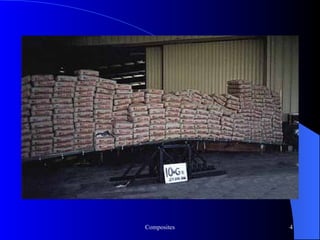
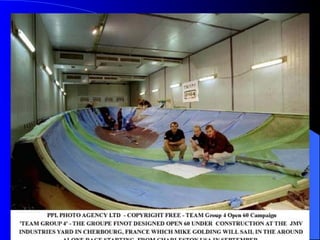
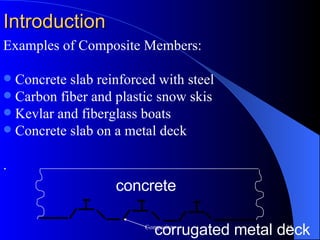
Examples of Composite Members: Concrete slab reinforced with steel Carbon fiber and plastic snow skis Kevlar and fiberglass boats Concrete slab on a metal deck . Introduction concrete corrugated metal deck
Introduction Composite materials consist of two components: the  fiber  and the  matrix   Fiber – the load carrying material Matrix - the fluid binder that hold the fibers in place when it solidifies.
Fibers Materials: Glass fiber (hence, fiberglass) Aramid fiber (Kevlar) Graphite fiber  (carbon) Metal fiber (concrete, ceramics) Boron fiber Wood fiber
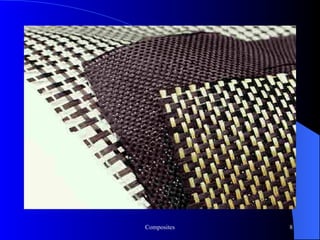
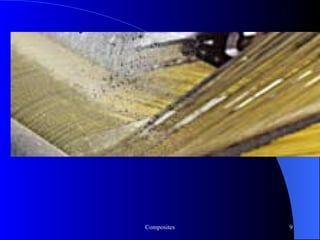
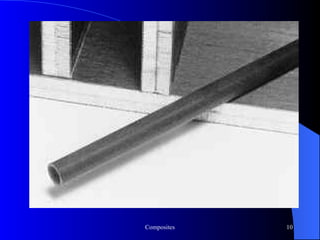
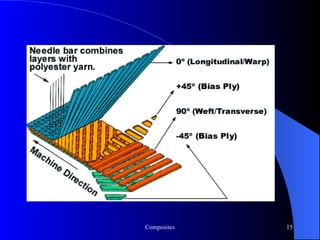
Fibers Forms: Strands (roving) – typically used with mandrel .  Direction and spacing controlled Woven mesh in sheets. Direction controlled Chopped fiber (approx 1” long) – random direction
 
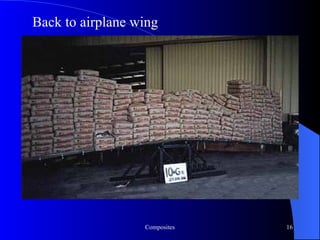
Back to airplane wing
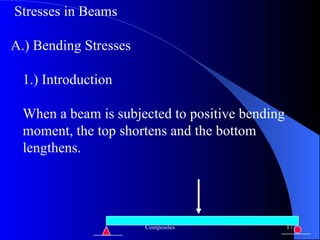
Stresses in Beams A.) Bending Stresses 1.) Introduction When a beam is subjected to positive bending moment, the top shortens and the bottom lengthens.
The bending strains are zero at the neutral axis. The bending strains increase proportionately with the distance from the neutral axis.   The maximum strains occur at the top and bottom of the beam (outer fibers)
Since stress is directly related to strain    =   E),  bending  stress  is also zero at the neutral axis and increases with the distance from the neutral axis. The maximum bending stresses occur at the top and bottom of the beam (outer fibers)
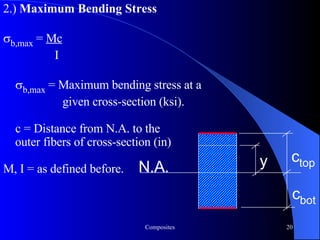
2.)  Maximum Bending Stress  b,max  =  Mc   I  b,max  = Maximum bending stress at a    given cross-section (ksi). c = Distance from N.A. to the  outer fibers of cross-section (in) M, I = as defined before. N.A. c top c bot y
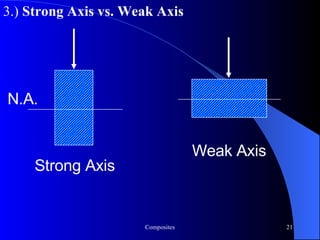
3.)  Strong Axis vs. Weak Axis Strong Axis N.A. Weak Axis
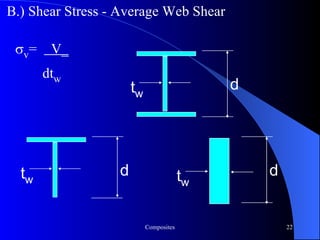
B.) Shear Stress - Average Web Shear  v =  V_ dt w d t w d t w d t w

10

  • 1.
  • 2.
    Learning Objectives: Whatare composites made of? How are composites fabricated? Composite Material Properties
  • 3.
  • 4.
  • 5.
  • 6.
  • 7.
  • 8.
  • 9.
  • 10.
  • 11.
    Examples of CompositeMembers: Concrete slab reinforced with steel Carbon fiber and plastic snow skis Kevlar and fiberglass boats Concrete slab on a metal deck . Introduction concrete corrugated metal deck
  • 12.
    Introduction Composite materialsconsist of two components: the fiber and the matrix Fiber – the load carrying material Matrix - the fluid binder that hold the fibers in place when it solidifies.
  • 13.
    Fibers Materials: Glassfiber (hence, fiberglass) Aramid fiber (Kevlar) Graphite fiber (carbon) Metal fiber (concrete, ceramics) Boron fiber Wood fiber
  • 14.
    Fibers Forms: Strands(roving) – typically used with mandrel . Direction and spacing controlled Woven mesh in sheets. Direction controlled Chopped fiber (approx 1” long) – random direction
  • 15.
  • 16.
  • 17.
    Stresses in BeamsA.) Bending Stresses 1.) Introduction When a beam is subjected to positive bending moment, the top shortens and the bottom lengthens.
  • 18.
    The bending strainsare zero at the neutral axis. The bending strains increase proportionately with the distance from the neutral axis. The maximum strains occur at the top and bottom of the beam (outer fibers)
  • 19.
    Since stress isdirectly related to strain  =  E), bending stress is also zero at the neutral axis and increases with the distance from the neutral axis. The maximum bending stresses occur at the top and bottom of the beam (outer fibers)
  • 20.
    2.) MaximumBending Stress  b,max = Mc I  b,max = Maximum bending stress at a given cross-section (ksi). c = Distance from N.A. to the outer fibers of cross-section (in) M, I = as defined before. N.A. c top c bot y
  • 21.
    3.) StrongAxis vs. Weak Axis Strong Axis N.A. Weak Axis
  • 22.
    B.) Shear Stress- Average Web Shear  v = V_ dt w d t w d t w d t w

Editor's Notes

  • #2 - Mechanics is the study of forces and their effects on bodies at rest or in motion. - MECHANICS - FLUID MECHANICS - FLUID STATICS (hydrostatics) - FLUID DYNAMICS (hydrodynamics) - SOLID MECHANICS - STATICS - DYNAMICS - Statics is a discipline in the field of mechanics in which we study the effects of forces on solid bodies at rest. We assume these solid bodies are rigid , that is they do not deform (stretch, compress, bend, flex or twist).