Early findings from the ATD’s OER Degree
Initiative
Zero textbook cost
degrees
Unless otherwise licensed, this presentation is licensed CC BY 4.0.
Success is what counts. 2
Richard Sebastian
Director, OER Degree Initiative
Achieving the Dream
Jean Amaral
Assistant Professor/Outreach
Librarian
Borough of Manhattan
Community College
Success is what counts. 3
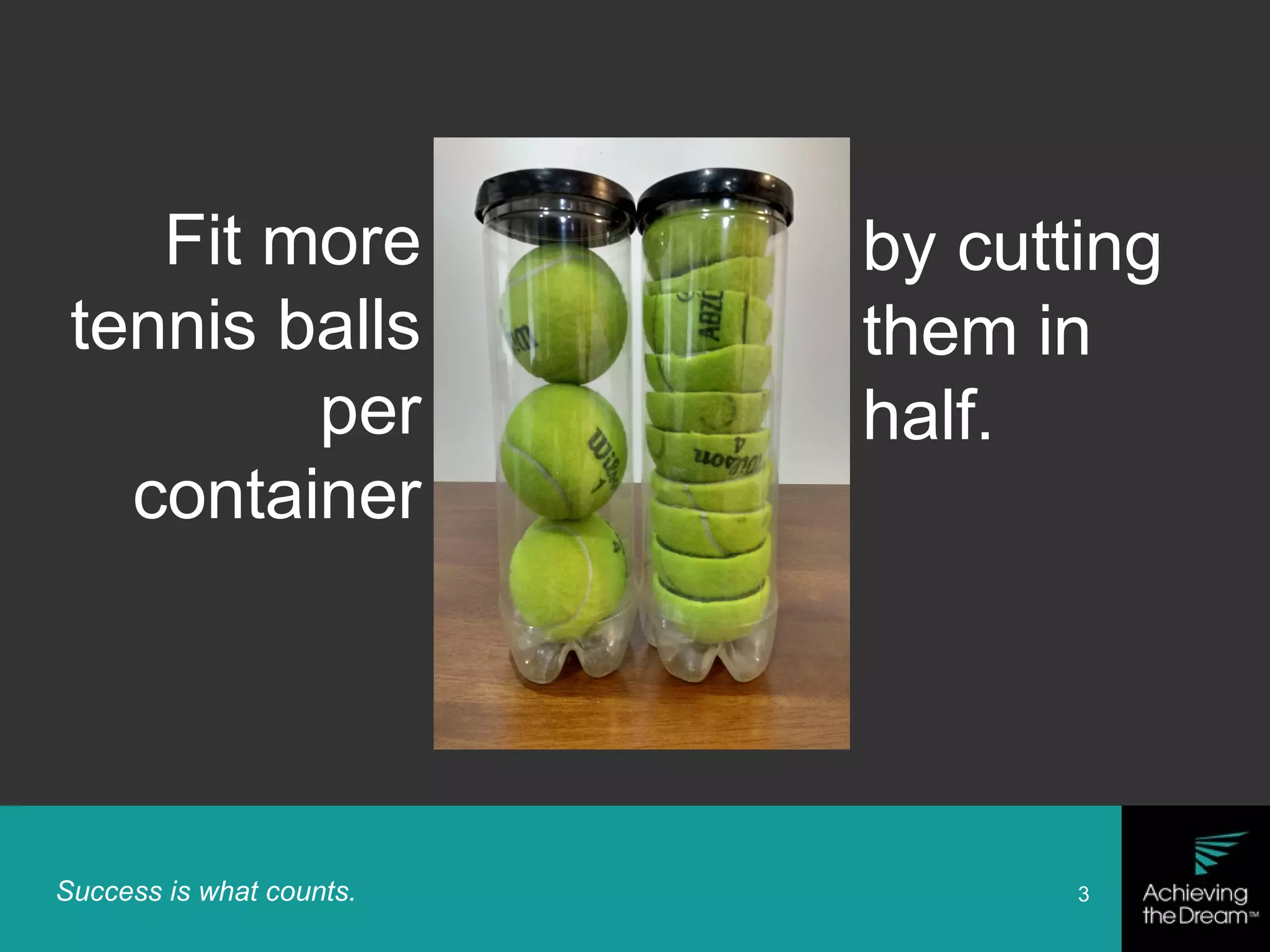
Fit more
tennis balls
per
container
by cutting
them in
half.
Success is what counts. 4
June 20, 2017
Success is what counts. 5
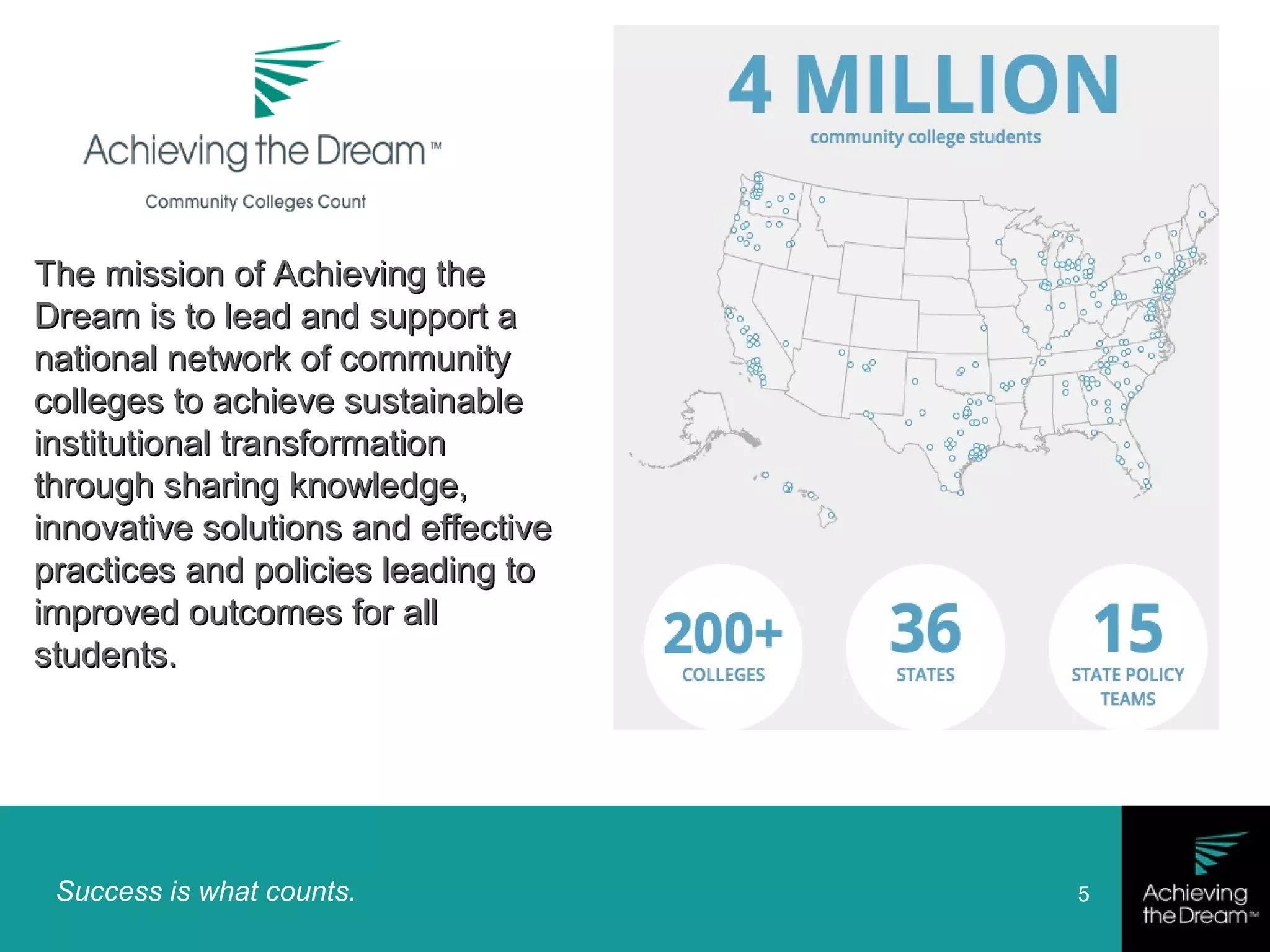
The mission of Achieving theThe mission of Achieving the
Dream is to lead and support aDream is to lead and support a
national network of communitynational network of community
colleges to achieve sustainablecolleges to achieve sustainable
institutional transformationinstitutional transformation
through sharing knowledge,through sharing knowledge,
innovative solutions and effectiveinnovative solutions and effective
practices and policies leading topractices and policies leading to
improved outcomes for allimproved outcomes for all
students.students.
Success is what counts. 6
OER OER
OER OER
OER
OER
OER
The mission of Achieving theThe mission of Achieving the
Dream is to lead and support aDream is to lead and support a
national network of communitynational network of community
colleges to achieve sustainablecolleges to achieve sustainable
institutional transformationinstitutional transformation
through sharing knowledge,through sharing knowledge,
innovative solutions and effectiveinnovative solutions and effective
practices and policies leading topractices and policies leading to
improved outcomes for allimproved outcomes for all
students.students.
Success is what counts. 7
Open educational resourcesOpen educational resources
(OER) are(OER) are freelyfreely availableavailable
materials that can bematerials that can be
downloaded, edited anddownloaded, edited and
sharedshared toto better servebetter serve allall
students.students.
Open educational resourcesOpen educational resources
(OER) are(OER) are freelyfreely availableavailable
materials that can bematerials that can be
downloaded, edited anddownloaded, edited and
sharedshared toto better servebetter serve allall
students.students.
CC-BY: https://www.flickr.com/photos/johanl/6966883093
Success is what counts. 8
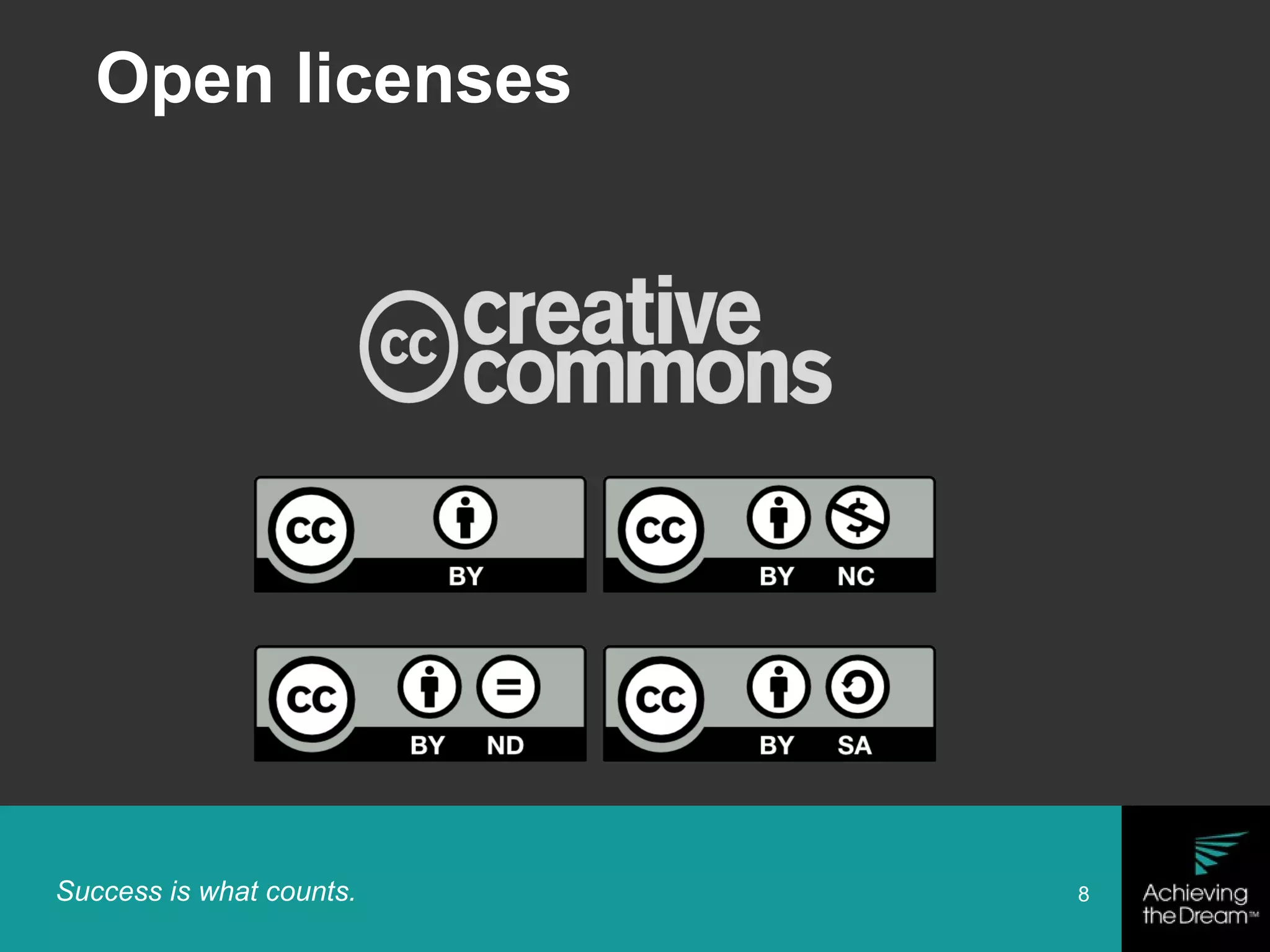
Open licenses
Success is what counts. 9
A “textbook” case of price gouging
Success is what counts. 10
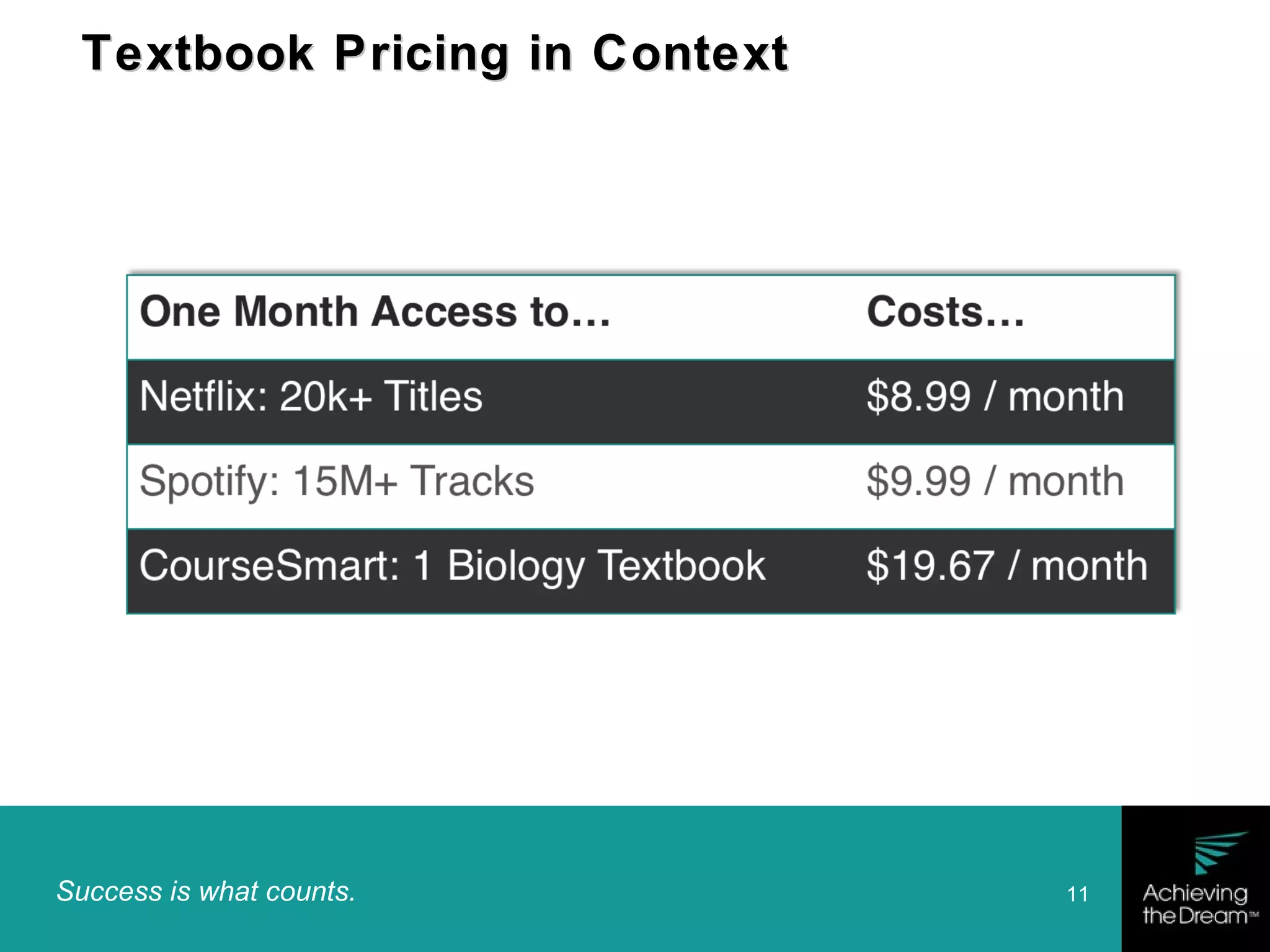
Textbook pricing in contextTextbook pricing in context
Success is what counts. 11
Textbook Pricing in ContextTextbook Pricing in Context
Success is what counts. 12
The redesign of a pathway ofThe redesign of a pathway of
existing courses that lead to aexisting courses that lead to a
degree or certificate using OERdegree or certificate using OER
instead of proprietary courseinstead of proprietary course
materials.materials.
What is an OER Degree?
Success is what counts. 13
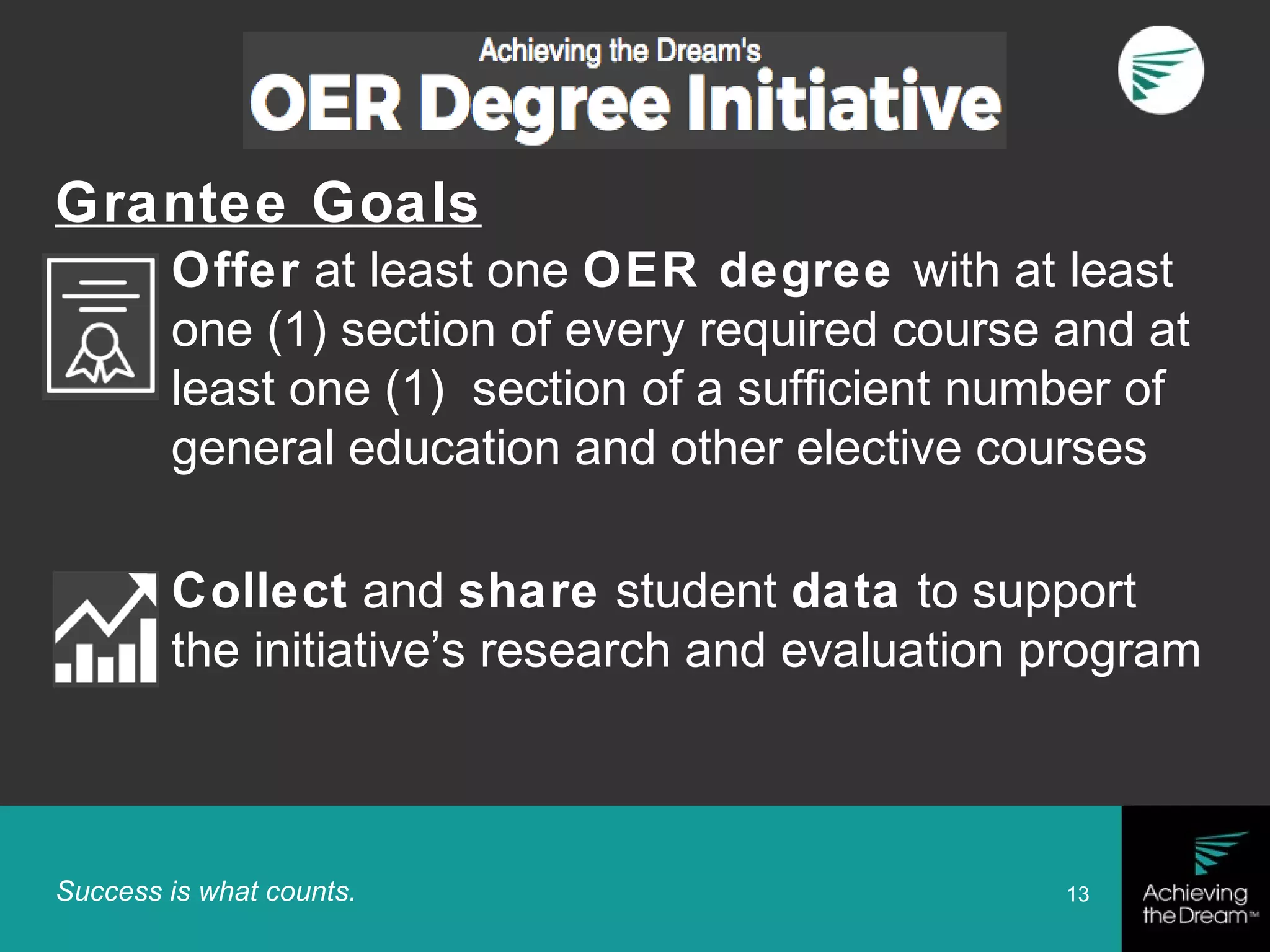
Offer at least one OER degree with at least
one (1) section of every required course and at
least one (1) section of a sufficient number of
general education and other elective courses
Collect and share student data to support
the initiative’s research and evaluation program
Grantee Goals
Success is what counts. 14
Share all educational materials developed
through this project with the public
Ensure access by and support for low
income students and students of color
in their OER degree programs
Grantee Goals
Success is what counts. 15
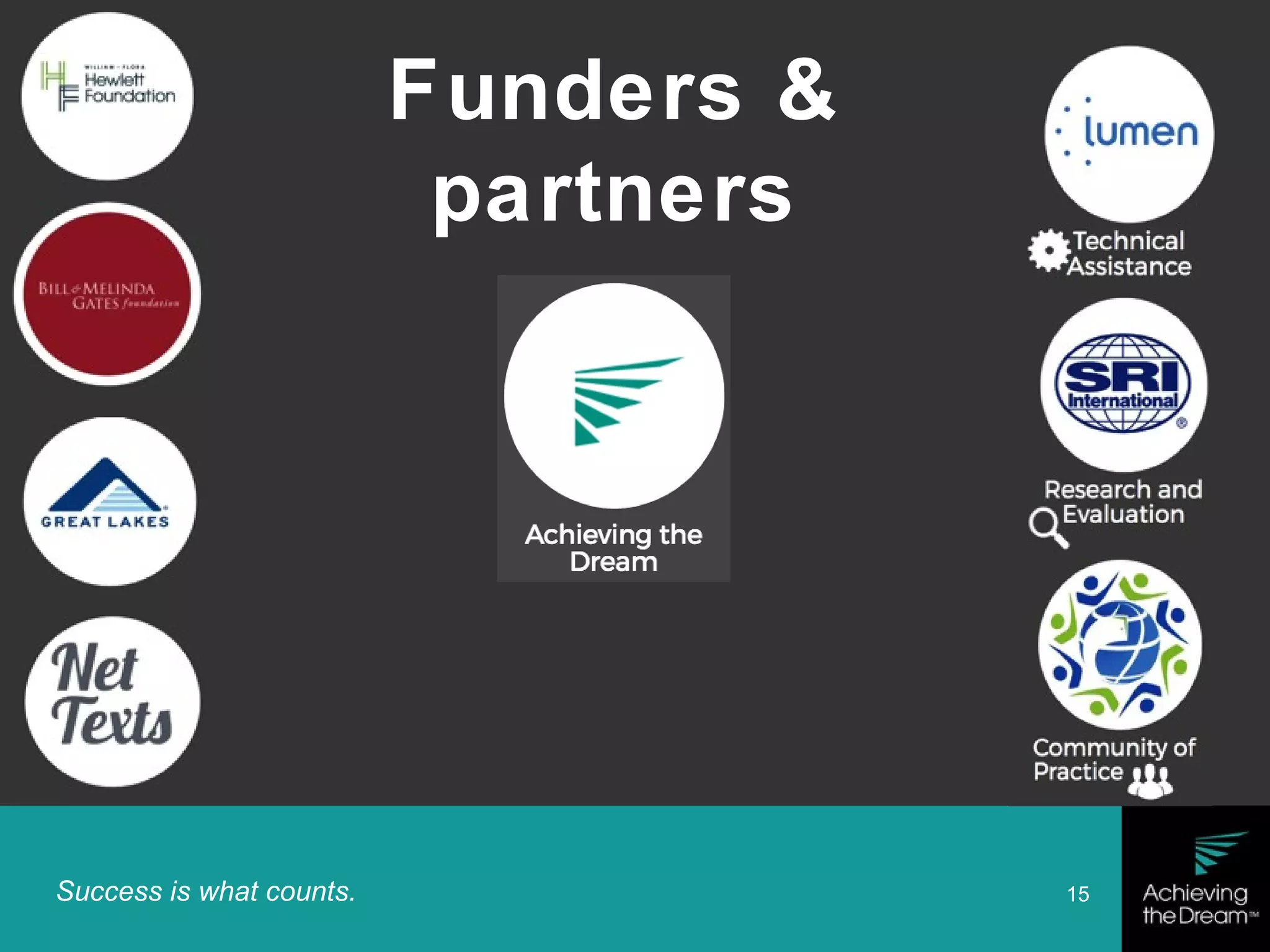
Funders &
partners
Success is what counts. 16
Timeline
Success is what counts. 17
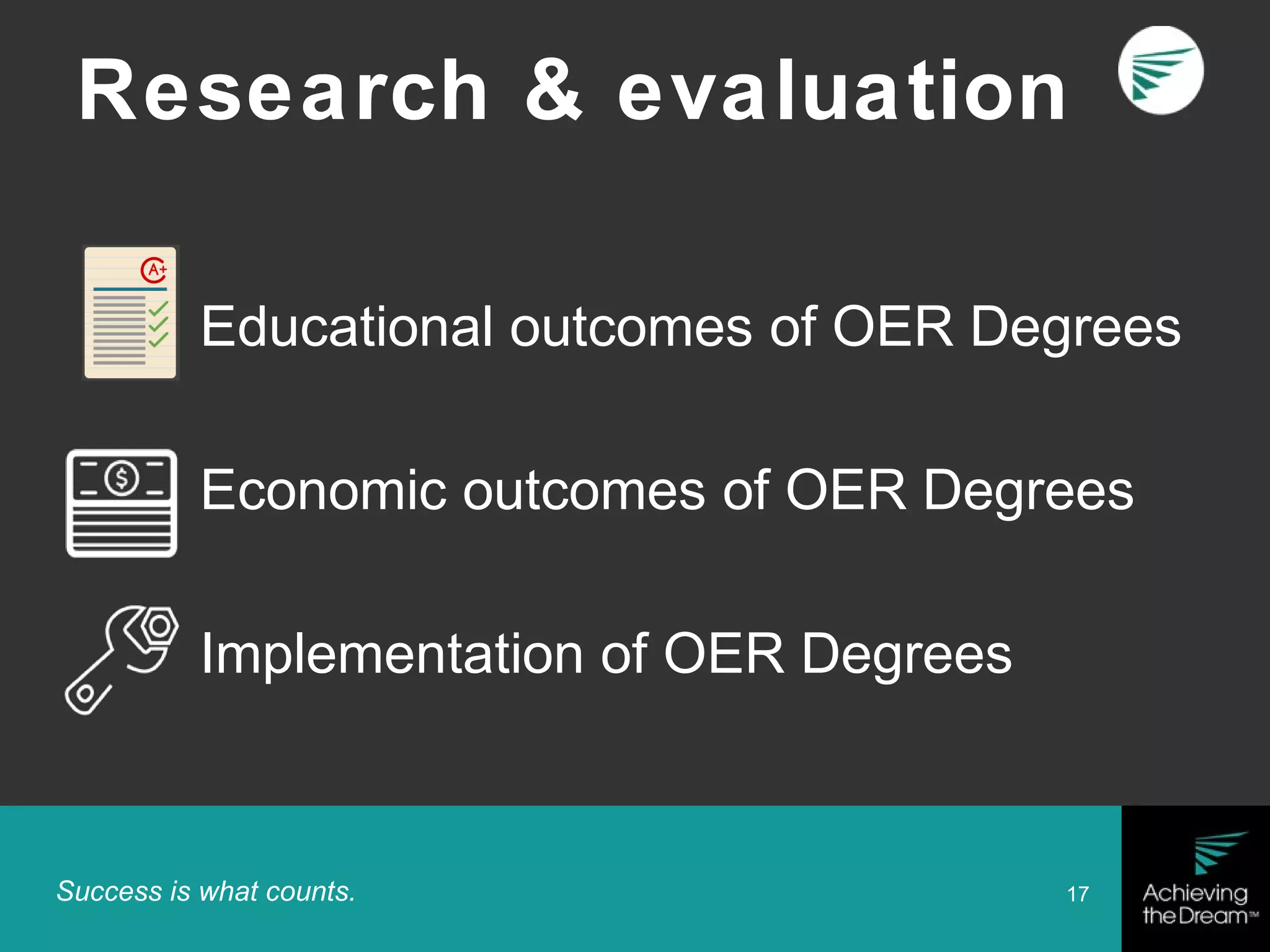
Research & evaluation
Educational outcomes of OER Degrees
Economic outcomes of OER Degrees
Implementation of OER Degrees
Success is what counts. 18
18
Research & evaluation
CC-0:https://www.pexels.com/u/louis-bauer-79024/
Success is what counts. 19
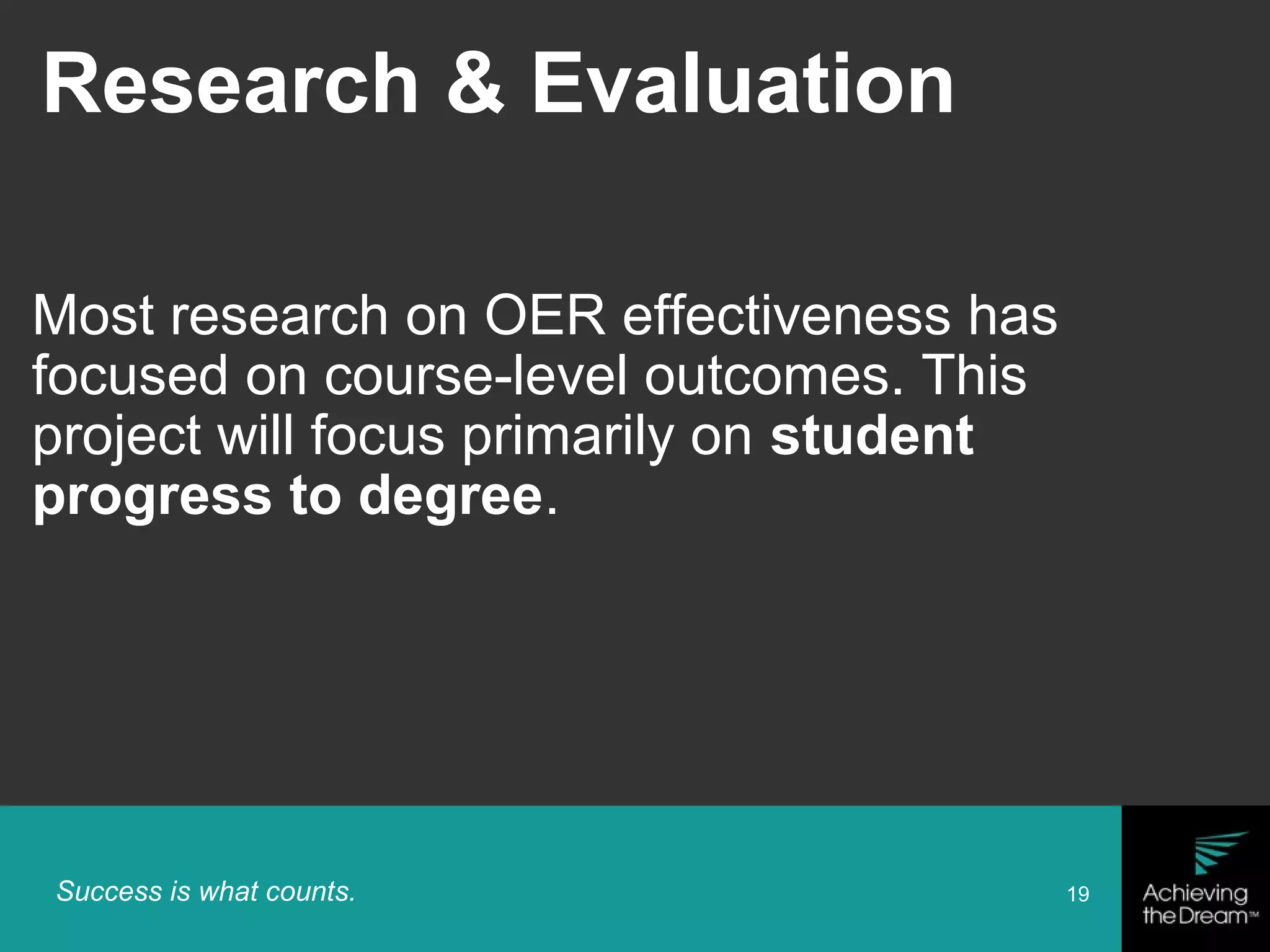
Most research on OER effectiveness has
focused on course-level outcomes. This
project will focus primarily on student
progress to degree.
Research & Evaluation
Success is what counts. 20
Quasi-experimental studies: to estimate the impact of
OER Degrees on key student outcomes
Cost analysis: to measure cost effectiveness and
sustainability
Implementation research: to provide formative
feedback to grantees and broader community
Aggregate pass/completion data: to evaluate the
overall impact of the OER Degree Initiative i.e. how
many OER course sections are offered, how many
students are involved, etc.
Research & Evaluation
Success is what counts. 21
Do students who take multiple OER degree
classes make more progress to degree than
similar students who take traditional classes?
Are OER degrees more or less beneficial to
particular subgroups of students? What are the key
mediators of effects on student outcomes?
What are best practices, facilitators, and barriers
associated with implementation of OER degree
programs?
What impacts do OER degrees have on key
stakeholders’ experiences and on institutional
culture?
Research & Evaluation
Success is what counts. 22
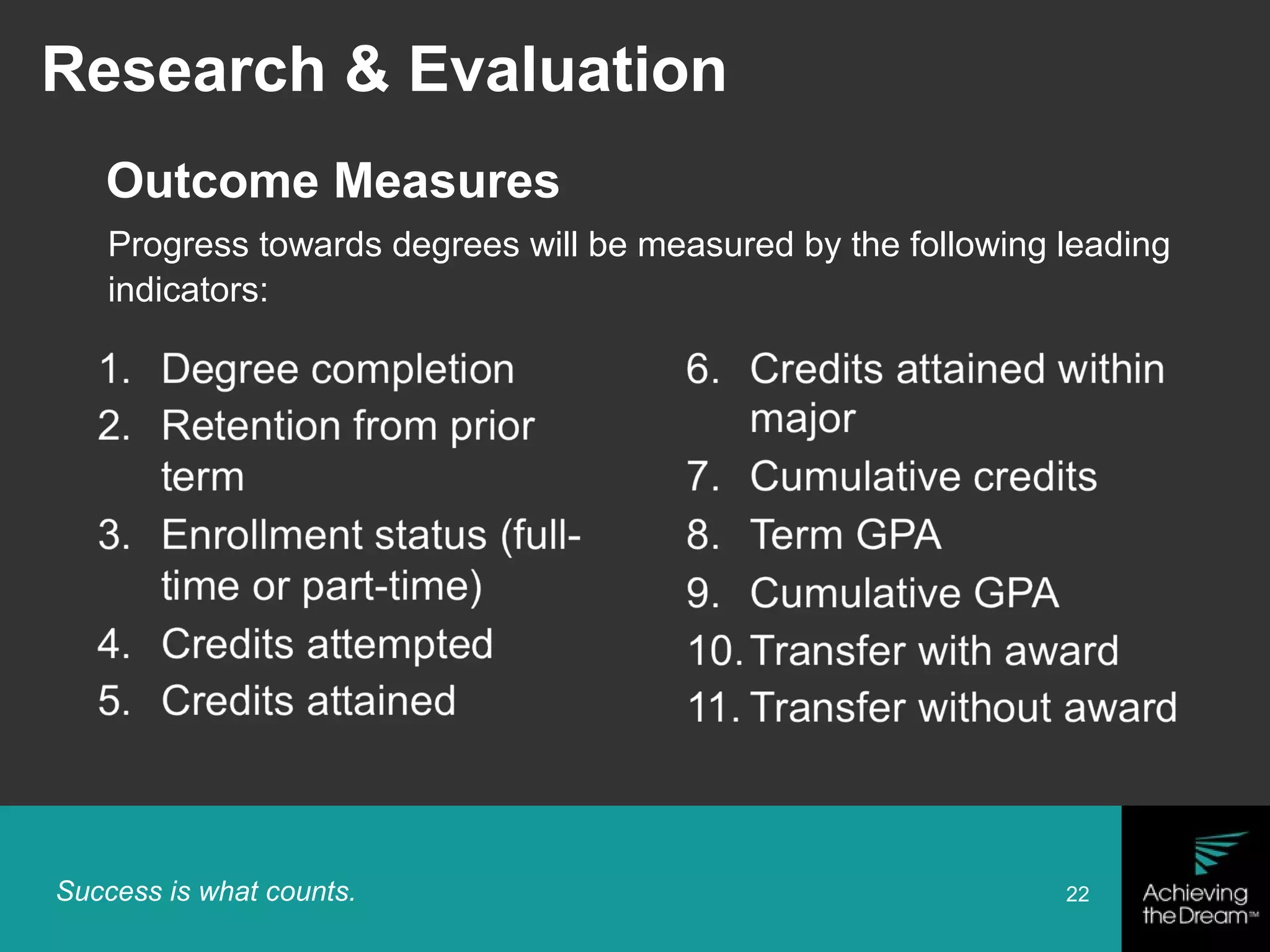
Outcome Measures
Progress towards degrees will be measured by the following leading
indicators:
Research & Evaluation
Success is what counts. 23
23
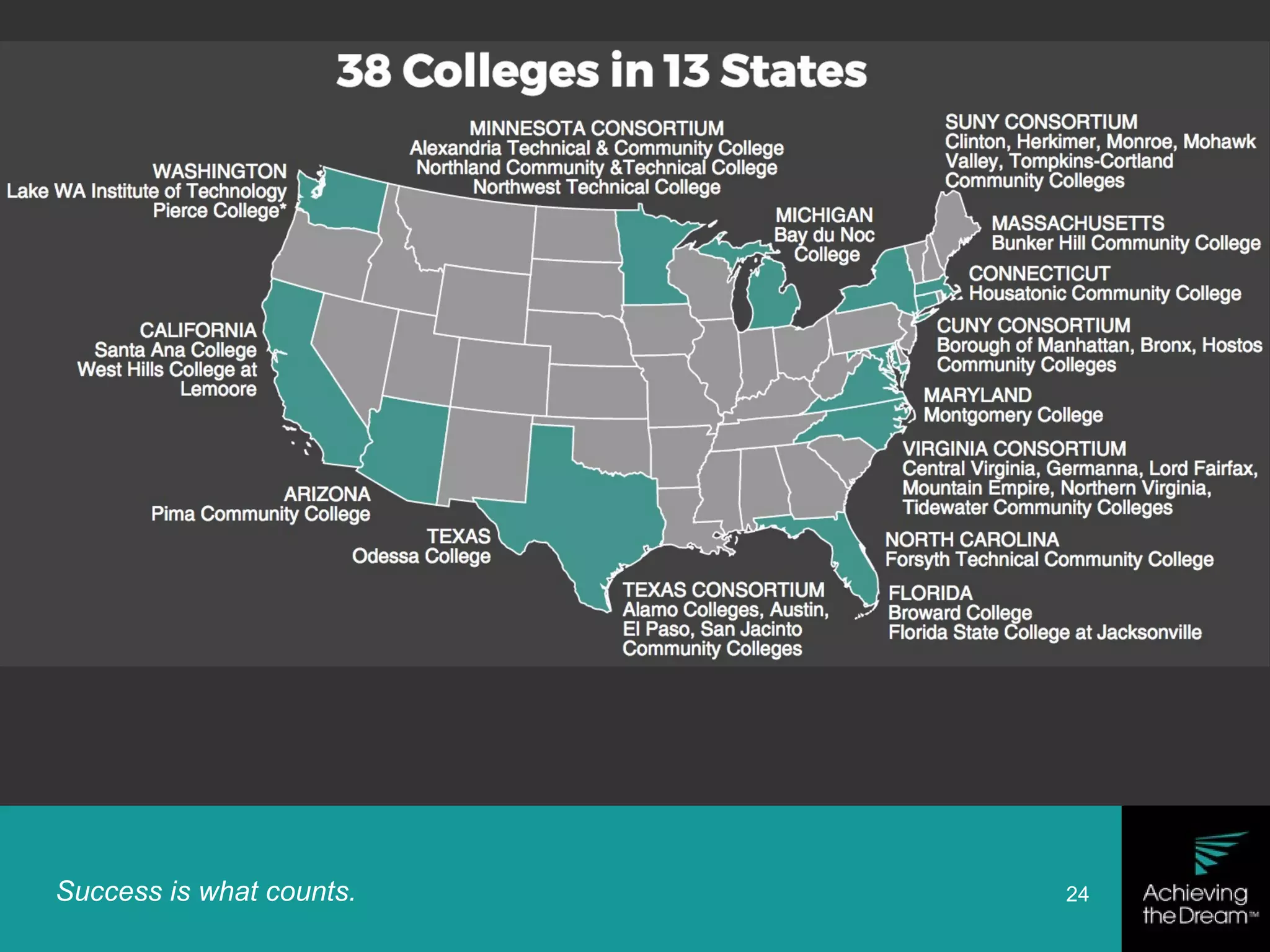
Who is participating in the
OER Degree Initiative?
CC –BY-NC: https://www.flickr.com/photos/uoeducation/10745091216
Success is what counts. 24
Questions?
Success is what counts. 25
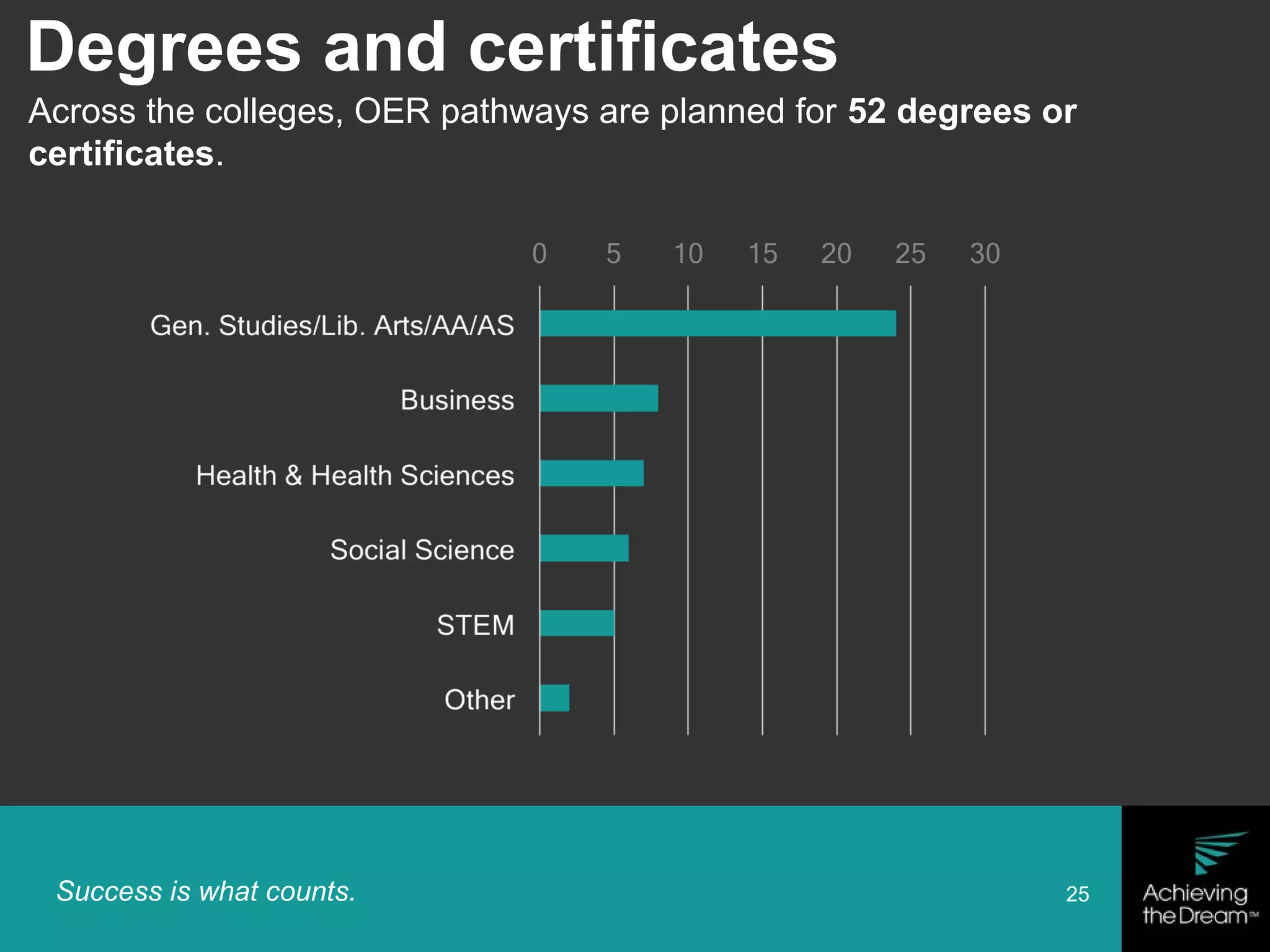
Across the colleges, OER pathways are planned for 52 degrees or
certificates.
Degrees and certificates
Success is what counts. 26
Fall 2016 enrollments
Success is what counts. 27
Success is what counts. 28
Success is what counts. 29
Grassroots Led
Numerous faculty members had independently
taken the initiative to experiment with OER and
convert their courses. These pioneers
established proof of concept on their campuses
and spread the word among their colleagues. In a
few cases where departments achieved strong
consensus around the decision to use OER,
entire gateway courses have been converted to
OER.
Success is what counts. 30
Administrator Led
One or more senior administrators were the first
to learn about OER degrees and saw this model
as a strong fit with their institution’s strategic
goals and mission. They took the lead in
recruiting faculty, building support among key
constituents, and shepherding resources to
launch their OER degree initiatives.
Success is what counts. 31
Service Unit Led
Librarians or units responsible for innovation in
teaching and learning (e.g. instructional
designers and technologists) were the first to
introduce OER to their campuses. These
proponents began by offering OER workshops to
faculty, attracting a few early adopters and
providing support for their course development.
Success is what counts. 32
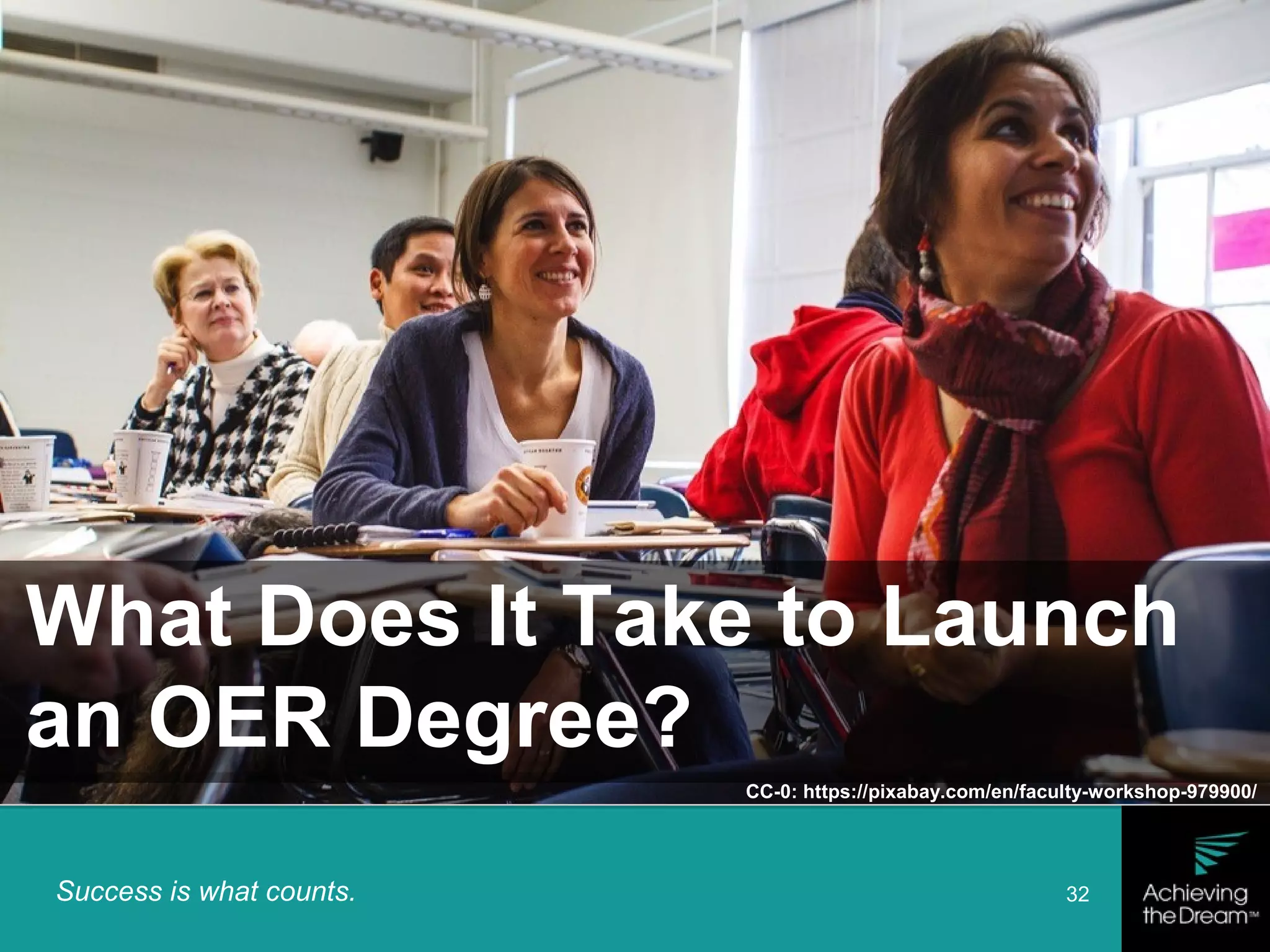
What Does It Take to Launch
an OER Degree?
CC-0: https://pixabay.com/en/faculty-workshop-979900/
Success is what counts. 33
OER courses vs. OER degrees
Developing an OER degree involves a broader set of
institutional investments in course development
and infrastructure than supporting individual faculty-
led OER course conversions.
What Does It Take to Launch an OER
Degree?
Success is what counts. 34
Course development
The largest initial investment required to launch a
complete OER degree pathway (typically about 20
courses) is the conversion of courses to OER.
Personnel costs are expected to account for the
largest upfront investment in developing OER
degrees.
What Does It Take to Launch an OER
Degree?
Success is what counts. 35
CC 0:https://www.pexels.com/photo/white-and-black-desk-calculator-on-white-graphing-paper-159804/
What About Sustainability?
Success is what counts. 36
The sustainability of OER degrees depends on the
extent to which the intervention becomes embedded
in organizational systems and connected to the
broader institutional strategy.
What About Sustainability?
Success is what counts. 37
What About Sustainability?
Success is what counts. 38
Most instructors see the primary advantage of OER as
alleviating a cost burden for students.
Some participants raised concerns that a case for OER
based on student cost savings alone will not sustain
long-term efforts.
Develop and share understanding of
strategic rationale for OER degree
Success is what counts. 39
OER creates pedagogical advantages for faculty such
as having access to more up-to-date course material
rather than textbooks that often become outdated
within a year or two.
Faculty are not yet widely taking advantage of or
seeing the benefits of the adaptability that an open
license provides.
Develop and share understanding of
strategic rationale for OER degree
Success is what counts. 40
What About Sustainability?
Success is what counts. 41
Instructors who have taken advantage
of supports for course development such as
instructional designers and library services and who
have experience using OER are more likely to report
changes in pedagogy.
Develop and share understanding of
strategic rationale for OER degree
Success is what counts. 42
It’s wonderful that I can adapt and remix
other sources and learning objectives. …
And I can also include other strategies that
help students be successful… That’s the
beauty of OER, you can adapt and make the
materials work for your classroom.
– Faculty
Success is what counts. 43
Next steps
http://www.mountainhome.af.mil/News/Art/igphoto/2001345294/
Success is what counts. 44
CC BY-SA-NC:https://www.flickr.com/photos/truthout/7598618262
Next steps
Fall 2017
Student survey
Grantee site visits
Spring-Fall 2018
Grantee site visits
2nd
Instructor survey
Section, student, and cost data

Zero Textbook Cost Degrees

  • 1.
    Early findings fromthe ATD’s OER Degree Initiative Zero textbook cost degrees Unless otherwise licensed, this presentation is licensed CC BY 4.0.
  • 2.
    Success is whatcounts. 2 Richard Sebastian Director, OER Degree Initiative Achieving the Dream Jean Amaral Assistant Professor/Outreach Librarian Borough of Manhattan Community College
  • 3.
    Success is whatcounts. 3 Fit more tennis balls per container by cutting them in half.
  • 4.
    Success is whatcounts. 4 June 20, 2017
  • 5.
    Success is whatcounts. 5 The mission of Achieving theThe mission of Achieving the Dream is to lead and support aDream is to lead and support a national network of communitynational network of community colleges to achieve sustainablecolleges to achieve sustainable institutional transformationinstitutional transformation through sharing knowledge,through sharing knowledge, innovative solutions and effectiveinnovative solutions and effective practices and policies leading topractices and policies leading to improved outcomes for allimproved outcomes for all students.students.
  • 6.
    Success is whatcounts. 6 OER OER OER OER OER OER OER The mission of Achieving theThe mission of Achieving the Dream is to lead and support aDream is to lead and support a national network of communitynational network of community colleges to achieve sustainablecolleges to achieve sustainable institutional transformationinstitutional transformation through sharing knowledge,through sharing knowledge, innovative solutions and effectiveinnovative solutions and effective practices and policies leading topractices and policies leading to improved outcomes for allimproved outcomes for all students.students.
  • 7.
    Success is whatcounts. 7 Open educational resourcesOpen educational resources (OER) are(OER) are freelyfreely availableavailable materials that can bematerials that can be downloaded, edited anddownloaded, edited and sharedshared toto better servebetter serve allall students.students. Open educational resourcesOpen educational resources (OER) are(OER) are freelyfreely availableavailable materials that can bematerials that can be downloaded, edited anddownloaded, edited and sharedshared toto better servebetter serve allall students.students. CC-BY: https://www.flickr.com/photos/johanl/6966883093
  • 8.
    Success is whatcounts. 8 Open licenses
  • 9.
    Success is whatcounts. 9 A “textbook” case of price gouging
  • 10.
    Success is whatcounts. 10 Textbook pricing in contextTextbook pricing in context
  • 11.
    Success is whatcounts. 11 Textbook Pricing in ContextTextbook Pricing in Context
  • 12.
    Success is whatcounts. 12 The redesign of a pathway ofThe redesign of a pathway of existing courses that lead to aexisting courses that lead to a degree or certificate using OERdegree or certificate using OER instead of proprietary courseinstead of proprietary course materials.materials. What is an OER Degree?
  • 13.
    Success is whatcounts. 13 Offer at least one OER degree with at least one (1) section of every required course and at least one (1) section of a sufficient number of general education and other elective courses Collect and share student data to support the initiative’s research and evaluation program Grantee Goals
  • 14.
    Success is whatcounts. 14 Share all educational materials developed through this project with the public Ensure access by and support for low income students and students of color in their OER degree programs Grantee Goals
  • 15.
    Success is whatcounts. 15 Funders & partners
  • 16.
    Success is whatcounts. 16 Timeline
  • 17.
    Success is whatcounts. 17 Research & evaluation Educational outcomes of OER Degrees Economic outcomes of OER Degrees Implementation of OER Degrees
  • 18.
    Success is whatcounts. 18 18 Research & evaluation CC-0:https://www.pexels.com/u/louis-bauer-79024/
  • 19.
    Success is whatcounts. 19 Most research on OER effectiveness has focused on course-level outcomes. This project will focus primarily on student progress to degree. Research & Evaluation
  • 20.
    Success is whatcounts. 20 Quasi-experimental studies: to estimate the impact of OER Degrees on key student outcomes Cost analysis: to measure cost effectiveness and sustainability Implementation research: to provide formative feedback to grantees and broader community Aggregate pass/completion data: to evaluate the overall impact of the OER Degree Initiative i.e. how many OER course sections are offered, how many students are involved, etc. Research & Evaluation
  • 21.
    Success is whatcounts. 21 Do students who take multiple OER degree classes make more progress to degree than similar students who take traditional classes? Are OER degrees more or less beneficial to particular subgroups of students? What are the key mediators of effects on student outcomes? What are best practices, facilitators, and barriers associated with implementation of OER degree programs? What impacts do OER degrees have on key stakeholders’ experiences and on institutional culture? Research & Evaluation
  • 22.
    Success is whatcounts. 22 Outcome Measures Progress towards degrees will be measured by the following leading indicators: Research & Evaluation
  • 23.
    Success is whatcounts. 23 23 Who is participating in the OER Degree Initiative? CC –BY-NC: https://www.flickr.com/photos/uoeducation/10745091216
  • 24.
    Success is whatcounts. 24 Questions?
  • 25.
    Success is whatcounts. 25 Across the colleges, OER pathways are planned for 52 degrees or certificates. Degrees and certificates
  • 26.
    Success is whatcounts. 26 Fall 2016 enrollments
  • 27.
    Success is whatcounts. 27
  • 28.
    Success is whatcounts. 28
  • 29.
    Success is whatcounts. 29 Grassroots Led Numerous faculty members had independently taken the initiative to experiment with OER and convert their courses. These pioneers established proof of concept on their campuses and spread the word among their colleagues. In a few cases where departments achieved strong consensus around the decision to use OER, entire gateway courses have been converted to OER.
  • 30.
    Success is whatcounts. 30 Administrator Led One or more senior administrators were the first to learn about OER degrees and saw this model as a strong fit with their institution’s strategic goals and mission. They took the lead in recruiting faculty, building support among key constituents, and shepherding resources to launch their OER degree initiatives.
  • 31.
    Success is whatcounts. 31 Service Unit Led Librarians or units responsible for innovation in teaching and learning (e.g. instructional designers and technologists) were the first to introduce OER to their campuses. These proponents began by offering OER workshops to faculty, attracting a few early adopters and providing support for their course development.
  • 32.
    Success is whatcounts. 32 What Does It Take to Launch an OER Degree? CC-0: https://pixabay.com/en/faculty-workshop-979900/
  • 33.
    Success is whatcounts. 33 OER courses vs. OER degrees Developing an OER degree involves a broader set of institutional investments in course development and infrastructure than supporting individual faculty- led OER course conversions. What Does It Take to Launch an OER Degree?
  • 34.
    Success is whatcounts. 34 Course development The largest initial investment required to launch a complete OER degree pathway (typically about 20 courses) is the conversion of courses to OER. Personnel costs are expected to account for the largest upfront investment in developing OER degrees. What Does It Take to Launch an OER Degree?
  • 35.
    Success is whatcounts. 35 CC 0:https://www.pexels.com/photo/white-and-black-desk-calculator-on-white-graphing-paper-159804/ What About Sustainability?
  • 36.
    Success is whatcounts. 36 The sustainability of OER degrees depends on the extent to which the intervention becomes embedded in organizational systems and connected to the broader institutional strategy. What About Sustainability?
  • 37.
    Success is whatcounts. 37 What About Sustainability?
  • 38.
    Success is whatcounts. 38 Most instructors see the primary advantage of OER as alleviating a cost burden for students. Some participants raised concerns that a case for OER based on student cost savings alone will not sustain long-term efforts. Develop and share understanding of strategic rationale for OER degree
  • 39.
    Success is whatcounts. 39 OER creates pedagogical advantages for faculty such as having access to more up-to-date course material rather than textbooks that often become outdated within a year or two. Faculty are not yet widely taking advantage of or seeing the benefits of the adaptability that an open license provides. Develop and share understanding of strategic rationale for OER degree
  • 40.
    Success is whatcounts. 40 What About Sustainability?
  • 41.
    Success is whatcounts. 41 Instructors who have taken advantage of supports for course development such as instructional designers and library services and who have experience using OER are more likely to report changes in pedagogy. Develop and share understanding of strategic rationale for OER degree
  • 42.
    Success is whatcounts. 42 It’s wonderful that I can adapt and remix other sources and learning objectives. … And I can also include other strategies that help students be successful… That’s the beauty of OER, you can adapt and make the materials work for your classroom. – Faculty
  • 43.
    Success is whatcounts. 43 Next steps http://www.mountainhome.af.mil/News/Art/igphoto/2001345294/
  • 44.
    Success is whatcounts. 44 CC BY-SA-NC:https://www.flickr.com/photos/truthout/7598618262 Next steps Fall 2017 Student survey Grantee site visits Spring-Fall 2018 Grantee site visits 2nd Instructor survey Section, student, and cost data

Editor's Notes

  • #6 Est. in 2004 Achieving the Dream believes that access to a high quality education in an inclusive environment is the right of all individuals and imperative for the continued advancement of a strong democracy and workforce. Achieving the Dream also believes higher education institutions have an obligation to work toward equity for their students. Equity is grounded in the principle of fairness. In higher education, equity refers to ensuring that each student receives what they need to be successful through the intentional design of the college experience. Columbus State Community College Cuyahoga Community College Eastern Gateway Community College Lorain County Community College North Central State College Sinclair Community College Zane State College
  • #7 Est. in 2004 Achieving the Dream believes that access to a high quality education in an inclusive environment is the right of all individuals and imperative for the continued advancement of a strong democracy and workforce. Achieving the Dream also believes higher education institutions have an obligation to work toward equity for their students. Equity is grounded in the principle of fairness. In higher education, equity refers to ensuring that each student receives what they need to be successful through the intentional design of the college experience.
  • #22 So, in order to test these hypotheses, these are our primary research questions: note that we’ll get to economic impacts in a minute)
  • #25 Overview Over 45 degrees in development 19 of the 38 colleges are active in ATD; 2 formerly active ATD institutions are also participating
  • #27 FA16 Enrollments Colleges weren’t required to launch OER courses in FA16 More had planned to offer courses but were delayed by the course verification requirements Future reports will focus more on outcomes ie enrollments, grades, completion etc.
  • #35 Build on the work of others; maintain your work.
  • #36 Costs Over 3100 students saved an average of $148 during Fall 2016 term Costs are one of the top three concerns of faculty This is a departure from past faculty surveys (Babson) where costs were less of a concern Teaching & Learning Little evidence of changes in teaching and learning, but data collected early in initiative
  • #45 Upcoming data collection Next round occurring in the fall of 2017 student survey (12 sites) site visits (5 grantees) Spring 18 and on data colllection Site visits (5 grantees) Second instructor survey Section and student level data Cost data – for the college and for students Internal Report: Spring 2018 Final report in Sept 2019