Source, Message,
and Channel
Factors
In this chapter, we analyze the major
variables in the communication
system: the source, message and
channel factors.
Source: Advertising & promotion an integrated marketing communication perspective 6th edition by George E Belch & Michael A Belch
Presentation by: Sanjaykumar Gopali
Guided by: Prof. Shrivatsa Joshi
Dr.D.Veerendra Heggade Institute of Management
Studies & Research – Vidyagiri, Dharwad
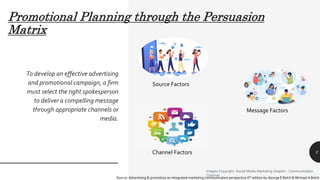
To develop an effective advertising
and promotional campaign, a firm
must select the right spokesperson
to deliver a compelling message
through appropriate channels or
media.
2
Source Factors
Channel Factors
Message Factors
Source: Advertising & promotion an integrated marketing communication perspective 6th edition by George E Belch & Michael A Belch
Images Copyright: Social Media Marketing Graphic - Communication
Channel
Promotional Planning through the Persuasion
Matrix
The Persuasion Matrix
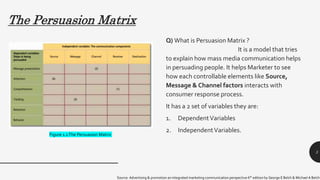
Q) What is Persuasion Matrix ?
It is a model that tries
to explain how mass media communication helps
in persuading people. It helps Marketer to see
how each controllable elements like Source,
Message & Channel factors interacts with
consumer response process.
It has a 2 set of variables they are:
1. DependentVariables
2. IndependentVariables.
3
Figure 1.1The Persuasion Matrix
Source: Advertising & promotion an integrated marketing communication perspective 6th edition by George E Belch & Michael A Belch
The Persuasion Matrix
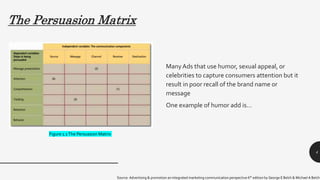
ManyAds that use humor, sexual appeal, or
celebrities to capture consumers attention but it
result in poor recall of the brand name or
message
One example of humor add is…
4
Figure 1.1The Persuasion Matrix
Source: Advertising & promotion an integrated marketing communication perspective 6th edition by George E Belch & Michael A Belch
5
Source: Advertising & promotion an integrated marketing communication perspective 6th edition by George E Belch & Michael A Belch
The following
examples, which
correspond to the
numbers in Figure 1-1,
illustrate decisions
that can be evaluated
with the persuasion
matrix.
6
1. Receiver/comprehension: Can the receiver
comprehend the ad?
2. Channel/presentation: Which media will
increase presentation?
3. Message/yielding: What type of message will
create favorable attitudes or feelings?
4. Source/attention: Who will be effective in
getting consumer’s attention?
Source: Advertising & promotion an integrated marketing communication perspective 6th edition by George E Belch & Michael A Belch
7
Source
Factors
 Source means the person involved in communicating a marketing message, either directly or
indirectly.
(Example for Direct source is attached in next slide)
 A direct source is a spokesperson who delivers a message or demonstrate a product or
service. An indirect source, is a model, doesn’t actually deliver a message but draws attention
and enhances the appearance of the ad.
 Herbert Kelman developed three basic categories of source attributes:
Source Credibility
Source Attractiveness and
Source Power.
7
Source: Advertising & promotion an integrated marketing communication perspective 6th edition by George E Belch & Michael A Belch
8
Source: Advertising & promotion an integrated marketing communication perspective 6th edition by George E Belch & Michael A Belch
9
 Source Credibility:
It is the extent to which the recipient sees the source as having relevant
knowledge, skill or experience & trust the sources to give unbiased objective information.
There are 2 dimension of Credibility & they are,
1) Applying Expertise:
Company’s use variety of technique to convey source expertise.
2) ApplyingTrustworthiness:
While expertise is important, the target audience must also find the
source believable. Advertisers uses various techniques to increase the perception that their
source is trustworthy by comparing with other brands. For example, Pepsodent comparing with
Colgate.
Source
Factors
Source: Advertising & promotion an integrated marketing communication perspective 6th edition by George E Belch & Michael A Belch
10
Source: Advertising & promotion an integrated marketing communication perspective 6th edition by George E Belch & Michael A Belch
11
Source
Factors
Source: Advertising & promotion an integrated marketing communication perspective 6th edition by George E Belch & Michael A Belch
 Source Attractiveness :
A source
attractiveness frequently used by advertiser is
attractiveness, which includes similarity, familiarity
and likability.
1) Similarity is supposed to sameness between the
source and the receiver of the message.
2) Familiarity refers to the knowledge of the
source through exposure.
3) Likability is an action for the source as a result
of physical appearance, behaviour or other
personal traits.
 Source Power:
A final characteristics
of Kelman’s classification scheme is Source
power.A source has as a power when he or
she manage reward and sentences to the
receiver.
The source may be able to
induce another person(s) to respond to the
request or position he or she is advocating.
12
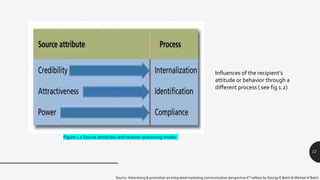
Figure 1.2 Source attributes and receiver processing modes
Influences of the recipient’s
attitude or behavior through a
different process ( see fig 1.2)
Source: Advertising & promotion an integrated marketing communication perspective 6th edition by George E Belch & Michael A Belch
13
Source: Advertising & promotion an integrated marketing communication perspective 6th edition by George E Belch & Michael A Belch
Fig 1.3 Meaning movement & endorsement process
14
Source: Advertising & promotion an integrated marketing communication perspective 6th edition by George E Belch & Michael A Belch
Message Factors
 Promotional managers must consider not only the content of their persuasive messages but also
how this information will be structured for presentation and what type of message appeal will be
used.
 Message Structure:
A body containing actual content of the message is known as message
structure.
 Order of Presentation:
Whether to put the strongest argument first or last in the advertisers
presentation is equally important. Should the most message points to be placed at the beginning of
the message, in the middle or at the end.?This suggest that a communicators strongest arguments
should be presented early or late in the but never in the middle
15
Source: Advertising & promotion an integrated marketing communication perspective 6th edition by George E Belch & Michael A Belch
Fig 1.4 Ad message recall as a function of order of presentation
16
Source: Advertising & promotion an integrated marketing communication perspective 6th edition by George E Belch & Michael A Belch
Message Factors
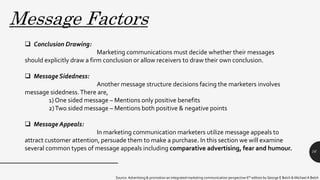
 Conclusion Drawing:
Marketing communications must decide whether their messages
should explicitly draw a firm conclusion or allow receivers to draw their own conclusion.
 Message Sidedness:
Another message structure decisions facing the marketers involves
message sidedness.There are,
1) One sided message – Mentions only positive benefits
2)Two sided message – Mentions both positive & negative points
 Message Appeals:
In marketing communication marketers utilize message appeals to
attract customer attention, persuade them to make a purchase. In this section we will examine
several common types of message appeals including comparative advertising, fear and humour.
17
Source: Advertising & promotion an integrated marketing communication perspective 6th edition by George E Belch & Michael A Belch
Message Factors
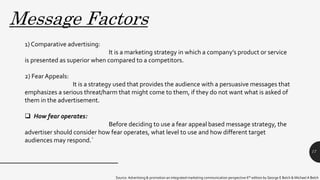
1) Comparative advertising:
It is a marketing strategy in which a company’s product or service
is presented as superior when compared to a competitors.
2) Fear Appeals:
It is a strategy used that provides the audience with a persuasive messages that
emphasizes a serious threat/harm that might come to them, if they do not want what is asked of
them in the advertisement.
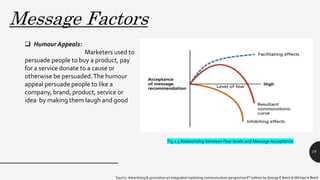
 How fear operates:
Before deciding to use a fear appeal based message strategy, the
advertiser should consider how fear operates, what level to use and how different target
audiences may respond.`
18
Source: Advertising & promotion an integrated marketing communication perspective 6th edition by George E Belch & Michael A Belch
Message Factors
 Humour Appeals:
Marketers used to
persuade people to buy a product, pay
for a service donate to a cause or
otherwise be persuaded.The humour
appeal persuade people to like a
company, brand, product, service or
idea by making them laugh and good
Fig 1.5 Relationship between Fear levels and MessageAcceptance
Images are subject toCopyrights
20
Source: Advertising & promotion an integrated marketing communication perspective 6th edition by George E Belch & Michael A Belch

Source & Message Factors.pptx

  • 1.
    Source, Message, and Channel Factors Inthis chapter, we analyze the major variables in the communication system: the source, message and channel factors. Source: Advertising & promotion an integrated marketing communication perspective 6th edition by George E Belch & Michael A Belch Presentation by: Sanjaykumar Gopali Guided by: Prof. Shrivatsa Joshi Dr.D.Veerendra Heggade Institute of Management Studies & Research – Vidyagiri, Dharwad
  • 2.
    To develop aneffective advertising and promotional campaign, a firm must select the right spokesperson to deliver a compelling message through appropriate channels or media. 2 Source Factors Channel Factors Message Factors Source: Advertising & promotion an integrated marketing communication perspective 6th edition by George E Belch & Michael A Belch Images Copyright: Social Media Marketing Graphic - Communication Channel Promotional Planning through the Persuasion Matrix
  • 3.
    The Persuasion Matrix Q)What is Persuasion Matrix ? It is a model that tries to explain how mass media communication helps in persuading people. It helps Marketer to see how each controllable elements like Source, Message & Channel factors interacts with consumer response process. It has a 2 set of variables they are: 1. DependentVariables 2. IndependentVariables. 3 Figure 1.1The Persuasion Matrix Source: Advertising & promotion an integrated marketing communication perspective 6th edition by George E Belch & Michael A Belch
  • 4.
    The Persuasion Matrix ManyAdsthat use humor, sexual appeal, or celebrities to capture consumers attention but it result in poor recall of the brand name or message One example of humor add is… 4 Figure 1.1The Persuasion Matrix Source: Advertising & promotion an integrated marketing communication perspective 6th edition by George E Belch & Michael A Belch
  • 5.
    5 Source: Advertising &promotion an integrated marketing communication perspective 6th edition by George E Belch & Michael A Belch
  • 6.
    The following examples, which correspondto the numbers in Figure 1-1, illustrate decisions that can be evaluated with the persuasion matrix. 6 1. Receiver/comprehension: Can the receiver comprehend the ad? 2. Channel/presentation: Which media will increase presentation? 3. Message/yielding: What type of message will create favorable attitudes or feelings? 4. Source/attention: Who will be effective in getting consumer’s attention? Source: Advertising & promotion an integrated marketing communication perspective 6th edition by George E Belch & Michael A Belch
  • 7.
    7 Source Factors  Source meansthe person involved in communicating a marketing message, either directly or indirectly. (Example for Direct source is attached in next slide)  A direct source is a spokesperson who delivers a message or demonstrate a product or service. An indirect source, is a model, doesn’t actually deliver a message but draws attention and enhances the appearance of the ad.  Herbert Kelman developed three basic categories of source attributes: Source Credibility Source Attractiveness and Source Power. 7 Source: Advertising & promotion an integrated marketing communication perspective 6th edition by George E Belch & Michael A Belch
  • 8.
    8 Source: Advertising &promotion an integrated marketing communication perspective 6th edition by George E Belch & Michael A Belch
  • 9.
    9  Source Credibility: Itis the extent to which the recipient sees the source as having relevant knowledge, skill or experience & trust the sources to give unbiased objective information. There are 2 dimension of Credibility & they are, 1) Applying Expertise: Company’s use variety of technique to convey source expertise. 2) ApplyingTrustworthiness: While expertise is important, the target audience must also find the source believable. Advertisers uses various techniques to increase the perception that their source is trustworthy by comparing with other brands. For example, Pepsodent comparing with Colgate. Source Factors Source: Advertising & promotion an integrated marketing communication perspective 6th edition by George E Belch & Michael A Belch
  • 10.
    10 Source: Advertising &promotion an integrated marketing communication perspective 6th edition by George E Belch & Michael A Belch
  • 11.
    11 Source Factors Source: Advertising &promotion an integrated marketing communication perspective 6th edition by George E Belch & Michael A Belch  Source Attractiveness : A source attractiveness frequently used by advertiser is attractiveness, which includes similarity, familiarity and likability. 1) Similarity is supposed to sameness between the source and the receiver of the message. 2) Familiarity refers to the knowledge of the source through exposure. 3) Likability is an action for the source as a result of physical appearance, behaviour or other personal traits.  Source Power: A final characteristics of Kelman’s classification scheme is Source power.A source has as a power when he or she manage reward and sentences to the receiver. The source may be able to induce another person(s) to respond to the request or position he or she is advocating.
  • 12.
    12 Figure 1.2 Sourceattributes and receiver processing modes Influences of the recipient’s attitude or behavior through a different process ( see fig 1.2) Source: Advertising & promotion an integrated marketing communication perspective 6th edition by George E Belch & Michael A Belch
  • 13.
    13 Source: Advertising &promotion an integrated marketing communication perspective 6th edition by George E Belch & Michael A Belch Fig 1.3 Meaning movement & endorsement process
  • 14.
    14 Source: Advertising &promotion an integrated marketing communication perspective 6th edition by George E Belch & Michael A Belch Message Factors  Promotional managers must consider not only the content of their persuasive messages but also how this information will be structured for presentation and what type of message appeal will be used.  Message Structure: A body containing actual content of the message is known as message structure.  Order of Presentation: Whether to put the strongest argument first or last in the advertisers presentation is equally important. Should the most message points to be placed at the beginning of the message, in the middle or at the end.?This suggest that a communicators strongest arguments should be presented early or late in the but never in the middle
  • 15.
    15 Source: Advertising &promotion an integrated marketing communication perspective 6th edition by George E Belch & Michael A Belch Fig 1.4 Ad message recall as a function of order of presentation
  • 16.
    16 Source: Advertising &promotion an integrated marketing communication perspective 6th edition by George E Belch & Michael A Belch Message Factors  Conclusion Drawing: Marketing communications must decide whether their messages should explicitly draw a firm conclusion or allow receivers to draw their own conclusion.  Message Sidedness: Another message structure decisions facing the marketers involves message sidedness.There are, 1) One sided message – Mentions only positive benefits 2)Two sided message – Mentions both positive & negative points  Message Appeals: In marketing communication marketers utilize message appeals to attract customer attention, persuade them to make a purchase. In this section we will examine several common types of message appeals including comparative advertising, fear and humour.
  • 17.
    17 Source: Advertising &promotion an integrated marketing communication perspective 6th edition by George E Belch & Michael A Belch Message Factors 1) Comparative advertising: It is a marketing strategy in which a company’s product or service is presented as superior when compared to a competitors. 2) Fear Appeals: It is a strategy used that provides the audience with a persuasive messages that emphasizes a serious threat/harm that might come to them, if they do not want what is asked of them in the advertisement.  How fear operates: Before deciding to use a fear appeal based message strategy, the advertiser should consider how fear operates, what level to use and how different target audiences may respond.`
  • 18.
    18 Source: Advertising &promotion an integrated marketing communication perspective 6th edition by George E Belch & Michael A Belch Message Factors  Humour Appeals: Marketers used to persuade people to buy a product, pay for a service donate to a cause or otherwise be persuaded.The humour appeal persuade people to like a company, brand, product, service or idea by making them laugh and good Fig 1.5 Relationship between Fear levels and MessageAcceptance
  • 19.
    Images are subjecttoCopyrights
  • 20.
    20 Source: Advertising &promotion an integrated marketing communication perspective 6th edition by George E Belch & Michael A Belch

Editor's Notes

  • #7 For Point no 1: Marketers must know their target market to make their messages clear and understandable. A less educated person may have more difficulty interpreting a complicated message. For Point no 2: A top-rated, prime-time TV program is seen by nearly 12 million households each week. TV Guide and Reader’s Digest reach nearly 12 million homes with each issue. But the important point is how well they reach the marketer’s target audience. For Point no 3: Marketers generally try to create agreeable messages that lead to positive feelings toward the product or service. Humorous messages often put consumers in a good mood and evoke positive feelings that may become associated with the brand being advertised For Point no 4: The large number of ads we are bombarded with every day makes it difficult for advertisers to break through the clutter. Marketers deal with this problem by using sources who will attract the target audience’s attention