Being a Product
Owner
Helen Meek
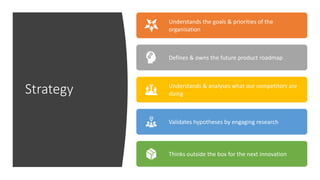
Strategy
Understands the goals & priorities of the
organisation
Defines & owns the future product roadmap
Understands & analyses what our competitors are
doing
Validates hypotheses by engaging research
Thinks outside the box for the next innovation
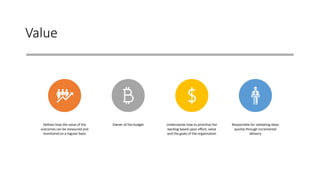
Value
Defines how the value of the
outcomes can be measured and
monitored on a regular basis
Owner of the budget Understands how to prioritise the
backlog based upon effort, value
and the goals of the organisation
Responsible for validating ideas
quickly through incremental
delivery
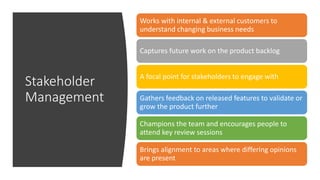
Stakeholder
Management
Works with internal & external customers to
understand changing business needs
Captures future work on the product backlog
A focal point for stakeholders to engage with
Gathers feedback on released features to validate or
grow the product further
Champions the team and encourages people to
attend key review sessions
Brings alignment to areas where differing opinions
are present
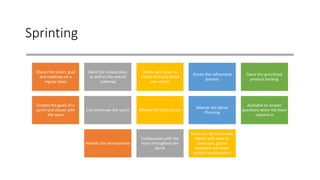
Sprinting
Shares the vision, goal
and roadmap on a
regular basis
Owns the release plan,
as well as the overall
roadmap
Works with team to
create vertically sliced
user stories
Drives the refinement
process
Owns the prioritised
product backlog
Creates the goals of a
sprint and shares with
the team
Can terminate the sprint Attends the Daily Scrum
Attends the Sprint
Planning
Available to answer
questions when the team
requires it
Attends the retrospective
Collaborates with the
team throughout the
Sprint
Owns the Sprint Review.
Works with team to
showcase, gather
feedback and share
product performance
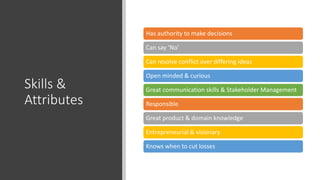
Skills &
Attributes
Has authority to make decisions
Can say ‘No’
Can resolve conflict over differing ideas
Open minded & curious
Great communication skills & Stakeholder Management
Responsible
Great product & domain knowledge
Entrepreneurial & visionary
Knows when to cut losses
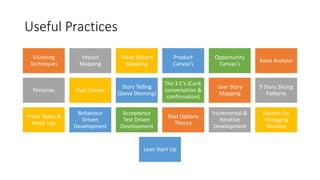
Useful Practices
Visioning
Techniques
Impact
Mapping
Value Stream
Mapping
Product
Canvas’s
Opportunity
Canvas’s
Kano Analysis
Personas User Stories
Story Telling
(Steve Denning)
The 3 C’s (Card,
conversation &
confirmation)
User Story
Mapping
9 Story Slicing
Patterns
Proto Types &
Mock Ups
Behaviour
Driven
Development
Acceptance
Test Driven
Development
Real Options
Theory
Incremental &
Iterative
Development
Kanban for
managing
Ideation
Lean Start Up
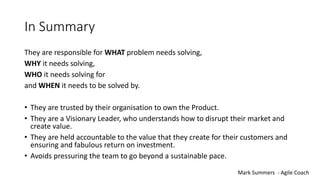
In Summary
They are responsible for WHAT problem needs solving,
WHY it needs solving,
WHO it needs solving for
and WHEN it needs to be solved by.
• They are trusted by their organisation to own the Product.
• They are a Visionary Leader, who understands how to disrupt their market and
create value.
• They are held accountable to the value that they create for their customers and
ensuring and fabulous return on investment.
• Avoids pressuring the team to go beyond a sustainable pace.
Mark Summers - Agile Coach

Being a product owner

  • 1.
  • 2.
    Strategy Understands the goals& priorities of the organisation Defines & owns the future product roadmap Understands & analyses what our competitors are doing Validates hypotheses by engaging research Thinks outside the box for the next innovation
  • 3.
    Value Defines how thevalue of the outcomes can be measured and monitored on a regular basis Owner of the budget Understands how to prioritise the backlog based upon effort, value and the goals of the organisation Responsible for validating ideas quickly through incremental delivery
  • 4.
    Stakeholder Management Works with internal& external customers to understand changing business needs Captures future work on the product backlog A focal point for stakeholders to engage with Gathers feedback on released features to validate or grow the product further Champions the team and encourages people to attend key review sessions Brings alignment to areas where differing opinions are present
  • 5.
    Sprinting Shares the vision,goal and roadmap on a regular basis Owns the release plan, as well as the overall roadmap Works with team to create vertically sliced user stories Drives the refinement process Owns the prioritised product backlog Creates the goals of a sprint and shares with the team Can terminate the sprint Attends the Daily Scrum Attends the Sprint Planning Available to answer questions when the team requires it Attends the retrospective Collaborates with the team throughout the Sprint Owns the Sprint Review. Works with team to showcase, gather feedback and share product performance
  • 6.
    Skills & Attributes Has authorityto make decisions Can say ‘No’ Can resolve conflict over differing ideas Open minded & curious Great communication skills & Stakeholder Management Responsible Great product & domain knowledge Entrepreneurial & visionary Knows when to cut losses
  • 7.
    Useful Practices Visioning Techniques Impact Mapping Value Stream Mapping Product Canvas’s Opportunity Canvas’s KanoAnalysis Personas User Stories Story Telling (Steve Denning) The 3 C’s (Card, conversation & confirmation) User Story Mapping 9 Story Slicing Patterns Proto Types & Mock Ups Behaviour Driven Development Acceptance Test Driven Development Real Options Theory Incremental & Iterative Development Kanban for managing Ideation Lean Start Up
  • 8.
    In Summary They areresponsible for WHAT problem needs solving, WHY it needs solving, WHO it needs solving for and WHEN it needs to be solved by. • They are trusted by their organisation to own the Product. • They are a Visionary Leader, who understands how to disrupt their market and create value. • They are held accountable to the value that they create for their customers and ensuring and fabulous return on investment. • Avoids pressuring the team to go beyond a sustainable pace. Mark Summers - Agile Coach