Unit 2.1 How do businesses start?
Today’s Lesson The Entrepreneur Famous Entrepreneurs Reasons for Starting up a Business Innovations & Inventors Tycoons
The Entrepreneur What is an entrepreneur? An individual who brings together the factors of production
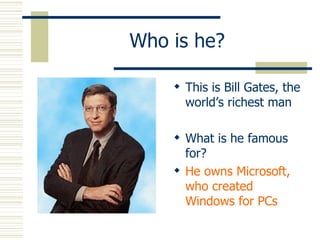
Who is he? This is Bill Gates, the world’s richest man What is he famous for? He owns Microsoft, who created Windows for PCs
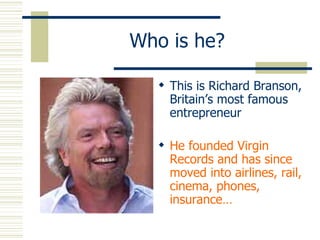
Who is he? This is Richard Branson, Britain’s most famous entrepreneur He founded Virgin Records and has since moved into airlines, rail, cinema, phones, insurance…
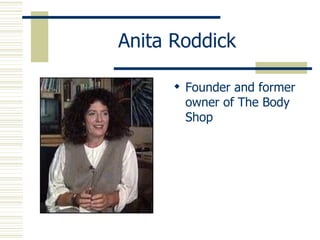
Anita Roddick Founder and former owner of The Body Shop
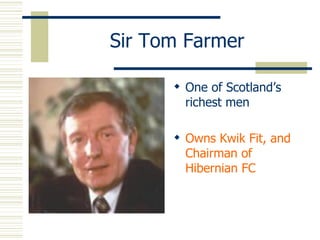
Sir Tom Farmer One of Scotland’s richest men Owns Kwik Fit, and Chairman of Hibernian FC
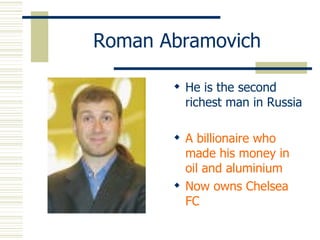
Roman Abramovich He is the second richest man in Russia A billionaire who made his money in oil and aluminium Now owns Chelsea FC
Reasons for starting up a business To make money To provide a public service Because they see a demand Because they have an idea Because they can do better
Innovators and Inventions
Tycoon John Paul Getty (1892-1976) was an oil baron   . He was at one time the richest man in the world. He was successful in business yet assembled a huge art collection which became a museum in 1974.
Today’s Lesson The Marketplace Buyers Sellers Customers & Consumers
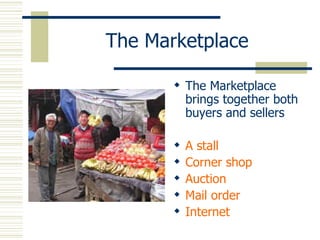
The Marketplace The Marketplace brings together both buyers and sellers A stall Corner shop Auction Mail order Internet
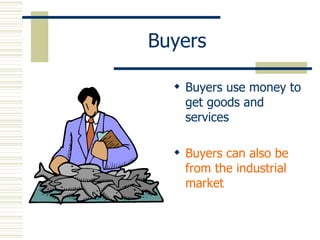
Buyers Buyers use money to get goods and services Buyers can also be from the industrial market
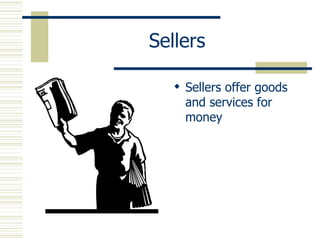
Sellers Sellers offer goods and services for money
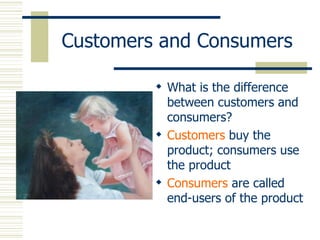
Customers and Consumers What is the difference between customers and consumers? Customers  buy the product; consumers use the product Consumers  are called end-users of the product
Today’s Lesson What is marketing? Product v Market Orientation Introduction to the Marketing Mix
Marketing Marketing is not just about selling. Marketing is knowing about and satisfying customer needs For businesses to be successful and market their goods/services they have to consider:
Product v Market Orientation Firms which are  product orientated  focus on making the product/service better, in terms of quality & technical excellence Firms which are  market orientated  focus on what the customer actually wants
The Marketing Mix The 4 Ps: Product Price Place Promotion
Product This is the good/service produced Does it satisfy consumers’ needs? Is it good quality? Can demand be met?
Price The monetary value offered to consumers Does the price help cover production & labour costs? Is price affordable to consumers?
Place This is where the product/service is available to consumers Shops? Direct mail? Online?
Promotion This involves letting people know about your product/service Word of mouth Advertising Sales Promotions Public Relations
Summary The marketing mix is: Selling the right product At the right price At the right place With the right promotional tool
Today’s Lesson Identify Needs Market Research Desk Research Field Research
Identify Needs Before we satisfy consumer needs we need to find out what they are! What do people want? Research the market: Ask consumers!
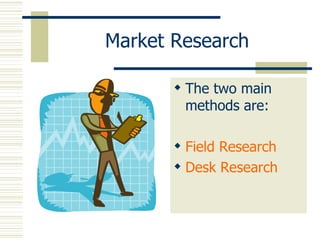
Market Research The two main methods are: Field Research Desk Research
Desk Research Also called Secondary Information Using info already at hand  (Internal info) Using info already published by others  (External info)
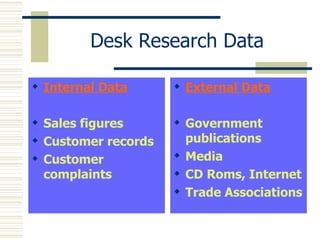
Desk Research Data Internal Data Sales figures Customer records Customer complaints External Data Government publications Media CD Roms, Internet Trade Associations
Field Research Also called Primary Research Gathering new info by themselves Can use questionnaires, surveys or interviews to find out about what consumers want
Today’s Lesson Surveys & Questionnaires +/- of Post +/- of Phone +/- of Face-to-face interviews
Methods of Conducting Surveys/Questionnaires By Post By Telephone Face-to-Face
Research by Post Advantages Cheap People can think about answers people may respond rather than personal interview anonymous Disadvantages Low response rate How valid are answers? Limited amount of information
Research by Phone Advantages More flexible than by post Response rate higher Quick and easy Disadvantages Person hasn’t time to think Limited info collected expensive
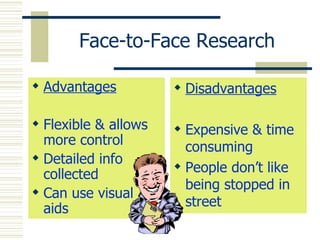
Face-to-Face Research Advantages Flexible & allows more control Detailed info collected Can use visual aids Disadvantages Expensive & time consuming People don’t like being stopped in street
Today’s Lesson How products are developed Stages in New Product Development Prototypes
Product Development
Stages in NPD
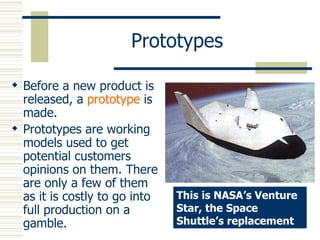
Prototypes Before a new product is released, a  prototype  is made. Prototypes are working models used to get potential customers opinions on them. There are only a few of them as it is costly to go into full production on a gamble. This is NASA’s Venture Star, the Space Shuttle’s replacement
Today’s Lesson Market Segmentation Consumer Behaviour
Market Segmentation
Consumer Behaviour
Marketing Mix
Product Life Cycle
Branding
Pricing
Place
Promotion
Business Support Support is offered in the shape of money or advice The Prince’s Trust Local enterprise companies Local government Business start-up schemes banks
Business Plan “ If we fail to plan, we plan to fail!” If a business is to meet its goals and objectives it needs a business plan When do we use it? When starting out for the first time Showing potential investors When planning for expansion
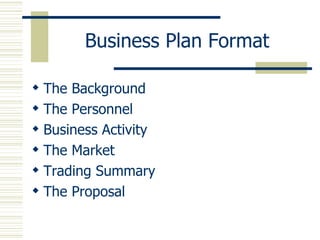
Business Plan Format The Background The Personnel Business Activity The Market Trading Summary The Proposal
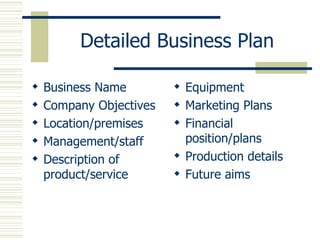
Detailed Business Plan Business Name Company Objectives Location/premises Management/staff Description of product/service Equipment Marketing Plans Financial position/plans Production details Future aims

Standard Grade Business Management Unit 2.1 Slides

  • 1.
    Unit 2.1 Howdo businesses start?
  • 2.
    Today’s Lesson TheEntrepreneur Famous Entrepreneurs Reasons for Starting up a Business Innovations & Inventors Tycoons
  • 3.
    The Entrepreneur Whatis an entrepreneur? An individual who brings together the factors of production
  • 4.
    Who is he?This is Bill Gates, the world’s richest man What is he famous for? He owns Microsoft, who created Windows for PCs
  • 5.
    Who is he?This is Richard Branson, Britain’s most famous entrepreneur He founded Virgin Records and has since moved into airlines, rail, cinema, phones, insurance…
  • 6.
    Anita Roddick Founderand former owner of The Body Shop
  • 7.
    Sir Tom FarmerOne of Scotland’s richest men Owns Kwik Fit, and Chairman of Hibernian FC
  • 8.
    Roman Abramovich Heis the second richest man in Russia A billionaire who made his money in oil and aluminium Now owns Chelsea FC
  • 9.
    Reasons for startingup a business To make money To provide a public service Because they see a demand Because they have an idea Because they can do better
  • 10.
  • 11.
    Tycoon John PaulGetty (1892-1976) was an oil baron . He was at one time the richest man in the world. He was successful in business yet assembled a huge art collection which became a museum in 1974.
  • 12.
    Today’s Lesson TheMarketplace Buyers Sellers Customers & Consumers
  • 13.
    The Marketplace TheMarketplace brings together both buyers and sellers A stall Corner shop Auction Mail order Internet
  • 14.
    Buyers Buyers usemoney to get goods and services Buyers can also be from the industrial market
  • 15.
    Sellers Sellers offergoods and services for money
  • 16.
    Customers and ConsumersWhat is the difference between customers and consumers? Customers buy the product; consumers use the product Consumers are called end-users of the product
  • 17.
    Today’s Lesson Whatis marketing? Product v Market Orientation Introduction to the Marketing Mix
  • 18.
    Marketing Marketing isnot just about selling. Marketing is knowing about and satisfying customer needs For businesses to be successful and market their goods/services they have to consider:
  • 19.
    Product v MarketOrientation Firms which are product orientated focus on making the product/service better, in terms of quality & technical excellence Firms which are market orientated focus on what the customer actually wants
  • 20.
    The Marketing MixThe 4 Ps: Product Price Place Promotion
  • 21.
    Product This isthe good/service produced Does it satisfy consumers’ needs? Is it good quality? Can demand be met?
  • 22.
    Price The monetaryvalue offered to consumers Does the price help cover production & labour costs? Is price affordable to consumers?
  • 23.
    Place This iswhere the product/service is available to consumers Shops? Direct mail? Online?
  • 24.
    Promotion This involvesletting people know about your product/service Word of mouth Advertising Sales Promotions Public Relations
  • 25.
    Summary The marketingmix is: Selling the right product At the right price At the right place With the right promotional tool
  • 26.
    Today’s Lesson IdentifyNeeds Market Research Desk Research Field Research
  • 27.
    Identify Needs Beforewe satisfy consumer needs we need to find out what they are! What do people want? Research the market: Ask consumers!
  • 28.
    Market Research Thetwo main methods are: Field Research Desk Research
  • 29.
    Desk Research Alsocalled Secondary Information Using info already at hand (Internal info) Using info already published by others (External info)
  • 30.
    Desk Research DataInternal Data Sales figures Customer records Customer complaints External Data Government publications Media CD Roms, Internet Trade Associations
  • 31.
    Field Research Alsocalled Primary Research Gathering new info by themselves Can use questionnaires, surveys or interviews to find out about what consumers want
  • 32.
    Today’s Lesson Surveys& Questionnaires +/- of Post +/- of Phone +/- of Face-to-face interviews
  • 33.
    Methods of ConductingSurveys/Questionnaires By Post By Telephone Face-to-Face
  • 34.
    Research by PostAdvantages Cheap People can think about answers people may respond rather than personal interview anonymous Disadvantages Low response rate How valid are answers? Limited amount of information
  • 35.
    Research by PhoneAdvantages More flexible than by post Response rate higher Quick and easy Disadvantages Person hasn’t time to think Limited info collected expensive
  • 36.
    Face-to-Face Research AdvantagesFlexible & allows more control Detailed info collected Can use visual aids Disadvantages Expensive & time consuming People don’t like being stopped in street
  • 37.
    Today’s Lesson Howproducts are developed Stages in New Product Development Prototypes
  • 38.
  • 39.
  • 40.
    Prototypes Before anew product is released, a prototype is made. Prototypes are working models used to get potential customers opinions on them. There are only a few of them as it is costly to go into full production on a gamble. This is NASA’s Venture Star, the Space Shuttle’s replacement
  • 41.
    Today’s Lesson MarketSegmentation Consumer Behaviour
  • 42.
  • 43.
  • 44.
  • 45.
  • 46.
  • 47.
  • 48.
  • 49.
  • 50.
    Business Support Supportis offered in the shape of money or advice The Prince’s Trust Local enterprise companies Local government Business start-up schemes banks
  • 51.
    Business Plan “If we fail to plan, we plan to fail!” If a business is to meet its goals and objectives it needs a business plan When do we use it? When starting out for the first time Showing potential investors When planning for expansion
  • 52.
    Business Plan FormatThe Background The Personnel Business Activity The Market Trading Summary The Proposal
  • 53.
    Detailed Business PlanBusiness Name Company Objectives Location/premises Management/staff Description of product/service Equipment Marketing Plans Financial position/plans Production details Future aims