Behaviour Driven Development
with Cucumber for Java
BDD
Domain Driven Design - DDD
● Common understanding
● Common language
● Test Driven Development - TDD
● Good technical practices
● Small steps
● Combined → Behaviour Driven Development
Test automation
 Test Driven Development, TDD – Develop it the
right way
 Behaviour Driven Development, BDD –
Develop the right thing
Three core principles
• Business and Technology should refer to the same system in
the same way
• Any system should have an identified, verifiable value
• Up-front analysis, design and planning all have a diminishing
return
Common language
Used by all involved
• Customer
• Developers
• Others?
Verifiable value
• Protect revenue
• Increase revenue
• Manage cost
• Increase brand value
• Make the product remarkable
• Provide more value to your customer
Big design up-front
• No big design up-front
• The further you plan ahead, the less accurate you will be
Three questions
• What is the most important thing the system should do?
• What is the next most important thing the system doesn't do
yet?
• If we were to switch off the system, where and what would be
the biggest impact?
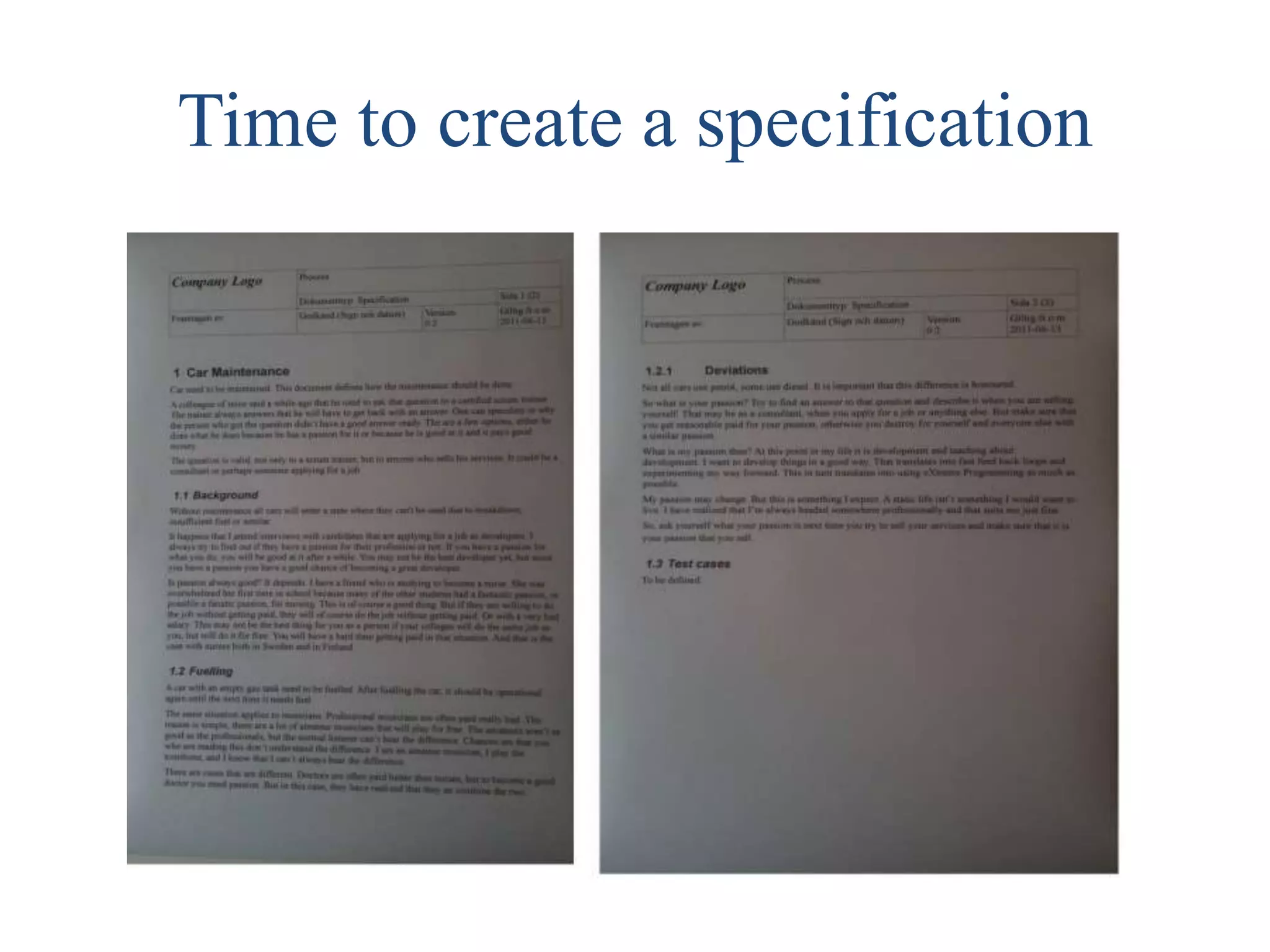
Time to create a specification
When are we done?
Interpret and translate
 We need to read the spec.
 Understand it
 Translate it into code
 Parse and execute it?
 No, not all specs are created equal
Solution
Write specifications so
 Translations isn't needed
 It is possible to execute them
Format
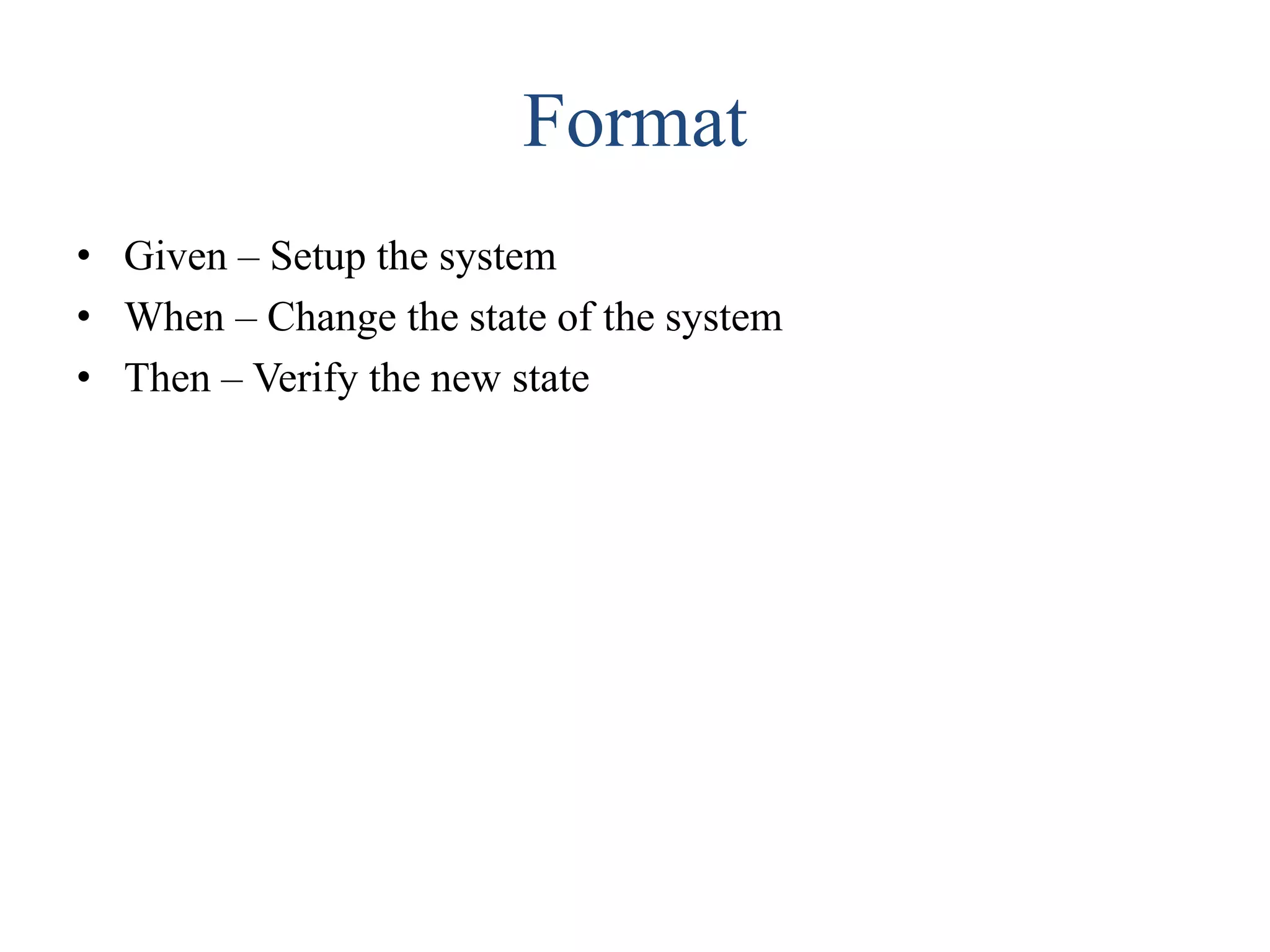
• Given – Setup the system
• When – Change the state of the system
• Then – Verify the new state
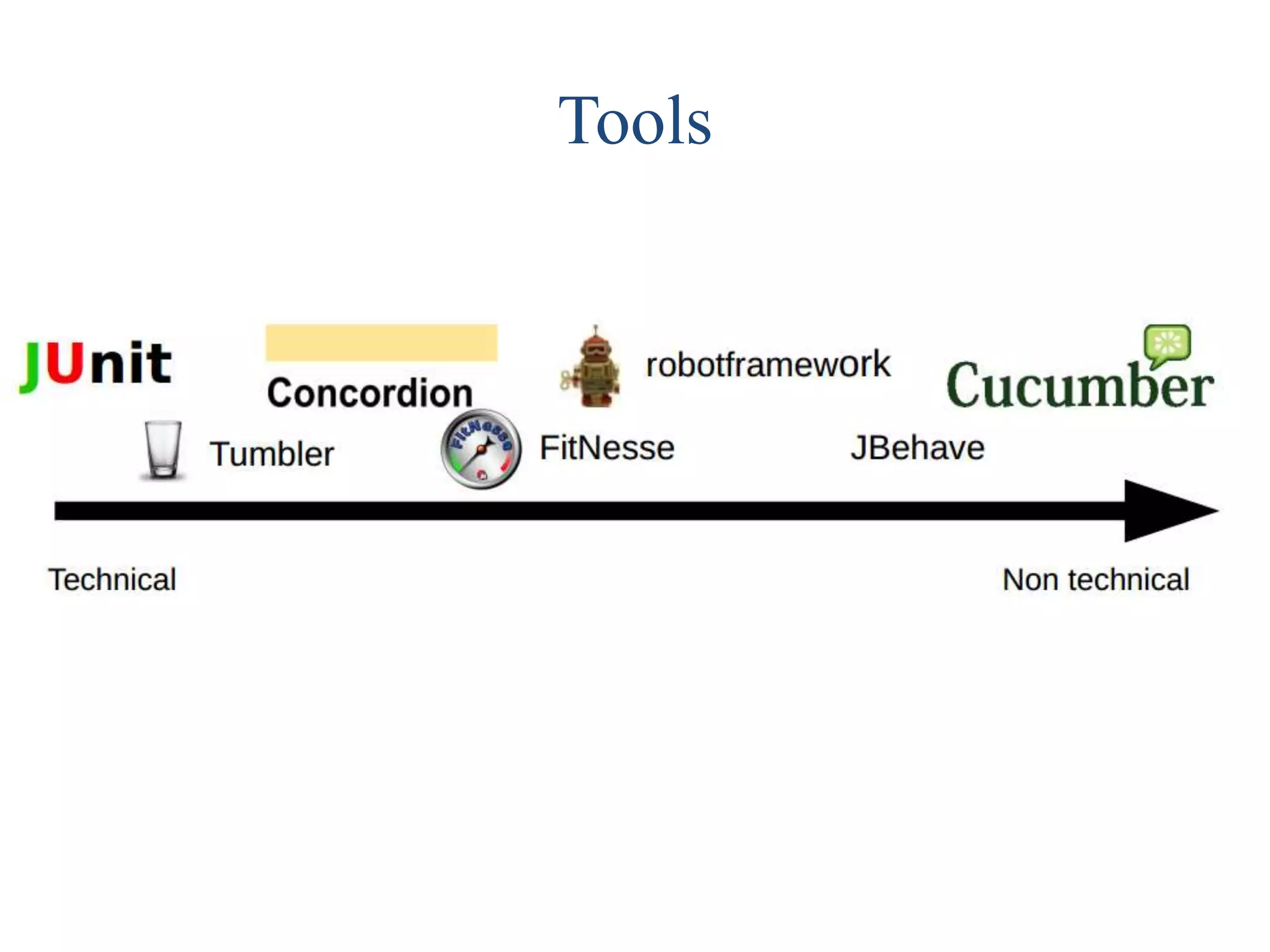
Tools
Audience
Readers
 Customers
 Developers
Maintainers
 Product owner
 Developers
Why Cucumber
 It is one of the least technical tools
 It is a very active open source project
 It supports a variety of languages
A concrete example
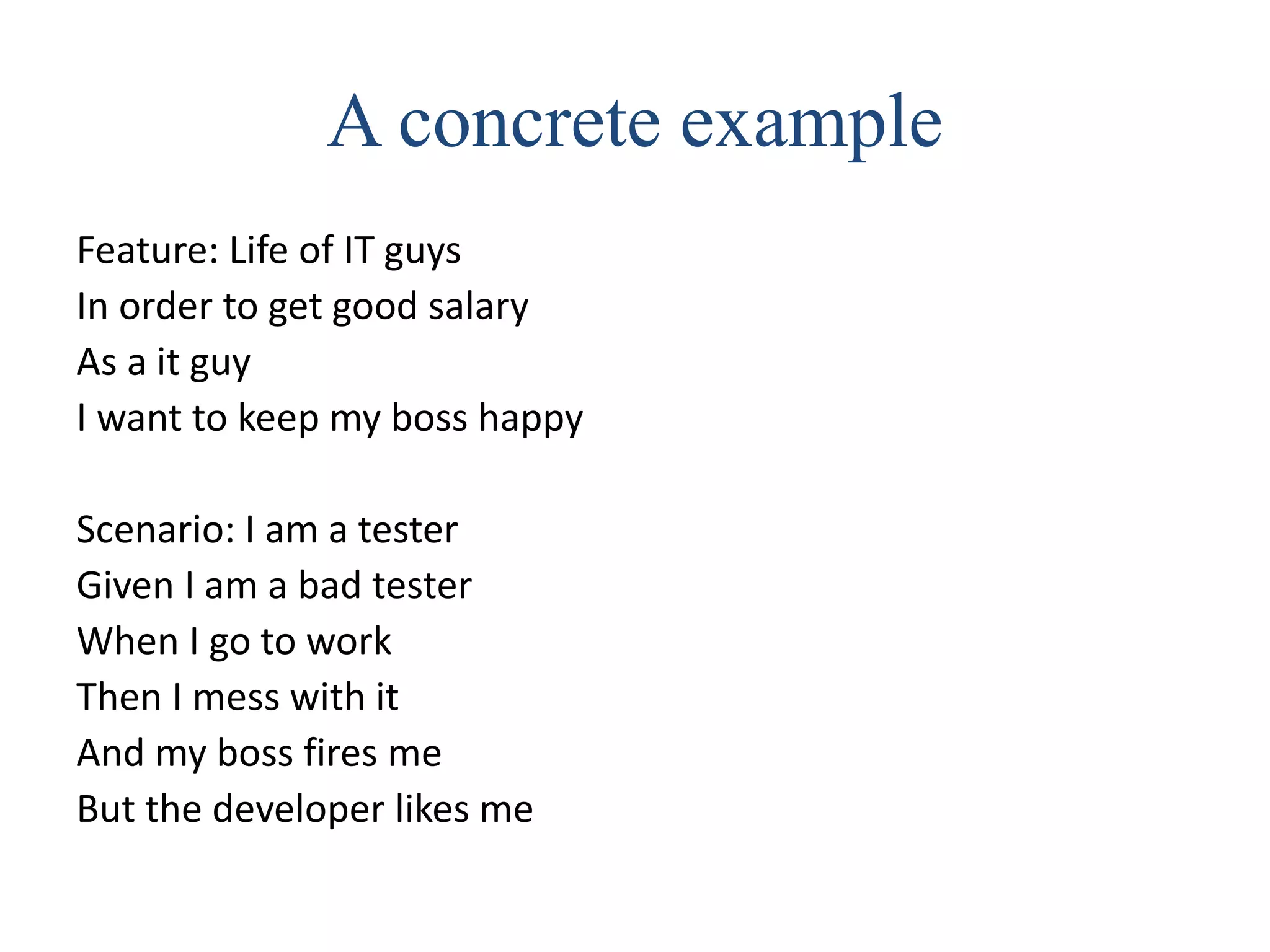
Feature: Life of IT guys
In order to get good salary
As a it guy
I want to keep my boss happy
Scenario: I am a tester
Given I am a bad tester
When I go to work
Then I mess with it
And my boss fires me
But the developer likes me
Advantages
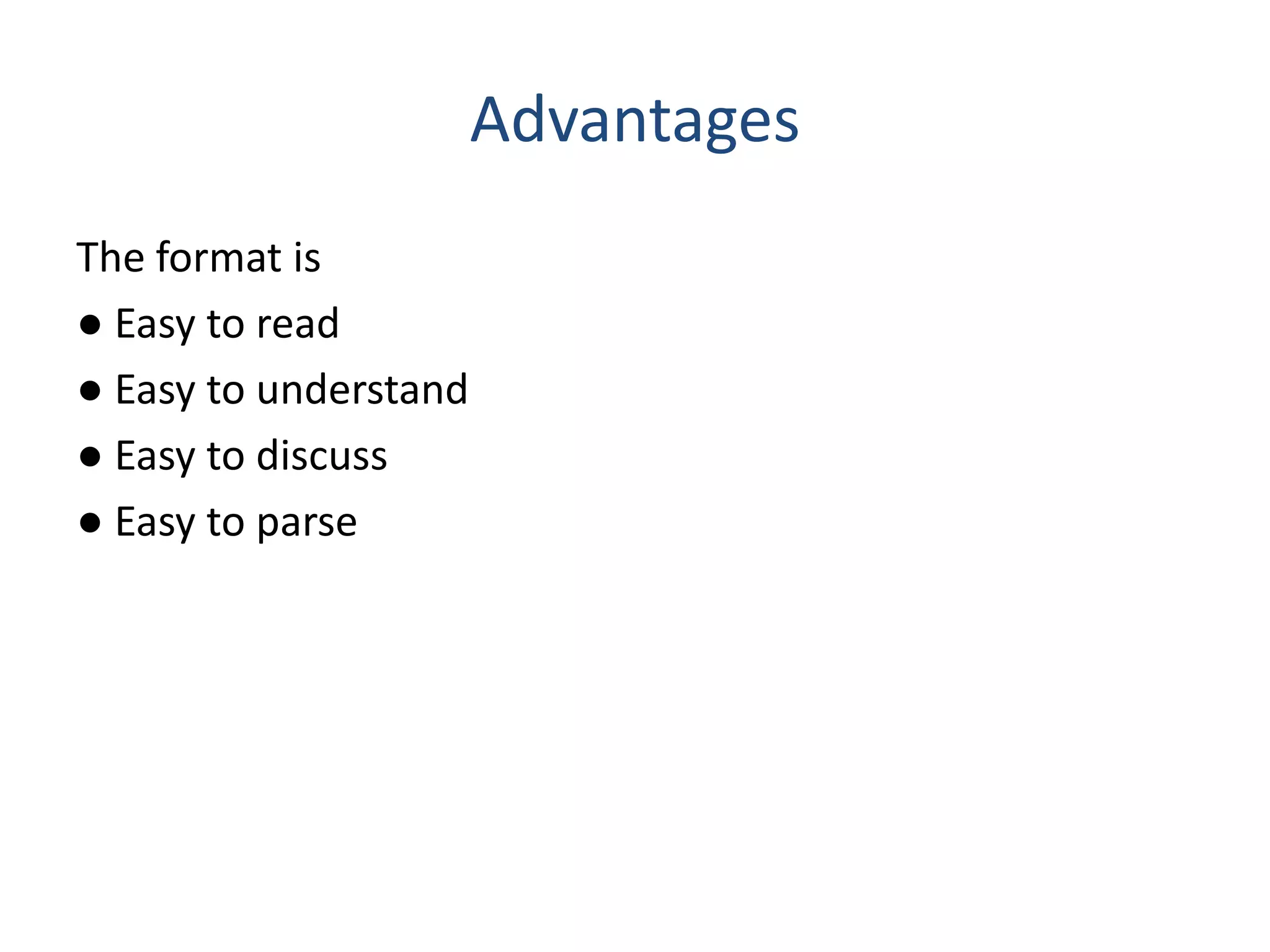
The format is
● Easy to read
● Easy to understand
● Easy to discuss
● Easy to parse
Parse and execute
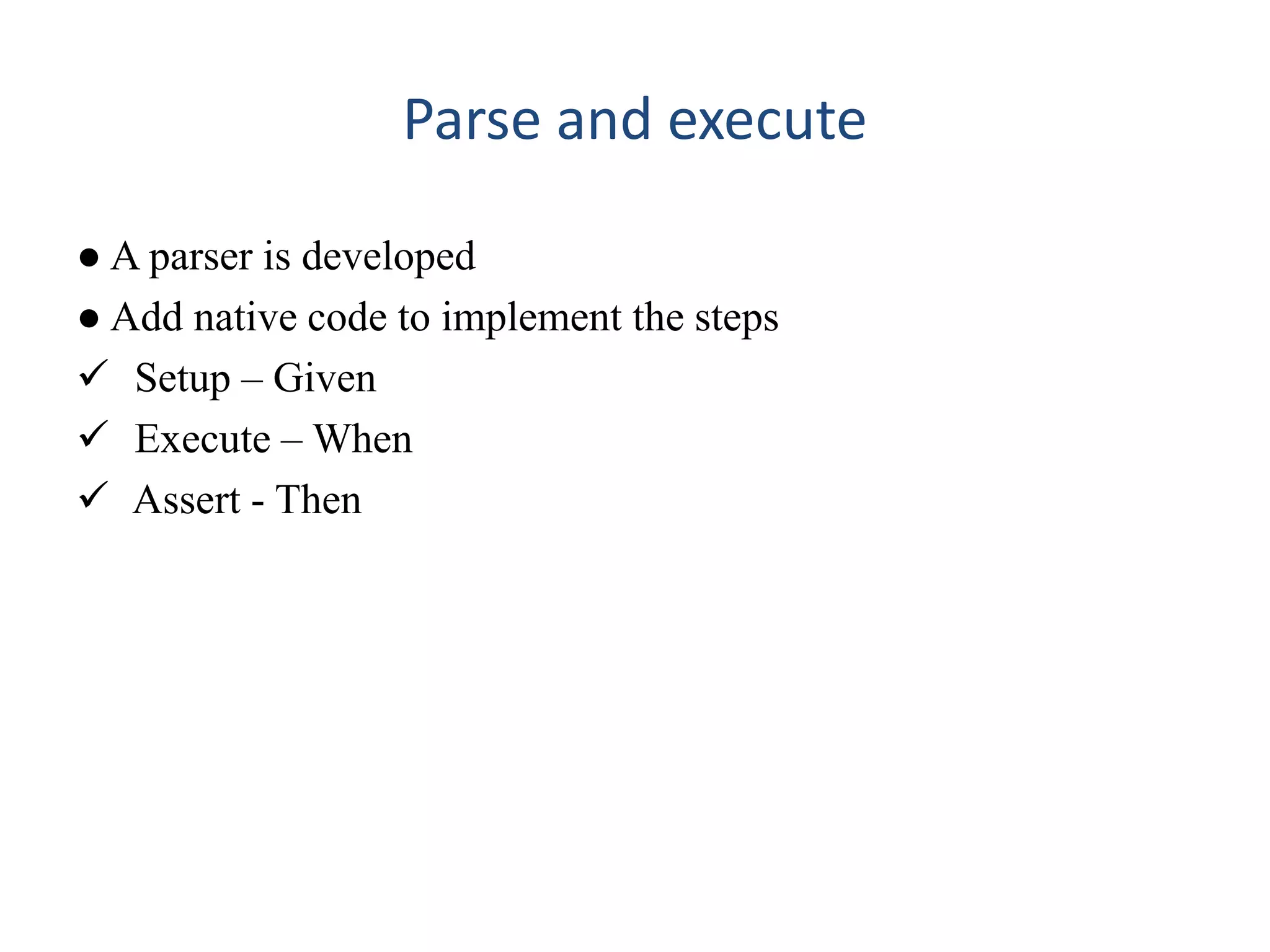
● A parser is developed
● Add native code to implement the steps
 Setup – Given
 Execute – When
 Assert - Then
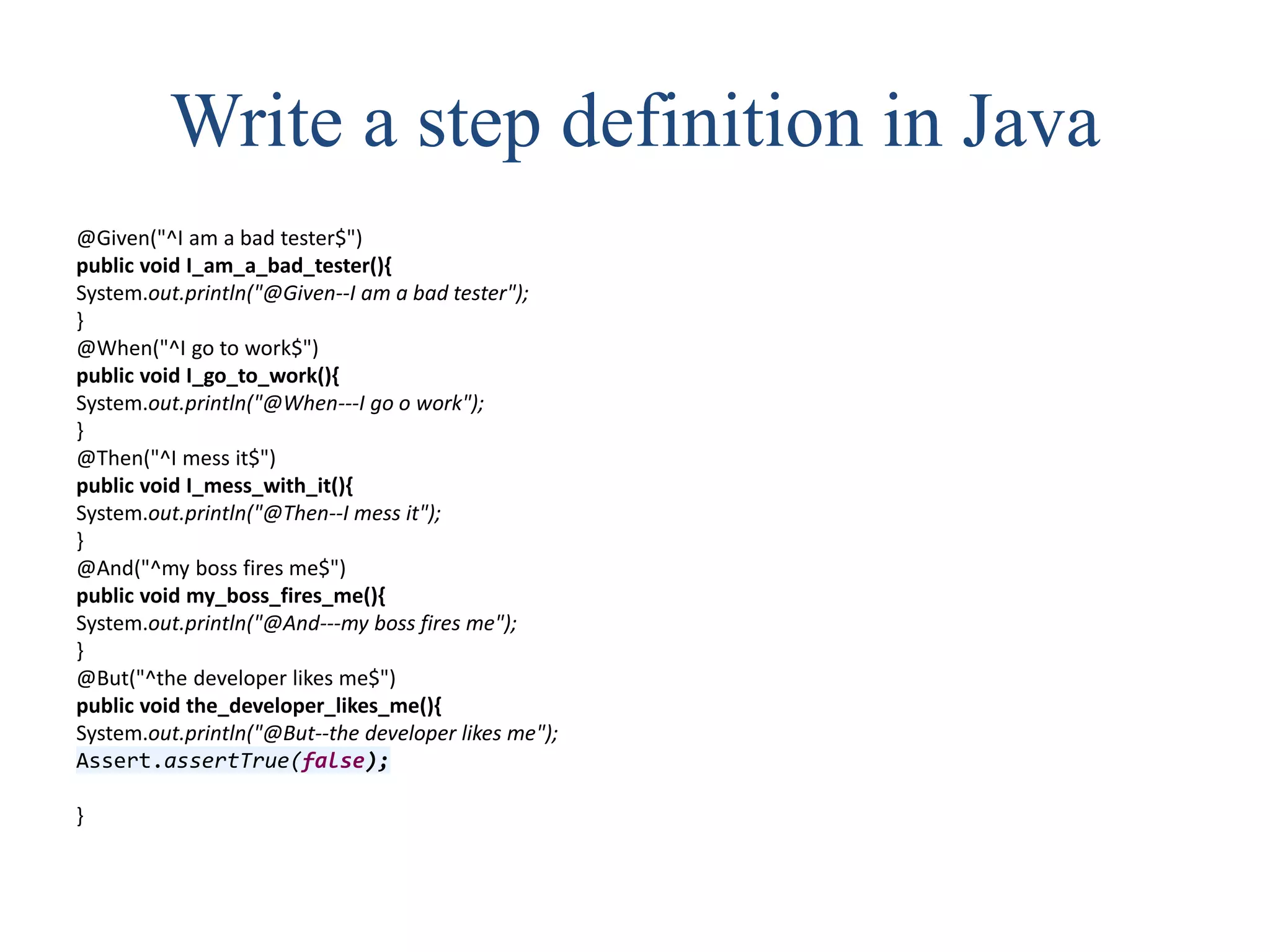
Write a step definition in Java
@Given("^I am a bad tester$")
public void I_am_a_bad_tester(){
System.out.println("@Given--I am a bad tester");
}
@When("^I go to work$")
public void I_go_to_work(){
System.out.println("@When---I go o work");
}
@Then("^I mess it$")
public void I_mess_with_it(){
System.out.println("@Then--I mess it");
}
@And("^my boss fires me$")
public void my_boss_fires_me(){
System.out.println("@And---my boss fires me");
}
@But("^the developer likes me$")
public void the_developer_likes_me(){
System.out.println("@But--the developer likes me");
Assert.assertTrue(false);
}
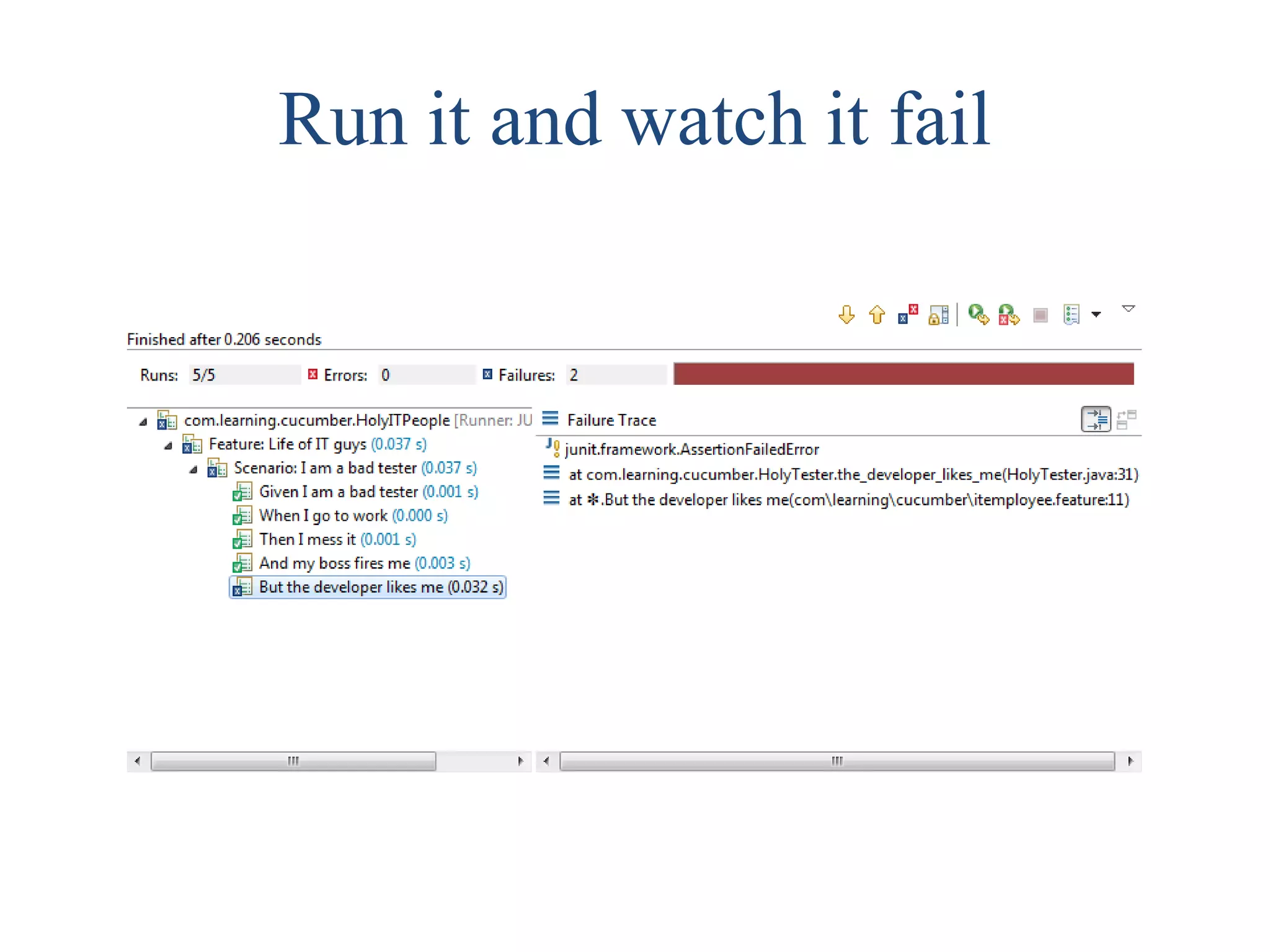
Run it and watch it fail
Write code to make the step pass
@Given("^I am a [a-zA-Z]{1,} tester$")
public void I_am_a_bad_tester(){
System.out.println("@Given--I am a bad tester");
}
@When("^I go to work$")
public void I_go_to_work(){
System.out.println("@When---I go o work");
}
@Then("^I [a-zA-Z]{1,} it$")
public void I_mess_with_it(){
System.out.println("@Then--I mess it");
}
@And("^my boss [a-zA-Z]{1,} me$")
public void my_boss_fires_me(){
System.out.println("@And---my boss fires me");
}
@But("^the developer [a-zA-Z]{1,} me$")
public void the_developer_likes_me(){
System.out.println("@But--the developer likes me");
}
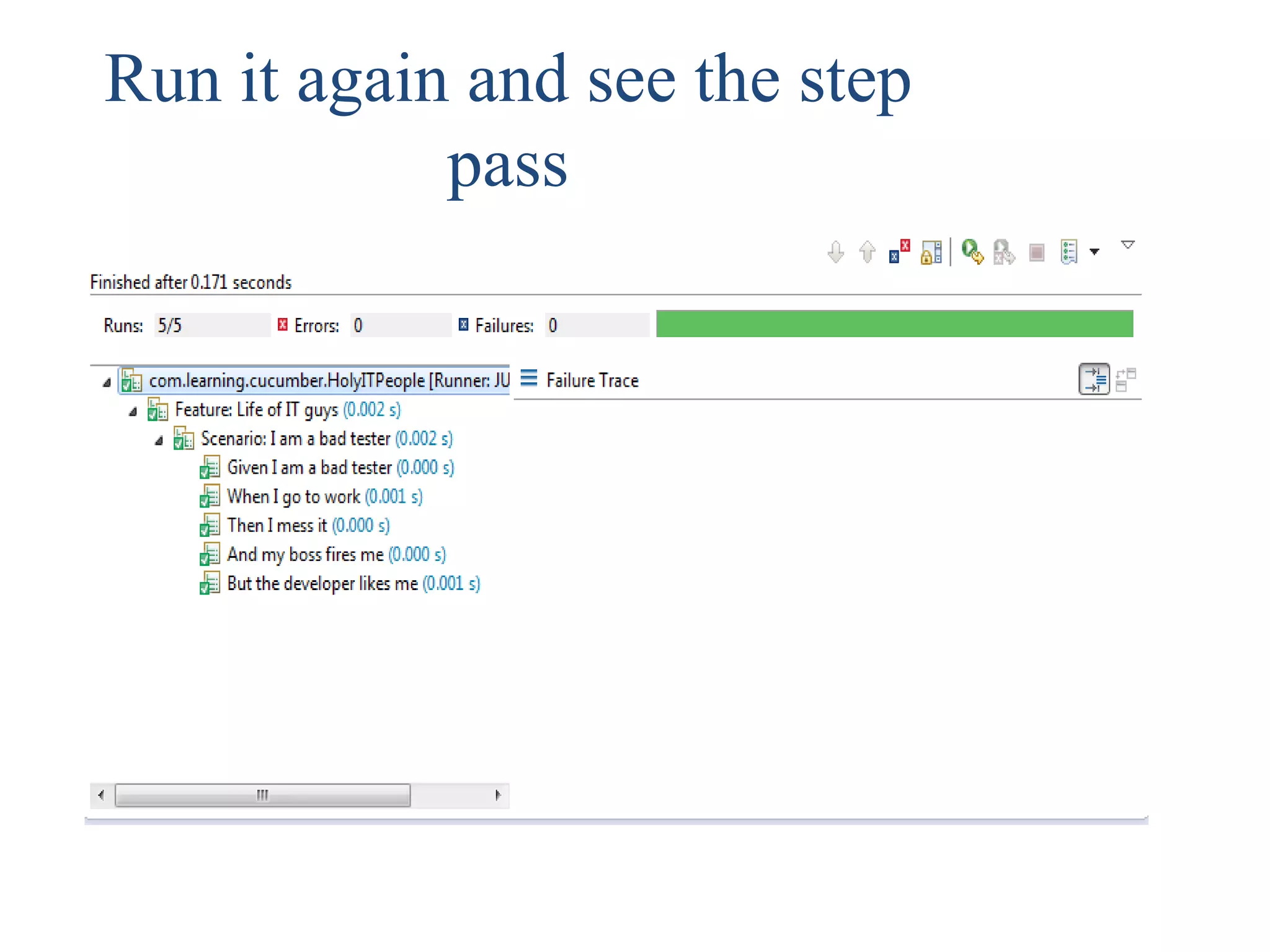
Run it again and see the step
pass
Why is Cucumber better
● Compared to well known tools like JUnit?
● It isn't, it's just easier to read for non coders
● The readability has increased
● Communication is easier
Benefits
● Less unnecessary work
● Better regression tests
● Less speculative work
● Less re-work
Maintenance
 Maintained together
● Specs
● Tests
● Code
 Maven
 Continuous Integration, CI
Tips
 Always use the a common language
 Don't over specify – start easy
 Never specify implementation details
Do not focus on tools
• They will never solve the problem
• A fool with a tool is still a fool
Resources
 Cucumber - http://cukes.info/
 Selenium - http://seleniumhq.org/
 Maven - http://maven.apache.org/
 Jenkins - http://jenkins-ci.org/
 Blog -http://thomassundberg.wordpress.com/
Thank You

Behaviour drivendevelopment

  • 1.
  • 2.
    BDD Domain Driven Design- DDD ● Common understanding ● Common language ● Test Driven Development - TDD ● Good technical practices ● Small steps ● Combined → Behaviour Driven Development
  • 3.
    Test automation  TestDriven Development, TDD – Develop it the right way  Behaviour Driven Development, BDD – Develop the right thing
  • 4.
    Three core principles •Business and Technology should refer to the same system in the same way • Any system should have an identified, verifiable value • Up-front analysis, design and planning all have a diminishing return
  • 5.
    Common language Used byall involved • Customer • Developers • Others?
  • 6.
    Verifiable value • Protectrevenue • Increase revenue • Manage cost • Increase brand value • Make the product remarkable • Provide more value to your customer
  • 7.
    Big design up-front •No big design up-front • The further you plan ahead, the less accurate you will be
  • 8.
    Three questions • Whatis the most important thing the system should do? • What is the next most important thing the system doesn't do yet? • If we were to switch off the system, where and what would be the biggest impact?
  • 9.
    Time to createa specification
  • 10.
    Time to createa specification When are we done?
  • 11.
    Interpret and translate We need to read the spec.  Understand it  Translate it into code  Parse and execute it?  No, not all specs are created equal
  • 12.
    Solution Write specifications so Translations isn't needed  It is possible to execute them
  • 13.
    Format • Given –Setup the system • When – Change the state of the system • Then – Verify the new state
  • 14.
  • 15.
  • 16.
    Why Cucumber  Itis one of the least technical tools  It is a very active open source project  It supports a variety of languages
  • 17.
    A concrete example Feature:Life of IT guys In order to get good salary As a it guy I want to keep my boss happy Scenario: I am a tester Given I am a bad tester When I go to work Then I mess with it And my boss fires me But the developer likes me
  • 18.
    Advantages The format is ●Easy to read ● Easy to understand ● Easy to discuss ● Easy to parse
  • 19.
    Parse and execute ●A parser is developed ● Add native code to implement the steps  Setup – Given  Execute – When  Assert - Then
  • 20.
    Write a stepdefinition in Java @Given("^I am a bad tester$") public void I_am_a_bad_tester(){ System.out.println("@Given--I am a bad tester"); } @When("^I go to work$") public void I_go_to_work(){ System.out.println("@When---I go o work"); } @Then("^I mess it$") public void I_mess_with_it(){ System.out.println("@Then--I mess it"); } @And("^my boss fires me$") public void my_boss_fires_me(){ System.out.println("@And---my boss fires me"); } @But("^the developer likes me$") public void the_developer_likes_me(){ System.out.println("@But--the developer likes me"); Assert.assertTrue(false); }
  • 21.
    Run it andwatch it fail
  • 22.
    Write code tomake the step pass @Given("^I am a [a-zA-Z]{1,} tester$") public void I_am_a_bad_tester(){ System.out.println("@Given--I am a bad tester"); } @When("^I go to work$") public void I_go_to_work(){ System.out.println("@When---I go o work"); } @Then("^I [a-zA-Z]{1,} it$") public void I_mess_with_it(){ System.out.println("@Then--I mess it"); } @And("^my boss [a-zA-Z]{1,} me$") public void my_boss_fires_me(){ System.out.println("@And---my boss fires me"); } @But("^the developer [a-zA-Z]{1,} me$") public void the_developer_likes_me(){ System.out.println("@But--the developer likes me"); }
  • 23.
    Run it againand see the step pass
  • 24.
    Why is Cucumberbetter ● Compared to well known tools like JUnit? ● It isn't, it's just easier to read for non coders ● The readability has increased ● Communication is easier
  • 25.
    Benefits ● Less unnecessarywork ● Better regression tests ● Less speculative work ● Less re-work
  • 26.
    Maintenance  Maintained together ●Specs ● Tests ● Code  Maven  Continuous Integration, CI
  • 27.
    Tips  Always usethe a common language  Don't over specify – start easy  Never specify implementation details
  • 28.
    Do not focuson tools • They will never solve the problem • A fool with a tool is still a fool
  • 29.
    Resources  Cucumber -http://cukes.info/  Selenium - http://seleniumhq.org/  Maven - http://maven.apache.org/  Jenkins - http://jenkins-ci.org/  Blog -http://thomassundberg.wordpress.com/
  • 30.