@sebrose h)p://cucumber.io
Seb Rose
Cucumber Limited
seb@cucumber.io
10 things you need to know about
Specflow
@sebrose h)p://cucumber.io
Seb Rose
Cucumber Limited
seb@cucumber.io
10 things you need to know about
BDD, Cucumber and Specflow
@sebrose h)p://cucumber.io
0. Know your BDD history
@sebrose h)p://cucumber.io
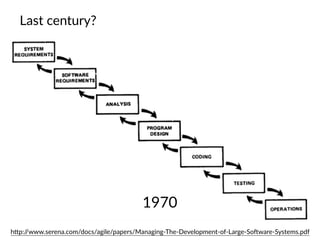
Last century?
h)p://www.serena.com/docs/agile/papers/Managing-The-Development-of-Large-SoEware-Systems.pdf
1970
@sebrose h)p://cucumber.io
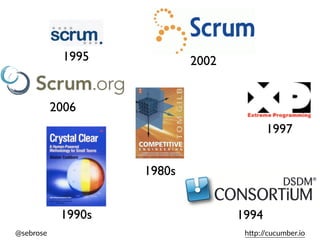
2002
2006
1995
1997
1990s 1994
1980s
@sebrose h)p://cucumber.io
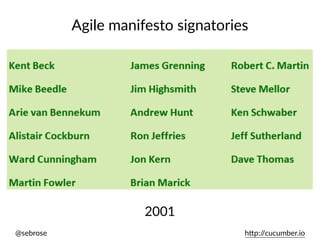
Agile manifesto signatories
2001
@sebrose h)p://cucumber.io
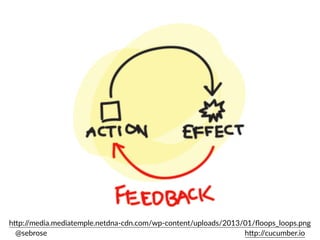
h)p://media.mediatemple.netdna-cdn.com/wp-content/uploads/2013/01/floops_loops.png
@sebrose h)p://cucumber.io
Chris Ma)s working with Rohit Darji
develop
“Pair Analysis”
2001
@sebrose h)p://cucumber.io
While using and teaching agile pracUces
like test-driven development (TDD) on
projects in different environments, I kept
coming across the same confusion and
misunderstandings.
Dan North
c. 2002
h)p://dannorth.net/introducing-bdd/
@sebrose h)p://cucumber.io
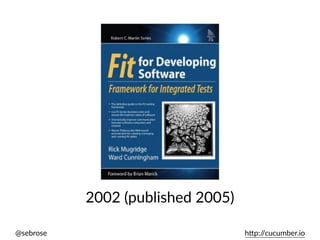
2002 (published 2005)
@sebrose h)p://cucumber.io
Chris Ma)s working with Sanela Hodzic
formalise
“Break the model”
2003
@sebrose h)p://cucumber.io
At the end of 2003, I decided it was Ume
to put my money – or at least my Ume –
where my mouth was. I started wriUng a
replacement for JUnit called JBehave,
which removed any reference to tesUng
and replaced it with a vocabulary built
around verifying behaviour.
Dan North
h)p://dannorth.net/introducing-bdd/
@sebrose h)p://cucumber.io
Chris Ma)s and Dan North discuss
the power of “should”
on a flight back from
Agile Development Conference 2004
@sebrose h)p://cucumber.io
Given/Then/When sees the light of day
Acceptance Criteria:
Prevent cash withdrawal when overdrawn
Given successfully login from user login

and the account is in overdrawn [balance = -50]

When the user requests cash [request 20]

Then refuse cash

and return card
abc.truemesh.com/archives/2004_11.html
@sebrose h)p://cucumber.io
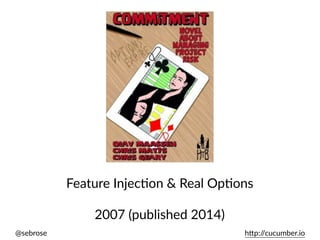
Feature InjecUon & Real OpUons
2007 (published 2014)
@sebrose h)p://cucumber.io
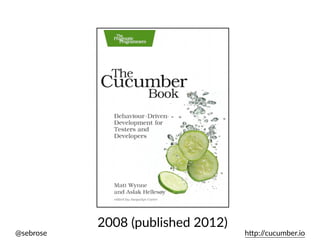
2008 (published 2012)
@sebrose h)p://cucumber.io
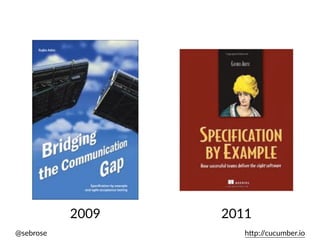
2009
h)p://www.specflow.org/media/specflow_logo.png
@sebrose h)p://cucumber.io
2009 2011
@sebrose h)p://cucumber.io
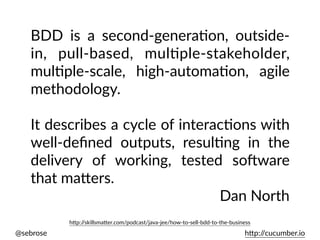
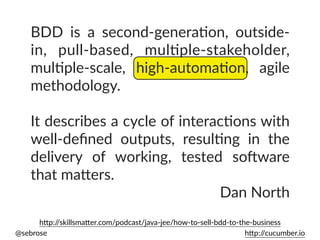
BDD is a second-generaUon, outside-
in, pull-based, mulUple-stakeholder,
mulUple-scale, high-automaUon, agile
methodology.
It describes a cycle of interacUons with
well-defined outputs, resulUng in the
delivery of working, tested soEware
that ma)ers.
Dan North
h)p://skillsma)er.com/podcast/java-jee/how-to-sell-bdd-to-the-business
@sebrose h)p://cucumber.io
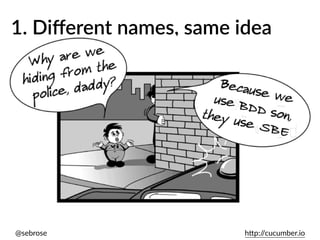
1. Different names, same idea
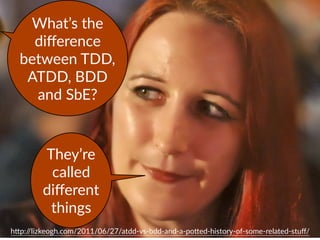
h)p://lizkeogh.com/2011/06/27/atdd-vs-bdd-and-a-po)ed-history-of-some-related-stuff/
What’s the
difference
between TDD,
ATDD, BDD
and SbE?
They’re
called
different
things
@sebrose h)p://cucumber.io
The best TDD
pracUUoners...
Work from the outside-in, i.e. test-first
Use examples to clarify their requirements
Develop and use a ubiquitous language
@sebrose h)p://cucumber.io
The best BDD
pracUUoners...
Focus on value
Discover examples collaboraAvely
Create living documentaAon
@sebrose h)p://cucumber.io
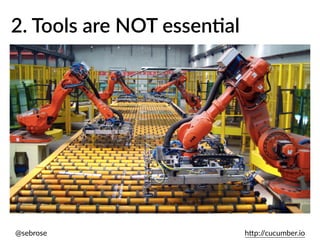
2. Tools are NOT essenAal
@sebrose h)p://cucumber.io
BDD is a second-generaUon, outside-
in, pull-based, mulUple-stakeholder,
mulUple-scale, high-automaUon, agile
methodology.
It describes a cycle of interacUons with
well-defined outputs, resulUng in the
delivery of working, tested soEware
that ma)ers.
Dan North
h)p://skillsma)er.com/podcast/java-jee/how-to-sell-bdd-to-the-business
@sebrose h)p://cucumber.io
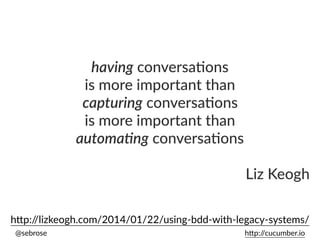
having conversa*ons
is more important than
capturing conversa*ons
is more important than
automa3ng conversa*ons
Liz Keogh
h)p://lizkeogh.com/2014/01/22/using-bdd-with-legacy-systems/
@sebrose h)p://cucumber.io
h)p://lizkeogh.com/2011/03/04/step-away-from-the-tools/
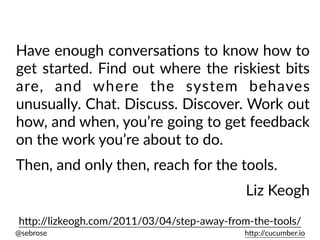
Have enough conversaUons to know how to
get started. Find out where the riskiest bits
are, and where the system behaves
unusually. Chat. Discuss. Discover. Work out
how, and when, you’re going to get feedback
on the work you’re about to do.
Then, and only then, reach for the tools.
Liz Keogh
@sebrose h)p://cucumber.io
h)p://www.accepUc.com/blog/wp-content/uploads/2013/09/bdd.jpg
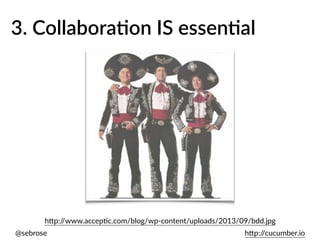
3. CollaboraAon IS essenAal
@sebrose h)p://cucumber.io
h)ps://cucumber.pro/blog/2014/03/03/the-worlds-most-misunderstood-collaboraUon-tool.html
When you do BDD/SpecificaUon by
Example and Outside-in, regression tests fall
out at the other end. They are a by-product
of those acUviUes. TesUng isn't the acUvity
itself.
Cucumber is first a foremost a collaboraUon
tool that aims to bring a common
understanding to soEware teams - across
roles.
Aslak Hellesøy
@sebrose h)p://cucumber.io
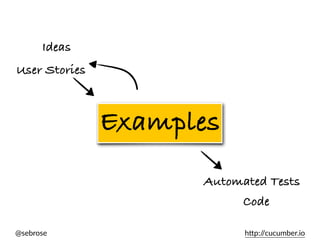
Ideas
User Stories
Examples
Automated Tests
Code
@sebrose h)p://cucumber.io
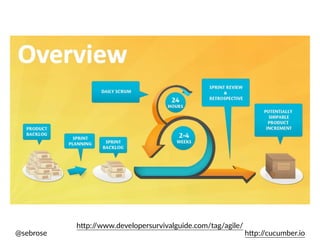
h)p://www.developersurvivalguide.com/tag/agile/
@sebrose h)p://cucumber.io
4. Specflow is simple
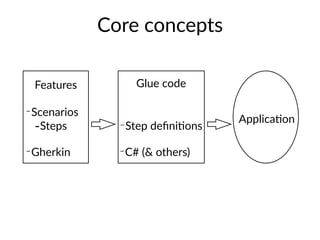
Core concepts
Features
-Scenarios
-Steps
-Gherkin
Glue code
-Step definiUons
-C# (& others)
ApplicaUon
@sebrose h)p://cucumber.io
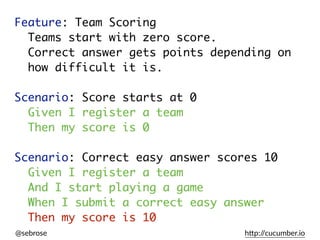
Feature: Team Scoring
Teams start with zero score.
Correct answer gets points depending on
how difficult it is.
Scenario: Score starts at 0
Given I register a team
Then my score is 0
Scenario: Correct easy answer scores 10
Given I register a team
And I start playing a game
When I submit a correct easy answer
Then my score is 10
Given I register a team
Then my score is 0
Given I register a team
And I start playing a game
When I submit a correct easy answer
Then my score is 10
@sebrose h)p://cucumber.io
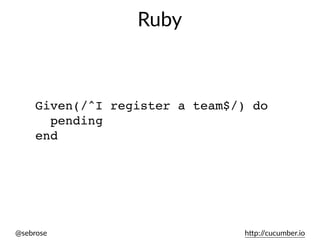
Given(/^I register a team$/) do
pending
end
Ruby
@sebrose h)p://cucumber.io
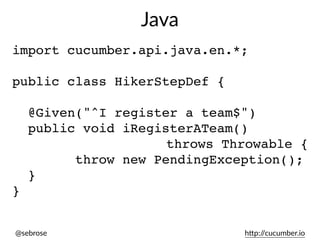
import cucumber.api.java.en.*;
public class HikerStepDef {
@Given("^I register a team$")
public void iRegisterATeam()
throws Throwable {
throw new PendingException();
}
}
Java
@sebrose h)p://cucumber.io
using TechTalk.SpecFlow;
[Binding]
public class GameSteps
{
[Given(@"I register a team")]
public void GivenIRegisterATeam()
{
ScenarioContext.Current.Pending();
}
}
C#
@sebrose h)p://cucumber.io
[Then(@"my score is (.*)")]
public void ThenMyScoreIs(int p0)
{
ScenarioContext.Current.Pending();
}
@sebrose h)p://cucumber.io
[Then(@"my score is (.*)")]
public void ThenMyScoreIs(int score)
{
ScenarioContext.Current.Pending();
}
@sebrose h)p://cucumber.io
[Then(@"my score is (d*)")]
public void ThenMyScoreIs(int score)
{
ScenarioContext.Current.Pending();
}
@sebrose h)p://cucumber.io
[Then(@"my score is (d*)")]
public void ThenMyScoreIs(int score)
{
Assert.AreEqual(score, game.Score);
}
@sebrose h)p://cucumber.io
5. Cucumber and Specflow aren’t
exactly the same
@sebrose h)p://cucumber.io
Given/When/Then namespaces
Global namespace
- Given/When/Then interchangeable
Separate namespaces
- Given/When/Then disUnct
- And/But bind to preceding namespace
- [StepDefiniUon] for compaUbility
@sebrose h)p://cucumber.io
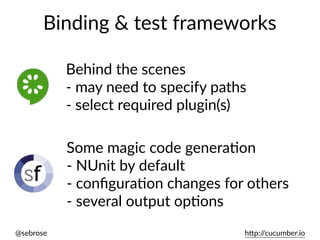
Binding & test frameworks
Behind the scenes
- may need to specify paths
- select required plugin(s)
Some magic code generaUon
- NUnit by default
- configuraUon changes for others
- several output opUons
@sebrose h)p://cucumber.io
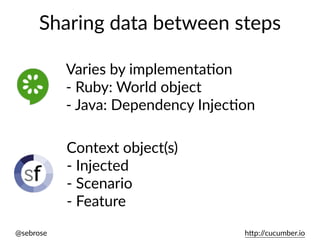
Sharing data between steps
Varies by implementaUon
- Ruby: World object
- Java: Dependency InjecUon
Context object(s)
- Injected
- Scenario
- Feature
@sebrose h)p://cucumber.io
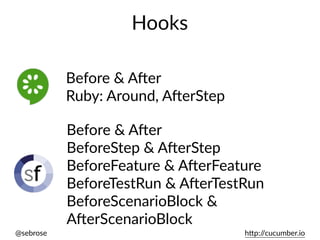
Hooks
Before & AEer
Ruby: Around, AEerStep
Before & AEer
BeforeStep & AEerStep
BeforeFeature & AEerFeature
BeforeTestRun & AEerTestRun
BeforeScenarioBlock &
AEerScenarioBlock
@sebrose h)p://cucumber.io
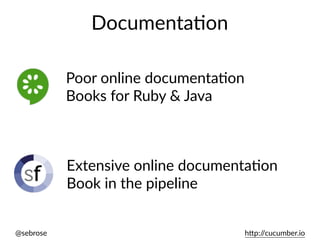
DocumentaUon
Poor online documentaUon
Books for Ruby & Java
Extensive online documentaUon
Book in the pipeline
@sebrose h)p://cucumber.io
h)ps://cemarking.net/wp-content/uploads/2014/01/User-Manual_featured.jpg
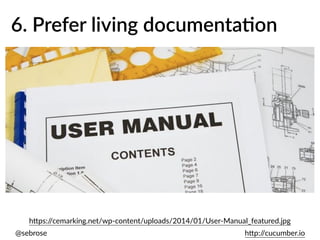
6. Prefer living documentaAon
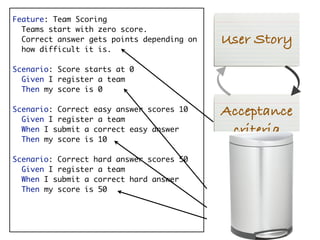
Acceptance
criteria
User Story
Examples
Feature: Team Scoring
Teams start with zero score.
Correct answer gets points depending on 

how difficult it is.
Scenario: Score starts at 0
Given I register a team
Then my score is 0
Scenario: Correct easy answer scores 10
Given I register a team
When I submit a correct easy answer
Then my score is 10
Scenario: Correct hard answer scores 50
Given I register a team
When I submit a correct hard answer
Then my score is 50
Other forms of documentaAon are
also necessary!
@sebrose h)p://cucumber.io
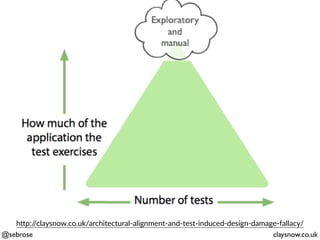
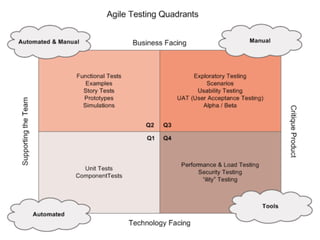
7. Don’t forget the testers
@sebrose claysnow.co.uk
h)p://claysnow.co.uk/architectural-alignment-and-test-induced-design-damage-fallacy/
@sebrose h)p://cucumber.io
http://1.bp.blogspot.com/_YzKCMr-tcMM/TFLIGeqTJfI/AAAAAAAAARQ/AhNW62KX5EA/s1600/cartoon6.jpg
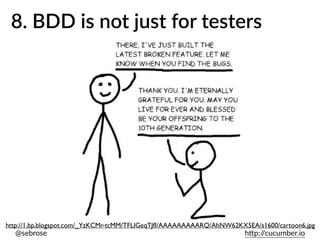
8. BDD is not just for testers
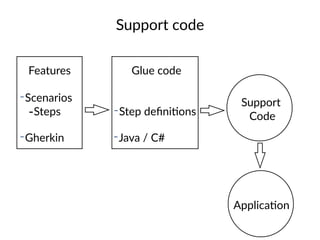
Support code
Features
-Scenarios
-Steps
-Gherkin
Glue code
-Step definiUons
-Java / C#
ApplicaUon
Support
Code
Ubiquitous
Language
@sebrose h)p://cucumber.io
9. The right amount of detail
@sebrose h)p://cucumber.io
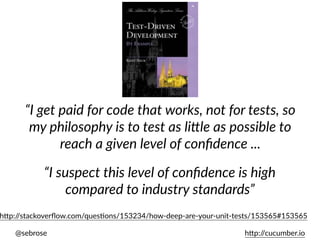
“I get paid for code that works, not for tests, so
my philosophy is to test as li8le as possible to
reach a given level of confidence ...
“I suspect this level of confidence is high
compared to industry standards”
h)p://stackoverflow.com/quesUons/153234/how-deep-are-your-unit-tests/153565#153565
@sebrose h)p://cucumber.io
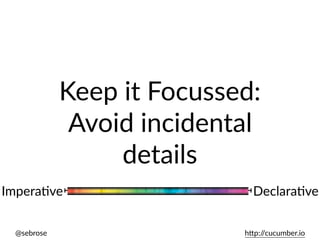
ImperaUve DeclaraUve
Keep it Focussed:
Avoid incidental
details
@sebrose h)p://cucumber.io
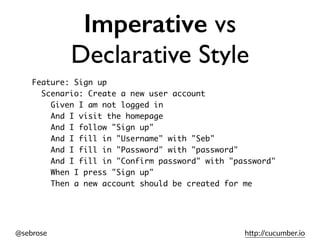
Imperative vs
Declarative Style
Feature: Sign up
Scenario: Create a new user account
Given I am not logged in
And I visit the homepage
And I follow "Sign up"
And I fill in "Username" with "Seb"
And I fill in "Password" with "password"
And I fill in "Confirm password" with "password"
When I press "Sign up"
Then a new account should be created for me
@sebrose h)p://cucumber.io
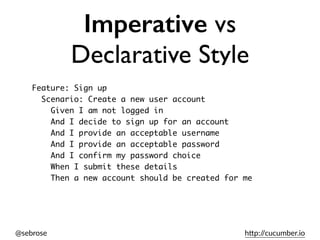
Imperative vs
Declarative Style
Feature: Sign up
Scenario: Create a new user account
Given I am not logged in
And I decide to sign up for an account
And I provide an acceptable username
And I provide an acceptable password
And I confirm my password choice
When I submit these details
Then a new account should be created for me
@sebrose h)p://cucumber.io
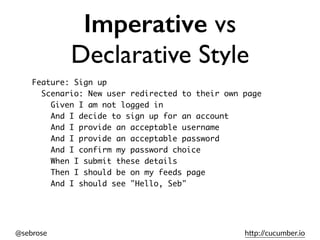
Imperative vs
Declarative Style
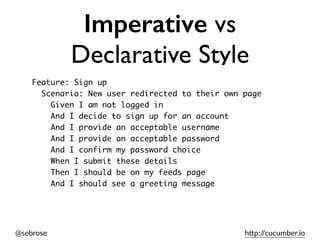
Feature: Sign up
Scenario: New user redirected to their own page
Given I am not logged in
And I decide to sign up for an account
And I provide an acceptable username
And I provide an acceptable password
And I confirm my password choice
When I submit these details
Then I should be on my feeds page
And I should see "Hello, Seb"
@sebrose h)p://cucumber.io
Imperative vs
Declarative Style
Feature: Sign up
Scenario: New user redirected to their own page
Given I am not logged in
And I decide to sign up for an account
And I provide an acceptable username
And I provide an acceptable password
And I confirm my password choice
When I submit these details
Then I should be on my feeds page
And I should see a greeting message
@sebrose h)p://cucumber.io
Imperative vs
Declarative Style
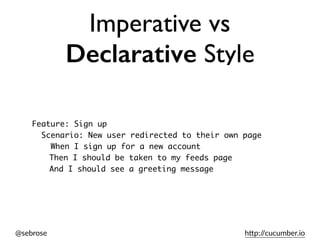
Feature: Sign up
Scenario: New user redirected to their own page
When I sign up for a new account
Then I should be taken to my feeds page
And I should see a greeting message
@sebrose h)p://cucumber.io
Imperative vs
Declarative Style
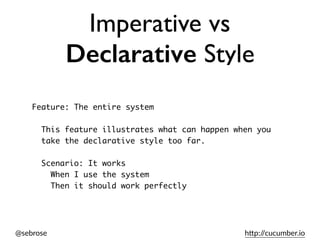
Feature: The entire system
This feature illustrates what can happen when you
take the declarative style too far.
Scenario: It works
When I use the system
Then it should work perfectly
@sebrose h)p://cucumber.io
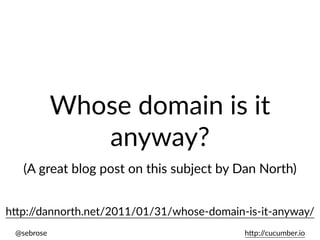
(A great blog post on this subject by Dan North)
h)p://dannorth.net/2011/01/31/whose-domain-is-it-anyway/
Whose domain is it
anyway?
@sebrose h)p://cucumber.io
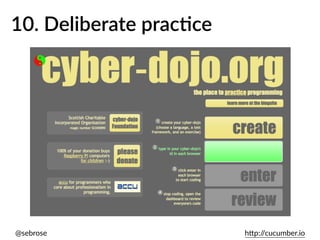
10. Deliberate pracAce
@sebrose h)p://cucumber.io
01 BDD demands collaboraUon


10 Examples facilitate feedback
102 things you should know
@sebrose h)p://cucumber.io
Seb Rose


Twi6er: @sebrose
Blog: cucumber.io/blog
E-mail: seb@cucumber.io

10 things about BDD, Cucumber and SpecFlow - Long Version 2016