Basics of Game Theory
Recap
• Decision Theory vs. Game Theory
• Rationality
• Completeness
• Transitivity
• What’s in a game?
• Players
• Actions
• Outcomes
• Preferences
• Beliefs
• Constraints
Defining a Game
Are moves simultaneous or sequential?
•Normal/strategic form
•Extensive form or game tree
Normal Form Game
• Normal (Strategic) Form
• More general than extensive form
• Less information that extensive form game
• All finite extensive form games can be transformed into
normal form games
• Reduces each player’s choice to the selection of a
complete plan (strategy) for playing the game
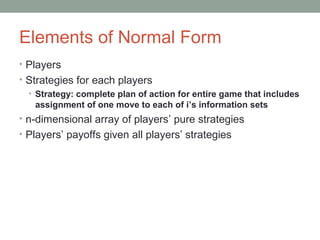
Elements of Normal Form
• Players
• Strategies for each players
• Strategy: complete plan of action for entire game that includes
assignment of one move to each of i’s information sets
• n-dimensional array of players’ pure strategies
• Players’ payoffs given all players’ strategies
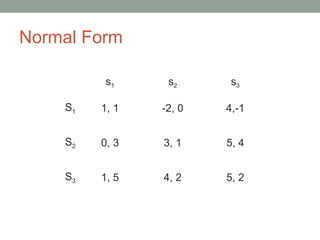
Normal Form
s1 s2 s3
S1 1, 1 -2, 0 4,-1
S2 0, 3 3, 1 5, 4
S3 1, 5 4, 2 5, 2
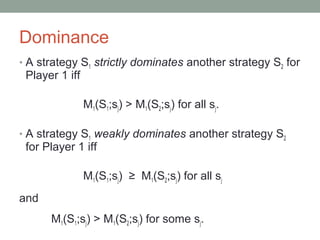
Dominance
• A strategy S1 strictly dominates another strategy S2 for
Player 1 iff
M1(S1;sj) > M1(S2;sj) for all sj.
• A strategy S1 weakly dominates another strategy S2
for Player 1 iff
M1(S1;sj) ≥ M1(S2;sj) for all sj
and
M1(S1;sj) > M1(S2;sj) for some sj.
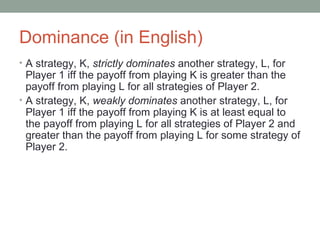
Dominance (in English)
• A strategy, K, strictly dominates another strategy, L, for
Player 1 iff the payoff from playing K is greater than the
payoff from playing L for all strategies of Player 2.
• A strategy, K, weakly dominates another strategy, L, for
Player 1 iff the payoff from playing K is at least equal to
the payoff from playing L for all strategies of Player 2 and
greater than the payoff from playing L for some strategy of
Player 2.
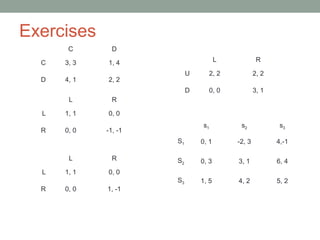
Exercises
s1 s2 s3
S1 0, 1 -2, 3 4,-1
S2 0, 3 3, 1 6, 4
S3 1, 5 4, 2 5, 2
C D
C 3, 3 1, 4
D 4, 1 2, 2
L R
L 1, 1 0, 0
R 0, 0 -1, -1
L R
L 1, 1 0, 0
R 0, 0 1, -1
L R
U 2, 2 2, 2
D 0, 0 3, 1
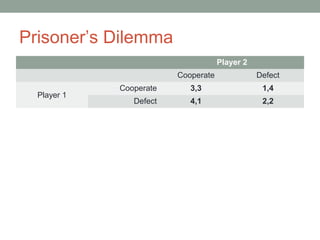
Prisoner’s Dilemma
Player 2
Cooperate Defect
Player 1
Cooperate 3,3 1,4
Defect 4,1 2,2
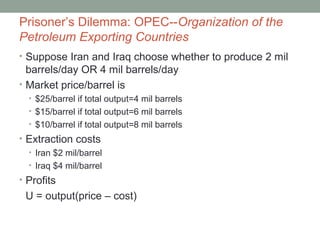
Prisoner’s Dilemma: OPEC--Organization of the
Petroleum Exporting Countries
• Suppose Iran and Iraq choose whether to produce 2 mil
barrels/day OR 4 mil barrels/day
• Market price/barrel is
• $25/barrel if total output=4 mil barrels
• $15/barrel if total output=6 mil barrels
• $10/barrel if total output=8 mil barrels
• Extraction costs
• Iran $2 mil/barrel
• Iraq $4 mil/barrel
• Profits
U = output(price – cost)
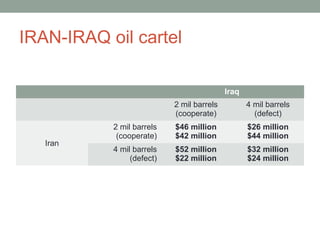
IRAN-IRAQ oil cartel
Iraq
2 mil barrels
(cooperate)
4 mil barrels
(defect)
Iran
2 mil barrels
(cooperate)
$46 million
$42 million
$26 million
$44 million
4 mil barrels
(defect)
$52 million
$22 million
$32 million
$24 million
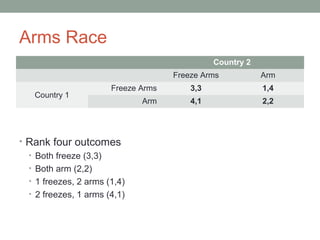
Arms Race
• Rank four outcomes
• Both freeze (3,3)
• Both arm (2,2)
• 1 freezes, 2 arms (1,4)
• 2 freezes, 1 arms (4,1)
Country 2
Freeze Arms Arm
Country 1
Freeze Arms 3,3 1,4
Arm 4,1 2,2
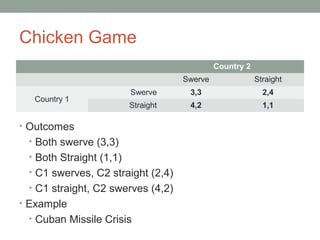
Chicken Game
• Outcomes
• Both swerve (3,3)
• Both Straight (1,1)
• C1 swerves, C2 straight (2,4)
• C1 straight, C2 swerves (4,2)
• Example
• Cuban Missile Crisis
Country 2
Swerve Straight
Country 1
Swerve 3,3 2,4
Straight 4,2 1,1
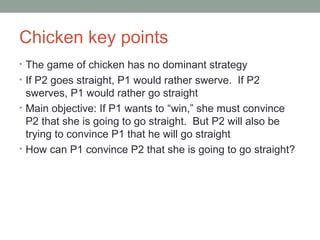
Chicken key points
• The game of chicken has no dominant strategy
• If P2 goes straight, P1 would rather swerve. If P2
swerves, P1 would rather go straight
• Main objective: If P1 wants to “win,” she must convince
P2 that she is going to go straight. But P2 will also be
trying to convince P1 that he will go straight
• How can P1 convince P2 that she is going to go straight?
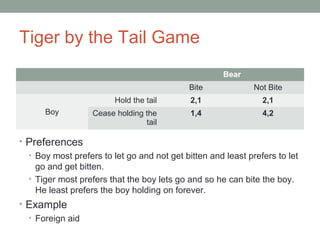
Tiger by the Tail Game
• Preferences
• Boy most prefers to let go and not get bitten and least prefers to let
go and get bitten.
• Tiger most prefers that the boy lets go and so he can bite the boy.
He least prefers the boy holding on forever.
• Example
• Foreign aid
Bear
Bite Not Bite
Boy
Hold the tail 2,1 2,1
Cease holding the
tail
1,4 4,2
Tiger by the tail: key points
• Bite is always a dominant strategy for the tiger if it
receives a move.
• Because tiger cannot commit NOT to bite, the boy will
never let go and the tiger gets its worst outcome.
• A credible commitment NOT to bite would make both the
tiger and the boy better off.
• How can the tiger commit NOT to bite?
• To consider commitments, we need to understand
sequential moves and extensive form games.
Sequential moves -- Extensive
Form
• Whose choice (move) is it at any particular point in time?
• What alternative actions are available to each person at
any particular move?
• What does each player know about other players’ prior
choices?
• What are the alternative states of nature and their
likelihood?
• What are each player’s preferences (utilities) over
outcomes?
Elements of Extensive Form
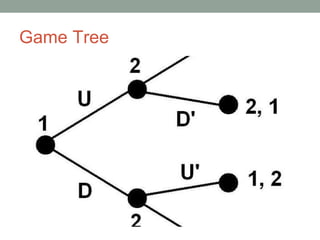
• Game tree: representation of extensive form
• Nodes: decision and terminal
• Branches: extend from each node representing alternatives
• Chance: nature makes each choice by chance from a specified
lottery over the alternative states
• Information sets: represents what players know at decision
nodes
• Set of outcomes
• Set of utility functions
• Common knowledge: each player knows and expects the other
players to know all details of the situation that the game presents
(each players knows that the others know that he knows the tree,
and so forth)
Game Tree
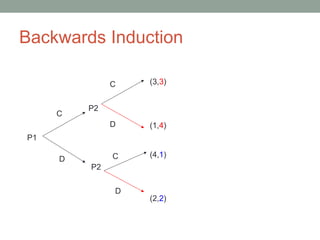
Solution: Backward Induction
• Looking forward in time and reasoning backward to
determine the optimal move sequence.
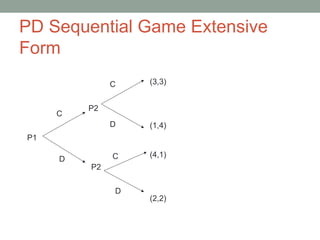
PD Sequential Game Extensive
Form
P1
C
D
P2
P2
(3,3)
(1,4)
(4,1)
(2,2)
D
D
C
C
Backwards Induction
P1
C
D
P2
P2
(3,3)
(1,4)
(4,1)
(2,2)
D
D
C
C
Some important points
• Because actors are strategic, they do not always try to
obtain their most preferred outcome. Rather, they try
to obtain the most preferred outcome they believe is
possible
• In order for a conflict to be resolved peacefully two
things must occur:
1. A settlement must be found that all actors prefer to fighting
2. A way must be found to make the agreements self-
enforcing
Information
• Perfect Information: if all information sets are singletons
(know the history of the game)
• Complete information: if all players’ payoffs are known to
all players
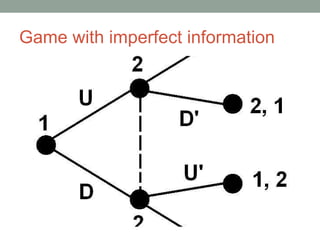
Game with imperfect information
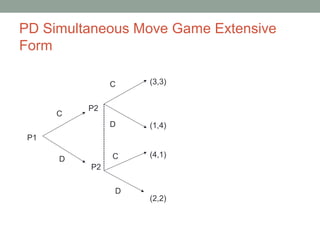
PD Simultaneous Move Game Extensive
Form
P1
C
D
P2
P2
(3,3)
(1,4)
(4,1)
(2,2)
D
D
C
C
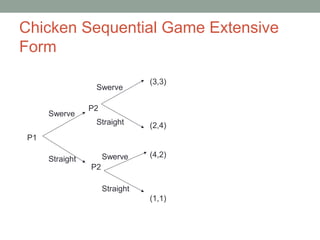
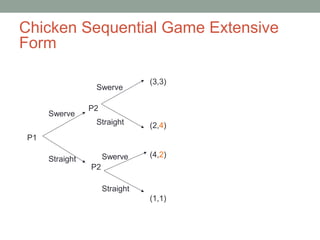
Chicken Sequential Game Extensive
Form
P1
Swerve
Straight
P2
P2
(3,3)
(2,4)
(4,2)
(1,1)
Swerve
Straight
Swerve
Straight
Chicken Sequential Game Extensive
Form
P1
Swerve
Straight
P2
P2
(3,3)
(2,4)
(4,2)
(1,1)
Swerve
Straight
Swerve
Straight

Game theory

  • 1.
  • 2.
    Recap • Decision Theoryvs. Game Theory • Rationality • Completeness • Transitivity • What’s in a game? • Players • Actions • Outcomes • Preferences • Beliefs • Constraints
  • 3.
    Defining a Game Aremoves simultaneous or sequential? •Normal/strategic form •Extensive form or game tree
  • 4.
    Normal Form Game •Normal (Strategic) Form • More general than extensive form • Less information that extensive form game • All finite extensive form games can be transformed into normal form games • Reduces each player’s choice to the selection of a complete plan (strategy) for playing the game
  • 5.
    Elements of NormalForm • Players • Strategies for each players • Strategy: complete plan of action for entire game that includes assignment of one move to each of i’s information sets • n-dimensional array of players’ pure strategies • Players’ payoffs given all players’ strategies
  • 6.
    Normal Form s1 s2s3 S1 1, 1 -2, 0 4,-1 S2 0, 3 3, 1 5, 4 S3 1, 5 4, 2 5, 2
  • 7.
    Dominance • A strategyS1 strictly dominates another strategy S2 for Player 1 iff M1(S1;sj) > M1(S2;sj) for all sj. • A strategy S1 weakly dominates another strategy S2 for Player 1 iff M1(S1;sj) ≥ M1(S2;sj) for all sj and M1(S1;sj) > M1(S2;sj) for some sj.
  • 8.
    Dominance (in English) •A strategy, K, strictly dominates another strategy, L, for Player 1 iff the payoff from playing K is greater than the payoff from playing L for all strategies of Player 2. • A strategy, K, weakly dominates another strategy, L, for Player 1 iff the payoff from playing K is at least equal to the payoff from playing L for all strategies of Player 2 and greater than the payoff from playing L for some strategy of Player 2.
  • 9.
    Exercises s1 s2 s3 S10, 1 -2, 3 4,-1 S2 0, 3 3, 1 6, 4 S3 1, 5 4, 2 5, 2 C D C 3, 3 1, 4 D 4, 1 2, 2 L R L 1, 1 0, 0 R 0, 0 -1, -1 L R L 1, 1 0, 0 R 0, 0 1, -1 L R U 2, 2 2, 2 D 0, 0 3, 1
  • 10.
    Prisoner’s Dilemma Player 2 CooperateDefect Player 1 Cooperate 3,3 1,4 Defect 4,1 2,2
  • 11.
    Prisoner’s Dilemma: OPEC--Organizationof the Petroleum Exporting Countries • Suppose Iran and Iraq choose whether to produce 2 mil barrels/day OR 4 mil barrels/day • Market price/barrel is • $25/barrel if total output=4 mil barrels • $15/barrel if total output=6 mil barrels • $10/barrel if total output=8 mil barrels • Extraction costs • Iran $2 mil/barrel • Iraq $4 mil/barrel • Profits U = output(price – cost)
  • 12.
    IRAN-IRAQ oil cartel Iraq 2mil barrels (cooperate) 4 mil barrels (defect) Iran 2 mil barrels (cooperate) $46 million $42 million $26 million $44 million 4 mil barrels (defect) $52 million $22 million $32 million $24 million
  • 13.
    Arms Race • Rankfour outcomes • Both freeze (3,3) • Both arm (2,2) • 1 freezes, 2 arms (1,4) • 2 freezes, 1 arms (4,1) Country 2 Freeze Arms Arm Country 1 Freeze Arms 3,3 1,4 Arm 4,1 2,2
  • 14.
    Chicken Game • Outcomes •Both swerve (3,3) • Both Straight (1,1) • C1 swerves, C2 straight (2,4) • C1 straight, C2 swerves (4,2) • Example • Cuban Missile Crisis Country 2 Swerve Straight Country 1 Swerve 3,3 2,4 Straight 4,2 1,1
  • 15.
    Chicken key points •The game of chicken has no dominant strategy • If P2 goes straight, P1 would rather swerve. If P2 swerves, P1 would rather go straight • Main objective: If P1 wants to “win,” she must convince P2 that she is going to go straight. But P2 will also be trying to convince P1 that he will go straight • How can P1 convince P2 that she is going to go straight?
  • 16.
    Tiger by theTail Game • Preferences • Boy most prefers to let go and not get bitten and least prefers to let go and get bitten. • Tiger most prefers that the boy lets go and so he can bite the boy. He least prefers the boy holding on forever. • Example • Foreign aid Bear Bite Not Bite Boy Hold the tail 2,1 2,1 Cease holding the tail 1,4 4,2
  • 17.
    Tiger by thetail: key points • Bite is always a dominant strategy for the tiger if it receives a move. • Because tiger cannot commit NOT to bite, the boy will never let go and the tiger gets its worst outcome. • A credible commitment NOT to bite would make both the tiger and the boy better off. • How can the tiger commit NOT to bite? • To consider commitments, we need to understand sequential moves and extensive form games.
  • 18.
    Sequential moves --Extensive Form • Whose choice (move) is it at any particular point in time? • What alternative actions are available to each person at any particular move? • What does each player know about other players’ prior choices? • What are the alternative states of nature and their likelihood? • What are each player’s preferences (utilities) over outcomes?
  • 19.
    Elements of ExtensiveForm • Game tree: representation of extensive form • Nodes: decision and terminal • Branches: extend from each node representing alternatives • Chance: nature makes each choice by chance from a specified lottery over the alternative states • Information sets: represents what players know at decision nodes • Set of outcomes • Set of utility functions • Common knowledge: each player knows and expects the other players to know all details of the situation that the game presents (each players knows that the others know that he knows the tree, and so forth)
  • 20.
  • 21.
    Solution: Backward Induction •Looking forward in time and reasoning backward to determine the optimal move sequence.
  • 22.
    PD Sequential GameExtensive Form P1 C D P2 P2 (3,3) (1,4) (4,1) (2,2) D D C C
  • 23.
  • 24.
    Some important points •Because actors are strategic, they do not always try to obtain their most preferred outcome. Rather, they try to obtain the most preferred outcome they believe is possible • In order for a conflict to be resolved peacefully two things must occur: 1. A settlement must be found that all actors prefer to fighting 2. A way must be found to make the agreements self- enforcing
  • 25.
    Information • Perfect Information:if all information sets are singletons (know the history of the game) • Complete information: if all players’ payoffs are known to all players
  • 26.
  • 27.
    PD Simultaneous MoveGame Extensive Form P1 C D P2 P2 (3,3) (1,4) (4,1) (2,2) D D C C
  • 28.
    Chicken Sequential GameExtensive Form P1 Swerve Straight P2 P2 (3,3) (2,4) (4,2) (1,1) Swerve Straight Swerve Straight
  • 29.
    Chicken Sequential GameExtensive Form P1 Swerve Straight P2 P2 (3,3) (2,4) (4,2) (1,1) Swerve Straight Swerve Straight

Editor's Notes

  • #3 Game: any rule-governed situation with a well-defined outcome, characterized by strategic interdependence. “The outcome of your choices (strategies) depends upon the choices of another person (or persons) acting purposively.” (D&N, p. 85)
  • #7 Identify players, strategies, payoffs
  • #9 We call L in this situation a weakly dominated strategy. If K strongly dominates all other strategies Si, we call K a dominant strategy. If both players have dominant strategies, the resulting equilibrium is called a dominant strategy equilibrium. Strongly dominated strategies are always inferior. A player always does better by playing the strategy that dominates. A player should never play a strongly dominated strategy. A weakly dominated strategy is never better and sometimes worse that the strategy that dominates it. Strictly dominant and weakly dominant solutions are NE.
  • #21 Identify players, moves, payoffs…