By,
MOHAMMED SAQIB
1GC11EE018
Dept of EEE
GCE,Ramanagaram
AN OVERVIEW ON USE OF
ARTIFICIAL INTELLIGENCE
TECHNIQUES
IN
EFFECTIVE SECURITY MANAGEMENT
Under The Guidance of
Mr.Aejaz Ahmed KR
Asst. Professor
What is
Artificial Intelligence[AI]…???
 The artificial intelligence is the process in which
machine can act like a human
 AI techniques gives rise to important applications
where human processing ability weakens
 Some of the field where AI is massively used are
Military, Antiterrorism, Automobile Industry,
Internet Search Engines and Robotics, Speech
recognition, Expert & fuzzy system etc.,
 The central goals of AI research
include reasoning, knowledge, planning, learning,
natural language processing
(communication),perception and the ability to
move and manipulate objects.
 General intelligence is still among the field's long-
term goals.
Artificial Intelligence & Security
 Nowadays Security is the important issue for Human,
Company Environment, Organization, Community and
Country in accordance to maintain growth and stability
 Security threat gives rise to several problems such as
instability, economical setbacks, terror attacks causes loss of
human lives, creates Un-safety feelings.
 As a human being, the security is challenging task because
human has several restriction on analyzing and processing
several information at a time. This is big drawback is
identified in current security system.
 This drawback can overcome on more practical manner with
the help of artificial intelligence techniques integration. The
security system includes Homeland security, Intrusion
detection system, DOS attack, Cryptography, Video vigilance
System etc. Human Processing ability integrated with AI
certainly raise the security at high extend.
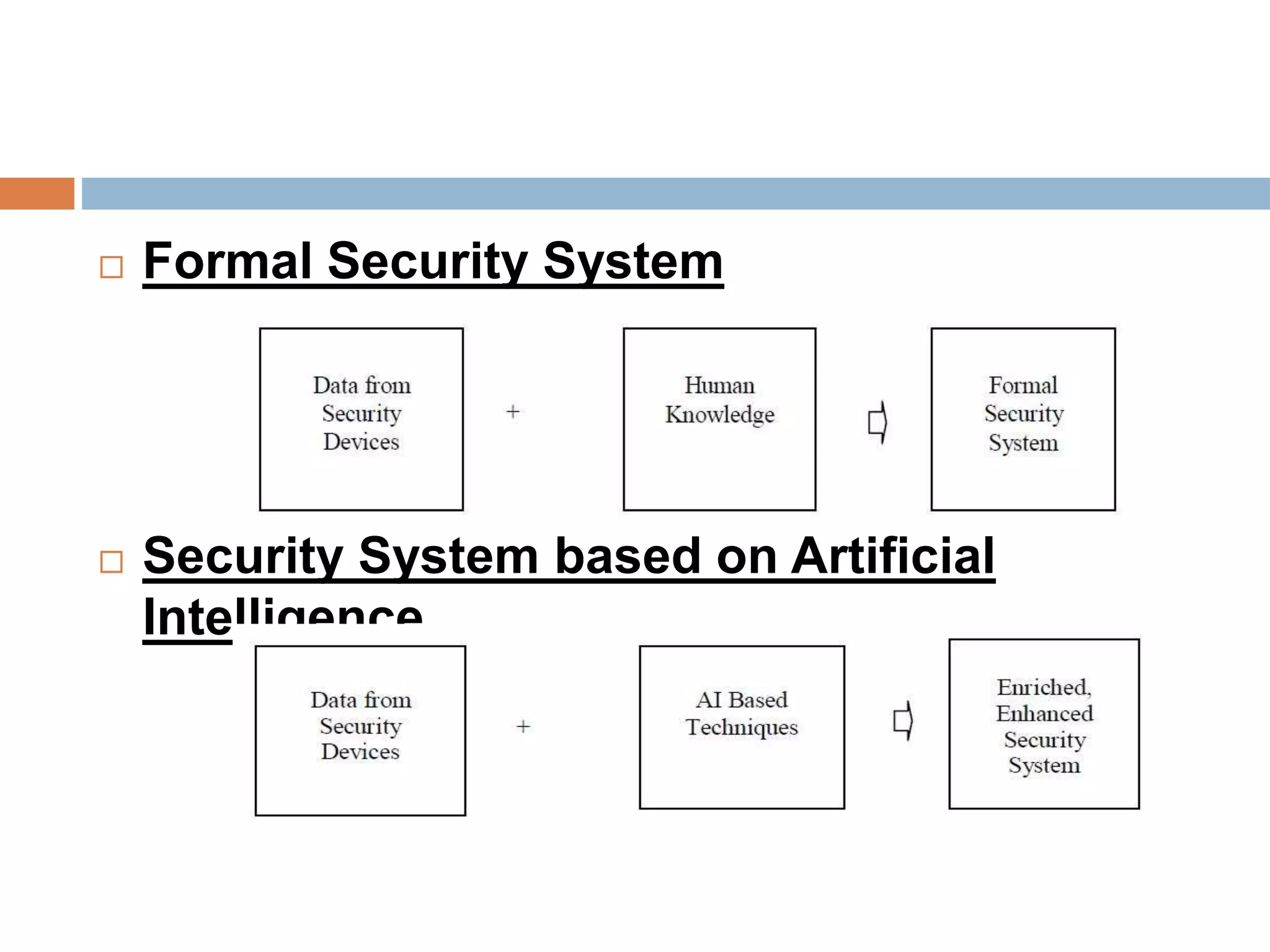
 Formal Security System
 Security System based on Artificial
Intelligence
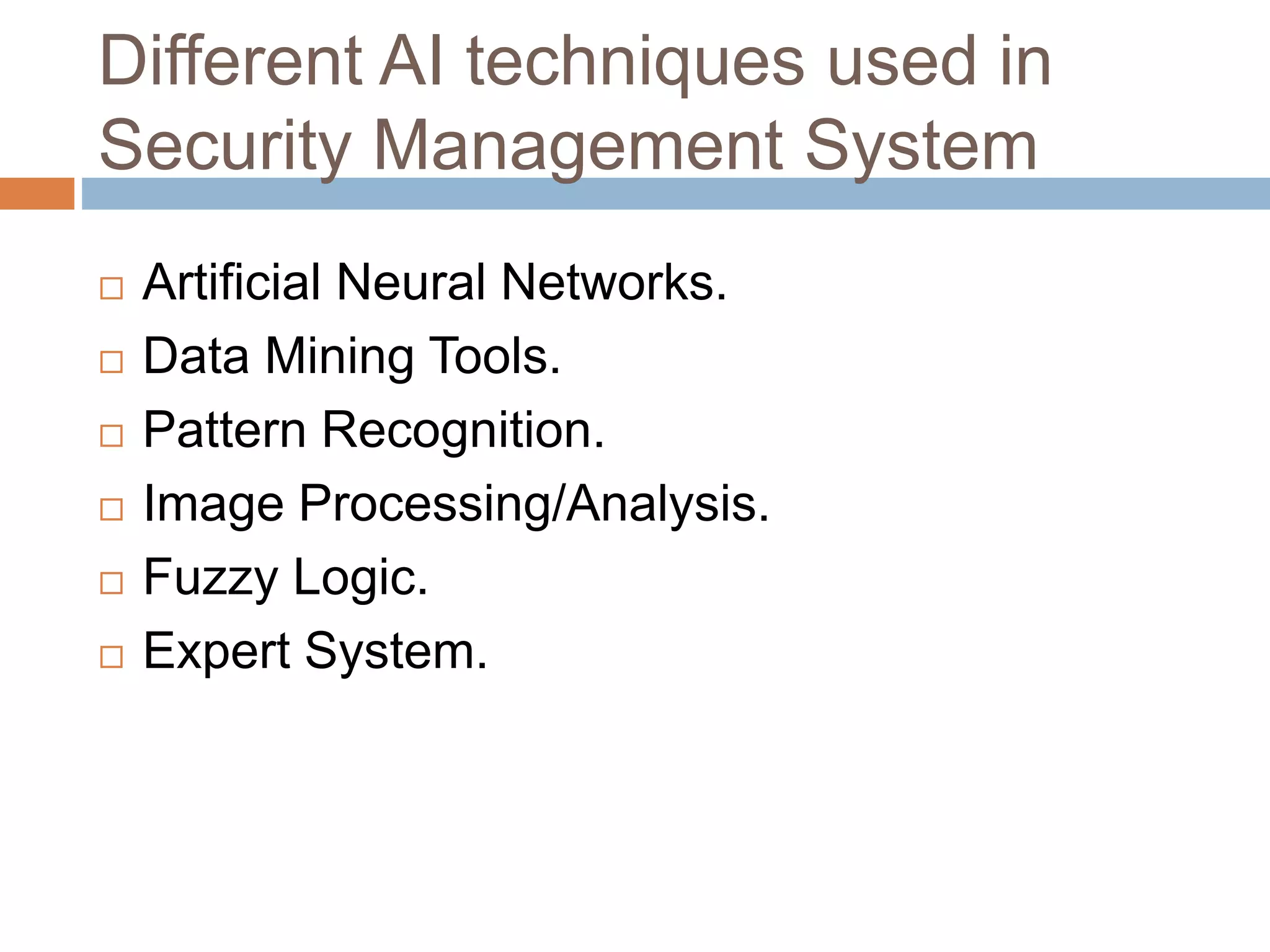
Different AI techniques used in
Security Management System
 Artificial Neural Networks.
 Data Mining Tools.
 Pattern Recognition.
 Image Processing/Analysis.
 Fuzzy Logic.
 Expert System.
Artificial Neural Networks
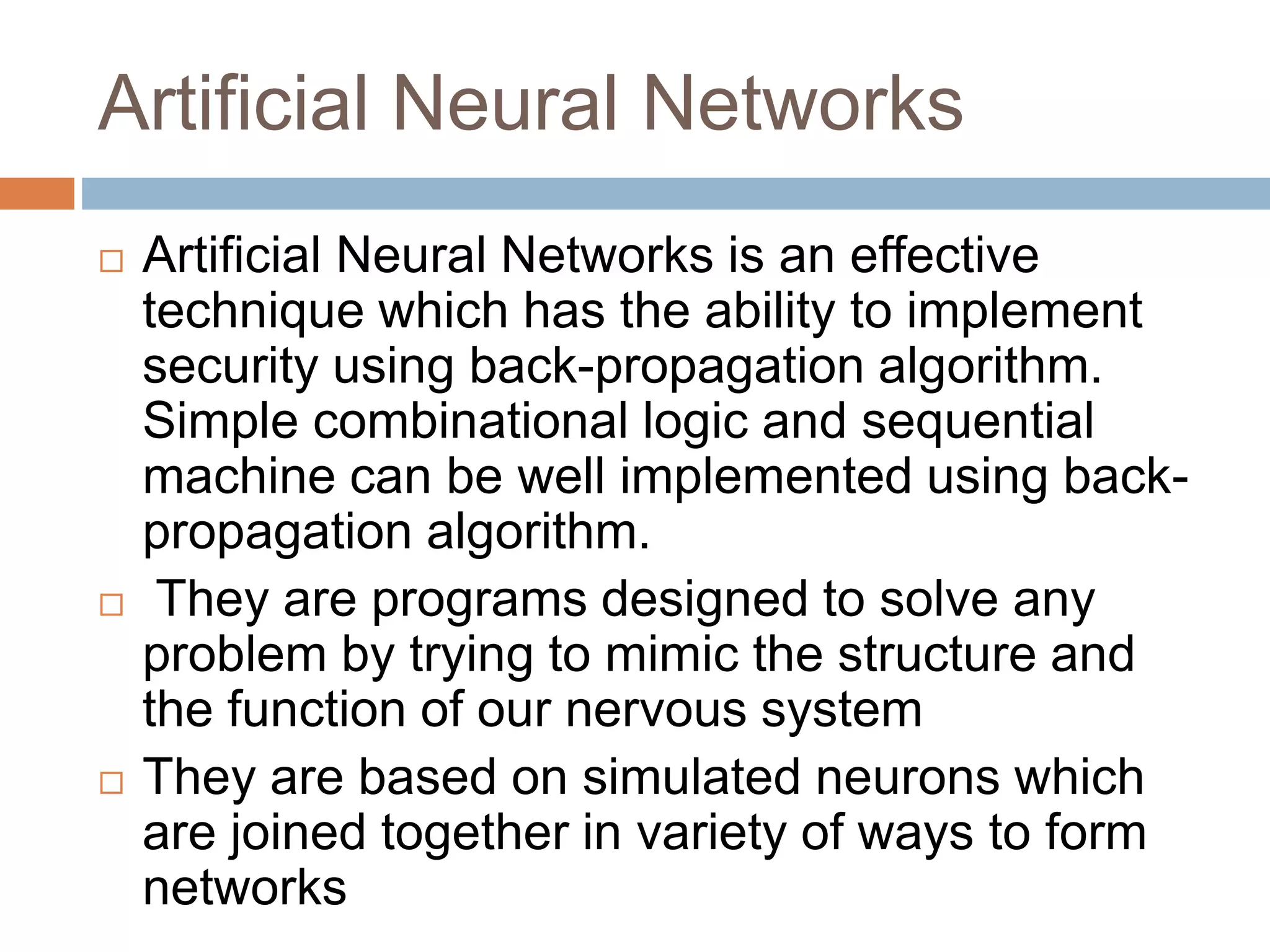
 Artificial Neural Networks is an effective
technique which has the ability to implement
security using back-propagation algorithm.
Simple combinational logic and sequential
machine can be well implemented using back-
propagation algorithm.
 They are programs designed to solve any
problem by trying to mimic the structure and
the function of our nervous system
 They are based on simulated neurons which
are joined together in variety of ways to form
networks
A Simple Biological neuron
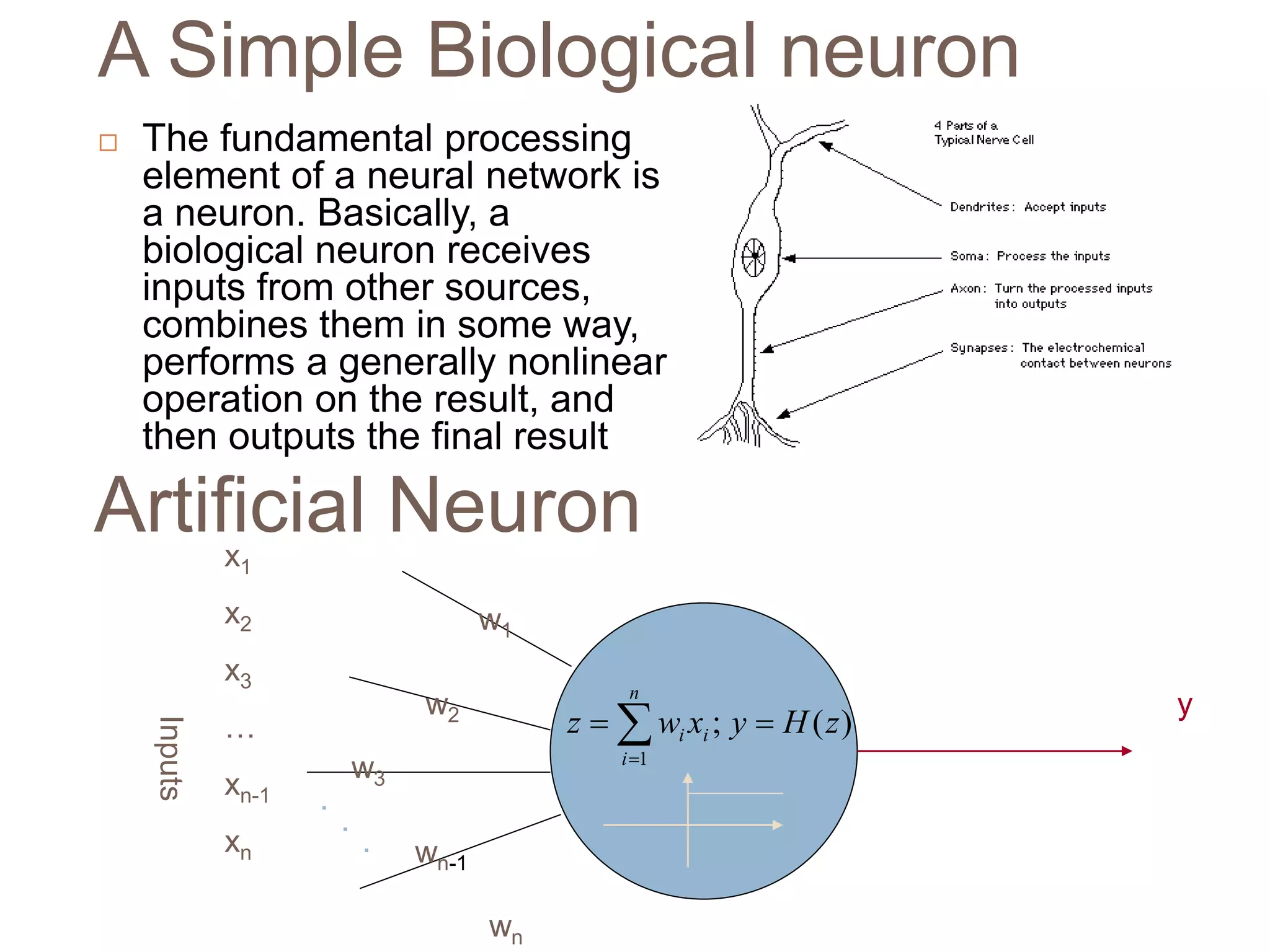
 The fundamental processing
element of a neural network is
a neuron. Basically, a
biological neuron receives
inputs from other sources,
combines them in some way,
performs a generally nonlinear
operation on the result, and
then outputs the final result
Inputs
w2
w1
w3
wn
wn-1
.
.
.
x1
x2
x3
…
xn-1
xn
y
)(;
1
zHyxwz
n
i
ii  
Artificial Neuron
ANN-Applications
 It involves Human like thinking
 They can handle noisy or missing data
 They can work with large number of variables
or parameters
 They deal with the non-linearity of the world
which we live in.
Fuzzy Rule Based Expert System
for Cyber Security
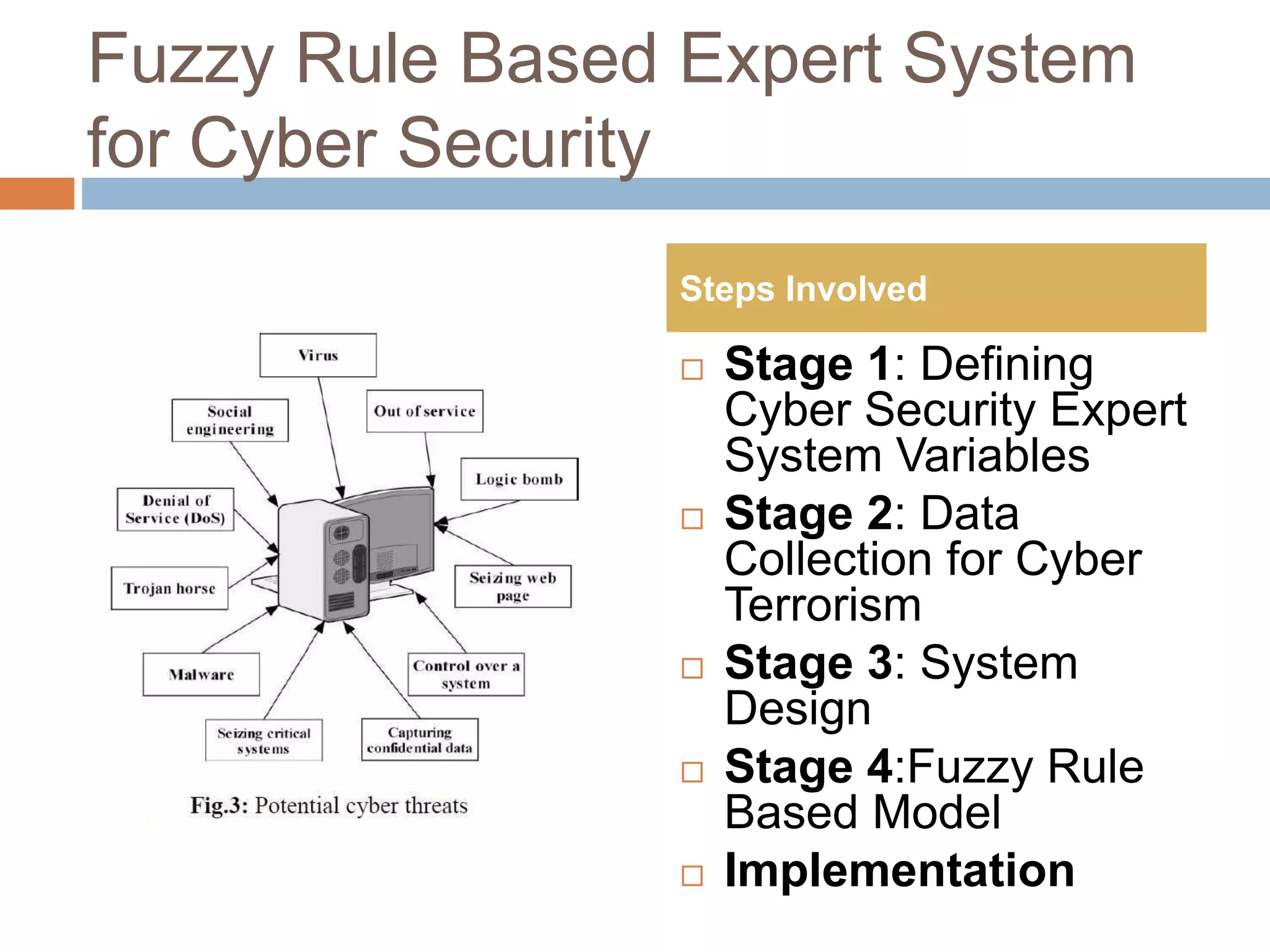
 Stage 1: Defining
Cyber Security Expert
System Variables
 Stage 2: Data
Collection for Cyber
Terrorism
 Stage 3: System
Design
 Stage 4:Fuzzy Rule
Based Model
 Implementation
Steps Involved
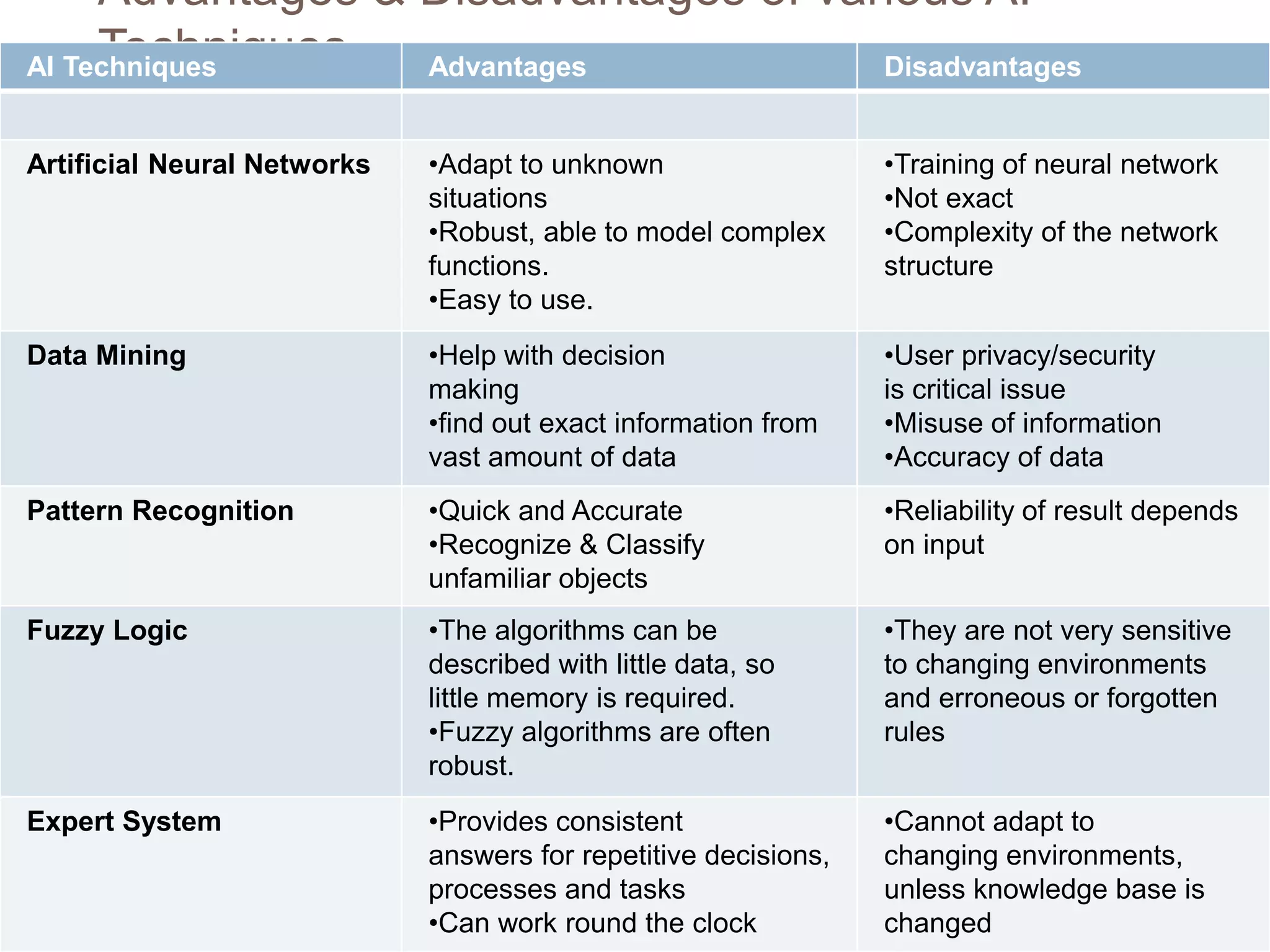
Advantages & Disadvantages of various AI
TechniquesAI Techniques Advantages Disadvantages
Artificial Neural Networks •Adapt to unknown
situations
•Robust, able to model complex
functions.
•Easy to use.
•Training of neural network
•Not exact
•Complexity of the network
structure
Data Mining •Help with decision
making
•find out exact information from
vast amount of data
•User privacy/security
is critical issue
•Misuse of information
•Accuracy of data
Pattern Recognition •Quick and Accurate
•Recognize & Classify
unfamiliar objects
•Reliability of result depends
on input
Fuzzy Logic •The algorithms can be
described with little data, so
little memory is required.
•Fuzzy algorithms are often
robust.
•They are not very sensitive
to changing environments
and erroneous or forgotten
rules
Expert System •Provides consistent
answers for repetitive decisions,
processes and tasks
•Can work round the clock
•Cannot adapt to
changing environments,
unless knowledge base is
changed
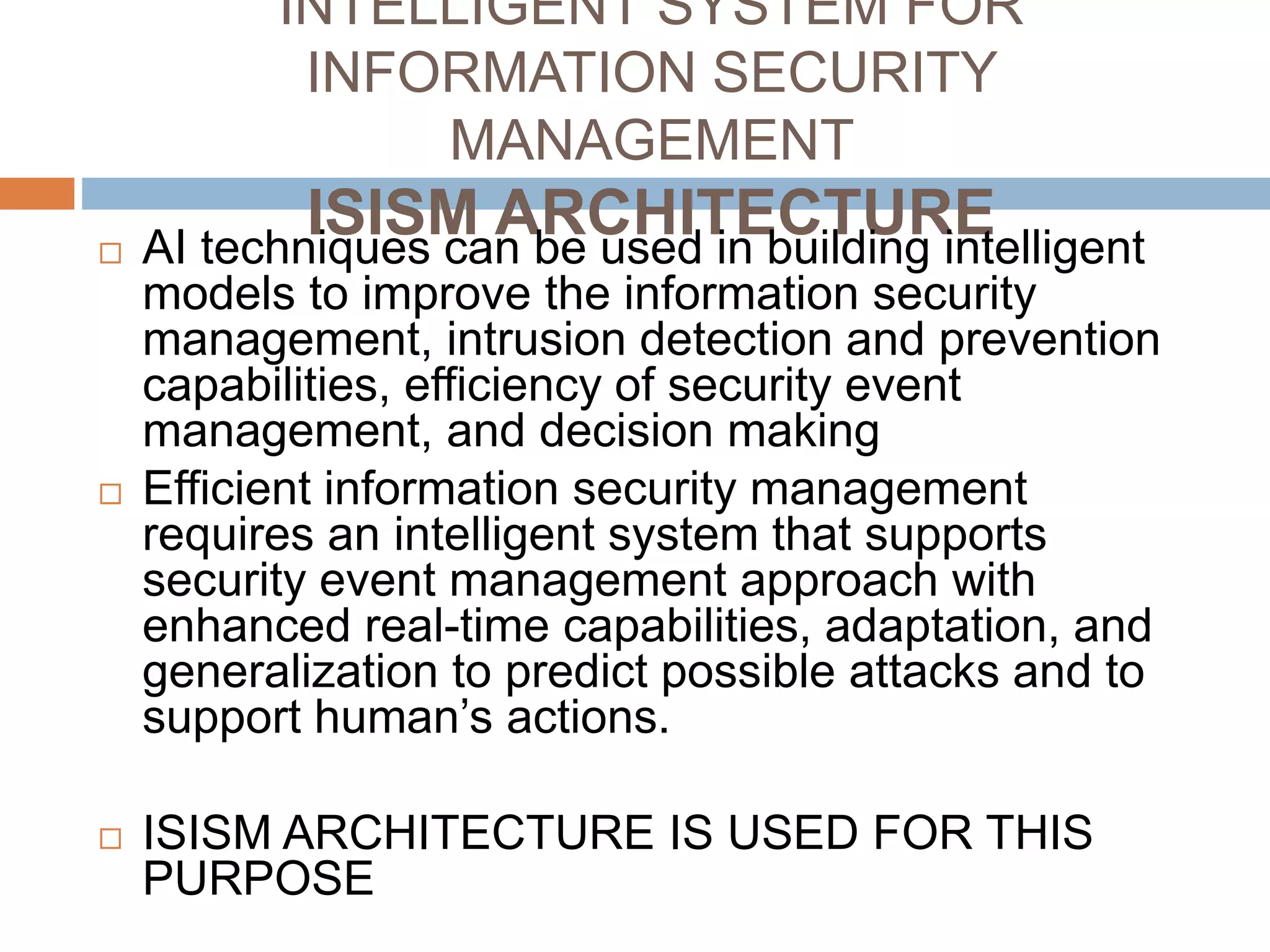
INTELLIGENT SYSTEM FOR
INFORMATION SECURITY
MANAGEMENT
ISISM ARCHITECTURE AI techniques can be used in building intelligent
models to improve the information security
management, intrusion detection and prevention
capabilities, efficiency of security event
management, and decision making
 Efficient information security management
requires an intelligent system that supports
security event management approach with
enhanced real-time capabilities, adaptation, and
generalization to predict possible attacks and to
support human’s actions.
 ISISM ARCHITECTURE IS USED FOR THIS
PURPOSE
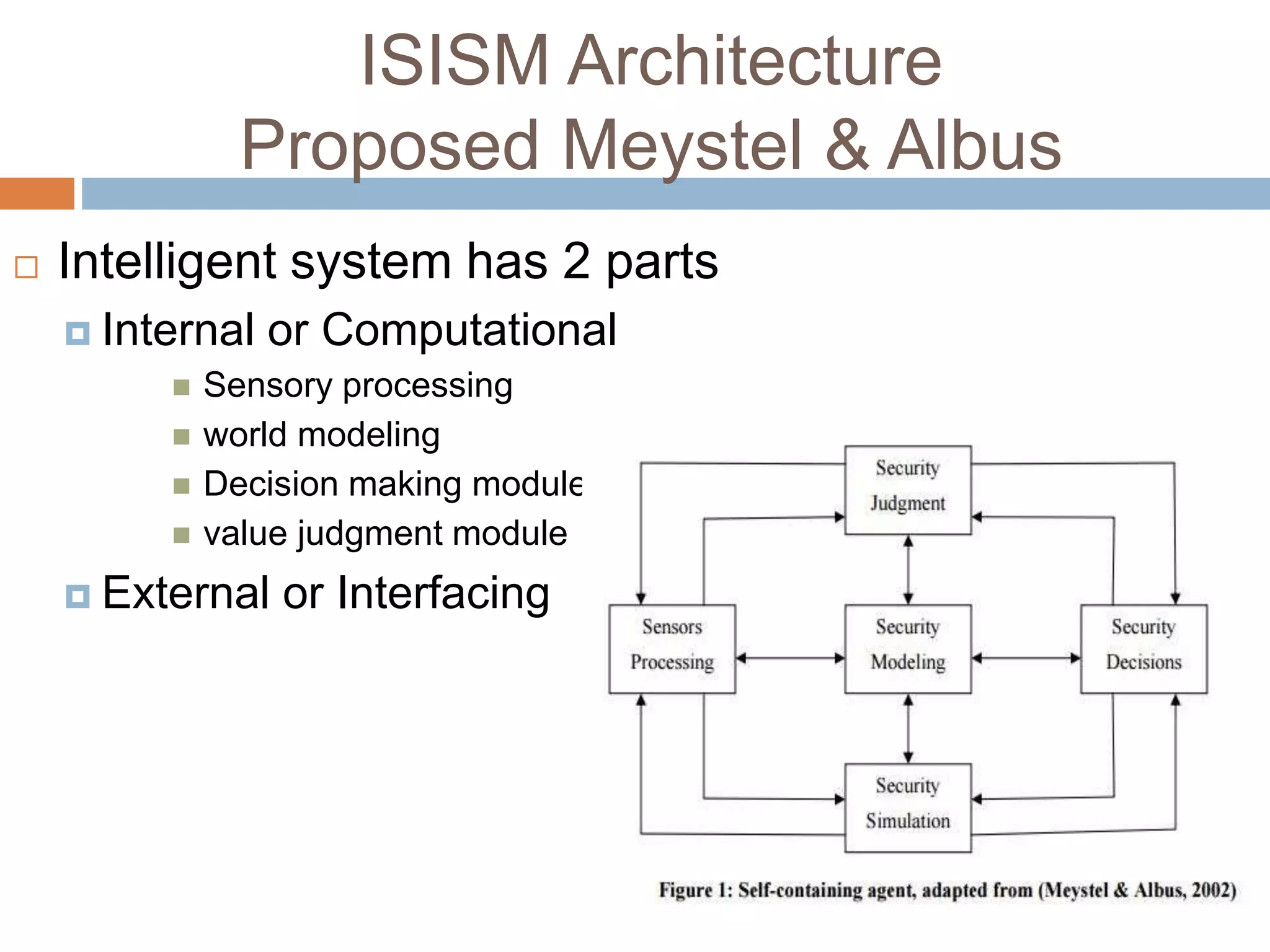
ISISM Architecture
Proposed Meystel & Albus
 Intelligent system has 2 parts
 Internal or Computational
 Sensory processing
 world modeling
 Decision making module
 value judgment module
 External or Interfacing
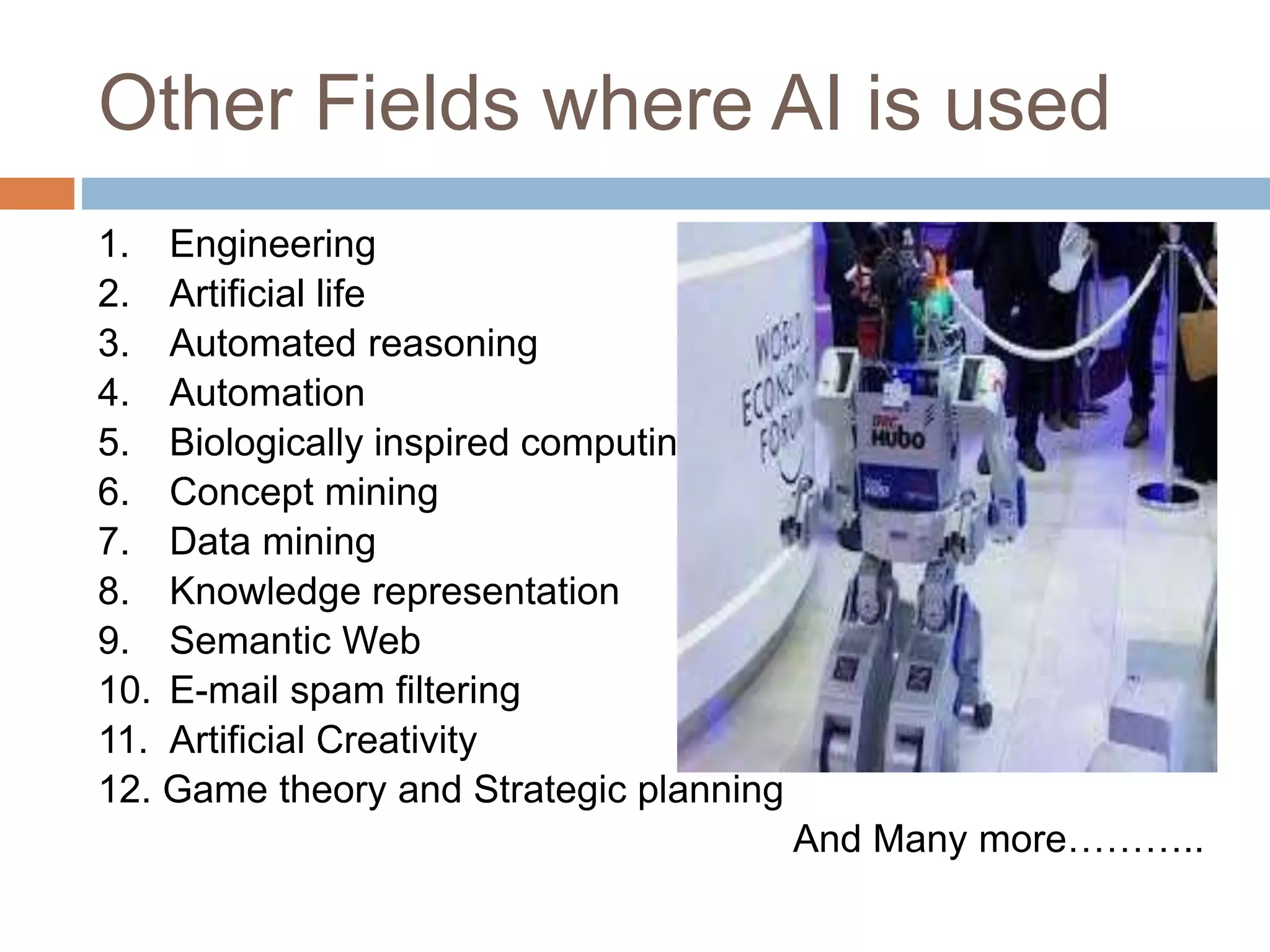
Other Fields where AI is used
1. Engineering
2. Artificial life
3. Automated reasoning
4. Automation
5. Biologically inspired computing
6. Concept mining
7. Data mining
8. Knowledge representation
9. Semantic Web
10. E-mail spam filtering
11. Artificial Creativity
12. Game theory and Strategic planning
And Many more………..
Conclusion
 As Security is key important issues, the integration
Artificial Intelligence Techniques certainly improve the
performance of the existing security system
 System alerts the user before unwanted hazards are
yet to happen
 The system constructs an intelligent image processing
technology which can identify the license plate and
human face. This is the essential as far as the terror
attacks are concerned
 Reduces human effort
 Man power required for the security purpose can be
reduced, as once the successful security system with
AI is designed, it can be used for longer duration.
 Drawback-Some are Expensive
BE-EEE-8th sem-Presentation Artificial intelligence in security managenent

BE-EEE-8th sem-Presentation Artificial intelligence in security managenent

  • 1.
    By, MOHAMMED SAQIB 1GC11EE018 Dept ofEEE GCE,Ramanagaram AN OVERVIEW ON USE OF ARTIFICIAL INTELLIGENCE TECHNIQUES IN EFFECTIVE SECURITY MANAGEMENT Under The Guidance of Mr.Aejaz Ahmed KR Asst. Professor
  • 2.
    What is Artificial Intelligence[AI]…??? The artificial intelligence is the process in which machine can act like a human  AI techniques gives rise to important applications where human processing ability weakens  Some of the field where AI is massively used are Military, Antiterrorism, Automobile Industry, Internet Search Engines and Robotics, Speech recognition, Expert & fuzzy system etc.,  The central goals of AI research include reasoning, knowledge, planning, learning, natural language processing (communication),perception and the ability to move and manipulate objects.  General intelligence is still among the field's long- term goals.
  • 3.
    Artificial Intelligence &Security  Nowadays Security is the important issue for Human, Company Environment, Organization, Community and Country in accordance to maintain growth and stability  Security threat gives rise to several problems such as instability, economical setbacks, terror attacks causes loss of human lives, creates Un-safety feelings.  As a human being, the security is challenging task because human has several restriction on analyzing and processing several information at a time. This is big drawback is identified in current security system.  This drawback can overcome on more practical manner with the help of artificial intelligence techniques integration. The security system includes Homeland security, Intrusion detection system, DOS attack, Cryptography, Video vigilance System etc. Human Processing ability integrated with AI certainly raise the security at high extend.
  • 4.
     Formal SecuritySystem  Security System based on Artificial Intelligence
  • 5.
    Different AI techniquesused in Security Management System  Artificial Neural Networks.  Data Mining Tools.  Pattern Recognition.  Image Processing/Analysis.  Fuzzy Logic.  Expert System.
  • 6.
    Artificial Neural Networks Artificial Neural Networks is an effective technique which has the ability to implement security using back-propagation algorithm. Simple combinational logic and sequential machine can be well implemented using back- propagation algorithm.  They are programs designed to solve any problem by trying to mimic the structure and the function of our nervous system  They are based on simulated neurons which are joined together in variety of ways to form networks
  • 7.
    A Simple Biologicalneuron  The fundamental processing element of a neural network is a neuron. Basically, a biological neuron receives inputs from other sources, combines them in some way, performs a generally nonlinear operation on the result, and then outputs the final result Inputs w2 w1 w3 wn wn-1 . . . x1 x2 x3 … xn-1 xn y )(; 1 zHyxwz n i ii   Artificial Neuron
  • 8.
    ANN-Applications  It involvesHuman like thinking  They can handle noisy or missing data  They can work with large number of variables or parameters  They deal with the non-linearity of the world which we live in.
  • 9.
    Fuzzy Rule BasedExpert System for Cyber Security  Stage 1: Defining Cyber Security Expert System Variables  Stage 2: Data Collection for Cyber Terrorism  Stage 3: System Design  Stage 4:Fuzzy Rule Based Model  Implementation Steps Involved
  • 10.
    Advantages & Disadvantagesof various AI TechniquesAI Techniques Advantages Disadvantages Artificial Neural Networks •Adapt to unknown situations •Robust, able to model complex functions. •Easy to use. •Training of neural network •Not exact •Complexity of the network structure Data Mining •Help with decision making •find out exact information from vast amount of data •User privacy/security is critical issue •Misuse of information •Accuracy of data Pattern Recognition •Quick and Accurate •Recognize & Classify unfamiliar objects •Reliability of result depends on input Fuzzy Logic •The algorithms can be described with little data, so little memory is required. •Fuzzy algorithms are often robust. •They are not very sensitive to changing environments and erroneous or forgotten rules Expert System •Provides consistent answers for repetitive decisions, processes and tasks •Can work round the clock •Cannot adapt to changing environments, unless knowledge base is changed
  • 11.
    INTELLIGENT SYSTEM FOR INFORMATIONSECURITY MANAGEMENT ISISM ARCHITECTURE AI techniques can be used in building intelligent models to improve the information security management, intrusion detection and prevention capabilities, efficiency of security event management, and decision making  Efficient information security management requires an intelligent system that supports security event management approach with enhanced real-time capabilities, adaptation, and generalization to predict possible attacks and to support human’s actions.  ISISM ARCHITECTURE IS USED FOR THIS PURPOSE
  • 12.
    ISISM Architecture Proposed Meystel& Albus  Intelligent system has 2 parts  Internal or Computational  Sensory processing  world modeling  Decision making module  value judgment module  External or Interfacing
  • 13.
    Other Fields whereAI is used 1. Engineering 2. Artificial life 3. Automated reasoning 4. Automation 5. Biologically inspired computing 6. Concept mining 7. Data mining 8. Knowledge representation 9. Semantic Web 10. E-mail spam filtering 11. Artificial Creativity 12. Game theory and Strategic planning And Many more………..
  • 14.
    Conclusion  As Securityis key important issues, the integration Artificial Intelligence Techniques certainly improve the performance of the existing security system  System alerts the user before unwanted hazards are yet to happen  The system constructs an intelligent image processing technology which can identify the license plate and human face. This is the essential as far as the terror attacks are concerned  Reduces human effort  Man power required for the security purpose can be reduced, as once the successful security system with AI is designed, it can be used for longer duration.  Drawback-Some are Expensive