RESEARCH REPORT
By,
Rahul R
Sabir Babu
Salman Sajid
Pooja Kumari
Preethi Gowda
Mohammed Saqib
And
Consumer Behavior
• Demonetization is the act of stripping a currency unit of its status as
legal tender.
• The old unit of currency must be retired and replaced with a new
currency unit.
• The Indian government moved as well as decided on November 8,
2016 to demonetize the two notes with biggest denomination i.e.
Rupees 500 and 1000 which are in combine recorded with 86%
participation in the total cash supply chain of the country.
• The main objective of this decision was to eradicate black money and
to make India go digital. The research focuses on the effects of
demonetization on the consumer behavior and their payment
methods.
INTRODUCTION TO DEMONETIZATION
Research objectives :
• To study the effect of demonetization on consumer behavior in terms of :
a) change in payment modes
b) purchase habits.
• To assess if the number of Indians doing cashless transactions has increased
significantly post demonetization.
• To assess if the proportion of cashless transactions(over cash transactions)made
by individuals has increased significantly post demonetization
• To understand if digital payment has got acceptance from the people
RESEARCH OBJECTIVES
• Since our economy is dependent on cash, significant percentage of
population do no use Net banking system for monetary transactions.

Hence, Demonetization has hit trade and consumption hard.
• The Research wanted to understand if demonetization has affected
consumer behavior and if it has changed their payment methods. This
study was also focused on the acceptance of digital payment from
people
STATEMENT OF PROBLEM
• In terms of information areas scope will be limited to Bangalore city
covering north, south and central Bangalore
• To understand the impact of demonetization on consumers and
changes in their payment methods
SCOPE OF THE STUDY
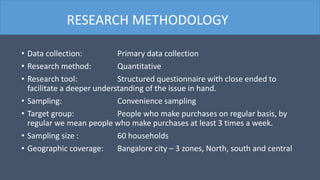
• Data collection: Primary data collection
• Research method: Quantitative
• Research tool: Structured questionnaire with close ended to
facilitate a deeper understanding of the issue in hand.
• Sampling: Convenience sampling
• Target group: People who make purchases on regular basis, by
regular we mean people who make purchases at least 3 times a week.
• Sampling size : 60 households
• Geographic coverage: Bangalore city – 3 zones, North, south and central
RESEARCH METHODOLOGY
• The data is tabulated
• Simple percentages are calculated to analyze the data and
• Data will is represented through graphs and charts
DATA ANALYSIS
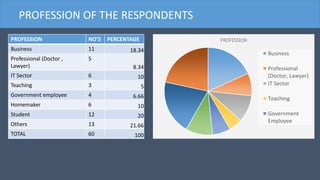
RESPONDENT PROFILE
PROFESSION NO’S PERCENTAGE
Business 11 18.34
Professional (Doctor ,
Lawyer)
5
8.34
IT Sector 6 10
Teaching 3 5
Government employee 4 6.66
Homemaker 6 10
Student 12 20
Others 13 21.66
TOTAL 60 100
PROFESSION
Business
Professional
(Doctor, Lawyer)
IT Sector
Teaching
Government
Employee
PROFESSION OF THE RESPONDENTS
`
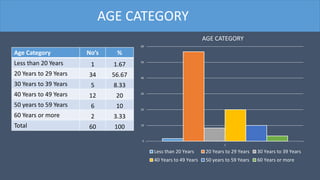
Age Category No’s %
Less than 20 Years 1 1.67
20 Years to 29 Years 34 56.67
30 Years to 39 Years 5 8.33
40 Years to 49 Years 12 20
50 years to 59 Years 6 10
60 Years or more 2 3.33
Total 60 100
0
10
20
30
40
50
60
1
AGE CATEGORY
Less than 20 Years 20 Years to 29 Years 30 Years to 39 Years
40 Years to 49 Years 50 years to 59 Years 60 Years or more
AGE CATEGORY
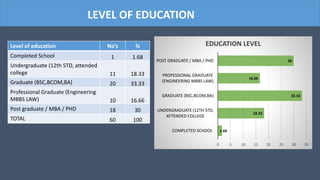
Level of education No’s %
Completed School 1 1.68
Undergraduate (12th STD, attended
college 11 18.33
Graduate (BSC,BCOM,BA) 20 33.33
Professional Graduate (Engineering
MBBS LAW) 10 16.66
Post graduate / MBA / PHD 18 30
TOTAL 60 100
1.68
18.33
33.33
16.66
30
0 5 10 15 20 25 30 35
COMPLETED SCHOOL
UNDERGRADUATE (12TH STD,
ATTENDED COLLEGE
GRADUATE (BSC,BCOM,BA)
PROFESSIONAL GRADUATE
(ENGINEERING MBBS LAW)
POST GRADUATE / MBA / PHD
EDUCATION LEVEL
LEVEL OF EDUCATION
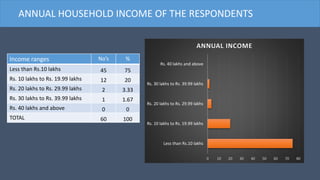
Income ranges No’s %
Less than Rs.10 lakhs 45 75
Rs. 10 lakhs to Rs. 19.99 lakhs 12 20
Rs. 20 lakhs to Rs. 29.99 lakhs 2 3.33
Rs. 30 lakhs to Rs. 39.99 lakhs 1 1.67
Rs. 40 lakhs and above 0 0
TOTAL 60 100
0 10 20 30 40 50 60 70 80
Less than Rs.10 lakhs
Rs. 10 lakhs to Rs. 19.99 lakhs
Rs. 20 lakhs to Rs. 29.99 lakhs
Rs. 30 lakhs to Rs. 39.99 lakhs
Rs. 40 lakhs and above
ANNUAL INCOME
ANNUAL HOUSEHOLD INCOME OF THE RESPONDENTS
FINDINGS
MAIN QUESTIONNAIRE
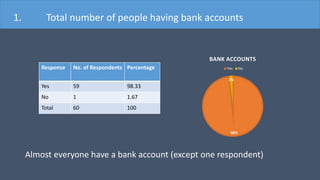
Response No. of Respondents Percentage
Yes 59 98.33
No 1 1.67
Total 60 100
98%
2%
BANK ACCOUNTS
Yes No
Almost everyone have a bank account (except one respondent)
1. Total number of people having bank accounts
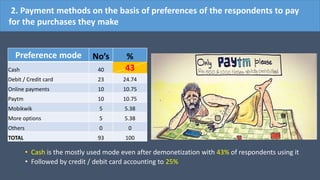
Preference mode No’s %
Cash 40 43
Debit / Credit card 23 24.74
Online payments 10 10.75
Paytm 10 10.75
Mobikwik 5 5.38
More options 5 5.38
Others 0 0
TOTAL 93 100
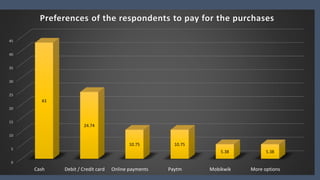
• Cash is the mostly used mode even after demonetization with 43% of respondents using it
• Followed by credit / debit card accounting to 25%
2. Payment methods on the basis of preferences of the respondents to pay
for the purchases they make
0
5
10
15
20
25
30
35
40
45
Cash Debit / Credit card Online payments Paytm Mobikwik More options
43
24.74
10.75 10.75
5.38 5.38
Preferences of the respondents to pay for the purchases
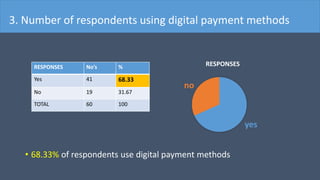
RESPONSES No’s %
Yes 41 68.33
No 19 31.67
TOTAL 60 100
yes
no
RESPONSES
• 68.33% of respondents use digital payment methods
3. Number of respondents using digital payment methods
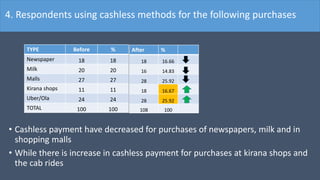
TYPE Before %
Newspaper 18 18
Milk 20 20
Malls 27 27
Kirana shops 11 11
Uber/Ola 24 24
TOTAL 100 100
After %
18 16.66
16 14.83
28 25.92
18 16.67
28 25.92
108 100
• Cashless payment have decreased for purchases of newspapers, milk and in
shopping malls
• While there is increase in cashless payment for purchases at kirana shops and
the cab rides
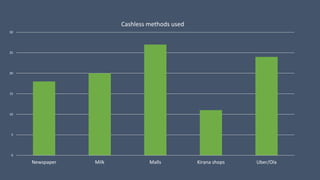
4. Respondents using cashless methods for the following purchases
0
5
10
15
20
25
30
Newspaper Milk Malls Kirana shops Uber/Ola
Cashless methods used
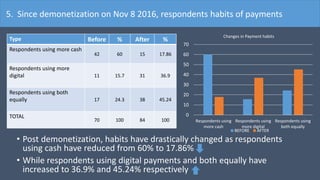
Type Before % After %
Respondents using more cash
42 60 15 17.86
Respondents using more
digital 11 15.7 31 36.9
Respondents using both
equally 17 24.3 38 45.24
TOTAL
70 100 84 100
• Post demonetization, habits have drastically changed as respondents
using cash have reduced from 60% to 17.86%
• While respondents using digital payments and both equally have
increased to 36.9% and 45.24% respectively
5. Since demonetization on Nov 8 2016, respondents habits of payments
0
10
20
30
40
50
60
70
Respondents using
more cash
Respondents using
more digital
Respondents using
both equally
Changes in Payment habits
BEFORE AFTER
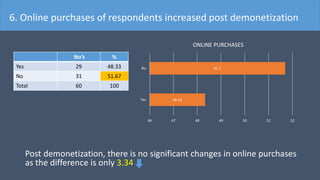
No’s %
Yes 29 48.33
No 31 51.67
Total 60 100
48.33
51.7
46 47 48 49 50 51 52
Yes
No
ONLINE PURCHASES
Post demonetization, there is no significant changes in online purchases
as the difference is only 3.34
6. Online purchases of respondents increased post demonetization
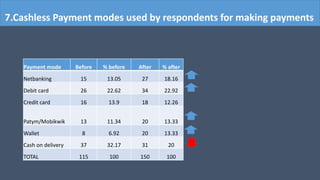
Payment mode Before % before After % after
Netbanking 15 13.05 27 18.16
Debit card 26 22.62 34 22.92
Credit card 16 13.9 18 12.26
Patym/Mobikwik 13 11.34 20 13.33
Wallet 8 6.92 20 13.33
Cash on delivery 37 32.17 31 20
TOTAL 115 100 150 100
7.Cashless Payment modes used by respondents for making payments
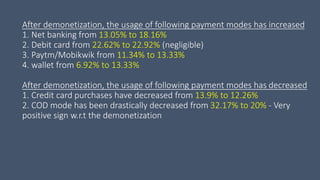
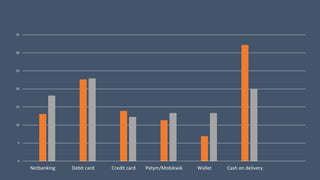
After demonetization, the usage of following payment modes has increased
1. Net banking from 13.05% to 18.16%
2. Debit card from 22.62% to 22.92% (negligible)
3. Paytm/Mobikwik from 11.34% to 13.33%
4. wallet from 6.92% to 13.33%
After demonetization, the usage of following payment modes has decreased
1. Credit card purchases have decreased from 13.9% to 12.26%
2. COD mode has been drastically decreased from 32.17% to 20% - Very
positive sign w.r.t the demonetization
0
5
10
15
20
25
30
35
Netbanking Debit card Credit card Patym/Mobikwik Wallet Cash on delivery
Individual attributes
Responses for some of the statements
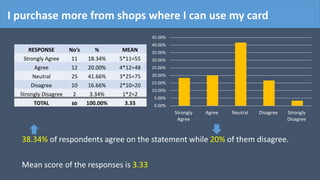
38.34% of respondents agree on the statement while 20% of them disagree.
Mean score of the responses is 3.33
RESPONSE No’s % MEAN
Strongly Agree 11 18.34% 5*11=55
Agree 12 20.00% 4*12=48
Neutral 25 41.66% 3*25=75
Disagree 10 16.66% 2*10=20
Strongly Disagree 2 3.34% 1*2=2
TOTAL 60 100.00% 3.33
I purchase more from shops where I can use my card
0.00%
5.00%
10.00%
15.00%
20.00%
25.00%
30.00%
35.00%
40.00%
45.00%
Strongly
Agree
Agree Neutral Disagree Strongly
Disagree
RESPONSE No’s % MEAN
Strongly Agree 4 6.66% 5*4=20
Agree 15 25% 4*25=100
Neutral 13 21.67% 3*13=39
Disagree 16 26.67% 2*16=32
Strongly Disagree 12 20% 1*12=12
TOTAL 60 100% 3.38
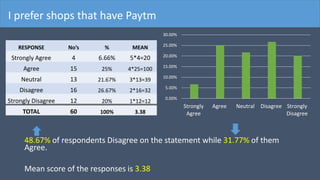
48.67% of respondents Disagree on the statement while 31.77% of them
Agree.
Mean score of the responses is 3.38
I prefer shops that have Paytm
0.00%
5.00%
10.00%
15.00%
20.00%
25.00%
30.00%
Strongly
Agree
Agree Neutral Disagree Strongly
Disagree
RESPONSE No’s % MEAN
Strongly Agree 1 1.67% 5*1=5
Agree 8 13.33% 4*8=32
Neutral 29 48.33% 3*29=57
Disagree 15 25% 2*15=30
Strongly Disagree 7 11.67% 1*7=7
TOTAL 60 100% 2.18
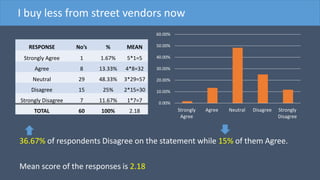
36.67% of respondents Disagree on the statement while 15% of them Agree.
Mean score of the responses is 2.18
I buy less from street vendors now
0.00%
10.00%
20.00%
30.00%
40.00%
50.00%
60.00%
Strongly
Agree
Agree Neutral Disagree Strongly
Disagree
RESPONSE No’s % MEAN
Strongly Agree 14 23.33% 5*14=70
Agree 19 31.67% 4*19=76
Neutral 13 21.67% 3*13=39
Disagree 10 16.66% 2*10=20
Strongly Disagree 4 6.67% 1*4=4
TOTAL 60 100% 3.48
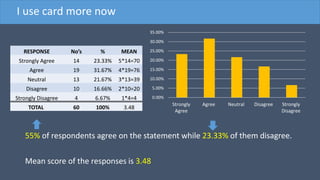
55% of respondents agree on the statement while 23.33% of them disagree.
Mean score of the responses is 3.48
I use card more now
0.00%
5.00%
10.00%
15.00%
20.00%
25.00%
30.00%
35.00%
Strongly
Agree
Agree Neutral Disagree Strongly
Disagree
RESPONSE No’s % MEAN
Strongly Agree 8 13.33% 5*8=40
Agree 23 38.33% 4*23=92
Neutral 23 38.33% 3*23=69
Disagree 4 6.67% 2*4=8
Strongly Disagree 2 3.34% 1*2=2
TOTAL 60 100% 3.51
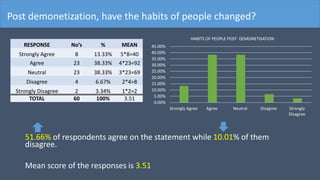
51.66% of respondents agree on the statement while 10.01% of them
disagree.
Mean score of the responses is 3.51
Post demonetization, have the habits of people changed?
0.00%
5.00%
10.00%
15.00%
20.00%
25.00%
30.00%
35.00%
40.00%
45.00%
Strongly Agree Agree Neutral Disagree Strongly
Disagree
HABITS OF PEOPLE POST DEMONETISATION
Research objectives :
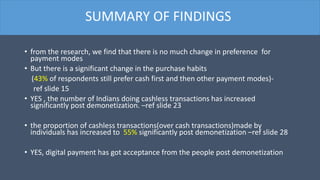
• from the research, we find that there is no much change in preference for
payment modes
• But there is a significant change in the purchase habits
(43% of respondents still prefer cash first and then other payment modes)-
ref slide 15
• YES , the number of Indians doing cashless transactions has increased
significantly post demonetization. –ref slide 23
• the proportion of cashless transactions(over cash transactions)made by
individuals has increased to 55% significantly post demonetization –ref slide 28
• YES, digital payment has got acceptance from the people post demonetization
SUMMARY OF FINDINGS
Demonetization survey

Demonetization survey

  • 1.
    RESEARCH REPORT By, Rahul R SabirBabu Salman Sajid Pooja Kumari Preethi Gowda Mohammed Saqib
  • 2.
  • 3.
    • Demonetization isthe act of stripping a currency unit of its status as legal tender. • The old unit of currency must be retired and replaced with a new currency unit. • The Indian government moved as well as decided on November 8, 2016 to demonetize the two notes with biggest denomination i.e. Rupees 500 and 1000 which are in combine recorded with 86% participation in the total cash supply chain of the country. • The main objective of this decision was to eradicate black money and to make India go digital. The research focuses on the effects of demonetization on the consumer behavior and their payment methods. INTRODUCTION TO DEMONETIZATION
  • 4.
    Research objectives : •To study the effect of demonetization on consumer behavior in terms of : a) change in payment modes b) purchase habits. • To assess if the number of Indians doing cashless transactions has increased significantly post demonetization. • To assess if the proportion of cashless transactions(over cash transactions)made by individuals has increased significantly post demonetization • To understand if digital payment has got acceptance from the people RESEARCH OBJECTIVES
  • 5.
    • Since oureconomy is dependent on cash, significant percentage of population do no use Net banking system for monetary transactions. Hence, Demonetization has hit trade and consumption hard. • The Research wanted to understand if demonetization has affected consumer behavior and if it has changed their payment methods. This study was also focused on the acceptance of digital payment from people STATEMENT OF PROBLEM
  • 6.
    • In termsof information areas scope will be limited to Bangalore city covering north, south and central Bangalore • To understand the impact of demonetization on consumers and changes in their payment methods SCOPE OF THE STUDY
  • 7.
    • Data collection:Primary data collection • Research method: Quantitative • Research tool: Structured questionnaire with close ended to facilitate a deeper understanding of the issue in hand. • Sampling: Convenience sampling • Target group: People who make purchases on regular basis, by regular we mean people who make purchases at least 3 times a week. • Sampling size : 60 households • Geographic coverage: Bangalore city – 3 zones, North, south and central RESEARCH METHODOLOGY
  • 8.
    • The datais tabulated • Simple percentages are calculated to analyze the data and • Data will is represented through graphs and charts DATA ANALYSIS
  • 9.
  • 10.
    PROFESSION NO’S PERCENTAGE Business11 18.34 Professional (Doctor , Lawyer) 5 8.34 IT Sector 6 10 Teaching 3 5 Government employee 4 6.66 Homemaker 6 10 Student 12 20 Others 13 21.66 TOTAL 60 100 PROFESSION Business Professional (Doctor, Lawyer) IT Sector Teaching Government Employee PROFESSION OF THE RESPONDENTS
  • 11.
    ` Age Category No’s% Less than 20 Years 1 1.67 20 Years to 29 Years 34 56.67 30 Years to 39 Years 5 8.33 40 Years to 49 Years 12 20 50 years to 59 Years 6 10 60 Years or more 2 3.33 Total 60 100 0 10 20 30 40 50 60 1 AGE CATEGORY Less than 20 Years 20 Years to 29 Years 30 Years to 39 Years 40 Years to 49 Years 50 years to 59 Years 60 Years or more AGE CATEGORY
  • 12.
    Level of educationNo’s % Completed School 1 1.68 Undergraduate (12th STD, attended college 11 18.33 Graduate (BSC,BCOM,BA) 20 33.33 Professional Graduate (Engineering MBBS LAW) 10 16.66 Post graduate / MBA / PHD 18 30 TOTAL 60 100 1.68 18.33 33.33 16.66 30 0 5 10 15 20 25 30 35 COMPLETED SCHOOL UNDERGRADUATE (12TH STD, ATTENDED COLLEGE GRADUATE (BSC,BCOM,BA) PROFESSIONAL GRADUATE (ENGINEERING MBBS LAW) POST GRADUATE / MBA / PHD EDUCATION LEVEL LEVEL OF EDUCATION
  • 13.
    Income ranges No’s% Less than Rs.10 lakhs 45 75 Rs. 10 lakhs to Rs. 19.99 lakhs 12 20 Rs. 20 lakhs to Rs. 29.99 lakhs 2 3.33 Rs. 30 lakhs to Rs. 39.99 lakhs 1 1.67 Rs. 40 lakhs and above 0 0 TOTAL 60 100 0 10 20 30 40 50 60 70 80 Less than Rs.10 lakhs Rs. 10 lakhs to Rs. 19.99 lakhs Rs. 20 lakhs to Rs. 29.99 lakhs Rs. 30 lakhs to Rs. 39.99 lakhs Rs. 40 lakhs and above ANNUAL INCOME ANNUAL HOUSEHOLD INCOME OF THE RESPONDENTS
  • 14.
  • 15.
    Response No. ofRespondents Percentage Yes 59 98.33 No 1 1.67 Total 60 100 98% 2% BANK ACCOUNTS Yes No Almost everyone have a bank account (except one respondent) 1. Total number of people having bank accounts
  • 16.
    Preference mode No’s% Cash 40 43 Debit / Credit card 23 24.74 Online payments 10 10.75 Paytm 10 10.75 Mobikwik 5 5.38 More options 5 5.38 Others 0 0 TOTAL 93 100 • Cash is the mostly used mode even after demonetization with 43% of respondents using it • Followed by credit / debit card accounting to 25% 2. Payment methods on the basis of preferences of the respondents to pay for the purchases they make
  • 17.
    0 5 10 15 20 25 30 35 40 45 Cash Debit /Credit card Online payments Paytm Mobikwik More options 43 24.74 10.75 10.75 5.38 5.38 Preferences of the respondents to pay for the purchases
  • 18.
    RESPONSES No’s % Yes41 68.33 No 19 31.67 TOTAL 60 100 yes no RESPONSES • 68.33% of respondents use digital payment methods 3. Number of respondents using digital payment methods
  • 19.
    TYPE Before % Newspaper18 18 Milk 20 20 Malls 27 27 Kirana shops 11 11 Uber/Ola 24 24 TOTAL 100 100 After % 18 16.66 16 14.83 28 25.92 18 16.67 28 25.92 108 100 • Cashless payment have decreased for purchases of newspapers, milk and in shopping malls • While there is increase in cashless payment for purchases at kirana shops and the cab rides 4. Respondents using cashless methods for the following purchases
  • 20.
    0 5 10 15 20 25 30 Newspaper Milk MallsKirana shops Uber/Ola Cashless methods used
  • 21.
    Type Before %After % Respondents using more cash 42 60 15 17.86 Respondents using more digital 11 15.7 31 36.9 Respondents using both equally 17 24.3 38 45.24 TOTAL 70 100 84 100 • Post demonetization, habits have drastically changed as respondents using cash have reduced from 60% to 17.86% • While respondents using digital payments and both equally have increased to 36.9% and 45.24% respectively 5. Since demonetization on Nov 8 2016, respondents habits of payments 0 10 20 30 40 50 60 70 Respondents using more cash Respondents using more digital Respondents using both equally Changes in Payment habits BEFORE AFTER
  • 22.
    No’s % Yes 2948.33 No 31 51.67 Total 60 100 48.33 51.7 46 47 48 49 50 51 52 Yes No ONLINE PURCHASES Post demonetization, there is no significant changes in online purchases as the difference is only 3.34 6. Online purchases of respondents increased post demonetization
  • 23.
    Payment mode Before% before After % after Netbanking 15 13.05 27 18.16 Debit card 26 22.62 34 22.92 Credit card 16 13.9 18 12.26 Patym/Mobikwik 13 11.34 20 13.33 Wallet 8 6.92 20 13.33 Cash on delivery 37 32.17 31 20 TOTAL 115 100 150 100 7.Cashless Payment modes used by respondents for making payments
  • 24.
    After demonetization, theusage of following payment modes has increased 1. Net banking from 13.05% to 18.16% 2. Debit card from 22.62% to 22.92% (negligible) 3. Paytm/Mobikwik from 11.34% to 13.33% 4. wallet from 6.92% to 13.33% After demonetization, the usage of following payment modes has decreased 1. Credit card purchases have decreased from 13.9% to 12.26% 2. COD mode has been drastically decreased from 32.17% to 20% - Very positive sign w.r.t the demonetization
  • 25.
    0 5 10 15 20 25 30 35 Netbanking Debit cardCredit card Patym/Mobikwik Wallet Cash on delivery
  • 26.
  • 27.
    38.34% of respondentsagree on the statement while 20% of them disagree. Mean score of the responses is 3.33 RESPONSE No’s % MEAN Strongly Agree 11 18.34% 5*11=55 Agree 12 20.00% 4*12=48 Neutral 25 41.66% 3*25=75 Disagree 10 16.66% 2*10=20 Strongly Disagree 2 3.34% 1*2=2 TOTAL 60 100.00% 3.33 I purchase more from shops where I can use my card 0.00% 5.00% 10.00% 15.00% 20.00% 25.00% 30.00% 35.00% 40.00% 45.00% Strongly Agree Agree Neutral Disagree Strongly Disagree
  • 28.
    RESPONSE No’s %MEAN Strongly Agree 4 6.66% 5*4=20 Agree 15 25% 4*25=100 Neutral 13 21.67% 3*13=39 Disagree 16 26.67% 2*16=32 Strongly Disagree 12 20% 1*12=12 TOTAL 60 100% 3.38 48.67% of respondents Disagree on the statement while 31.77% of them Agree. Mean score of the responses is 3.38 I prefer shops that have Paytm 0.00% 5.00% 10.00% 15.00% 20.00% 25.00% 30.00% Strongly Agree Agree Neutral Disagree Strongly Disagree
  • 29.
    RESPONSE No’s %MEAN Strongly Agree 1 1.67% 5*1=5 Agree 8 13.33% 4*8=32 Neutral 29 48.33% 3*29=57 Disagree 15 25% 2*15=30 Strongly Disagree 7 11.67% 1*7=7 TOTAL 60 100% 2.18 36.67% of respondents Disagree on the statement while 15% of them Agree. Mean score of the responses is 2.18 I buy less from street vendors now 0.00% 10.00% 20.00% 30.00% 40.00% 50.00% 60.00% Strongly Agree Agree Neutral Disagree Strongly Disagree
  • 30.
    RESPONSE No’s %MEAN Strongly Agree 14 23.33% 5*14=70 Agree 19 31.67% 4*19=76 Neutral 13 21.67% 3*13=39 Disagree 10 16.66% 2*10=20 Strongly Disagree 4 6.67% 1*4=4 TOTAL 60 100% 3.48 55% of respondents agree on the statement while 23.33% of them disagree. Mean score of the responses is 3.48 I use card more now 0.00% 5.00% 10.00% 15.00% 20.00% 25.00% 30.00% 35.00% Strongly Agree Agree Neutral Disagree Strongly Disagree
  • 31.
    RESPONSE No’s %MEAN Strongly Agree 8 13.33% 5*8=40 Agree 23 38.33% 4*23=92 Neutral 23 38.33% 3*23=69 Disagree 4 6.67% 2*4=8 Strongly Disagree 2 3.34% 1*2=2 TOTAL 60 100% 3.51 51.66% of respondents agree on the statement while 10.01% of them disagree. Mean score of the responses is 3.51 Post demonetization, have the habits of people changed? 0.00% 5.00% 10.00% 15.00% 20.00% 25.00% 30.00% 35.00% 40.00% 45.00% Strongly Agree Agree Neutral Disagree Strongly Disagree HABITS OF PEOPLE POST DEMONETISATION
  • 32.
    Research objectives : •from the research, we find that there is no much change in preference for payment modes • But there is a significant change in the purchase habits (43% of respondents still prefer cash first and then other payment modes)- ref slide 15 • YES , the number of Indians doing cashless transactions has increased significantly post demonetization. –ref slide 23 • the proportion of cashless transactions(over cash transactions)made by individuals has increased to 55% significantly post demonetization –ref slide 28 • YES, digital payment has got acceptance from the people post demonetization SUMMARY OF FINDINGS