Knowledge-Based Systems:

          Introduction
         Richard Dybowski

              5 Feb 2008


   Russell & Norvig (2003), Chapter 1
Aims

● To understand the concept of AI in terms
of a rational agent

● To appreciate AI's history and ability
Artificial Intelligence (AI)

AI attempts not just to understand how we think but
also to build intelligent entities by attempting to
systemise and automate intellectual tasks.

AI encompasses many subjects from general-
purpose areas, such as learning and perception, to
specific tasks such as playing chess and
diagnosing diseases.
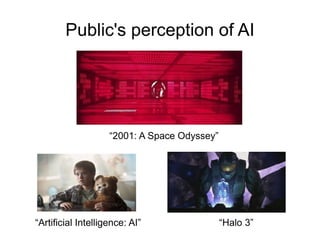
Public's perception of AI


                    “2001: A Space Odyssey”


“Artificial Intelligence: AI”                 “Halo 3”
“But what exactly is AI?”

There are different answers
to this question (depending
      on who you ask)
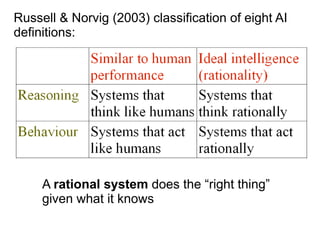
Russell & Norvig (2003) classification of eight AI
definitions:


     A rational system does the “right thing”
     given what it knows
The “rational agent” approach
Best approach because:
(a) More general than “laws of thought approach”
because rationality is not only about correct inference

(b) More amenable to scientific development than
approaches based on human behaviour or human
thought
History of AI
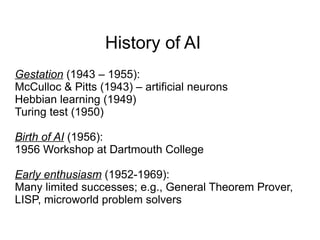
Gestation (1943 – 1955):
McCulloc & Pitts (1943) – artificial neurons
Hebbian learning (1949)
Turing test (1950)

Birth of AI (1956):
1956 Workshop at Dartmouth College

Early enthusiasm (1952-1969):
Many limited successes; e.g., General Theorem Prover,
LISP, microworld problem solvers
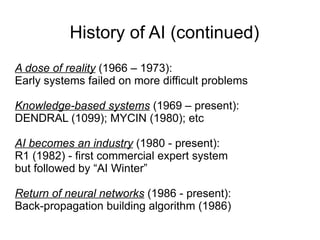
History of AI (continued)
A dose of reality (1966 – 1973):
Early systems failed on more difficult problems

Knowledge-based systems (1969 – present):
DENDRAL (1099); MYCIN (1980); etc

AI becomes an industry (1980 - present):
R1 (1982) - first commercial expert system
but followed by “AI Winter”

Return of neural networks (1986 - present):
Back-propagation building algorithm (1986)
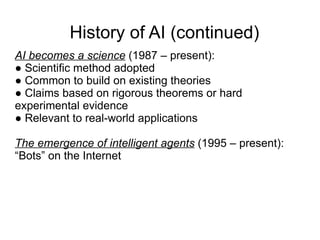
History of AI (continued)
AI becomes a science (1987 – present):
● Scientific method adopted
● Common to build on existing theories
● Claims based on rigorous theorems or hard
experimental evidence
● Relevant to real-world applications

The emergence of intelligent agents (1995 – present):
“Bots” on the Internet
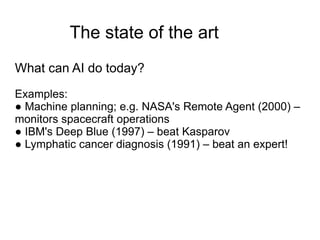
The state of the art
What can AI do today?
Examples:
● Machine planning; e.g. NASA's Remote Agent (2000) –
monitors spacecraft operations
● IBM's Deep Blue (1997) – beat Kasparov
● Lymphatic cancer diagnosis (1991) – beat an expert!

Knowledge based systems -- introduction

  • 1.
    Knowledge-Based Systems: Introduction Richard Dybowski 5 Feb 2008 Russell & Norvig (2003), Chapter 1
  • 2.
    Aims ● To understandthe concept of AI in terms of a rational agent ● To appreciate AI's history and ability
  • 3.
    Artificial Intelligence (AI) AIattempts not just to understand how we think but also to build intelligent entities by attempting to systemise and automate intellectual tasks. AI encompasses many subjects from general- purpose areas, such as learning and perception, to specific tasks such as playing chess and diagnosing diseases.
  • 4.
    Public's perception ofAI “2001: A Space Odyssey” “Artificial Intelligence: AI” “Halo 3”
  • 5.
    “But what exactlyis AI?” There are different answers to this question (depending on who you ask)
  • 6.
    Russell & Norvig(2003) classification of eight AI definitions: A rational system does the “right thing” given what it knows
  • 7.
    The “rational agent”approach Best approach because: (a) More general than “laws of thought approach” because rationality is not only about correct inference (b) More amenable to scientific development than approaches based on human behaviour or human thought
  • 8.
    History of AI Gestation(1943 – 1955): McCulloc & Pitts (1943) – artificial neurons Hebbian learning (1949) Turing test (1950) Birth of AI (1956): 1956 Workshop at Dartmouth College Early enthusiasm (1952-1969): Many limited successes; e.g., General Theorem Prover, LISP, microworld problem solvers
  • 9.
    History of AI(continued) A dose of reality (1966 – 1973): Early systems failed on more difficult problems Knowledge-based systems (1969 – present): DENDRAL (1099); MYCIN (1980); etc AI becomes an industry (1980 - present): R1 (1982) - first commercial expert system but followed by “AI Winter” Return of neural networks (1986 - present): Back-propagation building algorithm (1986)
  • 10.
    History of AI(continued) AI becomes a science (1987 – present): ● Scientific method adopted ● Common to build on existing theories ● Claims based on rigorous theorems or hard experimental evidence ● Relevant to real-world applications The emergence of intelligent agents (1995 – present): “Bots” on the Internet
  • 11.
    The state ofthe art What can AI do today? Examples: ● Machine planning; e.g. NASA's Remote Agent (2000) – monitors spacecraft operations ● IBM's Deep Blue (1997) – beat Kasparov ● Lymphatic cancer diagnosis (1991) – beat an expert!