Prepared by:- Asif  jawed Sagar Mitra Amit Kumar Gupta
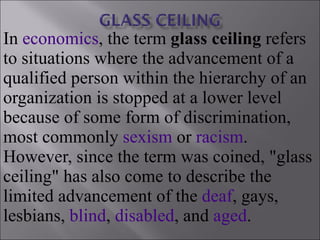
In  economics , the term  glass ceiling  refers to situations where the advancement of a qualified person within the hierarchy of an organization is stopped at a lower level because of some form of discrimination, most commonly  sexism  or  racism . However, since the term was coined, "glass ceiling" has also come to describe the limited advancement of the  deaf , gays, lesbians,  blind ,  disabled , and  aged .
[[Sexual discrimination]] was outlawed in the United States through the [[Civil Rights Act of 1964]] in the hopes of allowing women to rise in the working world once proper experience has been achieved. The term glass ceiling was first used in a Wall Street Journal column, “Corporate Women,” in the late 1980s. It is a reflection of gender roles and relations which give rise to and perpetuate inequalities between women and men in all walks of life ‘ The invisible artificial barriers that block women from senior executive jobs’
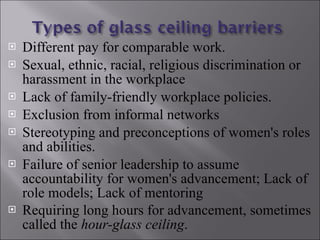
Different pay for comparable work. Sexual, ethnic, racial, religious discrimination or harassment in the workplace  Lack of family-friendly workplace policies. Exclusion from informal networks Stereotyping and preconceptions of women's roles and abilities. Failure of senior leadership to assume accountability for women's advancement; Lack of role models; Lack of mentoring  Requiring long hours for advancement, sometimes called the  hour-glass ceiling .
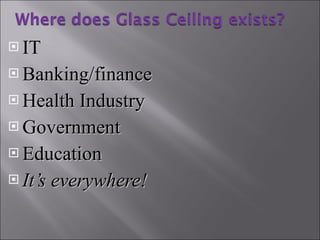
IT Banking/finance Health Industry Government Education It’s everywhere!
 
 
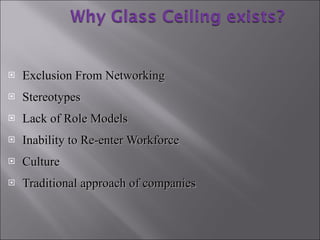
Exclusion From Networking Stereotypes Lack of Role Models Inability to Re-enter Workforce Culture Traditional approach of companies
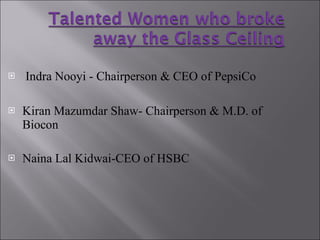
Indra Nooyi - Chairperson & CEO of PepsiCo Kiran Mazumdar Shaw- Chairperson & M.D. of Biocon Naina Lal Kidwai-CEO of HSBC
Although some believe there to be a glass ceiling, many women have still found much success. When at the top management, many women feel like outsiders. Most of the time they are the only female at that level and are surrounded by males. Some women have faced sexual harassment, wage inequality, blocked movement and gender stereotyped roles. Women are said to have different styles of leadership and management once they break the barrier. They are generalized to be more nurturing and caring in nature than men.
Women are a key resource in the race to create new products and resources  Women’s skills level is rising More and more women are starting businesses  It’s not only the right thing to do, it’s also good for business
 
Thiruvananthapuram:-   First Bollywood and now the Malayalam film industry. Women are making inroads in the male-dominated territory of filmmaking, quitting cushy jobs and breaking away from their settled lives to wield the megaphone. Take 38-year-old Shiny J. Koshy who took a break from Kuwait, where her husband was employed, and took the plunge into filmmaking. Today she is busy working as an assistant director to award-winning filmmaker Jairaj in his latest film "The Train", which stars Malayalam superstar Mammootty.  "Twelve years back I had worked as an assistant with Jairaj for two of his films and due to reasons of my own I took a break from films. Now, since I have a lot of time, I have decided to rejoin him," Koshy told IANS "I will be assisting him in his next film also. I am simultaneously working on my own film...I will announce it at an appropriate time," she added
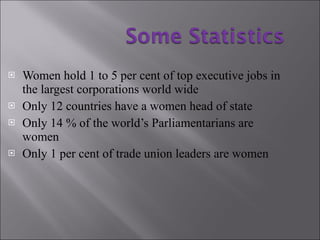
Women hold 1 to 5 per cent of top executive jobs in the largest corporations world wide Only 12 countries have a women head of state Only 14 % of the world’s Parliamentarians are women Only 1 per cent of trade union leaders are women
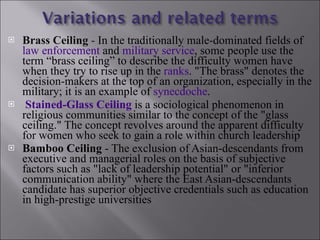
Brass Ceiling  -  In the traditionally male-dominated fields of  law enforcement  and  military service , some people use the term “brass ceiling” to describe the difficulty women have when they try to rise up in the  ranks . "The brass" denotes the decision-makers at the top of an organization, especially in the military; it is an example of  synecdoche . Stained-Glass Ceiling  is a sociological phenomenon in religious communities similar to the concept of the "glass ceiling." The concept revolves around the apparent difficulty for women who seek to gain a role within church leadership  Bamboo Ceiling  - The exclusion of Asian-descendants from executive and managerial roles on the basis of subjective factors such as "lack of leadership potential" or "inferior communication ability" where the East Asian-descendants candidate has superior objective credentials such as education in high-prestige universities
 
 
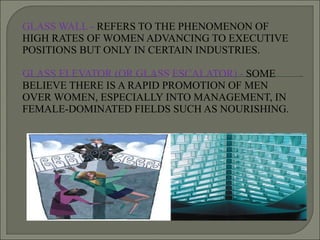
GLASS WALL -  REFERS TO THE PHENOMENON OF HIGH RATES OF WOMEN ADVANCING TO EXECUTIVE POSITIONS BUT ONLY IN CERTAIN INDUSTRIES. GLASS ELEVATOR (OR GLASS ESCALATOR) -  SOME BELIEVE THERE IS A RAPID PROMOTION OF MEN OVER WOMEN, ESPECIALLY INTO MANAGEMENT, IN FEMALE-DOMINATED FIELDS SUCH AS NOURISHING.
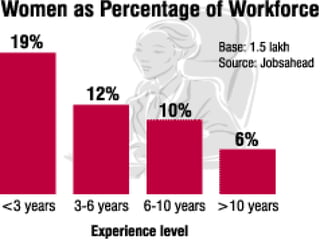
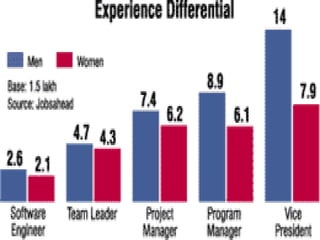
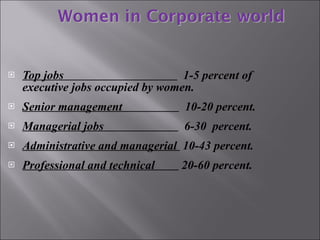
Top jobs  1-5 percent of executive jobs occupied by women. Senior management  10-20 percent. Managerial jobs  6-30  percent. Administrative and managerial  10-43 percent. Professional and technical  20-60 percent.
 

Becg

  • 1.
    Prepared by:- Asif jawed Sagar Mitra Amit Kumar Gupta
  • 2.
    In economics, the term glass ceiling refers to situations where the advancement of a qualified person within the hierarchy of an organization is stopped at a lower level because of some form of discrimination, most commonly sexism or racism . However, since the term was coined, "glass ceiling" has also come to describe the limited advancement of the deaf , gays, lesbians, blind , disabled , and aged .
  • 3.
    [[Sexual discrimination]] wasoutlawed in the United States through the [[Civil Rights Act of 1964]] in the hopes of allowing women to rise in the working world once proper experience has been achieved. The term glass ceiling was first used in a Wall Street Journal column, “Corporate Women,” in the late 1980s. It is a reflection of gender roles and relations which give rise to and perpetuate inequalities between women and men in all walks of life ‘ The invisible artificial barriers that block women from senior executive jobs’
  • 4.
    Different pay forcomparable work. Sexual, ethnic, racial, religious discrimination or harassment in the workplace Lack of family-friendly workplace policies. Exclusion from informal networks Stereotyping and preconceptions of women's roles and abilities. Failure of senior leadership to assume accountability for women's advancement; Lack of role models; Lack of mentoring Requiring long hours for advancement, sometimes called the hour-glass ceiling .
  • 5.
    IT Banking/finance HealthIndustry Government Education It’s everywhere!
  • 6.
  • 7.
  • 8.
    Exclusion From NetworkingStereotypes Lack of Role Models Inability to Re-enter Workforce Culture Traditional approach of companies
  • 9.
    Indra Nooyi -Chairperson & CEO of PepsiCo Kiran Mazumdar Shaw- Chairperson & M.D. of Biocon Naina Lal Kidwai-CEO of HSBC
  • 10.
    Although some believethere to be a glass ceiling, many women have still found much success. When at the top management, many women feel like outsiders. Most of the time they are the only female at that level and are surrounded by males. Some women have faced sexual harassment, wage inequality, blocked movement and gender stereotyped roles. Women are said to have different styles of leadership and management once they break the barrier. They are generalized to be more nurturing and caring in nature than men.
  • 11.
    Women are akey resource in the race to create new products and resources Women’s skills level is rising More and more women are starting businesses It’s not only the right thing to do, it’s also good for business
  • 12.
  • 13.
    Thiruvananthapuram:- First Bollywood and now the Malayalam film industry. Women are making inroads in the male-dominated territory of filmmaking, quitting cushy jobs and breaking away from their settled lives to wield the megaphone. Take 38-year-old Shiny J. Koshy who took a break from Kuwait, where her husband was employed, and took the plunge into filmmaking. Today she is busy working as an assistant director to award-winning filmmaker Jairaj in his latest film "The Train", which stars Malayalam superstar Mammootty. "Twelve years back I had worked as an assistant with Jairaj for two of his films and due to reasons of my own I took a break from films. Now, since I have a lot of time, I have decided to rejoin him," Koshy told IANS "I will be assisting him in his next film also. I am simultaneously working on my own film...I will announce it at an appropriate time," she added
  • 14.
    Women hold 1to 5 per cent of top executive jobs in the largest corporations world wide Only 12 countries have a women head of state Only 14 % of the world’s Parliamentarians are women Only 1 per cent of trade union leaders are women
  • 15.
    Brass Ceiling - In the traditionally male-dominated fields of law enforcement and military service , some people use the term “brass ceiling” to describe the difficulty women have when they try to rise up in the ranks . "The brass" denotes the decision-makers at the top of an organization, especially in the military; it is an example of synecdoche . Stained-Glass Ceiling is a sociological phenomenon in religious communities similar to the concept of the "glass ceiling." The concept revolves around the apparent difficulty for women who seek to gain a role within church leadership Bamboo Ceiling - The exclusion of Asian-descendants from executive and managerial roles on the basis of subjective factors such as "lack of leadership potential" or "inferior communication ability" where the East Asian-descendants candidate has superior objective credentials such as education in high-prestige universities
  • 16.
  • 17.
  • 18.
    GLASS WALL - REFERS TO THE PHENOMENON OF HIGH RATES OF WOMEN ADVANCING TO EXECUTIVE POSITIONS BUT ONLY IN CERTAIN INDUSTRIES. GLASS ELEVATOR (OR GLASS ESCALATOR) - SOME BELIEVE THERE IS A RAPID PROMOTION OF MEN OVER WOMEN, ESPECIALLY INTO MANAGEMENT, IN FEMALE-DOMINATED FIELDS SUCH AS NOURISHING.
  • 19.
    Top jobs 1-5 percent of executive jobs occupied by women. Senior management 10-20 percent. Managerial jobs 6-30 percent. Administrative and managerial 10-43 percent. Professional and technical 20-60 percent.
  • 20.