7/24/2022 ENGR. ZIA UR RAHMAN 1
BEARING CAPACITY
Bearing capacity Failure and its types
When the bearing pressure of the footing is large enough and the size of the footing is
smaller than the stresses may exceed the shear strength of the soil resulting in the failure
of the soil beneath the foundation called bearing capacity failure/Shear failure.
There are three modes of shear failure described below.
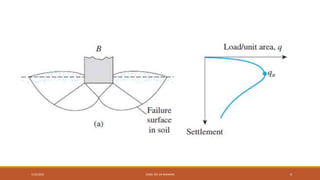
(1) General Shear Failure
It occurs in soil which are comparatively stronger such as stiff clay and dense sand
(Dr>70%). In this type of failure large settlements occur with plastic yielding fully
developed within the soil.
7/24/2022 ENGR. ZIA UR RAHMAN 2
Characteristics of general shear failure are as given below.
i. Well defined failure mechanism
ii. Continuous slip surface from the bottom of the footing to the ground surface.
iii. Sudden catastrophic failure
7/24/2022 ENGR. ZIA UR RAHMAN 3
Bearing capacity Failure and its types
7/24/2022 ENGR. ZIA UR RAHMAN 4
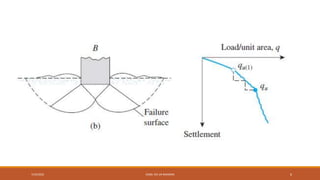
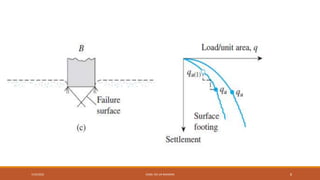
(2) Local shear Failure
Local shear failure is an intermediate case. The failure surface is well defined
under the foundation but becomes vague near the ground surface. It takes place in
medium sands and clay.
Considerable vertical displacement takes place.
Lower ultimate bearing capacity is observed in such case.
7/24/2022 ENGR. ZIA UR RAHMAN 5
Bearing capacity Failure and its types
7/24/2022 ENGR. ZIA UR RAHMAN 6
(3) Punching Shear
When the soil is loose one with less compressibility than this type of failure is
likely to occur with the following characteristics.
i. Less well defined failure mechanism.
ii. Large vertical displacements.
iii.Lower ultimate bearing capacity
7/24/2022 ENGR. ZIA UR RAHMAN 7
Bearing capacity Failure and its types
7/24/2022 ENGR. ZIA UR RAHMAN 8
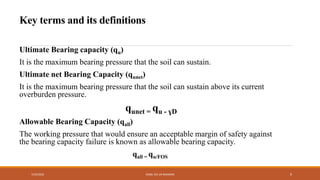
Key terms and its definitions
Ultimate Bearing capacity (qu)
It is the maximum bearing pressure that the soil can sustain.
Ultimate net Bearing Capacity (qunet)
It is the maximum bearing pressure that the soil can sustain above its current
overburden pressure.
qunet = qu - ɣD
Allowable Bearing Capacity (qall)
The working pressure that would ensure an acceptable margin of safety against
the bearing capacity failure is known as allowable bearing capacity.
qall = qu/FOS
7/24/2022 ENGR. ZIA UR RAHMAN 9
Ultimate Limit State
A state that defines a limit for the shear stress that may not be exceeded by any
conceivable or anticipated loading condition during the life span of the
foundation or geotechnical system.
Serviceability Limit State
It defines the limiting deformation/settlement, if exceeded will impair the
function of the supported structure.
7/24/2022 ENGR. ZIA UR RAHMAN 10
Key terms and its definitions
Terzaghi’s Bearing Capacity Theory
7/24/2022 ENGR. ZIA UR RAHMAN 11
Terzaghi made some assumptions for his analysis which are listed as following
•Soil is is isotropic.
•Soil is homogenous.
•Soil is weightless.
•Soil is rigid plastic material.
•A successful model to predict general shear failure of foundations on medium to
dense sands might be to assume a trapped rigid wedge beneath the footing,
bordering radial shear zone and rankine passive zone.
7/24/2022 ENGR. ZIA UR RAHMAN 12
Terzaghi’s Bearing Capacity Theory
Bearing Capacity Formulas
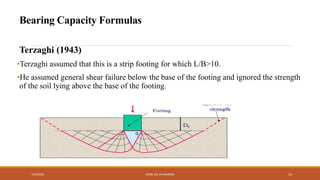
Terzaghi (1943)
•Terzaghi assumed that this is a strip footing for which L/B>10.
•He assumed general shear failure below the base of the footing and ignored the strength
of the soil lying above the base of the footing.
7/24/2022 ENGR. ZIA UR RAHMAN 13
Terzaghi’s Bearing Capacity Formula
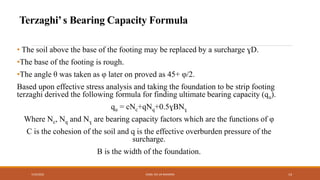
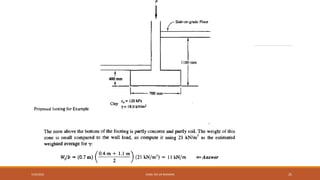
• The soil above the base of the footing may be replaced by a surcharge ɣD.
•The base of the footing is rough.
•The angle θ was taken as φ later on proved as 45+ φ/2.
Based upon effective stress analysis and taking the foundation to be strip footing
terzaghi derived the following formula for finding ultimate bearing capacity (qu).
qu = cNc+qNq+0.5ɣBNɣ
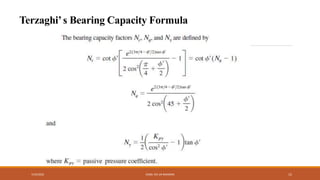
Where Nc, Nq and Nɣ are bearing capacity factors which are the functions of φ
C is the cohesion of the soil and q is the effective overburden pressure of the
surcharge.
B is the width of the foundation.
7/24/2022 ENGR. ZIA UR RAHMAN 14
7/24/2022 ENGR. ZIA UR RAHMAN 15
Terzaghi’s Bearing Capacity Formula
7/24/2022 ENGR. ZIA UR RAHMAN 16
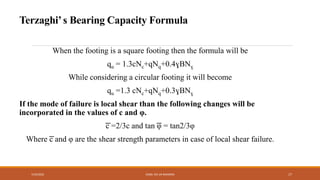
When the footing is a square footing then the formula will be
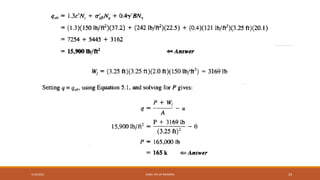
qu = 1.3cNc+qNq+0.4ɣBNɣ
While considering a circular footing it will become
qu =1.3 cNc+qNq+0.3ɣBNɣ
If the mode of failure is local shear than the following changes will be
incorporated in the values of c and φ.
͞c =2/3c and tan ͞φ = tan2/3φ
Where ͞c and φ are the shear strength parameters in case of local shear failure.
7/24/2022 ENGR. ZIA UR RAHMAN 17
Terzaghi’s Bearing Capacity Formula
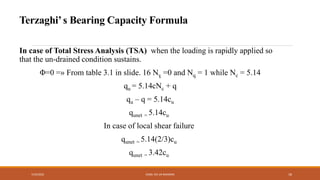
In case of Total Stress Analysis (TSA) when the loading is rapidly applied so
that the un-drained condition sustains.
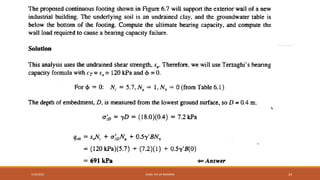
Φ=0 =» From table 3.1 in slide. 16 Nɣ =0 and Nq = 1 while Nc = 5.14
qu = 5.14cNc + q
qu – q = 5.14cu
qunet = 5.14cu
In case of local shear failure
qunet = 5.14(2/3)cu
qunet = 3.42cu
7/24/2022 ENGR. ZIA UR RAHMAN 18
Terzaghi’s Bearing Capacity Formula
7/24/2022 ENGR. ZIA UR RAHMAN 19
7/24/2022 ENGR. ZIA UR RAHMAN 20
7/24/2022 ENGR. ZIA UR RAHMAN 21
7/24/2022 ENGR. ZIA UR RAHMAN 22
7/24/2022 ENGR. ZIA UR RAHMAN 23
7/24/2022 ENGR. ZIA UR RAHMAN 24
7/24/2022 ENGR. ZIA UR RAHMAN 25
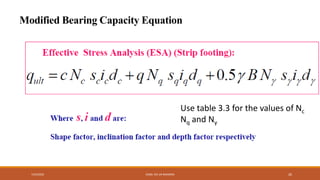
Modified Bearing Capacity Equation
7/24/2022 ENGR. ZIA UR RAHMAN 26
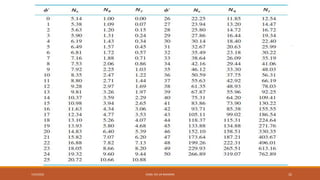
Use table 3.3 for the values of Nc
Nq and Ny
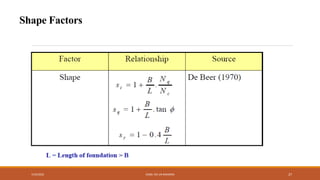
Shape Factors
7/24/2022 ENGR. ZIA UR RAHMAN 27
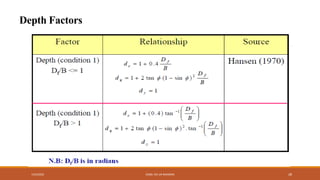
Depth Factors
7/24/2022 ENGR. ZIA UR RAHMAN 28
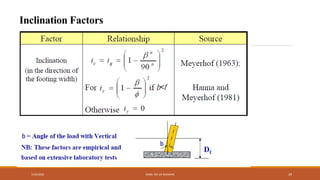
Inclination Factors
7/24/2022 ENGR. ZIA UR RAHMAN 29
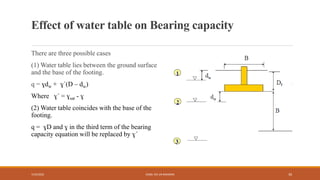
Effect of water table on Bearing capacity
There are three possible cases
(1) Water table lies between the ground surface
and the base of the footing.
q = ɣdw + ɣ´(D – dw)
Where ɣ´ = ɣsat - ɣ
(2) Water table coincides with the base of the
footing.
q = ɣD and ɣ in the third term of the bearing
capacity equation will be replaced by ɣ´
7/24/2022 ENGR. ZIA UR RAHMAN 30
Effect of water Table on Bearing Capacity
7/24/2022 ENGR. ZIA UR RAHMAN 31
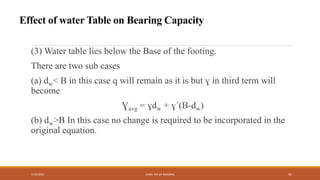
(3) Water table lies below the Base of the footing.
There are two sub cases
(a) dw< B in this case q will remain as it is but ɣ in third term will
become
Ɣavg = ɣdw + ɣ´(B-dw)
(b) dw>B In this case no change is required to be incorporated in the
original equation.
7/24/2022 ENGR. ZIA UR RAHMAN 32
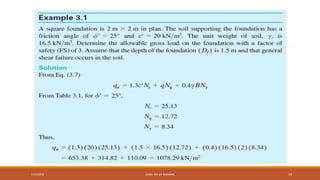
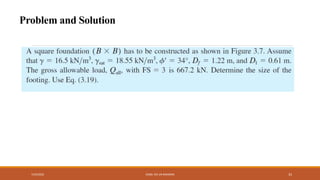
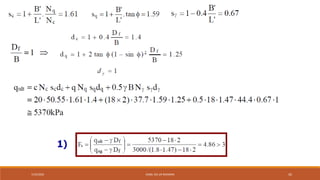
Problem and Solution
7/24/2022 ENGR. ZIA UR RAHMAN 33
7/24/2022 ENGR. ZIA UR RAHMAN 34
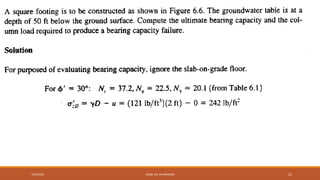
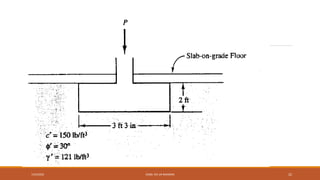
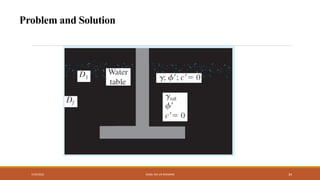
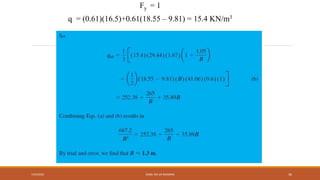
Problem and Solution
7/24/2022 ENGR. ZIA UR RAHMAN 35
Fy = 1
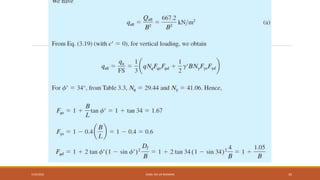
q = (0.61)(16.5)+0.61(18.55 – 9.81) = 15.4 KN/m3
7/24/2022 ENGR. ZIA UR RAHMAN 36
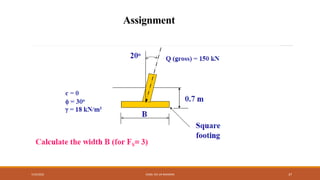
Assignment
7/24/2022 ENGR. ZIA UR RAHMAN 37
7/24/2022 ENGR. ZIA UR RAHMAN 38
7/24/2022 ENGR. ZIA UR RAHMAN 39
7/24/2022 ENGR. ZIA UR RAHMAN 40
7/24/2022 ENGR. ZIA UR RAHMAN 41
7/24/2022 ENGR. ZIA UR RAHMAN 42
7/24/2022 ENGR. ZIA UR RAHMAN 43
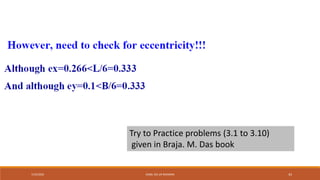
Try to Practice problems (3.1 to 3.10)
given in Braja. M. Das book

Bearing Capacity.pptx

  • 1.
    7/24/2022 ENGR. ZIAUR RAHMAN 1 BEARING CAPACITY
  • 2.
    Bearing capacity Failureand its types When the bearing pressure of the footing is large enough and the size of the footing is smaller than the stresses may exceed the shear strength of the soil resulting in the failure of the soil beneath the foundation called bearing capacity failure/Shear failure. There are three modes of shear failure described below. (1) General Shear Failure It occurs in soil which are comparatively stronger such as stiff clay and dense sand (Dr>70%). In this type of failure large settlements occur with plastic yielding fully developed within the soil. 7/24/2022 ENGR. ZIA UR RAHMAN 2
  • 3.
    Characteristics of generalshear failure are as given below. i. Well defined failure mechanism ii. Continuous slip surface from the bottom of the footing to the ground surface. iii. Sudden catastrophic failure 7/24/2022 ENGR. ZIA UR RAHMAN 3 Bearing capacity Failure and its types
  • 4.
  • 5.
    (2) Local shearFailure Local shear failure is an intermediate case. The failure surface is well defined under the foundation but becomes vague near the ground surface. It takes place in medium sands and clay. Considerable vertical displacement takes place. Lower ultimate bearing capacity is observed in such case. 7/24/2022 ENGR. ZIA UR RAHMAN 5 Bearing capacity Failure and its types
  • 6.
  • 7.
    (3) Punching Shear Whenthe soil is loose one with less compressibility than this type of failure is likely to occur with the following characteristics. i. Less well defined failure mechanism. ii. Large vertical displacements. iii.Lower ultimate bearing capacity 7/24/2022 ENGR. ZIA UR RAHMAN 7 Bearing capacity Failure and its types
  • 8.
  • 9.
    Key terms andits definitions Ultimate Bearing capacity (qu) It is the maximum bearing pressure that the soil can sustain. Ultimate net Bearing Capacity (qunet) It is the maximum bearing pressure that the soil can sustain above its current overburden pressure. qunet = qu - ɣD Allowable Bearing Capacity (qall) The working pressure that would ensure an acceptable margin of safety against the bearing capacity failure is known as allowable bearing capacity. qall = qu/FOS 7/24/2022 ENGR. ZIA UR RAHMAN 9
  • 10.
    Ultimate Limit State Astate that defines a limit for the shear stress that may not be exceeded by any conceivable or anticipated loading condition during the life span of the foundation or geotechnical system. Serviceability Limit State It defines the limiting deformation/settlement, if exceeded will impair the function of the supported structure. 7/24/2022 ENGR. ZIA UR RAHMAN 10 Key terms and its definitions
  • 11.
    Terzaghi’s Bearing CapacityTheory 7/24/2022 ENGR. ZIA UR RAHMAN 11
  • 12.
    Terzaghi made someassumptions for his analysis which are listed as following •Soil is is isotropic. •Soil is homogenous. •Soil is weightless. •Soil is rigid plastic material. •A successful model to predict general shear failure of foundations on medium to dense sands might be to assume a trapped rigid wedge beneath the footing, bordering radial shear zone and rankine passive zone. 7/24/2022 ENGR. ZIA UR RAHMAN 12 Terzaghi’s Bearing Capacity Theory
  • 13.
    Bearing Capacity Formulas Terzaghi(1943) •Terzaghi assumed that this is a strip footing for which L/B>10. •He assumed general shear failure below the base of the footing and ignored the strength of the soil lying above the base of the footing. 7/24/2022 ENGR. ZIA UR RAHMAN 13
  • 14.
    Terzaghi’s Bearing CapacityFormula • The soil above the base of the footing may be replaced by a surcharge ɣD. •The base of the footing is rough. •The angle θ was taken as φ later on proved as 45+ φ/2. Based upon effective stress analysis and taking the foundation to be strip footing terzaghi derived the following formula for finding ultimate bearing capacity (qu). qu = cNc+qNq+0.5ɣBNɣ Where Nc, Nq and Nɣ are bearing capacity factors which are the functions of φ C is the cohesion of the soil and q is the effective overburden pressure of the surcharge. B is the width of the foundation. 7/24/2022 ENGR. ZIA UR RAHMAN 14
  • 15.
    7/24/2022 ENGR. ZIAUR RAHMAN 15 Terzaghi’s Bearing Capacity Formula
  • 16.
    7/24/2022 ENGR. ZIAUR RAHMAN 16
  • 17.
    When the footingis a square footing then the formula will be qu = 1.3cNc+qNq+0.4ɣBNɣ While considering a circular footing it will become qu =1.3 cNc+qNq+0.3ɣBNɣ If the mode of failure is local shear than the following changes will be incorporated in the values of c and φ. ͞c =2/3c and tan ͞φ = tan2/3φ Where ͞c and φ are the shear strength parameters in case of local shear failure. 7/24/2022 ENGR. ZIA UR RAHMAN 17 Terzaghi’s Bearing Capacity Formula
  • 18.
    In case ofTotal Stress Analysis (TSA) when the loading is rapidly applied so that the un-drained condition sustains. Φ=0 =» From table 3.1 in slide. 16 Nɣ =0 and Nq = 1 while Nc = 5.14 qu = 5.14cNc + q qu – q = 5.14cu qunet = 5.14cu In case of local shear failure qunet = 5.14(2/3)cu qunet = 3.42cu 7/24/2022 ENGR. ZIA UR RAHMAN 18 Terzaghi’s Bearing Capacity Formula
  • 19.
    7/24/2022 ENGR. ZIAUR RAHMAN 19
  • 20.
    7/24/2022 ENGR. ZIAUR RAHMAN 20
  • 21.
    7/24/2022 ENGR. ZIAUR RAHMAN 21
  • 22.
    7/24/2022 ENGR. ZIAUR RAHMAN 22
  • 23.
    7/24/2022 ENGR. ZIAUR RAHMAN 23
  • 24.
    7/24/2022 ENGR. ZIAUR RAHMAN 24
  • 25.
    7/24/2022 ENGR. ZIAUR RAHMAN 25
  • 26.
    Modified Bearing CapacityEquation 7/24/2022 ENGR. ZIA UR RAHMAN 26 Use table 3.3 for the values of Nc Nq and Ny
  • 27.
  • 28.
  • 29.
  • 30.
    Effect of watertable on Bearing capacity There are three possible cases (1) Water table lies between the ground surface and the base of the footing. q = ɣdw + ɣ´(D – dw) Where ɣ´ = ɣsat - ɣ (2) Water table coincides with the base of the footing. q = ɣD and ɣ in the third term of the bearing capacity equation will be replaced by ɣ´ 7/24/2022 ENGR. ZIA UR RAHMAN 30
  • 31.
    Effect of waterTable on Bearing Capacity 7/24/2022 ENGR. ZIA UR RAHMAN 31 (3) Water table lies below the Base of the footing. There are two sub cases (a) dw< B in this case q will remain as it is but ɣ in third term will become Ɣavg = ɣdw + ɣ´(B-dw) (b) dw>B In this case no change is required to be incorporated in the original equation.
  • 32.
    7/24/2022 ENGR. ZIAUR RAHMAN 32
  • 33.
    Problem and Solution 7/24/2022ENGR. ZIA UR RAHMAN 33
  • 34.
    7/24/2022 ENGR. ZIAUR RAHMAN 34 Problem and Solution
  • 35.
    7/24/2022 ENGR. ZIAUR RAHMAN 35
  • 36.
    Fy = 1 q= (0.61)(16.5)+0.61(18.55 – 9.81) = 15.4 KN/m3 7/24/2022 ENGR. ZIA UR RAHMAN 36
  • 37.
  • 38.
    7/24/2022 ENGR. ZIAUR RAHMAN 38
  • 39.
    7/24/2022 ENGR. ZIAUR RAHMAN 39
  • 40.
    7/24/2022 ENGR. ZIAUR RAHMAN 40
  • 41.
    7/24/2022 ENGR. ZIAUR RAHMAN 41
  • 42.
    7/24/2022 ENGR. ZIAUR RAHMAN 42
  • 43.
    7/24/2022 ENGR. ZIAUR RAHMAN 43 Try to Practice problems (3.1 to 3.10) given in Braja. M. Das book