agile42 | We make your agile transition succeed ! www.agile42.com | All rights reserved. Copyright © 2007 - 2016.
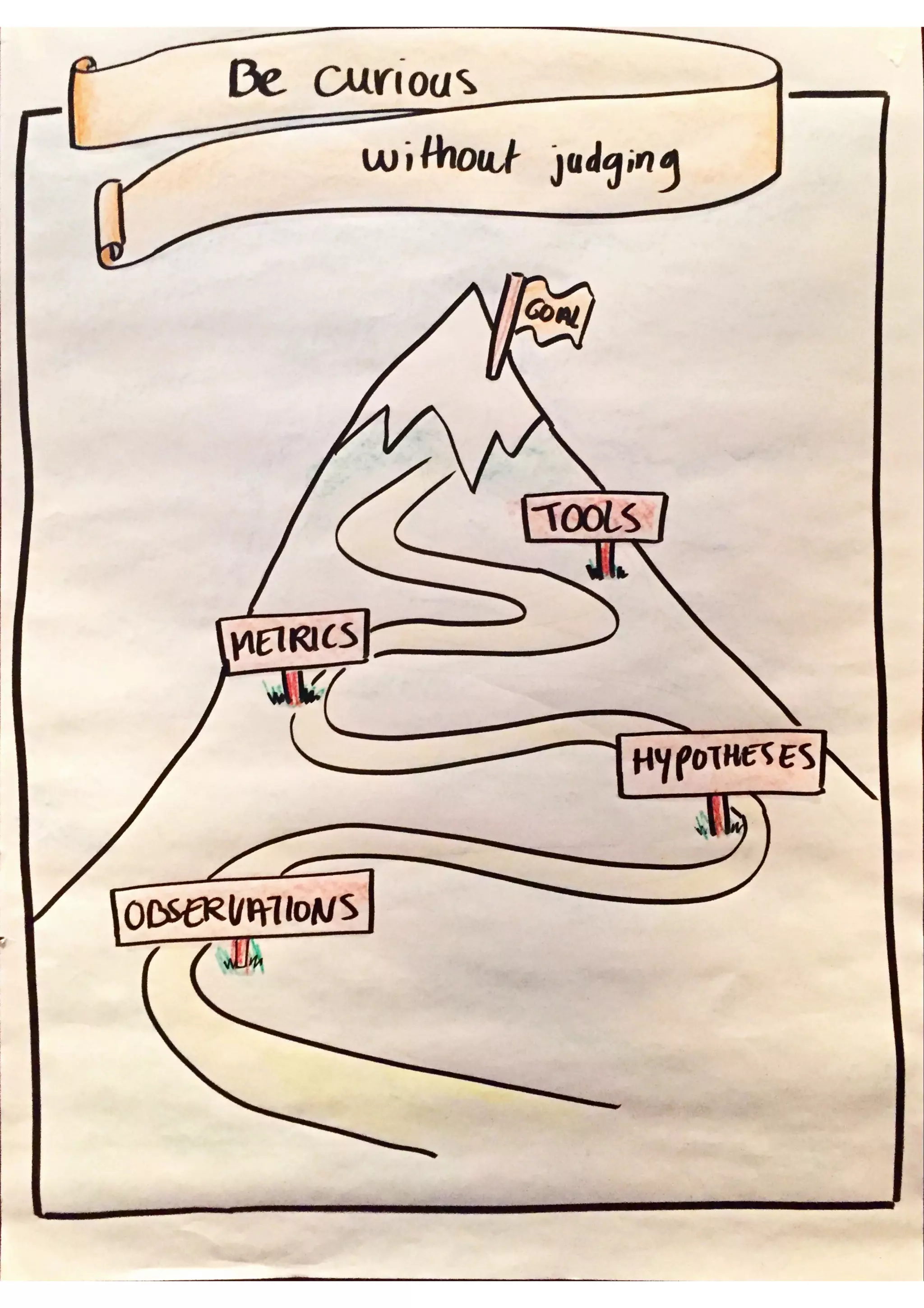
Be curious without judging
Using observations to structure your coaching
agile42 | We make your agile transition succeed ! www.agile42.com | All rights reserved. Copyright © 2007 - 2016.
Who are you?
Find the corner which fits you best …
• ScrumMaster
• Agile Coach
• Team Member
• None of the above
agile42 | We make your agile transition succeed ! www.agile42.com | All rights reserved. Copyright © 2007 - 2016.
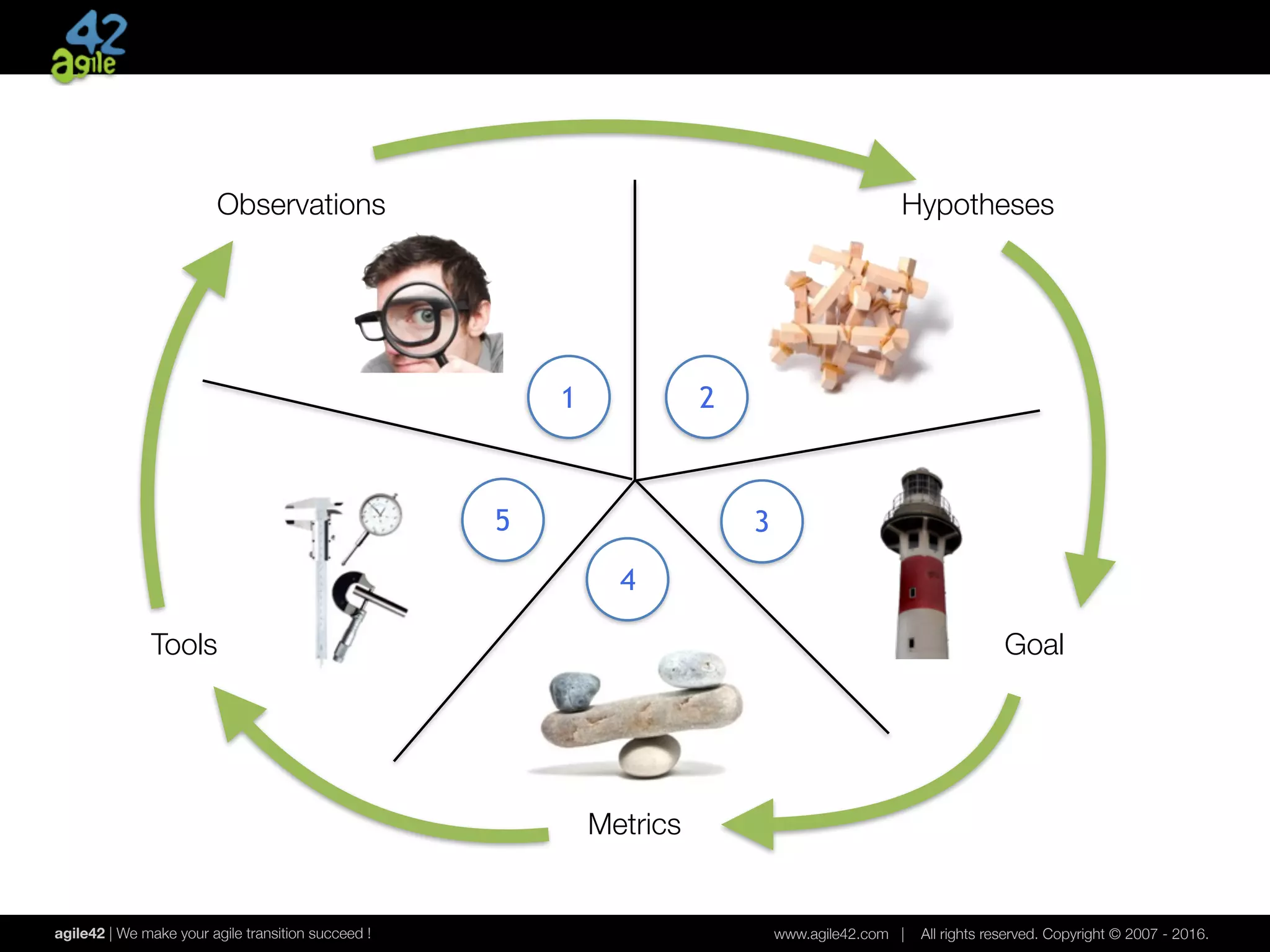
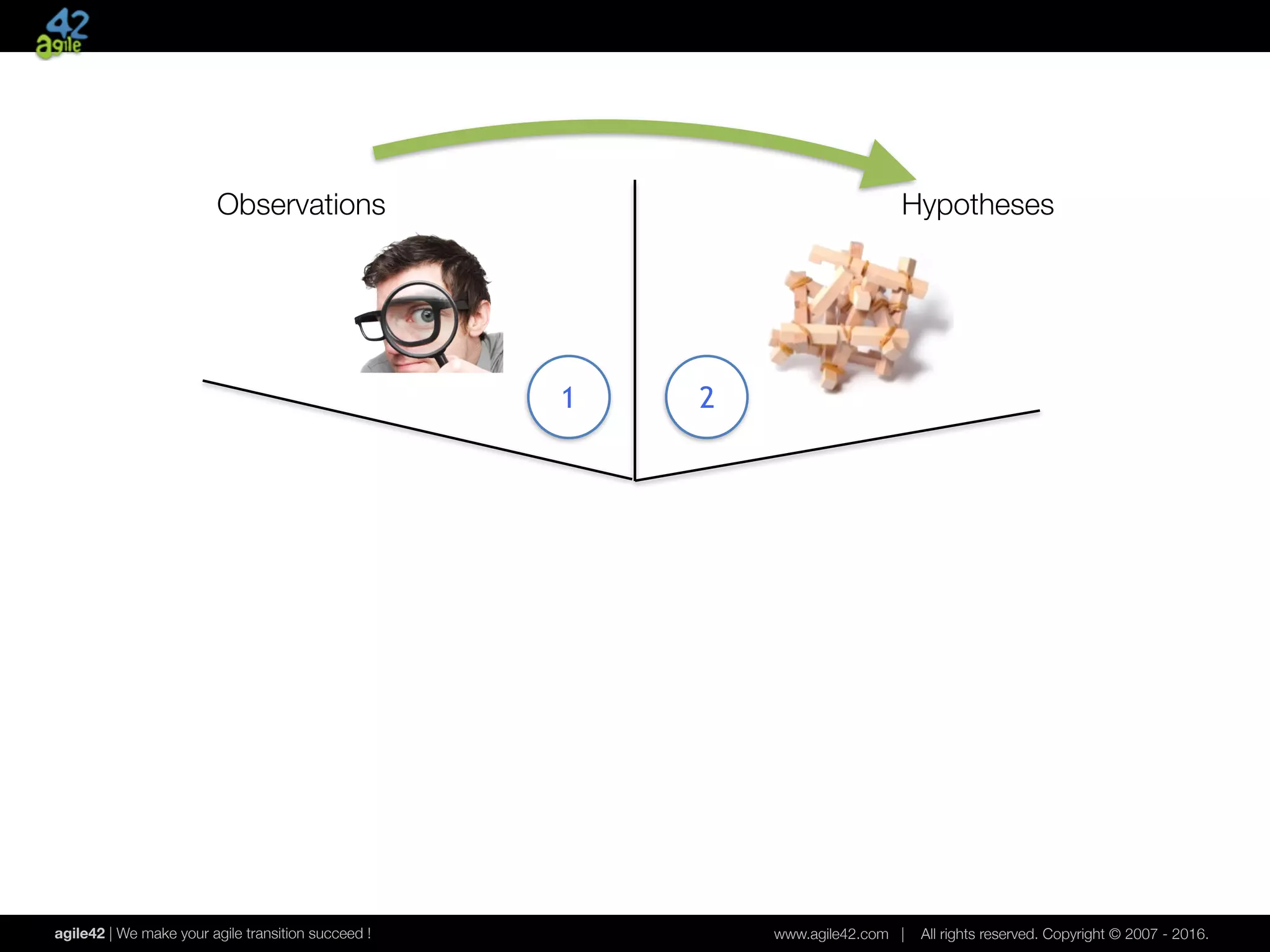
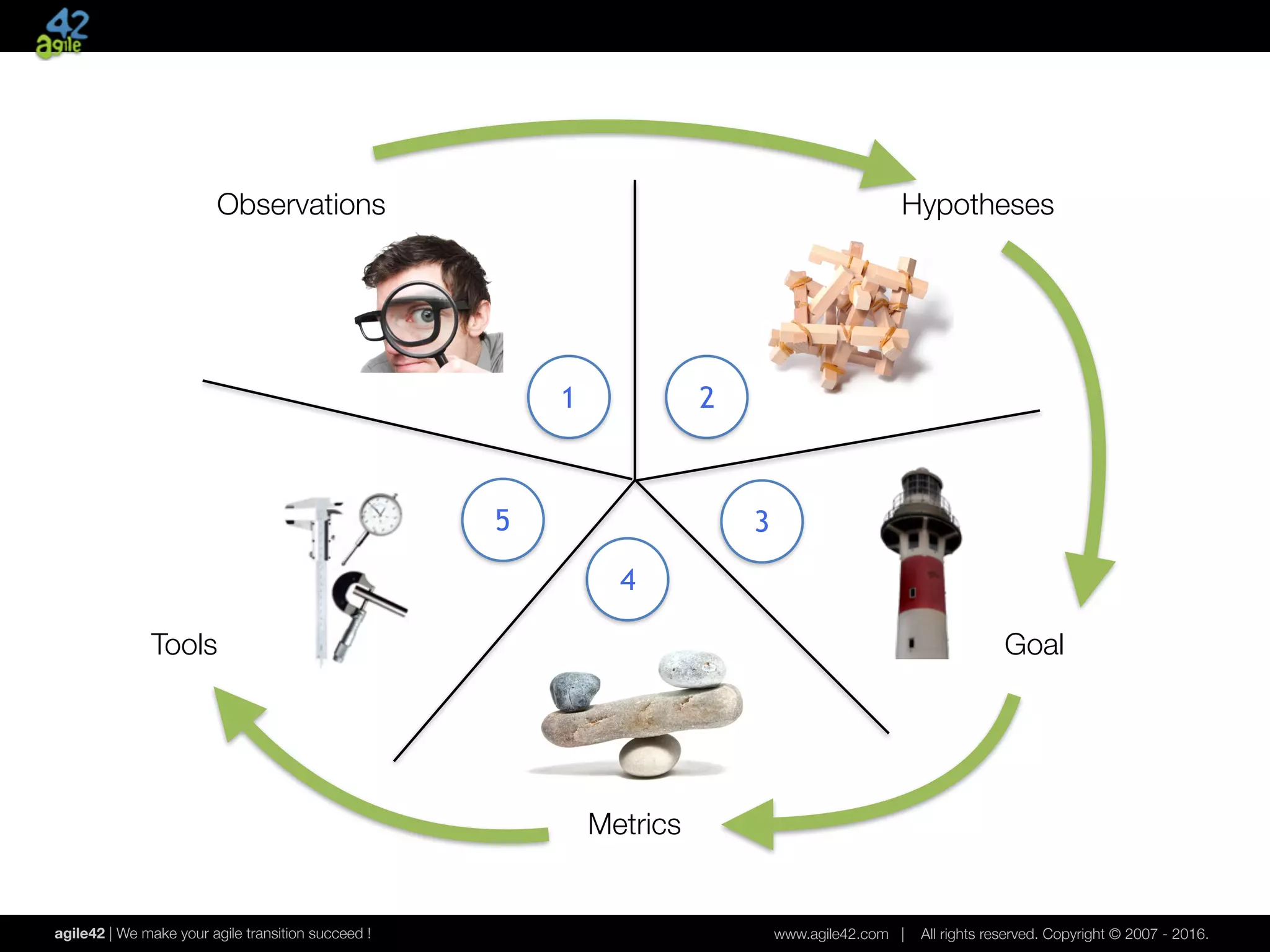
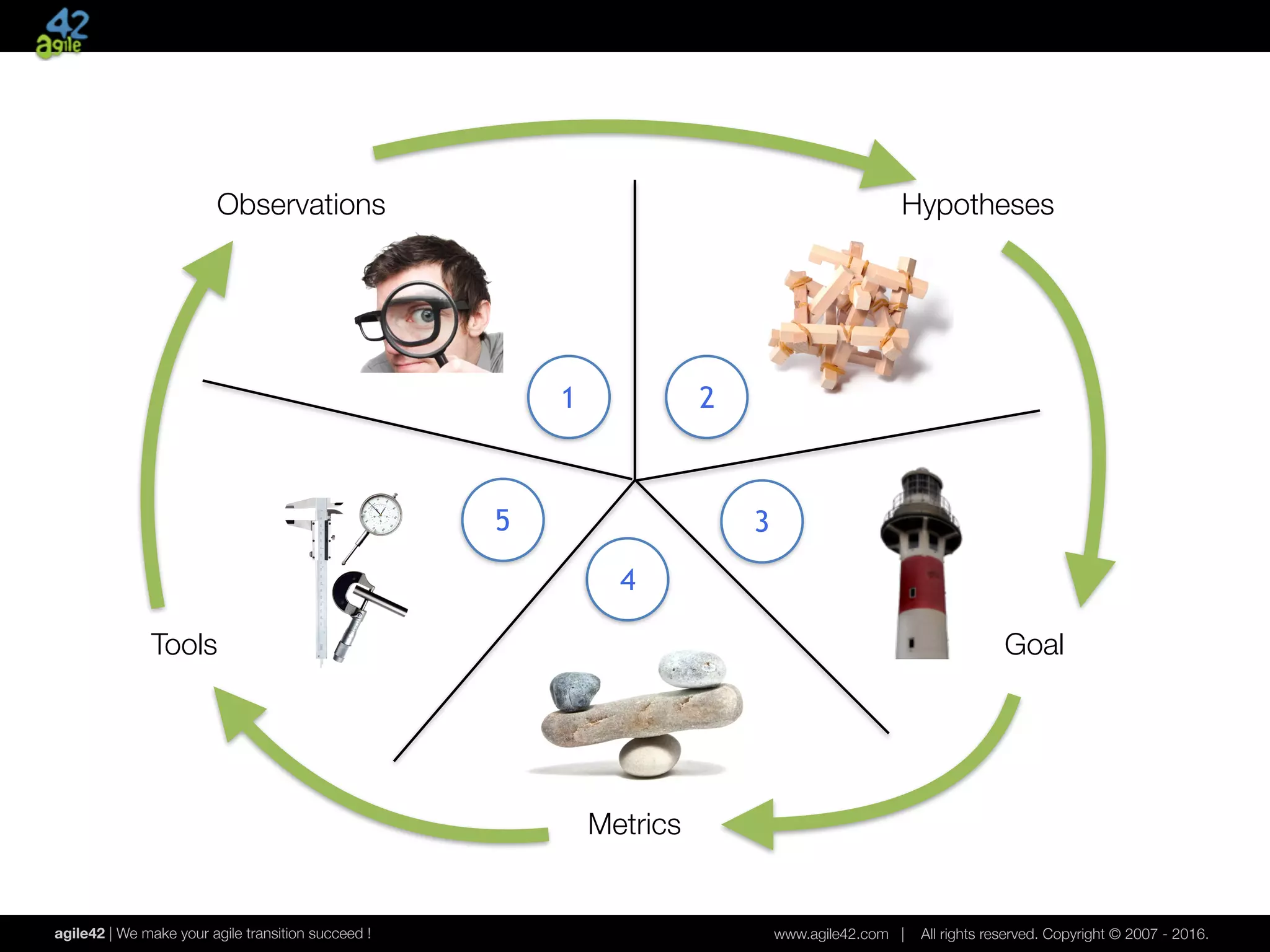
Observations
1
Hypotheses
2
Goal
3
Metrics
4
Tools
5
agile42 | We make your agile transition succeed ! www.agile42.com | All rights reserved. Copyright © 2007 - 2016.
Observations
1
agile42 | We make your agile transition succeed ! www.agile42.com | All rights reserved. Copyright © 2007 - 2016.
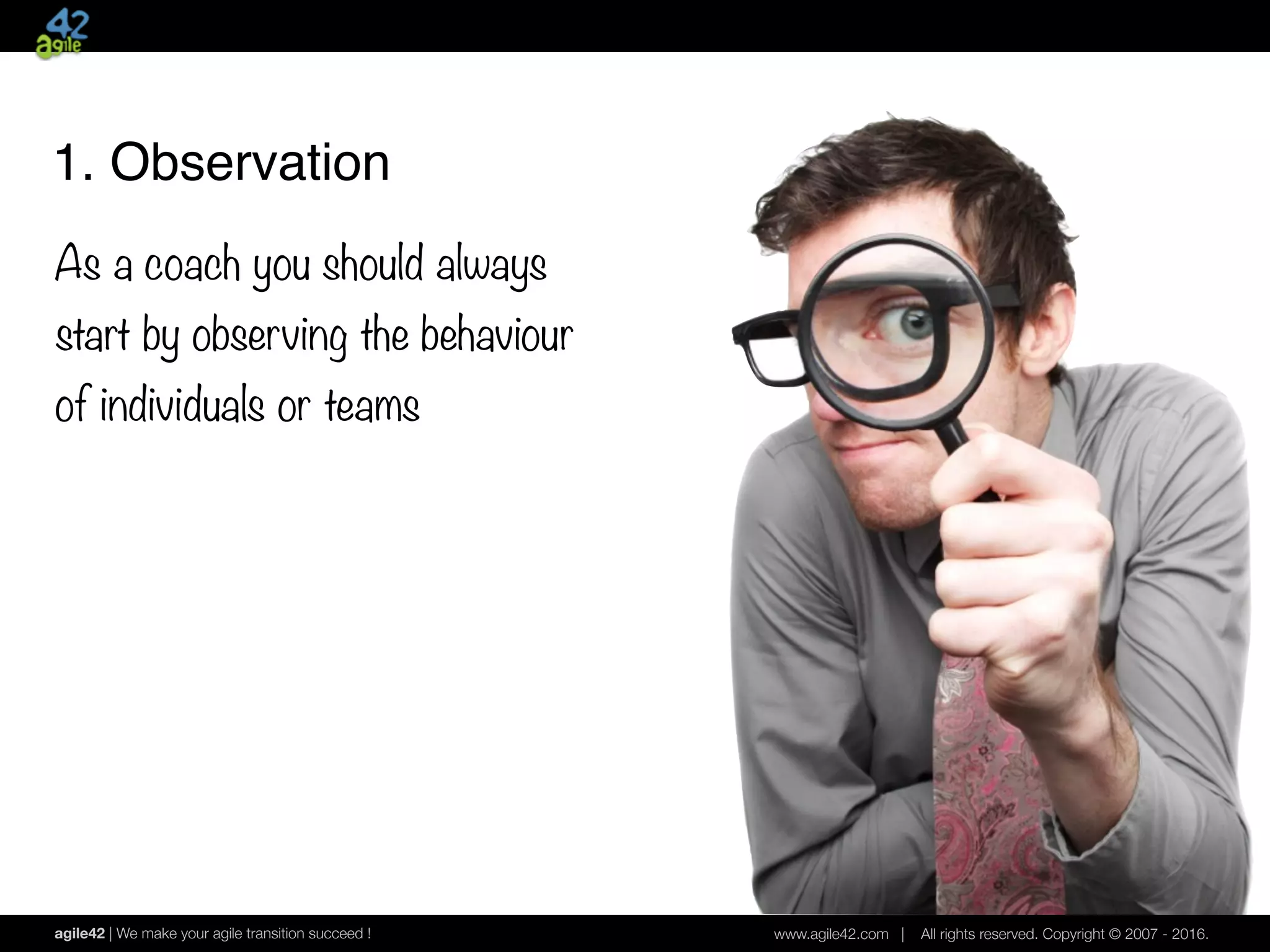
1. Observation
As a coach you should always
start by observing the behaviour
of individuals or teams
agile42 | We make your agile transition succeed ! www.agile42.com | All rights reserved. Copyright © 2007 - 2016.
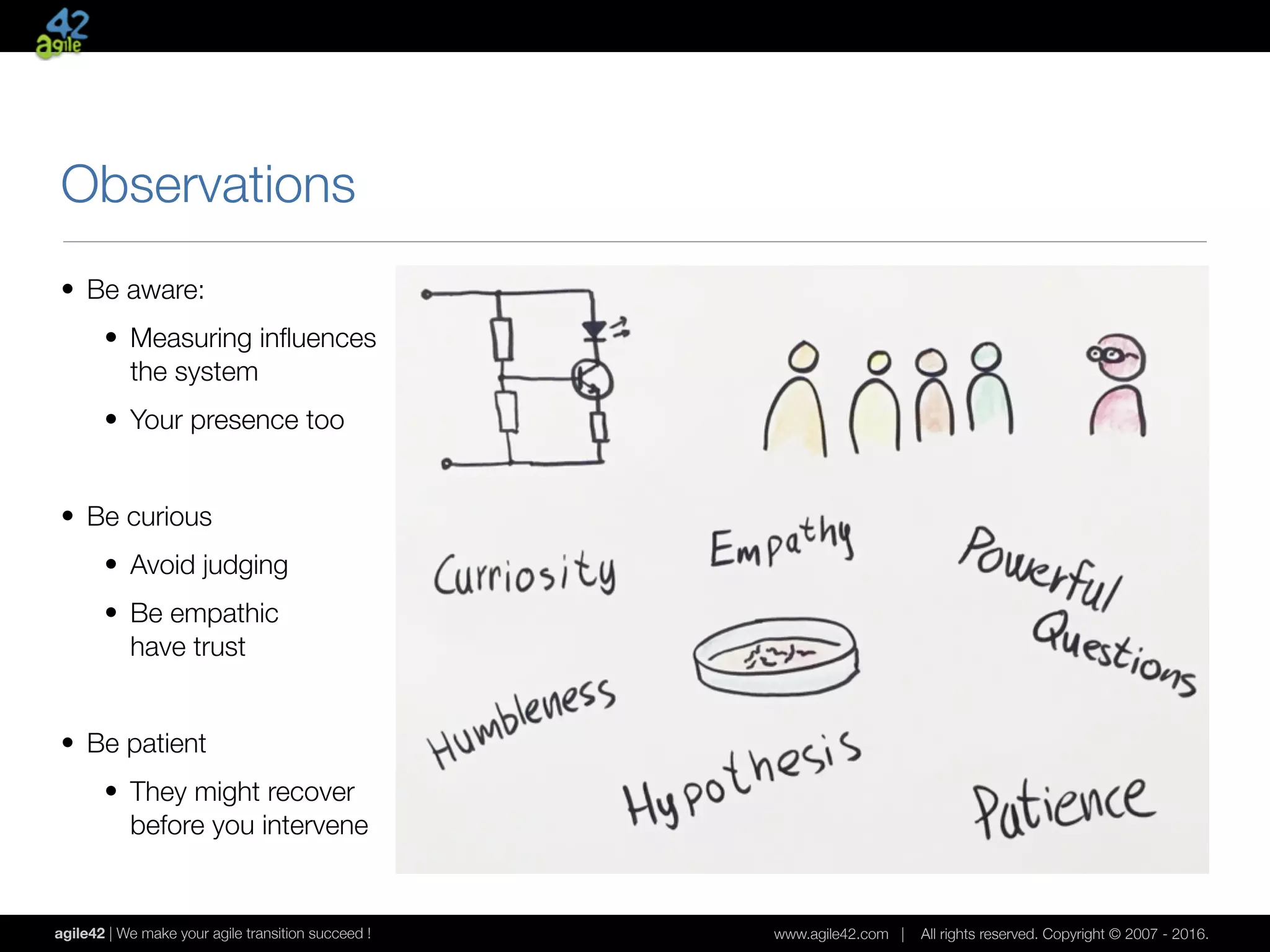
Observations
• Be aware:
• Measuring influences

the system
• Your presence too
• Be curious
• Avoid judging
• Be empathic

have trust
• Be patient
• They might recover

before you intervene
www.agile42.com
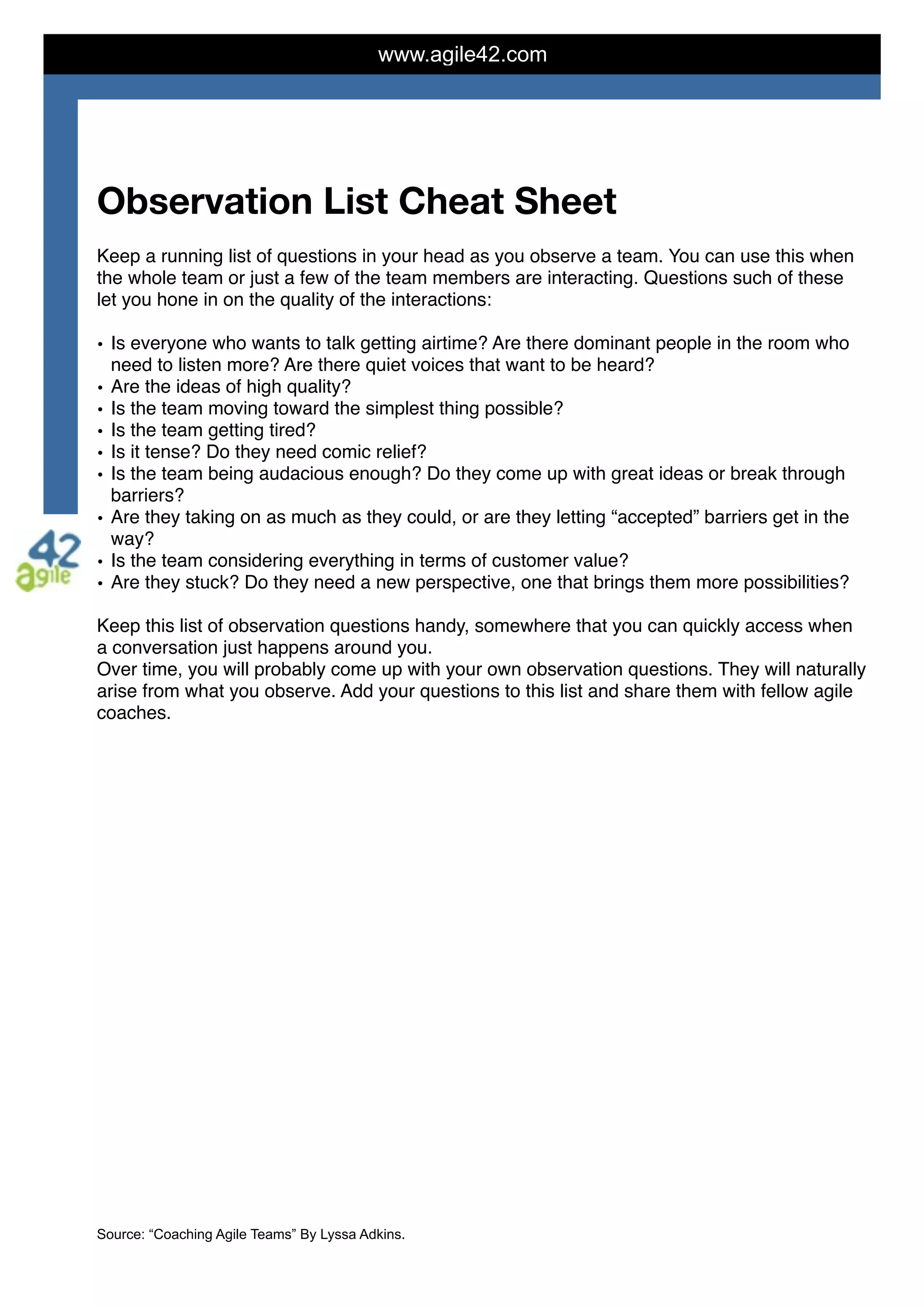
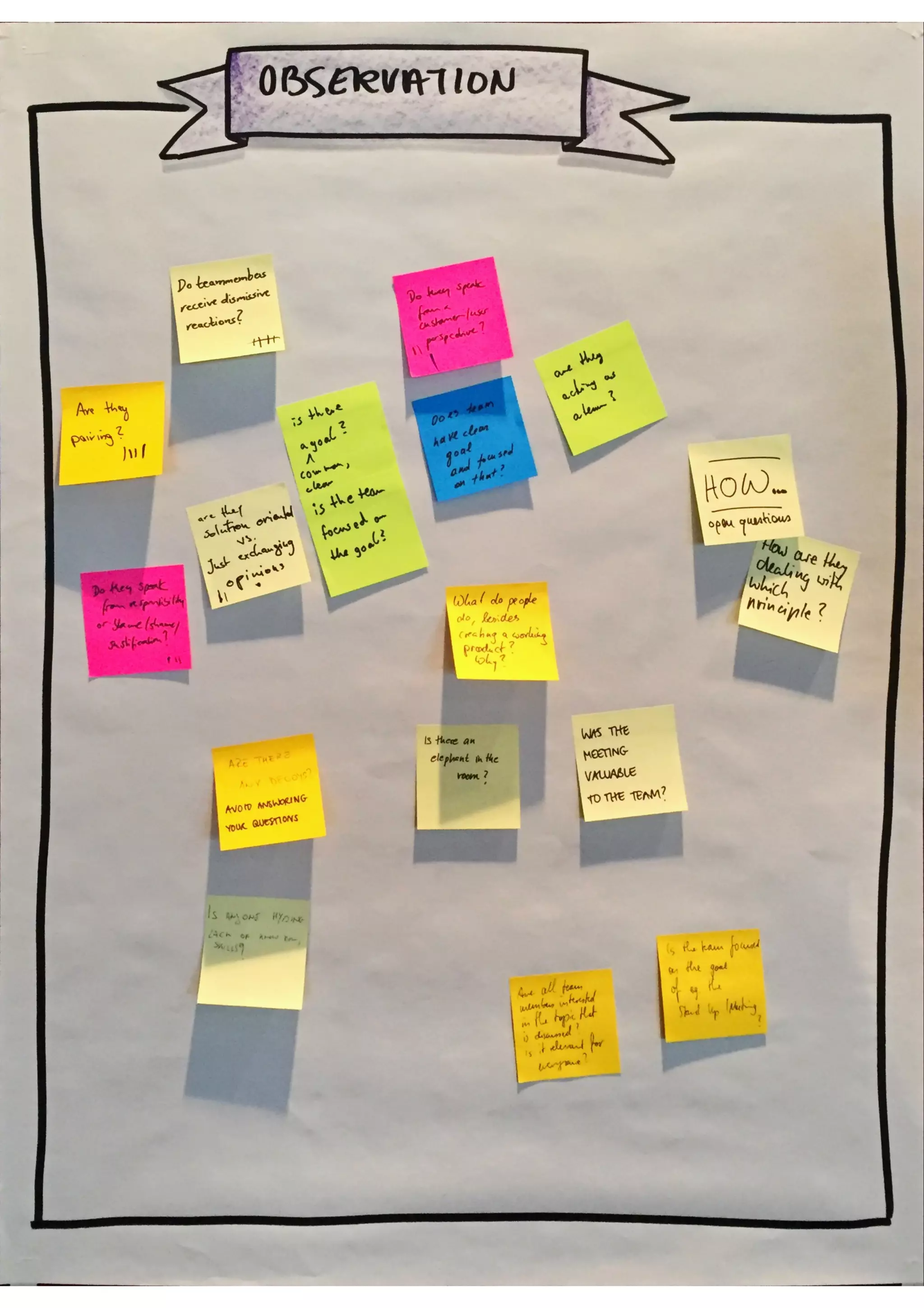
Observation List Cheat Sheet

Keep a running list of questions in your head as you observe a team. You can use this when
the whole team or just a few of the team members are interacting. Questions such of these
let you hone in on the quality of the interactions:
• Is everyone who wants to talk getting airtime? Are there dominant people in the room who
need to listen more? Are there quiet voices that want to be heard?
• Are the ideas of high quality?
• Is the team moving toward the simplest thing possible?
• Is the team getting tired?
• Is it tense? Do they need comic relief?
• Is the team being audacious enough? Do they come up with great ideas or break through
barriers?
• Are they taking on as much as they could, or are they letting “accepted” barriers get in the
way?
• Is the team considering everything in terms of customer value?
• Are they stuck? Do they need a new perspective, one that brings them more possibilities?
Keep this list of observation questions handy, somewhere that you can quickly access when
a conversation just happens around you.
Over time, you will probably come up with your own observation questions. They will naturally
arise from what you observe. Add your questions to this list and share them with fellow agile
coaches.
Source: “Coaching Agile Teams” By Lyssa Adkins.
agile42 | We make your agile transition succeed ! www.agile42.com | All rights reserved. Copyright © 2007 - 2016.
Observations
1
Hypotheses
2
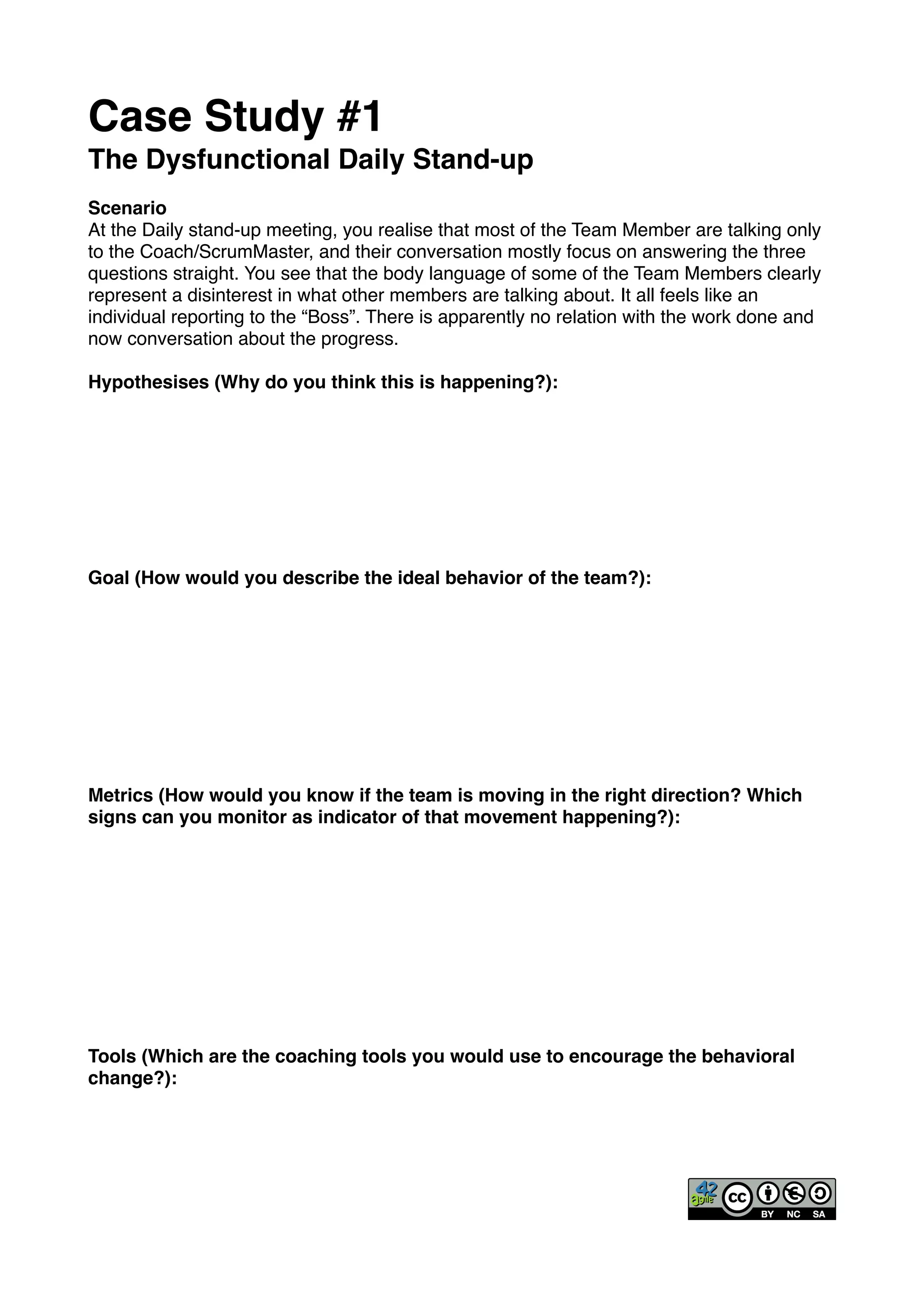
Case Study #1!
The Dysfunctional Daily Stand-up!
!
Scenario!
At the Daily stand-up meeting, you realise that most of the Team Member are talking only
to the Coach/ScrumMaster, and their conversation mostly focus on answering the three
questions straight. You see that the body language of some of the Team Members clearly
represent a disinterest in what other members are talking about. It all feels like an
individual reporting to the “Boss”. There is apparently no relation with the work done and
now conversation about the progress.!
!
Hypothesises (Why do you think this is happening?): !
!
!
!
!
!
!
!
!
Goal (How would you describe the ideal behavior of the team?):!
!
!
!
!
!
!
!
!
!
Metrics (How would you know if the team is moving in the right direction? Which
signs can you monitor as indicator of that movement happening?):!
!
!
!
!
!
!
!
!
!
!
Tools (Which are the coaching tools you would use to encourage the behavioral
change?):!
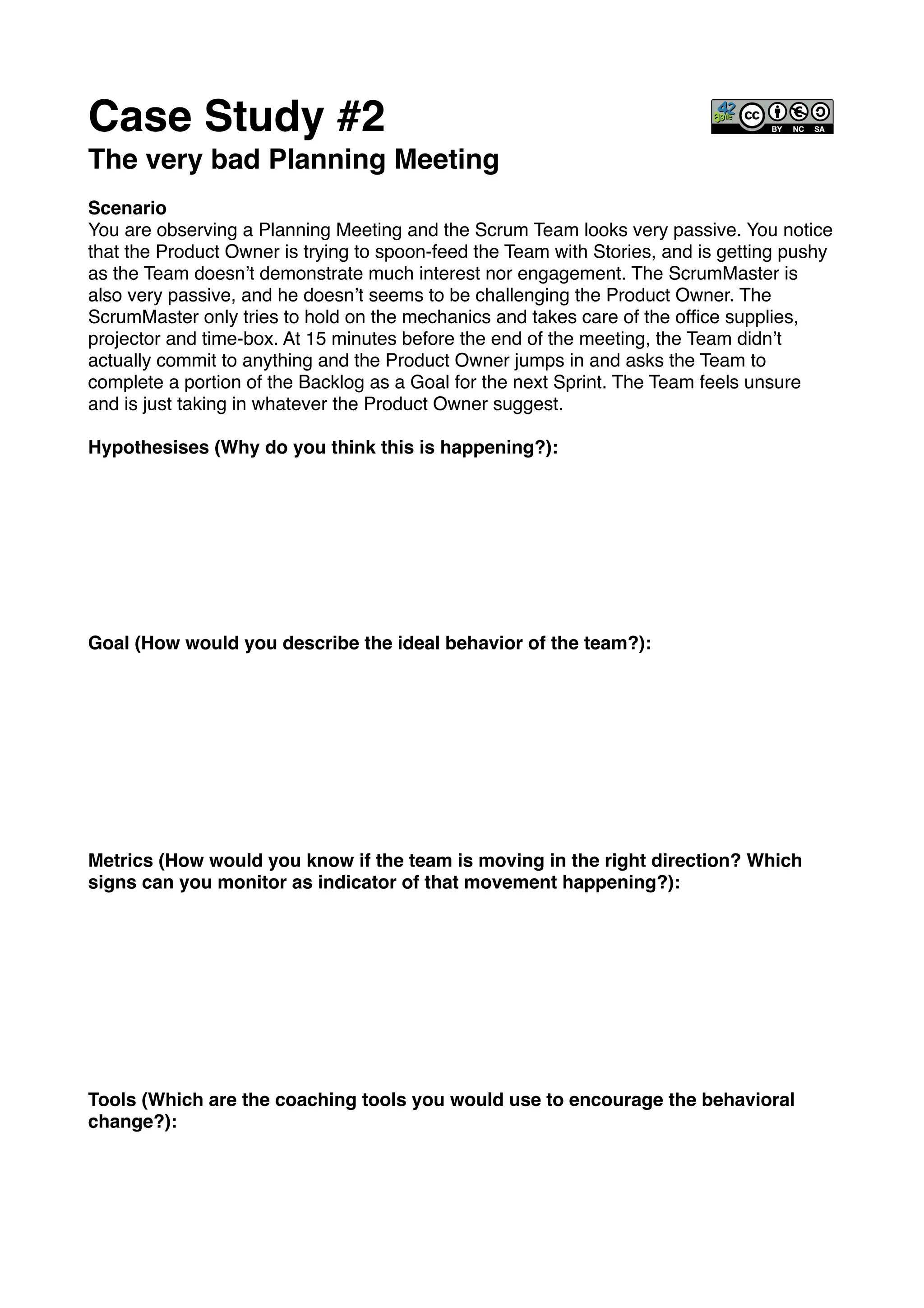
Case Study #2!
The very bad Planning Meeting!
!
Scenario!
You are observing a Planning Meeting and the Scrum Team looks very passive. You notice
that the Product Owner is trying to spoon-feed the Team with Stories, and is getting pushy
as the Team doesn’t demonstrate much interest nor engagement. The ScrumMaster is
also very passive, and he doesn’t seems to be challenging the Product Owner. The
ScrumMaster only tries to hold on the mechanics and takes care of the office supplies,
projector and time-box. At 15 minutes before the end of the meeting, the Team didn’t
actually commit to anything and the Product Owner jumps in and asks the Team to
complete a portion of the Backlog as a Goal for the next Sprint. The Team feels unsure
and is just taking in whatever the Product Owner suggest.!
!
Hypothesises (Why do you think this is happening?): !
!
!
!
!
!
!
!
!
Goal (How would you describe the ideal behavior of the team?):!
!
!
!
!
!
!
!
!
!
Metrics (How would you know if the team is moving in the right direction? Which
signs can you monitor as indicator of that movement happening?):!
!
!
!
!
!
!
!
!
!
Tools (Which are the coaching tools you would use to encourage the behavioral
change?):!
Case Study #3!
The Ineffectual Retrospective!
!
Scenario!
At the beginning of a retrospective, the team says that they haven’t done any actions from
the previous retrospective. The retrospective goes well, a lot of topics are discussed and
shared, but at the end your gut feeling is that the team is not really committed to the
actions. When you follow up on this, most people just shrug and some of them say they
will not have time. The 8-person strong team contains six consultants and two internal
employees. The consultants just do what they are asked to do, while the employees are
busy with software architecture and API design.!
!
Hypothesises (Why do you think this is happening?): !
!
!
!
!
!
!
!
!
Goal (How would you describe the ideal behavior of the team?):!
!
!
!
!
!
!
!
!
!
Metrics (How would you know if the team is moving in the right direction? Which
signs can you monitor as indicator of that movement happening?):!
!
!
!
!
!
!
!
!
!
!
Tools (Which are the coaching tools you would use to encourage the behavioral
change?):!
Case Study #4!
The Product Backlog Handover!
!
Scenario!
The case organisation has 15 teams with 11 Product Owners (POs) and 3 Product
Managers (PMs). PMs work “outwards” with the customers, while the POs work “inwards”
with the teams. The idea was to jointly ensure that the backlogs are up to date, but several
important backlog items were forgotten. The organisational response was to create very
detailed role definitions, down to who is supposed to tick checkboxes in the tool. This has
resulted in a lot of blame shifting and finger pointing, e.g. “I couldn’t find the story because
the PM put it in the wrong category”, or “we didn’t mark it as done because that’s the PO’s
job”.!
!
Hypothesises (Why do you think this is happening?): !
!
!
!
!
!
!
!
!
Goal (How would you describe the ideal behavior of the team?):!
!
!
!
!
!
!
!
!
!
Metrics (How would you know if the team is moving in the right direction? Which
signs can you monitor as indicator of that movement happening?):!
!
!
!
!
!
!
!
!
!
!
Tools (Which are the coaching tools you would use to encourage the behavioral
change?):!
Case Study #5!
The Static Board!
!
Scenario!
Looking at the task board you realize that two tasks are in the same positions since a long
time. The team members seems to be focalized on the other tasks that proceed at the
usual speed, but those two tasks were never touched by anyone since a “long time” (at
least 3 times the average task lead time). Also the team’s coach does not seems to react
to this fact, and doesn’t challenge the team on taking care of those tasks. !
!
Hypothesises (Why do you think this is happening?): !
!
!
!
!
!
!
!
!
Goal (How would you describe the ideal behavior of the team?):!
!
!
!
!
!
!
!
!
!
Metrics (How would you know if the team is moving in the right direction? Which
signs can you monitor as indicator of that movement happening?):!
!
!
!
!
!
!
!
!
!
!
Tools (Which are the coaching tools you would use to encourage the behavioral
change?):!
Case Study #6!
The hurried tests !
!
Scenario!
At the review meeting the team demonstrate a product that has not been fully tested. The
tests are never ready: often the tests are run on the tester's machine or on the developer's
laptop. They never described the tests environment nor they reflect the normal production
situation. There is no report on the tests run to verify the product. The Product Owner
seems to be okay with this, and the coach/ScrumMaster says that the time is so strict that
"it is a miracle when they have time to test something"!
!
Hypothesises (Why do you think this is happening?): !
!
!
!
!
!
!
!
!
Goal (How would you describe the ideal behavior of the team?):!
!
!
!
!
!
!
!
!
!
Metrics (How would you know if the team is moving in the right direction? Which
signs can you monitor as indicator of that movement happening?):!
!
!
!
!
!
!
!
!
!
!
Tools (Which are the coaching tools you would use to encourage the behavioral
change?):!
agile42 | We make your agile transition succeed ! www.agile42.com | All rights reserved. Copyright © 2007 - 2016.
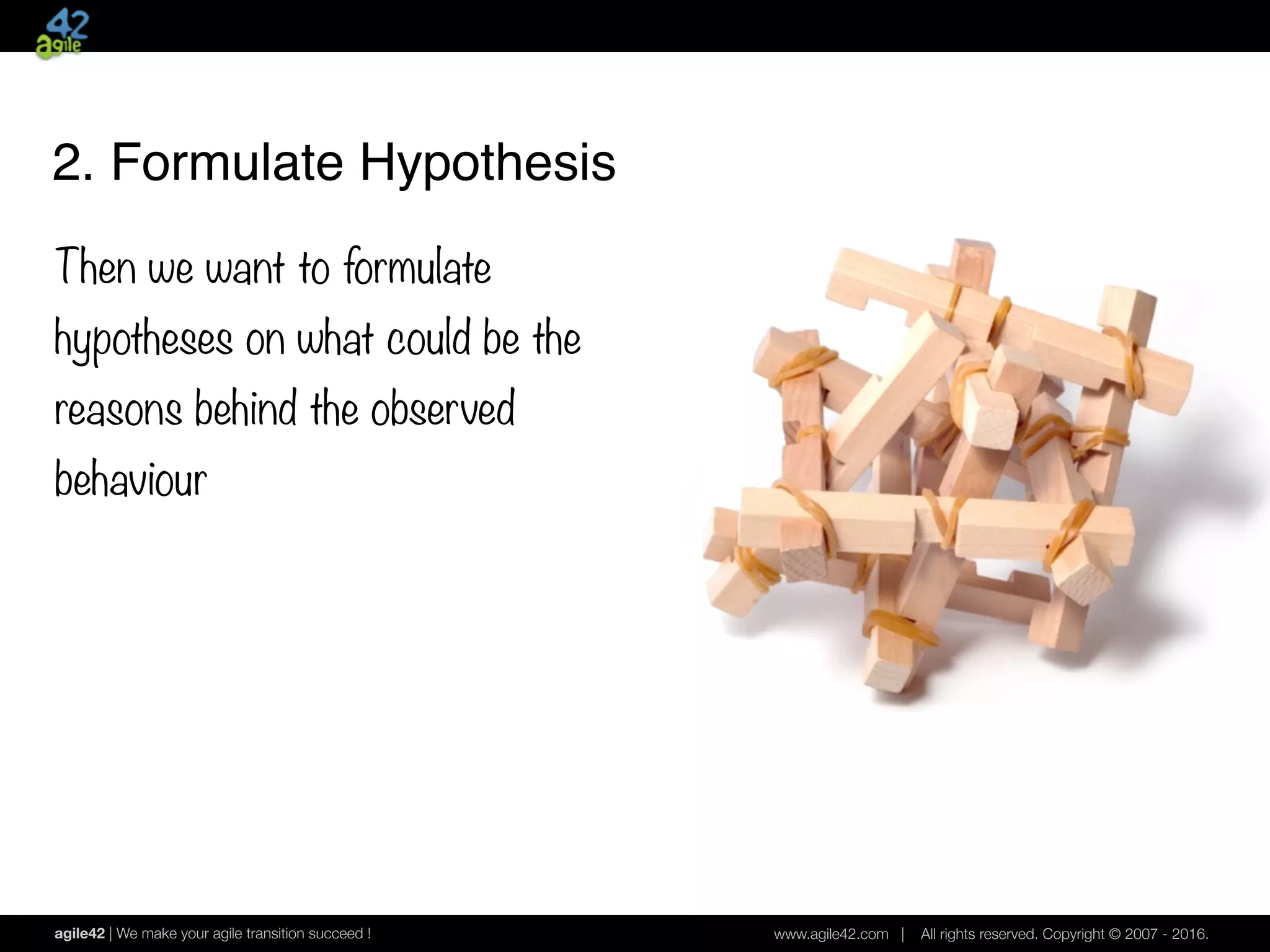
2. Formulate Hypothesis
Then we want to formulate
hypotheses on what could be the
reasons behind the observed
behaviour
agile42 | We make your agile transition succeed ! www.agile42.com | All rights reserved. Copyright © 2007 - 2016.
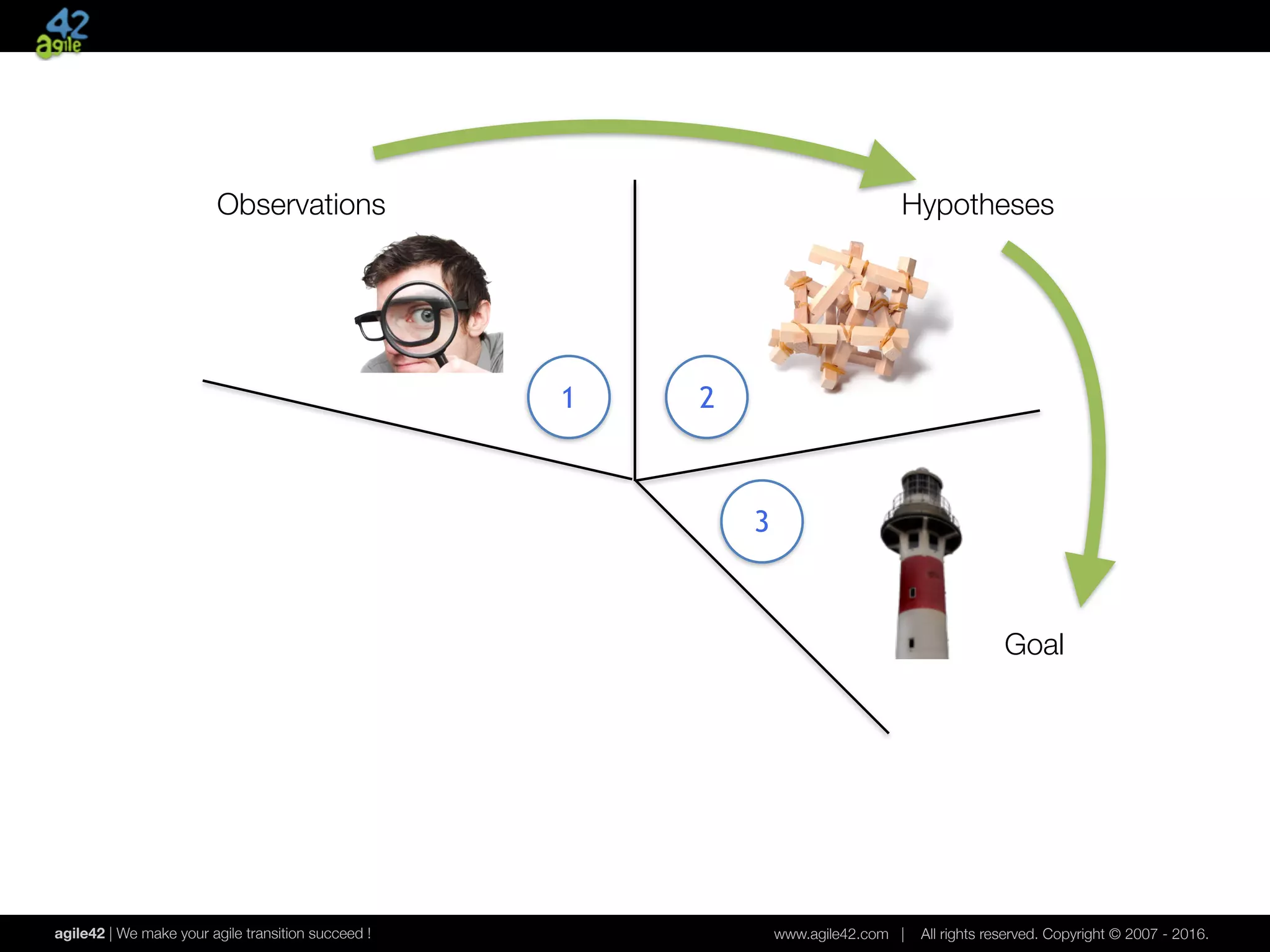
Observations
1
Hypotheses
2
Goal
3
agile42 | We make your agile transition succeed ! www.agile42.com | All rights reserved. Copyright © 2007 - 2016.
3. Define a Goal
Once we have an hypothesis, we
want to define what is the desired
behaviour that we want to see in
the individual or team.
agile42 | We make your agile transition succeed ! www.agile42.com | All rights reserved. Copyright © 2007 - 2016.
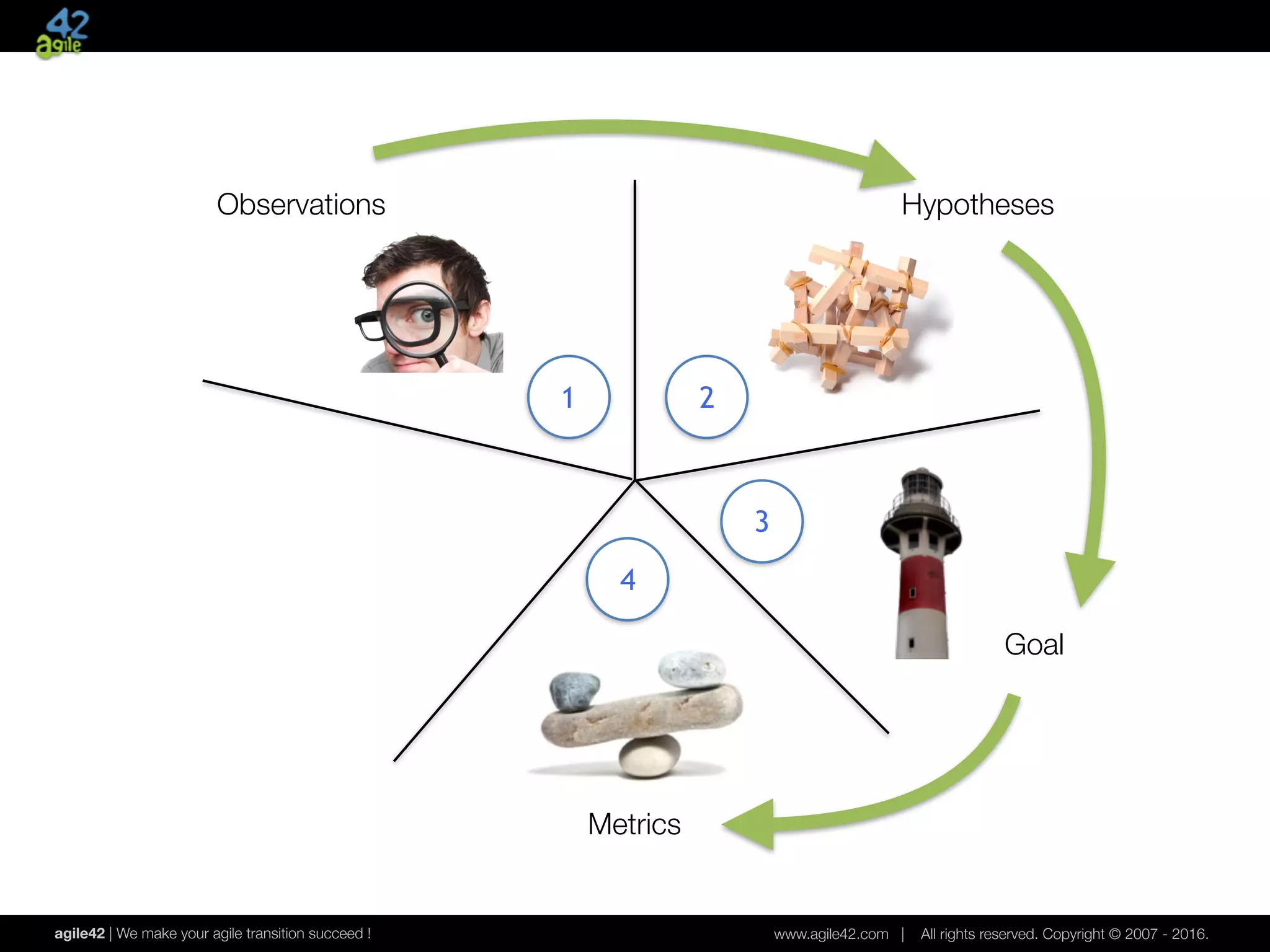
Observations
1
Hypotheses
2
Goal
3
Metrics
4
agile42 | We make your agile transition succeed ! www.agile42.com | All rights reserved. Copyright © 2007 - 2016.
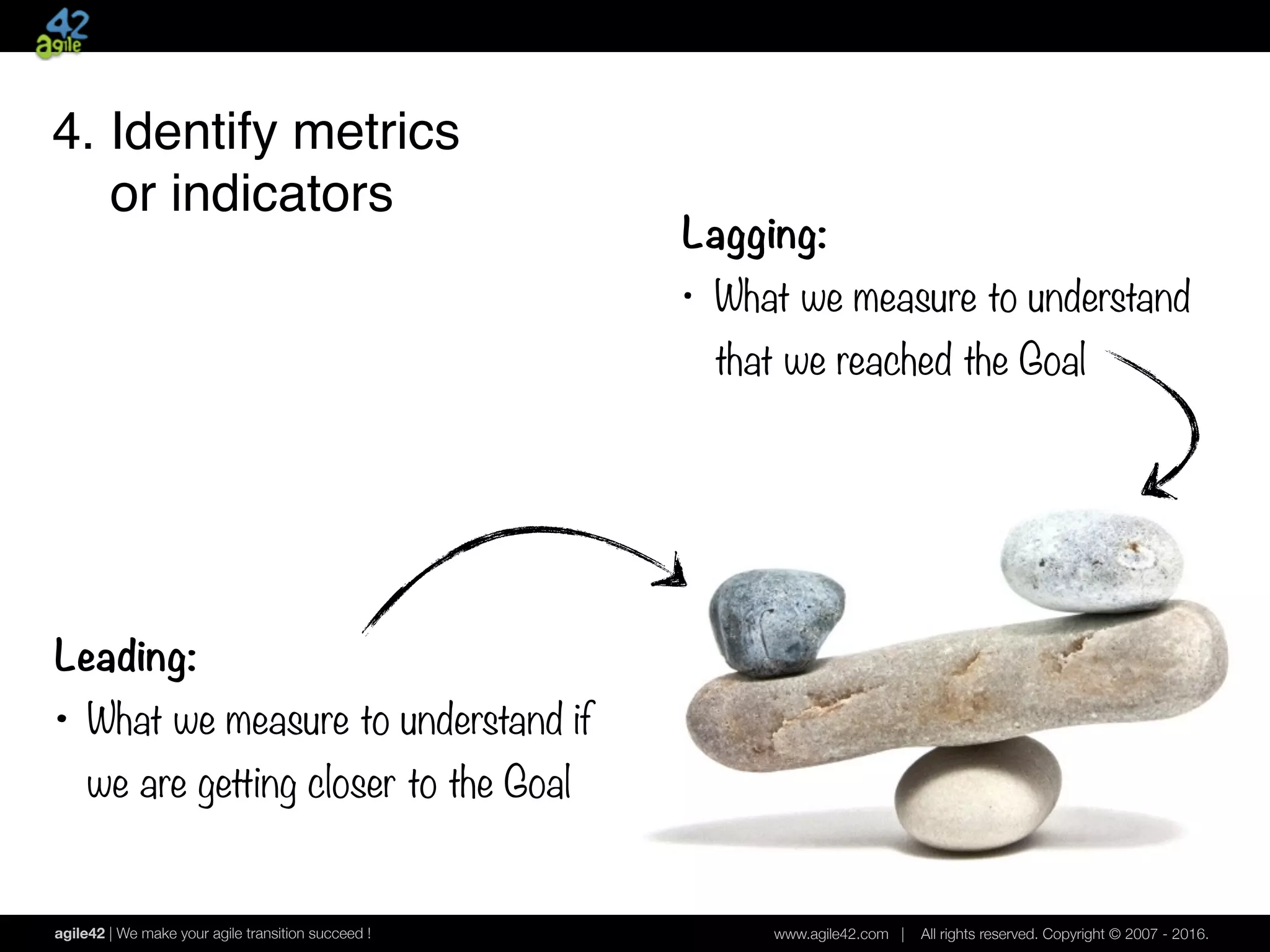
4. Identify metrics

or indicators
Leading:
• What we measure to understand if
we are getting closer to the Goal
Lagging:
• What we measure to understand
that we reached the Goal
agile42 | We make your agile transition succeed ! www.agile42.com | All rights reserved. Copyright © 2007 - 2016.
Observations
1
Hypotheses
2
Goal
3
Metrics
4
Tools
5
agile42 | We make your agile transition succeed ! www.agile42.com | All rights reserved. Copyright © 2007 - 2016.
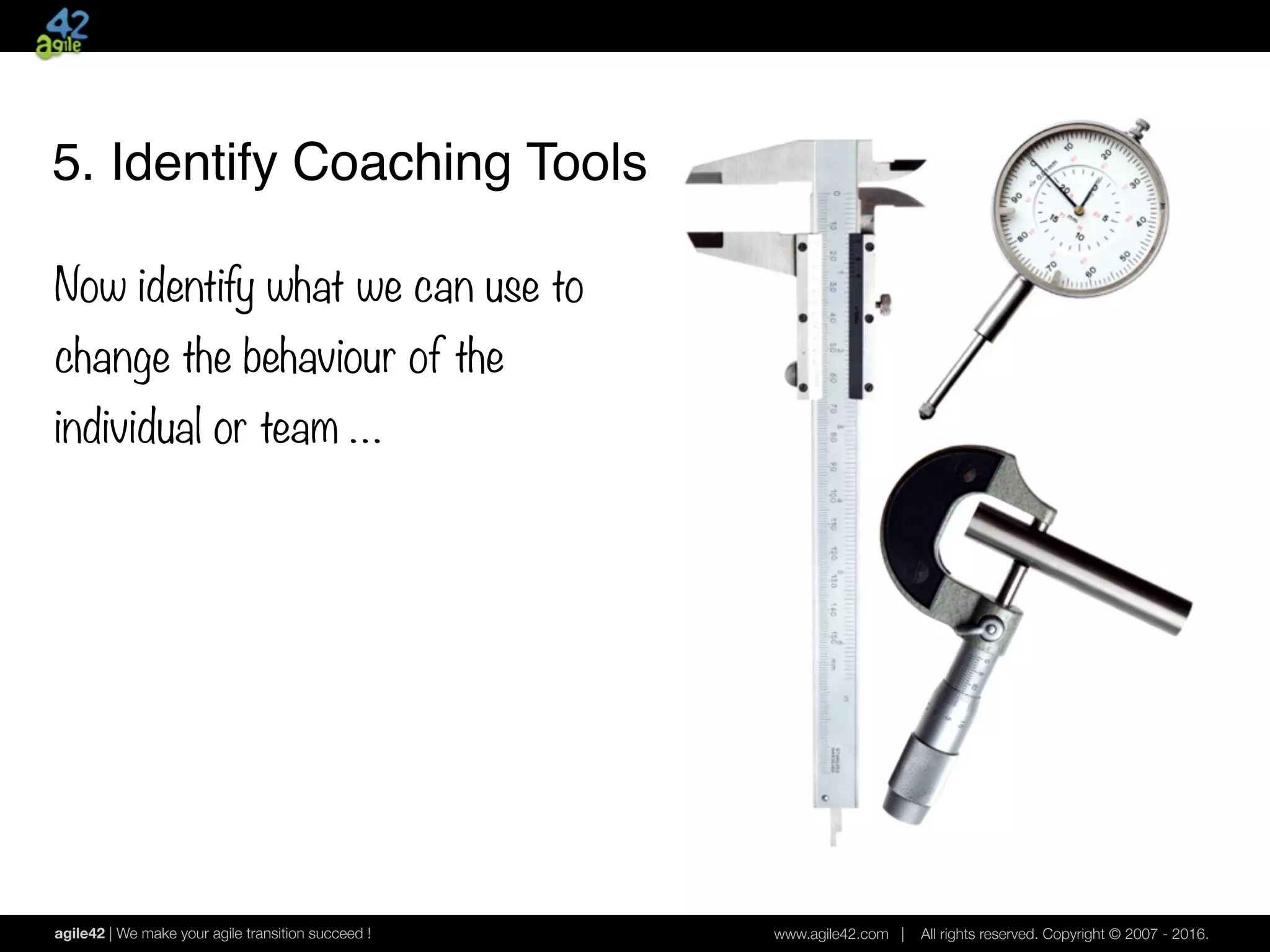
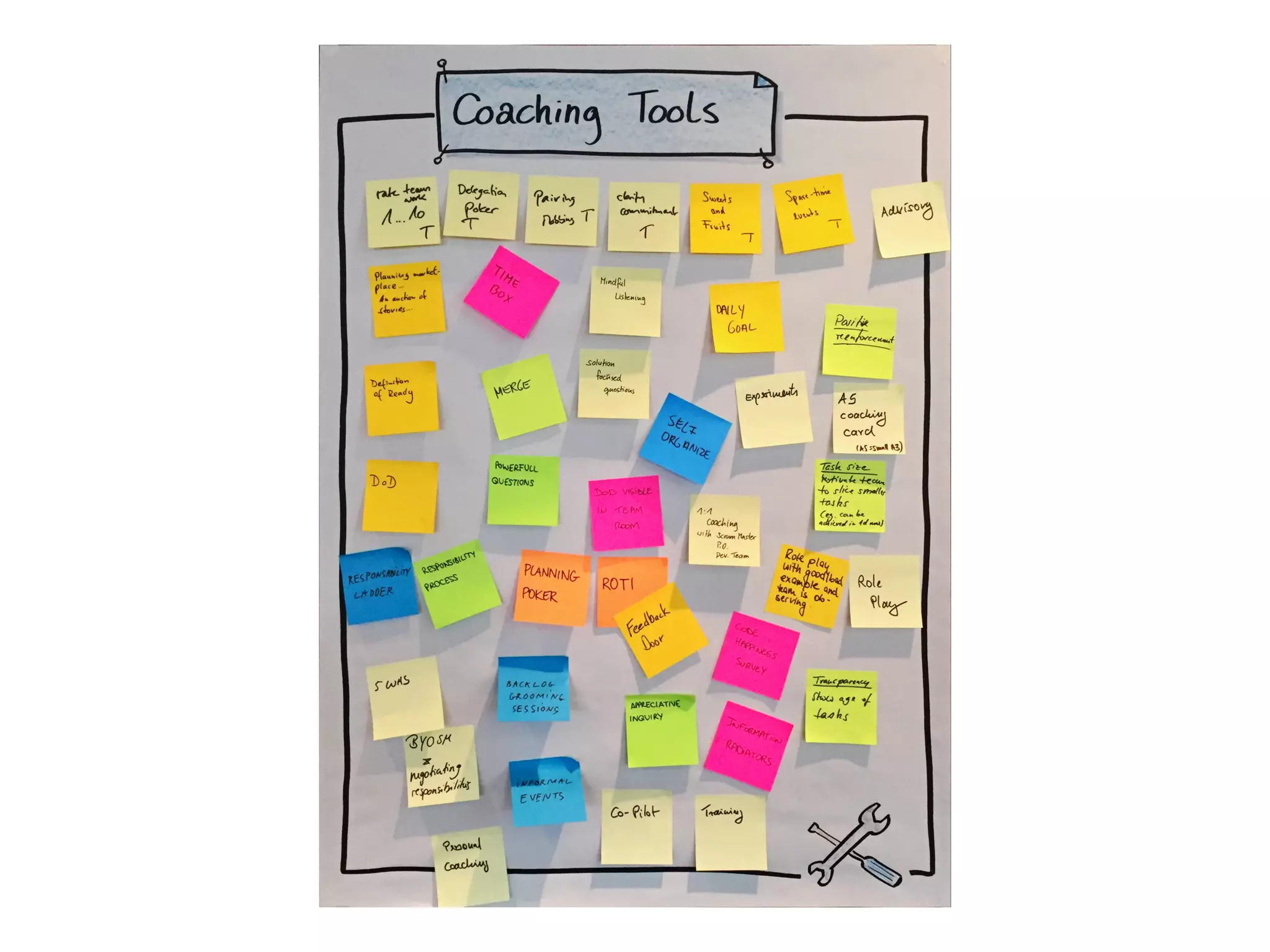
5. Identify Coaching Tools
Now identify what we can use to
change the behaviour of the
individual or team …
agile42 | We make your agile transition succeed ! www.agile42.com | All rights reserved. Copyright © 2007 - 2016.
Observations
1
Hypotheses
2
Goal
3
Metrics
4
Tools
5
agile42 | We make your agile transition succeed ! www.agile42.com | All rights reserved. Copyright © 2007 - 2016.
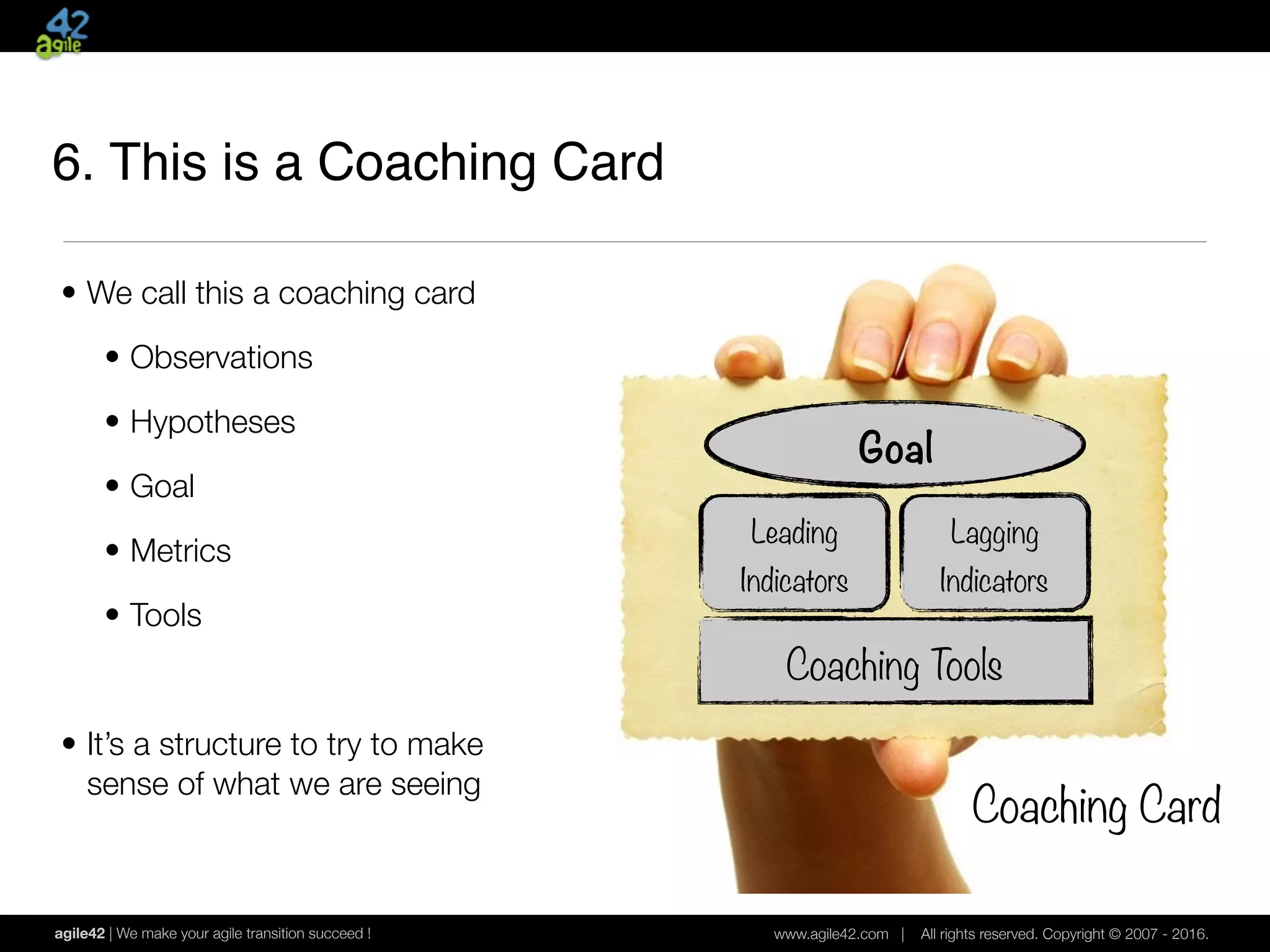
• We call this a coaching card
• Observations
• Hypotheses
• Goal
• Metrics
• Tools
• It’s a structure to try to make

sense of what we are seeing
Goal
Leading
Indicators
Lagging
Indicators
Coaching Tools
Coaching Card
6. This is a Coaching Card
agile42 | We make your agile transition succeed ! www.agile42.com | All rights reserved. Copyright © 2007 - 2016.
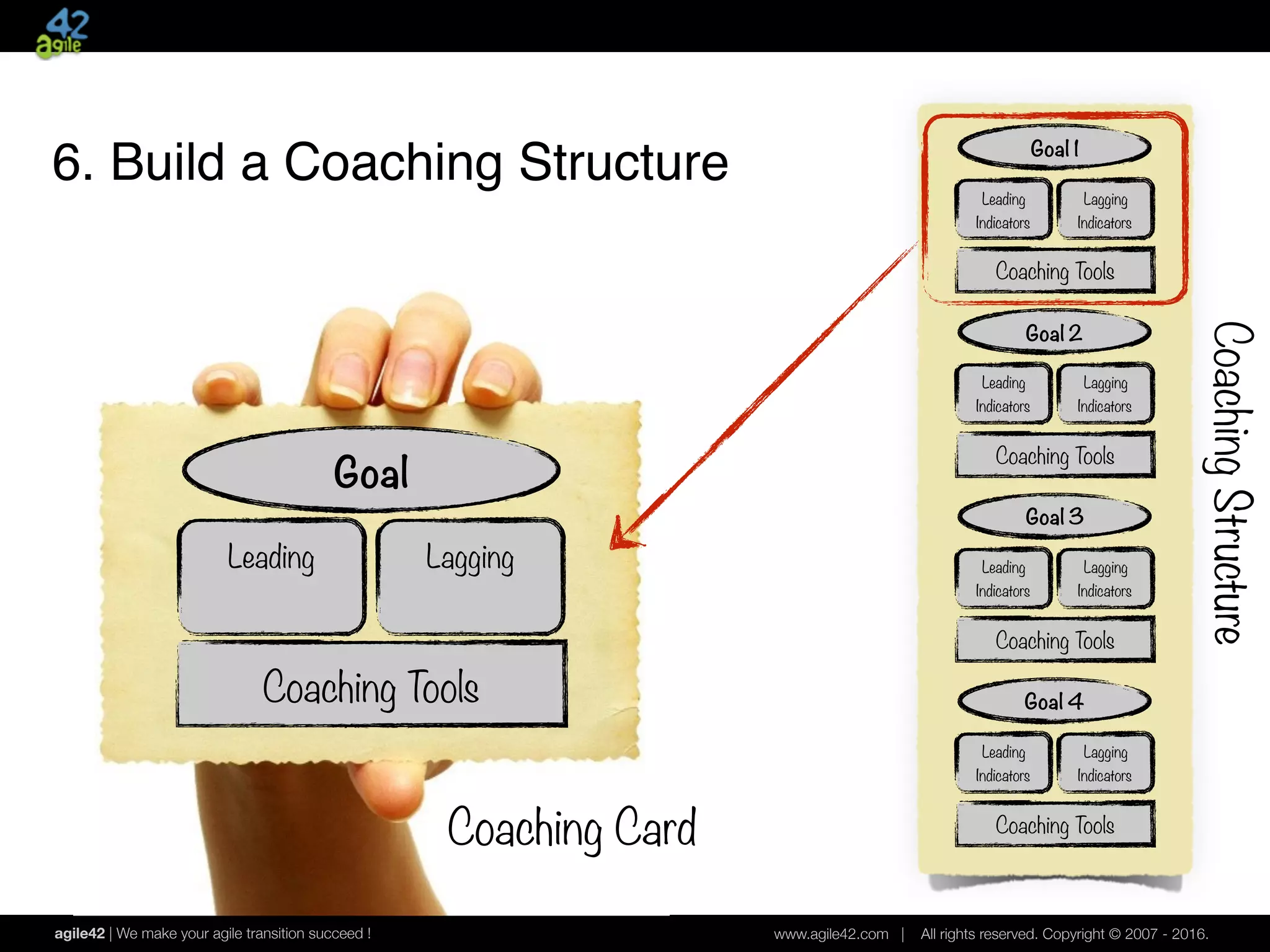
Goal
Leading Lagging
Coaching Tools
Coaching Card
6. Build a Coaching Structure Goal 1
Leading
Indicators
Lagging
Indicators
Coaching Tools
Goal 2
Leading
Indicators
Lagging
Indicators
Coaching Tools
Goal 3
Leading
Indicators
Lagging
Indicators
Coaching Tools
Goal 4
Leading
Indicators
Lagging
Indicators
Coaching Tools
CoachingStructure
agile42 | We make your agile transition succeed ! www.agile42.com | All rights reserved. Copyright © 2007 - 2016.
• We can apply this in a bigger context
• When working with multiple coaches in one organization
• To collaborate on defining a shared approach of multiple cards
• Working with ScrumMasters or internal Agile Coaches
• To help them to move to a coaching approach
• Or even with teams
• So teams can define hypotheses, goals, metrics and tools themselves.
6. Build a Coaching Structure

Be curious without judging - building a coaching structure

  • 2.
    agile42 | Wemake your agile transition succeed ! www.agile42.com | All rights reserved. Copyright © 2007 - 2016. Be curious without judging Using observations to structure your coaching
  • 3.
    agile42 | Wemake your agile transition succeed ! www.agile42.com | All rights reserved. Copyright © 2007 - 2016. Who are you? Find the corner which fits you best … • ScrumMaster • Agile Coach • Team Member • None of the above
  • 4.
    agile42 | Wemake your agile transition succeed ! www.agile42.com | All rights reserved. Copyright © 2007 - 2016. Observations 1 Hypotheses 2 Goal 3 Metrics 4 Tools 5
  • 5.
    agile42 | Wemake your agile transition succeed ! www.agile42.com | All rights reserved. Copyright © 2007 - 2016. Observations 1
  • 6.
    agile42 | Wemake your agile transition succeed ! www.agile42.com | All rights reserved. Copyright © 2007 - 2016. 1. Observation As a coach you should always start by observing the behaviour of individuals or teams
  • 7.
    agile42 | Wemake your agile transition succeed ! www.agile42.com | All rights reserved. Copyright © 2007 - 2016. Observations • Be aware: • Measuring influences
 the system • Your presence too • Be curious • Avoid judging • Be empathic
 have trust • Be patient • They might recover
 before you intervene
  • 8.
    www.agile42.com Observation List CheatSheet Keep a running list of questions in your head as you observe a team. You can use this when the whole team or just a few of the team members are interacting. Questions such of these let you hone in on the quality of the interactions: • Is everyone who wants to talk getting airtime? Are there dominant people in the room who need to listen more? Are there quiet voices that want to be heard? • Are the ideas of high quality? • Is the team moving toward the simplest thing possible? • Is the team getting tired? • Is it tense? Do they need comic relief? • Is the team being audacious enough? Do they come up with great ideas or break through barriers? • Are they taking on as much as they could, or are they letting “accepted” barriers get in the way? • Is the team considering everything in terms of customer value? • Are they stuck? Do they need a new perspective, one that brings them more possibilities? Keep this list of observation questions handy, somewhere that you can quickly access when a conversation just happens around you. Over time, you will probably come up with your own observation questions. They will naturally arise from what you observe. Add your questions to this list and share them with fellow agile coaches. Source: “Coaching Agile Teams” By Lyssa Adkins.
  • 10.
    agile42 | Wemake your agile transition succeed ! www.agile42.com | All rights reserved. Copyright © 2007 - 2016. Observations 1 Hypotheses 2
  • 11.
    Case Study #1! TheDysfunctional Daily Stand-up! ! Scenario! At the Daily stand-up meeting, you realise that most of the Team Member are talking only to the Coach/ScrumMaster, and their conversation mostly focus on answering the three questions straight. You see that the body language of some of the Team Members clearly represent a disinterest in what other members are talking about. It all feels like an individual reporting to the “Boss”. There is apparently no relation with the work done and now conversation about the progress.! ! Hypothesises (Why do you think this is happening?): ! ! ! ! ! ! ! ! ! Goal (How would you describe the ideal behavior of the team?):! ! ! ! ! ! ! ! ! ! Metrics (How would you know if the team is moving in the right direction? Which signs can you monitor as indicator of that movement happening?):! ! ! ! ! ! ! ! ! ! ! Tools (Which are the coaching tools you would use to encourage the behavioral change?):!
  • 12.
    Case Study #2! Thevery bad Planning Meeting! ! Scenario! You are observing a Planning Meeting and the Scrum Team looks very passive. You notice that the Product Owner is trying to spoon-feed the Team with Stories, and is getting pushy as the Team doesn’t demonstrate much interest nor engagement. The ScrumMaster is also very passive, and he doesn’t seems to be challenging the Product Owner. The ScrumMaster only tries to hold on the mechanics and takes care of the office supplies, projector and time-box. At 15 minutes before the end of the meeting, the Team didn’t actually commit to anything and the Product Owner jumps in and asks the Team to complete a portion of the Backlog as a Goal for the next Sprint. The Team feels unsure and is just taking in whatever the Product Owner suggest.! ! Hypothesises (Why do you think this is happening?): ! ! ! ! ! ! ! ! ! Goal (How would you describe the ideal behavior of the team?):! ! ! ! ! ! ! ! ! ! Metrics (How would you know if the team is moving in the right direction? Which signs can you monitor as indicator of that movement happening?):! ! ! ! ! ! ! ! ! ! Tools (Which are the coaching tools you would use to encourage the behavioral change?):!
  • 13.
    Case Study #3! TheIneffectual Retrospective! ! Scenario! At the beginning of a retrospective, the team says that they haven’t done any actions from the previous retrospective. The retrospective goes well, a lot of topics are discussed and shared, but at the end your gut feeling is that the team is not really committed to the actions. When you follow up on this, most people just shrug and some of them say they will not have time. The 8-person strong team contains six consultants and two internal employees. The consultants just do what they are asked to do, while the employees are busy with software architecture and API design.! ! Hypothesises (Why do you think this is happening?): ! ! ! ! ! ! ! ! ! Goal (How would you describe the ideal behavior of the team?):! ! ! ! ! ! ! ! ! ! Metrics (How would you know if the team is moving in the right direction? Which signs can you monitor as indicator of that movement happening?):! ! ! ! ! ! ! ! ! ! ! Tools (Which are the coaching tools you would use to encourage the behavioral change?):!
  • 14.
    Case Study #4! TheProduct Backlog Handover! ! Scenario! The case organisation has 15 teams with 11 Product Owners (POs) and 3 Product Managers (PMs). PMs work “outwards” with the customers, while the POs work “inwards” with the teams. The idea was to jointly ensure that the backlogs are up to date, but several important backlog items were forgotten. The organisational response was to create very detailed role definitions, down to who is supposed to tick checkboxes in the tool. This has resulted in a lot of blame shifting and finger pointing, e.g. “I couldn’t find the story because the PM put it in the wrong category”, or “we didn’t mark it as done because that’s the PO’s job”.! ! Hypothesises (Why do you think this is happening?): ! ! ! ! ! ! ! ! ! Goal (How would you describe the ideal behavior of the team?):! ! ! ! ! ! ! ! ! ! Metrics (How would you know if the team is moving in the right direction? Which signs can you monitor as indicator of that movement happening?):! ! ! ! ! ! ! ! ! ! ! Tools (Which are the coaching tools you would use to encourage the behavioral change?):!
  • 15.
    Case Study #5! TheStatic Board! ! Scenario! Looking at the task board you realize that two tasks are in the same positions since a long time. The team members seems to be focalized on the other tasks that proceed at the usual speed, but those two tasks were never touched by anyone since a “long time” (at least 3 times the average task lead time). Also the team’s coach does not seems to react to this fact, and doesn’t challenge the team on taking care of those tasks. ! ! Hypothesises (Why do you think this is happening?): ! ! ! ! ! ! ! ! ! Goal (How would you describe the ideal behavior of the team?):! ! ! ! ! ! ! ! ! ! Metrics (How would you know if the team is moving in the right direction? Which signs can you monitor as indicator of that movement happening?):! ! ! ! ! ! ! ! ! ! ! Tools (Which are the coaching tools you would use to encourage the behavioral change?):!
  • 16.
    Case Study #6! Thehurried tests ! ! Scenario! At the review meeting the team demonstrate a product that has not been fully tested. The tests are never ready: often the tests are run on the tester's machine or on the developer's laptop. They never described the tests environment nor they reflect the normal production situation. There is no report on the tests run to verify the product. The Product Owner seems to be okay with this, and the coach/ScrumMaster says that the time is so strict that "it is a miracle when they have time to test something"! ! Hypothesises (Why do you think this is happening?): ! ! ! ! ! ! ! ! ! Goal (How would you describe the ideal behavior of the team?):! ! ! ! ! ! ! ! ! ! Metrics (How would you know if the team is moving in the right direction? Which signs can you monitor as indicator of that movement happening?):! ! ! ! ! ! ! ! ! ! ! Tools (Which are the coaching tools you would use to encourage the behavioral change?):!
  • 17.
    agile42 | Wemake your agile transition succeed ! www.agile42.com | All rights reserved. Copyright © 2007 - 2016. 2. Formulate Hypothesis Then we want to formulate hypotheses on what could be the reasons behind the observed behaviour
  • 18.
    agile42 | Wemake your agile transition succeed ! www.agile42.com | All rights reserved. Copyright © 2007 - 2016. Observations 1 Hypotheses 2 Goal 3
  • 19.
    agile42 | Wemake your agile transition succeed ! www.agile42.com | All rights reserved. Copyright © 2007 - 2016. 3. Define a Goal Once we have an hypothesis, we want to define what is the desired behaviour that we want to see in the individual or team.
  • 20.
    agile42 | Wemake your agile transition succeed ! www.agile42.com | All rights reserved. Copyright © 2007 - 2016. Observations 1 Hypotheses 2 Goal 3 Metrics 4
  • 21.
    agile42 | Wemake your agile transition succeed ! www.agile42.com | All rights reserved. Copyright © 2007 - 2016. 4. Identify metrics
 or indicators Leading: • What we measure to understand if we are getting closer to the Goal Lagging: • What we measure to understand that we reached the Goal
  • 22.
    agile42 | Wemake your agile transition succeed ! www.agile42.com | All rights reserved. Copyright © 2007 - 2016. Observations 1 Hypotheses 2 Goal 3 Metrics 4 Tools 5
  • 23.
    agile42 | Wemake your agile transition succeed ! www.agile42.com | All rights reserved. Copyright © 2007 - 2016. 5. Identify Coaching Tools Now identify what we can use to change the behaviour of the individual or team …
  • 25.
    agile42 | Wemake your agile transition succeed ! www.agile42.com | All rights reserved. Copyright © 2007 - 2016. Observations 1 Hypotheses 2 Goal 3 Metrics 4 Tools 5
  • 26.
    agile42 | Wemake your agile transition succeed ! www.agile42.com | All rights reserved. Copyright © 2007 - 2016. • We call this a coaching card • Observations • Hypotheses • Goal • Metrics • Tools • It’s a structure to try to make
 sense of what we are seeing Goal Leading Indicators Lagging Indicators Coaching Tools Coaching Card 6. This is a Coaching Card
  • 27.
    agile42 | Wemake your agile transition succeed ! www.agile42.com | All rights reserved. Copyright © 2007 - 2016. Goal Leading Lagging Coaching Tools Coaching Card 6. Build a Coaching Structure Goal 1 Leading Indicators Lagging Indicators Coaching Tools Goal 2 Leading Indicators Lagging Indicators Coaching Tools Goal 3 Leading Indicators Lagging Indicators Coaching Tools Goal 4 Leading Indicators Lagging Indicators Coaching Tools CoachingStructure
  • 28.
    agile42 | Wemake your agile transition succeed ! www.agile42.com | All rights reserved. Copyright © 2007 - 2016. • We can apply this in a bigger context • When working with multiple coaches in one organization • To collaborate on defining a shared approach of multiple cards • Working with ScrumMasters or internal Agile Coaches • To help them to move to a coaching approach • Or even with teams • So teams can define hypotheses, goals, metrics and tools themselves. 6. Build a Coaching Structure