Copyright © nuCognitive LLC. & FiveWhyz LLC. All rights reserved.
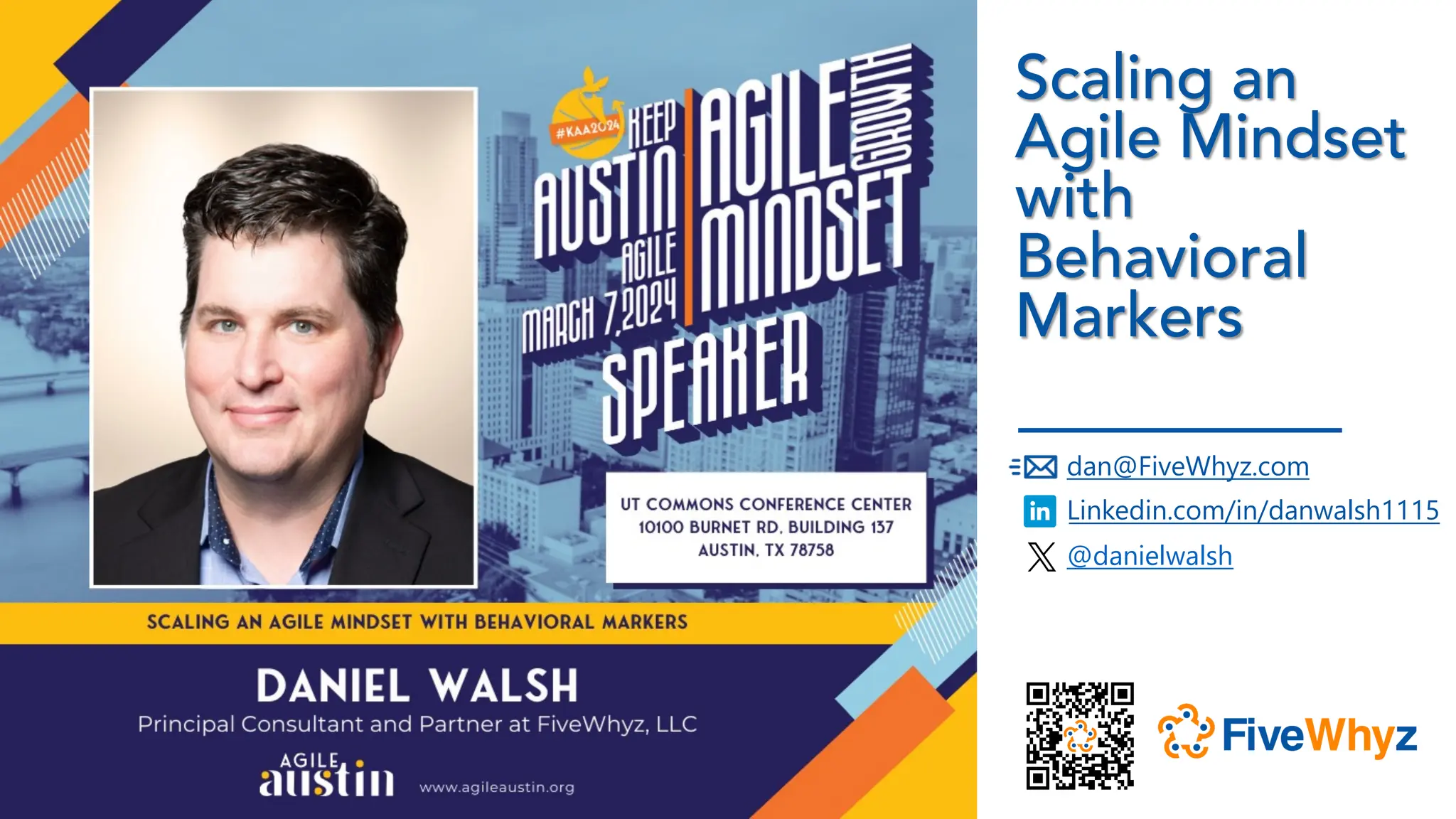
Scaling an
Agile Mindset
with
Behavioral
Markers
Linkedin.com/in/danwalsh1115
dan@FiveWhyz.com
@danielwalsh
Copyright © nuCognitive LLC. & FiveWhyz LLC. All rights reserved.
When some uses the word <mindset>,
what do they mean?
2
Copyright © nuCognitive LLC. & FiveWhyz LLC. All rights reserved.
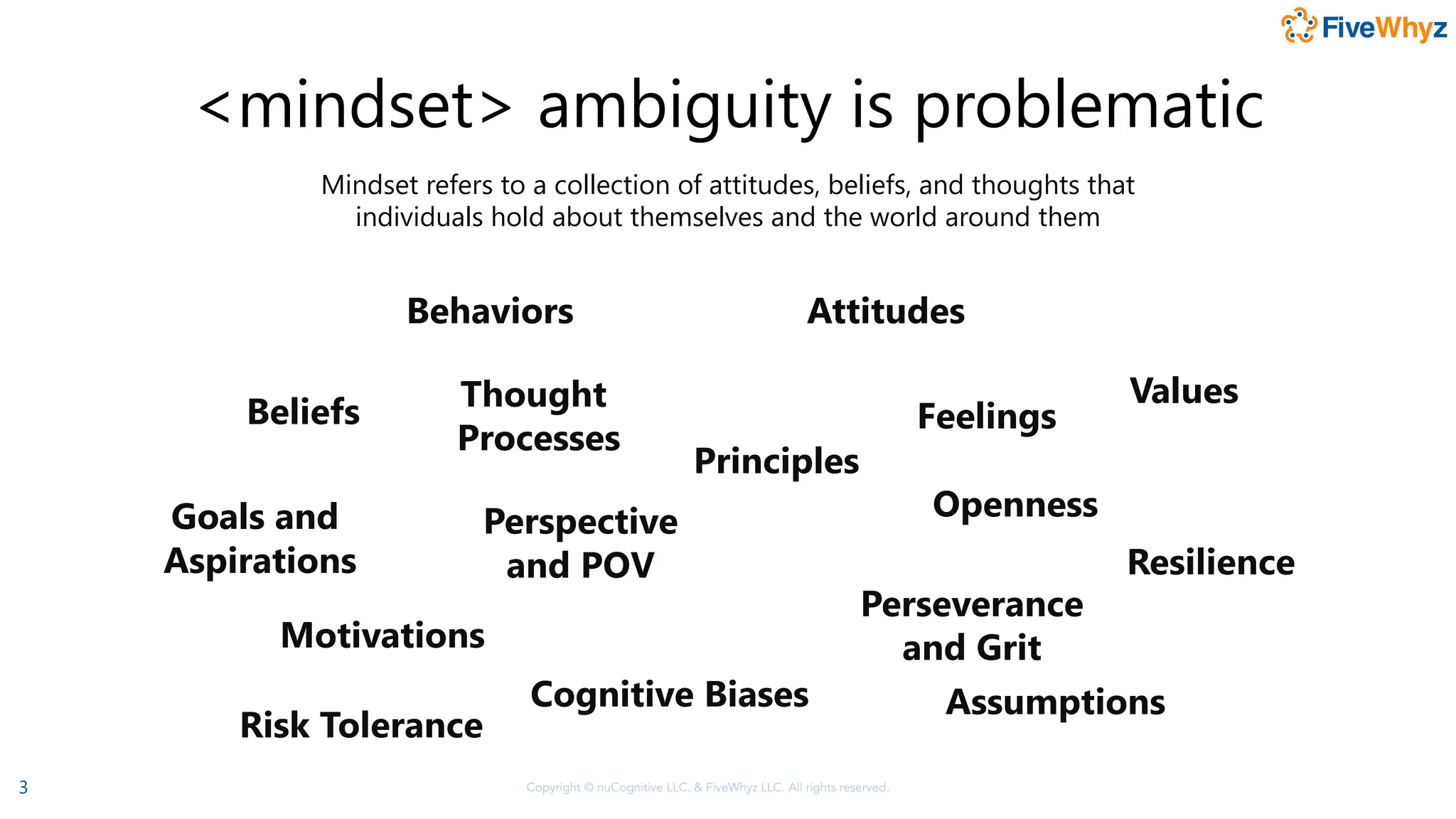
<mindset> ambiguity is problematic
3
Mindset refers to a collection of attitudes, beliefs, and thoughts that
individuals hold about themselves and the world around them
Principles
Values
Beliefs
Attitudes
Thought
Processes
Assumptions
Perspective
and POV
Cognitive Biases
Feelings
Motivations
Goals and
Aspirations
Behaviors
Openness
Risk Tolerance
Resilience
Perseverance
and Grit
Copyright © nuCognitive LLC. & FiveWhyz LLC. All rights reserved.
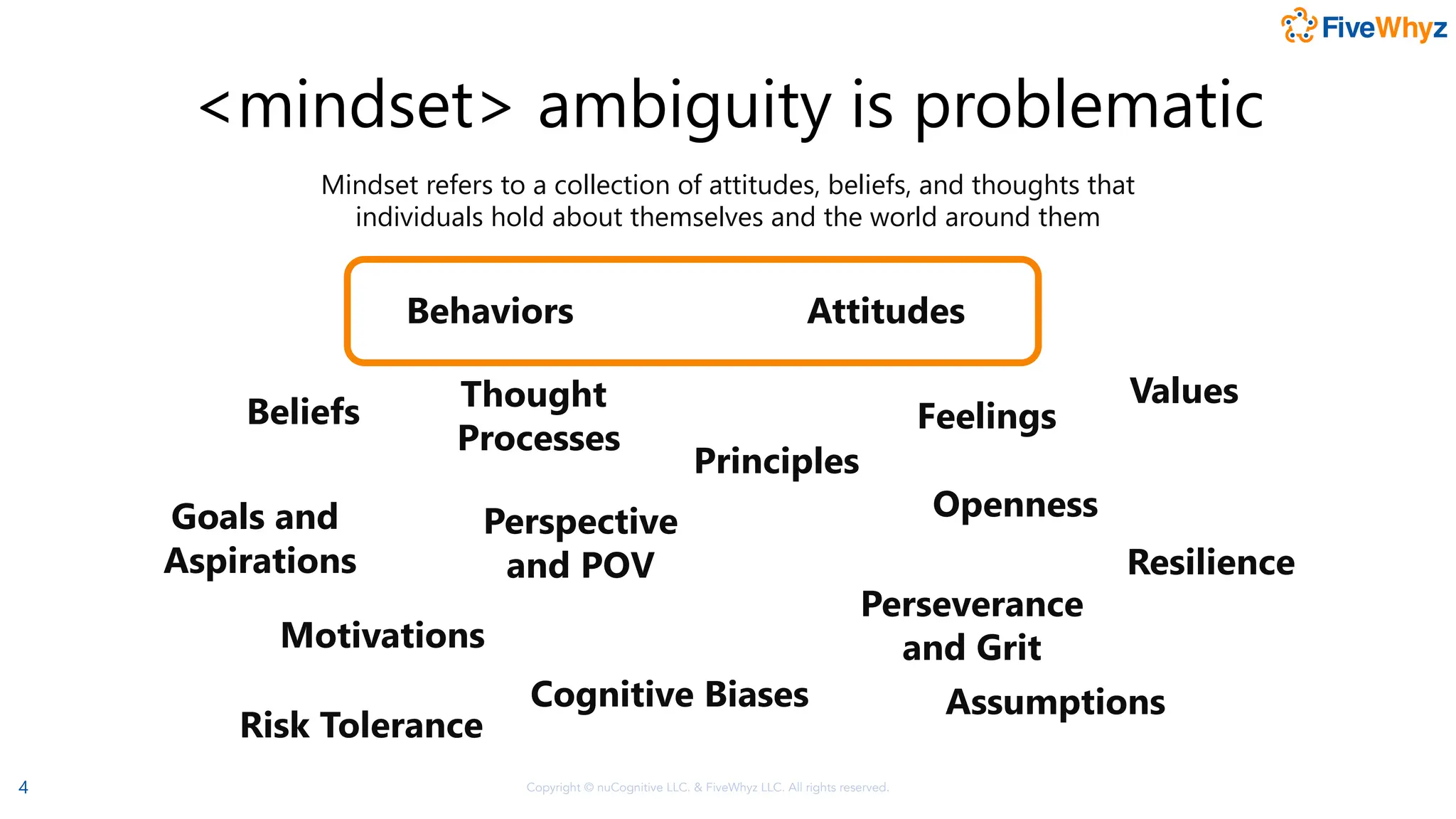
<mindset> ambiguity is problematic
4
Mindset refers to a collection of attitudes, beliefs, and thoughts that
individuals hold about themselves and the world around them
Principles
Values
Beliefs
Attitudes
Thought
Processes
Assumptions
Perspective
and POV
Cognitive Biases
Feelings
Motivations
Goals and
Aspirations
Behaviors
Openness
Risk Tolerance
Resilience
Perseverance
and Grit
Copyright © nuCognitive LLC. & FiveWhyz LLC. All rights reserved.
5
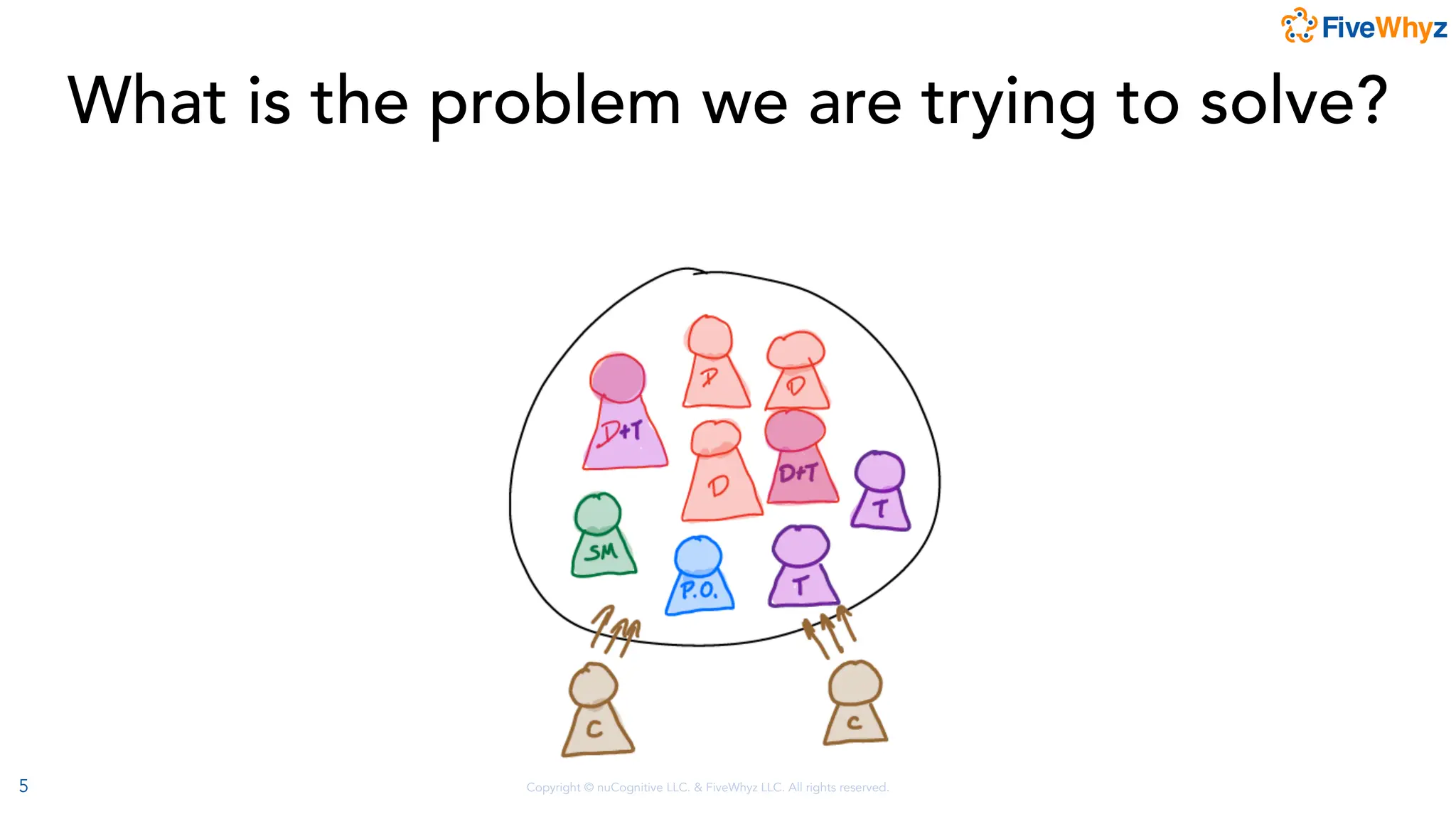
What is the problem we are trying to solve?
Copyright © nuCognitive LLC. & FiveWhyz LLC. All rights reserved.
6
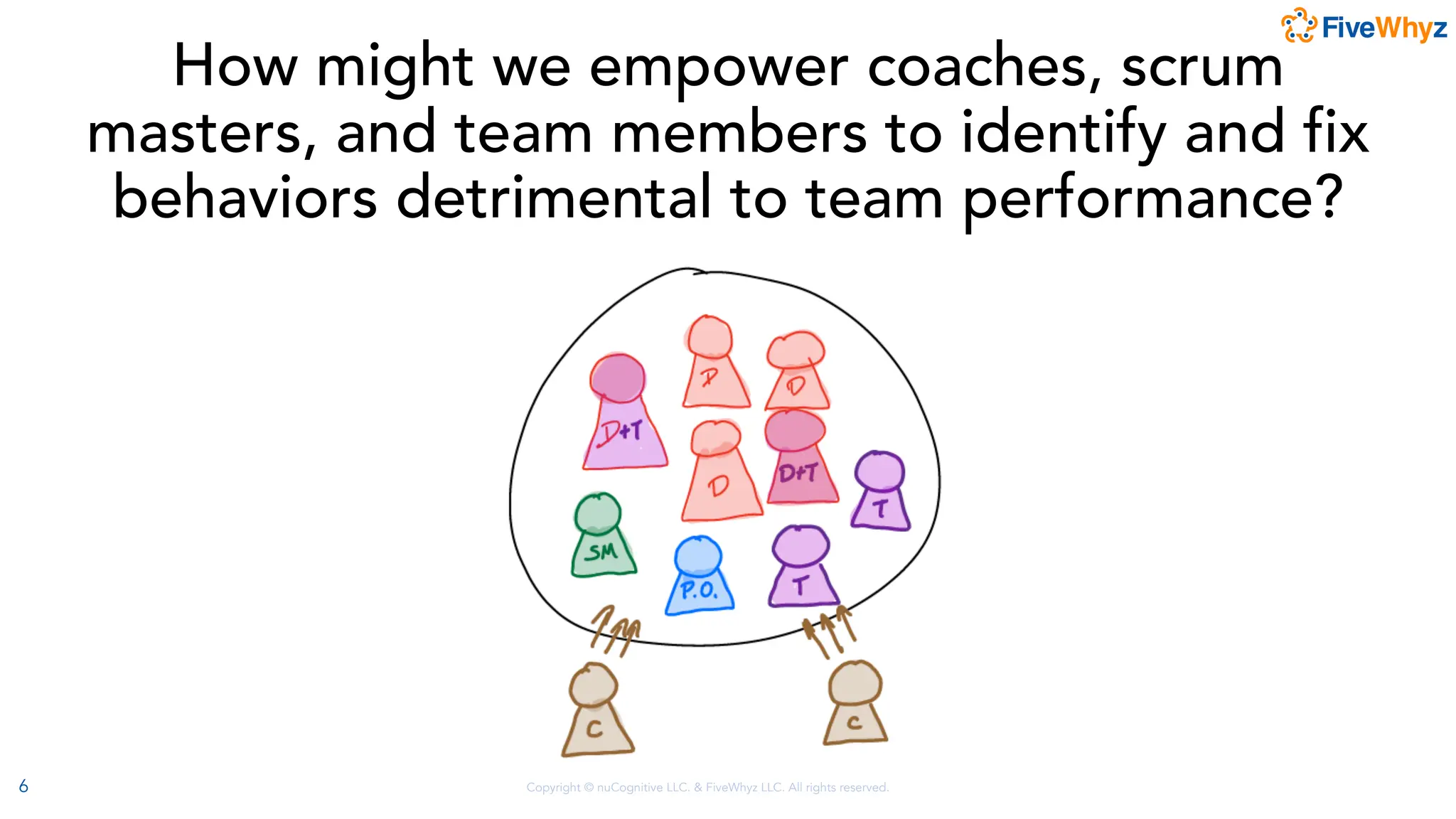
How might we empower coaches, scrum
masters, and team members to identify and fix
behaviors detrimental to team performance?
Copyright © nuCognitive LLC. & FiveWhyz LLC. All rights reserved.
7
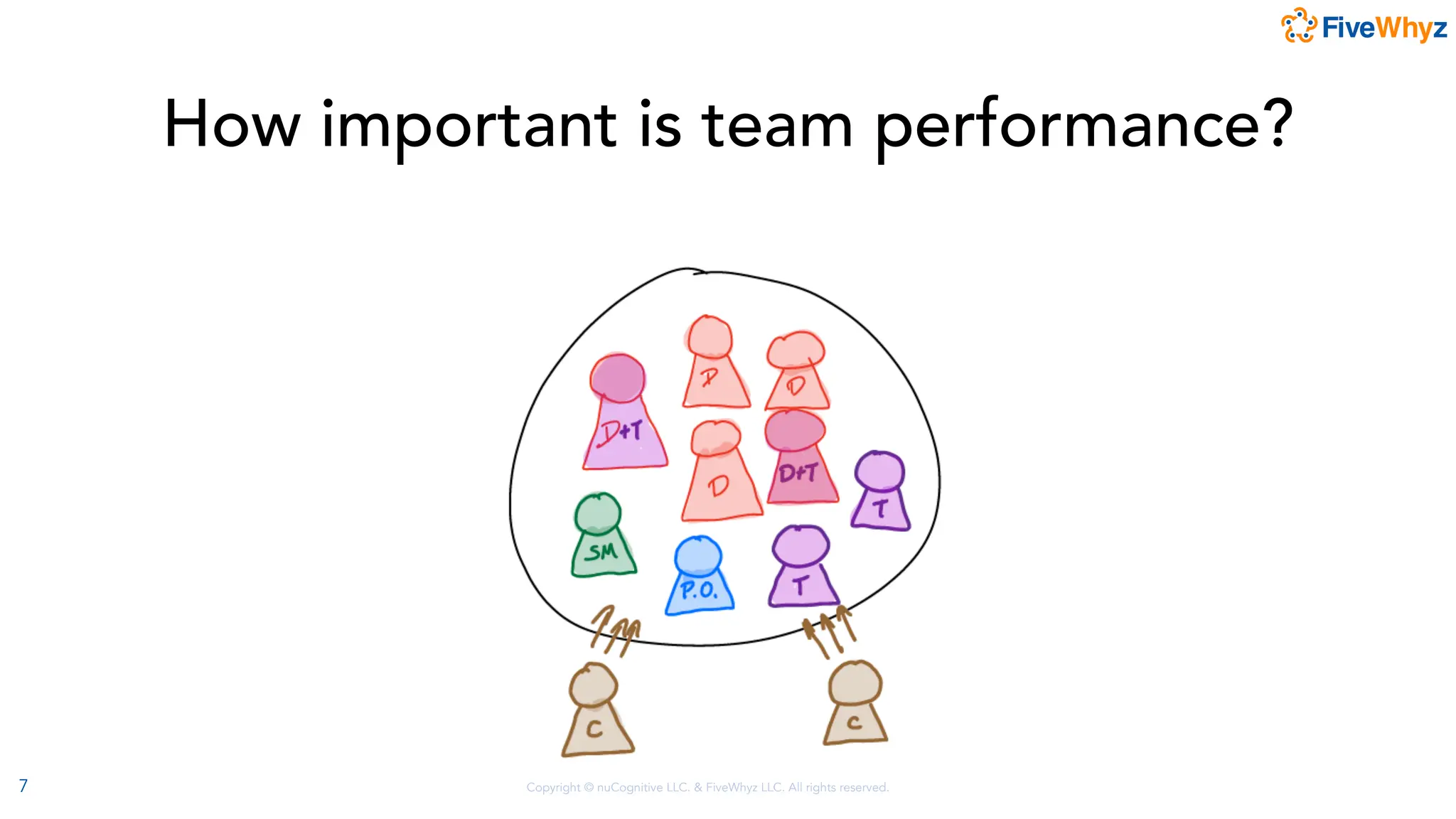
How important is team performance?
Copyright © nuCognitive LLC. & FiveWhyz LLC. All rights reserved.
8
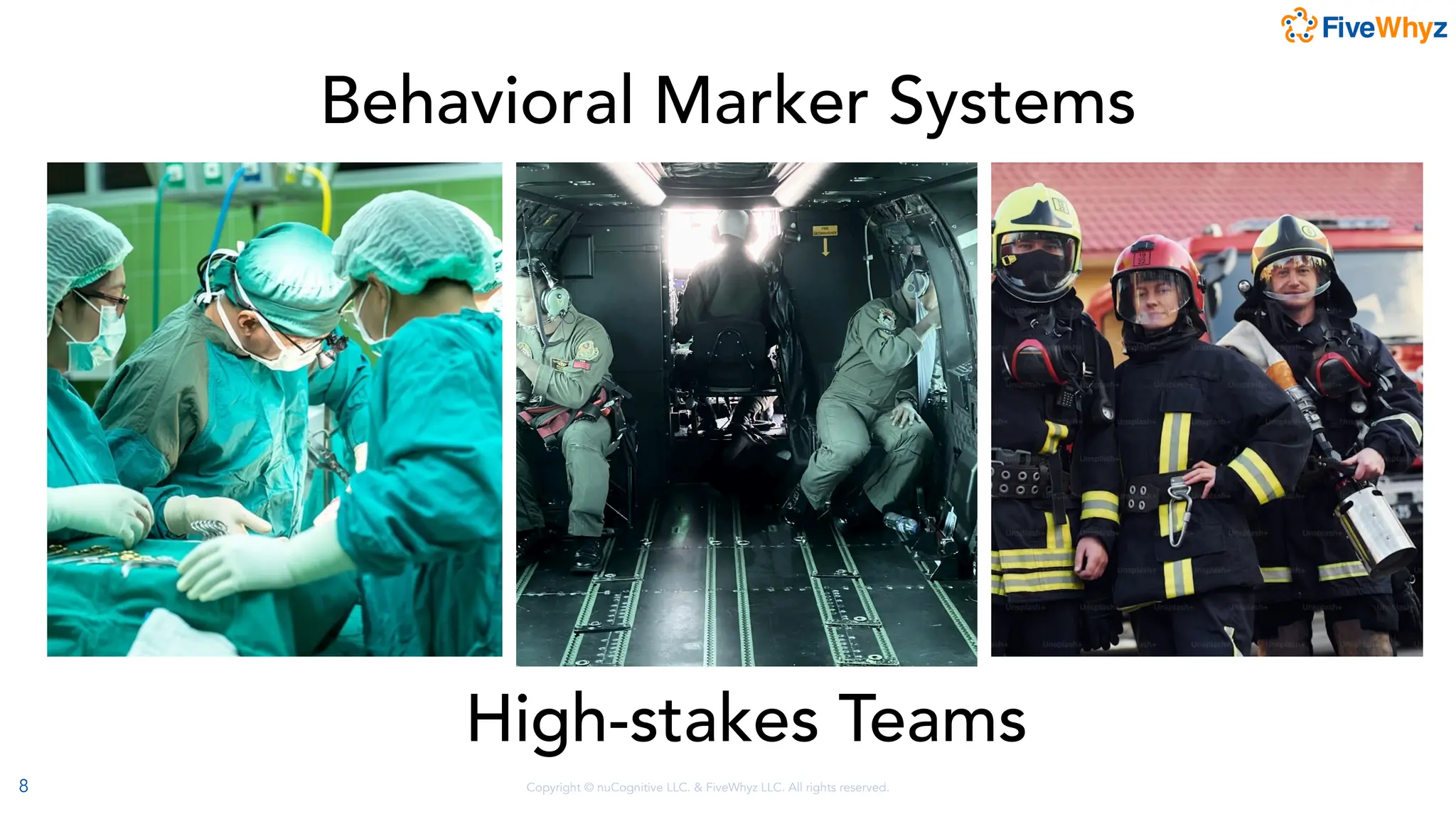
Behavioral Marker Systems
High-stakes Teams
Copyright © nuCognitive LLC. & FiveWhyz LLC. All rights reserved.
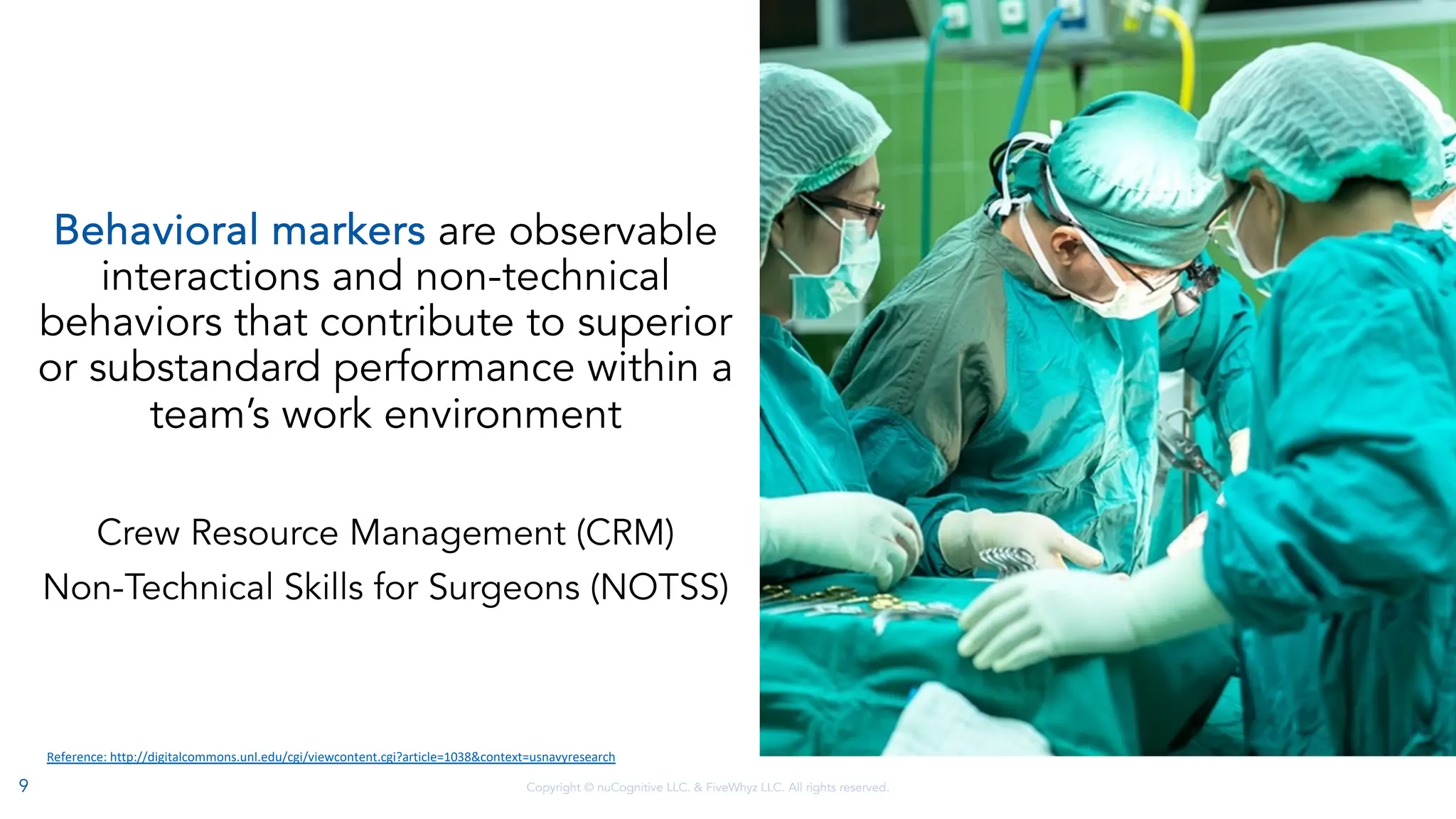
Behavioral markers are observable
interactions and non-technical
behaviors that contribute to superior
or substandard performance within a
team’s work environment
Crew Resource Management (CRM)
Non-Technical Skills for Surgeons (NOTSS)
Reference: http://digitalcommons.unl.edu/cgi/viewcontent.cgi?article=1038&context=usnavyresearch
9
Copyright © nuCognitive LLC. & FiveWhyz LLC. All rights reserved.
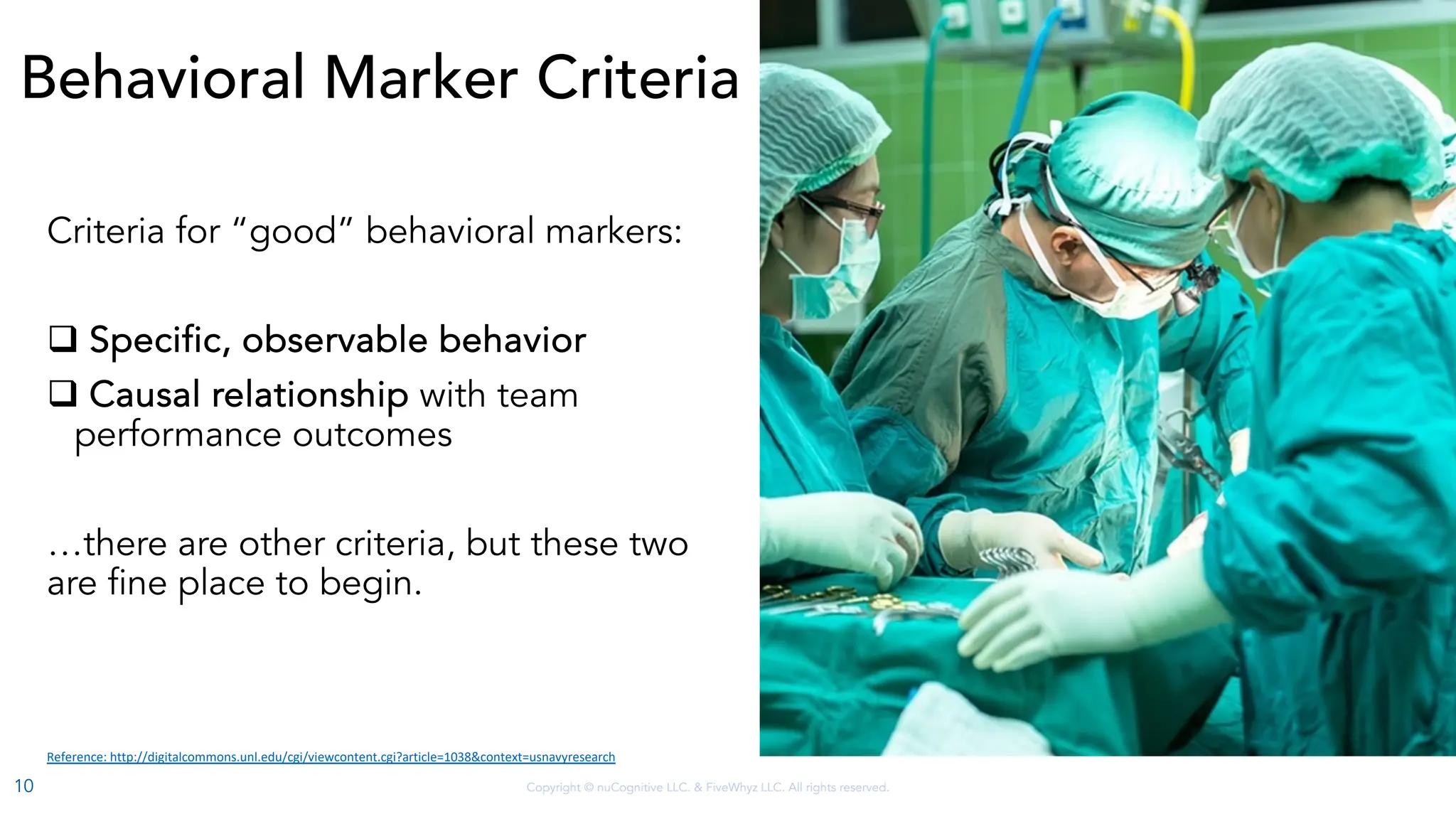
Behavioral Marker Criteria
Criteria for “good” behavioral markers:
q Specific, observable behavior
q Causal relationship with team
performance outcomes
…there are other criteria, but these two
are fine place to begin.
Reference: http://digitalcommons.unl.edu/cgi/viewcontent.cgi?article=1038&context=usnavyresearch
10
Copyright © nuCognitive LLC. & FiveWhyz LLC. All rights reserved.
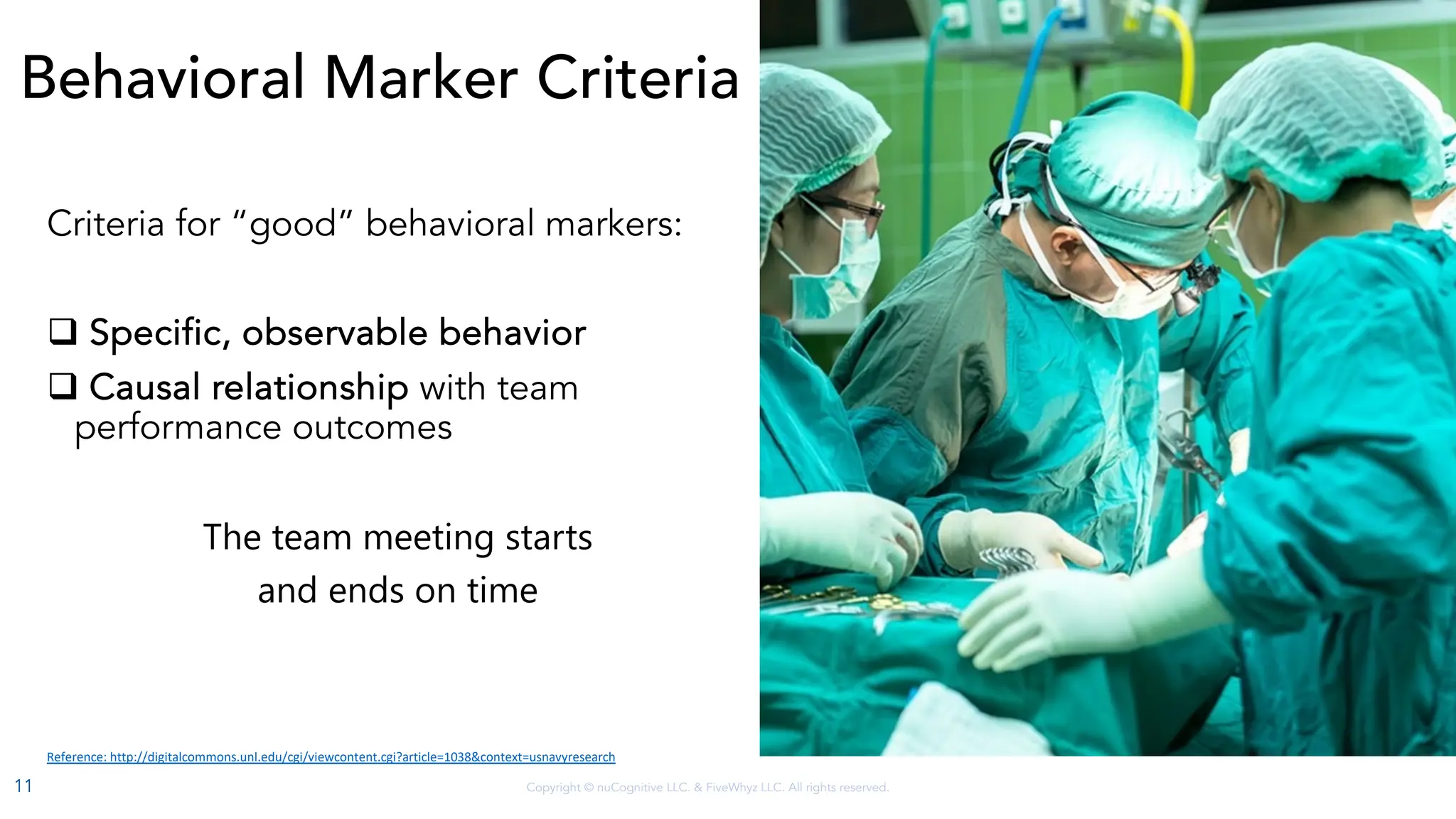
Behavioral Marker Criteria
Criteria for “good” behavioral markers:
q Specific, observable behavior
q Causal relationship with team
performance outcomes
The team meeting starts
and ends on time
Reference: http://digitalcommons.unl.edu/cgi/viewcontent.cgi?article=1038&context=usnavyresearch
11
Copyright © nuCognitive LLC. & FiveWhyz LLC. All rights reserved.
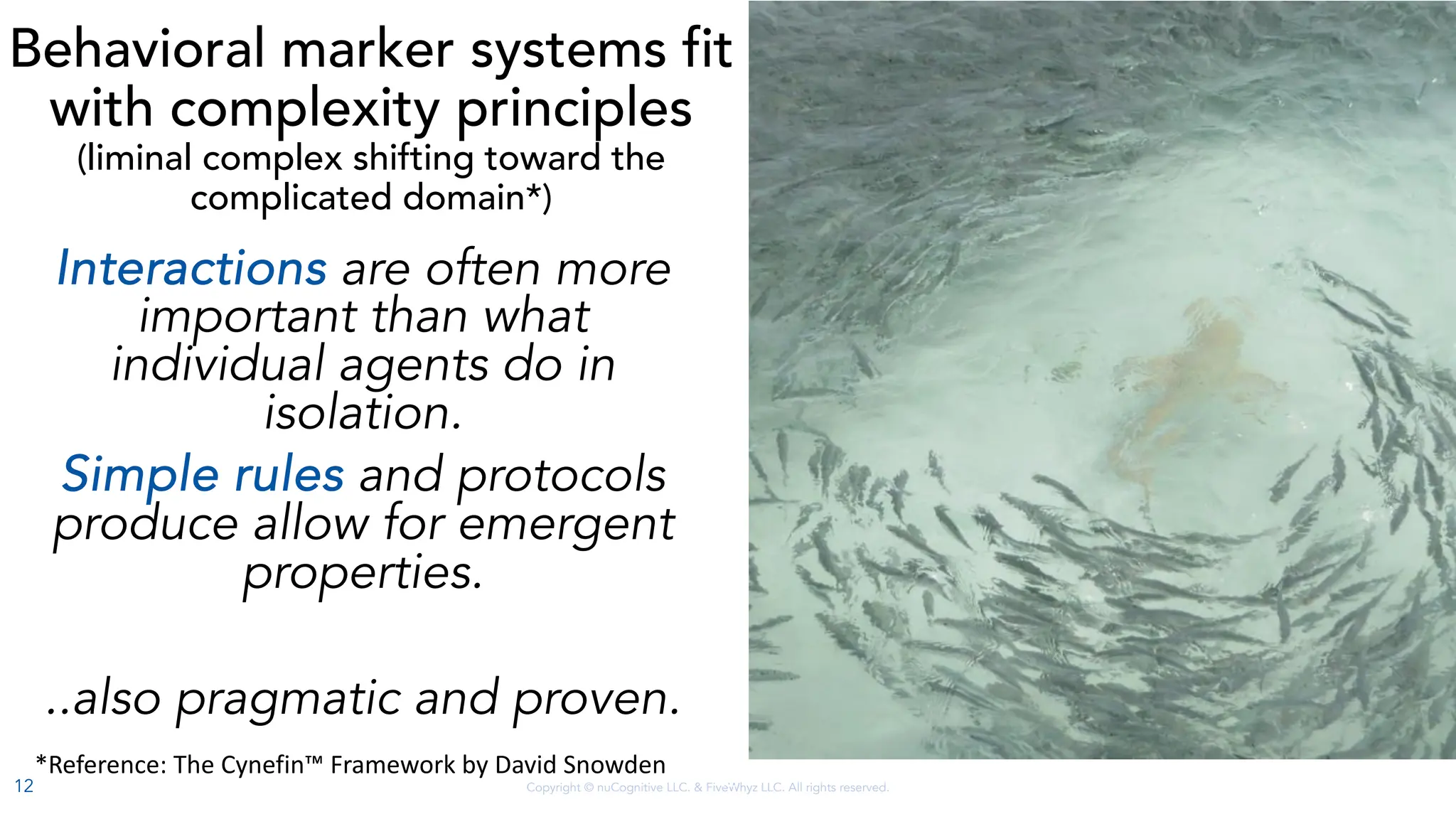
Behavioral marker systems fit
with complexity principles
(liminal complex shifting toward the
complicated domain*)
Interactions are often more
important than what
individual agents do in
isolation.
Simple rules and protocols
produce allow for emergent
properties.
..also pragmatic and proven.
12
12
*Reference: The Cynefin™ Framework by David Snowden
Copyright © nuCognitive LLC. & FiveWhyz LLC. All rights reserved.
13
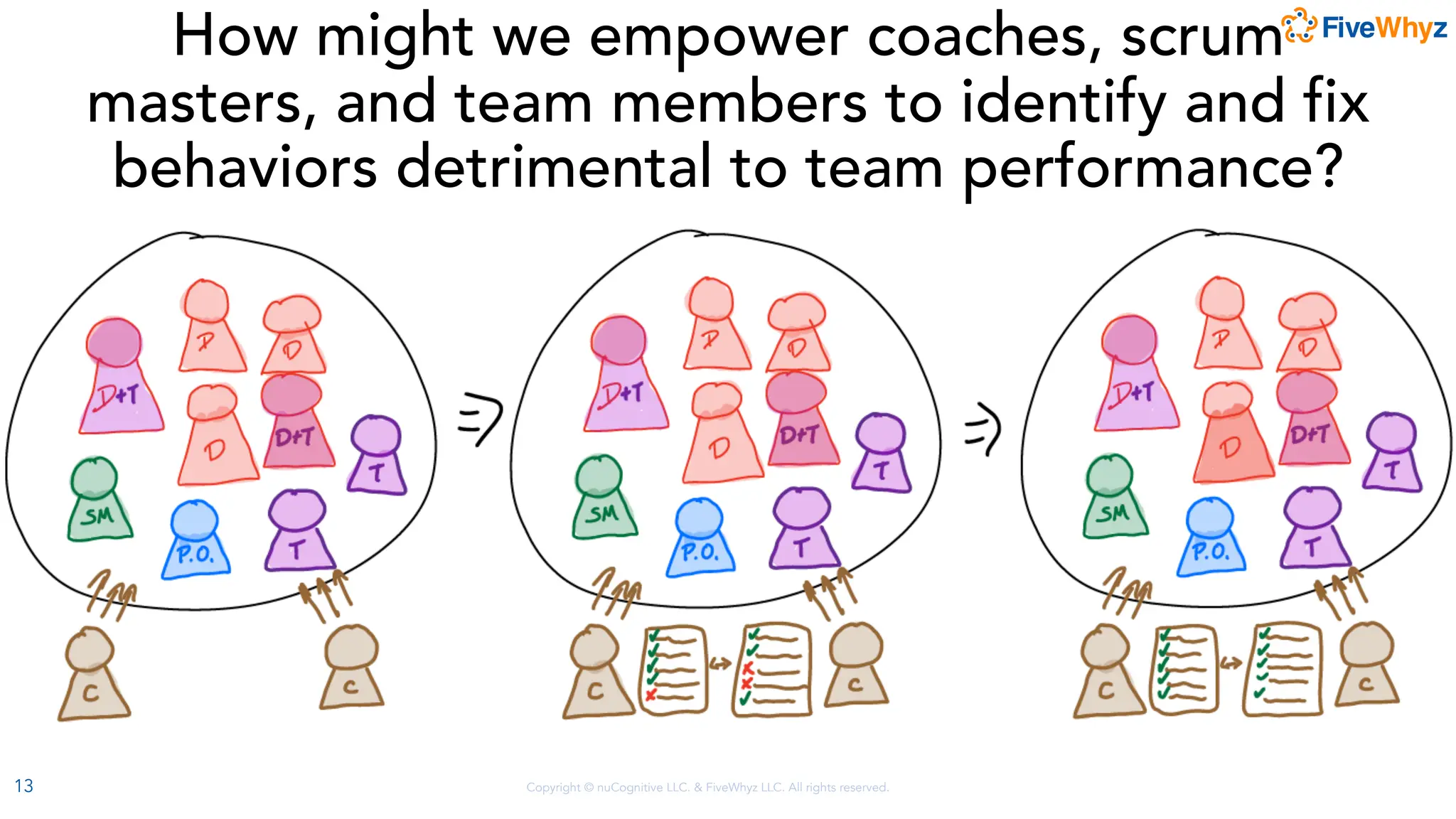
How might we empower coaches, scrum
masters, and team members to identify and fix
behaviors detrimental to team performance?
Copyright © nuCognitive LLC. & FiveWhyz LLC. All rights reserved.
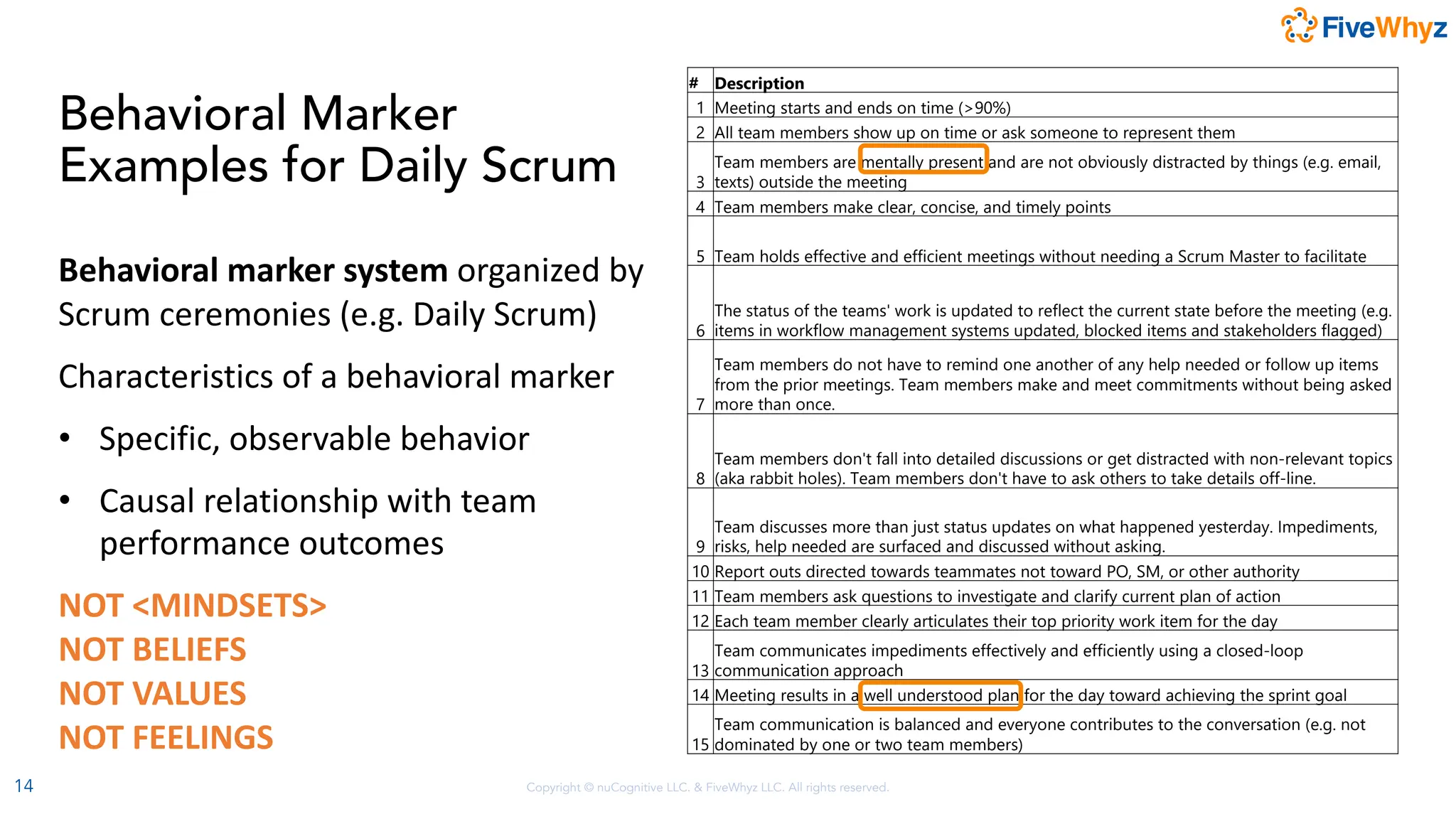
Behavioral Marker
Examples for Daily Scrum
# Description
1 Meeting starts and ends on time (>90%)
2 All team members show up on time or ask someone to represent them
3
Team members are mentally present and are not obviously distracted by things (e.g. email,
texts) outside the meeting
4 Team members make clear, concise, and timely points
5 Team holds effective and efficient meetings without needing a Scrum Master to facilitate
6
The status of the teams' work is updated to reflect the current state before the meeting (e.g.
items in workflow management systems updated, blocked items and stakeholders flagged)
7
Team members do not have to remind one another of any help needed or follow up items
from the prior meetings. Team members make and meet commitments without being asked
more than once.
8
Team members don't fall into detailed discussions or get distracted with non-relevant topics
(aka rabbit holes). Team members don't have to ask others to take details off-line.
9
Team discusses more than just status updates on what happened yesterday. Impediments,
risks, help needed are surfaced and discussed without asking.
10 Report outs directed towards teammates not toward PO, SM, or other authority
11 Team members ask questions to investigate and clarify current plan of action
12 Each team member clearly articulates their top priority work item for the day
13
Team communicates impediments effectively and efficiently using a closed-loop
communication approach
14 Meeting results in a well understood plan for the day toward achieving the sprint goal
15
Team communication is balanced and everyone contributes to the conversation (e.g. not
dominated by one or two team members)
Behavioral marker system organized by
Scrum ceremonies (e.g. Daily Scrum)
Characteristics of a behavioral marker
• Specific, observable behavior
• Causal relationship with team
performance outcomes
NOT <MINDSETS>
NOT BELIEFS
NOT VALUES
NOT FEELINGS
14
Copyright © nuCognitive LLC. & FiveWhyz LLC. All rights reserved.
15
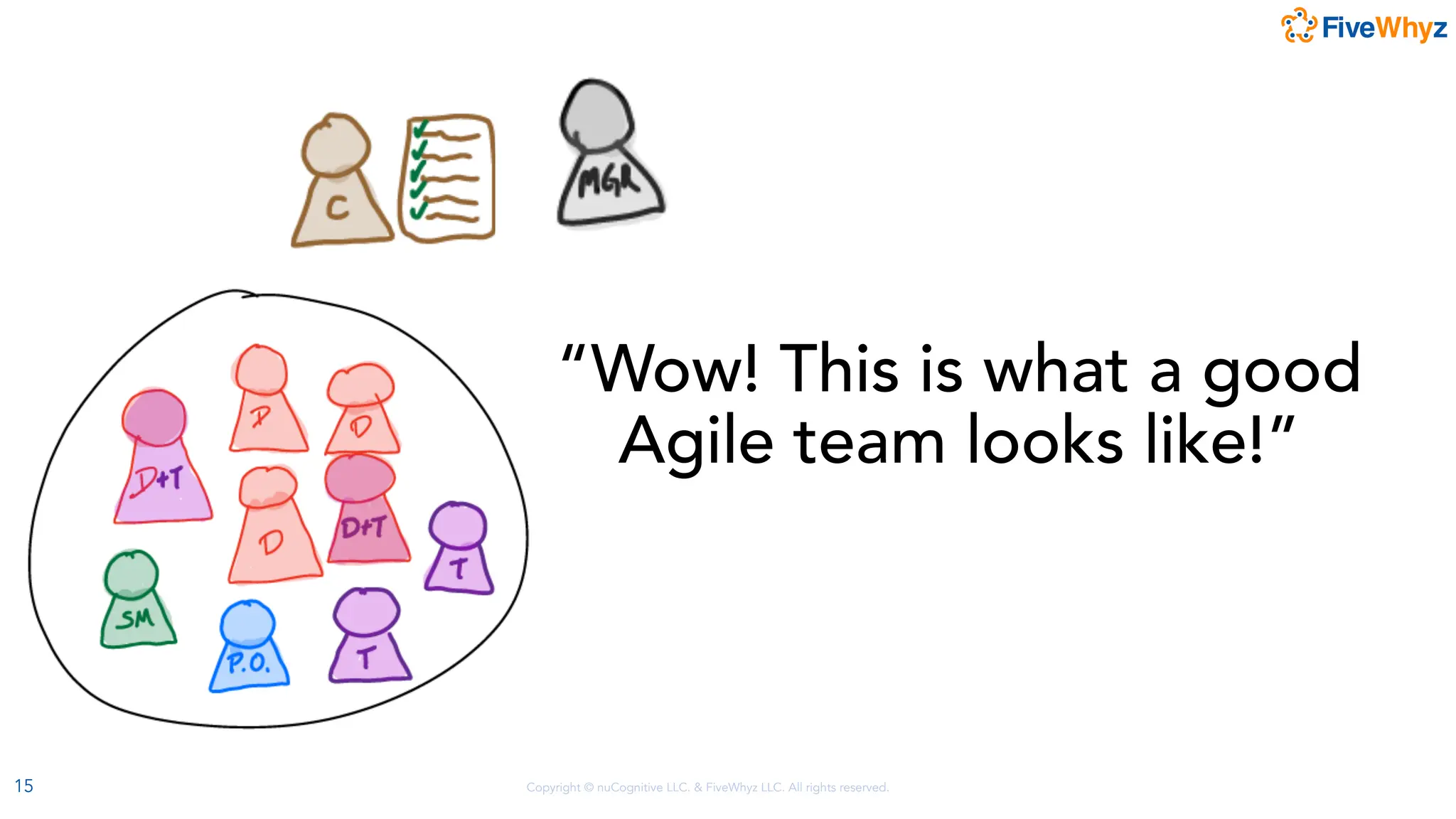
“Wow! This is what a good
Agile team looks like!”
Copyright © nuCognitive LLC. & FiveWhyz LLC. All rights reserved.
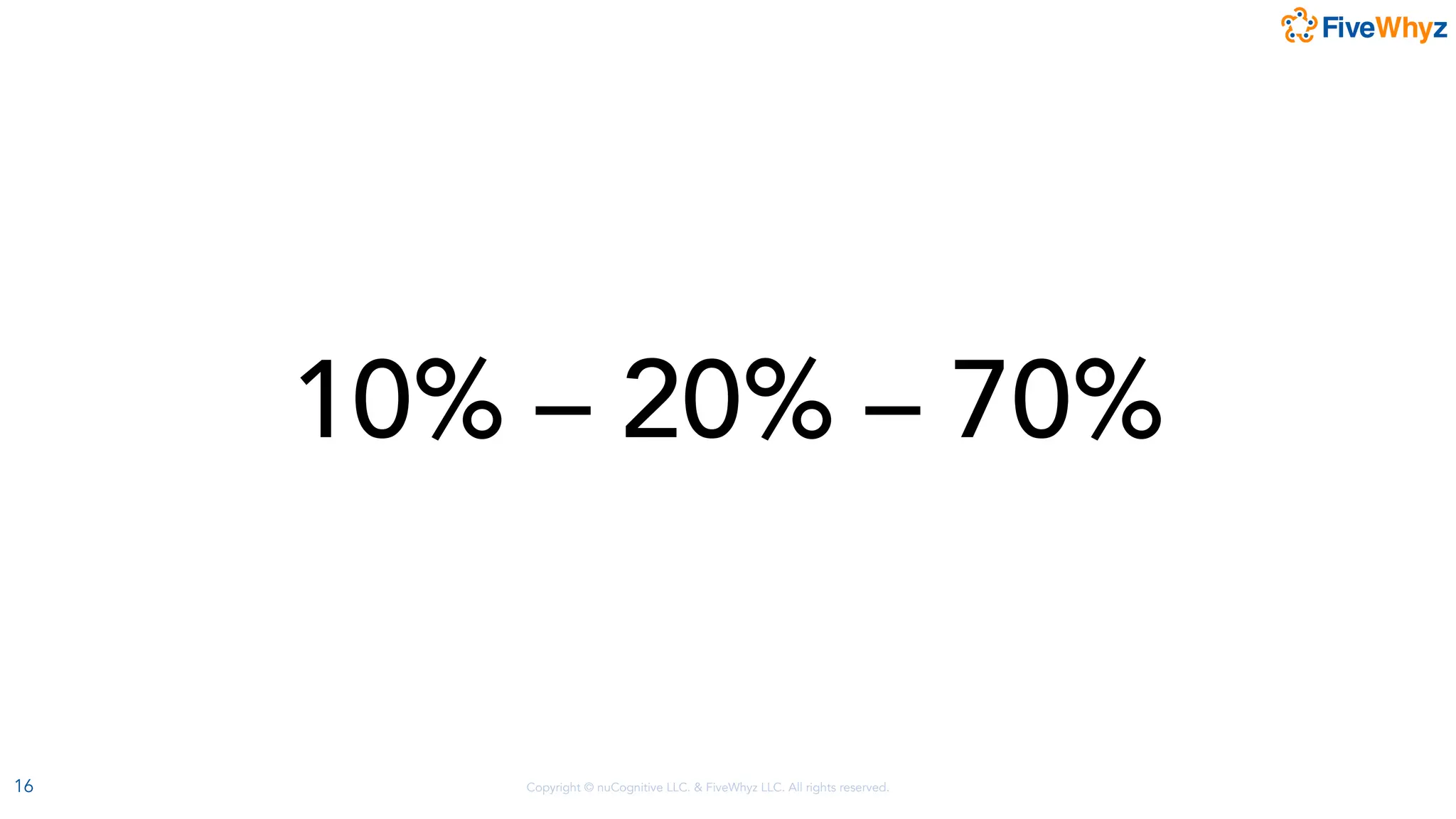
10% – 20% – 70%
16
Copyright © nuCognitive LLC. & FiveWhyz LLC. All rights reserved.
Exercise
Form small groups of 2-3 people…
1) brainstorm a couple of positive or negative
behaviors for a scrum meeting or PI planning
(real-world examples work best)
2) Select one and write it as a behavioral marker
[Event]: behavioral marker
3) TEST IT! Is it objectively observable? Does it
result in positive or negative performance
outcomes? If not, re-write it or try another idea.
4) Share with the group via chat or post on wall
10 min total to brainstorm, write, share
17
Criteria:
q Specific, observable behavior
q Causal relationship with team
performance outcomes
Copyright © nuCognitive LLC. & FiveWhyz LLC. All rights reserved.
18
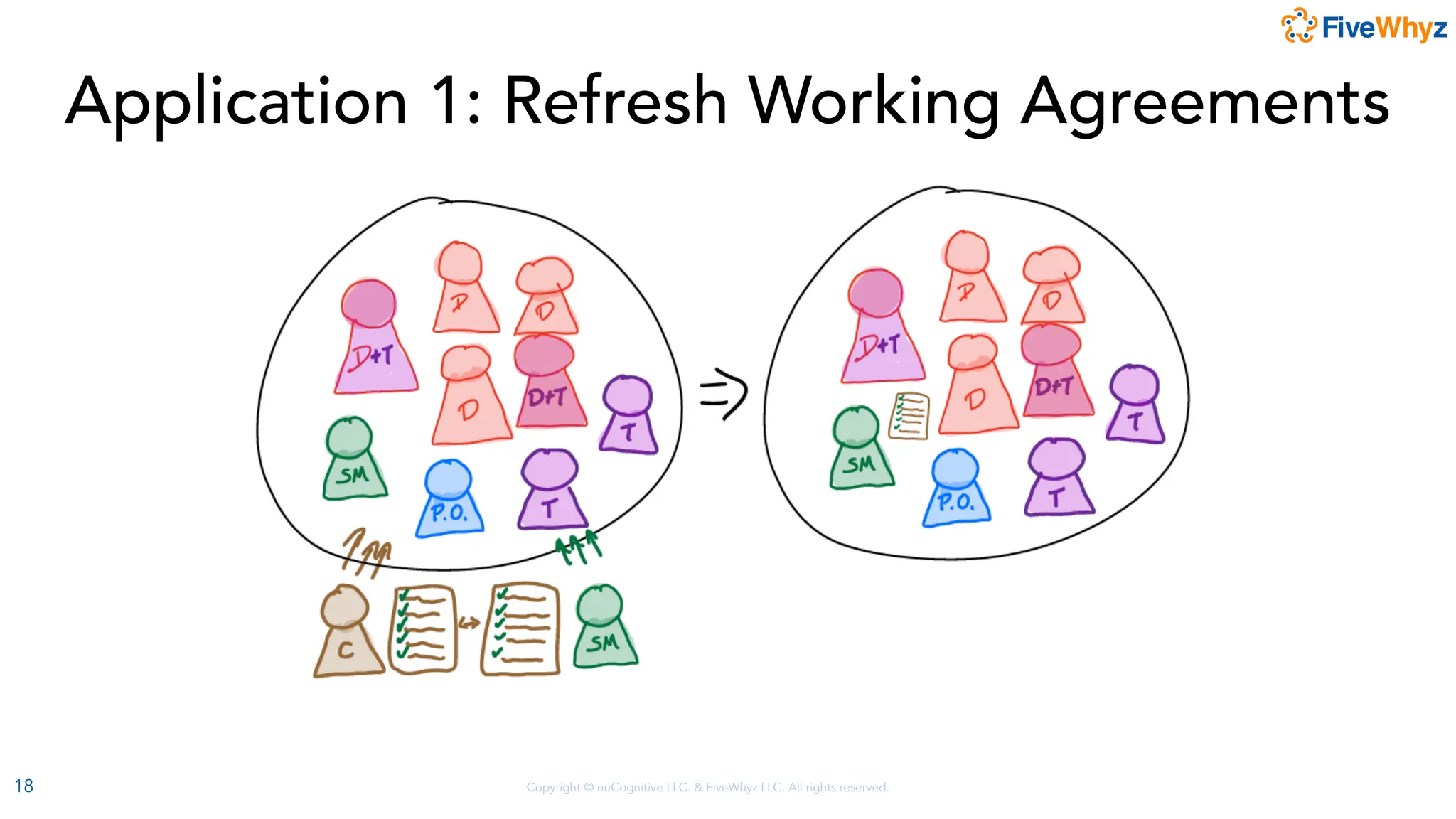
Application 1: Refresh Working Agreements
Copyright © nuCognitive LLC. & FiveWhyz LLC. All rights reserved.
19
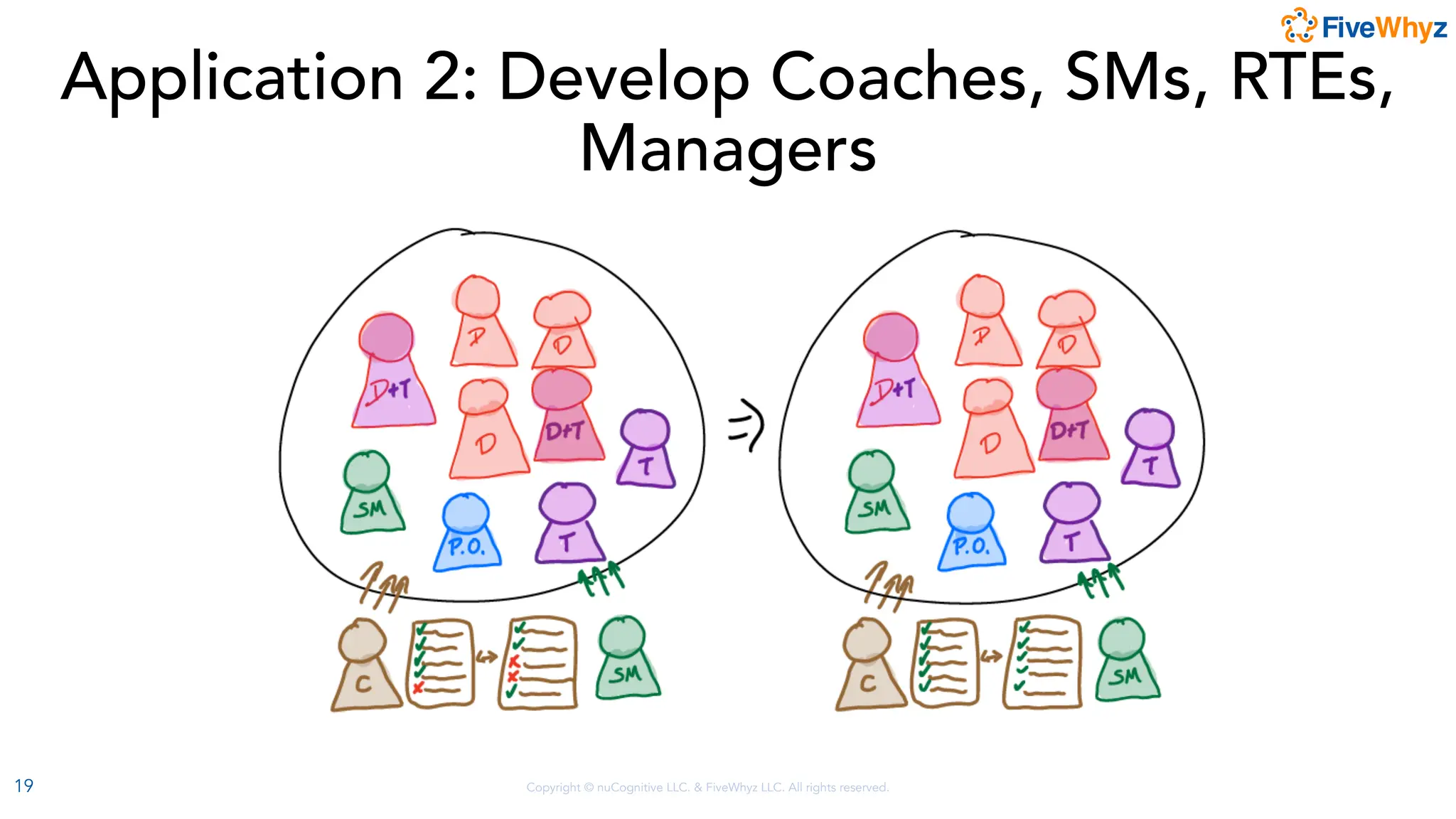
Application 2: Develop Coaches, SMs, RTEs,
Managers
Copyright © nuCognitive LLC. & FiveWhyz LLC. All rights reserved.
20
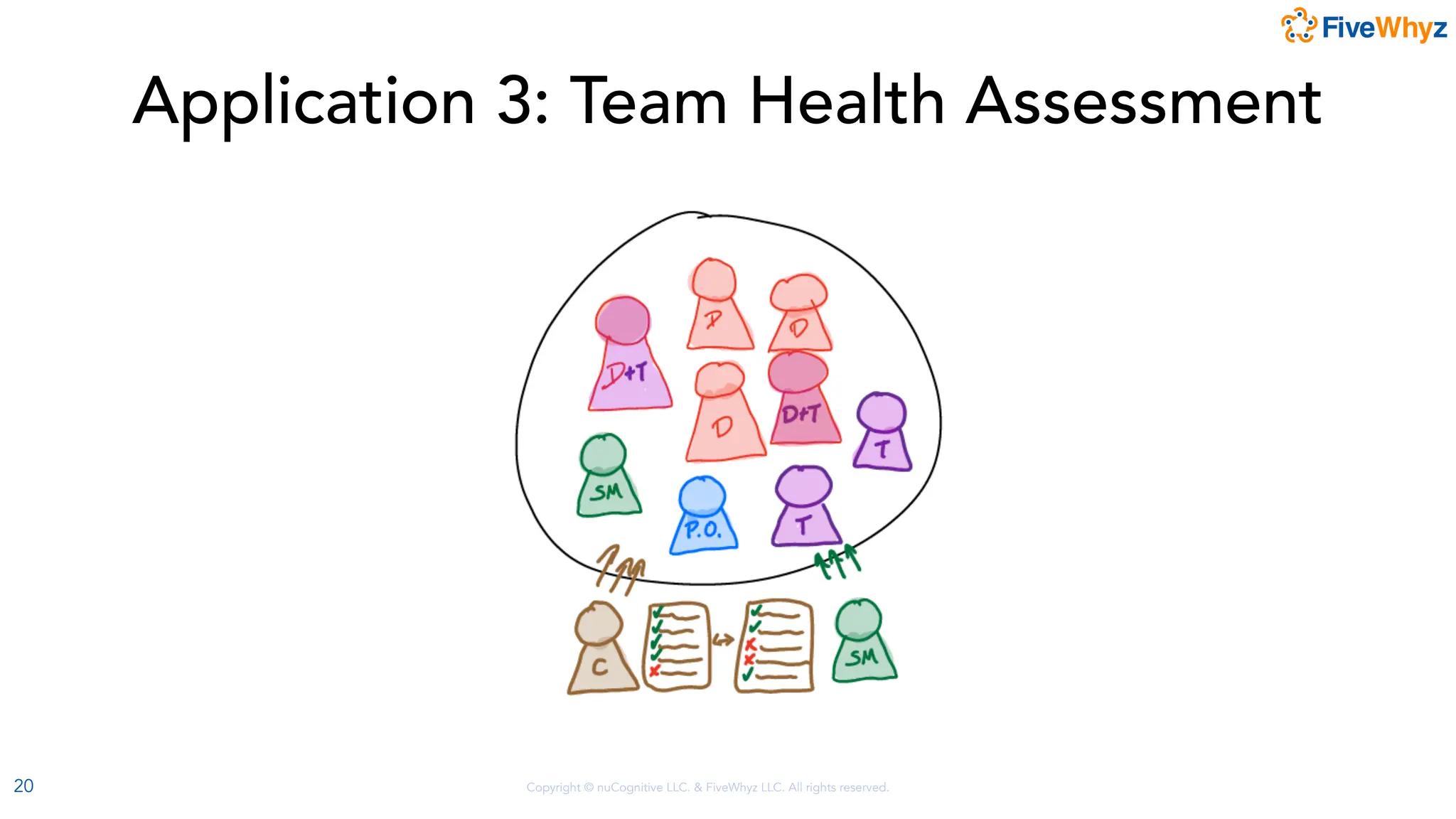
Application 3: Team Health Assessment
Copyright © nuCognitive LLC. & FiveWhyz LLC. All rights reserved.
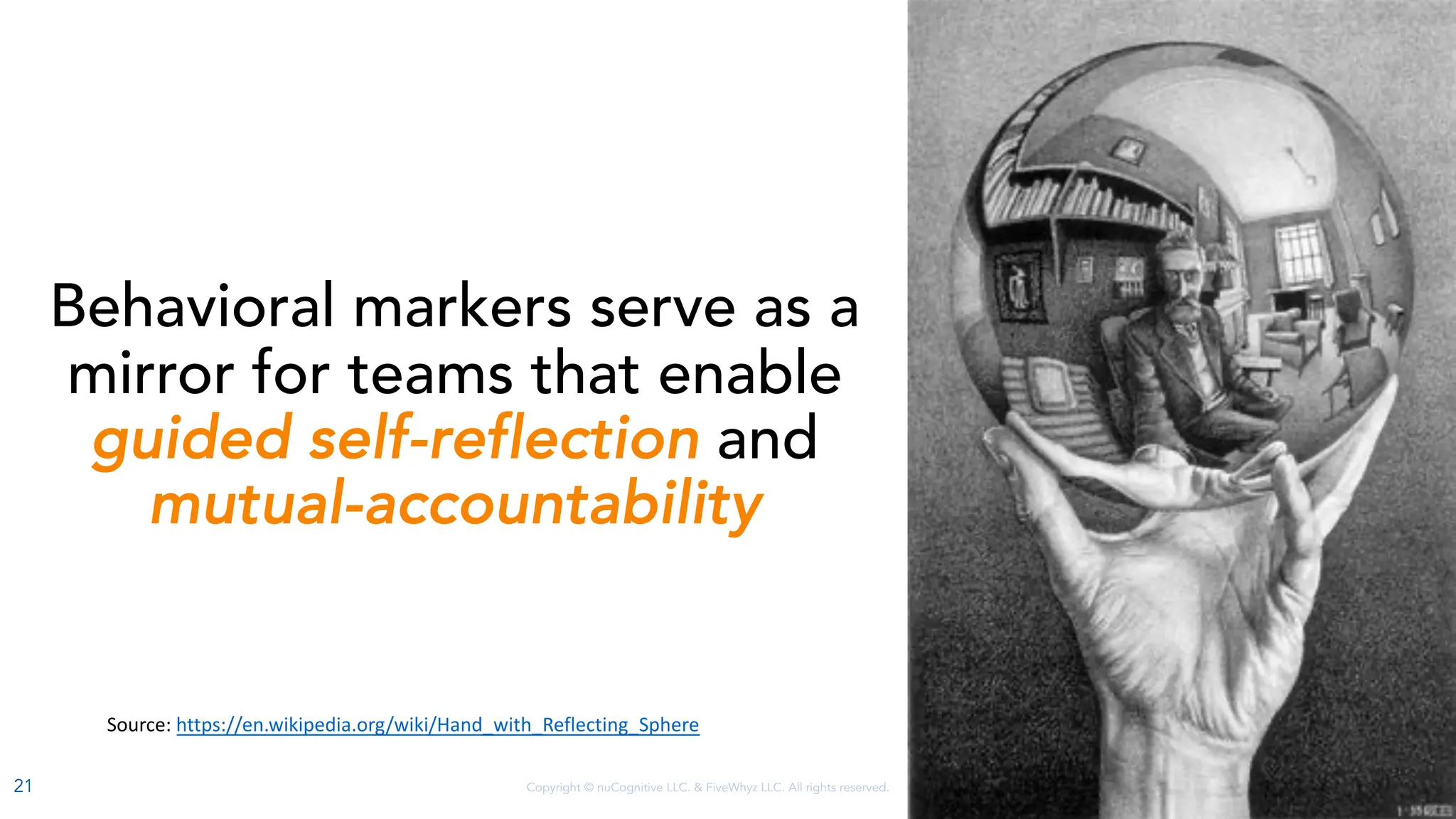
Behavioral markers serve as a
mirror for teams that enable
guided self-reflection and
mutual-accountability
Source: https://en.wikipedia.org/wiki/Hand_with_Reflecting_Sphere
21
Copyright © nuCognitive LLC. & FiveWhyz LLC. All rights reserved.
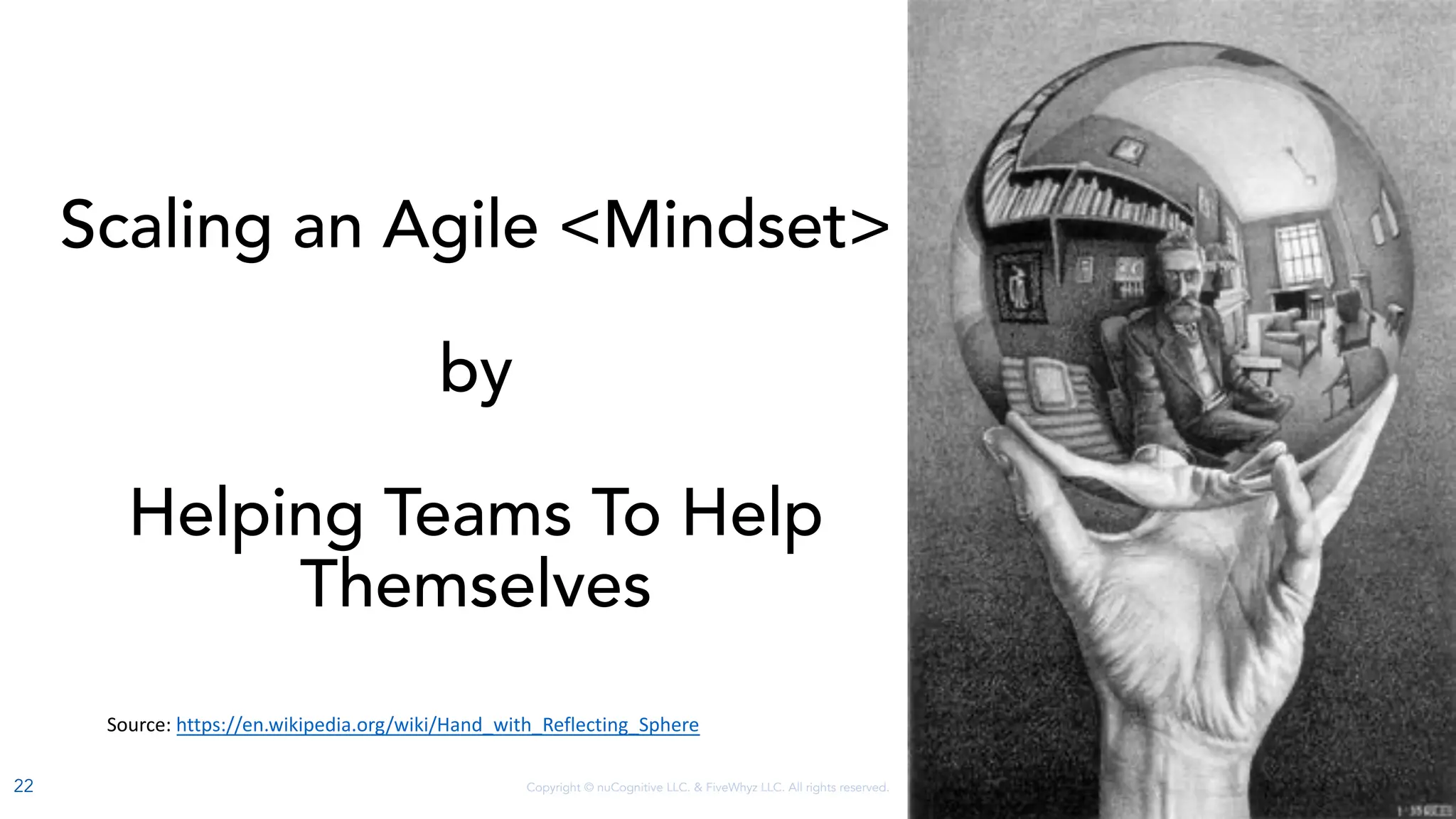
Scaling an Agile <Mindset>
by
Helping Teams To Help
Themselves
Source: https://en.wikipedia.org/wiki/Hand_with_Reflecting_Sphere
22
Copyright © nuCognitive LLC. & FiveWhyz LLC. All rights reserved.
Q&A
References:
Gatfield, David. Behavioural Markers for Assessment of Competence in Crisis Management,
2012.
O’Connor and Long, The development of a prototype behavioral marker system for US Navy
officers of the deck, 2011.
23
Copyright © nuCognitive LLC. & FiveWhyz LLC. All rights reserved.
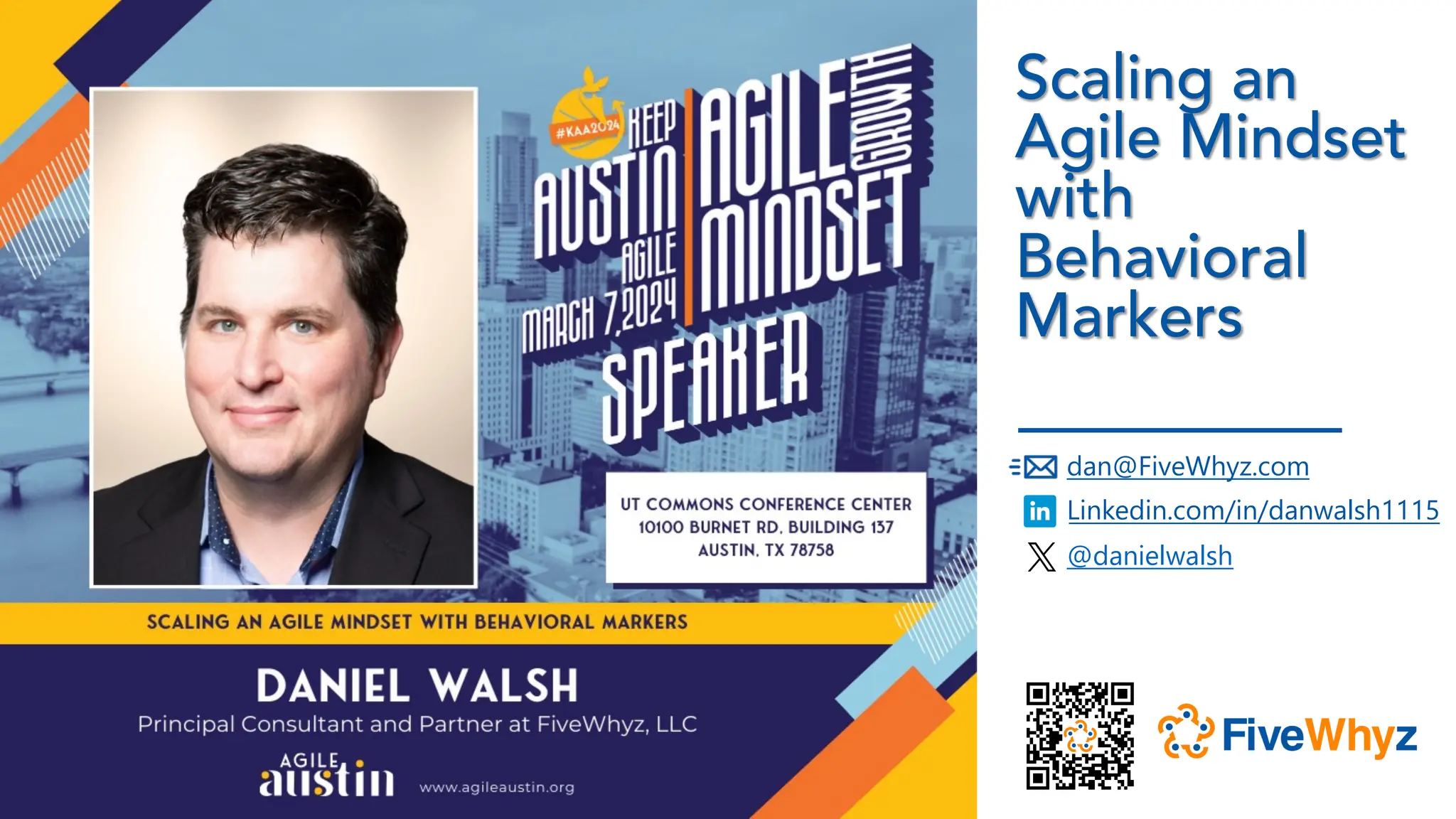
Scaling an
Agile Mindset
with
Behavioral
Markers
Linkedin.com/in/danwalsh1115
dan@FiveWhyz.com
@danielwalsh

Scaling an Agile Mindset with Behavioral Marker Systems 2024 03.pdf

  • 1.
    Copyright © nuCognitiveLLC. & FiveWhyz LLC. All rights reserved. Scaling an Agile Mindset with Behavioral Markers Linkedin.com/in/danwalsh1115 dan@FiveWhyz.com @danielwalsh
  • 2.
    Copyright © nuCognitiveLLC. & FiveWhyz LLC. All rights reserved. When some uses the word <mindset>, what do they mean? 2
  • 3.
    Copyright © nuCognitiveLLC. & FiveWhyz LLC. All rights reserved. <mindset> ambiguity is problematic 3 Mindset refers to a collection of attitudes, beliefs, and thoughts that individuals hold about themselves and the world around them Principles Values Beliefs Attitudes Thought Processes Assumptions Perspective and POV Cognitive Biases Feelings Motivations Goals and Aspirations Behaviors Openness Risk Tolerance Resilience Perseverance and Grit
  • 4.
    Copyright © nuCognitiveLLC. & FiveWhyz LLC. All rights reserved. <mindset> ambiguity is problematic 4 Mindset refers to a collection of attitudes, beliefs, and thoughts that individuals hold about themselves and the world around them Principles Values Beliefs Attitudes Thought Processes Assumptions Perspective and POV Cognitive Biases Feelings Motivations Goals and Aspirations Behaviors Openness Risk Tolerance Resilience Perseverance and Grit
  • 5.
    Copyright © nuCognitiveLLC. & FiveWhyz LLC. All rights reserved. 5 What is the problem we are trying to solve?
  • 6.
    Copyright © nuCognitiveLLC. & FiveWhyz LLC. All rights reserved. 6 How might we empower coaches, scrum masters, and team members to identify and fix behaviors detrimental to team performance?
  • 7.
    Copyright © nuCognitiveLLC. & FiveWhyz LLC. All rights reserved. 7 How important is team performance?
  • 8.
    Copyright © nuCognitiveLLC. & FiveWhyz LLC. All rights reserved. 8 Behavioral Marker Systems High-stakes Teams
  • 9.
    Copyright © nuCognitiveLLC. & FiveWhyz LLC. All rights reserved. Behavioral markers are observable interactions and non-technical behaviors that contribute to superior or substandard performance within a team’s work environment Crew Resource Management (CRM) Non-Technical Skills for Surgeons (NOTSS) Reference: http://digitalcommons.unl.edu/cgi/viewcontent.cgi?article=1038&context=usnavyresearch 9
  • 10.
    Copyright © nuCognitiveLLC. & FiveWhyz LLC. All rights reserved. Behavioral Marker Criteria Criteria for “good” behavioral markers: q Specific, observable behavior q Causal relationship with team performance outcomes …there are other criteria, but these two are fine place to begin. Reference: http://digitalcommons.unl.edu/cgi/viewcontent.cgi?article=1038&context=usnavyresearch 10
  • 11.
    Copyright © nuCognitiveLLC. & FiveWhyz LLC. All rights reserved. Behavioral Marker Criteria Criteria for “good” behavioral markers: q Specific, observable behavior q Causal relationship with team performance outcomes The team meeting starts and ends on time Reference: http://digitalcommons.unl.edu/cgi/viewcontent.cgi?article=1038&context=usnavyresearch 11
  • 12.
    Copyright © nuCognitiveLLC. & FiveWhyz LLC. All rights reserved. Behavioral marker systems fit with complexity principles (liminal complex shifting toward the complicated domain*) Interactions are often more important than what individual agents do in isolation. Simple rules and protocols produce allow for emergent properties. ..also pragmatic and proven. 12 12 *Reference: The Cynefin™ Framework by David Snowden
  • 13.
    Copyright © nuCognitiveLLC. & FiveWhyz LLC. All rights reserved. 13 How might we empower coaches, scrum masters, and team members to identify and fix behaviors detrimental to team performance?
  • 14.
    Copyright © nuCognitiveLLC. & FiveWhyz LLC. All rights reserved. Behavioral Marker Examples for Daily Scrum # Description 1 Meeting starts and ends on time (>90%) 2 All team members show up on time or ask someone to represent them 3 Team members are mentally present and are not obviously distracted by things (e.g. email, texts) outside the meeting 4 Team members make clear, concise, and timely points 5 Team holds effective and efficient meetings without needing a Scrum Master to facilitate 6 The status of the teams' work is updated to reflect the current state before the meeting (e.g. items in workflow management systems updated, blocked items and stakeholders flagged) 7 Team members do not have to remind one another of any help needed or follow up items from the prior meetings. Team members make and meet commitments without being asked more than once. 8 Team members don't fall into detailed discussions or get distracted with non-relevant topics (aka rabbit holes). Team members don't have to ask others to take details off-line. 9 Team discusses more than just status updates on what happened yesterday. Impediments, risks, help needed are surfaced and discussed without asking. 10 Report outs directed towards teammates not toward PO, SM, or other authority 11 Team members ask questions to investigate and clarify current plan of action 12 Each team member clearly articulates their top priority work item for the day 13 Team communicates impediments effectively and efficiently using a closed-loop communication approach 14 Meeting results in a well understood plan for the day toward achieving the sprint goal 15 Team communication is balanced and everyone contributes to the conversation (e.g. not dominated by one or two team members) Behavioral marker system organized by Scrum ceremonies (e.g. Daily Scrum) Characteristics of a behavioral marker • Specific, observable behavior • Causal relationship with team performance outcomes NOT <MINDSETS> NOT BELIEFS NOT VALUES NOT FEELINGS 14
  • 15.
    Copyright © nuCognitiveLLC. & FiveWhyz LLC. All rights reserved. 15 “Wow! This is what a good Agile team looks like!”
  • 16.
    Copyright © nuCognitiveLLC. & FiveWhyz LLC. All rights reserved. 10% – 20% – 70% 16
  • 17.
    Copyright © nuCognitiveLLC. & FiveWhyz LLC. All rights reserved. Exercise Form small groups of 2-3 people… 1) brainstorm a couple of positive or negative behaviors for a scrum meeting or PI planning (real-world examples work best) 2) Select one and write it as a behavioral marker [Event]: behavioral marker 3) TEST IT! Is it objectively observable? Does it result in positive or negative performance outcomes? If not, re-write it or try another idea. 4) Share with the group via chat or post on wall 10 min total to brainstorm, write, share 17 Criteria: q Specific, observable behavior q Causal relationship with team performance outcomes
  • 18.
    Copyright © nuCognitiveLLC. & FiveWhyz LLC. All rights reserved. 18 Application 1: Refresh Working Agreements
  • 19.
    Copyright © nuCognitiveLLC. & FiveWhyz LLC. All rights reserved. 19 Application 2: Develop Coaches, SMs, RTEs, Managers
  • 20.
    Copyright © nuCognitiveLLC. & FiveWhyz LLC. All rights reserved. 20 Application 3: Team Health Assessment
  • 21.
    Copyright © nuCognitiveLLC. & FiveWhyz LLC. All rights reserved. Behavioral markers serve as a mirror for teams that enable guided self-reflection and mutual-accountability Source: https://en.wikipedia.org/wiki/Hand_with_Reflecting_Sphere 21
  • 22.
    Copyright © nuCognitiveLLC. & FiveWhyz LLC. All rights reserved. Scaling an Agile <Mindset> by Helping Teams To Help Themselves Source: https://en.wikipedia.org/wiki/Hand_with_Reflecting_Sphere 22
  • 23.
    Copyright © nuCognitiveLLC. & FiveWhyz LLC. All rights reserved. Q&A References: Gatfield, David. Behavioural Markers for Assessment of Competence in Crisis Management, 2012. O’Connor and Long, The development of a prototype behavioral marker system for US Navy officers of the deck, 2011. 23
  • 24.
    Copyright © nuCognitiveLLC. & FiveWhyz LLC. All rights reserved. Scaling an Agile Mindset with Behavioral Markers Linkedin.com/in/danwalsh1115 dan@FiveWhyz.com @danielwalsh