@ Brock University

     Dr. Camille Rutherford
Twitter - @crutherford
    www.drcamillerutherford.com
Rationale
•   Every province has created a plan to transform their
    students into 21st century learners, but few have a plan
    to transform their educators into 21st century teachers.
•   The stand-alone educational technology course still
    serves as the primary means of preservice teacher
    preparation in technology" (Lambert & Gong, 2010).
Rationale
Digital natives are NOT intrinsically inclined to
integrate technology or embrace 21st century
teaching.

•The integration of 21st century skills, technology and
learning has not yet been addressed in a systematic way in
either preservice or in-service teacher education (Jensen,
2010).
EdTech Cohort
Components
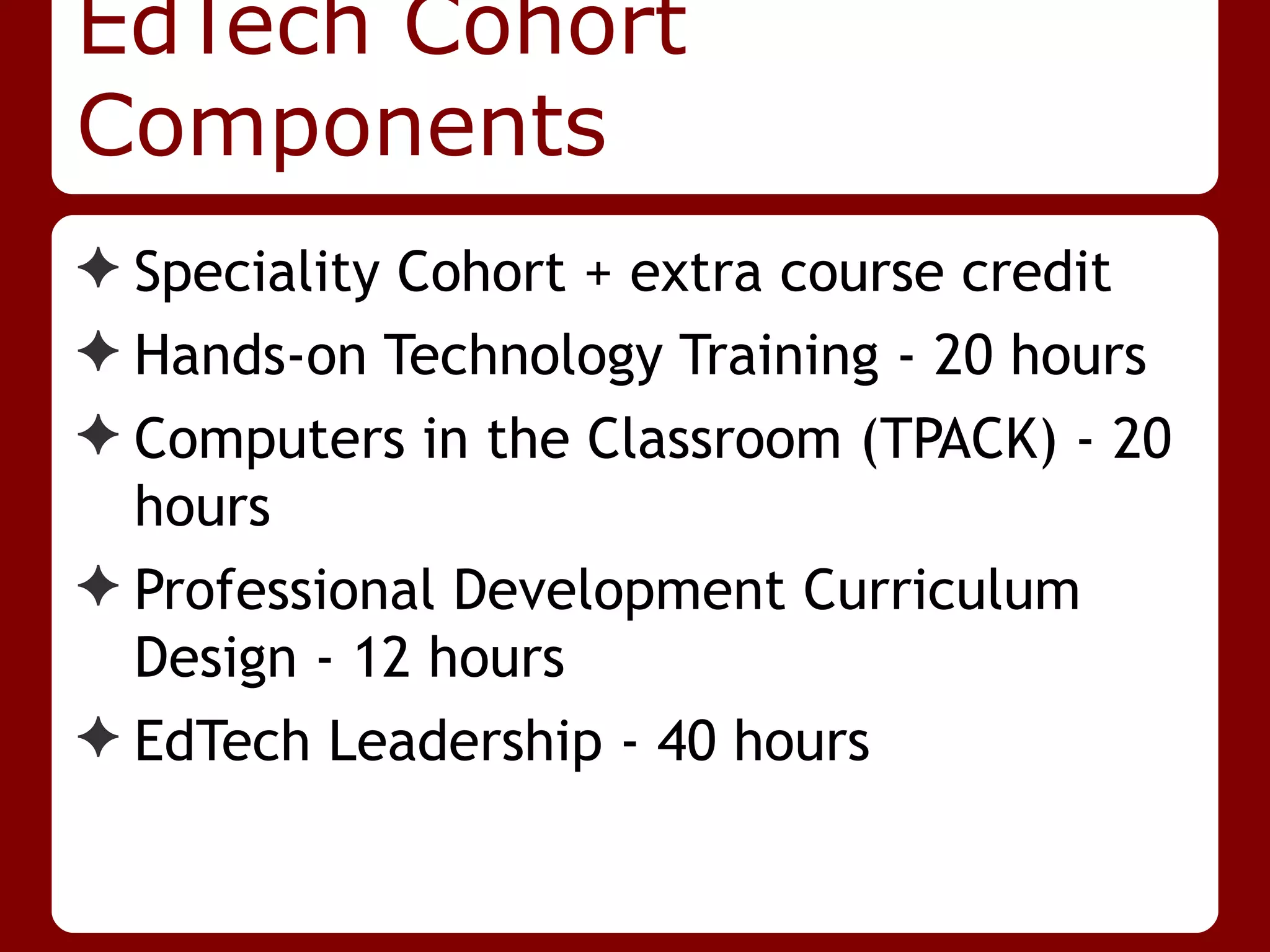
✦ Speciality Cohort + extra course credit
✦ Hands-on Technology Training - 20 hours
✦ Computers in the Classroom (TPACK) - 20
  hours
✦ Professional Development Curriculum
  Design - 12 hours
✦ EdTech Leadership - 40 hours
Computer & Digital
                          Technologies
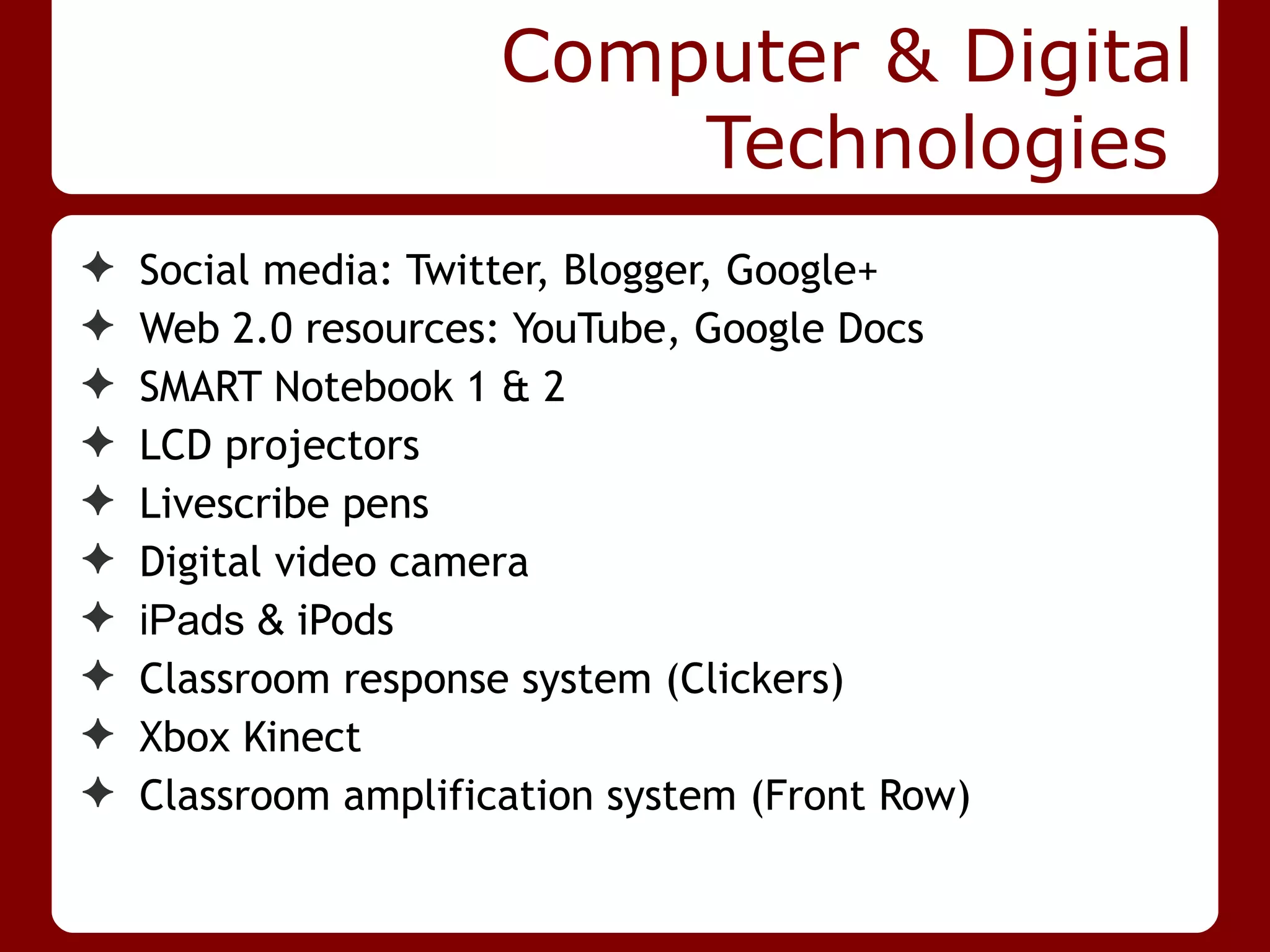
✦   Social media: Twitter, Blogger, Google+
✦   Web 2.0 resources: YouTube, Google Docs
✦   SMART Notebook 1 & 2
✦   LCD projectors
✦   Livescribe pens
✦   Digital video camera
✦   iPads & iPods
✦   Classroom response system (Clickers)
✦   Xbox Kinect
✦   Classroom amplification system (Front Row)
Learning Competencies
           Learning Competencies


✦ Computer & Digital Technologies
✦ Creativity
✦ Critical Thinking
✦ Collaboration
✦ Communication
Creativity
    From Brock
    University’s
    research
    laboratories -
    Collaborite is
    Canada’s #1
    solution for
    practicum
    stress.
Creativity
Critical Thinking
•   Google docs
Collaboration
Communication
Lessons Learned
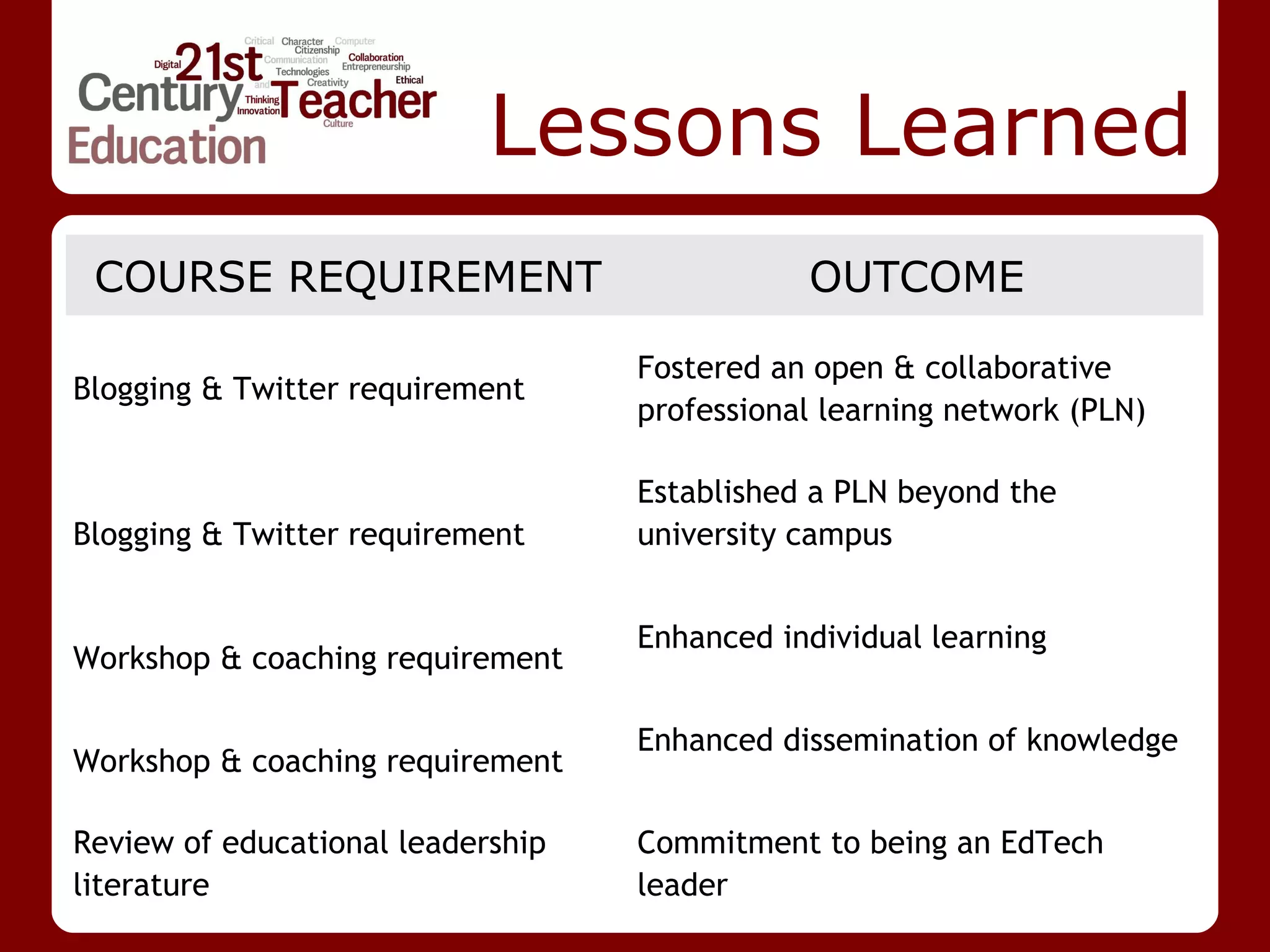
 COURSE REQUIREMENT                           OUTCOME

                                   Fostered an open & collaborative
Blogging & Twitter requirement
                                   professional learning network (PLN)

                                   Established a PLN beyond the
Blogging & Twitter requirement     university campus


                                   Enhanced individual learning
Workshop & coaching requirement

                                   Enhanced dissemination of knowledge
Workshop & coaching requirement

Review of educational leadership   Commitment to being an EdTech
literature                         leader
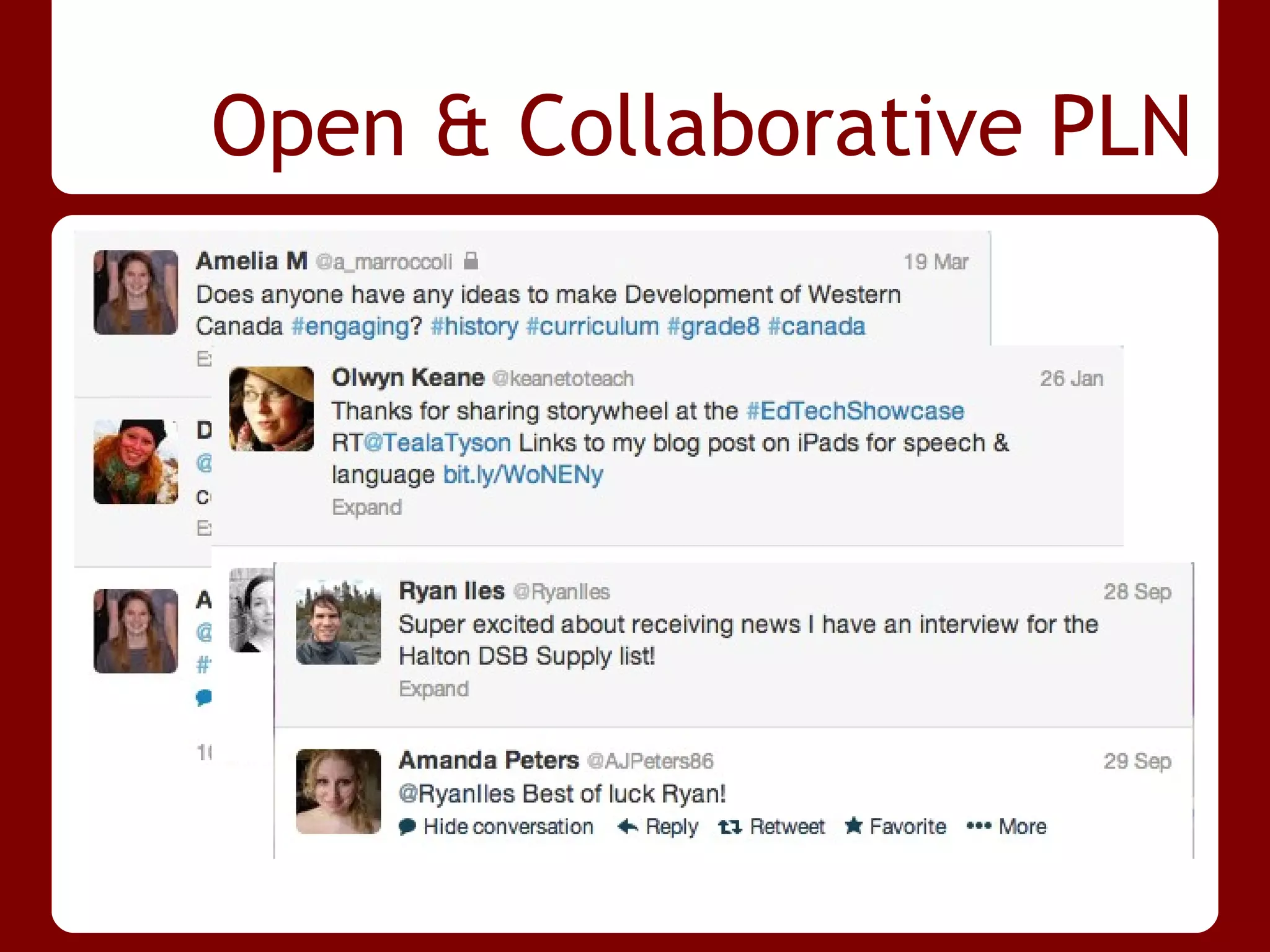
Open & Collaborative PLN
PLN Beyond Brock
Enhanced Learning
Teacher candidates must understand how to use a
technology in a classroom setting well enough to convey
their knowledge to others.
Dissemination of Knowledge
Over 9,735 video views on the
EdTech Teachers YouTube
channel
Delivered workshops
to hundreds of
educators.
Leadership Commitment

"It is suggested that technology training
go one step further and explicitly help
teachers develop a personal philosophy
that persuades them that technology can
make teaching and learning more
effective and provide and conduit to
allow students to practice 21st century
skills (Lambert & Gong, 2010 p. 67)."
Personal Philosophy
Mission Statement
             Mission Statement


As an EdTech Teacher Leader, I seek to model
instructional leadership within school
communities by enabling collaboration, taking
risks, and supporting colleagues in their
quests to enhance student engagement and
achievement through 21st century
teaching/learning tools and strategies.
Conclusion

  Open & collaborative PLN +
      PLN beyond Brock +
Delivering workshops/coaching +
        Leadership focus
 21st Century
@ Brock University

     Dr. Camille Rutherford
Twitter - @crutherford
    www.drcamillerutherford.com

Site 21 c teacher education copy

  • 1.
    @ Brock University Dr. Camille Rutherford Twitter - @crutherford www.drcamillerutherford.com
  • 2.
    Rationale • Every province has created a plan to transform their students into 21st century learners, but few have a plan to transform their educators into 21st century teachers. • The stand-alone educational technology course still serves as the primary means of preservice teacher preparation in technology" (Lambert & Gong, 2010).
  • 3.
    Rationale Digital natives areNOT intrinsically inclined to integrate technology or embrace 21st century teaching. •The integration of 21st century skills, technology and learning has not yet been addressed in a systematic way in either preservice or in-service teacher education (Jensen, 2010).
  • 4.
    EdTech Cohort Components ✦ SpecialityCohort + extra course credit ✦ Hands-on Technology Training - 20 hours ✦ Computers in the Classroom (TPACK) - 20 hours ✦ Professional Development Curriculum Design - 12 hours ✦ EdTech Leadership - 40 hours
  • 5.
    Computer & Digital Technologies ✦ Social media: Twitter, Blogger, Google+ ✦ Web 2.0 resources: YouTube, Google Docs ✦ SMART Notebook 1 & 2 ✦ LCD projectors ✦ Livescribe pens ✦ Digital video camera ✦ iPads & iPods ✦ Classroom response system (Clickers) ✦ Xbox Kinect ✦ Classroom amplification system (Front Row)
  • 6.
    Learning Competencies Learning Competencies ✦ Computer & Digital Technologies ✦ Creativity ✦ Critical Thinking ✦ Collaboration ✦ Communication
  • 7.
    Creativity From Brock University’s research laboratories - Collaborite is Canada’s #1 solution for practicum stress.
  • 8.
  • 9.
  • 10.
  • 11.
  • 12.
    Lessons Learned COURSEREQUIREMENT OUTCOME Fostered an open & collaborative Blogging & Twitter requirement professional learning network (PLN) Established a PLN beyond the Blogging & Twitter requirement university campus Enhanced individual learning Workshop & coaching requirement Enhanced dissemination of knowledge Workshop & coaching requirement Review of educational leadership Commitment to being an EdTech literature leader
  • 13.
  • 14.
  • 15.
    Enhanced Learning Teacher candidatesmust understand how to use a technology in a classroom setting well enough to convey their knowledge to others.
  • 16.
    Dissemination of Knowledge Over9,735 video views on the EdTech Teachers YouTube channel Delivered workshops to hundreds of educators.
  • 17.
    Leadership Commitment "It issuggested that technology training go one step further and explicitly help teachers develop a personal philosophy that persuades them that technology can make teaching and learning more effective and provide and conduit to allow students to practice 21st century skills (Lambert & Gong, 2010 p. 67)."
  • 18.
  • 19.
    Mission Statement Mission Statement As an EdTech Teacher Leader, I seek to model instructional leadership within school communities by enabling collaboration, taking risks, and supporting colleagues in their quests to enhance student engagement and achievement through 21st century teaching/learning tools and strategies.
  • 20.
    Conclusion Open& collaborative PLN + PLN beyond Brock + Delivering workshops/coaching + Leadership focus 21st Century
  • 21.
    @ Brock University Dr. Camille Rutherford Twitter - @crutherford www.drcamillerutherford.com

Editor's Notes

  • #3 With the EdTech Cohort we sought out to systematically support the development of 21st century teachers.
  • #4 Last point -> Digital natives experienced a system of education that was traditional in nature - 21st Century tools, methods and pedagogies of learning and teaching are new for them. People assume because of their age, they are equipped. They aren't.
  • #5 Modeling plays a critical role in preparing teacher candidates to integrate technology in their teaching (Fleming, Motamedi & May, 2001) -> hence, it was key that one of the components was to include a practicing teacher, both as an instructor, and in the field...
  • #6 As the year progressed, students began to use non-traditional methods in their teaching and learning. TRANSITION..... using FLIKR for storytelling, LIVESCRIBE for audio feedback, Video demonstrations, integration of gaming, and project based learning methods as part of lesson delivery. I observed one teacher candidate teach grade two students about the KILOMETER. She videotaped herself leaving school front doors, getting in car, driving through local community until she reached the grocery story. She then replayed the video on the smartboard, while students all held imaginary driving wheels. Without leaving the classroom, the could FEEL and EXPERIENCE a KILIMOTRE.
  • #7 camille Create opportunities to embrace competencies, purposefully and systematically
  • #8 (first picture) We knew it was important that from the onset to model creativity as instructors and in order to do this, TRUST and RELATIONSHIP building were vital. Students needed to feel safe to take risks, be vulnerable, to push the envelope of possibilities- to think outside the box. To be open- minded. A tough one (with an educator lens)- when on Day ONE, most of them were coming to us with a traditional mindset about education and pedagogy. CLICK TO transition --> Quick Story - WEEK ONE , (August 30), Students found and decorated a ROCK (yes, a rock). We gave 2 hours for this - what appeared to be "simple" activity. But- by being deliberate in the structure and nature, we set the stage for the ensuing weeks. We used this activity to start where they were and then build from it. Providing time, resources, modeling and support and student exploration became something more than just "decorating a rock"because we used the notion (their notion) of creativity to help them begin their discussions and explorations of 21st Century learning. We started from the familiar and transitioning to new territory. Opportunity to connect creativity with technolgy --- As the year progressed, students began to use non-traditional methods in their teaching and learning. TRANSITION..... using FLIKR for storytelling, LIVESCRIBE for audio feedback, Video demonstrations, integration of gaming, and project based learning methods as part of lesson delivery. I observed one teacher candidate teach grade two students about the KILOMETER. She videotaped herself leaving school front doors, getting in car, driving through local community until she reached the grocery story. She then replayed the video on the smartboard, while students all held imaginary driving wheels. Without leaving the classroom, the could FEEL and EXPERIENCE a KILIMOTRE.
  • #9 (first picture) We knew it was important that from the onset to model creativity as instructors and in order to do this, TRUST and RELATIONSHIP building were vital. Students needed to feel safe to take risks, be vulnerable, to push the envelope of possibilities- to think outside the box. To be open- minded. A tough one (with an educator lens)- when on Day ONE, most of them were coming to us with a traditional mindset about education and pedagogy. CLICK TO transition --> Quick Story - WEEK ONE , (August 30), Students found and decorated a ROCK (yes, a rock). We gave 2 hours for this - what appeared to be "simple" activity. But- by being deliberate in the structure and nature, we set the stage for the ensuing weeks. We used this activity to start where they were and then build from it. Providing time, resources, modeling and support and student exploration became something more than just "decorating a rock"because we used the notion (their notion) of creativity to help them begin their discussions and explorations of 21st Century learning. We started from the familiar and transitioning to new territory. Opportunity to connect creativity with technolgy --- As the year progressed, students began to use non-traditional methods in their teaching and learning. TRANSITION..... using FLIKR for storytelling, LIVESCRIBE for audio feedback, Video demonstrations, integration of gaming, and project based learning methods as part of lesson delivery. I observed one teacher candidate teach grade two students about the KILOMETER. She videotaped herself leaving school front doors, getting in car, driving through local community until she reached the grocery story. She then replayed the video on the smartboard, while students all held imaginary driving wheels. Without leaving the classroom, the could FEEL and EXPERIENCE a KILIMOTRE.
  • #10 Teaching new (or experienced) teachers to rethink what education is, to question past practice, to embrace new pedagogies (ones that are changing), to learn new ways of using familiar tools, to question status-quo, to accept new forms of literacies... Isn't this what we are all aiming to do as 21st Century leaders, researchers, consultants? Using collaborative tools and combining blended learning with Face to Face discussion, and ongoing coaching (both via instructors and the online community) students were constantly challenged. Challenged to work and reflect in a public zone, to share with educators beyond the clasroom walls, to find balance with their online digital footprints.
  • #11 Google Docs - Collaborative note taking - Elements of the 21st century classroom doc
  • #12 Google+ Hangout
  • #13 Camille
  • #14 Zoe
  • #15 Zoe will narrate as video is playing. (2. 5 minutes) Teachers from Ontario, Canada, and International responded to our request for Online Educational Coaches for pre-service students. Teachers, principals, consultants, leaders - partnered with one preservice student and guided them through blogging, twittering, and online networking. In order using twitter, blogs, and feeling authentic, they needed encouragement from more then just the feedback they get from their instructors and immediate instructors. So, by connecting them with practicing teacher (like you) to encourage, retweet, follow, respond, comment – that in itself has made a huge difference. Students feel empowered to attend professional development that pertains more to their needs, to chats that expand across our nation and beyond (edcamp conferences, online chats). This has helped them integrate into the Global network of educators. For instance, the use of Google Plus – where they have gravitated to creating circles and collaborative communities between themselves as well. Really, the VAT and the use of social media is about helping them to faciliate a balance between online and face to face relationships as it pertains mentoring, coaching and leadership. The fact that these students can have face to face supports in class that can continue as they go out in the field, in the class, to me is going to make all the difference when approaching Professional Learning Communities within their schools. This is Shawn – one of the Junior Intermediate students.
  • #16 Workshop and coaching requirement enhance learning as teacher candidates must understand how to use a tech resource well enough to convey their knowledge to others and
  • #17 Camille
  • #21 Camille