Power trading strategy
for Mongolia
(Asian Super Grid & Gobitec)
JAMBAA Lkhagva,
Engineer, Ministerial Task Team
on Asian Super Grid, Ministry of Energy
jambaa@energy.gov.mn www.facebook.com/MongoliaAsianSuperGrid
2
OUTLINE
Solar and wind energy resource potential in Mongolia
What are Gobitech and Asian Super Grid ?
What are benefits for the participating countries ?
The way forward & activities
Links for more information
Power sector and its exporting strategy
3
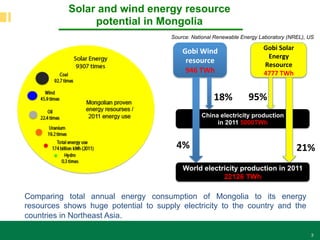
Solar and wind energy resource
potential in Mongolia
Comparing total annual energy consumption of Mongolia to its energy
resources shows huge potential to supply electricity to the country and the
countries in Northeast Asia.
Source: National Renewable Energy Laboratory (NREL), US
Gobi	
  Wind	
  
resource	
  	
  
946	
  TWh	
  	
  
Gobi	
  Solar	
  
Energy	
  
Resource	
  	
  
4777	
  TWh	
  
China electricity production
in 2011 5000TWh
World electricity production in 2011
22126 TWh
18%	
   95%	
  
4%	
   21%	
  
4
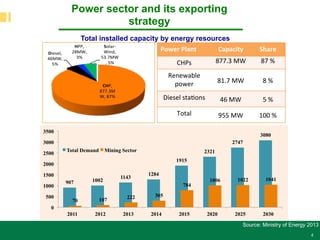
Power sector and its exporting
strategy
Power	
  Plant	
   Capacity	
   Share	
  
CHPs	
   877.3	
  MW	
   87	
  %	
  
Renewable	
  
power	
   81.7	
  MW	
   8	
  %	
  
Diesel	
  sta;ons	
   46	
  MW	
   5	
  %	
  
Total	
   955	
  MW	
   100	
  %	
  
907 1002
1143
1284
1915
2321
2747
3080
70 107 222 305
784
1006 1022 1041
0
500
1000
1500
2000
2500
3000
3500
2011 2012 2013 2014 2015 2020 2025 2030
Total Demand Mining Sector
Source: Ministry of Energy 2013
CHP,#
877.3M
W,#87%#
Diesel,#
46MW,##
5%#
HPP,#
28MW,##
3%#
Solar6
Wind,#
53.7MW
,#5%#
Total installed capacity by energy resources
5
Power sector and its exporting
strategy
Source: Ministry of Energy 2013
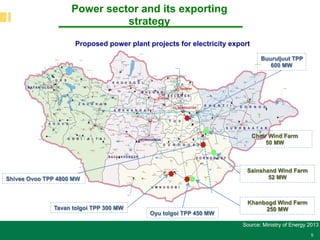
Proposed power plant projects for electricity export
Oyu tolgoi TPP 450 MW
Tavan tolgoi TPP 300 MW
Buuruljuut TPP
600 MW
Choir Wind Farm
50 MW
Sainshand Wind Farm
52 MW
Khanbogd Wind Farm
250 MW
Shivee Ovoo TPP 4800 MW
6
Power sector and its exporting
strategy
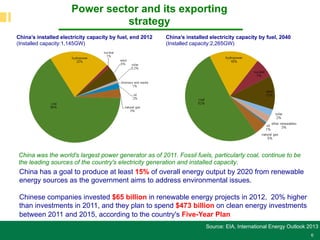
China’s installed electricity capacity by fuel, end 2012
(Installed capacity:1,145GW)
China’s installed electricity capacity by fuel, 2040
(Installed capacity:2,265GW)
Source: EIA, International Energy Outlook 2013
China was the world's largest power generator as of 2011. Fossil fuels, particularly coal, continue to be
the leading sources of the country's electricity generation and installed capacity.
China has a goal to produce at least 15% of overall energy output by 2020 from renewable
energy sources as the government aims to address environmental issues.
Chinese companies invested $65 billion in renewable energy projects in 2012, 20% higher
than investments in 2011, and they plan to spend $473 billion on clean energy investments
between 2011 and 2015, according to the country's Five-Year Plan
7
Power sector and its exporting
strategy
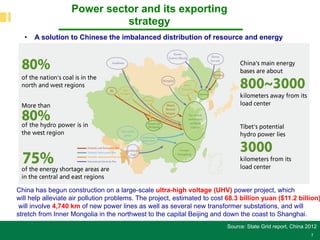
•  A solution to Chinese the imbalanced distribution of resource and energy
Source: State Grid report, China 2012
China has begun construction on a large-scale ultra-high voltage (UHV) power project, which
will help alleviate air pollution problems. The project, estimated to cost 68.3 billion yuan ($11.2 billion)
will involve 4,740 km of new power lines as well as several new transformer substations, and will
stretch from Inner Mongolia in the northwest to the capital Beijing and down the coast to Shanghai.
8
What are Gobitech and
Asian Super Grid?
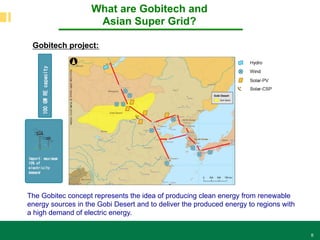
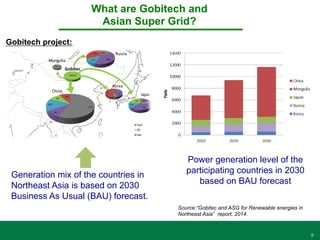
The Gobitec concept represents the idea of producing clean energy from renewable
energy sources in the Gobi Desert and to deliver the produced energy to regions with
a high demand of electric energy.
Gobitech project:
9
Power generation level of the
participating countries in 2030
based on BAU forecast
Generation mix of the countries in
Northeast Asia is based on 2030
Business As Usual (BAU) forecast.
Source:“Gobitec and ASG for Renewable energies in
Northeast Asia” report, 2014.
What are Gobitech and
Asian Super Grid?
Gobitech project:
10
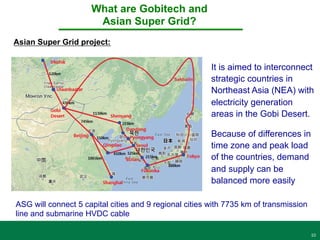
It is aimed to interconnect
strategic countries in
Northeast Asia (NEA) with
electricity generation
areas in the Gobi Desert.
What are Gobitech and
Asian Super Grid?
Asian Super Grid project:
Because of differences in
time zone and peak load
of the countries, demand
and supply can be
balanced more easily
ASG will connect 5 capital cities and 9 regional cities with 7735 km of transmission
line and submarine HVDC cable
11
What are benefits for the
participating countries?
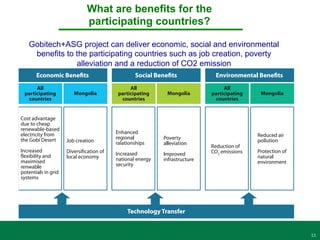
Gobitech+ASG project can deliver economic, social and environmental
benefits to the participating countries such as job creation, poverty
alleviation and a reduction of CO2 emission
12
What are benefits for the
participating countries?
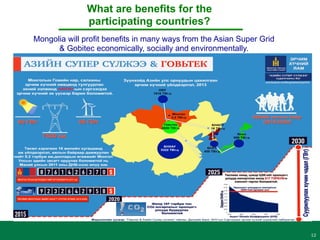
Mongolia will profit benefits in many ways from the Asian Super Grid
& Gobitec economically, socially and environmentally.
13
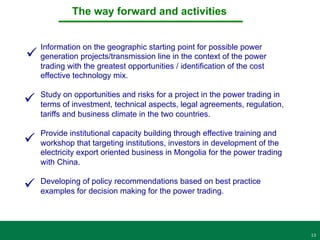
The way forward and activities
Information on the geographic starting point for possible power
generation projects/transmission line in the context of the power
trading with the greatest opportunities / identification of the cost
effective technology mix.
Study on opportunities and risks for a project in the power trading in
terms of investment, technical aspects, legal agreements, regulation,
tariffs and business climate in the two countries.
Provide institutional capacity building through effective training and
workshop that targeting institutions, investors in development of the
electricity export oriented business in Mongolia for the power trading
with China.
Developing of policy recommendations based on best practice
examples for decision making for the power trading.
ü
ü
ü
ü
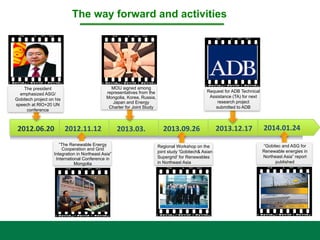
2013.03.	
  
MOU signed among
representatives from the
Mongolia, Korea, Russia,
Japan and Energy
Charter for Joint Study
“Gobitec and ASG for
Renewable energies in
Northeast Asia” report
published	
  
2014.01.24	
  2013.12.17	
  
Request for ADB Technical
Assistance (TA) for next
research project
submitted to ADB
2012.06.20	
  	
  
The president
emphasized ASG/
Gobitech project on his
speech at RIO+20 UN
conference
2012.11.12	
  
“The Renewable Energy
Cooperation and Grid
Integration in Northeast Asia”
International Conference in
Mongolia
Regional Workshop on the
joint study 'Gobitech& Asian
Supergrid' for Renewables
in Northeast Asia
2013.09.26	
  
The way forward and activities
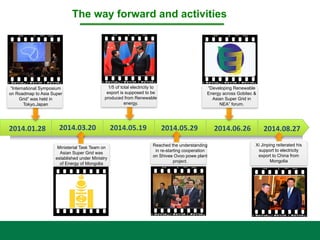
2014.03.20	
  
Ministerial Task Team on
Asian Super Grid was
established under Ministry
of Energy of Mongolia
2014.01.28	
  
“International Symposium
on Roadmap to Asia Super
Grid” was held in
Tokyo,Japan
The way forward and activities
2014.05.19	
  
1/5 of total electricity to
export is supposed to be
produced from Renewable
energy.
2014.05.29	
  
Reached the understanding
in re-starting cooperation
on Shivee Ovoo powe plant
project.
2014.06.26	
  
“Developing Renewable
Energy across Gobitec &
Asian Super Grid in
NEA” forum.
Xi Jinping reiterated his
support to electricity
export to China from
Mongolia
2014.08.27	
  
16
Links for more information	
  
ü “Gobitec and ASG for Renewable energies in Northeast Asia” report 	
  
hCp://www.encharter.org/index.php?id=643&L=0	
  	
  
ü “Developing Renewable Energy across Gobitec &Asian Super Grid
in NEA” Forum in Ulaanbaatar, June 26, 2014
hCp://www.encharter.org/index.php?id=661&L=0	
  	
  
ü “Energy Mongolia 2014” International Conference and Expo
in Ulaanbaatar, May 22-24, 2014
hCp://energy-­‐mongolia.mn/index.php/en/	
  	
  
ü Ministerial Task Team on Asian Super Grid, Ministry of Energy, Mongolia
hCps://www.facebook.com/MongoliaAsianSuperGrid	
  	
  
Thank you for your attention
17

BCM's Environmental Working Group Meeting

  • 1.
    Power trading strategy forMongolia (Asian Super Grid & Gobitec) JAMBAA Lkhagva, Engineer, Ministerial Task Team on Asian Super Grid, Ministry of Energy jambaa@energy.gov.mn www.facebook.com/MongoliaAsianSuperGrid
  • 2.
    2 OUTLINE Solar and windenergy resource potential in Mongolia What are Gobitech and Asian Super Grid ? What are benefits for the participating countries ? The way forward & activities Links for more information Power sector and its exporting strategy
  • 3.
    3 Solar and windenergy resource potential in Mongolia Comparing total annual energy consumption of Mongolia to its energy resources shows huge potential to supply electricity to the country and the countries in Northeast Asia. Source: National Renewable Energy Laboratory (NREL), US Gobi  Wind   resource     946  TWh     Gobi  Solar   Energy   Resource     4777  TWh   China electricity production in 2011 5000TWh World electricity production in 2011 22126 TWh 18%   95%   4%   21%  
  • 4.
    4 Power sector andits exporting strategy Power  Plant   Capacity   Share   CHPs   877.3  MW   87  %   Renewable   power   81.7  MW   8  %   Diesel  sta;ons   46  MW   5  %   Total   955  MW   100  %   907 1002 1143 1284 1915 2321 2747 3080 70 107 222 305 784 1006 1022 1041 0 500 1000 1500 2000 2500 3000 3500 2011 2012 2013 2014 2015 2020 2025 2030 Total Demand Mining Sector Source: Ministry of Energy 2013 CHP,# 877.3M W,#87%# Diesel,# 46MW,## 5%# HPP,# 28MW,## 3%# Solar6 Wind,# 53.7MW ,#5%# Total installed capacity by energy resources
  • 5.
    5 Power sector andits exporting strategy Source: Ministry of Energy 2013 Proposed power plant projects for electricity export Oyu tolgoi TPP 450 MW Tavan tolgoi TPP 300 MW Buuruljuut TPP 600 MW Choir Wind Farm 50 MW Sainshand Wind Farm 52 MW Khanbogd Wind Farm 250 MW Shivee Ovoo TPP 4800 MW
  • 6.
    6 Power sector andits exporting strategy China’s installed electricity capacity by fuel, end 2012 (Installed capacity:1,145GW) China’s installed electricity capacity by fuel, 2040 (Installed capacity:2,265GW) Source: EIA, International Energy Outlook 2013 China was the world's largest power generator as of 2011. Fossil fuels, particularly coal, continue to be the leading sources of the country's electricity generation and installed capacity. China has a goal to produce at least 15% of overall energy output by 2020 from renewable energy sources as the government aims to address environmental issues. Chinese companies invested $65 billion in renewable energy projects in 2012, 20% higher than investments in 2011, and they plan to spend $473 billion on clean energy investments between 2011 and 2015, according to the country's Five-Year Plan
  • 7.
    7 Power sector andits exporting strategy •  A solution to Chinese the imbalanced distribution of resource and energy Source: State Grid report, China 2012 China has begun construction on a large-scale ultra-high voltage (UHV) power project, which will help alleviate air pollution problems. The project, estimated to cost 68.3 billion yuan ($11.2 billion) will involve 4,740 km of new power lines as well as several new transformer substations, and will stretch from Inner Mongolia in the northwest to the capital Beijing and down the coast to Shanghai.
  • 8.
    8 What are Gobitechand Asian Super Grid? The Gobitec concept represents the idea of producing clean energy from renewable energy sources in the Gobi Desert and to deliver the produced energy to regions with a high demand of electric energy. Gobitech project:
  • 9.
    9 Power generation levelof the participating countries in 2030 based on BAU forecast Generation mix of the countries in Northeast Asia is based on 2030 Business As Usual (BAU) forecast. Source:“Gobitec and ASG for Renewable energies in Northeast Asia” report, 2014. What are Gobitech and Asian Super Grid? Gobitech project:
  • 10.
    10 It is aimedto interconnect strategic countries in Northeast Asia (NEA) with electricity generation areas in the Gobi Desert. What are Gobitech and Asian Super Grid? Asian Super Grid project: Because of differences in time zone and peak load of the countries, demand and supply can be balanced more easily ASG will connect 5 capital cities and 9 regional cities with 7735 km of transmission line and submarine HVDC cable
  • 11.
    11 What are benefitsfor the participating countries? Gobitech+ASG project can deliver economic, social and environmental benefits to the participating countries such as job creation, poverty alleviation and a reduction of CO2 emission
  • 12.
    12 What are benefitsfor the participating countries? Mongolia will profit benefits in many ways from the Asian Super Grid & Gobitec economically, socially and environmentally.
  • 13.
    13 The way forwardand activities Information on the geographic starting point for possible power generation projects/transmission line in the context of the power trading with the greatest opportunities / identification of the cost effective technology mix. Study on opportunities and risks for a project in the power trading in terms of investment, technical aspects, legal agreements, regulation, tariffs and business climate in the two countries. Provide institutional capacity building through effective training and workshop that targeting institutions, investors in development of the electricity export oriented business in Mongolia for the power trading with China. Developing of policy recommendations based on best practice examples for decision making for the power trading. ü ü ü ü
  • 14.
    2013.03.   MOU signedamong representatives from the Mongolia, Korea, Russia, Japan and Energy Charter for Joint Study “Gobitec and ASG for Renewable energies in Northeast Asia” report published   2014.01.24  2013.12.17   Request for ADB Technical Assistance (TA) for next research project submitted to ADB 2012.06.20     The president emphasized ASG/ Gobitech project on his speech at RIO+20 UN conference 2012.11.12   “The Renewable Energy Cooperation and Grid Integration in Northeast Asia” International Conference in Mongolia Regional Workshop on the joint study 'Gobitech& Asian Supergrid' for Renewables in Northeast Asia 2013.09.26   The way forward and activities
  • 15.
    2014.03.20   Ministerial TaskTeam on Asian Super Grid was established under Ministry of Energy of Mongolia 2014.01.28   “International Symposium on Roadmap to Asia Super Grid” was held in Tokyo,Japan The way forward and activities 2014.05.19   1/5 of total electricity to export is supposed to be produced from Renewable energy. 2014.05.29   Reached the understanding in re-starting cooperation on Shivee Ovoo powe plant project. 2014.06.26   “Developing Renewable Energy across Gobitec & Asian Super Grid in NEA” forum. Xi Jinping reiterated his support to electricity export to China from Mongolia 2014.08.27  
  • 16.
    16 Links for moreinformation   ü “Gobitec and ASG for Renewable energies in Northeast Asia” report   hCp://www.encharter.org/index.php?id=643&L=0     ü “Developing Renewable Energy across Gobitec &Asian Super Grid in NEA” Forum in Ulaanbaatar, June 26, 2014 hCp://www.encharter.org/index.php?id=661&L=0     ü “Energy Mongolia 2014” International Conference and Expo in Ulaanbaatar, May 22-24, 2014 hCp://energy-­‐mongolia.mn/index.php/en/     ü Ministerial Task Team on Asian Super Grid, Ministry of Energy, Mongolia hCps://www.facebook.com/MongoliaAsianSuperGrid    
  • 17.
    Thank you foryour attention 17