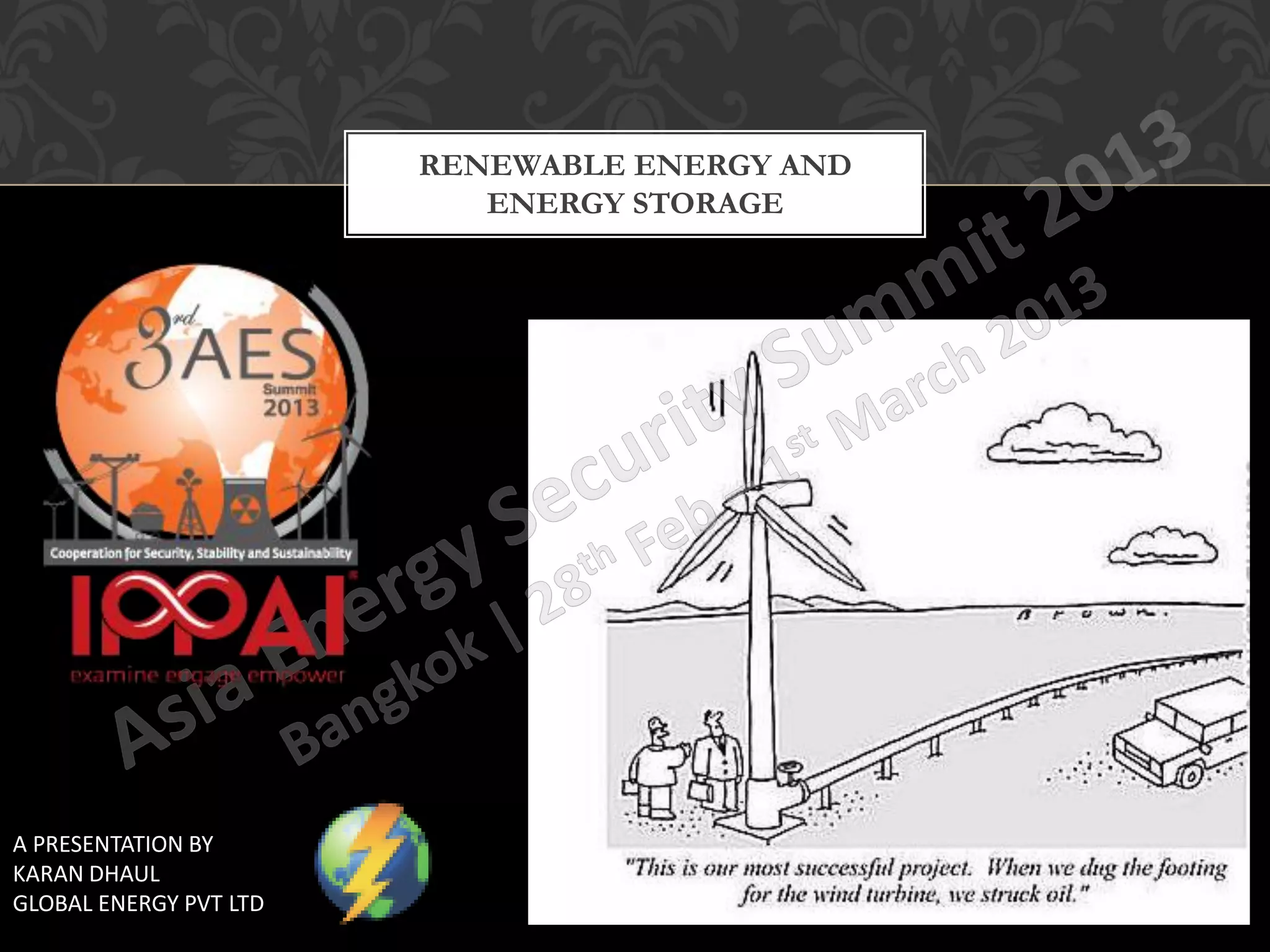
RENEWABLE ENERGY AND
                           ENERGY STORAGE


A PRESENTATION BY
KARAN DHAUL
GLOBAL ENERGY PVT LTD
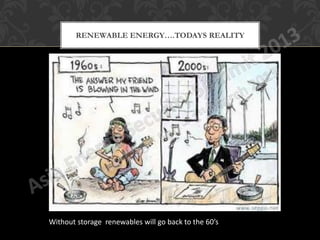
RENEWABLE ENERGY….TODAYS REALITY


Without storage renewables will go back to the 60’s
WHAT IS ENERGY STORAGE?


Storing energy allows grids to
balance the supply and demand.
Energy storage systems in
commercial use today can be
broadly categorized as mechanical,
electrical, chemical, biological and
thermal.


  •   In the absence of storage, electricity must be used when it is produced. This requires a system that is constantly able to
      balance electricity generation with electricity demand (Swedish Energy Agency, 2010).
  •   Excess supply of electricity in the grid will cause the voltage and alternating frequency to rise above the safe level causing
      electricity “surges,” too little supply and there will not be enough electricity in the grid for demand, causing shortages or
      “brown- outs” (CESPOS, 2009).
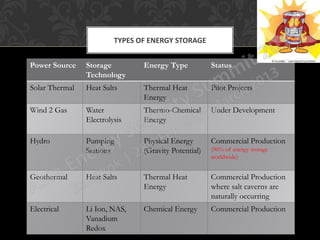
TYPES OF ENERGY STORAGE


Power Source    Storage         Energy Type           Status
                Technology
Solar Thermal   Heat Salts      Thermal Heat          Pilot Projects
                                Energy
Wind 2 Gas      Water           Thermo-Chemical       Under Development
                Electrolysis    Energy

Hydro           Pumping         Physical Energy       Commercial Production
                Stations        (Gravity Potential)   (90% of energy storage
                                                      worldwide)


Geothermal      Heat Salts      Thermal Heat          Commercial Production
                                Energy                where salt caverns are
                                                      naturally occurring
Electrical      Li Ion, NAS,    Chemical Energy       Commercial Production
                Vanadium
                Redox
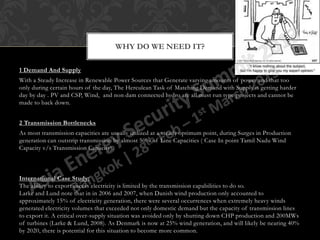
WHY DO WE NEED IT?

1 Demand And Supply
With a Steady Increase in Renewable Power Sources that Generate varying amounts of power and that too
only during certain hours of the day, The Herculean Task of Matching Demand with Supply is getting harder
day by day . PV and CSP, Wind, and non dam connected hydro are all must run type projects and cannot be
made to back down.


2 Transmission Bottlenecks
As most transmission capacities are usually utilized at a steady optimum point, during Surges in Production
generation can outstrip transmission by almost 50% of Line Capacities ( Case In point Tamil Nadu Wind
Capacity v/s Transmission Capacity).


International Case Study:
The ability to export excess electricity is limited by the transmission capabilities to do so.
Larke and Lund note that in in 2006 and 2007, when Danish wind production only accounted to
approximately 15% of electricity generation, there were several occurrences when extremely heavy winds
generated electricity volumes that exceeded not only domestic demand but the capacity of transmission lines
to export it. A critical over-supply situation was avoided only by shutting down CHP production and 200MWs
of turbines (Larke & Lund, 2008). As Denmark is now at 25% wind generation, and will likely be nearing 40%
by 2020, there is potential for this situation to become more common.
THE SUN SHINES ON
                                             RENEWABLES


                                                                 Indian Capacity Addition in RE Power
                                                                 By 2017 Source: PGCIL Report on Green Corridors
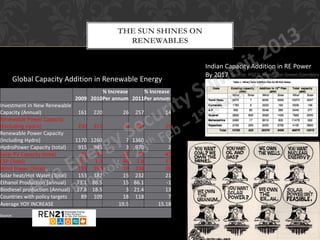
          Global Capacity Addition in Renewable Energy
                                      % Increase    % Increase
                             2009 2010Per annum 2011Per annum
Investment in New Renewable
Capacity (Annual)              161 220       26   257       14
Renewable Power Capacity
(Excluding Hydro)              250 315       20   390       19
Renewable Power Capacity
(Including Hydro)             1170 1260        7 1360        7
HydroPower Capacity (total)    915 945         3 970         2
Solar PV Capacity (total)       23   40      42    70       42
CSP (Total)                     0.7 1.3      46 1.8         27
Wind Power (Total)             159 198       19 238         16
Solar heat/Hot Water (Total)   153 182       15 232         21
Ethanol Production (annual)    73.1 86.5     15 86.1        -1
Biodiesel production (Annual) 17.8 18.5        3 21.4       13
Countries with policy targets   89 109       18 118          7
Average YOY INCREASE                        19.5         15.18
Source:
RENEWABLE ENERGY PROGRESS REPORT- AN UPDATE


SOLAR THERMAL HEATING AND COOLING.
Solar heating capacity increased by an estimated 27% in 2011
to reach approximately 232 GW, excluding unglazed swimming pool heating. China again led the world for solar thermal installations, with
Europe a distant second. Most solar thermal is used for water heating, but solar space heating and cooling are gaining ground, particularly in
Europe.

CONCENTRATING SOLAR THERMAL POWER (CSP)
More than 450 megawatts (MW) of CSP was installed in 2011, bringing global capacity to almost 1,760 MW. Spain accounted for the vast
majority of capacity additions, while several developing countries launched their first CSP plants and industry activity expanded its attention
from Spain and the United States to new regions. Parabolic trough plants continued to dominate the market, but new central receiver and
Fresnel plants were commissioned during 2011 and others were under construction

GEOTHERMAL HEAT AND POWER.
Geothermal energy provided an estimated 205 TWh (736 PJ) in 2011, one- third in the form of electricity (with an estimated 11.2GW of
capacity) and the remaining two-thirds in the form of heat. At least 78 countries used direct geothermal energy in 2011. Most of the growth in
direct use was associated with ground-source heat pumps (GHP), which can provide heating and cooling and have experienced growth rates
averaging 20% annually. Geothermal electricity saw only modest expansion in 2011, but the rate of deployment is expected to accelerate with
projects under development in traditional markets and the movement into new markets in East Africa and elsewhere.

HYDROPOWER
 An estimated 25 GW of new capacity came on line in 2011, increasing global installed capacity by nearly
2.7% to approximately 970 GW. Hydropower continues to generate more electricity than any other
renewable resource, with an estimated 3,400 TWh produced during 2011. Asia was the most active
region for new projects, while more mature markets focused on retrofits of existing facilities for
improved output and efficiency. Hydropower is increasingly providing balancing services, including
through expansion of pumped storage capacity, in part to accommodate the increased use of variable
solar and wind resources.

OCEAN ENERGY.
After years that saw development of only small pilot projects, global ocean power capacity almost doubled in
2011. The launch of a 254 MW tidal power plant in South Korea and a 0.3 MW wave energy plant in Spain
brought total global capacity to 527 MW.
In $$$$ and Cents….


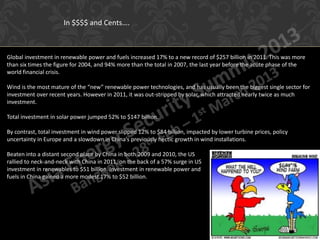
Global investment in renewable power and fuels increased 17% to a new record of $257 billion in 2011. This was more
than six times the figure for 2004, and 94% more than the total in 2007, the last year before the acute phase of the
world financial crisis.

Wind is the most mature of the “new” renewable power technologies, and has usually been the biggest single sector for
investment over recent years. However in 2011, it was out-stripped by solar, which attracted nearly twice as much
investment.

Total investment in solar power jumped 52% to $147 billion.

By contrast, total investment in wind power slipped 12% to $84 billion, impacted by lower turbine prices, policy
uncertainty in Europe and a slowdown in China’s previously hectic growth in wind installations.

Beaten into a distant second place by China in both 2009 and 2010, the US
rallied to neck-and-neck with China in 2011, on the back of a 57% surge in US
investment in renewables to $51 billion. Investment in renewable power and
fuels in China gained a more modest 17% to $52 billion.
WORLDWIDE ANNOUNCEMENTS

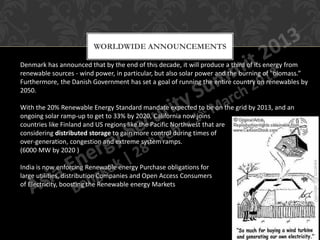
Denmark has announced that by the end of this decade, it will produce a third of its energy from
renewable sources - wind power, in particular, but also solar power and the burning of "biomass.”
Furthermore, the Danish Government has set a goal of running the entire country on renewables by
2050.

With the 20% Renewable Energy Standard mandate expected to be on the grid by 2013, and an
ongoing solar ramp-up to get to 33% by 2020, California now joins
countries like Finland and US regions like the Pacific Northwest that are
considering distributed storage to gain more control during times of
over-generation, congestion and extreme system ramps.
(6000 MW by 2020 )

India is now enforcing Renewable energy Purchase obligations for
large utilities, distribution Companies and Open Access Consumers
of Electricity, boosting the Renewable energy Markets
Indian Experience – Ripe For storage


Presently the total installed electricity generation capacity in India is about 200
    GW (as on 31.03.12). Out of this about 12 % (24915 MW) is through
renewable generation mainly wind (17353 MW) and balance is in the form of
      small hydro (3396 MW), Biomass (3225 MW) and solar (941 MW).
• As per the FOIR Report, States with High wind Capacity Installed have
  major problems in managing the sudden surge in generation during the
  early monsoon, and are forced to back down conventional generation
  stations in order to avoid Over-Frequency Grid Tripping.

• The Difference in Power prices on the exchange vary from
  a minimum of Rs. 2 per KWh to an average maximum of
  Rs. 9 depending on the time of Day (Peak/Offpeak).
More than a Smart Grid, WE need a “wise” grid,one that
      can store energy and use it wheN required


                THANK YOU

Asia Energy Security Summit 2013

  • 1.
    RENEWABLE ENERGY AND ENERGY STORAGE A PRESENTATION BY KARAN DHAUL GLOBAL ENERGY PVT LTD
  • 2.
    RENEWABLE ENERGY….TODAYS REALITY Withoutstorage renewables will go back to the 60’s
  • 3.
    WHAT IS ENERGYSTORAGE? Storing energy allows grids to balance the supply and demand. Energy storage systems in commercial use today can be broadly categorized as mechanical, electrical, chemical, biological and thermal. • In the absence of storage, electricity must be used when it is produced. This requires a system that is constantly able to balance electricity generation with electricity demand (Swedish Energy Agency, 2010). • Excess supply of electricity in the grid will cause the voltage and alternating frequency to rise above the safe level causing electricity “surges,” too little supply and there will not be enough electricity in the grid for demand, causing shortages or “brown- outs” (CESPOS, 2009).
  • 4.
    TYPES OF ENERGYSTORAGE Power Source Storage Energy Type Status Technology Solar Thermal Heat Salts Thermal Heat Pilot Projects Energy Wind 2 Gas Water Thermo-Chemical Under Development Electrolysis Energy Hydro Pumping Physical Energy Commercial Production Stations (Gravity Potential) (90% of energy storage worldwide) Geothermal Heat Salts Thermal Heat Commercial Production Energy where salt caverns are naturally occurring Electrical Li Ion, NAS, Chemical Energy Commercial Production Vanadium Redox
  • 5.
    WHY DO WENEED IT? 1 Demand And Supply With a Steady Increase in Renewable Power Sources that Generate varying amounts of power and that too only during certain hours of the day, The Herculean Task of Matching Demand with Supply is getting harder day by day . PV and CSP, Wind, and non dam connected hydro are all must run type projects and cannot be made to back down. 2 Transmission Bottlenecks As most transmission capacities are usually utilized at a steady optimum point, during Surges in Production generation can outstrip transmission by almost 50% of Line Capacities ( Case In point Tamil Nadu Wind Capacity v/s Transmission Capacity). International Case Study: The ability to export excess electricity is limited by the transmission capabilities to do so. Larke and Lund note that in in 2006 and 2007, when Danish wind production only accounted to approximately 15% of electricity generation, there were several occurrences when extremely heavy winds generated electricity volumes that exceeded not only domestic demand but the capacity of transmission lines to export it. A critical over-supply situation was avoided only by shutting down CHP production and 200MWs of turbines (Larke & Lund, 2008). As Denmark is now at 25% wind generation, and will likely be nearing 40% by 2020, there is potential for this situation to become more common.
  • 6.
    THE SUN SHINESON RENEWABLES Indian Capacity Addition in RE Power By 2017 Source: PGCIL Report on Green Corridors Global Capacity Addition in Renewable Energy % Increase % Increase 2009 2010Per annum 2011Per annum Investment in New Renewable Capacity (Annual) 161 220 26 257 14 Renewable Power Capacity (Excluding Hydro) 250 315 20 390 19 Renewable Power Capacity (Including Hydro) 1170 1260 7 1360 7 HydroPower Capacity (total) 915 945 3 970 2 Solar PV Capacity (total) 23 40 42 70 42 CSP (Total) 0.7 1.3 46 1.8 27 Wind Power (Total) 159 198 19 238 16 Solar heat/Hot Water (Total) 153 182 15 232 21 Ethanol Production (annual) 73.1 86.5 15 86.1 -1 Biodiesel production (Annual) 17.8 18.5 3 21.4 13 Countries with policy targets 89 109 18 118 7 Average YOY INCREASE 19.5 15.18 Source:
  • 7.
    RENEWABLE ENERGY PROGRESSREPORT- AN UPDATE SOLAR THERMAL HEATING AND COOLING. Solar heating capacity increased by an estimated 27% in 2011 to reach approximately 232 GW, excluding unglazed swimming pool heating. China again led the world for solar thermal installations, with Europe a distant second. Most solar thermal is used for water heating, but solar space heating and cooling are gaining ground, particularly in Europe. CONCENTRATING SOLAR THERMAL POWER (CSP) More than 450 megawatts (MW) of CSP was installed in 2011, bringing global capacity to almost 1,760 MW. Spain accounted for the vast majority of capacity additions, while several developing countries launched their first CSP plants and industry activity expanded its attention from Spain and the United States to new regions. Parabolic trough plants continued to dominate the market, but new central receiver and Fresnel plants were commissioned during 2011 and others were under construction GEOTHERMAL HEAT AND POWER. Geothermal energy provided an estimated 205 TWh (736 PJ) in 2011, one- third in the form of electricity (with an estimated 11.2GW of capacity) and the remaining two-thirds in the form of heat. At least 78 countries used direct geothermal energy in 2011. Most of the growth in direct use was associated with ground-source heat pumps (GHP), which can provide heating and cooling and have experienced growth rates averaging 20% annually. Geothermal electricity saw only modest expansion in 2011, but the rate of deployment is expected to accelerate with projects under development in traditional markets and the movement into new markets in East Africa and elsewhere. HYDROPOWER An estimated 25 GW of new capacity came on line in 2011, increasing global installed capacity by nearly 2.7% to approximately 970 GW. Hydropower continues to generate more electricity than any other renewable resource, with an estimated 3,400 TWh produced during 2011. Asia was the most active region for new projects, while more mature markets focused on retrofits of existing facilities for improved output and efficiency. Hydropower is increasingly providing balancing services, including through expansion of pumped storage capacity, in part to accommodate the increased use of variable solar and wind resources. OCEAN ENERGY. After years that saw development of only small pilot projects, global ocean power capacity almost doubled in 2011. The launch of a 254 MW tidal power plant in South Korea and a 0.3 MW wave energy plant in Spain brought total global capacity to 527 MW.
  • 8.
    In $$$$ andCents…. Global investment in renewable power and fuels increased 17% to a new record of $257 billion in 2011. This was more than six times the figure for 2004, and 94% more than the total in 2007, the last year before the acute phase of the world financial crisis. Wind is the most mature of the “new” renewable power technologies, and has usually been the biggest single sector for investment over recent years. However in 2011, it was out-stripped by solar, which attracted nearly twice as much investment. Total investment in solar power jumped 52% to $147 billion. By contrast, total investment in wind power slipped 12% to $84 billion, impacted by lower turbine prices, policy uncertainty in Europe and a slowdown in China’s previously hectic growth in wind installations. Beaten into a distant second place by China in both 2009 and 2010, the US rallied to neck-and-neck with China in 2011, on the back of a 57% surge in US investment in renewables to $51 billion. Investment in renewable power and fuels in China gained a more modest 17% to $52 billion.
  • 9.
    WORLDWIDE ANNOUNCEMENTS Denmark hasannounced that by the end of this decade, it will produce a third of its energy from renewable sources - wind power, in particular, but also solar power and the burning of "biomass.” Furthermore, the Danish Government has set a goal of running the entire country on renewables by 2050. With the 20% Renewable Energy Standard mandate expected to be on the grid by 2013, and an ongoing solar ramp-up to get to 33% by 2020, California now joins countries like Finland and US regions like the Pacific Northwest that are considering distributed storage to gain more control during times of over-generation, congestion and extreme system ramps. (6000 MW by 2020 ) India is now enforcing Renewable energy Purchase obligations for large utilities, distribution Companies and Open Access Consumers of Electricity, boosting the Renewable energy Markets
  • 10.
    Indian Experience –Ripe For storage Presently the total installed electricity generation capacity in India is about 200 GW (as on 31.03.12). Out of this about 12 % (24915 MW) is through renewable generation mainly wind (17353 MW) and balance is in the form of small hydro (3396 MW), Biomass (3225 MW) and solar (941 MW). • As per the FOIR Report, States with High wind Capacity Installed have major problems in managing the sudden surge in generation during the early monsoon, and are forced to back down conventional generation stations in order to avoid Over-Frequency Grid Tripping. • The Difference in Power prices on the exchange vary from a minimum of Rs. 2 per KWh to an average maximum of Rs. 9 depending on the time of Day (Peak/Offpeak).
  • 11.
    More than aSmart Grid, WE need a “wise” grid,one that can store energy and use it wheN required THANK YOU