November 2010; 52:9
Pages 429-492
www.bcmj.org
Surgical interventions
The role of arthroscopy in the
treatment of degenerative joint
disease of the knee
Partial knee replacement
Total knee arthroplasty:
Techniques and results
Total hip arthroplasty:
Techniques and results
Proust: Erik Paterson
Good guys: Russell Palmer
BCCDC: Antibiotic resistance
WorkSafeBC: Asbestosis
OSTEOARTHRITIS OF THE
HIP AND KNEE—PART 2
BC MEDICAL JOURNAL VOL. 52 NO. 9, NOVEMBER 2010 www.bcmj.org430
contents
A R T I C L E S
OSTEOARTHRITIS OF THE HIP AND KNEE—PART 2
438 Guest editorial: Surgical interventions
B.A. Masri, MD
439 The role of arthroscopy in the treatment of degenerative
joint disease of the knee
Robert McCormack, MD
442 Partial knee replacement
Robert C. Schweigel, MD
447 Total knee arthroplasty: Techniques and results
Daniel H. Williams, MSc, FRCS, Donald S. Garbuz, MD, B.A. Masri, MD
455 Total hip arthroplasty: Techniques and results
R. Stephen J. Burnett, MD
O P I N I O N S
432 Editorials
Invasion of the body scanners, David R. Richardson, MD (432); The end of
an era, David B. Chapman, MD (433)
434 Comment
Determining fitness to drive: A troublesome task
Ian Gillespie, MD
435 Personal View
Re: Medical marijuana, Rielle Capler, MHA, Philippe Lucas, MA (435);
Dr Vroom responds, Willem R. Vroom, MD (436); CMPA position (436)
466 Good Guys
Russell Palmer: Forgotten champion, Angus Rae, MB
490 Back Page
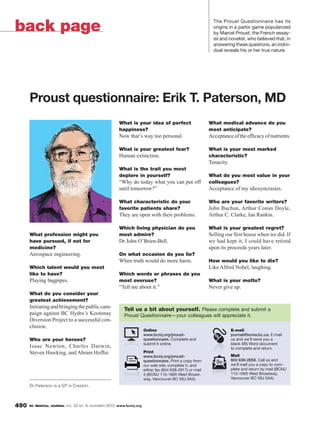
Proust questionnaire: Erik T. Paterson, MD
30%
Cert no. SW-COC-002226
Established 1959
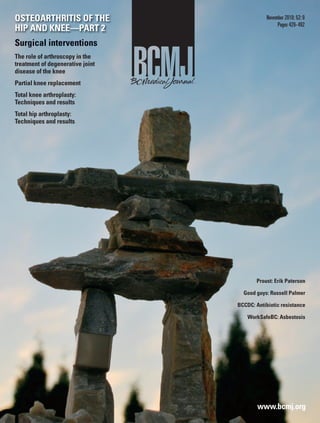
ON THE COVER: Part 2 of
our special series on OA of
the hip and knee focuses
on surgical interventions.
With the ongoing improve-
ment in outcomes and the
advent of predictable and
durable surgical technique,
younger patients are re-
questing the pain relief and
improved quality of life af-
forded by these operations.
Artwork by Jerry Wong.
ECO-AUDIT:
Environmental benefits of using recycled paper
Using recycled paper made with post-
consumer waste and bleached without the use
of chlorine or chlorine compounds results in
measurable environmental benefits. We are
pleased to report the following savings.
1399 pounds of post-consumer waste used
instead of virgin fibre saves:
• 8 trees
• 760 pounds of solid waste
• 837 gallons of water
• 1091 kilowatt hours of electricity (equivalent:
1.4 months of electric power required by the
average home)
• 1382 pounds of greenhouse gases (equivalent:
1119 miles traveled in the average car)
• 6 pounds of HAPs, VOCs, and AOX combined
• 2 cubic yards of landfill space
November 2010
Volume 52• Number 9
Pages 429–492
Enter to Win an iPad from
www.bcmj.org
www.bcmj.org VOL. 52 NO. 9, NOVEMBER 2010 BC MEDICAL JOURNAL 431431
© British Columbia Medical Journal, 2010. All rights reserved. No part of this journal may be re-
produced, stored in a retrieval system, or transmitted in any form or by any other means—elec-
tronic, mechanical, photocopying, recording, or otherwise—without prior permission in
writing from the British Columbia Medical Journal. To seek permission to use BCMJ material in any
form for any purpose, send an e-mail to journal@bcma.bc.ca or call 604 638-2815.
The BCMJ is published 10 times per year by the BC Medical Association as a vehicle for
continuing medical education and a forum for association news and members’opinions. The BCMJ
is distributed by second-class mail in the second week of each month except January and August.
Prospective authors should consult the “Guidelines forAuthors,” which appears regularly in the Jour-
nal, is available at our web site at www.bcmj.org, or can be obtained from the BCMJ office.
Statements and opinions expressed in the BCMJ reflect the opinions of the authors and not nec-
essarily those of the BCMA or the institutions they may be assoicated with. The BCMA does not as-
sume responsibility or liability for damages arising from errors or omissions, or from the use of
information or advice contained in the BCMJ.
The BCMJ reserves the right to refuse advertising.
Subscriptions
Single issue ................................................................................................................................$8.00
Canada per year........................................................................................................................$60.00
Foreign (surface mail)..............................................................................................................$75.00
Postage paid at Vancouver, BC. Canadian Publications Mail, Product Sales Agreement #40841036.
Return undeliverable copies to BC Medical Journal, 115-1665 West Broadway, Vancouver, BC V6J
5A4; tel: 604 638-2815; e-mail: journal@bcma.bc.ca
US POSTMASTER: BCMJ (USPS 010-938) is published monthly, except for combined issues Janu-
ary/February and July/August, for $75 (foreign) per year, by the BC MedicalAssociation c/o US Agent-
Transborder Mail 4708 Caldwell Rd E, Edgewood, WA 98372-9221. Periodicals postage paid at
Puyallup, WA. USA and at additional mailing offices. POSTMASTER: Send address changes
to BCMJ c/o Transborder Mail, PO Box 6016, Federal Way, WA 98063-6061, USA.
#115–1665 West Broadway, Vancouver, BC, Canada V6J 5A4
Tel: 604 638-2815 or 604 638-2814 Fax: 604 638-2917
E-mail: journal@bcma.bc.ca Web: www.bcmj.org contents
Advertisements and enclosures carry no endorsement of the BCMA or BCMJ.
EDITOR
David R. Richardson, MD
EDITORIAL BOARD
David B. Chapman, MBChB
Brian Day, MB
Susan E. Haigh, MD
Lindsay M. Lawson, MD
Timothy C. Rowe, MB
Cynthia Verchere, MD
EDITOR EMERITUS
Willem R. Vroom, MD
MANAGING EDITOR
Jay Draper
PRODUCTION COORDINATOR
Kashmira Suraliwalla
EDITORIAL ASSISTANT
Tara Lyon
COPY EDITOR
Barbara Tomlin
PROOFREADER
Ruth Wilson
COVER CONCEPT & ART
Peaceful Warrior Arts
DESIGN AND PRODUCTION
Olive Design Inc.
PRINTING
Mitchell Press
ADVERTISING
OnTrack Media
Tel: 604 375-9561
bcmj@ontrackco.com
302–70 E. 2nd Ave.
Vancouver, BC V5T 1B1
ISSN: 0007-0556
D E P A R T M E N T S
437 College Library
Best evidence: The tip of the information iceberg
Karen MacDonnell, Judy Neill
465 BC Centre for Disease Control
Your irresistible personal portrait: A way to reduce antibiotic resistance?
David M. Patrick, MD, Malcolm Maclure, ScD, Bill Mackie, MD, Rachel McKay, MSc
470 General Practice Services Committee
Divisions of Family Practice address community needs, improve care at
local level, Brian Evoy, PhD
472 In Memoriam
Dr Norman Wignall, Norman Wignall Jr.
472 Pulsimeter
New BC-wide surgery booking system (472); Online stroke information
(472); BC Genome Sciences Centre advances, Judy Hamill (473); BCPRA
education course for GPs, Michael Schachter, MD (473); Don Rix leadership
award announced (474); Call for nominations: BCMA and CMA special
awards (475); Signs of Stroke materials available for physicians, Susan
Pinton (479); Body Worlds and the Brain exhibition, Lloyd Oppel, MD (479)
476 WorkSafeBC
Asbestosis: A persistent nemesis, Sami Youakim, MD
477 Council on Health Promotion
Emergency departments: Are they considered a safe haven from prosecution
for impaired drivers involved in fatal or personal injury crashes?
Roy Purssell, MD, Luvdeep Mahli, Robert Solomon, LLB, Erika Chamberlain, LLB
480 Calendar
483 Classifieds
486 Advertiser Index
489 Club MD
BC MEDICAL JOURNAL VOL. 52 NO. 9, NOVEMBER 2010 www.bcmj.org432
D
oyouthinkit’snormalforyour
dentisttocheckyourprostate?”
I ask the new hygienist. “Be-
cause Dr Plaque checks mine every
time I come in.”
At this point, somewhat alarmed,
the hygienist glances at the last entry
in my chart, under which, while unat-
tended, I have written, “prostate nor-
mal.” After I explain my little joke to
theslightlycreeped-outyoungwoman,
all my appointments go pretty much
the following way.
“You haven’t had X-rays for a
while so we should do them.”
“Why?”
“Well, Dr Plaque likes to have
them done periodically to check on
things.”
“Well, then Dr Plaque can pay for
them.” I don’t think the dentist likes
me.
Imagine, doing a periodic X-ray to
check on things. This has always been
frowned upon in our profession. How-
ever,wearenowonthecrestofabrave
new scanning wave. Patients can pay
privately for almost any scan imagi-
nable. Then with the scans and reports
in hand they come to us for advice.
The problem is that nobody really
knows what to do with the results.
Randomized controlled trials that
investigate the impact of routine diag-
nostic imaging on mortality and mor-
bidity are scarce. So what does one do
with an otherwise healthy 50-year-old
man who pays privately for a coro-
nary CT that shows calcifications? Do
you order a stress test, exercise MIBI,
angiogram,orjustmonitorandencour-
age risk-factor modification (which is
what was prescribed prior to the scan
anyways)? How about tiny renal or
lung lesions? What about small cere-
bral ischemic changes? The list goes
on. Private companies are happy to do
the scans, but what is the next step?
Patients are signing up for virtual col-
onoscopies, ultrasounds, CTs, PET
scans, carotid dopplers, and more in
ever-increasing numbers.
Let’snotforgetmagneticresonance
imaging (MRI). Oh, how I hate those
three letters. It doesn’t seem to matter
what the patient’s problem is, eventu-
ally they always come to the conclu-
sion (based on the expert advice of
editorials
Invasion of the body scanners
their lawyer, spouse, parents, physio,
massage therapist, barista, or garden-
er) that they need an MRI just in case
something is being missed. This hap-
pens despite my explanation that an
MRI won’t aid in the diagnosis of their
ingrown toenail or make their obesity-
related back pain go away. I am con-
sidering purchasing a big magnet to
glide over people while I make a
humming noise. I will then give them
a stick drawing of the appropriate
injured area and bill them for a dis-
count MRI.
Technological advances are often
a good thing, but some rational judg-
ment must be applied. There is still
an art to practising medicine, an art
that can be intriguing, satisfying, and
alluring. I’m calling for the use of
good old common sense.Agood ques-
tion to ask is, “Is the management of
this patient likely to change depend-
ing on the outcome of this test?” If
not, don’t do it. If your patients remain
dissatisfied, send them to my newly
opened discount MRI clinic.
—DRR
“
www.bcmj.org VOL. 52 NO. 9, NOVEMBER 2010 BC MEDICAL JOURNAL 433
W
e are approaching the end
of an era at our community
hospital. As you read this
line, you may be expecting a lament
on the death of the full-service family
physician. The family doctor who has
an office practice, hospital privileges,
does house calls, does palliative care,
delivers babies, and perhaps also does
ER work. The dinosaur that has previ-
ously been described in these pages,
and whose imminent demise has been
much lamented. This would be a rea-
sonable thought.
It may also be reasonable to expect
an essay on the demise of the commu-
nity hospital. I expect that this may
happen soon in the new era of “pro-
gram management.” The new buzz-
words in our health authority seem to
be carving our once unified hospital
into separate silos of health care deliv-
ery. Our interdependent departments
such as obstetrics, pediatrics, anesthe-
sia, and surgery are being managed
and directed by individuals who are
not on site full-time because they have
too much on their plates and have to
manage and direct multiple hospital
sites and programs.
But, alas no. I am going on about
the imminent loss of an indispensible
person at our hospital, our medical
staff secretary who for approximately
the past 17 years has been doing her
job with amazing dedication. Unfor-
tunately, she is retiring and her posi-
tion is not going to be filled.
I must be getting old. I find myself
reflecting more and more about how
things used to be. I am becoming one
of the When we generation. You know
who you are. You start sentences with
When we, such as, “When we started
at this hospital…” It is true.
When I started at my hospital 20
years ago, I applied for hospital privi-
leges through the medical staff secre-
tary. It was the medical staff secretary
who organized my pager for me, as
well as the multiple replacements I
have needed over the years. She
reminded me that my annual dues
were overdue, as was my annual reap-
plication for hospital privileges. The
medical staff secretary took minutes
at our medical staff meetings (and
many other committee meetings); she
coordinated our on-call schedules and
notified others of the changes that we
seemed to make so frequently. The
medical staff secretary updated our
hospital’s physician directory, an
indispensible tool for us and our office
staff. She was the “go to” person at
our hospital when one had a question
or a problem. She coordinated weekly
educationsessionsforphysicians.Our
medical staff secretary managed our
medical staff bank accounts and
administered the scholarships our
hospital medical staff gives to worthy
medical students each year.
Herjobdescriptionhasbeenchang-
ed by the hospital administration. She
editorials
The end of an era
is no longer supposed to be doing the
things she has done for the medical
staff for the last 17 years. She has out-
lasted every other secretary in the hos-
pital. She has gone above and beyond
on many occasions, quietly and effi-
ciently. She is due to retire shortly.
The glue that holds our hospital’s
medical staff together is about to be
dissolved.
By the time we realize what we
have lost, it will be too late. From one
dinosaur to another: Have a well-
deserved retirement, Marcy. You have
certainly earned it. We will all miss
you. It won’t be same around here any
more. —DBC
Linda Berti
604.291.2266
1.877.311.2266
lindab@cartergm.com
4550 Lougheed Hwy
Burnaby, BC
ALL makes and models!
(Honda, BMW, GM, Ford, Subaru, etc.)
Lowest prices.
No need to negotiate
Quick and convenient.
Over the phone, by email or in person
Car shopping that’s stress free.
The glue that holds our
hospital’s medical staff
together is about to
be dissolved.
BC MEDICAL JOURNAL VOL. 52 NO. 9, NOVEMBER 2010 www.bcmj.org434
A
s long ago as 1999, the Sup-
reme Court of Canada decid-
ed in the case of Terry Gris-
mer to instruct all motor vehicle
licensing authorities to make fitness-
to-drive decisions on the basis of
functional capacity, not simply by
diagnosis, as had been done previous-
ly. Mr Grismer was the operator of a
mining truck and wanted to continue
his employment after a stroke pro-
duced a homonymous hemianopsia
that eliminated most of his left-side
peripheral vision in both eyes. Al-
though, sadly, Mr Grismer died while
the human rights legal challenge was
making its way through subsequent
levels of court, his estate pursued the
matter to this conclusion.
In our province, the Office of
the Superintendent of Motor Vehicles
(OSMV) then began a consultation
process and planned for the publica-
tion of a new BC Guide in Determin-
ing Fitness to Drive to replace the
1997 edition. After a long consulta-
tion period, in which many doctors
volunteered their time, the new edi-
tion was published online in July
2010. It was always the intention to
also publish a condensed and user-
friendly guide for physicians, as the
full edition was aimed more toward
the needs of regulators. This task has
now been delayed until at least 2011,
with no announced plan for medical
editing and consultation.
At the time of this writing, the
BCMA does not know when and how
the new Guide will be implemented.
ThefirstreadingofBill14–TheMotor
VehicleAmendmentAct, 2010, in part
21, provided for government to set out
by regulation the medical conditions
or functional impairments that oblige
a physician or other health profes-
sional to report.
Doctors can feel uncomfortable
balancing the mobility needs of a
patient against the potential risk to
public and patient safety when con-
sidering whether and what to report.
In my experience, a lot of the risk is
related to the driver’s level of insight.
A “safe enough driver” is aware of
any cognitive limitations and has the
judgment and willingness to adapt his
or her driving to these limitations. The
most dangerous situations are those in
which the driver denies or minimizes
the reduction in his or her functional
capacity and makes no accommoda-
tion for it.
When facing such complex deci-
sions it has been very helpful for BC
physicians to know they could contact
a medical consultant employed by the
OSMV. The OSMV used to have two
part-time medical consultants on staff.
For the past 10 years, Dr John Mc-
Cracken provided this valuable serv-
ice; however, his contract was not to
be renewed. The BCMA and the Col-
lege of Physicians and Surgeons of
BC have jointly written to the OSMV
to highlight this concern and request a
meeting. With the demographics of an
aging population and more crowded
roadways this is a time that we need
more medical consultation available
—not less.
Meanwhile,DriveABLEisthetest
that the OSMV has contracted with
the BC Automobile Association to
provideobjectiveinformationtoassist
in decision making when there is
a concern about cognitive function.
The OSMV is also proposing to use
SIMARD-MD, a brief pencil-and-
paper test, to assist health care pro-
viders in rapid screening of patients.
This approach has been used in a lim-
ited way inAlberta. We await the start
of a proposed pilot study in BC.
Functional capacity is much more
than the score on a test—without a
mechanism for meaningful and trust-
ed consultation we run the risk of even
more rigidity in fitness to drive deter-
minations than existed when only
diagnosis was used.
The BCMA’s Board of Directors
was kept regularly informed during
the preparation of the OSMV’s cur-
rent Guide, but the BCMA was never
advised of plans to discontinue the
role of medical consultant or the use
of medical appeals. We need to find a
way to address this social and medical
issue together and not lose many years
of medical “corporate memory” and a
spirit of collaboration, as we move
ahead.
—Ian Gillespie, MD
BCMA President
Determining fitness to drive: A troublesome task
comment
www.bcmj.org VOL. 52 NO. 9, NOVEMBER 2010 BC MEDICAL JOURNAL 435
Re: Medical
marijuana
W
hile Health Canada has
delegated responsibility to
physicians to recommend
the use of cannabis for access to their
legal program, it has clearly abdicated
its responsibility to educate doctors to
ensure their medical opinion is more
informed than that of DrVroom [Med-
ical marijuana. BCMJ 2010;52:329].
As a result, Dr Vroom is not alone
is his lack of knowledge about the
medical use of cannabis. During our
many years working and conducting
research at both the British Columbia
Compassion Club Society and the
Vancouver Island Compassion Soci-
ety, we have heard the other side of
doctor-patientdynamicthatDrVroom
describes.
Many patients report having an
extremely difficult time obtaining
support from their physicians for the
use of this medicine, or even dis-
cussing this legitimate health option.
This deeply affects the doctor-patient
relationship, causing patients unnec-
essary stress and creating an atmos-
phere of shame and distrust. Sadly,
many patients find themselves in the
role of having to educate their doctors.
Cannabis is a legal therapy option
officially sanctioned by the federal
government.Itisnotaphysician’srole
to decide what is or isn’t a medicine,
but rather to discuss the suitability of
treatment options on a case-by-case
basis.Inapreviouseditorial,DrVroom
stated,“Iamnotafraidtokeepanopen
mind about remedies I know nothing
about, but I research their scientific
evidence.”1 DrVroomseemstobemak-
ingan exception for medical cannabis.
Thousands of peer-reviewed sci-
entific studies have been published on
the use of cannabis to treat many dif-
ferent conditions and symptoms—as
personal view
Letters for Personal View are welcomed.
They should be double-spaced and less
than 300 words. The BCMJ reserves the
right to edit letters for clarity and length.
Letters may be e-mailed (journal@bcma
.bc.ca), faxed (604 638-2917), or sent
through the post.
MARKET LOSS RECOVERY GROUPMARKETT LOSS RECOV Y GROUPRVE
Continued on page 436
BC MEDICAL JOURNAL VOL. 52 NO. 9, NOVEMBER 2010 www.bcmj.org436
both symptom relief for conditions
like chronic pain and to slow disease
progression. For starters, we suggest
that Dr Vroom might check out the
Canadians for Safe Access (CSA)
research page (http://safeaccess.ca/
research/), or consider attending an
upcoming accredited course by the
Canadian Consortium for the Investi-
gation of Cannabinoids (www.ccic
.net/registeronline).
—Rielle Capler, MHA
—Philippe Lucas, MA
Co-founders, Canadians
for Safe Access
Reference
1. Vroom WR. Naturopath prescribing: The
hill to die on. BC Med J 2009;51:101.
Dr Vroom responds
Ms Capler and Mr Lucas are correct
about my lack of knowledge of mari-
juana pharmacology. Their recom-
mended web site has, unfortunately,
not educated me any further.
The whole crux of my editorial
was to acknowledge that I have no
knowledge about all of the actions of
the 60-plus cannabinoids contained in
a joint, nor of their potency or con-
centration. That makes endorsing, let
alone prescribing, a substance such as
this problematic for me. I pointed out
that the only legal way to access mar-
ijuana is by the recognized indications
contained in the Health Canada Form
B1andpalliativesituations.MsCapler
and Mr Lucas maintain that it is not
for physicians to decide what is or
isn’t medicine. Maybe so, but there
are many medicines that I won’t pre-
scribe. And that is my right. Just
because Health Canada has created
“medical marijuana” as an escape
from advocacy group pressure doesn’t
mean that I have to accept their prob-
lem as now being mine.
Marijuana has an excellent reputa-
tion for being a recreational drug. I am
sure that, some day, research will lead
us to completely understand all of its
actions. Perhaps we may even see it
legitimized for recreational use. In
the meantime call it “experimental
marijuana,” “research marijuana,” or
“palliative marijuana”—anything but
“medical marijuana.”
—WRV
CMPA position
WhenweaskedfortheCanadianMed-
ical Protective Association’s position
on the topic of prescribing marijuana,
Luce Lavoie, the director of commu-
nications at the CMPA, directed us to
their statement entitled, “Marijuana
for medical reasons: The Medical
Declaration form,” originally pub-
lished October 2001, revised Septem-
ber 2009. Here is the introduction:
“Marijuana is not approved for use
as a drug in Canada. Health Canada
states that “no marijuana product has
been issued a notice of compliance”
and notes that indications, safety and
risks have not been adequately stud-
personal view
“MCI takes care of everything
without telling me how to
run my practice”.
Toronto – Calgary – Vancouver
MCI Medical Clinics Inc.
MCI means freedom:
I remain independent
Continued from page 435
www.bcmj.org VOL. 52 NO. 9, NOVEMBER 2010 BC MEDICAL JOURNAL 437
ied and the appropriate dosage is
unclear.
“Many regulatory authorities
(Colleges) have considered these
facts. Some have stated clearly that
physicians should not support an
application for the medical use of
marijuana, while others have cho-
sen to simply remind their mem-
bers of the importance of evidence-
based medicine and the lack of
evidence about the benefits and
risks of this substance.
“However, patients who believe
that marijuana is effective for treat-
ing certain symptoms from which
they suffer can apply to Health
Canada for authorization to pos-
sess and use marijuana under the
Marijuana Medical Access Regu-
lations (the Regulations). Those
Regulations require the applicant
(patient) to submit two declara-
tions, one of which is the appli-
cant’s and the other a Medical Dec-
laration signed by the applicant’s
medical practitioner.”
The full statement is available
at www.cmpaacpm.ca/cmpapd04/
docs/resource_files/infosheets/20
09/com_is09103-e.cfm.
—ED
personal view
By BC physicians, for BC physicians
GPAC clinical practice guidelines are
now available in iPod Touch and
iPhone format — FREE!
This free application contains over 30 clinical practice guidelines in
abridged format. It serves as a condensed, portable companion to the
full clinical practice guidelines found at www.BCGuidelines.ca, where over
50 guidelines are available in a range of formats. Download app from:
http://itunes.apple.com/us/app/bc-guidelines/id377956292?mt=8
I
ncorporatinghigh-qualityevidence
into clinical decision making re-
quiressystematicsearching,apprais-
ing, and synthesizing of the literature.
Performing these complex and time-
consuming tasks on a regular basis
is beyond reasonable expectations
for busy physicians, so using existing
sources of evidence-based informa-
tion, particularly systematic reviews,
is helpful. Unlike traditional narrative
reviews that are generally written by a
few authors who subjectively select
literaturetocommentonabroadtopic,
systematic reviews tend to be pro-
duced by a team that endeavors to
search the literature on a narrow clin-
ical question in an unbiased and repro-
duciblemannerandanalyzethesearch
results according to explicit criteria.
Two initiatives of note that produce
carefully synthesized and appraised
systematic reviews are Clinical Evi-
dence from BMJ Publishing Group
and the Cochrane Collaboration. Both
tendtofocusonthebenefitsandharms
of clinical interventions.
ClinicalEvidence,createdin1999,
summarizessystematicreviews,RCTs,
and observational studies, and states
college library
Best evidence: The tip of the information
iceberg
the current view on what is known and
unknown about specific aspects of
disease management. Conveniently,
patient leaflets on general topics sup-
plement the more precisely focused
systematic reviews. Clinical Evidence
is both a stand-alone publication as
well as a component of BMJ Point of
Care. The Cochrane Collaboration, a
distinctandindependentorganization,
has been producing the Cochrane
Database of Systematic Reviews since
1993. The Collaboration is not-for-
profit, funded by agencies such as
universities, charities, and personal
donations. Like Clinical Evidence,
Cochrane reviews tend to focus on the
risks and benefits of therapeutic inter-
ventions. Both of these resources are
available for free to all College mem-
bers at www.cpsbc.ca/library.
In addition the College Library
offers workshops on identifying and
effectively searching high-quality
medical evidence, and we are also
happy to arrange one-on-one learning
sessions with College members.
—Karen MacDonell, Judy Neill
Librarians/Co-Managers, College of
Physicians and Surgeons of BC Library
BC MEDICAL JOURNAL VOL. 52 NO. 9, NOVEMBER 2010 www.bcmj.org438
I
n the first part of this two-part
theme issue, we discussed the
etiology, diagnosis, and nonoper-
ative treatment of osteoarthritis
(OA). While the majority of patients,
particularlythosewithsmalljointOA,
respond to nonoperative treatment,
surgical treatment is required in an
increasing proportion of patients with
large joint OA. With the ongoing im-
provements in outcomes and with the
advent of very predictable and durable
surgical technique, younger patients
with OA are requesting the pain relief
and the improved quality of life
afforded by these operations.
Hips and knees continue to be the
joints most commonly affected and
requiring surgical intervention. His-
torically, hip and knee joint replace-
ment were reserved for older patients,
and it was not uncommon to hear
patients complaining that they were
deniedsurgerybecausetheywere“too
young.” In the past, with the limited
durability of joint replacement, that
was a reasonable strategy to protect
patients from failed joint replacement
down the road. Today, however, tech-
niques for first-time joint replacement
have improved so significantly that
we can offer joint replacements with
predictable longevity, with fewer
complications, and with less severe
failures. Moreover, revision surgical
techniques have also improved to the
point where even when joint replace-
ments fail, they can be predictably
reconstructed in the majority of
patients.
Inthearticlesthatfollow,webegin
with an overview by Dr McCormack,
who describes the role of arthroscopy
in early OAof the knee. Because knee
OA often presents with isolated dis-
ease in one of the three compartments
of the knee, we continue with Dr
Schweigel’s discussion of partial knee
replacement. DrWilliams, Dr Garbuz,
and I then consider total knee replace-
ment. We finish with Dr Burnett’s
article about hip replacement and
resurfacing.
With the increasing success of hip
and knee replacement, demand will
continue to increase. It is my hope that
the articles in this two-part theme
issue will put the topic of hip and knee
osteoarthritis in perspective. I am
extremely grateful for the contribu-
tions of the various authors who have
done an excellent job of summarizing
this vast topic in a clear and concise
manner.
—B.A. Masri, MD, FRCSC
Professor and Head
Department of Orthopaedics
University of British Columbia
Guest editorial: Osteoarthritis of
the hip and knee, Part 2:
Surgical interventions
Guest editorial
Dr B.A. Masri
www.bcmj.org VOL. 52 NO. 9, NOVEMBER 2010 BC MEDICAL JOURNAL 439
ABSTRACT: Degenerative joint dis-
ease is a common cause of knee
symptoms and disability. The indica-
tion to proceed to surgery is usually
the failure of standard nonsurgical
treatments. Despite the success of
joint replacement surgery, many cli-
nicians choose to avoid this large,
complex surgery if a minimally inva-
sive ambulatory procedure can allow
a patient to improve function and
quality of life. This has led to the fre-
quent use of arthroscopy to treat
degenerative joints, especially knee
joints. While a “scope” does qualify
as minimally invasive, it is still im-
portant to consider the ratio of risks
to benefits and the efficacy of arthro-
scopic debridement for degenera-
tive joint disease of the knee.
T
he impact of osteoarthritis
on the health care system is
significant and continues to
growasourpopulationages.
As there is no cure for degenerative
joint disease (DJD), medical interven-
tions have focused on symptom con-
trol. Unfortunately, none of the non-
operative measures are universally
successful and some have significant
risks. A minimally invasive day-care
procedure that improves patient func-
tion and delays more extensive recon-
struction is appealing. Arthroscopy is
the most commonly performed ortho-
paedic procedure, one often associat-
ed with knee ligament reconstruction
and treatment of meniscal tears. In
addition, some estimates suggest that
over 500 000 arthroscopies are per-
formed in North America each year
for the treatment of degenerative joint
disease.1 Recent studies have ques-
tioned the role of this procedure in the
treatment of osteoarthritis, and there
is a general consensus that it has been
overused in the past. The goal of this
article is to address the role of arthro-
scopic surgery in patients who have
degenerative joint disease in the knee.
Proposed benefits
It has been proposed that arthroscopic
lavage (wash out) of the knee joint can
improve patient status by washing out
inflammatory cytokines, cartilage frag-
ments, and other debris from the joint.
Formal joint debridement has also
been reported to improve patient
status by smoothing off unstable flaps
of articular cartilage and possibly
improving the weight distribution of
the remaining articular cartilage.2
On the one hand, if there is an
unstable meniscal fragment that is
causing mechanical symptoms, such
as locking, pain with sudden turns, or
sharp intermittent pain, an arthrosco-
py can address that component of the
patient’s symptoms by trimming the
unstable fragment. On the other hand,
it is difficult to quantify the benefit of
arthroscopic repair of the arthritic
knee given the inability during arthro-
scopy to actually perform biological
resurfacing in the face of diffuse
degenerative changes and the ex-
tremely variable course of DJD.
Recent studies
Most of the orthopaedic studies re-
garding the role of arthroscopy in the
treatment of DJD are of low quality
and suffer from the same shortcom-
ings seen in many other areas of med-
icine: variable selection criteria, incon-
sistent outcome measures, different
surgical techniques, and publication
The role of arthroscopy in the
treatment of degenerative joint
disease of the knee
Recent studies question the benefits of arthroscopic debridement for
managing patients with osteoarthritis affecting a weight-bearing joint.
Robert McCormack, MD, FRCSC
Dr McCormack is an associate professor in
the Department of Orthopaedics at the Uni-
versity of British Columbia.
BC MEDICAL JOURNAL VOL. 52 NO. 9, NOVEMBER 2010 www.bcmj.org440
attention because patients were ran-
domized to one of three arms: arthro-
scopic lavage, arthroscopic debride-
ment, or sham operation. The patients
were assessed by a blinded independ-
ent assessor and the key finding was
that there was no significant differ-
ence in pain or function between the
sham operation and either of the
arthroscopic surgery groups. As inter-
esting as the results were, the design
of the trial also captured a lot of atten-
tion.Theplaceboeffectofsurgerywas
neutralized by giving the patients in
the sham operation an anaesthetic and
creating the standard arthroscopic
portals, without performing any sur-
gery inside the knee.
The Moseley study created a furor
among orthopaedic arthroscopists.
Many criticized the design of the
study and the fact that all subjects
were males (in a female-dominated
disease) and all came from a Veterans
Affairs hospital (equivalent to work-
ers’ compensation patients). There
were concerns that the patients had
more severe disease than average and
that the authors used a nonvalidated
outcome measure. Nevertheless, sev-
eral societies, including the American
Rheumatological Association, came
out with position statements that
arthroscopy did not have a role in the
treatment of osteoarthritis.
This controversy spawned further
trials in a number of centres, and re-
cently a prospective randomized clin-
ical trial from the University of West-
ern Ontario was published, again in
the New England Journal of Medi-
cine.6 This Canadian trial by Kirkley
and colleagues randomized patients to
optimal medical treatment or optimal
medical treatment plus arthroscopic
debridement. The researchers defined
the grade of arthritis more precisely
and ensured that limb malalignment
was not significant. The patients in
both groups had similar age, BMI, and
length of follow-up. Importantly, the
researchers excluded patients with
significant meniscal tears that were
causing mechanical symptoms. The
primary outcome was the validated,
disease-specificWOMAC score.7 The
bottom line is that the trial addressed
most of the criticisms of the Moseley
trial. Interestingly, at 2 years follow-
up, the WOMAC scores were not sta-
tistically different (P = .22) and with
an absolute difference of less than 1%
that did not meet the threshold of a
clinically significant difference.
Significance of findings
What do these findings mean to the
clinician? Degenerative joint disease
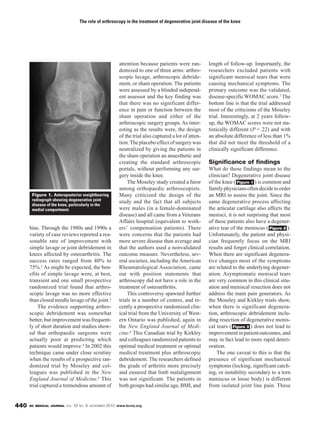
of the knee ( ) is common and
familyphysiciansoftendecidetoorder
an MRI to assess the joint. Since the
same degenerative process affecting
the articular cartilage also affects the
menisci, it is not surprising that most
of these patients also have a degener-
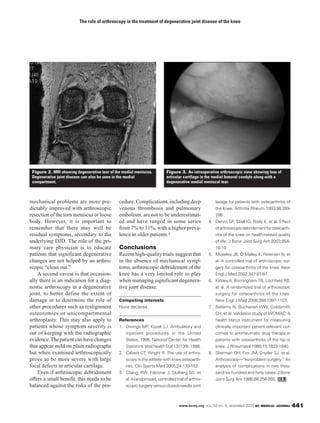
ative tear of the meniscus ( ).
Unfortunately, the patient and physi-
cian frequently focus on the MRI
results and forget clinical correlation.
When there are significant degenera-
tive changes most of the symptoms
are related to the underlying degener-
ation. Asymptomatic meniscal tears
are very common in this clinical situ-
ation and meniscal resection does not
address the main pain generators. As
the Moseley and Kirkley trials show,
when there is significant degenera-
tion, arthroscopic debridement inclu-
ding resection of degenerative menis-
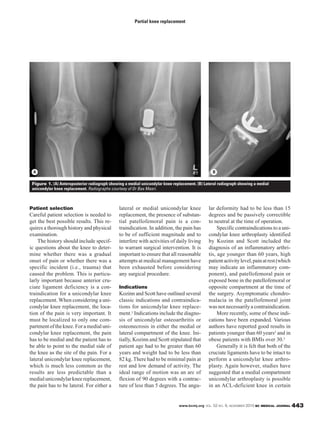
cal tears ( ) does not lead to
improvementinpatientoutcomes,and
may in fact lead to more rapid deteri-
oration.
The one caveat to this is that the
presence of significant mechanical
symptoms (locking, significant catch-
ing, or instability secondary to a torn
meniscus or loose body) is different
from isolated joint line pain. These
Figure 3
Figure 2
Figure 1
The role of arthroscopy in the treatment of degenerative joint disease of the knee
bias. Through the 1980s and 1990s a
variety of case reviews reported a rea-
sonable rate of improvement with
simple lavage or joint debridement in
knees affected by osteoarthritis. The
success rates ranged from 40% to
75%.2 As might be expected, the ben-
efits of simple lavage were, at best,
transient and one small prospective
randomized trial found that arthro-
scopic lavage was no more effective
than closed needle lavage of the joint.3
The evidence supporting arthro-
scopic debridement was somewhat
better, but improvement was frequent-
ly of short duration and studies show-
ed that orthopaedic surgeons were
actually poor at predicting which
patients would improve.4 In 2002 this
technique came under close scrutiny
when the results of a prospective ran-
domized trial by Moseley and col-
leagues was published in the New
England Journal of Medicine.5 This
trial captured a tremendous amount of
Figure 1. Anteroposterior weightbearing
radiograph showing degenerative joint
disease of the knee, particularly in the
medial compartment.
www.bcmj.org VOL. 52 NO. 9, NOVEMBER 2010 BC MEDICAL JOURNAL 441
mechanical problems are more pre-
dictably improved with arthroscopic
resection of the torn meniscus or loose
body. However, it is important to
remember that there may well be
residual symptoms, secondary to the
underlying DJD. The role of the pri-
mary care physician is to educate
patients that significant degenerative
changes are not helped by an arthro-
scopic “clean out.”
A second caveat is that occasion-
ally there is an indication for a diag-
nostic arthroscopy in a degenerative
joint, to better define the extent of
damage or to determine the role of
other procedures such as realignment
osteotomies or unicompartmental
arthroplasty. This may also apply to
patients whose symptom severity is
out of keeping with the radiographic
evidence.Thepatientcanhavechanges
that appear mild on plain radiographs
but when examined arthroscopically
prove to be more severe with large
focal defects in articular cartilage.
Even if arthroscopic debridement
offers a small benefit, this needs to be
balanced against the risks of the pro-
cedure.Complications,includingdeep
venous thrombosis and pulmonary
embolism, are not to be underestimat-
ed and have ranged in some series
from 7% to 31%, with a higher preva-
lence in older patients.8
Conclusions
Recent high-quality trials suggest that
in the absence of mechanical symp-
toms, arthroscopic debridement of the
knee has a very limited role to play
when managing significant degenera-
tive joint disease.
Competing interests
None declared.
References
1. Owings MF, Kozak LJ. Ambulatory and
inpatient procedures in the United
States, 1996. National Center for Health
Statistics.VitalhealthStat13(139).1998.
2. Calvert GT, Wright R. The use of arthro-
scopy in the athlete with knee osteoarth-
ritis. Clin Sports Med 2005;24:133-152.
3. Chang, RW, Falconer J, Stulberg SD, et
al.Arandomized,controlledtrialofarthro-
scopic surgery versus closed-needle joint
lavage for patients with osteoarthritis of
the knee. Arthritis Rheum 1993;36:289-
296.
4. Dervin GF, Stiell IG, Rody K, et al. Effect
ofarthroscopicdebridementforosteoarth-
ritis of the knee on health-related quality
of life. J Bone Joint Surg Am 2003;85A:
10-19.
5. Moseley JB, O’Malley K, Petersen N, et
al. A controlled trial of arthroscopic sur-
gery for osteoarthritis of the knee. New
Engl J Med 2002;347:81-87.
6. Kirkley A, Birmingham TB, Litchfield RB,
et al. A randomized trial of arthroscopic
surgery for osteoarthritis of the knee.
New Engl J Med 2008;359:1097-1107.
7. Bellamy N, Buchanan WW, Goldsmith
CH, et al. Validation study of WOMAC: A
health status instrument for measuring
clinically important patient relevant out-
comes to antirheumatic drug therapy in
patients with osteoarthritis of the hip or
knee. J Rheumatol 1988;15:1833-1840.
8. Sherman OH, Fox JM, Snyder SJ, et al.
Arthroscopy—“no-problemsurgery.”An
analysis of complications in two thou-
sand six hundred and forty cases: J Bone
Joint Surg Am 1986;68:256-265.
The role of arthroscopy in the treatment of degenerative joint disease of the knee
Figure 2. MRI showing degenerative tear of the medial meniscus.
Degenerative joint disease can also be seen in the medial
compartment.
Figure 3. An intraoperative arthroscopic view showing loss of
articular cartilage in the medial femoral condyle along with a
degenerative medial meniscal tear.
BC MEDICAL JOURNAL VOL. 52 NO. 9, NOVEMBER 2010 www.bcmj.org442
ABSTRACT: Partial knee replace-
ments have come into and out of
favor over the past 60 years. There
has been renewed interest in partial
knee replacements in the armamen-
tarium for arthritic knees due to
increasingly good results. Partial
knee replacements include the uni-
condylar knee replacement and the
patellofemoral arthroplasty. These
partial knee replacements are indicat-
ed for specific, isolated arthritic por-
tions of the knee joint—specifically
the medial, lateral, or patellofemoral
portion of the joint. In carefully
selected patients outcomes are com-
parable to the results of total knee
replacements. Patient selection and
meticulous surgical technique are
likely the key to a good result in a par-
tial knee replacement.
P
artial knee replacements
are a form of knee arthro-
plasty that doesn’t replace
the entire knee (the femoral
condyles, tibial plateau, and patella).
These surgical interventions include
the patellofemoral arthroplasty and
the more common unicondylar knee
arthroplasty. Both procedures have
been available since the 1950s and
may be options for patients who have
osteoarthritis in one compartment of
the knee, do not have specific con-
traindications for these more conser-
vative procedures, and who have
failed to benefit from nonoperative
management of their osteoarthritis.
Unicondylar knee
arthroplasty
In the past, unicondylar knee replace-
ments fell out of favor primarily be-
cause of the surgical technique of the
time, which made conversion to a full
knee replacement difficult. However,
with the advent of minimally invasive
approaches for unicondylar knee
replacement, there has been renewed
interest in this procedure over the past
decade.
A unicondylar knee replacement
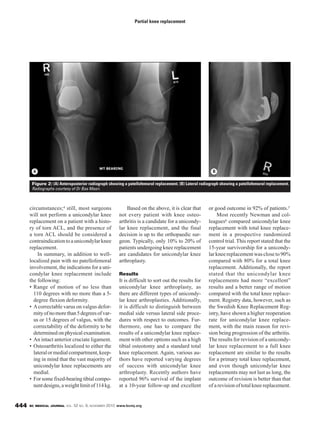
( ) consists of a metal compo-Figure 1
nent that goes on the femoral condyle,
and another component that goes on
the tibial side. The tibial component
can be metal-backed with a fixed-
bearing or mobile-bearing polyethyl-
ene bearing surface, or it can be an all-
polyethylene fixed-bearing cemented
component. There is no evidence that
one approach is better than another.
The rationale for considering a
unicondylar knee arthroplasty is that
it is a more conservative operation
with faster recovery, less resection of
bone, conservation of the cruciate lig-
aments, and potentially better func-
tion. In addition, conversion to a total
knee replacement down the road is
simple using modern techniques, with
outcomes similar to a primary knee
replacement. When appropriate, par-
tial knee arthroplasty can be thought
of as a time-buying operation.
In addition, a unicondylar knee
replacement is an alternative to other
invasive procedures such as a high
tibial osteotomy or a total knee
replacement.
Partial knee replacement
The last decade has seen renewed interest in unicondylar knee
arthroplasty and patellafemoral arthroplasty for patients with
osteoarthritis affecting one compartment of the knee.
Robert C. Schweigel, MD, FRCSC
Dr Schweigel is a clinical instructor in the
Department of Orthopaedics at the Univer-
sity of British Columbia.
www.bcmj.org VOL. 52 NO. 9, NOVEMBER 2010 BC MEDICAL JOURNAL 443
Patient selection
Careful patient selection is needed to
get the best possible results. This re-
quires a thorough history and physical
examination.
The history should include specif-
ic questions about the knee to deter-
mine whether there was a gradual
onset of pain or whether there was a
specific incident (i.e., trauma) that
caused the problem. This is particu-
larly important because anterior cru-
ciate ligament deficiency is a con-
traindication for a unicondylar knee
replacement. When considering a uni-
condylar knee replacement, the loca-
tion of the pain is very important. It
must be localized to only one com-
partmentoftheknee.Foramedialuni-
condylar knee replacement, the pain
has to be medial and the patient has to
be able to point to the medial side of
the knee as the site of the pain. For a
lateral unicondylar knee replacement,
which is much less common as the
results are less predictable than a
medialunicondylarkneereplacement,
the pain has to be lateral. For either a
lateral or medial unicondylar knee
replacement, the presence of substan-
tial patellofemoral pain is a con-
traindication. In addition, the pain has
to be of sufficient magnitude and to
interfere with activities of daily living
to warrant surgical intervention. It is
important to ensure that all reasonable
attempts at medical management have
been exhausted before considering
any surgical procedure.
Indications
Kozinn and Scott have outlined several
classic indications and contraindica-
tions for unicondylar knee replace-
ment.1 Indications include the diagno-
sis of unicondylar osteoarthritis or
osteonecrosis in either the medial or
lateral compartment of the knee. Ini-
tially, Kozinn and Scott stipulated that
patient age had to be greater than 60
years and weight had to be less than
82 kg. There had to be minimal pain at
rest and low demand of activity. The
ideal range of motion was an arc of
flexion of 90 degrees with a contrac-
ture of less than 5 degrees. The angu-
lar deformity had to be less than 15
degrees and be passively correctible
to neutral at the time of operation.
Specific contraindications to a uni-
condylar knee arthroplasty identified
by Kozinn and Scott included the
diagnosis of an inflammatory arthri-
tis, age younger than 60 years, high
patientactivitylevel,painatrest(which
may indicate an inflammatory com-
ponent), and patellofemoral pain or
exposed bone in the patellofemoral or
opposite compartment at the time of
the surgery. Asymptomatic chondro-
malacia in the patellofemoral joint
was not necessarily a contraindication.
More recently, some of these indi-
cations have been expanded. Various
authors have reported good results in
patients younger than 60 years2 and in
obese patients with BMIs over 30.3
Generally it is felt that both of the
cruciate ligaments have to be intact to
perform a unicondylar knee arthro-
plasty. Again however, studies have
suggested that a medial compartment
unicondylar arthroplasty is possible
in an ACL-deficient knee in certain
Partial knee replacement
Figure 1. (A) Anteroposterior radiograph showing a medial unicondylar knee replacement. (B) Lateral radiograph showing a medial
unicondylar knee replacement. Radiographs courtesy of Dr Bas Masri.
A B
BC MEDICAL JOURNAL VOL. 52 NO. 9, NOVEMBER 2010 www.bcmj.org444
circumstances;4 still, most surgeons
will not perform a unicondylar knee
replacement on a patient with a histo-
ry of torn ACL, and the presence of
a torn ACL should be considered a
contraindicationtoaunicondylarknee
replacement.
In summary, in addition to well-
localized pain with no patellofemoral
involvement, the indications for a uni-
condylar knee replacement include
the following:
• Range of motion of no less than
110 degrees with no more than a 5-
degree flexion deformity.
• Acorrectable varus on valgus defor-
mityofnomorethan5degreesofvar-
us or 15 degrees of valgus, with the
correctability of the deformity to be
determined on physical examination.
• An intact anterior cruciate ligament.
• Osteoarthritis localized to either the
lateralormedialcompartment,keep-
ing in mind that the vast majority of
unicondylar knee replacements are
medial.
• For some fixed-bearing tibial compo-
nentdesigns,aweightlimitof114kg.
Based on the above, it is clear that
not every patient with knee osteo-
arthritis is a candidate for a unicondy-
lar knee replacement, and the final
decision is up to the orthopaedic sur-
geon. Typically, only 10% to 20% of
patients undergoing knee replacement
are candidates for unicondylar knee
arthroplasty.
Results
It is difficult to sort out the results for
unicondylar knee arthroplasty, as
there are different types of unicondy-
lar knee arthroplasties. Additionally,
it is difficult to distinguish between
medial side versus lateral side proce-
dures with respect to outcomes. Fur-
thermore, one has to compare the
results of a unicondylar knee replace-
ment with other options such as a high
tibial osteotomy and a standard total
knee replacement. Again, various au-
thors have reported varying degrees
of success with unicondylar knee
arthroplasty. Recently authors have
reported 96% survival of the implant
at a 10-year follow-up and excellent
or good outcome in 92% of patients.5
Most recently Newman and col-
leagues6 compared unicondylar knee
replacement with total knee replace-
ment in a prospective randomized
control trial. This report stated that the
15-year survivorship for a unicondy-
larkneereplacementwascloseto90%
compared with 80% for a total knee
replacement. Additionally, the report
stated that the unicondylar knee
replacements had more “excellent”
results and a better range of motion
compared with the total knee replace-
ment. Registry data, however, such as
the Swedish Knee Replacement Reg-
istry, have shown a higher reoperation
rate for unicondylar knee replace-
ment, with the main reason for revi-
sion being progression of the arthritis.
The results for revision of a unicondy-
lar knee replacement to a full knee
replacement are similar to the results
for a primary total knee replacement,
and even though unicondylar knee
replacements may not last as long, the
outcome of revision is better than that
of a revision of total knee replacement.
Partial knee replacement
Figure 2: (A) Anteroposterior radiograph showing a patellofemoral replacement. (B) Lateral radiograph showing a patellofemoral replacement.
Radiographs courtesy of Dr Bas Masri.
A B
www.bcmj.org VOL. 52 NO. 9, NOVEMBER 2010 BC MEDICAL JOURNAL 445
Complications
The complications after a unicondylar
knee replacement are similar to a total
knee replacement. These complica-
tions include inadequate pain relief,
deep venous thrombosis in 1% to 5%
of patients, infection in less than 1%
of patients, and unexplained pain
about the knee.
Late complications include loos-
ening of a component, subsidence of
the component, degeneration of the
other compartment resulting in pain,
infection, polyethylene wear, and pos-
sible dislocation of the polyethylene
component in a mobile-bearing knee
replacement.
Patellofemoral
arthroplasty
A patellofemoral replacement
( ) is indicated for the man-
agement of isolated osteoarthritis of
the patellofemoral joint. It has to be
clear that this form of partial knee
replacement is not indicated for pat-
ellofemoral pain in the absence of rad-
iographically proven osteoarthritis.
Patient selection
Patellofemoral arthritis occurs in up
to 9% of patients over the age of 40
and 15% of patients over 60.7 Most
patellofemoral pain or arthritis can be
treated with nonoperative measures
such as activity modification, physi-
cal therapy, analgesics, braces, and/or
injections. Patellofemoral arthroplas-
ty may be an option for patellofemoral
arthritis when other treatment modal-
ities have failed.
Patients with chondromalacia of
the patella have been treated with
arthroscopic debridement with limit-
ed success.8 A patellectomy has been
used in the past as well. Unfortunate-
ly, a patellectomy has its own set of
problems,whichincludelossofexten-
sion power and increased risk of arth-
ritis in the tibiofemoral compartment.
Figure 2
Indications
According to Lonner9 the indications
and contraindications for a patello-
femoral arthroplasty are isolated
patellofemoral osteoarthritis, post-
traumatic arthritis, or advanced chon-
dromalacia with eburnation on either
or both of the trochlear and patellar
surfaces. It is contraindicated in pa-
tients with medial or lateral joint line
pain or tibiofemoral arthritis or chon-
dromalacia. It is not felt to be appro-
priate for inflammatory arthritis or
crystalline arthropathy. It should be
used with extreme caution in a patient
who has a highly malaligned patello-
femoral articulation with a high Q
angle and is thus at risk for dislocation.
Results
The component for patellofemoral
arthroplasty consists of a metal troch-
lear component and a polyethylene
button that replaces the articular sur-
face of the patella. Good to excellent
results have been reported in short,
mid-term, and medium follow-up.
The results are reported as being 80%
to 90% good to excellent.9
Complications
The complications after a patello-
femoral arthroplasty include patellar
snapping and instability. Additionally
the standard complications for uni-
condylar knee arthroplasty can be
included. There can be ongoing res-
idual anterior knee pain and dys-
function. There can be subsidence,
polyethylenewear,orloosening.Long-
term arthritis in the tibiaofemoral
joint can also occur.
Conclusions
Partial knee replacements may be an
option for a select group of patients.
There is renewed interest in partial
knee replacements with recently re-
ported good long-term outcomes,
complications similar to total knee
replacement, and the fall-back option
of a conversion to a total knee replace-
ment. For the unicondylar knee, it is a
more conservative option with a fast
recovery, good functional outcome,
and is a possible good option to a high
tibial osteotomy or total knee replace-
ment. The unicondylar knee is most
commonly done for isolated medial
compartment osteoarthritis and has
very specific indications. The patello-
femoral arthroplasty is possibly indi-
cated in patients with isolated patello-
femoral arthritic pain. The limited
reports on the patellofemoral arthro-
plasty suggest very good results.
Partial knee replacement
There is renewed interest in partial
knee replacements with recently reported
good long-term outcomes, complications
similar to total knee replacement, and the
fall-back option of a conversion to a
total knee replacement.
BC MEDICAL JOURNAL VOL. 52 NO. 9, NOVEMBER 2010 www.bcmj.org446
Partial knee replacement
Competing interests
None declared.
References
1. Kozinn SC, Scott R. Unicondylar knee
arthroplasty. J Bone Joint Surg Am 1989;
71:145-150.
2. Pennington DW, Swienckowski JJ,
Lutes WB, et al. Unicompartmental knee
arthoplasty in patients sixty years of age
or younger. J Bone Joint Surg. 2003;85-
A:1968-1973.
3. Tabor OB Jr, Tabor OB, Bernard M, et al.
Unicompartmental knee arthroplasty:
Long-term success in middle-age and
obese patients. J Surg Orthop Adv
2005;14:59-63.
4. Christensen NO. Unicompartmental
prosthesis for gonarthrosis. A nine-year
series of 575 knees from a Swedish hos-
pital. Clin Orthop Relat Res 1991;
273:165-169.
5. Berger RA, Meneghini RM, Jacobs JJ, et
al. Results of unicompartmental knee
arthoplasty at a minimum of ten years
follow-up. J Bone Joint Surg Am 2005;
87:999-1006.
6. NewmanJ,PydisettyRV,AckroydC.Uni-
compartmental or total knee replace-
ment. The 15-year results of a prospec-
tive randomized controlled trial. J Bone
Joint Surg Br 2009;91:52-57.
7. Davies AP, Vince AS, Shepstone L, et al.
The radiological prevalence of patello-
femoral osteoarthritis. Clin Orthop Relat
Res 2002;402:206-212.
8. Federico DJ, Reider B. Results of isolat-
ed patellar debridement for patello-
femoral pain in patients with normal
patellar alignment. Am J Sports Med
1997;25:663-669.
9. Lonner JH. Patellofemoral arthroplasty.
In: Lotke PA, Lonner JH (eds). Master
techniques in orthpaedic surgery: Knee
arthroplasty.3rded.Philadelphia,PA:Lip-
pincott Williams and Wilkins; 2009:343-
359.
www.bcmj.org VOL. 52 NO. 9, NOVEMBER 2010 BC MEDICAL JOURNAL 447
ABSTRACT: While osteoarthritis re-
mains the most common indication
for total knee replacement, the num-
ber of primary total knee arthroplas-
ties performed annually has increas-
ed exponentially over the last 55
years. Outcomes have improved
with the use of careful preoperative
assessment, a range of component
options, and operative technique
guided by clear surgical goals.
Informed consent of any patient con-
templating total knee arthroplasty
must be obtained by discussing the
risks and benefits and explaining that
between 80% and 85% of patients
are satisfied after the procedure.
M
ajor joint arthroplasty is
undoubtedly one of the
surgical success stories
of modern times. The
number of primary knee arthroplas-
ties performed annually increased
exponentially over the last half of the
20th century and increased between
16% and 44% during the first 5 years
of the 21st century.1,2 The history of
total knee arthroplasty began back
in 1860, when the German surgeon
Themistocles Gluck implanted the
first primitive hinge joints made of
ivory. Development really took off
following the introduction of the
Walldius hinge joint in 1951: initially
manufactured from acrylic and later,
in 1958, from cobalt and chrome.3
Unfortunately, this hinge joint suffer-
ed from early failure.
Intheearly1960s,JohnCharnley’s
cementedmetal-on-polyethylenetotal
hip arthroplasty inspired the develop-
ment of the modern total knee replace-
ment.4 Gunston, from the same centre
as Charnley, went on to design an
unhinged knee that replaced both the
medial and lateral sides of the joint
with separate condylar components.
Improvedbiomechanicsresultedfrom
the preserved intact cruciate and col-
lateral ligaments, which maintained
the stability of unlinked femoral and
tibial components, and a design that
allowedthecentreofrotationtochange
with flexion of the knee.5 The metal-
on-polyethylene condylar design—
completely replacing the femoral and
tibial articulating surfaces—was pur-
sued throughout the early 1970s at
centres across the world.6-11 The result
was an implant relying on component
geometry and soft tissue balance to
provide stability, with a large articu-
lating surface area to spread load and
minimize polyethylene wear. Incre-
mental improvements in component
materials, geometry, and fixation
continued throughout the 1970s and
1980s. More accurate sizing, the
option of patellafemoral replacement,
better instrumentation, and compo-
nents that allowed an increased range
of motion and a lower wear rate have
since been developed.
Unicompartmental knee arthro-
plasty developed in parallel with total
kneereplacementfromtheearlyefforts
Total knee arthroplasty:
Techniques and results
Providing a patient with a pain-free, stable knee joint that will last a
long time can be achieved by focusing on five surgical goals.
Daniel H. Williams, MSc, FRCS (Tr & Orth), Donald S. Garbuz, MD, MPH, FRCSC, B.A.
Masri, MD, FRCSC
Dr Williams is a fellow in the Division of
Lower Limb Reconstruction and Oncology
in the Department of Orthopaedics at
the University of British Columbia. Dr Gar-
buz is an associate professor and head of
the Division of Lower Limb Reconstruction
and Oncology in the Department of Ortho-
paedics at UBC. Dr Masri is a professor and
head of the Department of Orthopaedics at
UBC.
BC MEDICAL JOURNAL VOL. 52 NO. 9, NOVEMBER 2010 www.bcmj.org448
of McKeever and Elliott in 1952.12
However, because the unicompartmen-
tal procedure replaces only the dis-
eased part of the joint with more nat-
uralkinematicsorjointmovement,13,14
the indications for its use are more
limited.
Indications and
preoperative assessment
Osteoarthritis, whether primary, post-
traumatic, or secondary to avascular
necrosis, osteochondritis, or sepsis, is
by far the most common indication for
total knee replacement. Inflammatory
arthritides make up the bulk of the
remaining indications. Diagnosis of
the underlying condition allows appli-
cation of appropriate nonoperative
treatment, while the functional impact
of disease upon the everyday life of
the patient determines the appropriate
timing of surgery. Mechanical symp-
toms—locking or giving way—may
be amenable to arthroscopic assess-
ment and treatment. The severity of
symptoms are assessed by noting
reduced walking distance, analgesic
use, and sleep disturbance. Ability to
climb stairs or inclines, use of walk-
ing aids or other orthotics, and exac-
erbating or relieving factors all build a
more detailed picture of disability.
Knee examination should include
assessment of gait, surgical scars, loc-
alized tenderness, active and passive
range of motion, limb alignment, co-
ronal and sagittal plane ligament sta-
bility, and neurovascular status of the
limb. Other pathology contributing to
symptoms should be excluded by
examination of the back, hip, foot, and
ankle of the same limb.
Up-to-date and serial (if available)
radiographs of the knee should in-
clude an anteroposterior view as well
as true lateral and skyline patello-
femoral views of the involved knee
together with full long leg views if
there is significant deformity, previ-
ous fracture, or previous osteotomy of
the femur or tibia. An anteroposterior
pelvis and lateral radiograph of the
ipsilateralhipshouldbesoughtifthere
are symptoms of groin pain or signs of
stiffness or pain on rotation of the hip.
Magnetic resonance imaging can be
used to assess for meniscal or liga-
mentous injury in appropriate cases,
but is generally not required for the
routine assessment of the painful
arthritic knee. Radiographs should
always be performed before MRI is
ordered; in many cases, the plain rad-
iographic findings will make MRI
unnecessary.
The option of total knee arthro-
plasty is typically discussed with pa-
tients at the point in their lives when
knee pain from arthritis is significant-
ly interfering with activities of daily
living. Informed consent requires a
full discussion of the risks and bene-
fits of surgery to ensure that patient
expectations are realistic. Generally,
between 80% and 85% of patients are
satisfied with their knee arthroplasty.
The most significant complication is
deep infection, which complicates
between 1% and 2% of operations and
mayrequirefurtherandrepeatedmajor
joint surgery. Arterial injury compli-
cates between 0.03% and 0.17% of
cases15 and peroneal nerve injury has
been reported in between 0.3% and
2.0% of patients.16 The 20-day post-
operative mortality rate of 0.2% is
increased above the age-matched pop-
ulation and is the same as that meas-
ured for total hip arthroplasty. The
mortality rate normalizes with the
age-matched population after the 70th
postoperative day.17 Mortality at 1
year following knee arthroplasty is
1.6%, which is half the mortality rate
oftheage-matchedpopulation,demon-
strating that total knee arthroplasty
patients are a highly select group.18
Operative technique
Preoperative radiographic templating
for knee arthroplasty, while not as cru-
cial as for hip arthroplasty, does indi-
cate the size and shape of the tibial
bone to be removed and the compo-
nent type and size that is likely to be
required. It is particularly important
in cases requiring the extremes of
implant size to ensure that all likely
sizes are available, in cases of severe
deformity, and in cases where there is
severe bone loss.
Components
Most orthopaedic supply companies
manufacture a range of implant de-
signs, from cruciate ligament retain-
ing ( ) and posterior stabilized
( ) implants that usually pro-
vide sufficient stability in the primary
setting, through to megaprotheses for
replacing tumor or bone.
The level of built-in constraint, or
stability,requiredbyakneeprostheses
depends upon whether the posterior
cruciate and collateral ligaments are
intact. If the posterior cruciate liga-
ment is compromised, as it is in most
rheumatoid knees, or there is fixed
Figure 2
Figure 1
Total knee arthroplasty: Techniques and results
Radiographs should
always be performed
before MRI is ordered;
in many cases, the
plain radiographic
findings will make
MRI unnecessary.
www.bcmj.org VOL. 52 NO. 9, NOVEMBER 2010 BC MEDICAL JOURNAL 449
Total knee arthroplasty: Techniques and results
coronal plane or significant flexion
deformity, then the PCL is replaced
by a cam and post, the design of which
controls sagittal plane kinematics.
A larger post can provide additional
side-to-side/coronal plane stability
( ). If the medial collateral lig-
ament is compromised, a hinged pros-
thesis is chosen to further improve
coronal plane stability ( ). In-
evitably this puts greater strain upon
the hinge itself and produces increas-
ed shear stresses at the implant inter-
face with the bone. A rotating hinge
allows movement in the axial plane
between the polyethylene and tibial
surface, decreasing these stresses but
producing a secondary surface for the
generation of wear debris. Modular
femoral and tibial stems are added to
the resurfacing implants in this scen-
ario to increase the area of fixation,
spreading load and decreasing stress-
es at the implant bone interface.
Femoral or tibial stems of varying
lengths may also be added if there are
significant uncontained bone defects.
Generally, a contained bony defect
with an intact cortical rim or an uncon-
tained defect of less than 5 mm can be
filled with cement upon implantation.
Contained defects greater than 5 mm
with an intact cortical rim can be treat-
ed with morcelized impaction bone
allografting. Uncontained defects re-
quire shaping to accommodate the
metal wedges that are added to the
implant. Larger defects are not com-
monly encountered in the primary set-
ting, but when present may require
bulk bone allograft. The addition of a
femoral or tibial stem provides addi-
tional stability and protects supple-
mented defects, minimizing the risk
of long-term implant subsidence.
Surgical goals
The clinical aims of knee arthroplasty
are to provide the patient with a pain-
free, stable joint that will last a long
Figure 4
Figure 3
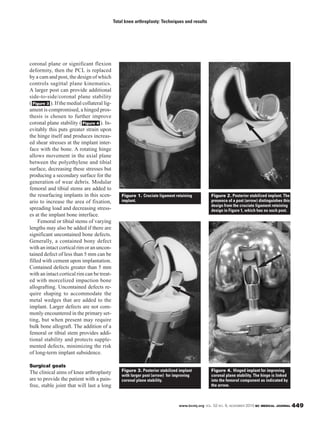
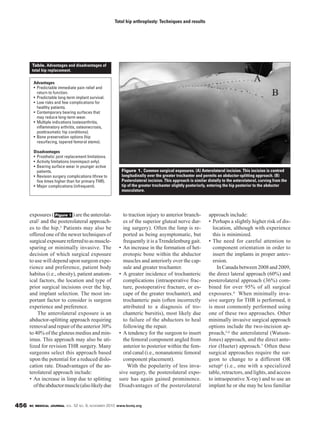
Figure 1. Cruciate ligament retaining
implant.
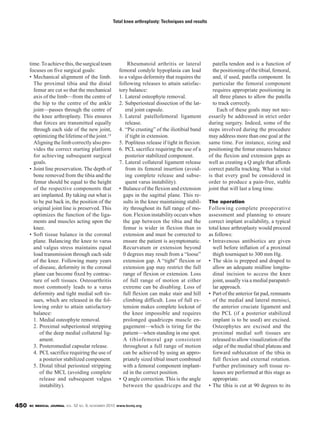
Figure 2. Posterior stabilized implant. The
presence of a post (arrow) distinguishes this
design from the cruciate ligament retaining
design in Figure 1, which has no such post.
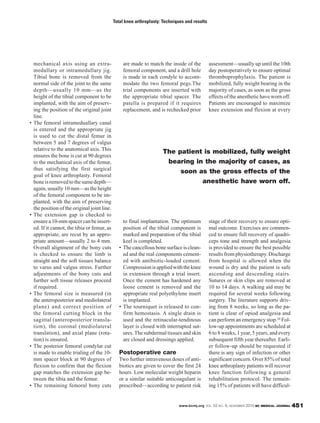
Figure 3. Posterior stabilized implant
with larger post (arrow) for improving
coronal plane stability.
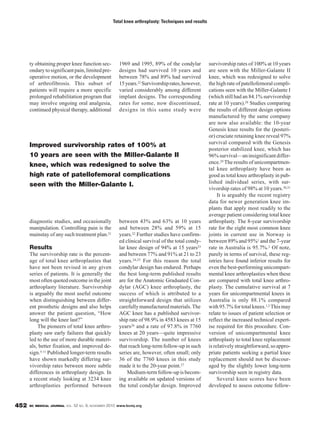
Figure 4. Hinged implant for improving
coronal plane stability. The hinge is linked
into the femoral component as indicated by
the arrow.
BC MEDICAL JOURNAL VOL. 52 NO. 9, NOVEMBER 2010 www.bcmj.org450
time.Toachievethis,thesurgicalteam
focuses on five surgical goals:
• Mechanical alignment of the limb.
The proximal tibia and the distal
femur are cut so that the mechanical
axis of the limb—from the centre of
the hip to the centre of the ankle
joint—passes through the centre of
the knee arthroplasty. This ensures
that forces are transmitted equally
through each side of the new joint,
optimizing the lifetime of the joint.19
Aligning the limb correctly also pro-
vides the correct starting platform
for achieving subsequent surgical
goals.
• Joint line preservation. The depth of
bone removed from the tibia and the
femur should be equal to the height
of the respective components that
are implanted. By taking out what is
to be put back in, the position of the
original joint line is preserved. This
optimizes the function of the liga-
ments and muscles acting upon the
knee.
• Soft tissue balance in the coronal
plane. Balancing the knee to varus
and valgus stress maintains equal
load transmission through each side
of the knee. Following many years
of disease, deformity in the coronal
plane can become fixed by contrac-
ture of soft tissues. Osteoarthritis
most commonly leads to a varus
deformity and tight medial soft tis-
sues, which are released in the fol-
lowing order to attain satisfactory
balance:
1. Medial osteophyte removal.
2. Proximal subperiosteal stripping
of the deep medial collateral lig-
ament.
3. Posteromedial capsular release.
4. PCLsacrifice requiring the use of
a posterior stabilized component.
5. Distal tibial periosteal stripping
of the MCL (avoiding complete
release and subsequent valgus
instability).
Rheumatoid arthritis or lateral
femoral condyle hypoplasia can lead
to a valgus deformity that requires the
following releases to attain satisfac-
tory balance:
1. Lateral osteophyte removal.
2. Subperiosteal dissection of the lat-
eral joint capsule.
3. Lateral patellofemoral ligament
release.
4. “Pie crusting” of the iliotibial band
if tight in extension.
5. Popliteus release if tight in flexion.
6. PCL sacrifice requiring the use of a
posterior stabilized component.
7. Lateral collateral ligament release
from its femoral insertion (avoid-
ing complete release and subse-
quent varus instability).
• Balance of the flexion and extension
gaps in the sagittal plane. This re-
sults in the knee maintaining stabil-
ity throughout its full range of mo-
tion.Flexioninstabilityoccurswhen
the gap between the tibia and the
femur is wider in flexion than in
extension and must be corrected to
ensure the patient is asymptomatic.
Recurvatum or extension beyond
0 degrees may result from a “loose”
extension gap. A “tight” flexion or
extension gap may restrict the full
range of flexion or extension. Loss
of full range of motion at either
extreme can be disabling. Loss of
full flexion can make stair and hill
climbing difficult. Loss of full ex-
tension makes complete lockout of
the knee impossible and requires
prolonged quadriceps muscle en-
gagement—which is tiring for the
patient—when standing in one spot.
A tibiofemoral gap consistent
throughout a full range of motion
can be achieved by using an appro-
priately sized tibial insert combined
with a femoral component implant-
ed in the correct position.
• Q angle correction. This is the angle
between the quadriceps and the
patella tendon and is a function of
the positioning of the tibial, femoral,
and, if used, patella component. In
particular the femoral component
requires appropriate positioning in
all three planes to allow the patella
to track correctly.
Each of these goals may not nec-
essarily be addressed in strict order
during surgery. Indeed, some of the
steps involved during the procedure
may address more than one goal at the
same time. For instance, sizing and
positioning the femur ensures balance
of the flexion and extension gaps as
well as creating a Q angle that affords
correct patella tracking. What is vital
is that every goal be considered in
order to produce a pain-free, stable
joint that will last a long time.
The operation
Following complete preoperative
assessment and planning to ensure
correct implant availability, a typical
total knee arthroplasty would proceed
as follows:
• Intravenous antibiotics are given
well before inflation of a proximal
thigh tourniquet to 300 mm Hg.
• The skin is prepped and draped to
allow an adequate midline longitu-
dinal incision to access the knee
joint, usually via a medial parapatel-
lar approach.
• Part of the anterior fat pad, remnants
of the medial and lateral menisci,
the anterior cruciate ligament and
the PCL (if a posterior stabilized
implant is to be used) are excised.
Osteophytes are excised and the
proximal medial soft tissues are
released to allow visualization of the
edge of the medial tibial plateau and
forward subluxation of the tibia in
full flexion and external rotation.
Further preliminary soft tissue re-
leases are performed at this stage as
appropriate.
• The tibia is cut at 90 degrees to its
Total knee arthroplasty: Techniques and results
www.bcmj.org VOL. 52 NO. 9, NOVEMBER 2010 BC MEDICAL JOURNAL 451
mechanical axis using an extra-
medullary or intramedullary jig.
Tibial bone is removed from the
normal side of the joint to the same
depth—usually 10 mm—as the
height of the tibial component to be
implanted, with the aim of preserv-
ing the position of the original joint
line.
• The femoral intrameduallary canal
is entered and the appropriate jig
is used to cut the distal femur in
between 5 and 7 degrees of valgus
relative to the anatomical axis. This
ensures the bone is cut at 90 degrees
to the mechanical axis of the femur,
thus satisfying the first surgical
goal of knee arthroplasty. Femoral
boneisremovedtothesamedepth—
again, usually 10 mm—as the height
of the femoral component to be im-
planted, with the aim of preserving
the position of the original joint line.
• The extension gap is checked to
ensurea10-mmspacercanbeinsert-
ed. If it cannot, the tibia or femur, as
appropriate, are recut by an appro-
priate amount—usually 2 to 4 mm.
Overall alignment of the bony cuts
is checked to ensure the limb is
straight and the soft tissues balance
to varus and valgus stress. Further
adjustments of the bony cuts and
further soft tissue releases proceed
if required.
• The femoral size is measured (in
the anteroposterior and mediolateral
plane) and correct position of
the femoral cutting block in the
sagittal (anteroposterior transla-
tion), the coronal (mediolateral
translation), and axial plane (rota-
tion) is ensured.
• The posterior femoral condylar cut
is made to enable trialing of the 10-
mm spacer block at 90 degrees of
flexion to confirm that the flexion
gap matches the extension gap be-
tween the tibia and the femur.
• The remaining femoral bony cuts
are made to match the inside of the
femoral component, and a drill hole
is made in each condyle to accom-
modate the two femoral pegs.The
trial components are inserted with
the appropriate tibial spacer. The
patella is prepared if it requires
replacement, and is rechecked prior
to final implantation. The optimum
position of the tibial component is
marked and preparation of the tibial
keel is completed.
• The cancellous bone surface is clean-
ed and the real components cement-
ed with antibiotic-loaded cement.
Compressionisappliedwiththeknee
in extension through a trial insert.
Once the cement has hardened any
loose cement is removed and the
appropriate real polyethylene insert
is implanted.
• The tourniquet is released to con-
firm hemostasis. A single drain is
used and the retinacular-tendinous
layer is closed with interrupted sut-
ures.The subdermal tissues and skin
are closed and dressings applied.
Postoperative care
Two further intravenous doses of anti-
biotics are given to cover the first 24
hours. Low molecular weight heparin
or a similar suitable anticoagulant is
prescribed—according to patient risk
assessment—usually up until the 10th
day postoperatively to ensure optimal
thromboprophylaxis. The patient is
mobilized, fully weight bearing in the
majority of cases, as soon as the gross
effectsoftheanesthetichavewornoff.
Patients are encouraged to maximize
knee extension and flexion at every
stage of their recovery to ensure opti-
mal outcome. Exercises are commen-
ced to ensure full recovery of quadri-
ceps tone and strength and analgesia
is provided to ensure the best possible
results from physiotherapy. Discharge
from hospital is allowed when the
wound is dry and the patient is safe
ascending and descending stairs.
Sutures or skin clips are removed at
10 to 14 days. A walking aid may be
required for several weeks following
surgery. The literature supports driv-
ing from 8 weeks, so long as the pa-
tient is clear of opiod analgesia and
can perform an emergency stop.20 Fol-
low-up appointments are scheduled at
6 to 8 weeks, 1 year, 5 years, and every
subsequent fifth year thereafter. Earli-
er follow-up should be requested if
there is any sign of infection or other
significant concern. Over 85% of total
knee arthroplasty patients will recover
knee function following a general
rehabilitation protocol. The remain-
ing 15% of patients will have difficul-
Total knee arthroplasty: Techniques and results
The patient is mobilized, fully weight
bearing in the majority of cases, as
soon as the gross effects of the
anesthetic have worn off.
BC MEDICAL JOURNAL VOL. 52 NO. 9, NOVEMBER 2010 www.bcmj.org452
ty obtaining proper knee function sec-
ondarytosignificantpain,limitedpre-
operative motion, or the development
of arthrofibrosis. This subset of
patients will require a more specific
prolonged rehabilitation program that
may involve ongoing oral analgesia,
continued physical therapy, additional
diagnostic studies, and occasionally
manipulation. Controlling pain is the
mainstay of any such treatment plan.21
Results
The survivorship rate is the percent-
age of total knee arthroplasties that
have not been revised in any given
series of patients. It is generally the
most often quoted outcome in the joint
arthroplasty literature. Survivorship
is arguably the most useful outcome
when distinguishing between differ-
ent prosthetic designs and also helps
answer the patient question, “How
long will the knee last?”
The pioneers of total knee arthro-
plasty saw early failures that quickly
led to the use of more durable materi-
als, better fixation, and improved de-
sign.5-11 Published longer-term results
have shown markedly differing sur-
vivorship rates between more subtle
differences in arthroplasty design. In
a recent study looking at 3234 knee
arthroplasties performed between
survivorship rates of 100% at 10 years
are seen with the Miller-Galante II
knee, which was redesigned to solve
the high rate of patellofemoral compli-
cations seen with the Miller-Galante I
(which still had an 84.1% survivorship
rate at 10 years).28 Studies comparing
the results of different design options
manufactured by the same company
are now also available: the 10-year
Genesis knee results for the (posteri-
or) cruciate retaining knee reveal 97%
survival compared with the Genesis
posterior stabilized knee, which has
96%survival—aninsignificantdiffer-
ence.29 The results of unicompartmen-
tal knee arthroplasty have been as
good as total knee arthroplasty in pub-
lished individual series, with sur-
vivorship rates of 98% at 10 years.30,31
It is arguably the recent registry
data for newer generation knee im-
plants that apply most readily to the
average patient considering total knee
arthroplasty. The 8-year survivorship
rate for the eight most common knee
joints in current use in Norway is
between 89% and 95%1 and the 7-year
rate in Australia is 95.7%.2 Of note,
purely in terms of survival, these reg-
istries have found inferior results for
even the best-performing unicompart-
mental knee arthroplasties when these
are compared with total knee arthro-
plasty. The cumulative survival at 7
years for unicompartmental knees in
Australia is only 88.1% compared
with95.7%fortotalknees.1,2 Thismay
relate to issues of patient selection or
reflect the increased technical expert-
ise required for this procedure. Con-
version of unicompartmental knee
arthroplasty to total knee replacement
isrelativelystraightforward,soappro-
priate patients seeking a partial knee
replacement should not be discour-
aged by the slightly lower long-term
survivorship seen in registry data.
Several knee scores have been
developed to assess outcome follow-
Total knee arthroplasty: Techniques and results
1969 and 1995, 89% of the condylar
designs had survived 10 years and
between 78% and 89% had survived
15years.22 Survivorshiprates,however,
varied considerably among different
implant designs. The corresponding
rates for some, now discontinued,
designs in this same study were
between 43% and 63% at 10 years
and between 28% and 59% at 15
years.22 Further studies have confirm-
ed clinical survival of the total condy-
lar knee design of 94% at 15 years23
and between 77% and 91% at 21 to 23
years.24,25 For this reason the total
condylar design has endured. Perhaps
the best long-term published results
are for the Anatomic Graduated Con-
dylar (AGC) knee arthroplasty, the
success of which is attributed to a
straightforward design that utilizes
carefullymanufacturedmaterials.The
AGC knee has a published survivor-
ship rate of 98.9% in 4583 knees at 15
years26 and a rate of 97.8% in 7760
knees at 20 years—quite impressive
survivorship. The number of knees
that reach long-term follow-up in such
series are, however, often small; only
36 of the 7760 knees in this study
made it to the 20-year point.27
Medium-term follow-up is becom-
ing available on updated versions of
the total condylar design. Improved
Improved survivorship rates of 100% at
10 years are seen with the Miller-Galante II
knee, which was redesigned to solve the
high rate of patellofemoral complications
seen with the Miller-Galante I.
www.bcmj.org VOL. 52 NO. 9, NOVEMBER 2010 BC MEDICAL JOURNAL 453
ingtotalkneearthroplasty.Thesetools
produce numbers that correspond to
excellent, good, fair, or poor outcome.
For example 92% of knees were as-
sessed as good or excellent in one
study, with 1.6% fair and 6.5% poor.23
Between 96% and 98% of knees were
assessed as good or excellent in anoth-
er study.29 However, more recently it
has been shown that the views of sur-
geons and their patients regarding the
outcome of surgical interventions do
not always correlate well—especially
with respect to function and pain.
Patient questionnaires are thought to
better assess patient outcome, and in a
recent study 81.8% of 8095 patients
were satisfied, 11.2% (906 of 8095)
were unsure, and 7.0% (566 of 8095)
were not satisfied with their new knee
joint.32
With regard to younger patients
under the age of 55 years, a survivor-
ship rate of 96% of 93 knees was
observed at 10 years,33 and of 90% of
108 knees at 18 years;34 94% of pa-
tients in the latter study had good or
excellent function and all but two
patients had improvement in their
activity score postoperatively. Fur-
thermore, 24% regularly participated
in activities such as tennis, skiing,
bicycling, or strenuous farm or con-
struction work.34 This suggests that
the traditional practice of withholding
knee replacement until patients are
over 65 or over is not warranted, and
replacement should proceed when
clinically appropriate.
It was traditionally thought that
obese patients do not fare as well as
normal-weight patients following
joint replacement. Postoperative out-
come scores for obese patients, how-
ever, were found to be comparable to
scores for patients who were not obese
in one recent study. Furthermore,
given the lower preoperative scores
measured in the obese group, the over-
all improvement was actually greater
than in the normal-weight group.
Additionally, survivorship rates in
obese patients were not significantly
lower than in patients who were not
obese at 10 years follow-up.35 There
was, however, a greater proportion of
lucent lines seen on the radiographs
around the implants of the obese
patients23,35 and in the morbidly obese
the complication rates are higher and
the implant survivorship rate is lower.
The final objective measure of
outcome perhaps most relevant to the
individual patient is range of flexion.
This has gradually improved from a
mean of 99 degrees23 to between 114
and 117 degrees with newer genera-
tion designs.29 Postoperative range of
motion largely depends on the preop-
erative range of motion. Generally,
what the patient has before the opera-
tion is what the patient can expect to
achieve after surgery and rehabilita-
tion.36 Patients seeking knee replace-
ment should be counseled that their
postoperative knee will not be “nor-
mal,” but it will feel and function
much better than their preoperative
arthritic knee.
Conclusions
Osteoarthritis remains the most com-
mon indication for total knee arthro-
plasty. Fortunately, technical devel-
opments over the last half century
have resulted in 10-year survivorship
rates of 90% and higher, and between
80% and 85% of patients have been
satisfied with their total knee replace-
ment. Further incremental improve-
ments in knee arthroplasty engineer-
ing, implant design, and material
science will continue to improve bear-
ing surface tribology, implant fixa-
tion, and implant longevity. These
advances will all help meet the main
surgical goals of total knee arthro-
plasty: to correct limb alignment, pre-
serve joint line position, balance the
soft tissues in the coronal plane, bal-
ance the flexion/extension gap in the
sagittal plan, and create a Q angle that
facilitates satisfactory patella track-
ing. Preoperative assessment and
planning will also help meet these
goals by ensuring patient expectations
are realistic and informed consent has
been obtained after a full discussion
of the risks and benefits of surgery.
Competing interests
None declared.
References
1. The Norwegian Arthroplasty Register.
Report 2006. www.haukeland.no/nrl/
eng (accessed 15 August 2009).
2. The Australian National Joint Replace-
Total knee arthroplasty: Techniques and results
Survivorship rates in obese patients
were not significantly lower than in
patients who were not obese at
10 years follow-up.
BC MEDICAL JOURNAL VOL. 52 NO. 9, NOVEMBER 2010 www.bcmj.org454
mentRegistry.Annualreport2008.www
.dmac.adelaide.edu.au/aoanjrr (acces-
sed 15 August 2009).
3. Walldius B. Arthroplasty of the knee joint
using an acrylic prosthesis. Acta Orthop
Scand 1953;23:121-131.
4. CharnleyJ.Arthroplastyofthehip.Anew
operation. Lancet 1961;1(7187):1129-
1132.
5. Gunston FH. Polycentric knee arthro-
plasty. Prosthetic simulation of normal
knee movement. J Bone Joint Surg Br
1971;53:272-277.
6. Ranawat CS. History of total knee
replacement. J South Orthop Assoc
2002;11:218-226.
7. Coventry MB, Finerman GA, Riley LH, et
al. A new geometric knee for total knee
arthroplasty. Clin Orthop Relat Res 1972;
83:157-162.
8. Freeman MA, Swanson SA, Todd RC.
Total replacement of the knee using the
Freeman-Swanson knee prosthesis. Clin
Orthop Relat Res 1973;(94):153-170.
9. Insall JF, Ranawat CS, Scott WN, et al.
Total condylar knee replacment: Prelimi-
nary report. Clin Orthop Relat Res
1976;149-154.
10. Ranawat CS, Shine JJ. Duo-condylar
total knee arthroplasty. Clin Orthop Relat
Res 1973;(94):185-195.
11. Townley C, Hill L. Total knee replace-
ment. Am J Nurs 1974;74:1612-1617.
12. McKeever DC. The classic: Tibial plateau
prosthesis 1960. Clin Orthop Relat Res
2005;440:4-8.
13. Goodfellow J, O’Connor J. The mechan-
ics of the knee and prosthesis design. J
Bone Joint Surg Br 1978;60-B:358-369.
14.Marmor L. The modular knee. Clin
Orthop Relat Res 1973;(94)242-248.
15. Smith DF, McGraw RW, Taylor DC, et al.
Arterial complications and total knee
arthroplasty. J Am Acad Orthop Surg
2001;9:253-257.
16. Lonner JH, Lotke PA. Aseptic complica-
tions after total knee arthroplasty. J Am
Acad Orthop Surg 1999;7:311-324.
17. Lie SA, Engesaeter LB, Havelin LI, et al.
Early postoperative mortality after
67,548 total hip replacements: Causes of
death and thromboprophylaxis in 68 hos-
pitals in Norway from 1987 to 1999. Acta
Orthop Scand 2002;73:392-399.
18. National Joint Registry [for England and
Wales 2007]. www.njrcentre.org.uk (ac-
cessed 13 September 2010).
19. Fang DM, Ritter MA, Davis KE. Coronal
alignment in total knee arthroplasty: Just
how important is it? J Arthroplasty 2009;
24:39-43.
20. Spalding TJ, Kiss J, Kyberd P, et al. Driv-
er reaction times after total knee replace-
ment. J Bone Joint Surg Br 1994;76:754-
756.
21. RanawatCS,RanawatAS,MehtaA.Total
knee arthroplasty rehabilitation protocol:
What makes the difference? J Arthro-
plasty 2003;18:27-30.
22. PradhanNR,GambhirAF,PorterML.Sur-
vivorship analysis of 3234 primary knee
arthroplasties implanted over a 26-year
period: A study of eight different implant
designs. Knee 2006;13:7-11.
23. Ranawat CS, Flynn WF Jr, Saddler S, et
al. Long-term results of the total condy-
lar knee arthroplasty. A 15-year survivor-
ship study. Clin Orthop Relat Res 1993;
(286)94-102.
24. Rodriguez JA, Bhende HF, Ranawat CS.
Total condylar knee replacement: A 20-
year followup study. Clin Orthop Relat
Res 2001;(388)10-17.
25. Pavone VM, Boettner FM, Fickert SM, et
al. Total condylar knee arthroplasty: A
long-term followup. Clin Orthop Relat
Res 2001;(388):18-25.
26. Ritter MA, Berend ME, Meding JB, et al.
Long-term followup of anatomic gradu-
ated components posterior cruciate-
retaining total knee replacement. Clin
Orthop Relat Res 2001;(388):51-57.
27. Ritter MA. The Anatomical Graduated
Component total knee replacement: A
long-term evaluation with 20-year sur-
vival analysis. J Bone Joint Surg Br
2009;91:745-749.
28. Berger RA, Rosenberg AG, Barden RM,
et al. Long-term followup of the Miller-
Galante total knee replacement. Clin
Total knee arthroplasty: Techniques and results
Orthop Relat Res 2001;(388):58-67.
29. Laskin RS. The Genesis total knee pros-
thesis: A 10-year followup study. Clin
Orthop Relat Res 2001;(388):95-102.
30. Berger RA, Meneghini RM, Jacobs JJ, et
al. Results of unicompartmental knee
arthroplasty at a minimum of ten years of
follow-up. J Bone Joint Surg Am
2005;87:999-1006.
31. Murray DW, Goodfellow JW, O’Connor
JJ. The Oxford medial unicompartmen-
tal arthroplasty: A ten-year survival study.
J Bone Joint Surg Br 1998;80:983-989.
32. Baker PN, van der Meulen JH, Lewsey
JF, et al. The role of pain and function in
determining patient satisfaction after
total knee replacement. Data from the
National Joint Registry for England and
Wales. J Bone Joint Surg Br 2007;
89:893-900.
33. Ranawat CS, Padgett DF, Ohashi Y. Total
knee arthroplasty for patients younger
than 55 years. Clin Orthop Relat Res
1989;(248)27-33.
34. Diduch DR, Insall JN, Scott WN, et al.
Total knee replacement in young, active
patients. Long-term follow-up and func-
tional outcome. J Bone Joint Surg Am
1997;79:575-582.
35. Griffin FM, Scuderi GR, Insall JN, et al.
Total knee arthroplasty in patients who
were obese with 10 years followup. Clin
Orthop Relat Res 1998;(356)28-33.
36. Gatha NM, Clarke HD, Fuchs RF, et al.
Factors affecting postoperative range of
motion after total knee arthroplasty. J
Knee Surg 2004;17:196-202.
www.bcmj.org VOL. 52 NO. 9, NOVEMBER 2010 BC MEDICAL JOURNAL 455
ABSTRACT: Primary total hip arthro-
plasty has become one of the most
successful surgical procedures over
the past 50 years and is currently
performed worldwide with similar
techniques and excellent results.
Despite variations in technique and
implant selection, medium and long-
term outcome studies have demon-
strated over 90% implant survival at
15 to 20 years. Previous problems
with implant fixation have now been
reduced, and the focus has shifted
to the selection of improved bearing
surfaces to limit wear, hip replace-
ment options for younger patients,
and improved surgical and anesthet-
ic techniques. Current surgical ap-
proaches to the hip rely most often
on direct lateral or posterolateral
exposure. The most commonly uti-
lized bearing surface for both hip
replacement and hip resurfacing in
Canada is a metal (cobalt-chrome)
femoral head combined with a
second-generation cross-linked poly-
ethylene, combined with cementless
implant fixation. Alternative bear-
ings such as ceramic-on-ceramic
and metal-on-metal may be consid-
ered for hip replacement in younger
patients. Although it has not been
determined which surface will prove
best for younger patients in the long-
term, there is no question about the
benefits of total hip arthroplasty.
With current techniques, the results
are favorable, and patient satisfaction,
pain relief, and long-term implant
survival are excellent.
T
he current long-term suc-
cess of total hip replacement
(THR) surgery has led to the
observation by Coventry1
that “total hip replacement, indeed,
might be the orthopaedic operation of
the century.” The indications for THR
have expanded to such an extent that
this surgery is no longer performed
only in the elderly or in those with de-
bilitatinghippain,arthritis,andsevere
functional restrictions. Rather,THR is
now performed in younger and higher-
demand patients, with expectations,
quality-of-life measures, and inten-
tions to return to prior activity levels
that challenge surgical techniques and
implant design technology. The ad-
vantages of THR generally outweigh
the disadvantages ( ), and atten-
tion is now focused on improved fix-
ation of the implants, reduction in the
rates of failure, and development of
bearing surfaces to reduce long-term
wear and improve implant longevity.
Surgical exposure
Several surgical exposures are utiliz-
ed for THR. The two most common
Table
Total hip arthroplasty:
Techniques and results
Younger, more active patients are now candidates for total hip re-
placement with the advent of improved implant fixation and new
low-wearing bearing surfaces.
R. Stephen J. Burnett, MD, FRCSC, Dipl ABOS
Dr Burnett is a consultant orthopaedic
surgeon in the Division of Orthopaedic Sur-
gery, Adult Reconstructive Surgery of the
Hip and Knee, Vancouver Island Health–
South Island.
BC MEDICAL JOURNAL VOL. 52 NO. 9, NOVEMBER 2010 www.bcmj.org456
exposures ( ) are the anterolat-
eral2 and the posterolateral approach-
es to the hip.3 Patients may also be
offered one of the newer techniques of
surgicalexposurereferredtoasmuscle-
sparing or minimally invasive. The
decision of which surgical exposure
to use will depend upon surgeon expe-
rience and preference, patient body
habitus (i.e., obesity), patient anatom-
ical factors, the location and type of
prior surgical incisions over the hip,
and implant selection. The most im-
portant factor to consider is surgeon
experience and preference.
The anterolateral exposure is an
abductor-splitting approach requiring
removalandrepairoftheanterior30%
to 40% of the gluteus medius and min-
imus. This approach may also be uti-
lized for revision THR surgery. Many
surgeons select this approach based
upon the potential for a reduced dislo-
cation rate. Disadvantages of the an-
terolateral approach include:
• An increase in limp due to splitting
oftheabductormuscle(alsolikelydue
Figure 1 to traction injury to anterior branch-
es of the superior gluteal nerve dur-
ing surgery). Often the limp is re-
ported as being asymptomatic, but
frequently it is a Trendelenburg gait.
• An increase in the formation of het-
erotopic bone within the abductor
muscles and anteriorly over the cap-
sule and greater trochanter.
• A greater incidence of trochanteric
complications (intraoperative frac-
ture, postoperative fracture, or es-
cape of the greater trochanter), and
trochanteric pain (often incorrectly
attributed to a diagnosis of tro-
chanteric bursitis), most likely due
to failure of the abductors to heal
following the repair.
• A tendency for the surgeon to insert
the femoral component angled from
anterior to posterior within the fem-
oral canal (i.e., nonanatomic femoral
component placement).
With the popularity of less inva-
sive surgery, the posterolateral expo-
sure has again gained prominence.
Disadvantages of the posterolateral
approach include:
• Perhaps a slightly higher risk of dis-
location, although with experience
this is minimized.
• The need for careful attention to
component orientation in order to
insert the implants in proper antev-
ersion.
InCanadabetween2008and2009,
the direct lateral approach (60%) and
posterolateral approach (36%) com-
bined for over 95% of all surgical
exposures.4 When minimally inva-
sive surgery for THR is performed, it
is most commonly performed using
one of these two approaches. Other
minimally invasive surgical approach
options include the two-incision ap-
proach,5,6 the anterolateral (Watson-
Jones) approach, and the direct ante-
rior (Hueter) approach.7 Often these
surgical approaches require the sur-
geon to change to a different OR
setup6 (i.e., one with a specialized
table, retractors, and lights, and access
to intraoperative X-ray) and to use an
implant he or she may be less familiar
Total hip arthroplasty: Techniques and results
Advantages
• Predictable immediate pain relief and
return to function.
• Predictable long-term implant survival.
• Low risks and few complications for
healthy patients.
• Contemporary bearing surfaces that
may reduce long-term wear.
• Multiple indications (osteoarthritis,
inflammatory arthritis, osteonecrosis,
posttraumatic hip conditions).
• Bone preservation options (hip
resurfacing, tapered femoral stems).
Disadvantages
• Prosthetic joint replacement limitations.
• Activity limitations (nonimpact only).
• Bearing surface wear in younger active
patients.
• Revision surgery complications (three to
five times higher than for primary THR).
• Major complications (infrequent).
Table. Advantages and disadvantages of
total hip replacement.
Figure 1. Common surgical exposures. (A) Anterolateral incision. This incision is centred
longitudinally over the greater trochanter and permits an abductor-splitting approach. (B)
Posterolateral incision. This approach is similar distally to the anterolateral, curving from the
tip of the greater trochanter slightly posteriorly, entering the hip posterior to the abductor
musculature.
www.bcmj.org VOL. 52 NO. 9, NOVEMBER 2010 BC MEDICAL JOURNAL 457
with in order to make the procedure
feasible. While there may be a few
short-term advantages to minimally
invasive surgery, the early and mid-
term results have been associated with
significantly increased risks and sur-
gical complications,5 which have not
been seen in THR prior to the popu-
larity of these techniques. Thus, the
enthusiasm for minimally invasive
surgery has declined recently in favor
of surgery performed safely through
smaller incisions, and with the goal of
achieving an ideal implant orientation
and longevity. Computer-assisted
surgery (CAS) for total hip replace-
ment has gained popularity and is per-
formed in many centres. The advan-
tages and results of CAS have been
difficult to assess, and there does not
appear to be any significant advantage
to CAS at this time. The one area of
potential advantage is that CAS may
be useful in identifying “outlier”
acetabular component position/angu-
lation and leg length and hip offset
intraoperatively, which might help in
select situations, especially for sur-
geons with less experience perform-
ing THR and surgeons combining
CASwithminimallyinvasivesurgery.
The main disadvantage is increased
OR time and increased cost. Overall,
CAS has not been shown to be cost-
effective to date.
Implant fixation:
Cemented or cementless?
Both cemented and cementless fixa-
tion are currently utilized in THR sur-
gery, although there has been a trend
in North America toward cementless
implants over the past 10 years. Total
hip replacement implants typically
consist of the acetabular component
(which is fitted into the patient’s
native acetabular pelvic bone with or
without cement), the femoral compo-
nent (inserted down the femoral
canal), and the bearing surfaces (the
articulating aspects of the implant).
When describing fixation methods,
we are referring to the femoral and
acetabular components.
Acetabular component
implant fixation
The use of cemented acetabular com-
ponents has declined in recent years in
North America, although cemented
components are still used occasional-
ly in older and lower-demand patients.
When compared with cementless im-
plants, cemented acetabular compo-
nents have been associated with in-
creased rates of loosening at 10 to 20
years, especially in patients younger
than 50,8 when compared to cement-
less implants. Cementless acetabular
fixation was introduced to solve the
problem of loosening with cemented
acetabular cups. The most commonly
usedcompositeforcementlessacetab-
ular components is titanium alloy,
which is favorable for bone ingrowth.
Typically, a modular bearing surface
(the liner) is inserted into the inner
aspect of the acetabular component,
and locks into place via a mechanism
contained within the acetabular com-
ponent. The acetabular component
may accept bearing surfaces, including
liners made of polyethylene, ceramic,
or metal, to complete the acetabular
component composition ( ).
This modular bearing surface may be
exchanged in the future if wear or
other less common indications make
this necessary, leaving the intact
osseo-integrated acetabular compo-
nent in place. The long-term results of
cementless titanium acetabular fixa-
tion have been favorable. At a mini-
mum of 20 years, the implant survival
Figure 2
Total hip arthroplasty: Techniques and results
Figure 2. Cementless titanium acetabular
component. (A) The porous outer surface
permits bone ingrowth and the cluster holes
allow for adjunctive screw fixation. (B) The
polished inner surface with circumferential
locking mechanism accommodates a
modular acetabular bearing surface. The
modular acetabular liners available for this
component include: (C) Cross-linked
polyethylene. (D) Ceramic. (E) Metal.
A B
C D
E
BC MEDICAL JOURNAL VOL. 52 NO. 9, NOVEMBER 2010 www.bcmj.org458
for titanium hemispherical cups has
recently been reported at over 95%.9
However, wear-related complications
of the polyethylene liner inside and on
the backside (and of the associated
modular locking mechanism) occur in
approximately 20% of patients by 20
years, a problem that has become the
focus of research in THR surgery.
Femoral component
implant fixation
Cemented femoral component fixa-
tion has achieved excellent long-term
results in multiple studies at 17 to 30
years10-14 and continues to be the gold
standard against which the more pop-
ular cementless femoral fixation must
be measured. Contemporary cement-
ing techniques were refined in the
1970s and require attention to detail.
In addition to cement technique, there
are two implant designs: the cemented
tapered polished collarless stem (Ex-
eter, Stryker Orthopaedics, Mahwah
NJ) and the Spectron EF stem (Smith
& Nephew Orthopaedics, Memphis
TN) ( ) which have incorpo-
rated differing design characteristics,
yet which have both proven very
successful in the long-term clinical
trials.15,16 Early failures of cemented
stems implanted with older cementing
technique included loosening, stem
fracture, and localized areas of bone
destruction (osteolysis) from cement
weardebris.Cementlessimplantswere
developed to solve these problems.
Today, cementless femoral compo-
nents are produced in various designs
and shapes, and with different metal-
lic compositions and surface prepara-
Figure 3
tion to promote osseo-integration. All
uncementedfemoralstemdesignsrely
on metaphyseal fixation, metaphy-
seal-diaphyseal junction fixation, dia-
physeal fixation, or a combination of
the three. The tapered titanium alloy
cementless stem ( ) has grown
in popularity17 and is becoming com-
monly used worldwide. Achieving
a press-fit via a single or dual taper-
ed wedge with subsequent proximal
osseo-integration of bone has proven
successful in multiple long-term stud-
ies18 of tapered titanium stems, with
over 95% survival at 10 to 20 years.
In summary, while cemented fem-
oral stem fixation remains the gold
standard in long-term studies, it is
highly dependent on cementing tech-
nique and implant design. Cemented
acetabular fixation is rarely utilized in
North America. Cementless fixation
on both the femoral and acetabular
sides is performed most commonly
and relies on an immediate press-fit
of the implant followed by osseo-
integration into host bone.
Hip resurfacing
Total hip resurfacing, also known as
surface replacement arthroplasty or
hip resurfacing (HR), has gained in
popularity partly because of two
metal-on-metal HR implants approv-
ed by the FDAwithin the past 9 years.
HR has been performed for 15 years
in both North America and Europe
with favorable results.19,20 It is per-
formed using a cemented metal fem-
oral component shaped to the patient’s
native femoral head and a cementless
acetabular component with a polished
inner cobalt-chrome metal surface
( ). The two surfaces join to
create a metal-on-metal bearing
surface that has low-wear properties.
Relative indications for HR surgery21
include younger age, active occu-
pational and lifestyle requirements,
favorable bone anatomy and quality
Figure 5
Figure 4
Total hip arthroplasty: Techniques and results
Figure 3. Cemented femoral component. (A) Spectron EF component (Smith & Nephew,
Memphis, TN). (B) Postoperative radiograph showing cemented femoral stem combined with a
cementless acetabular component, cross-linked polyethylene modular liner, and cobalt-
chrome modular femoral head.
A B
www.bcmj.org VOL. 52 NO. 9, NOVEMBER 2010 BC MEDICAL JOURNAL 459
Total hip arthroplasty: Techniques and results
Figure 4. Cementless femoral component. (A) Dual 3-degree tapered titanium component. The proximal portion of the stem has porous coating
for bone ingrowth, while the middle of the stem is roughened by grit-blasting for bone ongrowth. (B) Postoperative radiograph showing a
cementless tapered stem, cementless titanium acetabular component with screw fixation, and modular metal-on-metal bearing surface.
Figure 5. Hip resurfacing. (A) Metal-on-metal bearing surface. (B) Postoperative radiograph showing left hip resurfacing.
A B
A B
BC MEDICAL JOURNAL VOL. 52 NO. 9, NOVEMBER 2010 www.bcmj.org460
(withoutcysticchange,defects,ordys-
plasia), normal weight, and male sex.
Hip resurfacing may also be used ad-
junct when there is proximal femoral
deformity that would otherwise re-
quire an osteotomy to perform a THR
( ). Contraindications include
impaired renal function (or the poten-
tial for impairment with a diagnosis
such as diabetes) with an inability to
process serum metal ions, older age,
osteoporosis or osteopenia, unfavor-
able femoral head geometry, clinical
metal sensitivity history (usually a
nickelsensitivity),aleg-lengthdiscrep-
ancy greater than 1 cm, and women of
childbearing age. The primary con-
cern regarding HR in younger women
is how the increased ion levels of
cobalt and chromium normally asso-
ciated with a metal-on-metal bearings
could effect fetal development, as
these ions do cross the placenta. Two
recent studies suggest that although
these ions cross the placenta, a modu-
latory effect occurs, decreasing their
concentration in the fetus. Still, such
Figure 6
results should be interpreted with
caution.22,23
Hipresurfacingsurgeryisperform-
ed with similar exposures to those
used in conventional THR. Contrary
to popular belief, hip resurfacing is
not a minimally invasive procedure.
Rather, it often requires a larger inci-
sion and surgical exposure, with addi-
tional soft tissue capsular releases that
are not typically performed in THR—
thus HR is often more invasive, not
less. Despite this, recovery following
hip resurfacing is similar to conven-
tional THR, likely due to generally
younger patient age. The proposed
advantages (which remain controver-
sial) of HR surgery include:
• Bonepreservationonthefemoralside.
• Ease of future revision surgery on
the femoral side.
• Large-head bearing surface with a
reduced dislocation rate.
• Use of a metal-on-metal low-wear
bearing surface.
• Patient findings that HR feels more
normal than THR.
These advantages, however, can
all be obtained from conventional
THR with the use of a metal-on-metal
bearing surface, particularly if a large
femoral head is used.
Surgeons who disfavor hip resur-
facing do so for several reasons:
• Bone preservation may not neces-
sarily occur, with occasionally more
bone being removed on the acetab-
ularsidetoachieveadeepenedsock-
et with a press-fit and no option for
screw fixation.
• Theriskofnotchingthefemoralneck
and subsequent femoral neck fracture
(risk 0.8%–1.5%)24,25 ( ).
• Elevated levels of serum and urine
cobalt, chromium, molybdenum, and
selenium ions that remain elevated
lifelong.
• The risk of lymphocyte-mediated
metal sensitivity reactions and/or
the development of pseudotumors,
recently highlighted in research at
UBC and McGill University.26
• It is a technically more demanding
surgical procedure for the surgeon
Figure 7
Total hip arthroplasty: Techniques and results
Figure 6. Hip resurfacing in case of proximal femoral deformity. (A) Preoperative radiograph used to investigate left hip pain. This patient had
previously undergone an intertrochanteric osteotomy. The residual femoral canal deformity seen on the radiograph means that an osteotomy
would be required to perform a THR with a femoral component stem. (B) Postoperative radiograph showing left hip resurfacing performed to
avoid the femoral osteotomy.
A B
www.bcmj.org VOL. 52 NO. 9, NOVEMBER 2010 BC MEDICAL JOURNAL 461
and team, with a steep learning
curve27 and potentially increased
risks and complications when com-
pared with conventional THR.
While HR is an option to consider
in younger and more active patients, it
requires careful preoperative assess-
ment and a discussion with the patient
about all of the issues, including the
risk of increased metal ion levels and
metal sensitivity reactions, and the
low risk of psuedotumor.28 In addi-
tion, impact activities are not encour-
aged after HR, and the restrictions and
precautions following surgery are
similar to those for THR. Overall, the
short-term results of HR (up to 5
years) have been worse than for THR,
and therefore hip resurfacing should
be used with caution. THR remains
the gold standard.
Bearing surfaces
With current implant fixation meth-
ods demonstrating excellent long-
term results, the bearing surface
in THR is now the focus of much
research.The bearing surface is where
the movement of the two bearings
occurs and which provides the range
of motion and articulation of the pros-
thetic ball and socket joint. Within the
last 10 years, the use of traditional
ultrahigh molecular weight polyethyl-
ene (UHMWPE) acetabular liners has
declined with the development of new
kinds of polyethylene.
Highly cross-linked
polyethylenes
To reduce wear rates and particulate
debris, highly cross-linked polyethyl-
ene (XLPE) has been used in total
hip arthroplasty for 8 years. The man-
ufacturing process for these materials
cross-links the molecules and im-
proves wear characteristics but slight-
ly reduces the strength of the polyeth-
ylene. Free radicals may be generated
in the process, potentially allowing
for oxidative changes in the polyeth-
ylene, unless these changes are appro-
priately managed in the manufactur-
ing process. Thus, the ideal XLPE
would be cross-linked at an appropri-
ate level of radiation, and then remelt-
ed to remove these free radicals and
thus reduce the oxidation process.
Currently, all of the THR implant
manufacturers produce either a first-
generationorsecond-generationXLPE.
When combined with a polished
cobalt-chrome head of multiple sizes,
these new XLPEs have shown prom-
ise in reducing in vivo and simulator
wear measurements significantly29
comparedwithtraditionalUHMWPE.
The increase in wear resistance is,
however, associated with a decrease
in fatigue strength and toughness. The
use of XLPE liners requires meticu-
lous positioning of the acetabular
component to avoid vertical place-
ment of the implant, which reports
have associated with an increased risk
of fracture at the rim of the polyethyl-
ene liner ( ). The use of XLPE
has allowed the introduction of larger
femoral heads, which increase the sta-
bility of the hip with their greater dia-
meter and increased “jump distance.”
When XLPE is used, wear rates of the
polyethylene have not been shown to
be worse with larger femoral heads.
This is in contrast to older UHMWPE,
which demonstrates higher volumet-
ric polyethylene wear as the size of
the femoral head is increased.
Alternative bearing surfaces
Other bearing surfaces have been
developed and utilized in THR in an
attempt to reduce the wear-related
polyethylene complications. Polyeth-
ylene wear and debris formation result
in hip joint synovitis, joint instability,
osteolysis, and, potentially, prosthesis
loosening.Alternativebearingsurfaces
such as metal-on-metal, ceramic-on-
ceramic, ceramic-on-XLPE, oxinium
(oxidized zirconium), and even the
new XLPEs themselves have been
developed in an attempt to reduce
wear and improve implant survival in
Figure 8
Total hip arthroplasty: Techniques and results
Figure 7. Radiograph showing a femoral neck fracture that occurred at 4 months following
a left hip resurfacing procedure.
BC MEDICAL JOURNAL VOL. 52 NO. 9, NOVEMBER 2010 www.bcmj.org462
younger and more active patients.
Currently in Canada, the most com-
monly utilized bearing surface is a
cobalt-chrome head combined with
cross-linked polyethylene (59%),
while other alternative bearings such
as metal-on-metal (11% ; includes HR
use) and ceramics (13%) are used less
frequently, and usually in younger
patients.4
Ceramics. Alumina ceramics were
introduced in the 1970s. They have a
very low coefficient of friction and
demonstrate the lowest wear rates of
any implant bearing surface.30 They
are scratch resistant and may be com-
bined as a modular ceramic acetabular
liner with a ceramic head. There is no
potential for metal ion release, which
is attractive to younger patients, espe-
cially females of childbearing age.
Although ceramics can fracture be-
cause of their brittle composition, the
rate of fracture is very low (0.5%)31 in
most studies. Newer ceramic compos-
ites of alumina (Biolox Delta Ceram-
ic, CeramTec AG, Lauf, Germany)
have demonstrated increased strength
and fracture resistance, and offer
increased neck-length options intra-
operatively ( ). Ceramic-on-
ceramic bearing surfaces have been
associated with squeaking that is audi-
ble to the patient and others. Initially
believed to occur rarely (~1%) in
ceramic-on-ceramicTHR,recentstud-
ies have shown that noise (squeaking,
grinding, rubbing, or other audible
Figure 9
sounds from the hip) occurs more fre-
quently than originally reported, and
is experienced by 10% to 17% of
patients with a ceramic-on-ceramic
bearing surface.32,33 The causes and
implications of squeaking have yet to
be determined, but are likely to be
multifactorial: acetabular modular
implant design-specific factors, com-
ponent orientation and malposition,
instability, and femoral component
design have all been implicated. The
use of ceramic-on-ceramic bearings
offers many advantages in terms of
wear reduction, especially for young
and active patients. Nonetheless, pa-
tients considering ceramic-on-ceramic
bearings should be informed of this
phenomenon, and the surgeon and
Total hip arthroplasty: Techniques and results
Figure 8. Fractured rim of a cross-linked polyethylene liner. The acetabular component was
placed in a vertical orientation, leading to a fatigue fracture at the superior aspect of the
polyethylene liner.
Figure 9. A ceramic-on-ceramic modular
bearing surface.
www.bcmj.org VOL. 52 NO. 9, NOVEMBER 2010 BC MEDICAL JOURNAL 463
patient should discuss avoiding cer-
amic implants associated with a high-
er incidence of squeaking. There are
no long-term clinical results to date
for the newer ceramic composites.
Oxinium. Oxidized zirconium (Smith
& Nephew, Memphis, TN) has been
developed for femoral head compo-
nents and has the wear-resistance of
ceramic without the brittle fracture
risk. Compared with the limited cera-
mic ball neck lengths available, oxini-
um allows for increased length op-
tions intraoperatively. No long-term
clinical studies of this material have
beenpublishedyet,anditisonlyavail-
able from one manufacturer.
Metal-on-metal.Metal-on-metalbear-
ing surfaces have been used widely
since the 1960s.34-36 Poor metallurgy,
poordesign(equatorialheadedgebear-
ing),and poor fixation led to early fail-
ures of many hip replacements using
metal bearings. However, a subset of
these were found to have a suitable
central-headbearingandminimalwear
when compared with hip replace-
ments using UHMWPE. This finding
led to a resurgence of interest in metal-
on-metal surface bearings, and an
attempt to create a bearing surface
with similar metallurgy and design to
thatfoundinthesubsetwithlong-term
survival. Metal bearing surfaces dem-
onstrate very low wear rates—some-
where between rates for ceramic-on-
ceramic and metal-on-XLPE—and
much less wear than for conventional
UHWMPE. Metal bearings support
the use of a larger femoral head size,
which demonstrates better fluid-film
lubrication, and lower metal ion lev-
els than found with smaller head com-
binations, making metal-on-metal
ideally suited for hip resurfacing.
Metal is not brittle like ceramic, mak-
ing it attractive for younger patients.
Larger head sizes are also associated
with improved joint stability and a
reduced risk of dislocation. While
metal-on-metal bearing surfaces gen-
erally are associated with elevated
metal ion levels,37 no long-term effects
are known. Preoperatively, patients
must be informed that the low risk of
metal sensitivity and lymphocyte-
mediated reaction is similar to that for
hip resurfacing. Recently, inflamma-
tory granulomatous pseudotumors,
which are necrotic cystic soft tissue
tumors, have been seen following
large-headmetal-on-metalhipreplace-
ment with one or more implant de-
signs, and have been seen less often
following HR. For this reason, metal-
on-metal bearing surfaces should be
used with caution in THR, patients
should be followed closely at yearly
intervals, and patients should be coun-
seled about the possibility of metal-
related complications that will lead to
poor outcome if they occur, even after
revision surgery.
Conclusions
Total hip arthroplasty has become the
treatmentofchoiceforhip-relateddis-
orders leading to arthritis in the adult
population. With improvements in
long-term clinical results, implant fix-
ation, and new low-wear bearing sur-
faces, THR surgery is now being per-
formed in younger and more active
patients. Using current implant design
and techniques, the implant survival
at20yearsisfavorable,withover90%
implant survival in multiple studies.
However, with younger and more
active patients undergoing total hip
replacement, the challenge will be the
bearing surface selection. It remains
to be determined which bearing sur-
faces will provide the lowest wear
ratesandthefewestwear-relatedcom-
plications in the long term.
Competing interests
None declared.
References
1. Coventry MB. Foreword. In: Amstutz HC
(ed).Hiparthroplasty.NewYork:Churchill
Livingstone; 1991.
2. Mulliken BD, Rorabeck CH, Bourne RB,
et al. A modified direct lateral approach in
total hip arthroplasty: A comprehensive
review. J Arthroplasty 1998;13:737-747.
3. Kwon MS, Kuskowski M, Mulhall KJ, et
al. Does surgical approach affect total hip
arthroplasty dislocation rates? Clin
Orthop Relat Res 2006;447:34-38.
4. Canadian Institute for Health Informa-
tion. Hip and knee replacements in Cana-
da—Canadian Joint Replacement Reg-
istry (CJRR) 2008–2009 annual report.
http://secure.cihi.ca/cihiweb/dispPage.js
p?cw_page=PG_1519_E&cw_topic=15
19&cw_rel=AR_30_E (accessed 14 Sep-
tember 2010).
5. Bal BS, Haltom D, Aleto T, et al. Early
complications of primary total hip re-
placementperformedwithatwo-incision
minimally invasive technique. Surgical
technique. J Bone Joint Surg Am 2006;
88:(suppl):221-233.
6. Berger RA, Duwelius PJ. The two-inci-
sion minimally invasive total hip arthro-
plasty: Technique and results. Orthop
Clin North Am 2004;35:163-172.
7. Seng BE, Berend KR, Ajluni AF, et al.
Anterior-supine minimally invasive total
hip arthroplasty: Defining the learning
curve. Orthop Clin North Am 2009;
40:343-350.
8. Barrack RL, Mulroy RD Jr, Harris WH.
Improved cementing techniques and
femoral component loosening in young
patients with hip arthroplasty. A 12-year
radiographic review. J Bone Joint Surg Br
1992;74:385-389.
9. Della Valle CJ, Mesko NW, Quigley L, et
al. Primary total hip arthroplasty with a
porous-coated acetabular component. A
concisefollow-up,ataminimumoftwen-
tyyears,ofpreviousreports.JBoneJoint
Surg Am 2009;91:1130-1135.
10. Ling RS, Charity J, Lee AJ, et al. The long-
term results of the original Exeter pol-
ished cemented femoral component: A
Total hip arthroplasty: Techniques and results
BC MEDICAL JOURNAL VOL. 52 NO. 9, NOVEMBER 2010 www.bcmj.org464
follow-up report. J Arthroplasty 2009;
24:511-517.
11. Herberts P, Malchau H. Long-term regis-
tration has improved the quality of hip
replacement: A review of the Swedish
THR Register comparing 160,000 cases.
Acta Orthop Scand 2000;71:111-121.
12. Mulroy RD Jr, Harris WH. The effect of
improved cementing techniques on
componentlooseningintotalhipreplace-
ment. An 11-year radiographic review. J
Bone Joint Surg Br 1990;72:757-760.
13. Issack PS, Botero HG, Hiebert RN, et al.
Sixteen-year follow-up of the cemented
spectron femoral stem for hip arthro-
plasty. J Arthroplasty 2003;18:925-930.
14. Carrington NC, Sierra RJ, Gie GA, et al.
The Exeter Universal cemented femoral
component at 15 to 17 years: An update
on the first 325 hips. J Bone Joint Surg
Br 2009;91:730-737.
15. Williams HD, Browne G, Gie GA, et al.
The Exeter Universal cemented femoral
component at 8 to 12 years. A study of
the first 325 hips. J Bone Joint Surg Br
2002;84:324-334.
16. Garellick G, Malchau H, Herberts P. Sur-
vival of hip replacements. A comparison
of a randomized trial and a registry. Clin
Orthop Relat Res 2000;(375):157-167.
17. Danesh-Clough T, Bourne RB, Rorabeck
CH, et al. The mid-term results of a dual
offset uncemented stem for total hip
arthroplasty. J Arthroplasty, 2007;22:
195-203.
18. Lombardi AV Jr, Berend KR, Mallory TH,
et al. Survivorship of 2000 tapered titani-
umporousplasma-sprayedfemoralcom-
ponents. Clin Orthop Relat Res 2009;
467:146-154.
19. Treacy RB, McBryde CW, Pynsent PB.
Birmingham hip resurfacing arthroplasty.
A minimum follow-up of five years. J
Bone Joint Surg Br 2005;87:167-170.
20. Amstutz HC, Le Duff MJ. Eleven years
of experience with metal-on-metal
hybrid hip resurfacing: A review of 1000
conserve plus. J Arthroplasty 2008;
23(suppl):36-43.
21. Della Valle CJ, Nunley RM, Barrack RL.
When is the right time to resurface?
Orthopedics 2008;31(suppl).
22. Ziaee H, Daniel J, Datta AK, et al.
Transplacentaltransferofcobaltandchro-
mium in patients with metal-on-metal hip
arthroplasty: A controlled study. J Bone
Joint Surg Br 2007;89:301-305.
23. Amstutz HC, Antoniades JT, Le Duff MJ.
Results of metal-on-metal hybrid hip
resurfacing for Crowe type-I and II devel-
opmental dysplasia. J Bone Joint Surg
Am 2007;89:339-346.
24. Shimmin AJ, Back D. Femoral neck frac-
tures following Birmingham hip resurfac-
ing:Anationalreviewof50cases.JBone
Joint Surg Br 2005;87:463-464.
25. Amstutz HC, Campbell PA, Le Duff MJ.
Fracture of the neck of the femur after
surface arthroplasty of the hip. J Bone
Joint Surg Am 2004;86-A:1874-1877.
26. Garbuz DS, Tanzer M, Greidanus NV, et
al. The John Charnley Award: Metal-on-
metal hip resurfacing versus large-diam-
eter head metal-on-metal total hip arthro-
plasty: A randomized clinical trial. Clin
Orthop Relat Res 2009;468:318-325.
27. Nunley RM, Zhu J, Brooks PJ, et al. The
learning curve for adopting hip resurfac-
ing among hip specialists. Clin Orthop
Relat Res 2009;468:382-391.
28. Counsell A, Heasley R, Arumilli B, et al. A
groin mass caused by metal particle
Total hip arthroplasty: Techniques and results
debris after hip resurfacing. Acta Orthop
Belg 2008;74:870-874.
29. Bragdon CR, Kwon YM, Geller JA, et
al. Minimum 6-year followup of highly
cross-linked polyethylene in THA. Clin
Orthop Relat Res 2007;465:122-127.
30. Semlitsch M, Willert HG. Clinical wear
behaviour of ultra-high molecular weight
polyethylene cups paired with metal and
ceramic ball heads in comparison to
metal-on-metal pairings of hip joint
replacements. Proc Inst Mech Eng H
1997;211:73-88.
31. Capello WN, D’Antonio JA, Feinberg JR,
etal.Ceramic-on-ceramictotalhiparthro-
plasty: Update. J Arthroplasty 2008;23
(suppl):39-43.
32. Jarrett CA, Ranawat AS, Bruzzone M, et
al. The squeaking hip: A phenomenon of
ceramic-on-ceramic total hip arthroplas-
ty. J Bone Joint Surg Am, 2009;91:1344-
1349.
33. MaiK,VeriotiC,EzzetKA,etal.Incidence
of“squeaking”afterceramic-on-ceramic
total hip arthroplasty. Clin Orthop Relat
Res 2009;468:413-417.
34. McKee GK, Watson-Farrar J. Replace-
ment of arthritic hips by the McKee-Far-
rar prosthesis. J Bone Joint Surg Br
1966;48:245-259.
35. Ring PA. Complete replacement arthro-
plasty of the hip by the ring prosthesis. J
Bone Joint Surg Br 1968;50:720-731.
36. Muller ME. Total hip prostheses. Clin
Orthop Relat Res 1970;72:46-68.
37. MacDonald SJ, McCalden RW, Chess
DG, et al. Metal-on-metal versus poly-
ethylene in hip arthroplasty: A random-
ized clinical trial. Clin Orthop Relat Res
2003;(406):282-296.
www.bcmj.org VOL. 52 NO. 9, NOVEMBER 2010 BC MEDICAL JOURNAL 465
David M. Patrick, MD, FRCPC,
MHSc, Malcolm Maclure, ScD,
Bill Mackie, MD, Rachel
McKay, MSc
C
onfidentially, could you resist
looking at your pattern of an-
tibiotic prescribing and com-
paring it with evidence? Without any-
one else knowing? If you are a GP in
active practice, you will soon receive
a sealed, coded envelope containing a
confidential portrait (seen by no one)
of your prescribing of antibiotics for
urinary tract infections (UTI). Its goal
is to reverse recent growth in antibi-
otic resistance. Yes, we can! Studies
have demonstrated the potential for
reduced antibiotic resistance follow-
ing reduced antibiotic prescribing.1
Ten years ago, BC’s provincial
health officer published a report on
antimicrobial resistance which con-
tained recommendations for areas of
action.2 It is fair to say that consider-
able progress has been made on most
of the recommendations related to the
piratory tract infections (URTI). The
portraits will be mailed out in a stag-
gered manner in coming months, so
impacts on prescribing can be asses-
sed comparing geographic areas that
receive the portraits early versus de-
layed areas.
Now that we are finally making
progress in putting our own house in
order, we should applaud BCMA’s
endorsement of investigation into the
deleterious effects on nonveterinary
use of antibiotics in agricultural opera-
tions.4 The effects on the environment
and the contribution to emergence
of antibiotic-resistant organisms in
humans must be understood and
addressed.5 Whiletrendsinhumanuse
in BC are slowly improving, we have
made little or no progress on the issue
in agriculture and veterinary practice.
InseveralcountriesinnorthernEurope,
strict controls apply in agriculture.
References
1. Enne VI. Reducing antimicrobial resist-
ance in the community by restricting pre-
scribing: can it be done? J of Antimicrob
Chemother 2010;65:179-182.
2. Provincial Health Officer. Antimicrobial
Resistance: A Recommended Action
Plan for British Columbia. Office of the
Provincial Health Officer, 2000. www
.health.gov.bc.ca/library/publications/
year/2000/antimicrobialfinal.pdf
(accessed 28 September 2010).
3. Ranji SR, Steinman MA, Shojania KG, et
al. Interventions to reduce unnecessary
prescribing: A systematic review and
quantitative analysis. Med Care 2008;48:
847-862.
4. Gillespie I. BCMA leads country with 16
resolutions at CMA. BC Med J 2010;
52:330.
5. Mackie B. Antibiotic use in our livestock.
BC Med J 2010;52:309.
bc centre for
disease control
Your irresistible personal portrait:
A way to reduce antibiotic resistance?
Dr Patrick is the director of Epidemiology
Services at the BCCDC, and a professor in
the School of Population and Public Health
at the University of British Columbia. Dr
Maclure is professor and BC chair in Patient
Safety in the Department of Anesthesiolo-
gy, Pharmacology, and Therapeutics at
UBC and co-director of Research and Evi-
dence Development in Pharmaceutical
Services Division of the BC Ministry of
Health Services. Dr Mackie is current chair
of the BCMA Environmental Health Com-
mittee, past president of the BCMA, past
chair of the BCMA Council on Health Pro-
motion, and clinical associate professor
UBC Faculty of Medicine. Rachel McKay is
a surveillance analyst in Epidemiology Serv-
ices at the BCCDC.
practice of medicine. BCCDC and the
Do Bugs Need Drugs? program con-
duct regular surveillance on antibiotic
consumption and resistance in BC.
Our data show overall use of anti-
biotics rose between 2002 and 2005,
and then levelled off. Between 2005
and 2008 we saw an 8.7% reduction in
antibiotic use with acute sinusitis and
a 17% reduction with acute pharyn-
gitis. There has been a 35% to 57%
reduction in use of antibiotics in chil-
dren, with the largest reduction among
children less than 1 year of age.
Unfortunately, the use of antibi-
otics with acute bronchitis remains
high. Ominously, the overuse of fluo-
roquinolones now threatens to render
this class of antibiotic ineffective for
treating urinary tract infections (UTI)
as E. coli resistance surges. Despite
guidelines stating that moxifloxacin
should be used only after another
antibiotic, preliminary data suggest
the vast majority of prescriptions for
this drug in BC in 2009 were not pre-
ceded by another antibiotic.
Judicious use of antibiotics in
human medicine is imperative in con-
trolling the spread of antibiotic resist-
ant organisms. Evidence indicates that
personalized feedback to physicians
is an effective way to reduce unneces-
sary prescribing of antibiotics in out-
patients.3 The EQIP group, a joint
initiative of the BC Ministry of Health
Services, the BCMA, and UBC Fac-
ulty of Medicine’s Department of
Anesthesiology, Pharmacology, and
Therapeutics, creates individualized
de-identified prescribing portraits for
BC physicians on a variety of topics.
EQIP has recently collaborated with
the Do Bugs Need Drugs? program to
create portraits of antibiotic prescrib-
ingassociatedwithUTIandupperres-
BC MEDICAL JOURNAL VOL. 52 NO. 9, NOVEMBER 2010 www.bcmj.org466
Angus Rae, MB, FRCPC,
FRCP(UK), FACP
T
he Netherlands recently cele-
brated the 65th anniversary of
its liberation by CanadianArm-
ed Forces on 5 May 1945 from Nazi
Germany. These celebrations were
attended by a dwindling number of
Canadian veterans present on that his-
toric day. It was a joyous occasion and
the Dutch turned out in force.
OneCanadianveteranmissingwas
Lieutenant Colonel Russell Palmer
(Retired), who died 22 December
1999, aged 94.1 Dr Palmer’s major
contribution to the initiation and sub-
sequent growth of our renal failure
program, now the equal of any in
Canada, is seldom remembered in his
home province of British Columbia.
Who was Russell Palmer?
Lt. Col. Russell Palmer obtained a
BA from UBC in 1926 and an MD
from McGill University in 1931, and
was serving with the Royal Canadian
Army Medical Corps in Kampen,
Netherlands, at the time of the libera-
tion. There he met by chance Dr Wil-
lem Kolff, a Dutch physician who had
been trying for some years to develop
a workable artificial kidney for pa-
tients with renal failure, something
which despite many attempts had not
been done successfully.After the Nazi
invasion of 1940, Dr Kolff joined the
Dutch resistance and was forced to
continue his work in secret and in
great danger, since some of his mate-
rial, metal derived from downed air-
craft, was wanted by the foe.
Palmer given blueprint of
Kolff’s artificial kidney
When the Canadians arrived in 1945,
Dr Willem Kolff, anxious to discuss
his work with a physician from the lib-
erating forces, was introduced to Dr
Palmer who, as a general internist, had
no special interest in the kidney and
was unaware of attempts to create an
artificial one; there was no precedent
for a complex organ being replaced by
a machine. With the aid of an inter-
Russell Palmer: Forgotten champion
How victory in Holland launched the BC renal failure program
Dr Rae is clinical professor emeritus of
medicine, University of British Columbia.
good guys
preter, Dr Palmer immediately saw
the significance of Dr Kolff’s work
and gratefully accepted the offer of a
“reprint” (i.e., blueprint) of his rotat-
ing drum artificial kidney ( ).
Dr Kolff had used his invention as
early as 1943 in a variety of patients
with renal failure but, despite techni-
cal success with the equipment, none
of the patients survived; later several
were shown to have had chronic ir-
reversible disease, and Dr Kolff con-
Figure
Figure. Letter from Kolff to Palmer offering to supply a blueprint for the machine that would
enable Palmer’s first life-saving hemodialysis in 1947.
www.bcmj.org VOL. 52 NO. 9, NOVEMBER 2010 BC MEDICAL JOURNAL 467
cluded that this treatment was only
indicated in those with the potential
for recovery.
ThefirstpatientwhoselifeDrKolff
saved with his artificial kidney in Sep-
tember 1945 was a Nazi collaborator
imprisoned in the local barracks.2 She
was moribund from uremia due to
sulphonamide anuria following treat-
ment for cholecystitis and septicemia;
her kidneys recovered after treatment,
and she lived for a further 7 years.
First successful
hemodialysis with
Kolff’s machine
On return to Canada with Dr Kolff’s
blueprint, Dr Palmer had the rotating
drum built by his brother, an engineer
on Granville Island. Palmer’s first
life-saving hemodialysis using this
equipment was carried out at Shaugh-
nessy Hospital in Vancouver in Sep-
tember 1947.3
In 1946 Dr Kolff gave copies of
his rotating drum artificial kidney to
England, the United States, and Cana-
da.2 It was used several times in Lon-
doninthatyearwithindifferentresults
and abandoned in favor of dietary
management. Dr MacLean in Montre-
al used it in 1948, as did the Ameri-
cansinthesameyear;4 henceDrPalm-
er was the first to succeed with Dr
Kolff’s rotating drum in North Amer-
ica,andthefourthintheworld,includ-
ing Kolff’s case mentioned above.
Soon after, the new UBC Medical
School opened in 1950. Dr Palmer was
named head of the Metabolic Unit at
Vancouver General Hospital (VGH)
for a short while with the rank of clin-
ical assistant professor of medicine.
Dr Palmer used the rotating drum
artificial kidney briefly at Shaugh-
nessy Hospital and thereafter at VGH
until 1957 with the assistance of Dr
Edwin Henry, a research fellow in
clinicalinvestigation.Inthattimethey
obtained 10 years’ experience of 54
patients with acute renal failure, 23 of
whom were dialyzed with the rotating
drum, 12 of whom survived.5,6
In 1956 Dr Henry left to work in
Prince George and was replaced at
VGH by Dr John D.E. Price. Mean-
while Dr Kolff, having immigrated to
the US to work at the Cleveland Clin-
ic in 1950, improved on his earlier
device and developed the twin coil
artificial kidney. Dr Palmer promptly
arranged for Dr Price to spend a few
weeks in Cleveland to learn about it.
On Dr Price’s return to the VGH, and
at Dr Kolff’s invitation, a trial of the
twin coil was carried out and its supe-
riorfunctioningreportedbyDrsPalm-
er and Price in 1957.7
The treatment of acute renal fail-
ure by hemodialysis was now estab-
lished, but up until 1960 a major prob-
lemwastheneedforrepeatedvascular
puncture, which inevitably damaged
vesselsleadingtolackofaccess;when
that occurred the only alternative was
peritoneal dialysis, or death.This prob-
lem of vascular access was the major
reason why hemodialysis for chronic
renal failure was not even considered.
Dr Gordon Murray, a surgeon in
Toronto unaware of Kolff’s work,
built a machine with which he did a
hemodialysis in December 1946. Al-
though it was successful, his machine
never came to anything for reasons
given in an excellent 1999 article enti-
tled, “Gordon Murray and the artifi-
cial kidney in Canada.”8 This extraor-
dinary man was named a companion
of the Order of Canada in 1967.
Dr Kolff was inducted into the
Inventors’ Hall of Fame in 1985, and
in 1990 was named by Life magazine
in its list of the 100 Most Important
Americans of the 20th Century.
Peritoneal dialysis
Peritoneal dialysis also had problems
with access. Repeated puncture of the
peritoneal cavity carried the danger of
leakage, infection, and the potential
for visceral damage. Nevertheless Dr
Palmer’s interest in it began in the
1950s while still at VGH, in part be-
cause of these problems with hemo-
dialysis but also to relieve pressure on
this limited resource. Drs Palmer and
Henry published their experiences in
1963 using repeated peritoneal punc-
ture in eight acute and four chronic
renal failure patients; six of the acute
but none of the chronic patients sur-
vived, confirming the value of peri-
toneal dialysis in acute patients but
giving little hope for those with chron-
ic renal failure.9
In1962DrPalmerleftVGHtojoin
St. Paul’s Hospital, partly to pursue
hisinterestinperitonealdialysis,while
Dr John Price continued to supervise
dialysis at VGH. In 1964 the Vancou-
ver General Hospital Renal Unit for
Dialysis was opened and thereafter
thrived and expanded under Dr Price’s
leadership.Inthoseearlydaysnephro-
logy was not recognized as a special-
ty, and it was not until 1979 that the
UBC Medical School created a formal
Division of Nephrology under Dr John
Dirks.
Back at St. Paul’s Dr Palmer, with
assistance from Dr C.E. (Ed) Mac-
Donnell, another internist with an in-
terest in the kidney, concentrated on
peritoneal dialysis. Although it had
been known that the peritoneal mem-
brane had clinical potential as long
ago as 1877, the first successful peri-
toneal dialysis for acute renal failure
did not take place until 1923. Reports
of successes thereafter were few until
the 1950s.10 A major reason for the
good guys
Palmer’s first life-
saving hemodialysis
using this equipment
was carried out at
Shaughnessy Hospital
in Vancouver in
September 1947.
Continued on page 468
BC MEDICAL JOURNAL VOL. 52 NO. 9, NOVEMBER 2010 www.bcmj.org468
catheter.This,liketheshuntsforhemo-
dialysis, remained in place for access
when needed and peritoneal dialysis
for chronic kidney failure also became
a reality.11
Back at St. Paul’s, Drs Palmer
and McDonnell put the new Palmer-
Quinton catheter to good use. There
were no hemodialysis facilities then at
St. Paul’s, and since younger patients
were given priority for the limited
resource at VGH, the two doctors
focused their attention on patients
over 50 years of age with chronic kid-
ney failure. In 1968 they reported their
experiences with peritoneal dialysis
using the Palmer-Quinton catheter in
21 patients, including a nurse aged 53,
who survived for just under 2 years,
did much of her peritoneal dialysis at
home, and returned to work part-time.
In effect she became the first recorded
patient with chronic renal failure to do
home peritoneal dialysis.12
However neither the shunt nor
the catheter were without problems.
The Scribner-Quinton shunts had the
propensity to clot, requiring declotting
by a physician or revascularization by
a surgeon.
The Palmer-Quinton peritoneal
catheter was prone to leaks, and in-
fection could enter the track of the
catheter through the abdominal wall
and cause peritonitis. However, both
devices paved the way for later im-
provements that are now in widespread
use. The Scribner-Quinton shunt was
superseded by the Cimino-Brescia
fistula2,4 and the Palmer-Quinton
catheter by the Tenckhoff catheter,
whose Dacron cuffs fibrosed in the
abdominal wall, reducing the chance
of infection.4 There was now the dis-
tinct possibility of using both hemo-
dialysis and peritoneal dialysis for
long-term treatment of patients with
chronic renal failure.
New Renal Unit at
St. Paul’s
In 1968 Dr Palmer was instrumental
in recruiting his successor, the author,
from the trial home hemodialysis unit
funded by the State of Washington in
Spokane, a unit funded only for home
hemodialysis.13 Thus 4 years after the
opening of the Renal Unit for Dialysis
at VGH, a second such unit opened
at St. Paul’s, each now equipped for
hemodialysis and peritoneal dialysis;
Dr Palmer was the driving force in the
inauguration of both.
That was the end of Dr Palmer’s
active involvement in dialysis but he
remained interested and in 1982 pro-
duced his acclaimed history of peri-
toneal dialysis.10 In 1992 he received
an award at the 12th Annual Confer-
ence on Peritoneal Dialysis in Seattle,
where he made a brief presentation,
“Afterthoughts”—essentially his swan-
song.14
What did Palmer achieve?
Dr Russell Palmer introduced both
hemodialysis and peritoneal dialysis
to British Columbia and by initiating
the two renal units in Vancouver intro-
duced, if unwittingly, an essential ele-
ment of competition that triggered the
rapid expansion that has resulted in
BC’s leading position in this field.
Thefirstpatientstodohomehemo-
dialysis were trained at St. Paul’s in
196915 and at VGH soon after. Home
good guys
sluggish advance was the danger of
repeated peritoneal puncture. Hence
although both hemodialysis and peri-
toneal dialysis often saved lives in the
short term, both had major problems
with the need for repeated access.
In the end both hemodialysis and peri-
toneal access problems were solved by
the use of Teflon and silicone rubber.
In 1960 Professor Belding Scrib-
ner of the University of Washington
in Seattle, a leader in long-term hemo-
dialysis, had, together with his engi-
neer Mr Wayne Quinton, devised Tef-
lon catheters that were inserted in an
artery and an adjacent vein for long-
term vascular access. These catheters
were joined by a flexible silicone
rubber tube so that with anticoagula-
tion blood could flow continuously
between hemodialysis treatments, the
tubes being uncoupled for the proce-
dure. Hence repeated vascular punc-
ture was avoided and the prospect of
long-term hemodialysis for chronic
renal failure became a possibility us-
ing this Scribner-Quinton shunt.2,4
Dr Palmer, alert to these advances,
saw the potential of silicone rubber
for use as a permanent peritoneal
catheter, and described his idea to Mr
Quinton, who fashioned the Palmer-
Quinton silicone rubber peritoneal
Dr Russell Palmer, centre, after receiving a special recognition award in Seattle, February 1992.
He is pictured with Mrs Palmer (far left), his daughters Noel Palmer (holding award), and Lynn
Eyton (far right).
Continued from page 467
www.bcmj.org VOL. 52 NO. 9, NOVEMBER 2010 BC MEDICAL JOURNAL 469
peritoneal dialysis was continued at
St. Paul’s16 and VGH was the first to
adopt continuous ambulatory peri-
toneal dialysis a major advance first
described in 1978.17
Several other cities in BC now
have dialysis units and train patients
to treat themselves at home; some
units were initiated and supported by
Dr John Price in the 1960s and others
later by St. Paul’s.
Several hundred patients in BC are
now dialyzing themselves independ-
ently at home; about 20% are doing
hemodialysis and the others periton-
eal.18 Hundreds more are dialyzing in
communitycentreswithminimalassis-
tance from nurses. Well over 1000 are
receiving dialysis in hospital centres
and some in nursing homes because
they are elderly, infirm, or incapable
of learning the procedure.
The first renal transplant was done
at VGH in 1968, and when a second
team was warranted, St. Paul’s fol-
lowingin1986.Theadventofthissec-
ond team resulted in a surge in num-
bers and the transplant rate was tripled
in a few months. The total now trans-
planted approaches 4000. The paired
exchange program was started in BC
in 2009 and is increasing the pool of
eligible donors. The zenith of this
program to date is an exchange of kid-
neys among four couples.19
Is it too much to suggest that this
explosion of activity resulted from a
chance meeting in the Netherlands
65 years ago? I don’t think so. Histo-
ry is full of individuals who, marching
to the beat of their own drum, achieve
more than an army of conscripts to
another’s.
DrRussellPalmerwasbetterknown
in the US than at home. In 1975 he
waselectedtomastershipoftheAmer-
ican College of Physicians, an honor
granted only to “highly distinguished
physicians…who have achieved
recognition in medicine by…making
significant contributions to medical
science or the art of medicine…” Dr
Palmer qualified on both counts.
Dr Palmer was a modest man not
given to blowing his own trumpet.
Like most of those who together have
built our enviable renal failure pro-
gram, he was a member of clinical
faculty. Together with others in the
1940s and 1950s, and often opposed
by the academic and political estab-
lishment,20,21 he saw and seized on
possibilities that in the aggregate have
resulted in the well-being of millions
worldwide whose lives have been
saved and improved beyond measure
by dialysis while they await the ulti-
mate goal of a functioning kidney
transplant.
In the last paragraph of his swan-
song, “Afterthoughts,” Dr Palmer
reminds us that however necessary
and indeed seductive discovery can
be, it is of no value in the context of
our profession unless it serves our
main purpose to care for the sick and
injured.14
References
1. Rae A. Russell Alfred Palmer. BC Med J
2000;42:142-143.
2. Cameron JS. History of the Treatment of
Renal Failure by Dialysis. Don Mills:
Oxford University Press; 2002.
3. Palmer RS, Rutherford PS. Kidney sub-
stitutesonuraemia;theuseofKolff’sdial-
yser in two cases. CMAJ 1949;60:261-
266.
4. McBride PT. Genesis of the Artificial Kid-
ney. 2nd ed. Chicago: Baxter Healthcare;
1987.
5. Palmer RA, Henry E, Eden J. The man-
agement of renal failure. Observations
on 54 cases. CMAJ 1957;77:11-19.
6. Palmer RA, Henry EW. The clinical
courseofacuterenalfailureobservations
on 54 cases. CMAJ 1957;77:1078-1083.
7. Palmer RA, Price JDE, et al. Clinical trials
with the Kolff Twin Coil Artificial Kidney.
CMAJ 1957;77:850-855.
8. McKellar S. Gordon Murray and the arti-
ficial kidney in Canada. Nephrol Dial
Transplant 1999;14:2766-2770.
9. Palmer RA, Maybee TK, Henry EW, et al.
Peritoneal dialysis in acute and chronic
failure. CMAJ 1963;88:920-927.
10. PalmerRA.Asitwasthebeginning.Ahis-
tory of peritoneal dialysis. Perit Dial Bull
1982;2:16-23.
11. Palmer RA, Quinton WE, Gray JE, et al.
Prolonged peritoneal dialysis for chronic
renal failure. Lancet 1964;1:700-702.
12. Palmer RA, McDonnell CE. Prolonged
peritoneal dialysis for chronic renal fail-
ure in patients over 50 years of age.
CMAJ 1968;98:344-349.
13. Rae AI, Marr TA, et al. Hemodialysis in
the home. Its integration into general
medicalpractice.JAMA1968;206:92-96.
14. Palmer RA, Afterthoughts. Advances
Peritoneal Dial 1992;8:xvii–xviii.
15. Rae A, Craig P, Miles G. Home dialysis:
Its costs and problems. CMAJ 1972;106:
1305-1316.
16. Rae A, Pendray M. Advantages of peri-
toneal dialysis in chronic renal failure.
JAMA 1973;225:937-941.
17. PopovitchRP,MoncriefJW,NolphKD,et
al.Continuousambulatoryperitonealdial-
ysis. Ann Int Med 1978;88:449.
18. Komenda P, Copland M, Makwana J, et
al. The cost of starting and maintaining a
large home hemodialysis program. Kid
Inter 2010;77:1039-1045.
19. Landsberg DN, Shapiro J. Kidney, pan-
creas, and pancreatic islet transplanta-
tion. BC Med J 2010;52:189-196.
20. Crowther SM, Reynolds LA, Tansey EM
(eds). History of dialysis in the UK:
c.1950–1980. Wellcome Witnesses to
Twentieth Century Medicine. Wellcome
Trust Centre for the History of Medicine
at UCL. 2009;37:1-122.
21. Rae A. History of dialysis in the UK: c.
1950–1980. Hemodial Int 2010;14:156-
157.
good guys
Make your
community
healthier
www.divisionsbc.ca
BC MEDICAL JOURNAL VOL. 52 NO. 9, NOVEMBER 2010 www.bcmj.org470
T
he Divisions of Family Practice
initiative is clearly meeting the
needs of family physicians
across the province. Since its launch
almost 2 years ago, the initiative has
seen the creation of 18 divisions, rep-
resenting the interests of physicians in
68 communities. By year-end another
two divisions are expected to be added
to the total.
Although many of the issues being
addressed through the Divisions of
Family Practice—such as expanding
capacityforprimarycareandenabling
access to a family physician for all
British Columbians—are similar
across the province, the divisions also
focus on identifying and addressing
specific local community needs.
“Our Division gives us an oppor-
tunity to make positive changes in our
community,” says Dr Steve Larigakis,
physician lead for the White Rock–
South Surrey Division. “In the past
there wasn’t a mechanism for improv-
ing things. Now we can identify local
problems and through our Collabora-
tive Services Committee we can work
together toward solutions.”
One of the current priorities for the
White Rock–South Surrey Division is
the Attachment initiative, also called
“AGPfor Me,” which is funded by the
General Practice Services Committee
(GPSC). The provincial goal for this
program is to ensure by 2015 that
every British Columbian who wants
access to a family physician has it.
“The solution to attachment is
multi-faceted,” says Dr Brenda Hef-
ford, lead physician for the Division’s
A GP for Me initiative. “It involves
helping family physicians in the work
they do, while also increasing com-
munity capacity.”
To expand capacity, the White
Rock–South Surrey Division is devel-
opingarecruitmentstrategyforattract-
ing new general practitioners to the
community, and hopes to recruit up to
four new family physicians within the
next 2 years.
The Division is also working with
Fraser Health to develop a multidisci-
plinary primary care access clinic,
slated for opening in early November,
to provide a “primary care transition-
al home” for local patients discharged
from hospital or emergency who do
not have a family physician. The
Division is providing operational sup-
port for the clinic, which will be staf-
fed by a community physician and by
nurse practitioners provided by Fras-
er Health.
Recruitment of new physicians
has also been a priority for theAbbots-
ford Division of Family Practice,
which in the past year has succeeded
in attracting seven new family physi-
cians to the community.
“We discovered that in the past
there were doctors making inquiries
about working here, but since recruit-
ment was handled by the health au-
thority and not locally, there wouldn’t
be any follow-up,” says Dr Holden
Chow, physician lead for the Division.
By hiring a coordinator and partner-
ing with Fraser Health and adminis-
trators at Abbotsford Regional Hospi-
tal, the Division was able to ensure
that every physician expressing inter-
est in moving to the region was con-
tacted and encouraged to choose
Abbotsford. The Division has a goal
of securing three additional GPs and
is currently in discussions with four
potential recruits.
Many of Abbotsford’s newly re-
cruited physicians have requested
hospital privileges and are participat-
ing in the Division’s Hospital Care
Physician Program.
“On any given day up to 15 admis-
sions to the hospital are unattached
patients who would be uncared for if
we didn’t have this program,” says Dr
Chow. The new physicians have revi-
talized the hospital care program and
helped reduce the stress for other
family physicians with hospital privi-
leges, says Dr Chow.
In Prince George, an in-patient
primary care program has been devel-
oped to support family physicians and
patients in hospital who don’t have
their own doctor, says Dr Garry Knoll,
Divisions of Family Practice address community needs,
improve care at local level
gpsc
Make your voice heard
www.divisionsbc.ca
“We discovered that
in the past there were
doctors making inquiries
about working here, but
since recruitment was
handled by the health
authority and not locally,
there wouldn’t be any
follow-up.”
www.bcmj.org VOL. 52 NO. 9, NOVEMBER 2010 BC MEDICAL JOURNAL 471
gpsc
physician lead for the Prince
George Division. There is also an
unattached patient clinic to follow
up with these patients once they
are discharged from hospital.
Dr Knoll says the Division has
discussed partnering with North-
ern Health to provide a home for
up to 5000 unattached patients in
the community, many of whom
have special needs. By providing
primary care along with a multi-
disciplinary range of services in
areas such as social work, physio-
therapy, and mental health and
addictions counseling, Dr Knoll
says the needs of up to 30% of
PrinceGeorge’sunattachedpatients
could be met.
This summer the Chilliwack
DivisionofFamilyPracticelaunch-
ed a hospital care program. Ac-
cording to physician lead, Dr Scott
Markey, the program is working
out better than anticipated.
“We have had some success in
bringing back physicians who had
stopped working at the hospital,
and with some locum physicians
in the community who have cho-
sen to keep up their hospital skills
by working in the program,” says
Dr Markey.
Overall, among the divisions
there is a strong feeling of opti-
mism about the chance to make
local changes toward improving
primary care.
“It’s pretty exciting times for
family practice right now,” says
Dr Hefford. “The things going on
in the divisions have opened doors
and opportunities that didn’t exist
before.”
“There’s a recognition now that
family practice is where things can
be done to make a difference,”
says Dr Chow. “We’ve heard that
from all levels and now we’re
starting to see it.”
—Brian Evoy, PhD
Executive Lead, Divisions
of Family Practice
BCMA Board officers and
delegates contact list
President Ian Gillespie iangillespie@telus.net
Past
President
Brian Brodie brian@brodieb.com
President-Elect Nasir Jetha njetha@telus.net
Chair of the General
Assembly
Shelley Ross shelley.ross@usa.net
Honorary Secretary
Treasurer
William Cunningham wjcunningham60@gmail.com
Chair of the Board Alan Gow allangow@telus.net
District #1 William Cavers wcavers@shaw.ca
District #1 Robin Saunders rd.saunders@shaw.ca
District #1 Carole Williams dr_carole@shaw.ca
District #2 Robin Routledge routledge@shaw.ca
District #2 Michael Morris michaelmorris@shaw.ca
District #3 James Busser jbusser@interchange.ubc.ca
District #3 Bradley Fritz bfritz@telus.net
District #3 Charles Webb charleswebb@telus.net
District #3 Duncan Etches detches@cw.bc.ca
District #3 Lloyd Oppel lloyd_oppel@telus.net
District #3 David Wilton davidwwilton@yahoo.com
District #3 Mark Godley godley@nationalsurgery.com
District #4 Kevin McLeod kevin_mcleod@shaw.ca
District #4 Nigel Walton drnigelwalton@telus.net
District #5 Bruce Horne brcehorn@telus.net
District #6 Todd Sorokan drsorokan@shaw.ca
District #7 Yusuf Bawa ybhb@aol.com
District #7 Barry Turchen bturchen@hotmail.com
District #8 Gordon Mackie gordon.mackie@neuromackie.com
District #9 Jannie du Plessis jannie@telus.net
District #10 Shirley Sze brightsky@telus.net
District #11 Jean-Pierre Viljoen Drjpviljoen@gmail.com
District #12 Charl Badenhorst charl.badenhorst@northernhealth.ca
District #13 Mark Corbett markcorbett@telus.net
District #13 Philip White drwhitemd@shaw.ca
District #15 Trina Larsen Soles solars@xplornet.com
District #16 Luay Dindo ldindo@telus.net
District #16 Evelyn Shukin dreksinc@direct.ca
BC MEDICAL JOURNAL VOL. 52 NO. 9, NOVEMBER 2010 www.bcmj.org472
one less form to complete as part of
the OR booking process. Surgeons
will still make the decision with their
patient when to have surgery.
Benefits for patients
The standardized method used across
the province for prioritizing patients
will enable waitlists to be managed
fairly and barriers to reducing wait
times will be identified.This is intend-
ed ultimately to improve access for
BC’s surgical patients.
Watchforfurtherinformationcom-
ing your way soon from the BCMA,
the Provincial Surgical Advisory
Council, and your health authority.
Online stroke
information
Health Education Solutions, anAmer-
ican continuing medical education
company, has released a new Stroke
Special Section within its online
research library, incorporating a series
of articles, vignettes, and facts about
the American Heart Association’s
pulsimeterin memoriam
Dr Norman Wignall
1918–2010
Dr Norman Wignall passed away
on28Augustafteralengthyillness.
Dr Wignall was born in Barrow-in-
Furness, England, and immigrated
to Canada in 1956. He was a mem-
beroftheRoyal(British8th)Army
Medical Corps serving in North
AfricaandtheMiddleEast.Agrad-
uate of the University of Liverpool
FacultyofMedicine,Normanprac-
tised pathology with the qualifica-
tions of CD, MB, ChB, FRCPC in
Vancouver until his retirement in
1991. He was also a member of the
BC Regiment and Royal Canadi-
an Army Medical Corps.
He is survived by his wife,
Teiko, and son, Norman Jr. He will
be missed. His family is grateful
to his friends and colleagues for
their support and to the medical
professionals who always assisted
withcompassion and effectiveness.
—Norman Wignall Jr.
Vancouver
Correction
BCMJ regrets the inclusion of Dr
Helen Angela Penny in the list of
recently deceased physicians pub-
lished in our October 2010 issue.
WesincerelyapologizetoDrPenny
for this publication error.
New BC-wide surgery
booking system
After 3 years of use, the Clinical
Assessment Tool has now been dis-
continued and replaced with a stan-
dard province-wide, diagnosis-based
prioritization system for all adult and
pediatric elective surgeries in BC (see
the ). As of 1 December 2010
three additional fields will be added
to all Health Authority OR booking
forms—two of those fields will be for
“Date of Decision for Surgery” and
“Cancer Status” and the third will be
mandatorycompletionofa“Condition/
Diagnostic code” field. More than 120
surgical leaders across the province
representing 14 surgical reference
groups and subspecialties provided
feedback on the development of a
comprehensive list of adult patient
condition/diagnosis codes.
The new system is designed to be
much simpler to use. Surgeons will
select the relevant patient condition/
diagnosis code from the list provided
by their health authority and enter it
on their existing OR booking form,
rather than filling in a separate form.
These codes link every patient’s diag-
nosis and clinical condition to one of
five priority levels and an associated
maximum wait time target.
Because these changes are being
incorporated into your health authori-
ty’s OR booking form, there will be
no fee attached for completing it.
Benefits for surgeons
Because there is now an objective and
standardized methodology for desig-
nating patient diagnosis/condition
descriptions to a priority level, sur-
geons will be able to review their wait
listed patients by level of urgency and
see how long their patients have been
waiting relative to the maximum rec-
ommended target. The elimination of
the Clinical Assessment Tool means
Figure
Figure. Example of a revised OR booking
form. As of 1 December 2010 the Clinical
Assessment Tool form will be replaced with
the mandatory completion of these three
fields in the OR booking form.
Norman Wignall, MD
www.bcmj.org VOL. 52 NO. 9, NOVEMBER 2010 BC MEDICAL JOURNAL 473
CKD increases the normal risk of car-
diac morbidity by 10 times. Fully 40%
of patients on dialysis also have dia-
betes.
The ability of GPs to manage care
for patients with chronic conditions
often depends on effective communi-
cation and exchange of knowledge
with specialist colleagues. The BCMA
and Ministry of Health Services have
highlighted the importance of effec-
tive physician-to-physician commu-
nication through recent updates to fee
schedules that facilitate inter-provider
contact. Strategic alignment of com-
pensation with point-of-care health
care processes provides appropriate
incentives to enhance interaction
among participating physicians and
represents a philosophical shift toward
a shared care model.1
Shared care refers to a set of ideas
designed to facilitate collaboration
between GPs and specialists.The ben-
efits are thought to include reduced
patient wait times for specialist care
by minimizing the amount of primary
care provided by specialists, a decrease
in inappropriate consultations, less
duplication of testing and fewer un-
necessaryprescriptions,andincreased
communication and knowledge ex-
change between specialists and GPs.
Shared care also seeks to open
ongoing dialogue between specialists
and GPs to more effectively define
roles and mutual expectations and en-
sure that patients do not “fall through
the cracks.”
In support of shared care, the Bri-
tishColumbiaProvincialRenalAgency
(BCPRA) has developed a program
to engage GPs and nephrologists to-
ward improving care for patients with
kidney disease. Within this program,
one initiative has focused on studying
stroke certification courses. The 10-
article special section is free for health
care providers, first responders, and
individuals who want to be prepared
to provide emergency care.
Titles include “Recognizing the
Signs of Stroke,” “Trends in Stroke,”
“CommonStrokeRiskFactors,”“Dif-
ferentiatingStrokefromMimics,”and
“The Seven D’s of Stroke Survival.”
Health Education Solutions pro-
vides the cognitive portions of each
American Heart Association (AHA)
course, includingAcute Stroke, Stroke
Prehospital Care, and Stroke Hospi-
tal-based Care, entirely online. The
courses’ web-based, self-paced mod-
ules provide a flexible training option
for health care providers. Students who
follow the online course are required
to meet with an AHA instructor to
complete a hands-on skills practice
session and test.
For more information or to access
the online research library, please visit
www.healthedsolutions.com.
BC Genome Sciences
Centre advances
In 1997, Nobel laureate Dr Michael
Smith created Canada’s first genomic
research centre dedicated to the study
of cancer in British Columbia.
At the time, genomics was still in
development—it would be another 3
years before scientists decoded the
human genome. British Columbians
invested $24 million through the BC
Cancer Foundation to establish Cana-
da’s Michael Smith Genome Sciences
Centre at the BC Cancer Agency.
Now one of the largest genome
centres in the world, the centre has
announced four major research break-
throughs in the past year revealing
specific genetic mutations underlying
the cause or development of cancers.
All these breakthroughs were made
possible by next-generation computer
sequencing technology, which has
the capacity to process and analyze
torrents of data at previously unimag-
inable rates and at a fraction of the
original cost.
Ten years ago, sifting through the
human DNA code to find individual
genetic mutations was the proverbial
hunt for the needle in a haystack. Up
until about 2 years ago, researchers
had no way to look through thousands
of kilometres of DNA in each of an
individual’s trillions of cells.
The Genome Sciences Centre’s
technology platform provides BC
Cancer Agency researchers with very
specific biological targets at which to
aim new treatments to improve pa-
tients’ outcomes. Now, personalized
medicine—once a distant possibility
—is within researchers’ grasp.
This was demonstrated by the
Centre’s latest breakthrough, recently
published in Genome Biology. Centre
director Dr Marco Marra and his team
sequenced the genome of a living
patient’s tumor for the first time,
which guided oncologists to a treat-
ment regime for his rare and aggres-
sive cancer. It worked—the cancer
was halted for several months.
Although there are many chal-
lenges to overcome before this type of
approach becomes routine, in the near
future researchers will be able to look
at tumors at the genetic level to deter-
mine whether it is possible to tailor a
patient’s treatment and ultimately
improve that patient’s outcome.
—Judy Hamill
BC Cancer Foundation
BCPRA education
course for GPs
It is estimated that up to 8% of British
Columbians have potentially signifi-
cant chronic kidney disease (CKD).
Many of these patients are also affect-
ed by heart disease and diabetes as
pulsimeter
Make your professional life better
www.divisionsbc.ca
Pulsimeter continued on page 474
BC MEDICAL JOURNAL VOL. 52 NO. 9, NOVEMBER 2010 www.bcmj.org474
Physicians of Canada for 6.5 Main-
pro-1 CME credits. It will be held Sat-
urday, 22 January 2010 at the Wosk
CentreforDialogueindowntownVan-
couver. More information is available
at www.bcrenalagency.ca/default.htm.
—Michael Schachter, MD
Vancouver
References
1. Hickman M, Drummond N, Grinshaw J.
A taxonomy of shared care for chronic
disease. J Public Health Med. 1994;
16:447-454.
2. Stigant C, Stevens L, Levin A. Nephrolo-
gy: 4. Strategies for the care of adults
withchronickidneydisease.CMAJ2003;
168:1553-1560.
3. Coresh J, Selvin E, Stevens LA. Preva-
lence of chronic kidney disease in the
United States. JAMA 2007;298:2038-
2047.
Don Rix leadership
award announced
The BCMA will honor Dr Donald
Rix’s memory and his many achieve-
ments with the annual Dr Don Rix
AwardforPhysicianLeadership(D.B.
Rix Award). This award recognizes
exemplary physician leadership, as
exhibited by the late Don Rix through-
out his life and career.
Lifetime achievement is the prime
requisite in determining the recipient
for this award. The achievement
should be so outstanding as to serve as
an inspiration and a challenge to the
medical profession in British Colum-
bia. Medalists may have achieved dis-
tinction in one or more of the follow-
ing ways:
• Supported lifelong learning oppor-
tunities.
• Promoted excellence in medical
education.
• Built consensus among physicians
and groups of physicians.
• Provided leadership for new initia-
tives both in business and clinical
practice.
• Provided leadership and service to
the general community or province
either by direct support or through
philanthropy.
• Provided service to the medical pro-
fession through participation in the
BCMA.
• Provided leadership to the broader
medical community.
• Participated in legislative and other
political activities in support of
health care.
The award will consist of a $2000
donation to a BC charity of the win-
ner’s choice, as well as a gold medal.
Nominees must be a member in good
standing of the BC Medical Associa-
tion. Nominations may be submitted,
accompanied by suitable documenta-
tion, by a BCMA member. Documen-
tation should include a completed
nomination form, a detailed letter of
nomination accompanied by two let-
ters of support, and the nominee’s cur-
riculum vitae. Nominations submitted
electronically will be considered so
long as the origin of the documenta-
tion can be verified. Handwritten sub-
missions will not be accepted.
The first award will be made in
2011andpresentedatthe2011BCMA
Annual General Meeting. If you know
pulsimeter
* Population projections for year-end, 2010 come from BC stats P.E.O.P.L.E (Population Extrapolation
for Organization Planning with Less Error): www.bcstats.gov.bc.ca/data/pop/pop/popproj.asp#bc.
† Prevalence of CKD I-IV comes from US NHANES estimates, 1999–2004.3
‡ HD or PD is the actual number of patients registered in PROMIS as of year end 2009.
§ Assume patients with CKD III and IV constitute true provincial demand for out patient services.
wait times for outpatient nephrology
assessment, while a second is aimed
at providing opportunities for GPs to
upgrade their knowledge of nephrolo-
gy care.
These initiatives are timely in view
of the epidemic prevalence of CKD,
which is estimated to affect more than
2millionCanadians.2 The shows
the projected CKD prevalence figures
for BC by health authority.
While the projected total out-
patient demand of approximately
360 000 patients may include some
non-progressers who do not need to
see a nephrologist, the most conserva-
tive estimate of true outpatient CKD
demand suggests close to 200 000
British Columbians live with high-
risk CKD stage 3 to 4. At the same
time, BC has only about 50 full-time
nephrologists. It is clear that provi-
sion of effective early CKD care by
primary care physicians is needed to
optimize outcomes for these patients.
To help GPs manage the increas-
ing number of CKD patients in their
practices, the BCPRA has developed
a nephrology curriculum with objec-
tives derived from a formal survey of
GP’s educational needs. The first
annual GPnephrology course has been
approved by the College of Family
Table
Table. Projected dialysis and CKD prevalence in BC for 2009 and 2010.
Population per
health authority*
FHA VCH VIHA IH NH Total BC
1606149 1123407 759319 736264 285328 4510467
NHANES Prevalence†
CKD I 1.78% 28589 19 997 13 516 13 105 5079 80286
CKD II 3.24% 52 039 36 398 24 602 23 855 9245 146139
CKD III 7.69% 123 513 86 390 58 392 56 619 21 942 346855
CKD IV 0.35% 5622 3932 2658 2 577 999 15 787
HD or PD‡ 843 886 440 385 166 2720
Total outpatient
demand§ 129 134 90 322 61 049 59 196 22 940 362 642
Continued on page 479
Continued from page 473
www.bcmj.org VOL. 52 NO. 9, NOVEMBER 2010 BC MEDICAL JOURNAL 475
BCMA Silver Medal of Service
BCMA members are encouraged to
nominate physicians or laypersons for
the BCMA Silver Medal of Service
award. The medal will be presented at
the BCMA’s Annual General Meeting
in June 2011. Physician nominees must
have 25 years of membership in good
standing in the BCMA, the CMA, and
the BC College of Physicians and Sur-
geons of British Columbia. Nonmed-
ical candidates may be laypersons of
Canadian or foreign citizenship. To be
eligible for the award, nominees must
meet at least one of the following cri-
teria:
• Long and distinguished service to the
BCMA.
• Outstandingcontributionstomedicine
and/or medical/political involve-
ment in British Columbia or Canada.
• Outstanding contributions by a
layperson to medicine and/or to the
welfare of the people of British
Columbia or Canada.
Nominations for the BCMA Silver
Medal of Service may be made by any
BCMAmember in good standing. Sub-
mit the candidate’s curriculum vitae
and your reasons for nominating the
individual to the BCMA Membership
Committee, #115–1665 West Broad-
way, Vancouver, BC V6J 5A4 by 30
November 2010.
CMA Honorary Membership
The BCMA is able to submit nomina-
tions to the CMA for individuals to
receive the honor of becoming a CMA
Honorary Member (previously called
CMA Senior Member Award). Candi-
dates must be age 65 or over and a
member of both the BCMA and the
CMA for the immediately preceding
10 consecutive years, including the
forthcoming year 2011. They must
have distinguished themselves in their
medical careers by making a signifi-
cantcontributiontothecommunityand
to the medical profession. To nominate
a candidate for CMA Honorary Mem-
ber Award, send a letter outlining the
reasonsforyournominationalongwith
the individual’s curriculum vitae to the
BCMAMembershipCommittee,#115–
1665 West Broadway, Vancouver, BC
V6J 5A4 by 30 November 2010.
Dr David M. Bachop Gold
Medal for Distinguished
Medical Service
This award may be made annually to a
British Columbia doctor who is judged
by the selection committee to have
made an extraordinary contribution
in the field of organized medicine
and/or community service. Achieve-
ment should be so outstanding as to
serve as an inspiration and a challenge
to the medical profession in British
Columbia. Only one award will be
made in any 1 year and there shall be
no obligation on the fund to make the
award annually. A letter of nomination
including a current curriculum vitae of
the candidate should be sent to Ms
Lorie Janzen at BCMA, #115–1665
West Broadway, Vancouver, BC V6J
5A4 by 5 April 2011.
CMA Special Awards
Further information on criteria, includ-
ing nomination forms for the CMA
Special Awards, can be obtained from
www.cma.ca/index.cfm/ci_id/1368/
la_id/1.htm (select “About CMA” and
“Awards from CMA”). Alternatively,
contact the CMA Awards Committee
Coordinator by mail, 1867 Alta Vista
Drive, Ottawa, ON K1G 3Y6, or by
telephone at 800 663-7336 extension
2243. Nominations and the individ-
ual’s curriculum vitae must be sent to
the CMA by 30 November 2010.
F.N.G. Starr Award
Awarded to a CMA member who has
achieved distinction in one of the fol-
lowing ways: making an outstanding
contribution to science, the fine arts, or
literature (nonmedical); serving human-
ityunder conditions calling for courage
or the endurance of hardship in the pro-
motion of health or the saving of life;
or advancing the humanitarian or cul-
tural life of his or her community or in
improving medical service in Canada.
CMA Medal of Honour
Bestowed upon an individual who is
not a member of the medical profes-
sion who has achieved excellence in
one of the following areas: personal
contributions to the advancement of
medical research, medical education,
health care organization, or health edu-
cation of the public; service to the peo-
ple of Canada in raising the standards
of health care delivery in Canada; serv-
icetotheprofessioninthefieldofmed-
ical organization.
CMA Medal of Service
Presented to a CMAmember for excel-
lence in at least two of the following
areas: service to the profession in the
field of medical organization, service
to the people of Canada in raising the
standardsofmedicalpracticeinCanada,
personal contributions to the advance-
ment of the art and science of medicine.
Sir Charles Tupper Award for
Political Action
Awarded to a member of the CMA’s
MD-MP Contact Program who has
demonstrated exemplary leadership,
commitment,anddedicationtothecause
of advancing the policies, views, and
goals of the CMA at the federal level
through grassroots advocacy efforts.
May Cohen Award for Women
Mentors
Submitted by the mentee and presented
to a woman physician who has demon-
strated outstanding mentoring abilities.
CMA Award for Excellence in
Health Promotion
Awarded for individual efforts or a
non-health sector organization to pro-
mote the health of Canadians at the
national level or with a national posi-
tive impact.
CMA Award for Young Leaders
The CMA will present the Award for
Young Leaders to one student, one res-
ident, and one early-career physician
(5 years post-residency) member who
has demonstrated exemplary dedica-
tion, commitment, and leadership in
one of the following domains: politi-
cal, clinical, education, research, or
community service.
Dr William Marsden Award
in Medical Ethics
Recognizes a CMA member who has
demonstrated exemplary leadership,
commitment, and dedication to the
cause of advancing and promoting
excellenceinthefieldofmedicalethics
in Canada.
Call for nominations: BCMA and CMA special awards
pulsimeter
BC MEDICAL JOURNAL VOL. 52 NO. 9, NOVEMBER 2010 www.bcmj.org476
A
sbestos is a fibrous silicate
mineral with numerous desir-
able characteristics, such as
resistance to heat and chemicals, good
tensile strength, and flexibility. As a
result, it has been used in thousands of
products, including insulation (acous-
tic, heat, electrical), friction material
(brake pads), gaskets, concrete rein-
forcement (pipes, sheeting, tiles),
plaster compounds, and spackling. In
the past 40 years, as adverse health
effects were recognized, the use of
asbestos in Canada has been marked-
ly curtailed. Despite this, the inci-
dence of asbestos-related diseases has
not declined, because of the long
latencycharacteristicofthesediseases
and the ubiquity of materials contain-
ing asbestos.
Asbestos can cause a variety of
pulmonary diseases, some generally
benign pleural changes, such as effu-
sion, plaques, calcification, and hy-
pertrophy, and some more pernicious,
such as asbestosis, bronchogenic car-
cinoma,andmalignantmesothelioma.
Diagnosis of asbestosis
Asbestosis is a diffuse interstitial fi-
brosis of the lung parenchyma caused
by prolonged repeated exposure to
high levels of asbestos fibres. The
fibrosis typically starts symmetrically
at the lung bases and, as the disease
progresses, can extend to all lung
fields, producing stiffer lungs and
reduced gas exchange ability.Advanc-
ed asbestosis can be debilitating, as
severe fibrosis can lead to pulmonary
hypertension and right-sided heart
failure.
Asbestosis typically has a long
latency period, with symptoms occur-
ring 20 years after the onset of expo-
sure. The severity and progression of
the disease is dose dependent. Among
workers with high cumulative lifetime
exposure, the disease can continue to
progress even with cessation of expo-
sure.
Initially, workers with asbestosis
complain of shortness of breath with
exertion and decreased exercise toler-
ance. A dry cough can develop and
rales can be heard at the lung bases.As
the disease progresses, dyspnea oc-
curs at rest and there may be clubbing,
cyanosis, and signs of right-sided
heart failure.
Lung function tests demonstrate a
restrictive pattern with reduced FVC,
lung volumes, lung compliance, and
diffusion capacity. Asbestos by itself
does not typically result in small air-
way disease or COPD, so obstructive
changes on lung function testing are
uncharacteristic. Oxygen saturation
can decline with exercise or, in more
severe cases, at rest. Small irregular
opacities are noted on chest X-rays.
Coincidental radiologic manifesta-
tions of asbestos-related pleural dis-
ease may be found.
Since asbestosis affects only the
lungs, this is one way to differentiate
it from other systemic diseases that
also cause pulmonary fibrosis. Differ-
entiating asbestosis from idiopathic
pulmonary fibrosis can be challeng-
ing. The presence of asbestos-related
pleural changes is very useful as a
marker of asbestos exposure. Howev-
er, the most essential diagnostic crite-
rion is a history of prolonged and
repeated exposure to asbestos. The
risk of developing asbestosis is low if
the cumulative exposure is less than
25 fibres/ml-years (the metric fibres/
ml-years is analogous to pack-years
for cigarette smokers).
Those at greatest risk for asbesto-
sis are individuals who were actively
working with asbestos in the past. In
British Columbia, this includes work-
ers generally older than 60 who were
employed prior to the early 1980s as
asbestos miners and millers, construc-
tion workers, insulators, pipefitters,
millwrights, naval yard workers,
power or chemical plant workers, or
ship or train mechanics. Today, these
types of workers are still at risk,
although the risk is mitigated by im-
proved work practices that reduce
exposure. Other workers at risk for
asbestos-related diseases are those
involved in asbestos abatement, older
building renovation and demolition,
or building maintenance. The risk,
however, is generally low because, in
most circumstances, the presence of
asbestos is recognized and exposure is
controlled.
Treatment and prevention
Since there aren’t any good treatments
for asbestosis, the best approach is
disease prevention. The prevention
branch of WorkSafeBC has been
actively involved through worker and
employer education, workplace in-
spections, and overseeing abatement
procedures. WorkSafeBC requires
employers to maintain an asbestos
inventory identifying all locations
where asbestos is found and to control
access to those areas.
Physicians can participate in pre-
venting asbestosis by identifying pa-
tients at risk with a comprehensive
occupational history, and referring
suspected cases to WorkSafeBC. If
inappropriate workplace exposure is
suspected, please contact WorkSafe-
BC’s prevention branch at 1 888 621-
7233.
worksafebc
Asbestosis: A persistent nemesis
A disease with a long latency that can easily be overlooked.
Continued on page 479
www.bcmj.org VOL. 52 NO. 9, NOVEMBER 2010 BC MEDICAL JOURNAL 477
I
mpairment-related crashes are the
leading criminal cause of death in
Canada, accounting for approx-
imately 1239 deaths, 73120 injuries,
and as much as $12.6 billion in finan-
cial and social costs annually.1 Sanc-
tions resulting from conviction are
effective in preventing impaired driv-
ing.2-6 However, the injured impaired
drivers treated in our emergency de-
partments are infrequently convicted
of impaired driving. Three Canadian
studies have been published. The
first found that only 11% of injured
alcohol-impaired drivers identified in
the British Columbia trauma registry
between 1992 and 2000 were convict-
ed of impaired driving.7 The second
study found that the conviction rate
for injured alcohol-impaired drivers
admitted to Calgary Health Region
trauma service between 1999 and
2003 was only 16%.8 The third study
reported a conviction rate of only
6.7% for all alcohol-impaired drivers
injured in a crash who presented to a
tertiary care emergency department in
British Columbia from 1999 to 2003.9
Follow-up over a 41/2 year period
indicated that 30.7% of the injured
impaired drivers were engaged in sub-
sequent impaired driving, notwith-
standing that they injured or killed
someone in more than 84% of initial
crashes.9 These studies suggest that
our emergency departments may have
become safe havens for the worst
drinking drivers, those drivers who
are involved in fatal or personal injury
crashes.
Three separate Criminal Code,
R.S.C.1985,c.C-46,provisionsallow
the police to demand or seize blood
samples from suspected impaired
drivers. First, under section 254(3)(b),
the police may demand blood samples
from a person if they have reasonable
grounds to believe (a) that he or she
committedanimpaireddrivingoffence
within the preceding three hours; and
(b) that, by reason of the person’s
physical condition, he or she is inca-
pable of providing a breath sample or
it is impracticable to obtain one. Sec-
ond, under section 256, the police may
apply to a justice for a warrant auth-
orizing them to seek blood samples
from a driver if they have reasonable
grounds to believe that (a) the driver
committed an impaired driving
offence within the previous 4 hours;
(b) the driver was involved in a crash
resulting in death or bodily harm; and
(c) a medical practitioner is of the
opinion that the driver is unable to
consent to the drawing of blood sam-
ples, and that the taking of the samples
would not endanger the driver. Third,
under section 487 of the Criminal
Code, the police may apply to a justice
for a general search warrant authoriz-
ing them to search for and seize any
relevant evidence, including blood
samples that have already been taken
from a suspected impaired driver for
treatment purposes. Before issuing
such a warrant, the justice must be sat-
isfied, based on information sworn
under oath, that there were reasonable
grounds to believe that such blood
sample evidence would be found on
the premises.
To satisfy these Criminal Code
provisions the police must establish
that they had “reasonable grounds to
believe that the driver committed an
impaired driving offence.” However,
in many cases the police will need
information about the suspect’s phys-
ical condition that can only be ob-
council on
health promotion
Emergency departments: Are they considered a safe haven
from prosecution for impaired drivers involved in fatal or
personal injury crashes?
tained from the suspect’s physician.
ForexampleinR.v.Clark,theaccused
was involved in a head-on collision
that killed another driver. Gerein com-
mented that the sweet odor on the
accused’s breath may potentially have
been due to alcohol. However, the
police officer did not provide reason-
able grounds to obtain a blood sam-
ple, because the odor may have been
due to another source such as dia-
betes.10 The police officer could only
have determined if the patient had
diabetes by interviewing Mr Clark’s
physician.
However, health professionals
who release patient information with-
out consent or statutory authority
would be in breach of their common
law, professional, and statutory confi-
dentiality obligations. The Canadian
Medical Association Code of Ethics
permits “disclosure of patients’ per-
sonal health information to third par-
ties only with their consent, or as pro-
vided for by law, such as when the
maintenance of confidentiality would
result in a significant risk of substan-
tial harm to others or, in the case of
incompetent patients, to the patients
Continued on page 478
Health professionals
who release patient
information without
consent or statutory
authority would be in
breach of their common
law, professional, and
statutory confidentiality
obligations.
BC MEDICAL JOURNAL VOL. 52 NO. 9, NOVEMBER 2010 www.bcmj.org478
ple results were excluded, and the
charges against the accused for im-
paired driving causing death and im-
paired driving causing bodily harm
were dismissed.14
Complicating the issue further, the
present statutes require the collection
of evidentiary samples within 3 hours
of the impaired driving offence. Often
the police cannot establish grounds
for demanding these evidentiary
blood samples within this time. In
other comparable democracies, blood
samples are taken when the patient
enters the emergency department and
are held in a secure location within
the hospital until the police have in-
dependently established grounds for
their seizure.13
Moreover, the Criminal Code
effectively limits the taking of blood
samples in hospitals, where drawing
blood is routine and taking eviden-
tiary breath samples is simply not fea-
sible due to limited space and patient
care priorities. Before being allowed
to demand a blood sample, the police
must demonstrate that the patient is
unable to provide a breath sample due
to their physical condition or that it
is impracticable to do so. The courts
have generally held that police should
not make decisions about the driver’s
inability to provide a breath sample
unless they have consulted a medical
professional.13 For instance, in R. v.
Brooke, the accused was wearing a
neck brace and strapped down at the
time of arrest. The officer demanded a
blood sample, but the court excluded
the blood sample evidence because
the officer had not specifically asked
the attending physician about the ac-
cused’sphysicalconditionandwhether
he was able to provide a breath sam-
ple.15 Thus, in most cases, police can-
not obtain evidentiary breath samples
for logistical reasons, and a physician
cannot give them the information they
requiretodemandbloodsampleswith-
out violating his or her confidentiality
obligations.
Thus, the legal “catch-22.” The
police need a considerable amount of
information to comply with the legal
requirements for a blood sample de-
mand from a patient who is hospital-
ized. It is very difficult for the police
to independently gather this informa-
tion, given that the patient may be
lying on a stretcher or otherwise
unable to perform a standard field
sobriety test. Moreover, the courts
have indicated that tests on approved
screening devices may only be con-
ducted at roadside. Therefore, in the
vast majority of cases, the police will
only have authority to demand an evi-
dentiary blood sample if they obtain
the necessary information from the
patient’s physician. However, the phy-
sician cannot provide this information
to police without violating his or her
confidentiality obligations. Such a
breach of confidentiality will likely
result in the evidence being excluded
and the accused being acquitted.
The Canadian Medical Associa-
tion is also concerned about this issue.
In 2008, the CMA passed the follow-
ing resolution at General Council:
“The Canadian Medical Association
urges the federal Department of Jus-
tice to conduct a review of the appli-
cable sections of the Criminal Code
related to blood testing of intoxicated
drivers who are treated in hospital
following a motor vehicle crash.” The
authors of this paper are of the opinion
that the following four amendments
would improve the effectiveness of
these Criminal Code provisions.
1) The Criminal Code should be
amended to authorize police to
demand blood samples from any
hospitalized occupant of a motor
vehicle that has been involved in a
fatal or personal injury crash. The
evidentiary collection process could
be modeled after the systems that
have been in place in England, New
Zealand, and Australia for many
years.13
2) To facilitate the timely collection of
evidentiary blood samples, they
should be taken from all occupants
themselves.”11 The Canadian Medical
ProtectiveAssociationadvises:“While
physicians may have a desire to col-
laborate with police to foster public
safety and injury prevention, physi-
cians are bound by a duty of confi-
dentiality to their patients. As such,
physicians should not provide any
patient information to the police
unless the patient has consented to this
disclosure or where it is required by
law.”12 While section 257(2) of the
Criminal Code protects medical prac-
titioners from criminal and civil lia-
bility for taking a blood sample pur-
suant to a valid demand or search
warrant, it does not protect them from
liability for breaching confidentiality
in assisting police to make a valid
demand or obtain a search warrant.
If the police wrongfully obtained
confidential patient information, a
blood sample demand made or a war-
rant obtained based on this informa-
tion would be invalid.Any subsequent
seizure of the blood sample would be
found to violate section 8 of the Char-
ter and, depending on the specific
facts, may well be excluded at trial.13
For example, in R. v. Dersch, the
accused expressly refused a police
demand for blood samples and told
the doctor not to draw blood in any
circumstances. However, once the
suspect was unconscious, the doctor
took blood samples for medical pur-
poses.At an officer’s request, the doc-
tor disclosed the accused’s BAC to the
police, who subsequently obtained a
warrant and seized the samples. The
Supreme Court of Canada held that
the samples should not have been
taken without the accused’s consent,
and that the doctor breached his con-
fidentiality obligation in disclosing
the accused’s BAC to the police, as
the police had not used appropriate
means to obtain this information. The
Court held that the police conduct in
obtaining the suspect’s BAC informa-
tion was analogous to a search and
seizure. Consequently, the blood sam-
cohp
Continued from page 477
www.bcmj.org VOL. 52 NO. 9, NOVEMBER 2010 BC MEDICAL JOURNAL 479
of motor vehicles involved in
fatal or personal injury crashes
upon their entry into the hos-
pital. These samples should be
stored in a secure location and
only released if the police can
independently establish grounds
for their seizure.
3) The Criminal Code and all laws
governing patient confidentiali-
ty should specify what informa-
tion physicians must provide to
the police during an impaired
driving investigation.The police
cannot effectively investigate
impaired driving cases unless
they have been told that the
patient has been admitted to hos-
pital, the patient’s location, if the
patient can be interviewed, and
if drawing blood would endan-
ger the patient.
4) The Criminal Code should be
amended to remove the “prefer-
ence” for breath samples when
suspected impaired drivers are
taken to hospital.
—Roy Purssell, MD
Associate Professor, Department
of Emergency Medicine, UBC
—Luvdeep Mahli,
Faculty of Medicine, UBC
—Robert Solomon, LLB
Professor, Faculty of Law,
University of Western Ontario
—Erika Chamberlain, LLB
Assistant Professor,
Faculty of Law, UWO
References
References are available at www.bcmj
.org.
of a suitable candidate, consider nom-
inating him or her for the honor of
receiving the first Dr Don Rix Award
for Physician Leadership. The dead-
line for nominations is 30 March
annually, and should be sent to the
CEO of the BCMA at 115–1665 West
Broadway, Vancouver BC V6J 5A4 or
CEO@bcma.bc.ca.
Signs of Stroke
materials available
for physicians
The Heart and Stroke Foundation of
BC & Yukon has launched a 2-year
campaign to educate BC residents
about the five warning signs of stroke
and the time-sensitive nature of tissue
plasminogen activator treatments.
The campaign will use a TV com-
mercial, radio, and print advertising,
and public relations. Posters, wallet
cards, and other materials have been
printed for physicians to display in
their offices. If you are interested in
ordering a few posters and other mate-
rials for your office, please e-mail
info@hsf.bc.ca with “Signs of Stroke”
in the subject line.
—Susan Pinton
Heart and Stroke Foundation of
BC & Yukon
Body Worlds and the
Brain exhibition
Telus World of Science is displaying
the Gunther von Hagens’BodyWorlds
and the Brain exhibition until early
January. The exhibit is renowned for
the human bodies, specially preserved
through a method called plastination,
that are displayed in life-like postures.
Different specimens allow visitors to
appreciate the functional anatomy of
the various body systems, including
fetal development.
Since debuting in 1995, over 30
million people in 50 cities have seen
Body Worlds. Dr von Hagens invent-
ed plastination in 1977 in an effort to
For more information
For further information regarding
asbestosis, contact Sami Youakim,
MD, at 1 250 881-3490.
—Sami Youakim, MD, MSc,
FRCP, WorkSafeBC
Occupational Disease Services
improve the education of medical stu-
dents. He created the Body Worlds
exhibitions to bring anatomy to the
public. Understandably, an exhibit
that presents human material in such a
frank and vivid manner will attract
bothpositiveandnegativeinterest,but
such a valuable educational opportu-
nity clearly deserves the support of
the medical community. In addition to
a special focus on the anatomy and
function of the brain, the exhibit will
allow people to see the consequences
of a number of modifiable behaviors
such as smoking, obesity, and poor
eating habits. These are conditions
that are not only important considera-
tions for individuals, but are also
major public health concerns. Visitor
numbers are expected to be very high.
Educational materials for school
groups and adults are being prepared
and extensive community consulta-
tions are underway.
Physicians interested in more in-
formation can find it at www.science
world.ca/bodyworlds and www.body
worlds.com. Timed tickets are now
available from Science World, either
by phone at 604 443 7500 or online at
www.scienceworld.ca/bodyworlds.
—Lloyd Oppel, MD
Vancouver
cohp pulsimeter
Continued from page 474
Continued from page 476
worksafebc
BC MEDICAL JOURNAL VOL. 52 NO. 9, NOVEMBER 2010 www.bcmj.org480
CME AT BIG WHITE
Kelowna, 2010–2011 Ski season
SkiME is a daily CME program held
at the Big White Ski Resort for physi-
cians and medical staff. High-quality
recent lectures from international
speakers are shown from 8 a.m. to
noon weekdays during the ski season
at the Whitefoot Medical Clinic at Big
White Resort. Lectures are free to
watch. Certificate of Attendance cer-
tificates is available for a fee. For
complete programming information
or to pre-register (required by some
tax jurisdictions) see http://mybig
white.com/business/cme/. For more
information call 250 765-0544; e-mail
cme@mybigwhite.com.
FREE ACCREDITED
ONLINE CME
www.mdBriefCase.com
Looking for convenient and afford-
able ways to participate in accredited
CPDactivities?LetmdBriefCasehelp!
Since 2002, www.mdBriefCase.com
hasbeentheleadingproviderofonline
continuing education for Canadian
physicians. Our courses are available
24/7, making it easy for busy physi-
cians to complete their requirements.
Wedevelopmorethan35onlinelearn-
ing programs each year in collabora-
tion with leading experts, profession-
alsocieties,andacademicinstitutions.
All of our programs are Mainpro-M1
and Maintenance of Certification
(MOC) accredited and we offer easy-
to-print certificates. What are you
waiting for? Sign up today and start
getting your CME at www.mdBrief
Case.com!
CME ON THE RUN
Various dates, 1 Oct–6 May (Fri)
Please join us for the CME on the Run
conferences that are held at the Paet-
zold Lecture Hall, Vancouver General
Hospital. There are opportunities to
participate via videoconference from
Prince George, Royal Columbian, and
Surrey Memorial hospitals. Each pro-
gram runs on Friday afternoons from
1 p.m. to 5 p.m. and includes great
speakers and learning materials. Top-
ics and dates: 5 Nov (women’s and
men’s health including menopause,
breast cancer screening updates, man-
agingerectiledysfunction,etc.),3Dec
(geriatrics), 4 Feb (diagnostics and
radiology), 1 Apr (ophthalmology/
ENT),6May(generalinternalmedicine/
best topics). To register and for more
information, visit www.ubccpd.ca, call
604 875-5101, or e-mail cpd.info@
ubc.ca.
ADHD CONFERENCE
Vancouver, 20–21 Nov (Sat–Sun)
The Canadian ADHD Resource
Alliance is returning to Vancouver for
their 6th Annual ADHD Conference.
This year’s conference will feature
topics dealing with the less frequently
presented faces of ADHD: ADHD in
girls, women, and preschoolers; pa-
tients with brain injury and those
involved with forensics; and patients
with mood and rage disorders. Re-
search on long-term outcomes,ADHD
and learning, adult ADHD in primary
care practice, and the latest informa-
tion on ADHD within the DSM-V will
be covered. Two free preconference
workshopsonadultADHDandADHD
medication will be offered. Formats
willincludeplenaries,workshops,and
“meettheexpert”sessionswherecases
can be discussed. Featured speakers
include Laurence Greenhill, Gabri-
elle Carlson, Rachel Klein, Rosemary
Tannock, and Steve Hotz. Accredita-
tion for family physicians, specialists,
andAmericanphysicians,andapproval
for psychologists, has been applied
for. For more information visit www
.caddra.ca or e-mail penny.scott@
caddra.ca.
COMBINED APLS/ACLS
Vancouver, 25–27 Nov (Thu–Sat)
APLS: The Pediatric Emergency
Medicine Course will run half-day,
Thursday, 25 November and full-day
Friday, 26 November. This course is
designed to train physicians to assess
and manage critically ill children dur-
ing their first hours in the emergency
department. Participants will take part
in a 2-day format of skills stations and
case discussion sessions and must
then successfully complete the APLS
Course Completion Examination.
Please note that this course is intend-
ed for experienced clinicians involved
in care of critically ill children. Par-
ticipants are required to have previ-
ously completed at least one PALS or
APLS course successfully.TheACLS:
Provider Update Course will run on
Saturday, 27 November. The ACLS
Provider Course provides the knowl-
edge and skills needed to evaluate
and manage the first 10 minutes of an
adultventricularfibrillation/ventricular
tachycardia (VF/VT) arrest. Providers
are expected to learn to manage 10
core ACLS cases: a respiratory emer-
calendar
CALENDAR ON THE WEB
The BCMJ Calendar section is available
on the BCMA web site at www.bcma.org.
CME listings on the web are updated
once a week (on Fridays), and once a
month (when preparing copy for the up-
coming BCMJ) all listings that will be time-
ly are gathered and printed in the Journal.
Rates: $75 for up to 150 words (maxi-
mum), plus GST, for 1 to 30 days; there is
no partial rate. If the course or event is
over before an issue of the BCMJ comes
out, there is no discount. VISA and
MasterCard accepted.
Deadlines: Online: Every Thursday (list-
ings are posted every Friday). Print: The
first of the month 1 month prior to the
issue in which you want your notice to
appear, e.g., 1 February for the March
issue. We prefer that you send material
by e-mail to journal@bcma.bc.ca.
www.bcmj.org VOL. 52 NO. 9, NOVEMBER 2010 BC MEDICAL JOURNAL 481
gency, four types of cardiac arrest
(simpleVF/VT,complexVF/VT,PEA,
and asystole), four types of pre-arrest
emergencies (bradychardia, stable
tachycardia,unstabletachycardia,and
acutecoronarysyndromes),andstroke.
This 1-day update course is intended
for experienced clinicians who have
previously completed at least one
ACLS course successfully. Resuscita-
tion simulations that are relevant and
realistic for the learner’s background
and current work environment will be
used as much as possible. To register
and for more information, visit
www.ubccpd.ca, call 604 875-5101,
or e-mail cpd.info@ubc.ca.
FP ONCOLOGY CME DAY
Vancouver, 27 Nov (Sat)
TheBCCancerAgency’sFamilyPrac-
tice Oncology Network invites family
physicians to take part in its annual
CMEDay—anopportunitytostrength-
en oncology skills and knowledge and
enhance cancer care for patients and
families. This session takes place at
the Westin Bayshore Hotel in Vancou-
ver and is part of the BC Cancer
Agency’sAnnual Cancer Conference,
25–27 November. The program meets
the accreditation criteria of the Col-
lege of Family Physicians of Canada
and has been accredited for up to 1.5
Mainpro-C credits and 2 Mainpro-
M1 credits. This Family Practice On-
cology CME Day will provide an
effective means to learn about new
oncology resources and support, bet-
ter understand the BC Cancer Agency
and establish useful contacts, and ben-
efit from oncology updates, including
practical and current information. To
learn more about the network please
visit www.bccancer.bc.ca/hpi/fpon.
Register for this event at www.bc
canceragencyconference.com.
BRAIN 2010
Vancouver, 3 Dec (Fri)
Brain 2010 Conference: Transform-
ing Health Care, will be held at the
Coast Coal Harbour Hotel, and aims
to explore the impact of modern neu-
roscience and clinical neuroscience
on the health care system. The confer-
ence will cover a wide range of topics
relating to brain development, brain
function, and brain disorders with the
goal of understanding how findings in
each area are leading to fundamental
changes in how we think of and deliv-
er health care. Brain 2010 will be of
interest to health care professionals
who work in areas where brain func-
tion is either the central focus or a
vitally important aspect of care, as
well as to professionals who provide
lifestyle counseling, personal coach-
ing, and performance-enhancement
training. These areas include general
and specialized medical practice, psy-
chology, nursing, counseling, and
rehabilitation. To view the program,
list of speakers, registration, and ac-
commodation information, please
visit www.brain2010.com, call Con-
gressWorld Conferences Inc. at 604
685-0450, or e-mail info@congress
world.ca.
EMERGENCY MEDICINE
UPDATE
Whistler, 20–23 Jan (Thurs–Sun)
Sponsored by the University of
Toronto, the 24th Annual Update in
Emergency Medicine will be held at
the Hilton Whistler Resort, Whistler,
British Columbia. The Office of Con-
tinuing Education and Professional
Development (CEPD), Faculty of
Medicine, University of Toronto is
fully accredited by the Committee on
Accreditation of Continuing Medical
Education (CACME), a subcommit-
tee of the Committee on Accredita-
tion of Canadian Medical Schools
(CACMS). This standard allows the
Office of CEPD to assign credits for
educational activities based on the cri-
teria established by the College of
Family Physicians of Canada, the
Royal College of Physicians and Sur-
geons of Canada, the American Med-
ical Association, and the European
Accreditation Council for Continuing
Medical Education (EACCME). Fur-
ther information: The Office of Con-
tinuing Education & Professional
Development, Faculty of Medicine,
University of Toronto, 650-500 Uni-
versity Avenue, Toronto, ON, M5G
1V7. Tel 416 978-2719, toll free 1 888
512-8173, fax 416 946-7028, e-mail
info-EMR1101@cepdtoronto.ca,
website http://events.cepdtoronto.ca/
website/index/EMR1101.
EXOTIC CME CRUISES
Various dates and locations
16–30 Jan sailing to South America
(CME: respirology, cardiology, psy-
chiatry); 21–28 Mar, Dubai and UAE
(CME: anti-aging and aesthetics);
22–29Apr, Rhine River cruise (CME:
primary care refresher); 29 Oct–12
Nov Istanbul to Luxor (CME: rheuma-
tology, neurology), and includes free
4-day post-cruise tour to Luxor and
Cairo. Group rates and your compan-
ion cruises free. Contact Sea Courses
Cruises at 604 684-7327, toll free 1
888 647-7327, e-mail cruises@sea-
courses.com. Visit www.seacourses
.com for more CME cruises.
NEPHROLOGY FOR FPs
Vancouver, 22 Jan (Sat)
Sponsored by the BC Renal Agency,
this 1-day course (7:30 a.m. to 3:30
p.m.) will be held at the Wosk Centre
for Dialogue. The conference aims to
help GPs improve care for their pa-
tients with kidney disease. In BC, an
estimated 200 000 people have some
level of kidney disease. Learn about
methods for estimating renal function,
guidelines for managing chronic kid-
neydisease,evidence-basedtreatment
for hypertension, when and how to
refer patients to a nephrologist, and
strategies for enhancing end-of-life
care. Cost: $100. Participants will
receive6.5CFPCMainproCMEcred-
its. For information or to register, visit
www.bcrenalagency.caore-mailbcpra
@bcpra.ca. Registration limited to
first 50 respondents.
calendar
Continued on page 482
BC MEDICAL JOURNAL VOL. 52 NO. 9, NOVEMBER 2010 www.bcmj.org482
CLINICAL MEDICINE CRUISE
Caribbean, 19–27 Feb (Sun–Sun)
An 8-day cruise for the price of 7 days.
This CME is ideal for hospitalists,
internists, rural physicians, and as a
general update for all physicians.
Approved for 17 hours of CME cred-
its. Optional workshop: a primer on
quality improvement (approved for 4
hoursCME).SailonboardRoyalCarib-
bean’s Liberty of the Seas from Miami
to St. Thomas, St. Maarten, Puerto
Rico, and a day at Labadee—a private
beach. Group rates and your compan-
ion cruises free. Contact Sea Courses
Cruises at 604 684-7327, toll free 1
888 647-7327, e-mail cruises@sea
courses.com. Visit www.seacourses
.com for more CME cruises.
FP ONCOLOGY PRECEPTOR
TRAINING
Vancouver, 28 Feb–11 Mar (Mon–
Fri), and 26 Sep–7 Oct (Mon–Fri)
The BC Cancer Agency’s Family
Practice Oncology Network offers an
8-week preceptor program beginning
with a 2-week introductory session
every spring and fall in the Vancouver
Centre. This program provides oppor-
tunityforruralfamilyphysicians,with
the support of their community, to
strengthentheironcologyskillssothat
they may provide enhanced care for
local cancer patients and their fami-
lies. Following the introductory ses-
sion, participants complete a further
6 weeks of customized clinic experi-
ence at the Cancer Centre where their
patients are referred. These can be
scheduledflexiblyover6months.Par-
ticipants who complete the program
are eligible for credits from the Col-
lege of Family Physicians of Canada.
Those who are REAP eligible receive
astipendandexpensecoveragethrough
UBC’s Enhanced Skills Program. For
more information or to apply visit
www.bccancer.bc.ca/hpi/fpon or con-
tact Gail Compton at 604 707-6367.
SPRING BREAK CRUISE
Caribbean, 12–19 Mar (Sat–Sat)
Spring break promotion of 2nd, 3rd,
and 4th person in room cruises free.
CME on this cruise focuses on dia-
betes management and is ideally suit-
ed to all physicians and allied health
care providers. Additional workshops
will be held on effective practice man-
agement by MD Physician Services.
Up to 18.50 hours of CME will be pro-
vided. Group rates and your compan-
ion cruises free. Contact Sea Courses
Cruises at 604 684-7327, toll free 1
888 647-7327, e-mail cruises@sea
courses.com. Visit www.seacourses
.com for more CME cruises.
SOMATIC MEDITATION
Victoria, 25–27 Mar (Fri–Sun)
To be held at Royal Roads University
and sponsored by the Association of
Complementary and Alternative Phy-
sicians of BC, The Art and Science of
Somatic Meditation with Reginald
Ray, PhD, is for physicians, health
care professionals, meditation stu-
dents, and those interested in body-
centeredpracticesandthehealingarts.
Dr Ray is the spiritual director of the
Dharma Ocean Foundation, Creston,
CO, US. Program participants will
benefit personally and professionally
from somatic meditation practices,
deepen the felt connection with the
energetic dimension of the human
body, and nourish and renew them-
selves while engaged in the healing
arts. Cost: $285. Registration: www
.royalroads.ca/continuing-studies.
Call 250 391-2600, ext. 4801, toll free
1 866 890-0220.
CDN GERIATRIC SOCIETYASM
Vancouver, 14–16 Apr (Thu–Sat)
The 31stAnnual Scientific Meeting of
the Canadian Geriatrics Society will
beheldattheFourSeasonsHotel.This
year’s national conference in beauti-
ful Vancouver aims to attract geriatri-
cians, family physicians, fellows, res-
idents, students, and allied health care
professionals. A number of interna-
calendar
tional keynote presenters have been
secured, including Dr Edward R. Mar-
cantonio, associate professor of med-
icine,HarvardMedicalSchool,Boston,
MA; Dr John E. Morley, Saint Louis
University; Dr Cheryl Phillips,Amer-
ican Geriatrics Society Board chair
and clinical professor, University of
California; Dr Kaveh G. Shojania,
University of Toronto; and Dr Roger
Y. Wong, University of British Col-
umbia. The meeting’s comprehensive
agenda has resulted in a keen interest
for this conference. Abstract closing
date is 1 December 2010, and notifi-
cations of acceptance will be sent via
e-mail in January 2011. To register
and for more information visit www
.CGS2011.ca, call 604 875-5101, or
e-mail cpd.info@ubc.ca.
BCMJ CRUISE CONFERENCE
Rhine River, 22–29 Apr, 2011
(Fri–Fri)
Cruise your way from Basel, Switzer-
land, to Amsterdam, Netherlands, on-
board theAMAWaterways ms Amale-
gro. Enjoy castles, cobblestones, cafes,
and cathedrals on the free daily shore
excursions. Gourmet meals, free local
regional wine and beer with meals,
complimentary Internet, and use of
helmetsandbikesasyouexplorethese
fascinating medieval towns and cities!
Companion cruises free. Application
has been made for 13 hours of CME
credits. Faculty for this Primary Care
Refresher include Drs Matt Black-
wood, Shannon Lee Dutchyn, Lind-
say Lawson, Colin Rankin, and David
Richardson speaking on a true cross-
section of the issues seen in primary
care today, including opiate prescrib-
ing, ADHD, practical dermatology,
COPDandasthma,tuberculosis,chron-
ic back pain, humor in medicine, and
more. Book now as this cruise is
almostsoldout.Moreinformationand
photos at www.seacourses.com; to
book call 604 684-7327, toll free 1
888 647-7327, or e-mail cruises@sea
courses.com.
Continued from page 481
www.bcmj.org VOL. 52 NO. 9, NOVEMBER 2010 BC MEDICAL JOURNAL 483
practices available
FP—KAMLOOPS
Family practice available in Kamloops. Locat-
ed two blocks from hospital. Lease in renovat-
ed house with two congenial colleagues.
Excellent support staff. Availability flexible—
late 2010 to early 2011. Phone 250 372-8568
or e-mail marklangford5@gmail.net.
FP/GP—VERNON
Established full-time solo family practice
available in Vernon in a modern, spacious two-
GP office with shared overhead. No OBS or
ER. Office hours are flexible; currently share 1
in 6 weekend in-patient call. Enjoy biking, ski-
ing, boating, and Okanagan sunshine. Contact
Dr Bill Charlton at 250 542-2887 or kbcharlton
@shaw.ca.
FP—VICTORIA
Family practice available in Victoria’s western
communities. Turnkey operation, no charge.
Half-time but can go to full-time. Can apply
for partnership in doctor-run treatment centre.
Contact Paul at paulj_paone@telus.net or 250
479-0548.
positions available
PHYSICIAN—NORTH VANCOUVER
Physician required for the busiest clinic/family
practice on the North Shore! Our MOAs are
known to be the best, helping your day run
smoothly. Lucrative 6-hour shifts and no head-
aches! For more information, or to book shifts
online, please contact Kim Graffi at kimgraffi
@hotmail.com or by phone at 604 987-0918.
GPs/SPECIALISTS—LOWER
MAINLAND
Considering a change of practice style or loca-
tion, or considering selling your practice?
Group of eight established locations within
Surrey, Delta, and Abbotsford with opportuni-
ties for family, walk-in, or specialist physi-
cians. Full-time, part-time, or locum doctors
are guaranteed to be busy. We provide all the
administrative and operational support. En-
quiries to Paul Foster, 604 592-5527, or e-mail
pfoster@denninghealth.ca.
LOCUM—VANCOUVER
Busy walk-in clinic shifts available in Yale-
town and the heart of Kitsilano at Khatsahlano
Medical Clinic—voted best independent med-
ical clinic in Vancouver in the Georgia
Straight readers’ poll. Contact Dr Chris Watt at
watt1@telus.net.
WALK-IN—VICTORIA
Walk-in clinic shifts available in the heart of
lovely Cook St. Village in Victoria, steps from
the ocean, Beacon Hill Park, and Starbucks.
For more information contact Dr Chris Watt at
watt1@telus.net.
LOCUM—ABBOTSFORD
East Abbotsford walk-in clinic with congenial
staff and pleasant patient population is looking
for a flexible locum physician interested in
possible long-term opportunity with excellent
remuneration. Please call Cindy at 604 504-
7145 between 9 a.m. and 2 p.m., Monday to
Friday.
GP—FORT ST. JAMES
GP required for busy family practice. Sur-
rounded by beautiful scenery and hundreds of
lakes, Fort St. James has recreational opportu-
nities for everyone! We are recruiting two full-
time physicians to consult in the clinic and
share ER on-call services and hospital in-
patient care. High-income potential! For more
information please contact our office manager,
Kathy, at kathy.marchal@northernhealthcare
.ca or call 250 996-8291. Visit our web site at
www.fsjamesmedicalclinic.com.
DOCTOR—SURREY
If the overhead cost is stopping you from hav-
ing your own practice, or if you are looking to
have a very busy practice with guaranteed
income, we have the right office for you!
Located in Surrey, On King George Blvd, two
blocks from SkyTrain station, next to a phar-
macy and a dental clinic. Four exam rooms,
physician’s office, reception, waiting area,
storage, signage, computer networking, plenty
of free parking, and more. Lease terms are
flexible, and the rent is very low and nego-
tiable. For more information please call Mr
Zehtab at 604 306-4706, or e-mail mydoctor@
shawbiz.ca.
GPs/LOCUMS—SURREY
Very busy walk-in clinic looking for physi-
cians/locums to do Monday and Friday morn-
ing shifts from 9 a.m. to 3 p.m. Coverage also
needed for April Sunday morning shifts from
9 a.m. to 3 p.m. or 10 a.m. to 3 p.m. Evenings
from Monday to Friday from 3 p.m. to 8 p.m.
The split is 70/30 with $95 minimum. Also
looking for physicians to move their practice.
We can do it by a percentage or just flat fee.
Please contact the manager at 778 688-5898,
or e-mail jobs@chandmedical.com.
FP—SURREY/GUILDFORD
Lucrative family practice/walk-in in Surrey,
near Guildford. Physician needed full-time or
part-time. Split 75%. Busy practice. Mostly
young families. High-income potential. Call
Dr R. Manchanda at 604 580-5541, or e-mail
raman_manchanda@hotmail.com.
GP—NANAIMO
General practitioner required for locum or per-
manent positions. The Caledonian Clinic is
located in Nanaimo on beautiful Vancouver
Island. Well-established, very busy clinic with
24 general practitioners and four specialists.
Two locations in Nanaimo; after-hours walk-in
clinic in the evening and on weekends. Com-
puterized medical records, lab, X-ray, and
pharmacy on site. Contact Doris Gross at 250
716-5360, or e-mail dorisg@shawcable.com.
FP/WALK-IN—SURREY
Physician required for shifts in a busy, happy,
and colorful clinic located inside the Guildford
Town Centre Mall. Please feel welcome to
drop by, or contact Andrew at 604 588-8764,
fax 604 588-8761, or e-mail guildfordmedical
clinic@telus.net.
classifieds
Rates: BCMA members $50 + GST per
issue for each insertion of up to 50 words.
Each additional word, 50¢ + GST per issue.
Box number $5 + GST. We will invoice on
publication.
Non-members $60+GST per issue for each
insertion of up to 50 words. Each additional
word, 50¢ + GST. Box number $5 + GST per
issue. Payment must accompany submission.
Deadlines: Ads must be submitted or can-
celled in writing by the first of the month pre-
ceding the month of publication, e.g., by
1 November for December publication. Please
call if you have questions.
Send material to: Kashmira Suraliwalla •
BC Medical Journal • #115-1665 West
Broadway • Vancouver, BC V6J 5A4
Canada • Tel: 604 638-2815; fax: 604 638-
2917 • E-mail: journal@bcma.bc.ca
Provincial legislation prohibits ads that dis-
criminate on the basis of sex. The BCMJ may
change wording of ads to comply.
C L A S S I F I E D A D V E R T I S I N G ( l i m i t e d t o 100 words )
Continued on page 484
BC MEDICAL JOURNAL VOL. 52 NO. 9, NOVEMBER 2010 www.bcmj.org484
hill, cross-country, and heli-skiing; mountain
hiking and biking; unsurpassed ocean and river
fishing; wildlife watching; golf; and whitewa-
ter rafting. Tremendous sporting facilities.
Good schools. Affordable housing. No traffic!
www.healthmatchbc.com. www.mdwork.com.
www.kitimat.com. Apply to hjpmills@uniserve
.com.
LOCUM/ASSOC—
BURNABY/NEW WEST
Tired of waiting for your locum cheque? Get
paid the next day. Long-term/short-term, part-
time/full-time, locum/associate needed in a
multi-physician office with family physicians,
pediatrician, internal medicine specialist, hear-
ing specialist, sleep specialist, etc. Supportive
colleagues in beautiful medical centre with
onsite pharmacy, laboratory, optometry clinic,
dental clinic, and rehab centre with physiother-
apists, massage therapists, and chiropractors.
Extremely safe, bright, and pleasant work
environment. Convenient cafe across the hall-
way from the medical clinic. Clinic is located
centrally on the Burnaby/New Westminster bor-
der, 25 minutes from Vancouver. Contact Devon
at parhar.assist@ubc.ca or 604 771-1081.
PHYSICIAN—BURNABY
Simon Fraser University Health and Coun-
selling Services is looking for a physician to
work 1 or 2 days a week. We are a clinic locat-
ed at SFU’s Burnaby campus offering medical
and counseling services to SFU students from
Monday to Friday, 9 a.m. to 4:30 p.m. Our
staff also includes RNs, counselors, psycholo-
gists, congenial and efficient MOAs, and spe-
cialist consults by an allergist and psychiatrist.
This position could begin as a locum and
progress to a contract position with benefits.
Contact Dr Patrice Ranger at pranger@sfu.ca
or 778 782-4615.
FP—OAKRIDGE
Interested in cutting back on your hours? Two
family physicians looking for a third FP to
share two practices; i.e., you would work 8
months per year. These practices are located in
the Oakridge area in prime office space, with
lab and X-ray in same building. Reply to
drtwilson@shawbiz.ca.
LOCUM—PENTICTON
Locum/vacation position in Penticton. Two-
doctor office, EMR. Five days per week hospi-
tal rounds (1 hour), 3 days per week office.
No nights, weekends. Enjoy the beaches, golf,
wine tours. Various times available in 2011.
Contact Dr Glen Burgoyne at 250 492-4066.
RADIOLOGIST—VAN
Our unique private MRI facility is searching
for an on-site locum radiologist to join our
innovative team! We are committed to provid-
ing the highest quality medical care in a com-
fortable, private, safe environment. On-site
radiologist to report primarily MSK/neurology
patients. Successful candidate must be in good
standing, have CMPA coverage, and be regis-
tered with the College of Physicians and Sur-
geons of BC. Excellent opportunity in a leading
cutting-edge facility! Please contact Lisa Gar-
cia at 604 733-4007 or lgarcia@aimmedical
imaging.com.
LOCUM—NORTH VAN
North Vancouver, locum for December-January.
Busy FP using EMR in a group setting. Can
work 4 or 5 days a week. Also an opening for
someone to take over a practice available. Call
office at 604 904-8804 or e-mail gortynsky
@shaw.ca.
LOCUM—METRO VAN
Available Jan to Oct 2011 with possible exten-
sion. This radiology practice involves tertiary,
community, and clinic work, including general
X-ray, ultrasound, CT, MRI, mammography,
and IR. Vascular interventional skills preferred
but not required. Excellent remuneration in a
progressive, dynamic group practice. For more
information, please contact Dr Ken Wong at
kenneth.wong@fraserhealth.ca or 778 231-5809.
PHYSICIANS—KELOWNA
Medi-Kel Clinics Ltd. seeks physicians from
across Canada for well-established family
practice and walk-in clinic for full-time, part-
time, and locum positions. Clinic is computer-
ized (Osler EMR). Obstetrics and hospital
privileges optional but not required. We pro-
vide all the administrative and operational sup-
port. Kelowna offers lots of recreational activ-
ities. Please contact office manager Maria
Varga at officemanager@medi-kel.com or call
250 863-9555.
FP—ASHCROFT
Enjoy the vibrant community of Ashcroft—
famous for sunny skies, mild temperatures,
and picturesque countryside. Join the experi-
enced family physicians who provide medical
care from the Ashcroft Hospital, Health Care
Centre, and 24-hour ER. Full specialist support
at Royal Inland Hospital in nearby Kamloops.
Weekday clinic hours 9–5. ER is manned 24/7.
Call 1 in 3. Generous remuneration, on-call pay-
ment, rural recruitment funding, and retention
allowance as well as a community-supported
recruitment package. Contact 250 453-9353,
toll free 1 877 522-9722, e-mail physician
recruitment@interiorhealth.ca, or visit better
here.ca.
FP—DELTA
Locum/associate for a large family practice
with after hours and weekend services. Full
EMR. Flexible hours. For information, contact
Dr R. Clarke at r_clarke@telus.net.
FP—CASTLEGAR
Join a team of four family physicians and a
nurse in their new office equipped with EMR.
No in-patients. ER shifts from 8 a.m. to 8 p.m.
Office/clinic is in the process of becoming
computerized. Full specialist support at re-
gional hospital. Will consider locums. Castle-
classifieds
PHYSICIANS—LETHBRIDGE
Would you like to live in the best place in
Alberta, close to mountains and lakes? Camp-
bell Clinic is seeking P/T and F/T physicians;
new graduates welcome. Currently we have 16
family physicians, one pediatrician, and an
internist. Multidisciplinary health care teams
include a pharmacist, clinical educators, and
mental health worker. Fully integrated elec-
tronic medical records and on-site X-ray, labo-
ratory service, and pharmacy. Friendly support
staff and professional management. Excellent
start-up conditions and above-average income
with very competitive overhead. We welcome
your inquiries. Contact Chris Harty at 403
381-2263 or charty@campbellclinic.ca.
GP—TSAWWASSEN
The Tsawwassen Medical Clinic, a friendly
six-doctor group, has an opening for a family
physician in July 2011. This position will appeal
to someone looking for an excellent medical
group with superior facilities and an excellent
staff in a great community just 30 to 35 min-
utes south of Vancouver. Schools and recre-
ational facilities are excellent as well as easy
access to nearby marinas. On-call schedule is
one in six and hospital and OB involvement
are available but not necessary. This is a great
opportunity for a young doctor to build up his
or her practice quickly, as well as taking over
the practice of a retiring doctor. Interested
applicants please contact Susan at 604 943-
9922 or e-mail info.tmc@eastlink.ca.
GP—KITIMAT
Brilliant family opportunity for doc to join GP
in stunning northwest BC. Kitimat, a marvel of
industry and nature, needs a fifth GP. New 22-
bed hospital. Refurbished clinic. Great staff.
Wide variety of work. Specialist cover. Lots of
government incentive payments. Excellent
gross income. Friendly, purpose-built town is a
safe, healthy environment, and offers the
young family an exciting new start. Lots of
ocean and mountain activities including down-
Continued from page 483
Credit cards accepted
by the BCMJ
The BC Medical Journal accepts
payments by Visa and Master-
Card for advertising. If your ac-
count is overdue please call 604
638-2815 or 604 638-2858 and we
will clear it immediately with a
credit card payment—
saving you the time and trouble of
producing a cheque.
www.bcmj.org VOL. 52 NO. 9, NOVEMBER 2010 BC MEDICAL JOURNAL 485
gar offers an enjoyable lifestyle with unlimited
year-round recreational activities including
championship golf courses, two world-class
ski resorts, and groomed cross-county ski
trails. Generous remuneration. MOCAP fund-
ing available. Contact 1 877 522-9722, e-mail
physicianrecruitment@interiorhealth.ca, or
visit betterhere.ca.
FP—CHASE
Join three other physicians in the multidiscipli-
nary clinic where set hours, weekends off, and
no call mean that you will be able to enjoy the
famous Shuswap lifestyle. With a guaranteed
minimum income, full practice support, and
efficiency incentives you will be able to focus on
patient care while building your thriving prac-
tice. Set weekday hours 8 a.m. to 5:30 p.m. One
emergency/outpatient day per week. No call.
Call 1 877 522-9722, e-mail physician recruit
ment@interiorhealth.ca, or visit betterhere.ca.
FP—CLEARWATER
Permanent, full-time GP with emergency room
skills to perform clinic work with four other
physicians in an unopposed group practice.
On-call rota at the new community hospital is
1 in 4 and is not onerous. Obstetrical skills
appreciated, but not required. Clearwater offers
a relaxed pace, good remuneration, congenial
colleagues, and many desirable recreational op-
portunities. On-call stipend and retention bonus
paid directly to physician. Contact Jennifer
Thur at 250 674-2244, e-mail physicianrecruit
ment@interiorhealth.ca, or visit betterhere.ca.
FP—LYTTON
Group family practice clinic in new health care
centre located adjacent to ER, lab/X-ray, and
pharmacy. Congenial, well organized, low
overhead, fee-for-service practice with flexible
scheduling for either full- or part-time. Week-
day hours 9 a.m. to 5 p.m., with 1 in 3 call. ER
skills required. Generous remuneration and
retention incentives. Lytton is a friendly com-
munity with a great climate, and is the white-
water rafting capital of Canada. Contact 1 877
522-9722, e-mail physicianrecruitment@
interiorhealth.ca, or visit betterhere.ca.
FP—SORRENTO
Sorrento is located on the south shore of
Shuswap Lake and serves approximately 8000
residents. Physicians in Sorrento receive full
specialist support from tertiary care centres in
Kamloops and Kelowna. Family practice, week-
days only. No call required. Physician may join
the ER rotation in nearby Salmon Arm. Excep-
tional remuneration and lifestyle. Contact
Denise Moore at 250 675-3903, toll free 1 877
522-9722, e-mail physicianrecruitment@
interiorhealth.ca, or visit betterhere.ca.
FP—100 MILE HOUSE
We are looking for FPs for clinic, walk-in, and
ER shifts. Part-time and full-time positions
classifieds
General Pathologist
Richmond, BC
A permanent full-time position for a General Pathologist at Rich-
mond Hospital will be available November 2010. You will join
three other General Pathologists providing services to Richmond
Health Services, and potentially Sea-to-Sky Highway, Sunshine
Coast and BC Central Coast. The Richmond Hospital Laboratory
provides anatomic pathology, hematopathology, blood tranfusion
services, chemistry and infection control, and is part of the inte-
grated Regional Laboratory which provides subspecialist support
in all disciplines. Participation in medical student and resident
training is strongly encouraged.
The Richmond Hospital is fully accredited, serving a community
of 193,000 and a further 75,000 in the adjacent catchment area.
Opportunity and flexibility may be considered within the regional
laboratory system.
In accordance with Canadian immigration requirements, this ad-
vertisement is directed toward Canadian citizens and permanent
residents of Canada. The Vancouver Coastal Health Authority and
its affiliates hire on the basis of merit and are committed to em-
ployment equity. Candidates should be eligible for licensure by
the College of Physicians and Surgeons of BC.
Send a CV and letter of intent to Medical Administration, Rich-
mond Health Services, 7000 Westminster Highway, Richmond,
BC. V6X 1A2. Fax: 604-244-5552. Email: billy.teng@vch.ca for
more information. Position will remain open until filled. Please
note, only applicants of interest will be contacted.
Visit metropolitan.com for
meeting planning tools and
great corporate promotions.
1.800.667.2300 metropolitan.com/vanc
DELICIOUS
ENERGIZING
PRODUCTIVE
available. Obstetrics, GP surgery, and GP anes-
thesia are optional. Located in the Cariboo-
Chilcotin region of British Columbia; the
warm, dry summers are ideal for hiking and
fishing while snow in the winter offers cross-
country skiing and snowmobiling. Recruit-
ment and retention incentives available. Con-
tact Dr Franky Mah, 250 395-2271, toll free 1
877 522-9722, e-mail physicianrecruitment@
interiorhealth.ca, or visit betterhere.ca.
GP ANESTHETIST & GP SURGEON—
FERNIE
GP surgeon needed to work with another
FRCP general surgeon to share on-call respon-
sibilities for C-sections, long-term care, and
in-patient care. Also looking for a GP anes-
thetist for one to two OR mornings per week as
well as half-time family practice. ER shifts and
obstetrics optional. There is a local FRCP gen-
eral surgeon as well as visiting dentists and
orthopaedics. Located in the Elk Valley in
southeast British Columbia, Fernie offers
exceptional recreation including fly-fishing,
alpine skiing, and golf. Contact 1 877 522-
9722, e-mail physicianrecruitment@interior
health.ca, or visit betterhere.ca.
PEDIATRICS—BURNABY
Busy pediatric and multidisciplinary office
offering walk-in and referral based practice.
Excellent location and competitive remunera-
tion. Please contact Jeremy at 604 299-9769.
Continued on page 486
BC MEDICAL JOURNAL VOL. 52 NO. 9, NOVEMBER 2010 www.bcmj.org486
FP—NAKSUP
FPs required in Nakusp to provide medical
services from private clinic and 6-bed hospital.
MOCAP funding, rural recruitment and reten-
tion incentives, and enhanced CME available.
Call 1 in 6. Nakusp is located between the
Monashee and Selkirk Mountains in BC’s
Kootenay region. Residents enjoy relaxing hot
springs, terrific golf and fishing, excellent hik-
ing trails, and a multitude of other outdoor and
indoor activities. Contact Miriam Ramsden at
250 354-2318, toll free 1 877 522-9722, e-mail
miriam.ramsden@interiorhealth.ca, or
visit betterhere.ca.
FP—PRINCETON
Work with four physicians who provide a full
range of medical services in a six-bed commu-
nity hospital that provides emergency, general
medicine, and basic laboratory and diagnostic
imaging services. Full specialist support avail-
able at nearby Penticton Regional Hospital.
On-site ambulance. 9 a.m. to 5 p.m. plus 1:6
on call for 24/7 ER. Princeton is a family-
oriented, well-serviced community at the
foothills of the Cascade Mountains—the gate-
way to exceptional four-season recreation.
Contact 1 877 522-9722, e-mail physician
recruitment@interiorhealth.ca, or visit better
here.ca.
GPs/SPECIALISTS—VANCOUVER
Multidisciplinary Integrative Medical Centre
ideally located at Broadway and Cambie has
openings for GPs and specialty practitioners.
Clinic has an educational center for seminars,
etc. Great support staff, beautiful ambience.
Exceptional clinic/centre, the first in Canada.
Open extended hours. Flat rental room rate.
Call Sharon at 604 708-3600 or e-mail
s.menard@imccanada.com.
medical office space
SPACE—VANCOUVER
Third person wanted for shared three-office
space. Suitable for psychiatrist or psycholo-
gist. Pooled expenses. North view, Fairmont
Medical Building, 750 W. Broadway, 12th
floor. Close to VGH and public transportation.
Call 604 872-3422.
SPACE—VANCOUVER
Two psychiatrists looking for a third to share
suite 902–601 W. Broadway. The office is gor-
geous with a stunning floor-to-ceiling view
facing north and west. The space is available
Mon, Wed, and Fri (and weekends if desired).
Call Trish Long at 604 872-3235 (Mon–Thur).
SPACE—SURREY
Office space available right across the street
from the main entrance to Surrey Memorial
Hospital. Space is 2000 sq. ft., set up for up to
five doctors. Available immediately for rea-
sonable rent. For viewing please e-mail Lee at
lee@cowleylawcorp.ca.
classifieds
Continued from page 485
advertiser
index
The BC Medical Association thanks the following advertisers for their
support of this issue of the BC Medical Journal.
All new bcmj.org
launches this month
BCMJ.org is turning into a true online publication,
with fresh content throughout the month.
• Early access to articles
• Instant article commenting
• Video (interviews with authors and others)
• Blog on BC medical matters
• New “People” section
• Patient information sheets
• Links to related articles
Follow us on Twitter for a
chance to win an iPad!
For updates on the exact launch date, go to
www.twitter.com/BCMedicalJrnl or
www.facebook.com/BCMedicalJournal
www.bcmj.org
AIM Medical Imaging ............................................................................................................. 488
BC Association of Clinical Counsellors ....................................................................... 434
Breivik and Company .............................................................................................................. 435
Cambie Surgery Centre/Specialist Referral Clinic ................................................ 432
Carter Auto ...................................................................................................................................... 433
General Practice Service Committee ............................................ 469, 470, 473, 491
Guidelines and Protocols Advisory Committee ...................................................... 437
MCI Medical Clinics Inc. ...................................................................................................... 436
Metropolitan Hotel ..................................................................................................................... 485
Optimed ............................................................................................................................................. 487
Richmond Health Services .................................................................................................... 485
Society of Specialist Physicians and Surgeons ........................................................ 488
Speakeasy Solutions .................................................................................................................. 487
Wickaninnish Inn ........................................................................................................................ 436
www.bcmj.org VOL. 52 NO. 9, NOVEMBER 2010 BC MEDICAL JOURNAL 487
SPACE—VANCOUVER
Position/space available for a family doctor or
walk-in clinic doctor to join our multidiscipli-
nary clinic on the ground floor of the brand
new Vancouver Coastal Health building locat-
ed at 1669 E. Broadway. The ideal doctor
would be willing to refer patients for treat-
ments of their injuries/accidents, etc. Terms
are negotiable and flexible. Our team consists
of an experienced chiropractor, physiothera-
pist, massage therapist, acupuncturist, and pain
medicine specialist physician. If interested
please contact Dr Samji at 604 760-0230 or
docsuhill@rogers.com.
SPACE—ABBOTSFORD
Fully renovated medical clinic in Abbotsford is
looking for family physicians for walk-in or
private practice. The 1300 sq. ft. location is in
a busy area. 15/85 split if we set up. Otherwise,
free rent for up to 1 year. Contact 604 537-
4464. E-mail kamalsandhu6@gmail.com.
LEASE—PORT MOODY
St. Johns St., Main St. Level walk-in. Long-
term lease available for medical practice.
Choose 1100 sq. ft. space, or large 2200 sq. ft.
unit for multi-practitioner clinic. Rear parking
lot. Future pharmacy or practice expansion
will be available. Extensive exterior/interior
renovations in progress. All medical use build-
ing. Separate meters and HVAC. Package
available. Call Andrew R. Taylor at 604 939-
4325, or e-mail drandrew@telus.net.
SPACE—SURREY
Fully renovated medical clinic in Fleetwood is
looking for family physicians for walk-in or
private practice. Large 3000 sq. ft. central loca-
tion in a high-traffic area is adjacent to ample
free parking and a lab. 15/85 split if we set up.
Otherwise, free rent for up to 1 year. Contact
604 537-4464. E-mail kamalsandhu6@gmail
.com.
SPACE—NORTH VAN
Physician leaving province. Spacious five-
doctor office. Beautiful location in profession-
al building facing Grouse Mountain. Close to
Lions Gate Hospital. Equipped with electronic
medical records. Adequate space for full-time
or part-time consultant/family physician prac-
tice. Excellent, experienced medical office
assistant. Awesome colleagues. Contact 778
888-7251 or susanfar@shaw.ca.
SPACE—VICTORIA
Excellent downtown Victoria medical office
space now available. Approximately 1000 sq.
ft. Base rent is $12. Located at 531 Yates St.
Call Kabir at 1 250 479-6480 ext. 23.
classifieds
The EMR for BC Specialists
7% of General Surgeons
7% of Internists
8% of Dermatologists
8% of Neurosurgeons
9% of Otolaryngologists
10% of Neurologists
13% of Surgical Specialists
13% of Urologists
13% of Ophthalmologists
19% of Endocrinologists
21% of Thoracic Surgeons
22% of Obstetricians & Gynecologists
25% of Orthopaedic Surgeons
29% of Plastic Surgeons
35% of Gastroenterologists
42% of Nephrologists
info@optimedsoftware.com 1-866-454-4681
www.optimedsoftware.com for Accuro® Demonstration
* percentage of BC Specialists
using Accuro®EMR
satisfied with the product. This undoubtedly improves patient care. I
- Dr. Steven Krywulak, Orthopaedic Surgeon
Accuro® EMR has proven to Orthopaedic Surgeon,
Dr. Steven Krywulak, to be the best way to
simplify a complex and busy practice.
Qualify for funding with BC PITO ASFP
Continued on page 488
The freedom to work
when and where it
suits you.
604-264-9109
www.speakeasysolutions.com
Easy to use
Records, even in noisy environments
Gives you the freedom to work
wherever, whenever
If you don’t have a digital dictation system
working for you, call for a complimentary
on-site demonstration today.
Now, time away from the office doesn’t
mean you can’t be productive.
Let Speakeasy Solutions show you the
benefits of a cutting edge digital
dictation system.
BC MEDICAL JOURNAL VOL. 52 NO. 9, NOVEMBER 2010 www.bcmj.org488
miscellaneous
BILLING SOFTWARE—$199
It’s true. Windows XP Practice Software, $199
per computer. Klinix Assess. You get the com-
plete software package of billing, scheduling,
and medical records plus product support and
updates for an annual licence fee of $199 per
computer. Your satisfaction guaranteed in the
first 120 days or return Klinix Assess for your
money back. No fine print. Demos at
www.klinix.com. Toll free 1 877 SAVE-199.
BOOK OF POEMS AVAILABLE
Instinct-Science and Other Poems by Gurdev
S. Boparai is available through Chapters book-
store, at www.chapters.ca.
PATIENT RECORD STORAGE—FREE
Retiring, moving, or closing your family or
general practice, physician’s estate? DOCU-
davit Medical Solutions provides free storage
for your paper or electronic patient records
with no hidden costs. Contact Sid Soil at
DOCUdavit Solutions today at 1 888 711-0083,
ext. 105 or e-mail ssoil@docudavit.com. We
also provide great rates for closing specialists.
FREE CME SPACE—VANCOUVER
New state-of-the-art facility with boardrooms
available for CME events. No charge for phy-
sicians; seats up to 35 guests. Easy access to
underground parking. For further information
contact Lisa at 604 733-4407 or lgarcia@
aimmedicalimaging.com.
FOR SALE—HYSTEROSCOPY UNIT
Never used Storz Office Hysteroscopy Unit.
Autoclavable 2 mm 30 degree telescope with
enlarged view, 2.8 mm outer sheath. Tricam
Zoom 3-chip camera head. 175 watt xenon
light source and light cable. CO2 insufflator.
14" monitor. Storz endoscopy cart (36" high).
Purchased in 2004 but never used. In excellent
condition. Asking $20000 OBO; must sell as
practice is now closed. E-mail sroffice@
telus.net or leave message at 604 872-2003.
classifieds
Your forum to advance…
Specialist Issues
Representing
BCMA specialists
SPACE—VANCOUVER
Fully renovated medical clinic in Vancouver is
looking for family physicians for walk-in or
private practice. Large 2000 sq. ft. central
location in a high-traffic area. Free parking in
back. 15/85 split if we set up. Otherwise, free
rent for up to 1 year. Contact 604 537-4464.
E-mail kamalsandhu6@gmail.com.
vacation properties
NEED A HOLIDAY IN PARADISE?
One bedroom beachfront condo in Puerto Val-
larta, Mexico, overlooking Mismaloya Bay.
Sleeps four. Full kitchen, fully furnished, A/C,
satellite TV. Available weekly or monthly. Call
604 542-1928, or e-mail jorajames@telus.net.
FRENCH VILLA
France/Provence. Les Geraniums, a 3-bedroom,
3-bath villa. Terrace with pool and panoramic
views. Walk to market town. One hour to Aix
and Nice. New, independent studio with ter-
race also available. 604 522-5196, villavar
@telus.net.
FOR RENT—WHISTLER
Plan your next holiday, beautiful four-bedroom
house, 5 minutes from Whistler Village. Quiet,
private, ideal for groups of 8 to 10. All the
comforts of home. Contact Beth Watt or Peter
Vieira at beth_watt@telus.net or 604 882-1965.
FOR RENT—MAUI
Our oceanview 1 BR, 2 bath condominium unit
can accommodate up to four people in relaxed
surroundings. It is located in Kihei across the
road from the Kamaole III Beach Park. Facili-
ties include two swimming pools, two hot tubs,
two tennis courts, BBQ, and high-speed Inter-
net access. Rates US $120–$180 per day. Call
250 248-9527 or e-mail pstockdill@telus.net.
Continued from page 487
www.bcmj.org VOL. 52 NO. 9, NOVEMBER 2010 BC MEDICAL JOURNAL 489
BCMA MEMBER DISCOUNTS CLUB MD
E: vlee@bcma.bc.ca P: 604.638.2838 TF: 1 800 665.2262 ext 2838
www.bcma.org/quick-news/club-md-enews
BCMA discounted Ski tickets!
Available online for a limited time!
Enjoying the view
15%off!
Ticket Window B M
dult (19-64 years) 71$ 59$
Youth (13-18 years) 59$ 49$
Senior (65+ years) 59$ 49$
hild (6-12 years) 35$ 29$
PURCHASE DEADLINE - November 7, 2010
Ticket Window B M
dult (19-64 years) 93$ 70$
Youth (13-18 years) 79$ 56$
Senior (65+ years) 79$ 56$
hild (6-12 years) 49$ 35$
Whistler Equipment Rental
B M
dult Hi-Performance Set
(13+ Y S) 52.99$ 34.99$
dult Development Set 38.99$ 24.99$
hild Set 3-12 Y S) 25.99$ 17.99$
Ticket Window
PURCHASE DEADLINE - November 14, 2010
25%off!
30%off!
Ticket Window B M
dult (19-64 years) 73$ 59$
Youth (13-18 years) 58$ 49$
Senior (65+ years) 58$ 49$
hild (6-12 years) 36$ 29$
PURCHASE DEADLINE - November 7, 2010
15%off!
Best prices on Whistler ski passes in town!
Peak 2 Peak lift!
AllpriceslisteddonotincludeHST.
BC MEDICAL JOURNAL VOL. 52 NO. 9, NOVEMBER 2010 www.bcmj.org490
What profession might you
have pursued, if not for
medicine?
Aerospace engineering.
Which talent would you most
like to have?
Playing bagpipes.
What do you consider your
greatest achievement?
Initiatingandbringingthepubliccam-
paign against BC Hydro’s Kootenay
Diversion Project to a successful con-
clusion.
Who are your heroes?
Isaac Newton, Charles Darwin,
Steven Hawking, and Abram Hoffer.
Dr Paterson is a GP in Creston.
What is your idea of perfect
happiness?
Now that’s way too personal.
What is your greatest fear?
Human extinction.
What is the trait you most
deplore in yourself?
“Why do today what you can put off
until tomorrow?”
What characteristic do your
favorite patients share?
They are open with their problems.
Which living physician do you
most admire?
Dr John O’Brien-Bell.
On what occasion do you lie?
When truth would do more harm.
Which words or phrases do you
most overuse?
“Tell me about it.”
The Proust Questionnaire has its
origins in a parlor game popularized
by Marcel Proust, the French essay-
ist and novelist, who believed that, in
answering these questions, an indivi-
dual reveals his or her true nature.
Tell us a bit about yourself. Please complete and submit a
Proust Questionnaire—your colleagues will appreciate it.
Online
www.bcmj.org/proust-
questionnaire. Complete and
submit it online.
E-mail
journal@bcma.bc.ca. E-mail
us and we’ll send you a
blank MS Word document
to complete and return.
Print
www.bcmj.org/proust-
questionnaire. Print a copy from
our web site, complete it, and
either fax (604 638-2917) or mail
it (BCMJ 115-1665 West Broad-
way, Vancouver BC V6J 5A4).
Mail
604 638-2858. Call us and
we’ll mail you a copy to com-
plete and return by mail (BCMJ
115-1665 West Broadway,
Vancouver BC V6J 5A4).
back page
What medical advance do you
most anticipate?
Acceptanceoftheefficacyofnutrients.
What is your most marked
characteristic?
Tenacity.
What do you most value in your
colleagues?
Acceptance of my idiosyncrasies.
Who are your favorite writers?
John Buchan, Arthur Conan Doyle,
Arthur C. Clarke, Ian Rankin.
What is your greatest regret?
Selling our first house when we did. If
we had kept it, I could have retired
upon its proceeds years later.
How would you like to die?
Like Alfred Nobel, laughing.
What is your motto?
Never give up.
Proust questionnaire: Erik T. Paterson, MD
www.bcmj.org VOL. 52 NO. 9, NOVEMBER 2010 BC MEDICAL JOURNAL 491
Make a difference
in your community
Divisions of Family Practice, an initiative of the General Practice Services
Committee, are community-based affiliations of family physicians
working together to improve patient care, to increase family physicians’
influence on health care delivery and policy, and to provide professional
satisfaction for physicians.
The first of its kind in Canada, the Divisions initiative provides physicians
with a stronger collective voice in their community while supporting them
to improve their clinical practices and offer comprehensive patient services.
The initiative is founded in the belief that our communities are best served
when we seek to improve the health of all residents in the region.
Being a member of a Division offers a number of benefits, such as:
services around a Division practice area
and wellness programs
We invite you to join your local Division and make a difference in the
delivery of primary health care in your community. www.divisionsbc.ca
in you
Make
ur comm
efere a dif
unity
ence
22–29 April 2011 • Basel, Switzerland to Amsterdam, Netherlands
Basel • Breisach • Colmar • Freiburg • Strasbourg • Mannheim • Heidelberg • Rudesheim • Kolbenz • Cologne • Amsterdam
AMA Waterways, MS Amalegro
Companion cruises free!
Itinerary, features, faculty, topics,
and more: www.seacourses.com
Cruise is selling quickly—call
now to avoid disappointment
604 684-7327
1 888 647-7327
cruises@seacourses.com
www.seacourses.com
Primary CareRefresher
Excellent accredited CME
BC Medical Journal Cruise Conference

British Columbia Medical Journal - November 2010

  • 1.
    November 2010; 52:9 Pages429-492 www.bcmj.org Surgical interventions The role of arthroscopy in the treatment of degenerative joint disease of the knee Partial knee replacement Total knee arthroplasty: Techniques and results Total hip arthroplasty: Techniques and results Proust: Erik Paterson Good guys: Russell Palmer BCCDC: Antibiotic resistance WorkSafeBC: Asbestosis OSTEOARTHRITIS OF THE HIP AND KNEE—PART 2
  • 2.
    BC MEDICAL JOURNALVOL. 52 NO. 9, NOVEMBER 2010 www.bcmj.org430 contents A R T I C L E S OSTEOARTHRITIS OF THE HIP AND KNEE—PART 2 438 Guest editorial: Surgical interventions B.A. Masri, MD 439 The role of arthroscopy in the treatment of degenerative joint disease of the knee Robert McCormack, MD 442 Partial knee replacement Robert C. Schweigel, MD 447 Total knee arthroplasty: Techniques and results Daniel H. Williams, MSc, FRCS, Donald S. Garbuz, MD, B.A. Masri, MD 455 Total hip arthroplasty: Techniques and results R. Stephen J. Burnett, MD O P I N I O N S 432 Editorials Invasion of the body scanners, David R. Richardson, MD (432); The end of an era, David B. Chapman, MD (433) 434 Comment Determining fitness to drive: A troublesome task Ian Gillespie, MD 435 Personal View Re: Medical marijuana, Rielle Capler, MHA, Philippe Lucas, MA (435); Dr Vroom responds, Willem R. Vroom, MD (436); CMPA position (436) 466 Good Guys Russell Palmer: Forgotten champion, Angus Rae, MB 490 Back Page Proust questionnaire: Erik T. Paterson, MD 30% Cert no. SW-COC-002226 Established 1959 ON THE COVER: Part 2 of our special series on OA of the hip and knee focuses on surgical interventions. With the ongoing improve- ment in outcomes and the advent of predictable and durable surgical technique, younger patients are re- questing the pain relief and improved quality of life af- forded by these operations. Artwork by Jerry Wong. ECO-AUDIT: Environmental benefits of using recycled paper Using recycled paper made with post- consumer waste and bleached without the use of chlorine or chlorine compounds results in measurable environmental benefits. We are pleased to report the following savings. 1399 pounds of post-consumer waste used instead of virgin fibre saves: • 8 trees • 760 pounds of solid waste • 837 gallons of water • 1091 kilowatt hours of electricity (equivalent: 1.4 months of electric power required by the average home) • 1382 pounds of greenhouse gases (equivalent: 1119 miles traveled in the average car) • 6 pounds of HAPs, VOCs, and AOX combined • 2 cubic yards of landfill space November 2010 Volume 52• Number 9 Pages 429–492 Enter to Win an iPad from www.bcmj.org
  • 3.
    www.bcmj.org VOL. 52NO. 9, NOVEMBER 2010 BC MEDICAL JOURNAL 431431 © British Columbia Medical Journal, 2010. All rights reserved. No part of this journal may be re- produced, stored in a retrieval system, or transmitted in any form or by any other means—elec- tronic, mechanical, photocopying, recording, or otherwise—without prior permission in writing from the British Columbia Medical Journal. To seek permission to use BCMJ material in any form for any purpose, send an e-mail to journal@bcma.bc.ca or call 604 638-2815. The BCMJ is published 10 times per year by the BC Medical Association as a vehicle for continuing medical education and a forum for association news and members’opinions. The BCMJ is distributed by second-class mail in the second week of each month except January and August. Prospective authors should consult the “Guidelines forAuthors,” which appears regularly in the Jour- nal, is available at our web site at www.bcmj.org, or can be obtained from the BCMJ office. Statements and opinions expressed in the BCMJ reflect the opinions of the authors and not nec- essarily those of the BCMA or the institutions they may be assoicated with. The BCMA does not as- sume responsibility or liability for damages arising from errors or omissions, or from the use of information or advice contained in the BCMJ. The BCMJ reserves the right to refuse advertising. Subscriptions Single issue ................................................................................................................................$8.00 Canada per year........................................................................................................................$60.00 Foreign (surface mail)..............................................................................................................$75.00 Postage paid at Vancouver, BC. Canadian Publications Mail, Product Sales Agreement #40841036. Return undeliverable copies to BC Medical Journal, 115-1665 West Broadway, Vancouver, BC V6J 5A4; tel: 604 638-2815; e-mail: journal@bcma.bc.ca US POSTMASTER: BCMJ (USPS 010-938) is published monthly, except for combined issues Janu- ary/February and July/August, for $75 (foreign) per year, by the BC MedicalAssociation c/o US Agent- Transborder Mail 4708 Caldwell Rd E, Edgewood, WA 98372-9221. Periodicals postage paid at Puyallup, WA. USA and at additional mailing offices. POSTMASTER: Send address changes to BCMJ c/o Transborder Mail, PO Box 6016, Federal Way, WA 98063-6061, USA. #115–1665 West Broadway, Vancouver, BC, Canada V6J 5A4 Tel: 604 638-2815 or 604 638-2814 Fax: 604 638-2917 E-mail: journal@bcma.bc.ca Web: www.bcmj.org contents Advertisements and enclosures carry no endorsement of the BCMA or BCMJ. EDITOR David R. Richardson, MD EDITORIAL BOARD David B. Chapman, MBChB Brian Day, MB Susan E. Haigh, MD Lindsay M. Lawson, MD Timothy C. Rowe, MB Cynthia Verchere, MD EDITOR EMERITUS Willem R. Vroom, MD MANAGING EDITOR Jay Draper PRODUCTION COORDINATOR Kashmira Suraliwalla EDITORIAL ASSISTANT Tara Lyon COPY EDITOR Barbara Tomlin PROOFREADER Ruth Wilson COVER CONCEPT & ART Peaceful Warrior Arts DESIGN AND PRODUCTION Olive Design Inc. PRINTING Mitchell Press ADVERTISING OnTrack Media Tel: 604 375-9561 bcmj@ontrackco.com 302–70 E. 2nd Ave. Vancouver, BC V5T 1B1 ISSN: 0007-0556 D E P A R T M E N T S 437 College Library Best evidence: The tip of the information iceberg Karen MacDonnell, Judy Neill 465 BC Centre for Disease Control Your irresistible personal portrait: A way to reduce antibiotic resistance? David M. Patrick, MD, Malcolm Maclure, ScD, Bill Mackie, MD, Rachel McKay, MSc 470 General Practice Services Committee Divisions of Family Practice address community needs, improve care at local level, Brian Evoy, PhD 472 In Memoriam Dr Norman Wignall, Norman Wignall Jr. 472 Pulsimeter New BC-wide surgery booking system (472); Online stroke information (472); BC Genome Sciences Centre advances, Judy Hamill (473); BCPRA education course for GPs, Michael Schachter, MD (473); Don Rix leadership award announced (474); Call for nominations: BCMA and CMA special awards (475); Signs of Stroke materials available for physicians, Susan Pinton (479); Body Worlds and the Brain exhibition, Lloyd Oppel, MD (479) 476 WorkSafeBC Asbestosis: A persistent nemesis, Sami Youakim, MD 477 Council on Health Promotion Emergency departments: Are they considered a safe haven from prosecution for impaired drivers involved in fatal or personal injury crashes? Roy Purssell, MD, Luvdeep Mahli, Robert Solomon, LLB, Erika Chamberlain, LLB 480 Calendar 483 Classifieds 486 Advertiser Index 489 Club MD
  • 4.
    BC MEDICAL JOURNALVOL. 52 NO. 9, NOVEMBER 2010 www.bcmj.org432 D oyouthinkit’snormalforyour dentisttocheckyourprostate?” I ask the new hygienist. “Be- cause Dr Plaque checks mine every time I come in.” At this point, somewhat alarmed, the hygienist glances at the last entry in my chart, under which, while unat- tended, I have written, “prostate nor- mal.” After I explain my little joke to theslightlycreeped-outyoungwoman, all my appointments go pretty much the following way. “You haven’t had X-rays for a while so we should do them.” “Why?” “Well, Dr Plaque likes to have them done periodically to check on things.” “Well, then Dr Plaque can pay for them.” I don’t think the dentist likes me. Imagine, doing a periodic X-ray to check on things. This has always been frowned upon in our profession. How- ever,wearenowonthecrestofabrave new scanning wave. Patients can pay privately for almost any scan imagi- nable. Then with the scans and reports in hand they come to us for advice. The problem is that nobody really knows what to do with the results. Randomized controlled trials that investigate the impact of routine diag- nostic imaging on mortality and mor- bidity are scarce. So what does one do with an otherwise healthy 50-year-old man who pays privately for a coro- nary CT that shows calcifications? Do you order a stress test, exercise MIBI, angiogram,orjustmonitorandencour- age risk-factor modification (which is what was prescribed prior to the scan anyways)? How about tiny renal or lung lesions? What about small cere- bral ischemic changes? The list goes on. Private companies are happy to do the scans, but what is the next step? Patients are signing up for virtual col- onoscopies, ultrasounds, CTs, PET scans, carotid dopplers, and more in ever-increasing numbers. Let’snotforgetmagneticresonance imaging (MRI). Oh, how I hate those three letters. It doesn’t seem to matter what the patient’s problem is, eventu- ally they always come to the conclu- sion (based on the expert advice of editorials Invasion of the body scanners their lawyer, spouse, parents, physio, massage therapist, barista, or garden- er) that they need an MRI just in case something is being missed. This hap- pens despite my explanation that an MRI won’t aid in the diagnosis of their ingrown toenail or make their obesity- related back pain go away. I am con- sidering purchasing a big magnet to glide over people while I make a humming noise. I will then give them a stick drawing of the appropriate injured area and bill them for a dis- count MRI. Technological advances are often a good thing, but some rational judg- ment must be applied. There is still an art to practising medicine, an art that can be intriguing, satisfying, and alluring. I’m calling for the use of good old common sense.Agood ques- tion to ask is, “Is the management of this patient likely to change depend- ing on the outcome of this test?” If not, don’t do it. If your patients remain dissatisfied, send them to my newly opened discount MRI clinic. —DRR “
  • 5.
    www.bcmj.org VOL. 52NO. 9, NOVEMBER 2010 BC MEDICAL JOURNAL 433 W e are approaching the end of an era at our community hospital. As you read this line, you may be expecting a lament on the death of the full-service family physician. The family doctor who has an office practice, hospital privileges, does house calls, does palliative care, delivers babies, and perhaps also does ER work. The dinosaur that has previ- ously been described in these pages, and whose imminent demise has been much lamented. This would be a rea- sonable thought. It may also be reasonable to expect an essay on the demise of the commu- nity hospital. I expect that this may happen soon in the new era of “pro- gram management.” The new buzz- words in our health authority seem to be carving our once unified hospital into separate silos of health care deliv- ery. Our interdependent departments such as obstetrics, pediatrics, anesthe- sia, and surgery are being managed and directed by individuals who are not on site full-time because they have too much on their plates and have to manage and direct multiple hospital sites and programs. But, alas no. I am going on about the imminent loss of an indispensible person at our hospital, our medical staff secretary who for approximately the past 17 years has been doing her job with amazing dedication. Unfor- tunately, she is retiring and her posi- tion is not going to be filled. I must be getting old. I find myself reflecting more and more about how things used to be. I am becoming one of the When we generation. You know who you are. You start sentences with When we, such as, “When we started at this hospital…” It is true. When I started at my hospital 20 years ago, I applied for hospital privi- leges through the medical staff secre- tary. It was the medical staff secretary who organized my pager for me, as well as the multiple replacements I have needed over the years. She reminded me that my annual dues were overdue, as was my annual reap- plication for hospital privileges. The medical staff secretary took minutes at our medical staff meetings (and many other committee meetings); she coordinated our on-call schedules and notified others of the changes that we seemed to make so frequently. The medical staff secretary updated our hospital’s physician directory, an indispensible tool for us and our office staff. She was the “go to” person at our hospital when one had a question or a problem. She coordinated weekly educationsessionsforphysicians.Our medical staff secretary managed our medical staff bank accounts and administered the scholarships our hospital medical staff gives to worthy medical students each year. Herjobdescriptionhasbeenchang- ed by the hospital administration. She editorials The end of an era is no longer supposed to be doing the things she has done for the medical staff for the last 17 years. She has out- lasted every other secretary in the hos- pital. She has gone above and beyond on many occasions, quietly and effi- ciently. She is due to retire shortly. The glue that holds our hospital’s medical staff together is about to be dissolved. By the time we realize what we have lost, it will be too late. From one dinosaur to another: Have a well- deserved retirement, Marcy. You have certainly earned it. We will all miss you. It won’t be same around here any more. —DBC Linda Berti 604.291.2266 1.877.311.2266 lindab@cartergm.com 4550 Lougheed Hwy Burnaby, BC ALL makes and models! (Honda, BMW, GM, Ford, Subaru, etc.) Lowest prices. No need to negotiate Quick and convenient. Over the phone, by email or in person Car shopping that’s stress free. The glue that holds our hospital’s medical staff together is about to be dissolved.
  • 6.
    BC MEDICAL JOURNALVOL. 52 NO. 9, NOVEMBER 2010 www.bcmj.org434 A s long ago as 1999, the Sup- reme Court of Canada decid- ed in the case of Terry Gris- mer to instruct all motor vehicle licensing authorities to make fitness- to-drive decisions on the basis of functional capacity, not simply by diagnosis, as had been done previous- ly. Mr Grismer was the operator of a mining truck and wanted to continue his employment after a stroke pro- duced a homonymous hemianopsia that eliminated most of his left-side peripheral vision in both eyes. Al- though, sadly, Mr Grismer died while the human rights legal challenge was making its way through subsequent levels of court, his estate pursued the matter to this conclusion. In our province, the Office of the Superintendent of Motor Vehicles (OSMV) then began a consultation process and planned for the publica- tion of a new BC Guide in Determin- ing Fitness to Drive to replace the 1997 edition. After a long consulta- tion period, in which many doctors volunteered their time, the new edi- tion was published online in July 2010. It was always the intention to also publish a condensed and user- friendly guide for physicians, as the full edition was aimed more toward the needs of regulators. This task has now been delayed until at least 2011, with no announced plan for medical editing and consultation. At the time of this writing, the BCMA does not know when and how the new Guide will be implemented. ThefirstreadingofBill14–TheMotor VehicleAmendmentAct, 2010, in part 21, provided for government to set out by regulation the medical conditions or functional impairments that oblige a physician or other health profes- sional to report. Doctors can feel uncomfortable balancing the mobility needs of a patient against the potential risk to public and patient safety when con- sidering whether and what to report. In my experience, a lot of the risk is related to the driver’s level of insight. A “safe enough driver” is aware of any cognitive limitations and has the judgment and willingness to adapt his or her driving to these limitations. The most dangerous situations are those in which the driver denies or minimizes the reduction in his or her functional capacity and makes no accommoda- tion for it. When facing such complex deci- sions it has been very helpful for BC physicians to know they could contact a medical consultant employed by the OSMV. The OSMV used to have two part-time medical consultants on staff. For the past 10 years, Dr John Mc- Cracken provided this valuable serv- ice; however, his contract was not to be renewed. The BCMA and the Col- lege of Physicians and Surgeons of BC have jointly written to the OSMV to highlight this concern and request a meeting. With the demographics of an aging population and more crowded roadways this is a time that we need more medical consultation available —not less. Meanwhile,DriveABLEisthetest that the OSMV has contracted with the BC Automobile Association to provideobjectiveinformationtoassist in decision making when there is a concern about cognitive function. The OSMV is also proposing to use SIMARD-MD, a brief pencil-and- paper test, to assist health care pro- viders in rapid screening of patients. This approach has been used in a lim- ited way inAlberta. We await the start of a proposed pilot study in BC. Functional capacity is much more than the score on a test—without a mechanism for meaningful and trust- ed consultation we run the risk of even more rigidity in fitness to drive deter- minations than existed when only diagnosis was used. The BCMA’s Board of Directors was kept regularly informed during the preparation of the OSMV’s cur- rent Guide, but the BCMA was never advised of plans to discontinue the role of medical consultant or the use of medical appeals. We need to find a way to address this social and medical issue together and not lose many years of medical “corporate memory” and a spirit of collaboration, as we move ahead. —Ian Gillespie, MD BCMA President Determining fitness to drive: A troublesome task comment
  • 7.
    www.bcmj.org VOL. 52NO. 9, NOVEMBER 2010 BC MEDICAL JOURNAL 435 Re: Medical marijuana W hile Health Canada has delegated responsibility to physicians to recommend the use of cannabis for access to their legal program, it has clearly abdicated its responsibility to educate doctors to ensure their medical opinion is more informed than that of DrVroom [Med- ical marijuana. BCMJ 2010;52:329]. As a result, Dr Vroom is not alone is his lack of knowledge about the medical use of cannabis. During our many years working and conducting research at both the British Columbia Compassion Club Society and the Vancouver Island Compassion Soci- ety, we have heard the other side of doctor-patientdynamicthatDrVroom describes. Many patients report having an extremely difficult time obtaining support from their physicians for the use of this medicine, or even dis- cussing this legitimate health option. This deeply affects the doctor-patient relationship, causing patients unnec- essary stress and creating an atmos- phere of shame and distrust. Sadly, many patients find themselves in the role of having to educate their doctors. Cannabis is a legal therapy option officially sanctioned by the federal government.Itisnotaphysician’srole to decide what is or isn’t a medicine, but rather to discuss the suitability of treatment options on a case-by-case basis.Inapreviouseditorial,DrVroom stated,“Iamnotafraidtokeepanopen mind about remedies I know nothing about, but I research their scientific evidence.”1 DrVroomseemstobemak- ingan exception for medical cannabis. Thousands of peer-reviewed sci- entific studies have been published on the use of cannabis to treat many dif- ferent conditions and symptoms—as personal view Letters for Personal View are welcomed. They should be double-spaced and less than 300 words. The BCMJ reserves the right to edit letters for clarity and length. Letters may be e-mailed (journal@bcma .bc.ca), faxed (604 638-2917), or sent through the post. MARKET LOSS RECOVERY GROUPMARKETT LOSS RECOV Y GROUPRVE Continued on page 436
  • 8.
    BC MEDICAL JOURNALVOL. 52 NO. 9, NOVEMBER 2010 www.bcmj.org436 both symptom relief for conditions like chronic pain and to slow disease progression. For starters, we suggest that Dr Vroom might check out the Canadians for Safe Access (CSA) research page (http://safeaccess.ca/ research/), or consider attending an upcoming accredited course by the Canadian Consortium for the Investi- gation of Cannabinoids (www.ccic .net/registeronline). —Rielle Capler, MHA —Philippe Lucas, MA Co-founders, Canadians for Safe Access Reference 1. Vroom WR. Naturopath prescribing: The hill to die on. BC Med J 2009;51:101. Dr Vroom responds Ms Capler and Mr Lucas are correct about my lack of knowledge of mari- juana pharmacology. Their recom- mended web site has, unfortunately, not educated me any further. The whole crux of my editorial was to acknowledge that I have no knowledge about all of the actions of the 60-plus cannabinoids contained in a joint, nor of their potency or con- centration. That makes endorsing, let alone prescribing, a substance such as this problematic for me. I pointed out that the only legal way to access mar- ijuana is by the recognized indications contained in the Health Canada Form B1andpalliativesituations.MsCapler and Mr Lucas maintain that it is not for physicians to decide what is or isn’t medicine. Maybe so, but there are many medicines that I won’t pre- scribe. And that is my right. Just because Health Canada has created “medical marijuana” as an escape from advocacy group pressure doesn’t mean that I have to accept their prob- lem as now being mine. Marijuana has an excellent reputa- tion for being a recreational drug. I am sure that, some day, research will lead us to completely understand all of its actions. Perhaps we may even see it legitimized for recreational use. In the meantime call it “experimental marijuana,” “research marijuana,” or “palliative marijuana”—anything but “medical marijuana.” —WRV CMPA position WhenweaskedfortheCanadianMed- ical Protective Association’s position on the topic of prescribing marijuana, Luce Lavoie, the director of commu- nications at the CMPA, directed us to their statement entitled, “Marijuana for medical reasons: The Medical Declaration form,” originally pub- lished October 2001, revised Septem- ber 2009. Here is the introduction: “Marijuana is not approved for use as a drug in Canada. Health Canada states that “no marijuana product has been issued a notice of compliance” and notes that indications, safety and risks have not been adequately stud- personal view “MCI takes care of everything without telling me how to run my practice”. Toronto – Calgary – Vancouver MCI Medical Clinics Inc. MCI means freedom: I remain independent Continued from page 435
  • 9.
    www.bcmj.org VOL. 52NO. 9, NOVEMBER 2010 BC MEDICAL JOURNAL 437 ied and the appropriate dosage is unclear. “Many regulatory authorities (Colleges) have considered these facts. Some have stated clearly that physicians should not support an application for the medical use of marijuana, while others have cho- sen to simply remind their mem- bers of the importance of evidence- based medicine and the lack of evidence about the benefits and risks of this substance. “However, patients who believe that marijuana is effective for treat- ing certain symptoms from which they suffer can apply to Health Canada for authorization to pos- sess and use marijuana under the Marijuana Medical Access Regu- lations (the Regulations). Those Regulations require the applicant (patient) to submit two declara- tions, one of which is the appli- cant’s and the other a Medical Dec- laration signed by the applicant’s medical practitioner.” The full statement is available at www.cmpaacpm.ca/cmpapd04/ docs/resource_files/infosheets/20 09/com_is09103-e.cfm. —ED personal view By BC physicians, for BC physicians GPAC clinical practice guidelines are now available in iPod Touch and iPhone format — FREE! This free application contains over 30 clinical practice guidelines in abridged format. It serves as a condensed, portable companion to the full clinical practice guidelines found at www.BCGuidelines.ca, where over 50 guidelines are available in a range of formats. Download app from: http://itunes.apple.com/us/app/bc-guidelines/id377956292?mt=8 I ncorporatinghigh-qualityevidence into clinical decision making re- quiressystematicsearching,apprais- ing, and synthesizing of the literature. Performing these complex and time- consuming tasks on a regular basis is beyond reasonable expectations for busy physicians, so using existing sources of evidence-based informa- tion, particularly systematic reviews, is helpful. Unlike traditional narrative reviews that are generally written by a few authors who subjectively select literaturetocommentonabroadtopic, systematic reviews tend to be pro- duced by a team that endeavors to search the literature on a narrow clin- ical question in an unbiased and repro- duciblemannerandanalyzethesearch results according to explicit criteria. Two initiatives of note that produce carefully synthesized and appraised systematic reviews are Clinical Evi- dence from BMJ Publishing Group and the Cochrane Collaboration. Both tendtofocusonthebenefitsandharms of clinical interventions. ClinicalEvidence,createdin1999, summarizessystematicreviews,RCTs, and observational studies, and states college library Best evidence: The tip of the information iceberg the current view on what is known and unknown about specific aspects of disease management. Conveniently, patient leaflets on general topics sup- plement the more precisely focused systematic reviews. Clinical Evidence is both a stand-alone publication as well as a component of BMJ Point of Care. The Cochrane Collaboration, a distinctandindependentorganization, has been producing the Cochrane Database of Systematic Reviews since 1993. The Collaboration is not-for- profit, funded by agencies such as universities, charities, and personal donations. Like Clinical Evidence, Cochrane reviews tend to focus on the risks and benefits of therapeutic inter- ventions. Both of these resources are available for free to all College mem- bers at www.cpsbc.ca/library. In addition the College Library offers workshops on identifying and effectively searching high-quality medical evidence, and we are also happy to arrange one-on-one learning sessions with College members. —Karen MacDonell, Judy Neill Librarians/Co-Managers, College of Physicians and Surgeons of BC Library
  • 10.
    BC MEDICAL JOURNALVOL. 52 NO. 9, NOVEMBER 2010 www.bcmj.org438 I n the first part of this two-part theme issue, we discussed the etiology, diagnosis, and nonoper- ative treatment of osteoarthritis (OA). While the majority of patients, particularlythosewithsmalljointOA, respond to nonoperative treatment, surgical treatment is required in an increasing proportion of patients with large joint OA. With the ongoing im- provements in outcomes and with the advent of very predictable and durable surgical technique, younger patients with OA are requesting the pain relief and the improved quality of life afforded by these operations. Hips and knees continue to be the joints most commonly affected and requiring surgical intervention. His- torically, hip and knee joint replace- ment were reserved for older patients, and it was not uncommon to hear patients complaining that they were deniedsurgerybecausetheywere“too young.” In the past, with the limited durability of joint replacement, that was a reasonable strategy to protect patients from failed joint replacement down the road. Today, however, tech- niques for first-time joint replacement have improved so significantly that we can offer joint replacements with predictable longevity, with fewer complications, and with less severe failures. Moreover, revision surgical techniques have also improved to the point where even when joint replace- ments fail, they can be predictably reconstructed in the majority of patients. Inthearticlesthatfollow,webegin with an overview by Dr McCormack, who describes the role of arthroscopy in early OAof the knee. Because knee OA often presents with isolated dis- ease in one of the three compartments of the knee, we continue with Dr Schweigel’s discussion of partial knee replacement. DrWilliams, Dr Garbuz, and I then consider total knee replace- ment. We finish with Dr Burnett’s article about hip replacement and resurfacing. With the increasing success of hip and knee replacement, demand will continue to increase. It is my hope that the articles in this two-part theme issue will put the topic of hip and knee osteoarthritis in perspective. I am extremely grateful for the contribu- tions of the various authors who have done an excellent job of summarizing this vast topic in a clear and concise manner. —B.A. Masri, MD, FRCSC Professor and Head Department of Orthopaedics University of British Columbia Guest editorial: Osteoarthritis of the hip and knee, Part 2: Surgical interventions Guest editorial Dr B.A. Masri
  • 11.
    www.bcmj.org VOL. 52NO. 9, NOVEMBER 2010 BC MEDICAL JOURNAL 439 ABSTRACT: Degenerative joint dis- ease is a common cause of knee symptoms and disability. The indica- tion to proceed to surgery is usually the failure of standard nonsurgical treatments. Despite the success of joint replacement surgery, many cli- nicians choose to avoid this large, complex surgery if a minimally inva- sive ambulatory procedure can allow a patient to improve function and quality of life. This has led to the fre- quent use of arthroscopy to treat degenerative joints, especially knee joints. While a “scope” does qualify as minimally invasive, it is still im- portant to consider the ratio of risks to benefits and the efficacy of arthro- scopic debridement for degenera- tive joint disease of the knee. T he impact of osteoarthritis on the health care system is significant and continues to growasourpopulationages. As there is no cure for degenerative joint disease (DJD), medical interven- tions have focused on symptom con- trol. Unfortunately, none of the non- operative measures are universally successful and some have significant risks. A minimally invasive day-care procedure that improves patient func- tion and delays more extensive recon- struction is appealing. Arthroscopy is the most commonly performed ortho- paedic procedure, one often associat- ed with knee ligament reconstruction and treatment of meniscal tears. In addition, some estimates suggest that over 500 000 arthroscopies are per- formed in North America each year for the treatment of degenerative joint disease.1 Recent studies have ques- tioned the role of this procedure in the treatment of osteoarthritis, and there is a general consensus that it has been overused in the past. The goal of this article is to address the role of arthro- scopic surgery in patients who have degenerative joint disease in the knee. Proposed benefits It has been proposed that arthroscopic lavage (wash out) of the knee joint can improve patient status by washing out inflammatory cytokines, cartilage frag- ments, and other debris from the joint. Formal joint debridement has also been reported to improve patient status by smoothing off unstable flaps of articular cartilage and possibly improving the weight distribution of the remaining articular cartilage.2 On the one hand, if there is an unstable meniscal fragment that is causing mechanical symptoms, such as locking, pain with sudden turns, or sharp intermittent pain, an arthrosco- py can address that component of the patient’s symptoms by trimming the unstable fragment. On the other hand, it is difficult to quantify the benefit of arthroscopic repair of the arthritic knee given the inability during arthro- scopy to actually perform biological resurfacing in the face of diffuse degenerative changes and the ex- tremely variable course of DJD. Recent studies Most of the orthopaedic studies re- garding the role of arthroscopy in the treatment of DJD are of low quality and suffer from the same shortcom- ings seen in many other areas of med- icine: variable selection criteria, incon- sistent outcome measures, different surgical techniques, and publication The role of arthroscopy in the treatment of degenerative joint disease of the knee Recent studies question the benefits of arthroscopic debridement for managing patients with osteoarthritis affecting a weight-bearing joint. Robert McCormack, MD, FRCSC Dr McCormack is an associate professor in the Department of Orthopaedics at the Uni- versity of British Columbia.
  • 12.
    BC MEDICAL JOURNALVOL. 52 NO. 9, NOVEMBER 2010 www.bcmj.org440 attention because patients were ran- domized to one of three arms: arthro- scopic lavage, arthroscopic debride- ment, or sham operation. The patients were assessed by a blinded independ- ent assessor and the key finding was that there was no significant differ- ence in pain or function between the sham operation and either of the arthroscopic surgery groups. As inter- esting as the results were, the design of the trial also captured a lot of atten- tion.Theplaceboeffectofsurgerywas neutralized by giving the patients in the sham operation an anaesthetic and creating the standard arthroscopic portals, without performing any sur- gery inside the knee. The Moseley study created a furor among orthopaedic arthroscopists. Many criticized the design of the study and the fact that all subjects were males (in a female-dominated disease) and all came from a Veterans Affairs hospital (equivalent to work- ers’ compensation patients). There were concerns that the patients had more severe disease than average and that the authors used a nonvalidated outcome measure. Nevertheless, sev- eral societies, including the American Rheumatological Association, came out with position statements that arthroscopy did not have a role in the treatment of osteoarthritis. This controversy spawned further trials in a number of centres, and re- cently a prospective randomized clin- ical trial from the University of West- ern Ontario was published, again in the New England Journal of Medi- cine.6 This Canadian trial by Kirkley and colleagues randomized patients to optimal medical treatment or optimal medical treatment plus arthroscopic debridement. The researchers defined the grade of arthritis more precisely and ensured that limb malalignment was not significant. The patients in both groups had similar age, BMI, and length of follow-up. Importantly, the researchers excluded patients with significant meniscal tears that were causing mechanical symptoms. The primary outcome was the validated, disease-specificWOMAC score.7 The bottom line is that the trial addressed most of the criticisms of the Moseley trial. Interestingly, at 2 years follow- up, the WOMAC scores were not sta- tistically different (P = .22) and with an absolute difference of less than 1% that did not meet the threshold of a clinically significant difference. Significance of findings What do these findings mean to the clinician? Degenerative joint disease of the knee ( ) is common and familyphysiciansoftendecidetoorder an MRI to assess the joint. Since the same degenerative process affecting the articular cartilage also affects the menisci, it is not surprising that most of these patients also have a degener- ative tear of the meniscus ( ). Unfortunately, the patient and physi- cian frequently focus on the MRI results and forget clinical correlation. When there are significant degenera- tive changes most of the symptoms are related to the underlying degener- ation. Asymptomatic meniscal tears are very common in this clinical situ- ation and meniscal resection does not address the main pain generators. As the Moseley and Kirkley trials show, when there is significant degenera- tion, arthroscopic debridement inclu- ding resection of degenerative menis- cal tears ( ) does not lead to improvementinpatientoutcomes,and may in fact lead to more rapid deteri- oration. The one caveat to this is that the presence of significant mechanical symptoms (locking, significant catch- ing, or instability secondary to a torn meniscus or loose body) is different from isolated joint line pain. These Figure 3 Figure 2 Figure 1 The role of arthroscopy in the treatment of degenerative joint disease of the knee bias. Through the 1980s and 1990s a variety of case reviews reported a rea- sonable rate of improvement with simple lavage or joint debridement in knees affected by osteoarthritis. The success rates ranged from 40% to 75%.2 As might be expected, the ben- efits of simple lavage were, at best, transient and one small prospective randomized trial found that arthro- scopic lavage was no more effective than closed needle lavage of the joint.3 The evidence supporting arthro- scopic debridement was somewhat better, but improvement was frequent- ly of short duration and studies show- ed that orthopaedic surgeons were actually poor at predicting which patients would improve.4 In 2002 this technique came under close scrutiny when the results of a prospective ran- domized trial by Moseley and col- leagues was published in the New England Journal of Medicine.5 This trial captured a tremendous amount of Figure 1. Anteroposterior weightbearing radiograph showing degenerative joint disease of the knee, particularly in the medial compartment.
  • 13.
    www.bcmj.org VOL. 52NO. 9, NOVEMBER 2010 BC MEDICAL JOURNAL 441 mechanical problems are more pre- dictably improved with arthroscopic resection of the torn meniscus or loose body. However, it is important to remember that there may well be residual symptoms, secondary to the underlying DJD. The role of the pri- mary care physician is to educate patients that significant degenerative changes are not helped by an arthro- scopic “clean out.” A second caveat is that occasion- ally there is an indication for a diag- nostic arthroscopy in a degenerative joint, to better define the extent of damage or to determine the role of other procedures such as realignment osteotomies or unicompartmental arthroplasty. This may also apply to patients whose symptom severity is out of keeping with the radiographic evidence.Thepatientcanhavechanges that appear mild on plain radiographs but when examined arthroscopically prove to be more severe with large focal defects in articular cartilage. Even if arthroscopic debridement offers a small benefit, this needs to be balanced against the risks of the pro- cedure.Complications,includingdeep venous thrombosis and pulmonary embolism, are not to be underestimat- ed and have ranged in some series from 7% to 31%, with a higher preva- lence in older patients.8 Conclusions Recent high-quality trials suggest that in the absence of mechanical symp- toms, arthroscopic debridement of the knee has a very limited role to play when managing significant degenera- tive joint disease. Competing interests None declared. References 1. Owings MF, Kozak LJ. Ambulatory and inpatient procedures in the United States, 1996. National Center for Health Statistics.VitalhealthStat13(139).1998. 2. Calvert GT, Wright R. The use of arthro- scopy in the athlete with knee osteoarth- ritis. Clin Sports Med 2005;24:133-152. 3. Chang, RW, Falconer J, Stulberg SD, et al.Arandomized,controlledtrialofarthro- scopic surgery versus closed-needle joint lavage for patients with osteoarthritis of the knee. Arthritis Rheum 1993;36:289- 296. 4. Dervin GF, Stiell IG, Rody K, et al. Effect ofarthroscopicdebridementforosteoarth- ritis of the knee on health-related quality of life. J Bone Joint Surg Am 2003;85A: 10-19. 5. Moseley JB, O’Malley K, Petersen N, et al. A controlled trial of arthroscopic sur- gery for osteoarthritis of the knee. New Engl J Med 2002;347:81-87. 6. Kirkley A, Birmingham TB, Litchfield RB, et al. A randomized trial of arthroscopic surgery for osteoarthritis of the knee. New Engl J Med 2008;359:1097-1107. 7. Bellamy N, Buchanan WW, Goldsmith CH, et al. Validation study of WOMAC: A health status instrument for measuring clinically important patient relevant out- comes to antirheumatic drug therapy in patients with osteoarthritis of the hip or knee. J Rheumatol 1988;15:1833-1840. 8. Sherman OH, Fox JM, Snyder SJ, et al. Arthroscopy—“no-problemsurgery.”An analysis of complications in two thou- sand six hundred and forty cases: J Bone Joint Surg Am 1986;68:256-265. The role of arthroscopy in the treatment of degenerative joint disease of the knee Figure 2. MRI showing degenerative tear of the medial meniscus. Degenerative joint disease can also be seen in the medial compartment. Figure 3. An intraoperative arthroscopic view showing loss of articular cartilage in the medial femoral condyle along with a degenerative medial meniscal tear.
  • 14.
    BC MEDICAL JOURNALVOL. 52 NO. 9, NOVEMBER 2010 www.bcmj.org442 ABSTRACT: Partial knee replace- ments have come into and out of favor over the past 60 years. There has been renewed interest in partial knee replacements in the armamen- tarium for arthritic knees due to increasingly good results. Partial knee replacements include the uni- condylar knee replacement and the patellofemoral arthroplasty. These partial knee replacements are indicat- ed for specific, isolated arthritic por- tions of the knee joint—specifically the medial, lateral, or patellofemoral portion of the joint. In carefully selected patients outcomes are com- parable to the results of total knee replacements. Patient selection and meticulous surgical technique are likely the key to a good result in a par- tial knee replacement. P artial knee replacements are a form of knee arthro- plasty that doesn’t replace the entire knee (the femoral condyles, tibial plateau, and patella). These surgical interventions include the patellofemoral arthroplasty and the more common unicondylar knee arthroplasty. Both procedures have been available since the 1950s and may be options for patients who have osteoarthritis in one compartment of the knee, do not have specific con- traindications for these more conser- vative procedures, and who have failed to benefit from nonoperative management of their osteoarthritis. Unicondylar knee arthroplasty In the past, unicondylar knee replace- ments fell out of favor primarily be- cause of the surgical technique of the time, which made conversion to a full knee replacement difficult. However, with the advent of minimally invasive approaches for unicondylar knee replacement, there has been renewed interest in this procedure over the past decade. A unicondylar knee replacement ( ) consists of a metal compo-Figure 1 nent that goes on the femoral condyle, and another component that goes on the tibial side. The tibial component can be metal-backed with a fixed- bearing or mobile-bearing polyethyl- ene bearing surface, or it can be an all- polyethylene fixed-bearing cemented component. There is no evidence that one approach is better than another. The rationale for considering a unicondylar knee arthroplasty is that it is a more conservative operation with faster recovery, less resection of bone, conservation of the cruciate lig- aments, and potentially better func- tion. In addition, conversion to a total knee replacement down the road is simple using modern techniques, with outcomes similar to a primary knee replacement. When appropriate, par- tial knee arthroplasty can be thought of as a time-buying operation. In addition, a unicondylar knee replacement is an alternative to other invasive procedures such as a high tibial osteotomy or a total knee replacement. Partial knee replacement The last decade has seen renewed interest in unicondylar knee arthroplasty and patellafemoral arthroplasty for patients with osteoarthritis affecting one compartment of the knee. Robert C. Schweigel, MD, FRCSC Dr Schweigel is a clinical instructor in the Department of Orthopaedics at the Univer- sity of British Columbia.
  • 15.
    www.bcmj.org VOL. 52NO. 9, NOVEMBER 2010 BC MEDICAL JOURNAL 443 Patient selection Careful patient selection is needed to get the best possible results. This re- quires a thorough history and physical examination. The history should include specif- ic questions about the knee to deter- mine whether there was a gradual onset of pain or whether there was a specific incident (i.e., trauma) that caused the problem. This is particu- larly important because anterior cru- ciate ligament deficiency is a con- traindication for a unicondylar knee replacement. When considering a uni- condylar knee replacement, the loca- tion of the pain is very important. It must be localized to only one com- partmentoftheknee.Foramedialuni- condylar knee replacement, the pain has to be medial and the patient has to be able to point to the medial side of the knee as the site of the pain. For a lateral unicondylar knee replacement, which is much less common as the results are less predictable than a medialunicondylarkneereplacement, the pain has to be lateral. For either a lateral or medial unicondylar knee replacement, the presence of substan- tial patellofemoral pain is a con- traindication. In addition, the pain has to be of sufficient magnitude and to interfere with activities of daily living to warrant surgical intervention. It is important to ensure that all reasonable attempts at medical management have been exhausted before considering any surgical procedure. Indications Kozinn and Scott have outlined several classic indications and contraindica- tions for unicondylar knee replace- ment.1 Indications include the diagno- sis of unicondylar osteoarthritis or osteonecrosis in either the medial or lateral compartment of the knee. Ini- tially, Kozinn and Scott stipulated that patient age had to be greater than 60 years and weight had to be less than 82 kg. There had to be minimal pain at rest and low demand of activity. The ideal range of motion was an arc of flexion of 90 degrees with a contrac- ture of less than 5 degrees. The angu- lar deformity had to be less than 15 degrees and be passively correctible to neutral at the time of operation. Specific contraindications to a uni- condylar knee arthroplasty identified by Kozinn and Scott included the diagnosis of an inflammatory arthri- tis, age younger than 60 years, high patientactivitylevel,painatrest(which may indicate an inflammatory com- ponent), and patellofemoral pain or exposed bone in the patellofemoral or opposite compartment at the time of the surgery. Asymptomatic chondro- malacia in the patellofemoral joint was not necessarily a contraindication. More recently, some of these indi- cations have been expanded. Various authors have reported good results in patients younger than 60 years2 and in obese patients with BMIs over 30.3 Generally it is felt that both of the cruciate ligaments have to be intact to perform a unicondylar knee arthro- plasty. Again however, studies have suggested that a medial compartment unicondylar arthroplasty is possible in an ACL-deficient knee in certain Partial knee replacement Figure 1. (A) Anteroposterior radiograph showing a medial unicondylar knee replacement. (B) Lateral radiograph showing a medial unicondylar knee replacement. Radiographs courtesy of Dr Bas Masri. A B
  • 16.
    BC MEDICAL JOURNALVOL. 52 NO. 9, NOVEMBER 2010 www.bcmj.org444 circumstances;4 still, most surgeons will not perform a unicondylar knee replacement on a patient with a histo- ry of torn ACL, and the presence of a torn ACL should be considered a contraindicationtoaunicondylarknee replacement. In summary, in addition to well- localized pain with no patellofemoral involvement, the indications for a uni- condylar knee replacement include the following: • Range of motion of no less than 110 degrees with no more than a 5- degree flexion deformity. • Acorrectable varus on valgus defor- mityofnomorethan5degreesofvar- us or 15 degrees of valgus, with the correctability of the deformity to be determined on physical examination. • An intact anterior cruciate ligament. • Osteoarthritis localized to either the lateralormedialcompartment,keep- ing in mind that the vast majority of unicondylar knee replacements are medial. • For some fixed-bearing tibial compo- nentdesigns,aweightlimitof114kg. Based on the above, it is clear that not every patient with knee osteo- arthritis is a candidate for a unicondy- lar knee replacement, and the final decision is up to the orthopaedic sur- geon. Typically, only 10% to 20% of patients undergoing knee replacement are candidates for unicondylar knee arthroplasty. Results It is difficult to sort out the results for unicondylar knee arthroplasty, as there are different types of unicondy- lar knee arthroplasties. Additionally, it is difficult to distinguish between medial side versus lateral side proce- dures with respect to outcomes. Fur- thermore, one has to compare the results of a unicondylar knee replace- ment with other options such as a high tibial osteotomy and a standard total knee replacement. Again, various au- thors have reported varying degrees of success with unicondylar knee arthroplasty. Recently authors have reported 96% survival of the implant at a 10-year follow-up and excellent or good outcome in 92% of patients.5 Most recently Newman and col- leagues6 compared unicondylar knee replacement with total knee replace- ment in a prospective randomized control trial. This report stated that the 15-year survivorship for a unicondy- larkneereplacementwascloseto90% compared with 80% for a total knee replacement. Additionally, the report stated that the unicondylar knee replacements had more “excellent” results and a better range of motion compared with the total knee replace- ment. Registry data, however, such as the Swedish Knee Replacement Reg- istry, have shown a higher reoperation rate for unicondylar knee replace- ment, with the main reason for revi- sion being progression of the arthritis. The results for revision of a unicondy- lar knee replacement to a full knee replacement are similar to the results for a primary total knee replacement, and even though unicondylar knee replacements may not last as long, the outcome of revision is better than that of a revision of total knee replacement. Partial knee replacement Figure 2: (A) Anteroposterior radiograph showing a patellofemoral replacement. (B) Lateral radiograph showing a patellofemoral replacement. Radiographs courtesy of Dr Bas Masri. A B
  • 17.
    www.bcmj.org VOL. 52NO. 9, NOVEMBER 2010 BC MEDICAL JOURNAL 445 Complications The complications after a unicondylar knee replacement are similar to a total knee replacement. These complica- tions include inadequate pain relief, deep venous thrombosis in 1% to 5% of patients, infection in less than 1% of patients, and unexplained pain about the knee. Late complications include loos- ening of a component, subsidence of the component, degeneration of the other compartment resulting in pain, infection, polyethylene wear, and pos- sible dislocation of the polyethylene component in a mobile-bearing knee replacement. Patellofemoral arthroplasty A patellofemoral replacement ( ) is indicated for the man- agement of isolated osteoarthritis of the patellofemoral joint. It has to be clear that this form of partial knee replacement is not indicated for pat- ellofemoral pain in the absence of rad- iographically proven osteoarthritis. Patient selection Patellofemoral arthritis occurs in up to 9% of patients over the age of 40 and 15% of patients over 60.7 Most patellofemoral pain or arthritis can be treated with nonoperative measures such as activity modification, physi- cal therapy, analgesics, braces, and/or injections. Patellofemoral arthroplas- ty may be an option for patellofemoral arthritis when other treatment modal- ities have failed. Patients with chondromalacia of the patella have been treated with arthroscopic debridement with limit- ed success.8 A patellectomy has been used in the past as well. Unfortunate- ly, a patellectomy has its own set of problems,whichincludelossofexten- sion power and increased risk of arth- ritis in the tibiofemoral compartment. Figure 2 Indications According to Lonner9 the indications and contraindications for a patello- femoral arthroplasty are isolated patellofemoral osteoarthritis, post- traumatic arthritis, or advanced chon- dromalacia with eburnation on either or both of the trochlear and patellar surfaces. It is contraindicated in pa- tients with medial or lateral joint line pain or tibiofemoral arthritis or chon- dromalacia. It is not felt to be appro- priate for inflammatory arthritis or crystalline arthropathy. It should be used with extreme caution in a patient who has a highly malaligned patello- femoral articulation with a high Q angle and is thus at risk for dislocation. Results The component for patellofemoral arthroplasty consists of a metal troch- lear component and a polyethylene button that replaces the articular sur- face of the patella. Good to excellent results have been reported in short, mid-term, and medium follow-up. The results are reported as being 80% to 90% good to excellent.9 Complications The complications after a patello- femoral arthroplasty include patellar snapping and instability. Additionally the standard complications for uni- condylar knee arthroplasty can be included. There can be ongoing res- idual anterior knee pain and dys- function. There can be subsidence, polyethylenewear,orloosening.Long- term arthritis in the tibiaofemoral joint can also occur. Conclusions Partial knee replacements may be an option for a select group of patients. There is renewed interest in partial knee replacements with recently re- ported good long-term outcomes, complications similar to total knee replacement, and the fall-back option of a conversion to a total knee replace- ment. For the unicondylar knee, it is a more conservative option with a fast recovery, good functional outcome, and is a possible good option to a high tibial osteotomy or total knee replace- ment. The unicondylar knee is most commonly done for isolated medial compartment osteoarthritis and has very specific indications. The patello- femoral arthroplasty is possibly indi- cated in patients with isolated patello- femoral arthritic pain. The limited reports on the patellofemoral arthro- plasty suggest very good results. Partial knee replacement There is renewed interest in partial knee replacements with recently reported good long-term outcomes, complications similar to total knee replacement, and the fall-back option of a conversion to a total knee replacement.
  • 18.
    BC MEDICAL JOURNALVOL. 52 NO. 9, NOVEMBER 2010 www.bcmj.org446 Partial knee replacement Competing interests None declared. References 1. Kozinn SC, Scott R. Unicondylar knee arthroplasty. J Bone Joint Surg Am 1989; 71:145-150. 2. Pennington DW, Swienckowski JJ, Lutes WB, et al. Unicompartmental knee arthoplasty in patients sixty years of age or younger. J Bone Joint Surg. 2003;85- A:1968-1973. 3. Tabor OB Jr, Tabor OB, Bernard M, et al. Unicompartmental knee arthroplasty: Long-term success in middle-age and obese patients. J Surg Orthop Adv 2005;14:59-63. 4. Christensen NO. Unicompartmental prosthesis for gonarthrosis. A nine-year series of 575 knees from a Swedish hos- pital. Clin Orthop Relat Res 1991; 273:165-169. 5. Berger RA, Meneghini RM, Jacobs JJ, et al. Results of unicompartmental knee arthoplasty at a minimum of ten years follow-up. J Bone Joint Surg Am 2005; 87:999-1006. 6. NewmanJ,PydisettyRV,AckroydC.Uni- compartmental or total knee replace- ment. The 15-year results of a prospec- tive randomized controlled trial. J Bone Joint Surg Br 2009;91:52-57. 7. Davies AP, Vince AS, Shepstone L, et al. The radiological prevalence of patello- femoral osteoarthritis. Clin Orthop Relat Res 2002;402:206-212. 8. Federico DJ, Reider B. Results of isolat- ed patellar debridement for patello- femoral pain in patients with normal patellar alignment. Am J Sports Med 1997;25:663-669. 9. Lonner JH. Patellofemoral arthroplasty. In: Lotke PA, Lonner JH (eds). Master techniques in orthpaedic surgery: Knee arthroplasty.3rded.Philadelphia,PA:Lip- pincott Williams and Wilkins; 2009:343- 359.
  • 19.
    www.bcmj.org VOL. 52NO. 9, NOVEMBER 2010 BC MEDICAL JOURNAL 447 ABSTRACT: While osteoarthritis re- mains the most common indication for total knee replacement, the num- ber of primary total knee arthroplas- ties performed annually has increas- ed exponentially over the last 55 years. Outcomes have improved with the use of careful preoperative assessment, a range of component options, and operative technique guided by clear surgical goals. Informed consent of any patient con- templating total knee arthroplasty must be obtained by discussing the risks and benefits and explaining that between 80% and 85% of patients are satisfied after the procedure. M ajor joint arthroplasty is undoubtedly one of the surgical success stories of modern times. The number of primary knee arthroplas- ties performed annually increased exponentially over the last half of the 20th century and increased between 16% and 44% during the first 5 years of the 21st century.1,2 The history of total knee arthroplasty began back in 1860, when the German surgeon Themistocles Gluck implanted the first primitive hinge joints made of ivory. Development really took off following the introduction of the Walldius hinge joint in 1951: initially manufactured from acrylic and later, in 1958, from cobalt and chrome.3 Unfortunately, this hinge joint suffer- ed from early failure. Intheearly1960s,JohnCharnley’s cementedmetal-on-polyethylenetotal hip arthroplasty inspired the develop- ment of the modern total knee replace- ment.4 Gunston, from the same centre as Charnley, went on to design an unhinged knee that replaced both the medial and lateral sides of the joint with separate condylar components. Improvedbiomechanicsresultedfrom the preserved intact cruciate and col- lateral ligaments, which maintained the stability of unlinked femoral and tibial components, and a design that allowedthecentreofrotationtochange with flexion of the knee.5 The metal- on-polyethylene condylar design— completely replacing the femoral and tibial articulating surfaces—was pur- sued throughout the early 1970s at centres across the world.6-11 The result was an implant relying on component geometry and soft tissue balance to provide stability, with a large articu- lating surface area to spread load and minimize polyethylene wear. Incre- mental improvements in component materials, geometry, and fixation continued throughout the 1970s and 1980s. More accurate sizing, the option of patellafemoral replacement, better instrumentation, and compo- nents that allowed an increased range of motion and a lower wear rate have since been developed. Unicompartmental knee arthro- plasty developed in parallel with total kneereplacementfromtheearlyefforts Total knee arthroplasty: Techniques and results Providing a patient with a pain-free, stable knee joint that will last a long time can be achieved by focusing on five surgical goals. Daniel H. Williams, MSc, FRCS (Tr & Orth), Donald S. Garbuz, MD, MPH, FRCSC, B.A. Masri, MD, FRCSC Dr Williams is a fellow in the Division of Lower Limb Reconstruction and Oncology in the Department of Orthopaedics at the University of British Columbia. Dr Gar- buz is an associate professor and head of the Division of Lower Limb Reconstruction and Oncology in the Department of Ortho- paedics at UBC. Dr Masri is a professor and head of the Department of Orthopaedics at UBC.
  • 20.
    BC MEDICAL JOURNALVOL. 52 NO. 9, NOVEMBER 2010 www.bcmj.org448 of McKeever and Elliott in 1952.12 However, because the unicompartmen- tal procedure replaces only the dis- eased part of the joint with more nat- uralkinematicsorjointmovement,13,14 the indications for its use are more limited. Indications and preoperative assessment Osteoarthritis, whether primary, post- traumatic, or secondary to avascular necrosis, osteochondritis, or sepsis, is by far the most common indication for total knee replacement. Inflammatory arthritides make up the bulk of the remaining indications. Diagnosis of the underlying condition allows appli- cation of appropriate nonoperative treatment, while the functional impact of disease upon the everyday life of the patient determines the appropriate timing of surgery. Mechanical symp- toms—locking or giving way—may be amenable to arthroscopic assess- ment and treatment. The severity of symptoms are assessed by noting reduced walking distance, analgesic use, and sleep disturbance. Ability to climb stairs or inclines, use of walk- ing aids or other orthotics, and exac- erbating or relieving factors all build a more detailed picture of disability. Knee examination should include assessment of gait, surgical scars, loc- alized tenderness, active and passive range of motion, limb alignment, co- ronal and sagittal plane ligament sta- bility, and neurovascular status of the limb. Other pathology contributing to symptoms should be excluded by examination of the back, hip, foot, and ankle of the same limb. Up-to-date and serial (if available) radiographs of the knee should in- clude an anteroposterior view as well as true lateral and skyline patello- femoral views of the involved knee together with full long leg views if there is significant deformity, previ- ous fracture, or previous osteotomy of the femur or tibia. An anteroposterior pelvis and lateral radiograph of the ipsilateralhipshouldbesoughtifthere are symptoms of groin pain or signs of stiffness or pain on rotation of the hip. Magnetic resonance imaging can be used to assess for meniscal or liga- mentous injury in appropriate cases, but is generally not required for the routine assessment of the painful arthritic knee. Radiographs should always be performed before MRI is ordered; in many cases, the plain rad- iographic findings will make MRI unnecessary. The option of total knee arthro- plasty is typically discussed with pa- tients at the point in their lives when knee pain from arthritis is significant- ly interfering with activities of daily living. Informed consent requires a full discussion of the risks and bene- fits of surgery to ensure that patient expectations are realistic. Generally, between 80% and 85% of patients are satisfied with their knee arthroplasty. The most significant complication is deep infection, which complicates between 1% and 2% of operations and mayrequirefurtherandrepeatedmajor joint surgery. Arterial injury compli- cates between 0.03% and 0.17% of cases15 and peroneal nerve injury has been reported in between 0.3% and 2.0% of patients.16 The 20-day post- operative mortality rate of 0.2% is increased above the age-matched pop- ulation and is the same as that meas- ured for total hip arthroplasty. The mortality rate normalizes with the age-matched population after the 70th postoperative day.17 Mortality at 1 year following knee arthroplasty is 1.6%, which is half the mortality rate oftheage-matchedpopulation,demon- strating that total knee arthroplasty patients are a highly select group.18 Operative technique Preoperative radiographic templating for knee arthroplasty, while not as cru- cial as for hip arthroplasty, does indi- cate the size and shape of the tibial bone to be removed and the compo- nent type and size that is likely to be required. It is particularly important in cases requiring the extremes of implant size to ensure that all likely sizes are available, in cases of severe deformity, and in cases where there is severe bone loss. Components Most orthopaedic supply companies manufacture a range of implant de- signs, from cruciate ligament retain- ing ( ) and posterior stabilized ( ) implants that usually pro- vide sufficient stability in the primary setting, through to megaprotheses for replacing tumor or bone. The level of built-in constraint, or stability,requiredbyakneeprostheses depends upon whether the posterior cruciate and collateral ligaments are intact. If the posterior cruciate liga- ment is compromised, as it is in most rheumatoid knees, or there is fixed Figure 2 Figure 1 Total knee arthroplasty: Techniques and results Radiographs should always be performed before MRI is ordered; in many cases, the plain radiographic findings will make MRI unnecessary.
  • 21.
    www.bcmj.org VOL. 52NO. 9, NOVEMBER 2010 BC MEDICAL JOURNAL 449 Total knee arthroplasty: Techniques and results coronal plane or significant flexion deformity, then the PCL is replaced by a cam and post, the design of which controls sagittal plane kinematics. A larger post can provide additional side-to-side/coronal plane stability ( ). If the medial collateral lig- ament is compromised, a hinged pros- thesis is chosen to further improve coronal plane stability ( ). In- evitably this puts greater strain upon the hinge itself and produces increas- ed shear stresses at the implant inter- face with the bone. A rotating hinge allows movement in the axial plane between the polyethylene and tibial surface, decreasing these stresses but producing a secondary surface for the generation of wear debris. Modular femoral and tibial stems are added to the resurfacing implants in this scen- ario to increase the area of fixation, spreading load and decreasing stress- es at the implant bone interface. Femoral or tibial stems of varying lengths may also be added if there are significant uncontained bone defects. Generally, a contained bony defect with an intact cortical rim or an uncon- tained defect of less than 5 mm can be filled with cement upon implantation. Contained defects greater than 5 mm with an intact cortical rim can be treat- ed with morcelized impaction bone allografting. Uncontained defects re- quire shaping to accommodate the metal wedges that are added to the implant. Larger defects are not com- monly encountered in the primary set- ting, but when present may require bulk bone allograft. The addition of a femoral or tibial stem provides addi- tional stability and protects supple- mented defects, minimizing the risk of long-term implant subsidence. Surgical goals The clinical aims of knee arthroplasty are to provide the patient with a pain- free, stable joint that will last a long Figure 4 Figure 3 Figure 1. Cruciate ligament retaining implant. Figure 2. Posterior stabilized implant. The presence of a post (arrow) distinguishes this design from the cruciate ligament retaining design in Figure 1, which has no such post. Figure 3. Posterior stabilized implant with larger post (arrow) for improving coronal plane stability. Figure 4. Hinged implant for improving coronal plane stability. The hinge is linked into the femoral component as indicated by the arrow.
  • 22.
    BC MEDICAL JOURNALVOL. 52 NO. 9, NOVEMBER 2010 www.bcmj.org450 time.Toachievethis,thesurgicalteam focuses on five surgical goals: • Mechanical alignment of the limb. The proximal tibia and the distal femur are cut so that the mechanical axis of the limb—from the centre of the hip to the centre of the ankle joint—passes through the centre of the knee arthroplasty. This ensures that forces are transmitted equally through each side of the new joint, optimizing the lifetime of the joint.19 Aligning the limb correctly also pro- vides the correct starting platform for achieving subsequent surgical goals. • Joint line preservation. The depth of bone removed from the tibia and the femur should be equal to the height of the respective components that are implanted. By taking out what is to be put back in, the position of the original joint line is preserved. This optimizes the function of the liga- ments and muscles acting upon the knee. • Soft tissue balance in the coronal plane. Balancing the knee to varus and valgus stress maintains equal load transmission through each side of the knee. Following many years of disease, deformity in the coronal plane can become fixed by contrac- ture of soft tissues. Osteoarthritis most commonly leads to a varus deformity and tight medial soft tis- sues, which are released in the fol- lowing order to attain satisfactory balance: 1. Medial osteophyte removal. 2. Proximal subperiosteal stripping of the deep medial collateral lig- ament. 3. Posteromedial capsular release. 4. PCLsacrifice requiring the use of a posterior stabilized component. 5. Distal tibial periosteal stripping of the MCL (avoiding complete release and subsequent valgus instability). Rheumatoid arthritis or lateral femoral condyle hypoplasia can lead to a valgus deformity that requires the following releases to attain satisfac- tory balance: 1. Lateral osteophyte removal. 2. Subperiosteal dissection of the lat- eral joint capsule. 3. Lateral patellofemoral ligament release. 4. “Pie crusting” of the iliotibial band if tight in extension. 5. Popliteus release if tight in flexion. 6. PCL sacrifice requiring the use of a posterior stabilized component. 7. Lateral collateral ligament release from its femoral insertion (avoid- ing complete release and subse- quent varus instability). • Balance of the flexion and extension gaps in the sagittal plane. This re- sults in the knee maintaining stabil- ity throughout its full range of mo- tion.Flexioninstabilityoccurswhen the gap between the tibia and the femur is wider in flexion than in extension and must be corrected to ensure the patient is asymptomatic. Recurvatum or extension beyond 0 degrees may result from a “loose” extension gap. A “tight” flexion or extension gap may restrict the full range of flexion or extension. Loss of full range of motion at either extreme can be disabling. Loss of full flexion can make stair and hill climbing difficult. Loss of full ex- tension makes complete lockout of the knee impossible and requires prolonged quadriceps muscle en- gagement—which is tiring for the patient—when standing in one spot. A tibiofemoral gap consistent throughout a full range of motion can be achieved by using an appro- priately sized tibial insert combined with a femoral component implant- ed in the correct position. • Q angle correction. This is the angle between the quadriceps and the patella tendon and is a function of the positioning of the tibial, femoral, and, if used, patella component. In particular the femoral component requires appropriate positioning in all three planes to allow the patella to track correctly. Each of these goals may not nec- essarily be addressed in strict order during surgery. Indeed, some of the steps involved during the procedure may address more than one goal at the same time. For instance, sizing and positioning the femur ensures balance of the flexion and extension gaps as well as creating a Q angle that affords correct patella tracking. What is vital is that every goal be considered in order to produce a pain-free, stable joint that will last a long time. The operation Following complete preoperative assessment and planning to ensure correct implant availability, a typical total knee arthroplasty would proceed as follows: • Intravenous antibiotics are given well before inflation of a proximal thigh tourniquet to 300 mm Hg. • The skin is prepped and draped to allow an adequate midline longitu- dinal incision to access the knee joint, usually via a medial parapatel- lar approach. • Part of the anterior fat pad, remnants of the medial and lateral menisci, the anterior cruciate ligament and the PCL (if a posterior stabilized implant is to be used) are excised. Osteophytes are excised and the proximal medial soft tissues are released to allow visualization of the edge of the medial tibial plateau and forward subluxation of the tibia in full flexion and external rotation. Further preliminary soft tissue re- leases are performed at this stage as appropriate. • The tibia is cut at 90 degrees to its Total knee arthroplasty: Techniques and results
  • 23.
    www.bcmj.org VOL. 52NO. 9, NOVEMBER 2010 BC MEDICAL JOURNAL 451 mechanical axis using an extra- medullary or intramedullary jig. Tibial bone is removed from the normal side of the joint to the same depth—usually 10 mm—as the height of the tibial component to be implanted, with the aim of preserv- ing the position of the original joint line. • The femoral intrameduallary canal is entered and the appropriate jig is used to cut the distal femur in between 5 and 7 degrees of valgus relative to the anatomical axis. This ensures the bone is cut at 90 degrees to the mechanical axis of the femur, thus satisfying the first surgical goal of knee arthroplasty. Femoral boneisremovedtothesamedepth— again, usually 10 mm—as the height of the femoral component to be im- planted, with the aim of preserving the position of the original joint line. • The extension gap is checked to ensurea10-mmspacercanbeinsert- ed. If it cannot, the tibia or femur, as appropriate, are recut by an appro- priate amount—usually 2 to 4 mm. Overall alignment of the bony cuts is checked to ensure the limb is straight and the soft tissues balance to varus and valgus stress. Further adjustments of the bony cuts and further soft tissue releases proceed if required. • The femoral size is measured (in the anteroposterior and mediolateral plane) and correct position of the femoral cutting block in the sagittal (anteroposterior transla- tion), the coronal (mediolateral translation), and axial plane (rota- tion) is ensured. • The posterior femoral condylar cut is made to enable trialing of the 10- mm spacer block at 90 degrees of flexion to confirm that the flexion gap matches the extension gap be- tween the tibia and the femur. • The remaining femoral bony cuts are made to match the inside of the femoral component, and a drill hole is made in each condyle to accom- modate the two femoral pegs.The trial components are inserted with the appropriate tibial spacer. The patella is prepared if it requires replacement, and is rechecked prior to final implantation. The optimum position of the tibial component is marked and preparation of the tibial keel is completed. • The cancellous bone surface is clean- ed and the real components cement- ed with antibiotic-loaded cement. Compressionisappliedwiththeknee in extension through a trial insert. Once the cement has hardened any loose cement is removed and the appropriate real polyethylene insert is implanted. • The tourniquet is released to con- firm hemostasis. A single drain is used and the retinacular-tendinous layer is closed with interrupted sut- ures.The subdermal tissues and skin are closed and dressings applied. Postoperative care Two further intravenous doses of anti- biotics are given to cover the first 24 hours. Low molecular weight heparin or a similar suitable anticoagulant is prescribed—according to patient risk assessment—usually up until the 10th day postoperatively to ensure optimal thromboprophylaxis. The patient is mobilized, fully weight bearing in the majority of cases, as soon as the gross effectsoftheanesthetichavewornoff. Patients are encouraged to maximize knee extension and flexion at every stage of their recovery to ensure opti- mal outcome. Exercises are commen- ced to ensure full recovery of quadri- ceps tone and strength and analgesia is provided to ensure the best possible results from physiotherapy. Discharge from hospital is allowed when the wound is dry and the patient is safe ascending and descending stairs. Sutures or skin clips are removed at 10 to 14 days. A walking aid may be required for several weeks following surgery. The literature supports driv- ing from 8 weeks, so long as the pa- tient is clear of opiod analgesia and can perform an emergency stop.20 Fol- low-up appointments are scheduled at 6 to 8 weeks, 1 year, 5 years, and every subsequent fifth year thereafter. Earli- er follow-up should be requested if there is any sign of infection or other significant concern. Over 85% of total knee arthroplasty patients will recover knee function following a general rehabilitation protocol. The remain- ing 15% of patients will have difficul- Total knee arthroplasty: Techniques and results The patient is mobilized, fully weight bearing in the majority of cases, as soon as the gross effects of the anesthetic have worn off.
  • 24.
    BC MEDICAL JOURNALVOL. 52 NO. 9, NOVEMBER 2010 www.bcmj.org452 ty obtaining proper knee function sec- ondarytosignificantpain,limitedpre- operative motion, or the development of arthrofibrosis. This subset of patients will require a more specific prolonged rehabilitation program that may involve ongoing oral analgesia, continued physical therapy, additional diagnostic studies, and occasionally manipulation. Controlling pain is the mainstay of any such treatment plan.21 Results The survivorship rate is the percent- age of total knee arthroplasties that have not been revised in any given series of patients. It is generally the most often quoted outcome in the joint arthroplasty literature. Survivorship is arguably the most useful outcome when distinguishing between differ- ent prosthetic designs and also helps answer the patient question, “How long will the knee last?” The pioneers of total knee arthro- plasty saw early failures that quickly led to the use of more durable materi- als, better fixation, and improved de- sign.5-11 Published longer-term results have shown markedly differing sur- vivorship rates between more subtle differences in arthroplasty design. In a recent study looking at 3234 knee arthroplasties performed between survivorship rates of 100% at 10 years are seen with the Miller-Galante II knee, which was redesigned to solve the high rate of patellofemoral compli- cations seen with the Miller-Galante I (which still had an 84.1% survivorship rate at 10 years).28 Studies comparing the results of different design options manufactured by the same company are now also available: the 10-year Genesis knee results for the (posteri- or) cruciate retaining knee reveal 97% survival compared with the Genesis posterior stabilized knee, which has 96%survival—aninsignificantdiffer- ence.29 The results of unicompartmen- tal knee arthroplasty have been as good as total knee arthroplasty in pub- lished individual series, with sur- vivorship rates of 98% at 10 years.30,31 It is arguably the recent registry data for newer generation knee im- plants that apply most readily to the average patient considering total knee arthroplasty. The 8-year survivorship rate for the eight most common knee joints in current use in Norway is between 89% and 95%1 and the 7-year rate in Australia is 95.7%.2 Of note, purely in terms of survival, these reg- istries have found inferior results for even the best-performing unicompart- mental knee arthroplasties when these are compared with total knee arthro- plasty. The cumulative survival at 7 years for unicompartmental knees in Australia is only 88.1% compared with95.7%fortotalknees.1,2 Thismay relate to issues of patient selection or reflect the increased technical expert- ise required for this procedure. Con- version of unicompartmental knee arthroplasty to total knee replacement isrelativelystraightforward,soappro- priate patients seeking a partial knee replacement should not be discour- aged by the slightly lower long-term survivorship seen in registry data. Several knee scores have been developed to assess outcome follow- Total knee arthroplasty: Techniques and results 1969 and 1995, 89% of the condylar designs had survived 10 years and between 78% and 89% had survived 15years.22 Survivorshiprates,however, varied considerably among different implant designs. The corresponding rates for some, now discontinued, designs in this same study were between 43% and 63% at 10 years and between 28% and 59% at 15 years.22 Further studies have confirm- ed clinical survival of the total condy- lar knee design of 94% at 15 years23 and between 77% and 91% at 21 to 23 years.24,25 For this reason the total condylar design has endured. Perhaps the best long-term published results are for the Anatomic Graduated Con- dylar (AGC) knee arthroplasty, the success of which is attributed to a straightforward design that utilizes carefullymanufacturedmaterials.The AGC knee has a published survivor- ship rate of 98.9% in 4583 knees at 15 years26 and a rate of 97.8% in 7760 knees at 20 years—quite impressive survivorship. The number of knees that reach long-term follow-up in such series are, however, often small; only 36 of the 7760 knees in this study made it to the 20-year point.27 Medium-term follow-up is becom- ing available on updated versions of the total condylar design. Improved Improved survivorship rates of 100% at 10 years are seen with the Miller-Galante II knee, which was redesigned to solve the high rate of patellofemoral complications seen with the Miller-Galante I.
  • 25.
    www.bcmj.org VOL. 52NO. 9, NOVEMBER 2010 BC MEDICAL JOURNAL 453 ingtotalkneearthroplasty.Thesetools produce numbers that correspond to excellent, good, fair, or poor outcome. For example 92% of knees were as- sessed as good or excellent in one study, with 1.6% fair and 6.5% poor.23 Between 96% and 98% of knees were assessed as good or excellent in anoth- er study.29 However, more recently it has been shown that the views of sur- geons and their patients regarding the outcome of surgical interventions do not always correlate well—especially with respect to function and pain. Patient questionnaires are thought to better assess patient outcome, and in a recent study 81.8% of 8095 patients were satisfied, 11.2% (906 of 8095) were unsure, and 7.0% (566 of 8095) were not satisfied with their new knee joint.32 With regard to younger patients under the age of 55 years, a survivor- ship rate of 96% of 93 knees was observed at 10 years,33 and of 90% of 108 knees at 18 years;34 94% of pa- tients in the latter study had good or excellent function and all but two patients had improvement in their activity score postoperatively. Fur- thermore, 24% regularly participated in activities such as tennis, skiing, bicycling, or strenuous farm or con- struction work.34 This suggests that the traditional practice of withholding knee replacement until patients are over 65 or over is not warranted, and replacement should proceed when clinically appropriate. It was traditionally thought that obese patients do not fare as well as normal-weight patients following joint replacement. Postoperative out- come scores for obese patients, how- ever, were found to be comparable to scores for patients who were not obese in one recent study. Furthermore, given the lower preoperative scores measured in the obese group, the over- all improvement was actually greater than in the normal-weight group. Additionally, survivorship rates in obese patients were not significantly lower than in patients who were not obese at 10 years follow-up.35 There was, however, a greater proportion of lucent lines seen on the radiographs around the implants of the obese patients23,35 and in the morbidly obese the complication rates are higher and the implant survivorship rate is lower. The final objective measure of outcome perhaps most relevant to the individual patient is range of flexion. This has gradually improved from a mean of 99 degrees23 to between 114 and 117 degrees with newer genera- tion designs.29 Postoperative range of motion largely depends on the preop- erative range of motion. Generally, what the patient has before the opera- tion is what the patient can expect to achieve after surgery and rehabilita- tion.36 Patients seeking knee replace- ment should be counseled that their postoperative knee will not be “nor- mal,” but it will feel and function much better than their preoperative arthritic knee. Conclusions Osteoarthritis remains the most com- mon indication for total knee arthro- plasty. Fortunately, technical devel- opments over the last half century have resulted in 10-year survivorship rates of 90% and higher, and between 80% and 85% of patients have been satisfied with their total knee replace- ment. Further incremental improve- ments in knee arthroplasty engineer- ing, implant design, and material science will continue to improve bear- ing surface tribology, implant fixa- tion, and implant longevity. These advances will all help meet the main surgical goals of total knee arthro- plasty: to correct limb alignment, pre- serve joint line position, balance the soft tissues in the coronal plane, bal- ance the flexion/extension gap in the sagittal plan, and create a Q angle that facilitates satisfactory patella track- ing. Preoperative assessment and planning will also help meet these goals by ensuring patient expectations are realistic and informed consent has been obtained after a full discussion of the risks and benefits of surgery. Competing interests None declared. References 1. The Norwegian Arthroplasty Register. Report 2006. www.haukeland.no/nrl/ eng (accessed 15 August 2009). 2. The Australian National Joint Replace- Total knee arthroplasty: Techniques and results Survivorship rates in obese patients were not significantly lower than in patients who were not obese at 10 years follow-up.
  • 26.
    BC MEDICAL JOURNALVOL. 52 NO. 9, NOVEMBER 2010 www.bcmj.org454 mentRegistry.Annualreport2008.www .dmac.adelaide.edu.au/aoanjrr (acces- sed 15 August 2009). 3. Walldius B. Arthroplasty of the knee joint using an acrylic prosthesis. Acta Orthop Scand 1953;23:121-131. 4. CharnleyJ.Arthroplastyofthehip.Anew operation. Lancet 1961;1(7187):1129- 1132. 5. Gunston FH. Polycentric knee arthro- plasty. Prosthetic simulation of normal knee movement. J Bone Joint Surg Br 1971;53:272-277. 6. Ranawat CS. History of total knee replacement. J South Orthop Assoc 2002;11:218-226. 7. Coventry MB, Finerman GA, Riley LH, et al. A new geometric knee for total knee arthroplasty. Clin Orthop Relat Res 1972; 83:157-162. 8. Freeman MA, Swanson SA, Todd RC. Total replacement of the knee using the Freeman-Swanson knee prosthesis. Clin Orthop Relat Res 1973;(94):153-170. 9. Insall JF, Ranawat CS, Scott WN, et al. Total condylar knee replacment: Prelimi- nary report. Clin Orthop Relat Res 1976;149-154. 10. Ranawat CS, Shine JJ. Duo-condylar total knee arthroplasty. Clin Orthop Relat Res 1973;(94):185-195. 11. Townley C, Hill L. Total knee replace- ment. Am J Nurs 1974;74:1612-1617. 12. McKeever DC. The classic: Tibial plateau prosthesis 1960. Clin Orthop Relat Res 2005;440:4-8. 13. Goodfellow J, O’Connor J. The mechan- ics of the knee and prosthesis design. J Bone Joint Surg Br 1978;60-B:358-369. 14.Marmor L. The modular knee. Clin Orthop Relat Res 1973;(94)242-248. 15. Smith DF, McGraw RW, Taylor DC, et al. Arterial complications and total knee arthroplasty. J Am Acad Orthop Surg 2001;9:253-257. 16. Lonner JH, Lotke PA. Aseptic complica- tions after total knee arthroplasty. J Am Acad Orthop Surg 1999;7:311-324. 17. Lie SA, Engesaeter LB, Havelin LI, et al. Early postoperative mortality after 67,548 total hip replacements: Causes of death and thromboprophylaxis in 68 hos- pitals in Norway from 1987 to 1999. Acta Orthop Scand 2002;73:392-399. 18. National Joint Registry [for England and Wales 2007]. www.njrcentre.org.uk (ac- cessed 13 September 2010). 19. Fang DM, Ritter MA, Davis KE. Coronal alignment in total knee arthroplasty: Just how important is it? J Arthroplasty 2009; 24:39-43. 20. Spalding TJ, Kiss J, Kyberd P, et al. Driv- er reaction times after total knee replace- ment. J Bone Joint Surg Br 1994;76:754- 756. 21. RanawatCS,RanawatAS,MehtaA.Total knee arthroplasty rehabilitation protocol: What makes the difference? J Arthro- plasty 2003;18:27-30. 22. PradhanNR,GambhirAF,PorterML.Sur- vivorship analysis of 3234 primary knee arthroplasties implanted over a 26-year period: A study of eight different implant designs. Knee 2006;13:7-11. 23. Ranawat CS, Flynn WF Jr, Saddler S, et al. Long-term results of the total condy- lar knee arthroplasty. A 15-year survivor- ship study. Clin Orthop Relat Res 1993; (286)94-102. 24. Rodriguez JA, Bhende HF, Ranawat CS. Total condylar knee replacement: A 20- year followup study. Clin Orthop Relat Res 2001;(388)10-17. 25. Pavone VM, Boettner FM, Fickert SM, et al. Total condylar knee arthroplasty: A long-term followup. Clin Orthop Relat Res 2001;(388):18-25. 26. Ritter MA, Berend ME, Meding JB, et al. Long-term followup of anatomic gradu- ated components posterior cruciate- retaining total knee replacement. Clin Orthop Relat Res 2001;(388):51-57. 27. Ritter MA. The Anatomical Graduated Component total knee replacement: A long-term evaluation with 20-year sur- vival analysis. J Bone Joint Surg Br 2009;91:745-749. 28. Berger RA, Rosenberg AG, Barden RM, et al. Long-term followup of the Miller- Galante total knee replacement. Clin Total knee arthroplasty: Techniques and results Orthop Relat Res 2001;(388):58-67. 29. Laskin RS. The Genesis total knee pros- thesis: A 10-year followup study. Clin Orthop Relat Res 2001;(388):95-102. 30. Berger RA, Meneghini RM, Jacobs JJ, et al. Results of unicompartmental knee arthroplasty at a minimum of ten years of follow-up. J Bone Joint Surg Am 2005;87:999-1006. 31. Murray DW, Goodfellow JW, O’Connor JJ. The Oxford medial unicompartmen- tal arthroplasty: A ten-year survival study. J Bone Joint Surg Br 1998;80:983-989. 32. Baker PN, van der Meulen JH, Lewsey JF, et al. The role of pain and function in determining patient satisfaction after total knee replacement. Data from the National Joint Registry for England and Wales. J Bone Joint Surg Br 2007; 89:893-900. 33. Ranawat CS, Padgett DF, Ohashi Y. Total knee arthroplasty for patients younger than 55 years. Clin Orthop Relat Res 1989;(248)27-33. 34. Diduch DR, Insall JN, Scott WN, et al. Total knee replacement in young, active patients. Long-term follow-up and func- tional outcome. J Bone Joint Surg Am 1997;79:575-582. 35. Griffin FM, Scuderi GR, Insall JN, et al. Total knee arthroplasty in patients who were obese with 10 years followup. Clin Orthop Relat Res 1998;(356)28-33. 36. Gatha NM, Clarke HD, Fuchs RF, et al. Factors affecting postoperative range of motion after total knee arthroplasty. J Knee Surg 2004;17:196-202.
  • 27.
    www.bcmj.org VOL. 52NO. 9, NOVEMBER 2010 BC MEDICAL JOURNAL 455 ABSTRACT: Primary total hip arthro- plasty has become one of the most successful surgical procedures over the past 50 years and is currently performed worldwide with similar techniques and excellent results. Despite variations in technique and implant selection, medium and long- term outcome studies have demon- strated over 90% implant survival at 15 to 20 years. Previous problems with implant fixation have now been reduced, and the focus has shifted to the selection of improved bearing surfaces to limit wear, hip replace- ment options for younger patients, and improved surgical and anesthet- ic techniques. Current surgical ap- proaches to the hip rely most often on direct lateral or posterolateral exposure. The most commonly uti- lized bearing surface for both hip replacement and hip resurfacing in Canada is a metal (cobalt-chrome) femoral head combined with a second-generation cross-linked poly- ethylene, combined with cementless implant fixation. Alternative bear- ings such as ceramic-on-ceramic and metal-on-metal may be consid- ered for hip replacement in younger patients. Although it has not been determined which surface will prove best for younger patients in the long- term, there is no question about the benefits of total hip arthroplasty. With current techniques, the results are favorable, and patient satisfaction, pain relief, and long-term implant survival are excellent. T he current long-term suc- cess of total hip replacement (THR) surgery has led to the observation by Coventry1 that “total hip replacement, indeed, might be the orthopaedic operation of the century.” The indications for THR have expanded to such an extent that this surgery is no longer performed only in the elderly or in those with de- bilitatinghippain,arthritis,andsevere functional restrictions. Rather,THR is now performed in younger and higher- demand patients, with expectations, quality-of-life measures, and inten- tions to return to prior activity levels that challenge surgical techniques and implant design technology. The ad- vantages of THR generally outweigh the disadvantages ( ), and atten- tion is now focused on improved fix- ation of the implants, reduction in the rates of failure, and development of bearing surfaces to reduce long-term wear and improve implant longevity. Surgical exposure Several surgical exposures are utiliz- ed for THR. The two most common Table Total hip arthroplasty: Techniques and results Younger, more active patients are now candidates for total hip re- placement with the advent of improved implant fixation and new low-wearing bearing surfaces. R. Stephen J. Burnett, MD, FRCSC, Dipl ABOS Dr Burnett is a consultant orthopaedic surgeon in the Division of Orthopaedic Sur- gery, Adult Reconstructive Surgery of the Hip and Knee, Vancouver Island Health– South Island.
  • 28.
    BC MEDICAL JOURNALVOL. 52 NO. 9, NOVEMBER 2010 www.bcmj.org456 exposures ( ) are the anterolat- eral2 and the posterolateral approach- es to the hip.3 Patients may also be offered one of the newer techniques of surgicalexposurereferredtoasmuscle- sparing or minimally invasive. The decision of which surgical exposure to use will depend upon surgeon expe- rience and preference, patient body habitus (i.e., obesity), patient anatom- ical factors, the location and type of prior surgical incisions over the hip, and implant selection. The most im- portant factor to consider is surgeon experience and preference. The anterolateral exposure is an abductor-splitting approach requiring removalandrepairoftheanterior30% to 40% of the gluteus medius and min- imus. This approach may also be uti- lized for revision THR surgery. Many surgeons select this approach based upon the potential for a reduced dislo- cation rate. Disadvantages of the an- terolateral approach include: • An increase in limp due to splitting oftheabductormuscle(alsolikelydue Figure 1 to traction injury to anterior branch- es of the superior gluteal nerve dur- ing surgery). Often the limp is re- ported as being asymptomatic, but frequently it is a Trendelenburg gait. • An increase in the formation of het- erotopic bone within the abductor muscles and anteriorly over the cap- sule and greater trochanter. • A greater incidence of trochanteric complications (intraoperative frac- ture, postoperative fracture, or es- cape of the greater trochanter), and trochanteric pain (often incorrectly attributed to a diagnosis of tro- chanteric bursitis), most likely due to failure of the abductors to heal following the repair. • A tendency for the surgeon to insert the femoral component angled from anterior to posterior within the fem- oral canal (i.e., nonanatomic femoral component placement). With the popularity of less inva- sive surgery, the posterolateral expo- sure has again gained prominence. Disadvantages of the posterolateral approach include: • Perhaps a slightly higher risk of dis- location, although with experience this is minimized. • The need for careful attention to component orientation in order to insert the implants in proper antev- ersion. InCanadabetween2008and2009, the direct lateral approach (60%) and posterolateral approach (36%) com- bined for over 95% of all surgical exposures.4 When minimally inva- sive surgery for THR is performed, it is most commonly performed using one of these two approaches. Other minimally invasive surgical approach options include the two-incision ap- proach,5,6 the anterolateral (Watson- Jones) approach, and the direct ante- rior (Hueter) approach.7 Often these surgical approaches require the sur- geon to change to a different OR setup6 (i.e., one with a specialized table, retractors, and lights, and access to intraoperative X-ray) and to use an implant he or she may be less familiar Total hip arthroplasty: Techniques and results Advantages • Predictable immediate pain relief and return to function. • Predictable long-term implant survival. • Low risks and few complications for healthy patients. • Contemporary bearing surfaces that may reduce long-term wear. • Multiple indications (osteoarthritis, inflammatory arthritis, osteonecrosis, posttraumatic hip conditions). • Bone preservation options (hip resurfacing, tapered femoral stems). Disadvantages • Prosthetic joint replacement limitations. • Activity limitations (nonimpact only). • Bearing surface wear in younger active patients. • Revision surgery complications (three to five times higher than for primary THR). • Major complications (infrequent). Table. Advantages and disadvantages of total hip replacement. Figure 1. Common surgical exposures. (A) Anterolateral incision. This incision is centred longitudinally over the greater trochanter and permits an abductor-splitting approach. (B) Posterolateral incision. This approach is similar distally to the anterolateral, curving from the tip of the greater trochanter slightly posteriorly, entering the hip posterior to the abductor musculature.
  • 29.
    www.bcmj.org VOL. 52NO. 9, NOVEMBER 2010 BC MEDICAL JOURNAL 457 with in order to make the procedure feasible. While there may be a few short-term advantages to minimally invasive surgery, the early and mid- term results have been associated with significantly increased risks and sur- gical complications,5 which have not been seen in THR prior to the popu- larity of these techniques. Thus, the enthusiasm for minimally invasive surgery has declined recently in favor of surgery performed safely through smaller incisions, and with the goal of achieving an ideal implant orientation and longevity. Computer-assisted surgery (CAS) for total hip replace- ment has gained popularity and is per- formed in many centres. The advan- tages and results of CAS have been difficult to assess, and there does not appear to be any significant advantage to CAS at this time. The one area of potential advantage is that CAS may be useful in identifying “outlier” acetabular component position/angu- lation and leg length and hip offset intraoperatively, which might help in select situations, especially for sur- geons with less experience perform- ing THR and surgeons combining CASwithminimallyinvasivesurgery. The main disadvantage is increased OR time and increased cost. Overall, CAS has not been shown to be cost- effective to date. Implant fixation: Cemented or cementless? Both cemented and cementless fixa- tion are currently utilized in THR sur- gery, although there has been a trend in North America toward cementless implants over the past 10 years. Total hip replacement implants typically consist of the acetabular component (which is fitted into the patient’s native acetabular pelvic bone with or without cement), the femoral compo- nent (inserted down the femoral canal), and the bearing surfaces (the articulating aspects of the implant). When describing fixation methods, we are referring to the femoral and acetabular components. Acetabular component implant fixation The use of cemented acetabular com- ponents has declined in recent years in North America, although cemented components are still used occasional- ly in older and lower-demand patients. When compared with cementless im- plants, cemented acetabular compo- nents have been associated with in- creased rates of loosening at 10 to 20 years, especially in patients younger than 50,8 when compared to cement- less implants. Cementless acetabular fixation was introduced to solve the problem of loosening with cemented acetabular cups. The most commonly usedcompositeforcementlessacetab- ular components is titanium alloy, which is favorable for bone ingrowth. Typically, a modular bearing surface (the liner) is inserted into the inner aspect of the acetabular component, and locks into place via a mechanism contained within the acetabular com- ponent. The acetabular component may accept bearing surfaces, including liners made of polyethylene, ceramic, or metal, to complete the acetabular component composition ( ). This modular bearing surface may be exchanged in the future if wear or other less common indications make this necessary, leaving the intact osseo-integrated acetabular compo- nent in place. The long-term results of cementless titanium acetabular fixa- tion have been favorable. At a mini- mum of 20 years, the implant survival Figure 2 Total hip arthroplasty: Techniques and results Figure 2. Cementless titanium acetabular component. (A) The porous outer surface permits bone ingrowth and the cluster holes allow for adjunctive screw fixation. (B) The polished inner surface with circumferential locking mechanism accommodates a modular acetabular bearing surface. The modular acetabular liners available for this component include: (C) Cross-linked polyethylene. (D) Ceramic. (E) Metal. A B C D E
  • 30.
    BC MEDICAL JOURNALVOL. 52 NO. 9, NOVEMBER 2010 www.bcmj.org458 for titanium hemispherical cups has recently been reported at over 95%.9 However, wear-related complications of the polyethylene liner inside and on the backside (and of the associated modular locking mechanism) occur in approximately 20% of patients by 20 years, a problem that has become the focus of research in THR surgery. Femoral component implant fixation Cemented femoral component fixa- tion has achieved excellent long-term results in multiple studies at 17 to 30 years10-14 and continues to be the gold standard against which the more pop- ular cementless femoral fixation must be measured. Contemporary cement- ing techniques were refined in the 1970s and require attention to detail. In addition to cement technique, there are two implant designs: the cemented tapered polished collarless stem (Ex- eter, Stryker Orthopaedics, Mahwah NJ) and the Spectron EF stem (Smith & Nephew Orthopaedics, Memphis TN) ( ) which have incorpo- rated differing design characteristics, yet which have both proven very successful in the long-term clinical trials.15,16 Early failures of cemented stems implanted with older cementing technique included loosening, stem fracture, and localized areas of bone destruction (osteolysis) from cement weardebris.Cementlessimplantswere developed to solve these problems. Today, cementless femoral compo- nents are produced in various designs and shapes, and with different metal- lic compositions and surface prepara- Figure 3 tion to promote osseo-integration. All uncementedfemoralstemdesignsrely on metaphyseal fixation, metaphy- seal-diaphyseal junction fixation, dia- physeal fixation, or a combination of the three. The tapered titanium alloy cementless stem ( ) has grown in popularity17 and is becoming com- monly used worldwide. Achieving a press-fit via a single or dual taper- ed wedge with subsequent proximal osseo-integration of bone has proven successful in multiple long-term stud- ies18 of tapered titanium stems, with over 95% survival at 10 to 20 years. In summary, while cemented fem- oral stem fixation remains the gold standard in long-term studies, it is highly dependent on cementing tech- nique and implant design. Cemented acetabular fixation is rarely utilized in North America. Cementless fixation on both the femoral and acetabular sides is performed most commonly and relies on an immediate press-fit of the implant followed by osseo- integration into host bone. Hip resurfacing Total hip resurfacing, also known as surface replacement arthroplasty or hip resurfacing (HR), has gained in popularity partly because of two metal-on-metal HR implants approv- ed by the FDAwithin the past 9 years. HR has been performed for 15 years in both North America and Europe with favorable results.19,20 It is per- formed using a cemented metal fem- oral component shaped to the patient’s native femoral head and a cementless acetabular component with a polished inner cobalt-chrome metal surface ( ). The two surfaces join to create a metal-on-metal bearing surface that has low-wear properties. Relative indications for HR surgery21 include younger age, active occu- pational and lifestyle requirements, favorable bone anatomy and quality Figure 5 Figure 4 Total hip arthroplasty: Techniques and results Figure 3. Cemented femoral component. (A) Spectron EF component (Smith & Nephew, Memphis, TN). (B) Postoperative radiograph showing cemented femoral stem combined with a cementless acetabular component, cross-linked polyethylene modular liner, and cobalt- chrome modular femoral head. A B
  • 31.
    www.bcmj.org VOL. 52NO. 9, NOVEMBER 2010 BC MEDICAL JOURNAL 459 Total hip arthroplasty: Techniques and results Figure 4. Cementless femoral component. (A) Dual 3-degree tapered titanium component. The proximal portion of the stem has porous coating for bone ingrowth, while the middle of the stem is roughened by grit-blasting for bone ongrowth. (B) Postoperative radiograph showing a cementless tapered stem, cementless titanium acetabular component with screw fixation, and modular metal-on-metal bearing surface. Figure 5. Hip resurfacing. (A) Metal-on-metal bearing surface. (B) Postoperative radiograph showing left hip resurfacing. A B A B
  • 32.
    BC MEDICAL JOURNALVOL. 52 NO. 9, NOVEMBER 2010 www.bcmj.org460 (withoutcysticchange,defects,ordys- plasia), normal weight, and male sex. Hip resurfacing may also be used ad- junct when there is proximal femoral deformity that would otherwise re- quire an osteotomy to perform a THR ( ). Contraindications include impaired renal function (or the poten- tial for impairment with a diagnosis such as diabetes) with an inability to process serum metal ions, older age, osteoporosis or osteopenia, unfavor- able femoral head geometry, clinical metal sensitivity history (usually a nickelsensitivity),aleg-lengthdiscrep- ancy greater than 1 cm, and women of childbearing age. The primary con- cern regarding HR in younger women is how the increased ion levels of cobalt and chromium normally asso- ciated with a metal-on-metal bearings could effect fetal development, as these ions do cross the placenta. Two recent studies suggest that although these ions cross the placenta, a modu- latory effect occurs, decreasing their concentration in the fetus. Still, such Figure 6 results should be interpreted with caution.22,23 Hipresurfacingsurgeryisperform- ed with similar exposures to those used in conventional THR. Contrary to popular belief, hip resurfacing is not a minimally invasive procedure. Rather, it often requires a larger inci- sion and surgical exposure, with addi- tional soft tissue capsular releases that are not typically performed in THR— thus HR is often more invasive, not less. Despite this, recovery following hip resurfacing is similar to conven- tional THR, likely due to generally younger patient age. The proposed advantages (which remain controver- sial) of HR surgery include: • Bonepreservationonthefemoralside. • Ease of future revision surgery on the femoral side. • Large-head bearing surface with a reduced dislocation rate. • Use of a metal-on-metal low-wear bearing surface. • Patient findings that HR feels more normal than THR. These advantages, however, can all be obtained from conventional THR with the use of a metal-on-metal bearing surface, particularly if a large femoral head is used. Surgeons who disfavor hip resur- facing do so for several reasons: • Bone preservation may not neces- sarily occur, with occasionally more bone being removed on the acetab- ularsidetoachieveadeepenedsock- et with a press-fit and no option for screw fixation. • Theriskofnotchingthefemoralneck and subsequent femoral neck fracture (risk 0.8%–1.5%)24,25 ( ). • Elevated levels of serum and urine cobalt, chromium, molybdenum, and selenium ions that remain elevated lifelong. • The risk of lymphocyte-mediated metal sensitivity reactions and/or the development of pseudotumors, recently highlighted in research at UBC and McGill University.26 • It is a technically more demanding surgical procedure for the surgeon Figure 7 Total hip arthroplasty: Techniques and results Figure 6. Hip resurfacing in case of proximal femoral deformity. (A) Preoperative radiograph used to investigate left hip pain. This patient had previously undergone an intertrochanteric osteotomy. The residual femoral canal deformity seen on the radiograph means that an osteotomy would be required to perform a THR with a femoral component stem. (B) Postoperative radiograph showing left hip resurfacing performed to avoid the femoral osteotomy. A B
  • 33.
    www.bcmj.org VOL. 52NO. 9, NOVEMBER 2010 BC MEDICAL JOURNAL 461 and team, with a steep learning curve27 and potentially increased risks and complications when com- pared with conventional THR. While HR is an option to consider in younger and more active patients, it requires careful preoperative assess- ment and a discussion with the patient about all of the issues, including the risk of increased metal ion levels and metal sensitivity reactions, and the low risk of psuedotumor.28 In addi- tion, impact activities are not encour- aged after HR, and the restrictions and precautions following surgery are similar to those for THR. Overall, the short-term results of HR (up to 5 years) have been worse than for THR, and therefore hip resurfacing should be used with caution. THR remains the gold standard. Bearing surfaces With current implant fixation meth- ods demonstrating excellent long- term results, the bearing surface in THR is now the focus of much research.The bearing surface is where the movement of the two bearings occurs and which provides the range of motion and articulation of the pros- thetic ball and socket joint. Within the last 10 years, the use of traditional ultrahigh molecular weight polyethyl- ene (UHMWPE) acetabular liners has declined with the development of new kinds of polyethylene. Highly cross-linked polyethylenes To reduce wear rates and particulate debris, highly cross-linked polyethyl- ene (XLPE) has been used in total hip arthroplasty for 8 years. The man- ufacturing process for these materials cross-links the molecules and im- proves wear characteristics but slight- ly reduces the strength of the polyeth- ylene. Free radicals may be generated in the process, potentially allowing for oxidative changes in the polyeth- ylene, unless these changes are appro- priately managed in the manufactur- ing process. Thus, the ideal XLPE would be cross-linked at an appropri- ate level of radiation, and then remelt- ed to remove these free radicals and thus reduce the oxidation process. Currently, all of the THR implant manufacturers produce either a first- generationorsecond-generationXLPE. When combined with a polished cobalt-chrome head of multiple sizes, these new XLPEs have shown prom- ise in reducing in vivo and simulator wear measurements significantly29 comparedwithtraditionalUHMWPE. The increase in wear resistance is, however, associated with a decrease in fatigue strength and toughness. The use of XLPE liners requires meticu- lous positioning of the acetabular component to avoid vertical place- ment of the implant, which reports have associated with an increased risk of fracture at the rim of the polyethyl- ene liner ( ). The use of XLPE has allowed the introduction of larger femoral heads, which increase the sta- bility of the hip with their greater dia- meter and increased “jump distance.” When XLPE is used, wear rates of the polyethylene have not been shown to be worse with larger femoral heads. This is in contrast to older UHMWPE, which demonstrates higher volumet- ric polyethylene wear as the size of the femoral head is increased. Alternative bearing surfaces Other bearing surfaces have been developed and utilized in THR in an attempt to reduce the wear-related polyethylene complications. Polyeth- ylene wear and debris formation result in hip joint synovitis, joint instability, osteolysis, and, potentially, prosthesis loosening.Alternativebearingsurfaces such as metal-on-metal, ceramic-on- ceramic, ceramic-on-XLPE, oxinium (oxidized zirconium), and even the new XLPEs themselves have been developed in an attempt to reduce wear and improve implant survival in Figure 8 Total hip arthroplasty: Techniques and results Figure 7. Radiograph showing a femoral neck fracture that occurred at 4 months following a left hip resurfacing procedure.
  • 34.
    BC MEDICAL JOURNALVOL. 52 NO. 9, NOVEMBER 2010 www.bcmj.org462 younger and more active patients. Currently in Canada, the most com- monly utilized bearing surface is a cobalt-chrome head combined with cross-linked polyethylene (59%), while other alternative bearings such as metal-on-metal (11% ; includes HR use) and ceramics (13%) are used less frequently, and usually in younger patients.4 Ceramics. Alumina ceramics were introduced in the 1970s. They have a very low coefficient of friction and demonstrate the lowest wear rates of any implant bearing surface.30 They are scratch resistant and may be com- bined as a modular ceramic acetabular liner with a ceramic head. There is no potential for metal ion release, which is attractive to younger patients, espe- cially females of childbearing age. Although ceramics can fracture be- cause of their brittle composition, the rate of fracture is very low (0.5%)31 in most studies. Newer ceramic compos- ites of alumina (Biolox Delta Ceram- ic, CeramTec AG, Lauf, Germany) have demonstrated increased strength and fracture resistance, and offer increased neck-length options intra- operatively ( ). Ceramic-on- ceramic bearing surfaces have been associated with squeaking that is audi- ble to the patient and others. Initially believed to occur rarely (~1%) in ceramic-on-ceramicTHR,recentstud- ies have shown that noise (squeaking, grinding, rubbing, or other audible Figure 9 sounds from the hip) occurs more fre- quently than originally reported, and is experienced by 10% to 17% of patients with a ceramic-on-ceramic bearing surface.32,33 The causes and implications of squeaking have yet to be determined, but are likely to be multifactorial: acetabular modular implant design-specific factors, com- ponent orientation and malposition, instability, and femoral component design have all been implicated. The use of ceramic-on-ceramic bearings offers many advantages in terms of wear reduction, especially for young and active patients. Nonetheless, pa- tients considering ceramic-on-ceramic bearings should be informed of this phenomenon, and the surgeon and Total hip arthroplasty: Techniques and results Figure 8. Fractured rim of a cross-linked polyethylene liner. The acetabular component was placed in a vertical orientation, leading to a fatigue fracture at the superior aspect of the polyethylene liner. Figure 9. A ceramic-on-ceramic modular bearing surface.
  • 35.
    www.bcmj.org VOL. 52NO. 9, NOVEMBER 2010 BC MEDICAL JOURNAL 463 patient should discuss avoiding cer- amic implants associated with a high- er incidence of squeaking. There are no long-term clinical results to date for the newer ceramic composites. Oxinium. Oxidized zirconium (Smith & Nephew, Memphis, TN) has been developed for femoral head compo- nents and has the wear-resistance of ceramic without the brittle fracture risk. Compared with the limited cera- mic ball neck lengths available, oxini- um allows for increased length op- tions intraoperatively. No long-term clinical studies of this material have beenpublishedyet,anditisonlyavail- able from one manufacturer. Metal-on-metal.Metal-on-metalbear- ing surfaces have been used widely since the 1960s.34-36 Poor metallurgy, poordesign(equatorialheadedgebear- ing),and poor fixation led to early fail- ures of many hip replacements using metal bearings. However, a subset of these were found to have a suitable central-headbearingandminimalwear when compared with hip replace- ments using UHMWPE. This finding led to a resurgence of interest in metal- on-metal surface bearings, and an attempt to create a bearing surface with similar metallurgy and design to thatfoundinthesubsetwithlong-term survival. Metal bearing surfaces dem- onstrate very low wear rates—some- where between rates for ceramic-on- ceramic and metal-on-XLPE—and much less wear than for conventional UHWMPE. Metal bearings support the use of a larger femoral head size, which demonstrates better fluid-film lubrication, and lower metal ion lev- els than found with smaller head com- binations, making metal-on-metal ideally suited for hip resurfacing. Metal is not brittle like ceramic, mak- ing it attractive for younger patients. Larger head sizes are also associated with improved joint stability and a reduced risk of dislocation. While metal-on-metal bearing surfaces gen- erally are associated with elevated metal ion levels,37 no long-term effects are known. Preoperatively, patients must be informed that the low risk of metal sensitivity and lymphocyte- mediated reaction is similar to that for hip resurfacing. Recently, inflamma- tory granulomatous pseudotumors, which are necrotic cystic soft tissue tumors, have been seen following large-headmetal-on-metalhipreplace- ment with one or more implant de- signs, and have been seen less often following HR. For this reason, metal- on-metal bearing surfaces should be used with caution in THR, patients should be followed closely at yearly intervals, and patients should be coun- seled about the possibility of metal- related complications that will lead to poor outcome if they occur, even after revision surgery. Conclusions Total hip arthroplasty has become the treatmentofchoiceforhip-relateddis- orders leading to arthritis in the adult population. With improvements in long-term clinical results, implant fix- ation, and new low-wear bearing sur- faces, THR surgery is now being per- formed in younger and more active patients. Using current implant design and techniques, the implant survival at20yearsisfavorable,withover90% implant survival in multiple studies. However, with younger and more active patients undergoing total hip replacement, the challenge will be the bearing surface selection. It remains to be determined which bearing sur- faces will provide the lowest wear ratesandthefewestwear-relatedcom- plications in the long term. Competing interests None declared. References 1. Coventry MB. Foreword. In: Amstutz HC (ed).Hiparthroplasty.NewYork:Churchill Livingstone; 1991. 2. Mulliken BD, Rorabeck CH, Bourne RB, et al. A modified direct lateral approach in total hip arthroplasty: A comprehensive review. J Arthroplasty 1998;13:737-747. 3. Kwon MS, Kuskowski M, Mulhall KJ, et al. Does surgical approach affect total hip arthroplasty dislocation rates? Clin Orthop Relat Res 2006;447:34-38. 4. Canadian Institute for Health Informa- tion. Hip and knee replacements in Cana- da—Canadian Joint Replacement Reg- istry (CJRR) 2008–2009 annual report. http://secure.cihi.ca/cihiweb/dispPage.js p?cw_page=PG_1519_E&cw_topic=15 19&cw_rel=AR_30_E (accessed 14 Sep- tember 2010). 5. Bal BS, Haltom D, Aleto T, et al. Early complications of primary total hip re- placementperformedwithatwo-incision minimally invasive technique. Surgical technique. J Bone Joint Surg Am 2006; 88:(suppl):221-233. 6. Berger RA, Duwelius PJ. The two-inci- sion minimally invasive total hip arthro- plasty: Technique and results. Orthop Clin North Am 2004;35:163-172. 7. Seng BE, Berend KR, Ajluni AF, et al. Anterior-supine minimally invasive total hip arthroplasty: Defining the learning curve. Orthop Clin North Am 2009; 40:343-350. 8. Barrack RL, Mulroy RD Jr, Harris WH. Improved cementing techniques and femoral component loosening in young patients with hip arthroplasty. A 12-year radiographic review. J Bone Joint Surg Br 1992;74:385-389. 9. Della Valle CJ, Mesko NW, Quigley L, et al. Primary total hip arthroplasty with a porous-coated acetabular component. A concisefollow-up,ataminimumoftwen- tyyears,ofpreviousreports.JBoneJoint Surg Am 2009;91:1130-1135. 10. Ling RS, Charity J, Lee AJ, et al. The long- term results of the original Exeter pol- ished cemented femoral component: A Total hip arthroplasty: Techniques and results
  • 36.
    BC MEDICAL JOURNALVOL. 52 NO. 9, NOVEMBER 2010 www.bcmj.org464 follow-up report. J Arthroplasty 2009; 24:511-517. 11. Herberts P, Malchau H. Long-term regis- tration has improved the quality of hip replacement: A review of the Swedish THR Register comparing 160,000 cases. Acta Orthop Scand 2000;71:111-121. 12. Mulroy RD Jr, Harris WH. The effect of improved cementing techniques on componentlooseningintotalhipreplace- ment. An 11-year radiographic review. J Bone Joint Surg Br 1990;72:757-760. 13. Issack PS, Botero HG, Hiebert RN, et al. Sixteen-year follow-up of the cemented spectron femoral stem for hip arthro- plasty. J Arthroplasty 2003;18:925-930. 14. Carrington NC, Sierra RJ, Gie GA, et al. The Exeter Universal cemented femoral component at 15 to 17 years: An update on the first 325 hips. J Bone Joint Surg Br 2009;91:730-737. 15. Williams HD, Browne G, Gie GA, et al. The Exeter Universal cemented femoral component at 8 to 12 years. A study of the first 325 hips. J Bone Joint Surg Br 2002;84:324-334. 16. Garellick G, Malchau H, Herberts P. Sur- vival of hip replacements. A comparison of a randomized trial and a registry. Clin Orthop Relat Res 2000;(375):157-167. 17. Danesh-Clough T, Bourne RB, Rorabeck CH, et al. The mid-term results of a dual offset uncemented stem for total hip arthroplasty. J Arthroplasty, 2007;22: 195-203. 18. Lombardi AV Jr, Berend KR, Mallory TH, et al. Survivorship of 2000 tapered titani- umporousplasma-sprayedfemoralcom- ponents. Clin Orthop Relat Res 2009; 467:146-154. 19. Treacy RB, McBryde CW, Pynsent PB. Birmingham hip resurfacing arthroplasty. A minimum follow-up of five years. J Bone Joint Surg Br 2005;87:167-170. 20. Amstutz HC, Le Duff MJ. Eleven years of experience with metal-on-metal hybrid hip resurfacing: A review of 1000 conserve plus. J Arthroplasty 2008; 23(suppl):36-43. 21. Della Valle CJ, Nunley RM, Barrack RL. When is the right time to resurface? Orthopedics 2008;31(suppl). 22. Ziaee H, Daniel J, Datta AK, et al. Transplacentaltransferofcobaltandchro- mium in patients with metal-on-metal hip arthroplasty: A controlled study. J Bone Joint Surg Br 2007;89:301-305. 23. Amstutz HC, Antoniades JT, Le Duff MJ. Results of metal-on-metal hybrid hip resurfacing for Crowe type-I and II devel- opmental dysplasia. J Bone Joint Surg Am 2007;89:339-346. 24. Shimmin AJ, Back D. Femoral neck frac- tures following Birmingham hip resurfac- ing:Anationalreviewof50cases.JBone Joint Surg Br 2005;87:463-464. 25. Amstutz HC, Campbell PA, Le Duff MJ. Fracture of the neck of the femur after surface arthroplasty of the hip. J Bone Joint Surg Am 2004;86-A:1874-1877. 26. Garbuz DS, Tanzer M, Greidanus NV, et al. The John Charnley Award: Metal-on- metal hip resurfacing versus large-diam- eter head metal-on-metal total hip arthro- plasty: A randomized clinical trial. Clin Orthop Relat Res 2009;468:318-325. 27. Nunley RM, Zhu J, Brooks PJ, et al. The learning curve for adopting hip resurfac- ing among hip specialists. Clin Orthop Relat Res 2009;468:382-391. 28. Counsell A, Heasley R, Arumilli B, et al. A groin mass caused by metal particle Total hip arthroplasty: Techniques and results debris after hip resurfacing. Acta Orthop Belg 2008;74:870-874. 29. Bragdon CR, Kwon YM, Geller JA, et al. Minimum 6-year followup of highly cross-linked polyethylene in THA. Clin Orthop Relat Res 2007;465:122-127. 30. Semlitsch M, Willert HG. Clinical wear behaviour of ultra-high molecular weight polyethylene cups paired with metal and ceramic ball heads in comparison to metal-on-metal pairings of hip joint replacements. Proc Inst Mech Eng H 1997;211:73-88. 31. Capello WN, D’Antonio JA, Feinberg JR, etal.Ceramic-on-ceramictotalhiparthro- plasty: Update. J Arthroplasty 2008;23 (suppl):39-43. 32. Jarrett CA, Ranawat AS, Bruzzone M, et al. The squeaking hip: A phenomenon of ceramic-on-ceramic total hip arthroplas- ty. J Bone Joint Surg Am, 2009;91:1344- 1349. 33. MaiK,VeriotiC,EzzetKA,etal.Incidence of“squeaking”afterceramic-on-ceramic total hip arthroplasty. Clin Orthop Relat Res 2009;468:413-417. 34. McKee GK, Watson-Farrar J. Replace- ment of arthritic hips by the McKee-Far- rar prosthesis. J Bone Joint Surg Br 1966;48:245-259. 35. Ring PA. Complete replacement arthro- plasty of the hip by the ring prosthesis. J Bone Joint Surg Br 1968;50:720-731. 36. Muller ME. Total hip prostheses. Clin Orthop Relat Res 1970;72:46-68. 37. MacDonald SJ, McCalden RW, Chess DG, et al. Metal-on-metal versus poly- ethylene in hip arthroplasty: A random- ized clinical trial. Clin Orthop Relat Res 2003;(406):282-296.
  • 37.
    www.bcmj.org VOL. 52NO. 9, NOVEMBER 2010 BC MEDICAL JOURNAL 465 David M. Patrick, MD, FRCPC, MHSc, Malcolm Maclure, ScD, Bill Mackie, MD, Rachel McKay, MSc C onfidentially, could you resist looking at your pattern of an- tibiotic prescribing and com- paring it with evidence? Without any- one else knowing? If you are a GP in active practice, you will soon receive a sealed, coded envelope containing a confidential portrait (seen by no one) of your prescribing of antibiotics for urinary tract infections (UTI). Its goal is to reverse recent growth in antibi- otic resistance. Yes, we can! Studies have demonstrated the potential for reduced antibiotic resistance follow- ing reduced antibiotic prescribing.1 Ten years ago, BC’s provincial health officer published a report on antimicrobial resistance which con- tained recommendations for areas of action.2 It is fair to say that consider- able progress has been made on most of the recommendations related to the piratory tract infections (URTI). The portraits will be mailed out in a stag- gered manner in coming months, so impacts on prescribing can be asses- sed comparing geographic areas that receive the portraits early versus de- layed areas. Now that we are finally making progress in putting our own house in order, we should applaud BCMA’s endorsement of investigation into the deleterious effects on nonveterinary use of antibiotics in agricultural opera- tions.4 The effects on the environment and the contribution to emergence of antibiotic-resistant organisms in humans must be understood and addressed.5 Whiletrendsinhumanuse in BC are slowly improving, we have made little or no progress on the issue in agriculture and veterinary practice. InseveralcountriesinnorthernEurope, strict controls apply in agriculture. References 1. Enne VI. Reducing antimicrobial resist- ance in the community by restricting pre- scribing: can it be done? J of Antimicrob Chemother 2010;65:179-182. 2. Provincial Health Officer. Antimicrobial Resistance: A Recommended Action Plan for British Columbia. Office of the Provincial Health Officer, 2000. www .health.gov.bc.ca/library/publications/ year/2000/antimicrobialfinal.pdf (accessed 28 September 2010). 3. Ranji SR, Steinman MA, Shojania KG, et al. Interventions to reduce unnecessary prescribing: A systematic review and quantitative analysis. Med Care 2008;48: 847-862. 4. Gillespie I. BCMA leads country with 16 resolutions at CMA. BC Med J 2010; 52:330. 5. Mackie B. Antibiotic use in our livestock. BC Med J 2010;52:309. bc centre for disease control Your irresistible personal portrait: A way to reduce antibiotic resistance? Dr Patrick is the director of Epidemiology Services at the BCCDC, and a professor in the School of Population and Public Health at the University of British Columbia. Dr Maclure is professor and BC chair in Patient Safety in the Department of Anesthesiolo- gy, Pharmacology, and Therapeutics at UBC and co-director of Research and Evi- dence Development in Pharmaceutical Services Division of the BC Ministry of Health Services. Dr Mackie is current chair of the BCMA Environmental Health Com- mittee, past president of the BCMA, past chair of the BCMA Council on Health Pro- motion, and clinical associate professor UBC Faculty of Medicine. Rachel McKay is a surveillance analyst in Epidemiology Serv- ices at the BCCDC. practice of medicine. BCCDC and the Do Bugs Need Drugs? program con- duct regular surveillance on antibiotic consumption and resistance in BC. Our data show overall use of anti- biotics rose between 2002 and 2005, and then levelled off. Between 2005 and 2008 we saw an 8.7% reduction in antibiotic use with acute sinusitis and a 17% reduction with acute pharyn- gitis. There has been a 35% to 57% reduction in use of antibiotics in chil- dren, with the largest reduction among children less than 1 year of age. Unfortunately, the use of antibi- otics with acute bronchitis remains high. Ominously, the overuse of fluo- roquinolones now threatens to render this class of antibiotic ineffective for treating urinary tract infections (UTI) as E. coli resistance surges. Despite guidelines stating that moxifloxacin should be used only after another antibiotic, preliminary data suggest the vast majority of prescriptions for this drug in BC in 2009 were not pre- ceded by another antibiotic. Judicious use of antibiotics in human medicine is imperative in con- trolling the spread of antibiotic resist- ant organisms. Evidence indicates that personalized feedback to physicians is an effective way to reduce unneces- sary prescribing of antibiotics in out- patients.3 The EQIP group, a joint initiative of the BC Ministry of Health Services, the BCMA, and UBC Fac- ulty of Medicine’s Department of Anesthesiology, Pharmacology, and Therapeutics, creates individualized de-identified prescribing portraits for BC physicians on a variety of topics. EQIP has recently collaborated with the Do Bugs Need Drugs? program to create portraits of antibiotic prescrib- ingassociatedwithUTIandupperres-
  • 38.
    BC MEDICAL JOURNALVOL. 52 NO. 9, NOVEMBER 2010 www.bcmj.org466 Angus Rae, MB, FRCPC, FRCP(UK), FACP T he Netherlands recently cele- brated the 65th anniversary of its liberation by CanadianArm- ed Forces on 5 May 1945 from Nazi Germany. These celebrations were attended by a dwindling number of Canadian veterans present on that his- toric day. It was a joyous occasion and the Dutch turned out in force. OneCanadianveteranmissingwas Lieutenant Colonel Russell Palmer (Retired), who died 22 December 1999, aged 94.1 Dr Palmer’s major contribution to the initiation and sub- sequent growth of our renal failure program, now the equal of any in Canada, is seldom remembered in his home province of British Columbia. Who was Russell Palmer? Lt. Col. Russell Palmer obtained a BA from UBC in 1926 and an MD from McGill University in 1931, and was serving with the Royal Canadian Army Medical Corps in Kampen, Netherlands, at the time of the libera- tion. There he met by chance Dr Wil- lem Kolff, a Dutch physician who had been trying for some years to develop a workable artificial kidney for pa- tients with renal failure, something which despite many attempts had not been done successfully.After the Nazi invasion of 1940, Dr Kolff joined the Dutch resistance and was forced to continue his work in secret and in great danger, since some of his mate- rial, metal derived from downed air- craft, was wanted by the foe. Palmer given blueprint of Kolff’s artificial kidney When the Canadians arrived in 1945, Dr Willem Kolff, anxious to discuss his work with a physician from the lib- erating forces, was introduced to Dr Palmer who, as a general internist, had no special interest in the kidney and was unaware of attempts to create an artificial one; there was no precedent for a complex organ being replaced by a machine. With the aid of an inter- Russell Palmer: Forgotten champion How victory in Holland launched the BC renal failure program Dr Rae is clinical professor emeritus of medicine, University of British Columbia. good guys preter, Dr Palmer immediately saw the significance of Dr Kolff’s work and gratefully accepted the offer of a “reprint” (i.e., blueprint) of his rotat- ing drum artificial kidney ( ). Dr Kolff had used his invention as early as 1943 in a variety of patients with renal failure but, despite techni- cal success with the equipment, none of the patients survived; later several were shown to have had chronic ir- reversible disease, and Dr Kolff con- Figure Figure. Letter from Kolff to Palmer offering to supply a blueprint for the machine that would enable Palmer’s first life-saving hemodialysis in 1947.
  • 39.
    www.bcmj.org VOL. 52NO. 9, NOVEMBER 2010 BC MEDICAL JOURNAL 467 cluded that this treatment was only indicated in those with the potential for recovery. ThefirstpatientwhoselifeDrKolff saved with his artificial kidney in Sep- tember 1945 was a Nazi collaborator imprisoned in the local barracks.2 She was moribund from uremia due to sulphonamide anuria following treat- ment for cholecystitis and septicemia; her kidneys recovered after treatment, and she lived for a further 7 years. First successful hemodialysis with Kolff’s machine On return to Canada with Dr Kolff’s blueprint, Dr Palmer had the rotating drum built by his brother, an engineer on Granville Island. Palmer’s first life-saving hemodialysis using this equipment was carried out at Shaugh- nessy Hospital in Vancouver in Sep- tember 1947.3 In 1946 Dr Kolff gave copies of his rotating drum artificial kidney to England, the United States, and Cana- da.2 It was used several times in Lon- doninthatyearwithindifferentresults and abandoned in favor of dietary management. Dr MacLean in Montre- al used it in 1948, as did the Ameri- cansinthesameyear;4 henceDrPalm- er was the first to succeed with Dr Kolff’s rotating drum in North Amer- ica,andthefourthintheworld,includ- ing Kolff’s case mentioned above. Soon after, the new UBC Medical School opened in 1950. Dr Palmer was named head of the Metabolic Unit at Vancouver General Hospital (VGH) for a short while with the rank of clin- ical assistant professor of medicine. Dr Palmer used the rotating drum artificial kidney briefly at Shaugh- nessy Hospital and thereafter at VGH until 1957 with the assistance of Dr Edwin Henry, a research fellow in clinicalinvestigation.Inthattimethey obtained 10 years’ experience of 54 patients with acute renal failure, 23 of whom were dialyzed with the rotating drum, 12 of whom survived.5,6 In 1956 Dr Henry left to work in Prince George and was replaced at VGH by Dr John D.E. Price. Mean- while Dr Kolff, having immigrated to the US to work at the Cleveland Clin- ic in 1950, improved on his earlier device and developed the twin coil artificial kidney. Dr Palmer promptly arranged for Dr Price to spend a few weeks in Cleveland to learn about it. On Dr Price’s return to the VGH, and at Dr Kolff’s invitation, a trial of the twin coil was carried out and its supe- riorfunctioningreportedbyDrsPalm- er and Price in 1957.7 The treatment of acute renal fail- ure by hemodialysis was now estab- lished, but up until 1960 a major prob- lemwastheneedforrepeatedvascular puncture, which inevitably damaged vesselsleadingtolackofaccess;when that occurred the only alternative was peritoneal dialysis, or death.This prob- lem of vascular access was the major reason why hemodialysis for chronic renal failure was not even considered. Dr Gordon Murray, a surgeon in Toronto unaware of Kolff’s work, built a machine with which he did a hemodialysis in December 1946. Al- though it was successful, his machine never came to anything for reasons given in an excellent 1999 article enti- tled, “Gordon Murray and the artifi- cial kidney in Canada.”8 This extraor- dinary man was named a companion of the Order of Canada in 1967. Dr Kolff was inducted into the Inventors’ Hall of Fame in 1985, and in 1990 was named by Life magazine in its list of the 100 Most Important Americans of the 20th Century. Peritoneal dialysis Peritoneal dialysis also had problems with access. Repeated puncture of the peritoneal cavity carried the danger of leakage, infection, and the potential for visceral damage. Nevertheless Dr Palmer’s interest in it began in the 1950s while still at VGH, in part be- cause of these problems with hemo- dialysis but also to relieve pressure on this limited resource. Drs Palmer and Henry published their experiences in 1963 using repeated peritoneal punc- ture in eight acute and four chronic renal failure patients; six of the acute but none of the chronic patients sur- vived, confirming the value of peri- toneal dialysis in acute patients but giving little hope for those with chron- ic renal failure.9 In1962DrPalmerleftVGHtojoin St. Paul’s Hospital, partly to pursue hisinterestinperitonealdialysis,while Dr John Price continued to supervise dialysis at VGH. In 1964 the Vancou- ver General Hospital Renal Unit for Dialysis was opened and thereafter thrived and expanded under Dr Price’s leadership.Inthoseearlydaysnephro- logy was not recognized as a special- ty, and it was not until 1979 that the UBC Medical School created a formal Division of Nephrology under Dr John Dirks. Back at St. Paul’s Dr Palmer, with assistance from Dr C.E. (Ed) Mac- Donnell, another internist with an in- terest in the kidney, concentrated on peritoneal dialysis. Although it had been known that the peritoneal mem- brane had clinical potential as long ago as 1877, the first successful peri- toneal dialysis for acute renal failure did not take place until 1923. Reports of successes thereafter were few until the 1950s.10 A major reason for the good guys Palmer’s first life- saving hemodialysis using this equipment was carried out at Shaughnessy Hospital in Vancouver in September 1947. Continued on page 468
  • 40.
    BC MEDICAL JOURNALVOL. 52 NO. 9, NOVEMBER 2010 www.bcmj.org468 catheter.This,liketheshuntsforhemo- dialysis, remained in place for access when needed and peritoneal dialysis for chronic kidney failure also became a reality.11 Back at St. Paul’s, Drs Palmer and McDonnell put the new Palmer- Quinton catheter to good use. There were no hemodialysis facilities then at St. Paul’s, and since younger patients were given priority for the limited resource at VGH, the two doctors focused their attention on patients over 50 years of age with chronic kid- ney failure. In 1968 they reported their experiences with peritoneal dialysis using the Palmer-Quinton catheter in 21 patients, including a nurse aged 53, who survived for just under 2 years, did much of her peritoneal dialysis at home, and returned to work part-time. In effect she became the first recorded patient with chronic renal failure to do home peritoneal dialysis.12 However neither the shunt nor the catheter were without problems. The Scribner-Quinton shunts had the propensity to clot, requiring declotting by a physician or revascularization by a surgeon. The Palmer-Quinton peritoneal catheter was prone to leaks, and in- fection could enter the track of the catheter through the abdominal wall and cause peritonitis. However, both devices paved the way for later im- provements that are now in widespread use. The Scribner-Quinton shunt was superseded by the Cimino-Brescia fistula2,4 and the Palmer-Quinton catheter by the Tenckhoff catheter, whose Dacron cuffs fibrosed in the abdominal wall, reducing the chance of infection.4 There was now the dis- tinct possibility of using both hemo- dialysis and peritoneal dialysis for long-term treatment of patients with chronic renal failure. New Renal Unit at St. Paul’s In 1968 Dr Palmer was instrumental in recruiting his successor, the author, from the trial home hemodialysis unit funded by the State of Washington in Spokane, a unit funded only for home hemodialysis.13 Thus 4 years after the opening of the Renal Unit for Dialysis at VGH, a second such unit opened at St. Paul’s, each now equipped for hemodialysis and peritoneal dialysis; Dr Palmer was the driving force in the inauguration of both. That was the end of Dr Palmer’s active involvement in dialysis but he remained interested and in 1982 pro- duced his acclaimed history of peri- toneal dialysis.10 In 1992 he received an award at the 12th Annual Confer- ence on Peritoneal Dialysis in Seattle, where he made a brief presentation, “Afterthoughts”—essentially his swan- song.14 What did Palmer achieve? Dr Russell Palmer introduced both hemodialysis and peritoneal dialysis to British Columbia and by initiating the two renal units in Vancouver intro- duced, if unwittingly, an essential ele- ment of competition that triggered the rapid expansion that has resulted in BC’s leading position in this field. Thefirstpatientstodohomehemo- dialysis were trained at St. Paul’s in 196915 and at VGH soon after. Home good guys sluggish advance was the danger of repeated peritoneal puncture. Hence although both hemodialysis and peri- toneal dialysis often saved lives in the short term, both had major problems with the need for repeated access. In the end both hemodialysis and peri- toneal access problems were solved by the use of Teflon and silicone rubber. In 1960 Professor Belding Scrib- ner of the University of Washington in Seattle, a leader in long-term hemo- dialysis, had, together with his engi- neer Mr Wayne Quinton, devised Tef- lon catheters that were inserted in an artery and an adjacent vein for long- term vascular access. These catheters were joined by a flexible silicone rubber tube so that with anticoagula- tion blood could flow continuously between hemodialysis treatments, the tubes being uncoupled for the proce- dure. Hence repeated vascular punc- ture was avoided and the prospect of long-term hemodialysis for chronic renal failure became a possibility us- ing this Scribner-Quinton shunt.2,4 Dr Palmer, alert to these advances, saw the potential of silicone rubber for use as a permanent peritoneal catheter, and described his idea to Mr Quinton, who fashioned the Palmer- Quinton silicone rubber peritoneal Dr Russell Palmer, centre, after receiving a special recognition award in Seattle, February 1992. He is pictured with Mrs Palmer (far left), his daughters Noel Palmer (holding award), and Lynn Eyton (far right). Continued from page 467
  • 41.
    www.bcmj.org VOL. 52NO. 9, NOVEMBER 2010 BC MEDICAL JOURNAL 469 peritoneal dialysis was continued at St. Paul’s16 and VGH was the first to adopt continuous ambulatory peri- toneal dialysis a major advance first described in 1978.17 Several other cities in BC now have dialysis units and train patients to treat themselves at home; some units were initiated and supported by Dr John Price in the 1960s and others later by St. Paul’s. Several hundred patients in BC are now dialyzing themselves independ- ently at home; about 20% are doing hemodialysis and the others periton- eal.18 Hundreds more are dialyzing in communitycentreswithminimalassis- tance from nurses. Well over 1000 are receiving dialysis in hospital centres and some in nursing homes because they are elderly, infirm, or incapable of learning the procedure. The first renal transplant was done at VGH in 1968, and when a second team was warranted, St. Paul’s fol- lowingin1986.Theadventofthissec- ond team resulted in a surge in num- bers and the transplant rate was tripled in a few months. The total now trans- planted approaches 4000. The paired exchange program was started in BC in 2009 and is increasing the pool of eligible donors. The zenith of this program to date is an exchange of kid- neys among four couples.19 Is it too much to suggest that this explosion of activity resulted from a chance meeting in the Netherlands 65 years ago? I don’t think so. Histo- ry is full of individuals who, marching to the beat of their own drum, achieve more than an army of conscripts to another’s. DrRussellPalmerwasbetterknown in the US than at home. In 1975 he waselectedtomastershipoftheAmer- ican College of Physicians, an honor granted only to “highly distinguished physicians…who have achieved recognition in medicine by…making significant contributions to medical science or the art of medicine…” Dr Palmer qualified on both counts. Dr Palmer was a modest man not given to blowing his own trumpet. Like most of those who together have built our enviable renal failure pro- gram, he was a member of clinical faculty. Together with others in the 1940s and 1950s, and often opposed by the academic and political estab- lishment,20,21 he saw and seized on possibilities that in the aggregate have resulted in the well-being of millions worldwide whose lives have been saved and improved beyond measure by dialysis while they await the ulti- mate goal of a functioning kidney transplant. In the last paragraph of his swan- song, “Afterthoughts,” Dr Palmer reminds us that however necessary and indeed seductive discovery can be, it is of no value in the context of our profession unless it serves our main purpose to care for the sick and injured.14 References 1. Rae A. Russell Alfred Palmer. BC Med J 2000;42:142-143. 2. Cameron JS. History of the Treatment of Renal Failure by Dialysis. Don Mills: Oxford University Press; 2002. 3. Palmer RS, Rutherford PS. Kidney sub- stitutesonuraemia;theuseofKolff’sdial- yser in two cases. CMAJ 1949;60:261- 266. 4. McBride PT. Genesis of the Artificial Kid- ney. 2nd ed. Chicago: Baxter Healthcare; 1987. 5. Palmer RA, Henry E, Eden J. The man- agement of renal failure. Observations on 54 cases. CMAJ 1957;77:11-19. 6. Palmer RA, Henry EW. The clinical courseofacuterenalfailureobservations on 54 cases. CMAJ 1957;77:1078-1083. 7. Palmer RA, Price JDE, et al. Clinical trials with the Kolff Twin Coil Artificial Kidney. CMAJ 1957;77:850-855. 8. McKellar S. Gordon Murray and the arti- ficial kidney in Canada. Nephrol Dial Transplant 1999;14:2766-2770. 9. Palmer RA, Maybee TK, Henry EW, et al. Peritoneal dialysis in acute and chronic failure. CMAJ 1963;88:920-927. 10. PalmerRA.Asitwasthebeginning.Ahis- tory of peritoneal dialysis. Perit Dial Bull 1982;2:16-23. 11. Palmer RA, Quinton WE, Gray JE, et al. Prolonged peritoneal dialysis for chronic renal failure. Lancet 1964;1:700-702. 12. Palmer RA, McDonnell CE. Prolonged peritoneal dialysis for chronic renal fail- ure in patients over 50 years of age. CMAJ 1968;98:344-349. 13. Rae AI, Marr TA, et al. Hemodialysis in the home. Its integration into general medicalpractice.JAMA1968;206:92-96. 14. Palmer RA, Afterthoughts. Advances Peritoneal Dial 1992;8:xvii–xviii. 15. Rae A, Craig P, Miles G. Home dialysis: Its costs and problems. CMAJ 1972;106: 1305-1316. 16. Rae A, Pendray M. Advantages of peri- toneal dialysis in chronic renal failure. JAMA 1973;225:937-941. 17. PopovitchRP,MoncriefJW,NolphKD,et al.Continuousambulatoryperitonealdial- ysis. Ann Int Med 1978;88:449. 18. Komenda P, Copland M, Makwana J, et al. The cost of starting and maintaining a large home hemodialysis program. Kid Inter 2010;77:1039-1045. 19. Landsberg DN, Shapiro J. Kidney, pan- creas, and pancreatic islet transplanta- tion. BC Med J 2010;52:189-196. 20. Crowther SM, Reynolds LA, Tansey EM (eds). History of dialysis in the UK: c.1950–1980. Wellcome Witnesses to Twentieth Century Medicine. Wellcome Trust Centre for the History of Medicine at UCL. 2009;37:1-122. 21. Rae A. History of dialysis in the UK: c. 1950–1980. Hemodial Int 2010;14:156- 157. good guys Make your community healthier www.divisionsbc.ca
  • 42.
    BC MEDICAL JOURNALVOL. 52 NO. 9, NOVEMBER 2010 www.bcmj.org470 T he Divisions of Family Practice initiative is clearly meeting the needs of family physicians across the province. Since its launch almost 2 years ago, the initiative has seen the creation of 18 divisions, rep- resenting the interests of physicians in 68 communities. By year-end another two divisions are expected to be added to the total. Although many of the issues being addressed through the Divisions of Family Practice—such as expanding capacityforprimarycareandenabling access to a family physician for all British Columbians—are similar across the province, the divisions also focus on identifying and addressing specific local community needs. “Our Division gives us an oppor- tunity to make positive changes in our community,” says Dr Steve Larigakis, physician lead for the White Rock– South Surrey Division. “In the past there wasn’t a mechanism for improv- ing things. Now we can identify local problems and through our Collabora- tive Services Committee we can work together toward solutions.” One of the current priorities for the White Rock–South Surrey Division is the Attachment initiative, also called “AGPfor Me,” which is funded by the General Practice Services Committee (GPSC). The provincial goal for this program is to ensure by 2015 that every British Columbian who wants access to a family physician has it. “The solution to attachment is multi-faceted,” says Dr Brenda Hef- ford, lead physician for the Division’s A GP for Me initiative. “It involves helping family physicians in the work they do, while also increasing com- munity capacity.” To expand capacity, the White Rock–South Surrey Division is devel- opingarecruitmentstrategyforattract- ing new general practitioners to the community, and hopes to recruit up to four new family physicians within the next 2 years. The Division is also working with Fraser Health to develop a multidisci- plinary primary care access clinic, slated for opening in early November, to provide a “primary care transition- al home” for local patients discharged from hospital or emergency who do not have a family physician. The Division is providing operational sup- port for the clinic, which will be staf- fed by a community physician and by nurse practitioners provided by Fras- er Health. Recruitment of new physicians has also been a priority for theAbbots- ford Division of Family Practice, which in the past year has succeeded in attracting seven new family physi- cians to the community. “We discovered that in the past there were doctors making inquiries about working here, but since recruit- ment was handled by the health au- thority and not locally, there wouldn’t be any follow-up,” says Dr Holden Chow, physician lead for the Division. By hiring a coordinator and partner- ing with Fraser Health and adminis- trators at Abbotsford Regional Hospi- tal, the Division was able to ensure that every physician expressing inter- est in moving to the region was con- tacted and encouraged to choose Abbotsford. The Division has a goal of securing three additional GPs and is currently in discussions with four potential recruits. Many of Abbotsford’s newly re- cruited physicians have requested hospital privileges and are participat- ing in the Division’s Hospital Care Physician Program. “On any given day up to 15 admis- sions to the hospital are unattached patients who would be uncared for if we didn’t have this program,” says Dr Chow. The new physicians have revi- talized the hospital care program and helped reduce the stress for other family physicians with hospital privi- leges, says Dr Chow. In Prince George, an in-patient primary care program has been devel- oped to support family physicians and patients in hospital who don’t have their own doctor, says Dr Garry Knoll, Divisions of Family Practice address community needs, improve care at local level gpsc Make your voice heard www.divisionsbc.ca “We discovered that in the past there were doctors making inquiries about working here, but since recruitment was handled by the health authority and not locally, there wouldn’t be any follow-up.”
  • 43.
    www.bcmj.org VOL. 52NO. 9, NOVEMBER 2010 BC MEDICAL JOURNAL 471 gpsc physician lead for the Prince George Division. There is also an unattached patient clinic to follow up with these patients once they are discharged from hospital. Dr Knoll says the Division has discussed partnering with North- ern Health to provide a home for up to 5000 unattached patients in the community, many of whom have special needs. By providing primary care along with a multi- disciplinary range of services in areas such as social work, physio- therapy, and mental health and addictions counseling, Dr Knoll says the needs of up to 30% of PrinceGeorge’sunattachedpatients could be met. This summer the Chilliwack DivisionofFamilyPracticelaunch- ed a hospital care program. Ac- cording to physician lead, Dr Scott Markey, the program is working out better than anticipated. “We have had some success in bringing back physicians who had stopped working at the hospital, and with some locum physicians in the community who have cho- sen to keep up their hospital skills by working in the program,” says Dr Markey. Overall, among the divisions there is a strong feeling of opti- mism about the chance to make local changes toward improving primary care. “It’s pretty exciting times for family practice right now,” says Dr Hefford. “The things going on in the divisions have opened doors and opportunities that didn’t exist before.” “There’s a recognition now that family practice is where things can be done to make a difference,” says Dr Chow. “We’ve heard that from all levels and now we’re starting to see it.” —Brian Evoy, PhD Executive Lead, Divisions of Family Practice BCMA Board officers and delegates contact list President Ian Gillespie iangillespie@telus.net Past President Brian Brodie brian@brodieb.com President-Elect Nasir Jetha njetha@telus.net Chair of the General Assembly Shelley Ross shelley.ross@usa.net Honorary Secretary Treasurer William Cunningham wjcunningham60@gmail.com Chair of the Board Alan Gow allangow@telus.net District #1 William Cavers wcavers@shaw.ca District #1 Robin Saunders rd.saunders@shaw.ca District #1 Carole Williams dr_carole@shaw.ca District #2 Robin Routledge routledge@shaw.ca District #2 Michael Morris michaelmorris@shaw.ca District #3 James Busser jbusser@interchange.ubc.ca District #3 Bradley Fritz bfritz@telus.net District #3 Charles Webb charleswebb@telus.net District #3 Duncan Etches detches@cw.bc.ca District #3 Lloyd Oppel lloyd_oppel@telus.net District #3 David Wilton davidwwilton@yahoo.com District #3 Mark Godley godley@nationalsurgery.com District #4 Kevin McLeod kevin_mcleod@shaw.ca District #4 Nigel Walton drnigelwalton@telus.net District #5 Bruce Horne brcehorn@telus.net District #6 Todd Sorokan drsorokan@shaw.ca District #7 Yusuf Bawa ybhb@aol.com District #7 Barry Turchen bturchen@hotmail.com District #8 Gordon Mackie gordon.mackie@neuromackie.com District #9 Jannie du Plessis jannie@telus.net District #10 Shirley Sze brightsky@telus.net District #11 Jean-Pierre Viljoen Drjpviljoen@gmail.com District #12 Charl Badenhorst charl.badenhorst@northernhealth.ca District #13 Mark Corbett markcorbett@telus.net District #13 Philip White drwhitemd@shaw.ca District #15 Trina Larsen Soles solars@xplornet.com District #16 Luay Dindo ldindo@telus.net District #16 Evelyn Shukin dreksinc@direct.ca
  • 44.
    BC MEDICAL JOURNALVOL. 52 NO. 9, NOVEMBER 2010 www.bcmj.org472 one less form to complete as part of the OR booking process. Surgeons will still make the decision with their patient when to have surgery. Benefits for patients The standardized method used across the province for prioritizing patients will enable waitlists to be managed fairly and barriers to reducing wait times will be identified.This is intend- ed ultimately to improve access for BC’s surgical patients. Watchforfurtherinformationcom- ing your way soon from the BCMA, the Provincial Surgical Advisory Council, and your health authority. Online stroke information Health Education Solutions, anAmer- ican continuing medical education company, has released a new Stroke Special Section within its online research library, incorporating a series of articles, vignettes, and facts about the American Heart Association’s pulsimeterin memoriam Dr Norman Wignall 1918–2010 Dr Norman Wignall passed away on28Augustafteralengthyillness. Dr Wignall was born in Barrow-in- Furness, England, and immigrated to Canada in 1956. He was a mem- beroftheRoyal(British8th)Army Medical Corps serving in North AfricaandtheMiddleEast.Agrad- uate of the University of Liverpool FacultyofMedicine,Normanprac- tised pathology with the qualifica- tions of CD, MB, ChB, FRCPC in Vancouver until his retirement in 1991. He was also a member of the BC Regiment and Royal Canadi- an Army Medical Corps. He is survived by his wife, Teiko, and son, Norman Jr. He will be missed. His family is grateful to his friends and colleagues for their support and to the medical professionals who always assisted withcompassion and effectiveness. —Norman Wignall Jr. Vancouver Correction BCMJ regrets the inclusion of Dr Helen Angela Penny in the list of recently deceased physicians pub- lished in our October 2010 issue. WesincerelyapologizetoDrPenny for this publication error. New BC-wide surgery booking system After 3 years of use, the Clinical Assessment Tool has now been dis- continued and replaced with a stan- dard province-wide, diagnosis-based prioritization system for all adult and pediatric elective surgeries in BC (see the ). As of 1 December 2010 three additional fields will be added to all Health Authority OR booking forms—two of those fields will be for “Date of Decision for Surgery” and “Cancer Status” and the third will be mandatorycompletionofa“Condition/ Diagnostic code” field. More than 120 surgical leaders across the province representing 14 surgical reference groups and subspecialties provided feedback on the development of a comprehensive list of adult patient condition/diagnosis codes. The new system is designed to be much simpler to use. Surgeons will select the relevant patient condition/ diagnosis code from the list provided by their health authority and enter it on their existing OR booking form, rather than filling in a separate form. These codes link every patient’s diag- nosis and clinical condition to one of five priority levels and an associated maximum wait time target. Because these changes are being incorporated into your health authori- ty’s OR booking form, there will be no fee attached for completing it. Benefits for surgeons Because there is now an objective and standardized methodology for desig- nating patient diagnosis/condition descriptions to a priority level, sur- geons will be able to review their wait listed patients by level of urgency and see how long their patients have been waiting relative to the maximum rec- ommended target. The elimination of the Clinical Assessment Tool means Figure Figure. Example of a revised OR booking form. As of 1 December 2010 the Clinical Assessment Tool form will be replaced with the mandatory completion of these three fields in the OR booking form. Norman Wignall, MD
  • 45.
    www.bcmj.org VOL. 52NO. 9, NOVEMBER 2010 BC MEDICAL JOURNAL 473 CKD increases the normal risk of car- diac morbidity by 10 times. Fully 40% of patients on dialysis also have dia- betes. The ability of GPs to manage care for patients with chronic conditions often depends on effective communi- cation and exchange of knowledge with specialist colleagues. The BCMA and Ministry of Health Services have highlighted the importance of effec- tive physician-to-physician commu- nication through recent updates to fee schedules that facilitate inter-provider contact. Strategic alignment of com- pensation with point-of-care health care processes provides appropriate incentives to enhance interaction among participating physicians and represents a philosophical shift toward a shared care model.1 Shared care refers to a set of ideas designed to facilitate collaboration between GPs and specialists.The ben- efits are thought to include reduced patient wait times for specialist care by minimizing the amount of primary care provided by specialists, a decrease in inappropriate consultations, less duplication of testing and fewer un- necessaryprescriptions,andincreased communication and knowledge ex- change between specialists and GPs. Shared care also seeks to open ongoing dialogue between specialists and GPs to more effectively define roles and mutual expectations and en- sure that patients do not “fall through the cracks.” In support of shared care, the Bri- tishColumbiaProvincialRenalAgency (BCPRA) has developed a program to engage GPs and nephrologists to- ward improving care for patients with kidney disease. Within this program, one initiative has focused on studying stroke certification courses. The 10- article special section is free for health care providers, first responders, and individuals who want to be prepared to provide emergency care. Titles include “Recognizing the Signs of Stroke,” “Trends in Stroke,” “CommonStrokeRiskFactors,”“Dif- ferentiatingStrokefromMimics,”and “The Seven D’s of Stroke Survival.” Health Education Solutions pro- vides the cognitive portions of each American Heart Association (AHA) course, includingAcute Stroke, Stroke Prehospital Care, and Stroke Hospi- tal-based Care, entirely online. The courses’ web-based, self-paced mod- ules provide a flexible training option for health care providers. Students who follow the online course are required to meet with an AHA instructor to complete a hands-on skills practice session and test. For more information or to access the online research library, please visit www.healthedsolutions.com. BC Genome Sciences Centre advances In 1997, Nobel laureate Dr Michael Smith created Canada’s first genomic research centre dedicated to the study of cancer in British Columbia. At the time, genomics was still in development—it would be another 3 years before scientists decoded the human genome. British Columbians invested $24 million through the BC Cancer Foundation to establish Cana- da’s Michael Smith Genome Sciences Centre at the BC Cancer Agency. Now one of the largest genome centres in the world, the centre has announced four major research break- throughs in the past year revealing specific genetic mutations underlying the cause or development of cancers. All these breakthroughs were made possible by next-generation computer sequencing technology, which has the capacity to process and analyze torrents of data at previously unimag- inable rates and at a fraction of the original cost. Ten years ago, sifting through the human DNA code to find individual genetic mutations was the proverbial hunt for the needle in a haystack. Up until about 2 years ago, researchers had no way to look through thousands of kilometres of DNA in each of an individual’s trillions of cells. The Genome Sciences Centre’s technology platform provides BC Cancer Agency researchers with very specific biological targets at which to aim new treatments to improve pa- tients’ outcomes. Now, personalized medicine—once a distant possibility —is within researchers’ grasp. This was demonstrated by the Centre’s latest breakthrough, recently published in Genome Biology. Centre director Dr Marco Marra and his team sequenced the genome of a living patient’s tumor for the first time, which guided oncologists to a treat- ment regime for his rare and aggres- sive cancer. It worked—the cancer was halted for several months. Although there are many chal- lenges to overcome before this type of approach becomes routine, in the near future researchers will be able to look at tumors at the genetic level to deter- mine whether it is possible to tailor a patient’s treatment and ultimately improve that patient’s outcome. —Judy Hamill BC Cancer Foundation BCPRA education course for GPs It is estimated that up to 8% of British Columbians have potentially signifi- cant chronic kidney disease (CKD). Many of these patients are also affect- ed by heart disease and diabetes as pulsimeter Make your professional life better www.divisionsbc.ca Pulsimeter continued on page 474
  • 46.
    BC MEDICAL JOURNALVOL. 52 NO. 9, NOVEMBER 2010 www.bcmj.org474 Physicians of Canada for 6.5 Main- pro-1 CME credits. It will be held Sat- urday, 22 January 2010 at the Wosk CentreforDialogueindowntownVan- couver. More information is available at www.bcrenalagency.ca/default.htm. —Michael Schachter, MD Vancouver References 1. Hickman M, Drummond N, Grinshaw J. A taxonomy of shared care for chronic disease. J Public Health Med. 1994; 16:447-454. 2. Stigant C, Stevens L, Levin A. Nephrolo- gy: 4. Strategies for the care of adults withchronickidneydisease.CMAJ2003; 168:1553-1560. 3. Coresh J, Selvin E, Stevens LA. Preva- lence of chronic kidney disease in the United States. JAMA 2007;298:2038- 2047. Don Rix leadership award announced The BCMA will honor Dr Donald Rix’s memory and his many achieve- ments with the annual Dr Don Rix AwardforPhysicianLeadership(D.B. Rix Award). This award recognizes exemplary physician leadership, as exhibited by the late Don Rix through- out his life and career. Lifetime achievement is the prime requisite in determining the recipient for this award. The achievement should be so outstanding as to serve as an inspiration and a challenge to the medical profession in British Colum- bia. Medalists may have achieved dis- tinction in one or more of the follow- ing ways: • Supported lifelong learning oppor- tunities. • Promoted excellence in medical education. • Built consensus among physicians and groups of physicians. • Provided leadership for new initia- tives both in business and clinical practice. • Provided leadership and service to the general community or province either by direct support or through philanthropy. • Provided service to the medical pro- fession through participation in the BCMA. • Provided leadership to the broader medical community. • Participated in legislative and other political activities in support of health care. The award will consist of a $2000 donation to a BC charity of the win- ner’s choice, as well as a gold medal. Nominees must be a member in good standing of the BC Medical Associa- tion. Nominations may be submitted, accompanied by suitable documenta- tion, by a BCMA member. Documen- tation should include a completed nomination form, a detailed letter of nomination accompanied by two let- ters of support, and the nominee’s cur- riculum vitae. Nominations submitted electronically will be considered so long as the origin of the documenta- tion can be verified. Handwritten sub- missions will not be accepted. The first award will be made in 2011andpresentedatthe2011BCMA Annual General Meeting. If you know pulsimeter * Population projections for year-end, 2010 come from BC stats P.E.O.P.L.E (Population Extrapolation for Organization Planning with Less Error): www.bcstats.gov.bc.ca/data/pop/pop/popproj.asp#bc. † Prevalence of CKD I-IV comes from US NHANES estimates, 1999–2004.3 ‡ HD or PD is the actual number of patients registered in PROMIS as of year end 2009. § Assume patients with CKD III and IV constitute true provincial demand for out patient services. wait times for outpatient nephrology assessment, while a second is aimed at providing opportunities for GPs to upgrade their knowledge of nephrolo- gy care. These initiatives are timely in view of the epidemic prevalence of CKD, which is estimated to affect more than 2millionCanadians.2 The shows the projected CKD prevalence figures for BC by health authority. While the projected total out- patient demand of approximately 360 000 patients may include some non-progressers who do not need to see a nephrologist, the most conserva- tive estimate of true outpatient CKD demand suggests close to 200 000 British Columbians live with high- risk CKD stage 3 to 4. At the same time, BC has only about 50 full-time nephrologists. It is clear that provi- sion of effective early CKD care by primary care physicians is needed to optimize outcomes for these patients. To help GPs manage the increas- ing number of CKD patients in their practices, the BCPRA has developed a nephrology curriculum with objec- tives derived from a formal survey of GP’s educational needs. The first annual GPnephrology course has been approved by the College of Family Table Table. Projected dialysis and CKD prevalence in BC for 2009 and 2010. Population per health authority* FHA VCH VIHA IH NH Total BC 1606149 1123407 759319 736264 285328 4510467 NHANES Prevalence† CKD I 1.78% 28589 19 997 13 516 13 105 5079 80286 CKD II 3.24% 52 039 36 398 24 602 23 855 9245 146139 CKD III 7.69% 123 513 86 390 58 392 56 619 21 942 346855 CKD IV 0.35% 5622 3932 2658 2 577 999 15 787 HD or PD‡ 843 886 440 385 166 2720 Total outpatient demand§ 129 134 90 322 61 049 59 196 22 940 362 642 Continued on page 479 Continued from page 473
  • 47.
    www.bcmj.org VOL. 52NO. 9, NOVEMBER 2010 BC MEDICAL JOURNAL 475 BCMA Silver Medal of Service BCMA members are encouraged to nominate physicians or laypersons for the BCMA Silver Medal of Service award. The medal will be presented at the BCMA’s Annual General Meeting in June 2011. Physician nominees must have 25 years of membership in good standing in the BCMA, the CMA, and the BC College of Physicians and Sur- geons of British Columbia. Nonmed- ical candidates may be laypersons of Canadian or foreign citizenship. To be eligible for the award, nominees must meet at least one of the following cri- teria: • Long and distinguished service to the BCMA. • Outstandingcontributionstomedicine and/or medical/political involve- ment in British Columbia or Canada. • Outstanding contributions by a layperson to medicine and/or to the welfare of the people of British Columbia or Canada. Nominations for the BCMA Silver Medal of Service may be made by any BCMAmember in good standing. Sub- mit the candidate’s curriculum vitae and your reasons for nominating the individual to the BCMA Membership Committee, #115–1665 West Broad- way, Vancouver, BC V6J 5A4 by 30 November 2010. CMA Honorary Membership The BCMA is able to submit nomina- tions to the CMA for individuals to receive the honor of becoming a CMA Honorary Member (previously called CMA Senior Member Award). Candi- dates must be age 65 or over and a member of both the BCMA and the CMA for the immediately preceding 10 consecutive years, including the forthcoming year 2011. They must have distinguished themselves in their medical careers by making a signifi- cantcontributiontothecommunityand to the medical profession. To nominate a candidate for CMA Honorary Mem- ber Award, send a letter outlining the reasonsforyournominationalongwith the individual’s curriculum vitae to the BCMAMembershipCommittee,#115– 1665 West Broadway, Vancouver, BC V6J 5A4 by 30 November 2010. Dr David M. Bachop Gold Medal for Distinguished Medical Service This award may be made annually to a British Columbia doctor who is judged by the selection committee to have made an extraordinary contribution in the field of organized medicine and/or community service. Achieve- ment should be so outstanding as to serve as an inspiration and a challenge to the medical profession in British Columbia. Only one award will be made in any 1 year and there shall be no obligation on the fund to make the award annually. A letter of nomination including a current curriculum vitae of the candidate should be sent to Ms Lorie Janzen at BCMA, #115–1665 West Broadway, Vancouver, BC V6J 5A4 by 5 April 2011. CMA Special Awards Further information on criteria, includ- ing nomination forms for the CMA Special Awards, can be obtained from www.cma.ca/index.cfm/ci_id/1368/ la_id/1.htm (select “About CMA” and “Awards from CMA”). Alternatively, contact the CMA Awards Committee Coordinator by mail, 1867 Alta Vista Drive, Ottawa, ON K1G 3Y6, or by telephone at 800 663-7336 extension 2243. Nominations and the individ- ual’s curriculum vitae must be sent to the CMA by 30 November 2010. F.N.G. Starr Award Awarded to a CMA member who has achieved distinction in one of the fol- lowing ways: making an outstanding contribution to science, the fine arts, or literature (nonmedical); serving human- ityunder conditions calling for courage or the endurance of hardship in the pro- motion of health or the saving of life; or advancing the humanitarian or cul- tural life of his or her community or in improving medical service in Canada. CMA Medal of Honour Bestowed upon an individual who is not a member of the medical profes- sion who has achieved excellence in one of the following areas: personal contributions to the advancement of medical research, medical education, health care organization, or health edu- cation of the public; service to the peo- ple of Canada in raising the standards of health care delivery in Canada; serv- icetotheprofessioninthefieldofmed- ical organization. CMA Medal of Service Presented to a CMAmember for excel- lence in at least two of the following areas: service to the profession in the field of medical organization, service to the people of Canada in raising the standardsofmedicalpracticeinCanada, personal contributions to the advance- ment of the art and science of medicine. Sir Charles Tupper Award for Political Action Awarded to a member of the CMA’s MD-MP Contact Program who has demonstrated exemplary leadership, commitment,anddedicationtothecause of advancing the policies, views, and goals of the CMA at the federal level through grassroots advocacy efforts. May Cohen Award for Women Mentors Submitted by the mentee and presented to a woman physician who has demon- strated outstanding mentoring abilities. CMA Award for Excellence in Health Promotion Awarded for individual efforts or a non-health sector organization to pro- mote the health of Canadians at the national level or with a national posi- tive impact. CMA Award for Young Leaders The CMA will present the Award for Young Leaders to one student, one res- ident, and one early-career physician (5 years post-residency) member who has demonstrated exemplary dedica- tion, commitment, and leadership in one of the following domains: politi- cal, clinical, education, research, or community service. Dr William Marsden Award in Medical Ethics Recognizes a CMA member who has demonstrated exemplary leadership, commitment, and dedication to the cause of advancing and promoting excellenceinthefieldofmedicalethics in Canada. Call for nominations: BCMA and CMA special awards pulsimeter
  • 48.
    BC MEDICAL JOURNALVOL. 52 NO. 9, NOVEMBER 2010 www.bcmj.org476 A sbestos is a fibrous silicate mineral with numerous desir- able characteristics, such as resistance to heat and chemicals, good tensile strength, and flexibility. As a result, it has been used in thousands of products, including insulation (acous- tic, heat, electrical), friction material (brake pads), gaskets, concrete rein- forcement (pipes, sheeting, tiles), plaster compounds, and spackling. In the past 40 years, as adverse health effects were recognized, the use of asbestos in Canada has been marked- ly curtailed. Despite this, the inci- dence of asbestos-related diseases has not declined, because of the long latencycharacteristicofthesediseases and the ubiquity of materials contain- ing asbestos. Asbestos can cause a variety of pulmonary diseases, some generally benign pleural changes, such as effu- sion, plaques, calcification, and hy- pertrophy, and some more pernicious, such as asbestosis, bronchogenic car- cinoma,andmalignantmesothelioma. Diagnosis of asbestosis Asbestosis is a diffuse interstitial fi- brosis of the lung parenchyma caused by prolonged repeated exposure to high levels of asbestos fibres. The fibrosis typically starts symmetrically at the lung bases and, as the disease progresses, can extend to all lung fields, producing stiffer lungs and reduced gas exchange ability.Advanc- ed asbestosis can be debilitating, as severe fibrosis can lead to pulmonary hypertension and right-sided heart failure. Asbestosis typically has a long latency period, with symptoms occur- ring 20 years after the onset of expo- sure. The severity and progression of the disease is dose dependent. Among workers with high cumulative lifetime exposure, the disease can continue to progress even with cessation of expo- sure. Initially, workers with asbestosis complain of shortness of breath with exertion and decreased exercise toler- ance. A dry cough can develop and rales can be heard at the lung bases.As the disease progresses, dyspnea oc- curs at rest and there may be clubbing, cyanosis, and signs of right-sided heart failure. Lung function tests demonstrate a restrictive pattern with reduced FVC, lung volumes, lung compliance, and diffusion capacity. Asbestos by itself does not typically result in small air- way disease or COPD, so obstructive changes on lung function testing are uncharacteristic. Oxygen saturation can decline with exercise or, in more severe cases, at rest. Small irregular opacities are noted on chest X-rays. Coincidental radiologic manifesta- tions of asbestos-related pleural dis- ease may be found. Since asbestosis affects only the lungs, this is one way to differentiate it from other systemic diseases that also cause pulmonary fibrosis. Differ- entiating asbestosis from idiopathic pulmonary fibrosis can be challeng- ing. The presence of asbestos-related pleural changes is very useful as a marker of asbestos exposure. Howev- er, the most essential diagnostic crite- rion is a history of prolonged and repeated exposure to asbestos. The risk of developing asbestosis is low if the cumulative exposure is less than 25 fibres/ml-years (the metric fibres/ ml-years is analogous to pack-years for cigarette smokers). Those at greatest risk for asbesto- sis are individuals who were actively working with asbestos in the past. In British Columbia, this includes work- ers generally older than 60 who were employed prior to the early 1980s as asbestos miners and millers, construc- tion workers, insulators, pipefitters, millwrights, naval yard workers, power or chemical plant workers, or ship or train mechanics. Today, these types of workers are still at risk, although the risk is mitigated by im- proved work practices that reduce exposure. Other workers at risk for asbestos-related diseases are those involved in asbestos abatement, older building renovation and demolition, or building maintenance. The risk, however, is generally low because, in most circumstances, the presence of asbestos is recognized and exposure is controlled. Treatment and prevention Since there aren’t any good treatments for asbestosis, the best approach is disease prevention. The prevention branch of WorkSafeBC has been actively involved through worker and employer education, workplace in- spections, and overseeing abatement procedures. WorkSafeBC requires employers to maintain an asbestos inventory identifying all locations where asbestos is found and to control access to those areas. Physicians can participate in pre- venting asbestosis by identifying pa- tients at risk with a comprehensive occupational history, and referring suspected cases to WorkSafeBC. If inappropriate workplace exposure is suspected, please contact WorkSafe- BC’s prevention branch at 1 888 621- 7233. worksafebc Asbestosis: A persistent nemesis A disease with a long latency that can easily be overlooked. Continued on page 479
  • 49.
    www.bcmj.org VOL. 52NO. 9, NOVEMBER 2010 BC MEDICAL JOURNAL 477 I mpairment-related crashes are the leading criminal cause of death in Canada, accounting for approx- imately 1239 deaths, 73120 injuries, and as much as $12.6 billion in finan- cial and social costs annually.1 Sanc- tions resulting from conviction are effective in preventing impaired driv- ing.2-6 However, the injured impaired drivers treated in our emergency de- partments are infrequently convicted of impaired driving. Three Canadian studies have been published. The first found that only 11% of injured alcohol-impaired drivers identified in the British Columbia trauma registry between 1992 and 2000 were convict- ed of impaired driving.7 The second study found that the conviction rate for injured alcohol-impaired drivers admitted to Calgary Health Region trauma service between 1999 and 2003 was only 16%.8 The third study reported a conviction rate of only 6.7% for all alcohol-impaired drivers injured in a crash who presented to a tertiary care emergency department in British Columbia from 1999 to 2003.9 Follow-up over a 41/2 year period indicated that 30.7% of the injured impaired drivers were engaged in sub- sequent impaired driving, notwith- standing that they injured or killed someone in more than 84% of initial crashes.9 These studies suggest that our emergency departments may have become safe havens for the worst drinking drivers, those drivers who are involved in fatal or personal injury crashes. Three separate Criminal Code, R.S.C.1985,c.C-46,provisionsallow the police to demand or seize blood samples from suspected impaired drivers. First, under section 254(3)(b), the police may demand blood samples from a person if they have reasonable grounds to believe (a) that he or she committedanimpaireddrivingoffence within the preceding three hours; and (b) that, by reason of the person’s physical condition, he or she is inca- pable of providing a breath sample or it is impracticable to obtain one. Sec- ond, under section 256, the police may apply to a justice for a warrant auth- orizing them to seek blood samples from a driver if they have reasonable grounds to believe that (a) the driver committed an impaired driving offence within the previous 4 hours; (b) the driver was involved in a crash resulting in death or bodily harm; and (c) a medical practitioner is of the opinion that the driver is unable to consent to the drawing of blood sam- ples, and that the taking of the samples would not endanger the driver. Third, under section 487 of the Criminal Code, the police may apply to a justice for a general search warrant authoriz- ing them to search for and seize any relevant evidence, including blood samples that have already been taken from a suspected impaired driver for treatment purposes. Before issuing such a warrant, the justice must be sat- isfied, based on information sworn under oath, that there were reasonable grounds to believe that such blood sample evidence would be found on the premises. To satisfy these Criminal Code provisions the police must establish that they had “reasonable grounds to believe that the driver committed an impaired driving offence.” However, in many cases the police will need information about the suspect’s phys- ical condition that can only be ob- council on health promotion Emergency departments: Are they considered a safe haven from prosecution for impaired drivers involved in fatal or personal injury crashes? tained from the suspect’s physician. ForexampleinR.v.Clark,theaccused was involved in a head-on collision that killed another driver. Gerein com- mented that the sweet odor on the accused’s breath may potentially have been due to alcohol. However, the police officer did not provide reason- able grounds to obtain a blood sam- ple, because the odor may have been due to another source such as dia- betes.10 The police officer could only have determined if the patient had diabetes by interviewing Mr Clark’s physician. However, health professionals who release patient information with- out consent or statutory authority would be in breach of their common law, professional, and statutory confi- dentiality obligations. The Canadian Medical Association Code of Ethics permits “disclosure of patients’ per- sonal health information to third par- ties only with their consent, or as pro- vided for by law, such as when the maintenance of confidentiality would result in a significant risk of substan- tial harm to others or, in the case of incompetent patients, to the patients Continued on page 478 Health professionals who release patient information without consent or statutory authority would be in breach of their common law, professional, and statutory confidentiality obligations.
  • 50.
    BC MEDICAL JOURNALVOL. 52 NO. 9, NOVEMBER 2010 www.bcmj.org478 ple results were excluded, and the charges against the accused for im- paired driving causing death and im- paired driving causing bodily harm were dismissed.14 Complicating the issue further, the present statutes require the collection of evidentiary samples within 3 hours of the impaired driving offence. Often the police cannot establish grounds for demanding these evidentiary blood samples within this time. In other comparable democracies, blood samples are taken when the patient enters the emergency department and are held in a secure location within the hospital until the police have in- dependently established grounds for their seizure.13 Moreover, the Criminal Code effectively limits the taking of blood samples in hospitals, where drawing blood is routine and taking eviden- tiary breath samples is simply not fea- sible due to limited space and patient care priorities. Before being allowed to demand a blood sample, the police must demonstrate that the patient is unable to provide a breath sample due to their physical condition or that it is impracticable to do so. The courts have generally held that police should not make decisions about the driver’s inability to provide a breath sample unless they have consulted a medical professional.13 For instance, in R. v. Brooke, the accused was wearing a neck brace and strapped down at the time of arrest. The officer demanded a blood sample, but the court excluded the blood sample evidence because the officer had not specifically asked the attending physician about the ac- cused’sphysicalconditionandwhether he was able to provide a breath sam- ple.15 Thus, in most cases, police can- not obtain evidentiary breath samples for logistical reasons, and a physician cannot give them the information they requiretodemandbloodsampleswith- out violating his or her confidentiality obligations. Thus, the legal “catch-22.” The police need a considerable amount of information to comply with the legal requirements for a blood sample de- mand from a patient who is hospital- ized. It is very difficult for the police to independently gather this informa- tion, given that the patient may be lying on a stretcher or otherwise unable to perform a standard field sobriety test. Moreover, the courts have indicated that tests on approved screening devices may only be con- ducted at roadside. Therefore, in the vast majority of cases, the police will only have authority to demand an evi- dentiary blood sample if they obtain the necessary information from the patient’s physician. However, the phy- sician cannot provide this information to police without violating his or her confidentiality obligations. Such a breach of confidentiality will likely result in the evidence being excluded and the accused being acquitted. The Canadian Medical Associa- tion is also concerned about this issue. In 2008, the CMA passed the follow- ing resolution at General Council: “The Canadian Medical Association urges the federal Department of Jus- tice to conduct a review of the appli- cable sections of the Criminal Code related to blood testing of intoxicated drivers who are treated in hospital following a motor vehicle crash.” The authors of this paper are of the opinion that the following four amendments would improve the effectiveness of these Criminal Code provisions. 1) The Criminal Code should be amended to authorize police to demand blood samples from any hospitalized occupant of a motor vehicle that has been involved in a fatal or personal injury crash. The evidentiary collection process could be modeled after the systems that have been in place in England, New Zealand, and Australia for many years.13 2) To facilitate the timely collection of evidentiary blood samples, they should be taken from all occupants themselves.”11 The Canadian Medical ProtectiveAssociationadvises:“While physicians may have a desire to col- laborate with police to foster public safety and injury prevention, physi- cians are bound by a duty of confi- dentiality to their patients. As such, physicians should not provide any patient information to the police unless the patient has consented to this disclosure or where it is required by law.”12 While section 257(2) of the Criminal Code protects medical prac- titioners from criminal and civil lia- bility for taking a blood sample pur- suant to a valid demand or search warrant, it does not protect them from liability for breaching confidentiality in assisting police to make a valid demand or obtain a search warrant. If the police wrongfully obtained confidential patient information, a blood sample demand made or a war- rant obtained based on this informa- tion would be invalid.Any subsequent seizure of the blood sample would be found to violate section 8 of the Char- ter and, depending on the specific facts, may well be excluded at trial.13 For example, in R. v. Dersch, the accused expressly refused a police demand for blood samples and told the doctor not to draw blood in any circumstances. However, once the suspect was unconscious, the doctor took blood samples for medical pur- poses.At an officer’s request, the doc- tor disclosed the accused’s BAC to the police, who subsequently obtained a warrant and seized the samples. The Supreme Court of Canada held that the samples should not have been taken without the accused’s consent, and that the doctor breached his con- fidentiality obligation in disclosing the accused’s BAC to the police, as the police had not used appropriate means to obtain this information. The Court held that the police conduct in obtaining the suspect’s BAC informa- tion was analogous to a search and seizure. Consequently, the blood sam- cohp Continued from page 477
  • 51.
    www.bcmj.org VOL. 52NO. 9, NOVEMBER 2010 BC MEDICAL JOURNAL 479 of motor vehicles involved in fatal or personal injury crashes upon their entry into the hos- pital. These samples should be stored in a secure location and only released if the police can independently establish grounds for their seizure. 3) The Criminal Code and all laws governing patient confidentiali- ty should specify what informa- tion physicians must provide to the police during an impaired driving investigation.The police cannot effectively investigate impaired driving cases unless they have been told that the patient has been admitted to hos- pital, the patient’s location, if the patient can be interviewed, and if drawing blood would endan- ger the patient. 4) The Criminal Code should be amended to remove the “prefer- ence” for breath samples when suspected impaired drivers are taken to hospital. —Roy Purssell, MD Associate Professor, Department of Emergency Medicine, UBC —Luvdeep Mahli, Faculty of Medicine, UBC —Robert Solomon, LLB Professor, Faculty of Law, University of Western Ontario —Erika Chamberlain, LLB Assistant Professor, Faculty of Law, UWO References References are available at www.bcmj .org. of a suitable candidate, consider nom- inating him or her for the honor of receiving the first Dr Don Rix Award for Physician Leadership. The dead- line for nominations is 30 March annually, and should be sent to the CEO of the BCMA at 115–1665 West Broadway, Vancouver BC V6J 5A4 or CEO@bcma.bc.ca. Signs of Stroke materials available for physicians The Heart and Stroke Foundation of BC & Yukon has launched a 2-year campaign to educate BC residents about the five warning signs of stroke and the time-sensitive nature of tissue plasminogen activator treatments. The campaign will use a TV com- mercial, radio, and print advertising, and public relations. Posters, wallet cards, and other materials have been printed for physicians to display in their offices. If you are interested in ordering a few posters and other mate- rials for your office, please e-mail info@hsf.bc.ca with “Signs of Stroke” in the subject line. —Susan Pinton Heart and Stroke Foundation of BC & Yukon Body Worlds and the Brain exhibition Telus World of Science is displaying the Gunther von Hagens’BodyWorlds and the Brain exhibition until early January. The exhibit is renowned for the human bodies, specially preserved through a method called plastination, that are displayed in life-like postures. Different specimens allow visitors to appreciate the functional anatomy of the various body systems, including fetal development. Since debuting in 1995, over 30 million people in 50 cities have seen Body Worlds. Dr von Hagens invent- ed plastination in 1977 in an effort to For more information For further information regarding asbestosis, contact Sami Youakim, MD, at 1 250 881-3490. —Sami Youakim, MD, MSc, FRCP, WorkSafeBC Occupational Disease Services improve the education of medical stu- dents. He created the Body Worlds exhibitions to bring anatomy to the public. Understandably, an exhibit that presents human material in such a frank and vivid manner will attract bothpositiveandnegativeinterest,but such a valuable educational opportu- nity clearly deserves the support of the medical community. In addition to a special focus on the anatomy and function of the brain, the exhibit will allow people to see the consequences of a number of modifiable behaviors such as smoking, obesity, and poor eating habits. These are conditions that are not only important considera- tions for individuals, but are also major public health concerns. Visitor numbers are expected to be very high. Educational materials for school groups and adults are being prepared and extensive community consulta- tions are underway. Physicians interested in more in- formation can find it at www.science world.ca/bodyworlds and www.body worlds.com. Timed tickets are now available from Science World, either by phone at 604 443 7500 or online at www.scienceworld.ca/bodyworlds. —Lloyd Oppel, MD Vancouver cohp pulsimeter Continued from page 474 Continued from page 476 worksafebc
  • 52.
    BC MEDICAL JOURNALVOL. 52 NO. 9, NOVEMBER 2010 www.bcmj.org480 CME AT BIG WHITE Kelowna, 2010–2011 Ski season SkiME is a daily CME program held at the Big White Ski Resort for physi- cians and medical staff. High-quality recent lectures from international speakers are shown from 8 a.m. to noon weekdays during the ski season at the Whitefoot Medical Clinic at Big White Resort. Lectures are free to watch. Certificate of Attendance cer- tificates is available for a fee. For complete programming information or to pre-register (required by some tax jurisdictions) see http://mybig white.com/business/cme/. For more information call 250 765-0544; e-mail cme@mybigwhite.com. FREE ACCREDITED ONLINE CME www.mdBriefCase.com Looking for convenient and afford- able ways to participate in accredited CPDactivities?LetmdBriefCasehelp! Since 2002, www.mdBriefCase.com hasbeentheleadingproviderofonline continuing education for Canadian physicians. Our courses are available 24/7, making it easy for busy physi- cians to complete their requirements. Wedevelopmorethan35onlinelearn- ing programs each year in collabora- tion with leading experts, profession- alsocieties,andacademicinstitutions. All of our programs are Mainpro-M1 and Maintenance of Certification (MOC) accredited and we offer easy- to-print certificates. What are you waiting for? Sign up today and start getting your CME at www.mdBrief Case.com! CME ON THE RUN Various dates, 1 Oct–6 May (Fri) Please join us for the CME on the Run conferences that are held at the Paet- zold Lecture Hall, Vancouver General Hospital. There are opportunities to participate via videoconference from Prince George, Royal Columbian, and Surrey Memorial hospitals. Each pro- gram runs on Friday afternoons from 1 p.m. to 5 p.m. and includes great speakers and learning materials. Top- ics and dates: 5 Nov (women’s and men’s health including menopause, breast cancer screening updates, man- agingerectiledysfunction,etc.),3Dec (geriatrics), 4 Feb (diagnostics and radiology), 1 Apr (ophthalmology/ ENT),6May(generalinternalmedicine/ best topics). To register and for more information, visit www.ubccpd.ca, call 604 875-5101, or e-mail cpd.info@ ubc.ca. ADHD CONFERENCE Vancouver, 20–21 Nov (Sat–Sun) The Canadian ADHD Resource Alliance is returning to Vancouver for their 6th Annual ADHD Conference. This year’s conference will feature topics dealing with the less frequently presented faces of ADHD: ADHD in girls, women, and preschoolers; pa- tients with brain injury and those involved with forensics; and patients with mood and rage disorders. Re- search on long-term outcomes,ADHD and learning, adult ADHD in primary care practice, and the latest informa- tion on ADHD within the DSM-V will be covered. Two free preconference workshopsonadultADHDandADHD medication will be offered. Formats willincludeplenaries,workshops,and “meettheexpert”sessionswherecases can be discussed. Featured speakers include Laurence Greenhill, Gabri- elle Carlson, Rachel Klein, Rosemary Tannock, and Steve Hotz. Accredita- tion for family physicians, specialists, andAmericanphysicians,andapproval for psychologists, has been applied for. For more information visit www .caddra.ca or e-mail penny.scott@ caddra.ca. COMBINED APLS/ACLS Vancouver, 25–27 Nov (Thu–Sat) APLS: The Pediatric Emergency Medicine Course will run half-day, Thursday, 25 November and full-day Friday, 26 November. This course is designed to train physicians to assess and manage critically ill children dur- ing their first hours in the emergency department. Participants will take part in a 2-day format of skills stations and case discussion sessions and must then successfully complete the APLS Course Completion Examination. Please note that this course is intend- ed for experienced clinicians involved in care of critically ill children. Par- ticipants are required to have previ- ously completed at least one PALS or APLS course successfully.TheACLS: Provider Update Course will run on Saturday, 27 November. The ACLS Provider Course provides the knowl- edge and skills needed to evaluate and manage the first 10 minutes of an adultventricularfibrillation/ventricular tachycardia (VF/VT) arrest. Providers are expected to learn to manage 10 core ACLS cases: a respiratory emer- calendar CALENDAR ON THE WEB The BCMJ Calendar section is available on the BCMA web site at www.bcma.org. CME listings on the web are updated once a week (on Fridays), and once a month (when preparing copy for the up- coming BCMJ) all listings that will be time- ly are gathered and printed in the Journal. Rates: $75 for up to 150 words (maxi- mum), plus GST, for 1 to 30 days; there is no partial rate. If the course or event is over before an issue of the BCMJ comes out, there is no discount. VISA and MasterCard accepted. Deadlines: Online: Every Thursday (list- ings are posted every Friday). Print: The first of the month 1 month prior to the issue in which you want your notice to appear, e.g., 1 February for the March issue. We prefer that you send material by e-mail to journal@bcma.bc.ca.
  • 53.
    www.bcmj.org VOL. 52NO. 9, NOVEMBER 2010 BC MEDICAL JOURNAL 481 gency, four types of cardiac arrest (simpleVF/VT,complexVF/VT,PEA, and asystole), four types of pre-arrest emergencies (bradychardia, stable tachycardia,unstabletachycardia,and acutecoronarysyndromes),andstroke. This 1-day update course is intended for experienced clinicians who have previously completed at least one ACLS course successfully. Resuscita- tion simulations that are relevant and realistic for the learner’s background and current work environment will be used as much as possible. To register and for more information, visit www.ubccpd.ca, call 604 875-5101, or e-mail cpd.info@ubc.ca. FP ONCOLOGY CME DAY Vancouver, 27 Nov (Sat) TheBCCancerAgency’sFamilyPrac- tice Oncology Network invites family physicians to take part in its annual CMEDay—anopportunitytostrength- en oncology skills and knowledge and enhance cancer care for patients and families. This session takes place at the Westin Bayshore Hotel in Vancou- ver and is part of the BC Cancer Agency’sAnnual Cancer Conference, 25–27 November. The program meets the accreditation criteria of the Col- lege of Family Physicians of Canada and has been accredited for up to 1.5 Mainpro-C credits and 2 Mainpro- M1 credits. This Family Practice On- cology CME Day will provide an effective means to learn about new oncology resources and support, bet- ter understand the BC Cancer Agency and establish useful contacts, and ben- efit from oncology updates, including practical and current information. To learn more about the network please visit www.bccancer.bc.ca/hpi/fpon. Register for this event at www.bc canceragencyconference.com. BRAIN 2010 Vancouver, 3 Dec (Fri) Brain 2010 Conference: Transform- ing Health Care, will be held at the Coast Coal Harbour Hotel, and aims to explore the impact of modern neu- roscience and clinical neuroscience on the health care system. The confer- ence will cover a wide range of topics relating to brain development, brain function, and brain disorders with the goal of understanding how findings in each area are leading to fundamental changes in how we think of and deliv- er health care. Brain 2010 will be of interest to health care professionals who work in areas where brain func- tion is either the central focus or a vitally important aspect of care, as well as to professionals who provide lifestyle counseling, personal coach- ing, and performance-enhancement training. These areas include general and specialized medical practice, psy- chology, nursing, counseling, and rehabilitation. To view the program, list of speakers, registration, and ac- commodation information, please visit www.brain2010.com, call Con- gressWorld Conferences Inc. at 604 685-0450, or e-mail info@congress world.ca. EMERGENCY MEDICINE UPDATE Whistler, 20–23 Jan (Thurs–Sun) Sponsored by the University of Toronto, the 24th Annual Update in Emergency Medicine will be held at the Hilton Whistler Resort, Whistler, British Columbia. The Office of Con- tinuing Education and Professional Development (CEPD), Faculty of Medicine, University of Toronto is fully accredited by the Committee on Accreditation of Continuing Medical Education (CACME), a subcommit- tee of the Committee on Accredita- tion of Canadian Medical Schools (CACMS). This standard allows the Office of CEPD to assign credits for educational activities based on the cri- teria established by the College of Family Physicians of Canada, the Royal College of Physicians and Sur- geons of Canada, the American Med- ical Association, and the European Accreditation Council for Continuing Medical Education (EACCME). Fur- ther information: The Office of Con- tinuing Education & Professional Development, Faculty of Medicine, University of Toronto, 650-500 Uni- versity Avenue, Toronto, ON, M5G 1V7. Tel 416 978-2719, toll free 1 888 512-8173, fax 416 946-7028, e-mail info-EMR1101@cepdtoronto.ca, website http://events.cepdtoronto.ca/ website/index/EMR1101. EXOTIC CME CRUISES Various dates and locations 16–30 Jan sailing to South America (CME: respirology, cardiology, psy- chiatry); 21–28 Mar, Dubai and UAE (CME: anti-aging and aesthetics); 22–29Apr, Rhine River cruise (CME: primary care refresher); 29 Oct–12 Nov Istanbul to Luxor (CME: rheuma- tology, neurology), and includes free 4-day post-cruise tour to Luxor and Cairo. Group rates and your compan- ion cruises free. Contact Sea Courses Cruises at 604 684-7327, toll free 1 888 647-7327, e-mail cruises@sea- courses.com. Visit www.seacourses .com for more CME cruises. NEPHROLOGY FOR FPs Vancouver, 22 Jan (Sat) Sponsored by the BC Renal Agency, this 1-day course (7:30 a.m. to 3:30 p.m.) will be held at the Wosk Centre for Dialogue. The conference aims to help GPs improve care for their pa- tients with kidney disease. In BC, an estimated 200 000 people have some level of kidney disease. Learn about methods for estimating renal function, guidelines for managing chronic kid- neydisease,evidence-basedtreatment for hypertension, when and how to refer patients to a nephrologist, and strategies for enhancing end-of-life care. Cost: $100. Participants will receive6.5CFPCMainproCMEcred- its. For information or to register, visit www.bcrenalagency.caore-mailbcpra @bcpra.ca. Registration limited to first 50 respondents. calendar Continued on page 482
  • 54.
    BC MEDICAL JOURNALVOL. 52 NO. 9, NOVEMBER 2010 www.bcmj.org482 CLINICAL MEDICINE CRUISE Caribbean, 19–27 Feb (Sun–Sun) An 8-day cruise for the price of 7 days. This CME is ideal for hospitalists, internists, rural physicians, and as a general update for all physicians. Approved for 17 hours of CME cred- its. Optional workshop: a primer on quality improvement (approved for 4 hoursCME).SailonboardRoyalCarib- bean’s Liberty of the Seas from Miami to St. Thomas, St. Maarten, Puerto Rico, and a day at Labadee—a private beach. Group rates and your compan- ion cruises free. Contact Sea Courses Cruises at 604 684-7327, toll free 1 888 647-7327, e-mail cruises@sea courses.com. Visit www.seacourses .com for more CME cruises. FP ONCOLOGY PRECEPTOR TRAINING Vancouver, 28 Feb–11 Mar (Mon– Fri), and 26 Sep–7 Oct (Mon–Fri) The BC Cancer Agency’s Family Practice Oncology Network offers an 8-week preceptor program beginning with a 2-week introductory session every spring and fall in the Vancouver Centre. This program provides oppor- tunityforruralfamilyphysicians,with the support of their community, to strengthentheironcologyskillssothat they may provide enhanced care for local cancer patients and their fami- lies. Following the introductory ses- sion, participants complete a further 6 weeks of customized clinic experi- ence at the Cancer Centre where their patients are referred. These can be scheduledflexiblyover6months.Par- ticipants who complete the program are eligible for credits from the Col- lege of Family Physicians of Canada. Those who are REAP eligible receive astipendandexpensecoveragethrough UBC’s Enhanced Skills Program. For more information or to apply visit www.bccancer.bc.ca/hpi/fpon or con- tact Gail Compton at 604 707-6367. SPRING BREAK CRUISE Caribbean, 12–19 Mar (Sat–Sat) Spring break promotion of 2nd, 3rd, and 4th person in room cruises free. CME on this cruise focuses on dia- betes management and is ideally suit- ed to all physicians and allied health care providers. Additional workshops will be held on effective practice man- agement by MD Physician Services. Up to 18.50 hours of CME will be pro- vided. Group rates and your compan- ion cruises free. Contact Sea Courses Cruises at 604 684-7327, toll free 1 888 647-7327, e-mail cruises@sea courses.com. Visit www.seacourses .com for more CME cruises. SOMATIC MEDITATION Victoria, 25–27 Mar (Fri–Sun) To be held at Royal Roads University and sponsored by the Association of Complementary and Alternative Phy- sicians of BC, The Art and Science of Somatic Meditation with Reginald Ray, PhD, is for physicians, health care professionals, meditation stu- dents, and those interested in body- centeredpracticesandthehealingarts. Dr Ray is the spiritual director of the Dharma Ocean Foundation, Creston, CO, US. Program participants will benefit personally and professionally from somatic meditation practices, deepen the felt connection with the energetic dimension of the human body, and nourish and renew them- selves while engaged in the healing arts. Cost: $285. Registration: www .royalroads.ca/continuing-studies. Call 250 391-2600, ext. 4801, toll free 1 866 890-0220. CDN GERIATRIC SOCIETYASM Vancouver, 14–16 Apr (Thu–Sat) The 31stAnnual Scientific Meeting of the Canadian Geriatrics Society will beheldattheFourSeasonsHotel.This year’s national conference in beauti- ful Vancouver aims to attract geriatri- cians, family physicians, fellows, res- idents, students, and allied health care professionals. A number of interna- calendar tional keynote presenters have been secured, including Dr Edward R. Mar- cantonio, associate professor of med- icine,HarvardMedicalSchool,Boston, MA; Dr John E. Morley, Saint Louis University; Dr Cheryl Phillips,Amer- ican Geriatrics Society Board chair and clinical professor, University of California; Dr Kaveh G. Shojania, University of Toronto; and Dr Roger Y. Wong, University of British Col- umbia. The meeting’s comprehensive agenda has resulted in a keen interest for this conference. Abstract closing date is 1 December 2010, and notifi- cations of acceptance will be sent via e-mail in January 2011. To register and for more information visit www .CGS2011.ca, call 604 875-5101, or e-mail cpd.info@ubc.ca. BCMJ CRUISE CONFERENCE Rhine River, 22–29 Apr, 2011 (Fri–Fri) Cruise your way from Basel, Switzer- land, to Amsterdam, Netherlands, on- board theAMAWaterways ms Amale- gro. Enjoy castles, cobblestones, cafes, and cathedrals on the free daily shore excursions. Gourmet meals, free local regional wine and beer with meals, complimentary Internet, and use of helmetsandbikesasyouexplorethese fascinating medieval towns and cities! Companion cruises free. Application has been made for 13 hours of CME credits. Faculty for this Primary Care Refresher include Drs Matt Black- wood, Shannon Lee Dutchyn, Lind- say Lawson, Colin Rankin, and David Richardson speaking on a true cross- section of the issues seen in primary care today, including opiate prescrib- ing, ADHD, practical dermatology, COPDandasthma,tuberculosis,chron- ic back pain, humor in medicine, and more. Book now as this cruise is almostsoldout.Moreinformationand photos at www.seacourses.com; to book call 604 684-7327, toll free 1 888 647-7327, or e-mail cruises@sea courses.com. Continued from page 481
  • 55.
    www.bcmj.org VOL. 52NO. 9, NOVEMBER 2010 BC MEDICAL JOURNAL 483 practices available FP—KAMLOOPS Family practice available in Kamloops. Locat- ed two blocks from hospital. Lease in renovat- ed house with two congenial colleagues. Excellent support staff. Availability flexible— late 2010 to early 2011. Phone 250 372-8568 or e-mail marklangford5@gmail.net. FP/GP—VERNON Established full-time solo family practice available in Vernon in a modern, spacious two- GP office with shared overhead. No OBS or ER. Office hours are flexible; currently share 1 in 6 weekend in-patient call. Enjoy biking, ski- ing, boating, and Okanagan sunshine. Contact Dr Bill Charlton at 250 542-2887 or kbcharlton @shaw.ca. FP—VICTORIA Family practice available in Victoria’s western communities. Turnkey operation, no charge. Half-time but can go to full-time. Can apply for partnership in doctor-run treatment centre. Contact Paul at paulj_paone@telus.net or 250 479-0548. positions available PHYSICIAN—NORTH VANCOUVER Physician required for the busiest clinic/family practice on the North Shore! Our MOAs are known to be the best, helping your day run smoothly. Lucrative 6-hour shifts and no head- aches! For more information, or to book shifts online, please contact Kim Graffi at kimgraffi @hotmail.com or by phone at 604 987-0918. GPs/SPECIALISTS—LOWER MAINLAND Considering a change of practice style or loca- tion, or considering selling your practice? Group of eight established locations within Surrey, Delta, and Abbotsford with opportuni- ties for family, walk-in, or specialist physi- cians. Full-time, part-time, or locum doctors are guaranteed to be busy. We provide all the administrative and operational support. En- quiries to Paul Foster, 604 592-5527, or e-mail pfoster@denninghealth.ca. LOCUM—VANCOUVER Busy walk-in clinic shifts available in Yale- town and the heart of Kitsilano at Khatsahlano Medical Clinic—voted best independent med- ical clinic in Vancouver in the Georgia Straight readers’ poll. Contact Dr Chris Watt at watt1@telus.net. WALK-IN—VICTORIA Walk-in clinic shifts available in the heart of lovely Cook St. Village in Victoria, steps from the ocean, Beacon Hill Park, and Starbucks. For more information contact Dr Chris Watt at watt1@telus.net. LOCUM—ABBOTSFORD East Abbotsford walk-in clinic with congenial staff and pleasant patient population is looking for a flexible locum physician interested in possible long-term opportunity with excellent remuneration. Please call Cindy at 604 504- 7145 between 9 a.m. and 2 p.m., Monday to Friday. GP—FORT ST. JAMES GP required for busy family practice. Sur- rounded by beautiful scenery and hundreds of lakes, Fort St. James has recreational opportu- nities for everyone! We are recruiting two full- time physicians to consult in the clinic and share ER on-call services and hospital in- patient care. High-income potential! For more information please contact our office manager, Kathy, at kathy.marchal@northernhealthcare .ca or call 250 996-8291. Visit our web site at www.fsjamesmedicalclinic.com. DOCTOR—SURREY If the overhead cost is stopping you from hav- ing your own practice, or if you are looking to have a very busy practice with guaranteed income, we have the right office for you! Located in Surrey, On King George Blvd, two blocks from SkyTrain station, next to a phar- macy and a dental clinic. Four exam rooms, physician’s office, reception, waiting area, storage, signage, computer networking, plenty of free parking, and more. Lease terms are flexible, and the rent is very low and nego- tiable. For more information please call Mr Zehtab at 604 306-4706, or e-mail mydoctor@ shawbiz.ca. GPs/LOCUMS—SURREY Very busy walk-in clinic looking for physi- cians/locums to do Monday and Friday morn- ing shifts from 9 a.m. to 3 p.m. Coverage also needed for April Sunday morning shifts from 9 a.m. to 3 p.m. or 10 a.m. to 3 p.m. Evenings from Monday to Friday from 3 p.m. to 8 p.m. The split is 70/30 with $95 minimum. Also looking for physicians to move their practice. We can do it by a percentage or just flat fee. Please contact the manager at 778 688-5898, or e-mail jobs@chandmedical.com. FP—SURREY/GUILDFORD Lucrative family practice/walk-in in Surrey, near Guildford. Physician needed full-time or part-time. Split 75%. Busy practice. Mostly young families. High-income potential. Call Dr R. Manchanda at 604 580-5541, or e-mail raman_manchanda@hotmail.com. GP—NANAIMO General practitioner required for locum or per- manent positions. The Caledonian Clinic is located in Nanaimo on beautiful Vancouver Island. Well-established, very busy clinic with 24 general practitioners and four specialists. Two locations in Nanaimo; after-hours walk-in clinic in the evening and on weekends. Com- puterized medical records, lab, X-ray, and pharmacy on site. Contact Doris Gross at 250 716-5360, or e-mail dorisg@shawcable.com. FP/WALK-IN—SURREY Physician required for shifts in a busy, happy, and colorful clinic located inside the Guildford Town Centre Mall. Please feel welcome to drop by, or contact Andrew at 604 588-8764, fax 604 588-8761, or e-mail guildfordmedical clinic@telus.net. classifieds Rates: BCMA members $50 + GST per issue for each insertion of up to 50 words. Each additional word, 50¢ + GST per issue. Box number $5 + GST. We will invoice on publication. Non-members $60+GST per issue for each insertion of up to 50 words. Each additional word, 50¢ + GST. Box number $5 + GST per issue. Payment must accompany submission. Deadlines: Ads must be submitted or can- celled in writing by the first of the month pre- ceding the month of publication, e.g., by 1 November for December publication. Please call if you have questions. Send material to: Kashmira Suraliwalla • BC Medical Journal • #115-1665 West Broadway • Vancouver, BC V6J 5A4 Canada • Tel: 604 638-2815; fax: 604 638- 2917 • E-mail: journal@bcma.bc.ca Provincial legislation prohibits ads that dis- criminate on the basis of sex. The BCMJ may change wording of ads to comply. C L A S S I F I E D A D V E R T I S I N G ( l i m i t e d t o 100 words ) Continued on page 484
  • 56.
    BC MEDICAL JOURNALVOL. 52 NO. 9, NOVEMBER 2010 www.bcmj.org484 hill, cross-country, and heli-skiing; mountain hiking and biking; unsurpassed ocean and river fishing; wildlife watching; golf; and whitewa- ter rafting. Tremendous sporting facilities. Good schools. Affordable housing. No traffic! www.healthmatchbc.com. www.mdwork.com. www.kitimat.com. Apply to hjpmills@uniserve .com. LOCUM/ASSOC— BURNABY/NEW WEST Tired of waiting for your locum cheque? Get paid the next day. Long-term/short-term, part- time/full-time, locum/associate needed in a multi-physician office with family physicians, pediatrician, internal medicine specialist, hear- ing specialist, sleep specialist, etc. Supportive colleagues in beautiful medical centre with onsite pharmacy, laboratory, optometry clinic, dental clinic, and rehab centre with physiother- apists, massage therapists, and chiropractors. Extremely safe, bright, and pleasant work environment. Convenient cafe across the hall- way from the medical clinic. Clinic is located centrally on the Burnaby/New Westminster bor- der, 25 minutes from Vancouver. Contact Devon at parhar.assist@ubc.ca or 604 771-1081. PHYSICIAN—BURNABY Simon Fraser University Health and Coun- selling Services is looking for a physician to work 1 or 2 days a week. We are a clinic locat- ed at SFU’s Burnaby campus offering medical and counseling services to SFU students from Monday to Friday, 9 a.m. to 4:30 p.m. Our staff also includes RNs, counselors, psycholo- gists, congenial and efficient MOAs, and spe- cialist consults by an allergist and psychiatrist. This position could begin as a locum and progress to a contract position with benefits. Contact Dr Patrice Ranger at pranger@sfu.ca or 778 782-4615. FP—OAKRIDGE Interested in cutting back on your hours? Two family physicians looking for a third FP to share two practices; i.e., you would work 8 months per year. These practices are located in the Oakridge area in prime office space, with lab and X-ray in same building. Reply to drtwilson@shawbiz.ca. LOCUM—PENTICTON Locum/vacation position in Penticton. Two- doctor office, EMR. Five days per week hospi- tal rounds (1 hour), 3 days per week office. No nights, weekends. Enjoy the beaches, golf, wine tours. Various times available in 2011. Contact Dr Glen Burgoyne at 250 492-4066. RADIOLOGIST—VAN Our unique private MRI facility is searching for an on-site locum radiologist to join our innovative team! We are committed to provid- ing the highest quality medical care in a com- fortable, private, safe environment. On-site radiologist to report primarily MSK/neurology patients. Successful candidate must be in good standing, have CMPA coverage, and be regis- tered with the College of Physicians and Sur- geons of BC. Excellent opportunity in a leading cutting-edge facility! Please contact Lisa Gar- cia at 604 733-4007 or lgarcia@aimmedical imaging.com. LOCUM—NORTH VAN North Vancouver, locum for December-January. Busy FP using EMR in a group setting. Can work 4 or 5 days a week. Also an opening for someone to take over a practice available. Call office at 604 904-8804 or e-mail gortynsky @shaw.ca. LOCUM—METRO VAN Available Jan to Oct 2011 with possible exten- sion. This radiology practice involves tertiary, community, and clinic work, including general X-ray, ultrasound, CT, MRI, mammography, and IR. Vascular interventional skills preferred but not required. Excellent remuneration in a progressive, dynamic group practice. For more information, please contact Dr Ken Wong at kenneth.wong@fraserhealth.ca or 778 231-5809. PHYSICIANS—KELOWNA Medi-Kel Clinics Ltd. seeks physicians from across Canada for well-established family practice and walk-in clinic for full-time, part- time, and locum positions. Clinic is computer- ized (Osler EMR). Obstetrics and hospital privileges optional but not required. We pro- vide all the administrative and operational sup- port. Kelowna offers lots of recreational activ- ities. Please contact office manager Maria Varga at officemanager@medi-kel.com or call 250 863-9555. FP—ASHCROFT Enjoy the vibrant community of Ashcroft— famous for sunny skies, mild temperatures, and picturesque countryside. Join the experi- enced family physicians who provide medical care from the Ashcroft Hospital, Health Care Centre, and 24-hour ER. Full specialist support at Royal Inland Hospital in nearby Kamloops. Weekday clinic hours 9–5. ER is manned 24/7. Call 1 in 3. Generous remuneration, on-call pay- ment, rural recruitment funding, and retention allowance as well as a community-supported recruitment package. Contact 250 453-9353, toll free 1 877 522-9722, e-mail physician recruitment@interiorhealth.ca, or visit better here.ca. FP—DELTA Locum/associate for a large family practice with after hours and weekend services. Full EMR. Flexible hours. For information, contact Dr R. Clarke at r_clarke@telus.net. FP—CASTLEGAR Join a team of four family physicians and a nurse in their new office equipped with EMR. No in-patients. ER shifts from 8 a.m. to 8 p.m. Office/clinic is in the process of becoming computerized. Full specialist support at re- gional hospital. Will consider locums. Castle- classifieds PHYSICIANS—LETHBRIDGE Would you like to live in the best place in Alberta, close to mountains and lakes? Camp- bell Clinic is seeking P/T and F/T physicians; new graduates welcome. Currently we have 16 family physicians, one pediatrician, and an internist. Multidisciplinary health care teams include a pharmacist, clinical educators, and mental health worker. Fully integrated elec- tronic medical records and on-site X-ray, labo- ratory service, and pharmacy. Friendly support staff and professional management. Excellent start-up conditions and above-average income with very competitive overhead. We welcome your inquiries. Contact Chris Harty at 403 381-2263 or charty@campbellclinic.ca. GP—TSAWWASSEN The Tsawwassen Medical Clinic, a friendly six-doctor group, has an opening for a family physician in July 2011. This position will appeal to someone looking for an excellent medical group with superior facilities and an excellent staff in a great community just 30 to 35 min- utes south of Vancouver. Schools and recre- ational facilities are excellent as well as easy access to nearby marinas. On-call schedule is one in six and hospital and OB involvement are available but not necessary. This is a great opportunity for a young doctor to build up his or her practice quickly, as well as taking over the practice of a retiring doctor. Interested applicants please contact Susan at 604 943- 9922 or e-mail info.tmc@eastlink.ca. GP—KITIMAT Brilliant family opportunity for doc to join GP in stunning northwest BC. Kitimat, a marvel of industry and nature, needs a fifth GP. New 22- bed hospital. Refurbished clinic. Great staff. Wide variety of work. Specialist cover. Lots of government incentive payments. Excellent gross income. Friendly, purpose-built town is a safe, healthy environment, and offers the young family an exciting new start. Lots of ocean and mountain activities including down- Continued from page 483 Credit cards accepted by the BCMJ The BC Medical Journal accepts payments by Visa and Master- Card for advertising. If your ac- count is overdue please call 604 638-2815 or 604 638-2858 and we will clear it immediately with a credit card payment— saving you the time and trouble of producing a cheque.
  • 57.
    www.bcmj.org VOL. 52NO. 9, NOVEMBER 2010 BC MEDICAL JOURNAL 485 gar offers an enjoyable lifestyle with unlimited year-round recreational activities including championship golf courses, two world-class ski resorts, and groomed cross-county ski trails. Generous remuneration. MOCAP fund- ing available. Contact 1 877 522-9722, e-mail physicianrecruitment@interiorhealth.ca, or visit betterhere.ca. FP—CHASE Join three other physicians in the multidiscipli- nary clinic where set hours, weekends off, and no call mean that you will be able to enjoy the famous Shuswap lifestyle. With a guaranteed minimum income, full practice support, and efficiency incentives you will be able to focus on patient care while building your thriving prac- tice. Set weekday hours 8 a.m. to 5:30 p.m. One emergency/outpatient day per week. No call. Call 1 877 522-9722, e-mail physician recruit ment@interiorhealth.ca, or visit betterhere.ca. FP—CLEARWATER Permanent, full-time GP with emergency room skills to perform clinic work with four other physicians in an unopposed group practice. On-call rota at the new community hospital is 1 in 4 and is not onerous. Obstetrical skills appreciated, but not required. Clearwater offers a relaxed pace, good remuneration, congenial colleagues, and many desirable recreational op- portunities. On-call stipend and retention bonus paid directly to physician. Contact Jennifer Thur at 250 674-2244, e-mail physicianrecruit ment@interiorhealth.ca, or visit betterhere.ca. FP—LYTTON Group family practice clinic in new health care centre located adjacent to ER, lab/X-ray, and pharmacy. Congenial, well organized, low overhead, fee-for-service practice with flexible scheduling for either full- or part-time. Week- day hours 9 a.m. to 5 p.m., with 1 in 3 call. ER skills required. Generous remuneration and retention incentives. Lytton is a friendly com- munity with a great climate, and is the white- water rafting capital of Canada. Contact 1 877 522-9722, e-mail physicianrecruitment@ interiorhealth.ca, or visit betterhere.ca. FP—SORRENTO Sorrento is located on the south shore of Shuswap Lake and serves approximately 8000 residents. Physicians in Sorrento receive full specialist support from tertiary care centres in Kamloops and Kelowna. Family practice, week- days only. No call required. Physician may join the ER rotation in nearby Salmon Arm. Excep- tional remuneration and lifestyle. Contact Denise Moore at 250 675-3903, toll free 1 877 522-9722, e-mail physicianrecruitment@ interiorhealth.ca, or visit betterhere.ca. FP—100 MILE HOUSE We are looking for FPs for clinic, walk-in, and ER shifts. Part-time and full-time positions classifieds General Pathologist Richmond, BC A permanent full-time position for a General Pathologist at Rich- mond Hospital will be available November 2010. You will join three other General Pathologists providing services to Richmond Health Services, and potentially Sea-to-Sky Highway, Sunshine Coast and BC Central Coast. The Richmond Hospital Laboratory provides anatomic pathology, hematopathology, blood tranfusion services, chemistry and infection control, and is part of the inte- grated Regional Laboratory which provides subspecialist support in all disciplines. Participation in medical student and resident training is strongly encouraged. The Richmond Hospital is fully accredited, serving a community of 193,000 and a further 75,000 in the adjacent catchment area. Opportunity and flexibility may be considered within the regional laboratory system. In accordance with Canadian immigration requirements, this ad- vertisement is directed toward Canadian citizens and permanent residents of Canada. The Vancouver Coastal Health Authority and its affiliates hire on the basis of merit and are committed to em- ployment equity. Candidates should be eligible for licensure by the College of Physicians and Surgeons of BC. Send a CV and letter of intent to Medical Administration, Rich- mond Health Services, 7000 Westminster Highway, Richmond, BC. V6X 1A2. Fax: 604-244-5552. Email: billy.teng@vch.ca for more information. Position will remain open until filled. Please note, only applicants of interest will be contacted. Visit metropolitan.com for meeting planning tools and great corporate promotions. 1.800.667.2300 metropolitan.com/vanc DELICIOUS ENERGIZING PRODUCTIVE available. Obstetrics, GP surgery, and GP anes- thesia are optional. Located in the Cariboo- Chilcotin region of British Columbia; the warm, dry summers are ideal for hiking and fishing while snow in the winter offers cross- country skiing and snowmobiling. Recruit- ment and retention incentives available. Con- tact Dr Franky Mah, 250 395-2271, toll free 1 877 522-9722, e-mail physicianrecruitment@ interiorhealth.ca, or visit betterhere.ca. GP ANESTHETIST & GP SURGEON— FERNIE GP surgeon needed to work with another FRCP general surgeon to share on-call respon- sibilities for C-sections, long-term care, and in-patient care. Also looking for a GP anes- thetist for one to two OR mornings per week as well as half-time family practice. ER shifts and obstetrics optional. There is a local FRCP gen- eral surgeon as well as visiting dentists and orthopaedics. Located in the Elk Valley in southeast British Columbia, Fernie offers exceptional recreation including fly-fishing, alpine skiing, and golf. Contact 1 877 522- 9722, e-mail physicianrecruitment@interior health.ca, or visit betterhere.ca. PEDIATRICS—BURNABY Busy pediatric and multidisciplinary office offering walk-in and referral based practice. Excellent location and competitive remunera- tion. Please contact Jeremy at 604 299-9769. Continued on page 486
  • 58.
    BC MEDICAL JOURNALVOL. 52 NO. 9, NOVEMBER 2010 www.bcmj.org486 FP—NAKSUP FPs required in Nakusp to provide medical services from private clinic and 6-bed hospital. MOCAP funding, rural recruitment and reten- tion incentives, and enhanced CME available. Call 1 in 6. Nakusp is located between the Monashee and Selkirk Mountains in BC’s Kootenay region. Residents enjoy relaxing hot springs, terrific golf and fishing, excellent hik- ing trails, and a multitude of other outdoor and indoor activities. Contact Miriam Ramsden at 250 354-2318, toll free 1 877 522-9722, e-mail miriam.ramsden@interiorhealth.ca, or visit betterhere.ca. FP—PRINCETON Work with four physicians who provide a full range of medical services in a six-bed commu- nity hospital that provides emergency, general medicine, and basic laboratory and diagnostic imaging services. Full specialist support avail- able at nearby Penticton Regional Hospital. On-site ambulance. 9 a.m. to 5 p.m. plus 1:6 on call for 24/7 ER. Princeton is a family- oriented, well-serviced community at the foothills of the Cascade Mountains—the gate- way to exceptional four-season recreation. Contact 1 877 522-9722, e-mail physician recruitment@interiorhealth.ca, or visit better here.ca. GPs/SPECIALISTS—VANCOUVER Multidisciplinary Integrative Medical Centre ideally located at Broadway and Cambie has openings for GPs and specialty practitioners. Clinic has an educational center for seminars, etc. Great support staff, beautiful ambience. Exceptional clinic/centre, the first in Canada. Open extended hours. Flat rental room rate. Call Sharon at 604 708-3600 or e-mail s.menard@imccanada.com. medical office space SPACE—VANCOUVER Third person wanted for shared three-office space. Suitable for psychiatrist or psycholo- gist. Pooled expenses. North view, Fairmont Medical Building, 750 W. Broadway, 12th floor. Close to VGH and public transportation. Call 604 872-3422. SPACE—VANCOUVER Two psychiatrists looking for a third to share suite 902–601 W. Broadway. The office is gor- geous with a stunning floor-to-ceiling view facing north and west. The space is available Mon, Wed, and Fri (and weekends if desired). Call Trish Long at 604 872-3235 (Mon–Thur). SPACE—SURREY Office space available right across the street from the main entrance to Surrey Memorial Hospital. Space is 2000 sq. ft., set up for up to five doctors. Available immediately for rea- sonable rent. For viewing please e-mail Lee at lee@cowleylawcorp.ca. classifieds Continued from page 485 advertiser index The BC Medical Association thanks the following advertisers for their support of this issue of the BC Medical Journal. All new bcmj.org launches this month BCMJ.org is turning into a true online publication, with fresh content throughout the month. • Early access to articles • Instant article commenting • Video (interviews with authors and others) • Blog on BC medical matters • New “People” section • Patient information sheets • Links to related articles Follow us on Twitter for a chance to win an iPad! For updates on the exact launch date, go to www.twitter.com/BCMedicalJrnl or www.facebook.com/BCMedicalJournal www.bcmj.org AIM Medical Imaging ............................................................................................................. 488 BC Association of Clinical Counsellors ....................................................................... 434 Breivik and Company .............................................................................................................. 435 Cambie Surgery Centre/Specialist Referral Clinic ................................................ 432 Carter Auto ...................................................................................................................................... 433 General Practice Service Committee ............................................ 469, 470, 473, 491 Guidelines and Protocols Advisory Committee ...................................................... 437 MCI Medical Clinics Inc. ...................................................................................................... 436 Metropolitan Hotel ..................................................................................................................... 485 Optimed ............................................................................................................................................. 487 Richmond Health Services .................................................................................................... 485 Society of Specialist Physicians and Surgeons ........................................................ 488 Speakeasy Solutions .................................................................................................................. 487 Wickaninnish Inn ........................................................................................................................ 436
  • 59.
    www.bcmj.org VOL. 52NO. 9, NOVEMBER 2010 BC MEDICAL JOURNAL 487 SPACE—VANCOUVER Position/space available for a family doctor or walk-in clinic doctor to join our multidiscipli- nary clinic on the ground floor of the brand new Vancouver Coastal Health building locat- ed at 1669 E. Broadway. The ideal doctor would be willing to refer patients for treat- ments of their injuries/accidents, etc. Terms are negotiable and flexible. Our team consists of an experienced chiropractor, physiothera- pist, massage therapist, acupuncturist, and pain medicine specialist physician. If interested please contact Dr Samji at 604 760-0230 or docsuhill@rogers.com. SPACE—ABBOTSFORD Fully renovated medical clinic in Abbotsford is looking for family physicians for walk-in or private practice. The 1300 sq. ft. location is in a busy area. 15/85 split if we set up. Otherwise, free rent for up to 1 year. Contact 604 537- 4464. E-mail kamalsandhu6@gmail.com. LEASE—PORT MOODY St. Johns St., Main St. Level walk-in. Long- term lease available for medical practice. Choose 1100 sq. ft. space, or large 2200 sq. ft. unit for multi-practitioner clinic. Rear parking lot. Future pharmacy or practice expansion will be available. Extensive exterior/interior renovations in progress. All medical use build- ing. Separate meters and HVAC. Package available. Call Andrew R. Taylor at 604 939- 4325, or e-mail drandrew@telus.net. SPACE—SURREY Fully renovated medical clinic in Fleetwood is looking for family physicians for walk-in or private practice. Large 3000 sq. ft. central loca- tion in a high-traffic area is adjacent to ample free parking and a lab. 15/85 split if we set up. Otherwise, free rent for up to 1 year. Contact 604 537-4464. E-mail kamalsandhu6@gmail .com. SPACE—NORTH VAN Physician leaving province. Spacious five- doctor office. Beautiful location in profession- al building facing Grouse Mountain. Close to Lions Gate Hospital. Equipped with electronic medical records. Adequate space for full-time or part-time consultant/family physician prac- tice. Excellent, experienced medical office assistant. Awesome colleagues. Contact 778 888-7251 or susanfar@shaw.ca. SPACE—VICTORIA Excellent downtown Victoria medical office space now available. Approximately 1000 sq. ft. Base rent is $12. Located at 531 Yates St. Call Kabir at 1 250 479-6480 ext. 23. classifieds The EMR for BC Specialists 7% of General Surgeons 7% of Internists 8% of Dermatologists 8% of Neurosurgeons 9% of Otolaryngologists 10% of Neurologists 13% of Surgical Specialists 13% of Urologists 13% of Ophthalmologists 19% of Endocrinologists 21% of Thoracic Surgeons 22% of Obstetricians & Gynecologists 25% of Orthopaedic Surgeons 29% of Plastic Surgeons 35% of Gastroenterologists 42% of Nephrologists info@optimedsoftware.com 1-866-454-4681 www.optimedsoftware.com for Accuro® Demonstration * percentage of BC Specialists using Accuro®EMR satisfied with the product. This undoubtedly improves patient care. I - Dr. Steven Krywulak, Orthopaedic Surgeon Accuro® EMR has proven to Orthopaedic Surgeon, Dr. Steven Krywulak, to be the best way to simplify a complex and busy practice. Qualify for funding with BC PITO ASFP Continued on page 488 The freedom to work when and where it suits you. 604-264-9109 www.speakeasysolutions.com Easy to use Records, even in noisy environments Gives you the freedom to work wherever, whenever If you don’t have a digital dictation system working for you, call for a complimentary on-site demonstration today. Now, time away from the office doesn’t mean you can’t be productive. Let Speakeasy Solutions show you the benefits of a cutting edge digital dictation system.
  • 60.
    BC MEDICAL JOURNALVOL. 52 NO. 9, NOVEMBER 2010 www.bcmj.org488 miscellaneous BILLING SOFTWARE—$199 It’s true. Windows XP Practice Software, $199 per computer. Klinix Assess. You get the com- plete software package of billing, scheduling, and medical records plus product support and updates for an annual licence fee of $199 per computer. Your satisfaction guaranteed in the first 120 days or return Klinix Assess for your money back. No fine print. Demos at www.klinix.com. Toll free 1 877 SAVE-199. BOOK OF POEMS AVAILABLE Instinct-Science and Other Poems by Gurdev S. Boparai is available through Chapters book- store, at www.chapters.ca. PATIENT RECORD STORAGE—FREE Retiring, moving, or closing your family or general practice, physician’s estate? DOCU- davit Medical Solutions provides free storage for your paper or electronic patient records with no hidden costs. Contact Sid Soil at DOCUdavit Solutions today at 1 888 711-0083, ext. 105 or e-mail ssoil@docudavit.com. We also provide great rates for closing specialists. FREE CME SPACE—VANCOUVER New state-of-the-art facility with boardrooms available for CME events. No charge for phy- sicians; seats up to 35 guests. Easy access to underground parking. For further information contact Lisa at 604 733-4407 or lgarcia@ aimmedicalimaging.com. FOR SALE—HYSTEROSCOPY UNIT Never used Storz Office Hysteroscopy Unit. Autoclavable 2 mm 30 degree telescope with enlarged view, 2.8 mm outer sheath. Tricam Zoom 3-chip camera head. 175 watt xenon light source and light cable. CO2 insufflator. 14" monitor. Storz endoscopy cart (36" high). Purchased in 2004 but never used. In excellent condition. Asking $20000 OBO; must sell as practice is now closed. E-mail sroffice@ telus.net or leave message at 604 872-2003. classifieds Your forum to advance… Specialist Issues Representing BCMA specialists SPACE—VANCOUVER Fully renovated medical clinic in Vancouver is looking for family physicians for walk-in or private practice. Large 2000 sq. ft. central location in a high-traffic area. Free parking in back. 15/85 split if we set up. Otherwise, free rent for up to 1 year. Contact 604 537-4464. E-mail kamalsandhu6@gmail.com. vacation properties NEED A HOLIDAY IN PARADISE? One bedroom beachfront condo in Puerto Val- larta, Mexico, overlooking Mismaloya Bay. Sleeps four. Full kitchen, fully furnished, A/C, satellite TV. Available weekly or monthly. Call 604 542-1928, or e-mail jorajames@telus.net. FRENCH VILLA France/Provence. Les Geraniums, a 3-bedroom, 3-bath villa. Terrace with pool and panoramic views. Walk to market town. One hour to Aix and Nice. New, independent studio with ter- race also available. 604 522-5196, villavar @telus.net. FOR RENT—WHISTLER Plan your next holiday, beautiful four-bedroom house, 5 minutes from Whistler Village. Quiet, private, ideal for groups of 8 to 10. All the comforts of home. Contact Beth Watt or Peter Vieira at beth_watt@telus.net or 604 882-1965. FOR RENT—MAUI Our oceanview 1 BR, 2 bath condominium unit can accommodate up to four people in relaxed surroundings. It is located in Kihei across the road from the Kamaole III Beach Park. Facili- ties include two swimming pools, two hot tubs, two tennis courts, BBQ, and high-speed Inter- net access. Rates US $120–$180 per day. Call 250 248-9527 or e-mail pstockdill@telus.net. Continued from page 487
  • 61.
    www.bcmj.org VOL. 52NO. 9, NOVEMBER 2010 BC MEDICAL JOURNAL 489 BCMA MEMBER DISCOUNTS CLUB MD E: vlee@bcma.bc.ca P: 604.638.2838 TF: 1 800 665.2262 ext 2838 www.bcma.org/quick-news/club-md-enews BCMA discounted Ski tickets! Available online for a limited time! Enjoying the view 15%off! Ticket Window B M dult (19-64 years) 71$ 59$ Youth (13-18 years) 59$ 49$ Senior (65+ years) 59$ 49$ hild (6-12 years) 35$ 29$ PURCHASE DEADLINE - November 7, 2010 Ticket Window B M dult (19-64 years) 93$ 70$ Youth (13-18 years) 79$ 56$ Senior (65+ years) 79$ 56$ hild (6-12 years) 49$ 35$ Whistler Equipment Rental B M dult Hi-Performance Set (13+ Y S) 52.99$ 34.99$ dult Development Set 38.99$ 24.99$ hild Set 3-12 Y S) 25.99$ 17.99$ Ticket Window PURCHASE DEADLINE - November 14, 2010 25%off! 30%off! Ticket Window B M dult (19-64 years) 73$ 59$ Youth (13-18 years) 58$ 49$ Senior (65+ years) 58$ 49$ hild (6-12 years) 36$ 29$ PURCHASE DEADLINE - November 7, 2010 15%off! Best prices on Whistler ski passes in town! Peak 2 Peak lift! AllpriceslisteddonotincludeHST.
  • 62.
    BC MEDICAL JOURNALVOL. 52 NO. 9, NOVEMBER 2010 www.bcmj.org490 What profession might you have pursued, if not for medicine? Aerospace engineering. Which talent would you most like to have? Playing bagpipes. What do you consider your greatest achievement? Initiatingandbringingthepubliccam- paign against BC Hydro’s Kootenay Diversion Project to a successful con- clusion. Who are your heroes? Isaac Newton, Charles Darwin, Steven Hawking, and Abram Hoffer. Dr Paterson is a GP in Creston. What is your idea of perfect happiness? Now that’s way too personal. What is your greatest fear? Human extinction. What is the trait you most deplore in yourself? “Why do today what you can put off until tomorrow?” What characteristic do your favorite patients share? They are open with their problems. Which living physician do you most admire? Dr John O’Brien-Bell. On what occasion do you lie? When truth would do more harm. Which words or phrases do you most overuse? “Tell me about it.” The Proust Questionnaire has its origins in a parlor game popularized by Marcel Proust, the French essay- ist and novelist, who believed that, in answering these questions, an indivi- dual reveals his or her true nature. Tell us a bit about yourself. Please complete and submit a Proust Questionnaire—your colleagues will appreciate it. Online www.bcmj.org/proust- questionnaire. Complete and submit it online. E-mail journal@bcma.bc.ca. E-mail us and we’ll send you a blank MS Word document to complete and return. Print www.bcmj.org/proust- questionnaire. Print a copy from our web site, complete it, and either fax (604 638-2917) or mail it (BCMJ 115-1665 West Broad- way, Vancouver BC V6J 5A4). Mail 604 638-2858. Call us and we’ll mail you a copy to com- plete and return by mail (BCMJ 115-1665 West Broadway, Vancouver BC V6J 5A4). back page What medical advance do you most anticipate? Acceptanceoftheefficacyofnutrients. What is your most marked characteristic? Tenacity. What do you most value in your colleagues? Acceptance of my idiosyncrasies. Who are your favorite writers? John Buchan, Arthur Conan Doyle, Arthur C. Clarke, Ian Rankin. What is your greatest regret? Selling our first house when we did. If we had kept it, I could have retired upon its proceeds years later. How would you like to die? Like Alfred Nobel, laughing. What is your motto? Never give up. Proust questionnaire: Erik T. Paterson, MD
  • 63.
    www.bcmj.org VOL. 52NO. 9, NOVEMBER 2010 BC MEDICAL JOURNAL 491 Make a difference in your community Divisions of Family Practice, an initiative of the General Practice Services Committee, are community-based affiliations of family physicians working together to improve patient care, to increase family physicians’ influence on health care delivery and policy, and to provide professional satisfaction for physicians. The first of its kind in Canada, the Divisions initiative provides physicians with a stronger collective voice in their community while supporting them to improve their clinical practices and offer comprehensive patient services. The initiative is founded in the belief that our communities are best served when we seek to improve the health of all residents in the region. Being a member of a Division offers a number of benefits, such as: services around a Division practice area and wellness programs We invite you to join your local Division and make a difference in the delivery of primary health care in your community. www.divisionsbc.ca in you Make ur comm efere a dif unity ence
  • 64.
    22–29 April 2011• Basel, Switzerland to Amsterdam, Netherlands Basel • Breisach • Colmar • Freiburg • Strasbourg • Mannheim • Heidelberg • Rudesheim • Kolbenz • Cologne • Amsterdam AMA Waterways, MS Amalegro Companion cruises free! Itinerary, features, faculty, topics, and more: www.seacourses.com Cruise is selling quickly—call now to avoid disappointment 604 684-7327 1 888 647-7327 cruises@seacourses.com www.seacourses.com Primary CareRefresher Excellent accredited CME BC Medical Journal Cruise Conference