Energy Step Code
DISCUSSION OF BC BUILDING CODE Section 9.36.6 and Section10.2
TAN, XIANGYANG
P.ENG., LEEDAP., M.S.Ac.
Senior Mechanical Engineer
WECHAT: 37180531
E-mail: tandog@gmail.com
tan@xtengineering.com
T: 778-706-5858
Copyright of X.Tan June 2017
Introduction of Presenter
- 10 years working in china as
HVAC/plumbing/fire protection engineer/
architect
- 10 year working in Canada as mechanical
engineer
- Master in architecture in Belgium
- Master in building engineering in Canada
- Designed more than 200 large size buildings
across west china and Canada
- Registered Engineer in British Columbia and
Alberta
Copyright of X.Tan June 2017
Table of Contents
 What is BC Energy Step Code?
 Why Energy Step Code is applied?
 What constructions are applicable?
 When the step code will be effective?
 How to comply with Energy Step Code?
3
Copyright of X.Tan June 2017
What is BC Energy Step Code?
 A new, voluntary compliance path within the BC Building
Code (BCBC) (Subsections 9.36.6. and 10.2.3. of Division
B).
 Progressive performance targets, or steps, that support
market transformation from the current energy
efficiency requirements in the BCBC to net zero energy
ready buildings by 2032.
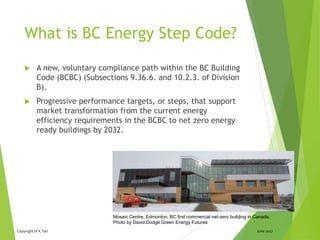
4Mosaic Centre, Edmonton, BC first commercial net-zero building in Canada.
Photo by David Dodge Green Energy Futures
Copyright of X.Tan June 2017
Why Energy Step Code is
applied?
5
 Conservation of energy, and
 Reduction of greenhouse gas emissions.
Unrestricted with two conditions:
• Local governments may not require buildings to be constructed except in
conformance with a step described in Article 9.36.6.3. or 10.2.3.3. of Division B of
the BC BuildingCode; and
• Local governments may not modify a requirement of in addition to those set out
in, Subsection 9.36.6. or 10.2.3. of Division B of the BC BuildingCode.
Must do it!
Don’t require too much!
Copyright of X.Tan June 2017
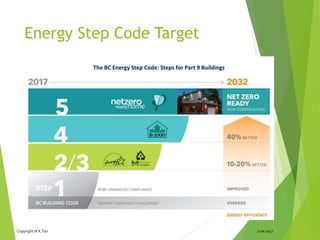
Energy Step Code Target
Copyright of X.Tan June 2017
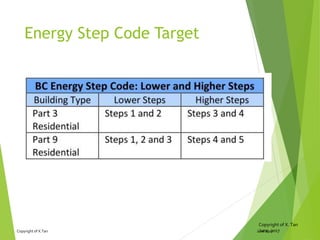
Energy Step Code Target
Copyright of X. Tan
June, 2017
Copyright of X.Tan June 2017
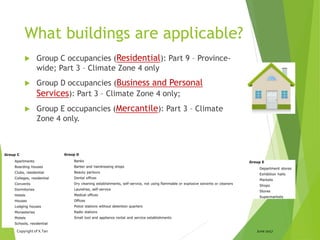
What buildings are applicable?
 Group C occupancies (Residential): Part 9 – Province-
wide; Part 3 – Climate Zone 4 only
 Group D occupancies (Business and Personal
Services): Part 3 – Climate Zone 4 only;
 Group E occupancies (Mercantile): Part 3 – Climate
Zone 4 only.
Copyright of X.Tan June 2017
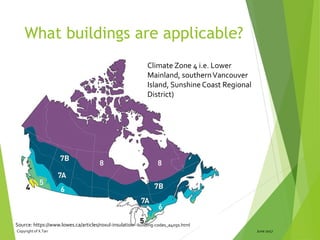
What buildings are applicable?
Source: https://www.lowes.ca/articles/roxul-insulation--building-codes_a4050.html
Climate Zone 4 i.e. Lower
Mainland, southernVancouver
Island, Sunshine Coast Regional
District)
Copyright of X.Tan June 2017
When the step code will be
effective?
April 7, 2017
Copyright of X.Tan June 2017
How to comply with Energy Step
Code?
 Air tightness Requirements
 Performance of building equipment
and system
 Performance of building envelope
Copyright of X.Tan June 2017
Energy Step Code – Part 9.36.6.2
-Definition
1. Mechanical energy use intensity
(kWh/m2.year)
2. EnerGuide Rating System version
15 or HOT2000 version 11
3. Thermal energy demand intensity
(kWh/m2.year)
4. Peak thermal load
Copyright of X.Tan June 2017
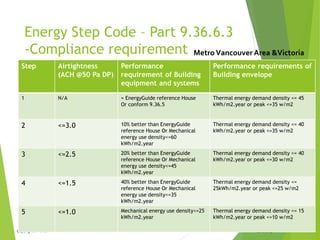
Energy Step Code – Part 9.36.6.3
-Compliance requirement
Step Airtightness
(ACH @50 Pa DP)
Performance
requirement of Building
equipment and systems
Performance requirements of
Building envelope
1 N/A = EnergyGuide reference House
Or conform 9.36.5
Thermal energy demand density <= 45
kWh/m2.year or peak <=35 w/m2
2 <=3.0 10% better than EnergyGuide
reference House Or Mechanical
energy use density<=60
kWh/m2.year
Thermal energy demand density <= 40
kWh/m2.year or peak <=35 w/m2
3 <=2.5 20% better than EnergyGuide
reference House Or Mechanical
energy use density<=45
kWh/m2.year
Thermal energy demand density <= 40
kWh/m2.year or peak <=30 w/m2
4 <=1.5 40% better than EnergyGuide
reference House Or Mechanical
energy use density<=35
kWh/m2.year
Thermal energy demand density <=
25kWh/m2.year or peak <=25 w/m2
5 <=1.0 Mechanical energy use density<=25
kWh/m2.year
Thermal energy demand density <= 15
kWh/m2.year or peak <=10 w/m2
MetroVancouver Area &Victoria
Copyright of X.Tan June 2017
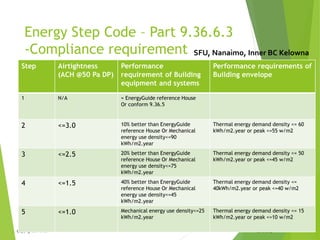
Energy Step Code – Part 9.36.6.3
-Compliance requirement
Step Airtightness
(ACH @50 Pa DP)
Performance
requirement of Building
equipment and systems
Performance requirements of
Building envelope
1 N/A = EnergyGuide reference House
Or conform 9.36.5
2 <=3.0 10% better than EnergyGuide
reference House Or Mechanical
energy use density<=90
kWh/m2.year
Thermal energy demand density <= 60
kWh/m2.year or peak <=55 w/m2
3 <=2.5 20% better than EnergyGuide
reference House Or Mechanical
energy use density<=75
kWh/m2.year
Thermal energy demand density <= 50
kWh/m2.year or peak <=45 w/m2
4 <=1.5 40% better than EnergyGuide
reference House Or Mechanical
energy use density<=45
kWh/m2.year
Thermal energy demand density <=
40kWh/m2.year or peak <=40 w/m2
5 <=1.0 Mechanical energy use density<=25
kWh/m2.year
Thermal energy demand density <= 15
kWh/m2.year or peak <=10 w/m2
SFU, Nanaimo, Inner BC Kelowna
Copyright of X.Tan June 2017
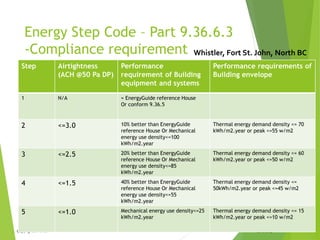
Energy Step Code – Part 9.36.6.3
-Compliance requirement
Step Airtightness
(ACH @50 Pa DP)
Performance
requirement of Building
equipment and systems
Performance requirements of
Building envelope
1 N/A = EnergyGuide reference House
Or conform 9.36.5
2 <=3.0 10% better than EnergyGuide
reference House Or Mechanical
energy use density<=100
kWh/m2.year
Thermal energy demand density <= 70
kWh/m2.year or peak <=55 w/m2
3 <=2.5 20% better than EnergyGuide
reference House Or Mechanical
energy use density<=85
kWh/m2.year
Thermal energy demand density <= 60
kWh/m2.year or peak <=50 w/m2
4 <=1.5 40% better than EnergyGuide
reference House Or Mechanical
energy use density<=55
kWh/m2.year
Thermal energy demand density <=
50kWh/m2.year or peak <=45 w/m2
5 <=1.0 Mechanical energy use density<=25
kWh/m2.year
Thermal energy demand density <= 15
kWh/m2.year or peak <=10 w/m2
Whistler, Fort St. John, North BC
Copyright of X.Tan June 2017
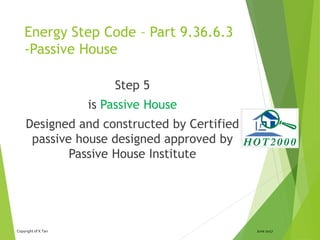
Energy Step Code – Part 9.36.6.3
-Passive House
Step 5
is Passive House
Designed and constructed by Certified
passive house designed approved by
Passive House Institute
Copyright of X.Tan June 2017
Energy Step Code – Part 9.36.6.4
-Energy Modelling
1) Using computer program: TRACE, HAP,
eQuest, Hot2000, IES, EnergyPlus,
OpenStudio, Etc.
2) Conform 9.36.5, EnerGuide v15, or
NECB, or City of Vancouver Energy
Modelling Guideline
3) Use air leakage rate derived from
9.36.6.5
Copyright of X.Tan June 2017
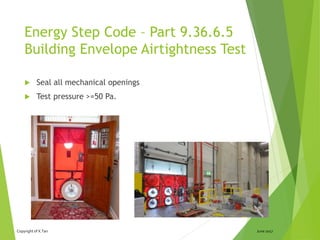
Energy Step Code – Part 9.36.6.5
Building Envelope Airtightness Test
 Seal all mechanical openings
 Test pressure >=50 Pa.
Copyright of X.Tan June 2017
Reference:
 BC Building 2012 Revision 11
 Provincial Policy: Local government
implementation of the BC Energy
Step Code
 BC Building Act Guide

BC Energy step code

  • 1.
    Energy Step Code DISCUSSIONOF BC BUILDING CODE Section 9.36.6 and Section10.2 TAN, XIANGYANG P.ENG., LEEDAP., M.S.Ac. Senior Mechanical Engineer WECHAT: 37180531 E-mail: tandog@gmail.com tan@xtengineering.com T: 778-706-5858
  • 2.
    Copyright of X.TanJune 2017 Introduction of Presenter - 10 years working in china as HVAC/plumbing/fire protection engineer/ architect - 10 year working in Canada as mechanical engineer - Master in architecture in Belgium - Master in building engineering in Canada - Designed more than 200 large size buildings across west china and Canada - Registered Engineer in British Columbia and Alberta
  • 3.
    Copyright of X.TanJune 2017 Table of Contents  What is BC Energy Step Code?  Why Energy Step Code is applied?  What constructions are applicable?  When the step code will be effective?  How to comply with Energy Step Code? 3
  • 4.
    Copyright of X.TanJune 2017 What is BC Energy Step Code?  A new, voluntary compliance path within the BC Building Code (BCBC) (Subsections 9.36.6. and 10.2.3. of Division B).  Progressive performance targets, or steps, that support market transformation from the current energy efficiency requirements in the BCBC to net zero energy ready buildings by 2032. 4Mosaic Centre, Edmonton, BC first commercial net-zero building in Canada. Photo by David Dodge Green Energy Futures
  • 5.
    Copyright of X.TanJune 2017 Why Energy Step Code is applied? 5  Conservation of energy, and  Reduction of greenhouse gas emissions. Unrestricted with two conditions: • Local governments may not require buildings to be constructed except in conformance with a step described in Article 9.36.6.3. or 10.2.3.3. of Division B of the BC BuildingCode; and • Local governments may not modify a requirement of in addition to those set out in, Subsection 9.36.6. or 10.2.3. of Division B of the BC BuildingCode. Must do it! Don’t require too much!
  • 6.
    Copyright of X.TanJune 2017 Energy Step Code Target
  • 7.
    Copyright of X.TanJune 2017 Energy Step Code Target Copyright of X. Tan June, 2017
  • 8.
    Copyright of X.TanJune 2017 What buildings are applicable?  Group C occupancies (Residential): Part 9 – Province- wide; Part 3 – Climate Zone 4 only  Group D occupancies (Business and Personal Services): Part 3 – Climate Zone 4 only;  Group E occupancies (Mercantile): Part 3 – Climate Zone 4 only.
  • 9.
    Copyright of X.TanJune 2017 What buildings are applicable? Source: https://www.lowes.ca/articles/roxul-insulation--building-codes_a4050.html Climate Zone 4 i.e. Lower Mainland, southernVancouver Island, Sunshine Coast Regional District)
  • 10.
    Copyright of X.TanJune 2017 When the step code will be effective? April 7, 2017
  • 11.
    Copyright of X.TanJune 2017 How to comply with Energy Step Code?  Air tightness Requirements  Performance of building equipment and system  Performance of building envelope
  • 12.
    Copyright of X.TanJune 2017 Energy Step Code – Part 9.36.6.2 -Definition 1. Mechanical energy use intensity (kWh/m2.year) 2. EnerGuide Rating System version 15 or HOT2000 version 11 3. Thermal energy demand intensity (kWh/m2.year) 4. Peak thermal load
  • 13.
    Copyright of X.TanJune 2017 Energy Step Code – Part 9.36.6.3 -Compliance requirement Step Airtightness (ACH @50 Pa DP) Performance requirement of Building equipment and systems Performance requirements of Building envelope 1 N/A = EnergyGuide reference House Or conform 9.36.5 Thermal energy demand density <= 45 kWh/m2.year or peak <=35 w/m2 2 <=3.0 10% better than EnergyGuide reference House Or Mechanical energy use density<=60 kWh/m2.year Thermal energy demand density <= 40 kWh/m2.year or peak <=35 w/m2 3 <=2.5 20% better than EnergyGuide reference House Or Mechanical energy use density<=45 kWh/m2.year Thermal energy demand density <= 40 kWh/m2.year or peak <=30 w/m2 4 <=1.5 40% better than EnergyGuide reference House Or Mechanical energy use density<=35 kWh/m2.year Thermal energy demand density <= 25kWh/m2.year or peak <=25 w/m2 5 <=1.0 Mechanical energy use density<=25 kWh/m2.year Thermal energy demand density <= 15 kWh/m2.year or peak <=10 w/m2 MetroVancouver Area &Victoria
  • 14.
    Copyright of X.TanJune 2017 Energy Step Code – Part 9.36.6.3 -Compliance requirement Step Airtightness (ACH @50 Pa DP) Performance requirement of Building equipment and systems Performance requirements of Building envelope 1 N/A = EnergyGuide reference House Or conform 9.36.5 2 <=3.0 10% better than EnergyGuide reference House Or Mechanical energy use density<=90 kWh/m2.year Thermal energy demand density <= 60 kWh/m2.year or peak <=55 w/m2 3 <=2.5 20% better than EnergyGuide reference House Or Mechanical energy use density<=75 kWh/m2.year Thermal energy demand density <= 50 kWh/m2.year or peak <=45 w/m2 4 <=1.5 40% better than EnergyGuide reference House Or Mechanical energy use density<=45 kWh/m2.year Thermal energy demand density <= 40kWh/m2.year or peak <=40 w/m2 5 <=1.0 Mechanical energy use density<=25 kWh/m2.year Thermal energy demand density <= 15 kWh/m2.year or peak <=10 w/m2 SFU, Nanaimo, Inner BC Kelowna
  • 15.
    Copyright of X.TanJune 2017 Energy Step Code – Part 9.36.6.3 -Compliance requirement Step Airtightness (ACH @50 Pa DP) Performance requirement of Building equipment and systems Performance requirements of Building envelope 1 N/A = EnergyGuide reference House Or conform 9.36.5 2 <=3.0 10% better than EnergyGuide reference House Or Mechanical energy use density<=100 kWh/m2.year Thermal energy demand density <= 70 kWh/m2.year or peak <=55 w/m2 3 <=2.5 20% better than EnergyGuide reference House Or Mechanical energy use density<=85 kWh/m2.year Thermal energy demand density <= 60 kWh/m2.year or peak <=50 w/m2 4 <=1.5 40% better than EnergyGuide reference House Or Mechanical energy use density<=55 kWh/m2.year Thermal energy demand density <= 50kWh/m2.year or peak <=45 w/m2 5 <=1.0 Mechanical energy use density<=25 kWh/m2.year Thermal energy demand density <= 15 kWh/m2.year or peak <=10 w/m2 Whistler, Fort St. John, North BC
  • 16.
    Copyright of X.TanJune 2017 Energy Step Code – Part 9.36.6.3 -Passive House Step 5 is Passive House Designed and constructed by Certified passive house designed approved by Passive House Institute
  • 17.
    Copyright of X.TanJune 2017 Energy Step Code – Part 9.36.6.4 -Energy Modelling 1) Using computer program: TRACE, HAP, eQuest, Hot2000, IES, EnergyPlus, OpenStudio, Etc. 2) Conform 9.36.5, EnerGuide v15, or NECB, or City of Vancouver Energy Modelling Guideline 3) Use air leakage rate derived from 9.36.6.5
  • 18.
    Copyright of X.TanJune 2017 Energy Step Code – Part 9.36.6.5 Building Envelope Airtightness Test  Seal all mechanical openings  Test pressure >=50 Pa.
  • 19.
    Copyright of X.TanJune 2017 Reference:  BC Building 2012 Revision 11  Provincial Policy: Local government implementation of the BC Energy Step Code  BC Building Act Guide