W25 – IMPLEMENTING THE B.C. ENERGY STEP CODE: LESSONS LEARNED
AND NEXT STEPS ON THE PATH TO NET-ZERO NEW CONSTRUCTION
Wednesday,	February	14,	2018		
12:00PM-1:30PM	ROOM	218/219	
Speakers:	
Bob	Deeks,	President,	RDC	Fine	Homes	
	
Tom-Pierre	Frappé-Sénéclauze,	Director,	Buildings	and	Urban	SoluKons,	Pembina	InsKtute	
	
Robyn	Wark,	Team	Lead,	Sustainable	CommuniKes,	BC	Hydro	
SPONSORED	BY
1	
February 14, 2018
	
Presented by Bob Deeks / RDC Fine Homes
Buildex
Two Provincial Initiatives Set the Stage
Building Act
§ Consistency, Competency & Innovation
§ December 2017 marks the end of local
building requirements in bylaws.
Climate Leadership Plan
§ Establishes a target that all new
construction will be net-zero ready by 2032.
2
Energy	Step	Code	–	Overview	
	
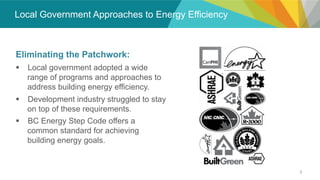
Eliminating the Patchwork:
§  Local government adopted a wide
range of programs and approaches to
address building energy efficiency.
§  Development industry struggled to stay
on top of these requirements.
§  BC Energy Step Code offers a
common standard for achieving
building energy goals.
Local Government Approaches to Energy Efficiency
3
Part 9 | Step 5: Net Zero Ready New Construction
Existing Program Equivalencies
Part 3: High Performance Large + Complex Buildings
Energy modeling Air-Tightness Testing No Prescriptive Requirements
Performance Compliance
10
Energy	Step	Code	–	Overview	
	
What Does the BC Energy Step Code Measure?
11	
Performance Requirements For:
ü  Building envelope
Energy	Step	Code	–	Overview	
	
What Does the BC Energy Step Code Measure?
12	
Performance Requirements For:
ü  Building envelope
ü  Equipment and systems
Energy	Step	Code	–	Overview	
	
What Does the BC Energy Step Code Measure?
13	
Performance Requirements For:
ü  Building envelope
ü  Equipment and systems
ü  Post-construction testing
•  Airtightness
Energy	Step	Code	–	Overview	
	
Building Envelope Efficiency Metrics
14	
Losses
•  Air tightness
•  Insulation
Gains
•  Solar gain
•  People and equipment
Units of heat energy required for
constant temperature after losses and
gains (ignores equipment efficiency).
Energy	Step	Code	–	Overview	
	
Equipment Efficiency Metrics
15	
Energy	Use	
Energy Use
•  Heat
•  Water heating
•  Ventilation
•  Lights and plug loads
(large buildings only)
Part 9 Targets:
Province Wide
Part 3 Targets:
South Coast
Province may add or
adjust targets in future
Geographic Availability
Alignment With Energy Efficiency Incentive Programs
Sample	Programs:		
Resort Municipality of Whistler
City of New Westminster
Sparwood, Invermere, Kimberley
Langley, Saanich
City of Richmond
City of Surrey
City of North Vancouver
17
|	LOCAL	GOVERNMENTS	
	
|	NGOs	
	
|	TRADES	&		
PROFESSIONALS	
	
|	PROVINCIAL		
GOVERNMENT	
	|	BUILDERS	&	
	DEVELOPERS	
	
|	UTILITIES	
	
Research and Support Resources
Completed or Underway:
•  Resource hub: energystepcode.ca
•  Training and capacity assessment
•  Costing study
•  Local government readiness survey
•  Peer network for local government staff
•  Webinars and presentations
18
Timeline
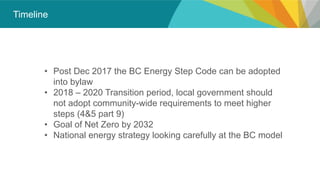
•  Post Dec 2017 the BC Energy Step Code can be adopted
into bylaw
•  2018 – 2020 Transition period, local government should
not adopt community-wide requirements to meet higher
steps (4&5 part 9)
•  Goal of Net Zero by 2032
•  National energy strategy looking carefully at the BC model
Case Study – Step 3 Climate Zone 6
Loca6on	–	Whistler	BC	
Climate	Zone	–	6	
Size	–	204.24	sq.	m	(2198	sq.	H.)	
3	bed,	2.5	bath	with	den	
Walk	out	basement
Energy Model
Foundation & Slab
•  Quadlock	Insulated	Forms	Effec6ve	R	value	
25		
•  R12	Neopor	under	slab	insula6on
Wall Assembly
•  4”	2lb	spray	foam	in	2X6	wall	
•  1.5”	Owens	Corning	Code	Board	
•  Combined	effec6ve	R	value	R31.7	
•  Triple	glazed	double	Low	E	Windows	-	
U	Factor	+/-	1.0
Roof
•  12”	Fiberglass	blown	in	insula6on	in	
parallel	cord	truss	
•  2.5”	Neopor	graphite	EPS	
•  Combined	effec6ve	R	value	R55.88
Mechanical Specification
•  Electric	baseboard	heat	with	electric	floor	heat	to	
baths	and	entry/mudroom	
•  Venmar	Heat	Recovery	Ven6lator	75%	efficient	
•  Propane	gas	fireplace	67%	efficient	
•  Electric	hot	water
Compliance Zone 4
Compliance Zone 5
Compliance Zone 6
Questions?
Zachary May A/Director, Policy and
Codes Development Building and Safety
Standards Branch
zachary.may@gov.bc.ca
Bob Deeks
RDC Fine Homes
bob@rdcfinehomes.com
604 967 1142
Thank You!
29
BC Energy Step Code
Policy context and connection to
code development
Tom-Pierre Frappé-Sénéclauze
Director, Buildings and Urban Solutions
Pembina Institute
February 14, 2018
@tompierrefs
Paris agreement
3
4
2016 B.C. Climate Leadership Plan
•  Net-zero ready by 2032
•  Energy Step Code for local governments to
implement
2016 Pan-Canadian Framework on Clean
Growth and Climate Change
•  Adoption of net-zero ready codes by 2030
•  Provide NZR and interim codes by 2020
5
Provincial and federal objectives
6
Provincial and federal objectives
Other jurisdictions are also
headed for net-zero
EU: nearly zero energy by 2020
(2018 for public buildings)
CA: net-zero energy by 2020 for
residential, 2030 for commercial
WA: 70% energy reduction by 2030
ON: net-zero carbon small
buildings by 2030
Emissions from B.C. buildings
8
0
1
2
3
4
5
6
7
8
2015 2020 2025 2030 2035 2040 2045 2050
GHGemissionsfrombuildings(Mt)
Business as usual
Net-zero ready policy
+
Retrofit strategy
40%-50%
2030
80%-100%
2050
Targets:
No more fossil fuels
for heating
9
A global market
$300B
Photo: Japan Times Data: IEA, 2016
10
0
0.5
1
1.5
2
2.5
3
2009 2010 2011 2012 2013 2014 2015 2016 2016 + in
development
CumulativeSquareFootage(Millions)
Growth of Passive House in North America
B.C.:
20+ projects
600+ units
Data: PHI, PHIUS and Passive House Canada
11
Costing study: results
“In most situations,
builders can achieve the
Lower Steps for less than a
2% construction cost
premium above that of a
home built to the
requirements of the BC
Building Code.”
Long term affordability
114,000 new units of
affordable housing in next
10 years
BC Housing new
construction standard for
Lower Mainland:
—  Step 3 for concrete
—  Step 4 for wood-framed
13
Energy Step Code &
B.C. Building Code evolution
BCBC-2017
BCBC-2020 or
2022
BCBC-2027
BCBC-2032
Step 3
Step 4
Step 5
By 2030:
Most new
construction
Step 4/5
Partners & supporters
Tom-Pierre Frappé-Sénéclauze
tompierrefs@pembina.org
@tompierrefs
pembina.org/subscription
Subscribe – our perspectives to your inbox.
twitter.com/pembina
facebook.com/pembina.institute
Robyn Wark
Vice-Chair, Energy Step Code Council
BC Hydro, Sustainable Communities
January 2018
1
Municipal Update
What trends are we seeing?
2
Which Local Governments are adopting / consulting?
3
Adopted (21% of BC residential building starts)
City of Vancouver*
District of North Vancouver
City of North Vancouver
District of West Vancouver
Consulting (36% of BC residential building starts)
City of Surrey
City of Richmond
Township of Langley
City of Kelowna
City of New Westminster
City of Victoria
District of Saanich
District of Squamish
City of Campbell River
Comox Valley Regional District
City of Duncan
District of North Saanich
Resort Municipality of Whistler
City of Penticton
How are Local Governments consulting with industry?
4
Base Building Bylaws
5
Adopted
• City of Vancouver
• City of North
Vancouver
• District of North
Vancouver
• District of West
Vancouver
Consulting
• City of Richmond,
• City of Surrey,
• City of New
Westminster
• City of Burnaby
• District of Saanich,
• City of Victoria
• City of Kelowna
• … and more
Using Step 1 to ease learning curve to Step 3
8
Sub-regional consistency …
9
North Shore consistent adoption
Richmond, Surrey, New West, Victoria and Saanich – very similar proposal
10
Rezoning Policies - Opportunities for Stepping Up …
Local Area Plans - Opportunities for Stepping Up …
11
12
Local Area Plans - Opportunities for Stepping Up …
Local Government
Builder Education
13
14
Local Government
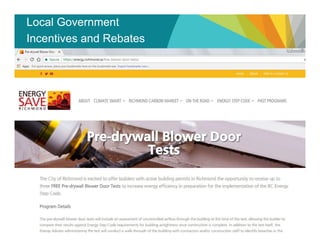
Incentives and Rebates
15
Local Government
Incentives and Rebates
Guides and Training Opportunities
16
Local Energy Efficiency Partnership (LEEP)
17
Video Link
For updates and information ….
www.EnergyStepCode.ca
18
Sustainablecommunities@bchydro.com

Implementing the B.C. Energy Step Code