CEC-400-2013-001-CMF-REV2
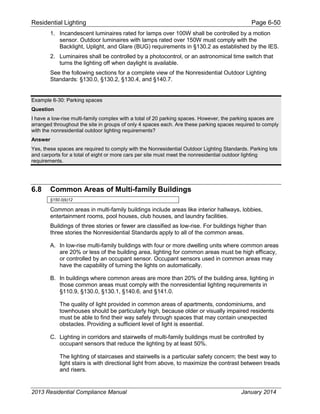
JUNE 2014
REVISED SEPTEMBER 2015
CALIFORNIA ENERGY COMMISSION
Edmund G. Brown Jr., Governor
RESIDENTIAL
COMPLIANCE MANUAL
FOR THE 2013 BUILDING ENERGY EFFICIENCY STANDARDS
TITLE 24, PART 6, AND ASSOCIATED
ADMINISTRATIVE REGULATIONS IN PART 1
2013
 
John Laird
Secretary for Natural Resources Agency
CALIFORNIA ENERGY COMMISSION:
Robert Weisenmiller, Ph.D.
Chairman
Commissioners:
Andrew McAllister
Karen Douglas, J.D.
David Hochschild
Janea A. Scott
Rob Oglesby
Executive Director
David Ashuckian
Deputy Director
Efficiency and Renewable Energy Division
Bill Pennington
Deputy Division Chief
Efficiency and Renewable Energy Division
Eurlyne Geiszler
Office Manager
High Performance Buildings Office
Project Managers:
Maziar Shirakh, P.E.
High Performance Buildings Office  


Acknowledgments
The Building Energy Efficiency Standards (Standards) were first adopted and put into effect in 1978
and have been updated periodically in the intervening years. The Standards are a unique California
asset and have benefitted from the conscientious involvement and enduring commitment to the
public good of many persons and organizations along the way. The 2013 Standards development
and adoption process continued that long-standing practice of maintaining the Standards with
technical rigor, challenging but achievable design and construction practices, public engagement
and full consideration of the views of stakeholders.
The 2013 Standards revision and the supporting documents were conceptualized, evaluated and
justified through the excellent work of Energy Commission staff and consultants working under
contract to the Energy Commission, Pacific Gas and Electric Company, Southern California Edison
Company, San Diego Gas and Electric Company, and Southern California Gas Company. At the
Energy Commission, Maziar Shirakh, P.E.; and Martha Brook, P.E. served as the project managers
and senior engineers. Bill Pennington, Deputy Division Chief of the Efficiency and Renewable
Energy Division, provided overall guidance to the staff and consultants. Eurlyne Geiszler served as
the Office Manager for the High Performance Buildings Office. Pippin Brehler and Kristen Driskell
provided legal counsel to the staff. Other key technical staff contributors included, Gary Flamm;
Patrick Saxton P.E.; Jeff Miller, P.E.; Payam Bozorgchami, P.E.; David Ware; Tav Commins; Rob
Hudler; Owen Howlett; Danny Tam; and Nelson Pena. Additional staff input and assistance came
from Ron Yasny; Seran Thamilseran; Brian Samuelson; Chris Olvera; Jim Holland; Todd Ferris; Joe
Loyer, Alan Marshall; the Energy Hotline staff; and the Energy Commission’s Web Team. Key
Energy Commission and CASE consultants included Architectural Energy Corporation, Bruce
Wilcox, Taylor Engineering, Proctor Engineering, Benya Lighting Design, Chitwood Energy
Management, Davis Energy Group, EnerComp, McHugh Energy, Energy Solutions, E3, PECI, and
the Heschong Mahone Group.
The authors are grateful to the many people and organizations that contributed to the development
and production of the Standards and the supporting documents. The documents reflect, to a large
extent, the comments made by the many people who took time to carefully review earlier versions.
Reviewers who significantly contributed to the content include members of CABEC and CALBO.
Special thanks go to Panama Bartholomy, the former Deputy Director Efficiency and Renewable
Energy Division for his vision and support of the 2013 Standards.
The authors are grateful to the many people and organizations that contributed to the development
and production of the Standards and the supporting documents. The documents reflect, to a large
extent, the comments made by the many people who took time to carefully review earlier versions.
Reviewers who significantly contributed to the content include members of CABEC and CALBO.
Special thanks go to Panama Bartholomy, the former Deputy Director Efficiency and Renewable
Energy Division for his vision and support of the 2013 Standards.
The Energy Commission dedicates the adoption of the 2013 Building Energy
Efficiency Standards to Valerie T. Hall, (November 28, 1952 - December 21, 2010),
Deputy Director of the Efficiency and Renewable Energy Division for her more than 32
years of dedication to excellence in the development and implementation of energy
efficiency programs in California with the most aggressive energy efficient building
standards in the country and for being a model for others to follow.
 
Abstract 
 
This manual is designed to help building owners, architects, engineers, designers, energy 
consultants, builders, enforcement agencies, contractors and installers, and manufacturers 
comply with and enforce the 2013 Title 24 California Building Energy Efficiency Standards 
(Standards) for low rise residential buildings. Written as both a reference and an instructional 
guide, this manual can be helpful for anyone that is directly or indirectly involved in the design 
and construction of energy efficient nonresidential buildings. This manual is intended to 
supplement several other documents that are available from the California Energy Commission 
(Energy Commission). These are the: (1) 2013 California Building Energy Efficiency Standards, 
which were adopted May 31, 2012 and become effective January 1, 2014; (2) Reference 
Appendices for the Standards; and (3) Residential Alternative Calculation Method Reference and 
Approval Manuals. This manual provides a summary of the principle changes in the 2013 Standards 
relative to the 2008 Standards. The technical chapters cover building envelope, mechanical / heating 
ventilation and air conditioning (HVAC) systems, water heating (including swimming pool system 
requirements), interior and for outdoor lighting permanently attached to the building, and the solar 
ready zone requirements. Mandatory measures, prescriptive requirements and compliance options are 
described within each technical area, subsystem or component. Other subjects that are covered include 
the compliance and enforcement process, including design and preparation of compliance 
documentation through field verification and diagnostic testing; computer performance approach; 
additions, alterations and repairs; New Solar Home Partnership (NSHP) requirements; and HERS (Home 
Energy Rating System) raters. 
 
Keywords: title 24, energy, energy efficiency, low rise residential buildings, building envelope, 
domestic water heating, HVAC, indoor outdoor lighting, performance approach, prescriptive 
approach, mandatory requirements, residential compliance manual, HERS rating, diagnostic testing, 
solar, residential cool roofs, residential additions alterations repairs, climate zones 
(This page left intentionally blank)
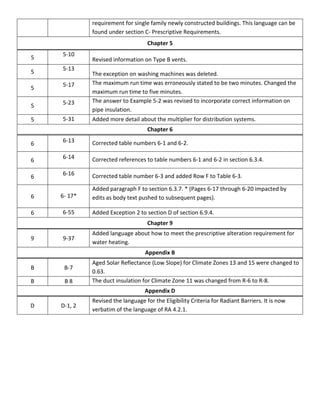
Errata to the 2013 Residential Compliance Manual
This package of inserts can be used to update the 2013 Residential Compliance Manual.
HOW TO DETERMINE WHERE CHANGES HAVE BEEN MADE
| Sidebars in the margins indicate specific locations in the text where insertions and deletions have been made.
Sidebars appearing in the margins not listed in the summary table indicate formatting changes.
* Asterisks, used in the summary table below, indicate those pages, which may include but not limited to those
shown with sidebars, which are different from the original 2013 edition because of insertions moving existing
text to the next page. All pages listed in the parentheses as well as those in the “page(s) with updates” column
require a new print to show the errata incorporation. Note that a new footer appears on those pages with the
date of September 2015. Unchanged pages display the footer of January 2014.
CHAPTER
PAGE(S)
WITH
UPDATES SUMMARY OF CHANGES
Chapter 3
3 3- 29
Removed clause that when installing a fenestration product of SHGC of 0.25 or
lower plus an overhang it will automatically comply.
Added a “Reserved” section to page 3-29, replacing “Prescriptive Compliance
Using South-Facing Overhangs”.
3 3-31
Removed outdated information.
3 3-35
Inserted “Mandatory Minimum Requirements” into Section 3.7.1.
3 3-51
Changed the solar reflectance number for low-sloped roof from 0.55 to 0.63. The
SRI for low-sloped roofs was changed from 64 to 75.
Chapter 4
4 4-4,5 Modified language explaining the Appliance Efficiency Regulation and added note.
4 4-15 Modified Table 4-6 central air conditioners SEER and added footnote.
4 4-31 Added more recommendations for acceptable portable watt meters.
4 4-55
Changed the link on the page from
http://www.techstreet.com/ashrae/lists/ashrae_standards.html to
http://www.techstreet.com/products/1866880
4 4-65, 66
For consistency, 4.3 was changed to 4-3, 4.4 was changed to 4-4, and 4.5 was
changed to 4-5.
4 4-91*
Added Equation 4-9. *(Pages 4- 90 through 4-125 impacted by edits as body text
pushed to subsequent pages).
4 4-91, 92 Table 4-17 was added to the chapter.
4 4-110 Added language to state that whole house fans are now a prescriptive
requirement for single family newly constructed buildings. This language can be
found under section C- Prescriptive Requirements.
Chapter 5
5
5-10
Revised information on Type B vents.
5
5-13
The exception on washing machines was deleted.
5
5-17 The maximum run time was erroneously stated to be two minutes. Changed the
maximum run time to five minutes.
5
5-23 The answer to Example 5-2 was revised to incorporate correct information on
pipe insulation.
5 5-31 Added more detail about the multiplier for distribution systems.
Chapter 6
6
6-13 Corrected table numbers 6-1 and 6-2.
6
6-14 Corrected references to table numbers 6-1 and 6-2 in section 6.3.4.
6
6-16 Corrected table number 6-3 and added Row F to Table 6-3.
6 6- 17*
Added paragraph F to section 6.3.7. * (Pages 6-17 through 6-20 impacted by
edits as body text pushed to subsequent pages).
6 6-55 Added Exception 2 to section D of section 6.9.4.
Chapter 9
9 9-37
Added language about how to meet the prescriptive alteration requirement for
water heating.
Appendix B
B B-7
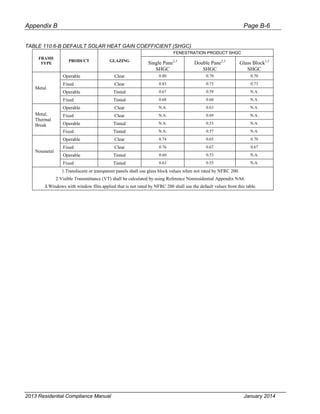
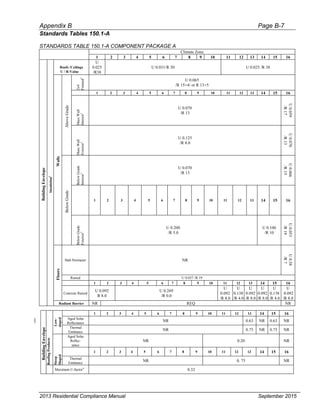
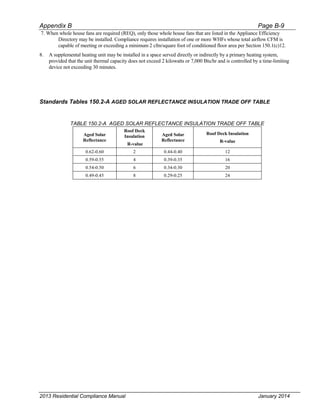
Aged Solar Reflectance (Low Slope) for Climate Zones 13 and 15 were changed to
0.63.
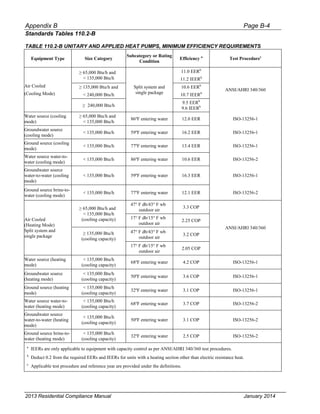
B B 8 The duct insulation for Climate Zone 11 was changed from R-6 to R-8.
Appendix D
D D-1, 2
Revised the language for the Eligibility Criteria for Radiant Barriers. It is now
verbatim of the language of RA 4.2.1.
Table of Contents Page i
2013 Residential Compliance Manual January 2014
Table of Contents 
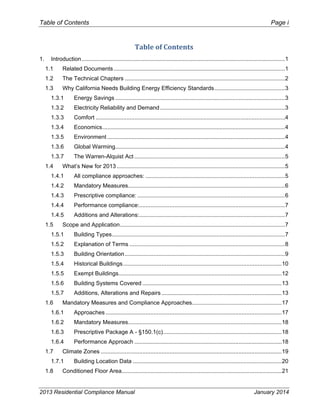
1.  Introduction...............................................................................................................................1 
1.1  Related Documents...........................................................................................................1 
1.2  The Technical Chapters ....................................................................................................2 
1.3  Why California Needs Building Energy Efficiency Standards............................................3 
1.3.1  Energy Savings ..........................................................................................................3 
1.3.2  Electricity Reliability and Demand..............................................................................3 
1.3.3  Comfort ......................................................................................................................4 
1.3.4  Economics..................................................................................................................4 
1.3.5  Environment ...............................................................................................................4 
1.3.6  Global Warming..........................................................................................................4 
1.3.7  The Warren-Alquist Act ..............................................................................................5 
1.4  What’s New for 2013 .........................................................................................................5 
1.4.1  All compliance approaches: .......................................................................................5 
1.4.2  Mandatory Measures..................................................................................................6 
1.4.3  Prescriptive compliance: ............................................................................................6 
1.4.4  Performance compliance:...........................................................................................7 
1.4.5  Additions and Alterations:...........................................................................................7 
1.5  Scope and Application.......................................................................................................7 
1.5.1  Building Types............................................................................................................7 
1.5.2  Explanation of Terms .................................................................................................8 
1.5.3  Building Orientation....................................................................................................9 
1.5.4  Historical Buildings...................................................................................................10 
1.5.5  Exempt Buildings......................................................................................................12 
1.5.6  Building Systems Covered .......................................................................................13 
1.5.7  Additions, Alterations and Repairs ...........................................................................13 
1.6  Mandatory Measures and Compliance Approaches........................................................17 
1.6.1  Approaches ..............................................................................................................17 
1.6.2  Mandatory Measures................................................................................................18 
1.6.3  Prescriptive Package A - §150.1(c)..........................................................................18 
1.6.4  Performance Approach ............................................................................................18 
1.7  Climate Zones .................................................................................................................19 
1.7.1  Building Location Data .............................................................................................20 
1.8  Conditioned Floor Area....................................................................................................21 
Page ii Table of Contents
2013 Residential Compliance Manual January 2014
1.9  Where to Get Help...........................................................................................................22 
1.9.1  Energy Commission Publications and Support ........................................................22 
1.9.2  Training Opportunities..............................................................................................24 
1.9.3  Energy Consultants..................................................................................................24 
1.9.4  Online Videos...........................................................................................................24 
1.9.5  HERS Raters and Providers.....................................................................................25 
Introduction – Related Documents Page 1-1
2013 Residential Compliance Manual January 2014
1. Introduction
This compliance manual is intended to help plans examiners, inspectors, owners, designers,
builders, and energy consultants comply with and enforce California’s 2013 Building Energy
Efficiency Standards for low-rise residential buildings. The lighting and domestic hot water
requirements in this compliance manual also apply to high-rise residential buildings. The
manual is written as a reference and an instructional guide and can be helpful for anyone that
is directly or indirectly involved in the design and construction of energy efficient low-rise
residential buildings.
The compliance manual has nine chapters:
Chapter 1 introduces the Standards and discusses the application and scope of the
Standards for low-rise residences.
Chapter 2 reviews the compliance and enforcement process, including design and
preparation of compliance documentation through field verification and diagnostic testing.
Chapter 3 addresses the requirements for the design of the building envelope.
Chapter 4 covers the requirements for HVAC systems.
Chapter 5 covers the water heating systems requirements, including the requirements for
swimming pool systems.
Chapter 6 addresses the requirements for hardwired interior lighting and for outdoor lighting
permanently attached to the building.
Chapter 7 addresses the new solar ready requirements for low-rise residential buildings and
covers guidelines for complying with the requirements of the New Solar Homes Partnership.
Chapter 8 covers the computer performance approach.
Chapter 9 covers additions, alterations, and repairs.
1.1 Related Documents
This compliance manual is intended to supplement four other related documents that are
available from the California Energy Commission (Energy Commission). These are as
follows:
A. The California 2013 Building Energy Efficiency Standards, Title 24, Part 6 (Standards).
This compliance manual supplements and explains California’s energy efficiency
standards for buildings; it does not replace them. Readers should have a copy of the
Standards to refer to while reading this manual as well as a copy of the 2013 Reference
Appendices which contain information that is common to both the residential and
nonresidential standards.
B. 2013 Reference Appendices - The Reference Appendices have three main subsections:
Reference Joint Appendices, Reference Residential Appendices, and Reference
Nonresidential Appendices:
1. The 2013 Reference Joint Appendices contain information common to both residential
Page 1-2 Introduction – The Technical Chapters
2013 Residential Compliance Manual January 2014
and nonresidential buildings including, but not limited to: definitions, climate zone
listings, weather data, assembly properties, and compliance documentation
registration procedures.
2. The 2013 Reference Residential Appendices contain information for residential
buildings only. The Reference Residential Appendices contain HERS field verification
and/or diagnostic testing procedures for HVAC equipment, air distribution ducts, and
insulation construction quality. The Reference Residential Appendices also contain
eligibility criteria for energy efficiency measures.
3. The 2013 Reference Nonresidential Appendices contain information for nonresidential
buildings only. The Reference Nonresidential Appendices contain HERS field
verification and/or diagnostic testing procedures for HVAC equipment and air
distribution ducts, acceptance testing procedures, and luminaire power default values.
C. The 2013 Residential Alternate Calculation Method (ACMs or Compliance Software)
Approval Manual. The 2013 Residential ACM Approval Manual describes the process for
certifying and decertifying the compliance software programs.
D. The 2013 Residential Alternate Calculation Method Reference Manual is a new document
in 2013 and lays out the technical rules for implementing the 2013 performance
compliance path in software programs.
Material from related documents is not repeated in this Compliance Manual; rather, it is
referenced. If you are using the electronic version of this Compliance Manual, there are
hyperlinks throughout the manual that will take you directly to the document that is
referenced.
1.2 The Technical Chapters
Each of the five technical chapters (3 through 7) begins with an overview, followed by a
presentation of a specific topic in each subsection. For the building envelope, subsections
include fenestration, opaque surfaces (walls, floors, and roofs), air leakage and infiltration,
radiant barriers, cool roofs, and HERS quality insulation installation (QII) verification. For
HVAC, the subsections include heating equipment, cooling equipment, ducts, and HERS field
verification and diagnostic testing. For water heating, subsections include equipment
efficiencies and distribution systems. Lighting subsections include high efficacy and low
efficacy lighting, LED lighting, switching devices and controls, and recessed luminaires.
Mandatory measures and prescriptive requirements (defined in Section 1.6 of this chapter)
are described within each subsection or component. Chapter 8 describes the computer
performance approach. Chapter 9 covers requirements for additions
Introduction – Mandatory Measures and Compliance Approaches Page 1-3
2013 Residential Compliance Manual January 2014
and alterations. Chapter 2, although not a technical chapter, covers important compliance
and enforcement topics.
Each technical chapter or subsection also has a compliance options section. The
compliance options section includes information on how to design a building that goes
beyond the prescriptive energy efficiency requirements and mandatory energy efficiency
measures. Compliance options are utilized for compliance credit through the performance
approach. There are also design recommendations, such as on-site generation, for which
no energy code compliance credit is offered. However, following the recommendations will
significantly impact building energy use or peak demand.
Table 1-1 – Compliance Options vs. Design Recommendations
Compliance Options Design Recommendations, such as on-site generation
Credit offered through the performance approach No credit, but may still impact energy or demand.
1.3 Why California Needs Building Energy Efficiency Standards
Energy efficiency reduces energy costs, increases reliability and availability of electricity,
improves building occupant comfort, and reduces impacts to the environment making
standards important and necessary for California’s energy future.
1.3.1 Energy Savings
Reducing energy use is a benefit to all. Homeowners save money, Californians have a
more secure and healthy economy, the environment is less negatively impacted, and our
electrical system can operate in a more stable manner. The 2013 Standards (for both
residential and nonresidential buildings) are expected to reduce the growth in electricity
use by 464 gigawatt-hours per year (GWh/yr) and reduce the growth in natural gas use by
10.9 million therms per year (therms/yr). The savings attributable to new low-rise
residences are 23.6 GWh/yr of electricity savings and 1.1 million therms of natural gas.
These savings are first year annual savings based on the estimated housing starts and
existing dwelling renovation levels. The cumulative 3-year savings are much higher than
these numbers.
1.3.2 Electricity Reliability and Demand
Buildings are one of the major contributors to electricity demand. We learned during the
2000/2001 California electricity crisis and the east coast blackout in the summer of 2003
that our electric distribution network is fragile and system overloads caused by excessive
demand from buildings can create unstable conditions. Furthermore, resulting blackouts
can seriously disrupt business and cost the economy billions of dollars.
Since the California electricity crisis, the Energy Commission has placed more and more
emphasis on demand reduction. The 2013 Standards are expected to reduce electric
demand by 138.7 MW each year and 35 MW are attributable to low-rise residential
buildings. Like energy savings, demand savings accumulate each year.
Page 1-4 Introduction – Why California Needs Building Energy Efficiency Standards
2013 Residential Compliance Manual January 2014
1.3.3 Comfort
Comfort is an important benefit of energy efficient homes. Energy efficient houses are well
insulated, less drafty, and use high performance windows and/or shading to reduce solar
gains and heat loss. Poorly designed building envelopes result in houses that are less
comfortable. Even with oversized heating and cooling systems, comfort cannot be
achieved in older, poorly insulated and leaky homes.
1.3.4 Economics
For the homeowner, energy efficiency helps to ensure that a home is affordable both now
and into the future. Banks and other financial institutions recognize the impact of energy
efficiency through energy efficient mortgages; they look at the total cost of owning the
home, including paying the utility bills. If the utility bills are lower, lenders can qualify
borrowers for a larger loan.
From a larger perspective, the less California depends on depletable resources such as
natural gas, coal, and oil, the stronger and more stable the economy will remain in the
face of energy cost increases. A cost-effective investment in energy efficiency helps
everyone. In many ways, it is far more cost effective for the people of California to invest in
saving energy than it is to invest in building new power plants.
1.3.5 Environment
In many parts of the world, energy use has led to oil spills, acid rain, smog, and other
forms of environmental pollution that have ruined the natural beauty people seek to enjoy.
California is not immune to these problems, but appliance standards, building standards,
and utility programs that promote efficiency and conservation help to maintain
environmental quality. Other benefits include reduced destruction of natural habitats,
which helps protect animals, plants, and natural systems.
1.3.6 Global Warming
Burning fossil fuels contributes greatly to global warming; carbon dioxide is being added to
an atmosphere already containing 35 percent more than it did two centuries ago. Carbon
dioxide and other greenhouse gases create an insulating layer around the earth that leads
to global climate change. Energy Commission research shows that most of the sectors of
the state economy face significant risk from climate change, including water resources
(from reduced snow pack), agriculture, forests, and the natural habitats of a number of
indigenous plants and animals.
Scientists recommend that actions be taken to reduce emissions of carbon dioxide and
other greenhouse gases. While adding scrubbers to power plants and catalytic converters
to cars reduce other emissions, they do not limit the carbon dioxide we emit into the
atmosphere. Using energy efficiently is a far-reaching strategy that can make an important
contribution to the reduction of greenhouse gases.
The National Academy of Sciences has urged the whole country to follow California's lead
on such efforts, saying that conservation and efficiency should be the chief element in
energy and global warming policy. Their first efficiency recommendation was simple:
Adopt nationwide energy efficient building codes. Energy conservation will not only
Introduction – Mandatory Measures and Compliance Approaches Page 1-5
2013 Residential Compliance Manual January 2014
increase comfort levels and save homeowners money, it will also play a vital role in
creating and maintaining a healthy environment.
The Standards are expected to have a significant impact on reducing greenhouse gas and
other air emissions. Carbon dioxide, one of the more prevalent greenhouse gases, would
be reduced by 16,110 metric tons the first year when the Standards go into effect; the
cumulative 3-year savings or the CO2
savings over the life of the Standards are much
higher than the savings indicated above.. These estimates are based, when possible, on
hourly emission rates for electricity use in southern and northern California. When savings
estimates are made on an annual basis, average emission rates are used.
1.3.7 The Warren-Alquist Act
Section 25402 of the Public Resources Code
The authority of the Energy Commission to develop and maintain building energy
efficiency standards for new buildings is provided in Section 25402 of the Public
Resources Code (the Code). This section of the Code, commonly referred to as the
Warren-Alquist Act (the Act), is direction from the legislature on the development of
building energy efficiency standards in California.
The Act created the Energy Commission in 1974 and gave it authority to develop and
maintain building energy efficiency standards for new buildings. The Act directs the
Energy Commission to “Prescribe, by regulation, lighting, insulation, climate control
system, and other building design and construction standards which increase the
efficiency in the use of energy for new residential and new nonresidential buildings.”
The Act also requires that the Standards be cost effective “when taken in their entirety and
amortized over the economic life of the structure,” and it requires that the Energy
Commission periodically update the Standards and develop manuals to support the
Standards. The Act directs local building permit jurisdictions to withhold permits until the
building satisfies the Standards.
The Public Resources Code was amended through Senate Bill 5X in 2002 to expand the
authority of the Energy Commission to develop and maintain standards for outdoor lighting
and signs.
1.4 What’s New for 2013
The most significant changes in the 2013 Building Energy Efficiency Standards affecting
residential buildings include the new requirements for high performance fenestration
products. Other changes for residential buildings include the following:
1.4.1 All compliance approaches:
A. Revisions to the administrative section §10-103 sets the format and informational order
for electronic compliance document registration and submittal and for electronic
retention of compliance documentation for future use and clarifies the roles and
responsibilities of the documentation author and the responsible person; §10-109
describes the rules for approving compliance software, alternative component
packages, exceptional methods, data registries and related data input software, or
Page 1-6 Introduction – What’s New for 2013
2013 Residential Compliance Manual January 2014
electronic document repositories. §10-111 describes the rules for reporting
fenestration U-factor, SHGC, and VT.
B. §110.3(c)5 explains the requirements for the water heating recirculation loops serving
multiple dwelling units, high-rise residential, hotel/motel, and nonresidential
occupancies..
C. Revisions to §110.9 now covers ballasts and luminaires and residential vacancy
sensors.
1.4.2 Mandatory Measures
A. Duct sealing in all climate zones (CZs) (defined in Section 1.7 of this chapter). (Section
150.0(m)11)
B. Return duct design or fan power, airflow testing, and grill sizing requirements
(Residential HVAC Quality Installation Improvements). (Section150.0(m)13)
C. Lighting – Improving and clarifying the mandatory lighting requirements for all
residential buildings including kitchens, bathrooms, dining rooms, utility rooms,
garages, hall ways, bedrooms, and outdoor lighting. (Section150.0(k)
D. New luminaire efficacy levels in Table 150.0-B
E. Hot water pipe insulation - Requires insulation on pipes ¾ inch and larger.
(Section150.0(j)2Aii)
F. Solar Ready Measure – 250 square feet of solar ready zone on single family roofs in
subdivisions of 10 or more swelling units. (Section150.0(r))
G. Walls with 2x6 framing and larger must have at least R-19 insulation (Section
150.0(c)2).
H. New mandatory U-factor of 0.58 for vertical fenestrations products and skylights,
Section 150.0(q).
I. New third party HERS verifications requirement for Ventilation for Indoor Air Quality,
ASHRAE 62.2 requirements, Section 150.0(o).
1.4.3 Prescriptive compliance:
A. High Performance Windows – Reducing the U-Factor to 0.32 and SHGC to 0.25 in
most climate zones. (Section 150.1(c)3A).
B. Duct Insulation – Raise minimum from R-4.2 to R-6.0 in climate zones 6, 7, and 8.
(Section 150.1(c)9).
C. Night Ventilation – Whole house fan required to be installed in climate zones 8 through
14; a Smart Vents and Night Breeze allowed as performance path alternatives.
(Section 150.1(c)12).
D. Expand the Radiant Barrier requirements to climate zones 3, and 5 through 7. (Section
150.1(c)2).
Introduction – Mandatory Measures and Compliance Approaches Page 1-7
2013 Residential Compliance Manual January 2014
E. Refrigerant charge and verification now expanded to include ducted package units,
mini-splits, and other units (Section 150.1(c)7).
F. Increase wall insulation to R15+4 in all CZs (Section 150.1(c)1B).
1.4.4 Performance compliance:
The modeling procedures and requirements for compliance software have been significantly
modified for the 2013 Standards. All compliance software vendors must use a single modeling
approach and a single interpretation of the performance compliance rules. This “Compliance
Manager” software will be integrated into vendor-supplied compliance software that is certified by
the Energy Commission. More information is available in the 2013 Residential ACM Approval
Manual and the 2013 Residential ACM Reference Manual.
1.4.5 Additions and Alterations:
A. Simplified Compliance documentation requirements for small additions and alteration
projects that do not involve a HERS measure. (Section 10-103(a)1C and Section 10-
103(a)3C)
B. Simplified rules for both the prescriptive and performance paths for additions,
alterations, and existing plus additions plus alterations. (Section 150.2(a) and (b))
1.5 Scope and Application
1.5.1 Building Types
Though the California Standards apply to both nonresidential and residential buildings, this
compliance manual only address the requirements for low-rise residential buildings. A
companion compliance manual addresses the requirements for nonresidential buildings,
including hotels, motels, and high-rise residential buildings that are four stories or more in
height.
Mixed Low-Rise Residential and Nonresidential Occupancies. When a building
includes both low-rise residential and nonresidential occupancies, the requirements are
different depending upon the percentages of the conditioned floor that is occupied by each
occupancy type:
i. Minor Occupancy (Exception 1 to §100(f)). When a residential occupancy occurs in
the same building as a nonresidential occupancy, and if one of the occupancies is less
than 20 percent of the total conditioned floor area, the smaller occupancy is
considered a “minor” occupancy. Under this scenario, optionally, the entire building
may be treated as if it is the major occupancy for the purpose of envelope, HVAC, and
water heating. Lighting requirements in §140.6 through 140.8 or 150.0(k) must be met
for each occupancy separately. The mandatory measures applicable to the minor
occupancy, if different from the major occupancy, would still apply.
ii. Mixed Occupancy. When residential occupancy is mixed with a nonresidential
occupancy, and if neither occupancy is less than 20 percent of the total conditioned
Page 1-8 Introduction – Scope and Application
2013 Residential Compliance Manual January 2014
floor area, these occupancies fall under different sets of Standards and must be
considered separately. Two compliance submittals must be prepared, each using the
calculations and forms of its respective Standards. Separate compliance for each
occupancy, to their respective Standards, is an option when one of the occupancies is
a minor occupancy, as discussed in the paragraph above.
In multi-family buildings, lighting in common areas is subject to all nonresidential
requirements if the common area CFA exceeds 20% of the building CFA. Where the
common area does not exceed 20% of the building CFA, lighting must meet mandatory
requirements – a choice of high-efficacy lighting or automatic controls. See Standards §
150.0(k)12.
The three-story designation relates to multifamily buildings, since all single family homes
fall under the low-rise residential requirements regardless of the number of stories. An
apartment building with three or fewer habitable stories falls under the low-rise residential
standards while an apartment building that has more than three habitable stories falls
under the nonresidential standards. High-rise residential dwelling units must still comply
with the lighting and water heating requirements for low-rise residential buildings, e.g., the
Nonresidential Compliance Manual makes reference to Chapters 5 and 6 of this
document.
A habitable story is defined in the California Building Code (CBC) and that definition is
used with the building energy efficiency standards. Mezzanines are not counted as
separate habitable stories – nor are minor conditioned spaces such as an enclosed entry
stair that leads to an apartment or dwelling unit on the next floor. A habitable story is one
that contains space in which humans may live or work in reasonable comfort, and that has
at least 50 percent of its volume above grade.
Live/work buildings are a special case since they combine residential and nonresidential
uses within individual units. Such buildings are a common form of new construction in San
Francisco and some other urban areas of the state. Even though live/work spaces may be
used for an office or a studio, they are typically heated and/or cooled like a residence. For
this reason the residential standards are more suitable and the Energy Commission has
made this determination. Either the low-rise or high-rise residential standards apply,
depending on the number of habitable stories.
However, lighting in designated workspaces in live/work lofts must comply with the
nonresidential prescriptive lighting requirements. See Chapter 5 of the Nonresidential
Compliance Manual and §140.6 for more information.
1.5.2 Explanation of Terms
The term building type refers to the classification of buildings defined by the CBC and
applicable to the requirements of the Building Energy Efficiency Standards. This manual is
concerned with the building energy efficiency standards that apply to all low-rise
residential buildings, which includes all single-family dwellings and multi-family buildings
with three or fewer habitable stories in the entire building. A multi-family building with four
or more habitable stories is under the scope of the nonresidential requirements, but the
dwelling units must meet the lighting, water heating, and setback thermostat requirements
for low-rise residential buildings. A multi-family building contains multiple dwelling units
that share common walls (single family attached) and may also share common floors or
ceilings (apartments).
Introduction – Mandatory Measures and Compliance Approaches Page 1-9
2013 Residential Compliance Manual January 2014
All residential buildings not in the above low-rise category are covered in the 2013 edition
of the Energy Commission's Nonresidential Compliance Manual (see Parts 1.1 and 1.2).
A. A single-family building is a single dwelling unit of occupancy group R-3, as defined
in the CBC, which stands separate and unattached from other dwelling units but may
have an attached garage.
B. A multi-family building is a dwelling unit of occupancy group R, as defined in the
CBC; that shares a common wall and/or floor/ceiling with at least one other dwelling
unit. See Chapter 8 for more information on multi-family energy compliance. A single
family attached building is a dwelling unit of occupancy group R that shares a common
wall with another dwelling unit.
C. An addition to an existing building increases both the conditioned floor area and
volume of a building, which can be new construction or adding space conditioning to
an existing unconditioned space. See Chapter 9 for more information on energy
compliance of additions.
D. An existing building is: "...a building erected prior to the adoption of [the current]
code, or one for which a legal building permit has been issued." [CBC, Part 2]
1.5.3 Building Orientation
Building orientation can affect the energy use of a building, particularly in cooling
dominated climate zones with high amount of west facing glass. Some prescriptive
requirements and performance modeling inputs for compliance with the Standards require
a description of the building orientation.
A. East-Facing
"East-facing is oriented to within 45 degrees of true east, including 45°0'0" south of
east (SE), but excluding 45°0'0" north of east (NE)." [§100.1]
B. North-Facing
"North-facing is oriented to within 45 degrees of true north, including 45°0'0" east of
north (NE), but excluding 45°0'0" west of north (NW)." [§100.1]
C. South-Facing
"South-facing is oriented to within 45 degrees of true south, including 45°0'0" west of
south (SW), but excluding 45°0'0" east of south (SE)." [§100.1]
D. West-Facing
"West-facing is oriented to within 45 degrees of true west, including 45°0'0" due north
of west (NW) but excluding 45°0'0" south of west (SW)." [§100.1]
Page 1-10 Introduction – Scope and Application
2013 Residential Compliance Manual January 2014
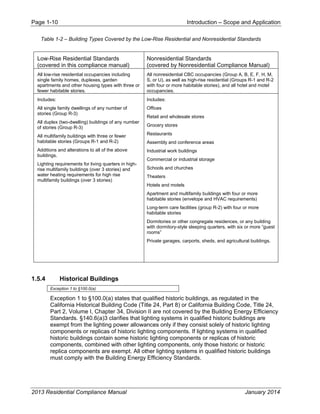
Table 1-2 – Building Types Covered by the Low-Rise Residential and Nonresidential Standards
Low-Rise Residential Standards
(covered in this compliance manual)
Nonresidential Standards
(covered by Nonresidential Compliance Manual)
All low-rise residential occupancies including
single family homes, duplexes, garden
apartments and other housing types with three or
fewer habitable stories.
All nonresidential CBC occupancies (Group A, B, E, F, H, M,
S, or U), as well as high-rise residential (Groups R-1 and R-2
with four or more habitable stories), and all hotel and motel
occupancies.
Includes:
All single family dwellings of any number of
stories (Group R-3)
All duplex (two-dwelling) buildings of any number
of stories (Group R-3)
All multifamily buildings with three or fewer
habitable stories (Groups R-1 and R-2)
Additions and alterations to all of the above
buildings.
Lighting requirements for living quarters in high-
rise multifamily buildings (over 3 stories) and
water heating requirements for high rise
multifamily buildings (over 3 stories)
Includes:
Offices
Retail and wholesale stores
Grocery stores
Restaurants
Assembly and conference areas
Industrial work buildings
Commercial or industrial storage
Schools and churches
Theaters
Hotels and motels
Apartment and multifamily buildings with four or more
habitable stories (envelope and HVAC requirements)
Long-term care facilities (group R-2) with four or more
habitable stories
Dormitories or other congregate residences, or any building
with dormitory-style sleeping quarters, with six or more “guest
rooms”
Private garages, carports, sheds, and agricultural buildings.
1.5.4 Historical Buildings
Exception 1 to §100.0(a)
Exception 1 to §100.0(a) states that qualified historic buildings, as regulated in the
California Historical Building Code (Title 24, Part 8) or California Building Code, Title 24,
Part 2, Volume I, Chapter 34, Division II are not covered by the Building Energy Efficiency
Standards. §140.6(a)3 clarifies that lighting systems in qualified historic buildings are
exempt from the lighting power allowances only if they consist solely of historic lighting
components or replicas of historic lighting components. If lighting systems in qualified
historic buildings contain some historic lighting components or replicas of historic
components, combined with other lighting components, only those historic or historic
replica components are exempt. All other lighting systems in qualified historic buildings
must comply with the Building Energy Efficiency Standards.
Introduction – Mandatory Measures and Compliance Approaches Page 1-11
2013 Residential Compliance Manual January 2014
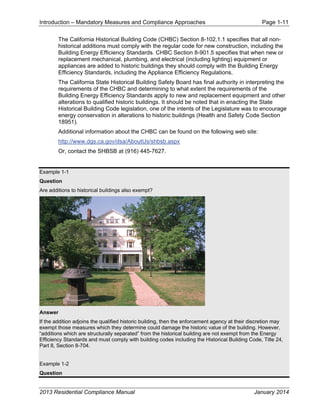
The California Historical Building Code (CHBC) Section 8-102.1.1 specifies that all non-
historical additions must comply with the regular code for new construction, including the
Building Energy Efficiency Standards. CHBC Section 8-901.5 specifies that when new or
replacement mechanical, plumbing, and electrical (including lighting) equipment or
appliances are added to historic buildings they should comply with the Building Energy
Efficiency Standards, including the Appliance Efficiency Regulations.
The California State Historical Building Safety Board has final authority in interpreting the
requirements of the CHBC and determining to what extent the requirements of the
Building Energy Efficiency Standards apply to new and replacement equipment and other
alterations to qualified historic buildings. It should be noted that in enacting the State
Historical Building Code legislation, one of the intents of the Legislature was to encourage
energy conservation in alterations to historic buildings (Health and Safety Code Section
18951).
Additional information about the CHBC can be found on the following web site:
http://www.dgs.ca.gov/dsa/AboutUs/shbsb.aspx
Or, contact the SHBSB at (916) 445-7627.
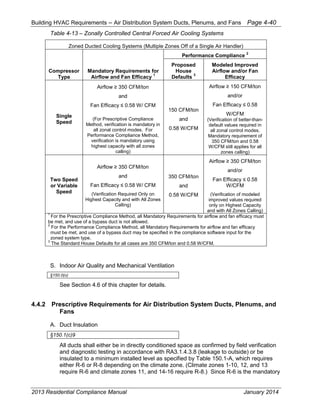
Example 1-1
Question
Are additions to historical buildings also exempt?
Answer
If the addition adjoins the qualified historic building, then the enforcement agency at their discretion may
exempt those measures which they determine could damage the historic value of the building. However,
“additions which are structurally separated” from the historical building are not exempt from the Energy
Efficiency Standards and must comply with building codes including the Historical Building Code, Title 24,
Part 8, Section 8-704.
Example 1-2
Question
Page 1-12 Introduction – Scope and Application
2013 Residential Compliance Manual January 2014
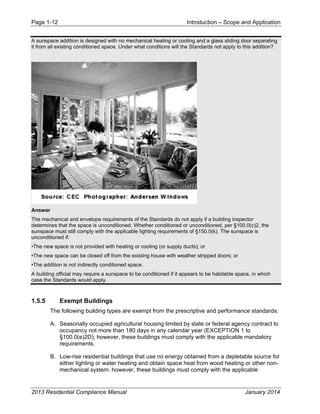
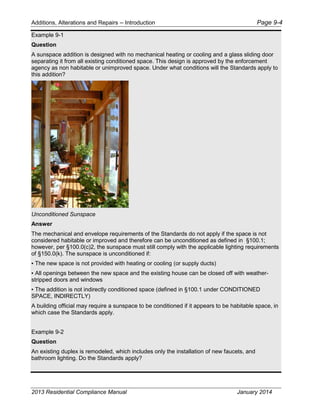
A sunspace addition is designed with no mechanical heating or cooling and a glass sliding door separating
it from all existing conditioned space. Under what conditions will the Standards not apply to this addition?
Answer
The mechanical and envelope requirements of the Standards do not apply if a building inspector
determines that the space is unconditioned. Whether conditioned or unconditioned, per §100.0(c)2, the
sunspace must still comply with the applicable lighting requirements of §150.0(k). The sunspace is
unconditioned if:
•The new space is not provided with heating or cooling (or supply ducts); or
•The new space can be closed off from the existing house with weather stripped doors; or
•The addition is not indirectly conditioned space.
A building official may require a sunspace to be conditioned if it appears to be habitable space, in which
case the Standards would apply.
1.5.5 Exempt Buildings
The following building types are exempt from the prescriptive and performance standards:
A. Seasonally occupied agricultural housing limited by state or federal agency contract to
occupancy not more than 180 days in any calendar year (EXCEPTION 1 to
§100.0(e)2D); however, these buildings must comply with the applicable mandatory
requirements.
B. Low-rise residential buildings that use no energy obtained from a depletable source for
either lighting or water heating and obtain space heat from wood heating or other non-
mechanical system: however, these buildings must comply with the applicable
Introduction – Mandatory Measures and Compliance Approaches Page 1-13
2013 Residential Compliance Manual January 2014
mandatory requirements .
C. Based on discretion of building officials, temporary buildings, temporary outdoor
lighting or temporary lighting in an unconditioned building, or structures erected in
response to a natural disaster (EXCEPTION 2 to §100.0(a)). These buildings may also
be exempt from the mandatory and prescriptive requirements of the Standards.
1.5.6 Building Systems Covered
The low-rise residential standards affect the design of the building envelope; the heating,
ventilation and air conditioning (HVAC) system; the water heating system; and the lighting
system. The Standards do not apply to residential appliances (Appliance Efficiency
Regulations may apply), elevators or dumbwaiters, or to portable lighting systems that are
plugged into a wall outlet. Only hardwired lighting is regulated, which includes lighting that
is a permanent part of the building.
1.5.7 Additions, Alterations and Repairs
• §100.1(b)
• §150.2(a)
• §150.2(b)
Additions, alterations, and repairs are common construction projects for California
homeowners. The Standards apply to both additions and alterations, but not to repairs.
See Chapter 9 for details.
A. Additions are changes to an existing building that increase both conditioned floor
area and volume.
B. Alterations, that are not additions, are changes to a building's envelope, space
conditioning system, water heating system or lighting system.
C. Repairs are the reconstruction or renewal of any part of an existing building for the
purpose of its maintenance and are not under the scope of the Standards.
Replacement of any component systems (i.e. re-roofing), or equipment for which there
are requirements in the Standards is considered an alteration and not a repair.
Example 1-3
Question
The Standards do not specify whether buildings damaged by natural disasters can be reconstructed to their
original energy performance specifications. What requirements apply under these circumstances?
Answer
Buildings destroyed or damaged by natural disasters must comply with the energy code requirements in
effect when the builder or owner applies for a permit to rebuild for those portions of the building that are
being rebuilt.
Example 1-4
Question
Do the Standards apply to an addition to a manufactured (“mobile”) home?
Page 1-14 Introduction – Scope and Application
2013 Residential Compliance Manual January 2014
Answer
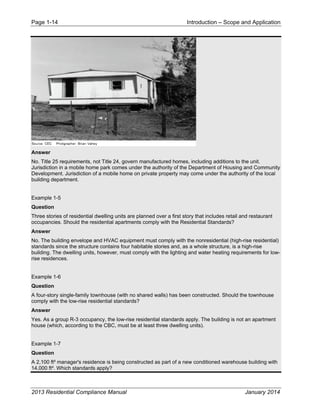
No. Title 25 requirements, not Title 24, govern manufactured homes, including additions to the unit.
Jurisdiction in a mobile home park comes under the authority of the Department of Housing and Community
Development. Jurisdiction of a mobile home on private property may come under the authority of the local
building department.
Example 1-5
Question
Three stories of residential dwelling units are planned over a first story that includes retail and restaurant
occupancies. Should the residential apartments comply with the Residential Standards?
Answer
No. The building envelope and HVAC equipment must comply with the nonresidential (high-rise residential)
standards since the structure contains four habitable stories and, as a whole structure, is a high-rise
building. The dwelling units, however, must comply with the lighting and water heating requirements for low-
rise residences.
Example 1-6
Question
A four-story single-family townhouse (with no shared walls) has been constructed. Should the townhouse
comply with the low-rise residential standards?
Answer
Yes. As a group R-3 occupancy, the low-rise residential standards apply. The building is not an apartment
house (which, according to the CBC, must be at least three dwelling units).
Example 1-7
Question
A 2,100 ft² manager's residence is being constructed as part of a new conditioned warehouse building with
14,000 ft². Which standards apply?
Introduction – Mandatory Measures and Compliance Approaches Page 1-15
2013 Residential Compliance Manual January 2014
Answer
The whole building can comply with the nonresidential standards, and the residential unit is not required to
comply separately since it is a subordinate occupancy containing less than 20% of the total conditioned
floor area. However, the residential dwelling unit must meet all low-rise residential mandatory measures as
well as the lighting and water heating requirements.
Example 1-8
Question
Assume the same scenario as in the previous example, except that the dwelling unit is new and the
remainder of the building is existing. Do the residential standards apply?
Answer
Yes. Since 100% of the addition being permitted is a low-rise residential occupancy, compliance under the
residential standards is required.
Example 1-9
Question
A residence is being moved to a different location. What are the applicable compliance requirements?
Answer
Because this is an existing conditioned space, the requirements applicable to alterations would apply to any
alterations being made. The building does not need to show compliance with the current energy standards
applicable to new buildings or additions.
Example 1-10
Question
A previously conditioned retail space is remodeled to become a residential dwelling. What are the
applicable compliance requirements?
Answer
The residential dwelling is treated as if it were previously a residential occupancy. In this case, the rules that
apply to residential alterations are applied.
Example 1-11
Question
A 10,000 ft², 16-unit motel is constructed with an attached 1,950 ft² manager's residence. What are the
applicable compliance requirements?
Page 1-16 Introduction – Scope and Application
2013 Residential Compliance Manual January 2014
Answer
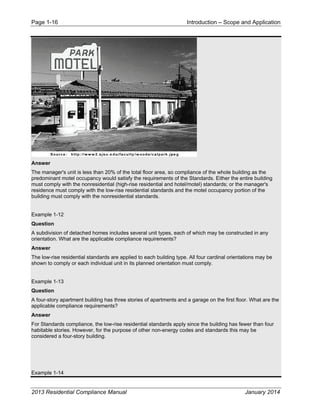
The manager's unit is less than 20% of the total floor area, so compliance of the whole building as the
predominant motel occupancy would satisfy the requirements of the Standards. Either the entire building
must comply with the nonresidential (high-rise residential and hotel/motel) standards; or the manager's
residence must comply with the low-rise residential standards and the motel occupancy portion of the
building must comply with the nonresidential standards.
Example 1-12
Question
A subdivision of detached homes includes several unit types, each of which may be constructed in any
orientation. What are the applicable compliance requirements?
Answer
The low-rise residential standards are applied to each building type. All four cardinal orientations may be
shown to comply or each individual unit in its planned orientation must comply.
Example 1-13
Question
A four-story apartment building has three stories of apartments and a garage on the first floor. What are the
applicable compliance requirements?
Answer
For Standards compliance, the low-rise residential standards apply since the building has fewer than four
habitable stories. However, for the purpose of other non-energy codes and standards this may be
considered a four-story building.
Example 1-14
Introduction – Mandatory Measures and Compliance Approaches Page 1-17
2013 Residential Compliance Manual January 2014
Question
If in Example 1-13 above, there was a small air conditioned elevator lobby at the garage floor, what would
be applicable compliance requirements?
Answer
§100.1 defines a habitable story as a story that contains space in which humans may work or live in
reasonable comfort, and that has at least 50 percent of its volume above grade. The small elevator lobby
does not meet this definition for habitable story and therefore the low-rise residential standards still apply.
Example 1-15
Question
If in Example 1-13 above, there was a receptionist station in the conditioned elevator lobby at the garage
floor, what would be the applicable compliance requirements?
Answer
In this case the lobby with the receptionist meets the habitable story definition of §100.1 and therefore the
building must be considered a high-rise residential occupancy. The building envelope and HVAC equipment
must comply with the nonresidential (high-rise residential) standards, and the dwelling units must comply
with the lighting and water heating requirements for low-rise residences.
1.6 Mandatory Measures and Compliance Approaches
In addition to the mandatory measures (Section 1.6.2), the Standards provide two basic
methods for complying with low-rise residential energy budgets: the prescriptive approach
and the performance approach. The mandatory measures must be installed with either of
these approaches, but note that mandatory measures may be superseded by more
stringent measures under either approach.
1.6.1 Approaches
A. The prescriptive approach, composed of a climate zone dependent prescriptive
package (Section 1.6.3), is less flexible but simpler than the performance approach
(Section 1.6.4). Each individual energy component of the proposed building must meet
a prescribed minimum efficiency. The prescriptive approach offers relatively little
design flexibility but is easy to use. There is some flexibility for building envelope
components, such as walls, where portions of the wall that do not meet the prescriptive
insulation requirement may still comply as long as they are area-weighted with the rest
of the walls, and the average wall performance complies.
B. The performance approach (Section 1.6.4) is more complicated but offers
considerable design flexibility. The performance approach requires an approved
computer software program that models a proposed building, determines its allowed
energy budget, calculates its energy use, and determines when it complies with the
budget. Compliance options such as window orientation, shading, thermal mass, zonal
control, and house configuration are all considered in the performance approach. This
approach is popular with production home builders because of the flexibility and
because it provides a way to find the most cost-effective solution for complying with
Page 1-18 Introduction – Mandatory Measures and Compliance Approaches
2013 Residential Compliance Manual January 2014
the Standards.
For additions and alterations, see Chapter 9 for details of compliance approaches that are
available.
1.6.2 Mandatory Measures
With either the prescriptive or performance compliance paths, there are mandatory
measures that must always be installed. Many of the mandatory measures deal with
infiltration control and lighting; others require minimum insulation levels and equipment
efficiency. New for the 2013 Building Energy Efficiency Standards are mandatory
measures that require HERS verification for duct sealing and leakage, HVAC system
airflow and fan efficacy, and ventilation systems (including exhaust fans) installed to meet
the requirements of ASHRAE Standard 62.2. The minimum mandatory levels are
sometimes superseded by more stringent prescriptive or performance approach
requirements. For example, if mandatory measures specify R-30 ceiling insulation and the
prescriptive approach, Package A, is used, R-38 ceiling insulation (depending on climate
zone) must be installed. Conversely, the mandatory measures may be of a higher
efficiency than permitted under the performance approach; in these instances, the higher
mandatory levels must be installed. For example, a building may comply using the
performance computer modeling only R-7 insulation in a raised floor, but R-19 must be
installed because that is the mandatory minimum.
1.6.3 Prescriptive Package A - §150.1(c)
The prescriptive requirements are represented in Package A. The prescriptive package is
the simplest but least flexible compliance path. Package A establishes the stringency of
the Standards for the performance approach. Approved computer programs model a
house with the features of Package A to determine the envelope, space conditioning, and
water heating budgets.
The prescriptive package is a set of pre-defined performance levels for various building
components. Each building component must meet or exceed the minimum efficiency level
specified in the package. For the 2013 Standards, there is only one prescriptive package:
Package A. Packages C and E were eliminated in the 2013 Standards and Package D has
been renamed as Package A.
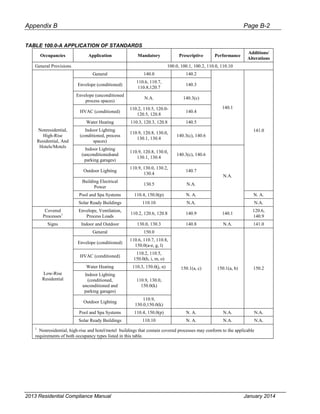
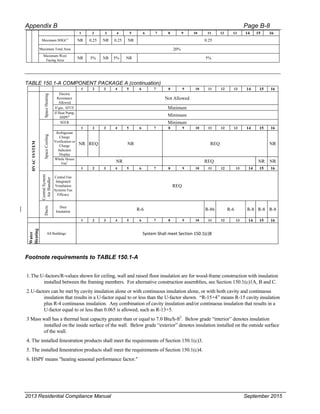
A. Package A is presented in Table 150.1-A (and its footnotes) in the Standards (also in
Appendix B of this document). Package A. The Package A prescriptive requirements
serve as the basis of the standard design in the performance approach and determine
the energy budget of a proposed design. These prescriptive requirements require that
ducted split system and packaged air conditioners or heat pumps (for definition see
Reference Joint Appendix JA1) be diagnostically tested to verify that they have the
correct refrigerant charge.
1.6.4 Performance Approach
The performance approach, also known as the computer method, requires that the annual
Time Dependent Valuation (TDV) energy be calculated for the proposed house and
compared to the standard TDV energy budget. TDV energy is the “currency” for the
performance approach. TDV energy not only considers the type of energy that is used
Introduction – Mandatory Measures and Compliance Approaches Page 1-19
2013 Residential Compliance Manual January 2014
(electricity, gas, or propane), but also when it is used. Energy saved during periods when
California is likely to have a statewide system peak is worth more than energy saved at
times when supply exceeds demand. Reference Joint Appendix JA3 has more information
on TDV energy.
The use of Energy Commission approved computer methods represents the most detailed
and sophisticated method of compliance. While this approach requires the most effort, it
also provides the greatest flexibility. The computer program automatically calculates the
energy budget for space conditioning and water heating. The budget is determined from
the standard design, a computer model of the building using the Package A prescriptive
package. The computer software allows manipulation of the proposed building’s energy
features to achieve or do better than the standard energy budget; i.e. the building
proposed energy consumption would be equal to or less than the standard energy budget.
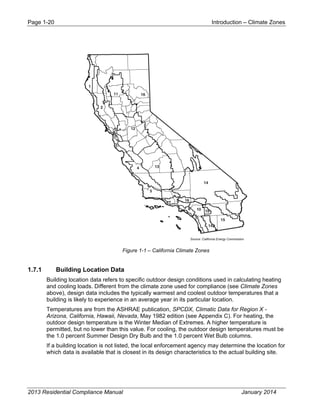
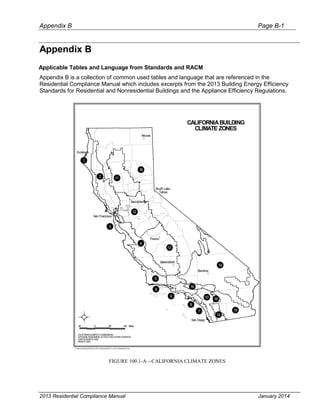
1.7 Climate Zones
To standardize calculations and to provide a basis for presenting the prescriptive
requirements, the Energy Commission has established a set of standard climate data for
each of the 16 climate zones. More information is provided in Reference Joint Appendix
JA2, including a listing of climate zones for all California zip codes. Reference Joint
Appendix JA2 gives other climate information such as design temperatures for sizing
HVAC equipment. The climate zone definitions and data are the same for both the low-rise
residential and the nonresidential standards.
Beginning with the 2013 Standards, zip code boundaries are used to define climate zone
boundaries; under the new rules, a given zip code is alway located entirely within a single
climate zone.
Page 1-20 Introduction – Climate Zones
2013 Residential Compliance Manual January 2014
Figure 1-1 – California Climate Zones
1.7.1 Building Location Data
Building location data refers to specific outdoor design conditions used in calculating heating
and cooling loads. Different from the climate zone used for compliance (see Climate Zones
above), design data includes the typically warmest and coolest outdoor temperatures that a
building is likely to experience in an average year in its particular location.
Temperatures are from the ASHRAE publication, SPCDX, Climatic Data for Region X -
Arizona, California, Hawaii, Nevada, May 1982 edition (see Appendix C). For heating, the
outdoor design temperature is the Winter Median of Extremes. A higher temperature is
permitted, but no lower than this value. For cooling, the outdoor design temperatures must be
the 1.0 percent Summer Design Dry Bulb and the 1.0 percent Wet Bulb columns.
If a building location is not listed, the local enforcement agency may determine the location for
which data is available that is closest in its design characteristics to the actual building site.
Introduction – Climate Zones Page 1-21
2013 Residential Compliance Manual January 2014
1.8 Conditioned Floor Area
Conditioned floor area (CFA) is the total floor area (in square feet) of enclosed conditioned
space on all floors of a building, as measured at the floor level of the exterior surfaces of
exterior walls enclosing the conditioned space. [§100.1] This term is also referred to in the
Standards simply as the floor area.
This is an important value for the purpose of compliance since annual energy use is divided
by this value to obtain the energy budget. In the prescriptive package, the maximum
fenestration and west facing fenestration area requirements are expressed as a percentage
of this value.
CFA is calculated from the plan dimensions of the building, including the floor area of all
conditioned and indirectly conditioned space on all floors. It includes lofts and mezzanines but
does not include covered walkways, open roofed-over areas, porches, pipe trenches, exterior
terraces or steps, chimneys, roof overhangs, or parking garages. Unheated basements or
closets for central gas forced air furnaces are also not included, unless shown to be indirectly
conditioned.
The floor area of an interior stairway is determined as the CFA beneath the stairs and the
tread area of the stairs themselves.
See Figure 1-2 for an example of how CFA is calculated.
Second Floor
First Floor
Area 2 (conditioned Space Outlined)
Area 1 (Conditioned Space
Outlined)
Note: Measure from
exterior surfaces of
exterior partions
Unheated Garage
Note: Do not count
unconditioned
space
Total conditioned floor area = Area 1 + Area 2
NOTE: Stair area
should be included in
both the 1st and 2nd
floor areas
Figure 1-2 – Total Conditioned Floor Area
Page 1-22 Introduction – Where to Get Help
2013 Residential Compliance Manual January 2014
1.9 Where to Get Help
The Energy Commission has a number of resources to help designers, builders, homeowners
and others understand and apply the Standards.
1.9.1 Energy Commission Publications and Support
A. Telephone Hotline
If the information contained in the Standards or this compliance manual are not sufficient
to answer a specific question concerning compliance or enforcement, technical assistance
is available from the Energy Standards Hotline.
You can reach the Energy Standards Hotline on weekdays from 8 a.m. – noon and 1 p.m.
– 4:30 p.m.:
(800) 772-3300
(916) 654-5106
B. Publications
Publications, including the 2013 Building Energy Efficiency Standards, the 2013
Reference Appendices, and the 2013 Residential ACM Approval and Reference Manuals,
and others are available from the Energy Commission’s website at
http://www.energy.ca.gov/title24. Paper copies may also be ordered from:
Publications Unit
California Energy Commission
1516 Ninth Street, MS-13
Sacramento, CA 95814
(916) 654-5200
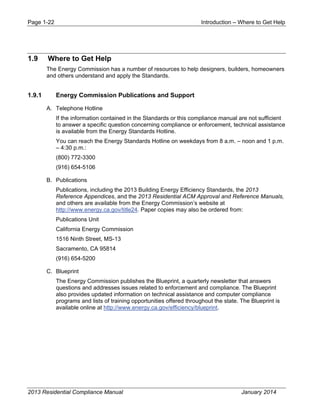
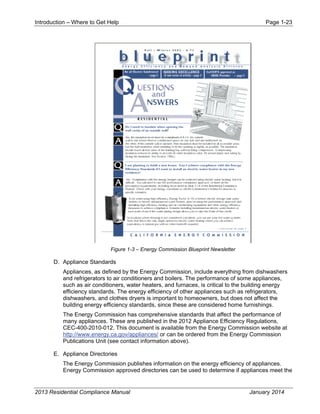
C. Blueprint
The Energy Commission publishes the Blueprint, a quarterly newsletter that answers
questions and addresses issues related to enforcement and compliance. The Blueprint
also provides updated information on technical assistance and computer compliance
programs and lists of training opportunities offered throughout the state. The Blueprint is
available online at http://www.energy.ca.gov/efficiency/blueprint.
Introduction – Where to Get Help Page 1-23
2013 Residential Compliance Manual January 2014
Figure 1-3 – Energy Commission Blueprint Newsletter
D. Appliance Standards
Appliances, as defined by the Energy Commission, include everything from dishwashers
and refrigerators to air conditioners and boilers. The performance of some appliances,
such as air conditioners, water heaters, and furnaces, is critical to the building energy
efficiency standards. The energy efficiency of other appliances such as refrigerators,
dishwashers, and clothes dryers is important to homeowners, but does not affect the
building energy efficiency standards, since these are considered home furnishings.
The Energy Commission has comprehensive standards that affect the performance of
many appliances. These are published in the 2012 Appliance Efficiency Regulations,
CEC-400-2010-012. This document is available from the Energy Commission website at
http://www.energy.ca.gov/appliances/ or can be ordered from the Energy Commission
Publications Unit (see contact information above).
E. Appliance Directories
The Energy Commission publishes information on the energy efficiency of appliances.
Energy Commission approved directories can be used to determine if appliances meet the
Page 1-24 Introduction – Where to Get Help
2013 Residential Compliance Manual January 2014
mandatory measures and/or the prescriptive requirements. Data may also be used in
performance calculations. The Energy Standards Hotline can verify certification of
appliances and provide information on appropriate directories.
The complete appliance database (including manufacturer, brand codes, rated
efficiencies, etc.) can be searched from the Energy Commission’s website at:
http://www.appliances.energy.ca.gov/
F. Directory of Certified Insulation Materials
Manufacturers whose insulating materials are certified for sale in California are listed in
the Department of Consumer Affair’s Consumer Guide and Directory of Certified
Insulation Material. Each building department receives a copy of this directory. If an
insulating product is not listed in the directory, or to purchase a directory, contact the
Department of Consumer Affairs, Bureau of Electronic Appliance and Repair, Home
Furnishings and Thermal Insulation (BEARHFTI), at (916) 999-2041.
1.9.2 Training Opportunities
If you are interested in attending a training seminar on the Standards, sign up to receive a
free subscription to the Blueprint.
Some colleges provide classes on building energy conservation and the Standards.
Information about these classes should be obtained directly from the college.
California utilities, organizations of energy consultants, building industry, trade associations,
and organizations that serve building officials often sponsor or conduct classes on
compliance and enforcement of the Title 24 Building Energy Efficiency Standards. These
classes are often listed in the Blueprint or posted on the Energy Commission’s website at
http://www.energy.ca.gov/title24.
1.9.3 Energy Consultants
The California Association of Building Energy Consultants (CABEC) maintains a directory of
consultants who provide compliance assistance. The listing is available at
http://www.cabec.org.
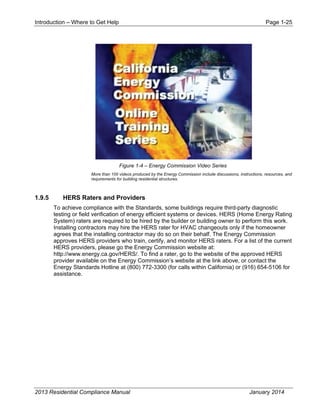
1.9.4 Online Videos
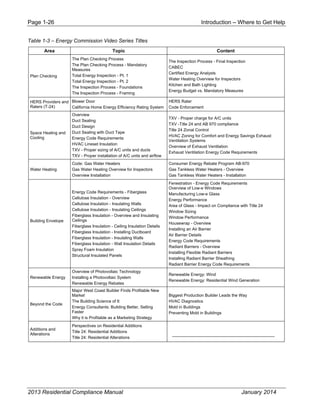
The Energy Commission has a series of streaming videos (see Table 1-3 below) that explain
energy efficiency concepts and the application of the standards. These videos cover topics
including plan checking, field inspection, HVAC, HERS, water heating, building envelope, and
renewable energy. They can be viewed at http://www.energyvideos.com.
Introduction – Where to Get Help Page 1-25
2013 Residential Compliance Manual January 2014
Figure 1-4 – Energy Commission Video Series
More than 100 videos produced by the Energy Commission include discussions, instructions, resources, and
requirements for building residential structures.
1.9.5 HERS Raters and Providers
To achieve compliance with the Standards, some buildings require third-party diagnostic
testing or field verification of energy efficient systems or devices. HERS (Home Energy Rating
System) raters are required to be hired by the builder or building owner to perform this work.
Installing contractors may hire the HERS rater for HVAC changeouts only if the homeowner
agrees that the installing contractor may do so on their behalf. The Energy Commission
approves HERS providers who train, certify, and monitor HERS raters. For a list of the current
HERS providers, please go the Energy Commission website at:
http://www.energy.ca.gov/HERS/. To find a rater, go to the website of the approved HERS
provider available on the Energy Commission’s website at the link above, or contact the
Energy Standards Hotline at (800) 772-3300 (for calls within California) or (916) 654-5106 for
assistance.
Page 1-26 Introduction – Where to Get Help
2013 Residential Compliance Manual January 2014
Table 1-3 – Energy Commission Video Series Titles
Area Topic Content
Plan Checking
The Plan Checking Process
The Plan Checking Process - Mandatory
Measures
Total Energy Inspection - Pt. 1
Total Energy Inspection - Pt. 2
The Inspection Process - Foundations
The Inspection Process - Framing
The Inspection Process - Final Inspection
CABEC
Certified Energy Analysts
Water Heating Overview for Inspectors
Kitchen and Bath Lighting
Energy Budget vs. Mandatory Measures
HERS Providers and
Raters (T-24)
Blower Door
California Home Energy Efficiency Rating System
HERS Rater
Code Enforcement
Space Heating and
Cooling
Overview
Duct Sealing
Duct Design
Duct Sealing with Duct Tape
Energy Code Requirements
HVAC Lineset Insulation
TXV - Proper sizing of A/C units and ducts
TXV - Proper installation of A/C units and airflow
TXV - Proper charge for A/C units
TXV -Title 24 and AB 970 compliance
Title 24 Zonal Control
HVAC Zoning for Comfort and Energy Savings Exhaust
Ventilation Systems
Overview of Exhaust Ventilation
Exhaust Ventilation Energy Code Requirements
Water Heating
Code: Gas Water Heaters
Gas Water Heating Overview for Inspectors
Overview Installation
Consumer Energy Rebate Program AB-970
Gas Tankless Water Heaters - Overview
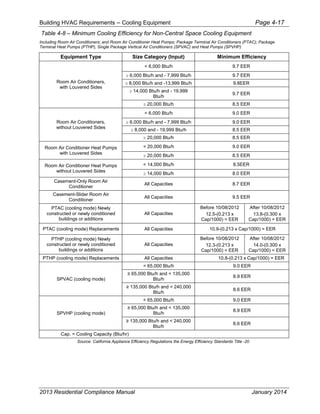
Gas Tankless Water Heaters - Installation
Building Envelope
Energy Code Requirements - Fiberglass
Cellulose Insulation - Overview
Cellulose Insulation - Insulating Walls
Cellulose Insulation - Insulating Ceilings
Fiberglass Insulation - Overview and Insulating
Ceilings
Fiberglass Insulation - Ceiling Insulation Details
Fiberglass Insulation - Installing Ductboard
Fiberglass Insulation - Insulating Walls
Fiberglass Insulation - Wall Insulation Details
Spray Foam Insulation
Structural Insulated Panels
Fenestration - Energy Code Requirements
Overview of Low-e Windows
Manufacturing Low-e Glass
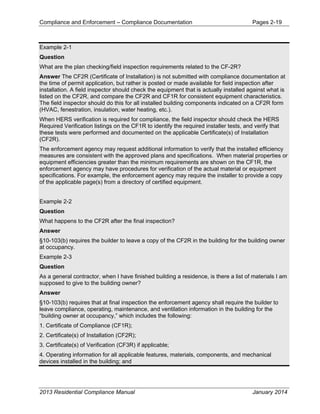
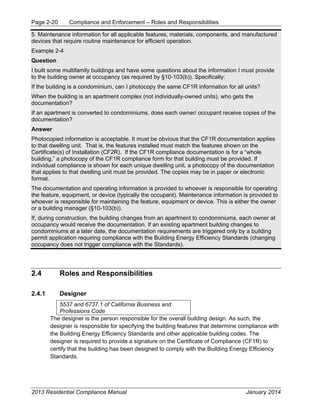
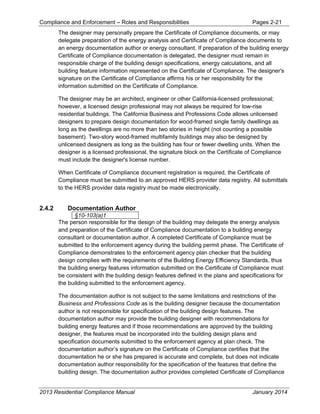
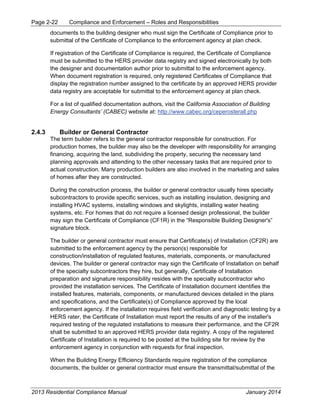
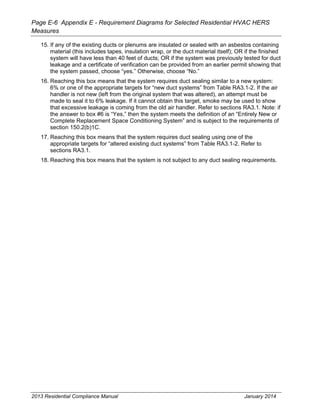
Energy Performance
Area of Glass - Impact on Compliance with Title 24
Window Sizing
Window Performance
Housewrap - Overview
Installing an Air Barrier
Air Barrier Details
Energy Code Requirements
Radiant Barriers - Overview
Installing Flexible Radiant Barriers
Installing Radiant Barrier Sheathing
Radiant Barrier Energy Code Requirements
Renewable Energy
Overview of Photovoltaic Technology
Installing a Photovoltaic System
Renewable Energy Rebates
Renewable Energy: Wind
Renewable Energy: Residential Wind Generation
Beyond the Code
Major West Coast Builder Finds Profitable New
Market
The Building Science of It
Energy Consultants: Building Better, Selling
Faster
Why it is Profitable as a Marketing Strategy
Biggest Production Builder Leads the Way
HVAC Diagnostics
Mold in Buildings
Preventing Mold in Buildings
Additions and
Alterations
Perspectives on Residential Additions
Title 24: Residential Additions
Title 24: Residential Alterations
____________________________________________
Table of Contents Page i
2013 Residential Compliance Manual January 2014
Table Contents 
2.  Compliance and Enforcement ..................................................................................................1 
2.1  Overview ...........................................................................................................................1 
2.1.1  Compliance Document Registration...........................................................................2 
2.2  Phases ..............................................................................................................................3 
2.2.1  Design Phase.............................................................................................................4 
2.2.2  Permit Application ......................................................................................................5 
2.2.3  Plan Check.................................................................................................................5 
2.2.4  Building Permit ...........................................................................................................7 
2.2.5  Construction Phase....................................................................................................7 
2.2.6  Enforcement Agency Field Inspection........................................................................8 
2.2.7  Field Verification and/or Diagnostic Testing.............................................................10 
2.2.8  Approval for Occupancy...........................................................................................11 
2.2.9  Occupancy ...............................................................................................................12 
2.3  Compliance Documentation ............................................................................................12 
2.3.1  Building Permit Phase Documentation.....................................................................13 
2.3.2  Certificate of Compliance (CF1R) ............................................................................14 
2.3.3  Construction Phase Documentation (CF2R)............................................................15 
2.3.4  Field Verification and/or Diagnostic Testing Documentation (CF3R).......................17 
2.3.5  Compliance, Operating, and Maintenance, and Ventilation Information to be
Provided by Builder ................................................................................................................18 
2.4  Roles and Responsibilities ..............................................................................................20 
2.4.1  Designer...................................................................................................................20 
2.4.2  Documentation Author..............................................................................................21 
2.4.3  Builder or General Contractor ..................................................................................22 
2.4.4  Specialty Subcontractors..........................................................................................23 
2.4.5  Enforcement Agency................................................................................................24 
2.4.6  HERS Provider.........................................................................................................28 
2.4.7  HERS Rater .............................................................................................................28 
2.4.8  Third Party Quality Control Program ........................................................................31 
2.4.9  Owner.......................................................................................................................32 
2.5  HERS Field Verification and Diagnostic Testing .............................................................33 
2.5.1  Measures Requiring HERS Field Verification and Diagnostic Testing.....................34 
Page ii Table of Contents
2013 Residential Compliance Manual January 2014
2.5.2  Verification, Testing and Sampling...........................................................................35 
2.5.3  Initial Model Field Verification and Diagnostic Testing.............................................36 
2.5.4  Group Sample Field Verification and Diagnostic Testing.........................................36 
2.5.5  Re-sampling, Full Testing and Corrective Action .....................................................38 
2.5.6  Installer Requirements and HERS Procedures for Alterations.................................39 
2.5.7  For More Information................................................................................................40 
Compliance and Enforcement – Overview Pages 2-1
2013 Residential Compliance Manual January 2014
2. Compliance and Enforcement
2.1 Overview
The primary responsibility for compliance with and the enforcement of the Energy
Commission’s Building Energy Efficiency Standards rests with the local enforcement
agency, typically associated with a city or county government. Low-rise residential
buildings must obtain a permit from the local enforcement agency before a new building
may be constructed, before constructing an addition, and before alterations are made to
existing buildings. Before a permit is issued, the local enforcement agency examines the
plans and specifications for the proposed building to verify compliance with all applicable
codes and standards. Verification of compliance with the Building Energy Efficiency
Standards, which is done by comparing the requirements specified on the Certificate of
Compliance (CF1R) with the plans and specifications for the building, is the enforcement
agency's plan check responsibility. The enforcement agency's plans examiner must also
verify that the plans and specifications for the building are in compliance with the building
code, plumbing code, electrical code, mechanical code, and all other applicable codes
and standards adopted by the local enforcement agency.
Once the enforcement agency has determined that the proposed building (as represented
in the plans and specifications) complies with all applicable codes and standards, a
building permit may be issued at the request of the builder or the owner of the proposed
building. This is the first significant milestone in the compliance and enforcement process.
Once construction starts, the enforcement process begins for the Inspector who will verify
that the installed building components (HVAC equipment, fenestration, lighting, insulation,
etc.) match the energy components modeled on the Certificate of Compliance (CF1R)
during each respective phase of construction (i.e. footing/foundation, rough frame,
insulation, etc.). After building construction is complete, the local enforcement agency
completes the final inspection and issues the Certificate of Occupancy. If the enforcement
agency's final inspection determines that the building conforms to the plans and
specifications approved during plan check, that all applicable Certificates of Installation
(CF2R) and Certificates of Verification (CF3R ) forms are registered and submitted for
verification, and that it complies with all applicable codes and standards, the enforcement
agency may approve the building. The enforcement agency's final approval is also a
significant milestone.
While the permit and the Certificate of Occupancy are the most significant milestones, the
compliance and enforcement process is significantly more involved and requires
participation by a number of other persons and organizations including the architect or
building designer, specialty engineers (mechanical, electrical, civil, etc.), energy
consultants, contractors, the owner, third party inspectors (HERS raters), and many
others. This chapter describes the overall compliance and enforcement process, and it
Page 2-2 Compliance and Enforcement – Overview
2013 Residential Compliance Manual January 2014
identifies the responsibilities for each person or organization throughout the permit
process.
2.1.1 Compliance Document Registration
§10-103;
Reference Residential Appendix RA2;
Reference Joint Appendix JA7
New requirements for a documentation procedure called registration were introduced
beginning with the 2008 Building Energy Efficiency Standards. Registration documentation
is required for the construction and alteration of residential buildings for which HERS
verification is required for compliance. Registration requirements will be described in this
chapter, and elsewhere in this manual, as applicable. Also, Reference Residential
Appendix RA2 and Reference Joint Appendix JA7 provide detailed descriptions of
document registration procedures and individual responsibilities for registration of
Certificate(s) of Compliance (CF1R), Certificate(s) of Installation (CF2R), and Certificate(s)
of Verification (CF3R).
Registration will be required for all low-rise residential buildings for which compliance
requires HERS field verification. For the 2013 Building Energy Efficiency Standards,
mandatory HERS verification will be required, with some exceptions, for all newly
constructed residential buildings, so registration will be required for majority of these
building types. When registration is required, persons responsible for completing and
submitting compliance documents (Certificate of Compliance, Certificate of Installation,
and Certificate of Verification) are required to submit the compliance form(s) electronically
to an approved HERS provider data registry for registration and retention.
Compliance documents submitted to the registry shall be certified by the applicable
responsible person (§10-103). The registry will assign a unique registration number to the
document(s), provided the documents are completed correctly and a certification/signature
is provided by the responsible person. The "registered" document will be retained by the
HERS provider data registry, and copies of the unique registered document(s) will be
made available via secure internet website access to authorized users of the HERS
provider data registry for use in making electronic or paper copies of the registered
document(s) for submittals to the enforcement agency as required, and for any other
applicable purposes such as posting copies in the field for enforcement agency
inspections and providing copies to the building owner (see Section 2.2.9).
Examples of authorized users of the HERS provider data registry may include energy
consultants, builders, building owners, construction contractors and installers, HERS
raters, enforcement agencies, the Energy Commission, and other parties to the
compliance and enforcement process that the documents are designed to support.
Compliance and Enforcement – Phases Pages 2-3
2013 Residential Compliance Manual January 2014
Authorized users of the registry will be granted read/write access rights to only the
electronic data that pertains to their project(s).
NOTE: Documents submitted to public agencies for code compliance are considered
public information.
2.2 Phases
Compliance and Enforcement
The process of complying with and enforcing the Building Energy Efficiency Standards in
residential buildings involves many parties. Those involved may include the architect or
designer, builder/developer, purchasing agent, general contractor, subcontractor/installer,
energy consultant, plan checker, inspector, realtor, and owner/first occupant. All of these
parties must communicate and cooperate in order for the compliance and enforcement
process to run efficiently.
The standards specify detailed reporting requirements that are intended to provide design,
construction, and enforcement parties with required information to complete the building
process and ensure that the energy features are properly installed. Each party is
accountable for ensuring that the building’s energy features are correctly installed in their
area of responsibility. This section outlines each phase of the process, and discusses
responsibilities and requirements associated with them.
The Energy Compliance documentation has been revised and reorganized. Versions of
the Certificate of Compliance have been designed to be used specifically with Residential
New construction (CF1R), Residential Additions (CF1R-ADD), Residential Alterations
(CF1R-ALT), and Residential HVAC change-outs (CF1R-ALT-HVAC). The Certificate of
Installation (CF-2R) is separated into Envelope (CF2R-ENV), Lighting (CF2R-LTG), and
Mechanical (CF2R-MECH) categories, and most compliance measures have a separate
CF2R form that is specific to a particular installation. CF2R forms also incorporate
references to applicable mandatory measures. The HERS Certificate of Verification
(CF3R) forms are categorized and organized in the same way as the Certificate of
Installation (CF2R) forms. Refer to Appendix A of this manual for more information about
the forms, or to view samples of the forms. Additional information about use of the
compliance forms will be provided in applicable sections of this chapter and throughout
this manual.
The Building Energy Efficiency Standards require residential energy compliance
documents to be registered with a HERS provider data registry prior to submittal to an
enforcement agency when HERS verification is required for compliance. The registration
of documents prior to submittal to an enforcement agency accomplishes retention of a
completed and signed copy of the submitted energy compliance documentation. Section
10-103 of the Building Energy Efficiency Standards allows the registered CF1R-ALT-
HVAC form to be submitted to an enforcement agency at final inspection, and not before
obtaining a permit, to facilitate the permit process for HVAC change-outs. Refer to
Page 2-4 Compliance and Enforcement – Phases
2013 Residential Compliance Manual January 2014
Chapter 9 of this manual for more details. Document retention is vital to compliance and
enforcement follow-up and other quality assurance follow-up processes that ensure
realization of energy savings from installed energy features. Although some local
enforcement agencies elect to retain copies of submitted residential energy compliance
documents, many jurisdictions do not retain these documents. Thus, the Energy
Standards requirement for registration of the energy compliance documentation in a
HERS provider data registry ensures that document retention is accomplished for the
residential construction projects that require HERS verification for compliance. General
information describing registration procedures that are specific to the design, construction
and inspection phases follow in this chapter. Refer also to Reference Residential
Appendix RA2 and Reference Joint Appendix JA7 for more detailed descriptions of these
document registration procedures that apply to each phase of the building energy code
compliance and enforcement process.
2.2.1 Design Phase
§10-103(a)2
This phase sets the stage for the type and style of building to be constructed. In addition to
issues concerning zoning, lot orientation and infrastructure, the building’s overall design
and energy features are documented in the construction documents and/or specifications.
Parties associated with this phase must ensure that the building complies with the Building
Energy Efficiency Standards and that the significant features required for compliance are
documented on the plans and/or specifications.
During the design process, an energy consultant or other professional will typically assist
the building designer by providing energy calculations that determine the impact of
building features being proposed for the design to ensure that the final building design
plans and specifications submitted to the enforcement agency will comply with the Building
Energy Efficiency Standards. Throughout the design phase, recommendations or
alternatives may be suggested by energy consultants or the documentation author to
assist the designer in achieving compliance.
The building design plans submitted to the enforcement agency are required to include the
specifications for the building energy features that are necessary to achieve compliance,
including insulation levels, window performance, equipment performance, lighting fixture
types and controls, exhaust fan performance, envelope sealing, weather stripping
requirements, and any other feature that was used for compliance or is a mandatory
measure. The building design plans and specifications must be consistent with respect to
the energy efficiency features information on the Certificate of Compliance (CF1R)
submitted to the enforcement agency. Any change in the building plans or specifications,
during any phase of design or construction, that changes the energy feature specifications
for the design necessitates recalculation of the building energy compliance, and issuance
of a revised Certificate of Compliance (CF1R) that is consistent with the revised plans and
specifications for the proposed building. If recalculation indicates that the building no
longer complies, alternate building features must be selected that bring the design back
into compliance with the Building Energy Efficiency Standards.
Compliance and Enforcement – Phases Pages 2-5
2013 Residential Compliance Manual January 2014
2.2.2 Permit Application
§10-103(a)2
When the design is complete, the construction documents are prepared, and when other
approvals (planning department, water, etc.) are secured, the owner or contractor makes
an application for a building permit. This is generally the last step in a long process of
planning and design. At this point, the infrastructure (streets, sewers, water lines,
electricity, gas, etc.) is in place or is being constructed and it is time to begin the process
of constructing the building(s).
To assist the enforcement agency in verifying that the proposed building complies with the
Building Energy Efficiency Standards, a set of compliance documents are submitted with
the building permit application. These documents consist of a Certificate of Compliance
(CF1R), which is required by the Building Energy Efficiency Standards (see §10-103). The
length and complexity of the documentation can vary considerably depending on: the
number of buildings that are being permitted; whether or not an orientation-independent
permit is being requested; whether the performance approach or the prescriptive approach
is being used; and many other factors. An energy consultant who understands the code
and is able to help the builder or owner comply with the standards in the most cost-
effective manner often prepares the Certificate of Compliance documentation.
The Administrative Regulations §10-103(a)2 require that documentation be submitted with
permit applications that will enable the plans examiner to verify the building’s compliance.
The forms used to demonstrate compliance must be readily legible and shall conform to a
format and informational order and content approved by the Energy Commission. If
registration is required, the CF1R that is submitted to the enforcement agency must be a
registered copy from an approved HERS provider data registry.
The registration process requires the builder or designer to submit the Certificate of
Compliance information and an electronic signature to an approved HERS provider data
registry in order to produce a completed, signed and dated electronic Certificate of
Compliance (CF1R) that is retained by the registry. The CF1R is assigned a unique
registration number, then copies of the unique registered CF1R are made available to
authorized users of the HERS provider data registry for use in making electronic or paper
copies of the registered document(s) for submittal to the enforcement agency as required.
2.2.3 Plan Check
Local enforcement agencies check plans to ensure that the building design conforms to
Building Standards. This includes health and safety requirements, such as fire and
structural, and also the building energy efficiency requirements. Vague, missing, or
incorrect information items on the construction documents are identified by the plans
examiner, and when necessary, the permit applicant is required to make corrections or
clarifications, then resubmit revised plans and specifications for verification by the plans
examiner. When the permit applicant submits accurate, clearly defined plans and
specifications, it helps to speed up the plan check process, since this provides the plans
examiner with all the information that is needed to complete the plan check review. If the
Page 2-6 Compliance and Enforcement – Phases
2013 Residential Compliance Manual January 2014
plans examiner must go back to the applicant to request more information, it can be a
time-consuming process that would be simplified (thus completed more easily and in less
time) when complete and accurate construction documents are submitted for plan check
approval.
With regard to energy code concerns, from the enforcement agency's perspective, the
plan checker's responsibility is to verify that the information contained on the construction
documents is consistent with the requirements specified on the energy efficiency
compliance documents (the CF1R). Some examples of how the plans examiner will verify
that the energy efficiency features detailed on the Certificate of Compliance (CF1R) forms
are specified in the respective sections of the building plans include:
• Verifying the window and skylight U-Factor and SHGC values from the CF1R on
the Structural/Architecture Plans in a window/skylight schedule, window/skylight
legend for the floor plan, etc.; and
• Verifying the HVAC equipment SEER, EER, AFUE, etc. efficiency values from the
CF1R on the Title 24 Plans, Mechanical Plans, etc. in an Equipment Schedule.
NOTE: The enforcement agency should clearly articulate to the builder/designer the
acceptable methods of specifying energy features on the building plans for approval.
Since personnel that purchase building materials, and the building construction craftsmen
in the field may rely solely on a copy of the approved plans and specifications for direction
in performing their responsibilities, it is of utmost importance that the building design
represented on the approved plans and specifications complies with the Building Energy
Efficiency Standards as specified on the Certificate(s) of Compliance (CF1R).
The enforcement agency plans examiner must also verify that the compliance documents
do not contain errors. When the compliance documents are produced by Energy
Commission-approved computer software applications, there is less chance that there will
be computational errors, but the plans examiner must still verify that the building design
represented on the plans is consistent with the building energy features represented on
the Certificate of Compliance (CF1R) documents. To obtain a list of Energy Commission-
approved energy code compliance software applications, visit the Energy Commission
website at:
http://www.energy.ca.gov/title24/2013standards/index.html
Or call the Efficiency Standards Hotline at 1-800-772-3300.
With production homes, where a builder may be constructing several identical houses at
roughly the same time, the compliance documentation may be prepared in such a way
that a house or model can be constructed in any orientation. In these instances, the Plans
Examiner shall verify that the home complies facing all four main compass points (North,
South, East, West) on the CF1R form.
Compliance and Enforcement – Phases Pages 2-7
2013 Residential Compliance Manual January 2014
2.2.4 Building Permit
After the plans examiner has approved the plans and specifications for the project, a
building permit may be issued by the enforcement agency at the request of the builder.
Issuance of the building permit is the first significant milestone in the compliance and
enforcement process. The building permit is the green light for the contractor to begin the
work. In some cases, the building permits are issued in phases. Sometimes there is a
permit for site work and grading that precedes the permit for actual building construction.
2.2.5 Construction Phase
Upon receiving a building permit from the local enforcement agency, the contractor begins
construction. The permit requires the contractor to construct the building in accordance
with the plans and specifications, but often there are variations. Some of these variations
are formalized through change orders. When change orders are issued, it is the
responsibility of the permit applicant and the local jurisdiction to verify that compliance with
the code is not compromised by the change order. In some cases, it will be quite clear if a
change order would compromise compliance, for instance when an inexpensive single
glazed window is substituted for a more expensive high performance window. However, it
may be difficult to determine if a change order would compromise compliance; for
instance, when the location of a window is changed, or when the orientation of the house
is changed. Field changes that result in non-compliance require enforcement agency
approval of revised plans and revised energy compliance documentation to confirm that
the building is still in compliance with the Building Energy Efficiency Standards.
During the construction process, the general contractor or specialty subcontractors are
required to complete various Certificate(s) of Installation (CF2R). The purpose of these
certificates is to verify that the contractor is aware of the requirements of the Building
Energy Efficiency Standards and that they have followed the Energy Commission-
approved procedures for installation, and to identify the energy efficiencies and features of
the installed building components. The Certificate(s) of Installation (CF2R) are a collection
of separate energy compliance information forms that are applicable to each regulated
energy feature that may be included in the construction. The certificates are required to be
completed by each of the applicable specialty contractors when they install regulated
energy features such as windows, water heater and plumbing, HVAC ducts and
equipment, lighting, and insulation.
The licensed person responsible for the building construction, or for installation of an
energy-related feature, must ensure their construction or installation work is done in
accordance with the approved plans and specifications for the building, and must
complete and sign a Certificate of Installation (CF2R) to certify that the installed features,
materials, components or manufactured devices for which they are responsible conform to
the plans and specifications and the Certificate of Compliance (CF1R) documents
approved by the enforcement agency for the building. A copy of the completed, signed
and dated CF2R must be posted at the building site for review by the enforcement agency
in conjunction with requests for final inspection for the building, and copies of the
registered CF2R forms shall be provided to the home owner (see section 2.2.9).
Page 2-8 Compliance and Enforcement – Phases
2013 Residential Compliance Manual January 2014
When any HERS verification is required for compliance, all of the CF2R forms must be
registered from an approved HERS provider data registry. This is a new requirement
under the 2013 Building Energy Efficiency Standards that will apply to both non-HERS
CF2R forms (i.e. CF2R-ENV-01) and to HERS CF2R forms (i.e. CF2R-MECH-20-HERS)
for installed features that require field verification by a HERS rater. When registration is
required, the builder or installing contractor must submit information to an approved HERS
provider data registry in order to produce a completed, signed and dated electronic
Certificate of Installation (CF2R) that is retained by the registry for use by authorized users
of the registry. After the information to complete the CF2R document is transmitted to the
data registry and the form is electronically signed, the CF2R is assigned a registration
number, and copies of the unique registered CF2R are made available to authorized users
of the HERS provider data registry for use in making electronic or paper copies of the
registered document(s) for submittal to the enforcement agency as required. The builder
or installing contractor responsible for the installation must provide a copy of the
completed, signed, and registered Certificate of Installation to the HERS rater, and post a
copy at the building site for review by the enforcement agency in conjunction with requests
for final inspection, and provide copies of the registered CF2R forms to the home owner
(see section 2.2.9).
For additional information and details regarding the registration of CF2R documents, refer
to Reference Residential Appendix RA2 and Reference Joint Appendix JA7.
2.2.6 Enforcement Agency Field Inspection
§10-103(d)
Local enforcement agency or their representatives, inspect all new buildings to ensure
compliance with the Building Standards. Field construction changes and non-complying
energy features require parties associated with previous phases to repeat and revise their
original energy compliance documents, or re-install building components that meet the
building specifications and energy compliance documents.
Enforcement agencies generally make multiple visits to a building site to verify
construction. The first visit is typically made just before it is time to pour the slab or the
building foundation. At this visit, the building inspector verifies that the proper reinforcing
steel is in place and that necessary wiring and plumbing that will be embedded in the slab
meets the requirements of the Standards. The inspector should verify features that are to
be installed in concrete slab floors, such as slab edge insulation or hot water recirculation
loops that involve piping that must be installed in the slab (see Slab Insulation in the
Envelope chapter of this manual). The inspector should also verify the front orientation
and floor assembly types (i.e. slab on grade, raised floor, etc.) of the building during this
phase of construction. Details of how the inspector should verify these components will be
discussed further in the Envelope chapter of this manual.
The second visit generally occurs after the walls have been framed, and the HVAC
equipment and ducting, fenestration, lighting cans, electrical wiring, plumbing, and other
services have been constructed or installed. This inspection is recommended to be made
Compliance and Enforcement – Phases Pages 2-9
2013 Residential Compliance Manual January 2014
before the insulation is installed, since it is the best time to assure the completion of
sealing and caulking around windows, and the caulking and sealing of any holes bored
through the framing members for installation of hot and cold water piping and electrical
wiring. During the rough Frame Inspection, it is also best for the inspector to verify the
installation of the high efficacy lighting (or the applicable lighting control alternatives) so
that the contractor has ample time to make any necessary corrections before the Final
Inspection, and to avoid having to remove drywall, insulation, etc. in order to remove an
incandescent can. The inspector should also verify the window/skylight U-factor and
SHGC values, the proper sealing/installation of HVAC ducts and duct insulation R-value,
the installation of exhaust fan housing and ducting in bathrooms and kitchens (ASHRAE
62.2.), installation of a radiant barrier and/or cool roof when required for compliance, etc.
during this phase of construction. Details of how the inspector should verify these
components will be discussed further in the respective chapters of this manual.
The third visit is the Insulation Inspection, which takes place after the wall, ceiling, and
floor insulation has been installed. This inspection occurs before the drywall is installed to
verify that the insulation R-value matches the CF1R Form, and that the insulation has
been properly installed without compressions, voids, or gaps. The inspector should verify
that insulation is installed correctly around and behind piping, and that all exterior walls are
insulated (especially behind obstructing objects like a bathtub). Details of how the
inspector should verify these components will be discussed further in the Envelope
chapter of this manual.
The next visit is usually a drywall Inspection, where the inspector verifies that the drywall
is installed properly to limit infiltration and exfiltration, especially at locations surrounding
lighting cans, HVAC registers and vents, electrical sockets, etc.
The Final Inspection is conducted after the walls have been closed and the final electrical
and plumbing fixtures are in place. The inspector should verify HVAC efficiency values,
water heating efficiency values, exhaust fan cfm and sone (noise level) ratings in
bathrooms and kitchens (ASHRAE 62.2), exterior lighting and controls, weatherstripping
on exterior/demising doors, etc. during this phase of construction. The inspector will also
verify that all required CF2R and CF3R forms have been completed, signed, and
registered (when applicable), and that copies of all of these forms have been provided to
the building owner. Details of how the inspector should verify these components will be
discussed further in the respective chapters of this manual.
The typical enforcement agency inspection sequence can vary from jurisdiction to
jurisdiction, and it can be difficult for the enforcement agency to verify every energy
efficiency measure required to be installed in the building. For example, exterior wall
insulation will likely not be installed at the time of the Framing Inspection, and if the
enforcement agency does not include the Insulation Inspection in their field inspection
process, the exterior wall insulation would be concealed from an inspector's view at the
time of the Final Inspection.
For this and other reasons, the Certificate(s) of Installation (CF2R), and when required,
the Certificate(s) of Verification (CF3R) are crucial. When inspection of an installed energy
Page 2-10 Compliance and Enforcement – Phases
2013 Residential Compliance Manual January 2014
feature would be impossible because of subsequent construction, the enforcement agency
may require the CF2R for the concealed feature to be posted at the site or made available
to the inspector upon completion/installation of the feature. In these instances, in order to
facilitate the inspection process, the inspector would reference the efficiency values and
building components specified on the submitted CF2R form to verify compliance with the
Building Energy Efficiency Standards.
When registration is required, all Certificate(s) of Installation (CF2R) must be a registered
copy from an approved HERS provider data registry. For all measures requiring field
verification, a registered Certificate of Verification (CF3R) shall also be made available to
the building inspector.
2.2.7 Field Verification and/or Diagnostic Testing
Some building features require field verification and/or diagnostic testing completed by a
third party inspector, called a HERS rater, as a condition for compliance with the
Standards. The Energy Commission has established the California Home Energy Rating
System (HERS) program to provide for the training and certification of HERS raters who
are considered special inspectors by enforcement agencies. When compliance with the
Building Energy Efficiency Standards is based on energy features that require third party
(HERS) verification, a certified HERS rater is required to perform field verification and/or
diagnostic testing according to the procedures in Reference Residential Appendix RA2
using the protocols specified in Reference Residential Appendix RA3.
Prescriptive Package A, as well as most performance method software applications,
require some sort of field verification and/or diagnostic testing. Most of the typical
measures that require HERS field verification and/or diagnostic testing involve air
conditioning equipment and forced air ducts that deliver conditioned air to the dwelling.
Examples of measures requiring HERS verification are refrigerant charge measurement
and duct sealing.
New for the 2013 Building Energy Standards are mandatory HERS measures. Under
previous Building Energy Efficiency Standards, all of the HERS requirements were
prescriptive measures or compliance options. Now, the 2013 Energy Standards mandate
that all newly constructed homes have duct sealing (leakage testing), duct system airflow
and fan watt draw (and installed HSPP/PSPP), and exhaust fans/systems (ASHRAE
62.2.) verified by a HERS rater when those systems are installed. With that said, majority
of newly constructed homes will require field verification and/or diagnostic testing by a
HERS rater per the mandatory measure requirements. Details about these specific HERS
measures and others will be discussed in the HVAC (Chapter 4) chapter of this manual.
Additionally, the Prescriptive HERS measure requirements for refrigerant charge testing
were amended in the 2013 Building Energy Efficiency Standards for clarity. The
Saturation Temperature Measurement Sensors (STMS) requirements were removed and
are no longer required when refrigerant charge testing is applicable. An exception was
included for the Measurement Access Holes (MAH) requirements for systems where it
would be impossible to install such holes. Lastly, the refrigerant charge requirements
Compliance and Enforcement – Phases Pages 2-11
2013 Residential Compliance Manual January 2014
were expanded and will be applicable to ducted packaged systems and mini-split systems.
Refer to the HVAC (Chapter 4) chapter of this manual for further details.
Additional measures requiring field verification include reduced duct surface area,
increased duct R-value, high EER cooling equipment, and quality installation of insulation.
For a full list of measures requiring field verification and/or diagnostic testing, refer to
Table RA2-1 of the 2013 Reference Residential Appendices. The requirements for field
verification and/or diagnostic testing apply only when equipment or systems are installed.
For example, if a house has no air distribution ducts, then a HERS rater does not have to
test the ducts, since there are no ducts to test.
The HERS rater must perform field verification of the required features and transmit all
required data describing the feature and the results of the verification or diagnostic test to
an approved HERS provider data registry. The HERS rater must also confirm that the
installed energy feature being verified is consistent with the requirements for that feature
as specified on registered copies of the CF1R approved by the enforcement agency for
the dwelling, and that the information on the CF2R is consistent with the CF1R. The test
results reported on the CF2R by the person responsible for the installation must be
consistent with the test results determined by the HERS rater's diagnostic verification and
meet the criteria for compliance with the Standards. A copy of the registered CF2R must
be posted at the building site for review by the enforcement agency, and made available
for all applicable inspections. A copy of the registered CF2R must also be left in the
dwelling for the home owner at occupancy.
Results from the Rater's field verification or diagnostic test are reported to the HERS
provider data registry regardless of whether the result indicates compliance (a “Pass”
result) or not (a “Fail” result). If the results indicate compliance, the HERS provider data
registry will make available a registered copy of the Certificate of Verification (CF3R). A
copy of the registered CF3R must be posted at the building site for review by the
enforcement agency, and made available for all applicable inspections. A copy of the
CF3R must be provided to the builder, and a copy must also be left in the dwelling for the
home owner at occupancy. If field verification and /or diagnostic testing indicates non-
compliance (failure) of the measure being verified, that failure must be entered into the
HERS provider’s data registry. HERS Providers shall not permit any user of the registry to
print or access electronically CF3R forms for non-compliance (failure) entries unless the
CF3R form contains a watermark with the word “FAIL” or “FAILURE” making it abundantly
clear the result of the test was a failure. Corrective action shall be taken by the builder or
installer on the failed measure and the measure shall be retested by the HERS rater to
verify that the corrective action was successful. Once determined to be corrected, the
passing measure shall be entered into the HERS provider’s data registry.
2.2.8 Approval for Occupancy
In multifamily dwellings of three or more units, the final step in the compliance and
enforcement process is the issuance of an occupancy permit by the enforcement agency.
This is the “green light” for occupants to move in. Single family dwellings and duplexes
may be approved for occupancy without an occupancy permit being issued. Often a
Page 2-12 Compliance and Enforcement – Compliance Documentation
2013 Residential Compliance Manual January 2014
signed-off final inspection serves as an approval for occupancy. When HERS verification
is required prior to the approval of occupancy, the HERS rater must post a signed and
registered CF3R in the field for the building inspector to verify at final inspection. The
HERS rater must also provide a copy of the registered CF3R to the builder, and a copy
must be left in the building for the building owner at occupancy. Only registered CF3R
documents are allowed for these document submittals. Handwritten versions of the CF3R
are not allowed for document submittals with the 2013 Building Energy Efficiency
Standards.
2.2.9 Occupancy
At the occupancy phase, the enforcement agency shall require the builder to leave inside
the building all completed, signed and dated compliance documentation which includes at
a minimum the CF1R and all applicable CF2R forms. When HERS field verification is
required, a copy of the registered CF3R is also required to be left on site with the
compliance documentation. When registration is required, the CF1R and all required
CF2R compliance documentation shall be registered copies as well. The builder is
required to provide the homeowner with a manual that contains instructions for operating
and maintaining the features of their building efficiently. See Section 2.3.5 for more details.
2.3 Compliance Documentation
Compliance documentation includes the forms, reports and other information that are
submitted to the enforcement agency with an application for a building permit. It also
includes documentation completed by the contractor or subcontractors to verify that
certain systems and equipment have been correctly installed. It may include reports and
test results by third-party inspectors (HERS raters). Ultimately, the compliance
documentation is included with a homeowner’s manual so that the end user knows what
energy features are installed in the house.
Compliance documentation is completed at the building permit phase, the construction
phase, the field verification and diagnostic testing phase, and at the final phase. The
required forms and documents are shown in Table 2-1 and described in the rest of this
section in more detail. When registration is required, all of the compliance documentation
shall be registered copies from an approved HERS provider data registry.
Compliance and Enforcement – Compliance Documentation Pages 2-13
2013 Residential Compliance Manual January 2014
Table 2-1 – Documentation Requirements, Prescriptive and Performance Compliance
Methods
Phase Method Documentation Required when applicable
Building Permit
Performance CF1R-PRF-E, Certificate of Compliance
Prescriptive CF1R-NCB-01-E, Certificate of Compliance
Prescriptive
CF1R-ADD-01-E, Certificate of Compliance
Additions less than 1,000 ft2)
Prescriptive
CF1R-ALT02-E, Certificate of Compliance (Alterations, HVAC
changeouts)
Prescriptive CF1R-ENV-02-E, Worksheet for area weighted average
Prescriptive
CF1R-ENV-03-E, Worksheet for solar heat gain coefficient
(SHGC)
Prescriptive CF1R-ENV-04-E, Worksheet for cool roofs and SRI
Prescriptive CF1R-SRA-01-E, Worksheet solar ready areas
Prescriptive CF1R-SRA-02-E, Worksheets for minimum solar zone area
Prescriptive CF1R-PLB-01-E, Worksheet for hydronic heating systems
Prescriptive and
Performance
CF1R-STH-02-E, Worksheet for OG 300 solar water heating
systems
Prescriptive and
Performance
CF1R-STH-02-E, Worksheet for OG 100 solar water heating
systems
Construction
Prescriptive and
Performance
CF2R-E, Certificate of Installation
Prescriptive and
Performance
CF2R-H,HERS Certificate of Installation
Prescriptive and
Performance
FC-1, Fenestration Certificate for unrated NFRC windows
Field Verification
and/or Diagnostic
Testing
Prescriptive and
Performance
CF3R-H, Certificate of Verification (HERS Rater)
Field Verification
and/or Diagnostic
Testing
Performance
CF3R-EXC-20-H, Certificate of Verification for Existing
Conditions (HERS Rater)
Refer to Appendix A of this manual for a complete list and samples of all energy compliance forms.
2.3.1 Building Permit Phase Documentation
§10-103(a)
The compliance documentation required at the building permit phase consists of the
Certificate of Compliance (CF1R) on the building plans, and depending on the compliance
approach, the energy compliance documentation package may also include the Thermal
Mass Worksheet (WS1R), the Area Weighted Average Calculation Worksheet (WS2R),
Page 2-14 Compliance and Enforcement – Compliance Documentation
2013 Residential Compliance Manual January 2014
the Solar Heat Gain Coefficient (SHGC) Worksheet (WS3R), and the Solar Water Heating
Calculation Form (CFSR). Blank copies of these documents are included in Appendix A of
this manual for use with the prescriptive compliance requirements. When the performance
approach is used, these worksheet documents are not needed since the Energy
Commission-approved software performs the calculations and provides the necessary
documentation as part of the software output. However, when the performance approach
is used, only the CF1R forms are required on the building plans.
The purpose of the compliance documentation is to enable the plans examiner to verify
that the building design shown in the plans and specifications complies with the Building
Energy Efficiency Standards, and to enable the field inspector to identify which building
features are required for compliance and will be verified in the field.
2.3.2 Certificate of Compliance (CF1R)
The standards require the certificate of compliance to be incorporated into the plans for
the building and submitted to the enforcement agency. The CF1R form identifies the
minimum energy performance specifications selected by the building designer or building
owner for compliance, and may include the results of the heating and cooling load
calculations.
To meet the requirement for filing a copy of the CF1R with the plans for the building,
builders/contractors should ask the local enforcement agency for information about their
preferences or requirements for document submittal procedures. Most local jurisdictions
may require the CF1R to be embedded in the building design computer aided drafting
(CAD) file for plotting on sheets that are the same size as the building design's plan set
sheets, thus the CF1R documentation would be submitted as energy compliance design
sheets integral to the entire plan set for the building. On the other hand, some
jurisdictions may allow taping CF1R document sheets to the submitted design drawings
for the building, while others may allow simply attaching 8-1/2 inch x 11 inch printed CF1R
document reports to the submitted design drawing package.
When the prescriptive approach is used for additions and alterations, a short-hand version
of the certificate of compliance shall be submitted with the building plans or with the permit
application when no plans are required. In these instances: a CF1R-ADD form is required
to be submitted for additions; a CF1R-ALT form is required for alterations; and a CF1R-
ALT-HVAC form is required for HVAC changeouts. (See Chapter 9 for more details)
For low-rise residential buildings for which compliance requires field verification, the CF1R
submitted to the enforcement agency must be a registered copy, from an approved HERS
provider data registry. Refer to Reference Residential Appendix RA2 and Reference Joint
Appendix JA7 for more information about document registration.
Compliance and Enforcement – Compliance Documentation Pages 2-15
2013 Residential Compliance Manual January 2014
2.3.3 Construction Phase Documentation (CF2R)
§10-103(a)3
The Certificate(s) of Installation (CF2R) are separated into Envelope (CF2R-ENV),
Lighting (CF2R-LTG), and Mechanical (CF2R-MECH) categories, and most compliance
measures have a separate CF2R form that is specific to a particular installation. The
CF2R forms must be completed during the construction or installation phase of the
compliance and enforcement process. The CF2R documents must be completed by the
applicable contractors who are responsible for installing regulated energy features such as
windows (fenestration), the air distribution ducts and the HVAC equipment, the exhaust
fans/ventilation system, the measures that affect building envelope tightness, the lighting
system, and the insulation. The CF2R must be posted at the job site in a conspicuous
location (e.g., in the garage) or kept with the building permit and made available to the
enforcement agency upon request. Certificate(s) of Installation will include, but not limited
to, the following:
A. HVAC Systems. The contractor who installs mechanical equipment signs the
applicable Certificate of Installation. Heating and cooling equipment are listed and
the energy efficiency, capacity, design loads and other properties of each piece of
equipment are documented.
B. Water Heating Systems. The Certificate of Installation includes information about
the water heating equipment installed in the building, including model number,
energy efficiency, tank size, input rating, tank insulation and other properties. The
installer also verifies that faucets and shower heads are certified and comply with
the Appliance Efficiency Regulations.
C. Fenestration/Glazing. The Certificate of Installation is completed and signed by
the contractor responsible for installing the windows and skylights. The U-factor,
SHGC, area, number of panes, etc. for each window and skylight are documented.
. The installer also verifies that all windows and skylights are installed according to
the manufacture recommendations .
D. Insulation Certificate. The Certificate of Installation is completed and signed by
the contractor responsible for installing the insulation. The manufacturer, brand, R-
value, etc. of the insulation installed in the roof/ ceiling, walls, floor and slab edge
are documented. The installer also verifies compliance with the applicable
mandatory measures (i.e. infiltration and exfiltration) for the building envelope.
E. Duct Leakage and Design Diagnostics. The Certificate of Installation is signed
by the contractor responsible for installing the HVAC air distribution system. The
results of duct leakage diagnostic testing, which will later be verified by a third-
party inspector (HERS rater), are documented on this form. The duct leakage
testing requirements are a mandatory measure under the 2013 Building Energy
Efficiency Standards. Refer to Chapter 4 of this manual for more details.
F. Refrigerant Charge and Airflow Measurement. The Certificate of Installation is
signed by the contractor responsible who verifies that air conditioners and heat
pumps have the correct refrigerant charge. This form contains diagnostic data that
is later verified by a third-party inspector (HERS rater). The Prescriptive
requirements for refrigerant charge and airflow under the 2013 Building Energy
Page 2-16 Compliance and Enforcement – Compliance Documentation
2013 Residential Compliance Manual January 2014
Efficiency Standards were expanded and will be applicable to ducted packaged
systems and mini-split systems. See Chapter 4 of this manual for more details.
G. Duct Location and Area Reduction Diagnostics. The Certificate of Installation
must be completed and signed by the contractor who installs the HVAC air
distribution ducts. It verifies that the installed duct system conforms to the duct
system design layout that was submitted to the enforcement agency at plan check.
The person responsible for the duct system installation must certify on the
Certificate of Installation that the installed system features, such as supply register
and return grill locations, duct diameters, duct R-values and other duct system
design details conform to the requirements for energy compliance credit for
improved duct design, as specified on the Certificate of Compliance, approved by
the enforcement agency. This form contains system features that will later be
verified by a third-party inspector (HERS rater). See Chapter 4 of this manual for
more details.
H. Exhaust Fans/Ventilation Systems. The Certificate of Installation includes
information about the exhaust fans or ventilation system installed to meet the
requirements of ASHRAE Standard 62.2. The airflow (cfm), sone rating, duct
diameter and length for each exhaust fan are documented. Under the 2013 Energy
Efficiency Standards, this form contains test results that will later be verified by a
third-party inspector (HERS rater). See Chapter 4 of this manual for more details.
I. Building Envelope Leakage Diagnostics. The Certificate of Installation is
completed by the contractor responsible for testing building envelope leakage
through pressurization of the house. This form contains test results that will later be
verified by a third-party inspector (HERS rater). See Chapter 3 of this manual for
more details.
J. Insulation Quality Checklist. The Certificate of Installation is completed and
signed by the insulation contractor when compliance credit is taken for quality
insulation installation. Two forms must be completed to verify the proper
installation of insulation: one during the rough frame stage of construction, and the
second during the insulation phase of construction. This form contains verification
results that are later verified by a third-party inspector (HERS rater). See Chapter 3
of this manual for more details.
K. Lighting Systems. The Certificate of Installation is completed and signed by the
contractor responsible for installing hard-wired lighting systems. The installer
verifies compliance with the mandatory requirements for lighting, and whether high
efficacy lighting or the alternate controls (occupancy sensors, dimmer switches,
etc.) were installed. Kitchen lighting and cabinet lighting wattages are indicated on
this form when applicable. See Chapter 6 of this manual for more details.
When field verification and/or diagnostic testing of a feature is required for compliance (as
shown in the HERS Required Verification section of the CF1R), the builder or the builder’s
subcontractor must perform the initial field verification or diagnostic testing of the
installation to confirm and document on the applicable CF2R compliance with the
Standards utilizing the applicable procedures specified in Reference Residential Appendix
Compliance and Enforcement – Compliance Documentation Pages 2-17
2013 Residential Compliance Manual January 2014
RA3. The builder, the builder’s subcontractor, or authorized representative must submit
the CF2R information to an approved HERS provider data registry. All CF2R information
submittals must be done electronically (registration) when HERS verification/testing is
required.
HERS raters or other authorized users of the HERS provider data registry shall be allowed
to facilitate the transmittal/submittal of the Certificate(s) of Installation information to the
HERS provider data registry website on behalf of the builder or the builder’s subcontractor
when such facilitation has been authorized by the builder or subcontractor. However, the
builder or subcontractor responsible for the installation is still required to sign/certify the
completed Certificate of Installation (CF2R) to confirm the accuracy of the information, and
confirm that the installation complies with the requirements shown on the Certificate of
Compliance (CF1R) for the building.
After submittal the Certificate of Installation information to the HERS provider data registry,
the builder or subcontractor must access the registered Certificate of Installation from the
provider data registry, submit an electronic certification/signature to the registry, and
provide a copy to the HERS rater. The registered copy submitted to the HERS rater may
be in paper or electronic format, or the HERS rater may access the completed, signed and
registered copy of the Certificate of Installation directly from the registry.
After providing the HERS rater a copy (or access to in the registry) of the Certificate of
Installation, the builder or subcontractor shall provide a copy of the completed, signed, and
registered Certificate of Installation at the building site for review by the enforcement
agency in conjunction with requests for final inspection for each dwelling unit. The builder
or subcontractor shall also leave a copy of the completed and registered CF2R, along with
the homeowners’ manual (see section 2.3.5 for details), in the building for the building
owner to receive at occupancy.
2.3.4 Field Verification and/or Diagnostic Testing Documentation (CF3R)
§10-103(a)5
For the 2013 Building Energy Efficiency Standards, some of the mandatory measures,
some of the prescriptive requirements, and some of the measures that may be used for
compliance in the performance approach may require field verification and/or diagnostic
testing. This must be performed by a third-party inspector who is specially trained and
independent from the builder or general contractor. The Energy Commission recognizes
HERS raters for this purpose.
When field verification and/or diagnostic testing is required, the Certificate of Verification
(CF3R) must be completed, registered, and signed/certified by the HERS rater. The CF3R
documents include information about the measurements, tests, and field verification
results that were required to be performed. The HERS rater must verify that the
requirements for compliance have been met.
The HERS rater who has been chosen for the project must transmit the CF3R information
to an approved HERS provider data registry. This must be the same HERS provider data
Page 2-18 Compliance and Enforcement – Compliance Documentation
2013 Residential Compliance Manual January 2014
registry through which the previous compliance documents (CF1R, CF2R) for the project
were registered. The HERS rater used for the project must be certified by the HERS
Provider whose registry the project has been entered into. A registered CF3R from the
provider that has been signed or certified by the rater is made available to the
enforcement agency and to the builder when HERS verification confirms compliance. The
builder is ultimately responsible for ensuring that the enforcement agency has received the
CF3R prior to the occupancy permit or final inspection.
Raters shall provide a separate registered CF3R form for each house that the rater
determines has met the verification or diagnostic requirements for compliance. The HERS
rater shall not sign a CF3R for a house that does not have a registered CF2R that has
been signed/certified by the installer. If the building was approved as part of a sample
group, the CF3R will include additional information that identifies whether the building was
a tested or a "not tested" building from the sample group. The CF3R form for the tested
home of a sample group will include the test/verification results, but the “not tested” homes
will not. CF3R forms for “not tested” homes in a sample group will still have a registration
number, date, time, etc. and a watermark of the HERS Provider’s seal. Refer to Reference
Residential Appendix RA2 for more details on HERS verification and CF3R documentation
procedures.
2.3.5 Compliance, Operating, and Maintenance, and Ventilation Information to
be Provided by Builder
§10-103(b)
The final documentation in the compliance and enforcement process is the information
that is provided to the homeowner. At the completion of construction and prior to
occupancy, the enforcement agency shall require the builder to leave in the building the
applicable completed, signed and dated compliance documentation including, at a
minimum, the applicable CF1R forms, CF2R forms, and if compliance required HERS
verification, the applicable CF3R forms. When registration is required, all of these
compliance documents shall be registered copies. In addition to the compliance
documentation, the builder must leave in the building all operating and maintenance
information for all installed features, materials, components, and manufactured devices.
The operating and maintenance information must contain the details needed to provide
the building owner/occupant with instructions on how to operate the home in an energy-
efficient manner and to maintain it so that it will continue to work efficiently into the future.
For individually-owned units in a multifamily building, the documentation must be provided
to the owner of the dwelling unit or to the individual(s) responsible for operating the
feature, equipment, or device. Information must be for the appropriate dwelling unit or
building (paper or electronic copies of these documents are acceptable).
Compliance and Enforcement – Compliance Documentation Pages 2-19
2013 Residential Compliance Manual January 2014
Example 2-1
Question
What are the plan checking/field inspection requirements related to the CF-2R?
Answer The CF2R (Certificate of Installation) is not submitted with compliance documentation at
the time of permit application, but rather is posted or made available for field inspection after
installation. A field inspector should check the equipment that is actually installed against what is
listed on the CF2R, and compare the CF2R and CF1R for consistent equipment characteristics.
The field inspector should do this for all installed building components indicated on a CF2R form
(HVAC, fenestration, insulation, water heating, etc.).
When HERS verification is required for compliance, the field inspector should check the HERS
Required Verification listings on the CF1R to identify the required installer tests, and verify that
these tests were performed and documented on the applicable Certificate(s) of Installation
(CF2R).
The enforcement agency may request additional information to verify that the installed efficiency
measures are consistent with the approved plans and specifications. When material properties or
equipment efficiencies greater than the minimum requirements are shown on the CF1R, the
enforcement agency may have procedures for verification of the actual material or equipment
specifications. For example, the enforcement agency may require the installer to provide a copy
of the applicable page(s) from a directory of certified equipment.
Example 2-2
Question
What happens to the CF2R after the final inspection?
Answer
§10-103(b) requires the builder to leave a copy of the CF2R in the building for the building owner
at occupancy.
Example 2-3
Question
As a general contractor, when I have finished building a residence, is there a list of materials I am
supposed to give to the building owner?
Answer
§10-103(b) requires that at final inspection the enforcement agency shall require the builder to
leave compliance, operating, maintenance, and ventilation information in the building for the
“building owner at occupancy,” which includes the following:
1. Certificate of Compliance (CF1R);
2. Certificate(s) of Installation (CF2R);
3. Certificate(s) of Verification (CF3R) if applicable;
4. Operating information for all applicable features, materials, components, and mechanical
devices installed in the building; and
Page 2-20 Compliance and Enforcement – Roles and Responsibilities
2013 Residential Compliance Manual January 2014
5. Maintenance information for all applicable features, materials, components, and manufactured
devices that require routine maintenance for efficient operation.
Example 2-4
Question
I built some multifamily buildings and have some questions about the information I must provide
to the building owner at occupancy (as required by §10-103(b)). Specifically:
If the building is a condominium, can I photocopy the same CF1R information for all units?
When the building is an apartment complex (not individually-owned units), who gets the
documentation?
If an apartment is converted to condominiums, does each owner/ occupant receive copies of the
documentation?
Answer
Photocopied information is acceptable. It must be obvious that the CF1R documentation applies
to that dwelling unit. That is, the features installed must match the features shown on the
Certificate(s) of Installation (CF2R). If the CF1R compliance documentation is for a “whole
building,” a photocopy of the CF1R compliance form for that building must be provided. If
individual compliance is shown for each unique dwelling unit, a photocopy of the documentation
that applies to that dwelling unit must be provided. The copies may be in paper or electronic
format.
The documentation and operating information is provided to whoever is responsible for operating
the feature, equipment, or device (typically the occupant). Maintenance information is provided to
whoever is responsible for maintaining the feature, equipment or device. This is either the owner
or a building manager (§10-103(b)).
If, during construction, the building changes from an apartment to condominiums, each owner at
occupancy would receive the documentation. If an existing apartment building changes to
condominiums at a later date, the documentation requirements are triggered only by a building
permit application requiring compliance with the Building Energy Efficiency Standards (changing
occupancy does not trigger compliance with the Standards).
2.4 Roles and Responsibilities
2.4.1 Designer
5537 and 6737.1 of California Business and
Professions Code
The designer is the person responsible for the overall building design. As such, the
designer is responsible for specifying the building features that determine compliance with
the Building Energy Efficiency Standards and other applicable building codes. The
designer is required to provide a signature on the Certificate of Compliance (CF1R) to
certify that the building has been designed to comply with the Building Energy Efficiency
Standards.
Compliance and Enforcement – Roles and Responsibilities Pages 2-21
2013 Residential Compliance Manual January 2014
The designer may personally prepare the Certificate of Compliance documents, or may
delegate preparation of the energy analysis and Certificate of Compliance documents to
an energy documentation author or energy consultant. If preparation of the building energy
Certificate of Compliance documentation is delegated, the designer must remain in
responsible charge of the building design specifications, energy calculations, and all
building feature information represented on the Certificate of Compliance. The designer's
signature on the Certificate of Compliance affirms his or her responsibility for the
information submitted on the Certificate of Compliance.
The designer may be an architect, engineer or other California-licensed professional;
however, a licensed design professional may not always be required for low-rise
residential buildings. The California Business and Professions Code allows unlicensed
designers to prepare design documentation for wood-framed single family dwellings as
long as the dwellings are no more than two stories in height (not counting a possible
basement). Two-story wood-framed multifamily buildings may also be designed by
unlicensed designers as long as the building has four or fewer dwelling units. When the
designer is a licensed professional, the signature block on the Certificate of Compliance
must include the designer's license number.
When Certificate of Compliance document registration is required, the Certificate of
Compliance must be submitted to an approved HERS provider data registry. All submittals
to the HERS provider data registry must be made electronically.
2.4.2 Documentation Author
§10-103(a)1
The person responsible for the design of the building may delegate the energy analysis
and preparation of the Certificate of Compliance documentation to a building energy
consultant or documentation author. A completed Certificate of Compliance must be
submitted to the enforcement agency during the building permit phase. The Certificate of
Compliance demonstrates to the enforcement agency plan checker that the building
design complies with the requirements of the Building Energy Efficiency Standards, thus
the building energy features information submitted on the Certificate of Compliance must
be consistent with the building design features defined in the plans and specifications for
the building submitted to the enforcement agency.
The documentation author is not subject to the same limitations and restrictions of the
Business and Professions Code as is the building designer because the documentation
author is not responsible for specification of the building design features. The
documentation author may provide the building designer with recommendations for
building energy features and if those recommendations are approved by the building
designer, the features must be incorporated into the building design plans and
specification documents submitted to the enforcement agency at plan check. The
documentation author’s signature on the Certificate of Compliance certifies that the
documentation he or she has prepared is accurate and complete, but does not indicate
documentation author responsibility for the specification of the features that define the
building design. The documentation author provides completed Certificate of Compliance
Page 2-22 Compliance and Enforcement – Roles and Responsibilities
2013 Residential Compliance Manual January 2014
documents to the building designer who must sign the Certificate of Compliance prior to
submittal of the Certificate of Compliance to the enforcement agency at plan check.
If registration of the Certificate of Compliance is required, the Certificate of Compliance
must be submitted to the HERS provider data registry and signed electronically by both
the designer and documentation author prior to submittal to the enforcement agency.
When document registration is required, only registered Certificates of Compliance that
display the registration number assigned to the certificate by an approved HERS provider
data registry are acceptable for submittal to the enforcement agency at plan check.
For a list of qualified documentation authors, visit the California Association of Building
Energy Consultants’ (CABEC) website at: http://www.cabec.org/ceperosterall.php
2.4.3 Builder or General Contractor
The term builder refers to the general contractor responsible for construction. For
production homes, the builder may also be the developer with responsibility for arranging
financing, acquiring the land, subdividing the property, securing the necessary land
planning approvals and attending to the other necessary tasks that are required prior to
actual construction. Many production builders are also involved in the marketing and sales
of homes after they are constructed.
During the construction process, the builder or general contractor usually hires specialty
subcontractors to provide specific services, such as installing insulation, designing and
installing HVAC systems, installing windows and skylights, installing water heating
systems, etc. For homes that do not require a licensed design professional, the builder
may sign the Certificate of Compliance (CF1R) in the “Responsible Building Designer's”
signature block.
The builder or general contractor must ensure that Certificate(s) of Installation (CF2R) are
submitted to the enforcement agency by the person(s) responsible for
construction/installation of regulated features, materials, components, or manufactured
devices. The builder or general contractor may sign the Certificate of Installation on behalf
of the specialty subcontractors they hire, but generally, Certificate of Installation
preparation and signature responsibility resides with the specialty subcontractor who
provided the installation services. The Certificate of Installation document identifies the
installed features, materials, components, or manufactured devices detailed in the plans
and specifications, and the Certificate(s) of Compliance approved by the local
enforcement agency. If the installation requires field verification and diagnostic testing by a
HERS rater, the Certificate of Installation must report the results of any of the installer's
required testing of the regulated installations to measure their performance, and the CF2R
shall be submitted to an approved HERS provider data registry. A copy of the registered
Certificate of Installation is required to be posted at the building site for review by the
enforcement agency in conjunction with requests for final inspection.
When the Building Energy Efficiency Standards require registration of the compliance
documents, the builder or general contractor must ensure the transmittal/submittal of the
Compliance and Enforcement – Roles and Responsibilities Pages 2-23
2013 Residential Compliance Manual January 2014
required CF1R information to an approved HERS provider data registry. The builder or
general contractor must make arrangements for the services of a certified HERS rater if
the Certificate of Compliance indicates that third-party field verification and diagnostic
testing by a HERS rater is required. The builder or general contractor must ensure that a
copy of the Certificate of Compliance that was approved by the designer/owner and
submitted to the enforcement agency during the permitting phase is transmitted to the
HERS provider data registry and made available to the HERS rater who will perform any
required field verification and diagnostic testing.
When installation work is complete, the builder or general contractor must ensure that the
persons responsible for the installation work have transmitted/submitted the required
Certificate of Installation information to the HERS provider data registry. Additionally, the
builder must ensure that the HERS rater receives a copy of the completed Certificate of
Installation (CF2R), or provide access to in the data registry, that has been registered and
signed by the builder or subcontractors responsible for the installation that is to be verified
by the HERS rater. When registration of the Certificate of Installation is required, the
completed and signed copies that are posted at the building site for review by the
enforcement agency, in conjunction with requests for final inspection, are required to be
registered copies.
At final inspection, the builder or general contractor is required to leave in the building all
applicable completed, signed, dated, and registered (when applicable) compliance
documents for the building owner at occupancy. Such information must, at a minimum,
include information indicated on the following forms: Certificate of Compliance (CF1R);
Certificate(s) of Installation (CF2R); and for buildings for which compliance requires HERS
field verification, Certificate(s) of Verification (CF3R). These forms must be in paper or
electronic format and must conform to the applicable requirements of §10-103(a).
2.4.4 Specialty Subcontractors
Specialty subcontractors provide the builder with services from specific building
construction trades for installation of features such as wall and ceiling insulation, windows,
HVAC systems and/or duct systems, water heating and plumbing systems, and these
subcontractors may perform other trade-specific specialty services during the building
construction process. The builder has ultimate responsibility for all aspects of the
building's construction and has the authority to complete and sign/certify all sections of the
required Certificate(s) of Installation (CF2R) forms. However, the licensed specialty
subcontractor should be expected to complete and sign/certify all applicable Certificate(s)
of Installation that document the completion of the installation work they have performed
for the builder. The subcontractor's responsibility for Certificate of Installation
documentation should include providing a registered (when applicable) and signed copy of
all applicable CF2R's to the builder, posting a registered (when applicable) and signed
copy of all applicable CF2R's at the building site for review by the enforcement agency,
and making available to the HERS rater the registered and signed copies of the applicable
CF2R's if HERS third-party field verification is required for compliance, as specified on the
Certificate of Compliance (CF1R).
Page 2-24 Compliance and Enforcement – Roles and Responsibilities
2013 Residential Compliance Manual January 2014
When the Standards require document registration, all copies of the Certificate(s) of
Installation documentation submitted to the builder, the enforcement agency, and the
HERS rater are required to be registered copies prepared in accordance with the
procedures described in Reference Residential Appendix RA2, Reference Joint Appendix
JA7, and Section 2.3 of this manual.
2.4.5 Enforcement Agency
§10-103
The enforcement agency is the local agency with responsibility and authority to issue
building permits and verify compliance with applicable codes and standards. The
enforcement agency performs several key roles in the compliance and enforcement
process.
Plan check: The enforcement agency performs plan check review of the Certificate(s) of
Compliance documentation and of the plans and specifications that define the building
design submitted to the enforcement agency at the building permit phase. During plan
check, the Certificate of Compliance documentation is compared to the plans and
specifications for the building design in order to confirm that the building features that
describe the building are specified consistently in all of the documents submitted. If the
specification for building design features shown on the Certificate of Compliance does not
conform to the specifications shown on the designer's submitted plans and specifications
for the building, revision of the submitted documents must be performed to make the
design specification consistent in all documents. Thus, if the Certificate of Compliance
indicates the building complies, and the features on the Certificate of Compliance are
consistent with the features given in the plans and specifications for the building design,
then the plan check process can confirm that the building design complies with the
building energy code. If it is determined that the building design is in compliance with the
building energy code, in addition to all of the other building codes, the enforcement agency
may issue a building permit. When the Standards require document registration, the
Certificate of Compliance documentation that is submitted to plan check must be a
registered document from an approved HERS provider data registry.
Construction inspection: During the construction of the building, the enforcement
agency should make several visits to the construction site to verify that the building is
being constructed in accordance with the approved plans and specifications, and energy
compliance documentation. As part of this process, at each site visit, the enforcement
agency should review any applicable Certificate(s) of Installation that have been posted or
made available with the building permit(s). The enforcement agency should confirm that
the energy efficiency features installed in the house are consistent with the requirements
given in the plans and specifications for the building approved during plan check; that the
installed features are described accurately on the Certificate(s) of Installation; and that all
applicable sections of the Certificate(s) of Installation have been signed by the responsible
licensed person(s). The enforcement agency shall not approve a dwelling unit until the
enforcement agency has received all applicable Certificate(s) of Installation. When the
Standards require registration of the energy compliance documents, the Certificate(s) of
Compliance and Enforcement – Roles and Responsibilities Pages 2-25
2013 Residential Compliance Manual January 2014
Installation documentation must be registered with an approved HERS provider data
registry.
Corroboration of field verification and diagnostic testing procedures: As described in
Reference Residential Appendix Section RA2.4.4, at its discretion, the enforcement
agency may require that field verification and diagnostic testing performed by the builder
or subcontractors or the certified HERS rater must be scheduled to be performed at a time
when the enforcement agency's field inspector can observe the verification or test
procedures to corroborate the results reported/documented on the Certificate(s) of
Installation (CF2R) and/or the Certificate(s) of Verification (CF3R).
Sampling within enforcement agency jurisdictions: When sampling is utilized for
HERS verification compliance for newly constructed buildings, all dwellings in a
designated sample group must be located within the same enforcement agency
jurisdiction and subdivision or multifamily housing development, as specified in Reference
Residential Appendix Section RA2.6.3.1
When sampling is utilized for HERS verification compliance for alterations, the dwellings in
a designated sample group are not required to be located within the same enforcement
agency jurisdiction, and the building owner may choose for the field verification and
diagnostic testing to be completed as part of a designated sample group composed of
dwelling units for which the same installing company has completed the work that requires
field verification and diagnostic testing for compliance, as specified in Reference
Residential Appendix Section RA2.8. However, to enable the enforcement agency to
schedule testing to accomplish the corroboration described in the previous section, the
enforcement agency may choose to require that a separate dwelling unit from the sample
group that is located within its jurisdiction be tested.
Final approval: The enforcement agency may approve the dwelling at the final inspection
phase of the process if the enforcement agency field inspector determines that the
dwelling conforms to the requirements of the building's plans and specifications and
Certificate of Compliance documents approved by the enforcement agency at plan check,
and meets the requirements of all other applicable codes and standards. For dwelling
units that have used an energy efficiency compliance feature that requires Certificate of
Installation documentation, the enforcement agency shall not approve the dwelling unit
until the enforcement agency has received a Certificate of Installation that meets the
requirements of §10-103(a) that has been completed, signed, and registered (when
applicable) by the builder or subcontractor.
For dwelling units that require third party HERS field verification and diagnostic testing for
compliance, the enforcement agency shall not approve the dwelling unit until the
enforcement agency has received a registered copy of the Certificate of Verification that
meets the requirements of §10-103(a) that has been signed and dated by the HERS rater.
The builder must ultimately take responsibility to ensure that all such required energy
compliance documentation has been completed properly and posted at the job site or
submitted to the enforcement agency in conjunction with any of the enforcement agency's
required inspections. However, the enforcement agency, in accordance with §10-103(d),
Page 2-26 Compliance and Enforcement – Roles and Responsibilities
2013 Residential Compliance Manual January 2014
as prerequisite to approval of the building, must examine all required copies of
Certificate(s) of Installation (CF2R) documentation and Certificate(s) of Verification (CF3R)
documentation posted at the site or made available with the building permits for the
required inspections, to confirm that they have been properly prepared and are consistent
with the plans and specifications and the Certificate of Compliance documentation
approved by the enforcement agency for the building at plan check.
When an alteration has been performed by a participating Third Party Quality Control
Program (TPQCP) contractor (see section 2.4.8 of this manual), the enforcement agency
may conditionally approve the building based on the Certificate of Installation (CF2R) if the
TPQCP data checking has indicated that the installation complies. However, if subsequent
HERS compliance verification procedures determine that re-sampling, full testing or
corrective action is necessary for such conditionally approved dwellings in the group, the
corrective work must be completed. Refer to Reference Residential Appendix RA2.4.3,
RA2.7, and RA2.8 for additional information on TPQCP requirements.
Corroboration of information provided for the owner/occupant: At final inspection, the
enforcement agency shall require the builder to leave in the building (for the building
owner at occupancy) energy compliance, operating, maintenance, and ventilation
information documentation as specified by §10-103(b).
Compliance documents for the building shall, at a minimum, include information indicated
on forms: Certificate of Compliance (CF1R); Certificate(s) of Installation (CF2R); and, for
buildings for which compliance requires HERS field verification, Certificate(s) of
Verification (CF3R). These forms shall be copies of the documentation submitted to or
approved by the enforcement agency, and the copies must conform to the applicable
requirements of §10-103(a).
Operating information shall include instructions on how to operate or maintain the
buildings energy features, materials, components, and mechanical devices correctly and
efficiently. Such information shall be contained in a folder or manual which provides all
information specified in §10-103(b). This operating information shall be in paper or
electronic format. For dwelling units, buildings or tenant spaces that are not individually
owned and operated, or are centrally operated, such information shall be provided to the
person(s) responsible for operating the feature, material, component, or mechanical
device installed in the building. This operating information shall be in paper or electronic
format.
Maintenance information shall be provided for all features, materials, components, and
manufactured devices that require routine maintenance for efficient operation. Required
routine maintenance actions shall be clearly stated and incorporated on a readily
accessible label. The label may be limited to identifying, by title and/or publication number,
the operation and maintenance manual for that particular model and type of feature,
material, component, or manufactured device. For dwelling units, buildings or tenant
spaces that are not individually owned and operated, or are centrally operated, such
information shall be provided to the person(s) responsible for maintaining the feature,
Compliance and Enforcement – Roles and Responsibilities Pages 2-27
2013 Residential Compliance Manual January 2014
material, component, or mechanical device installed in the building. This maintenance
information shall be in paper or electronic format.
Ventilation information shall include a description of the quantities of outdoor air that the
ventilation system(s) are designed to provide to the building’s conditioned space, and
instructions for proper operation and maintenance of the ventilation system. For buildings
or tenant spaces that are not individually owned and operated, or are centrally operated,
such information shall be provided to the person(s) responsible for operating and
maintaining the feature, material, component, or mechanical ventilation device installed in
the building. This information shall be in paper or electronic format.
Example 2-5
Question:
We are an enforcement agency with jurisdiction over the replacement of an HVAC unit's outdoor
compressor/condenser unit (an alteration), and the HVAC contractor who pulled the permit for
replacing the unit has requested that we approve the final inspection and close out the permit
based only on the Certificate of Installation (CF2R) for this job. This job requires HERS
verification, and I thought it was necessary to receive the HERS rater's completed and signed
Certificate of Verification (CF3R) before the job could be considered to be in compliance as a
condition to final approval of the installation. Is there an allowance for compliance based only on
the CF2R?
Answer:
Yes. The enforcement agency may provide a "conditional" final approval of the installation based
upon the CF2R for alterations jobs only, and only if the installing contractor is an approved Third
Party Quality Control Program (TPQCP) installing contractor. The conditional final approval is
allowed if TPQCP data checking has scrutinized the diagnostic test data submitted by the
approved contractor's diagnostic test for the installation, and such data checking indicates the
installation complies as shown on the CF2R.
The permittee is still required to complete all HERS verification procedures and comply with all
HERS verification criteria and a CF3R is still required to be submitted to the enforcement agency,
builder, and home owner in order for the documentation procedure to be complete.
If HERS verification of the approved TPQCP contractor's installation work determines that re-
sampling, full testing, or corrective action is necessary to bring the installation into compliance,
such work must be completed prior to issuance of the CF3R. Sampling procedures for HERS
verification for installation work performed by an approved TPQCP contractor allows for testing of
one sample from a designated group of up to 30 dwellings/installations for which the work was
performed by the same approved TPQCP installing contactor. Refer to Reference Residential
Appendix Sections RA2.4.3, RA2.7 and RA2.8 (and Chapter 9 of this manual) for additional
information on Third Party Quality Control Programs and conditional approvals for alterations that
use approved TPQCP contractors.
Page 2-28 Compliance and Enforcement – Roles and Responsibilities
2013 Residential Compliance Manual January 2014
2.4.6 HERS Provider
http://www.cheers.org
http://www.calcerts.com
http://www.cbpca-hers.org
A HERS provider is an organization that the Energy Commission has approved to
administer a HERS program. A HERS provider has responsibility to certify and train raters
and maintain quality control over the activities performed by the HERS raters who provide
third-party field verification and diagnostic testing on installed energy efficiency features in
dwellings when required for compliance with the Building Energy Efficiency Standards. In
California, the certified HERS providers currently are: ConSol Home Energy Efficiency
Rating System (CHEERS); California Certified Energy Rating & Testing Services
(CalCERTS); and U.S. Energy Raters Association (USERA) who was formerly CBPCA.
The HERS provider must maintain a database (data registry) that incorporates an internet
website-based user interface that has sufficient functionality to accommodate the needs of
the authorized users of the data registry who must participate in the administration of
HERS compliance, document registration, and Building Energy Efficiency Standards
enforcement activities. The data registry must receive and record information that can
adequately identify and track measures that require HERS verification in a specific
dwelling, and must have the capability to determine compliance based on the information
input from the results of applicable testing or verification procedures reported as input to
the data registry for the dwelling. When the requirements for compliance are met, the data
registry must make available a unique "registered" certificate for use in complying with
document submittal requirements to enforcement agencies, builders, building owners,
HERS raters, and other interested parties. Under the 2013 Building Energy Efficiency
Standards, the data registry must have the capability to facilitate electronic submittal of the
registered certificates to an Energy Commission document repository for retention of the
certificates for use in enforcement of the regulations.
The HERS provider must make available via phone or internet communications interface a
way for building officials, builders, HERS raters, and other authorized users of the
provider’s data registry to verify the information displayed on copies of the submitted
compliance documentation. Refer to Reference Residential Appendices Section RA2.4.2
and Reference Joint Appendix JA7 for additional information describing the HERS
provider’s role and responsibilities.
2.4.7 HERS Rater
The HERS rater is trained and certified by an Energy Commission-approved HERS
provider to perform the field verification and diagnostic testing that may be required to
demonstrate and document compliance with the Building Energy Efficiency Standards.
HERS raters receive special training in diagnostic techniques and building science as part
of the HERS rater certification process administered by the HERS provider; thus HERS
raters are to be considered special inspectors by enforcement agencies and shall
Compliance and Enforcement – Roles and Responsibilities Pages 2-29
2013 Residential Compliance Manual January 2014
demonstrate competence, to the satisfaction of the enforcement agency, to conduct the
required visual inspections and diagnostic testing of the regulated energy efficiency
features installed in the dwelling.
HERS raters should be cognizant that some enforcement agencies charge a fee for
special inspectors in their jurisdictions, and because HERS raters are deemed to be
special inspectors for the enforcement agency, a HERS rater may be disciplined (e.g.,
prohibit a HERS rater from conducting field verifications/testing in a local jurisdiction) if the
enforcement agency determines that a HERS rater willingly or negligently does not comply
with the Building Energy Efficiency Standards. HERS raters may also be required to attain
business licenses in some jurisdictions.
If the documentation author who produced the Certificate of Compliance documentation
for the dwelling is not an employee of the builder or subcontractor, the documentation
author for the dwelling may also act to perform the responsibilities of a HERS rater,
provided the documentation author has met the requirements and has been certified as a
HERS rater, and is associated with one of the Energy Commission-approved HERS
providers.
If requested to do so by the builder or subcontractor, the HERS rater may assist the
builder or subcontractor in transmitting/submitting the Certificate(s) of Installation (CF2R)
information to the HERS provider for registration. However, the HERS rater may not certify
the information on a Certificate of Installation. The builder or subcontractor responsible for
the installation must provide the Certificate of Installation certification/signature to confirm
the information submitted to the HERS provider data registry, even if the HERS rater has
assisted with transmittal of the data. Refer to Reference Residential Appendix Section
RA2.5 and Reference Joint Appendix JA7 for more information that describes these
procedures for document registration for which the HERS rater may assist the builder or
subcontractor.
The HERS rater is responsible for conducting the field verification and diagnostic testing of
the installed special features when required by the Certificate of Compliance (CF1R). The
HERS rater must transmit the results of the field verification and diagnostic testing to the
HERS provider data registry. The HERS rater must provide to the data registry all
information required to complete the Certificate(s) of Verification (CF3R) form, and must
also submit a certification/signature to the data registry. Whereupon, the data registry will
make available registered copies of the Certificate(s) of Verification (CF3R) to the HERS
rater, the builder, the enforcement agency, and other authorized users of the HERS
provider’s data registry. Printed copies, electronic or scanned copies, and photocopies of
the completed, signed, and registered Certificate(s) of Verification (CF3R) are allowed for
document submittals, subject to verification that the information contained on the copy
conforms to the registered document information currently on file in the HERS provider
data registry for the dwelling. A completed, signed, and registered copy of the
Certificate(s) of Verification (CF3R) must be posted at the building site or made available
to the inspector for review by the enforcement agency in conjunction with requests for final
inspection for each dwelling unit.
Page 2-30 Compliance and Enforcement – Roles and Responsibilities
2013 Residential Compliance Manual January 2014
For more information on the roles and responsibilities for HERS raters, refer to Reference
Residential Appendix Section RA2.4.2.
Example 2-6
Question:
May a certified HERS rater who does the field verification and completes and signs the CF3R for
a dwelling also perform the testing required of the builder or installer to certify compliance with the
Title 24, Part 6 installation requirements on the CF2R?
Answer:
Yes. This approach is allowed when the HERS rater is doing field verification for every dwelling
(100% testing), but it is not allowed when the HERS rater performs verification utilizing a
designated sample group of dwellings. When 100% testing is utilized for HERS verification,
the builder or the installer may utilize the information from the HERS rater's verification or
diagnostic test results when completing the CF2R; but when doing so, the builder or installer must
be aware that when they sign the certification statement on the CF2R they are assuming
responsibility for the information content on the CF2R and are certifying that the installation
conforms to all applicable codes and regulations. The HERS rater may not sign the CF2R form
and cannot be assigned the responsibilities of the builder or installer as stated on the CF2R form
and in regulations.
If the HERS rater determines that the compliance requirements are not met, the HERS rater will
submit the data of the failed verification/testing into a HERS Provider data registry for retention,
and the builder or installer must take corrective action to make whatever corrections are
necessary. Once corrections have been made and the HERS rater determines that all
compliance requirements are met, the builder or installer may certify the work by completing and
signing the applicable section of the CF2R, and the HERS rater can complete the CF3R
documentation for the dwelling.
Example 2-7
Question
I heard that there are conflict-of-interest requirements that HERS raters must abide by when
doing field verification and diagnostic testing. What are these requirements?
Answer
HERS raters are expected to be objective, independent, third parties when they are fulfilling their
duties as field verifiers and diagnostic testers. In this role, they are serving as special inspectors
for local enforcement agencies. By law, HERS raters must be independent entities from the
builder or subcontractor installer of the energy efficiency features being tested and verified. They
can have no financial interest in the installation of the improvements. HERS raters cannot be
employees of the builder or subcontractor whose work they are verifying. Also, HERS raters
cannot have a financial interest in the builder’s or contractor’s business, or advocate or
recommend the use of any product or service that they are verifying.
Compliance and Enforcement – Roles and Responsibilities Pages 2-31
2013 Residential Compliance Manual January 2014
The Energy Commission expects HERS raters to enter into a contract with the builder (not with
sub-contractors) to provide independent, third-party diagnostic testing and field verification. The
procedures adopted by the Energy Commission call for direct reporting of results to the builder,
the HERS provider, and the building official. Although not recommended by the Energy
Commission, a “three-party contract” between builder, HERS rater and sub-contractor is possible,
provided that the contract delineates both the independent responsibilities of the HERS rater and
the responsibilities of a sub-contractor to take corrective action in response to deficiencies that
are found by the HERS rater. Such “three-party contracts” may also establish the role for a sub-
contractor to serve as contract administrator for the contract, including scheduling the HERS
rater, invoicing, and payment, provided the contract ensures that monies paid by the builder to the
HERS rater can be traced through audit. It is critical that such “three-party contracts” preserve the
rater's independence in carrying out the responsibilities specified in Energy Commission-adopted
HERS field verification and diagnostic testing procedures. Even though such “three-party
contracts” are not on their face in violation of the requirements of the Energy Commission, the
closer the working relationship between the HERS rater and the sub-contractor whose work is
being inspected, the greater the potential for compromising the independence of the HERS rater.
Compliance cannot be shown using sampling if a "three-party contract" is used. 100% of homes
must be tested by a HERS rater when a three-party contract is used. HERS raters must use their
own diagnostic equipment (cannot use the installing contractor's diagnostic equipment) when
verifying work performed when a three-party contract is used.
(See Blueprint #66, pp. 1-2, and Blueprint #67, p. 7)
CHEERS, CalCERTS and USERA have been approved by the Energy Commission to serve as
HERS providers to certify and oversee HERS raters throughout the state.
These HERS providers are required to provide ongoing monitoring of the propriety and accuracy
of HERS raters in the performance of their duties and to respond to complaints about HERS rater
performance. In cases where there may be real or perceived compromising of HERS rater
independence, they are responsible for providing increased scrutiny of the HERS rater, and taking
action to ensure objective, accurate reporting of diagnostic testing and field verification results, in
compliance with Energy Commission adopted procedures.
Enforcement agencies have authority to require HERS raters to demonstrate their competence to
the satisfaction of the building official. Therefore, in situations where the independence of the
HERS rater is in question, building officials can prohibit a particular HERS rater from being used
in their jurisdiction, or disallow HERS rater practices that the building official believes will
compromise the HERS rater's independence. Building officials may require the use of a three-
party contract. For additional information about three-party contracts, please contact the Energy
Commission Hotline.
2.4.8 Third Party Quality Control Program
The Energy Commission may approve Third Party Quality Control Programs (TPQCP) that
serve some of the functions of HERS raters for field verification purposes but do not have the
authority to sign compliance documentation as a HERS rater. Third Party Quality Control
Programs:
A. Provide training to installers, participating program installing contractors, installing
technicians and specialty Third Party Quality Control Program subcontractors
regarding compliance requirements for measures for which diagnostic testing and field
verification is required.
Page 2-32 Compliance and Enforcement – Roles and Responsibilities
2013 Residential Compliance Manual January 2014
B. Collect data from participating installers for each installation completed for compliance
credit.
C. Perform data checking analysis of information from diagnostic testing performed on
participating TPQCP contractor installation work to evaluate the validity and accuracy
of the data and to independently determine whether compliance has been achieved.
D. Provide direction to the installer to retest and correct problems when data checking
determines that compliance has not been achieved.
E. Require resubmission of data when retesting and correction is directed.
F. Maintain a database of all data submitted by the participating TPQCP contractor in a
format that is acceptable and made available to the Energy Commission upon request.
The HERS provider must arrange for the services of an independent HERS rater to conduct
independent field verifications of the installation work performed by the participating TPQCP
contractor and Third Party Quality Control Program. If group sampling is utilized for HERS
verification compliance for jobs completed by a participating TPQCP contractor, the sample
from the group that is tested for compliance by the HERS rater may be selected from a group
composed of up to 30 dwellings for which the same participating TPQCP contractor has
performed the installation work. For alterations, the installation work performed by TPQCP
contractors may be approved at the enforcement agency's discretion, based upon a properly
completed Certificate of Installation (CF2R) as described in Section 2.4.5, on the condition
that if subsequent HERS compliance verification procedures determine that re-sampling, full
testing or corrective action is necessary for such conditionally approved dwellings in the
group, the corrective work must be completed. If the Standards require registration of the
Certificate of Installation, the certificate must be a registered copy from a HERS provider data
registry.
Refer to Reference Residential Appendix RA2.4.3, RA2.7, and RA2.8 for additional
information about the Third Party Quality Control Program, and for additional information
about document registration.
2.4.9 Owner
Building owner means the owner of the dwelling unit. In the context of production homes,
the owner is the person or family that the builder sells the house to. In custom homes and
remodels, the owner may be the “builder” or developer, and a general contractor,
architect, or engineer, etc. may be in their employment.
As part of the compliance process, the owner must receive Compliance, Operating,
Maintenance, and Ventilation information documents at the time of occupancy. The
enforcement agency must require the builder to leave this information in the building for
the building owner at occupancy as specified in §10-103(b).
Compliance and Enforcement – HERS Field Verification and Diagnostic Testing Pages 2-33
2013 Residential Compliance Manual January 2014
Example 2-8
Question
What is my responsibility with respect to the CF2R (Certificate of Installation) as: (a) an
enforcement agency inspector; and (b) as a builder?
Answer
(a)The enforcement agency field inspector is responsible for verifying that the required CF2R
form(s) are filled out completely and in conformance with the requirements of §10-103(d) during
applicable site inspections, which includes verifying the CF2R is registered when required by the
Standards, and confirming that the person responsible for the installation has signed the
certificate. Inspectors must verify that the installed features conform to the plans and
specifications and the Certificate of Compliance approved by the enforcement agency.
The CF2R is required to be posted at the job site or kept with the building permit, and must be
made available for all applicable inspections. The enforcement agency field inspector should
verify Certificate(s) of Installation during the applicable site inspections (e.g. verifying the
Certificates of Installation for Quality Insulation Installation, QII, at the framing and insulation
inspections). It is not advisable to wait until the final inspection to check all CF2R documentation.
(b)The general contractor or his/her agent (e.g. the installing contractor) must take responsibility
for completing and signing the CF2R form for the work performed. A homeowner acting as the
general contractor for a project is authorized to sign the CF2R; however, the installing contractor
should provide the certification since the CF2R certification statement is an installer’s assurance
to the owner that the work has been completed properly and in compliance with applicable codes
and regulations. The CF2R certification statement and signature indicates that the equipment or
feature: 1) was installed properly and it confirms that the information provided on the form
properly identifies the installed building component or equipment; 2) is equivalent or more efficient
than required by the approved plans (as indicated on the CF1R); and 3) meets all relevant
certification or performance requirements.
Refer to §10-103(a)3 for more information about Certificate of Installation requirements.
2.5 HERS Field Verification and Diagnostic Testing
This section describes some of the procedures and requirements for field verification
and/or diagnostic testing of energy efficiency features.
Field verification and diagnostic testing is performed by special third-party inspectors
called Home Energy Rating System (HERS) raters. The Energy Commission has given
this responsibility to the HERS raters, who must be specially trained and certified to
perform these services. HERS raters cannot be employees of the builder or contractor
whose work they are verifying. Also HERS raters cannot have a financial interest in the
builder’s or contractor’s business, or advocate or recommend the use of any product or
service that they are verifying. The training, quality assurance, and general oversight of
HERS raters is conducted by Energy Commission-approved HERS providers.
Page 2-34 Compliance and Enforcement – HERS Field Verification and Diagnostic Testing
2013 Residential Compliance Manual January 2014
2.5.1 Measures Requiring HERS Field Verification and Diagnostic Testing
The following features require field verification and/or diagnostic testing:
a) Duct Sealing
b) Supply Duct Location, Surface Area and R-Value
c) Low Leakage Ducts in Conditioned Space
d) Low Leakage Air Handlers
e) Verification of Return Duct Design
f) Verification of Air Filter Device Design
g) Verification of Bypass Duct Prohibition
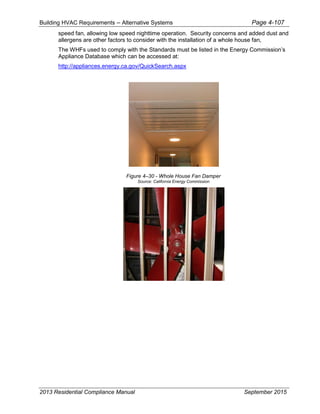
h) Refrigerant Charge in ducted Split System and ducted Packaged Unit Air
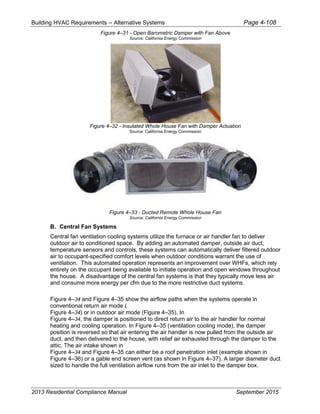
Conditioners and Heat Pumps, and mini-split systems
i) Refrigerant Charge Indicator Display (CID)
j) Verified System Airflow
k) Air Handler Fan Efficacy
l) Verified Energy Efficiency Ratio (EER)
m) Verified Seasonal Energy Efficiency Ratio (SEER)
n) Maximum Rated Total Cooling Capacity
o) Evaporatively Cooled Condensers
p) Ice Storage Air Conditioners
q) Continuous Whole-Building Mechanical Ventilation Airflow
r) Intermittent Whole-Building Mechanical Ventilation Airflow
s) Building Envelope Air Leakage
t) High Quality Insulation Installation (QII)
u) Quality Insulation Installation for Spray Polyurethane Foam
v) PV Field Verification Protocol
w) Verified Pipe Insulation Credit
x) Verified Parallel Piping
y) Verified Compact Hot Water Distribution System
Compliance and Enforcement – HERS Field Verification and Diagnostic Testing Pages 2-35
2013 Residential Compliance Manual January 2014
z) Verified Point of Use
aa) Demand Recirculation: Manual Control
bb) Demand Recirculation: Sensor Control
cc) Multiple Recirculation Loop Design for DHW Systems Serving Multiple Dwelling
Units
Field verification and diagnostic testing is only required when certain regulated efficiency
measures or equipment features are installed. If such efficiency measures or equipment
features are not installed, then field verification and diagnostic testing is not required. For
example, if a dwelling that must comply with the Standards does not have air distribution
ducts, then HERS verification of duct leakage is not required for compliance.
2.5.2 Verification, Testing and Sampling
At the builder’s option, HERS field verification and diagnostic testing may be completed
either for each dwelling unit or for a sample of dwelling units. Sampling is permitted only
when multiple dwelling units of the same type are constructed within the same subdivision
by the same subcontractor. Sampling may also be utilized for alterations for groups
composed of dwellings having the same measure installed that requires HERS
verification, and where the same installing contractor has installed the measures. More
detail on the sampling procedures is provided in Reference Residential Appendix Section
RA2.6 and RA2.8.
The builder or subcontractor must provide to the HERS rater a copy of the Certificate of
Compliance approved/signed by the principal designer/owner and a copy of the
Certificate(s) of Installation (CF2R) signed/certified by the builder or subcontractors as
specified in Reference Residential Appendix Section RA2.5.
When compliance requires document registration, prior to performing field verification
and diagnostic testing, the HERS rater must verify that transmittal to the HERS provider
data registry of the Certificate of Compliance information and the Certificate(s) of
Installation (CF2R) information has been completed for each dwelling unit for which
compliance requires HERS verification.
For all HERS verification procedures, the HERS rater must confirm that the
Certificate(s) of Installation (CF2R) have been completed as required, and that the
installer’s diagnostic test results and all other Certificate(s) of Installation (CF2R)
information shows compliance consistent with the requirements given in the plans and
specifications and Certificate of Compliance approved by the local enforcement agency for
the dwelling.
If field verification and diagnostic testing determines that the requirements for compliance
are met, the HERS rater shall transmit the test results and rater certification/signature to
the HERS provider data registry, whereupon the provider shall make available a registered
Page 2-36 Compliance and Enforcement – HERS Field Verification and Diagnostic Testing
2013 Residential Compliance Manual January 2014
copy of the completed and signed Certificate of Verification (CF3R) to the HERS rater, the
builder, the enforcement agency, and other approved users of the HERS provider data
registry. Printed copies, electronic or scanned copies, and photocopies of the completed,
signed and registered Certificate of Verification (CF3R) shall be allowed for document
submittals, subject to verification that the information contained on the copy conforms to
the registered document information currently on file in the HERS provider data registry for
the dwelling. A completed, signed and registered copy of the Certificate of Verification
(CF3R) must be posted at the building site or made available for review by the
enforcement agency in conjunction with requests for final inspection for each dwelling unit.
The HERS provider shall make available via phone or internet communications interface a
way for building officials, builders, HERS raters, and other authorized users of the provider
data registry to verify that the information displayed on copies of the submitted
Certificate(s) conforms to the registered document information currently on file in the
provider data registry for the dwelling unit.
NOTE: If the builder chooses the sampling option, the procedures described in Reference
Residential Appendix Sections RA2.6and RA2.8 must be followed.
2.5.3 Initial Model Field Verification and Diagnostic Testing
The HERS rater must diagnostically test and field verify the first dwelling unit of each
model within a subdivision or multifamily housing development. To be considered the
same model, dwelling units must have the same basic floor plan layout, energy design,
and compliance features as shown on the Certificate of Compliance for each dwelling unit.
Variations in the basic floor plan layout, energy design, compliance features, zone floor
area, or zone volume, that do not change the HERS features to be tested, the heating or
cooling capacity of the HVAC unit(s), or the number of HVAC units specified for the
dwelling units, shall not cause dwelling units to be considered a different model. For multi-
family buildings, variations in exterior surface areas caused by location of dwelling units
within the building shall not cause dwelling units to be considered a different model.
The initial model testing allows the builder to identify and correct any potential construction
flaws or practices in the build out of each model. If field verification and diagnostic testing
determines that the requirements for compliance are met, the HERS rater will transmit the
test results to the HERS provider data registry, whereupon the provider will make available
a registered copy of the Certificate of Verification (CF3R) to the HERS rater, the builder,
the enforcement agency, and other authorized users of the HERS provider data registry.
2.5.4 Group Sample Field Verification and Diagnostic Testing
After the initial model field verification and diagnostic testing is completed, the builder, or
the builder’s authorized representative determines which sampling procedure is to be used
for the group of dwellings that require HERS field verification. There are two procedures
for HERS verification compliance using group sampling: (1) sampling of a “closed” group
Compliance and Enforcement – HERS Field Verification and Diagnostic Testing Pages 2-37
2013 Residential Compliance Manual January 2014
of up to seven dwellings; and (2) sampling of an “open” group of up to five dwellings. The
group sampling requirements for each procedure will be discussed in this section.
Transmittal/submittal of the Certificate(s) of Installation information, for at least one
dwelling, to the HERS provider data registry, is required in order to “open” a new group.
Additional dwellings may be entered into the registry, and included in an “open” group over
a period of time, subject to transmittal/submittal of the Certificate(s) of Installation
information to the registry for each additional dwelling. However the group shall not remain
“open” to receive additional dwellings for a period longer than six months from the earliest
date shown on any Certificate of Installation for a dwelling included in a group. A group
may be “closed” at any time after the group has been “opened” at the option of the builder
or builder’s authorized representative, thus the size of a “closed” group may range from a
minimum of one dwelling to a maximum of seven dwellings. When a group becomes
classified as “closed”, no additional dwellings shall be added to the group.
Sampling of a “closed” group of up to seven dwellings requires the following
conditions to be met as prerequisite to receiving HERS compliance verification for the
group:
1. All of the dwelling units contained in the sample group have been identified. Up to
seven dwellings are allowed to be included in a “closed” sample group for the
HERS compliance verification.
2. Installation of all the measures that require HERS verification has been completed
in all the dwellings that are entered in the group, and registration of the
Certificate(s) of Installation for all the dwellings entered in the group has been
completed.
3. The group has been classified as a “closed” group in the HERS provider data
registry.
4. At the request of the builder or the builder’s authorized representative, a HERS
rater will randomly select one dwelling unit from the “closed” sample group for field
verification and diagnostic testing. If the dwelling unit meets the compliance
requirements, this “tested” dwelling and also each of the other “non-tested”
dwellings in the group will receive a registered Certificate of Verification (CF3R).
Sampling of an “open” group of up to five dwellings requires the following conditions
to be met as prerequisite to receiving HERS compliance verification for the group:
1. At least one dwelling unit from the sample group has been identified. Up to five
dwellings are allowed to be included in an “open” sample group for the HERS
compliance verification.
2. Installation of all the measures that require HERS verification shall be completed in
all the dwellings that are entered in the group, and registration of the Certificate(s)
of Installation for all the dwellings entered in the group has been completed.
3. At the request of the builder, or the builder’s authorized representative, a HERS rater will
randomly select one dwelling unit from those currently entered into the “open” sample
group for field verification and diagnostic testing. If the dwelling unit meets the compliance
requirements, the “tested” dwelling and also each of the other “non-tested” dwellings
Page 2-38 Compliance and Enforcement – HERS Field Verification and Diagnostic Testing
2013 Residential Compliance Manual January 2014
currently entered into the group shall receive a registered Certificate of Verification
(CF3R). If less than five dwelling units have been entered into the group, the group shall
be allowed to remain “open” and eligible to receive additional dwelling units. Dwelling units
entered into the “open” group subsequent to the successful HERS compliance verification
of the “tested” dwelling shall also receive a registered Certificate of Verification (CF3R) as
a “non-tested” dwelling subject to receipt of the registered Certificate(s) of Installation by
the HERS provider data registry for the dwelling. The group shall be “closed” when it
reaches the limit of 5 dwellings, when the 6 month limit for “open” groups has been
exceeded, or when the builder requests that the group be closed.
The HERS rater must confirm that the Certificate(s) of Installation have been completed as
required, and that the installer’s diagnostic test results and the Certificate(s) of Installation
shows compliance consistent with the Certificate of Compliance for the dwelling unit.
The HERS rater must diagnostically test and field verify the selected dwelling unit, and
enter the test and/or field verification results into the HERS provider data registry
regardless of whether the results indicate a pass or fail. If the test fails, then the failure
must be entered into the provider’s data registry even if the installer immediately corrects
the problem. In addition, any applicable procedures for re-sampling, full testing, and
corrective action must be followed as described in section 2.5.5 of this Chapter below.
If field verification and diagnostic testing determines that the requirements for compliance
are met, the HERS rater will enter the test results into the HERS provider data registry.
Whereupon the provider will make available to the HERS rater, the builder, the
enforcement agency, and to other approved users of the HERS provider data registry, a
registered copy of the Certificate of Verification (CF3R) for the “tested” dwelling, and for all
other “non-tested” dwelling units entered in the group at the time of the sample test. So as
to not create confusion by placing test results on non-tested dwelling units, the HERS
provider data registry will not report the testing/verification results of the tested home on
the certificate of field verification and diagnostic testing (CF3R) for non-tested dwelling
units in a sample group. The testing/verification results will only be reported on the CF3R
for the tested dwelling unit of the sample group. However, CF3R forms for non-tested
dwelling units will still have a registration number and date, a watermark of the HERS
provider’s seal, etc. and will specify the dwelling unit was not tested and is part of a
sample group.
The HERS provider is required to “close“ any “open” group within 6 months after the
earliest signature date shown on any Certificate of Installation for a dwelling entered in the
group. When such group closure occurs, the HERS provider shall notify the builder that
the group has been “closed,“ and require that a sample dwelling be selected for field
verification and diagnostic testing by a HERS rater if field verification has not yet been
conducted on a sample dwelling entered in the group.
2.5.5 Re-sampling, Full Testing and Corrective Action
When a failure is encountered during sample testing, the failure must be entered into the
HERS provider data registry for retention by the HERS rater. Corrective action must then
Compliance and Enforcement – HERS Field Verification and Diagnostic Testing Pages 2-39
2013 Residential Compliance Manual January 2014
be taken on the failed dwelling unit, and the dwelling unit must subsequently be retested to
verify that corrective action was successful and the dwelling complies. Corrective action
and retesting on the dwelling unit must be repeated until the testing determines that the
dwelling complies and the successful compliance results have been entered into the
HERS provider data registry. Whereupon, a registered Certificate of Verification (CF3R)
for the dwelling shall be made available to the HERS rater, the builder, the enforcement
agency, and other authorized users of the HERS provider data registry.
In addition, the HERS rater must conduct re-sampling and test a second randomly
selected dwelling within the sample group to assess whether the first failure in the group is
unique, or if the rest of the dwelling units in the group are likely to have similar failings.
“Re-sampling” refers to the procedure that requires testing of additional dwellings within a
group when the initial selected sample dwelling from a group fails to comply with the
HERS verification requirements.
When re-sampling in a "closed" group, if the testing of a second randomly selected
dwelling in the group confirms that the requirements for compliance credit are met for that
unit, then the dwelling unit with the initial failure is not considered to be an indication of
failure in the remaining untested dwelling units in the group, and a copy of the Certificate
of Verification (CF3R) will be made available for the remaining dwelling units in the group,
including the dwelling unit in the re-sample. If the second sample results in a failure, the
HERS rater must report the second failure to the HERS provider data registry, and all of
the non-tested dwelling units in the group must thereafter be individually field verified and
diagnostically tested.
Additional information describing the procedures for re-sampling of closed groups of up to
7 dwellings, and the procedures for re-sampling for open groups of up to 5 dwellings are
described in Reference Residential Appendix RA2.6..
2.5.6 Installer Requirements and HERS Procedures for Alterations
When compliance for an alteration requires field verification and diagnostic testing by a
certified HERS rater, the building owner may choose for the field verification and
diagnostic testing to be completed for the dwelling unit individually; or alternatively, as part
of a designated sample group of dwelling units for which the same installing company has
completed work that requires testing and field verification for compliance. Generally
speaking, the only alterations that will require HERS testing/verification are HVAC
changeouts. The building owner or agent of the building owner must complete the
applicable portions of a shorthand version of the Certificate of Compliance (the CF1R-
ALT) form for their climate zone. When compliance requires HERS verification, the
building owner or agent must make arrangements for transmittal/submittal of the
Certificate of Compliance information to the HERS provider data registry, identifying the
altered HVAC system and measures that require HERS verification. The building owner
must also arrange to submit an approved/signed copy of the Certificate of Compliance to
the HERS rater.
Page 2-40 Compliance and Enforcement – HERS Field Verification and Diagnostic Testing
2013 Residential Compliance Manual January 2014
When the installation is complete, the person responsible for the performance of the
installation must complete the Certificate(s) of Installation (CF2R). All required
Certificate(s) of Installation must be registered with an approved HERS provider data
registry when field verification and diagnostic testing is required.
After verifying that the Certificate of Compliance (CF1R-ALT) and all required Certificate(s)
of Installation are completed, signed and registered, the HERS rater must perform HERS
compliance verification, and if group sampling is utilized for compliance, the sampling
procedures described in Reference Residential Appendix RA2.6.3.3 and RA2.8 for
sampling of a ”closed” group of up to seven dwellings must be used, requiring that all
dwelling units (HVAC systems) within the group have been serviced by the same installing
company. The installing company may request a group for sampling that is smaller than
seven dwelling units (HVAC systems). Re-sampling, full testing, and corrective action
must be completed, if necessary, as specified by Reference Residential Appendix
RA2.6.4. NOTE: Whenever the HERS rater for the group is changed, a new group must
be established.
The enforcement agency cannot approve the alteration until the enforcement agency has
verified completed, signed and registered Certificate of Compliance (CF1R-ALT),
Certificate(s) of Installation (CF2R), and Certificate(s) of Verification (CF3R)
documentation for the altered HVAC system. The enforcement agency shall also verify
that the installing contractor provides copies of all of these forms to the home owner.
Third Party Quality Control Programs, as specified in Reference Residential Appendix
RA2.7, may also be used with alterations, and must be limited to “closed” sample group
sizes of thirty dwelling units (HVAC systems) or less. When a Third Party Quality Control
Program is used, the enforcement agency may approve compliance based on the
Certificate(s) of Installation (CF2R), where data checking has indicated that the unit
complies, on the condition that if the required HERS verification procedures determine that
re-sampling, full testing, or corrective action is necessary, such work shall be completed.
2.5.7 For More Information
More details on field verification and/or diagnostic testing and the HERS provider data
registry are provided in the 2013 Reference Residential Appendices and 2013 Reference
Joint Appendices, as described below:
• Reference Joint Appendix JA7 – Data Registry Requirements
• Reference Residential Appendix RA2 – Residential HERS Verification, Testing,
and Documentation Procedures
• Reference Residential Appendix RA3 – Residential Field Verification and
Diagnostic Test Protocols
Compliance and Enforcement – HERS Field Verification and Diagnostic Testing Pages 2-41
2013 Residential Compliance Manual January 2014
Example 2-9
Question
Given a multifamily building that has used the Duct Sealing HERS credit for compliance for all the
dwelling units in the building, what is the correct sampling procedure for HERS field verification
and diagnostic testing for the air distribution ducts?
Answer
If the builder of a multifamily building chooses to comply using sampling, then the sampling is
done using groups composed of dwelling units that have utilized the same HERS measures for
compliance. Dwellings that do not have the same HERS measures specified for compliance are
not allowed to be placed in the same HERS sample group. If the whole-building compliance
approach has been used, all dwellings in the building, by default, have the same HERS features
specified. However, if unit-by-unit compliance approach has been used, and all dwellings do not
utilize the same HERS features for compliance, then only the dwellings that have utilized the
same HERS features may be grouped together.
For this example, since duct testing is the only HERS measure specified for all of the dwelling
units, all of the dwelling units in the building can be grouped together for purposes of HERS
verification requirements. The procedures for assigning dwellings to groups and the HERS
verification of a sample from each group must follow the same procedure as for single family
dwellings described in Section 2.5.2 earlier in this chapter, and in Reference Residential Appendix
RA2. The first dwelling unit for each model floor plan in the building must be verified by the HERS
rater prior to start of formation of sample groups. For multi-family buildings, variations in exterior
surface areas caused by location of dwelling units within the building do not cause dwelling units
to be considered a different model floor plan. When verifying a dwelling unit, all the duct systems
associated with every HVAC unit in the dwelling must be tested in order to determine compliance
for that dwelling. After the HERS verification of the first dwelling of each model floor plan is
complete, the HERS rater must randomly select a sample dwelling unit from each group of
dwellings that have been formed, and these samples must be tested according to applicable
procedures in Reference Residential Appendix RA3, and documented according to procedures in
Reference Residential Appendix RA2. In a sampled dwelling unit that is to be tested to confirm
compliance, the duct system associated with every HVAC unit in that dwelling unit must be tested.
However duct systems do not have to be tested in dwelling units that are not selected for
sampling (non-tested dwelling), provided the dwelling that was tested complies. If the tested
dwelling in the group complies with the HERS verification, the remaining dwellings in the sample
group are certified for compliance based on the results of the sample dwelling test result. Testing
must be done on every duct system in a dwelling unit, regardless of whether it appears that the
HVAC and duct system are in conditioned space or not. This is akin to a single family residence
with one HVAC unit serving upstairs with ducts in the attic and another serving downstairs with
ducts between floors.
Defining duct location as "inside" or "outside" for leakage purposes is not described by the
locations of walls or the number of stories. The boundary between inside and outside for leakage
purposes is defined by the air boundary, typically drywall, between inside and outside. Spaces
between floors and spaces in walls (including interior walls) are often "outside" from an air
leakage perspective because they are not sealed effectively to form an air barrier and
communicate to the outside.
Page 2-42 Compliance and Enforcement – HERS Field Verification and Diagnostic Testing
2013 Residential Compliance Manual January 2014
Duct insulation is not required for ducts in directly conditioned space because there is an
expectation that there will be reduced conduction losses for these ducts. But to get full credit for
ducts in conditioned space, duct leakage must be tested and meet the requirements for duct
sealing. In a multifamily building in order for compliance credit to be taken for ducts in conditioned
space, all of the duct systems in the building must be in conditioned space unless compliance is
documented for each dwelling unit separately. To meet the mandatory requirements, all HVAC
units must have ducts made of UL 181 approved materials (i.e., cased coils). Coils enclosed by
sheetrock do not meet the mandatory requirements.
Table of Contents Page i
Table of Contents
3. Building Envelope Requirements 1
3.1 Organization ................................................................................................................... 1
3.2 What’s New for 2013 ...................................................................................................... 2
3.3 Compliance Options ....................................................................................................... 2
3.3.1 Mandatory Features and Devices ............................................................................ 3
3.3.2 Prescriptive Compliance Approach .......................................................................... 3
3.3.3 Performance Approach............................................................................................ 4
3.4 Key Envelope Compliance Terms................................................................................... 4
3.4.1 Vapor Retarders and Moisture Protection ................................................................ 5
3.5 Fenestration.................................................................................................................... 8
3.5.1 Fenestration Types.................................................................................................. 8
3.5.2 Relevant Sections in the Standards for Fenestration ............................................. 10
3.5.3 Mandatory Measures, Features, and Devices........................................................ 11
3.5.4 U-factor and SHGC Rating Mandatory Requirements............................................ 12
3.5.5 Labeling Mandatory Requirements ........................................................................ 14
A. Default Temporary Label 14
3.5.6 Certified Temporary and Permanent Labels........................................................... 15
3.5.7 Fenestration U-factor............................................................................................. 19
3.5.8 Prescriptive Requirements..................................................................................... 20
3.5.9 Fenestration Prescriptive Exceptions..................................................................... 20
3.5.10 Dynamic Glazing Compliance................................................................................ 24
3.5.11 Compliance Alternatives ........................................................................................ 27
A. Fenestration Area 27
B. Orientation .28
C. Improved Fenestration Performance 28
D. Fixed permanent Shading Devices ...29
E. Reserved ...29
F. Exterior Shading Devices ...31
G. Interior Shading 33
H. Bay Windows 33
I. Natural Ventilation through Fenestration . 33
3.6 Envelope Features........................................................................................................ 34
3.6.1 Mandatory Requirements....................................................................................... 34
2013 Residential Compliance Manual January 2014
Table of Contents Page ii
3.7 Construction Practice/Compliance and Enforcement .................................................... 35
3.7.1 Mandatory Minimum Requirements ....................................................................... 35
3.8 Field Applied Liquid Coatings........................................................................................ 38
3.8.1 Field Applied Liquid Coatings ................................................................................ 38
3.8.2 Prescriptive Requirements..................................................................................... 47
3.9 Advanced Assembly Systems....................................................................................... 59
3.9.1 Quality Insulation Installation (QII) ......................................................................... 59
3.9.2 Structural Bracing, Tie-Downs, Steel Structural Framing ....................................... 60
3.9.3 Air Barrier .............................................................................................................. 61
3.9.4 Insulation Installation ............................................................................................. 62
3.9.5 Reduced Building Air Leakage............................................................................... 64
3.9.6 Conventional and Non-Conventional/Advanced Assemblies.................................. 65
3.10 Compliance and Enforcement ....................................................................................... 82
Glossary/References............................................................................................................... 83
2013 Residential Compliance Manual January 2014
Building Envelope Requirements – Key Envelope Compliance Terms Page 3-1
3. Building Envelope Requirements
This chapter describes the requirements that affect the design of the building envelope for
residential buildings. The building’s design and choices made for individual components
can significantly impact the energy demand needed to meet heating and cooling loads to
maintain the building’s desired inside comfort temperature. Heating and Cooling load
calculations are used to determine the mechanical system design needed for space
heating and cooling. The principal components of heating loads are infiltration and
conduction losses through building envelope components, including walls, roofs, floors,
slabs, windows and doors. Cooling loads, on the other hand, are dominated by solar gains
through windows and skylights.
3.1 Organization
This chapter is organized by building system or building envelope component, and
includes the following subject areas:
3.2 What’s New for 2013
• Highlights of significant changes for 2013 affecting the building envelope
Compliance Options
• Provisions allowing the Energy Commission to approve new products, methods,
and procedures for compliance
3.3 Compliance Options
• A summary of the general requirements affecting compliance with the 2013
Building Energy Efficiency Standards
3.4 Key Envelope Compliance Terms
• Terms used most often related to the building envelope for compliance purposes
3.5 Fenestration
• Detailed explanation of the mandatory requirements, and prescriptive and
performance compliance approaches for fenestration
3.6 Envelope Features
• Detailed explanation of the mandatory requirements, and prescriptive and
performance compliance approaches for the building envelope
3.7 Advanced Assembly Systems
• Discussion of design techniques that when used in more innovative ways can
improve building energy efficiency and receive compliance energy credit
3.8 Compliance and Enforcement
• Discussion of issues to aid compliance and enforcement for elements of the
building envelope
2013 Residential Compliance Manual January 2014
Building Envelope Requirements – Key Envelope Compliance Terms Page 3-2
3.9 Glossary/References
• Key terms and reference information most often used for the building envelope
3.2 What’s New for 2013
The 2013 Building Energy Efficiency Standards for residential buildings include increased
efficiencies for several envelope measures, and there are improvements that have been made to
better aid the designer, builder, and building official.
1. An updated equation to calculate the aged solar reflectance for cool roofing product,
§110.8(i)2.
2. Mandatory minimum insulation levels installed between 2x6 inch and greater wall
framing, §150.0(c).
3. Introduced assembly U-factor to meet the prescriptive insulation requirement, TABLE
150.1-A.
4. Increased the prescriptive requirement for low- and steep-sloped roofing products
(cool roof) and removed the designations of roof weight, §150.1(c)11.
5. For alterations, a prescriptive tradeoff is allowed between insulation and cool roofs,
§150.2(b)1H.
6. More efficient fenestration (lower U-factor) and higher levels of shading (lower SGHC)
are required in specific climate zones.
7. Dynamic Glazing also known as smart windows can now be accounted for energy
compliance.
8. Window Films can be used to meet the shading requirements for alterations to existing
buildings.
Prescriptive component packages C and E have been removed. There is now only one
prescriptive component package, Package A (previously component package D).
3.3 Compliance Options
Public Resources Code, Section 25402.1 (b) requires the California Energy
Commission to establish a formal process for certification of compliance options of
new products, materials, designs or procedures that can improve building efficiency
levels established by the Building Energy Efficiency Standards. §10-109 of the
Standards allows for the introduction of new calculation methods and measures which
cannot be properly accounted for in the current approved compliance approaches.
This process for approval of new products, materials, procedures, and calculation
methods is called compliance options and helps to improve building efficiency levels
set by the Standards.
The Energy Commission encourages the use of energy-saving techniques and
designs for showing compliance with the standards. The compliance options process
allows the Energy Commission to review and gather public input regarding the merits
of new compliance techniques, products, materials, designs, or procedures to
demonstrate compliance for newly constructed buildings, additions, and alterations to
2013 Residential Compliance Manual January 2014
Building Envelope Requirements – Key Envelope Compliance Terms Page 3-3
existing buildings. Approved compliance options are generally carried for use with the
newer energy code when revisions are made to the standards and information
regarding their use and eligibility and/or installation criteria are incorporated in
compliance and reference manuals.
When the Energy Commission approves a new compliance option it is listed in the
Special Cases section of the Energy Commission’s website based on the adoption
year of the standards:
http://www.energy.ca.gov/title24/2008standards/special_case_appliance/.
Compliance Overview
3.3.1 Mandatory Features and Devices
§150.0
When compliance is being demonstrated with either the prescriptive or performance
compliance paths, there are mandatory measures that must be installed. Minimum
mandatory measures must be met regardless of the method of compliance being
used. For example, a building may comply using performance computer modeling
software with only a U-factor of U-0.41 insulation in a wood-framed attic roof, but a U-
factor of at least U-0.031 must be installed because that is the mandatory minimum.
3.3.2 Prescriptive Compliance Approach
Standards Table 150.1-A
A. The prescriptive requirements are the simplest way to comply with the building envelope
requirements but offer little flexibility. If each and every prescriptive requirement is met,
the building envelope complies with the standards. The prescriptive envelope
requirements are prescribed in §150.1 which include Table 150.1-A.
B. The prescriptive compliance approach consists of meeting specific requirements for each
envelope component, plus meeting all minimum mandatory requirements, such as
mandatory levels of insulation. Prescriptive requirements apply to:
1. roofs and ceilings,
2. exterior roofing products
3. exterior walls
4. floors
Fenestration must meet prescriptive efficiency values and have a maximum area of 20% of the
window-to-wall ratio conditioned floor area (CFA). The efficiency values are specified for the
maximum U-factor, maximum Solar Heat Gain Coefficient (SHGC) and maximum west facing
area of 5% of the CFA. Specific requirements are made for glazing in doors, tubular skylights,
non-tubular skylights, and chromatic type glazing (§150.1(c)3A).
2013 Residential Compliance Manual January 2014
Building Envelope Requirements – Key Envelope Compliance Terms Page 3-4
3.3.3 Performance Approach
§150.1
A. The prescribed mandatory measures and prescriptive requirements affect the design and
operation of the building. Mandatory measures, prescriptive requirements and operational
schedules establish a minimum performance level which can be exceeded by other design
measures and construction practices resulting in greater energy savings.
B. The performance approach is a more sophisticated compliance method and it offers greater
design flexibility than the prescriptive approach. The performance approach may be used for
any unique design element(s) that the user of compliance modeling software believes can
contribute to the building’s overall energy use.
C. The performance approach allows for more energy tradeoffs between building features,
such as increasing HVAC equipment efficiency in order to allow more fenestration area.
See Section 3.8 and Chapter 9 for a more complete discussion of the performance
approach.
3.4 Key Envelope Compliance Terms
Elements of the building envelope significantly contribute to its energy efficiency.
Several features are important to note when a method is chosen to demonstrate
compliance. Components of the building envelope include walls, floors, the roof
and/or ceiling, and fenestration. Details for compliance of fenestration are addressed
in Section 3.5, Fenestration.
A. Walls and Space(s) Surrounding Occupancy Uses
B. Envelope and other building component definitions are listed in §100.1 of the 2013
Standards, and the Reference Appendices.
C. Envelope requirements vary by envelope component and are a function of their
type of construction, their orientation and the space conditions on either side of the
envelope surface. Additional envelope component definitions are as follows:
D. An exterior partition or wall is an envelope component (roof, wall, floor, window
etc.) that separates conditioned space from ambient (outdoor) conditions.
E. A demising partition or wall is an envelope component that separates
conditioned space from an unconditioned space.
F. A conditioned space is either directly conditioned or indirectly conditioned (see
Section 100.1 for full definition). An indirectly conditioned space has less thermal
resistance to a directly conditioned space than to the outside. An unconditioned
space is enclosed space within a building that is not directly conditioned, or
indirectly conditioned.
G. A plenum is a space below an insulated roof and above an uninsulated ceiling. It
is an indirectly conditioned space as there is less thermal resistance to the directly
conditioned space below than to the ambient air outside. In comparison, an attic
below an uninsulated roof and having insulation on the attic floor is an
unconditioned space because there is less thermal resistance to the outside than
across the insulated ceiling to the conditioned space below. A plenum can also be
the space between the underside of a raised floor and the crawl space ground, and
is sometimes used as an air supply for the building when the exterior foundation is
sealed to the outside.
2013 Residential Compliance Manual January 2014
Building Envelope Requirements – Key Envelope Compliance Terms Page 3-5
H. Sloping surfaces are considered either a wall or a roof, depending on the slope
(see Figure 3-1). If the surface has a slope of less than 60° from horizontal, it is
considered a roof; a slope of 60° or more is a wall. This definition extends to
fenestration products, including windows in walls and any skylight types in roofs.
I. Floors and roof/ceilings do not differentiate between demising and exterior. Thus
an exterior roof/ceiling ”is an exterior partition, or a demising partition, that has a
slope less than 60 degrees from horizontal, that has conditioned space below,”
ambient conditions or unconditioned space above “and that is not an exterior door
or skylight.”
J. Similarly an “exterior floor/soffit is a horizontal exterior partition, or a horizontal
demising partition, under conditioned space” and above an unconditioned space or
above ambient (outdoor) conditions.
3.4.1 Vapor Retarders and Moisture Protection
A. A vapor retarder or barrier is a special covering over framing and insulation or
covering the ground of a crawl space that protects the assembly components from
possible damage due to moisture condensation. During cold weather, the inside of
the house is warm and moist (from breathing, showers, etc.) and the outside is
cold and dry. Moisture moves from more to less and from warm to cold. When the
moisture (in vapor form) reaches a point in the wall or roof assembly that has a
temperature below the dew point, it will condense into liquid water. Water build up
can cause structural damage, create mold that may contribute to indoor air quality
problems and can cause the insulation to lose its effectiveness.
B. Fenestration or Windows are considered part of the exterior wall because the
slope is typically over 60°. Where the slope of fenestration is less than 60°, the
glazing indicated as a window is considered a skylight.
Figure 3-1 – Slope of a Wall or Window (Roof or Skylight slope is less than 60°)
Source: California Energy Commission
C. Roofing Products (Cool Roof)
Roofing products with a high solar reflectance and thermal emittance are referred to as
“cool roofs.” These roofing types absorb less solar heat and give off more heat to their
surroundings than traditional roofing material. These roofs are cooler and thus help
reduce air conditioning loads by reflecting and emitting energy from the sun. Roof radiative
2013 Residential Compliance Manual January 2014
Building Envelope Requirements – Key Envelope Compliance Terms Page 3-6
properties are rated and listed by the Cool Roof Rating Council (CRRC)
(http://www.coolroofs.org/).
In general, light-colored high reflectance surfaces reflect solar energy (visible light,
invisible infrared and ultraviolet radiation) and stay cooler than darker surfaces that absorb
the sun’s energy and become hot.
The standards specify radiative properties that represent minimum “cool roof performance”
qualities of roofing products:
1. Solar reflectance—the fraction of solar energy that is reflected by the roof surface
2. Thermal emittance—the fraction of thermal energy that is emitted from the roof
surface
Both solar reflectance and thermal emittance are measured from 0 to 1; the higher the
value, the "cooler" the roof. There are numerous roofing materials in a wide range of
colors that have relatively good cool roof properties. Excess heat can increase the
building’s air conditioning load resulting in increased air conditioning energy needed for
maintaining occupant comfort. High-emitting roof surfaces reject absorbed heat quickly
(upward and out of the building) than darker roof surfaces with low-emitting properties.
The standards prescribe cool roof radiative properties for low-sloped and steep-sloped
roofs (§150.1(c)11). A low-sloped roof is defined as a surface with a pitch less than or
equal to 2:12 (9.5 degrees from the horizon), while a steep-sloped roof is a surface with a
pitch greater than 2:12 (9.5 degrees from the horizon). Because solar heat gain is based
on the sun’s angle of incidence on a surface, low-sloped roofs receive more solar radiation
than steep-sloped roofs in the summer when the sun is high in the sky.
Example 3-1
Question
I am a salesperson and represent some roofing products, and many of them are on the EPA’s
Energy Star list for cool roofing materials. Is this sufficient to meet Standards?
Answer
No. Energy Star has different requirements for reflectance and NO requirements for emittance.
Per Section10-113 of the Energy Building Regulations, the Cool Roof Rating Council
(http://www.coolroofs.org) is the only entity currently recognized by the Energy Commission to
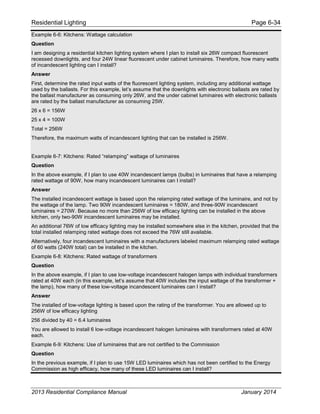
determine what qualifies as a cool roof.
Example 3-2
Question How does a product get CRRC cool roof certification?
Answer
Any party wishing to have a product or products certified by CRRC should contact CRRC to get
started call toll-free (866) 465-2523 from inside the US or (510) 485-7176, or email
info@coolroofs.org. CRRC staff will walk interested parties through the procedures. In addition,
CRRC publishes the procedures in "CRRC-1 Program Manual," available for free on
2013 Residential Compliance Manual January 2014
Building Envelope Requirements – Key Envelope Compliance Terms Page 3-7
http://www.coolroofs.org or by calling CRRC. However, working with CRRC staff is strongly
recommended.
Example 3-3
Question
I understand reflectance, but what is emittance?
Answer
Even a material that reflects the sun’s energy will still absorb some of that energy as heat; there
are no perfectly reflecting materials being used for roofing. That absorbed heat undergoes a
physical change (an increase in wavelength, for readers who remember physics) and is given off
– emitted – to the environment in varying amounts by various materials and surface types. This
emittance is given a unit-less value between 0 and 1, and this value represents a comparison
(ratio) between what a given material or surface emits and what a perfect blackbody emitter
(again, recall physics) would emit at the same temperature.
A higher emittance value means more energy is released from the material or surface; scientists
refer to this emitted energy as thermal radiation (as compared to the energy from the sun, solar
radiation, with shorter wavelength). Emittance is a measure of the relative efficiency with which a
material, surface, or body can cool itself by radiation. Lower-emitting materials become relatively
hotter for not being able to get rid of the energy, which is heat. Roof materials with low emittance
therefore hold onto more solar energy as heat, get hotter than high-emittance roofs, and with help
from the laws of physics, offer greater opportunity for that held heat to be given off downward into
the building through conduction. More heat in the building increases the need for air conditioning
for comfort. A cool roof system that reflects solar radiation (has high reflectance) and emits
thermal radiation well (has high emittance) will result in a cooler roof and a cooler building with
lower air-conditioning costs.
D. Air Leakage
Infiltration is the unintentional replacement of conditioned air with unconditioned air
through leaks or cracks in the building envelope. It is a major component of heating
and cooling loads. Air leakage can occur through holes and cracks in the building
envelope and around doors and fenestration framing areas. Ventilation is the
intentional replacement of conditioned air with unconditioned air through open
windows and skylights or mechanical ventilation.
Reducing air leakage in the building envelope can result in significant energy savings,
especially in climates with more severe winter and summer conditions. It also can
result in improved building comfort, reduced moisture intrusion, and fewer air
pollutants.
E. Advanced Assemblies
Common strategies for exceeding the minimum energy performance level set by the
2013 Standards include the use of better components such as: higher insulation
levels, more efficient fenestration, reducing the building’s air leakage, using radiant
barriers, “cool” roofing products, better framing techniques that accommodate more
insulation (raised-heel truss) and reduce thermal bridging across framing members,
greater use of non-framed assemblies or panelized systems (SIPs and ICFs), and
2013 Residential Compliance Manual January 2014
Building Envelope Requirements – Key Envelope Compliance Terms Page 3-8
more efficient heating, cooling and water heating equipment. The Energy Commission
encourages the use of energy savings techniques for showing compliance with the
standards. Innovative designs and practices are discussed in the “Advanced Assembly
System” section.
F. Advanced Building Design
The building’s design, its floor plan and site design layout impact energy use. A
passive solar designed building uses elements of the building to help heat and cool
itself as opposed to relying on mechanical systems to provide the building's thermal
energy needs. Passive solar strategies encompass several advanced high
performance envelope techniques, such as:
1. Carefully choosing the size, type and placement of fenestration and shading
2. Providing and controlling fresh air ventilation during the day or night
3. Having internal and external thermal mass components that help store useful
heat and cooling energy
4. Having highly insulated envelope assemblies
5. Using radiative energy performing roofing materials (cool roofs) and radiant
barriers
6. Having very low air leakage
Some measures included as part of an Advanced Assembly System may require
specific installation procedures, or field verification and diagnostic testing to ensure
their proper performance. Field verification and diagnostic testing is a way to ensure
that the energy efficiency that is used in compliance calculations is actually realized as
an energy benefit by the homeowner.
3.5 Fenestration
Windows, glazed doors, dynamic glazing, window films, and skylights have a significant
impact on energy u-2e in a home. Fenestration accounts for a large impact on heating and
cooling loads of residential and high-rise residential space conditioning loads, the size,
orientation, and types of fenestration products can dramatically affect the overall energy
performance of a house. Glazing type, orientation, shading and shading devices not only
play a major role in the building’s energy use, but can affect the load operation of the
HVAC system and the comfort of occupants.
3.5.1 Fenestration Types
When choosing a new or replacement window, it’s always best to look for a National
Fenestration Rating Council (NFRC) rated label sticker on the window. The Energy
Performance Ratings label is designed to help consumers identify a rating, or a
measurement scale that is reflective of a window's energy performance. This will help the
consumer or designer to compare the energy efficiency of window and glazed door
products, per different brands and manufacturers as well.
The following NFRC label sticker provides information about the energy performance rating by
listing identifiers; U-factors, Solar Heat Gain Coefficient (SHGC), Visible Transmittance (VT), and
Air Leakage (AL) which helps provide accurate information for the consumer or designer. The
label references the following information:
2013 Residential Compliance Manual January 2014
Building Envelope Requirements – Fenestration Page 3-9
1. U-factor measures the rate of heat loss
through a product. Therefore, the lower the
U-factor, the lower the amount of heat loss.
In cold climates where heating bills are a
concern, choosing products with lower U-
factors will reduce the amount of heat that
escapes from inside the house.
2. The Solar Heat Gain Coefficient (SHGC)
measures the percentage of heat in radiant
heat that passes through a fenestration
product. Therefore, the lower the SHGC,
the less amount of solar heat gain. In hot
climates where air conditioning bills are a
concern, choosing products with a lower
SHGC will reduce the amount of heat that
comes in from the outside.
3. Visible Transmittance (VT) measures the
percent amount of light that comes through
a fenestration product. The higher the VT
rating, the more light is allowed through a window or glazed door. Skylight’s significantly
allows more lighting and can be as efficient as vertical windows.
4. Air Leakage (AL) is a measurement of heat loss and gain by infiltration through cracks in the
window assembly and it affects the occupant comfort. The lower the AL, the less air will pass
through cracks in the window assembly.
There are three primary categories of fenestration:
A. WINDOWS
A window is fenestration including skylights that is an assembled unit consisting of a frame
and sash component holding one or more pieces of glazing. New advances in framing
material such as composites, fiberglass and vinyl help improve the energy efficiency of all
fenestration products. New technology has advanced the glass industry to include reflective
coatings such as silver, gold, bronze, low-e, low-e2
, or low-e3
which can be applied to clear
and tinted glass.
The following is a list of sub-categories of fenestration;
A. Manufactured Fenestration is a fenestration product constructed of materials
which are factory cut or otherwise factory formed with the specific intention of
being used to fabricate a fenestration product. Knocked down or partially
assembled products may be sold as a fenestration product when provided with
temporary and permanent labels as described in Section 10-111; or as a site-built
fenestration product when not provided with temporary and permanent labels as
described in Section 10-111.
B. A window is considered Field-fabricated when the windows are assembled at the
building site from the various elements that are not sold together as a fenestration
product (i.e., glazing, framing and weather stripping). Field-fabricated does not
include site-assembled frame components that were manufactured elsewhere with
the intention of being assembled on site (such as knocked down products,
sunspace kits, and curtain walls).
2013 Residential Compliance Manual January 2014
Building Envelope Requirements – Fenestration Page 3-10
C. Site-built Fenestration is designed to be field-glazed or field assembled units
using specific factory cut or otherwise factory formed framing and glazing units that
are manufactured with the intention of being assembled at the construction site.
These include store front systems, curtain walls or large track sliding glass walls
and atrium roof systems.
D. Dynamic Glazing is a glazing system that has the ability to reversibly change its
performance properties, including U-factor, Solar Heat Gain Coefficient (SHGC),
and Visible Transmittance (VT) between well-defined end points. These may
include, but are not limited to chromogenic glazing systems and integrated shading
systems. Dynamic Glazing systems may include internally mounted or externally
mounted shading devices that attach to the window framing/glazing that may or
may not be removable, but only if they are part of the original window, door or
skylight assembly and the assembly is labeled as such.
E. Windows Films Window Films were originally developed in the early 1950’s, and
are mostly made of polyester substrate that is durable, tough and highly flexible. It
absorbs little moisture and has both high arid and low temperature resistances.
Polyester film offers crystal clarity and can be pre-treated to accept different types
of coatings for energy control and long term performance. Window films are made
with a special scratch resistant coating on one side and with a mounting adhesive
layer on the other side. The adhesive is normally applied to the interior surface
(room side) of the glass, unless it is a film specifically designed for the exterior
window surface.
B. GLAZED DOORS
Glazed door is an exterior door having a glazed area of 50 percent or more of the area of the
door. These doors are typically installed in exterior walls that separate conditioned space from
exterior ambient or unconditioned space. When the door is less than 50 percent it will no
longer be considered a glazed door but is a door. The glass area will still have to be counted
towards the overall glass area of the conditioned space.
C. SKYLIGHTS
Skylights are an exceptional source of daylight and passive solar heating, illuminating rooms
with direct and indirect sunlight. In addition, when used appropriately, daylighting can
increase the quality of room light and reduce dependence upon electrical lighting. On the
other hand, skylights don’t typically have the same thermal properties as vertical fenestration,
and can be prone to greater heat loss in winter and solar heat gain during the summer. When
a window designer optimizes the whole envelope glazing arrangement for good daylight and
thermal control, significant heating and cooling energy savings can be realized, especially
when skylights with the same technology as efficient vertical windows are used.
3.5.2 Relevant Sections in the Standards for Fenestration
A. §10-111 (Administrative Standards) establishes the rules for rating and labeling
fenestration products and establishes the NFRC as the supervising authority.
B. §110.6(a)1 sets air leakage requirements for all manufactured windows, doors and
skylights whether they are used in residential or nonresidential buildings.
C. §110.6(a)2 through 4 requires that the U-factor, solar heat gain coefficient (SHGC),
and visible transmittance (VT) for manufactured fenestration products be determined
using NFRC procedures or use default values.
2013 Residential Compliance Manual January 2014
Building Envelope Requirements – Fenestration Page 3-11
D. §110.6(a)5 requires that manufactured fenestration products have both a temporary
and permanent label. The temporary label shall show the U-factor, SHGC and the VT
and verify that the window complies with the air leakage requirements.
E. §110.6(b) field-fabricated fenestration that do not have an NFRC rating shall use the
CEC default U-factors, SHGC and optional VT values.
F. §110.7 requires that openings around windows, skylights and doors be caulked,
gasketed, weatherstripped or otherwise sealed to limit air leakage.
G. §150.0(q) requires a mandatory U-factor of 0.58 or a maximum weighted average U-
factor of 0.58 for windows and skylights separating conditioned space from
unconditioned space or the outdoors. An exception allows the greater of 10 ft2
or 0.5%
of the conditioned floor area to exceed 0.58 U-factor.
H. §150.1(c)3 and 4 meet the prescriptive requirements for fenestration and shading in
low-rise residential buildings. These include requirements for maximum glazing area,
maximum U-factor, and for some climate zones, a maximum SHGC requirement.
I. §150.1(c)3A, in addition to be basic fenestration allowance of 20% of CFA, Exception
1 allows each dwelling unit to have up to 3 ft2
of glazing installed in doors and up to 3
ft2
of tubular daylighting device with dual-pane diffusers to have an assumed U-factor
and SHGC equivalent to the Package requirements.
J. §150.1(c)3A, in addition to be basic fenestration allowance of 20% of CFA, Exception
2 allows up to 16 ft2
of the skylights to have up to 0.55 U-factor and up to 0.30 SHGC
in each dwelling.
K. §150.1(c)3A Exception 3 allows automatically controlled chromogenic glazing (a type
of dynamic glazing) to assume the lowest U-factor and SHGC when connected to
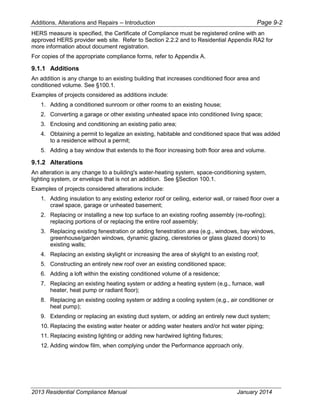
automatically controls that modulate the amount of heat flow into space in multiple
steps in response to solar intensity, chromogenic glazing shall be considered
separately from other fenestration, and must be not be weight averaged with other
fenestration.
L. §150.1(c)3A Exception 4 specifies that if a residential dwelling unit contains a
combination of manufactured and site-built fenestration; only the site-built fenestration
can be determined by using Nonresidential Reference Appendix NA6; however, all
fenestration and including sit-built can also default to TABLES 110.6-A or B.
M. §150.1(c)3B establishes a prescriptive limit that the prescriptive maximum total
fenestration area shall not exceed the percentage of conditioned floor area (CFA)
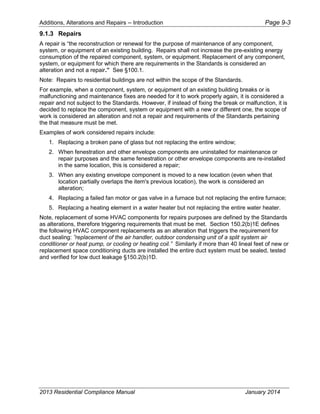
indicated in TABLE 150.1-A. Total fenestration includes skylights and west-facing
glazing.
N. §150.1(c)3C states that when west-facing glazing is limited by Package A, west-facing
includes skylights tilted in any direction when the pitch is less than 1:12.
O. §150.2(a) sets the prescriptive fenestration area requirements for residential additions
as well as other prescriptive requirements for new windows. Performance compliance
options (existing plus addition) are also available.
P. §150.2(b) establishes the prescriptive requirements for replacement windows in
existing residences. Performance compliance options (existing plus alteration) are also
available.
3.5.3 Mandatory Measures, Features, and Devices
Applicable Sections : §110.6(a)1; §110.7
A. Air Leakage. Manufactured fenestration products, including exterior doors, must be tested
and certified to leak no more than 0.3 cubic feet per minute (cfm) per ft² of the window area.
2013 Residential Compliance Manual January 2014
Building Envelope Requirements – Fenestration Page 3-12
This mandatory measure applies to all manufactured windows that are newly installed in
residential, high-residential or existing buildings. To determine leakage, the standard test
procedure requires manufacturers to use is either NFRC 400 or ASTM E283 at a pressure
differential of 75 Pascal (or 1.57 pounds/ft2
).
B. Site-built Products. There are no specific air leakage requirements for site-built fenestration
products but the Standards require limiting air leakage through weatherstripping and caulking.
"Note In the case when unrated NFRC site-built fenestration is used in a residential
application there is an alternative procedure to calculate the default thermal efficiencies U-
factor and SHGC values of such products. Using this alternative may not result in meeting the
prescriptive values as listed in Table 150.1-A. However, it may be used in the Performance
Approach. The alternative calculation can be found in the Reference Nonresidential
Appendices NA6."
C. Field-fabricated Products. No air leakage testing is required for field-fabricated fenestration
products; however, the Standards still require limiting air leakage through weatherstripping
and caulking.
D. Exterior Doors. Exterior doors must meet the following requirements:
1. Manufactured exterior doors must be certified as meeting an air leakage rate of 0.3
cfm/ft² of door area at a pressure differential of 75 Pascal, which is the same as
windows.
2. Exterior doors must comply with the requirements of §110.7, as described in “Joints
and Other Openings,” e.g., they must be caulked and weatherstripped if field-
fabricated.
3. Any door whose surface area has greater than 50 percent glass is considered as a
glazed door and must comply with the Mandatory and applicable Prescriptive and
Performance requirements of §150.0, §150.1, and §150.2.
4. Alternatively, if less than 50 percent of glass the area may be exempt in accordance
with one of the exceptions of §150.0, §150.1, and §150.2.
3.5.4 U-factor and SHGC Rating Mandatory Requirements
Applicable Sections: §110.6(a)2 and §110.6(a)3; TABLE 110.6-A and TABLE 110.6-B
Requiring that U-factor and SHGC be calculated using a standardize procedure ensures that the
thermal performance or efficiency data for fenestration products are accurate and the data
provided by different manufacturers within each fenestration type (windows, doors, skylights,
TDDs) can be easily compared to others within that type and can be independently verified.
For manufactured fenestration products, the mandatory requirements are that the U-factor and
Solar Heat Gain Coefficient (SHGC) be rated by NFRC and be listed in NFRC’s Certified Product
Directory (CPD). The test procedure for U-factor is NFRC 100, and for SHGC is NFRC 200 and
NFRC-200, NRC-202 or ASTM E972 for translucent panels and NFRC-203 for tubular daylighting
devices skylights (TDDs), and for certain type of skylights.
At the time of field inspection, the field inspector verifies the fenestration U-factor and SHGC
values meets the energy compliance values by checking the NFRC label sticker on the
window.
Alternatively, when manufacturers do not rate the thermal efficiencies by NFRC procedures,
the Energy Commission default values must be used and documented on a temporary default
label. See Sample Default Label Figure 3-2.
2013 Residential Compliance Manual January 2014
Building Envelope Requirements – Fenestration Page 3-13
Note: If no labels are available on site for verification, the field inspector should cease any
further installation of fenestration until proof of efficiency (label) is produced on site or filed in
the field office. In cases when proof is not met then the field inspector can cease construction
until the architect/ specifier can produce such labels.
The Energy Commissions default U-factors are listed in TABLE 110.6-A, and the default
SHGC values are listed in TABLE 110.6-B (also in Appendix B of this compliance manual).
Note: While there is no minimum VT value requirement for residential compliance, the value
may be shown on the temporary label for information only. A listing of NFRC certified ratings
is available at http://www.NFRC.org.
Energy Commission (CEC) default values in TABLE 110.6-A and TABLE 110.6-B in the
Standards list the worst possible values that can be assumed when fenestration is not rated
by NFRC. To get credit for high performance window features such as low-e (low-emissivity)
coatings and thermal break frames, the window manufacturer must have the window tested,
labeled, and certified according to NFRC procedures.
A. Site-built Fenestration Products. For low-rise residential construction, site-built products
are treated the same as manufactured products: proof of U-factor and SHGC values must
come from NFRC ratings or from Standards default TABLE 110.6-A and TABLE 110.6-B.
Note: When only unrated site-built fenestration is used in a residential application there is an
alternative procedure to calculate the default U-factor and SHGC values. Though using this
alternative may not result in meeting the prescriptive values as required by Table 150.1-A.
The alternative calculation can be found in the Reference Nonresidential Appendices NA6 or it
may require to use the performance approach to meet energy compliance.
B. Field-fabricated Products §110.6(b). Field-fabricated fenestration must always use the
Energy Commission default U-factors from Standards TABLE 110.6-A and SHGC values
from TABLE 110.6-B. There is no minimum requirement for VT, but only used for
informational purposes.
For acceptable methods of determining U-factor and SHGC are shown in Table 3-1A and
Table 3-1B respectively.
Table 3-1A – Acceptable Methods for Determining U-factor
Fenestration Category
U-factor
Determination
Method
Manufactured
Windows
Manufactured
Skylights
Site-Built
Fenestration
(Vertical&
Skylight)
Field-
Fabricated
Fenestration
Glass
Block
NFRC’s Component
Modeling Approach
(CMA)
1
N/A N/A
NFRC-100 N/A N/A
Standards Default
Table 110.6-A
NA6
2
N/A N/A N/A N/A
1. The NFRC Residential CMA method is an option that may be available during the 2013 cycle of the
Energy Standards.
2. The Alternative Default U-factors from Nonresidential Reference Nonresidential Appendix NA6 may only
be used for site-built vertical and skylights having less than 1,000ft
2
.
2013 Residential Compliance Manual January 2014
Building Envelope Requirements – Fenestration Page 3-14
Table 3-1B – Methods for Determining Solar Heat Gain Coefficients
Fenestration Category
SHGC
Determination
Method
Manufactured
Windows
Manufactured
Skylights
Site-Built
Fenestration
(Vertical&
Skylight)
Field-
Fabricated
Fenestration
Glass
Block
NFRC’s Component
Modeling Approach
(CMA)
1
N/A N/A
NFRC-200 N/A N/A
Standards Default
Table 110.6-B
NA6
2
N/A N/A N/A N/A
1. The NFRC Residential CMA method is an option that may be available during the 2013 cycle of the
Energy Standards.
2. The Alternative Default U-factors from Nonresidential Reference Nonresidential Appendix NA6 may only
be used for site-built vertical and skylights having less than 1,000ft
2
.
3.5.5 Labeling Mandatory Requirements
Applicable Sections: §10-111(a); §110.6(a)5
A. Default Temporary Label
The manufacturer can also choose to use Energy Commission (CEC) default values from TABLE
110.6-A for U-factors and TABLE 110.6-B for SHGC. If default values are used, the manufacturer
must attach a temporary label meeting the following specific requirements (permanent etching
labels are not required). Product shall meet the air infiltration requirements of §110.6(a)1, U-factor
criteria of §110.6(a)2, and SHGC criteria of §110.6(a)3 in the Building Energy Efficiency
Standards for Residential and Nonresidential Buildings.
Although there is no exact format for the default temporary label, it must be clearly visible and
large enough for the enforcement agency field inspectors to read easily and it must include all
information required by the standards. The minimum suggested label size is 4 in. x 4 in. and the
label must have the following words at the bottom of the label as noted in Figure 3-2:
“Product meets the air infiltration requirements of §110.6(a)1, U-factor criteria of
§110.6(a)2, SHGC criteria of §110.6(a)3 and VT criteria of §110.6(a)4 of the 2013
California Building Energy Efficiency Standards for Residential and Nonresidential
Buildings.”
The manufacture ensures the U-factor and SHGC default values should be large enough to be
visible from 4 feet away. The manufacturer ensures the appropriate checkboxes are checked and
indicated on default label.
2013 Residential Compliance Manual January 2014
Building Envelope Requirements – Fenestration Page 3-15
2013 California Energy Commission Default Label
XYZ Manufacturing Co.
Key Features:
Doors Double-Pane
Skylight Glass Block
Frame Type Product Type: Product Glazing Type:
Metal Operable Clear
Non-Metal Fixed Tinted
Metal, Thermal Break
Greenhouse/Garden
Window
Single-Pane
Air space 7/16 in. or
greater
With built-in curb
Meets Thermal-Break
Default Criteria
---------- To calculate VT see NA6
California Energy
Commission
Default U-factor =
California Energy
Commission
Default SHGC =
California Energy
Commission
Calculated VT =
Product meets the air infiltration requirements of §110.6(a)1, U-factor criteria of
§110.6(a)2, SHGC criteria of §110.6(a)3 and VT criteria of §110.6(a)4 of the 2013
Building Energy Efficiency Standards for Residential and Nonresidential Buildings.
Figure 3-2 – Sample of Default Temporary Label
Source: California Energy Commission
3.5.6 Certified Temporary and Permanent Labels
Applicable Section: §10-111
A. Certified Manufactured Fenestration Products
The Standards require that manufactured fenestration have both temporary and permanent
labels. The temporary label shows the U-factor and SHGC, on for each rated window. The
label must also show that the window meets the air infiltration criteria. The temporary label
must not be removed before inspection by the enforcement agency.
B. The permanent label must, at a minimum, identify the certifying organization and have an ID
number or code to allow tracking back to the original information on file with the certifying
organization, NFRC. The permanent label also can be inscribed on the spacer, etched on the
glass, engraved on the frame, or otherwise located so as not to affect aesthetics.
C. Field-Fabricated Fenestration A label is not required for field-fabricated fenestration
products, but the CEC default values in TABLE 110.6-A and TABLE 110.6-B from the
Standards must be used and documented on the Fenestration Certificate NRCC-ENV-05-E
(formerly FC-1) form.
Example 3-4
Question
My new home will have a combination of window types, including fixed, operable, wood, metal, etc., some
of which are field-fabricated. What are the options for showing compliance with the Standards?
2013 Residential Compliance Manual January 2014
Building Envelope Requirements – Fenestration Page 3-16
Answer
First, all windows must meet the mandatory requirements of §110.6 and §110.7 unless exempted.
For field-fabricated windows, you must select U-factors and SHGC values from the default tables (TABLE
110.6-A and TABLE 110.6-B from the Standards). Windows that are not field-fabricated must be labeled
with an NFRC certified or default efficiencies. If the U-factors or SHGC values do not comply with the
prescriptive requirements, the performance method must be used. To simplify data entry into the
compliance software, you may choose the U-factor from TABLE 110.6-A that is the highest of any of the
windows planned to be installed, and use this for all windows for compliance purposes. However, you must
use the appropriate SHGC from TABLE 110.6-B for each individual window type being installed.
Example 3-5
Question
When windows are labeled with a default value, are there any special requirements that apply to the label?
Answer
First, all windows must meet the mandatory requirements by §110.6 and §110.7 unless exempted.
There are two criteria that apply to fenestration products labeled with default values.
First, the Administrative Regulations (§10-111) require that the words “CEC Default U-factor” and “CEC
Default SHGC” appear on the temporary label in front of or before the U-factor or SHGC (i.e., not in a
footnote).
Second, the U-factor and SHGC for the specific product must be listed. If multiple values are listed on the
label, the manufacturer must identify, in a permanent manner, the appropriate value for the labeled product.
Marking the correct value may be done in the following ways only:
1. Circle the correct U-factor and SHGC (permanent ink);
2. Black out all values except the correct U-factor and SHGC (permanent ink); or
3. Make a hole punch next to the appropriate values.
Example 3-6
Question
What U-factor do I use for an operable metal framed, glass block? What solar heat gain coefficient do I use
for clear glass block? Does it need a label?
Can I use the default clear glass SHGC values for tinted glass block?
Answer
For glass block, use the U-factor and SHGC values from Standards TABLE 110.6-A and TABLE 110.6-B for
the frame type in which the glass blocks are installed. The worst-case scenario would be metal-framed
glass. The U-factor for metal framed glass block is from TABLE 110.6-A is 0.87. The SHGC depends on
whether the glass block has a metal or non-metal frame, and is operable or fixed or clear or tinted. For this
example, the glass block is operable and clear, therefore the SHGC is 0.70. Glass block is considered a
field-fabricated product and therefore does not need a label.
Yes, the default tables for glass block do not include tinted glass.
2013 Residential Compliance Manual January 2014
Building Envelope Requirements – Fenestration Page 3-17
Example 3-7
Question Is there a default U-factor for the glass in sunrooms?
Answer
Yes. For the horizontal or sloped portions of the sunroom glazing, use the U-factor for skylights. For the
vertical portions, use the U-factors for fixed windows, operable windows, or doors, as appropriate. As a
simplifying alternative, the manufacturer may label the entire sunroom with the highest U-factor of any of
the individual fenestration types within the assembly.
Example 3-8
Question
How are various door types treated in compliance documentation for U-factor and SHGC? How can I
determine a U-factor and SHGC for doors when less the 50% of the door area is glass?
Answer
All doors with glass area greater than 50% of the door area, which includes French doors, are defined as
fenestration products and are covered by the NFRC Rating and Certification Program. The U-factor SHGC
for doors with glass area greater than 50% may be determined in one of two ways:
1. Use the NFRC rated and labeled values.
2. Refer to Standards TABLE 110.6-B, the values are based upon glazing and framing type.
3. In special cases were site-built fenestration is being installed in a residential application the site-built
windows can use an alternative method to calculate the U-factor and the SHGC by using the
manufacturer’s center-of-glass values (COG). The COG values are calculated in accordance with
Nonresidential Reference Appendix NA6. Note the maximum allowed of site-built fenestration is less than
1,000 ft
2
.
Doors with less than 50% glass areas are treated as a door with fenestration installed within the door. The
glass area is calculated as the sum of the glass areas plus two inches on all sides (to account for framing).
For prescriptive or performance approaches, use one of the following options for U-factor and SHGC of the
glass:
• The NFRC label if one is available, or
• The default values from Standards TABLE 110.6-A and 110.6-B
The opaque part of the door is ignored in the prescriptive approach. If the performance approach is used a
default SHGC value of 0.50 must be assumed for the opaque portion of the door. Alternatively, if NFRC
values for U-factor and SHGC for the entire door are available, the door may be considered a fenestration
product.
Example 3-9
Question
As a manufacturer of fenestration products, I place a temporary label with the air infiltration rates on my
products. Can you clarify which products must be tested and certified?
Answer
Each product line must be tested and certified for air infiltration rates. Features such as weather seal, frame
design, operator type, and direction of operation all affect air leakage. Every product must have a temporary
label certifying that the air infiltration requirements are met. This temporary label may be combined with the
temporary U- factor, SHGC and VT label.
Example 3-10
Question
Is a custom window “field-fabricated” for purposes of meeting air infiltration requirements?
2013 Residential Compliance Manual January 2014
Building Envelope Requirements – Fenestration Page 3-18
Answer
No. Most custom windows are manufactured and delivered to the site either completely assembled or
“knocked down,” which means they are a manufactured product. A window is considered field-fabricated
when the windows are assembled at the building site from the various elements that are not sold together
as a fenestration product (i.e., glazing, framing and weatherstripping). Field-fabricated does not include site-
assembled frame components that were manufactured elsewhere with the intention of being assembled on
site (such as knocked down products, sunspace kits, and curtain walls).
Example 3-11
Question
What constitutes a “double-pane” window?
Answer
Double-pane (or dual-pane) glazing is made of two panes of glass (or other glazing material) separated by
space (generally 1/4" [6 mm] to 3/4" [18 mm]) filled with air or other gas. Two panes of glazing laminated
together do not constitute double-pane glazing.
Example 3-12
Question
To get daylight into a room in my new house, I plan on installing a tubular skylight and will be using the
performance approach for compliance purposes. The skylight has a clear plastic dome exterior to the roof,
a single pane ¼-inch (6 mm)-thick acrylic diffuser mounted at the ceiling, and a metal tube connecting the
two. How do I determine the U-factor and SHGC that I will need to determine if I can comply with the
Standards, if Uc is 1.20 and SHGCc is 0.85?
Answer
Tubular daylighting device (TDD) skylights are an effective means for bringing natural light into interior
spaces, as are traditional skylights.
There are three methods available for determining the thermal efficiencies for TDDs:
The first is to use the default U-factor from Standards TABLE 110.6-A. This tubular skylight would be
considered a metal frame, fixed, single-pane skylight resulting in a U-factor of 1.19, which must appear on a
label preceded by the words “CEC Default U-factor.” (A tubular daylighting device skylight would have to
have two panes of glazing with an air space of less than 2 inches (50 mm) between them at the plane of the
ceiling insulation for it to be considered double-pane.);
The second method is to determine the U-factor from the Reference Nonresidential Appendix NA6,
Equation NA6-1. The U-factor for this tubular daylighting device skylight would be based on metal with no
curb (Table NA6-5). The U-factor for this skylight, using Equation NA6-1, is 1.25, where Ut = (0.195 +
(0.882 x 1.20)). This must appear on a label stated as “CEC Default U-factor 1.25.”
2013 Residential Compliance Manual January 2014
Building Envelope Requirements – Fenestration Page 3-19
The third and best method, applicable if the skylight has been tested and certified pursuant to NFRC
procedures, requires a label that states: “Manufacturer stipulates that this rating was determined in
accordance with applicable NFRC procedures NFRC 100”, followed by the U-factor.
There also are three methods available for determining SHGC. The first is to use the default table SHGC in
Standards TABLE 110.6-B. This tubular skylight would be considered a metal frame, fixed, clear, single-
pane skylight resulting in an SHGC of 0.83, which must appear on a label stated as “CEC Default SHGC
0.83.”
The second method also determines the SHGC from the Reference Nonresidential Appendix NA6,
Equation NA6-2. The SHGC for this skylight using Equation NA6-2 is 0.81, where
SHGCt =(0.08 + (0.86 x 0.85)). This must appear on a label stated as “CEC Default SHGC 0.81.”
The third method, applicable if the skylight has been tested and certified pursuant to NFRC procedures,
requires a label that states, “Manufacturer stipulates that this rating was determined in accordance with
applicable NFRC procedures.
Example 3-13
Question
How would the U-factor and the SHGC be determined if the tubular daylighting device in the example above
has a dual pane diffuser (instead of single pane) mounted at the ceiling?
Answer
The procedure would be exactly the same as the example above, except that the double pane U-factor and
SHGC values from Standards TABLE 110.6-A and TABLE 110.6-B would be used instead of single pane
values. Note that up to 3 ft
2
of tubular daylighting device is assumed to have the U-factor and SHGC
required by Package A for prescriptive performance compliance (Exception 1 to §150.1(c)3A).
3.5.7 Fenestration U-factor
Applicable Section: §150.0(q)
With the 2013 update, the mandatory maximum U-factor is set by §150.0(q) for fenestration
including skylights to be at maximum U-factor of 0.58. While there is an allowance for area-
weighted averaging, this will limit the use of single pane products. Up to 10 ft2
or 0.5% of
conditioned floor area (whichever is greater) is exempt from the maximum U-factor
requirement.
Table 3-3 – Maximum U-factors, SHGC and Fenestration Area by Climate Zone in Packages A
Climate Zone 1, 3, 5 2,4,6-16
Maximum U-factor 0.32 0.32
Maximum SHGC NR 0.25
Maximum Fenestration Area 20% 20%
Maximum West-Facing Fenestration NR 5%
2013 Residential Compliance Manual January 2014
Building Envelope Requirements – Fenestration Page 3-20
.
Figure 3-4 – Package A SHGC Criteria by Climate Zone
3.5.8 Prescriptive Requirements
Applicable Section: §150.1(c)3
Prescriptive requirements described in this chapter typically refer to Package A or Table
150.1-A of the Standards. The maximum U-factor required by prescriptive Package A for
all climate zones is 0.32 and the maximum Solar Heat Gain Coefficient (SHGC) is 0.25 or
lower for dwellings in climate zones 2, 4, and 6-16. Homes constructed in climate zones 1,
3, and 5 have no maximum SHGC requirements. The requirements apply to fenestration
products without consideration of insect screens or interior shading devices. With some
exceptions, some fenestration products may exceed the prescriptive requirement as long
as the U-factor and SHGC of windows, glazed doors and skylights can be area-weight
averaged together to meet the prescriptive requirement using the WS-2R form in Appendix
A of this manual.
3.5.9 Fenestration Prescriptive Exceptions
Applicable Section: §150.1(c)3A through §150.1(c)3C
A. Doors and Tubular Daylighting Device
In each dwelling unit, up to 3 ft2
of the glazing area installed in doors and up to 3 ft2
of
tubular daylighting devices area with dual-pane diffusers at the ceiling are exempt from
the prescriptive U-factor and SHGC requirements, where area is included in the
2013 Residential Compliance Manual January 2014
Building Envelope Requirements – Fenestration Page 3-21
maximum of 20 percent fenestration area. However, the U-factor shall not exceed a
maximum is 0.58. See §150.0(q) and Exception 1 of §150.1(c)3A.
B. Skylights
Each new dwelling unit may have up to 16 ft2
of skylight area; the area is included in the
maximum of 20 percent fenestration area and meets a maximum 0.55 U-factor and a
maximum SHGC of 0.30. See Exception 2 of §150.1(c)3A.
Aside from the specific exceptions to the Fenestration Prescriptive requirements, U-factors
and SHGCs for skylights can be significantly higher than they are for windows so long as
their area weight-averaged U-factor and SHGC do not exceed the 0.55 U-factor and is not
greater than the 0.30 SHGC when large amounts of individual skylights are used for
prescriptive compliance. Alternatively, the performance approach should be used for
meeting energy compliance.
C. Dynamic Glazing
If a dwelling unit includes a type of dynamic glazing that is chromogenic or integrated
shading device, and the glazing is automatically controlled, use the lowest U-factor and
lowest SHGC to determine compliance with prescriptive Package A fenestration
requirements. Since this type of product has compliance that varies, it cannot be weight
averaged with other non-chromogenic products as per Exception 3 of §150.1(c)3A.
D. Site-Built Fenestration
When residential dwelling unit contains combination of manufactured and site-built
fenestration; only site-built fenestration values can be determined by using Nonresidential
Reference Appendix NA6; however, all fenestration and including sit-built can default to
TABLES 110.6-A or B.
E. Window Maximum Area
The prescriptive requirements limit total glass area to a maximum of 20 percent of the
conditioned floor area in all climate zones, however there are exceptions to the
prescriptive requirements for alterations in §150.2(b)1A which allow additional glass area
beyond the 20 percent limitation, including west-facing glass.
2013 Residential Compliance Manual January 2014
Building Envelope Requirements – Fenestration Page 3-22
Figure 3-5 – Package A, Prescriptive West-Facing Window Area Limits by Climate Zone
F. Shading
While a low emissivity (low-e) coating on the glass is one of the most common ways to
reduce solar gain in combination with insulated window frame, there are other options to
help increase shading:
• Use of permanent installed exterior shade screens;
• Louvers on the outside of the window are typically used on windows facing
south. See Table 3-4 for different types of Exterior Shades and Solar Heat Gain
Coefficients;
• Properly sized overhang - See Fixed Permanent Shading Devices discussed
later in this chapter below.
G. Dynamic Glazing:
Dynamic Glazing products are either Integrated Shading Systems or Electro-
Chromatic type devices and are considered a fenestration product. Integrated shading
systems include blinds positioned between glass panes that can be opened and
closed manually or using automatic controls. The labels for internal shading systems
will reflect the endpoints of the product’s performance for U-factor and SHGC. See
Figure 3-6.
2013 Residential Compliance Manual January 2014
Building Envelope Requirements – Fenestration Page 3-23
Figure 3-6 – Example of Dynamic Glazing Type - Integrated Shading System
Source: NFRC Dynamic Glazing Products Fact Sheet
Its unique rating “Variable Arrow” identifier help consumers/specifiers understand the
“dynamics” of the product and allow comparison with other similar dynamic fenestration
products. The following label references are;
1. The Variable Arrow – If the fenestration product can operate at intermediate states, a
dual directional arrow, (↔), with the word “Variable” will appear on the label. Some
dynamic glazings are able to adjust to intermediate states allowing for a performance
level between the endpoints. The low value rating is displayed to the left (in the Closed
or darker position) and the high value rating is displayed to the right (in the Open or
lighter position). This lets the consumer know at a glance the best and worst case
performance of the product and what the default or de-energized performance level.
Figure 3-7 – Dynamic Glazing NFRC Label Stickers
Source: NFRC Dynamic Glazing Products Fact Sheet
2013 Residential Compliance Manual January 2014
Building Envelope Requirements – Fenestration Page 3-24
H. Chromatic Glazing
One type of dynamic glazing product uses a Chromatic type of glass that has the ability to
change its performance properties, allowing the occupant to control manually or
automatically their environment by tinting or darkening a window with the flip of a switch.
Some windows and doors can change their performance automatically in response to a
control or environmental signals. These high-performance windows provide a variety of
benefits; including reduced energy costs due to controlled daylighting and unwanted heat
gain or heat loss. While still a relatively new technology, they are expected to grow
substantially in the coming years. A view of Chromatic glazing in the open (off) and closed
(on) position is shown in Figure 3-8 below.
Figure 3-8 – Chromatic Glazing
Source: Sage Electrochromics
3.5.10 Dynamic Glazing Compliance
A. Integral Shading Device
To use the high performance values the following must be met:
1. Must have a an NFRC Certified Label sticker; or
2. When no NFRC is available then the default values from Table 110.6-A and
110.6-B must be used.
B. Chromogenic Glazing
1. Must have a an NFRC Certified Label sticker; and
2. Automatic controls must be installed to receive best rated performance value.
3. If no NFRC label but with automatic controls then default to Table 150.1-A
maximum U-factor of 0.32 and Maximum SHGC of 0.25; or
4. If with an NFRC label, but no automatic controls then default to Table 150.1-A
maximum U-factor of 0.32 and Maximum SHGC of 0.25; or
5. If no NFRC and no automatic controls then the default values from Table
110.6-A and 110.6-B must be used.
2013 Residential Compliance Manual January 2014
Building Envelope Requirements – Fenestration Page 3-25
C. Window Films
Window films are Polyester film that offer crystal clarity and can be pre-treated to accept
different types of coatings. There are three basic categories of window films:
1. Clear (Non-Reflective);
2. Tinted or Dyed (Non-Reflective); and
3. Metalized (Reflective), which can be metalized through vacuum coating, sputtering,
or reactive deposition or reactive deposition and may be clear or colored.
4. Clear films are used as safety or security films and to reduce ultraviolet (UV) light
which contributes greatly to fading; however, they are not normally used for solar
control or energy savings.
5. Tinted or dyed films reduce both heat and light transmission, mostly through
increased absorptance, and can be used in applications where the primary benefit
desired is glare control with energy savings secondary.
6. Metalized (reflective) films are the preferred film in most energy savings
applications, since they reduce transmission primarily through reflectance, and are
manufactured to selectively reflect heat more than visible light through various
combinations of metals.
2013 Residential Compliance Manual January 2014
Building Envelope Requirements – Fenestration Page 3-26
See Figure 3-9 below. NFRC Attachment Ratings Label which helps to identify the energy
performance of Window Films.
Figure 3-9 – Window Film Energy Performance Label
Source: NFRC Applied Film Products Fact Sheet
D. Performance Window Film Compliance
To receive window film credit the following must be met:
• The Performance Approach must be used to meet energy compliance;
• NFRC Window Film Energy Performance Label is required for each
different film applied; otherwise use the default TABLE 110.6-A and 110.6-
B values must be used;
• Windows films must have at least a 10 year warranty
2013 Residential Compliance Manual January 2014
Building Envelope Requirements – Fenestration Page 3-27
E. Glazed Doors
§110.6
The following rules apply to doors with glass:
Any door that is more than one-half glass is considered a glazed door and must comply
with the mandatory other requirements applicable to a fenestration product. Up to 3 ft2
of
glass in a door is exempt from the U-factor and SHGC requirements (or can be considered
equivalent to the Package A values). The U-factor and SHGC shall be based on either the
NFRC values for the entire door including glass area, or use default values in Table 110.6-
A for the U-factor and Table 110.6-B for the SGHC. If the door is made up of less than 50
percent, the opaque part of the door is ignored in the prescriptive approach, but in the
performance method it is assumed a default U-factor of 0.50. The glass area of the door
is calculated as the sum of all glass surfaces plus 2 inches on all sides of the glass to
account for a frame.
3.5.11 Compliance Alternatives
While the prescriptive requirements and mandatory measures establish a minimum level
of performance, the opportunities to exceed the requirements of the standards are
considerable. Some of these compliance options are discussed in this section while others
are included in the Performance Compliance section (Chapter 8). Options that are
recognized for credit through the performance method are called compliance options.
Most require using the performance approach, but a few exterior shading devices and
south facing overhangs may be used to comply with the prescriptive requirements.
A. Fenestration Area
Beginning with the 2005 update to the Standards, no credit is offered through the
performance approach for reducing fenestration area below the maximum allowed 20
percent of the conditioned floor area (CFA).
Data show that the average window area in single family homes is about 17.3 percent of
the CFA. In multifamily buildings, the average window area is about 14.5 percent of the
conditioned floor area. While these are averages, the variations are considerable as
shown in Figure 3-10.
2013 Residential Compliance Manual January 2014
Building Envelope Requirements – Fenestration Page 3-28
Figure 3-10 – Glass Area in Single Family and Multifamily Residence
(Source: Residential New Construction Database)
The Energy Commission made fenestration area less than or equal to 20 percent a neutral
variable in the performance approach with the 2005 update and there is no change in this
regard in the 2013 update. The Commission recognizes that area and orientation can have a
big impact on energy use, but because these are so variable in buildings, the Commission
does not want the energy efficiency of other building components to be eroded in buildings
that have small fenestration areas. While there is no credit for fenestration area less than 20
percent of CFA, there is a penalty for buildings that have a window area that exceeds 20
percent of CFA. Such buildings are permitted only with the performance approach, where the
standard design has a fenestration area equal to the proposed design, up to 20 percent of
the conditioned floor area, and the glass area in the standard design is uniformly distributed
among cardinal orientations. The proposed design has the exact proposed glass area and
orientation.
B. Orientation
Window and skylight orientation has a huge impact on both energy use and peak electric
demand. Orientation is a compliance option that is recognized in the performance approach,
since the standard design has windows uniformly distributed on the north, south, east, and
west sides of the building.
C. Improved Fenestration Performance
With the 2013 update, the weighted average U-factor has been reduced to 0.32 in all climate
zones as indicated in Package A. This means there is less credit available for installing high
performance fenestration that could be traded off or be used to avoid other measures, such
as duct sealing and verification. However, choosing high performance fenestration which
performs better than the prescriptive requirements can still earn some credit through the
performance method. In air conditioning climates, choosing a window with an SHGC lower
than 0.25 will reduce the cooling loads compared to the standard design.
The magnitude of the impact will vary by climate zone; in mild coastal climates the benefit
from reducing fenestration U-factor will be smaller than in cold mountain climates. Several
factors affect window performance. For fenestration with NFRC ratings, the following
performance features are accounted for in the U-factor and SHGC ratings:
2013 Residential Compliance Manual January 2014
Building Envelope Requirements – Fenestration Page 3-29
1. Frame materials, design, and configuration (including cross-sectional characteristics).
Fenestration is usually framed in wood, aluminum, vinyl, or composites of these.
Frame materials such as wood and vinyl are better insulators than metal. Some
aluminum-framed units have thermal breaks that reduce the conductive heat transfer
through the framing element as compared with similar units that have no such
conductive thermal barriers.
2. Number of panes of glazing, coatings, and fill gases. Double-glazing, dynamic glazing
with controls offers opportunities for improving performance beyond the dimension of
the air space between panes. For example, special materials that reduce emissivity of
the surfaces facing the air space, including low-e or other coatings and chromogenic
glazing, improve the thermal performance of fenestration products. Fill gases other
than dry air such as, carbon dioxide, argon, or krypton and chromogenic glazing – also
improve thermal performance.
D. Fixed permanent Shading Devices
Shading of windows is also an important compliance option. Overhangs or sidefins that are
attached to the building or shading from the building itself are compliance options for which
credit is offered through the performance approach. However, no credit is offered for shading
from trees, adjacent buildings, or terrain.
Windows that face south can be effectively shaded by overhangs positioned above the
window. The ideal overhang is one that provides shade during the months when the building
is likely to be in an air conditioning mode and allows direct solar gains in the heating months.
This can be achieved because during the summer the sun is high as it passes over the south
side, while in the winter it is low enabling solar radiation to pass beneath the overhang. Due
to the potential effectiveness of south-facing overhangs, a prescriptive compliance option is
offered. See the Exterior Shading Devices section for details.
Shading is much more difficult on the east and west sides of the housee. When the sun
strikes these façades it is fairly low in the sky, making overhangs ineffective. Vertical fins can
be effective, but they degrade the quality of the view from the window and limit the natural
light that can enter. In cooling climates, the best approach is to minimize windows that face
east and west. Landscaping features can be considered to increase comfort but cannot be
used for compliance credit.
E. Reserved
2013 Residential Compliance Manual September 2015
Building Envelope Requirements – Fenestration Page 3-30
(This page left intentionally blank)
2013 Residential Compliance Manual January 2014
Building Envelope Requirements – Fenestration Page 3-31
F. Exterior Shading Devices
The prescriptive Standards require fenestration products with an SHGC of 0.25 or lower in
climate zones 2, 4, and 6 through 16. However, a fenestration product with an SHGC greater
than 0.25 may be used with the prescriptive requirements if a qualifying exterior shading
device is used. Exterior shading devices and their SHGC values are shown in Table 3-4.
These include woven sunscreens as well as perforated metal sunscreens. As shown in the
table, these devices transmit between 13 percent and 30 percent of the sun that strikes them.
When exterior overhangs are used, the SHGC requirements of prescriptive
Package A may be met if the calculated combination of the overhang and fenestration SHGC
efficiency is equal or lower than 0.25.
2013 Residential Compliance Manual September 2015
Building Envelope Requirements – Fenestration Page 3-32
For compliance credit, exterior shading devices must be permanently attached as opposed to
clips, hooks, latches, snaps, or ties. Exterior shading devices on windows or skylights that
are prohibited by life-safety codes from being permanently attached for emergency egress
reasons are exempt from this requirement. Compliance with WS-03R form is to calculate the
combined SHGC of windows and exterior shading devices. When exterior shades are
required for compliance, they must also be listed on the CF1R form and documented on the
plans.
The SHGC of the window in combination with an exterior device is given by the following:
Equation1
3-1: SHGCcombined = (0.2875 x SHGCmax + 0.75) x SHGCmin
All operable windows and skylights are assumed to have an insect screen and this is the
default condition against which other window/exterior shading device combinations are
compared. The standard case is a window with an SHGC of 0.25 and an insect screen with
an SHGC of 0.76. For this default case, the SHGC of the window is the SHGCmin, and the
SHGC of the exterior sunscreen is SHGCmax. Working through the math on the WS-03R
form, SHGCcombined is 0.25. This means that any combination of window SHGC and exterior
SHGC that results in a SHGCcombined of 0.25 or less complies with the prescriptive
requirements.
Most of the shading devices (other than the default insect screen) have an SHGC of 0.30 or
lower. Combining this with the SHGC of any window may result in a combined SHGC which
is equal or lower than the prescriptive criterion of 0.25. This method of combining the SHGC
of the window with the SHGC of the exterior shading device is also used with the whole
building performance approach.
Compliance WS-03R form is used to calculate the combined SHGC of windows and exterior
sunscreen type shading devices. When exterior shades are required for compliance, they
must be listed on the CF1R form and be documented on the plans.
Table 3-4 – Exterior Shades and Solar Heat Gain Coefficients
Exterior Shading Device SHGC*
Standard Bug (insect) Screen (default for windows) 0.76
Exterior Sunscreens with Weave 53 x 16/inch 0.30
Louvered Sunscreens w/Louvers as wide as Window Openings 0.27
Low Sun Angle Louvered Sunscreen 0.13
Vertical Roller Shades or retractable/Drop Arm/
Combination/Marquisolette and Operable Awnings
0.13
Roll Down Blinds or Slats 0.13
None (for skylights only) 1.00
* Reference glass values assume single pane clear glass and metal framing 1/8
th
inch double
strength (DSS) glass. Use WS-3R Worksheet for calculation.
1
The equation can be found in the 2013 Residential Compliance Manual and it is included in WS-3R in
Appendix A.
2013 Residential Compliance Manual January 2014
Building Envelope Requirements – Fenestration Page 3-33
G. Interior Shading
There is no credit for interior aftermarket shading devices, although they can be effective in
reducing solar gains and should be considered by homeowners. The Energy Commission
considers these added interior shades in the category of home furnishings and not a feature
of the house that is provided by the builder or fenestration manufacturer. Draperies, interior
blinds, interior shades, and other interior devices are not credited toward energy compliance;
however, a default standard shade is still considered in performance calculations so that
estimates of energy use are more realistic, and tradeoffs against other measures are more
equitable.
H. Bay Windows
Bay windows are a special compliance case. Bay windows may either have a unit NFRC
rating (i.e., the rating covers both the window and all opaque areas of the bay window), an
NFRC rating for the window only, or no NRFC rating. Non-rated bay windows may or may not
have factory-installed insulation.
For bay windows that come with an NFRC rating for the entire unit, compliance is determined
based on the rough opening area of the entire unit, applying the NFRC U-factor and SHGC. If
the unit U-factor and SHGC do not meet the package requirements or area-weighted
average, the project must show compliance using the performance approach.
Bay windows with no rating for the entire unit (where there are multiple windows that make
up the bay) and with factory-installed or field-installed insulation must comply accounting for
the performance characteristics of each component separately. Opaque portions of bay
windows including roofs and floors must be insulated to meet the wall insulation requirements
of Package A for prescriptive compliance. The opaque portion must either meet the minimum
insulation requirements of Package A for the applicable climate zone or be included in a
weighted average U-factor calculation of an overall opaque assembly that does meet the
Package A requirements. For the windows, the U-factor and SHGC values may be
determined either from an NFRC rating or by using default values in §110.6-A and §110.6-B.
If the window U-factor and SHGC meet the package requirements, the bay window complies
prescriptively (if overall building fenestration area meets prescriptive compliance
requirements). If the bay window does not meet package requirements, the project must
show compliance under the performance approach.
I. Natural Ventilation through Fenestration
Operable windows can be a source of ventilation air useful for improving indoor air quality by
dilution of indoor air contaminants and moisture and “free” cooling. During periods when the
outdoor temperature is lower than the desired indoor temperature and the indoor temperature
is uncomfortably warm from solar gains through windows or from heat generated inside the
house, windows may be opened for some or all of the cooling. Natural ventilation can reduce
the need to run the air conditioner. Not only does natural ventilation save energy, but it can
also provide better air quality inside the home.
When building envelopes are sealed to reduce infiltration, air exchange with the outside air is
reduced which increases the need for a mechanical means of bringing in outside air.
Energy Commission sponsored research in California homes has shown that a significant
number of home occupants do not regularly open their windows for
ventilation. When building envelopes are sealed to reduce infiltration, air exchange with the
outside air is reduced which increases the need for a mechanical means of bringing in
outside air.
2013 Residential Compliance Manual January 2014
Building Envelope Requirements – Envelope Features Page 3-34
Starting with the 2008 update, it is mandatory to meet the requirements of ASHRAE
Standard 62.2 which include mechanical ventilation and minimum openable window area
requirements. This mandatory measure is discussed in greater detail in Section 3.6.1.
J. Construction Practice/Compliance and Enforcement
The compliance and enforcement process, should ensure that the fenestration efficiency
values, areas, orientation, etc. be indicated on the CF1R form and are also specified on the
building plans. In addition, the same efficiency values of the actual installed fenestration
products meet or exceed the efficiency values on the CF1R form. For more information, see
Compliance and Enforcement on fenestration in chapter 2 of this manual.
3.6 Envelope Features
This section of the building envelope chapter addresses the requirements for
the building shell, excluding fenestration. Components of the building shell
include walls, floors, and roofs and/or ceilings. Fenestration, and windows
and doors are addressed in Section 3.5 Fenestration.
3.6.1 Mandatory Requirements
§110.7
Joints and Other Openings
Air leakage through joints, penetrations, cracks, holes and openings around windows,
doors, walls, roofs and floors can result in higher energy use for home heating and
cooling than necessary. The following openings in the building envelope shall be
caulked, gasketed, weatherstripped or otherwise sealed:
A. Exterior joints around window and door frames, including doors between the
house and garage, between interior HVAC closets and conditioned space,
between attic access and conditioned space, between wall sole plates and the
floor, exterior panels and all siding materials;
B. Openings for plumbing, electricity, and gas lines in exterior walls, ceilings and
floors;
C. Openings in the attic floor (such as where ceiling panels meet interior and
exterior walls and masonry fireplaces);
D. Openings around exhaust ducts such as those for clothes dryers;
E. Weatherstripping is required for all field-fabricated operable windows and doors
(other windows and doors must meet infiltration requirements and be laboratory
tested). This includes doors between the garage and the house, between
interior HVAC closets and conditioned space, and between the attic access and
conditioned space (§110.6(b)); and
F. All other such openings in the building envelope.
Alternative techniques may be used to meet the mandatory caulking and sealing requirements
for exterior walls. These include, but are not limited to:
2013 Residential Compliance Manual January 2014
Building Envelope Requirements – Envelope Features Page 3-35
1. Stucco
2. Caulking and taping all joints between wall components (e.g., between slats in
wood slat walls
3. Building wraps
4. Rigid wall insulation installed continuously on the exterior of the building
Figure 3-13 – Caulking and Weatherstripping
Source: California Energy Commission
3.7 Construction Practice/Compliance and Enforcement
3.7.1 Insulation and Roofing ProductsMandatory Minimum Requirements
The compliance and enforcement process should ensure that all potential sources of
infiltration and exfiltration in the building envelope, joints and openings are caulked,
gasketed, or otherwise sealed. For more information on Compliance and Enforcement on
joints and openings, see Chapter 2.
A. Certification of Insulation Materials
§110.8(a)
Manufacturers must first certify that insulating materials comply with California Quality
Standards for Insulating Materials (CCR, Title 24, Part 12, Chapters 12-13), which ensure
that insulation sold or installed in the state performs according to stated R-values and
meets minimum quality, health, and safety standards. Builders and enforcement agencies
shall use the Department of Consumer Affairs Directory of Certified Insulation Material to
verify the certification of the insulating material. If an insulating product is not listed in the
most recent edition of the directory, contact the Department of Consumer Affairs, Bureau
of Home Furnishing and Thermal Insulation Program, at (916) 999-2041 or by E-mail:
HomeProducts@dca.ca.gov.
B. Urea Formaldehyde Foam Insulation
§110.8(b)
The mandatory measures restrict the use of urea formaldehyde foam insulation. The
restrictions are intended to limit human exposure to formaldehyde, which is a volatile
organic chemical known to be harmful to humans.
If foam insulation is used that has urea formaldehyde, it must be installed on the exterior
side of the wall (not in the cavity of framed walls), and a continuous vapor retarder must
2013 Residential Compliance Manual September 2015
Building Envelope Requirements – Envelope Features Page 3-36
be placed in the wall construction to isolate the insulation from the interior of the space.
The vapor retarder must be 4-mil (0.1 mm) thick polyethylene or equivalent.
C. Flame Spread Rating of Insulation
§110.8(c)
The California Quality Standards for Insulating Materials requires that exposed facings on
insulation material be fire resistant and be tested and certified not to exceed a flame
spread of 25 and a smoke development rating of 450. Insulation facings must be in
contact with the finished assembly surface or they are considered exposed applications
and cannot be installed.
Flame spread ratings and smoke density ratings are shown on the insulation or packaging
material or may be obtained from the manufacturer.
D. Insulation Placement on Roof/Ceilings
§110.8(e)
Insulation installed on the top of suspended (T-bar) ceilings with removable ceiling panels
may not be used to comply with the Standards unless the installation meets the criteria
described in the Exception to §110.8(e)3 below. Insulation may be installed in this location
for other purposes such as for sound control, but it will have no value in terms of meeting
roof/ceiling insulation requirements of the Standards.
Acceptable insulation installations include placing the insulation in direct contact with a
continuous roof or ceiling that is sealed to limit infiltration and exfiltration as specified in
§110.7; including but not limited to placing insulation either above or below the roof deck
or on top of a drywall ceiling.
E. Insulation Requirements for Heated Slab Floors
§110.8(g)
Heated slab-on-grade floors must be insulated according to the requirements in Table
110.8-A of the standards. The top of the insulation must be protected with a rigid plate to
prevent intrusion of insects into the building foundation.
A common location for the slab insulation is on the perimeter of the foundation. Insulation
that extends downward to the top of the footing is acceptable. Otherwise, the insulation
must extend downward from the level of the top of the slab, down 16 inches (40 cm) or to
the frost line, whichever is greater.
For below-grade slabs, vertical insulation shall be extended from the top of the foundation
wall to the bottom of the foundation (or the top of the footing) or to the frost line, whichever
is greater.
Another option is to install the insulation between the heated slab and foundation wall. In
this case insulation must extend downwards to the top of the footing and then extend
horizontally inwards a distance of 4 ft towards the center of the slab. R-5 vertical insulation
is required in all climates except climate zone 16, which requires R-10 of vertical insulation
and R-7 horizontal insulation.
2013 Residential Compliance Manual January 2014
Building Envelope Requirements – Envelope Features Page 3-37
Figure 3-14 – Perimeter slab insulation
Source: California Energy Commission
Table 3-5 – Slab Insulation Requirements for Heated Slab Floors
Insulation
Location
Insulation
Orientation
Installation Requirements
Climate
Zone
Insulation
R-Value
Outside edge
of heated slab,
either inside or
outside the
foundation wall
Vertical
From the level of the top of the slab, down
16 inches or to the frost line, whichever is
greater. Insulation may stop at the top of
the footing where this is less than the
required depth. For below grade slabs,
vertical insulation shall be extended from
the top of the foundation wall to the bottom
of the foundation (or the top of the footing)
or to the frost line, whichever is greater.
1 – 15 5
16 10
Between
heated slab
and outside
foundation wall
Vertical and
Horizontal
Vertical insulation from top of slab at inside
edge of outside wall down to the top of the
horizontal insulation. Horizontal insulation
from the outside edge of the vertical
insulation extending 4 feet toward the
center of the slab in a direction normal to
the outside of the building in plan view.
1 – 15 5
16
10 vertical
and 7
horizontal
F. Wet Insulation Systems
§110.8(h)
Wet insulation systems are roofing systems where the insulation is installed above the
roof’s waterproof membrane. Water can penetrate this insulation material and have an
effect on the energy performance of the roofing assembly in wet and cool climates. In
climate zones 1 and 16, the insulating R-value of continuous insulation materials installed
above the roof’s waterproof membrane must be multiplied by 0.8 before choosing the table
column in Reference Joint Appendix JA4 for determining assembly U-factor. See the
footnotes for Tables 4.2.1 through 4.2.7 in the Reference Joint Appendix JA4.
G. Roofing Products Solar Reflectance & Thermal Emittance
§110.8(i)
Roofing products shall be tested and labeled by the Cool Roof Rating Council (CRRC) for
both solar reflectance and thermal emittance. The CRRC certification includes solar
reflectance and thermal emittance. There are two kinds of solar reflectance:
1. Initial solar reflectance
2013 Residential Compliance Manual January 2014
Building Envelope Requirements – Envelope Features Page 3-38
2. 3-year aged solar reflectance
All requirements of the Standards are based on the 3-year aged reflectance. However, if
the aged value for the reflectance is not available in the CRRC’s Rated Product Directory,
then the aged value shall be derived from the CRRC initial value. The equation below can
be used to calculated the aged rated solar reflectance until the appropriate aged rated
value for the reflectance is posted in the directory.
Equation 3-2: Aged Reflectancecalculated=(0.2+ β[ρinitial – 0.2])
Where:
ρinitial = Initial Reflectance listed in the CRRC Rated Product Directory
β = soiling resistance which is listed in Table 3-6
Table 3-6 – Values Of Soiling Resistance β By Product Type
PRODUCT TYPE β
Field-applied coating 0.65
Other 0.70
The Standards do not distinguish between initial and aged thermal emittance, meaning
that either value can be used to demonstrate compliance with the Standards. If a
manufacturer fails to obtain CRRC certificate for their roofing products, the following
default aged solar reflectance and thermal emittance values must be used for compliance:
1. For asphalt shingles, 0.08/0.75
2. For all other roofing products, 0.10/0.75
Figure 3-15 – Sample CRRC Product label and information
Source: Cool Roof Rating Council
3.8 Field Applied Liquid Coatings
3.8.1 Field Applied Liquid Coatings
There are a number of liquid products, including elastomeric coatings and white acrylic
coatings that qualify for Field Applied Liquid Coatings. The Standards specify minimum
performance and durability requirements for field-applied liquid coatings. Please note that
these requirements do not apply to industrial coatings that are factory-applied, such as
2013 Residential Compliance Manual January 2014
Building Envelope Requirements – Envelope Features Page 3-39
metal roof panels. The requirements address elongation, tensile strength, permeance, and
accelerated weathering. The requirements depend on the type of coating and are
described in greater detail below. Liquid roof coatings applied to low-sloped roofs in the
field as the top surface of a roof covering shall comply with the following mandatory
requirements and descriptions.
A. Aluminum-Pigmented Asphalt Roof Coatings
Aluminum-pigmented coatings are silver-colored coatings that are commonly applied to
modified bitumen and other roofing products. The coating has aluminum pigments that
float to the top surface of the coating while it is setting, providing a shiny and reflective
surface. Because of the shiny surface and the physical properties of aluminum, these
coatings have a thermal emittance below 0.75, which is the minimum rating for
prescriptive compliance.
This class of field-applied liquid coatings shall be applied across the entire surface of the
roof and meet the dry mil thickness or coverage recommended by the coating
manufacturer, taking into consideration the substrate on which the coating will be applied
to. Also, the aluminum-pigmented asphalt roof coatings shall be manufactured in
accordance with ASTM D28242
. Standard Specification is also required for Aluminum-
Pigmented Asphalt Roof Coatings, Nonfibered, Asbestos Fibered, and Fibered without
Asbestos that are suitable for application to roofing or masonry surfaces by brush or
spray. Use ASTM D6848, Standard Specification for Aluminum Pigmented Emulsified
Asphalt used as a Protective Coating for Roofing; installed in accordance with ASTM
D3805, Standard Guide for Application of Aluminum-Pigmented Asphalt Roof Coatings.
B. Cement-Based Roof Coatings
This class of coatings consists of a layer of cement and has been used for a number of
years in the central valley of California and in other regions. These coatings may be
applied to almost any type of roofing product.
Cement-based coatings shall be applied across the entire roof surface to meet the dry mil
thickness or coverage recommended by the manufacturer. Also, cement-based coatings
shall be manufactured to contain no less than 20% Portland Cement and meet the
requirements of ASTM D822, ASTM C1583 and ASTM D5870.
C. Other Field-Applied Liquid Coatings
Other field-applied liquid coatings include elastomeric and acrylic-based coatings. These
coatings must be applied across the entire surface of the roof surface to meet the dry mil
thickness or coverage recommended by the coating manufacturer, taking into
consideration the substrate on which the coating will be applied. The field-applied liquid
coatings must be tested to meet a number of performance and durability requirements as
specified in Table 110.8-C of the Standards or the minimum performance requirements of
ASTM C836, D3468, D6083, or D6694, whichever are appropriate to the coating material.
2
A. This specification covers asphalt-based, aluminum roof coatings suitable for application to roofing or masonry surfaces
by brush or spray.
B. The values stated in SI units are to be regarded as the standard. The values in parentheses are for information only.
C. The following precautionary caveat pertains only to the test method portion, Section 8, of this specification: This standard
does not purport to address all of the safety concerns, if any, associated with its use. It is the responsibility of the user of this
standard to establish appropriate safety and health practices and determine the applicability of regulatory limitations prior to
use.
2013 Residential Compliance Manual January 2014
Building Envelope Requirements – Envelope Features Page 3-40
D. Radiant Barriers
§110.8(j)
The radiant barrier is a reflective material that reduces radiant heat transfer caused by
solar heat gain in the roof. Radiant barriers are installed below the roof deck in the attic
and reduce radiant heat to air distribution ducts and insulation located below the radiant
barrier. To qualify, a radiant barrier must have an emittance of 0.05 or less. The product
must be tested according to ASTM C-1371-98 or ASTM E408-71(2002) and must be
certified by the California Bureau of Electronic and Appliance Repair, Home Furnishings
and Thermal Insulation and listed in their Consumer Guide and Directory of Certified
Insulation material, at http://www.bhfti.ca.gov/industry/tinsulation.shtml.
E. Ceiling and Rafter Roof Insulation
§110.8(d), §110.8(e), §150.0(a), §150.0(b) These sections are also
shown in Appendix B of this document.
Wood framed roof/ceiling construction assemblies must have at least R-30 insulation or a
maximum U-factor of 0.031 based on 24 inch on center wood framed rafter roofs, as
determined from the Reference Joint Appendix JA4. Some areas of the roof/ceiling can be
less than the mandatory minimum U-factor as long as other areas exceed the requirement
and the weighted average U-factor for the overall ceiling/roof is 0.031 or less.
Metal-framed and roof/ceiling constructions other than wood framed must have a U-factor
of 0.031 or less in order to comply with the mandatory measures. If the insulation is not
penetrated by framing, such as rigid insulation laid over a structural deck, then the rigid
insulation can actually have a rated R-value of less than R-30 so long as the total
roof/ceiling assembly U-factor is not greater than U-0.031.
F. Loose Fill Insulation
§150.0(b) Loose Fill Insulation
Loose fill insulation must be blown in evenly, and insulation levels must be documented on
the Certificate of Installation (CF2R). The insulation level can be verified by checking that
the depth of insulation conforms to the manufacturer’s coverage chart for achieving the
required R-value. The insulation must also meet the manufacturer’s specified minimum
weight per ft² for the corresponding R-value. When installing loose fill insulation, the
following guidelines should be followed:
For wood trusses that provide a flat ceiling and a sloped roof, the slope of the roof should
be at about 4:12 or greater in order to provide adequate access for installing the
insulation. Insulation thickness near the edge of the attic will be reduced with all standard
trusses, but this is acceptable as long as the average thickness is adequate to meet the
minimum insulation requirement.
If the ceiling is sloped (for instance, with scissor trusses), loose fill insulation can be used
as long as the slope of the ceiling is no more than 4:12. If the ceiling slope is greater than
4:12, loose fill should be used only if the insulation manufacturer will certify the installation
for the slope of the ceiling.
At the apex of the truss, a clearance of at least 30 inch should be provided to facilitate
installation and inspection.
G. Wall Insulation
§150.0(c) Wall Insulation
2013 Residential Compliance Manual January 2014
Building Envelope Requirements – Envelope Features Page 3-41
The mandatory measures have two requirements depending on frame size:
1. 2x4 inch wood-framed walls above grade shall have at least R-13 insulation
installed in the cavities between framing members, or a U-factor that cannot
exceed U-0.102. Insulation may be of greater insulating value in certain areas of
the wall and of lesser insulating value in other areas of the wall provided that the
area-weighted U- factor does not exceed 0.102 to show equivalence to an R-13
wall.
2. 2x6 inch or greater wood-framed walls above grade shall have at least R-19
insulation installed in the cavities between framing members or a U-factor not
exceeding 0.074. Insulation may be of greater insulating value in certain areas of
the wall and of lesser insulating value in other areas of the wall provided that the
area-weighted U-factor does not exceed 0.074 to show equivalence to an R-19
wall.
There are several cases where the mandatory measures for wall insulation do not apply or
apply in a special way. These include the following:
1. The mandatory measures apply to framed foundation walls of heated basements
or heated crawl spaces that are located above grade, but not to the portion that is
located below grade.
2. For additions to existing buildings, existing wood-framed walls that are already
insulated with R-11 insulation need not comply with the mandatory R-13 wall
insulation.
3. Rim joists between floors of a multi-story building are deemed to comply with these
mandatory measures if they have R-13 insulation installed on the inside of the rim
joist and are properly installed between joist members.
For demising partitions and knee walls are not required to meet the prescriptive
requirements of §150.1(c)1B. Demising partitions and knee walls are required to meet the
mandatory minimum insulation requirement as set in §150.0(c)1 and 2. §150.0(c)1
requires that insulation not less than R-13 be installed between a 2x4 framing, or a U-
factor which shall not exceed U-0.102. §150.0(c)2 requires insulation not less than R-19
be installed in framing of 2x6 inch or greater, or a U-factor equal to or less than 0.074.
H. Raised-floor Insulation
§150.0(d)
Wood-framed floors must have at least R-19 insulation installed between framing
members, or the construction must have a U-factor of 0.049 or less. The equivalent U-
factor is based on R-19 insulation in a wood-framed floor. The R-19 insulation value and
U-factor of U-0.049 are for the floor assembly alone and do not assume the effects of a
crawlspace or buffer zone beneath the floor. If comparing to a crawlspace assembly, the
equivalent U-factor is 0.037, which includes the effect of the crawlspace.
Other types of raised floors, except for concrete raised floors (concrete raised floors do not
have a mandatory requirement, but do have a prescriptive requirement) **need to meet,
must also meet the maximum U-factor. In all cases, some areas of the floor can have a U-
factor less than the requirement as long as other areas have a U-factor that exceeds the
requirement and the area-weighted average U-factor is less than described above.
Raised slab floors with radiant heat (heated slab floors) must meet special insulation
requirements that are described in Chapter 4 of this manual.
2013 Residential Compliance Manual January 2014
Building Envelope Requirements – Envelope Features Page 3-42
When a controlled ventilated crawlspace or an unvented crawlspace is used, raised-floor
insulation is not required.
I. Fireplaces, Decorative Gas Appliances and Gas Logs
§150.0(e)
The Standards have mandatory requirements to limit infiltration associated with fireplaces,
decorative gas appliances, and gas logs. Fireplace efficiency can be greatly improved
through proper air control, and reduced infiltration is also a benefit when the fireplace is
not operating (the majority of the time for most houses).
Installation of factory-built or masonry fireplaces (see Figure 3-16) must include the
following:
1. Closable metal or glass doors covering the entire opening of the firebox,
2. Doors covering the entire opening of the firebox that can be closed when the fire is
burning,
3. A combustion air intake that is at least 6 square inches to draw air from outdoors
and equipped with a readily accessible, operable and tight-fitting damper or
combustion air control device (Exception: An outside combustion air intake is not
required if the fireplace is installed over a concrete slab and the fireplace is not
located on an exterior wall),
4. A flue damper with a readily accessible control. (Exception: When a gas log, log
lighter or decorative gas appliance is installed in a fireplace, the flue damper shall
be blocked open if required by the manufacturer's installation instructions or the
California Mechanical Code).
Continuous burning pilot lights are prohibited for fireplaces as well as for
decorative gas appliances and gas logs. In addition, indoor air may not be used for
cooling a firebox jacket when that indoor air is vented to the outside of the building.
When a gas log, log lighter or decorative gas appliance is installed in a fireplace,
the flue damper must be blocked open if required by the manufacturer's installation
instructions or the California Mechanical Code.
2013 Residential Compliance Manual January 2014
Building Envelope Requirements – Envelope Features Page 3-43
Figure 3-16 – Fireplace Installation
Source: California Energy Commission
Example 3-14
Question
Are closable glass or metal doors required for decorative gas appliances?
Answer
Yes. Decorative gas appliances are required to have closable glass or metal doors covering the entire
opening of the firebox.
Example 3-15
Question
If I want to have a gas log or some other device in the fireplace of my home, can I have a standing pilot
light? Can I block open the damper?
Answer
The Standards disallow standing pilot light. The flue damper may be blocked open if required by either the
manufacturer's installation instructions or the California Mechanical Code.
Example 3-16
Question
§150.0(e)2 states that no fireplace, decorative gas appliance or gas log can be installed if it has a
continuously burning pilot light. The California Mechanical Code requires all gas appliances installed in
California to have a manually operated shut-off valve, accessible to the inhabited space. Does this shut-off
valve meet the intent of this section?
2013 Residential Compliance Manual January 2014
Building Envelope Requirements – Envelope Features Page 3-44
Answer
Not if the pilot light must be manually extinguished when the appliance is off. A unit that meets the intent of
this section will have a pilot light that cannot stay on when the unit is off.
Example 3-17
Question
A building plan specifies a freestanding gas heater that is decorative; however, the equipment is vented and
is rated as a room heater. Is it acceptable that this appliance have a pilot light?
Answer
Yes. Since this equipment is rated as a room heater, it can have a continuous burning pilot light.
Example 3-18
Question
Do decorative gas appliances need glass or metal doors?
Answer
Yes, the door requirement applies to masonry or factory-built fireplaces only. If a decorative gas appliance
is installed inside a fireplace, the fireplace needs doors. Consult with the manufacturer of the decorative gas
appliance regarding combustion air requirements.
J. Recessed Luminaires in Ceilings
§150.0(k)8
Luminaires recessed in insulated ceilings can create thermal bridging through the insulation. Not
only does this degrade the performance of the ceiling assembly, but it can also permit
condensation on a cold surface of the luminaire if exposed to moist air, as in a bathroom.
For these reasons, luminaires recessed in insulated ceilings must meet three requirements:
1. They must be listed as defined in the Article 100 of the California Electric Code for zero
clearance insulation contact (IC) by Underwriters Laboratories or other testing/rating
laboratories recognized by the International Conference of Building Officials. This enables
insulation to be in direct contact with the luminaire.
2. The luminaire must have a label certified as per §150.0(k)8B for air tight (AT)
construction. Air tight construction means that leakage through the luminaire will not
exceed 2.0 cfm when exposed to a 75 Pa pressure difference, when tested in accordance
with ASTM E283.
3. The luminaire must be sealed with a gasket or caulk between the housing and ceiling.
Refer to the Lighting chapter (Chapter 6) of this compliance manual for more information
regarding the applicable requirements for recessed luminaires.
2013 Residential Compliance Manual January 2014
Building Envelope Requirements – Envelope Features Page 3-45
Figure 3-17 – IC-Rated Luminaire (Light Fixture)
Source: California Energy Commission
K. Slab Insulation
§150.0(l) §118(g)
Mandatory measures require that the insulation material must be suitable for the
application, with a water absorption rate no greater than 0.3 percent when tested in
accordance with ASTM C272 Test Method A, 24-Hour-Immersion, and a vapor permeance
no greater than 2.0 perm/inch when tested in accordance with ASTM E96. An example of
an insulating material that meets these specifications is smooth-skin extruded polystyrene.
The insulation must also be protected from physical and UV degradation by either installing
a water-resistant protection board, extending sheet metal flashing below grade, choosing
an insulation product that has a hard durable surface on one side, or by other suitable
means.
L. Ventilation for Indoor Air Quality
§150.0(o)
All buildings shall meet the requirements of ASHRAE Standard 62.2, Ventilation and
Acceptable Indoor Air Quality in Low-Residential Buildings. The whole-building ventilation
airflow shall be provided to meet the requirements of ASHRAE 62.2. Window operations
are not a permissible method of providing whole house ventilation. Use of a continuously
operating central fan integrated with a forced-air system air handler cannot be used to
meet the whole-building ventilation airflow requirement.
M. Ventilation Openings
ASHRAE Standard 62.2 requires ventilation openings in habitable spaces, toilets and
utility rooms. Spaces that meet the exhaust requirements are exempted from meeting the
whole-building ventilation air flow requirement; there for an exhaust system can be
substituted for a ventilation opening (see Section 4.6.6).
Field Verification and Diagnostic Testing
2013 Residential Compliance Manual January 2014
Building Envelope Requirements – Envelope Features Page 3-46
Field verification and diagnostic testing is required to confirm proper ventilation airflow
following the procedures specified in the Residential Reference Appendices, Appendix
RA3.7.
Example 3-19 – Ventilation Opening Louvers
Question
There are fixed wooden louvers over a window in a bedroom. The louvers have slats that are 1/8 inch thick,
and they are spaced 1 inch apart. What is the reduction in square inches of openable area?
Answer
Assuming a window of 4 x 5 feet with 1 inch spacing between 1 inch louvers. Each louver has a space of 1
inch measured perpendicular to the slats (the correct way). The reduction is the slat thickness divided by
the spacing, or 1/8 inch. The opening area is the original opening area (2880in
2
) x ((1in – 1/8in)/1in) =
2520in
2
.
N. Vapor Retarder
§150.0(g) and Reference Residential Appendix RA4.5.2
Vapor retarder class is a measure of the ability of a material or assembly to limit the
amount of moisture the passes through the material or assembly. Vapor retarder classes
are defined in Section 202 of the CBC. Testing for vapor retarder class is defined using
the desiccant method of ASTM E96.
1. Class I: 0.1 perm or less
2. Class II: 0.1 < perm < 1.0 perm
3. Class III: 1.0 < perm < 10 perm
In climate zones 14 and 16, a continuous Class II vapor retarder, lapped or joint sealed,
must be installed on the conditioned space side of all insulation in all exterior walls, on the
ceiling of vented attics, and in unvented attics with air-permeable insulation.
Buildings with unvented crawl spaces in Climates zones 1-16 must have a Class I or Class
II vapor retarder covering the earth floor to protect against moisture condensation.
If a building has a controlled ventilation crawl space a Class I or Class II vapor retarder
must be placed over the earth floor of the crawl space to reduce moisture entry and
protect insulation from condensation in accordance with Reference Residential Appendix
RA4.5.2.
There are many product types having tested vapor retarder performance. Some common
examples are:
1. Foil and other facings on gypboard can provide moisture resistance and product
literature should always be checked to ensure conformance to ASTM E96.
2. The kraft paper used as facing on thermal batt insulation material is typically a
Class II vapor retarder. Faced-batts may or may not have flanges for fastening to
assembly framing. Fastening flanges may be face or inset stapled or not stapled
at all as the flanges provide no moisture control. Face stapling of flanged thermal
batts helps ensure the insulation material is installed fully and properly within the
framed cavity. Flangeless batts are also common and require no fastening as
2013 Residential Compliance Manual January 2014
Building Envelope Requirements – Envelope Features Page 3-47
these materials maintain their installation integrity through friction-fitting within the
cavity of framed assemblies. In all cases, the insulation must be installed properly.
3. Many interior painted surfaces may also qualify for meeting the vapor retarder
requirement if the paint product has been tested to show its compliance as a vapor
retarder. The effectiveness of vapor retarder paint is dependent on the installed
thickness, in mils. These products often require more than one layer to achieve
their tested perm rating and care must be shown by the installer of the paint and
for inspection by the building official.
For all types of vapor barriers, care should be taken to seal penetrations such as electric
outlets on exterior walls.
Figure 3-18 – Typical Kraft Faced Vapor Retarder Facing
3.8.2 Prescriptive Requirements
A. Roof/Ceiling
The prescriptive package, Component Package A, compliance method requires R-38
insulation or a U-factor of 0.025 in climate zones 1, and 11 through 16. R-30 insulation or
U-factor of 0.031 is required in all other climate zones. In addition, a radiant barrier is
required in climate zones 2 through 15; the climate zones where air conditioning is more
common.
There are three ways to meet the prescriptive insulation requirement. The first way is to
install R-30 or R-38 attic insulation in wood-framed construction. Wood-framed
constructions include those in Tables 4.2.1 and 4.2.2 in Reference Joint Appendix JA4.
The second way is to use a different roof assembly from Reference Joint Appendix JA4,
including structural insulated panel systems (SIPS) or metal-framed roofs, as long as they
have a U-factor less than that of a wood-framed attic (the choices from Table 4.2.1 in
2013 Residential Compliance Manual January 2014
Building Envelope Requirements – Envelope Features Page 3-48
Reference Joint Appendix JA4). The U-factor criteria are 0.025 (Table 4.2.1, cell entry
A21) in climate zones 1 and 11 through 16 (where R-38 is required) and 0.031 (Table
4.2.1, cell entry A20) in the other climate zones (where R-30 is required).
The third way is to use the Energy Commission’s EZ-Frame assembly calculator to
calculate the U-factor of the assembly components intended for the building design than
those listed for Reference Joint Appendix JA4. The EZ-Frame assembly calculator can be
used to calculate the total overall R-value and assembly’s U-factor. EZ-Frame is based on
procedures of ASHRAE Handbook of Fundamentals.
Note that R-30 or R-38 installed in a wood rafter construction (the choices from JA4 Table
4.2.2) are acceptable for complying with Component Package A, since they have the
minimum required insulation, even though these have a U-factor higher than the U-factor
criteria stated above.
Construction Practice/Compliance and Enforcement
Insulation coverage should extend far enough to the outside walls to cover the bottom
chord of the truss. However, insulation should not block eave vents in attics because the
flow of air through the attic space helps remove moisture that can build up in the attic and
condense on the underside of the roof. This can cause structural damage and reduce the
insulation’s effectiveness.
Insulation may be tapered near the eave, but it must be applied at a rate to cover the
entire ceiling at the specified level. An elevated truss is not required but may be desirable.
See the Advanced Assembly section.
B. Radiant Barriers
§150.1(c)2
The prescriptive requirements call for a radiant barrier in climate zones 2 through 15. The
radiant barrier is a reflective material that reduces radiant heat transfer caused by solar
heat gain in the roof. Radiant barriers reduce the radiant gain to air distribution ducts and
insulation located below the radiant barrier, typically within the attic space. In the
performance approach, radiant barriers are modeled as separate adjustments to the
heating U-factor and the cooling U-factor. The duct efficiency is also affected by the
presence of a radiant barrier when using the performance approach.
Radiant Barrier Construction Practice
The most common way of meeting the radiant barrier requirement is to use roof sheathing
that has a radiant barrier bonded to it by the manufacturer. Some oriented strand board
(OSB) products have a factory-applied radiant barrier. The sheathing is installed with the
radiant barrier (shiny side) facing down toward the attic space. Alternatively, a radiant
barrier material that meets the same ASTM test and moisture perforation requirements
that apply to factory-laminated foil can be field-laminated. Field lamination must use a
secure mechanical means of holding the foil type material to the bottom of the roof
decking such as staples or nails that do not penetrate all the way through the roof deck
material. Roofs with gable ends must have a radiant barrier installed on them to meet the
radiant barrier requirement.
Other acceptable methods are to drape a foil type radiant barrier over the top of the top
chords before the sheathing is installed, stapling the radiant barrier between the top
chords after the sheathing is installed, and stapling the radiant barrier to the underside of
the truss/rafters (top chord). For these installation methods, the foil must be installed with
spacing requirements as described in Residential Reference Appendices RA4.2.1.
Installation of radiant barriers is somewhat more challenging in the case of closed rafter
2013 Residential Compliance Manual January 2014
Building Envelope Requirements – Envelope Features Page 3-49
spaces, particularly when roof sheathing is installed that does not include a laminated foil
type radiant barrier. Radiant barrier foil material may be field-laminated after the
sheathing has been installed by “laminating” the foil as described above to the roof
sheathing between framing members. This construction type is described in the
Residential Reference Appendices RA4.2.1.1. See below for drawings of radiant barrier
installation methods.
Figure 3-19 – Methods of Installation for Radiant Barriers
Source: California Energy Commission
2013 Residential Compliance Manual January 2014
Building Envelope Requirements – Envelope Features Page 3-50
Figure 3-20 – Package A Prescriptive Ceiling/Roof Insulation Requirements
C. Roofing Products (Cool Roof)
§150.1(c)11
Cool roofs of steep and low-sloped roofs are required in some climate zones. A low-slope
roof is defined as a surface with a pitch less than or equal to 2:12 (9.5 degrees from the
horizontal or less) while a steep-slope roof is a surface with a pitch greater than 2:12
(more than 9.5 degrees from the horizontal). The prescriptive requirement is based on an
aged solar reflectance and thermal emittance tested value from the CRRC.
An alternative to the aged solar reflectance and thermal emittance is to use the Solar
Reflectance Index (SRI) to show compliance. A calculator has been produced to calculate
the SRI by designating the Solar Reflectance and Thermal emittance of the desired
roofing material. The calculator can be found at
http://www.energy.ca.gov/title24/2013standards. To calculate the SRI, the 3-year aged
value of the roofing product must be used. By using the SRI calculator a cool roof may
comply with an emittance lower than 0.85, as long as the aged reflectance is higher and
vice versa.
2013 Residential Compliance Manual January 2014
Building Envelope Requirements – Envelope Features Page 3-51
The residential roofing product requirement in the prescriptive package is as follows. For steep-
sloped applications in climate zones 10-15, the three year aged solar reflectance requirement of
0.20 and a (three year aged or initial) thermal emittance requirement of 0.75, or a minimum solar
reflectance index (SRI) of 16.
For low-sloped roofing applications, in climate zones 13 and 15, there is a minimum aged solar
reflectance of 0.63 and thermal emittance of 0.75, or a minimum SRI of 75.
There are two exceptions to meeting the roofing products requirements in the prescriptive package:
1. The roof area with building integrated photovoltaic panels and building integrated solar
thermal panels are exempt from the minimum requirements for aged solar reflectance and
thermal emittance or SRI Exception 1 to §150.1(c)11B.
2. Roof constructions that have thermal mass over the roof membrane with a weight of at
least 25 lb/ft² are exempt from the minimum requirements for aged solar reflectance and
thermal emittance or SRI under Exception 2 to §150.1(c)11B.
Construction Practice/Compliance and Enforcement
The compliance and enforcement process should ensure that the cool roof efficiency values (solar
reflectance and thermal emittance values) modeled on the CF1R form are specified on the building
plans, and that those same values of the actual installed cool roof product meet or exceed the
efficiency values on the CF1R form. For more information on Compliance and Enforcement on cool
roof, see chapter 2 of this manual.
Example 3-20
Question
A computer method analysis shows that a new house requires R-19 ceiling insulation to comply using the
performance approach, but the minimum mandatory insulation level for ceiling insulation is only R-30. Which
insulation level should be used?
Answer
R-30 the higher insulation level must be installed for the building to comply. In some cases such as this,
minimum mandatory measures are superseded by stricter compliance measures when using the performance
approach.
Example 3-21
Question
A small addition to an existing house appears to comply using only R-15 ceiling insulation with the performance
approach. Does this insulation level comply with the Standards?
Answer
No. R-15 would not be sufficient because the required minimum ceiling insulation level established by the
mandatory measures is R-30. However, R-15 could be used in limited areas, as follows:
1. 16-inches on center framing with attic with the weighted average U-factor for the entire ceiling/roof less than
0.032.
2. 24-inches on center framing with attic with the weighted average U-factor for the entire ceiling/roof less than
0.031
3. 16-inches on center rafter without attic with the weighted average U-factor for the entire ceiling/roof less than
0.051.
4. 24-inches on center rafter without attic with the weighted average U-factor for the entire ceiling/roof less than
0.04.
2013 Residential Compliance Manual September 2015
Building Envelope Requirements – Envelope Features Page 3-52
C. Wall Insulation
1. Framed Walls
§150.1(c)1B
The Package A prescriptive requirements (Standards Table 150.1-A call for either R-
15 cavity wall insulation with R-4 continuous insulation or R-13 cavity wall insulation
with R-5 continuous insulation with 2x4 framing or a U-factor of 0.065 in all climate
zones.
Wood-framed walls may comply by specifying and installing the minimum R-value
indicated. For metal-framed walls, or as an alternative to meeting the installed R-
value in wood-framed walls, the designer may choose any wall construction from
Reference Joint Appendix JA4 that has a U-factor equal to or less than 0.065).
Metal-framed assemblies will require rigid insulation in order to meet the maximum U-
factor criteria. U-factors for metal-framed walls are given in Reference Joint Appendix
JA4.
Demising partitions and knee walls are not required to meet the prescriptive
requirements of §150.1(c)1B. Demising partitions and knee walls are required to
meet the mandatory minimum insulation requirement as set in §150.0(c)1 and 2.
§150.0(c)1 requires that insulation not less than R-13 be installed between a 2x4
framing, or a U-factor which shall not exceed U-0.102. §150.0(c)2 requires insulation
not less than R-19 be installed in framing of 2x6 inch or greater, or a U-factor equal to
or less than 0.074.
2. Mass Walls
§150.1(c) These sections are also shown in Appendix B of
this document.
The prescriptive requirements have separate criteria for mass walls with interior
insulation and mass walls with exterior insulation. “Interior” denotes that insulation is
installed on the interior surface of the mass wall and “exterior” denotes insulation is
installed on the exterior surface of the mass wall. Placement of insulation on mass
walls does affect the thermal mass properties of a building. The effect of thermal
mass helps temper the fluctuation of heating and cooling loads throughout the year in
the building.
3. Concrete Mass and Furred Walls
To determine the total R-value of a mass wall, the U-factor from Reference Joint
Appendix JA4 Table 4.3.5, 4.3.6 or other masonry tables is added to an insulation
layer selected from Reference Joint Appendix JA4 Table 4.3.14. When the
prescriptive requirements are used, the insulation must be installed integral with or on
the exterior or interior of the mass wall.
2013 Residential Compliance Manual January 2014
Building Envelope Requirements – Envelope Features Page 3-53
Figure 3-21 – Brick Wall with Furring Details
Source: California Energy Commission
The walls addressed in the Properties of Solid Unit Masonry and Solid Concrete Walls tables in
the Reference Joint Appendix JA4 tables are rarely used in residential construction, but are
common in some types of nonresidential construction. For residential construction, the
Prescriptive CF1R, CF1R-ADD and CF1R-ALT can calculate complex wall systems to include
furred strip walls.
A four step process is required to calculate the effective U-factor of a furred wall;
1. Select one of the concrete or masonry walls tables and select a U-factor; and
2. Select the appropriate Effective R-value for Interior or Exterior Insulation Layers in Table
4.3.14; and
3. Fill out the CF1R Insulation Values for Opaque Surface table columns. To achieve the
Proposed Assembly U-factor or R-value column, first the Furring Strips Construction Table for
Mass Walls Only table needs to be filled out; and
4. Calculate the Final Assembly R-value and carry the value back to the Insulation Values for
Opaque Surface Details table. Compare the R-value, it must be equal to or greater than
the mass standard R-value from Energy Standards Prescriptive TABLE 150.1-A.
2013 Residential Compliance Manual January 2014
Building Envelope Requirements – Envelope Features Page 3-54
Construction Practice/Compliance and Enforcement
The compliance and enforcement process should ensure that the insulation R-value for walls
(cavity and/or continuous) modeled on the CF1R form is specified on the building plans and that
the same value for the actual installed wall insulation meets or exceeds the R-value on the CF1R
form. For more information on Compliance and Enforcement on wall insulation, see Chapter 2 of
this manual.
Because it is difficult to inspect wall insulation behind tub/shower enclosures after the enclosures
are installed, insulation of these wall sections should be inspected during the framing inspection.
Batt and loose fill insulation should fill the wall cavity evenly. If Kraft or foil-faced insulation is
used, it should be installed per manufacturer recommendations to minimize air leakage and avoid
sagging of the insulation.
Wall insulation should extend into the perimeter floor joist (rim joist) cavities along the same plane
as the wall.
If a vapor retarder is required, it must be installed on the conditioned space side of the framing.
Figure 3-22 – Brick Wall Construction Details
Wood-Framed Wall with Brick Veneer, Mandatory Minimum R-13 Insulation
Source: California Energy Commission
2013 Residential Compliance Manual January 2014
Building Envelope Requirements – Envelope Features Page 3-55
Figure 3-23 – Wall Construction Detail
Wood-Framed Wall with Vinyl or Aluminum Siding, Mandatory Minimum R-13 Insulation
Source: California Energy Commission
Example 3-22
Question
Do new residential buildings or additions consisting of block walls (for example, converting a garage into
living space) have to comply with the R-13 minimum wall insulation requirement? If not, what insulation R-
value do they need?
Answer
Framed walls must meet the R-13 requirement or the U-factor associated with it. There is no mandatory
minimum insulation requirement for mass walls. However, there are minimum insulation requirements in
Package A for both framed and mass walls that must be met under Prescriptive compliance.
Example 3-23
Question
If 2-inches of medium density foam is used in combination with R-13 batt insulation in the cavity of a 2x6
wood framed wall, without continuous insulation added, what is the total U-factor for the wall assembly?
Does this assembly meet prescriptive compliance Package A requirements?
Answer
No. Medium density foam is given a default value of R-5.8 per inch. When added with R-11 batt insulation,
the total cavity insulation is R-22. The Reference Joint Appendix JA4 Table 4.3.1 shows the wall U-factor
for this assembly as 0.072 (cell entry A7). The assembly does meet the minimum mandatory wall insulation
U-factor requirement of 0.110, but does not meet the prescriptive compliance Package A U-factor
requirement of 0.065. To meet the Package A requirement, Advanced Wall System (AWS) techniques may
be used to reduce the framing factor, or continuous insulation may be added.
2013 Residential Compliance Manual January 2014
Building Envelope Requirements – Envelope Features Page 3-56
D. Floor Insulation
1. Raised-floor
§150.1(c)1C
Package A prescriptive requirements call for R-19 or maximum U-factor of 0.037 insulation
in raised floors in all climates.
The requirement may be satisfied by installing the specified amount of insulation in a
wood-framed floor or by meeting an equivalent U-factor. U-factors for raised-floors are
listed in Reference Joint Appendix JA4. Concrete floors separating multifamily habitable
space from a parking garage are also considered a raised-floor. For this class of
construction, R-4 insulation is required for climate zones 12 and 15, and R-8 is required
for climate zones 1, 2, 11, 13, 14, and 16. No insulation is required in other climate zones
with a concrete raised floor.
Table 3-7 – Raised Floor Constructions Used as Basis for Equivalent U-factor Compliance
Insulation R-value Crawlspace?
Reference Joint Appendix JA4
Construction and Table Cell
Entry Equivalent U-factor
R-19 No 4.4.2 A4 0.049
R-19 Yes 4.4.1 A4 0.037
Construction Practice/Compliance and Enforcement
Floor insulation should be installed in direct contact with the subfloor so that there is no air space
between the insulation and the floor. Support is needed to prevent the insulation from falling,
sagging, or deteriorating.
Options for support include netting stapled to the underside of floor joists, insulation hangers
running perpendicular to the joists, or other suitable means. Insulation hangers should be spaced
at 18 inch or less prior to rolling out the insulation. Insulation hangers are heavy wires up to 48
inch long with pointed ends, which provide positive wood penetration. Netting or mesh should be
nailed or stapled to the underside of the joists. Floor insulation should not cover foundation vents.
2013 Residential Compliance Manual January 2014
Building Envelope Requirements – Envelope Features Page 3-57
Figure 3-24 – Raised Floor Insulation
Source: California Energy Commission
2. Slab Insulation
§150.1(c)1D
Prescriptive Table 150.1-A, Package A, requires slab insulation only in climate zone 16. In
this case, a minimum of R-7 must be installed. The insulation must be installed to a
minimum depth of 16 in. or to the bottom of the footing, whichever is less. The depth is
measured from the top of the insulation, as near the top-of-slab as practical, to the bottom
edge of the insulation.
Perimeter insulation is not required along the slab edge between conditioned space and
the concrete slab of an attached unconditioned enclosed space such as a garage, covered
porch, or covered patio. Neither would it be practical or necessary to insulate concrete
steps attached to the outside slab edge.
In situations where the slab is below grade and slab edge insulation is being applied to a
basement or retaining wall, the top of the slab edge insulation should be placed as near to
ground level as possible and extended down at least 16 inches. In situations where the
slab is above grade and slab edge insulation is being applied, the top of the slab edge
insulation should be placed at the top of the slab.
Construction Practice/Compliance and Enforcement
Slab-edge insulation should be protected from physical damage and ultraviolet light
exposure because deterioration from moisture, pest infestation, ultraviolet light and other
factors can significantly reduce the effectiveness of the insulation.
2013 Residential Compliance Manual January 2014
Building Envelope Requirements – Envelope Features Page 3-58
Figure 3-25 – Allowed Slab Edge Insulation Placement
When slab-edge insulation is required by the prescriptive or performance requirements, then minimum
depth is 16 inch or to the top of the footing, whichever is less.
Source: California Energy Commission
Example 3-24
Question
What are the slab edge insulation requirements for a hydronic-heating system with the hot water pipes in
the slab?
Answer
The requirements for insulation of heated slabs can be found in §110.8(g) of the Standards and are
described in Chapter 4 of this manual. The material and installation specifications are as follows:
• Insulation values as shown in Table 110.8-A of the Standards
• Protection from physical damage and ultra-violet light deterioration
• Water absorption rate no greater than 0.3% (ASTM-C272)
• Water vapor permeance no greater than 2.0 perm/inch (ASTM-E96
Slab on Grade
Insulation
Grade
Framing
Foundation
Radiant Floor InsulationBeneath Slab
I l i
Inside Insulation Outside
Grade
Insulation
Slab on
Framing
Grade
Insulation
Framing
Slab on Grade
Framing
Foundatio
Foundatio
Foundation
Slab on Grade
Insulation
2013 Residential Compliance Manual January 2014
Building Envelope Requirements – Advanced Assembly Systems Page 3-59
3.9 Advanced Assembly Systems
The Energy Commission encourages the use of energy saving techniques and designs for
showing compliance with the standards. Many standard products with traditional
construction practices can be used in ways that improve building efficiency beyond
requirements set by the standards. In addition, innovative construction techniques and
building products are being used more often by designers and builders who recognize the
value of energy efficient high performance buildings. When the performance compliance
method is used an energy credit can be taken for design strategies that reduce building
energy use below the standard design energy budget (compliance credit). Some
strategies may require third-party verification by a HERS rater, others do not.
3.9.1 Quality Insulation Installation (QII)
Energy Commission videos
Reference Residential Appendix RA3.5
Many residential insulation installations have flaws that degrade thermal performance.
Four problems are generally responsible for this degradation:
1. There is an inadequate air barrier in the building envelope, or holes and gaps within
the air barrier system inhibit its ability to limit air leakage.
2. Insulation is not in contact with the air barrier creating air spaces that short-circuits
the insulation’s thermal control when the air barrier is not limiting air leakage
properly.
3. The insulation has voids or gaps resulting in portions of the construction assembly
that are not insulated and, therefore, has less thermal resistance than other
portions of the assembly.
4. The insulation is compressed, creating a gap near the air barrier and/or reducing the
thickness of the insulation.
Figure 3-26 – Examples of Poor Quality Insulation Installation
An energy credit for correctly installing an air barrier and insulation to eliminate or reduce
common problems associated with poor installation are provided in the Reference
2013 Residential Compliance Manual January 2014
Building Envelope Requirements – Advanced Assembly Systems Page 3-60
Appendices, Residential Appendix RA3.5. This compliance credit applies to framed and
nonframed assemblies. Residential construction may incorporate multiple frame types; for
example, using a combination of nonframed walls with a framed roof/ceiling. Likewise,
multiple insulation materials are often used. Framed assemblies include wood and steel
construction insulated with batts of mineral fiber, mineral and natural wool, and cellulose;
loose fill insulation of mineral fiber, mineral and natural wool, and cellulose, and light and
medium density spray polyurethane foam; and for rigid board insulation used on the
exterior or interior of framed and nonframed assemblies. Non-framed assemblies include
structural insulated panels, insulated concrete forms, and mass walls of masonry,
concrete and concrete sandwich panels, log walls, and straw bale.
This compliance credit can only be taken for the whole building—roof/ceilings, walls and
floors, and requires field verification by a third-party HERS rater. Further explanation is
provided below:
1. Compliance credit is not allowed for walls alone; or for roofs/ceilings but not walls
also.
2. Compliance credit is allowed for a building built on a slab floor, where the slab has
no requirement for insulation. However, if insulation is installed (i.e., slab edge
insulation for radiant floor heating) then the integrity of the slab edge insulation
must also be field verified in addition to the air barrier and insulation system for
walls and the roof/ceiling.
3. Combinations of insulation types (hybrid systems) are allowed.
4. An air barrier shall be installed for the entire envelope.
5. Compliance credit is allowed for additions to existing buildings where energy
compliance has been demonstrated for the “addition alone” (§150.2(a)2A).
6. Compliance credit is not allowed for additions to existing buildings where the
“existing plus alteration plus addition” approach is used (§150.2(a)2B).
Approved computer compliance modeling software automatically reduces the
effectiveness of insulation for compliance purposes. This reduction is accounted for in
developing the Standards and prescribing the required prescriptive measures for each
climate zone to establish the standard design energy budget in performance compliance
calculations. The effect of a poorly installed air barrier system and envelope insulation
results in higher wall heat loss and heat gain than standard R-value and U-factor
calculations would indicate. Similar increases in heat loss and heat gain are experienced
for roof/ceilings where construction and installation flaws are present.
3.9.2 Structural Bracing, Tie-Downs, Steel Structural Framing
Reference Residential Appendix RA3.5.5.2.8
When metal bracing, tie-downs or steel structural framing is used to connect to wood
framing for structural or seismic purposes the QII energy credit still can be taken if:
1. Metal bracing, tie-downs or steel structural framing is identified on the structural
plans, and
2. Insulation is installed in a manner that restricts the thermal bridging through the
structural framing assembly, and
3. Insulation fills the entire cavity and/or adheres to all sides and ends of structural
assembly that separates conditioned from unconditioned space.
2013 Residential Compliance Manual January 2014
Building Envelope Requirements – Advanced Assembly Systems Page 3-61
Figure 3-27 – STRUCTURAL BRACING, TIE-DOWNS
Source: California Energy Commission
To take advantage of the QII energy credit two primary installation criteria must be
adhered to and they both will be field verified by a HERS rater:
3.9.3 Air Barrier
Reference Residential Appendix RA3.5.2
An air barrier shall be installed enclosing the entire building and when this credit is shown
to be taken on compliance documentation a third-party HERS rater is required to verify the
integrity of the air barrier system. The air barrier must be installed in a continuous manner
across all components of framed and non-framed envelope assemblies. The installer shall
provide evidence with compliance documentation that the air barrier system meets one or
more of the air barrier specifications shown in Table 3-8 below. More detailed explanation
is provided in Reference Appendices, Residential Appendix RA3.5. Documentation for the
air barrier includes product data sheets and manufacturer specifications and installation
guidelines. The third-party HERS rater shall verify that the air barrier has been installed
properly and is integral with the insulation being used throughout the building.
Table 3-8 – Continuous Air Barrier
Continuous
Air Barrier
A combination of interconnected materials and assemblies joined and sealed together to
provide a continuous barrier to air leakage through the building envelope separating
conditioned from unconditioned space, or adjoining conditioned spaces of different
occupancies or uses. An air barrier is required in all thermal envelope assemblies to limit air
movement between unconditioned/outside spaces and conditioned/inside spaces and must
meet one of the following:
1. Using individual materials that have an air permeance not exceeding 0.004cfm/ft
2
under a
pressure differential of 0.3in. w.g. (1.57psf) (0.02 L/s.m
2
at 75 pa) when tested in accordance
with ASTM E2178; or
2. Using assemblies of materials and components that have an average air leakage not to
exceed 0.04 cfm/ft2 under a pressure differential of 0.3 in. w.g (1.57psf) (0.2 L/s.m
2
at 75 pa)
when tested in accordance with ASTM E2357, ASTM E1677, ASTM E1680 or ASTM E283; or
3. Testing the completed building and demonstrating that the air leakage rate of the building
2013 Residential Compliance Manual January 2014
Building Envelope Requirements – Advanced Assembly Systems Page 3-62
envelope does not exceed 0.40 cfm/ft
2
at a pressure differential of 0.3 in w.g. (1.57 psf) (2.0
L/s.m
2
at 75 pa) in accordance with ASTM E779 or an equivalent approved method.
Individual materials and assemblies of materials that can demonstrate compliance with the air
barrier testing requirements must be installed according to the manufacturer's instructions and
a HERS rater shall verify the integrity of the installation. Below are example materials
meeting the air permeance testing performance levels of 1 above. Manufacturers of these
and other product types must provide a specification or product data sheet showing
compliance to the ASTM testing requirements to be considered as an air barrier.
• Plywood – minimum 3/8 inch
• Oriented strand board – minimum. 3/8 inches
• Extruded polystyrene insulation board – minimum. ½ inch
• Foil-back polyisocyanurate insulation board – minimum. ½ inch
• Foil backed urethane foam insulation (1 inch)
Closed cell spray polyurethane foam with a minimum density of 2.0 pcf and a minimum
thickness of 2.0 inches
Open cell spray polyurethane foam with a minimum density of 0.4 to1.5 pcf and a minimum
thickness of 5½ inches
• Exterior or interior gypsum board - minimum 1/2 inch
• Cement board - minimum 1/2 inch
• Built up roofing membrane
• Modified bituminous roof membrane
• Particleboard-minimum1/2 inch
• Fully adhered single-ply roof membrane
• Portland cement/sand parge ,or gypsum plaster minimum 5/8 inch
• Cast-in-place and precast concrete.
• Fully grouted uninsulated and insulated concrete block masonry
• Sheet steel or aluminum
3.9.4 Insulation Installation
All insulation shall be installed properly throughout the entire building and when this credit
is taken on compliance documentation a third-party HERS rater is required to verify the
integrity of the installed insulation. The installer shall provide evidence with compliance
documentation that all insulation specified on compliance documentation is installed to
meet specified R-values and assembly U-factors.
General insulation types are shown in Table 3-9 below. More detailed explanation is
provided in the wall insulation discussion of Section 3.3.2, 3.6.1, and in Reference
Appendices, Residential Appendix RA3.5.
Documentation of insulation R-values and assembly U-factors includes product data
sheets, manufacturer specifications and installation guidelines, insulation product and
assembly testing information, and U-factor calculations following the procedures specified
in Reference Appendices, Joint Appendix JA4, through use of the EZ-Frame Assembly
Calculator, or from results of approved performance compliance computer software. The
third-party HERS rater shall verify that all insulation has been installed properly and is
integral with the air barrier being used throughout the building.
2013 Residential Compliance Manual January 2014
Building Envelope Requirements – Advanced Assembly Systems Page 3-63
Table 3-9 – Insulation Types
Insulation
Types--
framed
assemblies
There are four basic types of insulation, or insulation "systems", installed
in residential buildings and their use varies based on the design and type
of construction:
1. Batt and Blanket: Batt and blanket insulation is made of mineral fiber and mineral
wool -- either processed fiberglass, rock or slag wool; natural wool products—animal wool
or cotton based products; or cellulose materials. These products are used to insulate
below floors, above ceilings, below roofs, and within walls.
2. Loose-fill: Loose-fill insulation includes loose fibers or fiber pellets that are blown into
building cavities or attics using special equipment. Loose-fill insulations typically are
produced using mineral fiber, mineral or natural wool (animal or cotton based products), or
cellulose. They are installed in walls, floors, attics and below roofs using a dry-pack
process or a moist-spray technique, and may include a netting material.
3. Rigid Board: Rigid board insulation sheathing is made from fiberglass, expanded
polystyrene (EPS), extruded polystyrene (XPS), polyisocyanurate, or polyurethane. This
type of insulation is used for above roof decks, exterior walls, cathedral ceilings, basement
walls, as perimeter insulation at concrete slab edges, and to insulate special framing
situations such as window and door headers, and around metal seismic bracing. Rigid
board insulation may also be integral to exterior siding materials.
4. Spray Polyurethane Foam (SPF): A two-part liquid foamed plastic (such as
polyurethane or modified urethane) material formed by the reaction of an isocyanurate and
a polyol that uses a blowing agent to develop a cellular structure when spray applied onto
a substrate. SPF insulation is a two-component reactive system mixed at a spray gun or a
single-component system that cures by exposure to humidity. The liquid is sprayed
through a nozzle into wall, roof/ceiling, and floor cavities. SPF insulation can be formulated
to have specific physical properties (i.e., density, compressive strength, fire resistance and
R-value). There are two types of SPF insulation:
a. Low Density Open-Cell SPF (ocSPF) Insulation: A spray applied
polyurethane foam insulation having an open cellular structure resulting in an
installed nominal density of 0.4 to 1.5 pounds per cubic foot (pcf).
b. Medium Density Closed-Cell SPF (ccSPF) Insulation: A spray applied
polyurethane foam insulation having a closed cellular structure resulting in an
installed nominal density of greater than 1.5 to less than 2.5 pounds per cubic
foot (pcf).
Insulation
Types--non-
framed
assemblies
There are five basic types of non-framed wall systems that provide structural as well as
thermal resistance and their use varies based on the design and type of construction:
1. Structural Insulated Panel (SIP): A composite building material consisting of an
insulating layer of rigid polymer foam sandwiched between two layers of structural board.
The board can be sheet metal, plywood, cement or oriented strand board (OSB) and the
foam is either expanded polystyrene foam (EPS), extruded polystyrene foam (XPS) or
polyurethane foam. SIPs combine several components of conventional building, such as
studs and joists, insulation, vapor barrier and air barrier. They can be used for many
different applications, such as exterior walls, roofs, floors, and foundation systems.
2. Insulated Concrete Form (ICF): A system of formwork for concrete that stays in place
as permanent building insulation and is used for cast-in-place, reinforced above and
below-grade concrete walls, floors, and roofs. ICFs are interlocking modular units that can
be dry-stacked (without mortar) and filled with concrete as a single concrete masonry unit
(CMU). ICFs lock together externally and have internal metal or plastic ties to hold the
outer layer(s) of insulation to create a concrete form for the structural walls, roof/ceilings,
or floors of a building. ICFs are manufactured from several materials including: expanded
and extruded polystyrene foam, polyurethane foam, cement-bonded wood fiber, and
cement-bonded polystyrene beads.
2. Mass Walls:
a. Masonry types include clay and concrete units, which may be solid or hollow,
and glazed or unglazed. Other masonry unit types include cast stone and
calcium silicate units. Concrete masonry units (CMU) are made from a
2013 Residential Compliance Manual January 2014
Building Envelope Requirements – Advanced Assembly Systems Page 3-64
mixture of portland cement and aggregates under controlled conditions.
Concrete masonry units can be manufactured in different sizes and with a
variety of face textures.
b. Concrete and concrete sandwich panels typically use a pre-cast form by
casting concrete in a reusable mold or "form" which is then cured in a
controlled environment, transported to the construction site and lifted into
place. Precast stone is distinguished from precast concrete by using a fine
aggregate in the mixture giving the appearance of naturally occurring rock or
stone.
4. Log Walls: Log walls are typically made from trees that have been cut into logs that
have not been milled into conventional lumber. Logs used for walls, roofs and/or floor
systems may be milled and or laminated by the manufacturer or supplier to meet
specific dimensions and fitting and finishing conditions.
5. Straw Bale: Straw bale construction is a building method that uses bales of straw
(commonly wheat, rice, rye and oat straw) as structural and insulating elements of the
building.
3.9.5 Reduced Building Air Leakage
Reference Appendices, Residential Appendix RA3.8
An energy credit is allowed through the performance approach when the building’s rate of
envelope air leakage is less than the air leakage rate assumed for the standard design building.
A third-party HERS rater shall verify the air leakage rate shown on compliance documentation
through diagnostic testing of the building’s air leakage.
The air leakage testing process (i.e., blower door) involves closing all the windows and doors,
pressurizing the house with a special fan, usually positioned in a doorway (see Figure 3-28), and
measuring the leakage rate, measured in cubic feet per minute at a 50 Pa pressure difference
(CFM50). This measurement procedure is described in the Reference Appendices, Residential
Appendix RA3.8. It is derived from the Residential Energy Services Network's (RESNET)
Mortgage Industry National Home Energy Rating Standards, Standard 800, which is based on
ASTM E779 air tightness measurement protocols. This procedure requires the use of software
consistent with ASTM E779. This test method is intended to produce a measure of the air
tightness of a building envelope for determining the energy credit allowance for reduced building
air leakage. Further explanations are described below:
A. This procedure shall only be used to verify the building air leakage rate before the
building construction permit is finalized when an energy credit for reduced air leakage
is being claimed on compliance documentation.
B. The Home Energy Rating System (HERS) rater shall measure the building air leakage
rate to ensure measured air leakage is less than or equal to the building air leakage
rate stated on the Certificate of Compliance, and all other required compliance
documentation. HERS verified building air leakage shall be documented on
compliance forms.
C. This is a whole building credit; therefore, no credit is allowed for the installation of
individual envelope measures that may help in reducing the building’s air leakage rate,
such as for an exterior air retarding wrap, or for an air barrier material or assembly
meeting the requirements describe in Table 3-9 above.
2013 Residential Compliance Manual January 2014
Building Envelope Requirements – Advanced Assembly Systems Page 3-65
Figure 3-28 – Blower Door Testing
3.9.6 Conventional and Non-Conventional/Advanced Assemblies
1. Roof Assembly
The construction techniques described below are assemblies that can be used in residential
construction to help exceed minimum prescriptive requirements, particularly when using the
performance compliance approach. This section describes typical constructions for roof deck
insulation and raised heel trusses (also called “energy trusses”).
a. Roof Deck Insulation
An assembly and insulation alternative that helps augment conventional attic insulation that can
achieve an energy compliance credit is to install insulation either directly above or directly below
the roof deck. Roof deck insulation is not a prescriptive requirement but can be an inexpensive
choice that improves the thermal integrity of the roof system. In addition, using roof deck
insulation, either with conventional attic insulation that is laid horizontally over the bottom cord of
the roof truss, or roof deck insulation (above or below the roof deck) without conventional
horizontal attic insulation, can provide an energy tradeoff with other prescriptive measures or
used to help meet high performance building energy codes in local jurisdictions, Tier 1 and Tier 2
of the CalGreen Code, or other energy efficiency targets, such as LEED© for Homes and Energy
Star.
Roof deck insulation can be particularly effective when air conditioning ducts are located in the
attic, since roof deck insulation considerably lowers the attic temperature during the cooling
season.
2013 Residential Compliance Manual January 2014
Building Envelope Requirements – Advanced Assembly Systems Page 3-66
b. Below Roof Deck Insulation
Insulation installed directly below the roof deck (i.e., batt, spray foam, rigid board) can be placed
between the truss members and pinned in place. Other options that can provide somewhat higher
R-values are to install loose fill glass fiber or cellulose between roof trusses which has netting
underneath. For all cases, the attic can usually be conventionally vented using soffit, eave, and
ridge vents, or other acceptable means. When insulation is installed below the roof deck the effect
of radiant barrier is to be neglected. The radiant barrier is to be installed with the shiny side
facing down toward the attic space. The radiant barrier is a reflective material that reduces
radiant heat transfer caused by solar heat gain in the roof. For the radiant barrier to work properly
it must not have insulation abutting to the shiny side.
Figure 3-29 – Below Roof Deck Insulation
Source: California Energy Commission
NOTE: In some climates, placing insulation directly below the roof deck can create a
condensation plane on the underside of the roof deck during the winter months. Whenever the
outside air temperature is well below the dewpoint temperature of the indoor air (about 40°F to
45°F) there is potential for moisture to condense. For climate zones 11, 12, 13, 15 and 16, above
deck insulation may be a better choice, particularly with a vented attic. R-8 of continuous
insulation above the roof deck is approximately thermally equivalent to a R-13 batt insulation
below the roof deck.
c. Above Roof Deck Insulation
Above deck insulation can also add effective R-value to the thermal integrity of the roof system.
Using rigid board insulation with a minimum of R-4 helps provide additional R-value when
conventional ceiling insulation is also installed and an energy credit can be taken even with a
vented attic.
Waterproof
Membrane
Asphalt Paper
Inside
Gypsum
Rafter
Insulation
2013 Residential Compliance Manual January 2014
Building Envelope Requirements – Advanced Assembly Systems Page 3-67
Figure 3-30 – Above Roof Deck Insulation
Source: California Energy Commission
Compliance software can model the thermal effects and energy benefits of both above deck and
below deck insulation, and the effects of a vented versus unvented attic.
2. Attic Ventilation
Where ceiling insulation is installed next to eaves or soffit vents, a rigid baffle should be installed
at the top plate to direct ventilation air up and over the ceiling insulation (See Figure 3-31). The
baffle should extend beyond the height of the ceiling insulation and should have sufficient
clearance between the baffle and roof deck at the top. There are a number of acceptable methods
for maintaining ventilation air, including pre-formed baffles made of either cardboard or plastic. In
some cases, plywood baffles are used.
The California Building Code (CBC) requires a minimum vent area to be provided in roofs with
attics, including enclosed rafter roofs creating cathedral or vaulted ceilings. Check with the local
building jurisdiction to determine which of the two CBC ventilation requirements are to be
followed:
1. CBC, Title 24, Part 2, Vol. 1, Section 1203.2 requires that the net free ventilating area
shall not be less than 1/300 of the area of the space ventilated.
2. CBC, Title 24, Part 2, Vol. 2.5, Section R806.2 requires that the net free ventilating area
shall not be less than 1/150 of the area of the space ventilated. This ratio may be reduced
to 1/300 if a ceiling vapor retarder is installed.
In either situation, a minimum of 50% of the vents must be located in the upper portion of the
space being ventilated at least 3 feet above eave or cornice vents.
Waterproof
Membrane
Above Roof
Deck Insulation
OSB or
Plywood
Asphalt Paper
2013 Residential Compliance Manual January 2014
Building Envelope Requirements – Advanced Assembly Systems Page 3-68
Ventilated openings are covered with corrosion resistant wire cloth screening or similar mesh
material. When part of the vent area is blocked by meshes or louvers, the resulting “net free
area” of the vent must be considered when meeting ventilation requirements.
Many jurisdictions in California are covered by Wildland Urban Interface (WUI) regulations where
specific measures for construction materials must be used to improve fire resistance for the
building. These regulations require special vents that are expressly tested to resist the intrusion
of flame and burning embers. Check with the building department to ensure compliance with
local codes.
a. Wood Rafter Constructions
Ventilating framed rafter spaces is more difficult than ventilating attics because each framing
cavity requires its own vent openings. It is common practice with loose-fill insulation material to
completely fill the cavity so that there is no ventilation at all. With batt insulation it is possible to
ventilate above the insulation using higher density (cathedral ceiling) batts because this material
is specifically manufactured to allow a minimum of 1 inch above the top of the insulation to allow
for ventilation. If spray polyurethane foam is used, it is applied to the underside of the roof deck
leaving no ventilation space.
Attic ventilation, particularly in hotter climate zones, can provide an energy benefit. However, no
energy credit is allowed for reducing the ventilation area below building code requirements.
Figure 3-31 – Ceiling Insulation Construction Detail
Source: California Energy Commission
2013 Residential Compliance Manual January 2014
Building Envelope Requirements – Advanced Assembly Systems Page 3-69
Figure 3-32 – Baffles at the Eave in Attics
Source: California Energy Commission
3. Unvented Attic Assemblies
Attic ventilation is the traditional way of controlling temperature and moisture in an attic. In an
unvented attic (conditioned attic) assembly insulation is applied directly at the roofline of the
building, either above or below the structural roof sheathing. The roof system becomes part of
the insulated building enclosure. For this case, the thermal boundary of the building results in
an unconditioned attic space between the ceiling gypboard and the insulated roof above.
The provisions of CBC, Title 24, Part 2, Vol. 2.5, Section R806.4 describes conditions for
insulation placed at the roof of the building as opposed to on top of the horizontal ceiling.
Unvented attic assemblies are allowed provided that:
A. Air-impermeable insulation is used below and in direct contact with the underside of
the roof sheathing, or
B. Air-permeable insulation is used below and in direct contact with the underside of the
roof sheathing and rigid board or sheet insulation of at least R-4 is used above the roof
sheathing, or
C. Air-impermeable insulation is used below and in direct contact with the underside of
the roof sheathing and an additional layer of air-permeable insulation is installed
directly under the air-impermeable insulation.
Check with the local building jurisdiction to determine their specific requirements for unvented
attic conditions.
A building that employs an unvented attic with above or below roof deck insulation can attain
significant energy credits due to the increased thermal benefits of the insulation R-value, plus
the reduction of duct conduction and leakage losses (bringing ducts within the conditioned
space). Combining this with the additional design improvement of low air leakage for the rest of
the building would achieve significant energy savings and compliance energy credit.
2013 Residential Compliance Manual January 2014
Building Envelope Requirements – Advanced Assembly Systems Page 3-70
Figure 3-33 – Unvented Attic Assembly
Source: California Energy Commission
4. Wall Assembly
See Energy Commission videos
More insulation is almost always better than less. Insulation is one of the least expensive
measures to improve building energy efficiency. Insulation requires no maintenance,
helps improve indoor comfort, and provides excellent sound control. Builders and
designers who tout meeting minimum insulation requirements for new buildings are not
providing consumers and homeowners with a home of great value. Buildings that comply
minimally with the standards represent the worst buildings allowed by code. Adding extra
insulation at a later time is much more expensive than simply maximizing insulation levels
at the beginning of construction.
a. Batt and Blanket Insulation
Thermal batts of glass fiber, mineral and natural wool, and cotton material are some of the
most widely used insulation in the marketplace. They offer ease of installation with R-
values set by the manufacturer based on size and thickness. They are available with
facings, some as vapor retarders, and have flanges to aid in installation to framed
assemblies. They also are available as unfaced material and can be easily friction-fitted
into framed cavities. Batt and blanket thermal insulation material have more testing for
sound attenuation than any other insulation type. However, in some instances
manufacturers of blown or sprayed insulation material may have testing information
supporting their product’s sound performance for special applications with higher values
typically found for thermal batts.
2013 Residential Compliance Manual January 2014
Building Envelope Requirements – Advanced Assembly Systems Page 3-71
Batt and blanket insulation allow easy inspection and installation errors can readily be identified
and remedied, including breeches in the air barrier system that allow air leakage. Nevertheless,
care should always be taken to install the insulation properly, filling the entire cavity, and butting
ends or sides of the batt material to ensure uniformity of the installation. Batt and blanket
insulation material must be split to allow for wiring, plumbing, and other penetrations within the
framed cavity area.
b. Blown or Sprayed Insulation
Blown or sprayed wall insulation can be an effective way to deal with the irregularities of wall and
ceiling cavities, especially the spaces around pipes, electric cables, junction boxes, and other
equipment that is embedded in cavities. There are several commonly used types of insulation that
have a blown or sprayed process for its installation, including: cellulose, fiberglass, and spray
polyurethane foam (SPF). The R-value of blown or sprayed wall insulation material is determined
by the applicator at the site. This differs from manufactured products such as fiberglass or
mineral wool batts whose R-value has been tested and arrives at the construction site in
preformed lengths with set R-value thicknesses.
Blown or sprayed wall insulation must be thoroughly checked to insure the R-value is achieved.
Line of sight down a wall section can deceivingly hide imperfections in the installation leading to
underachieving stated R-values. Depressions and voids within the insulated cavity are areas
lacking in their R-value performance. Where netting is used, over-spraying can result in a higher
installed density (higher R-value) but can be troublesome for attaching gypboard to wall framing.
Where cavities have been under-sprayed, there may be voids or “soft” areas under the netting.
These areas are often re-sprayed again, or the area is removed of its insulation material and a
thermal batt is installed in its place.
c. Loose Fill Cellulose Insulation
Cellulose is basically paper that has been treated for flame- and insect-resistance. Loose fill
cellulose is commonly used in attic applications. For walls, the cellulose material is typically
mixed with a water- and starch-based binder. The binder causes the insulation to adhere to itself
and stick to the surfaces of the wall cavity. Excess insulation that extends past the wall cavity is
scraped off with a special tool and recycled into the insulation hopper with fresh material for
further installations. R-value is dependent on the installed density of the material at the building
site and the building official should ensure the installed density meets manufacturer
specifications. Cellulose insulation that dislodges from the cavity is often re-sprayed again, or the
area is removed of cellulose and a thermal batt is installed in its place.
d. Loose Fill Fiberglass Insulation
Loose fill fiberglass insulation is made up of small glass fibers. The product is similar to lose fill
fiberglass that is commonly used in attics, but for walls it can be installed behind a netting fabric
or mixed with a water based adhesive. The adhesive causes the insulation to adhere to itself and
stick to surfaces of the wall cavity. Excess insulation that extends past the wall cavity is scraped
off and recycled. R-value is dependent on the installed density of the material at the building site
and the building official should ensure the installed density meets manufacturer specifications.
e. Spray Polyurethane Foam (SPF)
Spray polyurethane foam insulation is a foamed plastic formed by the combination of chemicals
and a blowing agent applied using a spray gun. SPF insulation is spray applied to fully adhere to
the joist and other framing faces to form a complete air seal within the construction cavities. R-
value is dependent on the installed thickness and the building official should ensure the thickness
and uniformity of the SPF material within each cavity space of framed assemblies meets
manufacturer specifications. When installed on the underside of the roof deck and exposed to the
2013 Residential Compliance Manual January 2014
Building Envelope Requirements – Advanced Assembly Systems Page 3-72
attic space below SPF must be separated from the interior of the building by an approved thermal
barrier consisting of 1/2-inch (12.7 mm) gypsum wallboard or equivalent thermal barrier material
(Section 316.4, CBC).
There are two types of SPF insulation: medium-density closed cell (ccSPF), and light-density
open cell (ocSPF) insulation. They have different insulating properties and compliance
requirements as described below:
A. ccSPF has been assigned a default R-value of 5.8 per inch for compliance purposes
and a nominal density of greater than 1.5 to less than 2.5 pounds per cubic foot (pcf).
The average thickness of the foam insulation must meet or exceed the required R-
value. Depressions in the foam insulation’s surface shall not be greater than 1/2-inch
of the required thickness at any given point of the surface area being insulated.
ccSPF is not required to fill the cavity.
B. ocSPF has been assigned a default R-value of 3.6 per inch for compliance purposes
and a nominal density of 0.4 to 1.5 pounds per cubic foot (pcf). ocSPF insulation is
sprayed then expands to fill the framed cavity. Excess insulation is removed with a
special tool. The average thickness of the foam insulation must meet or exceed the
required R-value. Depressions in the foam insulation surface shall not be greater
than 1 inch of the required thickness provided these depressions do not exceed 10%
of the surface area being insulated. ocSPF must fill the cavity of 2x4 framing.
Table 3-10: Required Thickness of SPF Insulation to Achieve Default R-values
Thickness of SPF Insulation R11 R13 R15 R19 R21 R22 R25 R30 R38
Required thickness of ccSPF Insulation (inches) 2.00 2.25 2.75 3.50 3.75 4.00 4.50 5.25 6.75
Required thickness of ocSPF Insulation (inches) 3.0 3.5 4.2 5.3 5.8 6.1 6.9 8.3 10.6
Alternatively, the total R-value may be calculated based on the thickness of insulation
multiplied by the "tested R-value per inch" as listed in the Table of R-values or R-value Chart
from the manufacturer's current ICC Evaluation Service Report (ESR) that shows compliance
with Acceptance Criteria for Spray-Applied Foam Plastic Insulation--AC377. Overall assembly
U-factors are determined by selecting the assembly type, framing configuration, and cavity
insulation from the appropriate Reference Joint Appendix JA4 table or other approved method
specified in Section JA4 of the Reference Appendices.
f. Air Barrier
1. ccSPF installed as an air barrier shall be a minimum of 2.0 inches in thickness;
alternatively, ccSPF insulation shall be installed at a thickness that meets an air
permeance no greater than 0.02 L/s-m2
at 75 Pa pressure differential when
tested in accordance to ASTM E2178 or ASTM E283.
2. ocSPF installed as an air barrier shall be a minimum of 5.5 inches in thickness;
alternatively, ocSPF insulation shall be installed at a thickness that meets an
air permeance no greater than 0.02 L/s-m2
at 75 Pa pressure differential when
tested in accordance to ASTM E2178 or ASTM E283.
2013 Residential Compliance Manual January 2014
Building Envelope Requirements – Advanced Assembly Systems Page 3-73
Figure 3-34 – Cellulose Insulated Wall
g. Metal Framing
A change from wood framing to metal framing can significantly affect compliance.
Metal framed assemblies are often chosen where greater structural integrity is
necessary, or in climate conditions where greater durability is desired from the effects
of excessive moisture exposure. Metal framed wall construction generally requires a
continuous layer of rigid insulation to meet the mandatory minimum wall insulation
levels and/or the prescriptive requirements since metal is more conductive than wood.
In Reference Joint Appendix JA4, Tables 4.2.4 and 4.2.5 have U-factors for metal-
framed ceiling/roof constructions. Table 4.3.4 has U-factors for metal-framed walls.
Tables 4.4.4 and 4.4.5 have U-factors for metal-framed floors.
To comply prescriptively, a non-wood framed assembly, such as a metal framed
assembly, must have an assembly U-factor that is equal or less than the U-factor of
the wood framed assembly for that climate zone. Compliance credit is available
through the performance approach for metal framed assemblies that exceed the
prescriptive requirements of the equivalent wood framed assemblies.
h. Log Homes
Log homes are an alternative construction type used in some parts of the state. Log
home companies promote the aesthetic qualities of solid wood construction and can
"package" the logs and deliver them directly to a building site. Some companies
provide log wall, roof, and floor systems with special insulating "channels" or other
techniques to minimize the effect of air infiltration between log members and to
increase the thermal benefit of the logs.
Log walls do not have framing members like conventional wood stud walls. Therefore,
the mandatory requirement for a minimum of R-13 wall insulation does not apply.
Otherwise, in prescriptive compliance log walls must meet the same thermal
requirements as other construction types. For performance compliance, consult the
compliance software vendor’s documentation for any unique modeling requirements
2013 Residential Compliance Manual January 2014
Building Envelope Requirements – Advanced Assembly Systems Page 3-74
for mass walls using values from Reference Appendices. In prescriptive compliance,
the walls will qualify as either light mass or heavy mass walls depending on the
thickness – remember a heat capacity (HC) of 8.0 Btu/°F-ft² is equivalent to a heavy
mass wall (40 lb/ft³). The prescriptive requirements for heavy mass walls are less
stringent than the criteria for wood-framed walls. Reduced insulation is allowed
because the effects of the thermal mass (interior and exterior) can compensate for less
insulation.
The thermal performance of log walls is shown in Reference Joint Appendix JA4, Table
4.3.11. The U-factor ranges from 0.133 for a 6-inch wall to 0.053 for a 16-inch wall. The U-
factor of an 8-inch wall is 0.102, which complies with the R-13 prescriptive requirements.
U-factors for other log wall constructions (not shown in Reference Joint Appendix JA4)
would have to be approved by the Energy Commission through the exceptional methods
process.
Log walls have a heat capacity that is in excess of conventional construction. Reference
Joint Appendix JA4 [Table 4.3.11 Thermal Properties of Log Home Walls] shows that a 6-
inch wall has an HC of 4.04 which increases to 10.77 for a 16-inch wall. The thermal mass
effects of log home construction can be accounted for within the performance approach.
Air infiltration between log walls can be considerably different among manufacturers
depending upon the construction technique used. For purposes of compliance, infiltration
is always assumed to be equivalent to a wood-frame building. However, the builder should
consider using a blower door test to find and seal leaks through the exterior walls.
i. Straw Bale
Straw bale construction is regulated within the CBC and specific guidelines are
established for moisture content, bale density, seismic bracing, weather protection, and
other structural requirements.
The Energy Commission has determined specific thermal properties for straw bale walls
and thermal mass benefits associated with this type of construction. The performance
compliance approach can be used to model the heat capacity characteristics of straw
bales.
Straw bales that are 23 inch by 16 inch are assumed to have a thermal resistance of R-30,
whether stacked so the walls are 23 inch wide or 16 inch wide. The minimum density of
load bearing walls is 7.0 lb/ft3, and this value or the actual density may be used for
modeling straw bale walls in the performance approach. Specific heat is set to 0.32 Btu/lb-
°F. Volumetric heat capacity (used in some computer programs) is calculated as density
times specific heat. At a density of 7 lb/ft³, for example, the volumetric heat capacity is
2.24 Btu/ft³-°F.
The minimum dimension of the straw bales when placed in the walls must be 22 inch by
16 inch and there are no restrictions on how the bales are stacked. Due to the higher
resistance to heat flow across the grain of the straw, a bale laid on edge with a nominal
16-inch horizontal thickness has the same R-Value (R-30) as a bale laid flat.
j. Structural Insulated Panels (SIPS)
Structural Insulated Panels (SIPS) are a non-framed advanced construction system that
consists of rigid insulation (usually expanded polystyrene) sandwiched between two
sheets of OSB or plywood. Little or no structural framing penetrates the insulation layer.
Panels are typically manufactured at a factory and shipped to the job site in assemblies
that can be as large as 8 ft by 24 ft.
2013 Residential Compliance Manual January 2014
Building Envelope Requirements – Advanced Assembly Systems Page 3-75
In the field, the SIPS panels are joined in one of three ways: (1) single or double 2x
splines, (2) I-joists, or (3) with OSB splines. The choice of these options affects thermal
performance and structural capacity. The 2x and I-joist spline types each fit in a recess of
the foam core, between the two layers of plywood or OSB. Reference Joint Appendix
JA4, Table 4.2.3 contains U-factors for roof/ceiling assemblies, Table 4.3.2 has U-factors
for SIPS wall assemblies and Table 4.4.3 has U-factors for SIPS floor constructions. U-
factors used for compliance must be taken from these tables, through the EZ-Frame
assembly calculator, or by using approved performance compliance software.
Figure 3-35 – Methods of Joining SIPS Panels
k. Insulating Concrete Forms (ICF)
Insulating Concrete Forms (ICFs) are a concrete forming system that uses stay-in-place
panels made from a variety of insulating materials for constructing cast-in-place solid
concrete walls. Three factors contribute to the energy efficiency of buildings using an ICF
wall: (1) continuous rigid insulation on both sides of a high-mass core, (2) elimination of
thermal bridging from wood framing components, and (3) a high degree of air-tightness
inherent to this method of construction.
Climate zones with large daily temperature fluctuations have the greatest potential to
benefit from the time lag and temperature dampening effects of these high-mass envelope
systems. However, this combination of mass and insulation is beneficial in almost all
climates with the possible exception of mild coastal climate zones.
There are three basic types of ICFs: flat wall, waffle-grid and screen-grid. A flat wall ICF
results in a wall with a consistent and continuous thickness of concrete. A waffle-grid ICF
creates a concrete waffle pattern, an uninterrupted-grid, with some concrete sections
thicker than others. A screen-grid ICF consists of a discrete post-and-beam structure with
the concrete completely encapsulated by the foam insulation, except at the intersection of
posts and beams. The insulating panels for all three ICF types are most commonly made
from expanded polystyrene (EPS) and extruded polystyrene (XPS) rigid insulation boards.
Insulating panels are also made from polyurethane, composites of cement and EPS, and
composites of cement and shredded wood fiber, although these tend to be proprietary
materials developed by the ICF manufacturer.
2013 Residential Compliance Manual January 2014
Building Envelope Requirements – Advanced Assembly Systems Page 3-76
Plastic or metal cross-ties, consisting of two flanges and a web, separate the insulating
panels and provide structural integrity during the concrete pour resulting in a uniform wall
thickness. A variety of wall thicknesses can be obtained by changing the length of the
web. The area of attachment of the cross-ties to the insulating form provides a secure
connection surface located at standard spacings for mechanical attachment of finish
materials to the interior and exterior of the wall. ICFs can be used to construct load-
bearing and non-load bearing walls, above- and below-grade walls, and can be designed
to structurally perform in any seismic zone.
The ICF system is modular and stackable with interlocking edges. The materials can be
delivered as pre-assembled blocks or as planks that require the flanges and web to be
assembled during construction. The forms vary in height from 12” - 24” and are either 4’ or
8’ long. Vertical panels come in similar modules, but are stacked vertically. ICF panels are
typically available with core thickness ranging from 4” to 12”.
The thermal aspects of ICFs are represented in the Reference Joint Appendix JA4, Table
4.3.13.
l. Advanced Wall System (AWS)
Advanced Wall Systems (AWS), also known as Optimum Value Engineering (OVE), refers
to a set of framing techniques and practices that minimize the amount of wood and labor
necessary to build a structurally sound, safe and durable, energy efficient building. AWS
improves energy and resource efficiency while reducing first costs.
Reducing the amount of wood in wood framed exterior walls improves energy efficiency,
allowing more insulation to be installed, and has greater resource efficiency for the
materials being used. In addition, fewer framing studs reduces the effects of “thermal
bridging” and increases the amount of insulation in the wall, resulting in a more energy
efficient building envelope. The framing factor assumed for calculating the energy
performance of a wood framed 2x4 wall at 16”oc is 25%. When AWS is used the framing
factor is reduced to 17%, reflecting the improved energy performance of the wall system.
While AWS represents a range of practices, it must be adequately inspected to ensure
framing contractors have adhered to all best practice construction throughout the exterior
envelope. Examples of construction practices for AWSs that should be followed and that
can be used as a general guide for enforcement are provided below:
1. Use at a minimum 2x6 at 24” on-center wall framing
2. Use precise engineering of headers on load-bearing walls
3. Install 2x4, 2x6, or I-joist headers on exterior non-load-bearing walls
4. Eliminate cripple studs at window and door openings less than 4 feet in width
5. Align window/door openings with standard stud spacing
6. The king stud, on at least one side of the window/door opening, must take the
place of an on-layout AWS stud
7. Use two-stud corners instead of 3-stud corners
8. Nailing for interior gypsum board can be accomplished with drywall clips, 1x nailer
strip, recycled plastic nailing strip. Drywall clips reduce the potential for drywall
cracking
9. Ladder block where interior partitions intersect exterior walls, instead of 3-stud
channels
10. Eliminate unnecessary double floor joists underneath non-bearing walls
11. Use metal let-in T-bracing or other methods on non-shear walls to allow full
insulation
12. Include detailed framing plans and elevations on the construction permit plan set
2013 Residential Compliance Manual January 2014
Building Envelope Requirements – Advanced Assembly Systems Page 3-77
13. Optimize house design for efficient material use (e.g. reducing header spans,
designing exterior surfaces in two foot modules, designing clear spans to eliminate
interior bearing walls)
14. Build with “insulated headers” (a “sandwich” of two solid or engineered lumber
components with a layer of foam insulation in the middle or on one or both sides of
the header)
15. Use engineered lumber. Examples include: “I”-joists, open web floor trusses; 2x
“raised heel” roof trusses, glulam beams, laminated veneer lumber (LVL),
laminated strand lumber (LSL), parallel strand lumber (PSL), oriented strand board
(OSB)
16. Eliminate trimmers at window and door opening headers less than 4 feet in width,
only when rated hangers are utilized and noted on the plans.
17. Use 2x4 or 2x3 interior non-load-bearing walls
18. Integrate framing design with HVAC system
19. Use “inset” shear wall panels
The graphic below is a description of a typical AWS and the assembly characteristics that
are used in the prescriptive and performance compliance approaches to support it use.
But note, the building official must ensure during the framing inspection that all elements
of AWS have been met.
Figure 3-36 – Wood Framed Wall, 2x6 @ 24” OC, AWF with 2-stud corners
Source: California Energy Commission
2013 Residential Compliance Manual January 2014
Building Envelope Requirements – Advanced Assembly Systems Page 3-78
Table 3-11 – Assumptions
Layer Assembly Type: Wall 2x6 @ 24” OC AWS R-Value
Framing Material: Wood Framing Factor 17
Assembly Components Cavity (Rc) Frame (Rf)
1 Outside air film 0.17 0.17
2 7/8 inch 3-coat stucco 0.18 0.18
3 3/8 inch sheathing 0.47 0.47
4 R-21 insulation 21.0 --
5 2x6 douglass fir framing @ R-1.086/inch -- 5.973
6 ½ inch gypboard 0.45 0.45
7 Inside air film 0.68 0.68
Subtotal 23.01 7.983
[1/Rc x (1-Frame% / 100)] + [(1/Rf)] x (Frame% / 100)] =
Assembly U-factor
Assembly
U-factor
0.057
Assumptions: Values in Table 3-11 were calculated using the parallel heat flow calculation
method, documented in the 2009 ASHRAE Handbook of Fundamentals. The construction
assembly assumes an exterior air film of R-0.17, a 7/8 inch layer of stucco of R-0.18 (SC01),
building paper of R-0.06 (BP01), sheathing or continuous insulation layer if present, the cavity
insulation / framing layer, ½ inch gypsum board of R-0.45 (GP01), and an interior air film 0.68.
The framing factor is assumed to be 25 percent for 16 inch stud spacing, 22 percent for 24 inch
spacing, and 17 percent for Advanced Wall System (AWS).
Actual cavity depth is 3.5 inch for 2x4, 5.5 inch for 2x6. The thickness of the stucco is assumed to
be reduced to 3/8 inch (R-0.08) when continuous insulation is applied.
m. Double and Staggered Wall Assemblies
Double wall and staggered wall systems were developed to better accommodate electrical and
plumbing systems, allow higher levels of insulation, and provide greater sound attenuation. The
advantages of these types of wall systems are that:
1. Smaller dimensional lumber can be used
2. Easier to install installation properly
3. Eliminates thermal bridging through the framing
4. Reduces sound transmission through the wall
With double walls, insulation may be on one side of the wall or on both (higher R-values). It is not
uncommon to find double walls with insulation installed within the outside wall cavities, leaving the
inside wall sections open for wiring and plumbing purposes.
With staggered walls, thermal batt insulation may be installed horizontally or vertically, butting the
sides of the insulation until the cavity across the entire wall section is completely filled.
2013 Residential Compliance Manual January 2014
Building Envelope Requirements – Advanced Assembly Systems Page 3-79
Figure 3-37 – Typical Double and Staggered Wall Systems
Source: California Energy Commission
5. Floor Assembly
a. Controlled Ventilation Crawlspace (CVC)
CVC Eligibility Criteria in 2013 Reference Appendices, Residential
Appendix RA4.5.1
Buildings having crawlspace foundations must meet mandatory and prescriptive requirements
for insulation of a raised floor separating the unconditioned crawlspace from conditioned
space above (§150.0(d) and §150.1(c)1C). An alternative to under floor insulation is
Outside
Building
Paper Inside
Gypsum
Inside
Gypsum
Outside
Building Paper
Outside
sheathing
Outside
sheathing
2013 Residential Compliance Manual January 2014
Building Envelope Requirements – Advanced Assembly Systems Page 3-80
insulating the stem wall of the foundation crawlspace. Insulating the crawlspace foundation
can improve the thermal efficiency of the floor system by:
1. Reducing heat transfer into the unconditioned crawlspace,
2. Reducing moisture buildup in the crawlspace, and
3. Minimizing insulation exposed to adverse weather prior to enclosure of the building
shell
An energy credit can be taken in performance compliance software for Controlled Ventilation
Crawlspace (CVC). This credit requires insulating the foundation stem wall, the use of
automatically controlled crawlspace vents, and vapor retarder covering the entire ground soil
area for moisture control on the crawlspace floor (see Section 3.3. V, Vapor Retarder).
Figure 3-38 2– Controlled Ventilation Crawl Space
Source: California Energy Commission
All building designs should ensure that proper site engineering and drainage away from
the building is maintained, this includes landscaping techniques that emphasize sound
water management strategies:
A. Drainage: Crawlspace buildings in particular are susceptible to moisture ponding
when good drainage and/or moisture removal designs are not employed.
B. Ground water and soils: Local ground water tables at maximum winter recharge
elevation should be below the lowest excavated elevation of the site foundation.
Sites that are well drained and that do not have surface water problems are
generally good candidates for this stem wall insulation strategy. However,
allowance for this alternative insulating technique is entirely at the building officials'
discretion. The building permit applicant should be prepared to provide supporting
information that site drainage strategies (e.g., perimeter drainage techniques) will
prevent potential moisture concerns.
The following eligibility criteria (see Reference Appendices, Residential Appendix
RA4.5.1) are required in order to use the CVC energy credit:
2013 Residential Compliance Manual January 2014
Building Envelope Requirements – Advanced Assembly Systems Page 3-81
C. Ventilation: All crawlspace vents must have automatic vent dampers. Automatic
vent dampers must be shown on the building plans and installed. Dampers shall
be temperature actuated to be fully closed at approximately 40°F and fully open at
approximately 70°F. Cross-ventilation consisting of the required vent area shall be
distributed between opposing foundation walls.
D. Insulation: The R-value of insulation placed on the foundation stem wall shall be
equal to or greater than the wall insulation above the raised floor. Stem wall
insulation shall run vertically along the stem wall and horizontally across the
crawlspace floor for a distance of 2 feet (24 inches).
E. Direct Earth Contact—Foam plastic insulation used for crawlspace insulation
having direct earth contact shall be a closed cell water resistant material and meet
the slab edge insulation requirements for water absorption and water vapor
transmission rate specified in the mandatory requirements (§110.8(g)1).
A Class I or Class II vapor retarder must be placed over the earth floor of the crawl space
to reduce moisture entry and protect insulation from condensation in accordance with
Reference Residential Appendix RA4.5.2. This requires essentially a polyethylene type
ground cover having a minimum 6 mil thickness (0.006 inch) or approved equal. The
vapor retarder must be overlapped a minimum of 6 inches at joints and shall extend over
the top of footings and piers. All overlapping of joints shall be sealed with tape, caulk or
mastic.
Penetrations, tears and holes in the vapor barrier shall be sealed with tape, caulk or
mastic.
The vapor retarder shall be Class I or Class II and rated as 1.0 perm or less.
Edges of the vapor retarder shall be turned up a minimum of 4 inches at the stem wall and
securely fastened before insulation is installed.
In sloping crawlspace ground soil areas, the vapor retarder shall be securely held in place,
such as spiked with 5 inch gutter nails then have proper sealing of penetration holes.
The vapor retarder shall be shown on the plans.
6. Other Assemblies
A. Thermal Mass
Thermal mass consists of exposed tile floors over concrete, mass walls such as stone or
brick, and other heavy elements within the building envelope that serve to stabilize indoor
temperatures. Thermal mass helps temper interior temperature, storing heat or cooling for
use at a later time. In California’s central valley and desert climates, the summer
temperature range between night and day can be 30°F or more and thermal mass can be
an effective strategy to reduce daytime cooling loads. When thermal mass exists in
exterior walls, it works to stabilize temperatures in two ways. First, there is a time delay
between when the outside temperature of the wall reaches its peak and when the inside of
the wall reaches its peak. For an 8-inch to 12-inch concrete wall, this time delay is on the
order of 6 to 10 hours. Second, there is a dampening effect whereby the temperature
range on the inside of the house is less than the temperature range on the outside of the
house. These effects are illustrated in the following figure.
2013 Residential Compliance Manual January 2014
Building Envelope Requirements – Advanced Assembly Systems Page 3-82
Figure 3-39 – Thermal Mass Performance
Source: California Energy Commission
When the performance method is used, credit is offered for increasing thermal mass in
buildings. However, credit for thermal mass in the proposed design may be considered only
when the proposed design qualifies as a high mass building. A high mass building is one with
thermal mass equivalent to having 30 percent of the conditioned slab floor exposed and 15
percent of the conditioned non-slab floor exposed with the equivalent of 2 inch-(50 mm) thick
concrete. This procedure is automated in Energy Commission approved computer.
3.10 Compliance and Enforcement
For buildings for which the Certificate of Compliance (CF1R) requires HERS field verification
for compliance with the standards, a HERS rater must visit the site to perform field verification
and diagnostic testing, to complete the applicable Envelope portions of a Certificate of Field
Verification and Diagnostic Testing (CF3R).
The following measures require field verification and diagnostic testing if they are used in the
proposed design for compliance, and are listed on the CF1R as special features requiring
HERS rater verification:
1. Building Envelope Sealing
2. Quality Insulation Installation (QII)
Field verification is necessary only when credit is taken for the measure. For example,
Building Envelope Sealing need only be HERS verified if Building Envelope Sealing was
used to achieve credit in the proposed design.
Registration of the CF3R is required. The HERS rater must submit the CF3R information
to the HERS provider data registry as described in Chapter 2. For additional detail
describing HERS verification and the registration procedure, refer to Reference
Residential Appendix RA2.
A. Design
The initial compliance documentation consists of the Certificate of Compliance (CF1R). With
the 2008 update, MF-1R is no longer a checklist, but a statement of the mandatory features to
2013 Residential Compliance Manual January 2014
Building Envelope Requirements – Advanced Assembly Systems Page 3-83
be included with the CF1R forms. The mandatory features are also included in the CF2R
forms. The CF1R must be filed on the plans and specifications. Included on the CF1R is a
section where special envelope features are listed. The following are envelope features that
should be listed in this section if they exist in the proposed design:
1. Inter-zone ventilation
2. Radiant barriers
3. Multiple Orientation
4. Controlled ventilation crawlspace
5. Non-standard ventilation height differences
6. Standard free ventilation area greater than 10 percent of the window area
7. Metal-framed walls
8. Sunspace with interzone surfaces
9. Roofing products (Cool roof)
10. Air retarding wrap
Plan checkers should verify that insulation levels, fenestration U-factors, and SHGCs listed on the
CF1R are consistent with the plans and specifications.
If registration of the CF1R is required (see Chapter 2 for requirements), the building owner, or the
person responsible for the design must submit the CF1R to the HERS provider data registry for
retention following the procedures described in Chapter 2 and in Reference Residential Appendix
RA2.
B. Construction
During the construction process, the contractor and/or the sub-contractors complete the
necessary sections of the Certificate of Installation (CF2R):
Fenestration/Glazing. The glazing contractor lists all the fenestration products that are installed in
the building along with the model number, the manufacturer number, the U-factor and the SHGC.
Ensure dynamic glazing controls are functional with Energy Management Systems or similar.
Building Envelope Leakage Diagnostics. This is applicable only if the builder/contractor does
blower door testing to reduce building envelope leakage.
Insulation Installation Quality Certificate. The insulation contractor documents the insulation
installation quality features that have been followed as shown on the CF2R checklist.
Description of Insulation. The insulation contractor documents the insulation materials installed in
the walls, roofs, and floors along with the brand name of the materials and the thermal resistance.
The building official (field inspector) will visit the site multiple times during the construction
process. The purpose of these visits is to verify that the equipment and materials installed are
consistent with the plans and specifications.
If registration of the CF2R is required, the licensed person responsible for the installation must
submit the portion of the CF2R information that applies to the installation to a HERS provider data
registry using procedures described in Chapter 2 and in Reference Residential Appendix RA2.
3.11 Glossary/References
The Reference Joint Appendices JA1 contains a glossary of terms. The following terms either
expand on those listed in the Reference Appendices or are provided here to better clarify
compliance issues for the building envelope.
2013 Residential Compliance Manual January 2014
Building Envelope Requirements – Advanced Assembly Systems Page 3-84
1. Fenestration Terminology
A. General Terms
The following terms are used in describing fenestration products.
1. Center of Glass U-factor, Solar Heat Gain Coefficient (SHGC) and Visible
Transmittance (VT). The U-factor, SHGC and VT are measured only through glass at
least 2.5 inches from the edge of the glass or dividers.
2. Clear glass. Little if any observable tint. An IG unit with an SHGC of 0.5 or greater.
3. Divider (Muntin). An element that actually or visually divides different lites of glass. It
may be a true divided lite, between the panes, and/or applied to the exterior or interior
of the glazing.
4. Dynamic Glazing. Glazing systems have the ability to reversibly change their
performance properties, including U-factor, Solar Heat Gain Coefficient (SHGC),
and/or Visible Transmittance (VT) between well-defined end points.
5. Chromogenic. Class of switchable glazing which includes active materials (e.g.
electrochromic) and passive materials (e.g. photochromic and thermochromic)
permanently integrated into the glazing assembly.
6. Integrated shading systems. Class of fenestration products including an active layer:
e.g. shades, louvers, blinds or other materials permanently integrated between two or
more glazing layers.
7. Fixed glass: The fenestration product cannot be opened.
8. Gap Width. The distance between glazings in multi-glazed systems (e.g., double-or
triple-glazing). This dimension is measured from inside surface to inside surface.
Some manufacturers may report "overall" IG unit thickness which is measured from
outside surface to outside surface.Grille. See Divider.
9. IG Unit. Insulating glass unit. An IG unit includes the glazings, spacer(s), films
(if any), gas infills, and edge caulking.
10. Hard Coat. A pyrolytic low-e coating that is generally more durable but less effective
than a soft coat. See separate glossary term for low-e coating.
11. Light or Lite. A layer of glazing material, especially in a multi-layered IG unit. Referred
to as panes in §110.6 when the lites are separated by a spacer from inside to outside
of the fenestration.
12. Low-e Coating. A transparent or semitransparent metallic coating applied to glazing
that reduces the emittance of the surface and that usually affects the solar heat gain of
the glass. Low-e stands for low-emissivity. The coating (or film) is generally between
glazings in double-pane or triple-pane fenestration products.
13. Mullion. A frame member that is used to join two individual windows into one
fenestration unit.
14. Muntin. See Dividers.
15. Nonmetal Frame. Includes vinyl, wood, or fiberglass. Vinyl is a polyvinyl chloride
(PVC) compound used for frame and divider elements with a significantly lower
conductivity than metal and a similar conductivity to wood. Fiberglass has similar
thermal characteristics. Non-metal frames may have metal strengthening bars entirely
inside the frame extrusions or metal-cladding only on the surface.
16. Operable. The fenestration product can be opened for ventilation.
17. Soft Coat. A low-e coating applied through a sputter process. See separate glossary
term for low-e coating.
18. Spacer or Gap Space. A material that separates multiple panes of glass in an
insulating glass unit.
19. Thermal Break Frame. Includes metal frames that are not solid metal from the inside
to the outside, but are separated in the middle by a material, usually vinyl or urethane,
with a significantly lower conductivity.
2013 Residential Compliance Manual January 2014
Building Envelope Requirements – Advanced Assembly Systems Page 3-85
20. Tinted. Darker gray, brown or green visible tint. Also, low-e or IG unit with an SHGC
less than 0.5.
21. Visible Transmittance( VT). The ratio of visible light transmitted through the
fenestration. The higher the VT rating, the more light is allowed through a window.
22. Window Film are composed of a polyester substrate to which a special scratch
resistant coating is applied on one side, with a mounting adhesive layer and protective
release liner applied to the other side.
B. Low-e Coatings
Low-emissivity coatings are special coatings applied to the second or third surfaces in double-
glazed windows or skylights. As the name implies the surface has a low emittance. This means
that radiation from that surface to the surface it “looks at” is reduced. Since radiation transfer from
the hot side of the window to the cool side of the window is a major component of heat transfer in
glazing, low-e coatings are very effective in reducing the U-factor. They do nothing, however, to
reduce losses through the frame.
In the residential market, there are two kinds of low-e coatings: low solar gain and high solar gain.
Low-solar gain low-e coatings are formulated to reduce air conditioning loads. Fenestration
products with low solar gain low-e coatings typically have an SHGC of 0.40 or less. Low-solar
gain low-e coatings are sometimes called spectrally selective coatings because they filter much of
the infrared and ultra-violet portions of the sun’s radiation while allowing visible light to pass
through. High solar gain low-e coatings, by contrast, are formulated to maximize solar gains. Such
coatings would be preferable in passive solar applications or where is little air conditioning.
Another advantage of low-e coatings, especially low solar gain low-e coatings, is that when they
filter the sun’s energy, they generally remove between 80 percent and 85 percent of the ultraviolet
light that would otherwise pass through the window and damage fabrics and other interior
furnishings. This is a major advantage for homeowners and can be a selling point for builders.
C. National Fenestration Rating Council
The National Fenestration Rating Council (NFRC) is the entity recognized by the Energy
Commission to supervise the rating and labeling of fenestration products. NFRC list the Certified
Product Directory, containing NFRC certified U-factors and SHGC values for thousands of
residential fenestration products see http://www.nfrc.org.
Fenestration product performance data used in compliance calculations must be provided through
the NFRC rating program and must be labeled by the manufacturer with the rated U-factor and
SHGC in accordance with §10-111 procedures.
D. R-value
R-value is a measure of a material’s thermal resistance, expressed in ft²(hr)°F/Btu. R-value is the
inverse of U-factor. A higher R-value and lower
U-factor indicate higher energy efficiency.
The rated R-value of fiberglass (batt) insulation is based upon its fully expanded thickness and
may be obtained from the Reference Joint Appendices JA4, Table 4.6.2 or from the
manufacturer’s literature. When the insulation is compressed, the R-value is reduced. The most
common insulation compression occurs with R-19 and R-22 insulation batts installed in locations
with a nominal 6-inch framing that is actually only 5.5 in. thick. To achieve its rated insulation
value, an R-19 batt of insulation expands to a thickness of six and one quarter inches. If it is
compressed into 2x6 framing with an actual depth of 5.5 inches, the insulation
R-Value is lowered to 17.8.
E. Solar Heat Gain Coefficient
2013 Residential Compliance Manual January 2014
Building Envelope Requirements – Advanced Assembly Systems Page 3-86
Solar heat gain coefficient (SHGC) is a measure of the relative amount of heat gain from sunlight
that passes through a fenestration product. SHGC is a number between zero and one that
represents the ratio of solar heat that passes through the fenestration product to the total solar
heat that is incident on the outside of the window. A low SHGC number (closer to 0) means that
the fenestration product keeps out most solar heat. A higher SHGC number (closer to 1) means
that the fenestration product lets in most of the solar heat.
SHGCc is the SHGC for the center of glazing area; SHGC or SHGCt is the SHGC for the total
fenestration product and is the value used for compliance with the Standards.
F. U-factor of Fenestration Products
U-factor is a measure of how much heat passes through a construction assembly or a
fenestration product. The lower the U-factor, the more energy efficient the product is. The units for
U-factor are Btu of heat loss each hour per ft² of window area per degree °F of temperature
difference (Btu/hr-ft²-°F). U-factor is the inverse of R-value.
The U-factor considers the entire product, including losses through the center of glass, at the
edge of glass where a metal spacer typically separates the double-glazing panes, losses through
the frame, and through the mullions. For metal-framed windows, the frame losses can be
significant.
The U-factor for the center of glazing area; The U value measured at the center of a glazing
assembly is the U value of the glazing itself. Not accounting for the edge affect or the U-factor of
the framing.
Estimating the rate of heat transfer through a fenestration product is complicated by the variety of
frame configurations for operable windows, the different combinations of materials used for
sashes and frames, and the difference in sizes available in various applications. The NFRC rating
system makes the differences uniform, so that an entire fenestration product line is assumed to
have only one typical size. The NFRC rated U-factor may be obtained from a directory of certified
fenestration products, directly from a manufacturer's listing in product literature, or from the
product label.
G. Fenestration Terminology
The following terms are used in describing fenestration products.
Center of Glass U-factor, Solar Heat Gain Coefficient (SHGC) and Visible Transmittance (VT).
The U-factor, SHGC and VT are measured only through glass at least 2.5 inches from the edge of
the glass or dividers.
Clear. Little if any observable tint. An IG unit with an SHGC of 0.5 or greater.
Divider (Muntin). An element that actually or visually divides different lites of glass. It may be a
true divided lite, between the panes, and/or applied to the exterior or interior of the glazing.
2013 Residential Compliance Manual January 2014
Building Envelope Requirements – Advanced Assembly Systems Page 3-87
H. Dynamic Glazing:
1. Includes active materials (e.g. electrochromic) and passive materials (e.g.
photochromic and thermochromic) permanently integrated into the glazing assembly.
Electro-chromatic glass that darkens by demand or lightens up when more free
daylight or solar heat is desired? Improved glasses decreases the Solar Heat Gain
Coefficient (SHGC) in the summer and reduces heat loss in the winter and are glazing
systems that have the ability to reversibly change their performance properties,
including U-factor, Solar Heat Gain Coefficient (SHGC), and/or Visible Transmittance
(VT) between well-defined end points.
2. Integrated shading systems is a class of fenestration products including an active
layer: e.g. shades, louvers, blinds or other materials permanently integrated between
two or more glazing layers and that has the ability to reversibly change their
performance properties, including U-factor, Solar Heat Gain Coefficient (SHGC),
and/or Visible Transmittance (VT) between well-defined end points.
I. Low-e Coatings
Low-emissivity coatings are special coatings applied to the second or third surfaces in double-
glazed windows or skylights. As the name implies the surface has a low emittance. This means
that radiation from that surface to the surface it “looks at” is reduced. Since radiation transfer from
the hot side of the window to the cool side of the window is a major component of heat transfer in
glazing, low-e coatings are very effective in reducing the U-factor. They do nothing, however, to
reduce losses through the frame.
In the residential market, there are two kinds of low-e coatings: low solar gain and high solar gain.
Low-solar gain low-e coatings are formulated to reduce air conditioning loads. Fenestration
products with low solar gain low-e coatings typically have an SHGC of 0.40 or less. Low-solar
gain low-e coatings are sometimes called spectrally selective coatings because they filter much of
the infrared and ultra-violet portions of the sun’s radiation while allowing visible light to pass
through. High solar gain low-e coatings, by contrast, are formulated to maximize solar gains. Such
coatings would be preferable in passive solar applications or where is little air conditioning.
Another advantage of low-e coatings, especially low solar gain low-e coatings, is that when they
filter the sun’s energy, they generally remove between 80 percent and 85 percent of the ultraviolet
light that would otherwise pass through the window and damage fabrics and other interior
furnishings. This is a major advantage for homeowners and can be a selling point for builders.
J. National Fenestration Rating Council
The National Fenestration Rating Council (NFRC) is the entity recognized by the Energy
Commission to supervise the rating and labeling of fenestration products. NFRC list the Certified
Product Directory, containing NFRC certified U-factors and SHGC values for thousands of
residential fenestration products see http://www.nfrc.org.
Fenestration product performance data used in compliance calculations must be provided through
the NFRC rating program and must be labeled by the manufacturer with the rated U-factor and
SHGC in accordance with §10-111 procedures.
K. R-value
R-value is a measure of a material’s thermal resistance, expressed in ft²(hr)°F/Btu. R-value is the
inverse of U-factor. A higher R-value and lower
U-factor indicate higher energy efficiency.
The rated R-value of fiberglass (batt) insulation is based upon its fully expanded thickness and
may be obtained from the Reference Joint Appendices JA4, Table 4.6.2 or from the
2013 Residential Compliance Manual January 2014
Building Envelope Requirements – Advanced Assembly Systems Page 3-88
manufacturer’s literature. When the insulation is compressed, the R-value is reduced. The most
common insulation compression occurs with R-19 and R-22 insulation batts installed in locations
with a nominal 6-inch framing that is actually only 5.5 in. thick. To achieve its rated insulation
value, an R-19 batt of insulation expands to a thickness of six and one quarter inches. If it is
compressed into 2x6 framing with an actual depth of 5.5 inches, the insulation R-Value is lowered
to 17.8.
L. Solar Heat Gain Coefficient
Solar heat gain coefficient (SHGC) is a measure of the relative amount of heat gain from sunlight
that passes through a fenestration product. SHGC is a number between zero and one that
represents the ratio of solar heat that passes through the fenestration product to the total solar
heat that is incident on the outside of the window. A low SHGC number (closer to 0) means that
the fenestration product keeps out most solar heat. A higher SHGC number (closer to 1) means
that the fenestration product lets in most of the solar heat.
SHGCc is the SHGC for the center of glazing area; SHGC or SHGCt is the SHGC for the total
fenestration product and is the value used for compliance with the Standards.
M. U-factor of Fenestration Products
U-factor is a measure of how much heat passes through a construction assembly or a
fenestration product. The lower the U-factor, the more energy efficient the product is. The units for
U-factor are Btu of heat loss each hour per ft² of window area per degree °F of temperature
difference (Btu/hr-ft²-°F). U-factor is the inverse of R-value.
The U-factor considers the entire product, including losses through the center of glass, at the
edge of glass where a metal spacer typically separates the double-glazing panes, losses through
the frame and through the mullions. For metal-framed windows, the frame losses can be
significant.
U-factor is the U-factor for the center of glazing area; U-factor is the U-factor for the total
fenestration product and is the value used for compliance with the Building Energy Efficiency
Standards.
Estimating the rate of heat transfer through a fenestration product is complicated by the variety of
frame configurations for operable windows, the different combinations of materials used for
sashes and frames, and the difference in sizes available in various applications. The NFRC rating
system makes the differences uniform, so that an entire fenestration product line is assumed to
have only one typical size. The NFRC rated U-factor may be obtained from a directory of certified
fenestration products, directly from a manufacturer's listing in product literature, or from the
product label.
N. Building Orientation
Orientation of the building, particularly walls and fenestration, can impact its energy use.
Orientation is also critical for sizing and installing renewable energy sources, such as solar
thermal collectors for domestic water heating and solar electric collectors to help offset electrical
demand.
East-Facing- "East-facing is oriented to within 45 degrees of true east, including 45°0'0" south of
east (SE), but excluding 45°0'0" north of east (NE)." [§100.1] The designation “East-Facing” is
also used in production buildings using orientation restrictions (e.g., Shaded Areas: East-Facing).
North-Facing- "North-facing is oriented to within 45 degrees of true north, including 45°0'0" east
of north (NE), but excluding 45°0'0" west of north (NW)." [§100.1]
South-Facing- “South-facing is oriented to within 45 degrees of true south, including 45°0’0”
west of south (SW), but excluding 45°0’0” east of south (SE).” [§100.1] The designation “South-
2013 Residential Compliance Manual January 2014
Building Envelope Requirements – Advanced Assembly Systems Page 3-89
Facing” is also used in production buildings using orientation restrictions (e.g., Shaded Areas:
East-Facing).
West-Facing- "West-facing is oriented to within 45 degrees of true west, including 45°0'0" due
north of west (NW) but excluding 45°0'0" south of west (SW)." [§100.1]. The designation “West-
Facing” is also used in production buildings using orientation restrictions (e.g., Shaded Areas:
West-Facing).
2013 Residential Compliance Manual January 2014
Table of Contents Page i
Table of Contents
4. Building HVAC Requirements................................................................................................ 1
4.1 Overview......................................................................................................................... 1
4.1.1 Introduction and Organization.................................................................................. 1
4.1.2 What’s New for the 2013 Standards......................................................................... 2
4.1.3 Common System Types........................................................................................... 3
4.1.4 California Appliance Standards and Equipment Certification ................................... 4
4.1.5 Federal Appliance Standards (NAECA) ................................................................... 5
4.2 Heating Equipment ......................................................................................................... 5
4.2.1 Mandatory Measures for Heating Equipment........................................................... 5
4.2.2 Prescriptive Requirements for Heating Equipment................................................. 12
4.2.3 Compliance Options for Heating Equipment .......................................................... 12
4.3 Cooling Equipment ....................................................................................................... 12
4.3.1 Mandatory Measures for Cooling Equipment ......................................................... 13
4.3.2 Prescriptive Requirements for Cooling Equipment................................................. 21
4.3.3 Performance Compliance Options for Cooling Equipment ..................................... 23
4.4 Air Distribution System Ducts, Plenums, and Fans ....................................................... 24
4.4.1 Mandatory Measures for Air Distribution System Ducts, Plenums, and Fans......... 24
4.4.2 Prescriptive Requirements for Air Distribution System Ducts, Plenums, and Fans. 40
4.4.3 Compliance Options for Air Distribution System Ducts, Plenums, and Fans .......... 41
4.4.4 Duct Installation Standards.................................................................................... 44
4.5 Controls ........................................................................................................................ 51
4.5.1 Thermostats........................................................................................................... 51
4.5.2 Zonal Control......................................................................................................... 52
4.6 Indoor Air Quality and Mechanical Ventilation............................................................... 55
4.6.1 Field Verification and Diagnostic Testing .............................................................. 55
4.6.2 Typical Solutions for Whole-Building Ventilation .................................................... 59
4.6.3 Whole-building Ventilation Flow Rate (Section 4 of ASHRAE 62.2) ....................... 63
4.6.4 Whole-Building Mechanical Ventilation Energy Consumption ................................ 71
4.6.5 Local Exhaust (Section 5 of ASHRAE 62.2)........................................................... 72
4.6.6 Other Requirements (Section 6 of ASHRAE 62.2) ................................................. 77
4.6.7 Air Moving Equipment (Section 7 of ASHRAE 62.2) .............................................. 86
4.6.8 Multifamily Buildings (Section 8 of ASHRAE 62.2) .................................................. 90
2013 Residential Compliance Manual January 2014
Table of Contents Page ii
4.7 Alternative Systems...................................................................................................... 93
4.7.1 Hydronic Heating Systems..................................................................................... 93
4.7.2 Mandatory Requirements....................................................................................... 94
4.7.3 Radiant Floor System ............................................................................................ 97
4.7.4 Evaporative Cooling............................................................................................... 99
4.7.5 Ground-Source Heat Pumps................................................................................ 101
4.7.6 Solar Space Heating............................................................................................ 102
4.7.7 Wood Space Heating........................................................................................... 102
4.7.8 Gas Appliances ................................................................................................... 104
4.7.9 Evaporatively Cooled Condensers....................................................................... 104
4.7.10 Ice Storage Air Conditioners................................................................................ 105
4.7.11 Non-Ducted Systems........................................................................................... 105
4.7.12 Ventilation Cooling............................................................................................... 105
4.8 Compliance and Enforcement..................................................................................... 115
4.8.1 Design-Phase Documentation ............................................................................. 115
4.8.2 Construction-Phase Documentation .................................................................... 116
4.8.3 Field Verification and/or Diagnostic Testing ......................................................... 117
4.9 Refrigerant Charge ..................................................................................................... 118
4.9.1 Refrigerant Charge Verification............................................................................ 118
2013 Residential Compliance Manual January 2014
Building HVAC Requirements – Overview Page 4-1
4. Building HVAC Requirements
4.1 Overview
4.1.1 Introduction and Organization
This chapter addresses the requirements for heating, ventilating, and air conditioning
(HVAC) systems. The requirements are presented in this chapter so that it may serve as a
single source of information for mechanical system designers and mechanical system
installers, as well as energy consultants, HERS raters and enforcement personnel.
Each section in this chapter outlines the mandatory measures and when applicable, the
prescriptive requirements or compliance options. These prescriptive requirements vary by
climate zone. When the building design does not achieve the minimum prescriptive
requirements, then the compliance options may be used under the performance approach
to achieve compliance.
The chapter is organized under the following sections:
1. Heating Equipment. This section addresses the requirements for heating
equipment, including mandatory measures, prescriptive requirements, and
compliance options.
2. Cooling Equipment. This section addresses cooling equipment requirements,
including mandatory measures, prescriptive requirements, and compliance options.
3. Air Distribution System Ducts, Plenums. This section covers mandatory
requirements such as duct insulation, duct system construction practices and duct
diagnostic testing. This section also covers prescriptive specifications for access
holes in the supply and return plenums to accommodate pressure and temperature
measurements by installers and HERS raters.
4. Controls. This section addresses mandatory requirements for thermostats and the
compliance option for zonal controls.
5. Indoor Air Quality and Mechanical Ventilation. This section covers mandatory
requirements for indoor air quality including mechanical ventilation.
6. Alternative Systems. This section covers a number of systems that are less
common in California homes, including hydronic heating, radiant floor systems,
evaporative cooling, gas cooling, ground-source heat pumps, and wood space
heating.
7. Compliance and Enforcement. In this section the documentation requirements at
each phase of the project are highlighted.
8. Refrigerant Charge More information on the refrigerant charge verification
procedures is included in this section.
Chapter 9 covers the heating and cooling requirements for additions to existing
dwellings and for alterations to existing heating and cooling systems.
2013 Residential Compliance Manual January 2014
Building HVAC Requirements – Overview Page 4-2
4.1.2 What’s New for the 2013 Standards
The following is a summary of the new HVAC measures for the 2013 Standards, including
new compliance options that provide greater flexibility in complying with the Standards
when using the performance method. See individual sections of this Manual for more
detail.
Mandatory Features and Devices - Section 150.0
1. The indoor design temperature for heating load calculations has been changed
from 70 degrees to 68 degrees. [150.0(h)2]
2. Air conditioning condensers are required to be located at least 5 feet from a
clothes dryer vent outlet. [150.0(h)3]
3. Gas furnaces must be designed and installed to meet the manufacturer’s
maximum temperature split in heating mode. [150.0(h)4]
4. There are some changes to the tables specifying mandatory minimum insulation
on air conditioning refrigerant lines. [150.0(j)2C]
5. There are some changes to the mandatory insulation protection for insulated pipes
found outside conditioned space. [150.0(j)3B]
6. There is a new reference to a mandatory duct construction standard,
ANSI/SMACNA-006-2006 HVAC Duct Construction Standard. [150.0(m)1]
7. The mandatory minimum duct insulation R-value has been raised from R-4.2 to R-
6, except for ducts located completely within directly conditioned space.
[150.0(m)1]
8. Duct sealing and field verification is now a mandatory measure (moved from the
prescriptive packages) and can no longer be traded off by using the performance
approach. [150.0(m)11]
9. There are some changes to the target leakage rates for dwellings in multi-family
buildings. [150.0(m)11]
10. There are new mandatory requirements for filtration of all air passing through a
ducted space conditioning system. The requirements affect the design, efficiency,
pressure drop and labeling of the filtration devices. [150.0(m)12]
11. There are new mandatory requirements to ensure proper duct and filter grill sizing
for forced air distribution systems that supply cooling to an occupiable space.
They include requirements for a hole for a static pressure probe (HSPP) and an
option to either size return ducts based on prescriptive tables or field testing to
meet airflow and fan watt requirements. [150.0(m)13]
12. There are some new mandatory requirements for space cooling systems that
utilize automatic zonal control to meet airflow and fan watt draw requirements.
[150.0(m)15]
13. The mandatory whole building ventilation requirement of ASHRAE 62.2 is now a
HERS verified measure. [150.0(o)]
2013 Residential Compliance Manual January 2014
Building HVAC Requirements – Overview Page 4-3
Prescriptive and Performance Compliance Approaches - Section150.1
1. When higher than minimum SEER ratings are specified using the performance
approach, installation of proper equipment is now a HERS verified measure.
Previously this only applied to high EER equipment. [150.1(b)4Bi]
2. There is now only one set of prescriptive measures (prescriptive package A).
[150.1(c)]
3. There is a new allowance for supplemental heating systems. It includes limitations
on size and requirements for timing controls. [150.1(c)6]
4. The temperature split approach to minimum airflow verification for refrigerant
charge verification has been omitted. This reduces the number of required
measurement access holes from two to one. [150.1(c)7Aia]
5. Some package units, mini-splits and variable refrigerant flow systems will be
required to demonstrate proper refrigerant charge using a weigh-in approach and
must be verified by a HERS rater. [150.1(c)7Aii]
6. Ducts not insulated because they are deemed to be in directly conditioned space
must be verified by a HERS rater utilizing the duct leakage to outside procedures.
[150.1(c)9]
7. There is a new prescriptive requirement in climate zones 8 through 14 for whole
house fans designed to provide ventilation cooling. [150.1(c)12]
8. When homes utilizing the prescriptive approach have automatic zonal control, they
are prohibited from using bypass ducts that divert supply air directly back to the
return air stream. Using the performance approach, there is an energy penalty for
systems choosing to utilize bypass ducts for zonal control. [150.1(c)13]
9. Maximum Rated Total Cooling Capacity compliance credit has been deleted.
Additions and Alterations - Section 150.2
The new requirements in the 2013 Standards for HVAC systems in homes that are altered
or added to are summarized and discussed in Chapter 9.
4.1.3 Common System Types
The typical new California home in the central valley and the desert has a gas furnace and
a split system air conditioner. Both heating and cooling is typically distributed to each of
the rooms through air ducts. Most of the mandatory measures and prescriptive
requirements are based on this type of system. In some areas, a heat pump provides
both heating and cooling, eliminating the furnace. In coastal climates and in the
mountains, air conditioning is rare and most new homes are heated by gas furnaces.
Although the Standards focus on the typical system, they also apply to other systems as
well, including some radiant hydronic systems where hot water is distributed to parts of the
home to provide at least some of the heat to conditioned space.
Electric resistance systems are used in some areas and applications, although it is difficult
for them to comply under the Standards.
Ground-source or water source heat pump (geo-exchange) systems are also used,
especially in areas where there is no gas service. Unlike the more typical air source
2013 Residential Compliance Manual January 2014
Building HVAC Requirements – Overview Page 4-4
systems, these utilize water circulated underground or in large ponds or lakes as the heat
source (in heating mode) and heat sink (in cooling mode).
This chapter focuses mostly on typical systems, but a section is provided to deal with the
alternative systems as well.
4.1.4 California Appliance Standards and Equipment Certification
§110.0 – General
§110.1 – Appliance Efficiency Regulations
Most heating and cooling equipment installed in new California homes is regulated by the
National Appliance Efficiency Conservation Act (NAECA) and/or the California Appliance
Efficiency Regulations (Title 20). Both the federal and state appliance standards apply to
the manufacturinge of new equipment and are applicable for equipment used in
replacements, repairs or for any other purpose. The Appliance Efficiency Regulations are
enforced at the point of sale (except central split system air conditioners and central single
package air conditioners, see Table 4-6), while the Energy Efficiency Standards explained
in this compliance manual are enforced by local enforcement agencies., while the Energy
Efficiency Standards explained this compliance manual are enforced by local enforcement
agencies.
The following types of equipment (in the list below) are covered by the Appliance
Efficiency Regulations. For this equipment, the manufacturer must certify that the
equipment complies with the current Appliance Efficiency Regulations at the time of
manufacture.
Appliances Covered by the Appliance Efficiency Regulations:
1. Room air conditioners
2. Room air conditioning heat
pumps
3. Central air conditioners with a
cooling capacity of less than
135,000 Btu/hr
4. Central air conditioning heat
pumps
5. Gas-fired central furnaces
6. Gas-fired boilers
7. Gas-fired furnaces
8. Gas-fired floor furnaces
9. Gas-fired room heaters
10. Gas-fired duct furnaces
11. Gas-fired unit heaters
The Appliance Efficiency Regulations do not require certification for:
1. Electric resistance space heaters
2. Oil-fired wall furnaces, floor furnaces, and room heaters (some are
voluntarily listed with certified gas-fired furnaces).
Equipment that does not meet the Federal Appliance Efficiency Standards may not be
sold in California. Any equipment covered by the Appliance Efficiency Regulations and
sold in California must have the date of manufacture permanently displayed in an
accessible place on that equipment. This date is frequently included as part of the serial
number.
Note: Equipment manufactured before the effective date of a new standard may be sold
and installed in California indefinitely, as long as the performance and prescriptive
approach demonstrates energy compliance of the building using the lower efficiency of the
2013 Residential Compliance Manual September 2015
Building HVAC Requirements – Overview Page 4-5
relevant appliances. However, the Department of Energy (DOE) now requires that central
split system air conditioners and central single package air conditioners installed in
California on or after January 1st 2015 must comply with the minimum SEER and EER as
specified in Table 4-6.
The compliance and enforcement process should ensure that all installed HVAC
equipment regulated by the Appliance Efficiency Regulations is certified to the Energy
Commission.
Plan Review Process (Compliance)
During the plan review process builder must show compliance with the Appliance
Efficiency Regulations by providing the efficiency of the HVAC equipment that is to be
installed. Typically the builder does not identify the exact make or model at this point
during the process. The Plans Examiner is responsible for verifying that the specified
equipment efficiency complies with the Appliance Efficiency Regulations.
Field Inspection (Enforcement)
It is the responsibility of The Field Inspector to visually verify that the product information
on the installed HVAC equipment matches the efficiency that was approved by the Plans
Examiner. To facilitate the inspection process the Field Inspector may reference the
CF2R-MCH-01-H form submitted by the builder/installing contractor. Additionally, the
Field Inspector must also verify that the installed HVAC equipment is certified to the
Energy Commission. The Field Inspector, at their discretion, may require the
builder/installing contractor to provide a print out from the Energy Commission Appliance
Efficiency Database of certified equipment listing the same make and model that is
installed.
If the specifications labeled on the HVAC equipment do not match the equipment
specifications on the Energy Commission Appliance Efficiency Database, the Inspector
shall issue a correction notice to the builder/installing contractor. The following statement
may be used as a correction notice.
4.1.5 Federal Appliance Standards (NAECA)
On June 27, 2011 the U.S. Department of Energy adopted new federal air conditioner
efficiency standards. For California those federal standards require efficiencies of
SEER 14 and EER 12.2 for central split system air conditioners smaller than 45,000
Btu/hr (a SEER 14 and EER of 11.7 is required for larger central split system air
conditioners). The new federal standards go into effect on January 1, 2015, which is
six months after the July 1, 2014 effective date of the 2013 Standards. For
performance approach simulations for projects subject to building permits (newly
constructed buildings, additions and alterations to existing buildings) applied for after
December 31, 2014, the compliance software will use a standard design that has been
updated for the new federal standards.
In the past production builders have found it to be disruptive to have federal appliance
efficiency standards change in the middle of a California Building Energy Efficiency
Standards code cycle. They have preferred that for the entire period of the code cycle,
that energy performance compliance be determined based on compliance both with the
California building standards requirements plus the federal appliance efficiency standards.
In that way they can build out their subdivisions with measures that remain consistent
throughout the code cycle, rather than have to track and cope with a change in those
measures in the middle of the cycle, which results in different
2013 Residential Compliance Manual September 2015
Building HVAC Requirements – Heating Equipment Page 4-5
customers receiving homes with different levels of energy efficiency. Other builders
may prefer to cope with that change in the middle of the cycle, and build homes prior
to the effective date of the federal standards that have a worse efficiency (and likely
lower construction cost) than the homes that they build after the effective date of the
federal standards.
The Energy Commission will direct compliance software developers to provide either
approach to builders so they can choose which approach to take. Based on the
builder’s choice the software will automatically determine whether compliance has
been achieved.
For projects with permits applied for between July 1, 2014 and December 31, 2014
builders have two choices:
Option 1: Choose to Change the Efficiency for Their Homes in the Middle of the Code
Cycle. Install equipment that meets the SEER 13 requirements of the current federal
air conditioner standards. The software will compare the efficiency of the installed
equipment against a standard design of SEER 13 to determine to what extent the
building complies with the Building Standards. Starting January 1, 2015 the standard
design will change to match the new federal air conditioner standards. After that point
in time builders will have to improve the efficiency of the air conditioners they install to
be equal to or better than the new federal air conditioner standards, and the efficiency
measures required in the rest of the house may have to change to comply with the
Building Standards depending on the air conditioner efficiencies that they choose.
Option 2: Choose to Build a Constant Efficiency for their Homes Throughout the Code
Cycle. Install higher efficiency air conditioners that meet the new federal air
conditioner efficiency standards. The software will compare the higher efficiency of the
installed air conditioner against a standard design that meets the new federal air
conditioner efficiency standards. Builders will be able to install the same air
conditioner efficiency before and after the federal air conditioner standards effective
date; expectations are that the construction costs will come down after the effective
date as manufacturers are competing to offer equipment compliant with the new
federal standards at lowest cost – this cost competition also may occur earlier than the
effective date, as manufacturers endeavor to gain a competitive advantage ahead of
the effective date. Builders will be able to install other building energy efficiency
measures in their homes throughout the code cycle without having to have a disruptive
change in what their crews are installing, and can avoid customers receiving homes
that have different efficiency levels and measures in the middle of the code cycle.
4.2 Heating Equipment
This section addresses the requirements for heating equipment, including furnaces,
boilers, heat pumps and electric resistance equipment.
4.2.1 Mandatory Measures for Heating Equipment
A. Equipment Efficiency
2013 Residential Compliance Manual January 2014
Building HVAC Requirements – Heating Equipment Page 4-6
§110.1 and §110.2(a)
Appliance Efficiency Regulations
The efficiency of most heating equipment is regulated by NAECA (the federal
appliance standard) and the California Appliance Efficiency Regulations. These
regulations are not contained in the Building Energy Efficiency Standards but are
published separately. These regulations are referenced in §110.1. The Appliance
Efficiency Regulations include definitions for all types of equipment and are scheduled
to be updated January 1, 2015, which may change the minimum efficiencies of most
equipment.
Note: The Appliance Efficiency Regulations that are in effect when the building permit
is applied for will determine the minimum efficiency of the appliances identified in the
compliance documentation.
The energy efficiency of other equipment is regulated by §110.2(a). Also, see the
Nonresidential Compliance Manual for more information on larger equipment.
1. Gas and Oil-Fired Furnaces
The current Appliance Efficiency Regulations require that the Annual Fuel Utilization
Efficiency (AFUE) of all new gas and oil-fired central furnaces with a single phase
electrical supply be at least 78% with an output capacity less than 225,000 Btu/hr.
Gas and oil-fired central furnaces with outputs greater than or equal to 225,000 Btu/hr are
rated according to their Thermal (or Steady State) Efficiency. The minimum Thermal
Efficiency for large gas furnaces is 80% and 81% for large oil-fired central furnaces.
Table 4-1 – Minimum Efficiency for Gas and Oil-Fired Central Furnaces
Appliance
Rated Input
(Btu/hr)
Minimum Efficiency (%)
AFUE
Effective
Before
1/1/15
AFUE
Effective
1/1/15 Thermal Efficiency
Weatherized gas central furnaces
with single phase electrical supply < 225,000 78 78 —
Non-weatherized gas and oil
central furnaces with single phase
electrical supply
< 225,000 80 80 —
Weatherized oil central furnaces
with single phase electrical supply < 225,000 78 78 —
Non-weatherized oil central
furnaces with single phase
electrical supply
< 225,000 83 83 —
Gas central furnaces — — 80
Oil central furnaces — — 81
Source: California Appliance Efficiency Regulations Title-20 - Table E-4
Non-central gas furnaces and space heaters shall be certified to have AFUE values greater than
or equal to those listed in below:
2013 Residential Compliance Manual January 2014
Building HVAC Requirements – Heating Equipment Page 4-7
Table 4-2 – Minimum Heating Efficiency for Non-Ducted, Non-Central Gas Fired Heating
Equipment
Type Capacity AFUE
Wall Furnace
(fan type)
up to 42,000 Btu/hour 73%
over 42,000 Btu/hour 74%
Wall Furnace
(gravity type)
up to 10,000 Btu/hour 59%
over 10,000 Btu/hour up to
12,000 Btu/hour
60%
over 12,000 Btu/hour up to
15,000 Btu/hour
61%
over 15,000 Btu/hour up to
19,000 Btu/hour
62%
over 19,000 Btu/hour up to
27,000 Btu/hour
63%
over 27,000 Btu/hour up to
46,000 Btu/hour
64%
over 46,000 Btu/hour 65%
Floor Furnace up to 37,000 Btu/hour 56%
over 37,000 Btu/hour 57%
Room Heater up to 18,000 Btu/hour 57%
over 18,000 Btu/hour up to
20,000 Btu/hour
58%
over 20,000 Btu/hour up to
27,000 Btu/hour
63%
over 27,000 Btu/hour up to
46,000 Btu/hour
64%
over 46,000 Btu/hour 65%
Source: California Appliance Efficiency Regulations Title-20 - Table E-2
2. Heat Pumps and Electric Heating
Heat pumps shall be certified to have a HSPF or COP equal to or better than those listed
in Table 4-3 below:
2013 Residential Compliance Manual January 2014
Building HVAC Requirements – Heating Equipment Page 4-8
Table 4-3 – Minimum Heating Efficiency for Heat Pumps
Equipment
Type
Appliance
Efficiency
Reg.
Reference Configuration/Size Minimum Heating Efficiency
Packaged
terminal heat
pumps
(heating mode)
Table
110.2 E
Newly constructed or newly
conditioned buildings or
additions
Before 10/08/2012
3.2-(0.026 x
Cap
1
/1000) =
COP
After 10/08/2013
3.7-(0.052 x
Cap
1
/1000) = COP
Packaged
terminal heat
pumps
(heating mode)
Table
110.2 E
Replacements 2.9-(0.026 x Cap1/1000) = COP
Single phase
air source heat
pumps
(NAECA)
Table C-2
< 65,000 Btu/h Cooling
Capacity prior to 1/1/2015
Packaged 7.7 HSPF
Split 7.7 HSPF
< 65,000 Btu/h Cooling
Capacity effective 1/1/2015
Packaged 8.0 HSPF
Split 8.2 HSPF
Space Constrained
< 65,000 Btu/h Cooling
Capacity
Packaged 7.4 HSPF
Split 7.4 HSPF
Small duct high velocity
< 65,000 Btu/h Cooling
Capacity
7.7 HSPF
Three-phase
air source heat
pumps
Table C-3
< 65,000 Btu/h
Packaged 7.4 HSPF
Split 7.4 HSPF
and <135,000 3.3 COP
3 and 3.2 COP
and 3.2 COP
Water-source
heat pumps
Table C-5
< 135,000 Btu/h 4.2 COP
3 t h
Btu/h
2.9 COP
Single package
vertical heat
pumps
Table C-6
< 65,000 Single Phase 3.0 COP
< 65,000 3-Phase 3.0 COP
and 3 3.0 COP
3 and 2.9 COP
1. Cap = Cooling Capacity
Source: California Appliance Efficiency Regulation and Energy Efficiency Standards Title-20
2013 Residential Compliance Manual January 2014
Building HVAC Requirements – Heating Equipment Page 4-9
There are no minimum appliance efficiency standards for electric-resistance or electric-radiant
heating systems.
3. Gas and Oil-Fired Central Boilers and Electric Boilers
Gas and oil-fired central boilers shall be certified to have and AFUE or Combustion
Efficiency equal to or better than those listed in Table 4-4 below:
Table 4-4 – Minimum Efficiency for Gas and Oil Fired Central Boilers
Appliance
Rated Input
(Btu/hr)
Minimum Efficiency (%)
AFUE
Combustion Efficiency at
Maximum Rated Capacity
Effective September 1, 2012
Gas steam boilers with single phase
electrical supply
< 300,000 80 ¹ —
Gas hot water boilers with single
phase electrical supply
< 300,000 82 ¹,² —
Oil steam boilers with single phase
electrical supply
< 300,000 82 —
Oil hot water boilers with single
phase electrical supply
< 300,000 84 ² —
All other boilers with single phase
electrical supply
< 300,000 — —
Gas packaged boilers 3 — 80
Oil packaged boilers 3 — 83
¹ No constant burning pilot light design standard.
² Automatic means for adjusting temperature design standard.
Source: California Appliance Efficiency Regulations Title-20 Table E-3
B. Heating System Controls
§150.0(i), 110.2(b), Exceptions to §110.2(b), 110.2(c), Exception to
110.2(c)
All unitary heating systems, including heat pumps, must be controlled by a setback
thermostat. These thermostats must be capable of allowing the occupant to program
the temperature set points for at least four different periods in 24 hours. For example,
the setback thermostat could be programmed at specific temperature starting at 6:30
am, 9:00 am, 4:30 pm and 9:00 pm, thus allowing for four periods within 24 hours.
If the heating system is integrated into a central energy management control system
(EMCS), then that system does not need to comply with the set back requirements.
Additionally, all gravity gas wall heaters, floor heaters, room heaters and fireplaces,
decorative gas appliances, wood stoves and non-central electric heaters do not need
to be controlled by a setback thermostat.
Any heat pump with supplementary electric resistance heating must have controls that
have two capabilities to limit the electric resistance heating. The first is to set the cut-
on and cut-off temperatures for compression and supplementary heating at different
2013 Residential Compliance Manual January 2014
Building HVAC Requirements – Heating Equipment Page 4-10
levels.
For example, if the heat pump begins heating when the inside temperature reaches
68°F, the electric resistance heating is set to come on if the temperature gets below
65°F; and there is an opposite off mode such that if the heat pump shuts off when the
temperature reaches 72°F, the back-up heating shuts off at 68°F.
The second control capability prevents the supplementary electric resistance heater
from operating when the heat pump alone can meet the heating load, except during
defrost. There is a limited exception to this second function for “smart thermostats” that
provide the following: intelligent recovery, staging, ramping, or another control
mechanism that prevents the unnecessary operation of supplementary electric
resistance heating when the heat pump alone can meet the heating load.
To meet the thermostat requirements, a thermostat for a heat pump must be a “smart
thermostat” that minimizes the use of supplementary heating during startup and
recovery from setbacks.
Note: Room air conditioner heat pumps are not required to comply with the thermostat
requirements.
C. Equipment Sizing
§150.0(h)1 and 2
The Standards do not set limits on the sizing of heating equipment, but they do require
that heating loads be calculated for new heating systems. Oversized equipment
typically operates less efficiently and can create comfort problems due to excessive
cycling and high airflow.
Acceptable load calculation procedures include methods described in
1. The ASHRAE Handbook – Equipment,
2. The ASHRAE Handbook – Applications,
3. The ASHRAE Handbook – Fundamentals,
4. The SMACNA Residential Comfort System Installation Manual, or
5. ACCA Manual J.
The Standards require that the outdoor design conditions for load calculations be
selected from Reference Joint Appendix JA2, and that the indoor design temperature
for heating load calculations be 68°F.
The outdoor design temperature must be no lower than the “heating winter median of
extremes” as listed in the Reference Joint Appendix JA2.
If the actual city location for a project is not included in the Reference Joint Appendix
JA2, or if the data given for a particular city does not match the conditions at the actual
site as well as that given for another nearby city, consult the local building department
for guidance.
The load calculations must be submitted with the compliance documentation when
requested by the building department.
The load calculations may be prepared by 1) a mechanical engineer, 2) the
mechanical contractor who is installing the equipment or 3) someone who is qualified
to do so in the State of California according to Division 3 of the Business and
Professions Code.
2013 Residential Compliance Manual January 2014
Building HVAC Requirements – Heating Equipment Page 4-11
D. Furnace Temperature Rise
§150.0(h)4
High temperature rise in a furnace is an indicator of low airflow and/or over
specification firing rate. High temperature rise causes low efficiency and is potentially
damaging to the furnace. Central forced-air heating furnace installations must be
configured to operate at or below the furnace manufacturer's maximum inlet-to-outlet
temperature rise specification.
E. Standby Losses and Pilot Lights
§110.5 and §110.2(d)
Fan-type central furnaces may not have a continuously burning pilot light. This
requirement does not apply to wall furnaces, floor furnaces or any gravity type furnace.
Household cooking appliances also must not have a continuously burning pilot light
except for those without an electrical supply voltage connection and in which each pilot
consumes less than 150 Btu/hr.
Larger gas-fired and oil- ired orced air rnaces with in t ratings t h
(which is bigger than a typical residential furnace) must also have an intermittent
ignition or interrupted device (IID), and either power venting or a flue damper.
A vent damper is an acceptable alternative to a flue damper for furnaces where
combustion air is drawn ro the conditioned s ace ll rnaces with in t ratings
225,000 Btu/h, including electric furnaces, that are not located within the conditioned
space must have jacket losses not exceeding 0.75 percent of the input rating.
F. Pipe Insulation
§150.0(j)2C, §150.0(j)3, §120.3
The piping for heat pumps and for both steam and hydronic heating systems with an
operating pressure above 15 psig (103kPa) shall meet the requirements from Table
4-5, which can be found below. When the insulation is located outside conditioned
space it is required to be protected from damage caused by environmental conditions.
The insulation must be rated for outdoor use or covered with a material that can
withstand the outdoor conditions. Examples of these types of coverings are aluminum,
sheet metal, painted canvas, plastic cover or if the insulation is cellular foam, a coating
that is water retardant and shields from solar radiation. Additionally, the insulation
used for the refrigerant suction line of a heat pump must be Class I or Class II vapor
retarding. If the insulation is not Class I or Class II, then the insulation must be
installed at the required thickness that would qualify it as a Class I or Class II vapor
retarder.
Table 4-5 - Insulation Requirements for Heating System Piping
Fluid
Temperature
Range (
o
F)
Conductivity
Range (in
Btu-inch per
hour per
square foot
per (
o
F)
Insulation Mean
Rating
Temperature(
o
F)
Nominal Pipe Diameter (in inches)
1 and
less
1 to
<1.5
1.5 to
<4 4 to <8
8 and
larger
Insulation Thickness Required (in inches)
Space heating, Hot Water systems (steam, steam condensate and hot water), Service Water
Heating Systems
2013 Residential Compliance Manual January 2014
Building HVAC Requirements – Cooling Equipment Page 4-12
Above 350 0.32-0.34 250 4.5 5.0 5.0 5.0 5.0
251-350 0.29-0.31 200 3.0 4.0 4.5 4.5 4.5
201-250 0.27-0.30 150 2.5 2.5 2.5 3.0 3.0
141-200 0.25-0.29 125 1.5 1.5 2.0 2.0 2.0
105-140 0.22-0.28 100 1.0 1.5 1.5 1.5 1.5
Heat Pump Suction Line
40-60 0.21-0.27 75 0.5 0.5 1.0 1.0 1.0
Below 40 0.20-0.26 50 1.0 1.5 1.5 1.5 1.5
From Table 120.3 A of the Building Energy Efficiency Standards Title-20
4.2.2 Prescriptive Requirements for Heating Equipment
§150.1(c)6 Heating System Type
Prescriptive Component Package A requires that a gas heating system or a heat pump
be installed. The minimum energy efficiency of the heating equipment is specified by
the mandatory measures (see above).
Supplemental heating systems are allowed prescriptively and the designer may elect
to provide supplemental heating to a space such as a bathroom. In this instance,
supplemental heating system must be installed in a space that is served by the primary
heating system and must have a thermal capacity of less than 2 kW or 7,000 Btu/hr
while being controlled by a time-limiting device not exceeding 30 minutes. Electric
resistance and electric radiant heating is only allowed to be installed as the primary
heating system when using the performance compliance method as described in
Section 4.2.3.
Using the prescriptive compliance approach, no additional credit is given for selecting
equipment that is higher than what is required by the prescriptive component package.
4.2.3 Compliance Options for Heating Equipment
There is one option for receiving compliance credit related to the heating system. This
credit is available through the performance compliance method.
High Efficiency Heating
Heating system efficiencies are explained above in section 4.2.2 and the minimum
efficiency is required per the prescriptive package. With the performance compliance
method, compliance credit is awarded for selecting higher efficiency heating
equipment, such as a high efficiency furnace or heat pump. With a furnace, for
example, selecting an AFUE higher than 78 will result in compliance credit which can
then be used to offset other building features that do not satisfy the prescriptive
requirements but that do comply with the mandatory requirements.
4.3 Cooling Equipment
This section addresses the requirements for space cooling equipment.
2013 Residential Compliance Manual January 2014
Building HVAC Requirements – Cooling Equipment Page 4-13
4.3.1 Mandatory Measures for Cooling Equipment
A. Equipment Efficiency
§110.1 and §110.2(a) and the
Appliance Efficiency Regulations
The efficiency of most cooling equipment is regulated by NAECA (the federal
appliance standard) and the California Appliance Efficiency Regulations. These
regulations are not contained in the Building Energy Efficiency Standards but rather in
separate documents. These regulations are referenced in §110.1. The Appliance
Efficiency Regulations include definitions for all types of equipment. The energy
efficiency of larger equipment is regulated by §110.2(a). See the Nonresidential
Compliance Manual for information on larger equipment.
1. Central, Single Phase Air Conditioners and Air Source Heat Pumps (under 65,000
Btu/h)
The central, single phase air conditioners and air source heat pumps that are most
commonly installed in residences have a smaller capacity than 65,000 Btu/h. The
Appliance Efficiency Regulations for this equipment require minimum Seasonal Energy
Efficiency Ratios (SEER).
The Seasonal Energy Efficiency Ratio of all new central, single phase air conditioners
and air source heat pumps with output less than 65,000 Btu/h shall be certified to the
Energy Commission to have values no less than the values listed below in Table 4-6.
2013 Residential Compliance Manual January 2014
Building HVAC Requirements – Cooling Equipment Page 4-15
Table 4-6 – Minimum Cooling Efficiencies for Central Air Conditioners and Heat Pumps
Appliance Type
SEER
Eff Before
1/1/2015
SEER
Eff 1/1/2015
EER
Eff 1/1/2015
Central
Air Conditioners1
Split System
<45,000 Btuh
13.0 14 12.2
Split System
45,000 Btuh
13 14 11.7
Single Package 13.0 14 11.0
Central Air Source
Heat Pumps
Split System 13.0 14 NR
Single Package 13.0 14 NR
Space Constrained
Air Conditioner
Split System 12 12 NR
Single Package 12 12 NR
Space Constrained
Heat Pump
Split System 12 12 NR
Single Package 12 12 NR
Through-The-Wall
Air Conditioner
Split System 10.9 10.9 NR
Single Package 10.6 10.6 NR
Through-The-Wall
Heat Pump
Split System 10.9 10.9 NR
Single Package 10.6 10.6 NR
Small Duct, High
Velocity Air
Conditioner
All 13 13 NR
Small Duct, High
Velocity Heat Pump
All 13 13 NR
1
Central split system air conditioners and central single package air conditioners installed on
or after January 1
st
, 2015, must comply with the minimum SEER and EER requirements of
this table regardless of date of manufacturer.
Source: California Appliance Efficiency Regulations Table C-2 Title-20 and Federal
Appliance Standards (NAECA)
NR = No Requirement
2. Other Air Conditioners and Heat Pumps
Appliance Efficiency Regulations
The current Appliance Efficiency Regulations for larger central air conditioners and heat
pumps, and for all room air conditioners and room air conditioner heat pumps shall be
certified to the Energy Commission by the manufacturer to have values no less than the
values listed in Table 4-7 and Table 4–8.
2013 Residential Compliance Manual September 2015
Building HVAC Requirements – Cooling Equipment Page 4-16
Table 4-7 – Minimum Cooling Efficiency for Larger Central Air Conditioners and Heat Pumps
Equipment Type Size Category EER
Central Air Conditioners
t h b t 3 t h
11.2
1
11.0
2
3 t h b t t h
11.0
1
10.8
2
t h b t t h
10.0
1
9.8
2
Central Air Source Heat Pumps
t h b t 135,000 Btu/h
11.0
1
10.8
2
3 t h b t t h
10.6
1
10.4
2
t h b t t h
9.5
1
9.3
2
Central Water Source Heat
Pumps
< 17,000 Btu/h 11.2
t h and 3 t h 12.0
3 t h and t h 9.6
Water-Cooled Air Conditioners
< 17,000 < 65,000 Btu/h 12.1
t h and 3 t h 11.5
3 t h and t h 11.0
1 Applies to equipment that has electric resistance heat or no heating.
2 Applies to equipment with all other heating-system types that are integrated into the unitary equipment.
Source: California Appliance Efficiency Regulations Table C-3, C-5
2013 Residential Compliance Manual January 2014
Building HVAC Requirements – Cooling Equipment Page 4-17
Table 4-8 – Minimum Cooling Efficiency for Non-Central Space Cooling Equipment
Including Room Air Conditioners; and Room Air Conditioner Heat Pumps; Package Terminal Air Conditioners (PTAC); Package
Terminal Heat Pumps (PTHP), Single Package Vertical Air Conditioners (SPVAC) and Heat Pumps (SPVHP)
Equipment Type Size Category (Input) Minimum Efficiency
Room Air Conditioners,
with Louvered Sides
< 6,000 Btu/h 9.7 EER
6,000 Btu/h and - 7,999 Btu/h 9.7 EER
8,000 Btu/h and -13,999 Btu/h 9.8EER
14,000 Btu/h and - 19,999
Btu/h
9.7 EER
20,000 Btu/h 8.5 EER
Room Air Conditioners,
without Louvered Sides
< 6,000 Btu/h 9.0 EER
6,000 Btu/h and - 7,999 Btu/h 9.0 EER
8,000 and - 19,999 Btu/h 8.5 EER
20,000 Btu/h 8.5 EER
Room Air Conditioner Heat Pumps
with Louvered Sides
< 20,000 Btu/h 9.0 EER
20,000 Btu/h 8.5 EER
Room Air Conditioner Heat Pumps
without Louvered Sides
< 14,000 Btu/h 8.5EER
14,000 Btu/h 8.0 EER
Casement-Only Room Air
Conditioner
All Capacities 8.7 EER
Casement-Slider Room Air
Conditioner
All Capacities 9.5 EER
PTAC (cooling mode) Newly
constructed or newly conditioned
buildings or additions
All Capacities
Before 10/08/2012
12.5-(0.213 x
Cap/1000) = EER
After 10/08/2012
13.8-(0.300 x
Cap/1000) = EER
PTAC (cooling mode) Replacements All Capacities 10.9-(0.213 x Cap/1000) = EER
PTHP (cooling mode) Newly
constructed or newly conditioned
buildings or additions
All Capacities
Before 10/08/2012
12.3-(0.213 x
Cap/1000) = EER
After 10/08/2012
14.0-(0.300 x
Cap/1000) = EER
PTHP (cooling mode) Replacements All Capacities 10.8-(0.213 x Cap/1000) = EER
SPVAC (cooling mode)
< 65,000 Btu/h 9.0 EER
t h and 3
Btu/h
8.9 EER
3 t h and
Btu/h
8.6 EER
SPVHP (cooling mode)
< 65,000 Btu/h 9.0 EER
t h and 3
Btu/h
8.9 EER
3 t h and
Btu/h
8.6 EER
Cap. = Cooling Capacity (Btu/hr)
Source: California Appliance Efficiency Regulations the Energy Efficiency Standards Title -20
2013 Residential Compliance Manual January 2014
Building HVAC Requirements – Cooling Equipment Page 4-18
B. Insulation for Refrigerant Lines in Split System Air Conditioners
§150.0(j)2 and 3, §150.0(m)9 Two refrigerant lines connect the indoor and outdoor units of split
system air conditioners and heat pumps: the liquid line (the smaller diameter line) and
the suction line (the larger diameter line). The liquid line is at an elevated temperature
relative to outdoor and indoor temperatures, in those areas, heat escaping from it is
helpful; therefore, it should not be insulated. When the liquid line runs through the attic,
its surrounding temperature is higher than the liquid line temperature. It would be
advantageous to insulate liquid lines running through attics. The suction line carries
refrigerant vapor that is cooler than ambient in the summer and (with heat pumps)
warmer than ambient in the winter. This line must be insulated to the required
thickness (in inches) as specified in the table below.
Table 4-9 – Insulation Requirements for Split System Refrigerant Piping
Fluid
Temperature
Range (
o
F)
Conductivity
Range (in
Btu-inch per
hour per
square foot
per
o
F
Insulation Mean
Rating
Temperature(
o
F)
Nominal Pipe Diameter (in inches)
1 and
less
1 to
<1.5
1.5 to
<4
4 to
<8
8 and
larger
Insulation Thickness Required (in inches)
Space cooling systems suction line
40-60 0.21-0.27 75 0.5 0.5 1.0 1.0 1.0
Below 40 0.20-0.26 50 1.0 1.5 1.5 1.5 1.5
From Table 120.3-A of the Building Energy Efficiency Standards
Insulation used for the suction line must be protected from physical damage or from UV
deterioration when it is located in outside conditioned space. Pipe insulation is typically
protected by an aluminum or sheet metal jacket, painted canvas, plastic cover, or coating
that is water retardant and UV resistant. Additionally, the insulation used for the
refrigerant suction line of a heat pump must be Class I or Class II vapor retarding. If the
insulation is not Class I or Class II, then the insulation must be installed at the required
thickness that would qualify it as a Class I or Class II vapor retarder. See §150.0(j) 3, and
Figure 4-1.
2013 Residential Compliance Manual January 2014
Building HVAC Requirements – Cooling Equipment Page 4-19
Figure 4-1 – Refrigerant Line Insulation
C. Outdoor Condensing Unit Clearance
§150.0(h)3
Any obstruction of the airflow through the outdoor unit of an air conditioner or heat
pump lowers its efficiency. Dryer vents are prime sources for substances that clog
outdoor coils and sometimes discharge substances that can cause corrosion.
Therefore, condensing units shall not be placed within 5 feet of a dryer vent.
Regardless of location, condenser coils should be cleaned regularly in all homes.
Figure 4-2 – Non-Compliant Condensing Unit Clearance from Dryer Vents
Source: California Energy Commission
2013 Residential Compliance Manual January 2014
Building HVAC Requirements – Cooling Equipment Page 4-20
D. Equipment Sizing
§150.0(h)
Similar to heating equipment, the Standards do not set limits on the size of cooling
equipment, but they do require that cooling loads be calculated for new cooling
systems. Avoiding oversizing is especially important for cooling equipment because
ducts must be sized large enough to carry the mandatory airflow and oversized air
conditioners make this difficult.
The outdoor design conditions for load calculations must be selected from Reference
Joint Appendix JA2, Table 2-3, using values no greater than the “1.0 percent Cooling
Dry Bulb” and “Mean Coincident Wet Bulb” values listed. The indoor design
temperature for cooling load calculations must be 75°F. Acceptable load calculation
procedures include methods described in
1. The ASHRAE Handbook – Equipment,
2. The ASHRAE Handbook – Applications,
3. The ASHRAE Handbook – Fundamentals,
4. The SMACNA Residential Comfort System Installation Manual, or
5. ACCA Manual J
Cooling load calculations must be submitted with compliance documentation when
requested by the building department. The load calculations may be prepared by 1) a
mechanical engineer, 2) the mechanical contractor who is installing the equipment or
3) someone who is qualified to do so in the State of California according to Division 3
of the Business and Professions Code.:
E. Hole for Static Pressure Probe (HSPP) or Permanently Installed Static Pressure Probe
(PSPP)
§150.0(m)13
Space conditioning systems that utilize forced air ducts to supply cooling to occupiable
space shall have a hole for the placement of a static pressure probe (HSPP) or
permanently installed static pressure probe (PSPP) installed downstream from the
evaporator coil.
The HSPP or PSPP must be installed in the required location, in accordance with the
specifications detailed in Reference Residential Appendix RA3.3. The HSPP or PSPP
is required in order to facilitate system airflow measurement when using
devices/procedures that depend on supply plenum pressure measurements. The
HSPP or PSPP allows HERS raters to perform the required diagnostic airflow testing
in a non-intrusive manner, by eliminating the necessity for the rater to drill holes in the
supply plenum for placement of pressure measurement probes.
The size and placement of the HSPP/PSPP shall be in accordance with RA3.3.1.1 and
shall be verified by a HERS rater. In the event that the HSPP/PSPP cannot be
installed as shown in Figure RA3.3-1, due to the configuration of the system or that the
location is not accessible, an alternative location may be provided that can accurately
measure the average static pressure in the supply plenum. If an alternative location
cannot be provide then the HSPP/PSPP is not required to be installed. The HERS
2013 Residential Compliance Manual January 2014
Building HVAC Requirements – Cooling Equipment Page 4-21
rater will verify this. Note that not installing an HSPP/PSPP will limit the airflow
measurement method to either a powered flowhood or passive (traditional) flow hood.
When the mandatory measure for minimum system airflow rate is in effect (entirely
new systems), there must be a hole in the supply plenum, provided by the installing
contractor, for the placement of a static pressure probe (HSPP). Alternatively a
permanently installed static pressure probe (PSPP) must be installed in the same
location.
This requirement also applies when the plenum pressure matching method or the flow
grid method of airflow measurement is used by either the installer or the rater to verify
airflow in an altered system. Note that the HSPP/PSPP must be installed by the
installer, not the rater.
See Air Distribution Ducts, Plenums, and Fans Section 4.4 for discussion regarding
mandatory sizing/airflow requirements for ducted systems with cooling.
4.3.2 Prescriptive Requirements for Cooling Equipment
§150.1(c)7
The Prescriptive Component Packages do not require that a cooling system be installed.
However if one is to be installed, the cooling equipment efficiency requirements are
specified by the mandatory measures (see above).
Using the prescriptive compliance approach, no additional credit is given for selecting
equipment that is higher than what is required by the prescriptive component package.
Prescriptive Component Package A, for split system equipment in climate zones 2 and 8
through 15, requires refrigerant charge verification (RCV) and the installation of a
measurement access hole (MAH). The RCV must be performed by the installer and/or
HERS rater. The MAH provides a non-intrusive means of measuring return air
temperature, which is a parameter important to the RCV process. The alternative to RCV
is the installation of a refrigerant charge indicator display (§151(f)7Aia).
A. Refrigerant Charge Verification (RCV)
The prescriptive standards require that a HERS rater verify that air-cooled air
conditioners and air-source heat pumps have the correct refrigerant charge. The RCV
procedures are documented in Reference Residential Appendix RA3.2, and RA1.2.
Refrigerant charge refers to the actual amount of refrigerant present in the system.
Excessive refrigerant charge (overcharge) reduces system efficiency and can lead to
premature compressor failure. Insufficient refrigerant charge (undercharge) also
reduces system efficiency and can cause compressors to overheat. Ensuring correct
refrigerant charge can significantly improve the performance of air conditioning
equipment. Refrigerants are the working fluids in air conditioning and heat pump
systems that absorb heat energy from one area (the evaporator),transfer and reject it
to another (the condenser).
B. Note: The Refrigerant Charge Verification process is discussed in greater detail later in
Section 4.9.Measurement Access Hole (MAH)
MAH provide a non-intrusive means for refrigerant charge verification by HERS raters
and other third party inspectors, since they eliminate the need for the raters/inspectors
to drill holes into the installed air conditioning equipment enclosures for placement of
the temperature sensors that are required by the refrigerant charge verification test
2013 Residential Compliance Manual January 2014
Building HVAC Requirements – Cooling Equipment Page 4-22
procedures described in the Reference Residential Appendix RA3.2.
Installation of MAH must be performed by the installer of the air conditioner or heat
pump equipment according to the specifications given in Reference Residential
Appendix RA3.2.
The MAH feature consists of one 5/8 inch (16 mm) diameter hole in the return plenum,
upstream from the evaporator coil (see figure RA3.2-1 in Reference Residential
Appendix RA3.2).
C. Charge Indicator Display
The installation of a charge indicator display (CID) may be used as an alternative to
the prescriptive requirement for HERS diagnostic testing of the refrigerant charge in
split system air conditioners and heat pumps. The purpose of the CID is to provide
real-time information to the building occupant about the status of the system
refrigerant charge, metering device, and system airflow. The CID will monitor and
determine the operating performance of split system air conditioners and heat pumps,
and provide visual indication to the system owner or operator if the system’s refrigerant
charge, airflow, or metering device performance does not conform to approved target
parameters for minimally efficient operation. Thus, if the CID signals the
owner/occupant that the system requires service or repair, the occupant can
immediately call for a service technician to make the necessary adjustments or repairs.
A CID can provide significant benefit to the owner/occupant by alerting the
owner/occupant to the presence of inefficient operation that could result in excessive
energy use/costs over extended periods of time. A CID can also indicate system
performance faults that could result in system component damage or failure if not
corrected, thus helping the owner/occupant to avoid unnecessary repair costs.
The CID procedures are documented in Reference Residential Appendix RA4.3.2.
Charge indicator display technologies shall be factory installed or field installed
according to manufacturer's specifications. Reference Joint Appendix JA6 contains
more information about CID technologies.
The presence of a CID on a system must be field verified by a HERS rater. See
Reference Residential Appendix RA3.4.2 for the HERS verification procedure, which
consists of a visual verification of the presence of the installed CID technology. The
rater must inspect to see that the visual indication display component of the installed
CID technology is mounted adjacent to the split system's thermostat. When the
outdoor temperature is greater than 65°F, the rater must also observe that the system
reports no system faults when the system is operated continuously for at least 15
minutes when the indoor air temperature returning to the air conditioner is at or above
70°F. When the outdoor temperature is below 65°F the Rater must observe that the
CID does a self diagnosis and indicates that the sensors and internal processes are
operating properly.
Though not specifically mentioned in the CID protocols of Residential Appendix
RA3.4.2, the Winter Set Up Method detailed in RA 1.2 may be used when normally
allowed. For purposes of CID verification the Winter Setup Method will be treated the
same as the Subcooling Method.
2013 Residential Compliance Manual January 2014
Building HVAC Requirements – Cooling Equipment Page 4-23
4.3.3 Performance Compliance Options for Cooling Equipment
There are several options for receiving compliance credit related to the cooling system.
These credits are available through the performance compliance method.
A. High Efficiency Air Conditioner
Air conditioner efficiencies are determined according to federal test procedures. The
efficiencies are reported in terms of Seasonal Energy Efficiency Rating (SEER) and
Energy Efficiency Rating (EER). Savings can be achieved by choosing an air
conditioner that exceeds the minimum efficiency requirements.
The EER is the full load efficiency at specific operating conditions. It is possible that
two units with the same SEER can have different EERs. In cooling climate zones of
California, for two units with a given SEER, the unit with the higher EER is more
effective in saving energy. Using the performance compliance method, credit is
available for specifying an air conditioner with an EER greater than 10 (see the
compliance program vendor’s compliance supplement). When credit is taken for a high
EER or SEER, field verification by a HERS rater is required (see Reference
Residential Appendix RA3.4).
B. Air Handler Watt Draw and System Airflow
It is mandatory that central forced air systems produce fan watt draws less than or
equal to 0.58 watts/CFM and flow at least 350 CFM per nominal cooling ton.
Performance compliance credits are available for demonstrating the installation of a
high efficiency system with a lower fan wattage and/or higher airflow than the
mandatory requirements. These credits can be achieved by selecting good duct
design and can be assisted by a high efficiency fan. There are two possible
performance compliance credits:
1. The performance compliance method allows the user’s proposed fan watt
draw to be entered and credit earned if it is lower than the default of 0.58
watts per CFM of system airflow. To obtain this credit, the system airflow
must meet the mandatory requirement of at least 350 CFM/ton of nominal
cooling capacity.
2. The performance compliance method allows the user’s proposed airflow to
be entered and credit earned if it is higher than the default of 350 CFM/ton
of nominal cooling capacity. To obtain this credit, the fan watt draw must
meet the mandatory requirement of no more than 0.58 Watts per CFM of
nominal cooling capacity.
After installation, the contractor must test the actual fan power and airflow of the
system using the procedure in Reference Residential Appendix RA3.3, and show that
it is equal or better than what was proposed in the compliance software analysis.
Field verification by a HERS rater is required (see Reference Residential Appendix
RA3.3).
2013 Residential Compliance Manual January 2014
Building HVAC Requirements – Air Distribution System Ducts, Plenums, and Fans Page 4-24
4.4 Air Distribution System Ducts, Plenums, and Fans
Air distribution system performance can have a big impact on overall HVAC system
efficiency. Therefore, air distribution systems face a number of mandatory measures and
prescriptive requirements, discussed below.
The 2013 Standards specify mandatory requirements for air distribution ducts to be sealed
and tested in all climate zones. There are also a number of compliance credits available
related to duct system design.
Duct efficiency is affected by the following parameters:
1. Duct location (attic, crawlspace, basement, inside conditioned space, or
other)
2. Specific conditions in the unconditioned space, e.g., presence of a radiant
barrier
3. Duct insulation characteristics
4. Duct surface area, and
5. Air leakage of the duct system
In performance calculations, duct efficiency can be calculated in one of two ways:
1. default input assumptions; or
2. diagnostic measurement values.
The computer program will use default assumptions for the proposed design when the
user does not intend to make improvements in duct efficiency.
4.4.1 Mandatory Measures for Air Distribution System Ducts, Plenums, and Fans
A. Minimum Insulation
§150.0(m)1
In all cases, unless ducts are enclosed entirely in directly conditioned space, the
minimum allowed duct insulation value is R-6. Note that higher values may be required
by the prescriptive requirements as described below.
To determine whether ducts are enclosed entirely in directly conditioned space as it is
defined in Section 100.1, a rater must field verify by visual inspection and by using the
protocols of RA3.1.4.3.8. .
RA3.1.4.3.8 utilizes a duct leakage to outside test procedure to help ensure that the
ducts are within the pressure boundary of the space being served by the duct system.
Passing the test alone is not enough to establish that the ducts are entirely within
directly conditioned space. The test procedure is in addition to a basic visual
inspection of the ducts to ensure that no portion of the duct system is obviously
outside of the apparent pressure/thermal boundary. Once this has been established,
the leakage to outside test verifies that the pressure boundary is intact and preventing
leakage from escaping to the outside.
Applying this procedure to multi-family dwelling units poses a unique situation. In this
case leakage to “outside” means conditioned air leaking from the ducts to anywhere
outside of the pressure boundary of the space being served by the duct system,
including adjacent dwelling units. Duct leakage to adjacent dwelling units is not
2013 Residential Compliance Manual January 2014
Building HVAC Requirements – Air Distribution System Ducts, Plenums, and Fans Page 4-25
desirable and should be eliminated. When performing the leakage to outside test, it is
only necessary to pressurize the dwelling unit served by the duct system being tested.
§150.0(m)1 Exception to §150.0(m)1
Ducts and fans integral to a wood heater or fireplace are exempt from Standards
Section 150.0(m)1.
§150.0(m)5
For the purpose of determining installed R-value of duct insulation based on thickness,
when not an integral part of a manufacturer-labeled, insulated duct product such as
vinyl flex duct, the following shall be used:
1. For duct wrap, the installed thickness of insulation must be assumed to be
75 percent of the nominal thickness due to compression.
2. For duct board, duct liner and factory-made rigid ducts not normally
subjected to compression, the nominal insulation thickness shall be used.
B. Connections and Closures
§150.0(m)1, §150.0(m)2, §150.0(m)3
Note: Duct installation requirements are discussed in more detail in Duct Installation
Standards Section 4.4.3
The Standards set a number of mandatory measures related to duct connections and
closures. These measures address both the materials and methods used for duct
sealing. The following is a summary. Refer to the sections of the Standards listed
above for additional details.
C. Factory-fabricated Duct Systems
Factory fabricated duct systems must comply with the following requirements:
1. All factory-fabricated duct systems must comply with UL 181 for ducts and
closure systems, including collars, connections, and splices, and be labeled
as complying with UL 181. UL181 testing may be performed by UL
laboratories or a laboratory approved by the Executive Director.
2. All pressure-sensitive tapes, heat-activated tapes, and mastics used in the
manufacture of rigid fiberglass ducts must comply with UL 181 and UL
181A.
3. All pressure-sensitive tapes and mastics used with flexible ducts must
comply with UL 181 and UL 181B.
4. Joints and seams of duct systems and their components cannot be sealed
with cloth back rubber adhesive duct tapes unless such tape is used in
combination with mastic and draw bands: or
5. It has on its backing the phrase "CEC approved," a drawing of a fitting to
plenum joint in a red circle with a slash through it (the international symbol
of prohibition), and a statement that it cannot be used to seal fittings to
plenums and junction box joints.
D. Field-fabricated Duct Systems
Field –fabricated duct systems must comply with the following requirements:
2013 Residential Compliance Manual January 2014
Building HVAC Requirements – Air Distribution System Ducts, Plenums, and Fans Page 4-26
1. Factory-made rigid fiberglass and flexible ducts for field-fabricated duct
systems must comply with UL 181. All pressure-sensitive tapes, mastics,
aerosol sealants, or other closure systems used for installing field-fabricated
duct systems shall meet the applicable requirements of UL 181, UL 181A, and
UL 181B.
2. Mastic sealants and mesh:
a. Sealants must comply with the applicable requirements of UL 181,
UL 181A, and/or UL 181B, and be nontoxic and water resistant.
b. Sealants for interior applications must be tested in accordance with
ASTM C731 and D2202.
c. Sealants for exterior applications must be tested in accordance with
ASTM C731, C732, and D 2202.
d. Sealants and meshes must be rated for exterior use.
3. Pressure-sensitive tapes must comply with the applicable requirements of UL
181, UL 181A, and UL 181B.
4. Joints and seams of duct systems and their components must not be sealed
with cloth back rubber adhesive duct tapes unless such tape is used in
combination with mastic and draw bands: or
5. It has on its backing the phrase "CEC approved," a drawing of a fitting to
plenum joint in a red circle with a slash through it (the international symbol of
prohibition), and a statement that it cannot be used to seal fittings to plenums
or junction box joints.
E. Draw Bands Used With Flexible Duct
1. Draw bands must be either stainless-steel worm-drive hose clamps or UV-
resistant nylon duct ties.
2. Draw bands must have a minimum tensile strength rating of 150 pounds.
3. Draw bands must be tightened as recommended by the manufacturer with an
adjustable tensioning tool.
F. Aerosol-sealant Closures
1. Aerosol sealants shall meet the requirements of UL 723 and be applied according
to manufacturer specifications.
2. Tapes or mastics used in combination with aerosol sealing shall meet the
requirements of this Section.
If mastic or tape is used to seal openings greater than 1/4 inch, the combination of
mastic and either mesh or tape must be used.
Building spaces such as cavities between walls, support platforms for air handlers, and
plenums defined or constructed with materials other than sealed sheet metal, duct
board, or flexible duct must not be used for conveying conditioned air including return
air and supply air. The practice of using drywall materials as the interior surface of a
return plenum is not allowed. Building cavities and support platforms may contain
ducts. Ducts installed in cavities and support platforms must not be compressed to
cause reductions in the cross sectional area of the ducts. Although a HERS rater may
examine this as a part of his or her responsibilities when involved in a project, the
2013 Residential Compliance Manual January 2014
Building HVAC Requirements – Air Distribution System Ducts, Plenums, and Fans Page 4-27
enforcement of these minimum standards for ducts is the responsibility of the building
official.
§150.0(m)2D, §150.0(m)3D
Duct systems may not use cloth-back, rubber-adhesive duct tape (typical, “old
fashion”, non-rated duct tape) unless it is installed in combination with mastic and draw
bands. Note: mastic and drawbands alone are adequate for sealing most connections.
Cloth back rubber adhesive duct tape would then only be used to hold the outer vapor
barrier in place or for some other superfluous purpose. It alone is not adequate to
serve as an air sealing method or as a mechanical connection.
The enforcement of these minimum standards is normally the responsibility of the
building official; however HERS raters will also verify compliance with this requirement
in conjunction with duct leakage verification.
G. Product Markings
§150.0(m)2A, §150.0(m)6
All factory-fabricated duct systems must meet UL 181 for ducts and closure systems
and be labeled as complying with UL 181. Collars, connections and splices are
considered to be factory-fabricated duct systems and must meet the same
requirement.
Insulated flexible duct products installed to meet this requirement must include labels,
in maximum intervals of 3 ft, showing the R-value for the duct insulation (excluding air
films, vapor barriers, or other duct components), based on the tests and thickness
specified in §150.0(m)4 and §150.0(m)5C.
H. Dampers to Prevent Air Leakage
§150.0(m)7
Fan systems that exhaust air from the building to the outside must be provided with
back draft or automatic dampers.
§150.0(m)8
Gravity ventilating systems must have an automatic or readily accessible, manually
operated damper in all openings to the outside, except combustion inlet and outlet air
openings and elevator shaft vents. This includes clothes dryer exhaust vents when
installed in conditioned space.
I. Protection of Insulation
§150.0(m)9
Insulation must be protected from damage, including that due to sunlight, moisture,
equipment maintenance, and wind but not limited to the following:
• Insulation exposed to weather must be suitable for outdoor service; for
example, protected by aluminum, sheet metal, painted canvas, or plastic cover.
• Cellular foam insulation shall be protected as above or painted with a coating
that is water retardant and provides shielding from solar radiation that can
cause degradation of the material.
J. Ducts in Concrete Slab
2013 Residential Compliance Manual January 2014
Building HVAC Requirements – Air Distribution System Ducts, Plenums, and Fans Page 4-28
Ducts located in a concrete slab must have R-6 insulation but other issues will come
into play. If ducts are located in the soil beneath the slab or embedded in the slab, the
insulation material should be designed and rated for such installation. Insulation
installed in below-grade applications should resist moisture penetration (closed cell
foam is one moisture-resistant product). Common pre-manufactured duct systems are
not suitable for below-grade installations. If concrete is to be poured directly over the
ducts, then the duct construction and insulation system should be sturdy enough to
resist the pressure and not collapse. Insulation should be of a type that will not
compress, or it should be located inside a rigid duct enclosure. The only time that
common flex ducts are suitable in a below-grade application is when a channel is
provided in the slab.
K. Porous Inner Core Flex Duct
§150(m)10
Over time the outer vapor barrier of flex duct can be compromised. Therefore porous
inner core flex duct is not allowed.
L. Duct System Sealing and Leakage Testing
§150(m)11
Duct system sealing and leakage testing is mandatory in all climate zones. Duct
systems in newly constructed single family dwellings, townhouses, and multifamily
dwellings are required to comply with the requirements. Alterations and additions to
ducted systems in existing buildings in all climate zones are also required to comply
with applicable maximum leakage criteria. Refer to Chapter 9 for more information on
duct sealing and leakage testing for existing buildings.
Duct Leakage Testing For Multiple Duct Systems With Common Return Ducts
If there are two or more duct systems in a building that are tied together at a common
return duct, then each duct system should be tested separately, including the shared
portion of the return duct system in each test. Under this scenario, the portions of the
second duct system that is not being tested must be completely isolated from the
portions of the ducts that are being tested, so the leakage from second duct system
does not affect the leakage rate from the side that is being tested.
The diagram below represents the systems that are attached to a shared return boot
or remote return plenum. In this case, the point in the return system that needs to be
blocked off is readily accessible through the return grille.
The “duct leakage averaging” where both system are tested together as though it is
one large system and divide by the combined tonnage to get the target leakage may
not be used as it allows a duct system with more the 6% leakage to pass if the
combined system’s leakage is 6% or less.
2013 Residential Compliance Manual January 2014
Building HVAC Requirements – Air Distribution System Ducts, Plenums, and Fans Page 4-29
Figure 4–3- Two Duct Systems with a Common Return Duct
Source: California Energy Commission
M. Air Filtration
§150.0(m)12
Air filtration is present in forced air systems to protect the equipment and may provide
health benefits to occupants of the building. In addition to filtering particulates from the
airstream filters add flow resistance to the forced air system, potentially lowering the
efficiency of the heating/cooling equipment. Flow resistance is measured as a pressure
drop at a specific airflow.
Except for evaporative coolers, any mechanical forced air heating and/or cooling system
with more than 10 feet of duct must meet four sets of criteria:
1. System Design Criteria:
a) All recirculated and outdoor air passing through the heating/cooling device must
first pass through the filter.
b) The system design must accommodate the pressure drop through the filter at the
designed airflow. In order to accomplish this, the design airflow and the design
pressure drop through the filter must be determined by the designer. The design
pressure drop will determine the size and depth of the filter media required for the
device (return filter grill or filter rack).
2013 Residential Compliance Manual January 2014
Building HVAC Requirements – Air Distribution System Ducts, Plenums, and Fans Page 4-30
c) If the system design elects compliance utilizing the Return Duct Design alternative
specified in Tables 150.0-C and D, then the designer must assume a design filter
pressure drop of 0.05 IWC at the applicable design airflow rate.
d) Replacing the filters, like for like, when they become dirty brings their resistance to
airflow back to the design condition. Therefore, the filters must be located to allow
access for regular service by the occupants.
e) To maintain the energy efficiency of the system it is necessary for the occupants to
know which filters to select that will provide the designed airflow. Therefore, a
clearly legible label, such as shown in Figure 4-6 shall be permanently placed in a
location visible to a person changing the filter. As shown in Figure 4-6, the label
shows the allowable maximum resistance at the airflow rate closest to the design
airflow for that filter location. Figure 4-6 is an example of label for a filter location
designed for 400 CFM at 0.03 IWC. Note that the standard AHRI 680 airflow
values are given in 400 CFM increments. The filter media pressure drop
specifications at the design airflow rates that fall between the 400 cfm increments
must be determined by interpolation of the Standard 680 rating values, or by
lookup methods made available by the filter media vendor or manufacturer.
AHRI 680 Standards Rating Maintenance Instructions
Airflow (CFM)
Initial Resistance
(inch WC)
USE ONLY REPLACEMENT FILTERS WITH
AN INTIAL RESISTANCE LESS THAN 0.032
AT 400 CFM
AIRFLOW RATE400 0.03
Figure 4-4 – Example of Filter Location Label
1. Air Filter Media Efficiency Criteria: The filter media shall be MERV 6 or better to
provide protection to the equipment and to potentially provide health benefits. Filter
media that provide at least 50% particle efficiency in the 3.0– range in
680 are considered to meet the MERV 6 criterion.
2. Air Filter Media Pressure Drop Criteria: To ensure airflow for efficient heating and
cooling equipment operation, the installed filter media must conform to the design
pressure drop specification shown in the Filter Location Label described in item 1e
above.
3. Air Filter Media Labeling Criteria: The filter device must be provided with a filter
media product that has been labeled by the manufacturer to disclose performance
ratings that meet both the Efficiency and Pressure drop criteria described in 2, and
3 above and as shown in the Filter Location Label described in item 1e above.
N. Forced Air System Duct Sizing, Airflow Rate and Fan Efficacy
§150.0(m)13
Adequate airflow is critical for heating and cooling equipment efficiency.
Simultaneously, the watt draw of the fan producing the airflow is a portion of the
efficiency. It is important to maintain adequate airflow without expending excessive fan
watts to achieve the airflow. The airflow and watt draw must be HERS verified. See
Reference Residential Appendices RA3.3 for the HERS verification procedures. The
prescriptive return system does not have to be HERS verified.
Except for heating only systems, systems must comply with one of the following two
2013 Residential Compliance Manual January 2014
Building HVAC Requirements – Air Distribution System Ducts, Plenums, and Fans Page 4-31
methods:
1. Airflow and watt draw measurement and determination of Fan Efficacy:
When using the Airflow (cfm/ton) and Fan Efficacy (Watt/cfm) method the following
criteria must be met:
a) Provide airflow through the return grilles that is equal to or greater than 350
CFM per ton of nominal cooling capacity.
b) At the same time the fan watt draw must be less than or equal to 0.58
Watts per CFM.
The methods of measuring the watt draw are described in Reference Residential
Appendix RA3.3. Three acceptable apparatuses are:
a) A portable watt meter: when required to measure fan watt draw in
packaged air conditioner and heat pump units it is recommended to use a
portable true power clamp-on meter to provide flexibility for isolating the
correct fan wires serving in packaged air conditioner or heat pump units.
Note: Higher voltage clamp-on meters may be required for packaged air
conditioner and heat pump units.
b) An analog utility revenue meter.
c) A digital utility revenue meter.
There are three acceptable methods to determine compliance with the system
airflow requirement. They are described in Reference Residential Appendix RA3.3
and use an:
a) active or passive flow capture hood to measure the total airflow through the
return grill(s), or
b) flow grid device(s) at the return grill(s) or other location where all the central
fan airflow passes through the flow grid, or
c) fan flow meter device to perform the plenum pressure matching procedure.
The flow grid measurement device and the fan flow meter measurement device
both require access to static pressure measurements of the airflow exiting the
cooling coil, which utilizes a HSPP or PSPP (Section RA3.3.1.1).
The contractor must install either a hole for the placement of a static pressure
probe (HSPP) or provide a permanently installed static pressure probe (PSPP)
as shown in Figure 4-7 below and Reference Residential Appendix RA3.3
2013 Residential Compliance Manual September 2015
Building HVAC Requirements – Air Distribution System Ducts, Plenums, and Fans Page 4-32
Figure 4–5 - Location of the Static Pressure Probe
Source: California Energy Commission
The HSPP or PSPP facilitates cooling coil airflow measurement when using
devices/procedures that depend on supply plenum pressure measurements.
2. Return Duct System Design Method – This method allows the designer to specify,
and the contractor to install, a system that does not have to be tested for airflow
and fan watt draw. This method can be used for return systems with two returns.
Each return shall be no longer than 30 feet from the return plenum to the filter
grille. When bends are needed, metal elbows are desirable. Each return can have
up to 180 degrees of bend and no more 90 degrees of bend can be flex duct. To
use this method, the designer and installer must provide return system sizing that
meets the appropriate criteria in Table 150.0-C or D.
O. Airflow and Fan Efficacy Testing Versus Return Duct Sizing
Studies have shown that adequate airflow is critical to the efficient operation of air
conditioning systems. Section 150.0(m)13B establishes mandatory requirements that are
intended to ensure adequate cooling airflow through properly sized ducts and efficient fan
motors.
There are two options allowed to ensure adequate air flow; option one is to design and
install the systems using standard design criteria and then have the systems airflow and
fan efficacy (AF/FE) tested and third-party verified in the field. The second option is to use
size the return ducts according to Tables 150.0-C and D. These tables are very simplified
and very conservative (the return ducts are much larger than would normally be used).
They should only be used in situations where there is a serious concern that the system
will not pass the diagnostic tests for airflow and fan efficacy, such as in alterations where
duct modification opportunities are limited. The first option, AF/FE testing, is always
B
A
Air Flow
Evaporator
Coil
.75A
.75B
A = Supply Plenum/Coil Box
dimension parallel to
airflow.
B = Supply Plenum/Coil Box
dimension perpendicular
to airflow.
Return Plenum/Blower
Compartment
Supply Plenum/Coil Box
Title 24
Supply Plenum
Measurement
Access
5/16 inch Diameter Hole
Or Permanent Static
Pressure Probe
2013 Residential Compliance Manual January 2014
Building HVAC Requirements – Air Distribution System Ducts, Plenums, and Fans Page 4-33
preferable, especially in new construction.
The California Green Code and the California Mechanical Code both require that
residential duct systems be designed according to ACCA Manual D, or equivalent. If
reasonable care and judgment is used in designing the duct system (both return and
supply ducts) and the system is designed to reasonable parameters for airflow per ton,
static pressure across the fan and friction rate, these systems should have no problem
passing the diagnostic tests. Return ducts should not be sized according to Tables 150.0-
C and D purely as a way to avoid the diagnostic testing. While undersized return ducts
are very often the cause of poor airflow in many systems, they are only part of the overall
system.
The following design guidelines will increase the chances of the system passing the AF/FE
testing without sizing the return ducts according to Table 150.0-Cand D:
1. Right-size the HVAC system; if a 3-ton unit is enough to satisfy the cooling load, do
not install a 4-ton unit “just to be safe”. Oversizing equipment can cause comfort
problems in addition to excessive energy use.
2. The HVAC designer must coordinate closely with the architect and structural
engineer to make sure that the ducts will fit into the home as designed.
3. Prepare a detailed mechanical plan that can be followed in the field. If deviations
must occur in the field, make sure that they are coordinated with the designer and
that the design is adjusted as needed.
4. Follow Manual D for duct sizing:
a. Make sure that the correct duct type is being used (vinyl flex, sheet metal, rigid
fiberglass, etc.).
b. Make sure that all equivalent lengths and pressure drops are correctly
accounted for (bends, plenum start collars, t-wyes, filters, grilles, registers, etc).
c. Select a furnace that will provide at least 400 cfm/ton at the desired static
pressure of 125 to 150 Pa (0.5 to 0.6 inches w.c.).
d. Design the duct system to a static pressure across the fan of no more than 150
Pa (0.6 inches w.c.).
e. Consider upsizing the evaporator coil relative to the condenser to reduce the
static pressure drop. This results in better airflow and slightly better capacity
and efficiency. Manufacturers commonly provide performance data for such
condenser coil combinations.
f. Consider specifying an air handler with a better quality fan motor.
5. Install a large grill area and use proper filter for the system; using a higher MERV
filter than needed unnecessarily increases the static pressure.
6. Locate registers and equipment to make duct runs as short as possible.
7. Make all short-radius 90 Degree bends out of rigid ducting.
8. Install flex duct properly by: stretching all flex duct tight and cut off excess ducting,
ensure the duct is not kinked or compressed, ensure flex duct is properly
supported every four feet or less using one inch strapping having less than two
inches of sag between supports.
Consider using better quality supply and filter grills. “Bar-type” registers have considerably
better airflow performance than standard stamped-face” registers. Refer to
manufacturer’s specifications and select accordingly.
Note that Standards Tables 150.0-C and D (Tables 4-10, 4-11, 4-12) only allow for one or
two returns. There may be times where three returns are necessary on a single system.
2013 Residential Compliance Manual January 2014
Building HVAC Requirements – Air Distribution System Ducts, Plenums, and Fans Page 4-34
Furthermore, Table 150.0-D does not allow for deviation from the two sizes specified. For
example, the table requires two 16” return ducts for a 3.5-ton system, but specific airflow
requirements and architectural constraints may dictate something more like a 20” and a
14”. In this situation, the designer would have to rely on standard engineering principles
and trust their design to pass the diagnostic tests.
Having adequate room to run properly sized ducts has always been an issue. Historically,
duct systems have been sized to fit into the home at the expense of proper airflow. The
performance of these systems, in terms of efficiency and capacity, has suffered greatly
because of this practice; it is the intent of these standards to change these practices; the
home should be designed to accommodate properly sized ducts. This requires improved
coordination between the architect, structural engineer, and mechanical designer earlier in
the process. This is not “best practice”, this is simply good design.
It is also important to notice that the tables require that the return grilles be sized to
achieve a reasonable face velocity and static pressure drop. Return grille devices must
also be labeled in accordance with the requirements in section 150.0(m)12A to disclose
the grille's design airflow rate and a maximum allowable clean-filter pressure drop of 12 Pa
(0.05 inches water) for the air filter media.
P. Return Duct Sizing Example:
The mechanical contractor for a new home submitted the following mechanical design to
the builder. It was designed using typical design specifications (400 cfm/ton at 125 Pa
(0.5” wc), friction rate = 0.1, etc.). The system is has 4-ton condenser and the air handler
is rated for 1600 cfm.
2013 Residential Compliance Manual January 2014
Building HVAC Requirements – Air Distribution System Ducts, Plenums, and Fans Page 4-35
Figure 4-6 - Return Duct Design Option 1
Source: California Energy Commission
Because the builder has specified a low-end air handler, he is concerned that the system
may not pass the mandatory diagnostic testing requirement for airflow and fan efficacy.
The builder requests that the system be re-designed with the return ducts sized according
to Table 150.0-D. The following layout is the re-designed system. The only change is that
the system now has two 18” return ducts and two filter grilles sized according to Table
150.0-D, rather than a single 20” return duct and a filter grilled sized according to the
manufacturer’s specifications for 1600 cfm. Note that because one of the return ducts had
more than one 90 degree bend, one of the bends is required to be a metal elbow (to be
insulated). The two return filters are 20”x30” each and are rated by the manufacturer to
show that they have a pressure drop of less than 125 Pa ( 0.5” w.c.) at 800 cfm each.
2013 Residential Compliance Manual January 2014
Building HVAC Requirements – Air Distribution System Ducts, Plenums, and Fans Page 4-36
Figure 4-7 - Return Duct Design Option 2
Source: California Energy Commission
Table 4-10 – (Standards Table 150-C): Return Duct Sizing for Single Return Duct Systems
System Nominal Capacity
(Tons)
Minimum Return Duct
Diameter (inch)
Minimum Total Return Filter
Grille Gross Area (Inches)
1.5 16 500
2.0 18 600
2.5 20 800
2013 Residential Compliance Manual January 2014
Building HVAC Requirements – Air Distribution System Ducts, Plenums, and Fans Page 4-37
Table 4-11 – (Standards Table 150-D): Return Duct Sizing for Multiple Return Duct Systems
Two Returns
System Nominal
Tonnage
Return 1 Minimum Duct
Diameter (inches)
Return 2 Minimum Duct
Diameter (inches)
Minimum Gross Filter
Grille Face Area (sq. in.)
1.5 12 10 500
2.0 14 12 600
2.5 14 14 800
3.0 16 14 900
3.5 16 16 1000
4.0 18 18 1200
5.0 20 20 1500
Q. Zonally Controlled Central Forced Air Cooling Systems
§150(m)15
The primary purpose of zoning ducted air conditioners, heat pumps, and furnaces is to
improve comfort. Increased comfort is attained by having the capacity of the HVAC
system (cooling or heating delivered) follow the shift in load as it changes across the
house. For example, it is common for two-story homes to be too hot on the second
floor in both summer and winter. Zoning has the capability of diverting more of the
HVAC capacity to the area with the increased load. Another common example is a
home with a significant area of west-facing and east-facing windows. In the summer,
the east rooms overheat in the morning and the west rooms overheat in the afternoon.
Providing the most agreeable temperature to all the zones is comfortable, but it carries
with it the distinct possibility of increased energy consumption. Since the most
common home is single zoned and has only one thermostat placed near the center of
the house, temperatures in the rooms distant from that thermostat will vary, sometimes
significantly. If zoning is added, the more distant rooms may be conditioned to a more
comfortable temperature. This increased conditioning requires more energy.
It is common for zonally controlled central forced air cooling systems to produce lower
airflow through the returns thus lowering the sensible efficiency of the heating or
cooling equipment. There are two primary methods by which the common multi-zoned
dampered system lowers airflow: additional restriction of zoning dampers and
recirculation through the air conditioner from a bypass duct. To avoid this efficiency
problem, zonally controlled central forced air cooling systems utilizing a single speed
air conditioner must simultaneously meet the following criteria;
1. In every zonal control mode, the system shall provide airflow through the return grilles
that is equal to or greater than 350 CFM per ton of nominal cooling capacity.
2. In every zonal control mode, the fan watt draw must be less than or equal to 0.58 Watts
per CFM.
The airflow and fan watt draw must be HERS verified. See Reference Residential
Appendix RA3.3 for the HERS verification procedures.
Zonally controlled central forced air cooling systems with multi-speed or variable speed
compressors only need to be verified to meet the above 350 CFM per nominal ton and
0.58 Watts per CFM criteria with the compressor on high speed and all zones calling
for cooling.
2013 Residential Compliance Manual January 2014
Building HVAC Requirements – Air Distribution System Ducts, Plenums, and Fans Page 4-38
R. Zoned Systems and Airflow and Fan Efficacy Requirements
Recent studies have shown that zoned systems (multiple zones served by a single air
handler with motorized zone dampers), with or without bypass dampers, usually do not
meet the AF/FE requirements when less than all zones are calling. The energy penalty
that results from this is greater than the benefit of having zonal control, therefore zonal
control is no longer simply assumed to be a “better than minimum” condition and there are
special compliance requirements for them. Note that zonal control accomplished by using
multiple single-zone systems is not subject to these requirements.
There are two choices for modeling zoned systems. One is for air conditioning
condensers that have single speed compressors and the other is for condensers that have
“multi-speed” compressors. Two Speed and Variable Speed Compressors are considered
multi-speed. Multi-speed compressors alleviate the detrimental effects of not meeting the
AF/FE when less than all zones are calling and are given special consideration when used
in zoned systems. They are assumed to offset the negative impacts of zoned systems
and airflow and fan efficacy testing is only required to be performed in the highest speed
with all zones calling, while zoned systems with single speed compressors must be tested
and pass in all operating modes.
Because zoned systems, with or without bypass dampers, are less likely to meet the
AF/FE requirements when less than all zones are calling, a way is provided in the
performance compliance option to take this penalty and still allow use of zone dampers.
Other energy features must offset the penalty. In the performance compliance software, if
the system is modeled as a zoned system with a single speed compressor, the default
airflow drops to 150 CFM/ton. Note that the standard house is assumed to have an airflow
of 350 CFM/ton, so there is definitely a penalty unless the user specifies a value of 350 or
higher. Entering a value between 150 and 350 can lessen the penalty.
It is extremely important that the energy consultant model airflow and fan efficacy values
that are reasonable and obtainable, otherwise they will fail in the field and will need to be
remodeled at actual values. Energy consultants should coordinate with the HVAC
designer prior to registering the Certificate of Compliance.
Note: Bypass dampers may only be installed if the Certificate of Compliance specifically
states that the system was modeled as having a bypass damper.
Example:
1. A home is to be built with a zoned system (2-zones) with a single speed
compressor and bypass ducts. From experience, the HVAC contractor knows that
it will not be possible to meet the 350 CFM/ton requirement, but 275 CFM/ton is
likely.
2. The energy consultant models the system in the proposed house with 275
CFM/ton (better than default) and 0.58 W/CFM (default). Because the standard
house assumes 350 CFM/ton there is an energy penalty that must be made up
with other better-than-standard features, but it is not nearly as bad as it would be at
the default of 150 CFM/ton.
3. Because 275 CFM/ton is better than the default of 150, it must be tested in all
zonal control modes. Because the modeled fan efficacy is the default value, it
2013 Residential Compliance Manual January 2014
Building HVAC Requirements – Air Distribution System Ducts, Plenums, and Fans Page 4-39
needs only to be tested with all zones calling. If a better than default value was
modeled for fan efficacy it would need to be tested in all zonal control modes.
4. The home is built and the system is verified by a rater and passes at 287 CFM/ton
with one zone calling, 298 CFM/ton with the other zone calling, and 372 CFM/ton
with both zones calling. Note that it must still meet the mandatory requirements of
350 cfm/ton with all zones calling.
5. If this same home was to be built with a multi-speed compressor, it would only
have to be tested with both zones calling whether or not it has a bypass damper,
but the target airflow would be no less than 350 CFM/ton. Compliance credit can
be achieved by modeling airflows greater than 350 CFM/ton and/or fan efficacies
less than 0.58 watts/CFM.
Table 4-12 – Single Zone Ducted Central Forced Air Cooling Systems
Single-Zone Ducted Cooling Systems (Single Zone Off of a Single Air Handler)
Compressor Type
Mandatory Requirements
for Airflow and Fan
Efficacy
Performance Compliance Option
Proposed House
Defaults
Modeled
Improved Airflow
and/or Fan
Efficacy
Single Speed
and
Two Speed or
Variable Speed
(Testing Performed on
Highest Speed only)
ir low 3 ton
and
an icac
(Airflow and Fan Efficacy
testing not required if Return
System Sized to Tables 150.0-
C or D, but verification of
sizing is required)
350 CFM/ton
and
0.58 W/CFM
ir low 3
CFM/ton
and/or
an icac .58
W/CFM
2013 Residential Compliance Manual January 2014
Building HVAC Requirements – Air Distribution System Ducts, Plenums, and Fans Page 4-40
Table 4-13 – Zonally Controlled Central Forced Air Cooling Systems
Zoned Ducted Cooling Systems (Multiple Zones Off of a Single Air Handler)
Compressor
Type
Mandatory Requirements for
Airflow and Fan Efficacy
1
Performance Compliance
2
Proposed
House
Defaults
3
Modeled Improved
Airflow and/or Fan
Efficacy
Single
Speed
ir low 3 ton
and
an icac
(For Prescriptive Compliance
Method, verification is mandatory in
all zonal control modes. For
Performance Compliance Method,
verification is mandatory using
highest capacity with all zones
calling)
150 CFM/ton
and
0.58 W/CFM
ir low ton
and/or
an icac
W/CFM
(Verification of better-than-
default values required in
all zonal control modes.
Mandatory requirement of
350 CFM/ton and 0.58
W/CFM still applies for all
zones calling)
Two Speed
or Variable
Speed
ir low 3 ton
and
an icac
(Verification Required Only on
Highest Capacity and with All Zones
Calling)
350 CFM/ton
and
0.58 W/CFM
ir low 3 ton
and/or
an icac
W/CFM
(Verification of modeled
improved values required
only on Highest Capacity
and with All Zones Calling)
1
For the Prescriptive Compliance Method, all Mandatory Requirements for airflow and fan efficacy must
be met, and use of a bypass duct is not allowed.
2
For the Performance Compliance Method, all Mandatory Requirements for airflow and fan efficacy
must be met, and use of a bypass duct may be specified in the compliance software input for the
zoned system type.
3
The Standard House Defaults for all cases are 350 CFM/ton and 0.58 W/CFM.
S. Indoor Air Quality and Mechanical Ventilation
§150.0(o)
See Section 4.6 of this chapter for details.
4.4.2 Prescriptive Requirements for Air Distribution System Ducts, Plenums, and
Fans
A. Duct Insulation
§150.1(c)9
All ducts shall either be in directly conditioned space as confirmed by field verification
and diagnostic testing in accordance with RA3.1.4.3.8 (leakage to outside) or be
insulated to a minimum installed level as specified by Table 150.1-A, which requires
either R-6 or R-8 depending on the climate zone. (Climate zones 1-10, 12, and 13
require R-6 and climate zones 11, and 14-16 require R-8.) Since R-6 is the mandatory
2013 Residential Compliance Manual January 2014
Building HVAC Requirements – Air Distribution System Ducts, Plenums, and Fans Page 4-41
minimum, only the R-8 requirement can be opted out of by using the performance
approach and trading off the energy penalty against some other features.
B. Central Fan Integrated (CFI) Ventilation
There is a prescriptive requirement for ducted systems that have cooling and a CFI
ventilation system to have the fan efficacy verified. This can be opted out of using the
performance approach.
Figure 4-8 – R-4.2, R-6, and R-8 Ducts
Source: California Energy Commission
4.4.3 Compliance Options for Air Distribution System Ducts, Plenums, and Fans
The Standards provide credit for several compliance options related to duct design and
construction.
1. System Airflow and Fan Efficacy
A performance compliance credit is available for demonstrating the installation of a
high efficiency fan and duct system with better performance than the mandatory
requirement of 350 cfm/ton and 0.58 watts/cfm. This credit can be achieved by
selecting a unit with a high efficiency air handler fan and/or careful attention to efficient
duct design. The performance compliance method allows the user’s proposed fan
power to be entered into the program, and credit will be earned if it is lower than the
default of 0.58 watts per CFM of system airflow. To obtain this credit, the system
airflow must meet the prescriptive requirements of at least 350 CFM/ton of nominal
cooling capacity. After installation, the contractor must test the actual fan power of
each system using the procedure in Reference Residential Appendix RA3.3, and show
that it is equal or less than what was proposed in the compliance software analysis.
The watt draw and airflow must also be verified by a HERS rater.
2. Supply Duct Location
There are three ways to achieve credit for favorable duct location when using the
performance compliance method.
2013 Residential Compliance Manual January 2014
Building HVAC Requirements – Air Distribution System Ducts, Plenums, and Fans Page 4-42
First, credit is available if no more than 12 LF (linear feet) of supply duct are outside
conditioned space. This total must include the air handler and plenum length. This
credit results in a reduction of duct surface area in the computer compliance programs.
This option requires certification by the installer and field verification by a HERS rater.
The second alternative applies when 100 percent of the ducts are located in
conditioned space. This credit results in eliminating the conduction losses associated
with both the return and supply ducts, however, leakage rates still applies. This
option requires field verification of the duct system by means of a visual inspection by
a HERS rater.
Third, credit for a high efficiency duct design is available through the Diagnostic
Supply Duct Location, Surface Area, and R-value compliance option, which is
described below. This option requires field verification of the duct design layout
drawing(s) by a HERS rater. Verified duct design, when required, will be included in
the HERS Required Verification list on the Certificate of Compliance (CF-1R). This
approach provides energy savings credits for having shorter duct runs, fewer ducts,
ducts in beneficial locations of ductwork and other benefits of a well designed duct
system.
There is no compliance credit provided for choosing a heating system such as a wall
furnace, floor heater, or room heater even though those systems typically have no
ducts. For these cases, the standard design in the compliance calculation uses the
same type of system and also has no ducts. However, other systems, such as
hydronic heating systems with a central heater or boiler and multiple terminal units, are
considered central HVAC systems that are compared to a ducted system in the
Standard Design. If the hydronic system has no ducts, there may be a significant
energy credit through the performance method.
2013 Residential Compliance Manual January 2014
Building HVAC Requirements – Air Distribution System Ducts, Plenums, and Fans Page 4-43
Figure 4-9 – Example: Buried Ducts on Ceiling and Deeply Buried Ducts
Source: California Energy Commission
3. Duct Insulation
Performance credit is also available if all of the ducts are insulated to a level higher
than required by the prescriptive package. If ducts with multiple R-values are installed,
the lowest duct R-value must be used for the entire duct system. However, the air
handler, plenum, connectors, and boots can be insulated to the mandatory minimum
R-value.
As an alternative when there is a mix of duct insulation R-values, credit is available
through the method described in the next section.
4. Diagnostic Supply Duct Location, Surface Area, and R-value
This compliance option allows the designer to take credit for a high efficiency duct
design that incorporates duct system features that may not meet the criteria for the
duct location and/or insulation compliance options described above. This method
requires that the designer must enter the design characteristics of all supply ducts that
are not located within conditioned space. The information required for the input to the
compliance software includes the length, diameter, insulation R-value, and location of
all supply ducts. This method will result in a credit if the proposed duct system is better
2013 Residential Compliance Manual January 2014
Building HVAC Requirements – Air Distribution System Ducts, Plenums, and Fans Page 4-44
than the standard design, which exactly meets the prescriptive insulation requirement
and has supply duct surface area set at 27 percent of floor area.
In order to claim this credit, the duct system design must be documented on plans that
are submitted to the enforcement agency and posted at the construction site for use by
the installation persons, the enforcement agency field inspector, and the HERS rater.
The duct system must be installed in accordance with the approved duct system plans,
and the duct system installation must be certified by the installer on the CF2R form
and verified by a HERS rater on the CF3R form. Details of this compliance option are
described in Section 3.12.3 of the Residential ACM Reference Manual, and verification
procedures are described in RA3.1 of the Reference Residential Appendix.
5. Buried and Deeply Buried Ducts
This compliance option also allows credit for the special case of ducts that are buried
by blown attic insulation. For ducts that lie on the ceiling (or within 3.5 inch of the
ceiling), the effective R-value is calculated based on the duct size and the depth of
ceiling insulation as shown in Table R3-38 in the Residential ACM Manual. This case
is referred to as “Buried Ducts on the Ceiling”. For the case of Deeply Buried Ducts,
which are ducts that are enclosed in a lowered portion of the ceiling and completely
covered by attic insulation, then the effective R-value allowance in the compliance
calculations is R-25 when the attic insulation is fiberglass and R-31 for cellulose attic
insulation. In order to take credit for buried ducts, the system must meet the verified
duct design criteria described above, be diagnostically tested for duct sealing
compliance by a HERS rater according to Reference Residential Appendix RA3.1,
and meet the requirements for high insulation installation quality described in
Reference Residential Appendix RA3.5. Verified minimum airflow (350 cfm/ton or
higher if higher is specified on the CF1R) is required when a measure is selected for
compliance that has a verified duct design as a prerequisite.
6. Ducts in Attics with Radiant Barriers
Installation of a radiant barrier in the attic increases the duct efficiency by lowering attic
summer temperatures. Compliance credit for radiant barriers requires listing of the
radiant barrier in the Special Features and Modeling Assumptions in order to aid the
local enforcement agency’s inspections. Compliance credit for a radiant barrier does
not require HERS rater verification.
4.4.4 Duct Installation Standards
The mandatory duct construction measures referenced in Section 4.4.1 above state that
duct installations must comply with 2007 California Mechanical Code Sections 601, 602,
603, 604, 605, and the applicable requirements of the 2013 California Building Energy
Efficiency Standards. Some of the highlights of these requirements are listed in this
section along with some guidance for recommended quality construction practice.
A. Tapes and Clamps
All tapes and clamps must meet the requirements of §150.0(m).
Cloth-back rubber-adhesive tapes must be used only in combination with mastic and
draw bands, or have on its backing the phrase "CEC approved," a drawing of a fitting
to plenum joint in a red circle with a slash through it (the international symbol of
prohibition), and a statement that it cannot be used to seal fittings to plenums and
2013 Residential Compliance Manual January 2014
Building HVAC Requirements – Air Distribution System Ducts, Plenums, and Fans Page 4-45
junction box joints.
B. All Joints Must Be Mechanically Fastened
For residential round metal ducts, installers must overlap the joint by at least 1½ inch
and use three sheet metal screws equally spaced around the joint (see Figure 4-10).
Figure 4-10 – Connecting Round Metallic Ducts
Source: Richard Heath & Associates/Pacific Gas & Electric
For round non-metallic flex ducts, installers must insert the core over the metal collar
or fitting by at least 1 in. This connection may be completed with either mesh, mastic
and a clamp, or two wraps of tape and a clamp.
For a mesh and mastic connection, the installer must first tighten the clamp over the
overlapping section of the core, apply a coat of mastic covering both the metal collar
and the core by at least 1 in., and then firmly press the fiber mesh into the mastic and
cover with a second coat of mastic over the fiber mesh (see Figure 4-11).
Figure 4-11 – Connecting Flex Ducts Using Mastic and Mesh
Source: Richard Heath & Associates/Pacific Gas & Electric
For the tape connection first apply at least two wraps of approved tape covering both
the core and the metal collar by at least 1 inch, then tighten the clamp over the
2013 Residential Compliance Manual January 2014
Building HVAC Requirements – Air Distribution System Ducts, Plenums, and Fans Page 4-46
overlapping section of the core (see Figure 4-12).
Source: Richard Heath & Associates/Pacific Gas & Electric
Figure 4-12 –Connecting Flex Ducts Using Tape and Clamps
Source: California Energy Commission
C. All Joints Must Be Made Airtight (§150(m))
Seal all joints with either mastic, tape, aerosol sealant, or other duct-closure system
which meets the applicable requirements of UL 181, UL 181A, UL 181B, or UL 723.
Duct systems shall not use cloth-back, rubber-adhesive duct tape regardless of UL
designation, unless it is installed in combination with mastic and clamps. The Energy
Commission has approved three cloth-back duct tapes with special butyl synthetic
adhesives rather than rubber adhesive to seal flex duct to fittings. These tapes are:
1. Polyken 558CA, Nashua 558CA, manufactured by Berry Plastics Tapes and Coatings
Division and
2. Shurtape PC 858CA, manufactured by Shurtape Technologies, Inc.
These tapes passed Lawrence Berkeley Laboratory tests comparable to those that
cloth-back rubber-adhesive duct tapes failed (the LBNL test procedure has been
adopted by the American Society of Testing and Materials as ASTM
E2342-03). These tapes are allowed to be used to seal flex duct to fittings without
being in combination with mastic. These tapes cannot be used to seal other duct
system joints, such as the attachment of fittings to plenums and junction boxes. These
tapes have on their backing a drawing of a fitting to plenum joint in a red circle with a
slash through it (the international symbol of prohibition) to illustrate where they are not
allowed to be used, and installation instructions in their packing boxes that explain how
to install them on duct core to fittings and a statement that the tapes cannot be used to
seal fitting to plenum and junction box joints.
Mastic and mesh should be used where round or oval ducts join flat or round plenums
(see Figure 4-13).
2013 Residential Compliance Manual January 2014
Building HVAC Requirements – Air Distribution System Ducts, Plenums, and Fans Page 4-47
Figure 4-13 – Sealing Metallic Ducts with Mastic and Mesh
Source: Richard Heath & Associates/Pacific Gas & Electric
All ducts must be adequately supported.
Both rigid duct and flex duct may be supported on rigid building materials between
ceiling joists or on ceiling joists.
For rigid round metal ducts that are suspended from above, hangers must occur 12 ft
apart or less (see Figure 4-14).
2013 Residential Compliance Manual January 2014
Building HVAC Requirements – Air Distribution System Ducts, Plenums, and Fans Page 4-48
Figure 4-14 – Options for Suspending Rigid Round Metal Ducts
Source: Richard Heath & Associates/Pacific Gas & Electric
For rectangular metal ducts that are suspended from above, hangers must occur at a
minimum of 4 ft to 10 ft depending on the size of the ducts (see Table 6-2-A in
Appendix A of the 2007 California Mechanical Code). Refer to Figure 4-15.
Figure 4-15 – Options for Suspending Rectangular Metal Ducts
Source: Richard Heath & Associates/Pacific Gas & Electric
For flex ducts that are suspended from above, hangers must occur at 4 ft apart or less
and all fittings and accessories must be supported separately by hangers (see Figure
4-16).
2013 Residential Compliance Manual January 2014
Building HVAC Requirements – Air Distribution System Ducts, Plenums, and Fans Page 4-49
Figure 4-16 – Minimum Spacing for Suspended Flex Ducts
Source: Richard Heath & Associates/Pacific Gas & Electric
For vertical runs of flex duct, support must occur at 6 ft intervals or less (see Figure
4-17)
Figure 4-17 – Minimum Spacing for Supporting Vertical Flex Ducts
Source: Richard Heath & Associates/Pacific Gas & Electric
The routing and length of all duct systems can have significant impacts on system
performance due to possible increased airflow resistance. The Energy Commission
recommends using the minimum length of duct to make connections and the minimum
possible number of turns.
For flexible duct, the Energy Commission recommends fully extending the duct by
2013 Residential Compliance Manual January 2014
Building HVAC Requirements – Air Distribution System Ducts, Plenums, and Fans Page 4-50
pulling the duct tight and cutting off any excess duct and avoiding bending ducts
across sharp corners or compressing them to fit between framing members (see
Figure 4-18). Also avoid incidental contact with metal fixtures, pipes, or conduits or
installation of the duct near hot equipment such as furnaces, boilers, or steam pipes
that are above the recommended flexible duct use temperature.
Figure 4-18 – Minimizing Radius for Flex Duct Bends
Source: Richard Heath & Associates/Pacific Gas & Electric
All joints between two sections of duct must be mechanically fastened and
substantially airtight. For flex duct this must consist of a metal sleeve no less than 4
inch in length between the two sections of flex duct.
All joints must be properly insulated. For flex ducts this must consist of pulling the
insulation and jacket back over the joint and using a clamp or two wraps of tape.
Aerosol sealant injection systems are an alternative that typically combines duct testing
and duct sealing in one process.
Figure 4-19 shows the computer-controlled injection fan temporarily connected to the
supply duct. The plenum is blocked off by sheet metal to prevent sealant from entering
the furnace. Supply air registers are also blocked temporarily to keep the sealant out
of the house. Note that ducts must still be mechanically fastened even if an aerosol
sealant system is used.
2013 Residential Compliance Manual January 2014
Building HVAC Requirements – Controls Page 4-51
Figure 4-19 – Computer-Controlled Aerosol Injection System
Source: Richard Heath & Associates/Pacific Gas & Electric
4.5 Controls
4.5.1 Thermostats
Automatic setback thermostats can add both comfort and convenience to a home.
Occupants can wake up to a warm house in the winter and come home to a cool house in
the summer without using unnecessary energy.
§110.2(c), §150.0(i)
A thermostat is always required for central systems whether the prescriptive or
performance compliance method is used. An exception is allowed only if:
1. the building complies using a computer performance approach with a non-setback
thermostat; and
2. the system is one of the following non-central types:
a. Non-central electric heaters
b. Room air conditioners
c. Room air conditioner heat pumps
d. Gravity gas wall heaters
e. Gravity floor heaters
f. Gravity room heaters
g. Wood stoves
h. Fireplace or decorative gas appliances
When it is required, the setback thermostat must have a clock or other mechanism that
allows the building occupant to schedule the heating and/or cooling set points for at least
four periods over 24 hours.
2013 Residential Compliance Manual January 2014
Building HVAC Requirements – Controls Page 4-52
If more than one piece of heating equipment is installed in a residence or dwelling unit, the
set-back requirement may be met by controlling all heating units by one thermostat or by
controlling each unit with a separate thermostat. Separate heating units may be provided
with a separate on/off control capable of overriding the thermostat.
§110.2(b)
Note that thermostats for heat pumps must be “smart thermostats” that minimize the use
of supplementary electric resistance heating during startup and recovery from setback, as
discussed earlier in the heating equipment section.
Example 4-1
Question
Am I exempt from the requirement for a thermostat if I have a gravity wall heater or any of the equipment
types listed in the exception to §110.2(c)?
Answer
The answer depends on the compliance approach. Under the prescriptive approach, Exception to §110.2(c)
exempts gravity wall, floor and room heaters from the thermostat requirements. However, under the
performance approach, the exception requires that “the resulting increase in energy use due to the
elimination of the thermostat shall be factored into the compliance analysis”. This means that under the
performance scenario, if the building is modeled with a non-setback thermostat, any energy lost because of
this will have to be made up using other efficiency features.
4.5.2 Zonal Control
An energy compliance credit is provided for zoned heating systems, which save energy by
providing selective conditioning for only the occupied areas of a house. A house having at
least two zones (living and sleeping) may qualify for this compliance credit. The equipment
may consist of one heating system for the living areas and another system for sleeping
areas or a single system with zoning capabilities, set to turn off the sleeping areas in the
daytime and the living area unit at night (see
Figure 4-20).
There are unique eligibility and installation requirements for zonal control to qualify under
the Standards. The following steps must be taken for the building to show compliance with
the Standards under this exceptional method:
1. Temperature Sensors. Each thermal zone, including a living zone and a sleeping
zone, must have individual air temperature sensors that provide accurate
temperature readings of the typical condition in that zone.
2. Habitable Rooms. For systems using central forced air or hydronic heating each
habitable room in each zone must have a source of space heating such as forced
air supply registers, radiant tubing or a radiator. For systems using a combination
of a central system and a gas vented fireplace or other individual conditioning
units, the zone served by the individual conditioning unit can be limited to a single
room. Bathrooms, laundry, halls and/or dressing rooms are not habitable rooms.
3. Non-closeable Openings. The total non-closeable opening area (W) between
adjacent living and sleeping thermal zones (i.e., halls, stairwells, and other
openings) must be less than or equal to 40 ft². All remaining zonal boundary areas
must be separated by permanent floor-to-ceiling walls and/or fully solid, operable
2013 Residential Compliance Manual January 2014
Building HVAC Requirements – Controls Page 4-53
doors capable of restricting free air movement when in the closed position.
Figure 4-20 – Zonal Control Example
Source: Richard Heath & Associates/Pacific Gas & Electric
4. Thermostats. Each zone must be controlled by a central automatic dual setback
thermostat that can control the conditioning equipment and maintain preset
temperatures for varying time periods in each zone independent of the other.
Thermostats controlling vented gas fireplace heaters that are not permanently
mounted to a wall are acceptable as long as they have the dual setback
capabilities.
Other requirements specific to forced air ducted systems include the following:
1. Each zone must be served by a return air register located entirely within the
zone. Return air dampers are not required.
2. Supply air dampers must be manufactured and installed so that when they are
closed, there is no measurable airflow at the registers.
3. The system must be designed to operate within the equipment manufacturer's
specifications.
4. Air is to positively flow into, through, and out of a zone only when the zone is
being conditioned. No measurable amount of supply air is to be discharged
into unconditioned or unoccupied space in order to maintain proper airflow in
the system.
Although multiple thermally distinct living and/or sleeping zones may exist in a residence,
the correct way to model zonal control for credit requires only two zones: one living zone
and one sleeping zone. All separate living zone components must be modeled as one
single living zone; the same must be done for sleeping zones.
T T
T
T
MBR
LRD
K
BR
EDEN
FAM
Zone #3
(Living zone)
Zone #2
(Sleeping zone)
Zone #1
(Living zone)
Temperature Sensors:
Individual air temperature
sensors in each zone
Zone #4
(Living zone)
Heating and/or cooling
source (typical) required
in each habital room.
"Habitable
Rooms" within
each zone: Each
has a source of
space heating
and/or cooling.
Nonclosable Openings: Maximum
value of W permitted = 40/H feet, where
H = Floor-to-ceiling height in feet
W W
2013 Residential Compliance Manual January 2014
Building HVAC Requirements – Controls Page 4-54
Example 4-2
Question
In defining the living and sleeping zones for a home with a zonally-controlled HVAC system, can laundry
rooms and bathrooms (which are not habitable spaces) be included on whichever zone they are most
suited to geographically (e.g., a bathroom located near bedrooms)?
Answer
Yes. For computer modeling purposes, include the square footage of any non-habitable or indirectly
conditioned spaces, with the closest zone.
Example 4-3
Question
I have two HVAC systems and want to take zonal control credit. Can the return air grilles for both zones be
located next to each other in the 5 ft wide by 9 ft high hallway (in the same zone)?
Answer
No. Because of the need to prevent mixing of air between the conditioned zone and the unconditioned
zone, it is necessary to (1) have the return air for each zone within that zone, and (2) limit any non-
closeable openings between the two zones to 40 ft² or less. Unless these criteria and the other criteria listed
in this chapter can be met, credit for a zonally controlled system cannot be taken.
Example 4-5
Question
How do I model the energy efficiency of a gas vented fireplace for zonal control heating?
Answer
The efficiency of gas vented fireplaces places is described as an Annual Fuel Utilization Efficiency (AFUE)
and is calculated by the manufacturer per the ANSI Z21.88-2009 Standard. Gas vented fireplaces need to
meet all of the other relevant requirements of zonal control.
Example 4-6
Question
Does a gas vented fireplace with a handheld remote thermostat meet the thermostat requirement for the
two-zone modeling credit?
Answer
Yes, as long as the thermostat has manual on to start, automatic setback capability and temperature preset
capability, it does not have to be permanently wall-mounted.
2013 Residential Compliance Manual January 2014
Building HVAC Requirements – Indoor Air Quality and Mechanical Ventilation Page 4-55
4.6 Indoor Air Quality and Mechanical Ventilation
§150.0(o) and §150.2(a)
As houses have been tightened up over the last twenty years due to energy cost concerns and the use of
large sheet goods and housewrap, what used to be normal infiltration and exfiltration has been significantly
reduced. In the meantime, we have introduced thousands of chemicals into our houses through building
materials, cleaners, finishes, packaging, furniture, carpets, clothing and other products. The California
Standards have always assumed adequate indoor air quality would be provided by a combination of infiltration
and natural ventilation and that home occupants would open windows as necessary to make up any shortfall in
infiltration. However, Commission sponsored research on houses built under the 2001 Standards has revealed
lower than expected overall ventilation rates, higher than expected indoor concentration of chemicals such as
formaldehyde and many occupants who do not open windows regularly for ventilation. The 2013 update
includes mandatory mechanical ventilation intended to improve indoor air quality in homes with low infiltration
and natural ventilation rates.
The Energy Commission adopted the requirements of ASHRAE Standard 62.2-2010,
including ASHRAE Addenda b, c, e, g, h, i, j, l, and n
[http://www.techstreet.com/ashrae/lists/ashrae_standards.html
http://www.techstreet.com/ashrae/products/1866880], except that opening and closing
windows (although permitted by ASHRAE) and continuous operation of central forced air
system air handlers of a central fan integrated ventilation system are not an acceptable
option for providing whole-building ventilation in California.
This section addresses the mandatory requirements for mechanical ventilation. All low-rise
residential buildings are required to have a whole-building ventilation system and satisfy
other requirements to achieve acceptable indoor air quality (IAQ).
The mechanical ventilation and indoor air quality requirements of ASHRAE Standard 62.2
as referenced from Section 150.0(o) are mandatory measures for newly constructed low-
rise residential buildings. The applicable section is §150.0(o) for new construction. The
applicable sections are §150.2(a)1C (prescriptive approach) and §150.2(a)2C
(performance approach) for additions and alterations.
Ventilation for Indoor Air Quality §150.0(o), §150.2(a)1C,
§150.2(a)2C
§150.0(o): Ventilation for Indoor Air Quality. All dwelling units shall meet the
requirements of ASHRAE Standard 62.2 – Ventilation and Acceptable Indoor Air Quality in
Low-Rise Residential Buildings. Window operation is not a permissible method of
providing the Whole-Building Ventilation airflow required in Section 4 of ASHRAE 62.2.
Additionally, all dwelling units shall meet the following requirements:
4.6.1 Field Verification and Diagnostic Testing –
1. Airflow Performance. The Whole-Building Ventilation airflow required by Section
4 of the ASHRAE Standard 62.2 shall be confirmed through field verification and
diagnostic testing in accordance with the applicable procedures specified in
Reference Residential Appendix RA3.7.
2. §150.2(a)1C and§150.2(a)2C: Additions larger than 1,000 square feet shall meet
the ASHRAE Standard 62.2 Section 4 requirement to provide whole-building
ventilation airflow. The whole building ventilation airflow rate shall be based on
the conditioned floor area for the entire dwelling unit comprised of the existing
dwelling conditioned floor area plus the addition conditioned floor area.
2013 Residential Compliance Manual September 2015
Building HVAC Requirements – Indoor Air Quality and Mechanical Ventilation Page 4-56
The whole building ventilation airflow requirement in ASHRAE 62.2 is required in new
buildings and in buildings with additions greater than 1,000 ft2
. All other mechanical
ventilation requirements in §150.0(o), including local exhaust, must be met (as applicable)
in all additions and alterations..
Alterations to components of existing buildings which previously met any requirements of
ASHRAE 62.2 shall continue to meet its requirements upon completion of the alteration(s).
Refer to Chapter 9.X for more information on ventilation requirements for additions and
alterations.
The following summarizes the key requirements for most newly constructed residences.
1. A whole-building mechanical ventilation system shall be provided. The typical
solutions are described in the following section. This system shall be confirmed
through field verification and diagnostic testing in accordance with the applicable
procedures specified in Reference Residential Appendix RA3.7.
2. Kitchens and bathrooms shall have local exhaust systems vented to the outdoors.
3.Clothes dryers shall be vented to the outdoors.
Miscellaneous indoor air quality design requirements apply, including:
1. Ventilation air shall come from the out of doors and shall not be transferred from
adjacent dwelling units, garages or crawlspaces.
2. Ventilation system controls shall be labeled and the home owner shall be provided
with instructions on how to operate the system.
3. Combustion appliances shall be properly vented and air systems shall be designed
to prevent back drafting.
4. The walls and openings between the house and the garage shall be sealed.
5. Habitable rooms shall have windows with a ventilation area of at least 4 percent of
the floor area (see Ventilation Opening Area in Section 4.6.5 below)
6. Mechanical systems including heating and air conditioning systems that supply air
to habitable spaces shall have MERV 6 filters or better.
7. Dedicated air inlets (not exhaust) that are part of the ventilation system design
shall be located away from known contaminants.
8. A carbon monoxide alarm shall be installed in each dwelling unit in accordance
with NFPA 720, Standard for the installation of Carbon Monoxide (CO) Detection
and Warning Equipment
9. Air moving equipment used to meet the whole-building ventilation requirement and
the local ventilation exhaust requirement shall be rated in terms of airflow and
sound.
a. All continuously operating fans shall be rated at a maximum of 1.0 sone.
b. Intermittently operated whole-building ventilation fans shall be rated at a
maximum of 1.0 sone.
c. Intermittently operated local exhaust fans shall be rated at a maximum of 3.0
sone.
d. Remotely located air-moving equipment (mounted outside of habitable
spaces) need not meet sound requirements if there is at least 4 feet of
2013 Residential Compliance Manual January 2014
Building HVAC Requirements – Indoor Air Quality and Mechanical Ventilation Page 4-57
ductwork between the fan and the intake grill.
A. Compliance and Enforcement
Compliance with Indoor Air Quality and Mechanical Ventilation requirements is verified by
the enforcement agency. HERS verification is required for the whole house ventilation
requirement of ASHRAE 62.2.
In addition to HERS verification of the required whole house ventilation rate, if a central
heating/cooling system air handler fan is utilized for providing ventilation air to the dwelling
(central fan integrated ventilation), the air handler must meet the prescriptive fan Watt
draw criteria which requires the installer to perform the diagnostic protocol given in
Reference Appendix RA3.3, and a HERS rater must perform a verification of the air
handler utilizing the same protocol (see CFI ventilation topic in the Supply Ventilation
section below).
Certificate of Compliance reporting requirements:
1.When compliance with the Standards utilizes the performance approach, information
that describes the whole-building ventilation system must be given as input to the
compliance software, thus a performance Certificate of Compliance (CF1R) will report:
a. the ventilation airflow rate (calculated value) that must be delivered by the
installed system to meet the whole-building ventilation requirement; and
b. the system type selected to meet the whole-building ventilation requirement;
and
c. the fan power ratio (W/cfm) for the whole-building ventilation system that was
selected; and
d. if applicable, the requirement for HERS verification of fan Watt draw of the
central heating/cooling system air handler when CFI ventilation system is the
whole-building ventilation system type selected.
The whole-building ventilation system that is installed in the dwelling must conform to the
requirements given on the performance CF1R in order to comply. For more information
about the performance, see section 4.6.3 Whole-Building Mechanical Ventilation Energy
Consumption calculations for whole-building ventilation systems. There are no
requirements for providing information on the performance CF1R to describe fans installed
for other purposes such as local ventilation exhaust.
1. When compliance with the Standards utilizes the prescriptive approach,
information that describes the whole-building ventilation system is not required on
the CF1R. Thus, unless otherwise required by the enforcement agency,
calculation of the required whole-building ventilation airflow rate and selection of
the whole-building ventilation system type can be accomplished at the time of
installation. There are no requirements for providing information describing fans
installed for other purposes such as local exhaust on the prescriptive CF1R.
The enforcement agency may require additional information/documentation describing the
ventilation systems be submitted along with the CF1R at plan check.
2013 Residential Compliance Manual January 2014
Building HVAC Requirements – Indoor Air Quality and Mechanical Ventilation Page 4-58
B. Installation Certificate reporting requirements:
The builder/installer must complete an Installation Certificate (CF2R-MECH-27) for the
dwelling that identifies the installed mechanical ventilation and indoor air quality features
for the dwelling.
The Installation Certificate requires that the installer provide:
1. Calculated value for whole-building ventilation airflow rate requirement for
continuous and/or intermittent operation per ASHRAE 62.2 equations (see 4.6.2
and 4.6.4)
2. Determination of local ventilation exhaust airflow rate requirements for continuous
and/or intermittent operation
3. Whole-building ventilation and local ventilation exhaust system/design type(s)
4. Installed fan equipment make, model, and rated performance used to meet the
Standard
5. Installed duct system design information if compliance is being demonstrated by
inspection of the prescriptive design criteria or manufacturer's design criteria
6. Measured airflow rate of the installed system if compliance is being demonstrated
by the airflow measurement method
7. Confirmation that other requirements given in ASHRAE 62.2 have been met (see
section 4.6.5)
The Installation Certificate must be signed by the builder/installing contractor who is
responsible for the installed mechanical ventilation and indoor air quality related features,
and the completed/signed Installation Certificate must be posted in the field for use by the
building inspector at final inspection.
Reducing Pollutant Emissions from Interior Materials, Finishes, and Furnishings
The requirements of ASHRAE Standard 62.2 focus on whole-building mechanical
ventilation and local ventilation exhaust at known sources of pollutants or moisture
such as kitchens, baths, and laundries. While not a requirement of the Standards,
builders and home owners should select materials, finishes and furnishings that have
no or low emissions of air pollutants, including formaldehyde and volatile organic
compounds (VOCs).
Keeping air pollutants out of the building in the first place is more effective than
flushing them out later through ventilation. Most building materials emit some level of
VOCs, formaldehyde or other pollutants, and the resultant indoor pollutant exposures
can pose a substantial risk for health effects such as cancer, asthma attacks, and
irritation of the eyes, nose, and throat. Pollutant emissions are highest immediately
after a new product is installed, but emissions may continue for days, weeks, months,
or years. Build-up of air pollutants in the home is affected by ventilation, infiltration,
and filtration rates which are the subjects of ASHRAE Standard 62.2.
Choosing materials, finishes and furnishings with low pollutant emissions requires
some research on the part of the builder or the homeowner. Testing is required to
determine the level of pollutant emissions. To this end, the California Department of
Public Health (CDPH) has developed a standardized test procedure for interior
materials such as paints, adhesives, sealants, sealers, carpets, resilient flooring,
2013 Residential Compliance Manual January 2014
Building HVAC Requirements – Indoor Air Quality and Mechanical Ventilation Page 4-59
furniture, and ceiling panels. Construction assemblies or systems are tested, e.g.,
resilient floor tile is tested with the required adhesive. Typically, a small sample of the
product or material is tested (usually a 6 inch square), but the test procedure may also
be applied to larger items such as chairs, desks and other furnishings.
The Collaborative for High Performance Schools (CHPS) maintains a database of
materials that have been tested by third-party groups to the CDPH protocol or an
equivalent protocol. The list includes materials that are safe to use in classrooms.
While not designed for the specific application of residences where ventilation rates
are lower than those in schools, the list provides guidance on which products have low
emissions. See the following link for more information:
http://www.betterbuildingsbetterstudents.org/dev/Drupal/node/445
In addition, simple measures can be taken during construction to reduce the emissions
of pollutants in a building before it is occupied. Such measures include pre-
conditioning building materials and furnishings before installation, providing continuous
exhaust ventilation once the materials are installed, and controlling dust buildup on
interior surfaces and ductwork. CHPS has developed required measures of this type
for classrooms, but these measures would also be effective in new homes with
mechanical ventilation systems. The California Air Resources Board (ARB) also
provides guidance for reducing indoor air pollution in homes. For more information,
see:
a ARB Indoor Air Quality Guidelines,
http://www.arb.ca.gov/research/indoor/guidelines.htm.
b CHPS 2009 Criteria (Volume III)
Indoor Air Quality and Thermal Comfort section
http://www.chps.net/manual/.
4.6.2 Typical Solutions for Whole-Building Ventilation
There are three generic solutions to meeting the outside air ventilation requirement:
1. Exhaust ventilation,
2. Supply ventilation, or a
3. Combination of supply and exhaust ventilation. If the supply and exhaust flows are
within 10 percent of each other this is called a balanced ventilation system.
Whole-building ventilation may be achieved through a single fan or a system of fans that
are dedicated to this ventilation only. Or it may be carried out by fans that also provide
local exhaust or distribute heating and cooling.
2013 Residential Compliance Manual January 2014
Building HVAC Requirements – Indoor Air Quality and Mechanical Ventilation Page 4-60
A. Exhaust Ventilation
Figure 4-21 – Exhaust Ventilation Example
Source: California Energy Commission
Exhaust Ventilation is probably the most common solution. This is usually achieved by
a quiet ceiling-mounted bath fan or remote-mounted inline or exterior-mounted fan. Air
is drawn from the house by the exhaust fan and outdoor air enters the house through
leaks in the building envelope.
Many high quality bath fans are available in the 30 to 150 cfm size range, and are
quiet enough to be used continuously. One or more fans of this size will meet the
requirements of most homes. The exhaust fan can be a dedicated IAQ fan or it can be
a more typical bath fan that is used for both whole-building ventilation and local
ventilation.
Inline fans (either single pickup or multipoint pickup) can be a very effective method of
providing quiet exhaust ventilation from one or several bathrooms. As discussed
above, inline fans can be located in the garage, attic, basement, or mechanical room.
Exterior-mounted fans can be mounted on the exterior wall or on the roof. A sound
rating is not required for remote or exterior fans as long as there is at least 4 ft of duct
between the closest pickup grille and the fan.
Attic
Air vented to
outdoors
Continuously
operating
exhaust fan in
bath or other
location
Air leaks
through
building
envelope
2013 Residential Compliance Manual January 2014
Building HVAC Requirements – Indoor Air Quality and Mechanical Ventilation Page 4-61
B. Supply Ventilation
Figure 4-22 – Supply Ventilation Example
Source: California Energy Commission
Supply ventilation works in just the opposite way as exhaust ventilation. Outside air
enters the house through a dedicated supply fan or through the central HVAC system
air handler and escapes through leaks in the building envelope.
With the supply ventilation approach, the outdoor air inlet should be placed to avoid
known areas of contaminants, such as the garage, barbeque areas, and chimneys. If a
dedicated fan is used, care must be taken to avoid introducing too much outdoor air
into one location and creating uncomfortable conditions. The air handler or supply fans
can be located on the exterior of the house or dwelling unit, or in the garage, attic,
basement, or mechanical room.
The ventilation air can be distributed by a dedicated ventilation air duct system that is
separate from the central forced air distribution duct system.
Alternatively, the central forced air heating/cooling system air handler can be
configured to function as a supply ventilation system by installing a dedicated
ventilation air duct that connects to the air handler's return plenum at one end, and
connects on the other end to the outside of the dwelling to access fresh air from
outdoors. This strategy, called Central Fan Integrated (CFI) ventilation, uses the
negative pressure in the return plenum to pull the desired amount of outdoor air in
through the ventilation air duct and into the return plenum. Then the central system air
handler distributes the ventilation air to all rooms in the dwelling. Also, a damper and
controls must be installed that ensure the air handler delivers the required ventilation
airflow regardless of the size of the heating or cooling load. One type of CFI product
operates in ventilation mode by providing 100% outdoor air. This product primarily
provides off-peak cooling through mechanical ventilation under favorable outdoor
conditions, but can also satisfy fresh air ventilation requirements as long as it is
properly controlled to ensure compliance with the minimum intermittent ventilation rate.
Refer to section 4.6.2 for more details.
When discussing design and compliance considerations for CFI ventilation systems, it
is important to draw the distinction between the central forced air system fan total
airflow, and the much smaller airflow that is induced to flow into the return plenum from
outdoors (ventilation airflow). Refer to Figure 4-22 and note that the total airflow
Air handler
Return AirSupply air
Supply ductwork
Air leaks
through
building
envelope
Attic
Ventilation
air duct with
damper and
control
2013 Residential Compliance Manual January 2014
Building HVAC Requirements – Indoor Air Quality and Mechanical Ventilation Page 4-62
through the air handler is the sum of the return airflow and the outside air ducted to the
return plenum (ventilation airflow).
CFI ventilation systems can use a very significant amount of electricity on an annual
basis. Refer to the discussion on energy consumption of central fan integrated
ventilation systems in section 4.6.3. Air handlers used in CFI ventilation systems are
required to meet the prescriptive fan Watt draw requirements in all climate zones.
ASHRAE Standard 62.2 also requires the installer to measure the ventilation airflow
rate induced into the return plenum in a CFI system to ensure that it will meet the
whole-building ventilation rate requirements regardless of the heating or cooling load
when the dwelling is occupied. Because section 150.0(o) specifically prohibits
continuously operated, CFI systems are considered "intermittent" ventilation systems
(see section 4.6.2). The results of the airflow measurement of the installed CFI system,
and a description of the intermittent ventilation control schedule used for the CFI
system must be given on the Installation Certificate for the system. The whole house
ventilation rate will also be verified by a HERS rater.
Note: the outside air (OA) ducts for CFI ventilation systems shall not be sealed/taped
off during duct leakage testing. However, CFI OA ducts that utilize controlled
motorized dampers, that open only when OA ventilation is required to meet ASHRAE
Standard 62.2, and close when OA ventilation is not required, may be configured to
the closed position during duct leakage testing.
C. Combination Ventilation
Figure 4-23 – Combination Ventilation Example
Source: California Energy Commission
Combination systems use both exhaust fans and supply fans. If both fans supply the
same airflow the system is balanced and the house has a neutral pressure.
Combination systems are often integrated devices, sometimes with a heat exchanger
or heat recovery wheel. The supply and exhaust airstreams are typically of equal flow.
Combination systems can also consist of a mixture of supply fans and exhaust fans. It
may be as simple as a quiet continuous bathroom exhaust fan matched to an outdoor
air connection that introduces air into the return air plenum of a continuously-operating
central heating/cooling system air handler. Note: ventilation systems that utilize
constant operation of the central heating/cooling system air handler can use a very
House is at
nuetral pressure
relative to outdoors
Attic
Return Air Supply Air
Exhaust
Outside
air supply
Heat recovery
ventilator
2013 Residential Compliance Manual January 2014
Building HVAC Requirements – Indoor Air Quality and Mechanical Ventilation Page 4-63
significant amount of electricity on an annual basis and are not permitted by the
standards. Refer to the discussion on energy consumption of central fan integrated
ventilation systems in section 4.6.3.
4.6.3 Whole-building Ventilation Flow Rate (Section 4 of ASHRAE 62.2)
The whole-building ventilation system may operate continuously or intermittently. The
whole-building ventilation rate is determined for continuous ventilation, and if the system is
operated intermittently, an adjustment is made.
A. Continuous Whole-building Ventilation
There are two strategies for determining the continuous whole-building ventilation rate.
One, called the Fan Ventilation Rate Method, assumes that all of the required
ventilation will be provided mechanically. The other, called Total Ventilation Rate
Method, assumes that ventilation will be achieved by some combination of measured
natural infiltration and a mechanical means.
Both methods are allowed for newly constructed homes and altered homes. From a
design perspective, the Fan Ventilation Rate Method may be advantageous due to not
having to predict the homes infiltration rate prior to the home being built, as is required
by the Total Ventilation Rate Method.
In either case, a fan system must be designed and installed that meets the whole-
building ventilation airflow requirements, however it is determined. Both methods
allow for an intermittent ventilation option.
Fan Ventilation Rate Method
The continuous whole-building ventilation rate is 1 cfm for each 100 ft² of conditioned
floor area (CFA) plus 7.5 cfm for each occupant. The number of occupants is
calculated as the number of bedrooms plus one. For example, a three bedroom house
is assumed to have four occupants. The required ventilation rate is given by the
following equation.
Equation 4-1
𝑉𝑒𝑛𝑡𝑖𝑙𝑎𝑡𝑖𝑜𝑛 𝑅𝑎𝑡𝑒 (𝑐𝑓𝑚) =
𝐶𝐹𝐴
100
+ 7.5 𝑥 (𝑁𝑢𝑚𝑏𝑒𝑟 𝐵𝑒𝑑𝑟𝑜𝑜𝑚𝑠 + 1)
Instead of using one of the equations given above, Table 4-14 may be used to
determine the required ventilation. This table allows the user to find the required
ventilation rate directly if they know the floor area and number of bedrooms. Note that
Table 4-14 may give somewhat higher targets than Page 4-121.
To comply with ASHRAE 62.2 the delivered airflow of the whole house ventilation fan
must be greater than or equal to the required ventilation rate (cfm) from either Table
4-14 or Page 4-121.
2013 Residential Compliance Manual January 2014
Building HVAC Requirements – Indoor Air Quality and Mechanical Ventilation Page 4-64
Table 4-14 – Continuous Whole-building Ventilation Rate (cfm) (from ASHRAE 62.2, Table
4.1a (I-P))
Conditioned Floor Area (ft²)
Bedrooms
0-1 2-3 4-5 6-7 >7
30 45 60 75 90
1501-3000 45 60 75 90 105
3001-4500 60 75 90 105 120
4501-6000 75 90 105 120 135
6001-7500 90 105 120 135 150
>7500 105 120 135 150 165
Example 4-7 – Required Ventilation
Question
What is the required continuous ventilation rate for a 3 bedroom, 1,800 ft² townhouse?
Answer
48 cfm. This is calculated as 1800/100 + (3+1)x7.5 = 48 cfm. Using Table 4–15, the required ventilation rate
would be 60 cfm.
Example 4-8
Question
The house I am building has a floor area of 2,240 ft² and 3 bedrooms. My calculations come out to 52.4
cfm. Can I use a 50 cfm fan?
Answer
No, a 50 cfm fan does not meet the standard. You would need to select the next larger size fan, such as a
unit rated at 55 cfm or 60 cfm. Note that a fan’s nominal rating can be very different than what a fan
actually delivers when installed. Actual airflow depends greatly on the length and size of the duct needed to
get the air to the outside. Proper fan sizing requires more detailed manufacturer’s data, such as airflow vs.
static pressure. This is why whole-house ventilation rates must be verified by a HERS rater.
B. Total Ventilation Rate Method
This method for determining a continuous whole-building ventilation rate starts with a
calculation of the Total Ventilation Rate that consists of both the natural and mechanical
ventilation rates. This number is calculated using a similar equation to the one used in the
Fan Ventilation Rate Method, but results in a substantially higher value. Next, the
ventilation associated with infiltration is calculated from diagnostically tested values. That
value is subtracted from the Total Ventilation Rate, leaving the ventilation rate that must
be provided mechanically. This continuous fan ventilation rate can then be used to
determine an intermittent value using the same table. (Note that the following equations
and factors were taken from ASHRAE 62.2 – 2010, including Addenda b, c, e, g, h, i, j, l,
and n).
The equation for calculating the Total Ventilation Rate is:
2013 Residential Compliance Manual January 2014
Building HVAC Requirements – Indoor Air Quality and Mechanical Ventilation Page 4-65
Equation 4-2:
Qtotal = 0.03Afloor + 7.5(Nbr + 1)
Where:
Qtotal = total required ventilation rate (cfm)
Afloor = floor are of residence (ft2
)
Nbr = number of bedrooms (not less than one)
Note that the number multiplied times the floor area is three times greater than that used
in equation 4-1.
The ventilation rate associate with infiltration is calculated using an ELA value that must
be diagnostically verified in the field.
Note that the ELA value used for these equations is in square feet, not square inches as
may be the case in other equations.
RA3.8 covers the protocols for blower door testing for the purpose of verifying infiltration
for reduced infiltration compliance credit. Unless specifically directed otherwise in this
section, RA3.8 shall be met.
Because infiltration can occur by air coming into the home as well as air going out of the
home, it is more accurate to measure ELA under depressurization and pressurization,
then average the two values using equation 4.-3.
Equation 4-3:
ELA = (Lpress + Ldepress)/2
Where:
ELA = effective leakage area in square feet
Lpress = leakage area from pressurization in square feet
Ldepress = leakage area from depressurization in square feet
Note that when designing this system for a house that is not built yet, the ELA values will
be estimated numbers. If the actual (measured) number is different, the ventilation system
design may need to be modified to comply with the standard.
2013 Residential Compliance Manual September 2015
Building HVAC Requirements – Indoor Air Quality and Mechanical Ventilation Page 4-66
The leakage is normalized based on the area of the house and the potential for stack
effect using equation 4-4.
Equation 4-4:
NL = 1,000 ∙
ELA
Afloor
∙ �
H
Hr
�
Z
Where:
NL = normalized leakage
Hr = reference height, 8.2 ft (2.5m)
H = vertical distance from lowest above grade floor to highest ceiling, ft (m)
Z = 0.4 for the purpose of calculating Effective Annual infiltration Rate below
Afloor = floor area of residence, ft2
The effective annual infiltration rate is then calculation using Equation 4-5. This is the
amount of infiltration that is considered to offset the need for fan powered ventilation.
Equation 4.-5:
Qinf(cfm) = NL(wsf) Afloor
7.3
Where:
NL = normalized leakage
Wsf = weather and shielding factor from Normative Appendix X, Table X1- US Climates;
ANSI/ASHRAE Standard 62.2-2010
Afloor = floor area of residence, ft2
The ventilation rate required by the fan is then calculated by subtracting the infiltration ventilation
rate from the total ventilation rate.
Equation 4-6:
Qfan = Qtotal – Qinf
Where:
Qfan = required mechanical ventilation rate (cfm)
Qtotal = total required ventilation rate (cfm)
Qinf = effective annual average infiltration rate (cfm)
Note that for well sealed houses, the fan ventilation rate calculated using the Total
Ventilation Rate Method may be higher than that calculated by the Fan Ventilation Rate
method, so it is worth checking both.
2013 Residential Compliance Manual September 2015
Building HVAC Requirements – Indoor Air Quality and Mechanical Ventilation Page 4-67
Ventilation Rate for Combination Systems
When a combination ventilation system is used, meaning that both supply and exhaust
fans are installed, the provided ventilation rate is the larger of the total supply airflow or the
total exhaust airflow. The airflow rates of the supply and exhaust fans cannot be added
together to determine the provided ventilation rate.
Example 4-9
Question
A 2,400 ft² house has exhaust fans running continuously in two bathrooms providing a total exhaust flow
rate of 40 cfm, but the requirement is 60 cfm. What are the options for providing the required 60 cfm?
Answer
The required 60 cfm could be provided either by increasing the exhaust flow by 20 cfm or by adding a
ventilation system that blows 60 cfm of outdoor air into the building. It cannot be achieved by using a make-
up air fan blowing 20 cfm into the house.
C. Intermittent Whole-building Ventilation
In some cases, it may be desirable to design a whole-building ventilation system that
operates intermittently. One common example of intermittent ventilation is when outside
air is ducted to the return plenum of the central heating/cooling system, and thus the
central heating/cooling system fan is used to distribute the ventilation air to the rooms in
the building (see CFI system described above in the supply ventilation section).
Intermittent ventilation is permitted as long as the ventilation airflow is increased to
respond to the fewer hours of fan operation and the tendency of pollutant concentrations
to build up during off cycles.
Equation 4-7:
Qfan = Qr/( x f)
Where:
Qfan= fan flow rate
Qr = ventilation air requirement (continuous)
= mechanical ventilation effectiveness (from Table 4-15 below)
f = fractional on-time, defined as the on-time for one cycle divided by the cycle
time.
Table 4-15 also requires the calculation of the required turnover, N, as follows:
Equation 4-8:
N = 12.8 x Qfan x Tcyc/Afloor (I-P)
Where
Qfan = mechanical ventilation air requirement from Table 4-15, cfm
Tcyc = fan cycle time, defined as the total time for one off-cycle and one
on-cycle, h.
2013 Residential Compliance Manual January 2014
Building HVAC Requirements – Indoor Air Quality and Mechanical Ventilation Page 4-68
Afloor = floor area, ft2
Note: the building is thermally conditioned for human occupancy for less than 876 hrs per
year,
The values of for turnover (N) and fractional on time (f) are used in Table 4-15, which will
yield the fan effectiveness value (e), which is then used in equation 4-8 to calculate the fan
flow rate.
Table 4–15 – Mechanical Ventilation Effectiveness for Intermittent Fans
Source: ASHRAE 62.2 – 2010
Intermittent ventilation systems have to be automatically controlled by a timer or other
device that assures that they will operate the minimum amount of time needed to meet the
ventilation requirement. The scheduling of the automatic controls shall make sure that the
fan operates at least 10% of the time and that a single on/off cycle occurs at least once
per day.
Example 4-10 – Flowrate for Intermittent Fan
Question
The required ventilation rate is 60 cfm. If the ventilation fan runs 80 percent of the time, what must the
airflow rate be?
Answer
Since f is 0.8 (80 percent) and e is 1, then the ventilation effectiveness, Equation 4-7; Qfan= Qr/(e x f).
Qfan = 60/(1x 0.8) = 75 cfm. This is a fairly small increase in fan size.
2013 Residential Compliance Manual January 2014
Building HVAC Requirements – Indoor Air Quality and Mechanical Ventilation Page 4-69
Example 4-11
Question
For the same house, if the fan runs half the day (12 hours per day), what is the required airflow?
Answer
The fractional on-time, f is 0.5 (50 percent), so e is also 0.5 from Table 4-15. The fan size, Qfan= 60/(0.5 x
0.5) = 240 cfm. This is a much larger increase in fan size.
Example 4-12
Question
For an apartment, the flow required is 45 cfm. If the ventilation fan runs 20 minutes on and 10 minutes off,
what is the required fan size?
Answer
Fractional on-time is 0.67 (67 percent). [f = on-time/total time = 20/(20 + 10)] Since the fan runs at least
once every three hours, is 1.0 (see Table 4-15). The fan size, Qfan = 45/(0.67 x 1.0) = 67.5 cfm, which
rounds to 68 cfm.
Example 4-13
Question
For the same apartment, if the fan runs 8 hours on and 4 hours off, what flow rate is required?
Answer
Fractional on-time is again 0.67 (67 percent, but now e is 0.75. Qfan= 45/(0.67 x 0.75) = 89.6 cfm, rounded
to 90 cfm.
Example 4-14
Question
I have an electronic timer system. I would like to have the system run only 2 hours in the morning and 8
hours in the evening (6 a.m. – 8 a.m. and 4 p.m. to midnight). I can set the timer to operate the fan for 1
minute every hour. What flow rate do I need?
Answer
Forget about the 1 minute every hour. ASHRAE has issued an interpretation of the standard that says that
operation such as you describe is not sufficient to use a ventilation effectiveness of 1. In this case, the
fractional on-time is 0.42 (10 hours/24 hours), so ventilation effectiveness from Table 4-15 is 0.5. Qfan= 60
cfm/(0.42 x 0.5) = 286 cfm.
D. Control and Operation
From ASHRAE 62.2-2010
2013 Residential Compliance Manual January 2014
Building HVAC Requirements – Indoor Air Quality and Mechanical Ventilation Page 4-70
Section 4.4 Control and Operation
The “fan on” switch on a heating or air-conditioning system shall be permitted as an operational control for
systems introducing ventilation air through a duct to the return side of an HVAC system. Readily accessible
override control must be provided to the occupant. Local exhaust fan switches and “fan on” switches shall be
permitted as override controls. Controls, including the “fan-on” switch of a conditioning system, must be
appropriately labeled.
Exception to Section 4.3: An intermittently operating, whole-house mechanical ventilation system may be used if
the ventilation rate is adjusted according to the exception to 4.5. The system must be designed so that it can
operate automatically based on a timer. The intermittent mechanical ventilation system must operate at least
one hour per day and must operate at least 10% of the time.
ASHRAE 62.2 requires that the ventilation system have an override control which is readily
accessible to the occupants. The “fan-on” switch on a typical thermostat controlling the
HVAC system and the wall switch for an exhaust fan are both allowed as acceptable
controls. The control must be “readily accessible”, e.g. it must be capable of being accessed
quickly and easily without having to remove panels or doors. It can be as simple as a labeled
wall switch by the electrical panel. It may be integrated in a labeled wall-mounted control or
in the air moving device that requires the removal of the cover plate, but it cannot be buried
in the insulation in the attic or the inside of the fan. The occupant must be able to modify the
settings or override the system.
If intermittent fans are used, they must be controlled by a timer, and they must have an
increased airflow rate to compensate for the off time.
Time-of-day timers or duty cycle timers can be used to provide intermittent whole-building
ventilation. Manual crank timers cannot be used, since the system must operate
automatically without intervention by the occupant. Some controls “look back” over a set time
interval to see if the air handler has already operated for heating or cooling before it turns on
the air handler for ventilation only operation.
Example 4-15 – Control Options
Question
I plan to use a bathroom exhaust fan to provide whole-building ventilation for a house. The fan is designed
to be operated by a typical wall switch. Do I need to put a label on the wall plate to comply with the
requirement that controls be “appropriately labeled”?
Answer
Yes. If the exhaust fan were serving only the local exhaust requirement for the bathroom, then a label would
not be required. Since the fan is providing the required whole-building ventilation, a label is needed to
inform the occupant that the fan should be operating whenever the home is occupied.
Example 4-16 – Thermostatic Control
Question
I plan to provide ventilation air by connecting a duct run from the return side of the central air handler to the
outdoors. Ventilation will be provided whenever the air handler operates. According to my estimates, the
system will run on calls for heating and cooling about 40 percent of the time, averaged over the year. If I
provide a safety factor and assume that it only runs 25 percent of the time, and size the airflow accordingly,
can I allow the system to run under thermostatic control?
Answer
2013 Residential Compliance Manual January 2014
Building HVAC Requirements – Indoor Air Quality and Mechanical Ventilation Page 4-71
No. A system under thermostatic control will go through periods with little or no operation when the outdoor
temperature is near the indoor setpoint, or if the system is in setback mode. An intermittently operating
ventilation system MUST be controlled by a timer in order to assure that adequate ventilation is provided
regardless of outdoor conditions.
As mentioned in the text, there are timer based controls available that function to keep track of when (and
for how long) the system operates to satisfy heating/cooling requirements in the home. These controls only
turn on the central fan to provide additional ventilation air when heating/cooling operation of the central fan
has not already operated enough to provide the required ventilation.
4.6.4 Whole-Building Mechanical Ventilation Energy Consumption
For builders using the performance compliance approach the energy use of fans (other
than CFI fans) installed to meet the whole-building ventilation requirement is usually not
an issue because the standard design W/CFM is set equal to the proposed design W/CFM
up to an energy use level sufficient to accommodate most well designed ventilation
systems. Also, the standard design whole-building ventilation system airflow rate is set
equal to the proposed design whole-building ventilation system airflow rate so there is no
energy penalty or credit for most systems. Systems that utilize Heat Recovery or Energy
Recovery ventilators (HR/ERV) may need to account for the heat recovery benefit in the
performance calculation to make up for their high energy use.
The energy use of the central air handler fan utilized for a CFI ventilation system must
conform to the same fan Watt draw (W/CFM) limit as is the prescriptive requirement for
cooling systems in all climate zones. CFI systems are the only type of ventilation system
that must meet a prescriptive fan Watt draw requirement that must be tested by the
builder/installer, and verified by a HERS rater in accordance with the diagnostic test
protocols given in RA3.3.
Energy use of fans installed for other purposes such as local exhaust is not regulated in
the Standards.
A. Central Fan Integrated Ventilation Systems - Watt Draw
§150.1(f)10. Central Fan Integrated Ventilation Systems. Central forced air system
fans used in central fan integrated ventilation systems shall demonstrate, in Air
Distribution Mode, an air-handling unit fan efficiency less than or equal to 0.58 W/CFM
as confirmed through field verification and diagnostic testing in accordance with all
applicable procedures specified in Reference Appendix RA 3.3.
CFI system automatic controls must operate the central system air handler fan
(generally part of every hour of the year) in order to draw in and/or distribute ventilation
air around the home even when there is no heating or cooling required. CFI systems
generally do not operate continuously, thus do not meet the whole-building ventilation
requirement as a “continuous" system. Because the CFI ventilation control increases
the central system air handler fan run time significantly, and because typical central
system air handler fan and duct systems require a large amount of power, a CFI
ventilation system can use a very significant amount of electricity on an annual basis.
The 2008 update includes prescriptive standards for central system air handler fan
Watt draw for cooling systems in the hottest California climates. The same prescriptive
fan Watt draw requirement also applies to any central system air handler used for a
CFI system installed in any California climate zone. Compliance with this requirement
involves a post-construction measurement by the installing contractor of the airflow
through the air handler, and the simultaneous measurement of the Watt draw of the air
handler fan motor. This fan Watt draw measurement must be verified by a HERS rater
2013 Residential Compliance Manual January 2014
Building HVAC Requirements – Indoor Air Quality and Mechanical Ventilation Page 4-72
(see Reference Residential Appendix RA3.3). The central system air handler must be
operating in ventilation mode (outdoor air damper is open and ventilation air is flowing
into the return plenum from outside the building) and the airflow that must be
measured is the total airflow through the air handler (system airflow), which is the sum
of the return airflow, and the outside air ducted to the return plenum (ventilation
airflow). To pass the test, the watt draw must be less than 0.58 W/CFM.
Builders who utilize CFI systems and comply using the performance approach have
the option of accepting the default value for the central system fan Watt draw of 0.8
W/CFM (which does not require a post-construction measurement and HERS
verification). Alternatively, the builder can specify a lower W/CFM value for compliance
which must be tested and verified by a HERS rater. In either case the compliance
software will check the furnace fan heating and cooling operation every hour, and if the
air handler has not been operating for at least 20 minutes during that hour, the
software will calculate energy use for operation in CFI mode until 20 minutes of fan
operating occurs. The standard design ventilation energy consumption for that hour
will be calculated as the extra fan run time at a Watt draw of 0.58 W/CFM. The
proposed design ventilation energy for that hour will be calculated as the extra fan run
time at the Watt draw that was specified for compliance, otherwise at the default Watt
draw of 0.8 W/CFM.
B. Other Whole-Building Ventilation Systems – Watt Draw
There are no prescriptive requirements for maximum fan energy (Watt draw) for whole-
building ventilation systems other than CFI systems.
Builders who specify other whole-building ventilation systems and comply using the
performance approach have the option of accepting the default minimum whole-
building ventilation airflow rate and a Watt draw value of 0.25 W/CFM which is typical
of simple exhaust fans that meet the 1 Sone requirement. If the builder installs a
whole-building ventilation system that has a fan Watt draw specification greater than
1.2 W/CFM of ventilation airflow, then he must input the ventilation airflow (CFM) and
Watt draw (W/CFM) corresponding to the system that he proposes to install. The
compliance software will simulate whole-building ventilation using the builder’s
specified ventilation CFM and W/CFM for the proposed design. For the standard
design the builders proposed CFM and 1.2 W/CFM will be used. If the builder specifies
a system with heat recovery he inputs the recovery efficiency of his proposed system
and the compliance software uses it in the proposed design to calculate the heating
and cooling impact of the whole-building ventilation. Ventilation heat recovery is never
used in the standard design.
4.6.5 Local Exhaust (Section 5 of ASHRAE 62.2)
Local exhaust (sometimes called spot ventilation) has long been required for bathrooms
and kitchens to deal with moisture and odors at the source. Building codes have required
an operable window or an exhaust fan in baths for many years and have generally
required kitchen exhaust either directly through a fan or indirectly through a ventless range
hood and an operable window. The 2008 Standards recognize the limitations of these
indirect methods of providing ventilation to reduce moisture and odors and requires that
these spaces be mechanically exhausted directly to outdoors even if windows are present.
As we build tighter homes with more insulation, the relative humidity in the home has
increased and the potential for condensation on cool or cold surfaces has increased as
well. The presence of moisture condensation has been a leading cause of mold and
2013 Residential Compliance Manual January 2014
Building HVAC Requirements – Indoor Air Quality and Mechanical Ventilation Page 4-73
mildew in both new and existing construction. The occurrence of asthma has also
increased as the interior relative humidity has gotten higher. Therefore, it has become
more important to remove the moisture from bathing and cooking right at the source.
The Standards require that each kitchen and bathroom have a local exhaust system
installed. Generally this will be accomplished by installing a dedicated exhaust fan in each
room that requires local exhaust, although ventilation systems that exhaust air from
multiple rooms utilizing a duct system connected to a single ventilation fan are allowed as
long as the minimum local ventilation airflow rate requirement is met in all rooms served
by the system. The Standards define kitchens as any room containing cooking appliances,
and bathrooms are rooms containing a bathtub, shower, spa, or other similar source of
moisture. Note that a room containing only a toilet is not required by the Standards to have
mechanical exhaust; it assumes that there will be an adjacent bathroom which will have
local exhaust.
The Standards allow the designer to choose between intermittent operation or continuous
operation for the local exhaust ventilation system. The ventilation rates are different
because the ventilation effectiveness of an intermittent operation fan is different than the
ventilation effectiveness of a continuous operation fan.
Building codes may require that fans used for kitchen range hood ventilation be safety-
rated by UL or some other testing agency for the particular location and/or application.
Typically, these requirements address the fire safety issues of fans placed within an area
defined by a set of lines at 45° outward and upward from the cook top. Few “bath” fans will
have this rating and cannot be used in this area of the kitchen ceiling.
Example 4-17 – Local Exhaust Required for Toilet
Question
I am building a house with 2½ baths. The half bath consists of a room with a toilet and sink. Is local exhaust
required for the half bath?
Answer
No. Local exhaust is required only for bathrooms, which are defined by the Standards as rooms with a
bathtub, shower, spa or some other similar source of moisture. This does not include a simple sink for
occasional hand washing.
Example 4-18
Question
The master bath suite in a house has a bathroom with a shower, spa and sinks. The toilet is in a separate,
adjacent room with a full door. Where do I need to install local exhaust fans?
Answer
The Standards only requires local exhaust in the bathroom, not the separate toilet room.
A. Intermittent Local Exhaust
The Standards requires that intermittent local exhaust fans be designed to be operated
by the occupant. This usually means that a wall switch or some other type of control is
accessible and obvious. There is no requirement to specify where the control or switch
needs to be located, but bath fan controls are generally located next to the light switch,
2013 Residential Compliance Manual January 2014
Building HVAC Requirements – Indoor Air Quality and Mechanical Ventilation Page 4-74
and range hood or downdraft fan controls are generally integrated into the range hood
or mounted on the wall or counter adjacent to the range hood.
Bathrooms can use a variety of exhaust strategies. They can utilize typical ceiling bath
fans or may utilize one or two pickups for remote inline or exterior-mounted fans or
heat recovery products. Intermittent local exhaust can be integrated with the whole-
building ventilation system to provide both functions. Kitchens can have range hoods,
down-draft exhausts, ceiling fans, wall fans, or pickups for remote inline or exterior-
mounted fans. Generally, HVR/ERV manufacturers will not allow kitchen pickups to
avoid the issue of grease buildup in the heat exchange core. Building codes typically
require that the kitchen exhaust must be exhausted through metal ductwork for fire
safety.
Example 4-19 – Ducting Kitchen Exhaust to the Outdoors
Question
How do I know what kind of duct I need to use. I’ve been using recirculating hoods my entire career, now I
need to vent to outdoors. How do I do it?
Answer
Kitchen range hood or downdraft duct is generally smooth metal duct that is sized to match the outlet of the
ventilation device. It is often six inch or seven inch round duct or the range hood may have a rectangular
discharge. If it is rectangular, the fan will typically have a rectangular-to-round adapter included. Always use
a terminal device on the roof or wall that is sized to be at least as large as the duct. Try to minimize the
number of elbows used.
Example 4-20
Question
How do I know what the requirements are in my area?
Answer
Ask your enforcement agency for that information. Some enforcement agencies will accept metal flex, some
will not.
B. Control and Operation for Intermittent Local Exhaust
The choice of control is left to the designer. It can be an automatic control like an
occupancy sensor or a manual switch. Some products have multiple speeds and some
switches have a delay-off function that continues the exhaust fan flow for a set time
after the occupant leaves the bathroom. New control strategies continue to come to
the market. The only requirement is that there is a control.
C. Ventilation Rate for Intermittent Local Exhaust
A minimum intermittent ventilation airflow of 100 cfm is required for the kitchen range
hood and a minimum intermittent ventilation airflow of 50 cfm is required for the bath
fan.
The 100 cfm requirement for the range hood or microwave/hood combination is the
minimum to adequately capture the moisture and other products of cooking and/or
combustion. The kitchen exhaust requirement can also be met with either a ceiling or
2013 Residential Compliance Manual January 2014
Building HVAC Requirements – Indoor Air Quality and Mechanical Ventilation Page 4-75
wall-mounted exhaust fan or with a ducted fan or ducted ventilation system that
provides at least 5 air changes of the kitchen volume per hour. Recirculating range
hoods that do not exhaust pollutants to the outside cannot be used to meet the
requirements of the ASHRAE Standard 62.2.
Most range hoods provide more than one speed, with the high speed at 150 cfm or
more – sometimes much more. Range hoods are available that are rated for 1,000 or
1,500 cfm on high speed and are often specified when large commercial-style stoves
are installed. Care must be taken to avoid backdrafting combustion appliances when
large range hoods are used. Refer to Table 5.1 in ASHRAE 62.2 for intermittent local
ventilation exhaust airflow rates.
Example 4-21 – Is an Intermittent Range Hood Required?
Question
I am building a house with a kitchen that is 12 ft x 14 ft with a 10 ft ceiling. What size ceiling exhaust fan is
required?
Answer
The kitchen volume is 12 ft x 14 ft x 10 ft = 1680 ft
3
. 5 air changes is a flowrate of 1680 ft³ x 5/ hr ÷ 60
min/hr = 140 cfm. So this kitchen must have a ceiling or wall exhaust fan of 140 cfm or a 100 cfm vented
range hood.
D. Continuous Local Exhaust
The Standards allow the designer to install a local exhaust system that operates
without occupant intervention continuously and automatically during all occupiable
hours. Continuous local exhaust is generally specified when the local exhaust
ventilation system is combined with a continuous whole-building ventilation system.
For example, if the whole-building exhaust is provided by a continuously operating
exhaust fan located in the bathroom, this fan satisfies the local exhaust requirement
for the bathroom. The continuous local exhaust may also be part of the continuous
whole-building ventilation system, such as a pickup for a remote fan or HRV/ERV
system.
Continuously operating bathroom fans must operate at a minimum of 20 cfm and
continuously operating kitchen fans must operate at 5 air changes per hour. Note:
these continuous ventilation airflow rates are different than the ventilation airflow rates
required for intermittent local exhaust. Refer to Table 5.2 in ASHRAE 62.2 for
continuous local ventilation exhaust airflow rates.
The requirement that continuous kitchen exhaust fans must provide 5 air changes per
hour is due to the difficulty of a central exhaust to adequately remove contaminants
released during cooking from kitchens that may be quite large, have an open-plan
design, or have high ceilings. The only way to avoid a vented kitchen hood is to
provide more than 5 air changes per hour of constant local exhaust ventilation.
Example 4-22 – Continuous Kitchen Exhaust
Question
The kitchen in an apartment is 5 ft. by 10 ft., with an 8 ft ceiling. If a continuous ceiling-mounted exhaust fan
is used, what must the airflow be?
Answer
2013 Residential Compliance Manual January 2014
Building HVAC Requirements – Indoor Air Quality and Mechanical Ventilation Page 4-76
The kitchen volume is 5 ft x 10 ft x 8 ft = 400 ft
3
. 5 air changes equates to 400 ft³ x 5/hr ÷ 60 min/hr = 34
cfm.
Example 4-23
Question
A new house has an open-design 12 ftx18 ft ranch kitchen with 12 ft cathedral ceilings. What airflow rate
will be required for a continuous exhaust fan?
2013 Residential Compliance Manual January 2014
Building HVAC Requirements – Indoor Air Quality and Mechanical Ventilation Page 4-77
Answer:
The kitchen volume is 12 ft x 18 ft x 12 ft = 2592 ft³. The airflow required is 2592 ft³ x 5/hr ÷ 60 min/hr = 216
cfm.
4.6.6 Other Requirements (Section 6 of ASHRAE 62.2)
A. Transfer Air
From ASHRAE 62.2-2010
6.1 Adjacent Spaces
Measures shall be taken to minimize air movement across envelope components to occupiable
spaces from garages, unconditioned crawl spaces, and unconditioned attics. Supply and balanced
ventilation systems shall be designed and constructed to provide ventilation air directly from the
outdoors.
ASHRAE Standard 62.2 requires that the air used for ventilation purposes come from
the outdoors. Air may not be drawn in as transfer air from other spaces that are
outside the occupiable space of the dwelling unit. This is to prevent airborne pollutants
originating in those other spaces from contaminating the dwelling unit. For example,
drawing ventilation air from the garage could introduce VOCs, or pesticides into the
indoor air. Drawing ventilation air from an unconditioned crawlspace could cause
elevated allergen concentrations in the dwelling such as mold spores, insects or
rodent allergens. Likewise, drawing air from an adjacent dwelling could introduce
unwanted contaminants such as cooking products or cigarette smoke.
In addition to designing the ventilation system to draw air from the outdoors, the
standard also requires that measures be taken to prevent air movement between
adjacent dwelling units and between the dwelling unit and other adjacent spaces, such
as garages. The measures can include air sealing of envelope components, pressure
management and use of airtight recessed light fixtures. The measures must apply to
adjacent units both above and below, as well as side by side.
Air sealing must include pathways in vertical components such as party walls and
walls common to the unit and an attached garage; and in horizontal components such
as floors and ceilings. Pipe and electrical penetrations are examples of pathways that
require sealing.
Section 6.1 of ASHRAE 62.2 does not prohibit whole-building exhaust or local exhaust
ventilation systems, and does not require mechanical systems to maintain pressure
relationships with adjacent spaces except as required by Section 6.4 of ASHRAE 62.2.
B. Instructions and Labeling
From ASHRAE 62.2-2010
6.2 Instructions and Labeling
Information on the ventilation design and/or ventilation systems installed, instructions on their proper
operation to meet the requirements of this standard, and instructions detailing any required
maintenance (similar to that provided for HVAC systems) shall be provided to the owner and the
occupant of the dwelling unit. Controls shall be labeled as to their function (unless that function is
obvious, such as toilet exhaust fan switches). See Chapter 13 of Guideline 24
2
for information on
instructions and labeling.
There has been a history of ventilation systems that worked initially but failed due to
lack of information for the occupant or lack of maintenance. So ASHRAE Standard
2013 Residential Compliance Manual January 2014
Building HVAC Requirements – Indoor Air Quality and Mechanical Ventilation Page 4-78
62.2 requires that the installer or builder provide written information on the basic
ventilation concept being used and the expected performance of the system. These
instructions must include how to operate the system and what maintenance is
required.
Because the concept of a designed whole-building ventilation system may be new to a
lot of occupants, the standard requires that ventilation system controls be labeled as to
their function. No specific wording is mandated, but the wording needs to make clear
what the control is for and the importance of operating the system. This may be as
simple as “Ventilation Control” or might include wording such as “Operate whenever
the house is in use” or “Keep on except when gone over 7 days”. If the system is
designed to operate with a timer as an intermittent system, the labeling may need to
be more complex. One acceptable option is to affix a label to the electrical panel that
provides some basic system operation information.
C. Clothes Dryers
From ASHRAE 62.2-2010
6.3 Clothes Dryers
Clothes dryers shall be exhausted directly to the outdoors.
Exception: Condensing dryers plumbed to a drain.
All laundry rooms must be built with a duct to the outdoors, designed to be connected
to the dryer. Devices which allow the exhaust air to be diverted into the indoor space
to provide extra heating are not permitted. This requirement is consistent with existing
clothes dryer installation and design standards.
In multi-family buildings, multiple dryer exhaust ducts can be connected to a common
exhaust only when dampers are provided to prevent recirculation of exhaust air from
one apartment to another.
Example 4-24 – Clothes Dryer Exhaust Diverter
Question
I am building a home which has been purchased prior to completion. The buyer has asked for an exhaust
air diverter to be installed in the dryer exhaust duct. He says that it is wasteful of heating energy to exhaust
the warm humid air to the outdoors during the winter when the furnace and humidifier are working. He says
that the screen on the diverter will prevent excess dust being released into the space. Can I install the
device for him?
Answer
If you do, you will not comply with the Standards. The device is specifically prohibited. Significant amounts
of dust are released from such devices, and the moisture in the dryer exhaust can lead to humidity
problems as well, particularly in warmer climates.
2013 Residential Compliance Manual January 2014
Building HVAC Requirements – Indoor Air Quality and Mechanical Ventilation Page 4-79
D. Combustion and Solid-Fuel Burning Appliances
From ASHRAE 62.2-2010
6.4 Combustion and Solid-Fuel Burning Appliances
Combustion and solid-fuel burning appliances must be provided with adequate combustion and ventilation
air and vented in accordance with manufacturer’s installation instructions, NFPA 54/ANSI Z223.1,
National Fuel Gas Code, NFPA 31, Standard for the Installation of Oil-Burning Equipment, or NFPA 211,
Standard for Chimneys, Fireplaces, Vents, and Solid-Fuel Burning Appliances, or other equivalent code
acceptable to the building official.
Where atmospherically vented combustion appliances or solid-fuel burning appliances are located inside
the pressure boundary, the total net exhaust flow of the two largest exhaust fans (not including a summer
cooling fan intended to be operated only when windows or other air inlets are open) shall not exceed 15
cfm/100 ft² (75 Lps/100 m
2
) of occupiable space when in operation at full capacity. If the designed total
net flow exceeds this limit, the net exhaust flow must be reduced by reducing the exhaust flow or
providing compensating outdoor airflow. Atmospherically vented combustion appliances do not include
direct-vent appliances.
ASHRAE Standard 62.2 requires that the vent system for combustion appliances be
properly installed, as specified by the instructions from the appliance manufacturer and
by the California Building Code. Compliance with the venting requirements will involve
determining the type of vent material to be used, the sizing of the vent system, and
vent routing requirements.
ASHRAE Standard 62.2 includes a provision intended to prevent backdrafting where
one or more large exhaust fans are installed in a home with atmospherically vented or
solid fuel appliances. If the two largest exhaust fans have a combined capacity that
exceeds 15 cfm/100 ft² of floor area, then an electrically interlocked makeup air fan
must be installed so that the net exhaust is less than 15 cfm/100 ft² with either or both
fans operating. This provision applies only when the atmospherically vented appliance
is inside the pressure boundary of the house, and does not include a summer cooling
fan which is designed to be operated with the windows open. Direct-vent appliances
are not considered “atmospherically vented.”
The 2 largest exhaust fans are normally the kitchen range hood and the clothes dryer
(if located inside the dwelling unit pressure boundary). Many large range hoods,
particularly down draft range hoods, have capacities of 1,000 cfm or more.
A problem with this requirement can be solved in one of three ways. First, all
atmospherically vented combustion appliances can be moved outside the pressure
boundary of the house (to the garage or other similar space). Second, the flowrate of
one or more of the fans can be reduced so that the combined flow is less than 15
cfm/100 ft². Finally, a supply fan can be installed to balance the flow.
Example 4-25 – Large Exhaust Fan
Question
I am building a 3,600 ft
2
custom home that has 4 bedrooms. The kitchen will have a high end range hood
that has three speeds, nominally 1000 cfm, 1400 cfm and 1600 cfm. The house will be heated with a gas
furnace located in the basement. If I am using a central exhaust fan for the whole-building ventilation of 90
cfm, and there is a clothes dryer installed, how large does my compensating supply fan need to be?
2013 Residential Compliance Manual January 2014
Building HVAC Requirements – Indoor Air Quality and Mechanical Ventilation Page 4-80
Answer
You must use the high speed value for the range hood of 1600 cfm. The clothes dryer will have a flow that
is assumed to be 150 cfm for sizing purposes. These two flows must be added together for a total exhaust
capacity of 1750 cfm. Since the whole-building ventilation fan is not one of the two largest exhaust fans, it
does not figure into sizing the supply fan. Using the equation above, the supply fan must be at least 1750
cfm – 15 cfm x 3600 ft² / 100 ft² = 1210 cfm.
Example 4-26
Question
The same custom house will have the furnace located in the garage instead of the basement. Does that
change anything?
Answer
The garage and the attic would both normally be considered outside the pressure boundary, so no
compensating fan would be required. An exception to this would be if the attic is specially designed to be
inside the pressure boundary, then the answer would be the same as for Example 4-23.
Example 4-27
Question
For this house, I need to keep the furnace in the basement. What are my options that would avoid using the
compensating supply fan?
Answer
There are several things you could do. First, you could use direct vent appliances which would give higher
efficiency and would not require a supply fan. You could use a lower capacity range hood, one that is less
than 390 cfm (15 cfm x 3600 ft² / 100 ft² – 150 cfm).Use of supply-only whole-building ventilation would
allow the hood capacity to increase to 480 cfm (15 cfm x 3600 ft² / 100 ft² – 150 cfm + 90 cfm). There are
also range hoods available in the commercial market that have integrated supply fans (or makeup air).One
of these units would be acceptable too.
E. Garages
From ASHRAE 62.2-2010
6.5.1 Garages
When an occupiable space adjoins a garage, the design must prevent migration of contaminants to the
adjoining occupiable space. Air seal the walls, ceilings, and floors that separate garages from occupiable
space. To be considered air sealed, all joints, seams, penetrations, openings between door assemblies
and their respective jambs and framing, and other sources of air leakage through wall and ceiling
assemblies separating the garage from the residence and its attic area shall be caulked, gasketed,
weather stripped, wrapped, or otherwise sealed to limit air movement. Doors between garages and
occupiable spaces shall be gasketed or made substantially airtight with weather stripping.
Garages often contain numerous sources of contaminants. These include gasoline
and exhaust from vehicles, pesticides, paints and solvents, etc. The Standards require
that when garages are attached to the house, these contaminants be prevented from
entering the house. The wall between the unit and garage (or garage ceiling in designs
with living space above garages) shall be designed and constructed so that no air
migrates through the wall or ceiling. The common doors and any air handlers or ducts
located in the garage shall also be sealed, weather-stripped or gasketed. Use of an
exterior door system would address this requirement.
If an air handling unit (furnace) is located in the garage, or return ducts are located in
2013 Residential Compliance Manual January 2014
Building HVAC Requirements – Indoor Air Quality and Mechanical Ventilation Page 4-81
the garage (regardless of the air handler location) the entire duct system must meet
the sealed and tested ducts criteria.
Example 4-28 – Garages
Question
The building designer located the air handler in the garage. The main return trunk from the dwelling is
connected to the air handler. Is this acceptable?
Answer
Yes, provided that the duct system is leak tested at 25 Pa. and sealed, if necessary, to have leakage no
greater than 6 percent of the total fan flow.
Example 4-29
Question
The building designer located the air handler in the dwelling unit. A return duct runs through the garage to a
bedroom above the garage. The duct has only 4 ft of length in the garage. How do I test that length of the
duct?
Answer
This design is allowed but the entire duct system must be leak tested at 25 Pa. and sealed, if necessary, to
have leakage no greater than 6 percent of the total fan flow. There is no test available to leak test only the
garage portion of the duct system.
F. Ventilation Opening Area
From ASHRAE 62.2-2010
6.6 Ventilation Opening Area
Spaces shall have ventilation openings as listed below. Such openings shall meet the requirements of
Section 6.8.
Exception: Spaces that meet the local ventilation requirements set for bathrooms in Section 5.
6.6.1 Habitable Spaces
Each habitable space shall be provided with ventilation openings with an openable area not less than 4%
of the floor area, nor less than 5 ft² (0.5 m
2
).
6.6.2 Toilets and Utility Rooms
Toilets and utility rooms shall be provided with ventilation openings with an openable area not less than
4% of the room floor area, nor less than 1.5 ft² (0.15 m
2
).
Exceptions: (1) Utility rooms with a dryer exhaust duct; (2) toilet compartments in bathrooms.
The whole-building mechanical ventilation is intended to provide adequate ventilation
to typical new homes under normal circumstances. On occasion, however, houses
experience unusual circumstances where high levels of contaminants are released
into the space. When this occurs, some means of providing the significantly higher
levels of ventilation required to remove the contaminants is needed. Operable
windows are the most likely means of providing the additional ventilation.
This section of ASHRAE Standard 62.2 requires ventilation openings in habitable
spaces, toilets and utility rooms. Ventilation openings usually means operable
windows, although a dedicated non-window opening for ventilation is acceptable.
Spaces that meet the local exhaust requirements are exempted from this requirement.
2013 Residential Compliance Manual January 2014
Building HVAC Requirements – Indoor Air Quality and Mechanical Ventilation Page 4-82
G. Habitable Spaces
Habitable spaces are required to have ventilation openings with openable area equal
to at least 4 percent of the space floor area (but not less than 5 ft2
). Rooms people
occupy are considered habitable space. Dining rooms, living rooms, family rooms,
bedrooms and kitchens are considered habitable space. Closets, crawl spaces,
garages and utility rooms are generally not. If the washer and dryer are located in an
open basement that is also the family room, it would be considered habitable space.
The openings do not have to be provided by windows. They can also be provided by
operable, insulated, weather-stripped panels.
Ventilation openings, which include windows, skylights, through-the-wall inlets, window
air inlets, or similar devices, shall be readily accessible to the occupant. This means
that the occupant must be able to operate the opening without having to climb on
anything. An operable skylight must have some means of being operated while
standing on the floor: a push rod, a long crank handle, or an electric motor.
If a ventilation opening is covered with louvers or otherwise obstructed, the openable
area is the unobstructed free area through the opening.
Example 4-30 – Ventilation Openings
Question
I am building a house with a 14 ft. by 12 ft. bedroom. What size window do I need to install?
Answer
It depends on the type of window. The standard requires that the openable area of the window, not the
window unit, be 4 percent of the floor area, or 14 ft x 12 ft’ x 0.04 = 6.7 ft². The fully opened area of the
window or windows must be greater than 6.7 ft
2
. The requirement for this example can be met using two
double hung windows each with a fully opened area of 3.35 ft
2
. Any combination of windows whose opened
areas add up to at least 6.7 ft
2
will meet the requirement.
Example 4-31 – Ventilation Opening Louvers
Question
There are fixed wooden louvers over a window in a bedroom. The louvers have slats that are 1/8 in thick,
and they are spaced 1 inch apart. What is the reduction in openable area?
Answer
Assuming that the 1 inch spacing was measured perpendicular to the slats (the correct way), then the
reduction is the slat thickness divided by the spacing, or 1/8 inch. So the credited opening area is the
original opening area x (1 inch – 1/8 inch)/1 inch = 7/8 inch of the original opening area.
2013 Residential Compliance Manual January 2014
Building HVAC Requirements – Indoor Air Quality and Mechanical Ventilation Page 4-83
H. Minimum Filtration
From ASHRAE 62.2-2010
6.7 Minimum Filtration
Mechanical systems that supply air to an occupiable space through ductwork exceeding 10 ft (3 m) in length and
through a thermal conditioning component, except evaporative coolers, shall be provided with a filter having a
designated minimum efficiency of MERV 6, or better, when tested in accordance with ANSI/ASHRAE Standard 52.2,
Method of Testing General Ventilation Air-Cleaning Devices for Removal Efficiency by Particle Size, or a minimum
Particle Size Efficiency of 50% in the 3.0-10 µm range in accordance with AHRI Standard 680, Performance Rating of
Residential Air Filter Equipment. The system shall be designed such that all recirculated and mechanically supplied
outdoor air is filtered before passing through the thermal conditioning components. The filter shall be located and
installed in such a manner as to facilitate access and regular service by the owner.
ASHRAE Standard 62.2 requires that particulate air filtration of no less than MERV 6
efficiency is installed in any HVAC system having more than 10 ft of ductwork. The
particulate filter must be installed such that all of the air circulated through the furnace
or air handler is filtered prior to passing through the thermal conditioning portion of the
system. In addition, the standard requires that the filter be located and installed for
easy access and service by the homeowner. Lastly, the standard requires that the filter
cartridge be sized to operate at no greater than 0.1 inch water column when clean, or
that the air handler be selected to handle greater pressure loss without undue
restriction on airflow.
Many residential units have factory installed filter cartridges that comply with this
minimum filtration requirement. These are normally 1-inch thick with a pleated media
configuration to attain the proper efficiency and airflow performance. If the filter bank is
to be field installed, the sizing selection is critical to HVAC system performance.
The filter retainer section must be easily accessible by the homeowner to assure
continued monitoring and replacement. The filter bank may be located in the air
handler/furnace (1); in the return air plenum near the air handler (2a); in the return air
plenum with a deep pleat cartridge (2b); angled across the return air plenum to
enhance cross-section (3); or situated in a wall return grille (4). See Figure 4-24.
Figure 4-24 – Filter Location Options
Source: California Energy Commission
The MERV 6 pleated filter provides enhanced particulate arrestance, but also provides
(1)(2a)(2b)(3)
(4)
Air Handler SA
RA
2013 Residential Compliance Manual January 2014
Building HVAC Requirements – Indoor Air Quality and Mechanical Ventilation Page 4-84
longer service life than the conventional low efficiency panel filter. Typically, the
pleated type filter will last 3 months or longer, depending upon operating conditions, as
compared to the typical 1 month life cycle of disposable fiberglass filters. The deeper
pleated versions will typically provide even longer life cycles, up to 1 year or more.
Example 4-32– Filter Sizing
Question
I am installing a 1200 cfm furnace in a new house. It has a 20 inches x 20 inches filter furnished and
installed in the unit. Is this in compliance?
Answer
Yes, you may assume that the equipment manufacturer has selected a compliant filter efficiency and
pressure drop to match the features of their air handler.
Example 4-33
Question
What if the above unit has no filter installed but recommends a 20 inches x 20 inches filter size? What filter
do I select?
Answer
A number of manufacturers produce a 1-inch deep MERV 6 for use in slide-in tracks and return air grills. If
the pressure drop information is not furnished with the filter to assist with the selection, oversize the filter by
at least one size multiple beyond the normal recommendation of the manufacturer. In this case, a filter
selection of 20 inches” x 25 inches to over-size the filter would reduce the face velocity by 25 percent,
which in turn reduces the initial pressure drop by almost 50 percent.
Example 4-34
Question
For the same 1200 cfm furnace, what other options do I have?
Answer
For any filter, the pressure drop, efficiency, and life cycle can all be affected by velocity control. By
enlarging the filter cartridge size, the approach velocity is decreased along with the pressure drop. If the
depth of the filter is increased, likewise the air velocity through the media is decreased, and that, in turn,
substantially reduces the actual pressure drop. Doubling the pleat depth will halve the velocity through the
media and decrease pressure drop by up to 75 percent.
Example 4-35
Question
I am installing an HVAC system with the filter to be installed at the return air grill. What should I do to
accommodate a 1 inch pleated MERV 6 filter?
Answer
You can reduce the face velocity and related pressure drop by employing multiple return air grilles. By
doubling or tripling the return air filter surface area, the pressure drop is reduced by 75 percent or greater.
Alternatively, you can increase the size of the return air grill similar to what was discussed in Example 4-31,
above, or increase the depth of the filter as discussed in Example 4-32
2013 Residential Compliance Manual January 2014
Building HVAC Requirements – Indoor Air Quality and Mechanical Ventilation Page 4-85
Example 4-36
Question
I am installing a ductless split system in a space that is being added on to the house. Must I use the
designated MERV 6 filter?
Answer
No, the requirement does not apply since there is no ductwork attached to the unit.
Example 4-37
Question
My builder supply house has only MERV 8 or greater efficiency filters. Is this in compliance?
Answer
Yes, this is a better efficiency. However, higher MERV filters usually have higher pressure drop. Make sure
that the pressure drop does not exceed the MERV 6 specified performance level and adjust the size and
related air velocity accordingly.
I. Air Inlets
From ASHRAE 62.2-2010
Section 6.8 Air Inlets
Air inlets that are part of the ventilation design shall be located a minimum of 10 ft (3 m) from known
sources of contamination such as a stack, vent, exhaust hood, or vehicle exhaust. The intake shall be
placed so that entering air is not obstructed by snow, plantings, or other material. Forced air inlets
shall be provided with rodent/insect screens (mesh not larger than 1/2 inch).
Exceptions:
a Ventilation openings in the wall may be as close as a stretched-string distance of 3 ft (1 m) from
sources of contamination exiting through the roof or dryer exhausts.
b No minimum separation distance shall be required between windows and local exhaust outlets in
kitchens and bathrooms.
c Vent terminations covered by and meeting the requirements of the National Fuel Gas Code (NFPA
54/ANSI Z223.1, National Fuel Gas Code) or equivalent.
When the ventilation system is designed with air inlets, the inlets must be located away
from locations that can be expected to be sources of contamination. The minimum
separation is 10 ft. Inlets include not only inlets to ducts, but windows which are
needed to the opening area.
The Standards list some likely sources of contaminants. For typical residential
applications, the sources will include:
• Vents from combustion appliances
• Chimneys
• Exhaust fan outlets
• Barbeque grills
• Locations where vehicles may be idling for any significant length of time
• Any other locations where contaminants will be generated
The Standards also require that air intakes be placed so that they will not become
obstructed by snow, plants, or other material. Forced air inlets must also be equipped
with insect/rodent screens, where the mesh is no larger than 1/2 inch.
2013 Residential Compliance Manual January 2014
Building HVAC Requirements – Indoor Air Quality and Mechanical Ventilation Page 4-86
There are three exceptions to the separation requirements.
1. Windows or ventilation openings in the wall can be as close as three feet to
sources of contamination which exit through the roof or to dryer exhausts.
2. There is no minimum distance between windows and the outlet of a local exhaust
outlet from kitchens or bathrooms.
3. Vent terminations which meet the requirements of the National Fuel Gas Code,
which has its own separation and location requirements, do not need to meet the
requirements.
4.6.7 Air Moving Equipment (Section 7 of ASHRAE 62.2)
From ASHRAE 62.2-2010
Section 7.1 Selection and Installation
Ventilation devices and equipment shall be tested in accordance with ANSI/ASHRAE Standard
51/AMCA 210, Laboratory Methods of Testing Fans for Aerodynamic Performance Rating, and
ANSI/AMCA Standard 300, Reverberant Room Method for Sound Testing of Fans, and rated in
accordance with the airflow and sound rating procedures of the Home Ventilating Institute (HVI 915,
Procedure for Loudness Rating of Residential Fan Products, HVI 916, Air Flow Test Procedure, and
HVI 920, Product Performance Certification Procedure Including Verification and Challenge).
Installations of systems or equipment shall be carried out in accordance with manufacturers’ design
requirements and installation instructions.
Equipment used to meet the whole-building ventilation requirements or the local ventilation
exhaust requirements shall be rated to deliver the required airflow, and shall have sound
ratings that meet the requirements of this section.
A. Selection and Installation
ASHRAE Standard 62.2 requires that equipment used to comply with the standard be
selected based on tested and certified ratings of performance for airflow and sound.
When selecting fans for use in meeting the requirements of the standard, you must
check the Home Ventilating Institute (HVI) certified products directory to confirm that
the equipment you select has been tested, and the rated performance meets the
requirements. The HVI-Certified Products Directory can be viewed at the following link:
www.hvi.org/resourcelibrary/proddirectory.html
In addition, the Standard requires that the fans be installed in accordance with the
manufacturer’s instructions. You must review the installation instructions and other
literature shipped with the fan, and make sure that the installation complies with those
instructions.
2013 Residential Compliance Manual January 2014
Building HVAC Requirements – Indoor Air Quality and Mechanical Ventilation Page 4-87
B. Sound Ratings for Fans
From ASHRAE 62.2-2010
Section 7.2 Sound Ratings for Fans)
Ventilation fans shall be rated for sound at no less than the minimum airflow rate required by this
standard, as noted below. These sound ratings shall be at minimum of 0.1 in. w.c. (25 Pa) static
pressure in accordance with the HVI procedures referenced in Section 7.1.
Section 7.2.1 Whole-Building or Continuous Ventilation Fans.
These fans shall be rated for sound at a maximum of 1.0 sone. Section 7.2.2 Intermittent Local
exhaust Fans.
Fans used to comply with Section 5.2 shall be rated for sound at a maximum of 3 sone, unless their
maximum rated airflow exceeds 400 cfm (200 L/s).
Exception: HVAC air handlers and remote-mounted fans need not meet sound requirements. To be
considered for this exception, a remote-mounted fan must be mounted outside the habitable spaces,
bathrooms, toilets, and hallways, and there must be at least 4 ft (1 m) of ductwork between the fan
and the intake grille.
One common reason for not using ventilation equipment, particularly local exhaust
fans, is the noise they create. To address this, ASHRAE Standard 62.2 requires that
certain fans be rated for sound, and that installed fans shall have ratings below
specified limits. The sound rating must be done at an airflow that is no less than the
airflow that the fan must provide to meet the ventilation airflow requirement.
Because of the variables in length and type of duct and grille, there is no clearly
repeatable way to specify a sound level for ventilation devices that are not mounted in
the ceiling or wall surface. Consequently, air handlers, HRV/ERVs, inline fans and
remote fans are exempted from the sound rating requirements that apply to surface-
mounted fans. However, to reduce the amount of fan and/or motor noise that could
come down the duct to the grille, the Standards sets a minimum of 4 ft of ductwork
between the grille and the ventilation device. This may still produce an undesirable
amount of noise for the occupant, especially if hard metal duct is used. Flexible
insulated duct or a sound attenuator to will reduce the transmitted sound into the
space.
Continuous Ventilation Fans (surface mounted fans)
Continuously operated fans shall be rated at 1.0 sone or less. This 1.0 sone requirement
applies to continuous whole-building ventilation fans, and also to continuous local
ventilation exhaust fans.
Intermittent Fans (surface mounted fans)
Intermittently operated whole-building ventilation fans shall be rated at a maximum of 1.0
sone. Intermittently operated local exhaust fans shall be rated at a maximum of 3.0 sone,
unless the maximum rated airflow is greater than 400 cfm.
Thus, ASHRAE Standard 62.2 extends the requirement for quiet fans to include range
hoods and regular bath fans, not just whole-building ventilation system fans. The whole-
building fan or other combined systems that operate continuously to provide whole-
building ventilation must be rated at 1.0 sone or less, but intermittent local ventilation
exhaust fans, including intermittently operated bath fans, must be rated at a maximum of
3.0 sones. Range hoods must also be rated at 3.0 sones or less, but this is at their
required “working speed” of 100 cfm. Most range hoods have maximum speeds of much
more than 100 cfm, but 100 cfm is the minimum airflow that is required by the Standards.
2013 Residential Compliance Manual January 2014
Building HVAC Requirements – Indoor Air Quality and Mechanical Ventilation Page 4-88
C. Airflow Rating
From ASHRAE 62.2-2010
Section 4.3 Airflow Measurement
The airflows required by this Section is the quantity of outdoor ventilation air supplied and/ or indoor
air exhausted by the ventilation system as installed and shall be measured using a flow hood, flow
grid, or other airflow measuring device. Ventilation airflow of systems with multiple operating modes
shall be tested in all modes designed to meet this section.
Section 5.4 Airflow Measurement
The airflow required by this section is the quantity of indoor air exhausted by the ventilation system as
installed and shall be measured using a flow hood, flow grid, or other airflow measuring device.
Exception to Section 5.4
The airflow rating, according to Section 7.1, at a pressure of 0.25 in. w.c. (62.5 Pa) may be used,
provided the duct sizing meets prescriptive requirements of Table 5.3 or manufacturer’s design
criteria.
Compliance with the ventilation airflow requirements for a ventilation system can be
demonstrated in one of two ways:
1. The ventilation system can be tested using an airflow measuring device after
completion of the installation to confirm that the delivered ventilation airflow meets
the requirement. The builder/installer must also list the result of the airflow
measurement(s) for the ventilation fan(s) on the Installation Certificate (CF2R-
MCH-27) for the building. The ventilation airflow must be measured and reported
for any/all ventilation system types installed in the building, except for those
described in item 2 below.
2. Simple exhaust systems can comply by performing and documenting an inspection
of the installation to verify conformance to a prescriptive requirement that the fan
has a certified airflow rating that meets or exceeds the required ventilation airflow,
and the ducts for the ventilation system meet either the fan manufacturers
published duct design specifications, or the prescriptive duct design requirements
given in Table 4-167 below (Table 7.1 of ASHRAE 62.2). The builder/installer must
also list the description of the installed fan equipment and duct design criteria for
the ventilation fan(s) on the Installation Certificate (CF2R-MCH-27) for the building.
The fan's certified airflow rating must be based on tested performance at the 0.25 inch
w.c. operating point. The certified airflow rating of a ventilation device is generally
available from the manufacturer, and is also available for hundreds of products in the
Home Ventilating Institute (HVI) Certified Products Directory at the HVI website
(www.hvi.org). Manufacturers can choose whether to provide the certified data for
posting at the HVI website, but all of them should have available the rated data at 0.25
inches of water column static pressure.
If the manufacturer's duct system design specifications are utilized for compliance, the
enforcement agency may require that the manufacturer's published system design
documentation be provided for use in inspection of the installation(s).
The prescriptive duct design criteria given in Table 4-16 provide maximum duct lengths
based on various duct diameters and duct type. As can be seen, the higher the flow,
the larger in diameter or shorter in length the duct has to be. Also note that smooth
duct can be used to manage longer duct runs. Interpolation and extrapolation of Table
4-16 (Table 7.1 of ASHRAE 62.2) is not allowed. For airflow values not listed, use the
next higher value. The table is not applicable for systems with airflow greater than 125
cfm at 62 Pa (0.25 inches of water column) static pressure.
2013 Residential Compliance Manual January 2014
Building HVAC Requirements – Indoor Air Quality and Mechanical Ventilation Page 4-89
Table 4-16 – Prescriptive Duct Sizing for Single Fan Exhaust Systems (from 62.2, Table 7.1)
Duct Type Flex Duct Smooth Duct
Fan Rating 62
Pa (cfm@ 0.25
in. w.c.) 50 80 100 125 50 80 100 125
Diameter inch Maximum Length ft.
3 X X X X 5 X X X
4 70 3 X X 105 35 5 X
5 NL 70 35 20 NL 135 85 55
6 NL NL 125 95 NL NL NL 145
7 and above NL NL NL NL NL NL NL NL
This table assumes no elbows. Deduct 15 feet of allowable duct length for each elbow.
NL = no limit on duct length of this size.
X = not allowed, any length of duct of this size with assumed turns and fitting will exceed the rated pressure
drop.
Example 4-38 – Prescriptive Duct Sizing
Question
I need to provide 75 cfm of continuous ventilation, which I plan to do using a central exhaust fan. I plan to
connect the fan to a roof vent termination using flex duct. The duct will be about 8 ft long, with no real
elbows, but some slight bends in the duct. What size duct do I need to use?
Answer
From Table 4-16, using the 80 cfm, flex duct column, we find that the maximum length with 4 inch duct is 3
ft, so you cannot use 4 inches duct. With 5 inch duct the maximum length is 70 ft, so that will clearly be
adequate. Even if the bend in the duct is treated as an elbow, the allowable length only drops to 55 ft, more
than adequate for the 8 ft required.
Example 4-39
Question
For the situation in example 4-36, again providing 75 cfm, what size duct would I need if smooth metal duct
were used? In this case the total length would increase to about 10 ft, and there would be 2 elbows.
Answer
Using the 80 cfm, smooth duct column of Table 4-16, we find that the maximum length of 4 inches duct is
35 ft. Subtracting 15 ft for each of the 2 elbows leaves us with 5 ft, which is not long enough. With 5 inch
duct the maximum length is 135 ft. Subtracting 15 ft for each of the 2 elbows leaves us with 105 ft, so that
will clearly be adequate.
Example 4-40
Question
I will need a 100 cfm range hood. I have two possible duct routings. One is 15 ft long and will require 3
elbows. The other is 35 ft long but only requires one elbow. What size flex duct do I need to use?
Answer
2013 Residential Compliance Manual January 2014
Building HVAC Requirements – Indoor Air Quality and Mechanical Ventilation Page 4-90
First, let’s take the 2 routings and add in the correction for the elbows. Elbow corrections can be either
added to the desired length or subtracted from the allowable length. In this case, we know the desired
length, so we’ll add the elbows. We get 15 ft plus 3 times 15 ft for a total of 60 ft, or 35 ft plus 15 ft equals
50 ft.
Looking at Table 4-16, in the 100 cfm, flex duct column, we find that the maximum length with 5 inches duct
is 35 ft, which is less than the adjusted length for either routing. With 6 inches duct, the maximum length is
125 ft, longer than either adjusted length. 6 inch duct would need to be used for either routing. Note: The
building code may not allow flex duct to be used for the range hood, in which case smooth duct would be
required. For smooth duct, 5 inches would be acceptable.
D. Multi-Branch Exhaust Ducting
From ASHRAE 62.2-2010
Section 7.3 Multi-Branch Exhaust Ducting (62.2 text)
If more than one of the exhaust fans in a dwelling unit shares a common exhaust duct, each fan shall
be equipped with a back-draft damper to prevent the recirculation of exhaust air from one room to
another through the exhaust ducting system. Exhaust fans in separate dwelling units shall not share a
common exhaust duct.
ASHRAE Standard 62.2 contains restrictions on several situations where multiple
exhausts are connected through a combined duct system. These restrictions are
intended to prevent air from moving between spaces through the exhaust ducts.
The first restriction is that if more than one exhaust fan in a dwelling shares a common
duct, then each fan must be equipped with a backdraft damper so that air exhausted
from one bathroom or unit is not allowed to go into another space. Exhaust fans in
multiple dwelling units may not share a common duct.
The other restriction applies to remote fans serving more than one dwelling unit.
Sometimes a single remote fan or HRV/ERV will exhaust from several units in a
multifamily building. This section does not preclude the use of that type of system, but
it does require that either the shared exhaust fan operate continuously or that each
unit be equipped with a backdraft damper so that air cannot flow from unit to unit when
the fan is off.
In multifamily buildings, fire codes may impose additional restrictions.
4.6.8 Multifamily Buildings (Section 8 of ASHRAE 62.2)
A. Whole-Building Mechanical Ventilation
2013 Residential Compliance Manual January 2014
Building HVAC Requirements – Indoor Air Quality and Mechanical Ventilation Page 4-91
From ASHRAE 62.2-2010
Section 8.2 Multifamily Buildings – Ventilation Rate (62.2 text)
For multifamily buildings, the term “building” in Section 4 refers to a single dwelling unit.
The required dwelling unit mechanical ventilation rate, Qfan, shall be the rate in Section 4.1.1 plus
0.02 cfm per ft
2
(10 L/s per 100 m
2
) of floor area or, equivalently, the rate from Tables 8.2.1a and
8.2.1b. The required mechanical ventilation rate shall not be reduced as described in Section 4.1.2.
Corridors and other common areas within the conditioned space shall be provided with ventilation at
a rate of 0.06 cfm per ft
2
(30 L/s per 100 m
2
) of floor area.
Nonresidential spaces in mixed-use buildings shall meet the requirements of ANSI/ASHRAE
Standard 62.1, Ventilation for Acceptable Indoor Air Quality.
The strategy for determining the continuous whole-building ventilation rate for
multifamily buildings is called the Fan Ventilation Rate Method, which assumes that all
of the required ventilation will be provided mechanically. From a design perspective,
the Fan Ventilation Rate Method may be advantageous due to not having to predict
the homes infiltration rate prior to the home being built, as is required by the Total
Ventilation Rate Method. The fan system must be designed and installed to meets the
whole-building ventilation airflow requirements and may use an intermittent ventilation
option.
Fan Ventilation Rate Method
The continuous whole-building ventilation rate is 3 cfm for each 100 ft² of conditioned
floor area (CFA) plus 7.5 cfm for each occupant. The number of occupants is
calculated as the number of bedrooms plus one. For example, a three bedroom house
is assumed to have four occupants. The required ventilation rate is given by the
following equation.
Equation 4-9
𝑉𝑒𝑛𝑡𝑖𝑙𝑎𝑡𝑖𝑜𝑛 𝑅𝑎𝑡𝑒 (𝑐𝑓𝑚) = 0.03 ∗ 𝐶𝐹𝐴 + 7.5 𝑥 (𝑁𝑢𝑚𝑏𝑒𝑟 𝐵𝑒𝑑𝑟𝑜𝑜𝑚𝑠 + 1)
Instead of using the equations given above, Table 4-1Table 4-14Table 4-14Table
4-147 may be used to determine the required ventilation. This table allows the user to
find the required ventilation rate directly if they know the floor area and number of
bedrooms.
Table 4-17 Dwelling Unit Ventilation Air Requirements, cfm
Floor Area
(ft2
)
Bedrooms
1 2 3 4
<500 30 40 45 55 60
500-1000 45 55 60 70 75
1001-1500 60 70 75 85 90
1501-2000 75 85 90 100 105
2001-2500 90 100 105 115 120
2013 Residential Compliance Manual September 2015
Building HVAC Requirements – Indoor Air Quality and Mechanical Ventilation Page 4-92
2501-3000 105 115 120 130 135
3001-3500 120 130 135 145 150
>3501 135 145 150 160 165
B. Other Requirements
From ASHRAE 62.2-2010
Section 8.4.1- Transfer air and 8.4.2 – Compliance
Measures shall be taken to minimize air movement across envelope components separating dwelling
units, including sealing penetrations in the common walls, ceilings, and floors of each unit and by
sealing vertical chases adjacent to the units. All doors between dwelling units and common hallways
shall be gasketed or made substantially airtight.
One method for demonstrating compliance with 8.4.1 shall be to verify a leakage rate below a
maximum of 0.2 cfm per ft
2
of the dwelling unit envelope area (i.e., the sum of the area of the walls
between dwelling units, exterior walls, ceiling and floor) at a test pressure of 50 Pa by a blower door
test conducted in accordance with either ANSI/ASTM E779-10, Standard Test Method for
Determining Air Leakage Rate by Fan Pressurization, or ANSI/ASTM E1827, Standard Test Method
for Determining Airtightness of Buildings Using an Orifice Blower Door. The test shall be conducted
with the dwelling unit as if it were exposed to outdoor air on all sides, top, and bottom by opening
doors and windows of adjacent dwelling units.
ASHRAE Standard 62.2 requires that the air used for ventilation purposes come from
the outdoors. Air may not be drawn in as transfer air from other spaces that are
outside the occupiable space of the dwelling unit. This is to prevent airborne pollutants
originating in those other spaces from contaminating the dwelling unit. For example,
drawing air from an adjacent dwelling could introduce unwanted contaminants such as
cooking products or cigarette smoke.
In addition to designing the ventilation system to draw air from the outdoors, the
standard also requires that measures be taken to prevent air movement between
adjacent dwelling units and between the dwelling unit and other adjacent spaces, such
as common corridors. The measures can include air sealing of envelope components,
pressure management and use of airtight recessed light fixtures. The measures must
apply to adjacent units both above and below, as well as side by side.
Air sealing must include pathways in vertical components such as party walls and
walls common to the unit; and in horizontal components such as floors and ceilings.
Pipe and electrical penetrations are examples of pathways that require sealing.
In order to verify that all the accessible penetrations have been sealed a blower door
test must be conducted following the procedures of RA3.8.
C. Air-Moving Equipment
2013 Residential Compliance Manual September 2015
Building HVAC Requirements – Alternative Systems Page 4-93
From ASHRAE 62.2-2010
Section 8.5.1 - Exhaust Ducts and 8.5.2 – Supply Ducts
Exhaust fans in separate dwelling units shall not share a common exhaust duct. Exhaust inlets from
more than one dwelling unit may be served by a single exhaust fan downstream of all the exhaust
inlets if the fan is designated and intended to run continuously or if each inlet is equipped with a back-
draft damper to prevent cross-contamination when the fan is not running.
Supply outlets to more than one dwelling unit may be served by a single fan upstream of all the
supply outlets if the fan is designated and intended to run continuously or if each supply outlet is
equipped with a back-draft damper to prevent cross-contamination when the fan is not running.
The source of supply air must be located away from locations that can be expected to
be sources of contamination at a minimum separation of 10 ft.
The Standards list some likely sources of contaminants. For typical residential
applications, the sources will include:
• Vents from combustion appliances
• Chimneys
• Exhaust fan outlets
• Barbeque grills
• Locations where vehicles may be idling for any significant length of time
• Any other locations where contaminants will be generated
The Standards also require that air intakes be placed so that they will not become
obstructed by snow, plants, or other material. Forced air inlets must also be equipped
with insect/rodent screens, where the mesh is no larger than 1/2 inch.
4.7 Alternative Systems
4.7.1 Hydronic Heating Systems
Hydronic heating is the use of hot water to distribute heat. Hydronic heating is discussed
in this compliance manual as an “Alternative System” because it is much less common in
California than in other parts of the United States.
A hydronic heating system consists of a heat source, which is either a boiler or water
heater, and a distribution system. There are three main types of hydronic distribution
systems, and they may be used individually or in combination: baseboard convectors or
radiators, hot water air handlers, and radiant panel heating systems. These three options
are illustrated in Figure 4-25.
Baseboard convectors or radiators are most effective when mounted near the floor. Cool
air rises by gravity over heated panels or finned tubes and warms the air in the room.
These devices also increase the mean radiant temperature of the space, improving
comfort. Baseboard convectors or radiators do not require ducting.
Air handlers consist of a blower and finned tube coil enclosed in a sheet metal box (similar
to a typical residential furnace), and may be ducted or non-ducted. Air handlers may also
include refrigerant coils for air conditioning. Some air handlers are compact and can fit
under cabinets.
2013 Residential Compliance Manual September 2015
Building HVAC Requirements – Alternative Systems Page 4-94
Radiant panels may be mounted on or integrated with floors, walls, and ceilings. Radiant
floor panels are most typical. See the separate section below for additional requirements
specific to radiant floor designs.
4.7.2 Mandatory Requirements
For hydronic heating systems without ducts, the mandatory measures cover only pipe
insulation, tank insulation, and boiler efficiency. Otherwise, for fan coils with ducted air
distribution, the mandatory air distribution measures also apply as described in Section
4.4. And for combined hydronic systems, as described below, mandatory water
heating requirements also apply to the water heating portion of the system.
A. Pipe and Tank Insulation
§150.0(j) Water System Pipe and Tank Insulation and Cooling
Systems Line Insulation, §123.0 Requirements for Pipe Insulation
The typical residential hydronic heating system operating at less than 200° F must
have at least 1 inch (25 mm) of nominal R-4 insulation on pipes up to 2 inches (50
mm) in diameter and 1.5 inch (38 mm) of insulation on larger pipes. For other
temperatures and pipe insulation characteristics see Tables 120.3-A in the Standards.
There are a few exceptions where insulation is not required: sections of pipes where
they penetrate framing members; pipes that provide the heat exchange surface for
radiant floor heating; piping in the attic that is covered by at least 4 inches (100 mm) of
blown insulation on top; and piping installed within walls if all the requirements for
Insulation Installation Quality are met (see Chapter 3 Building Envelope
Requirements).
If the system includes an unfired hot water storage tank, then the tank must be either
wrapped with R-12 insulation or insulated internally to at least R-16.
2013 Residential Compliance Manual September 2015
Building HVAC Requirements – Alternative Systems Page 4-95
Figure 4-25 – Hydronic Heating System Components
Source: Richard Heath & Associates/Pacific Gas & Electric
Figure 4-26 – Combined Hydronic System with Water Heater as Heat Source
Source: Richard Heath & Associates/Pacific Gas & Electric
For pipes in hydronic heating systems that operate at pressure greater than 15 psi, the
requirements of §120.3 apply. These are the same requirements that apply to
nonresidential piping systems.
Gas or oil boilers of the size typically used for residential space heating (less than
300,000 Btu/h capacity) must be rated with an AFUE of 80 percent or greater (See
Appliance Efficiency Regulations, Title 20 for minimum efficiencies of other heating
equipment). A gas or oil water heater may also be used as a dedicated source for
space heating. Other hot water sources, including heat pumps or electric resistance
water heaters, are not allowed for use in dedicated space heating systems. Therefore,
some water heaters may be used for space heating only if used as part of a combined
hydronic system as described below. In that case, the mandatory water heater
requirements apply.
Thermostat requirements also apply to hydronic systems as described in Section
4.5.1.
B. Prescriptive Requirements
There are no specific prescriptive requirements that apply to hydronic systems.
However, if the system has a fan coil with ducted air distribution, the relevant
prescriptive requirements apply, including duct insulation and duct sealing.
C. Compliance Options
Credit for choosing a hydronic heating system is possible using the performance
compliance method. The standard design is assumed to have a furnace and ducted air
distribution system. Therefore, hydronic systems without ducts can take credit for
avoiding duct leakage penalties. In addition, minimizing the amount of pipe outside of
2013 Residential Compliance Manual September 2015
Building HVAC Requirements – Alternative Systems Page 4-96
conditioned space will provide some savings. Hydronic heating compliance
calculations are described in the Residential ACM Manual.
If the proposed hydronic system includes ducted air distribution, then the associated
compliance options described earlier in this chapter may apply, such as adequate
airflow (if there is air conditioning) and supply duct location.
A “combined hydronic” system is another compliance option that is possible when
using the performance method. Combined hydronic heating refers to the use of a
single water heating device as the heat source for both space and domestic hot water
heating.
There are two types of combined hydronic systems. One uses a boiler as a heat
source for the hydronic space heating system. The boiler also heats domestic water by
circulating hot water through a heat exchanger in an indirect-fired water heater.
Figure 4-27 – Combined Hydronic System with Boiler and Indirect Fired Water Heater
Source: Richard Heath & Associates/Pacific Gas & Electric
The other type of hydronic heating uses a water heater as a heat source. The water
heater provides domestic hot water as usual. Space heating is accomplished by
circulating water from the water heater through the space heating delivery system.
Sometimes a heat exchanger is used to isolate potable water from the water circulated
through the delivery system. Some water heaters have built-in heat exchangers for this
purpose.
For compliance calculations, the water heating function of a combined hydronic system
is analyzed for its water heating performance as if the space heating function were
separate. For the space heating function, an “effective” AFUE or HSPF rating is
calculated. These calculations are performed automatically by the compliance
software.
2013 Residential Compliance Manual September 2015
Building HVAC Requirements – Alternative Systems Page 4-97
4.7.3 Radiant Floor System
One type of distribution system is the radiant floor system, either hydronic or electric,
which must meet mandatory insulation measures (see below). Radiant floors may take
one of several forms. Tubing or electric elements for radiant floor systems may be:
• Embedded in a concrete floor slab,
• Installed over the top of a wood sub-floor and covered with a concrete topping,
• Installed over the top of wood sub-floor in between wood furring strips, or
• Installed on the underside surface of wood sub-floor
In the latter two types of installations, aluminum fins are typically installed to spread the
heat evenly over the floor surface, and to reduce the temperature of the water as required.
All hydronic systems use one or more pumps to circulate hot water. Pumps are controlled
directly or indirectly by thermostats, or by special outdoor reset controls.
A. Mandatory Insulation Measures
§110.8(g) Insulation Requirements for Heated Slab Floors
Standards Table 118.0-A Slab Insulation Requirements for Heated
Slab-On-Grade Floors
Table 4-18 – Slab Insulation Requirements for Heated Slabs
Location of
Insulation
Orientation
of Insulation Installation Criteria
Climate
Zone
Insulation
R-value
Outside edge of
heated slab, either
inside or outside
the foundation wall
Vertical
From the level of the top of the slab,
down 16 inches or to the frost line,
whichever is greater? Insulation may
stop at the top of the footing where this
is less than the required depth.
For below-grade slabs, vertical
insulation shall be extended from the
top of the foundation wall to the bottom
of the foundation (or the top of the
footing) or frost line, whichever is
greater.
1-15 5
16 10
1-15 5
Between heated
slab and outside
foundation wall
Vertical and
Horizontal
Vertical insulation from the top of the
slab at the inside edge of the outside
wall down to the top of the horizontal
insulation. Horizontal insulation from
the outside edge of the vertical
insulation extending 4 feet toward the
center of the slab in a direction normal
to the outside of the building in the plan
view.
16
10 vertical
and
7 horizontal
Radiant floor systems in concrete slabs must have insulation between the heated
portion of the slab and the outdoors.
When space heating hot water pipes or heating elements are set into a concrete slab-
on-grade floor, slab-edge insulation from the level of the top of the slab, down 16
inches (200 mm) or to the frost line, whichever is greater (insulation may stop at the
top of the footing, where this is less than the required depth), or insulation installed
down from the top of the slab and wrapping under the slab for a minimum of 4 ft
2013 Residential Compliance Manual September 2015
Building HVAC Requirements – Alternative Systems Page 4-98
toward the middle of the slab, is required. The required insulation value for each of
these insulating methods is either R-5 or R-10 depending on climate zone as shown in
Table 4–18. Any part of the slab extending outward horizontally must be insulated to
the level specified in Table 4–18.
When using the performance compliance method with slab-on-grade construction, the
standard design includes slab edge insulation as described above using the F-factors
in Reference Joint Appendix JA4, Table 4.4.8.
When space heating hot water pipes or heating elements are set into a lightweight
concrete topping slab laid over a raised floor, insulation must be applied to the exterior
of any slab surface from the top of the slab where it meets the exterior wall, to the
distance below ground level described in Table 4–18. If the slab does not meet the
ground on its bottom surface, the specified insulation level must be installed on the
entire bottom surface of the raised slab. Any part of the slab extending outward
horizontally must be insulated to the level specified in Table 4–18. For lightweight
slabs installed on raised floors and inside exterior walls, the overall wall R-value and
overall floor R-value (determined as 1/(U-factor)) may be counted toward meeting the
minimum R-value requirements specified in Table 4–18.
Raised floor insulation that meets the mandatory minimum R-value for wood floor
assemblies also meets the requirement for insulation wrapping under the lightweight
topping slab.
Slab edge insulation applied to basement or retaining walls (with heated slab below
grade) must be installed so that insulation starts at or above ground level and extends
down to the bottom of the foundation or to the frost line, whichever is greater.
Figure 4-28 – Heated Slab-On-Grade Floor Insulation Options
Source: California Energy Commission
Local conditions (such as a high water table) may require special insulation treatment
in order to achieve satisfactory system performance and efficiency. To determine the
2013 Residential Compliance Manual September 2015
Building HVAC Requirements – Alternative Systems Page 4-99
need for additional insulation, follow the recommendations of the manufacturer of the
hydronic tubing or heating element being installed. Where there is a danger of termite
infestation, install termite barriers, as required, to prevent hidden access for insects
from the ground to the building framing.
In addition to the insulation R-value requirements, the Standards, in Section 110.8(g)1
also set mandatory measures related to moisture absorption properties of the
insulation and protection of the insulation from physical damage or pest intrusion.
Example 4-41
Question
My client wants a dedicated hydronic-heating system (space heating only), but a few things are unclear: (1)
What piping insulation is required? (2) Can I use any compliance approach? (3) Do I have to insulate the
slab with slab edge insulation? and (4) What special documentation must be submitted for this system
type?
Answer
(1) The supply lines not installed within a concrete radiant floor must be insulated in accordance with
§150.0(j)2—1.0 inch (25mm) of nominal R-4 on pipes that are 2 inch (50 mm) or less in diameter, and 1.5
inch (38 mm) for pipes greater than 2 inch (50 mm) in diameter.
(2) You can use any compliance approach, but the boiler must meet the mandatory efficiency 80 percent
AFUE.
(3) The slab edge insulation shown in Table 4–18 is required only when the distribution system is a radiant
floor system (pipes in the slab). When this is the case the insulation values shown are mandatory measures
(no modeling or credit).
(4) No special documentation is required.
Example 4-42
Question
What are the slab edge insulation requirements for a hydronic-heating system with the hot water pipes in
the slab?
Answer
The requirements for slab edge insulation can be found in §110.8 and §150.0(l).
Material and installation specifications are as follows:
• insulation values as shown in Table 4–18
• protected from physical damage and ultra-violet light deterioration,
• water absorption rate no greater than 0.3 percent (ASTM-C272), and
• water vapor permeance no greater than 2.0 per inch (ASTM-E96-90).
4.7.4 Evaporative Cooling
Evaporative coolers provide cooling to a building by either passing outdoor air through a
wetted evaporative media (direct evaporative cooler), by indirect cooling through a non-
porous heat exchanger separating evaporatively cooled secondary air from outdoor air, or
by a combination indirect-direct system that combines an indirect heat exchanger with a
2013 Residential Compliance Manual September 2015
Building HVAC Requirements – Alternative Systems Page 4-100
downstream direct evaporative process. Although direct coolers are the most common
systems available, the more advanced indirect and indirect-direct systems offer generally
lower supply air temperatures with less moisture addition to indoor space. For the 2013
Energy Efficiency Standards, performance credit is allowed only for indirect and indirect-
direct evaporative cooling systems. All coolers receiving credits within the ACM Manual
must be listed in the Energy Commission’s Title 20 Evaporative Cooler appliance
database1
.
Evaporative coolers may be used with any compliance approach. In the prescriptive
compliance approach, all evaporative coolers are treated as a minimum efficiency 13.0
SEER air conditioner.
In the performance approach the compliance software uses an hourly model based on unit
effectiveness, supply airflow, and power to determine the magnitude of the credit based on
climate conditions and unit sizing relative to the loads. Typical cooling budget credits are
approximately 20-30 percent, depending upon these factors.
The evaporative cooling system must meet the following requirements to receive credit
based on the hourly performance method described above. Direct coolers, as well as
indirect and indirect-direct coolers not meeting these criteria shall be modeled as a
minimum efficiency (13.0 SEER) central air conditioner.
Eligibility and Installation Criteria:
1. The equipment manufacturer shall certify to the Commission that water use does
not exceed 7.5 gallons per ton hour based on the Title 20 Appliance Efficiency
Regulations testing criteria.
2. Equipment shall be permanently installed (no window or portable units).
3. Installation shall provide for automatic relief of supply air from the house with
maximum air velocity through the relief dampers not exceeding 800 fpm (at the
Title 20 rated airflow). Pressure relief dampers and ductwork shall be distributed to
provide adequate airflow through all habitable rooms. For installations with an attic,
ceiling dampers shall be installed to relieve air into the attic and then to outside
through attic vents. For installations without an attic, sidewall relief dampers are
acceptable.
4. To minimize water consumption, bleed systems are not allowed.
5. A water quality management system (either “pump down” or conductivity sensor) is
required. “Pump down” systems can either be integral to the evaporative cooler or
they can be accessories that operate on a timed interval. The time interval
between pumps shall be set to a minimum of 6 hours of cooler operation. Longer
intervals are encouraged if local water quality allows.
6. Automatic thermostats are required. Manual On/Off controls are not allowed.
7. If the evaporative cooler duct system is shared with a heating and/or cooling
system, the installed duct system shall employ backdraft dampers at the
evaporative cooler supply.
8. The installing contractor must provide a winter closure device that substantially
blocks outdoor air from entering the indoor space.
1
More information can be found for the Appliance Efficiency Database at: http://www.energy.ca.gov/appliances
2013 Residential Compliance Manual September 2015
Building HVAC Requirements – Alternative Systems Page 4-101
9. The size of the water inlet connection at the evaporative cooler shall not exceed
3/8 inch.
10. Unless prohibited by local code, the sump overflow line shall not be directly
connected to a drain and shall be terminated in a location that is normally visible to
the building occupants.
Example 4-43
Question
How are applications with vapor compression cooling systems and evaporative cooling systems handled?
Answer
In situations where both evaporative cooling system(s) and vapor compression system(s) are installed in a
house, the sizing of the evaporative cooler will dictate the magnitude of the credit. The performance
approach will ensure that an evaporative cooler sized to meet most of the cooling loads will generate a
higher credit than one sized to meet a fraction of the design cooling load.
Example 4-44
Question
How do you model multiple evaporative coolers on one house?
Answer
In situations with multiple evaporative coolers, effectiveness inputs should be averaged, and airflow and
power inputs should be totaled. Performance characteristics of each piece of equipment should be
individually listed on the compliance forms.
4.7.5 Ground-Source Heat Pumps
Table 4-19 – Standards for Ground Water-Source and Ground-Source Heat Pumps
Manufactured on or after October 29, 2003
Source: Section 1605.3 Table C-8 of the 2012 California Appliance Efficiency Regulations
Appliance Rating Condition
Minimum
Standard
Ground water source heat pumps (cooling) 59º F entering water temperature 16.2 EER
Ground water source heat pumps (heating) 50º F entering water temperature 3.6 COP
Ground source heat pumps (cooling) 77º F entering brine temperature 13.4 EER
Ground source heat pumps (heating) 32º F entering brine temperature 3.1 COP
A geothermal or ground-source heat pump uses the earth as a source of energy for
heating and as a heat sink for energy when cooling. Some systems pump water from an
aquifer in the ground and return the water to the ground after exchanging heat with the
water. A few systems use refrigerant directly in a loop of piping buried in the ground.
Those heat pumps that either use a water loop or pump water from an aquifer have
efficiency test methods that are accepted by the Energy Commission.
The mandatory efficiencies for ground water source heat pumps are specified in the
California Appliance Efficiency Regulations, and repeated in Table 4–19. These efficiency
2013 Residential Compliance Manual September 2015
Building HVAC Requirements – Alternative Systems Page 4-102
values are certified to the Energy Commission by the manufacturer and are expressed in
terms of Coefficient of Performance (COP) for heating and EER for cooling.
For the performance compliance approach, the COP must be converted to HSPF. To take
appropriate credit the EER should be entered as a HERS verified EER, which requires
that a HERS rater verify the equipment efficiency. When this approach is used, a
significant portion of the ground source heat pumps efficiency will not be accounted for. If
credit is not taken, the EER may be used in place of the SEER. When heat pump
equipment is not tested for HSPF, calculate the HSPF as follows:
Equation 4-9
HSPF = (3.2 x COP) - 2.4
The efficiency of geothermal heat pump systems is dependent on how well the portion of
the system in the ground works. Manufacturers’ recommendations must be followed
carefully to ensure that the system is appropriately matched to the soil types and weather
conditions. Local codes may require special installation practices for the ground-installed
portions of the system. Verify that the system will meet local code conditions before
choosing this type of system to meet the Standards.
4.7.6 Solar Space Heating
Solar space-heating systems are not recognized within either the prescriptive packages or
the performance compliance method.
4.7.7 Wood Space Heating
The Energy Commission’s exceptional method for wood heaters with any type of backup
heating is available in areas where natural gas is not available. If the required eligibility
criteria are met, a building with one or more wood heaters may be shown to comply with
the Standards using either the prescriptive or performance approaches as described
below.
A. Prescriptive Approach
The building envelope conservation measures of the Component Package must be
installed. The overall heating system efficiency (wood stove plus back-up system)
must comply with the prescriptive requirements.
B. Performance Approach
A computer method may be used for compliance when a home has wood space heat.
There is no credit, however. Both the proposed design and the standard building are
modeled with the same system, for example, with the overall heating system efficiency
equivalent to a 78 percent AFUE central furnace with ducts in the attic insulated to
Package A and with diagnostic duct testing.
A. Wood Heater Qualification Criteria
The Standards establish exceptional method guidelines for the use of wood heaters. If all
of the criteria for the wood heat exceptional method are not met, a backup heating system
must be included in the compliance calculations as the primary heat source.
The following eligibility criteria apply:
2013 Residential Compliance Manual September 2015
Building HVAC Requirements – Alternative Systems Page 4-103
The building department having jurisdiction must determine that natural gas is not
available.
Note: Liquefied petroleum gas, or propane, is not considered natural gas.
1. The local or regional air quality authority must determine that its authorization of
this exceptional method is consistent with state and regional ambient air quality
requirements pursuant to Sections 39000 to 42708 of the California Health and
Safety Code.
2. The wood heater must be installed in a manner that meets the requirements of all
applicable health and safety codes, including, but not limited to, the requirements
for maintaining indoor air quality in the CMC, in particular those homes where
vapor barriers are.
3. The wood heater must meet the EPA definition of a wood heater as defined in Title
40, Part 60, Subpart AAA of the Code of Federal Regulations (40CFR60 Subpart
AAA) (see below).
4. The performance of the wood heater must be certified by a nationally recognized
agency and approved by the building department having jurisdiction to meet the
performance standards of the EPA.
5. The rated output of the wood heater must be at least 60 percent of the design
heating load, using calculation methods and design conditions as specified in
§150(h).
6. At the discretion of the local enforcement agency, a backup heating system may
be required and be designed to provide all or part of the design heating load, using
calculation methods and design conditions as specified in §150(h).
7. The wood heater must be located such that transfer of heat from the wood heater
is effectively distributed throughout the entire residential unit, or it must be used in
conjunction with a mechanical means of providing heat distribution throughout the
dwelling.
8. Habitable rooms separated from the wood heater by one free opening of less than
15 ft² or two or more doors must be provided with a positive heat distribution
system, such as a thermostatically controlled fan system. Habitable rooms do not
include closets or bathrooms.
9. Wood heaters on a lower level are considered to heat rooms on the next level up,
provided they are not separated by two or more doors.
10. The wood heater must be installed according to manufacturer and local
enforcement agency specifications and must include instructions for homeowners
that describe safe operation.
11. The local enforcement agency may require documentation that demonstrates that
a particular wood heater meets any and all of these requirements.
40CFR60 Subpart AAA includes minimum criteria for wood heaters established by the US
EPA. These criteria define a wood heater as an enclosed, wood-burning appliance
capable of and intended for space heating or domestic water heating that meets all of the
following criteria:
1. An air-to-fuel ratio averaging less than 35 to 1
2. A firebox volume less than 20 ft3.
2013 Residential Compliance Manual September 2015
Building HVAC Requirements – Alternative Systems Page 4-104
3. A minimum burn rate less than 5 kilogram/hour (11.0 lbs/hr)
4. A maximum weight of less than 800 kilograms (1760 lbs)
5. The federal rules explicitly exclude furnaces, boilers, cook stoves, and open
masonry fireplaces constructed on site, but include wood-heater inserts.
Example 4-45
Question
Are pellet stoves treated the same as wood stoves for the purposes of Standards compliance?
Answer
Yes.
Example 4-46
Question
If a wood stove is installed in a wall, does it have to meet the fireplace requirements of §150(e)?
Answer
No. A wood stove that meets EPA certification requirements does not have to meet any requirements
applicable to fireplaces.
4.7.8 Gas Appliances
§110.5 Pilot Lights
As noted in an earlier section, pilot lights are prohibited in fan-type central furnaces. The
Standards also prohibit pilot lights in cooking appliances, pool heaters, and spa heaters.
However, one exception is provided for household cooking appliances without an electrical
supply voltage connection and in which each pilot consumes less than 150 Btu/h.
For requirements related to installation of fireplaces, decorative gas appliances, and gas
logs, see the Chapter 3 Building Envelope Requirements.
4.7.9 Evaporatively Cooled Condensers
Evaporatively Cooled Condenser Air conditioners are a type of air conditioning system that
can provide significant space cooling savings especially in hot dry climates such as the
central valley, interior south coast and desert area of California. The equipment minimal
efficiencies are determined according to federal test procedures. Their efficiencies are
reported in terms of Energy Efficiency Rating (EER).
The EER is the full load efficiency at specific operating conditions. In cooling climate
zones of California, high EER units are more effective in saving energy than high SEER
units. Using the performance compliance method, credit is available for specifying
evaporatively cooled air conditioner. When credit is taken for a high EER, field verification
by a HERS rater is required.
If an evaporatively cooled air conditioner is installed, HERS verified measures must be
installed including duct sealing, airflow and refrigerant charge or charge indicator display.
Besides the HERS verification, there are additional special requirement for evaporatively
cooled condensing air conditioners. Among these are the following requirements, that the
manufacturer provide certification that water use is limited to no more than 0.15 gallon per
minute per ton of capacity and that the supply line be no larger than ¼ inch in diameter.
2013 Residential Compliance Manual September 2015
Building HVAC Requirements – Alternative Systems Page 4-105
For a listing of all the requirements for evaporatively cooled condensing air conditioners
see the CF2R compliance form.
4.7.10 Ice Storage Air Conditioners
Ice storage air conditioners use a conventional split system air conditioner where the
outdoor coil is installed in a large storage tank. The system uses a special operating
schedule which runs the compressor during the cooler night hours. During this period the
system turns the water in the storage tank into ice. As the day warms up and the house
needs cooling, the compressor is shut off and the system uses the ice in the storage tank
as the source of cooling.
The only way to claim compliance credit for installing an ice storage air conditioner is to
use the performance compliance method.
If an ice storage air conditioner is installed, HERS verified measures must be installed
including duct sealing, airflow and refrigerant charge or charge indicator lights.
4.7.11 Non-Ducted Systems
Several manufacturers currently offer equipment that does not use air distribution ducts to
heat or cool spaces. These systems use either refrigerant or water that has been heated
and/or cooled to condition the space. Besides not using duct work these systems have
advanced controls and full range multi-speed compressors that will allow for optimal
performance through a wide range of conditioning loads without losing efficiency.
Currently these systems must be modeled as though they were minimal efficient units.
The Energy Commission expects that the manufacturers will apply for a compliance option
in the near future which will allow for the development of appropriate modeling rules to be
included in the performance calculation approach.
As with all other high performance system, the Energy Commission recommend that all
associated HERS verified measure be conducted to assure that all of the efficiency of this
equipment is captured.
4.7.12 Ventilation Cooling
Ventilation cooling is differentiated from fresh air ventilation in that the primary focus is not
to provide a minimum amount of air to meet ventilation requirements, but to utilize higher
volumes of outdoor air to cool the indoor space in lieu of air conditioning.
The simplest form of ventilation cooling utilizes windows to promote the flow of cooler air
from outside to inside.
Whole house fans incorporate a fan (typically located in the attic) to pull cooler outdoor air
through open windows, up into the attic, exhausting the air to outside through attic vents.
By pulling cooler outdoor air through the house, indoor air temperatures and the
temperature of building mass is reduced, offsetting next day cooling loads. The
effectiveness of night ventilation cooling is dependent upon the climate conditions and
how much indoor temperature variation the occupant will tolerate.
Another type of ventilation cooling system is characterized as a central fan system,
whereby the HVAC air handler is integrated with a damper, outdoor air duct and controls
to provide automated outdoor air delivery when conditions are favorable.
2013 Residential Compliance Manual September 2015
Building HVAC Requirements – Alternative Systems Page 4-106
Although any of these ventilation cooling approaches can be utilized whenever outdoor
temperatures are lower than indoor temperatures, the primary benefit occurs during
summer nights when cooler outdoor air can be used to efficiently reduce indoor air
temperatures below the daytime air conditioner thermostat setpoint, offsetting or
eliminating next day cooling loads. The key distinction between ventilation cooling and
night ventilation cooling is that the latter approach involves cooling beyond the air
conditioner setpoint and utilizing building mass as a thermal storage system. The
effectiveness of night ventilation cooling is dependent upon the climate conditions, thermal
envelope and how much indoor temperature variation the occupant will tolerate.
Figure 4–29 – Diurnal Temperature Variation and Ventilation Cooling
Source: California Energy Commission
Figure 4–29, above, illustrates how ventilation cooling can offset air conditioning energy
use with a relatively small amount of off peak fan energy.
A. Whole House Fans
Traditional whole house fans have a simple barometric damper (Figure 4–30) and a belt or
direct drive motor driving a prop fan. Figure 4–31 shows the damper open with the fan
immediately above.
Figure 4–32 shows a similar product which moves less air, but provides an insulated
damper with a better leakage seal between the attic and conditioned space. These units
are generally designed to fit between standard rafter spacing, simplifying retrofit
installations. Finally, Figure 4–33 shows remote whole house fan design which removes
the fan further from indoor space, reducing the noise impact during operation.
Whole house fans operate most effectively at cooling a space when windows throughout
the house are opened to a limited extent to insure fairly uniform airflow throughout the
dwelling. This results in the greatest interaction of the cool air with the interior mass
throughout the dwelling, providing the greatest amount of stored cooling. Running the fan
all night long is most effective at fully “charging” the thermal mass. Noise can be mitigated
to some extent through either use of a variable speed control, or installation of a multi-
2013 Residential Compliance Manual September 2015
Building HVAC Requirements – Alternative Systems Page 4-107
speed fan, allowing low speed nighttime operation. Security concerns and added dust and
allergens are other factors to consider with the installation of a whole house fan,
The WHFs used to comply with the Standards must be listed in the Energy Commission’s
Appliance Database which can be accessed at:
http://appliances.energy.ca.gov/QuickSearch.aspx
Figure 4–30 - Whole House Fan Damper
Source: California Energy Commission
2013 Residential Compliance Manual September 2015
Building HVAC Requirements – Alternative Systems Page 4-108
Figure 4–31 - Open Barometric Damper with Fan Above
Source: California Energy Commission
Figure 4–32 - Insulated Whole House Fan with Damper Actuation
Source: California Energy Commission
Figure 4–33 - Ducted Remote Whole House Fan
Source: California Energy Commission
B. Central Fan Systems
Central fan ventilation cooling systems utilize the furnace or air handler fan to deliver
outdoor air to conditioned space. By adding an automated damper, outside air duct,
temperature sensors and controls, these systems can automatically deliver filtered outdoor
air to occupant-specified comfort levels when outdoor conditions warrant the use of
ventilation. This automated operation represents an improvement over WHFs, which rely
entirely on the occupant being available to initiate operation and open windows throughout
the house. A disadvantage of the central fan systems is that they typically move less air
and consume more energy per cfm due to the more restrictive duct systems.
Figure 4–34 and Figure 4–35 show the airflow paths when the systems operate in
conventional return air mode (
Figure 4–34) or in outdoor air mode (Figure 4–35). In
Figure 4–34, the damper is positioned to direct return air to the air handler for normal
heating and cooling operation. In Figure 4–35 (ventilation cooling mode), the damper
position is reversed so that air entering the air handler is now pulled from the outside air
duct, and then delivered to the house, with relief air exhausted through the damper to the
attic. The air intake shown in
Figure 4–34 and Figure 4–35 can either be a roof penetration inlet (example shown in
Figure 4–36) or a gable end screen vent (as shown in Figure 4–37). A larger diameter duct
sized to handle the full ventilation airflow runs from the air inlet to the damper box.
2013 Residential Compliance Manual September 2015
Building HVAC Requirements – Alternative Systems Page 4-109
Figure 4–34 - Central Fan System (Return Air Mode)
Source: California Energy Commission
Figure 4–35 - Central Fan System (Outdoor Air Mode)
Source: California Energy Commission
RELIEF
AIR
SUPPLY
AIR
OUTSIDE
AIR
INTAKE
ATTIC
VENT
EXHAUST
2013 Residential Compliance Manual September 2015
Building HVAC Requirements – Alternative Systems Page 4-110
Figure 4–36 - Sample Rooftop Air Intake
Source: California Energy Commission
Figure 4–37 - Sample Gable End Air Intake (lower set of vents)
Source: California Energy Commission
Several advantages for central fan systems include control integration with the central
system thermostat, precise control of ventilation initiation and termination, filtered outdoor
air, and increased home security (windows can remain shut). One of the systems
currently available also utilizes a variable speed motor facilitating fan speed control in
response to outdoor conditions and indoor comfort settings. This has been shown to
provide energy savings relative to a fixed speed central fan ventilation system.
C. Prescriptive Requirements
Component Package A specifies a whole house fan as a prescriptive requirement for
single family newly constructed the standard buildings design in climate zones 8 through
14. The whole house fan, or central fan system, must meet the eligibility criteria specified
below to meet the prescriptive requirement.
Additions of 1,000 ft2
or less are exempt from the whole house fan prescriptive
requirements.
2013 Residential Compliance Manual September 2015
Building HVAC Requirements – Alternative Systems Page 4-111
D. E gibility Criteria for Whole House Fans
§150.1(c)12
1. Must meet combustion air safety requirements related to indoor gas-fired appliances
2. Whole House Fans modeled for Title 24 credits must be listed in the CEC Appliance
Database.
3. To meet the prescriptive requirement, the installed Whole House Fan(s) must have a
listed airflow of at least 2 cfm/ft2
of house conditioned floor area.
4. The house must have a minimum attic net free vent area to outdoors of one square
foot per 375 cfm of installed Whole House Fan(s) rated airflow. See Tables 4-20 and
4-21 below for net free ventilation area based on the square footage of the house.
5. Homeowners who have WHFs installed must be provided with a one page “How to
operate your whole house fan” informational sheet.
E. Eligibility Criteria for Central Fan Systems
1. Central fan night ventilation systems will be required to meet Title 24 duct leakage
requirements (with system operating in return air mode).
2. Central fan night ventilation systems will be required to meet the fan Watt draw
requirement that involve HERS verification of airflow and fan power, demonstrating an
efficacy of no more than 0.58 Watts/cfm.
3. In addition to sensing temperature at the thermostat, central fan system shall have an
outdoor temperature sensor (used to initiate and terminate night ventilation operation)
and a temperature sensor sensing the air temperature entering the air handling unit
(used for damper position verification).
4. Central fan systems will be treated as “fixed speed” systems, unless the manufacturer
can provide documentation to the California Energy Commission that the product
demonstrates the criteria listed below. The Commission will review the submittal and
make a determination that the system adequately meets the qualifying criteria.
a. The installed fan motor is a variable speed motor
b. The motor is controlled in night ventilation mode to vary in a continuous range
between full air flow (100%) and a minimum airflow of no more than 25% of full
airflow.
c. The manufacturer will provide written documentation on how their control
strategy is implemented, how night ventilation fan speed is controlled, and how
ventilation cooling rates are determined. The ventilation cooling rate
2013 Residential Compliance Manual September 2015
Building HVAC Requirements – Alternative Systems Page 4-112
calculation will occur at a time interval of 24 hours or less, to insure that the
system responds in a timely manner to changes in weather patterns.
Table 4-20 shows example conversions for the calculated Net Free Vent Area (NFVA) for
a range of CEC listed whole house fan airflow levels. Instead of using the table, one can
calculate the NFVA by dividing the listed cfm by 375.
Table 4-20 – Sample NFVA Calculation
CEC Listed Airflow (cfm) Minimum Attic NFVA (ft2)
1000 2.7
2000 5.3
3000 8.0
4000 10.7
5000 13.3
6000 16.0
7000 18.7
Since attic vents present some level of airflow restriction, use the appropriate screen and
louver reduction factor from Table 4-21.
Table 4-21 - Attic Vent Airflow Reduction Factors
Vent Type Reduction Factor
¼” screen (hardware cloth) 0.90
¼” screen with metal louvers 0.75
¼” screen with wood louvers 0.25
Insect screen (mesh under ¼”) 0.50
Insect screen with metal louvers 0.50
¼” screen with wood louvers 0.25
Example:
Required vent area = Minimum Attic NFVA (Table -20) ÷ Reduction Factor
A 3,000 cfm fan is selected from the Energy Commission Appliance Database. The builder is planning to
use vents with “¼” screen with metal louvers”.
Answer
The minimum required vent area is = 8.0 ÷ 0.90 = 8.9 ft
2
2013 Residential Compliance Manual September 2015
Building HVAC Requirements – Alternative Systems Page 4-113
Example 4-47 – Ventilation Cooling
Question
I am building a 2,350 ft
2
house in Climate Zone 8. Do I need to install a whole house fan or central fan
ventilation system?
Answer
No. Whole house fans (or eligible central fan systems) are a prescriptive requirement in climate zones 8-14,
meaning that they are not a mandatory measure, although they do define the prescriptive compliance level.
If you decide to install a whole house fan to meet the prescriptive requirement, you should select a fan from
the CEC Appliance Database. The prescriptive requirement specifies a minimum airflow of 2 cfm/ft
2
(4,700
cfm for the proposed house) and 1 ft
2
of attic net free ventilation area per 375 cfm of airflow (12.5 ft
2
for a
4,700 cfm fan).
Example 4-48
Question
Why do I need to provide attic ventilation area for a whole house fan?
Answer
Whole house fans move a lot of air, all of which is exhausted to the attic. Without sufficient attic relief to
outdoors, the air velocity will increase (potentially disturbing blown insulation), and the fan will move less
air.
Example 4-49
Question
What are the advantages and disadvantages of whole house fans relative to central fan ventilation cooling
systems?
Answer
Whole house fans are relatively inexpensive; both in first cost and operating cost, and are highly effective if
used properly in the right climate. They move much more air than central fan systems which must deliver
air through the existing duct system. Whole house fans can be noisy, require user operation to open
windows, turn on and off, bring dust and allergens in from outside, and potentially reduce home security if
operated throughout the night. Central fan systems are more expensive and generally move less air, but
provide totally automated operation, independent of whether the occupant is home or not. Windows can
remain shut and all outdoor air is filtered. Some central fan systems may also be configured to provide
fresh air ventilation consistent with the mechanical ventilation requirements (Section 4.6). Review product
literature to determine if available products meet the CEC fresh air ventilation requirements.
Example 4-50
Question
A two story home with a 2,500 sf of conditioned space and having an attic of 1,500 sf is located in climate
zone 10. Are whole house fans required? Does this impact the number of vents in the attic?
Answer
Section 150.1(c)12 requires whole house fans (WHF) in single family houses that are located in climate
zones 8-14. These are climate zones which have summer cooling needs but where the home can be
efficiently cooled on cool summer evenings by the use of a whole house fan.
2013 Residential Compliance Manual September 2015
Building HVAC Requirements – Alternative Systems Page 4-114
Section 150.1(c)12 also requires that these fans be sized so they provide at least 2 cubic feet per minute
(cfm) of flow for each square foot of conditioned space in the house. The fans used must be listed in the
Energy Commission’s Appliance Database (http://appliances.energy.ca.gov/QuickSearch.aspx) and the
rated cfm listed on the CF2R-Mech 02 form. In addition, the attic must have at least one sf of attic vent free
area for each 375 cfm of whole house fan rated flow.
Thus for this house with 2,500 sf of conditioned floor area, the minimum total flow rate of whole house fans
installed in the house must be at least:
Min WHF flow rate = Conditioned Floor Area x 2 CFM/sf = 2,500 sf x 2 cfm/sf = 5,000 cfm.
In this case the builder has selected two 3,000 cfm whole house fans. The minimum amount of vent net
free area in the attic is calculated as follows:
Net Free Area = Total WHF cfm / (375 cfm/sf NFA) = (3,000 + 3,000) / 375 = 16 sf
Example 4-51
Question
For the above house what impact does this added vent area have on “solar ready” roof area?
Answer
Section R806 “Roof Ventilation” of the California Residential Code describes the requirements of roof
ventilation for protection of attic components from moisture. For ventilated attics the default minimum net
free area is 1 square foot for each 150 square feet of the roof. However one can reduce the net free area
of attic vents to 1 square foot per 300 square feet of attic area by using either of the following two methods:
1. Install between 50% and 80% of the total net free area in ventilators that are at least 3 feet (914
mm) above the eave or cornice vents with the balance of the required ventilation provided by eave
or cornice vents; or
2. A Class I or II vapor barrier is installed on the warm-in-winter side of the ceiling.
In this example the attic has a total area of 1,500 sf. If the default 1/150 sf of vents are installed, the total
vent area is:
Total Vent Free Area = Attic area / 150= 1,500 / 150= 10 sf.
If the smaller vent area was desired by use either of the two methods described above, a ratio of 1 sf of
vent net free area would be required per 300 sf of attic area. Thus the total vent net free area would be:
Total Vent Free Area = Attic area / 300= 1,500 / 300= 5 sf.
However with the required whole house fan ventilation rate, there is little motivation to use either of the two
methods of reducing vent net free area as the whole house fan will require 16 sf of vent area, more than
either method of calculating vent area.
The amount of vent area does not have to impact the “solar ready” roof area facing south. The vents can
be either located on the north side of the roof or for gable roofs, the least expensive method is to install
gable end vents.
2013 Residential Compliance Manual September 2015
Building HVAC Requirements – Compliance and Enforcement Page 4-115
4.8 Compliance and Enforcement
The purpose of this section is to describe compliance documentation and field verification
requirements related to heating and cooling systems.
4.8.1 Design-Phase Documentation
The initial compliance documentation consists of the Certificate of Compliance (CF1R). It
lists the features that the house needs for it to comply to the prescriptive or performance
requirements, depending on the compliance path taken.
Mandatory features as required by section 150.0, are not documented on any required
compliance forms. They are however listed in a Mandatory Features Checklist provided in
Appendix A that enforcement personnel can use as a compliance too if they choose to.
For the prescriptive compliance approach, the required features are based on Prescriptive
Component Package A, shown in Table 150.1-A.
For the performance compliance approach, the require features are based on a set of
features that the designer has documented to result in a level of efficiency at least as good
as Prescriptive Component Package A. The calculations for documenting this are done
using the approved performance software, algorithm of which is detailed in the Alternative
Calculation Method (ACM) Manual.
The performance approach provides maximum design flexibility. It also allows the
compliance credit for special, additional features to be quantified.
For newly constructed buildings and additions, the Mandatory Features Checklist is
required to be included on the plans and specifications submitted to the enforcement
agency.
The CF1R has a section where special modeling features are listed. These are features
for which special compliance credit was taken using the performance approach. They
required additional visual verification by the enforcement agency to ensure proper
installation. Some require field verification and diagnostic testing by a HERS rater. These
will be listed in a separate section.
The following are heating and cooling system features that will be listed in this section if
they exist in the proposed design:
Special Features Not Requiring HERS Rater Verification:
1. Ducts in a basement
2. Ducts in a crawlspace
3. Ducts in an attic with a radiant barrier
4. Hydronic heating and system design details
5. Gas-fired absorption cooling
6. Zonal control
7. Ductless wall heaters
2013 Residential Compliance Manual September 2015
Building HVAC Requirements – Compliance and Enforcement Page 4-116
Special Features Requiring HERS Rater Verification:
1. Duct sealing
2. Verified duct design – for reduced duct surface area and ducts in conditioned
space
3. Low leakage ducts in conditioned space
4. Low leakage air handlers
5. Verification of Return Duct Design
6. Verification of Air Filter Device Design
7. Verification of Bypass Duct Prohibition
8. Refrigerant charge
9. Installation of a Charge Indicator Display (CID)
10. Verified system airflow
11. Air handler fan watt draw
12. High energy efficiency ratio (EER)
13. Verified Seasonal Energy Efficiency Ratio (SEER)
14. Maximum Rated Total Cooling Capacity
15. Evaporatively cooled condensers
16. Ice storage air conditioners
17. Continuous Whole-Building Mechanical Ventilation Airflow
18. Intermittent Whole-Building Mechanical Ventilation Airflow
19. High Quality Insulation Installation QII
Information summarizing measures requiring field verification and diagnostic testing is
presented in Table RA2-1 of the Reference Residential Appendix RA2. The field
verification and diagnostic testing protocols that must be followed to qualify for compliance
credit are described in RA3 of the Reference Residential Appendix.
Registration of the CF1R with an approved HERS provider is required. The building
owner or the person responsible for the design; must submit the CF1R to the HERS
provider Data Registry for retention by following the procedures described in Chapter 2
and in RA2 of the Reference Residential Appendix. Registration ensures that the project
follows the appropriate verification process, provides tracking and provides instant access
to the most current documentation.
4.8.2 Construction-Phase Documentation
During the construction process, the general contractor and/or specialty subcontractors
must complete the applicable sections of an Installation Certificate (CF2R) for any building
design special features specified on the certificate of compliance. A list of CF2R sections
that apply to the HVAC special feature requirements follows:
A. HVAC Systems
B. Duct Leakage Diagnostics
2013 Residential Compliance Manual September 2015
Building HVAC Requirements – Compliance and Enforcement Page 4-117
C. Refrigerant Charge Verification.
D. Duct Design Verification for the Location and Area Reduction compliance
measures. The duct design specifications and layout must be included on the
building plans submitted to the enforcement agency, and a copy of the duct design
layout must be posted or made available with the building permit(s) issued for the
building, and must be made available to the enforcement agency, installing
contractor, and HERS rater for use during the installation work and for all
applicable inspections.
E. Fan Efficacy Verification
F. System Airflow Verification.
G. High SEER/EER Verification.
H. Whole-Building Ventilation for Indoor Air Quality (IAQ), Local Ventilation Exhaust,
and other IAQ measures given in ASHRAE Standard 62.2
Like the CF1R, registration of the CF2R is required. The licensed person responsible for
the installation must submit the CF2R information that applies to the installation to a HERS
provider Data registry using procedures described in Chapter 2 and in RA2 of the
Reference Residential Appendix.
4.8.3 Field Verification and/or Diagnostic Testing
For buildings for which the Certificate of Compliance (CF1R) requires HERS field
verification for compliance with the Standards, a HERS rater must visit the site to perform
field verification and diagnostic testing, to complete the applicable heating and cooling
system Certificates of Field Verification and Diagnostic Testing (CF3R). The following
measures require field verification and diagnostic testing if they are used in the proposed
design for compliance, and are listed on the CF1R as special Features Requiring HERS
Rater Verification:
A. Verified duct leakage.
Note: Outside air (OA) ducts for Central Fan Integrated (CFI) ventilation systems, shall not
be sealed/taped off during duct leakage testing. CFI OA ducts that utilize controlled
motorized dampers, that open only when OA ventilation is required to meet ASHRAE
Standard 62.2, and close when OA ventilation is not required, may be configured to the
closed position during duct leakage testing.
A. Verified Duct Design - supply duct location, surface area, and R-value (including
buried ducts).
B. Low leakage ducts in conditioned space.
C. Low leakage air handlers.
D. Refrigerant charge verification
E. Verification of installation of a Charge Indicator Display (CID)
F. Forced air system airflow verification utilizing the installer-provided hole for the
placement of a Hole for a Static Pressure Probe (HSPP), or a Permanently
installed Static Pressure Probe (PSPP).
G. Air handler fan watt draw.
H. High efficiency air conditioner energy efficiency ratio (EER).
2013 Residential Compliance Manual September 2015
Building HVAC Requirements – Refrigerant Charge Page 4-118
I. Evaporatively cooled condensers.
J. Ice storage air conditioners
K. Photovoltaic (PV) field Verification. To receive PV rebates for photovoltaic
installations pursuant to the New Solar Home Partnership, the output of the
installed system must be measured and shown to comply with the output specified
on the rebate application (taking into account variables such as the solar
insolation, the time, and the temperature)
L. Central fan integrated systems for ventilation cooling for air handler fan watt draw.
M. Whole-Building Ventilation for Indoor Air Quality (IAQ), Local Ventilation Exhaust,
and other IAQ measures given in ASHRAE Standard 62.2
Field verification is for non-mandatory features are only necessary when performance
credit is taken for the measure. For example, maximum cooling capacity need only be
HERS verified if maximum cooling capacity was used to achieve credit in the proposed
design. Some field verification is for mandatory measures and will occur in all homes,
unless they are exempt from the measure.
Like the CF1R and CF2R, registration of the CF3R is required. The HERS rater must
submit the field verification and diagnostic testing information to the HERS provider data
registry as described in Chapter 2. For additional detail describing HERS verification and
the registration procedure, refer to RA2 of the Reference Residential Appendix.
4.9 Refrigerant Charge
4.9.1 Refrigerant Charge Verification
This section provides a summary of the procedures for verifying refrigerant charge for air
conditioning systems. RA3.2 of the Reference Residential Appendix describes the
procedures in detail. Refrigeration technicians and HERS raters who do the testing should
refer to these and other technical documents. This section is intended to provide an
overview and explanation of these procedures.
A. Overview
A split system air conditioner undergoes its final assembly at the time of installation.
This installation must be verified to ensure proper performance. Important factors that
affect performance include the amount of refrigerant in the system (the charge) and
the proper functioning of the metering device. Air conditioner energy efficiency suffers
if the refrigerant charge is either too low or too high and if the metering device (TXV or
EXV) is not functioning properly. In addition to a loss of efficiency and capacity, errors
in these areas can lead to premature compressor failure.
To help avoid these problems, the prescriptive standards require that systems be
correctly installed. The prescriptive standards also require that they be field verified in
Climate Zones 2, and 8 through 15. Refrigerant charge verification is also required in
any Climate Zone when chosen as a compliance feature using the performance
approach.
The requirement to verify the refrigerant charge after installation does not apply to new
packaged systems where the manufacturer certifies the charge performed in the
2013 Residential Compliance Manual September 2015
Building HVAC Requirements – Refrigerant Charge Page 4-119
factory, however airflow and other requirements must still be verified. The prescriptive
standards regarding verification of refrigerant charge do apply to altered package
systems in Climate Zones 2 and 8 through 15.
This section describes the measurements and tests required to verify proper
refrigerant charge and to verify that the system’s refrigerant metering device is working
as designed. An alternative to the testing requirement is the installation of a charge
indicator display that continuously monitors the function of the unit.
The verification of proper refrigerant charge must occur after the HVAC contractor has
installed and charged the system in accordance with the manufacturer’s specifications.
The procedure requires properly calibrated digital refrigerant gauges, thermocouples,
and digital thermometers. When multiple systems in the same home require testing,
each must be tested individually.
In a typical residential cooling system, there are two important performance criteria
that can be checked relatively easy to verify that there is neither too much nor too little
refrigerant in the system. In systems with a fixed orifice device in the evaporator coil
the number to check is called its superheat. In a system with a variable metering
device, the number to check is called its subcooling.
Superheat refers to the number of degrees the refrigerant is raised after it evaporates
into a gas. This occurs inside the evaporator coil (aka, indoor coil). The correct
superheat for a system will vary depending on certain operating conditions. The target
superheat for a system must be obtained from a table provided in the RA3.2 protocols
or the manufacturer’s superheat table. There is an allowed range of several degrees
between the measured superheat and the target superheat for a system to pass.
Subcooling refers to the number of degrees the refrigerant is lowered after it
condenses into a liquid. This occurs inside the condenser coil (aka, outdoor coil). The
manufacturer specifies the correct subcooling for a system. It may vary depending on
operating conditions. Like superheat, there is an allowed range of several degrees
between the measured subcooling and the target subcooling for a system to pass.
The temperature at which a refrigerant condenses or evaporates is called its saturation
temperature. Above its saturation temperature, a refrigerant is always a gas. Below
its saturation temperature, a refrigerant is always a liquid.
Saturation is when a refrigerant exists as both a liquid and a gas. It always occurs at
the same temperature depending on what the pressure of the refrigerant happens to
be. At higher pressures, the saturation temperature goes up and visa-versa. This
convenient property is what makes refrigeration work.
The saturation temperature can be determined by simply measuring the pressure of a
refrigerant and referring to a table, known as a pressure-temperature (PT) table, for
that specific refrigerant. Saturation temperatures are well documented for all common
refrigerants.
Because variable refrigerant metering devices are prone to failure and even more so
to improper installation, it is important that their operation be checked. The purpose of
a metering device is to maintain a relatively constant superheat over a wide range of
operating conditions, therefore checking the superheat, in addition to the other tests
performed, will indicate if the metering device is operating correctly.
Unfortunately, checking superheat and subcooling can only be done under certain
indoor and outdoor conditions. This verification procedure, called the Standard
Charge Verification Method, is very weather dependent.
2013 Residential Compliance Manual September 2015
Building HVAC Requirements – Refrigerant Charge Page 4-120
There is another way to verify proper refrigerant charge that is not weather dependent
and that is by weighing the refrigerant. Called the Weigh-in Charge Verification
Method, this approach can only be performed by the installer. It can be verified by the
HERS rater either by simultaneous observation or by using the Standard Method when
conditions permit.
B. Minimum System Airflow Verification for Refrigerant Charge Verification
To have a valid charge test, the system airflow must be verified to be at least 300
cfm/ton for altered systems and 350 cfm/ton for new systems. The procedures for
measuring total system airflow are found in RA3.3. They include plenum pressure
matching using a fan flow meter, a flow grid, a powered flow hood and the traditional
(non-powered flow hood). The airflow verification procedures for refrigerant charge
verification no longer include the temperature split method.
If a system does not meet the minimum airflow requirements, remedial steps may be
required to increase the system airflow. More airflow is generally better for systems
with air conditioning. Not only does this allow proper refrigerant charge to be verified,
but it also improves the overall performance of the system. When able to be
performed on a system, regardless of the refrigerant charge verification procedure,
minimum system airflow must always be verified. Note that section 150.2(b)1F states
that systems must be installed with “all applicable procedures”. This includes the
minimum system airflow requirements.
In some cases, improving airflow may be cost prohibitive and there is a process for
documenting this (RA3.2.2.7.3). When this option is used, verification by sample
groups is not allowed.
Minimum airflow is critical to proper air conditioner operation. Reducing airflow
reduces cooling capacity and efficiency. Many systems in California have oversized
equipment and undersized ducts. In newly installed duct systems the minimum airflow
requirement is higher because the opportunity is there to design and install a better
system. In altered systems, the installer may be required to modify the ducts system
to meet the minimum. It should be noted that the minimums of 300 and 350 cfm/ton
are far lower than the desired airflow for most systems, which is usually 400 cfm/ton
and up.
C. Standard Charge Verification Procedure (RA3.2.2)
The first step is to turn on the air conditioning system and let it run for at least 15
minutes in order to stabilize temperatures and pressures. While the system is
stabilizing, the HERS rater or the installer may attach the instruments needed to take
the measurements.
2013 Residential Compliance Manual September 2015
Building HVAC Requirements – Refrigerant Charge Page 4-121
Figure 4-38 – Measurements for Refrigerant Charge and Airflow Tests
Source: California Energy Commission
The following measurements shall be taken by the technician or HERS rater when
applicable.
1. The return air wet bulb and dry bulb temperatures are measured in the return
plenum before the blower at the location labeled "Title 24 – Return Plenum
Measurement Access Hole". This hole must be provided by the installer, not
the rater. (see point 2 in Figure 4-38). See figure RA 3.2-1 for more information
on the placement of the measurement access hole (MAH).
2. Additionally, the outdoor air dry bulb temperature is measured at the point
where the air enters the outdoor condensing coil (see point 4 in Figure 4-38). It
is important that this outdoor temperature sensor be shaded from direct sun
during the verification procedure.
In addition to the air temperature measurements, four refrigerant properties need to be
measured. Two of these measurements are taken near the suction line service valve
before the line enters the outdoor unit ) and are used to check the superheat.
1. The first measurement is the temperature of the refrigerant in the suction line,
which is taken by a clamp-on thermocouple or other suitable device insulated
from the outdoor air. (see point 5 in Figure 4-38)
2. The second measurement determines the saturation temperature of the
refrigerant in the evaporator coil. (see point 6 in Figure 4-38).The saturation
temperature can be determined from the low-side (suction line) pressure and a
saturation temperature table for the applicable refrigerant.
To check the subcooling, two more refrigerant properties are required, and may be
measured near the liquid line service valve at the point where the line exits the outdoor
unit (see points 7 and 8 in Figure 4-38):
1. The liquid refrigerant temperature in the liquid line is measured by a clamp-on
thermocouple insulated from the outdoor air.
2013 Residential Compliance Manual September 2015
Building HVAC Requirements – Refrigerant Charge Page 4-122
2. The condenser saturation temperature can be determined from the liquid line
pressure and a saturation temperature table for the applicable refrigerant.
Note: determination of the condenser saturation temperature and the liquid line
temperature is used only for the subcooling verification method on systems with TXV
or EXV metering devices.
Superheat Charge Verification Method (RA3.2.2.6.1)
The Superheat Charge Verification Method is used on units with a fixed refrigerant
metering device (not a TXV or EXV).
Airflow verification must be confirmed prior to starting the Superheat Verification
Method.
Table 4-22 – Structure of Target Superheat
Return Air Wet-Bulb Temperature ( F)
(T Return, wb)
50 51 52 53 54 55 -- -- 75 76
CondenserAirDry-Bulb
Temperature(F)
(Tcondenser,db)
55
Target Superheat = (Suction Line Temperature minus Evaporator Saturation Temperature) – See
Reference Residential Appendix Table RA3.2-2
56
57
--
--
93
94
95
The Superheat Verification Method involves comparing the actual (measured)
superheat temperature to a target value from a table. The actual superheat
temperature is the measured suction line temperature (TSuction, db) minus the evaporator
saturation temperature (TEvaporator, Saturation). The target superheat value is read from a
table (Table RA3.2-2 of the Reference Residential Appendix or the manufacturer’s
superheat table).
For illustration purposes, the structure of Table RA3.2-2 is shown above as
Table 4-23.
Only an EPA-certified technician may add or remove refrigerant. Under no
circumstances may a HERS rater add or remove refrigerant on systems that they
are verifying.
D. Subcooling Verification Method (RA3.2.2.6.2)
The Subcooling Verification Method is used on units with a variable refrigerant
metering device (a TXV or EXV).
Airflow verification must be confirmed prior to starting the Subcooling Verification
Method.
The Subcooling Verification Method involves comparing the actual subcooling
temperature to the target value supplied by the manufacturer. The actual subcooling is
2013 Residential Compliance Manual September 2015
Building HVAC Requirements – Refrigerant Charge Page 4-123
the condenser saturation temperature (TCondenser, Saturation) minus the liquid line
temperature (TLiquid).
E. Weigh-in Charging Procedure
The weigh-in charging procedure involves charging the system by determining the
appropriate weight of refrigerant based on the size of the equipment and refrigerant
lines rather than by actual performance of the system. Systems utilizing the weigh-in
procedure by the installer for any reason may not be third party verified by using
sample groups.
The weigh-in procedure does not relieve the installer from having to ensure proper
airflow.
There are two installer options for the weigh-in procedure. One involves the
adjustment to the amount of refrigerant in a system by adding or removing a fraction of
the refrigerant as specified by the manufacturer (weigh-in charge adjustment). The
other involves evacuating the entire system and recharging it with the correct total
amount of refrigerant, by weight (weigh-in total charge).
The weigh-in charge adjustment procedure may only be used when a new factory-
charged outdoor unit is being installed and the manufacturer provides adjustment
specifications based on evaporator coil size and refrigerant line size and length.
The weigh-in total charge may be used for any weigh-in procedure but still requires
manufacturer’s adjustment specifications. Only the installer/technician may perform
any kind of weigh-in procedure.
F. Equipment Limitations
The Standards only specifically require verification of refrigerant charge for air cooled
air conditioners and air source heat pumps. All other types of systems are not
expressly exempt from the refrigerant charge requirements. Certain portions of the
requirements may still apply, such as the minimum system airflow requirement. The
installer would have to verify with the manufacturer and confirm with the CEC. The
installer must adhere strictly to the manufacturer’s specifications.
Variable refrigerant flow systems and systems such as mini-splits that cannot be
verified using the standard approach must demonstrate compliance using the weigh-in
method. Verification by the HERS rater can only be accomplished by simultaneous
observation of the installer’s weigh-in process.
G. HERS Rater Verification Procedures
When required by the Certificate of Compliance, HERS raters will perform third party
field verification and diagnostic testing of refrigerant charge. This may include the
standard method, simultaneous observation of the weigh-in method, verification of
minimum system airflow, and verification of installation of the measurement access
hole.
The verification procedures are essentially identical for the rater and the installer
except that the tolerances for passing the superheat and subcooling tests are less
stringent for the rater’s test. This is to allow for some variations is measurements due
to instrumentation or test conditions (e.g., weather).
The following conditions prohibit verification using sample groups:
1. Weigh-in method; or
2013 Residential Compliance Manual September 2015
Building HVAC Requirements – Refrigerant Charge Page 4-124
2. When the minimum airflow cannot be met despite reasonable remediation
attempts. (See RA3.2.2.7.3).
As always, to be eligible for sampling, the system must first be verified and passed by
the installer. If sampling is not being used, the rater will perform the verification
process only after the installer has charged the system according to manufacturer’s
specifications.
H. Winter Setup Procedures
Reference Appendix RA1 provides for the approval of special case refrigerant charge
verification procedures when the equipment is specifically approved by the
manufacturer for such procedures. One such procedure is found in RA1.2. It provides
for a modification to the standard charge procedure when conditions make the
standard charge method difficult.
The Standard Charge Verification Procedure (Section RA3.2.2 of the Reference
Residential Appendices) calls for the outdoor temperature to be within the
manufacturer's specified range. When outdoor temperatures are below 70°F, the
setup for the Standard Charge Verification Procedure must be modified in order to
achieve the proper system pressure differential needed for the procedure. (Note: the
Standard Charge Verification procedure is generally allowed to be used down to 55°F
without the Winter Setup; however, the 70°F requirement mentioned here is typical of
most manufacturers’ requirements for the Winter Setup). The Winter Setup for the
Standard Charge Verification Procedure (Winter Charge Setup) allows both installers
and HERS Raters to utilize the Standard Charge Verification Procedure of RA3.2.2 in
the winter. Note that the Weigh-in Charging Procedure specified in Section RA3.2.3
may also be used, but only by the installer.
The Winter Charge Setup creates the right conditions at the unit being tested for
outdoor temperatures above 37°F and below 71°F that allow the system to operate in
the same range of pressure differences between the low side pressure and the high
side pressure as occurs during warm outdoor temperatures.
1. The Winter Charge Setup is used only for units equipped with variable metering
devices, which include Thermostatic Expansion Valves (TXV) and Electronic
Expansion Valves (EXV) for which the manufacturer specifies subcooling as
the means for determining the proper charge for the unit, including units
equipped with micro-channel heat exchangers. The Winter Charge Setup
achieves an appropriate high side - low side pressure differential to conduct the
Standard Charge Verification Procedure, by restricting the airflow at the
condenser fan outlet through the use of a Condenser Outlet Air Restrictor.
Once this pressure differential is achieved, the Variable Metering Device
Calculations are conducted in the same way as the variable metering device
procedures described in Reference Residential Appendix RA 3.2.2.6.2. All
other applicable requirements of Section RA3.2.2 remain the same and must
also be completed when using the Winter Charge Setup,
Though not specifically mentioned in the CID protocols of Residential Appendix
RA3.4.2, the Winter Set Up Method detailed in RA 1.2 may be used when normally
allowed. For purposes of CID verification the Winter Setup Method will be treated the
same as the Subcooling Method.
2013 Residential Compliance Manual September 2015
Building HVAC Requirements – Refrigerant Charge Page 4-125
I. Utilizing Weigh-in Charging Procedure at Low Outdoor Temperatures
When a new HVAC system in installed, for enforcement agencies to issue an occupancy
permit, the HVAC installer must check the refrigerant charge and a HERS rater must verify
the correct charge; however, EXCEPTION to Section 150.1(c)7A provides for an
alternative third party HERS verification if the weigh-in method is used when the outdoor
temperatures are less than 55 degrees F.
Typically, when the weigh-in method used by the installing contractor to ensure proper
refrigerant charge, a HERS rater must perform a charge verification in accordance to the
procedures outlined in the Reference Residential Appendix RA3.2, which is the standard
charge procedure described above in this chapter. However, since the standards charge
verification procedures (RA3.2) cannot be performed when the outdoor temperatures are
less than 55 degrees; the standards provide the installer with two choices:
1. Utilize the “HERS Rater - Observation of Weigh-In Charging Procedure” as
prescribed in Reference Residential Appendix RA3.2.3.2, to demonstrate
compliance, AND install an Occupant Controlled Smart Thermostat (OCST), or
2. Wait for warmer temperatures and perform the standard charge verification
procedure, which can delay the project.
As noted above, when the HVAC installer elects this procedure for verification (RA3.2.3.2),
the system thermostat must be an Occupant Controlled Smart Thermostat (OCST)
which conforms to the requirements of Reference Joint Appendix JA5.
2013 Residential Compliance Manual September 2015
Table of Contents Page i
Table of Contents
5. Water Heating Requirements.......................................................................................................1
5.1 Overview ..............................................................................................................................1
5.1.1 Water Heating Energy ...................................................................................................1
5.1.2 What’s New for 2013 .....................................................................................................2
5.2 Water Heating Equipment.....................................................................................................4
5.2.1 Water Heater Types.......................................................................................................4
5.2.2 Mandatory Requirements for Water Heaters..................................................................7
5.3 Distribution Systems...........................................................................................................11
5.3.1 Types of Water Heating Distribution Systems..............................................................11
5.3.2 Systems Serving Single Dwelling Unit .........................................................................11
5.3.3 Systems Serving Multiple Dwelling Units .....................................................................17
5.3.4 Mandatory Requirements for Distribution Systems ......................................................18
5.3.5 Distribution System Compliance Limitations ................................................................23
5.4 Prescriptive Water Heater and Distribution System Requirements......................................23
5.4.1 Single Dwelling Units...................................................................................................23
5.4.2 Multiple Dwelling Units: Multi-Family, Motel/Hotels and High-Rise Nonresidential .......26
5.5 Water Heating System Performance Compliance...............................................................30
5.5.1 Treatment of Water Heater Efficiency..........................................................................33
5.5.2 Compliance Issues ......................................................................................................34
5.6 Solar Water Heating ...........................................................................................................34
5.6.1 Prescriptive Requirements...........................................................................................36
5.6.2 Performance Compliance ............................................................................................38
5.7 Swimming Pool and Spa Heating........................................................................................38
5.7.1 Swimming Pool and Spa Types ...................................................................................38
5.7.2 Mandatory Requirements ............................................................................................38
5.8 Combined Hydronic System ...............................................................................................43
5.8.1 Combined Hydronic .....................................................................................................43
5.9 Shower Heads....................................................................................................................43
5.9.1 Certification of Showerheads and Faucets...................................................................43
5.10 Compliance and Enforcement.............................................................................................44
5.10.1 Design Review.............................................................................................................44
5.10.2 Field Inspection ...........................................................................................................44
2013 Residential Compliance Manual January 2014
Table of Contents Page ii
5.10.3 Field Verification and/or Diagnostic Testing ................................................................ 44
5.11 Glossary/Reference ........................................................................................................... 45
5.11.1 Swimming Pool and Spa............................................................................................. 45
2013 Residential Compliance Manual January 2014
Water Heating Requirements – Overview Page 5-1
5. Water Heating Requirements
5.1 Overview
5.1.1 Water Heating Energy
Water heating energy use is an important end use in low-rise residential buildings. Roughly
90 percent of California households use natural gas fueled water heaters, typically
atmospheric gas storage units with tank volumes of 40 to 50 gallons. Roughly 6% of
households use electricity to heat water and a few percent use propane (liquefied petroleum
gas, or LPG). Standby loss associated with the center flue design represents about 25-35%
of a typical gas storage water heater system's annual energy use.
The electricity generation system is comprised of a variety of generation plants including
fossil fueled (natural gas and coal), nuclear, hydroelectric, solar, and wind. Approximately
two-thirds of the source energy used to produce the electricity is lost in the generation,
transmission, and distribution processes. Historically this has played into Title 24’s decision to
base the water heating budget on the more “source energy” efficient gas water heating
system. The Standards require water heating systems to account for hourly usage impacts of
the overall efficiency of each fuel type in the form of Time Dependent Valuation (TDV).
Natural gas fired system are used as the reference TDV for water heating, except where
natural gas is not available which in those cases, in which cases propane is the reference
case. Since electric TDV is much higher (per unit of energy content) than gas, electric
resistance water heating is essentially precluded unless it is used in conjunction with an
adequately sized solar water heating system. One electrical option which can comply with the
standards is heat pump water heaters.
Figure 5-1 below shows the energy flows that constitute water heating energy usage. On the
right hand side, hot water draws at the end use points represents the useful energy
consumed. Hot water that is actually used typically represents the largest fraction of water
heating energy use, although in situations with very small draws, standby losses from the
typical gas storage water heater can exceed the end use. Distribution system associated
energy impacts vary widely based on the type of system, quality of installation, house design,
and hot water use patterns. Typical single family water heating system distribution losses
may amount to up to 30 percent of energy consumed, while compact single family distribution
systems may be less than 10 percent. Multifamily water heating system distribution losses
can exceed 30 percent. The heating device must meet this recovery load (end use plus
distribution losses) minus any contribution from auxiliary heat inputs, such as a solar thermal
system. Total building water heating energy use is comprised of the end use, heater
inefficiencies, standby loss, and distribution system inefficiencies.
2013 Residential Compliance Manual January 2014
Water Heating Requirements – Overview Page 5-2
Figure 5-1 – Water Heating Energy Flow Representation
5.1.2 What’s New for 2013
The key changes in water heating code from 2013 are listed below and are distinguished
between two cases: one or more water heaters serving a single dwelling unit, and a central
multi-family design where one or more water heaters serves many dwelling units:
One or more water heating systems serving a single dwelling unit (includes single family
homes and dedicated water heating systems serving a single dwelling unit in multi-family and
hotel/motel buildings).
1. New Mandatory Requirements:
a. A 120 V electrical receptacle that is within three feet of the water heater and
accessible to the water heater with no obstructions; and,
b. A Category III or IV vent, or a Type B vent with straight pipe between the outside
termination and the space where the water heater is installed; and,
c. A condensate drain that is no more than 2 inches higher than the base of the
installed water heater, and allows natural draining without pump assistance, and,
d. A gas supply line with a capacity of to provide at least 200,000 Btu/hr to the water
heater.
2013 Residential Compliance Manual January 2014
Water Heating Requirements – Overview Page 5-3
2. New Prescriptive Requirements:
a. Increased solar water heating requirement for electric resistance water heating systems.
Under the 2013 standards, the minimum solar thermal water heating system size has
increased from a solar savings fraction (SSF) of 25% to at least 50%.
3. New Performance Compliance Options:
a. The Point of Use Distribution multiplier now applies to systems with water heaters no
more than (5 feet of ¾ inch), (10 feet of ½ inch), or (15 feet of 3/8 inch) of pipe from any
point of use are acceptable alternatives. Distances are measured in plan view, allowing
for water heaters on either the first or second floor to serve points located on the floor
above or below, hence ignoring the direct vertical length of pipe from the water heater.
This measure requires HERS verification.
b. HERS verified Compact Distribution System credit has been added as a new compliance
option credit. The furthest hot water use point from the water heater must be field-
measured and shown to be within a prescribed distance from the water heater. This
measure requires HERS verification
c. Additional optional HERS verification elements have been added to offer credits for
verified quality pipe insulation installation on both recirculating and non-recirculating
distribution systems. This measure requires HERS verification.
d. Central home run manifold systems located within 5 feet of the water heater will receive a
small compliance credit. This measure requires HERS verification.
Multi-family central distribution systems (One or more central water heaters serving multiple
dwelling units):
1. New Mandatory Requirements:
a. Dwelling unit pipe insulation is now required on all hot water distribution piping greater
than ¾ inch diameter, as well as all piping from the water heater to the kitchen. For
central multi-family systems, all piping in the recirculation loop must be insulated. This
requirement applies to the distribution to each dwelling unit.
2. New Prescriptive Requirements:
a. Demand recirculation controls are the default basis of the performance energy budget for
buildings with central recirculation systems.
b. Solar water heating is required for all climate zones. The required solar savings fractions
are either 20% or 35%, depending on the climate zone.
c. Water heating recirculation systems are required to be designed with two recirculation
loops. This measure must be HERS verified to ensure that two sets of recirculation loops
are put in place from either the same or separate water heating equipment. Buildings with
8 units or less are not required to meet this requirement
3. New Performance Compliance Options:
While demand recirculation controls are the basis of the performance energy budget, both
temperature modulation controls and time clock controls can be used for performance
compliance. Using temperature modulation controls will require additional energy efficiency
measures to offset higher energy consumption due to higher recirculation loop pipe heat loss
than those for demand controls. Using time clock controls will require even more efficiency
2013 Residential Compliance Manual January 2014
Water Heating Requirements – Water Heating Equipment Page 5-4
measures to offset relatively high heat losses from recirculation loops using this control
strategy.
More detailed recirculation piping system design information, including number of
recirculation loops, pipe lengths, diameters, and locations, is required to properly calculate
energy consumption due to recirculation pipe heat loss. The prescriptive requirement is to
install two recirculation loops, connected to the same or separate water heating equipment.
These installation requirements are not applicable to central system serving 8 or fewer units.
If just one recirculation loop is used, pipes need to be sized according to hot water demand of
all dwelling units. As a result, larger pipes than those in dual loop systems have to be
installed, which lead to larger pipe surface area and higher heat loss. Dual recirculation loop
designs have to be verified by a HERS rater in order to receive the compliance credit.
Systems with more than two recirculation loops will NOT be given additional compliance
credit.
In addition to the dual recirculation loop requirement, the Standard also incorporates a
performance calculation method to verify user input of recirculation designs. Energy budget of
the recirculation system is determined based on an optimized recirculation system design
with two recirculation loops and optimized pipe routing. The performance calculation method
also generates a default design based on best practices, which is not as good as the
optimized design. Both the optimized design and the default design are generated according
to building characteristics such as floor area, number of dwelling units, and number of storied.
The default design can be used for compliance to avoid providing detailed recirculation
system design information. However, note that the default design uses more energy than
what is established by the energy budget and, therefore, requires other efficiency measures
to make up the difference. A dual loop design with HERS verification is the only possible
compliance option to match the performance of the optimized design, For all other user-input
designs, the total pipe surface area will be adjusted to match that of the default (best practice)
design, if it is smaller.
5.2 Water Heating Equipment
5.2.1 Water Heater Types
There are several different types of equipment used for producing domestic hot water. Any
water heater type used for compliance must be recognized under the appliance regulations.
The most commonly used water heater for single family homes is either small storage gas or
instantaneous (tankless) gas units. For multi-family buildings, two options are commonly
used: either one or more commercial storage water heaters or one or more boilers coupled
with a storage tank to serve the entire building. Alternatively, individual water heaters are
installed in each dwelling unit (similar to single family).
1. Small Storage Gas Water Heaters
Storage water heater means a water heater that heats and stores water within the appliance
at a thermostatically-controlled temperature for delivery on demand, and that has an input
less than 4,000 Btu per hour per gallon of stored water.
Small Storage Water Heater is defined as a water heater that is a gas storage water heater
with an input of 75,000 Btu per hour or less, an oil storage water heater with an input of
2013 Residential Compliance Manual January 2014
Water Heating Requirements – Water Heating Equipment Page 5-5
105,000 Btu per hour or less, an electric storage water heater with an input of 12 kW or less.
All small storage water heaters are rated using an Energy Factor. This value represents the
combination of the units firing efficiency and standby loss over a 24 hour period.
Application Issues
In California, a vast majority of small water heaters are atmospheric natural gas water
heaters, despite the fact that they are relatively inefficient due to high standby losses.
Historically these units are the cheapest to install and operate in California. Due to observed
California hot water loads that are considerably lower than assumed in the Energy Factor
rating test the typical California performance of small storage water heaters is lower than their
ratings.
2. Large Storage Gas
Large Storage Gas is a storage gas water heater with input capacity greater than 75,000
Btu/h. They are rated with an AFUE and either a total standby loss numeric value or a percent
standby loss..
Application Issues
These units offer higher capacity and generally greater storage volume, and are therefore
better suited for high load situations, including combined hydronic space and water heating
applications. Many of the products available in this category are higher efficiency. These
units typically require an electrical connection for controls and combustion air blowers.
3. Small Storage Electric
A Storage Electric water heater is an electric water heater designed to heat and store water at
less than 180°F. Water temperature is controlled with a thermostat. Storage electric water
heaters have a manufacturer's specified storage capacity of at least two gallons.
Application Issues
Storage electric water heaters represent less than 6% of the installed residential water
heaters in California, and are often found in areas where natural gas is unavailable. For most
of the state, relatively inexpensive natural gas is a much more economical water heating
approach for the consumer.
4. Storage Heat Pump
A Storage Heat Pump is an electric water heater that uses a compressor to transfer thermal
energy from one temperature level to a higher temperature level for the purpose of heating
water. It includes all necessary auxiliary equipment such as fans, storage tanks, pumps or
controls.
Application Issues
Energy Factors for heat pump water heaters are found in the Energy Commission’s Appliance
Database under Certified Water Heaters. In recent years, heat pump water heaters have
started to gain a greater national presence, since they offer roughly 50% savings relative to a
standard storage electric water heater. None of the prescriptive packages allow the use of
heat pump water heaters but they can be applied for water heating using the performance
approach.
2013 Residential Compliance Manual January 2014
Water Heating Requirements – Water Heating Equipment Page 5-6
Heat pump water heater performance, more than other water heater types, is sensitive to a
variety of factors including: operating mode and set point, hot water loads and load intensity
(short, intense draws reduce efficiency), climate, and unit location (environment temperature).
Most manufacturers suggest that the unit be installed in space with a volume of at least 700
ft3
to provide a sufficient quantity of air to allow for more efficient heat pump operation. Indoor
located units may offer space conditioning benefits in hotter climate areas, although noise
may be a potential concern.
5. Instantaneous (Tankless) Gas
Instantaneous gas water heaters are defined as a water heater that has an input rating of at
least 4,000 Btu per hour per gallon of stored water. These units, commonly referred to as gas
tankless water heaters, operate their burner in response to water flow heating the water
flowing through the heat exchanger (typical volumes around 0.5 gallons). The main efficiency
benefit of associated with these units is the elimination of standby losses common to storage
water heaters. Virtually all of these units require an electrical connection for controls and
combustion air blower.
Application Issues
Instantaneous units are recognized as being optimistically rated by the Energy Factor test,
due to the test procedures specification of only six draws during the 24 hour test period. Field
data suggests a ~10% degradation in performance due to real world loads and draw patterns.
Although performance is sensitive to the number of draw events and average draw volume
size, in general instantaneous efficiency is much less sensitive to daily hot water load than
storage water heaters. Installation issues related to instantaneous units include the need for
a larger gas line (typical input ratings of 140 – 200 kBtu/hr), alternative venting systems, and
electrical connection. For retrofits, this can be a major added cost.
Instantaneous water heaters have minimum flow rates for initiating burner firing, resulting in
some low flow rate hot water draws not being satisfied. In addition, firing from a cold start
requires an additional 15-30 seconds of delay before fully heated water leaves the unit. This
has implications in terms of water waste and occupant satisfaction. Care must also be taken
in matching tankless unit with recirculation pumps (pumps must be sized to overcome high
unit pressure drop) and solar systems (tankless firing becomes intermittent as inlet
temperature approach the setpoint temperature). Finally, maintenance of instantaneous units
is more critical than for a conventional water heater, especially in areas with hard supply
water, due to potential heat exchanger scaling problems. Despite these potential issues,
instantaneous sales have increased dramatically over the past ten years, with a recent study
suggesting that 25% of new California homes have gas instantaneous water heaters.
Instantaneous water heaters are occasionally installed with small electric storage buffer tanks
either internally or downstream of the instantaneous unit to mitigate the potential for cold
water sandwich effects, an effect which may cause fluctuating delivery temperatures. If a
buffer tank is installed the buffer tank must be modeled as a separate electric water heater.
If the buffer tank is installed downstream of the instantaneous system the buffer tank must be
listed in the CEC Appliance Directory and the listed wattage of the unit will be entered into the
compliance software. For instantaneous units with integral buffer tanks the rated wattage on
the manufactures cut sheet should be used.
6. Instantaneous (Tankless) Electric
An Instantaneous Electric water heater is an electric water heater controlled automatically by
a thermostat, with a manufacturer's specified storage capacity of less than 2 gallons.
2013 Residential Compliance Manual January 2014
Water Heating Requirements – Water Heating Equipment Page 5-7
Application Issues
Instantaneous electric water heaters are not generally designed for use with solar water
heating systems or as heat sources for indirect fired water heaters. They are also typically
inappropriate for use with recirculation systems. Consult manufacturer's literature when
considering these applications.
Instantaneous electric units offer several advantages over electric storage water heaters:
smaller size, reduction in standby losses, and ability to locate remotely resulting in reduced
distribution losses. Countering this is the need for upsized electrical service to handle the
demands (up to 30 kW) associated with instantaneous heating of the water. In areas without
natural gas, these systems may provide some operating cost savings, however for the
majority of California, the abundance and low cost of natural gas creates a difficult
environment for this technology to succeed.
7. Hot Water Supply Boiler
A hot water supply boiler is industrial water heating equipment with a heat input rate from 300
kBtu/hr to 12,500 kBtu/hr and at least 4,000 Btu/hr per gallon of stored water. A hot water
boiler should have either the temperature and pressure control necessary for heating potable
water for purposes other than space heating, or the boiler manufacturer’s literature should
indicate that the boilers’ intended uses include heating potable water for purposes other than
space heating. A hot water boiler could be fueled by oil or gas, and it must adhere to the
minimum thermal efficiency and maximum standby loss as described in California’s Title 20
Appliance Standards in effect.
Application Issues
Boilers are typically used for doing both space heating and water heating. Use of a boiler will
typically require one or more unfired storage tanks to be installed as part of the system.
Careful attention should be given to the layout of these systems due to the potential for high
energy losses between the boiler and storage tanks.
5.2.2 Mandatory Requirements for Water Heaters
8. Equipment Certification
§110.3(a)
Manufacturers must certify that their products comply with the Appliance Efficiency
Regulations at the time of manufacture. Regulated equipment which applies to all of the
aforementioned system types in Section 5.2.1 must be listed in the California Energy
Commission appliance database.
9. Equipment Efficiency
§110.3(b), §110.1
Small water heaters are regulated by federal efficiency standards. The efficiency
requirements for such equipment are given in Table 5-1below. Note that on April 16, 2015 the
federal standards change, requiring higher efficiencies for most product classes and also
classifying storage water heaters into two categories: 55 gallons volume, and > 55 gallons.
The larger volume units will require higher performance. For gas water heaters with > 55
gallon storage volume, the efficiency levels dictate condensing performance, while for electric
2013 Residential Compliance Manual January 2014
Water Heating Requirements – Water Heating Equipment Page 5-8
storage water heaters > 55 gallons, the efficiency level suggest performance comparable to a
heat pump water heater.
Table 5-1 – Minimum Energy Factor Requirements
Type Size
Energy Factor (EF)
(Effective date
January 1, 2014)
Energy Factor (EF)
(Effective date
April 16, 2015)
Gas Storage
( 55 gallons)
t hr 0.67-(0.0019*V) 0.675-(0.0015*V)
Gas Storage
(> 55 gallons)
t hr 0.67-(0.0019*V) 0.8012 – (0.00078*V)
Gas Instantaneous 200 kBtu/hr 0.62 0.82
Oil Storage 105 kBtu/hr 0.59-(0.0019*V) 0.68-(0.0019*V)
Oil Instantaneous 210 kBtu/hr 0.59-(0.0019*V) --
Electric Storage
( gallons e c table to )
0.97-(0.00132*V) 0.96-(0.0003*V)
Electric Storage
(> 55 gallons, exc. table top)
0.97-(0.00132*V) 2.057 – (0.0013 *V)
Electric Table Top 0.93-(0.00132*V) No change
Electric Instantaneous
(exc. table top)
0.93-(0.00132*V) No change
Heat pump Water Heater s 0.97-(0.00132*V)
See Electric Storage
>55 gallons
The energy efficiency of equipment that is larger than the Table 5-1 specifications is regulated by the
California Appliance Efficiency Regulations. Energy Factor is not applicable for this equipment, but
rather minimums are specified for thermal efficiency and standby loss as shown in Table 5-2.
2013 Residential Compliance Manual January 2014
Water Heating Requirements – Water Heating Equipment Page 5-9
Table 5-2 – Minimum Energy Factor Requirements - Large Water Heaters
Appliance
Input to
Volume Ratio Size (Volume)
Minimum
Thermal
Efficiency (%) Maximum Standby Loss¹
,
²
Gas storage water
heaters
< 4,000
Btu/hr/gal
any 80 Q/800 + 110(Vr)1/2 Btu/hr
Gas instantaneous
water heaters
4,000
Btu/hr/gal
< 10 gal 80 –
10 gal 80 Q/800 + 110(Vr)1/2 Btu/hr
Gas hot water
supply boilers
4,000
Btu/hr/gal
< 10 gal 80 –
10 gal 80 Q/800 + 110(Vr)1/2 Btu/hr
Oil storage water
heaters
< 4,000
Btu/hr/gal
any 78 Q/800 + 110(Vr)1/2 Btu/hr
Oil instantaneous
water heaters
4,000
Btu/hr/gal
< 10 gal 80 –
10 gal 78 Q/800 + 110(Vr)1/2 Btu/hr
Oil hot water
supply boilers
4,000
Btu/hr/gal
< 10 gal 80 –
10 gal 78 Q/800 + 110(Vr)1/2 Btu/hr
Electric storage
water heaters
< 4,000
Btu/hr/gal
any – 0.3 + 27/Vm %/hr
1. Standby loss is based on a 70° F temperature difference between stored water and ambient requirements. In the
standby loss equations, Vr is the rated volume in gallons, Vm is the measured volume in gallons, and Q is the
nameplate input rate in Btu/hr.
2. Water heaters and hot water supply boilers having more than 140 gallons of storage capacity are not required to
meet the standby loss requirement if the tank surface is thermally insulated to R-12.5, if a standing pilot light is not
installed, and for gas- or oil-fired storage water heaters, there is a flue damper or fan-assisted combustion.
3. Storage Tank Insulation
§150.0(j)1 Tank Insulation
A minimum R-12 external tank wrap is a mandatory requirement for minimum efficiency
storage water heaters.
§110.3(c)4
Any unfired tanks (used as a back-up for solar water heating or as storage for a boiler) must
either be insulated externally with R-12 or have a label indicating the tank is internally
insulated with R-16. Alternatively, a tank can comply with this mandatory measure if
calculations are provided that show that the average heat loss is less than 6.5 Btu/hr-ft² when
there is a temperature difference of 80°F between the water in the tank and the ambient air.
2013 Residential Compliance Manual January 2014
Water Heating Requirements – Water Heating Equipment Page 5-10
4. High Efficiency Water Heater Ready
§150.0(n)
In order to facilitate future installations of high efficiency equipment, the Standards has
implemented the following requirements for systems using gas or propane water heaters to
serve individual dwelling units. These requirements are for new constructions and additions,
and they are not applicable to alterations.
a. A 120 V electrical receptacle that is within three feet of the water heater and accessible to
the water heater with no obstructions; and,
b. A Category III or IV vent, or a Type B vent with straight pipe between the outside
termination and the space where the water heater is installed; and,
c. A condensate drain that is no more than 2 inches higher than the base of the installed
water heater, and allows natural draining without pump assistance, and,
d. A gas supply line with a capacity of to provide at least 200,000 Btu/hr to the water heater.
These requirements make it easier for someone to retrofit high efficiency gas water heaters in the
future. Virtually all high efficiency gas water heaters require an electrical connection and wiring
during initial construction stage is much less costly than trying to retrofit it later.
Table 5-3 below summarizes venting requirements for different types of water heaters. Higher
efficiency water heaters often require different vent materials due to the presence of acidic
condensation from flue gases. The standard Type B vent installed for conventional atmospheric gas
water heaters is made of steel and would soon be destroyed by the condensate. As a result, this
standard requires that the only time one can use a Type B vent for the water heater is when there is
a straight shot between the water heater and where the vent leaves the building. The application of
the word straight is intended There should be no bends along the path of the Type B vent, except the
portion of the Type B vent outside the building and in the space where the water heater is installed.
The installation shall to require that installation meet all code and manufactures guidelines. Because
category III and IV pipes are usually smaller than those for Type B vents, a straight Type B vent can
be easily modified into a category III or IV vent by simply inserting a new vent pipe through the
existing Type B vent pipe. A flue pipe that makes bends though the building structure is not easy to
retrofit and thus these flues must be either category III or IV vent pipes. Please note that only
stainless steel category III and IV vents are compatible with typical atmospheric combustion storage
water heaters. The requirement for the condensate drain being placed near the water heater and no
higher than the base of the tank allows the condensate to be removed without relying on a sump
pump.
Designing the gas line to provide 200,000 Btu/hr gas supply capacity to the water heater is required
to accommodate future retrofit to a tankless (instantaneous) water heater, which usually has a heat
input capacity of 199,000 Btu/hr or above. Similar to the electrical requirement, installing a larger gas
line during new construction is very inexpensive relative to a future gas line retrofit. Gas pipe sizing
for the building needs to consider piping layout and gas supply requirements for other gas appliances
as well, such as gas clothes dryers, gas furnaces, gas ranges and ovens, and gas fireplace burners.
The tradition practice of using a ½ inch gas pipe in a single family house to serve a storage water
heater will NOT be able to meet the new standard requirement. The minimum gas pipe size for water
heaters will be ¾ inch. However, the exact gas piping system should be designed following the
applicable plumbing code.
2013 Residential Compliance Manual January 2014
Water Heating Requirements – Distribution Systems Page 5-11
Table 5-3 – Summary of Acceptable Vent Material by Appliance Category
Appliance Venting Category Vent Pressure
Condensing or
Non-Condensing
Common Vent
Pipe Material
Category I: An appliance that operates
with a non-positive vent static pressure and
with a vent gas temperature that avoids
excessive condensate production in the
vent
Non-positive; atmospheric
vented; gravity vented;
most common category of
gas-fired water heaters.
Non condensing
(typically less than
82% efficiency)
Metal double wall
“B” vent
Category II: An appliance that operates
with a non-positive vent static pressure and
with a vent gas temperature that may
cause excessive condensate production in
the vent
Non-positive Condensing
Special venting
material per the
product
manufacturer
Category III: An appliance that operates
with a positive vent static pressure and with
a vent gas temperature that avoids
excessive condensate production in the
vent
Positive (usually created by
a blower motor); generally
cannot be adjoined to
gravity-vented water
heater.
Non condensing
(typically less than
82% efficiency)
Stainless Steel;
these usually
require 3” clearance
to combustibles and
the joints must be
sealed air tight.
Category IV: An appliance that operates
with a positive vent static pressure and with
a vent gas temperature that avoids
excessive condensate production in the
vent
Positive (usually created by
a blower motor); generally
cannot be adjoined to
gravity-vented water
heater.
Condensing
Plastic pipe (PVC,
CPVC, ABS, etc.)
5.3 Distribution Systems
5.3.1 Types of Water Heating Distribution Systems
The water heating distribution system is the configuration of piping (and pumps and controls
in the case of recirculating systems) that delivers hot water from the water heater to the end
use points within the building. For systems designed for single family buildings or individual
dwelling units in a building the system will resemble one of the system types described below
under dwelling unit distribution systems. In multi-family buildings the use of a central water
heater and central recirculation distribution system that brings hot water close to all the
dwelling units is also common. A description of the recognized systems for serving single
and multiple dwelling units are listed in the following two sections. Any hot water distribution
system that is installed that does not meet all of the installation guidelines discussed in this
manual and in the Residential Appendix RA3 and RA4 must either have the deficiencies
corrected or compliance calculations must be redone using the performance approach
assuming that the installed distribution system is sub-standard.
5.3.2 Systems Serving Single Dwelling Unit
1. Standard Distribution System (Trunk and Branch and mini-manifold configurations)
The most basic plumbing layout, and assumed as the reference design in the performance
approach is represented by the conventional trunk and branch layout. This layout of a trunk
and branch system may include one or more trunks each serving a portion of the building.
The trunks are subdivided or branch off into branches, which serve specific rooms, and these
2013 Residential Compliance Manual January 2014
Water Heating Requirements – Distribution Systems Page 5-12
are in turn divided into twigs which serve a particular point of use. This distribution system
class includes mini-manifold layouts (see Figure 5-2Figure 5-2 which incorporates trunk lines
feeding remote manifolds that then distribute via twigs to the end use points. A Standard
Distribution System may not incorporate a pump for hot water recirculation. Piping cannot be
run up to the attic and then down to points of use on the first floor.
Figure 5-2 – Mini Manifold Configuration
Installation Criteria and Guidelines
No pumps may be used to recirculate hot water with the Standard system. All applicable
mandatory features must be met. When designing a trunk and branch the concern is keeping
all segments of the system as short and as small a diameter as possible. Even an insulated
pipe will lose most of its stored heat within thirty minutes. The other issue to realize is that if a
cold line is to get hot water, it will require not only running out all the water in the pipe but up
to an additional third of the volume again to heat the pipe enough so that the water at the
point of use will be an acceptable temperature. The adopted requirements for installation
guidelines are included in RA3 and RA4.
1. Central Parallel Piping System
The primary design concept in a central parallel piping system is an insulated main trunk line
runs from the water heater to one or more manifolds, which then feeds individual use points
with ½” or smaller plastic piping. The traditional central system with a single manifold (Figure
5-3Figure 5-3) must have a maximum pipe run length of 15 ft between the water heater and
the manifold. With the advent of mini-manifolds, the central parallel piping system can now
accommodate multiple mini-manifolds in lieu of the single central manifold, provided that a)
the sum of the piping length from the water heater to all the mini-manifolds is less than 15 ft,
b) all piping downstream of the mini-manifolds is nominally ½” or smaller.
2013 Residential Compliance Manual January 2014
Water Heating Requirements – Distribution Systems Page 5-13
Figure 5-3 – Central Manifold System
Installation Criteria and Guidelines
All applicable mandatory measures must be met. Piping from the manifold cannot be run up
to the attic and then down to points of use on the first floor. The intent of a good parallel
piping design is to minimize the volume of water entrained in piping between the water heater
and the end use points, with a focus on reducing the length of the 3/4 inch or 1 inch line from
the water heater to the manifold(s). To encourage reducing the water heater to manifold
length, there is a distribution system compliance credit for installations that are HERS-verified
to have no more than 5 ft of piping between the water heater and the manifold(s). The
manifold feeds individual hot water use points with 3/8 or 1/2 inch PEX) tubing. (Check with
local jurisdictions on the use of 3/8 inch piping, since many do not allow it without engineering
approval.) The adopted requirements for installation guidelines are included in RA3 and RA4.
2. Point of Use
A point of use distribution system design significantly reduces the volume of water between
the water heater and the hot water use points. To use this type of system will requires a
combination of good architectural design (water heater location adjacent to hot water use
points), an indoor mechanical closet, or the use of multiple water heaters. Figure 5-4Figure 5-
4 provides an example of the latter approach where three water heaters are installed in close
proximity to the use points. For compliance with this credit, HERS verification is required. This
system is not applicable to systems serving multiple dwelling units.
Installation Criteria and Guidelines
All applicable mandatory features must be met, and the distance between the water heater
and any fixture using hot water cannot exceed the length specified in Table 5-4Table 5-4
below, as measured by the HERS rater. The adopted requirements for installation guidelines
are included in RA3 and RA4. All water heaters and hot water fixtures must be shown on
plans submitted for local building department plan check.
2013 Residential Compliance Manual September 2015
Water Heating Requirements – Distribution Systems Page 5-14
Figure 5-4 – Point of Use Distribution System
Table 5-4 – Point of Use Distribution System
Size Nominal, Inch Length of Pipe (feet)
3/8” 15
1/2” 10
3/4” 5
3. Compact Design
A compact distribution system design means that all the hot water use points in a non-
recirculating distribution system are within a specified length of piping to the water heater
that serves those fixtures. Table 5-5Table 5-5 below specifies the maximum pipe run length
that meets the compact design criteria based on floor area served (floor area served =
building conditioned floor area divided by the number of water heaters), which recognizes
that multiple water heaters may be beneficial in achieving a more compact distribution
system. To be eligible, for the compact credit, the length must be physically measured
and field-verified by a HERS rater. The adopted requirements for installation guidelines
are included in RA3 and RA4.
Typical hot water distribution designs are often much larger than they need to be in terms
of pipe length. A big part of the problem is a house design process which doesn’t take into
account the location of the water heater relative to bathrooms and kitchen use points.
Figure 5-5Figure 5-5 below shows a fairly common house layout with the water heater
located in the corner of the garage, and hot water use points in each corner of the house.
2013 Residential Compliance Manual January 2014
Water Heating Requirements – Distribution Systems Page 5-15
A much improved house design is shown in Figure 5-6Figure 5-6, where the water heater
location is in close proximity to the kitchen and bathrooms and laundry area. Early in the
design stage, the location of hot water use points can play a big role in achieving the
benefits associated with a compact distribution system design.
Figure 5-5 – “Common” Production Home House Layout
Figure 5-6 – Compact Design Distribution System
2013 Residential Compliance Manual January 2014
Water Heating Requirements – Distribution Systems Page 5-16
Table 5-5 – Compact Distribution System
Floor Area Maximum Water Heater
Served (ft
2
) To Use Point Distance (ft)
< 1000 28’
1001 – 1600 43’
1601 – 2200 53’
2201 – 2800 62’
>2800 68’
4. Recirculation System – Non-Demand Control Options
This distribution system type encompasses all recirculation strategies that do not incorporate
a demand control strategy to minimize recirculating pump operation. Under this category,
recirculation system types include uncontrolled continuous recirculation, timer control,
temperature control, and time/temperature controls. The intent is to clearly distinguish
between recirculation system control options that result in very little daily pump operating time
(demand control strategies) and the other strategies, where pump run time is much more
uncertain. Recirculation systems are known to save water (since the hot water is much closer
to the use points), but the energy impact can be very high in a poorly designed and/or
controlled system.
Installation Criteria
All piping used to recirculate hot water must be insulated to meet the mandatory
requirements. Since the Standards require pipe insulation for recirculating systems, these
systems are not eligible for the Pipe Insulation credit. For systems serving a single dwelling
unit, the recirculating loop within a dwelling unit must be laid out to be within 8 ft of all hot
water fixtures served by the recirculating loop. As with all recirculation systems, an intelligent
loop layout (loop in-board of hot water use points) and proper insulation installation are
essential in obtaining desired performance. Piping in a recirculation system cannot be run up
to the attic and then down to points of use on the first floor. The adopted requirements for
installation guidelines are included in RA3 and RA4
5. Recirculation System – Demand Control
A demand-control recirculation system uses brief pump operation in response to a hot water
demand “signal” to circulate hot water through the recirculation loop. The system must have a
temperature sensor, typically located at the most remote point of the recirculation loop. The
sensor provides input to the controller to terminate pump operation when the sensed
temperature rises. Typical control options include manual push button controls or occupancy
sensor controls installed at key use areas (bathrooms and/or kitchen). Push button control is
preferred from a performance perspective, since it eliminates “false signals” for pump
operation that an occupancy sensor could generate. The adopted requirements for installation
guidelines are included in RA3 and RA4
Installation Criteria
All criteria listed for continuous recirculation systems apply. Piping in a recirculation system
cannot be run up to the attic and then down to points of use on the first floor.
2013 Residential Compliance Manual January 2014
Water Heating Requirements – Distribution Systems Page 5-17
Pump start-up must be provided by a push button, flow switch, or occupancy sensor. Pump
shut-off must be provided by a combination of a temperature sensing device that shuts off the
pump when hot water reaches the location of use, and by a timer which limits maximum pump
run time to two five minutes or less.
For a system serving a single dwelling, push buttons and sensors must be installed in all
locations with a sink, shower, or tub, with the exception of the laundry room.
Plans must include a wiring/circuit diagram for the pump and timer/temperature sensing
device and specify whether the control system is manual (push button or flow switch) or other
control means, such as an occupancy sensor.
5.3.3 Systems Serving Multiple Dwelling Units
1. Multiple Dwelling Units: Central Demand Recirculation System (Standard Distribution
System)
The standard distribution system for water heaters serving multiple dwelling units
incorporates recirculation loops, which bring hot water to different parts of the building, and a
demand control, which automatically shuts off the recirculation pump when the recirculation
flow is not needed. In summary, central recirculation systems include three components,
recirculation loops, branch pipes, and pipes within dwelling units. Recirculation loops are
used to bring hot water close to all dwelling units, but are not expected to go through each
dwelling unit. Branch pipes are used to connect pipes within dwelling units and the
recirculation loops. This concept is illustrated in Figure 5-7Figure 5-7. Designs of distribution
systems within dwelling units are similar to those serving single dwelling units, described in
Section 5.4.1.
Central recirculation water heating systems which use temperature, timer or no controls can
use a default recirculation system type if performance compliance is used.
.
Figure 5-7 – Standard Multi-Family Central Distribution System
Demand controls for central recirculation systems are automatic control systems that control
the recirculation pump operation based on measurement of hot water demand and hot water
return temperatures.
2013 Residential Compliance Manual September 2015
Water Heating Requirements – Distribution Systems Page 5-18
Multiple Dwelling Units: Recirculation Temperature Modulation Control
A recirculation temperature modulation control shall reduce the hot water supply temperature
when hot water demand is determined to be low by the control system. The control system
may use a fixed control schedule or dynamic control schedules based measurements of hot
water demand. The daily hot water supply temperature reduction, which is defined as the sum
of temperature reduction by the control in each hour within a 24-hour period, shall be more
than 50 degrees Fahrenheit to qualify for the energy savings credit. Qualifying equipment
shall be listed with the Commission.
Recirculation systems shall also meet the requirements of §110.3.
2. Multiple Dwell Units: Recirculation Continuous Monitoring Systems
Systems that qualify as a recirculation continuous monitoring systems for domestic hot water
systems serving multiple dwelling units shall record no less frequently than hourly
measurements of key system operation parameters, including hot water supply temperatures,
hot water return temperatures, and status of gas valve relays of water heating equipment.
The continuous monitoring system shall automatically alert building operators of abnormalities
identified from monitoring results. Qualifying equipment or services shall be listed with the
Commission.
Recirculation systems shall also meet the requirements of §110.3.
3. Non-recirculating Water Heater System
Multi-unit buildings may also use systems without a recirculation system, if the served
dwelling units are closely located so that the branch pipes between the water heating
equipment and dwelling units are relatively short. Long branch lines will lead to excessive
energy and water waste.
5.3.4 Mandatory Requirements for Distribution Systems
1. Pipe Insulation for All Buildings
§150.0(j)2 Pipe Insulation
Pipe insulation is a mandatory requirement in the following cases:
a. The first 5 feet of hot and cold water pipes from the storage tank or water heater.
b. All piping with a nominal diameter of ¾ inch or larger.
c. All piping associated within a domestic hot water recirculation system regardless of the pipe
diameter. This excludes branches off of the recirculation loop that are less than ¾ inch diameter or
do not serve the kitchen.
d. Piping from the heating source to a storage tank or between tanks.
e. Piping buried below grade.
f. All hot water pipes from the heating source to the kitchen fixtures.
In addition to insulation requirements, all domestic hot water pipes that are buried below
grade must be installed in a water proof and non-crushable casing or sleeve that allows for
installation, removal, and replacement of the enclosed pipe and insulation. Note that the
2013 Residential Compliance Manual January 2014
Water Heating Requirements – Distribution Systems Page 5-19
installation show in Figure 5-8Figure 5-8 below would not meet the installation requirements
since they are not insulated if supplying the kitchen.
Figure 5-8 – Below Grade Piping
Piping exempt from the mandatory insulation requirement includes:
a. Factory installed piping within space conditioning equipment.
b. Piping that penetrates framing members is not required to have insulation where it penetrates the
framing. However, if the framing is metal then some insulating material must prevent contact
between the pipe and the metal framing.
c. Piping located within exterior walls which is installed so that piping is placed inside of wall
insulation does not need to be insulated if all the requirements for Insulation Installation Quality
are met (See Reference Residential Appendix RA4.4.1).
d. Piping located in the attic does not need pipe insulation if it is continuously buried by at least 4
inches of blown ceiling insulation. Piping may not be placed directly in contact with sheetrock and
then covered with insulation to meet this requirement.
e. Piping that serves process loads, gas piping, cold domestic water piping (other than within five
feet of the water heater), condensate drains, roof drains, vents, or waste piping.
Other installation information:
a. No insulation should be installed closer than 6 inches from the flue. If possible, bend the pipe
away from the flue. Otherwise, it may be necessary to stop pipe insulation short of the storage
tank (See 2007 California Mechanical Code, Chapter 3, Table 3-3).
b. All pipe insulation seams should be sealed.
c. Installed piping may not be located in supply or return air plenums. (See 2007 California
Mechanical Code, Chapter 3, Table 3-3).
d. Hot and cold water piping, when installed in parallel runs should be a minimum of
2 inches apart. (See RA4).
2013 Residential Compliance Manual January 2014
Water Heating Requirements – Distribution Systems Page 5-20
e. If a fire wall interrupts the first 5 ft of pipe, the insulation may be interrupted at the
wall and continued on the other side.
f. Insulation for pipe elbows should be mitered and insulation for tees should be
notched. (see RA4).
Figure 5-9 – Pipe Insulation Requirements First Five Feet from Water Heater
Standards Table 120.3-A
Where insulation is required as described above, one inch of insulation is typically required.
This requirement applies to domestic hot water pipe (above 105° F) when the pipe diameter is
1 inch or smaller, the water temperature is between 105°F and 140°F, and the insulation
conductivity between 0.22 and 0.28 Btu-in/hr-ft²-°F (typical of cellular foam pipe insulation
material). One and one half inch insulation is required on pipes greater than 1 inch. For other
situations refer to table 120.3-A.
Insulation Protection
§150.0(j)3
If hot water piping insulation is exposed to weather, it must be suitable for outdoor service.
For typical cellular foam pipe insulation, this means protection with aluminum, sheet metal,
painted canvas, plastic cover, or a water retardant paint coating that shields from solar
radiation. Insulation must be protected by an external covering unless the insulation has been
approved for exterior use using a recognized federal test procedure.
2. Distribution Systems Serving Multiple Dwelling Units – With Recirculation Loops
§110.3(c)5
Multi-family building may have individual water heaters for each unit, but they are more likely
to have a central water heating system with a recirculation loop that supplies each of the
units. This recirculation loop is comprised of a supply portion, of larger diameter pipe
connected to smaller diameter branches that serve multiple dwelling units, guest rooms, or
fixtures and a return portion that completes the loop back to the water heating equipment.
The large volume of water which is recirculated during periods of high use creates situations
that require the installation of certain controls and servicing mechanisms to optimize
2013 Residential Compliance Manual January 2014
Water Heating Requirements – Distribution Systems Page 5-21
performance and allow for lower cost of maintenance. The following paragraphs cover the
requirements for system serving multiple dwelling units and with recirculation loops; the
corresponding compliance form is CF2R-PLMB-03-E.
a. Air Release Valves
§110.3(c)5A
The constant supply of new water in combination with the continuous operation of pump
creates the possibility of the pumps cavitation due to air in the water. Cavitation is the
formation of bubbles in the low pressure liquid on the suction side of the pump. The cavities
or bubbles will collapse when they pass into the higher regions of pressure, causing noise,
and vibration, which may lead to damage to many of the components. In addition there is a
loss in capacity and the pump can no longer build the same head (pressure). Ultimately this
impacts the pump’s efficiency and life expectancy.
Cavitation shall be minimized by either the installation of an air release valve or mounting the
pump vertically. The air release valve must be located no more than 4 ft from the inlet of the
pump. The air release valve must be mounted on a vertical riser with a length of at least 12
inches.
b. Backflow Prevention
§110.3(c)5B
Temperature and pressure differences in the water throughout a recirculation system can
create potentials for backflows. This can result in cooler water from the bottom of the water
heater tank and water near the end of the recirculation loop flowing backwards towards the
hot water load and reducing the delivered water temperature.
To prevent this from occurring, the Standards require that a check valve or similar device be
located between the recirculation pump and the water heating equipment.
c. Equipment for Pump Priming/Pump Isolation Valves
§110.3(c)5C&D
A large number of systems are allowed to operate until complete failure simply because of the
difficulty of repair or servicing. Repair labor costs can be reduced significantly by planning
ahead and designing for easy pump replacement when the pump fails. Provision for pump
priming and pump isolation valves help reduces maintenance costs.
To meet the pump priming equipment requirement, a hose bib must be installed between the
pump and the water heater. In addition, an isolation valve shall be installed between the hose
bib and the water heating equipment. This configuration will allow the flow from the water
heater to be shut off, allowing the hose bib to be used for bleeding air out of the pump after
pump replacement.
The requirement for the pump isolation valves will allow replacement of the pump without
draining a large portion of the system. The isolation valves shall be installed on both sides of
the pump. These valves may be part of the flange that attaches the pump to the pipe. One of
the isolation valves may be the same isolation valve as in item C.
2013 Residential Compliance Manual January 2014
Water Heating Requirements – Distribution Systems Page 5-22
d. Connection of Recirculation Lines
§110.3(c)5E
Manufacturer’s specifications should always be followed to assure optimal performance of the
system. The cold water piping and the recirculation loop piping should never be connected to
the hot water storage tank drain port.
e. Backflow Prevention in Cold Water Supply
§110.3(c)5F
The dynamic between the water in the heater and the cold water supply are similar to those in
the recirculation loop. Thermosyphoning can occur on this side of this loop just as it does on
the recirculation side of the system. To prevent this, the Standards require a check valve to
be installed on the cold water supply line. The valve should be located between the hot water
system and the next closest tee on the cold water supply line. Note that the system shall
comply with the expansion tank requirements as described in the California Plumbing Code
Section 608.3.
Figure 5-10 – Mandatory Central System Installation Requirements
Example 5-1 - Distribution Systems
Question
When I'm insulating the pipes for a recirculating water-heating system, I understand that I must insulate the
entire length of hot water pipes that are part of the recirculation loop. Do I also need to insulate the runouts?
Answer
No. Since the water in runouts does not recirculate, they do not need to be insulated.
Example 5-2 - Recirculation system insulation
Question
Can I get pipe insulation credit for a recirculating water-heating system?
Cold water supply
Check
valve
Check
valve
Hose
bib
Isolation
valves
Automatic
air release
valve
ToDwellingUnits
Min
12”
Max 4 ft
Drain valve
(not recirculation
return)
2013 Residential Compliance Manual January 2014
Water Heating Requirements – Prescriptive Water Heater and Distribution System Requirements
Page 5-23
Answer
No, not for systems systems serving a single dwelling unit. Recirculating water heating systems have a
mandatory insulation requirement for the recirculating section of the hot water pipes; pipes less than 1 inch
must be insulated to 1 inch of insulation. For systems serving multiple dwelling units, using thicker than
required insulation results in credit within the performance approach. All the circulation loop pipes in one
location type (e.g., inside, outside, underground) must be insulated to the higher level to qualify.
Example 5-3 - Pipe Insulation
Question
I thought I was supposed to insulate hot and cold water piping from the water heater for either the first 5 ft or
the length of piping before coming to a wall, whichever is less. Did I misunderstand?
Answer
Yes. The requirement is that you must insulate the entire length of the first 5 ft, regardless of whether there is a
wall (§150.0(j)2). You have two options: (1) interrupt insulation for a fire wall and continue it on the other side of
the wall or (2) run the pipe through an insulated wall, making sure that the wall insulation completely surrounds
the pipe. The reason for this insulating the cold line requirement is that when heated, the water heater expands
and pushes hot water out the cold water line. The first several feet of the cold water pipe near the water heater
can be warm and insulation reduces the heat loss from the first 5 feet of the cold water piping.
5.3.5 Distribution System Compliance Limitations
1. Pipe Insulation
Insulation must meet the level required in the mandatory requirements. Note that pipes buried within
ceiling or wall insulation can meet the mandatory requirements. The adopted requirements for
installation guidelines are included in RA3 and RA4
2. Heat Tape
If heat tape – electric resistance heating tape wrapped around hot water pipes – may be used only
for freeze protection and cannot be used instead of mandatory pipe insulation (see §150.0(j)) or pipe
insulation receiving distribution credit.
5.4 Prescriptive Water Heater and Distribution System
Requirements
5.4.1 Single Dwelling Units
150.1(c)8
The conventional approach to meeting the prescriptive requirements of Package A for
systems serving individual dwelling units the system would be to use either a small storage or
instantaneous gas water heater as prescribed in the water heater Section 5.1. The distribution
type options for a complying system would include either a conventional trunk and branch
system or an on-demand recirculation system with manual controls. Both distribution systems
must meet all of the mandatory requirements previously mentioned in this chapter. Other
distribution system types do not meet the prescriptive requirement.
2013 Residential Compliance Manual September 2015
Water Heating Requirements – Prescriptive Water Heater and Distribution System Requirements
Page 5-24
The other option under the prescriptive compliance method is to use the performance method
for water heating only as defined in §150.1(b)1 and which is discussed in full in the
performance compliance section later in this chapter. This path requires inputting the building
square footage and detailing the water heater and distribution system information into the
building performance compliance tool.
§150.1(c)8
With the changes in the 2013 standards there are actually three prescriptive options for
domestic hot water heating in single family residences depending upon whether natural gas
service is available at the site.
1. A system with a single gas or propane storage type water heater must have:
a) A gas input rating 75,000 Btu/h,
b) If the water heater’s efficiency only meets the minimum federal efficiency
standards, the tank must be wrapped with an R-12 water heating blanket [a
mandatory requirement in §150.0(j)1].
c) If the system uses a trunk and branch distribution system then all pipes from
the water heater to the kitchen must be insulated and all pipe with a diameter
equal to or greater than ¾ of an inch must be insulated.
d) If this system has a recirculation pump then the control must be demand based
with manual controls (pump only runs upon user direct activation until water
temperature equals temperature setpoint). All portions of the distribution
system that recirculate water must be insulated.
e) All applicable mandatory requirements in Section 110.3 and 150.0(j,n) must be
met.
2. A system with a single gas or propane instantaneous water heater without a storage tank
must have:
a) A gas input rating 200,000 Btu/h,
b) No supplemental storage tank is installed,
c) Uses a trunk and branch distribution system then all pipes from the water
heater to the kitchen must be insulated and all pipe with a diameter equal to or
greater than ¾ of a inch must be insulated.
d) All applicable mandatory requirements in Section 110.3 and 150.0(j,n) must
be met
3. An electric resistance storage or instantaneous water heater can be used if all of the
following conditions are met:
a) Natural gas is unavailable at the site
b) The water heater is located within the building envelope
c) For storage electric and instantaneous a trunk and branch distribution system
must have all pipes from the water heater to the kitchen and must be insulated
2013 Residential Compliance Manual June 20142015June 2014
Water Heating Requirements – Prescriptive Water Heater and Distribution System Requirements
Page 5-25
and all pipe with a diameter equal to or greater than ¾ of an inch must be
insulated.
d) All applicable mandatory requirements in Section 110.3 and 150.0 must be
met
e) A solar water heater is installed which is designed to provide a solar fraction of
50% (provides 50% of the heating load) and is installed as specified in the
Reference Residential Appendix RA4. The details of the solar water heating
prescriptive requirements are described in more detail in Section 5.6.3 later on
in this chapter.
f) No supplemental storage tank is installed
g) No recirculation system can be installed with electric instantaneous water
heaters.
If a water heater is installed in combination with a booster heater used to either eliminate
cold surges when an instantaneous water heater is the primary system, or used to reheat
water in a portion of the system the booster heater must be included in compliance. All
booster heaters must be treated a separate electric instantaneous water heaters. To
comply, performance compliance must be used to demonstrate the installed system uses no
more energy than what is allowed under the standards.
Questions and Answers – Single Family Systems
Example 5-4 - Single family with multiple water heaters
Question
A 6,000-ft² single family residence has 3 storage gas water heaters (40 gallon, 30 gallon and a 100-gallon unit
with 80,000 Btu/h input). Does it comply?
Answer
A performance calculation is required since the system does not meet the standard requirements and must be
shown to meet the water heating budget of §150.1(b)1. In most cases, adding a second storage water heater
will result in greater energy consumption than the standard design case.
Example 5-5 - Single family with large storage gas water heater
Question
A single family residence has a 76,000 Btu/hr input 50-gallon gas water heater with an on-demand recirculating
distribution system (with manual push button control).Does it comply with the prescriptive requirements?
Answer
Since the input rating is greater than 75,000 Btu/hr the unit is considered a large storage gas water heater.
Compliance will have to be determined using the performance approach. If the water heater had an input
rating less than 75,000 Btu/ hr it would qualify, since the proposed distribution system. Qualifies as long as all
mandatory measures are met.
2013 Residential Compliance Manual January 2014
Water Heating Requirements – Prescriptive Water Heater and Distribution System Requirements
Page 5-26
Example 5-6 - Single family with point of use distribution system
Question
A 1,800 ft² single family residence has two identical 30-gallon gas storage tank water heaters and a distribution
system that meets the point of use criteria. Does this comply?
Answer
Because there are two water heaters, this system does not meet the standard prescriptive water heating
systems requirements of §150.1(f)8, regardless of the distribution system. To evaluate this design, it must be
modeled using the performance approach.
Example 5-7 - Home Using Electric Water Heaters
Question
We plan to install a heat pump water heater in a single family home. Since heat pump water heaters have
electric-resistance heating elements, are they considered as electric-resistance water heaters and subject to
solar water heating requirements? How about for systems using a gas water heater as the primary water
heater, but using under-sink electric heaters as booster heaters?
Answer
Heat pump water heaters are considered electric water heaters, but have different requirements for new
construction and alterations when using the prescriptive approach New construction homes following
prescriptive compliance method can install a heat pump water heater as the primary water heater if natural gas
is not available to the home. A solar water heater with a minimum solar fraction of 0.5 must also be installed for
prescriptive compliance. Upgrading an existing electric water heater to a heat pump water heater is not subject
to the solar water heating requirement. Alternatively, one can model the heat pump water heater using the
performance approach and likely not require the solar water heater.
When the primary water heater is a gas water heater, installing a solar water heater is not required for
compliance purposes, even when small point-of-use electric water heaters are installed.
5.4.2 Multiple Dwelling Units: Multi-family, Motel/Hotels and High-Rise
Nonresidential
§150.1(c)8
When using the prescriptive approach on multi-family buildings two options exist. Either
individual water heaters must be installed in each unit that meet the requirements for single
family building or a central gas or propane fired water heater or boiler is required. The water
heater must have an efficiency that meets the requirements in Sections 110.1 and 110.3 in
the standards (as listed in Table 5-1 or Table 5-2 earlier in this chapter). In addition if a
central recirculation system is installed it shall be installed with controls and a distribution
layout that will include demand recirculation controls and at least two recirculation loops.
These new prescriptive rules were added based on studies that found that recirculation pipe
heat loss is a major component of energy loss within a central hot water system. Pipe heat
loss is affected by the temperature difference between the hot water and ambient, pipe
insulation level, and pipe surface area. The motivation behind having two loops is to reduce
recirculation pipe sizes, thus pipe surface areas. This measure reduces energy uses and
piping materials associated with recirculation systems. Central water heating systems with
eight or fewer dwelling units are exempted from needing two recirculation loops.
2013 Residential Compliance Manual January 2014
Water Heating Requirements – Prescriptive Water Heater and Distribution System Requirements
Page 5-27
1. Solar Water Heating Requirements
A new requirement for multi-family buildings with a central distribution system is that a solar
water heating system be installed. Section 5.6 is entirely dedicated to solar water heating,
and it includes detailed descriptions on associated mandatory and prescriptive requirements.
The installed solar heating collectors must be certified by the Solar Rating and Certification
Corporation (SRCC). Minimum solar fractions for each climate zone are listed below in Table
5-6Table 5-6, and documented on the corresponding compliance form.
Table 5-6 – Required Performance of Solar Systems Installed in Multi-family Buildings with
Central Distribution Systems
Climate Zone Minimum Solar Fraction
1-9 0.20
10-162 0.35
2. Duel Loop Recirculation System Design
150.1(c)8Cii
A dual-loop design is illustrated in Figure 5-11Figure 5-11. In a dual-loop design, each loop
serves half of the dwelling units. According to plumbing code requirements, the pipe
diameters can be downsized compared to a loop serving all dwelling units. The total pipe
surface area is effectively reduced, even though total pipe length is about the same as that of
a single-loop design. For appropriate pipe sizing guidelines, please refer to the Universal
Plumbing Code.
Figure 5-11 – Example of a Dual-Loop Recirculation System
2013 Residential Compliance Manual January 2014
Water Heating Requirements – Prescriptive Water Heater and Distribution System Requirements
Page 5-28
Figure 5-12Figure 5-12 provides an example of how to implement duel-loop design in a low-
rise multi-family building with a simple layout. In this example, the water heating equipment is
located in the middle of top floor with each recirculation loop serve exactly half of the building.
The recirculation loops are located in the middle floor to minimize branch pipe length to each
dwelling units. The figure also illustrates how the solar water heating system and demand
control are integrated.
For buildings with complicated layouts, how to create and locate recirculation loops heavily
depends on building geometry. In general, the system should be designed to have each loop
serve the equal number of dwelling units in order to minimize pipe sizes. For systems serving
buildings with distinct sections, e.g. two wings in an “L” shaped building, it is better to
dedicate a separate recirculation loop to each of the sections. Very large buildings and
buildings with more than two sections should consider using separate central water heating
systems for each section. In all cases, simple routing of recirculation loops should be used to
keep recirculation pipes as short as possible. Figure 5-12Figure 5-12 provides dual-loop
recirculation system designs in buildings with complicated shapes.
2013 Residential Compliance Manual January 2014
Water Heating Requirements – Prescriptive Water Heater and Distribution System Requirements
Page 5-29
Figure 5-12 – Examples of dual-loop recirculation system designs
in buildings of complicated shapes
Location of water heating equipment in the building also needs to be carefully considered to
properly implement the dual-loop design. The goal is to keep overall pipe length as short as
possible. As an example, for building in regular shapes, locating the water heating equipment
at the center of the building footprint rather than at one end of the building helps to minimize
the pipe length needed to connect the water heating equipment to the two loops. If a water
heating system serves several distinct building sections, the water heating equipment would
preferably nest in between these sections.
With the new prescriptive solar water heating requirement this cycle, it is especially important
to consider the integration between the hot water recirculation system and the solar water
heating system. Based on feedbacks from industry stakeholders, most solar water heating
systems are only configured as a pre-heater of the primary gas water heating equipment. In
other words, recirculation hot water returns are usually plumbed back to the gas water
heating storage tanks, not directly into the solar tank. This means recirculation loop designs
should be mostly based on the building layout and are relatively independent of the solar
water heating system. On the other hand, gas water heating equipment and solar tanks
should be located closed to each other to avoid heat loss from pipes connecting the two
systems. The preferred configuration is to place both the gas water heating equipment and
solar tanks on the top floor near the solar collector so that the total system pipe length can be
reduced. As noted before, minimizing pipe length helps reduced DHW system energy use as
well as system plumbing cost.
3. Demand Recirculation Control
The prescriptive requirement for DHW systems serving multiple dwelling units requires the
installation of a demand recirculation control to minimize pump operation. Please note that
they are different from the demand control used in single dwelling unit, as described in the
section 0. Demand controls for central recirculation systems are based on hot water demand
and recirculation return temperatures. The temperature sensor should be installed at the last
branch pipe along the recirculation loop.
Any system not meeting these prescriptive requirements must instead meet the Standard
Design Building energy budget as described in §150.1(b)1, or must follow the performance
compliance method for the building as a whole.
2013 Residential Compliance Manual January 2014
Water Heating Requirements – Water Heating System Performance Compliance Page 5-30
Example 5-8 - Multi-family with individual water heater
Question
A 10-unit multi-family building has separate gas water heaters for each dwelling unit. Five units have 30-gallon
water heaters, and 5 units have 50-gallon water heaters. Does this comply?
Answer
The Standard provides two prescriptive compliance paths for domestic hot water heating systems in multi-
family buildings. One is to use a central water heating system. The other is to use separate gas waters for each
dwelling unit, as in this example. In order to use this compliance method, all dwelling units must use residential
water heaters (heat input of less than 75,000 Btu/hr) with EF ratings equal or higher than corresponding Title
20 appliance standard requirements. .
Example 5-9 - Multi-family recirculation system
Question
We are building an 8-unit, 7,800 ft² multi-family building with a 200 gallon storage gas water heater with a time
and temperature controlled recirculation system that has 1 inch of insulation on all the piping. The system
serves all the units. Do I have to perform calculations to show compliance?
Answer
Water heating calculations are required since the standard design assumption uses demand recirculation for
the control strategy for central recirculation. There is also the concern that solar water heating is required for
all multi-family building with central recirculation systems.
Example 5-10 - Multi-family large water heater
Question
We are building a 10-unit apartment building with a single large water heater. We do not plan to install a
recirculation pump and loop. Does this meet the Prescriptive requirements?
Answer
No. Since it is unlikely that a non-recirculating system will satisfactorily supply hot water to meet the tenants’
needs, either a recirculating system or individual water heaters must be installed to meet the Prescriptive
requirements. There is an exception for multi-family buildings of eight units or less. using the performance
approach
5.5 Water Heating System Performance Compliance
1. Energy Budget Calculation
The computer performance approach allows for the modeling of water heating system
performance taking into account building floor area, climate, system type, efficiency, and fuel
type. The standard design water heating budget is defined by the corresponding prescriptive
requirements. The performance method allows for modeling alternative water heater and
distribution system combinations. Some of these options will offer compliance credits and
some result in penalties.
2013 Residential Compliance Manual January 2014
Water Heating Requirements – Water Heating System Performance Compliance Page 5-31
2. Systems Serving Single Dwelling Unit
In the case of single family buildings, any type or number of water heaters can theoretically
be installed. The calculated energy use of the proposed design is compared to the standard
design energy budget based on a single small storage water heater with a Standard hot water
distribution system. Adding multiple water heaters to a single family design will generally
result in an energy penalty in the water heating budget that must be offset elsewhere in the
overall Title 24 compliance.
A standard distribution system serving a single dwelling unit does not incorporate a pump for
hot water recirculation, and does not take credit for any design features eligible for energy
credits. As per the prescriptive requirements, all mandatory pipe insulation requirements must
be met such as all pipe lengths running to the kitchen must be insulated. Alternative
distribution systems are compared to the standard design case by using distribution system
multipliers (DSMs), which effectively rate alternative options.
Table 5-7Table 5-7 provides a listing of all the recognized distribution systems that can be
used in the performance approach with their assigned distribution multiplier. The standard
distribution system has a multiplier of 1.0. Distribution systems with a multiplier less than 1.0
represent an energy compliance credit, while distribution systems with a multiplier greater
than 1.0 are counted as an energy compliance penalty. For example, pipe insulation with a
HERS Inspection Required (PIC-H) has a multiplier of 0.8. That means that it is modeled at
20 percent less distribution loss than the standard distribution system. For more information
or installation requirements on any of the systems refer to Section 5.3.
2013 Residential Compliance Manual September 2015
Water Heating Requirements – Water Heating System Performance Compliance Page 5-32
Table 5-7 – Applicability of Distribution Systems Options within a Dwelling Unit
Distribution System Types
Assigned
Distribution
System Multiplier
Systems Serving a
Single Dwelling Unit
Multi-family with
central recirculation
systems
No HERS Inspection Required
Trunk and Branch -Standard (STD) 1.0 Yes Yes
Pipe Insulation (PIA) 0.9 Yes Yes
Parallel Piping (PP) 1.05 Yes --
Insulated and Protected Pipe Below Grade (IPBG) 1.4 Yes --
Recirculation: Non-Demand Control Options (R-
ND)
7.0 Yes --
Recirculation with Manual Demand Control (R-
Dman)
1.15 Yes Yes
Recirculation with Motion Sensor Demand Control
(R-DAuto)
1.3 Yes --
Optional Cases: HERS Inspection Required
Pipe Insulation (PIC-H) 0.8 Yes Yes
Parallel Piping with 5’ maximum length (PP-H) 0.95 Yes --
Compact Design (CHWDS-H) 0.7 Yes --
Point of Use (POU-H) 0.3 Yes --
Recirculation with Manual Demand Control (R-
Drmc-H)
1.05 Yes --
Recirculation with Motion Sensor Demand Control
(RDRsc-H)
1.2 Yes --
Non Compliant Installation Distribution Multiplier 1.2 Yes Yes
Note: any system that does not meet the installation requirements listed in RA3 and RA4 for the specific system type in any
way must either have the installation corrected or have the compliance run redone using the Non Compliance installation
distribution multiplier.
3. Systems Serving Multiple Dwelling Units
For systems serving multiple dwelling units with a recirculating pump the standard distribution
system design is based on a central recirculation system with two recirculation loops which
are controlled by a demand control technology. Systems designed with other options are
allowed. But they require compliance verification through performance calculation.
2013 Residential Compliance Manual January 2014
Water Heating Requirements – Water Heating System Performance Compliance Page 5-33
Table 5-8 – Applicability of Distribution Systems Options within a Dwelling Unit Applicability of Distribution
Systems Options for Central Distribution Systems in Multi-family Buildings
Distribution System Type
Residential Reference
Joint Appendices
Demand Recirculation Defined RA4
Demand Recirculation With HERS
verification
Defined RA3
Temperature Modulation Defined RA4
Constant Monitoring Defined RA4
Default (Other) Added for ACM rules
Pipe Insulation Defined in RA3 and RA4
Central recirculation systems using only one recirculation loop are expected to have larger
pipe surface areas than those of dual-loop designs, according to plumbing code requirements
for pipe sizing. For large buildings, it may be better to use more than one recirculation loop
with each serving a small portion of the building, even though the Standard does not provide
additional credit for designs with more than two recirculation loops.
If demand control is not used, temperature modulation controls and/or continuous monitoring
should be used as an alternative compliance method. Recirculation timer controls are not
given any control credits because field studies revealed that they are usually not properly
configured to achieve the intended purposes. Buildings with uncontrolled recirculation
systems will have to install other efficiency measures to meet compliance requirements
through the performance method.
Systems with all pipes insulated can claim compliance credit. The amount of credit is
increased if the insulation is verified by a HERS rater. Increasing recirculation pipe insulation
by 0.5 inch above the mandatory requirements can also result in compliance credit through
performance calculation.
5.5.1 Treatment of Water Heater Efficiency
1. Small Storage Water Heaters
Small storage gas and electric water heaters are modeled to reflect the dependency of their
rated performance on the actual hot water recovery load (the estimated energy load on the
water heater based on the CEC draw schedule). This “load dependent Energy Factor”
relationship decreases the water heater efficiency at loads lower than the EF test level and
increases it for loads exceeding the EF test level.
2. Large Storage Water Heaters
For large storage water heaters, energy use due to hot water demand and distribution loss
are calculated and listed according to thermal efficiency. The total water heater energy use is
documented by also includes standby loss, which is reported either as a percentage or
numeric value in Btu/hr. Both values are calculated based on a relationship of standby looses
(which include thermal and electricity) compared to the total energy storage capacity of the
water heater Heat Pump Water Heaters
2013 Residential Compliance Manual January 2014
Water Heating Requirements – Solar Water Heating Page 5-34
Heat pump water heaters are modeled based on their rated EF. In addition to recognizing the
performance impact of loads on annual efficiency, the heat pump water heater model also
includes a climate zone adjustment to reflect changes to heat pump efficiency with the
ambient temperatures in that climate zone.
3. Instantaneous Gas Water Heaters
A PIER-sponsored evaluation of instantaneous (or tankless) gas water heaters was
completed to assess whether the rated Energy Factor for these units accurately describes
real world system performance. Results of the study indicate that the Energy Factor test
procedure underestimates the impact of small volume hot water draws and heat exchanger
cycling on annual system performance. Based on these findings, the 2008 Standards applied
a 0.92 derating factor on the nominal EF of all gas instantaneous water heaters. This
derating was validated by further PIER field research completed in 2011.
Instantaneous water heaters are occasionally installed with small electric storage buffer tanks
downstream of the tankless unit to mitigate the potential for cold water sandwich effects. If
one of these units is installed, both the buffer tank and the instantaneous water heater must
be modeled. The buffer tank must be listed in the CEC Appliance Directory and the listed
standby wattage is used to model the buffer tank as a separate electric point of use water
heater. In cases where the buffer tank in built into the instantaneous gas water heater the
wattage of heating coil in the buffer tank must be modeled in the same manner as if the buffer
tank where separate.
4. Solar Water Heating Systems
Solar water heating can be used in compliance with single family or multi-family buildings. For
treatment of solar water heating systems, please refer to Section 5.6.5.
5.5.2 Compliance Issues
Water heating is becoming more and more important to overall compliance as building
envelope performance and mechanical efficiency improved. When the performance
approach is used, a high efficiency water heater can significantly impact the overall
performance margin of a building especially in the milder climates like climate zones 4
through 9, where water heating typically represents a larger fraction of the overall house
energy budget.
Asking for a cut sheet on the installed equipment to verify efficiency is a simple shortcut to
checking compliance. Also note that when used in a combined hydronic system it is
important to check the capacity of the system to verify that both space and water heating
loads can both be met
5.6 Solar Water Heating
The Water Heating Calculation Method allows water heating credits for solar water heaters.
Solar systems save energy by using non-delectable resources to offset the use of
conventional energy sources.
For single-family solar systems, All systems must be Solar Rating and Certification
Corporation (SRCC) approved. Accepted testing procedures include either fully approved
system with OG-300 test results or built up system that use the collector (OG-100) rating. For
2013 Residential Compliance Manual January 2014
Water Heating Requirements – Solar Water Heating Page 5-35
multi-family, only systems with OG-100 collectors can be installed. For more detailed
instructions on installation of solar water heaters refer to RA4.4. The sort able database of
SRCC-certified is located on the SRCC website1
.
Figure 5-13Figure 5-13 summarizes the process flow for demonstrating compliance via both
the prescriptive and performance compliances.
Figure 5-13 – Compliance Process for Solar Water Heating System
Under the prescriptive compliance path, to calculate SFF for OG-300 systems go to the
following link.
http://www.gosolarcalifornia.org/solarwater/nshp/swh_calc_systems.php
and complete the use the compliance worksheet. To do this you will need the Solar Energy
Factor (SEF) value from the SRCC website listed previoulsy. To calculate SSF for OG-100
collectors under the prescriptive compliance use the compliance tool at the following link:
http://www.gosolarcalifornia.org/solarwater/nshp/swh_calc_collectors.php
and complete the worksheet.
Regardless of the system type installed and compliance method chosen, mandatory
requirements for pipe insulation and storage tank insulation apply as described in Section 0.
1
https://secure.solar-rating.org/Certification/Ratings/RatingsSummaryPage.aspx
Prescriptive
Compliance
OG-100 Rated
Collector: use CF1R-
WKS-06-E to
calculate SSF
Include the
worksheet with
CF2R- PLMB-04-E
submission
OG-300 Rated
Systems: use CF1R-
WKS-05-E to
calculate SSF
Include the
worksheet with
CF2R- PLMB-04-E
submission
Use approved,
alternative solar
modeling software to
calculate annual SSF
Enter system and SSF
info into compliance
form CF2R-PLMB-04-
E
Performance
Compliance
OG-100 Rated
Collectors
Use CBECC:
Enter system
characteristics to
generate annual SSF
OG-300 Rated
Systems
Use CBECC:
Enter system
characteristics to
general annual SSF
Use approved,
alternative solar
modeling software to
calculate daily,
monthly or annual
SSF
Enter system info
and daily, monthly or
annual SSF into
CBECC
2013 Residential Compliance Manual January 2014
Water Heating Requirements – Solar Water Heating Page 5-36
5.6.1 Solar or Recovered Energy in State Buildings
§110.3(c)6
Low-rise residential buildings constructed by the State of California shall have solar water
heating systems. The solar system shall be sized and designed to provide at least 60 percent
of the energy needed for service water heating from site solar energy or recovered energy.
There is an exception when buildings for which the state architect determines that service
water heating is economically or physical infeasible. See the Compliance Options section
below for more information about solar water heating systems.
5.6.2 Solar Ready Buildings Requirements
150.0(r),110.1
There are new mandatory requirements for all buildings to be “solar ready.” The motivation
behind having solar ready requirements is to encourage more future installations of both
photovoltaic and solar water heating systems, even if these systems are not installed during
the time of new construction. Details on these solar ready requirements are in the “Solar
Ready Requirements” chapter of the compliance manual. In summary, the elements to being
solar ready include:
• Designated solar zone
• Designated conduit and plumbing paths
• Documentation for solar zone and paths on construction plans, and
• Adequate electric busbar and panel capacity
5.6.3 Prescriptive Requirements
This section discusses when solar water heating is required prescriptively for systems serving
single and multiple-dwelling units.
1. Single Family
Solar water heating is prescriptively required for systems serving single family dwelling units
with electric water heaters. Where no natural gas is available the standards allow the use of
either electric-resistance storage or instantaneous water heater systems to serve single
family dwelling units but only with the use of solar water heating. To use this prescriptive
option all of the following requirements and conditions must be met:
a. If natural gas is unavailable to the home; and
b. The water heater is located within the building envelope; and
c. Recirculation pumps are not used; and
d. The water heating system includes a solar water-heating system with a minimum SSF of
0.50.
In meeting the solar thermal system criteria the system or collectors must be certified by Solar
Rating and Certification Corporation (SRCC) as described above in the introduction to 5.5.
Either OG-100 or OG-300 systems can be installed. Installation of a solar water heating
system exempts single family homes from needing to set aside solar zone for future solar PV
or solar water heating installation (§110.10(b)1A).
2013 Residential Compliance Manual January 2014
Water Heating Requirements – Solar Water Heating Page 5-37
The collector installation must also meet the installation requirements detailed in RA-4.4.
These requirements specify that systems complying with the OG-300 system must be
installed to the following guidelines:
a. Face within 35 degrees of due south; and
b. Have a tilt slope of at least 3:12; and
c. Be un-shaded by buildings or trees. See the residential appendix RA4.4 for details.
For built up systems using components and the OG-100 collector rating the collectors must
be installed to match the specification entered when the solar thermal system was modeled.
For compliance with either option, you will need to print out the results and submit along with
the completed compliance form.
5.6.4 Multi-family, Motel/Hotels and High-Rise Nonresidential
150.1(c)8Ciii
Solar water heating is prescriptively required for water heating systems serving multiple
dwelling units, whether they are multi-family, motel/hotels or high-rise nonresidential
buildings. The minimum SSF is dependent on the climate zone: 0.20 for CZ 1 through 9, and
0.35 for CZ 10 through 16. The regulations do not limit the solar water heating equipment or
system type, as long as they are SRCC certified and meet the orientation, tilt and shading
requirement specified in RA4.4. Installation of a solar water heating system exempts
multifamily buildings from needing to set aside solar zone for future solar PV and solar water
heating installation (§110.10(b)1B). The following paragraphs offer some high-level design
considerations for multifamily building solar water heating systems.
A high-priority factor for solar water heating system design is component sizing. Proper sizing
of the solar collectors and solar tank ensures that the system take full advantage of the sun’s
energy while avoiding the problem of overheating. While the issue of freeze protection has
been widely explored (development of various solar water heating system types is a reflection
of this evolution), the issue of overheating is often not considered as seriously as it should be,
especially for climate conditions with relatively high solar insolation level such as California.
This is especially critical for multifamily-sized systems, due to load variability.
The solar water heating sizing requirements for the Standards are conservative, the highest
SSF requirement called for by the 2013 Title 24 at 50%. Stakeholders further suggested that
industry standard sizing for an active system is 1.5 ft2
collector area per gallon capacity for
solar tank. For more detailed guidance and best practices, there are many publicly available
industry design guidelines. Two such resources developed by/in association with government
agencies are Building America Best Practices Series: Solar Thermal and Photovoltaic
Systems2
, and California Solar Initiative – Thermal: Program Handbook3
.Because of the new
solar water heating requirement and prevalence of recirculation hot water systems in
multifamily buildings, it is essential to re-iterate the importance of proper integration between
the hot water recirculation system and the solar water heating system. Industry stakeholders
recommended the recirculation hot water return to be connected back to the system
downstream of the solar storage tank. This eliminates the unnecessary wasted energy used
2
http://apps1.eere.energy.gov/buildings/publications/pdfs/building_america/41085.pdf
3
http://www.cpuc.ca.gov/NR/rdonlyres/CB11B92E-DFFF-477B-BFA9-F1F04906F9F9/0/CSIThermal_Handbook201209.pdf
2013 Residential Compliance Manual January 2014
Water Heating Requirements – Swimming Pool and Spa Heating Page 5-38
to heat up water routed back from the recirculation loop that may have been sitting in the
solar water tank if no draw has occurred over a prolonged period of time.
Another design consideration is the layout and placement of collectors and solar tank. The
idea here, similar to the discussions on recirculation system design in Section 5.3.3, is to
minimize the length of plumbing, thus reducing pipe surface areas susceptible to heat loss
and piping materials needed. This calls for the shortest feasible distance between the
collectors themselves; furthermore, since solar tanks are typically plumbed in series with, just
upstream of the conventional/auxiliary water heating equipment, the distance between
collectors and solar tank should also be as short as practically possible.
5.6.5 Performance Compliance
Solar water heating systems with SSF higher than the specified prescriptive minimum or
required mandatory level can be used as a tradeoff under the performance approach. Figure
5-13Figure 5-13 shows the compliance process needed for demonstrating compliance with
solar water heating modeling. The new CEC compliance software integrates the capability of
calculating an annual SSF. Users now input collector and system component specifications to
calculate a corresponding SSF for the proposed system. The SSF along with other system
parameters should be entered into compliance form which will be used to populate the
certificate of compliance.
5.7 Swimming Pool and Spa Heating
5.7.1 Swimming Pool and Spa Types
The Standards now include many additional requirements for residential swimming pool
filtration equipment which affect pump selection and flow rate, piping and fittings, and filter
selection. These new Standards are designed to reduce the energy used to filter and maintain
the clarity and sanitation of pool water.
5.7.2 Mandatory Requirements
Before any pool or spa heating system or equipment may be installed, the manufacturer must
certify to the Energy Commission that the system or equipment complies with §110.4 and
§110.5. The requirements include minimum heating efficiency according to Appliance
Efficiency Regulations, an on-off switch outside the heater, permanent and weatherproof
operating instructions, no continuous pilot light, and no electric resistance heating (see
exceptions below).
§110.5
Pool and spa heaters may not have continuously burning pilot lights.
§110.4
Outdoor pools and spas with gas or electric heaters shall have a cover installed. The cover
should be fitted and installed during the final inspection.
2013 Residential Compliance Manual January 2014
Water Heating Requirements – Swimming Pool and Spa Heating Page 5-39
There are two exceptions for electric heaters, which may be installed for:
a. Listed package units with fully insulated enclosures (e.g., hot tubs), and with tight-fitting
covers, insulated to at least R-6.
b. Pools or spas getting 60 percent or more of their annual heating from site solar energy or
recovered energy.
1. Pool Pump Requirements
For maximum energy efficiency, pool filtration should be operated at the lowest possible flow
rate for a time period that provides sufficient water turnover for clarity and sanitation. Auxiliary
pool loads that require high flow rates such as spas, pool cleaners, and water features,
should be operated separately from the filtration to allow the filtration flow rate to be kept to a
minimum.
§150.0(p)1
All pumps and pump motors shall comply with the specifications of the Appliance Efficiency
Regulations.
The pool filtration flow rate may not be greater than the rate needed to turn over the pool
water volume in 6 hours or 36 gpm, whichever is greater. This means that for pools of less
than 13,000 gallons the pump must be sized to have a flow rate of less than 36 gpm and for
pools of greater than 13,000 gallons, the pump must be sized using the following equation:
Max Flow Rate (gpm) = Pool Volume (gallons)
360min
These are maximum flow rates. Lower flow rates and longer filtration times are encouraged
and will result in added energy savings.
Pools with auxiliary pool loads must use either a multi-speed pump or a separate pump for
each auxiliary pool load. For example, if a spa shares the pool filtration system, either a multi-
speed pump must be used or a separate pump must be provided to operate the spa. If the
pool system can be served by one pump of less than 1 total-hp in capacity, the pump may be
single speed.
Filtration pump motors with a capacity of 1 total-hp or more must be multi-speed.
All pool pumps sold in California must be tested and listed with the Energy Commission
according to the Appliance Efficiency Regulations. Pump manufacturers must list flow rate,
power, and energy factor at each of three system curves (see Figure 5-14Figure 5-14). For
pools equal to or less than 17,000 gallons, a pump must be chosen such that the flow rate
listed for Curve A is less than the 6-hour turnover rate. For pools greater than 17,000 gallons,
a pump must be chosen such that the listed flow rate at Curve C is less than the 6-hour
turnover rate.
2013 Residential Compliance Manual January 2014
Water Heating Requirements – Swimming Pool and Spa Heating Page 5-40
Figure 5-14 – System Test Curves
2. Pool Pump Controls
Pool controls are a critical element of energy efficient pool design. Modern pool controls allow
for auxiliary loads such as cleaning systems, solar heating, and temporary water features
without compromising energy savings.
§110.4(b)
A time switch or similar control mechanism must be installed as part of the pool water
circulation control system that will allow all pumps to be set or programmed to run only during
the off-peak electric demand period and for the minimum time necessary to maintain the
water in the condition required by applicable public health standards. Solar system that
requires pumps to during peak hours must also have control mechanism installed
§150.0 (p)1
Multi-speed pumps must have controls that default to the filtration flow rate when no auxiliary
pool loads are operating. The controls must also default to the filtration flow rate setting within
24 hours and must have a temporary override capability for servicing.
3. Pool Pipe, Filter, and Valve Requirements
System design for residential pools was introduced in 2008. Correct sizing of piping, filters,
and valves reduces overall system head, reduces noise and wear, and increases energy
efficiency. Other mandatory requirements include leading straight pipe into the pump,
directional inlets for mixing, and piping to allow for future solar installations.
0
10
20
30
40
50
60
0 10 20 30 40 50 60 70 80 90
Flow (gpm)
Head(feet)
Operating
Points
B
A
C
Pump
2013 Residential Compliance Manual January 2014
Water Heating Requirements – Swimming Pool and Spa Heating Page 5-41
§110.4(b) and §150(p)2
Pool piping must be sized according to the maximum flow rate needed for all auxiliary loads.
The maximum velocity allowed is 8 fps in the return line and 6 fps in the suction line. Table 5-
9Table 5-9 shows the minimum pipe sizes required by pool volume based on a 6-hour
turnover filtration flow rate. These pipe sizes would need to be increased if there are auxiliary
loads that operate at greater than the filtration flow rate. Conversely, they could be reduced if
the pump is sized for greater than a 6-hour turnover filtration flow rate.
Table 5-9 – Hour Turnover Pipe Sizing
Pool Volume (gallons) Minimum Pipe Diameter (in)
Min Max Return Suction
- 13,000 1.5 1.5
13,000 17,000 1.5 2.0
17,000 21,000 2.0 2.0
21,000 30,000 2.0 2.5
30,000 42,000 2.5 3.0
42,000 48,000 3.0 3.0
48,000 65,000 3.0 3.5
There must be a length of straight pipe that is greater than or equal to at least 4 inches pipe
diameters installed before the pump. That is, for a 2 inch suction pump, there must be at least
8 inches of straight pipe before the pump’s strainer basket.
Traditional hard 90o
elbows are not allowed. All elbows must be sweep elbows or a type of
elbow that has a pressure drop less than the pressure drop of straight pipe with a length of 30
pipe diameters. For example, a 2 inch elbow must have a pressure drop less than a 5-foot
length of 2 inch straight pipe.
Field verification of sweep elbows may be performed by checking that the distance “w” of the
installed sweep elbow is greater than that for a hard 90 elbow (refer to Figure 5-15Figure
5-15). The difference in measurement between the radial edge of one sleeve to the
perpendicular side of the elbow is found to be distinct between sweep elbows and hard 90’s.
There is sufficient difference in distance “w” such that all sweep elbows exceed the minimum
values listed in Table 5-10Table 5-10.
Figure 5-15Figure 5-15 below illustrates “w” the dimension between the elbow sleeves and
Table 5-10Table 5-10 shows the minimum distances “w” for an acceptable sweep elbow.
2013 Residential Compliance Manual January 2014
Water Heating Requirements – Swimming Pool and Spa Heating Page 5-42
Figure 5-15 – Measuring “w” at the Pool Site.
Table 5-10 – Pool Site Measurement for Sweep Elbows
Pipe Diameter Minimum W (inch)
1.5 3/8
2 1/2
2.5 5/8
3 3/4
4 1
Filters shall be sized using NSF/ANSI 50 based on the maximum flow rate through the filter.
The filter factors that must be used are (in ft²/gpm):
Cartridge 0.375
Sand 15
Diatomaceous Earth 2
Backwash valves must be sized to the diameter of the return pipe or two inches, whichever is
greater. Multiport backwash valves have a high pressure drop and are discouraged. Low-loss
slide and multiple 3-way valves can provide significant savings.
The pool must have directional inlets to adequately mix the pool water.
If a pool does not currently use solar water heating, piping must be installed to accommodate
any future installation. Contractors can choose three options to allow for the future addition of
solar heating equipment:
1. Provide at least 36 inches of pipe between the filter and the heater to allow for the
future addition of solar heating equipment.
2. Plumb separate suction and return lines to the pool dedicated to future solar heating.
2013 Residential Compliance Manual January 2014
Water Heating Requirements – Combined Hydronic System Page 5-43
3. Install built-up or built-in connections for future piping to solar water heating. An
example of this would be a capped off tee fitting.
Example 5-11 - Pool covers
Question
My pool has both a solar heater and a gas heater. Do I need to install a pool cover?
Answer
Yes. A cover is required for all pools with gas or electric heaters, regardless of whether they also have a solar
heater.
Example 5-12 - Pool pump
Question
I have a 25,000 gallon pool and want to use a two-speed pump with a Curve C flow rate of 79 gpm on high-
speed and 39 gpm on low-speed. Is this okay and what size piping must I installed?
Answer
The maximum filtration flow rate for a 25,000 gallon pool is 69 gpm by using equation [Max Flow Rate (gpm)
=Pool Volume (gallons) / 360 minutes], so the pump is adequately sized, as long as a control is installed to
operate the pump on low-speed for filtration. The maximum pipe size must be based on the maximum flow rate
of 79 gpm. Referencing Table 5-9, you must use 2.5 inch suction and 2 inch return piping.
5.8 Combined Hydronic System
5.8.1 Combined Hydronic
Combined hydronic space heating systems utilize a single heat source to provide both space
heating and domestic hot water. The current modeling of these system types is fairly
simplistic, treating water heating performance separately from the space heating function.
Section 4.7.1 provides an explanation of combined hydronic systems.
5.9 Shower Heads
5.9.1 Certification of Showerheads and Faucets
Maximum flow rates have historically been set by the Appliance Efficiency Regulations, and
all faucets and showerheads sold in California must meet these standards. California’s Title
20 Appliance Efficiency Regulations contains the maximum flow rate for showerheads and
lavatory and kitchen faucets. Current flow requirements contained in the Title 24 part 11
CALGreen Code set more efficiency levels. Installations of showerheads and faucets are
mandatory under the CALGreen Code and must be met.
2013 Residential Compliance Manual January 2014
Water Heating Requirements – Compliance and Enforcement Page 5-44
5.10 Compliance and Enforcement
Chapter 2 addresses the compliance and enforcement process in a general manner and
discusses the roles and responsibilities of each of the major parties, the compliance forms,
and the process for field verification and/or diagnostic testing. This section highlights
compliance enforcement issues for water heating systems.
5.10.1 Design Review
The initial compliance documentation consists of the Certificate of Compliance and
Installation Certificate. These documents are included on the plans and specifications. The
Certificate of Compliance has a section where special features are listed. The following are
water heating features that should be listed in this section of the Certificate of Compliance:
1. Any system type other than one water heater per dwelling unit
2. Non-NAECA large water heater performance
3. Indirect water heater performance
4. Instantaneous gas water heater performance
5. Distribution system type and controls
6. Solar system
7. Combined hydronic system
If any of these measures are called out on the Certificate of Compliance special attention
should be given to make sure that identical information in located on the plan set.
Highlighting key concerns or adding notes will allow field inspectors to quickly catch any
measures that should be installed that made a significant difference in compliance.
5.10.2 Field Inspection
During the construction process, the contractor and/or the specialty contractors complete the
necessary sections of the Installation Certificate. For water heating there is only one section
to be completed where information about the installed water heating system is entered.
Inspectors should check that the number and types of water heater systems indicated on the
installation certificate, corresponds to the approved Certificate of Compliance. The distribution
system is also significant and must correspond to plan specifications.
5.10.3 Field Verification and/or Diagnostic Testing
1. Single Family
HERS verification is required for all hot water distribution types that include options for field
verification. The first type is alternative designs to conventional distribution systems which
include parallel piping, demand recirculation, automatic and manual on demand recirculation.
The second type is for distribution systems that can only be used when verified by field
2013 Residential Compliance Manual January 2014
Water Heating Requirements – Glossary/Reference Page 5-45
verification. These include, compact design, and point of use. For all of these cases the field
inspector must verify that the eligibility requirements for the specific system are met.
The one water heating system distribution credit that is different is the pipe insulation credit.
This credit applies if all pipes in a distribution system are insulated and can only be applied to
non recirculating systems. If this credit is taken in combination with installation credit then
field verification is required. To meet the installation requirements hot water pipes located in
insulated walls or buried in the attic insulation comply with the requirements – without pipe
insulation. In this case, a field inspector must verify that the eligibility requirements for pipe
insulation have been met.
2. Multi-family
The only field inspector verification for water heating that applies to central domestic hot
water recirculation systems in multi-family buildings is the verification of multiple distribution
lines for central recirculation systems.
5.11 Glossary/Reference
Relevant terms are defined in Reference Joint Appendix JA1.
The following are terms that are either not defined in JA1 or expansions to the Appendix I
definitions.
Energy Factor (EF) of a water heater is a measure of overall water heater efficiency for most
residential water heaters, as determined using the applicable test method in the Appliance
Efficiency Regulations. Typical gas storage water heaters have typical EFs of about 0.60-
0.70, electric storage water heaters approximately 0.90, and gas instantaneous units
approximately 0.80-0.94.
External tank insulation can be applied to the exterior of storage type water heater tanks.
When installed, water heater insulation should be applied to completely cover the exterior of
the water heater, but should not conceal controls or access ports to burners, obstruct
combustion air openings, or interfere in any way with safe water heater operation. Insulation
of top and bottom surfaces is not necessary.
Recovery energy is the energy used to heat water.
Recovery load is the load on the water heater due to hot water end uses and distribution
losses.
Thermal efficiency is defined in the Appliance Efficiency Regulations as a measure of the
percentage of heat from the combustion of gas or oil that is transferred to the hot water as
determined using the applicable test methods.
5.11.1 Swimming Pool and Spa
Flow Rate is the volume of water flowing through the filtration system in a given time, usually
measured in gallons per minute.
2013 Residential Compliance Manual January 2014
Water Heating Requirements – Glossary/Reference Page 5-46
Nameplate Power is the motor horsepower (hp) listed on the nameplate and the horsepower
by which a pump is typically sold.
Pool Pumps usually come with a leaf strainer before the impeller. The pumps contain an
impeller to accelerate the water through the housing. The motors for residential us pumps are
included in the pump purchase but can be replaced separately. The pumps increase the
“head” and “flow” of the water. Head is necessary to move fluid through pipes, drains, and
inlets, push water through filters and heaters, and project it through fountains and jets. Flow is
the movement of the water used to maintain efficient filtering, heating, and sanitation for the
pool.
Return refers to the water in the filtration system returning to the pool. The return lines or
return side, relative to the pump, can also be defined as the pressure lines or the pressure
side of the pump. Water in the returns is delivered back to the pool at the pool inlets.
Service Factor. The service factor rating indicates the percent above nameplate horsepower
at which a pump motor may operate continuously when full rated voltage is applied and
ambient temperature does not exceed the motor rating. Full-rated pool motor service factors
can be as high as 1.65. A 1.5 hp pump with a 1.65 service factor produces 2.475 hp (total hp)
at the maximum service factor point.
Suction created by the pump is how the pool water gets from the skimmers and drains to the
filtration system. The suction side and suction lines refer to the vacuum side of the pump. It is
at negative atmospheric pressure relative to the pool surface.
Total Dynamic Head (TDH) refers to the sum of all the friction losses and pressure drops in
the filtration system from the pools drains and skimmers to the returns. It is a measure of the
system’s total pressure drop and is given in units of either psi or feet of water column
(sometimes referred to as “feet” or “feet of head”).
Total Motor Power or T-hp, refers to the product of the nameplate power and the service
factor of a motor used on a pool pump.
Turnover is the act of filtering one volume of the pool.
Turnover Time (also called Turnover Rate) is the time required to circulate the entire volume
of water in the pool or spa through the filter. For example, a turnover time of 6-hours means
an entire volume of water equal to that of the pool will be passed through a filter system in six
hours.
rateFlow
pooltheofVolume
TimeTurnover
2013 Residential Compliance Manual January 2014
Table of Contents Page i
Table Contents
6. Residential Lighting................................................................................................................ 1
6.1 Overview......................................................................................................................... 1
6.1.1 Scope ...................................................................................................................... 1
6.1.2 Summary of Requirements by Space Type.............................................................. 4
6.1.3 Residential Luminaire Requirements ....................................................................... 5
6.1.4 Related Documents ................................................................................................. 5
6.2 Certification to the Energy Commission .......................................................................... 7
6.2.1 Self-Contained Lighting Controls ............................................................................. 7
6.2.2 Lighting Control Systems......................................................................................... 8
6.2.3 Qualifying LED as High Efficacy .............................................................................. 9
6.2.4 Ballasts for Compact Fluorescent Luminaires.......................................................... 9
6.3 Requirements for Residential Luminaires...................................................................... 10
6.3.1 Permanently Installed vs. Portable Luminaires ...................................................... 10
6.3.2 Residential High Efficacy Luminaires..................................................................... 11
6.3.3 Residential Low Efficacy Luminaires...................................................................... 11
6.3.4 Residential Hybrid LED Luminaires........................................................................ 13
6.3.5 GU-24 Luminaires.................................................................................................. 14
6.3.6 NO “Permanent” GU-24 Adaptors.......................................................................... 15
6.3.7 LED Must Be Certified to Qualify as Residential High Efficacy............................... 15
C. Integrated LED lamp with GU-24 base .................................................................................. 16
6.3.8 Electronic Ballasts ................................................................................................. 17
6.3.9 Ballasts for Residential Recessed Luminaires ....................................................... 17
6.3.10 Night Lights............................................................................................................ 18
6.3.11 Lighting Integral to Exhaust Fans........................................................................... 18
6.3.12 IC/AT Luminaires Recessed in Ceilings................................................................. 18
6.3.13 Building Official Inspection of IC/AT Requirements................................................ 19
6.3.14 Recommendations for Luminaire Specifications .................................................... 22
6.4 Calculating Kitchen Wattage and Classifying Luminaires.............................................. 24
6.4.1 Luminaire Labeling Requirements ......................................................................... 24
6.4.2 Incandescent Luminaires....................................................................................... 25
6.4.3 Fluorescent and High Intensity Discharge (HID) Luminaires.................................. 25
6.4.4 Track Lighting........................................................................................................ 26
2013 Residential Compliance Manual January 2014
Table of Contents Page ii
6.4.5 Low Voltage Lighting ............................................................................................. 26
6.4.6 LED Luminaires and Light Engines........................................................................ 27
6.4.7 Miscellaneous Lighting Systems............................................................................ 27
6.4.8 Blank Electrical Boxes ........................................................................................... 28
6.5 Requirements for Switching Devices and Controls........................................................ 29
6.5.1 Certification of Residential Lighting Controls.......................................................... 29
6.5.2 Lighting Control Switching Requirements .............................................................. 29
6.5.3 Lighting Control Systems and Energy Management Control Systems.................... 30
6.5.4 Vacancy Sensors................................................................................................... 30
6.5.5 Residential Dimmers.............................................................................................. 32
6.6 Requirements for Specific Indoor Space Types ............................................................ 33
6.6.1 Residential Kitchen................................................................................................ 33
6.6.2 Bathrooms ............................................................................................................. 41
6.6.3 Garages, Laundry Rooms, and Utility Rooms ........................................................ 43
6.6.4 Other Rooms ......................................................................................................... 44
6.7 Requirements for Residential Outdoor Lighting............................................................. 46
6.7.1 Single-Family Buildings ......................................................................................... 46
6.7.2 Low-Rise Multifamily Buildings............................................................................... 47
6.7.3 High-Rise Multifamily buildings .............................................................................. 47
6.7.4 Address Signs ....................................................................................................... 47
6.7.5 Hot and Cold Environments................................................................................... 48
6.7.6 Outdoor Lighting Not Attached to a Building .......................................................... 48
6.7.7 Residential Parking Lots, Carports and Parking Garages ...................................... 49
6.8 Common Areas of Multi-family Buildings....................................................................... 50
6.9 Requirements for Residential LED Lighting................................................................... 52
6.9.1 Certification Responsibilities.................................................................................. 52
6.9.2 Definitions.............................................................................................................. 52
6.9.3 Classifying Luminaires and Determining Input Wattage......................................... 53
6.9.4 Qualification Requirements for Residential Luminaires Using LED Light Source ... 54
6.10 Residential Lighting Compliance Documentation .......................................................... 56
6.10.1 Certificate of Installation......................................................................................... 57
6.10.2 Documentation for Lighting Control Systems ......................................................... 58
2013 Residential Compliance Manual January 2014
Residential Lighting Page 6-1
6. Residential Lighting
6.1 Overview
This chapter is a one-stop place where a building department, builder, contractor, or
lighting designer can get the information they need about residential lighting in low-rise
buildings and in the dwelling units of high-rise buildings.
For residential buildings, all of the lighting requirements are mandatory measures.
Therefore, lighting energy is not part of the energy budget for the whole building
performance method, except as part of the standard assumption on internal heat gains
that is assumed to be the same for all buildings. There are no tradeoffs between lighting
and other building features.
6.1.1 Scope
A. Low-Rise Residential Buildings
The residential lighting requirements apply to both indoor and outdoor lighting, in low-rise
residential single-family buildings, and low-rise multi-family buildings.
The residential lighting requirements also apply to some spaces in buildings classified as
nonresidential, as explained below in section 6.1.1 B of this chapter.
A low-rise residential building is defined in §100.1(b) of the Standards as a building, other
than a hotel/motel, that is an Occupancy Group that is one of the following:
• R-2, multi-family, with three stories or less; or
• R-3, single family; or
• U-building, located on a residential site.
B. Residential Space Types in Nonresidential Building
The design and installation of all lighting systems, lighting controls and equipment in the
following space types shall comply with the applicable provisions of the residential lighting
requirements for newly constructed buildings and additions in §150.0(k), and the
provisions of the residential lighting requirements for alterations in §150.2(b).
The residential lighting requirements apply to the following space types, as defined in
§100.1(b) of the Standards:
1. Dwelling units in high-rise residential buildings
2. Outdoor lighting that is attached to a high-rise residential or hotel/motel building, and is
separately controlled from the inside of a dwelling unit or guest room.
3. Fire station dwelling accommodations.
4. Hotel and motel guest rooms. Additionally, hotel and motel guest rooms shall meet the
requirements of §130.1(c)8.
Following are the requirements for hotel and motel guest rooms in §130.1(c)8 of the
Standards:
2013 Residential Compliance Manual January 2014
Residential Lighting Page 6-2
• Hotel motel guest rooms shall have captive card key controls, occupancy sensing
controls, or automatic controls such that, no longer than 30 minutes after the guest
room has been vacated, lighting power is switched off.
EXCEPTION: One high efficacy luminaire as defined in TABLE 150.0-A or 150.0-B
that is switched separately and where the switch is located within 6 feet of the
entry door.
5. Dormitory and senior housing dwelling accommodations.
C. Nonresidential Buildings
The space types specifically listed is section B above are in buildings which are classified
as nonresidential. All of the other space types in these nonresidential buildings are
required to comply with the applicable nonresidential lighting Standards.
Typical nonresidential space types, required to comply with the applicable nonresidential
lighting Standards include meeting rooms, corridors, public restrooms, stairs, support
areas, exercise centers, hotel function areas, lobbies, lounge areas, offices, parking
garages, and all other common areas.
Following are some relevant definitions from §100.1(b) of the Standards:
1. High-rise residential building is a building, other than a hotel/motel, of Occupancy
Group R-2 or R-4 with four or more habitable stories.
2. Hotel/Motel is a building or buildings that has six or more guest rooms or a lobby
serving six or more guest rooms, where the guest rooms are intended or designed to
be used, or which are used, rented, or hired out to be occupied, or which are occupied
for sleeping purposes by guests, and all conditioned spaces within the same building
envelope.
Hotel/motel also includes all conditioned spaces which are
a. On the same property as the hotel/motel,
b. Served by the same central heating, ventilation, and air-conditioning system as the
hotel/motel, and
c. Integrally related to the functioning of the hotel/motel as such, including, but not
limited to, exhibition facilities, meeting and conference facilities, food service
facilities, lobbies, and laundries.
3. Nonresidential building is any building which is identified in the California Building
Code Table; Description of Occupancy as Group A, B, E, F, H, M, or S; and is a U; as
defined by Part 2 of Title 24 of the California Code of Regulation.
2013 Residential Compliance Manual January 2014
Residential Lighting Page 6-3
D. Existing Construction
“Additions” are treated the same as newly constructed buildings, so they must meet the
applicable residential lighting requirements of §150.0(k).
In “alterations”, existing luminaires may stay in place, but all new luminaires that are
permanently installed shall meet the applicable requirements of §150.0(k).
E. Permanently Installed Lighting
The residential lighting Standards apply only to permanently installed luminaires, i.e.,
luminaires that are attached to the house, as opposed to portable luminaires such as
torchieres or table lamps.
Permanently installed luminaires include ceiling luminaires, chandeliers, vanity lamps, wall
sconces, under-cabinet luminaires, and any other type of luminaire that is attached to the
house. Permanently installed luminaires may include hard wired or plug-in luminaires.
• Permanently Installed lighting is defined as lighting that consists of luminaires that are
affixed to land, within the meaning of Civil Code §658 and §660, except as provided
below.
• Permanently installed luminaires may be mounted inside or outside of a building or site
and may have either plug-in or hardwired connections for electric power.
• Permanently installed luminaires Examples of permanently installed lighting include
track and flexible lighting systems; lighting attached to walls, ceilings, columns, inside
or outside of permanently installed cabinets, internally illuminated cabinets, mounted
on poles, in trees, or in the ground; attached to ceiling fans and integral to exhaust
fans.
• Permanently installed lighting does not include portable lighting or lighting that is
installed by the manufacturer in exhaust hoods for cooking equipment, refrigerated
cases, food preparation equipment, and scientific and industrial equipment.
• Portable lighting is table and freestanding floor lamps with plug-in connections.
Luminaires that are attached to the bottom of a kitchen cabinet are classified as
permanent, even when they have plug-in connections.
See section 6.3.1 of this chapter for additional information about permanently installed
luminaires.
F. Outdoor Lighting
Some residential outdoor lighting is subject to the residential lighting requirements, and
some residential outdoor lighting is subject to the nonresidential requirements, as
described in section 6.7 of this chapter.
For single-family residences, all lighting attached to the residence or to other buildings on
the same lot must be high efficacy, or controlled by a motion sensor and either a photocell
or an astronomical time clock. The same requirements apply to the outdoor lighting of
low-rise multifamily buildings with certain exceptions, and to the outdoor lighting on private
patios of high-rise multifamily when the lighting is controlled from inside each individual
dwelling unit.
Outdoor residential lighting is sometimes subject to the residential lighting requirements,
and sometimes subject to the nonresidential lighting requirements. To help clarify the
distinction, Figure 6-10 shows which requirements apply to various types of outdoor
lighting for each building type.
2013 Residential Compliance Manual January 2014
Residential Lighting Page 6-4
G. Figure 6.7Signs
Internally illuminated address signs shall consume no more than 5 watts of power (watts
shall be determined according to §130.0(c)), or shall comply with the applicable
nonresidential sign lighting requirements in §140.8 of the Standards
See section 6.7.4 of this chapter for additional information about signs on residential
buildings.
6.1.2 Summary of Requirements by Space Type
For each room or area, the lighting requirements may be summarized as follows:
A. Kitchens
At least half the installed wattage of luminaires in kitchens shall be high efficacy.
However, lighting installed inside cabinets may not be required to be included in the
wattage calculation that determines whether half of the installed wattage is high
efficacy. See section 6.6 of this chapter for information about residential kitchen
lighting requirements.
B. Bathrooms
At least one luminaire in each bathroom must be high efficacy. All other luminaires in
a bathroom must be either high efficacy, or controlled by vacancy sensors. See section
6.6.2 of this chapter for information about residential lighting requirements in
bathrooms.
C. Garages, Laundry Rooms, and Utility Rooms
All luminaires must be high efficacy, and must be controlled by a vacancy sensor. See
section 6.6.3 of this chapter for information about residential lighting requirements in
these rooms.
D. Other Rooms
This classification applies only to rooms that are not kitchens, bathrooms, garages,
laundry rooms, closets, or utility rooms. All installed luminaires shall either be high
efficacy or shall be controlled by a vacancy sensor or dimmer. Closets that are less
than 70 ft² are exempt from this requirement. See section 6.6.4 of this chapter for
information about residential lighting requirements in these rooms.
E. Outdoor Lighting – Single Family
In single-family residences, all luminaires mounted to the building (or to other buildings
on the same lot) shall be high efficacy luminaires, or shall be controlled by a motion
sensor and also by a photocontrol, astronomical time clock, or energy management
control system (EMCS). See section 6.7.1 of this chapter for information about
residential outdoor lighting requirements for single-family residences.
F. Outdoor Lighting – Multifamily
Outdoor lighting for multifamily buildings is sometimes subject to the nonresidential
outdoor lighting requirements. See sections 6.7.2 and 6.7.3 of this chapter for
information about residential outdoor lighting requirements for multi-family buildings.
2013 Residential Compliance Manual January 2014
Residential Lighting Page 6-5
G. Interior Common Areas of Multifamily Buildings
For high-rise multifamily buildings, the lighting of common areas shall comply with the
nonresidential lighting requirements.
For low-rise multifamily buildings, if the total interior common area of the building
equals 20% or less of the floor area, common area lighting shall be high efficacy or
controlled by an occupant sensor. If the total interior common area of the building
equals more than 20% of the floor area, common area lighting shall meet the
nonresidential lighting requirements. See section 6.8 of this chapter for information
about residential lighting requirements for interior common areas of multifamily
buildings.
H. Parking Lots
The nonresidential outdoor lighting Standards apply to residential parking lots or
garages with space for eight or more cars, which are typically for multifamily buildings.
The Nonresidential Lighting Standards for parking lots and/or garages apply in these
cases (§130.2, §140.7). See section 6.7.7 for additional information about lighting
Standards for residential parking lots or residential garages with space for eight or
more cars. See section 6.7.7 of this chapter for information about lighting in residential
parking lots.
6.1.3 Residential Luminaire Requirements
Residential luminaires are classified as being either “high efficacy” or “low efficacy” for the
purpose of compliance, according to the requirements described in Section 6.3.2 and
6.3.3.
The residential lighting Standards have requirements for electronic ballasts (section 6.3.8),
permanently installed night lights (section 6.3.9), lighting integral to exhaust fans (section
6.3.11), and lighting switching requirements (sections 6.5 and 6.6 of this chapter).
Luminaires that are recessed into ceilings shall have airtight housings to prevent
conditioned air escaping into the ceiling cavity or attic, or unconditioned air infiltrating from
the ceiling or attic into the conditioned space.
Luminaires that are recessed into insulated ceilings are required to be rated for insulation
contact (“IC-rated”) so that insulation can be placed over them. See sections 6.3.9; 6.3.12;
and 6.3.13 of this chapter for additional information about luminaires recessed into
insulated ceilings.
6.1.4 Related Documents
There are a number of publications and documents available from the California Energy
Commission and others that provide additional information about residential lighting. A
summary of these is listed below:
A. The Nonresidential Compliance Manual should be consulted for more details on the
requirements for parking lots and parking garages.
The Residential Lighting Design Guide, (Best practices and lighting designs to help
buildings comply with California’s Title 24 energy code) is available from the California
Lighting Technology Center (www.CLTC.ucdavis.edu).
B. The Advanced Lighting Guidelines, available from the New Buildings Institute
(www.newbuildings.org) is an informative resource for energy efficient lighting design,
luminaires, and controls. While the document is mostly oriented for nonresidential
2013 Residential Compliance Manual January 2014
Residential Lighting Page 6-6
lighting applications, it has generic information about lamps, ballasts, luminaires, and
controls that is applicable to low-rise residential buildings.
C. Professionally qualified lighting designers can be quickly located via the websites of
the International Association of Lighting Designers (www.iald.org/index), or the
National Council on Qualifications for the Lighting Professions (NCQLP):
www.ncqlp.org). Many designers are ready to offer informal advice as well as
undertake commissioned work.
D. Many books on residential lighting design are available. The best books explain the
principles of good lighting design as well as showing examples of luminaires. The fast
pace of lamp development makes recently written books much more useful.
E. Guidance on the selection and use of lighting technologies is available from the
Lighting Research Center’s National Lighting Product Information Program, at
www.lrc.rpi.edu/programs/nlpip. Additional resources for energy efficient lighting and
other building systems are available from the California Building Industry Institute at
www.thebii.org.
2013 Residential Compliance Manual January 2014
Residential Lighting Page 6-7
6.2 Certification to the Energy Commission
§100(k); §110; §119
Certification to the Energy Commission is completed by manufacturers of regulated
devices. Certification includes a declaration of compliance, executed under penalty of
perjury of the laws of California, that the regulated device meets the requirements of the
Standards.
A. For compliance with the Title 20 Appliance Efficiency Regulations and the Title 24
Building Energy Efficiency Standards, the Energy Commission maintains a database
of appliances, controls, and other devices which have been certified to the Energy
Commission.
B. For compliance with the residential lighting Standards, this database includes lighting
controls, ballasts for residential recessed luminaires, and high efficacy LED lighting
systems.
C. Lighting controls, and ballasts for residential recessed luminaires are two of the
devices which shall not be installed unless they have been certified by the
manufacturer and listed on this database.
D. LED lighting systems cannot be counted as “high efficacy” for the purposes of code
compliance unless that have been certified and listed on the database. The database
and certification instructions are available from the following web links:
www.energy.ca.gov/appliances/database/index.html
www.energy.ca.gov/appliances/forms/
E. Building departments, builders, contractors, and lighting designers should check to
database to verify that a regulated device has been certified to the Energy
Commission by the manufacturer of that device.
6.2.1 Self-Contained Lighting Controls
Self-contained lighting controls are required to be certified to the Energy Commission by
the manufacturer.
A. A self-contained lighting control is defined as a unitary lighting control module that
requires no additional components to be a fully functional lighting control.
B. Self-contained lighting control devices cannot be sold or offered for sale in California
unless they have been certified to the Energy Commission according to the Title 20
Appliance Efficiency Regulations.
2013 Residential Compliance Manual January 2014
Residential Lighting Page 6-8
Figure 6-1 – Self-Contained Lighting Controls
6.2.2 Lighting Control Systems
A. A lighting control system is defined by the Standards as requiring two or more
components to be installed in the building to provide all of the functionality required to
make up a fully functional and compliant lighting control. Therefore, a lighting control
system must functionally meet all applicable requirements in the Standards.
B. Lighting control systems are not required to be certified to the Energy Commission, but
are required to comply with the minimum performance requirements in §110.9, and a
Certificate of Installation must be signed in accordance with the requirements in
§130.4.
1. The minimum performance requirements in §110.9 of the Standards requires that a
lighting control system functionally meet all of the requirements that a self-
contained lighting control is required to meet. For example, a vacancy sensor
system must functionally meet all of the requirements in the Title 20 Appliance
Efficiency Regulations for a self-contained vacancy sensor.
2. A single lighting control system that is installed to provide the functionality of more
than one lighting control device is required to provide all of the functionality of each
respective lighting control for which it is installed.
3. Whenever a lighting control system is installed to comply with lighting control
requirements in Title 24, a licensee of record must fill out and sign an Certificate of
Installation in accordance with the requirements in §130.4. If the Certificate of
Installation is not submitted, the lighting control system shall not be recognized for
compliance with the Standards.
C. Specific types of lighting control systems must also meet the following requirements:
1. An Energy Management Control System (EMCS) may be used to comply with
dimmer requirements if at a minimum it provides the functionality of a dimmer, and
a Certificate of Installation is signed.
2. An Energy Management Control System (EMCS) may be used to comply with
vacancy sensor requirements if at a minimum it provides the functionality of a
vacancy sensor, and a Certificate of Installation is signed.
3. A multi-scene programmable controller may be used to comply with dimmer
requirements if at a minimum it provides the functionality of a dimmer.
4. Lighting controls and equipment are required to be installed in accordance with the
manufacturer's instructions.
2013 Residential Compliance Manual January 2014
Residential Lighting Page 6-9
6.2.3 Qualifying LED as High Efficacy
For a light emitting diode (LED) lighting system to qualify as high efficacy for compliance
with the residential lighting Standards, an LED luminaire, or LED light engine shall be
certified to the Energy Commission by the manufacturer as meeting all of the following
conditions:
1. Shall meet the minimum efficacy requirements in Table 150.0-B (explained in sections
6.3.2 and 6.3.3 of this chapter). The LED lighting system shall be tested by an
independent testing lab, according to IES LM-79-08.
For calculating kitchen lighting loads, input power shall be determined as specified by
§130.0(c)9 (explained in section 6.4 of this chapter).
See section 6.3.7; 6.4.6; and 6.9 of this chapter for additional information about residential
LED lighting requirements.
6.2.4 Ballasts for Compact Fluorescent Luminaires
All ballasts for compact fluorescent luminaires, when used in residential recessed
luminaires, shall be certified by the manufacturer to the Energy Commission according to
§110.9(f), as meeting the following conditions:
1. Be rated by the ballast manufacturer to have a minimum rated life of 30,000 hours
when operated at or below a specified maximum case temperature. This maximum
ballast case temperature specified by the ballast manufacturer shall not be exceeded
when tested in accordance to UL 1598 §19.15; and
2. Have a ballast factor of not less than 0.90 for non-dimming ballasts and a ballast factor
of not less than 0.85 for dimming ballasts.
2013 Residential Compliance Manual January 2014
Residential Lighting Page 6-10
6.3 Requirements for Residential Luminaires
A luminaire is the lighting industry’s term for light fixture. A luminaire consists of the
housing, power supply (for instance a ballast, transformer, or driver), lamp, and optical
components such as reflectors or lenses. A lamp is the lighting industry’s term for a light
bulb.
Although portable table and floor lamps are classified as luminaires, they are not covered
by the Title 24 residential lighting Standards. However, portable luminaires are required to
comply with the California Title 20 Appliance Efficiency Regulations.
Every installed luminaire shall be classified as either “high efficacy” or “low efficacy” for
compliance with the residential lighting Standards. There are different requirements for
high and low-efficacy luminaires. The rules for classifying a luminaire as high efficacy are
explained further in sections 6.3.2 and 6.3.3 of this chapter.
6.3.1 Permanently Installed vs. Portable Luminaires
The residential lighting Standards require that all permanently installed luminaires be high
efficacy as defined in §150.0(k)1, with some exceptions described in section 6.6 of this
chapter. The residential lighting Standards do not apply to portable luminaires.
A. Permanently installed luminaires include all luminaires attached to the inside or
outside of a building or other structures on the same site. Permanently installed
luminaires may have either plug-in or hardwired connections for electric power. This
includes plug-in under-cabinet lighting where the luminaires are attached to the bottom
of the cabinets.
B. The definition of permanently installed lighting in §100.1 includes outdoor lighting
mounted on poles, in trees, or in the ground. However, because outdoor lighting
mounted on poles, in trees, or in the ground is not regulated by the residential lighting
Standards, this portion of the definition applies only to nonresidential outdoor lighting
applications.
1. Permanently installed lighting includes the following:
a. Lighting attached to walls, ceilings, columns.
b. Track and flexible lighting systems.
c. Lighting inside permanently installed cabinets.
d. Lighting attached to the top or bottom of permanently installed cabinets.
e. Lighting attached to ceiling fans.
f. Lighting integral to exhaust fans.
g. Lighting that is integral to garage door openers if it is designed to be used as
general lighting, is switched independently from the garage door opener, and
does not automatically turn off after a pre-determined amount of time.
2013 Residential Compliance Manual January 2014
Residential Lighting Page 6-11
2. Permanently installed lighting does not include the following:
a. Portable lighting as defined by §100.1 (table and freestanding floor lamps with
plug-in connections).
b. Lighting installed by the manufacturer in refrigerators, stoves, microwave
ovens, exhaust hoods for cooking equipment, refrigerated cases, vending
machines, food preparation equipment, and scientific and industrial equipment.
c. Lighting in garage door openers which consists of no more than two screw-
based sockets integrated into the garage door opener by the manufacturer,
where the lights automatically turn on when the garage door is activated, and
automatically turn off after a pre-determined amount of time.
C. Portable lighting, for residential applications, is defined as lighting with plug-in
connections for electric power that is table and freestanding floor lamps. However,
plug-in lighting attached to the bottom of a cabinet is considered permanently installed
lighting.
6.3.2 Residential High Efficacy Luminaires
§150.0(k)1
A high efficacy luminaire is one that meets the criteria listed in Table 6-1, or if the lighting
technology is not covered in Table 6-1, qualifies as high efficacy in accordance with
Table 6-2.
To determine whether a luminaire is classified as high efficacy or low efficacy, first refer to
Table 6-1. If the luminaire is not listed in either of the two columns in Table 6-1, then use
Table 6-2, to determine whether it qualifies as high efficacy.
When required to calculate efficacy according to Table 6-2, simply divide the initial rated
lumens of the lamp by the rated wattage of the lamp. Lamp lumens can typically be found
on the lamp package or in a manufacturer’s catalogue
6.3.3 Residential Low Efficacy Luminaires
§150.0(k)2
A. A low efficacy luminaire is one that meets the criteria listed in Table 6-1. If a luminaire
consists of a lighting technology that is not specifically covered by Table 6-1, it shall be
classified as low efficacy if it does not meet the minimum efficacy requirements in
Table 6-2.
B. Typical examples of low efficacy luminaires include:
1. LED lighting which has not been certified to the Energy Commission as high
efficacy.
2. Line-voltage socket or lamp holders, except for GU-24. These include
conventional medium screw-base sockets, candelabra sockets, pin-based sockets,
or any other type of line-voltage lamp holders capable of accepting any type of
incandescent lamp, or any other type of low efficacy lamp.
3. Low voltage incandescent lighting.
4. Track lighting of any type, or any other lighting systems which allows the addition
or relocation of luminaires without altering the wiring of the system.
2013 Residential Compliance Manual January 2014
Residential Lighting Page 6-12
5. Lighting systems which have modular components that allow conversion between
screw-based and pin-based sockets without changing the luminaires’ housing or
wiring.
C. Unfinished electrical boxes are also classified as low efficacy luminaires. This applies
to electrical boxes that are finished with a blank cover or electrical boxes where no
electrical equipment has been installed, where the electrical box can be used for a
luminaire or a surface mounted ceiling fan.
D. LED luminaires that have not been certified to the Energy Commission in accordance
with the requirements in Reference Appendix JA-8, are classified as low efficacy, even
if they meet the efficacy requirements of Table 6-2.
E. See section 6.9 of this chapter for additional information about qualifying LED as high
efficacy lighting.
F. Any luminaire that contains a socket that can be fitted with an incandescent lamp is
classified as low efficacy, even if a compact fluorescent or LED lamp is installed into
that socket.
G. The Standards do not recognize any socket adaptors as permanent, even when
classified as permanent by the manufacturer.
2013 Residential Compliance Manual January 2014
Residential Lighting Page 6-13
Table 6-31- (Table 150.0-A in the Standards) Efficacy Classification of Common Light
Sources
High Efficacy Light Sources
Luminaires manufactured, designed and rated
for use with only lighting technologies in this
column shall be classified as high efficacy:
Low Efficacy Light Sources
Luminaires manufactured, designed or
rated for use with any of the lighting
technologies in this column shall be
classified as low efficacy.
• Pin-based linear fluorescent lamps or pin-
based compact fluorescent lamps, provided
that the ballast in the luminaire is electronic.
o act l orescent la s 3 watts ha e
4 pins for compliance with the electronic
ballast requirements in §150.0(k)1D.
• Pulse-start metal halide lamps.
• High pressure sodium lamps.
• GU-24 sockets rated for LED lamps.
• GU-24 sockets rated for compact fluorescent
lamps.
• Luminaires using LED light sources which
have been certified to the Commission as
high efficacy in accordance with Reference
Joint Appendix JA8.
• Luminaire housings rated by the
manufacturer for use with only LED light
engines.
• Induction lamps.
Note: Adaptors which convert an incandescent
lamp holder to a high-efficacy lamp holder shall
not be used to classify a luminaire as high
efficacy, even if the manufacturer declares that
such adaptors as permanent.
• Line-voltage lamp holders (sockets)
capable of operating incandescent
lamps of any type.
• Low-voltage lamp holders capable of
operating incandescent lamps of any
type.
• High efficacy lamps installed in low-
efficacy luminaires, including screw
base compact fluorescent and screw
base LED lamps.
• Mercury vapor lamps.
• Track lighting or other flexible lighting
system which allows the addition or
relocation of luminaires without
altering the wiring of the system.
• Luminaires using LED light sources
which have not been certified to the
Commission as high efficacy.
• Lighting systems which have modular
components that allow conversion
between high-efficacy and low-efficacy
lighting without changing the
luminaires’ housing or wiring.
• Electrical boxes finished with a blank
cover or where no electrical
equipment has been installed, and
where the electrical box can be used
for a luminaire or a surface mounted
ceiling fan.
Table 6-42 – (Table 150.0-B in the Standards) Efficacy Classification of Uncommon Light
Sources
Use this table to determine luminaire efficacy and classification only for lighting systems not listed in
TABLE 150.0-A
Luminaire Power Rating
Minimum Luminaire Efficacy
to Qualify as High Efficacy
5 watts or less 30 lumens per watt
over 5 watts to 15 watts 45 lumens per watt
over 15 watts to 40 watts 60 lumens per watt
over 40 watts 90 lumens per watt
Note: Determine minimum luminaire efficacy using the system initial rated lumens divided by the
luminaire total rated system input power.
6.3.4 Residential Hybrid LED Luminaires
Some luminaires contain both LEDs and other light sources. These are known as hybrid
LED luminaires. When the LED source has been certified to the Energy Commission as
2013 Residential Compliance Manual September 2015
Residential Lighting Page 6-14
high efficacy, and the other light source in the hybrid luminaire also qualifies as high
efficacy according to Error! Reference source not found. Table 6-1 or Error! Reference
source not found. Table 6-2 of this chapter, the entire luminaire may be classified as high
efficacy for compliance with the residential lighting Standards.
However, when a certified high efficacy LED source system is combined with a low
efficacy lighting system in a Hybrid LED Luminaire, the high efficacy and low efficacy
lighting systems shall each separately comply with the applicable requirements of
§150.0(k). This means that the specific requirements of each residential room type apply
to the high efficacy and low efficacy parts of the luminaire respectively.
6.3.5 GU-24 Luminaires
Luminaires with GU-24 sockets which are rated for use with only LED lamps, fluorescent
lamps, or high intensity discharge lamps, are automatically classified as high efficacy for
residential use, and are a cost-effective way of installing high efficacy lighting.
Luminaires with GU-24 sockets sold or offered for sale in California shall accept only high
efficacy lamps, and GU-24 lamps shall only be high efficacy, according to the Title 20
Appliance Efficiency Regulations. The shape and size of the GU-24 socket enables it to
be manufactured into any luminaire that could use an Edison Screw socket. This means
that many residential luminaire manufacturers offer GU-24 sockets as an option in all their
screw-based luminaires, making it possible for all these luminaires to be classified as high-
efficacy without incurring additional cost.
Compact fluorescent lamps and LED lamps are available with GU-24 bases, as shown in
Figure 6-36-3. Note that the Edison-base-to-GU-24 socket adaptor shown on the right side
of Figure 6-3 shall never be recognized for compliance with the residential lighting
Standards. However, California law does not prohibit the installation of such adaptors in
previously installed luminaires, provided that such luminaires are not used to comply with
Title 24.
Under the California Title 20 Appliance Efficiency Regulations, it is illegal to sell or offer for
sale an incandescent lamp with a GU-24 base, a luminaire with a GU-24 socket that is
rated for incandescent lamps, or an adaptor that converts a GU-24 socket to an Edison
socket.
Figure 6-2 – GU-24 socket and base
2013 Residential Compliance Manual September 2015
Residential Lighting Page 6-15
Source: http://www.northernlightsusa.com/sites/default/files/imagecache/product_full/GU24_0.jpg.
Figure 6-3 – GU-24 Lamps
6.3.6 No “Permanent” GU-24 Adaptors
Luminaires manufactured and rated with only GU-24 sockets are recognized as high
efficacy. The Standards do not recognize any socket adaptor as being able to permanently
convert one type of luminaire to another type of luminaire for compliance with the
Standards. For example, there are no “permanent” adaptors recognized for converting a
luminaire with an incandescent screw-base socket to a permanently installed compact
fluorescent luminaire, regardless of manufacturer declarations.
Figure 6-4 – A screw-base to GU-24 socket adaptor is not recognized as high efficacy by Title 24.
6.3.7 LED Must Be Certified to Qualify as Residential High Efficacy
Unlike CFL and GU-24 luminaires, LED luminaires must be certified to the Commission by
the manufacturer to qualify as “high efficacy”. If LEDs are not certified, they are classified
as low efficacy regardless of their actual efficacy.
Screw-based compact fluorescent lamps have never been recognized as permanently
installed fluorescent lighting systems for compliance with the Standards. Similarly, LED
screw based lamps, and LED screw based light engines, are also not recognized as an
LED luminaire for compliance with the Standards.
There are special provisions for LED lamps that have GU-24 bases—these qualify
automatically as an LED luminaire. See section 6.3.5 of this chapter for additional
information about luminaires with GU-24 sockets.
The market for LED luminaires has given rise to new types of luminaires and new
terminology within the lighting industry. This new terminology can be confusing;
Table 6-3
2013 Residential Compliance Manual January 2014
Residential Lighting Page 6-16
sets out the five types of LED lighting, and shows how to determine whether each type is
high efficacy or low efficacy.
Table 6-53 – Classification of LED Luminaire Types
LED Type Common examples
Is this a high efficacy
luminaire?
Method for calculating
Installed Kitchen
lighting power
A. Integral LED
luminaire
Most LED under cabinet
luminaires
Most LED picture lights
Yes, if it has been certified to the
Energy Commission
Treat as LED luminaire
(§130.0(c)9)
B. Luminaire with
replaceable LED light
engine
Recessed LED luminaires
that have a replaceable
proprietary light engine
Yes, if it does not contain a screw
base or other ANSI base, and the
light engine has been certified to
the Energy Commission
Treat as LED luminaire
(§130.0(c)9)
C. Integrated LED lamp
with GU-24 base
GU-24 LED lamps
LED trims designed to fit into
recessed cans not having
incandescent sockets.
Yes, if the luminaire has a GU-24
socket and is rated for use with
only LEDs.
Treat as LED luminaire
(§130.0(c)9)
D. Integrated LED
lamps with any type of
incandescent base
Screw-based LED lamps or
LED trims designed to fit into
incandescent recessed cans.
Never qualify as high efficacy
Treat as a line-voltage
luminaire or line-voltage track
as applicable (§130.0(c)2 or 7)
E. Non-integrated LED
lamp
MR16 or MR11 lamps with
“bi-pin” (GU5.3 or GX5.3)
sockets that are powered by a
12V transformer
Never qualify as high efficacy
Treat as low voltage lighting
(§130.0(c)8)
F. Luminaire housings
rated by the
manufacturer for use
with only LED light
engines.
Recessed down lights,
surface or wall mounted
residential lights, outdoor
luminaires and flood lights.
Only if, at the time the Certificate
of Installation is completed, it has
been fitted with a LED light
engine which has been certified
as high efficacy to the Energy
Commission
Treat as LED luminaire
(§130.0(c)9)
The five six types of LED lighting in Table 6-3 are defined as follows:
A. Integral LED luminaire.
These are luminaires in which the LEDs cannot be removed from the luminaire. The
luminaire forms a single unitary device in which the lamps are not replaceable. Many
picture lights and under cabinet lights are integral LED luminaires. Integral LED
luminaires are high efficacy if they are certified by the manufacturer to the Commission
(as described in Reference Joint Appendix JA8). LED luminaires not certified to the
Energy Commission are classified as low efficacy, regardless of their actual efficacy.
B. Luminaire with replaceable LED light engine
These are the similar to integrated LED lamps (above), except that the socket is not an
ANSI standard socket, and is designed to connect to a luminaire housing rated for
LED light engines. The connection may include a quick connect, GU-24, or other type
of non-incandescent lamp holder. Many recessed LEDs are built this way. Integral LED
luminaires are high efficacy only if they are certified by the manufacturer to the Energy
Commission (as described in Reference Joint Appendix JA8. See section 6.9 of this
chapter).
C. Integrated LED lamp with GU-24 base
These are LED lamps which contain their own drivers, and can be directly connected
to a GU-24 line-voltage socket through an ANSI GU-24 standard base.
D. Integrated LED Lamps with Any Type of Incandescent Base
2013 Residential Compliance Manual September 2015
Residential Lighting Page 6-17
These are lamps which contain their own drivers, and can be directly connected to a
line-voltage socket through any type of incandescent base. Integrated LED lamps that
fit into any type of incandescent luminaire never qualify as high efficacy luminaires for
compliance with the Standards because they can be replaced with incandescent
lamps.
E. Non-integrated LED lamp
These are similar to an integrated LED lamp with an incandescent base except that
the replaceable part (the lamp) does not contain its own driver (the driver is located
within the luminaire). Non-integrated lamps must have ANSI sockets. Most low-
voltage LED track spotlights are non-integrated lamps. These lamps never qualify as
high efficacy luminaires because they could easily be replaced with incandescent
lamps.
F. Luminaire housings rated by the manufacturer for use with only LED light
engines
These are luminaire housings into which LED light engines can be installed. An LED
light engine is defined in ANSI/IES RP-16-10 as an integrated assembly comprised of
LED packages (components) or LED arrays (modules), LED driver, and other optical,
thermal, mechanical, and electrical components. The device is intended to connect
directly to the branch circuit through a custom connector compatible with the LED
luminaire for which it was designed and does not use an ANSI standard base.
It is expected that an LED light engine, which has been certified by the manufacturer
to the Energy Commission as high efficacy, has been installed prior to completion of
the Certificate of Installation by the licensee of record (see section 6.10 of this
chapter).
6.3.8 Electronic Ballasts
§150.0(k)1D
Fluorescent lamps with a power rating of 13 watts or more shall have electronic ballasts
that operate the lamp at a frequency of 20 kHz or more. Most commonly available
electronic ballasts meet this requirement.
If in doubt, look at the number of pins protruding from the compact fluorescent lamp base.
Pin-based compact fluorescent lamps operated with electronic ballasts typically have four-
pin lamp holders. Pin-based compact fluorescent lamps with two-pin lamp holders typically
indicate that the ballast is magnetic. Be careful not to confuse pin-based CFL sockets with
GU-24 sockets.
There are additional requirements for compact fluorescent ballasts, when in recessed
luminaires, to be certified to the Energy Commission. See section 6.3.9 of this chapter for
additional information.
High intensity discharge (HID) lamps (like pulse-start metal halide or high-pressure
sodium) are not required to have electronic ballasts. This requirement does not apply to
HID luminaires.
6.3.9 Ballasts for Residential Recessed Luminaires
§110.9(f)
2013 Residential Compliance Manual September 2015
Residential Lighting Page 6-18
For recessed luminaires with compact fluorescent ballasts, the ballasts shall be certified to
the Energy Commission. For additional information on certifying ballasts and other devices to
the Energy Commission, see section 6.2 of this chapter. The luminaire shall be designed
and installed to allow ballast maintenance and replacement to be readily accessible to
building occupants from below the ceiling without requiring the cutting of holes in the ceiling.
Figure 6-5 –Airtight, Type IC Luminaire
6.3.10 Night Lights
§150.0(k)1E
Permanently installed night lights and night lights integral to an installed luminaire or
exhaust fan shall be rated to consume no more than 5W of power per luminaire or exhaust
fan, as determined by §130.0(c). Night lights are not required to be controlled by vacancy
sensors, regardless of the type of room they are located in.
Note: Indicator lights that are integral to lighting controls shall not consume more than 5W
of power per switch in accordance with §110.9(a)5.
6.3.11 Lighting Integral to Exhaust Fans
§150.0(k)1F
Lighting integral to exhaust fans shall meet the applicable requirements of §150.0(k).
However, lighting which is part of a kitchen stove exhaust hood is not required to comply
with §150.0(k). This lighting integral to exhaust fans shall be controlled separately from
the exhaust fan according to §150.0(k)2B. See sections 6.5.2 for more information about
lighting attached to or integral to exhaust fans.
6.3.12 IC/AT Luminaires Recessed in Ceilings
§150.0(k)8
Luminaires recessed in ceilings must meet special requirements due to the potential for
thermal bridging and air paths through the ceiling insulation, and to the potential for heat
build-up in the fixture to compromise the performance of the lamp. Air leaks degrade
insulation performance, and can also permit condensation on the cold surface of the
luminaire if exposed to moist air; for instance, in a bathroom.
Under the 2013 code, these requirements apply to all recessed luminaires (under the 2008
code they applied only to luminaires in insulated ceilings).
Luminaires recessed in ceilings must meet three requirements:
2013 Residential Compliance Manual September 2015
Residential Lighting Page 6-19
A. They shall be listed, as defined in §100.1, for zero clearance insulation contact (IC) by
Underwriters Laboratories or other nationally recognized testing/rating laboratories.
This enables insulation to be packed in direct contact with the luminaire.
B. They shall have a label certifying that the luminaire has airtight construction. Airtight
construction means that leakage through the luminaire will not exceed 2.0 CFM when
exposed to a 75 Pascals pressure difference, when tested in accordance with ASTM
E283 (An exhaust fan housing shall not be required to be certified airtight).
C. They shall be sealed with a gasket or caulking between the luminaire housing and
ceiling, and shall have all air leak paths between conditioned and unconditioned
spaces sealed with a gasket or caulk, to prevent the flow of heated or cooled air out of
the living areas and into the ceiling cavity.
The residential lighting Standards allow the use of either a gasket or caulking, and do not
favor one of these methods over the other. See section 6.3.13 of this chapter for helpful
information on what to look for to make sure that all air leak paths have been sealed.
The following performance requirements also apply:
A. They be certified to the Commission to comply with the applicable ballast requirements
in §110.9(f) (150.0(k)8D)
B. They shall allow ballast maintenance and replacement to be readily accessible to
building occupants from below the ceiling without requiring the cutting of holes in the
ceiling (150.0(k)8E)
C. Ballasts for fluorescent lamps rated 13 watts or greater shall be electronic and shall
have an output frequency no less than 20 kHz.150.0(k)1D
Example 6-1: Recessed luminaires: fire-rated housings
Question
If a factory manufactured fire rated luminaire housing is placed over a recessed luminaire in a multi-family
residential dwelling unit, is the luminaire still required to comply with the IC requirements?
Answer
There are limited applications where a non-IC luminaire may be used conjunction with a manufactured fire
rated luminaire housing in a multi-family residential dwelling unit. However, the luminaire shall still comply
with all of the airtight requirements.
A non-IC luminaire may be used in a ceiling in conjunction with a fire rated housing only if all three of the
following conditions are met:
1. The multi-family dwelling unit is an occupancy type R1 or R2; and
2. The luminaire is recessed between different dwelling units that are regulated by California Building
Code §712.4.1.2; and
3. The manufactured fire rated housing is rated for a minimum of 1 hour fire in accordance with UL
263.
6.3.13 Building Official Inspection of IC/AT Requirements
§150.0(k)12
2013 Residential Compliance Manual September 2015
Residential Lighting Page 6-20
A. As covered in section 6.3.12 of this chapter, recessed luminaires shall be IC rated and
have a gasket or caulking between the housing and ceiling to prevent the flow of
heated or cooled air between conditioned and unconditioned spaces.
B. The luminaire shall include a label certifying airtight or similar designation to show air
leakage less than 2.0 CFM at 75 Pascals when tested in accordance with ASTM E283.
The label shall be clearly visible for the building inspector. The building inspector may
verify the IC and ASTM E283 labels at a rough inspection. If verified at final inspection
the building inspector may have to remove the trim kit to see the labels.
C. The ASTM E283 certification is a laboratory procedure intended to measure only
leakage of the luminaire housing or, if applicable, of an airtight trim kit, and not the
installation.
Luminaire housings labeled as airtight, airtight ready or other airtight designation does
not establish that a luminaire has been installed airtight.
The luminaire manufacturer shall provide instructions that explain the entire assembly
required to achieve an airtight installation.
D. There are several different methods used by manufacturers to meet the airtight
standards. The residential lighting Standards do not favor one airtight method over
another, including they do not prefer the use of gaskets over caulk, or the use of caulk
over gaskets for compliance with the Standards.
Because a luminaire housing is not always installed perfectly parallel to the ceiling
surface, both methods have their benefits as follows:
1. Caulk will generally fill in and seal wide and uneven gaps. However, after the caulk
dries, it may permanently attach the luminaire housing or trim to the ceiling
surface. Therefore, the caulk may need to be cut away from the ceiling surface in
the event that a luminaire housing or trim needs to be moved away from the
ceiling.
2. Many gaskets allow the luminaire housing or trim to be readily moved away from
the ceiling surface after it has been installed. However, if the gasket is too thin, or
not made out of an air stopping type of material, it may not sufficiently reduce the
air flow between the conditioned and unconditioned spaces.
Although the Standards do not specify the type of material needed for a gasket, it
is likely that an open cell type of foam, particularly if the gasket is relatively thin, will
not create an airtight barrier.
E. The primary intent is to install a certified airtight luminaire so that it is sufficiently
airtight to prevent the flow of heated or cooled air between conditioned and
unconditioned spaces. All air leak paths through the luminaire assembly or through the
ceiling opening shall be sealed. Leak paths in the installation assembly that are not
part of the ASTM E283 testing shall be sealed with either a gasket or caulk.
One example may apply for assemblies where a certified airtight luminaire housing is
installed in an adjustable mounting frame; all air leak paths between the certified
airtight luminaire housing and the adjustable mounting frame shall be sealed, either
with a gasket or caulk.
Following is the process for verifying that the requirements for an airtight installation
are met.
2013 Residential Compliance Manual September 2015
Residential Lighting Page 6-21
1. Manufacturer specifications (a "cut sheet") of the certified airtight luminaire
housing(s) and installation instructions shall be made available with the plans to
show all components of the assembly that will be necessary to insure there is an
airtight installation consistent with §150.0(k)8. This allows the building inspector to
know what method the luminaire manufacturer specifies to achieve airtight
installation, and therefore, at what phase of construction the building inspector
shall inspect the luminaire for airtight compliance.
2. One of the following primary methods is specified by the luminaire manufacturer to
insure an airtight seal of the certified airtight housing to the ceiling:
a. A gasket is attached to the bottom of the certified airtight housing prior to the
installation of the ceiling (i.e. drywall or other ceiling materials) to create an
airtight seal. The gasket may be preinstalled at the factory, or may need to be
field installed. For field installed gaskets, instructions on how the gasket is to be
attached shall be provided by the manufacturer. The luminaire shall be installed
so that the gasket will be sufficiently compressed by the ceiling when the
ceiling is installed. A gasket that is too thin will not provide an airtight seal.
b. A gasket is applied between the certified airtight housing and the ceiling
opening after the ceiling has been installed. The gasket creates the airtight
seal. The cut sheet and installation instructions for achieving the airtight
conditions shall indicate how the gasket is to be attached.
c. Caulk is applied between the certified airtight housing and the ceiling after the
ceiling has been installed. The caulk creates the airtight seal. The cut sheet or
installation instructions for achieving the airtight conditions shall specify the
type of caulk that must be used and how the caulk shall be applied.
d. A certified airtight trim kit is attached to the housing after the ceiling has been
installed. The certified airtight trim kit in combination with the luminaire housing
makes the manufactured luminaire airtight.
Note that a decorative luminaire trim that is not ASTM E283 certified does not
make the manufactured luminaire airtight. Most decorative luminaire trims are
not designed to make a luminaire airtight. Rather, these trims are used to
provide a finished look between the ceiling and luminaire housing, and may
include a reflector, baffle, and/or lens.
However, some trim kits are specifically designed to be a critical component
used to make a luminaire installation airtight. These trim kits shall be certified
airtight in accordance with ASTM E283. Certified airtight trim kits typically
consist of a one-piece lamp-holder, reflector cone, and baffle.
The cut sheet and installation instructions for achieving the airtight conditions
shall show which certified airtight trim kits are designed to be installed with the
luminaire housing, and how the certified airtight trim kits shall be attached. A
gasket shall be installed between the certified airtight trim kit and the ceiling.
3. The following methods for insuring an airtight seal between the certified airtight
housing or certified airtight trim and the ceiling shall be field verified at different
phases during construction:
a. A gasket attached to the bottom of the certified airtight housing shall be
inspected prior to the installation of the ceiling when the rough-in electrical work
is visible.
2013 Residential Compliance Manual January 2014
Residential Lighting Page 6-22
The inspector shall review the cut sheet or installation instructions to make sure
the housing and gasket have been installed correctly.
All gaskets shall be permanently in place at the time of inspection. It is
important that once the ceiling material is installed the gasket will be in
continuous, compressed contact with the backside of the ceiling and that the
housing is attached securely to avoid vertical movement.
The housing shall be installed on a plane that is parallel to the ceiling plane to
assure continuous compression of the gasket.
b. A gasket applied between the certified airtight housing and the ceiling after the
ceiling has been installed shall be inspected after the installation of the ceiling.
The inspector shall review the cut sheet or installation instructions to make sure
the housing and gasket have been installed correctly.
The gasket shall be permanently in place at the time of inspection. It is
important that the gasket is in continuous, compressed contact with the ceiling,
and that the housing is attached securely to avoid vertical movement.
c. Caulk applied between the certified airtight housing and the ceiling after the
ceiling has been installed shall be inspected after the installation of the ceiling.
The inspector shall review the cut sheet or installation instructions to make sure
the housing has been installed correctly and the caulk has been applied
correctly. It is important and that the housing is attached securely to avoid
vertical movement.
d. A certified airtight trim kit shall be inspected after the installation of the ceiling
and the installation of the trim.
The inspector shall review the cut sheet or installation instructions to make sure
the luminaire housing and the certified airtight trim kit have been installed
correctly. It is important that the housing and the certified airtight trim kit are
attached securely to avoid vertical movement.
The ASTM E283 certification is a laboratory procedure where the trim kit is
tested on a smooth mounting surface. However, it is common for certified
airtight trim kits to be installed against a textured ceiling or other irregular
ceiling surface. It is important that the gasket is in continuous, compressed
contact with the ceiling and the certified airtight trim kit. Therefore, it is
important to visually inspect the certified airtight trim kit and gasket next to the
ceiling to assure that a continuous seal has been produced.
Certified airtight trim kits may be installed on luminaire housings that may or
may not be certified airtight. If the trim kit is certified airtight, it shall also have a
sealed gasket between the trim kit and ceiling.
6.3.14 Recommendations for Luminaire Specifications
It is important that luminaires are described fully in the specifications and on drawings so
that contractors and subcontractors provide and install residential lighting systems that
comply with the residential lighting Standards. The specifications should be clear and
complete so that contractors understand what is required to comply with the Standards.
Following are a few suggestions to help reduce the chance that there may be costly
change orders required to bring a non-complying building into compliance.
2013 Residential Compliance Manual January 2014
Residential Lighting Page 6-23
A. Include all applicable residential lighting requirements in the general notes on the
drawings and other bid documents.
B. Include the residential lighting requirements with each luminaire listed in the lighting
schedule text and details, for example:
Table 6-4 –Recommendations for Luminaire Specifications
Luminaire Type Recommended Type of Notes for Luminaire Schedule
Bath Bar Bath bar, GU-24 sockets rated for use with only LED lamps.
Ceiling fixture
(i.e., for a bathroom application)
Fluorescent surface-mounted ceiling luminaire, with one F32-T8
fluorescent lamp and electronic ballast, meeting the requirements of
§150.0(k).
LED Recessed Can
(i.e., for a kitchen application)
LED recessed can certified by the manufacturer to the Energy
Commission, housing rated only for use with LED and not containing
incandescent sockets of any kind, meeting the IC, and airtight
requirements of §150.0(k).
Incandescent Recessed Can (i.e., for a
Kitchen application)
Low-voltage recessed can with a maximum relamping wattage of 50
W, meeting the labeling, IC, and Airtight requirements of §150.0(k).
Chandelier
Chandelier, controlled by a dimmer switch meeting the requirements
of §150.0(k) where the dimmer is certified to the Energy Commission
by the manufacturer.
Vacancy Sensor (Manual-on Occupant
Sensor)
Vacancy sensor certified to the Energy Commission by the
manufacturer.
2013 Residential Compliance Manual January 2014
Residential Lighting Page 6-24
6.4 Calculating Kitchen Wattage and Classifying Luminaires
§150.0(k)3; §150.0(k)8, §130.0(c)
This section contains a summary of §130.0(c) of the Standards as it relates to residential
lighting. This information is used to determine luminaire classification for all permanently
installed luminaires, and to determine input power in residential kitchens.
The residential lighting Standards require luminaire input power (wattage) to be
determined only in kitchens.
There are two different luminaire classifications that need to be considered for complying
with residential lighting Standards.
• First, all luminaires, regardless of the type of room in which they are installed, need to
be classified as high or low efficacy as described in sections 6.3.2 and 6.3.3 of this
chapter. This classification will determine how the luminaire will be treated in §150.0(k)
of the Standards.
• Second, if the luminaire is to be installed in a kitchen, the luminaire needs to be
classified according to lighting technology in accordance with §130.0(c) to determine
luminaire input watts. See sections 6.4.1 through 6.4.8 of this chapter.
If the luminaire is to be installed in a kitchen, luminaire input wattage need to be
determined as follows:
• Luminaires need to be labeled in accordance with section 6.4.1 of this chapter.
• Wattage shall be determined in accordance with sections 6.4.2 through 6.4.8 of this
chapter (§130.0(c) of the Standards).
6.4.1 Luminaire Labeling Requirements
The Lighting Standards determine installed lighting power by using the maximum
relamping rated wattage of the luminaire.
The Standards require that the maximum relamping rated wattage shall be listed on a
permanent, pre-printed, factory installed label, as specified by UL 1574, 1598, 2108, or
8750, as applicable. Labels shall meet the following requirements:
The factory-installed maximum relamping rated wattage label shall not consist of peel-off
or peel-down layers or other methods that allow the rated wattage to be changed after the
luminaire has been shipped from the manufacturer.
EXCEPTION: Peel-down labels may be used ONLY for luminaires that are manufactured,
rated, and designed to meet ALL of the following requirements:
A. The Iuminaire must be one that can accommodate a range of lamp wattages without
changing the luminaire housing, ballast, transformer or wiring, and
B. The luminaire can only operate one lamp, and
C. The luminaire has an integrated ballast or transformer, and
D. The peel-down labels shall be layered such that the rated wattage reduces as
successive layers are removed and,
E. The luminaire is capable of using only one of the following three lighting technologies:
2013 Residential Compliance Manual January 2014
Residential Lighting Page 6-25
1. High intensity discharge luminaire, having an integral electronic ballast, with a
maximum relamping rated wattage of 150 watts, or
2. An individual low-voltage luminaire (low voltage track systems do not qualify to use
this labeling ethod) olts with a a i rela ing rated wattage o
watts, or
3. Compact fluorescent luminaire, having an integral electronic ballast, with a
maximum relamping rated wattage of 42 watts.
6.4.2 Incandescent Luminaires
A. The Standards classify all luminaires with line voltage screw-base sockets as
incandescent. This includes all types of medium screw base incandescent lamp.
B. For determining input power for incandescent luminaires, use the maximum relamping
rated wattage of the luminaire in accordance with the labeling requirements discussed
in section 6.4.1 of this chapter.
For recessed luminaires with line-voltage medium screw base sockets, the input
wattage shall never be calculated as less than 50 watts per socket, even if the
relamping rated wattage on a label is less than 50 watts.
C. Luminaires and luminaire housings designed to accommodate a variety of trims or
modular components that allow the conversion between incandescent and any other
lighting technology without changing the luminaire housing or wiring shall always be
classified as incandescent.
D. Screw-based adaptors are never recognized as converting an incandescent luminaire
to any type of non-incandescent technology. Screw-based adaptors, including screw-
base adaptors classified as permanent by the manufacturer, are never recognized for
compliance with the lighting Standards.
E. Luminaires and luminaire housings manufactured with incandescent screw base
sockets shall be classified only as incandescent.
F. Field modifications, including hard wiring of an LED module into an incandescent
luminaire or luminaire housing, shall not be recognized as converting the incandescent
luminaire or luminaire housing to a non-incandescent technology for compliance with
the residential lighting Standards, except for very specific alterations of preexisting
luminaires as described in section 6.3.1 E of this chapter. For example, LED lighting
modules having incandescent bases, or having incandescent pit-tails, shall not be
recognized as LED for compliance with the Standards.
6.4.3 Fluorescent and High Intensity Discharge (HID) Luminaires
A. Both fluorescent and high intensity discharge (HID) lighting requires ballasts to
operate. Therefore, luminaires with installed ballasts are either fluorescent (pin-based
linear fluorescent or pin-based compact fluorescent) or HID (metal halide or high
pressure sodium).
B. For determining input power for fluorescent and HID luminaires, the input watts shall
be the rated lamp/ballast combination used in the luminaire, as published in the ballast
manufacturer’s catalogs based on independent testing lab reports as specified by UL
1598.
2013 Residential Compliance Manual January 2014
Residential Lighting Page 6-26
C. For fluorescent luminaires, this applies only to luminaires that are manufactured, rated,
and designed for use with only pin-base fluorescent lamps, Screw-based compact
fluorescent lamps do not qualify as fluorescent luminaires.
D. For linear LED lamps, when installed in luminaires that are manufactured, rated, and
designed for use with pin-base fluorescent lamps, such LED lamps shall not be
recognized as converting the fluorescent luminaire to an LED luminaire.
6.4.4 Track Lighting
Track Lighting is a system that includes luminaires and a track, rails, or cables that serve
to both mount the system, and deliver electric power. There are two different type of track
lighting typically used in residential kitchens: Line-voltage and Low-voltage track lighting.
As shown in Table 6-1, track lighting is always classified as low-efficacy incandescent
lighting, regardless what lighting technology is actually installed on the track.
A. Line-Voltage Track Lighting
There is a menu of options available for determining the lighting power of line-voltage
track lighting. Following are three options available for determining line-voltage track
lighting input wattage when installed in residential kitchen lighting:
1. Use the volt-ampere rating of the branch circuit feeding the track; or
2. Use the higher the following two options:
a. The rated wattage of all of the luminaires included in the system, where
wattage is determined according to §130.0(c), or
b. 45 watts per linear foot of track, or
3. When using a line-voltage track lighting integral current limiter, use the higher of
the following two options:
a. The volt-ampere rating of an integral current limiter controlling the track or
busway, or
b. 12.5 watts per linear foot of track or busway.
Note that only an Integral current limiter that has been certified by the manufacturer to
the Energy Commission (§110.9) shall be recognized for determining track lighting
wattage. An integral current limiter not certified to the Energy Commission shall not be
recognized for compliance with the Standards. See section 6.5 of this chapter for
additional information about certification requirements.
B. Low-voltage track lighting
A low-voltage track lighting system is equipped with a remote transformer for use with
low-voltage equipment along the entire length of track. The wattage of low-voltage
track lighting shall be the maximum rated input wattage of the transformer, as further
explained in section 6.4.5 of this chapter.
6.4.5 Low Voltage Lighting
Low-voltage lighting includes luminaires and lighting systems with permanently installed or
remotely installed transformers.
The wattage of low-voltage lighting shall be determined as follows:
2013 Residential Compliance Manual January 2014
Residential Lighting Page 6-27
A. For low-voltage luminaires that do not allow the addition of lamps, lamp holders, or
luminaires without rewiring, the wattage shall be the rated wattage of the
lamp/transformer combination.
B. For low-voltage lighting systems which allow the addition of lamps, lamp holders, or
luminaires without rewiring (such as low voltage track lighting), the wattage shall be
the maximum rated input wattage of the transformer.
6.4.6 LED Luminaires and Light Engines
§130.0(c)9
A. LEDs that have been certified to the Energy Commission by the manufacturer as high
efficacy are the only LED luminaires recognized being “high efficacy”. LEDs that are
not certified to the Energy Commission are automatically classified as low efficacy,
regardless of their actual efficacy.
B. For use in residential kitchens, LED wattage shall be calculated using one of the
methods below:
1. For stand-alone LED luminaires or light engines (stand-alone means you cannot
add LEDs) the installed lighting power shall be the rated wattage of the installed
system, when wattage has been determined by the manufacturer in accordance
with IES LM-79-08.
2. For LED systems that do allow additional LEDs to be connected without rewiring,
the installed lighting power shall be the maximum rated input wattage of the power
supply.
3. For luminaires that use LED lamps (either integrated- or non-integrated type)
installed lighting power shall be calculated as incandescent luminaires.
4. Luminaires manufactured or rated for use with line-voltage or low-voltage
incandescent lamps, into which LED modules or LED lamps have been installed,
shall not be recognized as LED lighting systems.
See sections 6.3.7, and 6.9 of this chapter for additional information about residential high
efficacy lighting.
6.4.7 Miscellaneous Lighting Systems
§130.0(c)10
This method applies only to lighting systems which have not been addressed by another
subsection of §130.0(c), and is primarily intended to address new technologies that have
been introduced after the Standards were adopted. This method shall not be applied to
incandescent, fluorescent, HID, or LED luminaires because these lighting technologies
have already been addressed in §130.0(c).
The wattage of all other miscellaneous lighting equipment shall be the maximum rated
wattage of the lighting equipment, or operating input wattage of the system, listed on a
permanent, pre-printed, factory-installed label, or published in manufacturer’s catalogs,
based on independent testing lab reports as specified by UL 1574 or UL 1598.
2013 Residential Compliance Manual January 2014
Residential Lighting Page 6-28
6.4.8 Blank Electrical Boxes
§150.0(k)1C
In residential kitchens, the installed lighting power of electrical boxes finished with a blank
cover or where no electrical equipment has been installed, and where the electrical box
can be used for a luminaire or a surface mounted ceiling fan, shall be calculated as 180
watts of low efficacy lighting per electrical box.
Figure 6-6 – Blank Electrical Box
2013 Residential Compliance Manual January 2014
Residential Lighting Page 6-29
6.5 Requirements for Switching Devices and Controls
The use of lighting controls is an important component of the residential lighting
Standards. This section describes lighting control requirements for the residential lighting
Standards.
6.5.1 Certification of Residential Lighting Controls
Manual-on/automatic-off occupant sensors (also known as vacancy sensors), motion
sensors, photocontrols and astronomical time clock controls(used for outdoor lighting),
track lighting integral current limiters, and dimmers installed to comply with §150.0(k) shall
be certified according to the applicable requirements of the Title 20 Appliance Standards,
as described in §110.9.
Additional information about certifying devices to the Energy Commission is in section 6.2
of this chapter.
6.5.2 Lighting Control Switching Requirements
Following are controls that are required for compliance with the residential lighting
Standards:
A. Permanently Installed Luminaires
All permanently installed high efficacy luminaires shall be switched separately from low
efficacy luminaires.
B. Exhaust Fans
There are two options for the switching of lighting associated with exhaust fans:
1. All lighting shall be switched separately from exhaust fans, or
2. For an exhaust fan with an integral lighting system, it shall be possible for the
lighting system to be manually turned on and off while allowing the fan to continue
to operate for an extended period of time.
An exhaust fan may need to run continuously if used to comply with §150.0(o).
C. Readily Accessible Manual Controls
All permanently installed luminaires shall be switched with readily accessible controls
that permit the luminaires to be manually switched on and off.
D. Manufacturer Instructions
All lighting controls and equipment shall be installed in accordance with the
manufacturer's instructions.
E. Multiple Switches
This requirement applies to all 3-way, 4-way, and other lighting circuits controlled by
more than one switch. A lighting circuit controlled by more than one switch where a
dimmer or vacancy sensor has been installed to comply with §150.0(k) shall meet the
following conditions:
1. No controls shall bypass the dimmer or vacancy sensor function, and
2013 Residential Compliance Manual January 2014
Residential Lighting Page 6-30
2. The dimmer or vacancy sensor shall be certified to the Energy Commission that it
complies with the applicable requirements of §119.
6.5.3 Lighting Control Systems and Energy Management Control Systems
§110.9
Lighting control devices may be either individual devices or systems consisting of two or
more components. Lighting control systems and Energy Management Control Systems
(EMCS) must meet the requirements of §110.9. There is no need for lighting control
systems to be certified to the Commission. However, when installing a lighting control
system, a licensee of record must sign a lighting control Certificate of Installation.
See section 6.2.2 of this chapter for more information about lighting control systems.
6.5.4 Vacancy Sensors
§150.0(k) and 110.9
A. The residential lighting Standards require the installation of high efficacy lighting, but
allow vacancy sensors to be used as an alternate compliance option in some room
types.
See section 6.6 of this chapter to identify rooms where vacancy sensors may be used
to comply with the residential lighting Standards.
B. Manual-on/automatic-off occupant sensors, also known as vacancy sensors,
automatically turn lights off if an occupant forgets to turn them off when a room is
unoccupied.
C. Additionally, these sensors are required to provide the occupant with the ability to
manually turn the lights:
• Off upon leaving the room, and
• Off while still occupying a room, and
• On upon entering the room.
The manual–off feature is critical because it provides the occupants with the flexibility
to control the lighting environment to their satisfaction, and results in greater energy
savings by allowing the occupants to turn off the lights when they are not needed.
D. Vacancy sensors are required to the certified by the manufacturer to the Energy
Commission in accordance with the requirements in the Title 20 Appliance Efficiency
Regulations before they can be sold or offered for sale in California.
See section 6.2 of this chapter for more information about certifying lighting control
devices.
E. If there are rooms or areas where there are safety concerns regarding the use of
vacancy sensors, then the use of “dual technology” (infra-red plus ultrasonic) may be
desirable, or alternatively the vacancy sensor may be staged to partially shut off the
lighting before switching it off completely.
F. Vacancy sensors commonly on the market are wired in two different ways:
1. Where sensor operating current uses the load connection (two-wire connection).
2013 Residential Compliance Manual January 2014
Residential Lighting Page 6-31
2. Where sensor operating current uses a neutral connection (three-wire connection).
Some vacancy sensors using the load connection for operating current have minimum
load requirements.
For example, a vacancy sensor may require that bulbs rated over 25W be installed
before the sensor will work. However, if an occupant later installs a screw-in compact
fluorescent lamp that is rated less than 25W, the sensor may no longer work.
Therefore, it is critical to select a sensor that has a low enough minimum load
requirement to accommodate however small a load the occupant may install into the
socket. The sensors that have a minimum load requirement are typically the ones that
are designed to operate without a neutral wire in the switch box which is a common
wiring scheme in older residential units.
A better solution would be to install a vacancy sensor that does not have minimum
load requirements.
Vacancy sensors that are designed to take advantage of the neutral wire in the switch
box typically do not have a minimum load requirement and are the preferred choice to
meet the requirements of the residential lighting Standards.
Using vacancy sensors that uses the ground wire for the operating current is not
recommended. There are potential safety concerns with using the ground to carry
current in residential applications.
If you are trying to control a lighting fixture from two different switches you may want to
use a ceiling mounted rather than a wall switch occupant sensor, or use 3-way
vacancy sensors at both switch locations.
Example 6-2: Bathroom vacancy sensors—automatic on
Question
In addition to one high-efficacy luminaire, we would like to use incandescent lighting in a bathroom,
controlled by a vacancy sensor. Although the vacancy sensor has the “manual-on” capability, it also has the
capability of turning the lights on automatically by flipping a switch that is located under the switch plate
cover. Does this sensor meet the requirements of the residential lighting Standards?
Answer
No, this vacancy sensor does not meet the requirements of the Standards. The Title 20 Appliance
Efficiency Regulations, and §110.9 of the Standards require that the vacancy sensor shall not have an
override switch that converts the sensor from a manual-on to an automatic-on system. Such vacancy
sensors cannot be sold in California according to the Title 20 Appliance Efficiency Regulations.
Example 6-3: Bathroom vacancy sensors--manual off
Question
Must the vacancy sensor in the example above give the occupant the option of turning the light off manually
upon leaving the bathroom?
Answer
Yes. The vacancy sensor must provide the occupant with the option to turn the lights off manually upon
leaving the space.
If the occupant forgets to turn the lights off when a room is left unoccupied then the vacancy sensor must
turn the lights off automatically within 30 minutes.
2013 Residential Compliance Manual January 2014
Residential Lighting Page 6-32
The lights must then be manually switched back on when the lights are needed again. This option provides
the occupants with the flexibility to control the lighting environment to their satisfaction, and results in
greater energy savings by allowing the occupants to turn off the lights when they are not needed.
Example 6-4: Can auto-on occupancy sensors be used?
Question
What are our options if we want to use an automatic-on occupant sensor in a bathroom, garage, laundry
room, or utility room?
Answer
Automatic-on occupant sensors are not allowed under the residential lighting Standards.
6.5.5 Residential Dimmers
A. Dimmers are one of the alternate options to using high efficacy lighting in any room
that is not a kitchen, bathroom, garage, laundry room, closet greater than 70 ft², or
utility room.
See section 6.6.4 of this chapter for additional information.
B. Dimmers are required to be certified by the manufacturer according to the Title 20
Appliance Efficiency Regulations. See section 6.2 of this chapter for more information
about certifying lighting control devices.
C. It is important to correctly match the dimmer with the type of lighting load that is being
dimmed. Failure to correctly match the dimmer with the electrical lighting load may
result in early equipment failure, including the dimmer, transformer, ballast, or lamp.
This is especially important with LED lighting; a dimmer with the appropriate power
range should be chosen, to match the total wattage of lighting it controls.
D. Dimmer manufacturers typically offer three basic types of incandescent dimmers:
1. Line voltage (120 volt), and
2. Low-voltage for use with a magnetic transformer, and
3. Low-voltage for use with an electronic transformer.
Line voltage incandescent lamps, including tungsten-halogen lamps, can easily be
dimmed over their full range of output with voltage control or phase control (electronic)
dimmers, generally without any special considerations.
When dimming a low voltage load, additional components are required in the dimmer
to avoid overheating the transformer. UL has separate requirements for 120-volt and
low-voltage dimmers due to the heat concern with transformers.
Example 6-5: Using dimmers on three-way lighting circuits
Question
In stairwells and some corridors, 3-way circuits are a common way to allow control of the lighting from either
end of the space. How can I use dimmers to give a similar level of control?
Answer
In this case, the Standards require that the lighting must be controlled by at least one dimmer. It is
functionally preferable to have dimmers at every point.
2013 Residential Compliance Manual January 2014
Residential Lighting Page 6-33
However, the Standards do not require that every control point must allow dimming. One of the switches
could be a dimmer and the other could be a regular toggle switch. Alternatively, more advanced controls
are available that allow dimming from both ends of the circuit.
However, the toggles switch(es) must not allow the lighting to come on at a higher level than is set by the
dimmer.
6.6 Requirements for Specific Indoor Space Types
6.6.1 Residential Kitchen
§150.0(k)3
The Standards define a residential kitchen as a room or area used for food storage and
preparation and washing dishes including associated counter tops and cabinets,
refrigerator, stove, oven, and floor areas.
Kitchen lighting includes all permanently installed lighting in the kitchen, except for lighting
that is internal to cabinets for the purpose of illuminating only the inside of the cabinets.
Lighting in areas adjacent to the kitchen, including but not limited to dining and nook
areas, are considered kitchen lighting if they are not separately switched from kitchen
lighting.
See section 6.3.1 of this chapter for a discussion of permanent versus portable lighting.
A. Determine High Efficacy and Low Efficacy Installed Wattage
§150.0(k)3A
The residential lighting Standards require that at least half of the rated lighting wattage
installed in a kitchen shall be high efficacy luminaires.
For example, if 150W of high efficacy lighting is installed, no more than 150W of low
efficacy lighting can be installed.
See sections 6.3.2 and 6.3.3 of this chapter for descriptions of high and low efficacy
luminaires.
Because high efficacy luminaires typically consume less power than other luminaires,
about three-fourths of the luminaires in the kitchen are likely to be high efficacy.
The Residential Lighting Certificate of Installation is required to be completed to determine
if kitchen lighting complies with the Standards.
There are no limits to the total number of watts that can be installed in a residential
kitchen. Therefore, there are no limits to illumination levels. If higher illumination levels are
needed, simply install additional wattage from high efficacy luminaires until needed
illumination levels are reached.
See section 6.4 of this chapter for information on determining the input power (wattage) of
each installed luminaire.
2013 Residential Compliance Manual January 2014
Residential Lighting Page 6-34
Example 6-6: Kitchens: Wattage calculation
Question
I am designing a residential kitchen lighting system where I plan to install six 26W compact fluorescent
recessed downlights, and four 24W linear fluorescent under cabinet luminaires. Therefore, how many watts
of incandescent lighting can I install?
Answer
First, determine the rated input watts of the fluorescent lighting system, including any additional wattage
used by the ballasts. For this example, let’s assume that the downlights with electronic ballasts are rated by
the ballast manufacturer as consuming only 26W, and the under cabinet luminaires with electronic ballasts
are rated by the ballast manufacturer as consuming 25W.
26 x 6 = 156W
25 x 4 = 100W
Total = 256W
Therefore, the maximum watts of incandescent lighting that can be installed is 256W.
Example 6-7: Kitchens: Rated “relamping” wattage of luminaires
Question
In the above example, if I plan to use 40W incandescent lamps (bulbs) in luminaires that have a relamping
rated wattage of 90W, how many incandescent luminaires can I install?
Answer
The installed incandescent wattage is based upon the relamping rated wattage of the luminaire, and not by
the wattage of the lamp. Two 90W incandescent luminaires = 180W, and three-90W incandescent
luminaires = 270W. Because no more than 256W of low efficacy lighting can be installed in the above
kitchen, only two-90W incandescent luminaires may be installed.
An additional 76W of low efficacy lighting may be installed somewhere else in the kitchen, provided that the
total installed relamping rated wattage does not exceed the 76W still available.
Alternatively, four incandescent luminaires with a manufacturers labeled maximum relamping rated wattage
of 60 watts (240W total) can be installed in the kitchen.
Example 6-8: Kitchens: Rated wattage of transformers
Question
In the above example, if I plan to use low-voltage incandescent halogen lamps with individual transformers
rated at 40W each (in this example, let’s assume that 40W includes the input wattage of the transformer +
the lamp), how many of these low-voltage incandescent luminaires can I install?
Answer
The installed of low-voltage lighting is based upon the rating of the transformer. You are allowed up to
256W of low efficacy lighting
256 divided by 40 = 6.4 luminaires
You are allowed to install 6 low-voltage incandescent halogen luminaires with transformers rated at 40W
each.
Example 6-9: Kitchens: Use of luminaires that are not certified to the Commission
Question
In the previous example, if I plan to use 15W LED luminaires which has not been certified to the Energy
Commission as high efficacy, how many of these LED luminaires can I install?
2013 Residential Compliance Manual January 2014
Residential Lighting Page 6-35
Answer
LED lighting, which has not been certified by the Energy Commission as high efficacy, shall be classified as
low efficacy lighting. The installed LED system wattage must include transformers, power supplies, and any
other power consuming components. You are allowed up to 256W of low efficacy lighting.
In this example, let’s assume a system input wattage of 15W per LED luminaire:
256 divided by 15 = 17 luminaires
You are allowed to install 17 low efficacy LED luminaires with system input wattage of 15W each.
NOTE: There would be no limit on the number of LED luminaires that could be installed, if they had been
certified to the Energy Commission as high efficacy.
Example 6-10: Definition of high efficacy lighting
Question
I am using an incandescent luminaire over a sink that is rated to take a 60W lamp. The luminaire has a
screw-base socket and I plan to install a 26W compact fluorescent lamp. Does this qualify as a high efficacy
luminaire and what wattage should I use in determining if half the lighting power in the kitchen is high
efficacy?
Answer
No, the luminaire does not count as high efficacy because it is capable of being lamped with an
incandescent lamp. Use the maximum rated power (60W) for determining the percent of high efficacy
lighting. If the maximum rating of the luminaire is less than 50W, it counts as a 50W luminaire for the
purpose of lighting wattage calculations.
If this luminaire were manufactured with only a GU-24 twist-lock socket, and no screw-base sockets, it
would be classified as a high-efficacy luminaire. Note that adaptors that convert screw-base sockets to GU-
24 sockets are not recognized for compliance with the lighting Standards.
Example 6-11: Kitchens: Track lighting power calculation
Question
If I use track lighting in a kitchen, how do I calculate the power?
Answer
See §130(d) of the Standards, or section 6.4.4 of this chapter. For line voltage track, use the maximum
relamping wattage of all of the installed luminaires as listed on permanent factory-installed labels, or
45W/linear feet of track, whichever is larger. If a line-voltage integral current limiter is used, use
12.5W/linear feet of track, or the volt-ampere rating of the current limiter (if the current limiter is certified to
the Commission), whichever is lower.
For low-voltage tracks, use the maximum rated input wattage of the transformer as listed on a permanent
factory-installed label.
Example 6-12: Kitchens: Boundary between kitchen and other rooms
Question
Where does the kitchen lighting stop and the other lighting begin in the case of a large family room with the
kitchen on just one side of an approximately 24-ft by 24-ft room. Is the kitchen nook part of the kitchen?
Lighting over the eating counter? Lighting in an adjacent pantry?
Answer
Lighting over food preparation areas is kitchen lighting, including areas used for cooking, food storage and
preparation and washing dishes, including associated countertops and cabinets, refrigerator, stove, oven,
and floor areas. Any other lighting on the same switch is also kitchen lighting, whether or not the luminaires
are in the kitchen area. Lighting for areas not specifically included in the definition of a kitchen, like the nook
or the family room, is not kitchen lighting, as long as it is switched separately.
2013 Residential Compliance Manual January 2014
Residential Lighting Page 6-36
Example 6-13: Kitchens: Extraction hood lighting
Question
I am installing an extraction hood over my stove, it has lamps within it. Do these lamps have to be high
efficacy?
Answer
This lighting is part of an appliance, and therefore does not have to meet the residential lighting Standards
for permanently installed lighting. This lighting is ignored in determining if half the kitchen lighting is high
efficacy.
B. Kitchen Low Efficacy Tradeoff Option
Exception to §150.0(k)3
There is a residential kitchen lighting “tradeoff” option available when additional low
efficacy lighting is needed, provided that other conditions are met.
Once it has been determined that the installed low efficacy lighting wattage is no greater
than the installed high efficacy wattage, a limited number of additional low efficacy lighting
wattage may be installed. The additional low efficacy wattage shown below in Table 6-5 –
Additional Low Efficacy Wattage Tradeoff may be installed provided that all lighting in the
kitchen (including the high efficacy lighting) is controlled by vacancy sensors, dimmers, or
by a lighting control system that provides one or both of those functions.
See section 6.2 of this chapter for requirements to certify lighting controls.
Table 6-5 – Additional Low Efficacy Wattage Tradeoff
Size of Individual Dwelling Unit
Additional low efficacy lighting allowed
in a residential kitchen
Less than or equal to 2,500 ft² Up to an additional 50 W
Larger than 2,500 ft² Up to an additional 100 W
Example 6-14: Kitchens: Additional low-wattage allowances
Question
I am designing kitchen lighting for a 2,400 ft² house. My design exceeds the 50% low efficacy lighting ratio
in my kitchen. This design includes 208W of high efficacy lighting. I plan to control the high efficacy lighting
in the kitchen with a vacancy sensor, and the low efficacy lighting in the kitchen with a dimmer. How many
watts of low efficacy lighting can I install in my kitchen?
Answer
You are allowed an additional 50W of low efficacy lighting in the kitchen because the house is less than
2,500 ft². You are also allowed 208W of low efficacy lighting based upon the wattage of high efficacy
lighting you are installing.
50W + 208W = 258W.
You are allowed to install up to 258W of low efficacy lighting in the kitchen.
C. Lighting Internal to Cabinets
2013 Residential Compliance Manual September 2015
Residential Lighting Page 6-37
Lighting mounted to a cabinet for the purpose of projecting light somewhere other than the
inside of the cabinet shall be considered as kitchen lighting when determining that at least
50% of the permanently installed lighting is high efficacy. For examples, indirect lighting
mounted to the top of a cabinet for illuminating the ceiling, light projected from within a
cabinet onto a surface outside of a cabinet, and under cabinet lighting, are all types of
lighting that are required to be counted toward the 50% residential kitchen lighting high
efficacy versus low efficacy lighting.
However, lighting internal to cabinets, installed only for the purpose of illuminating the
inside of the cabinets, is not considered kitchen lighting when determining that at least
50% of the permanently installed lighting in a residential kitchen is high efficacy.
Permanently installed lighting that is internal to cabinets shall use no more than 20 W of
power per linear foot of illuminated cabinet.
See section 6.3.1 of this chapter for more information about permanently installed lighting.
This linear footage can be determined using any one of the following methods, regardless
of the number of shelves or cabinet doors:
1. The total horizontal length of illuminated cabinets
2. The sum of the heights of each separate illuminated cabinet section
3. The sum of several height measurements, taken no closer than 40” from each
other.
The third method is recommended when illuminating several cabinets that are of different
heights. Figure 6-7 –6-7 shows that one vertical measurement can be taken per 40”
length of illuminated cabinet. If any of the cabinets are not illuminated, they do not count
toward the 40” length and should be skipped.
Figure 6-7 – Calculating the Linear Footage of Illuminated Cabinets Using Multiple Vertical Lengths
2013 Residential Compliance Manual January 2014
Residential Lighting Page 6-38
Lighting that is internal to cabinets is defined as lighting installed inside of a cabinet only
for the purpose of the illuminating the inside of the cabinet. Lighting installed for the
purpose of illuminating surfaces outside of kitchen cabinet is not considered lighting
internal to cabinets. The following lighting systems are not considered lighting internal to
cabinets:
1. Lighting recessed into a cabinet for the purpose of illuminating surfaces outside of
the cabinet.
2. Lighting attached to any surface on the outside of a cabinet, including the top,
bottom, or sides.
3. Lighting attached to the inside of a cabinet, such as reflector lamps, for the
purpose of projecting light out of the cabinet.
Example 6-15: Kitchens: Cabinet lighting, number of shelves
Question
I have 23 linear feet of upper kitchen cabinets, and 32 linear feet of lower kitchen cabinets. I want to install
lighting on the inside of three 6 foot sections of upper cabinet that are 30” tall, and which have glass doors.
The upper cabinets have three shelves. I want to install lights under all three shelves. How many watts of
lighting may I install in the cabinets?
Answer
The cabinet lighting allowance is based upon the linear footage of illuminated cabinet only, regardless of
the number of shelves in each cabinet. There are three ways to calculate the allowance.
i. Horizontal length, Multiply 18 ft times 20W per foot = 360W.
ii. Number of illuminated sections. There are three separate sections of cabinet, each 30” tall. 3 times 30”
= 90”, times 20W per foot = 150W.
iii. Height. Height can be measured once per 40” of horizontal length. The total 18’ length, divided into 40”
sections, gives 5.4 sections. Assuming that the height is uniformly 30”, the total height is 5.4 times 30” =
162”, times 20W per foot = 270W
Using the largest of the three answers, up to 360W of internal cabinet lighting could be installed.
Example 6-16: Kitchens: Cabinet lighting, non-illuminated cabinets
Question
In the above example, if I have 18 linear feet of upper cabinets with glass doors, but I only want to install
lighting in 10 linear feet of the cabinets, how many watts of lighting may I install in the cabinets?
Answer
The allowance is based upon the linear feet of cabinet that is illuminated. In this case, multiply 10 ft time
20W/ft = 200W. You are allowed to install up to 200W of internal cabinet lighting.
Example 6-17: Kitchens: Definition of cabinet lighting
Question
In the above example, I am installing puck lights under the shelves of the cabinets with glass doors. Some
of the lighting will inadvertently spill through the glass. Is this still considered lighting only for the purpose of
illuminating the inside of the cabinets?
Answer
2013 Residential Compliance Manual January 2014
Residential Lighting Page 6-39
Yes, this is still considered lighting for the purpose of illuminating the inside of the cabinets because the
lighting system is specifically designed for illuminating the inside of the cabinets. However, if a different
lighting system, such as adjustable flood lights, is designed to project lighting on to surfaces external to the
cabinets, that lighting will be considered permanently installed kitchen lighting, and not internal cabinet
lighting.
D. Required Kitchen Lighting Controls
High-efficacy luminaires and low efficacy luminaires are required to be controlled
separately. See section 6.5 of this chapter for additional information on residential lighting
controls.
All high efficacy luminaires may be controlled together, and all low efficacy luminaires may
be controlled together, but to give occupants more energy-saving options, each lighting
layer that serves a unique function should have the ability to operate independently. The
following are some recommendations for kitchen lighting controls:
1. Recessed downlights should be controlled separately from other lighting.
2. Linear fluorescent luminaires mounted on the ceiling should be controlled separately
from other lighting.
3. Under-cabinet lighting should be controlled separately from other lighting.
Under-cabinet lighting using 14W and 28W T5 linear fluorescent lamps
Source: www.gelighting.com
Figure 6-8 – Kitchen Work Surface Lighting
4. Uplights (mounted on walls or on top of cabinets) should be controlled separately from
other lighting. Uplights are effective at making rooms less gloomy, so if an uplight is
provided people may choose not to switch on the other lights in the room.
2013 Residential Compliance Manual January 2014
Residential Lighting Page 6-40
5. Task lighting for specific areas such as sinks or bars should be controlled separately.
6. Lighting in areas adjacent to the kitchen, such as dining and nook areas and even
family rooms, is considered to be kitchen lighting if it is not separately switched from
the kitchen lighting.
It is important that lighting in other rooms is separately switched from the kitchen
lighting, or the lighting in the other room will need to be considered when determining if
the kitchen complies with the 50% high efficacy lighting requirements.
The switches may be mounted on the same faceplate, but as long as the lights can be
switched independently, these areas do not count as being in the kitchen.
Recessed cans with 18W CFLs light specific task areas
Wall-mounted uplights using 32W CFLs increase the sense of space
Figure 6-9 – General Kitchen Lighting
2013 Residential Compliance Manual January 2014
Residential Lighting Page 6-41
E. Kitchen Lighting Alterations
The same lighting requirements apply to any kitchen lighting alterations, additions or
renovations, as to newly constructed buildings.
The Standards do not recognize the conversion of incandescent luminaires to LED
luminaires for any newly constructed buildings or additions. However, for specific
residential lighting alterations, Light Emitting Diode (LED) modules may be hardwired into
luminaire housings manufactured for use with incandescent lamps, and qualify as high
efficacy luminaires provided ALL of the following conditions are met:
1. The luminaire has been previously used and is in its existing installation, and
2. The LED modules are not LED lamps, integrated or non-integrated type, as defined by
ANSI/IES RP-16-2010 (this includes that they shall not have any type of screw base),
and
3. The LED modules comply with all other requirements in §130.0(c)¸and
4. The LED modules are certified as high efficacy to the Energy Commission by the
manufacturer in accordance with §110.9
5. The LED modules are not connected using screw-based sockets or screw-base
adaptors.
Note that GU-24 sockets are not covered by an ANSI standard, and therefore are not
classified as either “integrated” or “non-integrated” LED lamps under ANSI/IES RP-16-
2010. Therefore LED retrofit modules with GU-24 bases qualify as high efficacy
luminaires in retrofits.
Example 6-18: Kitchens: Calculating allowed wattage based on existing luminaires
Question
I am doing minor renovations to my kitchen that has six recessed incandescent cans and I am adding a
new luminaire over the sink. Does this luminaire have to be a high efficacy luminaire?
Answer
Yes, all new luminaires must be high efficacy until at least 50% of the total lighting wattage comes from high
efficacy luminaires (§150.2(b)1 and §150.2(b)2).
Example 6-19: Kitchens: Wattage calculation for a total remodel
Question
I am completely remodeling my kitchen and putting in an entirely new lighting system. How do the
residential lighting Standards apply to this case?
Answer
All the same lighting Standards apply. This remodel is treated like newly constructed buildings.
6.6.2 Bathrooms
100.1 definitions, §150.0(k)5
A. A bathroom is a room or area containing a sink used for personal hygiene, toilet,
shower, or a tub.
2013 Residential Compliance Manual January 2014
Residential Lighting Page 6-42
B. If a sink used for personal hygiene is in a room other than a bathroom, such as
bedroom, where no doors, walls, or other partitions separate the sink area from the
rest of the room, and the lighting for the sink area is switched separately from room
area lighting, only the luminaire(s) that are lighting the sink area must meet the
bathroom lighting requirements; in this case, lighting of the sink area includes lighting
of associated counters, cabinets, and mirrors.
C. Each bathroom shall have a minimum of one high efficacy luminaire. All other lighting
in bathrooms shall be high efficacy or controlled by vacancy sensors.
D. More than one circuit of luminaires may be attached to the same vacancy sensor.
Example 6-20: What types of vacancy sensors are eligible?
Question
What types of vacancy sensors qualify for controlling low efficacy lights in bathrooms?
Answer
Eligible vacancy sensors are those which have been certified by the manufacturer to the Energy
Commission according to the Title 20 Appliance Efficiency Regulations. These vacancy sensors (manual-on
/ automatic-off occupancy sensors) do not allow the luminaire to be turned on automatically and do not
have an override that allows it to remain on.
See section 6.5.4 of this chapter for more information about vacancy sensors.
Example 6-21: Vacancy sensor safety considerations
Question
Is it good lighting practice to have all the lighting in a room controlled by a single vacancy sensor?
Answer
Vacancy sensors may fail to detect people who aren’t making large movements, and their sensitivity is
reduced in hot environments. Vacancy sensors may cause the lights to switch off while someone is using a
hazardous device. The required high efficacy luminaire in each bathroom, and any additional high efficacy
luminaires in a bathroom are not required to be controlled by a vacancy sensor.
Example 6-22: Bathrooms: Medicine cabinet lighting
Question
Is the factory installed lighting system in a bathroom mounted medicine cabinet required to be either high-
efficacy or controlled by a vacancy sensor?
Answer
If the factory installed lighting in a medicine cabinet is designed to only illuminate the inside of the medicine
cabinet, and the lighting is controlled only by a door activated switch where the lights turn off automatically
when the cabinet door is closed, then the factory installed lighting is not regulated by the residential lighting
Standards. However, if the factory installed lighting is connected to a manually operated switch that can be
turned on regardless of the position of the cabinet door, or the lighting is designed to illuminate or display
the contents of the cabinet when the door is closed, then it is considered permanently installed lighting that
must comply with the residential lighting Standards. Also, any factory installed “bath bar” or other general
lighting system integrated into the medicine cabinet is considered permanently installed lighting that must
comply with the residential lighting Standards.
2013 Residential Compliance Manual January 2014
Residential Lighting Page 6-43
6.6.3 Garages, Laundry Rooms, and Utility Rooms
§150.0(k)6
A. Lighting in garages (attached and detached), laundry rooms, and utility rooms shall be
high efficacy, and shall be controlled by vacancy sensors. See section 6.3.12 for
information on residential lighting controls.
B. A garage, for compliance with the residential lighting Standards, is a non-habitable
building or portion of building, attached to or detached from a residential dwelling unit, in
which motor vehicles are parked.
Garages present an opportunity to reduce energy use by providing task lighting. The end
of the garage furthest from the door to the house is often used as a work area, and can be
provided with high efficacy luminaires switched separately from the rest of the space.
Because people may be working in garages for long periods, and may be obscured by
cars or other large objects, ultrasonic or dual-technology vacancy sensors may be
preferred to standard passive infra-red vacancy sensors. Ultrasonic sensors can “see
around corners” unlike infra-red sensors which are line-of-sight.
See section 6.3.1 of this chapter for information about when lighting integral to garage
door openers does and does not have to be included as permanently installed lighting in a
garage.
C. A laundry room is a non-habitable room or space which contains plumbing and electrical
connections for a washing machine or clothes dryer.
D. A utility room is a non-habitable room or building which contains only HVAC, plumbing, or
electrical controls or equipment; and which is not a bathroom, closet, garage, or laundry
room.
Example 6-23: Vacancy sensor safety considerations
Question
Is it good lighting practice to have all the lighting in a room controlled by a single vacancy sensor?
Answer
Vacancy sensors may fail to detect people who aren’t making large movements, and the sensitivity of
passive infra-red vacancy sensors is reduced in hot environments. Also, passive infra-red sensors cannot
“see around corners” like ultrasonic or microwave sensors can. In spaces in which someone may be using
a hazardous device (such as garages) dual-technology sensors reduce the likelihood that the lights will
switch off while the room is occupied. Alternatively, sensors which dim the lights before switching them off
provide an additional level of security.
Example 6-24: Laundry rooms: built-in lighting for ironing boards
Question
Is the factory installed lighting in a built-in ironing board device required to be high-efficacy and controlled
by a vacancy sensor when it is installed in a laundry room?
Answer
2013 Residential Compliance Manual January 2014
Residential Lighting Page 6-44
Yes, if the lighting is permanently installed it must be high-efficacy and controlled by a vacancy sensor. See
section 6.3.1 for additional information about permanently installed luminaires.
6.6.4 Other Rooms
§150.0(k)7
A. “Other rooms” include any room or area that is not a kitchen, bathroom laundry, garage, or
utility room.
Rooms which are classified as “other rooms” would include hallways, dining rooms, family
rooms, club house, home office, bedrooms, attic spaces, and closets.
These tend to be the rooms in which people are most aware of interior design both in
terms of fashion and the usability of their living space.
A closet defined as a non-habitable room used for the storage of linens, household
supplies, clothing, non-perishable food, or similar uses, and which is not a hallway or
passageway.
A storage building is defined as a non-habitable detached building used for the storage of
tools, garden equipment, or miscellaneous items.
B. Permanently installed lighting in any room classified as “other rooms” has three
compliance options. The lighting shall be:
1. High efficacy, or
2. Controlled by a vacancy sensor, or
3. Controlled by a dimmer
See section 6.2 for residential lighting control requirements.
C. Note that the dimmer compliance option is available only in rooms that qualify as “other
rooms.” The Standards do not disallow or discourage the use of dimmers in any rooms;
however dimmers shall not be recognized as a method of compliance with the residential
lighting Standards for any kitchen, bathroom laundry, garage, or utility room.
D. There are many rooms in houses for which permanently installed lighting has not been
provided. Instead, these rooms are often provided with switched receptacles, sometimes
called, “half-hots.” Many people commonly add their own portable lighting. Portable
lighting is not regulated by the Title 24 residential lighting Standards. However, portable
lighting is regulated by the Title 20 Appliance Efficiency Regulations.
See section 6.3.1 of this chapter for additional information about portable lighting.
Permanently installed can be used to create variations of light throughout the room, and
by reducing areas of shadow. To achieve this, use several luminaires rather than a single
luminaire; wall-mounted uplights are a good choice because they are design-neutral and
can be repainted. For high-end properties, linear fluorescent or LED cove lighting and
other forms of concealed lighting may increase marketability.
E. Most people like to control the appearance of their rooms; providing separate switches for
each layer of luminaires will make the space more attractive to tenants and will allow them
to reduce their energy use.
2013 Residential Compliance Manual January 2014
Residential Lighting Page 6-45
F. Although vacancy sensors can be used in all living spaces, there are limitations in some
living spaces where people are expecting to sit still for long periods of time and not move
around enough to keep the sensor activated, resulting in lights going off prematurely.
G. All Other Room Exceptions:
1. Lighting in detached storage buildings that are less than 1000 ft², when those storage
buildings are located on a residential site, are not required to comply with §150.0(k)7.
2. Closets less than 70 ft² are also exempt from these requirements.
However, a hallway having storage shelves, such as a butler’s cupboard, shall not be exempt
because it is considered a hallway for compliance with the residential lighting Standards. A
butler’s cupboard is therefore not considered an exempt closet.
A closet is defined as a non-habitable room used for the storage of linens, household supplies,
clothing, non-perishable food, or similar uses, and which is not a hallway or passageway.
Example 6-25: Ceiling fans with integrated lighting
Question
Can a ceiling fan with integrated lighting be a high efficacy luminaire?
Answer
Yes. Ceiling fan light kits with integral CFL ballasts are available. Some LED lighting may qualify as high
efficacy. LED lighting must be certified to the Energy Commission before it can be classified as high
efficacy. See sections 6.2.3; 6.3.7; 6.4.6; and 6.9 for more information about requirements for residential
LED lighting.
Some occupants are likely to prefer obscured lamps to visible lamps. A less efficient alternative, when the
ceiling fan is installed in a room other than a kitchen, bathroom, garage, laundry room and/or utility room, is
to use incandescent lamps on a dimming circuit separate to the fan circuit.
Example 6-26: Best practice for high efficacy spotlights
Question
Are high-efficacy spotlights available, to replace halogen MR16s?
Answer
Some CFLs resemble spotlights, and manufacturers may describe them as spotlights, but they produce the
same diffuse light as regular CFLs.
Metal halide spotlights with 35W T-6 high efficacy lamps are available, and LEDs can be used as spotlights.
LED lighting must be certified to the Energy Commission before it can be classified as high efficacy. See
sections 6.2.3; 6.3.7; 6.4.6; and 6.9 for more information about requirements for residential LED lighting.
2013 Residential Compliance Manual January 2014
Residential Lighting Page 6-46
6.7 Requirements for Residential Outdoor Lighting
§150.0(k)9
Outdoor residential lighting is sometimes subject to the residential lighting requirements,
and sometimes subject to the nonresidential lighting requirements. To help clarify the
distinction, Figure 6-10 shows which requirements apply to various types of outdoor
lighting for each building type.
Residential
2
Versus Nonresidential
3
Lighting Requirements
Space type
Single-
Family
Low-rise multifamily
High-rise
Multifamily and
Hotels
1-3
Dwelling
units
4 or more
Dwelling
units
Private patios,
entrances, balconies,
porches; parking lots
carports with fewer than
eight vehicles per site
Residential
Residential or
Nonresidential
Residential, if the
lighting is
separately
controlled from the
inside of a dwelling
unit or guest room.
Otherwise,
nonresidential
Residential parking
garages
1
, lots and
carports with more than
eight vehicles per site
Nonresidential
Other outdoor lighting
attached to the building
Residential Nonresidential
Outdoor lighting not
attached to a building
Not regulated Nonresidential
1. Residential parking garages with seven or fewer vehicles are covered by the indoor
residential lighting requirements.
2. “Residential” means that the lighting shall comply with §150.0(k)9A
3. “Nonresidential” means that the lighting shall comply with §110.9, §130.0, §130.2,
§130.4, §140.7, and §141.0 as applicable.
Figure 6-10 – Applicability of Standards to Outdoor Lighting in Different Residential Building Types
6.7.1 Single-Family Buildings
All lighting attached to the residence or to other buildings on the same lot must be high
efficacy, or controlled by a motion sensor and either a photocell or an astronomical time
clock.
Lighting must be controlled by a manual on/off switch that does not override any automatic
sensor to the “on” mode.
Motion sensors may have a temporary override function that keeps the luminaire switched
on irrespective of whether motion is detected, but the sensor must default back to
automatic operation after no longer than six hours.
An Energy Management Control System (EMCS) may be used if it complies with all these
requirements.
2013 Residential Compliance Manual January 2014
Residential Lighting Page 6-47
Stand-alone lighting control devices are required to be certified to the Energy Commission
in accordance with the Title 20 Appliance Standards. Lighting control systems shall meet
all the applicable requirements of §110.9.
See sections 6.2.1 and 6.2.2 of this chapter for additional information about lighting
controls.
6.7.2 Low-Rise Multifamily Buildings
A. Low-rise multifamily buildings are subject to the same outdoor lighting requirements as
single-family buildings, with the exception that outdoor lighting in the following areas is
allowed to comply with either the single-family requirements or the nonresidential
requirements:
1. Private patios
2. Entrances
3. Balconies
4. Porches
5. Residential parking lots and carports with fewer than eight vehicles
B. Residential parking lots and carports with eight or more vehicles are required to meet the
nonresidential outdoor lighting requirements.
6.7.3 High-Rise Multifamily buildings
Any outdoor lighting attached to the building, and which is controlled from within the
dwelling unit, shall meet the residential requirements.
Outdoor lighting attached to the building that is not controlled from within the dwelling unit
shall meet the nonresidential requirements. For information on the nonresidential
requirements, see the outdoor lighting chapter for the 2013 Nonresidential Compliance
Manual.
6.7.4 Address Signs
§150.0(k)10
A. Internally illuminated address signs shall:
1. Comply with the nonresidential sign lighting Standards in §140.8, or
2. Consume no more than 5 watts of power as determined according to §130.0(c).
B. Other Signs
For high-rise residential buildings and hotels, signs that are not inside the dwelling units or
guest rooms shall comply with the applicable nonresidential Sign Lighting requirements in
§130.3 and §140.8. For additional information, see the Sign Lighting chapter of the 2013
Nonresidential Compliance Manual.
2013 Residential Compliance Manual January 2014
Residential Lighting Page 6-48
6.7.5 Hot and Cold Environments
Amalgam CFLs perform better at both very high and very low temperatures than non-
amalgam versions, so are appropriate for outdoor lighting, although they can take a few
minutes to reach full output. CFLs and ballasts that are not labeled “instant start” are likely
to be amalgam lamps. If instant start is important and temperatures may be low, specify a
cold-weather-rated ballast.
Alternatively, an LED luminaire may be a good choice because LEDs perform very well in
cold environments.
6.7.6 Outdoor Lighting Not Attached to a Building
§150.0(k)9
Lighting that is not permanently attached to single family and low-rise multifamily buildings
with fewer than four dwelling units, such as decorative landscape lighting, is not regulated
by the residential lighting Standards.
However, when landscape lighting is attached to a building, it is regulated by the
residential lighting Standards.
For exempt lighting, using a time clock or photocontrol on outdoor lighting not attached to
buildings will help to prevent people from accidentally leaving these lights on during the
day and will reduce energy use.
Example 6-27: Outdoor lighting: Glare control
Question
Are there any “cutoff” requirements for residential outdoor luminaires?
Answer
There are no “cutoff” requirements for typical residential outdoor lighting. However, residential parking lots
for eight or more vehicles are required to meet the Nonresidential Standards, which do include cutoff
requirements for luminaries greater than 150W. The requirement uses the Backlight, Uplight and Glare
(BUG) ratings developed by the IES to define acceptable amounts of the uplight and glare (there are no
limits on “backlight”). Even though not required for most residential outdoor lighting, luminaires that limit
uplight are usually more efficient at providing light in the required area, so a lower wattage lamp and ballast
can be used. The BUG requirements also reduce stray light and glare problems which can cause visual
discomfort.
Example 6-28: Outdoor lighting: Landscape lighting
Question
I would like to install low-voltage landscape lighting in my yard. Are these required to be on a motion sensor
and photocontrol?
Answer
No. The high efficacy requirement only applies to lighting mounted to the building.
Example 6-29: Outdoor lighting: Patios
Question
Does outdoor lighting on the patio of a high-rise residential building have to comply with the Residential or
Nonresidential Lighting Standards?
Answer
2013 Residential Compliance Manual January 2014
Residential Lighting Page 6-49
If the patio outdoor lighting is controlled from inside of the dwelling unit, it must comply with the Residential
Outdoor Lighting Standards. If the patio outdoor lighting is controlled outside of the dwelling unit, it must
comply with the Nonresidential Outdoor Lighting Standards. For example, if the outdoor patio lighting is
controlled by a building-wide EMCS outside of the dwelling units, it must comply with the Nonresidential
Outdoor Lighting Standards.
6.7.7 Residential Parking Lots, Carports and Parking Garages
§150.0(k)13; §130; §131; §132; §134; §146; §147;; §150.0(k)11
Residential parking garages are treated as indoor spaces, whereas residential parking lots
and carports are treated as outdoor space. All three types of parking facilities are required
to meet either the residential or the nonresidential requirements of the Standards,
depending on what type of building they are associated with, as demonstrated in Figure 6-
11.
Residential Indoor,
1
Residential Outdoor,
2
Nonresidential Indoor,
3
Nonresidential Outdoor
4
Space type
Number of
car spaces
Single-
family
Low-rise multifamily
High-rise
multifamily
and hotels
Common
area is
20% or
less of
interior
space
Common
area is
>20% of
interior
space
Parking
garages
<8 Residential indoor Nonresidential indoor
8 or more Nonresidential indoor
Parking lots
and carports
<8 Residential
outdoor
Residential outdoor, or
nonresidential outdoor
Nonresidenti
al outdoor
8 or more Nonresidential outdoor
1. “Residential indoor” means that the lighting shall comply with §150.0(k)7 (see
section 6.6.3).
2. “Residential outdoor” means that the lighting shall comply with §150.0(k)9 (see
sections 6.7.6 and 6.7.7).
3. “Nonresidential” indoor means that the lighting shall comply with §110.9, §130.0,
§130.1, §130.4, §140.6, and §141.0
4. “Nonresidential” outdoor means that the lighting shall comply with §110.9, §130.0,
§130.2, §130.4, §140.7, and §141.0
Figure 6-11 – Applicability of Standards to Parking Facilities and Common Areas in Different
Residential Building Types
Residential parking lots should be lighted uniformly to provide a sense of safety; this
means that lighting should fill in shadows and dark corners. Two or more less powerful
luminaires in different places are often preferable to a single luminaire.
The Nonresidential Outdoor Lighting Standards include the following requirements for
parking lots and car ports that accommodate a total of eight or more vehicles per site:
2013 Residential Compliance Manual January 2014
Residential Lighting Page 6-50
1. Incandescent luminaires rated for lamps over 100W shall be controlled by a motion
sensor. Outdoor luminaires with lamps rated over 150W must comply with the
Backlight, Uplight, and Glare (BUG) requirements in §130.2 as established by the IES.
2. Luminaires shall be controlled by a photocontrol, or an astronomical time switch that
turns the lighting off when daylight is available.
See the following sections for a complete view of the Nonresidential Outdoor Lighting
Standards: §130.0, §130.2, §130.4, and §140.7.
Example 6-30: Parking spaces
Question
I have a low-rise multi-family complex with a total of 20 parking spaces. However, the parking spaces are
arranged throughout the site in groups of only 4 spaces each. Are these parking spaces required to comply
with the nonresidential outdoor lighting requirements?
Answer
Yes, these spaces are required to comply with the Nonresidential Outdoor Lighting Standards. Parking lots
and carports for a total of eight or more cars per site must meet the nonresidential outdoor lighting
requirements.
6.8 Common Areas of Multi-family Buildings
§150.0(k)12
Common areas in multi-family buildings include areas like interior hallways, lobbies,
entertainment rooms, pool houses, club houses, and laundry facilities.
Buildings of three stories or fewer are classified as low-rise. For buildings higher than
three stories the Nonresidential Standards apply to all of the common areas.
A. In low-rise multi-family buildings with four or more dwelling units where common areas
are 20% or less of the building area, lighting for common areas must be high efficacy,
or controlled by an occupant sensor. Occupant sensors used in common areas may
have the capability of turning the lights on automatically.
B. In buildings where common areas are more than 20% of the building area, lighting in
those common areas must comply with the nonresidential lighting requirements in
§110.9, §130.0, §130.1, §140.6, and §141.0.
The quality of light provided in common areas of apartments, condominiums, and
townhouses should be particularly high, because older or visually impaired residents
must be able to find their way safely through spaces that may contain unexpected
obstacles. Providing a sufficient level of light is essential.
C. Lighting in corridors and stairwells of multi-family buildings must be controlled by
occupant sensors that reduce the lighting by at least 50%.
The lighting of staircases and stairwells is a particular safety concern; the best way to
light stairs is with directional light from above, to maximize the contrast between treads
and risers.
2013 Residential Compliance Manual January 2014
Residential Lighting Page 6-51
Example 6-31: Multifamily common areas: Low rise
Question
Does the lighting for an interior common-area hallway of a low-rise residential building with four or fewer
dwelling units have to comply with the Residential or Nonresidential Lighting Standards?
Answer
No, the lighting of an interior common-area hallway of a low-rise residential building with four or less
dwelling units must comply with the residential lighting Standards.
Example 6-32: Multifamily common areas: High rise
Question
Does the lighting for an interior common-area hallway of a high rise residential building have to comply with
the Residential or Nonresidential Lighting Standards?
Answer
The lighting of an interior common-area hallway of a high rise residential building must comply with the
Nonresidential Lighting Standards. All the lighting in common areas must comply with the Nonresidential
Standards; lighting inside the dwelling units must comply with the residential lighting Standards.
Hallways and stairwells are required to have partial on/off occupancy sensors that switch off at least half the
lighting load when the hallway or stairwell is unoccupied.
2013 Residential Compliance Manual January 2014
Residential Lighting Page 6-52
6.9 Requirements for Residential LED Lighting
The purpose of this section is to assemble all of the 2013 Title 24 Standards language
related residential LED lighting into one place in this chapter.
To qualify as high efficacy for compliance with the residential lighting Standards, an LED
luminaire or light engine must be certified to the Energy Commission by the manufacturer.
LEDs not certified in accordance with all of the requirements in the Standards shall be
classified as low efficacy, regardless of their actual efficacy.
There are no requirements, opportunities, or provisions to certify nonresidential LED
luminaires to the Energy Commission. Any LED luminaires which are not for residential
applications, and which may have been certified to the Energy Commission, have been
done so incorrectly by the manufacturer.
6.9.1 Certification Responsibilities
The following Standards language establishes that manufacturers are responsible to
certify high efficacy LED light sources
§100.0(h)
Residential high efficacy LED light sources are required to be Certified to the Energy
Commission, which requires them to be certified by the manufacturer in a declaration,
executed under penalty of perjury under the laws of the State of California, that all the
information provided pursuant to the certification is true, complete, accurate and in
compliance with all applicable provisions of Part 6; and if applicable that the
equipment, product, or device was tested under the applicable test method specified in
Part 6.
§110.9(e)
To qualify as high efficacy for compliance with the residential lighting Standards in
§150.0(k), a residential LED luminaire or LED light engine shall be certified to the
Energy Commission according to Reference Joint Appendix JA-8. LED lighting not
certified to the Energy Commission shall be classified as low efficacy for compliance
with §150.0(k). Nonresidential LED lighting is not required to be certified to the Energy
Commission.
6.9.2 Definitions
The following definitions in the Standards are relevant to the certification of high efficacy
LED lighting sources.
§100.1(b)
Certified to the Energy Commission, means, when used in association with appliances,
certified under §1606 of Title 20 of the California Code of Regulations; and otherwise
means certified by the manufacturer in a declaration, executed under penalty of
perjury under the laws of the State of California, that all the information provided
pursuant to the certification is true, complete, accurate and in compliance with all
applicable provisions of Part 6; and if applicable that the equipment, product, or device
was tested under the applicable test method specified in Part 6.
2013 Residential Compliance Manual January 2014
Residential Lighting Page 6-53
Light Emitting Diode (LED) definitions used in Part 6 are in section 6.8 of ANSI/IES
RP-16-10.
6.9.3 Classifying Luminaires and Determining Input Wattage
The following Standards language regulates how to classify luminaires as LED and how to
determine input wattage.
§130.0(c)5
Luminaires and luminaire housings manufactured with incandescent screw base
sockets shall be classified only as incandescent. Field modifications, including hard
wiring of an LED module, shall not be recognized as converting an incandescent
luminaire or luminaire housing to a non-incandescent technology for compliance with
Part 6.
§130.0(c)6B
Replacement of lamps in a luminaire manufactured or rated for use with linear
fluorescent lamps, with linear lamps of a different technology such as linear LED
lamps, shall not be recognized as converting the fluorescent luminaire to a different
technology for compliance with Part 6.
§130.0(c)9
Light emitting diode (LED) Luminaires and LED Light Engine.
A. The wattage of such luminaires shall be the maximum rated input wattage of the
system when tested in accordance with IES LM-79-08.
B. The maximum rated input wattage shall be labeled in accordance with §130.0(c)1.
See section 6.4.1 of this chapter for additional information on luminaire labeling
requirements.
C. An LED lamp, integrated or non-integrated type in accordance with the definition in
ANSI/IES RP-16-2010, shall not be classified as a LED lighting system for
compliance with Part 6. LED modules having screw-bases including screw based
pig-tails, screw-based sockets, or screw-based adaptors shall not be recognized
as a LED lighting system for compliance with Part 6.
D. Luminaires and luminaire housings equipped with screw-base sockets shall not be
classified as a LED lighting system for compliance with Part 6.
E. Luminaires manufactured or rated for use with low-voltage incandescent lamps,
into which have been installed LED modules or LED lamps, shall not be
recognized as a LED lighting system for compliance with Part 6.
F. For LED lighting systems which allow the addition of luminaires or light engines
without rewiring, the wattage of such luminaires shall be the maximum rated input
wattage of the power supply, labeled in accordance with §130.0(c)1 or published
in the power supply manufacturer’s catalog.
2013 Residential Compliance Manual January 2014
Residential Lighting Page 6-54
Table 150.0 - A
Table 150.0-A is shown as Table 6-1 in this chapter. According to Table 150.0-A,
some of the lighting systems classified as residential high efficacy include the
following:
1. GU-24 sockets rated for LED lamps.
2. Luminaires using LED light sources which have been certified to the Commission
as high efficacy in accordance with Reference Joint Appendix JA8.
3. Luminaire housings rated by the manufacturer for use with only LED light engines.
Also, according to Table 150.0-A, lighting systems classified as residential low efficacy
include:
1. Line-voltage lamp holders (sockets) capable of operating incandescent lamps of
any type.
2. Low-voltage lamp holders capable of operating incandescent lamps of any type.
3. High efficacy lamps installed in low-efficacy luminaires, including screw base
compact fluorescent and screw base LED lamps.
4. Track lighting or other flexible lighting system which allows the addition or
relocation of luminaires without altering the wiring of the system.
5. Luminaires using LED light sources which have not been certified by the
manufacturer to the Commission as high efficacy.
6. Lighting systems which have modular components that allow conversion between
high-efficacy and low-efficacy lighting without changing the luminaires’ housing or
wiring.
6.9.4 Qualification Requirements for Residential Luminaires Using LED Light
Source
Following is the language from Reference Joint Appendix JA8, which is required by
manufacturers to qualify LEDs as residential high efficacy.
Reference Joint Appendix JA8
To qualify as a residential high efficacy luminaire using Light Emitting Diode (LED) as
the light source (as defined in IES LM-80-2008), the LED light engine (as defined in
ANSI/IES RP-16-2010) used in the luminaire shall be certified to the Energy
Commission according to all of the following requirements, or by a method approved
by the Executive Director.
If the LED light engine is inseparable from the luminaire (integral LED luminaire) then
the entire luminaire shall meet the same requirements. LED light engine(s) and integral
LED luminaire(s) are referred to as LED luminaire(s) below.
a. Shall be manufactured for use in residential applications.
LED luminaires not intended for use in residential applications, LED landscape
luminaires, and luminaire housings not containing a light engine shall not be
2013 Residential Compliance Manual January 2014
Residential Lighting Page 6-55
certified to the Energy Commission for the purpose of complying with Joint
Appendix JA-8
b. The efficacy of the integral LED luminaire or LED light engine, when tested in
accordance with IES LM-79-2008, shall be equal to or greater than the efficacies
contained in Table 6-6 (Table JA-8 in the Standards).
c. When designed or rated for indoor use shall be capable of providing a nominal
Correlated Color Temperature (CCT) that includes at least one point within the
range of 2700K to 4000K;
When designed or rated for outdoor use shall be capable of providing a nominal
CCT that includes at least one point within the range of 2700K to 5000K. (With
tolerance defined as in ANSI C78-377-2008)
Exception to subsection (c): Monochromatic LEDs that are only for decorative
purposes
d. Shall be capable of providing a minimum Color Rendering Index (CRI) of 90.
Exception 1 to section (d): Monochromatic LEDs that are only for decorative
purposes.
Exception 2 to section (d): LED luminaires used for compliance with the outdoor
lighting requirements in Title 24, Part 6, Section 150.0(k)9.
If the color of the LED cannot be varied by the user or by an automatic system,
then the color rendering index (CRI) shall be at least 90. If the color of the LED
can be varied by the user or by an automatic system, then at least one of the color
variations shall have a CRI of at least 90.
e. An LED light engine shall be capable of being installed in luminaire housing without
using any type of base or socket used for incandescent lamps; it may include a
GU-24 or modular quick connect, but shall not include screw base sockets or
adaptors of type and size E12 through E39.
f. An LED lamp, integrated or non-integrated type in accordance with the definition in
ANSI/IES RP-16-2010, shall not be certified to the Energy Commission as a high
efficacy luminaire or high efficacy light engine, and shall not be classified as a high
efficacy luminaire for compliance with Title 24, Part 6 of the CCR.
g. The integral LED luminaire or LED light engine under test shall be tested in a
Underwriters Laboratory (UL) 1598 testing apparatus in a testing laboratory
participating in the ISO/IEC 17025, by the National Voluntary Laboratory
Accreditation Program (NVLAP) or other laboratory accreditation body operating in
accordance with ISO/IEC 17011 and produced under an ongoing inspection
program carried out by a Type A inspection body in accordance with ISO/IEC
17020, accredited to ISO/IEC 17020 by an accreditation body operating in
accordance with ISO/IEC 17011.
h. Each integral LED luminaire or LED light engine tested shall produce the same
quantity and quality of light. An integral LED luminaire or LED light engine under
test producing different Correlated Color Temperature (CCT), Color Rendering
Index (CRI), total flux (per linear foot for linear systems) or other quantitative and
qualitative differences in light shall be separately tested and separately certified to
the Energy Commission.
i. A worst case test may be used to certify a group of integral LED luminaires or LED
light engines having the same quantity and quality of light in accordance with
section (h).
2013 Residential Compliance Manual September 2015
Residential Lighting Page 6-56
j. For determining efficacy, the input wattage of the integral LED luminaire or LED
light engine under test shall be determined as follows:
1. For single LED luminaires, use the maximum rated input wattage of the
luminaire.
2. When multiple LED light engines are connected to a single power supply, all
possible combinations shall be tested to determine the various input wattages
and efficacies for the power supply under test. The combination providing the
worst case efficacy shall be the system efficacy.
3. LED luminaires, installed on lighting track that is capable of being used with
multiple lighting technologies, shall be treated as single LED luminaires in
accordance with section (j)1.
Lighting track capable of accommodating any non-LED lighting technologies
shall not be certified as LED lighting.
k. For single LED luminaires, maximum rated input wattage, total luminous flux, CCT,
and CRI of the integral LED luminaire or LED light engine under test shall be listed
on a permanent, pre-printed, factory-installed label on the circuit board, light
engine, or luminaire housing.
l. For LED systems in accordance with section (j)2, all possible wattage
combinations, luminous flux, CCT, CRI, and efficacies of each of possible
combination of the integral LED luminaire or LED light engine under test shall be
listed on a permanent, pre-printed, factory-installed label on the power supply, or
published in manufacturer’s catalogs.
Table 6-6 – (Table JA8 in Nonresidential Appendix JA-8) High Efficacy Qualification
Requirements for Luminaires or Light Engines Using LED Light Sources. (This table is the
same as Table 6-2 of this chapter)
Power Rating per Integral LED
Luminaire, or per LED Light Engine
Under Test
Minimum Efficacy
(Lumens Per Watt)
5 watts or less 30
Over 5 watts to 15 watts 45
Over 15 watts to 40 watts 60
Over 40 watts 90
6.10 Residential Lighting Compliance Documentation
This section covers residential lighting compliance documentation (compliance forms)
that is required to be submitted to the Authority Having Jurisdiction (AHJ) for
compliance with the residential lighting Standards.
Because the compliance documentation for residential lighting consists primarily of a
Certificate of Installation, it is not to be submitted until after the lighting project has
been completed.
As stated in section 6.1 of this chapter, all of the residential lighting requirements are
mandatory measures. There are no tradeoffs between lighting and other building
features.
2013 Residential Compliance Manual January 2014
Residential Lighting Page 6-57
6.10.1 Certificate of Installation
A. Person Responsible to Submit the Certificate of Installation
The Certificate of Installation is required to be submitted by a person eligible under
Division 3 of the Business and Professions Code to accept responsibility for
construction for all residential lighting projects. In this Certificate of Installation, the
person accepting responsibility for the projected declares that the installed residential
lighting complied with all of the applicable lighting requirements.
B. Number of Certificates of Installation Required
A residential lighting project may require only one, or more than one, Certificate of
Installation to be submitted. For example, if one qualified person accepts
responsibility for the lighting installation of an entire lighting project, only one
Certificate of Installation will need to be submitted. However, if one qualified person
accepts responsibility for the installation of the lighting controls, and another qualified
person accepts responsibility for the installation of the luminaires, then each qualified
person will separately need to submit a Certificate of Installation.
A Certificate of Installation must be submitted to the AHJ for any residential lighting
project that is regulated by Part 6, whether that lighting project is for only one
luminaire, or for the lighting of an entire building.
C. CF-2R-LTG
The Energy Compliance documentation has been revised and reorganized. The
Certificate of Installation for residential lighting is now CF-2R-LTG.
D. Registration
New requirements for a documentation procedure called registration were introduced
beginning with the 2008 Building Energy Efficiency Standards.
Registration is now required for all low-rise residential buildings for which compliance
requires HERS field verification. When registration is required, persons responsible for
completing and submitting compliance documents, including the CF-2R-LTG, are
required to submit the compliance form(s) electronically to an approved HERS provider
data registry for registration and retention.
Registration requirements are detailed in Chapter 1 of the 2013 Residential
Compliance Manual.
The Certificate of Installation for residential lighting is completed and signed by the
contractor responsible for installing hard-wired lighting systems. The installer verifies
compliance with the mandatory requirements for lighting, and whether high efficacy
lighting of the alternate controls (occupancy sensors, dimmer switches, etc.) was
installed. Kitchen lighting and cabinet lighting wattages are indicated on this form when
applicable.
When any HERS verification is required for compliance all of the CF-2R forms must be
registered documents from an approved HERS provider data registry.
The builder or installing contractor responsible for the installation must provide a copy
of the completed, signed, and registered Certificate(s) of Installation to the HERS rater,
and post a copy at the building site for review by the enforcement agency in
2013 Residential Compliance Manual January 2014
Residential Lighting Page 6-58
conjunction with requests for final inspection, and provide copies of the registered CF-
2R forms to the home owner,
6.10.2 Documentation for Lighting Control Systems
A. Person Responsible to Submit the Certificate of Installation
As explained in section 6.2.2 of this chapter, lighting control systems are required to
comply with the Certificate of Installation requirements in §130.4.
Even through the Certificate of Installation for lighting control systems is designed
primarily for use as a nonresidential compliance document, it is also required
whenever a lighting control system is used to comply with the residential lighting
Standards.
This Certificate of Installation is also required to be submitted by a person eligible
under Division 3 of the Business and Professions Code to accept responsibility for
construction for all residential lighting projects. In this Certificate of Installation, the
person accepting responsibility for the installation of the lighting control system
declares that the installation complied with all of the applicable lighting requirements.
B. Certificate of Installation Requirements in the Standards
Following is language in the Standards that requires the Certificate of Installation to
the submitted when a lighting control system is installed to comply with any of the
residential lighting control requirements.
§150(k)2F
Lighting controls shall comply with the applicable requirements of §110.9.
§150(k)2G
An Energy Management Control System (EMCS) may be used to comply with
dimmer requirements in §150.0(k) if at a minimum it provides the functionality of a
dimmer in accordance with §110.9, meets the installation certificate requirements
in §130.4, the EMCS requirements in §130.5, and complies with all other
applicable requirements in §150.0(k)2.
§150(k)2H
An Energy Management Control System (EMCS) may be used to comply with
vacancy sensor requirements in §150.0(k) if at a minimum it provides the
functionality of a vacancy sensor in accordance with §110.9, meets the installation
certificate requirements in §130.4, the EMCS requirements in §130.5, and
complies with all other applicable requirements in §150.0(k)2.
§150(k)2I
A multi-scene programmable controller may be used to comply with dimmer
requirements in §150.0(k) if at a minimum it provides the functionality of a dimmer
in accordance with §110.9, and complies with all other applicable requirements in
§150.0(k)2.
§110.9(a)4.
2013 Residential Compliance Manual January 2014
Residential Lighting Page 6-59
Lighting Control Systems, as defined in §100.1, shall be a fully functional lighting
control system complying with the applicable requirements in §110.9(b), and shall
meet the Lighting Control Installation requirements in §130.4.
§130.4(b) Lighting Control Installation Certificate Requirements
To be recognized for compliance with Part 6 an Installation Certificate shall be
submitted in accordance with §10-103(a) for any lighting control system, Energy
Management Control System, track lighting integral current limiter, track lighting
supplementary over current protection panel, interlocked lighting system, lighting
Power Adjustment Factor, or additional wattage available for a videoconference
studio, in accordance with the following requirements, as applicable:
1. Certification that when a lighting control system is installed to comply with
lighting control requirements in Part 6 it complies with the applicable
requirements of §110.9; and complies with Reference Nonresidential Appendix
NA7.7.1.
2. Certification that when an Energy Management Control System is installed to
function as a lighting control required by Part 6 it functionally meets all
applicable requirements for each application for which it is installed, in
accordance with Sections 110.9, 130.0 through 130.5, 140.6 through 150.0,
and 150.2; and complies with Reference Nonresidential Appendix NA7.7.2.
2013 Residential Compliance Manual January 2014
Table of Contents Page i
2013 Residential Compliance Manual June 2014
Table of Contents 
7.  Solar Ready..................................................................................................1 
7.1  Overview.......................................................................................................1 
7.2  Covered Occupancies ..................................................................................2 
7.3  Solar Zone....................................................................................................2 
7.3.1  Minimum Area...................................................................................3 
A.  Single Family Residences ...................................................................................................... 3 
B.  Low rise Multi family Buildings ............................................................................................ 6 
7.3.2  Orientation ........................................................................................8 
7.3.3  Shading.............................................................................................8 
7.4  Construction Documents ..............................................................................9 
7.4.1  Structural Design Loads....................................................................9 
7.4.2  Interconnection Pathways.................................................................9 
7.4.3  Documentation................................................................................10 
7.5  Main Electrical Service Panel.....................................................................10 
7.6  California Fire Code Solar Access Requirements ......................................10 
7.7  Compliance and Enforcement ....................................................................13 
Solar Ready Page 7-1
2013 Residential Compliance Manual June 2014
7. Solar Ready
§110.10
This chapter of the residential compliance manual addresses residential solar ready
buildings requirements. These requirements are new for the 2013 Standards (§110.10).
The intent of the solar ready requirements is to provide a penetration free and shade free
portion of the roof, called the solar zone. This helps ensure future installation of a solar
energy system is not precluded by the original design and layout of the building and its
associated equipment. There are no infrastructure related requirements, such as
installation of conduit or piping, inclusion of collateral structural loads, or pre-installed
mounting hardware.
The requirements for solar ready buildings are mandatory measures for newly constructed
single family residences and low-rise multifamily residential buildings, and do not apply to
either additions or alterations.
7.1 Overview
The requirements for solar ready buildings are all mandatory, so there are no prescriptive
and performance compliance paths. Since the provisions are mandatory, there are also no
tradeoffs allowed, and applicants must demonstrate compliance with each measure. There
are, however, exceptions. Exceptions to mandatory requirements are described in their
corresponding sections.
The chapter is organized as follows:
7.Solar Ready 
7.1  Overview 
7.2  Covered Occupancies 
7.2.1  Single Family Residences 
7.2.2  Low-rise Multifamily Buildings 
7.3  Solar Zone 
7.3.1  Minimum Area 
7.3.2  Orientation 
7.3.3  Shading 
7.4  Construction Documents 
7.4.1  Structural Design Loads 
7.4.2  Interconnection Pathways 
7.4.3  Documentation 
7.5  Main Electrical Service Panel
7.6 California Fire Code Solar Access Requirements
7.7 Compliance and Enforcement
Page 7-2 Solar Ready – Covered Occupancies
2013 Residential Compliance Manual June 2014
7.2 Covered Occupancies
§110.10(a)
The residential solar ready requirements apply to single family residences and low-rise
multifamily buildings.
7.2.1 Single Family Residences
The solar ready requirements are applicable to newly constructed single family residences
located in subdivisions with 10 or more residences and where the application for a
tentative subdivision map for the residences has been deemed complete by the
enforcement agency on or after January 1, 2014. This allowance is for situations where
subdivisions may be partially built or where the layout of streets and residences have
previously been approved by the enforcement agency. The allowance applies only to the
solar ready requirements. Single family residences shall comply with all other provisions of
Title 24, Part 6, that are in effect on the date that the building permit application is
submitted.
7.2.2 Low-rise Multifamily Buildings
The solar ready requirements are applicable to newly constructed low-rise multifamily
buildings. By the Standards’ definition, low-rise multifamily buildings have three stories or
fewer.
7.3 Solar Zone
§110.10(b)
The solar zone is an allocated space that is unshaded, un-penetrated, and free of
obstructions. It serves as a suitable place that solar panels can be installed at a future
date.
For single family residences the solar zone shall be located on the roof or overhang of the
building.
For low-rise multifamily buildings the solar zone can be located at any of the following
locations:
• Roof of building
• Overhang of the building
• Roof and overhang of another structure located within 250 feet (75 meters) of
the primary building
• Covered parking installed with the building project
• Other structures include, but are not limited to, trellises, arbors, patio covers,
carports, gazebos, and similar accessory structures.
The solar zone design must comply with the access, pathway, smoke ventilation, and
spacing requirements as specified in Title 24, Part 9 or in any requirements adopted by a
local jurisdiction. These additional requirements are located in other Parts of Title 24
Solar Ready Page 7-3
2013 Residential Compliance Manual June 2014
including Parts 2, 2.5, and 9 that are adopted by the California Building Standards
Commission as part of the California Building Standards Code.
7.3.1 Minimum Area 
§110.10(b)1
The total area of the solar zone may be composed of multiple sub-areas. No dimension of
a sub-area can be less than five feet. If the total roof area is equal to or less than 10,000
square feet (1,000 square meters), each sub-area must be at least 80 square feet (8
square meters). If the total roof area is greater than 10,000 square feet (1,000 square
meters), each sub-area must be at least 160 square feet (16 square meters).
A. Single Family Residences
The solar zone shall be located on the roof or overhang of the building. The solar zone
shall have a total area that is no less than 250 square feet (25 square meters). There are
multiple exceptions, as described below, to the required total solar zone area. For
Exceptions 1, 2 and 7 below, although the language in the Standards implies that these
three exceptions only apply to the solar zone requirements, the intent of the Standard is
for the exceptions to apply to the solar zone requirement as well as the interconnection
pathway requirements described in section 110.10(c), the documentation requirements
described in section 110.10(d), and the electric service panel requirements described in
section 110.10(e).
Exceptions
1. Single family residences are exempt from the solar zone, interconnection pathway
and documentation requirements if a solar PV system with a nameplate direct
current (DC) power rating, of 1000 watts or greater is permanently installed at the
time of construction. The nameplate rating must be measured under Standard Test
Conditions. The permanently installed solar electric system is not required to be
located on the roof of the building. To verify compliance with this exception form
CF2R-SPV-01-E Certificate of Installation: Photovoltaic Systems must be
submitted.
2. Single family residences are exempt from the solar zone, interconnection pathway
and documentation requirements if a domestic solar water-heating system is
permanently installed at the time of construction. The SWH system must comply
with the installation criteria in the Reference Residential Appendix RA4.4.21 and
having a minimum solar savings fraction of 0.50 is permanently installed at the
time of construction. This is the equivalent of the prescriptive solar water-heating
system requirements when installing an electric-resistance storage or
instantaneous water heater serving an individual dwelling unit. The permanently
installed domestic solar water-heating collectors are not required to be located on
the roof of the building. To verify compliance with this exception form CF2R-STH-
01-E Certificate of Installation: Solar Water Heating System must be submitted.
3. The solar zone may be reduced to no less than 150 square feet (15 square
meters) for single family residences with three stories or more and with a total floor
area equal to 2,000 square feet (200 square meters) or less.
4. The solar zone may be reduced to no less than 150 square feet (15 square
Page 7-4 Solar Ready – Solar Zone
2013 Residential Compliance Manual June 2014
meters) for single family residences with a whole house fan and where the
residence is located in climate zones 8 through 14 and where the residence is
located in the Wildland-Urban Interface Fire Area (as defined in Title 24, Part 2).
This exception is to accommodate attic and roof venting requirements in these fire
areas.
5. The solar zone may be reduced to 50 percent of the potential solar zone area. For
the purpose of the Standards, the potential solar zone area is the total area of the
roof where annual solar access is 70 percent or greater. This exception reduces
the required solar zone area when the roof is shaded by objects which are not
located on the roof or any other part of the building. If the potential solar zone is
smaller than the minimum solar zone area specified in §110.10(b)1A of 250 square
feet, then the solar zone can be reduced to half the area of the potential solar
zone. If the roof is shaded such that there is no potential solar zone area, then no
solar zone is required.
For purposes of the solar ready requirements, solar access is the ratio of solar
insolation including shading to the solar insolation without shading.
Solar Access
Solar Insolation Including Shading
Solar Insolation Without Shading
Objects that are excluded from the building project are objects that will not be
moved or modified as part of the building project and include existing buildings,
telephone poles, communication towers, trees, or other objects. Objects that are
included in the building project are objects that will be constructed as part of the
building project and include the building itself, HVAC equipment on the building,
parking lot lights, and other similar objects. As mentioned, solar access does not
take into account shading from objects that are included in the building project as
the designer has control of the location of these potential obstructions.
Annual solar access is most easily determined using an instrument that is
equipped with a camera with a fisheye lens and specialized imagery processing
software. The instrument can calculate the annual solar access of any point on a
proposed site based on the location of the building and information that is captured
in the digital photograph. Since this type of instrument relies on photographs, their
most appropriate use is to determine solar access on existing buildings. The
instruments are not as useful in the design phase for newly constructed buildings
when capturing a digital photograph from the proposed solar zone location is not
feasible.
To determine the annual solar access during the design phase, designers will first
evaluate whether there are any objects external to the building project that will
shade the rooftop (or other prospective solar zone areas such as overhangs or
parking shade structures). If an existing object is located to the north of all potential
solar zones, the object will not shade the solar zone. Similarly, if the horizontal
distance (“D”) from the object to the solar zone is at least two times the height
difference (“H”) between the highest point of the object and the horizontal
projection of the nearest point of the solar zone then the object will not shade the
solar zone (see Figure 7-1).
If objects external to the building project could shade the solar zone, annual solar
access can be quantitatively determined using several computer-aided design
(CAD) software packages which can import a CAD file of the building and perform
a shading analysis or several online solar quoting tools can be used which make
Solar Ready Page 7-5
2013 Residential Compliance Manual June 2014
use of both overhead and orthogonal aerial imagery. Annual solar access can be
qualitatively determined using several three-dimensional modeling programs. The
method/tools used to quantify that the solar access is less than 70 percent (and
reduce the potential solar area) shall be documented in compliance form CF1R-
SRA-02-E.
Example 7-1
Question
A house has a total roof area of 2,500 SF. The neighbor’s house and trees shade the roof, so 2,100 SF of
the roof has less than 70 percent annual solar access. How big does the solar zone have to be?
Answer
If the entire roof were to have an annual solar access of 70 percent or greater, the minimum solar zone
would have been 250 SF. However, the since the potential solar zone is only 2,500 – 2,100 = 400 SF, the
minimum solar zone can be reduced to 50 percent of the potential solar zone, or 200 SF.
6. The solar zone may be reduced to no less than 150 square feet (15 square
meters) if all thermostats in the residence are Occupant Controlled Smart
Thermostats (OCST) with communications capabilities enabled to receive and
respond to Demand Response signals. An OCST is a setback thermostat with
communication capabilities that enable the occupant to receive Demand Response
related messages and respond to those signals by automatic adjustment of the
thermostat setpoint as described in Joint Appendix JA5 (subject to occupant
participation). Enabling communications capabilities requires that the OCST has
one of the following: onboard communications capabilities, an installed
communications module for OCSTs with removable communications module(s), or
an installed communications gateway for an OCST where an external gateway is
required for communications.
7. Single family residences are exempt from the solar zone, interconnection pathway
and documentation requirements if all of the following conditions are met:
Page 7-6 Solar Ready – Solar Zone
2013 Residential Compliance Manual June 2014
a All thermostats in the residence are OCST with communications capabilities
enabled to receive and respond to Demand Response signals (subject to
occupant participation). Enabling communications capabilities requires that the
OCST has one of the following: onboard communications capabilities, an
installed communications module for OCSTs with removable communications
module(s), or an installed communications gateway for an OCST where an
external gateway is required for communications.
b All permanently installed indoor lighting is high efficacy and is installed in
kitchens, bathrooms, utility rooms, and garages at a minimum. Permanently
installed nightlights complying with Section 150.0(k)1E and lighting integral to
exhaust fans complying with Section 150.0(k)1F are allowed.
c All permanently installed lighting in bathrooms is controlled by a vacancy
sensor, except for one high efficacy luminaire with total lamp wattage no
greater than 26 watts.
d Every room which does not have permanently installed lighting has at least one
switched receptacle installed.
e All permanently installed outdoor lighting is high efficacy and controlled by an
on/off switch and either a photocontrol or astronomical time clock or energy
management control system.
B. Low-rise Multi-family Buildings
The solar zone shall be located on the roof or overhang of the building or on the roof or
overhang of another structure located within 250 feet (75 meters) of the building or on
covered parking installed with the building project. Other structures include, but are not
limited to, trellises, arbors, patio covers, carports, gazebos, and similar accessory
structures. The solar zone shall have a total area that is no less than 15% of the total roof
area of the building after subtracting any skylight area from the roof area. There are
multiple exceptions, as described below, to the required total area. For Exceptions 1, 2, 4
and 5 below, although the language in the Standards implies that these four exceptions
only apply to the solar zone requirements, the intent of the Standard is for the exceptions
to apply to the solar zone requirement as well as the interconnection pathway
requirements described in section 110.10(c), and the documentation requirements
described in section 110.10(d),
Exceptions
1. Buildings are exempt from solar zone, interconnection pathway and documentation
requirements if a solar electric system with a nameplate DC power rating of no less
than 1 watt per square foot of roof area is permanently installed at the time of
construction. The nameplate rating must be measured under Standard Test
Conditions, The permanently installed solar electric system is not required to be
located on the roof or overhang of the building or on the roof or overhang of
another structure. To verify compliance with this exception form CF2R-SPV-01-E
Certificate of Installation: Photovoltaic Systems must be submitted.
2. Buildings are exempt from solar zone, interconnection pathway and documentation
requirements if a domestic solar water-heating system complying with Section
150.1(c)8Ciii is permanently installed at the time of construction. This is the
equivalent of the prescriptive solar water-heating system requirements when
installing a water-heating system serving multiple dwelling units. The permanently
Solar Ready Page 7-7
2013 Residential Compliance Manual June 2014
installed domestic solar water-heating collectors are not required to be located on
the roof or overhang of the building or on the roof or overhang of another structure.
To verify compliance with this exception form CF2R-STH-01-E Certificate of
Installation: Solar Water Heating System must be submitted.
3. The solar zone may be reduced to 50 percent of the potential solar zone area. The
potential solar zone area is the total area of the roof where annual solar access is
70 percent or greater. This exception reduces the required solar zone area when
the roof is shaded by objects which are not located on the roof or any other part of
the building. If the roof is shaded such that there is no potential solar zone area,
then no solar zone is required. For a detailed discussion of annual solar access,
see Exception 5 under Single Family Residences.
4. Low-rise multifamily buildings that comply with items (a) through (e) below are
exempt from solar zone, interconnection pathway and documentation
requirements.
a All thermostats in each dwelling unit are Occupant Controlled Smart
Thermostats (OCST) with communications capabilities enabled to receive and
respond to Demand Response signals. An OCST is a setback thermostat with
communication capabilities that enable the occupant to receive Demand
Response related messages and respond to those signals by automatic
adjustment of the thermostat setpoint as described in Joint Appendix JA5
(subject to occupant participation). Enabling communications capabilities
requires that the OCST has one of the following: onboard communications
capabilities, an installed communications module for OCSTs with removable
communications module(s), or an installed communications gateway for an
OCST where an external gateway is required for communications. OCST must
be certified by the Energy Commission to meet the requirements described in
the Joint Appendix JA5.
b All permanently installed indoor lighting in each dwelling unit is high efficacy
and is installed in kitchens, bathrooms, utility rooms, and private garages at a
minimum. Permanently installed nightlights complying with Section 150.0(k)1E
and lighting integral to exhaust fans complying with Section 150.0(k)1F are
allowed.
c All permanently installed lighting in bathrooms is controlled by a vacancy
sensor, except for one high efficacy luminaire with total lamp wattage no less
than 26 watts.
d Every room which does not have permanently installed lighting has at least one
switched receptacle installed.
e All permanently installed outdoor lighting for private patios, entrances,
balconies, and porches is high efficacy and controlled by an on/off switch and
either a photocontrol or astronomical time clock or energy management control
system.
5. Buildings are exempt from solar zone interconnection pathway and documentation
requirements if the roof is designed for vehicle traffic (parking lot) or if the roof is
designed as a helicopter landing zone.
Page 7-8 Solar Ready – Solar Zone
2013 Residential Compliance Manual June 2014
7.3.2 Orientation   
§110.10(b)2
For both single family residences and low-rise multi-family buildings, all sections of the
solar zone on steep-sloped roofs (ratio of rise to run of greater than 2:12) shall be oriented
between 110 degrees and 270 degrees of true north. The orientation is important because
it ensures a reasonable solar exposure if a solar energy system is installed in the future.
Figure 7.1: Orientation of roof if solar zone is located on steep-sloped roof.
If a solar zone is located on a low-sloped roof (ratio of rise to run less than 2:12), the
orientation requirement does not apply.
7.3.3 Shading    
§110.10(b)3
For both single family residences and low-rise multi-family buildings, the solar zone shall
be free from roof penetrations and shall not have any obstructions such as vents,
chimneys, architectural features, or roof mounted equipment located in the solar zone.
This requirement ensures that the solar zone remains clear and open for the future
installation of a solar energy system.
For both single family residences and low-rise multi-family buildings, any obstruction
located on the roof or any other part of the building that projects above the solar zone shall
be located at a sufficient horizontal distance away from the solar zone in order to reduce
the resulting shading of the solar zone. For each obstruction, the horizontal distance (“D”)
from the obstruction to the solar zone shall be at least two times the height difference (“H”)
between the highest point of the obstruction and the horizontal projection of the nearest
point of the solar zone (see following equation).
Equation 7.1 D ≥2 X H
Solar Ready Page 7-9
2013 Residential Compliance Manual June 2014
Source: California Energy Commission 
H
D
D
H
Figure 7–2 - Schematic of Allowable Setback from Rooftop Obstructions
Any obstruction oriented north of all points of the solar zone is not subject to these
requirements. Any obstruction which is not located on the roof or another part of the
building, such as landscaping or a neighboring building is not subject to these
requirements.
7.4 Construction Documents
Construction documents must include information about the as-designed structural loads
and plans for interconnecting a PV and SWH system to the building’s electrical or
plumbing systems.
These requirements apply to both single family residences and low-rise multi-family
buildings.
7.4.1 Structural Design Loads   
§110.10(b)4
For the areas of the roof designated as the solar zone, the structural design loads for roof
dead load and roof live load shall be clearly indicated on the construction documents. This
is required so that the structural loads are known if a solar energy system is installed in
the future. There are no requirements for the inclusion of any collateral loads for future
solar energy systems.
7.4.2 Interconnection Pathways 
§110.10(c)
All buildings that must include a solar zone must also include a plan for connecting a PV
and SWH system to the building’s electrical or plumbing system. The construction
documents shall indicate:
1. A location for inverters and metering equipment for future solar electric systems.
2. A pathway for routing conduit from the solar zone to the point of interconnection
with the electrical service. There is no requirement to install any conduit.
3. A pathway for routing of plumbing from the solar zone to the water-heating system.
There is no requirement to install any piping.
Page 7-10 Solar Ready – Main Electrical Service Panel
2013 Residential Compliance Manual June 2014
7.4.3 Documentation 
§110.10(d)
A copy of the construction documents or a document containing the required solar ready
information shall be provided to the occupant. The building occupant must also receive a
copy of compliance forms number CF1R-SRA-01-E and CF1R-SRA-02-E. Providing this
information to the building occupant is required so that the solar ready information is
available if a solar energy system is installed in the future.
7.5 Main Electrical Service Panel
§110.10(e)
This requirement applies only to single family residences. The main electrical service
panel shall have a minimum busbar rating of 200 amps and shall have a reserved space
to allow for the installation of a double pole circuit breaker. The reserved circuit breaker
space shall be on the opposite (load) end from the input feeder or main circuit location.
The reserved circuit breaker space shall be permanently marked as “For Future Solar
Electric”. These items are required to facilitate the possible future installation of a solar
electric system.
7.6 California Fire Code Solar Access Requirements
Pursuant to regulations established by the Office of the State Fire Marshal, the 2013
version of Parts 2, 2.5 and 9 of Title 24 now includes requirements for the installation of
rooftop solar photovoltaic systems. These regulations cover the marking, location of DC
conductors, and access and pathways for photovoltaic systems. They apply to residential
and nonresidential buildings regulated by Title 24 of the California Building Standards
Codes. Provided below is a brief summary of the fire code requirements for residential
buildings.
PV arrays shall not have dimensions in either axis greater than 150 feet. Residential
buildings with hip, ridge/valley roof features shall provide a 3-foot access pathway away
from applicable eave to hip/ridge/valley features. To provide adequate smoke ventilation,
PV arrays are shall not be located higher than 3 feet below the ridge. Builders shall refer
directly to the relevant sections of Title 24 (most currently Part 2: Section 3111, Part 2.5
Section R331, and Part 9 Section 903.3) for detailed requirements.
In addition to the requirements in the Fire Code, the California Department of Forestry and
Fire Protection - Office of the State Fire Marshal (CAL FIRE-OSFM), local Fire
Departments (FD), and the solar photovoltaic industry previously developed a Solar
Photovoltaic Installation Guideline to increase public safety for all structures equipped with
solar photovoltaic systems. The intent of this guideline is to provide the solar photovoltaic
industry with information that will aid in the designing, building, and installation of solar
photovoltaic systems in a manner that should meet the objectives of both the solar
photovoltaic industry and the requirements now set forth in the California Fire Code.
The entire Solar Photovoltaic Installation Guideline can be accessed at:
http://osfm.fire.ca.gov/pdf/reports/solarphotovoltaicguideline.pdf
Solar Ready Page 7-11
2013 Residential Compliance Manual June 2014
The following illustrations from this Guideline demonstrate some acceptable solar access
techniques.
Figure 7-2 Cross Gable Roof
Page 7-12 Solar Ready – California Fire Code Solar Access Requirements
2013 Residential Compliance Manual June 2014
Figure 7-3 Cross Gable with Valley
Figure 7-4 Full Gable
Figure 7-5 Full Hip Roof
Solar Ready Page 7-13
2013 Residential Compliance Manual June 2014
7.7 Compliance and Enforcement
At the time a building permit application is submitted to the enforcement agency, the
applicant also submits plans and energy compliance documentation. This section
describes the forms and procedures for documenting compliance with the solar ready
requirements of the Standards. The following discussion is addressed to the designer
preparing construction and compliance documents, and to the enforcement agency plan
checkers who are examining those documents for compliance with the Standards.
There are four forms associated with the nonresidential solar ready requirements. Each
form is briefly described below.
• CF1R-SRA-01-E: Certificate of Compliance: Residential Solar Ready Areas
This form is required for every project where the solar ready requirements apply: newly
constructed single family residences and low-rise multifamily buildings.
• CF1R-SRA-02-E: Certificate of Compliance: Minimum Solar Zone Area Worksheet
This form is required when buildings comply with the solar ready requirement by
including a solar zone. That is, an appropriately sized solar PV system is not installed,
an appropriately sized solar water heating system is not installed, the building does not
comply with all the OCST and high-efficacy lighting requirements or the roof is not
designed for vehicle traffic or a heliport.
• CF2R-SPV-01-E: Certificate of Installation – Solar Photovoltaic System
This form is required when the building is exempt from the solar zone requirements
because an appropriately sized solar PV system has been installed.
• CF2R-STH-01-E: Certificate of Installation – Solar Water Heating System
This form is required when the building is exempt from the solar zone requirements because an
appropriately sized solar water heating system has been install.
Page 7-14 Solar Ready – Compliance and Enforcement
2013 Residential Compliance Manual June 2014
(Intentionally Blank)
Table of Contents Page i
2013 Residential Compliance Manual January 2014
Table of Contents 
8.  Performance Method ................................................................................................................1 
8.1  Overview ...........................................................................................................................1 
8.2  What’s New for 2013 .........................................................................................................2 
8.3  Compliance Process..........................................................................................................2 
8.3.1  Defining the Standard Design ....................................................................................3 
8.3.2  Professional Judgment...............................................................................................4 
8.4  Mixed Occupancy Buildings ..............................................................................................5 
8.5  Multifamily Buildings..........................................................................................................6 
8.5.1  Whole-building Compliance Approach .......................................................................6 
8.5.2  Unit-By-Unit Compliance Approach – Fixed Orientation Alternative ..........................7 
8.5.3  Unit-By-Unit Compliance Approach – Multiple Orientation Alternative.......................9 
8.6  Subdivisions and Master Plans .........................................................................................9 
8.6.2  Individual Building Approach......................................................................................9 
8.6.3  Multiple Orientation Alternative: No Orientation Restrictions ...................................10 
8.7  HVAC Issues ...................................................................................................................11 
8.7.1  No Cooling Installed .................................................................................................11 
8.7.2  Equipment without SEER or HSPF ..........................................................................11 
8.7.3  Multiple HVAC Systems ...........................................................................................11 
8.7.4  Existing + Addition + Alteration Approach................................................................12 
2013 Residential Compliance Manual January 2014
Performance Method – Overview Page 8-1
2013 Residential Compliance Manual January 2014
8. Performance Method
8.1 Overview
This chapter explains the performance method of complying with the Standards. The
method works by calculating the Time Dependent Valuation (TDV) energy use of the
proposed design and comparing it to the TDV energy use of the standard design (the
budget). The standard design is a building with the same size as the proposed design, but
incorporating all features of Prescriptive Package A. The energy budget includes water
heating, space heating, and space cooling. Lighting is not included in the performance
calculations. If the proposed design uses equal or less TDV energy than the standard
design, then the building complies.
Computer programs used for compliance are certified by the Energy Commission as being
capable of calculating space conditioning and water heating energy use in accordance
with a detailed set of rules. The computer programs models the thermal behavior of
buildings by calculating heat flows into and out of the various thermal zones of the
building. The computer programs certified by the Energy Commission must demonstrate
their accuracy in analyzing annual space conditioning and water heating energy use of
different building conservation features, levels and techniques. This method provides
maximum flexibility because the building designer may trade-off the energy performance
of different building components and design features to achieve compliance. Making a
building more efficient will result in lower utility bills and usually improved comfort. The
performance approach provides the ability to test different options and choose the best
strategy to reduce your overall energy budget. With today’s wide choice of high efficiency
materials, equipment and controls there are many opportunities to make a building more
energy efficient. Improving the building envelope provides several opportunities for
improving efficiency, in particular with measures related to window placement, location,
and efficiency. In space conditioning there is not only equipment with very high efficiency
for space heating and cooling but also many innovative system types that eliminate the
need for ducts, combine space and water heating together, or use advanced designs that
can dramatically improve the building’s overall performance. Improved water heating
system efficiency includes wide range equipment that can significantly increase efficiency,
and improvements to the distribution system can drastically reduce energy losses.
The performance method is the most popular compliance method under the Standards,
with more than 95 percent of building permit applications for newly constructed buildings
being submitted in this manner. The method is especially popular with production
homebuilders because they can optimize performance and achieve compliance at the
lowest possible cost. This chapter provides only a general overview of the performance
method. Each computer program that is certified by the Energy Commission is required to
have a compliance supplement that provides more detailed information regarding the use
of the software for compliance purposes. The requirements for the compliance supplement
along with other requirements for approved computer programs are documented in the
2013 Residential ACM Approval Manual.
For a detailed discussion of the performance method with additions and alterations, see
Sections 9.5, 9.6 and 9.7.
Page8-2 Performance Method – What’s New for 2013
2013 Residential Compliance Manual January 2014
8.2 What’s New for 2013
In 2013, the most significant change is that all certified residential compliance software
programs will use the same modeling and rules processing “Compliance Manager”
software within their compliance programs. Compliance software vendors are no longer
allowed to separately implement the ACM rules or use the energy modeling algorithms of
their choice. This new Compliance Manager includes many advanced modeling
capabilities including the modeling of solar gains, thermal mass and airflows.
As part of the new operation of the compliance software, the programs will access
electronic versions of the compliance forms from an Energy Commission web
server. Energy analysts using the software will need to have internet access to generate
the final CF-1R reports for submittal to building departments.
8.3 Compliance Process
Any certified computer program may be used to comply with the Standards using the
performance method. The following steps are a general outline of the typical computer
program procedure:
1. Collect all necessary data on each component. For the building envelope the area
of each fenestration, wall, door, roof, ceiling and floor needs to be available. For
each component the applicable energy characteristics needs to be defined
including U-factor, solar heat gain coefficients, solar reflectance, and thermal mass
values. The type and efficiency of space conditioning equipment. For hydronic
space heating, the specific water heater model. For fan-forced conditioning
systems, the location and amount of insulation of the duct system.
2. For domestic hot water systems, if the system is either not a "standard" system, or
if credit is to be taken for a specific system design, the following will be required:
• Water heater model(s)
• Quantity of water heaters
• Location served by each water heater
• Distribution system design
• Additional information will be required for "built-up" systems.
Other efficiency measures and options exist that can be used to improve building
efficiency. To review the complete list of options refer to your compliance software user’s
guide.
3. Start by entering the building envelope basic data such as square footage, number
of stories, occupancy type and climate zone. Define each opaque surface with its
orientation, area and thermal performance properties. Add the fenestrations that
are associated with each opaque surface, including any fixed shading such as
overhangs and side-fins. Enter the data on the equipment and distribution systems
for the space conditioning and water heating systems. Input values and
assumptions must correctly correspond to the information on the final approved
plan set; and inputs must be equal to or more energy efficient than required
mandatory measures.
4. Launch a computer run to automatically calculate the TDV energy of the standard
design and the proposed design.
Performance Method – Compliance Process Page 8-3
2013 Residential Compliance Manual January 2014
The building energy efficiency complies if all the mandatory measures are met and the
total TDV energy use of the proposed design is the same as or less than the standard
design TDV energy budget.
When creating a computer input file, use the space provided for the project title
information to concisely and uniquely describe the building being modeled. User-
designated names should be clear and internally consistent with other orientations and/or
buildings being analyzed. Title names and explanatory comments should assist individuals
involved in both the compliance and enforcement process.
8.3.1 Defining the Standard Design
Each approved computer program must automatically calculate the TDV energy use of the
standard design. The standard design is created based upon data entered for the
proposed design using all the correct fixed and restricted inputs.
The computer program defines the standard design by modifying the geometry of the
proposed design and inserting the building features of prescriptive Package A. This
process is built into each approved computer program and the user cannot access it. Key
details on how the standard design is created and calculated by the computer programs,
including the listing of fixed and restricted input assumptions are documented in the 2013
Residential ACM Manual.
The standard design assumes the same total conditioned floor area, conditioned slab floor
area, and volume as the proposed design, and the same gross exterior wall area as the
proposed design, except that the wall area in each of the four cardinal orientations is
equal. The standard design uses the same roof/ceiling area, raised floor area, slab-on-
grade area and perimeter as the proposed design, assuming the standard insulation R-
values required in the prescriptive packages.
Total fenestration area in the standard design is equal to the proposed design if the
fenestration area in the proposed design is less than or equal to 20 percent of the floor
area, otherwise, the fenestration area of the standard design is equal to 20 percent of the
floor area. Fenestration area in the standard design is evenly distributed between the four
cardinal orientations. SHGC and U-factors are those listed in Package A, and no fixed
shading devices such as over
Cec 400-2013-001-cmf-rev2.pdf

Cec 400-2013-001-cmf-rev2.pdf

  • 1.
    CEC-400-2013-001-CMF-REV2 JUNE 2014 REVISED SEPTEMBER2015 CALIFORNIA ENERGY COMMISSION Edmund G. Brown Jr., Governor RESIDENTIAL COMPLIANCE MANUAL FOR THE 2013 BUILDING ENERGY EFFICIENCY STANDARDS TITLE 24, PART 6, AND ASSOCIATED ADMINISTRATIVE REGULATIONS IN PART 1 2013
  • 2.
      John Laird Secretary forNatural Resources Agency CALIFORNIA ENERGY COMMISSION: Robert Weisenmiller, Ph.D. Chairman Commissioners: Andrew McAllister Karen Douglas, J.D. David Hochschild Janea A. Scott Rob Oglesby Executive Director David Ashuckian Deputy Director Efficiency and Renewable Energy Division Bill Pennington Deputy Division Chief Efficiency and Renewable Energy Division Eurlyne Geiszler Office Manager High Performance Buildings Office Project Managers: Maziar Shirakh, P.E. High Performance Buildings Office          
  • 3.
    Acknowledgments The Building EnergyEfficiency Standards (Standards) were first adopted and put into effect in 1978 and have been updated periodically in the intervening years. The Standards are a unique California asset and have benefitted from the conscientious involvement and enduring commitment to the public good of many persons and organizations along the way. The 2013 Standards development and adoption process continued that long-standing practice of maintaining the Standards with technical rigor, challenging but achievable design and construction practices, public engagement and full consideration of the views of stakeholders. The 2013 Standards revision and the supporting documents were conceptualized, evaluated and justified through the excellent work of Energy Commission staff and consultants working under contract to the Energy Commission, Pacific Gas and Electric Company, Southern California Edison Company, San Diego Gas and Electric Company, and Southern California Gas Company. At the Energy Commission, Maziar Shirakh, P.E.; and Martha Brook, P.E. served as the project managers and senior engineers. Bill Pennington, Deputy Division Chief of the Efficiency and Renewable Energy Division, provided overall guidance to the staff and consultants. Eurlyne Geiszler served as the Office Manager for the High Performance Buildings Office. Pippin Brehler and Kristen Driskell provided legal counsel to the staff. Other key technical staff contributors included, Gary Flamm; Patrick Saxton P.E.; Jeff Miller, P.E.; Payam Bozorgchami, P.E.; David Ware; Tav Commins; Rob Hudler; Owen Howlett; Danny Tam; and Nelson Pena. Additional staff input and assistance came from Ron Yasny; Seran Thamilseran; Brian Samuelson; Chris Olvera; Jim Holland; Todd Ferris; Joe Loyer, Alan Marshall; the Energy Hotline staff; and the Energy Commission’s Web Team. Key Energy Commission and CASE consultants included Architectural Energy Corporation, Bruce Wilcox, Taylor Engineering, Proctor Engineering, Benya Lighting Design, Chitwood Energy Management, Davis Energy Group, EnerComp, McHugh Energy, Energy Solutions, E3, PECI, and the Heschong Mahone Group. The authors are grateful to the many people and organizations that contributed to the development and production of the Standards and the supporting documents. The documents reflect, to a large extent, the comments made by the many people who took time to carefully review earlier versions. Reviewers who significantly contributed to the content include members of CABEC and CALBO. Special thanks go to Panama Bartholomy, the former Deputy Director Efficiency and Renewable Energy Division for his vision and support of the 2013 Standards. The authors are grateful to the many people and organizations that contributed to the development and production of the Standards and the supporting documents. The documents reflect, to a large extent, the comments made by the many people who took time to carefully review earlier versions. Reviewers who significantly contributed to the content include members of CABEC and CALBO. Special thanks go to Panama Bartholomy, the former Deputy Director Efficiency and Renewable Energy Division for his vision and support of the 2013 Standards. The Energy Commission dedicates the adoption of the 2013 Building Energy Efficiency Standards to Valerie T. Hall, (November 28, 1952 - December 21, 2010), Deputy Director of the Efficiency and Renewable Energy Division for her more than 32 years of dedication to excellence in the development and implementation of energy efficiency programs in California with the most aggressive energy efficient building standards in the country and for being a model for others to follow.  
  • 4.
    Abstract    This manual is designed to help building owners, architects, engineers, designers, energy  consultants, builders, enforcement agencies, contractors and installers, and manufacturers  comply with and enforce the 2013 Title 24 California Building Energy Efficiency Standards  (Standards) for low rise residential buildings. Written as both a reference and an instructional  guide, this manual can be helpful for anyone that is directly or indirectly involved in the design  and construction of energy efficient nonresidential buildings. This manual is intended to  supplement several other documents that are available from the California Energy Commission  (Energy Commission). These are the: (1) 2013 California Building Energy Efficiency Standards,  which were adopted May 31, 2012 and become effective January 1, 2014; (2) Reference  Appendices for the Standards; and (3) Residential Alternative Calculation Method Reference and  Approval Manuals. This manual provides a summary of the principle changes in the 2013 Standards  relative to the 2008 Standards. The technical chapters cover building envelope, mechanical / heating  ventilation and air conditioning (HVAC) systems, water heating (including swimming pool system  requirements), interior and for outdoor lighting permanently attached to the building, and the solar  ready zone requirements. Mandatory measures, prescriptive requirements and compliance options are  described within each technical area, subsystem or component. Other subjects that are covered include  the compliance and enforcement process, including design and preparation of compliance  documentation through field verification and diagnostic testing; computer performance approach;  additions, alterations and repairs; New Solar Home Partnership (NSHP) requirements; and HERS (Home  Energy Rating System) raters.    Keywords: title 24, energy, energy efficiency, low rise residential buildings, building envelope,  domestic water heating, HVAC, indoor outdoor lighting, performance approach, prescriptive  approach, mandatory requirements, residential compliance manual, HERS rating, diagnostic testing,  solar, residential cool roofs, residential additions alterations repairs, climate zones 
  • 5.
    (This page leftintentionally blank)
  • 6.
    Errata to the2013 Residential Compliance Manual This package of inserts can be used to update the 2013 Residential Compliance Manual. HOW TO DETERMINE WHERE CHANGES HAVE BEEN MADE | Sidebars in the margins indicate specific locations in the text where insertions and deletions have been made. Sidebars appearing in the margins not listed in the summary table indicate formatting changes. * Asterisks, used in the summary table below, indicate those pages, which may include but not limited to those shown with sidebars, which are different from the original 2013 edition because of insertions moving existing text to the next page. All pages listed in the parentheses as well as those in the “page(s) with updates” column require a new print to show the errata incorporation. Note that a new footer appears on those pages with the date of September 2015. Unchanged pages display the footer of January 2014. CHAPTER PAGE(S) WITH UPDATES SUMMARY OF CHANGES Chapter 3 3 3- 29 Removed clause that when installing a fenestration product of SHGC of 0.25 or lower plus an overhang it will automatically comply. Added a “Reserved” section to page 3-29, replacing “Prescriptive Compliance Using South-Facing Overhangs”. 3 3-31 Removed outdated information. 3 3-35 Inserted “Mandatory Minimum Requirements” into Section 3.7.1. 3 3-51 Changed the solar reflectance number for low-sloped roof from 0.55 to 0.63. The SRI for low-sloped roofs was changed from 64 to 75. Chapter 4 4 4-4,5 Modified language explaining the Appliance Efficiency Regulation and added note. 4 4-15 Modified Table 4-6 central air conditioners SEER and added footnote. 4 4-31 Added more recommendations for acceptable portable watt meters. 4 4-55 Changed the link on the page from http://www.techstreet.com/ashrae/lists/ashrae_standards.html to http://www.techstreet.com/products/1866880 4 4-65, 66 For consistency, 4.3 was changed to 4-3, 4.4 was changed to 4-4, and 4.5 was changed to 4-5. 4 4-91* Added Equation 4-9. *(Pages 4- 90 through 4-125 impacted by edits as body text pushed to subsequent pages). 4 4-91, 92 Table 4-17 was added to the chapter. 4 4-110 Added language to state that whole house fans are now a prescriptive
  • 7.
    requirement for singlefamily newly constructed buildings. This language can be found under section C- Prescriptive Requirements. Chapter 5 5 5-10 Revised information on Type B vents. 5 5-13 The exception on washing machines was deleted. 5 5-17 The maximum run time was erroneously stated to be two minutes. Changed the maximum run time to five minutes. 5 5-23 The answer to Example 5-2 was revised to incorporate correct information on pipe insulation. 5 5-31 Added more detail about the multiplier for distribution systems. Chapter 6 6 6-13 Corrected table numbers 6-1 and 6-2. 6 6-14 Corrected references to table numbers 6-1 and 6-2 in section 6.3.4. 6 6-16 Corrected table number 6-3 and added Row F to Table 6-3. 6 6- 17* Added paragraph F to section 6.3.7. * (Pages 6-17 through 6-20 impacted by edits as body text pushed to subsequent pages). 6 6-55 Added Exception 2 to section D of section 6.9.4. Chapter 9 9 9-37 Added language about how to meet the prescriptive alteration requirement for water heating. Appendix B B B-7 Aged Solar Reflectance (Low Slope) for Climate Zones 13 and 15 were changed to 0.63. B B 8 The duct insulation for Climate Zone 11 was changed from R-6 to R-8. Appendix D D D-1, 2 Revised the language for the Eligibility Criteria for Radiant Barriers. It is now verbatim of the language of RA 4.2.1.
  • 8.
    Table of ContentsPage i 2013 Residential Compliance Manual January 2014 Table of Contents  1.  Introduction...............................................................................................................................1  1.1  Related Documents...........................................................................................................1  1.2  The Technical Chapters ....................................................................................................2  1.3  Why California Needs Building Energy Efficiency Standards............................................3  1.3.1  Energy Savings ..........................................................................................................3  1.3.2  Electricity Reliability and Demand..............................................................................3  1.3.3  Comfort ......................................................................................................................4  1.3.4  Economics..................................................................................................................4  1.3.5  Environment ...............................................................................................................4  1.3.6  Global Warming..........................................................................................................4  1.3.7  The Warren-Alquist Act ..............................................................................................5  1.4  What’s New for 2013 .........................................................................................................5  1.4.1  All compliance approaches: .......................................................................................5  1.4.2  Mandatory Measures..................................................................................................6  1.4.3  Prescriptive compliance: ............................................................................................6  1.4.4  Performance compliance:...........................................................................................7  1.4.5  Additions and Alterations:...........................................................................................7  1.5  Scope and Application.......................................................................................................7  1.5.1  Building Types............................................................................................................7  1.5.2  Explanation of Terms .................................................................................................8  1.5.3  Building Orientation....................................................................................................9  1.5.4  Historical Buildings...................................................................................................10  1.5.5  Exempt Buildings......................................................................................................12  1.5.6  Building Systems Covered .......................................................................................13  1.5.7  Additions, Alterations and Repairs ...........................................................................13  1.6  Mandatory Measures and Compliance Approaches........................................................17  1.6.1  Approaches ..............................................................................................................17  1.6.2  Mandatory Measures................................................................................................18  1.6.3  Prescriptive Package A - §150.1(c)..........................................................................18  1.6.4  Performance Approach ............................................................................................18  1.7  Climate Zones .................................................................................................................19  1.7.1  Building Location Data .............................................................................................20  1.8  Conditioned Floor Area....................................................................................................21 
  • 9.
    Page ii Tableof Contents 2013 Residential Compliance Manual January 2014 1.9  Where to Get Help...........................................................................................................22  1.9.1  Energy Commission Publications and Support ........................................................22  1.9.2  Training Opportunities..............................................................................................24  1.9.3  Energy Consultants..................................................................................................24  1.9.4  Online Videos...........................................................................................................24  1.9.5  HERS Raters and Providers.....................................................................................25 
  • 10.
    Introduction – RelatedDocuments Page 1-1 2013 Residential Compliance Manual January 2014 1. Introduction This compliance manual is intended to help plans examiners, inspectors, owners, designers, builders, and energy consultants comply with and enforce California’s 2013 Building Energy Efficiency Standards for low-rise residential buildings. The lighting and domestic hot water requirements in this compliance manual also apply to high-rise residential buildings. The manual is written as a reference and an instructional guide and can be helpful for anyone that is directly or indirectly involved in the design and construction of energy efficient low-rise residential buildings. The compliance manual has nine chapters: Chapter 1 introduces the Standards and discusses the application and scope of the Standards for low-rise residences. Chapter 2 reviews the compliance and enforcement process, including design and preparation of compliance documentation through field verification and diagnostic testing. Chapter 3 addresses the requirements for the design of the building envelope. Chapter 4 covers the requirements for HVAC systems. Chapter 5 covers the water heating systems requirements, including the requirements for swimming pool systems. Chapter 6 addresses the requirements for hardwired interior lighting and for outdoor lighting permanently attached to the building. Chapter 7 addresses the new solar ready requirements for low-rise residential buildings and covers guidelines for complying with the requirements of the New Solar Homes Partnership. Chapter 8 covers the computer performance approach. Chapter 9 covers additions, alterations, and repairs. 1.1 Related Documents This compliance manual is intended to supplement four other related documents that are available from the California Energy Commission (Energy Commission). These are as follows: A. The California 2013 Building Energy Efficiency Standards, Title 24, Part 6 (Standards). This compliance manual supplements and explains California’s energy efficiency standards for buildings; it does not replace them. Readers should have a copy of the Standards to refer to while reading this manual as well as a copy of the 2013 Reference Appendices which contain information that is common to both the residential and nonresidential standards. B. 2013 Reference Appendices - The Reference Appendices have three main subsections: Reference Joint Appendices, Reference Residential Appendices, and Reference Nonresidential Appendices: 1. The 2013 Reference Joint Appendices contain information common to both residential
  • 11.
    Page 1-2 Introduction– The Technical Chapters 2013 Residential Compliance Manual January 2014 and nonresidential buildings including, but not limited to: definitions, climate zone listings, weather data, assembly properties, and compliance documentation registration procedures. 2. The 2013 Reference Residential Appendices contain information for residential buildings only. The Reference Residential Appendices contain HERS field verification and/or diagnostic testing procedures for HVAC equipment, air distribution ducts, and insulation construction quality. The Reference Residential Appendices also contain eligibility criteria for energy efficiency measures. 3. The 2013 Reference Nonresidential Appendices contain information for nonresidential buildings only. The Reference Nonresidential Appendices contain HERS field verification and/or diagnostic testing procedures for HVAC equipment and air distribution ducts, acceptance testing procedures, and luminaire power default values. C. The 2013 Residential Alternate Calculation Method (ACMs or Compliance Software) Approval Manual. The 2013 Residential ACM Approval Manual describes the process for certifying and decertifying the compliance software programs. D. The 2013 Residential Alternate Calculation Method Reference Manual is a new document in 2013 and lays out the technical rules for implementing the 2013 performance compliance path in software programs. Material from related documents is not repeated in this Compliance Manual; rather, it is referenced. If you are using the electronic version of this Compliance Manual, there are hyperlinks throughout the manual that will take you directly to the document that is referenced. 1.2 The Technical Chapters Each of the five technical chapters (3 through 7) begins with an overview, followed by a presentation of a specific topic in each subsection. For the building envelope, subsections include fenestration, opaque surfaces (walls, floors, and roofs), air leakage and infiltration, radiant barriers, cool roofs, and HERS quality insulation installation (QII) verification. For HVAC, the subsections include heating equipment, cooling equipment, ducts, and HERS field verification and diagnostic testing. For water heating, subsections include equipment efficiencies and distribution systems. Lighting subsections include high efficacy and low efficacy lighting, LED lighting, switching devices and controls, and recessed luminaires. Mandatory measures and prescriptive requirements (defined in Section 1.6 of this chapter) are described within each subsection or component. Chapter 8 describes the computer performance approach. Chapter 9 covers requirements for additions
  • 12.
    Introduction – MandatoryMeasures and Compliance Approaches Page 1-3 2013 Residential Compliance Manual January 2014 and alterations. Chapter 2, although not a technical chapter, covers important compliance and enforcement topics. Each technical chapter or subsection also has a compliance options section. The compliance options section includes information on how to design a building that goes beyond the prescriptive energy efficiency requirements and mandatory energy efficiency measures. Compliance options are utilized for compliance credit through the performance approach. There are also design recommendations, such as on-site generation, for which no energy code compliance credit is offered. However, following the recommendations will significantly impact building energy use or peak demand. Table 1-1 – Compliance Options vs. Design Recommendations Compliance Options Design Recommendations, such as on-site generation Credit offered through the performance approach No credit, but may still impact energy or demand. 1.3 Why California Needs Building Energy Efficiency Standards Energy efficiency reduces energy costs, increases reliability and availability of electricity, improves building occupant comfort, and reduces impacts to the environment making standards important and necessary for California’s energy future. 1.3.1 Energy Savings Reducing energy use is a benefit to all. Homeowners save money, Californians have a more secure and healthy economy, the environment is less negatively impacted, and our electrical system can operate in a more stable manner. The 2013 Standards (for both residential and nonresidential buildings) are expected to reduce the growth in electricity use by 464 gigawatt-hours per year (GWh/yr) and reduce the growth in natural gas use by 10.9 million therms per year (therms/yr). The savings attributable to new low-rise residences are 23.6 GWh/yr of electricity savings and 1.1 million therms of natural gas. These savings are first year annual savings based on the estimated housing starts and existing dwelling renovation levels. The cumulative 3-year savings are much higher than these numbers. 1.3.2 Electricity Reliability and Demand Buildings are one of the major contributors to electricity demand. We learned during the 2000/2001 California electricity crisis and the east coast blackout in the summer of 2003 that our electric distribution network is fragile and system overloads caused by excessive demand from buildings can create unstable conditions. Furthermore, resulting blackouts can seriously disrupt business and cost the economy billions of dollars. Since the California electricity crisis, the Energy Commission has placed more and more emphasis on demand reduction. The 2013 Standards are expected to reduce electric demand by 138.7 MW each year and 35 MW are attributable to low-rise residential buildings. Like energy savings, demand savings accumulate each year.
  • 13.
    Page 1-4 Introduction– Why California Needs Building Energy Efficiency Standards 2013 Residential Compliance Manual January 2014 1.3.3 Comfort Comfort is an important benefit of energy efficient homes. Energy efficient houses are well insulated, less drafty, and use high performance windows and/or shading to reduce solar gains and heat loss. Poorly designed building envelopes result in houses that are less comfortable. Even with oversized heating and cooling systems, comfort cannot be achieved in older, poorly insulated and leaky homes. 1.3.4 Economics For the homeowner, energy efficiency helps to ensure that a home is affordable both now and into the future. Banks and other financial institutions recognize the impact of energy efficiency through energy efficient mortgages; they look at the total cost of owning the home, including paying the utility bills. If the utility bills are lower, lenders can qualify borrowers for a larger loan. From a larger perspective, the less California depends on depletable resources such as natural gas, coal, and oil, the stronger and more stable the economy will remain in the face of energy cost increases. A cost-effective investment in energy efficiency helps everyone. In many ways, it is far more cost effective for the people of California to invest in saving energy than it is to invest in building new power plants. 1.3.5 Environment In many parts of the world, energy use has led to oil spills, acid rain, smog, and other forms of environmental pollution that have ruined the natural beauty people seek to enjoy. California is not immune to these problems, but appliance standards, building standards, and utility programs that promote efficiency and conservation help to maintain environmental quality. Other benefits include reduced destruction of natural habitats, which helps protect animals, plants, and natural systems. 1.3.6 Global Warming Burning fossil fuels contributes greatly to global warming; carbon dioxide is being added to an atmosphere already containing 35 percent more than it did two centuries ago. Carbon dioxide and other greenhouse gases create an insulating layer around the earth that leads to global climate change. Energy Commission research shows that most of the sectors of the state economy face significant risk from climate change, including water resources (from reduced snow pack), agriculture, forests, and the natural habitats of a number of indigenous plants and animals. Scientists recommend that actions be taken to reduce emissions of carbon dioxide and other greenhouse gases. While adding scrubbers to power plants and catalytic converters to cars reduce other emissions, they do not limit the carbon dioxide we emit into the atmosphere. Using energy efficiently is a far-reaching strategy that can make an important contribution to the reduction of greenhouse gases. The National Academy of Sciences has urged the whole country to follow California's lead on such efforts, saying that conservation and efficiency should be the chief element in energy and global warming policy. Their first efficiency recommendation was simple: Adopt nationwide energy efficient building codes. Energy conservation will not only
  • 14.
    Introduction – MandatoryMeasures and Compliance Approaches Page 1-5 2013 Residential Compliance Manual January 2014 increase comfort levels and save homeowners money, it will also play a vital role in creating and maintaining a healthy environment. The Standards are expected to have a significant impact on reducing greenhouse gas and other air emissions. Carbon dioxide, one of the more prevalent greenhouse gases, would be reduced by 16,110 metric tons the first year when the Standards go into effect; the cumulative 3-year savings or the CO2 savings over the life of the Standards are much higher than the savings indicated above.. These estimates are based, when possible, on hourly emission rates for electricity use in southern and northern California. When savings estimates are made on an annual basis, average emission rates are used. 1.3.7 The Warren-Alquist Act Section 25402 of the Public Resources Code The authority of the Energy Commission to develop and maintain building energy efficiency standards for new buildings is provided in Section 25402 of the Public Resources Code (the Code). This section of the Code, commonly referred to as the Warren-Alquist Act (the Act), is direction from the legislature on the development of building energy efficiency standards in California. The Act created the Energy Commission in 1974 and gave it authority to develop and maintain building energy efficiency standards for new buildings. The Act directs the Energy Commission to “Prescribe, by regulation, lighting, insulation, climate control system, and other building design and construction standards which increase the efficiency in the use of energy for new residential and new nonresidential buildings.” The Act also requires that the Standards be cost effective “when taken in their entirety and amortized over the economic life of the structure,” and it requires that the Energy Commission periodically update the Standards and develop manuals to support the Standards. The Act directs local building permit jurisdictions to withhold permits until the building satisfies the Standards. The Public Resources Code was amended through Senate Bill 5X in 2002 to expand the authority of the Energy Commission to develop and maintain standards for outdoor lighting and signs. 1.4 What’s New for 2013 The most significant changes in the 2013 Building Energy Efficiency Standards affecting residential buildings include the new requirements for high performance fenestration products. Other changes for residential buildings include the following: 1.4.1 All compliance approaches: A. Revisions to the administrative section §10-103 sets the format and informational order for electronic compliance document registration and submittal and for electronic retention of compliance documentation for future use and clarifies the roles and responsibilities of the documentation author and the responsible person; §10-109 describes the rules for approving compliance software, alternative component packages, exceptional methods, data registries and related data input software, or
  • 15.
    Page 1-6 Introduction– What’s New for 2013 2013 Residential Compliance Manual January 2014 electronic document repositories. §10-111 describes the rules for reporting fenestration U-factor, SHGC, and VT. B. §110.3(c)5 explains the requirements for the water heating recirculation loops serving multiple dwelling units, high-rise residential, hotel/motel, and nonresidential occupancies.. C. Revisions to §110.9 now covers ballasts and luminaires and residential vacancy sensors. 1.4.2 Mandatory Measures A. Duct sealing in all climate zones (CZs) (defined in Section 1.7 of this chapter). (Section 150.0(m)11) B. Return duct design or fan power, airflow testing, and grill sizing requirements (Residential HVAC Quality Installation Improvements). (Section150.0(m)13) C. Lighting – Improving and clarifying the mandatory lighting requirements for all residential buildings including kitchens, bathrooms, dining rooms, utility rooms, garages, hall ways, bedrooms, and outdoor lighting. (Section150.0(k) D. New luminaire efficacy levels in Table 150.0-B E. Hot water pipe insulation - Requires insulation on pipes ¾ inch and larger. (Section150.0(j)2Aii) F. Solar Ready Measure – 250 square feet of solar ready zone on single family roofs in subdivisions of 10 or more swelling units. (Section150.0(r)) G. Walls with 2x6 framing and larger must have at least R-19 insulation (Section 150.0(c)2). H. New mandatory U-factor of 0.58 for vertical fenestrations products and skylights, Section 150.0(q). I. New third party HERS verifications requirement for Ventilation for Indoor Air Quality, ASHRAE 62.2 requirements, Section 150.0(o). 1.4.3 Prescriptive compliance: A. High Performance Windows – Reducing the U-Factor to 0.32 and SHGC to 0.25 in most climate zones. (Section 150.1(c)3A). B. Duct Insulation – Raise minimum from R-4.2 to R-6.0 in climate zones 6, 7, and 8. (Section 150.1(c)9). C. Night Ventilation – Whole house fan required to be installed in climate zones 8 through 14; a Smart Vents and Night Breeze allowed as performance path alternatives. (Section 150.1(c)12). D. Expand the Radiant Barrier requirements to climate zones 3, and 5 through 7. (Section 150.1(c)2).
  • 16.
    Introduction – MandatoryMeasures and Compliance Approaches Page 1-7 2013 Residential Compliance Manual January 2014 E. Refrigerant charge and verification now expanded to include ducted package units, mini-splits, and other units (Section 150.1(c)7). F. Increase wall insulation to R15+4 in all CZs (Section 150.1(c)1B). 1.4.4 Performance compliance: The modeling procedures and requirements for compliance software have been significantly modified for the 2013 Standards. All compliance software vendors must use a single modeling approach and a single interpretation of the performance compliance rules. This “Compliance Manager” software will be integrated into vendor-supplied compliance software that is certified by the Energy Commission. More information is available in the 2013 Residential ACM Approval Manual and the 2013 Residential ACM Reference Manual. 1.4.5 Additions and Alterations: A. Simplified Compliance documentation requirements for small additions and alteration projects that do not involve a HERS measure. (Section 10-103(a)1C and Section 10- 103(a)3C) B. Simplified rules for both the prescriptive and performance paths for additions, alterations, and existing plus additions plus alterations. (Section 150.2(a) and (b)) 1.5 Scope and Application 1.5.1 Building Types Though the California Standards apply to both nonresidential and residential buildings, this compliance manual only address the requirements for low-rise residential buildings. A companion compliance manual addresses the requirements for nonresidential buildings, including hotels, motels, and high-rise residential buildings that are four stories or more in height. Mixed Low-Rise Residential and Nonresidential Occupancies. When a building includes both low-rise residential and nonresidential occupancies, the requirements are different depending upon the percentages of the conditioned floor that is occupied by each occupancy type: i. Minor Occupancy (Exception 1 to §100(f)). When a residential occupancy occurs in the same building as a nonresidential occupancy, and if one of the occupancies is less than 20 percent of the total conditioned floor area, the smaller occupancy is considered a “minor” occupancy. Under this scenario, optionally, the entire building may be treated as if it is the major occupancy for the purpose of envelope, HVAC, and water heating. Lighting requirements in §140.6 through 140.8 or 150.0(k) must be met for each occupancy separately. The mandatory measures applicable to the minor occupancy, if different from the major occupancy, would still apply. ii. Mixed Occupancy. When residential occupancy is mixed with a nonresidential occupancy, and if neither occupancy is less than 20 percent of the total conditioned
  • 17.
    Page 1-8 Introduction– Scope and Application 2013 Residential Compliance Manual January 2014 floor area, these occupancies fall under different sets of Standards and must be considered separately. Two compliance submittals must be prepared, each using the calculations and forms of its respective Standards. Separate compliance for each occupancy, to their respective Standards, is an option when one of the occupancies is a minor occupancy, as discussed in the paragraph above. In multi-family buildings, lighting in common areas is subject to all nonresidential requirements if the common area CFA exceeds 20% of the building CFA. Where the common area does not exceed 20% of the building CFA, lighting must meet mandatory requirements – a choice of high-efficacy lighting or automatic controls. See Standards § 150.0(k)12. The three-story designation relates to multifamily buildings, since all single family homes fall under the low-rise residential requirements regardless of the number of stories. An apartment building with three or fewer habitable stories falls under the low-rise residential standards while an apartment building that has more than three habitable stories falls under the nonresidential standards. High-rise residential dwelling units must still comply with the lighting and water heating requirements for low-rise residential buildings, e.g., the Nonresidential Compliance Manual makes reference to Chapters 5 and 6 of this document. A habitable story is defined in the California Building Code (CBC) and that definition is used with the building energy efficiency standards. Mezzanines are not counted as separate habitable stories – nor are minor conditioned spaces such as an enclosed entry stair that leads to an apartment or dwelling unit on the next floor. A habitable story is one that contains space in which humans may live or work in reasonable comfort, and that has at least 50 percent of its volume above grade. Live/work buildings are a special case since they combine residential and nonresidential uses within individual units. Such buildings are a common form of new construction in San Francisco and some other urban areas of the state. Even though live/work spaces may be used for an office or a studio, they are typically heated and/or cooled like a residence. For this reason the residential standards are more suitable and the Energy Commission has made this determination. Either the low-rise or high-rise residential standards apply, depending on the number of habitable stories. However, lighting in designated workspaces in live/work lofts must comply with the nonresidential prescriptive lighting requirements. See Chapter 5 of the Nonresidential Compliance Manual and §140.6 for more information. 1.5.2 Explanation of Terms The term building type refers to the classification of buildings defined by the CBC and applicable to the requirements of the Building Energy Efficiency Standards. This manual is concerned with the building energy efficiency standards that apply to all low-rise residential buildings, which includes all single-family dwellings and multi-family buildings with three or fewer habitable stories in the entire building. A multi-family building with four or more habitable stories is under the scope of the nonresidential requirements, but the dwelling units must meet the lighting, water heating, and setback thermostat requirements for low-rise residential buildings. A multi-family building contains multiple dwelling units that share common walls (single family attached) and may also share common floors or ceilings (apartments).
  • 18.
    Introduction – MandatoryMeasures and Compliance Approaches Page 1-9 2013 Residential Compliance Manual January 2014 All residential buildings not in the above low-rise category are covered in the 2013 edition of the Energy Commission's Nonresidential Compliance Manual (see Parts 1.1 and 1.2). A. A single-family building is a single dwelling unit of occupancy group R-3, as defined in the CBC, which stands separate and unattached from other dwelling units but may have an attached garage. B. A multi-family building is a dwelling unit of occupancy group R, as defined in the CBC; that shares a common wall and/or floor/ceiling with at least one other dwelling unit. See Chapter 8 for more information on multi-family energy compliance. A single family attached building is a dwelling unit of occupancy group R that shares a common wall with another dwelling unit. C. An addition to an existing building increases both the conditioned floor area and volume of a building, which can be new construction or adding space conditioning to an existing unconditioned space. See Chapter 9 for more information on energy compliance of additions. D. An existing building is: "...a building erected prior to the adoption of [the current] code, or one for which a legal building permit has been issued." [CBC, Part 2] 1.5.3 Building Orientation Building orientation can affect the energy use of a building, particularly in cooling dominated climate zones with high amount of west facing glass. Some prescriptive requirements and performance modeling inputs for compliance with the Standards require a description of the building orientation. A. East-Facing "East-facing is oriented to within 45 degrees of true east, including 45°0'0" south of east (SE), but excluding 45°0'0" north of east (NE)." [§100.1] B. North-Facing "North-facing is oriented to within 45 degrees of true north, including 45°0'0" east of north (NE), but excluding 45°0'0" west of north (NW)." [§100.1] C. South-Facing "South-facing is oriented to within 45 degrees of true south, including 45°0'0" west of south (SW), but excluding 45°0'0" east of south (SE)." [§100.1] D. West-Facing "West-facing is oriented to within 45 degrees of true west, including 45°0'0" due north of west (NW) but excluding 45°0'0" south of west (SW)." [§100.1]
  • 19.
    Page 1-10 Introduction– Scope and Application 2013 Residential Compliance Manual January 2014 Table 1-2 – Building Types Covered by the Low-Rise Residential and Nonresidential Standards Low-Rise Residential Standards (covered in this compliance manual) Nonresidential Standards (covered by Nonresidential Compliance Manual) All low-rise residential occupancies including single family homes, duplexes, garden apartments and other housing types with three or fewer habitable stories. All nonresidential CBC occupancies (Group A, B, E, F, H, M, S, or U), as well as high-rise residential (Groups R-1 and R-2 with four or more habitable stories), and all hotel and motel occupancies. Includes: All single family dwellings of any number of stories (Group R-3) All duplex (two-dwelling) buildings of any number of stories (Group R-3) All multifamily buildings with three or fewer habitable stories (Groups R-1 and R-2) Additions and alterations to all of the above buildings. Lighting requirements for living quarters in high- rise multifamily buildings (over 3 stories) and water heating requirements for high rise multifamily buildings (over 3 stories) Includes: Offices Retail and wholesale stores Grocery stores Restaurants Assembly and conference areas Industrial work buildings Commercial or industrial storage Schools and churches Theaters Hotels and motels Apartment and multifamily buildings with four or more habitable stories (envelope and HVAC requirements) Long-term care facilities (group R-2) with four or more habitable stories Dormitories or other congregate residences, or any building with dormitory-style sleeping quarters, with six or more “guest rooms” Private garages, carports, sheds, and agricultural buildings. 1.5.4 Historical Buildings Exception 1 to §100.0(a) Exception 1 to §100.0(a) states that qualified historic buildings, as regulated in the California Historical Building Code (Title 24, Part 8) or California Building Code, Title 24, Part 2, Volume I, Chapter 34, Division II are not covered by the Building Energy Efficiency Standards. §140.6(a)3 clarifies that lighting systems in qualified historic buildings are exempt from the lighting power allowances only if they consist solely of historic lighting components or replicas of historic lighting components. If lighting systems in qualified historic buildings contain some historic lighting components or replicas of historic components, combined with other lighting components, only those historic or historic replica components are exempt. All other lighting systems in qualified historic buildings must comply with the Building Energy Efficiency Standards.
  • 20.
    Introduction – MandatoryMeasures and Compliance Approaches Page 1-11 2013 Residential Compliance Manual January 2014 The California Historical Building Code (CHBC) Section 8-102.1.1 specifies that all non- historical additions must comply with the regular code for new construction, including the Building Energy Efficiency Standards. CHBC Section 8-901.5 specifies that when new or replacement mechanical, plumbing, and electrical (including lighting) equipment or appliances are added to historic buildings they should comply with the Building Energy Efficiency Standards, including the Appliance Efficiency Regulations. The California State Historical Building Safety Board has final authority in interpreting the requirements of the CHBC and determining to what extent the requirements of the Building Energy Efficiency Standards apply to new and replacement equipment and other alterations to qualified historic buildings. It should be noted that in enacting the State Historical Building Code legislation, one of the intents of the Legislature was to encourage energy conservation in alterations to historic buildings (Health and Safety Code Section 18951). Additional information about the CHBC can be found on the following web site: http://www.dgs.ca.gov/dsa/AboutUs/shbsb.aspx Or, contact the SHBSB at (916) 445-7627. Example 1-1 Question Are additions to historical buildings also exempt? Answer If the addition adjoins the qualified historic building, then the enforcement agency at their discretion may exempt those measures which they determine could damage the historic value of the building. However, “additions which are structurally separated” from the historical building are not exempt from the Energy Efficiency Standards and must comply with building codes including the Historical Building Code, Title 24, Part 8, Section 8-704. Example 1-2 Question
  • 21.
    Page 1-12 Introduction– Scope and Application 2013 Residential Compliance Manual January 2014 A sunspace addition is designed with no mechanical heating or cooling and a glass sliding door separating it from all existing conditioned space. Under what conditions will the Standards not apply to this addition? Answer The mechanical and envelope requirements of the Standards do not apply if a building inspector determines that the space is unconditioned. Whether conditioned or unconditioned, per §100.0(c)2, the sunspace must still comply with the applicable lighting requirements of §150.0(k). The sunspace is unconditioned if: •The new space is not provided with heating or cooling (or supply ducts); or •The new space can be closed off from the existing house with weather stripped doors; or •The addition is not indirectly conditioned space. A building official may require a sunspace to be conditioned if it appears to be habitable space, in which case the Standards would apply. 1.5.5 Exempt Buildings The following building types are exempt from the prescriptive and performance standards: A. Seasonally occupied agricultural housing limited by state or federal agency contract to occupancy not more than 180 days in any calendar year (EXCEPTION 1 to §100.0(e)2D); however, these buildings must comply with the applicable mandatory requirements. B. Low-rise residential buildings that use no energy obtained from a depletable source for either lighting or water heating and obtain space heat from wood heating or other non- mechanical system: however, these buildings must comply with the applicable
  • 22.
    Introduction – MandatoryMeasures and Compliance Approaches Page 1-13 2013 Residential Compliance Manual January 2014 mandatory requirements . C. Based on discretion of building officials, temporary buildings, temporary outdoor lighting or temporary lighting in an unconditioned building, or structures erected in response to a natural disaster (EXCEPTION 2 to §100.0(a)). These buildings may also be exempt from the mandatory and prescriptive requirements of the Standards. 1.5.6 Building Systems Covered The low-rise residential standards affect the design of the building envelope; the heating, ventilation and air conditioning (HVAC) system; the water heating system; and the lighting system. The Standards do not apply to residential appliances (Appliance Efficiency Regulations may apply), elevators or dumbwaiters, or to portable lighting systems that are plugged into a wall outlet. Only hardwired lighting is regulated, which includes lighting that is a permanent part of the building. 1.5.7 Additions, Alterations and Repairs • §100.1(b) • §150.2(a) • §150.2(b) Additions, alterations, and repairs are common construction projects for California homeowners. The Standards apply to both additions and alterations, but not to repairs. See Chapter 9 for details. A. Additions are changes to an existing building that increase both conditioned floor area and volume. B. Alterations, that are not additions, are changes to a building's envelope, space conditioning system, water heating system or lighting system. C. Repairs are the reconstruction or renewal of any part of an existing building for the purpose of its maintenance and are not under the scope of the Standards. Replacement of any component systems (i.e. re-roofing), or equipment for which there are requirements in the Standards is considered an alteration and not a repair. Example 1-3 Question The Standards do not specify whether buildings damaged by natural disasters can be reconstructed to their original energy performance specifications. What requirements apply under these circumstances? Answer Buildings destroyed or damaged by natural disasters must comply with the energy code requirements in effect when the builder or owner applies for a permit to rebuild for those portions of the building that are being rebuilt. Example 1-4 Question Do the Standards apply to an addition to a manufactured (“mobile”) home?
  • 23.
    Page 1-14 Introduction– Scope and Application 2013 Residential Compliance Manual January 2014 Answer No. Title 25 requirements, not Title 24, govern manufactured homes, including additions to the unit. Jurisdiction in a mobile home park comes under the authority of the Department of Housing and Community Development. Jurisdiction of a mobile home on private property may come under the authority of the local building department. Example 1-5 Question Three stories of residential dwelling units are planned over a first story that includes retail and restaurant occupancies. Should the residential apartments comply with the Residential Standards? Answer No. The building envelope and HVAC equipment must comply with the nonresidential (high-rise residential) standards since the structure contains four habitable stories and, as a whole structure, is a high-rise building. The dwelling units, however, must comply with the lighting and water heating requirements for low- rise residences. Example 1-6 Question A four-story single-family townhouse (with no shared walls) has been constructed. Should the townhouse comply with the low-rise residential standards? Answer Yes. As a group R-3 occupancy, the low-rise residential standards apply. The building is not an apartment house (which, according to the CBC, must be at least three dwelling units). Example 1-7 Question A 2,100 ft² manager's residence is being constructed as part of a new conditioned warehouse building with 14,000 ft². Which standards apply?
  • 24.
    Introduction – MandatoryMeasures and Compliance Approaches Page 1-15 2013 Residential Compliance Manual January 2014 Answer The whole building can comply with the nonresidential standards, and the residential unit is not required to comply separately since it is a subordinate occupancy containing less than 20% of the total conditioned floor area. However, the residential dwelling unit must meet all low-rise residential mandatory measures as well as the lighting and water heating requirements. Example 1-8 Question Assume the same scenario as in the previous example, except that the dwelling unit is new and the remainder of the building is existing. Do the residential standards apply? Answer Yes. Since 100% of the addition being permitted is a low-rise residential occupancy, compliance under the residential standards is required. Example 1-9 Question A residence is being moved to a different location. What are the applicable compliance requirements? Answer Because this is an existing conditioned space, the requirements applicable to alterations would apply to any alterations being made. The building does not need to show compliance with the current energy standards applicable to new buildings or additions. Example 1-10 Question A previously conditioned retail space is remodeled to become a residential dwelling. What are the applicable compliance requirements? Answer The residential dwelling is treated as if it were previously a residential occupancy. In this case, the rules that apply to residential alterations are applied. Example 1-11 Question A 10,000 ft², 16-unit motel is constructed with an attached 1,950 ft² manager's residence. What are the applicable compliance requirements?
  • 25.
    Page 1-16 Introduction– Scope and Application 2013 Residential Compliance Manual January 2014 Answer The manager's unit is less than 20% of the total floor area, so compliance of the whole building as the predominant motel occupancy would satisfy the requirements of the Standards. Either the entire building must comply with the nonresidential (high-rise residential and hotel/motel) standards; or the manager's residence must comply with the low-rise residential standards and the motel occupancy portion of the building must comply with the nonresidential standards. Example 1-12 Question A subdivision of detached homes includes several unit types, each of which may be constructed in any orientation. What are the applicable compliance requirements? Answer The low-rise residential standards are applied to each building type. All four cardinal orientations may be shown to comply or each individual unit in its planned orientation must comply. Example 1-13 Question A four-story apartment building has three stories of apartments and a garage on the first floor. What are the applicable compliance requirements? Answer For Standards compliance, the low-rise residential standards apply since the building has fewer than four habitable stories. However, for the purpose of other non-energy codes and standards this may be considered a four-story building. Example 1-14
  • 26.
    Introduction – MandatoryMeasures and Compliance Approaches Page 1-17 2013 Residential Compliance Manual January 2014 Question If in Example 1-13 above, there was a small air conditioned elevator lobby at the garage floor, what would be applicable compliance requirements? Answer §100.1 defines a habitable story as a story that contains space in which humans may work or live in reasonable comfort, and that has at least 50 percent of its volume above grade. The small elevator lobby does not meet this definition for habitable story and therefore the low-rise residential standards still apply. Example 1-15 Question If in Example 1-13 above, there was a receptionist station in the conditioned elevator lobby at the garage floor, what would be the applicable compliance requirements? Answer In this case the lobby with the receptionist meets the habitable story definition of §100.1 and therefore the building must be considered a high-rise residential occupancy. The building envelope and HVAC equipment must comply with the nonresidential (high-rise residential) standards, and the dwelling units must comply with the lighting and water heating requirements for low-rise residences. 1.6 Mandatory Measures and Compliance Approaches In addition to the mandatory measures (Section 1.6.2), the Standards provide two basic methods for complying with low-rise residential energy budgets: the prescriptive approach and the performance approach. The mandatory measures must be installed with either of these approaches, but note that mandatory measures may be superseded by more stringent measures under either approach. 1.6.1 Approaches A. The prescriptive approach, composed of a climate zone dependent prescriptive package (Section 1.6.3), is less flexible but simpler than the performance approach (Section 1.6.4). Each individual energy component of the proposed building must meet a prescribed minimum efficiency. The prescriptive approach offers relatively little design flexibility but is easy to use. There is some flexibility for building envelope components, such as walls, where portions of the wall that do not meet the prescriptive insulation requirement may still comply as long as they are area-weighted with the rest of the walls, and the average wall performance complies. B. The performance approach (Section 1.6.4) is more complicated but offers considerable design flexibility. The performance approach requires an approved computer software program that models a proposed building, determines its allowed energy budget, calculates its energy use, and determines when it complies with the budget. Compliance options such as window orientation, shading, thermal mass, zonal control, and house configuration are all considered in the performance approach. This approach is popular with production home builders because of the flexibility and because it provides a way to find the most cost-effective solution for complying with
  • 27.
    Page 1-18 Introduction– Mandatory Measures and Compliance Approaches 2013 Residential Compliance Manual January 2014 the Standards. For additions and alterations, see Chapter 9 for details of compliance approaches that are available. 1.6.2 Mandatory Measures With either the prescriptive or performance compliance paths, there are mandatory measures that must always be installed. Many of the mandatory measures deal with infiltration control and lighting; others require minimum insulation levels and equipment efficiency. New for the 2013 Building Energy Efficiency Standards are mandatory measures that require HERS verification for duct sealing and leakage, HVAC system airflow and fan efficacy, and ventilation systems (including exhaust fans) installed to meet the requirements of ASHRAE Standard 62.2. The minimum mandatory levels are sometimes superseded by more stringent prescriptive or performance approach requirements. For example, if mandatory measures specify R-30 ceiling insulation and the prescriptive approach, Package A, is used, R-38 ceiling insulation (depending on climate zone) must be installed. Conversely, the mandatory measures may be of a higher efficiency than permitted under the performance approach; in these instances, the higher mandatory levels must be installed. For example, a building may comply using the performance computer modeling only R-7 insulation in a raised floor, but R-19 must be installed because that is the mandatory minimum. 1.6.3 Prescriptive Package A - §150.1(c) The prescriptive requirements are represented in Package A. The prescriptive package is the simplest but least flexible compliance path. Package A establishes the stringency of the Standards for the performance approach. Approved computer programs model a house with the features of Package A to determine the envelope, space conditioning, and water heating budgets. The prescriptive package is a set of pre-defined performance levels for various building components. Each building component must meet or exceed the minimum efficiency level specified in the package. For the 2013 Standards, there is only one prescriptive package: Package A. Packages C and E were eliminated in the 2013 Standards and Package D has been renamed as Package A. A. Package A is presented in Table 150.1-A (and its footnotes) in the Standards (also in Appendix B of this document). Package A. The Package A prescriptive requirements serve as the basis of the standard design in the performance approach and determine the energy budget of a proposed design. These prescriptive requirements require that ducted split system and packaged air conditioners or heat pumps (for definition see Reference Joint Appendix JA1) be diagnostically tested to verify that they have the correct refrigerant charge. 1.6.4 Performance Approach The performance approach, also known as the computer method, requires that the annual Time Dependent Valuation (TDV) energy be calculated for the proposed house and compared to the standard TDV energy budget. TDV energy is the “currency” for the performance approach. TDV energy not only considers the type of energy that is used
  • 28.
    Introduction – MandatoryMeasures and Compliance Approaches Page 1-19 2013 Residential Compliance Manual January 2014 (electricity, gas, or propane), but also when it is used. Energy saved during periods when California is likely to have a statewide system peak is worth more than energy saved at times when supply exceeds demand. Reference Joint Appendix JA3 has more information on TDV energy. The use of Energy Commission approved computer methods represents the most detailed and sophisticated method of compliance. While this approach requires the most effort, it also provides the greatest flexibility. The computer program automatically calculates the energy budget for space conditioning and water heating. The budget is determined from the standard design, a computer model of the building using the Package A prescriptive package. The computer software allows manipulation of the proposed building’s energy features to achieve or do better than the standard energy budget; i.e. the building proposed energy consumption would be equal to or less than the standard energy budget. 1.7 Climate Zones To standardize calculations and to provide a basis for presenting the prescriptive requirements, the Energy Commission has established a set of standard climate data for each of the 16 climate zones. More information is provided in Reference Joint Appendix JA2, including a listing of climate zones for all California zip codes. Reference Joint Appendix JA2 gives other climate information such as design temperatures for sizing HVAC equipment. The climate zone definitions and data are the same for both the low-rise residential and the nonresidential standards. Beginning with the 2013 Standards, zip code boundaries are used to define climate zone boundaries; under the new rules, a given zip code is alway located entirely within a single climate zone.
  • 29.
    Page 1-20 Introduction– Climate Zones 2013 Residential Compliance Manual January 2014 Figure 1-1 – California Climate Zones 1.7.1 Building Location Data Building location data refers to specific outdoor design conditions used in calculating heating and cooling loads. Different from the climate zone used for compliance (see Climate Zones above), design data includes the typically warmest and coolest outdoor temperatures that a building is likely to experience in an average year in its particular location. Temperatures are from the ASHRAE publication, SPCDX, Climatic Data for Region X - Arizona, California, Hawaii, Nevada, May 1982 edition (see Appendix C). For heating, the outdoor design temperature is the Winter Median of Extremes. A higher temperature is permitted, but no lower than this value. For cooling, the outdoor design temperatures must be the 1.0 percent Summer Design Dry Bulb and the 1.0 percent Wet Bulb columns. If a building location is not listed, the local enforcement agency may determine the location for which data is available that is closest in its design characteristics to the actual building site.
  • 30.
    Introduction – ClimateZones Page 1-21 2013 Residential Compliance Manual January 2014 1.8 Conditioned Floor Area Conditioned floor area (CFA) is the total floor area (in square feet) of enclosed conditioned space on all floors of a building, as measured at the floor level of the exterior surfaces of exterior walls enclosing the conditioned space. [§100.1] This term is also referred to in the Standards simply as the floor area. This is an important value for the purpose of compliance since annual energy use is divided by this value to obtain the energy budget. In the prescriptive package, the maximum fenestration and west facing fenestration area requirements are expressed as a percentage of this value. CFA is calculated from the plan dimensions of the building, including the floor area of all conditioned and indirectly conditioned space on all floors. It includes lofts and mezzanines but does not include covered walkways, open roofed-over areas, porches, pipe trenches, exterior terraces or steps, chimneys, roof overhangs, or parking garages. Unheated basements or closets for central gas forced air furnaces are also not included, unless shown to be indirectly conditioned. The floor area of an interior stairway is determined as the CFA beneath the stairs and the tread area of the stairs themselves. See Figure 1-2 for an example of how CFA is calculated. Second Floor First Floor Area 2 (conditioned Space Outlined) Area 1 (Conditioned Space Outlined) Note: Measure from exterior surfaces of exterior partions Unheated Garage Note: Do not count unconditioned space Total conditioned floor area = Area 1 + Area 2 NOTE: Stair area should be included in both the 1st and 2nd floor areas Figure 1-2 – Total Conditioned Floor Area
  • 31.
    Page 1-22 Introduction– Where to Get Help 2013 Residential Compliance Manual January 2014 1.9 Where to Get Help The Energy Commission has a number of resources to help designers, builders, homeowners and others understand and apply the Standards. 1.9.1 Energy Commission Publications and Support A. Telephone Hotline If the information contained in the Standards or this compliance manual are not sufficient to answer a specific question concerning compliance or enforcement, technical assistance is available from the Energy Standards Hotline. You can reach the Energy Standards Hotline on weekdays from 8 a.m. – noon and 1 p.m. – 4:30 p.m.: (800) 772-3300 (916) 654-5106 B. Publications Publications, including the 2013 Building Energy Efficiency Standards, the 2013 Reference Appendices, and the 2013 Residential ACM Approval and Reference Manuals, and others are available from the Energy Commission’s website at http://www.energy.ca.gov/title24. Paper copies may also be ordered from: Publications Unit California Energy Commission 1516 Ninth Street, MS-13 Sacramento, CA 95814 (916) 654-5200 C. Blueprint The Energy Commission publishes the Blueprint, a quarterly newsletter that answers questions and addresses issues related to enforcement and compliance. The Blueprint also provides updated information on technical assistance and computer compliance programs and lists of training opportunities offered throughout the state. The Blueprint is available online at http://www.energy.ca.gov/efficiency/blueprint.
  • 32.
    Introduction – Whereto Get Help Page 1-23 2013 Residential Compliance Manual January 2014 Figure 1-3 – Energy Commission Blueprint Newsletter D. Appliance Standards Appliances, as defined by the Energy Commission, include everything from dishwashers and refrigerators to air conditioners and boilers. The performance of some appliances, such as air conditioners, water heaters, and furnaces, is critical to the building energy efficiency standards. The energy efficiency of other appliances such as refrigerators, dishwashers, and clothes dryers is important to homeowners, but does not affect the building energy efficiency standards, since these are considered home furnishings. The Energy Commission has comprehensive standards that affect the performance of many appliances. These are published in the 2012 Appliance Efficiency Regulations, CEC-400-2010-012. This document is available from the Energy Commission website at http://www.energy.ca.gov/appliances/ or can be ordered from the Energy Commission Publications Unit (see contact information above). E. Appliance Directories The Energy Commission publishes information on the energy efficiency of appliances. Energy Commission approved directories can be used to determine if appliances meet the
  • 33.
    Page 1-24 Introduction– Where to Get Help 2013 Residential Compliance Manual January 2014 mandatory measures and/or the prescriptive requirements. Data may also be used in performance calculations. The Energy Standards Hotline can verify certification of appliances and provide information on appropriate directories. The complete appliance database (including manufacturer, brand codes, rated efficiencies, etc.) can be searched from the Energy Commission’s website at: http://www.appliances.energy.ca.gov/ F. Directory of Certified Insulation Materials Manufacturers whose insulating materials are certified for sale in California are listed in the Department of Consumer Affair’s Consumer Guide and Directory of Certified Insulation Material. Each building department receives a copy of this directory. If an insulating product is not listed in the directory, or to purchase a directory, contact the Department of Consumer Affairs, Bureau of Electronic Appliance and Repair, Home Furnishings and Thermal Insulation (BEARHFTI), at (916) 999-2041. 1.9.2 Training Opportunities If you are interested in attending a training seminar on the Standards, sign up to receive a free subscription to the Blueprint. Some colleges provide classes on building energy conservation and the Standards. Information about these classes should be obtained directly from the college. California utilities, organizations of energy consultants, building industry, trade associations, and organizations that serve building officials often sponsor or conduct classes on compliance and enforcement of the Title 24 Building Energy Efficiency Standards. These classes are often listed in the Blueprint or posted on the Energy Commission’s website at http://www.energy.ca.gov/title24. 1.9.3 Energy Consultants The California Association of Building Energy Consultants (CABEC) maintains a directory of consultants who provide compliance assistance. The listing is available at http://www.cabec.org. 1.9.4 Online Videos The Energy Commission has a series of streaming videos (see Table 1-3 below) that explain energy efficiency concepts and the application of the standards. These videos cover topics including plan checking, field inspection, HVAC, HERS, water heating, building envelope, and renewable energy. They can be viewed at http://www.energyvideos.com.
  • 34.
    Introduction – Whereto Get Help Page 1-25 2013 Residential Compliance Manual January 2014 Figure 1-4 – Energy Commission Video Series More than 100 videos produced by the Energy Commission include discussions, instructions, resources, and requirements for building residential structures. 1.9.5 HERS Raters and Providers To achieve compliance with the Standards, some buildings require third-party diagnostic testing or field verification of energy efficient systems or devices. HERS (Home Energy Rating System) raters are required to be hired by the builder or building owner to perform this work. Installing contractors may hire the HERS rater for HVAC changeouts only if the homeowner agrees that the installing contractor may do so on their behalf. The Energy Commission approves HERS providers who train, certify, and monitor HERS raters. For a list of the current HERS providers, please go the Energy Commission website at: http://www.energy.ca.gov/HERS/. To find a rater, go to the website of the approved HERS provider available on the Energy Commission’s website at the link above, or contact the Energy Standards Hotline at (800) 772-3300 (for calls within California) or (916) 654-5106 for assistance.
  • 35.
    Page 1-26 Introduction– Where to Get Help 2013 Residential Compliance Manual January 2014 Table 1-3 – Energy Commission Video Series Titles Area Topic Content Plan Checking The Plan Checking Process The Plan Checking Process - Mandatory Measures Total Energy Inspection - Pt. 1 Total Energy Inspection - Pt. 2 The Inspection Process - Foundations The Inspection Process - Framing The Inspection Process - Final Inspection CABEC Certified Energy Analysts Water Heating Overview for Inspectors Kitchen and Bath Lighting Energy Budget vs. Mandatory Measures HERS Providers and Raters (T-24) Blower Door California Home Energy Efficiency Rating System HERS Rater Code Enforcement Space Heating and Cooling Overview Duct Sealing Duct Design Duct Sealing with Duct Tape Energy Code Requirements HVAC Lineset Insulation TXV - Proper sizing of A/C units and ducts TXV - Proper installation of A/C units and airflow TXV - Proper charge for A/C units TXV -Title 24 and AB 970 compliance Title 24 Zonal Control HVAC Zoning for Comfort and Energy Savings Exhaust Ventilation Systems Overview of Exhaust Ventilation Exhaust Ventilation Energy Code Requirements Water Heating Code: Gas Water Heaters Gas Water Heating Overview for Inspectors Overview Installation Consumer Energy Rebate Program AB-970 Gas Tankless Water Heaters - Overview Gas Tankless Water Heaters - Installation Building Envelope Energy Code Requirements - Fiberglass Cellulose Insulation - Overview Cellulose Insulation - Insulating Walls Cellulose Insulation - Insulating Ceilings Fiberglass Insulation - Overview and Insulating Ceilings Fiberglass Insulation - Ceiling Insulation Details Fiberglass Insulation - Installing Ductboard Fiberglass Insulation - Insulating Walls Fiberglass Insulation - Wall Insulation Details Spray Foam Insulation Structural Insulated Panels Fenestration - Energy Code Requirements Overview of Low-e Windows Manufacturing Low-e Glass Energy Performance Area of Glass - Impact on Compliance with Title 24 Window Sizing Window Performance Housewrap - Overview Installing an Air Barrier Air Barrier Details Energy Code Requirements Radiant Barriers - Overview Installing Flexible Radiant Barriers Installing Radiant Barrier Sheathing Radiant Barrier Energy Code Requirements Renewable Energy Overview of Photovoltaic Technology Installing a Photovoltaic System Renewable Energy Rebates Renewable Energy: Wind Renewable Energy: Residential Wind Generation Beyond the Code Major West Coast Builder Finds Profitable New Market The Building Science of It Energy Consultants: Building Better, Selling Faster Why it is Profitable as a Marketing Strategy Biggest Production Builder Leads the Way HVAC Diagnostics Mold in Buildings Preventing Mold in Buildings Additions and Alterations Perspectives on Residential Additions Title 24: Residential Additions Title 24: Residential Alterations ____________________________________________
  • 36.
    Table of ContentsPage i 2013 Residential Compliance Manual January 2014 Table Contents  2.  Compliance and Enforcement ..................................................................................................1  2.1  Overview ...........................................................................................................................1  2.1.1  Compliance Document Registration...........................................................................2  2.2  Phases ..............................................................................................................................3  2.2.1  Design Phase.............................................................................................................4  2.2.2  Permit Application ......................................................................................................5  2.2.3  Plan Check.................................................................................................................5  2.2.4  Building Permit ...........................................................................................................7  2.2.5  Construction Phase....................................................................................................7  2.2.6  Enforcement Agency Field Inspection........................................................................8  2.2.7  Field Verification and/or Diagnostic Testing.............................................................10  2.2.8  Approval for Occupancy...........................................................................................11  2.2.9  Occupancy ...............................................................................................................12  2.3  Compliance Documentation ............................................................................................12  2.3.1  Building Permit Phase Documentation.....................................................................13  2.3.2  Certificate of Compliance (CF1R) ............................................................................14  2.3.3  Construction Phase Documentation (CF2R)............................................................15  2.3.4  Field Verification and/or Diagnostic Testing Documentation (CF3R).......................17  2.3.5  Compliance, Operating, and Maintenance, and Ventilation Information to be Provided by Builder ................................................................................................................18  2.4  Roles and Responsibilities ..............................................................................................20  2.4.1  Designer...................................................................................................................20  2.4.2  Documentation Author..............................................................................................21  2.4.3  Builder or General Contractor ..................................................................................22  2.4.4  Specialty Subcontractors..........................................................................................23  2.4.5  Enforcement Agency................................................................................................24  2.4.6  HERS Provider.........................................................................................................28  2.4.7  HERS Rater .............................................................................................................28  2.4.8  Third Party Quality Control Program ........................................................................31  2.4.9  Owner.......................................................................................................................32  2.5  HERS Field Verification and Diagnostic Testing .............................................................33  2.5.1  Measures Requiring HERS Field Verification and Diagnostic Testing.....................34 
  • 37.
    Page ii Tableof Contents 2013 Residential Compliance Manual January 2014 2.5.2  Verification, Testing and Sampling...........................................................................35  2.5.3  Initial Model Field Verification and Diagnostic Testing.............................................36  2.5.4  Group Sample Field Verification and Diagnostic Testing.........................................36  2.5.5  Re-sampling, Full Testing and Corrective Action .....................................................38  2.5.6  Installer Requirements and HERS Procedures for Alterations.................................39  2.5.7  For More Information................................................................................................40 
  • 38.
    Compliance and Enforcement– Overview Pages 2-1 2013 Residential Compliance Manual January 2014 2. Compliance and Enforcement 2.1 Overview The primary responsibility for compliance with and the enforcement of the Energy Commission’s Building Energy Efficiency Standards rests with the local enforcement agency, typically associated with a city or county government. Low-rise residential buildings must obtain a permit from the local enforcement agency before a new building may be constructed, before constructing an addition, and before alterations are made to existing buildings. Before a permit is issued, the local enforcement agency examines the plans and specifications for the proposed building to verify compliance with all applicable codes and standards. Verification of compliance with the Building Energy Efficiency Standards, which is done by comparing the requirements specified on the Certificate of Compliance (CF1R) with the plans and specifications for the building, is the enforcement agency's plan check responsibility. The enforcement agency's plans examiner must also verify that the plans and specifications for the building are in compliance with the building code, plumbing code, electrical code, mechanical code, and all other applicable codes and standards adopted by the local enforcement agency. Once the enforcement agency has determined that the proposed building (as represented in the plans and specifications) complies with all applicable codes and standards, a building permit may be issued at the request of the builder or the owner of the proposed building. This is the first significant milestone in the compliance and enforcement process. Once construction starts, the enforcement process begins for the Inspector who will verify that the installed building components (HVAC equipment, fenestration, lighting, insulation, etc.) match the energy components modeled on the Certificate of Compliance (CF1R) during each respective phase of construction (i.e. footing/foundation, rough frame, insulation, etc.). After building construction is complete, the local enforcement agency completes the final inspection and issues the Certificate of Occupancy. If the enforcement agency's final inspection determines that the building conforms to the plans and specifications approved during plan check, that all applicable Certificates of Installation (CF2R) and Certificates of Verification (CF3R ) forms are registered and submitted for verification, and that it complies with all applicable codes and standards, the enforcement agency may approve the building. The enforcement agency's final approval is also a significant milestone. While the permit and the Certificate of Occupancy are the most significant milestones, the compliance and enforcement process is significantly more involved and requires participation by a number of other persons and organizations including the architect or building designer, specialty engineers (mechanical, electrical, civil, etc.), energy consultants, contractors, the owner, third party inspectors (HERS raters), and many others. This chapter describes the overall compliance and enforcement process, and it
  • 39.
    Page 2-2 Complianceand Enforcement – Overview 2013 Residential Compliance Manual January 2014 identifies the responsibilities for each person or organization throughout the permit process. 2.1.1 Compliance Document Registration §10-103; Reference Residential Appendix RA2; Reference Joint Appendix JA7 New requirements for a documentation procedure called registration were introduced beginning with the 2008 Building Energy Efficiency Standards. Registration documentation is required for the construction and alteration of residential buildings for which HERS verification is required for compliance. Registration requirements will be described in this chapter, and elsewhere in this manual, as applicable. Also, Reference Residential Appendix RA2 and Reference Joint Appendix JA7 provide detailed descriptions of document registration procedures and individual responsibilities for registration of Certificate(s) of Compliance (CF1R), Certificate(s) of Installation (CF2R), and Certificate(s) of Verification (CF3R). Registration will be required for all low-rise residential buildings for which compliance requires HERS field verification. For the 2013 Building Energy Efficiency Standards, mandatory HERS verification will be required, with some exceptions, for all newly constructed residential buildings, so registration will be required for majority of these building types. When registration is required, persons responsible for completing and submitting compliance documents (Certificate of Compliance, Certificate of Installation, and Certificate of Verification) are required to submit the compliance form(s) electronically to an approved HERS provider data registry for registration and retention. Compliance documents submitted to the registry shall be certified by the applicable responsible person (§10-103). The registry will assign a unique registration number to the document(s), provided the documents are completed correctly and a certification/signature is provided by the responsible person. The "registered" document will be retained by the HERS provider data registry, and copies of the unique registered document(s) will be made available via secure internet website access to authorized users of the HERS provider data registry for use in making electronic or paper copies of the registered document(s) for submittals to the enforcement agency as required, and for any other applicable purposes such as posting copies in the field for enforcement agency inspections and providing copies to the building owner (see Section 2.2.9). Examples of authorized users of the HERS provider data registry may include energy consultants, builders, building owners, construction contractors and installers, HERS raters, enforcement agencies, the Energy Commission, and other parties to the compliance and enforcement process that the documents are designed to support.
  • 40.
    Compliance and Enforcement– Phases Pages 2-3 2013 Residential Compliance Manual January 2014 Authorized users of the registry will be granted read/write access rights to only the electronic data that pertains to their project(s). NOTE: Documents submitted to public agencies for code compliance are considered public information. 2.2 Phases Compliance and Enforcement The process of complying with and enforcing the Building Energy Efficiency Standards in residential buildings involves many parties. Those involved may include the architect or designer, builder/developer, purchasing agent, general contractor, subcontractor/installer, energy consultant, plan checker, inspector, realtor, and owner/first occupant. All of these parties must communicate and cooperate in order for the compliance and enforcement process to run efficiently. The standards specify detailed reporting requirements that are intended to provide design, construction, and enforcement parties with required information to complete the building process and ensure that the energy features are properly installed. Each party is accountable for ensuring that the building’s energy features are correctly installed in their area of responsibility. This section outlines each phase of the process, and discusses responsibilities and requirements associated with them. The Energy Compliance documentation has been revised and reorganized. Versions of the Certificate of Compliance have been designed to be used specifically with Residential New construction (CF1R), Residential Additions (CF1R-ADD), Residential Alterations (CF1R-ALT), and Residential HVAC change-outs (CF1R-ALT-HVAC). The Certificate of Installation (CF-2R) is separated into Envelope (CF2R-ENV), Lighting (CF2R-LTG), and Mechanical (CF2R-MECH) categories, and most compliance measures have a separate CF2R form that is specific to a particular installation. CF2R forms also incorporate references to applicable mandatory measures. The HERS Certificate of Verification (CF3R) forms are categorized and organized in the same way as the Certificate of Installation (CF2R) forms. Refer to Appendix A of this manual for more information about the forms, or to view samples of the forms. Additional information about use of the compliance forms will be provided in applicable sections of this chapter and throughout this manual. The Building Energy Efficiency Standards require residential energy compliance documents to be registered with a HERS provider data registry prior to submittal to an enforcement agency when HERS verification is required for compliance. The registration of documents prior to submittal to an enforcement agency accomplishes retention of a completed and signed copy of the submitted energy compliance documentation. Section 10-103 of the Building Energy Efficiency Standards allows the registered CF1R-ALT- HVAC form to be submitted to an enforcement agency at final inspection, and not before obtaining a permit, to facilitate the permit process for HVAC change-outs. Refer to
  • 41.
    Page 2-4 Complianceand Enforcement – Phases 2013 Residential Compliance Manual January 2014 Chapter 9 of this manual for more details. Document retention is vital to compliance and enforcement follow-up and other quality assurance follow-up processes that ensure realization of energy savings from installed energy features. Although some local enforcement agencies elect to retain copies of submitted residential energy compliance documents, many jurisdictions do not retain these documents. Thus, the Energy Standards requirement for registration of the energy compliance documentation in a HERS provider data registry ensures that document retention is accomplished for the residential construction projects that require HERS verification for compliance. General information describing registration procedures that are specific to the design, construction and inspection phases follow in this chapter. Refer also to Reference Residential Appendix RA2 and Reference Joint Appendix JA7 for more detailed descriptions of these document registration procedures that apply to each phase of the building energy code compliance and enforcement process. 2.2.1 Design Phase §10-103(a)2 This phase sets the stage for the type and style of building to be constructed. In addition to issues concerning zoning, lot orientation and infrastructure, the building’s overall design and energy features are documented in the construction documents and/or specifications. Parties associated with this phase must ensure that the building complies with the Building Energy Efficiency Standards and that the significant features required for compliance are documented on the plans and/or specifications. During the design process, an energy consultant or other professional will typically assist the building designer by providing energy calculations that determine the impact of building features being proposed for the design to ensure that the final building design plans and specifications submitted to the enforcement agency will comply with the Building Energy Efficiency Standards. Throughout the design phase, recommendations or alternatives may be suggested by energy consultants or the documentation author to assist the designer in achieving compliance. The building design plans submitted to the enforcement agency are required to include the specifications for the building energy features that are necessary to achieve compliance, including insulation levels, window performance, equipment performance, lighting fixture types and controls, exhaust fan performance, envelope sealing, weather stripping requirements, and any other feature that was used for compliance or is a mandatory measure. The building design plans and specifications must be consistent with respect to the energy efficiency features information on the Certificate of Compliance (CF1R) submitted to the enforcement agency. Any change in the building plans or specifications, during any phase of design or construction, that changes the energy feature specifications for the design necessitates recalculation of the building energy compliance, and issuance of a revised Certificate of Compliance (CF1R) that is consistent with the revised plans and specifications for the proposed building. If recalculation indicates that the building no longer complies, alternate building features must be selected that bring the design back into compliance with the Building Energy Efficiency Standards.
  • 42.
    Compliance and Enforcement– Phases Pages 2-5 2013 Residential Compliance Manual January 2014 2.2.2 Permit Application §10-103(a)2 When the design is complete, the construction documents are prepared, and when other approvals (planning department, water, etc.) are secured, the owner or contractor makes an application for a building permit. This is generally the last step in a long process of planning and design. At this point, the infrastructure (streets, sewers, water lines, electricity, gas, etc.) is in place or is being constructed and it is time to begin the process of constructing the building(s). To assist the enforcement agency in verifying that the proposed building complies with the Building Energy Efficiency Standards, a set of compliance documents are submitted with the building permit application. These documents consist of a Certificate of Compliance (CF1R), which is required by the Building Energy Efficiency Standards (see §10-103). The length and complexity of the documentation can vary considerably depending on: the number of buildings that are being permitted; whether or not an orientation-independent permit is being requested; whether the performance approach or the prescriptive approach is being used; and many other factors. An energy consultant who understands the code and is able to help the builder or owner comply with the standards in the most cost- effective manner often prepares the Certificate of Compliance documentation. The Administrative Regulations §10-103(a)2 require that documentation be submitted with permit applications that will enable the plans examiner to verify the building’s compliance. The forms used to demonstrate compliance must be readily legible and shall conform to a format and informational order and content approved by the Energy Commission. If registration is required, the CF1R that is submitted to the enforcement agency must be a registered copy from an approved HERS provider data registry. The registration process requires the builder or designer to submit the Certificate of Compliance information and an electronic signature to an approved HERS provider data registry in order to produce a completed, signed and dated electronic Certificate of Compliance (CF1R) that is retained by the registry. The CF1R is assigned a unique registration number, then copies of the unique registered CF1R are made available to authorized users of the HERS provider data registry for use in making electronic or paper copies of the registered document(s) for submittal to the enforcement agency as required. 2.2.3 Plan Check Local enforcement agencies check plans to ensure that the building design conforms to Building Standards. This includes health and safety requirements, such as fire and structural, and also the building energy efficiency requirements. Vague, missing, or incorrect information items on the construction documents are identified by the plans examiner, and when necessary, the permit applicant is required to make corrections or clarifications, then resubmit revised plans and specifications for verification by the plans examiner. When the permit applicant submits accurate, clearly defined plans and specifications, it helps to speed up the plan check process, since this provides the plans examiner with all the information that is needed to complete the plan check review. If the
  • 43.
    Page 2-6 Complianceand Enforcement – Phases 2013 Residential Compliance Manual January 2014 plans examiner must go back to the applicant to request more information, it can be a time-consuming process that would be simplified (thus completed more easily and in less time) when complete and accurate construction documents are submitted for plan check approval. With regard to energy code concerns, from the enforcement agency's perspective, the plan checker's responsibility is to verify that the information contained on the construction documents is consistent with the requirements specified on the energy efficiency compliance documents (the CF1R). Some examples of how the plans examiner will verify that the energy efficiency features detailed on the Certificate of Compliance (CF1R) forms are specified in the respective sections of the building plans include: • Verifying the window and skylight U-Factor and SHGC values from the CF1R on the Structural/Architecture Plans in a window/skylight schedule, window/skylight legend for the floor plan, etc.; and • Verifying the HVAC equipment SEER, EER, AFUE, etc. efficiency values from the CF1R on the Title 24 Plans, Mechanical Plans, etc. in an Equipment Schedule. NOTE: The enforcement agency should clearly articulate to the builder/designer the acceptable methods of specifying energy features on the building plans for approval. Since personnel that purchase building materials, and the building construction craftsmen in the field may rely solely on a copy of the approved plans and specifications for direction in performing their responsibilities, it is of utmost importance that the building design represented on the approved plans and specifications complies with the Building Energy Efficiency Standards as specified on the Certificate(s) of Compliance (CF1R). The enforcement agency plans examiner must also verify that the compliance documents do not contain errors. When the compliance documents are produced by Energy Commission-approved computer software applications, there is less chance that there will be computational errors, but the plans examiner must still verify that the building design represented on the plans is consistent with the building energy features represented on the Certificate of Compliance (CF1R) documents. To obtain a list of Energy Commission- approved energy code compliance software applications, visit the Energy Commission website at: http://www.energy.ca.gov/title24/2013standards/index.html Or call the Efficiency Standards Hotline at 1-800-772-3300. With production homes, where a builder may be constructing several identical houses at roughly the same time, the compliance documentation may be prepared in such a way that a house or model can be constructed in any orientation. In these instances, the Plans Examiner shall verify that the home complies facing all four main compass points (North, South, East, West) on the CF1R form.
  • 44.
    Compliance and Enforcement– Phases Pages 2-7 2013 Residential Compliance Manual January 2014 2.2.4 Building Permit After the plans examiner has approved the plans and specifications for the project, a building permit may be issued by the enforcement agency at the request of the builder. Issuance of the building permit is the first significant milestone in the compliance and enforcement process. The building permit is the green light for the contractor to begin the work. In some cases, the building permits are issued in phases. Sometimes there is a permit for site work and grading that precedes the permit for actual building construction. 2.2.5 Construction Phase Upon receiving a building permit from the local enforcement agency, the contractor begins construction. The permit requires the contractor to construct the building in accordance with the plans and specifications, but often there are variations. Some of these variations are formalized through change orders. When change orders are issued, it is the responsibility of the permit applicant and the local jurisdiction to verify that compliance with the code is not compromised by the change order. In some cases, it will be quite clear if a change order would compromise compliance, for instance when an inexpensive single glazed window is substituted for a more expensive high performance window. However, it may be difficult to determine if a change order would compromise compliance; for instance, when the location of a window is changed, or when the orientation of the house is changed. Field changes that result in non-compliance require enforcement agency approval of revised plans and revised energy compliance documentation to confirm that the building is still in compliance with the Building Energy Efficiency Standards. During the construction process, the general contractor or specialty subcontractors are required to complete various Certificate(s) of Installation (CF2R). The purpose of these certificates is to verify that the contractor is aware of the requirements of the Building Energy Efficiency Standards and that they have followed the Energy Commission- approved procedures for installation, and to identify the energy efficiencies and features of the installed building components. The Certificate(s) of Installation (CF2R) are a collection of separate energy compliance information forms that are applicable to each regulated energy feature that may be included in the construction. The certificates are required to be completed by each of the applicable specialty contractors when they install regulated energy features such as windows, water heater and plumbing, HVAC ducts and equipment, lighting, and insulation. The licensed person responsible for the building construction, or for installation of an energy-related feature, must ensure their construction or installation work is done in accordance with the approved plans and specifications for the building, and must complete and sign a Certificate of Installation (CF2R) to certify that the installed features, materials, components or manufactured devices for which they are responsible conform to the plans and specifications and the Certificate of Compliance (CF1R) documents approved by the enforcement agency for the building. A copy of the completed, signed and dated CF2R must be posted at the building site for review by the enforcement agency in conjunction with requests for final inspection for the building, and copies of the registered CF2R forms shall be provided to the home owner (see section 2.2.9).
  • 45.
    Page 2-8 Complianceand Enforcement – Phases 2013 Residential Compliance Manual January 2014 When any HERS verification is required for compliance, all of the CF2R forms must be registered from an approved HERS provider data registry. This is a new requirement under the 2013 Building Energy Efficiency Standards that will apply to both non-HERS CF2R forms (i.e. CF2R-ENV-01) and to HERS CF2R forms (i.e. CF2R-MECH-20-HERS) for installed features that require field verification by a HERS rater. When registration is required, the builder or installing contractor must submit information to an approved HERS provider data registry in order to produce a completed, signed and dated electronic Certificate of Installation (CF2R) that is retained by the registry for use by authorized users of the registry. After the information to complete the CF2R document is transmitted to the data registry and the form is electronically signed, the CF2R is assigned a registration number, and copies of the unique registered CF2R are made available to authorized users of the HERS provider data registry for use in making electronic or paper copies of the registered document(s) for submittal to the enforcement agency as required. The builder or installing contractor responsible for the installation must provide a copy of the completed, signed, and registered Certificate of Installation to the HERS rater, and post a copy at the building site for review by the enforcement agency in conjunction with requests for final inspection, and provide copies of the registered CF2R forms to the home owner (see section 2.2.9). For additional information and details regarding the registration of CF2R documents, refer to Reference Residential Appendix RA2 and Reference Joint Appendix JA7. 2.2.6 Enforcement Agency Field Inspection §10-103(d) Local enforcement agency or their representatives, inspect all new buildings to ensure compliance with the Building Standards. Field construction changes and non-complying energy features require parties associated with previous phases to repeat and revise their original energy compliance documents, or re-install building components that meet the building specifications and energy compliance documents. Enforcement agencies generally make multiple visits to a building site to verify construction. The first visit is typically made just before it is time to pour the slab or the building foundation. At this visit, the building inspector verifies that the proper reinforcing steel is in place and that necessary wiring and plumbing that will be embedded in the slab meets the requirements of the Standards. The inspector should verify features that are to be installed in concrete slab floors, such as slab edge insulation or hot water recirculation loops that involve piping that must be installed in the slab (see Slab Insulation in the Envelope chapter of this manual). The inspector should also verify the front orientation and floor assembly types (i.e. slab on grade, raised floor, etc.) of the building during this phase of construction. Details of how the inspector should verify these components will be discussed further in the Envelope chapter of this manual. The second visit generally occurs after the walls have been framed, and the HVAC equipment and ducting, fenestration, lighting cans, electrical wiring, plumbing, and other services have been constructed or installed. This inspection is recommended to be made
  • 46.
    Compliance and Enforcement– Phases Pages 2-9 2013 Residential Compliance Manual January 2014 before the insulation is installed, since it is the best time to assure the completion of sealing and caulking around windows, and the caulking and sealing of any holes bored through the framing members for installation of hot and cold water piping and electrical wiring. During the rough Frame Inspection, it is also best for the inspector to verify the installation of the high efficacy lighting (or the applicable lighting control alternatives) so that the contractor has ample time to make any necessary corrections before the Final Inspection, and to avoid having to remove drywall, insulation, etc. in order to remove an incandescent can. The inspector should also verify the window/skylight U-factor and SHGC values, the proper sealing/installation of HVAC ducts and duct insulation R-value, the installation of exhaust fan housing and ducting in bathrooms and kitchens (ASHRAE 62.2.), installation of a radiant barrier and/or cool roof when required for compliance, etc. during this phase of construction. Details of how the inspector should verify these components will be discussed further in the respective chapters of this manual. The third visit is the Insulation Inspection, which takes place after the wall, ceiling, and floor insulation has been installed. This inspection occurs before the drywall is installed to verify that the insulation R-value matches the CF1R Form, and that the insulation has been properly installed without compressions, voids, or gaps. The inspector should verify that insulation is installed correctly around and behind piping, and that all exterior walls are insulated (especially behind obstructing objects like a bathtub). Details of how the inspector should verify these components will be discussed further in the Envelope chapter of this manual. The next visit is usually a drywall Inspection, where the inspector verifies that the drywall is installed properly to limit infiltration and exfiltration, especially at locations surrounding lighting cans, HVAC registers and vents, electrical sockets, etc. The Final Inspection is conducted after the walls have been closed and the final electrical and plumbing fixtures are in place. The inspector should verify HVAC efficiency values, water heating efficiency values, exhaust fan cfm and sone (noise level) ratings in bathrooms and kitchens (ASHRAE 62.2), exterior lighting and controls, weatherstripping on exterior/demising doors, etc. during this phase of construction. The inspector will also verify that all required CF2R and CF3R forms have been completed, signed, and registered (when applicable), and that copies of all of these forms have been provided to the building owner. Details of how the inspector should verify these components will be discussed further in the respective chapters of this manual. The typical enforcement agency inspection sequence can vary from jurisdiction to jurisdiction, and it can be difficult for the enforcement agency to verify every energy efficiency measure required to be installed in the building. For example, exterior wall insulation will likely not be installed at the time of the Framing Inspection, and if the enforcement agency does not include the Insulation Inspection in their field inspection process, the exterior wall insulation would be concealed from an inspector's view at the time of the Final Inspection. For this and other reasons, the Certificate(s) of Installation (CF2R), and when required, the Certificate(s) of Verification (CF3R) are crucial. When inspection of an installed energy
  • 47.
    Page 2-10 Complianceand Enforcement – Phases 2013 Residential Compliance Manual January 2014 feature would be impossible because of subsequent construction, the enforcement agency may require the CF2R for the concealed feature to be posted at the site or made available to the inspector upon completion/installation of the feature. In these instances, in order to facilitate the inspection process, the inspector would reference the efficiency values and building components specified on the submitted CF2R form to verify compliance with the Building Energy Efficiency Standards. When registration is required, all Certificate(s) of Installation (CF2R) must be a registered copy from an approved HERS provider data registry. For all measures requiring field verification, a registered Certificate of Verification (CF3R) shall also be made available to the building inspector. 2.2.7 Field Verification and/or Diagnostic Testing Some building features require field verification and/or diagnostic testing completed by a third party inspector, called a HERS rater, as a condition for compliance with the Standards. The Energy Commission has established the California Home Energy Rating System (HERS) program to provide for the training and certification of HERS raters who are considered special inspectors by enforcement agencies. When compliance with the Building Energy Efficiency Standards is based on energy features that require third party (HERS) verification, a certified HERS rater is required to perform field verification and/or diagnostic testing according to the procedures in Reference Residential Appendix RA2 using the protocols specified in Reference Residential Appendix RA3. Prescriptive Package A, as well as most performance method software applications, require some sort of field verification and/or diagnostic testing. Most of the typical measures that require HERS field verification and/or diagnostic testing involve air conditioning equipment and forced air ducts that deliver conditioned air to the dwelling. Examples of measures requiring HERS verification are refrigerant charge measurement and duct sealing. New for the 2013 Building Energy Standards are mandatory HERS measures. Under previous Building Energy Efficiency Standards, all of the HERS requirements were prescriptive measures or compliance options. Now, the 2013 Energy Standards mandate that all newly constructed homes have duct sealing (leakage testing), duct system airflow and fan watt draw (and installed HSPP/PSPP), and exhaust fans/systems (ASHRAE 62.2.) verified by a HERS rater when those systems are installed. With that said, majority of newly constructed homes will require field verification and/or diagnostic testing by a HERS rater per the mandatory measure requirements. Details about these specific HERS measures and others will be discussed in the HVAC (Chapter 4) chapter of this manual. Additionally, the Prescriptive HERS measure requirements for refrigerant charge testing were amended in the 2013 Building Energy Efficiency Standards for clarity. The Saturation Temperature Measurement Sensors (STMS) requirements were removed and are no longer required when refrigerant charge testing is applicable. An exception was included for the Measurement Access Holes (MAH) requirements for systems where it would be impossible to install such holes. Lastly, the refrigerant charge requirements
  • 48.
    Compliance and Enforcement– Phases Pages 2-11 2013 Residential Compliance Manual January 2014 were expanded and will be applicable to ducted packaged systems and mini-split systems. Refer to the HVAC (Chapter 4) chapter of this manual for further details. Additional measures requiring field verification include reduced duct surface area, increased duct R-value, high EER cooling equipment, and quality installation of insulation. For a full list of measures requiring field verification and/or diagnostic testing, refer to Table RA2-1 of the 2013 Reference Residential Appendices. The requirements for field verification and/or diagnostic testing apply only when equipment or systems are installed. For example, if a house has no air distribution ducts, then a HERS rater does not have to test the ducts, since there are no ducts to test. The HERS rater must perform field verification of the required features and transmit all required data describing the feature and the results of the verification or diagnostic test to an approved HERS provider data registry. The HERS rater must also confirm that the installed energy feature being verified is consistent with the requirements for that feature as specified on registered copies of the CF1R approved by the enforcement agency for the dwelling, and that the information on the CF2R is consistent with the CF1R. The test results reported on the CF2R by the person responsible for the installation must be consistent with the test results determined by the HERS rater's diagnostic verification and meet the criteria for compliance with the Standards. A copy of the registered CF2R must be posted at the building site for review by the enforcement agency, and made available for all applicable inspections. A copy of the registered CF2R must also be left in the dwelling for the home owner at occupancy. Results from the Rater's field verification or diagnostic test are reported to the HERS provider data registry regardless of whether the result indicates compliance (a “Pass” result) or not (a “Fail” result). If the results indicate compliance, the HERS provider data registry will make available a registered copy of the Certificate of Verification (CF3R). A copy of the registered CF3R must be posted at the building site for review by the enforcement agency, and made available for all applicable inspections. A copy of the CF3R must be provided to the builder, and a copy must also be left in the dwelling for the home owner at occupancy. If field verification and /or diagnostic testing indicates non- compliance (failure) of the measure being verified, that failure must be entered into the HERS provider’s data registry. HERS Providers shall not permit any user of the registry to print or access electronically CF3R forms for non-compliance (failure) entries unless the CF3R form contains a watermark with the word “FAIL” or “FAILURE” making it abundantly clear the result of the test was a failure. Corrective action shall be taken by the builder or installer on the failed measure and the measure shall be retested by the HERS rater to verify that the corrective action was successful. Once determined to be corrected, the passing measure shall be entered into the HERS provider’s data registry. 2.2.8 Approval for Occupancy In multifamily dwellings of three or more units, the final step in the compliance and enforcement process is the issuance of an occupancy permit by the enforcement agency. This is the “green light” for occupants to move in. Single family dwellings and duplexes may be approved for occupancy without an occupancy permit being issued. Often a
  • 49.
    Page 2-12 Complianceand Enforcement – Compliance Documentation 2013 Residential Compliance Manual January 2014 signed-off final inspection serves as an approval for occupancy. When HERS verification is required prior to the approval of occupancy, the HERS rater must post a signed and registered CF3R in the field for the building inspector to verify at final inspection. The HERS rater must also provide a copy of the registered CF3R to the builder, and a copy must be left in the building for the building owner at occupancy. Only registered CF3R documents are allowed for these document submittals. Handwritten versions of the CF3R are not allowed for document submittals with the 2013 Building Energy Efficiency Standards. 2.2.9 Occupancy At the occupancy phase, the enforcement agency shall require the builder to leave inside the building all completed, signed and dated compliance documentation which includes at a minimum the CF1R and all applicable CF2R forms. When HERS field verification is required, a copy of the registered CF3R is also required to be left on site with the compliance documentation. When registration is required, the CF1R and all required CF2R compliance documentation shall be registered copies as well. The builder is required to provide the homeowner with a manual that contains instructions for operating and maintaining the features of their building efficiently. See Section 2.3.5 for more details. 2.3 Compliance Documentation Compliance documentation includes the forms, reports and other information that are submitted to the enforcement agency with an application for a building permit. It also includes documentation completed by the contractor or subcontractors to verify that certain systems and equipment have been correctly installed. It may include reports and test results by third-party inspectors (HERS raters). Ultimately, the compliance documentation is included with a homeowner’s manual so that the end user knows what energy features are installed in the house. Compliance documentation is completed at the building permit phase, the construction phase, the field verification and diagnostic testing phase, and at the final phase. The required forms and documents are shown in Table 2-1 and described in the rest of this section in more detail. When registration is required, all of the compliance documentation shall be registered copies from an approved HERS provider data registry.
  • 50.
    Compliance and Enforcement– Compliance Documentation Pages 2-13 2013 Residential Compliance Manual January 2014 Table 2-1 – Documentation Requirements, Prescriptive and Performance Compliance Methods Phase Method Documentation Required when applicable Building Permit Performance CF1R-PRF-E, Certificate of Compliance Prescriptive CF1R-NCB-01-E, Certificate of Compliance Prescriptive CF1R-ADD-01-E, Certificate of Compliance Additions less than 1,000 ft2) Prescriptive CF1R-ALT02-E, Certificate of Compliance (Alterations, HVAC changeouts) Prescriptive CF1R-ENV-02-E, Worksheet for area weighted average Prescriptive CF1R-ENV-03-E, Worksheet for solar heat gain coefficient (SHGC) Prescriptive CF1R-ENV-04-E, Worksheet for cool roofs and SRI Prescriptive CF1R-SRA-01-E, Worksheet solar ready areas Prescriptive CF1R-SRA-02-E, Worksheets for minimum solar zone area Prescriptive CF1R-PLB-01-E, Worksheet for hydronic heating systems Prescriptive and Performance CF1R-STH-02-E, Worksheet for OG 300 solar water heating systems Prescriptive and Performance CF1R-STH-02-E, Worksheet for OG 100 solar water heating systems Construction Prescriptive and Performance CF2R-E, Certificate of Installation Prescriptive and Performance CF2R-H,HERS Certificate of Installation Prescriptive and Performance FC-1, Fenestration Certificate for unrated NFRC windows Field Verification and/or Diagnostic Testing Prescriptive and Performance CF3R-H, Certificate of Verification (HERS Rater) Field Verification and/or Diagnostic Testing Performance CF3R-EXC-20-H, Certificate of Verification for Existing Conditions (HERS Rater) Refer to Appendix A of this manual for a complete list and samples of all energy compliance forms. 2.3.1 Building Permit Phase Documentation §10-103(a) The compliance documentation required at the building permit phase consists of the Certificate of Compliance (CF1R) on the building plans, and depending on the compliance approach, the energy compliance documentation package may also include the Thermal Mass Worksheet (WS1R), the Area Weighted Average Calculation Worksheet (WS2R),
  • 51.
    Page 2-14 Complianceand Enforcement – Compliance Documentation 2013 Residential Compliance Manual January 2014 the Solar Heat Gain Coefficient (SHGC) Worksheet (WS3R), and the Solar Water Heating Calculation Form (CFSR). Blank copies of these documents are included in Appendix A of this manual for use with the prescriptive compliance requirements. When the performance approach is used, these worksheet documents are not needed since the Energy Commission-approved software performs the calculations and provides the necessary documentation as part of the software output. However, when the performance approach is used, only the CF1R forms are required on the building plans. The purpose of the compliance documentation is to enable the plans examiner to verify that the building design shown in the plans and specifications complies with the Building Energy Efficiency Standards, and to enable the field inspector to identify which building features are required for compliance and will be verified in the field. 2.3.2 Certificate of Compliance (CF1R) The standards require the certificate of compliance to be incorporated into the plans for the building and submitted to the enforcement agency. The CF1R form identifies the minimum energy performance specifications selected by the building designer or building owner for compliance, and may include the results of the heating and cooling load calculations. To meet the requirement for filing a copy of the CF1R with the plans for the building, builders/contractors should ask the local enforcement agency for information about their preferences or requirements for document submittal procedures. Most local jurisdictions may require the CF1R to be embedded in the building design computer aided drafting (CAD) file for plotting on sheets that are the same size as the building design's plan set sheets, thus the CF1R documentation would be submitted as energy compliance design sheets integral to the entire plan set for the building. On the other hand, some jurisdictions may allow taping CF1R document sheets to the submitted design drawings for the building, while others may allow simply attaching 8-1/2 inch x 11 inch printed CF1R document reports to the submitted design drawing package. When the prescriptive approach is used for additions and alterations, a short-hand version of the certificate of compliance shall be submitted with the building plans or with the permit application when no plans are required. In these instances: a CF1R-ADD form is required to be submitted for additions; a CF1R-ALT form is required for alterations; and a CF1R- ALT-HVAC form is required for HVAC changeouts. (See Chapter 9 for more details) For low-rise residential buildings for which compliance requires field verification, the CF1R submitted to the enforcement agency must be a registered copy, from an approved HERS provider data registry. Refer to Reference Residential Appendix RA2 and Reference Joint Appendix JA7 for more information about document registration.
  • 52.
    Compliance and Enforcement– Compliance Documentation Pages 2-15 2013 Residential Compliance Manual January 2014 2.3.3 Construction Phase Documentation (CF2R) §10-103(a)3 The Certificate(s) of Installation (CF2R) are separated into Envelope (CF2R-ENV), Lighting (CF2R-LTG), and Mechanical (CF2R-MECH) categories, and most compliance measures have a separate CF2R form that is specific to a particular installation. The CF2R forms must be completed during the construction or installation phase of the compliance and enforcement process. The CF2R documents must be completed by the applicable contractors who are responsible for installing regulated energy features such as windows (fenestration), the air distribution ducts and the HVAC equipment, the exhaust fans/ventilation system, the measures that affect building envelope tightness, the lighting system, and the insulation. The CF2R must be posted at the job site in a conspicuous location (e.g., in the garage) or kept with the building permit and made available to the enforcement agency upon request. Certificate(s) of Installation will include, but not limited to, the following: A. HVAC Systems. The contractor who installs mechanical equipment signs the applicable Certificate of Installation. Heating and cooling equipment are listed and the energy efficiency, capacity, design loads and other properties of each piece of equipment are documented. B. Water Heating Systems. The Certificate of Installation includes information about the water heating equipment installed in the building, including model number, energy efficiency, tank size, input rating, tank insulation and other properties. The installer also verifies that faucets and shower heads are certified and comply with the Appliance Efficiency Regulations. C. Fenestration/Glazing. The Certificate of Installation is completed and signed by the contractor responsible for installing the windows and skylights. The U-factor, SHGC, area, number of panes, etc. for each window and skylight are documented. . The installer also verifies that all windows and skylights are installed according to the manufacture recommendations . D. Insulation Certificate. The Certificate of Installation is completed and signed by the contractor responsible for installing the insulation. The manufacturer, brand, R- value, etc. of the insulation installed in the roof/ ceiling, walls, floor and slab edge are documented. The installer also verifies compliance with the applicable mandatory measures (i.e. infiltration and exfiltration) for the building envelope. E. Duct Leakage and Design Diagnostics. The Certificate of Installation is signed by the contractor responsible for installing the HVAC air distribution system. The results of duct leakage diagnostic testing, which will later be verified by a third- party inspector (HERS rater), are documented on this form. The duct leakage testing requirements are a mandatory measure under the 2013 Building Energy Efficiency Standards. Refer to Chapter 4 of this manual for more details. F. Refrigerant Charge and Airflow Measurement. The Certificate of Installation is signed by the contractor responsible who verifies that air conditioners and heat pumps have the correct refrigerant charge. This form contains diagnostic data that is later verified by a third-party inspector (HERS rater). The Prescriptive requirements for refrigerant charge and airflow under the 2013 Building Energy
  • 53.
    Page 2-16 Complianceand Enforcement – Compliance Documentation 2013 Residential Compliance Manual January 2014 Efficiency Standards were expanded and will be applicable to ducted packaged systems and mini-split systems. See Chapter 4 of this manual for more details. G. Duct Location and Area Reduction Diagnostics. The Certificate of Installation must be completed and signed by the contractor who installs the HVAC air distribution ducts. It verifies that the installed duct system conforms to the duct system design layout that was submitted to the enforcement agency at plan check. The person responsible for the duct system installation must certify on the Certificate of Installation that the installed system features, such as supply register and return grill locations, duct diameters, duct R-values and other duct system design details conform to the requirements for energy compliance credit for improved duct design, as specified on the Certificate of Compliance, approved by the enforcement agency. This form contains system features that will later be verified by a third-party inspector (HERS rater). See Chapter 4 of this manual for more details. H. Exhaust Fans/Ventilation Systems. The Certificate of Installation includes information about the exhaust fans or ventilation system installed to meet the requirements of ASHRAE Standard 62.2. The airflow (cfm), sone rating, duct diameter and length for each exhaust fan are documented. Under the 2013 Energy Efficiency Standards, this form contains test results that will later be verified by a third-party inspector (HERS rater). See Chapter 4 of this manual for more details. I. Building Envelope Leakage Diagnostics. The Certificate of Installation is completed by the contractor responsible for testing building envelope leakage through pressurization of the house. This form contains test results that will later be verified by a third-party inspector (HERS rater). See Chapter 3 of this manual for more details. J. Insulation Quality Checklist. The Certificate of Installation is completed and signed by the insulation contractor when compliance credit is taken for quality insulation installation. Two forms must be completed to verify the proper installation of insulation: one during the rough frame stage of construction, and the second during the insulation phase of construction. This form contains verification results that are later verified by a third-party inspector (HERS rater). See Chapter 3 of this manual for more details. K. Lighting Systems. The Certificate of Installation is completed and signed by the contractor responsible for installing hard-wired lighting systems. The installer verifies compliance with the mandatory requirements for lighting, and whether high efficacy lighting or the alternate controls (occupancy sensors, dimmer switches, etc.) were installed. Kitchen lighting and cabinet lighting wattages are indicated on this form when applicable. See Chapter 6 of this manual for more details. When field verification and/or diagnostic testing of a feature is required for compliance (as shown in the HERS Required Verification section of the CF1R), the builder or the builder’s subcontractor must perform the initial field verification or diagnostic testing of the installation to confirm and document on the applicable CF2R compliance with the Standards utilizing the applicable procedures specified in Reference Residential Appendix
  • 54.
    Compliance and Enforcement– Compliance Documentation Pages 2-17 2013 Residential Compliance Manual January 2014 RA3. The builder, the builder’s subcontractor, or authorized representative must submit the CF2R information to an approved HERS provider data registry. All CF2R information submittals must be done electronically (registration) when HERS verification/testing is required. HERS raters or other authorized users of the HERS provider data registry shall be allowed to facilitate the transmittal/submittal of the Certificate(s) of Installation information to the HERS provider data registry website on behalf of the builder or the builder’s subcontractor when such facilitation has been authorized by the builder or subcontractor. However, the builder or subcontractor responsible for the installation is still required to sign/certify the completed Certificate of Installation (CF2R) to confirm the accuracy of the information, and confirm that the installation complies with the requirements shown on the Certificate of Compliance (CF1R) for the building. After submittal the Certificate of Installation information to the HERS provider data registry, the builder or subcontractor must access the registered Certificate of Installation from the provider data registry, submit an electronic certification/signature to the registry, and provide a copy to the HERS rater. The registered copy submitted to the HERS rater may be in paper or electronic format, or the HERS rater may access the completed, signed and registered copy of the Certificate of Installation directly from the registry. After providing the HERS rater a copy (or access to in the registry) of the Certificate of Installation, the builder or subcontractor shall provide a copy of the completed, signed, and registered Certificate of Installation at the building site for review by the enforcement agency in conjunction with requests for final inspection for each dwelling unit. The builder or subcontractor shall also leave a copy of the completed and registered CF2R, along with the homeowners’ manual (see section 2.3.5 for details), in the building for the building owner to receive at occupancy. 2.3.4 Field Verification and/or Diagnostic Testing Documentation (CF3R) §10-103(a)5 For the 2013 Building Energy Efficiency Standards, some of the mandatory measures, some of the prescriptive requirements, and some of the measures that may be used for compliance in the performance approach may require field verification and/or diagnostic testing. This must be performed by a third-party inspector who is specially trained and independent from the builder or general contractor. The Energy Commission recognizes HERS raters for this purpose. When field verification and/or diagnostic testing is required, the Certificate of Verification (CF3R) must be completed, registered, and signed/certified by the HERS rater. The CF3R documents include information about the measurements, tests, and field verification results that were required to be performed. The HERS rater must verify that the requirements for compliance have been met. The HERS rater who has been chosen for the project must transmit the CF3R information to an approved HERS provider data registry. This must be the same HERS provider data
  • 55.
    Page 2-18 Complianceand Enforcement – Compliance Documentation 2013 Residential Compliance Manual January 2014 registry through which the previous compliance documents (CF1R, CF2R) for the project were registered. The HERS rater used for the project must be certified by the HERS Provider whose registry the project has been entered into. A registered CF3R from the provider that has been signed or certified by the rater is made available to the enforcement agency and to the builder when HERS verification confirms compliance. The builder is ultimately responsible for ensuring that the enforcement agency has received the CF3R prior to the occupancy permit or final inspection. Raters shall provide a separate registered CF3R form for each house that the rater determines has met the verification or diagnostic requirements for compliance. The HERS rater shall not sign a CF3R for a house that does not have a registered CF2R that has been signed/certified by the installer. If the building was approved as part of a sample group, the CF3R will include additional information that identifies whether the building was a tested or a "not tested" building from the sample group. The CF3R form for the tested home of a sample group will include the test/verification results, but the “not tested” homes will not. CF3R forms for “not tested” homes in a sample group will still have a registration number, date, time, etc. and a watermark of the HERS Provider’s seal. Refer to Reference Residential Appendix RA2 for more details on HERS verification and CF3R documentation procedures. 2.3.5 Compliance, Operating, and Maintenance, and Ventilation Information to be Provided by Builder §10-103(b) The final documentation in the compliance and enforcement process is the information that is provided to the homeowner. At the completion of construction and prior to occupancy, the enforcement agency shall require the builder to leave in the building the applicable completed, signed and dated compliance documentation including, at a minimum, the applicable CF1R forms, CF2R forms, and if compliance required HERS verification, the applicable CF3R forms. When registration is required, all of these compliance documents shall be registered copies. In addition to the compliance documentation, the builder must leave in the building all operating and maintenance information for all installed features, materials, components, and manufactured devices. The operating and maintenance information must contain the details needed to provide the building owner/occupant with instructions on how to operate the home in an energy- efficient manner and to maintain it so that it will continue to work efficiently into the future. For individually-owned units in a multifamily building, the documentation must be provided to the owner of the dwelling unit or to the individual(s) responsible for operating the feature, equipment, or device. Information must be for the appropriate dwelling unit or building (paper or electronic copies of these documents are acceptable).
  • 56.
    Compliance and Enforcement– Compliance Documentation Pages 2-19 2013 Residential Compliance Manual January 2014 Example 2-1 Question What are the plan checking/field inspection requirements related to the CF-2R? Answer The CF2R (Certificate of Installation) is not submitted with compliance documentation at the time of permit application, but rather is posted or made available for field inspection after installation. A field inspector should check the equipment that is actually installed against what is listed on the CF2R, and compare the CF2R and CF1R for consistent equipment characteristics. The field inspector should do this for all installed building components indicated on a CF2R form (HVAC, fenestration, insulation, water heating, etc.). When HERS verification is required for compliance, the field inspector should check the HERS Required Verification listings on the CF1R to identify the required installer tests, and verify that these tests were performed and documented on the applicable Certificate(s) of Installation (CF2R). The enforcement agency may request additional information to verify that the installed efficiency measures are consistent with the approved plans and specifications. When material properties or equipment efficiencies greater than the minimum requirements are shown on the CF1R, the enforcement agency may have procedures for verification of the actual material or equipment specifications. For example, the enforcement agency may require the installer to provide a copy of the applicable page(s) from a directory of certified equipment. Example 2-2 Question What happens to the CF2R after the final inspection? Answer §10-103(b) requires the builder to leave a copy of the CF2R in the building for the building owner at occupancy. Example 2-3 Question As a general contractor, when I have finished building a residence, is there a list of materials I am supposed to give to the building owner? Answer §10-103(b) requires that at final inspection the enforcement agency shall require the builder to leave compliance, operating, maintenance, and ventilation information in the building for the “building owner at occupancy,” which includes the following: 1. Certificate of Compliance (CF1R); 2. Certificate(s) of Installation (CF2R); 3. Certificate(s) of Verification (CF3R) if applicable; 4. Operating information for all applicable features, materials, components, and mechanical devices installed in the building; and
  • 57.
    Page 2-20 Complianceand Enforcement – Roles and Responsibilities 2013 Residential Compliance Manual January 2014 5. Maintenance information for all applicable features, materials, components, and manufactured devices that require routine maintenance for efficient operation. Example 2-4 Question I built some multifamily buildings and have some questions about the information I must provide to the building owner at occupancy (as required by §10-103(b)). Specifically: If the building is a condominium, can I photocopy the same CF1R information for all units? When the building is an apartment complex (not individually-owned units), who gets the documentation? If an apartment is converted to condominiums, does each owner/ occupant receive copies of the documentation? Answer Photocopied information is acceptable. It must be obvious that the CF1R documentation applies to that dwelling unit. That is, the features installed must match the features shown on the Certificate(s) of Installation (CF2R). If the CF1R compliance documentation is for a “whole building,” a photocopy of the CF1R compliance form for that building must be provided. If individual compliance is shown for each unique dwelling unit, a photocopy of the documentation that applies to that dwelling unit must be provided. The copies may be in paper or electronic format. The documentation and operating information is provided to whoever is responsible for operating the feature, equipment, or device (typically the occupant). Maintenance information is provided to whoever is responsible for maintaining the feature, equipment or device. This is either the owner or a building manager (§10-103(b)). If, during construction, the building changes from an apartment to condominiums, each owner at occupancy would receive the documentation. If an existing apartment building changes to condominiums at a later date, the documentation requirements are triggered only by a building permit application requiring compliance with the Building Energy Efficiency Standards (changing occupancy does not trigger compliance with the Standards). 2.4 Roles and Responsibilities 2.4.1 Designer 5537 and 6737.1 of California Business and Professions Code The designer is the person responsible for the overall building design. As such, the designer is responsible for specifying the building features that determine compliance with the Building Energy Efficiency Standards and other applicable building codes. The designer is required to provide a signature on the Certificate of Compliance (CF1R) to certify that the building has been designed to comply with the Building Energy Efficiency Standards.
  • 58.
    Compliance and Enforcement– Roles and Responsibilities Pages 2-21 2013 Residential Compliance Manual January 2014 The designer may personally prepare the Certificate of Compliance documents, or may delegate preparation of the energy analysis and Certificate of Compliance documents to an energy documentation author or energy consultant. If preparation of the building energy Certificate of Compliance documentation is delegated, the designer must remain in responsible charge of the building design specifications, energy calculations, and all building feature information represented on the Certificate of Compliance. The designer's signature on the Certificate of Compliance affirms his or her responsibility for the information submitted on the Certificate of Compliance. The designer may be an architect, engineer or other California-licensed professional; however, a licensed design professional may not always be required for low-rise residential buildings. The California Business and Professions Code allows unlicensed designers to prepare design documentation for wood-framed single family dwellings as long as the dwellings are no more than two stories in height (not counting a possible basement). Two-story wood-framed multifamily buildings may also be designed by unlicensed designers as long as the building has four or fewer dwelling units. When the designer is a licensed professional, the signature block on the Certificate of Compliance must include the designer's license number. When Certificate of Compliance document registration is required, the Certificate of Compliance must be submitted to an approved HERS provider data registry. All submittals to the HERS provider data registry must be made electronically. 2.4.2 Documentation Author §10-103(a)1 The person responsible for the design of the building may delegate the energy analysis and preparation of the Certificate of Compliance documentation to a building energy consultant or documentation author. A completed Certificate of Compliance must be submitted to the enforcement agency during the building permit phase. The Certificate of Compliance demonstrates to the enforcement agency plan checker that the building design complies with the requirements of the Building Energy Efficiency Standards, thus the building energy features information submitted on the Certificate of Compliance must be consistent with the building design features defined in the plans and specifications for the building submitted to the enforcement agency. The documentation author is not subject to the same limitations and restrictions of the Business and Professions Code as is the building designer because the documentation author is not responsible for specification of the building design features. The documentation author may provide the building designer with recommendations for building energy features and if those recommendations are approved by the building designer, the features must be incorporated into the building design plans and specification documents submitted to the enforcement agency at plan check. The documentation author’s signature on the Certificate of Compliance certifies that the documentation he or she has prepared is accurate and complete, but does not indicate documentation author responsibility for the specification of the features that define the building design. The documentation author provides completed Certificate of Compliance
  • 59.
    Page 2-22 Complianceand Enforcement – Roles and Responsibilities 2013 Residential Compliance Manual January 2014 documents to the building designer who must sign the Certificate of Compliance prior to submittal of the Certificate of Compliance to the enforcement agency at plan check. If registration of the Certificate of Compliance is required, the Certificate of Compliance must be submitted to the HERS provider data registry and signed electronically by both the designer and documentation author prior to submittal to the enforcement agency. When document registration is required, only registered Certificates of Compliance that display the registration number assigned to the certificate by an approved HERS provider data registry are acceptable for submittal to the enforcement agency at plan check. For a list of qualified documentation authors, visit the California Association of Building Energy Consultants’ (CABEC) website at: http://www.cabec.org/ceperosterall.php 2.4.3 Builder or General Contractor The term builder refers to the general contractor responsible for construction. For production homes, the builder may also be the developer with responsibility for arranging financing, acquiring the land, subdividing the property, securing the necessary land planning approvals and attending to the other necessary tasks that are required prior to actual construction. Many production builders are also involved in the marketing and sales of homes after they are constructed. During the construction process, the builder or general contractor usually hires specialty subcontractors to provide specific services, such as installing insulation, designing and installing HVAC systems, installing windows and skylights, installing water heating systems, etc. For homes that do not require a licensed design professional, the builder may sign the Certificate of Compliance (CF1R) in the “Responsible Building Designer's” signature block. The builder or general contractor must ensure that Certificate(s) of Installation (CF2R) are submitted to the enforcement agency by the person(s) responsible for construction/installation of regulated features, materials, components, or manufactured devices. The builder or general contractor may sign the Certificate of Installation on behalf of the specialty subcontractors they hire, but generally, Certificate of Installation preparation and signature responsibility resides with the specialty subcontractor who provided the installation services. The Certificate of Installation document identifies the installed features, materials, components, or manufactured devices detailed in the plans and specifications, and the Certificate(s) of Compliance approved by the local enforcement agency. If the installation requires field verification and diagnostic testing by a HERS rater, the Certificate of Installation must report the results of any of the installer's required testing of the regulated installations to measure their performance, and the CF2R shall be submitted to an approved HERS provider data registry. A copy of the registered Certificate of Installation is required to be posted at the building site for review by the enforcement agency in conjunction with requests for final inspection. When the Building Energy Efficiency Standards require registration of the compliance documents, the builder or general contractor must ensure the transmittal/submittal of the
  • 60.
    Compliance and Enforcement– Roles and Responsibilities Pages 2-23 2013 Residential Compliance Manual January 2014 required CF1R information to an approved HERS provider data registry. The builder or general contractor must make arrangements for the services of a certified HERS rater if the Certificate of Compliance indicates that third-party field verification and diagnostic testing by a HERS rater is required. The builder or general contractor must ensure that a copy of the Certificate of Compliance that was approved by the designer/owner and submitted to the enforcement agency during the permitting phase is transmitted to the HERS provider data registry and made available to the HERS rater who will perform any required field verification and diagnostic testing. When installation work is complete, the builder or general contractor must ensure that the persons responsible for the installation work have transmitted/submitted the required Certificate of Installation information to the HERS provider data registry. Additionally, the builder must ensure that the HERS rater receives a copy of the completed Certificate of Installation (CF2R), or provide access to in the data registry, that has been registered and signed by the builder or subcontractors responsible for the installation that is to be verified by the HERS rater. When registration of the Certificate of Installation is required, the completed and signed copies that are posted at the building site for review by the enforcement agency, in conjunction with requests for final inspection, are required to be registered copies. At final inspection, the builder or general contractor is required to leave in the building all applicable completed, signed, dated, and registered (when applicable) compliance documents for the building owner at occupancy. Such information must, at a minimum, include information indicated on the following forms: Certificate of Compliance (CF1R); Certificate(s) of Installation (CF2R); and for buildings for which compliance requires HERS field verification, Certificate(s) of Verification (CF3R). These forms must be in paper or electronic format and must conform to the applicable requirements of §10-103(a). 2.4.4 Specialty Subcontractors Specialty subcontractors provide the builder with services from specific building construction trades for installation of features such as wall and ceiling insulation, windows, HVAC systems and/or duct systems, water heating and plumbing systems, and these subcontractors may perform other trade-specific specialty services during the building construction process. The builder has ultimate responsibility for all aspects of the building's construction and has the authority to complete and sign/certify all sections of the required Certificate(s) of Installation (CF2R) forms. However, the licensed specialty subcontractor should be expected to complete and sign/certify all applicable Certificate(s) of Installation that document the completion of the installation work they have performed for the builder. The subcontractor's responsibility for Certificate of Installation documentation should include providing a registered (when applicable) and signed copy of all applicable CF2R's to the builder, posting a registered (when applicable) and signed copy of all applicable CF2R's at the building site for review by the enforcement agency, and making available to the HERS rater the registered and signed copies of the applicable CF2R's if HERS third-party field verification is required for compliance, as specified on the Certificate of Compliance (CF1R).
  • 61.
    Page 2-24 Complianceand Enforcement – Roles and Responsibilities 2013 Residential Compliance Manual January 2014 When the Standards require document registration, all copies of the Certificate(s) of Installation documentation submitted to the builder, the enforcement agency, and the HERS rater are required to be registered copies prepared in accordance with the procedures described in Reference Residential Appendix RA2, Reference Joint Appendix JA7, and Section 2.3 of this manual. 2.4.5 Enforcement Agency §10-103 The enforcement agency is the local agency with responsibility and authority to issue building permits and verify compliance with applicable codes and standards. The enforcement agency performs several key roles in the compliance and enforcement process. Plan check: The enforcement agency performs plan check review of the Certificate(s) of Compliance documentation and of the plans and specifications that define the building design submitted to the enforcement agency at the building permit phase. During plan check, the Certificate of Compliance documentation is compared to the plans and specifications for the building design in order to confirm that the building features that describe the building are specified consistently in all of the documents submitted. If the specification for building design features shown on the Certificate of Compliance does not conform to the specifications shown on the designer's submitted plans and specifications for the building, revision of the submitted documents must be performed to make the design specification consistent in all documents. Thus, if the Certificate of Compliance indicates the building complies, and the features on the Certificate of Compliance are consistent with the features given in the plans and specifications for the building design, then the plan check process can confirm that the building design complies with the building energy code. If it is determined that the building design is in compliance with the building energy code, in addition to all of the other building codes, the enforcement agency may issue a building permit. When the Standards require document registration, the Certificate of Compliance documentation that is submitted to plan check must be a registered document from an approved HERS provider data registry. Construction inspection: During the construction of the building, the enforcement agency should make several visits to the construction site to verify that the building is being constructed in accordance with the approved plans and specifications, and energy compliance documentation. As part of this process, at each site visit, the enforcement agency should review any applicable Certificate(s) of Installation that have been posted or made available with the building permit(s). The enforcement agency should confirm that the energy efficiency features installed in the house are consistent with the requirements given in the plans and specifications for the building approved during plan check; that the installed features are described accurately on the Certificate(s) of Installation; and that all applicable sections of the Certificate(s) of Installation have been signed by the responsible licensed person(s). The enforcement agency shall not approve a dwelling unit until the enforcement agency has received all applicable Certificate(s) of Installation. When the Standards require registration of the energy compliance documents, the Certificate(s) of
  • 62.
    Compliance and Enforcement– Roles and Responsibilities Pages 2-25 2013 Residential Compliance Manual January 2014 Installation documentation must be registered with an approved HERS provider data registry. Corroboration of field verification and diagnostic testing procedures: As described in Reference Residential Appendix Section RA2.4.4, at its discretion, the enforcement agency may require that field verification and diagnostic testing performed by the builder or subcontractors or the certified HERS rater must be scheduled to be performed at a time when the enforcement agency's field inspector can observe the verification or test procedures to corroborate the results reported/documented on the Certificate(s) of Installation (CF2R) and/or the Certificate(s) of Verification (CF3R). Sampling within enforcement agency jurisdictions: When sampling is utilized for HERS verification compliance for newly constructed buildings, all dwellings in a designated sample group must be located within the same enforcement agency jurisdiction and subdivision or multifamily housing development, as specified in Reference Residential Appendix Section RA2.6.3.1 When sampling is utilized for HERS verification compliance for alterations, the dwellings in a designated sample group are not required to be located within the same enforcement agency jurisdiction, and the building owner may choose for the field verification and diagnostic testing to be completed as part of a designated sample group composed of dwelling units for which the same installing company has completed the work that requires field verification and diagnostic testing for compliance, as specified in Reference Residential Appendix Section RA2.8. However, to enable the enforcement agency to schedule testing to accomplish the corroboration described in the previous section, the enforcement agency may choose to require that a separate dwelling unit from the sample group that is located within its jurisdiction be tested. Final approval: The enforcement agency may approve the dwelling at the final inspection phase of the process if the enforcement agency field inspector determines that the dwelling conforms to the requirements of the building's plans and specifications and Certificate of Compliance documents approved by the enforcement agency at plan check, and meets the requirements of all other applicable codes and standards. For dwelling units that have used an energy efficiency compliance feature that requires Certificate of Installation documentation, the enforcement agency shall not approve the dwelling unit until the enforcement agency has received a Certificate of Installation that meets the requirements of §10-103(a) that has been completed, signed, and registered (when applicable) by the builder or subcontractor. For dwelling units that require third party HERS field verification and diagnostic testing for compliance, the enforcement agency shall not approve the dwelling unit until the enforcement agency has received a registered copy of the Certificate of Verification that meets the requirements of §10-103(a) that has been signed and dated by the HERS rater. The builder must ultimately take responsibility to ensure that all such required energy compliance documentation has been completed properly and posted at the job site or submitted to the enforcement agency in conjunction with any of the enforcement agency's required inspections. However, the enforcement agency, in accordance with §10-103(d),
  • 63.
    Page 2-26 Complianceand Enforcement – Roles and Responsibilities 2013 Residential Compliance Manual January 2014 as prerequisite to approval of the building, must examine all required copies of Certificate(s) of Installation (CF2R) documentation and Certificate(s) of Verification (CF3R) documentation posted at the site or made available with the building permits for the required inspections, to confirm that they have been properly prepared and are consistent with the plans and specifications and the Certificate of Compliance documentation approved by the enforcement agency for the building at plan check. When an alteration has been performed by a participating Third Party Quality Control Program (TPQCP) contractor (see section 2.4.8 of this manual), the enforcement agency may conditionally approve the building based on the Certificate of Installation (CF2R) if the TPQCP data checking has indicated that the installation complies. However, if subsequent HERS compliance verification procedures determine that re-sampling, full testing or corrective action is necessary for such conditionally approved dwellings in the group, the corrective work must be completed. Refer to Reference Residential Appendix RA2.4.3, RA2.7, and RA2.8 for additional information on TPQCP requirements. Corroboration of information provided for the owner/occupant: At final inspection, the enforcement agency shall require the builder to leave in the building (for the building owner at occupancy) energy compliance, operating, maintenance, and ventilation information documentation as specified by §10-103(b). Compliance documents for the building shall, at a minimum, include information indicated on forms: Certificate of Compliance (CF1R); Certificate(s) of Installation (CF2R); and, for buildings for which compliance requires HERS field verification, Certificate(s) of Verification (CF3R). These forms shall be copies of the documentation submitted to or approved by the enforcement agency, and the copies must conform to the applicable requirements of §10-103(a). Operating information shall include instructions on how to operate or maintain the buildings energy features, materials, components, and mechanical devices correctly and efficiently. Such information shall be contained in a folder or manual which provides all information specified in §10-103(b). This operating information shall be in paper or electronic format. For dwelling units, buildings or tenant spaces that are not individually owned and operated, or are centrally operated, such information shall be provided to the person(s) responsible for operating the feature, material, component, or mechanical device installed in the building. This operating information shall be in paper or electronic format. Maintenance information shall be provided for all features, materials, components, and manufactured devices that require routine maintenance for efficient operation. Required routine maintenance actions shall be clearly stated and incorporated on a readily accessible label. The label may be limited to identifying, by title and/or publication number, the operation and maintenance manual for that particular model and type of feature, material, component, or manufactured device. For dwelling units, buildings or tenant spaces that are not individually owned and operated, or are centrally operated, such information shall be provided to the person(s) responsible for maintaining the feature,
  • 64.
    Compliance and Enforcement– Roles and Responsibilities Pages 2-27 2013 Residential Compliance Manual January 2014 material, component, or mechanical device installed in the building. This maintenance information shall be in paper or electronic format. Ventilation information shall include a description of the quantities of outdoor air that the ventilation system(s) are designed to provide to the building’s conditioned space, and instructions for proper operation and maintenance of the ventilation system. For buildings or tenant spaces that are not individually owned and operated, or are centrally operated, such information shall be provided to the person(s) responsible for operating and maintaining the feature, material, component, or mechanical ventilation device installed in the building. This information shall be in paper or electronic format. Example 2-5 Question: We are an enforcement agency with jurisdiction over the replacement of an HVAC unit's outdoor compressor/condenser unit (an alteration), and the HVAC contractor who pulled the permit for replacing the unit has requested that we approve the final inspection and close out the permit based only on the Certificate of Installation (CF2R) for this job. This job requires HERS verification, and I thought it was necessary to receive the HERS rater's completed and signed Certificate of Verification (CF3R) before the job could be considered to be in compliance as a condition to final approval of the installation. Is there an allowance for compliance based only on the CF2R? Answer: Yes. The enforcement agency may provide a "conditional" final approval of the installation based upon the CF2R for alterations jobs only, and only if the installing contractor is an approved Third Party Quality Control Program (TPQCP) installing contractor. The conditional final approval is allowed if TPQCP data checking has scrutinized the diagnostic test data submitted by the approved contractor's diagnostic test for the installation, and such data checking indicates the installation complies as shown on the CF2R. The permittee is still required to complete all HERS verification procedures and comply with all HERS verification criteria and a CF3R is still required to be submitted to the enforcement agency, builder, and home owner in order for the documentation procedure to be complete. If HERS verification of the approved TPQCP contractor's installation work determines that re- sampling, full testing, or corrective action is necessary to bring the installation into compliance, such work must be completed prior to issuance of the CF3R. Sampling procedures for HERS verification for installation work performed by an approved TPQCP contractor allows for testing of one sample from a designated group of up to 30 dwellings/installations for which the work was performed by the same approved TPQCP installing contactor. Refer to Reference Residential Appendix Sections RA2.4.3, RA2.7 and RA2.8 (and Chapter 9 of this manual) for additional information on Third Party Quality Control Programs and conditional approvals for alterations that use approved TPQCP contractors.
  • 65.
    Page 2-28 Complianceand Enforcement – Roles and Responsibilities 2013 Residential Compliance Manual January 2014 2.4.6 HERS Provider http://www.cheers.org http://www.calcerts.com http://www.cbpca-hers.org A HERS provider is an organization that the Energy Commission has approved to administer a HERS program. A HERS provider has responsibility to certify and train raters and maintain quality control over the activities performed by the HERS raters who provide third-party field verification and diagnostic testing on installed energy efficiency features in dwellings when required for compliance with the Building Energy Efficiency Standards. In California, the certified HERS providers currently are: ConSol Home Energy Efficiency Rating System (CHEERS); California Certified Energy Rating & Testing Services (CalCERTS); and U.S. Energy Raters Association (USERA) who was formerly CBPCA. The HERS provider must maintain a database (data registry) that incorporates an internet website-based user interface that has sufficient functionality to accommodate the needs of the authorized users of the data registry who must participate in the administration of HERS compliance, document registration, and Building Energy Efficiency Standards enforcement activities. The data registry must receive and record information that can adequately identify and track measures that require HERS verification in a specific dwelling, and must have the capability to determine compliance based on the information input from the results of applicable testing or verification procedures reported as input to the data registry for the dwelling. When the requirements for compliance are met, the data registry must make available a unique "registered" certificate for use in complying with document submittal requirements to enforcement agencies, builders, building owners, HERS raters, and other interested parties. Under the 2013 Building Energy Efficiency Standards, the data registry must have the capability to facilitate electronic submittal of the registered certificates to an Energy Commission document repository for retention of the certificates for use in enforcement of the regulations. The HERS provider must make available via phone or internet communications interface a way for building officials, builders, HERS raters, and other authorized users of the provider’s data registry to verify the information displayed on copies of the submitted compliance documentation. Refer to Reference Residential Appendices Section RA2.4.2 and Reference Joint Appendix JA7 for additional information describing the HERS provider’s role and responsibilities. 2.4.7 HERS Rater The HERS rater is trained and certified by an Energy Commission-approved HERS provider to perform the field verification and diagnostic testing that may be required to demonstrate and document compliance with the Building Energy Efficiency Standards. HERS raters receive special training in diagnostic techniques and building science as part of the HERS rater certification process administered by the HERS provider; thus HERS raters are to be considered special inspectors by enforcement agencies and shall
  • 66.
    Compliance and Enforcement– Roles and Responsibilities Pages 2-29 2013 Residential Compliance Manual January 2014 demonstrate competence, to the satisfaction of the enforcement agency, to conduct the required visual inspections and diagnostic testing of the regulated energy efficiency features installed in the dwelling. HERS raters should be cognizant that some enforcement agencies charge a fee for special inspectors in their jurisdictions, and because HERS raters are deemed to be special inspectors for the enforcement agency, a HERS rater may be disciplined (e.g., prohibit a HERS rater from conducting field verifications/testing in a local jurisdiction) if the enforcement agency determines that a HERS rater willingly or negligently does not comply with the Building Energy Efficiency Standards. HERS raters may also be required to attain business licenses in some jurisdictions. If the documentation author who produced the Certificate of Compliance documentation for the dwelling is not an employee of the builder or subcontractor, the documentation author for the dwelling may also act to perform the responsibilities of a HERS rater, provided the documentation author has met the requirements and has been certified as a HERS rater, and is associated with one of the Energy Commission-approved HERS providers. If requested to do so by the builder or subcontractor, the HERS rater may assist the builder or subcontractor in transmitting/submitting the Certificate(s) of Installation (CF2R) information to the HERS provider for registration. However, the HERS rater may not certify the information on a Certificate of Installation. The builder or subcontractor responsible for the installation must provide the Certificate of Installation certification/signature to confirm the information submitted to the HERS provider data registry, even if the HERS rater has assisted with transmittal of the data. Refer to Reference Residential Appendix Section RA2.5 and Reference Joint Appendix JA7 for more information that describes these procedures for document registration for which the HERS rater may assist the builder or subcontractor. The HERS rater is responsible for conducting the field verification and diagnostic testing of the installed special features when required by the Certificate of Compliance (CF1R). The HERS rater must transmit the results of the field verification and diagnostic testing to the HERS provider data registry. The HERS rater must provide to the data registry all information required to complete the Certificate(s) of Verification (CF3R) form, and must also submit a certification/signature to the data registry. Whereupon, the data registry will make available registered copies of the Certificate(s) of Verification (CF3R) to the HERS rater, the builder, the enforcement agency, and other authorized users of the HERS provider’s data registry. Printed copies, electronic or scanned copies, and photocopies of the completed, signed, and registered Certificate(s) of Verification (CF3R) are allowed for document submittals, subject to verification that the information contained on the copy conforms to the registered document information currently on file in the HERS provider data registry for the dwelling. A completed, signed, and registered copy of the Certificate(s) of Verification (CF3R) must be posted at the building site or made available to the inspector for review by the enforcement agency in conjunction with requests for final inspection for each dwelling unit.
  • 67.
    Page 2-30 Complianceand Enforcement – Roles and Responsibilities 2013 Residential Compliance Manual January 2014 For more information on the roles and responsibilities for HERS raters, refer to Reference Residential Appendix Section RA2.4.2. Example 2-6 Question: May a certified HERS rater who does the field verification and completes and signs the CF3R for a dwelling also perform the testing required of the builder or installer to certify compliance with the Title 24, Part 6 installation requirements on the CF2R? Answer: Yes. This approach is allowed when the HERS rater is doing field verification for every dwelling (100% testing), but it is not allowed when the HERS rater performs verification utilizing a designated sample group of dwellings. When 100% testing is utilized for HERS verification, the builder or the installer may utilize the information from the HERS rater's verification or diagnostic test results when completing the CF2R; but when doing so, the builder or installer must be aware that when they sign the certification statement on the CF2R they are assuming responsibility for the information content on the CF2R and are certifying that the installation conforms to all applicable codes and regulations. The HERS rater may not sign the CF2R form and cannot be assigned the responsibilities of the builder or installer as stated on the CF2R form and in regulations. If the HERS rater determines that the compliance requirements are not met, the HERS rater will submit the data of the failed verification/testing into a HERS Provider data registry for retention, and the builder or installer must take corrective action to make whatever corrections are necessary. Once corrections have been made and the HERS rater determines that all compliance requirements are met, the builder or installer may certify the work by completing and signing the applicable section of the CF2R, and the HERS rater can complete the CF3R documentation for the dwelling. Example 2-7 Question I heard that there are conflict-of-interest requirements that HERS raters must abide by when doing field verification and diagnostic testing. What are these requirements? Answer HERS raters are expected to be objective, independent, third parties when they are fulfilling their duties as field verifiers and diagnostic testers. In this role, they are serving as special inspectors for local enforcement agencies. By law, HERS raters must be independent entities from the builder or subcontractor installer of the energy efficiency features being tested and verified. They can have no financial interest in the installation of the improvements. HERS raters cannot be employees of the builder or subcontractor whose work they are verifying. Also, HERS raters cannot have a financial interest in the builder’s or contractor’s business, or advocate or recommend the use of any product or service that they are verifying.
  • 68.
    Compliance and Enforcement– Roles and Responsibilities Pages 2-31 2013 Residential Compliance Manual January 2014 The Energy Commission expects HERS raters to enter into a contract with the builder (not with sub-contractors) to provide independent, third-party diagnostic testing and field verification. The procedures adopted by the Energy Commission call for direct reporting of results to the builder, the HERS provider, and the building official. Although not recommended by the Energy Commission, a “three-party contract” between builder, HERS rater and sub-contractor is possible, provided that the contract delineates both the independent responsibilities of the HERS rater and the responsibilities of a sub-contractor to take corrective action in response to deficiencies that are found by the HERS rater. Such “three-party contracts” may also establish the role for a sub- contractor to serve as contract administrator for the contract, including scheduling the HERS rater, invoicing, and payment, provided the contract ensures that monies paid by the builder to the HERS rater can be traced through audit. It is critical that such “three-party contracts” preserve the rater's independence in carrying out the responsibilities specified in Energy Commission-adopted HERS field verification and diagnostic testing procedures. Even though such “three-party contracts” are not on their face in violation of the requirements of the Energy Commission, the closer the working relationship between the HERS rater and the sub-contractor whose work is being inspected, the greater the potential for compromising the independence of the HERS rater. Compliance cannot be shown using sampling if a "three-party contract" is used. 100% of homes must be tested by a HERS rater when a three-party contract is used. HERS raters must use their own diagnostic equipment (cannot use the installing contractor's diagnostic equipment) when verifying work performed when a three-party contract is used. (See Blueprint #66, pp. 1-2, and Blueprint #67, p. 7) CHEERS, CalCERTS and USERA have been approved by the Energy Commission to serve as HERS providers to certify and oversee HERS raters throughout the state. These HERS providers are required to provide ongoing monitoring of the propriety and accuracy of HERS raters in the performance of their duties and to respond to complaints about HERS rater performance. In cases where there may be real or perceived compromising of HERS rater independence, they are responsible for providing increased scrutiny of the HERS rater, and taking action to ensure objective, accurate reporting of diagnostic testing and field verification results, in compliance with Energy Commission adopted procedures. Enforcement agencies have authority to require HERS raters to demonstrate their competence to the satisfaction of the building official. Therefore, in situations where the independence of the HERS rater is in question, building officials can prohibit a particular HERS rater from being used in their jurisdiction, or disallow HERS rater practices that the building official believes will compromise the HERS rater's independence. Building officials may require the use of a three- party contract. For additional information about three-party contracts, please contact the Energy Commission Hotline. 2.4.8 Third Party Quality Control Program The Energy Commission may approve Third Party Quality Control Programs (TPQCP) that serve some of the functions of HERS raters for field verification purposes but do not have the authority to sign compliance documentation as a HERS rater. Third Party Quality Control Programs: A. Provide training to installers, participating program installing contractors, installing technicians and specialty Third Party Quality Control Program subcontractors regarding compliance requirements for measures for which diagnostic testing and field verification is required.
  • 69.
    Page 2-32 Complianceand Enforcement – Roles and Responsibilities 2013 Residential Compliance Manual January 2014 B. Collect data from participating installers for each installation completed for compliance credit. C. Perform data checking analysis of information from diagnostic testing performed on participating TPQCP contractor installation work to evaluate the validity and accuracy of the data and to independently determine whether compliance has been achieved. D. Provide direction to the installer to retest and correct problems when data checking determines that compliance has not been achieved. E. Require resubmission of data when retesting and correction is directed. F. Maintain a database of all data submitted by the participating TPQCP contractor in a format that is acceptable and made available to the Energy Commission upon request. The HERS provider must arrange for the services of an independent HERS rater to conduct independent field verifications of the installation work performed by the participating TPQCP contractor and Third Party Quality Control Program. If group sampling is utilized for HERS verification compliance for jobs completed by a participating TPQCP contractor, the sample from the group that is tested for compliance by the HERS rater may be selected from a group composed of up to 30 dwellings for which the same participating TPQCP contractor has performed the installation work. For alterations, the installation work performed by TPQCP contractors may be approved at the enforcement agency's discretion, based upon a properly completed Certificate of Installation (CF2R) as described in Section 2.4.5, on the condition that if subsequent HERS compliance verification procedures determine that re-sampling, full testing or corrective action is necessary for such conditionally approved dwellings in the group, the corrective work must be completed. If the Standards require registration of the Certificate of Installation, the certificate must be a registered copy from a HERS provider data registry. Refer to Reference Residential Appendix RA2.4.3, RA2.7, and RA2.8 for additional information about the Third Party Quality Control Program, and for additional information about document registration. 2.4.9 Owner Building owner means the owner of the dwelling unit. In the context of production homes, the owner is the person or family that the builder sells the house to. In custom homes and remodels, the owner may be the “builder” or developer, and a general contractor, architect, or engineer, etc. may be in their employment. As part of the compliance process, the owner must receive Compliance, Operating, Maintenance, and Ventilation information documents at the time of occupancy. The enforcement agency must require the builder to leave this information in the building for the building owner at occupancy as specified in §10-103(b).
  • 70.
    Compliance and Enforcement– HERS Field Verification and Diagnostic Testing Pages 2-33 2013 Residential Compliance Manual January 2014 Example 2-8 Question What is my responsibility with respect to the CF2R (Certificate of Installation) as: (a) an enforcement agency inspector; and (b) as a builder? Answer (a)The enforcement agency field inspector is responsible for verifying that the required CF2R form(s) are filled out completely and in conformance with the requirements of §10-103(d) during applicable site inspections, which includes verifying the CF2R is registered when required by the Standards, and confirming that the person responsible for the installation has signed the certificate. Inspectors must verify that the installed features conform to the plans and specifications and the Certificate of Compliance approved by the enforcement agency. The CF2R is required to be posted at the job site or kept with the building permit, and must be made available for all applicable inspections. The enforcement agency field inspector should verify Certificate(s) of Installation during the applicable site inspections (e.g. verifying the Certificates of Installation for Quality Insulation Installation, QII, at the framing and insulation inspections). It is not advisable to wait until the final inspection to check all CF2R documentation. (b)The general contractor or his/her agent (e.g. the installing contractor) must take responsibility for completing and signing the CF2R form for the work performed. A homeowner acting as the general contractor for a project is authorized to sign the CF2R; however, the installing contractor should provide the certification since the CF2R certification statement is an installer’s assurance to the owner that the work has been completed properly and in compliance with applicable codes and regulations. The CF2R certification statement and signature indicates that the equipment or feature: 1) was installed properly and it confirms that the information provided on the form properly identifies the installed building component or equipment; 2) is equivalent or more efficient than required by the approved plans (as indicated on the CF1R); and 3) meets all relevant certification or performance requirements. Refer to §10-103(a)3 for more information about Certificate of Installation requirements. 2.5 HERS Field Verification and Diagnostic Testing This section describes some of the procedures and requirements for field verification and/or diagnostic testing of energy efficiency features. Field verification and diagnostic testing is performed by special third-party inspectors called Home Energy Rating System (HERS) raters. The Energy Commission has given this responsibility to the HERS raters, who must be specially trained and certified to perform these services. HERS raters cannot be employees of the builder or contractor whose work they are verifying. Also HERS raters cannot have a financial interest in the builder’s or contractor’s business, or advocate or recommend the use of any product or service that they are verifying. The training, quality assurance, and general oversight of HERS raters is conducted by Energy Commission-approved HERS providers.
  • 71.
    Page 2-34 Complianceand Enforcement – HERS Field Verification and Diagnostic Testing 2013 Residential Compliance Manual January 2014 2.5.1 Measures Requiring HERS Field Verification and Diagnostic Testing The following features require field verification and/or diagnostic testing: a) Duct Sealing b) Supply Duct Location, Surface Area and R-Value c) Low Leakage Ducts in Conditioned Space d) Low Leakage Air Handlers e) Verification of Return Duct Design f) Verification of Air Filter Device Design g) Verification of Bypass Duct Prohibition h) Refrigerant Charge in ducted Split System and ducted Packaged Unit Air Conditioners and Heat Pumps, and mini-split systems i) Refrigerant Charge Indicator Display (CID) j) Verified System Airflow k) Air Handler Fan Efficacy l) Verified Energy Efficiency Ratio (EER) m) Verified Seasonal Energy Efficiency Ratio (SEER) n) Maximum Rated Total Cooling Capacity o) Evaporatively Cooled Condensers p) Ice Storage Air Conditioners q) Continuous Whole-Building Mechanical Ventilation Airflow r) Intermittent Whole-Building Mechanical Ventilation Airflow s) Building Envelope Air Leakage t) High Quality Insulation Installation (QII) u) Quality Insulation Installation for Spray Polyurethane Foam v) PV Field Verification Protocol w) Verified Pipe Insulation Credit x) Verified Parallel Piping y) Verified Compact Hot Water Distribution System
  • 72.
    Compliance and Enforcement– HERS Field Verification and Diagnostic Testing Pages 2-35 2013 Residential Compliance Manual January 2014 z) Verified Point of Use aa) Demand Recirculation: Manual Control bb) Demand Recirculation: Sensor Control cc) Multiple Recirculation Loop Design for DHW Systems Serving Multiple Dwelling Units Field verification and diagnostic testing is only required when certain regulated efficiency measures or equipment features are installed. If such efficiency measures or equipment features are not installed, then field verification and diagnostic testing is not required. For example, if a dwelling that must comply with the Standards does not have air distribution ducts, then HERS verification of duct leakage is not required for compliance. 2.5.2 Verification, Testing and Sampling At the builder’s option, HERS field verification and diagnostic testing may be completed either for each dwelling unit or for a sample of dwelling units. Sampling is permitted only when multiple dwelling units of the same type are constructed within the same subdivision by the same subcontractor. Sampling may also be utilized for alterations for groups composed of dwellings having the same measure installed that requires HERS verification, and where the same installing contractor has installed the measures. More detail on the sampling procedures is provided in Reference Residential Appendix Section RA2.6 and RA2.8. The builder or subcontractor must provide to the HERS rater a copy of the Certificate of Compliance approved/signed by the principal designer/owner and a copy of the Certificate(s) of Installation (CF2R) signed/certified by the builder or subcontractors as specified in Reference Residential Appendix Section RA2.5. When compliance requires document registration, prior to performing field verification and diagnostic testing, the HERS rater must verify that transmittal to the HERS provider data registry of the Certificate of Compliance information and the Certificate(s) of Installation (CF2R) information has been completed for each dwelling unit for which compliance requires HERS verification. For all HERS verification procedures, the HERS rater must confirm that the Certificate(s) of Installation (CF2R) have been completed as required, and that the installer’s diagnostic test results and all other Certificate(s) of Installation (CF2R) information shows compliance consistent with the requirements given in the plans and specifications and Certificate of Compliance approved by the local enforcement agency for the dwelling. If field verification and diagnostic testing determines that the requirements for compliance are met, the HERS rater shall transmit the test results and rater certification/signature to the HERS provider data registry, whereupon the provider shall make available a registered
  • 73.
    Page 2-36 Complianceand Enforcement – HERS Field Verification and Diagnostic Testing 2013 Residential Compliance Manual January 2014 copy of the completed and signed Certificate of Verification (CF3R) to the HERS rater, the builder, the enforcement agency, and other approved users of the HERS provider data registry. Printed copies, electronic or scanned copies, and photocopies of the completed, signed and registered Certificate of Verification (CF3R) shall be allowed for document submittals, subject to verification that the information contained on the copy conforms to the registered document information currently on file in the HERS provider data registry for the dwelling. A completed, signed and registered copy of the Certificate of Verification (CF3R) must be posted at the building site or made available for review by the enforcement agency in conjunction with requests for final inspection for each dwelling unit. The HERS provider shall make available via phone or internet communications interface a way for building officials, builders, HERS raters, and other authorized users of the provider data registry to verify that the information displayed on copies of the submitted Certificate(s) conforms to the registered document information currently on file in the provider data registry for the dwelling unit. NOTE: If the builder chooses the sampling option, the procedures described in Reference Residential Appendix Sections RA2.6and RA2.8 must be followed. 2.5.3 Initial Model Field Verification and Diagnostic Testing The HERS rater must diagnostically test and field verify the first dwelling unit of each model within a subdivision or multifamily housing development. To be considered the same model, dwelling units must have the same basic floor plan layout, energy design, and compliance features as shown on the Certificate of Compliance for each dwelling unit. Variations in the basic floor plan layout, energy design, compliance features, zone floor area, or zone volume, that do not change the HERS features to be tested, the heating or cooling capacity of the HVAC unit(s), or the number of HVAC units specified for the dwelling units, shall not cause dwelling units to be considered a different model. For multi- family buildings, variations in exterior surface areas caused by location of dwelling units within the building shall not cause dwelling units to be considered a different model. The initial model testing allows the builder to identify and correct any potential construction flaws or practices in the build out of each model. If field verification and diagnostic testing determines that the requirements for compliance are met, the HERS rater will transmit the test results to the HERS provider data registry, whereupon the provider will make available a registered copy of the Certificate of Verification (CF3R) to the HERS rater, the builder, the enforcement agency, and other authorized users of the HERS provider data registry. 2.5.4 Group Sample Field Verification and Diagnostic Testing After the initial model field verification and diagnostic testing is completed, the builder, or the builder’s authorized representative determines which sampling procedure is to be used for the group of dwellings that require HERS field verification. There are two procedures for HERS verification compliance using group sampling: (1) sampling of a “closed” group
  • 74.
    Compliance and Enforcement– HERS Field Verification and Diagnostic Testing Pages 2-37 2013 Residential Compliance Manual January 2014 of up to seven dwellings; and (2) sampling of an “open” group of up to five dwellings. The group sampling requirements for each procedure will be discussed in this section. Transmittal/submittal of the Certificate(s) of Installation information, for at least one dwelling, to the HERS provider data registry, is required in order to “open” a new group. Additional dwellings may be entered into the registry, and included in an “open” group over a period of time, subject to transmittal/submittal of the Certificate(s) of Installation information to the registry for each additional dwelling. However the group shall not remain “open” to receive additional dwellings for a period longer than six months from the earliest date shown on any Certificate of Installation for a dwelling included in a group. A group may be “closed” at any time after the group has been “opened” at the option of the builder or builder’s authorized representative, thus the size of a “closed” group may range from a minimum of one dwelling to a maximum of seven dwellings. When a group becomes classified as “closed”, no additional dwellings shall be added to the group. Sampling of a “closed” group of up to seven dwellings requires the following conditions to be met as prerequisite to receiving HERS compliance verification for the group: 1. All of the dwelling units contained in the sample group have been identified. Up to seven dwellings are allowed to be included in a “closed” sample group for the HERS compliance verification. 2. Installation of all the measures that require HERS verification has been completed in all the dwellings that are entered in the group, and registration of the Certificate(s) of Installation for all the dwellings entered in the group has been completed. 3. The group has been classified as a “closed” group in the HERS provider data registry. 4. At the request of the builder or the builder’s authorized representative, a HERS rater will randomly select one dwelling unit from the “closed” sample group for field verification and diagnostic testing. If the dwelling unit meets the compliance requirements, this “tested” dwelling and also each of the other “non-tested” dwellings in the group will receive a registered Certificate of Verification (CF3R). Sampling of an “open” group of up to five dwellings requires the following conditions to be met as prerequisite to receiving HERS compliance verification for the group: 1. At least one dwelling unit from the sample group has been identified. Up to five dwellings are allowed to be included in an “open” sample group for the HERS compliance verification. 2. Installation of all the measures that require HERS verification shall be completed in all the dwellings that are entered in the group, and registration of the Certificate(s) of Installation for all the dwellings entered in the group has been completed. 3. At the request of the builder, or the builder’s authorized representative, a HERS rater will randomly select one dwelling unit from those currently entered into the “open” sample group for field verification and diagnostic testing. If the dwelling unit meets the compliance requirements, the “tested” dwelling and also each of the other “non-tested” dwellings
  • 75.
    Page 2-38 Complianceand Enforcement – HERS Field Verification and Diagnostic Testing 2013 Residential Compliance Manual January 2014 currently entered into the group shall receive a registered Certificate of Verification (CF3R). If less than five dwelling units have been entered into the group, the group shall be allowed to remain “open” and eligible to receive additional dwelling units. Dwelling units entered into the “open” group subsequent to the successful HERS compliance verification of the “tested” dwelling shall also receive a registered Certificate of Verification (CF3R) as a “non-tested” dwelling subject to receipt of the registered Certificate(s) of Installation by the HERS provider data registry for the dwelling. The group shall be “closed” when it reaches the limit of 5 dwellings, when the 6 month limit for “open” groups has been exceeded, or when the builder requests that the group be closed. The HERS rater must confirm that the Certificate(s) of Installation have been completed as required, and that the installer’s diagnostic test results and the Certificate(s) of Installation shows compliance consistent with the Certificate of Compliance for the dwelling unit. The HERS rater must diagnostically test and field verify the selected dwelling unit, and enter the test and/or field verification results into the HERS provider data registry regardless of whether the results indicate a pass or fail. If the test fails, then the failure must be entered into the provider’s data registry even if the installer immediately corrects the problem. In addition, any applicable procedures for re-sampling, full testing, and corrective action must be followed as described in section 2.5.5 of this Chapter below. If field verification and diagnostic testing determines that the requirements for compliance are met, the HERS rater will enter the test results into the HERS provider data registry. Whereupon the provider will make available to the HERS rater, the builder, the enforcement agency, and to other approved users of the HERS provider data registry, a registered copy of the Certificate of Verification (CF3R) for the “tested” dwelling, and for all other “non-tested” dwelling units entered in the group at the time of the sample test. So as to not create confusion by placing test results on non-tested dwelling units, the HERS provider data registry will not report the testing/verification results of the tested home on the certificate of field verification and diagnostic testing (CF3R) for non-tested dwelling units in a sample group. The testing/verification results will only be reported on the CF3R for the tested dwelling unit of the sample group. However, CF3R forms for non-tested dwelling units will still have a registration number and date, a watermark of the HERS provider’s seal, etc. and will specify the dwelling unit was not tested and is part of a sample group. The HERS provider is required to “close“ any “open” group within 6 months after the earliest signature date shown on any Certificate of Installation for a dwelling entered in the group. When such group closure occurs, the HERS provider shall notify the builder that the group has been “closed,“ and require that a sample dwelling be selected for field verification and diagnostic testing by a HERS rater if field verification has not yet been conducted on a sample dwelling entered in the group. 2.5.5 Re-sampling, Full Testing and Corrective Action When a failure is encountered during sample testing, the failure must be entered into the HERS provider data registry for retention by the HERS rater. Corrective action must then
  • 76.
    Compliance and Enforcement– HERS Field Verification and Diagnostic Testing Pages 2-39 2013 Residential Compliance Manual January 2014 be taken on the failed dwelling unit, and the dwelling unit must subsequently be retested to verify that corrective action was successful and the dwelling complies. Corrective action and retesting on the dwelling unit must be repeated until the testing determines that the dwelling complies and the successful compliance results have been entered into the HERS provider data registry. Whereupon, a registered Certificate of Verification (CF3R) for the dwelling shall be made available to the HERS rater, the builder, the enforcement agency, and other authorized users of the HERS provider data registry. In addition, the HERS rater must conduct re-sampling and test a second randomly selected dwelling within the sample group to assess whether the first failure in the group is unique, or if the rest of the dwelling units in the group are likely to have similar failings. “Re-sampling” refers to the procedure that requires testing of additional dwellings within a group when the initial selected sample dwelling from a group fails to comply with the HERS verification requirements. When re-sampling in a "closed" group, if the testing of a second randomly selected dwelling in the group confirms that the requirements for compliance credit are met for that unit, then the dwelling unit with the initial failure is not considered to be an indication of failure in the remaining untested dwelling units in the group, and a copy of the Certificate of Verification (CF3R) will be made available for the remaining dwelling units in the group, including the dwelling unit in the re-sample. If the second sample results in a failure, the HERS rater must report the second failure to the HERS provider data registry, and all of the non-tested dwelling units in the group must thereafter be individually field verified and diagnostically tested. Additional information describing the procedures for re-sampling of closed groups of up to 7 dwellings, and the procedures for re-sampling for open groups of up to 5 dwellings are described in Reference Residential Appendix RA2.6.. 2.5.6 Installer Requirements and HERS Procedures for Alterations When compliance for an alteration requires field verification and diagnostic testing by a certified HERS rater, the building owner may choose for the field verification and diagnostic testing to be completed for the dwelling unit individually; or alternatively, as part of a designated sample group of dwelling units for which the same installing company has completed work that requires testing and field verification for compliance. Generally speaking, the only alterations that will require HERS testing/verification are HVAC changeouts. The building owner or agent of the building owner must complete the applicable portions of a shorthand version of the Certificate of Compliance (the CF1R- ALT) form for their climate zone. When compliance requires HERS verification, the building owner or agent must make arrangements for transmittal/submittal of the Certificate of Compliance information to the HERS provider data registry, identifying the altered HVAC system and measures that require HERS verification. The building owner must also arrange to submit an approved/signed copy of the Certificate of Compliance to the HERS rater.
  • 77.
    Page 2-40 Complianceand Enforcement – HERS Field Verification and Diagnostic Testing 2013 Residential Compliance Manual January 2014 When the installation is complete, the person responsible for the performance of the installation must complete the Certificate(s) of Installation (CF2R). All required Certificate(s) of Installation must be registered with an approved HERS provider data registry when field verification and diagnostic testing is required. After verifying that the Certificate of Compliance (CF1R-ALT) and all required Certificate(s) of Installation are completed, signed and registered, the HERS rater must perform HERS compliance verification, and if group sampling is utilized for compliance, the sampling procedures described in Reference Residential Appendix RA2.6.3.3 and RA2.8 for sampling of a ”closed” group of up to seven dwellings must be used, requiring that all dwelling units (HVAC systems) within the group have been serviced by the same installing company. The installing company may request a group for sampling that is smaller than seven dwelling units (HVAC systems). Re-sampling, full testing, and corrective action must be completed, if necessary, as specified by Reference Residential Appendix RA2.6.4. NOTE: Whenever the HERS rater for the group is changed, a new group must be established. The enforcement agency cannot approve the alteration until the enforcement agency has verified completed, signed and registered Certificate of Compliance (CF1R-ALT), Certificate(s) of Installation (CF2R), and Certificate(s) of Verification (CF3R) documentation for the altered HVAC system. The enforcement agency shall also verify that the installing contractor provides copies of all of these forms to the home owner. Third Party Quality Control Programs, as specified in Reference Residential Appendix RA2.7, may also be used with alterations, and must be limited to “closed” sample group sizes of thirty dwelling units (HVAC systems) or less. When a Third Party Quality Control Program is used, the enforcement agency may approve compliance based on the Certificate(s) of Installation (CF2R), where data checking has indicated that the unit complies, on the condition that if the required HERS verification procedures determine that re-sampling, full testing, or corrective action is necessary, such work shall be completed. 2.5.7 For More Information More details on field verification and/or diagnostic testing and the HERS provider data registry are provided in the 2013 Reference Residential Appendices and 2013 Reference Joint Appendices, as described below: • Reference Joint Appendix JA7 – Data Registry Requirements • Reference Residential Appendix RA2 – Residential HERS Verification, Testing, and Documentation Procedures • Reference Residential Appendix RA3 – Residential Field Verification and Diagnostic Test Protocols
  • 78.
    Compliance and Enforcement– HERS Field Verification and Diagnostic Testing Pages 2-41 2013 Residential Compliance Manual January 2014 Example 2-9 Question Given a multifamily building that has used the Duct Sealing HERS credit for compliance for all the dwelling units in the building, what is the correct sampling procedure for HERS field verification and diagnostic testing for the air distribution ducts? Answer If the builder of a multifamily building chooses to comply using sampling, then the sampling is done using groups composed of dwelling units that have utilized the same HERS measures for compliance. Dwellings that do not have the same HERS measures specified for compliance are not allowed to be placed in the same HERS sample group. If the whole-building compliance approach has been used, all dwellings in the building, by default, have the same HERS features specified. However, if unit-by-unit compliance approach has been used, and all dwellings do not utilize the same HERS features for compliance, then only the dwellings that have utilized the same HERS features may be grouped together. For this example, since duct testing is the only HERS measure specified for all of the dwelling units, all of the dwelling units in the building can be grouped together for purposes of HERS verification requirements. The procedures for assigning dwellings to groups and the HERS verification of a sample from each group must follow the same procedure as for single family dwellings described in Section 2.5.2 earlier in this chapter, and in Reference Residential Appendix RA2. The first dwelling unit for each model floor plan in the building must be verified by the HERS rater prior to start of formation of sample groups. For multi-family buildings, variations in exterior surface areas caused by location of dwelling units within the building do not cause dwelling units to be considered a different model floor plan. When verifying a dwelling unit, all the duct systems associated with every HVAC unit in the dwelling must be tested in order to determine compliance for that dwelling. After the HERS verification of the first dwelling of each model floor plan is complete, the HERS rater must randomly select a sample dwelling unit from each group of dwellings that have been formed, and these samples must be tested according to applicable procedures in Reference Residential Appendix RA3, and documented according to procedures in Reference Residential Appendix RA2. In a sampled dwelling unit that is to be tested to confirm compliance, the duct system associated with every HVAC unit in that dwelling unit must be tested. However duct systems do not have to be tested in dwelling units that are not selected for sampling (non-tested dwelling), provided the dwelling that was tested complies. If the tested dwelling in the group complies with the HERS verification, the remaining dwellings in the sample group are certified for compliance based on the results of the sample dwelling test result. Testing must be done on every duct system in a dwelling unit, regardless of whether it appears that the HVAC and duct system are in conditioned space or not. This is akin to a single family residence with one HVAC unit serving upstairs with ducts in the attic and another serving downstairs with ducts between floors. Defining duct location as "inside" or "outside" for leakage purposes is not described by the locations of walls or the number of stories. The boundary between inside and outside for leakage purposes is defined by the air boundary, typically drywall, between inside and outside. Spaces between floors and spaces in walls (including interior walls) are often "outside" from an air leakage perspective because they are not sealed effectively to form an air barrier and communicate to the outside.
  • 79.
    Page 2-42 Complianceand Enforcement – HERS Field Verification and Diagnostic Testing 2013 Residential Compliance Manual January 2014 Duct insulation is not required for ducts in directly conditioned space because there is an expectation that there will be reduced conduction losses for these ducts. But to get full credit for ducts in conditioned space, duct leakage must be tested and meet the requirements for duct sealing. In a multifamily building in order for compliance credit to be taken for ducts in conditioned space, all of the duct systems in the building must be in conditioned space unless compliance is documented for each dwelling unit separately. To meet the mandatory requirements, all HVAC units must have ducts made of UL 181 approved materials (i.e., cased coils). Coils enclosed by sheetrock do not meet the mandatory requirements.
  • 80.
    Table of ContentsPage i Table of Contents 3. Building Envelope Requirements 1 3.1 Organization ................................................................................................................... 1 3.2 What’s New for 2013 ...................................................................................................... 2 3.3 Compliance Options ....................................................................................................... 2 3.3.1 Mandatory Features and Devices ............................................................................ 3 3.3.2 Prescriptive Compliance Approach .......................................................................... 3 3.3.3 Performance Approach............................................................................................ 4 3.4 Key Envelope Compliance Terms................................................................................... 4 3.4.1 Vapor Retarders and Moisture Protection ................................................................ 5 3.5 Fenestration.................................................................................................................... 8 3.5.1 Fenestration Types.................................................................................................. 8 3.5.2 Relevant Sections in the Standards for Fenestration ............................................. 10 3.5.3 Mandatory Measures, Features, and Devices........................................................ 11 3.5.4 U-factor and SHGC Rating Mandatory Requirements............................................ 12 3.5.5 Labeling Mandatory Requirements ........................................................................ 14 A. Default Temporary Label 14 3.5.6 Certified Temporary and Permanent Labels........................................................... 15 3.5.7 Fenestration U-factor............................................................................................. 19 3.5.8 Prescriptive Requirements..................................................................................... 20 3.5.9 Fenestration Prescriptive Exceptions..................................................................... 20 3.5.10 Dynamic Glazing Compliance................................................................................ 24 3.5.11 Compliance Alternatives ........................................................................................ 27 A. Fenestration Area 27 B. Orientation .28 C. Improved Fenestration Performance 28 D. Fixed permanent Shading Devices ...29 E. Reserved ...29 F. Exterior Shading Devices ...31 G. Interior Shading 33 H. Bay Windows 33 I. Natural Ventilation through Fenestration . 33 3.6 Envelope Features........................................................................................................ 34 3.6.1 Mandatory Requirements....................................................................................... 34 2013 Residential Compliance Manual January 2014
  • 81.
    Table of ContentsPage ii 3.7 Construction Practice/Compliance and Enforcement .................................................... 35 3.7.1 Mandatory Minimum Requirements ....................................................................... 35 3.8 Field Applied Liquid Coatings........................................................................................ 38 3.8.1 Field Applied Liquid Coatings ................................................................................ 38 3.8.2 Prescriptive Requirements..................................................................................... 47 3.9 Advanced Assembly Systems....................................................................................... 59 3.9.1 Quality Insulation Installation (QII) ......................................................................... 59 3.9.2 Structural Bracing, Tie-Downs, Steel Structural Framing ....................................... 60 3.9.3 Air Barrier .............................................................................................................. 61 3.9.4 Insulation Installation ............................................................................................. 62 3.9.5 Reduced Building Air Leakage............................................................................... 64 3.9.6 Conventional and Non-Conventional/Advanced Assemblies.................................. 65 3.10 Compliance and Enforcement ....................................................................................... 82 Glossary/References............................................................................................................... 83 2013 Residential Compliance Manual January 2014
  • 82.
    Building Envelope Requirements– Key Envelope Compliance Terms Page 3-1 3. Building Envelope Requirements This chapter describes the requirements that affect the design of the building envelope for residential buildings. The building’s design and choices made for individual components can significantly impact the energy demand needed to meet heating and cooling loads to maintain the building’s desired inside comfort temperature. Heating and Cooling load calculations are used to determine the mechanical system design needed for space heating and cooling. The principal components of heating loads are infiltration and conduction losses through building envelope components, including walls, roofs, floors, slabs, windows and doors. Cooling loads, on the other hand, are dominated by solar gains through windows and skylights. 3.1 Organization This chapter is organized by building system or building envelope component, and includes the following subject areas: 3.2 What’s New for 2013 • Highlights of significant changes for 2013 affecting the building envelope Compliance Options • Provisions allowing the Energy Commission to approve new products, methods, and procedures for compliance 3.3 Compliance Options • A summary of the general requirements affecting compliance with the 2013 Building Energy Efficiency Standards 3.4 Key Envelope Compliance Terms • Terms used most often related to the building envelope for compliance purposes 3.5 Fenestration • Detailed explanation of the mandatory requirements, and prescriptive and performance compliance approaches for fenestration 3.6 Envelope Features • Detailed explanation of the mandatory requirements, and prescriptive and performance compliance approaches for the building envelope 3.7 Advanced Assembly Systems • Discussion of design techniques that when used in more innovative ways can improve building energy efficiency and receive compliance energy credit 3.8 Compliance and Enforcement • Discussion of issues to aid compliance and enforcement for elements of the building envelope 2013 Residential Compliance Manual January 2014
  • 83.
    Building Envelope Requirements– Key Envelope Compliance Terms Page 3-2 3.9 Glossary/References • Key terms and reference information most often used for the building envelope 3.2 What’s New for 2013 The 2013 Building Energy Efficiency Standards for residential buildings include increased efficiencies for several envelope measures, and there are improvements that have been made to better aid the designer, builder, and building official. 1. An updated equation to calculate the aged solar reflectance for cool roofing product, §110.8(i)2. 2. Mandatory minimum insulation levels installed between 2x6 inch and greater wall framing, §150.0(c). 3. Introduced assembly U-factor to meet the prescriptive insulation requirement, TABLE 150.1-A. 4. Increased the prescriptive requirement for low- and steep-sloped roofing products (cool roof) and removed the designations of roof weight, §150.1(c)11. 5. For alterations, a prescriptive tradeoff is allowed between insulation and cool roofs, §150.2(b)1H. 6. More efficient fenestration (lower U-factor) and higher levels of shading (lower SGHC) are required in specific climate zones. 7. Dynamic Glazing also known as smart windows can now be accounted for energy compliance. 8. Window Films can be used to meet the shading requirements for alterations to existing buildings. Prescriptive component packages C and E have been removed. There is now only one prescriptive component package, Package A (previously component package D). 3.3 Compliance Options Public Resources Code, Section 25402.1 (b) requires the California Energy Commission to establish a formal process for certification of compliance options of new products, materials, designs or procedures that can improve building efficiency levels established by the Building Energy Efficiency Standards. §10-109 of the Standards allows for the introduction of new calculation methods and measures which cannot be properly accounted for in the current approved compliance approaches. This process for approval of new products, materials, procedures, and calculation methods is called compliance options and helps to improve building efficiency levels set by the Standards. The Energy Commission encourages the use of energy-saving techniques and designs for showing compliance with the standards. The compliance options process allows the Energy Commission to review and gather public input regarding the merits of new compliance techniques, products, materials, designs, or procedures to demonstrate compliance for newly constructed buildings, additions, and alterations to 2013 Residential Compliance Manual January 2014
  • 84.
    Building Envelope Requirements– Key Envelope Compliance Terms Page 3-3 existing buildings. Approved compliance options are generally carried for use with the newer energy code when revisions are made to the standards and information regarding their use and eligibility and/or installation criteria are incorporated in compliance and reference manuals. When the Energy Commission approves a new compliance option it is listed in the Special Cases section of the Energy Commission’s website based on the adoption year of the standards: http://www.energy.ca.gov/title24/2008standards/special_case_appliance/. Compliance Overview 3.3.1 Mandatory Features and Devices §150.0 When compliance is being demonstrated with either the prescriptive or performance compliance paths, there are mandatory measures that must be installed. Minimum mandatory measures must be met regardless of the method of compliance being used. For example, a building may comply using performance computer modeling software with only a U-factor of U-0.41 insulation in a wood-framed attic roof, but a U- factor of at least U-0.031 must be installed because that is the mandatory minimum. 3.3.2 Prescriptive Compliance Approach Standards Table 150.1-A A. The prescriptive requirements are the simplest way to comply with the building envelope requirements but offer little flexibility. If each and every prescriptive requirement is met, the building envelope complies with the standards. The prescriptive envelope requirements are prescribed in §150.1 which include Table 150.1-A. B. The prescriptive compliance approach consists of meeting specific requirements for each envelope component, plus meeting all minimum mandatory requirements, such as mandatory levels of insulation. Prescriptive requirements apply to: 1. roofs and ceilings, 2. exterior roofing products 3. exterior walls 4. floors Fenestration must meet prescriptive efficiency values and have a maximum area of 20% of the window-to-wall ratio conditioned floor area (CFA). The efficiency values are specified for the maximum U-factor, maximum Solar Heat Gain Coefficient (SHGC) and maximum west facing area of 5% of the CFA. Specific requirements are made for glazing in doors, tubular skylights, non-tubular skylights, and chromatic type glazing (§150.1(c)3A). 2013 Residential Compliance Manual January 2014
  • 85.
    Building Envelope Requirements– Key Envelope Compliance Terms Page 3-4 3.3.3 Performance Approach §150.1 A. The prescribed mandatory measures and prescriptive requirements affect the design and operation of the building. Mandatory measures, prescriptive requirements and operational schedules establish a minimum performance level which can be exceeded by other design measures and construction practices resulting in greater energy savings. B. The performance approach is a more sophisticated compliance method and it offers greater design flexibility than the prescriptive approach. The performance approach may be used for any unique design element(s) that the user of compliance modeling software believes can contribute to the building’s overall energy use. C. The performance approach allows for more energy tradeoffs between building features, such as increasing HVAC equipment efficiency in order to allow more fenestration area. See Section 3.8 and Chapter 9 for a more complete discussion of the performance approach. 3.4 Key Envelope Compliance Terms Elements of the building envelope significantly contribute to its energy efficiency. Several features are important to note when a method is chosen to demonstrate compliance. Components of the building envelope include walls, floors, the roof and/or ceiling, and fenestration. Details for compliance of fenestration are addressed in Section 3.5, Fenestration. A. Walls and Space(s) Surrounding Occupancy Uses B. Envelope and other building component definitions are listed in §100.1 of the 2013 Standards, and the Reference Appendices. C. Envelope requirements vary by envelope component and are a function of their type of construction, their orientation and the space conditions on either side of the envelope surface. Additional envelope component definitions are as follows: D. An exterior partition or wall is an envelope component (roof, wall, floor, window etc.) that separates conditioned space from ambient (outdoor) conditions. E. A demising partition or wall is an envelope component that separates conditioned space from an unconditioned space. F. A conditioned space is either directly conditioned or indirectly conditioned (see Section 100.1 for full definition). An indirectly conditioned space has less thermal resistance to a directly conditioned space than to the outside. An unconditioned space is enclosed space within a building that is not directly conditioned, or indirectly conditioned. G. A plenum is a space below an insulated roof and above an uninsulated ceiling. It is an indirectly conditioned space as there is less thermal resistance to the directly conditioned space below than to the ambient air outside. In comparison, an attic below an uninsulated roof and having insulation on the attic floor is an unconditioned space because there is less thermal resistance to the outside than across the insulated ceiling to the conditioned space below. A plenum can also be the space between the underside of a raised floor and the crawl space ground, and is sometimes used as an air supply for the building when the exterior foundation is sealed to the outside. 2013 Residential Compliance Manual January 2014
  • 86.
    Building Envelope Requirements– Key Envelope Compliance Terms Page 3-5 H. Sloping surfaces are considered either a wall or a roof, depending on the slope (see Figure 3-1). If the surface has a slope of less than 60° from horizontal, it is considered a roof; a slope of 60° or more is a wall. This definition extends to fenestration products, including windows in walls and any skylight types in roofs. I. Floors and roof/ceilings do not differentiate between demising and exterior. Thus an exterior roof/ceiling ”is an exterior partition, or a demising partition, that has a slope less than 60 degrees from horizontal, that has conditioned space below,” ambient conditions or unconditioned space above “and that is not an exterior door or skylight.” J. Similarly an “exterior floor/soffit is a horizontal exterior partition, or a horizontal demising partition, under conditioned space” and above an unconditioned space or above ambient (outdoor) conditions. 3.4.1 Vapor Retarders and Moisture Protection A. A vapor retarder or barrier is a special covering over framing and insulation or covering the ground of a crawl space that protects the assembly components from possible damage due to moisture condensation. During cold weather, the inside of the house is warm and moist (from breathing, showers, etc.) and the outside is cold and dry. Moisture moves from more to less and from warm to cold. When the moisture (in vapor form) reaches a point in the wall or roof assembly that has a temperature below the dew point, it will condense into liquid water. Water build up can cause structural damage, create mold that may contribute to indoor air quality problems and can cause the insulation to lose its effectiveness. B. Fenestration or Windows are considered part of the exterior wall because the slope is typically over 60°. Where the slope of fenestration is less than 60°, the glazing indicated as a window is considered a skylight. Figure 3-1 – Slope of a Wall or Window (Roof or Skylight slope is less than 60°) Source: California Energy Commission C. Roofing Products (Cool Roof) Roofing products with a high solar reflectance and thermal emittance are referred to as “cool roofs.” These roofing types absorb less solar heat and give off more heat to their surroundings than traditional roofing material. These roofs are cooler and thus help reduce air conditioning loads by reflecting and emitting energy from the sun. Roof radiative 2013 Residential Compliance Manual January 2014
  • 87.
    Building Envelope Requirements– Key Envelope Compliance Terms Page 3-6 properties are rated and listed by the Cool Roof Rating Council (CRRC) (http://www.coolroofs.org/). In general, light-colored high reflectance surfaces reflect solar energy (visible light, invisible infrared and ultraviolet radiation) and stay cooler than darker surfaces that absorb the sun’s energy and become hot. The standards specify radiative properties that represent minimum “cool roof performance” qualities of roofing products: 1. Solar reflectance—the fraction of solar energy that is reflected by the roof surface 2. Thermal emittance—the fraction of thermal energy that is emitted from the roof surface Both solar reflectance and thermal emittance are measured from 0 to 1; the higher the value, the "cooler" the roof. There are numerous roofing materials in a wide range of colors that have relatively good cool roof properties. Excess heat can increase the building’s air conditioning load resulting in increased air conditioning energy needed for maintaining occupant comfort. High-emitting roof surfaces reject absorbed heat quickly (upward and out of the building) than darker roof surfaces with low-emitting properties. The standards prescribe cool roof radiative properties for low-sloped and steep-sloped roofs (§150.1(c)11). A low-sloped roof is defined as a surface with a pitch less than or equal to 2:12 (9.5 degrees from the horizon), while a steep-sloped roof is a surface with a pitch greater than 2:12 (9.5 degrees from the horizon). Because solar heat gain is based on the sun’s angle of incidence on a surface, low-sloped roofs receive more solar radiation than steep-sloped roofs in the summer when the sun is high in the sky. Example 3-1 Question I am a salesperson and represent some roofing products, and many of them are on the EPA’s Energy Star list for cool roofing materials. Is this sufficient to meet Standards? Answer No. Energy Star has different requirements for reflectance and NO requirements for emittance. Per Section10-113 of the Energy Building Regulations, the Cool Roof Rating Council (http://www.coolroofs.org) is the only entity currently recognized by the Energy Commission to determine what qualifies as a cool roof. Example 3-2 Question How does a product get CRRC cool roof certification? Answer Any party wishing to have a product or products certified by CRRC should contact CRRC to get started call toll-free (866) 465-2523 from inside the US or (510) 485-7176, or email info@coolroofs.org. CRRC staff will walk interested parties through the procedures. In addition, CRRC publishes the procedures in "CRRC-1 Program Manual," available for free on 2013 Residential Compliance Manual January 2014
  • 88.
    Building Envelope Requirements– Key Envelope Compliance Terms Page 3-7 http://www.coolroofs.org or by calling CRRC. However, working with CRRC staff is strongly recommended. Example 3-3 Question I understand reflectance, but what is emittance? Answer Even a material that reflects the sun’s energy will still absorb some of that energy as heat; there are no perfectly reflecting materials being used for roofing. That absorbed heat undergoes a physical change (an increase in wavelength, for readers who remember physics) and is given off – emitted – to the environment in varying amounts by various materials and surface types. This emittance is given a unit-less value between 0 and 1, and this value represents a comparison (ratio) between what a given material or surface emits and what a perfect blackbody emitter (again, recall physics) would emit at the same temperature. A higher emittance value means more energy is released from the material or surface; scientists refer to this emitted energy as thermal radiation (as compared to the energy from the sun, solar radiation, with shorter wavelength). Emittance is a measure of the relative efficiency with which a material, surface, or body can cool itself by radiation. Lower-emitting materials become relatively hotter for not being able to get rid of the energy, which is heat. Roof materials with low emittance therefore hold onto more solar energy as heat, get hotter than high-emittance roofs, and with help from the laws of physics, offer greater opportunity for that held heat to be given off downward into the building through conduction. More heat in the building increases the need for air conditioning for comfort. A cool roof system that reflects solar radiation (has high reflectance) and emits thermal radiation well (has high emittance) will result in a cooler roof and a cooler building with lower air-conditioning costs. D. Air Leakage Infiltration is the unintentional replacement of conditioned air with unconditioned air through leaks or cracks in the building envelope. It is a major component of heating and cooling loads. Air leakage can occur through holes and cracks in the building envelope and around doors and fenestration framing areas. Ventilation is the intentional replacement of conditioned air with unconditioned air through open windows and skylights or mechanical ventilation. Reducing air leakage in the building envelope can result in significant energy savings, especially in climates with more severe winter and summer conditions. It also can result in improved building comfort, reduced moisture intrusion, and fewer air pollutants. E. Advanced Assemblies Common strategies for exceeding the minimum energy performance level set by the 2013 Standards include the use of better components such as: higher insulation levels, more efficient fenestration, reducing the building’s air leakage, using radiant barriers, “cool” roofing products, better framing techniques that accommodate more insulation (raised-heel truss) and reduce thermal bridging across framing members, greater use of non-framed assemblies or panelized systems (SIPs and ICFs), and 2013 Residential Compliance Manual January 2014
  • 89.
    Building Envelope Requirements– Key Envelope Compliance Terms Page 3-8 more efficient heating, cooling and water heating equipment. The Energy Commission encourages the use of energy savings techniques for showing compliance with the standards. Innovative designs and practices are discussed in the “Advanced Assembly System” section. F. Advanced Building Design The building’s design, its floor plan and site design layout impact energy use. A passive solar designed building uses elements of the building to help heat and cool itself as opposed to relying on mechanical systems to provide the building's thermal energy needs. Passive solar strategies encompass several advanced high performance envelope techniques, such as: 1. Carefully choosing the size, type and placement of fenestration and shading 2. Providing and controlling fresh air ventilation during the day or night 3. Having internal and external thermal mass components that help store useful heat and cooling energy 4. Having highly insulated envelope assemblies 5. Using radiative energy performing roofing materials (cool roofs) and radiant barriers 6. Having very low air leakage Some measures included as part of an Advanced Assembly System may require specific installation procedures, or field verification and diagnostic testing to ensure their proper performance. Field verification and diagnostic testing is a way to ensure that the energy efficiency that is used in compliance calculations is actually realized as an energy benefit by the homeowner. 3.5 Fenestration Windows, glazed doors, dynamic glazing, window films, and skylights have a significant impact on energy u-2e in a home. Fenestration accounts for a large impact on heating and cooling loads of residential and high-rise residential space conditioning loads, the size, orientation, and types of fenestration products can dramatically affect the overall energy performance of a house. Glazing type, orientation, shading and shading devices not only play a major role in the building’s energy use, but can affect the load operation of the HVAC system and the comfort of occupants. 3.5.1 Fenestration Types When choosing a new or replacement window, it’s always best to look for a National Fenestration Rating Council (NFRC) rated label sticker on the window. The Energy Performance Ratings label is designed to help consumers identify a rating, or a measurement scale that is reflective of a window's energy performance. This will help the consumer or designer to compare the energy efficiency of window and glazed door products, per different brands and manufacturers as well. The following NFRC label sticker provides information about the energy performance rating by listing identifiers; U-factors, Solar Heat Gain Coefficient (SHGC), Visible Transmittance (VT), and Air Leakage (AL) which helps provide accurate information for the consumer or designer. The label references the following information: 2013 Residential Compliance Manual January 2014
  • 90.
    Building Envelope Requirements– Fenestration Page 3-9 1. U-factor measures the rate of heat loss through a product. Therefore, the lower the U-factor, the lower the amount of heat loss. In cold climates where heating bills are a concern, choosing products with lower U- factors will reduce the amount of heat that escapes from inside the house. 2. The Solar Heat Gain Coefficient (SHGC) measures the percentage of heat in radiant heat that passes through a fenestration product. Therefore, the lower the SHGC, the less amount of solar heat gain. In hot climates where air conditioning bills are a concern, choosing products with a lower SHGC will reduce the amount of heat that comes in from the outside. 3. Visible Transmittance (VT) measures the percent amount of light that comes through a fenestration product. The higher the VT rating, the more light is allowed through a window or glazed door. Skylight’s significantly allows more lighting and can be as efficient as vertical windows. 4. Air Leakage (AL) is a measurement of heat loss and gain by infiltration through cracks in the window assembly and it affects the occupant comfort. The lower the AL, the less air will pass through cracks in the window assembly. There are three primary categories of fenestration: A. WINDOWS A window is fenestration including skylights that is an assembled unit consisting of a frame and sash component holding one or more pieces of glazing. New advances in framing material such as composites, fiberglass and vinyl help improve the energy efficiency of all fenestration products. New technology has advanced the glass industry to include reflective coatings such as silver, gold, bronze, low-e, low-e2 , or low-e3 which can be applied to clear and tinted glass. The following is a list of sub-categories of fenestration; A. Manufactured Fenestration is a fenestration product constructed of materials which are factory cut or otherwise factory formed with the specific intention of being used to fabricate a fenestration product. Knocked down or partially assembled products may be sold as a fenestration product when provided with temporary and permanent labels as described in Section 10-111; or as a site-built fenestration product when not provided with temporary and permanent labels as described in Section 10-111. B. A window is considered Field-fabricated when the windows are assembled at the building site from the various elements that are not sold together as a fenestration product (i.e., glazing, framing and weather stripping). Field-fabricated does not include site-assembled frame components that were manufactured elsewhere with the intention of being assembled on site (such as knocked down products, sunspace kits, and curtain walls). 2013 Residential Compliance Manual January 2014
  • 91.
    Building Envelope Requirements– Fenestration Page 3-10 C. Site-built Fenestration is designed to be field-glazed or field assembled units using specific factory cut or otherwise factory formed framing and glazing units that are manufactured with the intention of being assembled at the construction site. These include store front systems, curtain walls or large track sliding glass walls and atrium roof systems. D. Dynamic Glazing is a glazing system that has the ability to reversibly change its performance properties, including U-factor, Solar Heat Gain Coefficient (SHGC), and Visible Transmittance (VT) between well-defined end points. These may include, but are not limited to chromogenic glazing systems and integrated shading systems. Dynamic Glazing systems may include internally mounted or externally mounted shading devices that attach to the window framing/glazing that may or may not be removable, but only if they are part of the original window, door or skylight assembly and the assembly is labeled as such. E. Windows Films Window Films were originally developed in the early 1950’s, and are mostly made of polyester substrate that is durable, tough and highly flexible. It absorbs little moisture and has both high arid and low temperature resistances. Polyester film offers crystal clarity and can be pre-treated to accept different types of coatings for energy control and long term performance. Window films are made with a special scratch resistant coating on one side and with a mounting adhesive layer on the other side. The adhesive is normally applied to the interior surface (room side) of the glass, unless it is a film specifically designed for the exterior window surface. B. GLAZED DOORS Glazed door is an exterior door having a glazed area of 50 percent or more of the area of the door. These doors are typically installed in exterior walls that separate conditioned space from exterior ambient or unconditioned space. When the door is less than 50 percent it will no longer be considered a glazed door but is a door. The glass area will still have to be counted towards the overall glass area of the conditioned space. C. SKYLIGHTS Skylights are an exceptional source of daylight and passive solar heating, illuminating rooms with direct and indirect sunlight. In addition, when used appropriately, daylighting can increase the quality of room light and reduce dependence upon electrical lighting. On the other hand, skylights don’t typically have the same thermal properties as vertical fenestration, and can be prone to greater heat loss in winter and solar heat gain during the summer. When a window designer optimizes the whole envelope glazing arrangement for good daylight and thermal control, significant heating and cooling energy savings can be realized, especially when skylights with the same technology as efficient vertical windows are used. 3.5.2 Relevant Sections in the Standards for Fenestration A. §10-111 (Administrative Standards) establishes the rules for rating and labeling fenestration products and establishes the NFRC as the supervising authority. B. §110.6(a)1 sets air leakage requirements for all manufactured windows, doors and skylights whether they are used in residential or nonresidential buildings. C. §110.6(a)2 through 4 requires that the U-factor, solar heat gain coefficient (SHGC), and visible transmittance (VT) for manufactured fenestration products be determined using NFRC procedures or use default values. 2013 Residential Compliance Manual January 2014
  • 92.
    Building Envelope Requirements– Fenestration Page 3-11 D. §110.6(a)5 requires that manufactured fenestration products have both a temporary and permanent label. The temporary label shall show the U-factor, SHGC and the VT and verify that the window complies with the air leakage requirements. E. §110.6(b) field-fabricated fenestration that do not have an NFRC rating shall use the CEC default U-factors, SHGC and optional VT values. F. §110.7 requires that openings around windows, skylights and doors be caulked, gasketed, weatherstripped or otherwise sealed to limit air leakage. G. §150.0(q) requires a mandatory U-factor of 0.58 or a maximum weighted average U- factor of 0.58 for windows and skylights separating conditioned space from unconditioned space or the outdoors. An exception allows the greater of 10 ft2 or 0.5% of the conditioned floor area to exceed 0.58 U-factor. H. §150.1(c)3 and 4 meet the prescriptive requirements for fenestration and shading in low-rise residential buildings. These include requirements for maximum glazing area, maximum U-factor, and for some climate zones, a maximum SHGC requirement. I. §150.1(c)3A, in addition to be basic fenestration allowance of 20% of CFA, Exception 1 allows each dwelling unit to have up to 3 ft2 of glazing installed in doors and up to 3 ft2 of tubular daylighting device with dual-pane diffusers to have an assumed U-factor and SHGC equivalent to the Package requirements. J. §150.1(c)3A, in addition to be basic fenestration allowance of 20% of CFA, Exception 2 allows up to 16 ft2 of the skylights to have up to 0.55 U-factor and up to 0.30 SHGC in each dwelling. K. §150.1(c)3A Exception 3 allows automatically controlled chromogenic glazing (a type of dynamic glazing) to assume the lowest U-factor and SHGC when connected to automatically controls that modulate the amount of heat flow into space in multiple steps in response to solar intensity, chromogenic glazing shall be considered separately from other fenestration, and must be not be weight averaged with other fenestration. L. §150.1(c)3A Exception 4 specifies that if a residential dwelling unit contains a combination of manufactured and site-built fenestration; only the site-built fenestration can be determined by using Nonresidential Reference Appendix NA6; however, all fenestration and including sit-built can also default to TABLES 110.6-A or B. M. §150.1(c)3B establishes a prescriptive limit that the prescriptive maximum total fenestration area shall not exceed the percentage of conditioned floor area (CFA) indicated in TABLE 150.1-A. Total fenestration includes skylights and west-facing glazing. N. §150.1(c)3C states that when west-facing glazing is limited by Package A, west-facing includes skylights tilted in any direction when the pitch is less than 1:12. O. §150.2(a) sets the prescriptive fenestration area requirements for residential additions as well as other prescriptive requirements for new windows. Performance compliance options (existing plus addition) are also available. P. §150.2(b) establishes the prescriptive requirements for replacement windows in existing residences. Performance compliance options (existing plus alteration) are also available. 3.5.3 Mandatory Measures, Features, and Devices Applicable Sections : §110.6(a)1; §110.7 A. Air Leakage. Manufactured fenestration products, including exterior doors, must be tested and certified to leak no more than 0.3 cubic feet per minute (cfm) per ft² of the window area. 2013 Residential Compliance Manual January 2014
  • 93.
    Building Envelope Requirements– Fenestration Page 3-12 This mandatory measure applies to all manufactured windows that are newly installed in residential, high-residential or existing buildings. To determine leakage, the standard test procedure requires manufacturers to use is either NFRC 400 or ASTM E283 at a pressure differential of 75 Pascal (or 1.57 pounds/ft2 ). B. Site-built Products. There are no specific air leakage requirements for site-built fenestration products but the Standards require limiting air leakage through weatherstripping and caulking. "Note In the case when unrated NFRC site-built fenestration is used in a residential application there is an alternative procedure to calculate the default thermal efficiencies U- factor and SHGC values of such products. Using this alternative may not result in meeting the prescriptive values as listed in Table 150.1-A. However, it may be used in the Performance Approach. The alternative calculation can be found in the Reference Nonresidential Appendices NA6." C. Field-fabricated Products. No air leakage testing is required for field-fabricated fenestration products; however, the Standards still require limiting air leakage through weatherstripping and caulking. D. Exterior Doors. Exterior doors must meet the following requirements: 1. Manufactured exterior doors must be certified as meeting an air leakage rate of 0.3 cfm/ft² of door area at a pressure differential of 75 Pascal, which is the same as windows. 2. Exterior doors must comply with the requirements of §110.7, as described in “Joints and Other Openings,” e.g., they must be caulked and weatherstripped if field- fabricated. 3. Any door whose surface area has greater than 50 percent glass is considered as a glazed door and must comply with the Mandatory and applicable Prescriptive and Performance requirements of §150.0, §150.1, and §150.2. 4. Alternatively, if less than 50 percent of glass the area may be exempt in accordance with one of the exceptions of §150.0, §150.1, and §150.2. 3.5.4 U-factor and SHGC Rating Mandatory Requirements Applicable Sections: §110.6(a)2 and §110.6(a)3; TABLE 110.6-A and TABLE 110.6-B Requiring that U-factor and SHGC be calculated using a standardize procedure ensures that the thermal performance or efficiency data for fenestration products are accurate and the data provided by different manufacturers within each fenestration type (windows, doors, skylights, TDDs) can be easily compared to others within that type and can be independently verified. For manufactured fenestration products, the mandatory requirements are that the U-factor and Solar Heat Gain Coefficient (SHGC) be rated by NFRC and be listed in NFRC’s Certified Product Directory (CPD). The test procedure for U-factor is NFRC 100, and for SHGC is NFRC 200 and NFRC-200, NRC-202 or ASTM E972 for translucent panels and NFRC-203 for tubular daylighting devices skylights (TDDs), and for certain type of skylights. At the time of field inspection, the field inspector verifies the fenestration U-factor and SHGC values meets the energy compliance values by checking the NFRC label sticker on the window. Alternatively, when manufacturers do not rate the thermal efficiencies by NFRC procedures, the Energy Commission default values must be used and documented on a temporary default label. See Sample Default Label Figure 3-2. 2013 Residential Compliance Manual January 2014
  • 94.
    Building Envelope Requirements– Fenestration Page 3-13 Note: If no labels are available on site for verification, the field inspector should cease any further installation of fenestration until proof of efficiency (label) is produced on site or filed in the field office. In cases when proof is not met then the field inspector can cease construction until the architect/ specifier can produce such labels. The Energy Commissions default U-factors are listed in TABLE 110.6-A, and the default SHGC values are listed in TABLE 110.6-B (also in Appendix B of this compliance manual). Note: While there is no minimum VT value requirement for residential compliance, the value may be shown on the temporary label for information only. A listing of NFRC certified ratings is available at http://www.NFRC.org. Energy Commission (CEC) default values in TABLE 110.6-A and TABLE 110.6-B in the Standards list the worst possible values that can be assumed when fenestration is not rated by NFRC. To get credit for high performance window features such as low-e (low-emissivity) coatings and thermal break frames, the window manufacturer must have the window tested, labeled, and certified according to NFRC procedures. A. Site-built Fenestration Products. For low-rise residential construction, site-built products are treated the same as manufactured products: proof of U-factor and SHGC values must come from NFRC ratings or from Standards default TABLE 110.6-A and TABLE 110.6-B. Note: When only unrated site-built fenestration is used in a residential application there is an alternative procedure to calculate the default U-factor and SHGC values. Though using this alternative may not result in meeting the prescriptive values as required by Table 150.1-A. The alternative calculation can be found in the Reference Nonresidential Appendices NA6 or it may require to use the performance approach to meet energy compliance. B. Field-fabricated Products §110.6(b). Field-fabricated fenestration must always use the Energy Commission default U-factors from Standards TABLE 110.6-A and SHGC values from TABLE 110.6-B. There is no minimum requirement for VT, but only used for informational purposes. For acceptable methods of determining U-factor and SHGC are shown in Table 3-1A and Table 3-1B respectively. Table 3-1A – Acceptable Methods for Determining U-factor Fenestration Category U-factor Determination Method Manufactured Windows Manufactured Skylights Site-Built Fenestration (Vertical& Skylight) Field- Fabricated Fenestration Glass Block NFRC’s Component Modeling Approach (CMA) 1 N/A N/A NFRC-100 N/A N/A Standards Default Table 110.6-A NA6 2 N/A N/A N/A N/A 1. The NFRC Residential CMA method is an option that may be available during the 2013 cycle of the Energy Standards. 2. The Alternative Default U-factors from Nonresidential Reference Nonresidential Appendix NA6 may only be used for site-built vertical and skylights having less than 1,000ft 2 . 2013 Residential Compliance Manual January 2014
  • 95.
    Building Envelope Requirements– Fenestration Page 3-14 Table 3-1B – Methods for Determining Solar Heat Gain Coefficients Fenestration Category SHGC Determination Method Manufactured Windows Manufactured Skylights Site-Built Fenestration (Vertical& Skylight) Field- Fabricated Fenestration Glass Block NFRC’s Component Modeling Approach (CMA) 1 N/A N/A NFRC-200 N/A N/A Standards Default Table 110.6-B NA6 2 N/A N/A N/A N/A 1. The NFRC Residential CMA method is an option that may be available during the 2013 cycle of the Energy Standards. 2. The Alternative Default U-factors from Nonresidential Reference Nonresidential Appendix NA6 may only be used for site-built vertical and skylights having less than 1,000ft 2 . 3.5.5 Labeling Mandatory Requirements Applicable Sections: §10-111(a); §110.6(a)5 A. Default Temporary Label The manufacturer can also choose to use Energy Commission (CEC) default values from TABLE 110.6-A for U-factors and TABLE 110.6-B for SHGC. If default values are used, the manufacturer must attach a temporary label meeting the following specific requirements (permanent etching labels are not required). Product shall meet the air infiltration requirements of §110.6(a)1, U-factor criteria of §110.6(a)2, and SHGC criteria of §110.6(a)3 in the Building Energy Efficiency Standards for Residential and Nonresidential Buildings. Although there is no exact format for the default temporary label, it must be clearly visible and large enough for the enforcement agency field inspectors to read easily and it must include all information required by the standards. The minimum suggested label size is 4 in. x 4 in. and the label must have the following words at the bottom of the label as noted in Figure 3-2: “Product meets the air infiltration requirements of §110.6(a)1, U-factor criteria of §110.6(a)2, SHGC criteria of §110.6(a)3 and VT criteria of §110.6(a)4 of the 2013 California Building Energy Efficiency Standards for Residential and Nonresidential Buildings.” The manufacture ensures the U-factor and SHGC default values should be large enough to be visible from 4 feet away. The manufacturer ensures the appropriate checkboxes are checked and indicated on default label. 2013 Residential Compliance Manual January 2014
  • 96.
    Building Envelope Requirements– Fenestration Page 3-15 2013 California Energy Commission Default Label XYZ Manufacturing Co. Key Features: Doors Double-Pane Skylight Glass Block Frame Type Product Type: Product Glazing Type: Metal Operable Clear Non-Metal Fixed Tinted Metal, Thermal Break Greenhouse/Garden Window Single-Pane Air space 7/16 in. or greater With built-in curb Meets Thermal-Break Default Criteria ---------- To calculate VT see NA6 California Energy Commission Default U-factor = California Energy Commission Default SHGC = California Energy Commission Calculated VT = Product meets the air infiltration requirements of §110.6(a)1, U-factor criteria of §110.6(a)2, SHGC criteria of §110.6(a)3 and VT criteria of §110.6(a)4 of the 2013 Building Energy Efficiency Standards for Residential and Nonresidential Buildings. Figure 3-2 – Sample of Default Temporary Label Source: California Energy Commission 3.5.6 Certified Temporary and Permanent Labels Applicable Section: §10-111 A. Certified Manufactured Fenestration Products The Standards require that manufactured fenestration have both temporary and permanent labels. The temporary label shows the U-factor and SHGC, on for each rated window. The label must also show that the window meets the air infiltration criteria. The temporary label must not be removed before inspection by the enforcement agency. B. The permanent label must, at a minimum, identify the certifying organization and have an ID number or code to allow tracking back to the original information on file with the certifying organization, NFRC. The permanent label also can be inscribed on the spacer, etched on the glass, engraved on the frame, or otherwise located so as not to affect aesthetics. C. Field-Fabricated Fenestration A label is not required for field-fabricated fenestration products, but the CEC default values in TABLE 110.6-A and TABLE 110.6-B from the Standards must be used and documented on the Fenestration Certificate NRCC-ENV-05-E (formerly FC-1) form. Example 3-4 Question My new home will have a combination of window types, including fixed, operable, wood, metal, etc., some of which are field-fabricated. What are the options for showing compliance with the Standards? 2013 Residential Compliance Manual January 2014
  • 97.
    Building Envelope Requirements– Fenestration Page 3-16 Answer First, all windows must meet the mandatory requirements of §110.6 and §110.7 unless exempted. For field-fabricated windows, you must select U-factors and SHGC values from the default tables (TABLE 110.6-A and TABLE 110.6-B from the Standards). Windows that are not field-fabricated must be labeled with an NFRC certified or default efficiencies. If the U-factors or SHGC values do not comply with the prescriptive requirements, the performance method must be used. To simplify data entry into the compliance software, you may choose the U-factor from TABLE 110.6-A that is the highest of any of the windows planned to be installed, and use this for all windows for compliance purposes. However, you must use the appropriate SHGC from TABLE 110.6-B for each individual window type being installed. Example 3-5 Question When windows are labeled with a default value, are there any special requirements that apply to the label? Answer First, all windows must meet the mandatory requirements by §110.6 and §110.7 unless exempted. There are two criteria that apply to fenestration products labeled with default values. First, the Administrative Regulations (§10-111) require that the words “CEC Default U-factor” and “CEC Default SHGC” appear on the temporary label in front of or before the U-factor or SHGC (i.e., not in a footnote). Second, the U-factor and SHGC for the specific product must be listed. If multiple values are listed on the label, the manufacturer must identify, in a permanent manner, the appropriate value for the labeled product. Marking the correct value may be done in the following ways only: 1. Circle the correct U-factor and SHGC (permanent ink); 2. Black out all values except the correct U-factor and SHGC (permanent ink); or 3. Make a hole punch next to the appropriate values. Example 3-6 Question What U-factor do I use for an operable metal framed, glass block? What solar heat gain coefficient do I use for clear glass block? Does it need a label? Can I use the default clear glass SHGC values for tinted glass block? Answer For glass block, use the U-factor and SHGC values from Standards TABLE 110.6-A and TABLE 110.6-B for the frame type in which the glass blocks are installed. The worst-case scenario would be metal-framed glass. The U-factor for metal framed glass block is from TABLE 110.6-A is 0.87. The SHGC depends on whether the glass block has a metal or non-metal frame, and is operable or fixed or clear or tinted. For this example, the glass block is operable and clear, therefore the SHGC is 0.70. Glass block is considered a field-fabricated product and therefore does not need a label. Yes, the default tables for glass block do not include tinted glass. 2013 Residential Compliance Manual January 2014
  • 98.
    Building Envelope Requirements– Fenestration Page 3-17 Example 3-7 Question Is there a default U-factor for the glass in sunrooms? Answer Yes. For the horizontal or sloped portions of the sunroom glazing, use the U-factor for skylights. For the vertical portions, use the U-factors for fixed windows, operable windows, or doors, as appropriate. As a simplifying alternative, the manufacturer may label the entire sunroom with the highest U-factor of any of the individual fenestration types within the assembly. Example 3-8 Question How are various door types treated in compliance documentation for U-factor and SHGC? How can I determine a U-factor and SHGC for doors when less the 50% of the door area is glass? Answer All doors with glass area greater than 50% of the door area, which includes French doors, are defined as fenestration products and are covered by the NFRC Rating and Certification Program. The U-factor SHGC for doors with glass area greater than 50% may be determined in one of two ways: 1. Use the NFRC rated and labeled values. 2. Refer to Standards TABLE 110.6-B, the values are based upon glazing and framing type. 3. In special cases were site-built fenestration is being installed in a residential application the site-built windows can use an alternative method to calculate the U-factor and the SHGC by using the manufacturer’s center-of-glass values (COG). The COG values are calculated in accordance with Nonresidential Reference Appendix NA6. Note the maximum allowed of site-built fenestration is less than 1,000 ft 2 . Doors with less than 50% glass areas are treated as a door with fenestration installed within the door. The glass area is calculated as the sum of the glass areas plus two inches on all sides (to account for framing). For prescriptive or performance approaches, use one of the following options for U-factor and SHGC of the glass: • The NFRC label if one is available, or • The default values from Standards TABLE 110.6-A and 110.6-B The opaque part of the door is ignored in the prescriptive approach. If the performance approach is used a default SHGC value of 0.50 must be assumed for the opaque portion of the door. Alternatively, if NFRC values for U-factor and SHGC for the entire door are available, the door may be considered a fenestration product. Example 3-9 Question As a manufacturer of fenestration products, I place a temporary label with the air infiltration rates on my products. Can you clarify which products must be tested and certified? Answer Each product line must be tested and certified for air infiltration rates. Features such as weather seal, frame design, operator type, and direction of operation all affect air leakage. Every product must have a temporary label certifying that the air infiltration requirements are met. This temporary label may be combined with the temporary U- factor, SHGC and VT label. Example 3-10 Question Is a custom window “field-fabricated” for purposes of meeting air infiltration requirements? 2013 Residential Compliance Manual January 2014
  • 99.
    Building Envelope Requirements– Fenestration Page 3-18 Answer No. Most custom windows are manufactured and delivered to the site either completely assembled or “knocked down,” which means they are a manufactured product. A window is considered field-fabricated when the windows are assembled at the building site from the various elements that are not sold together as a fenestration product (i.e., glazing, framing and weatherstripping). Field-fabricated does not include site- assembled frame components that were manufactured elsewhere with the intention of being assembled on site (such as knocked down products, sunspace kits, and curtain walls). Example 3-11 Question What constitutes a “double-pane” window? Answer Double-pane (or dual-pane) glazing is made of two panes of glass (or other glazing material) separated by space (generally 1/4" [6 mm] to 3/4" [18 mm]) filled with air or other gas. Two panes of glazing laminated together do not constitute double-pane glazing. Example 3-12 Question To get daylight into a room in my new house, I plan on installing a tubular skylight and will be using the performance approach for compliance purposes. The skylight has a clear plastic dome exterior to the roof, a single pane ¼-inch (6 mm)-thick acrylic diffuser mounted at the ceiling, and a metal tube connecting the two. How do I determine the U-factor and SHGC that I will need to determine if I can comply with the Standards, if Uc is 1.20 and SHGCc is 0.85? Answer Tubular daylighting device (TDD) skylights are an effective means for bringing natural light into interior spaces, as are traditional skylights. There are three methods available for determining the thermal efficiencies for TDDs: The first is to use the default U-factor from Standards TABLE 110.6-A. This tubular skylight would be considered a metal frame, fixed, single-pane skylight resulting in a U-factor of 1.19, which must appear on a label preceded by the words “CEC Default U-factor.” (A tubular daylighting device skylight would have to have two panes of glazing with an air space of less than 2 inches (50 mm) between them at the plane of the ceiling insulation for it to be considered double-pane.); The second method is to determine the U-factor from the Reference Nonresidential Appendix NA6, Equation NA6-1. The U-factor for this tubular daylighting device skylight would be based on metal with no curb (Table NA6-5). The U-factor for this skylight, using Equation NA6-1, is 1.25, where Ut = (0.195 + (0.882 x 1.20)). This must appear on a label stated as “CEC Default U-factor 1.25.” 2013 Residential Compliance Manual January 2014
  • 100.
    Building Envelope Requirements– Fenestration Page 3-19 The third and best method, applicable if the skylight has been tested and certified pursuant to NFRC procedures, requires a label that states: “Manufacturer stipulates that this rating was determined in accordance with applicable NFRC procedures NFRC 100”, followed by the U-factor. There also are three methods available for determining SHGC. The first is to use the default table SHGC in Standards TABLE 110.6-B. This tubular skylight would be considered a metal frame, fixed, clear, single- pane skylight resulting in an SHGC of 0.83, which must appear on a label stated as “CEC Default SHGC 0.83.” The second method also determines the SHGC from the Reference Nonresidential Appendix NA6, Equation NA6-2. The SHGC for this skylight using Equation NA6-2 is 0.81, where SHGCt =(0.08 + (0.86 x 0.85)). This must appear on a label stated as “CEC Default SHGC 0.81.” The third method, applicable if the skylight has been tested and certified pursuant to NFRC procedures, requires a label that states, “Manufacturer stipulates that this rating was determined in accordance with applicable NFRC procedures. Example 3-13 Question How would the U-factor and the SHGC be determined if the tubular daylighting device in the example above has a dual pane diffuser (instead of single pane) mounted at the ceiling? Answer The procedure would be exactly the same as the example above, except that the double pane U-factor and SHGC values from Standards TABLE 110.6-A and TABLE 110.6-B would be used instead of single pane values. Note that up to 3 ft 2 of tubular daylighting device is assumed to have the U-factor and SHGC required by Package A for prescriptive performance compliance (Exception 1 to §150.1(c)3A). 3.5.7 Fenestration U-factor Applicable Section: §150.0(q) With the 2013 update, the mandatory maximum U-factor is set by §150.0(q) for fenestration including skylights to be at maximum U-factor of 0.58. While there is an allowance for area- weighted averaging, this will limit the use of single pane products. Up to 10 ft2 or 0.5% of conditioned floor area (whichever is greater) is exempt from the maximum U-factor requirement. Table 3-3 – Maximum U-factors, SHGC and Fenestration Area by Climate Zone in Packages A Climate Zone 1, 3, 5 2,4,6-16 Maximum U-factor 0.32 0.32 Maximum SHGC NR 0.25 Maximum Fenestration Area 20% 20% Maximum West-Facing Fenestration NR 5% 2013 Residential Compliance Manual January 2014
  • 101.
    Building Envelope Requirements– Fenestration Page 3-20 . Figure 3-4 – Package A SHGC Criteria by Climate Zone 3.5.8 Prescriptive Requirements Applicable Section: §150.1(c)3 Prescriptive requirements described in this chapter typically refer to Package A or Table 150.1-A of the Standards. The maximum U-factor required by prescriptive Package A for all climate zones is 0.32 and the maximum Solar Heat Gain Coefficient (SHGC) is 0.25 or lower for dwellings in climate zones 2, 4, and 6-16. Homes constructed in climate zones 1, 3, and 5 have no maximum SHGC requirements. The requirements apply to fenestration products without consideration of insect screens or interior shading devices. With some exceptions, some fenestration products may exceed the prescriptive requirement as long as the U-factor and SHGC of windows, glazed doors and skylights can be area-weight averaged together to meet the prescriptive requirement using the WS-2R form in Appendix A of this manual. 3.5.9 Fenestration Prescriptive Exceptions Applicable Section: §150.1(c)3A through §150.1(c)3C A. Doors and Tubular Daylighting Device In each dwelling unit, up to 3 ft2 of the glazing area installed in doors and up to 3 ft2 of tubular daylighting devices area with dual-pane diffusers at the ceiling are exempt from the prescriptive U-factor and SHGC requirements, where area is included in the 2013 Residential Compliance Manual January 2014
  • 102.
    Building Envelope Requirements– Fenestration Page 3-21 maximum of 20 percent fenestration area. However, the U-factor shall not exceed a maximum is 0.58. See §150.0(q) and Exception 1 of §150.1(c)3A. B. Skylights Each new dwelling unit may have up to 16 ft2 of skylight area; the area is included in the maximum of 20 percent fenestration area and meets a maximum 0.55 U-factor and a maximum SHGC of 0.30. See Exception 2 of §150.1(c)3A. Aside from the specific exceptions to the Fenestration Prescriptive requirements, U-factors and SHGCs for skylights can be significantly higher than they are for windows so long as their area weight-averaged U-factor and SHGC do not exceed the 0.55 U-factor and is not greater than the 0.30 SHGC when large amounts of individual skylights are used for prescriptive compliance. Alternatively, the performance approach should be used for meeting energy compliance. C. Dynamic Glazing If a dwelling unit includes a type of dynamic glazing that is chromogenic or integrated shading device, and the glazing is automatically controlled, use the lowest U-factor and lowest SHGC to determine compliance with prescriptive Package A fenestration requirements. Since this type of product has compliance that varies, it cannot be weight averaged with other non-chromogenic products as per Exception 3 of §150.1(c)3A. D. Site-Built Fenestration When residential dwelling unit contains combination of manufactured and site-built fenestration; only site-built fenestration values can be determined by using Nonresidential Reference Appendix NA6; however, all fenestration and including sit-built can default to TABLES 110.6-A or B. E. Window Maximum Area The prescriptive requirements limit total glass area to a maximum of 20 percent of the conditioned floor area in all climate zones, however there are exceptions to the prescriptive requirements for alterations in §150.2(b)1A which allow additional glass area beyond the 20 percent limitation, including west-facing glass. 2013 Residential Compliance Manual January 2014
  • 103.
    Building Envelope Requirements– Fenestration Page 3-22 Figure 3-5 – Package A, Prescriptive West-Facing Window Area Limits by Climate Zone F. Shading While a low emissivity (low-e) coating on the glass is one of the most common ways to reduce solar gain in combination with insulated window frame, there are other options to help increase shading: • Use of permanent installed exterior shade screens; • Louvers on the outside of the window are typically used on windows facing south. See Table 3-4 for different types of Exterior Shades and Solar Heat Gain Coefficients; • Properly sized overhang - See Fixed Permanent Shading Devices discussed later in this chapter below. G. Dynamic Glazing: Dynamic Glazing products are either Integrated Shading Systems or Electro- Chromatic type devices and are considered a fenestration product. Integrated shading systems include blinds positioned between glass panes that can be opened and closed manually or using automatic controls. The labels for internal shading systems will reflect the endpoints of the product’s performance for U-factor and SHGC. See Figure 3-6. 2013 Residential Compliance Manual January 2014
  • 104.
    Building Envelope Requirements– Fenestration Page 3-23 Figure 3-6 – Example of Dynamic Glazing Type - Integrated Shading System Source: NFRC Dynamic Glazing Products Fact Sheet Its unique rating “Variable Arrow” identifier help consumers/specifiers understand the “dynamics” of the product and allow comparison with other similar dynamic fenestration products. The following label references are; 1. The Variable Arrow – If the fenestration product can operate at intermediate states, a dual directional arrow, (↔), with the word “Variable” will appear on the label. Some dynamic glazings are able to adjust to intermediate states allowing for a performance level between the endpoints. The low value rating is displayed to the left (in the Closed or darker position) and the high value rating is displayed to the right (in the Open or lighter position). This lets the consumer know at a glance the best and worst case performance of the product and what the default or de-energized performance level. Figure 3-7 – Dynamic Glazing NFRC Label Stickers Source: NFRC Dynamic Glazing Products Fact Sheet 2013 Residential Compliance Manual January 2014
  • 105.
    Building Envelope Requirements– Fenestration Page 3-24 H. Chromatic Glazing One type of dynamic glazing product uses a Chromatic type of glass that has the ability to change its performance properties, allowing the occupant to control manually or automatically their environment by tinting or darkening a window with the flip of a switch. Some windows and doors can change their performance automatically in response to a control or environmental signals. These high-performance windows provide a variety of benefits; including reduced energy costs due to controlled daylighting and unwanted heat gain or heat loss. While still a relatively new technology, they are expected to grow substantially in the coming years. A view of Chromatic glazing in the open (off) and closed (on) position is shown in Figure 3-8 below. Figure 3-8 – Chromatic Glazing Source: Sage Electrochromics 3.5.10 Dynamic Glazing Compliance A. Integral Shading Device To use the high performance values the following must be met: 1. Must have a an NFRC Certified Label sticker; or 2. When no NFRC is available then the default values from Table 110.6-A and 110.6-B must be used. B. Chromogenic Glazing 1. Must have a an NFRC Certified Label sticker; and 2. Automatic controls must be installed to receive best rated performance value. 3. If no NFRC label but with automatic controls then default to Table 150.1-A maximum U-factor of 0.32 and Maximum SHGC of 0.25; or 4. If with an NFRC label, but no automatic controls then default to Table 150.1-A maximum U-factor of 0.32 and Maximum SHGC of 0.25; or 5. If no NFRC and no automatic controls then the default values from Table 110.6-A and 110.6-B must be used. 2013 Residential Compliance Manual January 2014
  • 106.
    Building Envelope Requirements– Fenestration Page 3-25 C. Window Films Window films are Polyester film that offer crystal clarity and can be pre-treated to accept different types of coatings. There are three basic categories of window films: 1. Clear (Non-Reflective); 2. Tinted or Dyed (Non-Reflective); and 3. Metalized (Reflective), which can be metalized through vacuum coating, sputtering, or reactive deposition or reactive deposition and may be clear or colored. 4. Clear films are used as safety or security films and to reduce ultraviolet (UV) light which contributes greatly to fading; however, they are not normally used for solar control or energy savings. 5. Tinted or dyed films reduce both heat and light transmission, mostly through increased absorptance, and can be used in applications where the primary benefit desired is glare control with energy savings secondary. 6. Metalized (reflective) films are the preferred film in most energy savings applications, since they reduce transmission primarily through reflectance, and are manufactured to selectively reflect heat more than visible light through various combinations of metals. 2013 Residential Compliance Manual January 2014
  • 107.
    Building Envelope Requirements– Fenestration Page 3-26 See Figure 3-9 below. NFRC Attachment Ratings Label which helps to identify the energy performance of Window Films. Figure 3-9 – Window Film Energy Performance Label Source: NFRC Applied Film Products Fact Sheet D. Performance Window Film Compliance To receive window film credit the following must be met: • The Performance Approach must be used to meet energy compliance; • NFRC Window Film Energy Performance Label is required for each different film applied; otherwise use the default TABLE 110.6-A and 110.6- B values must be used; • Windows films must have at least a 10 year warranty 2013 Residential Compliance Manual January 2014
  • 108.
    Building Envelope Requirements– Fenestration Page 3-27 E. Glazed Doors §110.6 The following rules apply to doors with glass: Any door that is more than one-half glass is considered a glazed door and must comply with the mandatory other requirements applicable to a fenestration product. Up to 3 ft2 of glass in a door is exempt from the U-factor and SHGC requirements (or can be considered equivalent to the Package A values). The U-factor and SHGC shall be based on either the NFRC values for the entire door including glass area, or use default values in Table 110.6- A for the U-factor and Table 110.6-B for the SGHC. If the door is made up of less than 50 percent, the opaque part of the door is ignored in the prescriptive approach, but in the performance method it is assumed a default U-factor of 0.50. The glass area of the door is calculated as the sum of all glass surfaces plus 2 inches on all sides of the glass to account for a frame. 3.5.11 Compliance Alternatives While the prescriptive requirements and mandatory measures establish a minimum level of performance, the opportunities to exceed the requirements of the standards are considerable. Some of these compliance options are discussed in this section while others are included in the Performance Compliance section (Chapter 8). Options that are recognized for credit through the performance method are called compliance options. Most require using the performance approach, but a few exterior shading devices and south facing overhangs may be used to comply with the prescriptive requirements. A. Fenestration Area Beginning with the 2005 update to the Standards, no credit is offered through the performance approach for reducing fenestration area below the maximum allowed 20 percent of the conditioned floor area (CFA). Data show that the average window area in single family homes is about 17.3 percent of the CFA. In multifamily buildings, the average window area is about 14.5 percent of the conditioned floor area. While these are averages, the variations are considerable as shown in Figure 3-10. 2013 Residential Compliance Manual January 2014
  • 109.
    Building Envelope Requirements– Fenestration Page 3-28 Figure 3-10 – Glass Area in Single Family and Multifamily Residence (Source: Residential New Construction Database) The Energy Commission made fenestration area less than or equal to 20 percent a neutral variable in the performance approach with the 2005 update and there is no change in this regard in the 2013 update. The Commission recognizes that area and orientation can have a big impact on energy use, but because these are so variable in buildings, the Commission does not want the energy efficiency of other building components to be eroded in buildings that have small fenestration areas. While there is no credit for fenestration area less than 20 percent of CFA, there is a penalty for buildings that have a window area that exceeds 20 percent of CFA. Such buildings are permitted only with the performance approach, where the standard design has a fenestration area equal to the proposed design, up to 20 percent of the conditioned floor area, and the glass area in the standard design is uniformly distributed among cardinal orientations. The proposed design has the exact proposed glass area and orientation. B. Orientation Window and skylight orientation has a huge impact on both energy use and peak electric demand. Orientation is a compliance option that is recognized in the performance approach, since the standard design has windows uniformly distributed on the north, south, east, and west sides of the building. C. Improved Fenestration Performance With the 2013 update, the weighted average U-factor has been reduced to 0.32 in all climate zones as indicated in Package A. This means there is less credit available for installing high performance fenestration that could be traded off or be used to avoid other measures, such as duct sealing and verification. However, choosing high performance fenestration which performs better than the prescriptive requirements can still earn some credit through the performance method. In air conditioning climates, choosing a window with an SHGC lower than 0.25 will reduce the cooling loads compared to the standard design. The magnitude of the impact will vary by climate zone; in mild coastal climates the benefit from reducing fenestration U-factor will be smaller than in cold mountain climates. Several factors affect window performance. For fenestration with NFRC ratings, the following performance features are accounted for in the U-factor and SHGC ratings: 2013 Residential Compliance Manual January 2014
  • 110.
    Building Envelope Requirements– Fenestration Page 3-29 1. Frame materials, design, and configuration (including cross-sectional characteristics). Fenestration is usually framed in wood, aluminum, vinyl, or composites of these. Frame materials such as wood and vinyl are better insulators than metal. Some aluminum-framed units have thermal breaks that reduce the conductive heat transfer through the framing element as compared with similar units that have no such conductive thermal barriers. 2. Number of panes of glazing, coatings, and fill gases. Double-glazing, dynamic glazing with controls offers opportunities for improving performance beyond the dimension of the air space between panes. For example, special materials that reduce emissivity of the surfaces facing the air space, including low-e or other coatings and chromogenic glazing, improve the thermal performance of fenestration products. Fill gases other than dry air such as, carbon dioxide, argon, or krypton and chromogenic glazing – also improve thermal performance. D. Fixed permanent Shading Devices Shading of windows is also an important compliance option. Overhangs or sidefins that are attached to the building or shading from the building itself are compliance options for which credit is offered through the performance approach. However, no credit is offered for shading from trees, adjacent buildings, or terrain. Windows that face south can be effectively shaded by overhangs positioned above the window. The ideal overhang is one that provides shade during the months when the building is likely to be in an air conditioning mode and allows direct solar gains in the heating months. This can be achieved because during the summer the sun is high as it passes over the south side, while in the winter it is low enabling solar radiation to pass beneath the overhang. Due to the potential effectiveness of south-facing overhangs, a prescriptive compliance option is offered. See the Exterior Shading Devices section for details. Shading is much more difficult on the east and west sides of the housee. When the sun strikes these façades it is fairly low in the sky, making overhangs ineffective. Vertical fins can be effective, but they degrade the quality of the view from the window and limit the natural light that can enter. In cooling climates, the best approach is to minimize windows that face east and west. Landscaping features can be considered to increase comfort but cannot be used for compliance credit. E. Reserved 2013 Residential Compliance Manual September 2015
  • 111.
    Building Envelope Requirements– Fenestration Page 3-30 (This page left intentionally blank) 2013 Residential Compliance Manual January 2014
  • 112.
    Building Envelope Requirements– Fenestration Page 3-31 F. Exterior Shading Devices The prescriptive Standards require fenestration products with an SHGC of 0.25 or lower in climate zones 2, 4, and 6 through 16. However, a fenestration product with an SHGC greater than 0.25 may be used with the prescriptive requirements if a qualifying exterior shading device is used. Exterior shading devices and their SHGC values are shown in Table 3-4. These include woven sunscreens as well as perforated metal sunscreens. As shown in the table, these devices transmit between 13 percent and 30 percent of the sun that strikes them. When exterior overhangs are used, the SHGC requirements of prescriptive Package A may be met if the calculated combination of the overhang and fenestration SHGC efficiency is equal or lower than 0.25. 2013 Residential Compliance Manual September 2015
  • 113.
    Building Envelope Requirements– Fenestration Page 3-32 For compliance credit, exterior shading devices must be permanently attached as opposed to clips, hooks, latches, snaps, or ties. Exterior shading devices on windows or skylights that are prohibited by life-safety codes from being permanently attached for emergency egress reasons are exempt from this requirement. Compliance with WS-03R form is to calculate the combined SHGC of windows and exterior shading devices. When exterior shades are required for compliance, they must also be listed on the CF1R form and documented on the plans. The SHGC of the window in combination with an exterior device is given by the following: Equation1 3-1: SHGCcombined = (0.2875 x SHGCmax + 0.75) x SHGCmin All operable windows and skylights are assumed to have an insect screen and this is the default condition against which other window/exterior shading device combinations are compared. The standard case is a window with an SHGC of 0.25 and an insect screen with an SHGC of 0.76. For this default case, the SHGC of the window is the SHGCmin, and the SHGC of the exterior sunscreen is SHGCmax. Working through the math on the WS-03R form, SHGCcombined is 0.25. This means that any combination of window SHGC and exterior SHGC that results in a SHGCcombined of 0.25 or less complies with the prescriptive requirements. Most of the shading devices (other than the default insect screen) have an SHGC of 0.30 or lower. Combining this with the SHGC of any window may result in a combined SHGC which is equal or lower than the prescriptive criterion of 0.25. This method of combining the SHGC of the window with the SHGC of the exterior shading device is also used with the whole building performance approach. Compliance WS-03R form is used to calculate the combined SHGC of windows and exterior sunscreen type shading devices. When exterior shades are required for compliance, they must be listed on the CF1R form and be documented on the plans. Table 3-4 – Exterior Shades and Solar Heat Gain Coefficients Exterior Shading Device SHGC* Standard Bug (insect) Screen (default for windows) 0.76 Exterior Sunscreens with Weave 53 x 16/inch 0.30 Louvered Sunscreens w/Louvers as wide as Window Openings 0.27 Low Sun Angle Louvered Sunscreen 0.13 Vertical Roller Shades or retractable/Drop Arm/ Combination/Marquisolette and Operable Awnings 0.13 Roll Down Blinds or Slats 0.13 None (for skylights only) 1.00 * Reference glass values assume single pane clear glass and metal framing 1/8 th inch double strength (DSS) glass. Use WS-3R Worksheet for calculation. 1 The equation can be found in the 2013 Residential Compliance Manual and it is included in WS-3R in Appendix A. 2013 Residential Compliance Manual January 2014
  • 114.
    Building Envelope Requirements– Fenestration Page 3-33 G. Interior Shading There is no credit for interior aftermarket shading devices, although they can be effective in reducing solar gains and should be considered by homeowners. The Energy Commission considers these added interior shades in the category of home furnishings and not a feature of the house that is provided by the builder or fenestration manufacturer. Draperies, interior blinds, interior shades, and other interior devices are not credited toward energy compliance; however, a default standard shade is still considered in performance calculations so that estimates of energy use are more realistic, and tradeoffs against other measures are more equitable. H. Bay Windows Bay windows are a special compliance case. Bay windows may either have a unit NFRC rating (i.e., the rating covers both the window and all opaque areas of the bay window), an NFRC rating for the window only, or no NRFC rating. Non-rated bay windows may or may not have factory-installed insulation. For bay windows that come with an NFRC rating for the entire unit, compliance is determined based on the rough opening area of the entire unit, applying the NFRC U-factor and SHGC. If the unit U-factor and SHGC do not meet the package requirements or area-weighted average, the project must show compliance using the performance approach. Bay windows with no rating for the entire unit (where there are multiple windows that make up the bay) and with factory-installed or field-installed insulation must comply accounting for the performance characteristics of each component separately. Opaque portions of bay windows including roofs and floors must be insulated to meet the wall insulation requirements of Package A for prescriptive compliance. The opaque portion must either meet the minimum insulation requirements of Package A for the applicable climate zone or be included in a weighted average U-factor calculation of an overall opaque assembly that does meet the Package A requirements. For the windows, the U-factor and SHGC values may be determined either from an NFRC rating or by using default values in §110.6-A and §110.6-B. If the window U-factor and SHGC meet the package requirements, the bay window complies prescriptively (if overall building fenestration area meets prescriptive compliance requirements). If the bay window does not meet package requirements, the project must show compliance under the performance approach. I. Natural Ventilation through Fenestration Operable windows can be a source of ventilation air useful for improving indoor air quality by dilution of indoor air contaminants and moisture and “free” cooling. During periods when the outdoor temperature is lower than the desired indoor temperature and the indoor temperature is uncomfortably warm from solar gains through windows or from heat generated inside the house, windows may be opened for some or all of the cooling. Natural ventilation can reduce the need to run the air conditioner. Not only does natural ventilation save energy, but it can also provide better air quality inside the home. When building envelopes are sealed to reduce infiltration, air exchange with the outside air is reduced which increases the need for a mechanical means of bringing in outside air. Energy Commission sponsored research in California homes has shown that a significant number of home occupants do not regularly open their windows for ventilation. When building envelopes are sealed to reduce infiltration, air exchange with the outside air is reduced which increases the need for a mechanical means of bringing in outside air. 2013 Residential Compliance Manual January 2014
  • 115.
    Building Envelope Requirements– Envelope Features Page 3-34 Starting with the 2008 update, it is mandatory to meet the requirements of ASHRAE Standard 62.2 which include mechanical ventilation and minimum openable window area requirements. This mandatory measure is discussed in greater detail in Section 3.6.1. J. Construction Practice/Compliance and Enforcement The compliance and enforcement process, should ensure that the fenestration efficiency values, areas, orientation, etc. be indicated on the CF1R form and are also specified on the building plans. In addition, the same efficiency values of the actual installed fenestration products meet or exceed the efficiency values on the CF1R form. For more information, see Compliance and Enforcement on fenestration in chapter 2 of this manual. 3.6 Envelope Features This section of the building envelope chapter addresses the requirements for the building shell, excluding fenestration. Components of the building shell include walls, floors, and roofs and/or ceilings. Fenestration, and windows and doors are addressed in Section 3.5 Fenestration. 3.6.1 Mandatory Requirements §110.7 Joints and Other Openings Air leakage through joints, penetrations, cracks, holes and openings around windows, doors, walls, roofs and floors can result in higher energy use for home heating and cooling than necessary. The following openings in the building envelope shall be caulked, gasketed, weatherstripped or otherwise sealed: A. Exterior joints around window and door frames, including doors between the house and garage, between interior HVAC closets and conditioned space, between attic access and conditioned space, between wall sole plates and the floor, exterior panels and all siding materials; B. Openings for plumbing, electricity, and gas lines in exterior walls, ceilings and floors; C. Openings in the attic floor (such as where ceiling panels meet interior and exterior walls and masonry fireplaces); D. Openings around exhaust ducts such as those for clothes dryers; E. Weatherstripping is required for all field-fabricated operable windows and doors (other windows and doors must meet infiltration requirements and be laboratory tested). This includes doors between the garage and the house, between interior HVAC closets and conditioned space, and between the attic access and conditioned space (§110.6(b)); and F. All other such openings in the building envelope. Alternative techniques may be used to meet the mandatory caulking and sealing requirements for exterior walls. These include, but are not limited to: 2013 Residential Compliance Manual January 2014
  • 116.
    Building Envelope Requirements– Envelope Features Page 3-35 1. Stucco 2. Caulking and taping all joints between wall components (e.g., between slats in wood slat walls 3. Building wraps 4. Rigid wall insulation installed continuously on the exterior of the building Figure 3-13 – Caulking and Weatherstripping Source: California Energy Commission 3.7 Construction Practice/Compliance and Enforcement 3.7.1 Insulation and Roofing ProductsMandatory Minimum Requirements The compliance and enforcement process should ensure that all potential sources of infiltration and exfiltration in the building envelope, joints and openings are caulked, gasketed, or otherwise sealed. For more information on Compliance and Enforcement on joints and openings, see Chapter 2. A. Certification of Insulation Materials §110.8(a) Manufacturers must first certify that insulating materials comply with California Quality Standards for Insulating Materials (CCR, Title 24, Part 12, Chapters 12-13), which ensure that insulation sold or installed in the state performs according to stated R-values and meets minimum quality, health, and safety standards. Builders and enforcement agencies shall use the Department of Consumer Affairs Directory of Certified Insulation Material to verify the certification of the insulating material. If an insulating product is not listed in the most recent edition of the directory, contact the Department of Consumer Affairs, Bureau of Home Furnishing and Thermal Insulation Program, at (916) 999-2041 or by E-mail: HomeProducts@dca.ca.gov. B. Urea Formaldehyde Foam Insulation §110.8(b) The mandatory measures restrict the use of urea formaldehyde foam insulation. The restrictions are intended to limit human exposure to formaldehyde, which is a volatile organic chemical known to be harmful to humans. If foam insulation is used that has urea formaldehyde, it must be installed on the exterior side of the wall (not in the cavity of framed walls), and a continuous vapor retarder must 2013 Residential Compliance Manual September 2015
  • 117.
    Building Envelope Requirements– Envelope Features Page 3-36 be placed in the wall construction to isolate the insulation from the interior of the space. The vapor retarder must be 4-mil (0.1 mm) thick polyethylene or equivalent. C. Flame Spread Rating of Insulation §110.8(c) The California Quality Standards for Insulating Materials requires that exposed facings on insulation material be fire resistant and be tested and certified not to exceed a flame spread of 25 and a smoke development rating of 450. Insulation facings must be in contact with the finished assembly surface or they are considered exposed applications and cannot be installed. Flame spread ratings and smoke density ratings are shown on the insulation or packaging material or may be obtained from the manufacturer. D. Insulation Placement on Roof/Ceilings §110.8(e) Insulation installed on the top of suspended (T-bar) ceilings with removable ceiling panels may not be used to comply with the Standards unless the installation meets the criteria described in the Exception to §110.8(e)3 below. Insulation may be installed in this location for other purposes such as for sound control, but it will have no value in terms of meeting roof/ceiling insulation requirements of the Standards. Acceptable insulation installations include placing the insulation in direct contact with a continuous roof or ceiling that is sealed to limit infiltration and exfiltration as specified in §110.7; including but not limited to placing insulation either above or below the roof deck or on top of a drywall ceiling. E. Insulation Requirements for Heated Slab Floors §110.8(g) Heated slab-on-grade floors must be insulated according to the requirements in Table 110.8-A of the standards. The top of the insulation must be protected with a rigid plate to prevent intrusion of insects into the building foundation. A common location for the slab insulation is on the perimeter of the foundation. Insulation that extends downward to the top of the footing is acceptable. Otherwise, the insulation must extend downward from the level of the top of the slab, down 16 inches (40 cm) or to the frost line, whichever is greater. For below-grade slabs, vertical insulation shall be extended from the top of the foundation wall to the bottom of the foundation (or the top of the footing) or to the frost line, whichever is greater. Another option is to install the insulation between the heated slab and foundation wall. In this case insulation must extend downwards to the top of the footing and then extend horizontally inwards a distance of 4 ft towards the center of the slab. R-5 vertical insulation is required in all climates except climate zone 16, which requires R-10 of vertical insulation and R-7 horizontal insulation. 2013 Residential Compliance Manual January 2014
  • 118.
    Building Envelope Requirements– Envelope Features Page 3-37 Figure 3-14 – Perimeter slab insulation Source: California Energy Commission Table 3-5 – Slab Insulation Requirements for Heated Slab Floors Insulation Location Insulation Orientation Installation Requirements Climate Zone Insulation R-Value Outside edge of heated slab, either inside or outside the foundation wall Vertical From the level of the top of the slab, down 16 inches or to the frost line, whichever is greater. Insulation may stop at the top of the footing where this is less than the required depth. For below grade slabs, vertical insulation shall be extended from the top of the foundation wall to the bottom of the foundation (or the top of the footing) or to the frost line, whichever is greater. 1 – 15 5 16 10 Between heated slab and outside foundation wall Vertical and Horizontal Vertical insulation from top of slab at inside edge of outside wall down to the top of the horizontal insulation. Horizontal insulation from the outside edge of the vertical insulation extending 4 feet toward the center of the slab in a direction normal to the outside of the building in plan view. 1 – 15 5 16 10 vertical and 7 horizontal F. Wet Insulation Systems §110.8(h) Wet insulation systems are roofing systems where the insulation is installed above the roof’s waterproof membrane. Water can penetrate this insulation material and have an effect on the energy performance of the roofing assembly in wet and cool climates. In climate zones 1 and 16, the insulating R-value of continuous insulation materials installed above the roof’s waterproof membrane must be multiplied by 0.8 before choosing the table column in Reference Joint Appendix JA4 for determining assembly U-factor. See the footnotes for Tables 4.2.1 through 4.2.7 in the Reference Joint Appendix JA4. G. Roofing Products Solar Reflectance & Thermal Emittance §110.8(i) Roofing products shall be tested and labeled by the Cool Roof Rating Council (CRRC) for both solar reflectance and thermal emittance. The CRRC certification includes solar reflectance and thermal emittance. There are two kinds of solar reflectance: 1. Initial solar reflectance 2013 Residential Compliance Manual January 2014
  • 119.
    Building Envelope Requirements– Envelope Features Page 3-38 2. 3-year aged solar reflectance All requirements of the Standards are based on the 3-year aged reflectance. However, if the aged value for the reflectance is not available in the CRRC’s Rated Product Directory, then the aged value shall be derived from the CRRC initial value. The equation below can be used to calculated the aged rated solar reflectance until the appropriate aged rated value for the reflectance is posted in the directory. Equation 3-2: Aged Reflectancecalculated=(0.2+ β[ρinitial – 0.2]) Where: ρinitial = Initial Reflectance listed in the CRRC Rated Product Directory β = soiling resistance which is listed in Table 3-6 Table 3-6 – Values Of Soiling Resistance β By Product Type PRODUCT TYPE β Field-applied coating 0.65 Other 0.70 The Standards do not distinguish between initial and aged thermal emittance, meaning that either value can be used to demonstrate compliance with the Standards. If a manufacturer fails to obtain CRRC certificate for their roofing products, the following default aged solar reflectance and thermal emittance values must be used for compliance: 1. For asphalt shingles, 0.08/0.75 2. For all other roofing products, 0.10/0.75 Figure 3-15 – Sample CRRC Product label and information Source: Cool Roof Rating Council 3.8 Field Applied Liquid Coatings 3.8.1 Field Applied Liquid Coatings There are a number of liquid products, including elastomeric coatings and white acrylic coatings that qualify for Field Applied Liquid Coatings. The Standards specify minimum performance and durability requirements for field-applied liquid coatings. Please note that these requirements do not apply to industrial coatings that are factory-applied, such as 2013 Residential Compliance Manual January 2014
  • 120.
    Building Envelope Requirements– Envelope Features Page 3-39 metal roof panels. The requirements address elongation, tensile strength, permeance, and accelerated weathering. The requirements depend on the type of coating and are described in greater detail below. Liquid roof coatings applied to low-sloped roofs in the field as the top surface of a roof covering shall comply with the following mandatory requirements and descriptions. A. Aluminum-Pigmented Asphalt Roof Coatings Aluminum-pigmented coatings are silver-colored coatings that are commonly applied to modified bitumen and other roofing products. The coating has aluminum pigments that float to the top surface of the coating while it is setting, providing a shiny and reflective surface. Because of the shiny surface and the physical properties of aluminum, these coatings have a thermal emittance below 0.75, which is the minimum rating for prescriptive compliance. This class of field-applied liquid coatings shall be applied across the entire surface of the roof and meet the dry mil thickness or coverage recommended by the coating manufacturer, taking into consideration the substrate on which the coating will be applied to. Also, the aluminum-pigmented asphalt roof coatings shall be manufactured in accordance with ASTM D28242 . Standard Specification is also required for Aluminum- Pigmented Asphalt Roof Coatings, Nonfibered, Asbestos Fibered, and Fibered without Asbestos that are suitable for application to roofing or masonry surfaces by brush or spray. Use ASTM D6848, Standard Specification for Aluminum Pigmented Emulsified Asphalt used as a Protective Coating for Roofing; installed in accordance with ASTM D3805, Standard Guide for Application of Aluminum-Pigmented Asphalt Roof Coatings. B. Cement-Based Roof Coatings This class of coatings consists of a layer of cement and has been used for a number of years in the central valley of California and in other regions. These coatings may be applied to almost any type of roofing product. Cement-based coatings shall be applied across the entire roof surface to meet the dry mil thickness or coverage recommended by the manufacturer. Also, cement-based coatings shall be manufactured to contain no less than 20% Portland Cement and meet the requirements of ASTM D822, ASTM C1583 and ASTM D5870. C. Other Field-Applied Liquid Coatings Other field-applied liquid coatings include elastomeric and acrylic-based coatings. These coatings must be applied across the entire surface of the roof surface to meet the dry mil thickness or coverage recommended by the coating manufacturer, taking into consideration the substrate on which the coating will be applied. The field-applied liquid coatings must be tested to meet a number of performance and durability requirements as specified in Table 110.8-C of the Standards or the minimum performance requirements of ASTM C836, D3468, D6083, or D6694, whichever are appropriate to the coating material. 2 A. This specification covers asphalt-based, aluminum roof coatings suitable for application to roofing or masonry surfaces by brush or spray. B. The values stated in SI units are to be regarded as the standard. The values in parentheses are for information only. C. The following precautionary caveat pertains only to the test method portion, Section 8, of this specification: This standard does not purport to address all of the safety concerns, if any, associated with its use. It is the responsibility of the user of this standard to establish appropriate safety and health practices and determine the applicability of regulatory limitations prior to use. 2013 Residential Compliance Manual January 2014
  • 121.
    Building Envelope Requirements– Envelope Features Page 3-40 D. Radiant Barriers §110.8(j) The radiant barrier is a reflective material that reduces radiant heat transfer caused by solar heat gain in the roof. Radiant barriers are installed below the roof deck in the attic and reduce radiant heat to air distribution ducts and insulation located below the radiant barrier. To qualify, a radiant barrier must have an emittance of 0.05 or less. The product must be tested according to ASTM C-1371-98 or ASTM E408-71(2002) and must be certified by the California Bureau of Electronic and Appliance Repair, Home Furnishings and Thermal Insulation and listed in their Consumer Guide and Directory of Certified Insulation material, at http://www.bhfti.ca.gov/industry/tinsulation.shtml. E. Ceiling and Rafter Roof Insulation §110.8(d), §110.8(e), §150.0(a), §150.0(b) These sections are also shown in Appendix B of this document. Wood framed roof/ceiling construction assemblies must have at least R-30 insulation or a maximum U-factor of 0.031 based on 24 inch on center wood framed rafter roofs, as determined from the Reference Joint Appendix JA4. Some areas of the roof/ceiling can be less than the mandatory minimum U-factor as long as other areas exceed the requirement and the weighted average U-factor for the overall ceiling/roof is 0.031 or less. Metal-framed and roof/ceiling constructions other than wood framed must have a U-factor of 0.031 or less in order to comply with the mandatory measures. If the insulation is not penetrated by framing, such as rigid insulation laid over a structural deck, then the rigid insulation can actually have a rated R-value of less than R-30 so long as the total roof/ceiling assembly U-factor is not greater than U-0.031. F. Loose Fill Insulation §150.0(b) Loose Fill Insulation Loose fill insulation must be blown in evenly, and insulation levels must be documented on the Certificate of Installation (CF2R). The insulation level can be verified by checking that the depth of insulation conforms to the manufacturer’s coverage chart for achieving the required R-value. The insulation must also meet the manufacturer’s specified minimum weight per ft² for the corresponding R-value. When installing loose fill insulation, the following guidelines should be followed: For wood trusses that provide a flat ceiling and a sloped roof, the slope of the roof should be at about 4:12 or greater in order to provide adequate access for installing the insulation. Insulation thickness near the edge of the attic will be reduced with all standard trusses, but this is acceptable as long as the average thickness is adequate to meet the minimum insulation requirement. If the ceiling is sloped (for instance, with scissor trusses), loose fill insulation can be used as long as the slope of the ceiling is no more than 4:12. If the ceiling slope is greater than 4:12, loose fill should be used only if the insulation manufacturer will certify the installation for the slope of the ceiling. At the apex of the truss, a clearance of at least 30 inch should be provided to facilitate installation and inspection. G. Wall Insulation §150.0(c) Wall Insulation 2013 Residential Compliance Manual January 2014
  • 122.
    Building Envelope Requirements– Envelope Features Page 3-41 The mandatory measures have two requirements depending on frame size: 1. 2x4 inch wood-framed walls above grade shall have at least R-13 insulation installed in the cavities between framing members, or a U-factor that cannot exceed U-0.102. Insulation may be of greater insulating value in certain areas of the wall and of lesser insulating value in other areas of the wall provided that the area-weighted U- factor does not exceed 0.102 to show equivalence to an R-13 wall. 2. 2x6 inch or greater wood-framed walls above grade shall have at least R-19 insulation installed in the cavities between framing members or a U-factor not exceeding 0.074. Insulation may be of greater insulating value in certain areas of the wall and of lesser insulating value in other areas of the wall provided that the area-weighted U-factor does not exceed 0.074 to show equivalence to an R-19 wall. There are several cases where the mandatory measures for wall insulation do not apply or apply in a special way. These include the following: 1. The mandatory measures apply to framed foundation walls of heated basements or heated crawl spaces that are located above grade, but not to the portion that is located below grade. 2. For additions to existing buildings, existing wood-framed walls that are already insulated with R-11 insulation need not comply with the mandatory R-13 wall insulation. 3. Rim joists between floors of a multi-story building are deemed to comply with these mandatory measures if they have R-13 insulation installed on the inside of the rim joist and are properly installed between joist members. For demising partitions and knee walls are not required to meet the prescriptive requirements of §150.1(c)1B. Demising partitions and knee walls are required to meet the mandatory minimum insulation requirement as set in §150.0(c)1 and 2. §150.0(c)1 requires that insulation not less than R-13 be installed between a 2x4 framing, or a U- factor which shall not exceed U-0.102. §150.0(c)2 requires insulation not less than R-19 be installed in framing of 2x6 inch or greater, or a U-factor equal to or less than 0.074. H. Raised-floor Insulation §150.0(d) Wood-framed floors must have at least R-19 insulation installed between framing members, or the construction must have a U-factor of 0.049 or less. The equivalent U- factor is based on R-19 insulation in a wood-framed floor. The R-19 insulation value and U-factor of U-0.049 are for the floor assembly alone and do not assume the effects of a crawlspace or buffer zone beneath the floor. If comparing to a crawlspace assembly, the equivalent U-factor is 0.037, which includes the effect of the crawlspace. Other types of raised floors, except for concrete raised floors (concrete raised floors do not have a mandatory requirement, but do have a prescriptive requirement) **need to meet, must also meet the maximum U-factor. In all cases, some areas of the floor can have a U- factor less than the requirement as long as other areas have a U-factor that exceeds the requirement and the area-weighted average U-factor is less than described above. Raised slab floors with radiant heat (heated slab floors) must meet special insulation requirements that are described in Chapter 4 of this manual. 2013 Residential Compliance Manual January 2014
  • 123.
    Building Envelope Requirements– Envelope Features Page 3-42 When a controlled ventilated crawlspace or an unvented crawlspace is used, raised-floor insulation is not required. I. Fireplaces, Decorative Gas Appliances and Gas Logs §150.0(e) The Standards have mandatory requirements to limit infiltration associated with fireplaces, decorative gas appliances, and gas logs. Fireplace efficiency can be greatly improved through proper air control, and reduced infiltration is also a benefit when the fireplace is not operating (the majority of the time for most houses). Installation of factory-built or masonry fireplaces (see Figure 3-16) must include the following: 1. Closable metal or glass doors covering the entire opening of the firebox, 2. Doors covering the entire opening of the firebox that can be closed when the fire is burning, 3. A combustion air intake that is at least 6 square inches to draw air from outdoors and equipped with a readily accessible, operable and tight-fitting damper or combustion air control device (Exception: An outside combustion air intake is not required if the fireplace is installed over a concrete slab and the fireplace is not located on an exterior wall), 4. A flue damper with a readily accessible control. (Exception: When a gas log, log lighter or decorative gas appliance is installed in a fireplace, the flue damper shall be blocked open if required by the manufacturer's installation instructions or the California Mechanical Code). Continuous burning pilot lights are prohibited for fireplaces as well as for decorative gas appliances and gas logs. In addition, indoor air may not be used for cooling a firebox jacket when that indoor air is vented to the outside of the building. When a gas log, log lighter or decorative gas appliance is installed in a fireplace, the flue damper must be blocked open if required by the manufacturer's installation instructions or the California Mechanical Code. 2013 Residential Compliance Manual January 2014
  • 124.
    Building Envelope Requirements– Envelope Features Page 3-43 Figure 3-16 – Fireplace Installation Source: California Energy Commission Example 3-14 Question Are closable glass or metal doors required for decorative gas appliances? Answer Yes. Decorative gas appliances are required to have closable glass or metal doors covering the entire opening of the firebox. Example 3-15 Question If I want to have a gas log or some other device in the fireplace of my home, can I have a standing pilot light? Can I block open the damper? Answer The Standards disallow standing pilot light. The flue damper may be blocked open if required by either the manufacturer's installation instructions or the California Mechanical Code. Example 3-16 Question §150.0(e)2 states that no fireplace, decorative gas appliance or gas log can be installed if it has a continuously burning pilot light. The California Mechanical Code requires all gas appliances installed in California to have a manually operated shut-off valve, accessible to the inhabited space. Does this shut-off valve meet the intent of this section? 2013 Residential Compliance Manual January 2014
  • 125.
    Building Envelope Requirements– Envelope Features Page 3-44 Answer Not if the pilot light must be manually extinguished when the appliance is off. A unit that meets the intent of this section will have a pilot light that cannot stay on when the unit is off. Example 3-17 Question A building plan specifies a freestanding gas heater that is decorative; however, the equipment is vented and is rated as a room heater. Is it acceptable that this appliance have a pilot light? Answer Yes. Since this equipment is rated as a room heater, it can have a continuous burning pilot light. Example 3-18 Question Do decorative gas appliances need glass or metal doors? Answer Yes, the door requirement applies to masonry or factory-built fireplaces only. If a decorative gas appliance is installed inside a fireplace, the fireplace needs doors. Consult with the manufacturer of the decorative gas appliance regarding combustion air requirements. J. Recessed Luminaires in Ceilings §150.0(k)8 Luminaires recessed in insulated ceilings can create thermal bridging through the insulation. Not only does this degrade the performance of the ceiling assembly, but it can also permit condensation on a cold surface of the luminaire if exposed to moist air, as in a bathroom. For these reasons, luminaires recessed in insulated ceilings must meet three requirements: 1. They must be listed as defined in the Article 100 of the California Electric Code for zero clearance insulation contact (IC) by Underwriters Laboratories or other testing/rating laboratories recognized by the International Conference of Building Officials. This enables insulation to be in direct contact with the luminaire. 2. The luminaire must have a label certified as per §150.0(k)8B for air tight (AT) construction. Air tight construction means that leakage through the luminaire will not exceed 2.0 cfm when exposed to a 75 Pa pressure difference, when tested in accordance with ASTM E283. 3. The luminaire must be sealed with a gasket or caulk between the housing and ceiling. Refer to the Lighting chapter (Chapter 6) of this compliance manual for more information regarding the applicable requirements for recessed luminaires. 2013 Residential Compliance Manual January 2014
  • 126.
    Building Envelope Requirements– Envelope Features Page 3-45 Figure 3-17 – IC-Rated Luminaire (Light Fixture) Source: California Energy Commission K. Slab Insulation §150.0(l) §118(g) Mandatory measures require that the insulation material must be suitable for the application, with a water absorption rate no greater than 0.3 percent when tested in accordance with ASTM C272 Test Method A, 24-Hour-Immersion, and a vapor permeance no greater than 2.0 perm/inch when tested in accordance with ASTM E96. An example of an insulating material that meets these specifications is smooth-skin extruded polystyrene. The insulation must also be protected from physical and UV degradation by either installing a water-resistant protection board, extending sheet metal flashing below grade, choosing an insulation product that has a hard durable surface on one side, or by other suitable means. L. Ventilation for Indoor Air Quality §150.0(o) All buildings shall meet the requirements of ASHRAE Standard 62.2, Ventilation and Acceptable Indoor Air Quality in Low-Residential Buildings. The whole-building ventilation airflow shall be provided to meet the requirements of ASHRAE 62.2. Window operations are not a permissible method of providing whole house ventilation. Use of a continuously operating central fan integrated with a forced-air system air handler cannot be used to meet the whole-building ventilation airflow requirement. M. Ventilation Openings ASHRAE Standard 62.2 requires ventilation openings in habitable spaces, toilets and utility rooms. Spaces that meet the exhaust requirements are exempted from meeting the whole-building ventilation air flow requirement; there for an exhaust system can be substituted for a ventilation opening (see Section 4.6.6). Field Verification and Diagnostic Testing 2013 Residential Compliance Manual January 2014
  • 127.
    Building Envelope Requirements– Envelope Features Page 3-46 Field verification and diagnostic testing is required to confirm proper ventilation airflow following the procedures specified in the Residential Reference Appendices, Appendix RA3.7. Example 3-19 – Ventilation Opening Louvers Question There are fixed wooden louvers over a window in a bedroom. The louvers have slats that are 1/8 inch thick, and they are spaced 1 inch apart. What is the reduction in square inches of openable area? Answer Assuming a window of 4 x 5 feet with 1 inch spacing between 1 inch louvers. Each louver has a space of 1 inch measured perpendicular to the slats (the correct way). The reduction is the slat thickness divided by the spacing, or 1/8 inch. The opening area is the original opening area (2880in 2 ) x ((1in – 1/8in)/1in) = 2520in 2 . N. Vapor Retarder §150.0(g) and Reference Residential Appendix RA4.5.2 Vapor retarder class is a measure of the ability of a material or assembly to limit the amount of moisture the passes through the material or assembly. Vapor retarder classes are defined in Section 202 of the CBC. Testing for vapor retarder class is defined using the desiccant method of ASTM E96. 1. Class I: 0.1 perm or less 2. Class II: 0.1 < perm < 1.0 perm 3. Class III: 1.0 < perm < 10 perm In climate zones 14 and 16, a continuous Class II vapor retarder, lapped or joint sealed, must be installed on the conditioned space side of all insulation in all exterior walls, on the ceiling of vented attics, and in unvented attics with air-permeable insulation. Buildings with unvented crawl spaces in Climates zones 1-16 must have a Class I or Class II vapor retarder covering the earth floor to protect against moisture condensation. If a building has a controlled ventilation crawl space a Class I or Class II vapor retarder must be placed over the earth floor of the crawl space to reduce moisture entry and protect insulation from condensation in accordance with Reference Residential Appendix RA4.5.2. There are many product types having tested vapor retarder performance. Some common examples are: 1. Foil and other facings on gypboard can provide moisture resistance and product literature should always be checked to ensure conformance to ASTM E96. 2. The kraft paper used as facing on thermal batt insulation material is typically a Class II vapor retarder. Faced-batts may or may not have flanges for fastening to assembly framing. Fastening flanges may be face or inset stapled or not stapled at all as the flanges provide no moisture control. Face stapling of flanged thermal batts helps ensure the insulation material is installed fully and properly within the framed cavity. Flangeless batts are also common and require no fastening as 2013 Residential Compliance Manual January 2014
  • 128.
    Building Envelope Requirements– Envelope Features Page 3-47 these materials maintain their installation integrity through friction-fitting within the cavity of framed assemblies. In all cases, the insulation must be installed properly. 3. Many interior painted surfaces may also qualify for meeting the vapor retarder requirement if the paint product has been tested to show its compliance as a vapor retarder. The effectiveness of vapor retarder paint is dependent on the installed thickness, in mils. These products often require more than one layer to achieve their tested perm rating and care must be shown by the installer of the paint and for inspection by the building official. For all types of vapor barriers, care should be taken to seal penetrations such as electric outlets on exterior walls. Figure 3-18 – Typical Kraft Faced Vapor Retarder Facing 3.8.2 Prescriptive Requirements A. Roof/Ceiling The prescriptive package, Component Package A, compliance method requires R-38 insulation or a U-factor of 0.025 in climate zones 1, and 11 through 16. R-30 insulation or U-factor of 0.031 is required in all other climate zones. In addition, a radiant barrier is required in climate zones 2 through 15; the climate zones where air conditioning is more common. There are three ways to meet the prescriptive insulation requirement. The first way is to install R-30 or R-38 attic insulation in wood-framed construction. Wood-framed constructions include those in Tables 4.2.1 and 4.2.2 in Reference Joint Appendix JA4. The second way is to use a different roof assembly from Reference Joint Appendix JA4, including structural insulated panel systems (SIPS) or metal-framed roofs, as long as they have a U-factor less than that of a wood-framed attic (the choices from Table 4.2.1 in 2013 Residential Compliance Manual January 2014
  • 129.
    Building Envelope Requirements– Envelope Features Page 3-48 Reference Joint Appendix JA4). The U-factor criteria are 0.025 (Table 4.2.1, cell entry A21) in climate zones 1 and 11 through 16 (where R-38 is required) and 0.031 (Table 4.2.1, cell entry A20) in the other climate zones (where R-30 is required). The third way is to use the Energy Commission’s EZ-Frame assembly calculator to calculate the U-factor of the assembly components intended for the building design than those listed for Reference Joint Appendix JA4. The EZ-Frame assembly calculator can be used to calculate the total overall R-value and assembly’s U-factor. EZ-Frame is based on procedures of ASHRAE Handbook of Fundamentals. Note that R-30 or R-38 installed in a wood rafter construction (the choices from JA4 Table 4.2.2) are acceptable for complying with Component Package A, since they have the minimum required insulation, even though these have a U-factor higher than the U-factor criteria stated above. Construction Practice/Compliance and Enforcement Insulation coverage should extend far enough to the outside walls to cover the bottom chord of the truss. However, insulation should not block eave vents in attics because the flow of air through the attic space helps remove moisture that can build up in the attic and condense on the underside of the roof. This can cause structural damage and reduce the insulation’s effectiveness. Insulation may be tapered near the eave, but it must be applied at a rate to cover the entire ceiling at the specified level. An elevated truss is not required but may be desirable. See the Advanced Assembly section. B. Radiant Barriers §150.1(c)2 The prescriptive requirements call for a radiant barrier in climate zones 2 through 15. The radiant barrier is a reflective material that reduces radiant heat transfer caused by solar heat gain in the roof. Radiant barriers reduce the radiant gain to air distribution ducts and insulation located below the radiant barrier, typically within the attic space. In the performance approach, radiant barriers are modeled as separate adjustments to the heating U-factor and the cooling U-factor. The duct efficiency is also affected by the presence of a radiant barrier when using the performance approach. Radiant Barrier Construction Practice The most common way of meeting the radiant barrier requirement is to use roof sheathing that has a radiant barrier bonded to it by the manufacturer. Some oriented strand board (OSB) products have a factory-applied radiant barrier. The sheathing is installed with the radiant barrier (shiny side) facing down toward the attic space. Alternatively, a radiant barrier material that meets the same ASTM test and moisture perforation requirements that apply to factory-laminated foil can be field-laminated. Field lamination must use a secure mechanical means of holding the foil type material to the bottom of the roof decking such as staples or nails that do not penetrate all the way through the roof deck material. Roofs with gable ends must have a radiant barrier installed on them to meet the radiant barrier requirement. Other acceptable methods are to drape a foil type radiant barrier over the top of the top chords before the sheathing is installed, stapling the radiant barrier between the top chords after the sheathing is installed, and stapling the radiant barrier to the underside of the truss/rafters (top chord). For these installation methods, the foil must be installed with spacing requirements as described in Residential Reference Appendices RA4.2.1. Installation of radiant barriers is somewhat more challenging in the case of closed rafter 2013 Residential Compliance Manual January 2014
  • 130.
    Building Envelope Requirements– Envelope Features Page 3-49 spaces, particularly when roof sheathing is installed that does not include a laminated foil type radiant barrier. Radiant barrier foil material may be field-laminated after the sheathing has been installed by “laminating” the foil as described above to the roof sheathing between framing members. This construction type is described in the Residential Reference Appendices RA4.2.1.1. See below for drawings of radiant barrier installation methods. Figure 3-19 – Methods of Installation for Radiant Barriers Source: California Energy Commission 2013 Residential Compliance Manual January 2014
  • 131.
    Building Envelope Requirements– Envelope Features Page 3-50 Figure 3-20 – Package A Prescriptive Ceiling/Roof Insulation Requirements C. Roofing Products (Cool Roof) §150.1(c)11 Cool roofs of steep and low-sloped roofs are required in some climate zones. A low-slope roof is defined as a surface with a pitch less than or equal to 2:12 (9.5 degrees from the horizontal or less) while a steep-slope roof is a surface with a pitch greater than 2:12 (more than 9.5 degrees from the horizontal). The prescriptive requirement is based on an aged solar reflectance and thermal emittance tested value from the CRRC. An alternative to the aged solar reflectance and thermal emittance is to use the Solar Reflectance Index (SRI) to show compliance. A calculator has been produced to calculate the SRI by designating the Solar Reflectance and Thermal emittance of the desired roofing material. The calculator can be found at http://www.energy.ca.gov/title24/2013standards. To calculate the SRI, the 3-year aged value of the roofing product must be used. By using the SRI calculator a cool roof may comply with an emittance lower than 0.85, as long as the aged reflectance is higher and vice versa. 2013 Residential Compliance Manual January 2014
  • 132.
    Building Envelope Requirements– Envelope Features Page 3-51 The residential roofing product requirement in the prescriptive package is as follows. For steep- sloped applications in climate zones 10-15, the three year aged solar reflectance requirement of 0.20 and a (three year aged or initial) thermal emittance requirement of 0.75, or a minimum solar reflectance index (SRI) of 16. For low-sloped roofing applications, in climate zones 13 and 15, there is a minimum aged solar reflectance of 0.63 and thermal emittance of 0.75, or a minimum SRI of 75. There are two exceptions to meeting the roofing products requirements in the prescriptive package: 1. The roof area with building integrated photovoltaic panels and building integrated solar thermal panels are exempt from the minimum requirements for aged solar reflectance and thermal emittance or SRI Exception 1 to §150.1(c)11B. 2. Roof constructions that have thermal mass over the roof membrane with a weight of at least 25 lb/ft² are exempt from the minimum requirements for aged solar reflectance and thermal emittance or SRI under Exception 2 to §150.1(c)11B. Construction Practice/Compliance and Enforcement The compliance and enforcement process should ensure that the cool roof efficiency values (solar reflectance and thermal emittance values) modeled on the CF1R form are specified on the building plans, and that those same values of the actual installed cool roof product meet or exceed the efficiency values on the CF1R form. For more information on Compliance and Enforcement on cool roof, see chapter 2 of this manual. Example 3-20 Question A computer method analysis shows that a new house requires R-19 ceiling insulation to comply using the performance approach, but the minimum mandatory insulation level for ceiling insulation is only R-30. Which insulation level should be used? Answer R-30 the higher insulation level must be installed for the building to comply. In some cases such as this, minimum mandatory measures are superseded by stricter compliance measures when using the performance approach. Example 3-21 Question A small addition to an existing house appears to comply using only R-15 ceiling insulation with the performance approach. Does this insulation level comply with the Standards? Answer No. R-15 would not be sufficient because the required minimum ceiling insulation level established by the mandatory measures is R-30. However, R-15 could be used in limited areas, as follows: 1. 16-inches on center framing with attic with the weighted average U-factor for the entire ceiling/roof less than 0.032. 2. 24-inches on center framing with attic with the weighted average U-factor for the entire ceiling/roof less than 0.031 3. 16-inches on center rafter without attic with the weighted average U-factor for the entire ceiling/roof less than 0.051. 4. 24-inches on center rafter without attic with the weighted average U-factor for the entire ceiling/roof less than 0.04. 2013 Residential Compliance Manual September 2015
  • 133.
    Building Envelope Requirements– Envelope Features Page 3-52 C. Wall Insulation 1. Framed Walls §150.1(c)1B The Package A prescriptive requirements (Standards Table 150.1-A call for either R- 15 cavity wall insulation with R-4 continuous insulation or R-13 cavity wall insulation with R-5 continuous insulation with 2x4 framing or a U-factor of 0.065 in all climate zones. Wood-framed walls may comply by specifying and installing the minimum R-value indicated. For metal-framed walls, or as an alternative to meeting the installed R- value in wood-framed walls, the designer may choose any wall construction from Reference Joint Appendix JA4 that has a U-factor equal to or less than 0.065). Metal-framed assemblies will require rigid insulation in order to meet the maximum U- factor criteria. U-factors for metal-framed walls are given in Reference Joint Appendix JA4. Demising partitions and knee walls are not required to meet the prescriptive requirements of §150.1(c)1B. Demising partitions and knee walls are required to meet the mandatory minimum insulation requirement as set in §150.0(c)1 and 2. §150.0(c)1 requires that insulation not less than R-13 be installed between a 2x4 framing, or a U-factor which shall not exceed U-0.102. §150.0(c)2 requires insulation not less than R-19 be installed in framing of 2x6 inch or greater, or a U-factor equal to or less than 0.074. 2. Mass Walls §150.1(c) These sections are also shown in Appendix B of this document. The prescriptive requirements have separate criteria for mass walls with interior insulation and mass walls with exterior insulation. “Interior” denotes that insulation is installed on the interior surface of the mass wall and “exterior” denotes insulation is installed on the exterior surface of the mass wall. Placement of insulation on mass walls does affect the thermal mass properties of a building. The effect of thermal mass helps temper the fluctuation of heating and cooling loads throughout the year in the building. 3. Concrete Mass and Furred Walls To determine the total R-value of a mass wall, the U-factor from Reference Joint Appendix JA4 Table 4.3.5, 4.3.6 or other masonry tables is added to an insulation layer selected from Reference Joint Appendix JA4 Table 4.3.14. When the prescriptive requirements are used, the insulation must be installed integral with or on the exterior or interior of the mass wall. 2013 Residential Compliance Manual January 2014
  • 134.
    Building Envelope Requirements– Envelope Features Page 3-53 Figure 3-21 – Brick Wall with Furring Details Source: California Energy Commission The walls addressed in the Properties of Solid Unit Masonry and Solid Concrete Walls tables in the Reference Joint Appendix JA4 tables are rarely used in residential construction, but are common in some types of nonresidential construction. For residential construction, the Prescriptive CF1R, CF1R-ADD and CF1R-ALT can calculate complex wall systems to include furred strip walls. A four step process is required to calculate the effective U-factor of a furred wall; 1. Select one of the concrete or masonry walls tables and select a U-factor; and 2. Select the appropriate Effective R-value for Interior or Exterior Insulation Layers in Table 4.3.14; and 3. Fill out the CF1R Insulation Values for Opaque Surface table columns. To achieve the Proposed Assembly U-factor or R-value column, first the Furring Strips Construction Table for Mass Walls Only table needs to be filled out; and 4. Calculate the Final Assembly R-value and carry the value back to the Insulation Values for Opaque Surface Details table. Compare the R-value, it must be equal to or greater than the mass standard R-value from Energy Standards Prescriptive TABLE 150.1-A. 2013 Residential Compliance Manual January 2014
  • 135.
    Building Envelope Requirements– Envelope Features Page 3-54 Construction Practice/Compliance and Enforcement The compliance and enforcement process should ensure that the insulation R-value for walls (cavity and/or continuous) modeled on the CF1R form is specified on the building plans and that the same value for the actual installed wall insulation meets or exceeds the R-value on the CF1R form. For more information on Compliance and Enforcement on wall insulation, see Chapter 2 of this manual. Because it is difficult to inspect wall insulation behind tub/shower enclosures after the enclosures are installed, insulation of these wall sections should be inspected during the framing inspection. Batt and loose fill insulation should fill the wall cavity evenly. If Kraft or foil-faced insulation is used, it should be installed per manufacturer recommendations to minimize air leakage and avoid sagging of the insulation. Wall insulation should extend into the perimeter floor joist (rim joist) cavities along the same plane as the wall. If a vapor retarder is required, it must be installed on the conditioned space side of the framing. Figure 3-22 – Brick Wall Construction Details Wood-Framed Wall with Brick Veneer, Mandatory Minimum R-13 Insulation Source: California Energy Commission 2013 Residential Compliance Manual January 2014
  • 136.
    Building Envelope Requirements– Envelope Features Page 3-55 Figure 3-23 – Wall Construction Detail Wood-Framed Wall with Vinyl or Aluminum Siding, Mandatory Minimum R-13 Insulation Source: California Energy Commission Example 3-22 Question Do new residential buildings or additions consisting of block walls (for example, converting a garage into living space) have to comply with the R-13 minimum wall insulation requirement? If not, what insulation R- value do they need? Answer Framed walls must meet the R-13 requirement or the U-factor associated with it. There is no mandatory minimum insulation requirement for mass walls. However, there are minimum insulation requirements in Package A for both framed and mass walls that must be met under Prescriptive compliance. Example 3-23 Question If 2-inches of medium density foam is used in combination with R-13 batt insulation in the cavity of a 2x6 wood framed wall, without continuous insulation added, what is the total U-factor for the wall assembly? Does this assembly meet prescriptive compliance Package A requirements? Answer No. Medium density foam is given a default value of R-5.8 per inch. When added with R-11 batt insulation, the total cavity insulation is R-22. The Reference Joint Appendix JA4 Table 4.3.1 shows the wall U-factor for this assembly as 0.072 (cell entry A7). The assembly does meet the minimum mandatory wall insulation U-factor requirement of 0.110, but does not meet the prescriptive compliance Package A U-factor requirement of 0.065. To meet the Package A requirement, Advanced Wall System (AWS) techniques may be used to reduce the framing factor, or continuous insulation may be added. 2013 Residential Compliance Manual January 2014
  • 137.
    Building Envelope Requirements– Envelope Features Page 3-56 D. Floor Insulation 1. Raised-floor §150.1(c)1C Package A prescriptive requirements call for R-19 or maximum U-factor of 0.037 insulation in raised floors in all climates. The requirement may be satisfied by installing the specified amount of insulation in a wood-framed floor or by meeting an equivalent U-factor. U-factors for raised-floors are listed in Reference Joint Appendix JA4. Concrete floors separating multifamily habitable space from a parking garage are also considered a raised-floor. For this class of construction, R-4 insulation is required for climate zones 12 and 15, and R-8 is required for climate zones 1, 2, 11, 13, 14, and 16. No insulation is required in other climate zones with a concrete raised floor. Table 3-7 – Raised Floor Constructions Used as Basis for Equivalent U-factor Compliance Insulation R-value Crawlspace? Reference Joint Appendix JA4 Construction and Table Cell Entry Equivalent U-factor R-19 No 4.4.2 A4 0.049 R-19 Yes 4.4.1 A4 0.037 Construction Practice/Compliance and Enforcement Floor insulation should be installed in direct contact with the subfloor so that there is no air space between the insulation and the floor. Support is needed to prevent the insulation from falling, sagging, or deteriorating. Options for support include netting stapled to the underside of floor joists, insulation hangers running perpendicular to the joists, or other suitable means. Insulation hangers should be spaced at 18 inch or less prior to rolling out the insulation. Insulation hangers are heavy wires up to 48 inch long with pointed ends, which provide positive wood penetration. Netting or mesh should be nailed or stapled to the underside of the joists. Floor insulation should not cover foundation vents. 2013 Residential Compliance Manual January 2014
  • 138.
    Building Envelope Requirements– Envelope Features Page 3-57 Figure 3-24 – Raised Floor Insulation Source: California Energy Commission 2. Slab Insulation §150.1(c)1D Prescriptive Table 150.1-A, Package A, requires slab insulation only in climate zone 16. In this case, a minimum of R-7 must be installed. The insulation must be installed to a minimum depth of 16 in. or to the bottom of the footing, whichever is less. The depth is measured from the top of the insulation, as near the top-of-slab as practical, to the bottom edge of the insulation. Perimeter insulation is not required along the slab edge between conditioned space and the concrete slab of an attached unconditioned enclosed space such as a garage, covered porch, or covered patio. Neither would it be practical or necessary to insulate concrete steps attached to the outside slab edge. In situations where the slab is below grade and slab edge insulation is being applied to a basement or retaining wall, the top of the slab edge insulation should be placed as near to ground level as possible and extended down at least 16 inches. In situations where the slab is above grade and slab edge insulation is being applied, the top of the slab edge insulation should be placed at the top of the slab. Construction Practice/Compliance and Enforcement Slab-edge insulation should be protected from physical damage and ultraviolet light exposure because deterioration from moisture, pest infestation, ultraviolet light and other factors can significantly reduce the effectiveness of the insulation. 2013 Residential Compliance Manual January 2014
  • 139.
    Building Envelope Requirements– Envelope Features Page 3-58 Figure 3-25 – Allowed Slab Edge Insulation Placement When slab-edge insulation is required by the prescriptive or performance requirements, then minimum depth is 16 inch or to the top of the footing, whichever is less. Source: California Energy Commission Example 3-24 Question What are the slab edge insulation requirements for a hydronic-heating system with the hot water pipes in the slab? Answer The requirements for insulation of heated slabs can be found in §110.8(g) of the Standards and are described in Chapter 4 of this manual. The material and installation specifications are as follows: • Insulation values as shown in Table 110.8-A of the Standards • Protection from physical damage and ultra-violet light deterioration • Water absorption rate no greater than 0.3% (ASTM-C272) • Water vapor permeance no greater than 2.0 perm/inch (ASTM-E96 Slab on Grade Insulation Grade Framing Foundation Radiant Floor InsulationBeneath Slab I l i Inside Insulation Outside Grade Insulation Slab on Framing Grade Insulation Framing Slab on Grade Framing Foundatio Foundatio Foundation Slab on Grade Insulation 2013 Residential Compliance Manual January 2014
  • 140.
    Building Envelope Requirements– Advanced Assembly Systems Page 3-59 3.9 Advanced Assembly Systems The Energy Commission encourages the use of energy saving techniques and designs for showing compliance with the standards. Many standard products with traditional construction practices can be used in ways that improve building efficiency beyond requirements set by the standards. In addition, innovative construction techniques and building products are being used more often by designers and builders who recognize the value of energy efficient high performance buildings. When the performance compliance method is used an energy credit can be taken for design strategies that reduce building energy use below the standard design energy budget (compliance credit). Some strategies may require third-party verification by a HERS rater, others do not. 3.9.1 Quality Insulation Installation (QII) Energy Commission videos Reference Residential Appendix RA3.5 Many residential insulation installations have flaws that degrade thermal performance. Four problems are generally responsible for this degradation: 1. There is an inadequate air barrier in the building envelope, or holes and gaps within the air barrier system inhibit its ability to limit air leakage. 2. Insulation is not in contact with the air barrier creating air spaces that short-circuits the insulation’s thermal control when the air barrier is not limiting air leakage properly. 3. The insulation has voids or gaps resulting in portions of the construction assembly that are not insulated and, therefore, has less thermal resistance than other portions of the assembly. 4. The insulation is compressed, creating a gap near the air barrier and/or reducing the thickness of the insulation. Figure 3-26 – Examples of Poor Quality Insulation Installation An energy credit for correctly installing an air barrier and insulation to eliminate or reduce common problems associated with poor installation are provided in the Reference 2013 Residential Compliance Manual January 2014
  • 141.
    Building Envelope Requirements– Advanced Assembly Systems Page 3-60 Appendices, Residential Appendix RA3.5. This compliance credit applies to framed and nonframed assemblies. Residential construction may incorporate multiple frame types; for example, using a combination of nonframed walls with a framed roof/ceiling. Likewise, multiple insulation materials are often used. Framed assemblies include wood and steel construction insulated with batts of mineral fiber, mineral and natural wool, and cellulose; loose fill insulation of mineral fiber, mineral and natural wool, and cellulose, and light and medium density spray polyurethane foam; and for rigid board insulation used on the exterior or interior of framed and nonframed assemblies. Non-framed assemblies include structural insulated panels, insulated concrete forms, and mass walls of masonry, concrete and concrete sandwich panels, log walls, and straw bale. This compliance credit can only be taken for the whole building—roof/ceilings, walls and floors, and requires field verification by a third-party HERS rater. Further explanation is provided below: 1. Compliance credit is not allowed for walls alone; or for roofs/ceilings but not walls also. 2. Compliance credit is allowed for a building built on a slab floor, where the slab has no requirement for insulation. However, if insulation is installed (i.e., slab edge insulation for radiant floor heating) then the integrity of the slab edge insulation must also be field verified in addition to the air barrier and insulation system for walls and the roof/ceiling. 3. Combinations of insulation types (hybrid systems) are allowed. 4. An air barrier shall be installed for the entire envelope. 5. Compliance credit is allowed for additions to existing buildings where energy compliance has been demonstrated for the “addition alone” (§150.2(a)2A). 6. Compliance credit is not allowed for additions to existing buildings where the “existing plus alteration plus addition” approach is used (§150.2(a)2B). Approved computer compliance modeling software automatically reduces the effectiveness of insulation for compliance purposes. This reduction is accounted for in developing the Standards and prescribing the required prescriptive measures for each climate zone to establish the standard design energy budget in performance compliance calculations. The effect of a poorly installed air barrier system and envelope insulation results in higher wall heat loss and heat gain than standard R-value and U-factor calculations would indicate. Similar increases in heat loss and heat gain are experienced for roof/ceilings where construction and installation flaws are present. 3.9.2 Structural Bracing, Tie-Downs, Steel Structural Framing Reference Residential Appendix RA3.5.5.2.8 When metal bracing, tie-downs or steel structural framing is used to connect to wood framing for structural or seismic purposes the QII energy credit still can be taken if: 1. Metal bracing, tie-downs or steel structural framing is identified on the structural plans, and 2. Insulation is installed in a manner that restricts the thermal bridging through the structural framing assembly, and 3. Insulation fills the entire cavity and/or adheres to all sides and ends of structural assembly that separates conditioned from unconditioned space. 2013 Residential Compliance Manual January 2014
  • 142.
    Building Envelope Requirements– Advanced Assembly Systems Page 3-61 Figure 3-27 – STRUCTURAL BRACING, TIE-DOWNS Source: California Energy Commission To take advantage of the QII energy credit two primary installation criteria must be adhered to and they both will be field verified by a HERS rater: 3.9.3 Air Barrier Reference Residential Appendix RA3.5.2 An air barrier shall be installed enclosing the entire building and when this credit is shown to be taken on compliance documentation a third-party HERS rater is required to verify the integrity of the air barrier system. The air barrier must be installed in a continuous manner across all components of framed and non-framed envelope assemblies. The installer shall provide evidence with compliance documentation that the air barrier system meets one or more of the air barrier specifications shown in Table 3-8 below. More detailed explanation is provided in Reference Appendices, Residential Appendix RA3.5. Documentation for the air barrier includes product data sheets and manufacturer specifications and installation guidelines. The third-party HERS rater shall verify that the air barrier has been installed properly and is integral with the insulation being used throughout the building. Table 3-8 – Continuous Air Barrier Continuous Air Barrier A combination of interconnected materials and assemblies joined and sealed together to provide a continuous barrier to air leakage through the building envelope separating conditioned from unconditioned space, or adjoining conditioned spaces of different occupancies or uses. An air barrier is required in all thermal envelope assemblies to limit air movement between unconditioned/outside spaces and conditioned/inside spaces and must meet one of the following: 1. Using individual materials that have an air permeance not exceeding 0.004cfm/ft 2 under a pressure differential of 0.3in. w.g. (1.57psf) (0.02 L/s.m 2 at 75 pa) when tested in accordance with ASTM E2178; or 2. Using assemblies of materials and components that have an average air leakage not to exceed 0.04 cfm/ft2 under a pressure differential of 0.3 in. w.g (1.57psf) (0.2 L/s.m 2 at 75 pa) when tested in accordance with ASTM E2357, ASTM E1677, ASTM E1680 or ASTM E283; or 3. Testing the completed building and demonstrating that the air leakage rate of the building 2013 Residential Compliance Manual January 2014
  • 143.
    Building Envelope Requirements– Advanced Assembly Systems Page 3-62 envelope does not exceed 0.40 cfm/ft 2 at a pressure differential of 0.3 in w.g. (1.57 psf) (2.0 L/s.m 2 at 75 pa) in accordance with ASTM E779 or an equivalent approved method. Individual materials and assemblies of materials that can demonstrate compliance with the air barrier testing requirements must be installed according to the manufacturer's instructions and a HERS rater shall verify the integrity of the installation. Below are example materials meeting the air permeance testing performance levels of 1 above. Manufacturers of these and other product types must provide a specification or product data sheet showing compliance to the ASTM testing requirements to be considered as an air barrier. • Plywood – minimum 3/8 inch • Oriented strand board – minimum. 3/8 inches • Extruded polystyrene insulation board – minimum. ½ inch • Foil-back polyisocyanurate insulation board – minimum. ½ inch • Foil backed urethane foam insulation (1 inch) Closed cell spray polyurethane foam with a minimum density of 2.0 pcf and a minimum thickness of 2.0 inches Open cell spray polyurethane foam with a minimum density of 0.4 to1.5 pcf and a minimum thickness of 5½ inches • Exterior or interior gypsum board - minimum 1/2 inch • Cement board - minimum 1/2 inch • Built up roofing membrane • Modified bituminous roof membrane • Particleboard-minimum1/2 inch • Fully adhered single-ply roof membrane • Portland cement/sand parge ,or gypsum plaster minimum 5/8 inch • Cast-in-place and precast concrete. • Fully grouted uninsulated and insulated concrete block masonry • Sheet steel or aluminum 3.9.4 Insulation Installation All insulation shall be installed properly throughout the entire building and when this credit is taken on compliance documentation a third-party HERS rater is required to verify the integrity of the installed insulation. The installer shall provide evidence with compliance documentation that all insulation specified on compliance documentation is installed to meet specified R-values and assembly U-factors. General insulation types are shown in Table 3-9 below. More detailed explanation is provided in the wall insulation discussion of Section 3.3.2, 3.6.1, and in Reference Appendices, Residential Appendix RA3.5. Documentation of insulation R-values and assembly U-factors includes product data sheets, manufacturer specifications and installation guidelines, insulation product and assembly testing information, and U-factor calculations following the procedures specified in Reference Appendices, Joint Appendix JA4, through use of the EZ-Frame Assembly Calculator, or from results of approved performance compliance computer software. The third-party HERS rater shall verify that all insulation has been installed properly and is integral with the air barrier being used throughout the building. 2013 Residential Compliance Manual January 2014
  • 144.
    Building Envelope Requirements– Advanced Assembly Systems Page 3-63 Table 3-9 – Insulation Types Insulation Types-- framed assemblies There are four basic types of insulation, or insulation "systems", installed in residential buildings and their use varies based on the design and type of construction: 1. Batt and Blanket: Batt and blanket insulation is made of mineral fiber and mineral wool -- either processed fiberglass, rock or slag wool; natural wool products—animal wool or cotton based products; or cellulose materials. These products are used to insulate below floors, above ceilings, below roofs, and within walls. 2. Loose-fill: Loose-fill insulation includes loose fibers or fiber pellets that are blown into building cavities or attics using special equipment. Loose-fill insulations typically are produced using mineral fiber, mineral or natural wool (animal or cotton based products), or cellulose. They are installed in walls, floors, attics and below roofs using a dry-pack process or a moist-spray technique, and may include a netting material. 3. Rigid Board: Rigid board insulation sheathing is made from fiberglass, expanded polystyrene (EPS), extruded polystyrene (XPS), polyisocyanurate, or polyurethane. This type of insulation is used for above roof decks, exterior walls, cathedral ceilings, basement walls, as perimeter insulation at concrete slab edges, and to insulate special framing situations such as window and door headers, and around metal seismic bracing. Rigid board insulation may also be integral to exterior siding materials. 4. Spray Polyurethane Foam (SPF): A two-part liquid foamed plastic (such as polyurethane or modified urethane) material formed by the reaction of an isocyanurate and a polyol that uses a blowing agent to develop a cellular structure when spray applied onto a substrate. SPF insulation is a two-component reactive system mixed at a spray gun or a single-component system that cures by exposure to humidity. The liquid is sprayed through a nozzle into wall, roof/ceiling, and floor cavities. SPF insulation can be formulated to have specific physical properties (i.e., density, compressive strength, fire resistance and R-value). There are two types of SPF insulation: a. Low Density Open-Cell SPF (ocSPF) Insulation: A spray applied polyurethane foam insulation having an open cellular structure resulting in an installed nominal density of 0.4 to 1.5 pounds per cubic foot (pcf). b. Medium Density Closed-Cell SPF (ccSPF) Insulation: A spray applied polyurethane foam insulation having a closed cellular structure resulting in an installed nominal density of greater than 1.5 to less than 2.5 pounds per cubic foot (pcf). Insulation Types--non- framed assemblies There are five basic types of non-framed wall systems that provide structural as well as thermal resistance and their use varies based on the design and type of construction: 1. Structural Insulated Panel (SIP): A composite building material consisting of an insulating layer of rigid polymer foam sandwiched between two layers of structural board. The board can be sheet metal, plywood, cement or oriented strand board (OSB) and the foam is either expanded polystyrene foam (EPS), extruded polystyrene foam (XPS) or polyurethane foam. SIPs combine several components of conventional building, such as studs and joists, insulation, vapor barrier and air barrier. They can be used for many different applications, such as exterior walls, roofs, floors, and foundation systems. 2. Insulated Concrete Form (ICF): A system of formwork for concrete that stays in place as permanent building insulation and is used for cast-in-place, reinforced above and below-grade concrete walls, floors, and roofs. ICFs are interlocking modular units that can be dry-stacked (without mortar) and filled with concrete as a single concrete masonry unit (CMU). ICFs lock together externally and have internal metal or plastic ties to hold the outer layer(s) of insulation to create a concrete form for the structural walls, roof/ceilings, or floors of a building. ICFs are manufactured from several materials including: expanded and extruded polystyrene foam, polyurethane foam, cement-bonded wood fiber, and cement-bonded polystyrene beads. 2. Mass Walls: a. Masonry types include clay and concrete units, which may be solid or hollow, and glazed or unglazed. Other masonry unit types include cast stone and calcium silicate units. Concrete masonry units (CMU) are made from a 2013 Residential Compliance Manual January 2014
  • 145.
    Building Envelope Requirements– Advanced Assembly Systems Page 3-64 mixture of portland cement and aggregates under controlled conditions. Concrete masonry units can be manufactured in different sizes and with a variety of face textures. b. Concrete and concrete sandwich panels typically use a pre-cast form by casting concrete in a reusable mold or "form" which is then cured in a controlled environment, transported to the construction site and lifted into place. Precast stone is distinguished from precast concrete by using a fine aggregate in the mixture giving the appearance of naturally occurring rock or stone. 4. Log Walls: Log walls are typically made from trees that have been cut into logs that have not been milled into conventional lumber. Logs used for walls, roofs and/or floor systems may be milled and or laminated by the manufacturer or supplier to meet specific dimensions and fitting and finishing conditions. 5. Straw Bale: Straw bale construction is a building method that uses bales of straw (commonly wheat, rice, rye and oat straw) as structural and insulating elements of the building. 3.9.5 Reduced Building Air Leakage Reference Appendices, Residential Appendix RA3.8 An energy credit is allowed through the performance approach when the building’s rate of envelope air leakage is less than the air leakage rate assumed for the standard design building. A third-party HERS rater shall verify the air leakage rate shown on compliance documentation through diagnostic testing of the building’s air leakage. The air leakage testing process (i.e., blower door) involves closing all the windows and doors, pressurizing the house with a special fan, usually positioned in a doorway (see Figure 3-28), and measuring the leakage rate, measured in cubic feet per minute at a 50 Pa pressure difference (CFM50). This measurement procedure is described in the Reference Appendices, Residential Appendix RA3.8. It is derived from the Residential Energy Services Network's (RESNET) Mortgage Industry National Home Energy Rating Standards, Standard 800, which is based on ASTM E779 air tightness measurement protocols. This procedure requires the use of software consistent with ASTM E779. This test method is intended to produce a measure of the air tightness of a building envelope for determining the energy credit allowance for reduced building air leakage. Further explanations are described below: A. This procedure shall only be used to verify the building air leakage rate before the building construction permit is finalized when an energy credit for reduced air leakage is being claimed on compliance documentation. B. The Home Energy Rating System (HERS) rater shall measure the building air leakage rate to ensure measured air leakage is less than or equal to the building air leakage rate stated on the Certificate of Compliance, and all other required compliance documentation. HERS verified building air leakage shall be documented on compliance forms. C. This is a whole building credit; therefore, no credit is allowed for the installation of individual envelope measures that may help in reducing the building’s air leakage rate, such as for an exterior air retarding wrap, or for an air barrier material or assembly meeting the requirements describe in Table 3-9 above. 2013 Residential Compliance Manual January 2014
  • 146.
    Building Envelope Requirements– Advanced Assembly Systems Page 3-65 Figure 3-28 – Blower Door Testing 3.9.6 Conventional and Non-Conventional/Advanced Assemblies 1. Roof Assembly The construction techniques described below are assemblies that can be used in residential construction to help exceed minimum prescriptive requirements, particularly when using the performance compliance approach. This section describes typical constructions for roof deck insulation and raised heel trusses (also called “energy trusses”). a. Roof Deck Insulation An assembly and insulation alternative that helps augment conventional attic insulation that can achieve an energy compliance credit is to install insulation either directly above or directly below the roof deck. Roof deck insulation is not a prescriptive requirement but can be an inexpensive choice that improves the thermal integrity of the roof system. In addition, using roof deck insulation, either with conventional attic insulation that is laid horizontally over the bottom cord of the roof truss, or roof deck insulation (above or below the roof deck) without conventional horizontal attic insulation, can provide an energy tradeoff with other prescriptive measures or used to help meet high performance building energy codes in local jurisdictions, Tier 1 and Tier 2 of the CalGreen Code, or other energy efficiency targets, such as LEED© for Homes and Energy Star. Roof deck insulation can be particularly effective when air conditioning ducts are located in the attic, since roof deck insulation considerably lowers the attic temperature during the cooling season. 2013 Residential Compliance Manual January 2014
  • 147.
    Building Envelope Requirements– Advanced Assembly Systems Page 3-66 b. Below Roof Deck Insulation Insulation installed directly below the roof deck (i.e., batt, spray foam, rigid board) can be placed between the truss members and pinned in place. Other options that can provide somewhat higher R-values are to install loose fill glass fiber or cellulose between roof trusses which has netting underneath. For all cases, the attic can usually be conventionally vented using soffit, eave, and ridge vents, or other acceptable means. When insulation is installed below the roof deck the effect of radiant barrier is to be neglected. The radiant barrier is to be installed with the shiny side facing down toward the attic space. The radiant barrier is a reflective material that reduces radiant heat transfer caused by solar heat gain in the roof. For the radiant barrier to work properly it must not have insulation abutting to the shiny side. Figure 3-29 – Below Roof Deck Insulation Source: California Energy Commission NOTE: In some climates, placing insulation directly below the roof deck can create a condensation plane on the underside of the roof deck during the winter months. Whenever the outside air temperature is well below the dewpoint temperature of the indoor air (about 40°F to 45°F) there is potential for moisture to condense. For climate zones 11, 12, 13, 15 and 16, above deck insulation may be a better choice, particularly with a vented attic. R-8 of continuous insulation above the roof deck is approximately thermally equivalent to a R-13 batt insulation below the roof deck. c. Above Roof Deck Insulation Above deck insulation can also add effective R-value to the thermal integrity of the roof system. Using rigid board insulation with a minimum of R-4 helps provide additional R-value when conventional ceiling insulation is also installed and an energy credit can be taken even with a vented attic. Waterproof Membrane Asphalt Paper Inside Gypsum Rafter Insulation 2013 Residential Compliance Manual January 2014
  • 148.
    Building Envelope Requirements– Advanced Assembly Systems Page 3-67 Figure 3-30 – Above Roof Deck Insulation Source: California Energy Commission Compliance software can model the thermal effects and energy benefits of both above deck and below deck insulation, and the effects of a vented versus unvented attic. 2. Attic Ventilation Where ceiling insulation is installed next to eaves or soffit vents, a rigid baffle should be installed at the top plate to direct ventilation air up and over the ceiling insulation (See Figure 3-31). The baffle should extend beyond the height of the ceiling insulation and should have sufficient clearance between the baffle and roof deck at the top. There are a number of acceptable methods for maintaining ventilation air, including pre-formed baffles made of either cardboard or plastic. In some cases, plywood baffles are used. The California Building Code (CBC) requires a minimum vent area to be provided in roofs with attics, including enclosed rafter roofs creating cathedral or vaulted ceilings. Check with the local building jurisdiction to determine which of the two CBC ventilation requirements are to be followed: 1. CBC, Title 24, Part 2, Vol. 1, Section 1203.2 requires that the net free ventilating area shall not be less than 1/300 of the area of the space ventilated. 2. CBC, Title 24, Part 2, Vol. 2.5, Section R806.2 requires that the net free ventilating area shall not be less than 1/150 of the area of the space ventilated. This ratio may be reduced to 1/300 if a ceiling vapor retarder is installed. In either situation, a minimum of 50% of the vents must be located in the upper portion of the space being ventilated at least 3 feet above eave or cornice vents. Waterproof Membrane Above Roof Deck Insulation OSB or Plywood Asphalt Paper 2013 Residential Compliance Manual January 2014
  • 149.
    Building Envelope Requirements– Advanced Assembly Systems Page 3-68 Ventilated openings are covered with corrosion resistant wire cloth screening or similar mesh material. When part of the vent area is blocked by meshes or louvers, the resulting “net free area” of the vent must be considered when meeting ventilation requirements. Many jurisdictions in California are covered by Wildland Urban Interface (WUI) regulations where specific measures for construction materials must be used to improve fire resistance for the building. These regulations require special vents that are expressly tested to resist the intrusion of flame and burning embers. Check with the building department to ensure compliance with local codes. a. Wood Rafter Constructions Ventilating framed rafter spaces is more difficult than ventilating attics because each framing cavity requires its own vent openings. It is common practice with loose-fill insulation material to completely fill the cavity so that there is no ventilation at all. With batt insulation it is possible to ventilate above the insulation using higher density (cathedral ceiling) batts because this material is specifically manufactured to allow a minimum of 1 inch above the top of the insulation to allow for ventilation. If spray polyurethane foam is used, it is applied to the underside of the roof deck leaving no ventilation space. Attic ventilation, particularly in hotter climate zones, can provide an energy benefit. However, no energy credit is allowed for reducing the ventilation area below building code requirements. Figure 3-31 – Ceiling Insulation Construction Detail Source: California Energy Commission 2013 Residential Compliance Manual January 2014
  • 150.
    Building Envelope Requirements– Advanced Assembly Systems Page 3-69 Figure 3-32 – Baffles at the Eave in Attics Source: California Energy Commission 3. Unvented Attic Assemblies Attic ventilation is the traditional way of controlling temperature and moisture in an attic. In an unvented attic (conditioned attic) assembly insulation is applied directly at the roofline of the building, either above or below the structural roof sheathing. The roof system becomes part of the insulated building enclosure. For this case, the thermal boundary of the building results in an unconditioned attic space between the ceiling gypboard and the insulated roof above. The provisions of CBC, Title 24, Part 2, Vol. 2.5, Section R806.4 describes conditions for insulation placed at the roof of the building as opposed to on top of the horizontal ceiling. Unvented attic assemblies are allowed provided that: A. Air-impermeable insulation is used below and in direct contact with the underside of the roof sheathing, or B. Air-permeable insulation is used below and in direct contact with the underside of the roof sheathing and rigid board or sheet insulation of at least R-4 is used above the roof sheathing, or C. Air-impermeable insulation is used below and in direct contact with the underside of the roof sheathing and an additional layer of air-permeable insulation is installed directly under the air-impermeable insulation. Check with the local building jurisdiction to determine their specific requirements for unvented attic conditions. A building that employs an unvented attic with above or below roof deck insulation can attain significant energy credits due to the increased thermal benefits of the insulation R-value, plus the reduction of duct conduction and leakage losses (bringing ducts within the conditioned space). Combining this with the additional design improvement of low air leakage for the rest of the building would achieve significant energy savings and compliance energy credit. 2013 Residential Compliance Manual January 2014
  • 151.
    Building Envelope Requirements– Advanced Assembly Systems Page 3-70 Figure 3-33 – Unvented Attic Assembly Source: California Energy Commission 4. Wall Assembly See Energy Commission videos More insulation is almost always better than less. Insulation is one of the least expensive measures to improve building energy efficiency. Insulation requires no maintenance, helps improve indoor comfort, and provides excellent sound control. Builders and designers who tout meeting minimum insulation requirements for new buildings are not providing consumers and homeowners with a home of great value. Buildings that comply minimally with the standards represent the worst buildings allowed by code. Adding extra insulation at a later time is much more expensive than simply maximizing insulation levels at the beginning of construction. a. Batt and Blanket Insulation Thermal batts of glass fiber, mineral and natural wool, and cotton material are some of the most widely used insulation in the marketplace. They offer ease of installation with R- values set by the manufacturer based on size and thickness. They are available with facings, some as vapor retarders, and have flanges to aid in installation to framed assemblies. They also are available as unfaced material and can be easily friction-fitted into framed cavities. Batt and blanket thermal insulation material have more testing for sound attenuation than any other insulation type. However, in some instances manufacturers of blown or sprayed insulation material may have testing information supporting their product’s sound performance for special applications with higher values typically found for thermal batts. 2013 Residential Compliance Manual January 2014
  • 152.
    Building Envelope Requirements– Advanced Assembly Systems Page 3-71 Batt and blanket insulation allow easy inspection and installation errors can readily be identified and remedied, including breeches in the air barrier system that allow air leakage. Nevertheless, care should always be taken to install the insulation properly, filling the entire cavity, and butting ends or sides of the batt material to ensure uniformity of the installation. Batt and blanket insulation material must be split to allow for wiring, plumbing, and other penetrations within the framed cavity area. b. Blown or Sprayed Insulation Blown or sprayed wall insulation can be an effective way to deal with the irregularities of wall and ceiling cavities, especially the spaces around pipes, electric cables, junction boxes, and other equipment that is embedded in cavities. There are several commonly used types of insulation that have a blown or sprayed process for its installation, including: cellulose, fiberglass, and spray polyurethane foam (SPF). The R-value of blown or sprayed wall insulation material is determined by the applicator at the site. This differs from manufactured products such as fiberglass or mineral wool batts whose R-value has been tested and arrives at the construction site in preformed lengths with set R-value thicknesses. Blown or sprayed wall insulation must be thoroughly checked to insure the R-value is achieved. Line of sight down a wall section can deceivingly hide imperfections in the installation leading to underachieving stated R-values. Depressions and voids within the insulated cavity are areas lacking in their R-value performance. Where netting is used, over-spraying can result in a higher installed density (higher R-value) but can be troublesome for attaching gypboard to wall framing. Where cavities have been under-sprayed, there may be voids or “soft” areas under the netting. These areas are often re-sprayed again, or the area is removed of its insulation material and a thermal batt is installed in its place. c. Loose Fill Cellulose Insulation Cellulose is basically paper that has been treated for flame- and insect-resistance. Loose fill cellulose is commonly used in attic applications. For walls, the cellulose material is typically mixed with a water- and starch-based binder. The binder causes the insulation to adhere to itself and stick to the surfaces of the wall cavity. Excess insulation that extends past the wall cavity is scraped off with a special tool and recycled into the insulation hopper with fresh material for further installations. R-value is dependent on the installed density of the material at the building site and the building official should ensure the installed density meets manufacturer specifications. Cellulose insulation that dislodges from the cavity is often re-sprayed again, or the area is removed of cellulose and a thermal batt is installed in its place. d. Loose Fill Fiberglass Insulation Loose fill fiberglass insulation is made up of small glass fibers. The product is similar to lose fill fiberglass that is commonly used in attics, but for walls it can be installed behind a netting fabric or mixed with a water based adhesive. The adhesive causes the insulation to adhere to itself and stick to surfaces of the wall cavity. Excess insulation that extends past the wall cavity is scraped off and recycled. R-value is dependent on the installed density of the material at the building site and the building official should ensure the installed density meets manufacturer specifications. e. Spray Polyurethane Foam (SPF) Spray polyurethane foam insulation is a foamed plastic formed by the combination of chemicals and a blowing agent applied using a spray gun. SPF insulation is spray applied to fully adhere to the joist and other framing faces to form a complete air seal within the construction cavities. R- value is dependent on the installed thickness and the building official should ensure the thickness and uniformity of the SPF material within each cavity space of framed assemblies meets manufacturer specifications. When installed on the underside of the roof deck and exposed to the 2013 Residential Compliance Manual January 2014
  • 153.
    Building Envelope Requirements– Advanced Assembly Systems Page 3-72 attic space below SPF must be separated from the interior of the building by an approved thermal barrier consisting of 1/2-inch (12.7 mm) gypsum wallboard or equivalent thermal barrier material (Section 316.4, CBC). There are two types of SPF insulation: medium-density closed cell (ccSPF), and light-density open cell (ocSPF) insulation. They have different insulating properties and compliance requirements as described below: A. ccSPF has been assigned a default R-value of 5.8 per inch for compliance purposes and a nominal density of greater than 1.5 to less than 2.5 pounds per cubic foot (pcf). The average thickness of the foam insulation must meet or exceed the required R- value. Depressions in the foam insulation’s surface shall not be greater than 1/2-inch of the required thickness at any given point of the surface area being insulated. ccSPF is not required to fill the cavity. B. ocSPF has been assigned a default R-value of 3.6 per inch for compliance purposes and a nominal density of 0.4 to 1.5 pounds per cubic foot (pcf). ocSPF insulation is sprayed then expands to fill the framed cavity. Excess insulation is removed with a special tool. The average thickness of the foam insulation must meet or exceed the required R-value. Depressions in the foam insulation surface shall not be greater than 1 inch of the required thickness provided these depressions do not exceed 10% of the surface area being insulated. ocSPF must fill the cavity of 2x4 framing. Table 3-10: Required Thickness of SPF Insulation to Achieve Default R-values Thickness of SPF Insulation R11 R13 R15 R19 R21 R22 R25 R30 R38 Required thickness of ccSPF Insulation (inches) 2.00 2.25 2.75 3.50 3.75 4.00 4.50 5.25 6.75 Required thickness of ocSPF Insulation (inches) 3.0 3.5 4.2 5.3 5.8 6.1 6.9 8.3 10.6 Alternatively, the total R-value may be calculated based on the thickness of insulation multiplied by the "tested R-value per inch" as listed in the Table of R-values or R-value Chart from the manufacturer's current ICC Evaluation Service Report (ESR) that shows compliance with Acceptance Criteria for Spray-Applied Foam Plastic Insulation--AC377. Overall assembly U-factors are determined by selecting the assembly type, framing configuration, and cavity insulation from the appropriate Reference Joint Appendix JA4 table or other approved method specified in Section JA4 of the Reference Appendices. f. Air Barrier 1. ccSPF installed as an air barrier shall be a minimum of 2.0 inches in thickness; alternatively, ccSPF insulation shall be installed at a thickness that meets an air permeance no greater than 0.02 L/s-m2 at 75 Pa pressure differential when tested in accordance to ASTM E2178 or ASTM E283. 2. ocSPF installed as an air barrier shall be a minimum of 5.5 inches in thickness; alternatively, ocSPF insulation shall be installed at a thickness that meets an air permeance no greater than 0.02 L/s-m2 at 75 Pa pressure differential when tested in accordance to ASTM E2178 or ASTM E283. 2013 Residential Compliance Manual January 2014
  • 154.
    Building Envelope Requirements– Advanced Assembly Systems Page 3-73 Figure 3-34 – Cellulose Insulated Wall g. Metal Framing A change from wood framing to metal framing can significantly affect compliance. Metal framed assemblies are often chosen where greater structural integrity is necessary, or in climate conditions where greater durability is desired from the effects of excessive moisture exposure. Metal framed wall construction generally requires a continuous layer of rigid insulation to meet the mandatory minimum wall insulation levels and/or the prescriptive requirements since metal is more conductive than wood. In Reference Joint Appendix JA4, Tables 4.2.4 and 4.2.5 have U-factors for metal- framed ceiling/roof constructions. Table 4.3.4 has U-factors for metal-framed walls. Tables 4.4.4 and 4.4.5 have U-factors for metal-framed floors. To comply prescriptively, a non-wood framed assembly, such as a metal framed assembly, must have an assembly U-factor that is equal or less than the U-factor of the wood framed assembly for that climate zone. Compliance credit is available through the performance approach for metal framed assemblies that exceed the prescriptive requirements of the equivalent wood framed assemblies. h. Log Homes Log homes are an alternative construction type used in some parts of the state. Log home companies promote the aesthetic qualities of solid wood construction and can "package" the logs and deliver them directly to a building site. Some companies provide log wall, roof, and floor systems with special insulating "channels" or other techniques to minimize the effect of air infiltration between log members and to increase the thermal benefit of the logs. Log walls do not have framing members like conventional wood stud walls. Therefore, the mandatory requirement for a minimum of R-13 wall insulation does not apply. Otherwise, in prescriptive compliance log walls must meet the same thermal requirements as other construction types. For performance compliance, consult the compliance software vendor’s documentation for any unique modeling requirements 2013 Residential Compliance Manual January 2014
  • 155.
    Building Envelope Requirements– Advanced Assembly Systems Page 3-74 for mass walls using values from Reference Appendices. In prescriptive compliance, the walls will qualify as either light mass or heavy mass walls depending on the thickness – remember a heat capacity (HC) of 8.0 Btu/°F-ft² is equivalent to a heavy mass wall (40 lb/ft³). The prescriptive requirements for heavy mass walls are less stringent than the criteria for wood-framed walls. Reduced insulation is allowed because the effects of the thermal mass (interior and exterior) can compensate for less insulation. The thermal performance of log walls is shown in Reference Joint Appendix JA4, Table 4.3.11. The U-factor ranges from 0.133 for a 6-inch wall to 0.053 for a 16-inch wall. The U- factor of an 8-inch wall is 0.102, which complies with the R-13 prescriptive requirements. U-factors for other log wall constructions (not shown in Reference Joint Appendix JA4) would have to be approved by the Energy Commission through the exceptional methods process. Log walls have a heat capacity that is in excess of conventional construction. Reference Joint Appendix JA4 [Table 4.3.11 Thermal Properties of Log Home Walls] shows that a 6- inch wall has an HC of 4.04 which increases to 10.77 for a 16-inch wall. The thermal mass effects of log home construction can be accounted for within the performance approach. Air infiltration between log walls can be considerably different among manufacturers depending upon the construction technique used. For purposes of compliance, infiltration is always assumed to be equivalent to a wood-frame building. However, the builder should consider using a blower door test to find and seal leaks through the exterior walls. i. Straw Bale Straw bale construction is regulated within the CBC and specific guidelines are established for moisture content, bale density, seismic bracing, weather protection, and other structural requirements. The Energy Commission has determined specific thermal properties for straw bale walls and thermal mass benefits associated with this type of construction. The performance compliance approach can be used to model the heat capacity characteristics of straw bales. Straw bales that are 23 inch by 16 inch are assumed to have a thermal resistance of R-30, whether stacked so the walls are 23 inch wide or 16 inch wide. The minimum density of load bearing walls is 7.0 lb/ft3, and this value or the actual density may be used for modeling straw bale walls in the performance approach. Specific heat is set to 0.32 Btu/lb- °F. Volumetric heat capacity (used in some computer programs) is calculated as density times specific heat. At a density of 7 lb/ft³, for example, the volumetric heat capacity is 2.24 Btu/ft³-°F. The minimum dimension of the straw bales when placed in the walls must be 22 inch by 16 inch and there are no restrictions on how the bales are stacked. Due to the higher resistance to heat flow across the grain of the straw, a bale laid on edge with a nominal 16-inch horizontal thickness has the same R-Value (R-30) as a bale laid flat. j. Structural Insulated Panels (SIPS) Structural Insulated Panels (SIPS) are a non-framed advanced construction system that consists of rigid insulation (usually expanded polystyrene) sandwiched between two sheets of OSB or plywood. Little or no structural framing penetrates the insulation layer. Panels are typically manufactured at a factory and shipped to the job site in assemblies that can be as large as 8 ft by 24 ft. 2013 Residential Compliance Manual January 2014
  • 156.
    Building Envelope Requirements– Advanced Assembly Systems Page 3-75 In the field, the SIPS panels are joined in one of three ways: (1) single or double 2x splines, (2) I-joists, or (3) with OSB splines. The choice of these options affects thermal performance and structural capacity. The 2x and I-joist spline types each fit in a recess of the foam core, between the two layers of plywood or OSB. Reference Joint Appendix JA4, Table 4.2.3 contains U-factors for roof/ceiling assemblies, Table 4.3.2 has U-factors for SIPS wall assemblies and Table 4.4.3 has U-factors for SIPS floor constructions. U- factors used for compliance must be taken from these tables, through the EZ-Frame assembly calculator, or by using approved performance compliance software. Figure 3-35 – Methods of Joining SIPS Panels k. Insulating Concrete Forms (ICF) Insulating Concrete Forms (ICFs) are a concrete forming system that uses stay-in-place panels made from a variety of insulating materials for constructing cast-in-place solid concrete walls. Three factors contribute to the energy efficiency of buildings using an ICF wall: (1) continuous rigid insulation on both sides of a high-mass core, (2) elimination of thermal bridging from wood framing components, and (3) a high degree of air-tightness inherent to this method of construction. Climate zones with large daily temperature fluctuations have the greatest potential to benefit from the time lag and temperature dampening effects of these high-mass envelope systems. However, this combination of mass and insulation is beneficial in almost all climates with the possible exception of mild coastal climate zones. There are three basic types of ICFs: flat wall, waffle-grid and screen-grid. A flat wall ICF results in a wall with a consistent and continuous thickness of concrete. A waffle-grid ICF creates a concrete waffle pattern, an uninterrupted-grid, with some concrete sections thicker than others. A screen-grid ICF consists of a discrete post-and-beam structure with the concrete completely encapsulated by the foam insulation, except at the intersection of posts and beams. The insulating panels for all three ICF types are most commonly made from expanded polystyrene (EPS) and extruded polystyrene (XPS) rigid insulation boards. Insulating panels are also made from polyurethane, composites of cement and EPS, and composites of cement and shredded wood fiber, although these tend to be proprietary materials developed by the ICF manufacturer. 2013 Residential Compliance Manual January 2014
  • 157.
    Building Envelope Requirements– Advanced Assembly Systems Page 3-76 Plastic or metal cross-ties, consisting of two flanges and a web, separate the insulating panels and provide structural integrity during the concrete pour resulting in a uniform wall thickness. A variety of wall thicknesses can be obtained by changing the length of the web. The area of attachment of the cross-ties to the insulating form provides a secure connection surface located at standard spacings for mechanical attachment of finish materials to the interior and exterior of the wall. ICFs can be used to construct load- bearing and non-load bearing walls, above- and below-grade walls, and can be designed to structurally perform in any seismic zone. The ICF system is modular and stackable with interlocking edges. The materials can be delivered as pre-assembled blocks or as planks that require the flanges and web to be assembled during construction. The forms vary in height from 12” - 24” and are either 4’ or 8’ long. Vertical panels come in similar modules, but are stacked vertically. ICF panels are typically available with core thickness ranging from 4” to 12”. The thermal aspects of ICFs are represented in the Reference Joint Appendix JA4, Table 4.3.13. l. Advanced Wall System (AWS) Advanced Wall Systems (AWS), also known as Optimum Value Engineering (OVE), refers to a set of framing techniques and practices that minimize the amount of wood and labor necessary to build a structurally sound, safe and durable, energy efficient building. AWS improves energy and resource efficiency while reducing first costs. Reducing the amount of wood in wood framed exterior walls improves energy efficiency, allowing more insulation to be installed, and has greater resource efficiency for the materials being used. In addition, fewer framing studs reduces the effects of “thermal bridging” and increases the amount of insulation in the wall, resulting in a more energy efficient building envelope. The framing factor assumed for calculating the energy performance of a wood framed 2x4 wall at 16”oc is 25%. When AWS is used the framing factor is reduced to 17%, reflecting the improved energy performance of the wall system. While AWS represents a range of practices, it must be adequately inspected to ensure framing contractors have adhered to all best practice construction throughout the exterior envelope. Examples of construction practices for AWSs that should be followed and that can be used as a general guide for enforcement are provided below: 1. Use at a minimum 2x6 at 24” on-center wall framing 2. Use precise engineering of headers on load-bearing walls 3. Install 2x4, 2x6, or I-joist headers on exterior non-load-bearing walls 4. Eliminate cripple studs at window and door openings less than 4 feet in width 5. Align window/door openings with standard stud spacing 6. The king stud, on at least one side of the window/door opening, must take the place of an on-layout AWS stud 7. Use two-stud corners instead of 3-stud corners 8. Nailing for interior gypsum board can be accomplished with drywall clips, 1x nailer strip, recycled plastic nailing strip. Drywall clips reduce the potential for drywall cracking 9. Ladder block where interior partitions intersect exterior walls, instead of 3-stud channels 10. Eliminate unnecessary double floor joists underneath non-bearing walls 11. Use metal let-in T-bracing or other methods on non-shear walls to allow full insulation 12. Include detailed framing plans and elevations on the construction permit plan set 2013 Residential Compliance Manual January 2014
  • 158.
    Building Envelope Requirements– Advanced Assembly Systems Page 3-77 13. Optimize house design for efficient material use (e.g. reducing header spans, designing exterior surfaces in two foot modules, designing clear spans to eliminate interior bearing walls) 14. Build with “insulated headers” (a “sandwich” of two solid or engineered lumber components with a layer of foam insulation in the middle or on one or both sides of the header) 15. Use engineered lumber. Examples include: “I”-joists, open web floor trusses; 2x “raised heel” roof trusses, glulam beams, laminated veneer lumber (LVL), laminated strand lumber (LSL), parallel strand lumber (PSL), oriented strand board (OSB) 16. Eliminate trimmers at window and door opening headers less than 4 feet in width, only when rated hangers are utilized and noted on the plans. 17. Use 2x4 or 2x3 interior non-load-bearing walls 18. Integrate framing design with HVAC system 19. Use “inset” shear wall panels The graphic below is a description of a typical AWS and the assembly characteristics that are used in the prescriptive and performance compliance approaches to support it use. But note, the building official must ensure during the framing inspection that all elements of AWS have been met. Figure 3-36 – Wood Framed Wall, 2x6 @ 24” OC, AWF with 2-stud corners Source: California Energy Commission 2013 Residential Compliance Manual January 2014
  • 159.
    Building Envelope Requirements– Advanced Assembly Systems Page 3-78 Table 3-11 – Assumptions Layer Assembly Type: Wall 2x6 @ 24” OC AWS R-Value Framing Material: Wood Framing Factor 17 Assembly Components Cavity (Rc) Frame (Rf) 1 Outside air film 0.17 0.17 2 7/8 inch 3-coat stucco 0.18 0.18 3 3/8 inch sheathing 0.47 0.47 4 R-21 insulation 21.0 -- 5 2x6 douglass fir framing @ R-1.086/inch -- 5.973 6 ½ inch gypboard 0.45 0.45 7 Inside air film 0.68 0.68 Subtotal 23.01 7.983 [1/Rc x (1-Frame% / 100)] + [(1/Rf)] x (Frame% / 100)] = Assembly U-factor Assembly U-factor 0.057 Assumptions: Values in Table 3-11 were calculated using the parallel heat flow calculation method, documented in the 2009 ASHRAE Handbook of Fundamentals. The construction assembly assumes an exterior air film of R-0.17, a 7/8 inch layer of stucco of R-0.18 (SC01), building paper of R-0.06 (BP01), sheathing or continuous insulation layer if present, the cavity insulation / framing layer, ½ inch gypsum board of R-0.45 (GP01), and an interior air film 0.68. The framing factor is assumed to be 25 percent for 16 inch stud spacing, 22 percent for 24 inch spacing, and 17 percent for Advanced Wall System (AWS). Actual cavity depth is 3.5 inch for 2x4, 5.5 inch for 2x6. The thickness of the stucco is assumed to be reduced to 3/8 inch (R-0.08) when continuous insulation is applied. m. Double and Staggered Wall Assemblies Double wall and staggered wall systems were developed to better accommodate electrical and plumbing systems, allow higher levels of insulation, and provide greater sound attenuation. The advantages of these types of wall systems are that: 1. Smaller dimensional lumber can be used 2. Easier to install installation properly 3. Eliminates thermal bridging through the framing 4. Reduces sound transmission through the wall With double walls, insulation may be on one side of the wall or on both (higher R-values). It is not uncommon to find double walls with insulation installed within the outside wall cavities, leaving the inside wall sections open for wiring and plumbing purposes. With staggered walls, thermal batt insulation may be installed horizontally or vertically, butting the sides of the insulation until the cavity across the entire wall section is completely filled. 2013 Residential Compliance Manual January 2014
  • 160.
    Building Envelope Requirements– Advanced Assembly Systems Page 3-79 Figure 3-37 – Typical Double and Staggered Wall Systems Source: California Energy Commission 5. Floor Assembly a. Controlled Ventilation Crawlspace (CVC) CVC Eligibility Criteria in 2013 Reference Appendices, Residential Appendix RA4.5.1 Buildings having crawlspace foundations must meet mandatory and prescriptive requirements for insulation of a raised floor separating the unconditioned crawlspace from conditioned space above (§150.0(d) and §150.1(c)1C). An alternative to under floor insulation is Outside Building Paper Inside Gypsum Inside Gypsum Outside Building Paper Outside sheathing Outside sheathing 2013 Residential Compliance Manual January 2014
  • 161.
    Building Envelope Requirements– Advanced Assembly Systems Page 3-80 insulating the stem wall of the foundation crawlspace. Insulating the crawlspace foundation can improve the thermal efficiency of the floor system by: 1. Reducing heat transfer into the unconditioned crawlspace, 2. Reducing moisture buildup in the crawlspace, and 3. Minimizing insulation exposed to adverse weather prior to enclosure of the building shell An energy credit can be taken in performance compliance software for Controlled Ventilation Crawlspace (CVC). This credit requires insulating the foundation stem wall, the use of automatically controlled crawlspace vents, and vapor retarder covering the entire ground soil area for moisture control on the crawlspace floor (see Section 3.3. V, Vapor Retarder). Figure 3-38 2– Controlled Ventilation Crawl Space Source: California Energy Commission All building designs should ensure that proper site engineering and drainage away from the building is maintained, this includes landscaping techniques that emphasize sound water management strategies: A. Drainage: Crawlspace buildings in particular are susceptible to moisture ponding when good drainage and/or moisture removal designs are not employed. B. Ground water and soils: Local ground water tables at maximum winter recharge elevation should be below the lowest excavated elevation of the site foundation. Sites that are well drained and that do not have surface water problems are generally good candidates for this stem wall insulation strategy. However, allowance for this alternative insulating technique is entirely at the building officials' discretion. The building permit applicant should be prepared to provide supporting information that site drainage strategies (e.g., perimeter drainage techniques) will prevent potential moisture concerns. The following eligibility criteria (see Reference Appendices, Residential Appendix RA4.5.1) are required in order to use the CVC energy credit: 2013 Residential Compliance Manual January 2014
  • 162.
    Building Envelope Requirements– Advanced Assembly Systems Page 3-81 C. Ventilation: All crawlspace vents must have automatic vent dampers. Automatic vent dampers must be shown on the building plans and installed. Dampers shall be temperature actuated to be fully closed at approximately 40°F and fully open at approximately 70°F. Cross-ventilation consisting of the required vent area shall be distributed between opposing foundation walls. D. Insulation: The R-value of insulation placed on the foundation stem wall shall be equal to or greater than the wall insulation above the raised floor. Stem wall insulation shall run vertically along the stem wall and horizontally across the crawlspace floor for a distance of 2 feet (24 inches). E. Direct Earth Contact—Foam plastic insulation used for crawlspace insulation having direct earth contact shall be a closed cell water resistant material and meet the slab edge insulation requirements for water absorption and water vapor transmission rate specified in the mandatory requirements (§110.8(g)1). A Class I or Class II vapor retarder must be placed over the earth floor of the crawl space to reduce moisture entry and protect insulation from condensation in accordance with Reference Residential Appendix RA4.5.2. This requires essentially a polyethylene type ground cover having a minimum 6 mil thickness (0.006 inch) or approved equal. The vapor retarder must be overlapped a minimum of 6 inches at joints and shall extend over the top of footings and piers. All overlapping of joints shall be sealed with tape, caulk or mastic. Penetrations, tears and holes in the vapor barrier shall be sealed with tape, caulk or mastic. The vapor retarder shall be Class I or Class II and rated as 1.0 perm or less. Edges of the vapor retarder shall be turned up a minimum of 4 inches at the stem wall and securely fastened before insulation is installed. In sloping crawlspace ground soil areas, the vapor retarder shall be securely held in place, such as spiked with 5 inch gutter nails then have proper sealing of penetration holes. The vapor retarder shall be shown on the plans. 6. Other Assemblies A. Thermal Mass Thermal mass consists of exposed tile floors over concrete, mass walls such as stone or brick, and other heavy elements within the building envelope that serve to stabilize indoor temperatures. Thermal mass helps temper interior temperature, storing heat or cooling for use at a later time. In California’s central valley and desert climates, the summer temperature range between night and day can be 30°F or more and thermal mass can be an effective strategy to reduce daytime cooling loads. When thermal mass exists in exterior walls, it works to stabilize temperatures in two ways. First, there is a time delay between when the outside temperature of the wall reaches its peak and when the inside of the wall reaches its peak. For an 8-inch to 12-inch concrete wall, this time delay is on the order of 6 to 10 hours. Second, there is a dampening effect whereby the temperature range on the inside of the house is less than the temperature range on the outside of the house. These effects are illustrated in the following figure. 2013 Residential Compliance Manual January 2014
  • 163.
    Building Envelope Requirements– Advanced Assembly Systems Page 3-82 Figure 3-39 – Thermal Mass Performance Source: California Energy Commission When the performance method is used, credit is offered for increasing thermal mass in buildings. However, credit for thermal mass in the proposed design may be considered only when the proposed design qualifies as a high mass building. A high mass building is one with thermal mass equivalent to having 30 percent of the conditioned slab floor exposed and 15 percent of the conditioned non-slab floor exposed with the equivalent of 2 inch-(50 mm) thick concrete. This procedure is automated in Energy Commission approved computer. 3.10 Compliance and Enforcement For buildings for which the Certificate of Compliance (CF1R) requires HERS field verification for compliance with the standards, a HERS rater must visit the site to perform field verification and diagnostic testing, to complete the applicable Envelope portions of a Certificate of Field Verification and Diagnostic Testing (CF3R). The following measures require field verification and diagnostic testing if they are used in the proposed design for compliance, and are listed on the CF1R as special features requiring HERS rater verification: 1. Building Envelope Sealing 2. Quality Insulation Installation (QII) Field verification is necessary only when credit is taken for the measure. For example, Building Envelope Sealing need only be HERS verified if Building Envelope Sealing was used to achieve credit in the proposed design. Registration of the CF3R is required. The HERS rater must submit the CF3R information to the HERS provider data registry as described in Chapter 2. For additional detail describing HERS verification and the registration procedure, refer to Reference Residential Appendix RA2. A. Design The initial compliance documentation consists of the Certificate of Compliance (CF1R). With the 2008 update, MF-1R is no longer a checklist, but a statement of the mandatory features to 2013 Residential Compliance Manual January 2014
  • 164.
    Building Envelope Requirements– Advanced Assembly Systems Page 3-83 be included with the CF1R forms. The mandatory features are also included in the CF2R forms. The CF1R must be filed on the plans and specifications. Included on the CF1R is a section where special envelope features are listed. The following are envelope features that should be listed in this section if they exist in the proposed design: 1. Inter-zone ventilation 2. Radiant barriers 3. Multiple Orientation 4. Controlled ventilation crawlspace 5. Non-standard ventilation height differences 6. Standard free ventilation area greater than 10 percent of the window area 7. Metal-framed walls 8. Sunspace with interzone surfaces 9. Roofing products (Cool roof) 10. Air retarding wrap Plan checkers should verify that insulation levels, fenestration U-factors, and SHGCs listed on the CF1R are consistent with the plans and specifications. If registration of the CF1R is required (see Chapter 2 for requirements), the building owner, or the person responsible for the design must submit the CF1R to the HERS provider data registry for retention following the procedures described in Chapter 2 and in Reference Residential Appendix RA2. B. Construction During the construction process, the contractor and/or the sub-contractors complete the necessary sections of the Certificate of Installation (CF2R): Fenestration/Glazing. The glazing contractor lists all the fenestration products that are installed in the building along with the model number, the manufacturer number, the U-factor and the SHGC. Ensure dynamic glazing controls are functional with Energy Management Systems or similar. Building Envelope Leakage Diagnostics. This is applicable only if the builder/contractor does blower door testing to reduce building envelope leakage. Insulation Installation Quality Certificate. The insulation contractor documents the insulation installation quality features that have been followed as shown on the CF2R checklist. Description of Insulation. The insulation contractor documents the insulation materials installed in the walls, roofs, and floors along with the brand name of the materials and the thermal resistance. The building official (field inspector) will visit the site multiple times during the construction process. The purpose of these visits is to verify that the equipment and materials installed are consistent with the plans and specifications. If registration of the CF2R is required, the licensed person responsible for the installation must submit the portion of the CF2R information that applies to the installation to a HERS provider data registry using procedures described in Chapter 2 and in Reference Residential Appendix RA2. 3.11 Glossary/References The Reference Joint Appendices JA1 contains a glossary of terms. The following terms either expand on those listed in the Reference Appendices or are provided here to better clarify compliance issues for the building envelope. 2013 Residential Compliance Manual January 2014
  • 165.
    Building Envelope Requirements– Advanced Assembly Systems Page 3-84 1. Fenestration Terminology A. General Terms The following terms are used in describing fenestration products. 1. Center of Glass U-factor, Solar Heat Gain Coefficient (SHGC) and Visible Transmittance (VT). The U-factor, SHGC and VT are measured only through glass at least 2.5 inches from the edge of the glass or dividers. 2. Clear glass. Little if any observable tint. An IG unit with an SHGC of 0.5 or greater. 3. Divider (Muntin). An element that actually or visually divides different lites of glass. It may be a true divided lite, between the panes, and/or applied to the exterior or interior of the glazing. 4. Dynamic Glazing. Glazing systems have the ability to reversibly change their performance properties, including U-factor, Solar Heat Gain Coefficient (SHGC), and/or Visible Transmittance (VT) between well-defined end points. 5. Chromogenic. Class of switchable glazing which includes active materials (e.g. electrochromic) and passive materials (e.g. photochromic and thermochromic) permanently integrated into the glazing assembly. 6. Integrated shading systems. Class of fenestration products including an active layer: e.g. shades, louvers, blinds or other materials permanently integrated between two or more glazing layers. 7. Fixed glass: The fenestration product cannot be opened. 8. Gap Width. The distance between glazings in multi-glazed systems (e.g., double-or triple-glazing). This dimension is measured from inside surface to inside surface. Some manufacturers may report "overall" IG unit thickness which is measured from outside surface to outside surface.Grille. See Divider. 9. IG Unit. Insulating glass unit. An IG unit includes the glazings, spacer(s), films (if any), gas infills, and edge caulking. 10. Hard Coat. A pyrolytic low-e coating that is generally more durable but less effective than a soft coat. See separate glossary term for low-e coating. 11. Light or Lite. A layer of glazing material, especially in a multi-layered IG unit. Referred to as panes in §110.6 when the lites are separated by a spacer from inside to outside of the fenestration. 12. Low-e Coating. A transparent or semitransparent metallic coating applied to glazing that reduces the emittance of the surface and that usually affects the solar heat gain of the glass. Low-e stands for low-emissivity. The coating (or film) is generally between glazings in double-pane or triple-pane fenestration products. 13. Mullion. A frame member that is used to join two individual windows into one fenestration unit. 14. Muntin. See Dividers. 15. Nonmetal Frame. Includes vinyl, wood, or fiberglass. Vinyl is a polyvinyl chloride (PVC) compound used for frame and divider elements with a significantly lower conductivity than metal and a similar conductivity to wood. Fiberglass has similar thermal characteristics. Non-metal frames may have metal strengthening bars entirely inside the frame extrusions or metal-cladding only on the surface. 16. Operable. The fenestration product can be opened for ventilation. 17. Soft Coat. A low-e coating applied through a sputter process. See separate glossary term for low-e coating. 18. Spacer or Gap Space. A material that separates multiple panes of glass in an insulating glass unit. 19. Thermal Break Frame. Includes metal frames that are not solid metal from the inside to the outside, but are separated in the middle by a material, usually vinyl or urethane, with a significantly lower conductivity. 2013 Residential Compliance Manual January 2014
  • 166.
    Building Envelope Requirements– Advanced Assembly Systems Page 3-85 20. Tinted. Darker gray, brown or green visible tint. Also, low-e or IG unit with an SHGC less than 0.5. 21. Visible Transmittance( VT). The ratio of visible light transmitted through the fenestration. The higher the VT rating, the more light is allowed through a window. 22. Window Film are composed of a polyester substrate to which a special scratch resistant coating is applied on one side, with a mounting adhesive layer and protective release liner applied to the other side. B. Low-e Coatings Low-emissivity coatings are special coatings applied to the second or third surfaces in double- glazed windows or skylights. As the name implies the surface has a low emittance. This means that radiation from that surface to the surface it “looks at” is reduced. Since radiation transfer from the hot side of the window to the cool side of the window is a major component of heat transfer in glazing, low-e coatings are very effective in reducing the U-factor. They do nothing, however, to reduce losses through the frame. In the residential market, there are two kinds of low-e coatings: low solar gain and high solar gain. Low-solar gain low-e coatings are formulated to reduce air conditioning loads. Fenestration products with low solar gain low-e coatings typically have an SHGC of 0.40 or less. Low-solar gain low-e coatings are sometimes called spectrally selective coatings because they filter much of the infrared and ultra-violet portions of the sun’s radiation while allowing visible light to pass through. High solar gain low-e coatings, by contrast, are formulated to maximize solar gains. Such coatings would be preferable in passive solar applications or where is little air conditioning. Another advantage of low-e coatings, especially low solar gain low-e coatings, is that when they filter the sun’s energy, they generally remove between 80 percent and 85 percent of the ultraviolet light that would otherwise pass through the window and damage fabrics and other interior furnishings. This is a major advantage for homeowners and can be a selling point for builders. C. National Fenestration Rating Council The National Fenestration Rating Council (NFRC) is the entity recognized by the Energy Commission to supervise the rating and labeling of fenestration products. NFRC list the Certified Product Directory, containing NFRC certified U-factors and SHGC values for thousands of residential fenestration products see http://www.nfrc.org. Fenestration product performance data used in compliance calculations must be provided through the NFRC rating program and must be labeled by the manufacturer with the rated U-factor and SHGC in accordance with §10-111 procedures. D. R-value R-value is a measure of a material’s thermal resistance, expressed in ft²(hr)°F/Btu. R-value is the inverse of U-factor. A higher R-value and lower U-factor indicate higher energy efficiency. The rated R-value of fiberglass (batt) insulation is based upon its fully expanded thickness and may be obtained from the Reference Joint Appendices JA4, Table 4.6.2 or from the manufacturer’s literature. When the insulation is compressed, the R-value is reduced. The most common insulation compression occurs with R-19 and R-22 insulation batts installed in locations with a nominal 6-inch framing that is actually only 5.5 in. thick. To achieve its rated insulation value, an R-19 batt of insulation expands to a thickness of six and one quarter inches. If it is compressed into 2x6 framing with an actual depth of 5.5 inches, the insulation R-Value is lowered to 17.8. E. Solar Heat Gain Coefficient 2013 Residential Compliance Manual January 2014
  • 167.
    Building Envelope Requirements– Advanced Assembly Systems Page 3-86 Solar heat gain coefficient (SHGC) is a measure of the relative amount of heat gain from sunlight that passes through a fenestration product. SHGC is a number between zero and one that represents the ratio of solar heat that passes through the fenestration product to the total solar heat that is incident on the outside of the window. A low SHGC number (closer to 0) means that the fenestration product keeps out most solar heat. A higher SHGC number (closer to 1) means that the fenestration product lets in most of the solar heat. SHGCc is the SHGC for the center of glazing area; SHGC or SHGCt is the SHGC for the total fenestration product and is the value used for compliance with the Standards. F. U-factor of Fenestration Products U-factor is a measure of how much heat passes through a construction assembly or a fenestration product. The lower the U-factor, the more energy efficient the product is. The units for U-factor are Btu of heat loss each hour per ft² of window area per degree °F of temperature difference (Btu/hr-ft²-°F). U-factor is the inverse of R-value. The U-factor considers the entire product, including losses through the center of glass, at the edge of glass where a metal spacer typically separates the double-glazing panes, losses through the frame, and through the mullions. For metal-framed windows, the frame losses can be significant. The U-factor for the center of glazing area; The U value measured at the center of a glazing assembly is the U value of the glazing itself. Not accounting for the edge affect or the U-factor of the framing. Estimating the rate of heat transfer through a fenestration product is complicated by the variety of frame configurations for operable windows, the different combinations of materials used for sashes and frames, and the difference in sizes available in various applications. The NFRC rating system makes the differences uniform, so that an entire fenestration product line is assumed to have only one typical size. The NFRC rated U-factor may be obtained from a directory of certified fenestration products, directly from a manufacturer's listing in product literature, or from the product label. G. Fenestration Terminology The following terms are used in describing fenestration products. Center of Glass U-factor, Solar Heat Gain Coefficient (SHGC) and Visible Transmittance (VT). The U-factor, SHGC and VT are measured only through glass at least 2.5 inches from the edge of the glass or dividers. Clear. Little if any observable tint. An IG unit with an SHGC of 0.5 or greater. Divider (Muntin). An element that actually or visually divides different lites of glass. It may be a true divided lite, between the panes, and/or applied to the exterior or interior of the glazing. 2013 Residential Compliance Manual January 2014
  • 168.
    Building Envelope Requirements– Advanced Assembly Systems Page 3-87 H. Dynamic Glazing: 1. Includes active materials (e.g. electrochromic) and passive materials (e.g. photochromic and thermochromic) permanently integrated into the glazing assembly. Electro-chromatic glass that darkens by demand or lightens up when more free daylight or solar heat is desired? Improved glasses decreases the Solar Heat Gain Coefficient (SHGC) in the summer and reduces heat loss in the winter and are glazing systems that have the ability to reversibly change their performance properties, including U-factor, Solar Heat Gain Coefficient (SHGC), and/or Visible Transmittance (VT) between well-defined end points. 2. Integrated shading systems is a class of fenestration products including an active layer: e.g. shades, louvers, blinds or other materials permanently integrated between two or more glazing layers and that has the ability to reversibly change their performance properties, including U-factor, Solar Heat Gain Coefficient (SHGC), and/or Visible Transmittance (VT) between well-defined end points. I. Low-e Coatings Low-emissivity coatings are special coatings applied to the second or third surfaces in double- glazed windows or skylights. As the name implies the surface has a low emittance. This means that radiation from that surface to the surface it “looks at” is reduced. Since radiation transfer from the hot side of the window to the cool side of the window is a major component of heat transfer in glazing, low-e coatings are very effective in reducing the U-factor. They do nothing, however, to reduce losses through the frame. In the residential market, there are two kinds of low-e coatings: low solar gain and high solar gain. Low-solar gain low-e coatings are formulated to reduce air conditioning loads. Fenestration products with low solar gain low-e coatings typically have an SHGC of 0.40 or less. Low-solar gain low-e coatings are sometimes called spectrally selective coatings because they filter much of the infrared and ultra-violet portions of the sun’s radiation while allowing visible light to pass through. High solar gain low-e coatings, by contrast, are formulated to maximize solar gains. Such coatings would be preferable in passive solar applications or where is little air conditioning. Another advantage of low-e coatings, especially low solar gain low-e coatings, is that when they filter the sun’s energy, they generally remove between 80 percent and 85 percent of the ultraviolet light that would otherwise pass through the window and damage fabrics and other interior furnishings. This is a major advantage for homeowners and can be a selling point for builders. J. National Fenestration Rating Council The National Fenestration Rating Council (NFRC) is the entity recognized by the Energy Commission to supervise the rating and labeling of fenestration products. NFRC list the Certified Product Directory, containing NFRC certified U-factors and SHGC values for thousands of residential fenestration products see http://www.nfrc.org. Fenestration product performance data used in compliance calculations must be provided through the NFRC rating program and must be labeled by the manufacturer with the rated U-factor and SHGC in accordance with §10-111 procedures. K. R-value R-value is a measure of a material’s thermal resistance, expressed in ft²(hr)°F/Btu. R-value is the inverse of U-factor. A higher R-value and lower U-factor indicate higher energy efficiency. The rated R-value of fiberglass (batt) insulation is based upon its fully expanded thickness and may be obtained from the Reference Joint Appendices JA4, Table 4.6.2 or from the 2013 Residential Compliance Manual January 2014
  • 169.
    Building Envelope Requirements– Advanced Assembly Systems Page 3-88 manufacturer’s literature. When the insulation is compressed, the R-value is reduced. The most common insulation compression occurs with R-19 and R-22 insulation batts installed in locations with a nominal 6-inch framing that is actually only 5.5 in. thick. To achieve its rated insulation value, an R-19 batt of insulation expands to a thickness of six and one quarter inches. If it is compressed into 2x6 framing with an actual depth of 5.5 inches, the insulation R-Value is lowered to 17.8. L. Solar Heat Gain Coefficient Solar heat gain coefficient (SHGC) is a measure of the relative amount of heat gain from sunlight that passes through a fenestration product. SHGC is a number between zero and one that represents the ratio of solar heat that passes through the fenestration product to the total solar heat that is incident on the outside of the window. A low SHGC number (closer to 0) means that the fenestration product keeps out most solar heat. A higher SHGC number (closer to 1) means that the fenestration product lets in most of the solar heat. SHGCc is the SHGC for the center of glazing area; SHGC or SHGCt is the SHGC for the total fenestration product and is the value used for compliance with the Standards. M. U-factor of Fenestration Products U-factor is a measure of how much heat passes through a construction assembly or a fenestration product. The lower the U-factor, the more energy efficient the product is. The units for U-factor are Btu of heat loss each hour per ft² of window area per degree °F of temperature difference (Btu/hr-ft²-°F). U-factor is the inverse of R-value. The U-factor considers the entire product, including losses through the center of glass, at the edge of glass where a metal spacer typically separates the double-glazing panes, losses through the frame and through the mullions. For metal-framed windows, the frame losses can be significant. U-factor is the U-factor for the center of glazing area; U-factor is the U-factor for the total fenestration product and is the value used for compliance with the Building Energy Efficiency Standards. Estimating the rate of heat transfer through a fenestration product is complicated by the variety of frame configurations for operable windows, the different combinations of materials used for sashes and frames, and the difference in sizes available in various applications. The NFRC rating system makes the differences uniform, so that an entire fenestration product line is assumed to have only one typical size. The NFRC rated U-factor may be obtained from a directory of certified fenestration products, directly from a manufacturer's listing in product literature, or from the product label. N. Building Orientation Orientation of the building, particularly walls and fenestration, can impact its energy use. Orientation is also critical for sizing and installing renewable energy sources, such as solar thermal collectors for domestic water heating and solar electric collectors to help offset electrical demand. East-Facing- "East-facing is oriented to within 45 degrees of true east, including 45°0'0" south of east (SE), but excluding 45°0'0" north of east (NE)." [§100.1] The designation “East-Facing” is also used in production buildings using orientation restrictions (e.g., Shaded Areas: East-Facing). North-Facing- "North-facing is oriented to within 45 degrees of true north, including 45°0'0" east of north (NE), but excluding 45°0'0" west of north (NW)." [§100.1] South-Facing- “South-facing is oriented to within 45 degrees of true south, including 45°0’0” west of south (SW), but excluding 45°0’0” east of south (SE).” [§100.1] The designation “South- 2013 Residential Compliance Manual January 2014
  • 170.
    Building Envelope Requirements– Advanced Assembly Systems Page 3-89 Facing” is also used in production buildings using orientation restrictions (e.g., Shaded Areas: East-Facing). West-Facing- "West-facing is oriented to within 45 degrees of true west, including 45°0'0" due north of west (NW) but excluding 45°0'0" south of west (SW)." [§100.1]. The designation “West- Facing” is also used in production buildings using orientation restrictions (e.g., Shaded Areas: West-Facing). 2013 Residential Compliance Manual January 2014
  • 171.
    Table of ContentsPage i Table of Contents 4. Building HVAC Requirements................................................................................................ 1 4.1 Overview......................................................................................................................... 1 4.1.1 Introduction and Organization.................................................................................. 1 4.1.2 What’s New for the 2013 Standards......................................................................... 2 4.1.3 Common System Types........................................................................................... 3 4.1.4 California Appliance Standards and Equipment Certification ................................... 4 4.1.5 Federal Appliance Standards (NAECA) ................................................................... 5 4.2 Heating Equipment ......................................................................................................... 5 4.2.1 Mandatory Measures for Heating Equipment........................................................... 5 4.2.2 Prescriptive Requirements for Heating Equipment................................................. 12 4.2.3 Compliance Options for Heating Equipment .......................................................... 12 4.3 Cooling Equipment ....................................................................................................... 12 4.3.1 Mandatory Measures for Cooling Equipment ......................................................... 13 4.3.2 Prescriptive Requirements for Cooling Equipment................................................. 21 4.3.3 Performance Compliance Options for Cooling Equipment ..................................... 23 4.4 Air Distribution System Ducts, Plenums, and Fans ....................................................... 24 4.4.1 Mandatory Measures for Air Distribution System Ducts, Plenums, and Fans......... 24 4.4.2 Prescriptive Requirements for Air Distribution System Ducts, Plenums, and Fans. 40 4.4.3 Compliance Options for Air Distribution System Ducts, Plenums, and Fans .......... 41 4.4.4 Duct Installation Standards.................................................................................... 44 4.5 Controls ........................................................................................................................ 51 4.5.1 Thermostats........................................................................................................... 51 4.5.2 Zonal Control......................................................................................................... 52 4.6 Indoor Air Quality and Mechanical Ventilation............................................................... 55 4.6.1 Field Verification and Diagnostic Testing .............................................................. 55 4.6.2 Typical Solutions for Whole-Building Ventilation .................................................... 59 4.6.3 Whole-building Ventilation Flow Rate (Section 4 of ASHRAE 62.2) ....................... 63 4.6.4 Whole-Building Mechanical Ventilation Energy Consumption ................................ 71 4.6.5 Local Exhaust (Section 5 of ASHRAE 62.2)........................................................... 72 4.6.6 Other Requirements (Section 6 of ASHRAE 62.2) ................................................. 77 4.6.7 Air Moving Equipment (Section 7 of ASHRAE 62.2) .............................................. 86 4.6.8 Multifamily Buildings (Section 8 of ASHRAE 62.2) .................................................. 90 2013 Residential Compliance Manual January 2014
  • 172.
    Table of ContentsPage ii 4.7 Alternative Systems...................................................................................................... 93 4.7.1 Hydronic Heating Systems..................................................................................... 93 4.7.2 Mandatory Requirements....................................................................................... 94 4.7.3 Radiant Floor System ............................................................................................ 97 4.7.4 Evaporative Cooling............................................................................................... 99 4.7.5 Ground-Source Heat Pumps................................................................................ 101 4.7.6 Solar Space Heating............................................................................................ 102 4.7.7 Wood Space Heating........................................................................................... 102 4.7.8 Gas Appliances ................................................................................................... 104 4.7.9 Evaporatively Cooled Condensers....................................................................... 104 4.7.10 Ice Storage Air Conditioners................................................................................ 105 4.7.11 Non-Ducted Systems........................................................................................... 105 4.7.12 Ventilation Cooling............................................................................................... 105 4.8 Compliance and Enforcement..................................................................................... 115 4.8.1 Design-Phase Documentation ............................................................................. 115 4.8.2 Construction-Phase Documentation .................................................................... 116 4.8.3 Field Verification and/or Diagnostic Testing ......................................................... 117 4.9 Refrigerant Charge ..................................................................................................... 118 4.9.1 Refrigerant Charge Verification............................................................................ 118 2013 Residential Compliance Manual January 2014
  • 173.
    Building HVAC Requirements– Overview Page 4-1 4. Building HVAC Requirements 4.1 Overview 4.1.1 Introduction and Organization This chapter addresses the requirements for heating, ventilating, and air conditioning (HVAC) systems. The requirements are presented in this chapter so that it may serve as a single source of information for mechanical system designers and mechanical system installers, as well as energy consultants, HERS raters and enforcement personnel. Each section in this chapter outlines the mandatory measures and when applicable, the prescriptive requirements or compliance options. These prescriptive requirements vary by climate zone. When the building design does not achieve the minimum prescriptive requirements, then the compliance options may be used under the performance approach to achieve compliance. The chapter is organized under the following sections: 1. Heating Equipment. This section addresses the requirements for heating equipment, including mandatory measures, prescriptive requirements, and compliance options. 2. Cooling Equipment. This section addresses cooling equipment requirements, including mandatory measures, prescriptive requirements, and compliance options. 3. Air Distribution System Ducts, Plenums. This section covers mandatory requirements such as duct insulation, duct system construction practices and duct diagnostic testing. This section also covers prescriptive specifications for access holes in the supply and return plenums to accommodate pressure and temperature measurements by installers and HERS raters. 4. Controls. This section addresses mandatory requirements for thermostats and the compliance option for zonal controls. 5. Indoor Air Quality and Mechanical Ventilation. This section covers mandatory requirements for indoor air quality including mechanical ventilation. 6. Alternative Systems. This section covers a number of systems that are less common in California homes, including hydronic heating, radiant floor systems, evaporative cooling, gas cooling, ground-source heat pumps, and wood space heating. 7. Compliance and Enforcement. In this section the documentation requirements at each phase of the project are highlighted. 8. Refrigerant Charge More information on the refrigerant charge verification procedures is included in this section. Chapter 9 covers the heating and cooling requirements for additions to existing dwellings and for alterations to existing heating and cooling systems. 2013 Residential Compliance Manual January 2014
  • 174.
    Building HVAC Requirements– Overview Page 4-2 4.1.2 What’s New for the 2013 Standards The following is a summary of the new HVAC measures for the 2013 Standards, including new compliance options that provide greater flexibility in complying with the Standards when using the performance method. See individual sections of this Manual for more detail. Mandatory Features and Devices - Section 150.0 1. The indoor design temperature for heating load calculations has been changed from 70 degrees to 68 degrees. [150.0(h)2] 2. Air conditioning condensers are required to be located at least 5 feet from a clothes dryer vent outlet. [150.0(h)3] 3. Gas furnaces must be designed and installed to meet the manufacturer’s maximum temperature split in heating mode. [150.0(h)4] 4. There are some changes to the tables specifying mandatory minimum insulation on air conditioning refrigerant lines. [150.0(j)2C] 5. There are some changes to the mandatory insulation protection for insulated pipes found outside conditioned space. [150.0(j)3B] 6. There is a new reference to a mandatory duct construction standard, ANSI/SMACNA-006-2006 HVAC Duct Construction Standard. [150.0(m)1] 7. The mandatory minimum duct insulation R-value has been raised from R-4.2 to R- 6, except for ducts located completely within directly conditioned space. [150.0(m)1] 8. Duct sealing and field verification is now a mandatory measure (moved from the prescriptive packages) and can no longer be traded off by using the performance approach. [150.0(m)11] 9. There are some changes to the target leakage rates for dwellings in multi-family buildings. [150.0(m)11] 10. There are new mandatory requirements for filtration of all air passing through a ducted space conditioning system. The requirements affect the design, efficiency, pressure drop and labeling of the filtration devices. [150.0(m)12] 11. There are new mandatory requirements to ensure proper duct and filter grill sizing for forced air distribution systems that supply cooling to an occupiable space. They include requirements for a hole for a static pressure probe (HSPP) and an option to either size return ducts based on prescriptive tables or field testing to meet airflow and fan watt requirements. [150.0(m)13] 12. There are some new mandatory requirements for space cooling systems that utilize automatic zonal control to meet airflow and fan watt draw requirements. [150.0(m)15] 13. The mandatory whole building ventilation requirement of ASHRAE 62.2 is now a HERS verified measure. [150.0(o)] 2013 Residential Compliance Manual January 2014
  • 175.
    Building HVAC Requirements– Overview Page 4-3 Prescriptive and Performance Compliance Approaches - Section150.1 1. When higher than minimum SEER ratings are specified using the performance approach, installation of proper equipment is now a HERS verified measure. Previously this only applied to high EER equipment. [150.1(b)4Bi] 2. There is now only one set of prescriptive measures (prescriptive package A). [150.1(c)] 3. There is a new allowance for supplemental heating systems. It includes limitations on size and requirements for timing controls. [150.1(c)6] 4. The temperature split approach to minimum airflow verification for refrigerant charge verification has been omitted. This reduces the number of required measurement access holes from two to one. [150.1(c)7Aia] 5. Some package units, mini-splits and variable refrigerant flow systems will be required to demonstrate proper refrigerant charge using a weigh-in approach and must be verified by a HERS rater. [150.1(c)7Aii] 6. Ducts not insulated because they are deemed to be in directly conditioned space must be verified by a HERS rater utilizing the duct leakage to outside procedures. [150.1(c)9] 7. There is a new prescriptive requirement in climate zones 8 through 14 for whole house fans designed to provide ventilation cooling. [150.1(c)12] 8. When homes utilizing the prescriptive approach have automatic zonal control, they are prohibited from using bypass ducts that divert supply air directly back to the return air stream. Using the performance approach, there is an energy penalty for systems choosing to utilize bypass ducts for zonal control. [150.1(c)13] 9. Maximum Rated Total Cooling Capacity compliance credit has been deleted. Additions and Alterations - Section 150.2 The new requirements in the 2013 Standards for HVAC systems in homes that are altered or added to are summarized and discussed in Chapter 9. 4.1.3 Common System Types The typical new California home in the central valley and the desert has a gas furnace and a split system air conditioner. Both heating and cooling is typically distributed to each of the rooms through air ducts. Most of the mandatory measures and prescriptive requirements are based on this type of system. In some areas, a heat pump provides both heating and cooling, eliminating the furnace. In coastal climates and in the mountains, air conditioning is rare and most new homes are heated by gas furnaces. Although the Standards focus on the typical system, they also apply to other systems as well, including some radiant hydronic systems where hot water is distributed to parts of the home to provide at least some of the heat to conditioned space. Electric resistance systems are used in some areas and applications, although it is difficult for them to comply under the Standards. Ground-source or water source heat pump (geo-exchange) systems are also used, especially in areas where there is no gas service. Unlike the more typical air source 2013 Residential Compliance Manual January 2014
  • 176.
    Building HVAC Requirements– Overview Page 4-4 systems, these utilize water circulated underground or in large ponds or lakes as the heat source (in heating mode) and heat sink (in cooling mode). This chapter focuses mostly on typical systems, but a section is provided to deal with the alternative systems as well. 4.1.4 California Appliance Standards and Equipment Certification §110.0 – General §110.1 – Appliance Efficiency Regulations Most heating and cooling equipment installed in new California homes is regulated by the National Appliance Efficiency Conservation Act (NAECA) and/or the California Appliance Efficiency Regulations (Title 20). Both the federal and state appliance standards apply to the manufacturinge of new equipment and are applicable for equipment used in replacements, repairs or for any other purpose. The Appliance Efficiency Regulations are enforced at the point of sale (except central split system air conditioners and central single package air conditioners, see Table 4-6), while the Energy Efficiency Standards explained in this compliance manual are enforced by local enforcement agencies., while the Energy Efficiency Standards explained this compliance manual are enforced by local enforcement agencies. The following types of equipment (in the list below) are covered by the Appliance Efficiency Regulations. For this equipment, the manufacturer must certify that the equipment complies with the current Appliance Efficiency Regulations at the time of manufacture. Appliances Covered by the Appliance Efficiency Regulations: 1. Room air conditioners 2. Room air conditioning heat pumps 3. Central air conditioners with a cooling capacity of less than 135,000 Btu/hr 4. Central air conditioning heat pumps 5. Gas-fired central furnaces 6. Gas-fired boilers 7. Gas-fired furnaces 8. Gas-fired floor furnaces 9. Gas-fired room heaters 10. Gas-fired duct furnaces 11. Gas-fired unit heaters The Appliance Efficiency Regulations do not require certification for: 1. Electric resistance space heaters 2. Oil-fired wall furnaces, floor furnaces, and room heaters (some are voluntarily listed with certified gas-fired furnaces). Equipment that does not meet the Federal Appliance Efficiency Standards may not be sold in California. Any equipment covered by the Appliance Efficiency Regulations and sold in California must have the date of manufacture permanently displayed in an accessible place on that equipment. This date is frequently included as part of the serial number. Note: Equipment manufactured before the effective date of a new standard may be sold and installed in California indefinitely, as long as the performance and prescriptive approach demonstrates energy compliance of the building using the lower efficiency of the 2013 Residential Compliance Manual September 2015
  • 177.
    Building HVAC Requirements– Overview Page 4-5 relevant appliances. However, the Department of Energy (DOE) now requires that central split system air conditioners and central single package air conditioners installed in California on or after January 1st 2015 must comply with the minimum SEER and EER as specified in Table 4-6. The compliance and enforcement process should ensure that all installed HVAC equipment regulated by the Appliance Efficiency Regulations is certified to the Energy Commission. Plan Review Process (Compliance) During the plan review process builder must show compliance with the Appliance Efficiency Regulations by providing the efficiency of the HVAC equipment that is to be installed. Typically the builder does not identify the exact make or model at this point during the process. The Plans Examiner is responsible for verifying that the specified equipment efficiency complies with the Appliance Efficiency Regulations. Field Inspection (Enforcement) It is the responsibility of The Field Inspector to visually verify that the product information on the installed HVAC equipment matches the efficiency that was approved by the Plans Examiner. To facilitate the inspection process the Field Inspector may reference the CF2R-MCH-01-H form submitted by the builder/installing contractor. Additionally, the Field Inspector must also verify that the installed HVAC equipment is certified to the Energy Commission. The Field Inspector, at their discretion, may require the builder/installing contractor to provide a print out from the Energy Commission Appliance Efficiency Database of certified equipment listing the same make and model that is installed. If the specifications labeled on the HVAC equipment do not match the equipment specifications on the Energy Commission Appliance Efficiency Database, the Inspector shall issue a correction notice to the builder/installing contractor. The following statement may be used as a correction notice. 4.1.5 Federal Appliance Standards (NAECA) On June 27, 2011 the U.S. Department of Energy adopted new federal air conditioner efficiency standards. For California those federal standards require efficiencies of SEER 14 and EER 12.2 for central split system air conditioners smaller than 45,000 Btu/hr (a SEER 14 and EER of 11.7 is required for larger central split system air conditioners). The new federal standards go into effect on January 1, 2015, which is six months after the July 1, 2014 effective date of the 2013 Standards. For performance approach simulations for projects subject to building permits (newly constructed buildings, additions and alterations to existing buildings) applied for after December 31, 2014, the compliance software will use a standard design that has been updated for the new federal standards. In the past production builders have found it to be disruptive to have federal appliance efficiency standards change in the middle of a California Building Energy Efficiency Standards code cycle. They have preferred that for the entire period of the code cycle, that energy performance compliance be determined based on compliance both with the California building standards requirements plus the federal appliance efficiency standards. In that way they can build out their subdivisions with measures that remain consistent throughout the code cycle, rather than have to track and cope with a change in those measures in the middle of the cycle, which results in different 2013 Residential Compliance Manual September 2015
  • 179.
    Building HVAC Requirements– Heating Equipment Page 4-5 customers receiving homes with different levels of energy efficiency. Other builders may prefer to cope with that change in the middle of the cycle, and build homes prior to the effective date of the federal standards that have a worse efficiency (and likely lower construction cost) than the homes that they build after the effective date of the federal standards. The Energy Commission will direct compliance software developers to provide either approach to builders so they can choose which approach to take. Based on the builder’s choice the software will automatically determine whether compliance has been achieved. For projects with permits applied for between July 1, 2014 and December 31, 2014 builders have two choices: Option 1: Choose to Change the Efficiency for Their Homes in the Middle of the Code Cycle. Install equipment that meets the SEER 13 requirements of the current federal air conditioner standards. The software will compare the efficiency of the installed equipment against a standard design of SEER 13 to determine to what extent the building complies with the Building Standards. Starting January 1, 2015 the standard design will change to match the new federal air conditioner standards. After that point in time builders will have to improve the efficiency of the air conditioners they install to be equal to or better than the new federal air conditioner standards, and the efficiency measures required in the rest of the house may have to change to comply with the Building Standards depending on the air conditioner efficiencies that they choose. Option 2: Choose to Build a Constant Efficiency for their Homes Throughout the Code Cycle. Install higher efficiency air conditioners that meet the new federal air conditioner efficiency standards. The software will compare the higher efficiency of the installed air conditioner against a standard design that meets the new federal air conditioner efficiency standards. Builders will be able to install the same air conditioner efficiency before and after the federal air conditioner standards effective date; expectations are that the construction costs will come down after the effective date as manufacturers are competing to offer equipment compliant with the new federal standards at lowest cost – this cost competition also may occur earlier than the effective date, as manufacturers endeavor to gain a competitive advantage ahead of the effective date. Builders will be able to install other building energy efficiency measures in their homes throughout the code cycle without having to have a disruptive change in what their crews are installing, and can avoid customers receiving homes that have different efficiency levels and measures in the middle of the code cycle. 4.2 Heating Equipment This section addresses the requirements for heating equipment, including furnaces, boilers, heat pumps and electric resistance equipment. 4.2.1 Mandatory Measures for Heating Equipment A. Equipment Efficiency 2013 Residential Compliance Manual January 2014
  • 180.
    Building HVAC Requirements– Heating Equipment Page 4-6 §110.1 and §110.2(a) Appliance Efficiency Regulations The efficiency of most heating equipment is regulated by NAECA (the federal appliance standard) and the California Appliance Efficiency Regulations. These regulations are not contained in the Building Energy Efficiency Standards but are published separately. These regulations are referenced in §110.1. The Appliance Efficiency Regulations include definitions for all types of equipment and are scheduled to be updated January 1, 2015, which may change the minimum efficiencies of most equipment. Note: The Appliance Efficiency Regulations that are in effect when the building permit is applied for will determine the minimum efficiency of the appliances identified in the compliance documentation. The energy efficiency of other equipment is regulated by §110.2(a). Also, see the Nonresidential Compliance Manual for more information on larger equipment. 1. Gas and Oil-Fired Furnaces The current Appliance Efficiency Regulations require that the Annual Fuel Utilization Efficiency (AFUE) of all new gas and oil-fired central furnaces with a single phase electrical supply be at least 78% with an output capacity less than 225,000 Btu/hr. Gas and oil-fired central furnaces with outputs greater than or equal to 225,000 Btu/hr are rated according to their Thermal (or Steady State) Efficiency. The minimum Thermal Efficiency for large gas furnaces is 80% and 81% for large oil-fired central furnaces. Table 4-1 – Minimum Efficiency for Gas and Oil-Fired Central Furnaces Appliance Rated Input (Btu/hr) Minimum Efficiency (%) AFUE Effective Before 1/1/15 AFUE Effective 1/1/15 Thermal Efficiency Weatherized gas central furnaces with single phase electrical supply < 225,000 78 78 — Non-weatherized gas and oil central furnaces with single phase electrical supply < 225,000 80 80 — Weatherized oil central furnaces with single phase electrical supply < 225,000 78 78 — Non-weatherized oil central furnaces with single phase electrical supply < 225,000 83 83 — Gas central furnaces — — 80 Oil central furnaces — — 81 Source: California Appliance Efficiency Regulations Title-20 - Table E-4 Non-central gas furnaces and space heaters shall be certified to have AFUE values greater than or equal to those listed in below: 2013 Residential Compliance Manual January 2014
  • 181.
    Building HVAC Requirements– Heating Equipment Page 4-7 Table 4-2 – Minimum Heating Efficiency for Non-Ducted, Non-Central Gas Fired Heating Equipment Type Capacity AFUE Wall Furnace (fan type) up to 42,000 Btu/hour 73% over 42,000 Btu/hour 74% Wall Furnace (gravity type) up to 10,000 Btu/hour 59% over 10,000 Btu/hour up to 12,000 Btu/hour 60% over 12,000 Btu/hour up to 15,000 Btu/hour 61% over 15,000 Btu/hour up to 19,000 Btu/hour 62% over 19,000 Btu/hour up to 27,000 Btu/hour 63% over 27,000 Btu/hour up to 46,000 Btu/hour 64% over 46,000 Btu/hour 65% Floor Furnace up to 37,000 Btu/hour 56% over 37,000 Btu/hour 57% Room Heater up to 18,000 Btu/hour 57% over 18,000 Btu/hour up to 20,000 Btu/hour 58% over 20,000 Btu/hour up to 27,000 Btu/hour 63% over 27,000 Btu/hour up to 46,000 Btu/hour 64% over 46,000 Btu/hour 65% Source: California Appliance Efficiency Regulations Title-20 - Table E-2 2. Heat Pumps and Electric Heating Heat pumps shall be certified to have a HSPF or COP equal to or better than those listed in Table 4-3 below: 2013 Residential Compliance Manual January 2014
  • 182.
    Building HVAC Requirements– Heating Equipment Page 4-8 Table 4-3 – Minimum Heating Efficiency for Heat Pumps Equipment Type Appliance Efficiency Reg. Reference Configuration/Size Minimum Heating Efficiency Packaged terminal heat pumps (heating mode) Table 110.2 E Newly constructed or newly conditioned buildings or additions Before 10/08/2012 3.2-(0.026 x Cap 1 /1000) = COP After 10/08/2013 3.7-(0.052 x Cap 1 /1000) = COP Packaged terminal heat pumps (heating mode) Table 110.2 E Replacements 2.9-(0.026 x Cap1/1000) = COP Single phase air source heat pumps (NAECA) Table C-2 < 65,000 Btu/h Cooling Capacity prior to 1/1/2015 Packaged 7.7 HSPF Split 7.7 HSPF < 65,000 Btu/h Cooling Capacity effective 1/1/2015 Packaged 8.0 HSPF Split 8.2 HSPF Space Constrained < 65,000 Btu/h Cooling Capacity Packaged 7.4 HSPF Split 7.4 HSPF Small duct high velocity < 65,000 Btu/h Cooling Capacity 7.7 HSPF Three-phase air source heat pumps Table C-3 < 65,000 Btu/h Packaged 7.4 HSPF Split 7.4 HSPF and <135,000 3.3 COP 3 and 3.2 COP and 3.2 COP Water-source heat pumps Table C-5 < 135,000 Btu/h 4.2 COP 3 t h Btu/h 2.9 COP Single package vertical heat pumps Table C-6 < 65,000 Single Phase 3.0 COP < 65,000 3-Phase 3.0 COP and 3 3.0 COP 3 and 2.9 COP 1. Cap = Cooling Capacity Source: California Appliance Efficiency Regulation and Energy Efficiency Standards Title-20 2013 Residential Compliance Manual January 2014
  • 183.
    Building HVAC Requirements– Heating Equipment Page 4-9 There are no minimum appliance efficiency standards for electric-resistance or electric-radiant heating systems. 3. Gas and Oil-Fired Central Boilers and Electric Boilers Gas and oil-fired central boilers shall be certified to have and AFUE or Combustion Efficiency equal to or better than those listed in Table 4-4 below: Table 4-4 – Minimum Efficiency for Gas and Oil Fired Central Boilers Appliance Rated Input (Btu/hr) Minimum Efficiency (%) AFUE Combustion Efficiency at Maximum Rated Capacity Effective September 1, 2012 Gas steam boilers with single phase electrical supply < 300,000 80 ¹ — Gas hot water boilers with single phase electrical supply < 300,000 82 ¹,² — Oil steam boilers with single phase electrical supply < 300,000 82 — Oil hot water boilers with single phase electrical supply < 300,000 84 ² — All other boilers with single phase electrical supply < 300,000 — — Gas packaged boilers 3 — 80 Oil packaged boilers 3 — 83 ¹ No constant burning pilot light design standard. ² Automatic means for adjusting temperature design standard. Source: California Appliance Efficiency Regulations Title-20 Table E-3 B. Heating System Controls §150.0(i), 110.2(b), Exceptions to §110.2(b), 110.2(c), Exception to 110.2(c) All unitary heating systems, including heat pumps, must be controlled by a setback thermostat. These thermostats must be capable of allowing the occupant to program the temperature set points for at least four different periods in 24 hours. For example, the setback thermostat could be programmed at specific temperature starting at 6:30 am, 9:00 am, 4:30 pm and 9:00 pm, thus allowing for four periods within 24 hours. If the heating system is integrated into a central energy management control system (EMCS), then that system does not need to comply with the set back requirements. Additionally, all gravity gas wall heaters, floor heaters, room heaters and fireplaces, decorative gas appliances, wood stoves and non-central electric heaters do not need to be controlled by a setback thermostat. Any heat pump with supplementary electric resistance heating must have controls that have two capabilities to limit the electric resistance heating. The first is to set the cut- on and cut-off temperatures for compression and supplementary heating at different 2013 Residential Compliance Manual January 2014
  • 184.
    Building HVAC Requirements– Heating Equipment Page 4-10 levels. For example, if the heat pump begins heating when the inside temperature reaches 68°F, the electric resistance heating is set to come on if the temperature gets below 65°F; and there is an opposite off mode such that if the heat pump shuts off when the temperature reaches 72°F, the back-up heating shuts off at 68°F. The second control capability prevents the supplementary electric resistance heater from operating when the heat pump alone can meet the heating load, except during defrost. There is a limited exception to this second function for “smart thermostats” that provide the following: intelligent recovery, staging, ramping, or another control mechanism that prevents the unnecessary operation of supplementary electric resistance heating when the heat pump alone can meet the heating load. To meet the thermostat requirements, a thermostat for a heat pump must be a “smart thermostat” that minimizes the use of supplementary heating during startup and recovery from setbacks. Note: Room air conditioner heat pumps are not required to comply with the thermostat requirements. C. Equipment Sizing §150.0(h)1 and 2 The Standards do not set limits on the sizing of heating equipment, but they do require that heating loads be calculated for new heating systems. Oversized equipment typically operates less efficiently and can create comfort problems due to excessive cycling and high airflow. Acceptable load calculation procedures include methods described in 1. The ASHRAE Handbook – Equipment, 2. The ASHRAE Handbook – Applications, 3. The ASHRAE Handbook – Fundamentals, 4. The SMACNA Residential Comfort System Installation Manual, or 5. ACCA Manual J. The Standards require that the outdoor design conditions for load calculations be selected from Reference Joint Appendix JA2, and that the indoor design temperature for heating load calculations be 68°F. The outdoor design temperature must be no lower than the “heating winter median of extremes” as listed in the Reference Joint Appendix JA2. If the actual city location for a project is not included in the Reference Joint Appendix JA2, or if the data given for a particular city does not match the conditions at the actual site as well as that given for another nearby city, consult the local building department for guidance. The load calculations must be submitted with the compliance documentation when requested by the building department. The load calculations may be prepared by 1) a mechanical engineer, 2) the mechanical contractor who is installing the equipment or 3) someone who is qualified to do so in the State of California according to Division 3 of the Business and Professions Code. 2013 Residential Compliance Manual January 2014
  • 185.
    Building HVAC Requirements– Heating Equipment Page 4-11 D. Furnace Temperature Rise §150.0(h)4 High temperature rise in a furnace is an indicator of low airflow and/or over specification firing rate. High temperature rise causes low efficiency and is potentially damaging to the furnace. Central forced-air heating furnace installations must be configured to operate at or below the furnace manufacturer's maximum inlet-to-outlet temperature rise specification. E. Standby Losses and Pilot Lights §110.5 and §110.2(d) Fan-type central furnaces may not have a continuously burning pilot light. This requirement does not apply to wall furnaces, floor furnaces or any gravity type furnace. Household cooking appliances also must not have a continuously burning pilot light except for those without an electrical supply voltage connection and in which each pilot consumes less than 150 Btu/hr. Larger gas-fired and oil- ired orced air rnaces with in t ratings t h (which is bigger than a typical residential furnace) must also have an intermittent ignition or interrupted device (IID), and either power venting or a flue damper. A vent damper is an acceptable alternative to a flue damper for furnaces where combustion air is drawn ro the conditioned s ace ll rnaces with in t ratings 225,000 Btu/h, including electric furnaces, that are not located within the conditioned space must have jacket losses not exceeding 0.75 percent of the input rating. F. Pipe Insulation §150.0(j)2C, §150.0(j)3, §120.3 The piping for heat pumps and for both steam and hydronic heating systems with an operating pressure above 15 psig (103kPa) shall meet the requirements from Table 4-5, which can be found below. When the insulation is located outside conditioned space it is required to be protected from damage caused by environmental conditions. The insulation must be rated for outdoor use or covered with a material that can withstand the outdoor conditions. Examples of these types of coverings are aluminum, sheet metal, painted canvas, plastic cover or if the insulation is cellular foam, a coating that is water retardant and shields from solar radiation. Additionally, the insulation used for the refrigerant suction line of a heat pump must be Class I or Class II vapor retarding. If the insulation is not Class I or Class II, then the insulation must be installed at the required thickness that would qualify it as a Class I or Class II vapor retarder. Table 4-5 - Insulation Requirements for Heating System Piping Fluid Temperature Range ( o F) Conductivity Range (in Btu-inch per hour per square foot per ( o F) Insulation Mean Rating Temperature( o F) Nominal Pipe Diameter (in inches) 1 and less 1 to <1.5 1.5 to <4 4 to <8 8 and larger Insulation Thickness Required (in inches) Space heating, Hot Water systems (steam, steam condensate and hot water), Service Water Heating Systems 2013 Residential Compliance Manual January 2014
  • 186.
    Building HVAC Requirements– Cooling Equipment Page 4-12 Above 350 0.32-0.34 250 4.5 5.0 5.0 5.0 5.0 251-350 0.29-0.31 200 3.0 4.0 4.5 4.5 4.5 201-250 0.27-0.30 150 2.5 2.5 2.5 3.0 3.0 141-200 0.25-0.29 125 1.5 1.5 2.0 2.0 2.0 105-140 0.22-0.28 100 1.0 1.5 1.5 1.5 1.5 Heat Pump Suction Line 40-60 0.21-0.27 75 0.5 0.5 1.0 1.0 1.0 Below 40 0.20-0.26 50 1.0 1.5 1.5 1.5 1.5 From Table 120.3 A of the Building Energy Efficiency Standards Title-20 4.2.2 Prescriptive Requirements for Heating Equipment §150.1(c)6 Heating System Type Prescriptive Component Package A requires that a gas heating system or a heat pump be installed. The minimum energy efficiency of the heating equipment is specified by the mandatory measures (see above). Supplemental heating systems are allowed prescriptively and the designer may elect to provide supplemental heating to a space such as a bathroom. In this instance, supplemental heating system must be installed in a space that is served by the primary heating system and must have a thermal capacity of less than 2 kW or 7,000 Btu/hr while being controlled by a time-limiting device not exceeding 30 minutes. Electric resistance and electric radiant heating is only allowed to be installed as the primary heating system when using the performance compliance method as described in Section 4.2.3. Using the prescriptive compliance approach, no additional credit is given for selecting equipment that is higher than what is required by the prescriptive component package. 4.2.3 Compliance Options for Heating Equipment There is one option for receiving compliance credit related to the heating system. This credit is available through the performance compliance method. High Efficiency Heating Heating system efficiencies are explained above in section 4.2.2 and the minimum efficiency is required per the prescriptive package. With the performance compliance method, compliance credit is awarded for selecting higher efficiency heating equipment, such as a high efficiency furnace or heat pump. With a furnace, for example, selecting an AFUE higher than 78 will result in compliance credit which can then be used to offset other building features that do not satisfy the prescriptive requirements but that do comply with the mandatory requirements. 4.3 Cooling Equipment This section addresses the requirements for space cooling equipment. 2013 Residential Compliance Manual January 2014
  • 187.
    Building HVAC Requirements– Cooling Equipment Page 4-13 4.3.1 Mandatory Measures for Cooling Equipment A. Equipment Efficiency §110.1 and §110.2(a) and the Appliance Efficiency Regulations The efficiency of most cooling equipment is regulated by NAECA (the federal appliance standard) and the California Appliance Efficiency Regulations. These regulations are not contained in the Building Energy Efficiency Standards but rather in separate documents. These regulations are referenced in §110.1. The Appliance Efficiency Regulations include definitions for all types of equipment. The energy efficiency of larger equipment is regulated by §110.2(a). See the Nonresidential Compliance Manual for information on larger equipment. 1. Central, Single Phase Air Conditioners and Air Source Heat Pumps (under 65,000 Btu/h) The central, single phase air conditioners and air source heat pumps that are most commonly installed in residences have a smaller capacity than 65,000 Btu/h. The Appliance Efficiency Regulations for this equipment require minimum Seasonal Energy Efficiency Ratios (SEER). The Seasonal Energy Efficiency Ratio of all new central, single phase air conditioners and air source heat pumps with output less than 65,000 Btu/h shall be certified to the Energy Commission to have values no less than the values listed below in Table 4-6. 2013 Residential Compliance Manual January 2014
  • 189.
    Building HVAC Requirements– Cooling Equipment Page 4-15 Table 4-6 – Minimum Cooling Efficiencies for Central Air Conditioners and Heat Pumps Appliance Type SEER Eff Before 1/1/2015 SEER Eff 1/1/2015 EER Eff 1/1/2015 Central Air Conditioners1 Split System <45,000 Btuh 13.0 14 12.2 Split System 45,000 Btuh 13 14 11.7 Single Package 13.0 14 11.0 Central Air Source Heat Pumps Split System 13.0 14 NR Single Package 13.0 14 NR Space Constrained Air Conditioner Split System 12 12 NR Single Package 12 12 NR Space Constrained Heat Pump Split System 12 12 NR Single Package 12 12 NR Through-The-Wall Air Conditioner Split System 10.9 10.9 NR Single Package 10.6 10.6 NR Through-The-Wall Heat Pump Split System 10.9 10.9 NR Single Package 10.6 10.6 NR Small Duct, High Velocity Air Conditioner All 13 13 NR Small Duct, High Velocity Heat Pump All 13 13 NR 1 Central split system air conditioners and central single package air conditioners installed on or after January 1 st , 2015, must comply with the minimum SEER and EER requirements of this table regardless of date of manufacturer. Source: California Appliance Efficiency Regulations Table C-2 Title-20 and Federal Appliance Standards (NAECA) NR = No Requirement 2. Other Air Conditioners and Heat Pumps Appliance Efficiency Regulations The current Appliance Efficiency Regulations for larger central air conditioners and heat pumps, and for all room air conditioners and room air conditioner heat pumps shall be certified to the Energy Commission by the manufacturer to have values no less than the values listed in Table 4-7 and Table 4–8. 2013 Residential Compliance Manual September 2015
  • 190.
    Building HVAC Requirements– Cooling Equipment Page 4-16 Table 4-7 – Minimum Cooling Efficiency for Larger Central Air Conditioners and Heat Pumps Equipment Type Size Category EER Central Air Conditioners t h b t 3 t h 11.2 1 11.0 2 3 t h b t t h 11.0 1 10.8 2 t h b t t h 10.0 1 9.8 2 Central Air Source Heat Pumps t h b t 135,000 Btu/h 11.0 1 10.8 2 3 t h b t t h 10.6 1 10.4 2 t h b t t h 9.5 1 9.3 2 Central Water Source Heat Pumps < 17,000 Btu/h 11.2 t h and 3 t h 12.0 3 t h and t h 9.6 Water-Cooled Air Conditioners < 17,000 < 65,000 Btu/h 12.1 t h and 3 t h 11.5 3 t h and t h 11.0 1 Applies to equipment that has electric resistance heat or no heating. 2 Applies to equipment with all other heating-system types that are integrated into the unitary equipment. Source: California Appliance Efficiency Regulations Table C-3, C-5 2013 Residential Compliance Manual January 2014
  • 191.
    Building HVAC Requirements– Cooling Equipment Page 4-17 Table 4-8 – Minimum Cooling Efficiency for Non-Central Space Cooling Equipment Including Room Air Conditioners; and Room Air Conditioner Heat Pumps; Package Terminal Air Conditioners (PTAC); Package Terminal Heat Pumps (PTHP), Single Package Vertical Air Conditioners (SPVAC) and Heat Pumps (SPVHP) Equipment Type Size Category (Input) Minimum Efficiency Room Air Conditioners, with Louvered Sides < 6,000 Btu/h 9.7 EER 6,000 Btu/h and - 7,999 Btu/h 9.7 EER 8,000 Btu/h and -13,999 Btu/h 9.8EER 14,000 Btu/h and - 19,999 Btu/h 9.7 EER 20,000 Btu/h 8.5 EER Room Air Conditioners, without Louvered Sides < 6,000 Btu/h 9.0 EER 6,000 Btu/h and - 7,999 Btu/h 9.0 EER 8,000 and - 19,999 Btu/h 8.5 EER 20,000 Btu/h 8.5 EER Room Air Conditioner Heat Pumps with Louvered Sides < 20,000 Btu/h 9.0 EER 20,000 Btu/h 8.5 EER Room Air Conditioner Heat Pumps without Louvered Sides < 14,000 Btu/h 8.5EER 14,000 Btu/h 8.0 EER Casement-Only Room Air Conditioner All Capacities 8.7 EER Casement-Slider Room Air Conditioner All Capacities 9.5 EER PTAC (cooling mode) Newly constructed or newly conditioned buildings or additions All Capacities Before 10/08/2012 12.5-(0.213 x Cap/1000) = EER After 10/08/2012 13.8-(0.300 x Cap/1000) = EER PTAC (cooling mode) Replacements All Capacities 10.9-(0.213 x Cap/1000) = EER PTHP (cooling mode) Newly constructed or newly conditioned buildings or additions All Capacities Before 10/08/2012 12.3-(0.213 x Cap/1000) = EER After 10/08/2012 14.0-(0.300 x Cap/1000) = EER PTHP (cooling mode) Replacements All Capacities 10.8-(0.213 x Cap/1000) = EER SPVAC (cooling mode) < 65,000 Btu/h 9.0 EER t h and 3 Btu/h 8.9 EER 3 t h and Btu/h 8.6 EER SPVHP (cooling mode) < 65,000 Btu/h 9.0 EER t h and 3 Btu/h 8.9 EER 3 t h and Btu/h 8.6 EER Cap. = Cooling Capacity (Btu/hr) Source: California Appliance Efficiency Regulations the Energy Efficiency Standards Title -20 2013 Residential Compliance Manual January 2014
  • 192.
    Building HVAC Requirements– Cooling Equipment Page 4-18 B. Insulation for Refrigerant Lines in Split System Air Conditioners §150.0(j)2 and 3, §150.0(m)9 Two refrigerant lines connect the indoor and outdoor units of split system air conditioners and heat pumps: the liquid line (the smaller diameter line) and the suction line (the larger diameter line). The liquid line is at an elevated temperature relative to outdoor and indoor temperatures, in those areas, heat escaping from it is helpful; therefore, it should not be insulated. When the liquid line runs through the attic, its surrounding temperature is higher than the liquid line temperature. It would be advantageous to insulate liquid lines running through attics. The suction line carries refrigerant vapor that is cooler than ambient in the summer and (with heat pumps) warmer than ambient in the winter. This line must be insulated to the required thickness (in inches) as specified in the table below. Table 4-9 – Insulation Requirements for Split System Refrigerant Piping Fluid Temperature Range ( o F) Conductivity Range (in Btu-inch per hour per square foot per o F Insulation Mean Rating Temperature( o F) Nominal Pipe Diameter (in inches) 1 and less 1 to <1.5 1.5 to <4 4 to <8 8 and larger Insulation Thickness Required (in inches) Space cooling systems suction line 40-60 0.21-0.27 75 0.5 0.5 1.0 1.0 1.0 Below 40 0.20-0.26 50 1.0 1.5 1.5 1.5 1.5 From Table 120.3-A of the Building Energy Efficiency Standards Insulation used for the suction line must be protected from physical damage or from UV deterioration when it is located in outside conditioned space. Pipe insulation is typically protected by an aluminum or sheet metal jacket, painted canvas, plastic cover, or coating that is water retardant and UV resistant. Additionally, the insulation used for the refrigerant suction line of a heat pump must be Class I or Class II vapor retarding. If the insulation is not Class I or Class II, then the insulation must be installed at the required thickness that would qualify it as a Class I or Class II vapor retarder. See §150.0(j) 3, and Figure 4-1. 2013 Residential Compliance Manual January 2014
  • 193.
    Building HVAC Requirements– Cooling Equipment Page 4-19 Figure 4-1 – Refrigerant Line Insulation C. Outdoor Condensing Unit Clearance §150.0(h)3 Any obstruction of the airflow through the outdoor unit of an air conditioner or heat pump lowers its efficiency. Dryer vents are prime sources for substances that clog outdoor coils and sometimes discharge substances that can cause corrosion. Therefore, condensing units shall not be placed within 5 feet of a dryer vent. Regardless of location, condenser coils should be cleaned regularly in all homes. Figure 4-2 – Non-Compliant Condensing Unit Clearance from Dryer Vents Source: California Energy Commission 2013 Residential Compliance Manual January 2014
  • 194.
    Building HVAC Requirements– Cooling Equipment Page 4-20 D. Equipment Sizing §150.0(h) Similar to heating equipment, the Standards do not set limits on the size of cooling equipment, but they do require that cooling loads be calculated for new cooling systems. Avoiding oversizing is especially important for cooling equipment because ducts must be sized large enough to carry the mandatory airflow and oversized air conditioners make this difficult. The outdoor design conditions for load calculations must be selected from Reference Joint Appendix JA2, Table 2-3, using values no greater than the “1.0 percent Cooling Dry Bulb” and “Mean Coincident Wet Bulb” values listed. The indoor design temperature for cooling load calculations must be 75°F. Acceptable load calculation procedures include methods described in 1. The ASHRAE Handbook – Equipment, 2. The ASHRAE Handbook – Applications, 3. The ASHRAE Handbook – Fundamentals, 4. The SMACNA Residential Comfort System Installation Manual, or 5. ACCA Manual J Cooling load calculations must be submitted with compliance documentation when requested by the building department. The load calculations may be prepared by 1) a mechanical engineer, 2) the mechanical contractor who is installing the equipment or 3) someone who is qualified to do so in the State of California according to Division 3 of the Business and Professions Code.: E. Hole for Static Pressure Probe (HSPP) or Permanently Installed Static Pressure Probe (PSPP) §150.0(m)13 Space conditioning systems that utilize forced air ducts to supply cooling to occupiable space shall have a hole for the placement of a static pressure probe (HSPP) or permanently installed static pressure probe (PSPP) installed downstream from the evaporator coil. The HSPP or PSPP must be installed in the required location, in accordance with the specifications detailed in Reference Residential Appendix RA3.3. The HSPP or PSPP is required in order to facilitate system airflow measurement when using devices/procedures that depend on supply plenum pressure measurements. The HSPP or PSPP allows HERS raters to perform the required diagnostic airflow testing in a non-intrusive manner, by eliminating the necessity for the rater to drill holes in the supply plenum for placement of pressure measurement probes. The size and placement of the HSPP/PSPP shall be in accordance with RA3.3.1.1 and shall be verified by a HERS rater. In the event that the HSPP/PSPP cannot be installed as shown in Figure RA3.3-1, due to the configuration of the system or that the location is not accessible, an alternative location may be provided that can accurately measure the average static pressure in the supply plenum. If an alternative location cannot be provide then the HSPP/PSPP is not required to be installed. The HERS 2013 Residential Compliance Manual January 2014
  • 195.
    Building HVAC Requirements– Cooling Equipment Page 4-21 rater will verify this. Note that not installing an HSPP/PSPP will limit the airflow measurement method to either a powered flowhood or passive (traditional) flow hood. When the mandatory measure for minimum system airflow rate is in effect (entirely new systems), there must be a hole in the supply plenum, provided by the installing contractor, for the placement of a static pressure probe (HSPP). Alternatively a permanently installed static pressure probe (PSPP) must be installed in the same location. This requirement also applies when the plenum pressure matching method or the flow grid method of airflow measurement is used by either the installer or the rater to verify airflow in an altered system. Note that the HSPP/PSPP must be installed by the installer, not the rater. See Air Distribution Ducts, Plenums, and Fans Section 4.4 for discussion regarding mandatory sizing/airflow requirements for ducted systems with cooling. 4.3.2 Prescriptive Requirements for Cooling Equipment §150.1(c)7 The Prescriptive Component Packages do not require that a cooling system be installed. However if one is to be installed, the cooling equipment efficiency requirements are specified by the mandatory measures (see above). Using the prescriptive compliance approach, no additional credit is given for selecting equipment that is higher than what is required by the prescriptive component package. Prescriptive Component Package A, for split system equipment in climate zones 2 and 8 through 15, requires refrigerant charge verification (RCV) and the installation of a measurement access hole (MAH). The RCV must be performed by the installer and/or HERS rater. The MAH provides a non-intrusive means of measuring return air temperature, which is a parameter important to the RCV process. The alternative to RCV is the installation of a refrigerant charge indicator display (§151(f)7Aia). A. Refrigerant Charge Verification (RCV) The prescriptive standards require that a HERS rater verify that air-cooled air conditioners and air-source heat pumps have the correct refrigerant charge. The RCV procedures are documented in Reference Residential Appendix RA3.2, and RA1.2. Refrigerant charge refers to the actual amount of refrigerant present in the system. Excessive refrigerant charge (overcharge) reduces system efficiency and can lead to premature compressor failure. Insufficient refrigerant charge (undercharge) also reduces system efficiency and can cause compressors to overheat. Ensuring correct refrigerant charge can significantly improve the performance of air conditioning equipment. Refrigerants are the working fluids in air conditioning and heat pump systems that absorb heat energy from one area (the evaporator),transfer and reject it to another (the condenser). B. Note: The Refrigerant Charge Verification process is discussed in greater detail later in Section 4.9.Measurement Access Hole (MAH) MAH provide a non-intrusive means for refrigerant charge verification by HERS raters and other third party inspectors, since they eliminate the need for the raters/inspectors to drill holes into the installed air conditioning equipment enclosures for placement of the temperature sensors that are required by the refrigerant charge verification test 2013 Residential Compliance Manual January 2014
  • 196.
    Building HVAC Requirements– Cooling Equipment Page 4-22 procedures described in the Reference Residential Appendix RA3.2. Installation of MAH must be performed by the installer of the air conditioner or heat pump equipment according to the specifications given in Reference Residential Appendix RA3.2. The MAH feature consists of one 5/8 inch (16 mm) diameter hole in the return plenum, upstream from the evaporator coil (see figure RA3.2-1 in Reference Residential Appendix RA3.2). C. Charge Indicator Display The installation of a charge indicator display (CID) may be used as an alternative to the prescriptive requirement for HERS diagnostic testing of the refrigerant charge in split system air conditioners and heat pumps. The purpose of the CID is to provide real-time information to the building occupant about the status of the system refrigerant charge, metering device, and system airflow. The CID will monitor and determine the operating performance of split system air conditioners and heat pumps, and provide visual indication to the system owner or operator if the system’s refrigerant charge, airflow, or metering device performance does not conform to approved target parameters for minimally efficient operation. Thus, if the CID signals the owner/occupant that the system requires service or repair, the occupant can immediately call for a service technician to make the necessary adjustments or repairs. A CID can provide significant benefit to the owner/occupant by alerting the owner/occupant to the presence of inefficient operation that could result in excessive energy use/costs over extended periods of time. A CID can also indicate system performance faults that could result in system component damage or failure if not corrected, thus helping the owner/occupant to avoid unnecessary repair costs. The CID procedures are documented in Reference Residential Appendix RA4.3.2. Charge indicator display technologies shall be factory installed or field installed according to manufacturer's specifications. Reference Joint Appendix JA6 contains more information about CID technologies. The presence of a CID on a system must be field verified by a HERS rater. See Reference Residential Appendix RA3.4.2 for the HERS verification procedure, which consists of a visual verification of the presence of the installed CID technology. The rater must inspect to see that the visual indication display component of the installed CID technology is mounted adjacent to the split system's thermostat. When the outdoor temperature is greater than 65°F, the rater must also observe that the system reports no system faults when the system is operated continuously for at least 15 minutes when the indoor air temperature returning to the air conditioner is at or above 70°F. When the outdoor temperature is below 65°F the Rater must observe that the CID does a self diagnosis and indicates that the sensors and internal processes are operating properly. Though not specifically mentioned in the CID protocols of Residential Appendix RA3.4.2, the Winter Set Up Method detailed in RA 1.2 may be used when normally allowed. For purposes of CID verification the Winter Setup Method will be treated the same as the Subcooling Method. 2013 Residential Compliance Manual January 2014
  • 197.
    Building HVAC Requirements– Cooling Equipment Page 4-23 4.3.3 Performance Compliance Options for Cooling Equipment There are several options for receiving compliance credit related to the cooling system. These credits are available through the performance compliance method. A. High Efficiency Air Conditioner Air conditioner efficiencies are determined according to federal test procedures. The efficiencies are reported in terms of Seasonal Energy Efficiency Rating (SEER) and Energy Efficiency Rating (EER). Savings can be achieved by choosing an air conditioner that exceeds the minimum efficiency requirements. The EER is the full load efficiency at specific operating conditions. It is possible that two units with the same SEER can have different EERs. In cooling climate zones of California, for two units with a given SEER, the unit with the higher EER is more effective in saving energy. Using the performance compliance method, credit is available for specifying an air conditioner with an EER greater than 10 (see the compliance program vendor’s compliance supplement). When credit is taken for a high EER or SEER, field verification by a HERS rater is required (see Reference Residential Appendix RA3.4). B. Air Handler Watt Draw and System Airflow It is mandatory that central forced air systems produce fan watt draws less than or equal to 0.58 watts/CFM and flow at least 350 CFM per nominal cooling ton. Performance compliance credits are available for demonstrating the installation of a high efficiency system with a lower fan wattage and/or higher airflow than the mandatory requirements. These credits can be achieved by selecting good duct design and can be assisted by a high efficiency fan. There are two possible performance compliance credits: 1. The performance compliance method allows the user’s proposed fan watt draw to be entered and credit earned if it is lower than the default of 0.58 watts per CFM of system airflow. To obtain this credit, the system airflow must meet the mandatory requirement of at least 350 CFM/ton of nominal cooling capacity. 2. The performance compliance method allows the user’s proposed airflow to be entered and credit earned if it is higher than the default of 350 CFM/ton of nominal cooling capacity. To obtain this credit, the fan watt draw must meet the mandatory requirement of no more than 0.58 Watts per CFM of nominal cooling capacity. After installation, the contractor must test the actual fan power and airflow of the system using the procedure in Reference Residential Appendix RA3.3, and show that it is equal or better than what was proposed in the compliance software analysis. Field verification by a HERS rater is required (see Reference Residential Appendix RA3.3). 2013 Residential Compliance Manual January 2014
  • 198.
    Building HVAC Requirements– Air Distribution System Ducts, Plenums, and Fans Page 4-24 4.4 Air Distribution System Ducts, Plenums, and Fans Air distribution system performance can have a big impact on overall HVAC system efficiency. Therefore, air distribution systems face a number of mandatory measures and prescriptive requirements, discussed below. The 2013 Standards specify mandatory requirements for air distribution ducts to be sealed and tested in all climate zones. There are also a number of compliance credits available related to duct system design. Duct efficiency is affected by the following parameters: 1. Duct location (attic, crawlspace, basement, inside conditioned space, or other) 2. Specific conditions in the unconditioned space, e.g., presence of a radiant barrier 3. Duct insulation characteristics 4. Duct surface area, and 5. Air leakage of the duct system In performance calculations, duct efficiency can be calculated in one of two ways: 1. default input assumptions; or 2. diagnostic measurement values. The computer program will use default assumptions for the proposed design when the user does not intend to make improvements in duct efficiency. 4.4.1 Mandatory Measures for Air Distribution System Ducts, Plenums, and Fans A. Minimum Insulation §150.0(m)1 In all cases, unless ducts are enclosed entirely in directly conditioned space, the minimum allowed duct insulation value is R-6. Note that higher values may be required by the prescriptive requirements as described below. To determine whether ducts are enclosed entirely in directly conditioned space as it is defined in Section 100.1, a rater must field verify by visual inspection and by using the protocols of RA3.1.4.3.8. . RA3.1.4.3.8 utilizes a duct leakage to outside test procedure to help ensure that the ducts are within the pressure boundary of the space being served by the duct system. Passing the test alone is not enough to establish that the ducts are entirely within directly conditioned space. The test procedure is in addition to a basic visual inspection of the ducts to ensure that no portion of the duct system is obviously outside of the apparent pressure/thermal boundary. Once this has been established, the leakage to outside test verifies that the pressure boundary is intact and preventing leakage from escaping to the outside. Applying this procedure to multi-family dwelling units poses a unique situation. In this case leakage to “outside” means conditioned air leaking from the ducts to anywhere outside of the pressure boundary of the space being served by the duct system, including adjacent dwelling units. Duct leakage to adjacent dwelling units is not 2013 Residential Compliance Manual January 2014
  • 199.
    Building HVAC Requirements– Air Distribution System Ducts, Plenums, and Fans Page 4-25 desirable and should be eliminated. When performing the leakage to outside test, it is only necessary to pressurize the dwelling unit served by the duct system being tested. §150.0(m)1 Exception to §150.0(m)1 Ducts and fans integral to a wood heater or fireplace are exempt from Standards Section 150.0(m)1. §150.0(m)5 For the purpose of determining installed R-value of duct insulation based on thickness, when not an integral part of a manufacturer-labeled, insulated duct product such as vinyl flex duct, the following shall be used: 1. For duct wrap, the installed thickness of insulation must be assumed to be 75 percent of the nominal thickness due to compression. 2. For duct board, duct liner and factory-made rigid ducts not normally subjected to compression, the nominal insulation thickness shall be used. B. Connections and Closures §150.0(m)1, §150.0(m)2, §150.0(m)3 Note: Duct installation requirements are discussed in more detail in Duct Installation Standards Section 4.4.3 The Standards set a number of mandatory measures related to duct connections and closures. These measures address both the materials and methods used for duct sealing. The following is a summary. Refer to the sections of the Standards listed above for additional details. C. Factory-fabricated Duct Systems Factory fabricated duct systems must comply with the following requirements: 1. All factory-fabricated duct systems must comply with UL 181 for ducts and closure systems, including collars, connections, and splices, and be labeled as complying with UL 181. UL181 testing may be performed by UL laboratories or a laboratory approved by the Executive Director. 2. All pressure-sensitive tapes, heat-activated tapes, and mastics used in the manufacture of rigid fiberglass ducts must comply with UL 181 and UL 181A. 3. All pressure-sensitive tapes and mastics used with flexible ducts must comply with UL 181 and UL 181B. 4. Joints and seams of duct systems and their components cannot be sealed with cloth back rubber adhesive duct tapes unless such tape is used in combination with mastic and draw bands: or 5. It has on its backing the phrase "CEC approved," a drawing of a fitting to plenum joint in a red circle with a slash through it (the international symbol of prohibition), and a statement that it cannot be used to seal fittings to plenums and junction box joints. D. Field-fabricated Duct Systems Field –fabricated duct systems must comply with the following requirements: 2013 Residential Compliance Manual January 2014
  • 200.
    Building HVAC Requirements– Air Distribution System Ducts, Plenums, and Fans Page 4-26 1. Factory-made rigid fiberglass and flexible ducts for field-fabricated duct systems must comply with UL 181. All pressure-sensitive tapes, mastics, aerosol sealants, or other closure systems used for installing field-fabricated duct systems shall meet the applicable requirements of UL 181, UL 181A, and UL 181B. 2. Mastic sealants and mesh: a. Sealants must comply with the applicable requirements of UL 181, UL 181A, and/or UL 181B, and be nontoxic and water resistant. b. Sealants for interior applications must be tested in accordance with ASTM C731 and D2202. c. Sealants for exterior applications must be tested in accordance with ASTM C731, C732, and D 2202. d. Sealants and meshes must be rated for exterior use. 3. Pressure-sensitive tapes must comply with the applicable requirements of UL 181, UL 181A, and UL 181B. 4. Joints and seams of duct systems and their components must not be sealed with cloth back rubber adhesive duct tapes unless such tape is used in combination with mastic and draw bands: or 5. It has on its backing the phrase "CEC approved," a drawing of a fitting to plenum joint in a red circle with a slash through it (the international symbol of prohibition), and a statement that it cannot be used to seal fittings to plenums or junction box joints. E. Draw Bands Used With Flexible Duct 1. Draw bands must be either stainless-steel worm-drive hose clamps or UV- resistant nylon duct ties. 2. Draw bands must have a minimum tensile strength rating of 150 pounds. 3. Draw bands must be tightened as recommended by the manufacturer with an adjustable tensioning tool. F. Aerosol-sealant Closures 1. Aerosol sealants shall meet the requirements of UL 723 and be applied according to manufacturer specifications. 2. Tapes or mastics used in combination with aerosol sealing shall meet the requirements of this Section. If mastic or tape is used to seal openings greater than 1/4 inch, the combination of mastic and either mesh or tape must be used. Building spaces such as cavities between walls, support platforms for air handlers, and plenums defined or constructed with materials other than sealed sheet metal, duct board, or flexible duct must not be used for conveying conditioned air including return air and supply air. The practice of using drywall materials as the interior surface of a return plenum is not allowed. Building cavities and support platforms may contain ducts. Ducts installed in cavities and support platforms must not be compressed to cause reductions in the cross sectional area of the ducts. Although a HERS rater may examine this as a part of his or her responsibilities when involved in a project, the 2013 Residential Compliance Manual January 2014
  • 201.
    Building HVAC Requirements– Air Distribution System Ducts, Plenums, and Fans Page 4-27 enforcement of these minimum standards for ducts is the responsibility of the building official. §150.0(m)2D, §150.0(m)3D Duct systems may not use cloth-back, rubber-adhesive duct tape (typical, “old fashion”, non-rated duct tape) unless it is installed in combination with mastic and draw bands. Note: mastic and drawbands alone are adequate for sealing most connections. Cloth back rubber adhesive duct tape would then only be used to hold the outer vapor barrier in place or for some other superfluous purpose. It alone is not adequate to serve as an air sealing method or as a mechanical connection. The enforcement of these minimum standards is normally the responsibility of the building official; however HERS raters will also verify compliance with this requirement in conjunction with duct leakage verification. G. Product Markings §150.0(m)2A, §150.0(m)6 All factory-fabricated duct systems must meet UL 181 for ducts and closure systems and be labeled as complying with UL 181. Collars, connections and splices are considered to be factory-fabricated duct systems and must meet the same requirement. Insulated flexible duct products installed to meet this requirement must include labels, in maximum intervals of 3 ft, showing the R-value for the duct insulation (excluding air films, vapor barriers, or other duct components), based on the tests and thickness specified in §150.0(m)4 and §150.0(m)5C. H. Dampers to Prevent Air Leakage §150.0(m)7 Fan systems that exhaust air from the building to the outside must be provided with back draft or automatic dampers. §150.0(m)8 Gravity ventilating systems must have an automatic or readily accessible, manually operated damper in all openings to the outside, except combustion inlet and outlet air openings and elevator shaft vents. This includes clothes dryer exhaust vents when installed in conditioned space. I. Protection of Insulation §150.0(m)9 Insulation must be protected from damage, including that due to sunlight, moisture, equipment maintenance, and wind but not limited to the following: • Insulation exposed to weather must be suitable for outdoor service; for example, protected by aluminum, sheet metal, painted canvas, or plastic cover. • Cellular foam insulation shall be protected as above or painted with a coating that is water retardant and provides shielding from solar radiation that can cause degradation of the material. J. Ducts in Concrete Slab 2013 Residential Compliance Manual January 2014
  • 202.
    Building HVAC Requirements– Air Distribution System Ducts, Plenums, and Fans Page 4-28 Ducts located in a concrete slab must have R-6 insulation but other issues will come into play. If ducts are located in the soil beneath the slab or embedded in the slab, the insulation material should be designed and rated for such installation. Insulation installed in below-grade applications should resist moisture penetration (closed cell foam is one moisture-resistant product). Common pre-manufactured duct systems are not suitable for below-grade installations. If concrete is to be poured directly over the ducts, then the duct construction and insulation system should be sturdy enough to resist the pressure and not collapse. Insulation should be of a type that will not compress, or it should be located inside a rigid duct enclosure. The only time that common flex ducts are suitable in a below-grade application is when a channel is provided in the slab. K. Porous Inner Core Flex Duct §150(m)10 Over time the outer vapor barrier of flex duct can be compromised. Therefore porous inner core flex duct is not allowed. L. Duct System Sealing and Leakage Testing §150(m)11 Duct system sealing and leakage testing is mandatory in all climate zones. Duct systems in newly constructed single family dwellings, townhouses, and multifamily dwellings are required to comply with the requirements. Alterations and additions to ducted systems in existing buildings in all climate zones are also required to comply with applicable maximum leakage criteria. Refer to Chapter 9 for more information on duct sealing and leakage testing for existing buildings. Duct Leakage Testing For Multiple Duct Systems With Common Return Ducts If there are two or more duct systems in a building that are tied together at a common return duct, then each duct system should be tested separately, including the shared portion of the return duct system in each test. Under this scenario, the portions of the second duct system that is not being tested must be completely isolated from the portions of the ducts that are being tested, so the leakage from second duct system does not affect the leakage rate from the side that is being tested. The diagram below represents the systems that are attached to a shared return boot or remote return plenum. In this case, the point in the return system that needs to be blocked off is readily accessible through the return grille. The “duct leakage averaging” where both system are tested together as though it is one large system and divide by the combined tonnage to get the target leakage may not be used as it allows a duct system with more the 6% leakage to pass if the combined system’s leakage is 6% or less. 2013 Residential Compliance Manual January 2014
  • 203.
    Building HVAC Requirements– Air Distribution System Ducts, Plenums, and Fans Page 4-29 Figure 4–3- Two Duct Systems with a Common Return Duct Source: California Energy Commission M. Air Filtration §150.0(m)12 Air filtration is present in forced air systems to protect the equipment and may provide health benefits to occupants of the building. In addition to filtering particulates from the airstream filters add flow resistance to the forced air system, potentially lowering the efficiency of the heating/cooling equipment. Flow resistance is measured as a pressure drop at a specific airflow. Except for evaporative coolers, any mechanical forced air heating and/or cooling system with more than 10 feet of duct must meet four sets of criteria: 1. System Design Criteria: a) All recirculated and outdoor air passing through the heating/cooling device must first pass through the filter. b) The system design must accommodate the pressure drop through the filter at the designed airflow. In order to accomplish this, the design airflow and the design pressure drop through the filter must be determined by the designer. The design pressure drop will determine the size and depth of the filter media required for the device (return filter grill or filter rack). 2013 Residential Compliance Manual January 2014
  • 204.
    Building HVAC Requirements– Air Distribution System Ducts, Plenums, and Fans Page 4-30 c) If the system design elects compliance utilizing the Return Duct Design alternative specified in Tables 150.0-C and D, then the designer must assume a design filter pressure drop of 0.05 IWC at the applicable design airflow rate. d) Replacing the filters, like for like, when they become dirty brings their resistance to airflow back to the design condition. Therefore, the filters must be located to allow access for regular service by the occupants. e) To maintain the energy efficiency of the system it is necessary for the occupants to know which filters to select that will provide the designed airflow. Therefore, a clearly legible label, such as shown in Figure 4-6 shall be permanently placed in a location visible to a person changing the filter. As shown in Figure 4-6, the label shows the allowable maximum resistance at the airflow rate closest to the design airflow for that filter location. Figure 4-6 is an example of label for a filter location designed for 400 CFM at 0.03 IWC. Note that the standard AHRI 680 airflow values are given in 400 CFM increments. The filter media pressure drop specifications at the design airflow rates that fall between the 400 cfm increments must be determined by interpolation of the Standard 680 rating values, or by lookup methods made available by the filter media vendor or manufacturer. AHRI 680 Standards Rating Maintenance Instructions Airflow (CFM) Initial Resistance (inch WC) USE ONLY REPLACEMENT FILTERS WITH AN INTIAL RESISTANCE LESS THAN 0.032 AT 400 CFM AIRFLOW RATE400 0.03 Figure 4-4 – Example of Filter Location Label 1. Air Filter Media Efficiency Criteria: The filter media shall be MERV 6 or better to provide protection to the equipment and to potentially provide health benefits. Filter media that provide at least 50% particle efficiency in the 3.0– range in 680 are considered to meet the MERV 6 criterion. 2. Air Filter Media Pressure Drop Criteria: To ensure airflow for efficient heating and cooling equipment operation, the installed filter media must conform to the design pressure drop specification shown in the Filter Location Label described in item 1e above. 3. Air Filter Media Labeling Criteria: The filter device must be provided with a filter media product that has been labeled by the manufacturer to disclose performance ratings that meet both the Efficiency and Pressure drop criteria described in 2, and 3 above and as shown in the Filter Location Label described in item 1e above. N. Forced Air System Duct Sizing, Airflow Rate and Fan Efficacy §150.0(m)13 Adequate airflow is critical for heating and cooling equipment efficiency. Simultaneously, the watt draw of the fan producing the airflow is a portion of the efficiency. It is important to maintain adequate airflow without expending excessive fan watts to achieve the airflow. The airflow and watt draw must be HERS verified. See Reference Residential Appendices RA3.3 for the HERS verification procedures. The prescriptive return system does not have to be HERS verified. Except for heating only systems, systems must comply with one of the following two 2013 Residential Compliance Manual January 2014
  • 205.
    Building HVAC Requirements– Air Distribution System Ducts, Plenums, and Fans Page 4-31 methods: 1. Airflow and watt draw measurement and determination of Fan Efficacy: When using the Airflow (cfm/ton) and Fan Efficacy (Watt/cfm) method the following criteria must be met: a) Provide airflow through the return grilles that is equal to or greater than 350 CFM per ton of nominal cooling capacity. b) At the same time the fan watt draw must be less than or equal to 0.58 Watts per CFM. The methods of measuring the watt draw are described in Reference Residential Appendix RA3.3. Three acceptable apparatuses are: a) A portable watt meter: when required to measure fan watt draw in packaged air conditioner and heat pump units it is recommended to use a portable true power clamp-on meter to provide flexibility for isolating the correct fan wires serving in packaged air conditioner or heat pump units. Note: Higher voltage clamp-on meters may be required for packaged air conditioner and heat pump units. b) An analog utility revenue meter. c) A digital utility revenue meter. There are three acceptable methods to determine compliance with the system airflow requirement. They are described in Reference Residential Appendix RA3.3 and use an: a) active or passive flow capture hood to measure the total airflow through the return grill(s), or b) flow grid device(s) at the return grill(s) or other location where all the central fan airflow passes through the flow grid, or c) fan flow meter device to perform the plenum pressure matching procedure. The flow grid measurement device and the fan flow meter measurement device both require access to static pressure measurements of the airflow exiting the cooling coil, which utilizes a HSPP or PSPP (Section RA3.3.1.1). The contractor must install either a hole for the placement of a static pressure probe (HSPP) or provide a permanently installed static pressure probe (PSPP) as shown in Figure 4-7 below and Reference Residential Appendix RA3.3 2013 Residential Compliance Manual September 2015
  • 206.
    Building HVAC Requirements– Air Distribution System Ducts, Plenums, and Fans Page 4-32 Figure 4–5 - Location of the Static Pressure Probe Source: California Energy Commission The HSPP or PSPP facilitates cooling coil airflow measurement when using devices/procedures that depend on supply plenum pressure measurements. 2. Return Duct System Design Method – This method allows the designer to specify, and the contractor to install, a system that does not have to be tested for airflow and fan watt draw. This method can be used for return systems with two returns. Each return shall be no longer than 30 feet from the return plenum to the filter grille. When bends are needed, metal elbows are desirable. Each return can have up to 180 degrees of bend and no more 90 degrees of bend can be flex duct. To use this method, the designer and installer must provide return system sizing that meets the appropriate criteria in Table 150.0-C or D. O. Airflow and Fan Efficacy Testing Versus Return Duct Sizing Studies have shown that adequate airflow is critical to the efficient operation of air conditioning systems. Section 150.0(m)13B establishes mandatory requirements that are intended to ensure adequate cooling airflow through properly sized ducts and efficient fan motors. There are two options allowed to ensure adequate air flow; option one is to design and install the systems using standard design criteria and then have the systems airflow and fan efficacy (AF/FE) tested and third-party verified in the field. The second option is to use size the return ducts according to Tables 150.0-C and D. These tables are very simplified and very conservative (the return ducts are much larger than would normally be used). They should only be used in situations where there is a serious concern that the system will not pass the diagnostic tests for airflow and fan efficacy, such as in alterations where duct modification opportunities are limited. The first option, AF/FE testing, is always B A Air Flow Evaporator Coil .75A .75B A = Supply Plenum/Coil Box dimension parallel to airflow. B = Supply Plenum/Coil Box dimension perpendicular to airflow. Return Plenum/Blower Compartment Supply Plenum/Coil Box Title 24 Supply Plenum Measurement Access 5/16 inch Diameter Hole Or Permanent Static Pressure Probe 2013 Residential Compliance Manual January 2014
  • 207.
    Building HVAC Requirements– Air Distribution System Ducts, Plenums, and Fans Page 4-33 preferable, especially in new construction. The California Green Code and the California Mechanical Code both require that residential duct systems be designed according to ACCA Manual D, or equivalent. If reasonable care and judgment is used in designing the duct system (both return and supply ducts) and the system is designed to reasonable parameters for airflow per ton, static pressure across the fan and friction rate, these systems should have no problem passing the diagnostic tests. Return ducts should not be sized according to Tables 150.0- C and D purely as a way to avoid the diagnostic testing. While undersized return ducts are very often the cause of poor airflow in many systems, they are only part of the overall system. The following design guidelines will increase the chances of the system passing the AF/FE testing without sizing the return ducts according to Table 150.0-Cand D: 1. Right-size the HVAC system; if a 3-ton unit is enough to satisfy the cooling load, do not install a 4-ton unit “just to be safe”. Oversizing equipment can cause comfort problems in addition to excessive energy use. 2. The HVAC designer must coordinate closely with the architect and structural engineer to make sure that the ducts will fit into the home as designed. 3. Prepare a detailed mechanical plan that can be followed in the field. If deviations must occur in the field, make sure that they are coordinated with the designer and that the design is adjusted as needed. 4. Follow Manual D for duct sizing: a. Make sure that the correct duct type is being used (vinyl flex, sheet metal, rigid fiberglass, etc.). b. Make sure that all equivalent lengths and pressure drops are correctly accounted for (bends, plenum start collars, t-wyes, filters, grilles, registers, etc). c. Select a furnace that will provide at least 400 cfm/ton at the desired static pressure of 125 to 150 Pa (0.5 to 0.6 inches w.c.). d. Design the duct system to a static pressure across the fan of no more than 150 Pa (0.6 inches w.c.). e. Consider upsizing the evaporator coil relative to the condenser to reduce the static pressure drop. This results in better airflow and slightly better capacity and efficiency. Manufacturers commonly provide performance data for such condenser coil combinations. f. Consider specifying an air handler with a better quality fan motor. 5. Install a large grill area and use proper filter for the system; using a higher MERV filter than needed unnecessarily increases the static pressure. 6. Locate registers and equipment to make duct runs as short as possible. 7. Make all short-radius 90 Degree bends out of rigid ducting. 8. Install flex duct properly by: stretching all flex duct tight and cut off excess ducting, ensure the duct is not kinked or compressed, ensure flex duct is properly supported every four feet or less using one inch strapping having less than two inches of sag between supports. Consider using better quality supply and filter grills. “Bar-type” registers have considerably better airflow performance than standard stamped-face” registers. Refer to manufacturer’s specifications and select accordingly. Note that Standards Tables 150.0-C and D (Tables 4-10, 4-11, 4-12) only allow for one or two returns. There may be times where three returns are necessary on a single system. 2013 Residential Compliance Manual January 2014
  • 208.
    Building HVAC Requirements– Air Distribution System Ducts, Plenums, and Fans Page 4-34 Furthermore, Table 150.0-D does not allow for deviation from the two sizes specified. For example, the table requires two 16” return ducts for a 3.5-ton system, but specific airflow requirements and architectural constraints may dictate something more like a 20” and a 14”. In this situation, the designer would have to rely on standard engineering principles and trust their design to pass the diagnostic tests. Having adequate room to run properly sized ducts has always been an issue. Historically, duct systems have been sized to fit into the home at the expense of proper airflow. The performance of these systems, in terms of efficiency and capacity, has suffered greatly because of this practice; it is the intent of these standards to change these practices; the home should be designed to accommodate properly sized ducts. This requires improved coordination between the architect, structural engineer, and mechanical designer earlier in the process. This is not “best practice”, this is simply good design. It is also important to notice that the tables require that the return grilles be sized to achieve a reasonable face velocity and static pressure drop. Return grille devices must also be labeled in accordance with the requirements in section 150.0(m)12A to disclose the grille's design airflow rate and a maximum allowable clean-filter pressure drop of 12 Pa (0.05 inches water) for the air filter media. P. Return Duct Sizing Example: The mechanical contractor for a new home submitted the following mechanical design to the builder. It was designed using typical design specifications (400 cfm/ton at 125 Pa (0.5” wc), friction rate = 0.1, etc.). The system is has 4-ton condenser and the air handler is rated for 1600 cfm. 2013 Residential Compliance Manual January 2014
  • 209.
    Building HVAC Requirements– Air Distribution System Ducts, Plenums, and Fans Page 4-35 Figure 4-6 - Return Duct Design Option 1 Source: California Energy Commission Because the builder has specified a low-end air handler, he is concerned that the system may not pass the mandatory diagnostic testing requirement for airflow and fan efficacy. The builder requests that the system be re-designed with the return ducts sized according to Table 150.0-D. The following layout is the re-designed system. The only change is that the system now has two 18” return ducts and two filter grilles sized according to Table 150.0-D, rather than a single 20” return duct and a filter grilled sized according to the manufacturer’s specifications for 1600 cfm. Note that because one of the return ducts had more than one 90 degree bend, one of the bends is required to be a metal elbow (to be insulated). The two return filters are 20”x30” each and are rated by the manufacturer to show that they have a pressure drop of less than 125 Pa ( 0.5” w.c.) at 800 cfm each. 2013 Residential Compliance Manual January 2014
  • 210.
    Building HVAC Requirements– Air Distribution System Ducts, Plenums, and Fans Page 4-36 Figure 4-7 - Return Duct Design Option 2 Source: California Energy Commission Table 4-10 – (Standards Table 150-C): Return Duct Sizing for Single Return Duct Systems System Nominal Capacity (Tons) Minimum Return Duct Diameter (inch) Minimum Total Return Filter Grille Gross Area (Inches) 1.5 16 500 2.0 18 600 2.5 20 800 2013 Residential Compliance Manual January 2014
  • 211.
    Building HVAC Requirements– Air Distribution System Ducts, Plenums, and Fans Page 4-37 Table 4-11 – (Standards Table 150-D): Return Duct Sizing for Multiple Return Duct Systems Two Returns System Nominal Tonnage Return 1 Minimum Duct Diameter (inches) Return 2 Minimum Duct Diameter (inches) Minimum Gross Filter Grille Face Area (sq. in.) 1.5 12 10 500 2.0 14 12 600 2.5 14 14 800 3.0 16 14 900 3.5 16 16 1000 4.0 18 18 1200 5.0 20 20 1500 Q. Zonally Controlled Central Forced Air Cooling Systems §150(m)15 The primary purpose of zoning ducted air conditioners, heat pumps, and furnaces is to improve comfort. Increased comfort is attained by having the capacity of the HVAC system (cooling or heating delivered) follow the shift in load as it changes across the house. For example, it is common for two-story homes to be too hot on the second floor in both summer and winter. Zoning has the capability of diverting more of the HVAC capacity to the area with the increased load. Another common example is a home with a significant area of west-facing and east-facing windows. In the summer, the east rooms overheat in the morning and the west rooms overheat in the afternoon. Providing the most agreeable temperature to all the zones is comfortable, but it carries with it the distinct possibility of increased energy consumption. Since the most common home is single zoned and has only one thermostat placed near the center of the house, temperatures in the rooms distant from that thermostat will vary, sometimes significantly. If zoning is added, the more distant rooms may be conditioned to a more comfortable temperature. This increased conditioning requires more energy. It is common for zonally controlled central forced air cooling systems to produce lower airflow through the returns thus lowering the sensible efficiency of the heating or cooling equipment. There are two primary methods by which the common multi-zoned dampered system lowers airflow: additional restriction of zoning dampers and recirculation through the air conditioner from a bypass duct. To avoid this efficiency problem, zonally controlled central forced air cooling systems utilizing a single speed air conditioner must simultaneously meet the following criteria; 1. In every zonal control mode, the system shall provide airflow through the return grilles that is equal to or greater than 350 CFM per ton of nominal cooling capacity. 2. In every zonal control mode, the fan watt draw must be less than or equal to 0.58 Watts per CFM. The airflow and fan watt draw must be HERS verified. See Reference Residential Appendix RA3.3 for the HERS verification procedures. Zonally controlled central forced air cooling systems with multi-speed or variable speed compressors only need to be verified to meet the above 350 CFM per nominal ton and 0.58 Watts per CFM criteria with the compressor on high speed and all zones calling for cooling. 2013 Residential Compliance Manual January 2014
  • 212.
    Building HVAC Requirements– Air Distribution System Ducts, Plenums, and Fans Page 4-38 R. Zoned Systems and Airflow and Fan Efficacy Requirements Recent studies have shown that zoned systems (multiple zones served by a single air handler with motorized zone dampers), with or without bypass dampers, usually do not meet the AF/FE requirements when less than all zones are calling. The energy penalty that results from this is greater than the benefit of having zonal control, therefore zonal control is no longer simply assumed to be a “better than minimum” condition and there are special compliance requirements for them. Note that zonal control accomplished by using multiple single-zone systems is not subject to these requirements. There are two choices for modeling zoned systems. One is for air conditioning condensers that have single speed compressors and the other is for condensers that have “multi-speed” compressors. Two Speed and Variable Speed Compressors are considered multi-speed. Multi-speed compressors alleviate the detrimental effects of not meeting the AF/FE when less than all zones are calling and are given special consideration when used in zoned systems. They are assumed to offset the negative impacts of zoned systems and airflow and fan efficacy testing is only required to be performed in the highest speed with all zones calling, while zoned systems with single speed compressors must be tested and pass in all operating modes. Because zoned systems, with or without bypass dampers, are less likely to meet the AF/FE requirements when less than all zones are calling, a way is provided in the performance compliance option to take this penalty and still allow use of zone dampers. Other energy features must offset the penalty. In the performance compliance software, if the system is modeled as a zoned system with a single speed compressor, the default airflow drops to 150 CFM/ton. Note that the standard house is assumed to have an airflow of 350 CFM/ton, so there is definitely a penalty unless the user specifies a value of 350 or higher. Entering a value between 150 and 350 can lessen the penalty. It is extremely important that the energy consultant model airflow and fan efficacy values that are reasonable and obtainable, otherwise they will fail in the field and will need to be remodeled at actual values. Energy consultants should coordinate with the HVAC designer prior to registering the Certificate of Compliance. Note: Bypass dampers may only be installed if the Certificate of Compliance specifically states that the system was modeled as having a bypass damper. Example: 1. A home is to be built with a zoned system (2-zones) with a single speed compressor and bypass ducts. From experience, the HVAC contractor knows that it will not be possible to meet the 350 CFM/ton requirement, but 275 CFM/ton is likely. 2. The energy consultant models the system in the proposed house with 275 CFM/ton (better than default) and 0.58 W/CFM (default). Because the standard house assumes 350 CFM/ton there is an energy penalty that must be made up with other better-than-standard features, but it is not nearly as bad as it would be at the default of 150 CFM/ton. 3. Because 275 CFM/ton is better than the default of 150, it must be tested in all zonal control modes. Because the modeled fan efficacy is the default value, it 2013 Residential Compliance Manual January 2014
  • 213.
    Building HVAC Requirements– Air Distribution System Ducts, Plenums, and Fans Page 4-39 needs only to be tested with all zones calling. If a better than default value was modeled for fan efficacy it would need to be tested in all zonal control modes. 4. The home is built and the system is verified by a rater and passes at 287 CFM/ton with one zone calling, 298 CFM/ton with the other zone calling, and 372 CFM/ton with both zones calling. Note that it must still meet the mandatory requirements of 350 cfm/ton with all zones calling. 5. If this same home was to be built with a multi-speed compressor, it would only have to be tested with both zones calling whether or not it has a bypass damper, but the target airflow would be no less than 350 CFM/ton. Compliance credit can be achieved by modeling airflows greater than 350 CFM/ton and/or fan efficacies less than 0.58 watts/CFM. Table 4-12 – Single Zone Ducted Central Forced Air Cooling Systems Single-Zone Ducted Cooling Systems (Single Zone Off of a Single Air Handler) Compressor Type Mandatory Requirements for Airflow and Fan Efficacy Performance Compliance Option Proposed House Defaults Modeled Improved Airflow and/or Fan Efficacy Single Speed and Two Speed or Variable Speed (Testing Performed on Highest Speed only) ir low 3 ton and an icac (Airflow and Fan Efficacy testing not required if Return System Sized to Tables 150.0- C or D, but verification of sizing is required) 350 CFM/ton and 0.58 W/CFM ir low 3 CFM/ton and/or an icac .58 W/CFM 2013 Residential Compliance Manual January 2014
  • 214.
    Building HVAC Requirements– Air Distribution System Ducts, Plenums, and Fans Page 4-40 Table 4-13 – Zonally Controlled Central Forced Air Cooling Systems Zoned Ducted Cooling Systems (Multiple Zones Off of a Single Air Handler) Compressor Type Mandatory Requirements for Airflow and Fan Efficacy 1 Performance Compliance 2 Proposed House Defaults 3 Modeled Improved Airflow and/or Fan Efficacy Single Speed ir low 3 ton and an icac (For Prescriptive Compliance Method, verification is mandatory in all zonal control modes. For Performance Compliance Method, verification is mandatory using highest capacity with all zones calling) 150 CFM/ton and 0.58 W/CFM ir low ton and/or an icac W/CFM (Verification of better-than- default values required in all zonal control modes. Mandatory requirement of 350 CFM/ton and 0.58 W/CFM still applies for all zones calling) Two Speed or Variable Speed ir low 3 ton and an icac (Verification Required Only on Highest Capacity and with All Zones Calling) 350 CFM/ton and 0.58 W/CFM ir low 3 ton and/or an icac W/CFM (Verification of modeled improved values required only on Highest Capacity and with All Zones Calling) 1 For the Prescriptive Compliance Method, all Mandatory Requirements for airflow and fan efficacy must be met, and use of a bypass duct is not allowed. 2 For the Performance Compliance Method, all Mandatory Requirements for airflow and fan efficacy must be met, and use of a bypass duct may be specified in the compliance software input for the zoned system type. 3 The Standard House Defaults for all cases are 350 CFM/ton and 0.58 W/CFM. S. Indoor Air Quality and Mechanical Ventilation §150.0(o) See Section 4.6 of this chapter for details. 4.4.2 Prescriptive Requirements for Air Distribution System Ducts, Plenums, and Fans A. Duct Insulation §150.1(c)9 All ducts shall either be in directly conditioned space as confirmed by field verification and diagnostic testing in accordance with RA3.1.4.3.8 (leakage to outside) or be insulated to a minimum installed level as specified by Table 150.1-A, which requires either R-6 or R-8 depending on the climate zone. (Climate zones 1-10, 12, and 13 require R-6 and climate zones 11, and 14-16 require R-8.) Since R-6 is the mandatory 2013 Residential Compliance Manual January 2014
  • 215.
    Building HVAC Requirements– Air Distribution System Ducts, Plenums, and Fans Page 4-41 minimum, only the R-8 requirement can be opted out of by using the performance approach and trading off the energy penalty against some other features. B. Central Fan Integrated (CFI) Ventilation There is a prescriptive requirement for ducted systems that have cooling and a CFI ventilation system to have the fan efficacy verified. This can be opted out of using the performance approach. Figure 4-8 – R-4.2, R-6, and R-8 Ducts Source: California Energy Commission 4.4.3 Compliance Options for Air Distribution System Ducts, Plenums, and Fans The Standards provide credit for several compliance options related to duct design and construction. 1. System Airflow and Fan Efficacy A performance compliance credit is available for demonstrating the installation of a high efficiency fan and duct system with better performance than the mandatory requirement of 350 cfm/ton and 0.58 watts/cfm. This credit can be achieved by selecting a unit with a high efficiency air handler fan and/or careful attention to efficient duct design. The performance compliance method allows the user’s proposed fan power to be entered into the program, and credit will be earned if it is lower than the default of 0.58 watts per CFM of system airflow. To obtain this credit, the system airflow must meet the prescriptive requirements of at least 350 CFM/ton of nominal cooling capacity. After installation, the contractor must test the actual fan power of each system using the procedure in Reference Residential Appendix RA3.3, and show that it is equal or less than what was proposed in the compliance software analysis. The watt draw and airflow must also be verified by a HERS rater. 2. Supply Duct Location There are three ways to achieve credit for favorable duct location when using the performance compliance method. 2013 Residential Compliance Manual January 2014
  • 216.
    Building HVAC Requirements– Air Distribution System Ducts, Plenums, and Fans Page 4-42 First, credit is available if no more than 12 LF (linear feet) of supply duct are outside conditioned space. This total must include the air handler and plenum length. This credit results in a reduction of duct surface area in the computer compliance programs. This option requires certification by the installer and field verification by a HERS rater. The second alternative applies when 100 percent of the ducts are located in conditioned space. This credit results in eliminating the conduction losses associated with both the return and supply ducts, however, leakage rates still applies. This option requires field verification of the duct system by means of a visual inspection by a HERS rater. Third, credit for a high efficiency duct design is available through the Diagnostic Supply Duct Location, Surface Area, and R-value compliance option, which is described below. This option requires field verification of the duct design layout drawing(s) by a HERS rater. Verified duct design, when required, will be included in the HERS Required Verification list on the Certificate of Compliance (CF-1R). This approach provides energy savings credits for having shorter duct runs, fewer ducts, ducts in beneficial locations of ductwork and other benefits of a well designed duct system. There is no compliance credit provided for choosing a heating system such as a wall furnace, floor heater, or room heater even though those systems typically have no ducts. For these cases, the standard design in the compliance calculation uses the same type of system and also has no ducts. However, other systems, such as hydronic heating systems with a central heater or boiler and multiple terminal units, are considered central HVAC systems that are compared to a ducted system in the Standard Design. If the hydronic system has no ducts, there may be a significant energy credit through the performance method. 2013 Residential Compliance Manual January 2014
  • 217.
    Building HVAC Requirements– Air Distribution System Ducts, Plenums, and Fans Page 4-43 Figure 4-9 – Example: Buried Ducts on Ceiling and Deeply Buried Ducts Source: California Energy Commission 3. Duct Insulation Performance credit is also available if all of the ducts are insulated to a level higher than required by the prescriptive package. If ducts with multiple R-values are installed, the lowest duct R-value must be used for the entire duct system. However, the air handler, plenum, connectors, and boots can be insulated to the mandatory minimum R-value. As an alternative when there is a mix of duct insulation R-values, credit is available through the method described in the next section. 4. Diagnostic Supply Duct Location, Surface Area, and R-value This compliance option allows the designer to take credit for a high efficiency duct design that incorporates duct system features that may not meet the criteria for the duct location and/or insulation compliance options described above. This method requires that the designer must enter the design characteristics of all supply ducts that are not located within conditioned space. The information required for the input to the compliance software includes the length, diameter, insulation R-value, and location of all supply ducts. This method will result in a credit if the proposed duct system is better 2013 Residential Compliance Manual January 2014
  • 218.
    Building HVAC Requirements– Air Distribution System Ducts, Plenums, and Fans Page 4-44 than the standard design, which exactly meets the prescriptive insulation requirement and has supply duct surface area set at 27 percent of floor area. In order to claim this credit, the duct system design must be documented on plans that are submitted to the enforcement agency and posted at the construction site for use by the installation persons, the enforcement agency field inspector, and the HERS rater. The duct system must be installed in accordance with the approved duct system plans, and the duct system installation must be certified by the installer on the CF2R form and verified by a HERS rater on the CF3R form. Details of this compliance option are described in Section 3.12.3 of the Residential ACM Reference Manual, and verification procedures are described in RA3.1 of the Reference Residential Appendix. 5. Buried and Deeply Buried Ducts This compliance option also allows credit for the special case of ducts that are buried by blown attic insulation. For ducts that lie on the ceiling (or within 3.5 inch of the ceiling), the effective R-value is calculated based on the duct size and the depth of ceiling insulation as shown in Table R3-38 in the Residential ACM Manual. This case is referred to as “Buried Ducts on the Ceiling”. For the case of Deeply Buried Ducts, which are ducts that are enclosed in a lowered portion of the ceiling and completely covered by attic insulation, then the effective R-value allowance in the compliance calculations is R-25 when the attic insulation is fiberglass and R-31 for cellulose attic insulation. In order to take credit for buried ducts, the system must meet the verified duct design criteria described above, be diagnostically tested for duct sealing compliance by a HERS rater according to Reference Residential Appendix RA3.1, and meet the requirements for high insulation installation quality described in Reference Residential Appendix RA3.5. Verified minimum airflow (350 cfm/ton or higher if higher is specified on the CF1R) is required when a measure is selected for compliance that has a verified duct design as a prerequisite. 6. Ducts in Attics with Radiant Barriers Installation of a radiant barrier in the attic increases the duct efficiency by lowering attic summer temperatures. Compliance credit for radiant barriers requires listing of the radiant barrier in the Special Features and Modeling Assumptions in order to aid the local enforcement agency’s inspections. Compliance credit for a radiant barrier does not require HERS rater verification. 4.4.4 Duct Installation Standards The mandatory duct construction measures referenced in Section 4.4.1 above state that duct installations must comply with 2007 California Mechanical Code Sections 601, 602, 603, 604, 605, and the applicable requirements of the 2013 California Building Energy Efficiency Standards. Some of the highlights of these requirements are listed in this section along with some guidance for recommended quality construction practice. A. Tapes and Clamps All tapes and clamps must meet the requirements of §150.0(m). Cloth-back rubber-adhesive tapes must be used only in combination with mastic and draw bands, or have on its backing the phrase "CEC approved," a drawing of a fitting to plenum joint in a red circle with a slash through it (the international symbol of prohibition), and a statement that it cannot be used to seal fittings to plenums and 2013 Residential Compliance Manual January 2014
  • 219.
    Building HVAC Requirements– Air Distribution System Ducts, Plenums, and Fans Page 4-45 junction box joints. B. All Joints Must Be Mechanically Fastened For residential round metal ducts, installers must overlap the joint by at least 1½ inch and use three sheet metal screws equally spaced around the joint (see Figure 4-10). Figure 4-10 – Connecting Round Metallic Ducts Source: Richard Heath & Associates/Pacific Gas & Electric For round non-metallic flex ducts, installers must insert the core over the metal collar or fitting by at least 1 in. This connection may be completed with either mesh, mastic and a clamp, or two wraps of tape and a clamp. For a mesh and mastic connection, the installer must first tighten the clamp over the overlapping section of the core, apply a coat of mastic covering both the metal collar and the core by at least 1 in., and then firmly press the fiber mesh into the mastic and cover with a second coat of mastic over the fiber mesh (see Figure 4-11). Figure 4-11 – Connecting Flex Ducts Using Mastic and Mesh Source: Richard Heath & Associates/Pacific Gas & Electric For the tape connection first apply at least two wraps of approved tape covering both the core and the metal collar by at least 1 inch, then tighten the clamp over the 2013 Residential Compliance Manual January 2014
  • 220.
    Building HVAC Requirements– Air Distribution System Ducts, Plenums, and Fans Page 4-46 overlapping section of the core (see Figure 4-12). Source: Richard Heath & Associates/Pacific Gas & Electric Figure 4-12 –Connecting Flex Ducts Using Tape and Clamps Source: California Energy Commission C. All Joints Must Be Made Airtight (§150(m)) Seal all joints with either mastic, tape, aerosol sealant, or other duct-closure system which meets the applicable requirements of UL 181, UL 181A, UL 181B, or UL 723. Duct systems shall not use cloth-back, rubber-adhesive duct tape regardless of UL designation, unless it is installed in combination with mastic and clamps. The Energy Commission has approved three cloth-back duct tapes with special butyl synthetic adhesives rather than rubber adhesive to seal flex duct to fittings. These tapes are: 1. Polyken 558CA, Nashua 558CA, manufactured by Berry Plastics Tapes and Coatings Division and 2. Shurtape PC 858CA, manufactured by Shurtape Technologies, Inc. These tapes passed Lawrence Berkeley Laboratory tests comparable to those that cloth-back rubber-adhesive duct tapes failed (the LBNL test procedure has been adopted by the American Society of Testing and Materials as ASTM E2342-03). These tapes are allowed to be used to seal flex duct to fittings without being in combination with mastic. These tapes cannot be used to seal other duct system joints, such as the attachment of fittings to plenums and junction boxes. These tapes have on their backing a drawing of a fitting to plenum joint in a red circle with a slash through it (the international symbol of prohibition) to illustrate where they are not allowed to be used, and installation instructions in their packing boxes that explain how to install them on duct core to fittings and a statement that the tapes cannot be used to seal fitting to plenum and junction box joints. Mastic and mesh should be used where round or oval ducts join flat or round plenums (see Figure 4-13). 2013 Residential Compliance Manual January 2014
  • 221.
    Building HVAC Requirements– Air Distribution System Ducts, Plenums, and Fans Page 4-47 Figure 4-13 – Sealing Metallic Ducts with Mastic and Mesh Source: Richard Heath & Associates/Pacific Gas & Electric All ducts must be adequately supported. Both rigid duct and flex duct may be supported on rigid building materials between ceiling joists or on ceiling joists. For rigid round metal ducts that are suspended from above, hangers must occur 12 ft apart or less (see Figure 4-14). 2013 Residential Compliance Manual January 2014
  • 222.
    Building HVAC Requirements– Air Distribution System Ducts, Plenums, and Fans Page 4-48 Figure 4-14 – Options for Suspending Rigid Round Metal Ducts Source: Richard Heath & Associates/Pacific Gas & Electric For rectangular metal ducts that are suspended from above, hangers must occur at a minimum of 4 ft to 10 ft depending on the size of the ducts (see Table 6-2-A in Appendix A of the 2007 California Mechanical Code). Refer to Figure 4-15. Figure 4-15 – Options for Suspending Rectangular Metal Ducts Source: Richard Heath & Associates/Pacific Gas & Electric For flex ducts that are suspended from above, hangers must occur at 4 ft apart or less and all fittings and accessories must be supported separately by hangers (see Figure 4-16). 2013 Residential Compliance Manual January 2014
  • 223.
    Building HVAC Requirements– Air Distribution System Ducts, Plenums, and Fans Page 4-49 Figure 4-16 – Minimum Spacing for Suspended Flex Ducts Source: Richard Heath & Associates/Pacific Gas & Electric For vertical runs of flex duct, support must occur at 6 ft intervals or less (see Figure 4-17) Figure 4-17 – Minimum Spacing for Supporting Vertical Flex Ducts Source: Richard Heath & Associates/Pacific Gas & Electric The routing and length of all duct systems can have significant impacts on system performance due to possible increased airflow resistance. The Energy Commission recommends using the minimum length of duct to make connections and the minimum possible number of turns. For flexible duct, the Energy Commission recommends fully extending the duct by 2013 Residential Compliance Manual January 2014
  • 224.
    Building HVAC Requirements– Air Distribution System Ducts, Plenums, and Fans Page 4-50 pulling the duct tight and cutting off any excess duct and avoiding bending ducts across sharp corners or compressing them to fit between framing members (see Figure 4-18). Also avoid incidental contact with metal fixtures, pipes, or conduits or installation of the duct near hot equipment such as furnaces, boilers, or steam pipes that are above the recommended flexible duct use temperature. Figure 4-18 – Minimizing Radius for Flex Duct Bends Source: Richard Heath & Associates/Pacific Gas & Electric All joints between two sections of duct must be mechanically fastened and substantially airtight. For flex duct this must consist of a metal sleeve no less than 4 inch in length between the two sections of flex duct. All joints must be properly insulated. For flex ducts this must consist of pulling the insulation and jacket back over the joint and using a clamp or two wraps of tape. Aerosol sealant injection systems are an alternative that typically combines duct testing and duct sealing in one process. Figure 4-19 shows the computer-controlled injection fan temporarily connected to the supply duct. The plenum is blocked off by sheet metal to prevent sealant from entering the furnace. Supply air registers are also blocked temporarily to keep the sealant out of the house. Note that ducts must still be mechanically fastened even if an aerosol sealant system is used. 2013 Residential Compliance Manual January 2014
  • 225.
    Building HVAC Requirements– Controls Page 4-51 Figure 4-19 – Computer-Controlled Aerosol Injection System Source: Richard Heath & Associates/Pacific Gas & Electric 4.5 Controls 4.5.1 Thermostats Automatic setback thermostats can add both comfort and convenience to a home. Occupants can wake up to a warm house in the winter and come home to a cool house in the summer without using unnecessary energy. §110.2(c), §150.0(i) A thermostat is always required for central systems whether the prescriptive or performance compliance method is used. An exception is allowed only if: 1. the building complies using a computer performance approach with a non-setback thermostat; and 2. the system is one of the following non-central types: a. Non-central electric heaters b. Room air conditioners c. Room air conditioner heat pumps d. Gravity gas wall heaters e. Gravity floor heaters f. Gravity room heaters g. Wood stoves h. Fireplace or decorative gas appliances When it is required, the setback thermostat must have a clock or other mechanism that allows the building occupant to schedule the heating and/or cooling set points for at least four periods over 24 hours. 2013 Residential Compliance Manual January 2014
  • 226.
    Building HVAC Requirements– Controls Page 4-52 If more than one piece of heating equipment is installed in a residence or dwelling unit, the set-back requirement may be met by controlling all heating units by one thermostat or by controlling each unit with a separate thermostat. Separate heating units may be provided with a separate on/off control capable of overriding the thermostat. §110.2(b) Note that thermostats for heat pumps must be “smart thermostats” that minimize the use of supplementary electric resistance heating during startup and recovery from setback, as discussed earlier in the heating equipment section. Example 4-1 Question Am I exempt from the requirement for a thermostat if I have a gravity wall heater or any of the equipment types listed in the exception to §110.2(c)? Answer The answer depends on the compliance approach. Under the prescriptive approach, Exception to §110.2(c) exempts gravity wall, floor and room heaters from the thermostat requirements. However, under the performance approach, the exception requires that “the resulting increase in energy use due to the elimination of the thermostat shall be factored into the compliance analysis”. This means that under the performance scenario, if the building is modeled with a non-setback thermostat, any energy lost because of this will have to be made up using other efficiency features. 4.5.2 Zonal Control An energy compliance credit is provided for zoned heating systems, which save energy by providing selective conditioning for only the occupied areas of a house. A house having at least two zones (living and sleeping) may qualify for this compliance credit. The equipment may consist of one heating system for the living areas and another system for sleeping areas or a single system with zoning capabilities, set to turn off the sleeping areas in the daytime and the living area unit at night (see Figure 4-20). There are unique eligibility and installation requirements for zonal control to qualify under the Standards. The following steps must be taken for the building to show compliance with the Standards under this exceptional method: 1. Temperature Sensors. Each thermal zone, including a living zone and a sleeping zone, must have individual air temperature sensors that provide accurate temperature readings of the typical condition in that zone. 2. Habitable Rooms. For systems using central forced air or hydronic heating each habitable room in each zone must have a source of space heating such as forced air supply registers, radiant tubing or a radiator. For systems using a combination of a central system and a gas vented fireplace or other individual conditioning units, the zone served by the individual conditioning unit can be limited to a single room. Bathrooms, laundry, halls and/or dressing rooms are not habitable rooms. 3. Non-closeable Openings. The total non-closeable opening area (W) between adjacent living and sleeping thermal zones (i.e., halls, stairwells, and other openings) must be less than or equal to 40 ft². All remaining zonal boundary areas must be separated by permanent floor-to-ceiling walls and/or fully solid, operable 2013 Residential Compliance Manual January 2014
  • 227.
    Building HVAC Requirements– Controls Page 4-53 doors capable of restricting free air movement when in the closed position. Figure 4-20 – Zonal Control Example Source: Richard Heath & Associates/Pacific Gas & Electric 4. Thermostats. Each zone must be controlled by a central automatic dual setback thermostat that can control the conditioning equipment and maintain preset temperatures for varying time periods in each zone independent of the other. Thermostats controlling vented gas fireplace heaters that are not permanently mounted to a wall are acceptable as long as they have the dual setback capabilities. Other requirements specific to forced air ducted systems include the following: 1. Each zone must be served by a return air register located entirely within the zone. Return air dampers are not required. 2. Supply air dampers must be manufactured and installed so that when they are closed, there is no measurable airflow at the registers. 3. The system must be designed to operate within the equipment manufacturer's specifications. 4. Air is to positively flow into, through, and out of a zone only when the zone is being conditioned. No measurable amount of supply air is to be discharged into unconditioned or unoccupied space in order to maintain proper airflow in the system. Although multiple thermally distinct living and/or sleeping zones may exist in a residence, the correct way to model zonal control for credit requires only two zones: one living zone and one sleeping zone. All separate living zone components must be modeled as one single living zone; the same must be done for sleeping zones. T T T T MBR LRD K BR EDEN FAM Zone #3 (Living zone) Zone #2 (Sleeping zone) Zone #1 (Living zone) Temperature Sensors: Individual air temperature sensors in each zone Zone #4 (Living zone) Heating and/or cooling source (typical) required in each habital room. "Habitable Rooms" within each zone: Each has a source of space heating and/or cooling. Nonclosable Openings: Maximum value of W permitted = 40/H feet, where H = Floor-to-ceiling height in feet W W 2013 Residential Compliance Manual January 2014
  • 228.
    Building HVAC Requirements– Controls Page 4-54 Example 4-2 Question In defining the living and sleeping zones for a home with a zonally-controlled HVAC system, can laundry rooms and bathrooms (which are not habitable spaces) be included on whichever zone they are most suited to geographically (e.g., a bathroom located near bedrooms)? Answer Yes. For computer modeling purposes, include the square footage of any non-habitable or indirectly conditioned spaces, with the closest zone. Example 4-3 Question I have two HVAC systems and want to take zonal control credit. Can the return air grilles for both zones be located next to each other in the 5 ft wide by 9 ft high hallway (in the same zone)? Answer No. Because of the need to prevent mixing of air between the conditioned zone and the unconditioned zone, it is necessary to (1) have the return air for each zone within that zone, and (2) limit any non- closeable openings between the two zones to 40 ft² or less. Unless these criteria and the other criteria listed in this chapter can be met, credit for a zonally controlled system cannot be taken. Example 4-5 Question How do I model the energy efficiency of a gas vented fireplace for zonal control heating? Answer The efficiency of gas vented fireplaces places is described as an Annual Fuel Utilization Efficiency (AFUE) and is calculated by the manufacturer per the ANSI Z21.88-2009 Standard. Gas vented fireplaces need to meet all of the other relevant requirements of zonal control. Example 4-6 Question Does a gas vented fireplace with a handheld remote thermostat meet the thermostat requirement for the two-zone modeling credit? Answer Yes, as long as the thermostat has manual on to start, automatic setback capability and temperature preset capability, it does not have to be permanently wall-mounted. 2013 Residential Compliance Manual January 2014
  • 229.
    Building HVAC Requirements– Indoor Air Quality and Mechanical Ventilation Page 4-55 4.6 Indoor Air Quality and Mechanical Ventilation §150.0(o) and §150.2(a) As houses have been tightened up over the last twenty years due to energy cost concerns and the use of large sheet goods and housewrap, what used to be normal infiltration and exfiltration has been significantly reduced. In the meantime, we have introduced thousands of chemicals into our houses through building materials, cleaners, finishes, packaging, furniture, carpets, clothing and other products. The California Standards have always assumed adequate indoor air quality would be provided by a combination of infiltration and natural ventilation and that home occupants would open windows as necessary to make up any shortfall in infiltration. However, Commission sponsored research on houses built under the 2001 Standards has revealed lower than expected overall ventilation rates, higher than expected indoor concentration of chemicals such as formaldehyde and many occupants who do not open windows regularly for ventilation. The 2013 update includes mandatory mechanical ventilation intended to improve indoor air quality in homes with low infiltration and natural ventilation rates. The Energy Commission adopted the requirements of ASHRAE Standard 62.2-2010, including ASHRAE Addenda b, c, e, g, h, i, j, l, and n [http://www.techstreet.com/ashrae/lists/ashrae_standards.html http://www.techstreet.com/ashrae/products/1866880], except that opening and closing windows (although permitted by ASHRAE) and continuous operation of central forced air system air handlers of a central fan integrated ventilation system are not an acceptable option for providing whole-building ventilation in California. This section addresses the mandatory requirements for mechanical ventilation. All low-rise residential buildings are required to have a whole-building ventilation system and satisfy other requirements to achieve acceptable indoor air quality (IAQ). The mechanical ventilation and indoor air quality requirements of ASHRAE Standard 62.2 as referenced from Section 150.0(o) are mandatory measures for newly constructed low- rise residential buildings. The applicable section is §150.0(o) for new construction. The applicable sections are §150.2(a)1C (prescriptive approach) and §150.2(a)2C (performance approach) for additions and alterations. Ventilation for Indoor Air Quality §150.0(o), §150.2(a)1C, §150.2(a)2C §150.0(o): Ventilation for Indoor Air Quality. All dwelling units shall meet the requirements of ASHRAE Standard 62.2 – Ventilation and Acceptable Indoor Air Quality in Low-Rise Residential Buildings. Window operation is not a permissible method of providing the Whole-Building Ventilation airflow required in Section 4 of ASHRAE 62.2. Additionally, all dwelling units shall meet the following requirements: 4.6.1 Field Verification and Diagnostic Testing – 1. Airflow Performance. The Whole-Building Ventilation airflow required by Section 4 of the ASHRAE Standard 62.2 shall be confirmed through field verification and diagnostic testing in accordance with the applicable procedures specified in Reference Residential Appendix RA3.7. 2. §150.2(a)1C and§150.2(a)2C: Additions larger than 1,000 square feet shall meet the ASHRAE Standard 62.2 Section 4 requirement to provide whole-building ventilation airflow. The whole building ventilation airflow rate shall be based on the conditioned floor area for the entire dwelling unit comprised of the existing dwelling conditioned floor area plus the addition conditioned floor area. 2013 Residential Compliance Manual September 2015
  • 230.
    Building HVAC Requirements– Indoor Air Quality and Mechanical Ventilation Page 4-56 The whole building ventilation airflow requirement in ASHRAE 62.2 is required in new buildings and in buildings with additions greater than 1,000 ft2 . All other mechanical ventilation requirements in §150.0(o), including local exhaust, must be met (as applicable) in all additions and alterations.. Alterations to components of existing buildings which previously met any requirements of ASHRAE 62.2 shall continue to meet its requirements upon completion of the alteration(s). Refer to Chapter 9.X for more information on ventilation requirements for additions and alterations. The following summarizes the key requirements for most newly constructed residences. 1. A whole-building mechanical ventilation system shall be provided. The typical solutions are described in the following section. This system shall be confirmed through field verification and diagnostic testing in accordance with the applicable procedures specified in Reference Residential Appendix RA3.7. 2. Kitchens and bathrooms shall have local exhaust systems vented to the outdoors. 3.Clothes dryers shall be vented to the outdoors. Miscellaneous indoor air quality design requirements apply, including: 1. Ventilation air shall come from the out of doors and shall not be transferred from adjacent dwelling units, garages or crawlspaces. 2. Ventilation system controls shall be labeled and the home owner shall be provided with instructions on how to operate the system. 3. Combustion appliances shall be properly vented and air systems shall be designed to prevent back drafting. 4. The walls and openings between the house and the garage shall be sealed. 5. Habitable rooms shall have windows with a ventilation area of at least 4 percent of the floor area (see Ventilation Opening Area in Section 4.6.5 below) 6. Mechanical systems including heating and air conditioning systems that supply air to habitable spaces shall have MERV 6 filters or better. 7. Dedicated air inlets (not exhaust) that are part of the ventilation system design shall be located away from known contaminants. 8. A carbon monoxide alarm shall be installed in each dwelling unit in accordance with NFPA 720, Standard for the installation of Carbon Monoxide (CO) Detection and Warning Equipment 9. Air moving equipment used to meet the whole-building ventilation requirement and the local ventilation exhaust requirement shall be rated in terms of airflow and sound. a. All continuously operating fans shall be rated at a maximum of 1.0 sone. b. Intermittently operated whole-building ventilation fans shall be rated at a maximum of 1.0 sone. c. Intermittently operated local exhaust fans shall be rated at a maximum of 3.0 sone. d. Remotely located air-moving equipment (mounted outside of habitable spaces) need not meet sound requirements if there is at least 4 feet of 2013 Residential Compliance Manual January 2014
  • 231.
    Building HVAC Requirements– Indoor Air Quality and Mechanical Ventilation Page 4-57 ductwork between the fan and the intake grill. A. Compliance and Enforcement Compliance with Indoor Air Quality and Mechanical Ventilation requirements is verified by the enforcement agency. HERS verification is required for the whole house ventilation requirement of ASHRAE 62.2. In addition to HERS verification of the required whole house ventilation rate, if a central heating/cooling system air handler fan is utilized for providing ventilation air to the dwelling (central fan integrated ventilation), the air handler must meet the prescriptive fan Watt draw criteria which requires the installer to perform the diagnostic protocol given in Reference Appendix RA3.3, and a HERS rater must perform a verification of the air handler utilizing the same protocol (see CFI ventilation topic in the Supply Ventilation section below). Certificate of Compliance reporting requirements: 1.When compliance with the Standards utilizes the performance approach, information that describes the whole-building ventilation system must be given as input to the compliance software, thus a performance Certificate of Compliance (CF1R) will report: a. the ventilation airflow rate (calculated value) that must be delivered by the installed system to meet the whole-building ventilation requirement; and b. the system type selected to meet the whole-building ventilation requirement; and c. the fan power ratio (W/cfm) for the whole-building ventilation system that was selected; and d. if applicable, the requirement for HERS verification of fan Watt draw of the central heating/cooling system air handler when CFI ventilation system is the whole-building ventilation system type selected. The whole-building ventilation system that is installed in the dwelling must conform to the requirements given on the performance CF1R in order to comply. For more information about the performance, see section 4.6.3 Whole-Building Mechanical Ventilation Energy Consumption calculations for whole-building ventilation systems. There are no requirements for providing information on the performance CF1R to describe fans installed for other purposes such as local ventilation exhaust. 1. When compliance with the Standards utilizes the prescriptive approach, information that describes the whole-building ventilation system is not required on the CF1R. Thus, unless otherwise required by the enforcement agency, calculation of the required whole-building ventilation airflow rate and selection of the whole-building ventilation system type can be accomplished at the time of installation. There are no requirements for providing information describing fans installed for other purposes such as local exhaust on the prescriptive CF1R. The enforcement agency may require additional information/documentation describing the ventilation systems be submitted along with the CF1R at plan check. 2013 Residential Compliance Manual January 2014
  • 232.
    Building HVAC Requirements– Indoor Air Quality and Mechanical Ventilation Page 4-58 B. Installation Certificate reporting requirements: The builder/installer must complete an Installation Certificate (CF2R-MECH-27) for the dwelling that identifies the installed mechanical ventilation and indoor air quality features for the dwelling. The Installation Certificate requires that the installer provide: 1. Calculated value for whole-building ventilation airflow rate requirement for continuous and/or intermittent operation per ASHRAE 62.2 equations (see 4.6.2 and 4.6.4) 2. Determination of local ventilation exhaust airflow rate requirements for continuous and/or intermittent operation 3. Whole-building ventilation and local ventilation exhaust system/design type(s) 4. Installed fan equipment make, model, and rated performance used to meet the Standard 5. Installed duct system design information if compliance is being demonstrated by inspection of the prescriptive design criteria or manufacturer's design criteria 6. Measured airflow rate of the installed system if compliance is being demonstrated by the airflow measurement method 7. Confirmation that other requirements given in ASHRAE 62.2 have been met (see section 4.6.5) The Installation Certificate must be signed by the builder/installing contractor who is responsible for the installed mechanical ventilation and indoor air quality related features, and the completed/signed Installation Certificate must be posted in the field for use by the building inspector at final inspection. Reducing Pollutant Emissions from Interior Materials, Finishes, and Furnishings The requirements of ASHRAE Standard 62.2 focus on whole-building mechanical ventilation and local ventilation exhaust at known sources of pollutants or moisture such as kitchens, baths, and laundries. While not a requirement of the Standards, builders and home owners should select materials, finishes and furnishings that have no or low emissions of air pollutants, including formaldehyde and volatile organic compounds (VOCs). Keeping air pollutants out of the building in the first place is more effective than flushing them out later through ventilation. Most building materials emit some level of VOCs, formaldehyde or other pollutants, and the resultant indoor pollutant exposures can pose a substantial risk for health effects such as cancer, asthma attacks, and irritation of the eyes, nose, and throat. Pollutant emissions are highest immediately after a new product is installed, but emissions may continue for days, weeks, months, or years. Build-up of air pollutants in the home is affected by ventilation, infiltration, and filtration rates which are the subjects of ASHRAE Standard 62.2. Choosing materials, finishes and furnishings with low pollutant emissions requires some research on the part of the builder or the homeowner. Testing is required to determine the level of pollutant emissions. To this end, the California Department of Public Health (CDPH) has developed a standardized test procedure for interior materials such as paints, adhesives, sealants, sealers, carpets, resilient flooring, 2013 Residential Compliance Manual January 2014
  • 233.
    Building HVAC Requirements– Indoor Air Quality and Mechanical Ventilation Page 4-59 furniture, and ceiling panels. Construction assemblies or systems are tested, e.g., resilient floor tile is tested with the required adhesive. Typically, a small sample of the product or material is tested (usually a 6 inch square), but the test procedure may also be applied to larger items such as chairs, desks and other furnishings. The Collaborative for High Performance Schools (CHPS) maintains a database of materials that have been tested by third-party groups to the CDPH protocol or an equivalent protocol. The list includes materials that are safe to use in classrooms. While not designed for the specific application of residences where ventilation rates are lower than those in schools, the list provides guidance on which products have low emissions. See the following link for more information: http://www.betterbuildingsbetterstudents.org/dev/Drupal/node/445 In addition, simple measures can be taken during construction to reduce the emissions of pollutants in a building before it is occupied. Such measures include pre- conditioning building materials and furnishings before installation, providing continuous exhaust ventilation once the materials are installed, and controlling dust buildup on interior surfaces and ductwork. CHPS has developed required measures of this type for classrooms, but these measures would also be effective in new homes with mechanical ventilation systems. The California Air Resources Board (ARB) also provides guidance for reducing indoor air pollution in homes. For more information, see: a ARB Indoor Air Quality Guidelines, http://www.arb.ca.gov/research/indoor/guidelines.htm. b CHPS 2009 Criteria (Volume III) Indoor Air Quality and Thermal Comfort section http://www.chps.net/manual/. 4.6.2 Typical Solutions for Whole-Building Ventilation There are three generic solutions to meeting the outside air ventilation requirement: 1. Exhaust ventilation, 2. Supply ventilation, or a 3. Combination of supply and exhaust ventilation. If the supply and exhaust flows are within 10 percent of each other this is called a balanced ventilation system. Whole-building ventilation may be achieved through a single fan or a system of fans that are dedicated to this ventilation only. Or it may be carried out by fans that also provide local exhaust or distribute heating and cooling. 2013 Residential Compliance Manual January 2014
  • 234.
    Building HVAC Requirements– Indoor Air Quality and Mechanical Ventilation Page 4-60 A. Exhaust Ventilation Figure 4-21 – Exhaust Ventilation Example Source: California Energy Commission Exhaust Ventilation is probably the most common solution. This is usually achieved by a quiet ceiling-mounted bath fan or remote-mounted inline or exterior-mounted fan. Air is drawn from the house by the exhaust fan and outdoor air enters the house through leaks in the building envelope. Many high quality bath fans are available in the 30 to 150 cfm size range, and are quiet enough to be used continuously. One or more fans of this size will meet the requirements of most homes. The exhaust fan can be a dedicated IAQ fan or it can be a more typical bath fan that is used for both whole-building ventilation and local ventilation. Inline fans (either single pickup or multipoint pickup) can be a very effective method of providing quiet exhaust ventilation from one or several bathrooms. As discussed above, inline fans can be located in the garage, attic, basement, or mechanical room. Exterior-mounted fans can be mounted on the exterior wall or on the roof. A sound rating is not required for remote or exterior fans as long as there is at least 4 ft of duct between the closest pickup grille and the fan. Attic Air vented to outdoors Continuously operating exhaust fan in bath or other location Air leaks through building envelope 2013 Residential Compliance Manual January 2014
  • 235.
    Building HVAC Requirements– Indoor Air Quality and Mechanical Ventilation Page 4-61 B. Supply Ventilation Figure 4-22 – Supply Ventilation Example Source: California Energy Commission Supply ventilation works in just the opposite way as exhaust ventilation. Outside air enters the house through a dedicated supply fan or through the central HVAC system air handler and escapes through leaks in the building envelope. With the supply ventilation approach, the outdoor air inlet should be placed to avoid known areas of contaminants, such as the garage, barbeque areas, and chimneys. If a dedicated fan is used, care must be taken to avoid introducing too much outdoor air into one location and creating uncomfortable conditions. The air handler or supply fans can be located on the exterior of the house or dwelling unit, or in the garage, attic, basement, or mechanical room. The ventilation air can be distributed by a dedicated ventilation air duct system that is separate from the central forced air distribution duct system. Alternatively, the central forced air heating/cooling system air handler can be configured to function as a supply ventilation system by installing a dedicated ventilation air duct that connects to the air handler's return plenum at one end, and connects on the other end to the outside of the dwelling to access fresh air from outdoors. This strategy, called Central Fan Integrated (CFI) ventilation, uses the negative pressure in the return plenum to pull the desired amount of outdoor air in through the ventilation air duct and into the return plenum. Then the central system air handler distributes the ventilation air to all rooms in the dwelling. Also, a damper and controls must be installed that ensure the air handler delivers the required ventilation airflow regardless of the size of the heating or cooling load. One type of CFI product operates in ventilation mode by providing 100% outdoor air. This product primarily provides off-peak cooling through mechanical ventilation under favorable outdoor conditions, but can also satisfy fresh air ventilation requirements as long as it is properly controlled to ensure compliance with the minimum intermittent ventilation rate. Refer to section 4.6.2 for more details. When discussing design and compliance considerations for CFI ventilation systems, it is important to draw the distinction between the central forced air system fan total airflow, and the much smaller airflow that is induced to flow into the return plenum from outdoors (ventilation airflow). Refer to Figure 4-22 and note that the total airflow Air handler Return AirSupply air Supply ductwork Air leaks through building envelope Attic Ventilation air duct with damper and control 2013 Residential Compliance Manual January 2014
  • 236.
    Building HVAC Requirements– Indoor Air Quality and Mechanical Ventilation Page 4-62 through the air handler is the sum of the return airflow and the outside air ducted to the return plenum (ventilation airflow). CFI ventilation systems can use a very significant amount of electricity on an annual basis. Refer to the discussion on energy consumption of central fan integrated ventilation systems in section 4.6.3. Air handlers used in CFI ventilation systems are required to meet the prescriptive fan Watt draw requirements in all climate zones. ASHRAE Standard 62.2 also requires the installer to measure the ventilation airflow rate induced into the return plenum in a CFI system to ensure that it will meet the whole-building ventilation rate requirements regardless of the heating or cooling load when the dwelling is occupied. Because section 150.0(o) specifically prohibits continuously operated, CFI systems are considered "intermittent" ventilation systems (see section 4.6.2). The results of the airflow measurement of the installed CFI system, and a description of the intermittent ventilation control schedule used for the CFI system must be given on the Installation Certificate for the system. The whole house ventilation rate will also be verified by a HERS rater. Note: the outside air (OA) ducts for CFI ventilation systems shall not be sealed/taped off during duct leakage testing. However, CFI OA ducts that utilize controlled motorized dampers, that open only when OA ventilation is required to meet ASHRAE Standard 62.2, and close when OA ventilation is not required, may be configured to the closed position during duct leakage testing. C. Combination Ventilation Figure 4-23 – Combination Ventilation Example Source: California Energy Commission Combination systems use both exhaust fans and supply fans. If both fans supply the same airflow the system is balanced and the house has a neutral pressure. Combination systems are often integrated devices, sometimes with a heat exchanger or heat recovery wheel. The supply and exhaust airstreams are typically of equal flow. Combination systems can also consist of a mixture of supply fans and exhaust fans. It may be as simple as a quiet continuous bathroom exhaust fan matched to an outdoor air connection that introduces air into the return air plenum of a continuously-operating central heating/cooling system air handler. Note: ventilation systems that utilize constant operation of the central heating/cooling system air handler can use a very House is at nuetral pressure relative to outdoors Attic Return Air Supply Air Exhaust Outside air supply Heat recovery ventilator 2013 Residential Compliance Manual January 2014
  • 237.
    Building HVAC Requirements– Indoor Air Quality and Mechanical Ventilation Page 4-63 significant amount of electricity on an annual basis and are not permitted by the standards. Refer to the discussion on energy consumption of central fan integrated ventilation systems in section 4.6.3. 4.6.3 Whole-building Ventilation Flow Rate (Section 4 of ASHRAE 62.2) The whole-building ventilation system may operate continuously or intermittently. The whole-building ventilation rate is determined for continuous ventilation, and if the system is operated intermittently, an adjustment is made. A. Continuous Whole-building Ventilation There are two strategies for determining the continuous whole-building ventilation rate. One, called the Fan Ventilation Rate Method, assumes that all of the required ventilation will be provided mechanically. The other, called Total Ventilation Rate Method, assumes that ventilation will be achieved by some combination of measured natural infiltration and a mechanical means. Both methods are allowed for newly constructed homes and altered homes. From a design perspective, the Fan Ventilation Rate Method may be advantageous due to not having to predict the homes infiltration rate prior to the home being built, as is required by the Total Ventilation Rate Method. In either case, a fan system must be designed and installed that meets the whole- building ventilation airflow requirements, however it is determined. Both methods allow for an intermittent ventilation option. Fan Ventilation Rate Method The continuous whole-building ventilation rate is 1 cfm for each 100 ft² of conditioned floor area (CFA) plus 7.5 cfm for each occupant. The number of occupants is calculated as the number of bedrooms plus one. For example, a three bedroom house is assumed to have four occupants. The required ventilation rate is given by the following equation. Equation 4-1 𝑉𝑒𝑛𝑡𝑖𝑙𝑎𝑡𝑖𝑜𝑛 𝑅𝑎𝑡𝑒 (𝑐𝑓𝑚) = 𝐶𝐹𝐴 100 + 7.5 𝑥 (𝑁𝑢𝑚𝑏𝑒𝑟 𝐵𝑒𝑑𝑟𝑜𝑜𝑚𝑠 + 1) Instead of using one of the equations given above, Table 4-14 may be used to determine the required ventilation. This table allows the user to find the required ventilation rate directly if they know the floor area and number of bedrooms. Note that Table 4-14 may give somewhat higher targets than Page 4-121. To comply with ASHRAE 62.2 the delivered airflow of the whole house ventilation fan must be greater than or equal to the required ventilation rate (cfm) from either Table 4-14 or Page 4-121. 2013 Residential Compliance Manual January 2014
  • 238.
    Building HVAC Requirements– Indoor Air Quality and Mechanical Ventilation Page 4-64 Table 4-14 – Continuous Whole-building Ventilation Rate (cfm) (from ASHRAE 62.2, Table 4.1a (I-P)) Conditioned Floor Area (ft²) Bedrooms 0-1 2-3 4-5 6-7 >7 30 45 60 75 90 1501-3000 45 60 75 90 105 3001-4500 60 75 90 105 120 4501-6000 75 90 105 120 135 6001-7500 90 105 120 135 150 >7500 105 120 135 150 165 Example 4-7 – Required Ventilation Question What is the required continuous ventilation rate for a 3 bedroom, 1,800 ft² townhouse? Answer 48 cfm. This is calculated as 1800/100 + (3+1)x7.5 = 48 cfm. Using Table 4–15, the required ventilation rate would be 60 cfm. Example 4-8 Question The house I am building has a floor area of 2,240 ft² and 3 bedrooms. My calculations come out to 52.4 cfm. Can I use a 50 cfm fan? Answer No, a 50 cfm fan does not meet the standard. You would need to select the next larger size fan, such as a unit rated at 55 cfm or 60 cfm. Note that a fan’s nominal rating can be very different than what a fan actually delivers when installed. Actual airflow depends greatly on the length and size of the duct needed to get the air to the outside. Proper fan sizing requires more detailed manufacturer’s data, such as airflow vs. static pressure. This is why whole-house ventilation rates must be verified by a HERS rater. B. Total Ventilation Rate Method This method for determining a continuous whole-building ventilation rate starts with a calculation of the Total Ventilation Rate that consists of both the natural and mechanical ventilation rates. This number is calculated using a similar equation to the one used in the Fan Ventilation Rate Method, but results in a substantially higher value. Next, the ventilation associated with infiltration is calculated from diagnostically tested values. That value is subtracted from the Total Ventilation Rate, leaving the ventilation rate that must be provided mechanically. This continuous fan ventilation rate can then be used to determine an intermittent value using the same table. (Note that the following equations and factors were taken from ASHRAE 62.2 – 2010, including Addenda b, c, e, g, h, i, j, l, and n). The equation for calculating the Total Ventilation Rate is: 2013 Residential Compliance Manual January 2014
  • 239.
    Building HVAC Requirements– Indoor Air Quality and Mechanical Ventilation Page 4-65 Equation 4-2: Qtotal = 0.03Afloor + 7.5(Nbr + 1) Where: Qtotal = total required ventilation rate (cfm) Afloor = floor are of residence (ft2 ) Nbr = number of bedrooms (not less than one) Note that the number multiplied times the floor area is three times greater than that used in equation 4-1. The ventilation rate associate with infiltration is calculated using an ELA value that must be diagnostically verified in the field. Note that the ELA value used for these equations is in square feet, not square inches as may be the case in other equations. RA3.8 covers the protocols for blower door testing for the purpose of verifying infiltration for reduced infiltration compliance credit. Unless specifically directed otherwise in this section, RA3.8 shall be met. Because infiltration can occur by air coming into the home as well as air going out of the home, it is more accurate to measure ELA under depressurization and pressurization, then average the two values using equation 4.-3. Equation 4-3: ELA = (Lpress + Ldepress)/2 Where: ELA = effective leakage area in square feet Lpress = leakage area from pressurization in square feet Ldepress = leakage area from depressurization in square feet Note that when designing this system for a house that is not built yet, the ELA values will be estimated numbers. If the actual (measured) number is different, the ventilation system design may need to be modified to comply with the standard. 2013 Residential Compliance Manual September 2015
  • 240.
    Building HVAC Requirements– Indoor Air Quality and Mechanical Ventilation Page 4-66 The leakage is normalized based on the area of the house and the potential for stack effect using equation 4-4. Equation 4-4: NL = 1,000 ∙ ELA Afloor ∙ � H Hr � Z Where: NL = normalized leakage Hr = reference height, 8.2 ft (2.5m) H = vertical distance from lowest above grade floor to highest ceiling, ft (m) Z = 0.4 for the purpose of calculating Effective Annual infiltration Rate below Afloor = floor area of residence, ft2 The effective annual infiltration rate is then calculation using Equation 4-5. This is the amount of infiltration that is considered to offset the need for fan powered ventilation. Equation 4.-5: Qinf(cfm) = NL(wsf) Afloor 7.3 Where: NL = normalized leakage Wsf = weather and shielding factor from Normative Appendix X, Table X1- US Climates; ANSI/ASHRAE Standard 62.2-2010 Afloor = floor area of residence, ft2 The ventilation rate required by the fan is then calculated by subtracting the infiltration ventilation rate from the total ventilation rate. Equation 4-6: Qfan = Qtotal – Qinf Where: Qfan = required mechanical ventilation rate (cfm) Qtotal = total required ventilation rate (cfm) Qinf = effective annual average infiltration rate (cfm) Note that for well sealed houses, the fan ventilation rate calculated using the Total Ventilation Rate Method may be higher than that calculated by the Fan Ventilation Rate method, so it is worth checking both. 2013 Residential Compliance Manual September 2015
  • 241.
    Building HVAC Requirements– Indoor Air Quality and Mechanical Ventilation Page 4-67 Ventilation Rate for Combination Systems When a combination ventilation system is used, meaning that both supply and exhaust fans are installed, the provided ventilation rate is the larger of the total supply airflow or the total exhaust airflow. The airflow rates of the supply and exhaust fans cannot be added together to determine the provided ventilation rate. Example 4-9 Question A 2,400 ft² house has exhaust fans running continuously in two bathrooms providing a total exhaust flow rate of 40 cfm, but the requirement is 60 cfm. What are the options for providing the required 60 cfm? Answer The required 60 cfm could be provided either by increasing the exhaust flow by 20 cfm or by adding a ventilation system that blows 60 cfm of outdoor air into the building. It cannot be achieved by using a make- up air fan blowing 20 cfm into the house. C. Intermittent Whole-building Ventilation In some cases, it may be desirable to design a whole-building ventilation system that operates intermittently. One common example of intermittent ventilation is when outside air is ducted to the return plenum of the central heating/cooling system, and thus the central heating/cooling system fan is used to distribute the ventilation air to the rooms in the building (see CFI system described above in the supply ventilation section). Intermittent ventilation is permitted as long as the ventilation airflow is increased to respond to the fewer hours of fan operation and the tendency of pollutant concentrations to build up during off cycles. Equation 4-7: Qfan = Qr/( x f) Where: Qfan= fan flow rate Qr = ventilation air requirement (continuous) = mechanical ventilation effectiveness (from Table 4-15 below) f = fractional on-time, defined as the on-time for one cycle divided by the cycle time. Table 4-15 also requires the calculation of the required turnover, N, as follows: Equation 4-8: N = 12.8 x Qfan x Tcyc/Afloor (I-P) Where Qfan = mechanical ventilation air requirement from Table 4-15, cfm Tcyc = fan cycle time, defined as the total time for one off-cycle and one on-cycle, h. 2013 Residential Compliance Manual January 2014
  • 242.
    Building HVAC Requirements– Indoor Air Quality and Mechanical Ventilation Page 4-68 Afloor = floor area, ft2 Note: the building is thermally conditioned for human occupancy for less than 876 hrs per year, The values of for turnover (N) and fractional on time (f) are used in Table 4-15, which will yield the fan effectiveness value (e), which is then used in equation 4-8 to calculate the fan flow rate. Table 4–15 – Mechanical Ventilation Effectiveness for Intermittent Fans Source: ASHRAE 62.2 – 2010 Intermittent ventilation systems have to be automatically controlled by a timer or other device that assures that they will operate the minimum amount of time needed to meet the ventilation requirement. The scheduling of the automatic controls shall make sure that the fan operates at least 10% of the time and that a single on/off cycle occurs at least once per day. Example 4-10 – Flowrate for Intermittent Fan Question The required ventilation rate is 60 cfm. If the ventilation fan runs 80 percent of the time, what must the airflow rate be? Answer Since f is 0.8 (80 percent) and e is 1, then the ventilation effectiveness, Equation 4-7; Qfan= Qr/(e x f). Qfan = 60/(1x 0.8) = 75 cfm. This is a fairly small increase in fan size. 2013 Residential Compliance Manual January 2014
  • 243.
    Building HVAC Requirements– Indoor Air Quality and Mechanical Ventilation Page 4-69 Example 4-11 Question For the same house, if the fan runs half the day (12 hours per day), what is the required airflow? Answer The fractional on-time, f is 0.5 (50 percent), so e is also 0.5 from Table 4-15. The fan size, Qfan= 60/(0.5 x 0.5) = 240 cfm. This is a much larger increase in fan size. Example 4-12 Question For an apartment, the flow required is 45 cfm. If the ventilation fan runs 20 minutes on and 10 minutes off, what is the required fan size? Answer Fractional on-time is 0.67 (67 percent). [f = on-time/total time = 20/(20 + 10)] Since the fan runs at least once every three hours, is 1.0 (see Table 4-15). The fan size, Qfan = 45/(0.67 x 1.0) = 67.5 cfm, which rounds to 68 cfm. Example 4-13 Question For the same apartment, if the fan runs 8 hours on and 4 hours off, what flow rate is required? Answer Fractional on-time is again 0.67 (67 percent, but now e is 0.75. Qfan= 45/(0.67 x 0.75) = 89.6 cfm, rounded to 90 cfm. Example 4-14 Question I have an electronic timer system. I would like to have the system run only 2 hours in the morning and 8 hours in the evening (6 a.m. – 8 a.m. and 4 p.m. to midnight). I can set the timer to operate the fan for 1 minute every hour. What flow rate do I need? Answer Forget about the 1 minute every hour. ASHRAE has issued an interpretation of the standard that says that operation such as you describe is not sufficient to use a ventilation effectiveness of 1. In this case, the fractional on-time is 0.42 (10 hours/24 hours), so ventilation effectiveness from Table 4-15 is 0.5. Qfan= 60 cfm/(0.42 x 0.5) = 286 cfm. D. Control and Operation From ASHRAE 62.2-2010 2013 Residential Compliance Manual January 2014
  • 244.
    Building HVAC Requirements– Indoor Air Quality and Mechanical Ventilation Page 4-70 Section 4.4 Control and Operation The “fan on” switch on a heating or air-conditioning system shall be permitted as an operational control for systems introducing ventilation air through a duct to the return side of an HVAC system. Readily accessible override control must be provided to the occupant. Local exhaust fan switches and “fan on” switches shall be permitted as override controls. Controls, including the “fan-on” switch of a conditioning system, must be appropriately labeled. Exception to Section 4.3: An intermittently operating, whole-house mechanical ventilation system may be used if the ventilation rate is adjusted according to the exception to 4.5. The system must be designed so that it can operate automatically based on a timer. The intermittent mechanical ventilation system must operate at least one hour per day and must operate at least 10% of the time. ASHRAE 62.2 requires that the ventilation system have an override control which is readily accessible to the occupants. The “fan-on” switch on a typical thermostat controlling the HVAC system and the wall switch for an exhaust fan are both allowed as acceptable controls. The control must be “readily accessible”, e.g. it must be capable of being accessed quickly and easily without having to remove panels or doors. It can be as simple as a labeled wall switch by the electrical panel. It may be integrated in a labeled wall-mounted control or in the air moving device that requires the removal of the cover plate, but it cannot be buried in the insulation in the attic or the inside of the fan. The occupant must be able to modify the settings or override the system. If intermittent fans are used, they must be controlled by a timer, and they must have an increased airflow rate to compensate for the off time. Time-of-day timers or duty cycle timers can be used to provide intermittent whole-building ventilation. Manual crank timers cannot be used, since the system must operate automatically without intervention by the occupant. Some controls “look back” over a set time interval to see if the air handler has already operated for heating or cooling before it turns on the air handler for ventilation only operation. Example 4-15 – Control Options Question I plan to use a bathroom exhaust fan to provide whole-building ventilation for a house. The fan is designed to be operated by a typical wall switch. Do I need to put a label on the wall plate to comply with the requirement that controls be “appropriately labeled”? Answer Yes. If the exhaust fan were serving only the local exhaust requirement for the bathroom, then a label would not be required. Since the fan is providing the required whole-building ventilation, a label is needed to inform the occupant that the fan should be operating whenever the home is occupied. Example 4-16 – Thermostatic Control Question I plan to provide ventilation air by connecting a duct run from the return side of the central air handler to the outdoors. Ventilation will be provided whenever the air handler operates. According to my estimates, the system will run on calls for heating and cooling about 40 percent of the time, averaged over the year. If I provide a safety factor and assume that it only runs 25 percent of the time, and size the airflow accordingly, can I allow the system to run under thermostatic control? Answer 2013 Residential Compliance Manual January 2014
  • 245.
    Building HVAC Requirements– Indoor Air Quality and Mechanical Ventilation Page 4-71 No. A system under thermostatic control will go through periods with little or no operation when the outdoor temperature is near the indoor setpoint, or if the system is in setback mode. An intermittently operating ventilation system MUST be controlled by a timer in order to assure that adequate ventilation is provided regardless of outdoor conditions. As mentioned in the text, there are timer based controls available that function to keep track of when (and for how long) the system operates to satisfy heating/cooling requirements in the home. These controls only turn on the central fan to provide additional ventilation air when heating/cooling operation of the central fan has not already operated enough to provide the required ventilation. 4.6.4 Whole-Building Mechanical Ventilation Energy Consumption For builders using the performance compliance approach the energy use of fans (other than CFI fans) installed to meet the whole-building ventilation requirement is usually not an issue because the standard design W/CFM is set equal to the proposed design W/CFM up to an energy use level sufficient to accommodate most well designed ventilation systems. Also, the standard design whole-building ventilation system airflow rate is set equal to the proposed design whole-building ventilation system airflow rate so there is no energy penalty or credit for most systems. Systems that utilize Heat Recovery or Energy Recovery ventilators (HR/ERV) may need to account for the heat recovery benefit in the performance calculation to make up for their high energy use. The energy use of the central air handler fan utilized for a CFI ventilation system must conform to the same fan Watt draw (W/CFM) limit as is the prescriptive requirement for cooling systems in all climate zones. CFI systems are the only type of ventilation system that must meet a prescriptive fan Watt draw requirement that must be tested by the builder/installer, and verified by a HERS rater in accordance with the diagnostic test protocols given in RA3.3. Energy use of fans installed for other purposes such as local exhaust is not regulated in the Standards. A. Central Fan Integrated Ventilation Systems - Watt Draw §150.1(f)10. Central Fan Integrated Ventilation Systems. Central forced air system fans used in central fan integrated ventilation systems shall demonstrate, in Air Distribution Mode, an air-handling unit fan efficiency less than or equal to 0.58 W/CFM as confirmed through field verification and diagnostic testing in accordance with all applicable procedures specified in Reference Appendix RA 3.3. CFI system automatic controls must operate the central system air handler fan (generally part of every hour of the year) in order to draw in and/or distribute ventilation air around the home even when there is no heating or cooling required. CFI systems generally do not operate continuously, thus do not meet the whole-building ventilation requirement as a “continuous" system. Because the CFI ventilation control increases the central system air handler fan run time significantly, and because typical central system air handler fan and duct systems require a large amount of power, a CFI ventilation system can use a very significant amount of electricity on an annual basis. The 2008 update includes prescriptive standards for central system air handler fan Watt draw for cooling systems in the hottest California climates. The same prescriptive fan Watt draw requirement also applies to any central system air handler used for a CFI system installed in any California climate zone. Compliance with this requirement involves a post-construction measurement by the installing contractor of the airflow through the air handler, and the simultaneous measurement of the Watt draw of the air handler fan motor. This fan Watt draw measurement must be verified by a HERS rater 2013 Residential Compliance Manual January 2014
  • 246.
    Building HVAC Requirements– Indoor Air Quality and Mechanical Ventilation Page 4-72 (see Reference Residential Appendix RA3.3). The central system air handler must be operating in ventilation mode (outdoor air damper is open and ventilation air is flowing into the return plenum from outside the building) and the airflow that must be measured is the total airflow through the air handler (system airflow), which is the sum of the return airflow, and the outside air ducted to the return plenum (ventilation airflow). To pass the test, the watt draw must be less than 0.58 W/CFM. Builders who utilize CFI systems and comply using the performance approach have the option of accepting the default value for the central system fan Watt draw of 0.8 W/CFM (which does not require a post-construction measurement and HERS verification). Alternatively, the builder can specify a lower W/CFM value for compliance which must be tested and verified by a HERS rater. In either case the compliance software will check the furnace fan heating and cooling operation every hour, and if the air handler has not been operating for at least 20 minutes during that hour, the software will calculate energy use for operation in CFI mode until 20 minutes of fan operating occurs. The standard design ventilation energy consumption for that hour will be calculated as the extra fan run time at a Watt draw of 0.58 W/CFM. The proposed design ventilation energy for that hour will be calculated as the extra fan run time at the Watt draw that was specified for compliance, otherwise at the default Watt draw of 0.8 W/CFM. B. Other Whole-Building Ventilation Systems – Watt Draw There are no prescriptive requirements for maximum fan energy (Watt draw) for whole- building ventilation systems other than CFI systems. Builders who specify other whole-building ventilation systems and comply using the performance approach have the option of accepting the default minimum whole- building ventilation airflow rate and a Watt draw value of 0.25 W/CFM which is typical of simple exhaust fans that meet the 1 Sone requirement. If the builder installs a whole-building ventilation system that has a fan Watt draw specification greater than 1.2 W/CFM of ventilation airflow, then he must input the ventilation airflow (CFM) and Watt draw (W/CFM) corresponding to the system that he proposes to install. The compliance software will simulate whole-building ventilation using the builder’s specified ventilation CFM and W/CFM for the proposed design. For the standard design the builders proposed CFM and 1.2 W/CFM will be used. If the builder specifies a system with heat recovery he inputs the recovery efficiency of his proposed system and the compliance software uses it in the proposed design to calculate the heating and cooling impact of the whole-building ventilation. Ventilation heat recovery is never used in the standard design. 4.6.5 Local Exhaust (Section 5 of ASHRAE 62.2) Local exhaust (sometimes called spot ventilation) has long been required for bathrooms and kitchens to deal with moisture and odors at the source. Building codes have required an operable window or an exhaust fan in baths for many years and have generally required kitchen exhaust either directly through a fan or indirectly through a ventless range hood and an operable window. The 2008 Standards recognize the limitations of these indirect methods of providing ventilation to reduce moisture and odors and requires that these spaces be mechanically exhausted directly to outdoors even if windows are present. As we build tighter homes with more insulation, the relative humidity in the home has increased and the potential for condensation on cool or cold surfaces has increased as well. The presence of moisture condensation has been a leading cause of mold and 2013 Residential Compliance Manual January 2014
  • 247.
    Building HVAC Requirements– Indoor Air Quality and Mechanical Ventilation Page 4-73 mildew in both new and existing construction. The occurrence of asthma has also increased as the interior relative humidity has gotten higher. Therefore, it has become more important to remove the moisture from bathing and cooking right at the source. The Standards require that each kitchen and bathroom have a local exhaust system installed. Generally this will be accomplished by installing a dedicated exhaust fan in each room that requires local exhaust, although ventilation systems that exhaust air from multiple rooms utilizing a duct system connected to a single ventilation fan are allowed as long as the minimum local ventilation airflow rate requirement is met in all rooms served by the system. The Standards define kitchens as any room containing cooking appliances, and bathrooms are rooms containing a bathtub, shower, spa, or other similar source of moisture. Note that a room containing only a toilet is not required by the Standards to have mechanical exhaust; it assumes that there will be an adjacent bathroom which will have local exhaust. The Standards allow the designer to choose between intermittent operation or continuous operation for the local exhaust ventilation system. The ventilation rates are different because the ventilation effectiveness of an intermittent operation fan is different than the ventilation effectiveness of a continuous operation fan. Building codes may require that fans used for kitchen range hood ventilation be safety- rated by UL or some other testing agency for the particular location and/or application. Typically, these requirements address the fire safety issues of fans placed within an area defined by a set of lines at 45° outward and upward from the cook top. Few “bath” fans will have this rating and cannot be used in this area of the kitchen ceiling. Example 4-17 – Local Exhaust Required for Toilet Question I am building a house with 2½ baths. The half bath consists of a room with a toilet and sink. Is local exhaust required for the half bath? Answer No. Local exhaust is required only for bathrooms, which are defined by the Standards as rooms with a bathtub, shower, spa or some other similar source of moisture. This does not include a simple sink for occasional hand washing. Example 4-18 Question The master bath suite in a house has a bathroom with a shower, spa and sinks. The toilet is in a separate, adjacent room with a full door. Where do I need to install local exhaust fans? Answer The Standards only requires local exhaust in the bathroom, not the separate toilet room. A. Intermittent Local Exhaust The Standards requires that intermittent local exhaust fans be designed to be operated by the occupant. This usually means that a wall switch or some other type of control is accessible and obvious. There is no requirement to specify where the control or switch needs to be located, but bath fan controls are generally located next to the light switch, 2013 Residential Compliance Manual January 2014
  • 248.
    Building HVAC Requirements– Indoor Air Quality and Mechanical Ventilation Page 4-74 and range hood or downdraft fan controls are generally integrated into the range hood or mounted on the wall or counter adjacent to the range hood. Bathrooms can use a variety of exhaust strategies. They can utilize typical ceiling bath fans or may utilize one or two pickups for remote inline or exterior-mounted fans or heat recovery products. Intermittent local exhaust can be integrated with the whole- building ventilation system to provide both functions. Kitchens can have range hoods, down-draft exhausts, ceiling fans, wall fans, or pickups for remote inline or exterior- mounted fans. Generally, HVR/ERV manufacturers will not allow kitchen pickups to avoid the issue of grease buildup in the heat exchange core. Building codes typically require that the kitchen exhaust must be exhausted through metal ductwork for fire safety. Example 4-19 – Ducting Kitchen Exhaust to the Outdoors Question How do I know what kind of duct I need to use. I’ve been using recirculating hoods my entire career, now I need to vent to outdoors. How do I do it? Answer Kitchen range hood or downdraft duct is generally smooth metal duct that is sized to match the outlet of the ventilation device. It is often six inch or seven inch round duct or the range hood may have a rectangular discharge. If it is rectangular, the fan will typically have a rectangular-to-round adapter included. Always use a terminal device on the roof or wall that is sized to be at least as large as the duct. Try to minimize the number of elbows used. Example 4-20 Question How do I know what the requirements are in my area? Answer Ask your enforcement agency for that information. Some enforcement agencies will accept metal flex, some will not. B. Control and Operation for Intermittent Local Exhaust The choice of control is left to the designer. It can be an automatic control like an occupancy sensor or a manual switch. Some products have multiple speeds and some switches have a delay-off function that continues the exhaust fan flow for a set time after the occupant leaves the bathroom. New control strategies continue to come to the market. The only requirement is that there is a control. C. Ventilation Rate for Intermittent Local Exhaust A minimum intermittent ventilation airflow of 100 cfm is required for the kitchen range hood and a minimum intermittent ventilation airflow of 50 cfm is required for the bath fan. The 100 cfm requirement for the range hood or microwave/hood combination is the minimum to adequately capture the moisture and other products of cooking and/or combustion. The kitchen exhaust requirement can also be met with either a ceiling or 2013 Residential Compliance Manual January 2014
  • 249.
    Building HVAC Requirements– Indoor Air Quality and Mechanical Ventilation Page 4-75 wall-mounted exhaust fan or with a ducted fan or ducted ventilation system that provides at least 5 air changes of the kitchen volume per hour. Recirculating range hoods that do not exhaust pollutants to the outside cannot be used to meet the requirements of the ASHRAE Standard 62.2. Most range hoods provide more than one speed, with the high speed at 150 cfm or more – sometimes much more. Range hoods are available that are rated for 1,000 or 1,500 cfm on high speed and are often specified when large commercial-style stoves are installed. Care must be taken to avoid backdrafting combustion appliances when large range hoods are used. Refer to Table 5.1 in ASHRAE 62.2 for intermittent local ventilation exhaust airflow rates. Example 4-21 – Is an Intermittent Range Hood Required? Question I am building a house with a kitchen that is 12 ft x 14 ft with a 10 ft ceiling. What size ceiling exhaust fan is required? Answer The kitchen volume is 12 ft x 14 ft x 10 ft = 1680 ft 3 . 5 air changes is a flowrate of 1680 ft³ x 5/ hr ÷ 60 min/hr = 140 cfm. So this kitchen must have a ceiling or wall exhaust fan of 140 cfm or a 100 cfm vented range hood. D. Continuous Local Exhaust The Standards allow the designer to install a local exhaust system that operates without occupant intervention continuously and automatically during all occupiable hours. Continuous local exhaust is generally specified when the local exhaust ventilation system is combined with a continuous whole-building ventilation system. For example, if the whole-building exhaust is provided by a continuously operating exhaust fan located in the bathroom, this fan satisfies the local exhaust requirement for the bathroom. The continuous local exhaust may also be part of the continuous whole-building ventilation system, such as a pickup for a remote fan or HRV/ERV system. Continuously operating bathroom fans must operate at a minimum of 20 cfm and continuously operating kitchen fans must operate at 5 air changes per hour. Note: these continuous ventilation airflow rates are different than the ventilation airflow rates required for intermittent local exhaust. Refer to Table 5.2 in ASHRAE 62.2 for continuous local ventilation exhaust airflow rates. The requirement that continuous kitchen exhaust fans must provide 5 air changes per hour is due to the difficulty of a central exhaust to adequately remove contaminants released during cooking from kitchens that may be quite large, have an open-plan design, or have high ceilings. The only way to avoid a vented kitchen hood is to provide more than 5 air changes per hour of constant local exhaust ventilation. Example 4-22 – Continuous Kitchen Exhaust Question The kitchen in an apartment is 5 ft. by 10 ft., with an 8 ft ceiling. If a continuous ceiling-mounted exhaust fan is used, what must the airflow be? Answer 2013 Residential Compliance Manual January 2014
  • 250.
    Building HVAC Requirements– Indoor Air Quality and Mechanical Ventilation Page 4-76 The kitchen volume is 5 ft x 10 ft x 8 ft = 400 ft 3 . 5 air changes equates to 400 ft³ x 5/hr ÷ 60 min/hr = 34 cfm. Example 4-23 Question A new house has an open-design 12 ftx18 ft ranch kitchen with 12 ft cathedral ceilings. What airflow rate will be required for a continuous exhaust fan? 2013 Residential Compliance Manual January 2014
  • 251.
    Building HVAC Requirements– Indoor Air Quality and Mechanical Ventilation Page 4-77 Answer: The kitchen volume is 12 ft x 18 ft x 12 ft = 2592 ft³. The airflow required is 2592 ft³ x 5/hr ÷ 60 min/hr = 216 cfm. 4.6.6 Other Requirements (Section 6 of ASHRAE 62.2) A. Transfer Air From ASHRAE 62.2-2010 6.1 Adjacent Spaces Measures shall be taken to minimize air movement across envelope components to occupiable spaces from garages, unconditioned crawl spaces, and unconditioned attics. Supply and balanced ventilation systems shall be designed and constructed to provide ventilation air directly from the outdoors. ASHRAE Standard 62.2 requires that the air used for ventilation purposes come from the outdoors. Air may not be drawn in as transfer air from other spaces that are outside the occupiable space of the dwelling unit. This is to prevent airborne pollutants originating in those other spaces from contaminating the dwelling unit. For example, drawing ventilation air from the garage could introduce VOCs, or pesticides into the indoor air. Drawing ventilation air from an unconditioned crawlspace could cause elevated allergen concentrations in the dwelling such as mold spores, insects or rodent allergens. Likewise, drawing air from an adjacent dwelling could introduce unwanted contaminants such as cooking products or cigarette smoke. In addition to designing the ventilation system to draw air from the outdoors, the standard also requires that measures be taken to prevent air movement between adjacent dwelling units and between the dwelling unit and other adjacent spaces, such as garages. The measures can include air sealing of envelope components, pressure management and use of airtight recessed light fixtures. The measures must apply to adjacent units both above and below, as well as side by side. Air sealing must include pathways in vertical components such as party walls and walls common to the unit and an attached garage; and in horizontal components such as floors and ceilings. Pipe and electrical penetrations are examples of pathways that require sealing. Section 6.1 of ASHRAE 62.2 does not prohibit whole-building exhaust or local exhaust ventilation systems, and does not require mechanical systems to maintain pressure relationships with adjacent spaces except as required by Section 6.4 of ASHRAE 62.2. B. Instructions and Labeling From ASHRAE 62.2-2010 6.2 Instructions and Labeling Information on the ventilation design and/or ventilation systems installed, instructions on their proper operation to meet the requirements of this standard, and instructions detailing any required maintenance (similar to that provided for HVAC systems) shall be provided to the owner and the occupant of the dwelling unit. Controls shall be labeled as to their function (unless that function is obvious, such as toilet exhaust fan switches). See Chapter 13 of Guideline 24 2 for information on instructions and labeling. There has been a history of ventilation systems that worked initially but failed due to lack of information for the occupant or lack of maintenance. So ASHRAE Standard 2013 Residential Compliance Manual January 2014
  • 252.
    Building HVAC Requirements– Indoor Air Quality and Mechanical Ventilation Page 4-78 62.2 requires that the installer or builder provide written information on the basic ventilation concept being used and the expected performance of the system. These instructions must include how to operate the system and what maintenance is required. Because the concept of a designed whole-building ventilation system may be new to a lot of occupants, the standard requires that ventilation system controls be labeled as to their function. No specific wording is mandated, but the wording needs to make clear what the control is for and the importance of operating the system. This may be as simple as “Ventilation Control” or might include wording such as “Operate whenever the house is in use” or “Keep on except when gone over 7 days”. If the system is designed to operate with a timer as an intermittent system, the labeling may need to be more complex. One acceptable option is to affix a label to the electrical panel that provides some basic system operation information. C. Clothes Dryers From ASHRAE 62.2-2010 6.3 Clothes Dryers Clothes dryers shall be exhausted directly to the outdoors. Exception: Condensing dryers plumbed to a drain. All laundry rooms must be built with a duct to the outdoors, designed to be connected to the dryer. Devices which allow the exhaust air to be diverted into the indoor space to provide extra heating are not permitted. This requirement is consistent with existing clothes dryer installation and design standards. In multi-family buildings, multiple dryer exhaust ducts can be connected to a common exhaust only when dampers are provided to prevent recirculation of exhaust air from one apartment to another. Example 4-24 – Clothes Dryer Exhaust Diverter Question I am building a home which has been purchased prior to completion. The buyer has asked for an exhaust air diverter to be installed in the dryer exhaust duct. He says that it is wasteful of heating energy to exhaust the warm humid air to the outdoors during the winter when the furnace and humidifier are working. He says that the screen on the diverter will prevent excess dust being released into the space. Can I install the device for him? Answer If you do, you will not comply with the Standards. The device is specifically prohibited. Significant amounts of dust are released from such devices, and the moisture in the dryer exhaust can lead to humidity problems as well, particularly in warmer climates. 2013 Residential Compliance Manual January 2014
  • 253.
    Building HVAC Requirements– Indoor Air Quality and Mechanical Ventilation Page 4-79 D. Combustion and Solid-Fuel Burning Appliances From ASHRAE 62.2-2010 6.4 Combustion and Solid-Fuel Burning Appliances Combustion and solid-fuel burning appliances must be provided with adequate combustion and ventilation air and vented in accordance with manufacturer’s installation instructions, NFPA 54/ANSI Z223.1, National Fuel Gas Code, NFPA 31, Standard for the Installation of Oil-Burning Equipment, or NFPA 211, Standard for Chimneys, Fireplaces, Vents, and Solid-Fuel Burning Appliances, or other equivalent code acceptable to the building official. Where atmospherically vented combustion appliances or solid-fuel burning appliances are located inside the pressure boundary, the total net exhaust flow of the two largest exhaust fans (not including a summer cooling fan intended to be operated only when windows or other air inlets are open) shall not exceed 15 cfm/100 ft² (75 Lps/100 m 2 ) of occupiable space when in operation at full capacity. If the designed total net flow exceeds this limit, the net exhaust flow must be reduced by reducing the exhaust flow or providing compensating outdoor airflow. Atmospherically vented combustion appliances do not include direct-vent appliances. ASHRAE Standard 62.2 requires that the vent system for combustion appliances be properly installed, as specified by the instructions from the appliance manufacturer and by the California Building Code. Compliance with the venting requirements will involve determining the type of vent material to be used, the sizing of the vent system, and vent routing requirements. ASHRAE Standard 62.2 includes a provision intended to prevent backdrafting where one or more large exhaust fans are installed in a home with atmospherically vented or solid fuel appliances. If the two largest exhaust fans have a combined capacity that exceeds 15 cfm/100 ft² of floor area, then an electrically interlocked makeup air fan must be installed so that the net exhaust is less than 15 cfm/100 ft² with either or both fans operating. This provision applies only when the atmospherically vented appliance is inside the pressure boundary of the house, and does not include a summer cooling fan which is designed to be operated with the windows open. Direct-vent appliances are not considered “atmospherically vented.” The 2 largest exhaust fans are normally the kitchen range hood and the clothes dryer (if located inside the dwelling unit pressure boundary). Many large range hoods, particularly down draft range hoods, have capacities of 1,000 cfm or more. A problem with this requirement can be solved in one of three ways. First, all atmospherically vented combustion appliances can be moved outside the pressure boundary of the house (to the garage or other similar space). Second, the flowrate of one or more of the fans can be reduced so that the combined flow is less than 15 cfm/100 ft². Finally, a supply fan can be installed to balance the flow. Example 4-25 – Large Exhaust Fan Question I am building a 3,600 ft 2 custom home that has 4 bedrooms. The kitchen will have a high end range hood that has three speeds, nominally 1000 cfm, 1400 cfm and 1600 cfm. The house will be heated with a gas furnace located in the basement. If I am using a central exhaust fan for the whole-building ventilation of 90 cfm, and there is a clothes dryer installed, how large does my compensating supply fan need to be? 2013 Residential Compliance Manual January 2014
  • 254.
    Building HVAC Requirements– Indoor Air Quality and Mechanical Ventilation Page 4-80 Answer You must use the high speed value for the range hood of 1600 cfm. The clothes dryer will have a flow that is assumed to be 150 cfm for sizing purposes. These two flows must be added together for a total exhaust capacity of 1750 cfm. Since the whole-building ventilation fan is not one of the two largest exhaust fans, it does not figure into sizing the supply fan. Using the equation above, the supply fan must be at least 1750 cfm – 15 cfm x 3600 ft² / 100 ft² = 1210 cfm. Example 4-26 Question The same custom house will have the furnace located in the garage instead of the basement. Does that change anything? Answer The garage and the attic would both normally be considered outside the pressure boundary, so no compensating fan would be required. An exception to this would be if the attic is specially designed to be inside the pressure boundary, then the answer would be the same as for Example 4-23. Example 4-27 Question For this house, I need to keep the furnace in the basement. What are my options that would avoid using the compensating supply fan? Answer There are several things you could do. First, you could use direct vent appliances which would give higher efficiency and would not require a supply fan. You could use a lower capacity range hood, one that is less than 390 cfm (15 cfm x 3600 ft² / 100 ft² – 150 cfm).Use of supply-only whole-building ventilation would allow the hood capacity to increase to 480 cfm (15 cfm x 3600 ft² / 100 ft² – 150 cfm + 90 cfm). There are also range hoods available in the commercial market that have integrated supply fans (or makeup air).One of these units would be acceptable too. E. Garages From ASHRAE 62.2-2010 6.5.1 Garages When an occupiable space adjoins a garage, the design must prevent migration of contaminants to the adjoining occupiable space. Air seal the walls, ceilings, and floors that separate garages from occupiable space. To be considered air sealed, all joints, seams, penetrations, openings between door assemblies and their respective jambs and framing, and other sources of air leakage through wall and ceiling assemblies separating the garage from the residence and its attic area shall be caulked, gasketed, weather stripped, wrapped, or otherwise sealed to limit air movement. Doors between garages and occupiable spaces shall be gasketed or made substantially airtight with weather stripping. Garages often contain numerous sources of contaminants. These include gasoline and exhaust from vehicles, pesticides, paints and solvents, etc. The Standards require that when garages are attached to the house, these contaminants be prevented from entering the house. The wall between the unit and garage (or garage ceiling in designs with living space above garages) shall be designed and constructed so that no air migrates through the wall or ceiling. The common doors and any air handlers or ducts located in the garage shall also be sealed, weather-stripped or gasketed. Use of an exterior door system would address this requirement. If an air handling unit (furnace) is located in the garage, or return ducts are located in 2013 Residential Compliance Manual January 2014
  • 255.
    Building HVAC Requirements– Indoor Air Quality and Mechanical Ventilation Page 4-81 the garage (regardless of the air handler location) the entire duct system must meet the sealed and tested ducts criteria. Example 4-28 – Garages Question The building designer located the air handler in the garage. The main return trunk from the dwelling is connected to the air handler. Is this acceptable? Answer Yes, provided that the duct system is leak tested at 25 Pa. and sealed, if necessary, to have leakage no greater than 6 percent of the total fan flow. Example 4-29 Question The building designer located the air handler in the dwelling unit. A return duct runs through the garage to a bedroom above the garage. The duct has only 4 ft of length in the garage. How do I test that length of the duct? Answer This design is allowed but the entire duct system must be leak tested at 25 Pa. and sealed, if necessary, to have leakage no greater than 6 percent of the total fan flow. There is no test available to leak test only the garage portion of the duct system. F. Ventilation Opening Area From ASHRAE 62.2-2010 6.6 Ventilation Opening Area Spaces shall have ventilation openings as listed below. Such openings shall meet the requirements of Section 6.8. Exception: Spaces that meet the local ventilation requirements set for bathrooms in Section 5. 6.6.1 Habitable Spaces Each habitable space shall be provided with ventilation openings with an openable area not less than 4% of the floor area, nor less than 5 ft² (0.5 m 2 ). 6.6.2 Toilets and Utility Rooms Toilets and utility rooms shall be provided with ventilation openings with an openable area not less than 4% of the room floor area, nor less than 1.5 ft² (0.15 m 2 ). Exceptions: (1) Utility rooms with a dryer exhaust duct; (2) toilet compartments in bathrooms. The whole-building mechanical ventilation is intended to provide adequate ventilation to typical new homes under normal circumstances. On occasion, however, houses experience unusual circumstances where high levels of contaminants are released into the space. When this occurs, some means of providing the significantly higher levels of ventilation required to remove the contaminants is needed. Operable windows are the most likely means of providing the additional ventilation. This section of ASHRAE Standard 62.2 requires ventilation openings in habitable spaces, toilets and utility rooms. Ventilation openings usually means operable windows, although a dedicated non-window opening for ventilation is acceptable. Spaces that meet the local exhaust requirements are exempted from this requirement. 2013 Residential Compliance Manual January 2014
  • 256.
    Building HVAC Requirements– Indoor Air Quality and Mechanical Ventilation Page 4-82 G. Habitable Spaces Habitable spaces are required to have ventilation openings with openable area equal to at least 4 percent of the space floor area (but not less than 5 ft2 ). Rooms people occupy are considered habitable space. Dining rooms, living rooms, family rooms, bedrooms and kitchens are considered habitable space. Closets, crawl spaces, garages and utility rooms are generally not. If the washer and dryer are located in an open basement that is also the family room, it would be considered habitable space. The openings do not have to be provided by windows. They can also be provided by operable, insulated, weather-stripped panels. Ventilation openings, which include windows, skylights, through-the-wall inlets, window air inlets, or similar devices, shall be readily accessible to the occupant. This means that the occupant must be able to operate the opening without having to climb on anything. An operable skylight must have some means of being operated while standing on the floor: a push rod, a long crank handle, or an electric motor. If a ventilation opening is covered with louvers or otherwise obstructed, the openable area is the unobstructed free area through the opening. Example 4-30 – Ventilation Openings Question I am building a house with a 14 ft. by 12 ft. bedroom. What size window do I need to install? Answer It depends on the type of window. The standard requires that the openable area of the window, not the window unit, be 4 percent of the floor area, or 14 ft x 12 ft’ x 0.04 = 6.7 ft². The fully opened area of the window or windows must be greater than 6.7 ft 2 . The requirement for this example can be met using two double hung windows each with a fully opened area of 3.35 ft 2 . Any combination of windows whose opened areas add up to at least 6.7 ft 2 will meet the requirement. Example 4-31 – Ventilation Opening Louvers Question There are fixed wooden louvers over a window in a bedroom. The louvers have slats that are 1/8 in thick, and they are spaced 1 inch apart. What is the reduction in openable area? Answer Assuming that the 1 inch spacing was measured perpendicular to the slats (the correct way), then the reduction is the slat thickness divided by the spacing, or 1/8 inch. So the credited opening area is the original opening area x (1 inch – 1/8 inch)/1 inch = 7/8 inch of the original opening area. 2013 Residential Compliance Manual January 2014
  • 257.
    Building HVAC Requirements– Indoor Air Quality and Mechanical Ventilation Page 4-83 H. Minimum Filtration From ASHRAE 62.2-2010 6.7 Minimum Filtration Mechanical systems that supply air to an occupiable space through ductwork exceeding 10 ft (3 m) in length and through a thermal conditioning component, except evaporative coolers, shall be provided with a filter having a designated minimum efficiency of MERV 6, or better, when tested in accordance with ANSI/ASHRAE Standard 52.2, Method of Testing General Ventilation Air-Cleaning Devices for Removal Efficiency by Particle Size, or a minimum Particle Size Efficiency of 50% in the 3.0-10 µm range in accordance with AHRI Standard 680, Performance Rating of Residential Air Filter Equipment. The system shall be designed such that all recirculated and mechanically supplied outdoor air is filtered before passing through the thermal conditioning components. The filter shall be located and installed in such a manner as to facilitate access and regular service by the owner. ASHRAE Standard 62.2 requires that particulate air filtration of no less than MERV 6 efficiency is installed in any HVAC system having more than 10 ft of ductwork. The particulate filter must be installed such that all of the air circulated through the furnace or air handler is filtered prior to passing through the thermal conditioning portion of the system. In addition, the standard requires that the filter be located and installed for easy access and service by the homeowner. Lastly, the standard requires that the filter cartridge be sized to operate at no greater than 0.1 inch water column when clean, or that the air handler be selected to handle greater pressure loss without undue restriction on airflow. Many residential units have factory installed filter cartridges that comply with this minimum filtration requirement. These are normally 1-inch thick with a pleated media configuration to attain the proper efficiency and airflow performance. If the filter bank is to be field installed, the sizing selection is critical to HVAC system performance. The filter retainer section must be easily accessible by the homeowner to assure continued monitoring and replacement. The filter bank may be located in the air handler/furnace (1); in the return air plenum near the air handler (2a); in the return air plenum with a deep pleat cartridge (2b); angled across the return air plenum to enhance cross-section (3); or situated in a wall return grille (4). See Figure 4-24. Figure 4-24 – Filter Location Options Source: California Energy Commission The MERV 6 pleated filter provides enhanced particulate arrestance, but also provides (1)(2a)(2b)(3) (4) Air Handler SA RA 2013 Residential Compliance Manual January 2014
  • 258.
    Building HVAC Requirements– Indoor Air Quality and Mechanical Ventilation Page 4-84 longer service life than the conventional low efficiency panel filter. Typically, the pleated type filter will last 3 months or longer, depending upon operating conditions, as compared to the typical 1 month life cycle of disposable fiberglass filters. The deeper pleated versions will typically provide even longer life cycles, up to 1 year or more. Example 4-32– Filter Sizing Question I am installing a 1200 cfm furnace in a new house. It has a 20 inches x 20 inches filter furnished and installed in the unit. Is this in compliance? Answer Yes, you may assume that the equipment manufacturer has selected a compliant filter efficiency and pressure drop to match the features of their air handler. Example 4-33 Question What if the above unit has no filter installed but recommends a 20 inches x 20 inches filter size? What filter do I select? Answer A number of manufacturers produce a 1-inch deep MERV 6 for use in slide-in tracks and return air grills. If the pressure drop information is not furnished with the filter to assist with the selection, oversize the filter by at least one size multiple beyond the normal recommendation of the manufacturer. In this case, a filter selection of 20 inches” x 25 inches to over-size the filter would reduce the face velocity by 25 percent, which in turn reduces the initial pressure drop by almost 50 percent. Example 4-34 Question For the same 1200 cfm furnace, what other options do I have? Answer For any filter, the pressure drop, efficiency, and life cycle can all be affected by velocity control. By enlarging the filter cartridge size, the approach velocity is decreased along with the pressure drop. If the depth of the filter is increased, likewise the air velocity through the media is decreased, and that, in turn, substantially reduces the actual pressure drop. Doubling the pleat depth will halve the velocity through the media and decrease pressure drop by up to 75 percent. Example 4-35 Question I am installing an HVAC system with the filter to be installed at the return air grill. What should I do to accommodate a 1 inch pleated MERV 6 filter? Answer You can reduce the face velocity and related pressure drop by employing multiple return air grilles. By doubling or tripling the return air filter surface area, the pressure drop is reduced by 75 percent or greater. Alternatively, you can increase the size of the return air grill similar to what was discussed in Example 4-31, above, or increase the depth of the filter as discussed in Example 4-32 2013 Residential Compliance Manual January 2014
  • 259.
    Building HVAC Requirements– Indoor Air Quality and Mechanical Ventilation Page 4-85 Example 4-36 Question I am installing a ductless split system in a space that is being added on to the house. Must I use the designated MERV 6 filter? Answer No, the requirement does not apply since there is no ductwork attached to the unit. Example 4-37 Question My builder supply house has only MERV 8 or greater efficiency filters. Is this in compliance? Answer Yes, this is a better efficiency. However, higher MERV filters usually have higher pressure drop. Make sure that the pressure drop does not exceed the MERV 6 specified performance level and adjust the size and related air velocity accordingly. I. Air Inlets From ASHRAE 62.2-2010 Section 6.8 Air Inlets Air inlets that are part of the ventilation design shall be located a minimum of 10 ft (3 m) from known sources of contamination such as a stack, vent, exhaust hood, or vehicle exhaust. The intake shall be placed so that entering air is not obstructed by snow, plantings, or other material. Forced air inlets shall be provided with rodent/insect screens (mesh not larger than 1/2 inch). Exceptions: a Ventilation openings in the wall may be as close as a stretched-string distance of 3 ft (1 m) from sources of contamination exiting through the roof or dryer exhausts. b No minimum separation distance shall be required between windows and local exhaust outlets in kitchens and bathrooms. c Vent terminations covered by and meeting the requirements of the National Fuel Gas Code (NFPA 54/ANSI Z223.1, National Fuel Gas Code) or equivalent. When the ventilation system is designed with air inlets, the inlets must be located away from locations that can be expected to be sources of contamination. The minimum separation is 10 ft. Inlets include not only inlets to ducts, but windows which are needed to the opening area. The Standards list some likely sources of contaminants. For typical residential applications, the sources will include: • Vents from combustion appliances • Chimneys • Exhaust fan outlets • Barbeque grills • Locations where vehicles may be idling for any significant length of time • Any other locations where contaminants will be generated The Standards also require that air intakes be placed so that they will not become obstructed by snow, plants, or other material. Forced air inlets must also be equipped with insect/rodent screens, where the mesh is no larger than 1/2 inch. 2013 Residential Compliance Manual January 2014
  • 260.
    Building HVAC Requirements– Indoor Air Quality and Mechanical Ventilation Page 4-86 There are three exceptions to the separation requirements. 1. Windows or ventilation openings in the wall can be as close as three feet to sources of contamination which exit through the roof or to dryer exhausts. 2. There is no minimum distance between windows and the outlet of a local exhaust outlet from kitchens or bathrooms. 3. Vent terminations which meet the requirements of the National Fuel Gas Code, which has its own separation and location requirements, do not need to meet the requirements. 4.6.7 Air Moving Equipment (Section 7 of ASHRAE 62.2) From ASHRAE 62.2-2010 Section 7.1 Selection and Installation Ventilation devices and equipment shall be tested in accordance with ANSI/ASHRAE Standard 51/AMCA 210, Laboratory Methods of Testing Fans for Aerodynamic Performance Rating, and ANSI/AMCA Standard 300, Reverberant Room Method for Sound Testing of Fans, and rated in accordance with the airflow and sound rating procedures of the Home Ventilating Institute (HVI 915, Procedure for Loudness Rating of Residential Fan Products, HVI 916, Air Flow Test Procedure, and HVI 920, Product Performance Certification Procedure Including Verification and Challenge). Installations of systems or equipment shall be carried out in accordance with manufacturers’ design requirements and installation instructions. Equipment used to meet the whole-building ventilation requirements or the local ventilation exhaust requirements shall be rated to deliver the required airflow, and shall have sound ratings that meet the requirements of this section. A. Selection and Installation ASHRAE Standard 62.2 requires that equipment used to comply with the standard be selected based on tested and certified ratings of performance for airflow and sound. When selecting fans for use in meeting the requirements of the standard, you must check the Home Ventilating Institute (HVI) certified products directory to confirm that the equipment you select has been tested, and the rated performance meets the requirements. The HVI-Certified Products Directory can be viewed at the following link: www.hvi.org/resourcelibrary/proddirectory.html In addition, the Standard requires that the fans be installed in accordance with the manufacturer’s instructions. You must review the installation instructions and other literature shipped with the fan, and make sure that the installation complies with those instructions. 2013 Residential Compliance Manual January 2014
  • 261.
    Building HVAC Requirements– Indoor Air Quality and Mechanical Ventilation Page 4-87 B. Sound Ratings for Fans From ASHRAE 62.2-2010 Section 7.2 Sound Ratings for Fans) Ventilation fans shall be rated for sound at no less than the minimum airflow rate required by this standard, as noted below. These sound ratings shall be at minimum of 0.1 in. w.c. (25 Pa) static pressure in accordance with the HVI procedures referenced in Section 7.1. Section 7.2.1 Whole-Building or Continuous Ventilation Fans. These fans shall be rated for sound at a maximum of 1.0 sone. Section 7.2.2 Intermittent Local exhaust Fans. Fans used to comply with Section 5.2 shall be rated for sound at a maximum of 3 sone, unless their maximum rated airflow exceeds 400 cfm (200 L/s). Exception: HVAC air handlers and remote-mounted fans need not meet sound requirements. To be considered for this exception, a remote-mounted fan must be mounted outside the habitable spaces, bathrooms, toilets, and hallways, and there must be at least 4 ft (1 m) of ductwork between the fan and the intake grille. One common reason for not using ventilation equipment, particularly local exhaust fans, is the noise they create. To address this, ASHRAE Standard 62.2 requires that certain fans be rated for sound, and that installed fans shall have ratings below specified limits. The sound rating must be done at an airflow that is no less than the airflow that the fan must provide to meet the ventilation airflow requirement. Because of the variables in length and type of duct and grille, there is no clearly repeatable way to specify a sound level for ventilation devices that are not mounted in the ceiling or wall surface. Consequently, air handlers, HRV/ERVs, inline fans and remote fans are exempted from the sound rating requirements that apply to surface- mounted fans. However, to reduce the amount of fan and/or motor noise that could come down the duct to the grille, the Standards sets a minimum of 4 ft of ductwork between the grille and the ventilation device. This may still produce an undesirable amount of noise for the occupant, especially if hard metal duct is used. Flexible insulated duct or a sound attenuator to will reduce the transmitted sound into the space. Continuous Ventilation Fans (surface mounted fans) Continuously operated fans shall be rated at 1.0 sone or less. This 1.0 sone requirement applies to continuous whole-building ventilation fans, and also to continuous local ventilation exhaust fans. Intermittent Fans (surface mounted fans) Intermittently operated whole-building ventilation fans shall be rated at a maximum of 1.0 sone. Intermittently operated local exhaust fans shall be rated at a maximum of 3.0 sone, unless the maximum rated airflow is greater than 400 cfm. Thus, ASHRAE Standard 62.2 extends the requirement for quiet fans to include range hoods and regular bath fans, not just whole-building ventilation system fans. The whole- building fan or other combined systems that operate continuously to provide whole- building ventilation must be rated at 1.0 sone or less, but intermittent local ventilation exhaust fans, including intermittently operated bath fans, must be rated at a maximum of 3.0 sones. Range hoods must also be rated at 3.0 sones or less, but this is at their required “working speed” of 100 cfm. Most range hoods have maximum speeds of much more than 100 cfm, but 100 cfm is the minimum airflow that is required by the Standards. 2013 Residential Compliance Manual January 2014
  • 262.
    Building HVAC Requirements– Indoor Air Quality and Mechanical Ventilation Page 4-88 C. Airflow Rating From ASHRAE 62.2-2010 Section 4.3 Airflow Measurement The airflows required by this Section is the quantity of outdoor ventilation air supplied and/ or indoor air exhausted by the ventilation system as installed and shall be measured using a flow hood, flow grid, or other airflow measuring device. Ventilation airflow of systems with multiple operating modes shall be tested in all modes designed to meet this section. Section 5.4 Airflow Measurement The airflow required by this section is the quantity of indoor air exhausted by the ventilation system as installed and shall be measured using a flow hood, flow grid, or other airflow measuring device. Exception to Section 5.4 The airflow rating, according to Section 7.1, at a pressure of 0.25 in. w.c. (62.5 Pa) may be used, provided the duct sizing meets prescriptive requirements of Table 5.3 or manufacturer’s design criteria. Compliance with the ventilation airflow requirements for a ventilation system can be demonstrated in one of two ways: 1. The ventilation system can be tested using an airflow measuring device after completion of the installation to confirm that the delivered ventilation airflow meets the requirement. The builder/installer must also list the result of the airflow measurement(s) for the ventilation fan(s) on the Installation Certificate (CF2R- MCH-27) for the building. The ventilation airflow must be measured and reported for any/all ventilation system types installed in the building, except for those described in item 2 below. 2. Simple exhaust systems can comply by performing and documenting an inspection of the installation to verify conformance to a prescriptive requirement that the fan has a certified airflow rating that meets or exceeds the required ventilation airflow, and the ducts for the ventilation system meet either the fan manufacturers published duct design specifications, or the prescriptive duct design requirements given in Table 4-167 below (Table 7.1 of ASHRAE 62.2). The builder/installer must also list the description of the installed fan equipment and duct design criteria for the ventilation fan(s) on the Installation Certificate (CF2R-MCH-27) for the building. The fan's certified airflow rating must be based on tested performance at the 0.25 inch w.c. operating point. The certified airflow rating of a ventilation device is generally available from the manufacturer, and is also available for hundreds of products in the Home Ventilating Institute (HVI) Certified Products Directory at the HVI website (www.hvi.org). Manufacturers can choose whether to provide the certified data for posting at the HVI website, but all of them should have available the rated data at 0.25 inches of water column static pressure. If the manufacturer's duct system design specifications are utilized for compliance, the enforcement agency may require that the manufacturer's published system design documentation be provided for use in inspection of the installation(s). The prescriptive duct design criteria given in Table 4-16 provide maximum duct lengths based on various duct diameters and duct type. As can be seen, the higher the flow, the larger in diameter or shorter in length the duct has to be. Also note that smooth duct can be used to manage longer duct runs. Interpolation and extrapolation of Table 4-16 (Table 7.1 of ASHRAE 62.2) is not allowed. For airflow values not listed, use the next higher value. The table is not applicable for systems with airflow greater than 125 cfm at 62 Pa (0.25 inches of water column) static pressure. 2013 Residential Compliance Manual January 2014
  • 263.
    Building HVAC Requirements– Indoor Air Quality and Mechanical Ventilation Page 4-89 Table 4-16 – Prescriptive Duct Sizing for Single Fan Exhaust Systems (from 62.2, Table 7.1) Duct Type Flex Duct Smooth Duct Fan Rating 62 Pa (cfm@ 0.25 in. w.c.) 50 80 100 125 50 80 100 125 Diameter inch Maximum Length ft. 3 X X X X 5 X X X 4 70 3 X X 105 35 5 X 5 NL 70 35 20 NL 135 85 55 6 NL NL 125 95 NL NL NL 145 7 and above NL NL NL NL NL NL NL NL This table assumes no elbows. Deduct 15 feet of allowable duct length for each elbow. NL = no limit on duct length of this size. X = not allowed, any length of duct of this size with assumed turns and fitting will exceed the rated pressure drop. Example 4-38 – Prescriptive Duct Sizing Question I need to provide 75 cfm of continuous ventilation, which I plan to do using a central exhaust fan. I plan to connect the fan to a roof vent termination using flex duct. The duct will be about 8 ft long, with no real elbows, but some slight bends in the duct. What size duct do I need to use? Answer From Table 4-16, using the 80 cfm, flex duct column, we find that the maximum length with 4 inch duct is 3 ft, so you cannot use 4 inches duct. With 5 inch duct the maximum length is 70 ft, so that will clearly be adequate. Even if the bend in the duct is treated as an elbow, the allowable length only drops to 55 ft, more than adequate for the 8 ft required. Example 4-39 Question For the situation in example 4-36, again providing 75 cfm, what size duct would I need if smooth metal duct were used? In this case the total length would increase to about 10 ft, and there would be 2 elbows. Answer Using the 80 cfm, smooth duct column of Table 4-16, we find that the maximum length of 4 inches duct is 35 ft. Subtracting 15 ft for each of the 2 elbows leaves us with 5 ft, which is not long enough. With 5 inch duct the maximum length is 135 ft. Subtracting 15 ft for each of the 2 elbows leaves us with 105 ft, so that will clearly be adequate. Example 4-40 Question I will need a 100 cfm range hood. I have two possible duct routings. One is 15 ft long and will require 3 elbows. The other is 35 ft long but only requires one elbow. What size flex duct do I need to use? Answer 2013 Residential Compliance Manual January 2014
  • 264.
    Building HVAC Requirements– Indoor Air Quality and Mechanical Ventilation Page 4-90 First, let’s take the 2 routings and add in the correction for the elbows. Elbow corrections can be either added to the desired length or subtracted from the allowable length. In this case, we know the desired length, so we’ll add the elbows. We get 15 ft plus 3 times 15 ft for a total of 60 ft, or 35 ft plus 15 ft equals 50 ft. Looking at Table 4-16, in the 100 cfm, flex duct column, we find that the maximum length with 5 inches duct is 35 ft, which is less than the adjusted length for either routing. With 6 inches duct, the maximum length is 125 ft, longer than either adjusted length. 6 inch duct would need to be used for either routing. Note: The building code may not allow flex duct to be used for the range hood, in which case smooth duct would be required. For smooth duct, 5 inches would be acceptable. D. Multi-Branch Exhaust Ducting From ASHRAE 62.2-2010 Section 7.3 Multi-Branch Exhaust Ducting (62.2 text) If more than one of the exhaust fans in a dwelling unit shares a common exhaust duct, each fan shall be equipped with a back-draft damper to prevent the recirculation of exhaust air from one room to another through the exhaust ducting system. Exhaust fans in separate dwelling units shall not share a common exhaust duct. ASHRAE Standard 62.2 contains restrictions on several situations where multiple exhausts are connected through a combined duct system. These restrictions are intended to prevent air from moving between spaces through the exhaust ducts. The first restriction is that if more than one exhaust fan in a dwelling shares a common duct, then each fan must be equipped with a backdraft damper so that air exhausted from one bathroom or unit is not allowed to go into another space. Exhaust fans in multiple dwelling units may not share a common duct. The other restriction applies to remote fans serving more than one dwelling unit. Sometimes a single remote fan or HRV/ERV will exhaust from several units in a multifamily building. This section does not preclude the use of that type of system, but it does require that either the shared exhaust fan operate continuously or that each unit be equipped with a backdraft damper so that air cannot flow from unit to unit when the fan is off. In multifamily buildings, fire codes may impose additional restrictions. 4.6.8 Multifamily Buildings (Section 8 of ASHRAE 62.2) A. Whole-Building Mechanical Ventilation 2013 Residential Compliance Manual January 2014
  • 265.
    Building HVAC Requirements– Indoor Air Quality and Mechanical Ventilation Page 4-91 From ASHRAE 62.2-2010 Section 8.2 Multifamily Buildings – Ventilation Rate (62.2 text) For multifamily buildings, the term “building” in Section 4 refers to a single dwelling unit. The required dwelling unit mechanical ventilation rate, Qfan, shall be the rate in Section 4.1.1 plus 0.02 cfm per ft 2 (10 L/s per 100 m 2 ) of floor area or, equivalently, the rate from Tables 8.2.1a and 8.2.1b. The required mechanical ventilation rate shall not be reduced as described in Section 4.1.2. Corridors and other common areas within the conditioned space shall be provided with ventilation at a rate of 0.06 cfm per ft 2 (30 L/s per 100 m 2 ) of floor area. Nonresidential spaces in mixed-use buildings shall meet the requirements of ANSI/ASHRAE Standard 62.1, Ventilation for Acceptable Indoor Air Quality. The strategy for determining the continuous whole-building ventilation rate for multifamily buildings is called the Fan Ventilation Rate Method, which assumes that all of the required ventilation will be provided mechanically. From a design perspective, the Fan Ventilation Rate Method may be advantageous due to not having to predict the homes infiltration rate prior to the home being built, as is required by the Total Ventilation Rate Method. The fan system must be designed and installed to meets the whole-building ventilation airflow requirements and may use an intermittent ventilation option. Fan Ventilation Rate Method The continuous whole-building ventilation rate is 3 cfm for each 100 ft² of conditioned floor area (CFA) plus 7.5 cfm for each occupant. The number of occupants is calculated as the number of bedrooms plus one. For example, a three bedroom house is assumed to have four occupants. The required ventilation rate is given by the following equation. Equation 4-9 𝑉𝑒𝑛𝑡𝑖𝑙𝑎𝑡𝑖𝑜𝑛 𝑅𝑎𝑡𝑒 (𝑐𝑓𝑚) = 0.03 ∗ 𝐶𝐹𝐴 + 7.5 𝑥 (𝑁𝑢𝑚𝑏𝑒𝑟 𝐵𝑒𝑑𝑟𝑜𝑜𝑚𝑠 + 1) Instead of using the equations given above, Table 4-1Table 4-14Table 4-14Table 4-147 may be used to determine the required ventilation. This table allows the user to find the required ventilation rate directly if they know the floor area and number of bedrooms. Table 4-17 Dwelling Unit Ventilation Air Requirements, cfm Floor Area (ft2 ) Bedrooms 1 2 3 4 <500 30 40 45 55 60 500-1000 45 55 60 70 75 1001-1500 60 70 75 85 90 1501-2000 75 85 90 100 105 2001-2500 90 100 105 115 120 2013 Residential Compliance Manual September 2015
  • 266.
    Building HVAC Requirements– Indoor Air Quality and Mechanical Ventilation Page 4-92 2501-3000 105 115 120 130 135 3001-3500 120 130 135 145 150 >3501 135 145 150 160 165 B. Other Requirements From ASHRAE 62.2-2010 Section 8.4.1- Transfer air and 8.4.2 – Compliance Measures shall be taken to minimize air movement across envelope components separating dwelling units, including sealing penetrations in the common walls, ceilings, and floors of each unit and by sealing vertical chases adjacent to the units. All doors between dwelling units and common hallways shall be gasketed or made substantially airtight. One method for demonstrating compliance with 8.4.1 shall be to verify a leakage rate below a maximum of 0.2 cfm per ft 2 of the dwelling unit envelope area (i.e., the sum of the area of the walls between dwelling units, exterior walls, ceiling and floor) at a test pressure of 50 Pa by a blower door test conducted in accordance with either ANSI/ASTM E779-10, Standard Test Method for Determining Air Leakage Rate by Fan Pressurization, or ANSI/ASTM E1827, Standard Test Method for Determining Airtightness of Buildings Using an Orifice Blower Door. The test shall be conducted with the dwelling unit as if it were exposed to outdoor air on all sides, top, and bottom by opening doors and windows of adjacent dwelling units. ASHRAE Standard 62.2 requires that the air used for ventilation purposes come from the outdoors. Air may not be drawn in as transfer air from other spaces that are outside the occupiable space of the dwelling unit. This is to prevent airborne pollutants originating in those other spaces from contaminating the dwelling unit. For example, drawing air from an adjacent dwelling could introduce unwanted contaminants such as cooking products or cigarette smoke. In addition to designing the ventilation system to draw air from the outdoors, the standard also requires that measures be taken to prevent air movement between adjacent dwelling units and between the dwelling unit and other adjacent spaces, such as common corridors. The measures can include air sealing of envelope components, pressure management and use of airtight recessed light fixtures. The measures must apply to adjacent units both above and below, as well as side by side. Air sealing must include pathways in vertical components such as party walls and walls common to the unit; and in horizontal components such as floors and ceilings. Pipe and electrical penetrations are examples of pathways that require sealing. In order to verify that all the accessible penetrations have been sealed a blower door test must be conducted following the procedures of RA3.8. C. Air-Moving Equipment 2013 Residential Compliance Manual September 2015
  • 267.
    Building HVAC Requirements– Alternative Systems Page 4-93 From ASHRAE 62.2-2010 Section 8.5.1 - Exhaust Ducts and 8.5.2 – Supply Ducts Exhaust fans in separate dwelling units shall not share a common exhaust duct. Exhaust inlets from more than one dwelling unit may be served by a single exhaust fan downstream of all the exhaust inlets if the fan is designated and intended to run continuously or if each inlet is equipped with a back- draft damper to prevent cross-contamination when the fan is not running. Supply outlets to more than one dwelling unit may be served by a single fan upstream of all the supply outlets if the fan is designated and intended to run continuously or if each supply outlet is equipped with a back-draft damper to prevent cross-contamination when the fan is not running. The source of supply air must be located away from locations that can be expected to be sources of contamination at a minimum separation of 10 ft. The Standards list some likely sources of contaminants. For typical residential applications, the sources will include: • Vents from combustion appliances • Chimneys • Exhaust fan outlets • Barbeque grills • Locations where vehicles may be idling for any significant length of time • Any other locations where contaminants will be generated The Standards also require that air intakes be placed so that they will not become obstructed by snow, plants, or other material. Forced air inlets must also be equipped with insect/rodent screens, where the mesh is no larger than 1/2 inch. 4.7 Alternative Systems 4.7.1 Hydronic Heating Systems Hydronic heating is the use of hot water to distribute heat. Hydronic heating is discussed in this compliance manual as an “Alternative System” because it is much less common in California than in other parts of the United States. A hydronic heating system consists of a heat source, which is either a boiler or water heater, and a distribution system. There are three main types of hydronic distribution systems, and they may be used individually or in combination: baseboard convectors or radiators, hot water air handlers, and radiant panel heating systems. These three options are illustrated in Figure 4-25. Baseboard convectors or radiators are most effective when mounted near the floor. Cool air rises by gravity over heated panels or finned tubes and warms the air in the room. These devices also increase the mean radiant temperature of the space, improving comfort. Baseboard convectors or radiators do not require ducting. Air handlers consist of a blower and finned tube coil enclosed in a sheet metal box (similar to a typical residential furnace), and may be ducted or non-ducted. Air handlers may also include refrigerant coils for air conditioning. Some air handlers are compact and can fit under cabinets. 2013 Residential Compliance Manual September 2015
  • 268.
    Building HVAC Requirements– Alternative Systems Page 4-94 Radiant panels may be mounted on or integrated with floors, walls, and ceilings. Radiant floor panels are most typical. See the separate section below for additional requirements specific to radiant floor designs. 4.7.2 Mandatory Requirements For hydronic heating systems without ducts, the mandatory measures cover only pipe insulation, tank insulation, and boiler efficiency. Otherwise, for fan coils with ducted air distribution, the mandatory air distribution measures also apply as described in Section 4.4. And for combined hydronic systems, as described below, mandatory water heating requirements also apply to the water heating portion of the system. A. Pipe and Tank Insulation §150.0(j) Water System Pipe and Tank Insulation and Cooling Systems Line Insulation, §123.0 Requirements for Pipe Insulation The typical residential hydronic heating system operating at less than 200° F must have at least 1 inch (25 mm) of nominal R-4 insulation on pipes up to 2 inches (50 mm) in diameter and 1.5 inch (38 mm) of insulation on larger pipes. For other temperatures and pipe insulation characteristics see Tables 120.3-A in the Standards. There are a few exceptions where insulation is not required: sections of pipes where they penetrate framing members; pipes that provide the heat exchange surface for radiant floor heating; piping in the attic that is covered by at least 4 inches (100 mm) of blown insulation on top; and piping installed within walls if all the requirements for Insulation Installation Quality are met (see Chapter 3 Building Envelope Requirements). If the system includes an unfired hot water storage tank, then the tank must be either wrapped with R-12 insulation or insulated internally to at least R-16. 2013 Residential Compliance Manual September 2015
  • 269.
    Building HVAC Requirements– Alternative Systems Page 4-95 Figure 4-25 – Hydronic Heating System Components Source: Richard Heath & Associates/Pacific Gas & Electric Figure 4-26 – Combined Hydronic System with Water Heater as Heat Source Source: Richard Heath & Associates/Pacific Gas & Electric For pipes in hydronic heating systems that operate at pressure greater than 15 psi, the requirements of §120.3 apply. These are the same requirements that apply to nonresidential piping systems. Gas or oil boilers of the size typically used for residential space heating (less than 300,000 Btu/h capacity) must be rated with an AFUE of 80 percent or greater (See Appliance Efficiency Regulations, Title 20 for minimum efficiencies of other heating equipment). A gas or oil water heater may also be used as a dedicated source for space heating. Other hot water sources, including heat pumps or electric resistance water heaters, are not allowed for use in dedicated space heating systems. Therefore, some water heaters may be used for space heating only if used as part of a combined hydronic system as described below. In that case, the mandatory water heater requirements apply. Thermostat requirements also apply to hydronic systems as described in Section 4.5.1. B. Prescriptive Requirements There are no specific prescriptive requirements that apply to hydronic systems. However, if the system has a fan coil with ducted air distribution, the relevant prescriptive requirements apply, including duct insulation and duct sealing. C. Compliance Options Credit for choosing a hydronic heating system is possible using the performance compliance method. The standard design is assumed to have a furnace and ducted air distribution system. Therefore, hydronic systems without ducts can take credit for avoiding duct leakage penalties. In addition, minimizing the amount of pipe outside of 2013 Residential Compliance Manual September 2015
  • 270.
    Building HVAC Requirements– Alternative Systems Page 4-96 conditioned space will provide some savings. Hydronic heating compliance calculations are described in the Residential ACM Manual. If the proposed hydronic system includes ducted air distribution, then the associated compliance options described earlier in this chapter may apply, such as adequate airflow (if there is air conditioning) and supply duct location. A “combined hydronic” system is another compliance option that is possible when using the performance method. Combined hydronic heating refers to the use of a single water heating device as the heat source for both space and domestic hot water heating. There are two types of combined hydronic systems. One uses a boiler as a heat source for the hydronic space heating system. The boiler also heats domestic water by circulating hot water through a heat exchanger in an indirect-fired water heater. Figure 4-27 – Combined Hydronic System with Boiler and Indirect Fired Water Heater Source: Richard Heath & Associates/Pacific Gas & Electric The other type of hydronic heating uses a water heater as a heat source. The water heater provides domestic hot water as usual. Space heating is accomplished by circulating water from the water heater through the space heating delivery system. Sometimes a heat exchanger is used to isolate potable water from the water circulated through the delivery system. Some water heaters have built-in heat exchangers for this purpose. For compliance calculations, the water heating function of a combined hydronic system is analyzed for its water heating performance as if the space heating function were separate. For the space heating function, an “effective” AFUE or HSPF rating is calculated. These calculations are performed automatically by the compliance software. 2013 Residential Compliance Manual September 2015
  • 271.
    Building HVAC Requirements– Alternative Systems Page 4-97 4.7.3 Radiant Floor System One type of distribution system is the radiant floor system, either hydronic or electric, which must meet mandatory insulation measures (see below). Radiant floors may take one of several forms. Tubing or electric elements for radiant floor systems may be: • Embedded in a concrete floor slab, • Installed over the top of a wood sub-floor and covered with a concrete topping, • Installed over the top of wood sub-floor in between wood furring strips, or • Installed on the underside surface of wood sub-floor In the latter two types of installations, aluminum fins are typically installed to spread the heat evenly over the floor surface, and to reduce the temperature of the water as required. All hydronic systems use one or more pumps to circulate hot water. Pumps are controlled directly or indirectly by thermostats, or by special outdoor reset controls. A. Mandatory Insulation Measures §110.8(g) Insulation Requirements for Heated Slab Floors Standards Table 118.0-A Slab Insulation Requirements for Heated Slab-On-Grade Floors Table 4-18 – Slab Insulation Requirements for Heated Slabs Location of Insulation Orientation of Insulation Installation Criteria Climate Zone Insulation R-value Outside edge of heated slab, either inside or outside the foundation wall Vertical From the level of the top of the slab, down 16 inches or to the frost line, whichever is greater? Insulation may stop at the top of the footing where this is less than the required depth. For below-grade slabs, vertical insulation shall be extended from the top of the foundation wall to the bottom of the foundation (or the top of the footing) or frost line, whichever is greater. 1-15 5 16 10 1-15 5 Between heated slab and outside foundation wall Vertical and Horizontal Vertical insulation from the top of the slab at the inside edge of the outside wall down to the top of the horizontal insulation. Horizontal insulation from the outside edge of the vertical insulation extending 4 feet toward the center of the slab in a direction normal to the outside of the building in the plan view. 16 10 vertical and 7 horizontal Radiant floor systems in concrete slabs must have insulation between the heated portion of the slab and the outdoors. When space heating hot water pipes or heating elements are set into a concrete slab- on-grade floor, slab-edge insulation from the level of the top of the slab, down 16 inches (200 mm) or to the frost line, whichever is greater (insulation may stop at the top of the footing, where this is less than the required depth), or insulation installed down from the top of the slab and wrapping under the slab for a minimum of 4 ft 2013 Residential Compliance Manual September 2015
  • 272.
    Building HVAC Requirements– Alternative Systems Page 4-98 toward the middle of the slab, is required. The required insulation value for each of these insulating methods is either R-5 or R-10 depending on climate zone as shown in Table 4–18. Any part of the slab extending outward horizontally must be insulated to the level specified in Table 4–18. When using the performance compliance method with slab-on-grade construction, the standard design includes slab edge insulation as described above using the F-factors in Reference Joint Appendix JA4, Table 4.4.8. When space heating hot water pipes or heating elements are set into a lightweight concrete topping slab laid over a raised floor, insulation must be applied to the exterior of any slab surface from the top of the slab where it meets the exterior wall, to the distance below ground level described in Table 4–18. If the slab does not meet the ground on its bottom surface, the specified insulation level must be installed on the entire bottom surface of the raised slab. Any part of the slab extending outward horizontally must be insulated to the level specified in Table 4–18. For lightweight slabs installed on raised floors and inside exterior walls, the overall wall R-value and overall floor R-value (determined as 1/(U-factor)) may be counted toward meeting the minimum R-value requirements specified in Table 4–18. Raised floor insulation that meets the mandatory minimum R-value for wood floor assemblies also meets the requirement for insulation wrapping under the lightweight topping slab. Slab edge insulation applied to basement or retaining walls (with heated slab below grade) must be installed so that insulation starts at or above ground level and extends down to the bottom of the foundation or to the frost line, whichever is greater. Figure 4-28 – Heated Slab-On-Grade Floor Insulation Options Source: California Energy Commission Local conditions (such as a high water table) may require special insulation treatment in order to achieve satisfactory system performance and efficiency. To determine the 2013 Residential Compliance Manual September 2015
  • 273.
    Building HVAC Requirements– Alternative Systems Page 4-99 need for additional insulation, follow the recommendations of the manufacturer of the hydronic tubing or heating element being installed. Where there is a danger of termite infestation, install termite barriers, as required, to prevent hidden access for insects from the ground to the building framing. In addition to the insulation R-value requirements, the Standards, in Section 110.8(g)1 also set mandatory measures related to moisture absorption properties of the insulation and protection of the insulation from physical damage or pest intrusion. Example 4-41 Question My client wants a dedicated hydronic-heating system (space heating only), but a few things are unclear: (1) What piping insulation is required? (2) Can I use any compliance approach? (3) Do I have to insulate the slab with slab edge insulation? and (4) What special documentation must be submitted for this system type? Answer (1) The supply lines not installed within a concrete radiant floor must be insulated in accordance with §150.0(j)2—1.0 inch (25mm) of nominal R-4 on pipes that are 2 inch (50 mm) or less in diameter, and 1.5 inch (38 mm) for pipes greater than 2 inch (50 mm) in diameter. (2) You can use any compliance approach, but the boiler must meet the mandatory efficiency 80 percent AFUE. (3) The slab edge insulation shown in Table 4–18 is required only when the distribution system is a radiant floor system (pipes in the slab). When this is the case the insulation values shown are mandatory measures (no modeling or credit). (4) No special documentation is required. Example 4-42 Question What are the slab edge insulation requirements for a hydronic-heating system with the hot water pipes in the slab? Answer The requirements for slab edge insulation can be found in §110.8 and §150.0(l). Material and installation specifications are as follows: • insulation values as shown in Table 4–18 • protected from physical damage and ultra-violet light deterioration, • water absorption rate no greater than 0.3 percent (ASTM-C272), and • water vapor permeance no greater than 2.0 per inch (ASTM-E96-90). 4.7.4 Evaporative Cooling Evaporative coolers provide cooling to a building by either passing outdoor air through a wetted evaporative media (direct evaporative cooler), by indirect cooling through a non- porous heat exchanger separating evaporatively cooled secondary air from outdoor air, or by a combination indirect-direct system that combines an indirect heat exchanger with a 2013 Residential Compliance Manual September 2015
  • 274.
    Building HVAC Requirements– Alternative Systems Page 4-100 downstream direct evaporative process. Although direct coolers are the most common systems available, the more advanced indirect and indirect-direct systems offer generally lower supply air temperatures with less moisture addition to indoor space. For the 2013 Energy Efficiency Standards, performance credit is allowed only for indirect and indirect- direct evaporative cooling systems. All coolers receiving credits within the ACM Manual must be listed in the Energy Commission’s Title 20 Evaporative Cooler appliance database1 . Evaporative coolers may be used with any compliance approach. In the prescriptive compliance approach, all evaporative coolers are treated as a minimum efficiency 13.0 SEER air conditioner. In the performance approach the compliance software uses an hourly model based on unit effectiveness, supply airflow, and power to determine the magnitude of the credit based on climate conditions and unit sizing relative to the loads. Typical cooling budget credits are approximately 20-30 percent, depending upon these factors. The evaporative cooling system must meet the following requirements to receive credit based on the hourly performance method described above. Direct coolers, as well as indirect and indirect-direct coolers not meeting these criteria shall be modeled as a minimum efficiency (13.0 SEER) central air conditioner. Eligibility and Installation Criteria: 1. The equipment manufacturer shall certify to the Commission that water use does not exceed 7.5 gallons per ton hour based on the Title 20 Appliance Efficiency Regulations testing criteria. 2. Equipment shall be permanently installed (no window or portable units). 3. Installation shall provide for automatic relief of supply air from the house with maximum air velocity through the relief dampers not exceeding 800 fpm (at the Title 20 rated airflow). Pressure relief dampers and ductwork shall be distributed to provide adequate airflow through all habitable rooms. For installations with an attic, ceiling dampers shall be installed to relieve air into the attic and then to outside through attic vents. For installations without an attic, sidewall relief dampers are acceptable. 4. To minimize water consumption, bleed systems are not allowed. 5. A water quality management system (either “pump down” or conductivity sensor) is required. “Pump down” systems can either be integral to the evaporative cooler or they can be accessories that operate on a timed interval. The time interval between pumps shall be set to a minimum of 6 hours of cooler operation. Longer intervals are encouraged if local water quality allows. 6. Automatic thermostats are required. Manual On/Off controls are not allowed. 7. If the evaporative cooler duct system is shared with a heating and/or cooling system, the installed duct system shall employ backdraft dampers at the evaporative cooler supply. 8. The installing contractor must provide a winter closure device that substantially blocks outdoor air from entering the indoor space. 1 More information can be found for the Appliance Efficiency Database at: http://www.energy.ca.gov/appliances 2013 Residential Compliance Manual September 2015
  • 275.
    Building HVAC Requirements– Alternative Systems Page 4-101 9. The size of the water inlet connection at the evaporative cooler shall not exceed 3/8 inch. 10. Unless prohibited by local code, the sump overflow line shall not be directly connected to a drain and shall be terminated in a location that is normally visible to the building occupants. Example 4-43 Question How are applications with vapor compression cooling systems and evaporative cooling systems handled? Answer In situations where both evaporative cooling system(s) and vapor compression system(s) are installed in a house, the sizing of the evaporative cooler will dictate the magnitude of the credit. The performance approach will ensure that an evaporative cooler sized to meet most of the cooling loads will generate a higher credit than one sized to meet a fraction of the design cooling load. Example 4-44 Question How do you model multiple evaporative coolers on one house? Answer In situations with multiple evaporative coolers, effectiveness inputs should be averaged, and airflow and power inputs should be totaled. Performance characteristics of each piece of equipment should be individually listed on the compliance forms. 4.7.5 Ground-Source Heat Pumps Table 4-19 – Standards for Ground Water-Source and Ground-Source Heat Pumps Manufactured on or after October 29, 2003 Source: Section 1605.3 Table C-8 of the 2012 California Appliance Efficiency Regulations Appliance Rating Condition Minimum Standard Ground water source heat pumps (cooling) 59º F entering water temperature 16.2 EER Ground water source heat pumps (heating) 50º F entering water temperature 3.6 COP Ground source heat pumps (cooling) 77º F entering brine temperature 13.4 EER Ground source heat pumps (heating) 32º F entering brine temperature 3.1 COP A geothermal or ground-source heat pump uses the earth as a source of energy for heating and as a heat sink for energy when cooling. Some systems pump water from an aquifer in the ground and return the water to the ground after exchanging heat with the water. A few systems use refrigerant directly in a loop of piping buried in the ground. Those heat pumps that either use a water loop or pump water from an aquifer have efficiency test methods that are accepted by the Energy Commission. The mandatory efficiencies for ground water source heat pumps are specified in the California Appliance Efficiency Regulations, and repeated in Table 4–19. These efficiency 2013 Residential Compliance Manual September 2015
  • 276.
    Building HVAC Requirements– Alternative Systems Page 4-102 values are certified to the Energy Commission by the manufacturer and are expressed in terms of Coefficient of Performance (COP) for heating and EER for cooling. For the performance compliance approach, the COP must be converted to HSPF. To take appropriate credit the EER should be entered as a HERS verified EER, which requires that a HERS rater verify the equipment efficiency. When this approach is used, a significant portion of the ground source heat pumps efficiency will not be accounted for. If credit is not taken, the EER may be used in place of the SEER. When heat pump equipment is not tested for HSPF, calculate the HSPF as follows: Equation 4-9 HSPF = (3.2 x COP) - 2.4 The efficiency of geothermal heat pump systems is dependent on how well the portion of the system in the ground works. Manufacturers’ recommendations must be followed carefully to ensure that the system is appropriately matched to the soil types and weather conditions. Local codes may require special installation practices for the ground-installed portions of the system. Verify that the system will meet local code conditions before choosing this type of system to meet the Standards. 4.7.6 Solar Space Heating Solar space-heating systems are not recognized within either the prescriptive packages or the performance compliance method. 4.7.7 Wood Space Heating The Energy Commission’s exceptional method for wood heaters with any type of backup heating is available in areas where natural gas is not available. If the required eligibility criteria are met, a building with one or more wood heaters may be shown to comply with the Standards using either the prescriptive or performance approaches as described below. A. Prescriptive Approach The building envelope conservation measures of the Component Package must be installed. The overall heating system efficiency (wood stove plus back-up system) must comply with the prescriptive requirements. B. Performance Approach A computer method may be used for compliance when a home has wood space heat. There is no credit, however. Both the proposed design and the standard building are modeled with the same system, for example, with the overall heating system efficiency equivalent to a 78 percent AFUE central furnace with ducts in the attic insulated to Package A and with diagnostic duct testing. A. Wood Heater Qualification Criteria The Standards establish exceptional method guidelines for the use of wood heaters. If all of the criteria for the wood heat exceptional method are not met, a backup heating system must be included in the compliance calculations as the primary heat source. The following eligibility criteria apply: 2013 Residential Compliance Manual September 2015
  • 277.
    Building HVAC Requirements– Alternative Systems Page 4-103 The building department having jurisdiction must determine that natural gas is not available. Note: Liquefied petroleum gas, or propane, is not considered natural gas. 1. The local or regional air quality authority must determine that its authorization of this exceptional method is consistent with state and regional ambient air quality requirements pursuant to Sections 39000 to 42708 of the California Health and Safety Code. 2. The wood heater must be installed in a manner that meets the requirements of all applicable health and safety codes, including, but not limited to, the requirements for maintaining indoor air quality in the CMC, in particular those homes where vapor barriers are. 3. The wood heater must meet the EPA definition of a wood heater as defined in Title 40, Part 60, Subpart AAA of the Code of Federal Regulations (40CFR60 Subpart AAA) (see below). 4. The performance of the wood heater must be certified by a nationally recognized agency and approved by the building department having jurisdiction to meet the performance standards of the EPA. 5. The rated output of the wood heater must be at least 60 percent of the design heating load, using calculation methods and design conditions as specified in §150(h). 6. At the discretion of the local enforcement agency, a backup heating system may be required and be designed to provide all or part of the design heating load, using calculation methods and design conditions as specified in §150(h). 7. The wood heater must be located such that transfer of heat from the wood heater is effectively distributed throughout the entire residential unit, or it must be used in conjunction with a mechanical means of providing heat distribution throughout the dwelling. 8. Habitable rooms separated from the wood heater by one free opening of less than 15 ft² or two or more doors must be provided with a positive heat distribution system, such as a thermostatically controlled fan system. Habitable rooms do not include closets or bathrooms. 9. Wood heaters on a lower level are considered to heat rooms on the next level up, provided they are not separated by two or more doors. 10. The wood heater must be installed according to manufacturer and local enforcement agency specifications and must include instructions for homeowners that describe safe operation. 11. The local enforcement agency may require documentation that demonstrates that a particular wood heater meets any and all of these requirements. 40CFR60 Subpart AAA includes minimum criteria for wood heaters established by the US EPA. These criteria define a wood heater as an enclosed, wood-burning appliance capable of and intended for space heating or domestic water heating that meets all of the following criteria: 1. An air-to-fuel ratio averaging less than 35 to 1 2. A firebox volume less than 20 ft3. 2013 Residential Compliance Manual September 2015
  • 278.
    Building HVAC Requirements– Alternative Systems Page 4-104 3. A minimum burn rate less than 5 kilogram/hour (11.0 lbs/hr) 4. A maximum weight of less than 800 kilograms (1760 lbs) 5. The federal rules explicitly exclude furnaces, boilers, cook stoves, and open masonry fireplaces constructed on site, but include wood-heater inserts. Example 4-45 Question Are pellet stoves treated the same as wood stoves for the purposes of Standards compliance? Answer Yes. Example 4-46 Question If a wood stove is installed in a wall, does it have to meet the fireplace requirements of §150(e)? Answer No. A wood stove that meets EPA certification requirements does not have to meet any requirements applicable to fireplaces. 4.7.8 Gas Appliances §110.5 Pilot Lights As noted in an earlier section, pilot lights are prohibited in fan-type central furnaces. The Standards also prohibit pilot lights in cooking appliances, pool heaters, and spa heaters. However, one exception is provided for household cooking appliances without an electrical supply voltage connection and in which each pilot consumes less than 150 Btu/h. For requirements related to installation of fireplaces, decorative gas appliances, and gas logs, see the Chapter 3 Building Envelope Requirements. 4.7.9 Evaporatively Cooled Condensers Evaporatively Cooled Condenser Air conditioners are a type of air conditioning system that can provide significant space cooling savings especially in hot dry climates such as the central valley, interior south coast and desert area of California. The equipment minimal efficiencies are determined according to federal test procedures. Their efficiencies are reported in terms of Energy Efficiency Rating (EER). The EER is the full load efficiency at specific operating conditions. In cooling climate zones of California, high EER units are more effective in saving energy than high SEER units. Using the performance compliance method, credit is available for specifying evaporatively cooled air conditioner. When credit is taken for a high EER, field verification by a HERS rater is required. If an evaporatively cooled air conditioner is installed, HERS verified measures must be installed including duct sealing, airflow and refrigerant charge or charge indicator display. Besides the HERS verification, there are additional special requirement for evaporatively cooled condensing air conditioners. Among these are the following requirements, that the manufacturer provide certification that water use is limited to no more than 0.15 gallon per minute per ton of capacity and that the supply line be no larger than ¼ inch in diameter. 2013 Residential Compliance Manual September 2015
  • 279.
    Building HVAC Requirements– Alternative Systems Page 4-105 For a listing of all the requirements for evaporatively cooled condensing air conditioners see the CF2R compliance form. 4.7.10 Ice Storage Air Conditioners Ice storage air conditioners use a conventional split system air conditioner where the outdoor coil is installed in a large storage tank. The system uses a special operating schedule which runs the compressor during the cooler night hours. During this period the system turns the water in the storage tank into ice. As the day warms up and the house needs cooling, the compressor is shut off and the system uses the ice in the storage tank as the source of cooling. The only way to claim compliance credit for installing an ice storage air conditioner is to use the performance compliance method. If an ice storage air conditioner is installed, HERS verified measures must be installed including duct sealing, airflow and refrigerant charge or charge indicator lights. 4.7.11 Non-Ducted Systems Several manufacturers currently offer equipment that does not use air distribution ducts to heat or cool spaces. These systems use either refrigerant or water that has been heated and/or cooled to condition the space. Besides not using duct work these systems have advanced controls and full range multi-speed compressors that will allow for optimal performance through a wide range of conditioning loads without losing efficiency. Currently these systems must be modeled as though they were minimal efficient units. The Energy Commission expects that the manufacturers will apply for a compliance option in the near future which will allow for the development of appropriate modeling rules to be included in the performance calculation approach. As with all other high performance system, the Energy Commission recommend that all associated HERS verified measure be conducted to assure that all of the efficiency of this equipment is captured. 4.7.12 Ventilation Cooling Ventilation cooling is differentiated from fresh air ventilation in that the primary focus is not to provide a minimum amount of air to meet ventilation requirements, but to utilize higher volumes of outdoor air to cool the indoor space in lieu of air conditioning. The simplest form of ventilation cooling utilizes windows to promote the flow of cooler air from outside to inside. Whole house fans incorporate a fan (typically located in the attic) to pull cooler outdoor air through open windows, up into the attic, exhausting the air to outside through attic vents. By pulling cooler outdoor air through the house, indoor air temperatures and the temperature of building mass is reduced, offsetting next day cooling loads. The effectiveness of night ventilation cooling is dependent upon the climate conditions and how much indoor temperature variation the occupant will tolerate. Another type of ventilation cooling system is characterized as a central fan system, whereby the HVAC air handler is integrated with a damper, outdoor air duct and controls to provide automated outdoor air delivery when conditions are favorable. 2013 Residential Compliance Manual September 2015
  • 280.
    Building HVAC Requirements– Alternative Systems Page 4-106 Although any of these ventilation cooling approaches can be utilized whenever outdoor temperatures are lower than indoor temperatures, the primary benefit occurs during summer nights when cooler outdoor air can be used to efficiently reduce indoor air temperatures below the daytime air conditioner thermostat setpoint, offsetting or eliminating next day cooling loads. The key distinction between ventilation cooling and night ventilation cooling is that the latter approach involves cooling beyond the air conditioner setpoint and utilizing building mass as a thermal storage system. The effectiveness of night ventilation cooling is dependent upon the climate conditions, thermal envelope and how much indoor temperature variation the occupant will tolerate. Figure 4–29 – Diurnal Temperature Variation and Ventilation Cooling Source: California Energy Commission Figure 4–29, above, illustrates how ventilation cooling can offset air conditioning energy use with a relatively small amount of off peak fan energy. A. Whole House Fans Traditional whole house fans have a simple barometric damper (Figure 4–30) and a belt or direct drive motor driving a prop fan. Figure 4–31 shows the damper open with the fan immediately above. Figure 4–32 shows a similar product which moves less air, but provides an insulated damper with a better leakage seal between the attic and conditioned space. These units are generally designed to fit between standard rafter spacing, simplifying retrofit installations. Finally, Figure 4–33 shows remote whole house fan design which removes the fan further from indoor space, reducing the noise impact during operation. Whole house fans operate most effectively at cooling a space when windows throughout the house are opened to a limited extent to insure fairly uniform airflow throughout the dwelling. This results in the greatest interaction of the cool air with the interior mass throughout the dwelling, providing the greatest amount of stored cooling. Running the fan all night long is most effective at fully “charging” the thermal mass. Noise can be mitigated to some extent through either use of a variable speed control, or installation of a multi- 2013 Residential Compliance Manual September 2015
  • 281.
    Building HVAC Requirements– Alternative Systems Page 4-107 speed fan, allowing low speed nighttime operation. Security concerns and added dust and allergens are other factors to consider with the installation of a whole house fan, The WHFs used to comply with the Standards must be listed in the Energy Commission’s Appliance Database which can be accessed at: http://appliances.energy.ca.gov/QuickSearch.aspx Figure 4–30 - Whole House Fan Damper Source: California Energy Commission 2013 Residential Compliance Manual September 2015
  • 282.
    Building HVAC Requirements– Alternative Systems Page 4-108 Figure 4–31 - Open Barometric Damper with Fan Above Source: California Energy Commission Figure 4–32 - Insulated Whole House Fan with Damper Actuation Source: California Energy Commission Figure 4–33 - Ducted Remote Whole House Fan Source: California Energy Commission B. Central Fan Systems Central fan ventilation cooling systems utilize the furnace or air handler fan to deliver outdoor air to conditioned space. By adding an automated damper, outside air duct, temperature sensors and controls, these systems can automatically deliver filtered outdoor air to occupant-specified comfort levels when outdoor conditions warrant the use of ventilation. This automated operation represents an improvement over WHFs, which rely entirely on the occupant being available to initiate operation and open windows throughout the house. A disadvantage of the central fan systems is that they typically move less air and consume more energy per cfm due to the more restrictive duct systems. Figure 4–34 and Figure 4–35 show the airflow paths when the systems operate in conventional return air mode ( Figure 4–34) or in outdoor air mode (Figure 4–35). In Figure 4–34, the damper is positioned to direct return air to the air handler for normal heating and cooling operation. In Figure 4–35 (ventilation cooling mode), the damper position is reversed so that air entering the air handler is now pulled from the outside air duct, and then delivered to the house, with relief air exhausted through the damper to the attic. The air intake shown in Figure 4–34 and Figure 4–35 can either be a roof penetration inlet (example shown in Figure 4–36) or a gable end screen vent (as shown in Figure 4–37). A larger diameter duct sized to handle the full ventilation airflow runs from the air inlet to the damper box. 2013 Residential Compliance Manual September 2015
  • 283.
    Building HVAC Requirements– Alternative Systems Page 4-109 Figure 4–34 - Central Fan System (Return Air Mode) Source: California Energy Commission Figure 4–35 - Central Fan System (Outdoor Air Mode) Source: California Energy Commission RELIEF AIR SUPPLY AIR OUTSIDE AIR INTAKE ATTIC VENT EXHAUST 2013 Residential Compliance Manual September 2015
  • 284.
    Building HVAC Requirements– Alternative Systems Page 4-110 Figure 4–36 - Sample Rooftop Air Intake Source: California Energy Commission Figure 4–37 - Sample Gable End Air Intake (lower set of vents) Source: California Energy Commission Several advantages for central fan systems include control integration with the central system thermostat, precise control of ventilation initiation and termination, filtered outdoor air, and increased home security (windows can remain shut). One of the systems currently available also utilizes a variable speed motor facilitating fan speed control in response to outdoor conditions and indoor comfort settings. This has been shown to provide energy savings relative to a fixed speed central fan ventilation system. C. Prescriptive Requirements Component Package A specifies a whole house fan as a prescriptive requirement for single family newly constructed the standard buildings design in climate zones 8 through 14. The whole house fan, or central fan system, must meet the eligibility criteria specified below to meet the prescriptive requirement. Additions of 1,000 ft2 or less are exempt from the whole house fan prescriptive requirements. 2013 Residential Compliance Manual September 2015
  • 285.
    Building HVAC Requirements– Alternative Systems Page 4-111 D. E gibility Criteria for Whole House Fans §150.1(c)12 1. Must meet combustion air safety requirements related to indoor gas-fired appliances 2. Whole House Fans modeled for Title 24 credits must be listed in the CEC Appliance Database. 3. To meet the prescriptive requirement, the installed Whole House Fan(s) must have a listed airflow of at least 2 cfm/ft2 of house conditioned floor area. 4. The house must have a minimum attic net free vent area to outdoors of one square foot per 375 cfm of installed Whole House Fan(s) rated airflow. See Tables 4-20 and 4-21 below for net free ventilation area based on the square footage of the house. 5. Homeowners who have WHFs installed must be provided with a one page “How to operate your whole house fan” informational sheet. E. Eligibility Criteria for Central Fan Systems 1. Central fan night ventilation systems will be required to meet Title 24 duct leakage requirements (with system operating in return air mode). 2. Central fan night ventilation systems will be required to meet the fan Watt draw requirement that involve HERS verification of airflow and fan power, demonstrating an efficacy of no more than 0.58 Watts/cfm. 3. In addition to sensing temperature at the thermostat, central fan system shall have an outdoor temperature sensor (used to initiate and terminate night ventilation operation) and a temperature sensor sensing the air temperature entering the air handling unit (used for damper position verification). 4. Central fan systems will be treated as “fixed speed” systems, unless the manufacturer can provide documentation to the California Energy Commission that the product demonstrates the criteria listed below. The Commission will review the submittal and make a determination that the system adequately meets the qualifying criteria. a. The installed fan motor is a variable speed motor b. The motor is controlled in night ventilation mode to vary in a continuous range between full air flow (100%) and a minimum airflow of no more than 25% of full airflow. c. The manufacturer will provide written documentation on how their control strategy is implemented, how night ventilation fan speed is controlled, and how ventilation cooling rates are determined. The ventilation cooling rate 2013 Residential Compliance Manual September 2015
  • 286.
    Building HVAC Requirements– Alternative Systems Page 4-112 calculation will occur at a time interval of 24 hours or less, to insure that the system responds in a timely manner to changes in weather patterns. Table 4-20 shows example conversions for the calculated Net Free Vent Area (NFVA) for a range of CEC listed whole house fan airflow levels. Instead of using the table, one can calculate the NFVA by dividing the listed cfm by 375. Table 4-20 – Sample NFVA Calculation CEC Listed Airflow (cfm) Minimum Attic NFVA (ft2) 1000 2.7 2000 5.3 3000 8.0 4000 10.7 5000 13.3 6000 16.0 7000 18.7 Since attic vents present some level of airflow restriction, use the appropriate screen and louver reduction factor from Table 4-21. Table 4-21 - Attic Vent Airflow Reduction Factors Vent Type Reduction Factor ¼” screen (hardware cloth) 0.90 ¼” screen with metal louvers 0.75 ¼” screen with wood louvers 0.25 Insect screen (mesh under ¼”) 0.50 Insect screen with metal louvers 0.50 ¼” screen with wood louvers 0.25 Example: Required vent area = Minimum Attic NFVA (Table -20) ÷ Reduction Factor A 3,000 cfm fan is selected from the Energy Commission Appliance Database. The builder is planning to use vents with “¼” screen with metal louvers”. Answer The minimum required vent area is = 8.0 ÷ 0.90 = 8.9 ft 2 2013 Residential Compliance Manual September 2015
  • 287.
    Building HVAC Requirements– Alternative Systems Page 4-113 Example 4-47 – Ventilation Cooling Question I am building a 2,350 ft 2 house in Climate Zone 8. Do I need to install a whole house fan or central fan ventilation system? Answer No. Whole house fans (or eligible central fan systems) are a prescriptive requirement in climate zones 8-14, meaning that they are not a mandatory measure, although they do define the prescriptive compliance level. If you decide to install a whole house fan to meet the prescriptive requirement, you should select a fan from the CEC Appliance Database. The prescriptive requirement specifies a minimum airflow of 2 cfm/ft 2 (4,700 cfm for the proposed house) and 1 ft 2 of attic net free ventilation area per 375 cfm of airflow (12.5 ft 2 for a 4,700 cfm fan). Example 4-48 Question Why do I need to provide attic ventilation area for a whole house fan? Answer Whole house fans move a lot of air, all of which is exhausted to the attic. Without sufficient attic relief to outdoors, the air velocity will increase (potentially disturbing blown insulation), and the fan will move less air. Example 4-49 Question What are the advantages and disadvantages of whole house fans relative to central fan ventilation cooling systems? Answer Whole house fans are relatively inexpensive; both in first cost and operating cost, and are highly effective if used properly in the right climate. They move much more air than central fan systems which must deliver air through the existing duct system. Whole house fans can be noisy, require user operation to open windows, turn on and off, bring dust and allergens in from outside, and potentially reduce home security if operated throughout the night. Central fan systems are more expensive and generally move less air, but provide totally automated operation, independent of whether the occupant is home or not. Windows can remain shut and all outdoor air is filtered. Some central fan systems may also be configured to provide fresh air ventilation consistent with the mechanical ventilation requirements (Section 4.6). Review product literature to determine if available products meet the CEC fresh air ventilation requirements. Example 4-50 Question A two story home with a 2,500 sf of conditioned space and having an attic of 1,500 sf is located in climate zone 10. Are whole house fans required? Does this impact the number of vents in the attic? Answer Section 150.1(c)12 requires whole house fans (WHF) in single family houses that are located in climate zones 8-14. These are climate zones which have summer cooling needs but where the home can be efficiently cooled on cool summer evenings by the use of a whole house fan. 2013 Residential Compliance Manual September 2015
  • 288.
    Building HVAC Requirements– Alternative Systems Page 4-114 Section 150.1(c)12 also requires that these fans be sized so they provide at least 2 cubic feet per minute (cfm) of flow for each square foot of conditioned space in the house. The fans used must be listed in the Energy Commission’s Appliance Database (http://appliances.energy.ca.gov/QuickSearch.aspx) and the rated cfm listed on the CF2R-Mech 02 form. In addition, the attic must have at least one sf of attic vent free area for each 375 cfm of whole house fan rated flow. Thus for this house with 2,500 sf of conditioned floor area, the minimum total flow rate of whole house fans installed in the house must be at least: Min WHF flow rate = Conditioned Floor Area x 2 CFM/sf = 2,500 sf x 2 cfm/sf = 5,000 cfm. In this case the builder has selected two 3,000 cfm whole house fans. The minimum amount of vent net free area in the attic is calculated as follows: Net Free Area = Total WHF cfm / (375 cfm/sf NFA) = (3,000 + 3,000) / 375 = 16 sf Example 4-51 Question For the above house what impact does this added vent area have on “solar ready” roof area? Answer Section R806 “Roof Ventilation” of the California Residential Code describes the requirements of roof ventilation for protection of attic components from moisture. For ventilated attics the default minimum net free area is 1 square foot for each 150 square feet of the roof. However one can reduce the net free area of attic vents to 1 square foot per 300 square feet of attic area by using either of the following two methods: 1. Install between 50% and 80% of the total net free area in ventilators that are at least 3 feet (914 mm) above the eave or cornice vents with the balance of the required ventilation provided by eave or cornice vents; or 2. A Class I or II vapor barrier is installed on the warm-in-winter side of the ceiling. In this example the attic has a total area of 1,500 sf. If the default 1/150 sf of vents are installed, the total vent area is: Total Vent Free Area = Attic area / 150= 1,500 / 150= 10 sf. If the smaller vent area was desired by use either of the two methods described above, a ratio of 1 sf of vent net free area would be required per 300 sf of attic area. Thus the total vent net free area would be: Total Vent Free Area = Attic area / 300= 1,500 / 300= 5 sf. However with the required whole house fan ventilation rate, there is little motivation to use either of the two methods of reducing vent net free area as the whole house fan will require 16 sf of vent area, more than either method of calculating vent area. The amount of vent area does not have to impact the “solar ready” roof area facing south. The vents can be either located on the north side of the roof or for gable roofs, the least expensive method is to install gable end vents. 2013 Residential Compliance Manual September 2015
  • 289.
    Building HVAC Requirements– Compliance and Enforcement Page 4-115 4.8 Compliance and Enforcement The purpose of this section is to describe compliance documentation and field verification requirements related to heating and cooling systems. 4.8.1 Design-Phase Documentation The initial compliance documentation consists of the Certificate of Compliance (CF1R). It lists the features that the house needs for it to comply to the prescriptive or performance requirements, depending on the compliance path taken. Mandatory features as required by section 150.0, are not documented on any required compliance forms. They are however listed in a Mandatory Features Checklist provided in Appendix A that enforcement personnel can use as a compliance too if they choose to. For the prescriptive compliance approach, the required features are based on Prescriptive Component Package A, shown in Table 150.1-A. For the performance compliance approach, the require features are based on a set of features that the designer has documented to result in a level of efficiency at least as good as Prescriptive Component Package A. The calculations for documenting this are done using the approved performance software, algorithm of which is detailed in the Alternative Calculation Method (ACM) Manual. The performance approach provides maximum design flexibility. It also allows the compliance credit for special, additional features to be quantified. For newly constructed buildings and additions, the Mandatory Features Checklist is required to be included on the plans and specifications submitted to the enforcement agency. The CF1R has a section where special modeling features are listed. These are features for which special compliance credit was taken using the performance approach. They required additional visual verification by the enforcement agency to ensure proper installation. Some require field verification and diagnostic testing by a HERS rater. These will be listed in a separate section. The following are heating and cooling system features that will be listed in this section if they exist in the proposed design: Special Features Not Requiring HERS Rater Verification: 1. Ducts in a basement 2. Ducts in a crawlspace 3. Ducts in an attic with a radiant barrier 4. Hydronic heating and system design details 5. Gas-fired absorption cooling 6. Zonal control 7. Ductless wall heaters 2013 Residential Compliance Manual September 2015
  • 290.
    Building HVAC Requirements– Compliance and Enforcement Page 4-116 Special Features Requiring HERS Rater Verification: 1. Duct sealing 2. Verified duct design – for reduced duct surface area and ducts in conditioned space 3. Low leakage ducts in conditioned space 4. Low leakage air handlers 5. Verification of Return Duct Design 6. Verification of Air Filter Device Design 7. Verification of Bypass Duct Prohibition 8. Refrigerant charge 9. Installation of a Charge Indicator Display (CID) 10. Verified system airflow 11. Air handler fan watt draw 12. High energy efficiency ratio (EER) 13. Verified Seasonal Energy Efficiency Ratio (SEER) 14. Maximum Rated Total Cooling Capacity 15. Evaporatively cooled condensers 16. Ice storage air conditioners 17. Continuous Whole-Building Mechanical Ventilation Airflow 18. Intermittent Whole-Building Mechanical Ventilation Airflow 19. High Quality Insulation Installation QII Information summarizing measures requiring field verification and diagnostic testing is presented in Table RA2-1 of the Reference Residential Appendix RA2. The field verification and diagnostic testing protocols that must be followed to qualify for compliance credit are described in RA3 of the Reference Residential Appendix. Registration of the CF1R with an approved HERS provider is required. The building owner or the person responsible for the design; must submit the CF1R to the HERS provider Data Registry for retention by following the procedures described in Chapter 2 and in RA2 of the Reference Residential Appendix. Registration ensures that the project follows the appropriate verification process, provides tracking and provides instant access to the most current documentation. 4.8.2 Construction-Phase Documentation During the construction process, the general contractor and/or specialty subcontractors must complete the applicable sections of an Installation Certificate (CF2R) for any building design special features specified on the certificate of compliance. A list of CF2R sections that apply to the HVAC special feature requirements follows: A. HVAC Systems B. Duct Leakage Diagnostics 2013 Residential Compliance Manual September 2015
  • 291.
    Building HVAC Requirements– Compliance and Enforcement Page 4-117 C. Refrigerant Charge Verification. D. Duct Design Verification for the Location and Area Reduction compliance measures. The duct design specifications and layout must be included on the building plans submitted to the enforcement agency, and a copy of the duct design layout must be posted or made available with the building permit(s) issued for the building, and must be made available to the enforcement agency, installing contractor, and HERS rater for use during the installation work and for all applicable inspections. E. Fan Efficacy Verification F. System Airflow Verification. G. High SEER/EER Verification. H. Whole-Building Ventilation for Indoor Air Quality (IAQ), Local Ventilation Exhaust, and other IAQ measures given in ASHRAE Standard 62.2 Like the CF1R, registration of the CF2R is required. The licensed person responsible for the installation must submit the CF2R information that applies to the installation to a HERS provider Data registry using procedures described in Chapter 2 and in RA2 of the Reference Residential Appendix. 4.8.3 Field Verification and/or Diagnostic Testing For buildings for which the Certificate of Compliance (CF1R) requires HERS field verification for compliance with the Standards, a HERS rater must visit the site to perform field verification and diagnostic testing, to complete the applicable heating and cooling system Certificates of Field Verification and Diagnostic Testing (CF3R). The following measures require field verification and diagnostic testing if they are used in the proposed design for compliance, and are listed on the CF1R as special Features Requiring HERS Rater Verification: A. Verified duct leakage. Note: Outside air (OA) ducts for Central Fan Integrated (CFI) ventilation systems, shall not be sealed/taped off during duct leakage testing. CFI OA ducts that utilize controlled motorized dampers, that open only when OA ventilation is required to meet ASHRAE Standard 62.2, and close when OA ventilation is not required, may be configured to the closed position during duct leakage testing. A. Verified Duct Design - supply duct location, surface area, and R-value (including buried ducts). B. Low leakage ducts in conditioned space. C. Low leakage air handlers. D. Refrigerant charge verification E. Verification of installation of a Charge Indicator Display (CID) F. Forced air system airflow verification utilizing the installer-provided hole for the placement of a Hole for a Static Pressure Probe (HSPP), or a Permanently installed Static Pressure Probe (PSPP). G. Air handler fan watt draw. H. High efficiency air conditioner energy efficiency ratio (EER). 2013 Residential Compliance Manual September 2015
  • 292.
    Building HVAC Requirements– Refrigerant Charge Page 4-118 I. Evaporatively cooled condensers. J. Ice storage air conditioners K. Photovoltaic (PV) field Verification. To receive PV rebates for photovoltaic installations pursuant to the New Solar Home Partnership, the output of the installed system must be measured and shown to comply with the output specified on the rebate application (taking into account variables such as the solar insolation, the time, and the temperature) L. Central fan integrated systems for ventilation cooling for air handler fan watt draw. M. Whole-Building Ventilation for Indoor Air Quality (IAQ), Local Ventilation Exhaust, and other IAQ measures given in ASHRAE Standard 62.2 Field verification is for non-mandatory features are only necessary when performance credit is taken for the measure. For example, maximum cooling capacity need only be HERS verified if maximum cooling capacity was used to achieve credit in the proposed design. Some field verification is for mandatory measures and will occur in all homes, unless they are exempt from the measure. Like the CF1R and CF2R, registration of the CF3R is required. The HERS rater must submit the field verification and diagnostic testing information to the HERS provider data registry as described in Chapter 2. For additional detail describing HERS verification and the registration procedure, refer to RA2 of the Reference Residential Appendix. 4.9 Refrigerant Charge 4.9.1 Refrigerant Charge Verification This section provides a summary of the procedures for verifying refrigerant charge for air conditioning systems. RA3.2 of the Reference Residential Appendix describes the procedures in detail. Refrigeration technicians and HERS raters who do the testing should refer to these and other technical documents. This section is intended to provide an overview and explanation of these procedures. A. Overview A split system air conditioner undergoes its final assembly at the time of installation. This installation must be verified to ensure proper performance. Important factors that affect performance include the amount of refrigerant in the system (the charge) and the proper functioning of the metering device. Air conditioner energy efficiency suffers if the refrigerant charge is either too low or too high and if the metering device (TXV or EXV) is not functioning properly. In addition to a loss of efficiency and capacity, errors in these areas can lead to premature compressor failure. To help avoid these problems, the prescriptive standards require that systems be correctly installed. The prescriptive standards also require that they be field verified in Climate Zones 2, and 8 through 15. Refrigerant charge verification is also required in any Climate Zone when chosen as a compliance feature using the performance approach. The requirement to verify the refrigerant charge after installation does not apply to new packaged systems where the manufacturer certifies the charge performed in the 2013 Residential Compliance Manual September 2015
  • 293.
    Building HVAC Requirements– Refrigerant Charge Page 4-119 factory, however airflow and other requirements must still be verified. The prescriptive standards regarding verification of refrigerant charge do apply to altered package systems in Climate Zones 2 and 8 through 15. This section describes the measurements and tests required to verify proper refrigerant charge and to verify that the system’s refrigerant metering device is working as designed. An alternative to the testing requirement is the installation of a charge indicator display that continuously monitors the function of the unit. The verification of proper refrigerant charge must occur after the HVAC contractor has installed and charged the system in accordance with the manufacturer’s specifications. The procedure requires properly calibrated digital refrigerant gauges, thermocouples, and digital thermometers. When multiple systems in the same home require testing, each must be tested individually. In a typical residential cooling system, there are two important performance criteria that can be checked relatively easy to verify that there is neither too much nor too little refrigerant in the system. In systems with a fixed orifice device in the evaporator coil the number to check is called its superheat. In a system with a variable metering device, the number to check is called its subcooling. Superheat refers to the number of degrees the refrigerant is raised after it evaporates into a gas. This occurs inside the evaporator coil (aka, indoor coil). The correct superheat for a system will vary depending on certain operating conditions. The target superheat for a system must be obtained from a table provided in the RA3.2 protocols or the manufacturer’s superheat table. There is an allowed range of several degrees between the measured superheat and the target superheat for a system to pass. Subcooling refers to the number of degrees the refrigerant is lowered after it condenses into a liquid. This occurs inside the condenser coil (aka, outdoor coil). The manufacturer specifies the correct subcooling for a system. It may vary depending on operating conditions. Like superheat, there is an allowed range of several degrees between the measured subcooling and the target subcooling for a system to pass. The temperature at which a refrigerant condenses or evaporates is called its saturation temperature. Above its saturation temperature, a refrigerant is always a gas. Below its saturation temperature, a refrigerant is always a liquid. Saturation is when a refrigerant exists as both a liquid and a gas. It always occurs at the same temperature depending on what the pressure of the refrigerant happens to be. At higher pressures, the saturation temperature goes up and visa-versa. This convenient property is what makes refrigeration work. The saturation temperature can be determined by simply measuring the pressure of a refrigerant and referring to a table, known as a pressure-temperature (PT) table, for that specific refrigerant. Saturation temperatures are well documented for all common refrigerants. Because variable refrigerant metering devices are prone to failure and even more so to improper installation, it is important that their operation be checked. The purpose of a metering device is to maintain a relatively constant superheat over a wide range of operating conditions, therefore checking the superheat, in addition to the other tests performed, will indicate if the metering device is operating correctly. Unfortunately, checking superheat and subcooling can only be done under certain indoor and outdoor conditions. This verification procedure, called the Standard Charge Verification Method, is very weather dependent. 2013 Residential Compliance Manual September 2015
  • 294.
    Building HVAC Requirements– Refrigerant Charge Page 4-120 There is another way to verify proper refrigerant charge that is not weather dependent and that is by weighing the refrigerant. Called the Weigh-in Charge Verification Method, this approach can only be performed by the installer. It can be verified by the HERS rater either by simultaneous observation or by using the Standard Method when conditions permit. B. Minimum System Airflow Verification for Refrigerant Charge Verification To have a valid charge test, the system airflow must be verified to be at least 300 cfm/ton for altered systems and 350 cfm/ton for new systems. The procedures for measuring total system airflow are found in RA3.3. They include plenum pressure matching using a fan flow meter, a flow grid, a powered flow hood and the traditional (non-powered flow hood). The airflow verification procedures for refrigerant charge verification no longer include the temperature split method. If a system does not meet the minimum airflow requirements, remedial steps may be required to increase the system airflow. More airflow is generally better for systems with air conditioning. Not only does this allow proper refrigerant charge to be verified, but it also improves the overall performance of the system. When able to be performed on a system, regardless of the refrigerant charge verification procedure, minimum system airflow must always be verified. Note that section 150.2(b)1F states that systems must be installed with “all applicable procedures”. This includes the minimum system airflow requirements. In some cases, improving airflow may be cost prohibitive and there is a process for documenting this (RA3.2.2.7.3). When this option is used, verification by sample groups is not allowed. Minimum airflow is critical to proper air conditioner operation. Reducing airflow reduces cooling capacity and efficiency. Many systems in California have oversized equipment and undersized ducts. In newly installed duct systems the minimum airflow requirement is higher because the opportunity is there to design and install a better system. In altered systems, the installer may be required to modify the ducts system to meet the minimum. It should be noted that the minimums of 300 and 350 cfm/ton are far lower than the desired airflow for most systems, which is usually 400 cfm/ton and up. C. Standard Charge Verification Procedure (RA3.2.2) The first step is to turn on the air conditioning system and let it run for at least 15 minutes in order to stabilize temperatures and pressures. While the system is stabilizing, the HERS rater or the installer may attach the instruments needed to take the measurements. 2013 Residential Compliance Manual September 2015
  • 295.
    Building HVAC Requirements– Refrigerant Charge Page 4-121 Figure 4-38 – Measurements for Refrigerant Charge and Airflow Tests Source: California Energy Commission The following measurements shall be taken by the technician or HERS rater when applicable. 1. The return air wet bulb and dry bulb temperatures are measured in the return plenum before the blower at the location labeled "Title 24 – Return Plenum Measurement Access Hole". This hole must be provided by the installer, not the rater. (see point 2 in Figure 4-38). See figure RA 3.2-1 for more information on the placement of the measurement access hole (MAH). 2. Additionally, the outdoor air dry bulb temperature is measured at the point where the air enters the outdoor condensing coil (see point 4 in Figure 4-38). It is important that this outdoor temperature sensor be shaded from direct sun during the verification procedure. In addition to the air temperature measurements, four refrigerant properties need to be measured. Two of these measurements are taken near the suction line service valve before the line enters the outdoor unit ) and are used to check the superheat. 1. The first measurement is the temperature of the refrigerant in the suction line, which is taken by a clamp-on thermocouple or other suitable device insulated from the outdoor air. (see point 5 in Figure 4-38) 2. The second measurement determines the saturation temperature of the refrigerant in the evaporator coil. (see point 6 in Figure 4-38).The saturation temperature can be determined from the low-side (suction line) pressure and a saturation temperature table for the applicable refrigerant. To check the subcooling, two more refrigerant properties are required, and may be measured near the liquid line service valve at the point where the line exits the outdoor unit (see points 7 and 8 in Figure 4-38): 1. The liquid refrigerant temperature in the liquid line is measured by a clamp-on thermocouple insulated from the outdoor air. 2013 Residential Compliance Manual September 2015
  • 296.
    Building HVAC Requirements– Refrigerant Charge Page 4-122 2. The condenser saturation temperature can be determined from the liquid line pressure and a saturation temperature table for the applicable refrigerant. Note: determination of the condenser saturation temperature and the liquid line temperature is used only for the subcooling verification method on systems with TXV or EXV metering devices. Superheat Charge Verification Method (RA3.2.2.6.1) The Superheat Charge Verification Method is used on units with a fixed refrigerant metering device (not a TXV or EXV). Airflow verification must be confirmed prior to starting the Superheat Verification Method. Table 4-22 – Structure of Target Superheat Return Air Wet-Bulb Temperature ( F) (T Return, wb) 50 51 52 53 54 55 -- -- 75 76 CondenserAirDry-Bulb Temperature(F) (Tcondenser,db) 55 Target Superheat = (Suction Line Temperature minus Evaporator Saturation Temperature) – See Reference Residential Appendix Table RA3.2-2 56 57 -- -- 93 94 95 The Superheat Verification Method involves comparing the actual (measured) superheat temperature to a target value from a table. The actual superheat temperature is the measured suction line temperature (TSuction, db) minus the evaporator saturation temperature (TEvaporator, Saturation). The target superheat value is read from a table (Table RA3.2-2 of the Reference Residential Appendix or the manufacturer’s superheat table). For illustration purposes, the structure of Table RA3.2-2 is shown above as Table 4-23. Only an EPA-certified technician may add or remove refrigerant. Under no circumstances may a HERS rater add or remove refrigerant on systems that they are verifying. D. Subcooling Verification Method (RA3.2.2.6.2) The Subcooling Verification Method is used on units with a variable refrigerant metering device (a TXV or EXV). Airflow verification must be confirmed prior to starting the Subcooling Verification Method. The Subcooling Verification Method involves comparing the actual subcooling temperature to the target value supplied by the manufacturer. The actual subcooling is 2013 Residential Compliance Manual September 2015
  • 297.
    Building HVAC Requirements– Refrigerant Charge Page 4-123 the condenser saturation temperature (TCondenser, Saturation) minus the liquid line temperature (TLiquid). E. Weigh-in Charging Procedure The weigh-in charging procedure involves charging the system by determining the appropriate weight of refrigerant based on the size of the equipment and refrigerant lines rather than by actual performance of the system. Systems utilizing the weigh-in procedure by the installer for any reason may not be third party verified by using sample groups. The weigh-in procedure does not relieve the installer from having to ensure proper airflow. There are two installer options for the weigh-in procedure. One involves the adjustment to the amount of refrigerant in a system by adding or removing a fraction of the refrigerant as specified by the manufacturer (weigh-in charge adjustment). The other involves evacuating the entire system and recharging it with the correct total amount of refrigerant, by weight (weigh-in total charge). The weigh-in charge adjustment procedure may only be used when a new factory- charged outdoor unit is being installed and the manufacturer provides adjustment specifications based on evaporator coil size and refrigerant line size and length. The weigh-in total charge may be used for any weigh-in procedure but still requires manufacturer’s adjustment specifications. Only the installer/technician may perform any kind of weigh-in procedure. F. Equipment Limitations The Standards only specifically require verification of refrigerant charge for air cooled air conditioners and air source heat pumps. All other types of systems are not expressly exempt from the refrigerant charge requirements. Certain portions of the requirements may still apply, such as the minimum system airflow requirement. The installer would have to verify with the manufacturer and confirm with the CEC. The installer must adhere strictly to the manufacturer’s specifications. Variable refrigerant flow systems and systems such as mini-splits that cannot be verified using the standard approach must demonstrate compliance using the weigh-in method. Verification by the HERS rater can only be accomplished by simultaneous observation of the installer’s weigh-in process. G. HERS Rater Verification Procedures When required by the Certificate of Compliance, HERS raters will perform third party field verification and diagnostic testing of refrigerant charge. This may include the standard method, simultaneous observation of the weigh-in method, verification of minimum system airflow, and verification of installation of the measurement access hole. The verification procedures are essentially identical for the rater and the installer except that the tolerances for passing the superheat and subcooling tests are less stringent for the rater’s test. This is to allow for some variations is measurements due to instrumentation or test conditions (e.g., weather). The following conditions prohibit verification using sample groups: 1. Weigh-in method; or 2013 Residential Compliance Manual September 2015
  • 298.
    Building HVAC Requirements– Refrigerant Charge Page 4-124 2. When the minimum airflow cannot be met despite reasonable remediation attempts. (See RA3.2.2.7.3). As always, to be eligible for sampling, the system must first be verified and passed by the installer. If sampling is not being used, the rater will perform the verification process only after the installer has charged the system according to manufacturer’s specifications. H. Winter Setup Procedures Reference Appendix RA1 provides for the approval of special case refrigerant charge verification procedures when the equipment is specifically approved by the manufacturer for such procedures. One such procedure is found in RA1.2. It provides for a modification to the standard charge procedure when conditions make the standard charge method difficult. The Standard Charge Verification Procedure (Section RA3.2.2 of the Reference Residential Appendices) calls for the outdoor temperature to be within the manufacturer's specified range. When outdoor temperatures are below 70°F, the setup for the Standard Charge Verification Procedure must be modified in order to achieve the proper system pressure differential needed for the procedure. (Note: the Standard Charge Verification procedure is generally allowed to be used down to 55°F without the Winter Setup; however, the 70°F requirement mentioned here is typical of most manufacturers’ requirements for the Winter Setup). The Winter Setup for the Standard Charge Verification Procedure (Winter Charge Setup) allows both installers and HERS Raters to utilize the Standard Charge Verification Procedure of RA3.2.2 in the winter. Note that the Weigh-in Charging Procedure specified in Section RA3.2.3 may also be used, but only by the installer. The Winter Charge Setup creates the right conditions at the unit being tested for outdoor temperatures above 37°F and below 71°F that allow the system to operate in the same range of pressure differences between the low side pressure and the high side pressure as occurs during warm outdoor temperatures. 1. The Winter Charge Setup is used only for units equipped with variable metering devices, which include Thermostatic Expansion Valves (TXV) and Electronic Expansion Valves (EXV) for which the manufacturer specifies subcooling as the means for determining the proper charge for the unit, including units equipped with micro-channel heat exchangers. The Winter Charge Setup achieves an appropriate high side - low side pressure differential to conduct the Standard Charge Verification Procedure, by restricting the airflow at the condenser fan outlet through the use of a Condenser Outlet Air Restrictor. Once this pressure differential is achieved, the Variable Metering Device Calculations are conducted in the same way as the variable metering device procedures described in Reference Residential Appendix RA 3.2.2.6.2. All other applicable requirements of Section RA3.2.2 remain the same and must also be completed when using the Winter Charge Setup, Though not specifically mentioned in the CID protocols of Residential Appendix RA3.4.2, the Winter Set Up Method detailed in RA 1.2 may be used when normally allowed. For purposes of CID verification the Winter Setup Method will be treated the same as the Subcooling Method. 2013 Residential Compliance Manual September 2015
  • 299.
    Building HVAC Requirements– Refrigerant Charge Page 4-125 I. Utilizing Weigh-in Charging Procedure at Low Outdoor Temperatures When a new HVAC system in installed, for enforcement agencies to issue an occupancy permit, the HVAC installer must check the refrigerant charge and a HERS rater must verify the correct charge; however, EXCEPTION to Section 150.1(c)7A provides for an alternative third party HERS verification if the weigh-in method is used when the outdoor temperatures are less than 55 degrees F. Typically, when the weigh-in method used by the installing contractor to ensure proper refrigerant charge, a HERS rater must perform a charge verification in accordance to the procedures outlined in the Reference Residential Appendix RA3.2, which is the standard charge procedure described above in this chapter. However, since the standards charge verification procedures (RA3.2) cannot be performed when the outdoor temperatures are less than 55 degrees; the standards provide the installer with two choices: 1. Utilize the “HERS Rater - Observation of Weigh-In Charging Procedure” as prescribed in Reference Residential Appendix RA3.2.3.2, to demonstrate compliance, AND install an Occupant Controlled Smart Thermostat (OCST), or 2. Wait for warmer temperatures and perform the standard charge verification procedure, which can delay the project. As noted above, when the HVAC installer elects this procedure for verification (RA3.2.3.2), the system thermostat must be an Occupant Controlled Smart Thermostat (OCST) which conforms to the requirements of Reference Joint Appendix JA5. 2013 Residential Compliance Manual September 2015
  • 300.
    Table of ContentsPage i Table of Contents 5. Water Heating Requirements.......................................................................................................1 5.1 Overview ..............................................................................................................................1 5.1.1 Water Heating Energy ...................................................................................................1 5.1.2 What’s New for 2013 .....................................................................................................2 5.2 Water Heating Equipment.....................................................................................................4 5.2.1 Water Heater Types.......................................................................................................4 5.2.2 Mandatory Requirements for Water Heaters..................................................................7 5.3 Distribution Systems...........................................................................................................11 5.3.1 Types of Water Heating Distribution Systems..............................................................11 5.3.2 Systems Serving Single Dwelling Unit .........................................................................11 5.3.3 Systems Serving Multiple Dwelling Units .....................................................................17 5.3.4 Mandatory Requirements for Distribution Systems ......................................................18 5.3.5 Distribution System Compliance Limitations ................................................................23 5.4 Prescriptive Water Heater and Distribution System Requirements......................................23 5.4.1 Single Dwelling Units...................................................................................................23 5.4.2 Multiple Dwelling Units: Multi-Family, Motel/Hotels and High-Rise Nonresidential .......26 5.5 Water Heating System Performance Compliance...............................................................30 5.5.1 Treatment of Water Heater Efficiency..........................................................................33 5.5.2 Compliance Issues ......................................................................................................34 5.6 Solar Water Heating ...........................................................................................................34 5.6.1 Prescriptive Requirements...........................................................................................36 5.6.2 Performance Compliance ............................................................................................38 5.7 Swimming Pool and Spa Heating........................................................................................38 5.7.1 Swimming Pool and Spa Types ...................................................................................38 5.7.2 Mandatory Requirements ............................................................................................38 5.8 Combined Hydronic System ...............................................................................................43 5.8.1 Combined Hydronic .....................................................................................................43 5.9 Shower Heads....................................................................................................................43 5.9.1 Certification of Showerheads and Faucets...................................................................43 5.10 Compliance and Enforcement.............................................................................................44 5.10.1 Design Review.............................................................................................................44 5.10.2 Field Inspection ...........................................................................................................44 2013 Residential Compliance Manual January 2014
  • 301.
    Table of ContentsPage ii 5.10.3 Field Verification and/or Diagnostic Testing ................................................................ 44 5.11 Glossary/Reference ........................................................................................................... 45 5.11.1 Swimming Pool and Spa............................................................................................. 45 2013 Residential Compliance Manual January 2014
  • 302.
    Water Heating Requirements– Overview Page 5-1 5. Water Heating Requirements 5.1 Overview 5.1.1 Water Heating Energy Water heating energy use is an important end use in low-rise residential buildings. Roughly 90 percent of California households use natural gas fueled water heaters, typically atmospheric gas storage units with tank volumes of 40 to 50 gallons. Roughly 6% of households use electricity to heat water and a few percent use propane (liquefied petroleum gas, or LPG). Standby loss associated with the center flue design represents about 25-35% of a typical gas storage water heater system's annual energy use. The electricity generation system is comprised of a variety of generation plants including fossil fueled (natural gas and coal), nuclear, hydroelectric, solar, and wind. Approximately two-thirds of the source energy used to produce the electricity is lost in the generation, transmission, and distribution processes. Historically this has played into Title 24’s decision to base the water heating budget on the more “source energy” efficient gas water heating system. The Standards require water heating systems to account for hourly usage impacts of the overall efficiency of each fuel type in the form of Time Dependent Valuation (TDV). Natural gas fired system are used as the reference TDV for water heating, except where natural gas is not available which in those cases, in which cases propane is the reference case. Since electric TDV is much higher (per unit of energy content) than gas, electric resistance water heating is essentially precluded unless it is used in conjunction with an adequately sized solar water heating system. One electrical option which can comply with the standards is heat pump water heaters. Figure 5-1 below shows the energy flows that constitute water heating energy usage. On the right hand side, hot water draws at the end use points represents the useful energy consumed. Hot water that is actually used typically represents the largest fraction of water heating energy use, although in situations with very small draws, standby losses from the typical gas storage water heater can exceed the end use. Distribution system associated energy impacts vary widely based on the type of system, quality of installation, house design, and hot water use patterns. Typical single family water heating system distribution losses may amount to up to 30 percent of energy consumed, while compact single family distribution systems may be less than 10 percent. Multifamily water heating system distribution losses can exceed 30 percent. The heating device must meet this recovery load (end use plus distribution losses) minus any contribution from auxiliary heat inputs, such as a solar thermal system. Total building water heating energy use is comprised of the end use, heater inefficiencies, standby loss, and distribution system inefficiencies. 2013 Residential Compliance Manual January 2014
  • 303.
    Water Heating Requirements– Overview Page 5-2 Figure 5-1 – Water Heating Energy Flow Representation 5.1.2 What’s New for 2013 The key changes in water heating code from 2013 are listed below and are distinguished between two cases: one or more water heaters serving a single dwelling unit, and a central multi-family design where one or more water heaters serves many dwelling units: One or more water heating systems serving a single dwelling unit (includes single family homes and dedicated water heating systems serving a single dwelling unit in multi-family and hotel/motel buildings). 1. New Mandatory Requirements: a. A 120 V electrical receptacle that is within three feet of the water heater and accessible to the water heater with no obstructions; and, b. A Category III or IV vent, or a Type B vent with straight pipe between the outside termination and the space where the water heater is installed; and, c. A condensate drain that is no more than 2 inches higher than the base of the installed water heater, and allows natural draining without pump assistance, and, d. A gas supply line with a capacity of to provide at least 200,000 Btu/hr to the water heater. 2013 Residential Compliance Manual January 2014
  • 304.
    Water Heating Requirements– Overview Page 5-3 2. New Prescriptive Requirements: a. Increased solar water heating requirement for electric resistance water heating systems. Under the 2013 standards, the minimum solar thermal water heating system size has increased from a solar savings fraction (SSF) of 25% to at least 50%. 3. New Performance Compliance Options: a. The Point of Use Distribution multiplier now applies to systems with water heaters no more than (5 feet of ¾ inch), (10 feet of ½ inch), or (15 feet of 3/8 inch) of pipe from any point of use are acceptable alternatives. Distances are measured in plan view, allowing for water heaters on either the first or second floor to serve points located on the floor above or below, hence ignoring the direct vertical length of pipe from the water heater. This measure requires HERS verification. b. HERS verified Compact Distribution System credit has been added as a new compliance option credit. The furthest hot water use point from the water heater must be field- measured and shown to be within a prescribed distance from the water heater. This measure requires HERS verification c. Additional optional HERS verification elements have been added to offer credits for verified quality pipe insulation installation on both recirculating and non-recirculating distribution systems. This measure requires HERS verification. d. Central home run manifold systems located within 5 feet of the water heater will receive a small compliance credit. This measure requires HERS verification. Multi-family central distribution systems (One or more central water heaters serving multiple dwelling units): 1. New Mandatory Requirements: a. Dwelling unit pipe insulation is now required on all hot water distribution piping greater than ¾ inch diameter, as well as all piping from the water heater to the kitchen. For central multi-family systems, all piping in the recirculation loop must be insulated. This requirement applies to the distribution to each dwelling unit. 2. New Prescriptive Requirements: a. Demand recirculation controls are the default basis of the performance energy budget for buildings with central recirculation systems. b. Solar water heating is required for all climate zones. The required solar savings fractions are either 20% or 35%, depending on the climate zone. c. Water heating recirculation systems are required to be designed with two recirculation loops. This measure must be HERS verified to ensure that two sets of recirculation loops are put in place from either the same or separate water heating equipment. Buildings with 8 units or less are not required to meet this requirement 3. New Performance Compliance Options: While demand recirculation controls are the basis of the performance energy budget, both temperature modulation controls and time clock controls can be used for performance compliance. Using temperature modulation controls will require additional energy efficiency measures to offset higher energy consumption due to higher recirculation loop pipe heat loss than those for demand controls. Using time clock controls will require even more efficiency 2013 Residential Compliance Manual January 2014
  • 305.
    Water Heating Requirements– Water Heating Equipment Page 5-4 measures to offset relatively high heat losses from recirculation loops using this control strategy. More detailed recirculation piping system design information, including number of recirculation loops, pipe lengths, diameters, and locations, is required to properly calculate energy consumption due to recirculation pipe heat loss. The prescriptive requirement is to install two recirculation loops, connected to the same or separate water heating equipment. These installation requirements are not applicable to central system serving 8 or fewer units. If just one recirculation loop is used, pipes need to be sized according to hot water demand of all dwelling units. As a result, larger pipes than those in dual loop systems have to be installed, which lead to larger pipe surface area and higher heat loss. Dual recirculation loop designs have to be verified by a HERS rater in order to receive the compliance credit. Systems with more than two recirculation loops will NOT be given additional compliance credit. In addition to the dual recirculation loop requirement, the Standard also incorporates a performance calculation method to verify user input of recirculation designs. Energy budget of the recirculation system is determined based on an optimized recirculation system design with two recirculation loops and optimized pipe routing. The performance calculation method also generates a default design based on best practices, which is not as good as the optimized design. Both the optimized design and the default design are generated according to building characteristics such as floor area, number of dwelling units, and number of storied. The default design can be used for compliance to avoid providing detailed recirculation system design information. However, note that the default design uses more energy than what is established by the energy budget and, therefore, requires other efficiency measures to make up the difference. A dual loop design with HERS verification is the only possible compliance option to match the performance of the optimized design, For all other user-input designs, the total pipe surface area will be adjusted to match that of the default (best practice) design, if it is smaller. 5.2 Water Heating Equipment 5.2.1 Water Heater Types There are several different types of equipment used for producing domestic hot water. Any water heater type used for compliance must be recognized under the appliance regulations. The most commonly used water heater for single family homes is either small storage gas or instantaneous (tankless) gas units. For multi-family buildings, two options are commonly used: either one or more commercial storage water heaters or one or more boilers coupled with a storage tank to serve the entire building. Alternatively, individual water heaters are installed in each dwelling unit (similar to single family). 1. Small Storage Gas Water Heaters Storage water heater means a water heater that heats and stores water within the appliance at a thermostatically-controlled temperature for delivery on demand, and that has an input less than 4,000 Btu per hour per gallon of stored water. Small Storage Water Heater is defined as a water heater that is a gas storage water heater with an input of 75,000 Btu per hour or less, an oil storage water heater with an input of 2013 Residential Compliance Manual January 2014
  • 306.
    Water Heating Requirements– Water Heating Equipment Page 5-5 105,000 Btu per hour or less, an electric storage water heater with an input of 12 kW or less. All small storage water heaters are rated using an Energy Factor. This value represents the combination of the units firing efficiency and standby loss over a 24 hour period. Application Issues In California, a vast majority of small water heaters are atmospheric natural gas water heaters, despite the fact that they are relatively inefficient due to high standby losses. Historically these units are the cheapest to install and operate in California. Due to observed California hot water loads that are considerably lower than assumed in the Energy Factor rating test the typical California performance of small storage water heaters is lower than their ratings. 2. Large Storage Gas Large Storage Gas is a storage gas water heater with input capacity greater than 75,000 Btu/h. They are rated with an AFUE and either a total standby loss numeric value or a percent standby loss.. Application Issues These units offer higher capacity and generally greater storage volume, and are therefore better suited for high load situations, including combined hydronic space and water heating applications. Many of the products available in this category are higher efficiency. These units typically require an electrical connection for controls and combustion air blowers. 3. Small Storage Electric A Storage Electric water heater is an electric water heater designed to heat and store water at less than 180°F. Water temperature is controlled with a thermostat. Storage electric water heaters have a manufacturer's specified storage capacity of at least two gallons. Application Issues Storage electric water heaters represent less than 6% of the installed residential water heaters in California, and are often found in areas where natural gas is unavailable. For most of the state, relatively inexpensive natural gas is a much more economical water heating approach for the consumer. 4. Storage Heat Pump A Storage Heat Pump is an electric water heater that uses a compressor to transfer thermal energy from one temperature level to a higher temperature level for the purpose of heating water. It includes all necessary auxiliary equipment such as fans, storage tanks, pumps or controls. Application Issues Energy Factors for heat pump water heaters are found in the Energy Commission’s Appliance Database under Certified Water Heaters. In recent years, heat pump water heaters have started to gain a greater national presence, since they offer roughly 50% savings relative to a standard storage electric water heater. None of the prescriptive packages allow the use of heat pump water heaters but they can be applied for water heating using the performance approach. 2013 Residential Compliance Manual January 2014
  • 307.
    Water Heating Requirements– Water Heating Equipment Page 5-6 Heat pump water heater performance, more than other water heater types, is sensitive to a variety of factors including: operating mode and set point, hot water loads and load intensity (short, intense draws reduce efficiency), climate, and unit location (environment temperature). Most manufacturers suggest that the unit be installed in space with a volume of at least 700 ft3 to provide a sufficient quantity of air to allow for more efficient heat pump operation. Indoor located units may offer space conditioning benefits in hotter climate areas, although noise may be a potential concern. 5. Instantaneous (Tankless) Gas Instantaneous gas water heaters are defined as a water heater that has an input rating of at least 4,000 Btu per hour per gallon of stored water. These units, commonly referred to as gas tankless water heaters, operate their burner in response to water flow heating the water flowing through the heat exchanger (typical volumes around 0.5 gallons). The main efficiency benefit of associated with these units is the elimination of standby losses common to storage water heaters. Virtually all of these units require an electrical connection for controls and combustion air blower. Application Issues Instantaneous units are recognized as being optimistically rated by the Energy Factor test, due to the test procedures specification of only six draws during the 24 hour test period. Field data suggests a ~10% degradation in performance due to real world loads and draw patterns. Although performance is sensitive to the number of draw events and average draw volume size, in general instantaneous efficiency is much less sensitive to daily hot water load than storage water heaters. Installation issues related to instantaneous units include the need for a larger gas line (typical input ratings of 140 – 200 kBtu/hr), alternative venting systems, and electrical connection. For retrofits, this can be a major added cost. Instantaneous water heaters have minimum flow rates for initiating burner firing, resulting in some low flow rate hot water draws not being satisfied. In addition, firing from a cold start requires an additional 15-30 seconds of delay before fully heated water leaves the unit. This has implications in terms of water waste and occupant satisfaction. Care must also be taken in matching tankless unit with recirculation pumps (pumps must be sized to overcome high unit pressure drop) and solar systems (tankless firing becomes intermittent as inlet temperature approach the setpoint temperature). Finally, maintenance of instantaneous units is more critical than for a conventional water heater, especially in areas with hard supply water, due to potential heat exchanger scaling problems. Despite these potential issues, instantaneous sales have increased dramatically over the past ten years, with a recent study suggesting that 25% of new California homes have gas instantaneous water heaters. Instantaneous water heaters are occasionally installed with small electric storage buffer tanks either internally or downstream of the instantaneous unit to mitigate the potential for cold water sandwich effects, an effect which may cause fluctuating delivery temperatures. If a buffer tank is installed the buffer tank must be modeled as a separate electric water heater. If the buffer tank is installed downstream of the instantaneous system the buffer tank must be listed in the CEC Appliance Directory and the listed wattage of the unit will be entered into the compliance software. For instantaneous units with integral buffer tanks the rated wattage on the manufactures cut sheet should be used. 6. Instantaneous (Tankless) Electric An Instantaneous Electric water heater is an electric water heater controlled automatically by a thermostat, with a manufacturer's specified storage capacity of less than 2 gallons. 2013 Residential Compliance Manual January 2014
  • 308.
    Water Heating Requirements– Water Heating Equipment Page 5-7 Application Issues Instantaneous electric water heaters are not generally designed for use with solar water heating systems or as heat sources for indirect fired water heaters. They are also typically inappropriate for use with recirculation systems. Consult manufacturer's literature when considering these applications. Instantaneous electric units offer several advantages over electric storage water heaters: smaller size, reduction in standby losses, and ability to locate remotely resulting in reduced distribution losses. Countering this is the need for upsized electrical service to handle the demands (up to 30 kW) associated with instantaneous heating of the water. In areas without natural gas, these systems may provide some operating cost savings, however for the majority of California, the abundance and low cost of natural gas creates a difficult environment for this technology to succeed. 7. Hot Water Supply Boiler A hot water supply boiler is industrial water heating equipment with a heat input rate from 300 kBtu/hr to 12,500 kBtu/hr and at least 4,000 Btu/hr per gallon of stored water. A hot water boiler should have either the temperature and pressure control necessary for heating potable water for purposes other than space heating, or the boiler manufacturer’s literature should indicate that the boilers’ intended uses include heating potable water for purposes other than space heating. A hot water boiler could be fueled by oil or gas, and it must adhere to the minimum thermal efficiency and maximum standby loss as described in California’s Title 20 Appliance Standards in effect. Application Issues Boilers are typically used for doing both space heating and water heating. Use of a boiler will typically require one or more unfired storage tanks to be installed as part of the system. Careful attention should be given to the layout of these systems due to the potential for high energy losses between the boiler and storage tanks. 5.2.2 Mandatory Requirements for Water Heaters 8. Equipment Certification §110.3(a) Manufacturers must certify that their products comply with the Appliance Efficiency Regulations at the time of manufacture. Regulated equipment which applies to all of the aforementioned system types in Section 5.2.1 must be listed in the California Energy Commission appliance database. 9. Equipment Efficiency §110.3(b), §110.1 Small water heaters are regulated by federal efficiency standards. The efficiency requirements for such equipment are given in Table 5-1below. Note that on April 16, 2015 the federal standards change, requiring higher efficiencies for most product classes and also classifying storage water heaters into two categories: 55 gallons volume, and > 55 gallons. The larger volume units will require higher performance. For gas water heaters with > 55 gallon storage volume, the efficiency levels dictate condensing performance, while for electric 2013 Residential Compliance Manual January 2014
  • 309.
    Water Heating Requirements– Water Heating Equipment Page 5-8 storage water heaters > 55 gallons, the efficiency level suggest performance comparable to a heat pump water heater. Table 5-1 – Minimum Energy Factor Requirements Type Size Energy Factor (EF) (Effective date January 1, 2014) Energy Factor (EF) (Effective date April 16, 2015) Gas Storage ( 55 gallons) t hr 0.67-(0.0019*V) 0.675-(0.0015*V) Gas Storage (> 55 gallons) t hr 0.67-(0.0019*V) 0.8012 – (0.00078*V) Gas Instantaneous 200 kBtu/hr 0.62 0.82 Oil Storage 105 kBtu/hr 0.59-(0.0019*V) 0.68-(0.0019*V) Oil Instantaneous 210 kBtu/hr 0.59-(0.0019*V) -- Electric Storage ( gallons e c table to ) 0.97-(0.00132*V) 0.96-(0.0003*V) Electric Storage (> 55 gallons, exc. table top) 0.97-(0.00132*V) 2.057 – (0.0013 *V) Electric Table Top 0.93-(0.00132*V) No change Electric Instantaneous (exc. table top) 0.93-(0.00132*V) No change Heat pump Water Heater s 0.97-(0.00132*V) See Electric Storage >55 gallons The energy efficiency of equipment that is larger than the Table 5-1 specifications is regulated by the California Appliance Efficiency Regulations. Energy Factor is not applicable for this equipment, but rather minimums are specified for thermal efficiency and standby loss as shown in Table 5-2. 2013 Residential Compliance Manual January 2014
  • 310.
    Water Heating Requirements– Water Heating Equipment Page 5-9 Table 5-2 – Minimum Energy Factor Requirements - Large Water Heaters Appliance Input to Volume Ratio Size (Volume) Minimum Thermal Efficiency (%) Maximum Standby Loss¹ , ² Gas storage water heaters < 4,000 Btu/hr/gal any 80 Q/800 + 110(Vr)1/2 Btu/hr Gas instantaneous water heaters 4,000 Btu/hr/gal < 10 gal 80 – 10 gal 80 Q/800 + 110(Vr)1/2 Btu/hr Gas hot water supply boilers 4,000 Btu/hr/gal < 10 gal 80 – 10 gal 80 Q/800 + 110(Vr)1/2 Btu/hr Oil storage water heaters < 4,000 Btu/hr/gal any 78 Q/800 + 110(Vr)1/2 Btu/hr Oil instantaneous water heaters 4,000 Btu/hr/gal < 10 gal 80 – 10 gal 78 Q/800 + 110(Vr)1/2 Btu/hr Oil hot water supply boilers 4,000 Btu/hr/gal < 10 gal 80 – 10 gal 78 Q/800 + 110(Vr)1/2 Btu/hr Electric storage water heaters < 4,000 Btu/hr/gal any – 0.3 + 27/Vm %/hr 1. Standby loss is based on a 70° F temperature difference between stored water and ambient requirements. In the standby loss equations, Vr is the rated volume in gallons, Vm is the measured volume in gallons, and Q is the nameplate input rate in Btu/hr. 2. Water heaters and hot water supply boilers having more than 140 gallons of storage capacity are not required to meet the standby loss requirement if the tank surface is thermally insulated to R-12.5, if a standing pilot light is not installed, and for gas- or oil-fired storage water heaters, there is a flue damper or fan-assisted combustion. 3. Storage Tank Insulation §150.0(j)1 Tank Insulation A minimum R-12 external tank wrap is a mandatory requirement for minimum efficiency storage water heaters. §110.3(c)4 Any unfired tanks (used as a back-up for solar water heating or as storage for a boiler) must either be insulated externally with R-12 or have a label indicating the tank is internally insulated with R-16. Alternatively, a tank can comply with this mandatory measure if calculations are provided that show that the average heat loss is less than 6.5 Btu/hr-ft² when there is a temperature difference of 80°F between the water in the tank and the ambient air. 2013 Residential Compliance Manual January 2014
  • 311.
    Water Heating Requirements– Water Heating Equipment Page 5-10 4. High Efficiency Water Heater Ready §150.0(n) In order to facilitate future installations of high efficiency equipment, the Standards has implemented the following requirements for systems using gas or propane water heaters to serve individual dwelling units. These requirements are for new constructions and additions, and they are not applicable to alterations. a. A 120 V electrical receptacle that is within three feet of the water heater and accessible to the water heater with no obstructions; and, b. A Category III or IV vent, or a Type B vent with straight pipe between the outside termination and the space where the water heater is installed; and, c. A condensate drain that is no more than 2 inches higher than the base of the installed water heater, and allows natural draining without pump assistance, and, d. A gas supply line with a capacity of to provide at least 200,000 Btu/hr to the water heater. These requirements make it easier for someone to retrofit high efficiency gas water heaters in the future. Virtually all high efficiency gas water heaters require an electrical connection and wiring during initial construction stage is much less costly than trying to retrofit it later. Table 5-3 below summarizes venting requirements for different types of water heaters. Higher efficiency water heaters often require different vent materials due to the presence of acidic condensation from flue gases. The standard Type B vent installed for conventional atmospheric gas water heaters is made of steel and would soon be destroyed by the condensate. As a result, this standard requires that the only time one can use a Type B vent for the water heater is when there is a straight shot between the water heater and where the vent leaves the building. The application of the word straight is intended There should be no bends along the path of the Type B vent, except the portion of the Type B vent outside the building and in the space where the water heater is installed. The installation shall to require that installation meet all code and manufactures guidelines. Because category III and IV pipes are usually smaller than those for Type B vents, a straight Type B vent can be easily modified into a category III or IV vent by simply inserting a new vent pipe through the existing Type B vent pipe. A flue pipe that makes bends though the building structure is not easy to retrofit and thus these flues must be either category III or IV vent pipes. Please note that only stainless steel category III and IV vents are compatible with typical atmospheric combustion storage water heaters. The requirement for the condensate drain being placed near the water heater and no higher than the base of the tank allows the condensate to be removed without relying on a sump pump. Designing the gas line to provide 200,000 Btu/hr gas supply capacity to the water heater is required to accommodate future retrofit to a tankless (instantaneous) water heater, which usually has a heat input capacity of 199,000 Btu/hr or above. Similar to the electrical requirement, installing a larger gas line during new construction is very inexpensive relative to a future gas line retrofit. Gas pipe sizing for the building needs to consider piping layout and gas supply requirements for other gas appliances as well, such as gas clothes dryers, gas furnaces, gas ranges and ovens, and gas fireplace burners. The tradition practice of using a ½ inch gas pipe in a single family house to serve a storage water heater will NOT be able to meet the new standard requirement. The minimum gas pipe size for water heaters will be ¾ inch. However, the exact gas piping system should be designed following the applicable plumbing code. 2013 Residential Compliance Manual January 2014
  • 312.
    Water Heating Requirements– Distribution Systems Page 5-11 Table 5-3 – Summary of Acceptable Vent Material by Appliance Category Appliance Venting Category Vent Pressure Condensing or Non-Condensing Common Vent Pipe Material Category I: An appliance that operates with a non-positive vent static pressure and with a vent gas temperature that avoids excessive condensate production in the vent Non-positive; atmospheric vented; gravity vented; most common category of gas-fired water heaters. Non condensing (typically less than 82% efficiency) Metal double wall “B” vent Category II: An appliance that operates with a non-positive vent static pressure and with a vent gas temperature that may cause excessive condensate production in the vent Non-positive Condensing Special venting material per the product manufacturer Category III: An appliance that operates with a positive vent static pressure and with a vent gas temperature that avoids excessive condensate production in the vent Positive (usually created by a blower motor); generally cannot be adjoined to gravity-vented water heater. Non condensing (typically less than 82% efficiency) Stainless Steel; these usually require 3” clearance to combustibles and the joints must be sealed air tight. Category IV: An appliance that operates with a positive vent static pressure and with a vent gas temperature that avoids excessive condensate production in the vent Positive (usually created by a blower motor); generally cannot be adjoined to gravity-vented water heater. Condensing Plastic pipe (PVC, CPVC, ABS, etc.) 5.3 Distribution Systems 5.3.1 Types of Water Heating Distribution Systems The water heating distribution system is the configuration of piping (and pumps and controls in the case of recirculating systems) that delivers hot water from the water heater to the end use points within the building. For systems designed for single family buildings or individual dwelling units in a building the system will resemble one of the system types described below under dwelling unit distribution systems. In multi-family buildings the use of a central water heater and central recirculation distribution system that brings hot water close to all the dwelling units is also common. A description of the recognized systems for serving single and multiple dwelling units are listed in the following two sections. Any hot water distribution system that is installed that does not meet all of the installation guidelines discussed in this manual and in the Residential Appendix RA3 and RA4 must either have the deficiencies corrected or compliance calculations must be redone using the performance approach assuming that the installed distribution system is sub-standard. 5.3.2 Systems Serving Single Dwelling Unit 1. Standard Distribution System (Trunk and Branch and mini-manifold configurations) The most basic plumbing layout, and assumed as the reference design in the performance approach is represented by the conventional trunk and branch layout. This layout of a trunk and branch system may include one or more trunks each serving a portion of the building. The trunks are subdivided or branch off into branches, which serve specific rooms, and these 2013 Residential Compliance Manual January 2014
  • 313.
    Water Heating Requirements– Distribution Systems Page 5-12 are in turn divided into twigs which serve a particular point of use. This distribution system class includes mini-manifold layouts (see Figure 5-2Figure 5-2 which incorporates trunk lines feeding remote manifolds that then distribute via twigs to the end use points. A Standard Distribution System may not incorporate a pump for hot water recirculation. Piping cannot be run up to the attic and then down to points of use on the first floor. Figure 5-2 – Mini Manifold Configuration Installation Criteria and Guidelines No pumps may be used to recirculate hot water with the Standard system. All applicable mandatory features must be met. When designing a trunk and branch the concern is keeping all segments of the system as short and as small a diameter as possible. Even an insulated pipe will lose most of its stored heat within thirty minutes. The other issue to realize is that if a cold line is to get hot water, it will require not only running out all the water in the pipe but up to an additional third of the volume again to heat the pipe enough so that the water at the point of use will be an acceptable temperature. The adopted requirements for installation guidelines are included in RA3 and RA4. 1. Central Parallel Piping System The primary design concept in a central parallel piping system is an insulated main trunk line runs from the water heater to one or more manifolds, which then feeds individual use points with ½” or smaller plastic piping. The traditional central system with a single manifold (Figure 5-3Figure 5-3) must have a maximum pipe run length of 15 ft between the water heater and the manifold. With the advent of mini-manifolds, the central parallel piping system can now accommodate multiple mini-manifolds in lieu of the single central manifold, provided that a) the sum of the piping length from the water heater to all the mini-manifolds is less than 15 ft, b) all piping downstream of the mini-manifolds is nominally ½” or smaller. 2013 Residential Compliance Manual January 2014
  • 314.
    Water Heating Requirements– Distribution Systems Page 5-13 Figure 5-3 – Central Manifold System Installation Criteria and Guidelines All applicable mandatory measures must be met. Piping from the manifold cannot be run up to the attic and then down to points of use on the first floor. The intent of a good parallel piping design is to minimize the volume of water entrained in piping between the water heater and the end use points, with a focus on reducing the length of the 3/4 inch or 1 inch line from the water heater to the manifold(s). To encourage reducing the water heater to manifold length, there is a distribution system compliance credit for installations that are HERS-verified to have no more than 5 ft of piping between the water heater and the manifold(s). The manifold feeds individual hot water use points with 3/8 or 1/2 inch PEX) tubing. (Check with local jurisdictions on the use of 3/8 inch piping, since many do not allow it without engineering approval.) The adopted requirements for installation guidelines are included in RA3 and RA4. 2. Point of Use A point of use distribution system design significantly reduces the volume of water between the water heater and the hot water use points. To use this type of system will requires a combination of good architectural design (water heater location adjacent to hot water use points), an indoor mechanical closet, or the use of multiple water heaters. Figure 5-4Figure 5- 4 provides an example of the latter approach where three water heaters are installed in close proximity to the use points. For compliance with this credit, HERS verification is required. This system is not applicable to systems serving multiple dwelling units. Installation Criteria and Guidelines All applicable mandatory features must be met, and the distance between the water heater and any fixture using hot water cannot exceed the length specified in Table 5-4Table 5-4 below, as measured by the HERS rater. The adopted requirements for installation guidelines are included in RA3 and RA4. All water heaters and hot water fixtures must be shown on plans submitted for local building department plan check. 2013 Residential Compliance Manual September 2015
  • 315.
    Water Heating Requirements– Distribution Systems Page 5-14 Figure 5-4 – Point of Use Distribution System Table 5-4 – Point of Use Distribution System Size Nominal, Inch Length of Pipe (feet) 3/8” 15 1/2” 10 3/4” 5 3. Compact Design A compact distribution system design means that all the hot water use points in a non- recirculating distribution system are within a specified length of piping to the water heater that serves those fixtures. Table 5-5Table 5-5 below specifies the maximum pipe run length that meets the compact design criteria based on floor area served (floor area served = building conditioned floor area divided by the number of water heaters), which recognizes that multiple water heaters may be beneficial in achieving a more compact distribution system. To be eligible, for the compact credit, the length must be physically measured and field-verified by a HERS rater. The adopted requirements for installation guidelines are included in RA3 and RA4. Typical hot water distribution designs are often much larger than they need to be in terms of pipe length. A big part of the problem is a house design process which doesn’t take into account the location of the water heater relative to bathrooms and kitchen use points. Figure 5-5Figure 5-5 below shows a fairly common house layout with the water heater located in the corner of the garage, and hot water use points in each corner of the house. 2013 Residential Compliance Manual January 2014
  • 316.
    Water Heating Requirements– Distribution Systems Page 5-15 A much improved house design is shown in Figure 5-6Figure 5-6, where the water heater location is in close proximity to the kitchen and bathrooms and laundry area. Early in the design stage, the location of hot water use points can play a big role in achieving the benefits associated with a compact distribution system design. Figure 5-5 – “Common” Production Home House Layout Figure 5-6 – Compact Design Distribution System 2013 Residential Compliance Manual January 2014
  • 317.
    Water Heating Requirements– Distribution Systems Page 5-16 Table 5-5 – Compact Distribution System Floor Area Maximum Water Heater Served (ft 2 ) To Use Point Distance (ft) < 1000 28’ 1001 – 1600 43’ 1601 – 2200 53’ 2201 – 2800 62’ >2800 68’ 4. Recirculation System – Non-Demand Control Options This distribution system type encompasses all recirculation strategies that do not incorporate a demand control strategy to minimize recirculating pump operation. Under this category, recirculation system types include uncontrolled continuous recirculation, timer control, temperature control, and time/temperature controls. The intent is to clearly distinguish between recirculation system control options that result in very little daily pump operating time (demand control strategies) and the other strategies, where pump run time is much more uncertain. Recirculation systems are known to save water (since the hot water is much closer to the use points), but the energy impact can be very high in a poorly designed and/or controlled system. Installation Criteria All piping used to recirculate hot water must be insulated to meet the mandatory requirements. Since the Standards require pipe insulation for recirculating systems, these systems are not eligible for the Pipe Insulation credit. For systems serving a single dwelling unit, the recirculating loop within a dwelling unit must be laid out to be within 8 ft of all hot water fixtures served by the recirculating loop. As with all recirculation systems, an intelligent loop layout (loop in-board of hot water use points) and proper insulation installation are essential in obtaining desired performance. Piping in a recirculation system cannot be run up to the attic and then down to points of use on the first floor. The adopted requirements for installation guidelines are included in RA3 and RA4 5. Recirculation System – Demand Control A demand-control recirculation system uses brief pump operation in response to a hot water demand “signal” to circulate hot water through the recirculation loop. The system must have a temperature sensor, typically located at the most remote point of the recirculation loop. The sensor provides input to the controller to terminate pump operation when the sensed temperature rises. Typical control options include manual push button controls or occupancy sensor controls installed at key use areas (bathrooms and/or kitchen). Push button control is preferred from a performance perspective, since it eliminates “false signals” for pump operation that an occupancy sensor could generate. The adopted requirements for installation guidelines are included in RA3 and RA4 Installation Criteria All criteria listed for continuous recirculation systems apply. Piping in a recirculation system cannot be run up to the attic and then down to points of use on the first floor. 2013 Residential Compliance Manual January 2014
  • 318.
    Water Heating Requirements– Distribution Systems Page 5-17 Pump start-up must be provided by a push button, flow switch, or occupancy sensor. Pump shut-off must be provided by a combination of a temperature sensing device that shuts off the pump when hot water reaches the location of use, and by a timer which limits maximum pump run time to two five minutes or less. For a system serving a single dwelling, push buttons and sensors must be installed in all locations with a sink, shower, or tub, with the exception of the laundry room. Plans must include a wiring/circuit diagram for the pump and timer/temperature sensing device and specify whether the control system is manual (push button or flow switch) or other control means, such as an occupancy sensor. 5.3.3 Systems Serving Multiple Dwelling Units 1. Multiple Dwelling Units: Central Demand Recirculation System (Standard Distribution System) The standard distribution system for water heaters serving multiple dwelling units incorporates recirculation loops, which bring hot water to different parts of the building, and a demand control, which automatically shuts off the recirculation pump when the recirculation flow is not needed. In summary, central recirculation systems include three components, recirculation loops, branch pipes, and pipes within dwelling units. Recirculation loops are used to bring hot water close to all dwelling units, but are not expected to go through each dwelling unit. Branch pipes are used to connect pipes within dwelling units and the recirculation loops. This concept is illustrated in Figure 5-7Figure 5-7. Designs of distribution systems within dwelling units are similar to those serving single dwelling units, described in Section 5.4.1. Central recirculation water heating systems which use temperature, timer or no controls can use a default recirculation system type if performance compliance is used. . Figure 5-7 – Standard Multi-Family Central Distribution System Demand controls for central recirculation systems are automatic control systems that control the recirculation pump operation based on measurement of hot water demand and hot water return temperatures. 2013 Residential Compliance Manual September 2015
  • 319.
    Water Heating Requirements– Distribution Systems Page 5-18 Multiple Dwelling Units: Recirculation Temperature Modulation Control A recirculation temperature modulation control shall reduce the hot water supply temperature when hot water demand is determined to be low by the control system. The control system may use a fixed control schedule or dynamic control schedules based measurements of hot water demand. The daily hot water supply temperature reduction, which is defined as the sum of temperature reduction by the control in each hour within a 24-hour period, shall be more than 50 degrees Fahrenheit to qualify for the energy savings credit. Qualifying equipment shall be listed with the Commission. Recirculation systems shall also meet the requirements of §110.3. 2. Multiple Dwell Units: Recirculation Continuous Monitoring Systems Systems that qualify as a recirculation continuous monitoring systems for domestic hot water systems serving multiple dwelling units shall record no less frequently than hourly measurements of key system operation parameters, including hot water supply temperatures, hot water return temperatures, and status of gas valve relays of water heating equipment. The continuous monitoring system shall automatically alert building operators of abnormalities identified from monitoring results. Qualifying equipment or services shall be listed with the Commission. Recirculation systems shall also meet the requirements of §110.3. 3. Non-recirculating Water Heater System Multi-unit buildings may also use systems without a recirculation system, if the served dwelling units are closely located so that the branch pipes between the water heating equipment and dwelling units are relatively short. Long branch lines will lead to excessive energy and water waste. 5.3.4 Mandatory Requirements for Distribution Systems 1. Pipe Insulation for All Buildings §150.0(j)2 Pipe Insulation Pipe insulation is a mandatory requirement in the following cases: a. The first 5 feet of hot and cold water pipes from the storage tank or water heater. b. All piping with a nominal diameter of ¾ inch or larger. c. All piping associated within a domestic hot water recirculation system regardless of the pipe diameter. This excludes branches off of the recirculation loop that are less than ¾ inch diameter or do not serve the kitchen. d. Piping from the heating source to a storage tank or between tanks. e. Piping buried below grade. f. All hot water pipes from the heating source to the kitchen fixtures. In addition to insulation requirements, all domestic hot water pipes that are buried below grade must be installed in a water proof and non-crushable casing or sleeve that allows for installation, removal, and replacement of the enclosed pipe and insulation. Note that the 2013 Residential Compliance Manual January 2014
  • 320.
    Water Heating Requirements– Distribution Systems Page 5-19 installation show in Figure 5-8Figure 5-8 below would not meet the installation requirements since they are not insulated if supplying the kitchen. Figure 5-8 – Below Grade Piping Piping exempt from the mandatory insulation requirement includes: a. Factory installed piping within space conditioning equipment. b. Piping that penetrates framing members is not required to have insulation where it penetrates the framing. However, if the framing is metal then some insulating material must prevent contact between the pipe and the metal framing. c. Piping located within exterior walls which is installed so that piping is placed inside of wall insulation does not need to be insulated if all the requirements for Insulation Installation Quality are met (See Reference Residential Appendix RA4.4.1). d. Piping located in the attic does not need pipe insulation if it is continuously buried by at least 4 inches of blown ceiling insulation. Piping may not be placed directly in contact with sheetrock and then covered with insulation to meet this requirement. e. Piping that serves process loads, gas piping, cold domestic water piping (other than within five feet of the water heater), condensate drains, roof drains, vents, or waste piping. Other installation information: a. No insulation should be installed closer than 6 inches from the flue. If possible, bend the pipe away from the flue. Otherwise, it may be necessary to stop pipe insulation short of the storage tank (See 2007 California Mechanical Code, Chapter 3, Table 3-3). b. All pipe insulation seams should be sealed. c. Installed piping may not be located in supply or return air plenums. (See 2007 California Mechanical Code, Chapter 3, Table 3-3). d. Hot and cold water piping, when installed in parallel runs should be a minimum of 2 inches apart. (See RA4). 2013 Residential Compliance Manual January 2014
  • 321.
    Water Heating Requirements– Distribution Systems Page 5-20 e. If a fire wall interrupts the first 5 ft of pipe, the insulation may be interrupted at the wall and continued on the other side. f. Insulation for pipe elbows should be mitered and insulation for tees should be notched. (see RA4). Figure 5-9 – Pipe Insulation Requirements First Five Feet from Water Heater Standards Table 120.3-A Where insulation is required as described above, one inch of insulation is typically required. This requirement applies to domestic hot water pipe (above 105° F) when the pipe diameter is 1 inch or smaller, the water temperature is between 105°F and 140°F, and the insulation conductivity between 0.22 and 0.28 Btu-in/hr-ft²-°F (typical of cellular foam pipe insulation material). One and one half inch insulation is required on pipes greater than 1 inch. For other situations refer to table 120.3-A. Insulation Protection §150.0(j)3 If hot water piping insulation is exposed to weather, it must be suitable for outdoor service. For typical cellular foam pipe insulation, this means protection with aluminum, sheet metal, painted canvas, plastic cover, or a water retardant paint coating that shields from solar radiation. Insulation must be protected by an external covering unless the insulation has been approved for exterior use using a recognized federal test procedure. 2. Distribution Systems Serving Multiple Dwelling Units – With Recirculation Loops §110.3(c)5 Multi-family building may have individual water heaters for each unit, but they are more likely to have a central water heating system with a recirculation loop that supplies each of the units. This recirculation loop is comprised of a supply portion, of larger diameter pipe connected to smaller diameter branches that serve multiple dwelling units, guest rooms, or fixtures and a return portion that completes the loop back to the water heating equipment. The large volume of water which is recirculated during periods of high use creates situations that require the installation of certain controls and servicing mechanisms to optimize 2013 Residential Compliance Manual January 2014
  • 322.
    Water Heating Requirements– Distribution Systems Page 5-21 performance and allow for lower cost of maintenance. The following paragraphs cover the requirements for system serving multiple dwelling units and with recirculation loops; the corresponding compliance form is CF2R-PLMB-03-E. a. Air Release Valves §110.3(c)5A The constant supply of new water in combination with the continuous operation of pump creates the possibility of the pumps cavitation due to air in the water. Cavitation is the formation of bubbles in the low pressure liquid on the suction side of the pump. The cavities or bubbles will collapse when they pass into the higher regions of pressure, causing noise, and vibration, which may lead to damage to many of the components. In addition there is a loss in capacity and the pump can no longer build the same head (pressure). Ultimately this impacts the pump’s efficiency and life expectancy. Cavitation shall be minimized by either the installation of an air release valve or mounting the pump vertically. The air release valve must be located no more than 4 ft from the inlet of the pump. The air release valve must be mounted on a vertical riser with a length of at least 12 inches. b. Backflow Prevention §110.3(c)5B Temperature and pressure differences in the water throughout a recirculation system can create potentials for backflows. This can result in cooler water from the bottom of the water heater tank and water near the end of the recirculation loop flowing backwards towards the hot water load and reducing the delivered water temperature. To prevent this from occurring, the Standards require that a check valve or similar device be located between the recirculation pump and the water heating equipment. c. Equipment for Pump Priming/Pump Isolation Valves §110.3(c)5C&D A large number of systems are allowed to operate until complete failure simply because of the difficulty of repair or servicing. Repair labor costs can be reduced significantly by planning ahead and designing for easy pump replacement when the pump fails. Provision for pump priming and pump isolation valves help reduces maintenance costs. To meet the pump priming equipment requirement, a hose bib must be installed between the pump and the water heater. In addition, an isolation valve shall be installed between the hose bib and the water heating equipment. This configuration will allow the flow from the water heater to be shut off, allowing the hose bib to be used for bleeding air out of the pump after pump replacement. The requirement for the pump isolation valves will allow replacement of the pump without draining a large portion of the system. The isolation valves shall be installed on both sides of the pump. These valves may be part of the flange that attaches the pump to the pipe. One of the isolation valves may be the same isolation valve as in item C. 2013 Residential Compliance Manual January 2014
  • 323.
    Water Heating Requirements– Distribution Systems Page 5-22 d. Connection of Recirculation Lines §110.3(c)5E Manufacturer’s specifications should always be followed to assure optimal performance of the system. The cold water piping and the recirculation loop piping should never be connected to the hot water storage tank drain port. e. Backflow Prevention in Cold Water Supply §110.3(c)5F The dynamic between the water in the heater and the cold water supply are similar to those in the recirculation loop. Thermosyphoning can occur on this side of this loop just as it does on the recirculation side of the system. To prevent this, the Standards require a check valve to be installed on the cold water supply line. The valve should be located between the hot water system and the next closest tee on the cold water supply line. Note that the system shall comply with the expansion tank requirements as described in the California Plumbing Code Section 608.3. Figure 5-10 – Mandatory Central System Installation Requirements Example 5-1 - Distribution Systems Question When I'm insulating the pipes for a recirculating water-heating system, I understand that I must insulate the entire length of hot water pipes that are part of the recirculation loop. Do I also need to insulate the runouts? Answer No. Since the water in runouts does not recirculate, they do not need to be insulated. Example 5-2 - Recirculation system insulation Question Can I get pipe insulation credit for a recirculating water-heating system? Cold water supply Check valve Check valve Hose bib Isolation valves Automatic air release valve ToDwellingUnits Min 12” Max 4 ft Drain valve (not recirculation return) 2013 Residential Compliance Manual January 2014
  • 324.
    Water Heating Requirements– Prescriptive Water Heater and Distribution System Requirements Page 5-23 Answer No, not for systems systems serving a single dwelling unit. Recirculating water heating systems have a mandatory insulation requirement for the recirculating section of the hot water pipes; pipes less than 1 inch must be insulated to 1 inch of insulation. For systems serving multiple dwelling units, using thicker than required insulation results in credit within the performance approach. All the circulation loop pipes in one location type (e.g., inside, outside, underground) must be insulated to the higher level to qualify. Example 5-3 - Pipe Insulation Question I thought I was supposed to insulate hot and cold water piping from the water heater for either the first 5 ft or the length of piping before coming to a wall, whichever is less. Did I misunderstand? Answer Yes. The requirement is that you must insulate the entire length of the first 5 ft, regardless of whether there is a wall (§150.0(j)2). You have two options: (1) interrupt insulation for a fire wall and continue it on the other side of the wall or (2) run the pipe through an insulated wall, making sure that the wall insulation completely surrounds the pipe. The reason for this insulating the cold line requirement is that when heated, the water heater expands and pushes hot water out the cold water line. The first several feet of the cold water pipe near the water heater can be warm and insulation reduces the heat loss from the first 5 feet of the cold water piping. 5.3.5 Distribution System Compliance Limitations 1. Pipe Insulation Insulation must meet the level required in the mandatory requirements. Note that pipes buried within ceiling or wall insulation can meet the mandatory requirements. The adopted requirements for installation guidelines are included in RA3 and RA4 2. Heat Tape If heat tape – electric resistance heating tape wrapped around hot water pipes – may be used only for freeze protection and cannot be used instead of mandatory pipe insulation (see §150.0(j)) or pipe insulation receiving distribution credit. 5.4 Prescriptive Water Heater and Distribution System Requirements 5.4.1 Single Dwelling Units 150.1(c)8 The conventional approach to meeting the prescriptive requirements of Package A for systems serving individual dwelling units the system would be to use either a small storage or instantaneous gas water heater as prescribed in the water heater Section 5.1. The distribution type options for a complying system would include either a conventional trunk and branch system or an on-demand recirculation system with manual controls. Both distribution systems must meet all of the mandatory requirements previously mentioned in this chapter. Other distribution system types do not meet the prescriptive requirement. 2013 Residential Compliance Manual September 2015
  • 325.
    Water Heating Requirements– Prescriptive Water Heater and Distribution System Requirements Page 5-24 The other option under the prescriptive compliance method is to use the performance method for water heating only as defined in §150.1(b)1 and which is discussed in full in the performance compliance section later in this chapter. This path requires inputting the building square footage and detailing the water heater and distribution system information into the building performance compliance tool. §150.1(c)8 With the changes in the 2013 standards there are actually three prescriptive options for domestic hot water heating in single family residences depending upon whether natural gas service is available at the site. 1. A system with a single gas or propane storage type water heater must have: a) A gas input rating 75,000 Btu/h, b) If the water heater’s efficiency only meets the minimum federal efficiency standards, the tank must be wrapped with an R-12 water heating blanket [a mandatory requirement in §150.0(j)1]. c) If the system uses a trunk and branch distribution system then all pipes from the water heater to the kitchen must be insulated and all pipe with a diameter equal to or greater than ¾ of an inch must be insulated. d) If this system has a recirculation pump then the control must be demand based with manual controls (pump only runs upon user direct activation until water temperature equals temperature setpoint). All portions of the distribution system that recirculate water must be insulated. e) All applicable mandatory requirements in Section 110.3 and 150.0(j,n) must be met. 2. A system with a single gas or propane instantaneous water heater without a storage tank must have: a) A gas input rating 200,000 Btu/h, b) No supplemental storage tank is installed, c) Uses a trunk and branch distribution system then all pipes from the water heater to the kitchen must be insulated and all pipe with a diameter equal to or greater than ¾ of a inch must be insulated. d) All applicable mandatory requirements in Section 110.3 and 150.0(j,n) must be met 3. An electric resistance storage or instantaneous water heater can be used if all of the following conditions are met: a) Natural gas is unavailable at the site b) The water heater is located within the building envelope c) For storage electric and instantaneous a trunk and branch distribution system must have all pipes from the water heater to the kitchen and must be insulated 2013 Residential Compliance Manual June 20142015June 2014
  • 326.
    Water Heating Requirements– Prescriptive Water Heater and Distribution System Requirements Page 5-25 and all pipe with a diameter equal to or greater than ¾ of an inch must be insulated. d) All applicable mandatory requirements in Section 110.3 and 150.0 must be met e) A solar water heater is installed which is designed to provide a solar fraction of 50% (provides 50% of the heating load) and is installed as specified in the Reference Residential Appendix RA4. The details of the solar water heating prescriptive requirements are described in more detail in Section 5.6.3 later on in this chapter. f) No supplemental storage tank is installed g) No recirculation system can be installed with electric instantaneous water heaters. If a water heater is installed in combination with a booster heater used to either eliminate cold surges when an instantaneous water heater is the primary system, or used to reheat water in a portion of the system the booster heater must be included in compliance. All booster heaters must be treated a separate electric instantaneous water heaters. To comply, performance compliance must be used to demonstrate the installed system uses no more energy than what is allowed under the standards. Questions and Answers – Single Family Systems Example 5-4 - Single family with multiple water heaters Question A 6,000-ft² single family residence has 3 storage gas water heaters (40 gallon, 30 gallon and a 100-gallon unit with 80,000 Btu/h input). Does it comply? Answer A performance calculation is required since the system does not meet the standard requirements and must be shown to meet the water heating budget of §150.1(b)1. In most cases, adding a second storage water heater will result in greater energy consumption than the standard design case. Example 5-5 - Single family with large storage gas water heater Question A single family residence has a 76,000 Btu/hr input 50-gallon gas water heater with an on-demand recirculating distribution system (with manual push button control).Does it comply with the prescriptive requirements? Answer Since the input rating is greater than 75,000 Btu/hr the unit is considered a large storage gas water heater. Compliance will have to be determined using the performance approach. If the water heater had an input rating less than 75,000 Btu/ hr it would qualify, since the proposed distribution system. Qualifies as long as all mandatory measures are met. 2013 Residential Compliance Manual January 2014
  • 327.
    Water Heating Requirements– Prescriptive Water Heater and Distribution System Requirements Page 5-26 Example 5-6 - Single family with point of use distribution system Question A 1,800 ft² single family residence has two identical 30-gallon gas storage tank water heaters and a distribution system that meets the point of use criteria. Does this comply? Answer Because there are two water heaters, this system does not meet the standard prescriptive water heating systems requirements of §150.1(f)8, regardless of the distribution system. To evaluate this design, it must be modeled using the performance approach. Example 5-7 - Home Using Electric Water Heaters Question We plan to install a heat pump water heater in a single family home. Since heat pump water heaters have electric-resistance heating elements, are they considered as electric-resistance water heaters and subject to solar water heating requirements? How about for systems using a gas water heater as the primary water heater, but using under-sink electric heaters as booster heaters? Answer Heat pump water heaters are considered electric water heaters, but have different requirements for new construction and alterations when using the prescriptive approach New construction homes following prescriptive compliance method can install a heat pump water heater as the primary water heater if natural gas is not available to the home. A solar water heater with a minimum solar fraction of 0.5 must also be installed for prescriptive compliance. Upgrading an existing electric water heater to a heat pump water heater is not subject to the solar water heating requirement. Alternatively, one can model the heat pump water heater using the performance approach and likely not require the solar water heater. When the primary water heater is a gas water heater, installing a solar water heater is not required for compliance purposes, even when small point-of-use electric water heaters are installed. 5.4.2 Multiple Dwelling Units: Multi-family, Motel/Hotels and High-Rise Nonresidential §150.1(c)8 When using the prescriptive approach on multi-family buildings two options exist. Either individual water heaters must be installed in each unit that meet the requirements for single family building or a central gas or propane fired water heater or boiler is required. The water heater must have an efficiency that meets the requirements in Sections 110.1 and 110.3 in the standards (as listed in Table 5-1 or Table 5-2 earlier in this chapter). In addition if a central recirculation system is installed it shall be installed with controls and a distribution layout that will include demand recirculation controls and at least two recirculation loops. These new prescriptive rules were added based on studies that found that recirculation pipe heat loss is a major component of energy loss within a central hot water system. Pipe heat loss is affected by the temperature difference between the hot water and ambient, pipe insulation level, and pipe surface area. The motivation behind having two loops is to reduce recirculation pipe sizes, thus pipe surface areas. This measure reduces energy uses and piping materials associated with recirculation systems. Central water heating systems with eight or fewer dwelling units are exempted from needing two recirculation loops. 2013 Residential Compliance Manual January 2014
  • 328.
    Water Heating Requirements– Prescriptive Water Heater and Distribution System Requirements Page 5-27 1. Solar Water Heating Requirements A new requirement for multi-family buildings with a central distribution system is that a solar water heating system be installed. Section 5.6 is entirely dedicated to solar water heating, and it includes detailed descriptions on associated mandatory and prescriptive requirements. The installed solar heating collectors must be certified by the Solar Rating and Certification Corporation (SRCC). Minimum solar fractions for each climate zone are listed below in Table 5-6Table 5-6, and documented on the corresponding compliance form. Table 5-6 – Required Performance of Solar Systems Installed in Multi-family Buildings with Central Distribution Systems Climate Zone Minimum Solar Fraction 1-9 0.20 10-162 0.35 2. Duel Loop Recirculation System Design 150.1(c)8Cii A dual-loop design is illustrated in Figure 5-11Figure 5-11. In a dual-loop design, each loop serves half of the dwelling units. According to plumbing code requirements, the pipe diameters can be downsized compared to a loop serving all dwelling units. The total pipe surface area is effectively reduced, even though total pipe length is about the same as that of a single-loop design. For appropriate pipe sizing guidelines, please refer to the Universal Plumbing Code. Figure 5-11 – Example of a Dual-Loop Recirculation System 2013 Residential Compliance Manual January 2014
  • 329.
    Water Heating Requirements– Prescriptive Water Heater and Distribution System Requirements Page 5-28 Figure 5-12Figure 5-12 provides an example of how to implement duel-loop design in a low- rise multi-family building with a simple layout. In this example, the water heating equipment is located in the middle of top floor with each recirculation loop serve exactly half of the building. The recirculation loops are located in the middle floor to minimize branch pipe length to each dwelling units. The figure also illustrates how the solar water heating system and demand control are integrated. For buildings with complicated layouts, how to create and locate recirculation loops heavily depends on building geometry. In general, the system should be designed to have each loop serve the equal number of dwelling units in order to minimize pipe sizes. For systems serving buildings with distinct sections, e.g. two wings in an “L” shaped building, it is better to dedicate a separate recirculation loop to each of the sections. Very large buildings and buildings with more than two sections should consider using separate central water heating systems for each section. In all cases, simple routing of recirculation loops should be used to keep recirculation pipes as short as possible. Figure 5-12Figure 5-12 provides dual-loop recirculation system designs in buildings with complicated shapes. 2013 Residential Compliance Manual January 2014
  • 330.
    Water Heating Requirements– Prescriptive Water Heater and Distribution System Requirements Page 5-29 Figure 5-12 – Examples of dual-loop recirculation system designs in buildings of complicated shapes Location of water heating equipment in the building also needs to be carefully considered to properly implement the dual-loop design. The goal is to keep overall pipe length as short as possible. As an example, for building in regular shapes, locating the water heating equipment at the center of the building footprint rather than at one end of the building helps to minimize the pipe length needed to connect the water heating equipment to the two loops. If a water heating system serves several distinct building sections, the water heating equipment would preferably nest in between these sections. With the new prescriptive solar water heating requirement this cycle, it is especially important to consider the integration between the hot water recirculation system and the solar water heating system. Based on feedbacks from industry stakeholders, most solar water heating systems are only configured as a pre-heater of the primary gas water heating equipment. In other words, recirculation hot water returns are usually plumbed back to the gas water heating storage tanks, not directly into the solar tank. This means recirculation loop designs should be mostly based on the building layout and are relatively independent of the solar water heating system. On the other hand, gas water heating equipment and solar tanks should be located closed to each other to avoid heat loss from pipes connecting the two systems. The preferred configuration is to place both the gas water heating equipment and solar tanks on the top floor near the solar collector so that the total system pipe length can be reduced. As noted before, minimizing pipe length helps reduced DHW system energy use as well as system plumbing cost. 3. Demand Recirculation Control The prescriptive requirement for DHW systems serving multiple dwelling units requires the installation of a demand recirculation control to minimize pump operation. Please note that they are different from the demand control used in single dwelling unit, as described in the section 0. Demand controls for central recirculation systems are based on hot water demand and recirculation return temperatures. The temperature sensor should be installed at the last branch pipe along the recirculation loop. Any system not meeting these prescriptive requirements must instead meet the Standard Design Building energy budget as described in §150.1(b)1, or must follow the performance compliance method for the building as a whole. 2013 Residential Compliance Manual January 2014
  • 331.
    Water Heating Requirements– Water Heating System Performance Compliance Page 5-30 Example 5-8 - Multi-family with individual water heater Question A 10-unit multi-family building has separate gas water heaters for each dwelling unit. Five units have 30-gallon water heaters, and 5 units have 50-gallon water heaters. Does this comply? Answer The Standard provides two prescriptive compliance paths for domestic hot water heating systems in multi- family buildings. One is to use a central water heating system. The other is to use separate gas waters for each dwelling unit, as in this example. In order to use this compliance method, all dwelling units must use residential water heaters (heat input of less than 75,000 Btu/hr) with EF ratings equal or higher than corresponding Title 20 appliance standard requirements. . Example 5-9 - Multi-family recirculation system Question We are building an 8-unit, 7,800 ft² multi-family building with a 200 gallon storage gas water heater with a time and temperature controlled recirculation system that has 1 inch of insulation on all the piping. The system serves all the units. Do I have to perform calculations to show compliance? Answer Water heating calculations are required since the standard design assumption uses demand recirculation for the control strategy for central recirculation. There is also the concern that solar water heating is required for all multi-family building with central recirculation systems. Example 5-10 - Multi-family large water heater Question We are building a 10-unit apartment building with a single large water heater. We do not plan to install a recirculation pump and loop. Does this meet the Prescriptive requirements? Answer No. Since it is unlikely that a non-recirculating system will satisfactorily supply hot water to meet the tenants’ needs, either a recirculating system or individual water heaters must be installed to meet the Prescriptive requirements. There is an exception for multi-family buildings of eight units or less. using the performance approach 5.5 Water Heating System Performance Compliance 1. Energy Budget Calculation The computer performance approach allows for the modeling of water heating system performance taking into account building floor area, climate, system type, efficiency, and fuel type. The standard design water heating budget is defined by the corresponding prescriptive requirements. The performance method allows for modeling alternative water heater and distribution system combinations. Some of these options will offer compliance credits and some result in penalties. 2013 Residential Compliance Manual January 2014
  • 332.
    Water Heating Requirements– Water Heating System Performance Compliance Page 5-31 2. Systems Serving Single Dwelling Unit In the case of single family buildings, any type or number of water heaters can theoretically be installed. The calculated energy use of the proposed design is compared to the standard design energy budget based on a single small storage water heater with a Standard hot water distribution system. Adding multiple water heaters to a single family design will generally result in an energy penalty in the water heating budget that must be offset elsewhere in the overall Title 24 compliance. A standard distribution system serving a single dwelling unit does not incorporate a pump for hot water recirculation, and does not take credit for any design features eligible for energy credits. As per the prescriptive requirements, all mandatory pipe insulation requirements must be met such as all pipe lengths running to the kitchen must be insulated. Alternative distribution systems are compared to the standard design case by using distribution system multipliers (DSMs), which effectively rate alternative options. Table 5-7Table 5-7 provides a listing of all the recognized distribution systems that can be used in the performance approach with their assigned distribution multiplier. The standard distribution system has a multiplier of 1.0. Distribution systems with a multiplier less than 1.0 represent an energy compliance credit, while distribution systems with a multiplier greater than 1.0 are counted as an energy compliance penalty. For example, pipe insulation with a HERS Inspection Required (PIC-H) has a multiplier of 0.8. That means that it is modeled at 20 percent less distribution loss than the standard distribution system. For more information or installation requirements on any of the systems refer to Section 5.3. 2013 Residential Compliance Manual September 2015
  • 333.
    Water Heating Requirements– Water Heating System Performance Compliance Page 5-32 Table 5-7 – Applicability of Distribution Systems Options within a Dwelling Unit Distribution System Types Assigned Distribution System Multiplier Systems Serving a Single Dwelling Unit Multi-family with central recirculation systems No HERS Inspection Required Trunk and Branch -Standard (STD) 1.0 Yes Yes Pipe Insulation (PIA) 0.9 Yes Yes Parallel Piping (PP) 1.05 Yes -- Insulated and Protected Pipe Below Grade (IPBG) 1.4 Yes -- Recirculation: Non-Demand Control Options (R- ND) 7.0 Yes -- Recirculation with Manual Demand Control (R- Dman) 1.15 Yes Yes Recirculation with Motion Sensor Demand Control (R-DAuto) 1.3 Yes -- Optional Cases: HERS Inspection Required Pipe Insulation (PIC-H) 0.8 Yes Yes Parallel Piping with 5’ maximum length (PP-H) 0.95 Yes -- Compact Design (CHWDS-H) 0.7 Yes -- Point of Use (POU-H) 0.3 Yes -- Recirculation with Manual Demand Control (R- Drmc-H) 1.05 Yes -- Recirculation with Motion Sensor Demand Control (RDRsc-H) 1.2 Yes -- Non Compliant Installation Distribution Multiplier 1.2 Yes Yes Note: any system that does not meet the installation requirements listed in RA3 and RA4 for the specific system type in any way must either have the installation corrected or have the compliance run redone using the Non Compliance installation distribution multiplier. 3. Systems Serving Multiple Dwelling Units For systems serving multiple dwelling units with a recirculating pump the standard distribution system design is based on a central recirculation system with two recirculation loops which are controlled by a demand control technology. Systems designed with other options are allowed. But they require compliance verification through performance calculation. 2013 Residential Compliance Manual January 2014
  • 334.
    Water Heating Requirements– Water Heating System Performance Compliance Page 5-33 Table 5-8 – Applicability of Distribution Systems Options within a Dwelling Unit Applicability of Distribution Systems Options for Central Distribution Systems in Multi-family Buildings Distribution System Type Residential Reference Joint Appendices Demand Recirculation Defined RA4 Demand Recirculation With HERS verification Defined RA3 Temperature Modulation Defined RA4 Constant Monitoring Defined RA4 Default (Other) Added for ACM rules Pipe Insulation Defined in RA3 and RA4 Central recirculation systems using only one recirculation loop are expected to have larger pipe surface areas than those of dual-loop designs, according to plumbing code requirements for pipe sizing. For large buildings, it may be better to use more than one recirculation loop with each serving a small portion of the building, even though the Standard does not provide additional credit for designs with more than two recirculation loops. If demand control is not used, temperature modulation controls and/or continuous monitoring should be used as an alternative compliance method. Recirculation timer controls are not given any control credits because field studies revealed that they are usually not properly configured to achieve the intended purposes. Buildings with uncontrolled recirculation systems will have to install other efficiency measures to meet compliance requirements through the performance method. Systems with all pipes insulated can claim compliance credit. The amount of credit is increased if the insulation is verified by a HERS rater. Increasing recirculation pipe insulation by 0.5 inch above the mandatory requirements can also result in compliance credit through performance calculation. 5.5.1 Treatment of Water Heater Efficiency 1. Small Storage Water Heaters Small storage gas and electric water heaters are modeled to reflect the dependency of their rated performance on the actual hot water recovery load (the estimated energy load on the water heater based on the CEC draw schedule). This “load dependent Energy Factor” relationship decreases the water heater efficiency at loads lower than the EF test level and increases it for loads exceeding the EF test level. 2. Large Storage Water Heaters For large storage water heaters, energy use due to hot water demand and distribution loss are calculated and listed according to thermal efficiency. The total water heater energy use is documented by also includes standby loss, which is reported either as a percentage or numeric value in Btu/hr. Both values are calculated based on a relationship of standby looses (which include thermal and electricity) compared to the total energy storage capacity of the water heater Heat Pump Water Heaters 2013 Residential Compliance Manual January 2014
  • 335.
    Water Heating Requirements– Solar Water Heating Page 5-34 Heat pump water heaters are modeled based on their rated EF. In addition to recognizing the performance impact of loads on annual efficiency, the heat pump water heater model also includes a climate zone adjustment to reflect changes to heat pump efficiency with the ambient temperatures in that climate zone. 3. Instantaneous Gas Water Heaters A PIER-sponsored evaluation of instantaneous (or tankless) gas water heaters was completed to assess whether the rated Energy Factor for these units accurately describes real world system performance. Results of the study indicate that the Energy Factor test procedure underestimates the impact of small volume hot water draws and heat exchanger cycling on annual system performance. Based on these findings, the 2008 Standards applied a 0.92 derating factor on the nominal EF of all gas instantaneous water heaters. This derating was validated by further PIER field research completed in 2011. Instantaneous water heaters are occasionally installed with small electric storage buffer tanks downstream of the tankless unit to mitigate the potential for cold water sandwich effects. If one of these units is installed, both the buffer tank and the instantaneous water heater must be modeled. The buffer tank must be listed in the CEC Appliance Directory and the listed standby wattage is used to model the buffer tank as a separate electric point of use water heater. In cases where the buffer tank in built into the instantaneous gas water heater the wattage of heating coil in the buffer tank must be modeled in the same manner as if the buffer tank where separate. 4. Solar Water Heating Systems Solar water heating can be used in compliance with single family or multi-family buildings. For treatment of solar water heating systems, please refer to Section 5.6.5. 5.5.2 Compliance Issues Water heating is becoming more and more important to overall compliance as building envelope performance and mechanical efficiency improved. When the performance approach is used, a high efficiency water heater can significantly impact the overall performance margin of a building especially in the milder climates like climate zones 4 through 9, where water heating typically represents a larger fraction of the overall house energy budget. Asking for a cut sheet on the installed equipment to verify efficiency is a simple shortcut to checking compliance. Also note that when used in a combined hydronic system it is important to check the capacity of the system to verify that both space and water heating loads can both be met 5.6 Solar Water Heating The Water Heating Calculation Method allows water heating credits for solar water heaters. Solar systems save energy by using non-delectable resources to offset the use of conventional energy sources. For single-family solar systems, All systems must be Solar Rating and Certification Corporation (SRCC) approved. Accepted testing procedures include either fully approved system with OG-300 test results or built up system that use the collector (OG-100) rating. For 2013 Residential Compliance Manual January 2014
  • 336.
    Water Heating Requirements– Solar Water Heating Page 5-35 multi-family, only systems with OG-100 collectors can be installed. For more detailed instructions on installation of solar water heaters refer to RA4.4. The sort able database of SRCC-certified is located on the SRCC website1 . Figure 5-13Figure 5-13 summarizes the process flow for demonstrating compliance via both the prescriptive and performance compliances. Figure 5-13 – Compliance Process for Solar Water Heating System Under the prescriptive compliance path, to calculate SFF for OG-300 systems go to the following link. http://www.gosolarcalifornia.org/solarwater/nshp/swh_calc_systems.php and complete the use the compliance worksheet. To do this you will need the Solar Energy Factor (SEF) value from the SRCC website listed previoulsy. To calculate SSF for OG-100 collectors under the prescriptive compliance use the compliance tool at the following link: http://www.gosolarcalifornia.org/solarwater/nshp/swh_calc_collectors.php and complete the worksheet. Regardless of the system type installed and compliance method chosen, mandatory requirements for pipe insulation and storage tank insulation apply as described in Section 0. 1 https://secure.solar-rating.org/Certification/Ratings/RatingsSummaryPage.aspx Prescriptive Compliance OG-100 Rated Collector: use CF1R- WKS-06-E to calculate SSF Include the worksheet with CF2R- PLMB-04-E submission OG-300 Rated Systems: use CF1R- WKS-05-E to calculate SSF Include the worksheet with CF2R- PLMB-04-E submission Use approved, alternative solar modeling software to calculate annual SSF Enter system and SSF info into compliance form CF2R-PLMB-04- E Performance Compliance OG-100 Rated Collectors Use CBECC: Enter system characteristics to generate annual SSF OG-300 Rated Systems Use CBECC: Enter system characteristics to general annual SSF Use approved, alternative solar modeling software to calculate daily, monthly or annual SSF Enter system info and daily, monthly or annual SSF into CBECC 2013 Residential Compliance Manual January 2014
  • 337.
    Water Heating Requirements– Solar Water Heating Page 5-36 5.6.1 Solar or Recovered Energy in State Buildings §110.3(c)6 Low-rise residential buildings constructed by the State of California shall have solar water heating systems. The solar system shall be sized and designed to provide at least 60 percent of the energy needed for service water heating from site solar energy or recovered energy. There is an exception when buildings for which the state architect determines that service water heating is economically or physical infeasible. See the Compliance Options section below for more information about solar water heating systems. 5.6.2 Solar Ready Buildings Requirements 150.0(r),110.1 There are new mandatory requirements for all buildings to be “solar ready.” The motivation behind having solar ready requirements is to encourage more future installations of both photovoltaic and solar water heating systems, even if these systems are not installed during the time of new construction. Details on these solar ready requirements are in the “Solar Ready Requirements” chapter of the compliance manual. In summary, the elements to being solar ready include: • Designated solar zone • Designated conduit and plumbing paths • Documentation for solar zone and paths on construction plans, and • Adequate electric busbar and panel capacity 5.6.3 Prescriptive Requirements This section discusses when solar water heating is required prescriptively for systems serving single and multiple-dwelling units. 1. Single Family Solar water heating is prescriptively required for systems serving single family dwelling units with electric water heaters. Where no natural gas is available the standards allow the use of either electric-resistance storage or instantaneous water heater systems to serve single family dwelling units but only with the use of solar water heating. To use this prescriptive option all of the following requirements and conditions must be met: a. If natural gas is unavailable to the home; and b. The water heater is located within the building envelope; and c. Recirculation pumps are not used; and d. The water heating system includes a solar water-heating system with a minimum SSF of 0.50. In meeting the solar thermal system criteria the system or collectors must be certified by Solar Rating and Certification Corporation (SRCC) as described above in the introduction to 5.5. Either OG-100 or OG-300 systems can be installed. Installation of a solar water heating system exempts single family homes from needing to set aside solar zone for future solar PV or solar water heating installation (§110.10(b)1A). 2013 Residential Compliance Manual January 2014
  • 338.
    Water Heating Requirements– Solar Water Heating Page 5-37 The collector installation must also meet the installation requirements detailed in RA-4.4. These requirements specify that systems complying with the OG-300 system must be installed to the following guidelines: a. Face within 35 degrees of due south; and b. Have a tilt slope of at least 3:12; and c. Be un-shaded by buildings or trees. See the residential appendix RA4.4 for details. For built up systems using components and the OG-100 collector rating the collectors must be installed to match the specification entered when the solar thermal system was modeled. For compliance with either option, you will need to print out the results and submit along with the completed compliance form. 5.6.4 Multi-family, Motel/Hotels and High-Rise Nonresidential 150.1(c)8Ciii Solar water heating is prescriptively required for water heating systems serving multiple dwelling units, whether they are multi-family, motel/hotels or high-rise nonresidential buildings. The minimum SSF is dependent on the climate zone: 0.20 for CZ 1 through 9, and 0.35 for CZ 10 through 16. The regulations do not limit the solar water heating equipment or system type, as long as they are SRCC certified and meet the orientation, tilt and shading requirement specified in RA4.4. Installation of a solar water heating system exempts multifamily buildings from needing to set aside solar zone for future solar PV and solar water heating installation (§110.10(b)1B). The following paragraphs offer some high-level design considerations for multifamily building solar water heating systems. A high-priority factor for solar water heating system design is component sizing. Proper sizing of the solar collectors and solar tank ensures that the system take full advantage of the sun’s energy while avoiding the problem of overheating. While the issue of freeze protection has been widely explored (development of various solar water heating system types is a reflection of this evolution), the issue of overheating is often not considered as seriously as it should be, especially for climate conditions with relatively high solar insolation level such as California. This is especially critical for multifamily-sized systems, due to load variability. The solar water heating sizing requirements for the Standards are conservative, the highest SSF requirement called for by the 2013 Title 24 at 50%. Stakeholders further suggested that industry standard sizing for an active system is 1.5 ft2 collector area per gallon capacity for solar tank. For more detailed guidance and best practices, there are many publicly available industry design guidelines. Two such resources developed by/in association with government agencies are Building America Best Practices Series: Solar Thermal and Photovoltaic Systems2 , and California Solar Initiative – Thermal: Program Handbook3 .Because of the new solar water heating requirement and prevalence of recirculation hot water systems in multifamily buildings, it is essential to re-iterate the importance of proper integration between the hot water recirculation system and the solar water heating system. Industry stakeholders recommended the recirculation hot water return to be connected back to the system downstream of the solar storage tank. This eliminates the unnecessary wasted energy used 2 http://apps1.eere.energy.gov/buildings/publications/pdfs/building_america/41085.pdf 3 http://www.cpuc.ca.gov/NR/rdonlyres/CB11B92E-DFFF-477B-BFA9-F1F04906F9F9/0/CSIThermal_Handbook201209.pdf 2013 Residential Compliance Manual January 2014
  • 339.
    Water Heating Requirements– Swimming Pool and Spa Heating Page 5-38 to heat up water routed back from the recirculation loop that may have been sitting in the solar water tank if no draw has occurred over a prolonged period of time. Another design consideration is the layout and placement of collectors and solar tank. The idea here, similar to the discussions on recirculation system design in Section 5.3.3, is to minimize the length of plumbing, thus reducing pipe surface areas susceptible to heat loss and piping materials needed. This calls for the shortest feasible distance between the collectors themselves; furthermore, since solar tanks are typically plumbed in series with, just upstream of the conventional/auxiliary water heating equipment, the distance between collectors and solar tank should also be as short as practically possible. 5.6.5 Performance Compliance Solar water heating systems with SSF higher than the specified prescriptive minimum or required mandatory level can be used as a tradeoff under the performance approach. Figure 5-13Figure 5-13 shows the compliance process needed for demonstrating compliance with solar water heating modeling. The new CEC compliance software integrates the capability of calculating an annual SSF. Users now input collector and system component specifications to calculate a corresponding SSF for the proposed system. The SSF along with other system parameters should be entered into compliance form which will be used to populate the certificate of compliance. 5.7 Swimming Pool and Spa Heating 5.7.1 Swimming Pool and Spa Types The Standards now include many additional requirements for residential swimming pool filtration equipment which affect pump selection and flow rate, piping and fittings, and filter selection. These new Standards are designed to reduce the energy used to filter and maintain the clarity and sanitation of pool water. 5.7.2 Mandatory Requirements Before any pool or spa heating system or equipment may be installed, the manufacturer must certify to the Energy Commission that the system or equipment complies with §110.4 and §110.5. The requirements include minimum heating efficiency according to Appliance Efficiency Regulations, an on-off switch outside the heater, permanent and weatherproof operating instructions, no continuous pilot light, and no electric resistance heating (see exceptions below). §110.5 Pool and spa heaters may not have continuously burning pilot lights. §110.4 Outdoor pools and spas with gas or electric heaters shall have a cover installed. The cover should be fitted and installed during the final inspection. 2013 Residential Compliance Manual January 2014
  • 340.
    Water Heating Requirements– Swimming Pool and Spa Heating Page 5-39 There are two exceptions for electric heaters, which may be installed for: a. Listed package units with fully insulated enclosures (e.g., hot tubs), and with tight-fitting covers, insulated to at least R-6. b. Pools or spas getting 60 percent or more of their annual heating from site solar energy or recovered energy. 1. Pool Pump Requirements For maximum energy efficiency, pool filtration should be operated at the lowest possible flow rate for a time period that provides sufficient water turnover for clarity and sanitation. Auxiliary pool loads that require high flow rates such as spas, pool cleaners, and water features, should be operated separately from the filtration to allow the filtration flow rate to be kept to a minimum. §150.0(p)1 All pumps and pump motors shall comply with the specifications of the Appliance Efficiency Regulations. The pool filtration flow rate may not be greater than the rate needed to turn over the pool water volume in 6 hours or 36 gpm, whichever is greater. This means that for pools of less than 13,000 gallons the pump must be sized to have a flow rate of less than 36 gpm and for pools of greater than 13,000 gallons, the pump must be sized using the following equation: Max Flow Rate (gpm) = Pool Volume (gallons) 360min These are maximum flow rates. Lower flow rates and longer filtration times are encouraged and will result in added energy savings. Pools with auxiliary pool loads must use either a multi-speed pump or a separate pump for each auxiliary pool load. For example, if a spa shares the pool filtration system, either a multi- speed pump must be used or a separate pump must be provided to operate the spa. If the pool system can be served by one pump of less than 1 total-hp in capacity, the pump may be single speed. Filtration pump motors with a capacity of 1 total-hp or more must be multi-speed. All pool pumps sold in California must be tested and listed with the Energy Commission according to the Appliance Efficiency Regulations. Pump manufacturers must list flow rate, power, and energy factor at each of three system curves (see Figure 5-14Figure 5-14). For pools equal to or less than 17,000 gallons, a pump must be chosen such that the flow rate listed for Curve A is less than the 6-hour turnover rate. For pools greater than 17,000 gallons, a pump must be chosen such that the listed flow rate at Curve C is less than the 6-hour turnover rate. 2013 Residential Compliance Manual January 2014
  • 341.
    Water Heating Requirements– Swimming Pool and Spa Heating Page 5-40 Figure 5-14 – System Test Curves 2. Pool Pump Controls Pool controls are a critical element of energy efficient pool design. Modern pool controls allow for auxiliary loads such as cleaning systems, solar heating, and temporary water features without compromising energy savings. §110.4(b) A time switch or similar control mechanism must be installed as part of the pool water circulation control system that will allow all pumps to be set or programmed to run only during the off-peak electric demand period and for the minimum time necessary to maintain the water in the condition required by applicable public health standards. Solar system that requires pumps to during peak hours must also have control mechanism installed §150.0 (p)1 Multi-speed pumps must have controls that default to the filtration flow rate when no auxiliary pool loads are operating. The controls must also default to the filtration flow rate setting within 24 hours and must have a temporary override capability for servicing. 3. Pool Pipe, Filter, and Valve Requirements System design for residential pools was introduced in 2008. Correct sizing of piping, filters, and valves reduces overall system head, reduces noise and wear, and increases energy efficiency. Other mandatory requirements include leading straight pipe into the pump, directional inlets for mixing, and piping to allow for future solar installations. 0 10 20 30 40 50 60 0 10 20 30 40 50 60 70 80 90 Flow (gpm) Head(feet) Operating Points B A C Pump 2013 Residential Compliance Manual January 2014
  • 342.
    Water Heating Requirements– Swimming Pool and Spa Heating Page 5-41 §110.4(b) and §150(p)2 Pool piping must be sized according to the maximum flow rate needed for all auxiliary loads. The maximum velocity allowed is 8 fps in the return line and 6 fps in the suction line. Table 5- 9Table 5-9 shows the minimum pipe sizes required by pool volume based on a 6-hour turnover filtration flow rate. These pipe sizes would need to be increased if there are auxiliary loads that operate at greater than the filtration flow rate. Conversely, they could be reduced if the pump is sized for greater than a 6-hour turnover filtration flow rate. Table 5-9 – Hour Turnover Pipe Sizing Pool Volume (gallons) Minimum Pipe Diameter (in) Min Max Return Suction - 13,000 1.5 1.5 13,000 17,000 1.5 2.0 17,000 21,000 2.0 2.0 21,000 30,000 2.0 2.5 30,000 42,000 2.5 3.0 42,000 48,000 3.0 3.0 48,000 65,000 3.0 3.5 There must be a length of straight pipe that is greater than or equal to at least 4 inches pipe diameters installed before the pump. That is, for a 2 inch suction pump, there must be at least 8 inches of straight pipe before the pump’s strainer basket. Traditional hard 90o elbows are not allowed. All elbows must be sweep elbows or a type of elbow that has a pressure drop less than the pressure drop of straight pipe with a length of 30 pipe diameters. For example, a 2 inch elbow must have a pressure drop less than a 5-foot length of 2 inch straight pipe. Field verification of sweep elbows may be performed by checking that the distance “w” of the installed sweep elbow is greater than that for a hard 90 elbow (refer to Figure 5-15Figure 5-15). The difference in measurement between the radial edge of one sleeve to the perpendicular side of the elbow is found to be distinct between sweep elbows and hard 90’s. There is sufficient difference in distance “w” such that all sweep elbows exceed the minimum values listed in Table 5-10Table 5-10. Figure 5-15Figure 5-15 below illustrates “w” the dimension between the elbow sleeves and Table 5-10Table 5-10 shows the minimum distances “w” for an acceptable sweep elbow. 2013 Residential Compliance Manual January 2014
  • 343.
    Water Heating Requirements– Swimming Pool and Spa Heating Page 5-42 Figure 5-15 – Measuring “w” at the Pool Site. Table 5-10 – Pool Site Measurement for Sweep Elbows Pipe Diameter Minimum W (inch) 1.5 3/8 2 1/2 2.5 5/8 3 3/4 4 1 Filters shall be sized using NSF/ANSI 50 based on the maximum flow rate through the filter. The filter factors that must be used are (in ft²/gpm): Cartridge 0.375 Sand 15 Diatomaceous Earth 2 Backwash valves must be sized to the diameter of the return pipe or two inches, whichever is greater. Multiport backwash valves have a high pressure drop and are discouraged. Low-loss slide and multiple 3-way valves can provide significant savings. The pool must have directional inlets to adequately mix the pool water. If a pool does not currently use solar water heating, piping must be installed to accommodate any future installation. Contractors can choose three options to allow for the future addition of solar heating equipment: 1. Provide at least 36 inches of pipe between the filter and the heater to allow for the future addition of solar heating equipment. 2. Plumb separate suction and return lines to the pool dedicated to future solar heating. 2013 Residential Compliance Manual January 2014
  • 344.
    Water Heating Requirements– Combined Hydronic System Page 5-43 3. Install built-up or built-in connections for future piping to solar water heating. An example of this would be a capped off tee fitting. Example 5-11 - Pool covers Question My pool has both a solar heater and a gas heater. Do I need to install a pool cover? Answer Yes. A cover is required for all pools with gas or electric heaters, regardless of whether they also have a solar heater. Example 5-12 - Pool pump Question I have a 25,000 gallon pool and want to use a two-speed pump with a Curve C flow rate of 79 gpm on high- speed and 39 gpm on low-speed. Is this okay and what size piping must I installed? Answer The maximum filtration flow rate for a 25,000 gallon pool is 69 gpm by using equation [Max Flow Rate (gpm) =Pool Volume (gallons) / 360 minutes], so the pump is adequately sized, as long as a control is installed to operate the pump on low-speed for filtration. The maximum pipe size must be based on the maximum flow rate of 79 gpm. Referencing Table 5-9, you must use 2.5 inch suction and 2 inch return piping. 5.8 Combined Hydronic System 5.8.1 Combined Hydronic Combined hydronic space heating systems utilize a single heat source to provide both space heating and domestic hot water. The current modeling of these system types is fairly simplistic, treating water heating performance separately from the space heating function. Section 4.7.1 provides an explanation of combined hydronic systems. 5.9 Shower Heads 5.9.1 Certification of Showerheads and Faucets Maximum flow rates have historically been set by the Appliance Efficiency Regulations, and all faucets and showerheads sold in California must meet these standards. California’s Title 20 Appliance Efficiency Regulations contains the maximum flow rate for showerheads and lavatory and kitchen faucets. Current flow requirements contained in the Title 24 part 11 CALGreen Code set more efficiency levels. Installations of showerheads and faucets are mandatory under the CALGreen Code and must be met. 2013 Residential Compliance Manual January 2014
  • 345.
    Water Heating Requirements– Compliance and Enforcement Page 5-44 5.10 Compliance and Enforcement Chapter 2 addresses the compliance and enforcement process in a general manner and discusses the roles and responsibilities of each of the major parties, the compliance forms, and the process for field verification and/or diagnostic testing. This section highlights compliance enforcement issues for water heating systems. 5.10.1 Design Review The initial compliance documentation consists of the Certificate of Compliance and Installation Certificate. These documents are included on the plans and specifications. The Certificate of Compliance has a section where special features are listed. The following are water heating features that should be listed in this section of the Certificate of Compliance: 1. Any system type other than one water heater per dwelling unit 2. Non-NAECA large water heater performance 3. Indirect water heater performance 4. Instantaneous gas water heater performance 5. Distribution system type and controls 6. Solar system 7. Combined hydronic system If any of these measures are called out on the Certificate of Compliance special attention should be given to make sure that identical information in located on the plan set. Highlighting key concerns or adding notes will allow field inspectors to quickly catch any measures that should be installed that made a significant difference in compliance. 5.10.2 Field Inspection During the construction process, the contractor and/or the specialty contractors complete the necessary sections of the Installation Certificate. For water heating there is only one section to be completed where information about the installed water heating system is entered. Inspectors should check that the number and types of water heater systems indicated on the installation certificate, corresponds to the approved Certificate of Compliance. The distribution system is also significant and must correspond to plan specifications. 5.10.3 Field Verification and/or Diagnostic Testing 1. Single Family HERS verification is required for all hot water distribution types that include options for field verification. The first type is alternative designs to conventional distribution systems which include parallel piping, demand recirculation, automatic and manual on demand recirculation. The second type is for distribution systems that can only be used when verified by field 2013 Residential Compliance Manual January 2014
  • 346.
    Water Heating Requirements– Glossary/Reference Page 5-45 verification. These include, compact design, and point of use. For all of these cases the field inspector must verify that the eligibility requirements for the specific system are met. The one water heating system distribution credit that is different is the pipe insulation credit. This credit applies if all pipes in a distribution system are insulated and can only be applied to non recirculating systems. If this credit is taken in combination with installation credit then field verification is required. To meet the installation requirements hot water pipes located in insulated walls or buried in the attic insulation comply with the requirements – without pipe insulation. In this case, a field inspector must verify that the eligibility requirements for pipe insulation have been met. 2. Multi-family The only field inspector verification for water heating that applies to central domestic hot water recirculation systems in multi-family buildings is the verification of multiple distribution lines for central recirculation systems. 5.11 Glossary/Reference Relevant terms are defined in Reference Joint Appendix JA1. The following are terms that are either not defined in JA1 or expansions to the Appendix I definitions. Energy Factor (EF) of a water heater is a measure of overall water heater efficiency for most residential water heaters, as determined using the applicable test method in the Appliance Efficiency Regulations. Typical gas storage water heaters have typical EFs of about 0.60- 0.70, electric storage water heaters approximately 0.90, and gas instantaneous units approximately 0.80-0.94. External tank insulation can be applied to the exterior of storage type water heater tanks. When installed, water heater insulation should be applied to completely cover the exterior of the water heater, but should not conceal controls or access ports to burners, obstruct combustion air openings, or interfere in any way with safe water heater operation. Insulation of top and bottom surfaces is not necessary. Recovery energy is the energy used to heat water. Recovery load is the load on the water heater due to hot water end uses and distribution losses. Thermal efficiency is defined in the Appliance Efficiency Regulations as a measure of the percentage of heat from the combustion of gas or oil that is transferred to the hot water as determined using the applicable test methods. 5.11.1 Swimming Pool and Spa Flow Rate is the volume of water flowing through the filtration system in a given time, usually measured in gallons per minute. 2013 Residential Compliance Manual January 2014
  • 347.
    Water Heating Requirements– Glossary/Reference Page 5-46 Nameplate Power is the motor horsepower (hp) listed on the nameplate and the horsepower by which a pump is typically sold. Pool Pumps usually come with a leaf strainer before the impeller. The pumps contain an impeller to accelerate the water through the housing. The motors for residential us pumps are included in the pump purchase but can be replaced separately. The pumps increase the “head” and “flow” of the water. Head is necessary to move fluid through pipes, drains, and inlets, push water through filters and heaters, and project it through fountains and jets. Flow is the movement of the water used to maintain efficient filtering, heating, and sanitation for the pool. Return refers to the water in the filtration system returning to the pool. The return lines or return side, relative to the pump, can also be defined as the pressure lines or the pressure side of the pump. Water in the returns is delivered back to the pool at the pool inlets. Service Factor. The service factor rating indicates the percent above nameplate horsepower at which a pump motor may operate continuously when full rated voltage is applied and ambient temperature does not exceed the motor rating. Full-rated pool motor service factors can be as high as 1.65. A 1.5 hp pump with a 1.65 service factor produces 2.475 hp (total hp) at the maximum service factor point. Suction created by the pump is how the pool water gets from the skimmers and drains to the filtration system. The suction side and suction lines refer to the vacuum side of the pump. It is at negative atmospheric pressure relative to the pool surface. Total Dynamic Head (TDH) refers to the sum of all the friction losses and pressure drops in the filtration system from the pools drains and skimmers to the returns. It is a measure of the system’s total pressure drop and is given in units of either psi or feet of water column (sometimes referred to as “feet” or “feet of head”). Total Motor Power or T-hp, refers to the product of the nameplate power and the service factor of a motor used on a pool pump. Turnover is the act of filtering one volume of the pool. Turnover Time (also called Turnover Rate) is the time required to circulate the entire volume of water in the pool or spa through the filter. For example, a turnover time of 6-hours means an entire volume of water equal to that of the pool will be passed through a filter system in six hours. rateFlow pooltheofVolume TimeTurnover 2013 Residential Compliance Manual January 2014
  • 348.
    Table of ContentsPage i Table Contents 6. Residential Lighting................................................................................................................ 1 6.1 Overview......................................................................................................................... 1 6.1.1 Scope ...................................................................................................................... 1 6.1.2 Summary of Requirements by Space Type.............................................................. 4 6.1.3 Residential Luminaire Requirements ....................................................................... 5 6.1.4 Related Documents ................................................................................................. 5 6.2 Certification to the Energy Commission .......................................................................... 7 6.2.1 Self-Contained Lighting Controls ............................................................................. 7 6.2.2 Lighting Control Systems......................................................................................... 8 6.2.3 Qualifying LED as High Efficacy .............................................................................. 9 6.2.4 Ballasts for Compact Fluorescent Luminaires.......................................................... 9 6.3 Requirements for Residential Luminaires...................................................................... 10 6.3.1 Permanently Installed vs. Portable Luminaires ...................................................... 10 6.3.2 Residential High Efficacy Luminaires..................................................................... 11 6.3.3 Residential Low Efficacy Luminaires...................................................................... 11 6.3.4 Residential Hybrid LED Luminaires........................................................................ 13 6.3.5 GU-24 Luminaires.................................................................................................. 14 6.3.6 NO “Permanent” GU-24 Adaptors.......................................................................... 15 6.3.7 LED Must Be Certified to Qualify as Residential High Efficacy............................... 15 C. Integrated LED lamp with GU-24 base .................................................................................. 16 6.3.8 Electronic Ballasts ................................................................................................. 17 6.3.9 Ballasts for Residential Recessed Luminaires ....................................................... 17 6.3.10 Night Lights............................................................................................................ 18 6.3.11 Lighting Integral to Exhaust Fans........................................................................... 18 6.3.12 IC/AT Luminaires Recessed in Ceilings................................................................. 18 6.3.13 Building Official Inspection of IC/AT Requirements................................................ 19 6.3.14 Recommendations for Luminaire Specifications .................................................... 22 6.4 Calculating Kitchen Wattage and Classifying Luminaires.............................................. 24 6.4.1 Luminaire Labeling Requirements ......................................................................... 24 6.4.2 Incandescent Luminaires....................................................................................... 25 6.4.3 Fluorescent and High Intensity Discharge (HID) Luminaires.................................. 25 6.4.4 Track Lighting........................................................................................................ 26 2013 Residential Compliance Manual January 2014
  • 349.
    Table of ContentsPage ii 6.4.5 Low Voltage Lighting ............................................................................................. 26 6.4.6 LED Luminaires and Light Engines........................................................................ 27 6.4.7 Miscellaneous Lighting Systems............................................................................ 27 6.4.8 Blank Electrical Boxes ........................................................................................... 28 6.5 Requirements for Switching Devices and Controls........................................................ 29 6.5.1 Certification of Residential Lighting Controls.......................................................... 29 6.5.2 Lighting Control Switching Requirements .............................................................. 29 6.5.3 Lighting Control Systems and Energy Management Control Systems.................... 30 6.5.4 Vacancy Sensors................................................................................................... 30 6.5.5 Residential Dimmers.............................................................................................. 32 6.6 Requirements for Specific Indoor Space Types ............................................................ 33 6.6.1 Residential Kitchen................................................................................................ 33 6.6.2 Bathrooms ............................................................................................................. 41 6.6.3 Garages, Laundry Rooms, and Utility Rooms ........................................................ 43 6.6.4 Other Rooms ......................................................................................................... 44 6.7 Requirements for Residential Outdoor Lighting............................................................. 46 6.7.1 Single-Family Buildings ......................................................................................... 46 6.7.2 Low-Rise Multifamily Buildings............................................................................... 47 6.7.3 High-Rise Multifamily buildings .............................................................................. 47 6.7.4 Address Signs ....................................................................................................... 47 6.7.5 Hot and Cold Environments................................................................................... 48 6.7.6 Outdoor Lighting Not Attached to a Building .......................................................... 48 6.7.7 Residential Parking Lots, Carports and Parking Garages ...................................... 49 6.8 Common Areas of Multi-family Buildings....................................................................... 50 6.9 Requirements for Residential LED Lighting................................................................... 52 6.9.1 Certification Responsibilities.................................................................................. 52 6.9.2 Definitions.............................................................................................................. 52 6.9.3 Classifying Luminaires and Determining Input Wattage......................................... 53 6.9.4 Qualification Requirements for Residential Luminaires Using LED Light Source ... 54 6.10 Residential Lighting Compliance Documentation .......................................................... 56 6.10.1 Certificate of Installation......................................................................................... 57 6.10.2 Documentation for Lighting Control Systems ......................................................... 58 2013 Residential Compliance Manual January 2014
  • 350.
    Residential Lighting Page6-1 6. Residential Lighting 6.1 Overview This chapter is a one-stop place where a building department, builder, contractor, or lighting designer can get the information they need about residential lighting in low-rise buildings and in the dwelling units of high-rise buildings. For residential buildings, all of the lighting requirements are mandatory measures. Therefore, lighting energy is not part of the energy budget for the whole building performance method, except as part of the standard assumption on internal heat gains that is assumed to be the same for all buildings. There are no tradeoffs between lighting and other building features. 6.1.1 Scope A. Low-Rise Residential Buildings The residential lighting requirements apply to both indoor and outdoor lighting, in low-rise residential single-family buildings, and low-rise multi-family buildings. The residential lighting requirements also apply to some spaces in buildings classified as nonresidential, as explained below in section 6.1.1 B of this chapter. A low-rise residential building is defined in §100.1(b) of the Standards as a building, other than a hotel/motel, that is an Occupancy Group that is one of the following: • R-2, multi-family, with three stories or less; or • R-3, single family; or • U-building, located on a residential site. B. Residential Space Types in Nonresidential Building The design and installation of all lighting systems, lighting controls and equipment in the following space types shall comply with the applicable provisions of the residential lighting requirements for newly constructed buildings and additions in §150.0(k), and the provisions of the residential lighting requirements for alterations in §150.2(b). The residential lighting requirements apply to the following space types, as defined in §100.1(b) of the Standards: 1. Dwelling units in high-rise residential buildings 2. Outdoor lighting that is attached to a high-rise residential or hotel/motel building, and is separately controlled from the inside of a dwelling unit or guest room. 3. Fire station dwelling accommodations. 4. Hotel and motel guest rooms. Additionally, hotel and motel guest rooms shall meet the requirements of §130.1(c)8. Following are the requirements for hotel and motel guest rooms in §130.1(c)8 of the Standards: 2013 Residential Compliance Manual January 2014
  • 351.
    Residential Lighting Page6-2 • Hotel motel guest rooms shall have captive card key controls, occupancy sensing controls, or automatic controls such that, no longer than 30 minutes after the guest room has been vacated, lighting power is switched off. EXCEPTION: One high efficacy luminaire as defined in TABLE 150.0-A or 150.0-B that is switched separately and where the switch is located within 6 feet of the entry door. 5. Dormitory and senior housing dwelling accommodations. C. Nonresidential Buildings The space types specifically listed is section B above are in buildings which are classified as nonresidential. All of the other space types in these nonresidential buildings are required to comply with the applicable nonresidential lighting Standards. Typical nonresidential space types, required to comply with the applicable nonresidential lighting Standards include meeting rooms, corridors, public restrooms, stairs, support areas, exercise centers, hotel function areas, lobbies, lounge areas, offices, parking garages, and all other common areas. Following are some relevant definitions from §100.1(b) of the Standards: 1. High-rise residential building is a building, other than a hotel/motel, of Occupancy Group R-2 or R-4 with four or more habitable stories. 2. Hotel/Motel is a building or buildings that has six or more guest rooms or a lobby serving six or more guest rooms, where the guest rooms are intended or designed to be used, or which are used, rented, or hired out to be occupied, or which are occupied for sleeping purposes by guests, and all conditioned spaces within the same building envelope. Hotel/motel also includes all conditioned spaces which are a. On the same property as the hotel/motel, b. Served by the same central heating, ventilation, and air-conditioning system as the hotel/motel, and c. Integrally related to the functioning of the hotel/motel as such, including, but not limited to, exhibition facilities, meeting and conference facilities, food service facilities, lobbies, and laundries. 3. Nonresidential building is any building which is identified in the California Building Code Table; Description of Occupancy as Group A, B, E, F, H, M, or S; and is a U; as defined by Part 2 of Title 24 of the California Code of Regulation. 2013 Residential Compliance Manual January 2014
  • 352.
    Residential Lighting Page6-3 D. Existing Construction “Additions” are treated the same as newly constructed buildings, so they must meet the applicable residential lighting requirements of §150.0(k). In “alterations”, existing luminaires may stay in place, but all new luminaires that are permanently installed shall meet the applicable requirements of §150.0(k). E. Permanently Installed Lighting The residential lighting Standards apply only to permanently installed luminaires, i.e., luminaires that are attached to the house, as opposed to portable luminaires such as torchieres or table lamps. Permanently installed luminaires include ceiling luminaires, chandeliers, vanity lamps, wall sconces, under-cabinet luminaires, and any other type of luminaire that is attached to the house. Permanently installed luminaires may include hard wired or plug-in luminaires. • Permanently Installed lighting is defined as lighting that consists of luminaires that are affixed to land, within the meaning of Civil Code §658 and §660, except as provided below. • Permanently installed luminaires may be mounted inside or outside of a building or site and may have either plug-in or hardwired connections for electric power. • Permanently installed luminaires Examples of permanently installed lighting include track and flexible lighting systems; lighting attached to walls, ceilings, columns, inside or outside of permanently installed cabinets, internally illuminated cabinets, mounted on poles, in trees, or in the ground; attached to ceiling fans and integral to exhaust fans. • Permanently installed lighting does not include portable lighting or lighting that is installed by the manufacturer in exhaust hoods for cooking equipment, refrigerated cases, food preparation equipment, and scientific and industrial equipment. • Portable lighting is table and freestanding floor lamps with plug-in connections. Luminaires that are attached to the bottom of a kitchen cabinet are classified as permanent, even when they have plug-in connections. See section 6.3.1 of this chapter for additional information about permanently installed luminaires. F. Outdoor Lighting Some residential outdoor lighting is subject to the residential lighting requirements, and some residential outdoor lighting is subject to the nonresidential requirements, as described in section 6.7 of this chapter. For single-family residences, all lighting attached to the residence or to other buildings on the same lot must be high efficacy, or controlled by a motion sensor and either a photocell or an astronomical time clock. The same requirements apply to the outdoor lighting of low-rise multifamily buildings with certain exceptions, and to the outdoor lighting on private patios of high-rise multifamily when the lighting is controlled from inside each individual dwelling unit. Outdoor residential lighting is sometimes subject to the residential lighting requirements, and sometimes subject to the nonresidential lighting requirements. To help clarify the distinction, Figure 6-10 shows which requirements apply to various types of outdoor lighting for each building type. 2013 Residential Compliance Manual January 2014
  • 353.
    Residential Lighting Page6-4 G. Figure 6.7Signs Internally illuminated address signs shall consume no more than 5 watts of power (watts shall be determined according to §130.0(c)), or shall comply with the applicable nonresidential sign lighting requirements in §140.8 of the Standards See section 6.7.4 of this chapter for additional information about signs on residential buildings. 6.1.2 Summary of Requirements by Space Type For each room or area, the lighting requirements may be summarized as follows: A. Kitchens At least half the installed wattage of luminaires in kitchens shall be high efficacy. However, lighting installed inside cabinets may not be required to be included in the wattage calculation that determines whether half of the installed wattage is high efficacy. See section 6.6 of this chapter for information about residential kitchen lighting requirements. B. Bathrooms At least one luminaire in each bathroom must be high efficacy. All other luminaires in a bathroom must be either high efficacy, or controlled by vacancy sensors. See section 6.6.2 of this chapter for information about residential lighting requirements in bathrooms. C. Garages, Laundry Rooms, and Utility Rooms All luminaires must be high efficacy, and must be controlled by a vacancy sensor. See section 6.6.3 of this chapter for information about residential lighting requirements in these rooms. D. Other Rooms This classification applies only to rooms that are not kitchens, bathrooms, garages, laundry rooms, closets, or utility rooms. All installed luminaires shall either be high efficacy or shall be controlled by a vacancy sensor or dimmer. Closets that are less than 70 ft² are exempt from this requirement. See section 6.6.4 of this chapter for information about residential lighting requirements in these rooms. E. Outdoor Lighting – Single Family In single-family residences, all luminaires mounted to the building (or to other buildings on the same lot) shall be high efficacy luminaires, or shall be controlled by a motion sensor and also by a photocontrol, astronomical time clock, or energy management control system (EMCS). See section 6.7.1 of this chapter for information about residential outdoor lighting requirements for single-family residences. F. Outdoor Lighting – Multifamily Outdoor lighting for multifamily buildings is sometimes subject to the nonresidential outdoor lighting requirements. See sections 6.7.2 and 6.7.3 of this chapter for information about residential outdoor lighting requirements for multi-family buildings. 2013 Residential Compliance Manual January 2014
  • 354.
    Residential Lighting Page6-5 G. Interior Common Areas of Multifamily Buildings For high-rise multifamily buildings, the lighting of common areas shall comply with the nonresidential lighting requirements. For low-rise multifamily buildings, if the total interior common area of the building equals 20% or less of the floor area, common area lighting shall be high efficacy or controlled by an occupant sensor. If the total interior common area of the building equals more than 20% of the floor area, common area lighting shall meet the nonresidential lighting requirements. See section 6.8 of this chapter for information about residential lighting requirements for interior common areas of multifamily buildings. H. Parking Lots The nonresidential outdoor lighting Standards apply to residential parking lots or garages with space for eight or more cars, which are typically for multifamily buildings. The Nonresidential Lighting Standards for parking lots and/or garages apply in these cases (§130.2, §140.7). See section 6.7.7 for additional information about lighting Standards for residential parking lots or residential garages with space for eight or more cars. See section 6.7.7 of this chapter for information about lighting in residential parking lots. 6.1.3 Residential Luminaire Requirements Residential luminaires are classified as being either “high efficacy” or “low efficacy” for the purpose of compliance, according to the requirements described in Section 6.3.2 and 6.3.3. The residential lighting Standards have requirements for electronic ballasts (section 6.3.8), permanently installed night lights (section 6.3.9), lighting integral to exhaust fans (section 6.3.11), and lighting switching requirements (sections 6.5 and 6.6 of this chapter). Luminaires that are recessed into ceilings shall have airtight housings to prevent conditioned air escaping into the ceiling cavity or attic, or unconditioned air infiltrating from the ceiling or attic into the conditioned space. Luminaires that are recessed into insulated ceilings are required to be rated for insulation contact (“IC-rated”) so that insulation can be placed over them. See sections 6.3.9; 6.3.12; and 6.3.13 of this chapter for additional information about luminaires recessed into insulated ceilings. 6.1.4 Related Documents There are a number of publications and documents available from the California Energy Commission and others that provide additional information about residential lighting. A summary of these is listed below: A. The Nonresidential Compliance Manual should be consulted for more details on the requirements for parking lots and parking garages. The Residential Lighting Design Guide, (Best practices and lighting designs to help buildings comply with California’s Title 24 energy code) is available from the California Lighting Technology Center (www.CLTC.ucdavis.edu). B. The Advanced Lighting Guidelines, available from the New Buildings Institute (www.newbuildings.org) is an informative resource for energy efficient lighting design, luminaires, and controls. While the document is mostly oriented for nonresidential 2013 Residential Compliance Manual January 2014
  • 355.
    Residential Lighting Page6-6 lighting applications, it has generic information about lamps, ballasts, luminaires, and controls that is applicable to low-rise residential buildings. C. Professionally qualified lighting designers can be quickly located via the websites of the International Association of Lighting Designers (www.iald.org/index), or the National Council on Qualifications for the Lighting Professions (NCQLP): www.ncqlp.org). Many designers are ready to offer informal advice as well as undertake commissioned work. D. Many books on residential lighting design are available. The best books explain the principles of good lighting design as well as showing examples of luminaires. The fast pace of lamp development makes recently written books much more useful. E. Guidance on the selection and use of lighting technologies is available from the Lighting Research Center’s National Lighting Product Information Program, at www.lrc.rpi.edu/programs/nlpip. Additional resources for energy efficient lighting and other building systems are available from the California Building Industry Institute at www.thebii.org. 2013 Residential Compliance Manual January 2014
  • 356.
    Residential Lighting Page6-7 6.2 Certification to the Energy Commission §100(k); §110; §119 Certification to the Energy Commission is completed by manufacturers of regulated devices. Certification includes a declaration of compliance, executed under penalty of perjury of the laws of California, that the regulated device meets the requirements of the Standards. A. For compliance with the Title 20 Appliance Efficiency Regulations and the Title 24 Building Energy Efficiency Standards, the Energy Commission maintains a database of appliances, controls, and other devices which have been certified to the Energy Commission. B. For compliance with the residential lighting Standards, this database includes lighting controls, ballasts for residential recessed luminaires, and high efficacy LED lighting systems. C. Lighting controls, and ballasts for residential recessed luminaires are two of the devices which shall not be installed unless they have been certified by the manufacturer and listed on this database. D. LED lighting systems cannot be counted as “high efficacy” for the purposes of code compliance unless that have been certified and listed on the database. The database and certification instructions are available from the following web links: www.energy.ca.gov/appliances/database/index.html www.energy.ca.gov/appliances/forms/ E. Building departments, builders, contractors, and lighting designers should check to database to verify that a regulated device has been certified to the Energy Commission by the manufacturer of that device. 6.2.1 Self-Contained Lighting Controls Self-contained lighting controls are required to be certified to the Energy Commission by the manufacturer. A. A self-contained lighting control is defined as a unitary lighting control module that requires no additional components to be a fully functional lighting control. B. Self-contained lighting control devices cannot be sold or offered for sale in California unless they have been certified to the Energy Commission according to the Title 20 Appliance Efficiency Regulations. 2013 Residential Compliance Manual January 2014
  • 357.
    Residential Lighting Page6-8 Figure 6-1 – Self-Contained Lighting Controls 6.2.2 Lighting Control Systems A. A lighting control system is defined by the Standards as requiring two or more components to be installed in the building to provide all of the functionality required to make up a fully functional and compliant lighting control. Therefore, a lighting control system must functionally meet all applicable requirements in the Standards. B. Lighting control systems are not required to be certified to the Energy Commission, but are required to comply with the minimum performance requirements in §110.9, and a Certificate of Installation must be signed in accordance with the requirements in §130.4. 1. The minimum performance requirements in §110.9 of the Standards requires that a lighting control system functionally meet all of the requirements that a self- contained lighting control is required to meet. For example, a vacancy sensor system must functionally meet all of the requirements in the Title 20 Appliance Efficiency Regulations for a self-contained vacancy sensor. 2. A single lighting control system that is installed to provide the functionality of more than one lighting control device is required to provide all of the functionality of each respective lighting control for which it is installed. 3. Whenever a lighting control system is installed to comply with lighting control requirements in Title 24, a licensee of record must fill out and sign an Certificate of Installation in accordance with the requirements in §130.4. If the Certificate of Installation is not submitted, the lighting control system shall not be recognized for compliance with the Standards. C. Specific types of lighting control systems must also meet the following requirements: 1. An Energy Management Control System (EMCS) may be used to comply with dimmer requirements if at a minimum it provides the functionality of a dimmer, and a Certificate of Installation is signed. 2. An Energy Management Control System (EMCS) may be used to comply with vacancy sensor requirements if at a minimum it provides the functionality of a vacancy sensor, and a Certificate of Installation is signed. 3. A multi-scene programmable controller may be used to comply with dimmer requirements if at a minimum it provides the functionality of a dimmer. 4. Lighting controls and equipment are required to be installed in accordance with the manufacturer's instructions. 2013 Residential Compliance Manual January 2014
  • 358.
    Residential Lighting Page6-9 6.2.3 Qualifying LED as High Efficacy For a light emitting diode (LED) lighting system to qualify as high efficacy for compliance with the residential lighting Standards, an LED luminaire, or LED light engine shall be certified to the Energy Commission by the manufacturer as meeting all of the following conditions: 1. Shall meet the minimum efficacy requirements in Table 150.0-B (explained in sections 6.3.2 and 6.3.3 of this chapter). The LED lighting system shall be tested by an independent testing lab, according to IES LM-79-08. For calculating kitchen lighting loads, input power shall be determined as specified by §130.0(c)9 (explained in section 6.4 of this chapter). See section 6.3.7; 6.4.6; and 6.9 of this chapter for additional information about residential LED lighting requirements. 6.2.4 Ballasts for Compact Fluorescent Luminaires All ballasts for compact fluorescent luminaires, when used in residential recessed luminaires, shall be certified by the manufacturer to the Energy Commission according to §110.9(f), as meeting the following conditions: 1. Be rated by the ballast manufacturer to have a minimum rated life of 30,000 hours when operated at or below a specified maximum case temperature. This maximum ballast case temperature specified by the ballast manufacturer shall not be exceeded when tested in accordance to UL 1598 §19.15; and 2. Have a ballast factor of not less than 0.90 for non-dimming ballasts and a ballast factor of not less than 0.85 for dimming ballasts. 2013 Residential Compliance Manual January 2014
  • 359.
    Residential Lighting Page6-10 6.3 Requirements for Residential Luminaires A luminaire is the lighting industry’s term for light fixture. A luminaire consists of the housing, power supply (for instance a ballast, transformer, or driver), lamp, and optical components such as reflectors or lenses. A lamp is the lighting industry’s term for a light bulb. Although portable table and floor lamps are classified as luminaires, they are not covered by the Title 24 residential lighting Standards. However, portable luminaires are required to comply with the California Title 20 Appliance Efficiency Regulations. Every installed luminaire shall be classified as either “high efficacy” or “low efficacy” for compliance with the residential lighting Standards. There are different requirements for high and low-efficacy luminaires. The rules for classifying a luminaire as high efficacy are explained further in sections 6.3.2 and 6.3.3 of this chapter. 6.3.1 Permanently Installed vs. Portable Luminaires The residential lighting Standards require that all permanently installed luminaires be high efficacy as defined in §150.0(k)1, with some exceptions described in section 6.6 of this chapter. The residential lighting Standards do not apply to portable luminaires. A. Permanently installed luminaires include all luminaires attached to the inside or outside of a building or other structures on the same site. Permanently installed luminaires may have either plug-in or hardwired connections for electric power. This includes plug-in under-cabinet lighting where the luminaires are attached to the bottom of the cabinets. B. The definition of permanently installed lighting in §100.1 includes outdoor lighting mounted on poles, in trees, or in the ground. However, because outdoor lighting mounted on poles, in trees, or in the ground is not regulated by the residential lighting Standards, this portion of the definition applies only to nonresidential outdoor lighting applications. 1. Permanently installed lighting includes the following: a. Lighting attached to walls, ceilings, columns. b. Track and flexible lighting systems. c. Lighting inside permanently installed cabinets. d. Lighting attached to the top or bottom of permanently installed cabinets. e. Lighting attached to ceiling fans. f. Lighting integral to exhaust fans. g. Lighting that is integral to garage door openers if it is designed to be used as general lighting, is switched independently from the garage door opener, and does not automatically turn off after a pre-determined amount of time. 2013 Residential Compliance Manual January 2014
  • 360.
    Residential Lighting Page6-11 2. Permanently installed lighting does not include the following: a. Portable lighting as defined by §100.1 (table and freestanding floor lamps with plug-in connections). b. Lighting installed by the manufacturer in refrigerators, stoves, microwave ovens, exhaust hoods for cooking equipment, refrigerated cases, vending machines, food preparation equipment, and scientific and industrial equipment. c. Lighting in garage door openers which consists of no more than two screw- based sockets integrated into the garage door opener by the manufacturer, where the lights automatically turn on when the garage door is activated, and automatically turn off after a pre-determined amount of time. C. Portable lighting, for residential applications, is defined as lighting with plug-in connections for electric power that is table and freestanding floor lamps. However, plug-in lighting attached to the bottom of a cabinet is considered permanently installed lighting. 6.3.2 Residential High Efficacy Luminaires §150.0(k)1 A high efficacy luminaire is one that meets the criteria listed in Table 6-1, or if the lighting technology is not covered in Table 6-1, qualifies as high efficacy in accordance with Table 6-2. To determine whether a luminaire is classified as high efficacy or low efficacy, first refer to Table 6-1. If the luminaire is not listed in either of the two columns in Table 6-1, then use Table 6-2, to determine whether it qualifies as high efficacy. When required to calculate efficacy according to Table 6-2, simply divide the initial rated lumens of the lamp by the rated wattage of the lamp. Lamp lumens can typically be found on the lamp package or in a manufacturer’s catalogue 6.3.3 Residential Low Efficacy Luminaires §150.0(k)2 A. A low efficacy luminaire is one that meets the criteria listed in Table 6-1. If a luminaire consists of a lighting technology that is not specifically covered by Table 6-1, it shall be classified as low efficacy if it does not meet the minimum efficacy requirements in Table 6-2. B. Typical examples of low efficacy luminaires include: 1. LED lighting which has not been certified to the Energy Commission as high efficacy. 2. Line-voltage socket or lamp holders, except for GU-24. These include conventional medium screw-base sockets, candelabra sockets, pin-based sockets, or any other type of line-voltage lamp holders capable of accepting any type of incandescent lamp, or any other type of low efficacy lamp. 3. Low voltage incandescent lighting. 4. Track lighting of any type, or any other lighting systems which allows the addition or relocation of luminaires without altering the wiring of the system. 2013 Residential Compliance Manual January 2014
  • 361.
    Residential Lighting Page6-12 5. Lighting systems which have modular components that allow conversion between screw-based and pin-based sockets without changing the luminaires’ housing or wiring. C. Unfinished electrical boxes are also classified as low efficacy luminaires. This applies to electrical boxes that are finished with a blank cover or electrical boxes where no electrical equipment has been installed, where the electrical box can be used for a luminaire or a surface mounted ceiling fan. D. LED luminaires that have not been certified to the Energy Commission in accordance with the requirements in Reference Appendix JA-8, are classified as low efficacy, even if they meet the efficacy requirements of Table 6-2. E. See section 6.9 of this chapter for additional information about qualifying LED as high efficacy lighting. F. Any luminaire that contains a socket that can be fitted with an incandescent lamp is classified as low efficacy, even if a compact fluorescent or LED lamp is installed into that socket. G. The Standards do not recognize any socket adaptors as permanent, even when classified as permanent by the manufacturer. 2013 Residential Compliance Manual January 2014
  • 362.
    Residential Lighting Page6-13 Table 6-31- (Table 150.0-A in the Standards) Efficacy Classification of Common Light Sources High Efficacy Light Sources Luminaires manufactured, designed and rated for use with only lighting technologies in this column shall be classified as high efficacy: Low Efficacy Light Sources Luminaires manufactured, designed or rated for use with any of the lighting technologies in this column shall be classified as low efficacy. • Pin-based linear fluorescent lamps or pin- based compact fluorescent lamps, provided that the ballast in the luminaire is electronic. o act l orescent la s 3 watts ha e 4 pins for compliance with the electronic ballast requirements in §150.0(k)1D. • Pulse-start metal halide lamps. • High pressure sodium lamps. • GU-24 sockets rated for LED lamps. • GU-24 sockets rated for compact fluorescent lamps. • Luminaires using LED light sources which have been certified to the Commission as high efficacy in accordance with Reference Joint Appendix JA8. • Luminaire housings rated by the manufacturer for use with only LED light engines. • Induction lamps. Note: Adaptors which convert an incandescent lamp holder to a high-efficacy lamp holder shall not be used to classify a luminaire as high efficacy, even if the manufacturer declares that such adaptors as permanent. • Line-voltage lamp holders (sockets) capable of operating incandescent lamps of any type. • Low-voltage lamp holders capable of operating incandescent lamps of any type. • High efficacy lamps installed in low- efficacy luminaires, including screw base compact fluorescent and screw base LED lamps. • Mercury vapor lamps. • Track lighting or other flexible lighting system which allows the addition or relocation of luminaires without altering the wiring of the system. • Luminaires using LED light sources which have not been certified to the Commission as high efficacy. • Lighting systems which have modular components that allow conversion between high-efficacy and low-efficacy lighting without changing the luminaires’ housing or wiring. • Electrical boxes finished with a blank cover or where no electrical equipment has been installed, and where the electrical box can be used for a luminaire or a surface mounted ceiling fan. Table 6-42 – (Table 150.0-B in the Standards) Efficacy Classification of Uncommon Light Sources Use this table to determine luminaire efficacy and classification only for lighting systems not listed in TABLE 150.0-A Luminaire Power Rating Minimum Luminaire Efficacy to Qualify as High Efficacy 5 watts or less 30 lumens per watt over 5 watts to 15 watts 45 lumens per watt over 15 watts to 40 watts 60 lumens per watt over 40 watts 90 lumens per watt Note: Determine minimum luminaire efficacy using the system initial rated lumens divided by the luminaire total rated system input power. 6.3.4 Residential Hybrid LED Luminaires Some luminaires contain both LEDs and other light sources. These are known as hybrid LED luminaires. When the LED source has been certified to the Energy Commission as 2013 Residential Compliance Manual September 2015
  • 363.
    Residential Lighting Page6-14 high efficacy, and the other light source in the hybrid luminaire also qualifies as high efficacy according to Error! Reference source not found. Table 6-1 or Error! Reference source not found. Table 6-2 of this chapter, the entire luminaire may be classified as high efficacy for compliance with the residential lighting Standards. However, when a certified high efficacy LED source system is combined with a low efficacy lighting system in a Hybrid LED Luminaire, the high efficacy and low efficacy lighting systems shall each separately comply with the applicable requirements of §150.0(k). This means that the specific requirements of each residential room type apply to the high efficacy and low efficacy parts of the luminaire respectively. 6.3.5 GU-24 Luminaires Luminaires with GU-24 sockets which are rated for use with only LED lamps, fluorescent lamps, or high intensity discharge lamps, are automatically classified as high efficacy for residential use, and are a cost-effective way of installing high efficacy lighting. Luminaires with GU-24 sockets sold or offered for sale in California shall accept only high efficacy lamps, and GU-24 lamps shall only be high efficacy, according to the Title 20 Appliance Efficiency Regulations. The shape and size of the GU-24 socket enables it to be manufactured into any luminaire that could use an Edison Screw socket. This means that many residential luminaire manufacturers offer GU-24 sockets as an option in all their screw-based luminaires, making it possible for all these luminaires to be classified as high- efficacy without incurring additional cost. Compact fluorescent lamps and LED lamps are available with GU-24 bases, as shown in Figure 6-36-3. Note that the Edison-base-to-GU-24 socket adaptor shown on the right side of Figure 6-3 shall never be recognized for compliance with the residential lighting Standards. However, California law does not prohibit the installation of such adaptors in previously installed luminaires, provided that such luminaires are not used to comply with Title 24. Under the California Title 20 Appliance Efficiency Regulations, it is illegal to sell or offer for sale an incandescent lamp with a GU-24 base, a luminaire with a GU-24 socket that is rated for incandescent lamps, or an adaptor that converts a GU-24 socket to an Edison socket. Figure 6-2 – GU-24 socket and base 2013 Residential Compliance Manual September 2015
  • 364.
    Residential Lighting Page6-15 Source: http://www.northernlightsusa.com/sites/default/files/imagecache/product_full/GU24_0.jpg. Figure 6-3 – GU-24 Lamps 6.3.6 No “Permanent” GU-24 Adaptors Luminaires manufactured and rated with only GU-24 sockets are recognized as high efficacy. The Standards do not recognize any socket adaptor as being able to permanently convert one type of luminaire to another type of luminaire for compliance with the Standards. For example, there are no “permanent” adaptors recognized for converting a luminaire with an incandescent screw-base socket to a permanently installed compact fluorescent luminaire, regardless of manufacturer declarations. Figure 6-4 – A screw-base to GU-24 socket adaptor is not recognized as high efficacy by Title 24. 6.3.7 LED Must Be Certified to Qualify as Residential High Efficacy Unlike CFL and GU-24 luminaires, LED luminaires must be certified to the Commission by the manufacturer to qualify as “high efficacy”. If LEDs are not certified, they are classified as low efficacy regardless of their actual efficacy. Screw-based compact fluorescent lamps have never been recognized as permanently installed fluorescent lighting systems for compliance with the Standards. Similarly, LED screw based lamps, and LED screw based light engines, are also not recognized as an LED luminaire for compliance with the Standards. There are special provisions for LED lamps that have GU-24 bases—these qualify automatically as an LED luminaire. See section 6.3.5 of this chapter for additional information about luminaires with GU-24 sockets. The market for LED luminaires has given rise to new types of luminaires and new terminology within the lighting industry. This new terminology can be confusing; Table 6-3 2013 Residential Compliance Manual January 2014
  • 365.
    Residential Lighting Page6-16 sets out the five types of LED lighting, and shows how to determine whether each type is high efficacy or low efficacy. Table 6-53 – Classification of LED Luminaire Types LED Type Common examples Is this a high efficacy luminaire? Method for calculating Installed Kitchen lighting power A. Integral LED luminaire Most LED under cabinet luminaires Most LED picture lights Yes, if it has been certified to the Energy Commission Treat as LED luminaire (§130.0(c)9) B. Luminaire with replaceable LED light engine Recessed LED luminaires that have a replaceable proprietary light engine Yes, if it does not contain a screw base or other ANSI base, and the light engine has been certified to the Energy Commission Treat as LED luminaire (§130.0(c)9) C. Integrated LED lamp with GU-24 base GU-24 LED lamps LED trims designed to fit into recessed cans not having incandescent sockets. Yes, if the luminaire has a GU-24 socket and is rated for use with only LEDs. Treat as LED luminaire (§130.0(c)9) D. Integrated LED lamps with any type of incandescent base Screw-based LED lamps or LED trims designed to fit into incandescent recessed cans. Never qualify as high efficacy Treat as a line-voltage luminaire or line-voltage track as applicable (§130.0(c)2 or 7) E. Non-integrated LED lamp MR16 or MR11 lamps with “bi-pin” (GU5.3 or GX5.3) sockets that are powered by a 12V transformer Never qualify as high efficacy Treat as low voltage lighting (§130.0(c)8) F. Luminaire housings rated by the manufacturer for use with only LED light engines. Recessed down lights, surface or wall mounted residential lights, outdoor luminaires and flood lights. Only if, at the time the Certificate of Installation is completed, it has been fitted with a LED light engine which has been certified as high efficacy to the Energy Commission Treat as LED luminaire (§130.0(c)9) The five six types of LED lighting in Table 6-3 are defined as follows: A. Integral LED luminaire. These are luminaires in which the LEDs cannot be removed from the luminaire. The luminaire forms a single unitary device in which the lamps are not replaceable. Many picture lights and under cabinet lights are integral LED luminaires. Integral LED luminaires are high efficacy if they are certified by the manufacturer to the Commission (as described in Reference Joint Appendix JA8). LED luminaires not certified to the Energy Commission are classified as low efficacy, regardless of their actual efficacy. B. Luminaire with replaceable LED light engine These are the similar to integrated LED lamps (above), except that the socket is not an ANSI standard socket, and is designed to connect to a luminaire housing rated for LED light engines. The connection may include a quick connect, GU-24, or other type of non-incandescent lamp holder. Many recessed LEDs are built this way. Integral LED luminaires are high efficacy only if they are certified by the manufacturer to the Energy Commission (as described in Reference Joint Appendix JA8. See section 6.9 of this chapter). C. Integrated LED lamp with GU-24 base These are LED lamps which contain their own drivers, and can be directly connected to a GU-24 line-voltage socket through an ANSI GU-24 standard base. D. Integrated LED Lamps with Any Type of Incandescent Base 2013 Residential Compliance Manual September 2015
  • 366.
    Residential Lighting Page6-17 These are lamps which contain their own drivers, and can be directly connected to a line-voltage socket through any type of incandescent base. Integrated LED lamps that fit into any type of incandescent luminaire never qualify as high efficacy luminaires for compliance with the Standards because they can be replaced with incandescent lamps. E. Non-integrated LED lamp These are similar to an integrated LED lamp with an incandescent base except that the replaceable part (the lamp) does not contain its own driver (the driver is located within the luminaire). Non-integrated lamps must have ANSI sockets. Most low- voltage LED track spotlights are non-integrated lamps. These lamps never qualify as high efficacy luminaires because they could easily be replaced with incandescent lamps. F. Luminaire housings rated by the manufacturer for use with only LED light engines These are luminaire housings into which LED light engines can be installed. An LED light engine is defined in ANSI/IES RP-16-10 as an integrated assembly comprised of LED packages (components) or LED arrays (modules), LED driver, and other optical, thermal, mechanical, and electrical components. The device is intended to connect directly to the branch circuit through a custom connector compatible with the LED luminaire for which it was designed and does not use an ANSI standard base. It is expected that an LED light engine, which has been certified by the manufacturer to the Energy Commission as high efficacy, has been installed prior to completion of the Certificate of Installation by the licensee of record (see section 6.10 of this chapter). 6.3.8 Electronic Ballasts §150.0(k)1D Fluorescent lamps with a power rating of 13 watts or more shall have electronic ballasts that operate the lamp at a frequency of 20 kHz or more. Most commonly available electronic ballasts meet this requirement. If in doubt, look at the number of pins protruding from the compact fluorescent lamp base. Pin-based compact fluorescent lamps operated with electronic ballasts typically have four- pin lamp holders. Pin-based compact fluorescent lamps with two-pin lamp holders typically indicate that the ballast is magnetic. Be careful not to confuse pin-based CFL sockets with GU-24 sockets. There are additional requirements for compact fluorescent ballasts, when in recessed luminaires, to be certified to the Energy Commission. See section 6.3.9 of this chapter for additional information. High intensity discharge (HID) lamps (like pulse-start metal halide or high-pressure sodium) are not required to have electronic ballasts. This requirement does not apply to HID luminaires. 6.3.9 Ballasts for Residential Recessed Luminaires §110.9(f) 2013 Residential Compliance Manual September 2015
  • 367.
    Residential Lighting Page6-18 For recessed luminaires with compact fluorescent ballasts, the ballasts shall be certified to the Energy Commission. For additional information on certifying ballasts and other devices to the Energy Commission, see section 6.2 of this chapter. The luminaire shall be designed and installed to allow ballast maintenance and replacement to be readily accessible to building occupants from below the ceiling without requiring the cutting of holes in the ceiling. Figure 6-5 –Airtight, Type IC Luminaire 6.3.10 Night Lights §150.0(k)1E Permanently installed night lights and night lights integral to an installed luminaire or exhaust fan shall be rated to consume no more than 5W of power per luminaire or exhaust fan, as determined by §130.0(c). Night lights are not required to be controlled by vacancy sensors, regardless of the type of room they are located in. Note: Indicator lights that are integral to lighting controls shall not consume more than 5W of power per switch in accordance with §110.9(a)5. 6.3.11 Lighting Integral to Exhaust Fans §150.0(k)1F Lighting integral to exhaust fans shall meet the applicable requirements of §150.0(k). However, lighting which is part of a kitchen stove exhaust hood is not required to comply with §150.0(k). This lighting integral to exhaust fans shall be controlled separately from the exhaust fan according to §150.0(k)2B. See sections 6.5.2 for more information about lighting attached to or integral to exhaust fans. 6.3.12 IC/AT Luminaires Recessed in Ceilings §150.0(k)8 Luminaires recessed in ceilings must meet special requirements due to the potential for thermal bridging and air paths through the ceiling insulation, and to the potential for heat build-up in the fixture to compromise the performance of the lamp. Air leaks degrade insulation performance, and can also permit condensation on the cold surface of the luminaire if exposed to moist air; for instance, in a bathroom. Under the 2013 code, these requirements apply to all recessed luminaires (under the 2008 code they applied only to luminaires in insulated ceilings). Luminaires recessed in ceilings must meet three requirements: 2013 Residential Compliance Manual September 2015
  • 368.
    Residential Lighting Page6-19 A. They shall be listed, as defined in §100.1, for zero clearance insulation contact (IC) by Underwriters Laboratories or other nationally recognized testing/rating laboratories. This enables insulation to be packed in direct contact with the luminaire. B. They shall have a label certifying that the luminaire has airtight construction. Airtight construction means that leakage through the luminaire will not exceed 2.0 CFM when exposed to a 75 Pascals pressure difference, when tested in accordance with ASTM E283 (An exhaust fan housing shall not be required to be certified airtight). C. They shall be sealed with a gasket or caulking between the luminaire housing and ceiling, and shall have all air leak paths between conditioned and unconditioned spaces sealed with a gasket or caulk, to prevent the flow of heated or cooled air out of the living areas and into the ceiling cavity. The residential lighting Standards allow the use of either a gasket or caulking, and do not favor one of these methods over the other. See section 6.3.13 of this chapter for helpful information on what to look for to make sure that all air leak paths have been sealed. The following performance requirements also apply: A. They be certified to the Commission to comply with the applicable ballast requirements in §110.9(f) (150.0(k)8D) B. They shall allow ballast maintenance and replacement to be readily accessible to building occupants from below the ceiling without requiring the cutting of holes in the ceiling (150.0(k)8E) C. Ballasts for fluorescent lamps rated 13 watts or greater shall be electronic and shall have an output frequency no less than 20 kHz.150.0(k)1D Example 6-1: Recessed luminaires: fire-rated housings Question If a factory manufactured fire rated luminaire housing is placed over a recessed luminaire in a multi-family residential dwelling unit, is the luminaire still required to comply with the IC requirements? Answer There are limited applications where a non-IC luminaire may be used conjunction with a manufactured fire rated luminaire housing in a multi-family residential dwelling unit. However, the luminaire shall still comply with all of the airtight requirements. A non-IC luminaire may be used in a ceiling in conjunction with a fire rated housing only if all three of the following conditions are met: 1. The multi-family dwelling unit is an occupancy type R1 or R2; and 2. The luminaire is recessed between different dwelling units that are regulated by California Building Code §712.4.1.2; and 3. The manufactured fire rated housing is rated for a minimum of 1 hour fire in accordance with UL 263. 6.3.13 Building Official Inspection of IC/AT Requirements §150.0(k)12 2013 Residential Compliance Manual September 2015
  • 369.
    Residential Lighting Page6-20 A. As covered in section 6.3.12 of this chapter, recessed luminaires shall be IC rated and have a gasket or caulking between the housing and ceiling to prevent the flow of heated or cooled air between conditioned and unconditioned spaces. B. The luminaire shall include a label certifying airtight or similar designation to show air leakage less than 2.0 CFM at 75 Pascals when tested in accordance with ASTM E283. The label shall be clearly visible for the building inspector. The building inspector may verify the IC and ASTM E283 labels at a rough inspection. If verified at final inspection the building inspector may have to remove the trim kit to see the labels. C. The ASTM E283 certification is a laboratory procedure intended to measure only leakage of the luminaire housing or, if applicable, of an airtight trim kit, and not the installation. Luminaire housings labeled as airtight, airtight ready or other airtight designation does not establish that a luminaire has been installed airtight. The luminaire manufacturer shall provide instructions that explain the entire assembly required to achieve an airtight installation. D. There are several different methods used by manufacturers to meet the airtight standards. The residential lighting Standards do not favor one airtight method over another, including they do not prefer the use of gaskets over caulk, or the use of caulk over gaskets for compliance with the Standards. Because a luminaire housing is not always installed perfectly parallel to the ceiling surface, both methods have their benefits as follows: 1. Caulk will generally fill in and seal wide and uneven gaps. However, after the caulk dries, it may permanently attach the luminaire housing or trim to the ceiling surface. Therefore, the caulk may need to be cut away from the ceiling surface in the event that a luminaire housing or trim needs to be moved away from the ceiling. 2. Many gaskets allow the luminaire housing or trim to be readily moved away from the ceiling surface after it has been installed. However, if the gasket is too thin, or not made out of an air stopping type of material, it may not sufficiently reduce the air flow between the conditioned and unconditioned spaces. Although the Standards do not specify the type of material needed for a gasket, it is likely that an open cell type of foam, particularly if the gasket is relatively thin, will not create an airtight barrier. E. The primary intent is to install a certified airtight luminaire so that it is sufficiently airtight to prevent the flow of heated or cooled air between conditioned and unconditioned spaces. All air leak paths through the luminaire assembly or through the ceiling opening shall be sealed. Leak paths in the installation assembly that are not part of the ASTM E283 testing shall be sealed with either a gasket or caulk. One example may apply for assemblies where a certified airtight luminaire housing is installed in an adjustable mounting frame; all air leak paths between the certified airtight luminaire housing and the adjustable mounting frame shall be sealed, either with a gasket or caulk. Following is the process for verifying that the requirements for an airtight installation are met. 2013 Residential Compliance Manual September 2015
  • 370.
    Residential Lighting Page6-21 1. Manufacturer specifications (a "cut sheet") of the certified airtight luminaire housing(s) and installation instructions shall be made available with the plans to show all components of the assembly that will be necessary to insure there is an airtight installation consistent with §150.0(k)8. This allows the building inspector to know what method the luminaire manufacturer specifies to achieve airtight installation, and therefore, at what phase of construction the building inspector shall inspect the luminaire for airtight compliance. 2. One of the following primary methods is specified by the luminaire manufacturer to insure an airtight seal of the certified airtight housing to the ceiling: a. A gasket is attached to the bottom of the certified airtight housing prior to the installation of the ceiling (i.e. drywall or other ceiling materials) to create an airtight seal. The gasket may be preinstalled at the factory, or may need to be field installed. For field installed gaskets, instructions on how the gasket is to be attached shall be provided by the manufacturer. The luminaire shall be installed so that the gasket will be sufficiently compressed by the ceiling when the ceiling is installed. A gasket that is too thin will not provide an airtight seal. b. A gasket is applied between the certified airtight housing and the ceiling opening after the ceiling has been installed. The gasket creates the airtight seal. The cut sheet and installation instructions for achieving the airtight conditions shall indicate how the gasket is to be attached. c. Caulk is applied between the certified airtight housing and the ceiling after the ceiling has been installed. The caulk creates the airtight seal. The cut sheet or installation instructions for achieving the airtight conditions shall specify the type of caulk that must be used and how the caulk shall be applied. d. A certified airtight trim kit is attached to the housing after the ceiling has been installed. The certified airtight trim kit in combination with the luminaire housing makes the manufactured luminaire airtight. Note that a decorative luminaire trim that is not ASTM E283 certified does not make the manufactured luminaire airtight. Most decorative luminaire trims are not designed to make a luminaire airtight. Rather, these trims are used to provide a finished look between the ceiling and luminaire housing, and may include a reflector, baffle, and/or lens. However, some trim kits are specifically designed to be a critical component used to make a luminaire installation airtight. These trim kits shall be certified airtight in accordance with ASTM E283. Certified airtight trim kits typically consist of a one-piece lamp-holder, reflector cone, and baffle. The cut sheet and installation instructions for achieving the airtight conditions shall show which certified airtight trim kits are designed to be installed with the luminaire housing, and how the certified airtight trim kits shall be attached. A gasket shall be installed between the certified airtight trim kit and the ceiling. 3. The following methods for insuring an airtight seal between the certified airtight housing or certified airtight trim and the ceiling shall be field verified at different phases during construction: a. A gasket attached to the bottom of the certified airtight housing shall be inspected prior to the installation of the ceiling when the rough-in electrical work is visible. 2013 Residential Compliance Manual January 2014
  • 371.
    Residential Lighting Page6-22 The inspector shall review the cut sheet or installation instructions to make sure the housing and gasket have been installed correctly. All gaskets shall be permanently in place at the time of inspection. It is important that once the ceiling material is installed the gasket will be in continuous, compressed contact with the backside of the ceiling and that the housing is attached securely to avoid vertical movement. The housing shall be installed on a plane that is parallel to the ceiling plane to assure continuous compression of the gasket. b. A gasket applied between the certified airtight housing and the ceiling after the ceiling has been installed shall be inspected after the installation of the ceiling. The inspector shall review the cut sheet or installation instructions to make sure the housing and gasket have been installed correctly. The gasket shall be permanently in place at the time of inspection. It is important that the gasket is in continuous, compressed contact with the ceiling, and that the housing is attached securely to avoid vertical movement. c. Caulk applied between the certified airtight housing and the ceiling after the ceiling has been installed shall be inspected after the installation of the ceiling. The inspector shall review the cut sheet or installation instructions to make sure the housing has been installed correctly and the caulk has been applied correctly. It is important and that the housing is attached securely to avoid vertical movement. d. A certified airtight trim kit shall be inspected after the installation of the ceiling and the installation of the trim. The inspector shall review the cut sheet or installation instructions to make sure the luminaire housing and the certified airtight trim kit have been installed correctly. It is important that the housing and the certified airtight trim kit are attached securely to avoid vertical movement. The ASTM E283 certification is a laboratory procedure where the trim kit is tested on a smooth mounting surface. However, it is common for certified airtight trim kits to be installed against a textured ceiling or other irregular ceiling surface. It is important that the gasket is in continuous, compressed contact with the ceiling and the certified airtight trim kit. Therefore, it is important to visually inspect the certified airtight trim kit and gasket next to the ceiling to assure that a continuous seal has been produced. Certified airtight trim kits may be installed on luminaire housings that may or may not be certified airtight. If the trim kit is certified airtight, it shall also have a sealed gasket between the trim kit and ceiling. 6.3.14 Recommendations for Luminaire Specifications It is important that luminaires are described fully in the specifications and on drawings so that contractors and subcontractors provide and install residential lighting systems that comply with the residential lighting Standards. The specifications should be clear and complete so that contractors understand what is required to comply with the Standards. Following are a few suggestions to help reduce the chance that there may be costly change orders required to bring a non-complying building into compliance. 2013 Residential Compliance Manual January 2014
  • 372.
    Residential Lighting Page6-23 A. Include all applicable residential lighting requirements in the general notes on the drawings and other bid documents. B. Include the residential lighting requirements with each luminaire listed in the lighting schedule text and details, for example: Table 6-4 –Recommendations for Luminaire Specifications Luminaire Type Recommended Type of Notes for Luminaire Schedule Bath Bar Bath bar, GU-24 sockets rated for use with only LED lamps. Ceiling fixture (i.e., for a bathroom application) Fluorescent surface-mounted ceiling luminaire, with one F32-T8 fluorescent lamp and electronic ballast, meeting the requirements of §150.0(k). LED Recessed Can (i.e., for a kitchen application) LED recessed can certified by the manufacturer to the Energy Commission, housing rated only for use with LED and not containing incandescent sockets of any kind, meeting the IC, and airtight requirements of §150.0(k). Incandescent Recessed Can (i.e., for a Kitchen application) Low-voltage recessed can with a maximum relamping wattage of 50 W, meeting the labeling, IC, and Airtight requirements of §150.0(k). Chandelier Chandelier, controlled by a dimmer switch meeting the requirements of §150.0(k) where the dimmer is certified to the Energy Commission by the manufacturer. Vacancy Sensor (Manual-on Occupant Sensor) Vacancy sensor certified to the Energy Commission by the manufacturer. 2013 Residential Compliance Manual January 2014
  • 373.
    Residential Lighting Page6-24 6.4 Calculating Kitchen Wattage and Classifying Luminaires §150.0(k)3; §150.0(k)8, §130.0(c) This section contains a summary of §130.0(c) of the Standards as it relates to residential lighting. This information is used to determine luminaire classification for all permanently installed luminaires, and to determine input power in residential kitchens. The residential lighting Standards require luminaire input power (wattage) to be determined only in kitchens. There are two different luminaire classifications that need to be considered for complying with residential lighting Standards. • First, all luminaires, regardless of the type of room in which they are installed, need to be classified as high or low efficacy as described in sections 6.3.2 and 6.3.3 of this chapter. This classification will determine how the luminaire will be treated in §150.0(k) of the Standards. • Second, if the luminaire is to be installed in a kitchen, the luminaire needs to be classified according to lighting technology in accordance with §130.0(c) to determine luminaire input watts. See sections 6.4.1 through 6.4.8 of this chapter. If the luminaire is to be installed in a kitchen, luminaire input wattage need to be determined as follows: • Luminaires need to be labeled in accordance with section 6.4.1 of this chapter. • Wattage shall be determined in accordance with sections 6.4.2 through 6.4.8 of this chapter (§130.0(c) of the Standards). 6.4.1 Luminaire Labeling Requirements The Lighting Standards determine installed lighting power by using the maximum relamping rated wattage of the luminaire. The Standards require that the maximum relamping rated wattage shall be listed on a permanent, pre-printed, factory installed label, as specified by UL 1574, 1598, 2108, or 8750, as applicable. Labels shall meet the following requirements: The factory-installed maximum relamping rated wattage label shall not consist of peel-off or peel-down layers or other methods that allow the rated wattage to be changed after the luminaire has been shipped from the manufacturer. EXCEPTION: Peel-down labels may be used ONLY for luminaires that are manufactured, rated, and designed to meet ALL of the following requirements: A. The Iuminaire must be one that can accommodate a range of lamp wattages without changing the luminaire housing, ballast, transformer or wiring, and B. The luminaire can only operate one lamp, and C. The luminaire has an integrated ballast or transformer, and D. The peel-down labels shall be layered such that the rated wattage reduces as successive layers are removed and, E. The luminaire is capable of using only one of the following three lighting technologies: 2013 Residential Compliance Manual January 2014
  • 374.
    Residential Lighting Page6-25 1. High intensity discharge luminaire, having an integral electronic ballast, with a maximum relamping rated wattage of 150 watts, or 2. An individual low-voltage luminaire (low voltage track systems do not qualify to use this labeling ethod) olts with a a i rela ing rated wattage o watts, or 3. Compact fluorescent luminaire, having an integral electronic ballast, with a maximum relamping rated wattage of 42 watts. 6.4.2 Incandescent Luminaires A. The Standards classify all luminaires with line voltage screw-base sockets as incandescent. This includes all types of medium screw base incandescent lamp. B. For determining input power for incandescent luminaires, use the maximum relamping rated wattage of the luminaire in accordance with the labeling requirements discussed in section 6.4.1 of this chapter. For recessed luminaires with line-voltage medium screw base sockets, the input wattage shall never be calculated as less than 50 watts per socket, even if the relamping rated wattage on a label is less than 50 watts. C. Luminaires and luminaire housings designed to accommodate a variety of trims or modular components that allow the conversion between incandescent and any other lighting technology without changing the luminaire housing or wiring shall always be classified as incandescent. D. Screw-based adaptors are never recognized as converting an incandescent luminaire to any type of non-incandescent technology. Screw-based adaptors, including screw- base adaptors classified as permanent by the manufacturer, are never recognized for compliance with the lighting Standards. E. Luminaires and luminaire housings manufactured with incandescent screw base sockets shall be classified only as incandescent. F. Field modifications, including hard wiring of an LED module into an incandescent luminaire or luminaire housing, shall not be recognized as converting the incandescent luminaire or luminaire housing to a non-incandescent technology for compliance with the residential lighting Standards, except for very specific alterations of preexisting luminaires as described in section 6.3.1 E of this chapter. For example, LED lighting modules having incandescent bases, or having incandescent pit-tails, shall not be recognized as LED for compliance with the Standards. 6.4.3 Fluorescent and High Intensity Discharge (HID) Luminaires A. Both fluorescent and high intensity discharge (HID) lighting requires ballasts to operate. Therefore, luminaires with installed ballasts are either fluorescent (pin-based linear fluorescent or pin-based compact fluorescent) or HID (metal halide or high pressure sodium). B. For determining input power for fluorescent and HID luminaires, the input watts shall be the rated lamp/ballast combination used in the luminaire, as published in the ballast manufacturer’s catalogs based on independent testing lab reports as specified by UL 1598. 2013 Residential Compliance Manual January 2014
  • 375.
    Residential Lighting Page6-26 C. For fluorescent luminaires, this applies only to luminaires that are manufactured, rated, and designed for use with only pin-base fluorescent lamps, Screw-based compact fluorescent lamps do not qualify as fluorescent luminaires. D. For linear LED lamps, when installed in luminaires that are manufactured, rated, and designed for use with pin-base fluorescent lamps, such LED lamps shall not be recognized as converting the fluorescent luminaire to an LED luminaire. 6.4.4 Track Lighting Track Lighting is a system that includes luminaires and a track, rails, or cables that serve to both mount the system, and deliver electric power. There are two different type of track lighting typically used in residential kitchens: Line-voltage and Low-voltage track lighting. As shown in Table 6-1, track lighting is always classified as low-efficacy incandescent lighting, regardless what lighting technology is actually installed on the track. A. Line-Voltage Track Lighting There is a menu of options available for determining the lighting power of line-voltage track lighting. Following are three options available for determining line-voltage track lighting input wattage when installed in residential kitchen lighting: 1. Use the volt-ampere rating of the branch circuit feeding the track; or 2. Use the higher the following two options: a. The rated wattage of all of the luminaires included in the system, where wattage is determined according to §130.0(c), or b. 45 watts per linear foot of track, or 3. When using a line-voltage track lighting integral current limiter, use the higher of the following two options: a. The volt-ampere rating of an integral current limiter controlling the track or busway, or b. 12.5 watts per linear foot of track or busway. Note that only an Integral current limiter that has been certified by the manufacturer to the Energy Commission (§110.9) shall be recognized for determining track lighting wattage. An integral current limiter not certified to the Energy Commission shall not be recognized for compliance with the Standards. See section 6.5 of this chapter for additional information about certification requirements. B. Low-voltage track lighting A low-voltage track lighting system is equipped with a remote transformer for use with low-voltage equipment along the entire length of track. The wattage of low-voltage track lighting shall be the maximum rated input wattage of the transformer, as further explained in section 6.4.5 of this chapter. 6.4.5 Low Voltage Lighting Low-voltage lighting includes luminaires and lighting systems with permanently installed or remotely installed transformers. The wattage of low-voltage lighting shall be determined as follows: 2013 Residential Compliance Manual January 2014
  • 376.
    Residential Lighting Page6-27 A. For low-voltage luminaires that do not allow the addition of lamps, lamp holders, or luminaires without rewiring, the wattage shall be the rated wattage of the lamp/transformer combination. B. For low-voltage lighting systems which allow the addition of lamps, lamp holders, or luminaires without rewiring (such as low voltage track lighting), the wattage shall be the maximum rated input wattage of the transformer. 6.4.6 LED Luminaires and Light Engines §130.0(c)9 A. LEDs that have been certified to the Energy Commission by the manufacturer as high efficacy are the only LED luminaires recognized being “high efficacy”. LEDs that are not certified to the Energy Commission are automatically classified as low efficacy, regardless of their actual efficacy. B. For use in residential kitchens, LED wattage shall be calculated using one of the methods below: 1. For stand-alone LED luminaires or light engines (stand-alone means you cannot add LEDs) the installed lighting power shall be the rated wattage of the installed system, when wattage has been determined by the manufacturer in accordance with IES LM-79-08. 2. For LED systems that do allow additional LEDs to be connected without rewiring, the installed lighting power shall be the maximum rated input wattage of the power supply. 3. For luminaires that use LED lamps (either integrated- or non-integrated type) installed lighting power shall be calculated as incandescent luminaires. 4. Luminaires manufactured or rated for use with line-voltage or low-voltage incandescent lamps, into which LED modules or LED lamps have been installed, shall not be recognized as LED lighting systems. See sections 6.3.7, and 6.9 of this chapter for additional information about residential high efficacy lighting. 6.4.7 Miscellaneous Lighting Systems §130.0(c)10 This method applies only to lighting systems which have not been addressed by another subsection of §130.0(c), and is primarily intended to address new technologies that have been introduced after the Standards were adopted. This method shall not be applied to incandescent, fluorescent, HID, or LED luminaires because these lighting technologies have already been addressed in §130.0(c). The wattage of all other miscellaneous lighting equipment shall be the maximum rated wattage of the lighting equipment, or operating input wattage of the system, listed on a permanent, pre-printed, factory-installed label, or published in manufacturer’s catalogs, based on independent testing lab reports as specified by UL 1574 or UL 1598. 2013 Residential Compliance Manual January 2014
  • 377.
    Residential Lighting Page6-28 6.4.8 Blank Electrical Boxes §150.0(k)1C In residential kitchens, the installed lighting power of electrical boxes finished with a blank cover or where no electrical equipment has been installed, and where the electrical box can be used for a luminaire or a surface mounted ceiling fan, shall be calculated as 180 watts of low efficacy lighting per electrical box. Figure 6-6 – Blank Electrical Box 2013 Residential Compliance Manual January 2014
  • 378.
    Residential Lighting Page6-29 6.5 Requirements for Switching Devices and Controls The use of lighting controls is an important component of the residential lighting Standards. This section describes lighting control requirements for the residential lighting Standards. 6.5.1 Certification of Residential Lighting Controls Manual-on/automatic-off occupant sensors (also known as vacancy sensors), motion sensors, photocontrols and astronomical time clock controls(used for outdoor lighting), track lighting integral current limiters, and dimmers installed to comply with §150.0(k) shall be certified according to the applicable requirements of the Title 20 Appliance Standards, as described in §110.9. Additional information about certifying devices to the Energy Commission is in section 6.2 of this chapter. 6.5.2 Lighting Control Switching Requirements Following are controls that are required for compliance with the residential lighting Standards: A. Permanently Installed Luminaires All permanently installed high efficacy luminaires shall be switched separately from low efficacy luminaires. B. Exhaust Fans There are two options for the switching of lighting associated with exhaust fans: 1. All lighting shall be switched separately from exhaust fans, or 2. For an exhaust fan with an integral lighting system, it shall be possible for the lighting system to be manually turned on and off while allowing the fan to continue to operate for an extended period of time. An exhaust fan may need to run continuously if used to comply with §150.0(o). C. Readily Accessible Manual Controls All permanently installed luminaires shall be switched with readily accessible controls that permit the luminaires to be manually switched on and off. D. Manufacturer Instructions All lighting controls and equipment shall be installed in accordance with the manufacturer's instructions. E. Multiple Switches This requirement applies to all 3-way, 4-way, and other lighting circuits controlled by more than one switch. A lighting circuit controlled by more than one switch where a dimmer or vacancy sensor has been installed to comply with §150.0(k) shall meet the following conditions: 1. No controls shall bypass the dimmer or vacancy sensor function, and 2013 Residential Compliance Manual January 2014
  • 379.
    Residential Lighting Page6-30 2. The dimmer or vacancy sensor shall be certified to the Energy Commission that it complies with the applicable requirements of §119. 6.5.3 Lighting Control Systems and Energy Management Control Systems §110.9 Lighting control devices may be either individual devices or systems consisting of two or more components. Lighting control systems and Energy Management Control Systems (EMCS) must meet the requirements of §110.9. There is no need for lighting control systems to be certified to the Commission. However, when installing a lighting control system, a licensee of record must sign a lighting control Certificate of Installation. See section 6.2.2 of this chapter for more information about lighting control systems. 6.5.4 Vacancy Sensors §150.0(k) and 110.9 A. The residential lighting Standards require the installation of high efficacy lighting, but allow vacancy sensors to be used as an alternate compliance option in some room types. See section 6.6 of this chapter to identify rooms where vacancy sensors may be used to comply with the residential lighting Standards. B. Manual-on/automatic-off occupant sensors, also known as vacancy sensors, automatically turn lights off if an occupant forgets to turn them off when a room is unoccupied. C. Additionally, these sensors are required to provide the occupant with the ability to manually turn the lights: • Off upon leaving the room, and • Off while still occupying a room, and • On upon entering the room. The manual–off feature is critical because it provides the occupants with the flexibility to control the lighting environment to their satisfaction, and results in greater energy savings by allowing the occupants to turn off the lights when they are not needed. D. Vacancy sensors are required to the certified by the manufacturer to the Energy Commission in accordance with the requirements in the Title 20 Appliance Efficiency Regulations before they can be sold or offered for sale in California. See section 6.2 of this chapter for more information about certifying lighting control devices. E. If there are rooms or areas where there are safety concerns regarding the use of vacancy sensors, then the use of “dual technology” (infra-red plus ultrasonic) may be desirable, or alternatively the vacancy sensor may be staged to partially shut off the lighting before switching it off completely. F. Vacancy sensors commonly on the market are wired in two different ways: 1. Where sensor operating current uses the load connection (two-wire connection). 2013 Residential Compliance Manual January 2014
  • 380.
    Residential Lighting Page6-31 2. Where sensor operating current uses a neutral connection (three-wire connection). Some vacancy sensors using the load connection for operating current have minimum load requirements. For example, a vacancy sensor may require that bulbs rated over 25W be installed before the sensor will work. However, if an occupant later installs a screw-in compact fluorescent lamp that is rated less than 25W, the sensor may no longer work. Therefore, it is critical to select a sensor that has a low enough minimum load requirement to accommodate however small a load the occupant may install into the socket. The sensors that have a minimum load requirement are typically the ones that are designed to operate without a neutral wire in the switch box which is a common wiring scheme in older residential units. A better solution would be to install a vacancy sensor that does not have minimum load requirements. Vacancy sensors that are designed to take advantage of the neutral wire in the switch box typically do not have a minimum load requirement and are the preferred choice to meet the requirements of the residential lighting Standards. Using vacancy sensors that uses the ground wire for the operating current is not recommended. There are potential safety concerns with using the ground to carry current in residential applications. If you are trying to control a lighting fixture from two different switches you may want to use a ceiling mounted rather than a wall switch occupant sensor, or use 3-way vacancy sensors at both switch locations. Example 6-2: Bathroom vacancy sensors—automatic on Question In addition to one high-efficacy luminaire, we would like to use incandescent lighting in a bathroom, controlled by a vacancy sensor. Although the vacancy sensor has the “manual-on” capability, it also has the capability of turning the lights on automatically by flipping a switch that is located under the switch plate cover. Does this sensor meet the requirements of the residential lighting Standards? Answer No, this vacancy sensor does not meet the requirements of the Standards. The Title 20 Appliance Efficiency Regulations, and §110.9 of the Standards require that the vacancy sensor shall not have an override switch that converts the sensor from a manual-on to an automatic-on system. Such vacancy sensors cannot be sold in California according to the Title 20 Appliance Efficiency Regulations. Example 6-3: Bathroom vacancy sensors--manual off Question Must the vacancy sensor in the example above give the occupant the option of turning the light off manually upon leaving the bathroom? Answer Yes. The vacancy sensor must provide the occupant with the option to turn the lights off manually upon leaving the space. If the occupant forgets to turn the lights off when a room is left unoccupied then the vacancy sensor must turn the lights off automatically within 30 minutes. 2013 Residential Compliance Manual January 2014
  • 381.
    Residential Lighting Page6-32 The lights must then be manually switched back on when the lights are needed again. This option provides the occupants with the flexibility to control the lighting environment to their satisfaction, and results in greater energy savings by allowing the occupants to turn off the lights when they are not needed. Example 6-4: Can auto-on occupancy sensors be used? Question What are our options if we want to use an automatic-on occupant sensor in a bathroom, garage, laundry room, or utility room? Answer Automatic-on occupant sensors are not allowed under the residential lighting Standards. 6.5.5 Residential Dimmers A. Dimmers are one of the alternate options to using high efficacy lighting in any room that is not a kitchen, bathroom, garage, laundry room, closet greater than 70 ft², or utility room. See section 6.6.4 of this chapter for additional information. B. Dimmers are required to be certified by the manufacturer according to the Title 20 Appliance Efficiency Regulations. See section 6.2 of this chapter for more information about certifying lighting control devices. C. It is important to correctly match the dimmer with the type of lighting load that is being dimmed. Failure to correctly match the dimmer with the electrical lighting load may result in early equipment failure, including the dimmer, transformer, ballast, or lamp. This is especially important with LED lighting; a dimmer with the appropriate power range should be chosen, to match the total wattage of lighting it controls. D. Dimmer manufacturers typically offer three basic types of incandescent dimmers: 1. Line voltage (120 volt), and 2. Low-voltage for use with a magnetic transformer, and 3. Low-voltage for use with an electronic transformer. Line voltage incandescent lamps, including tungsten-halogen lamps, can easily be dimmed over their full range of output with voltage control or phase control (electronic) dimmers, generally without any special considerations. When dimming a low voltage load, additional components are required in the dimmer to avoid overheating the transformer. UL has separate requirements for 120-volt and low-voltage dimmers due to the heat concern with transformers. Example 6-5: Using dimmers on three-way lighting circuits Question In stairwells and some corridors, 3-way circuits are a common way to allow control of the lighting from either end of the space. How can I use dimmers to give a similar level of control? Answer In this case, the Standards require that the lighting must be controlled by at least one dimmer. It is functionally preferable to have dimmers at every point. 2013 Residential Compliance Manual January 2014
  • 382.
    Residential Lighting Page6-33 However, the Standards do not require that every control point must allow dimming. One of the switches could be a dimmer and the other could be a regular toggle switch. Alternatively, more advanced controls are available that allow dimming from both ends of the circuit. However, the toggles switch(es) must not allow the lighting to come on at a higher level than is set by the dimmer. 6.6 Requirements for Specific Indoor Space Types 6.6.1 Residential Kitchen §150.0(k)3 The Standards define a residential kitchen as a room or area used for food storage and preparation and washing dishes including associated counter tops and cabinets, refrigerator, stove, oven, and floor areas. Kitchen lighting includes all permanently installed lighting in the kitchen, except for lighting that is internal to cabinets for the purpose of illuminating only the inside of the cabinets. Lighting in areas adjacent to the kitchen, including but not limited to dining and nook areas, are considered kitchen lighting if they are not separately switched from kitchen lighting. See section 6.3.1 of this chapter for a discussion of permanent versus portable lighting. A. Determine High Efficacy and Low Efficacy Installed Wattage §150.0(k)3A The residential lighting Standards require that at least half of the rated lighting wattage installed in a kitchen shall be high efficacy luminaires. For example, if 150W of high efficacy lighting is installed, no more than 150W of low efficacy lighting can be installed. See sections 6.3.2 and 6.3.3 of this chapter for descriptions of high and low efficacy luminaires. Because high efficacy luminaires typically consume less power than other luminaires, about three-fourths of the luminaires in the kitchen are likely to be high efficacy. The Residential Lighting Certificate of Installation is required to be completed to determine if kitchen lighting complies with the Standards. There are no limits to the total number of watts that can be installed in a residential kitchen. Therefore, there are no limits to illumination levels. If higher illumination levels are needed, simply install additional wattage from high efficacy luminaires until needed illumination levels are reached. See section 6.4 of this chapter for information on determining the input power (wattage) of each installed luminaire. 2013 Residential Compliance Manual January 2014
  • 383.
    Residential Lighting Page6-34 Example 6-6: Kitchens: Wattage calculation Question I am designing a residential kitchen lighting system where I plan to install six 26W compact fluorescent recessed downlights, and four 24W linear fluorescent under cabinet luminaires. Therefore, how many watts of incandescent lighting can I install? Answer First, determine the rated input watts of the fluorescent lighting system, including any additional wattage used by the ballasts. For this example, let’s assume that the downlights with electronic ballasts are rated by the ballast manufacturer as consuming only 26W, and the under cabinet luminaires with electronic ballasts are rated by the ballast manufacturer as consuming 25W. 26 x 6 = 156W 25 x 4 = 100W Total = 256W Therefore, the maximum watts of incandescent lighting that can be installed is 256W. Example 6-7: Kitchens: Rated “relamping” wattage of luminaires Question In the above example, if I plan to use 40W incandescent lamps (bulbs) in luminaires that have a relamping rated wattage of 90W, how many incandescent luminaires can I install? Answer The installed incandescent wattage is based upon the relamping rated wattage of the luminaire, and not by the wattage of the lamp. Two 90W incandescent luminaires = 180W, and three-90W incandescent luminaires = 270W. Because no more than 256W of low efficacy lighting can be installed in the above kitchen, only two-90W incandescent luminaires may be installed. An additional 76W of low efficacy lighting may be installed somewhere else in the kitchen, provided that the total installed relamping rated wattage does not exceed the 76W still available. Alternatively, four incandescent luminaires with a manufacturers labeled maximum relamping rated wattage of 60 watts (240W total) can be installed in the kitchen. Example 6-8: Kitchens: Rated wattage of transformers Question In the above example, if I plan to use low-voltage incandescent halogen lamps with individual transformers rated at 40W each (in this example, let’s assume that 40W includes the input wattage of the transformer + the lamp), how many of these low-voltage incandescent luminaires can I install? Answer The installed of low-voltage lighting is based upon the rating of the transformer. You are allowed up to 256W of low efficacy lighting 256 divided by 40 = 6.4 luminaires You are allowed to install 6 low-voltage incandescent halogen luminaires with transformers rated at 40W each. Example 6-9: Kitchens: Use of luminaires that are not certified to the Commission Question In the previous example, if I plan to use 15W LED luminaires which has not been certified to the Energy Commission as high efficacy, how many of these LED luminaires can I install? 2013 Residential Compliance Manual January 2014
  • 384.
    Residential Lighting Page6-35 Answer LED lighting, which has not been certified by the Energy Commission as high efficacy, shall be classified as low efficacy lighting. The installed LED system wattage must include transformers, power supplies, and any other power consuming components. You are allowed up to 256W of low efficacy lighting. In this example, let’s assume a system input wattage of 15W per LED luminaire: 256 divided by 15 = 17 luminaires You are allowed to install 17 low efficacy LED luminaires with system input wattage of 15W each. NOTE: There would be no limit on the number of LED luminaires that could be installed, if they had been certified to the Energy Commission as high efficacy. Example 6-10: Definition of high efficacy lighting Question I am using an incandescent luminaire over a sink that is rated to take a 60W lamp. The luminaire has a screw-base socket and I plan to install a 26W compact fluorescent lamp. Does this qualify as a high efficacy luminaire and what wattage should I use in determining if half the lighting power in the kitchen is high efficacy? Answer No, the luminaire does not count as high efficacy because it is capable of being lamped with an incandescent lamp. Use the maximum rated power (60W) for determining the percent of high efficacy lighting. If the maximum rating of the luminaire is less than 50W, it counts as a 50W luminaire for the purpose of lighting wattage calculations. If this luminaire were manufactured with only a GU-24 twist-lock socket, and no screw-base sockets, it would be classified as a high-efficacy luminaire. Note that adaptors that convert screw-base sockets to GU- 24 sockets are not recognized for compliance with the lighting Standards. Example 6-11: Kitchens: Track lighting power calculation Question If I use track lighting in a kitchen, how do I calculate the power? Answer See §130(d) of the Standards, or section 6.4.4 of this chapter. For line voltage track, use the maximum relamping wattage of all of the installed luminaires as listed on permanent factory-installed labels, or 45W/linear feet of track, whichever is larger. If a line-voltage integral current limiter is used, use 12.5W/linear feet of track, or the volt-ampere rating of the current limiter (if the current limiter is certified to the Commission), whichever is lower. For low-voltage tracks, use the maximum rated input wattage of the transformer as listed on a permanent factory-installed label. Example 6-12: Kitchens: Boundary between kitchen and other rooms Question Where does the kitchen lighting stop and the other lighting begin in the case of a large family room with the kitchen on just one side of an approximately 24-ft by 24-ft room. Is the kitchen nook part of the kitchen? Lighting over the eating counter? Lighting in an adjacent pantry? Answer Lighting over food preparation areas is kitchen lighting, including areas used for cooking, food storage and preparation and washing dishes, including associated countertops and cabinets, refrigerator, stove, oven, and floor areas. Any other lighting on the same switch is also kitchen lighting, whether or not the luminaires are in the kitchen area. Lighting for areas not specifically included in the definition of a kitchen, like the nook or the family room, is not kitchen lighting, as long as it is switched separately. 2013 Residential Compliance Manual January 2014
  • 385.
    Residential Lighting Page6-36 Example 6-13: Kitchens: Extraction hood lighting Question I am installing an extraction hood over my stove, it has lamps within it. Do these lamps have to be high efficacy? Answer This lighting is part of an appliance, and therefore does not have to meet the residential lighting Standards for permanently installed lighting. This lighting is ignored in determining if half the kitchen lighting is high efficacy. B. Kitchen Low Efficacy Tradeoff Option Exception to §150.0(k)3 There is a residential kitchen lighting “tradeoff” option available when additional low efficacy lighting is needed, provided that other conditions are met. Once it has been determined that the installed low efficacy lighting wattage is no greater than the installed high efficacy wattage, a limited number of additional low efficacy lighting wattage may be installed. The additional low efficacy wattage shown below in Table 6-5 – Additional Low Efficacy Wattage Tradeoff may be installed provided that all lighting in the kitchen (including the high efficacy lighting) is controlled by vacancy sensors, dimmers, or by a lighting control system that provides one or both of those functions. See section 6.2 of this chapter for requirements to certify lighting controls. Table 6-5 – Additional Low Efficacy Wattage Tradeoff Size of Individual Dwelling Unit Additional low efficacy lighting allowed in a residential kitchen Less than or equal to 2,500 ft² Up to an additional 50 W Larger than 2,500 ft² Up to an additional 100 W Example 6-14: Kitchens: Additional low-wattage allowances Question I am designing kitchen lighting for a 2,400 ft² house. My design exceeds the 50% low efficacy lighting ratio in my kitchen. This design includes 208W of high efficacy lighting. I plan to control the high efficacy lighting in the kitchen with a vacancy sensor, and the low efficacy lighting in the kitchen with a dimmer. How many watts of low efficacy lighting can I install in my kitchen? Answer You are allowed an additional 50W of low efficacy lighting in the kitchen because the house is less than 2,500 ft². You are also allowed 208W of low efficacy lighting based upon the wattage of high efficacy lighting you are installing. 50W + 208W = 258W. You are allowed to install up to 258W of low efficacy lighting in the kitchen. C. Lighting Internal to Cabinets 2013 Residential Compliance Manual September 2015
  • 386.
    Residential Lighting Page6-37 Lighting mounted to a cabinet for the purpose of projecting light somewhere other than the inside of the cabinet shall be considered as kitchen lighting when determining that at least 50% of the permanently installed lighting is high efficacy. For examples, indirect lighting mounted to the top of a cabinet for illuminating the ceiling, light projected from within a cabinet onto a surface outside of a cabinet, and under cabinet lighting, are all types of lighting that are required to be counted toward the 50% residential kitchen lighting high efficacy versus low efficacy lighting. However, lighting internal to cabinets, installed only for the purpose of illuminating the inside of the cabinets, is not considered kitchen lighting when determining that at least 50% of the permanently installed lighting in a residential kitchen is high efficacy. Permanently installed lighting that is internal to cabinets shall use no more than 20 W of power per linear foot of illuminated cabinet. See section 6.3.1 of this chapter for more information about permanently installed lighting. This linear footage can be determined using any one of the following methods, regardless of the number of shelves or cabinet doors: 1. The total horizontal length of illuminated cabinets 2. The sum of the heights of each separate illuminated cabinet section 3. The sum of several height measurements, taken no closer than 40” from each other. The third method is recommended when illuminating several cabinets that are of different heights. Figure 6-7 –6-7 shows that one vertical measurement can be taken per 40” length of illuminated cabinet. If any of the cabinets are not illuminated, they do not count toward the 40” length and should be skipped. Figure 6-7 – Calculating the Linear Footage of Illuminated Cabinets Using Multiple Vertical Lengths 2013 Residential Compliance Manual January 2014
  • 387.
    Residential Lighting Page6-38 Lighting that is internal to cabinets is defined as lighting installed inside of a cabinet only for the purpose of the illuminating the inside of the cabinet. Lighting installed for the purpose of illuminating surfaces outside of kitchen cabinet is not considered lighting internal to cabinets. The following lighting systems are not considered lighting internal to cabinets: 1. Lighting recessed into a cabinet for the purpose of illuminating surfaces outside of the cabinet. 2. Lighting attached to any surface on the outside of a cabinet, including the top, bottom, or sides. 3. Lighting attached to the inside of a cabinet, such as reflector lamps, for the purpose of projecting light out of the cabinet. Example 6-15: Kitchens: Cabinet lighting, number of shelves Question I have 23 linear feet of upper kitchen cabinets, and 32 linear feet of lower kitchen cabinets. I want to install lighting on the inside of three 6 foot sections of upper cabinet that are 30” tall, and which have glass doors. The upper cabinets have three shelves. I want to install lights under all three shelves. How many watts of lighting may I install in the cabinets? Answer The cabinet lighting allowance is based upon the linear footage of illuminated cabinet only, regardless of the number of shelves in each cabinet. There are three ways to calculate the allowance. i. Horizontal length, Multiply 18 ft times 20W per foot = 360W. ii. Number of illuminated sections. There are three separate sections of cabinet, each 30” tall. 3 times 30” = 90”, times 20W per foot = 150W. iii. Height. Height can be measured once per 40” of horizontal length. The total 18’ length, divided into 40” sections, gives 5.4 sections. Assuming that the height is uniformly 30”, the total height is 5.4 times 30” = 162”, times 20W per foot = 270W Using the largest of the three answers, up to 360W of internal cabinet lighting could be installed. Example 6-16: Kitchens: Cabinet lighting, non-illuminated cabinets Question In the above example, if I have 18 linear feet of upper cabinets with glass doors, but I only want to install lighting in 10 linear feet of the cabinets, how many watts of lighting may I install in the cabinets? Answer The allowance is based upon the linear feet of cabinet that is illuminated. In this case, multiply 10 ft time 20W/ft = 200W. You are allowed to install up to 200W of internal cabinet lighting. Example 6-17: Kitchens: Definition of cabinet lighting Question In the above example, I am installing puck lights under the shelves of the cabinets with glass doors. Some of the lighting will inadvertently spill through the glass. Is this still considered lighting only for the purpose of illuminating the inside of the cabinets? Answer 2013 Residential Compliance Manual January 2014
  • 388.
    Residential Lighting Page6-39 Yes, this is still considered lighting for the purpose of illuminating the inside of the cabinets because the lighting system is specifically designed for illuminating the inside of the cabinets. However, if a different lighting system, such as adjustable flood lights, is designed to project lighting on to surfaces external to the cabinets, that lighting will be considered permanently installed kitchen lighting, and not internal cabinet lighting. D. Required Kitchen Lighting Controls High-efficacy luminaires and low efficacy luminaires are required to be controlled separately. See section 6.5 of this chapter for additional information on residential lighting controls. All high efficacy luminaires may be controlled together, and all low efficacy luminaires may be controlled together, but to give occupants more energy-saving options, each lighting layer that serves a unique function should have the ability to operate independently. The following are some recommendations for kitchen lighting controls: 1. Recessed downlights should be controlled separately from other lighting. 2. Linear fluorescent luminaires mounted on the ceiling should be controlled separately from other lighting. 3. Under-cabinet lighting should be controlled separately from other lighting. Under-cabinet lighting using 14W and 28W T5 linear fluorescent lamps Source: www.gelighting.com Figure 6-8 – Kitchen Work Surface Lighting 4. Uplights (mounted on walls or on top of cabinets) should be controlled separately from other lighting. Uplights are effective at making rooms less gloomy, so if an uplight is provided people may choose not to switch on the other lights in the room. 2013 Residential Compliance Manual January 2014
  • 389.
    Residential Lighting Page6-40 5. Task lighting for specific areas such as sinks or bars should be controlled separately. 6. Lighting in areas adjacent to the kitchen, such as dining and nook areas and even family rooms, is considered to be kitchen lighting if it is not separately switched from the kitchen lighting. It is important that lighting in other rooms is separately switched from the kitchen lighting, or the lighting in the other room will need to be considered when determining if the kitchen complies with the 50% high efficacy lighting requirements. The switches may be mounted on the same faceplate, but as long as the lights can be switched independently, these areas do not count as being in the kitchen. Recessed cans with 18W CFLs light specific task areas Wall-mounted uplights using 32W CFLs increase the sense of space Figure 6-9 – General Kitchen Lighting 2013 Residential Compliance Manual January 2014
  • 390.
    Residential Lighting Page6-41 E. Kitchen Lighting Alterations The same lighting requirements apply to any kitchen lighting alterations, additions or renovations, as to newly constructed buildings. The Standards do not recognize the conversion of incandescent luminaires to LED luminaires for any newly constructed buildings or additions. However, for specific residential lighting alterations, Light Emitting Diode (LED) modules may be hardwired into luminaire housings manufactured for use with incandescent lamps, and qualify as high efficacy luminaires provided ALL of the following conditions are met: 1. The luminaire has been previously used and is in its existing installation, and 2. The LED modules are not LED lamps, integrated or non-integrated type, as defined by ANSI/IES RP-16-2010 (this includes that they shall not have any type of screw base), and 3. The LED modules comply with all other requirements in §130.0(c)¸and 4. The LED modules are certified as high efficacy to the Energy Commission by the manufacturer in accordance with §110.9 5. The LED modules are not connected using screw-based sockets or screw-base adaptors. Note that GU-24 sockets are not covered by an ANSI standard, and therefore are not classified as either “integrated” or “non-integrated” LED lamps under ANSI/IES RP-16- 2010. Therefore LED retrofit modules with GU-24 bases qualify as high efficacy luminaires in retrofits. Example 6-18: Kitchens: Calculating allowed wattage based on existing luminaires Question I am doing minor renovations to my kitchen that has six recessed incandescent cans and I am adding a new luminaire over the sink. Does this luminaire have to be a high efficacy luminaire? Answer Yes, all new luminaires must be high efficacy until at least 50% of the total lighting wattage comes from high efficacy luminaires (§150.2(b)1 and §150.2(b)2). Example 6-19: Kitchens: Wattage calculation for a total remodel Question I am completely remodeling my kitchen and putting in an entirely new lighting system. How do the residential lighting Standards apply to this case? Answer All the same lighting Standards apply. This remodel is treated like newly constructed buildings. 6.6.2 Bathrooms 100.1 definitions, §150.0(k)5 A. A bathroom is a room or area containing a sink used for personal hygiene, toilet, shower, or a tub. 2013 Residential Compliance Manual January 2014
  • 391.
    Residential Lighting Page6-42 B. If a sink used for personal hygiene is in a room other than a bathroom, such as bedroom, where no doors, walls, or other partitions separate the sink area from the rest of the room, and the lighting for the sink area is switched separately from room area lighting, only the luminaire(s) that are lighting the sink area must meet the bathroom lighting requirements; in this case, lighting of the sink area includes lighting of associated counters, cabinets, and mirrors. C. Each bathroom shall have a minimum of one high efficacy luminaire. All other lighting in bathrooms shall be high efficacy or controlled by vacancy sensors. D. More than one circuit of luminaires may be attached to the same vacancy sensor. Example 6-20: What types of vacancy sensors are eligible? Question What types of vacancy sensors qualify for controlling low efficacy lights in bathrooms? Answer Eligible vacancy sensors are those which have been certified by the manufacturer to the Energy Commission according to the Title 20 Appliance Efficiency Regulations. These vacancy sensors (manual-on / automatic-off occupancy sensors) do not allow the luminaire to be turned on automatically and do not have an override that allows it to remain on. See section 6.5.4 of this chapter for more information about vacancy sensors. Example 6-21: Vacancy sensor safety considerations Question Is it good lighting practice to have all the lighting in a room controlled by a single vacancy sensor? Answer Vacancy sensors may fail to detect people who aren’t making large movements, and their sensitivity is reduced in hot environments. Vacancy sensors may cause the lights to switch off while someone is using a hazardous device. The required high efficacy luminaire in each bathroom, and any additional high efficacy luminaires in a bathroom are not required to be controlled by a vacancy sensor. Example 6-22: Bathrooms: Medicine cabinet lighting Question Is the factory installed lighting system in a bathroom mounted medicine cabinet required to be either high- efficacy or controlled by a vacancy sensor? Answer If the factory installed lighting in a medicine cabinet is designed to only illuminate the inside of the medicine cabinet, and the lighting is controlled only by a door activated switch where the lights turn off automatically when the cabinet door is closed, then the factory installed lighting is not regulated by the residential lighting Standards. However, if the factory installed lighting is connected to a manually operated switch that can be turned on regardless of the position of the cabinet door, or the lighting is designed to illuminate or display the contents of the cabinet when the door is closed, then it is considered permanently installed lighting that must comply with the residential lighting Standards. Also, any factory installed “bath bar” or other general lighting system integrated into the medicine cabinet is considered permanently installed lighting that must comply with the residential lighting Standards. 2013 Residential Compliance Manual January 2014
  • 392.
    Residential Lighting Page6-43 6.6.3 Garages, Laundry Rooms, and Utility Rooms §150.0(k)6 A. Lighting in garages (attached and detached), laundry rooms, and utility rooms shall be high efficacy, and shall be controlled by vacancy sensors. See section 6.3.12 for information on residential lighting controls. B. A garage, for compliance with the residential lighting Standards, is a non-habitable building or portion of building, attached to or detached from a residential dwelling unit, in which motor vehicles are parked. Garages present an opportunity to reduce energy use by providing task lighting. The end of the garage furthest from the door to the house is often used as a work area, and can be provided with high efficacy luminaires switched separately from the rest of the space. Because people may be working in garages for long periods, and may be obscured by cars or other large objects, ultrasonic or dual-technology vacancy sensors may be preferred to standard passive infra-red vacancy sensors. Ultrasonic sensors can “see around corners” unlike infra-red sensors which are line-of-sight. See section 6.3.1 of this chapter for information about when lighting integral to garage door openers does and does not have to be included as permanently installed lighting in a garage. C. A laundry room is a non-habitable room or space which contains plumbing and electrical connections for a washing machine or clothes dryer. D. A utility room is a non-habitable room or building which contains only HVAC, plumbing, or electrical controls or equipment; and which is not a bathroom, closet, garage, or laundry room. Example 6-23: Vacancy sensor safety considerations Question Is it good lighting practice to have all the lighting in a room controlled by a single vacancy sensor? Answer Vacancy sensors may fail to detect people who aren’t making large movements, and the sensitivity of passive infra-red vacancy sensors is reduced in hot environments. Also, passive infra-red sensors cannot “see around corners” like ultrasonic or microwave sensors can. In spaces in which someone may be using a hazardous device (such as garages) dual-technology sensors reduce the likelihood that the lights will switch off while the room is occupied. Alternatively, sensors which dim the lights before switching them off provide an additional level of security. Example 6-24: Laundry rooms: built-in lighting for ironing boards Question Is the factory installed lighting in a built-in ironing board device required to be high-efficacy and controlled by a vacancy sensor when it is installed in a laundry room? Answer 2013 Residential Compliance Manual January 2014
  • 393.
    Residential Lighting Page6-44 Yes, if the lighting is permanently installed it must be high-efficacy and controlled by a vacancy sensor. See section 6.3.1 for additional information about permanently installed luminaires. 6.6.4 Other Rooms §150.0(k)7 A. “Other rooms” include any room or area that is not a kitchen, bathroom laundry, garage, or utility room. Rooms which are classified as “other rooms” would include hallways, dining rooms, family rooms, club house, home office, bedrooms, attic spaces, and closets. These tend to be the rooms in which people are most aware of interior design both in terms of fashion and the usability of their living space. A closet defined as a non-habitable room used for the storage of linens, household supplies, clothing, non-perishable food, or similar uses, and which is not a hallway or passageway. A storage building is defined as a non-habitable detached building used for the storage of tools, garden equipment, or miscellaneous items. B. Permanently installed lighting in any room classified as “other rooms” has three compliance options. The lighting shall be: 1. High efficacy, or 2. Controlled by a vacancy sensor, or 3. Controlled by a dimmer See section 6.2 for residential lighting control requirements. C. Note that the dimmer compliance option is available only in rooms that qualify as “other rooms.” The Standards do not disallow or discourage the use of dimmers in any rooms; however dimmers shall not be recognized as a method of compliance with the residential lighting Standards for any kitchen, bathroom laundry, garage, or utility room. D. There are many rooms in houses for which permanently installed lighting has not been provided. Instead, these rooms are often provided with switched receptacles, sometimes called, “half-hots.” Many people commonly add their own portable lighting. Portable lighting is not regulated by the Title 24 residential lighting Standards. However, portable lighting is regulated by the Title 20 Appliance Efficiency Regulations. See section 6.3.1 of this chapter for additional information about portable lighting. Permanently installed can be used to create variations of light throughout the room, and by reducing areas of shadow. To achieve this, use several luminaires rather than a single luminaire; wall-mounted uplights are a good choice because they are design-neutral and can be repainted. For high-end properties, linear fluorescent or LED cove lighting and other forms of concealed lighting may increase marketability. E. Most people like to control the appearance of their rooms; providing separate switches for each layer of luminaires will make the space more attractive to tenants and will allow them to reduce their energy use. 2013 Residential Compliance Manual January 2014
  • 394.
    Residential Lighting Page6-45 F. Although vacancy sensors can be used in all living spaces, there are limitations in some living spaces where people are expecting to sit still for long periods of time and not move around enough to keep the sensor activated, resulting in lights going off prematurely. G. All Other Room Exceptions: 1. Lighting in detached storage buildings that are less than 1000 ft², when those storage buildings are located on a residential site, are not required to comply with §150.0(k)7. 2. Closets less than 70 ft² are also exempt from these requirements. However, a hallway having storage shelves, such as a butler’s cupboard, shall not be exempt because it is considered a hallway for compliance with the residential lighting Standards. A butler’s cupboard is therefore not considered an exempt closet. A closet is defined as a non-habitable room used for the storage of linens, household supplies, clothing, non-perishable food, or similar uses, and which is not a hallway or passageway. Example 6-25: Ceiling fans with integrated lighting Question Can a ceiling fan with integrated lighting be a high efficacy luminaire? Answer Yes. Ceiling fan light kits with integral CFL ballasts are available. Some LED lighting may qualify as high efficacy. LED lighting must be certified to the Energy Commission before it can be classified as high efficacy. See sections 6.2.3; 6.3.7; 6.4.6; and 6.9 for more information about requirements for residential LED lighting. Some occupants are likely to prefer obscured lamps to visible lamps. A less efficient alternative, when the ceiling fan is installed in a room other than a kitchen, bathroom, garage, laundry room and/or utility room, is to use incandescent lamps on a dimming circuit separate to the fan circuit. Example 6-26: Best practice for high efficacy spotlights Question Are high-efficacy spotlights available, to replace halogen MR16s? Answer Some CFLs resemble spotlights, and manufacturers may describe them as spotlights, but they produce the same diffuse light as regular CFLs. Metal halide spotlights with 35W T-6 high efficacy lamps are available, and LEDs can be used as spotlights. LED lighting must be certified to the Energy Commission before it can be classified as high efficacy. See sections 6.2.3; 6.3.7; 6.4.6; and 6.9 for more information about requirements for residential LED lighting. 2013 Residential Compliance Manual January 2014
  • 395.
    Residential Lighting Page6-46 6.7 Requirements for Residential Outdoor Lighting §150.0(k)9 Outdoor residential lighting is sometimes subject to the residential lighting requirements, and sometimes subject to the nonresidential lighting requirements. To help clarify the distinction, Figure 6-10 shows which requirements apply to various types of outdoor lighting for each building type. Residential 2 Versus Nonresidential 3 Lighting Requirements Space type Single- Family Low-rise multifamily High-rise Multifamily and Hotels 1-3 Dwelling units 4 or more Dwelling units Private patios, entrances, balconies, porches; parking lots carports with fewer than eight vehicles per site Residential Residential or Nonresidential Residential, if the lighting is separately controlled from the inside of a dwelling unit or guest room. Otherwise, nonresidential Residential parking garages 1 , lots and carports with more than eight vehicles per site Nonresidential Other outdoor lighting attached to the building Residential Nonresidential Outdoor lighting not attached to a building Not regulated Nonresidential 1. Residential parking garages with seven or fewer vehicles are covered by the indoor residential lighting requirements. 2. “Residential” means that the lighting shall comply with §150.0(k)9A 3. “Nonresidential” means that the lighting shall comply with §110.9, §130.0, §130.2, §130.4, §140.7, and §141.0 as applicable. Figure 6-10 – Applicability of Standards to Outdoor Lighting in Different Residential Building Types 6.7.1 Single-Family Buildings All lighting attached to the residence or to other buildings on the same lot must be high efficacy, or controlled by a motion sensor and either a photocell or an astronomical time clock. Lighting must be controlled by a manual on/off switch that does not override any automatic sensor to the “on” mode. Motion sensors may have a temporary override function that keeps the luminaire switched on irrespective of whether motion is detected, but the sensor must default back to automatic operation after no longer than six hours. An Energy Management Control System (EMCS) may be used if it complies with all these requirements. 2013 Residential Compliance Manual January 2014
  • 396.
    Residential Lighting Page6-47 Stand-alone lighting control devices are required to be certified to the Energy Commission in accordance with the Title 20 Appliance Standards. Lighting control systems shall meet all the applicable requirements of §110.9. See sections 6.2.1 and 6.2.2 of this chapter for additional information about lighting controls. 6.7.2 Low-Rise Multifamily Buildings A. Low-rise multifamily buildings are subject to the same outdoor lighting requirements as single-family buildings, with the exception that outdoor lighting in the following areas is allowed to comply with either the single-family requirements or the nonresidential requirements: 1. Private patios 2. Entrances 3. Balconies 4. Porches 5. Residential parking lots and carports with fewer than eight vehicles B. Residential parking lots and carports with eight or more vehicles are required to meet the nonresidential outdoor lighting requirements. 6.7.3 High-Rise Multifamily buildings Any outdoor lighting attached to the building, and which is controlled from within the dwelling unit, shall meet the residential requirements. Outdoor lighting attached to the building that is not controlled from within the dwelling unit shall meet the nonresidential requirements. For information on the nonresidential requirements, see the outdoor lighting chapter for the 2013 Nonresidential Compliance Manual. 6.7.4 Address Signs §150.0(k)10 A. Internally illuminated address signs shall: 1. Comply with the nonresidential sign lighting Standards in §140.8, or 2. Consume no more than 5 watts of power as determined according to §130.0(c). B. Other Signs For high-rise residential buildings and hotels, signs that are not inside the dwelling units or guest rooms shall comply with the applicable nonresidential Sign Lighting requirements in §130.3 and §140.8. For additional information, see the Sign Lighting chapter of the 2013 Nonresidential Compliance Manual. 2013 Residential Compliance Manual January 2014
  • 397.
    Residential Lighting Page6-48 6.7.5 Hot and Cold Environments Amalgam CFLs perform better at both very high and very low temperatures than non- amalgam versions, so are appropriate for outdoor lighting, although they can take a few minutes to reach full output. CFLs and ballasts that are not labeled “instant start” are likely to be amalgam lamps. If instant start is important and temperatures may be low, specify a cold-weather-rated ballast. Alternatively, an LED luminaire may be a good choice because LEDs perform very well in cold environments. 6.7.6 Outdoor Lighting Not Attached to a Building §150.0(k)9 Lighting that is not permanently attached to single family and low-rise multifamily buildings with fewer than four dwelling units, such as decorative landscape lighting, is not regulated by the residential lighting Standards. However, when landscape lighting is attached to a building, it is regulated by the residential lighting Standards. For exempt lighting, using a time clock or photocontrol on outdoor lighting not attached to buildings will help to prevent people from accidentally leaving these lights on during the day and will reduce energy use. Example 6-27: Outdoor lighting: Glare control Question Are there any “cutoff” requirements for residential outdoor luminaires? Answer There are no “cutoff” requirements for typical residential outdoor lighting. However, residential parking lots for eight or more vehicles are required to meet the Nonresidential Standards, which do include cutoff requirements for luminaries greater than 150W. The requirement uses the Backlight, Uplight and Glare (BUG) ratings developed by the IES to define acceptable amounts of the uplight and glare (there are no limits on “backlight”). Even though not required for most residential outdoor lighting, luminaires that limit uplight are usually more efficient at providing light in the required area, so a lower wattage lamp and ballast can be used. The BUG requirements also reduce stray light and glare problems which can cause visual discomfort. Example 6-28: Outdoor lighting: Landscape lighting Question I would like to install low-voltage landscape lighting in my yard. Are these required to be on a motion sensor and photocontrol? Answer No. The high efficacy requirement only applies to lighting mounted to the building. Example 6-29: Outdoor lighting: Patios Question Does outdoor lighting on the patio of a high-rise residential building have to comply with the Residential or Nonresidential Lighting Standards? Answer 2013 Residential Compliance Manual January 2014
  • 398.
    Residential Lighting Page6-49 If the patio outdoor lighting is controlled from inside of the dwelling unit, it must comply with the Residential Outdoor Lighting Standards. If the patio outdoor lighting is controlled outside of the dwelling unit, it must comply with the Nonresidential Outdoor Lighting Standards. For example, if the outdoor patio lighting is controlled by a building-wide EMCS outside of the dwelling units, it must comply with the Nonresidential Outdoor Lighting Standards. 6.7.7 Residential Parking Lots, Carports and Parking Garages §150.0(k)13; §130; §131; §132; §134; §146; §147;; §150.0(k)11 Residential parking garages are treated as indoor spaces, whereas residential parking lots and carports are treated as outdoor space. All three types of parking facilities are required to meet either the residential or the nonresidential requirements of the Standards, depending on what type of building they are associated with, as demonstrated in Figure 6- 11. Residential Indoor, 1 Residential Outdoor, 2 Nonresidential Indoor, 3 Nonresidential Outdoor 4 Space type Number of car spaces Single- family Low-rise multifamily High-rise multifamily and hotels Common area is 20% or less of interior space Common area is >20% of interior space Parking garages <8 Residential indoor Nonresidential indoor 8 or more Nonresidential indoor Parking lots and carports <8 Residential outdoor Residential outdoor, or nonresidential outdoor Nonresidenti al outdoor 8 or more Nonresidential outdoor 1. “Residential indoor” means that the lighting shall comply with §150.0(k)7 (see section 6.6.3). 2. “Residential outdoor” means that the lighting shall comply with §150.0(k)9 (see sections 6.7.6 and 6.7.7). 3. “Nonresidential” indoor means that the lighting shall comply with §110.9, §130.0, §130.1, §130.4, §140.6, and §141.0 4. “Nonresidential” outdoor means that the lighting shall comply with §110.9, §130.0, §130.2, §130.4, §140.7, and §141.0 Figure 6-11 – Applicability of Standards to Parking Facilities and Common Areas in Different Residential Building Types Residential parking lots should be lighted uniformly to provide a sense of safety; this means that lighting should fill in shadows and dark corners. Two or more less powerful luminaires in different places are often preferable to a single luminaire. The Nonresidential Outdoor Lighting Standards include the following requirements for parking lots and car ports that accommodate a total of eight or more vehicles per site: 2013 Residential Compliance Manual January 2014
  • 399.
    Residential Lighting Page6-50 1. Incandescent luminaires rated for lamps over 100W shall be controlled by a motion sensor. Outdoor luminaires with lamps rated over 150W must comply with the Backlight, Uplight, and Glare (BUG) requirements in §130.2 as established by the IES. 2. Luminaires shall be controlled by a photocontrol, or an astronomical time switch that turns the lighting off when daylight is available. See the following sections for a complete view of the Nonresidential Outdoor Lighting Standards: §130.0, §130.2, §130.4, and §140.7. Example 6-30: Parking spaces Question I have a low-rise multi-family complex with a total of 20 parking spaces. However, the parking spaces are arranged throughout the site in groups of only 4 spaces each. Are these parking spaces required to comply with the nonresidential outdoor lighting requirements? Answer Yes, these spaces are required to comply with the Nonresidential Outdoor Lighting Standards. Parking lots and carports for a total of eight or more cars per site must meet the nonresidential outdoor lighting requirements. 6.8 Common Areas of Multi-family Buildings §150.0(k)12 Common areas in multi-family buildings include areas like interior hallways, lobbies, entertainment rooms, pool houses, club houses, and laundry facilities. Buildings of three stories or fewer are classified as low-rise. For buildings higher than three stories the Nonresidential Standards apply to all of the common areas. A. In low-rise multi-family buildings with four or more dwelling units where common areas are 20% or less of the building area, lighting for common areas must be high efficacy, or controlled by an occupant sensor. Occupant sensors used in common areas may have the capability of turning the lights on automatically. B. In buildings where common areas are more than 20% of the building area, lighting in those common areas must comply with the nonresidential lighting requirements in §110.9, §130.0, §130.1, §140.6, and §141.0. The quality of light provided in common areas of apartments, condominiums, and townhouses should be particularly high, because older or visually impaired residents must be able to find their way safely through spaces that may contain unexpected obstacles. Providing a sufficient level of light is essential. C. Lighting in corridors and stairwells of multi-family buildings must be controlled by occupant sensors that reduce the lighting by at least 50%. The lighting of staircases and stairwells is a particular safety concern; the best way to light stairs is with directional light from above, to maximize the contrast between treads and risers. 2013 Residential Compliance Manual January 2014
  • 400.
    Residential Lighting Page6-51 Example 6-31: Multifamily common areas: Low rise Question Does the lighting for an interior common-area hallway of a low-rise residential building with four or fewer dwelling units have to comply with the Residential or Nonresidential Lighting Standards? Answer No, the lighting of an interior common-area hallway of a low-rise residential building with four or less dwelling units must comply with the residential lighting Standards. Example 6-32: Multifamily common areas: High rise Question Does the lighting for an interior common-area hallway of a high rise residential building have to comply with the Residential or Nonresidential Lighting Standards? Answer The lighting of an interior common-area hallway of a high rise residential building must comply with the Nonresidential Lighting Standards. All the lighting in common areas must comply with the Nonresidential Standards; lighting inside the dwelling units must comply with the residential lighting Standards. Hallways and stairwells are required to have partial on/off occupancy sensors that switch off at least half the lighting load when the hallway or stairwell is unoccupied. 2013 Residential Compliance Manual January 2014
  • 401.
    Residential Lighting Page6-52 6.9 Requirements for Residential LED Lighting The purpose of this section is to assemble all of the 2013 Title 24 Standards language related residential LED lighting into one place in this chapter. To qualify as high efficacy for compliance with the residential lighting Standards, an LED luminaire or light engine must be certified to the Energy Commission by the manufacturer. LEDs not certified in accordance with all of the requirements in the Standards shall be classified as low efficacy, regardless of their actual efficacy. There are no requirements, opportunities, or provisions to certify nonresidential LED luminaires to the Energy Commission. Any LED luminaires which are not for residential applications, and which may have been certified to the Energy Commission, have been done so incorrectly by the manufacturer. 6.9.1 Certification Responsibilities The following Standards language establishes that manufacturers are responsible to certify high efficacy LED light sources §100.0(h) Residential high efficacy LED light sources are required to be Certified to the Energy Commission, which requires them to be certified by the manufacturer in a declaration, executed under penalty of perjury under the laws of the State of California, that all the information provided pursuant to the certification is true, complete, accurate and in compliance with all applicable provisions of Part 6; and if applicable that the equipment, product, or device was tested under the applicable test method specified in Part 6. §110.9(e) To qualify as high efficacy for compliance with the residential lighting Standards in §150.0(k), a residential LED luminaire or LED light engine shall be certified to the Energy Commission according to Reference Joint Appendix JA-8. LED lighting not certified to the Energy Commission shall be classified as low efficacy for compliance with §150.0(k). Nonresidential LED lighting is not required to be certified to the Energy Commission. 6.9.2 Definitions The following definitions in the Standards are relevant to the certification of high efficacy LED lighting sources. §100.1(b) Certified to the Energy Commission, means, when used in association with appliances, certified under §1606 of Title 20 of the California Code of Regulations; and otherwise means certified by the manufacturer in a declaration, executed under penalty of perjury under the laws of the State of California, that all the information provided pursuant to the certification is true, complete, accurate and in compliance with all applicable provisions of Part 6; and if applicable that the equipment, product, or device was tested under the applicable test method specified in Part 6. 2013 Residential Compliance Manual January 2014
  • 402.
    Residential Lighting Page6-53 Light Emitting Diode (LED) definitions used in Part 6 are in section 6.8 of ANSI/IES RP-16-10. 6.9.3 Classifying Luminaires and Determining Input Wattage The following Standards language regulates how to classify luminaires as LED and how to determine input wattage. §130.0(c)5 Luminaires and luminaire housings manufactured with incandescent screw base sockets shall be classified only as incandescent. Field modifications, including hard wiring of an LED module, shall not be recognized as converting an incandescent luminaire or luminaire housing to a non-incandescent technology for compliance with Part 6. §130.0(c)6B Replacement of lamps in a luminaire manufactured or rated for use with linear fluorescent lamps, with linear lamps of a different technology such as linear LED lamps, shall not be recognized as converting the fluorescent luminaire to a different technology for compliance with Part 6. §130.0(c)9 Light emitting diode (LED) Luminaires and LED Light Engine. A. The wattage of such luminaires shall be the maximum rated input wattage of the system when tested in accordance with IES LM-79-08. B. The maximum rated input wattage shall be labeled in accordance with §130.0(c)1. See section 6.4.1 of this chapter for additional information on luminaire labeling requirements. C. An LED lamp, integrated or non-integrated type in accordance with the definition in ANSI/IES RP-16-2010, shall not be classified as a LED lighting system for compliance with Part 6. LED modules having screw-bases including screw based pig-tails, screw-based sockets, or screw-based adaptors shall not be recognized as a LED lighting system for compliance with Part 6. D. Luminaires and luminaire housings equipped with screw-base sockets shall not be classified as a LED lighting system for compliance with Part 6. E. Luminaires manufactured or rated for use with low-voltage incandescent lamps, into which have been installed LED modules or LED lamps, shall not be recognized as a LED lighting system for compliance with Part 6. F. For LED lighting systems which allow the addition of luminaires or light engines without rewiring, the wattage of such luminaires shall be the maximum rated input wattage of the power supply, labeled in accordance with §130.0(c)1 or published in the power supply manufacturer’s catalog. 2013 Residential Compliance Manual January 2014
  • 403.
    Residential Lighting Page6-54 Table 150.0 - A Table 150.0-A is shown as Table 6-1 in this chapter. According to Table 150.0-A, some of the lighting systems classified as residential high efficacy include the following: 1. GU-24 sockets rated for LED lamps. 2. Luminaires using LED light sources which have been certified to the Commission as high efficacy in accordance with Reference Joint Appendix JA8. 3. Luminaire housings rated by the manufacturer for use with only LED light engines. Also, according to Table 150.0-A, lighting systems classified as residential low efficacy include: 1. Line-voltage lamp holders (sockets) capable of operating incandescent lamps of any type. 2. Low-voltage lamp holders capable of operating incandescent lamps of any type. 3. High efficacy lamps installed in low-efficacy luminaires, including screw base compact fluorescent and screw base LED lamps. 4. Track lighting or other flexible lighting system which allows the addition or relocation of luminaires without altering the wiring of the system. 5. Luminaires using LED light sources which have not been certified by the manufacturer to the Commission as high efficacy. 6. Lighting systems which have modular components that allow conversion between high-efficacy and low-efficacy lighting without changing the luminaires’ housing or wiring. 6.9.4 Qualification Requirements for Residential Luminaires Using LED Light Source Following is the language from Reference Joint Appendix JA8, which is required by manufacturers to qualify LEDs as residential high efficacy. Reference Joint Appendix JA8 To qualify as a residential high efficacy luminaire using Light Emitting Diode (LED) as the light source (as defined in IES LM-80-2008), the LED light engine (as defined in ANSI/IES RP-16-2010) used in the luminaire shall be certified to the Energy Commission according to all of the following requirements, or by a method approved by the Executive Director. If the LED light engine is inseparable from the luminaire (integral LED luminaire) then the entire luminaire shall meet the same requirements. LED light engine(s) and integral LED luminaire(s) are referred to as LED luminaire(s) below. a. Shall be manufactured for use in residential applications. LED luminaires not intended for use in residential applications, LED landscape luminaires, and luminaire housings not containing a light engine shall not be 2013 Residential Compliance Manual January 2014
  • 404.
    Residential Lighting Page6-55 certified to the Energy Commission for the purpose of complying with Joint Appendix JA-8 b. The efficacy of the integral LED luminaire or LED light engine, when tested in accordance with IES LM-79-2008, shall be equal to or greater than the efficacies contained in Table 6-6 (Table JA-8 in the Standards). c. When designed or rated for indoor use shall be capable of providing a nominal Correlated Color Temperature (CCT) that includes at least one point within the range of 2700K to 4000K; When designed or rated for outdoor use shall be capable of providing a nominal CCT that includes at least one point within the range of 2700K to 5000K. (With tolerance defined as in ANSI C78-377-2008) Exception to subsection (c): Monochromatic LEDs that are only for decorative purposes d. Shall be capable of providing a minimum Color Rendering Index (CRI) of 90. Exception 1 to section (d): Monochromatic LEDs that are only for decorative purposes. Exception 2 to section (d): LED luminaires used for compliance with the outdoor lighting requirements in Title 24, Part 6, Section 150.0(k)9. If the color of the LED cannot be varied by the user or by an automatic system, then the color rendering index (CRI) shall be at least 90. If the color of the LED can be varied by the user or by an automatic system, then at least one of the color variations shall have a CRI of at least 90. e. An LED light engine shall be capable of being installed in luminaire housing without using any type of base or socket used for incandescent lamps; it may include a GU-24 or modular quick connect, but shall not include screw base sockets or adaptors of type and size E12 through E39. f. An LED lamp, integrated or non-integrated type in accordance with the definition in ANSI/IES RP-16-2010, shall not be certified to the Energy Commission as a high efficacy luminaire or high efficacy light engine, and shall not be classified as a high efficacy luminaire for compliance with Title 24, Part 6 of the CCR. g. The integral LED luminaire or LED light engine under test shall be tested in a Underwriters Laboratory (UL) 1598 testing apparatus in a testing laboratory participating in the ISO/IEC 17025, by the National Voluntary Laboratory Accreditation Program (NVLAP) or other laboratory accreditation body operating in accordance with ISO/IEC 17011 and produced under an ongoing inspection program carried out by a Type A inspection body in accordance with ISO/IEC 17020, accredited to ISO/IEC 17020 by an accreditation body operating in accordance with ISO/IEC 17011. h. Each integral LED luminaire or LED light engine tested shall produce the same quantity and quality of light. An integral LED luminaire or LED light engine under test producing different Correlated Color Temperature (CCT), Color Rendering Index (CRI), total flux (per linear foot for linear systems) or other quantitative and qualitative differences in light shall be separately tested and separately certified to the Energy Commission. i. A worst case test may be used to certify a group of integral LED luminaires or LED light engines having the same quantity and quality of light in accordance with section (h). 2013 Residential Compliance Manual September 2015
  • 405.
    Residential Lighting Page6-56 j. For determining efficacy, the input wattage of the integral LED luminaire or LED light engine under test shall be determined as follows: 1. For single LED luminaires, use the maximum rated input wattage of the luminaire. 2. When multiple LED light engines are connected to a single power supply, all possible combinations shall be tested to determine the various input wattages and efficacies for the power supply under test. The combination providing the worst case efficacy shall be the system efficacy. 3. LED luminaires, installed on lighting track that is capable of being used with multiple lighting technologies, shall be treated as single LED luminaires in accordance with section (j)1. Lighting track capable of accommodating any non-LED lighting technologies shall not be certified as LED lighting. k. For single LED luminaires, maximum rated input wattage, total luminous flux, CCT, and CRI of the integral LED luminaire or LED light engine under test shall be listed on a permanent, pre-printed, factory-installed label on the circuit board, light engine, or luminaire housing. l. For LED systems in accordance with section (j)2, all possible wattage combinations, luminous flux, CCT, CRI, and efficacies of each of possible combination of the integral LED luminaire or LED light engine under test shall be listed on a permanent, pre-printed, factory-installed label on the power supply, or published in manufacturer’s catalogs. Table 6-6 – (Table JA8 in Nonresidential Appendix JA-8) High Efficacy Qualification Requirements for Luminaires or Light Engines Using LED Light Sources. (This table is the same as Table 6-2 of this chapter) Power Rating per Integral LED Luminaire, or per LED Light Engine Under Test Minimum Efficacy (Lumens Per Watt) 5 watts or less 30 Over 5 watts to 15 watts 45 Over 15 watts to 40 watts 60 Over 40 watts 90 6.10 Residential Lighting Compliance Documentation This section covers residential lighting compliance documentation (compliance forms) that is required to be submitted to the Authority Having Jurisdiction (AHJ) for compliance with the residential lighting Standards. Because the compliance documentation for residential lighting consists primarily of a Certificate of Installation, it is not to be submitted until after the lighting project has been completed. As stated in section 6.1 of this chapter, all of the residential lighting requirements are mandatory measures. There are no tradeoffs between lighting and other building features. 2013 Residential Compliance Manual January 2014
  • 406.
    Residential Lighting Page6-57 6.10.1 Certificate of Installation A. Person Responsible to Submit the Certificate of Installation The Certificate of Installation is required to be submitted by a person eligible under Division 3 of the Business and Professions Code to accept responsibility for construction for all residential lighting projects. In this Certificate of Installation, the person accepting responsibility for the projected declares that the installed residential lighting complied with all of the applicable lighting requirements. B. Number of Certificates of Installation Required A residential lighting project may require only one, or more than one, Certificate of Installation to be submitted. For example, if one qualified person accepts responsibility for the lighting installation of an entire lighting project, only one Certificate of Installation will need to be submitted. However, if one qualified person accepts responsibility for the installation of the lighting controls, and another qualified person accepts responsibility for the installation of the luminaires, then each qualified person will separately need to submit a Certificate of Installation. A Certificate of Installation must be submitted to the AHJ for any residential lighting project that is regulated by Part 6, whether that lighting project is for only one luminaire, or for the lighting of an entire building. C. CF-2R-LTG The Energy Compliance documentation has been revised and reorganized. The Certificate of Installation for residential lighting is now CF-2R-LTG. D. Registration New requirements for a documentation procedure called registration were introduced beginning with the 2008 Building Energy Efficiency Standards. Registration is now required for all low-rise residential buildings for which compliance requires HERS field verification. When registration is required, persons responsible for completing and submitting compliance documents, including the CF-2R-LTG, are required to submit the compliance form(s) electronically to an approved HERS provider data registry for registration and retention. Registration requirements are detailed in Chapter 1 of the 2013 Residential Compliance Manual. The Certificate of Installation for residential lighting is completed and signed by the contractor responsible for installing hard-wired lighting systems. The installer verifies compliance with the mandatory requirements for lighting, and whether high efficacy lighting of the alternate controls (occupancy sensors, dimmer switches, etc.) was installed. Kitchen lighting and cabinet lighting wattages are indicated on this form when applicable. When any HERS verification is required for compliance all of the CF-2R forms must be registered documents from an approved HERS provider data registry. The builder or installing contractor responsible for the installation must provide a copy of the completed, signed, and registered Certificate(s) of Installation to the HERS rater, and post a copy at the building site for review by the enforcement agency in 2013 Residential Compliance Manual January 2014
  • 407.
    Residential Lighting Page6-58 conjunction with requests for final inspection, and provide copies of the registered CF- 2R forms to the home owner, 6.10.2 Documentation for Lighting Control Systems A. Person Responsible to Submit the Certificate of Installation As explained in section 6.2.2 of this chapter, lighting control systems are required to comply with the Certificate of Installation requirements in §130.4. Even through the Certificate of Installation for lighting control systems is designed primarily for use as a nonresidential compliance document, it is also required whenever a lighting control system is used to comply with the residential lighting Standards. This Certificate of Installation is also required to be submitted by a person eligible under Division 3 of the Business and Professions Code to accept responsibility for construction for all residential lighting projects. In this Certificate of Installation, the person accepting responsibility for the installation of the lighting control system declares that the installation complied with all of the applicable lighting requirements. B. Certificate of Installation Requirements in the Standards Following is language in the Standards that requires the Certificate of Installation to the submitted when a lighting control system is installed to comply with any of the residential lighting control requirements. §150(k)2F Lighting controls shall comply with the applicable requirements of §110.9. §150(k)2G An Energy Management Control System (EMCS) may be used to comply with dimmer requirements in §150.0(k) if at a minimum it provides the functionality of a dimmer in accordance with §110.9, meets the installation certificate requirements in §130.4, the EMCS requirements in §130.5, and complies with all other applicable requirements in §150.0(k)2. §150(k)2H An Energy Management Control System (EMCS) may be used to comply with vacancy sensor requirements in §150.0(k) if at a minimum it provides the functionality of a vacancy sensor in accordance with §110.9, meets the installation certificate requirements in §130.4, the EMCS requirements in §130.5, and complies with all other applicable requirements in §150.0(k)2. §150(k)2I A multi-scene programmable controller may be used to comply with dimmer requirements in §150.0(k) if at a minimum it provides the functionality of a dimmer in accordance with §110.9, and complies with all other applicable requirements in §150.0(k)2. §110.9(a)4. 2013 Residential Compliance Manual January 2014
  • 408.
    Residential Lighting Page6-59 Lighting Control Systems, as defined in §100.1, shall be a fully functional lighting control system complying with the applicable requirements in §110.9(b), and shall meet the Lighting Control Installation requirements in §130.4. §130.4(b) Lighting Control Installation Certificate Requirements To be recognized for compliance with Part 6 an Installation Certificate shall be submitted in accordance with §10-103(a) for any lighting control system, Energy Management Control System, track lighting integral current limiter, track lighting supplementary over current protection panel, interlocked lighting system, lighting Power Adjustment Factor, or additional wattage available for a videoconference studio, in accordance with the following requirements, as applicable: 1. Certification that when a lighting control system is installed to comply with lighting control requirements in Part 6 it complies with the applicable requirements of §110.9; and complies with Reference Nonresidential Appendix NA7.7.1. 2. Certification that when an Energy Management Control System is installed to function as a lighting control required by Part 6 it functionally meets all applicable requirements for each application for which it is installed, in accordance with Sections 110.9, 130.0 through 130.5, 140.6 through 150.0, and 150.2; and complies with Reference Nonresidential Appendix NA7.7.2. 2013 Residential Compliance Manual January 2014
  • 409.
    Table of ContentsPage i 2013 Residential Compliance Manual June 2014 Table of Contents  7.  Solar Ready..................................................................................................1  7.1  Overview.......................................................................................................1  7.2  Covered Occupancies ..................................................................................2  7.3  Solar Zone....................................................................................................2  7.3.1  Minimum Area...................................................................................3  A.  Single Family Residences ...................................................................................................... 3  B.  Low rise Multi family Buildings ............................................................................................ 6  7.3.2  Orientation ........................................................................................8  7.3.3  Shading.............................................................................................8  7.4  Construction Documents ..............................................................................9  7.4.1  Structural Design Loads....................................................................9  7.4.2  Interconnection Pathways.................................................................9  7.4.3  Documentation................................................................................10  7.5  Main Electrical Service Panel.....................................................................10  7.6  California Fire Code Solar Access Requirements ......................................10  7.7  Compliance and Enforcement ....................................................................13 
  • 411.
    Solar Ready Page7-1 2013 Residential Compliance Manual June 2014 7. Solar Ready §110.10 This chapter of the residential compliance manual addresses residential solar ready buildings requirements. These requirements are new for the 2013 Standards (§110.10). The intent of the solar ready requirements is to provide a penetration free and shade free portion of the roof, called the solar zone. This helps ensure future installation of a solar energy system is not precluded by the original design and layout of the building and its associated equipment. There are no infrastructure related requirements, such as installation of conduit or piping, inclusion of collateral structural loads, or pre-installed mounting hardware. The requirements for solar ready buildings are mandatory measures for newly constructed single family residences and low-rise multifamily residential buildings, and do not apply to either additions or alterations. 7.1 Overview The requirements for solar ready buildings are all mandatory, so there are no prescriptive and performance compliance paths. Since the provisions are mandatory, there are also no tradeoffs allowed, and applicants must demonstrate compliance with each measure. There are, however, exceptions. Exceptions to mandatory requirements are described in their corresponding sections. The chapter is organized as follows: 7.Solar Ready  7.1  Overview  7.2  Covered Occupancies  7.2.1  Single Family Residences  7.2.2  Low-rise Multifamily Buildings  7.3  Solar Zone  7.3.1  Minimum Area  7.3.2  Orientation  7.3.3  Shading  7.4  Construction Documents  7.4.1  Structural Design Loads  7.4.2  Interconnection Pathways  7.4.3  Documentation  7.5  Main Electrical Service Panel 7.6 California Fire Code Solar Access Requirements 7.7 Compliance and Enforcement
  • 412.
    Page 7-2 SolarReady – Covered Occupancies 2013 Residential Compliance Manual June 2014 7.2 Covered Occupancies §110.10(a) The residential solar ready requirements apply to single family residences and low-rise multifamily buildings. 7.2.1 Single Family Residences The solar ready requirements are applicable to newly constructed single family residences located in subdivisions with 10 or more residences and where the application for a tentative subdivision map for the residences has been deemed complete by the enforcement agency on or after January 1, 2014. This allowance is for situations where subdivisions may be partially built or where the layout of streets and residences have previously been approved by the enforcement agency. The allowance applies only to the solar ready requirements. Single family residences shall comply with all other provisions of Title 24, Part 6, that are in effect on the date that the building permit application is submitted. 7.2.2 Low-rise Multifamily Buildings The solar ready requirements are applicable to newly constructed low-rise multifamily buildings. By the Standards’ definition, low-rise multifamily buildings have three stories or fewer. 7.3 Solar Zone §110.10(b) The solar zone is an allocated space that is unshaded, un-penetrated, and free of obstructions. It serves as a suitable place that solar panels can be installed at a future date. For single family residences the solar zone shall be located on the roof or overhang of the building. For low-rise multifamily buildings the solar zone can be located at any of the following locations: • Roof of building • Overhang of the building • Roof and overhang of another structure located within 250 feet (75 meters) of the primary building • Covered parking installed with the building project • Other structures include, but are not limited to, trellises, arbors, patio covers, carports, gazebos, and similar accessory structures. The solar zone design must comply with the access, pathway, smoke ventilation, and spacing requirements as specified in Title 24, Part 9 or in any requirements adopted by a local jurisdiction. These additional requirements are located in other Parts of Title 24
  • 413.
    Solar Ready Page7-3 2013 Residential Compliance Manual June 2014 including Parts 2, 2.5, and 9 that are adopted by the California Building Standards Commission as part of the California Building Standards Code. 7.3.1 Minimum Area  §110.10(b)1 The total area of the solar zone may be composed of multiple sub-areas. No dimension of a sub-area can be less than five feet. If the total roof area is equal to or less than 10,000 square feet (1,000 square meters), each sub-area must be at least 80 square feet (8 square meters). If the total roof area is greater than 10,000 square feet (1,000 square meters), each sub-area must be at least 160 square feet (16 square meters). A. Single Family Residences The solar zone shall be located on the roof or overhang of the building. The solar zone shall have a total area that is no less than 250 square feet (25 square meters). There are multiple exceptions, as described below, to the required total solar zone area. For Exceptions 1, 2 and 7 below, although the language in the Standards implies that these three exceptions only apply to the solar zone requirements, the intent of the Standard is for the exceptions to apply to the solar zone requirement as well as the interconnection pathway requirements described in section 110.10(c), the documentation requirements described in section 110.10(d), and the electric service panel requirements described in section 110.10(e). Exceptions 1. Single family residences are exempt from the solar zone, interconnection pathway and documentation requirements if a solar PV system with a nameplate direct current (DC) power rating, of 1000 watts or greater is permanently installed at the time of construction. The nameplate rating must be measured under Standard Test Conditions. The permanently installed solar electric system is not required to be located on the roof of the building. To verify compliance with this exception form CF2R-SPV-01-E Certificate of Installation: Photovoltaic Systems must be submitted. 2. Single family residences are exempt from the solar zone, interconnection pathway and documentation requirements if a domestic solar water-heating system is permanently installed at the time of construction. The SWH system must comply with the installation criteria in the Reference Residential Appendix RA4.4.21 and having a minimum solar savings fraction of 0.50 is permanently installed at the time of construction. This is the equivalent of the prescriptive solar water-heating system requirements when installing an electric-resistance storage or instantaneous water heater serving an individual dwelling unit. The permanently installed domestic solar water-heating collectors are not required to be located on the roof of the building. To verify compliance with this exception form CF2R-STH- 01-E Certificate of Installation: Solar Water Heating System must be submitted. 3. The solar zone may be reduced to no less than 150 square feet (15 square meters) for single family residences with three stories or more and with a total floor area equal to 2,000 square feet (200 square meters) or less. 4. The solar zone may be reduced to no less than 150 square feet (15 square
  • 414.
    Page 7-4 SolarReady – Solar Zone 2013 Residential Compliance Manual June 2014 meters) for single family residences with a whole house fan and where the residence is located in climate zones 8 through 14 and where the residence is located in the Wildland-Urban Interface Fire Area (as defined in Title 24, Part 2). This exception is to accommodate attic and roof venting requirements in these fire areas. 5. The solar zone may be reduced to 50 percent of the potential solar zone area. For the purpose of the Standards, the potential solar zone area is the total area of the roof where annual solar access is 70 percent or greater. This exception reduces the required solar zone area when the roof is shaded by objects which are not located on the roof or any other part of the building. If the potential solar zone is smaller than the minimum solar zone area specified in §110.10(b)1A of 250 square feet, then the solar zone can be reduced to half the area of the potential solar zone. If the roof is shaded such that there is no potential solar zone area, then no solar zone is required. For purposes of the solar ready requirements, solar access is the ratio of solar insolation including shading to the solar insolation without shading. Solar Access Solar Insolation Including Shading Solar Insolation Without Shading Objects that are excluded from the building project are objects that will not be moved or modified as part of the building project and include existing buildings, telephone poles, communication towers, trees, or other objects. Objects that are included in the building project are objects that will be constructed as part of the building project and include the building itself, HVAC equipment on the building, parking lot lights, and other similar objects. As mentioned, solar access does not take into account shading from objects that are included in the building project as the designer has control of the location of these potential obstructions. Annual solar access is most easily determined using an instrument that is equipped with a camera with a fisheye lens and specialized imagery processing software. The instrument can calculate the annual solar access of any point on a proposed site based on the location of the building and information that is captured in the digital photograph. Since this type of instrument relies on photographs, their most appropriate use is to determine solar access on existing buildings. The instruments are not as useful in the design phase for newly constructed buildings when capturing a digital photograph from the proposed solar zone location is not feasible. To determine the annual solar access during the design phase, designers will first evaluate whether there are any objects external to the building project that will shade the rooftop (or other prospective solar zone areas such as overhangs or parking shade structures). If an existing object is located to the north of all potential solar zones, the object will not shade the solar zone. Similarly, if the horizontal distance (“D”) from the object to the solar zone is at least two times the height difference (“H”) between the highest point of the object and the horizontal projection of the nearest point of the solar zone then the object will not shade the solar zone (see Figure 7-1). If objects external to the building project could shade the solar zone, annual solar access can be quantitatively determined using several computer-aided design (CAD) software packages which can import a CAD file of the building and perform a shading analysis or several online solar quoting tools can be used which make
  • 415.
    Solar Ready Page7-5 2013 Residential Compliance Manual June 2014 use of both overhead and orthogonal aerial imagery. Annual solar access can be qualitatively determined using several three-dimensional modeling programs. The method/tools used to quantify that the solar access is less than 70 percent (and reduce the potential solar area) shall be documented in compliance form CF1R- SRA-02-E. Example 7-1 Question A house has a total roof area of 2,500 SF. The neighbor’s house and trees shade the roof, so 2,100 SF of the roof has less than 70 percent annual solar access. How big does the solar zone have to be? Answer If the entire roof were to have an annual solar access of 70 percent or greater, the minimum solar zone would have been 250 SF. However, the since the potential solar zone is only 2,500 – 2,100 = 400 SF, the minimum solar zone can be reduced to 50 percent of the potential solar zone, or 200 SF. 6. The solar zone may be reduced to no less than 150 square feet (15 square meters) if all thermostats in the residence are Occupant Controlled Smart Thermostats (OCST) with communications capabilities enabled to receive and respond to Demand Response signals. An OCST is a setback thermostat with communication capabilities that enable the occupant to receive Demand Response related messages and respond to those signals by automatic adjustment of the thermostat setpoint as described in Joint Appendix JA5 (subject to occupant participation). Enabling communications capabilities requires that the OCST has one of the following: onboard communications capabilities, an installed communications module for OCSTs with removable communications module(s), or an installed communications gateway for an OCST where an external gateway is required for communications. 7. Single family residences are exempt from the solar zone, interconnection pathway and documentation requirements if all of the following conditions are met:
  • 416.
    Page 7-6 SolarReady – Solar Zone 2013 Residential Compliance Manual June 2014 a All thermostats in the residence are OCST with communications capabilities enabled to receive and respond to Demand Response signals (subject to occupant participation). Enabling communications capabilities requires that the OCST has one of the following: onboard communications capabilities, an installed communications module for OCSTs with removable communications module(s), or an installed communications gateway for an OCST where an external gateway is required for communications. b All permanently installed indoor lighting is high efficacy and is installed in kitchens, bathrooms, utility rooms, and garages at a minimum. Permanently installed nightlights complying with Section 150.0(k)1E and lighting integral to exhaust fans complying with Section 150.0(k)1F are allowed. c All permanently installed lighting in bathrooms is controlled by a vacancy sensor, except for one high efficacy luminaire with total lamp wattage no greater than 26 watts. d Every room which does not have permanently installed lighting has at least one switched receptacle installed. e All permanently installed outdoor lighting is high efficacy and controlled by an on/off switch and either a photocontrol or astronomical time clock or energy management control system. B. Low-rise Multi-family Buildings The solar zone shall be located on the roof or overhang of the building or on the roof or overhang of another structure located within 250 feet (75 meters) of the building or on covered parking installed with the building project. Other structures include, but are not limited to, trellises, arbors, patio covers, carports, gazebos, and similar accessory structures. The solar zone shall have a total area that is no less than 15% of the total roof area of the building after subtracting any skylight area from the roof area. There are multiple exceptions, as described below, to the required total area. For Exceptions 1, 2, 4 and 5 below, although the language in the Standards implies that these four exceptions only apply to the solar zone requirements, the intent of the Standard is for the exceptions to apply to the solar zone requirement as well as the interconnection pathway requirements described in section 110.10(c), and the documentation requirements described in section 110.10(d), Exceptions 1. Buildings are exempt from solar zone, interconnection pathway and documentation requirements if a solar electric system with a nameplate DC power rating of no less than 1 watt per square foot of roof area is permanently installed at the time of construction. The nameplate rating must be measured under Standard Test Conditions, The permanently installed solar electric system is not required to be located on the roof or overhang of the building or on the roof or overhang of another structure. To verify compliance with this exception form CF2R-SPV-01-E Certificate of Installation: Photovoltaic Systems must be submitted. 2. Buildings are exempt from solar zone, interconnection pathway and documentation requirements if a domestic solar water-heating system complying with Section 150.1(c)8Ciii is permanently installed at the time of construction. This is the equivalent of the prescriptive solar water-heating system requirements when installing a water-heating system serving multiple dwelling units. The permanently
  • 417.
    Solar Ready Page7-7 2013 Residential Compliance Manual June 2014 installed domestic solar water-heating collectors are not required to be located on the roof or overhang of the building or on the roof or overhang of another structure. To verify compliance with this exception form CF2R-STH-01-E Certificate of Installation: Solar Water Heating System must be submitted. 3. The solar zone may be reduced to 50 percent of the potential solar zone area. The potential solar zone area is the total area of the roof where annual solar access is 70 percent or greater. This exception reduces the required solar zone area when the roof is shaded by objects which are not located on the roof or any other part of the building. If the roof is shaded such that there is no potential solar zone area, then no solar zone is required. For a detailed discussion of annual solar access, see Exception 5 under Single Family Residences. 4. Low-rise multifamily buildings that comply with items (a) through (e) below are exempt from solar zone, interconnection pathway and documentation requirements. a All thermostats in each dwelling unit are Occupant Controlled Smart Thermostats (OCST) with communications capabilities enabled to receive and respond to Demand Response signals. An OCST is a setback thermostat with communication capabilities that enable the occupant to receive Demand Response related messages and respond to those signals by automatic adjustment of the thermostat setpoint as described in Joint Appendix JA5 (subject to occupant participation). Enabling communications capabilities requires that the OCST has one of the following: onboard communications capabilities, an installed communications module for OCSTs with removable communications module(s), or an installed communications gateway for an OCST where an external gateway is required for communications. OCST must be certified by the Energy Commission to meet the requirements described in the Joint Appendix JA5. b All permanently installed indoor lighting in each dwelling unit is high efficacy and is installed in kitchens, bathrooms, utility rooms, and private garages at a minimum. Permanently installed nightlights complying with Section 150.0(k)1E and lighting integral to exhaust fans complying with Section 150.0(k)1F are allowed. c All permanently installed lighting in bathrooms is controlled by a vacancy sensor, except for one high efficacy luminaire with total lamp wattage no less than 26 watts. d Every room which does not have permanently installed lighting has at least one switched receptacle installed. e All permanently installed outdoor lighting for private patios, entrances, balconies, and porches is high efficacy and controlled by an on/off switch and either a photocontrol or astronomical time clock or energy management control system. 5. Buildings are exempt from solar zone interconnection pathway and documentation requirements if the roof is designed for vehicle traffic (parking lot) or if the roof is designed as a helicopter landing zone.
  • 418.
    Page 7-8 SolarReady – Solar Zone 2013 Residential Compliance Manual June 2014 7.3.2 Orientation    §110.10(b)2 For both single family residences and low-rise multi-family buildings, all sections of the solar zone on steep-sloped roofs (ratio of rise to run of greater than 2:12) shall be oriented between 110 degrees and 270 degrees of true north. The orientation is important because it ensures a reasonable solar exposure if a solar energy system is installed in the future. Figure 7.1: Orientation of roof if solar zone is located on steep-sloped roof. If a solar zone is located on a low-sloped roof (ratio of rise to run less than 2:12), the orientation requirement does not apply. 7.3.3 Shading     §110.10(b)3 For both single family residences and low-rise multi-family buildings, the solar zone shall be free from roof penetrations and shall not have any obstructions such as vents, chimneys, architectural features, or roof mounted equipment located in the solar zone. This requirement ensures that the solar zone remains clear and open for the future installation of a solar energy system. For both single family residences and low-rise multi-family buildings, any obstruction located on the roof or any other part of the building that projects above the solar zone shall be located at a sufficient horizontal distance away from the solar zone in order to reduce the resulting shading of the solar zone. For each obstruction, the horizontal distance (“D”) from the obstruction to the solar zone shall be at least two times the height difference (“H”) between the highest point of the obstruction and the horizontal projection of the nearest point of the solar zone (see following equation). Equation 7.1 D ≥2 X H
  • 419.
    Solar Ready Page7-9 2013 Residential Compliance Manual June 2014 Source: California Energy Commission  H D D H Figure 7–2 - Schematic of Allowable Setback from Rooftop Obstructions Any obstruction oriented north of all points of the solar zone is not subject to these requirements. Any obstruction which is not located on the roof or another part of the building, such as landscaping or a neighboring building is not subject to these requirements. 7.4 Construction Documents Construction documents must include information about the as-designed structural loads and plans for interconnecting a PV and SWH system to the building’s electrical or plumbing systems. These requirements apply to both single family residences and low-rise multi-family buildings. 7.4.1 Structural Design Loads    §110.10(b)4 For the areas of the roof designated as the solar zone, the structural design loads for roof dead load and roof live load shall be clearly indicated on the construction documents. This is required so that the structural loads are known if a solar energy system is installed in the future. There are no requirements for the inclusion of any collateral loads for future solar energy systems. 7.4.2 Interconnection Pathways  §110.10(c) All buildings that must include a solar zone must also include a plan for connecting a PV and SWH system to the building’s electrical or plumbing system. The construction documents shall indicate: 1. A location for inverters and metering equipment for future solar electric systems. 2. A pathway for routing conduit from the solar zone to the point of interconnection with the electrical service. There is no requirement to install any conduit. 3. A pathway for routing of plumbing from the solar zone to the water-heating system. There is no requirement to install any piping.
  • 420.
    Page 7-10 SolarReady – Main Electrical Service Panel 2013 Residential Compliance Manual June 2014 7.4.3 Documentation  §110.10(d) A copy of the construction documents or a document containing the required solar ready information shall be provided to the occupant. The building occupant must also receive a copy of compliance forms number CF1R-SRA-01-E and CF1R-SRA-02-E. Providing this information to the building occupant is required so that the solar ready information is available if a solar energy system is installed in the future. 7.5 Main Electrical Service Panel §110.10(e) This requirement applies only to single family residences. The main electrical service panel shall have a minimum busbar rating of 200 amps and shall have a reserved space to allow for the installation of a double pole circuit breaker. The reserved circuit breaker space shall be on the opposite (load) end from the input feeder or main circuit location. The reserved circuit breaker space shall be permanently marked as “For Future Solar Electric”. These items are required to facilitate the possible future installation of a solar electric system. 7.6 California Fire Code Solar Access Requirements Pursuant to regulations established by the Office of the State Fire Marshal, the 2013 version of Parts 2, 2.5 and 9 of Title 24 now includes requirements for the installation of rooftop solar photovoltaic systems. These regulations cover the marking, location of DC conductors, and access and pathways for photovoltaic systems. They apply to residential and nonresidential buildings regulated by Title 24 of the California Building Standards Codes. Provided below is a brief summary of the fire code requirements for residential buildings. PV arrays shall not have dimensions in either axis greater than 150 feet. Residential buildings with hip, ridge/valley roof features shall provide a 3-foot access pathway away from applicable eave to hip/ridge/valley features. To provide adequate smoke ventilation, PV arrays are shall not be located higher than 3 feet below the ridge. Builders shall refer directly to the relevant sections of Title 24 (most currently Part 2: Section 3111, Part 2.5 Section R331, and Part 9 Section 903.3) for detailed requirements. In addition to the requirements in the Fire Code, the California Department of Forestry and Fire Protection - Office of the State Fire Marshal (CAL FIRE-OSFM), local Fire Departments (FD), and the solar photovoltaic industry previously developed a Solar Photovoltaic Installation Guideline to increase public safety for all structures equipped with solar photovoltaic systems. The intent of this guideline is to provide the solar photovoltaic industry with information that will aid in the designing, building, and installation of solar photovoltaic systems in a manner that should meet the objectives of both the solar photovoltaic industry and the requirements now set forth in the California Fire Code. The entire Solar Photovoltaic Installation Guideline can be accessed at: http://osfm.fire.ca.gov/pdf/reports/solarphotovoltaicguideline.pdf
  • 421.
    Solar Ready Page7-11 2013 Residential Compliance Manual June 2014 The following illustrations from this Guideline demonstrate some acceptable solar access techniques. Figure 7-2 Cross Gable Roof
  • 422.
    Page 7-12 SolarReady – California Fire Code Solar Access Requirements 2013 Residential Compliance Manual June 2014 Figure 7-3 Cross Gable with Valley Figure 7-4 Full Gable Figure 7-5 Full Hip Roof
  • 423.
    Solar Ready Page7-13 2013 Residential Compliance Manual June 2014 7.7 Compliance and Enforcement At the time a building permit application is submitted to the enforcement agency, the applicant also submits plans and energy compliance documentation. This section describes the forms and procedures for documenting compliance with the solar ready requirements of the Standards. The following discussion is addressed to the designer preparing construction and compliance documents, and to the enforcement agency plan checkers who are examining those documents for compliance with the Standards. There are four forms associated with the nonresidential solar ready requirements. Each form is briefly described below. • CF1R-SRA-01-E: Certificate of Compliance: Residential Solar Ready Areas This form is required for every project where the solar ready requirements apply: newly constructed single family residences and low-rise multifamily buildings. • CF1R-SRA-02-E: Certificate of Compliance: Minimum Solar Zone Area Worksheet This form is required when buildings comply with the solar ready requirement by including a solar zone. That is, an appropriately sized solar PV system is not installed, an appropriately sized solar water heating system is not installed, the building does not comply with all the OCST and high-efficacy lighting requirements or the roof is not designed for vehicle traffic or a heliport. • CF2R-SPV-01-E: Certificate of Installation – Solar Photovoltaic System This form is required when the building is exempt from the solar zone requirements because an appropriately sized solar PV system has been installed. • CF2R-STH-01-E: Certificate of Installation – Solar Water Heating System This form is required when the building is exempt from the solar zone requirements because an appropriately sized solar water heating system has been install.
  • 424.
    Page 7-14 SolarReady – Compliance and Enforcement 2013 Residential Compliance Manual June 2014 (Intentionally Blank)
  • 425.
    Table of ContentsPage i 2013 Residential Compliance Manual January 2014 Table of Contents  8.  Performance Method ................................................................................................................1  8.1  Overview ...........................................................................................................................1  8.2  What’s New for 2013 .........................................................................................................2  8.3  Compliance Process..........................................................................................................2  8.3.1  Defining the Standard Design ....................................................................................3  8.3.2  Professional Judgment...............................................................................................4  8.4  Mixed Occupancy Buildings ..............................................................................................5  8.5  Multifamily Buildings..........................................................................................................6  8.5.1  Whole-building Compliance Approach .......................................................................6  8.5.2  Unit-By-Unit Compliance Approach – Fixed Orientation Alternative ..........................7  8.5.3  Unit-By-Unit Compliance Approach – Multiple Orientation Alternative.......................9  8.6  Subdivisions and Master Plans .........................................................................................9  8.6.2  Individual Building Approach......................................................................................9  8.6.3  Multiple Orientation Alternative: No Orientation Restrictions ...................................10  8.7  HVAC Issues ...................................................................................................................11  8.7.1  No Cooling Installed .................................................................................................11  8.7.2  Equipment without SEER or HSPF ..........................................................................11  8.7.3  Multiple HVAC Systems ...........................................................................................11  8.7.4  Existing + Addition + Alteration Approach................................................................12 
  • 426.
    2013 Residential ComplianceManual January 2014
  • 427.
    Performance Method –Overview Page 8-1 2013 Residential Compliance Manual January 2014 8. Performance Method 8.1 Overview This chapter explains the performance method of complying with the Standards. The method works by calculating the Time Dependent Valuation (TDV) energy use of the proposed design and comparing it to the TDV energy use of the standard design (the budget). The standard design is a building with the same size as the proposed design, but incorporating all features of Prescriptive Package A. The energy budget includes water heating, space heating, and space cooling. Lighting is not included in the performance calculations. If the proposed design uses equal or less TDV energy than the standard design, then the building complies. Computer programs used for compliance are certified by the Energy Commission as being capable of calculating space conditioning and water heating energy use in accordance with a detailed set of rules. The computer programs models the thermal behavior of buildings by calculating heat flows into and out of the various thermal zones of the building. The computer programs certified by the Energy Commission must demonstrate their accuracy in analyzing annual space conditioning and water heating energy use of different building conservation features, levels and techniques. This method provides maximum flexibility because the building designer may trade-off the energy performance of different building components and design features to achieve compliance. Making a building more efficient will result in lower utility bills and usually improved comfort. The performance approach provides the ability to test different options and choose the best strategy to reduce your overall energy budget. With today’s wide choice of high efficiency materials, equipment and controls there are many opportunities to make a building more energy efficient. Improving the building envelope provides several opportunities for improving efficiency, in particular with measures related to window placement, location, and efficiency. In space conditioning there is not only equipment with very high efficiency for space heating and cooling but also many innovative system types that eliminate the need for ducts, combine space and water heating together, or use advanced designs that can dramatically improve the building’s overall performance. Improved water heating system efficiency includes wide range equipment that can significantly increase efficiency, and improvements to the distribution system can drastically reduce energy losses. The performance method is the most popular compliance method under the Standards, with more than 95 percent of building permit applications for newly constructed buildings being submitted in this manner. The method is especially popular with production homebuilders because they can optimize performance and achieve compliance at the lowest possible cost. This chapter provides only a general overview of the performance method. Each computer program that is certified by the Energy Commission is required to have a compliance supplement that provides more detailed information regarding the use of the software for compliance purposes. The requirements for the compliance supplement along with other requirements for approved computer programs are documented in the 2013 Residential ACM Approval Manual. For a detailed discussion of the performance method with additions and alterations, see Sections 9.5, 9.6 and 9.7.
  • 428.
    Page8-2 Performance Method– What’s New for 2013 2013 Residential Compliance Manual January 2014 8.2 What’s New for 2013 In 2013, the most significant change is that all certified residential compliance software programs will use the same modeling and rules processing “Compliance Manager” software within their compliance programs. Compliance software vendors are no longer allowed to separately implement the ACM rules or use the energy modeling algorithms of their choice. This new Compliance Manager includes many advanced modeling capabilities including the modeling of solar gains, thermal mass and airflows. As part of the new operation of the compliance software, the programs will access electronic versions of the compliance forms from an Energy Commission web server. Energy analysts using the software will need to have internet access to generate the final CF-1R reports for submittal to building departments. 8.3 Compliance Process Any certified computer program may be used to comply with the Standards using the performance method. The following steps are a general outline of the typical computer program procedure: 1. Collect all necessary data on each component. For the building envelope the area of each fenestration, wall, door, roof, ceiling and floor needs to be available. For each component the applicable energy characteristics needs to be defined including U-factor, solar heat gain coefficients, solar reflectance, and thermal mass values. The type and efficiency of space conditioning equipment. For hydronic space heating, the specific water heater model. For fan-forced conditioning systems, the location and amount of insulation of the duct system. 2. For domestic hot water systems, if the system is either not a "standard" system, or if credit is to be taken for a specific system design, the following will be required: • Water heater model(s) • Quantity of water heaters • Location served by each water heater • Distribution system design • Additional information will be required for "built-up" systems. Other efficiency measures and options exist that can be used to improve building efficiency. To review the complete list of options refer to your compliance software user’s guide. 3. Start by entering the building envelope basic data such as square footage, number of stories, occupancy type and climate zone. Define each opaque surface with its orientation, area and thermal performance properties. Add the fenestrations that are associated with each opaque surface, including any fixed shading such as overhangs and side-fins. Enter the data on the equipment and distribution systems for the space conditioning and water heating systems. Input values and assumptions must correctly correspond to the information on the final approved plan set; and inputs must be equal to or more energy efficient than required mandatory measures. 4. Launch a computer run to automatically calculate the TDV energy of the standard design and the proposed design.
  • 429.
    Performance Method –Compliance Process Page 8-3 2013 Residential Compliance Manual January 2014 The building energy efficiency complies if all the mandatory measures are met and the total TDV energy use of the proposed design is the same as or less than the standard design TDV energy budget. When creating a computer input file, use the space provided for the project title information to concisely and uniquely describe the building being modeled. User- designated names should be clear and internally consistent with other orientations and/or buildings being analyzed. Title names and explanatory comments should assist individuals involved in both the compliance and enforcement process. 8.3.1 Defining the Standard Design Each approved computer program must automatically calculate the TDV energy use of the standard design. The standard design is created based upon data entered for the proposed design using all the correct fixed and restricted inputs. The computer program defines the standard design by modifying the geometry of the proposed design and inserting the building features of prescriptive Package A. This process is built into each approved computer program and the user cannot access it. Key details on how the standard design is created and calculated by the computer programs, including the listing of fixed and restricted input assumptions are documented in the 2013 Residential ACM Manual. The standard design assumes the same total conditioned floor area, conditioned slab floor area, and volume as the proposed design, and the same gross exterior wall area as the proposed design, except that the wall area in each of the four cardinal orientations is equal. The standard design uses the same roof/ceiling area, raised floor area, slab-on- grade area and perimeter as the proposed design, assuming the standard insulation R- values required in the prescriptive packages. Total fenestration area in the standard design is equal to the proposed design if the fenestration area in the proposed design is less than or equal to 20 percent of the floor area, otherwise, the fenestration area of the standard design is equal to 20 percent of the floor area. Fenestration area in the standard design is evenly distributed between the four cardinal orientations. SHGC and U-factors are those listed in Package A, and no fixed shading devices such as over