BBA 4th SEMESTER
COURSE CONTENTS
2015
BY: - SHAS PRODUCTION
SYED HARIS
SHAS PRODUCTION | Agriculture University Peshawar
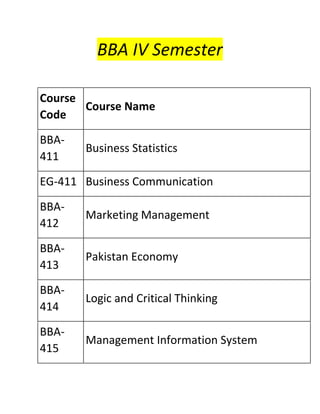
BBA IV Semester
Course
Code
Course Name
BBA-
411
Business Statistics
EG-411 Business Communication
BBA-
412
Marketing Management
BBA-
413
Pakistan Economy
BBA-
414
Logic and Critical Thinking
BBA-
415
Management Information System
shas
producti
on
Digitally signed by shas
production
DN: cn=shas production
gn=shas production
c=United States l=US
Reason: I am the author
of this document
Location:
Date: 2015-07-31
13:14+05:00
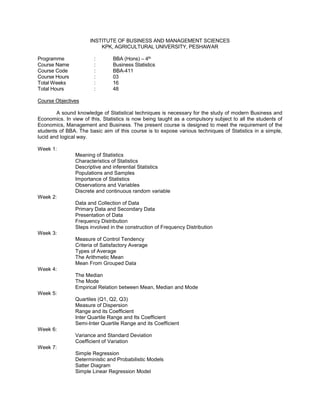
INSTITUTE OF BUSINESS AND MANAGEMENT SCIENCES
KPK, AGRICULTURAL UNIVERSITY, PESHAWAR
Programme : BBA (Hons) – 4th
Course Name : Business Statistics
Course Code : BBA-411
Course Hours : 03
Total Weeks : 16
Total Hours : 48
Course Objectives
A sound knowledge of Statistical techniques is necessary for the study of modern Business and
Economics. In view of this, Statistics is now being taught as a compulsory subject to all the students of
Economics, Management and Business. The present course is designed to meet the requirement of the
students of BBA. The basic aim of this course is to expose various techniques of Statistics in a simple,
lucid and logical way.
Week 1:
Meaning of Statistics
Characteristics of Statistics
Descriptive and inferential Statistics
Populations and Samples
Importance of Statistics
Observations and Variables
Discrete and continuous random variable
Week 2:
Data and Collection of Data
Primary Data and Secondary Data
Presentation of Data
Frequency Distribution
Steps involved in the construction of Frequency Distribution
Week 3:
Measure of Control Tendency
Criteria of Satisfactory Average
Types of Average
The Arithmetic Mean
Mean From Grouped Data
Week 4:
The Median
The Mode
Empirical Relation between Mean, Median and Mode
Week 5:
Quartiles (Q1, Q2, Q3)
Measure of Dispersion
Range and its Coefficient
Inter Quartile Range and Its Coefficient
Semi-Inter Quartile Range and its Coefficient
Week 6:
Variance and Standard Deviation
Coefficient of Variation
Week 7:
Simple Regression
Deterministic and Probabilistic Models
Satter Diagram
Simple Linear Regression Model
Week 8:
Least Square Regression live
Standard Deviation of Regression OR Standard error of estimate
Week 9:
Index Numbers
Introduction
Simple and Composite Index Numbers
Problems involved in the Construction of Index Numbers
Week 10:
Main Steps in the Construction of Index Number whole sale Price
Fixed Base Method and Chan Base Method
Week 11:
Advantages and Disadvantages of Chain Base Method Unweighted Index Numbers
Simple Aggregative Index
Week 12:
Simple Average of Relatives
Weighted Index Number
Weighted Aggregative Price Index Numbers
Week 13:
Laspeyre’s Price Index
Fisher’s Ideal Index
Week 14:
Probability
Introduction
Sets
Venn diagram
Week 15:
Operation in Sets
Random Experiments, Sample Space, Event
Mutually exclusive and Not-Mutually exclusive events
Formal Definition of Probability Simple Probability
Counting Sample Points,
Week 16:
Definition of probability
Addition Law of Probability for Mutually Exclusive and not mutually exclusive Events
Conditional Probability
Recommended Books:
1. Introduction to Statistical Theory, Part 1, by Prof. Sher Muhammad Chaudry.
2. Basic Statistics for Business and Economics by EARLK. BOWN AND MARTIN STARR
3. Introduction to Business Statistics 2004 Edition, Shamim Khan, Research and Development
Center Peshawar
INSTITUTE OF BUSINESS & MANAGEMENT SCIENCES
KPK AGRICULTURAL UNIVERSITY PESHAWAR
Programme : BBA (Hons) – 4th
Course Name : Business Communication
Course Code : EG-411
Course Hours : 03
Total Weeks : 16
Total Hours : 48
Course Objectives
This course seeks to develop Communication Skills of the students who are preparing for a
business or management position. The course will help the students to develop their ability to write
effectively, speak persuasively, and listen purposively.
Week 1
Business Messages
Components of Business Message
Composing of Business Message
Revising of Business Message
Week-2
Planning for Business Message
Five Planning Steps for Business Message
Basic Information and Strategies
Practice and Exercise
Week-3
Good-News Message
Organizational Planning
Favourable Reply
Neutral Message
Week-4
Bad-News Message
Organizational Planning
Negative Reply
Week-5
Unfavourable or Unsolicited Message
Types and farms of unfavourable message
Persuasive Written Messages
Organization of Persuasive Message
Week-6
Proposal and Technology
Purpose of Proposal
Kinds of Proposal
Week-7
Proposal
Parts of Proposal
Short Proposal
Sections of Short Proposal
Week-8
Long Proposal
Prefatory Sections of Long Proposal
Supplemental Sections of Long Proposal
Presentation of Long Proposal
Week-9
Writing and Appearance
Arranging Material and Structure of Proposal
Practice and Exercise
Week-10
Oral Communication
Strategies for Improving Oral Communication
Reducing Stage Fright
Practice and Exercise
Week-11
Oral Presentation
Oral Speeches
Principles and Strategies
Practice and Exercise
Week-12
Inter-personal Communication
Dyadic Communication
Telephoning Communication
Dictating and Practicing
Week-13
Business Meeting
Purpose of Business Meeting
Leadership and Responsibilities
Participating and Responsibilities in Meetings
Week-14
Job Application
Self-Assessment
Market Assessment
Practice and Exercise
Week-15
Preparation for successful job Application
Preparation for successful job Interview
Successful follow-up Message after Interview
Job Offer Negotiation
Week-16
Revision and Preparation for Exam
Recommended Books:
1. Effective Business Communication. Herta Murphy
2. English for Modern Business Ketteley and Thompson.
INSTITUTE OF BUSINESS AND MANAGEMENT SCIENCES
KPK, AGRICULTURAL UNIVERSITY, PESHAWAR
Programme : BBA (Hons) – 4th
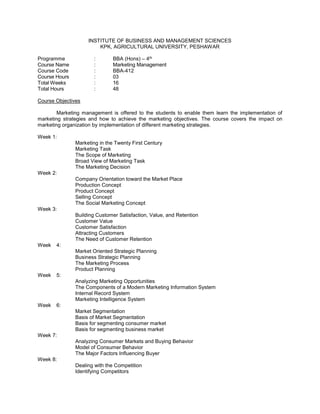
Course Name : Marketing Management
Course Code : BBA-412
Course Hours : 03
Total Weeks : 16
Total Hours : 48
Course Objectives
Marketing management is offered to the students to enable them learn the implementation of
marketing strategies and how to achieve the marketing objectives. The course covers the impact on
marketing organization by implementation of different marketing strategies.
Week 1:
Marketing in the Twenty First Century
Marketing Task
The Scope of Marketing
Broad View of Marketing Task
The Marketing Decision
Week 2:
Company Orientation toward the Market Place
Production Concept
Product Concept
Selling Concept
The Social Marketing Concept
Week 3:
Building Customer Satisfaction, Value, and Retention
Customer Value
Customer Satisfaction
Attracting Customers
The Need of Customer Retention
Week 4:
Market Oriented Strategic Planning
Business Strategic Planning
The Marketing Process
Product Planning
Week 5:
Analyzing Marketing Opportunities
The Components of a Modern Marketing Information System
Internal Record System
Marketing Intelligence System
Week 6:
Market Segmentation
Basis of Market Segmentation
Basis for segmenting consumer market
Basis for segmenting business market
Week 7:
Analyzing Consumer Markets and Buying Behavior
Model of Consumer Behavior
The Major Factors Influencing Buyer
Week 8:
Dealing with the Competition
Identifying Competitors
Analyzing Competitors
Week 9:
Positioning the Market Offering Through the Product Line Cycle
Developing and Communicating a Positioning Strategy
Product Life-Cycle Marketing Strategies
Week 10:
Developing New Product
Challenges in New Product Development
Managing the Development Process
Week 11:
Product Line Decision
Packing and Labeling
Week 12:
Designing Pricing Strategies and Programs
Setting the Price
Week 13:
Managing Marketing Channels
Work Preformed by Marketing Channels
Channel Design Decision
Week 14:
Managing Retiling, Wholesaling, and Market Logistics
Retailing, types of Retailers and Trends in Retailing
Wholesaling, Marketing Decisions
Market Logistics Objectives and Decisions
Week 15:
Deciding on Media and Measuring Effectiveness
Deciding on reach, frequency and impact
Choosing among major media types
Selecting specific vehicle
Deciding on media trimming
Deciding on geographic allocation
Evaluating advertising effectiveness
Week 16:
Presentations
Group Discussion
Review of Course
Recommended Books
1. MARKETING MANAGEMENT --- David W. Cravens Gerald E. Hills Robert
W. woodruff, (Latest Edition) Irwin.
2. MARKETING --- Eric N. Berkowitz Roger, A. Kerin Steven, W. Hartley.
(Latest Edition) Irwin.
3. MARKETING MANAGEMENT --- Phillip Kotlar. (Latest Edition) Prentice Hall.
INSTITUTE OF BUSINESS AND MANAGEMENT SCIENCES
KPK AGRICULTURAL UNIVERSITY PESHAWAR
Programme : BBA(Hons)- 4th
Course Name : Pakistan Economy
Course Code : BBA-413
Credit Hours : 03
Total Weeks : 16
Total Hours : 48
Course Objectives
Pakistan Economy is an important course designed for the students of Business Administration.
The core objective of the course is to multiply the knowledge and understanding of the students about the
economy and economic conditions of Pakistan in order to enable them to extend their contribution to the
economic wellbeing of Pakistan and serve the society in a best possible manner.
Week 1: Economy of Pakistan
Main Features of Pakistan Economy
Reforms of Recent and Past
Strength and Weakness of Pakistan Economy
Conclusion
Week 2: Population
Human Resource
Qualitative Aspect & Qualitative Aspect
Cause of Population Explosion
Population Growth & Economics Development
Different Approaches to take the population problem.
Rational Reduction of Birth Rate
Human Development
Week 3: Health
Over View
Health System & their Problems
Major Diseases & their treatments
Indigenous & Homoeopathic System in Medicine (Short - Summery)
Conclusion
Week 4: Education
Introduction
Role of education in Economics Development
Structure of Education in Pak
Lover all Development since Independence
Conclusion
Week 5: Mineral Resources
Definition
Mineral Deposits
Natural Gas, Oil, Coal, Chlorite, Barite, Gypsum, Limestone, Rock salt silica sand, Soap
Stones, Magnetite
Week 6:
Power Resources
Definition
Role of Power Resources
Power Resources
Thermal Electricity Resources
Oil, Natural Gas
Hydel Power Resource
Nuclear Power
Non Conventional Source of Energy
Biogas Projects, Solar Energy Projects
Wind Energy Project
Week 7:
Monetary Policy
State Bank of Pakistan
Function of State Bank of Pakistan
Monetary Policy (Definition)
Tools of Monetary Policy
Quantitative Tools
Qualitative Tools
Week 8: Fiscal Policy
Definition of Fiscal Policy
Objectives
Tools of Fiscal Policy
Direct and Indirect Taxation
Govt. Expedition
Main Types of Tax
Income TAX, Corporate Tax, Sales Tax,
Excise Duty, Custom Duty, State Duty
Govt, Expenditure
Current Expenditure
Developmental Expenditure
Week 9: Inflation
Definition
Type of Inflation
Demands Pull Inflation
Cost Push Inflation
Causes of Inflation
Effects of Inflations on different Classes
Control of Inflation
Monetary Measures
Fiscal Measures
Direct Measures
Week 10: Agriculture Sector
Role of Agri-Sector in the Economics Development of a Country
Problems of Agricultural Sector and their Solutions
Agriculture Finance (Rural Credit)
Need for Agri-Credit
Types of Agricultural Credit
Week 11: Industrial Section
Role of Industrializations in the Economics Development of the Country
Causes of Industrial Backwardness in Pak
Principal Industries of Pakistan
Week 12: Foreign Trade
Contribution of Foreign Trade to Economic Development
Balance of Trade (Definition)
BOP of Pakistan
Factors Contributing towards adverse BOP
Measures for Corrections
Week 13: Transport & Communication
Role of Transport & Communication
Economic Benefits
Political Benefits
Forms of Transport (Brief History and Statistics),
Railway, Roads, Air Transport & Water Transport
Communication system in Pakistan
Information Technology
Pakistan Telecommunication Authority
Broad Casting
Pakistan Television Corporation
Postal Services
Week 14:
National Income of Pakistan
Definition of NI
Different Concept GNP, GDP, NNP, NI at factor Cost, PI & PI
Definition of Per Capita Income
Causes of low per Capita Income in Pakistan
How to increase NI & Per Capita Income in Pakistan
Week 15: Planning & Development
Definition of Eco-Planning
Need of Planning in Pakistan
Types of Eco Planning
Factors inhibiting effective Planning in Pakistan
Week 16:
Review of the course
Presentation & Viva
Assignment
Recommended Books
1. “ECONOMICS OF PAKISTAN”, M. Saeed Nasir, Latest Edition
2. “ECONOMY OF PAKISTAN”, Dr. Khawaja Amjad Saeed, Latest Edition.
3. “FUNDAMENTAL OF ECONOMICS” Habibuallh Vaseer
INSTITUTE OF BUSINESS AND MANAGEMENT SCIENCES
KPK, AGRICULTURAL UNIVERSITY, PESHAWAR
Programme : BBA (Hons)-4th
Course Name : Logic and Critical Thinking
Course Code : BBA-414
Credit Hours : 03
Total Week : 16
Total Hours : 48
Course Objectives
The objective of this course is to sharpen the intellect of the students, develop their reasoning
ability, strengthen their understanding, and promote clear thinking.
Week 1:
Definition of Logic
Logic as Study of Thought
Logic in terms of Art and Sciences
Week 2:
Premises and Conclusions
Basic terms
The order of Premises and Conclusion
Conclusion Indicators and Premises Indicators
Argument in Context
Week 3:
Diagram for single Arguments
Agreements and Disagreements of Attitudes
Week 4:
The Language
Three Basic Functions of Language
Discourse Serving Multiple Functions
The Forms of Discourse
Week 5:
Emotive words and the Logic of Emotions
Emotively Neutral Language
Week 6:
Truth and Validly–Test Construction (Standardization and Generalization)
Problem Solving
Creativity Thinking and Invention
Week 7:
Fallacies
Fallacy of Relevance
Fallacy of Ambiguity
Week 8:
Definition
Purpose of Definition
Types of Definition
Week 9:
Proposition
Kinds of Proposition
Categorical Proposition
Quality, Quantity and Distribution
Week 10:
The Traditional Square of Opposition
Contradictories
Contraries
Sub Contraries
Sub alternation
The Sequence of Opposition
Existential import
Week 11:
Categorical Syllogisms
Standard form categorical Syllogisms
Major, Minor and Middle Terms
Mood
Figure
Venn diagram
Week 12:
Symbolic Logic
The value of Special Symbols
The Symbols for Conjunction, negation and Disjunction
Week 13:
Analogy
Arguments by Analogy
Appraising Analogical Arguments
Week 14:
Science and Hypothesis
The Value of Sciences
Problem and its solution (Deduction)
Week 15:
The Method of Deduction
The Formal Proof of Validity
The Rule of Replacement
Proof of Invalidity
Reliability and Reliability
Recommended Books
1. INTRODUCTION TO LOGIC , Irvin Copi, 3rd Edition,
INSTITUTE OF BUSINESS & MANAGEMENT SCIENCES
KPK AGRICULTURAL UNIVERSITY PESHAWAR
Programme : BBA (Hons) -4th
Course Code : Management Information System
Course Code : BBA-415
Course Hours : 03
Total Weeks : 16
Total Hours : 48
Course Objective
The field of business management and information technology is so volatile in nature that the
innovations of today are the obsoletes of tomorrow. The subject course themes are designed for the
students of MBA so that they could meet the challenges of the prevailing contemporary business market.
This course covers the broad spectrum of business, management and information systems. At the end of
the course, the students will be able to handle the problem related to Computer Based Information
System (CBIS).
Week 1:
Introduction
Management Information System and its Subsystems
Information Resource Management
Goals of Information System
Key ISSUES and Challenges in MIS
Week 2:
System and models
System concept
Components of IS
IS resources
Week 3:
Trends in IS
E-Business enterprise
Types of IS
Case Study
Week 4:
Models of Organizational System
General Model of Organization
Strategic Planning Model
Week 5:
Management & Decision Making I
Management
Contingency Approach
Roles of Manager, Planning and Control
Week 6:
Management & Decision Making II
Managerial Decision-Making
Characteristic of Effective Information
Types of Decisions, Decision Making Process
Evaluating Decision Making Process
Week 7:
Database Management
Database DBMS
Field, Record, Table
Primary key, Foreign key
Week 8:
Networking
Networks, Exchanging the Information,
Types of Network LAN, WAN,
Clients/Servers and Peer-to-Peer Networks
Networking Topologies
Protocols
Week 9:
Transaction Processing
Transaction Processing System
Transaction Processing Cycle
Transaction Processing Subsystems
Week 10:
Management Reporting System
Types of Reports, Structuring Reports
Role of MRS
Week 11:
Decision Support System (DSS) I
DSS, Goals and Applications
Components of DSS
DSS Development
Week 12:
Decision Support System (DSS) II
Group Decision Support System (GDSS)
Components, Configuration, Classification and Goals
Week 13:
Executive Information System (EIS)
Executive, Executives’ Role in Decision-Making
Executive Decision Making Environment
Week 14:
Knowledge Based Systems
Artificial Intelligence (AI), AI Applications
Need for Expert Systems (ES)
Components of ES, Developing ES
Week 15:
Office Information Systems (OIS)
Office and Office Systems
Types of Office Automation Systems
Week 16:
Revision and Viva Voce
Recommended Books
1. MANAGEMENT INFORMATION SYSTEM STRATEGY AND ACTION -- Thomas Case and
Charles Parker. 2nd Edition.
2. MANAGEMENT INORMATION SYSTEM – James A.O’ Brien 5th Edition.
3. MANAGEMENT INFORMATION SYSTEMS --- T.Lucey. 7th Edition.

BBA 4th semester

  • 1.
    BBA 4th SEMESTER COURSECONTENTS 2015 BY: - SHAS PRODUCTION SYED HARIS SHAS PRODUCTION | Agriculture University Peshawar
  • 2.
    BBA IV Semester Course Code CourseName BBA- 411 Business Statistics EG-411 Business Communication BBA- 412 Marketing Management BBA- 413 Pakistan Economy BBA- 414 Logic and Critical Thinking BBA- 415 Management Information System
  • 3.
    shas producti on Digitally signed byshas production DN: cn=shas production gn=shas production c=United States l=US Reason: I am the author of this document Location: Date: 2015-07-31 13:14+05:00
  • 4.
    INSTITUTE OF BUSINESSAND MANAGEMENT SCIENCES KPK, AGRICULTURAL UNIVERSITY, PESHAWAR Programme : BBA (Hons) – 4th Course Name : Business Statistics Course Code : BBA-411 Course Hours : 03 Total Weeks : 16 Total Hours : 48 Course Objectives A sound knowledge of Statistical techniques is necessary for the study of modern Business and Economics. In view of this, Statistics is now being taught as a compulsory subject to all the students of Economics, Management and Business. The present course is designed to meet the requirement of the students of BBA. The basic aim of this course is to expose various techniques of Statistics in a simple, lucid and logical way. Week 1: Meaning of Statistics Characteristics of Statistics Descriptive and inferential Statistics Populations and Samples Importance of Statistics Observations and Variables Discrete and continuous random variable Week 2: Data and Collection of Data Primary Data and Secondary Data Presentation of Data Frequency Distribution Steps involved in the construction of Frequency Distribution Week 3: Measure of Control Tendency Criteria of Satisfactory Average Types of Average The Arithmetic Mean Mean From Grouped Data Week 4: The Median The Mode Empirical Relation between Mean, Median and Mode Week 5: Quartiles (Q1, Q2, Q3) Measure of Dispersion Range and its Coefficient Inter Quartile Range and Its Coefficient Semi-Inter Quartile Range and its Coefficient Week 6: Variance and Standard Deviation Coefficient of Variation Week 7: Simple Regression Deterministic and Probabilistic Models Satter Diagram Simple Linear Regression Model
  • 5.
    Week 8: Least SquareRegression live Standard Deviation of Regression OR Standard error of estimate Week 9: Index Numbers Introduction Simple and Composite Index Numbers Problems involved in the Construction of Index Numbers Week 10: Main Steps in the Construction of Index Number whole sale Price Fixed Base Method and Chan Base Method Week 11: Advantages and Disadvantages of Chain Base Method Unweighted Index Numbers Simple Aggregative Index Week 12: Simple Average of Relatives Weighted Index Number Weighted Aggregative Price Index Numbers Week 13: Laspeyre’s Price Index Fisher’s Ideal Index Week 14: Probability Introduction Sets Venn diagram Week 15: Operation in Sets Random Experiments, Sample Space, Event Mutually exclusive and Not-Mutually exclusive events Formal Definition of Probability Simple Probability Counting Sample Points, Week 16: Definition of probability Addition Law of Probability for Mutually Exclusive and not mutually exclusive Events Conditional Probability Recommended Books: 1. Introduction to Statistical Theory, Part 1, by Prof. Sher Muhammad Chaudry. 2. Basic Statistics for Business and Economics by EARLK. BOWN AND MARTIN STARR 3. Introduction to Business Statistics 2004 Edition, Shamim Khan, Research and Development Center Peshawar
  • 6.
    INSTITUTE OF BUSINESS& MANAGEMENT SCIENCES KPK AGRICULTURAL UNIVERSITY PESHAWAR Programme : BBA (Hons) – 4th Course Name : Business Communication Course Code : EG-411 Course Hours : 03 Total Weeks : 16 Total Hours : 48 Course Objectives This course seeks to develop Communication Skills of the students who are preparing for a business or management position. The course will help the students to develop their ability to write effectively, speak persuasively, and listen purposively. Week 1 Business Messages Components of Business Message Composing of Business Message Revising of Business Message Week-2 Planning for Business Message Five Planning Steps for Business Message Basic Information and Strategies Practice and Exercise Week-3 Good-News Message Organizational Planning Favourable Reply Neutral Message Week-4 Bad-News Message Organizational Planning Negative Reply Week-5 Unfavourable or Unsolicited Message Types and farms of unfavourable message Persuasive Written Messages Organization of Persuasive Message Week-6 Proposal and Technology Purpose of Proposal Kinds of Proposal Week-7 Proposal Parts of Proposal Short Proposal Sections of Short Proposal Week-8 Long Proposal Prefatory Sections of Long Proposal Supplemental Sections of Long Proposal Presentation of Long Proposal
  • 7.
    Week-9 Writing and Appearance ArrangingMaterial and Structure of Proposal Practice and Exercise Week-10 Oral Communication Strategies for Improving Oral Communication Reducing Stage Fright Practice and Exercise Week-11 Oral Presentation Oral Speeches Principles and Strategies Practice and Exercise Week-12 Inter-personal Communication Dyadic Communication Telephoning Communication Dictating and Practicing Week-13 Business Meeting Purpose of Business Meeting Leadership and Responsibilities Participating and Responsibilities in Meetings Week-14 Job Application Self-Assessment Market Assessment Practice and Exercise Week-15 Preparation for successful job Application Preparation for successful job Interview Successful follow-up Message after Interview Job Offer Negotiation Week-16 Revision and Preparation for Exam Recommended Books: 1. Effective Business Communication. Herta Murphy 2. English for Modern Business Ketteley and Thompson.
  • 8.
    INSTITUTE OF BUSINESSAND MANAGEMENT SCIENCES KPK, AGRICULTURAL UNIVERSITY, PESHAWAR Programme : BBA (Hons) – 4th Course Name : Marketing Management Course Code : BBA-412 Course Hours : 03 Total Weeks : 16 Total Hours : 48 Course Objectives Marketing management is offered to the students to enable them learn the implementation of marketing strategies and how to achieve the marketing objectives. The course covers the impact on marketing organization by implementation of different marketing strategies. Week 1: Marketing in the Twenty First Century Marketing Task The Scope of Marketing Broad View of Marketing Task The Marketing Decision Week 2: Company Orientation toward the Market Place Production Concept Product Concept Selling Concept The Social Marketing Concept Week 3: Building Customer Satisfaction, Value, and Retention Customer Value Customer Satisfaction Attracting Customers The Need of Customer Retention Week 4: Market Oriented Strategic Planning Business Strategic Planning The Marketing Process Product Planning Week 5: Analyzing Marketing Opportunities The Components of a Modern Marketing Information System Internal Record System Marketing Intelligence System Week 6: Market Segmentation Basis of Market Segmentation Basis for segmenting consumer market Basis for segmenting business market Week 7: Analyzing Consumer Markets and Buying Behavior Model of Consumer Behavior The Major Factors Influencing Buyer Week 8: Dealing with the Competition Identifying Competitors
  • 9.
    Analyzing Competitors Week 9: Positioningthe Market Offering Through the Product Line Cycle Developing and Communicating a Positioning Strategy Product Life-Cycle Marketing Strategies Week 10: Developing New Product Challenges in New Product Development Managing the Development Process Managing the Development Process Week 11: Product Line Decision Packing and Labeling Week 12: Designing Pricing Strategies and Programs Setting the Price Week 13: Managing Marketing Channels Work Preformed by Marketing Channels Channel Design Decision Week 14: Managing Retiling, Wholesaling, and Market Logistics Retailing, types of Retailers and Trends in Retailing Wholesaling, Marketing Decisions Market Logistics Objectives and Decisions Week 15: Deciding on Media and Measuring Effectiveness Deciding on reach, frequency and impact Choosing among major media types Selecting specific vehicle Deciding on media trimming Deciding on geographic allocation Evaluating advertising effectiveness Week 16: Presentations Group Discussion Review of Course Recommended Books 1. MARKETING MANAGEMENT --- David W. Cravens Gerald E. Hills Robert W. woodruff, (Latest Edition) Irwin. 2. MARKETING --- Eric N. Berkowitz Roger, A. Kerin Steven, W. Hartley. (Latest Edition) Irwin. 3. MARKETING MANAGEMENT --- Phillip Kotlar. (Latest Edition) Prentice Hall.
  • 10.
    INSTITUTE OF BUSINESSAND MANAGEMENT SCIENCES KPK AGRICULTURAL UNIVERSITY PESHAWAR Programme : BBA(Hons)- 4th Course Name : Pakistan Economy Course Code : BBA-413 Credit Hours : 03 Total Weeks : 16 Total Hours : 48 Course Objectives Pakistan Economy is an important course designed for the students of Business Administration. The core objective of the course is to multiply the knowledge and understanding of the students about the economy and economic conditions of Pakistan in order to enable them to extend their contribution to the economic wellbeing of Pakistan and serve the society in a best possible manner. Week 1: Economy of Pakistan Main Features of Pakistan Economy Reforms of Recent and Past Strength and Weakness of Pakistan Economy Conclusion Week 2: Population Human Resource Qualitative Aspect & Qualitative Aspect Cause of Population Explosion Cause of Population Explosion Population Growth & Economics Development Different Approaches to take the population problem. Rational Reduction of Birth Rate Human Development Week 3: Health Over View Health System & their Problems Major Diseases & their treatments Indigenous & Homoeopathic System in Medicine (Short - Summery) Conclusion Week 4: Education Introduction Role of education in Economics Development Structure of Education in Pak Lover all Development since Independence Conclusion Week 5: Mineral Resources Definition Mineral Deposits Natural Gas, Oil, Coal, Chlorite, Barite, Gypsum, Limestone, Rock salt silica sand, Soap Stones, Magnetite Week 6: Power Resources Definition Role of Power Resources
  • 11.
    Power Resources Thermal ElectricityResources Oil, Natural Gas Hydel Power Resource Nuclear Power Non Conventional Source of Energy Biogas Projects, Solar Energy Projects Wind Energy Project Week 7: Monetary Policy State Bank of Pakistan Function of State Bank of Pakistan Monetary Policy (Definition) Tools of Monetary Policy Quantitative Tools Qualitative Tools Week 8: Fiscal Policy Definition of Fiscal Policy Objectives Tools of Fiscal Policy Direct and Indirect Taxation Govt. Expedition Main Types of Tax Income TAX, Corporate Tax, Sales Tax, Excise Duty, Custom Duty, State Duty Govt, Expenditure Current Expenditure Developmental Expenditure Week 9: Inflation Definition Type of Inflation Demands Pull Inflation Cost Push Inflation Causes of Inflation Effects of Inflations on different Classes Control of Inflation Monetary Measures Fiscal Measures Direct Measures Week 10: Agriculture Sector Role of Agri-Sector in the Economics Development of a Country Problems of Agricultural Sector and their Solutions Agriculture Finance (Rural Credit) Need for Agri-Credit Types of Agricultural Credit Week 11: Industrial Section Role of Industrializations in the Economics Development of the Country Causes of Industrial Backwardness in Pak Principal Industries of Pakistan Week 12: Foreign Trade Contribution of Foreign Trade to Economic Development
  • 12.
    Balance of Trade(Definition) BOP of Pakistan Factors Contributing towards adverse BOP Measures for Corrections Week 13: Transport & Communication Role of Transport & Communication Economic Benefits Political Benefits Forms of Transport (Brief History and Statistics), Railway, Roads, Air Transport & Water Transport Communication system in Pakistan Information Technology Pakistan Telecommunication Authority Broad Casting Pakistan Television Corporation Postal Services Week 14: National Income of Pakistan Definition of NI Different Concept GNP, GDP, NNP, NI at factor Cost, PI & PI Definition of Per Capita Income Causes of low per Capita Income in Pakistan How to increase NI & Per Capita Income in Pakistan Week 15: Planning & Development Definition of Eco-Planning Need of Planning in Pakistan Types of Eco Planning Factors inhibiting effective Planning in Pakistan Week 16: Review of the course Presentation & Viva Assignment Recommended Books 1. “ECONOMICS OF PAKISTAN”, M. Saeed Nasir, Latest Edition 2. “ECONOMY OF PAKISTAN”, Dr. Khawaja Amjad Saeed, Latest Edition. 3. “FUNDAMENTAL OF ECONOMICS” Habibuallh Vaseer
  • 13.
    INSTITUTE OF BUSINESSAND MANAGEMENT SCIENCES KPK, AGRICULTURAL UNIVERSITY, PESHAWAR Programme : BBA (Hons)-4th Course Name : Logic and Critical Thinking Course Code : BBA-414 Credit Hours : 03 Total Week : 16 Total Hours : 48 Course Objectives The objective of this course is to sharpen the intellect of the students, develop their reasoning ability, strengthen their understanding, and promote clear thinking. Week 1: Definition of Logic Logic as Study of Thought Logic in terms of Art and Sciences Week 2: Premises and Conclusions Basic terms The order of Premises and Conclusion Conclusion Indicators and Premises Indicators Argument in Context Week 3: Diagram for single Arguments Agreements and Disagreements of Attitudes Week 4: The Language Three Basic Functions of Language Discourse Serving Multiple Functions The Forms of Discourse Week 5: Emotive words and the Logic of Emotions Emotively Neutral Language Week 6: Truth and Validly–Test Construction (Standardization and Generalization) Problem Solving Creativity Thinking and Invention Week 7: Fallacies Fallacy of Relevance Fallacy of Ambiguity Week 8: Definition Purpose of Definition Purpose of Definition Types of Definition Week 9: Proposition Kinds of Proposition Categorical Proposition Quality, Quantity and Distribution Week 10: The Traditional Square of Opposition
  • 14.
    Contradictories Contraries Sub Contraries Sub alternation TheSequence of Opposition Existential import Week 11: Categorical Syllogisms Standard form categorical Syllogisms Major, Minor and Middle Terms Mood Figure Venn diagram Week 12: Symbolic Logic The value of Special Symbols The Symbols for Conjunction, negation and Disjunction Week 13: Analogy Arguments by Analogy Appraising Analogical Arguments Week 14: Science and Hypothesis The Value of Sciences Problem and its solution (Deduction) Week 15: The Method of Deduction The Formal Proof of Validity The Rule of Replacement Proof of Invalidity Reliability and Reliability Recommended Books 1. INTRODUCTION TO LOGIC , Irvin Copi, 3rd Edition,
  • 15.
    INSTITUTE OF BUSINESS& MANAGEMENT SCIENCES KPK AGRICULTURAL UNIVERSITY PESHAWAR Programme : BBA (Hons) -4th Course Code : Management Information System Course Code : BBA-415 Course Hours : 03 Total Weeks : 16 Total Hours : 48 Course Objective The field of business management and information technology is so volatile in nature that the innovations of today are the obsoletes of tomorrow. The subject course themes are designed for the students of MBA so that they could meet the challenges of the prevailing contemporary business market. This course covers the broad spectrum of business, management and information systems. At the end of the course, the students will be able to handle the problem related to Computer Based Information System (CBIS). Week 1: Introduction Management Information System and its Subsystems Information Resource Management Goals of Information System Key ISSUES and Challenges in MIS Week 2: System and models System concept Components of IS IS resources Week 3: Trends in IS E-Business enterprise Types of IS Case Study Week 4: Models of Organizational System General Model of Organization Strategic Planning Model Week 5: Management & Decision Making I Management Contingency Approach Roles of Manager, Planning and Control Week 6: Management & Decision Making II Managerial Decision-Making Characteristic of Effective Information Types of Decisions, Decision Making Process Evaluating Decision Making Process Week 7: Database Management Database DBMS Field, Record, Table
  • 16.
    Primary key, Foreignkey Week 8: Networking Networks, Exchanging the Information, Types of Network LAN, WAN, Clients/Servers and Peer-to-Peer Networks Networking Topologies Protocols Week 9: Transaction Processing Transaction Processing System Transaction Processing Cycle Transaction Processing Subsystems Week 10: Management Reporting System Types of Reports, Structuring Reports Role of MRS Week 11: Decision Support System (DSS) I DSS, Goals and Applications Components of DSS DSS Development Week 12: Decision Support System (DSS) II Group Decision Support System (GDSS) Components, Configuration, Classification and Goals Week 13: Executive Information System (EIS) Executive, Executives’ Role in Decision-Making Executive Decision Making Environment Week 14: Knowledge Based Systems Artificial Intelligence (AI), AI Applications Need for Expert Systems (ES) Components of ES, Developing ES Week 15: Office Information Systems (OIS) Office and Office Systems Types of Office Automation Systems Week 16: Revision and Viva Voce Recommended Books 1. MANAGEMENT INFORMATION SYSTEM STRATEGY AND ACTION -- Thomas Case and Charles Parker. 2nd Edition. 2. MANAGEMENT INORMATION SYSTEM – James A.O’ Brien 5th Edition. 3. MANAGEMENT INFORMATION SYSTEMS --- T.Lucey. 7th Edition.