Scaling & High Availability MySQL
learnings from the past decade+
Colin Charles, Chief Evangelist, Percona Inc.

colin.charles@percona.com / byte@bytebot.net

http://www.bytebot.net/blog/ | @bytebot on Twitter

OSDC.de, Berlin, Germany

12 June 2018
whoami
• Chief Evangelist, Percona Inc

• Focusing on the MySQL ecosystem (MySQL, Percona Server, MariaDB
Server), as well as the MongoDB ecosystem (Percona Server for
MongoDB) + 100% open source tools from Percona like Percona
Monitoring & Management, Percona xtrabackup, Percona Toolkit, etc.

• Founding team of MariaDB Server (2009-2016), previously at Monty
Program Ab, merged with SkySQL Ab, now MariaDB Corporation

• Formerly MySQL AB (exit: Sun Microsystems)

• Past lives include The Fedora Project (FESCO), OpenOffice.org

• MySQL Community Contributor of the Year Award winner 2014
License
• Creative Commons BY-NC-SA 4.0

• https://creativecommons.org/licenses/by-nc-sa/4.0/legalcode 

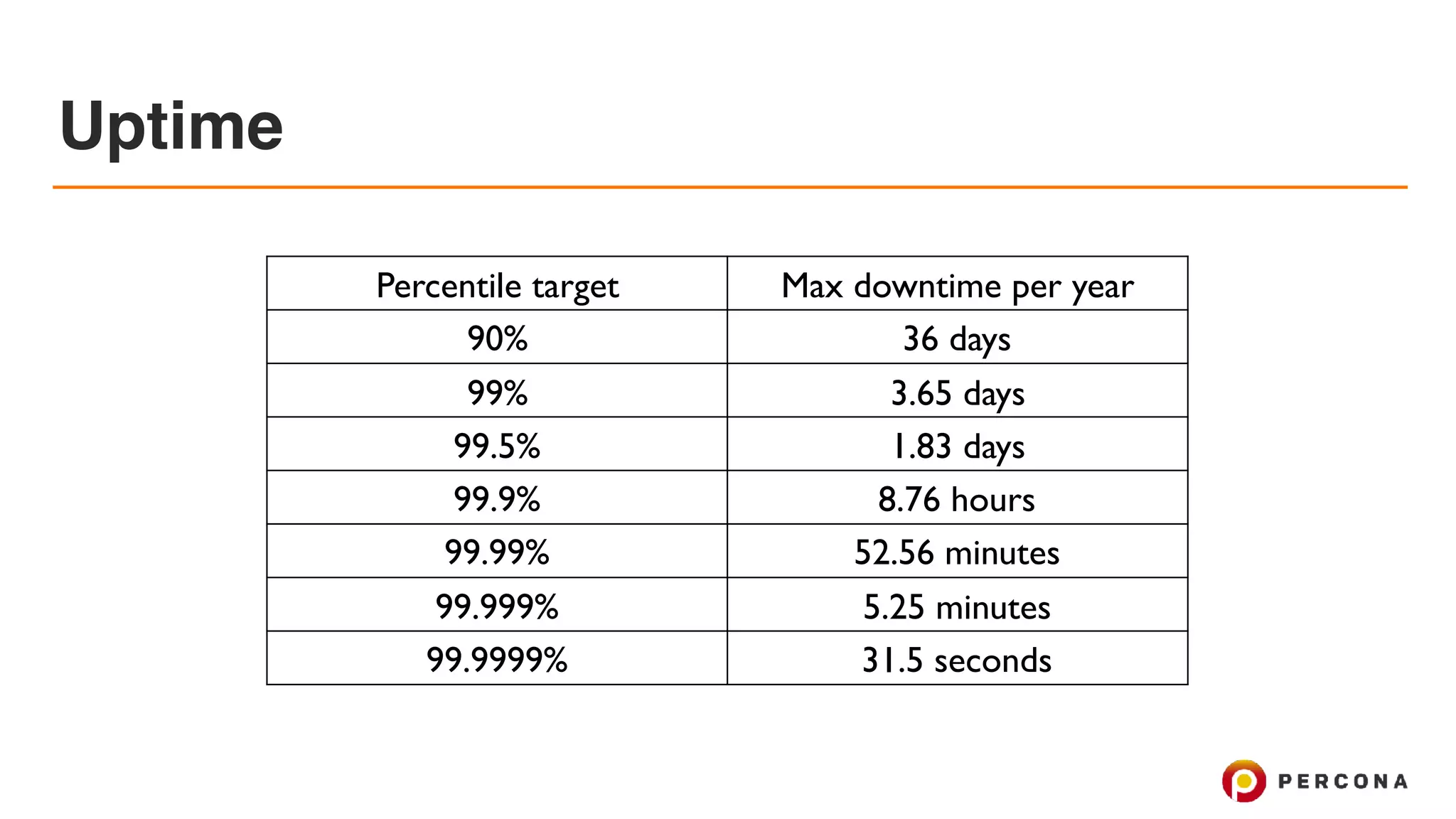
Uptime
Percentile target Max downtime per year
90% 36 days
99% 3.65 days
99.5% 1.83 days
99.9% 8.76 hours
99.99% 52.56 minutes
99.999% 5.25 minutes
99.9999% 31.5 seconds
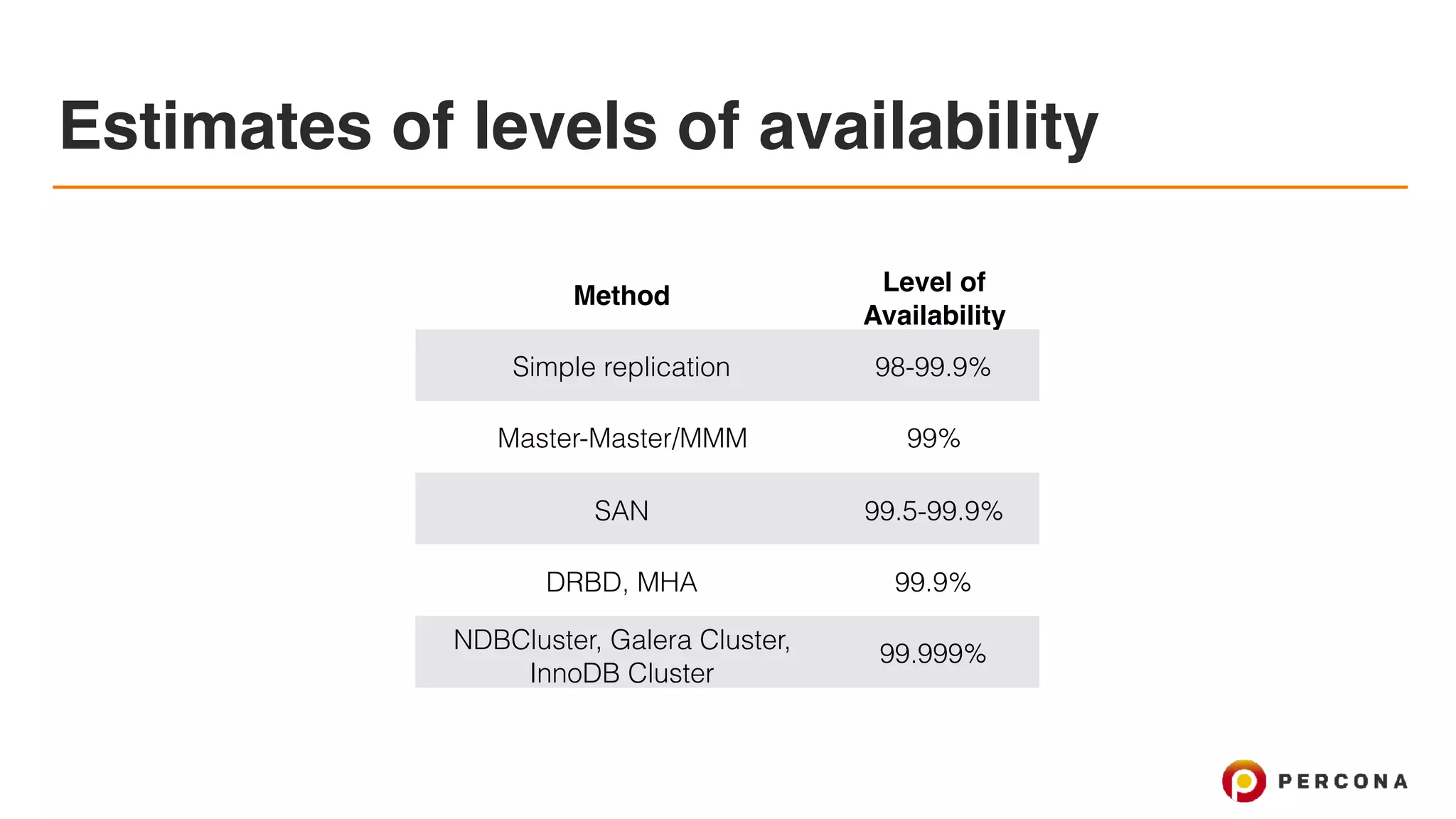
Estimates of levels of availability
Method
Level of
Availability
Simple replication 98-99.9%
Master-Master/MMM 99%
SAN 99.5-99.9%
DRBD, MHA 99.9%
NDBCluster, Galera Cluster,
InnoDB Cluster
99.999%
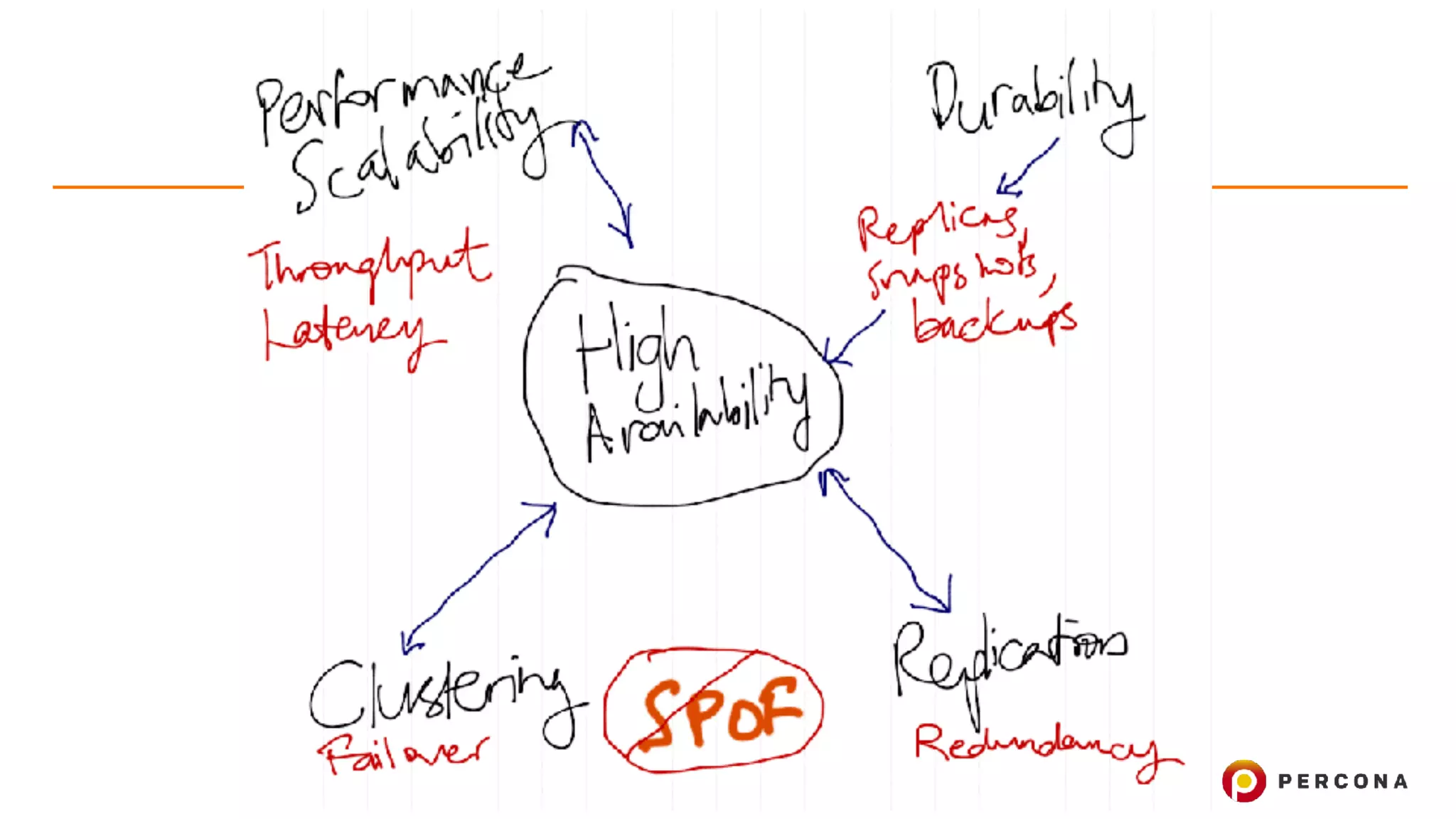
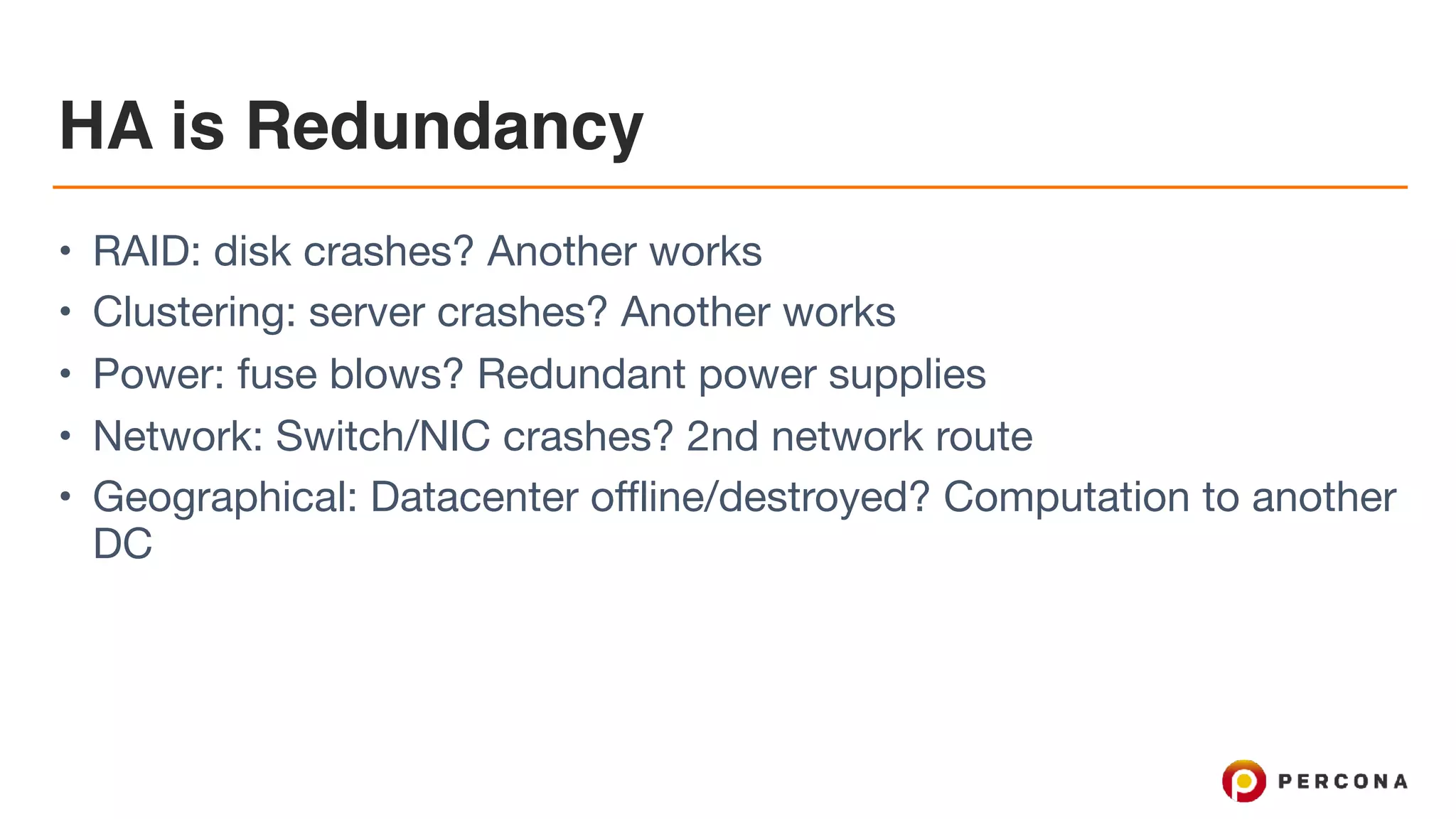
HA is Redundancy
• RAID: disk crashes? Another works

• Clustering: server crashes? Another works

• Power: fuse blows? Redundant power supplies

• Network: Switch/NIC crashes? 2nd network route

• Geographical: Datacenter offline/destroyed? Computation to another
DC
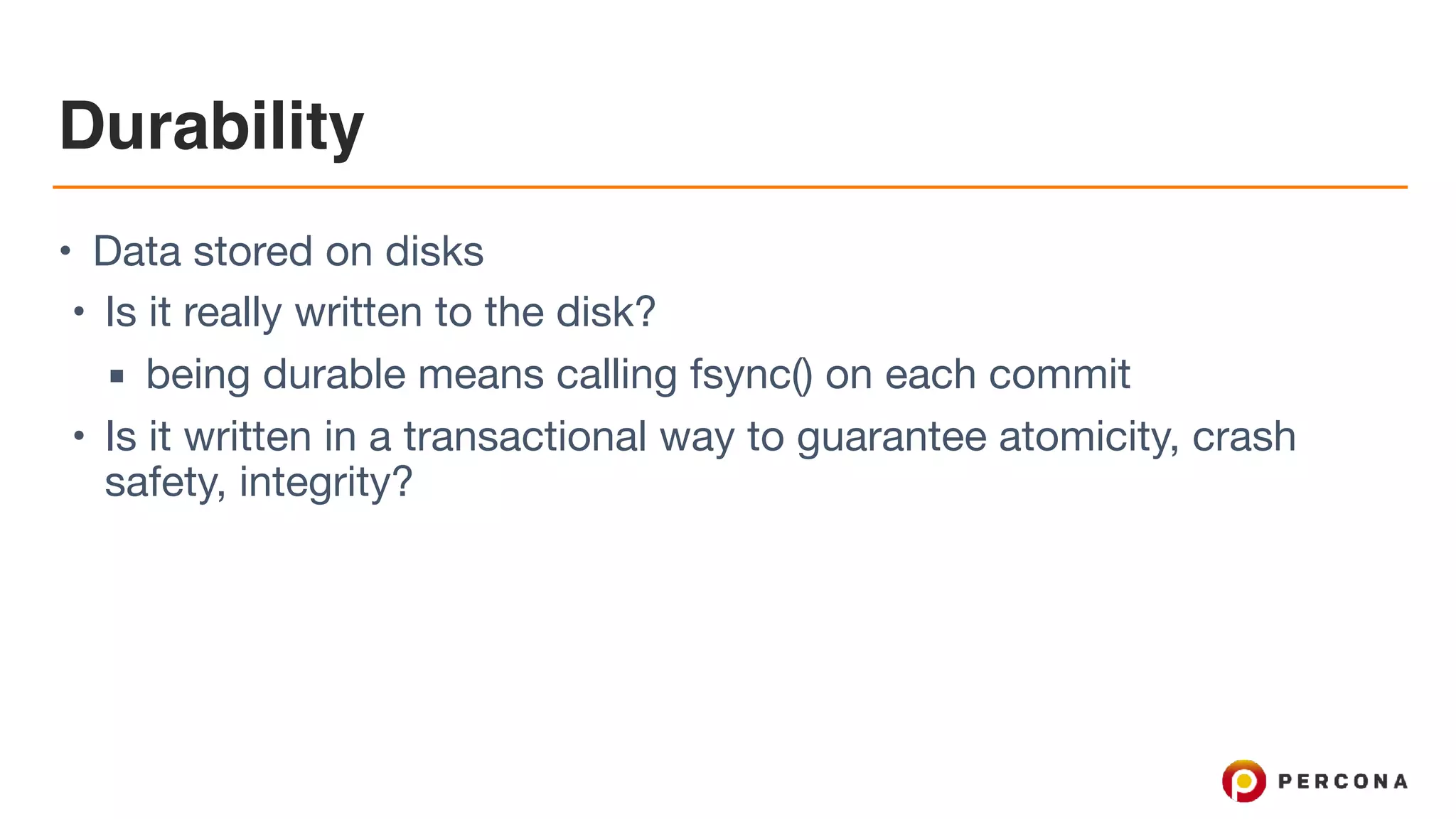
Durability
• Data stored on disks

• Is it really written to the disk?

▪ being durable means calling fsync() on each commit

• Is it written in a transactional way to guarantee atomicity, crash
safety, integrity?
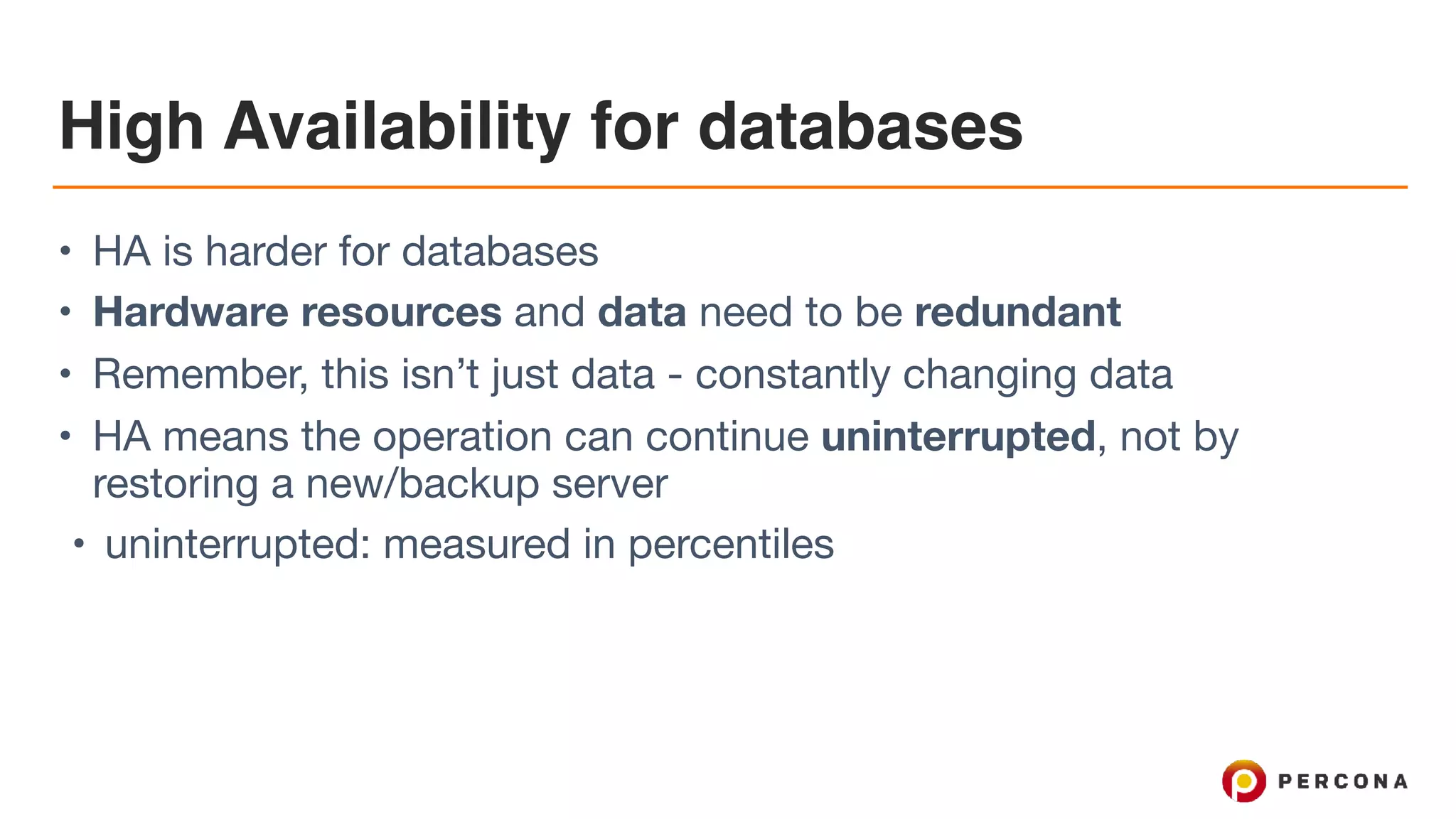
High Availability for databases
• HA is harder for databases

• Hardware resources and data need to be redundant

• Remember, this isn’t just data - constantly changing data

• HA means the operation can continue uninterrupted, not by
restoring a new/backup server

• uninterrupted: measured in percentiles
Redundancy through client-side XA
transactions
• Client writes to 2 independent but identical databases

• HA-JDBC (http://ha-jdbc.github.io/) 

• No replication anywhere
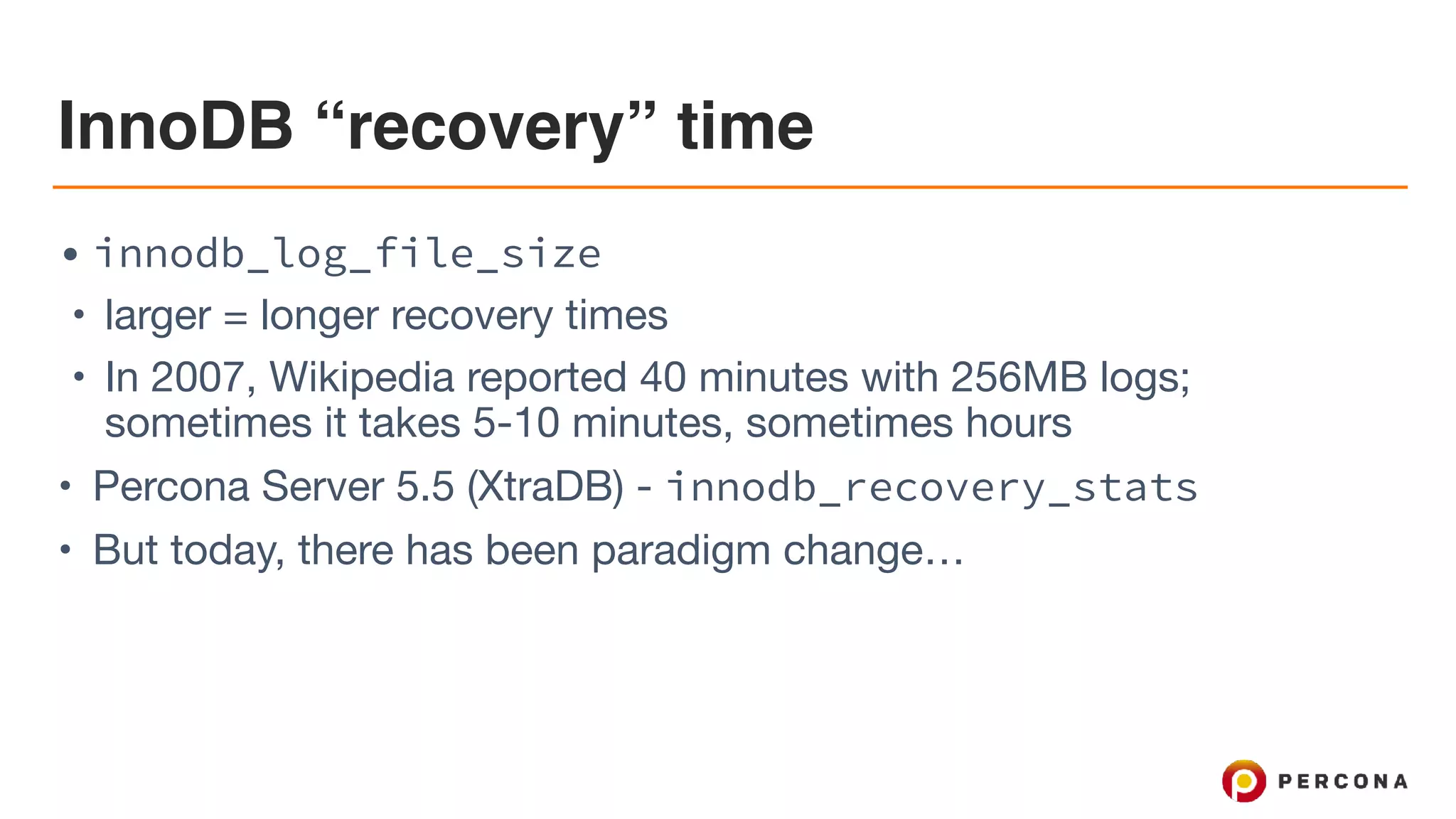
InnoDB “recovery” time
• innodb_log_file_size
• larger = longer recovery times

• In 2007, Wikipedia reported 40 minutes with 256MB logs;
sometimes it takes 5-10 minutes, sometimes hours

• Percona Server 5.5 (XtraDB) - innodb_recovery_stats
• But today, there has been paradigm change…
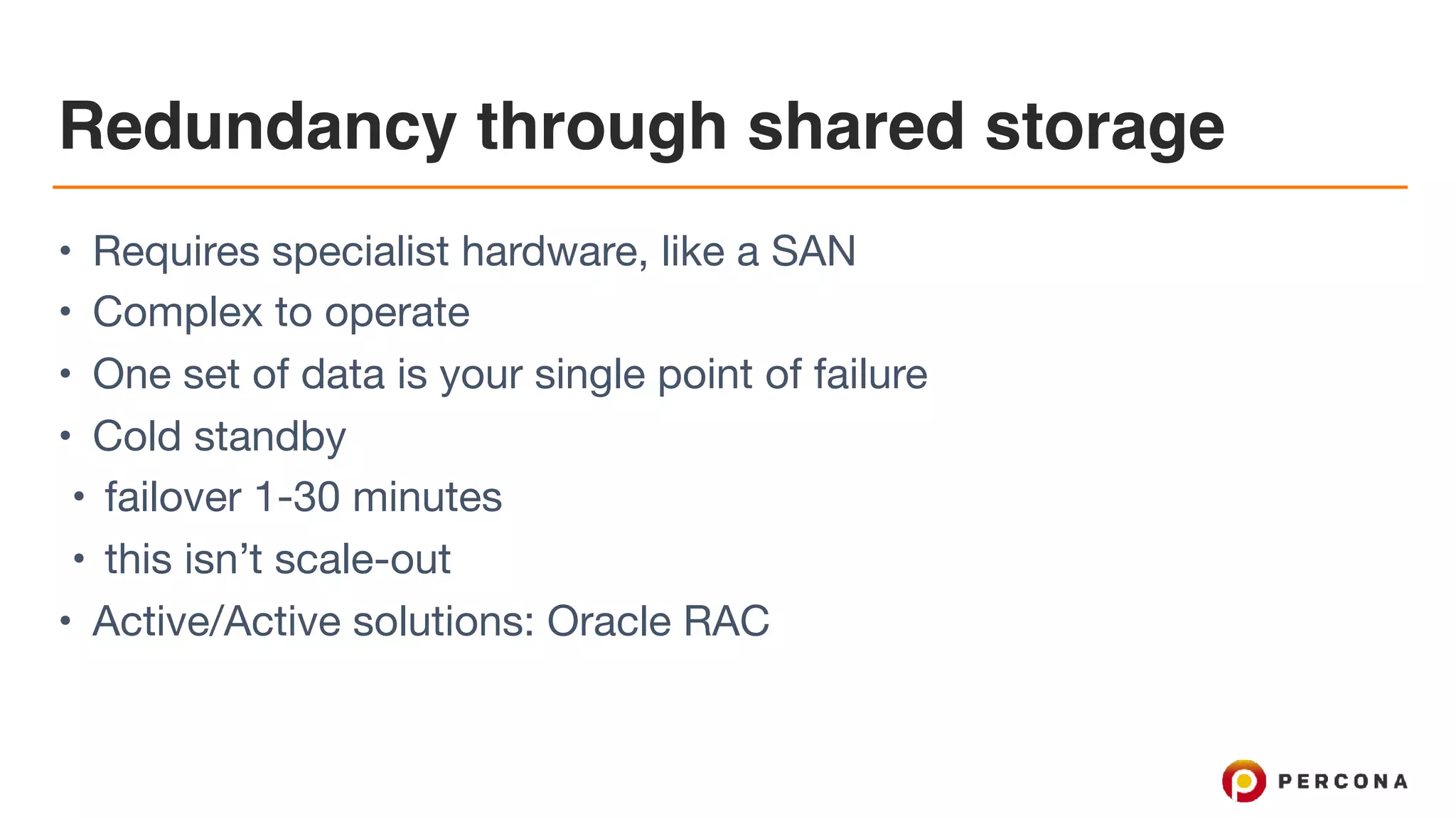
Redundancy through shared storage
• Requires specialist hardware, like a SAN

• Complex to operate

• One set of data is your single point of failure

• Cold standby

• failover 1-30 minutes

• this isn’t scale-out

• Active/Active solutions: Oracle RAC
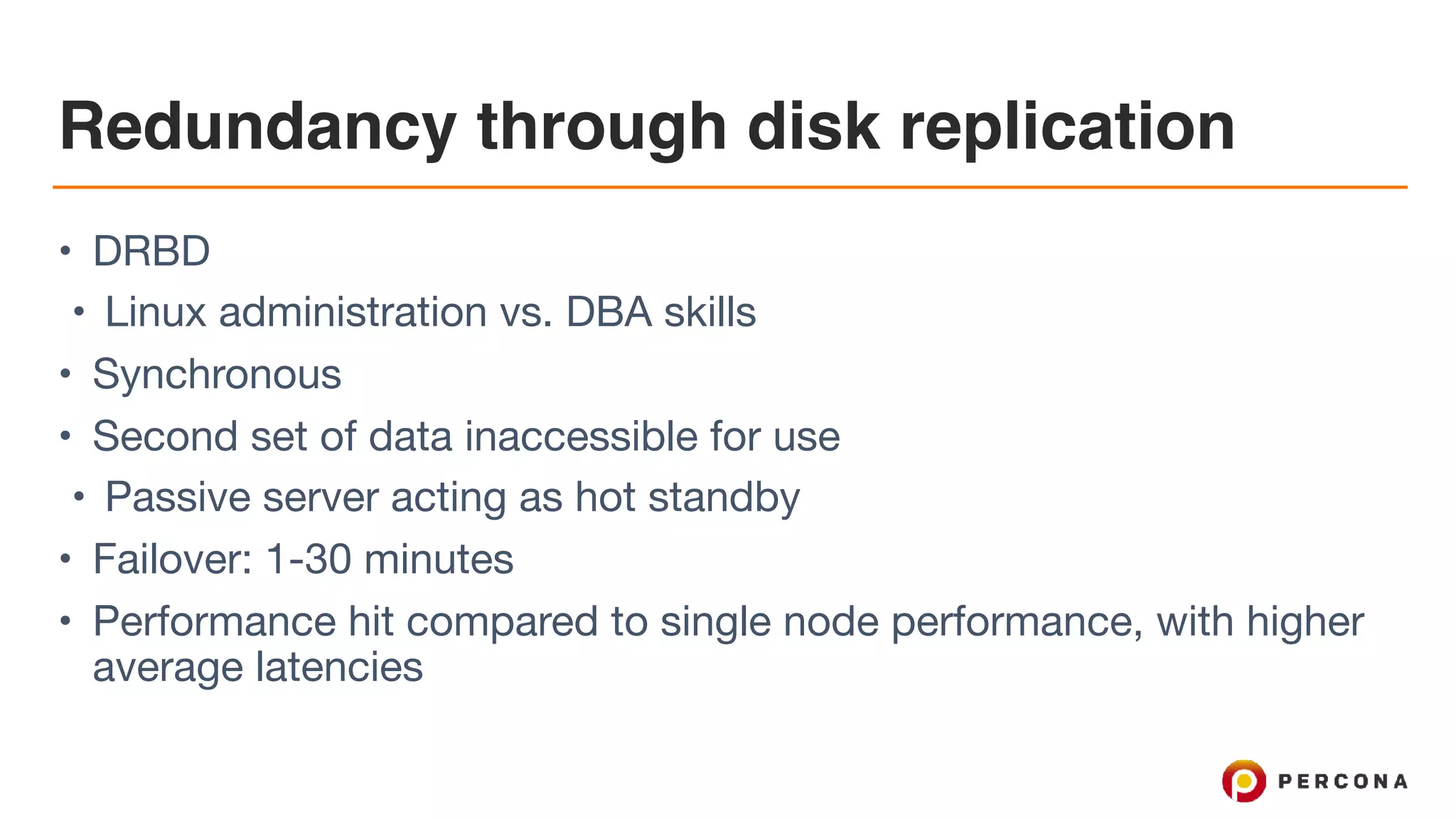
Redundancy through disk replication
• DRBD

• Linux administration vs. DBA skills

• Synchronous

• Second set of data inaccessible for use

• Passive server acting as hot standby

• Failover: 1-30 minutes

• Performance hit compared to single node performance, with higher
average latencies
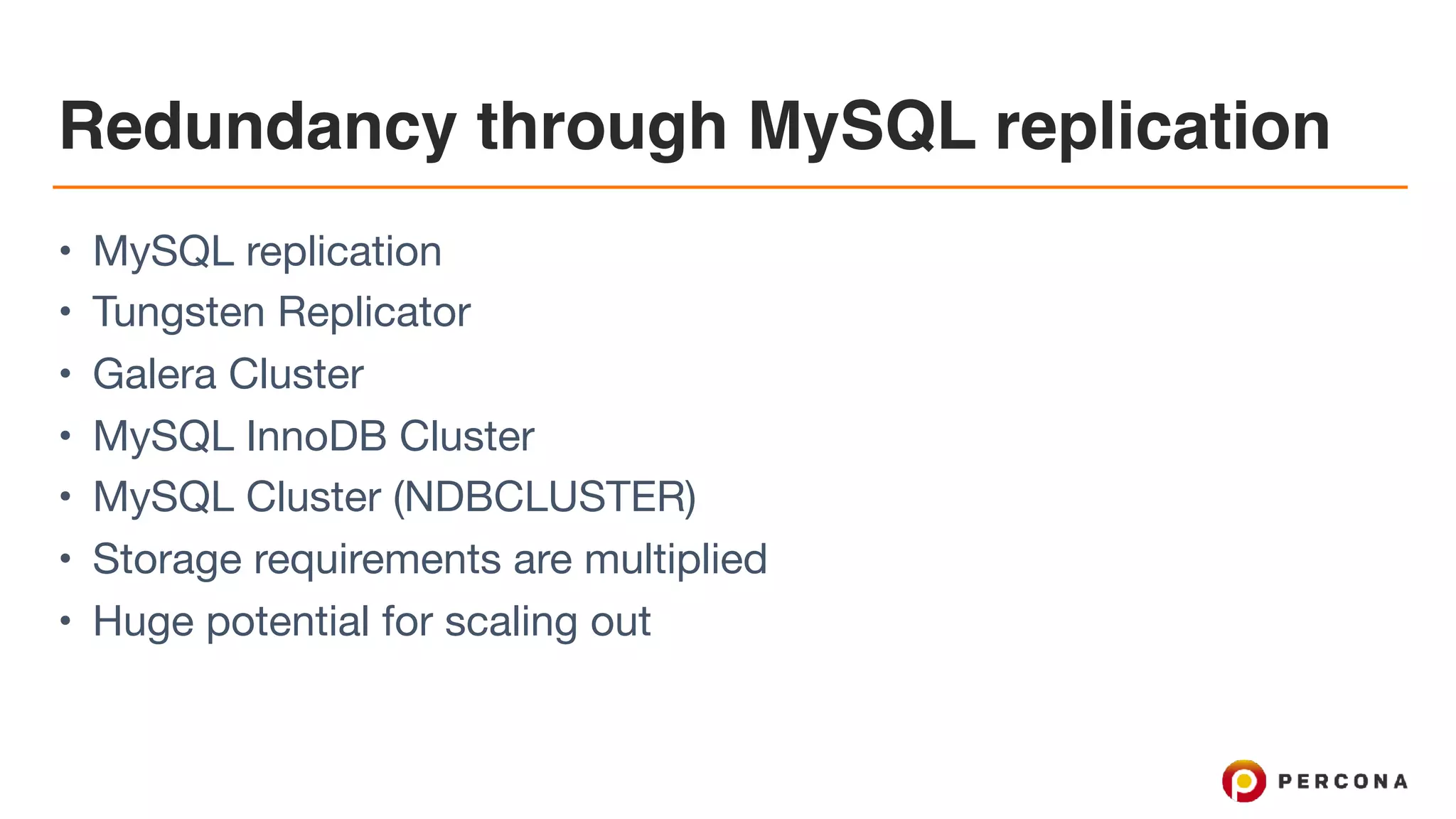
Redundancy through MySQL replication
• MySQL replication

• Tungsten Replicator

• Galera Cluster

• MySQL InnoDB Cluster

• MySQL Cluster (NDBCLUSTER)

• Storage requirements are multiplied

• Huge potential for scaling out
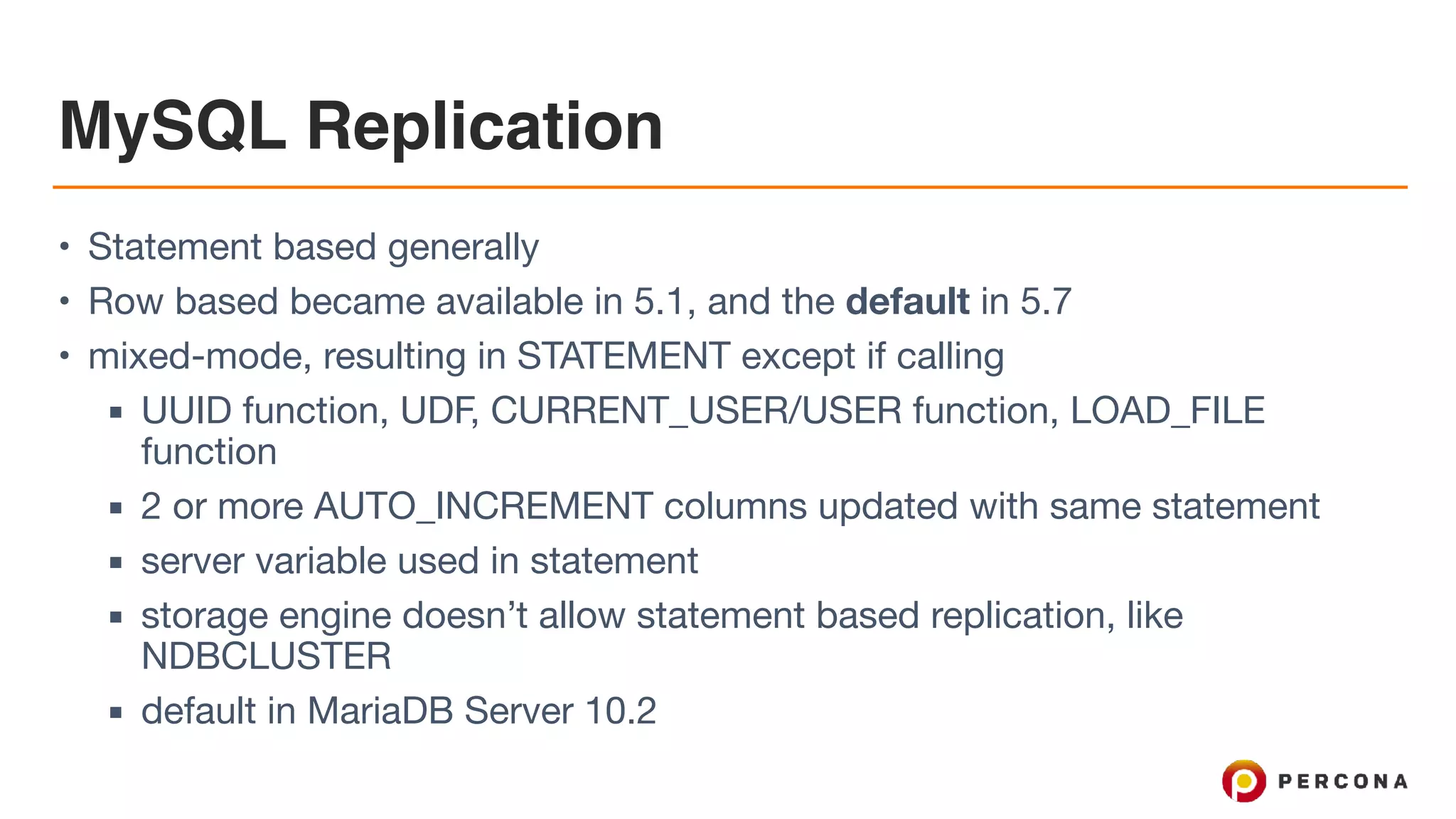
MySQL Replication
• Statement based generally

• Row based became available in 5.1, and the default in 5.7

• mixed-mode, resulting in STATEMENT except if calling

▪ UUID function, UDF, CURRENT_USER/USER function, LOAD_FILE
function

▪ 2 or more AUTO_INCREMENT columns updated with same statement

▪ server variable used in statement

▪ storage engine doesn’t allow statement based replication, like
NDBCLUSTER

▪ default in MariaDB Server 10.2
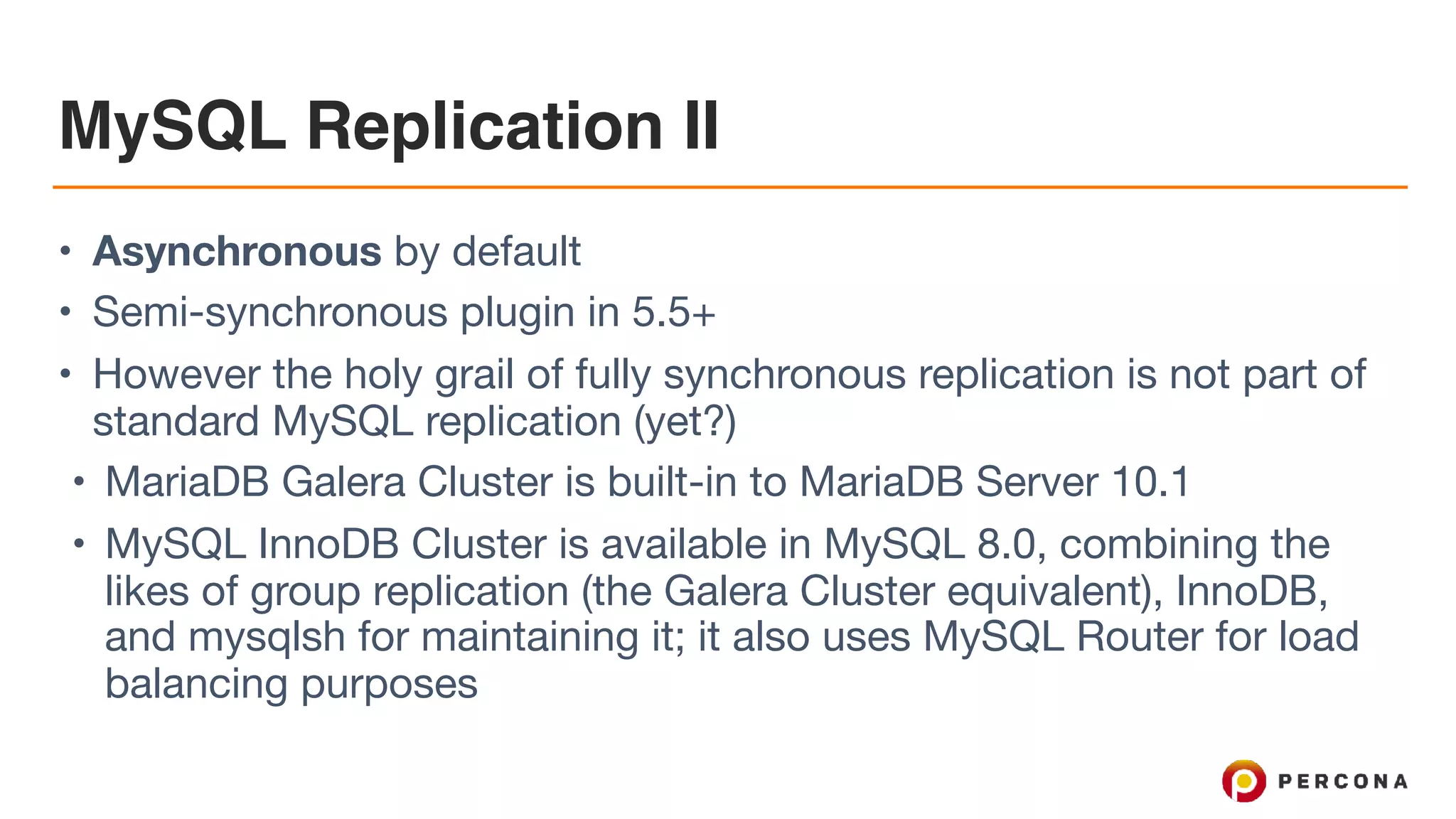
MySQL Replication II
• Asynchronous by default

• Semi-synchronous plugin in 5.5+

• However the holy grail of fully synchronous replication is not part of
standard MySQL replication (yet?)

• MariaDB Galera Cluster is built-in to MariaDB Server 10.1

• MySQL InnoDB Cluster is available in MySQL 8.0, combining the
likes of group replication (the Galera Cluster equivalent), InnoDB,
and mysqlsh for maintaining it; it also uses MySQL Router for load
balancing purposes
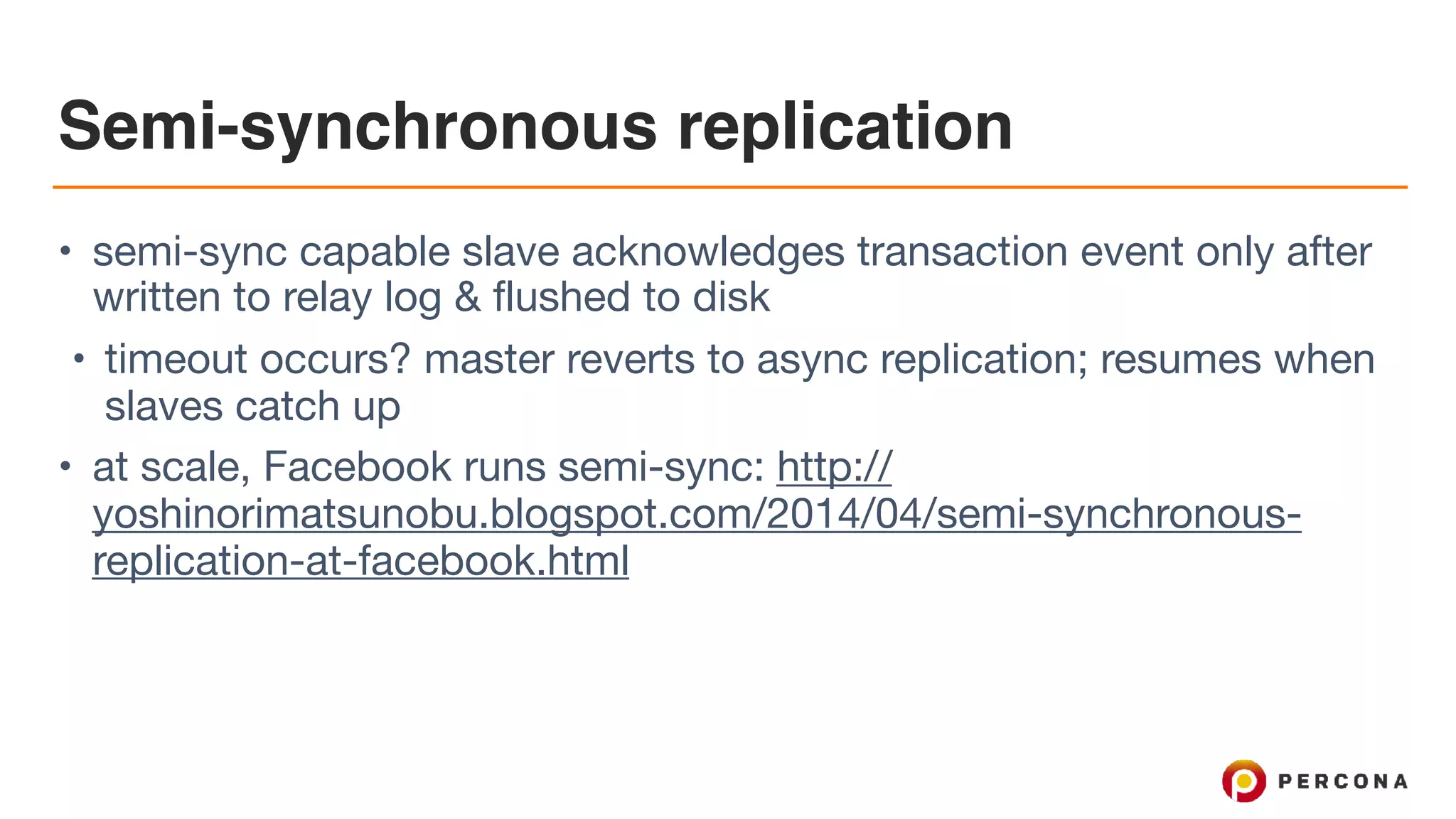
Semi-synchronous replication
• semi-sync capable slave acknowledges transaction event only after
written to relay log & flushed to disk

• timeout occurs? master reverts to async replication; resumes when
slaves catch up

• at scale, Facebook runs semi-sync: http://
yoshinorimatsunobu.blogspot.com/2014/04/semi-synchronous-
replication-at-facebook.html
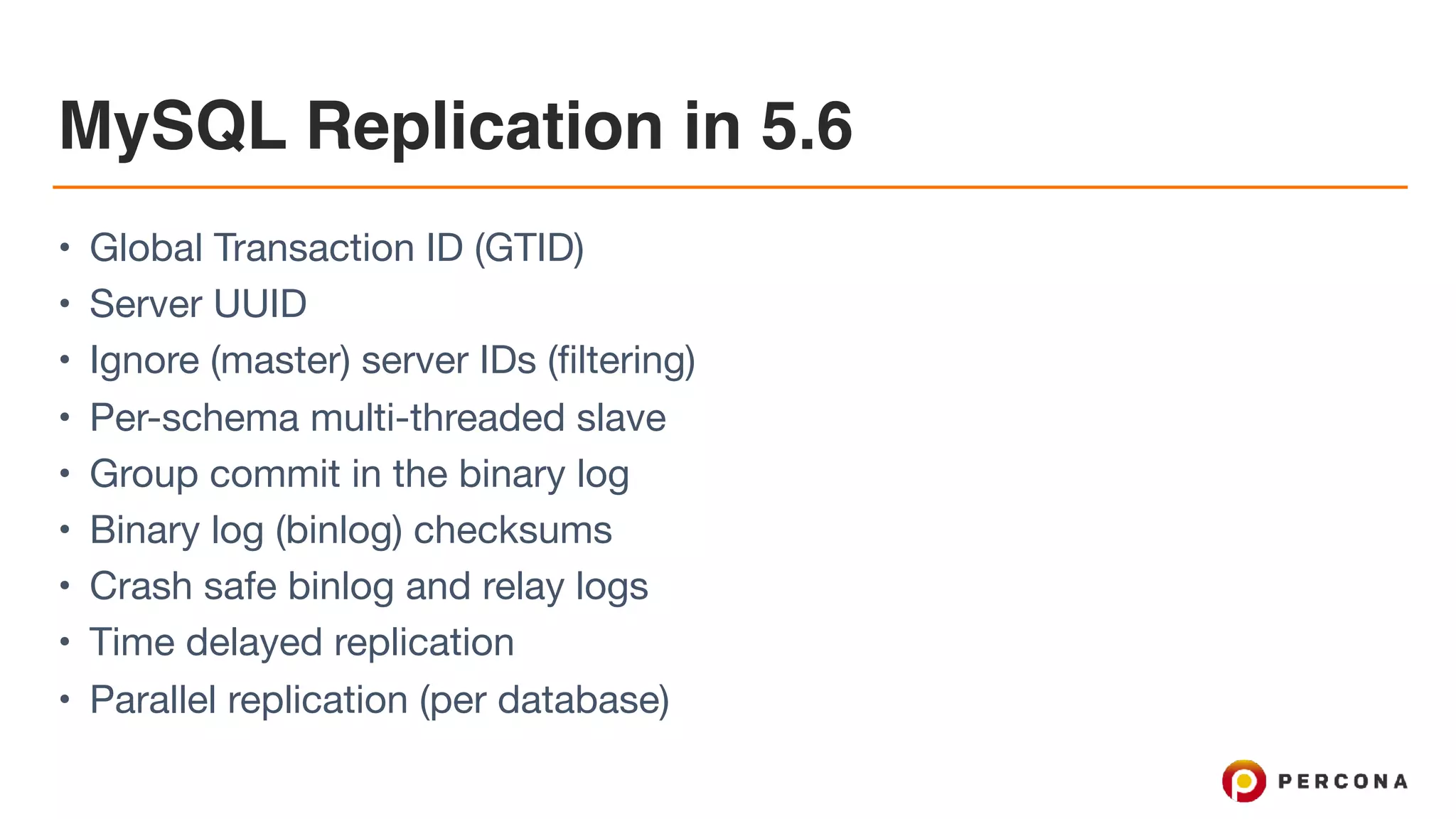
MySQL Replication in 5.6
• Global Transaction ID (GTID)

• Server UUID

• Ignore (master) server IDs (filtering)

• Per-schema multi-threaded slave

• Group commit in the binary log

• Binary log (binlog) checksums

• Crash safe binlog and relay logs

• Time delayed replication

• Parallel replication (per database)
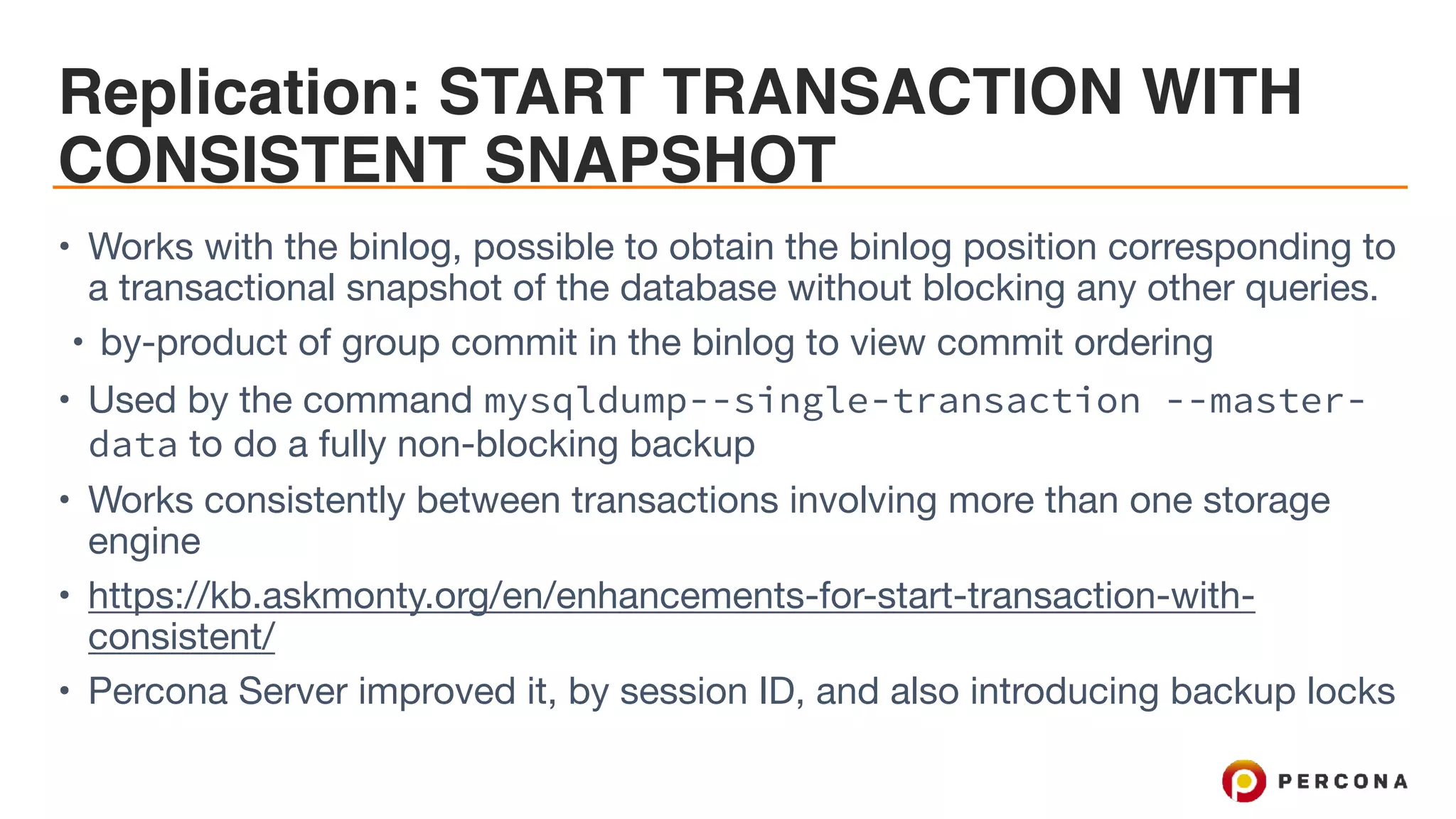
Replication: START TRANSACTION WITH
CONSISTENT SNAPSHOT
• Works with the binlog, possible to obtain the binlog position corresponding to
a transactional snapshot of the database without blocking any other queries. 

• by-product of group commit in the binlog to view commit ordering

• Used by the command mysqldump--single-transaction --master-
data to do a fully non-blocking backup 

• Works consistently between transactions involving more than one storage
engine

• https://kb.askmonty.org/en/enhancements-for-start-transaction-with-
consistent/

• Percona Server improved it, by session ID, and also introducing backup locks
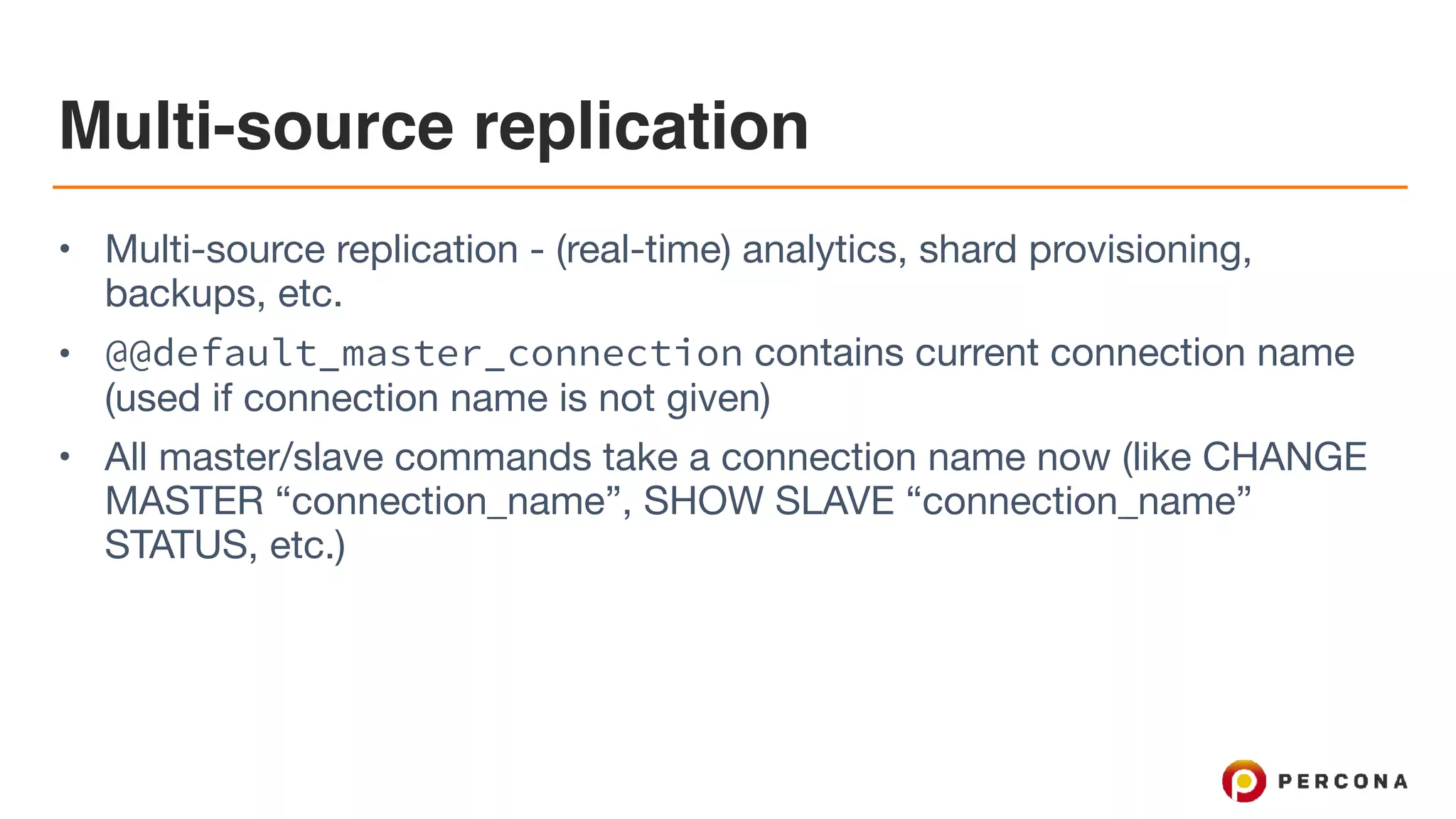
Multi-source replication
• Multi-source replication - (real-time) analytics, shard provisioning,
backups, etc.

• @@default_master_connection contains current connection name
(used if connection name is not given)

• All master/slave commands take a connection name now (like CHANGE
MASTER “connection_name”, SHOW SLAVE “connection_name”
STATUS, etc.)
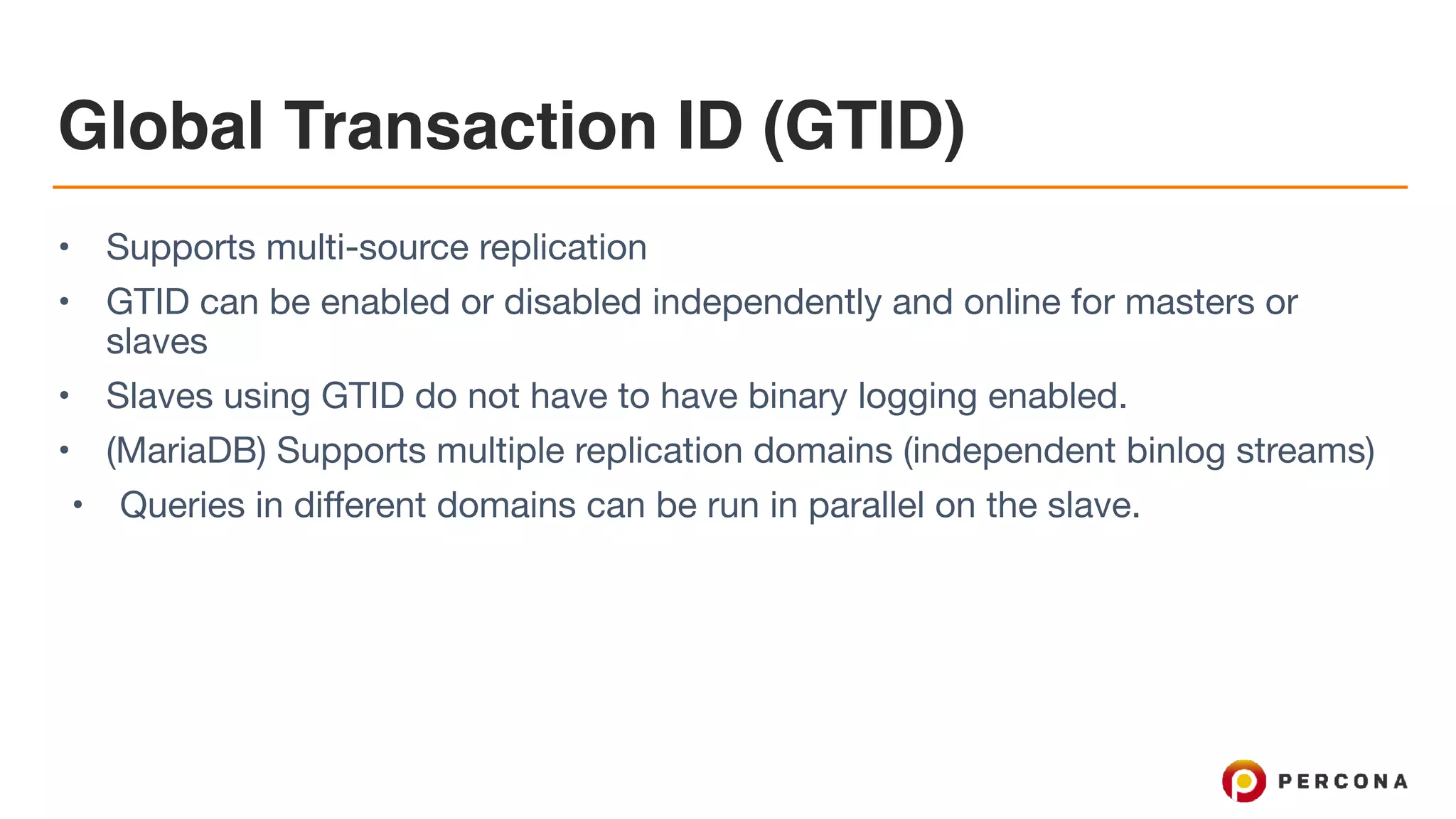
Global Transaction ID (GTID)
• Supports multi-source replication

• GTID can be enabled or disabled independently and online for masters or
slaves

• Slaves using GTID do not have to have binary logging enabled.

• (MariaDB) Supports multiple replication domains (independent binlog streams)

• Queries in different domains can be run in parallel on the slave.
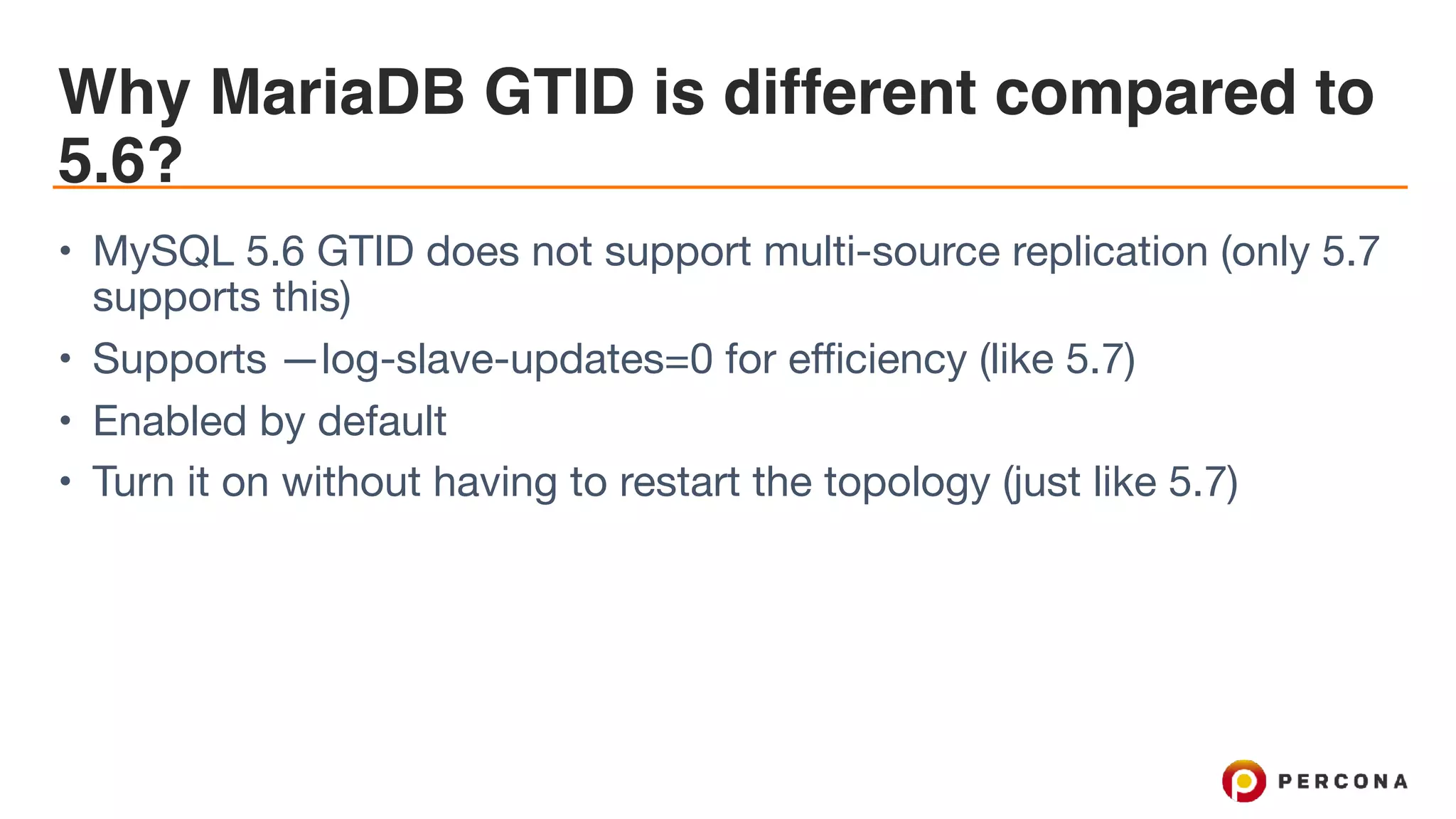
Why MariaDB GTID is different compared to
5.6?
• MySQL 5.6 GTID does not support multi-source replication (only 5.7
supports this)

• Supports —log-slave-updates=0 for efficiency (like 5.7)

• Enabled by default

• Turn it on without having to restart the topology (just like 5.7)
Parallel replication
• Multi-source replication from different masters executed in parallel 

• Queries from different domains are executed in parallel 

• Queries that are run in parallel on the master are run in parallel on the
slave (based on group commit).

• Transactions modifying the same table can be updated in parallel on
the slave! 

• Supports both statement based and row based replication.
All in… sometimes it can get out of sync
• Changed information on slave directly

• Statement based replication

• non-deterministic SQL (UPDATE/DELETE with LIMIT and without ORDER BY)

• triggers & stored procedures

• Master in MyISAM, slave in InnoDB (deadlocks)

• --replication-ignore-db with fully qualified queries

• Binlog corruption on master

• PURGE BINARY LOGS issued and not enough files to update slave

• read_buffer_size larger than max_allowed_packet

• Bugs?
Replication Monitoring
• Percona Toolkit is important

• pt-slave-find: find slave information from master

• pt-table-checksum: online replication consistency check

• executes checksum queries on master

• pt-table-sync: synchronise table data efficiently

• changes data, so backups important
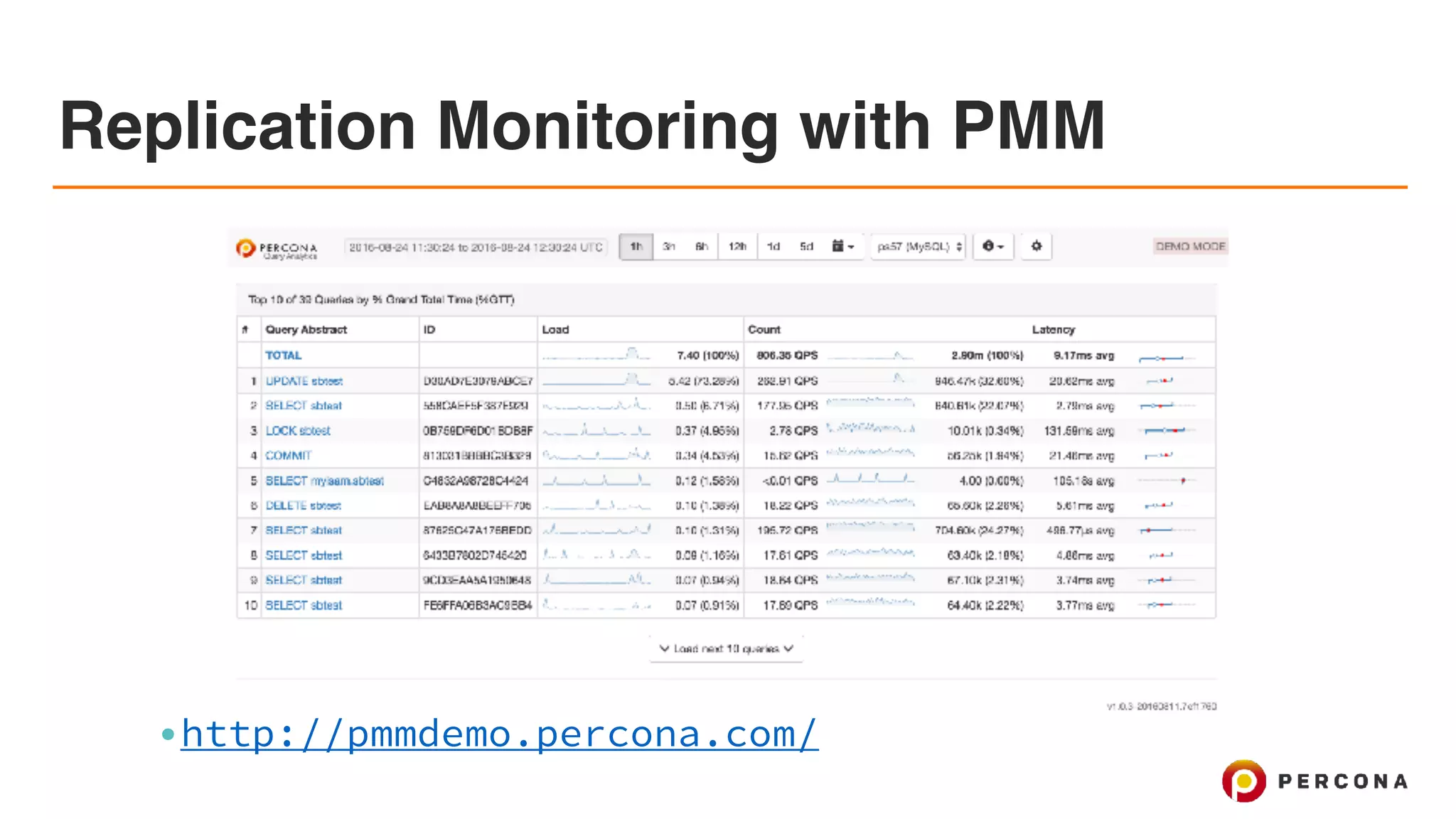
Replication Monitoring with PMM
•http://pmmdemo.percona.com/
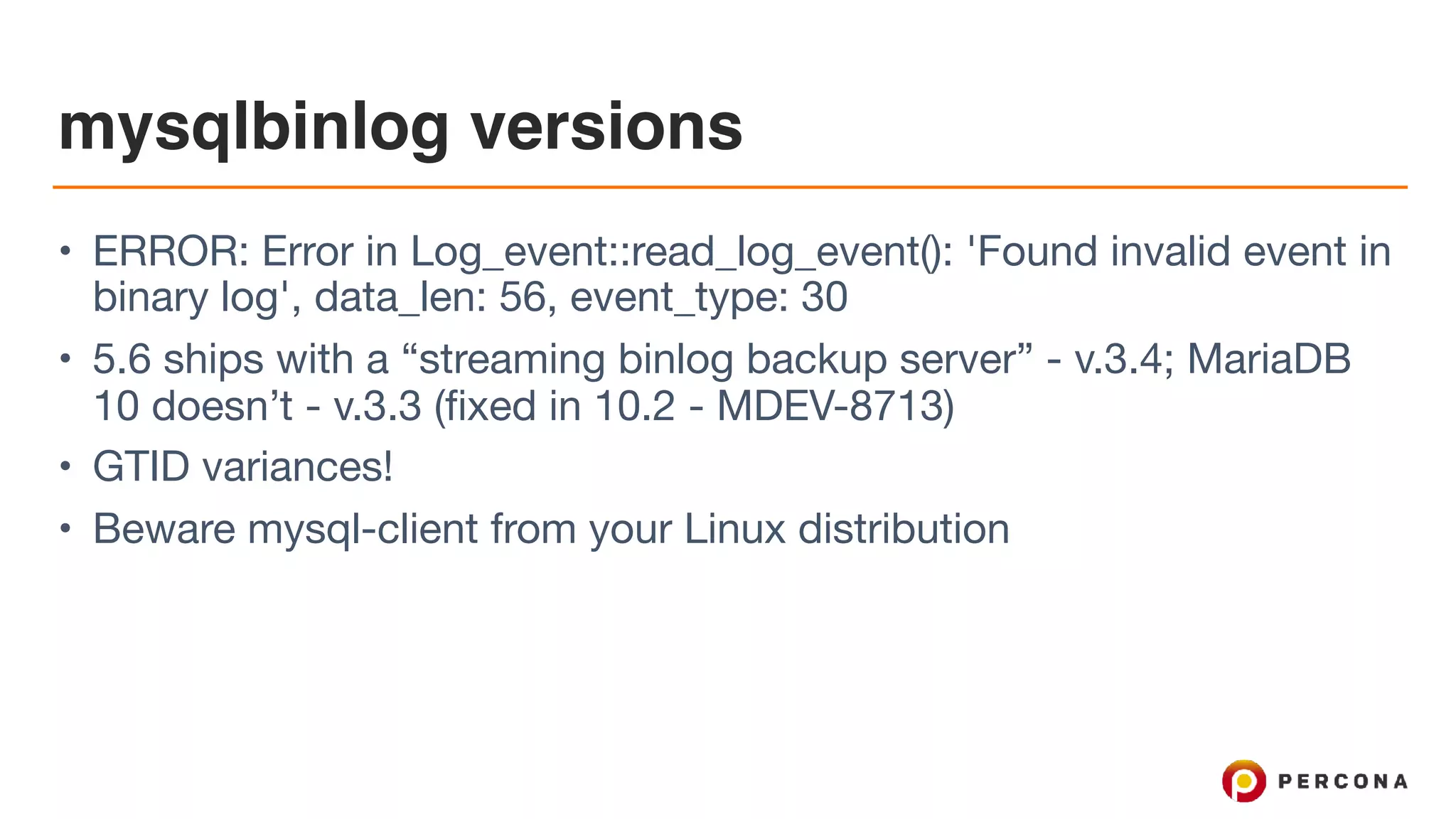
mysqlbinlog versions
• ERROR: Error in Log_event::read_log_event(): 'Found invalid event in
binary log', data_len: 56, event_type: 30

• 5.6 ships with a “streaming binlog backup server” - v.3.4; MariaDB
10 doesn’t - v.3.3 (fixed in 10.2 - MDEV-8713)

• GTID variances!

• Beware mysql-client from your Linux distribution
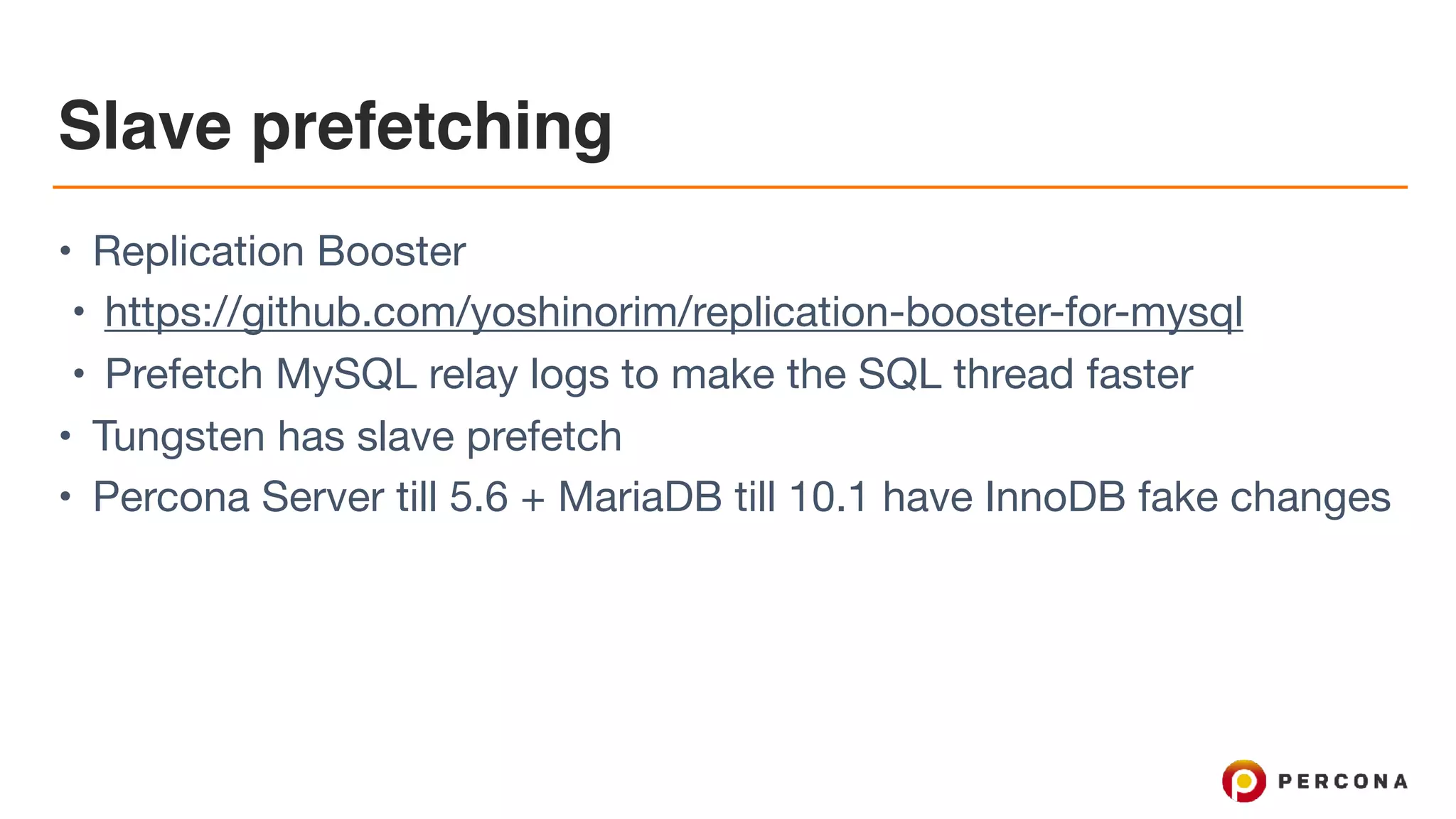
Slave prefetching
• Replication Booster

• https://github.com/yoshinorim/replication-booster-for-mysql

• Prefetch MySQL relay logs to make the SQL thread faster

• Tungsten has slave prefetch

• Percona Server till 5.6 + MariaDB till 10.1 have InnoDB fake changes
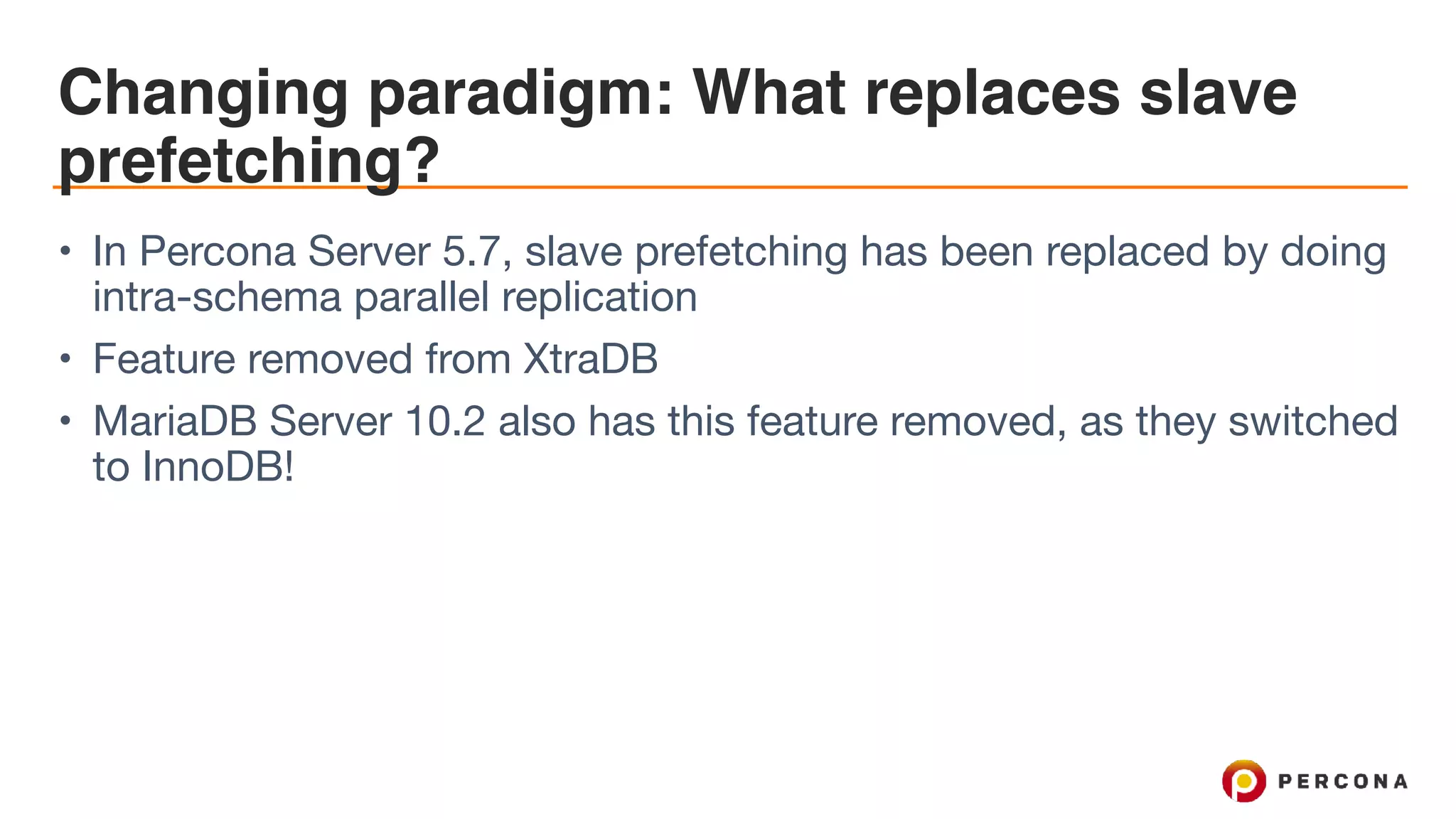
Changing paradigm: What replaces slave
prefetching?
• In Percona Server 5.7, slave prefetching has been replaced by doing
intra-schema parallel replication

• Feature removed from XtraDB

• MariaDB Server 10.2 also has this feature removed, as they switched
to InnoDB!
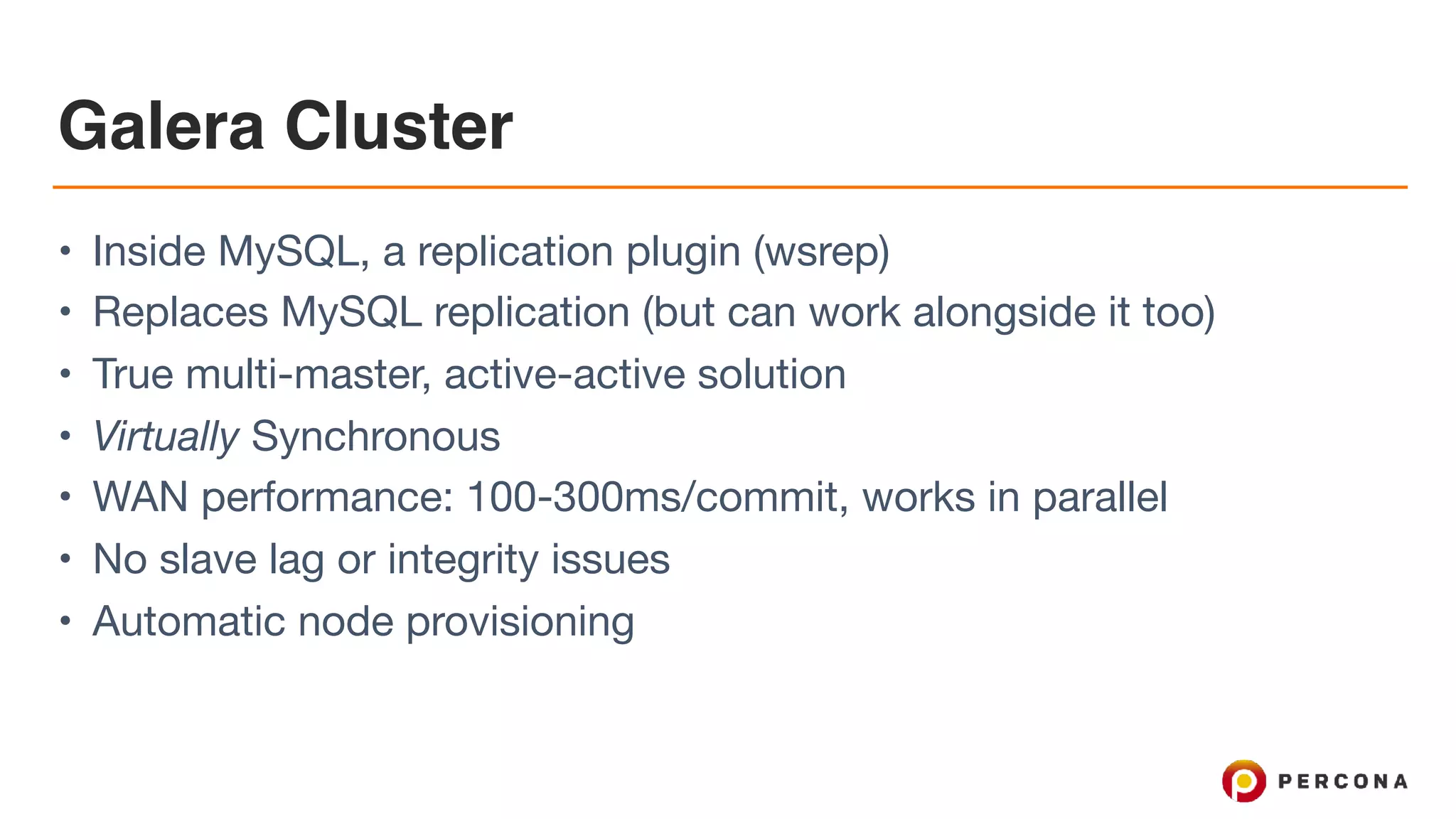
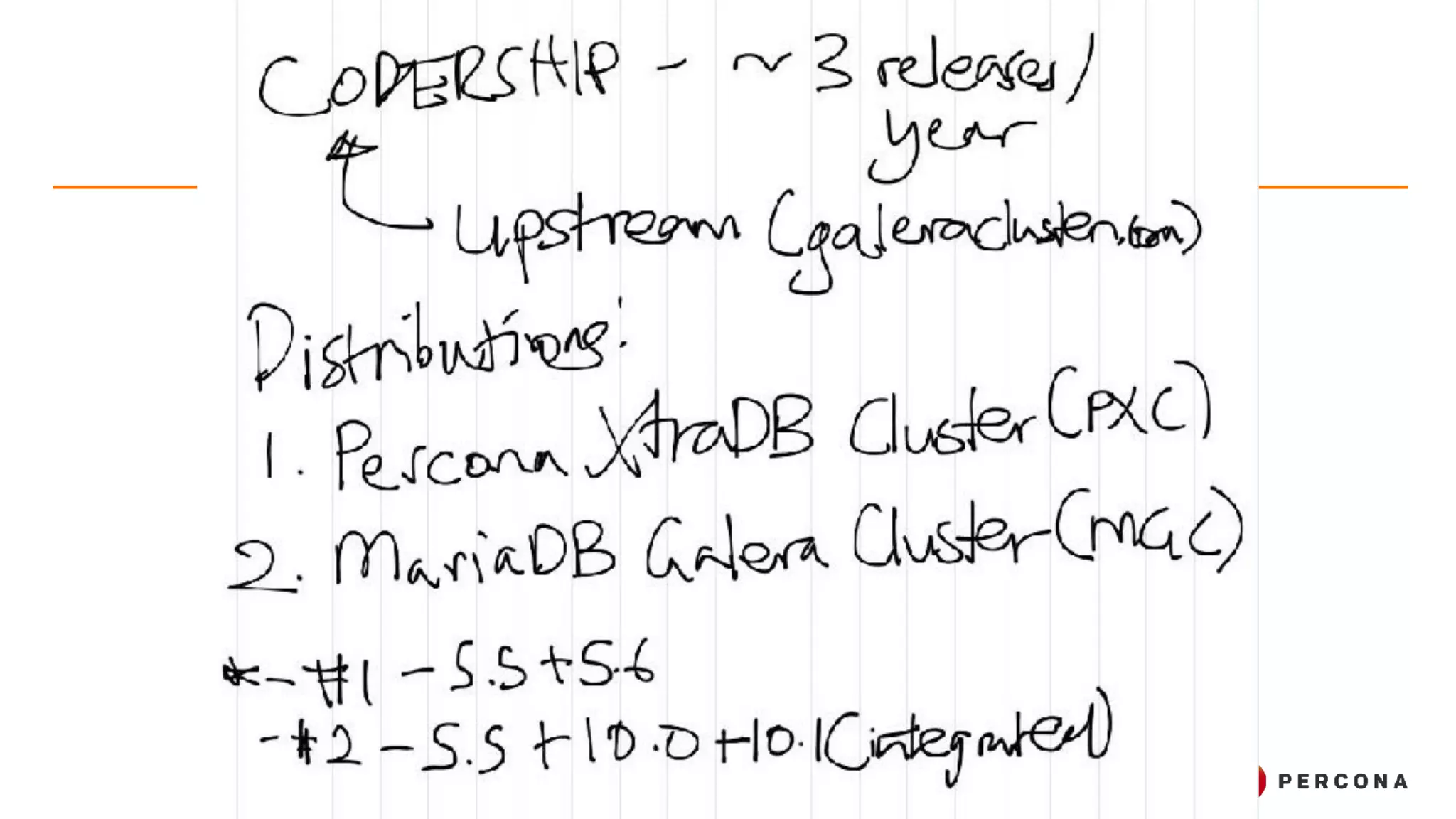
Galera Cluster
• Inside MySQL, a replication plugin (wsrep)

• Replaces MySQL replication (but can work alongside it too)

• True multi-master, active-active solution

• Virtually Synchronous

• WAN performance: 100-300ms/commit, works in parallel

• No slave lag or integrity issues

• Automatic node provisioning
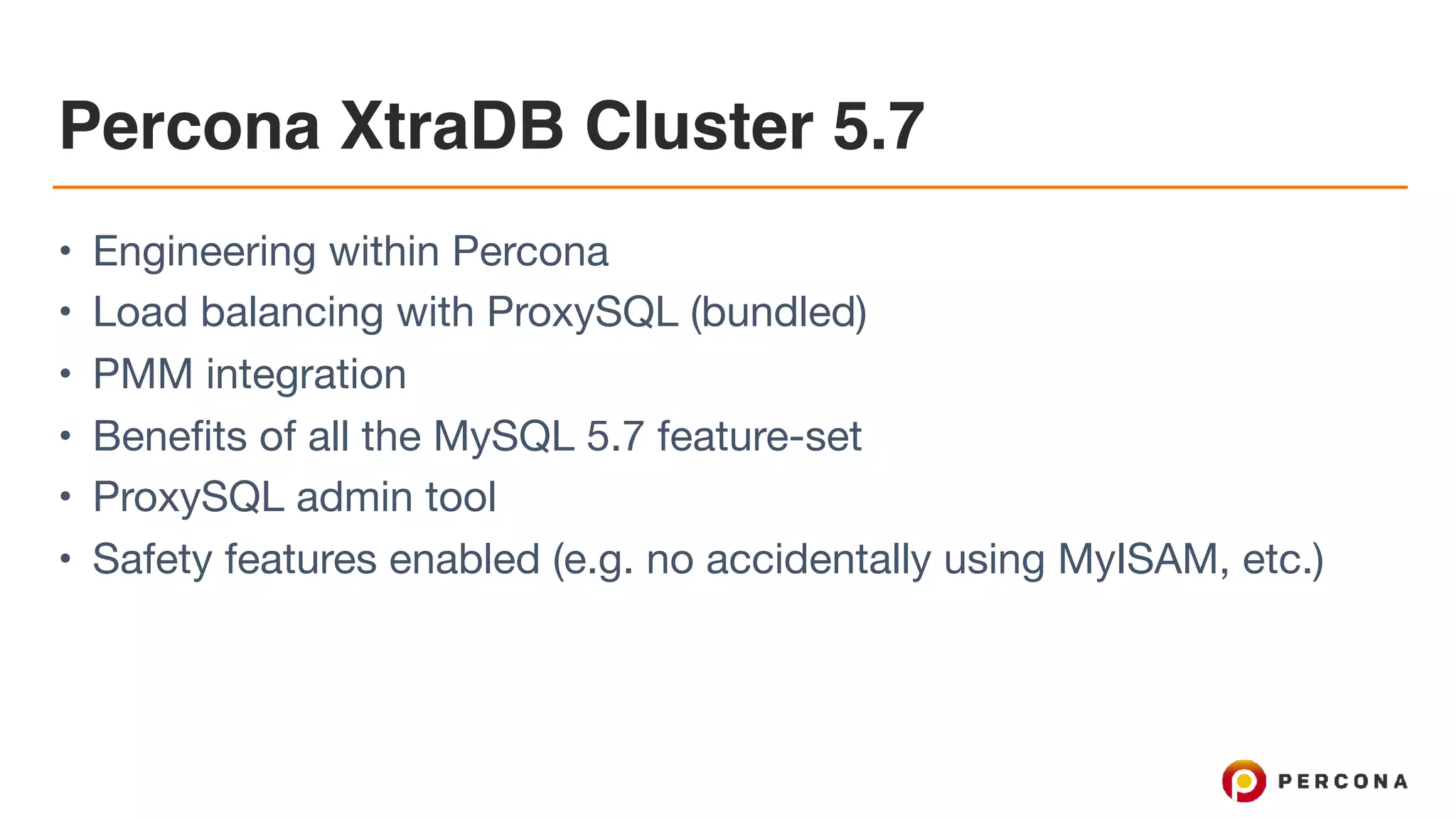
Percona XtraDB Cluster 5.7
• Engineering within Percona

• Load balancing with ProxySQL (bundled)

• PMM integration

• Benefits of all the MySQL 5.7 feature-set

• ProxySQL admin tool

• Safety features enabled (e.g. no accidentally using MyISAM, etc.)
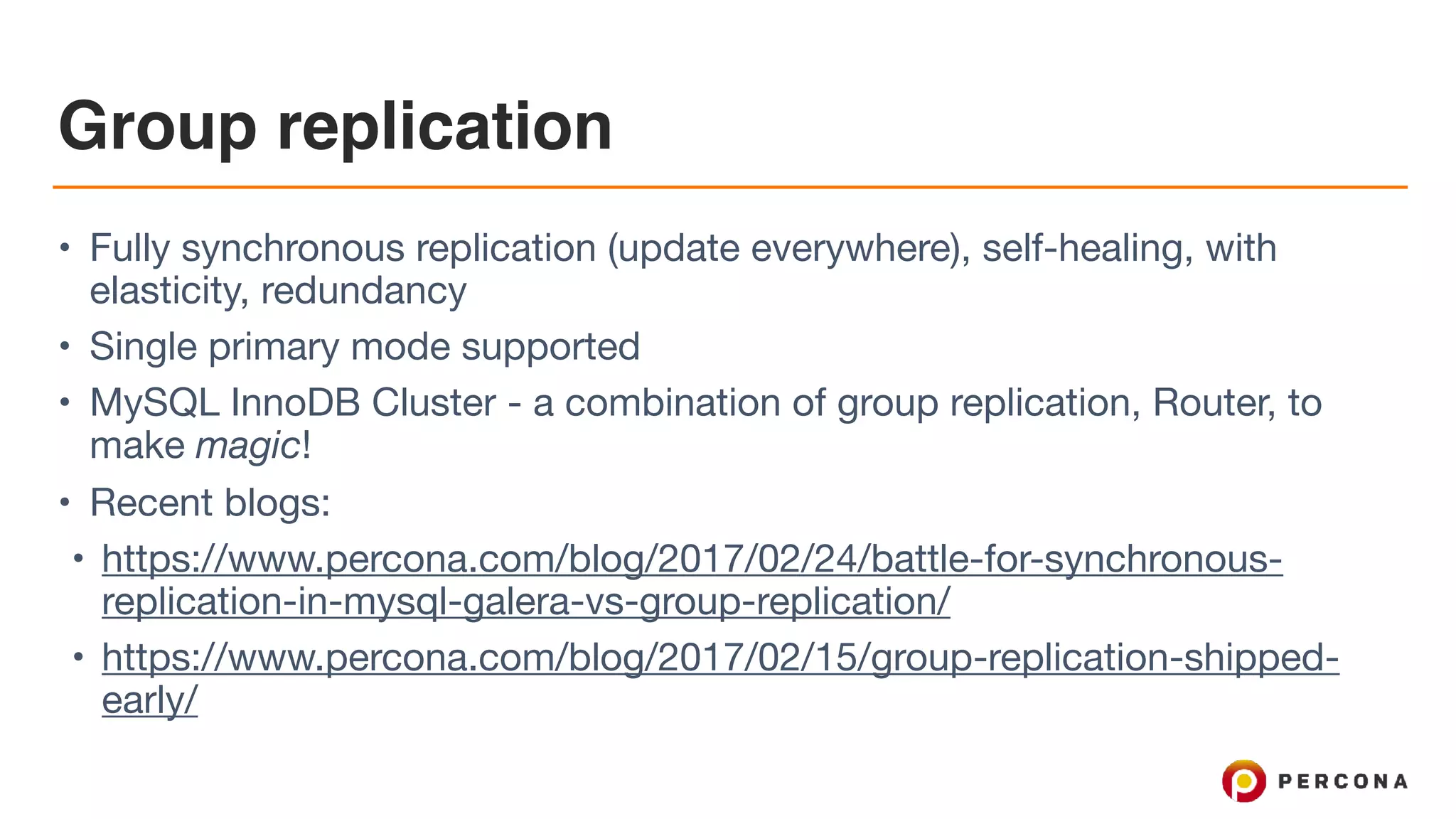
Group replication
• Fully synchronous replication (update everywhere), self-healing, with
elasticity, redundancy

• Single primary mode supported

• MySQL InnoDB Cluster - a combination of group replication, Router, to
make magic!

• Recent blogs:

• https://www.percona.com/blog/2017/02/24/battle-for-synchronous-
replication-in-mysql-galera-vs-group-replication/

• https://www.percona.com/blog/2017/02/15/group-replication-shipped-
early/
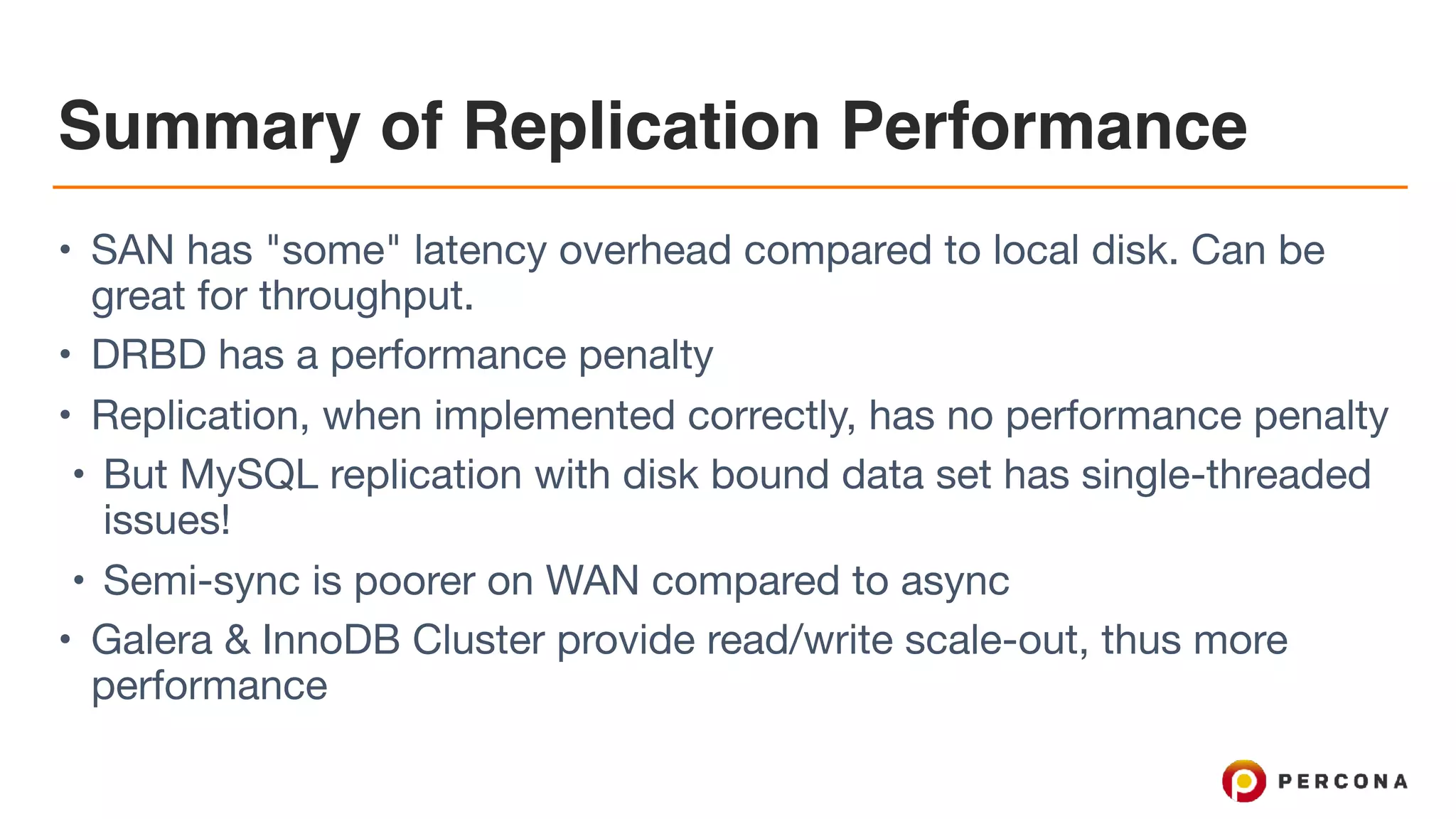
Summary of Replication Performance
• SAN has "some" latency overhead compared to local disk. Can be
great for throughput.

• DRBD has a performance penalty

• Replication, when implemented correctly, has no performance penalty

• But MySQL replication with disk bound data set has single-threaded
issues!

• Semi-sync is poorer on WAN compared to async

• Galera & InnoDB Cluster provide read/write scale-out, thus more
performance
Handling failure
• How do we find out about failure?

• Polling, monitoring, alerts...

• Error returned to and handled in client side

• What should we do about it?

• Direct requests to the spare nodes (or DCs)

• How to protect data integrity?

• Master-slave is unidirectional: Must ensure there is only one master at all times.

• DRBD and SAN have cold-standby: Must mount disks and start mysqld.

• In all cases must ensure that 2 disconnected replicas cannot both commit
independently. (split brain)
Frameworks to handle failure
• MySQL-MMM

• Severalnines ClusterControl

• Orchestrator

• MySQL MHA

• Percona Replication Manager

• Tungsten Replicator

• 5.6: mysqlfailover, mysqlrpladmin

• (MariaDB) Replication Manager
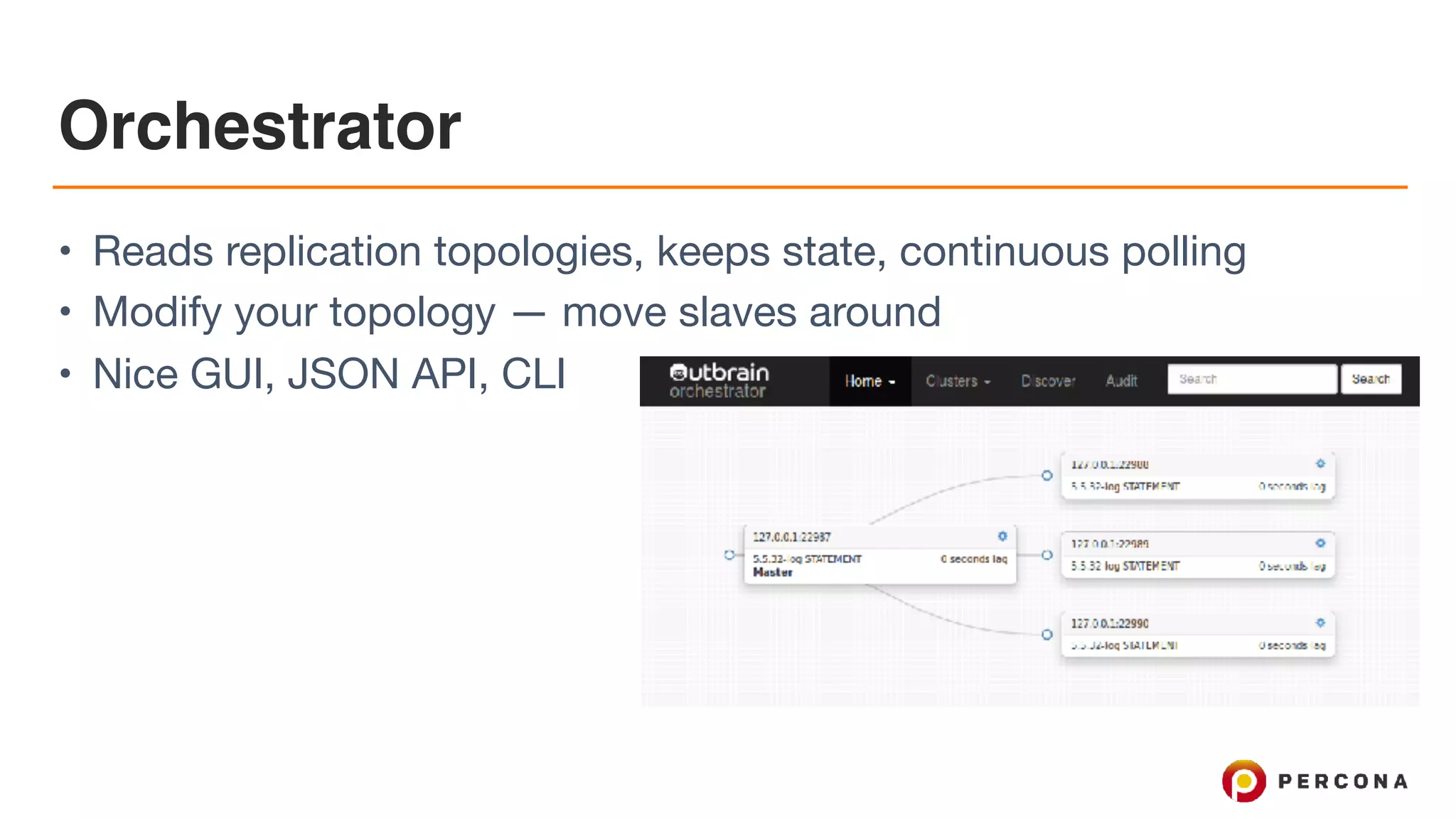
Orchestrator
• Reads replication topologies, keeps state, continuous polling

• Modify your topology — move slaves around

• Nice GUI, JSON API, CLI
MySQL MHA
• Like MMM, specialized solution for MySQL replication

• Developed by Yoshinori Matsunobu at DeNA

• Automated and manual failover options

• Topology: 1 master, many slaves

• Choose new master by comparing slave binlog positions

• Can be used in conjunction with other solutions

• http://code.google.com/p/mysql-master-ha/
Pacemaker
• Heartbeat, Corosync, Pacemaker

• Resource Agents, Percona-PRM

• Percona Replication Manager - cluster, geographical disaster
recovery options

• Pacemaker agent specialised on MySQL replication

• https://github.com/percona/percona-pacemaker-agents/ 

• Pacemaker Resource Agents 3.9.3+ include Percona Replication
Manager (PRM)
Load Balancers for multi-master clusters
• Synchronous multi-master clusters like Galera require load balancers

• HAProxy

• Galera Load Balancer (GLB)

• MaxScale

• ProxySQL
MySQL Router
• Routing between applications and any backend MySQL servers

• Failover

• Load Balancing

• Pluggable architecture (connection routing)
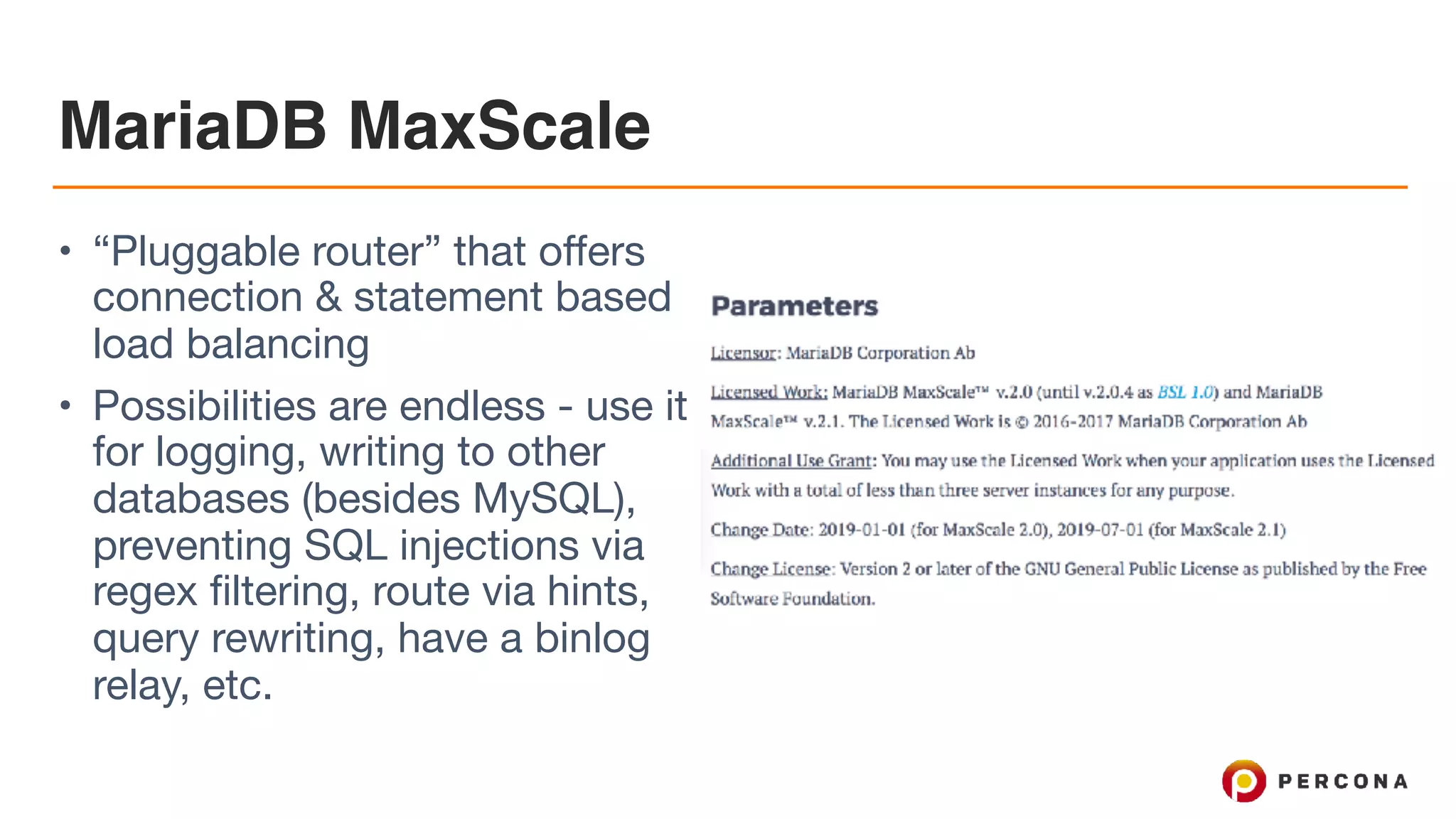
MariaDB MaxScale
• “Pluggable router” that offers
connection & statement based
load balancing

• Possibilities are endless - use it
for logging, writing to other
databases (besides MySQL),
preventing SQL injections via
regex filtering, route via hints,
query rewriting, have a binlog
relay, etc.
ProxySQL
• High Performance MySQL proxy with a GPL license

• Performance is a priority - the numbers prove it

• Can query rewrite

• Sharding by host/schema or both, with rule engine + modification to
SQL + application logic
JDBC/PHP drivers
• JDBC - multi-host failover feature (just specify master/slave hosts in
the properties)

• true for MariaDB Java Connector too

• PHP handles this too - mysqlnd_ms

• Can handle read-write splitting, round robin or random host
selection, and more
Clustering: solution or part of problem?
• "Causes of Downtime in Production MySQL Servers" whitepaper,
Baron Schwartz VividCortex

• Human error

• SAN

• Clustering framework + SAN = more problems

• Galera/group replication is replication based, has no false positives
as there’s no “failover” moment, you don’t need a clustering
framework (JDBC or PHP can load balance), and is relatively elegant
overall
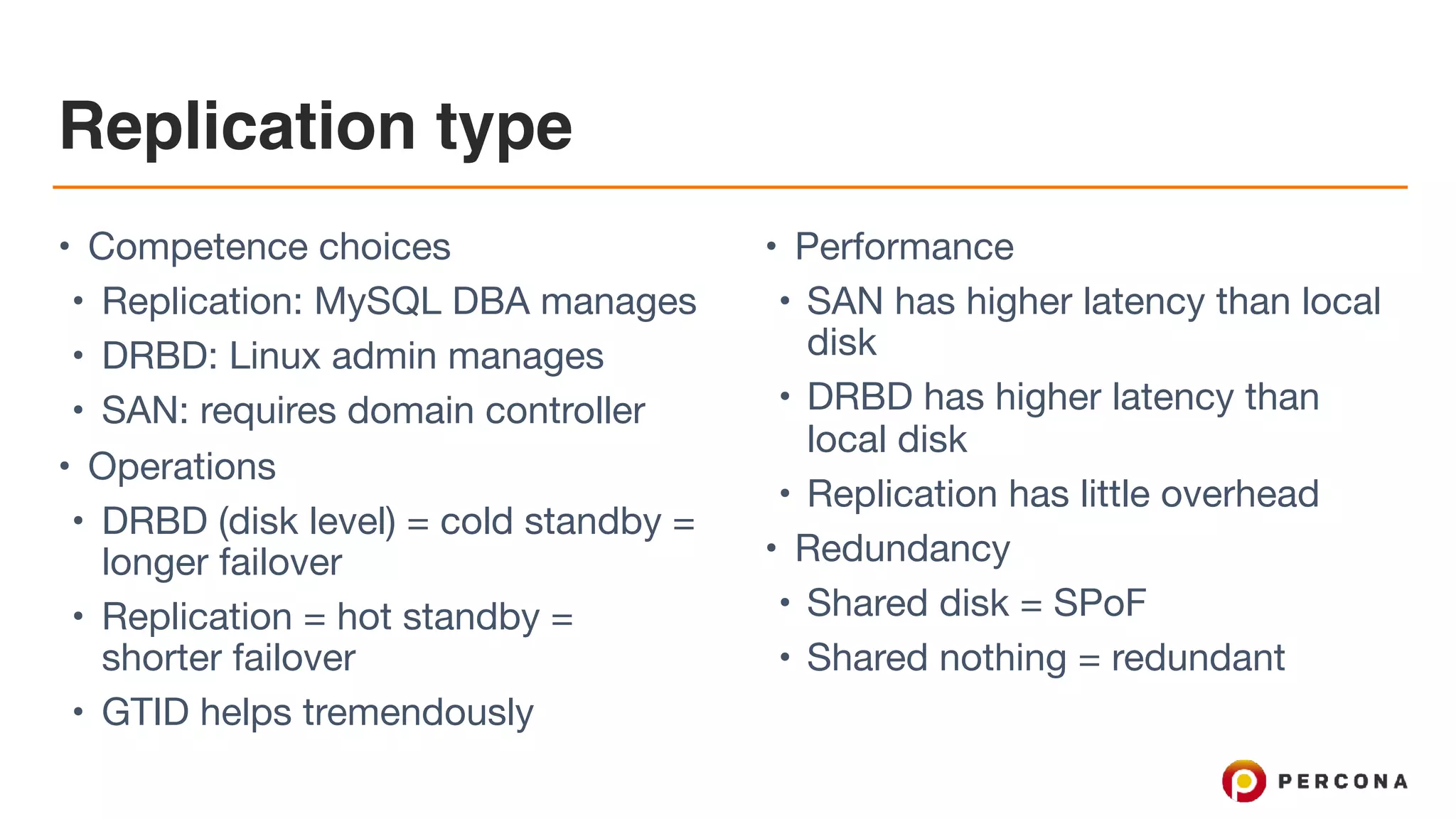
Replication type
• Competence choices

• Replication: MySQL DBA manages

• DRBD: Linux admin manages

• SAN: requires domain controller

• Operations

• DRBD (disk level) = cold standby =
longer failover

• Replication = hot standby =
shorter failover

• GTID helps tremendously

• Performance

• SAN has higher latency than local
disk

• DRBD has higher latency than
local disk

• Replication has little overhead

• Redundancy

• Shared disk = SPoF

• Shared nothing = redundant
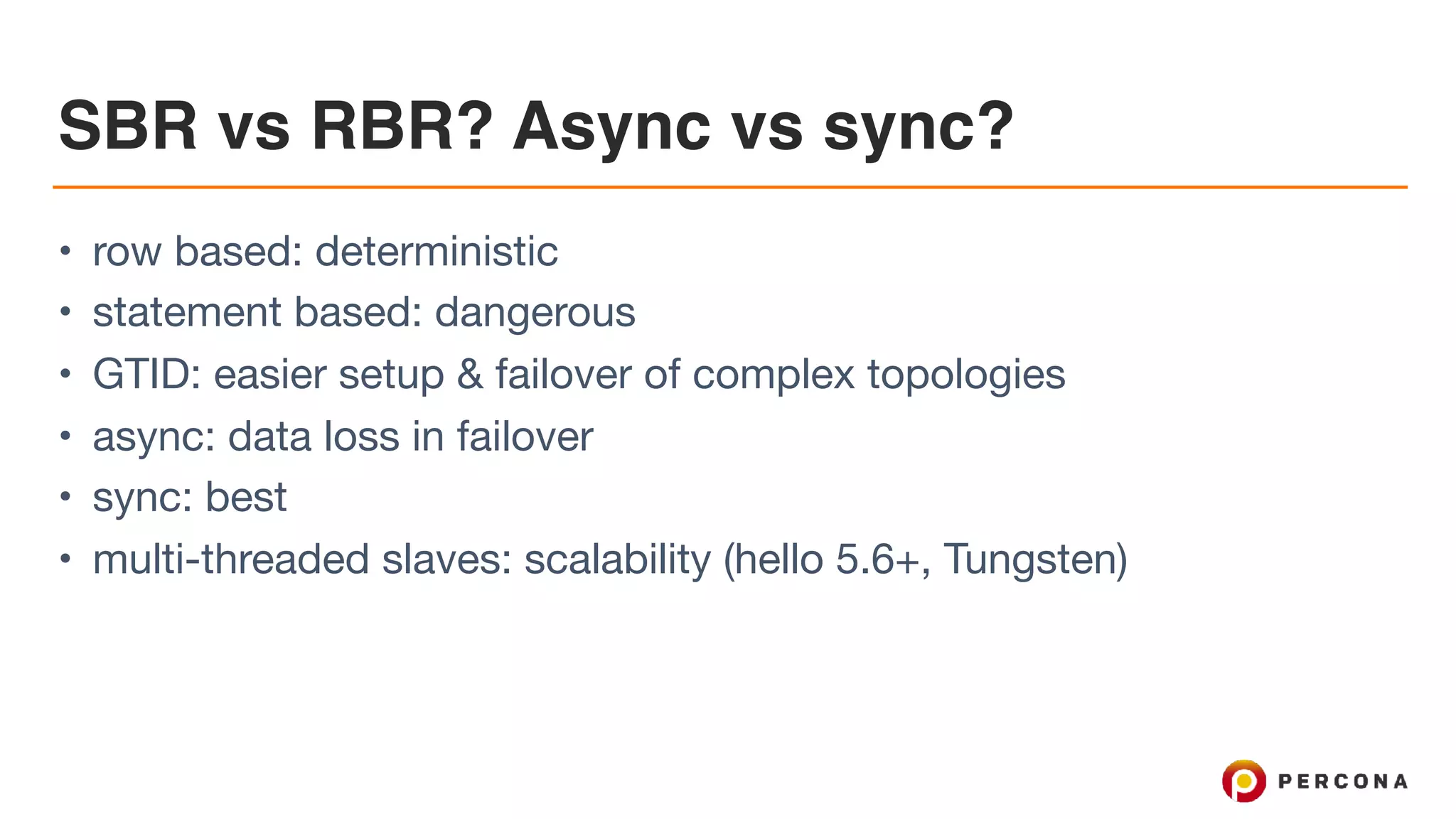
SBR vs RBR? Async vs sync?
• row based: deterministic

• statement based: dangerous

• GTID: easier setup & failover of complex topologies

• async: data loss in failover

• sync: best

• multi-threaded slaves: scalability (hello 5.6+, Tungsten)
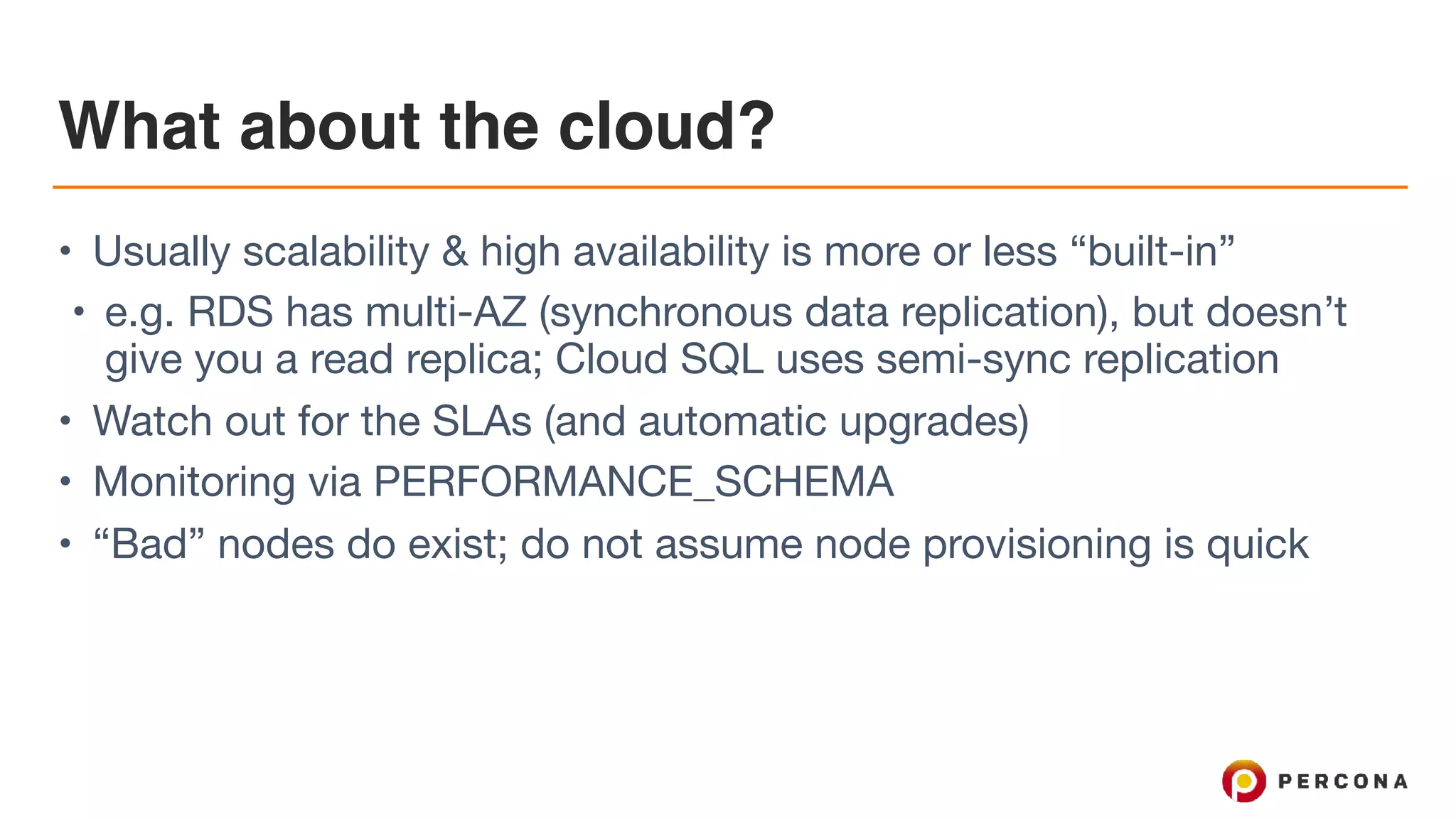
What about the cloud?
• Usually scalability & high availability is more or less “built-in”

• e.g. RDS has multi-AZ (synchronous data replication), but doesn’t
give you a read replica; Cloud SQL uses semi-sync replication

• Watch out for the SLAs (and automatic upgrades)

• Monitoring via PERFORMANCE_SCHEMA

• “Bad” nodes do exist; do not assume node provisioning is quick
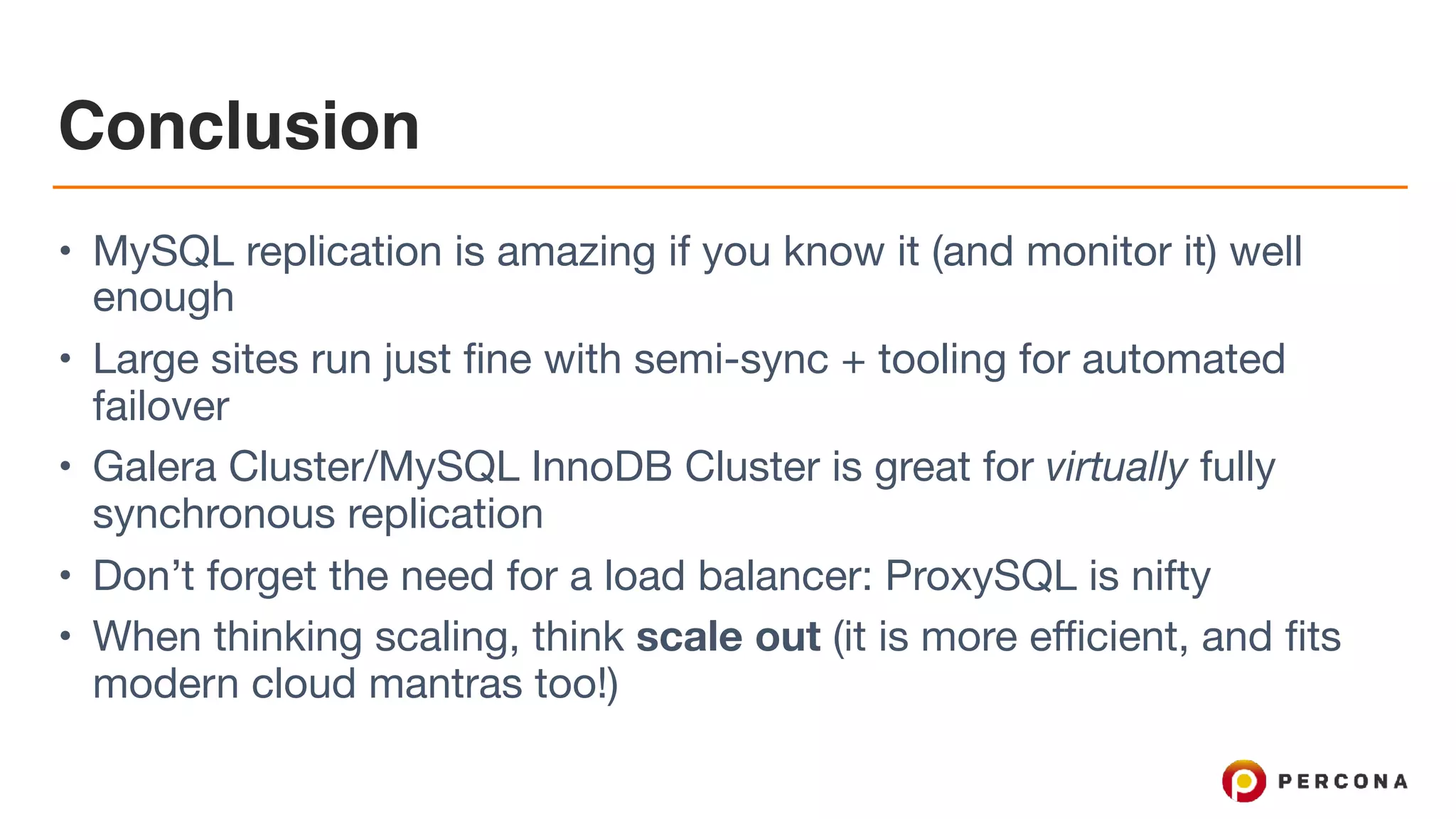
Conclusion
• MySQL replication is amazing if you know it (and monitor it) well
enough

• Large sites run just fine with semi-sync + tooling for automated
failover

• Galera Cluster/MySQL InnoDB Cluster is great for virtually fully
synchronous replication

• Don’t forget the need for a load balancer: ProxySQL is nifty

• When thinking scaling, think scale out (it is more efficient, and fits
modern cloud mantras too!)
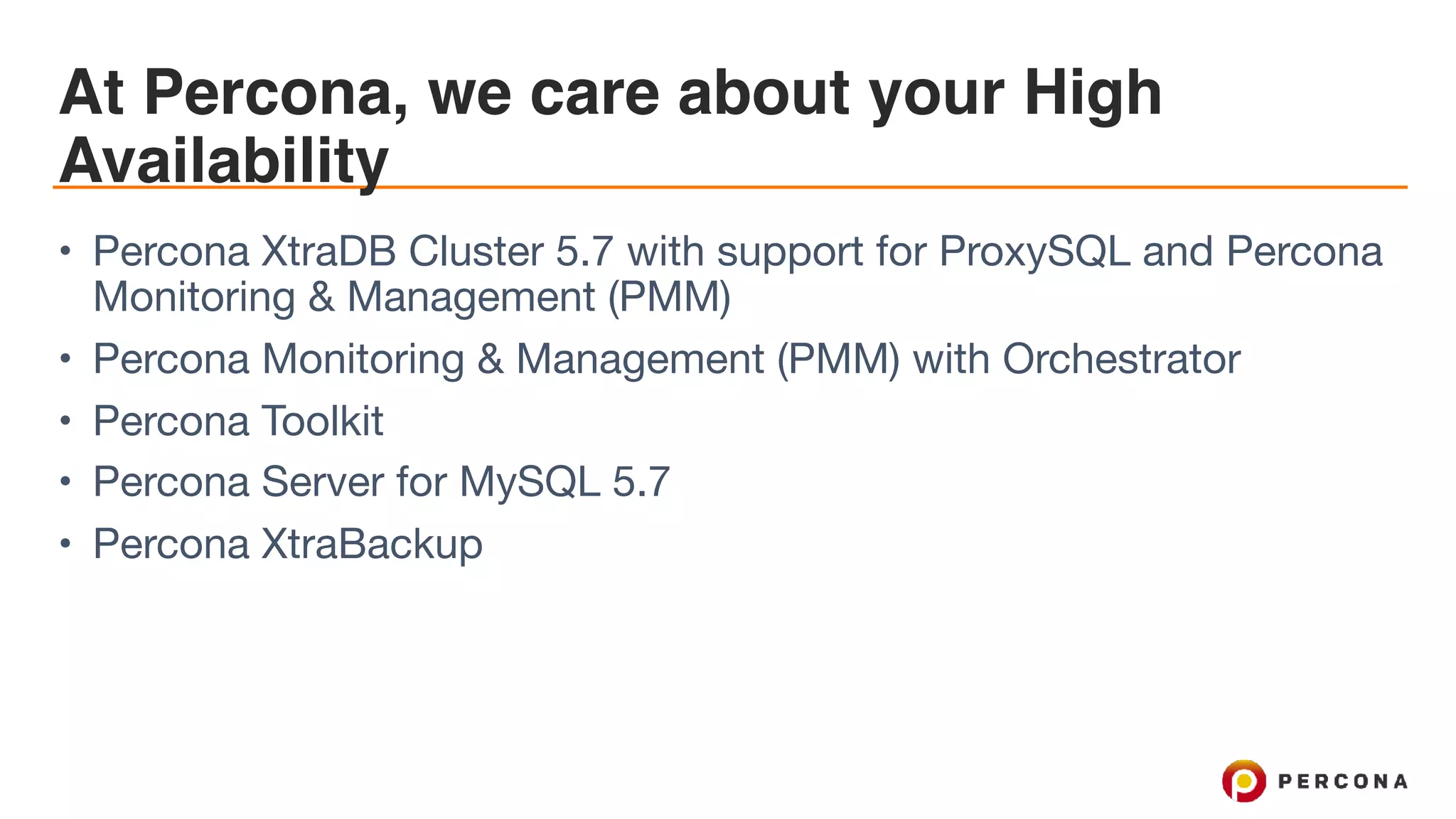
At Percona, we care about your High
Availability
• Percona XtraDB Cluster 5.7 with support for ProxySQL and Percona
Monitoring & Management (PMM)

• Percona Monitoring & Management (PMM) with Orchestrator

• Percona Toolkit

• Percona Server for MySQL 5.7

• Percona XtraBackup
Thank you!
Colin Charles
colin.charles@percona.com / byte@bytebot.net
http://bytebot.net/blog | @bytebot on twitter
slides: slideshare.net/bytebot

OSDC 2018 | Scaling & High Availability MySQL learnings from the past decade+ by Colin Charles

  • 1.
    Scaling & HighAvailability MySQL learnings from the past decade+ Colin Charles, Chief Evangelist, Percona Inc. colin.charles@percona.com / byte@bytebot.net http://www.bytebot.net/blog/ | @bytebot on Twitter OSDC.de, Berlin, Germany 12 June 2018
  • 2.
    whoami • Chief Evangelist,Percona Inc • Focusing on the MySQL ecosystem (MySQL, Percona Server, MariaDB Server), as well as the MongoDB ecosystem (Percona Server for MongoDB) + 100% open source tools from Percona like Percona Monitoring & Management, Percona xtrabackup, Percona Toolkit, etc. • Founding team of MariaDB Server (2009-2016), previously at Monty Program Ab, merged with SkySQL Ab, now MariaDB Corporation • Formerly MySQL AB (exit: Sun Microsystems) • Past lives include The Fedora Project (FESCO), OpenOffice.org • MySQL Community Contributor of the Year Award winner 2014
  • 3.
    License • Creative CommonsBY-NC-SA 4.0 • https://creativecommons.org/licenses/by-nc-sa/4.0/legalcode 

  • 7.
    Uptime Percentile target Maxdowntime per year 90% 36 days 99% 3.65 days 99.5% 1.83 days 99.9% 8.76 hours 99.99% 52.56 minutes 99.999% 5.25 minutes 99.9999% 31.5 seconds
  • 8.
    Estimates of levelsof availability Method Level of Availability Simple replication 98-99.9% Master-Master/MMM 99% SAN 99.5-99.9% DRBD, MHA 99.9% NDBCluster, Galera Cluster, InnoDB Cluster 99.999%
  • 9.
    HA is Redundancy •RAID: disk crashes? Another works • Clustering: server crashes? Another works • Power: fuse blows? Redundant power supplies • Network: Switch/NIC crashes? 2nd network route • Geographical: Datacenter offline/destroyed? Computation to another DC
  • 10.
    Durability • Data storedon disks • Is it really written to the disk? ▪ being durable means calling fsync() on each commit • Is it written in a transactional way to guarantee atomicity, crash safety, integrity?
  • 11.
    High Availability fordatabases • HA is harder for databases • Hardware resources and data need to be redundant • Remember, this isn’t just data - constantly changing data • HA means the operation can continue uninterrupted, not by restoring a new/backup server • uninterrupted: measured in percentiles
  • 12.
    Redundancy through client-sideXA transactions • Client writes to 2 independent but identical databases • HA-JDBC (http://ha-jdbc.github.io/) • No replication anywhere
  • 13.
    InnoDB “recovery” time •innodb_log_file_size • larger = longer recovery times • In 2007, Wikipedia reported 40 minutes with 256MB logs; sometimes it takes 5-10 minutes, sometimes hours • Percona Server 5.5 (XtraDB) - innodb_recovery_stats • But today, there has been paradigm change…
  • 14.
    Redundancy through sharedstorage • Requires specialist hardware, like a SAN • Complex to operate • One set of data is your single point of failure • Cold standby • failover 1-30 minutes • this isn’t scale-out • Active/Active solutions: Oracle RAC
  • 15.
    Redundancy through diskreplication • DRBD • Linux administration vs. DBA skills • Synchronous • Second set of data inaccessible for use • Passive server acting as hot standby • Failover: 1-30 minutes • Performance hit compared to single node performance, with higher average latencies
  • 16.
    Redundancy through MySQLreplication • MySQL replication • Tungsten Replicator • Galera Cluster • MySQL InnoDB Cluster • MySQL Cluster (NDBCLUSTER) • Storage requirements are multiplied • Huge potential for scaling out
  • 17.
    MySQL Replication • Statementbased generally • Row based became available in 5.1, and the default in 5.7 • mixed-mode, resulting in STATEMENT except if calling ▪ UUID function, UDF, CURRENT_USER/USER function, LOAD_FILE function ▪ 2 or more AUTO_INCREMENT columns updated with same statement ▪ server variable used in statement ▪ storage engine doesn’t allow statement based replication, like NDBCLUSTER ▪ default in MariaDB Server 10.2
  • 18.
    MySQL Replication II •Asynchronous by default • Semi-synchronous plugin in 5.5+ • However the holy grail of fully synchronous replication is not part of standard MySQL replication (yet?) • MariaDB Galera Cluster is built-in to MariaDB Server 10.1 • MySQL InnoDB Cluster is available in MySQL 8.0, combining the likes of group replication (the Galera Cluster equivalent), InnoDB, and mysqlsh for maintaining it; it also uses MySQL Router for load balancing purposes
  • 19.
    Semi-synchronous replication • semi-synccapable slave acknowledges transaction event only after written to relay log & flushed to disk • timeout occurs? master reverts to async replication; resumes when slaves catch up • at scale, Facebook runs semi-sync: http:// yoshinorimatsunobu.blogspot.com/2014/04/semi-synchronous- replication-at-facebook.html
  • 20.
    MySQL Replication in5.6 • Global Transaction ID (GTID) • Server UUID • Ignore (master) server IDs (filtering) • Per-schema multi-threaded slave • Group commit in the binary log • Binary log (binlog) checksums • Crash safe binlog and relay logs • Time delayed replication • Parallel replication (per database)
  • 21.
    Replication: START TRANSACTIONWITH CONSISTENT SNAPSHOT • Works with the binlog, possible to obtain the binlog position corresponding to a transactional snapshot of the database without blocking any other queries. • by-product of group commit in the binlog to view commit ordering • Used by the command mysqldump--single-transaction --master- data to do a fully non-blocking backup • Works consistently between transactions involving more than one storage engine • https://kb.askmonty.org/en/enhancements-for-start-transaction-with- consistent/ • Percona Server improved it, by session ID, and also introducing backup locks
  • 22.
    Multi-source replication • Multi-sourcereplication - (real-time) analytics, shard provisioning, backups, etc. • @@default_master_connection contains current connection name (used if connection name is not given) • All master/slave commands take a connection name now (like CHANGE MASTER “connection_name”, SHOW SLAVE “connection_name” STATUS, etc.)
  • 23.
    Global Transaction ID(GTID) • Supports multi-source replication • GTID can be enabled or disabled independently and online for masters or slaves • Slaves using GTID do not have to have binary logging enabled. • (MariaDB) Supports multiple replication domains (independent binlog streams) • Queries in different domains can be run in parallel on the slave.
  • 24.
    Why MariaDB GTIDis different compared to 5.6? • MySQL 5.6 GTID does not support multi-source replication (only 5.7 supports this) • Supports —log-slave-updates=0 for efficiency (like 5.7) • Enabled by default • Turn it on without having to restart the topology (just like 5.7)
  • 25.
    Parallel replication • Multi-sourcereplication from different masters executed in parallel • Queries from different domains are executed in parallel • Queries that are run in parallel on the master are run in parallel on the slave (based on group commit). • Transactions modifying the same table can be updated in parallel on the slave! • Supports both statement based and row based replication.
  • 26.
    All in… sometimesit can get out of sync • Changed information on slave directly • Statement based replication • non-deterministic SQL (UPDATE/DELETE with LIMIT and without ORDER BY) • triggers & stored procedures • Master in MyISAM, slave in InnoDB (deadlocks) • --replication-ignore-db with fully qualified queries • Binlog corruption on master • PURGE BINARY LOGS issued and not enough files to update slave • read_buffer_size larger than max_allowed_packet • Bugs?
  • 27.
    Replication Monitoring • PerconaToolkit is important • pt-slave-find: find slave information from master • pt-table-checksum: online replication consistency check • executes checksum queries on master • pt-table-sync: synchronise table data efficiently • changes data, so backups important
  • 28.
    Replication Monitoring withPMM •http://pmmdemo.percona.com/
  • 29.
    mysqlbinlog versions • ERROR:Error in Log_event::read_log_event(): 'Found invalid event in binary log', data_len: 56, event_type: 30 • 5.6 ships with a “streaming binlog backup server” - v.3.4; MariaDB 10 doesn’t - v.3.3 (fixed in 10.2 - MDEV-8713) • GTID variances! • Beware mysql-client from your Linux distribution
  • 30.
    Slave prefetching • ReplicationBooster • https://github.com/yoshinorim/replication-booster-for-mysql • Prefetch MySQL relay logs to make the SQL thread faster • Tungsten has slave prefetch • Percona Server till 5.6 + MariaDB till 10.1 have InnoDB fake changes
  • 31.
    Changing paradigm: Whatreplaces slave prefetching? • In Percona Server 5.7, slave prefetching has been replaced by doing intra-schema parallel replication • Feature removed from XtraDB • MariaDB Server 10.2 also has this feature removed, as they switched to InnoDB!
  • 32.
    Galera Cluster • InsideMySQL, a replication plugin (wsrep) • Replaces MySQL replication (but can work alongside it too) • True multi-master, active-active solution • Virtually Synchronous • WAN performance: 100-300ms/commit, works in parallel • No slave lag or integrity issues • Automatic node provisioning
  • 34.
    Percona XtraDB Cluster5.7 • Engineering within Percona • Load balancing with ProxySQL (bundled) • PMM integration • Benefits of all the MySQL 5.7 feature-set • ProxySQL admin tool • Safety features enabled (e.g. no accidentally using MyISAM, etc.)
  • 35.
    Group replication • Fullysynchronous replication (update everywhere), self-healing, with elasticity, redundancy • Single primary mode supported • MySQL InnoDB Cluster - a combination of group replication, Router, to make magic! • Recent blogs: • https://www.percona.com/blog/2017/02/24/battle-for-synchronous- replication-in-mysql-galera-vs-group-replication/ • https://www.percona.com/blog/2017/02/15/group-replication-shipped- early/
  • 36.
    Summary of ReplicationPerformance • SAN has "some" latency overhead compared to local disk. Can be great for throughput. • DRBD has a performance penalty • Replication, when implemented correctly, has no performance penalty • But MySQL replication with disk bound data set has single-threaded issues! • Semi-sync is poorer on WAN compared to async • Galera & InnoDB Cluster provide read/write scale-out, thus more performance
  • 37.
    Handling failure • Howdo we find out about failure? • Polling, monitoring, alerts... • Error returned to and handled in client side • What should we do about it? • Direct requests to the spare nodes (or DCs) • How to protect data integrity? • Master-slave is unidirectional: Must ensure there is only one master at all times. • DRBD and SAN have cold-standby: Must mount disks and start mysqld. • In all cases must ensure that 2 disconnected replicas cannot both commit independently. (split brain)
  • 38.
    Frameworks to handlefailure • MySQL-MMM • Severalnines ClusterControl • Orchestrator • MySQL MHA • Percona Replication Manager • Tungsten Replicator • 5.6: mysqlfailover, mysqlrpladmin • (MariaDB) Replication Manager
  • 39.
    Orchestrator • Reads replicationtopologies, keeps state, continuous polling • Modify your topology — move slaves around • Nice GUI, JSON API, CLI
  • 40.
    MySQL MHA • LikeMMM, specialized solution for MySQL replication • Developed by Yoshinori Matsunobu at DeNA • Automated and manual failover options • Topology: 1 master, many slaves • Choose new master by comparing slave binlog positions • Can be used in conjunction with other solutions • http://code.google.com/p/mysql-master-ha/
  • 41.
    Pacemaker • Heartbeat, Corosync,Pacemaker • Resource Agents, Percona-PRM • Percona Replication Manager - cluster, geographical disaster recovery options • Pacemaker agent specialised on MySQL replication • https://github.com/percona/percona-pacemaker-agents/ • Pacemaker Resource Agents 3.9.3+ include Percona Replication Manager (PRM)
  • 42.
    Load Balancers formulti-master clusters • Synchronous multi-master clusters like Galera require load balancers • HAProxy • Galera Load Balancer (GLB) • MaxScale • ProxySQL
  • 43.
    MySQL Router • Routingbetween applications and any backend MySQL servers • Failover • Load Balancing • Pluggable architecture (connection routing)
  • 44.
    MariaDB MaxScale • “Pluggablerouter” that offers connection & statement based load balancing • Possibilities are endless - use it for logging, writing to other databases (besides MySQL), preventing SQL injections via regex filtering, route via hints, query rewriting, have a binlog relay, etc.
  • 45.
    ProxySQL • High PerformanceMySQL proxy with a GPL license • Performance is a priority - the numbers prove it • Can query rewrite • Sharding by host/schema or both, with rule engine + modification to SQL + application logic
  • 46.
    JDBC/PHP drivers • JDBC- multi-host failover feature (just specify master/slave hosts in the properties) • true for MariaDB Java Connector too • PHP handles this too - mysqlnd_ms • Can handle read-write splitting, round robin or random host selection, and more
  • 47.
    Clustering: solution orpart of problem? • "Causes of Downtime in Production MySQL Servers" whitepaper, Baron Schwartz VividCortex • Human error • SAN • Clustering framework + SAN = more problems • Galera/group replication is replication based, has no false positives as there’s no “failover” moment, you don’t need a clustering framework (JDBC or PHP can load balance), and is relatively elegant overall
  • 48.
    Replication type • Competencechoices • Replication: MySQL DBA manages • DRBD: Linux admin manages • SAN: requires domain controller • Operations • DRBD (disk level) = cold standby = longer failover • Replication = hot standby = shorter failover • GTID helps tremendously • Performance • SAN has higher latency than local disk • DRBD has higher latency than local disk • Replication has little overhead • Redundancy • Shared disk = SPoF • Shared nothing = redundant
  • 49.
    SBR vs RBR?Async vs sync? • row based: deterministic • statement based: dangerous • GTID: easier setup & failover of complex topologies • async: data loss in failover • sync: best • multi-threaded slaves: scalability (hello 5.6+, Tungsten)
  • 50.
    What about thecloud? • Usually scalability & high availability is more or less “built-in” • e.g. RDS has multi-AZ (synchronous data replication), but doesn’t give you a read replica; Cloud SQL uses semi-sync replication • Watch out for the SLAs (and automatic upgrades) • Monitoring via PERFORMANCE_SCHEMA • “Bad” nodes do exist; do not assume node provisioning is quick
  • 51.
    Conclusion • MySQL replicationis amazing if you know it (and monitor it) well enough • Large sites run just fine with semi-sync + tooling for automated failover • Galera Cluster/MySQL InnoDB Cluster is great for virtually fully synchronous replication • Don’t forget the need for a load balancer: ProxySQL is nifty • When thinking scaling, think scale out (it is more efficient, and fits modern cloud mantras too!)
  • 52.
    At Percona, wecare about your High Availability • Percona XtraDB Cluster 5.7 with support for ProxySQL and Percona Monitoring & Management (PMM) • Percona Monitoring & Management (PMM) with Orchestrator • Percona Toolkit • Percona Server for MySQL 5.7 • Percona XtraBackup
  • 53.
    Thank you! Colin Charles colin.charles@percona.com/ byte@bytebot.net http://bytebot.net/blog | @bytebot on twitter slides: slideshare.net/bytebot