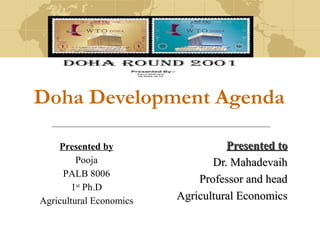
Doha Development Agenda
Presented toPresented to
Dr. MahadevaihDr. Mahadevaih
Professor and headProfessor and head
Agricultural EconomicsAgricultural Economics
Presented by
Pooja
PALB 8006
1st
Ph.D
Agricultural Economics
Overview
History of GATT and WTO
Ministerial conferences
Why negotiate at the WTO?
The launch of DDA
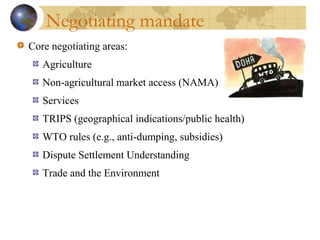
Negotiating mandate
Agricultural issues in DDA
DDA with concern to India
Conclusion
References
GATT
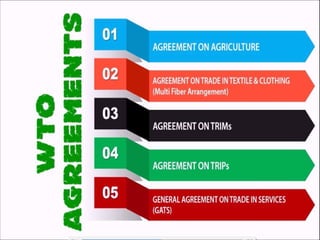
General Agreement on Tariffs and
Trade (GATT)
was a legal agreement between many
countries.
Purpose- promote international trade by
reducing or eliminating trade barriers such
as tariffs or quotas
first discussed during the United Nations
Conference on Trade and Employment and
was the outcome of the failure of negotiating
governments to create the International Trade
Organization (ITO).
GATT was signed by 23 nations in Geneva
on 30 October 1947, and took effect on 1
January 1948.
GATT remained in effect until the signature by 123 nations in
Marrakesh on 14 April 1994, of the Uruguay Round Agreements,
which established the World Trade Organization (WTO) on 1
January 1995.
The WTO is a successor to GATT, and the original GATT text
(GATT 1947) is still in effect under the WTO framework, subject
to the modifications of GATT 1994.
GATT, and its successor WTO, have successfully reduced tariffs.
The average tariff levels for the major GATT participants were
about 22% in 1947, but were 5% after the Uruguay Round in
1999.
WTO
Formation-1 January 1995; 24 years ago
Type-International trade organization
Purpose-Reduction of tariffs and other barriers to trade
Headquarters Centre- Geneva, Switzerland
Region served- Worldwide
Membership- 164 member states
Official language- English, French, Spanish
Director-General- Roberto Azevedo
Budget -197.2 million Swiss francs(approx. 209 million US$) in
2018.[
About WTO
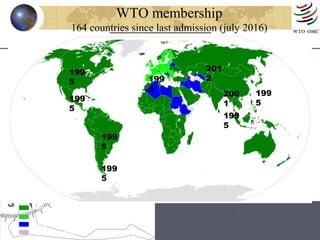
WTO membership
164 countries since last admission (july 2016)
Member states
European Union
Observe states
No member states
201
2
199
5
199
5
199
5
199
5
200
1
199
5
199
5
199
5
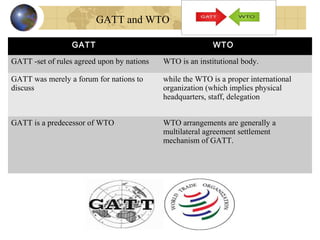
GATT and WTO
GATT WTO
GATT -set of rules agreed upon by nations WTO is an institutional body.
GATT was merely a forum for nations to
discuss
while the WTO is a proper international
organization (which implies physical
headquarters, staff, delegation
GATT is a predecessor of WTO WTO arrangements are generally a
multilateral agreement settlement
mechanism of GATT.
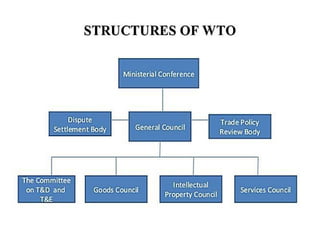
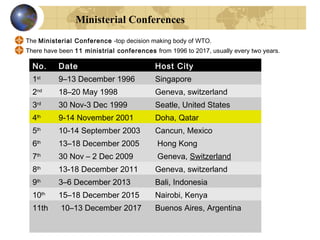
The Ministerial Conference -top decision making body of WTO.
There have been 11 ministrial conferences from 1996 to 2017, usually every two years.
No. Date Host City
1st
9–13 December 1996 Singapore
2nd
18–20 May 1998 Geneva, switzerland
3rd
30 Nov-3 Dec 1999 Seatle, United States
4th
9-14 November 2001 Doha, Qatar
5th
10-14 September 2003 Cancun, Mexico
6th
13–18 December 2005  Hong Kong
7th
30 Nov – 2 Dec 2009  Geneva, Switzerland
8th
13-18 December 2011 Geneva, switzerland
9th
3–6 December 2013  Bali, Indonesia
10th
15–18 December 2015  Nairobi, Kenya
11th  10–13 December 2017 Buenos Aires, Argentina
Ministerial Conferences
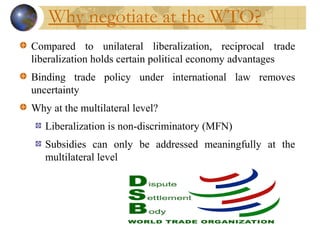
Why negotiate at the WTO?
Compared to unilateral liberalization, reciprocal trade
liberalization holds certain political economy advantages
Binding trade policy under international law removes
uncertainty
Why at the multilateral level?
Liberalization is non-discriminatory (MFN)
Subsidies can only be addressed meaningfully at the
multilateral level
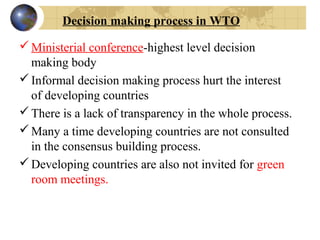
Ministerial conference-highest level decision
making body
Informal decision making process hurt the interest
of developing countries
There is a lack of transparency in the whole process.
Many a time developing countries are not consulted
in the consensus building process.
Developing countries are also not invited for green
room meetings.
Decision making process in WTO
Source: world trade organization
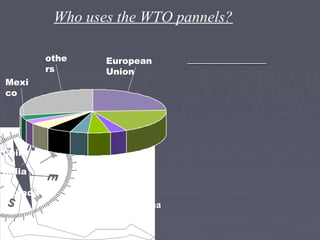
Who uses the WTO pannels?
European
Union
US
A
Ar gentina
Braz
ilJapa
n
othe
rs
Mexi
co
Chile
India
Canada
Source:
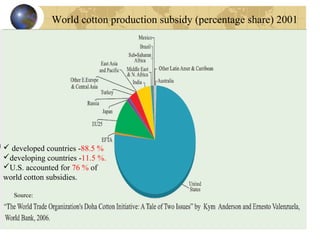
World cotton production subsidy (percentage share) 2001
 developed countries -88.5 %
developing countries -11.5 %.
U.S. accounted for 76 % of
world cotton subsidies.
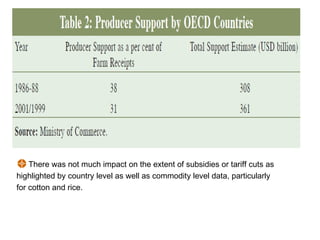
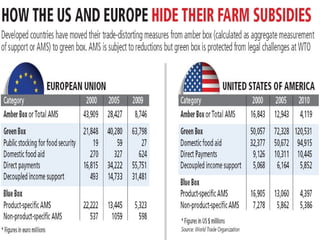
There was not much impact on the extent of subsidies or tariff cuts as
highlighted by country level as well as commodity level data, particularly
for cotton and rice.
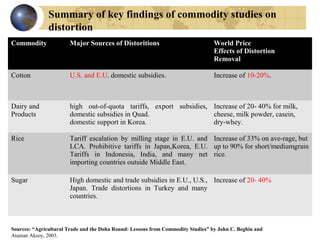
Commodity Major Sources of Distoritions World Price
Effects of Distortion
Removal
Cotton U.S. and E.U. domestic subsidies. Increase of 10-20%.
Dairy and
Products
high out-of-quota tariffs, export subsidies,
domestic subsidies in Quad.
domestic support in Korea.
Increase of 20- 40% for milk,
cheese, milk powder, casein,
dry-whey.
Rice Tariff escalation by milling stage in E.U. and
LCA. Prohibitive tariffs in Japan,Korea, E.U.
Tariffs in Indonesia, India, and many net
importing countries outside Middle East.
Increase of 33% on ave-rage, but
up to 90% for short/mediumgrain
rice.
Sugar High domestic and trade subsidies in E.U., U.S.,
Japan. Trade distortions in Turkey and many
countries.
Increase of 20- 40%
Summary of key findings of commodity studies on
distortion
Sources: “Agricultural Trade and the Doha Round: Lessons from Commodity Studies” by John C. Beghin and
Ataman Aksoy, 2003.
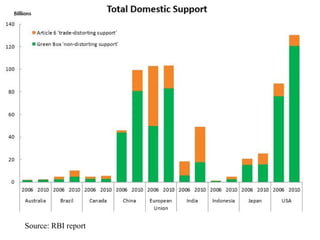
Source: RBI report
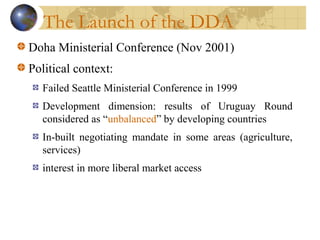
The Launch of the DDA
Doha Ministerial Conference (Nov 2001)
Political context:
Failed Seattle Ministerial Conference in 1999
Development dimension: results of Uruguay Round
considered as “unbalanced” by developing countries
In-built negotiating mandate in some areas (agriculture,
services)
interest in more liberal market access
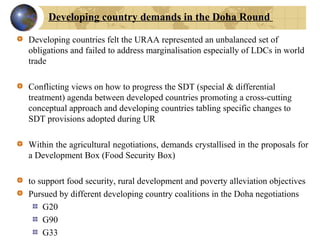
Developing countries felt the URAA represented an unbalanced set of
obligations and failed to address marginalisation especially of LDCs in world
trade
Conflicting views on how to progress the SDT (special & differential
treatment) agenda between developed countries promoting a cross-cutting
conceptual approach and developing countries tabling specific changes to
SDT provisions adopted during UR
Within the agricultural negotiations, demands crystallised in the proposals for
a Development Box (Food Security Box)
to support food security, rural development and poverty alleviation objectives
Pursued by different developing country coalitions in the Doha negotiations
G20
G90
G33
Developing country demands in the Doha Round
History:
•Launched at the 4th
MC in Doha, Qatar in
November 2001.
•Succeeded the Uruguay round and the three
ministerial conferences at Singapore (1996),
Geneva (1998) and Seattle (1999).
Objectives:
•Lower trade barriers around the world.
•Committing all countries to negotiations opening
agricultural and manufacturing markets, as well as
trade-in-services (GATS) negotiations and
expanded intellectual property regulation (TRIPS).
•To Make trade rules fairer for developing
countries
Negotiating mandate
Core negotiating areas:
Agriculture
Non-agricultural market access (NAMA)
Services
TRIPS (geographical indications/public health)
WTO rules (e.g., anti-dumping, subsidies)
Dispute Settlement Understanding
Trade and the Environment
 
4 Market Access: Reductions in Highest Tariffs
Elimination  of  Export  Subsidies  Trade  Distorting  Domestic 
Support
 Farm Support Reductions Over Time 
Issue: Many Developing Countries, G-20, G-33 Want Major Cuts 
in  US  Trade  Distorting  Domestic  Support 
Doha Work Program: Three Pillars of Trade Reform-
KEY ISSUES AT DOHA
•Agriculture has become the linchpin of the agenda for both developing  
and developed countries.
•A  review  of provisions giving special and differential treatment to
developing countries.
•Resolve  problems that developing countries are having in implementing  
current trade obligations.
•Key Interests for ASEAN countries –
Greater market access for industrial goods.
Trade facilitation.
Anti dumping and subsidies.
Technical Co-operation.
Effective dispute settlement mechanism
• Doha MC declaration on agriculture calls  for comprehensive 
negotiations aimed at substantial  improvements in market 
access, reduction of export subsidies.
• The Declaration also provides that special and different 
treatment for developing countries would be an integral part of  
all parts of negotiations.
• The Declaration took note of non-trade concerns reflected in  
negotiations proposal of various member countries and  
confirmed that they would be taken in to account in  
negotiations.
Ministerial Declaration
1. Developed countries agreed to reduce their subsidies
2. Differential preferential special treatment
-the developed countries will reduce their import duties and subsidies
-long term is given for developing countries for implementation
3. Labour issues- labour issues will not be taken by WTO anymore but 
those issues will be taken by ILO.
4. Addition of new clauses
a) TRIPS v/s Public health
b) NAMA- reducing the tariffs for industrial goods- to increase market 
access
Negotiations favoring to developing countries
1. New round of negotiations started
2. Developing countries agreed to reduce the duty on industrial goods
3. Singapore issues will be taken care-Consider negotiations on the four so-
called Singapore issues (investment, competition policy, transparency in 
government procurment, trade facilitation)
4. Environmental concerns
       
These negotiations were inclusive growth oriented but later on, developed 
counties withdrew from these agreements
Negotiations favoring to developed countries
Types of Impasses of relevance at DOHA round
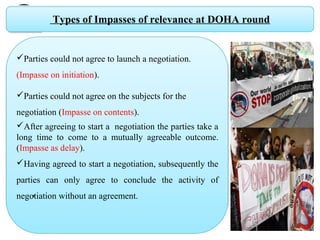
Parties could not agree to launch a negotiation.
(Impasse on initiation).
Parties could not agree on the subjects for the  
negotiation (Impasse on contents).
After agreeing to start a  negotiation the parties take a 
long  time  to  come  to  a  mutually  agreeable  outcome. 
(Impasse as delay).
Having agreed to start a negotiation, subsequently the 
parties  can  only  agree  to  conclude  the  activity  of 
negotiation without an agreement.,
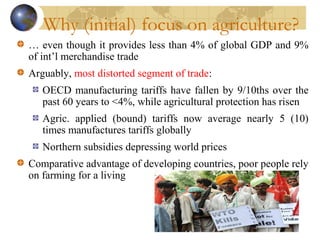
Why (initial) focus on agriculture?
… even though it provides less than 4% of global GDP and 9% 
of int’l merchandise trade
Arguably, most distorted segment of trade:
OECD manufacturing tariffs have fallen by 9/10ths over the 
past 60 years to <4%, while agricultural protection has risen
Agric.  applied  (bound)  tariffs  now  average  nearly  5  (10) 
times manufactures tariffs globally
Northern subsidies depressing world prices
Comparative advantage of developing countries, poor people rely 
on farming for a living
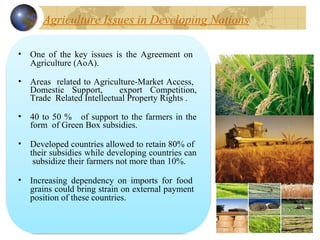
Agriculture Issues in Developing Nations
• One  of  the  key  issues  is  the  Agreement  on   
Agriculture (AoA).
• Areas  related to Agriculture-Market Access,  
Domestic  Support, export  Competition, 
Trade  Related Intellectual Property Rights .
• 40 to 50 %   of support to the farmers in the 
form  of Green Box subsidies.
• Developed countries allowed to retain 80% of  
their subsidies while developing countries can 
 subsidize their farmers not more than 10%.
• Increasing  dependency  on  imports  for  food   
grains could bring strain on external payment  
position of these countries.
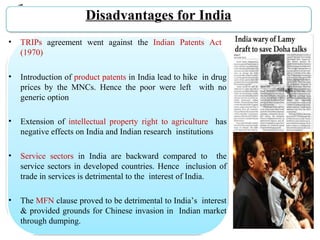
Disadvantages for India
• TRIPs  agreement  went  against  the  Indian  Patents  Act   
(1970)
• Introduction of product patents in India lead to hike  in drug 
prices  by  the  MNCs.  Hence  the  poor  were  left    with  no 
generic option
• Extension  of  intellectual  property  right  to  agriculture    has 
negative effects on India and Indian research  institutions
• Service  sectors  in  India  are  backward  compared  to    the 
service sectors in developed countries. Hence  inclusion of 
trade in services is detrimental to the  interest of India.
• The MFN clause proved to be detrimental to India’s  interest 
& provided grounds for Chinese invasion in  Indian market 
through dumping.
High poverty alleviation potential of agriculture
In  agriculture,  barriers  such  as  tariff  peaks,  tariff  escalation, 
domestic support and export subsidies continue to restrict effective 
market access of Indian agricultural products to developed country 
markets.
 India’s own tariffs have fewer peaks. Peak tariffs are applied to 
only  1.3%  of  tariff  lines  in  India,  versus  20%  of  tariff  lines  in 
developed countries. 
If there is full trade liberalisation in agriculture, India, as a net food 
exporting country, is likely to see significant welfare gains.
  India’s  exports  are  likely  to  increase  by  13%  if  trade  distorting 
domestic support in developed countries is reduced. The main sectors 
which would gain would be cereals, sugar and dairy products.
Simulations show that roughly 100 million people could be lifted
out of poverty by liberalisation in the developed countries in
agriculture.
Capacity building initiatives are required to help Indian farmers
integrate better into the international market and also to meet quality
issues in order to overcome the exacting regimes of sanitary and
phyto-sanitary measures.
Consolidation of land holdings, better infrastructure, better use of
IT, and marketing reforms are needed.
Continued…….
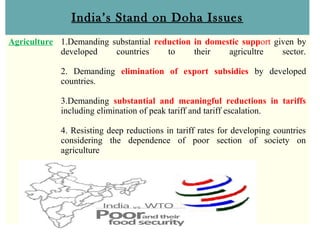
India’s Stand on Doha Issues
Agriculture 1.Demanding substantial reduction in domestic support given by
developed countries to their agricultre sector.
2. Demanding elimination of export subsidies by developed
countries.
3.Demanding substantial and meaningful reductions in tariffs
including elimination of peak tariff and tariff escalation.
4. Resisting deep reductions in tariff rates for developing countries
considering the dependence of poor section of society on
agriculture
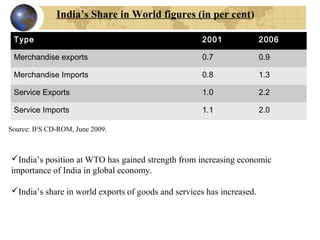
Type 2001 2006
Merchandise exports 0.7 0.9
Merchandise Imports 0.8 1.3
Service Exports 1.0 2.2
Service Imports 1.1 2.0
India’s Share in World figures (in per cent)
Source: IFS CD-ROM, June 2009.
India’s position at WTO has gained strength from increasing economic
importance of India in global economy.
India’s share in world exports of goods and services has increased.
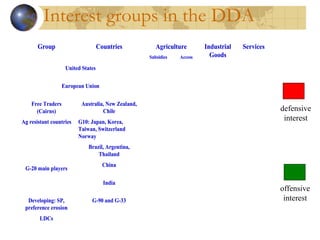
Interest groups in the DDA
LDCs
G-90 and G-33Developing: SP,
preference erosion
India
China
Brazil, Argentina,
Thailand
G-20 main players
G10: Japan, Korea,
Taiwan, Switzerland
Norway
Ag resistant countries
Australia, New Zealand,
Chile
Free Traders
(Cairns)
European Union
United States
AccessSubsidies
ServicesIndustrial
Goods
AgricultureCountriesGroup
LDCs
G-90 and G-33Developing: SP,
preference erosion
India
China
Brazil, Argentina,
Thailand
G-20 main players
G10: Japan, Korea,
Taiwan, Switzerland
Norway
Ag resistant countries
Australia, New Zealand,
Chile
Free Traders
(Cairns)
European Union
United States
AccessSubsidies
ServicesIndustrial
Goods
AgricultureCountriesGroup
defensive
interest
offensive
interest
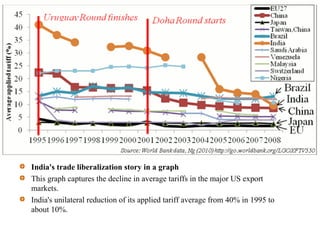
India's trade liberalization story in a graph
This graph captures the decline in average tariffs in the major US export
markets.
India's unilateral reduction of its applied tariff average from 40% in 1995 to
about 10%.
# the MC in Doha adopted the Development Agenda,
# which calls for a more coherent approach to trade and
development and puts the needs and interests of the developing
countries at the heart of the WTO's work program.
# The agenda includes new trade talks;
-an action program to resolve developing countries' complaints
about the implementation of Uruguay Round agreements;
- an accord on TRIPS ensuring that patent protection does not block
developing countries' access to affordable medicines.
# The conference also paved the way for China and Taiwan
Province of China to get full membership in the WTO.
Outcome of Doha
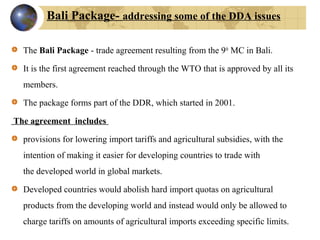
The Bali Package - trade agreement resulting from the 9th
MC in Bali.
It is the first agreement reached through the WTO that is approved by all its
members.
The package forms part of the DDR, which started in 2001.
The agreement includes
provisions for lowering import tariffs and agricultural subsidies, with the
intention of making it easier for developing countries to trade with
the developed world in global markets.
Developed countries would abolish hard import quotas on agricultural
products from the developing world and instead would only be allowed to
charge tariffs on amounts of agricultural imports exceeding specific limits.
Bali Package- addressing some of the DDA issues
Doha Round meant to be a development round
Developing countries dissatisfied with outcome of Uruguay
Round agreement on agriculture
Developing countries have conflicting interests in the outcome
of agricultural negotiations
Can sufficient flexibility be offered to developing countries
while ensuring sufficient negotiating gains for developed
countries?
Conclusion
 Editorial, New York Times: "What Development Round?"
 Bruce Stokes, Columnist, The National Journal: "Doha's Winners and
Losers“
 Esty, Daniel (2002) ‘The World Trade Organization’s Legitimacy Crisis’,
World Trade Review 1 (1): 7-22
 H. Ashok Chandra Prasad, “WTO Negotiations: Some Important Issues and
 Strategies for India”, 1999, Selected Policy Paper, Common Wealth.
 RBI reort on Doha round
References
Doha development agenda

Doha development agenda

  • 1.
    Doha Development Agenda PresentedtoPresented to Dr. MahadevaihDr. Mahadevaih Professor and headProfessor and head Agricultural EconomicsAgricultural Economics Presented by Pooja PALB 8006 1st Ph.D Agricultural Economics
  • 2.
    Overview History of GATTand WTO Ministerial conferences Why negotiate at the WTO? The launch of DDA Negotiating mandate Agricultural issues in DDA DDA with concern to India Conclusion References
  • 3.
    GATT General Agreement onTariffs and Trade (GATT) was a legal agreement between many countries. Purpose- promote international trade by reducing or eliminating trade barriers such as tariffs or quotas first discussed during the United Nations Conference on Trade and Employment and was the outcome of the failure of negotiating governments to create the International Trade Organization (ITO). GATT was signed by 23 nations in Geneva on 30 October 1947, and took effect on 1 January 1948.
  • 4.
    GATT remained ineffect until the signature by 123 nations in Marrakesh on 14 April 1994, of the Uruguay Round Agreements, which established the World Trade Organization (WTO) on 1 January 1995. The WTO is a successor to GATT, and the original GATT text (GATT 1947) is still in effect under the WTO framework, subject to the modifications of GATT 1994. GATT, and its successor WTO, have successfully reduced tariffs. The average tariff levels for the major GATT participants were about 22% in 1947, but were 5% after the Uruguay Round in 1999. WTO
  • 5.
    Formation-1 January 1995;24 years ago Type-International trade organization Purpose-Reduction of tariffs and other barriers to trade Headquarters Centre- Geneva, Switzerland Region served- Worldwide Membership- 164 member states Official language- English, French, Spanish Director-General- Roberto Azevedo Budget -197.2 million Swiss francs(approx. 209 million US$) in 2018.[ About WTO
  • 6.
    WTO membership 164 countriessince last admission (july 2016) Member states European Union Observe states No member states 201 2 199 5 199 5 199 5 199 5 200 1 199 5 199 5 199 5
  • 7.
    GATT and WTO GATTWTO GATT -set of rules agreed upon by nations WTO is an institutional body. GATT was merely a forum for nations to discuss while the WTO is a proper international organization (which implies physical headquarters, staff, delegation GATT is a predecessor of WTO WTO arrangements are generally a multilateral agreement settlement mechanism of GATT.
  • 10.
    The Ministerial Conference -top decisionmaking body of WTO. There have been 11 ministrial conferences from 1996 to 2017, usually every two years. No. Date Host City 1st 9–13 December 1996 Singapore 2nd 18–20 May 1998 Geneva, switzerland 3rd 30 Nov-3 Dec 1999 Seatle, United States 4th 9-14 November 2001 Doha, Qatar 5th 10-14 September 2003 Cancun, Mexico 6th 13–18 December 2005  Hong Kong 7th 30 Nov – 2 Dec 2009  Geneva, Switzerland 8th 13-18 December 2011 Geneva, switzerland 9th 3–6 December 2013  Bali, Indonesia 10th 15–18 December 2015  Nairobi, Kenya 11th  10–13 December 2017 Buenos Aires, Argentina Ministerial Conferences
  • 11.
    Why negotiate atthe WTO? Compared to unilateral liberalization, reciprocal trade liberalization holds certain political economy advantages Binding trade policy under international law removes uncertainty Why at the multilateral level? Liberalization is non-discriminatory (MFN) Subsidies can only be addressed meaningfully at the multilateral level
  • 12.
    Ministerial conference-highest leveldecision making body Informal decision making process hurt the interest of developing countries There is a lack of transparency in the whole process. Many a time developing countries are not consulted in the consensus building process. Developing countries are also not invited for green room meetings. Decision making process in WTO
  • 13.
    Source: world tradeorganization Who uses the WTO pannels? European Union US A Ar gentina Braz ilJapa n othe rs Mexi co Chile India Canada
  • 14.
    Source: World cotton productionsubsidy (percentage share) 2001  developed countries -88.5 % developing countries -11.5 %. U.S. accounted for 76 % of world cotton subsidies.
  • 15.
    There was notmuch impact on the extent of subsidies or tariff cuts as highlighted by country level as well as commodity level data, particularly for cotton and rice.
  • 16.
    Commodity Major Sourcesof Distoritions World Price Effects of Distortion Removal Cotton U.S. and E.U. domestic subsidies. Increase of 10-20%. Dairy and Products high out-of-quota tariffs, export subsidies, domestic subsidies in Quad. domestic support in Korea. Increase of 20- 40% for milk, cheese, milk powder, casein, dry-whey. Rice Tariff escalation by milling stage in E.U. and LCA. Prohibitive tariffs in Japan,Korea, E.U. Tariffs in Indonesia, India, and many net importing countries outside Middle East. Increase of 33% on ave-rage, but up to 90% for short/mediumgrain rice. Sugar High domestic and trade subsidies in E.U., U.S., Japan. Trade distortions in Turkey and many countries. Increase of 20- 40% Summary of key findings of commodity studies on distortion Sources: “Agricultural Trade and the Doha Round: Lessons from Commodity Studies” by John C. Beghin and Ataman Aksoy, 2003.
  • 17.
  • 19.
    The Launch ofthe DDA Doha Ministerial Conference (Nov 2001) Political context: Failed Seattle Ministerial Conference in 1999 Development dimension: results of Uruguay Round considered as “unbalanced” by developing countries In-built negotiating mandate in some areas (agriculture, services) interest in more liberal market access
  • 20.
    Developing countries feltthe URAA represented an unbalanced set of obligations and failed to address marginalisation especially of LDCs in world trade Conflicting views on how to progress the SDT (special & differential treatment) agenda between developed countries promoting a cross-cutting conceptual approach and developing countries tabling specific changes to SDT provisions adopted during UR Within the agricultural negotiations, demands crystallised in the proposals for a Development Box (Food Security Box) to support food security, rural development and poverty alleviation objectives Pursued by different developing country coalitions in the Doha negotiations G20 G90 G33 Developing country demands in the Doha Round
  • 21.
    History: •Launched at the4th MC in Doha, Qatar in November 2001. •Succeeded the Uruguay round and the three ministerial conferences at Singapore (1996), Geneva (1998) and Seattle (1999). Objectives: •Lower trade barriers around the world. •Committing all countries to negotiations opening agricultural and manufacturing markets, as well as trade-in-services (GATS) negotiations and expanded intellectual property regulation (TRIPS). •To Make trade rules fairer for developing countries
  • 22.
    Negotiating mandate Core negotiatingareas: Agriculture Non-agricultural market access (NAMA) Services TRIPS (geographical indications/public health) WTO rules (e.g., anti-dumping, subsidies) Dispute Settlement Understanding Trade and the Environment
  • 23.
      4 Market Access: Reductions in Highest Tariffs Elimination  of Export  Subsidies  Trade  Distorting  Domestic  Support  Farm Support Reductions Over Time  Issue: Many Developing Countries, G-20, G-33 Want Major Cuts  in  US  Trade  Distorting  Domestic  Support  Doha Work Program: Three Pillars of Trade Reform-
  • 25.
    KEY ISSUES ATDOHA •Agriculture has become the linchpin of the agenda for both developing   and developed countries. •A  review  of provisions giving special and differential treatment to developing countries. •Resolve  problems that developing countries are having in implementing   current trade obligations. •Key Interests for ASEAN countries – Greater market access for industrial goods. Trade facilitation. Anti dumping and subsidies. Technical Co-operation. Effective dispute settlement mechanism
  • 26.
  • 27.
  • 28.
  • 29.
    Types of Impassesof relevance at DOHA round Parties could not agree to launch a negotiation. (Impasse on initiation). Parties could not agree on the subjects for the   negotiation (Impasse on contents). After agreeing to start a  negotiation the parties take a  long  time  to  come  to  a  mutually  agreeable  outcome.  (Impasse as delay). Having agreed to start a negotiation, subsequently the  parties  can  only  agree  to  conclude  the  activity  of  negotiation without an agreement.,
  • 30.
    Why (initial) focuson agriculture? … even though it provides less than 4% of global GDP and 9%  of int’l merchandise trade Arguably, most distorted segment of trade: OECD manufacturing tariffs have fallen by 9/10ths over the  past 60 years to <4%, while agricultural protection has risen Agric.  applied  (bound)  tariffs  now  average  nearly  5  (10)  times manufactures tariffs globally Northern subsidies depressing world prices Comparative advantage of developing countries, poor people rely  on farming for a living
  • 31.
    Agriculture Issues inDeveloping Nations • One  of  the  key  issues  is  the  Agreement  on    Agriculture (AoA). • Areas  related to Agriculture-Market Access,   Domestic  Support, export  Competition,  Trade  Related Intellectual Property Rights . • 40 to 50 %   of support to the farmers in the  form  of Green Box subsidies. • Developed countries allowed to retain 80% of   their subsidies while developing countries can   subsidize their farmers not more than 10%. • Increasing  dependency  on  imports  for  food    grains could bring strain on external payment   position of these countries.
  • 32.
    Disadvantages for India •TRIPs  agreement  went  against  the  Indian  Patents  Act    (1970) • Introduction of product patents in India lead to hike  in drug  prices  by  the  MNCs.  Hence  the  poor  were  left    with  no  generic option • Extension  of  intellectual  property  right  to  agriculture    has  negative effects on India and Indian research  institutions • Service  sectors  in  India  are  backward  compared  to    the  service sectors in developed countries. Hence  inclusion of  trade in services is detrimental to the  interest of India. • The MFN clause proved to be detrimental to India’s  interest  & provided grounds for Chinese invasion in  Indian market  through dumping.
  • 33.
    High poverty alleviationpotential of agriculture In  agriculture,  barriers  such  as  tariff  peaks,  tariff  escalation,  domestic support and export subsidies continue to restrict effective  market access of Indian agricultural products to developed country  markets.  India’s own tariffs have fewer peaks. Peak tariffs are applied to  only  1.3%  of  tariff  lines  in  India,  versus  20%  of  tariff  lines  in  developed countries.  If there is full trade liberalisation in agriculture, India, as a net food  exporting country, is likely to see significant welfare gains.   India’s  exports  are  likely  to  increase  by  13%  if  trade  distorting  domestic support in developed countries is reduced. The main sectors  which would gain would be cereals, sugar and dairy products.
  • 34.
    Simulations show thatroughly 100 million people could be lifted out of poverty by liberalisation in the developed countries in agriculture. Capacity building initiatives are required to help Indian farmers integrate better into the international market and also to meet quality issues in order to overcome the exacting regimes of sanitary and phyto-sanitary measures. Consolidation of land holdings, better infrastructure, better use of IT, and marketing reforms are needed. Continued…….
  • 35.
    India’s Stand onDoha Issues Agriculture 1.Demanding substantial reduction in domestic support given by developed countries to their agricultre sector. 2. Demanding elimination of export subsidies by developed countries. 3.Demanding substantial and meaningful reductions in tariffs including elimination of peak tariff and tariff escalation. 4. Resisting deep reductions in tariff rates for developing countries considering the dependence of poor section of society on agriculture
  • 36.
    Type 2001 2006 Merchandiseexports 0.7 0.9 Merchandise Imports 0.8 1.3 Service Exports 1.0 2.2 Service Imports 1.1 2.0 India’s Share in World figures (in per cent) Source: IFS CD-ROM, June 2009. India’s position at WTO has gained strength from increasing economic importance of India in global economy. India’s share in world exports of goods and services has increased.
  • 37.
    Interest groups inthe DDA LDCs G-90 and G-33Developing: SP, preference erosion India China Brazil, Argentina, Thailand G-20 main players G10: Japan, Korea, Taiwan, Switzerland Norway Ag resistant countries Australia, New Zealand, Chile Free Traders (Cairns) European Union United States AccessSubsidies ServicesIndustrial Goods AgricultureCountriesGroup LDCs G-90 and G-33Developing: SP, preference erosion India China Brazil, Argentina, Thailand G-20 main players G10: Japan, Korea, Taiwan, Switzerland Norway Ag resistant countries Australia, New Zealand, Chile Free Traders (Cairns) European Union United States AccessSubsidies ServicesIndustrial Goods AgricultureCountriesGroup defensive interest offensive interest
  • 38.
    India's trade liberalizationstory in a graph This graph captures the decline in average tariffs in the major US export markets. India's unilateral reduction of its applied tariff average from 40% in 1995 to about 10%.
  • 39.
    # the MCin Doha adopted the Development Agenda, # which calls for a more coherent approach to trade and development and puts the needs and interests of the developing countries at the heart of the WTO's work program. # The agenda includes new trade talks; -an action program to resolve developing countries' complaints about the implementation of Uruguay Round agreements; - an accord on TRIPS ensuring that patent protection does not block developing countries' access to affordable medicines. # The conference also paved the way for China and Taiwan Province of China to get full membership in the WTO. Outcome of Doha
  • 40.
    The Bali Package- trade agreement resulting from the 9th MC in Bali. It is the first agreement reached through the WTO that is approved by all its members. The package forms part of the DDR, which started in 2001. The agreement includes provisions for lowering import tariffs and agricultural subsidies, with the intention of making it easier for developing countries to trade with the developed world in global markets. Developed countries would abolish hard import quotas on agricultural products from the developing world and instead would only be allowed to charge tariffs on amounts of agricultural imports exceeding specific limits. Bali Package- addressing some of the DDA issues
  • 41.
    Doha Round meantto be a development round Developing countries dissatisfied with outcome of Uruguay Round agreement on agriculture Developing countries have conflicting interests in the outcome of agricultural negotiations Can sufficient flexibility be offered to developing countries while ensuring sufficient negotiating gains for developed countries? Conclusion
  • 42.
     Editorial, NewYork Times: "What Development Round?"  Bruce Stokes, Columnist, The National Journal: "Doha's Winners and Losers“  Esty, Daniel (2002) ‘The World Trade Organization’s Legitimacy Crisis’, World Trade Review 1 (1): 7-22  H. Ashok Chandra Prasad, “WTO Negotiations: Some Important Issues and  Strategies for India”, 1999, Selected Policy Paper, Common Wealth.  RBI reort on Doha round References