EXERCISES:
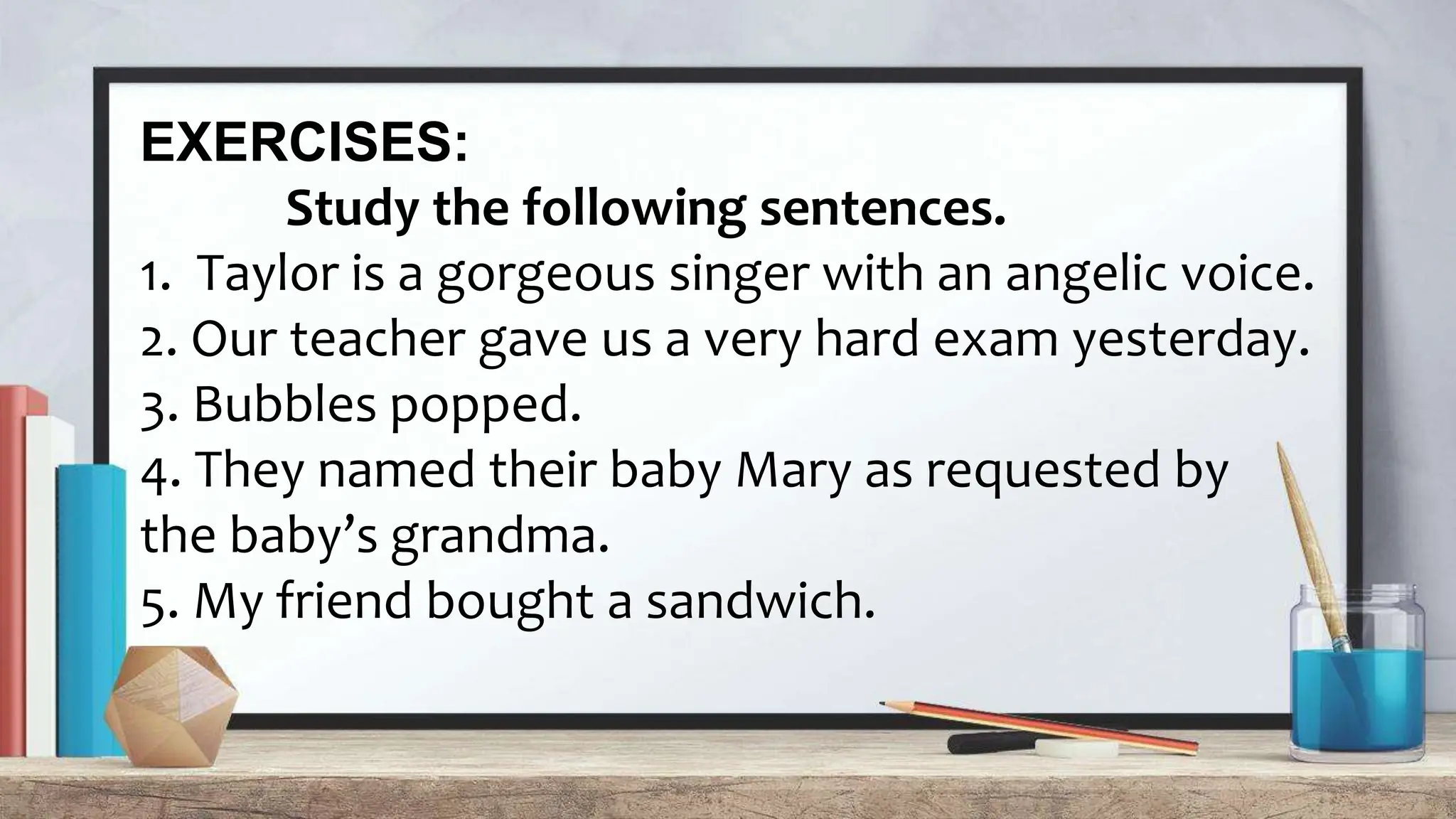
Study the following sentences.
1. Taylor is a gorgeous singer with an angelic voice.
2. Our teacher gave us a very hard exam yesterday.
3. Bubbles popped.
4. They named their baby Mary as requested by
the baby’s grandma.
5. My friend bought a sandwich.
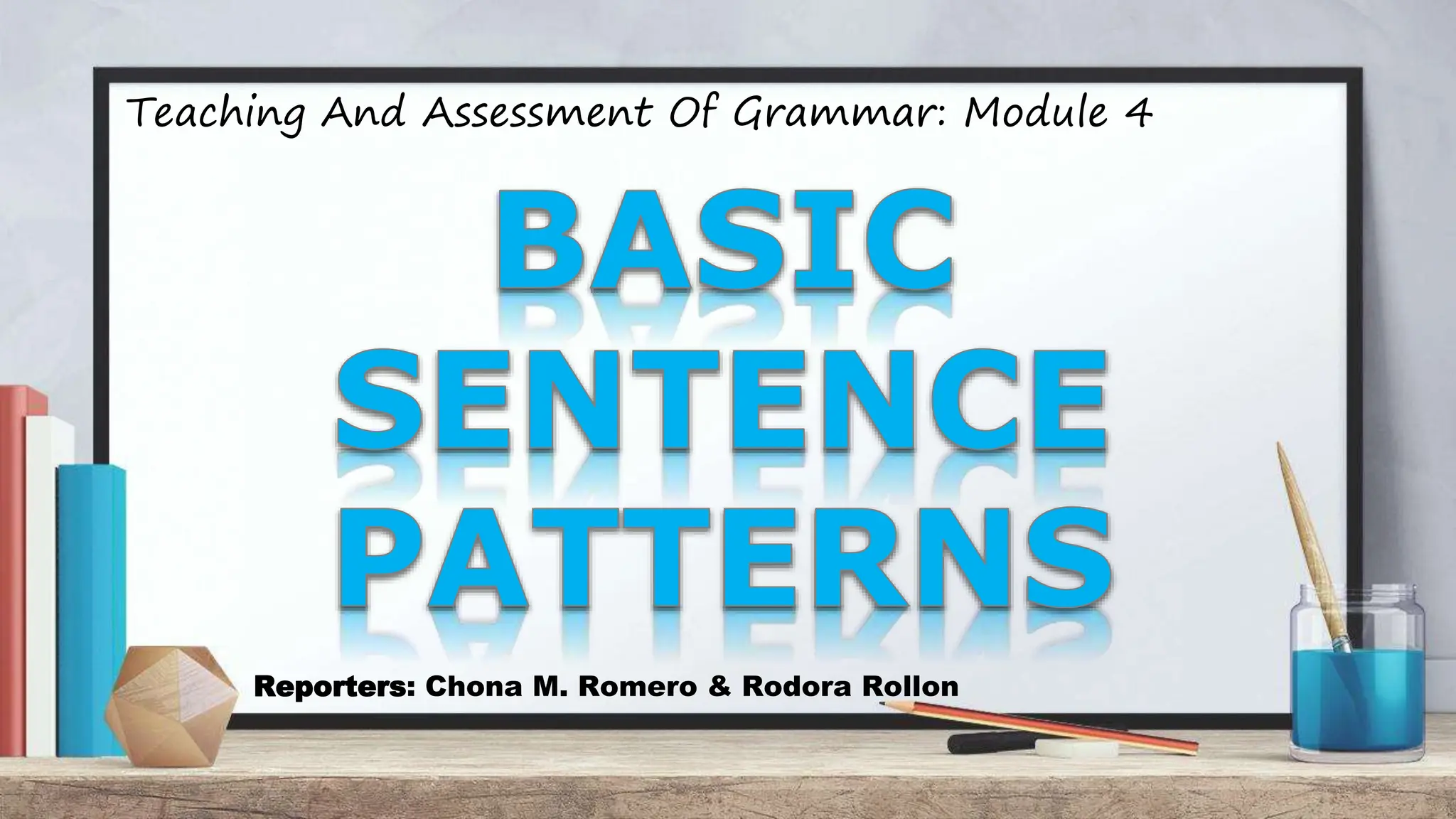
Reporters: Chona M. Romero & Rodora Rollon
Teaching And Assessment Of Grammar: Module 4
3
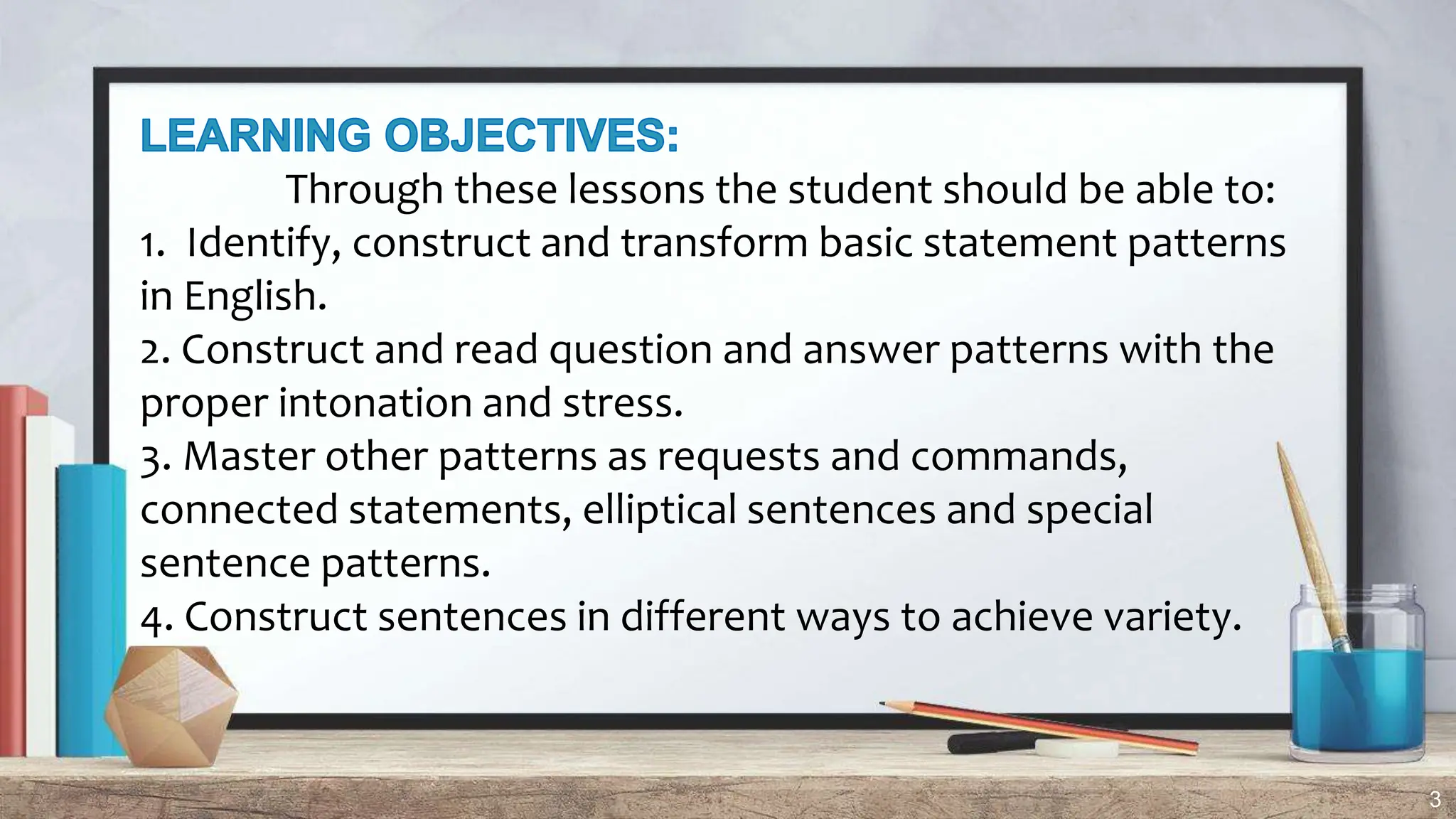
Through these lessons the student should be able to:
1. Identify, construct and transform basic statement patterns
in English.
2. Construct and read question and answer patterns with the
proper intonation and stress.
3. Master other patterns as requests and commands,
connected statements, elliptical sentences and special
sentence patterns.
4. Construct sentences in different ways to achieve variety.
4
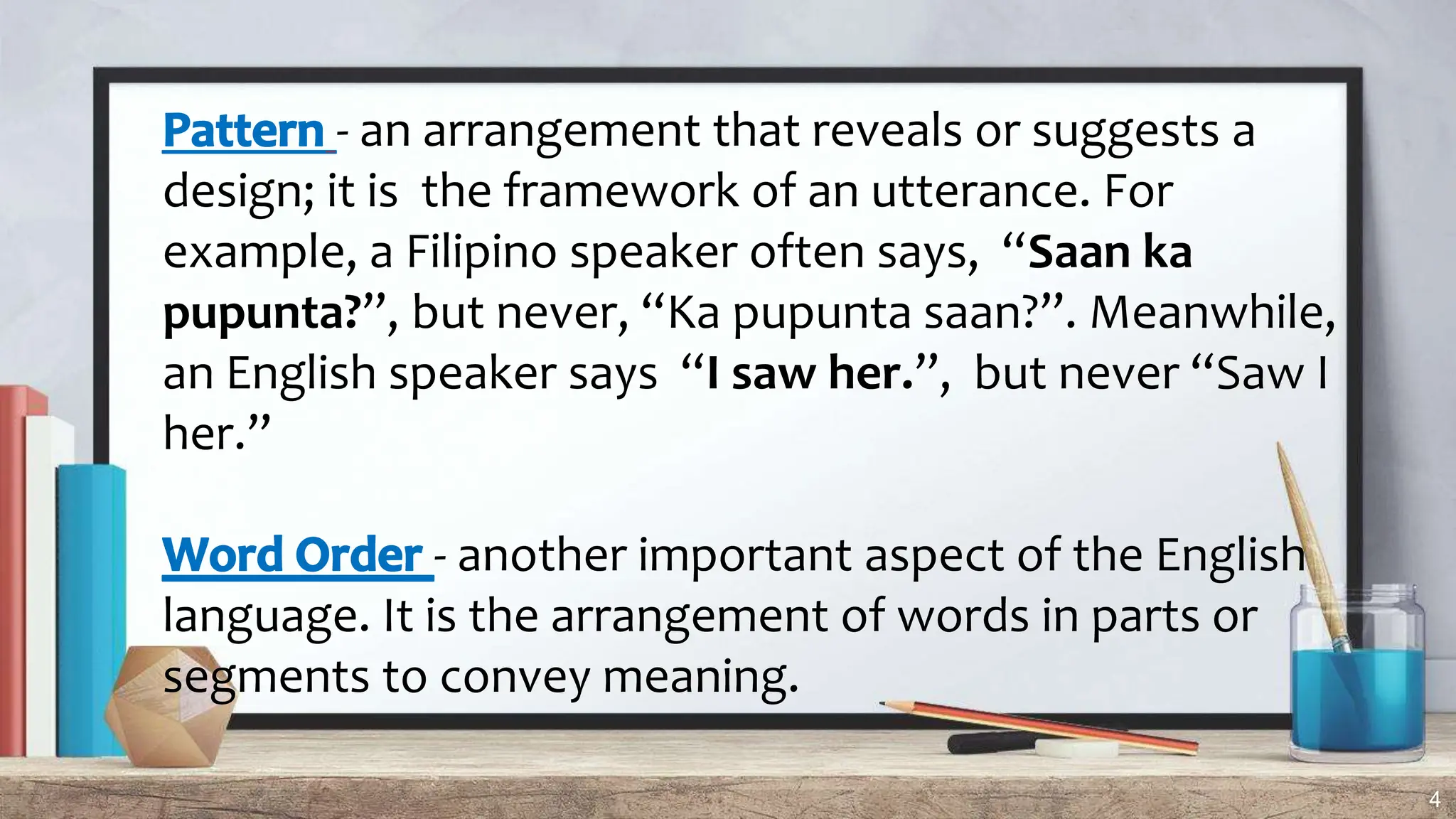
- an arrangement that reveals or suggests a
design; it is the framework of an utterance. For
example, a Filipino speaker often says, “Saan ka
pupunta?”, but never, “Ka pupunta saan?”. Meanwhile,
an English speaker says “I saw her.”, but never “Saw I
her.”
- another important aspect of the English
language. It is the arrangement of words in parts or
segments to convey meaning.
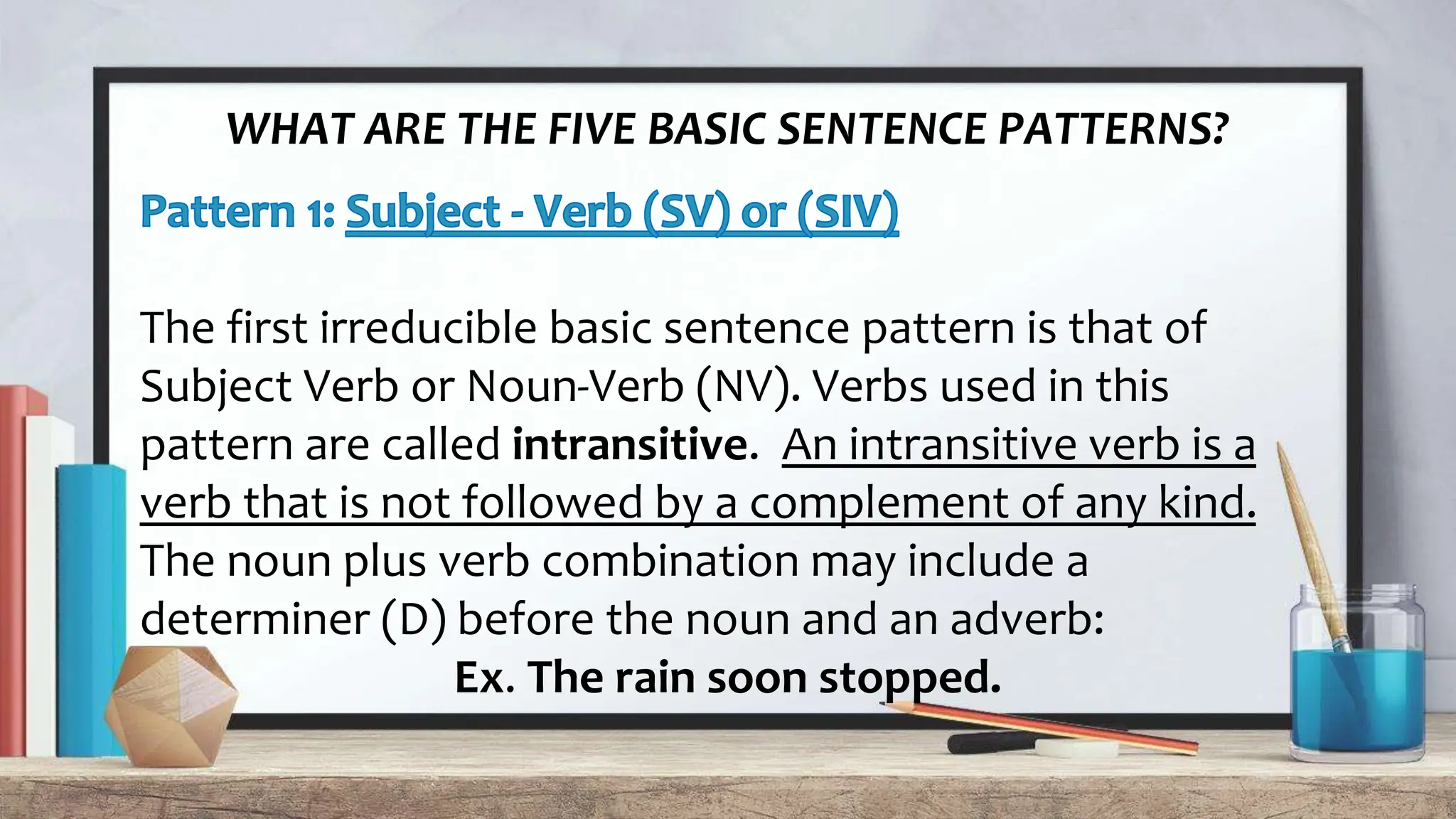
WHAT ARE THE FIVE BASIC SENTENCE PATTERNS?
The first irreducible basic sentence pattern is that of
Subject Verb or Noun-Verb (NV). Verbs used in this
pattern are called intransitive. An intransitive verb is a
verb that is not followed by a complement of any kind.
The noun plus verb combination may include a
determiner (D) before the noun and an adverb:
Ex. The rain soon stopped.
6
WHAT ARE THE FIVE BASIC SENTENCE PATTERNS?
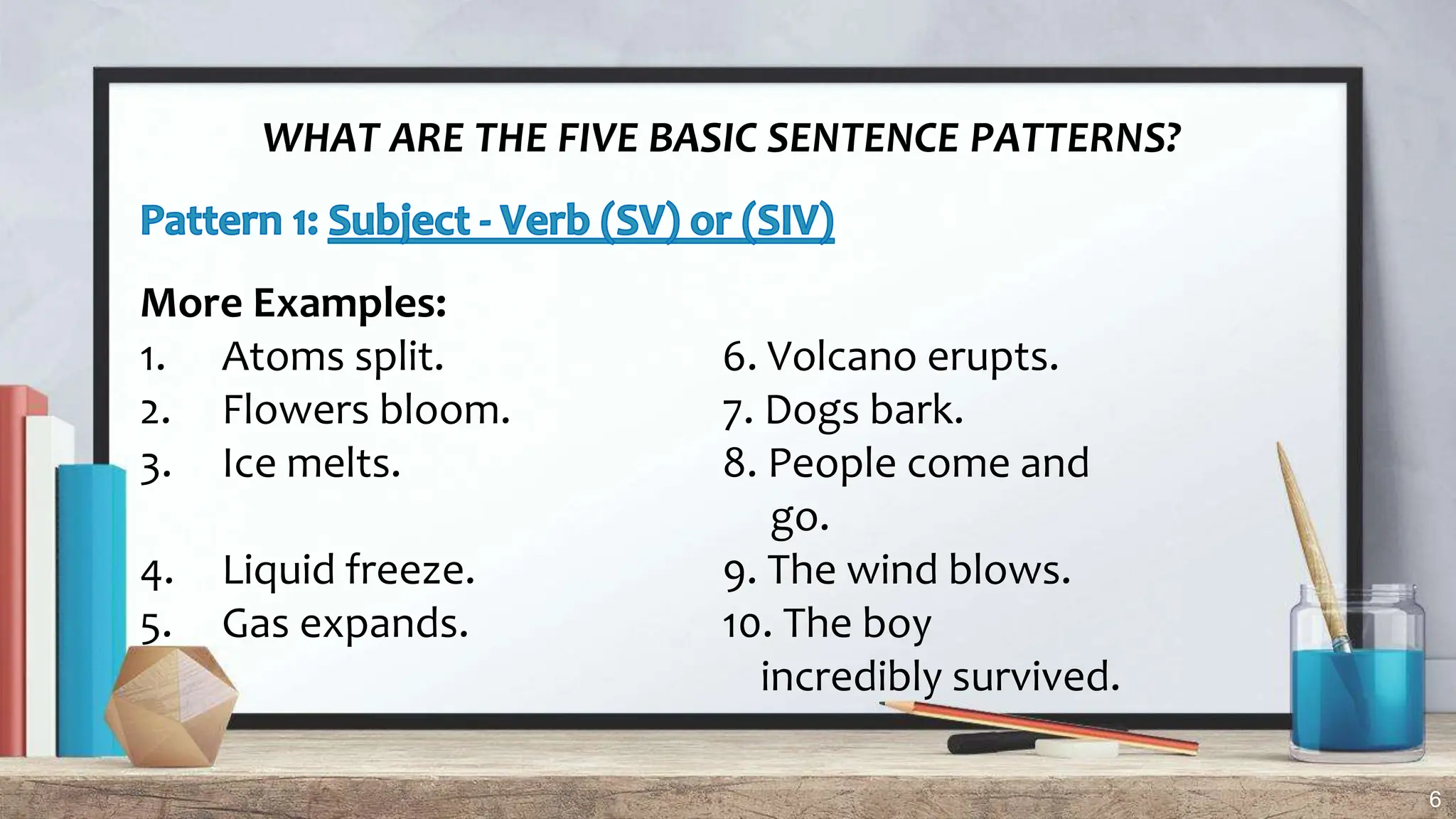
More Examples:
1. Atoms split. 6. Volcano erupts.
2. Flowers bloom. 7. Dogs bark.
3. Ice melts. 8. People come and
go.
4. Liquid freeze. 9. The wind blows.
5. Gas expands. 10. The boy
incredibly survived.
7
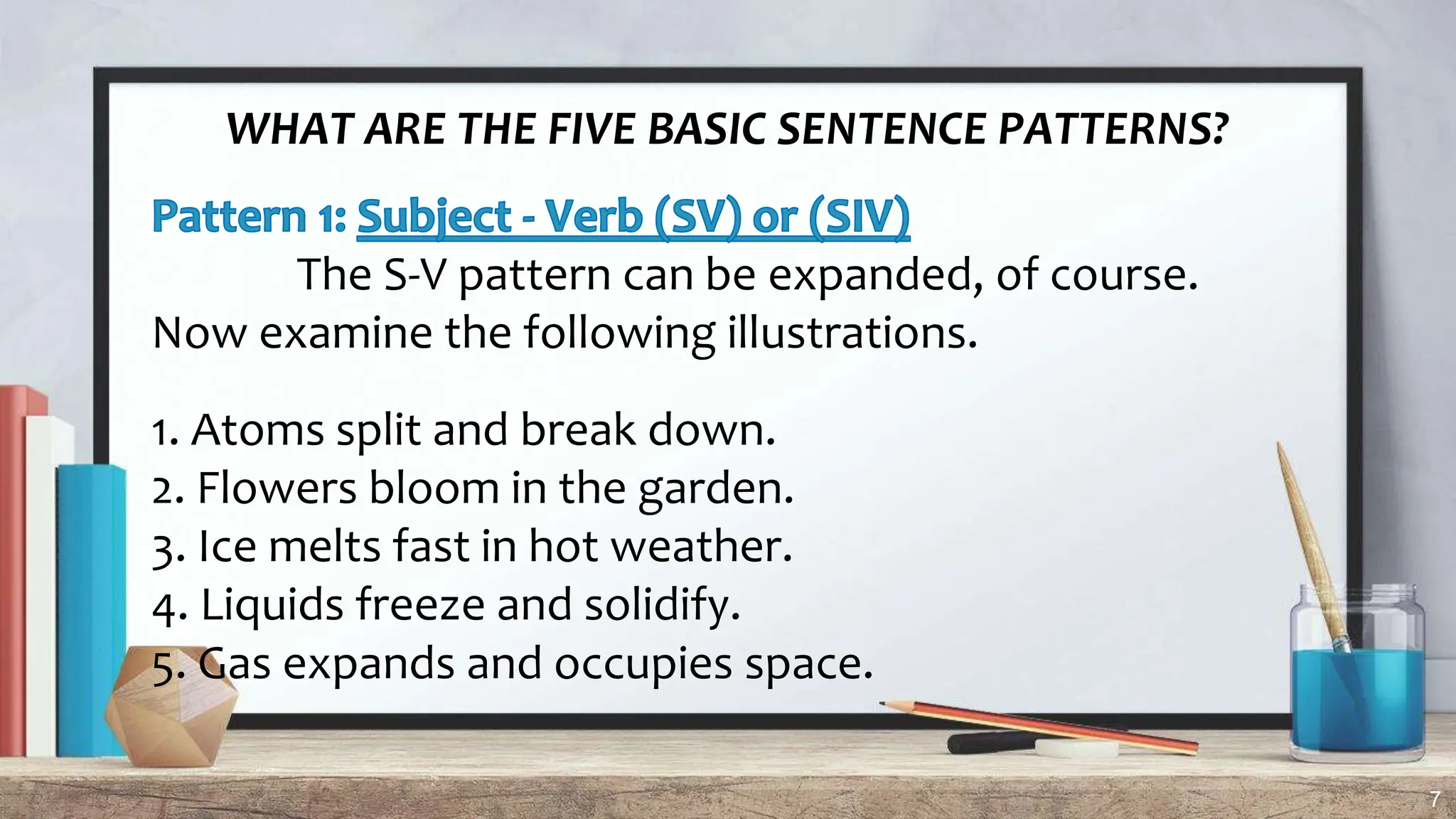
WHAT ARE THE FIVE BASIC SENTENCE PATTERNS?
The S-V pattern can be expanded, of course.
Now examine the following illustrations.
1. Atoms split and break down.
2. Flowers bloom in the garden.
3. Ice melts fast in hot weather.
4. Liquids freeze and solidify.
5. Gas expands and occupies space.
8
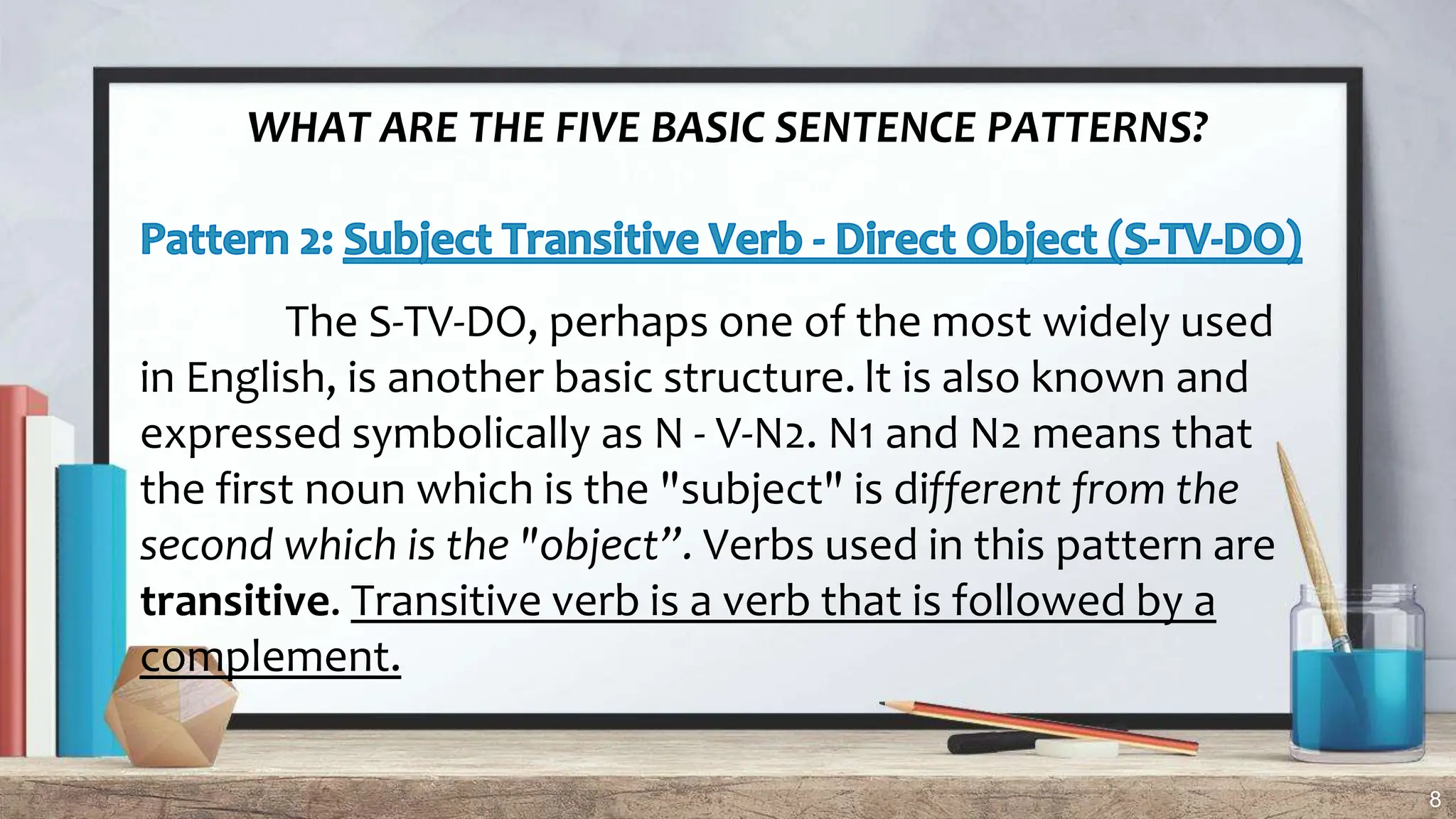
WHAT ARE THE FIVE BASIC SENTENCE PATTERNS?
The S-TV-DO, perhaps one of the most widely used
in English, is another basic structure. lt is also known and
expressed symbolically as N - V-N2. N1 and N2 means that
the first noun which is the "subject" is different from the
second which is the "object”. Verbs used in this pattern are
transitive. Transitive verb is a verb that is followed by a
complement.
WHAT ARE THE FIVE BASIC SENTENCE PATTERNS?
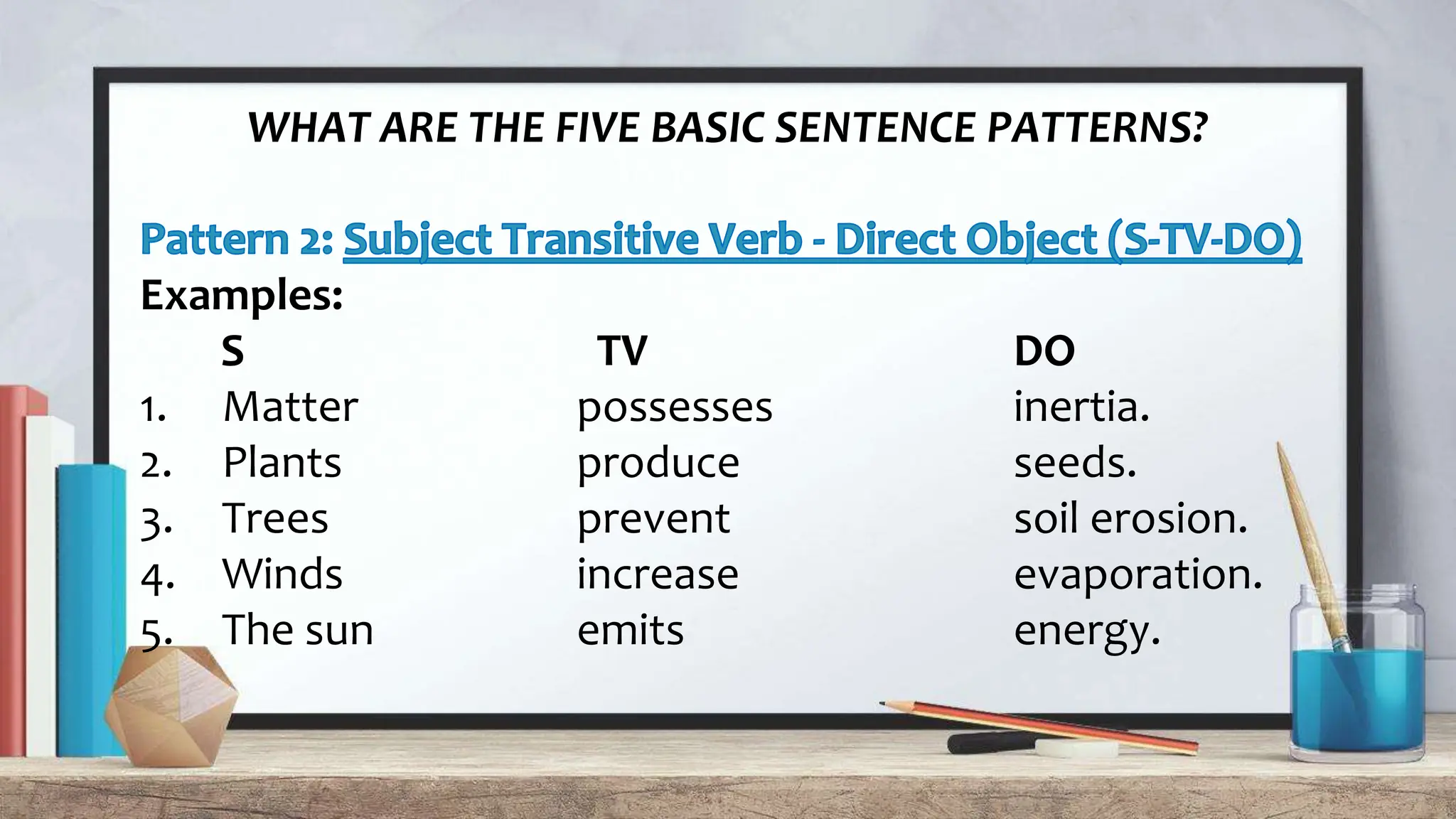
Examples:
S TV DO
1. Matter possesses inertia.
2. Plants produce seeds.
3. Trees prevent soil erosion.
4. Winds increase evaporation.
5. The sun emits energy.
WHAT ARE THE FIVE BASIC SENTENCE PATTERNS?
A third pattern uses a transitive verb and two
objects: the direct object and indirect object. Indirect object
is the first or the name word that tells to whom or for whom
the action is done. It comes between the verb and the direct
object. Direct object is the noun that receives the action of
the verb. This structure is also known as N1-V-N2-N3.
11
WHAT ARE THE FIVE BASIC SENTENCE PATTERNS?
Examples:
1. Charity foundations gave flood victims relief goods.
2. The lecturer showed the teachers a sample module.
3. The nurse gave me pills.
4. My sister tells me good stories every night.
5. The panelists awarded him a trophy and a medal.
WHAT ARE THE FIVE BASIC SENTENCE PATTERNS?
Another basic sentence pattern is S-LV-C, also
known as N-V-C. The complement may either be an
adjective which tells something about the subject or a
noun that explains or means person or thing as the
subject. Thus, it may either S-LV-C (N) or S-LV-C (A).
13
WHAT ARE THE FIVE BASIC SENTENCE PATTERNS?
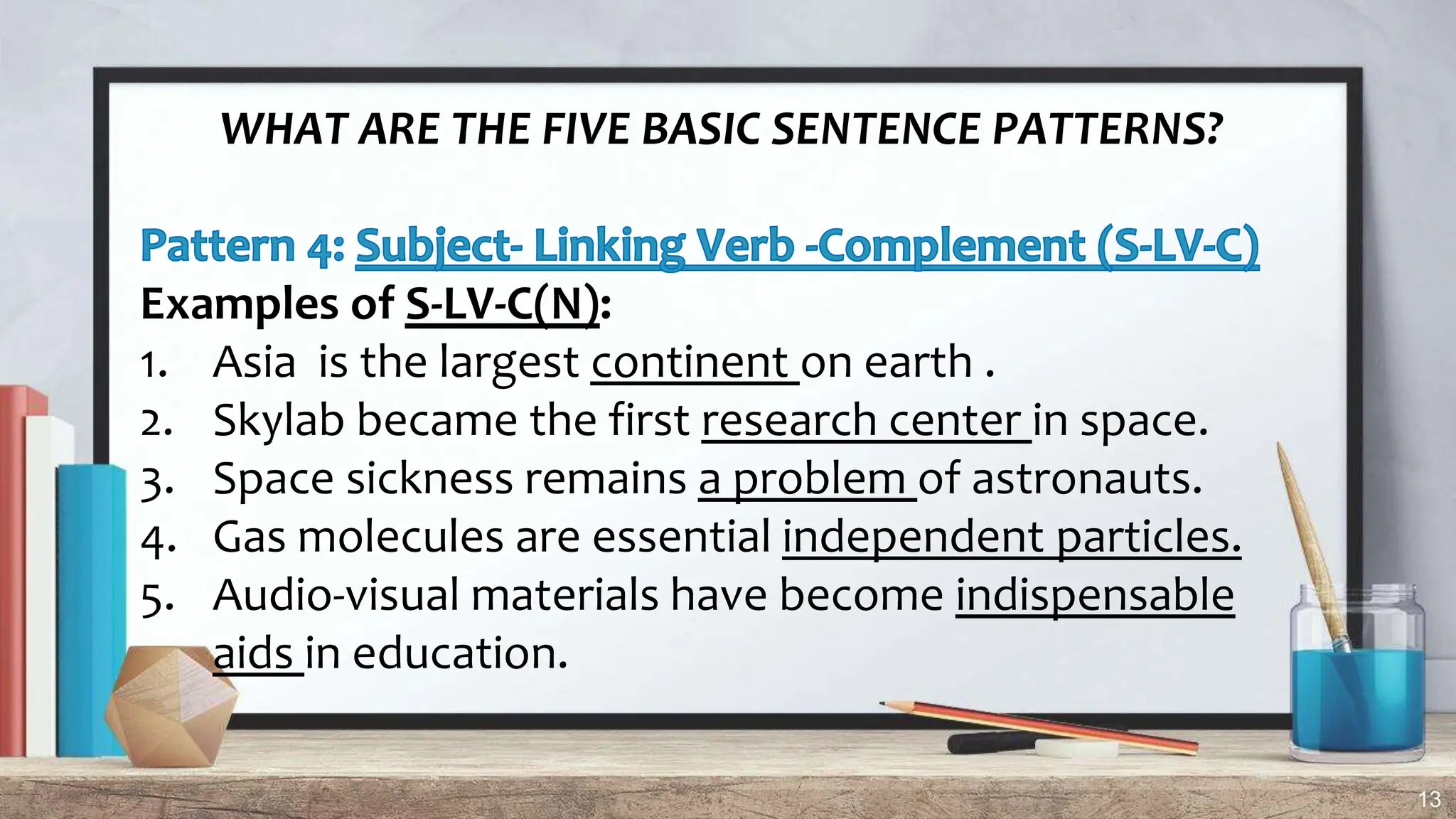
Examples of S-LV-C(N):
1. Asia is the largest continent on earth .
2. Skylab became the first research center in space.
3. Space sickness remains a problem of astronauts.
4. Gas molecules are essential independent particles.
5. Audio-visual materials have become indispensable
aids in education.
14
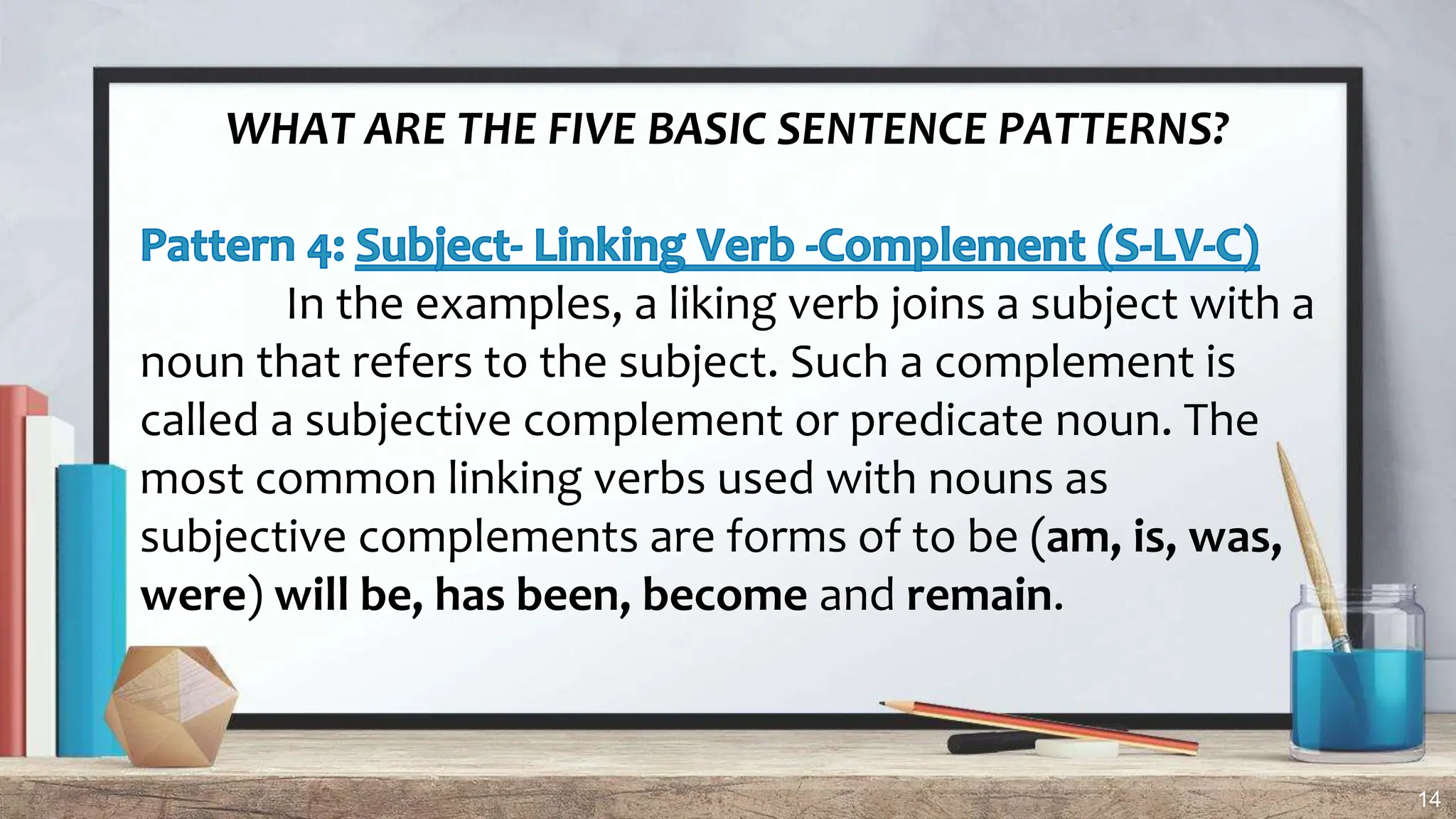
WHAT ARE THE FIVE BASIC SENTENCE PATTERNS?
In the examples, a liking verb joins a subject with a
noun that refers to the subject. Such a complement is
called a subjective complement or predicate noun. The
most common linking verbs used with nouns as
subjective complements are forms of to be (am, is, was,
were) will be, has been, become and remain.
15
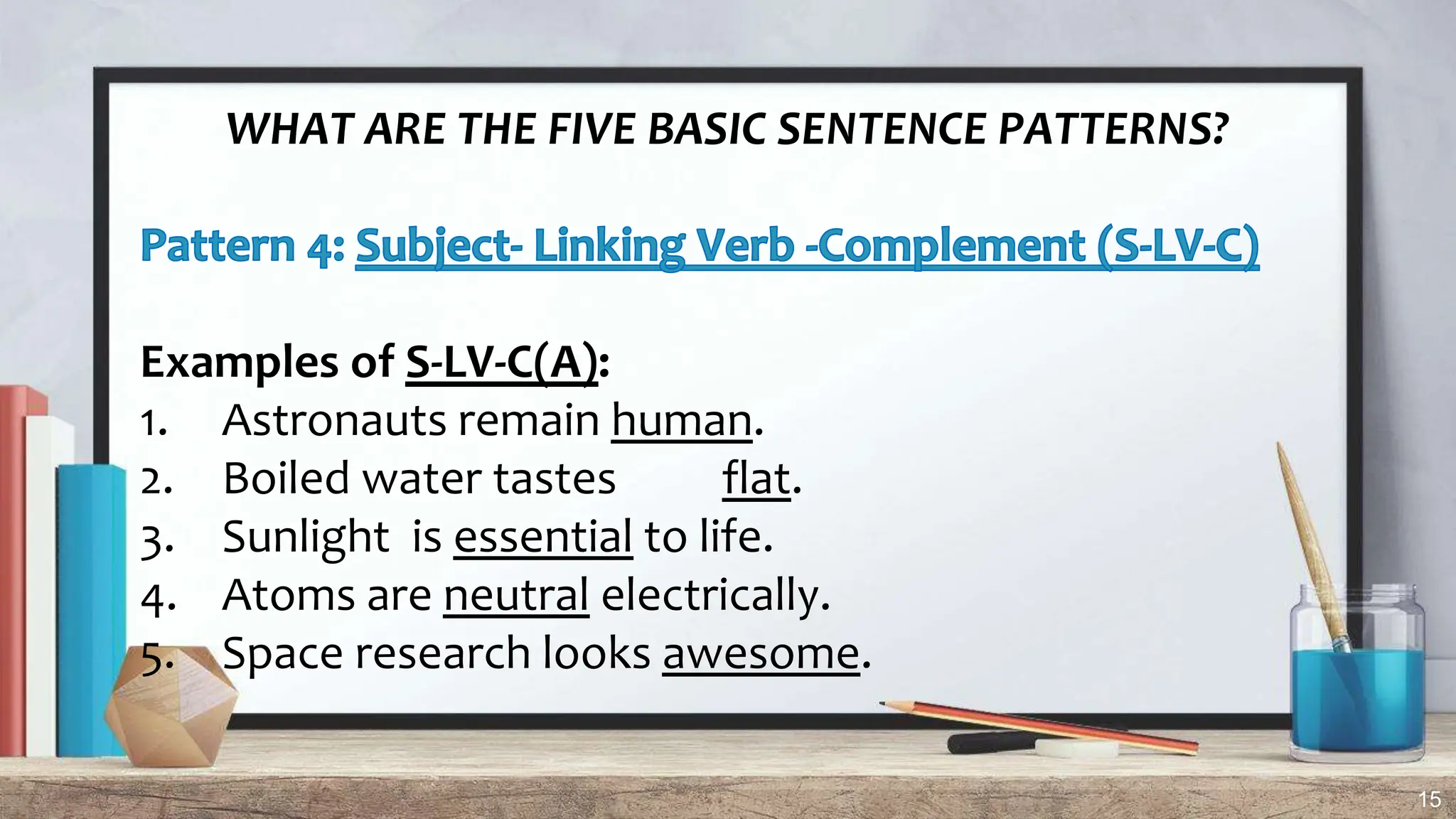
WHAT ARE THE FIVE BASIC SENTENCE PATTERNS?
Examples of S-LV-C(A):
1. Astronauts remain human.
2. Boiled water tastes flat.
3. Sunlight is essential to life.
4. Atoms are neutral electrically.
5. Space research looks awesome.
16
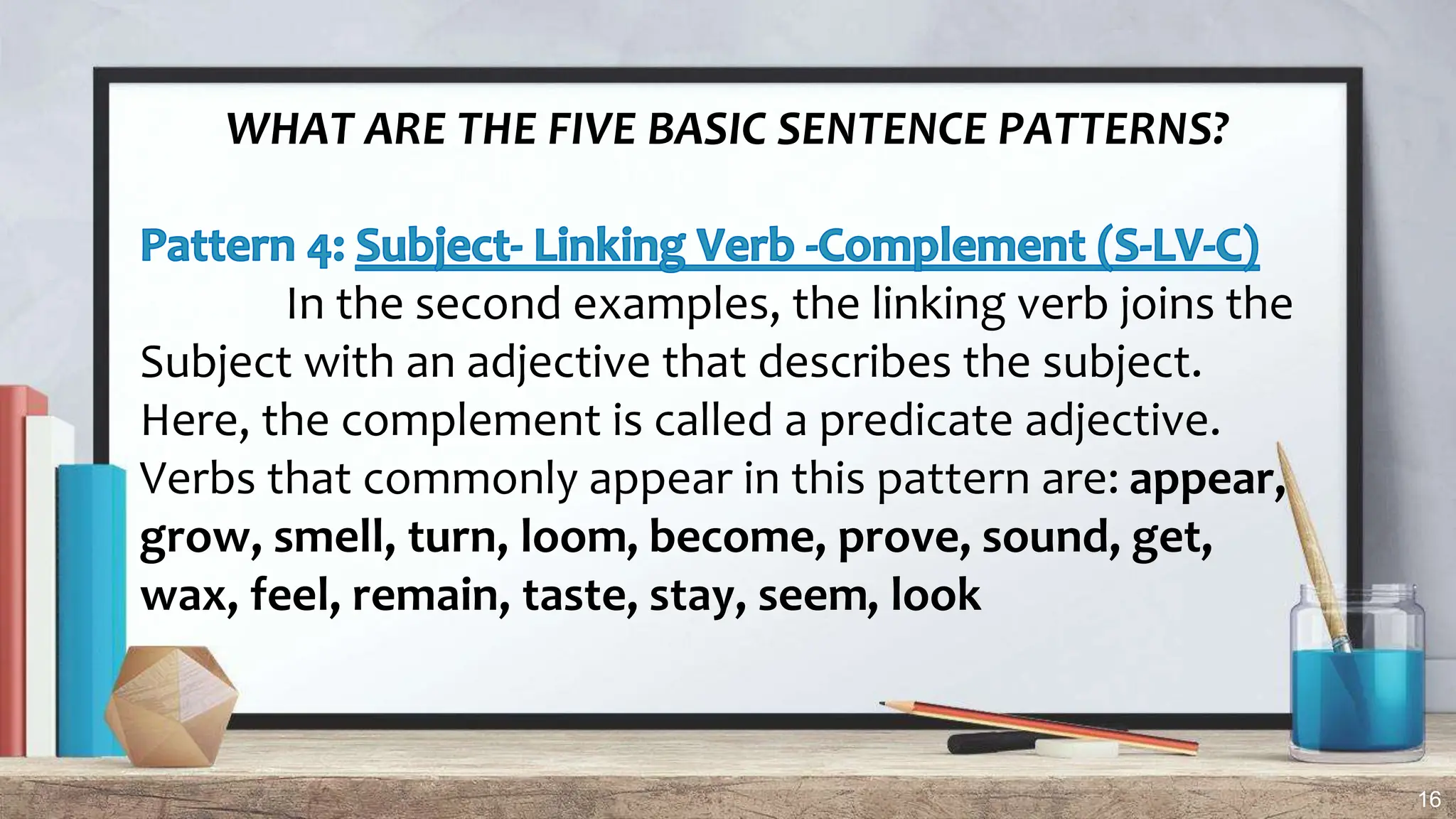
WHAT ARE THE FIVE BASIC SENTENCE PATTERNS?
In the second examples, the linking verb joins the
Subject with an adjective that describes the subject.
Here, the complement is called a predicate adjective.
Verbs that commonly appear in this pattern are: appear,
grow, smell, turn, loom, become, prove, sound, get,
wax, feel, remain, taste, stay, seem, look
17
WHAT ARE THE FIVE BASIC SENTENCE PATTERNS?
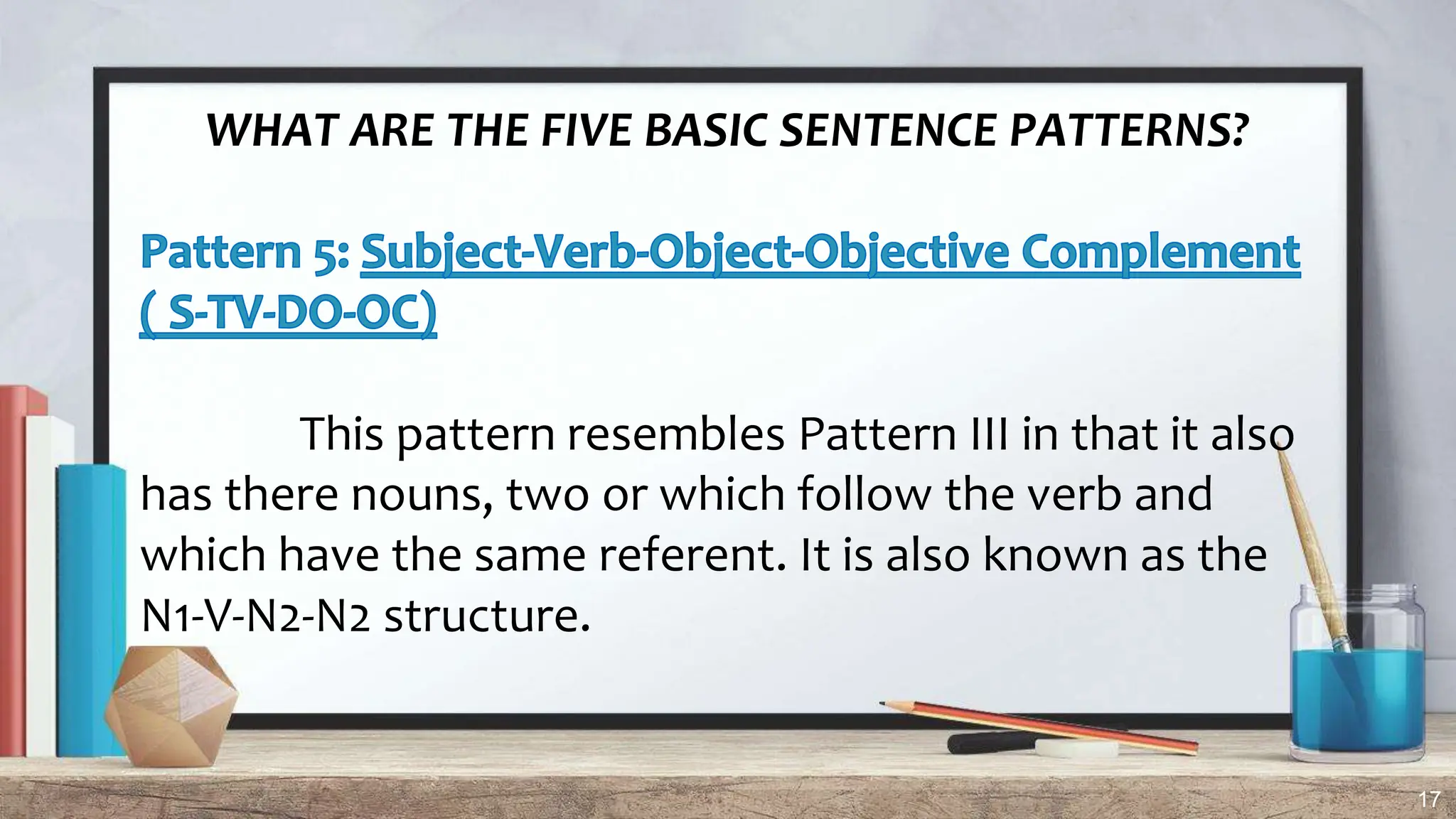
This pattern resembles Pattern III in that it also
has there nouns, two or which follow the verb and
which have the same referent. It is also known as the
N1-V-N2-N2 structure.
18
WHAT ARE THE FIVE BASIC SENTENCE PATTERNS?
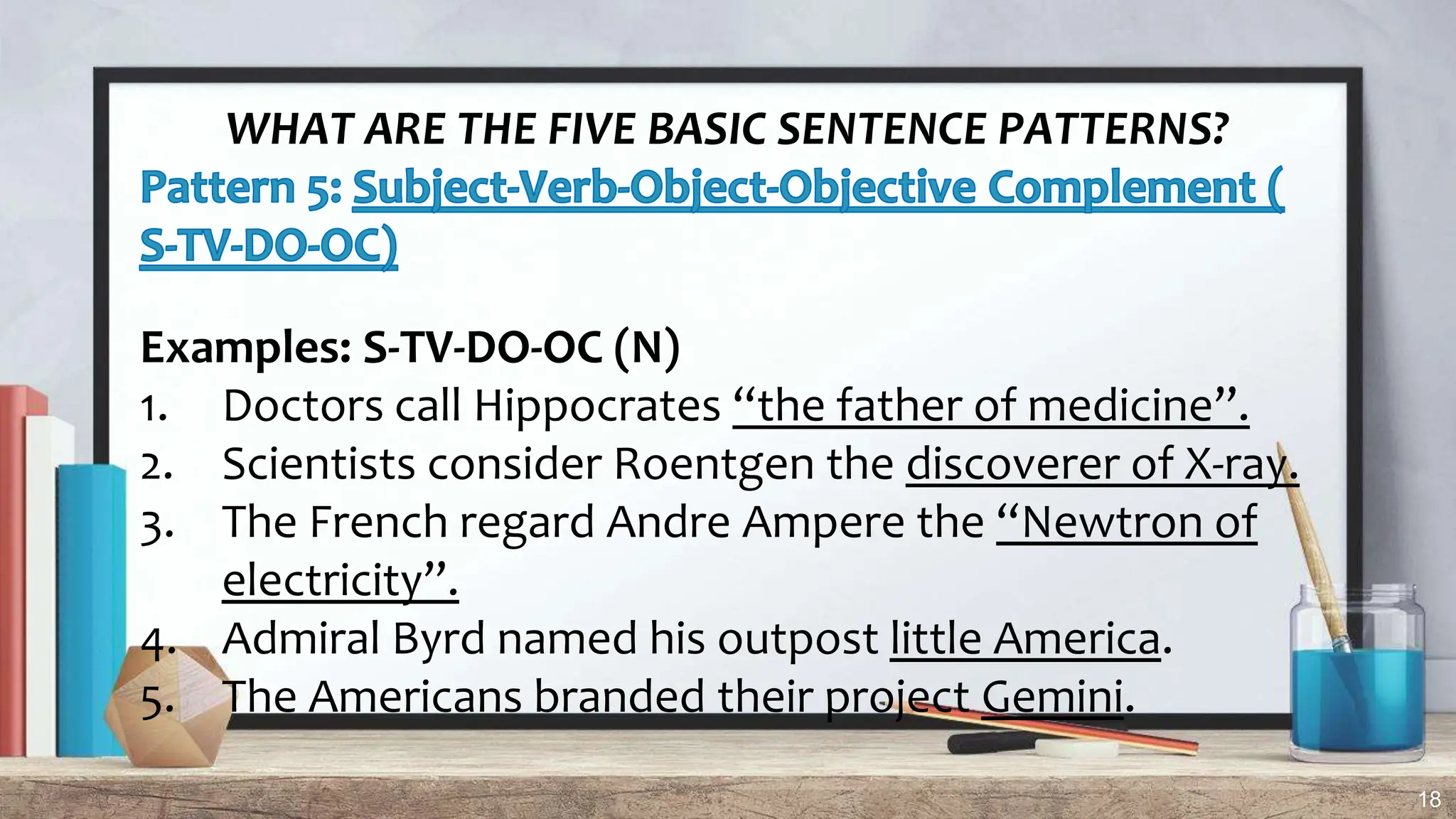
Examples: S-TV-DO-OC (N)
1. Doctors call Hippocrates “the father of medicine”.
2. Scientists consider Roentgen the discoverer of X-ray.
3. The French regard Andre Ampere the “Newtron of
electricity”.
4. Admiral Byrd named his outpost little America.
5. The Americans branded their project Gemini.
19
WHAT ARE THE FIVE BASIC SENTENCE PATTERNS?
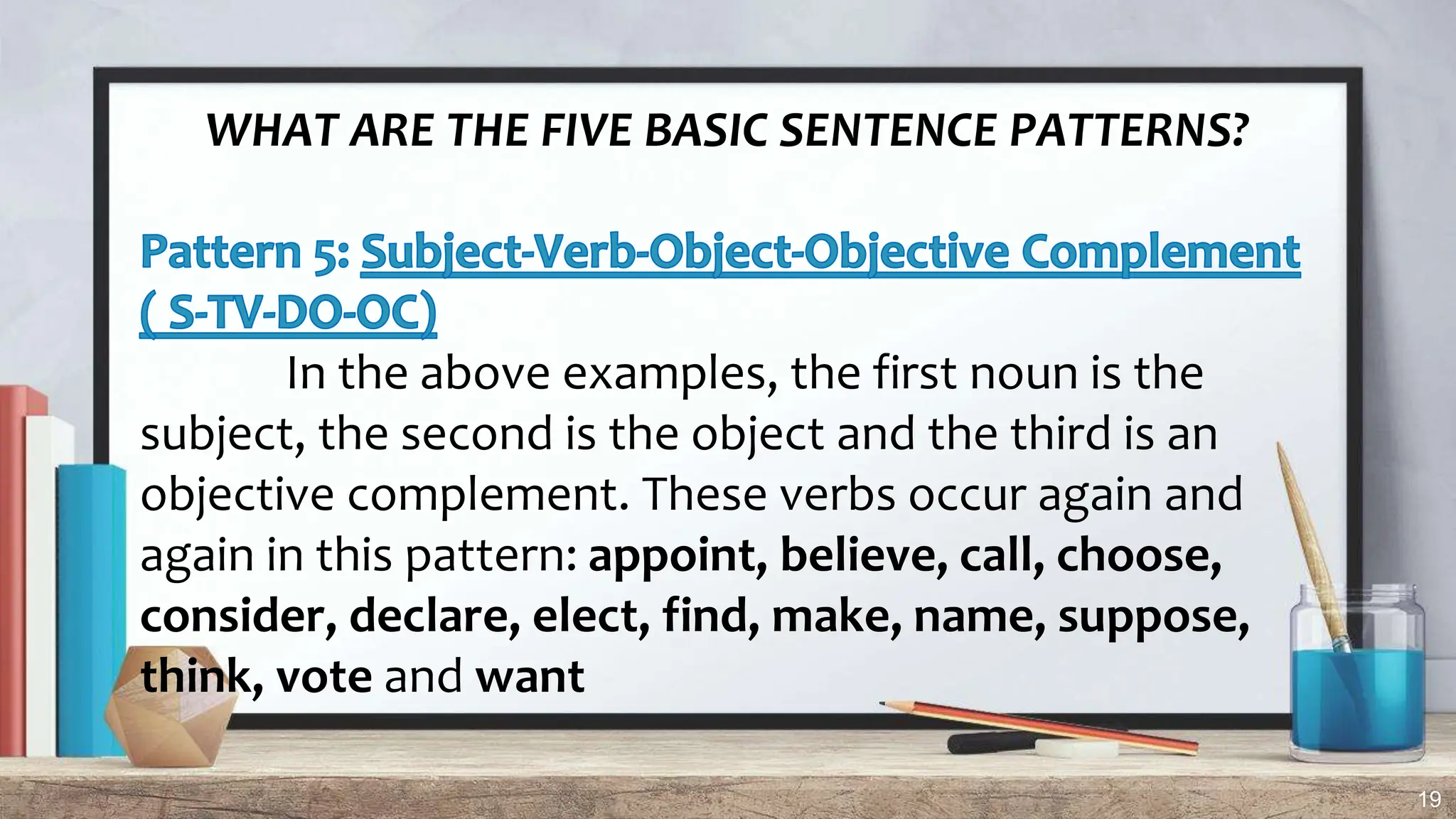
In the above examples, the first noun is the
subject, the second is the object and the third is an
objective complement. These verbs occur again and
again in this pattern: appoint, believe, call, choose,
consider, declare, elect, find, make, name, suppose,
think, vote and want
20
WHAT ARE THE FIVE BASIC SENTENCE PATTERNS?
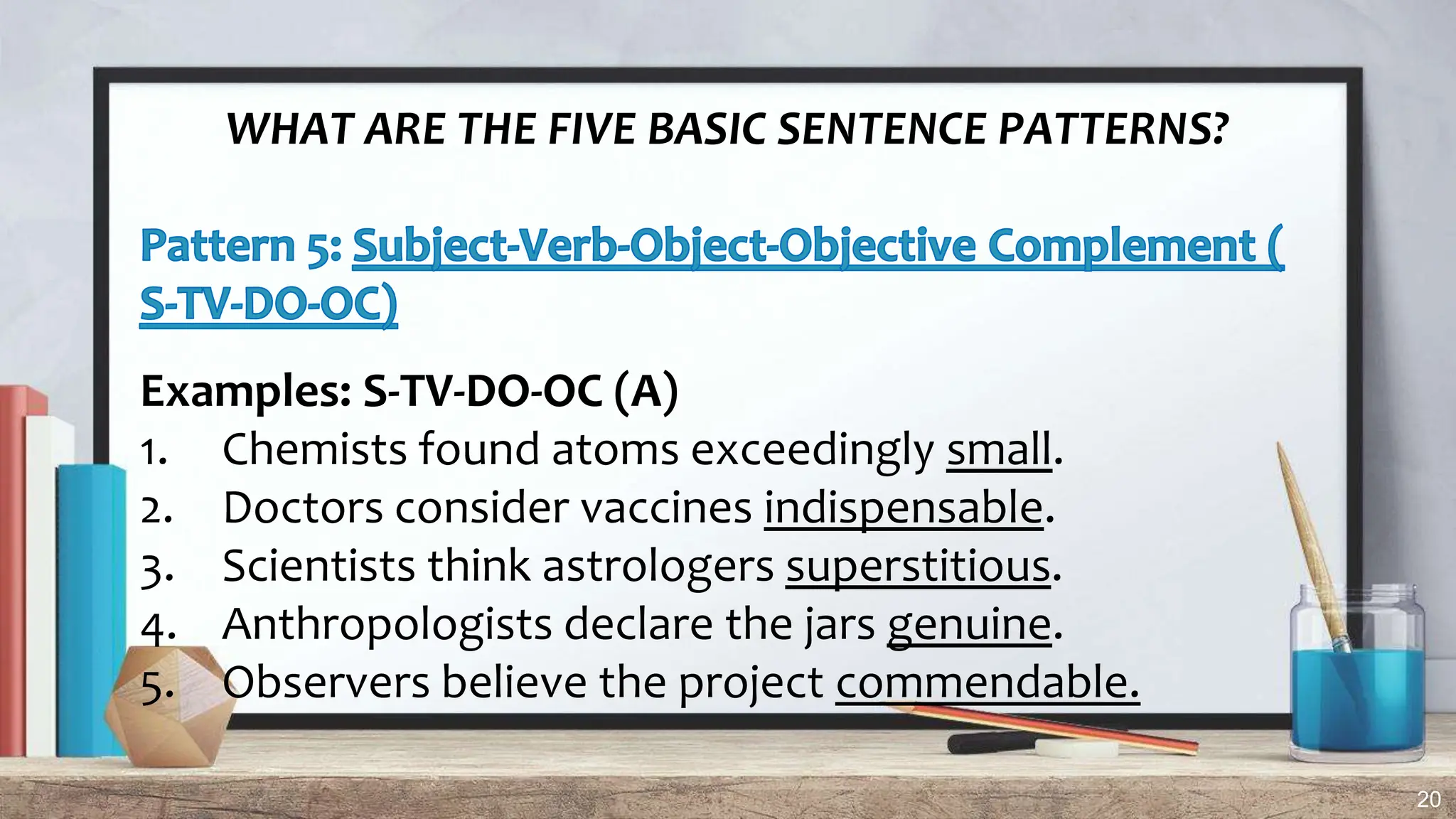
Examples: S-TV-DO-OC (A)
1. Chemists found atoms exceedingly small.
2. Doctors consider vaccines indispensable.
3. Scientists think astrologers superstitious.
4. Anthropologists declare the jars genuine.
5. Observers believe the project commendable.
21
WHAT ARE THE FIVE BASIC SENTENCE PATTERNS?
The objective complement in each or the
Sentences above is an adjective which describes or
makes a Judgment about the object in the pattern. The
structure 15 also Known as N-V-N2-Adj. The verbs listed
above in Pattern A of this pattern with the exception of
choose, elect, and vote are commonly used in this
pattern.

BASIC SENTENCE PATTERNS Englishhhhhhhhhhhhh.pptx

  • 1.
    EXERCISES: Study the followingsentences. 1. Taylor is a gorgeous singer with an angelic voice. 2. Our teacher gave us a very hard exam yesterday. 3. Bubbles popped. 4. They named their baby Mary as requested by the baby’s grandma. 5. My friend bought a sandwich.
  • 2.
    Reporters: Chona M.Romero & Rodora Rollon Teaching And Assessment Of Grammar: Module 4
  • 3.
    3 Through these lessonsthe student should be able to: 1. Identify, construct and transform basic statement patterns in English. 2. Construct and read question and answer patterns with the proper intonation and stress. 3. Master other patterns as requests and commands, connected statements, elliptical sentences and special sentence patterns. 4. Construct sentences in different ways to achieve variety.
  • 4.
    4 - an arrangementthat reveals or suggests a design; it is the framework of an utterance. For example, a Filipino speaker often says, “Saan ka pupunta?”, but never, “Ka pupunta saan?”. Meanwhile, an English speaker says “I saw her.”, but never “Saw I her.” - another important aspect of the English language. It is the arrangement of words in parts or segments to convey meaning.
  • 5.
    WHAT ARE THEFIVE BASIC SENTENCE PATTERNS? The first irreducible basic sentence pattern is that of Subject Verb or Noun-Verb (NV). Verbs used in this pattern are called intransitive. An intransitive verb is a verb that is not followed by a complement of any kind. The noun plus verb combination may include a determiner (D) before the noun and an adverb: Ex. The rain soon stopped.
  • 6.
    6 WHAT ARE THEFIVE BASIC SENTENCE PATTERNS? More Examples: 1. Atoms split. 6. Volcano erupts. 2. Flowers bloom. 7. Dogs bark. 3. Ice melts. 8. People come and go. 4. Liquid freeze. 9. The wind blows. 5. Gas expands. 10. The boy incredibly survived.
  • 7.
    7 WHAT ARE THEFIVE BASIC SENTENCE PATTERNS? The S-V pattern can be expanded, of course. Now examine the following illustrations. 1. Atoms split and break down. 2. Flowers bloom in the garden. 3. Ice melts fast in hot weather. 4. Liquids freeze and solidify. 5. Gas expands and occupies space.
  • 8.
    8 WHAT ARE THEFIVE BASIC SENTENCE PATTERNS? The S-TV-DO, perhaps one of the most widely used in English, is another basic structure. lt is also known and expressed symbolically as N - V-N2. N1 and N2 means that the first noun which is the "subject" is different from the second which is the "object”. Verbs used in this pattern are transitive. Transitive verb is a verb that is followed by a complement.
  • 9.
    WHAT ARE THEFIVE BASIC SENTENCE PATTERNS? Examples: S TV DO 1. Matter possesses inertia. 2. Plants produce seeds. 3. Trees prevent soil erosion. 4. Winds increase evaporation. 5. The sun emits energy.
  • 10.
    WHAT ARE THEFIVE BASIC SENTENCE PATTERNS? A third pattern uses a transitive verb and two objects: the direct object and indirect object. Indirect object is the first or the name word that tells to whom or for whom the action is done. It comes between the verb and the direct object. Direct object is the noun that receives the action of the verb. This structure is also known as N1-V-N2-N3.
  • 11.
    11 WHAT ARE THEFIVE BASIC SENTENCE PATTERNS? Examples: 1. Charity foundations gave flood victims relief goods. 2. The lecturer showed the teachers a sample module. 3. The nurse gave me pills. 4. My sister tells me good stories every night. 5. The panelists awarded him a trophy and a medal.
  • 12.
    WHAT ARE THEFIVE BASIC SENTENCE PATTERNS? Another basic sentence pattern is S-LV-C, also known as N-V-C. The complement may either be an adjective which tells something about the subject or a noun that explains or means person or thing as the subject. Thus, it may either S-LV-C (N) or S-LV-C (A).
  • 13.
    13 WHAT ARE THEFIVE BASIC SENTENCE PATTERNS? Examples of S-LV-C(N): 1. Asia is the largest continent on earth . 2. Skylab became the first research center in space. 3. Space sickness remains a problem of astronauts. 4. Gas molecules are essential independent particles. 5. Audio-visual materials have become indispensable aids in education.
  • 14.
    14 WHAT ARE THEFIVE BASIC SENTENCE PATTERNS? In the examples, a liking verb joins a subject with a noun that refers to the subject. Such a complement is called a subjective complement or predicate noun. The most common linking verbs used with nouns as subjective complements are forms of to be (am, is, was, were) will be, has been, become and remain.
  • 15.
    15 WHAT ARE THEFIVE BASIC SENTENCE PATTERNS? Examples of S-LV-C(A): 1. Astronauts remain human. 2. Boiled water tastes flat. 3. Sunlight is essential to life. 4. Atoms are neutral electrically. 5. Space research looks awesome.
  • 16.
    16 WHAT ARE THEFIVE BASIC SENTENCE PATTERNS? In the second examples, the linking verb joins the Subject with an adjective that describes the subject. Here, the complement is called a predicate adjective. Verbs that commonly appear in this pattern are: appear, grow, smell, turn, loom, become, prove, sound, get, wax, feel, remain, taste, stay, seem, look
  • 17.
    17 WHAT ARE THEFIVE BASIC SENTENCE PATTERNS? This pattern resembles Pattern III in that it also has there nouns, two or which follow the verb and which have the same referent. It is also known as the N1-V-N2-N2 structure.
  • 18.
    18 WHAT ARE THEFIVE BASIC SENTENCE PATTERNS? Examples: S-TV-DO-OC (N) 1. Doctors call Hippocrates “the father of medicine”. 2. Scientists consider Roentgen the discoverer of X-ray. 3. The French regard Andre Ampere the “Newtron of electricity”. 4. Admiral Byrd named his outpost little America. 5. The Americans branded their project Gemini.
  • 19.
    19 WHAT ARE THEFIVE BASIC SENTENCE PATTERNS? In the above examples, the first noun is the subject, the second is the object and the third is an objective complement. These verbs occur again and again in this pattern: appoint, believe, call, choose, consider, declare, elect, find, make, name, suppose, think, vote and want
  • 20.
    20 WHAT ARE THEFIVE BASIC SENTENCE PATTERNS? Examples: S-TV-DO-OC (A) 1. Chemists found atoms exceedingly small. 2. Doctors consider vaccines indispensable. 3. Scientists think astrologers superstitious. 4. Anthropologists declare the jars genuine. 5. Observers believe the project commendable.
  • 21.
    21 WHAT ARE THEFIVE BASIC SENTENCE PATTERNS? The objective complement in each or the Sentences above is an adjective which describes or makes a Judgment about the object in the pattern. The structure 15 also Known as N-V-N2-Adj. The verbs listed above in Pattern A of this pattern with the exception of choose, elect, and vote are commonly used in this pattern.