BASIC TEXT TYPES AND OTHER TEXT
TYPES AS TO SPECIFIC PURPOSE
DISCUSSANT: Mr. Norman B. Garejo
CAS-06-202p
TECHNICAL COMMUNICATION
Rizal Technological University
Cities of Mandaluyong and Pasig
A. INTRODUCTION
• This Introductory Part will Let You Familiarize the Relevance of
The Purpose of The Types of Text Congruently Associated To
Why Does Person Write.
• This will help you to analyze
PRIOR KNOWLEDGE
For you, What do you think
is the PURPOSE of Writing?
The editor and discussant of this topic doesn’t claim any of the
information cited in this handout. The information solicited from
different reading materials, references both online and physical books
were acknowledged and used only for academic purposes. The editor
also wants to assure that works; information used in this module were
credited from their respective authors.
DISCLAIMER
At the end of this lesson, you will be able to learn the Following:
•The Purpose of basic types of text.
•Relevance of the basic types of text and its purpose in the real aspect of determining why
does person write.
•Generic Structure of each basic types of text.
•Approaches on each basic types of text.
•Dominant Language Features of each basic types of text.
A. EXPECTED LEARNING OUTCOMES
WHY DOES PERSON WRITE?
•Laren (2017) explained that through writing activity, it gives
the person the opportunity to express himself. It is evident
that writing was done for few main reasons but it is mainly
meant to incite reformation and change.
•Laren (2017) exclaimed that there are 5 main reasons why
does person write. These are the following:
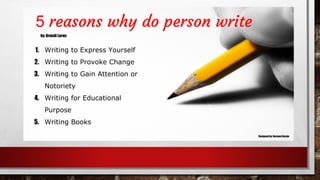
5 reasons why do person write
by: Brandi Laren
1. Writing to Express Yourself
2. Writing to Provoke Change
3. Writing to Gain Attention or
Notoriety
4. Writing for Educational
Purpose
5. Writing Books
Designed by: Norman Garejo
One of the common reasons why every person write is to
express their feelings. This serves as an outlet to voice out our
feelings and opinion based on a particular event or topic.
1.Writing to Express Yourself
Some articles are meant to incite reformation. Persuasive essay
and argumentative article aimed to persuade and argue with
presented claims and counter claims. These kinds of articles are
written to call-for-action.
2. Writing to Provoke Change
Others might also use writing as their way to become popular
and known to the people. To purely instrumentalize writing to
become famous.
3. Writing to Gain Attention or Notoriety
In some scholarly written works, students and academicians
usually write their understanding in a given topic. They need to
write to fulfill their requirements and enhance their academic
understanding. Usually, they are tasked to do research studies,
technical reports, proposals and various types of letters.
4. Writing for Educational Purposes
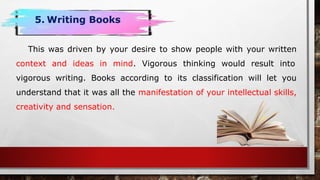
This was driven by your desire to show people with your written
context and ideas in mind. Vigorous thinking would result into
vigorous writing. Books according to its classification will let you
understand that it was all the manifestation of your intellectual skills,
creativity and sensation.
5. Writing Books
Writing has something to do with our own
personal experiences. Our mind, feelings, sensations
and desires urge us to write the story of our own. We
have this fictional and non-fictional written works
because we have this purpose of writing. We write to
entertain; we write to inform and we write because
we wanted to learn.
At this point, we can easily understand the lesson by means of personally taking
into account the personal purpose of writing with the basic types of text and its
equivalent purpose.
REFLECTION
A. CONTENT
a. 4 Basic Types of Text- Rhetorical Modes
There are many types of text written for intended and specific
purposes. However, they were categorized into broader classification.
Mainly, there are Four basic categories, inclusive but not limited to
Descriptive, Narrative and Argumentative and Expository. They are also
known as the 4 major Rhetorical modes (Modes of Discourse)proposed
as the classifications of essays by Crews, Frederick (1977), . There is also an
expository which is all of them are inclusive to it.
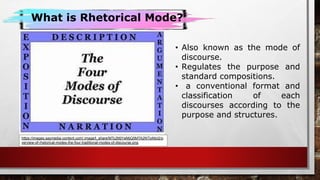
What is Rhetorical Mode?
https://images.saymedia-content.com/.image/t_share/MTc2MjYwMjQ5MTA2NTIzMzI2/o
verview-of-rhetorical-modes-the-four-traditional-modes-of-discourse.png
• Also known as the mode of
discourse.
• Regulates the purpose and
standard compositions.
• a conventional format and
classification of each
discourses according to the
purpose and structures.
VARIATIONS IN BROAD CLASSIFICATION
WEBSITE/
WRITER
BROAD CLASSIFICATION NO. OF CLASSIFIED
CATEGORY
LINK
-EXPLAIN- Expository texts,
Narrative texts, and
Argumentative texts.
3 http://explainwell.org/index.php/table
-of-contents-synthesize-text/types-of-
texts/
Literary
Ideas
Factual and Literary Texts 2 https://www.literacyideas.com/differe
nt-text-types
Cittặ studi Narrative, Descriptive,
Argumentative, Directive and
Expository Texts
5 https://www.cittastudi.org/uploads/Te
xt_Types.pdf
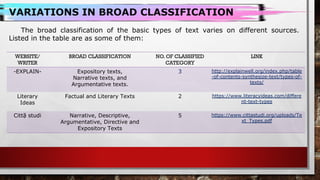
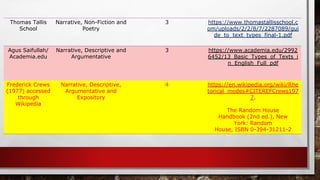
The broad classification of the basic types of text varies on different sources.
Listed in the table are as some of them:
Thomas Tallis
School
Narrative, Non-Fiction and
Poetry
3 https://www.thomastallisschool.c
om/uploads/2/2/8/7/2287089/gui
de_to_text_types_final-1.pdf
Agus Saifullah/
Academia.edu
Narrative, Descriptive and
Argumentative
3 https://www.academia.edu/2992
6452/13_Basic_Types_of_Texts_i
n_English_Full_pdf
Frederick Crews
(1977) accessed
through
Wikipedia
Narrative, Descriptive,
Argumentative and
Expository
4 https://en.wikipedia.org/wiki/Rhe
torical_modes#CITEREFCrews197
7.
The Random House
Handbook (2nd ed.), New
York: Random
House, ISBN 0-394-31211-2
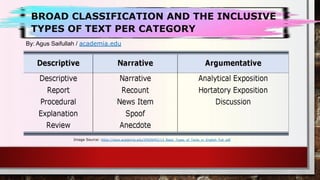
Image Source: https://www.academia.edu/29926452/13_Basic_Types_of_Texts_in_English_Full_pdf
BROAD CLASSIFICATION AND THE INCLUSIVE
TYPES OF TEXT PER CATEGORY
By: Agus Saifullah / academia.edu
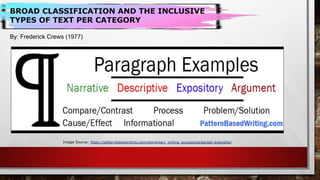
Image Source: https://patternbasedwriting.com/elementary_writing_success/paragraph-examples/
BROAD CLASSIFICATION AND THE INCLUSIVE
TYPES OF TEXT PER CATEGORY
By: Frederick Crews (1977)
https://puspapendini.blogspot.com/2018/12/desc
riptive-text-definition-structure.html
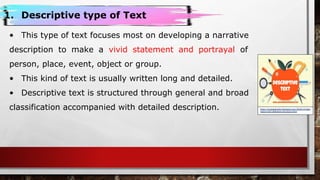
1. Descriptive type of Text
• This type of text focuses most on developing a narrative
description to make a vivid statement and portrayal of
person, place, event, object or group.
• This kind of text is usually written long and detailed.
• Descriptive text is structured through general and broad
classification accompanied with detailed description.
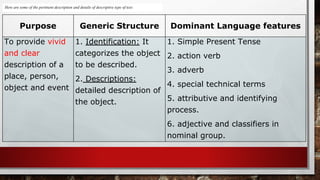
Here are some of the pertinent description and details of descriptive type of text:
Purpose Generic Structure Dominant Language features
To provide vivid
and clear
description of a
place, person,
object and event
1. Identification: It
categorizes the object
to be described.
2. Descriptions:
detailed description of
the object.
1. Simple Present Tense
2. action verb
3. adverb
4. special technical terms
5. attributive and identifying
process.
6. adjective and classifiers in
nominal group.
https://www.literacyideas.com/narratives
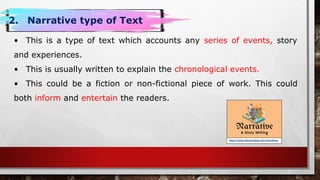
2. Narrative type of Text
• This is a type of text which accounts any series of events, story
and experiences.
• This is usually written to explain the chronological events.
• This could be a fiction or non-fictional piece of work. This could
both inform and entertain the readers.
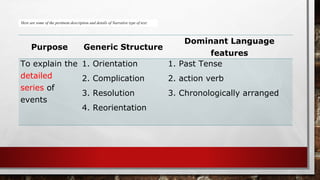
Here are some of the pertinent description and details of Narrative type of text:
Purpose Generic Structure
Dominant Language
features
To explain the
detailed
series of
events
1. Orientation
2. Complication
3. Resolution
4. Reorientation
1. Past Tense
2. action verb
3. Chronologically arranged
3. Argumentative type of Text
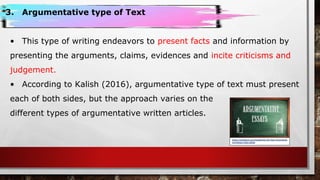
• This type of writing endeavors to present facts and information by
presenting the arguments, claims, evidences and incite criticisms and
judgement.
• According to Kalish (2016), argumentative type of text must present
each of both sides, but the approach varies on the
different types of argumentative written articles.
https://owlcation.com/academia/100-Easy-Argumenta
tive-Essay-Topic-Ideas
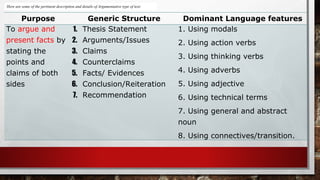
Purpose Generic Structure Dominant Language features
To argue and
present facts by
stating the
points and
claims of both
sides
1. Thesis Statement
2. Arguments/Issues
3. Claims
4. Counterclaims
5. Facts/ Evidences
6. Conclusion/Reiteration
7. Recommendation
1. Using modals
2. Using action verbs
3. Using thinking verbs
4. Using adverbs
5. Using adjective
6. Using technical terms
7. Using general and abstract
noun
8. Using connectives/transition.
Here are some of the pertinent description and details of Argumentative type of text:
3. Expository type of Text
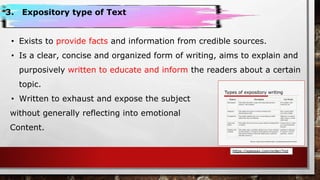
• Exists to provide facts and information from credible sources.
• Is a clear, concise and organized form of writing, aims to explain and
purposively written to educate and inform the readers about a certain
topic.
• Written to exhaust and expose the subject
without generally reflecting into emotional
Content.
https://apessay.com/order/?rid
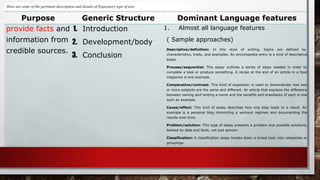
Purpose Generic Structure Dominant Language features
provide facts and
information from
credible sources.
1. Introduction
2. Development/body
3. Conclusion
1. Almost all language features
( Sample approaches)
Descriptive/definition: In this style of writing, topics are defined by
characteristics, traits, and examples. An encyclopedia entry is a kind of descriptive
essay.
Process/sequential: This essay outlines a series of steps needed in order to
complete a task or produce something. A recipe at the end of an article in a food
magazine is one example.
Comparative/contrast: This kind of exposition is used to demonstrate how two
or more subjects are the same and different. An article that explains the difference
between owning and renting a home and the benefits and drawbacks of each is one
such an example.
Cause/effect: This kind of essay describes how one step leads to a result. An
example is a personal blog chronicling a workout regimen and documenting the
results over time.
Problem/solution: This type of essay presents a problem and possible solutions,
backed by data and facts, not just opinion.
Classification: A classification essay breaks down a broad topic into categories or
groupings.
Here are some of the pertinent description and details of Expository type of text:
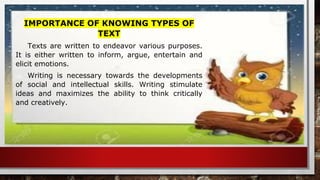
IMPORTANCE OF KNOWING TYPES OF
TEXT
Texts are written to endeavor various purposes.
It is either written to inform, argue, entertain and
elicit emotions.
Writing is necessary towards the developments
of social and intellectual skills. Writing stimulate
ideas and maximizes the ability to think critically
and creatively.
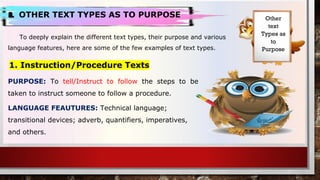
a. OTHER TEXT TYPES AS TO PURPOSE
To deeply explain the different text types, their purpose and various
language features, here are some of the few examples of text types.
Other
text
Types as
to
Purpose
1. Instruction/Procedure Texts
PURPOSE: To tell/Instruct to follow the steps to be
taken to instruct someone to follow a procedure.
LANGUAGE FEAUTURES: Technical language;
transitional devices; adverb, quantifiers, imperatives,
and others.
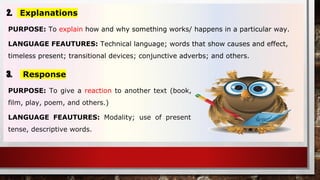
2. Explanations
PURPOSE: To explain how and why something works/ happens in a particular way.
LANGUAGE FEAUTURES: Technical language; words that show causes and effect,
timeless present; transitional devices; conjunctive adverbs; and others.
3. Response
PURPOSE: To give a reaction to another text (book,
film, play, poem, and others.)
LANGUAGE FEAUTURES: Modality; use of present
tense, descriptive words.
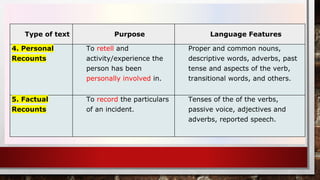
Type of text Purpose Language Features
4. Personal
Recounts
To retell and
activity/experience the
person has been
personally involved in.
Proper and common nouns,
descriptive words, adverbs, past
tense and aspects of the verb,
transitional words, and others.
5. Factual
Recounts
To record the particulars
of an incident.
Tenses of the of the verbs,
passive voice, adjectives and
adverbs, reported speech.
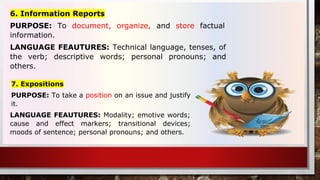
6. Information Reports
PURPOSE: To document, organize, and store factual
information.
LANGUAGE FEAUTURES: Technical language, tenses, of
the verb; descriptive words; personal pronouns; and
others.
7. Expositions
PURPOSE: To take a position on an issue and justify
it.
LANGUAGE FEAUTURES: Modality; emotive words;
cause and effect markers; transitional devices;
moods of sentence; personal pronouns; and others.
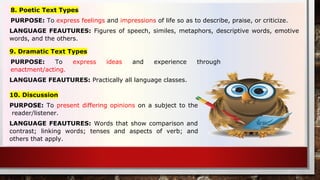
8. Poetic Text Types
PURPOSE: To express feelings and impressions of life so as to describe, praise, or criticize.
LANGUAGE FEAUTURES: Figures of speech, similes, metaphors, descriptive words, emotive
words, and the others.
9. Dramatic Text Types
PURPOSE: To express ideas and experience through
enactment/acting.
LANGUAGE FEAUTURES: Practically all language classes.
10. Discussion
PURPOSE: To present differing opinions on a subject to the
reader/listener.
LANGUAGE FEAUTURES: Words that show comparison and
contrast; linking words; tenses and aspects of verb; and
others that apply.
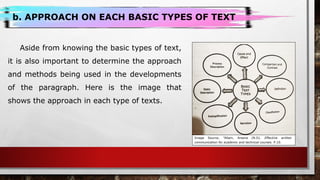
Aside from knowing the basic types of text,
it is also important to determine the approach
and methods being used in the developments
of the paragraph. Here is the image that
shows the approach in each type of texts.
b. APPROACH ON EACH BASIC TYPES OF TEXT
Image Source; 3
Allam, Arsena (N.D). Effective written
communication for academic and technical courses. P.10.
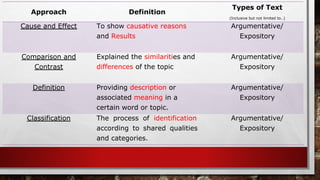
Approach Definition
Types of Text
(Inclusive but not limited to..)
Cause and Effect To show causative reasons
and Results
Argumentative/
Expository
Comparison and
Contrast
Explained the similarities and
differences of the topic
Argumentative/
Expository
Definition Providing description or
associated meaning in a
certain word or topic.
Argumentative/
Expository
Classification The process of identification
according to shared qualities
and categories.
Argumentative/
Expository
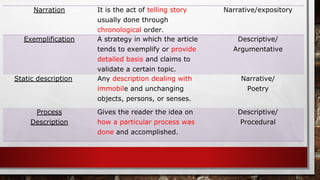
Narration It is the act of telling story
usually done through
chronological order.
Narrative/expository
Exemplification A strategy in which the article
tends to exemplify or provide
detailed basis and claims to
validate a certain topic.
Descriptive/
Argumentative
Static description Any description dealing with
immobile and unchanging
objects, persons, or senses.
Narrative/
Poetry
Process
Description
Gives the reader the idea on
how a particular process was
done and accomplished.
Descriptive/
Procedural
Reflection:
The relevance of the basic types of text and its purpose
with the reason why a person write helps you to identify the
importance of each texts base on their purpose.
We also identify and categorize the generic structure and
language features of each types of text. Now, you are familiar
with all the terminologies related to our topic.
You are getting closer on the successful finale. But before
that you are asked to finish the activities and assessment to
measure your learnings.
You are ready to take the final Challenge!
ASSESSMENT
1
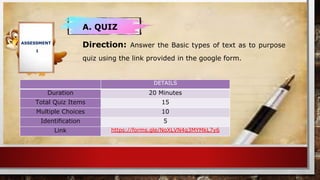
A. QUIZ
Direction: Answer the Basic types of text as to purpose
quiz using the link provided in the google form.
DETAILS
Duration 20 Minutes
Total Quiz Items 15
Multiple Choices 10
Identification 5
Link https://forms.gle/NoXLVN4q3MYMkL7y6
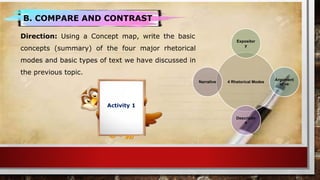
B. COMPARE AND CONTRAST
Direction: Using a Concept map, write the basic
concepts (summary) of the four major rhetorical
modes and basic types of text we have discussed in
the previous topic.
Activity 1
4 Rhetorical Modes
Expositor
y
Argument
ative
Descriptiv
e
Narrative
Final Evalaution
Complete the statement orally.
Today, I have learned that….
Now, I can……….
REFERENCES:
Allam, Arsena (N.D). Effective written communication for academic and technical courses. P.10.
Crews, Frederick (1977), The Random House Handbook (2nd ed.), New York: Random
House, ISBN 0-394-31211-2
Expository Text – Concept, Types, Structure and Characteristics. (2020, April 2). Retrieved from
https://www.takecareofmoney.com/expository-text-concept-types-structure-and-characteristics/
Kalish, Mandi. (2016, November 21). Three Types of Argumentative Essays. penandthepad.com. Retrieved
from https://penandthepad.com/three-types-argumentative-essays-8500461.html.
Laren, Brandi. (2017, April 17). Reasons Why People Write. penandthepad.com. Retrieved from
https://penandthepad.com/how-5161163-write-column.html
Meyers, Jeff. Instructions-Process Descriptions. Clinton Community College. Retrieved from:
https://courses.lumenlearning.com/atd-clinton-technicalwriting/chapter/instructions-process-descriptions/.
Questing Author. Dynamic Vs. Static Description. Retrieved on:
https://questingauthor.wordpress.com/2016/10/10/dynamic-v-s-static-description/.
Rhetorical patterns-Exemplification. Lincoln University.
https://www.lincoln.edu/departments/languages-and-literature-department/rhetorical-patterns/rhetorical-p
atterns.
What is Expository Text? - Definition, Types & Examples. (2015, September 28). Retrieved from
https://study.com/academy/lesson/what-is-expository-text-definition-types-examples.html.
Wikipedia. Accessed on 2021, february 9. Retrived from
https://en.wikipedia.org/wiki/Rhetorical_modes#CITEREFCrews1977.
THANK
YOU!

Basic text types and other text types as to purpose ppt

  • 1.
    BASIC TEXT TYPESAND OTHER TEXT TYPES AS TO SPECIFIC PURPOSE DISCUSSANT: Mr. Norman B. Garejo CAS-06-202p TECHNICAL COMMUNICATION Rizal Technological University Cities of Mandaluyong and Pasig
  • 3.
    A. INTRODUCTION • ThisIntroductory Part will Let You Familiarize the Relevance of The Purpose of The Types of Text Congruently Associated To Why Does Person Write. • This will help you to analyze
  • 4.
    PRIOR KNOWLEDGE For you,What do you think is the PURPOSE of Writing?
  • 5.
    The editor anddiscussant of this topic doesn’t claim any of the information cited in this handout. The information solicited from different reading materials, references both online and physical books were acknowledged and used only for academic purposes. The editor also wants to assure that works; information used in this module were credited from their respective authors. DISCLAIMER
  • 6.
    At the endof this lesson, you will be able to learn the Following: •The Purpose of basic types of text. •Relevance of the basic types of text and its purpose in the real aspect of determining why does person write. •Generic Structure of each basic types of text. •Approaches on each basic types of text. •Dominant Language Features of each basic types of text. A. EXPECTED LEARNING OUTCOMES
  • 7.
    WHY DOES PERSONWRITE? •Laren (2017) explained that through writing activity, it gives the person the opportunity to express himself. It is evident that writing was done for few main reasons but it is mainly meant to incite reformation and change. •Laren (2017) exclaimed that there are 5 main reasons why does person write. These are the following:
  • 8.
    5 reasons whydo person write by: Brandi Laren 1. Writing to Express Yourself 2. Writing to Provoke Change 3. Writing to Gain Attention or Notoriety 4. Writing for Educational Purpose 5. Writing Books Designed by: Norman Garejo
  • 9.
    One of thecommon reasons why every person write is to express their feelings. This serves as an outlet to voice out our feelings and opinion based on a particular event or topic. 1.Writing to Express Yourself
  • 10.
    Some articles aremeant to incite reformation. Persuasive essay and argumentative article aimed to persuade and argue with presented claims and counter claims. These kinds of articles are written to call-for-action. 2. Writing to Provoke Change
  • 11.
    Others might alsouse writing as their way to become popular and known to the people. To purely instrumentalize writing to become famous. 3. Writing to Gain Attention or Notoriety
  • 12.
    In some scholarlywritten works, students and academicians usually write their understanding in a given topic. They need to write to fulfill their requirements and enhance their academic understanding. Usually, they are tasked to do research studies, technical reports, proposals and various types of letters. 4. Writing for Educational Purposes
  • 13.
    This was drivenby your desire to show people with your written context and ideas in mind. Vigorous thinking would result into vigorous writing. Books according to its classification will let you understand that it was all the manifestation of your intellectual skills, creativity and sensation. 5. Writing Books
  • 14.
    Writing has somethingto do with our own personal experiences. Our mind, feelings, sensations and desires urge us to write the story of our own. We have this fictional and non-fictional written works because we have this purpose of writing. We write to entertain; we write to inform and we write because we wanted to learn. At this point, we can easily understand the lesson by means of personally taking into account the personal purpose of writing with the basic types of text and its equivalent purpose. REFLECTION
  • 15.
    A. CONTENT a. 4Basic Types of Text- Rhetorical Modes There are many types of text written for intended and specific purposes. However, they were categorized into broader classification. Mainly, there are Four basic categories, inclusive but not limited to Descriptive, Narrative and Argumentative and Expository. They are also known as the 4 major Rhetorical modes (Modes of Discourse)proposed as the classifications of essays by Crews, Frederick (1977), . There is also an expository which is all of them are inclusive to it.
  • 16.
    What is RhetoricalMode? https://images.saymedia-content.com/.image/t_share/MTc2MjYwMjQ5MTA2NTIzMzI2/o verview-of-rhetorical-modes-the-four-traditional-modes-of-discourse.png • Also known as the mode of discourse. • Regulates the purpose and standard compositions. • a conventional format and classification of each discourses according to the purpose and structures.
  • 17.
    VARIATIONS IN BROADCLASSIFICATION WEBSITE/ WRITER BROAD CLASSIFICATION NO. OF CLASSIFIED CATEGORY LINK -EXPLAIN- Expository texts, Narrative texts, and Argumentative texts. 3 http://explainwell.org/index.php/table -of-contents-synthesize-text/types-of- texts/ Literary Ideas Factual and Literary Texts 2 https://www.literacyideas.com/differe nt-text-types Cittặ studi Narrative, Descriptive, Argumentative, Directive and Expository Texts 5 https://www.cittastudi.org/uploads/Te xt_Types.pdf The broad classification of the basic types of text varies on different sources. Listed in the table are as some of them:
  • 18.
    Thomas Tallis School Narrative, Non-Fictionand Poetry 3 https://www.thomastallisschool.c om/uploads/2/2/8/7/2287089/gui de_to_text_types_final-1.pdf Agus Saifullah/ Academia.edu Narrative, Descriptive and Argumentative 3 https://www.academia.edu/2992 6452/13_Basic_Types_of_Texts_i n_English_Full_pdf Frederick Crews (1977) accessed through Wikipedia Narrative, Descriptive, Argumentative and Expository 4 https://en.wikipedia.org/wiki/Rhe torical_modes#CITEREFCrews197 7. The Random House Handbook (2nd ed.), New York: Random House, ISBN 0-394-31211-2
  • 19.
    Image Source: https://www.academia.edu/29926452/13_Basic_Types_of_Texts_in_English_Full_pdf BROADCLASSIFICATION AND THE INCLUSIVE TYPES OF TEXT PER CATEGORY By: Agus Saifullah / academia.edu
  • 20.
    Image Source: https://patternbasedwriting.com/elementary_writing_success/paragraph-examples/ BROADCLASSIFICATION AND THE INCLUSIVE TYPES OF TEXT PER CATEGORY By: Frederick Crews (1977)
  • 21.
    https://puspapendini.blogspot.com/2018/12/desc riptive-text-definition-structure.html 1. Descriptive typeof Text • This type of text focuses most on developing a narrative description to make a vivid statement and portrayal of person, place, event, object or group. • This kind of text is usually written long and detailed. • Descriptive text is structured through general and broad classification accompanied with detailed description.
  • 22.
    Here are someof the pertinent description and details of descriptive type of text: Purpose Generic Structure Dominant Language features To provide vivid and clear description of a place, person, object and event 1. Identification: It categorizes the object to be described. 2. Descriptions: detailed description of the object. 1. Simple Present Tense 2. action verb 3. adverb 4. special technical terms 5. attributive and identifying process. 6. adjective and classifiers in nominal group.
  • 23.
    https://www.literacyideas.com/narratives 2. Narrative typeof Text • This is a type of text which accounts any series of events, story and experiences. • This is usually written to explain the chronological events. • This could be a fiction or non-fictional piece of work. This could both inform and entertain the readers.
  • 24.
    Here are someof the pertinent description and details of Narrative type of text: Purpose Generic Structure Dominant Language features To explain the detailed series of events 1. Orientation 2. Complication 3. Resolution 4. Reorientation 1. Past Tense 2. action verb 3. Chronologically arranged
  • 25.
    3. Argumentative typeof Text • This type of writing endeavors to present facts and information by presenting the arguments, claims, evidences and incite criticisms and judgement. • According to Kalish (2016), argumentative type of text must present each of both sides, but the approach varies on the different types of argumentative written articles. https://owlcation.com/academia/100-Easy-Argumenta tive-Essay-Topic-Ideas
  • 26.
    Purpose Generic StructureDominant Language features To argue and present facts by stating the points and claims of both sides 1. Thesis Statement 2. Arguments/Issues 3. Claims 4. Counterclaims 5. Facts/ Evidences 6. Conclusion/Reiteration 7. Recommendation 1. Using modals 2. Using action verbs 3. Using thinking verbs 4. Using adverbs 5. Using adjective 6. Using technical terms 7. Using general and abstract noun 8. Using connectives/transition. Here are some of the pertinent description and details of Argumentative type of text:
  • 27.
    3. Expository typeof Text • Exists to provide facts and information from credible sources. • Is a clear, concise and organized form of writing, aims to explain and purposively written to educate and inform the readers about a certain topic. • Written to exhaust and expose the subject without generally reflecting into emotional Content. https://apessay.com/order/?rid
  • 28.
    Purpose Generic StructureDominant Language features provide facts and information from credible sources. 1. Introduction 2. Development/body 3. Conclusion 1. Almost all language features ( Sample approaches) Descriptive/definition: In this style of writing, topics are defined by characteristics, traits, and examples. An encyclopedia entry is a kind of descriptive essay. Process/sequential: This essay outlines a series of steps needed in order to complete a task or produce something. A recipe at the end of an article in a food magazine is one example. Comparative/contrast: This kind of exposition is used to demonstrate how two or more subjects are the same and different. An article that explains the difference between owning and renting a home and the benefits and drawbacks of each is one such an example. Cause/effect: This kind of essay describes how one step leads to a result. An example is a personal blog chronicling a workout regimen and documenting the results over time. Problem/solution: This type of essay presents a problem and possible solutions, backed by data and facts, not just opinion. Classification: A classification essay breaks down a broad topic into categories or groupings. Here are some of the pertinent description and details of Expository type of text:
  • 29.
    IMPORTANCE OF KNOWINGTYPES OF TEXT Texts are written to endeavor various purposes. It is either written to inform, argue, entertain and elicit emotions. Writing is necessary towards the developments of social and intellectual skills. Writing stimulate ideas and maximizes the ability to think critically and creatively.
  • 30.
    a. OTHER TEXTTYPES AS TO PURPOSE To deeply explain the different text types, their purpose and various language features, here are some of the few examples of text types. Other text Types as to Purpose 1. Instruction/Procedure Texts PURPOSE: To tell/Instruct to follow the steps to be taken to instruct someone to follow a procedure. LANGUAGE FEAUTURES: Technical language; transitional devices; adverb, quantifiers, imperatives, and others.
  • 31.
    2. Explanations PURPOSE: Toexplain how and why something works/ happens in a particular way. LANGUAGE FEAUTURES: Technical language; words that show causes and effect, timeless present; transitional devices; conjunctive adverbs; and others. 3. Response PURPOSE: To give a reaction to another text (book, film, play, poem, and others.) LANGUAGE FEAUTURES: Modality; use of present tense, descriptive words.
  • 32.
    Type of textPurpose Language Features 4. Personal Recounts To retell and activity/experience the person has been personally involved in. Proper and common nouns, descriptive words, adverbs, past tense and aspects of the verb, transitional words, and others. 5. Factual Recounts To record the particulars of an incident. Tenses of the of the verbs, passive voice, adjectives and adverbs, reported speech.
  • 33.
    6. Information Reports PURPOSE:To document, organize, and store factual information. LANGUAGE FEAUTURES: Technical language, tenses, of the verb; descriptive words; personal pronouns; and others. 7. Expositions PURPOSE: To take a position on an issue and justify it. LANGUAGE FEAUTURES: Modality; emotive words; cause and effect markers; transitional devices; moods of sentence; personal pronouns; and others.
  • 34.
    8. Poetic TextTypes PURPOSE: To express feelings and impressions of life so as to describe, praise, or criticize. LANGUAGE FEAUTURES: Figures of speech, similes, metaphors, descriptive words, emotive words, and the others. 9. Dramatic Text Types PURPOSE: To express ideas and experience through enactment/acting. LANGUAGE FEAUTURES: Practically all language classes. 10. Discussion PURPOSE: To present differing opinions on a subject to the reader/listener. LANGUAGE FEAUTURES: Words that show comparison and contrast; linking words; tenses and aspects of verb; and others that apply.
  • 35.
    Aside from knowingthe basic types of text, it is also important to determine the approach and methods being used in the developments of the paragraph. Here is the image that shows the approach in each type of texts. b. APPROACH ON EACH BASIC TYPES OF TEXT Image Source; 3 Allam, Arsena (N.D). Effective written communication for academic and technical courses. P.10.
  • 36.
    Approach Definition Types ofText (Inclusive but not limited to..) Cause and Effect To show causative reasons and Results Argumentative/ Expository Comparison and Contrast Explained the similarities and differences of the topic Argumentative/ Expository Definition Providing description or associated meaning in a certain word or topic. Argumentative/ Expository Classification The process of identification according to shared qualities and categories. Argumentative/ Expository
  • 37.
    Narration It isthe act of telling story usually done through chronological order. Narrative/expository Exemplification A strategy in which the article tends to exemplify or provide detailed basis and claims to validate a certain topic. Descriptive/ Argumentative Static description Any description dealing with immobile and unchanging objects, persons, or senses. Narrative/ Poetry Process Description Gives the reader the idea on how a particular process was done and accomplished. Descriptive/ Procedural
  • 38.
    Reflection: The relevance ofthe basic types of text and its purpose with the reason why a person write helps you to identify the importance of each texts base on their purpose. We also identify and categorize the generic structure and language features of each types of text. Now, you are familiar with all the terminologies related to our topic. You are getting closer on the successful finale. But before that you are asked to finish the activities and assessment to measure your learnings. You are ready to take the final Challenge!
  • 39.
    ASSESSMENT 1 A. QUIZ Direction: Answerthe Basic types of text as to purpose quiz using the link provided in the google form. DETAILS Duration 20 Minutes Total Quiz Items 15 Multiple Choices 10 Identification 5 Link https://forms.gle/NoXLVN4q3MYMkL7y6
  • 40.
    B. COMPARE ANDCONTRAST Direction: Using a Concept map, write the basic concepts (summary) of the four major rhetorical modes and basic types of text we have discussed in the previous topic. Activity 1 4 Rhetorical Modes Expositor y Argument ative Descriptiv e Narrative
  • 41.
    Final Evalaution Complete thestatement orally. Today, I have learned that…. Now, I can……….
  • 42.
    REFERENCES: Allam, Arsena (N.D).Effective written communication for academic and technical courses. P.10. Crews, Frederick (1977), The Random House Handbook (2nd ed.), New York: Random House, ISBN 0-394-31211-2 Expository Text – Concept, Types, Structure and Characteristics. (2020, April 2). Retrieved from https://www.takecareofmoney.com/expository-text-concept-types-structure-and-characteristics/ Kalish, Mandi. (2016, November 21). Three Types of Argumentative Essays. penandthepad.com. Retrieved from https://penandthepad.com/three-types-argumentative-essays-8500461.html. Laren, Brandi. (2017, April 17). Reasons Why People Write. penandthepad.com. Retrieved from https://penandthepad.com/how-5161163-write-column.html Meyers, Jeff. Instructions-Process Descriptions. Clinton Community College. Retrieved from: https://courses.lumenlearning.com/atd-clinton-technicalwriting/chapter/instructions-process-descriptions/.
  • 43.
    Questing Author. DynamicVs. Static Description. Retrieved on: https://questingauthor.wordpress.com/2016/10/10/dynamic-v-s-static-description/. Rhetorical patterns-Exemplification. Lincoln University. https://www.lincoln.edu/departments/languages-and-literature-department/rhetorical-patterns/rhetorical-p atterns. What is Expository Text? - Definition, Types & Examples. (2015, September 28). Retrieved from https://study.com/academy/lesson/what-is-expository-text-definition-types-examples.html. Wikipedia. Accessed on 2021, february 9. Retrived from https://en.wikipedia.org/wiki/Rhetorical_modes#CITEREFCrews1977.
  • 44.