1
Data Structures
Trees
1
2
Objectives Overview
 Trees
 Concept
 Examples and Applications
 Definition
 Terminology
 Types of Trees
 General Trees
 Representation and Traversal
 Binary Tree
 Types and Representations
3
Tree - Introduction
 Trees are very flexible, versatile and powerful
non-linear data structure
 It can be used to represent data items possessing
hierarchical relationship
 A tree can be theoretically defined as a finite set of
one or more data items (or nodes) such that
 There is a special node called the root of the tree
 Remaining nodes (or data item) are partitioned into
number of subsets each of which is itself a tree, are
called subtree
 A tree is a set of related interconnected nodes in a
hierarchical structure
4
Tree - Introduction
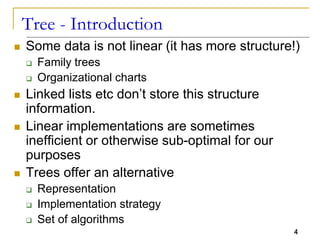
 Some data is not linear (it has more structure!)
 Family trees
 Organizational charts
 Linked lists etc don’t store this structure
information.
 Linear implementations are sometimes
inefficient or otherwise sub-optimal for our
purposes
 Trees offer an alternative
 Representation
 Implementation strategy
 Set of algorithms
5
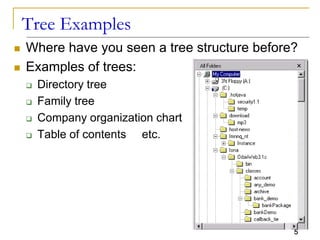
Tree Examples
 Where have you seen a tree structure before?
 Examples of trees:
 Directory tree
 Family tree
 Company organization chart
 Table of contents etc.
6
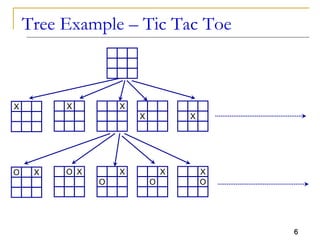
Tree Example – Tic Tac Toe
X X
X X
O X X
O
X
O
X
O
X
O X
7
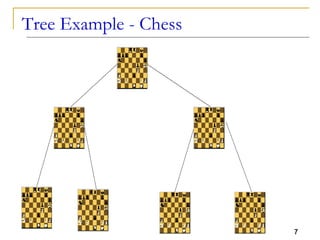
Tree Example - Chess
8
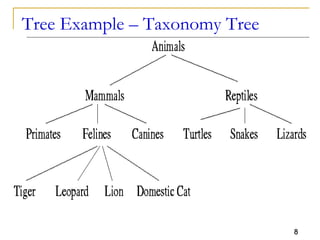
Tree Example – Taxonomy Tree
9
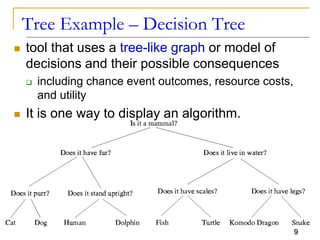
Tree Example – Decision Tree
 tool that uses a tree-like graph or model of
decisions and their possible consequences
 including chance event outcomes, resource costs,
and utility
 It is one way to display an algorithm.
10
What is a Tree Useful for?
 Artificial Intelligence – planning, navigating,
games
 Representing things:
 Simple file systems
 Class inheritance and composition
 Classification, e.g. taxonomy (the is-a relationship
again!)
 HTML pages
 Parse trees for language
 3D graphics
11
Tree - Definition
 A tree is a finite set of one or more nodes
such that:
 There is a specially designated node called the root.
 The remaining nodes are partitioned into n>=0
disjoint sets T1, ..., Tn, where each of these sets is
a tree.
 We call T1, ..., Tn the subtrees of the root r
 Each of whose roots are connected by a directed edge
from r
 A tree is a collection of N nodes, one of which is
the root and N-1 edges
12
Tree – Basic Terminology
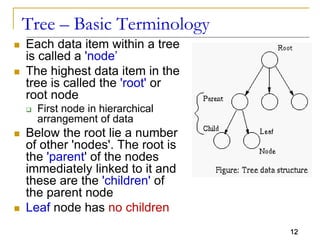
 Each data item within a tree
is called a 'node’
 The highest data item in the
tree is called the 'root' or
root node
 First node in hierarchical
arrangement of data
 Below the root lie a number
of other 'nodes'. The root is
the 'parent' of the nodes
immediately linked to it and
these are the 'children' of
the parent node
 Leaf node has no children
13
Tree – Basic Terminology
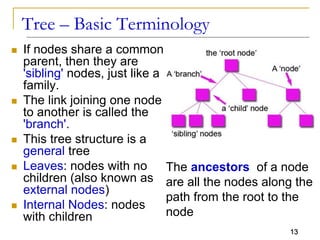
 If nodes share a common
parent, then they are
'sibling' nodes, just like a
family.
 The link joining one node
to another is called the
'branch'.
 This tree structure is a
general tree
 Leaves: nodes with no
children (also known as
external nodes)
 Internal Nodes: nodes
with children
The ancestors of a node
are all the nodes along the
path from the root to the
node
14
Tree – Basic Terminology
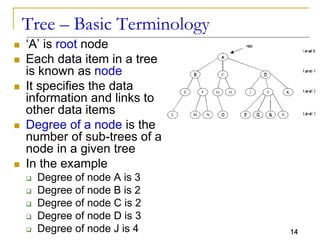
 ‘A’ is root node
 Each data item in a tree
is known as node
 It specifies the data
information and links to
other data items
 Degree of a node is the
number of sub-trees of a
node in a given tree
 In the example
 Degree of node A is 3
 Degree of node B is 2
 Degree of node C is 2
 Degree of node D is 3
 Degree of node J is 4
15
Tree – Basic Terminology
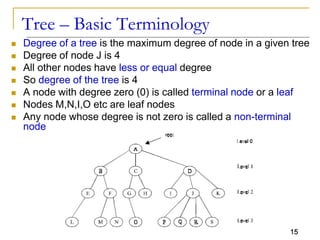
 Degree of a tree is the maximum degree of node in a given tree
 Degree of node J is 4
 All other nodes have less or equal degree
 So degree of the tree is 4
 A node with degree zero (0) is called terminal node or a leaf
 Nodes M,N,I,O etc are leaf nodes
 Any node whose degree is not zero is called a non-terminal
node
16
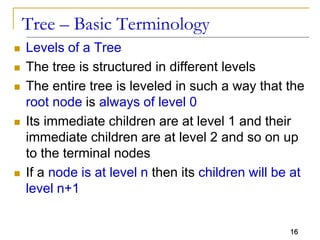
Tree – Basic Terminology
 Levels of a Tree
 The tree is structured in different levels
 The entire tree is leveled in such a way that the
root node is always of level 0
 Its immediate children are at level 1 and their
immediate children are at level 2 and so on up
to the terminal nodes
 If a node is at level n then its children will be at
level n+1
17
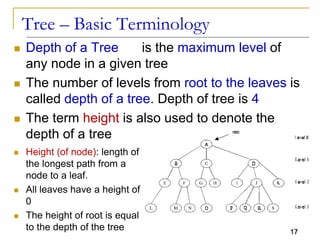
Tree – Basic Terminology
 Depth of a Tree is the maximum level of
any node in a given tree
 The number of levels from root to the leaves is
called depth of a tree. Depth of tree is 4
 The term height is also used to denote the
depth of a tree
 Height (of node): length of
the longest path from a
node to a leaf.
 All leaves have a height of
0
 The height of root is equal
to the depth of the tree
18
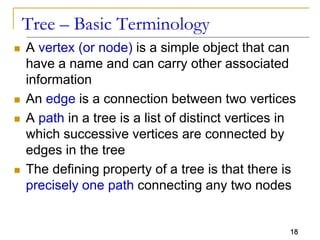
Tree – Basic Terminology
 A vertex (or node) is a simple object that can
have a name and can carry other associated
information
 An edge is a connection between two vertices
 A path in a tree is a list of distinct vertices in
which successive vertices are connected by
edges in the tree
 The defining property of a tree is that there is
precisely one path connecting any two nodes
19
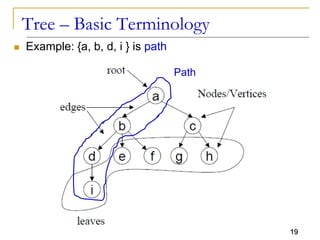
Tree – Basic Terminology
 Example: {a, b, d, i } is path
Path
20
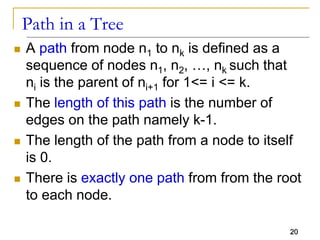
Path in a Tree
 A path from node n1 to nk is defined as a
sequence of nodes n1, n2, …, nk such that
ni is the parent of ni+1 for 1<= i <= k.
 The length of this path is the number of
edges on the path namely k-1.
 The length of the path from a node to itself
is 0.
 There is exactly one path from from the root
to each node.
21
What is a Tree?
 Models the parent/child relationship between
different elements
 Each child only has one parent
 From mathematics:
 “a directed acyclic graph”
 At most one path from any one node to any other
node
 Different kinds of trees exist.
 Trees can be used for different purposes.
 In what order to we visit elements in a tree?
22
How Many Types of Trees are there?
 Far too many:
 General tree
 Binary Tree
 Red-Black Tree
 AVL Tree
 Partially Ordered Tree
 B+ Trees
 … and so on
 Different types are used for different things
 To improve speed
 To improve the use of available memory
 To suit particular problems
23
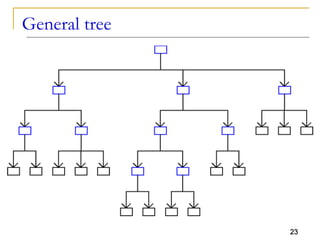
General tree
24
Representation of Trees
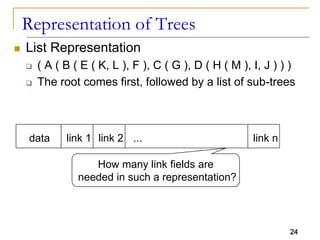
 List Representation
 ( A ( B ( E ( K, L ), F ), C ( G ), D ( H ( M ), I, J ) ) )
 The root comes first, followed by a list of sub-trees
data link 1 link 2 ... link n
How many link fields are
needed in such a representation?
25
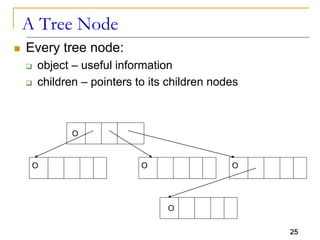
A Tree Node
 Every tree node:
 object – useful information
 children – pointers to its children nodes
O
O O
O
O
26
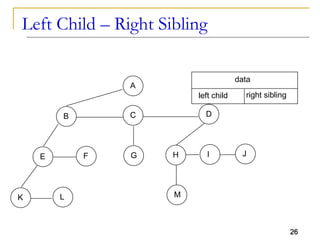
Left Child – Right Sibling
A
B C D
E F G H I J
K L M
data
left child right sibling
27
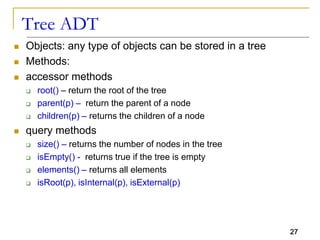
Tree ADT
 Objects: any type of objects can be stored in a tree
 Methods:
 accessor methods
 root() – return the root of the tree
 parent(p) – return the parent of a node
 children(p) – returns the children of a node
 query methods
 size() – returns the number of nodes in the tree
 isEmpty() - returns true if the tree is empty
 elements() – returns all elements
 isRoot(p), isInternal(p), isExternal(p)
28
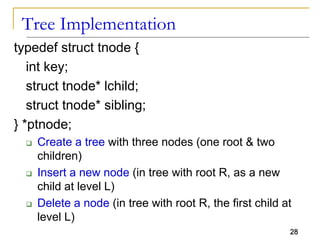
Tree Implementation
typedef struct tnode {
int key;
struct tnode* lchild;
struct tnode* sibling;
} *ptnode;
 Create a tree with three nodes (one root & two
children)
 Insert a new node (in tree with root R, as a new
child at level L)
 Delete a node (in tree with root R, the first child at
level L)
29
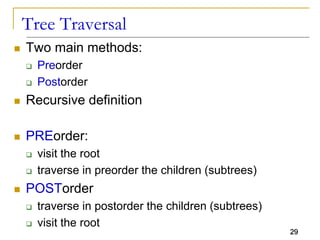
Tree Traversal
 Two main methods:
 Preorder
 Postorder
 Recursive definition
 PREorder:
 visit the root
 traverse in preorder the children (subtrees)
 POSTorder
 traverse in postorder the children (subtrees)
 visit the root
30
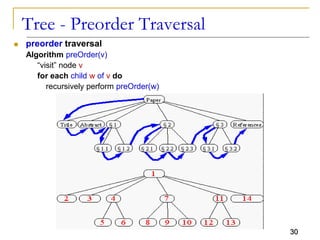
Tree - Preorder Traversal
 preorder traversal
Algorithm preOrder(v)
“visit” node v
for each child w of v do
recursively perform preOrder(w)
31
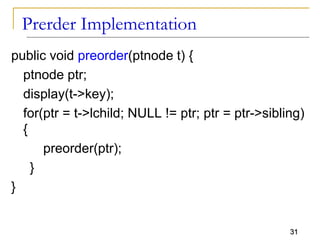
Prerder Implementation
public void preorder(ptnode t) {
ptnode ptr;
display(t->key);
for(ptr = t->lchild; NULL != ptr; ptr = ptr->sibling)
{
preorder(ptr);
}
}
32
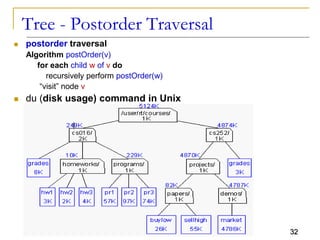
Tree - Postorder Traversal
 postorder traversal
Algorithm postOrder(v)
for each child w of v do
recursively perform postOrder(w)
“visit” node v
 du (disk usage) command in Unix
33
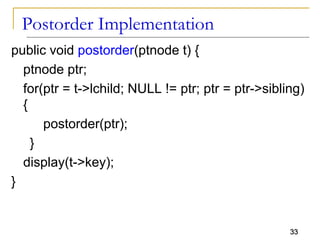
Postorder Implementation
public void postorder(ptnode t) {
ptnode ptr;
for(ptr = t->lchild; NULL != ptr; ptr = ptr->sibling)
{
postorder(ptr);
}
display(t->key);
}
34
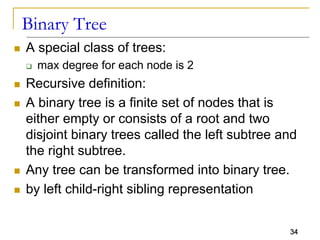
Binary Tree
 A special class of trees:
 max degree for each node is 2
 Recursive definition:
 A binary tree is a finite set of nodes that is
either empty or consists of a root and two
disjoint binary trees called the left subtree and
the right subtree.
 Any tree can be transformed into binary tree.
 by left child-right sibling representation
35
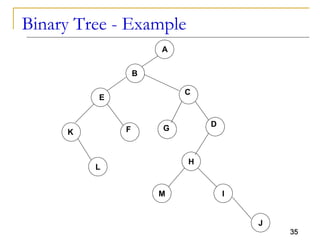
Binary Tree - Example
J
I
M
H
L
A
B
C
D
E
F G
K
36
Binary Tree
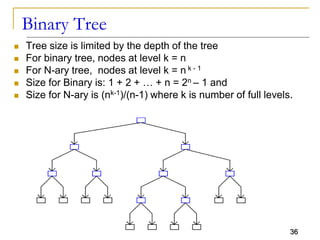
 Tree size is limited by the depth of the tree
 For binary tree, nodes at level k = n
 For N-ary tree, nodes at level k = n k - 1
 Size for Binary is: 1 + 2 + … + n = 2n – 1 and
 Size for N-ary is (nk-1)/(n-1) where k is number of full levels.
37
Binary Tree
 A binary tree is a tree in which no node can
have more than 2 children
 These children are described as “left child” and
“right child” of the parent node
 A binary tree T is defined as a finite set of
elements called nodes such that
 T is empty if T has no nodes called the null or empty
tree
 T contains a special node R, called root node of T
 remaining nodes of T form an ordered pair of
disjoined binary trees T1 and T2. They are called
left and right sub tree of R
38
Binary Tree
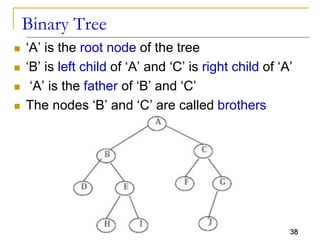
 ‘A’ is the root node of the tree
 ‘B’ is left child of ‘A’ and ‘C’ is right child of ‘A’
 ‘A’ is the father of ‘B’ and ‘C’
 The nodes ‘B’ and ‘C’ are called brothers
39
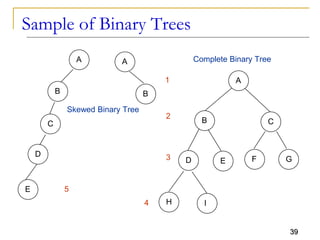
Sample of Binary Trees
A
B
A
B
A
B C
G
E
I
D
H
F
Complete Binary Tree
Skewed Binary Tree
E
C
D
1
2
3
4
5
40
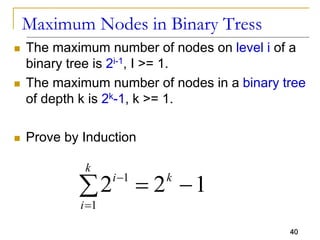
Maximum Nodes in Binary Tress
 The maximum number of nodes on level i of a
binary tree is 2i-1, I >= 1.
 The maximum number of nodes in a binary tree
of depth k is 2k-1, k >= 1.
 Prove by Induction
2 2 1
1
1
i
i
k
k


  
41
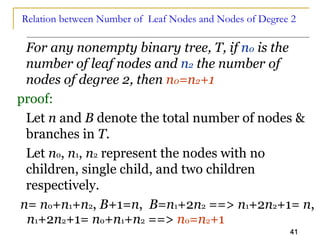
Relation between Number of Leaf Nodes and Nodes of Degree 2
For any nonempty binary tree, T, if n0 is the
number of leaf nodes and n2 the number of
nodes of degree 2, then n0=n2+1
proof:
Let n and B denote the total number of nodes &
branches in T.
Let n0, n1, n2 represent the nodes with no
children, single child, and two children
respectively.
n= n0+n1+n2, B+1=n, B=n1+2n2 ==> n1+2n2+1= n,
n1+2n2+1= n0+n1+n2 ==> n0=n2+1
42
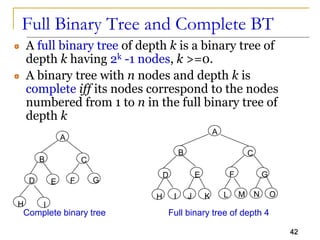
Full Binary Tree and Complete BT
A full binary tree of depth k is a binary tree of
depth k having 2k -1 nodes, k >=0.
A binary tree with n nodes and depth k is
complete iff its nodes correspond to the nodes
numbered from 1 to n in the full binary tree of
depth k
A
B C
G
E
I
D
H
F
A
B C
G
E
K
D
J
F
I
H O
N
M
L
Complete binary tree Full binary tree of depth 4
43
Binary Tree Representation
If a complete binary tree with n nodes (depth =
log n + 1) is represented sequentially, then for
any node with index i, 1<=i<=n, we have:
parent(i) is at i/2 if i!=1. If i=1, i is at the root and
has no parent.
leftChild(i) is at 2i if 2i<=n. If 2i>n, then i has no
left child.
rightChild(i) is at 2i+1 if 2i +1 <=n. If 2i +1 >n,
then i has no right child.
44
Sequential Representation
A
B
--
C
--
--
--
D
--
.
E
[1]
[2]
[3]
[4]
[5]
[6]
[7]
[8]
[9]
.
[16]
A
B
E
C
D
[1]
[2]
[3]
[4]
[5]
[6]
[7]
[8]
[9]
A
B
C
D
E
F
G
H
I
A
B C
G
E
I
D
H
F
(1) waste space
(2) insertion/deletion
problem
45
Linked Representation
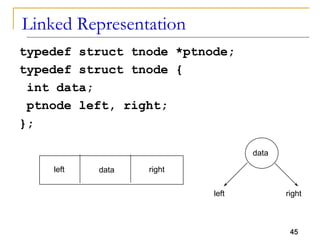
typedef struct tnode *ptnode;
typedef struct tnode {
int data;
ptnode left, right;
};
data
left right
data
left right
46
Summary
 Trees
 Concept
 Examples and Applications
 Definition
 Terminology
 Types of Trees
 General Trees
 Representation and Traversal
 Binary Tree
 Types and Representations

Tree Data Structure Tree Data Structure Details

  • 1.
  • 2.
    2 Objectives Overview  Trees Concept  Examples and Applications  Definition  Terminology  Types of Trees  General Trees  Representation and Traversal  Binary Tree  Types and Representations
  • 3.
    3 Tree - Introduction Trees are very flexible, versatile and powerful non-linear data structure  It can be used to represent data items possessing hierarchical relationship  A tree can be theoretically defined as a finite set of one or more data items (or nodes) such that  There is a special node called the root of the tree  Remaining nodes (or data item) are partitioned into number of subsets each of which is itself a tree, are called subtree  A tree is a set of related interconnected nodes in a hierarchical structure
  • 4.
    4 Tree - Introduction Some data is not linear (it has more structure!)  Family trees  Organizational charts  Linked lists etc don’t store this structure information.  Linear implementations are sometimes inefficient or otherwise sub-optimal for our purposes  Trees offer an alternative  Representation  Implementation strategy  Set of algorithms
  • 5.
    5 Tree Examples  Wherehave you seen a tree structure before?  Examples of trees:  Directory tree  Family tree  Company organization chart  Table of contents etc.
  • 6.
    6 Tree Example –Tic Tac Toe X X X X O X X O X O X O X O X
  • 7.
  • 8.
    8 Tree Example –Taxonomy Tree
  • 9.
    9 Tree Example –Decision Tree  tool that uses a tree-like graph or model of decisions and their possible consequences  including chance event outcomes, resource costs, and utility  It is one way to display an algorithm.
  • 10.
    10 What is aTree Useful for?  Artificial Intelligence – planning, navigating, games  Representing things:  Simple file systems  Class inheritance and composition  Classification, e.g. taxonomy (the is-a relationship again!)  HTML pages  Parse trees for language  3D graphics
  • 11.
    11 Tree - Definition A tree is a finite set of one or more nodes such that:  There is a specially designated node called the root.  The remaining nodes are partitioned into n>=0 disjoint sets T1, ..., Tn, where each of these sets is a tree.  We call T1, ..., Tn the subtrees of the root r  Each of whose roots are connected by a directed edge from r  A tree is a collection of N nodes, one of which is the root and N-1 edges
  • 12.
    12 Tree – BasicTerminology  Each data item within a tree is called a 'node’  The highest data item in the tree is called the 'root' or root node  First node in hierarchical arrangement of data  Below the root lie a number of other 'nodes'. The root is the 'parent' of the nodes immediately linked to it and these are the 'children' of the parent node  Leaf node has no children
  • 13.
    13 Tree – BasicTerminology  If nodes share a common parent, then they are 'sibling' nodes, just like a family.  The link joining one node to another is called the 'branch'.  This tree structure is a general tree  Leaves: nodes with no children (also known as external nodes)  Internal Nodes: nodes with children The ancestors of a node are all the nodes along the path from the root to the node
  • 14.
    14 Tree – BasicTerminology  ‘A’ is root node  Each data item in a tree is known as node  It specifies the data information and links to other data items  Degree of a node is the number of sub-trees of a node in a given tree  In the example  Degree of node A is 3  Degree of node B is 2  Degree of node C is 2  Degree of node D is 3  Degree of node J is 4
  • 15.
    15 Tree – BasicTerminology  Degree of a tree is the maximum degree of node in a given tree  Degree of node J is 4  All other nodes have less or equal degree  So degree of the tree is 4  A node with degree zero (0) is called terminal node or a leaf  Nodes M,N,I,O etc are leaf nodes  Any node whose degree is not zero is called a non-terminal node
  • 16.
    16 Tree – BasicTerminology  Levels of a Tree  The tree is structured in different levels  The entire tree is leveled in such a way that the root node is always of level 0  Its immediate children are at level 1 and their immediate children are at level 2 and so on up to the terminal nodes  If a node is at level n then its children will be at level n+1
  • 17.
    17 Tree – BasicTerminology  Depth of a Tree is the maximum level of any node in a given tree  The number of levels from root to the leaves is called depth of a tree. Depth of tree is 4  The term height is also used to denote the depth of a tree  Height (of node): length of the longest path from a node to a leaf.  All leaves have a height of 0  The height of root is equal to the depth of the tree
  • 18.
    18 Tree – BasicTerminology  A vertex (or node) is a simple object that can have a name and can carry other associated information  An edge is a connection between two vertices  A path in a tree is a list of distinct vertices in which successive vertices are connected by edges in the tree  The defining property of a tree is that there is precisely one path connecting any two nodes
  • 19.
    19 Tree – BasicTerminology  Example: {a, b, d, i } is path Path
  • 20.
    20 Path in aTree  A path from node n1 to nk is defined as a sequence of nodes n1, n2, …, nk such that ni is the parent of ni+1 for 1<= i <= k.  The length of this path is the number of edges on the path namely k-1.  The length of the path from a node to itself is 0.  There is exactly one path from from the root to each node.
  • 21.
    21 What is aTree?  Models the parent/child relationship between different elements  Each child only has one parent  From mathematics:  “a directed acyclic graph”  At most one path from any one node to any other node  Different kinds of trees exist.  Trees can be used for different purposes.  In what order to we visit elements in a tree?
  • 22.
    22 How Many Typesof Trees are there?  Far too many:  General tree  Binary Tree  Red-Black Tree  AVL Tree  Partially Ordered Tree  B+ Trees  … and so on  Different types are used for different things  To improve speed  To improve the use of available memory  To suit particular problems
  • 23.
  • 24.
    24 Representation of Trees List Representation  ( A ( B ( E ( K, L ), F ), C ( G ), D ( H ( M ), I, J ) ) )  The root comes first, followed by a list of sub-trees data link 1 link 2 ... link n How many link fields are needed in such a representation?
  • 25.
    25 A Tree Node Every tree node:  object – useful information  children – pointers to its children nodes O O O O O
  • 26.
    26 Left Child –Right Sibling A B C D E F G H I J K L M data left child right sibling
  • 27.
    27 Tree ADT  Objects:any type of objects can be stored in a tree  Methods:  accessor methods  root() – return the root of the tree  parent(p) – return the parent of a node  children(p) – returns the children of a node  query methods  size() – returns the number of nodes in the tree  isEmpty() - returns true if the tree is empty  elements() – returns all elements  isRoot(p), isInternal(p), isExternal(p)
  • 28.
    28 Tree Implementation typedef structtnode { int key; struct tnode* lchild; struct tnode* sibling; } *ptnode;  Create a tree with three nodes (one root & two children)  Insert a new node (in tree with root R, as a new child at level L)  Delete a node (in tree with root R, the first child at level L)
  • 29.
    29 Tree Traversal  Twomain methods:  Preorder  Postorder  Recursive definition  PREorder:  visit the root  traverse in preorder the children (subtrees)  POSTorder  traverse in postorder the children (subtrees)  visit the root
  • 30.
    30 Tree - PreorderTraversal  preorder traversal Algorithm preOrder(v) “visit” node v for each child w of v do recursively perform preOrder(w)
  • 31.
    31 Prerder Implementation public voidpreorder(ptnode t) { ptnode ptr; display(t->key); for(ptr = t->lchild; NULL != ptr; ptr = ptr->sibling) { preorder(ptr); } }
  • 32.
    32 Tree - PostorderTraversal  postorder traversal Algorithm postOrder(v) for each child w of v do recursively perform postOrder(w) “visit” node v  du (disk usage) command in Unix
  • 33.
    33 Postorder Implementation public voidpostorder(ptnode t) { ptnode ptr; for(ptr = t->lchild; NULL != ptr; ptr = ptr->sibling) { postorder(ptr); } display(t->key); }
  • 34.
    34 Binary Tree  Aspecial class of trees:  max degree for each node is 2  Recursive definition:  A binary tree is a finite set of nodes that is either empty or consists of a root and two disjoint binary trees called the left subtree and the right subtree.  Any tree can be transformed into binary tree.  by left child-right sibling representation
  • 35.
    35 Binary Tree -Example J I M H L A B C D E F G K
  • 36.
    36 Binary Tree  Treesize is limited by the depth of the tree  For binary tree, nodes at level k = n  For N-ary tree, nodes at level k = n k - 1  Size for Binary is: 1 + 2 + … + n = 2n – 1 and  Size for N-ary is (nk-1)/(n-1) where k is number of full levels.
  • 37.
    37 Binary Tree  Abinary tree is a tree in which no node can have more than 2 children  These children are described as “left child” and “right child” of the parent node  A binary tree T is defined as a finite set of elements called nodes such that  T is empty if T has no nodes called the null or empty tree  T contains a special node R, called root node of T  remaining nodes of T form an ordered pair of disjoined binary trees T1 and T2. They are called left and right sub tree of R
  • 38.
    38 Binary Tree  ‘A’is the root node of the tree  ‘B’ is left child of ‘A’ and ‘C’ is right child of ‘A’  ‘A’ is the father of ‘B’ and ‘C’  The nodes ‘B’ and ‘C’ are called brothers
  • 39.
    39 Sample of BinaryTrees A B A B A B C G E I D H F Complete Binary Tree Skewed Binary Tree E C D 1 2 3 4 5
  • 40.
    40 Maximum Nodes inBinary Tress  The maximum number of nodes on level i of a binary tree is 2i-1, I >= 1.  The maximum number of nodes in a binary tree of depth k is 2k-1, k >= 1.  Prove by Induction 2 2 1 1 1 i i k k     
  • 41.
    41 Relation between Numberof Leaf Nodes and Nodes of Degree 2 For any nonempty binary tree, T, if n0 is the number of leaf nodes and n2 the number of nodes of degree 2, then n0=n2+1 proof: Let n and B denote the total number of nodes & branches in T. Let n0, n1, n2 represent the nodes with no children, single child, and two children respectively. n= n0+n1+n2, B+1=n, B=n1+2n2 ==> n1+2n2+1= n, n1+2n2+1= n0+n1+n2 ==> n0=n2+1
  • 42.
    42 Full Binary Treeand Complete BT A full binary tree of depth k is a binary tree of depth k having 2k -1 nodes, k >=0. A binary tree with n nodes and depth k is complete iff its nodes correspond to the nodes numbered from 1 to n in the full binary tree of depth k A B C G E I D H F A B C G E K D J F I H O N M L Complete binary tree Full binary tree of depth 4
  • 43.
    43 Binary Tree Representation Ifa complete binary tree with n nodes (depth = log n + 1) is represented sequentially, then for any node with index i, 1<=i<=n, we have: parent(i) is at i/2 if i!=1. If i=1, i is at the root and has no parent. leftChild(i) is at 2i if 2i<=n. If 2i>n, then i has no left child. rightChild(i) is at 2i+1 if 2i +1 <=n. If 2i +1 >n, then i has no right child.
  • 44.
  • 45.
    45 Linked Representation typedef structtnode *ptnode; typedef struct tnode { int data; ptnode left, right; }; data left right data left right
  • 46.
    46 Summary  Trees  Concept Examples and Applications  Definition  Terminology  Types of Trees  General Trees  Representation and Traversal  Binary Tree  Types and Representations