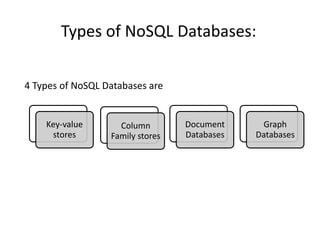
Types of NoSQL Databases:
Key-value
stores
Column
Family stores
Document
Databases
Graph
Databases
4 Types of NoSQL Databases are
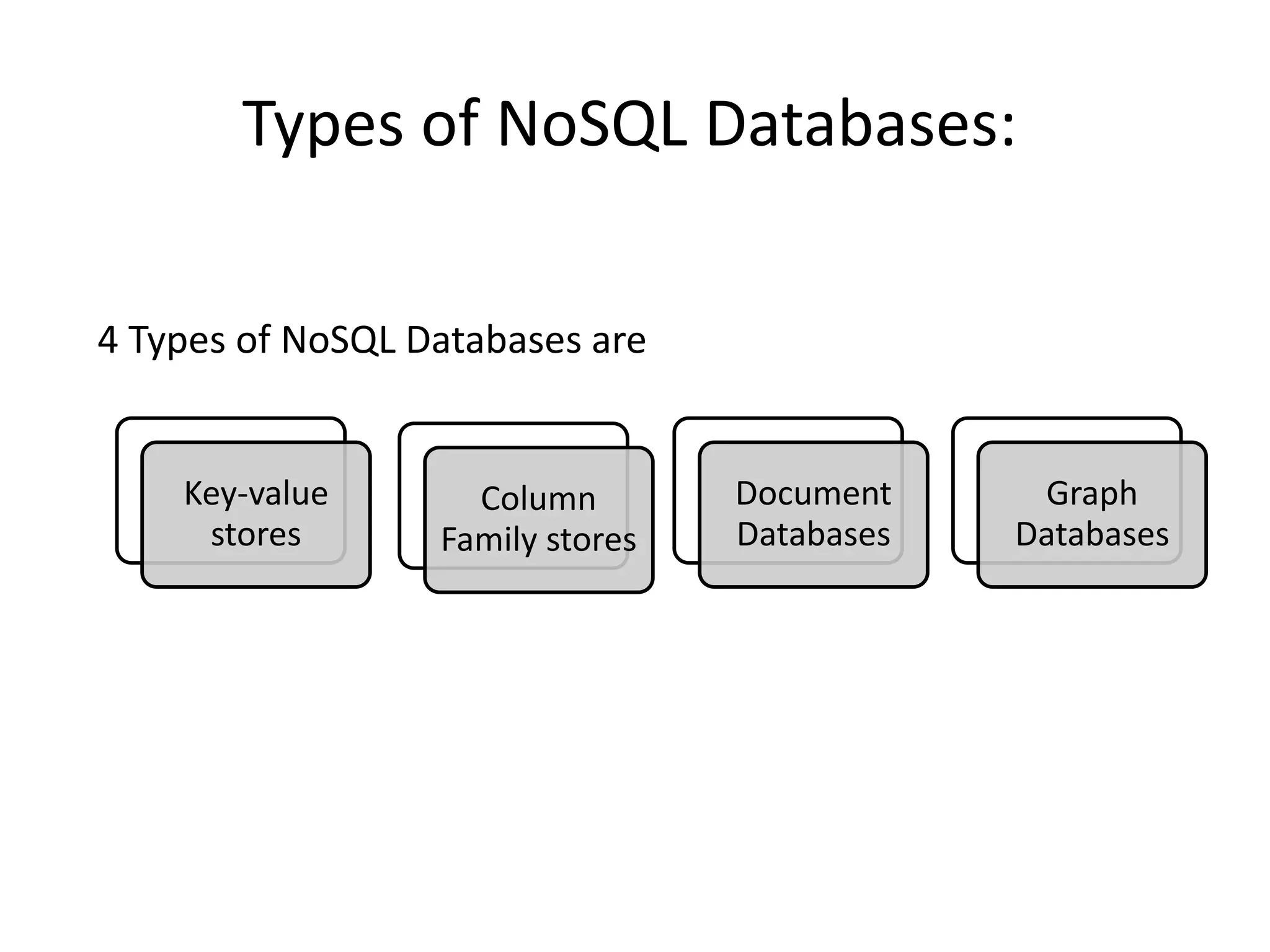
Key Value (tuple) Stores
•Implements Hash Table methodology
•Unique Keys & values with index pointers
•Simple and Easy to implement
•Pros: performance, scalability, flexibility
•Cons: No Schema
•Best with: Less complex huge data sets
Keys Values
Id 1 Name 1
Id 2 Name 2
Id 3 Name 3
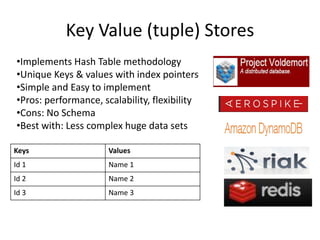
Column Family Stores
• Stores data using unique keys & multiple columns
•Main Concept: creating Columns – Column Families – Super
Columns
•Column Family - collection of columns with key-value pair
•Super Column - collection of column families but not other
super columns
•Best with: Complex data sets
•Pros: Scalability & Performance
•Cons: Flexibility
Name (key)
Value1
FirstName
Value2
MidlleName
Value3
LastName
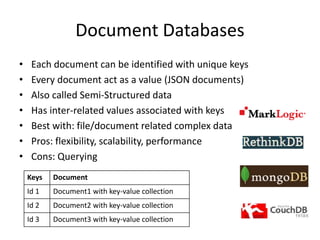
Document Databases
• Each document can be identified with unique keys
• Every document act as a value (JSON documents)
• Also called Semi-Structured data
• Has inter-related values associated with keys
• Best with: file/document related complex data
• Pros: flexibility, scalability, performance
• Cons: Querying
Keys Document
Id 1 Document1 with key-value collection
Id 2 Document2 with key-value collection
Id 3 Document3 with key-value collection
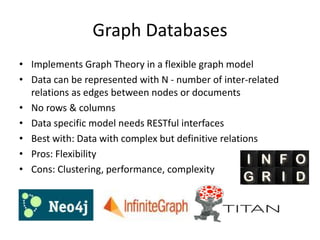
Graph Databases
• Implements Graph Theory in a flexible graph model
• Data can be represented with N - number of inter-related
relations as edges between nodes or documents
• No rows & columns
• Data specific model needs RESTful interfaces
• Best with: Data with complex but definitive relations
• Pros: Flexibility
• Cons: Clustering, performance, complexity

Types of no sql databases

  • 1.
    Types of NoSQLDatabases: Key-value stores Column Family stores Document Databases Graph Databases 4 Types of NoSQL Databases are
  • 2.
    Key Value (tuple)Stores •Implements Hash Table methodology •Unique Keys & values with index pointers •Simple and Easy to implement •Pros: performance, scalability, flexibility •Cons: No Schema •Best with: Less complex huge data sets Keys Values Id 1 Name 1 Id 2 Name 2 Id 3 Name 3
  • 3.
    Column Family Stores •Stores data using unique keys & multiple columns •Main Concept: creating Columns – Column Families – Super Columns •Column Family - collection of columns with key-value pair •Super Column - collection of column families but not other super columns •Best with: Complex data sets •Pros: Scalability & Performance •Cons: Flexibility Name (key) Value1 FirstName Value2 MidlleName Value3 LastName
  • 4.
    Document Databases • Eachdocument can be identified with unique keys • Every document act as a value (JSON documents) • Also called Semi-Structured data • Has inter-related values associated with keys • Best with: file/document related complex data • Pros: flexibility, scalability, performance • Cons: Querying Keys Document Id 1 Document1 with key-value collection Id 2 Document2 with key-value collection Id 3 Document3 with key-value collection
  • 5.
    Graph Databases • ImplementsGraph Theory in a flexible graph model • Data can be represented with N - number of inter-related relations as edges between nodes or documents • No rows & columns • Data specific model needs RESTful interfaces • Best with: Data with complex but definitive relations • Pros: Flexibility • Cons: Clustering, performance, complexity