








Network	
 Ā Basics

June	
 Ā Holley,	
 Ā Network	
 Ā Weaver
 june@networkweaving.com

            June	
 Ā 2010
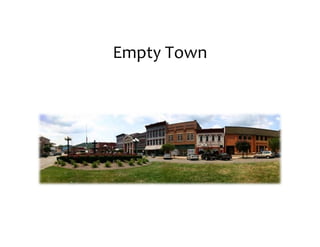
Empty	
 Ā Town
Ā Artisan	
 Ā Gallery
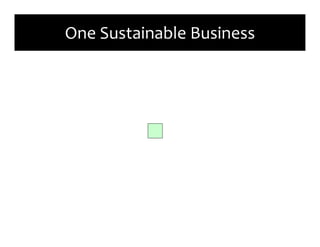
One	
 Ā Sustainable	
 Ā Business
        One	
 Ā Business
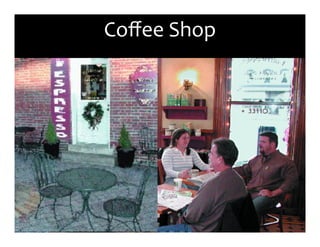
Coffee	
 Ā Shop
New	
 Ā Retail	
 Ā Network
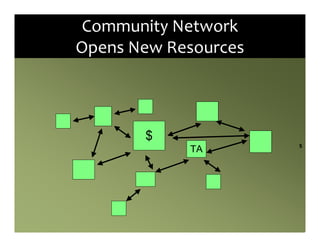
 Community	
 Ā  Created
Opens	
 Ā New	
 Ā Resources


          $
                            $
                TA
Ā 	
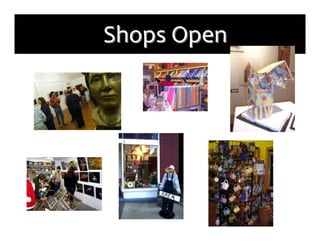
 Ā Shops	
 Ā Open
        Shops	
 Ā 
Ā 	
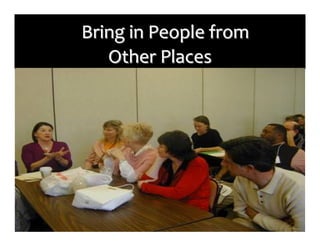
 Ā Bring	
 Ā in	
 Ā People	
 Ā from
        Bring	
 Ā 
       Other	
 Ā Places
New	
 Ā Retail	
 Ā Created
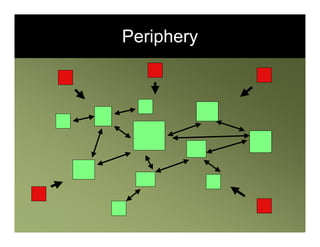
       Periphery
Ā 	
 Ā Opry	
 Ā House
        Opry	
 Ā House


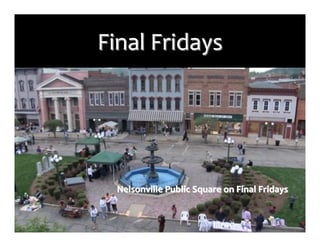
   Nelsonville	
 Ā Public	
 Ā Square	
 Ā on	
 Ā Final	
 Ā Fridays
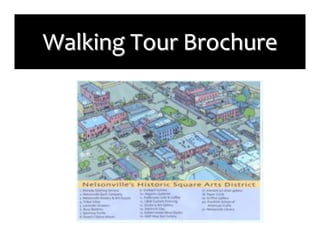
Walking	
 Ā Tour	
 Ā Brochure
Final	
 Ā Fridays


  Nelsonville	
 Ā Public	
 Ā Square	
 Ā on	
 Ā Final	
 Ā Fridays
Local	
 Ā Culinary	
 Ā School
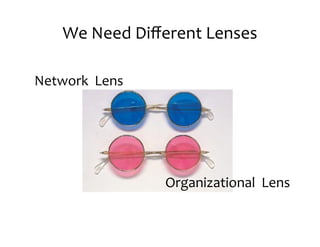
We	
 Ā Need	
 Ā Different	
 Ā Lenses

Network	
 Ā 	
 Ā Lens


                      Organizational	
 Ā 	
 Ā Lens
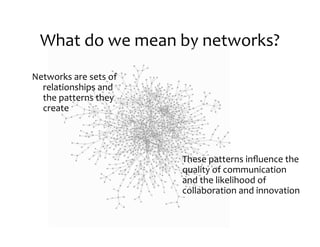
What	
 Ā do	
 Ā we	
 Ā mean	
 Ā by	
 Ā networks?
Networks	
 Ā are	
 Ā sets	
 Ā of
  relationships	
 Ā and
  the	
 Ā patterns	
 Ā they
  create


                                These	
 Ā patterns	
 Ā influence	
 Ā the
                                quality	
 Ā of	
 Ā communication
                                and	
 Ā the	
 Ā likelihood	
 Ā of
                                collaboration	
 Ā and	
 Ā innovation
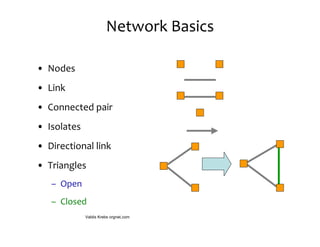
Network	
 Ā Basics

• Nodes
• Link
• Connected	
 Ā pair
• Isolates
• Directional	
 Ā link
• Triangles
    – Open
    – Closed
             Valdis Krebs orgnet.com
What	
 Ā do	
 Ā we	
 Ā mean	
 Ā by	
 Ā networks?
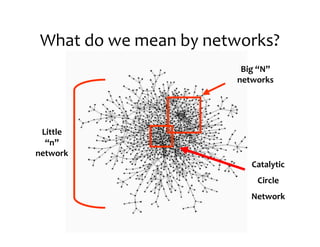
                                    Big	
 Ā ā€œNā€
                                   networks


 Little
  ā€œnā€
network
                                       Catalytic
                                         Circle
                                       Network
Smart	
 Ā Networks:
Networks	
 Ā most	
 Ā helpful	
 Ā in	
 Ā promoting	
 Ā collaboration
                      &	
 Ā innovation

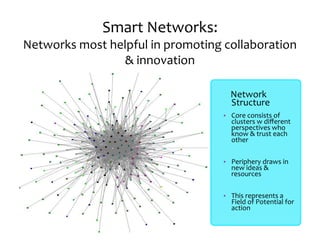
                                                 Network
                                                 Structure
                                              • Core	
 Ā consists	
 Ā of
                                                clusters	
 Ā w	
 Ā different
                                                perspectives	
 Ā who
                                                know	
 Ā &	
 Ā trust	
 Ā each
                                                other


                                              • Periphery	
 Ā draws	
 Ā in
                                                new	
 Ā ideas	
 Ā &
                                                resources


                                              • This	
 Ā represents	
 Ā a
                                                Field	
 Ā of	
 Ā Potential	
 Ā for
                                                action
Characteristics	
 Ā of	
 Ā Smart	
 Ā Networks


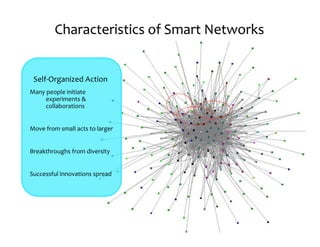
 Self-­‐Organized	
 Ā Action
Many	
 Ā people	
 Ā initiate
      experiments	
 Ā &
      collaborations


Move	
 Ā from	
 Ā small	
 Ā acts	
 Ā to	
 Ā larger


Breakthroughs	
 Ā from	
 Ā diversity


Successful	
 Ā innovations	
 Ā spread
Characteristics	
 Ā of	
 Ā Smart	
 Ā Networks
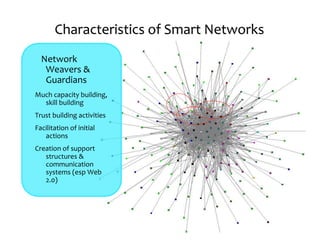
  Network
   Weavers	
 Ā &
   Guardians
Much	
 Ā capacity	
 Ā building,
  skill	
 Ā building
Trust	
 Ā building	
 Ā activities
Facilitation	
 Ā of	
 Ā initial
   actions
Creation	
 Ā of	
 Ā support
   structures	
 Ā &
   communication
   systems	
 Ā (esp	
 Ā Web
   2.0)
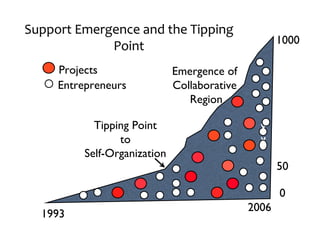
Support	
 Ā Emergence	
 Ā and	
 Ā the	
 Ā Tipping
                               the	
 Ā 
                                                       1000
                Point
       Projects                 Emergence of
       Entrepreneurs            Collaborative
                                   Region

              Tipping Point                       v
                   to                             v
                                                  v
            Self-Organization
                                                       50

                                                       0
                                                2006
   1993
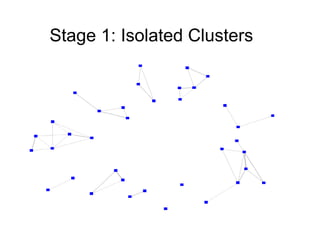
Stage 1: Isolated Clusters
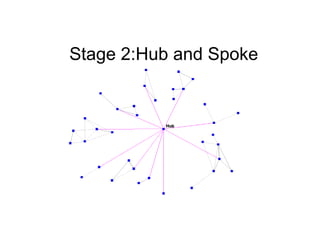
Stage 2:Hub and Spoke
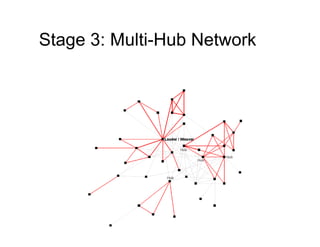
Stage 3: Multi-Hub Network
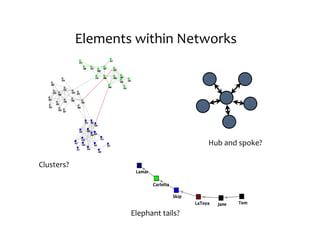
Elements	
 Ā within	
 Ā Networks


                                           Hub	
 Ā and	
 Ā spoke?

Clusters?


                      Elephant	
 Ā tails?
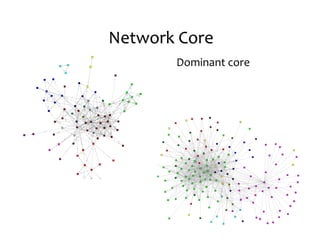
Network	
 Ā Core
         Dominant	
 Ā core
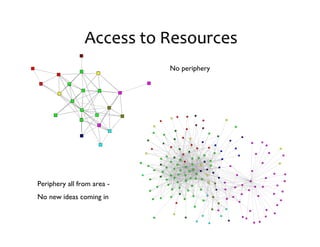
Access	
 Ā to	
 Ā Resources
                             No periphery


Periphery all from area -
No new ideas coming in
Network	
 Ā Surveying	
 Ā &	
 Ā Mapping

     June	
 Ā Holley,	
 Ā Network	
 Ā Weaver
      june@networkweaving.com

                 June	
 Ā 2010
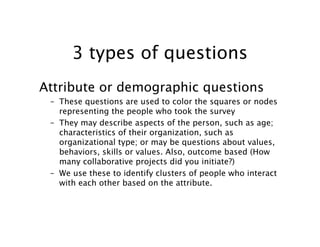
3 types of questions
Attribute or demographic questions
 – These questions are used to color the squares or nodes
   representing the people who took the survey
 – They may describe aspects of the person, such as age;
   characteristics of their organization, such as
   organizational type; or may be questions about values,
   behaviors, skills or values. Also, outcome based (How
   many collaborative projects did you initiate?)
 – We use these to identify clusters of people who interact
   with each other based on the attribute.
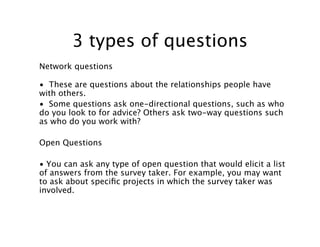
3 types of questions
Network questions

• These are questions about the relationships people have
with others.
• Some questions ask one-directional questions, such as who
do you look to for advice? Others ask two-way questions such
as who do you work with?

Open Questions

• You can ask any type of open question that would elicit a list
of answers from the survey taker. For example, you may want
to ask about specific projects in which the survey taker was
involved.
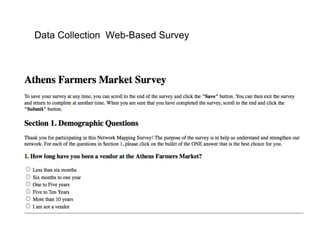
Data Collection Web-Based Survey
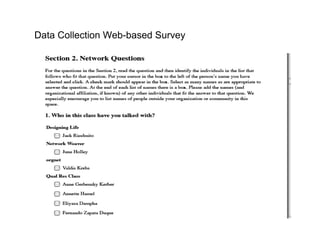
Data Collection Web-based Survey
Metrics
•   Awareness: How likely is it that information will spread throughout
    the network? Who knows what is happening in the network?

•   Influence: Who do people look to? How likely is it that people can
    positively influence others?

•   Connectors: Who links people who would not otherwise be
    connected? How connected are parts of the network?

•   Resilience: How dependent is the network on a few people?

•   Integration: What is the overall network health? Who are network
    leaders?

•   Smart Network: how large and well-connected is the core? How
    vast is the periphery?
Network	
 Ā Weaver


    A	
 Ā Network	
 Ā Weaver	
 Ā is	
 Ā willing	
 Ā to	
 Ā take
                                    willing	
 Ā 
 responsibility	
 Ā for	
 Ā making	
 Ā the	
 Ā network	
 Ā more
effective	
 Ā by	
 Ā increasing	
 Ā the	
 Ā quantity	
 Ā and	
 Ā quality
                      of	
 Ā connections.
Network	
 Ā Weaver


Take	
 Ā the	
 Ā Network	
 Ā Weaver	
 Ā Checklist


  Share	
 Ā your	
 Ā results	
 Ā with	
 Ā a	
 Ā friend
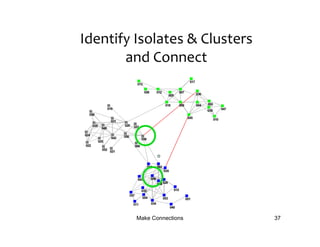
Identify	
 Ā Isolates	
 Ā &	
 Ā Clusters
       and	
 Ā Connect


            Make Connections            37
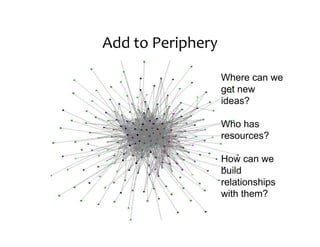
Add	
 Ā to	
 Ā Periphery

                         Where can we
                         get new
                         ideas?

                         Who has
                         resources?

                         How can we
                         build
                         relationships
                         with them?
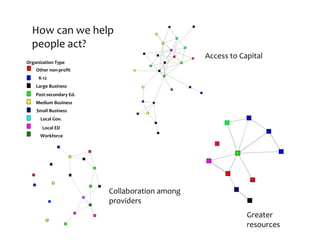
How	
 Ā can	
 Ā we	
 Ā help
  people	
 Ā act?
                                                                Access	
 Ā to	
 Ā Capital
Organization	
 Ā Type
     Other	
 Ā non-­‐profit
     	
 Ā 	
 Ā K-­‐12
     Large	
 Ā Business
    Post-­‐secondary	
 Ā Ed.
    Medium	
 Ā Business
     Small	
 Ā Business
     	
 Ā 	
 Ā 	
 Ā 	
 Ā Local	
 Ā Gov.
     	
 Ā 	
 Ā 	
 Ā 	
 Ā 	
 Ā Local	
 Ā ED
     	
 Ā 	
 Ā 	
 Ā Workforce


                                       Collaboration	
 Ā among
                                       providers
                                                                                Greater
                                                                                resources
Case Studies of Regional
     Development
  June	
 Ā Holley,	
 Ā Network	
 Ā Weaver
   june@networkweaving.com

              June	
 Ā 2010
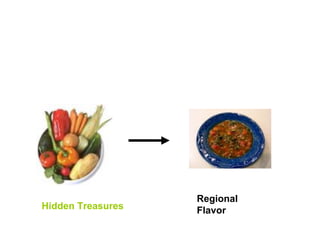
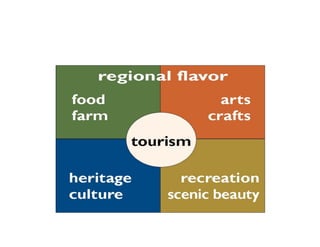
Regional
Hidden Treasures   Flavor
Hidden Treasures
Make a list of hidden treasures in
      your interest areas
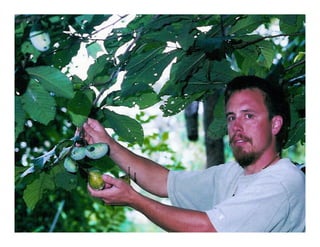
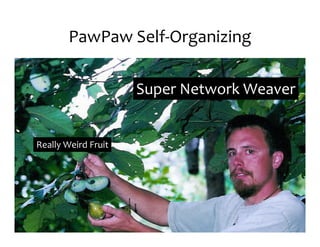
PawPaw	
 Ā Self-­‐Organizing

                           Super	
 Ā Network	
 Ā Weaver


Really	
 Ā Weird	
 Ā Fruit
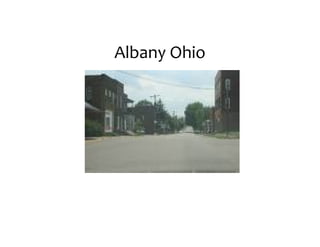
Albany	
 Ā Ohio
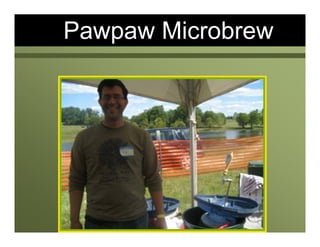
Pawpaw Microbrew
Travel	
 Ā Channel
    Travel Channel comes to the land of the pawpaw
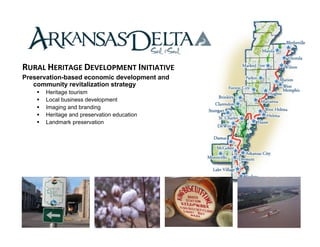
RURAL	
 Ā HERITAGE	
 Ā DEVELOPMENT	
 Ā INITIATIVE
Preservation-based economic development and
   community revitalization strategy
    ļ‚§   Heritage tourism
    ļ‚§   Local business development
    ļ‚§   Imaging and branding
    ļ‚§   Heritage and preservation education
    ļ‚§   Landmark preservation
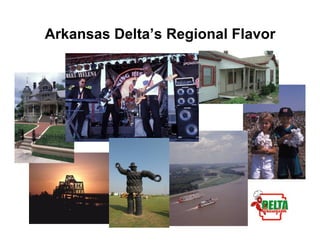
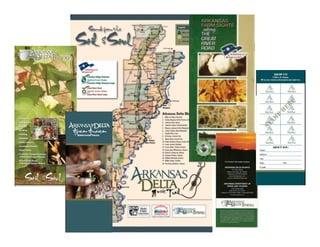
Arkansas Delta’s Regional Flavor
Utilize micro-brands and encourage
 partners to buy-in to regional brand
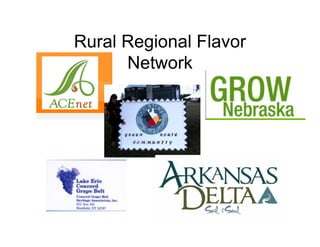
Rural Regional Flavor
      Network
Next	
 Ā Steps

• What	
 Ā are	
 Ā ideas	
 Ā you	
 Ā have	
 Ā for	
 Ā your	
 Ā interest	
 Ā area?

• What	
 Ā are	
 Ā small	
 Ā ac:ons	
 Ā you	
 Ā could	
 Ā take	
 Ā to	
 Ā explore
    op:ons	
 Ā in	
 Ā your	
 Ā interest	
 Ā area?
                    your	
 Ā 

• Who	
 Ā do	
 Ā you	
 Ā need	
 Ā to	
 Ā get	
 Ā to	
 Ā know?
         do	
 Ā 

• Who	
 Ā do	
 Ā you	
 Ā need	
 Ā to	
 Ā connect?

• What	
 Ā other	
 Ā support	
 Ā will	
 Ā you	
 Ā need	
 Ā to	
 Ā move	
 Ā forward
    in	
 Ā this	
 Ā area?

Basic networkconceptsnewfoundland

  • 1.
    Network Ā Basics June Ā Holley, Ā Network Ā Weaver june@networkweaving.com June Ā 2010
  • 2.
  • 3.
  • 4.
  • 5.
  • 6.
    New Ā Retail Ā Network Community Ā  Created Opens Ā New Ā Resources $ $ TA
  • 7.
  • 8.
    Ā  Ā Bring Ā in Ā People Ā from Bring Ā  Other Ā Places
  • 9.
  • 11.
    Ā  Ā Opry Ā House Opry Ā House Nelsonville Ā Public Ā Square Ā on Ā Final Ā Fridays
  • 12.
  • 13.
    Final Ā Fridays Nelsonville Ā Public Ā Square Ā on Ā Final Ā Fridays
  • 14.
  • 15.
    We Ā Need Ā Different Ā Lenses Network Ā  Ā Lens Organizational Ā  Ā Lens
  • 16.
    What Ā do Ā we Ā mean Ā by Ā networks? Networks Ā are Ā sets Ā of relationships Ā and the Ā patterns Ā they create These Ā patterns Ā influence Ā the quality Ā of Ā communication and Ā the Ā likelihood Ā of collaboration Ā and Ā innovation
  • 17.
    Network Ā Basics • Nodes •Link • Connected Ā pair • Isolates • Directional Ā link • Triangles – Open – Closed Valdis Krebs orgnet.com
  • 18.
    What Ā do Ā we Ā mean Ā by Ā networks? Big Ā ā€œNā€ networks Little ā€œnā€ network Catalytic Circle Network
  • 19.
    Smart Ā Networks: Networks Ā most Ā helpful Ā in Ā promoting Ā collaboration & Ā innovation Network Structure • Core Ā consists Ā of clusters Ā w Ā different perspectives Ā who know Ā & Ā trust Ā each other • Periphery Ā draws Ā in new Ā ideas Ā & resources • This Ā represents Ā a Field Ā of Ā Potential Ā for action
  • 20.
    Characteristics Ā of Ā Smart Ā Networks Self-­‐Organized Ā Action Many Ā people Ā initiate experiments Ā & collaborations Move Ā from Ā small Ā acts Ā to Ā larger Breakthroughs Ā from Ā diversity Successful Ā innovations Ā spread
  • 21.
    Characteristics Ā of Ā Smart Ā Networks Network Weavers Ā & Guardians Much Ā capacity Ā building, skill Ā building Trust Ā building Ā activities Facilitation Ā of Ā initial actions Creation Ā of Ā support structures Ā & communication systems Ā (esp Ā Web 2.0)
  • 22.
    Support Ā Emergence Ā and Ā the Ā Tipping the Ā  1000 Point Projects Emergence of Entrepreneurs Collaborative Region Tipping Point v to v v Self-Organization 50 0 2006 1993
  • 23.
  • 24.
  • 25.
  • 26.
    Elements Ā within Ā Networks Hub Ā and Ā spoke? Clusters? Elephant Ā tails?
  • 27.
    Network Ā Core Dominant Ā core
  • 28.
    Access Ā to Ā Resources No periphery Periphery all from area - No new ideas coming in
  • 29.
    Network Ā Surveying Ā & Ā Mapping June Ā Holley, Ā Network Ā Weaver june@networkweaving.com June Ā 2010
  • 30.
    3 types ofquestions Attribute or demographic questions – These questions are used to color the squares or nodes representing the people who took the survey – They may describe aspects of the person, such as age; characteristics of their organization, such as organizational type; or may be questions about values, behaviors, skills or values. Also, outcome based (How many collaborative projects did you initiate?) – We use these to identify clusters of people who interact with each other based on the attribute.
  • 31.
    3 types ofquestions Network questions • These are questions about the relationships people have with others. • Some questions ask one-directional questions, such as who do you look to for advice? Others ask two-way questions such as who do you work with? Open Questions • You can ask any type of open question that would elicit a list of answers from the survey taker. For example, you may want to ask about specific projects in which the survey taker was involved.
  • 32.
  • 33.
  • 34.
    Metrics • Awareness: How likely is it that information will spread throughout the network? Who knows what is happening in the network? • Influence: Who do people look to? How likely is it that people can positively influence others? • Connectors: Who links people who would not otherwise be connected? How connected are parts of the network? • Resilience: How dependent is the network on a few people? • Integration: What is the overall network health? Who are network leaders? • Smart Network: how large and well-connected is the core? How vast is the periphery?
  • 35.
    Network Ā Weaver A Ā Network Ā Weaver Ā is Ā willing Ā to Ā take willing Ā  responsibility Ā for Ā making Ā the Ā network Ā more effective Ā by Ā increasing Ā the Ā quantity Ā and Ā quality of Ā connections.
  • 36.
    Network Ā Weaver Take Ā the Ā Network Ā Weaver Ā Checklist Share Ā your Ā results Ā with Ā a Ā friend
  • 37.
    Identify Ā Isolates Ā & Ā Clusters and Ā Connect Make Connections 37
  • 38.
    Add Ā to Ā Periphery Where can we get new ideas? Who has resources? How can we build relationships with them?
  • 39.
    How Ā can Ā we Ā help people Ā act? Access Ā to Ā Capital Organization Ā Type Other Ā non-­‐profit Ā  Ā K-­‐12 Large Ā Business Post-­‐secondary Ā Ed. Medium Ā Business Small Ā Business Ā  Ā  Ā  Ā Local Ā Gov. Ā  Ā  Ā  Ā  Ā Local Ā ED Ā  Ā  Ā Workforce Collaboration Ā among providers Greater resources
  • 40.
    Case Studies ofRegional Development June Ā Holley, Ā Network Ā Weaver june@networkweaving.com June Ā 2010
  • 41.
  • 46.
    Hidden Treasures Make alist of hidden treasures in your interest areas
  • 47.
    PawPaw Ā Self-­‐Organizing Super Ā Network Ā Weaver Really Ā Weird Ā Fruit
  • 48.
  • 51.
  • 52.
    Travel Ā Channel Travel Channel comes to the land of the pawpaw
  • 53.
    RURAL Ā HERITAGE Ā DEVELOPMENT Ā INITIATIVE Preservation-based economic development and community revitalization strategy ļ‚§ Heritage tourism ļ‚§ Local business development ļ‚§ Imaging and branding ļ‚§ Heritage and preservation education ļ‚§ Landmark preservation
  • 54.
  • 57.
    Utilize micro-brands andencourage partners to buy-in to regional brand
  • 58.
  • 59.
    Next Ā Steps • What Ā are Ā ideas Ā you Ā have Ā for Ā your Ā interest Ā area? • What Ā are Ā small Ā ac:ons Ā you Ā could Ā take Ā to Ā explore op:ons Ā in Ā your Ā interest Ā area? your Ā  • Who Ā do Ā you Ā need Ā to Ā get Ā to Ā know? do Ā  • Who Ā do Ā you Ā need Ā to Ā connect? • What Ā other Ā support Ā will Ā you Ā need Ā to Ā move Ā forward in Ā this Ā area?