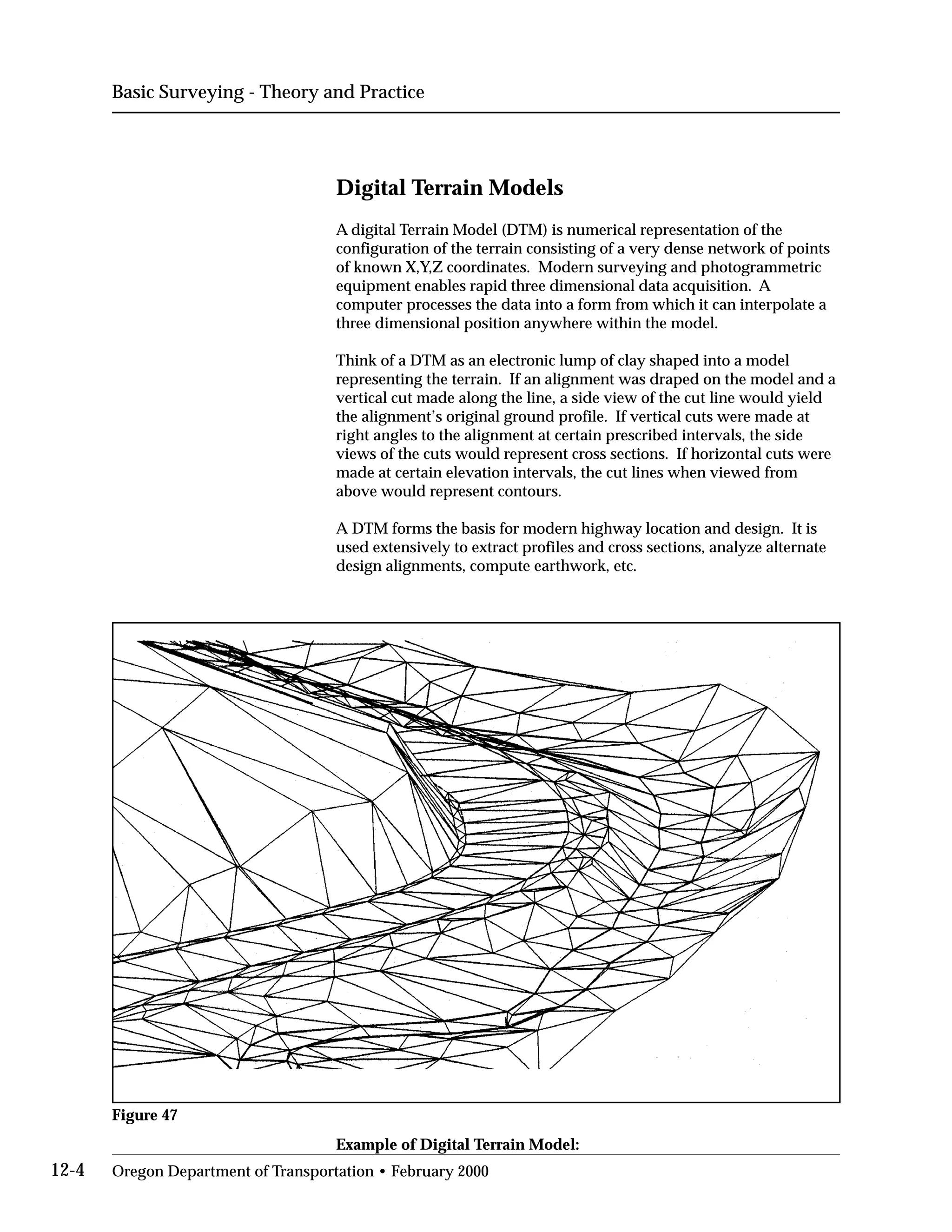
OREGON

DEPARTMENT

OF

TRANSPORTATION

GEOMETRONICS

200 Hawthorne Ave.,

B250

Salem, OR 97310

(503) 986-3103

Ron Singh, PLS
Chief of Surveys
(503) 986-3033
David Artman, PLS
Geometronics
(503) 986-3017
David W. Taylor, PLS
Geometronics
(503) 986-3034
Dave Brinton, PLS, WRE
Survey Operations
(503) 986-3035
BASIC SURVEYING -THEORY AND PRACTICE

Ninth Annual Seminar

Presented by the

Oregon Department of Transportation

Geometronics Unit

February 15th
- 17th
, 2000

Bend, Oregon
Table of Contents

Types of Surveys ........................................................................................... 1-1

Review of Basic Trigonometry ................................................................... 2-1

Distance Measuring Chaining ................................................................... 3-1

Distance Measuring Electronic Distance Meters ................................... 4-1

Angle Measuring .......................................................................................... 5-1

Bearing and Azimuths ................................................................................ 6-1

Coordinates .................................................................................................... 7-1

Traverse ........................................................................................................... 8-1

Global Positioning System ......................................................................... 9-1

Differential Leveling ................................................................................. 10-1

Trigonometric Leveling ..............................................................................11-1

Cross Sections / Digital Terrain Modeling ............................................ 12-1

Horizontal Curves ...................................................................................... 13-1

Spirals .......................................................................................................... 14-1

Vertical Curves ............................................................................................ 15-1

Appendix A:
Law of Sines/Cosines ........................................................................... A-1

Derivation of Pythagorean Theorem .................................................. A-3

Chaining Formulas ................................................................................ A-5

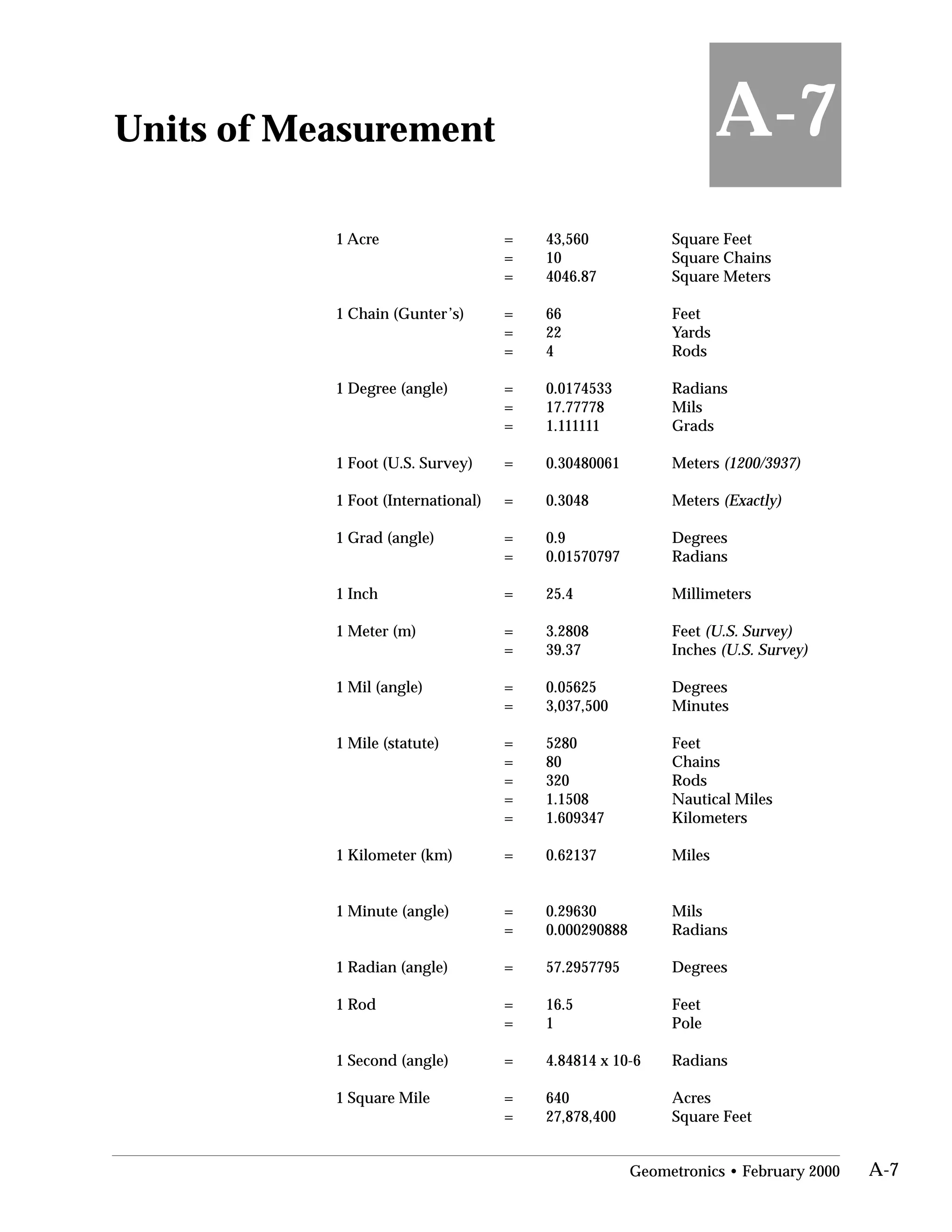
Units of Measurement .......................................................................... A-7

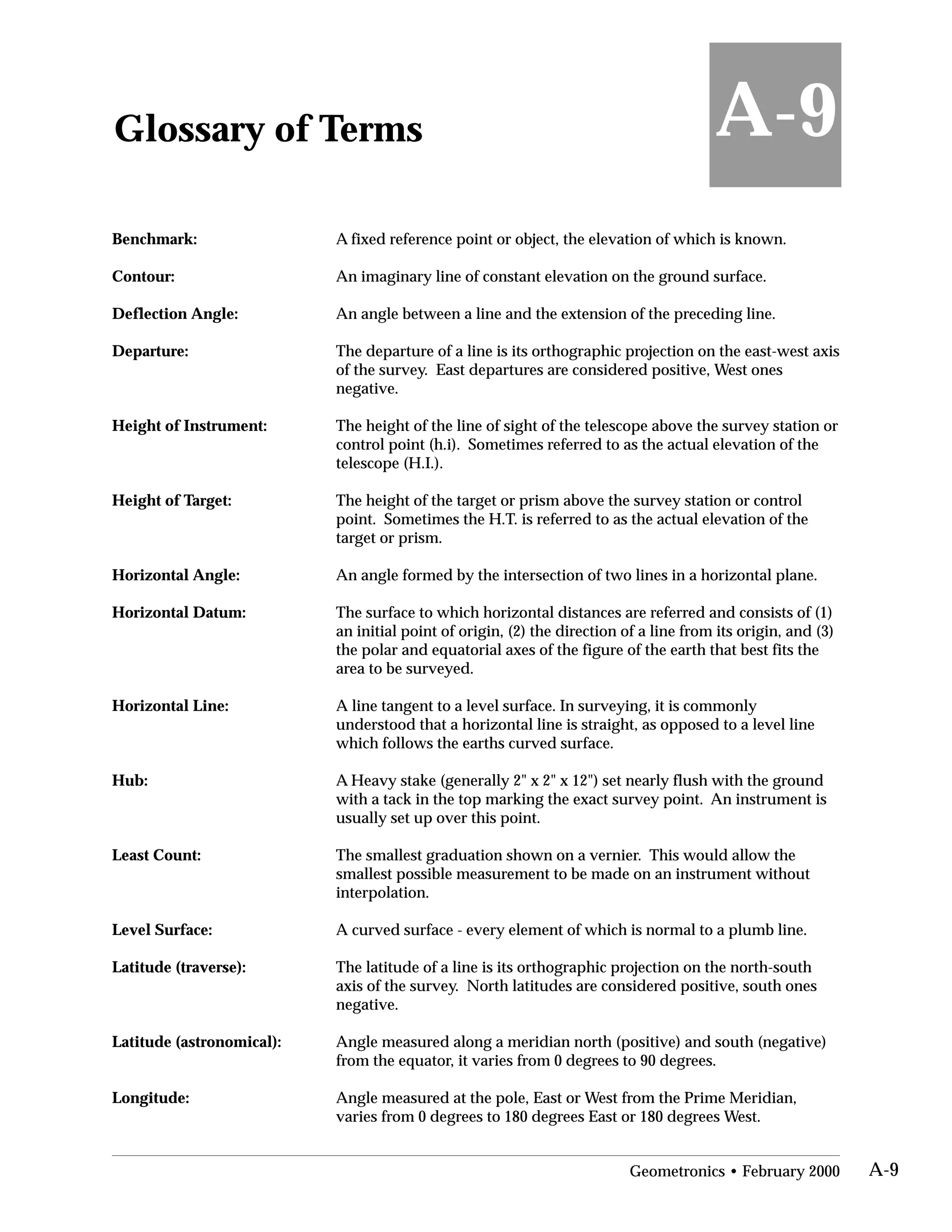
Glossary of Terms .................................................................................. A-9

Glossary of Abbreviations .................................................................. A-11

Example PPM Chart ............................................................................ A-15

Example Traverse Calculation Sheet ................................................ A-17

Excerpt from Table IV (Spiral Book) ................................................. A-19

Appendix B: Answer Keys
Basic Trigonometry ................................................................................ B-1

Angle Measuring .................................................................................... B-3

Bearings and Azimuths ......................................................................... B-5

Coordinates ............................................................................................. B-7

Traverse .................................................................................................. B-11

Differential Leveling ............................................................................ B-13

Trigonometric Leveling ....................................................................... B-15

Horizontal Curves ................................................................................ B-17

Spiral Curves ......................................................................................... B-19

Vertical Curves ...................................................................................... B-21

Appendix C
Surveyors Conference Notes ................................................................C-1

Geometronics • February 2000
Basic Surveying - Theory and Practice
Oregon Department of Transportation • February 2000
Types of Surveys
 1
Surveying has to do with the determination of the relative spatial location of
points on or near the surface of the earth. It is the art of measuring horizontal
and vertical distances between objects, of measuring angles between lines, of
determining the direction of lines, and of establishing points by predetermined
angular and linear measurements. Along with the actual survey measurements
are the mathematical calculations. Distances, angles, directions, locations,
elevations, areas, and volumes are thus determined from the data of the survey.
Survey data is portrayed graphically by the construction of maps, profiles, cross
sections, and diagrams.
Types of Surveys:
Geodetic Surveying:	 The type of surveying that takes into account the
true shape of the earth. These surveys are of
high precision and extend over large areas.
Plane Surveying:	 The type of surveying in which the mean surface
of the earth is considered as a plane, or in which
its spheroidal shape is neglected, with regard to
horizontal distances and directions.
Operations in Surveying:
Control Survey:	 Made to establish the horizontal and vertical
positions of arbitrary points.
Boundary Survey:	 Made to determine the length and direction of
land lines and to establish the position of these
lines on the ground.
Topographic Survey:	 Made to gather data to produce a topographic
map showing the configuration of the terrain
and the location of natural and man-made
objects.
Hydrographic Survey:	 The survey of bodies of water made for the
purpose of navigation, water supply, or sub-
aqueous construction.
Mining Survey:	 Made to control, locate and map underground
and surface works related to mining operations.
Construction Survey:	 Made to lay out, locate and monitor public and
private engineering works.
Geometronics • February 2000 1-1
Basic Surveying - Theory and Practice
Route Survey:	 Refers to those control, topographic, and
construction surveys necessary for the location
and construction of highways, railroads, canals,
transmission lines, and pipelines.
Photogrammetric Survey:	 Made to utilize the principles of aerial photo­
grammetry, in which measurements made on
photographs are used to determine the positions
of photographed objects.
1-2 Oregon Department of Transportation • February 2000
2Review of Basic Trigonometry
Pythagorean Theorem
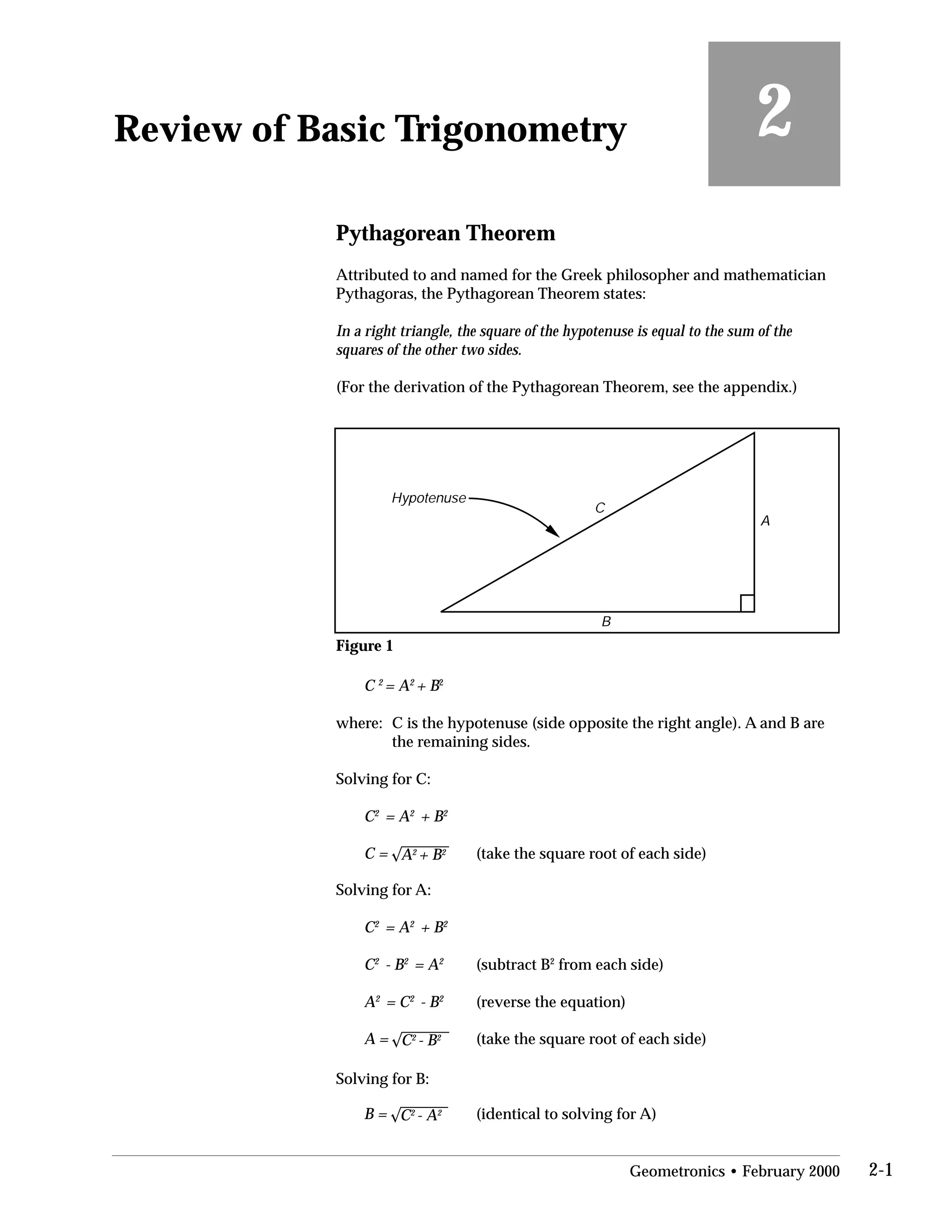
Attributed to and named for the Greek philosopher and mathematician
Pythagoras, the Pythagorean Theorem states:
In a right triangle, the square of the hypotenuse is equal to the sum of the
squares of the other two sides.
(For the derivation of the Pythagorean Theorem, see the appendix.)
A
B
C
Hypotenuse
Figure 1
C 2
= A2
+ B2
where:	 C is the hypotenuse (side opposite the right angle). A and B are
the remaining sides.
Solving for C:
C2
= A2
+ B2
C = A2
+ B2
Solving for A:
C2
= A2
+ B2
C2
- B2
= A2
A2
= C2
- B2
A = C2
- B2
Solving for B:
B = C2
- A2
(take the square root of each side)
(subtract B2
from each side)

(reverse the equation)

(take the square root of each side)

(identical to solving for A)
Geometronics • February 2000 2-1
C2
- B2
Basic Surveying - Theory and Practice
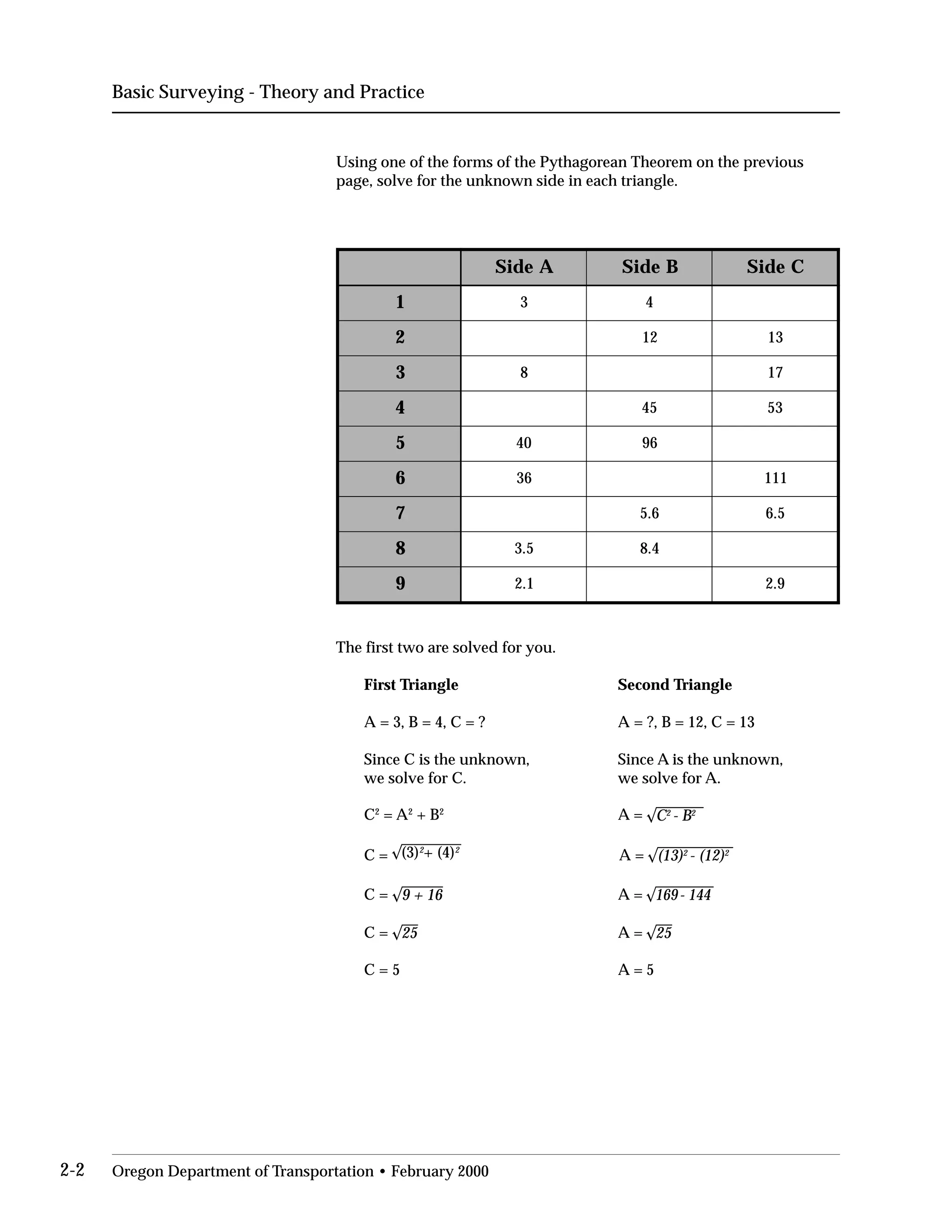
Using one of the forms of the Pythagorean Theorem on the previous
page, solve for the unknown side in each triangle.
AediS BediS CediS
1 3
2 21 1
3 8 1
4 54 5
5 04 9
6 63 11
7 6.5 .6
8 5.3 .8
9 1.2 .2
4
3
7
3
6
1
5
4
9
The first two are solved for you.
First Triangle
A = 3, B = 4, C = ?
Since C is the unknown,
we solve for C.
C2
= A2
+ B2
C =
C =
C =
C = 5
(3)2
+ (4)2
9 + 16
25
Second Triangle
A = ?, B = 12, C = 13
Since A is the unknown,
we solve for A.
A =
A =
A =
A =
A = 5
(13)2
- (12)2
169- 144
25
2-2 Oregon Department of Transportation • February 2000
Chapter 2: Review of Basic Trigonometry
Units of Angular Measurement
The most common angular units being employed in the United States is
the Sexagesimal System.
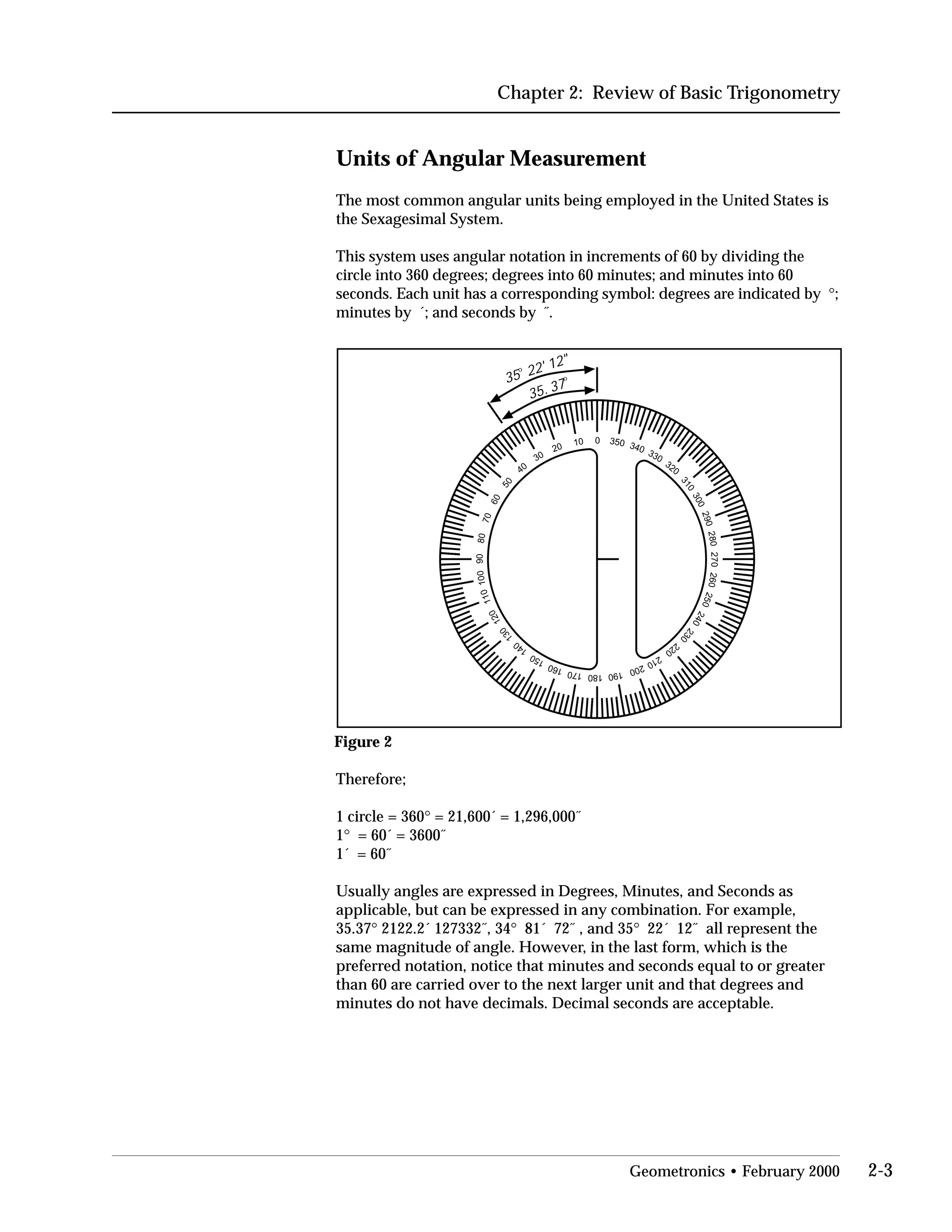
This system uses angular notation in increments of 60 by dividing the
circle into 360 degrees; degrees into 60 minutes; and minutes into 60
seconds. Each unit has a corresponding symbol: degrees are indicated by °;
minutes by ´; and seconds by ˝.
010
20
30
40
50
60
70
8090100
110
120
130
140
150
160
170 180 190
200
210
220
230
240
250
260270280
290
300
310
320
330
340
350
35. 37
o35
o
22' 12"
Figure 2
Therefore;

1 circle = 360° = 21,600´ = 1,296,000˝

1° = 60´ = 3600˝

1´ = 60˝

Usually angles are expressed in Degrees, Minutes, and Seconds as

applicable, but can be expressed in any combination. For example,

35.37° 2122.2´ 127332˝, 34° 81´ 72˝ , and 35° 22´ 12˝ all represent the

same magnitude of angle. However, in the last form, which is the

preferred notation, notice that minutes and seconds equal to or greater

than 60 are carried over to the next larger unit and that degrees and

minutes do not have decimals. Decimal seconds are acceptable.

Geometronics • February 2000 2-3
Basic Surveying - Theory and Practice
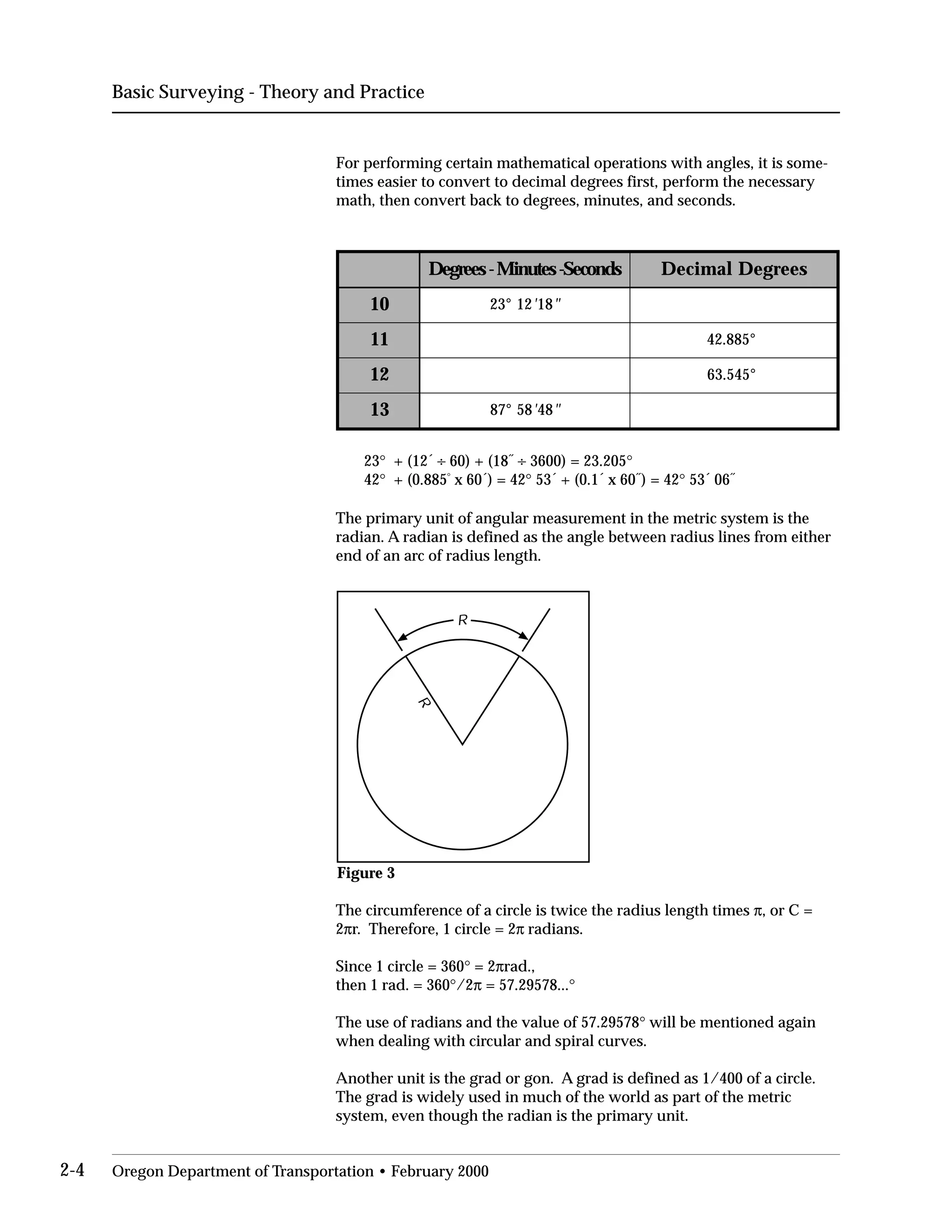
For performing certain mathematical operations with angles, it is some-
times easier to convert to decimal degrees first, perform the necessary
math, then convert back to degrees, minutes, and seconds.
sdnoceS-setuniM-seergeD seergeDlamiceD
01 21°32 ' 81 "
11 °588.24
21 °545.36
31 85°78 ' 84 "
23° + (12´ ÷ 60) + (18˝ ÷ 3600) = 23.205°
42° + (0.885°
x 60´) = 42° 53´ + (0.1´ x 60˝) = 42° 53´ 06˝
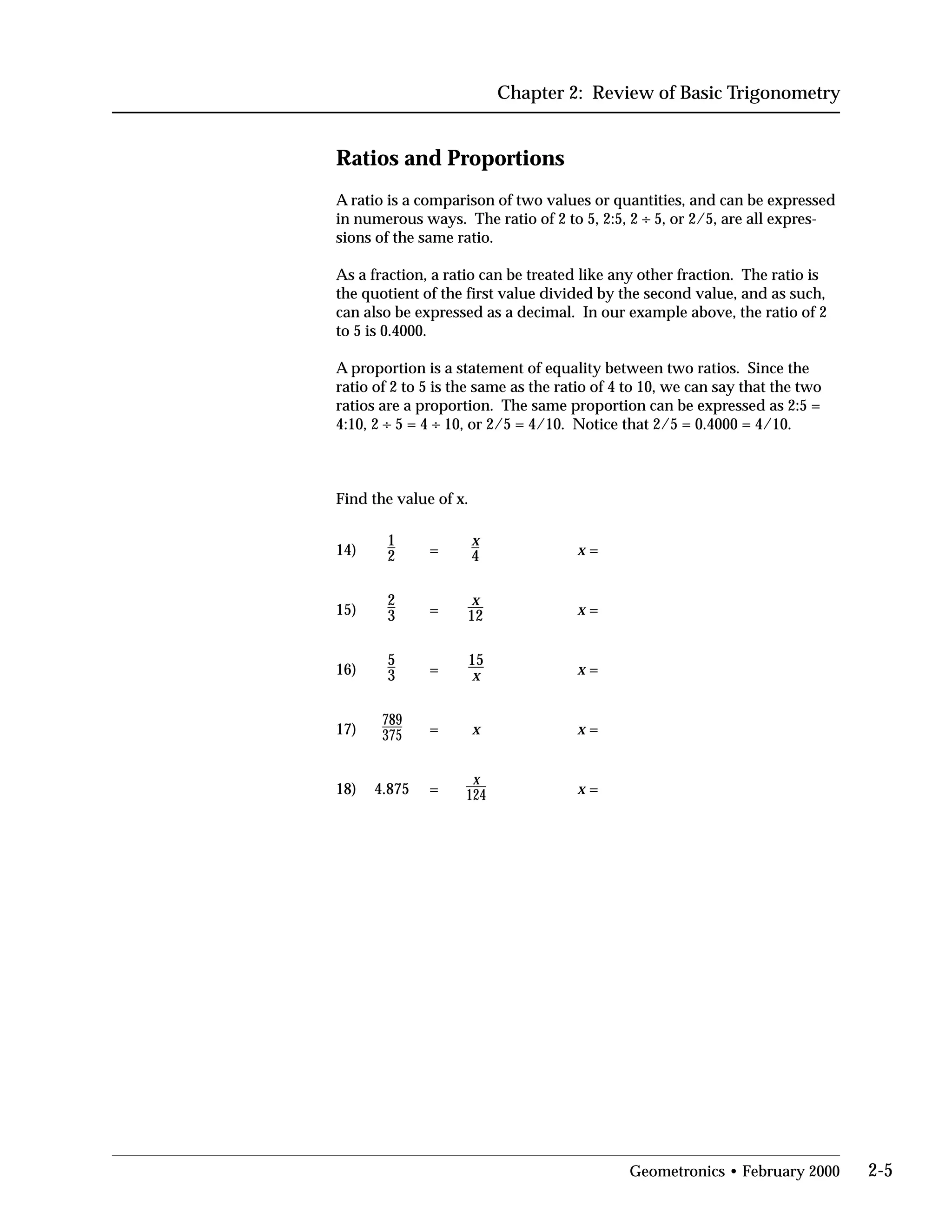
The primary unit of angular measurement in the metric system is the
radian. A radian is defined as the angle between radius lines from either
end of an arc of radius length.
R
R
Figure 3
The circumference of a circle is twice the radius length times π, or C =
2πr. Therefore, 1 circle = 2π radians.
Since 1 circle = 360° = 2πrad.,
then 1 rad. = 360°/2π = 57.29578...°
The use of radians and the value of 57.29578° will be mentioned again
when dealing with circular and spiral curves.
Another unit is the grad or gon. A grad is defined as 1/400 of a circle.
The grad is widely used in much of the world as part of the metric
system, even though the radian is the primary unit.
2-4 Oregon Department of Transportation • February 2000
Chapter 2: Review of Basic Trigonometry
Ratios and Proportions
A ratio is a comparison of two values or quantities, and can be expressed
in numerous ways. The ratio of 2 to 5, 2:5, 2 ÷ 5, or 2/5, are all expres­
sions of the same ratio.
As a fraction, a ratio can be treated like any other fraction. The ratio is
the quotient of the first value divided by the second value, and as such,
can also be expressed as a decimal. In our example above, the ratio of 2
to 5 is 0.4000.
A proportion is a statement of equality between two ratios. Since the
ratio of 2 to 5 is the same as the ratio of 4 to 10, we can say that the two
ratios are a proportion. The same proportion can be expressed as 2:5 =
4:10, 2 ÷ 5 = 4 ÷ 10, or 2/5 = 4/10. Notice that 2/5 = 0.4000 = 4/10.
Find the value of x.
1 x
14) 2 = 4 x =
2
15) 3 =
x
12 x =
5
16) 3 =
15
x =x
789
17) 375 = x x =
18) 4.875 =
x
124 x =
Geometronics • February 2000 2-5
Basic Surveying - Theory and Practice
Definition of Trigonometric Functions
All trigonometric functions are simply ratios of one side of a right triangle
to a second side of the same triangle, or one side over another side. The
distinction between functions is which two sides are compared in the ratio.
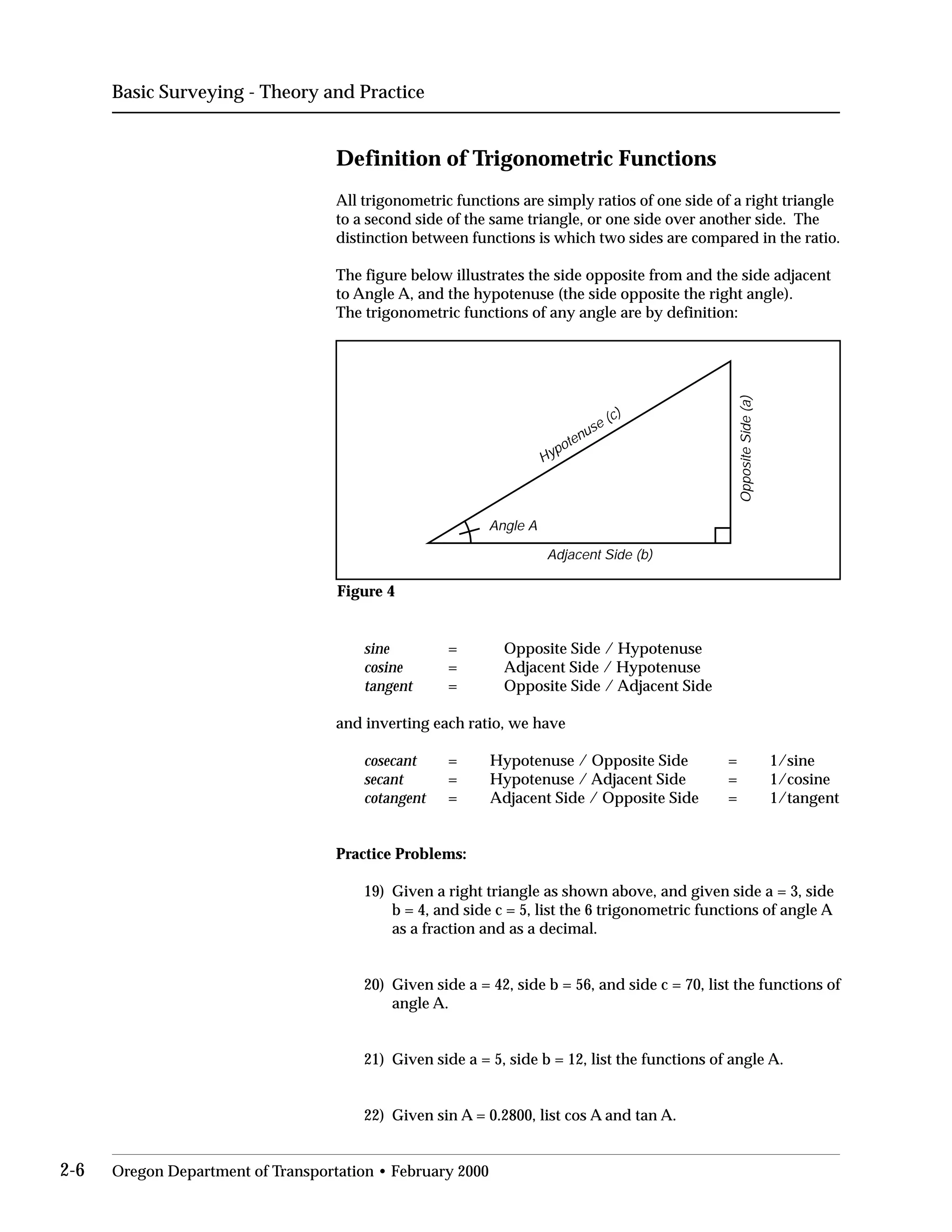
The figure below illustrates the side opposite from and the side adjacent
to Angle A, and the hypotenuse (the side opposite the right angle).
The trigonometric functions of any angle are by definition:
Adjacent Side (b)
OppositeSide(a)
Hypotenuse (c)
Angle A
Figure 4
sine = Opposite Side / Hypotenuse
cosine = Adjacent Side / Hypotenuse
tangent = Opposite Side / Adjacent Side
and inverting each ratio, we have
cosecant = Hypotenuse / Opposite Side = 1/sine
secant = Hypotenuse / Adjacent Side = 1/cosine
cotangent = Adjacent Side / Opposite Side = 1/tangent
Practice Problems:
19)	 Given a right triangle as shown above, and given side a = 3, side
b = 4, and side c = 5, list the 6 trigonometric functions of angle A
as a fraction and as a decimal.
20)	 Given side a = 42, side b = 56, and side c = 70, list the functions of
angle A.
21) Given side a = 5, side b = 12, list the functions of angle A.
22) Given sin A = 0.2800, list cos A and tan A.
2-6 Oregon Department of Transportation • February 2000
Chapter 2: Review of Basic Trigonometry
Trigonometric Functions of 45°
In the examples on the previous page, we developed trig functions for
various angles A without determining the value of angle A. In order for
trig functions to be of significant value, there must be a known correla­
tion between the magnitude of the angle and the magnitude of the
trigonometric functions.
b
c
45o
a
Figure 5
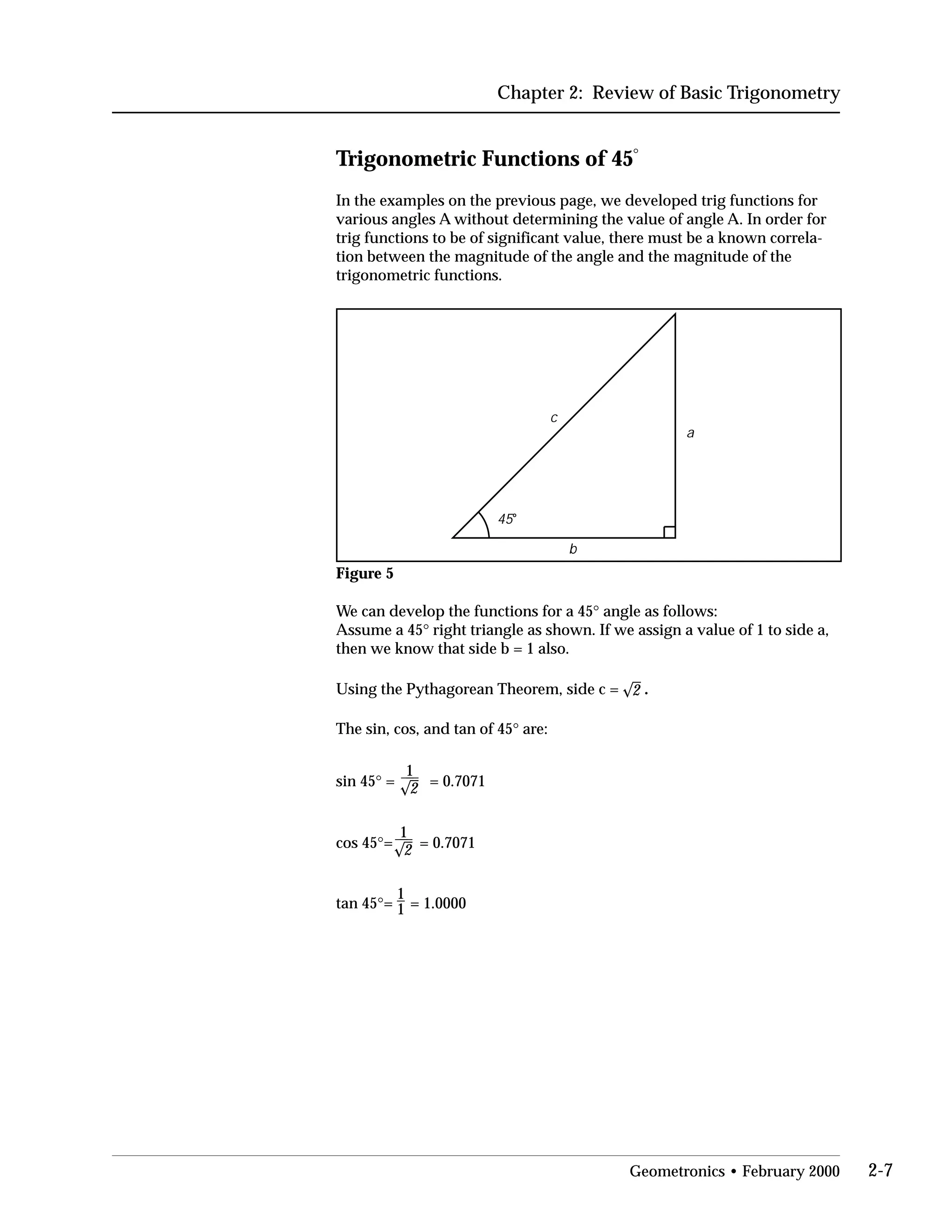
We can develop the functions for a 45° angle as follows:

Assume a 45° right triangle as shown. If we assign a value of 1 to side a,

then we know that side b = 1 also.

Using the Pythagorean Theorem, side c = 
 2 .
The sin, cos, and tan of 45° are:

1
sin 45° = 2 = 0.7071
1
cos 45°= 2 = 0.7071
1
tan 45°= 1 = 1.0000
Geometronics • February 2000 2-7
Basic Surveying - Theory and Practice
Trig Functions -vs- Size of the Triangle
On the previous page, we developed values for the trig functions of a 45°
angle given assumed lengths of the sides of the triangle. But if the
lengths of the sides were altered and the 45° angle held, would the trig
functions remain unchanged? Let’s find out.
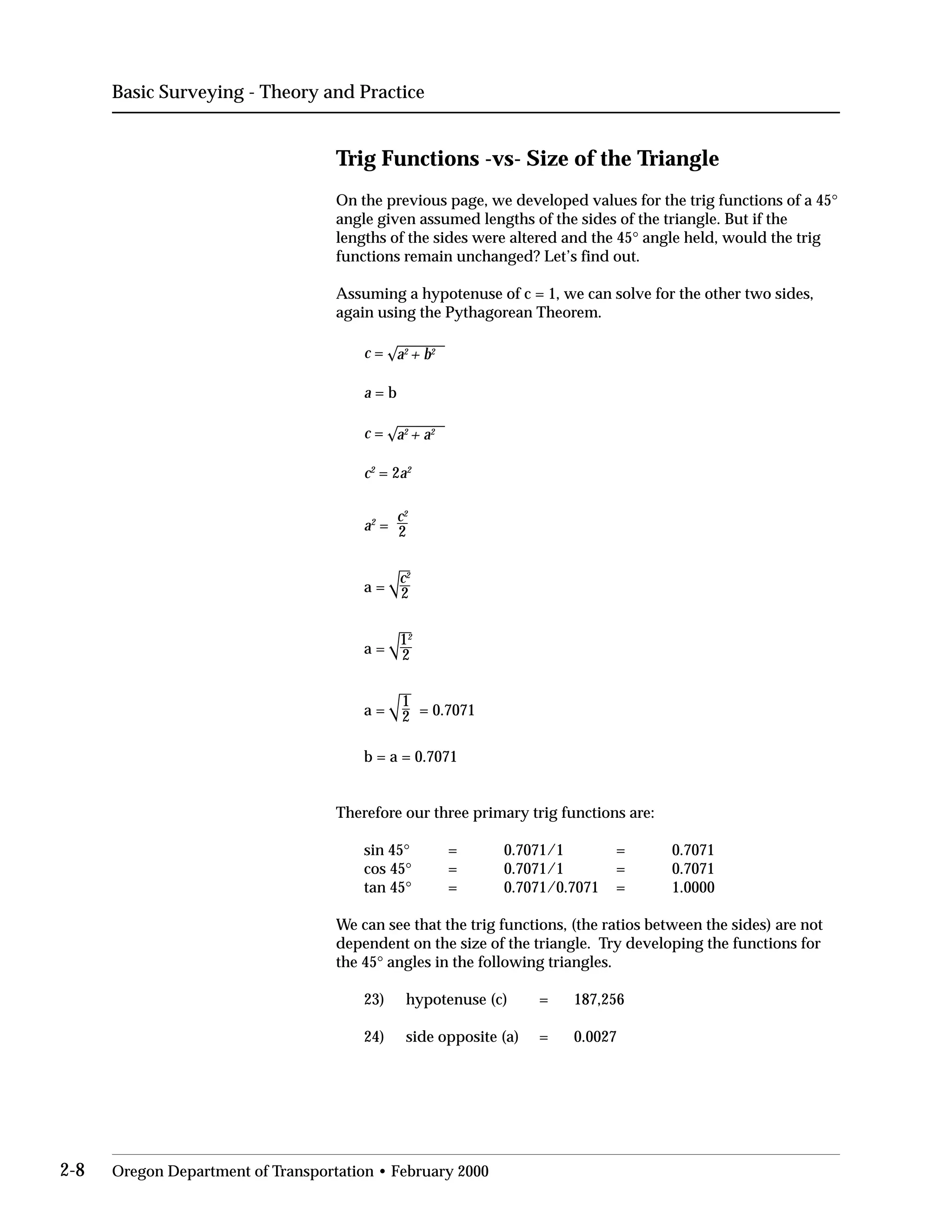
Assuming a hypotenuse of c = 1, we can solve for the other two sides,
again using the Pythagorean Theorem.
c = a2
+ b2
a = b
c = a2
+ a2
c2
= 2a2
c2
a2
= 2
a =
a =
a =
c2
2
12
2
1
2 = 0.7071
b = a = 0.7071
Therefore our three primary trig functions are:
sin 45° = 0.7071/1 = 0.7071
cos 45° = 0.7071/1 = 0.7071
tan 45° = 0.7071/0.7071 = 1.0000
We can see that the trig functions, (the ratios between the sides) are not
dependent on the size of the triangle. Try developing the functions for
the 45° angles in the following triangles.
23) hypotenuse (c) = 187,256
24) side opposite (a) = 0.0027
2-8 Oregon Department of Transportation • February 2000
Chapter 2: Review of Basic Trigonometry
Trig Functions -vs- the Magnitude of the Angle
Now that we know that the size of a triangle does not affect the trig
functions of its angles, let’s find out what happens if we alter the shape
of the triangle by increasing or decreasing the magnitude of the acute
angles. The right angle cannot be modified since trig functions are the
ratios of one side to another side of a right triangle.
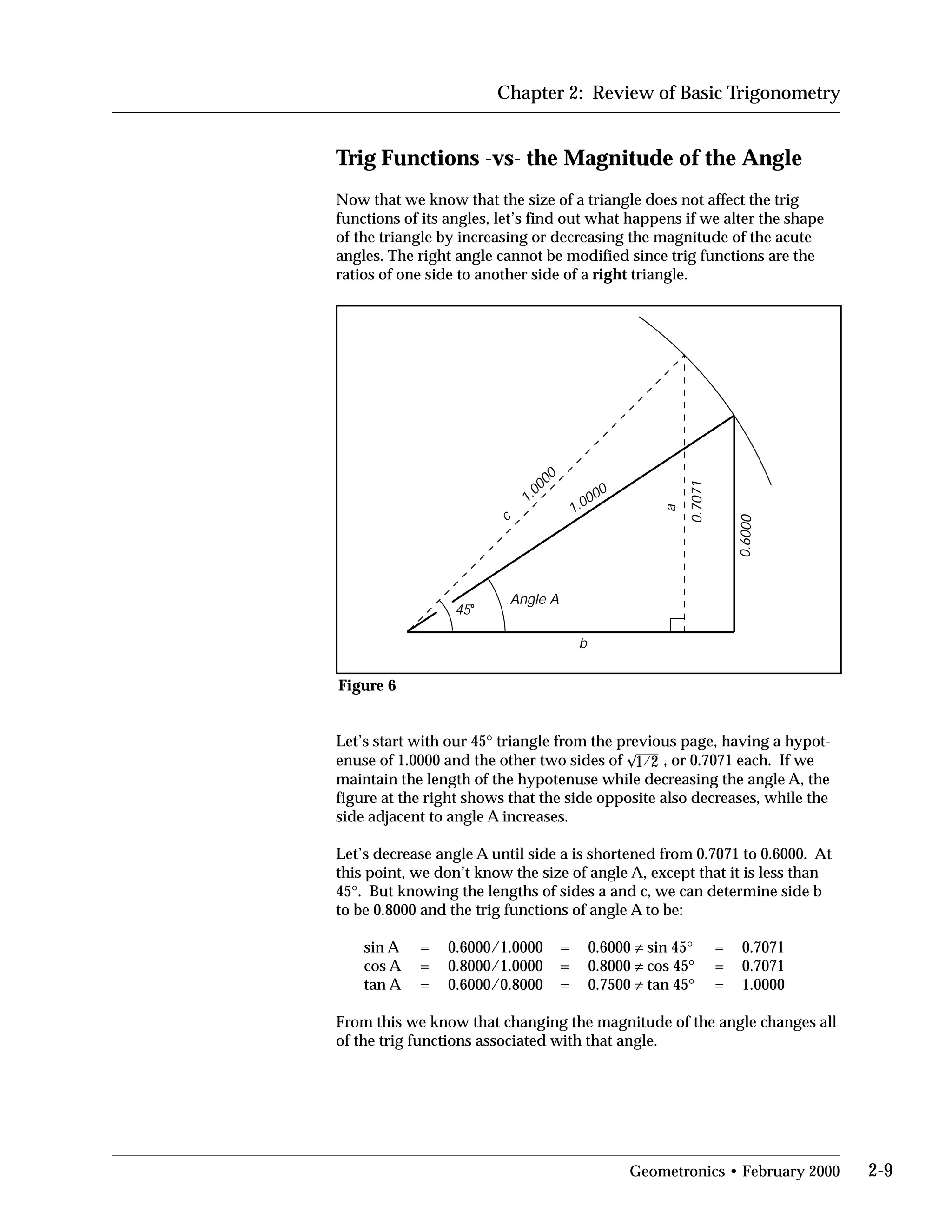
45o
1.0000
1.0000
0.7071
0.6000
Angle A
b
c
a
Figure 6
Let’s start with our 45° triangle from the previous page, having a hypot­

enuse of 1.0000 and the other two sides of 

maintain the length of the hypotenuse while decreasing the angle A, the

figure at the right shows that the side opposite also decreases, while the

side adjacent to angle A increases.

1/2 , or 0.7071 each. If we
Let’s decrease angle A until side a is shortened from 0.7071 to 0.6000. At

this point, we don’t know the size of angle A, except that it is less than

45°. But knowing the lengths of sides a and c, we can determine side b

to be 0.8000 and the trig functions of angle A to be:

sin A = 0.6000/1.0000 = 0.6000 ≠ sin 45° = 0.7071
cos A = 0.8000/1.0000 = 0.8000 ≠ cos 45° = 0.7071
tan A = 0.6000/0.8000 = 0.7500 ≠ tan 45° = 1.0000
From this we know that changing the magnitude of the angle changes all
of the trig functions associated with that angle.
Geometronics • February 2000 2-9
Basic Surveying - Theory and Practice
Trigonometric Functions of 30°
and 60°
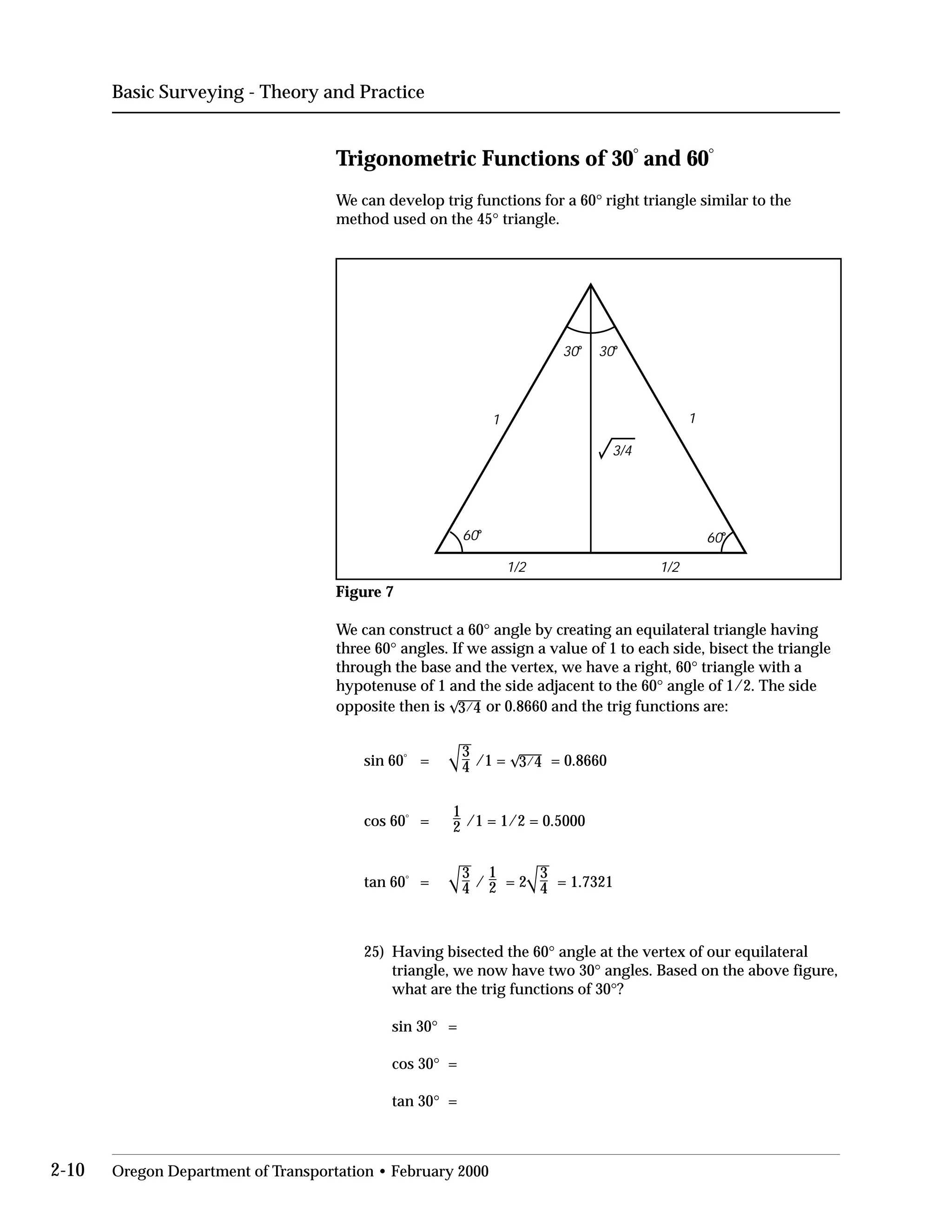
We can develop trig functions for a 60° right triangle similar to the
method used on the 45° triangle.
1/21/2
1 1
30o
30o
60o
60o
3/4
Figure 7
We can construct a 60° angle by creating an equilateral triangle having
three 60° angles. If we assign a value of 1 to each side, bisect the triangle
through the base and the vertex, we have a right, 60° triangle with a
hypotenuse of 1 and the side adjacent to the 60° angle of 1/2. The side
opposite then is 3/4 or 0.8660 and the trig functions are:
sin 60°
=
3
4 /1 = 3/4 = 0.8660
1

2 /1 = 1/2 = 0.5000
cos 60°
=
3
4 /
1
2 = 2
3
4 = 1.7321tan 60°
=
25)	 Having bisected the 60° angle at the vertex of our equilateral
triangle, we now have two 30° angles. Based on the above figure,
what are the trig functions of 30°?
sin 30° =
cos 30° =
tan 30° =
2-10 Oregon Department of Transportation • February 2000
Chapter 2: Review of Basic Trigonometry
Cofunctions
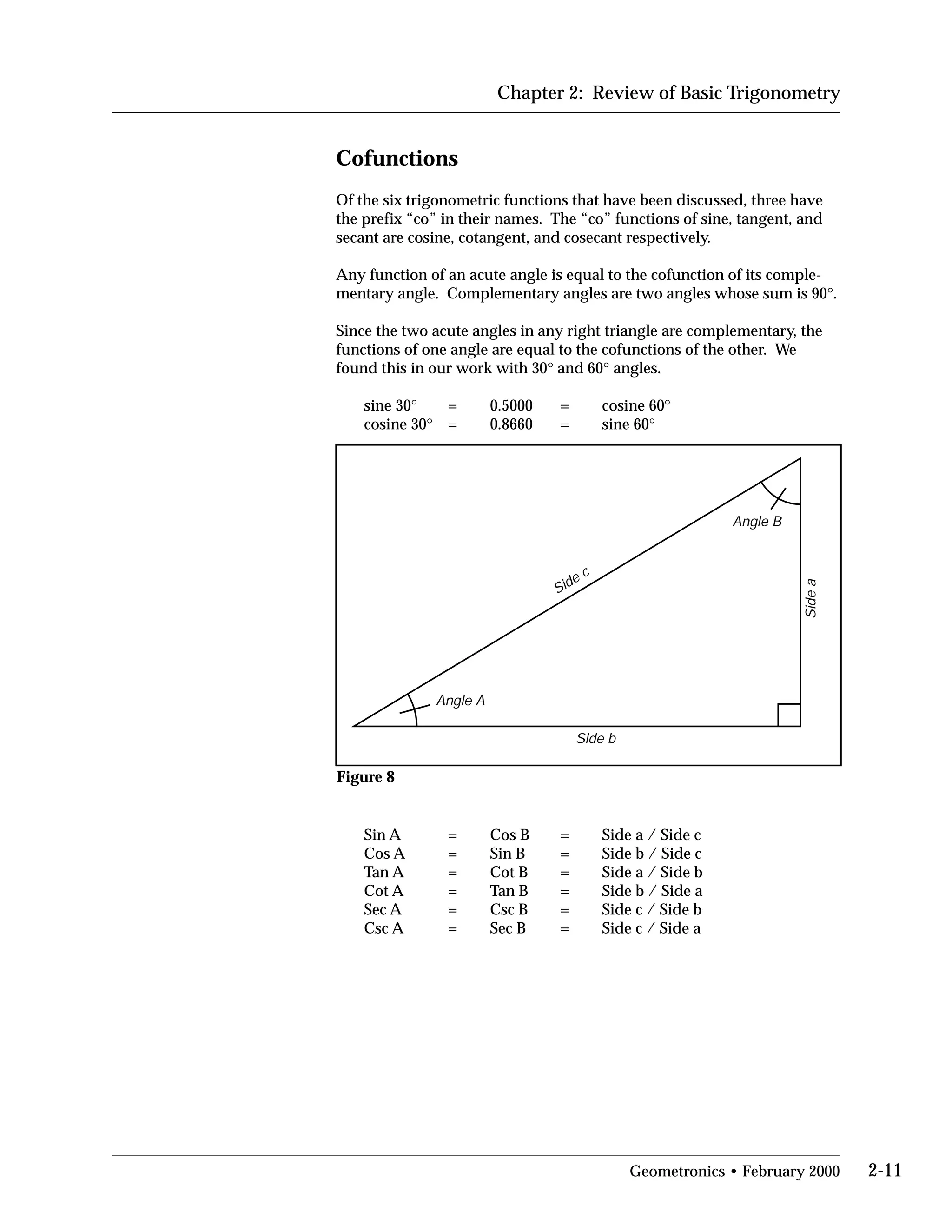
Of the six trigonometric functions that have been discussed, three have
the prefix “co” in their names. The “co” functions of sine, tangent, and
secant are cosine, cotangent, and cosecant respectively.
Any function of an acute angle is equal to the cofunction of its comple­
mentary angle. Complementary angles are two angles whose sum is 90°.
Since the two acute angles in any right triangle are complementary, the
functions of one angle are equal to the cofunctions of the other. We
found this in our work with 30° and 60° angles.
sine 30° = 0.5000 = cosine 60°
cosine 30° = 0.8660 = sine 60°
Angle A
Side c
Side b
Sidea
Angle B
Figure 8
Sin A = Cos B = Side a / Side c
Cos A = Sin B = Side b / Side c
Tan A = Cot B = Side a / Side b
Cot A = Tan B = Side b / Side a
Sec A = Csc B = Side c / Side b
Csc A = Sec B = Side c / Side a
Geometronics • February 2000 2-11
Basic Surveying - Theory and Practice
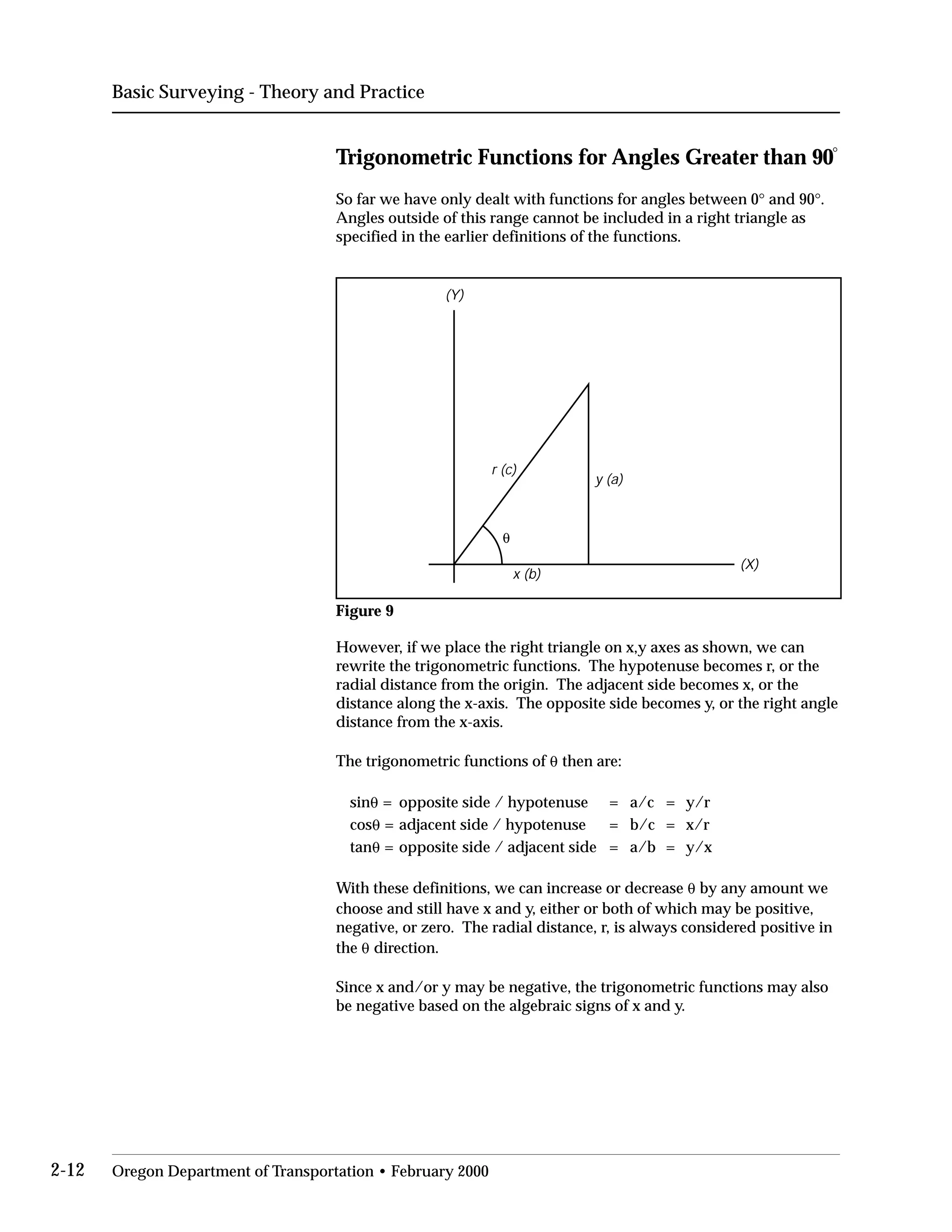
Trigonometric Functions for Angles Greater than 90°
So far we have only dealt with functions for angles between 0° and 90°.
Angles outside of this range cannot be included in a right triangle as
specified in the earlier definitions of the functions.
θ
y (a)
r (c)
x (b)
(X)
(Y)
Figure 9
However, if we place the right triangle on x,y axes as shown, we can
rewrite the trigonometric functions. The hypotenuse becomes r, or the
radial distance from the origin. The adjacent side becomes x, or the
distance along the x-axis. The opposite side becomes y, or the right angle
distance from the x-axis.
The trigonometric functions of 0 then are:
sin0 = opposite side / hypotenuse = a/c = y/r
cos0 = adjacent side / hypotenuse = b/c = x/r
tan0 = opposite side / adjacent side = a/b = y/x
With these definitions, we can increase or decrease 0 by any amount we
choose and still have x and y, either or both of which may be positive,
negative, or zero. The radial distance, r, is always considered positive in
the 0 direction.
Since x and/or y may be negative, the trigonometric functions may also
be negative based on the algebraic signs of x and y.
2-12 Oregon Department of Transportation • February 2000
Chapter 2: Review of Basic Trigonometry
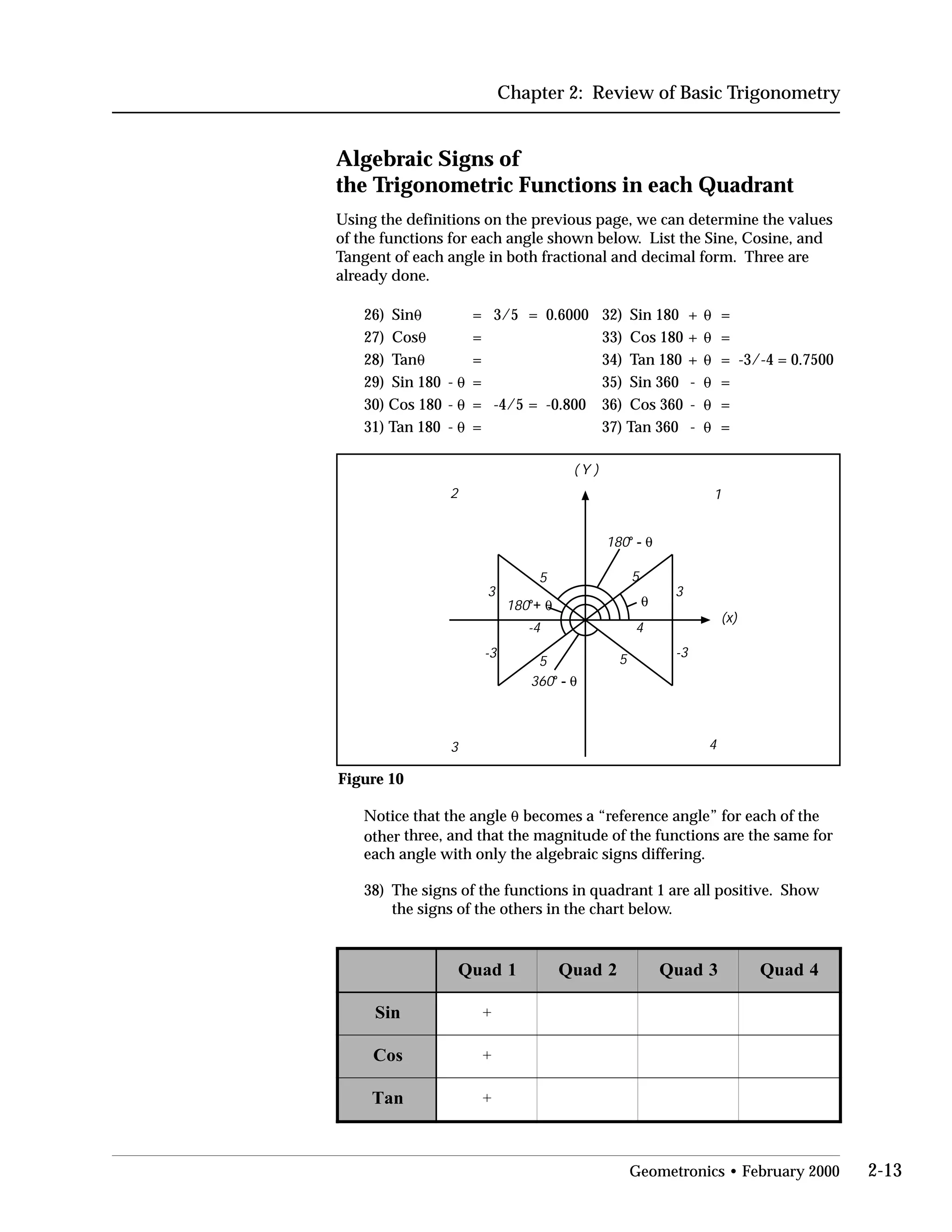
Algebraic Signs of

the Trigonometric Functions in each Quadrant

Using the definitions on the previous page, we can determine the values
of the functions for each angle shown below. List the Sine, Cosine, and
Tangent of each angle in both fractional and decimal form. Three are
already done.
26) Sin0 = 3/5 = 0.6000 32) Sin 180 + 0 =
27) Cos0 = 33) Cos 180 + 0 =
28) Tan0 = 34) Tan 180 + 0 = -3/-4 = 0.7500
29) Sin 180 - 0 = 35) Sin 360 - 0 =
30) Cos 180 - 0 = -4/5 = -0.800 36) Cos 360 - 0 =
31) Tan 180 - 0 = 37) Tan 360 - 0 =
12
3 4
θ
180o
- θ
180o
+ θ
360o
- θ
4
5
5
5
5
33
-3 -3
-4
(x)
( Y )
Figure 10
Notice that the angle 0 becomes a “reference angle” for each of the
other three, and that the magnitude of the functions are the same for
each angle with only the algebraic signs differing.
38)	 The signs of the functions in quadrant 1 are all positive. Show
the signs of the others in the chart below.
1dauQ 2dauQ 3dauQ 4dauQ
niS +
soC +
naT +
Geometronics • February 2000 2-13
Basic Surveying - Theory and Practice
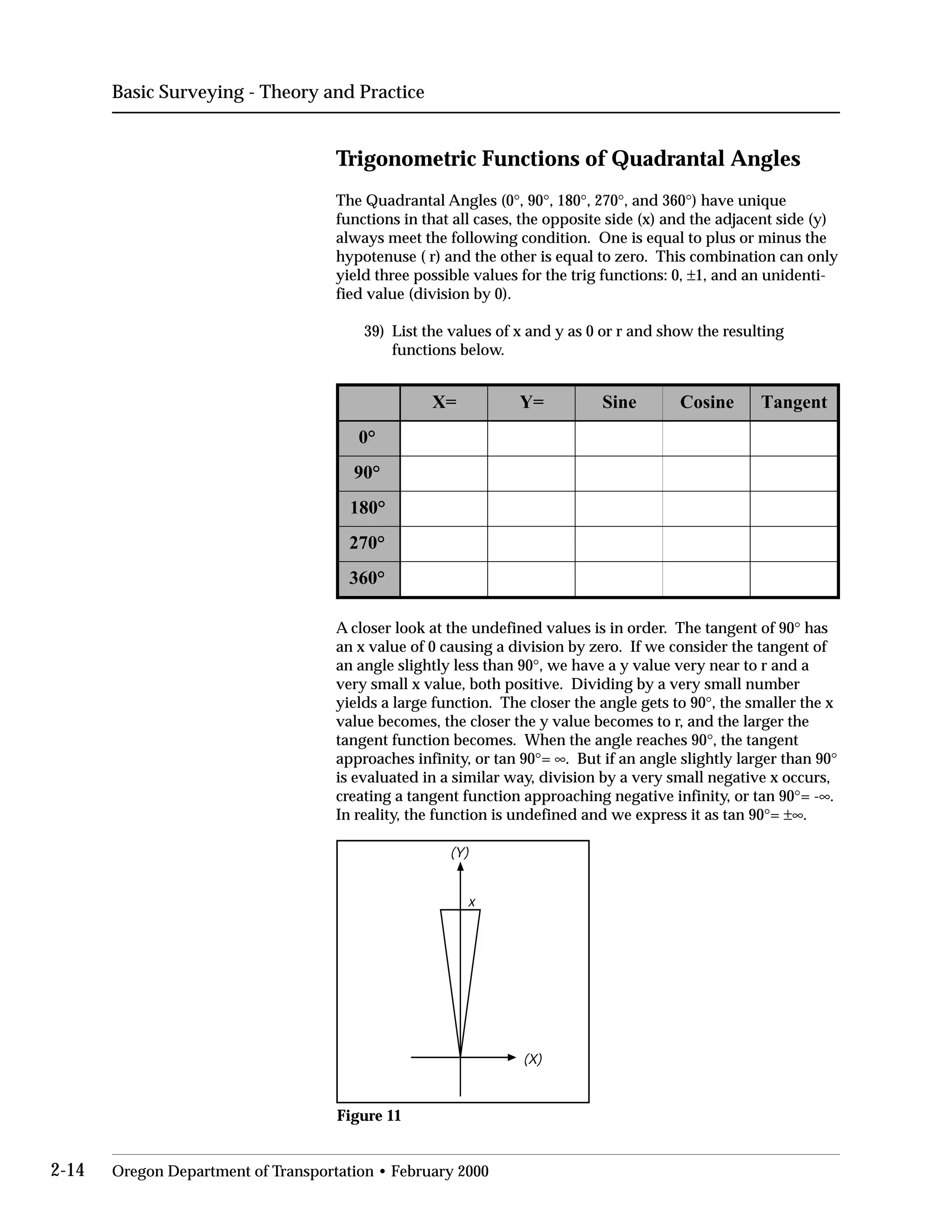
Trigonometric Functions of Quadrantal Angles
The Quadrantal Angles (0°, 90°, 180°, 270°, and 360°) have unique
functions in that all cases, the opposite side (x) and the adjacent side (y)
always meet the following condition. One is equal to plus or minus the
hypotenuse ( r) and the other is equal to zero. This combination can only
yield three possible values for the trig functions: 0, ±1, and an unidenti­
fied value (division by 0).
39)	 List the values of x and y as 0 or r and show the resulting
functions below.
=X =Y eniS enisoC tnegnaT
°0
°09
°081
°072
°063
A closer look at the undefined values is in order. The tangent of 90° has
an x value of 0 causing a division by zero. If we consider the tangent of
an angle slightly less than 90°, we have a y value very near to r and a
very small x value, both positive. Dividing by a very small number
yields a large function. The closer the angle gets to 90°, the smaller the x
value becomes, the closer the y value becomes to r, and the larger the
tangent function becomes. When the angle reaches 90°, the tangent
approaches infinity, or tan 90°= ∞. But if an angle slightly larger than 90°
is evaluated in a similar way, division by a very small negative x occurs,
creating a tangent function approaching negative infinity, or tan 90°= -∞.
In reality, the function is undefined and we express it as tan 90°= ±∞.
(X)
(Y)
x
Figure 11
2-14 Oregon Department of Transportation • February 2000
Chapter 2: Review of Basic Trigonometry
Values of Trigonometric Functions
There are several possible ways to determine the values of the trigono­
metric functions of a given angle:
1) The infinite series for Sine and Cosine functions.
2) Interpolation of values from published Trigonometric Tables.
3) Select the appropriate button on a scientific calculator.
The first is long and involved and beyond the scope of this course. Both
(1) and (2) have become obsolete due to (3). We will assume that our
little electronic wonders will return the proper value when a function is
calculated. Notice that only three functions exist on most electronic
calculators, as the others can be expressed as reciprocals of those shown,
or otherwise easily reached.
While each angle has only one value for each of its trigonometric func­
tions, exercise problems 26-37 reveal that more than one angle can have
the same trigonometric values. Sin0 and Sin 180° - 0 , Cos0 and Cos 360°
- 0 , and Tan0 and Tan 180° + 0 are just three examples. Your calculator
cannot determine which value is truly correct when taking an inverse or
arc function (determining an angle from a function) so it will return a
value between -90° and +180° depending on the function. It will be up to
the individual to evaluate whether that is the correct value for the
particular situation.
Practice Problems:
40)	 Determine the missing side of a 30° right triangle with a hypot­
enuse of 6.
41) Determine the angles in a 3,4,5 triangle.
42)	 Measured slope distance is 86.95 feet at +8.5°. What is the
horizontal distance and the elevation difference?
Geometronics • February 2000 2-15
Basic Surveying - Theory and Practice
2-16 Oregon Department of Transportation • February 2000
Distance Measuring (Chaining)

History of Chaining
3
The Egyptians were one of the first known people to use some form of
chaining in both land surveying and construction surveying. On a wall
in the tomb of Thebes and carved on a stone coffin are drawings of rope
stretchers measuring a field of grain. The Great Pyramid of Gizeh (2900
B.C.) was constructed with an error of 8 inches in it’s 750 foot base. This
is an error of 1 in 1000 on each side.
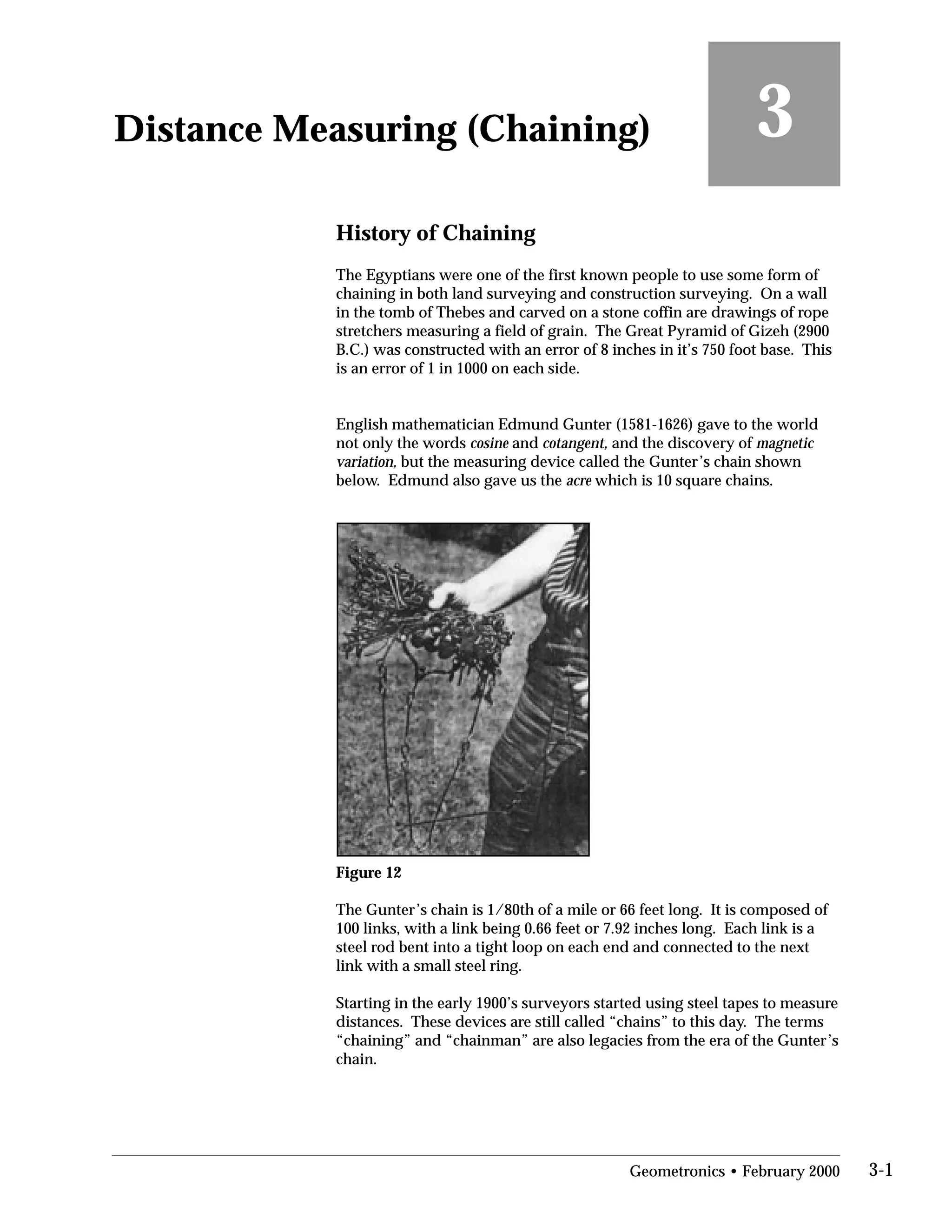
English mathematician Edmund Gunter (1581-1626) gave to the world
not only the words cosine and cotangent, and the discovery of magnetic
variation, but the measuring device called the Gunter’s chain shown
below. Edmund also gave us the acre which is 10 square chains.
Figure 12
The Gunter’s chain is 1/80th of a mile or 66 feet long. It is composed of
100 links, with a link being 0.66 feet or 7.92 inches long. Each link is a
steel rod bent into a tight loop on each end and connected to the next
link with a small steel ring.
Starting in the early 1900’s surveyors started using steel tapes to measure
distances. These devices are still called “chains” to this day. The terms
“chaining” and “chainman” are also legacies from the era of the Gunter’s
chain.
Geometronics • February 2000 3-1
Basic Surveying - Theory and Practice
Procedures for Chaining
It must be remembered in surveying, that under most circumstances, all
distances are presumed to be horizontal distances and not surface
distances. This dictates that every field measurement taken be either
measured horizontally or, if not, reduced to a horizontal distance math­
ematically.
In many instances, it is easiest to simply measure the horizontal distance
by keeping both ends of the chain at the same elevation. This is not
difficult if there is less than five feet or so of elevation change between
points. A hand level or “pea gun” is very helpful for maintaining the
horizontal position of the chain when “level chaining.” A pointed
weight on the end of a string called a “plumb bob” is used to carry the
location of the point on the ground up to the elevated chain by simply
suspending the plumb bob from the chain such that the point of the
plumb bob hangs directly above the point on the ground.
When the difference in elevation along the measurement becomes too
great for level chaining, other methods are called for. One option, “break
chaining”, involves simply breaking the measurement into two or more
measurements that can be chained level. This works well for measure­
ments along a gentle slope where a reasonable distance can be measured
between break chaining points.
3-2 Oregon Department of Transportation • February 2000
Chapter 3: Distance Measuring (Chaining)
In some cases, it becomes impractical to break chain. When the slope
becomes so steep that frequent chaining points are required, a vertical
surface must be measured across, or intermediate chaining points are
not readily accessible, it may be more desirable to determine the horizon­
tal distance indirectly. The most frequently used method is “slope
chaining”, where the distance along the slope is measured, the slope rate
is determined, and the horizontal distance calculated.
Slope rate angles are measured as Vertical Angles (+/- from horizontal),
or as Zenith Angles (Measured downward from a imaginary point on the
celestial sphere directly above the instrument).
When the vertical angle (v) is used, the horizontal distance (HD) is
calculated by multiplying the slope distance (SD) by the cosine of the
vertical angle. This is the solution of a right triangle for the side adjacent
(horizontal distance) with the hypotenuse (slope distance) known.
From basic trigonometry, we know that;
cosine = Adjacent Side / Hypotenuse
Substituting the known values, we have;
cos(v) = HD / SD
Solving for HD by multiplying both sides of the equation by SD, we get;
HD = SDcos(v)
If the zenith angle (z) is measured rather than the vertical angle, the
calculations are nearly identical. The only variation is that the zenith
angle is the complimentary angle of the vertical angle, so the sine func­
tion must be used. The formula is;
HD = SDsin(z)
Geometronics • February 2000 3-3
Basic Surveying - Theory and Practice
Errors in Chaining
Every measurement made with a mechanical device is subject to any
error that could possibly be caused by the condition of the device or by
the procedure used in taking the measurement. Some of the more
common sources of errors are the standards to which the chain was
manufactured, any damage to the chain, sag in the chain, variation in the
tension on the chain, and changes in the temperature of the chain. With
proper care of the chain and reasonable effort made with each use, the
effects of these errors can be kept within acceptable tolerances for all but
the most precise measurements. When necessary, however, each of these
conditions can be compensated for mathematically if they are monitored
and compared to a known standard.
Proportional Errors
When a chain is manufactured, it is intended to be a specific length, plus
or minus some tolerance. It may or may not actually meet those specifi­
cations. When a field measurement is taken, the acceptable error may be
more or less than what the chain was designed for. For high precision
work, we need to measure several known distances and determine if this
chain is the proper length. If not, we need next to determine if the error
is in one or more specific locations along the chain or if the error is
proportional along the length. If a known 50 foot distance is measured to
be 49.995 feet and a known 100 foot distance to be 99.99 feet, all measure­
ments made with that chain should be multiplied by a factor of 100/
99.99 (known distance over measured distance).
Constant Errors
If a chain has been kinked or broken and spliced back together, there is a
good chance that there will be a consistent error for any distances
measured using that portion of the chain. This error needs to be added
or subtracted as appropriate each time.
Sag Correction
When a chain is suspended from each end and not supported along it’s
length, the weight of the chain causes it to sag and pull the two ends
toward each other. It is impossible to exert enough outward force to
fully overcome the sag. For all measurements, adequate tension should
be applied to minimize the effective shortening of the chain. For precise
measurements, a correction should be applied using the formula given in
the appendix.
3-4 Oregon Department of Transportation • February 2000
Chapter 3: Distance Measuring (Chaining)
Tension Correction
While a certain amount of tension is desirable to help offset the sag
effect, it will also stretch the chain. Steel is generally thought of as not
being very easily stretched and indeed it is not. That is one of the
reasons it is used for making chains. But steel will still stretch to some
degree if tension is applied. When a chain is checked against a known
distance, the applied tension should be controlled. Subsequent precise
measurements should be made using the same tension, or if not, a
correction should be applied. The formula for this is also in the appen­
dix.
Temperature Correction
Whatever material is used to make a chain, that material will expand and
contract with any change in temperature. Some materials are more
affected than others, but every chain will change length somewhat if
warmed or cooled. If precise measurements are needed, an adjustment
needs to be made for the change in temperature between the current
temperature and the temperature at the time the chain was checked
against a known distance. This formula is also in the appendix.
Geometronics • February 2000 3-5
Basic Surveying - Theory and Practice
3-6 Oregon Department of Transportation • February 2000
Distance Measuring
(Electronic Distance Meters)
4
In the early 1950’s the first Electronic Distance Measuring (EDM) equip­
ment were developed. These primarily consisted of electro-optical (light
waves) and electromagnetic (microwave) instruments. They were bulky,
heavy and expensive. The typical EDM today uses the electro-optical
principle. They are small, reasonably light weight, highly accurate, but
still expensive. This chapter will focus on electro-optical instruments
only.
0o
90o
180o
270o
360o
wavelength
Measured Phase
Angle of Returned
Signal
φ∆
Figure 13
Basic Principle
To measure any distance, you simply compare it to a known or calibrated
distance; for example by using a scale or tape to measure the length of an
object. In EDM’s the same comparison principle is used. The calibrated
distance, in this case, is the wavelength of the modulation on a carrier
wave.
Modern EDM’s use the precision of a Quartz Crystal Oscillator and the
measurement of phase-shift to determine the distance.
The EDM is set up at one end of the distance to be measured and a
reflector at the other end. The EDM generates an infrared continuous-
wave carrier beam, which is modulated by an electronic shutter (Quartz
crystal oscillator). This beam is then transmitted through the aiming
optics to the reflector. The reflector returns the beam to the receiving
optics, where the incoming light is converted to an electrical signal,
allowing a phase comparison between transmitted and received signals.
The amount by which the transmitted and received wavelengths are out
of phase, can be measured electronically and registered on a meter to
within a millimeter or two.
Geometronics • February 2000 4-1
Basic Surveying - Theory and Practice
Suppose the distance to be measured is an exact multiple (n) of 10 m.
The optical path however, will be 2n x 10 m (this is the double distance).
As the total path is 2n x 10 m, the total phase delay is n x 360°. Each 10
m wavelength represents a full 360° phase delay. The phase difference
between a transmitted and received beam is also n x 360°, which cannot
be distinguished from a 0° phase shift.
In general, the distance to be measured may be expressed as n x 10 + d.
The total phase delay Φ between transmitted and received signals
becomes:
Φ = n x 360° + ∆Φ
In which ∆Φ equals the phase delay due to the distance d. As n x 360° is
equivalent to 0° for a phase meter, the angle can be measured and will
represent d according to the relation.
d = 	 ∆Φ x 10 m
360°
Most EDM’s use four modulation frequencies to measure long distances
without ambiguity.
The EDM first transmits a particular frequency generating a 10 m
wavelength which determines the fraction of 10 m measured, it then
switches to a 100 m wavelength to determine the fraction of 100 m, 1000
m wavelength to determine the fraction of 1000 m and 10 000 m wave-
length to determine the fraction of 10 000 m.
detareneGhgnelevaW ecnatsiDevloseR
m01 12.3xxx
m001 12.37xx
m0001 12.372x
00001 12.3721
0
0
0
0
The final distance is then converted and displayed in the units desired.
In the latest generation instruments, this process is done in less that 2
seconds.
4-2 Oregon Department of Transportation • February 2000
Chapter 4: Distance Measuring (Elecronic Distance Meters)
Accuracy Specifications
EDM specifications are usually given as a standard deviation. The
specification given is a two part quantity. A constant uncertainty (re­
gardless of the distance measured) and a parts-per-million (ppm) term
(proportionate to the distance measured).
EDM Make and Model Constant Proportion
Wild D14 and D14L +/– 5 mm +/– 5 ppm
Wild D15 and D15S +/– 3 mm +/– 2 ppm
Wild/Leica DI1600 +/– 3 mm +/– 2 ppm
Wild DI2000 +/– 1 mm +/– 1 ppm
TCA 1800 +/– 1 mm +/– 2 ppm
For short distances, the constant part of the error is significant and could
exceed the normal errors of ordinary taping. As in angle measurements,
short traverse sides should be avoided.
Environmental Correction
The procedures used to measure distances depends entirely on an
accurate modulation wavelength. When the infrared beam is transmit­
ted through the air, it is affected by the atmospheric conditions that exist.
To correct for these conditions, the barometric pressure and temperature
must be measured and the appropriate corrections made. All EDM’s
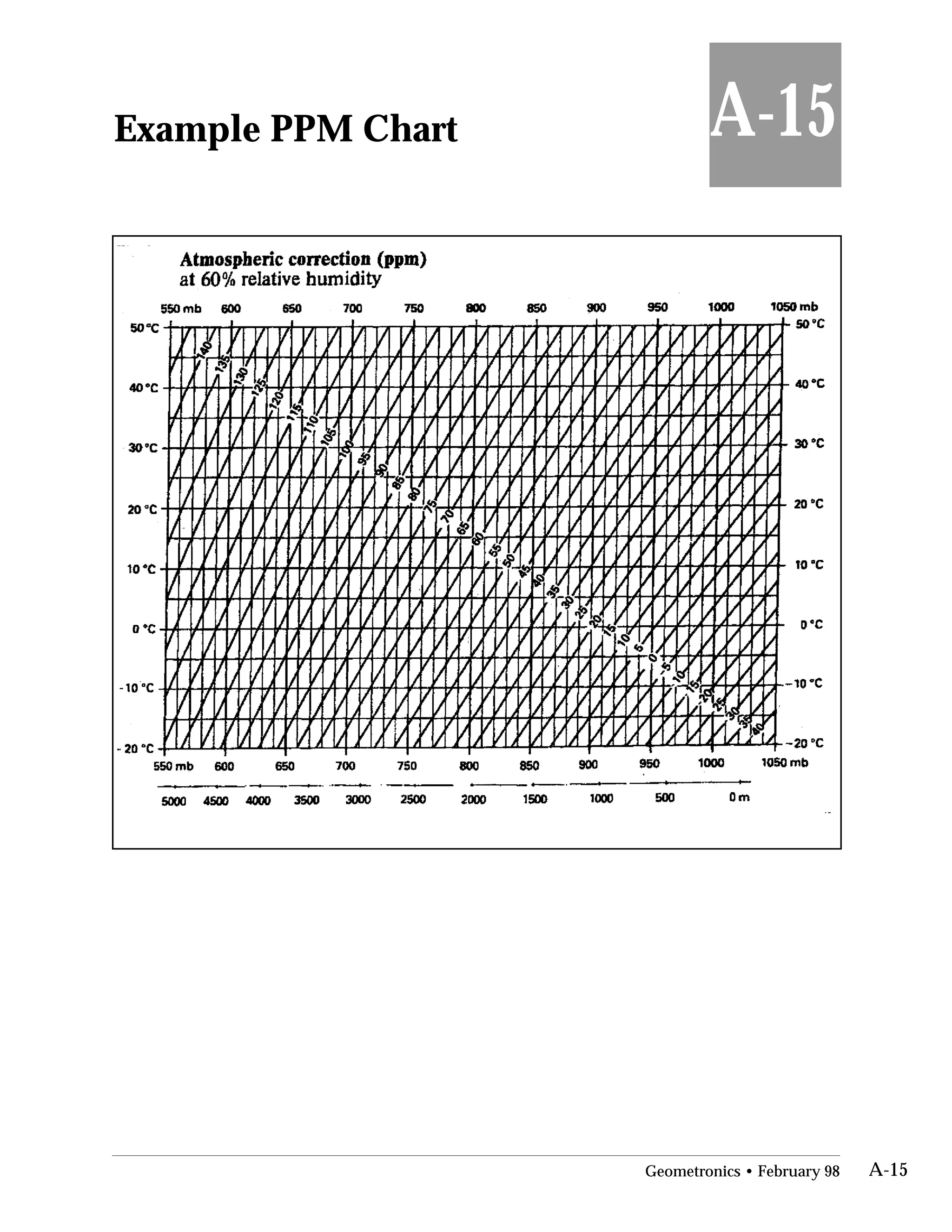
come with charts and formulas to compute this PPM correction. This
value can usually be stored in the instrument. Optionally, the PPM
correction could by applied later instead. An example ppm chart is
shown in the appendix.
Geometronics • February 2000 4-3
Basic Surveying - Theory and Practice
Prisms
The reflector, or prism, is a corner cube of glass in which the sides are
perpendicular to a very close tolerance. It has the characteristic that
incident light is reflected parallel to itself, thus returning the beam to the
source. This is called a retrodirective prism or retro reflector.
These reflectors have a so-called “effective center”. The location of the
center is not geometrically obvious because light travels slower through
glass than air. The effective center will be behind the prism itself and is
generally not over the station occupied. Thus there is a reflector constant
or prism constant to be subtracted from the measurement. Some manu­
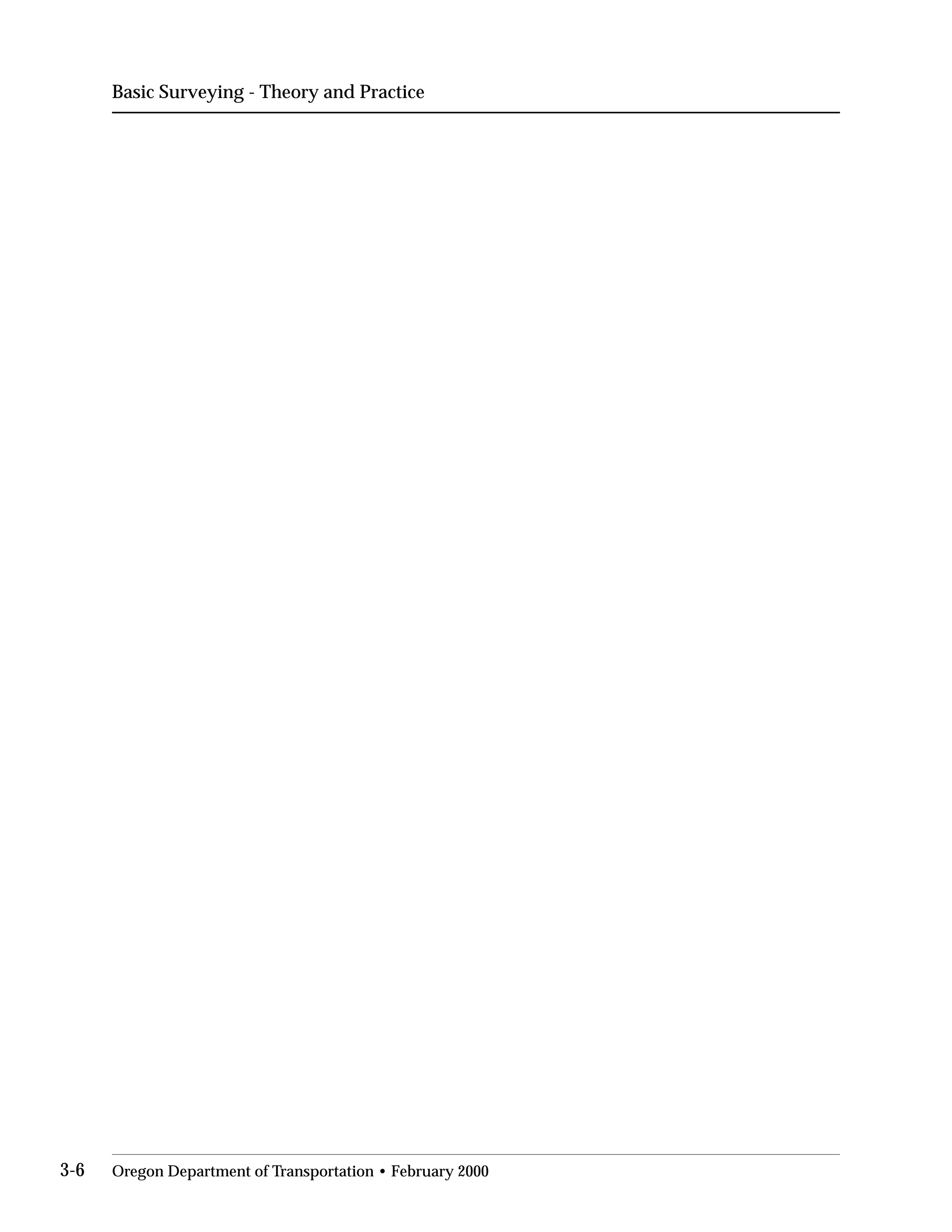
facturers shift the center of the EDM forward the same amount as the
prism offset to yield a zero constant. All Wild/Leica EDM’s are shifted
forward by 35 mm.
a
b
c
t
D
1.57 x 2t
offset
From EDM
To EDM
Figure 14
Always use prisms designed for your EDM system. Virtually all
electro-optical EDM’s of today mount to the theodolite and, depending
on the type of the mount (scope, yoke, built in, etc), the prism housing
has to be designed accordingly.
4-4 Oregon Department of Transportation • February 2000
Chapter 4: Distance Measuring (Elecronic Distance Meters)
Slope Reduction
EDM instruments all measure (line of sight) slope distances only. In
surveying, we are primarily concerned with horizontal distances.
Therefore, this slope distance must be reduced to a horizontal distance.
Most EDM’s have the ability to make these computations through the
use of a keyboard or by passing the raw distance to an electronic theodo­
lite which in turn performs the function. For short distances, a simple
right triangle reduction may be applied:
Horizontal Distance = s x sin(z)
When larger distances are involved, the earth’s curvature and atmo­
spheric refraction need to be taken into account. The equations are as
follows:
Horizontal Distance in meters = s(sinz - E1
cosz)
Vertical Distance in meters = s(cosz + Esinz)
Where:
E1
= 0.929 s(sinz)
6 372 000 m
E = 0.429 s(sinz)
6 372 000 m
s = slope distance in meters
z = zenith angle
The horizontal distance equation uses the instrument elevation as the
datum. If the sight is long and steeply inclined, a reciprocal observation
(from the other end) would give a different answer. Each can be reduced
to sea level by multiplying them by the following factor:
6 372 000
6 372 000 + H
H = station elevation in meters
Where H is the station elevation in meters. A more modern approach
producing better results is the use of reciprocal zenith computations where
the zenith angles and slope distances are measured from both ends of the
line. The difference in elevation is the average of the elevations and the
correction for earth curvature and refraction cancels.
Geometronics • February 2000 4-5
Basic Surveying - Theory and Practice
4-6 Oregon Department of Transportation • February 2000
Angle Measuring
 5
Measuring distances alone in surveying does not establish the location of
an object. We need to locate the object in 3 dimensions. To accomplish
that we need:
1. Horizontal length (distance)
2. Difference in height (elevation)
3. Angular direction.
This chapter discusses the measurement of both horizontal and vertical
angles.
An angle is defined as the difference in direction between two convergent
lines. A horizontal angle is formed by the directions to two objects in a
horizontal plane. A vertical angle is formed by two intersecting lines in a
vertical plane, one of these lines horizontal. A zenith angle is the comple­
mentary angle to the vertical angle and is formed by two intersecting
lines in a vertical plane, one of these lines directed toward the zenith.
PlumbLine
PlumbLine
Zenith
Angle
Vertical Angle
ZenithZenith
Nadir
Level Surface
Figure 15
Geometronics • February 2000 5-1
Basic Surveying - Theory and Practice
Types of Measured Angles
Interior angles are measured clockwise or counter-clockwise between two
adjacent lines on the inside of a closed polygon figure.
Exterior angles are measured clockwise or counter-clockwise between two
adjacent lines on the outside of a closed polygon figure.
Deflection angles, right or left, are measured from an extension of the
preceding course and the ahead line. It must be noted when the deflec­
tion is right (R) or left (L).
Angles to the right are turned from the back line in a clockwise or right
hand direction to the ahead line. This is ODOT’s standard.
Angles to the left are turned from the back line in a counter-clockwise or
left hand direction to the ahead line.
Angles are normally measured with a transit or a theodolite, but a
compass may be used for reconnaissance work.
Exterior Angles
Deflection LeftDeflection Right
Backsight
Foresight
180o
Back Line Produced
Backsight
Foresight 180o
Back Line Produced
Backsight
Foresight
Interior Angles
Backsight
Foresight
Angles to the LeftAngles to the Right
Figure 16
5-2 Oregon Department of Transportation • February 2000
Chapter 5: Angle Measuring
A Transit is a surveying instrument having a horizontal circle divided
into degrees, minutes, and seconds. It has a vertical circle or arc. Tran­
sits are used to measure horizontal and vertical angles. The graduated
circles (plates) are on the outside of the instrument and angles have to be
read by using a vernier.
Figure 18
A Theodolite is a precision surveying instrument; consisting of an alidade
with a telescope and an accurately graduated circle; and equipped with
the necessary levels and optical-reading circles. The glass horizontal and
vertical circles, optical-reading system, and all mechanical parts are
enclosed in an alidade section along with 3 leveling screws contained in
a detachable base or tribrach.
Figure 17
Geometronics • February 2000 5-3
Basic Surveying - Theory and Practice
As surveyors we must know several relationships between an angular
value and its corresponding subtended distance.
Surveyors must strive to maintain a balance in precision for angular and
linear measurements. If distances in a survey are to be measured with a
relative precision of 1 part in 20,000, the angular error should be limited
to 10 seconds or smaller.
Comparison of Angular and Linear Errors
Standard error
of angular
measurement
05’
Linear error
in 1000 Units.
(Feet – Meters)
Accuracy
Ratio
01’
30”
20”
10”
05”
01”
1.454
0.291
0.145
0.097
0.048
0.024
0.005
1:688
1:3436
1:6897
1:10,309
1:20,833
1:41,667
1:200,000
5-4 Oregon Department of Transportation • February 2000
Chapter 5: Angle Measuring
Repeating Instruments
All transits and some theodolites are constructed with a double vertical
axis. They are equipped with upper and lower circle clamps and tangent
screws, sometimes referred to as upper and lower motions. The lower
clamp secures the horizontal circle to the base of the instrument while
the upper clamp secures the circle to the alidade (the upper body of the
instrument).Through the use of both clamps and their accompanying
tangent (fine adjustment) screws, these instruments can be used to
measure angles by repetition.
In ODOT’s survey equipment fleet, the Wild T16’s are Repeating Instru­
ments. These instruments have a modified design providing tangent
screw and one traditional type clamp that actually secures the alidade to
the base. This clamp acts as either upper or lower motion depending on
the position of the locking lever located near the tangent screw. With the
lever in the down position, the circle is clamped to the alidade and the
lock and tangent screw function as a lower motion. When the lever is
moved to the up position, the circle is released from the alidade and
allowed to rest on the base of the instrument, causing the clamp and
tangent to function as an upper motion.
Geometronics • February 2000 5-5
Basic Surveying - Theory and Practice
Measuring Angles with a Repeating Instrument
Repeated measurements of an angle increase accuracy over that obtained
from a single measurement. A horizontal angle may be accumulated and
the sum can be read with the same precision as the single value. When
this sum is divided by the number of repetitions, the resulting angle has
a precision that exceeds the nominal least count of the instrument.
To measure an angle set by repetition:
1. Set zero on the horizontal plate, and lock the upper motion.
2.	 Release the lower motion, sight the backsight, lock the lower
motion, and perfect the sighting with the lower tangent screw.
3.	 Release the upper motion, turn to the foresight, lock the upper
motion, and perfect the sighting.
4. Record the horizontal angle.
5.	 Release the lower motion, plunge (invert) the scope and point to
the backsight in the reverse position, lock the lower motion, and
perfect the sighting.
6.	 Release the upper motion, turn to the foresight, lock the upper
motion, and perfect the sighting.
7. Record the double angle. Compute the mean angle.
8.	 If further accuracy is desired continue this process until 6 angles
are accumulated. Divide the result by 6 and compare the result
to the mean of the first 2. If they agree within 6 seconds accept
the angle. Otherwise redo the set. In ODOT, we are required to
turn (6) angles for Traverse and (2) for other less critical control
points.
The expected accuracy of a measurement, as computed, is in direct
proportion to the number of observations. However, factors limiting
accuracy include, eccentricity in instrument centers, errors in the plate
graduations, instrument wear, setting up and pointing the instrument,
and reading the scale or vernier. A practical limit to the number of
repetitions is about 6 or 8, beyond which there is little or no appreciable
increase in accuracy.
5-6 Oregon Department of Transportation • February 2000
Chapter 5: Angle Measuring
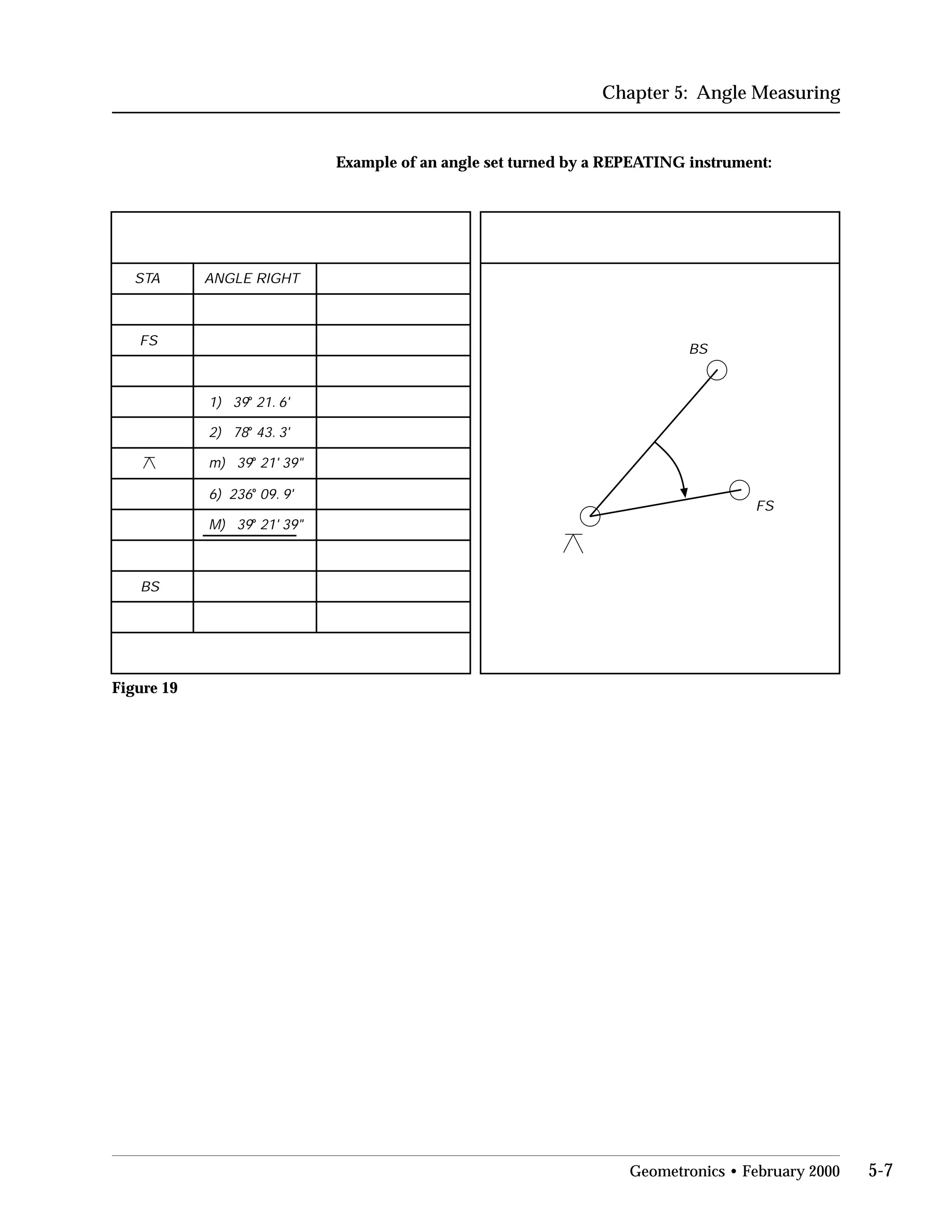
Example of an angle set turned by a REPEATING instrument:
2) o
43. 3'
STA ANGLE RIGHT
FS
BS
6) o
09. 9'
M) o
21' 39"
1) o
21. 6'
m) o
21' 39"
78
236
39
39
39
BS
FS
Figure 19
Geometronics • February 2000 5-7
Basic Surveying - Theory and Practice
Measuring Angles with a Directional Instrument
A Directional Theodolite is not equipped with a lower motion. It is con­
structed with a single vertical axis and cannot accumulate angles. It
does, however, have a horizontal circle positioning drive to coarsely
orient the horizontal circle in any desired position. In ODOT’s survey
equipment fleet, the T2000’s, T1600’s and T1610’s are all Directional Instru­
ments.
A directional theodolite is more precise than a repeating theodolite.
Directions, rather than angles are read. After sighting on a point, the line
direction from the instrument to the target is noted. When a pointing is
taken on the next mark, the difference in directions between them is the
included angle.
To measure an angle set with a directional theodolite:
1. Point to the backsight in the direct position, lock on the target
and record the plate reading. Although not mathematically necessary, we set
the horizontal circle to zero to simplify the calculations and to aid in any
necessary debugging of the data.
2. Loosen the horizontal motion and turn to the foresight. Lock the
horizontal motion, perfect the sighting, then record the horizontal plate
reading.
3. Loosen both horizontal and vertical motions, plunge the scope
and point to the foresight. Again ( in the reverse position) lock the
horizontal motion, perfect the sighting and record the horizontal plate
reading.
4. Loosen the horizontal motion and turn to the backsight, lock the
horizontal motion, perfect the sighting and record the horizontal plate
reading.
This completes one set. Depending on the accuracy required additional
sets should be turned.
In ODOT, we are required to turn (2) sets for Traverse angles and (1) set
for other less critical control points.
To reduce the notes, mean the direct and reverse observations to the
backsight and foresight. Compute the mean direction to the foresight by
subtracting the value of the meaned initial direction (backsight) to get
final directions. If any set varies from the mean of all sets by more than
+/- 5 seconds, reject that set and re-observe that particular set.
5-8 Oregon Department of Transportation • February 2000
Chapter 5: Angle Measuring
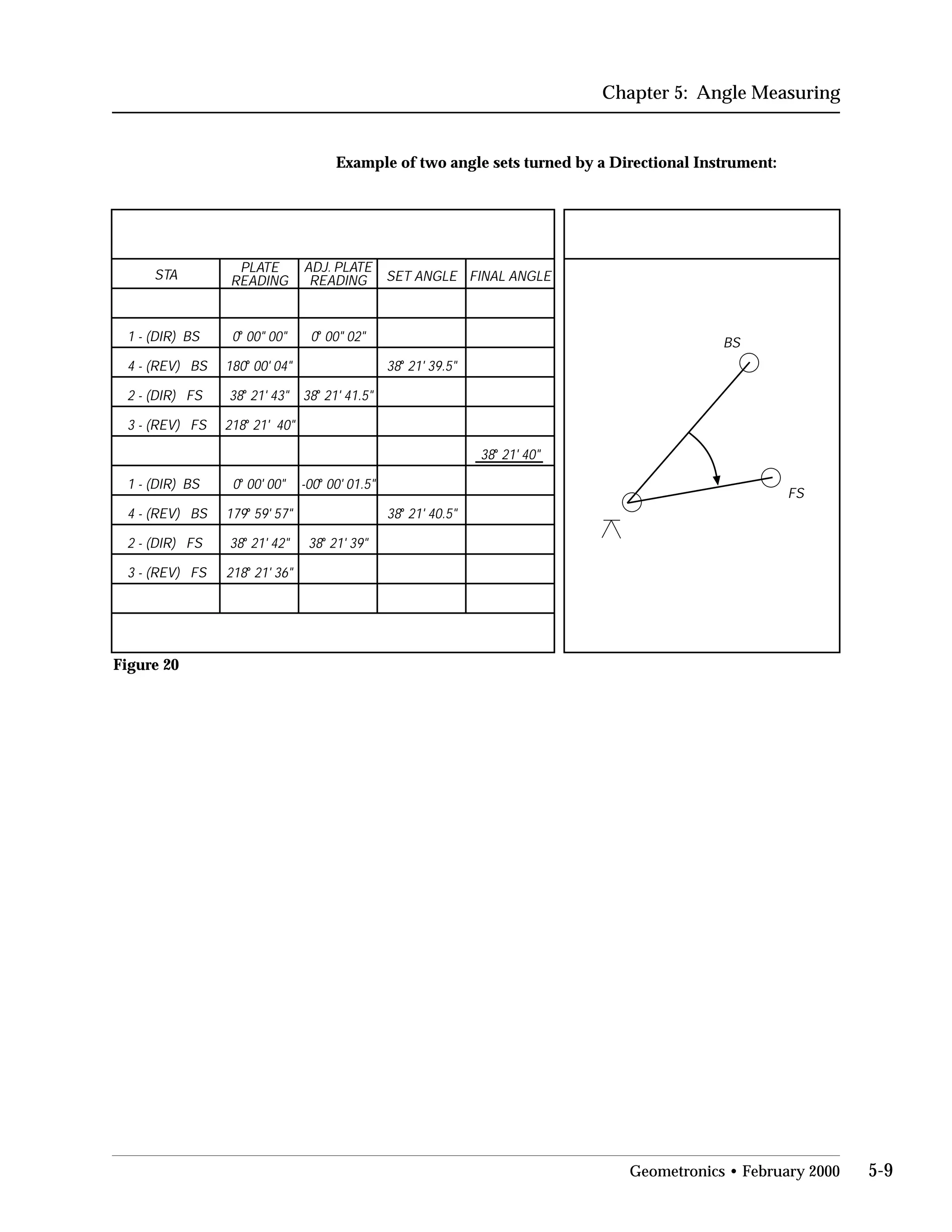
Example of two angle sets turned by a Directional Instrument:
218o
21'
STA
PLATE
READING
ADJ. PLATE
READING SET ANGLE FINAL ANGLE
1 - (DIR)
4 - (REV)
2 - (DIR)
3 - (REV)
1 - (DIR)
4 - (REV)
2 - (DIR)
3 - (REV)
0o
00" 00" 0o
00" 02"
180o
00' 04"
38o
21' 43" 38o
21' 41.5"
38o
21' 39.5"
0o
00' 00"
179o
59' 57"
38o
21' 42"
218o
21' 36"
-00o
00' 01.5"
38o
21' 39"
38o
21' 40.5"
38o
21' 40"
40"
BS
BS
FS
FS
BS
BS
FS
FS
BS
FS
Figure 20

Geometronics • February 2000 5-9
Basic Surveying - Theory and Practice
Zenith Angles
Unlike transits, theodolites are not equipped with a telescope level.
Modern theodolites have an indexing system that utilizes an automatic
compensator responding to the influence of gravity.
When the theodolite is properly leveled, the compensator is free to bring
the vertical circle index to its true position. Automatic compensators are
generally of two types:
1.	 Mechanical, whereby a suspended pendulum controls prisms
directing light rays of the optical-reading system.
2.	 Optical, in which the optical path is reflected from the level
surface of a liquid.
To measure a zenith angle:
1. Point the instrument to the target object in a direct position.
2.	 Lock the vertical motion, perfect the sighting and record the
zenith angle.
3.	 Loosen both the horizontal and vertical motions, plunge the
scope, rotate the alidade 180° and re-point to the target in the
reverse position.
4.	 Lock the vertical motion, perfect the pointing and record the
zenith angle.
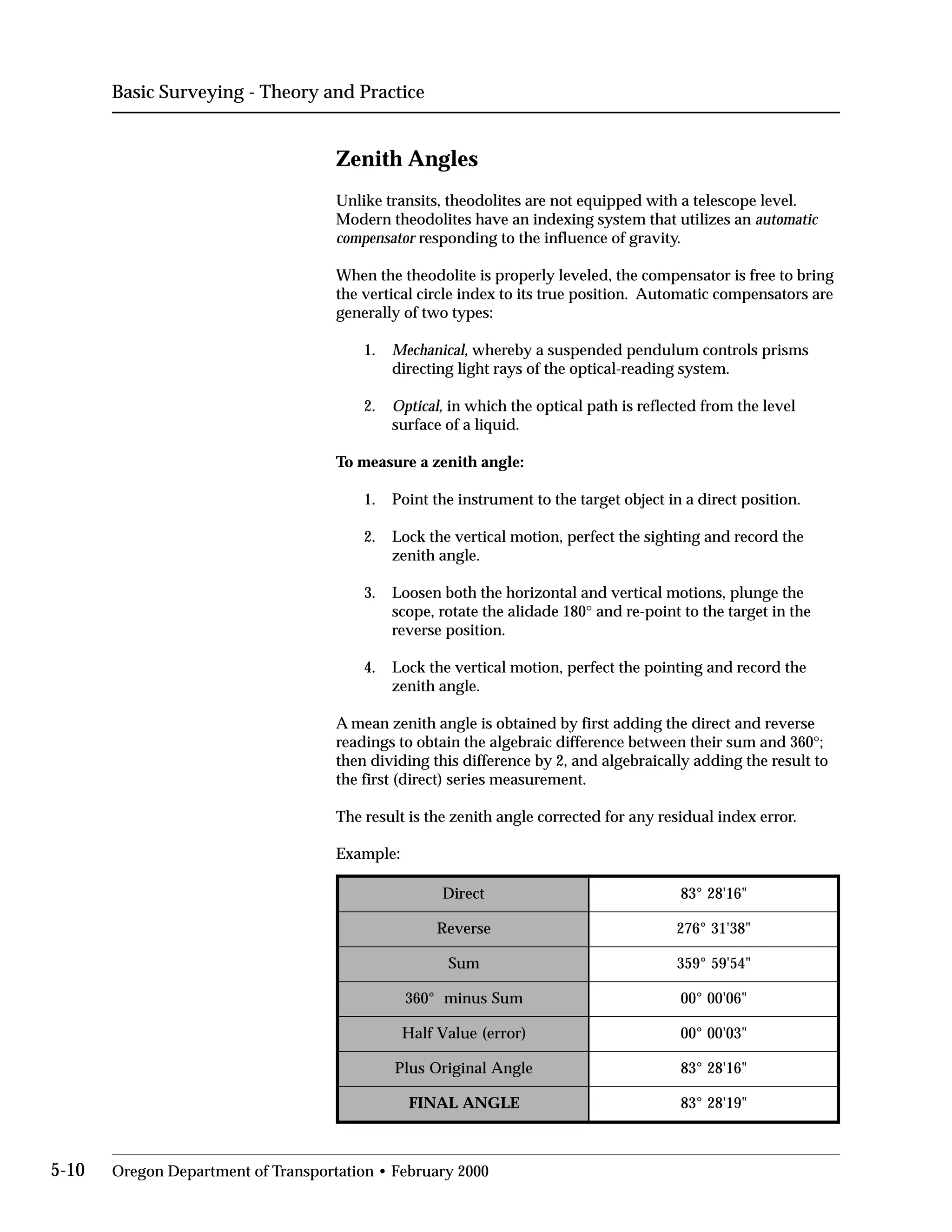
A mean zenith angle is obtained by first adding the direct and reverse
readings to obtain the algebraic difference between their sum and 360°;
then dividing this difference by 2, and algebraically adding the result to
the first (direct) series measurement.
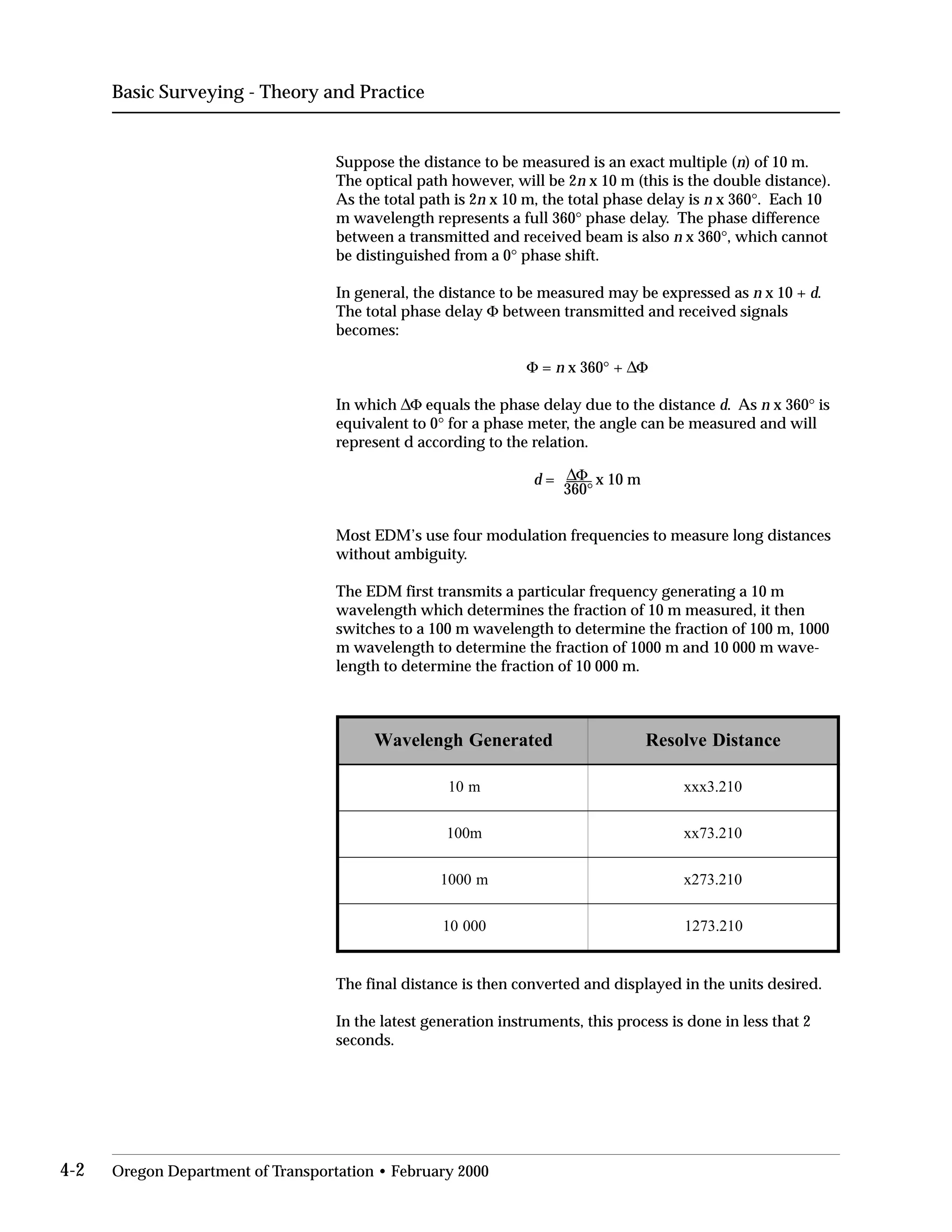
The result is the zenith angle corrected for any residual index error.
Example:
tceriD 61'82°38
esreveR 83'13°672
muS 45'95°953
muSsunim°063 60'00°00
)rorre(eulaVflaH 30'00°00
elgnAlanigirOsulP 61'82°38
ELGNALANIF "91'82°38
"
"
"
"
"
"
5-10 Oregon Department of Transportation • February 2000
Chapter 5: Angle Measuring
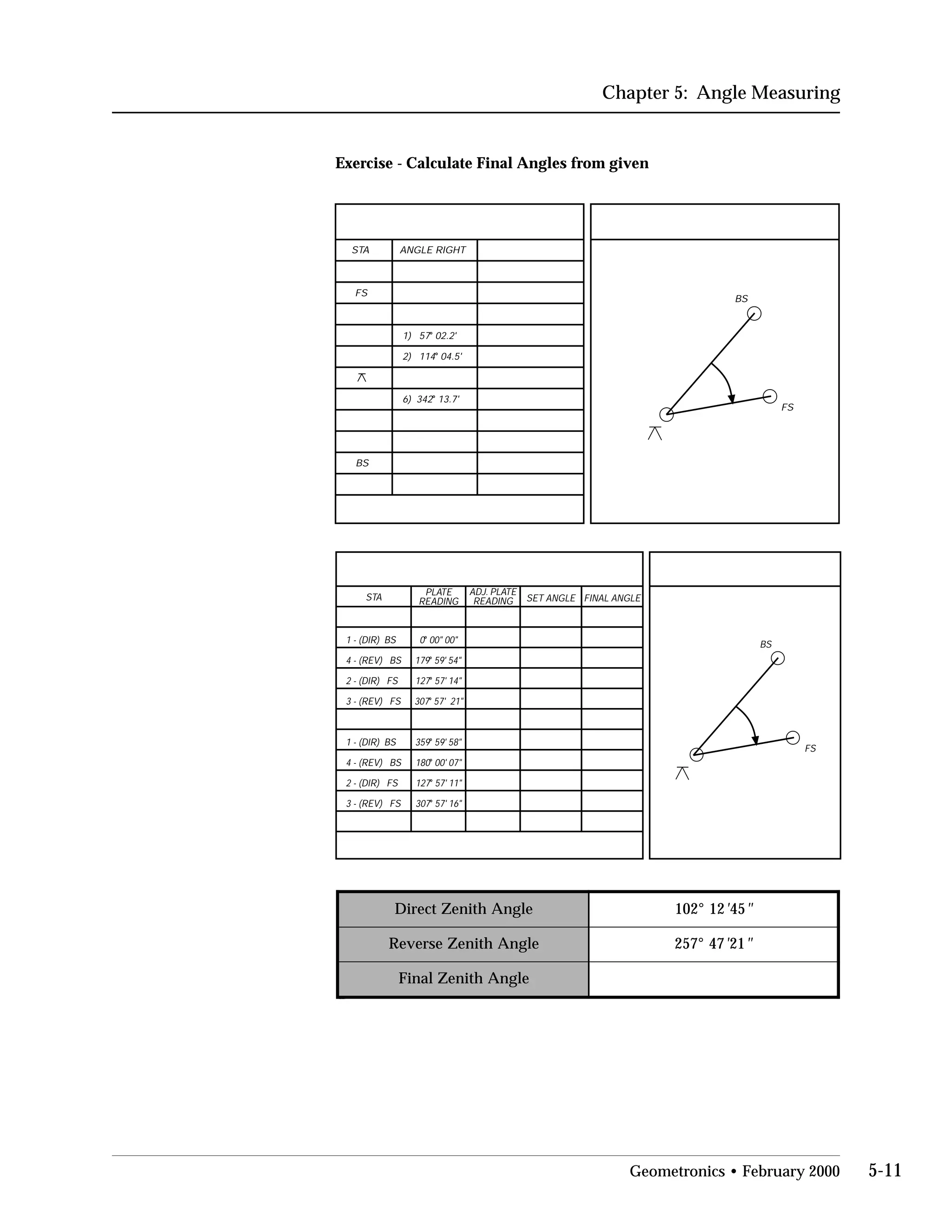
Exercise - Calculate Final Angles from given
2) o
04.5'
BS
FS
STA ANGLE RIGHT
FS
BS
6) o
13.7'
1) o
02.2'
307o
57'
BS
FS
STA
PLATE
READING
ADJ. PLATE
READING SET ANGLE FINAL ANGLE
1 - (DIR)
4 - (REV)
2 - (DIR)
3 - (REV)
1 - (DIR)
4 - (REV)
2 - (DIR)
3 - (REV)
0o
00" 00"
179o
59' 54"
127o
57' 14"
359o
59' 58"
180o
00' 07"
127o
57' 11"
307o
57' 16"
data:
elgnAhtineZtceriD 1°201 ' 54 "
elgnAhtineZesreveR 4°752 ' 12 "
elgnAhtineZlaniF
114
342
57
21"
BS
BS
FS
FS
BS
BS
FS
FS
2
7
Geometronics • February 2000 5-11
Basic Surveying - Theory and Practice
5-12 Oregon Department of Transportation • February 2000
Bearings and Azimuths
 6
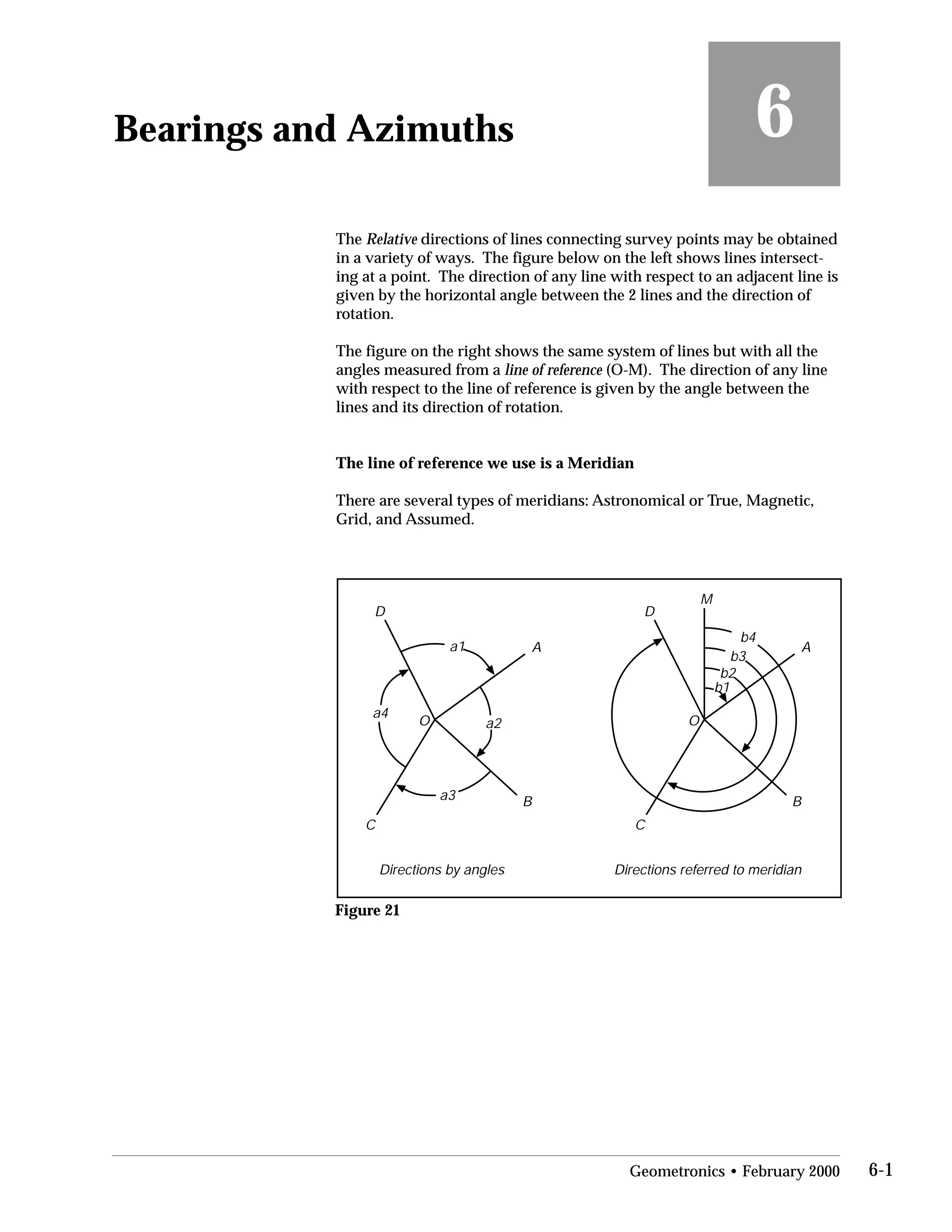
The Relative directions of lines connecting survey points may be obtained
in a variety of ways. The figure below on the left shows lines intersect­
ing at a point. The direction of any line with respect to an adjacent line is
given by the horizontal angle between the 2 lines and the direction of
rotation.
The figure on the right shows the same system of lines but with all the
angles measured from a line of reference (O-M). The direction of any line
with respect to the line of reference is given by the angle between the
lines and its direction of rotation.
The line of reference we use is a Meridian
There are several types of meridians: Astronomical or True, Magnetic,
Grid, and Assumed.
A
B
C
D
O
A
B
C
D
O
M
a1
a2
a3
a4
b1
b2
b3
b4
Directions by angles Directions referred to meridian
Figure 21
Geometronics • February 2000 6-1
Basic Surveying - Theory and Practice
Astronomical or True Meridians
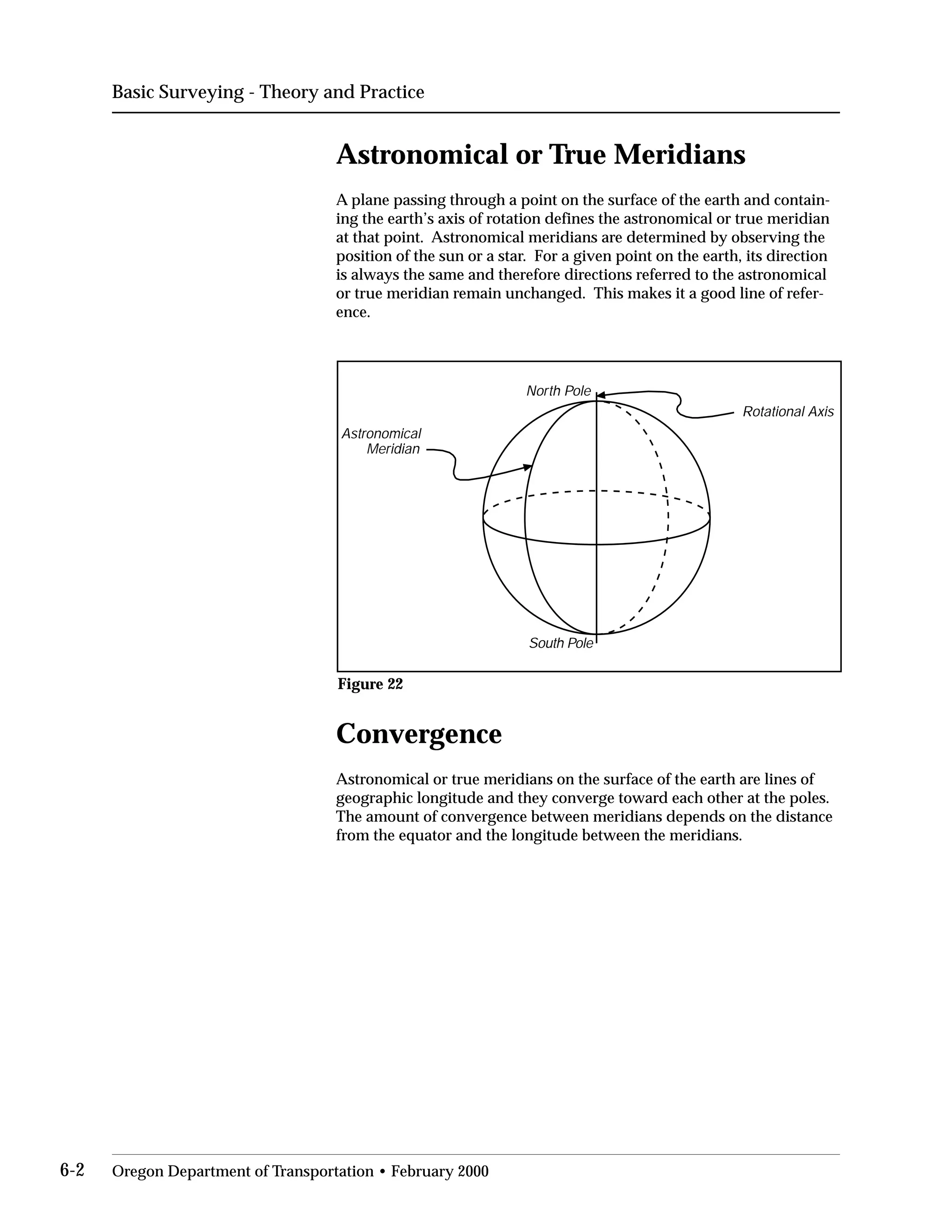
A plane passing through a point on the surface of the earth and contain­
ing the earth’s axis of rotation defines the astronomical or true meridian
at that point. Astronomical meridians are determined by observing the
position of the sun or a star. For a given point on the earth, its direction
is always the same and therefore directions referred to the astronomical
or true meridian remain unchanged. This makes it a good line of refer­
ence.
Rotational Axis
Astronomical
Meridian
North Pole
South Pole
Figure 22
Convergence
Astronomical or true meridians on the surface of the earth are lines of
geographic longitude and they converge toward each other at the poles.
The amount of convergence between meridians depends on the distance
from the equator and the longitude between the meridians.
6-2 Oregon Department of Transportation • February 2000
Chapter 6: Bearing and Azimuths
Magnetic Meridian
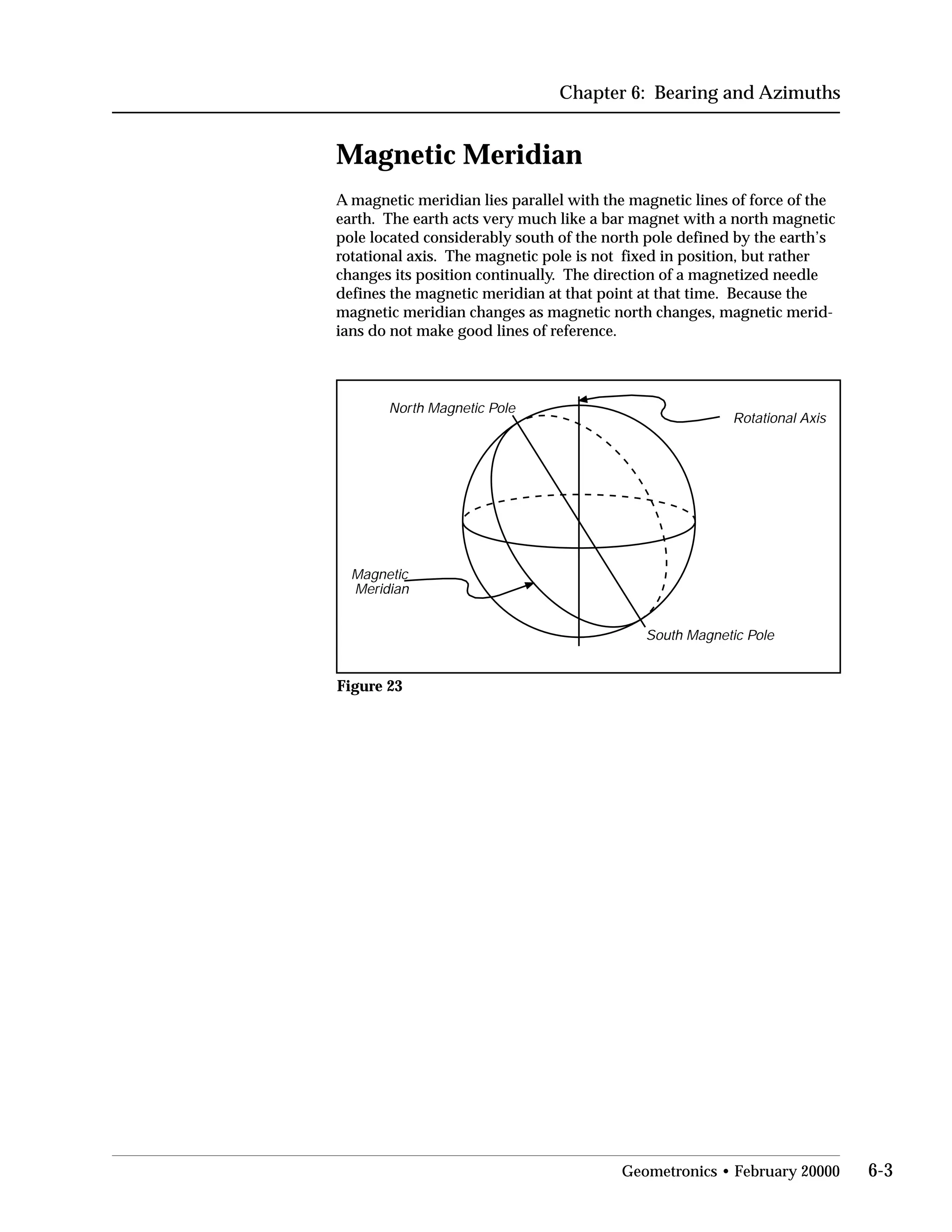
A magnetic meridian lies parallel with the magnetic lines of force of the
earth. The earth acts very much like a bar magnet with a north magnetic
pole located considerably south of the north pole defined by the earth’s
rotational axis. The magnetic pole is not fixed in position, but rather
changes its position continually. The direction of a magnetized needle
defines the magnetic meridian at that point at that time. Because the
magnetic meridian changes as magnetic north changes, magnetic merid­
ians do not make good lines of reference.
Rotational Axis
North Magnetic Pole
South Magnetic Pole
Magnetic
Meridian
Figure 23
Geometronics • February 20000 6-3
Basic Surveying - Theory and Practice
Grid Meridians
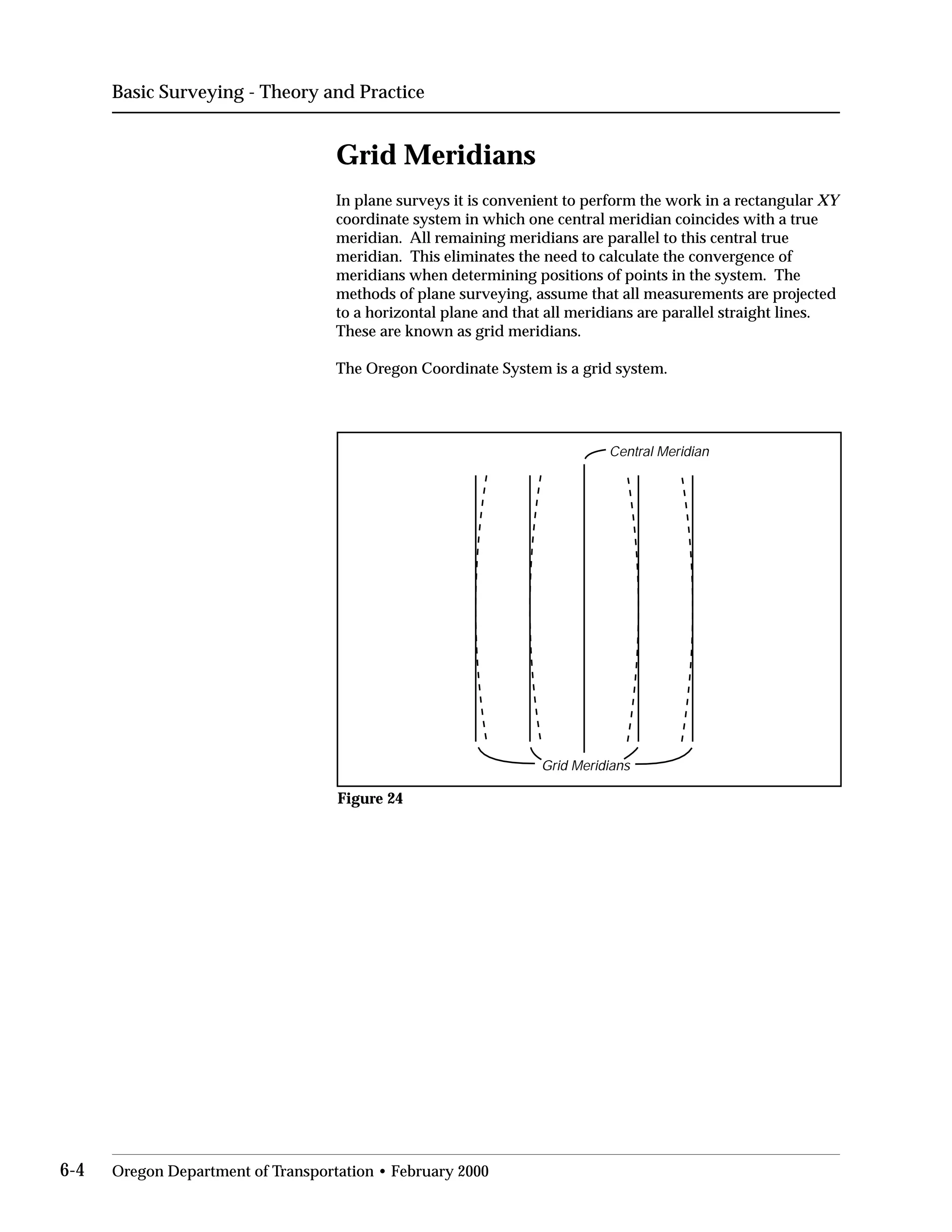
In plane surveys it is convenient to perform the work in a rectangular XY
coordinate system in which one central meridian coincides with a true
meridian. All remaining meridians are parallel to this central true
meridian. This eliminates the need to calculate the convergence of
meridians when determining positions of points in the system. The
methods of plane surveying, assume that all measurements are projected
to a horizontal plane and that all meridians are parallel straight lines.
These are known as grid meridians.
The Oregon Coordinate System is a grid system.
Central Meridian
Grid Meridians
Figure 24
6-4 Oregon Department of Transportation • February 2000
Chapter 6: Bearing and Azimuths
Assumed Meridians
On certain types of localized surveying, it may not be necessary to
establish a true, magnetic, or grid direction. However it is usually
desirable to have some basis for establishing relative directions within
the current survey. This may be done by establishing an assumed
meridian.
An assumed meridian is an arbitrary direction assigned to some line in
the survey from which all other lines are referenced. This could be a line
between two property monuments, the centerline of a tangent piece of
roadway, or even the line between two points set for that purpose.
The important point to remember about assumed meridians is that they
have no relationship to any other meridian and thus the survey cannot
be readily (if at all) related to other surveys. Also, if the original monu­
ments are disturbed, the direction may not be reproducible.
It is good practice when assuming a direction to avoid directions that
might appear to be true. If assuming a direction on a line that runs
generally north and south, do not assume a north direction, as some
future surveyor may mistakenly use your direction as true.
Geometronics • February 20000 6-5
Basic Surveying - Theory and Practice
Azimuths
The azimuth of a line on the ground is its horizontal angle measured
from the meridian to the line. Azimuth gives the direction of the line with
respect to the meridian. It is usually measured in a clockwise direction
with respect to either the north meridian or the south meridian. In plane
surveying, azimuths are generally measured from the north.
When using azimuths, one needs to designate whether the azimuth is
from the north or the south.
Azimuths are called true (astronomical) azimuths, magnetic azimuths,
grid azimuths, or assumed azimuths depending on the type of meridian
referenced.
Azimuths may have values between 0 and 360 degrees.
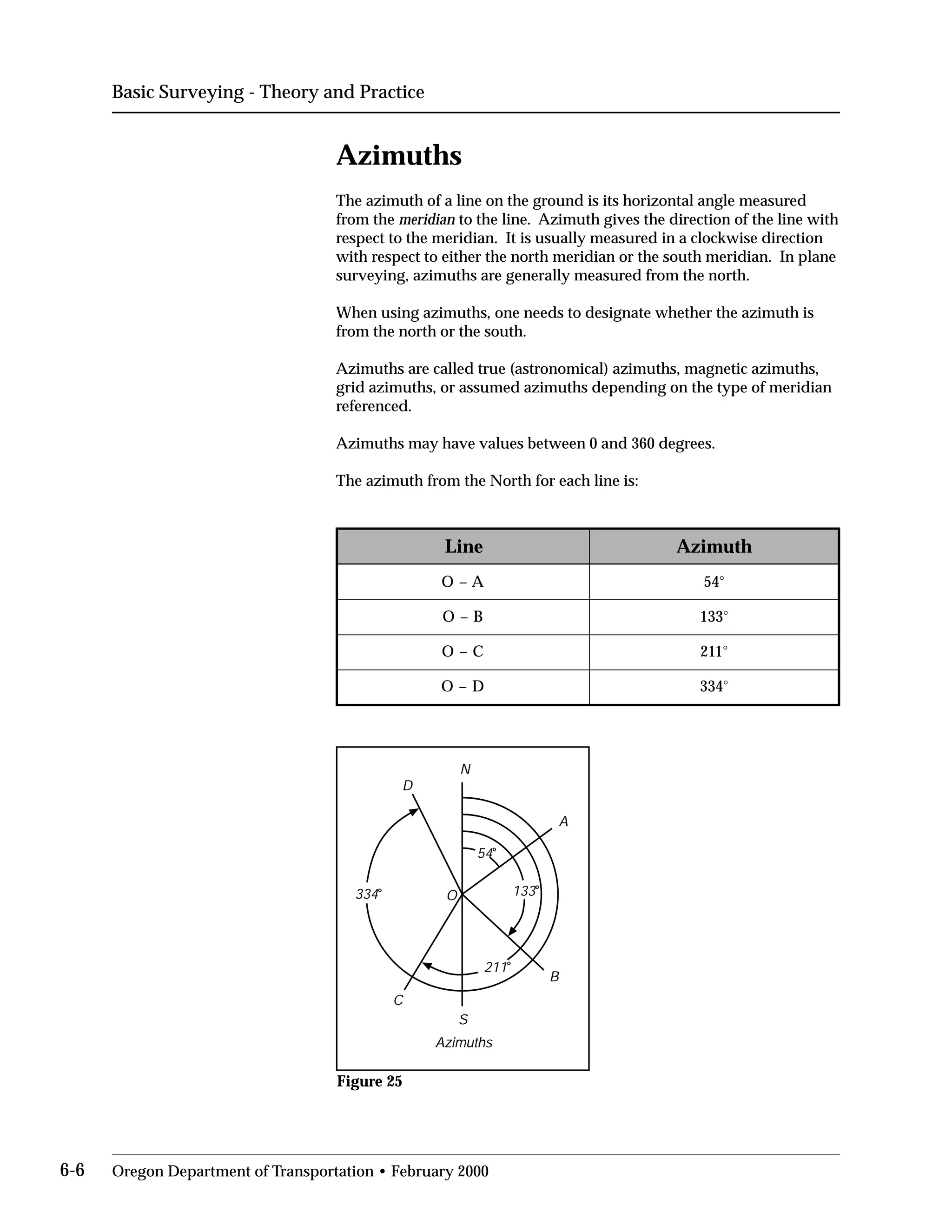
The azimuth from the North for each line is:
Line Azimuth
O – A 54°
O – B 133°
O – C 211°
O – D 334°
A
B
C
D
O
Azimuths
S
N
54o
133o
211o
334o
Figure 25
6-6 Oregon Department of Transportation • February 2000
Chapter 6: Bearing and Azimuths
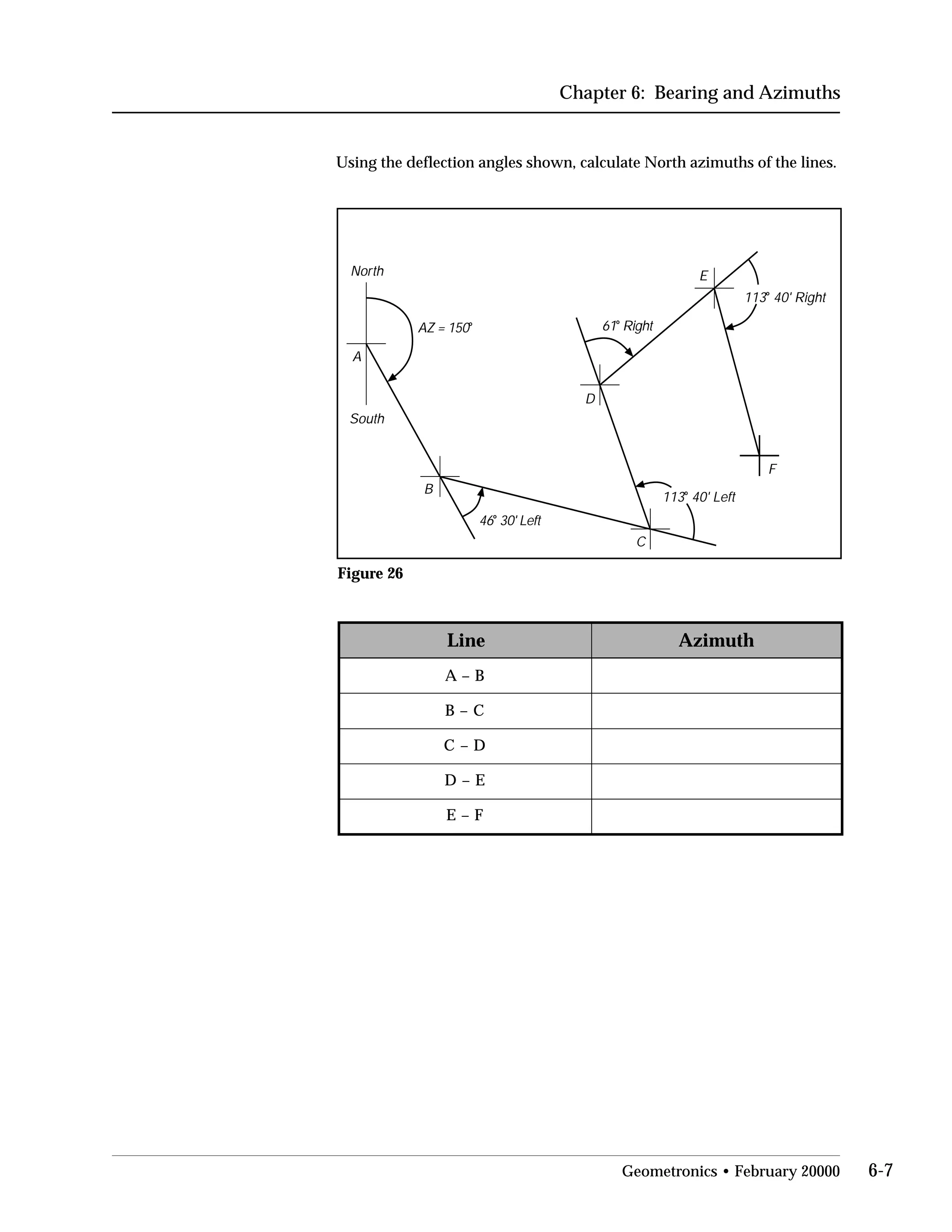
Using the deflection angles shown, calculate North azimuths of the lines.
A
B
C
D
E
F
North
South
46o
30' Left
113o
40' Left
61o
Right
113o
40' Right
AZ = 150o
Figure 26

Line Azimuth
A – B
B – C
C – D
D – E
E – F
Geometronics • February 20000 6-7
Basic Surveying - Theory and Practice
Bearings
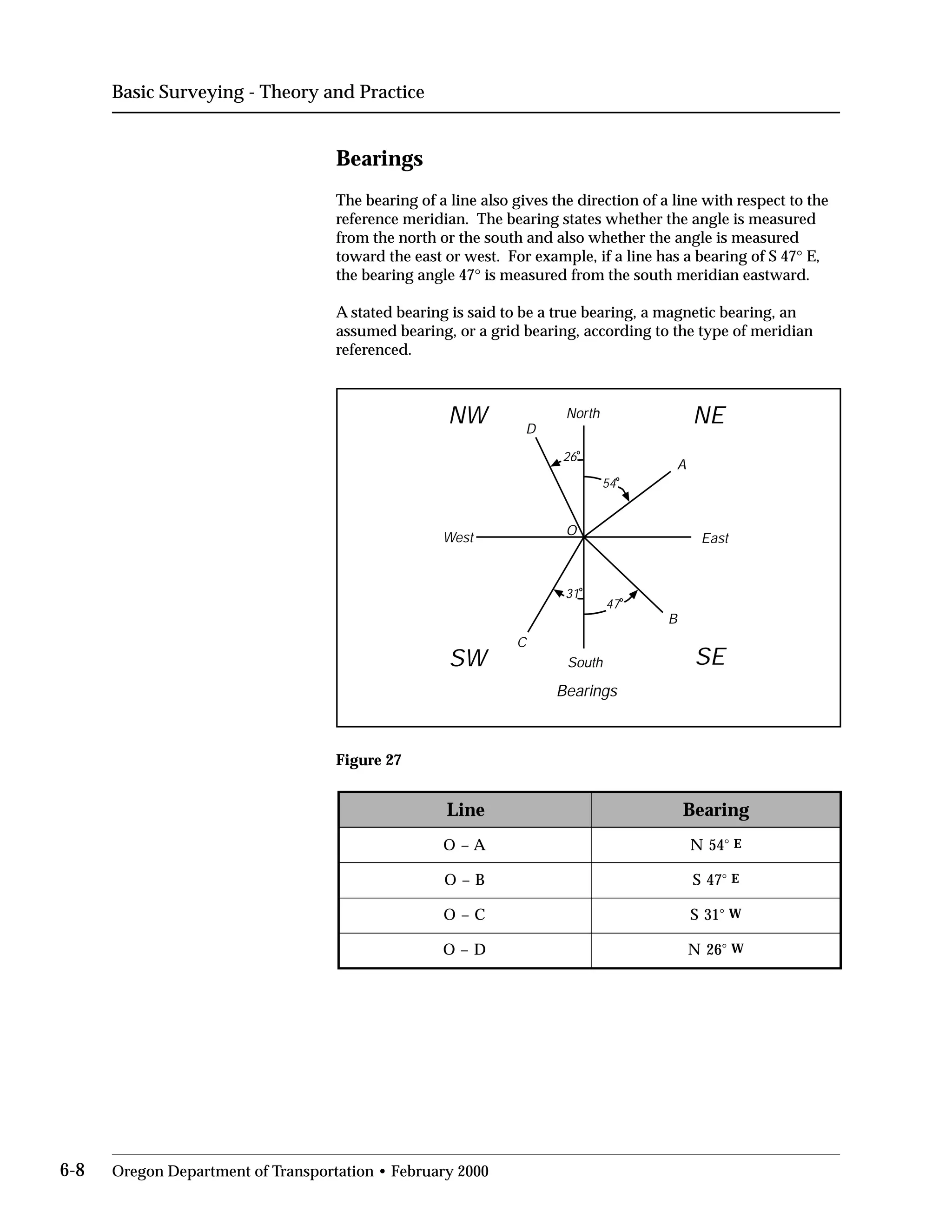
The bearing of a line also gives the direction of a line with respect to the
reference meridian. The bearing states whether the angle is measured
from the north or the south and also whether the angle is measured
toward the east or west. For example, if a line has a bearing of S 47° E,
the bearing angle 47° is measured from the south meridian eastward.
A stated bearing is said to be a true bearing, a magnetic bearing, an
assumed bearing, or a grid bearing, according to the type of meridian
referenced.
A
B
C
D
O
54
o
Bearings
South
North
EastWest
26
o
31
o
47
o
NW NE
SESW
Figure 27
Line Bearing
O – A N 54° E
O – B S 47° E
O – C S 31° W
O – D N 26° W
6-8 Oregon Department of Transportation • February 2000
Chapter 6: Bearing and Azimuths
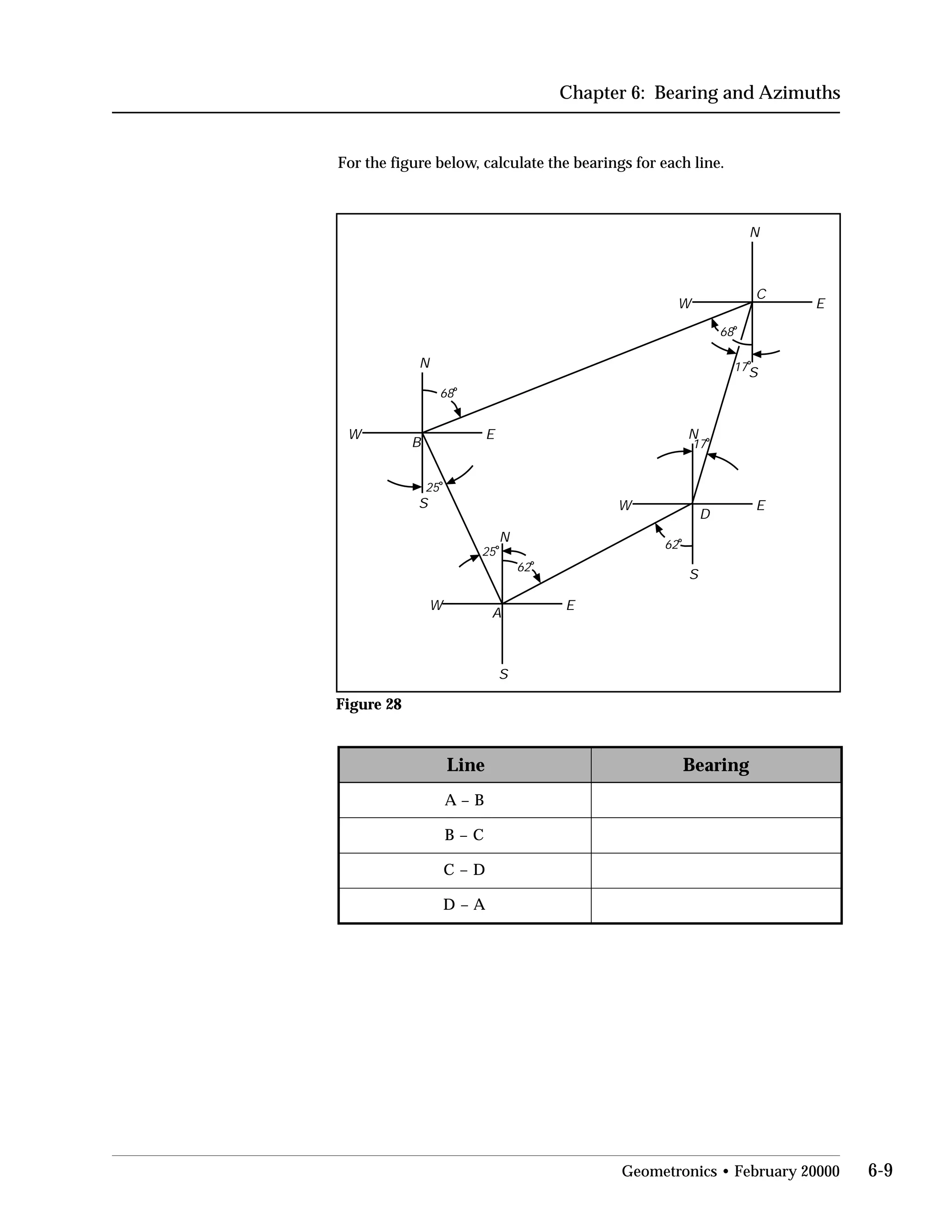
For the figure below, calculate the bearings for each line.
N
E
S
W
N
E
S
W
N
E
S
W
N
E
S
W
A
B
C
D
62
o
25
o
68
o
62
o
25
o
68
o
17
o
17
o
Figure 28

Line Bearing
A – B
B – C
C – D
D – A
Geometronics • February 20000 6-9
Basic Surveying - Theory and Practice
Relation between Bearing and Azimuths
To simplify computations based on survey data, bearings may be con­

verted to azimuths or azimuths to bearings.

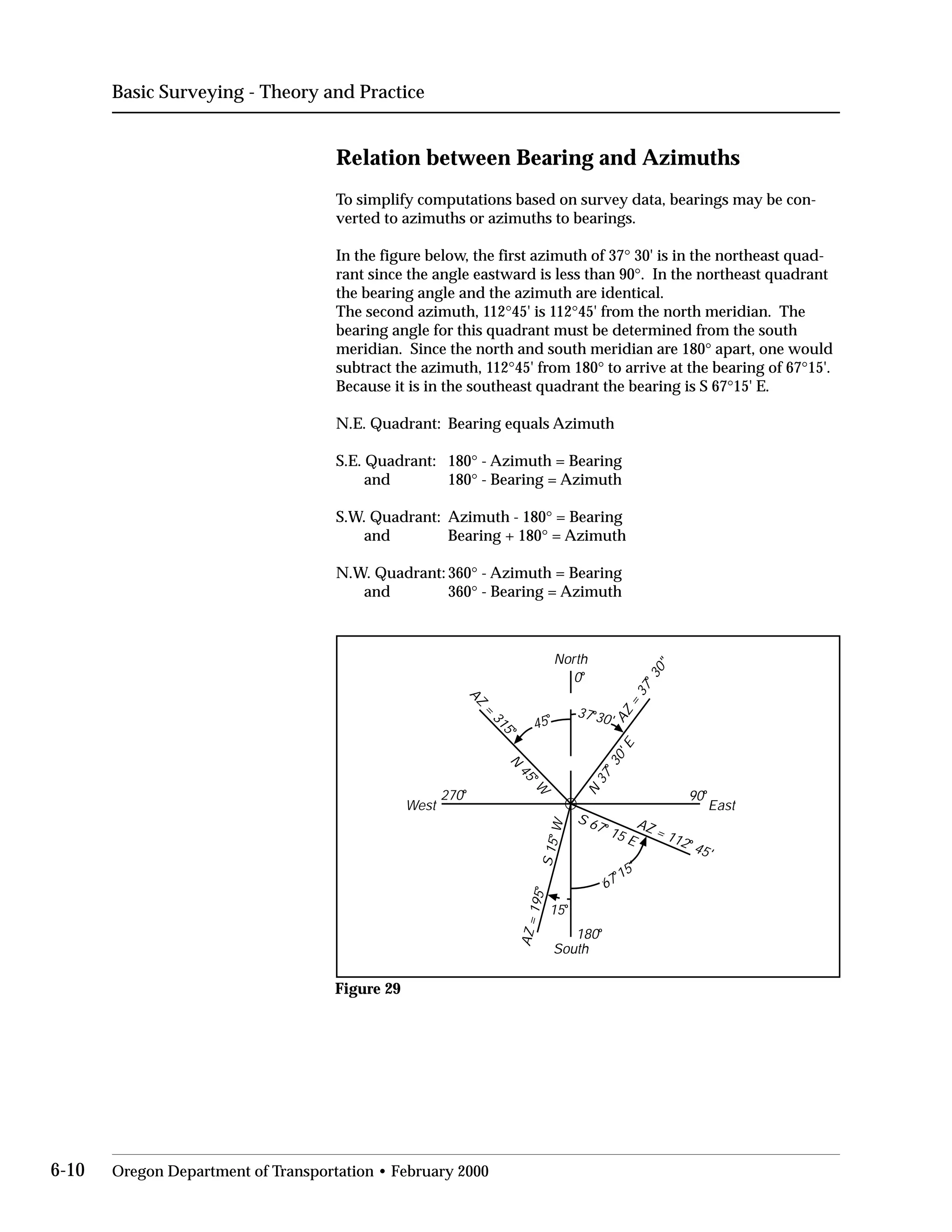
In the figure below, the first azimuth of 37° 30' is in the northeast quad-

rant since the angle eastward is less than 90°. In the northeast quadrant

the bearing angle and the azimuth are identical.

The second azimuth, 112°45' is 112°45' from the north meridian. The

bearing angle for this quadrant must be determined from the south

meridian. Since the north and south meridian are 180° apart, one would

subtract the azimuth, 112°45' from 180° to arrive at the bearing of 67°15'.

Because it is in the southeast quadrant the bearing is S 67°15' E.

N.E. Quadrant: Bearing equals Azimuth

S.E. Quadrant: 180° - Azimuth = Bearing
and 180° - Bearing = Azimuth
S.W. Quadrant: Azimuth - 180° = Bearing
and Bearing + 180° = Azimuth
N.W. Quadrant: 360° - Azimuth = Bearing
and 360° - Bearing = Azimuth
North
East
South
West
0o
90o
180o
270o
37o
30'45
o
N
37o
30'E
N
45
oW
67
o
15'
15o
S 67 o
15 E
S15o
W
AZ
=
315
o
AZ
=
37o
30"
AZ = 112 o
45'
AZ=195o
Figure 29
6-10 Oregon Department of Transportation • February 2000
Chapter 6: Bearing and Azimuths
Back Azimuths and Back Bearings
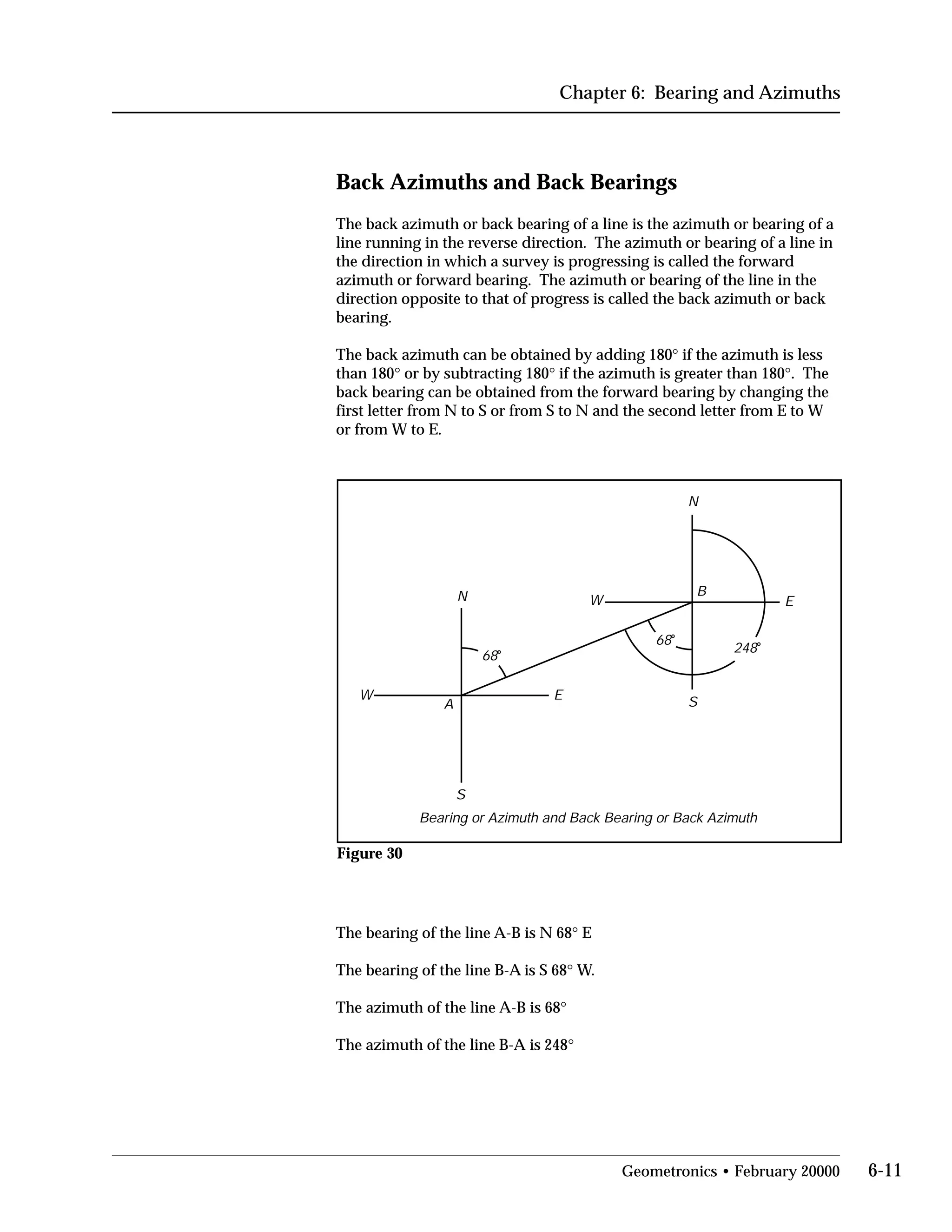
The back azimuth or back bearing of a line is the azimuth or bearing of a
line running in the reverse direction. The azimuth or bearing of a line in
the direction in which a survey is progressing is called the forward
azimuth or forward bearing. The azimuth or bearing of the line in the
direction opposite to that of progress is called the back azimuth or back
bearing.
The back azimuth can be obtained by adding 180° if the azimuth is less
than 180° or by subtracting 180° if the azimuth is greater than 180°. The
back bearing can be obtained from the forward bearing by changing the
first letter from N to S or from S to N and the second letter from E to W
or from W to E.
N
N
E
S
W
A
B
68o
68o
248o
E
W
S
Bearing or Azimuth and Back Bearing or Back Azimuth
Figure 30
The bearing of the line A-B is N 68° E
The bearing of the line B-A is S 68° W.
The azimuth of the line A-B is 68°
The azimuth of the line B-A is 248°
Geometronics • February 20000 6-11
Basic Surveying - Theory and Practice
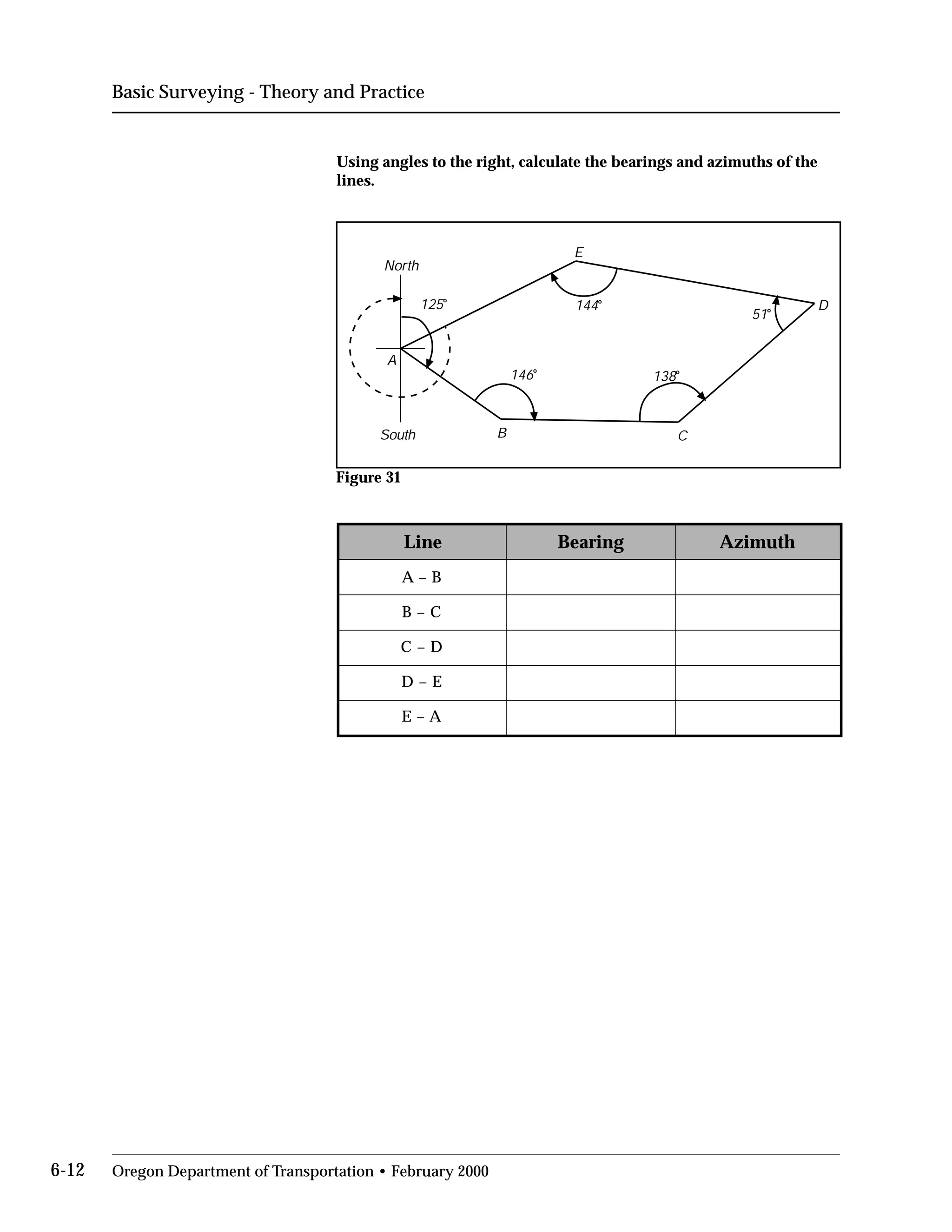
Using angles to the right, calculate the bearings and azimuths of the
lines.
South
North
B C
D
E
A
125o
146o
138o
51o144o
Figure 31
Line Bearing Azimuth
A – B
B – C
C – D
D – E
E – A
6-12 Oregon Department of Transportation • February 2000
Coordinates
 7
In Surveying, one of the primary functions is to describe or establish the
positions of points on the surface of the earth. One of the many ways to
accomplish this is by using coordinates to provide an address for the
point. Modern surveying techniques rely heavily on 3 dimensional
coordinates.
In order to understand the somewhat complex coordinate systems used
in surveying, we must first look at the Rectangular Coordinate System
(or Cartesian Plane) from basic mathematics.
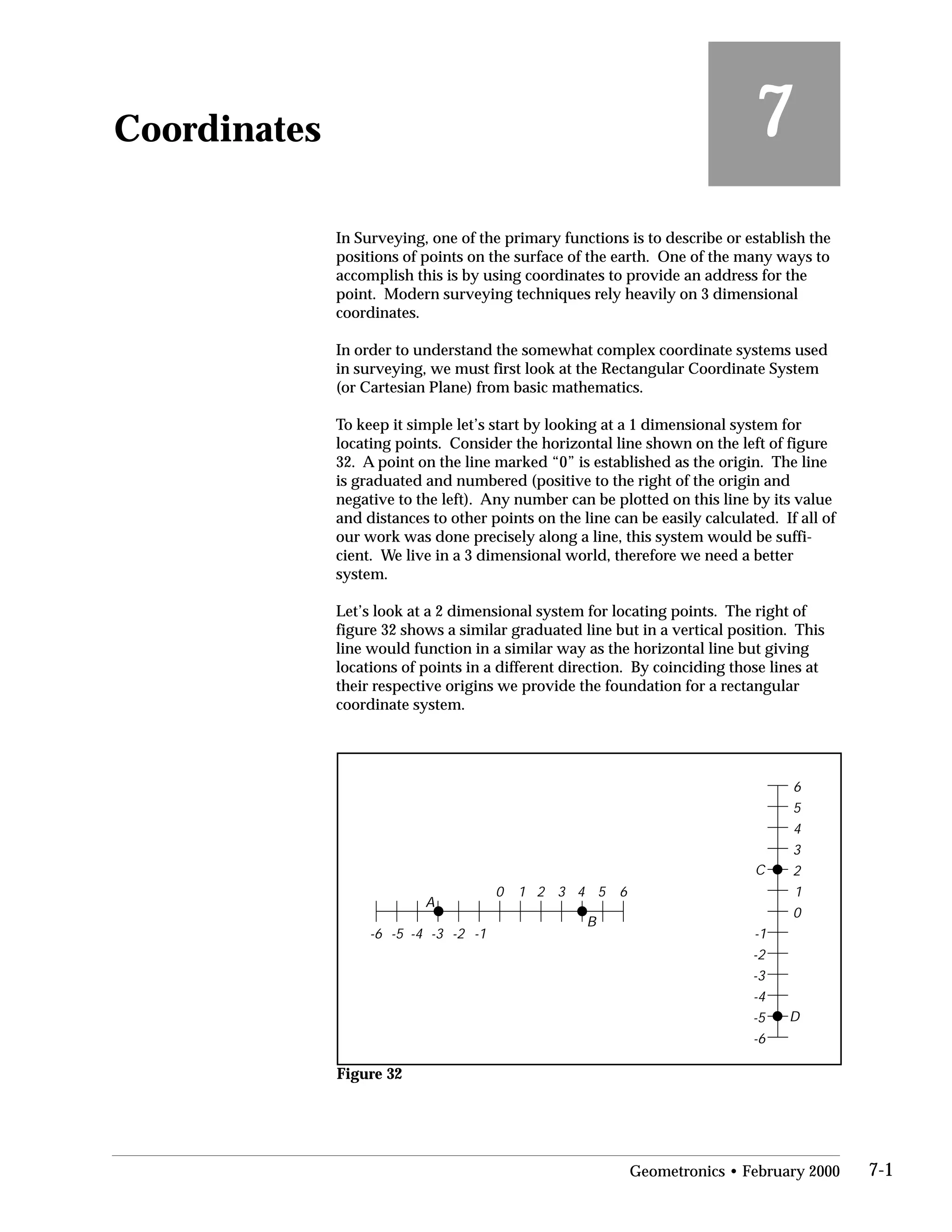
To keep it simple let’s start by looking at a 1 dimensional system for
locating points. Consider the horizontal line shown on the left of figure
32. A point on the line marked “0” is established as the origin. The line
is graduated and numbered (positive to the right of the origin and
negative to the left). Any number can be plotted on this line by its value
and distances to other points on the line can be easily calculated. If all of
our work was done precisely along a line, this system would be suffi­
cient. We live in a 3 dimensional world, therefore we need a better
system.
Let’s look at a 2 dimensional system for locating points. The right of
figure 32 shows a similar graduated line but in a vertical position. This
line would function in a similar way as the horizontal line but giving
locations of points in a different direction. By coinciding those lines at
their respective origins we provide the foundation for a rectangular
coordinate system.
0
0
11 2
2
3
3 4
4
5
5 6
6
-1-1-2
-2
-3
-3-4
-4
-5
-5-6
-6
A
B
D
C
Figure 32
Geometronics • February 2000 7-1
Basic Surveying - Theory and Practice
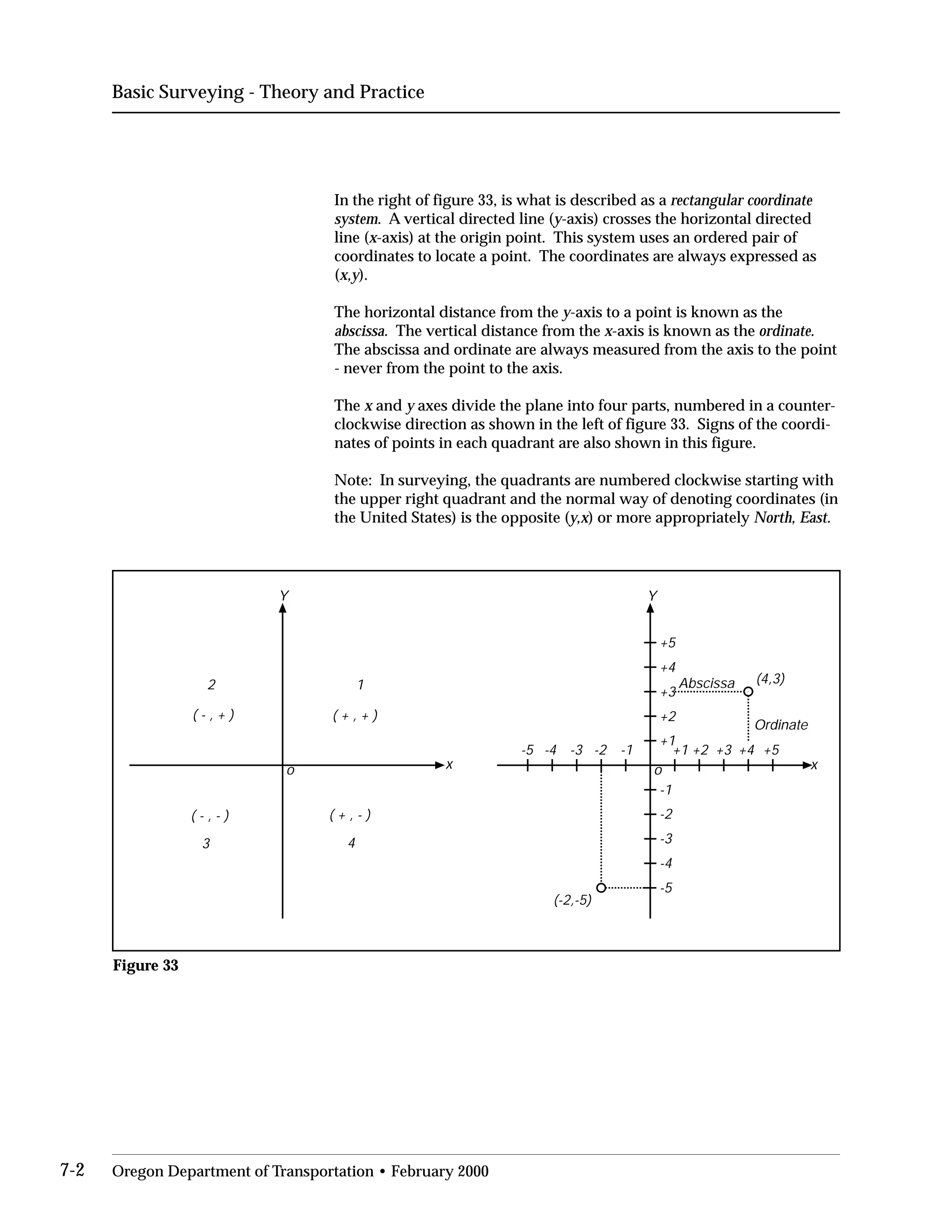
In the right of figure 33, is what is described as a rectangular coordinate
system. A vertical directed line (y-axis) crosses the horizontal directed
line (x-axis) at the origin point. This system uses an ordered pair of
coordinates to locate a point. The coordinates are always expressed as
(x,y).
The horizontal distance from the y-axis to a point is known as the
abscissa. The vertical distance from the x-axis is known as the ordinate.
The abscissa and ordinate are always measured from the axis to the point
- never from the point to the axis.
The x and y axes divide the plane into four parts, numbered in a counter-
clockwise direction as shown in the left of figure 33. Signs of the coordi­
nates of points in each quadrant are also shown in this figure.
Note: In surveying, the quadrants are numbered clockwise starting with
the upper right quadrant and the normal way of denoting coordinates (in
the United States) is the opposite (y,x) or more appropriately North, East.
Y
x
( + , + )
( + , - )( - , - )
( - , + )
12
3 4
o
Y
+1 +2 +3 +4 +5
-1
-2
-3
-4
-5
+1
+2
+3
+4
+5
-1-2-3-4-5
(4,3)
(-2,-5)
o
Abscissa
Ordinate
Figure 33
7-2 Oregon Department of Transportation • February 2000
x
Chapter 7: Coordinates
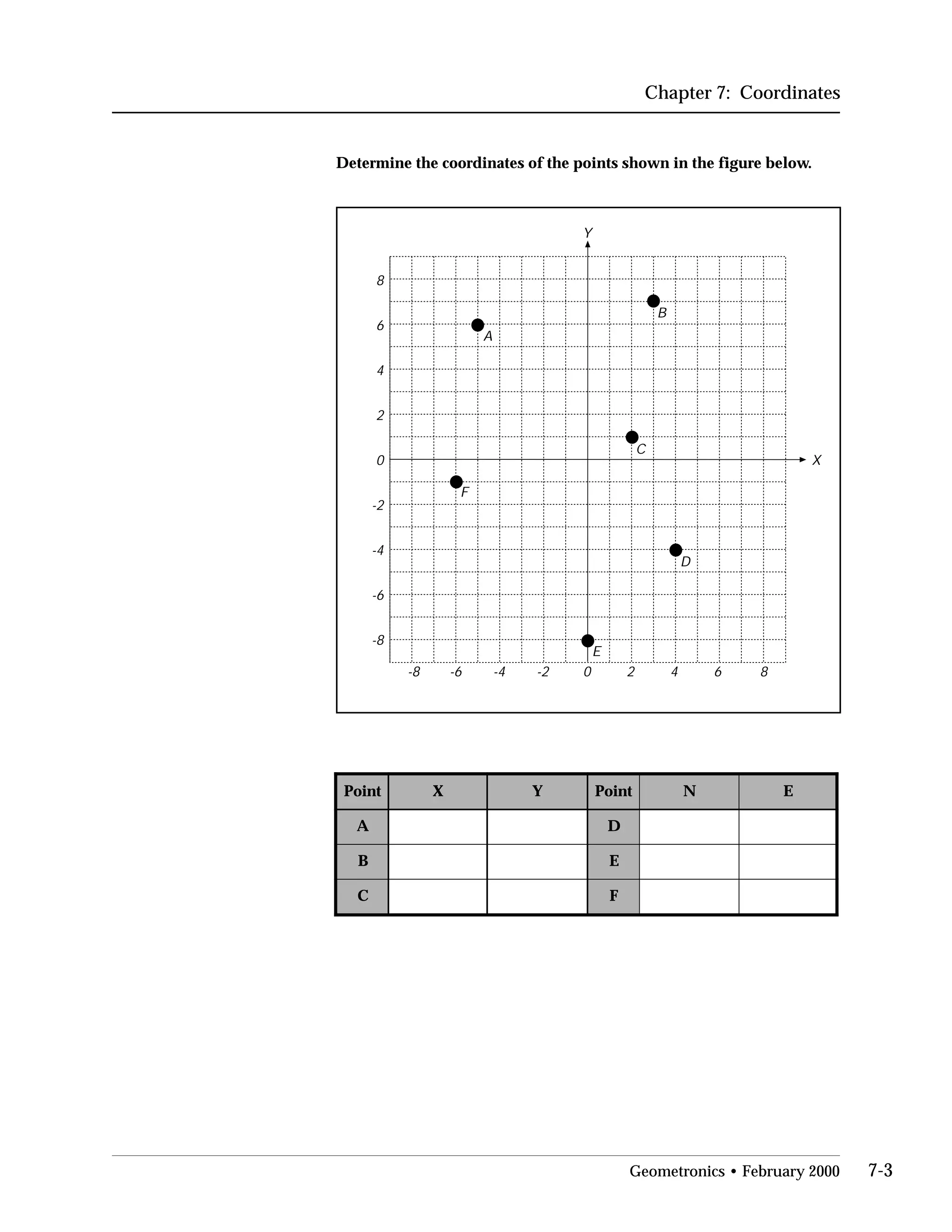
Determine the coordinates of the points shown in the figure below.
8
6
4
2
0
-2
-4
-6
-8
-8 -6 -4 -2 0 8
X
Y
642
B
A
C
F
D
E
tnioP X Y tnioP N E
A D
B E
C F
Geometronics • February 2000 7-3
Basic Surveying - Theory and Practice
Polar Coordinates
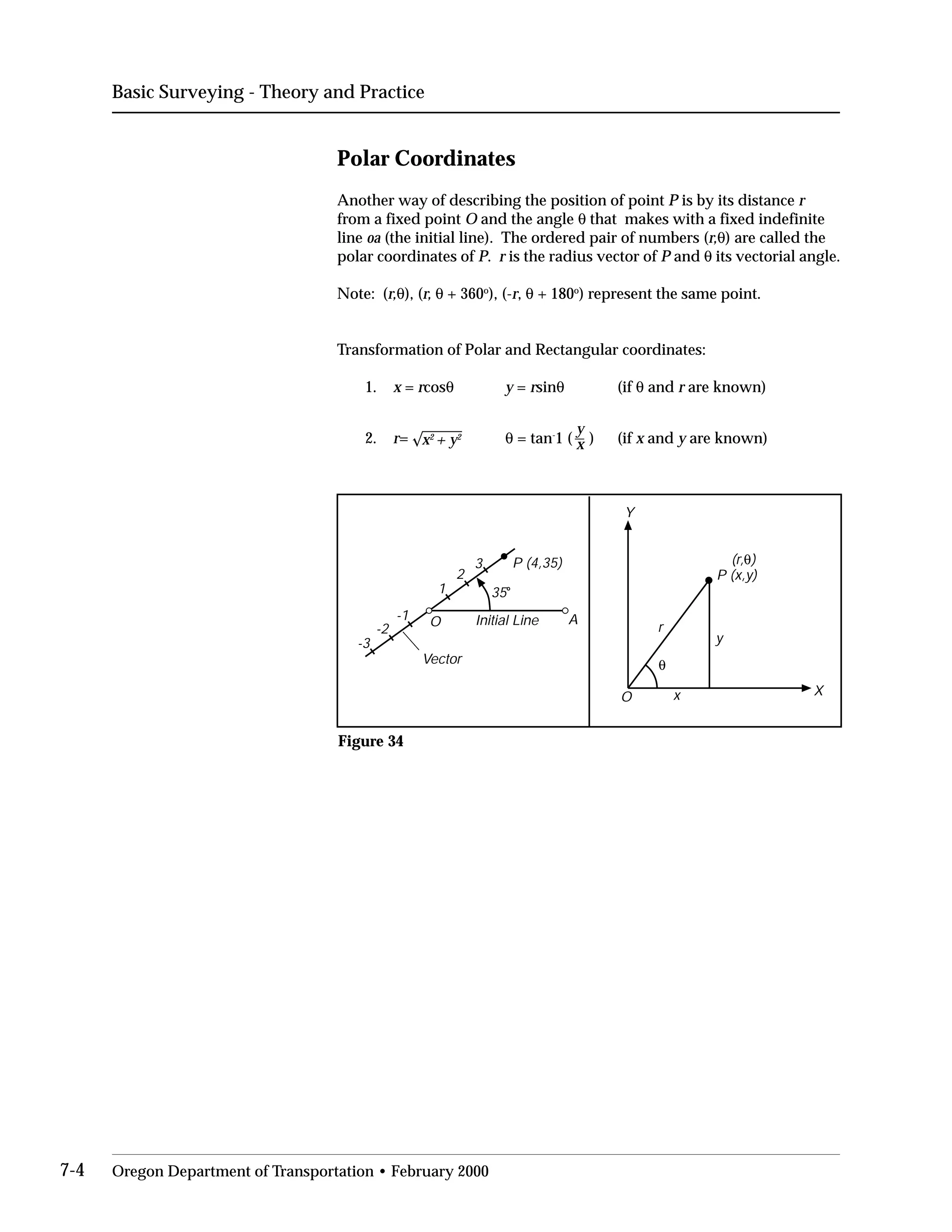
Another way of describing the position of point P is by its distance r
from a fixed point O and the angle θ that makes with a fixed indefinite
line oa (the initial line). The ordered pair of numbers (r,θ) are called the
polar coordinates of P. r is the radius vector of P and θ its vectorial angle.
Note: (r,θ), (r, θ + 360o
), (-r, θ + 180o
) represent the same point.
Transformation of Polar and Rectangular coordinates:
1. x = rcosθ y = rsinθ (if θ and r are known)
2. r= x2
+ y2 θ = tan-
1 (
y
x ) (if x and y are known)
O
Vector
Initial Line
1
2
3
-1
-2
-3
35o
A
P (4,35) (r,θ)
O X
Y
x
y
r
θ
P (x,y)
Figure 34
7-4 Oregon Department of Transportation • February 2000
Chapter 7: Coordinates
Measuring distance between coordinates
When determining the distance between any two points in a rectangular
coordinate system, the pythagorean theorem may be used (see Review of
Basic Trigonometry). In the figure below, the distance between A and B
can be computed in the following way :
AB = [4-(-2)]2
+[3-(-5)]2
AB = [4+2)]2
+[3+5)]2
AB = 10
CB=+4-(-2)=4+2 AC=+3-(-5)=3+5
Point C in this figure was derived by passing a horizontal line through
point B and a vertical line through point A thus forming an intersect at
point C, and also forming a right triangle with line AB being the hypot­
enuse. The x-coordinate of C will be the same as the x-coordinate of A (4)
and the y-coordinate of C will be the same y-coordinate of B (-5).
Y
x
+1 +2 +3 +4 +5
-1
-2
-3
-4
-5
+1
+2
+3
+4
+5
-1-2-3-4-5
(4,3)
(-2,-5)
o
(4,-5)
A
B C
Figure 35
Geometronics • February 2000 7-5
Basic Surveying - Theory and Practice
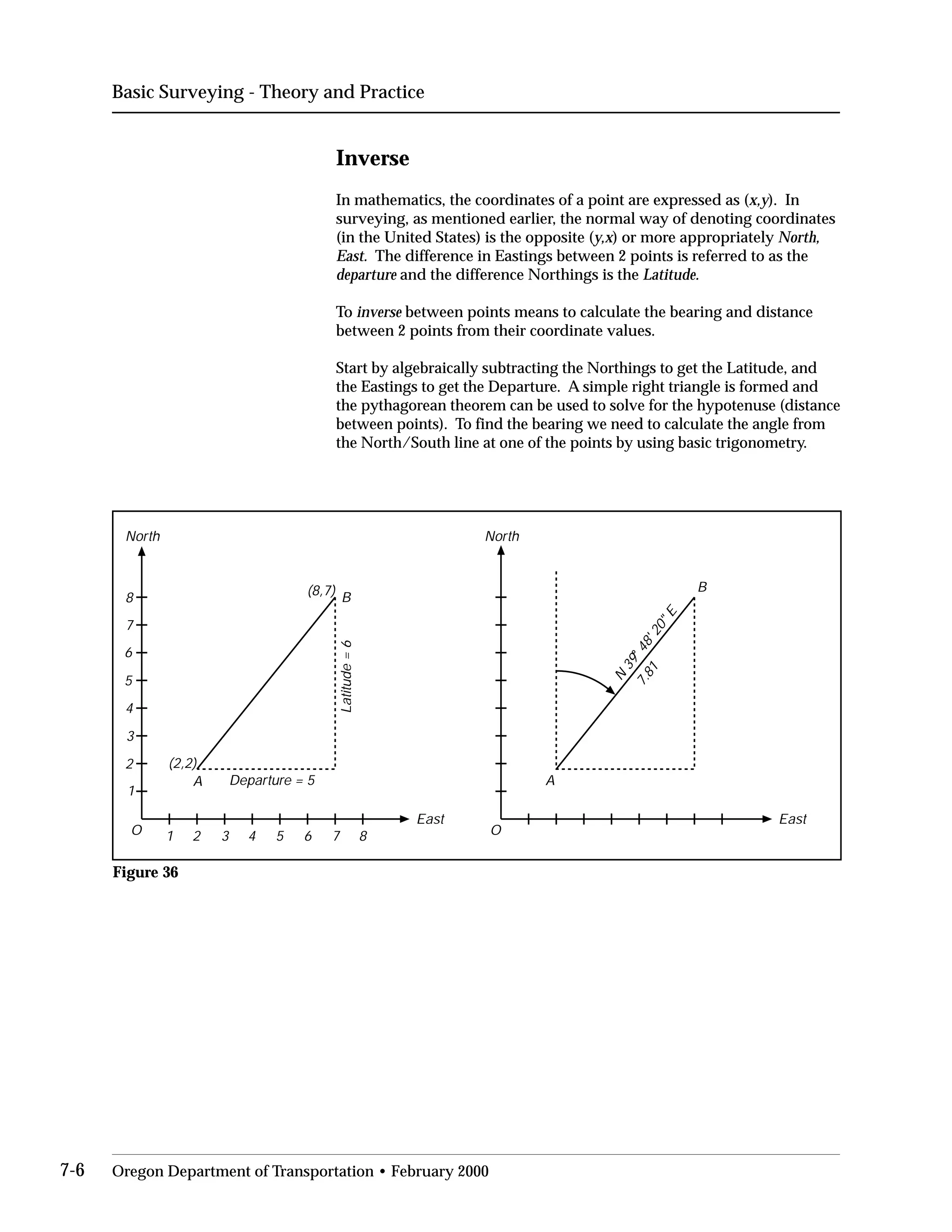
Inverse
In mathematics, the coordinates of a point are expressed as (x,y). In
surveying, as mentioned earlier, the normal way of denoting coordinates
(in the United States) is the opposite (y,x) or more appropriately North,
East. The difference in Eastings between 2 points is referred to as the
departure and the difference Northings is the Latitude.
To inverse between points means to calculate the bearing and distance
between 2 points from their coordinate values.
Start by algebraically subtracting the Northings to get the Latitude, and
the Eastings to get the Departure. A simple right triangle is formed and
the pythagorean theorem can be used to solve for the hypotenuse (distance
between points). To find the bearing we need to calculate the angle from
the North/South line at one of the points by using basic trigonometry.
O
A
B
East
North
1 3 5 6 7 8
1
2
3
4
5
6
7
8
(2,2)
(8,7)
Latitude=6
Departure = 5
O
A
B
East
North
7.81
N
39o
48'20"E
2 4
Figure 36
7-6 Oregon Department of Transportation • February 2000
Chapter 7: Coordinates
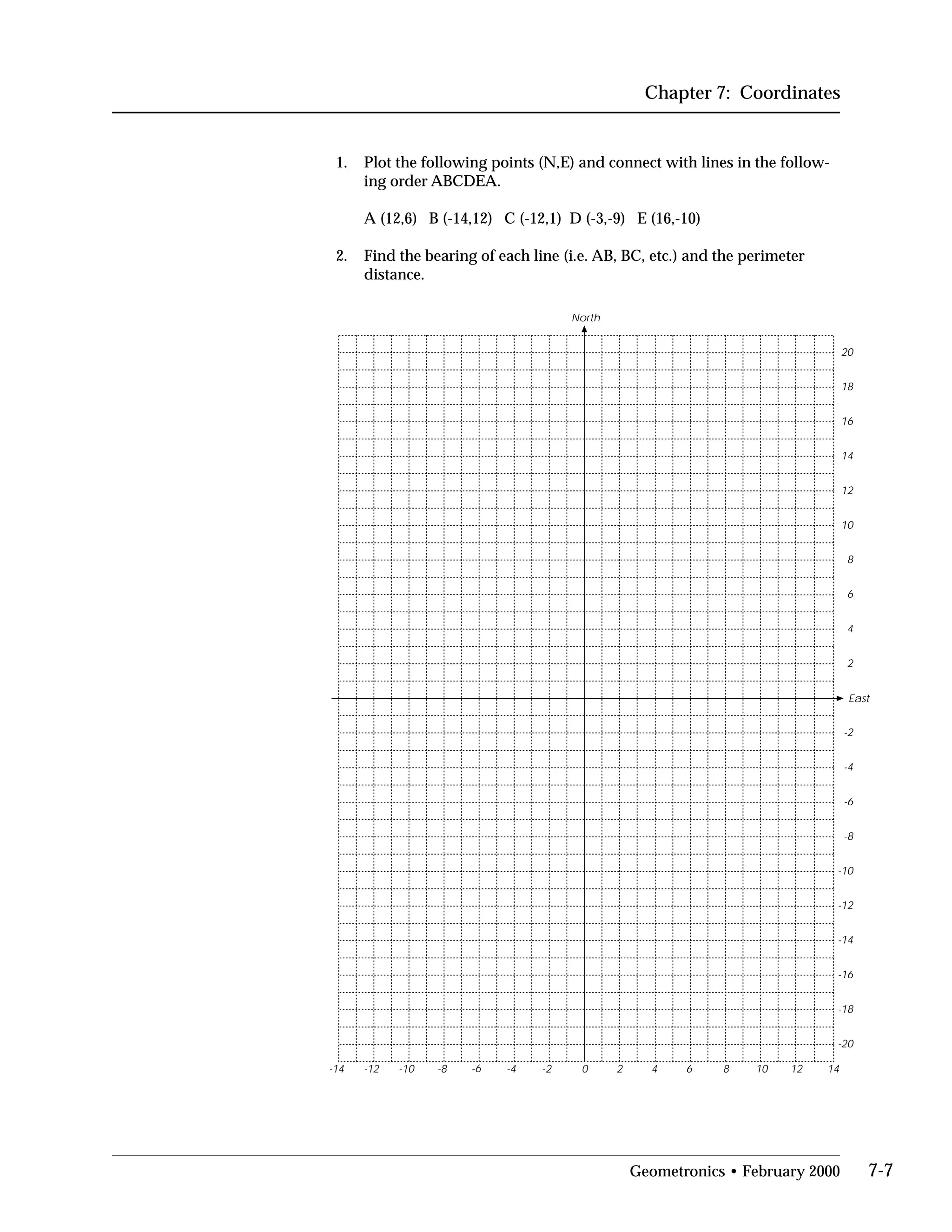
1.	 Plot the following points (N,E) and connect with lines in the follow­
ing order ABCDEA.
A (12,6) B (-14,12) C (-12,1) D (-3,-9) E (16,-10)
2.	 Find the bearing of each line (i.e. AB, BC, etc.) and the perimeter
distance.
North
20
18
16
14
12
10
8
6
4
2
East
-2
-4
-6
-8
-10
-12
-14
-16
-18
-20
-14 -12 -10 -8 -6 -4 -2 0 2 4 6 8 10 12 14
Geometronics • February 2000 7-7
Basic Surveying - Theory and Practice
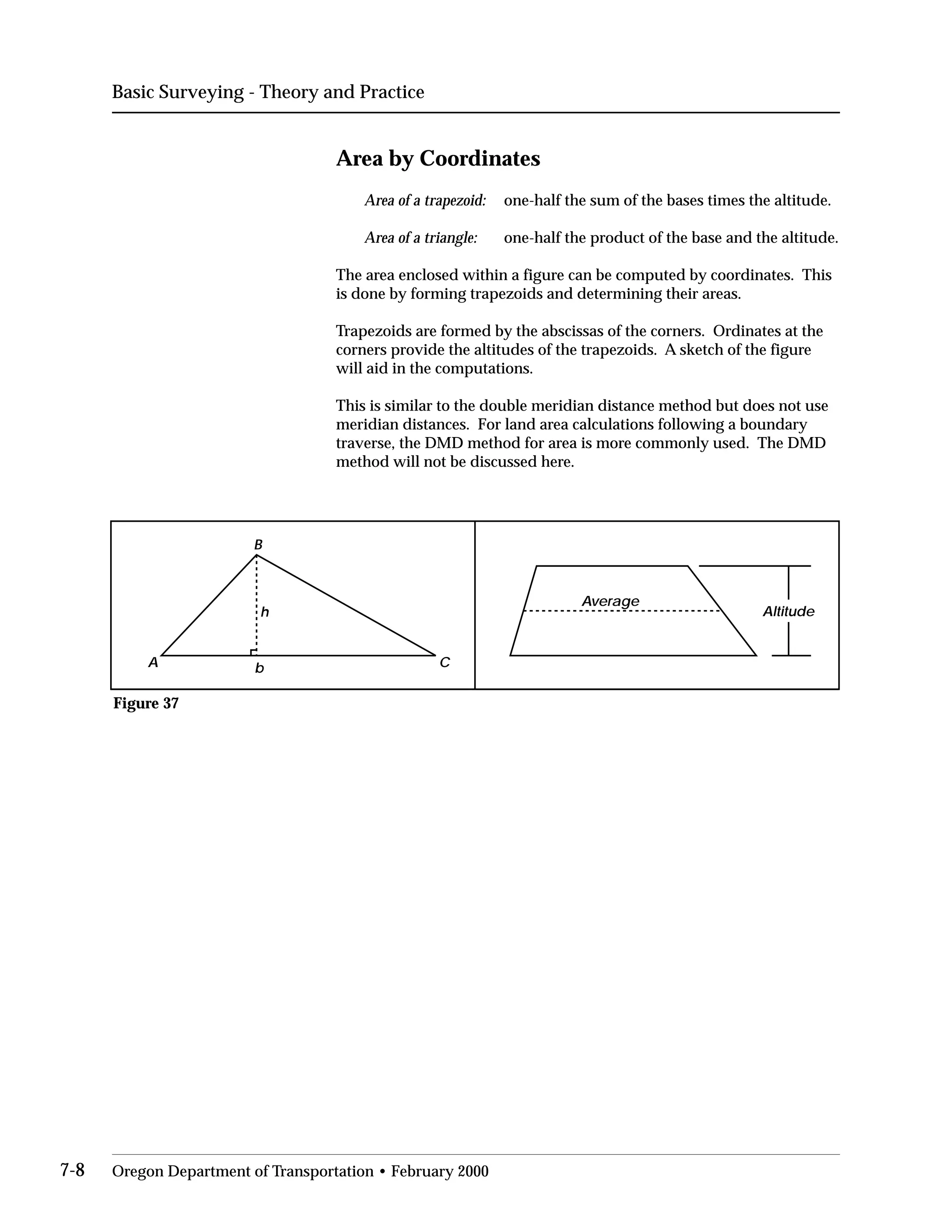
Area by Coordinates
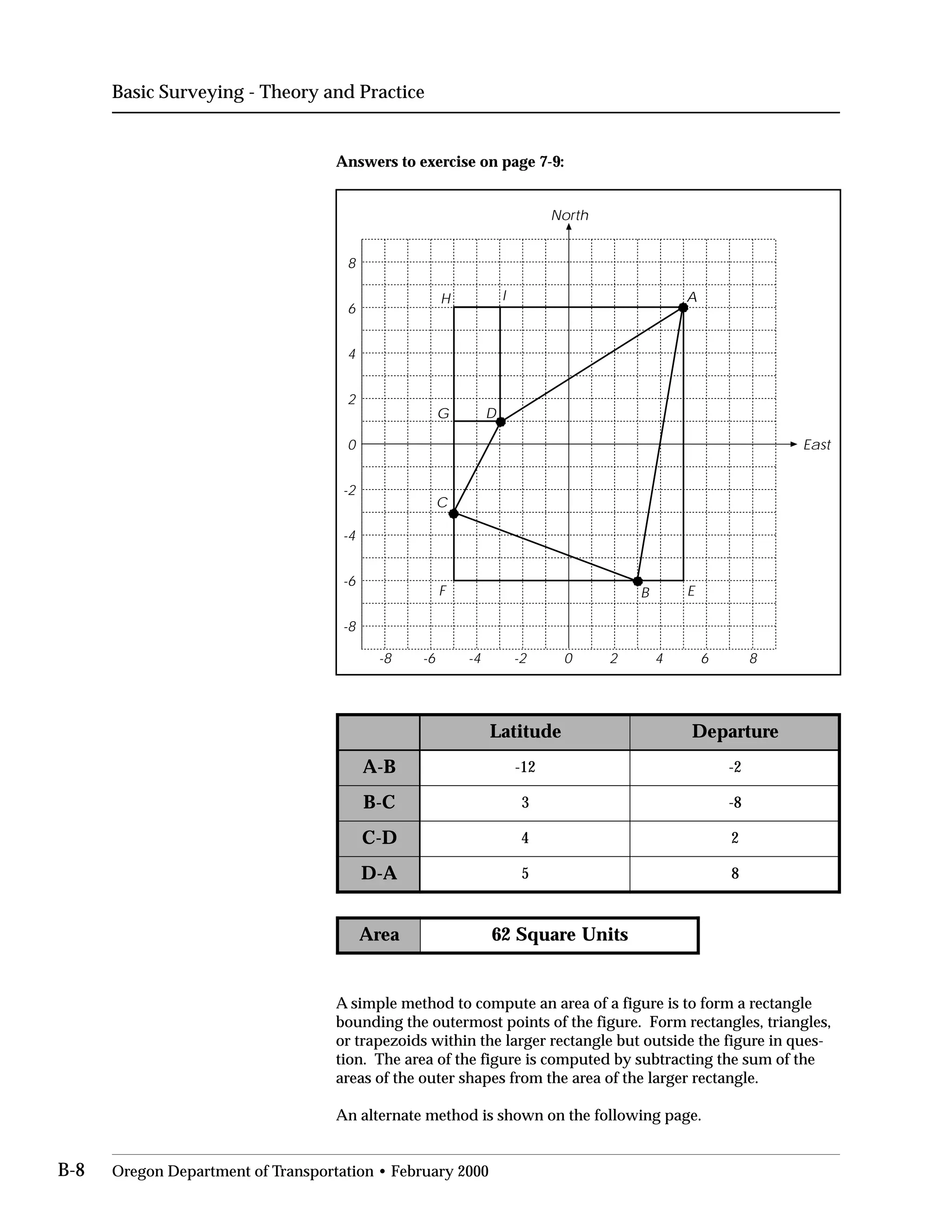
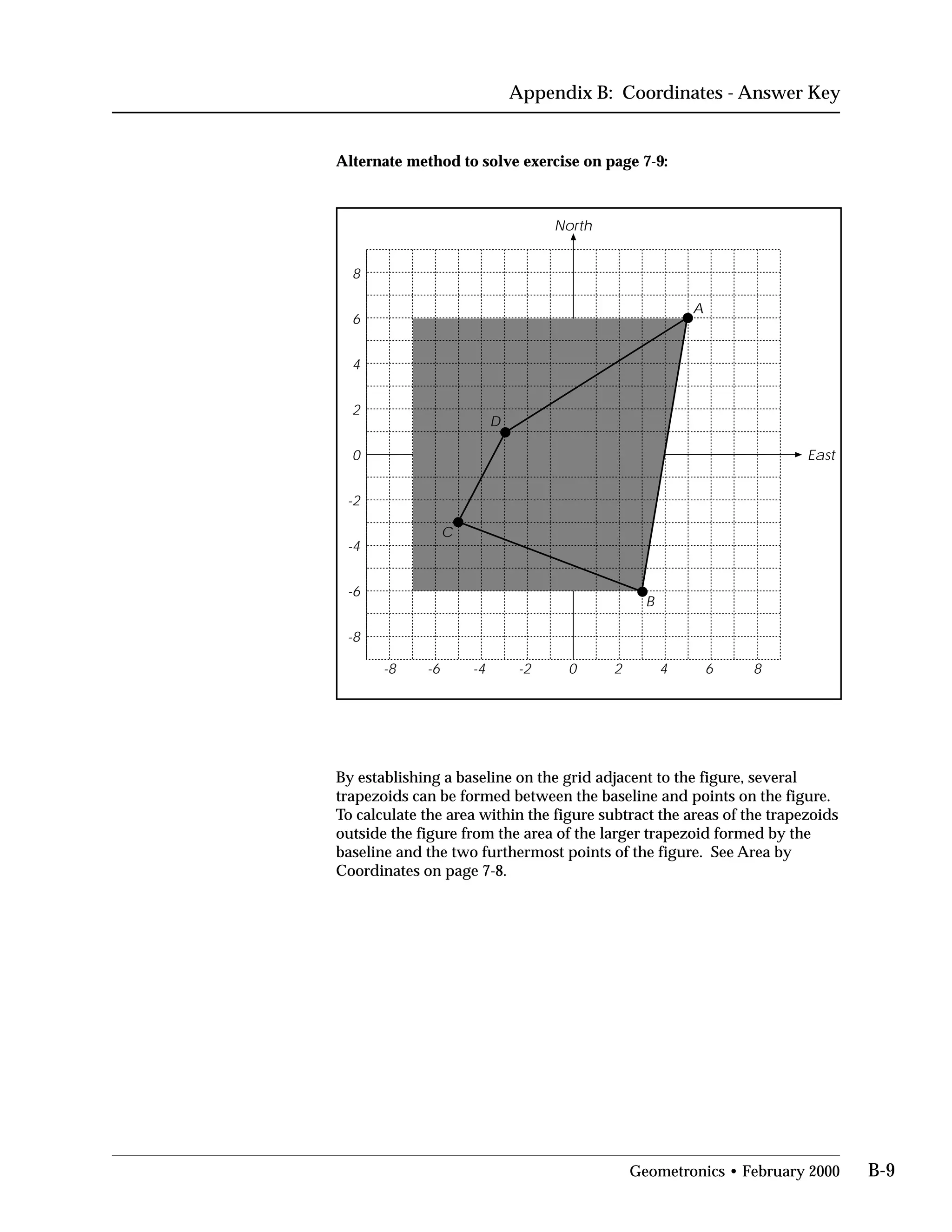
Area of a trapezoid: one-half the sum of the bases times the altitude.
Area of a triangle: one-half the product of the base and the altitude.
The area enclosed within a figure can be computed by coordinates. This
is done by forming trapezoids and determining their areas.
Trapezoids are formed by the abscissas of the corners. Ordinates at the
corners provide the altitudes of the trapezoids. A sketch of the figure
will aid in the computations.
This is similar to the double meridian distance method but does not use
meridian distances. For land area calculations following a boundary
traverse, the DMD method for area is more commonly used. The DMD
method will not be discussed here.
A
B
Cb
h
Average
Altitude
Figure 37
7-8 Oregon Department of Transportation • February 2000
Chapter 7: Coordinates
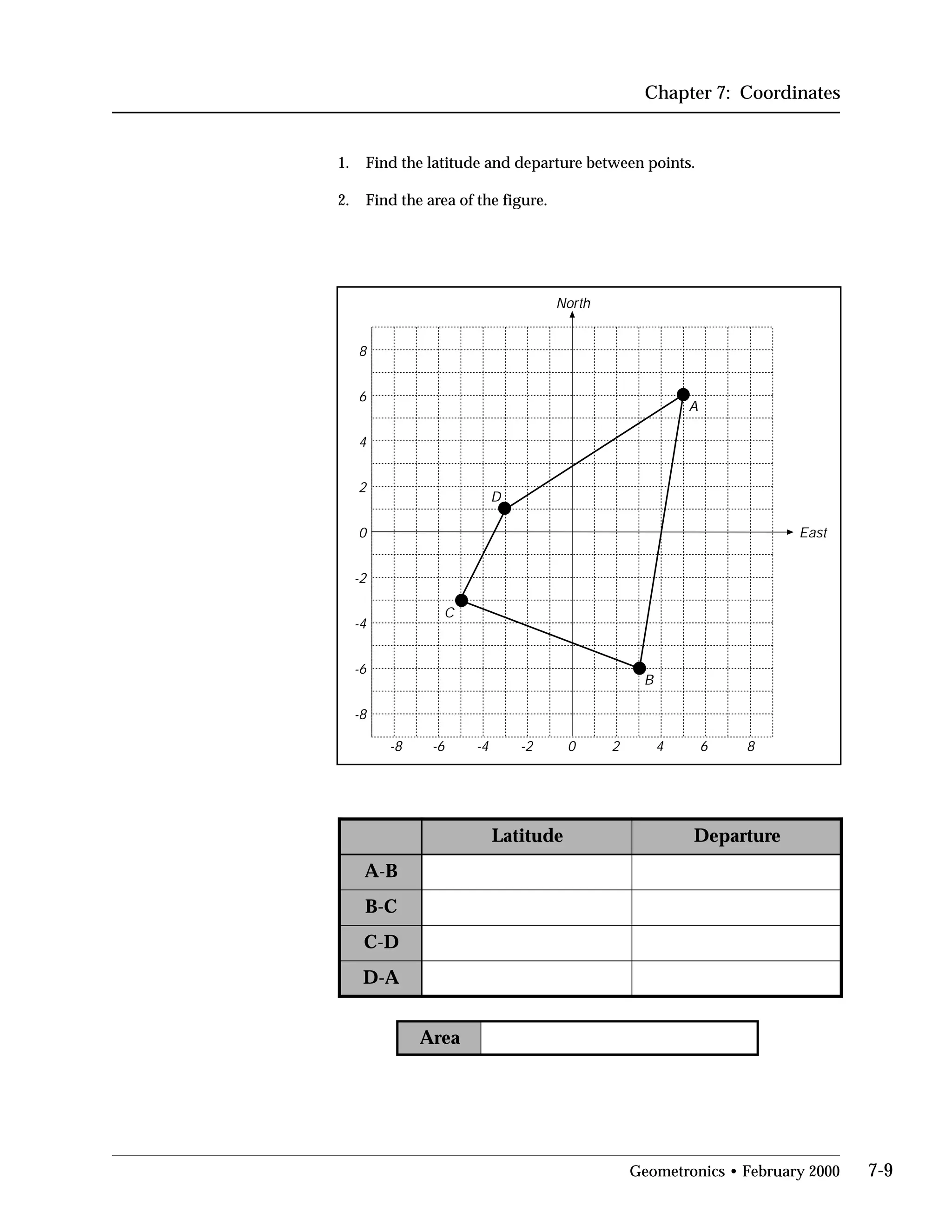
1. Find the latitude and departure between points.
2. Find the area of the figure.
8
6
4
2
0
-2
-4
-6
-8
-8 -6 -4 -2 0 8
East
North
642
A
D
C
B
edutitaL erutrapeD
B-A
C-B
D-C
A-D
Area
Geometronics • February 2000 7-9
Basic Surveying - Theory and Practice
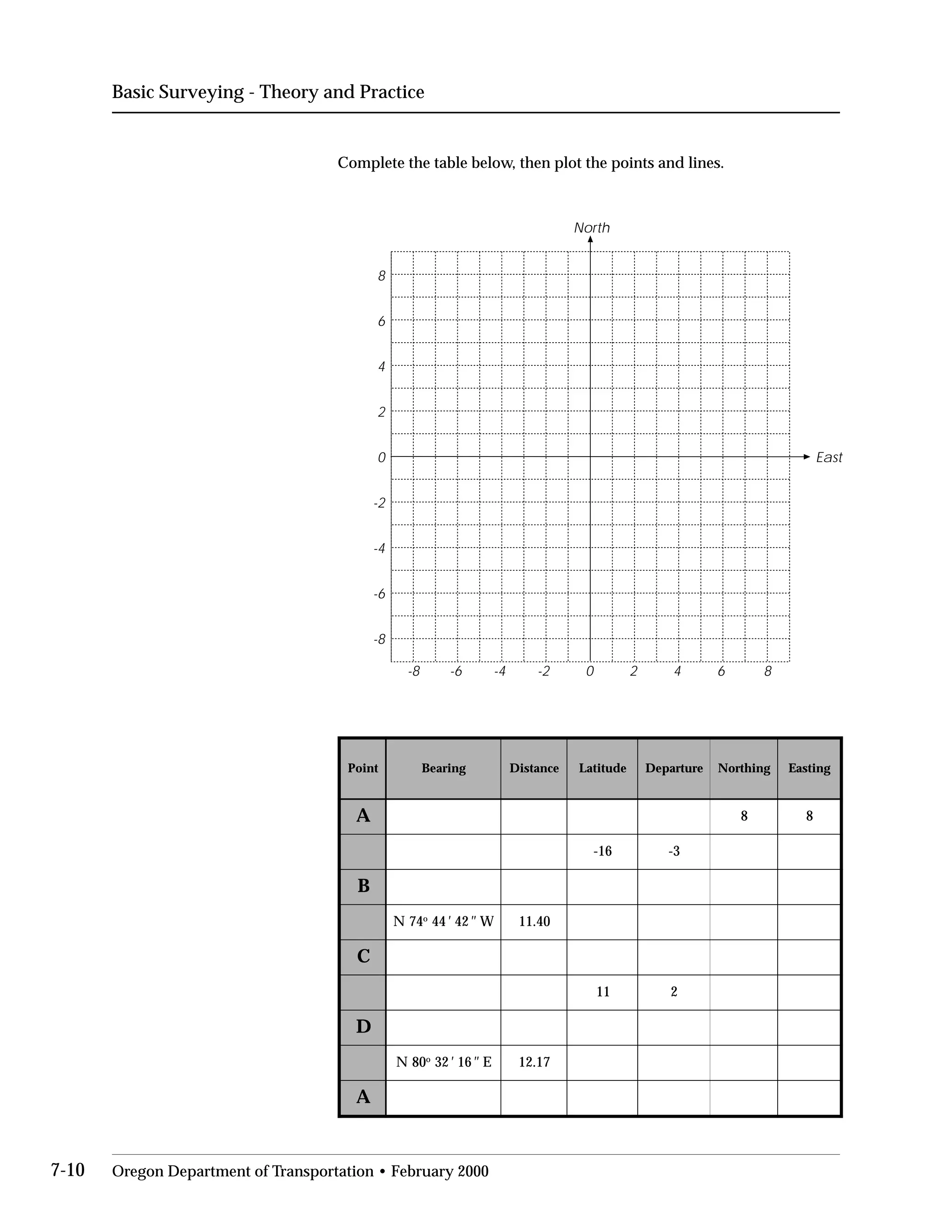
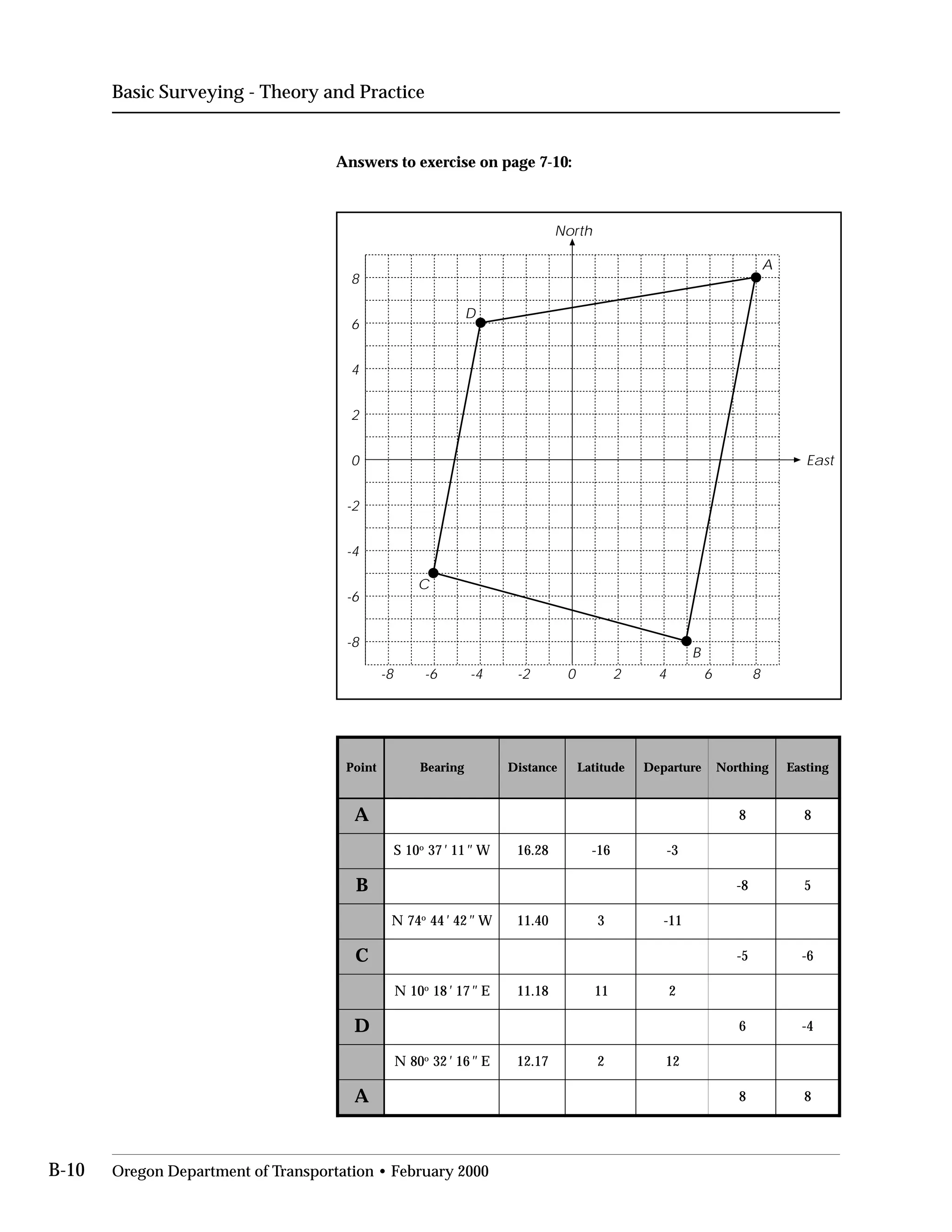
Complete the table below, then plot the points and lines.
North
8
6
4
2
0
-2
-4
-6
East
-8
-8 -6 -4 -2 0 2 4 6 8
tnioP gniraeB ecnatsiD edutitaL erutrapeD gnihtroN gnitsaE
A 8
61- -
B
47N o
44 ' 24 " W 4.11
C
11
D
08N o
23 ' 61 " E 1.21
A
8
3
0
2
7
7-10 Oregon Department of Transportation • February 2000
Traverse
Definition of a traverse
8
A Traverse is a succession of straight lines along or through the area to be
surveyed. The directions and lengths of these lines are determined by
measurements taken in the field.
Purpose of a traverse
A traverse is currently the most common of several possible methods for
establishing a series or network of monuments with known positions on
the ground. Such monuments are referred to as horizontal control points
and collectively, they comprise the horizontal control for the project.
In the past, triangulation networks have served as horizontal control for
larger areas, sometimes covering several states. They have been replaced
recently in many places by GPS networks. (GPS will be discussed in
more detail later.) GPS and other methods capitalizing on new technol­
ogy may eventually replace traversing as a primary means of establish­
ing horizontal control. Meanwhile, most surveys covering relatively
small areas will continue to rely on traverses.
Whatever method is employed to establish horizontal control, the result
is to assign rectangular coordinates to each control point within the
survey. This allows each point to be related to every other point with
respect to distance and direction, as well as to permit areas to be calcu­
lated when needed.
Geometronics • February 2000 8-1
Basic Surveying - Theory and Practice
Types of traverses
There are several types or designs of traverses that can be utilized on any
given survey. The terms open and closed are used to describe certain
characteristics of a traverse. If not specified, they are assumed to refer to
the mathematical rather than geometrical properties of the traverse.
A Geometrically Closed Traverse creates a closed geometrical shape, such as
the first two examples in Figure 38. The traverse ends on one of two
points, either the on same point from which it began or on the initial
backsight. The first two traverses in Figure 38 are geometrically closed.
1
2
1
2
1
2
3
4
100
101 102
100 101
102
103104
105
103
104
104
100
101
102
103
Traverse Point
Known position
Figure 38
A Geometrically Open Traverse does not create a closed shape because it
ends at some point other than the initially occupied point or the initial
backsight. This type of traverse is sometimes expedient for the survey of
a strip project such as a pipeline or highway. The third example in
Figure 38 is a geometrically open traverse.
A Mathematically Open Traverse or simply an Open Traverse begins at a
point of known position and ends at a point of previously unknown
position. There is no method to verify that the measurements of the
angles and distances are free from error. Consequently, this is not a
desirable survey method.
A Mathematically Closed Traverse or simply a Closed Traverse begins at a
point of known position and ends at a point of known position. Calcula­
tions can be made to check for errors. This method is preferred because
the numbers can be confirmed. Figure 38 shows three different types of
closed traverses.
8-2 Oregon Department of Transportation • February 2000
Chapter 8: Traverse
One form of a closed traverse is a “closed loop traverse” which begins at a
point of known position and ends at that same point. The first example
in Figure 38 is a closed loop traverse. While the angles in this form of
traverse can be checked for errors, no systematic error in the measuring
device can be detected. Only blunders can be found.
To point this out lets consider an example of a closed loop traverse done
with a transit and chain. The first time the traverse is run early in the
morning on a cold day. No correction is used for the chain. The traverse
is adjusted and meets the standards. Now the traverse is run again on a
hot summer afternoon. No correction is used for the chain. Again the
traverse is adjusted and meets the standards. Now when the coordinates
of the first points are compared to the coordinates of the second points,
we find that some of them are not close to one another . This is particu­
larly true of those that are the farthest from the beginning of the traverse.
The problem was that the chain was not the same length due to tempera­
ture changes, and this type of traverse will not show this type of error.
In a closed loop traverse, or on any geometrically closed traverse, there is
also no check on the “basis of bearing.”
This is an acceptable traverse method but care should be taken that the
distance measuring equipment is properly calibrated and that the basis
of bearing is correct.
Geometronics • February 2000 8-3
Basic Surveying - Theory and Practice
Procedure for running a traverse
To begin any traverse, a known point must be occupied. (To occupy a
point means to set up and level the transit or theodolite, directly over a
monument on the ground representing that point.) Next, a direction
must be established. This can be done by sighting with the instrument a
second known point, or any definite object, which is in a known direc­
tion from the occupied point. The object that the instrument is pointed
to in order to establish a direction is known as a backsight. Possible
examples would be another monument on the ground, a radio tower or
water tank on a distant hill, or anything with a known direction from the
occupied point. A celestial body such as Polaris or the sun could also be
used to establish an initial direction.
Once the instrument is occupying a known point, for example point
number 2, and the telescope has been pointed toward the backsight,
perhaps toward point number 1, then an angle and a distance is mea­
sured to the first unknown point. An unknown point being measured to
is called a foresight. With this data, the position of this point (lets call it
point number 100) can be determined. In Figure 38, there are graphical
representations of three sample traverses, each beginning with the
process described here.
The next step is to move the instrument ahead to the former foresight
and duplicate the entire process. The former occupied point becomes the
backsight and a new unknown point becomes the foresight. This proce­
dure is repeated at each point until measurements have been taken to all
the needed points.
8-4 Oregon Department of Transportation • February 2000
Chapter 8: Traverse
Calculating coordinates for traverse
To calculate the coordinates for each point on a traverse, the direction
and distance from a known point must be also be known. Typically, the
distance is measured in the field, but the direction is not. It must be
computed from the angles measured in the field. The specific procedure
will vary depending on the type of field angles measured and whether
bearings or azimuths are used to describe directions. Refer to the section
of this manual on “Bearings and Azimuths” for more detail. It is also
helpful to draw a sketch of each angle to help visualize what is happen­
ing.
Once the distance and direction are known, the latitude and departure
can be calculated using right triangle trigonometry as discussed in the
previous section on “Coordinates.” These values will indicate the
distances north or south and east or west between the two points. The
coordinates on the unknown point can then be determined by algebra­
ically adding the latitude to the northing of the known point and the
departure to the easting of the known point. A positive, or north,
latitude is added to the northing while a negative, or south, latitude (or
the absolute value of the latitude) is subtracted from the northing. A
positive, or east, departure is added to the easting while a negative, or
west, departure (or the absolute value of the departure) is subtracted
from the easting.
These calculations are repeated for each point along the traverse. The
coordinates of the last point are used as a base for each new point. The
new latitude and departure are added to this base. The last point of a
(mathematically) closed traverse is designated as the closing point. If
the traverse is a (mathematically) closed traverse, the calculated coordi­
nates for the closing point should be equal to or nearly equal to the
record or previously known coordinate values for that point.
Geometronics • February 2000 8-5
Basic Surveying - Theory and Practice
Precision of the traverse
The odds having exact closure using the raw angles and distances from a
traverse are astronomical. There will usually be some discrepancy
between the record coordinates and those calculated in the traverse. By
inversing between the two sets of coordinates, the linear distance be-
tween them can be computed. This value is called the linear closure for
the traverse and gives us an idea of how much error there was in the field
measurements. A small error is most likely due to the limitations on how
precisely the angles and distances can be measured with the specific
equipment. A large error would indicate that there is a blunder in the
measurements.
The linear closure suggests how well the measuring was done. But while
a half foot might seem like a small error when measuring ten miles, it
would seem a rather large error when cutting an eight-foot board. To
better determine whether the error in a particular traverse is acceptable
or not, we compare it to the distance traversed. This comparison is
frequently called precision, and gives us a much better way to evaluate
the error.
The Precision of a traverse is expressed as the ratio of the “linear error of
closure” to the “traverse perimeter”, and is called the “closure ratio.” A
traverse that is 12,000 feet in length and does not close by 1 foot, is said to
have “1 in 12,000 closure.” If that same traverse does not close by 0.10
feet, then it has 1 in 120,000 closure.
8-6 Oregon Department of Transportation • February 2000
Chapter 8: Traverse
Balancing a traverse
Balancing the traverse is a procedure that distributes and apportions field
measurement errors. Adjustments are made to give the traverse an exact
closure. In a closed-loop traverse the Northings and the Southings must
be equal to each other and the Eastings must be equal to the Westings.
There are several methods for balancing coordinates.
The Transit Rule is used when angular measurement is much better than
distance measurement. This procedure was developed for chain and
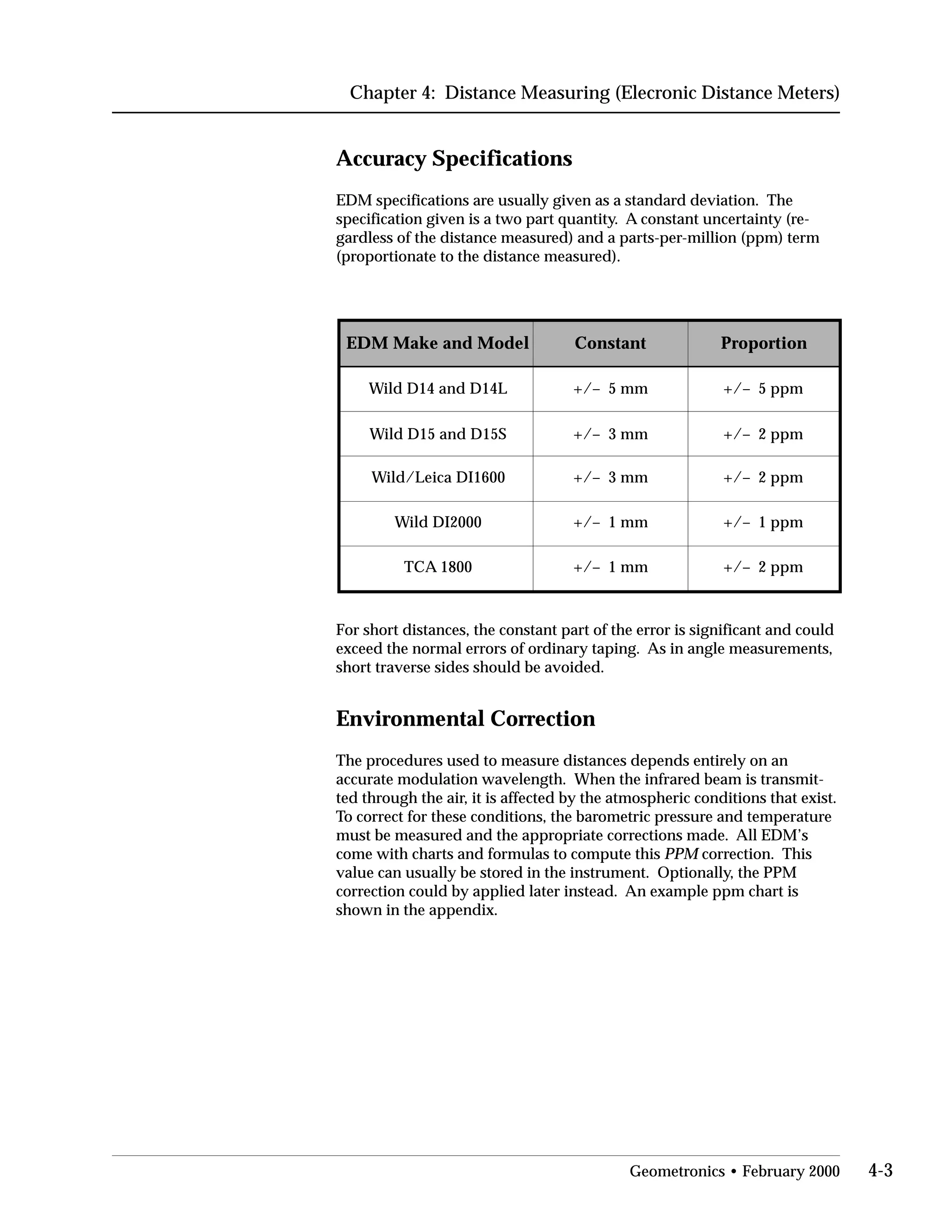
transit surveys where angles could be measured rather precisely. The
distances, on the other hand, were subject to all of the possible errors of
break and slope chaining over rough terrain. It distributes the traverse
error in latitude proportionally to the latitude of the individual legs.
Traverse legs with the largest change in latitude absorb the most error in
latitude. The traverse error in departure is distributed in proportion to
the departure of the individual legs.
The Crandall Method is also used when angular measurement is much
better than distance measurement. It also distributes the error in a
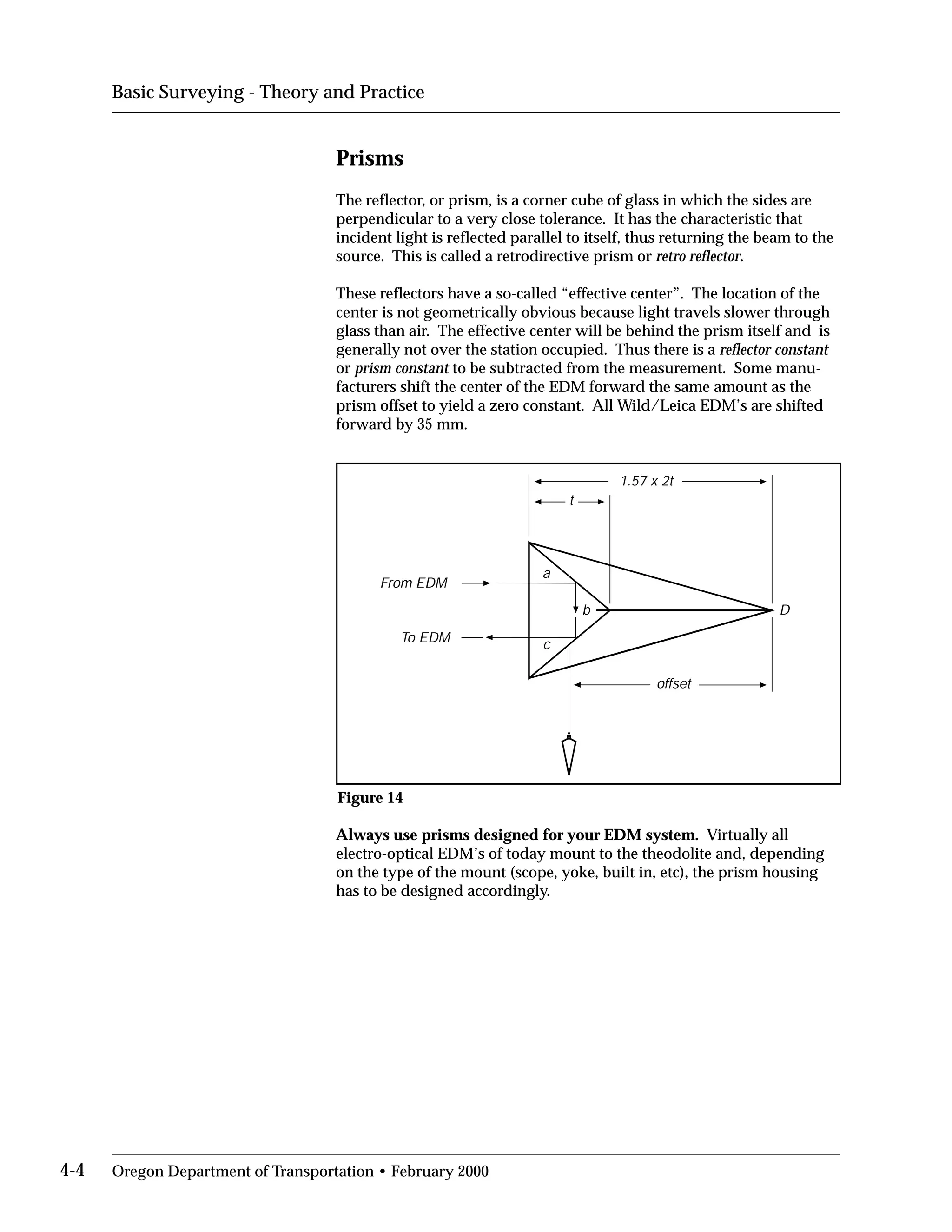
comparable way.
The Compass Rule is used when the accuracy of angular measurement is
about equal to the accuracy of distance measurement. This procedure
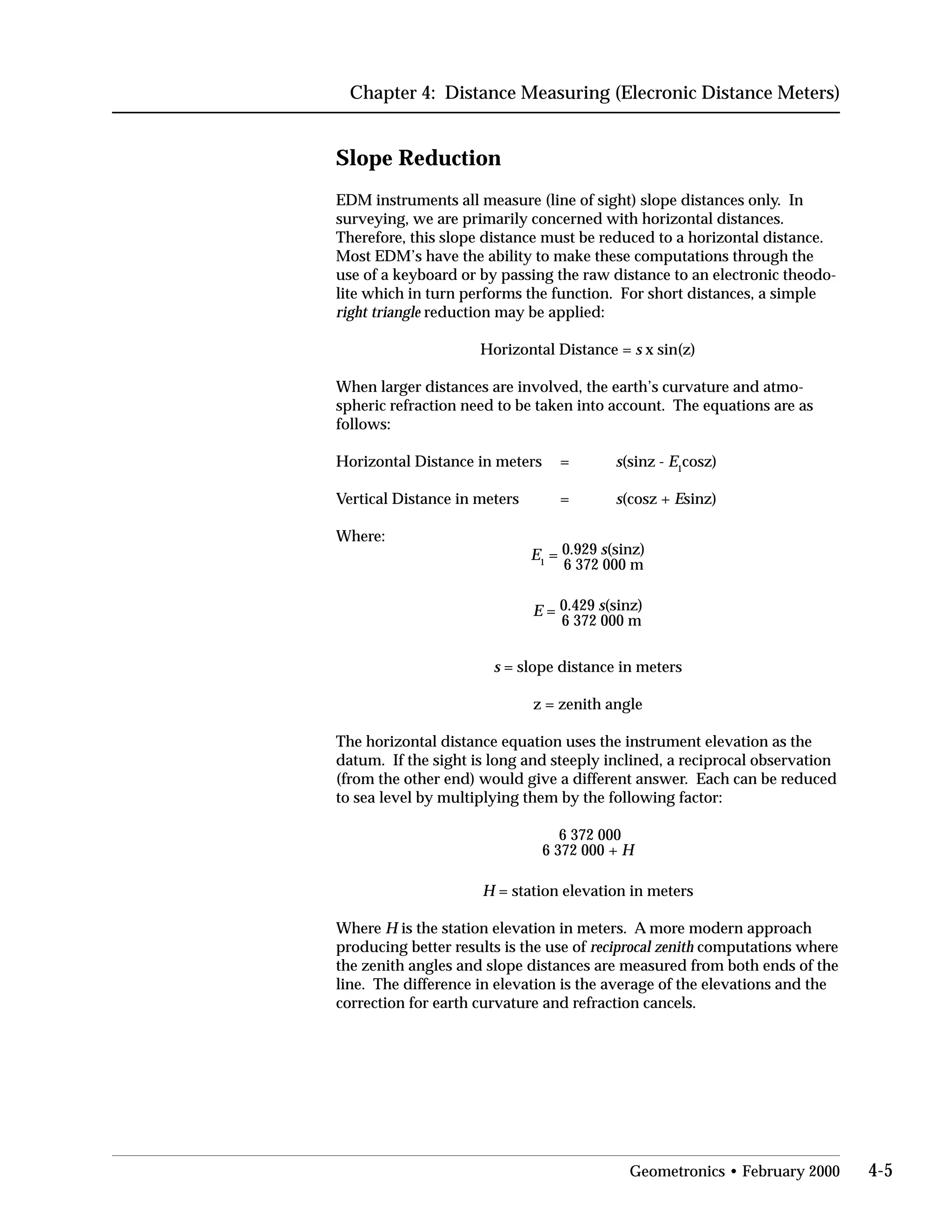
was developed during the days of surveying with a chain and staff
compass. It is a two-step process. First, the angular error is meted out to
provide angular closure. Secondly, the coordinates are developed using
the adjusted angles and then the coordinates are adjusted. It distributes
the traverse error in proportion to the length of the individual legs.
Although this method was designed for some early, low precision
equipment, this method works well for an EDM-theodolite traverse. The
assumption that the precision of angles and distances is comparable
generally holds true.
The Least Squares Method works well whatever the relative accuracy of
angular or distance measurements. Weighted values can be given for
each measurement. This causes more reliable measurements to be given
more influence in the adjustment. This procedure also does not require a
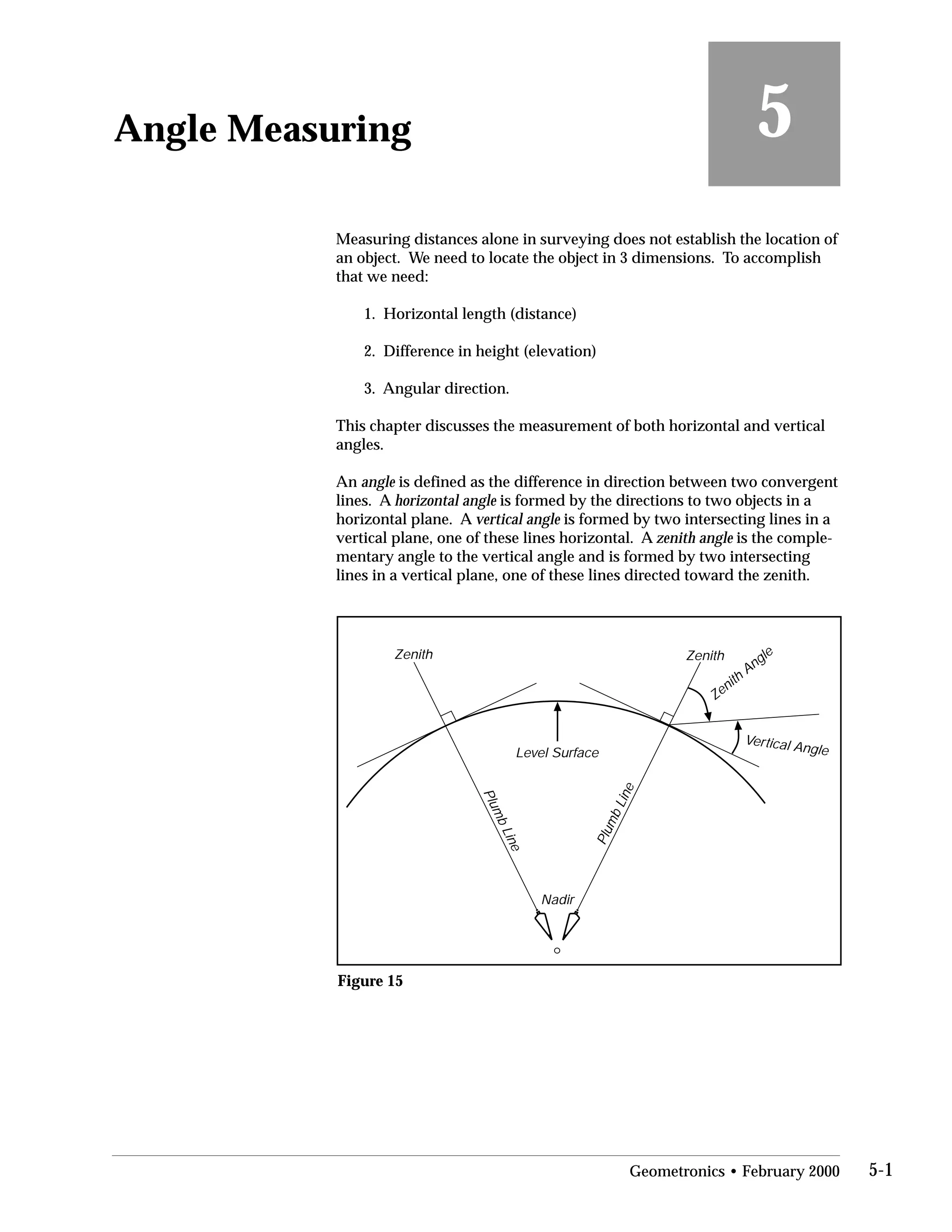
single line traverse. The Least Squares Method can be applied to com­
plex networks and traverses with measurements between multiple
points. This allows more flexibility in establishing control and greater
opportunities for locating blunders. Error distribution is similar to the
compass rule. The calculations are much more complex and demand a
computer. The Federal Geodetic Control Committee cites this method in
their standards.
Geometronics • February 2000 8-7
Basic Surveying - Theory and Practice
Balancing a traverse by Compass Rule
Balancing by the Compass Rule is a two-step process. First, the angular
error is meted out to provide angular closure. This is done by computing
a direction on the closing course of the traverse and comparing it to the
record direction. Any difference between the two is divided by the
number of angles measured and each angle modified by that amount.
Care needs to be taken, particularly if types of angles measured were not
consistent, that each angle is modified in the right direction. The final
course should now agree and the direction of each coarse should have
changed by a prorated amount.
If certain conditions are met, the angular error can be determined using
the formula shown in Figure 39. The traverse must be geometrically
closed as shown at the top of Figure 39. In addition, all angles must be
measured in the same direction, either as internal angles or as external
angles. This method will still work on the traverse in the bottom of
Figure 39. However, care should be taken that only the required angle is
counted at the initial point of the traverse, regardless of how many
angles were actually measured.
Closed - Loop Traverse
Exterior
Angles
Exterior
AnglesInterior
Angles
Sum Interior Angles = 180o
(n-2)
Sum Exterior Angles = 360o
+ 180n
n = # of angle points = # of sides
Closed - Loop Traverse
Exterior
Angles Interior
Angles
Exterior
Angles
Exterior
Angles
Sum Interior Angles = 180o
(n-2)
Sum Exterior Angles = 360o
+ 180n
n = # of angle points = # of sides
Figure 39
8-8 Oregon Department of Transportation • February 2000
Chapter 8: Traverse
Calculate and balance the traverse azimuths below using the
compass rule.
Point
I.D.
Measured
Angle
Measured
Azimuth
Azimuth
Adjustment
Adjusted
Azimuth
1415.50
1645.55
227o
01´ 24˝
252o
48´ 15˝
115o
19´ 54˝
N 89o
26´ 03˝ W 180o
18´ 36˝ 304o
32´ 06˝
2732.11
“B”
“C”
“D”“A”
1035.92
“X”
Geometronics • February 2000 8-9
Basic Surveying - Theory and Practice
Next, the coordinates for each point are developed and recorded using
the adjusted angles. Then the errors in latitude and departure are distrib­
uted in proportion to the lengths of the traverse legs. The longest leg of
the traverse will receive the most adjustment in both latitude and
departure. The shortest leg will receive the least.
The latitude adjustment for any one leg is:
(Latitude Adjustment) =
(Total Latitude Adjustment)
(Length Of The Leg)(Traverse Perimeter)
Similarly, the departure adjustment for any one leg is:
(Departure Adjustment) =
(Total Departure Adjustment)
(Length Of The Leg)(Traverse Perimeter)
The adjustments for both latitude and departure are computed and
recorded for each course. The final adjusted latitudes and departures are
determined by algebraically adding the corrections to the latitudes and
departures that were calculated from the adjusted angles.
To complete the process, the final adjusted coordinates are calculated by
algebraically adding the latitude and departure for each point to the
coordinates of the prior point. The closing point should have the same
coordinates as record.
8-10 Oregon Department of Transportation • February 2000
Chapter 8: Traverse
Calculate and balance the traverse coordinates using the compass rule.
Point
I.D.
Adjusted
Azimuth
Horizontal
Distance
Latitude Departure Latitude Departure Northing Easting
Adjustment Coordinates
Geometronics • February 2000 8-11
Basic Surveying - Theory and Practice
8-12 Oregon Department of Transportation • February 2000
The Global Positioning System
 9
The Global Positioning System (GPS) is a navigational or positioning
system developed by the United States Department of Defense. It was
designed as a fast positioning system for 24 hour a day, three
dimensional coverage worldwide.
It is based on a constellation of 21 active and 3 spare satellites orbiting
10,900 miles above the earth. The GPS (NAVSTAR) satellites have an
orbital period of 12 hours and are not in geosynchronous orbit (they are
not stationary over a point on the earth). They maintain a very precise
orbit and their position is known at any given moment in time. This
constellation could allow a GPS user access to up to a maximum of 8
satellites anywhere in the world.
GPS provides Point Position (Latitude/Longitude) and Relative Position
(Vector). GPS can differentiate between every square meter on the
earth’s surface thus allowing a new international standard for defining
locations and directions.
The applications (military or civilian) for GPS are almost limitless, from
guiding a missile to a target with incredible accuracy or tracking and
monitoring the location of a city’s emergency vehicles or providing a
zero visibility landing and air collision avoidance system to a variety of
surveying applications.
The Basic Principles of GPS
For centuries man has used the stars to determine his position. The
extreme distance from the stars made them look the same from different
Earth’s Surface
Known Position
Known Position
Known Position
MeasuredDistance
MeasuredDistance
Computed Position
Measured Distance
Figure 40
Geometronics • February 2000 9-1
Basic Surveying - Theory and Practice
locations and even with the most sophisticated instruments could not
produce a position closer then a mile or two. The GPS system is a
constellation of Manmade Stars at an orbit high enough to allow a field of
view of several satellites, yet low enough to detect a change in the
geometry even if you moved a few feet.
A typical conventional survey establishes positions of unknown points
by occupying a known point and measuring to the unknown points.
GPS is somewhat the opposite. We occupy the unknown point and
measure to known points. In conventional surveying this is similar to
the process of doing a resection, the slight difference is that the targets
are 10,900 miles away and travelling at extremely high speeds!
How positions are computed
Think of the satellites as precise reference points for our survey and we
are using satellite ranging to trilaterate our position (trilateration is the
process of determining positions by measuring the lengths of triangles,
while triangulation is the process of determining the positions by
measuring the angles of triangles). If we know the distance from one
satellite our position could be anywhere on the surface of an imaginary
sphere with the satellite at the center of that sphere. This obviously does
not give us our position. If we knew the distance to a second satellite our
position could be anywhere on the circle formed by the intersection of
the two imaginary spheres with the satellites at their centers. This still
does not give us a single position. If we include the distance to a third
satellite into our scenario, we find that by intersecting three spheres, two
solutions exist. Usually one of these solutions yields a position nowhere
near the earth and can be discarded. If you know the elevation of your
position, you can eliminate the need for one satellite. One of the spheres
in the computation would be the earth with a radius of the earth plus
your elevation.
How satellite distance is measured
Each GPS satellite continually broadcasts a radio signal. Radio waves
travel at the speed of light (186,000 miles per second) and if we measure
how long it took for the signal to reach us we could compute the distance
by multiplying the time in seconds by 186,000 miles per second.
In order to measure the travel time of the radio signal, the satellite
broadcasts a very complicated digital code. The receiver on the ground
generates the same code at the exact time and when the signal is received
from the satellite, the receiver compares the two and measures the phase
shift to determine the time difference.
9-2 Oregon Department of Transportation • February 2000
Chapter 9: Global Positioning System
Code Generated
by the satellite
Code Generated
by the receiver
Phase Shift
(Time Difference)
receiver
Figure 41
If the satellites are orbiting about 10,900 miles above the surface of the
earth and the radio signal travels at 186,000 miles per second, a satellite
directly above takes about 0.06 seconds to transmit its signal to earth. To
be able to measure the distance to the accuracy needed, the satellite and
the receiver must be perfectly in sync and we must have the ability to
measure time with extreme accuracy. Each satellite is equipped with 4
atomic clocks which keep almost perfect time and the receivers that we
use can measure time to an accuracy of 0.000000001 of a second. The
problem is that the receivers are not in sync with the atomic clocks. If the
receiver is out of sync with the satellite by even 0.001 of a second, the
computed distance would be off by 186 miles!
To solve this problem we include the measurement to an extra satellite.
The added sphere to the equation would intersect at the same point as
before if the receiver were in perfect sync with the satellite. If the added
sphere does not intersect at the same point, then the clocks are not in
perfect sync and a clock offset for the receiver can be calculated. For
accurate 3D positions, 4 satellites must be in view of the receiver.
The Ephemeris
Once we know the distance to the satellite, we need to know exactly
where the satellite was at the moment of the measurement. Receivers
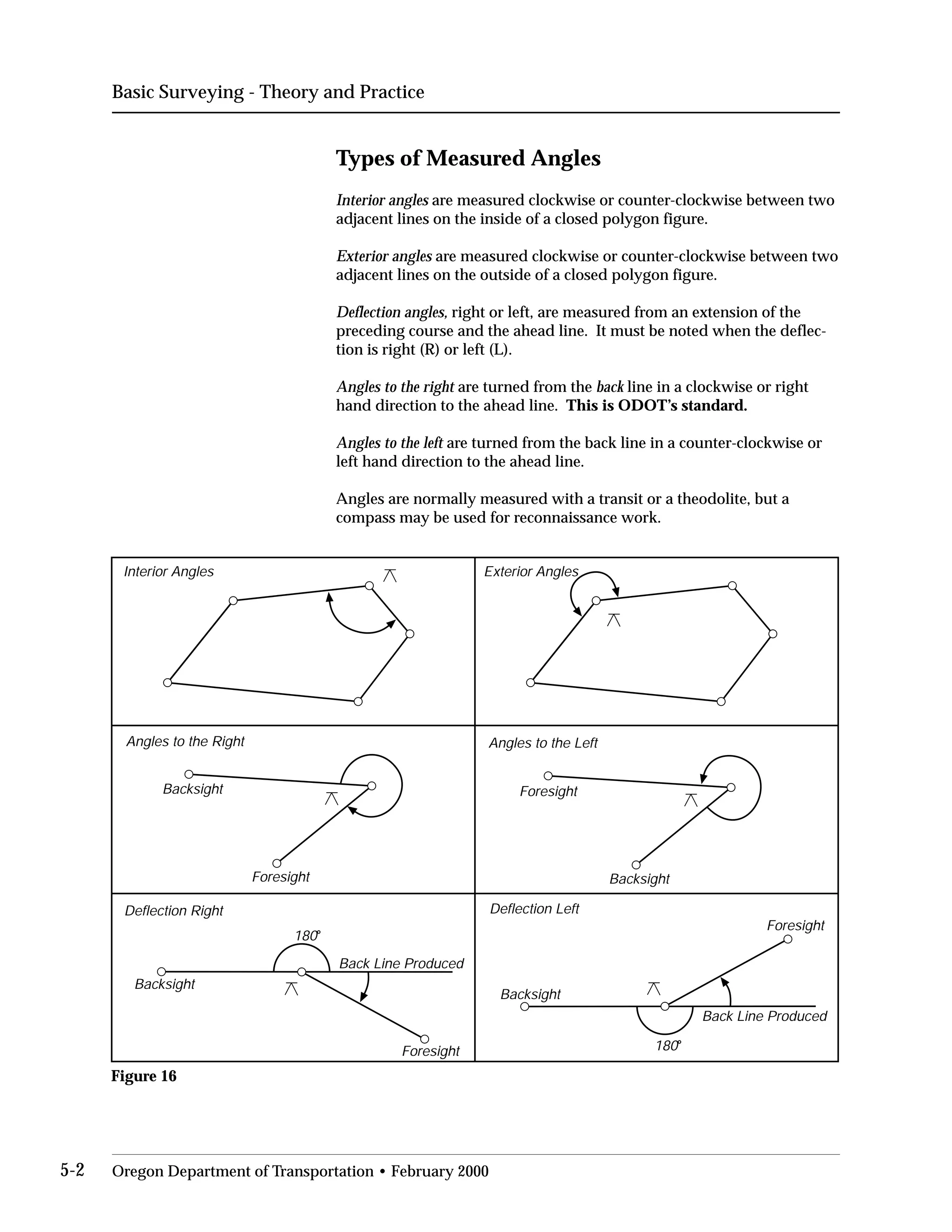
have an almanac stored in their memory which gives each satellite’s
position in the sky at any given time. Contradicting what was
mentioned earlier, the satellite’s orbit does decay changing its position,
altitude and speed. This change is extremely minuscule and is
monitored by the Department of Defense every 12 hours and these
variations (ephemeris errors) are transmitted back to the satellite. The
satellite transmits a data message along with its pseudo-random code.
The data message contains information about its exact orbital location
(with the ephemeris error corrections) and its system’s health.
Geometronics • February 2000 9-3
Basic Surveying - Theory and Practice
Sources of error and expected GPS accuracy
GPS positions are affected by various errors such as the clock and satellite
position errors mentioned earlier. Other errors include: ionospheric and
atmospheric errors which are caused by the slowing down the radio
waves as they travel through the ionosphere and lower atmosphere;
multipath errors which are caused by the radio waves bouncing off
objects before reaching the receiver; and poor geometry in the satellite
positions. In addition to all these errors there is a deliberately caused
error called Selective Availability (SA) which is the degrading of the radio
signal by the Department of Defense. This manmade error can be turned
on as needed to deny hostile forces the advantage of GPS positioning.
The ultimate accuracy of GPS positions are determined by the sum of all
these errors. It is difficult to quantify this specification as receiver
manufacturers are constantly finding new ways to improve accuracy.
There are a variety of receivers on the market yielding a variety of levels
of accuracy. Receivers typically fall into 3 categories; Survey, mapping,
and navigation grades. Currently, survey grade receivers can achieve
accuracies in the millimeter range, mapping grade receivers through the
use of post-processing or real time correction using a base station can
achieve 1 to 3 meter accuracy, and navigational receivers can achieve 5 to
12 meter accuracy (with SA off).
Differential GPS
To achieve sub-centimeter accuracies in positions, we need a survey
grade receiver and a technique called Differential GPS. By placing a
receiver at a known location, a total error factor which accounts for all
the possible errors in the system, can be computed which can be applied
to the position data of the other receivers in the same locale. The
satellites are so high-up that any errors measured by one receiver could
be considered to be exactly the same for all others in the immediate area.
Known Position
Unknown Position
Figure 42
9-4 Oregon Department of Transportation • February 2000
Differential Leveling
 10
Differential leveling is the process used to determine a difference in
elevation between two points. A Level is an instrument with a telescope
that can be leveled with a spirit bubble. The optical line of sight forms a
horizontal plane, which is at the same elevation as the telescope
crosshair. By reading a graduated rod held vertically on a point of
known elevation (Bench Mark) a difference in elevation can be measured
and a height of instrument (H.I.) calculated by adding the rod reading to
the elevation of the bench mark. Once the height of instrument is
established, rod readings can be taken on subsequent points and their
elevations calculated by simply subtracting the readings from the height
of instrument.
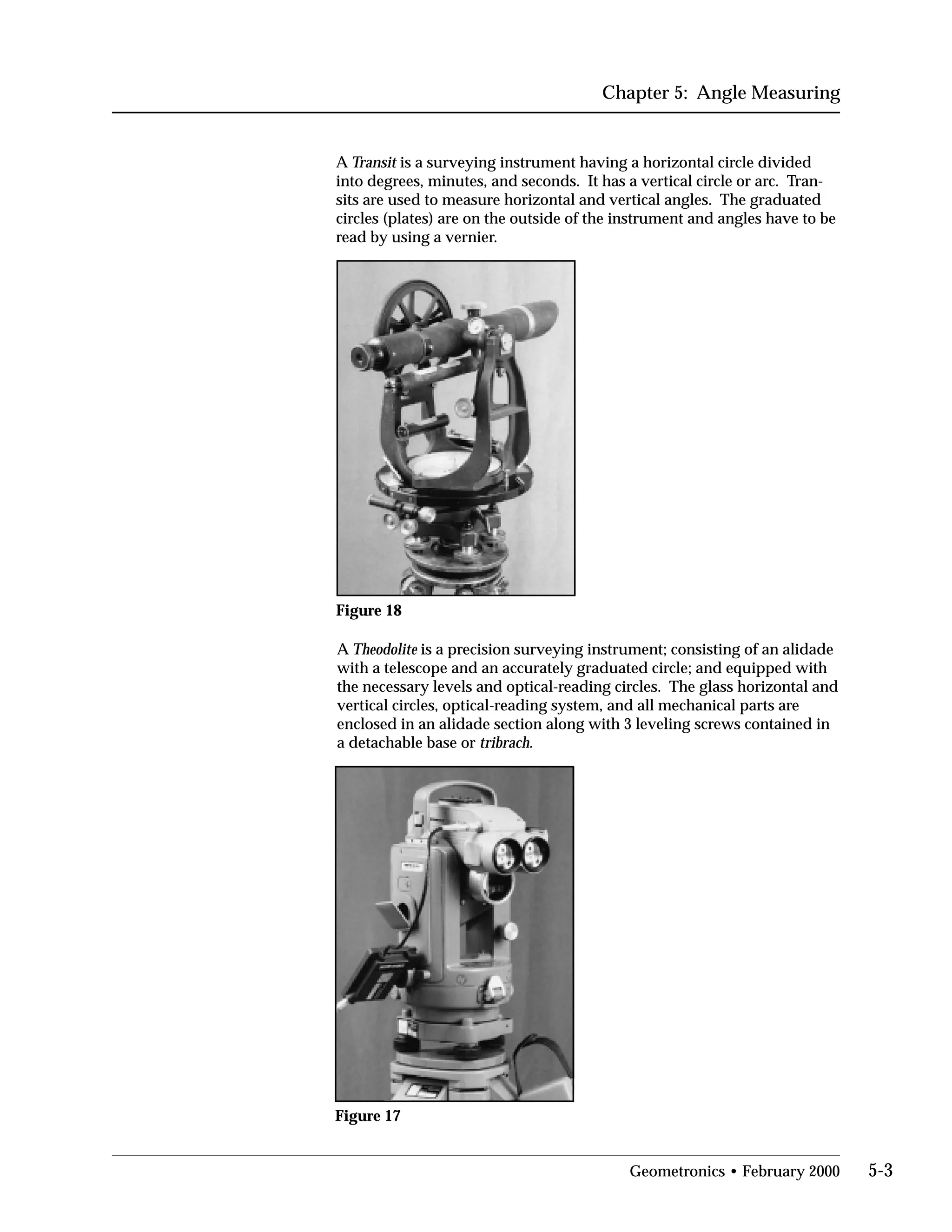
Horizontal Line of Sight
Mean Sea Level (Datum)
Rod Reading 1.23
1.23
762.34
Rod Reading 8.46
8.46
755.11
Turning Point
Figure 43
Geometronics • February 2000 10-1
Basic Surveying - Theory and Practice
Running a line of levels
In the following example, the elevation at BM-A is known, and we need to
know the elevation of BM-K. The level is set up at a point near BM-A, and a
rod reading taken. The height of instrument (HI) is calculated and a rod
reading to a turning point (TP1) is taken. The reading of the foresight is
subtracted from the height of instrument to obtain the elevation at TP1. The
rod stays at TP1, the level moves ahead and the rod at TP1 now becomes the
backsight. This procedure is repeated until the final foresight to BM-K.
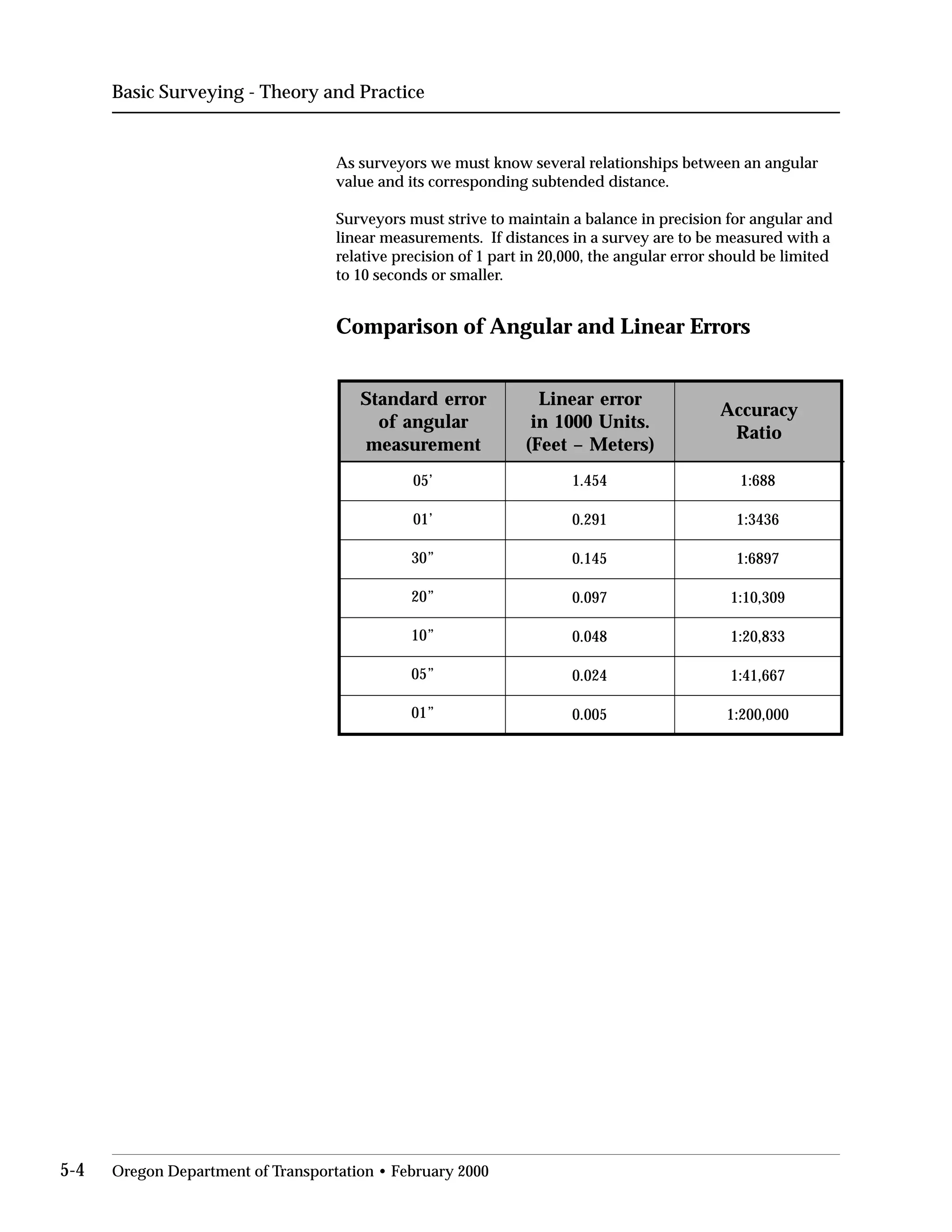
Elev.
820.00 ft.
BM A
Elev.
831.13 ft.
BM K
Elev.
832.68 ft.
Elev.
837.43 ft.
Elev.
827.22 ft.
1.20 ft.
1.35 ft.
11.56ft.
6.15ft.
H.I.=838.78ft.
H.I.=843.58ft.
H.I.=837.07ft.
H.I.=828.42ft.
8.42ft.
Datum - Elevation 0.00 ft.
4.39ft.
10.90ft.
5.94ft.
Figure 44
Sta BS (+) H.I. FS (-) Elev Description
BM A 8.42 820.00 BM A: Top of Iron Pipe, 3" diameter
828.42 at corner of Wishburn and Oak Dr.
TP 1 11.56 1.20 827.22
838.78
TP 2 6.15 1.35 837.43
843.58
TP 3 4.39 10.90 832.68
837.07
BM K 5.94 831.13 BM K: Top of iron pipe, 2" diameter
Corner of Wishburn and Oxford.
BS Sum = 30.52 FS Sum = 19.39 CHECK: =Begin Elevation 820.00
BS/FS Difference = 11.13
Difference = 30.52 - 19.39 = 11.13 Ending Elevation = 831.13
10-2 Oregon Department of Transportation • February 2000
Chapter 10: Differential Leveling
Closing the Level Loop
A level loop is closed either to another Benchmark or back to the starting
Benchmark. To check for errors in the loop sum the Backsights (BS) and
the Foresights (FS). Calculate the difference between the BS and FS (BS­
FS). Algebraically add this difference to the starting elevation, to yield
the closing elevation. This elevation should be within accepted industry
standards tolerances of the closing Benchmark’s published elevation.
Instrumental Errors
The most common instrumental error is caused by the level being out of
adjustment. As has been previously stated, the line of sight of the
telescope is horizontal when the bubble is in the center of the tube,
provided the instrument is in perfect adjustment. When it is not in
adjustment, the line of sight will either slope upward or downward
when the bubble is brought to the center of the tube.
Instrumental errors can be eliminated if kept at a minimum by testing
the level frequently and adjusting it when necessary. Such errors can
also be eliminated by keeping the lengths of the sights for the backsight
and foresight readings nearly equal at each setting of the level. Since it is
never known just when an instrument goes out of adjustment, this latter
method is the more certain and should always be used for careful
leveling.
Extremely long sights should also be avoided. The further the rod is
from the level, the greater the space covered on the rod by the cross hair
and the more difficult it will be to determine the reading accurately. For
accurate results, sights with the engineer’s level should be limited to
about 300 feet.
Geometronics • February 2000 10-3
Basic Surveying - Theory and Practice
Complete the following level circuit, compute misclosure.
Sta BS (+) H.I. FS (-) Elev Description
BM X 6.72 935.42 BM X: Brass Disk in walk
N.W. corner 12th and Sunset
TP 1 7.13 2.18 Elev: 935.42
TP 2 4.19 3.23
TP 3 6.72 5.11
TP 4 1.09 7.23
BM Y 2.36 BM Y: 1/2” Iron Rod
S.E. Corner 18th and Sunrise
Elev: 941.19
10-4 Oregon Department of Transportation • February 2000
Trigonometric Leveling
 11
This leveling procedure involves observing the vertical (or zenith) angle and
slope distance between two points. The difference in elevation can then be
calculated. Within the limits of ordinary practice, triangle BEC (figure 45) can
be assumed to be a right triangle and:
EC = BC x cos(zenith angle)
A major source of error in determining the difference in elevation by this method
is the uncertainty in the curvature and refraction caused by variations in the
atmospheric conditions.
Figure 45
Survey Operations • February 2000 11-1
Basic Surveying - Theory and Practice
The effects of Earth Curvature and Atmospheric Refraction must be taken into
account when using trigonometric methods to determine elevations. A line of
sight perpendicular to a plumb line lies in a horizontal plane. The earths curved
surface departs from this line by the value c (shown in Figure 45, as the distance
E-F).
For most surveys, a practical value for curvature is:
c = 0.667M2
Where M is the sight distance in Miles
and c is the earths curvature in Feet.
Due to the density of the air, the optical line of sight refracts or bends back
towards the earth, negating about 14% of the effects of curvature.
The combined effect of Curvature and Refraction is:
(c+r) = 0.574M2
There are two acceptable methods to correct for Curvature and Refraction if the
formulas are not applied:
Balance the Backsights and Foresights
Observe the zenith angles from both ends of the line (reciprocal zeniths).
The effects of Curvature and Refraction increases rapidly with distance as shown
in the table below:
Effects of Curvature and Refraction
Distance 200 ft 500 ft 1000 ft 1 mile 2 mile
(h) feet 0.001 0.005 0.021 0.574 2.296
11-2 Oregon Department of Transportation • February 2000
Chapter 11: Trigonometric Leveling
When using trigonometric methods to establish accurate elevations, the follow­
ing must be taken into consideration:
•	 Due to the effects of curvature and refraction, the instrument to
target distance must be kept relatively short. A good rule of thumb
is not to exceed 1000 feet.
•	 Make sure you understand your equipment’s capabilities. Instru­
ments that can measure zenith angles and slope distances to a high
order of accuracy will produce good trigonometric elevations.
•	 Setup and level your instrument and target carefully. Measure the
height of instrument and height of target accurately.
•	 Measure several slope distances and use a representative or mean
value. Make sure that your EDM is correcting for the appropriate
atmospheric conditions.
•	 Measure Direct and Reverse zenith angles, and use the adjusted
value for your calculations.
• For lines longer than 500 feet, correct for curvature and refraction.
Modern Total Station instruments have built in capabilities to reduce and display
trigonometric elevations.
Survey Operations • February 2000 11-3
Basic Surveying - Theory and Practice
Refer to figure 45, for the following exercise.
Given the following:
Elevation of Point A 506.78 ft
Height of Instrument 5.21 ft
Height of Target 5.46 ft
Measured Slope Distance 837.58 ft
Direct Zenith Angle 78°37’42”
Reverse Zenith Angle 281°22’28”
Correcting for curvature and refraction, calculate the elevation of point D.
11-4 Oregon Department of Transportation • February 2000
Cross Sections
 12
Cross sections are lines 90 degrees perpendicular to the alignment (P-
Line, L-Line, centerline of stream, etc.), along which the configuration of
the ground is determined by obtaining elevations of points at known
distances from the alignment.
Cross sections are used to determine the shape of the ground surface
through the alignment corridor. The shape of the ground surface helps
the designer pick his horizontal and vertical profile. Once the alignment
is picked, earthwork quantities can be calculated. The earthwork
quantities will then be used to help evaluate the alignment choice.
In addition to earthwork calculations, cross sections are used in the
design of storm sewers, culvert extensions and the size and location of
new culverts. Because of this fact it becomes more important to get the
additional sections at the points of interest that do not fall on the 50 foot
stations.
The traditional method of taking cross sections starts with an alignment
staked out in the field. A profile is run over the centerline stations by
differential leveling. Cross section lines are laid out 90 degrees to the
alignment, often with a right angle prism. Usually elevations are
determined with an engineer’s level and rod in level terrain or with a
hand level and rod in rough, irregular country. For each cross section,
the height of instrument is determined by a backsight on the centerline
station. The rod is then held on the cross section line at breaks in the
surface slope, where rod readings are observed and distances measured
with a tape. Cross sections are usually taken at even stations and points
of interest or irregularity along the alignment.
Geometronics • February 2000 12-1
Basic Surveying - Theory and Practice
An example of cross section notes:
1. Stationing runs from the bottom of the page to the top.
2. Notes are taken looking ahead on line.
3.	 Record all topographical features that you encounter: roads, fences,
ditches, curbs, striping, etc.
4.	 Leave plenty of space on the notes for the unexpected. Cross sections
can grow and you may need to add a section at a pipe crossing, ditch
crossing, road intersection, etc.
12-2 Oregon Department of Transportation • February 2000
Chapter 12: Cross Sections/DTM
Cross sections can be taken from contour maps. The example shows a
cross section picked from the contour map for station 1+50.
Figure 46
Geometronics • February 2000 12-3
Basic Surveying - Theory and Practice
Digital Terrain Models
A digital Terrain Model (DTM) is numerical representation of the
configuration of the terrain consisting of a very dense network of points
of known X,Y,Z coordinates. Modern surveying and photogrammetric
equipment enables rapid three dimensional data acquisition. A
computer processes the data into a form from which it can interpolate a
three dimensional position anywhere within the model.
Think of a DTM as an electronic lump of clay shaped into a model
representing the terrain. If an alignment was draped on the model and a
vertical cut made along the line, a side view of the cut line would yield
the alignment’s original ground profile. If vertical cuts were made at
right angles to the alignment at certain prescribed intervals, the side
views of the cuts would represent cross sections. If horizontal cuts were
made at certain elevation intervals, the cut lines when viewed from
above would represent contours.
A DTM forms the basis for modern highway location and design. It is
used extensively to extract profiles and cross sections, analyze alternate
design alignments, compute earthwork, etc.
Figure 47
Example of Digital Terrain Model:
12-4 Oregon Department of Transportation • February 2000
13Horizontal Curves
Highway Curves
Many alignments are composed of one or more straight lines, or tangent
alignments. Power lines, pipe lines, and low speed city streets are
several examples. But for railroad or higher speed vehicular traffic,
instantaneous changes in direction, either horizontally or vertically, are
at best uncomfortable for the passengers and at worst, hazardous.
To lessen the forces involved when a vehicle changes direction, a gradual
change is utilized resulting in a curve in the alignment. There are three
general types of curves; Circular (or simple) curves, Spiral (or transition)
curves, and Vertical (or parabolic) curves. This chapter will focus on the
simple circular curve.
Stationing
One of the basic tasks of a survey crew is to layout or stake centerline
and vertical alignments. One of the tools available to make this job
easier is centerline stationing. Stationing is the assignment of a value
representing the distance from some arbitrary starting point. Where the
stationing begins is not generally too important, but any point along the
alignment can be related to any other point on the same alignment by
using the stationing.
A station is a linear distance of 100 feet along some described alignment.
Without a described alignment, the station has no direction and therefore
is rather meaningless.
Stationing is usually expressed as number of stations or 100 foot units
plus the number of feet less than 100 and any decimal feet. This value is
preceded by an alphanumeric alignment designation. A point on an
alignment called B3 and 1345.29 feet from the beginning of the stationing
would be designated as “B3 13+45.29”. To perform math with stationing,
the “+” can be dropped and the distance treated as feet.
Geometronics • February 2000 13-1
Basic Surveying - Theory and Practice
Circular Curves
The simplest of the three curves is the circular or simple curve. The
circular curve is exactly what the name implies, a segment of a circle.
Circular curves are used for horizontal alignments because they can be
laid out on the ground using basic surveying tools and techniques.
To layout a circular curve, the surveyor usually uses a chain or EDM to
measure distances along the arc of the curve and a transit or theodolite
to measure the horizontal angles from a reference line to the station to be
set. Before laying out a circular curve we need to know it’s parameters.
• The radius of the curve.
• The beginning station.
•	 The distances along the arc between the instrument and the points to
be set.
Knowing these basics we can determine the deflection angles between
stations.
From basic geometry we know that:
• Circumference = πD or 2πR
Where, π = 3.1415926 and D = the Diameter of the circle, and
R = the Radius.
• We also know that there are 360 degrees in a circle.
If we say that the length along the arc is L, then we can determine the
interior angle of the circle subtended by the arc. To do that, let’s calcu­
late the fractional part of the arc to the circumference.
(Arc Length) L
(Fractional Portion) = (Circumference) = 2πR
This represents the fractional part of the total circle subtended by the arc.
We will call the subtended angle ∆.
L L x 360
o
360
∆ .o = 2πR ... ∆ = 2πR
We also know that the deflection angle α is 1/2 ∆, by combining terms
we can write the deflection angle like so,
90L
α =
360L
= πR4πR
These are the formulas we would use to calculate the curve deflections
for circular curves.
13-2 Oregon Department of Transportation • February 2000
Chapter 13: Horizontal Curves
The Degree of Curve is defined as the angle subtended by an arc whose

length is 100 ft.

A Radian is the angle subtended by an arc whose length equals the length

of the Radius, or

57° 17’ 44.8”, or 57.295779513°.

Pi = π = 3.1415926

Circumference = 2πR

Degrees in a circle = 360°

Radius of a one degree curve = 5729.5779513 ft.

D = Degree of Curve.

R = Radius of the curve.

∆ = Delta, the central angle of the curve.

α = Alpha, the deflection angle to the point to be set.

Geometronics • February 2000 13-3
Basic Surveying - Theory and Practice
2
PTPC
PI
E
C
L
T
R
M
Radius Point
Figure 48
5729.578 5729.578
R = D D = R
∆
T = R*Tan 2 C = 2R*Sin
∆
2
M = R(1-Cos
∆ 100∆ πR∆
2 ) L = D = 180°
R
E = ( Cos ∆/2 )-R
13-4 Oregon Department of Transportation • February 2000
Chapter 13: Horizontal Curves
Calculate the following horizontal curve elements:
Chord Length
Degree of Curve 4° Lt
Delta 20°
External Distance
Length of Curve
Middle Ordinate
P.C. Station
P.I. Station 125+52.00
P.T. Station
Radius
Tangent Distance
Calculate the curve layout data:
Station Deflection Long Chord
Geometronics • February 2000 13-5
Basic Surveying - Theory and Practice
Calculate a 30’ right offset curve for the same curve as that on page 13-5:
Chord Length
Degree of Curve
Delta
Length of Curve
P.C. Station
P.I. Station
P.T. Station
Calculate the offset curve layout data:
Station Deflection Long Chord
13-6 Oregon Department of Transportation • February 2000
14Spiral Curves
Spiral Curve Definition
The Oregon Department of Transportation 1973 Standard Highway
Spiral Manual gives the following definition for a spiral curve:
The Standard Highway Spiral is a curve whose degree varies directly as its
length, beginning at zero at the P.S. and reaching a degree of curve equal to
the simple curve at the P.S.C.
In simple terms, a spiral is a curve whose radius keeps getting shorter,
like a dog running around a tree with his chain getting shorter and
shorter.
Spirals are sometimes called transition curves because they are used to
transition into and out of circular curves.
The Purpose in using Spiral Curves
To understand the rational for using Spiral curves, we must take a brief
look at the basic physics involved when a vehicle travels through a
curve. The first figure below shows the forces at work as a truck negoti­
ates a right-hand turn on a flat roadway. There is the force of gravity
pulling the truck toward the center of the earth. There is also the cen­
trifugal force caused by the continuous change in the direction required
to successfully navigate a curve. This centrifugal force causes the truck
to want to slide to the left off the roadway. If the friction of the tires on
the roadway is sufficient to prevent this sideways slide, the centrifugal
force then creates a torsional or rotating force that will try to tip the truck
over. The sharper the curve, the greater this force will be at a given
speed.
90
o
Figure 49
Geometronics • February 2000 14-1
Basic Surveying - Theory and Practice
To lessen the effect of these potentially hazardous forces, roadways are
super elevated or banked through corners. The super elevation is
designed such that the road surface is near perpendicular to the resultant
force of gravity and centrifugal inertia. The second figure shows this
situation. However, in order to transition from a flat roadway to a fully
super elevated section and still maintain the balance of forces, the degree
or sharpness of the curve must begin at zero and increase steadily until
maximum super elevation is reached. This is precisely what a Spiral
Curve does.
Spiral Curve Nomenclature
The P.S. or “point of spiral” is the point of change from tangent to spiral.
The P.S.C. or “point of spiral to curve” is the point where the radius of
the spiral has decreased to match that of the circular curve. It is the point
of change from spiral to circular curve. These terms apply to the spiral
that is transitioning into the curve travelling ahead on line. On the
outgoing spiral, the P.C.S. or “point of curve to spiral” and P.T. or “point
of tangency” are mathematically identical to the P.S.C. and the P.S.
respectively.
The difference in stationing between the P.S. and the P.S.C. is the length
of the spiral. It is expressed as “L”. The degree of curve of the circular
curve and the length of the spiral dictates the rate of change in the radius
of the spiral. This rate of change, known as “a”, is the change in degree
of curve per station (100 feet) of spiral or:
a =
100D

L

Where:	 D = the degree of curve of the simple curve.
L = the total length of the spiral in feet
For a 5 degree curve with a 250 foot spiral
a =
(100) (5)
= 2250
Exercise: Compute a for the following spirals.
foeergeD
evruC vruC evruC evruC vruC
fohtgneL
laripS aripS laripS laripS aripS
a eulav
1 °01 002 '
2 03°7 ' 052 '
3 °4 005 '
4 03°1 ' 053 '
ee ll
14-2 Oregon Department of Transportation • February 2000
Chapter 14: Spiral Curves
S° angle (or Delta “∆“) of a spiral curve.
Within a spiral curve some change in direction occurs reducing the ∆
value of the central curve by some amount. Also this angle referred to as
the S° angle is needed in order to determine most of the other properties
of the spiral.
In a simple curve, ∆ is the degree of curve (D), times the length of curve
(L) in stations, or:
DL
∆= 100
Where:	 D = degree of curve
L = length of curve in feet
Since a spiral has a constantly variable D, beginning at zero and ending
at D of the simple curve, S° is the average degree of curve (or D/2) times
the length of the spiral in stations, or:
DL
S° = 200
Where:	 D = the degree of curve of the circular curve
L = the length of the spiral in feet
Exercise: Using this formula, determine the S° for the following spirals:
noitamrofnIneviG s °
5 002 ' evruc°4aotnilarips
6 004 ' naotnilarips a 1foeulav
7 nahtiwlarips a evruc°5aotni2foeulav
8 005 ' 51°6aotnilarips ' evruc
Geometronics • February 2000 14-3
Basic Surveying - Theory and Practice
X and Y, the Ordinate and the Abscissa.
The ordinate, represented by X, and the abscissa, represented by Y, are
the backbone of most of the calculations of spiral elements. The ordinate,
X, is the right angle offset distance from the P.S.C. to a point on the
tangent line. This point on the tangent is called the x-point. The abscissa,
Y, is the distance along the tangent from the P.S. to the x-point.
y
PS
x
x
Point
PSC
Figure 50
The calculation of X and Y is probably not something most of us would
choose to do more than once without a computer. They are described as:
X=LM and Y=LN
Where:	 L = Spiral Length
M & N each represent the summation of a different infinite series
involving S° expressed in radians. These formulae can be found
on pages 8 and 9 of the spiral manual.
Fortunately for us, somebody has calculated M and N for every minute
of S° angle from 0° to 100° and recorded them in Table IV of the spiral
manual.
14-4 Oregon Department of Transportation • February 2000
Chapter 14: Spiral Curves
Other Spiral Elements
Some elements that we need for designing, drafting, and field layout of
spiral curves are listed on the next few pages.
The deflection from the tangent to the P.S.C.
i = atan(
x
y )
The chord from the P.S. to the P.S.C.
C = x2
+ y2
PS
PSC
C
i
Figure 51
Besides X and Y, table IV also contains factors for i, c, p, q, u and v. All
we have to do is multiply the values in Table IV by L to get to get these
elements. All of the spiral elements are shown graphically in Figure 54.
Geometronics • February 2000 14-5
Basic Surveying - Theory and Practice
u
v
so
Figure 52
The long spiral tangent is represented by u and the short one by v, as
shown above. These two lines intersect at an angle equal to S°.
PS
PSC
q p
so
R
Figure 53
The offset from the main tangent to the point where the tangent to the
circular curve becomes parallel to the main tangent is known as p. The
distance along the tangent from the PS or PT to a point perpendicular
from the radius point is called q.
14-6 Oregon Department of Transportation • February 2000
Chapter 14: Spiral Curves
q
u
y
Ts
So
PS
PSC
PCS PT
SPI
PI
p
R
v
x
T
T
So
So
I
i
Figure 54
•	 The semi-tangent distance from the P.S. to the P.I. of the total curve,
given equal spirals on each end.
SemiTangent = q + (R + p) tan
1
2 ∆
Where:
R=radius
q=Y-RsinS°
p=X-R(1 - cosS°)
Geometronics • February 2000 14-7
Basic Surveying - Theory and Practice
Typical Solution of Spiral Elements
Given L = 400, a = 0.5, T∆ = 14°
a=
100D

L

Multiplying both sides by L/100 we get:
D= 100
aL.
=
(0.5)(400)
=2° 00’100
And solving for the spiral angle and the radius of the circular curve:
DL
S° = 200 =
(2)(400)
=4° 00’200
5729.578
R= 2 =2,864.79
Taking the following values from Table IV of the Spiral manual and
multiplying both sides of the equation by L (400) we get:
i = 1° 20’

C/L = 0.999783 C = 399.91

Y/L = 0.999513 Y = 399.81

X/L = 0.023263 X = 9.31

P/L = 0.005817 p = 2.33

q/L = 0.499919 q = 199.97

and
SemiTangent=q+(R+p)tan
T
2
∆
=199.97+(2864.79+2.33)tan(
14
o
)=552.012
Practice exercise:
9)	 Given D = 6°, T∆ = 45°, and L = 400’ and using the excerpt from
Table IV in the appendix, solve for a, S° , i, C, Y, X, and the semi-
tangent.
14-8 Oregon Department of Transportation • February 2000
Chapter 14: Spiral Curves
Deflection Angles
It should be apparent that deflection angles for the spiral in exercise 9
could be computed by determining the X and Y values to each point to be
staked or plotted and then use the formula:
i= atan
X
Y
Another option is by calculating the S° to each point and then reading the
deflection angle directly from Table IV of the Spiral manual. Table II also
lists deflections in minutes on angle divided by a, for each foot of the
spiral. We could read this table for each point and multiply by the a
value of 1.5. A similar value can be interpolated from Table III.
However for most situations the following formula will give adequate
results. Errors will be less than one minute if the S° is 25° or less. The
greater the S° and the longer the spiral, the greater the error will be in the
calculated position of the point.
i = 10ad2
Where:
i = deflection in minutes.
d = distance from the PS in stations.
or
ad
2
i = 60,000
Where:
i = deflection in degrees
d = distance from the PS in feet
Practice exercise:
10) Given a PS station at 321+11.50, compute deflections to even 50’
stations on the spiral from the previous exercise. The deflection to station
321+50 is done for you.
d = (Station 321+50) - (Station 321+11.50) = 38.50 feet
i = (1.5)(38.5)2
/60000 = 0° 02’ 13”
Geometronics • February 2000 14-9
Basic Surveying - Theory and Practice
14-10 Oregon Department of Transportation • February 2000
Vertical Curves
 15
We have covered both the simple and spiral horizontal curves. These are
used to give us stations along the alignment. Now we will look at the
vertical alignment and the vertical curve. The vertical or parabolic curve
gives us a smoother transition for elevations than either the simple or the
spiral curve.
There is a simple method to calculate the elevation of any point along the
vertical curve that uses the following procedure:
• Calculate the elevation along the tangent, at each station needed.
• Calculate the vertical offset for each station needed.
• Add the tangent elevation and the vertical offset for each station.
v
D
A
B
PC
PI
PT
G
G2
1
Figure 55
The Tangent Grade Elevation is calculated by using:
Tangent Elevation = (G1 * D) + PC Elevation
The Vertical Offset is calculated by:
v = gD2
Where,
g=
(G2-G1)
2L
G1
=Grade of the back tangent
G2
=Grade of the ahead tangent
L=Length of the vertical curve
D=Distance from the PC to the station
Geometronics • February 2000 15-1
Basic Surveying - Theory and Practice
Example of Crest Vertical Curve computation:
PC
PI
PT
10+06.12
100.00
+2.5%
-2.0%
11+56.12
14+06.12
400' VC
Figure 56
-0.020-0.025
g = 2(400) = -0.00005625
Station Distance
Tangent
Elevation
V
Grade
Elevation
10+06.12 0 100.00 0 100.00
10+50 43.88 101.10 -0.11 100.99
11+00 93.88 102.35 -0.50 101.85
11+50 143.88 103.60 -1.16 102.44
12+00 193.80 104.85 -2.11 102.74
12+50 243.88 106.10 -3.35 102.75
13+00 293.88 107.35 -4.86 102.49
13+50 343.88 108.60 -6.65 101.95
14+00 393.88 109.85 -8.73 101.12
14+06.12 400.00 110.00 -9.00 101.00
15-2 Oregon Department of Transportation • February 2000
Chapter 15: Vertical Curves
Exercise: Complete table below for Crest Vertical Curve
PC
10+06.12
100.00
PT
13+06.12
PI
11+56.12
+ 2.5%
+ 1.0%
300' V.C.
Figure 57
+0.01-0.025
g = 2(300) = -0.000025
Station Distance
Tangent
Elevation
V
Grade
Elevation
10+06.12
10+50
11+00
11+50
12+00
12+50
13+00
13+06.12
Geometronics • February 2000 15-3
Basic Surveying - Theory and Practice
Exercise: Complete the table below for Sag Vertical Curve
PC
15+12.67
102.41
-2.0%
PI
16+62.67
+1.5%
300' V.C.
PT
18+12.67
Figure 57
0.015+0.02
g= 2(300) = 0.000058333
Station Distance
Tangent
Elevation
V
Grade
Elevation
15+12.67
15+50
16+00
16+50
17+00
17+50
18+00
18+12.67
15-4 Oregon Department of Transportation • February 2000
A-1Law of Sines/Cosines

Law of Sines
sinA sinB sinC
= =a b c
sinA =
a*sinB
b =

a*sinC
c
a =
b*sinA
sinB =

c*sinA
sinC
a
b
c
A 90o
B
C
h
Figure 59
Law of Cosines
c2
= a2
+ b2
- 2ab* cosC
cosC =
a2
+b2
-c2
2ab
Geometronics • February 2000 A-1
Basic Surveying - Theory and Practice
A-2 Oregon Department of Transportation • February 2000
A-3Derivation of the
Pythagorean Theorem
Construct a rectangle of A width and B height. Next, create two right
triangles by placing a diagonal, C. Note that the acute angles in each
triangle must total 90 or it is not a right triangle.
A
A
BB C
Figure 60
Now construct a square with sides C (equal to the hypotenuse of our
right triangle). Place four copies of our triangle into the square as
shown.
A
A
A
A
B
B
B
C
C
C
A-B
A-B
A-B
A-B
C
Figure 61
Geometronics • February 2000 A-3
Basic Surveying - Theory and Practice
It can now be seen that the area of the larger square is equal to the area of
the four triangles plus the area of the smaller square.
or C2
= 4(
1
2 AB) + (A - B)2
C2
= 2AB + (A2
- AB - AB + B2
)
C2
= 2AB - 2AB + A2
+ B2
C2
= A2
+ B2
A-4 Oregon Department of Transportation • February 2000
Chaining Formulas
Slope Correction
H=scosθ
where:
H = Horizontal Distance
s = Slope Distance
θ = Vertical Angle
Temperature Correction
ct
= αL(T - To
)
where:
α = Coefficient of thermal expansion (0.00000645 / 1o
F)
L = Measured Length
T = Temperature of Chain
T = Standard Temperature ( 68o
F )o
Tension Correction
C =
(P-P0)L
p aE
where:
C = Correction per distance Lp
P = Applied Tension (Lb.s)
P = Tension for which the tape was standardized.o
L = Length, (Ft.)
a = Cross-Sectional Area of the Chain.
E = Modulus of Elasticity of Steel. (30 * 106
lb/in2
)
Sag Correction
w2
L2
W2
L
Cs
= 24P2 or Cs
= 24P2
where:
Cs
= Sag Correction between points of support, (Ft.)
w = Weight of tape, (Lb.s / Ft.)
W = Total Weight of tape between supports, (Lb.s)
L = Distance between supports (Ft.)
P = Applied Tension, (Lb.s)
A-5
Geometronics • February 2000 A-5
Basic Surveying - Theory and Practice
A-6 Oregon Department of Transportation • February 2000
Units of Measurement

1 Acre = 43,560 Square Feet
= 10 Square Chains
= 4046.87 Square Meters
1 Chain (Gunter’s) = 66 Feet
= 22 Yards
= 4 Rods
1 Degree (angle) = 0.0174533 Radians
= 17.77778 Mils
= 1.111111 Grads
1 Foot (U.S. Survey) = 0.30480061 Meters (1200/3937)
1 Foot (International) = 0.3048 Meters (Exactly)
1 Grad (angle) = 0.9 Degrees
= 0.01570797 Radians
1 Inch = 25.4 Millimeters
1 Meter (m) = 3.2808 Feet (U.S. Survey)
= 39.37 Inches (U.S. Survey)
1 Mil (angle) = 0.05625 Degrees
= 3,037,500 Minutes
1 Mile (statute) = 5280 Feet
= 80 Chains
= 320 Rods
= 1.1508 Nautical Miles
= 1.609347 Kilometers
1 Kilometer (km) = 0.62137 Miles
1 Minute (angle) = 0.29630 Mils
= 0.000290888 Radians
1 Radian (angle) = 57.2957795 Degrees
1 Rod = 16.5 Feet
= 1 Pole
1 Second (angle) = 4.84814 x 10⁻⁶ Radians
1 Square Mile = 640 Acres
= 27,878,400 Square Feet
A-7
Geometronics • February 2000 A-7
Basic Surveying - Theory and Practice
Metric Prefixes
1 000 000 000 000 000 000 000 000

1 000 000 000 000 000 000 000

1 000 000 000 000 000 000

1 000 000 000 000 000

1 000 000 000 000

1 000 000 000

1 000 000

1 000

100

10

1

0.1

0.01

0.001

0.000 001

0.000 000 001

0.000 000 000 001

0.000 000 000 000 001

0.000 000 000 000 000 001

0.000 000 000 000 000 000 001

0.000 000 000 000 000 000 000 001

=
=
=
=
=
=
=
=
=
=
=
=
=
=
=
=
=
=
=
=
=
Commonly Used Constants
Coefficient of expansion of invar tape =
Coefficient of expansion of steel tape =
heit

1 Degree of Latitude

1 Minute of Latitude

1 Second of Latitude

Length and Width of a Township

Number of Sections in a Township

1 Normal Section

360 Degrees

Typical Stadia Ratio

Mean Radius of the Earth

=
=
=
=
=
=
=
=
=
1024 yotta Y
1021 zetta Z
1018 exa E
1015 peta P
1012 tera T
109 giga G
106 mega M
103 kilo k
102 hecto h
101 deka da
100
10-1 deci d
10-2 centi c
10-3 milli m
10-6 micro µ
10-9 nano n
10-12 pico p
10-15 femto f
10-18 atto a
10-21 zepto z
10-24 yocta y
0.0000001 per Degree Fahrenheit
0.00000645 per Degree Fahren-
69.1 Miles
1.15 Miles
101 Feet
6 Miles or 480 Chains
36
640 Acres
400 Grads or 6400 Mils
100
20,906,000 Feet
A-8 Oregon Department of Transportation • February 2000
Glossary of Terms
Benchmark: A fixed reference point or object, the elevation of which is known.
A-9
Contour: An imaginary line of constant elevation on the ground surface.
Deflection Angle: An angle between a line and the extension of the preceding line.
Departure:	 The departure of a line is its orthographic projection on the east-west axis
of the survey. East departures are considered positive, West ones
negative.
Height of Instrument:	 The height of the line of sight of the telescope above the survey station or
control point (h.i). Sometimes referred to as the actual elevation of the
telescope (H.I.).
Height of Target:	 The height of the target or prism above the survey station or control
point. Sometimes the H.T. is referred to as the actual elevation of the
target or prism.
Horizontal Angle: An angle formed by the intersection of two lines in a horizontal plane.
Horizontal Datum:	 The surface to which horizontal distances are referred and consists of (1)
an initial point of origin, (2) the direction of a line from its origin, and (3)
the polar and equatorial axes of the figure of the earth that best fits the
area to be surveyed.
Horizontal Line:	 A line tangent to a level surface. In surveying, it is commonly
understood that a horizontal line is straight, as opposed to a level line
which follows the earths curved surface.
Hub:	 A Heavy stake (generally 2" x 2" x 12") set nearly flush with the ground
with a tack in the top marking the exact survey point. An instrument is
usually set up over this point.
Least Count:	 The smallest graduation shown on a vernier. This would allow the
smallest possible measurement to be made on an instrument without
interpolation.
Level Surface: A curved surface - every element of which is normal to a plumb line.
Latitude (traverse):	 The latitude of a line is its orthographic projection on the north-south
axis of the survey. North latitudes are considered positive, south ones
negative.
Latitude (astronomical):	 Angle measured along a meridian north (positive) and south (negative)
from the equator, it varies from 0 degrees to 90 degrees.
Longitude:	 Angle measured at the pole, East or West from the Prime Meridian,
varies from 0 degrees to 180 degrees East or 180 degrees West.
Geometronics • February 2000 A-9
Basic Surveying - Theory and Practice
Meridian (astronomical):	 An imaginary line on the earths surface having the same astronomical
longitude at every point.
Meridian (magnetic):	 The vertical plane in which a freely suspended magnetized needle, under
no transient artificial magnetic disturbance, will come to rest.
Meridian (grid):	 A line parallel to the central meridian or Y-axis of a rectangular
coordinate system.
Pacing:	 A means of getting approximate distances by walking using steady
paces. Under average conditions a person can pace with a relative
precision of 1:200. Each two paces is called a stride. A stride is usually 5
feet, there would be roughly 1000 strides per mile.
Plumb Bob:	 A pointed metal weight used to project the horizontal location of a point
from one elevation to another.
Range pole:	 Metal, wooden, or fiberglass poles used as temporary signals to indicate
the location of points or direction of lines. Usually the pole is painted
with alternate red and white one foot long bands. These poles come in
sections and the bottom section shod with a steel point.
Stadia:	 A method of measurement to determine an approximate horizontal
distance using the cross-hairs in a telescope and a leveling rod.
Vernier:	 A short auxiliary scale placed alongside the graduated scale of an
instrument, by means of which the fractional parts of the least division of
the main scale can be measured precisely.
Vertical Datum: The level surface to which all vertical distances are referred.
Vertical Line: A line perpendicular to the level plane.
Vertical Angle:	 An angle formed between two intersecting lines in a vertical plane. In
surveying, it is commonly understood that one of these lines is
horizontal.
Zenith Angle:	 An angle formed between two intersecting lines in a vertical plane where
one of these lines is directed towards the zenith.
A-10 Oregon Department of Transportation • February 2000
Glossary of Abbreviations

A

ac

alt.

BM

BS

BT

C

CC

Con. Mon.

const.

decl.

delta

dep.

diam.

dir.

dist.

Dr.

elev.

esmt.

Ex.

F

F.H.

F.L.

frac.

A-11
area

acres

altitude

bench mark

back sight

bearing tree

cut

closing corner

concrete monument

construction

declination

central angle

departure

diameter

direct

distance

drive

elevation

easement

existing

fill

fire hydrant

flow line (invert)

fraction

Geometronics • February 2000 A-11
Basic Surveying - Theory and Practice
F.S.

G.M.

h.i.

HI

H & T

hor.

I.P.

I.R.

L

lat.

long.

max.

MC

meas.

min.

M.H.

M.H.W.

M.L.W.

Mon.

obs.

obsn.

orig.

pt.

pvmt.

R

R, Rs

foresight

guide meridian

height of inst. above sta.

height of inst. above datum

hub and tack

horizontal

iron pipe

iron rod

left (x-section notes)

latitude

longitude

maximum

meander corner

measurement

minimum

manhole

mean high water

mean low water

monument

observer

observation

original

point

pavement

right (x-section notes)

range, ranges

A-12 Oregon Department of Transportation • February 2000
Appendix A: Glossery of Abbreviations
R 1 W range 1 west

rev. reverse

RP reference point

R/W right-of-way

SC standard corner

S.G. subgrade

spec. specifications

Sq. square

St. street

sta. station

Std. standard

T, Tp, Tps township, townships

TBM temporary bench mark

temp. temperature

T 2 N township 2 north

TP turning point

WC witness corner

X-sect. cross-section

yd. yard

Geometronics • February 2000 A-13
Basic Surveying - Theory and Practice
A-14 Oregon Department of Transportation • February 2000
Example PPM Chart
 A-15
Geometronics • February 98 A-15
Basic Surveying - Theory and Practice
A-16 Oregon Department of Transportation • February 2000
Example Traverse

Calculation Sheet

A-17
Project: Traverse ID: Calculated By: Date:
Purpose: Page: of: Checked By: Date:
Point
I.D.
Adjusted
Azimuth
Horizontal
Distance
Adjustment Coordinates
Latitude Departure Latitude Departure Northing Easting
Geometronics • February 2000 A-17
Basic Surveying - Theory and Practice
A-18 Oregon Department of Transportation • February 2000
Excerpt from Table IV

(Spiral Book)

A-19
Geometronics • February 2000 A-19
Basic Surveying - Theory and Practice
A-20 Oregon Department of Transportation • February 2000
Basic Trigonometry

Answer Key
1)
2)
3)
4)
5)
6)
7)
8)
9)
10)
11)
12)
13)
14)
15)
16)
17)
18)
19)
20)
21)
22)
23)
24)
25)
26)
27)
C = 5

A = 5

B = 15

A = 28

C = 104

B = 105

A = 3.3

C = 9.1

B = 2.0

23.205°

42° 53’ 06”

63° 32’ 42”

87.980°

x = 2

x = 8

x = 9

x = 2.104

x = 604.5

Sin A

Cosine A

Tangent A

Cosecant A

Secant A

Cotangent A

Sine A

Cosine A

Tangent A

Cosecant A

Secant A

Cotangent A

side c

Sine A

Cosine A

Tangent A

Cosecant A

Secant A

Cotangent A

cos A

tan A

sin 45°

cos 45°

tan 45°

B-1
= 3/5 = 0.6000
= 4/5 = 0.8000
= 3/4 = 0.7500
= 5/3 = 1.6667
= 5/4 = 1.2500
= 4/3 = 1.3333
= 42/70 = 3/5 = 0.6000
= 56/70 = 4/5 = 0.8000
= 42/56 = 3/4 = 0.7500
= 70/42 = 5/3 = 1.6667
= 70/56 = 5/4 = 1.2500
= 56/42 = 4/3 = 1.3333
= 13
= 5/13 = 0.3846
= 12/13 = 0.9231
= 5/12 = 0.4167
= 13/5 = 2.6000
= 13/12 = 1.0833
= 12/5 = 2.4000
= 0.9600
= 0.2917
= 0.7071
= 0.7071
= 1.0000
Same answers as #23.
sin 30° = 0.5000
cos 30° = 0.8660
tan 30° = 0.5774
sinθ = 3/5 = 0.6000
cosθ = 4/5 = 0.8000
Geometronics • February 2000 B-1
Basic Surveying - Theory and Practice
28)
29)
30)
31)
32)
33)
34)
35)
36)
37)
38)
tanθ = 3/4 = 0.7500
sin 180° - θ = 3/5 = 0.6000
cos 180° - θ = -4/5 = -0.8000
tan 180° - θ = 3/-4 = -0.7500
sin 180° + θ = -3/5 = -0.6000
cos 180° + θ = -4/5 = -0.8000
tan 180° + θ = -3/-4 = 0.7500
sin 360° - θ = -3/5 = -0.6000
cos 360° - θ = 4/5 = 0.8000
tan 360° - θ = -3/4 = -0.7500
1dauQ 2dauQ 3duaQ 4dauQ
niS + - -
soC + - +
naT + + -
+
-
-
39)
=X =Y eniS enisoC tnegnaT
°0 r 0=r/0 =r/r =r/0
°09 0 1=r/r =r/0 =0/r ∞
°081 r- 0=r/0 -=r/r- =r/0
°072 0 - -=r/r- =r/0 =0/r ∞
°063 r 0=r/0 =r/r =r/0
0 1 0
r 0 ±
0 1 0
r 1 0 ±
0 1 0
40)	 Adjacent side = 5.1962
Opposite side = 3.0000
41) 36° 52’ 12”+ and 53° 07’48”
42)	 Horizontal Distance = 85.99
Elevation Difference = +12.85
B-2 Oregon Department of Transportation • February 2000
Angle Measuring
Answer Key
Answers to exercises on page 5-11
m) o
02.15'
M) o
02.17'
2) o
04.5'
STA ANGLE RIGHT
FS
BS
6) o
13.7'
1) o
02.2'
57
57
114
342
57
BS
FS
B-3
307o
57'
STA
PLATE
READING
ADJ. PLATE
READING SET ANGLE FINAL ANGLE
1 - (DIR)
4 - (REV)
2 - (DIR)
3 - (REV)
1 - (DIR)
4 - (REV)
2 - (DIR)
3 - (REV)
0o
00’ 00"
179o
59' 54"
127o
57' 14"
359o
59' 58"
180o
00' 07"
127o
57' 11"
307o
57' 16"
-00o
00’ 03"
127o
57' 17.5"
00o
00' 02.5"
127o
57' 13.5"
127o
57' 20.5"
127o
57' 11.0"
127o
57' 16"
21"
BS
BS
FS
FS
BS
BS
FS
FS
BS
FS
elgnAhtineZtceriD 1°201 ' 54 "
elgnAhtineZesreveR 4°752 ' 12 "
elgnAhtineZlaniF 1°201 ' 24 "
2
7
2
Geometronics • February 2000 B-3
Basic Surveying - Theory and Practice
B-4 Oregon Department of Transportation • February 2000
Bearings and Azimuths
Answer Key
Answers to exercises for the following pages:
Page 6-7
B-5
eniL htumizA
B–A 051
C–B 3°301 '
D–C 5°943 '
E–D 5°05 '
F–E 3°461 '
°
0
0
0
0
Page 6-9
eniL gniraeB
B–A °52N
C–B °86N
D–C °71S
A–D °26S
W
E
W
W
Page 6-12
eniL gniraeB htumizA
B–A E°55S 521
C–B E°98S 19
D–C E°94N 94
E–D W°08N 082
A–E W°46S 442
°
°
°
°
°
Geometronics • February 2000 B-5
Basic Surveying - Theory and Practice
B-6 Oregon Department of Transportation • February 2000
Coordinates
Answer Key
Answers to exercise on page 7-3:
B-7
tnioP X Y tnioP N E
A 5- D 4-
B 3 E 8-
C 2 F 1- -
6 4
7 0
1 6
Answers to exercise on page 7-7:
North
20
18
16
14
12
10
-2
-4
-6
-8
-10
-12
-14
-16
-18
-20
S 75o
57’ 50” E16.49
S12
o
59’41”E
26.68
Perimeter - 86.83
C
B
A
D
E
N3o
00’46”W
19.03
N
48
o
00’46”W
13.45
N 79o
41’ 43”W
11.18
8

6

4

2

East
-14 -12 -10 -8 -6 -4 -2 0 2 4 6 8 10 12 14

Geometronics • February 2000 B-7
Basic Surveying - Theory and Practice
Answers to exercise on page 7-9:
8
6
4
2
0
-2
-4
-6
-8
-8 -6 -4 -2 0 8
East
North
E
C
IH
G
F
A
B
D
edutitaL erutrapeD
B-A 21- -
C-B 3 -
D-C 4
A-D 5
aerA stinUerauqS26
642
2
8
2
8
A simple method to compute an area of a figure is to form a rectangle
bounding the outermost points of the figure. Form rectangles, triangles,
or trapezoids within the larger rectangle but outside the figure in ques­
tion. The area of the figure is computed by subtracting the sum of the
areas of the outer shapes from the area of the larger rectangle.
An alternate method is shown on the following page.
B-8 Oregon Department of Transportation • February 2000
Appendix B: Coordinates - Answer Key
Alternate method to solve exercise on page 7-9:
8
6
4
2
0
-2
-4
-6
-8
-8 -6 -4 -2 0 8
East
North
642
A
D
C
B
By establishing a baseline on the grid adjacent to the figure, several
trapezoids can be formed between the baseline and points on the figure.
To calculate the area within the figure subtract the areas of the trapezoids
outside the figure from the area of the larger trapezoid formed by the
baseline and the two furthermost points of the figure. See Area by
Coordinates on page 7-8.
Geometronics • February 2000 B-9
Basic Surveying - Theory and Practice
Answers to exercise on page 7-10:
tnioP gniraeB ecnatsiD edutitaL erutrapeD gnihtroN gnitsaE
A 8
01S o
73 ' 11 " W 2.61 1- -
B 8-
47N o
44 ' 24 " W 4.11 11-
C 5- -
01N o
81 ' 71 " E 1.11 1
D 6 -
08N o
23 ' 61 " E 1.21 21
A 8
8
6
4
2
0
-2
-4
-6
-8
-8 -6 -4 -2 0 8
East
North
8
8 6 3
5
0 3
6
8 1 2
4
7 2
8
642
A
D
C
B
B-10 Oregon Department of Transportation • February 2000
Traverse
Answer Key
Answers to exercise on page 8-9

B-11
tnioP
DIDIDIDIDI
derusaeM
elgna lgna elgna elgna lgna
derusaeM
htumizA tumizA htumizA htumizA tumizA
htumizA
tnemtsujdA nemtsujdA tnemtsujdA tnemtsujdA nemtsujdA
detsujdA
htumizA tumizA htumizA htumizA tumizA
X
”75’33°072
A ”45’91°511
”15’35°52 ”30’00°0- ”84’35°52
B ”42’10°722
”51’55°27 ”60’00°0- ”90’55°27
C ”51’84°252
”03’34°541 ”90’00°0- ”12’34°541
D ”60’23°403
”63’51°072 ”21’00°0- ”42’51°072
A ”63’81°081
”21’43°072 ”51’00°0- ”75’33°072
X
ee hh tt hh
Geometronics • February 2000 B-11
Basic Surveying - Theory and Practice
Answers to exercise on page 8-11

Point
I.D.
Adjusted
Azimuth
Horizontal
Distance
Adjustment Coordinates
Latitude Departure Latitude Departure Northing Easting
270°33’57”
°
3000.00 7000.00
25°53’48” 1035.92 +931.896 +452.438 -0.022 -0.030
3931.874 7452.408
72°55’09” 1415.50 +415.762 +1353.064 -0.031 -0.040
4347.605 8805.432
145°43’21” 1645.55 -1359.750 926.776 -0.035 -0.047
2987.820 9732.161
270°15’24” 2732.11 +12.239 -2732.083 -0.059 -0.078
3000.00 7000.00
270°33’57”
Totals 6829.08 0 0 +0.147 +0.195
B-12 Oregon Department of Transportation • February 2000
Differential Leveling
Answer Key
Answers to exercise on page 10-4

B-13
Sta BS (+) H.I. FS (-) Elev Description
BM X 6.72 935.42 BM X: Brass Disk in walk
942.14 N.W. corner 12th and Sunset
TP 1 7.13 2.18 939.96 Elev: 935.42
947.09
TP 2 4.19 3.23 943.86
948.05
TP 3 6.72 5.11 942.94
949.66
TP 4 1.09 7.23 942.43
943.53
BM Y 2.36 941.16 BM Y: 1/2” Iron Rod
S.E. Corner 18th and Sunrise
Elev: 941.19
∑ Backsights = 25.85
∑ Foresights = 20.11
Difference = 5.74
Check:
Begin Elev. = 935.42
BS/FS Diff. = +5.74
Ending Elev. = 941.16
True Elev = 941.19
Closing Elev. = 941.16
Misclosure = 0.03
Geometronics • February 2000 B-13
Basic Surveying - Theory and Practice
B-14 Oregon Department of Transportation • February 2000
Trigonometric Leveling
Answer Key
Answers to exercise on page 11-4

B-15
Elevation of Point A 506.78 ft
Height of Instrument 5.21 ft
Height of Target 5.46 ft
Measured Slope Distance 837.58 ft
Direct Zenith Angle 78°37’42”
Reverse Zenith Angle 281°22’28”
Zenith Angle Reduction
Direct Zenith Angle
Reverse Zenith Angle
78°37’42”
281°22’28”
Sum 360°00’10”
360° Minus Sum -0°00’10”
Half Value (error) -0°00’05”
Plus Original Angle 78°37’42”
Final Zenith Angle -78°37’37”
Curature and Refraction
Sight Distance in Miles (837.58/5280)
Curvature and Refraction (0.574)(0.1586)2
0.1586
0.01 ft
Geometronics • February 2000 B-15
Basic Surveying - Theory and Practice
Solving for Elevation at D
Elevation at B (tilting axis) 511.99Elevation at A plus H.I.
Elevation difference between B & C 165.17Slope Distance x COS (zenith angle)
Elevation at C (target tilting axis) 677.16Elevation at B plus elevation difference
Elevation at D (without C&R) 671.70Elevation at C minus height of target
Elevation at D (adjusted for C&R) 671.69Elevation at D minus C&R
B-16 Oregon Department of Transportation • February 2000
Horizontal Curves
Answer Key
Answers to exercise on page 13-5

B-17
Chord Length 497.47
Degree of Curve 4° Lt
Delta 20°
External Distance 22.10
Length of Curve 500
Middle Ordinate 21.76
P.C. Station 122+99.43
P.I. Station 125+52.00
P.T. Station 127+99.43
Radius 1432.40
Tangent Distance 252.57
Station Deflection Long Chord
127+99.43 P.T. 10°00’00” 497.47
127+50 9°00’41” 448.71
127+00 8°00’41” 399.27
126+50 7°00’41” 349.70
126+00 6°00’41” 300.02
125+50 5°00’41” 250.25
125+00 4°00’41” 200.41
124+50 3°00’41” 150.50
124+00 2°00’41” 100.55
123+50 1°00’41” 50.57
123+00 0°00’41” 0.57
122+99.43 P.C. 0°00’00” 0.00
Geometronics • February 2000 B-17
Basic Surveying - Theory and Practice
Answers to exercise on page 13-6

Chord Length 507.88
Degree of Curve 3°55’05”
Delta 20°
Length of Curve 510.47
P.C. Station 122+99.43
P.I. Station 127+99.43
P.T. Station 1462.40
Station Deflection Long Chord
127+99.43 P.T. 10°00’00” 507.88
127+50 9°00’41” 458.11
127+00 8°00’41” 407.63
126+50 7°00’41” 357.02
126+00 6°00’41” 306.30
125+50 5°00’41” 255.49
125+00 4°00’41” 204.60
124+50 3°00’41” 153.65
124+00 2°00’41” 102.66
123+50 1°00’41” 51.63
123+00 0°00’41” 0.58
122+99.43 P.C. 0°00’00” 0.00
B-18 Oregon Department of Transportation • February 2000
Spiral Curves
Answer Key
1) a =
2) a =
3) a =
4) a =
5) S =
6) S =
7) S =
8) S =
9) a =
S =
i =
C =
Y =
X =
sT =
B-19
5
3
0.8
0.4
4° 00’
8° 00’
6° 15’
15° 37’ 30”
1.5
12° 00’
3° 59’ 55”
399.22’
398.25’
27.84’
598.14’
10)	 321+50
322+00
322+50
323+00
323+50
324+00
324+50
325+00
325+11.50
i = 0° 02’ 13”
i = 0° 11’ 45”
i = 0° 28’ 46”
i = 0° 53’ 18”
i = 1° 25’ 19”
i = 2° 04’ 51”
i = 2° 51’ 52”
i = 3° 46’ 24”
i = 4° 00’ 00”
Geometronics • February 2000 B-19
Basic Surveying - Theory and Practice
B-20 Oregon Department of Transportation • February 2000
Vertical Curves
Answer Key
Answers to exercise on page 15-3:
B-21
PC
10+06.12
100.00
PT
13+06.12
PI
11+56.12
+ 2.5%
+ 1.0%
300' V.C.
g=
+0.01-0.025
2(300) = -0.000025
Station Distance
Tangent
Elevation
V
Grade
Elevation
10+06.12 0 100.00 0 100.00
10+50 43.88 101.10 -0.05 101.05
11+00 93.88 102.35 -0.22 102.13
11+50 143.88 103.60 -0.52 103.08
12+00 193.88 104.85 -0.94 103.91
12+50 243.88 106.10 -1.49 104.61
13+00 293.88 107.35 -2.16 105.19
13+06.12 300.00 107.50 -2.25 105.25
Geometronics • February 2000 B-21
Basic Surveying - Theory and Practice
Answers to exercise on page 105:
PC
15+12.67
102.41
-2.0%
PI
16+62.67
+1.5%
300' V.C.
PT
18+12.67
0.015-0.02
g = 2(300) = 0.000058333
Station Distance
Tangent
Elevation
V
Grade
Elevation
15+12.67 o 102.41 0 102.41
15+50 37.33 101.66 0.08 101.74
16+00 87.33 100.66 0.44 101.10
16+50 137.33 99.66 1.10 100.76
17+00 187.33 98.66 2.05 100.71
17+50 237.33 97.66 3.29 100.95
18+00 287.33 96.66 4.82 101.48
18+12.67 300.00 96.41 5.25 101.66
B-22 Oregon Department of Transportation • February 2000
Surveyor’s Conference Notes
 C-1
Geometronics • February 2000
Surveyor’s Conference Notes
Geometronics • February 2000
Basic Surveying - Theory and Practice
Oregon Department of Transportation • February 2000
Acknowledgement
The following people have dedicated their time and effort into helping develop
earlier versions of this manual or instructing at prior seminars:
1991
Larry Hart, PLS
Region 1
Charlie Middleton, PLS
Roadway Descriptions
Bob Pappe, PLS
Region 3
1993
David Artman, PLS
Survey Unit
Bill Harlon
Survey Unit
Joe Ferguson, PLS
Region 1
1996
David Artman, PLS
Survey Operations
Wade Ansell, LSIT
Survey Operations
1998
Wade Ansell, PLS
Geometronics
Dave Brinton, PLS, WRE
Geometronics
1992
David Artman, PLS
Region 2
Ray Lapke, LSIT, EIT
Region 3
Dave Polly, PLS, WRE
Final Design
1994
David Artman, PLS
Survey Operations
Bill Harlon
Survey Operations
1997
Wade Ansell, LSIT
Survey Operations
Dave Brinton, PLS
Survey Operations
1999
Wade Ansell, PLS
Geometronics
Dave Brinton, PLS, WRE
Geometronics
Their efforts are very much appreciated.
Ron Singh, PLS
Chief of Surveys

Basic manual2000 02

  • 1.
    OREGON DEPARTMENT OF TRANSPORTATION GEOMETRONICS 200 Hawthorne Ave., B250 Salem,OR 97310 (503) 986-3103 Ron Singh, PLS Chief of Surveys (503) 986-3033 David Artman, PLS Geometronics (503) 986-3017 David W. Taylor, PLS Geometronics (503) 986-3034 Dave Brinton, PLS, WRE Survey Operations (503) 986-3035 BASIC SURVEYING -THEORY AND PRACTICE Ninth Annual Seminar Presented by the Oregon Department of Transportation Geometronics Unit February 15th - 17th , 2000 Bend, Oregon
  • 3.
    Table of Contents Typesof Surveys ........................................................................................... 1-1 Review of Basic Trigonometry ................................................................... 2-1 Distance Measuring Chaining ................................................................... 3-1 Distance Measuring Electronic Distance Meters ................................... 4-1 Angle Measuring .......................................................................................... 5-1 Bearing and Azimuths ................................................................................ 6-1 Coordinates .................................................................................................... 7-1 Traverse ........................................................................................................... 8-1 Global Positioning System ......................................................................... 9-1 Differential Leveling ................................................................................. 10-1 Trigonometric Leveling ..............................................................................11-1 Cross Sections / Digital Terrain Modeling ............................................ 12-1 Horizontal Curves ...................................................................................... 13-1 Spirals .......................................................................................................... 14-1 Vertical Curves ............................................................................................ 15-1 Appendix A: Law of Sines/Cosines ........................................................................... A-1 Derivation of Pythagorean Theorem .................................................. A-3 Chaining Formulas ................................................................................ A-5 Units of Measurement .......................................................................... A-7 Glossary of Terms .................................................................................. A-9 Glossary of Abbreviations .................................................................. A-11 Example PPM Chart ............................................................................ A-15 Example Traverse Calculation Sheet ................................................ A-17 Excerpt from Table IV (Spiral Book) ................................................. A-19 Appendix B: Answer Keys Basic Trigonometry ................................................................................ B-1 Angle Measuring .................................................................................... B-3 Bearings and Azimuths ......................................................................... B-5 Coordinates ............................................................................................. B-7 Traverse .................................................................................................. B-11 Differential Leveling ............................................................................ B-13 Trigonometric Leveling ....................................................................... B-15 Horizontal Curves ................................................................................ B-17 Spiral Curves ......................................................................................... B-19 Vertical Curves ...................................................................................... B-21 Appendix C Surveyors Conference Notes ................................................................C-1 Geometronics • February 2000
  • 4.
    Basic Surveying -Theory and Practice Oregon Department of Transportation • February 2000
  • 5.
    Types of Surveys 1 Surveying has to do with the determination of the relative spatial location of points on or near the surface of the earth. It is the art of measuring horizontal and vertical distances between objects, of measuring angles between lines, of determining the direction of lines, and of establishing points by predetermined angular and linear measurements. Along with the actual survey measurements are the mathematical calculations. Distances, angles, directions, locations, elevations, areas, and volumes are thus determined from the data of the survey. Survey data is portrayed graphically by the construction of maps, profiles, cross sections, and diagrams. Types of Surveys: Geodetic Surveying: The type of surveying that takes into account the true shape of the earth. These surveys are of high precision and extend over large areas. Plane Surveying: The type of surveying in which the mean surface of the earth is considered as a plane, or in which its spheroidal shape is neglected, with regard to horizontal distances and directions. Operations in Surveying: Control Survey: Made to establish the horizontal and vertical positions of arbitrary points. Boundary Survey: Made to determine the length and direction of land lines and to establish the position of these lines on the ground. Topographic Survey: Made to gather data to produce a topographic map showing the configuration of the terrain and the location of natural and man-made objects. Hydrographic Survey: The survey of bodies of water made for the purpose of navigation, water supply, or sub- aqueous construction. Mining Survey: Made to control, locate and map underground and surface works related to mining operations. Construction Survey: Made to lay out, locate and monitor public and private engineering works. Geometronics • February 2000 1-1
  • 6.
    Basic Surveying -Theory and Practice Route Survey: Refers to those control, topographic, and construction surveys necessary for the location and construction of highways, railroads, canals, transmission lines, and pipelines. Photogrammetric Survey: Made to utilize the principles of aerial photo­ grammetry, in which measurements made on photographs are used to determine the positions of photographed objects. 1-2 Oregon Department of Transportation • February 2000
  • 7.
    2Review of BasicTrigonometry Pythagorean Theorem Attributed to and named for the Greek philosopher and mathematician Pythagoras, the Pythagorean Theorem states: In a right triangle, the square of the hypotenuse is equal to the sum of the squares of the other two sides. (For the derivation of the Pythagorean Theorem, see the appendix.) A B C Hypotenuse Figure 1 C 2 = A2 + B2 where: C is the hypotenuse (side opposite the right angle). A and B are the remaining sides. Solving for C: C2 = A2 + B2 C = A2 + B2 Solving for A: C2 = A2 + B2 C2 - B2 = A2 A2 = C2 - B2 A = C2 - B2 Solving for B: B = C2 - A2 (take the square root of each side) (subtract B2 from each side) (reverse the equation) (take the square root of each side) (identical to solving for A) Geometronics • February 2000 2-1
  • 8.
    C2 - B2 Basic Surveying- Theory and Practice Using one of the forms of the Pythagorean Theorem on the previous page, solve for the unknown side in each triangle. AediS BediS CediS 1 3 2 21 1 3 8 1 4 54 5 5 04 9 6 63 11 7 6.5 .6 8 5.3 .8 9 1.2 .2 4 3 7 3 6 1 5 4 9 The first two are solved for you. First Triangle A = 3, B = 4, C = ? Since C is the unknown, we solve for C. C2 = A2 + B2 C = C = C = C = 5 (3)2 + (4)2 9 + 16 25 Second Triangle A = ?, B = 12, C = 13 Since A is the unknown, we solve for A. A = A = A = A = A = 5 (13)2 - (12)2 169- 144 25 2-2 Oregon Department of Transportation • February 2000
  • 9.
    Chapter 2: Reviewof Basic Trigonometry Units of Angular Measurement The most common angular units being employed in the United States is the Sexagesimal System. This system uses angular notation in increments of 60 by dividing the circle into 360 degrees; degrees into 60 minutes; and minutes into 60 seconds. Each unit has a corresponding symbol: degrees are indicated by °; minutes by ´; and seconds by ˝. 010 20 30 40 50 60 70 8090100 110 120 130 140 150 160 170 180 190 200 210 220 230 240 250 260270280 290 300 310 320 330 340 350 35. 37 o35 o 22' 12" Figure 2 Therefore; 1 circle = 360° = 21,600´ = 1,296,000˝ 1° = 60´ = 3600˝ 1´ = 60˝ Usually angles are expressed in Degrees, Minutes, and Seconds as applicable, but can be expressed in any combination. For example, 35.37° 2122.2´ 127332˝, 34° 81´ 72˝ , and 35° 22´ 12˝ all represent the same magnitude of angle. However, in the last form, which is the preferred notation, notice that minutes and seconds equal to or greater than 60 are carried over to the next larger unit and that degrees and minutes do not have decimals. Decimal seconds are acceptable. Geometronics • February 2000 2-3
  • 10.
    Basic Surveying -Theory and Practice For performing certain mathematical operations with angles, it is some- times easier to convert to decimal degrees first, perform the necessary math, then convert back to degrees, minutes, and seconds. sdnoceS-setuniM-seergeD seergeDlamiceD 01 21°32 ' 81 " 11 °588.24 21 °545.36 31 85°78 ' 84 " 23° + (12´ ÷ 60) + (18˝ ÷ 3600) = 23.205° 42° + (0.885° x 60´) = 42° 53´ + (0.1´ x 60˝) = 42° 53´ 06˝ The primary unit of angular measurement in the metric system is the radian. A radian is defined as the angle between radius lines from either end of an arc of radius length. R R Figure 3 The circumference of a circle is twice the radius length times π, or C = 2πr. Therefore, 1 circle = 2π radians. Since 1 circle = 360° = 2πrad., then 1 rad. = 360°/2π = 57.29578...° The use of radians and the value of 57.29578° will be mentioned again when dealing with circular and spiral curves. Another unit is the grad or gon. A grad is defined as 1/400 of a circle. The grad is widely used in much of the world as part of the metric system, even though the radian is the primary unit. 2-4 Oregon Department of Transportation • February 2000
  • 11.
    Chapter 2: Reviewof Basic Trigonometry Ratios and Proportions A ratio is a comparison of two values or quantities, and can be expressed in numerous ways. The ratio of 2 to 5, 2:5, 2 ÷ 5, or 2/5, are all expres­ sions of the same ratio. As a fraction, a ratio can be treated like any other fraction. The ratio is the quotient of the first value divided by the second value, and as such, can also be expressed as a decimal. In our example above, the ratio of 2 to 5 is 0.4000. A proportion is a statement of equality between two ratios. Since the ratio of 2 to 5 is the same as the ratio of 4 to 10, we can say that the two ratios are a proportion. The same proportion can be expressed as 2:5 = 4:10, 2 ÷ 5 = 4 ÷ 10, or 2/5 = 4/10. Notice that 2/5 = 0.4000 = 4/10. Find the value of x. 1 x 14) 2 = 4 x = 2 15) 3 = x 12 x = 5 16) 3 = 15 x =x 789 17) 375 = x x = 18) 4.875 = x 124 x = Geometronics • February 2000 2-5
  • 12.
    Basic Surveying -Theory and Practice Definition of Trigonometric Functions All trigonometric functions are simply ratios of one side of a right triangle to a second side of the same triangle, or one side over another side. The distinction between functions is which two sides are compared in the ratio. The figure below illustrates the side opposite from and the side adjacent to Angle A, and the hypotenuse (the side opposite the right angle). The trigonometric functions of any angle are by definition: Adjacent Side (b) OppositeSide(a) Hypotenuse (c) Angle A Figure 4 sine = Opposite Side / Hypotenuse cosine = Adjacent Side / Hypotenuse tangent = Opposite Side / Adjacent Side and inverting each ratio, we have cosecant = Hypotenuse / Opposite Side = 1/sine secant = Hypotenuse / Adjacent Side = 1/cosine cotangent = Adjacent Side / Opposite Side = 1/tangent Practice Problems: 19) Given a right triangle as shown above, and given side a = 3, side b = 4, and side c = 5, list the 6 trigonometric functions of angle A as a fraction and as a decimal. 20) Given side a = 42, side b = 56, and side c = 70, list the functions of angle A. 21) Given side a = 5, side b = 12, list the functions of angle A. 22) Given sin A = 0.2800, list cos A and tan A. 2-6 Oregon Department of Transportation • February 2000
  • 13.
    Chapter 2: Reviewof Basic Trigonometry Trigonometric Functions of 45° In the examples on the previous page, we developed trig functions for various angles A without determining the value of angle A. In order for trig functions to be of significant value, there must be a known correla­ tion between the magnitude of the angle and the magnitude of the trigonometric functions. b c 45o a Figure 5 We can develop the functions for a 45° angle as follows: Assume a 45° right triangle as shown. If we assign a value of 1 to side a, then we know that side b = 1 also. Using the Pythagorean Theorem, side c = 2 . The sin, cos, and tan of 45° are: 1 sin 45° = 2 = 0.7071 1 cos 45°= 2 = 0.7071 1 tan 45°= 1 = 1.0000 Geometronics • February 2000 2-7
  • 14.
    Basic Surveying -Theory and Practice Trig Functions -vs- Size of the Triangle On the previous page, we developed values for the trig functions of a 45° angle given assumed lengths of the sides of the triangle. But if the lengths of the sides were altered and the 45° angle held, would the trig functions remain unchanged? Let’s find out. Assuming a hypotenuse of c = 1, we can solve for the other two sides, again using the Pythagorean Theorem. c = a2 + b2 a = b c = a2 + a2 c2 = 2a2 c2 a2 = 2 a = a = a = c2 2 12 2 1 2 = 0.7071 b = a = 0.7071 Therefore our three primary trig functions are: sin 45° = 0.7071/1 = 0.7071 cos 45° = 0.7071/1 = 0.7071 tan 45° = 0.7071/0.7071 = 1.0000 We can see that the trig functions, (the ratios between the sides) are not dependent on the size of the triangle. Try developing the functions for the 45° angles in the following triangles. 23) hypotenuse (c) = 187,256 24) side opposite (a) = 0.0027 2-8 Oregon Department of Transportation • February 2000
  • 15.
    Chapter 2: Reviewof Basic Trigonometry Trig Functions -vs- the Magnitude of the Angle Now that we know that the size of a triangle does not affect the trig functions of its angles, let’s find out what happens if we alter the shape of the triangle by increasing or decreasing the magnitude of the acute angles. The right angle cannot be modified since trig functions are the ratios of one side to another side of a right triangle. 45o 1.0000 1.0000 0.7071 0.6000 Angle A b c a Figure 6 Let’s start with our 45° triangle from the previous page, having a hypot­ enuse of 1.0000 and the other two sides of maintain the length of the hypotenuse while decreasing the angle A, the figure at the right shows that the side opposite also decreases, while the side adjacent to angle A increases. 1/2 , or 0.7071 each. If we Let’s decrease angle A until side a is shortened from 0.7071 to 0.6000. At this point, we don’t know the size of angle A, except that it is less than 45°. But knowing the lengths of sides a and c, we can determine side b to be 0.8000 and the trig functions of angle A to be: sin A = 0.6000/1.0000 = 0.6000 ≠ sin 45° = 0.7071 cos A = 0.8000/1.0000 = 0.8000 ≠ cos 45° = 0.7071 tan A = 0.6000/0.8000 = 0.7500 ≠ tan 45° = 1.0000 From this we know that changing the magnitude of the angle changes all of the trig functions associated with that angle. Geometronics • February 2000 2-9
  • 16.
    Basic Surveying -Theory and Practice Trigonometric Functions of 30° and 60° We can develop trig functions for a 60° right triangle similar to the method used on the 45° triangle. 1/21/2 1 1 30o 30o 60o 60o 3/4 Figure 7 We can construct a 60° angle by creating an equilateral triangle having three 60° angles. If we assign a value of 1 to each side, bisect the triangle through the base and the vertex, we have a right, 60° triangle with a hypotenuse of 1 and the side adjacent to the 60° angle of 1/2. The side opposite then is 3/4 or 0.8660 and the trig functions are: sin 60° = 3 4 /1 = 3/4 = 0.8660 1 2 /1 = 1/2 = 0.5000 cos 60° = 3 4 / 1 2 = 2 3 4 = 1.7321tan 60° = 25) Having bisected the 60° angle at the vertex of our equilateral triangle, we now have two 30° angles. Based on the above figure, what are the trig functions of 30°? sin 30° = cos 30° = tan 30° = 2-10 Oregon Department of Transportation • February 2000
  • 17.
    Chapter 2: Reviewof Basic Trigonometry Cofunctions Of the six trigonometric functions that have been discussed, three have the prefix “co” in their names. The “co” functions of sine, tangent, and secant are cosine, cotangent, and cosecant respectively. Any function of an acute angle is equal to the cofunction of its comple­ mentary angle. Complementary angles are two angles whose sum is 90°. Since the two acute angles in any right triangle are complementary, the functions of one angle are equal to the cofunctions of the other. We found this in our work with 30° and 60° angles. sine 30° = 0.5000 = cosine 60° cosine 30° = 0.8660 = sine 60° Angle A Side c Side b Sidea Angle B Figure 8 Sin A = Cos B = Side a / Side c Cos A = Sin B = Side b / Side c Tan A = Cot B = Side a / Side b Cot A = Tan B = Side b / Side a Sec A = Csc B = Side c / Side b Csc A = Sec B = Side c / Side a Geometronics • February 2000 2-11
  • 18.
    Basic Surveying -Theory and Practice Trigonometric Functions for Angles Greater than 90° So far we have only dealt with functions for angles between 0° and 90°. Angles outside of this range cannot be included in a right triangle as specified in the earlier definitions of the functions. θ y (a) r (c) x (b) (X) (Y) Figure 9 However, if we place the right triangle on x,y axes as shown, we can rewrite the trigonometric functions. The hypotenuse becomes r, or the radial distance from the origin. The adjacent side becomes x, or the distance along the x-axis. The opposite side becomes y, or the right angle distance from the x-axis. The trigonometric functions of 0 then are: sin0 = opposite side / hypotenuse = a/c = y/r cos0 = adjacent side / hypotenuse = b/c = x/r tan0 = opposite side / adjacent side = a/b = y/x With these definitions, we can increase or decrease 0 by any amount we choose and still have x and y, either or both of which may be positive, negative, or zero. The radial distance, r, is always considered positive in the 0 direction. Since x and/or y may be negative, the trigonometric functions may also be negative based on the algebraic signs of x and y. 2-12 Oregon Department of Transportation • February 2000
  • 19.
    Chapter 2: Reviewof Basic Trigonometry Algebraic Signs of the Trigonometric Functions in each Quadrant Using the definitions on the previous page, we can determine the values of the functions for each angle shown below. List the Sine, Cosine, and Tangent of each angle in both fractional and decimal form. Three are already done. 26) Sin0 = 3/5 = 0.6000 32) Sin 180 + 0 = 27) Cos0 = 33) Cos 180 + 0 = 28) Tan0 = 34) Tan 180 + 0 = -3/-4 = 0.7500 29) Sin 180 - 0 = 35) Sin 360 - 0 = 30) Cos 180 - 0 = -4/5 = -0.800 36) Cos 360 - 0 = 31) Tan 180 - 0 = 37) Tan 360 - 0 = 12 3 4 θ 180o - θ 180o + θ 360o - θ 4 5 5 5 5 33 -3 -3 -4 (x) ( Y ) Figure 10 Notice that the angle 0 becomes a “reference angle” for each of the other three, and that the magnitude of the functions are the same for each angle with only the algebraic signs differing. 38) The signs of the functions in quadrant 1 are all positive. Show the signs of the others in the chart below. 1dauQ 2dauQ 3dauQ 4dauQ niS + soC + naT + Geometronics • February 2000 2-13
  • 20.
    Basic Surveying -Theory and Practice Trigonometric Functions of Quadrantal Angles The Quadrantal Angles (0°, 90°, 180°, 270°, and 360°) have unique functions in that all cases, the opposite side (x) and the adjacent side (y) always meet the following condition. One is equal to plus or minus the hypotenuse ( r) and the other is equal to zero. This combination can only yield three possible values for the trig functions: 0, ±1, and an unidenti­ fied value (division by 0). 39) List the values of x and y as 0 or r and show the resulting functions below. =X =Y eniS enisoC tnegnaT °0 °09 °081 °072 °063 A closer look at the undefined values is in order. The tangent of 90° has an x value of 0 causing a division by zero. If we consider the tangent of an angle slightly less than 90°, we have a y value very near to r and a very small x value, both positive. Dividing by a very small number yields a large function. The closer the angle gets to 90°, the smaller the x value becomes, the closer the y value becomes to r, and the larger the tangent function becomes. When the angle reaches 90°, the tangent approaches infinity, or tan 90°= ∞. But if an angle slightly larger than 90° is evaluated in a similar way, division by a very small negative x occurs, creating a tangent function approaching negative infinity, or tan 90°= -∞. In reality, the function is undefined and we express it as tan 90°= ±∞. (X) (Y) x Figure 11 2-14 Oregon Department of Transportation • February 2000
  • 21.
    Chapter 2: Reviewof Basic Trigonometry Values of Trigonometric Functions There are several possible ways to determine the values of the trigono­ metric functions of a given angle: 1) The infinite series for Sine and Cosine functions. 2) Interpolation of values from published Trigonometric Tables. 3) Select the appropriate button on a scientific calculator. The first is long and involved and beyond the scope of this course. Both (1) and (2) have become obsolete due to (3). We will assume that our little electronic wonders will return the proper value when a function is calculated. Notice that only three functions exist on most electronic calculators, as the others can be expressed as reciprocals of those shown, or otherwise easily reached. While each angle has only one value for each of its trigonometric func­ tions, exercise problems 26-37 reveal that more than one angle can have the same trigonometric values. Sin0 and Sin 180° - 0 , Cos0 and Cos 360° - 0 , and Tan0 and Tan 180° + 0 are just three examples. Your calculator cannot determine which value is truly correct when taking an inverse or arc function (determining an angle from a function) so it will return a value between -90° and +180° depending on the function. It will be up to the individual to evaluate whether that is the correct value for the particular situation. Practice Problems: 40) Determine the missing side of a 30° right triangle with a hypot­ enuse of 6. 41) Determine the angles in a 3,4,5 triangle. 42) Measured slope distance is 86.95 feet at +8.5°. What is the horizontal distance and the elevation difference? Geometronics • February 2000 2-15
  • 22.
    Basic Surveying -Theory and Practice 2-16 Oregon Department of Transportation • February 2000
  • 23.
    Distance Measuring (Chaining) Historyof Chaining 3 The Egyptians were one of the first known people to use some form of chaining in both land surveying and construction surveying. On a wall in the tomb of Thebes and carved on a stone coffin are drawings of rope stretchers measuring a field of grain. The Great Pyramid of Gizeh (2900 B.C.) was constructed with an error of 8 inches in it’s 750 foot base. This is an error of 1 in 1000 on each side. English mathematician Edmund Gunter (1581-1626) gave to the world not only the words cosine and cotangent, and the discovery of magnetic variation, but the measuring device called the Gunter’s chain shown below. Edmund also gave us the acre which is 10 square chains. Figure 12 The Gunter’s chain is 1/80th of a mile or 66 feet long. It is composed of 100 links, with a link being 0.66 feet or 7.92 inches long. Each link is a steel rod bent into a tight loop on each end and connected to the next link with a small steel ring. Starting in the early 1900’s surveyors started using steel tapes to measure distances. These devices are still called “chains” to this day. The terms “chaining” and “chainman” are also legacies from the era of the Gunter’s chain. Geometronics • February 2000 3-1
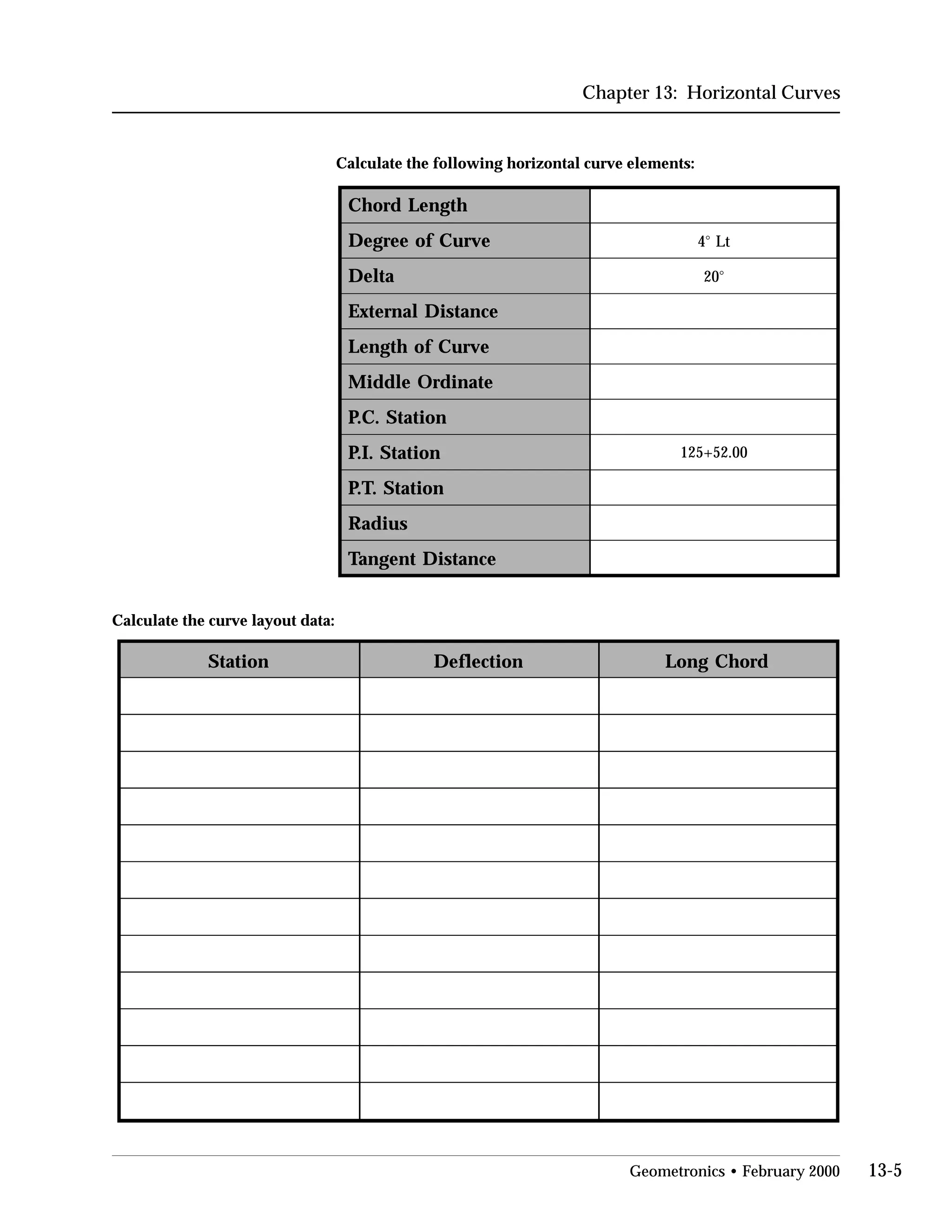
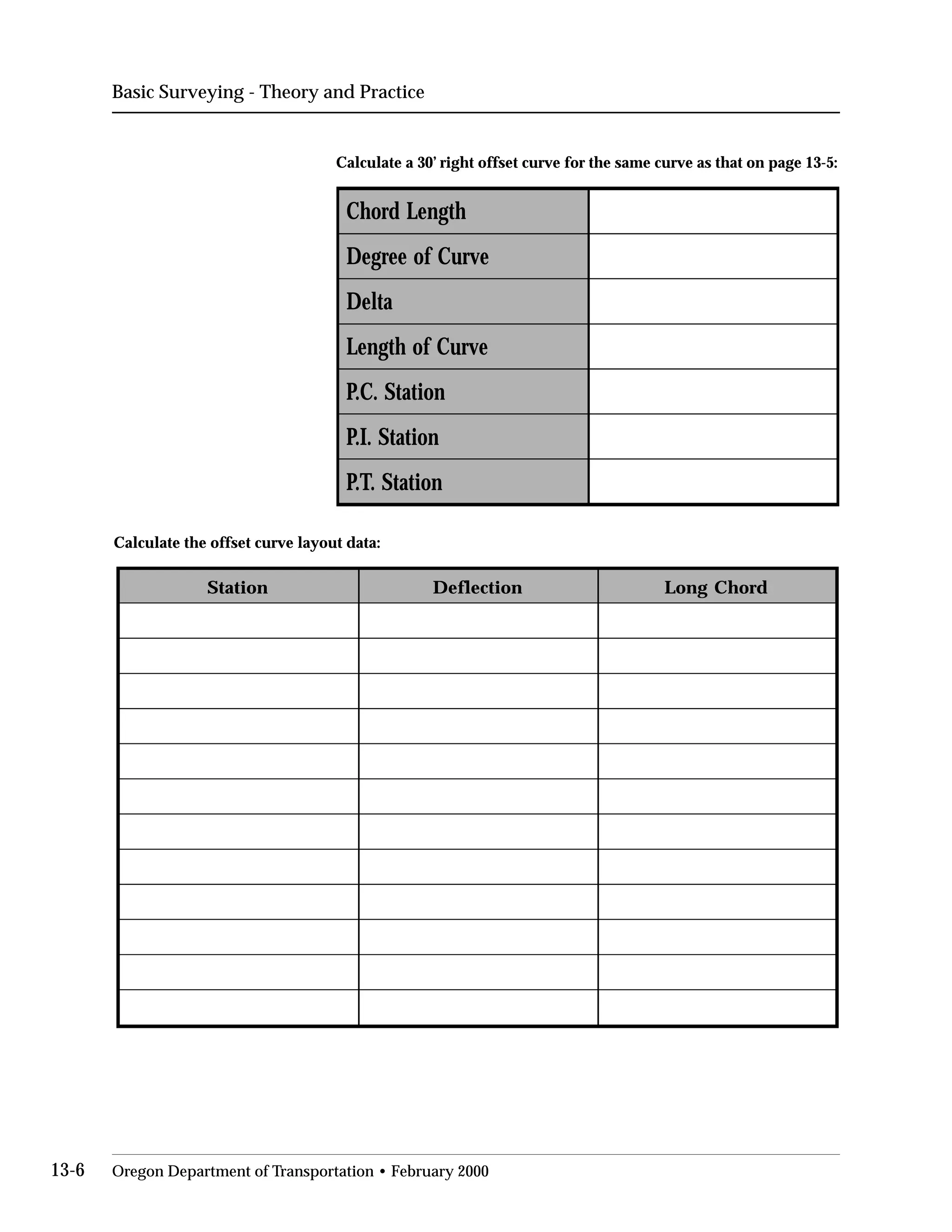
  • 24.
    Basic Surveying -Theory and Practice Procedures for Chaining It must be remembered in surveying, that under most circumstances, all distances are presumed to be horizontal distances and not surface distances. This dictates that every field measurement taken be either measured horizontally or, if not, reduced to a horizontal distance math­ ematically. In many instances, it is easiest to simply measure the horizontal distance by keeping both ends of the chain at the same elevation. This is not difficult if there is less than five feet or so of elevation change between points. A hand level or “pea gun” is very helpful for maintaining the horizontal position of the chain when “level chaining.” A pointed weight on the end of a string called a “plumb bob” is used to carry the location of the point on the ground up to the elevated chain by simply suspending the plumb bob from the chain such that the point of the plumb bob hangs directly above the point on the ground. When the difference in elevation along the measurement becomes too great for level chaining, other methods are called for. One option, “break chaining”, involves simply breaking the measurement into two or more measurements that can be chained level. This works well for measure­ ments along a gentle slope where a reasonable distance can be measured between break chaining points. 3-2 Oregon Department of Transportation • February 2000
  • 25.
    Chapter 3: DistanceMeasuring (Chaining) In some cases, it becomes impractical to break chain. When the slope becomes so steep that frequent chaining points are required, a vertical surface must be measured across, or intermediate chaining points are not readily accessible, it may be more desirable to determine the horizon­ tal distance indirectly. The most frequently used method is “slope chaining”, where the distance along the slope is measured, the slope rate is determined, and the horizontal distance calculated. Slope rate angles are measured as Vertical Angles (+/- from horizontal), or as Zenith Angles (Measured downward from a imaginary point on the celestial sphere directly above the instrument). When the vertical angle (v) is used, the horizontal distance (HD) is calculated by multiplying the slope distance (SD) by the cosine of the vertical angle. This is the solution of a right triangle for the side adjacent (horizontal distance) with the hypotenuse (slope distance) known. From basic trigonometry, we know that; cosine = Adjacent Side / Hypotenuse Substituting the known values, we have; cos(v) = HD / SD Solving for HD by multiplying both sides of the equation by SD, we get; HD = SDcos(v) If the zenith angle (z) is measured rather than the vertical angle, the calculations are nearly identical. The only variation is that the zenith angle is the complimentary angle of the vertical angle, so the sine func­ tion must be used. The formula is; HD = SDsin(z) Geometronics • February 2000 3-3

  • 26.
    Basic Surveying -Theory and Practice Errors in Chaining Every measurement made with a mechanical device is subject to any error that could possibly be caused by the condition of the device or by the procedure used in taking the measurement. Some of the more common sources of errors are the standards to which the chain was manufactured, any damage to the chain, sag in the chain, variation in the tension on the chain, and changes in the temperature of the chain. With proper care of the chain and reasonable effort made with each use, the effects of these errors can be kept within acceptable tolerances for all but the most precise measurements. When necessary, however, each of these conditions can be compensated for mathematically if they are monitored and compared to a known standard. Proportional Errors When a chain is manufactured, it is intended to be a specific length, plus or minus some tolerance. It may or may not actually meet those specifi­ cations. When a field measurement is taken, the acceptable error may be more or less than what the chain was designed for. For high precision work, we need to measure several known distances and determine if this chain is the proper length. If not, we need next to determine if the error is in one or more specific locations along the chain or if the error is proportional along the length. If a known 50 foot distance is measured to be 49.995 feet and a known 100 foot distance to be 99.99 feet, all measure­ ments made with that chain should be multiplied by a factor of 100/ 99.99 (known distance over measured distance). Constant Errors If a chain has been kinked or broken and spliced back together, there is a good chance that there will be a consistent error for any distances measured using that portion of the chain. This error needs to be added or subtracted as appropriate each time. Sag Correction When a chain is suspended from each end and not supported along it’s length, the weight of the chain causes it to sag and pull the two ends toward each other. It is impossible to exert enough outward force to fully overcome the sag. For all measurements, adequate tension should be applied to minimize the effective shortening of the chain. For precise measurements, a correction should be applied using the formula given in the appendix. 3-4 Oregon Department of Transportation • February 2000
  • 27.
    Chapter 3: DistanceMeasuring (Chaining) Tension Correction While a certain amount of tension is desirable to help offset the sag effect, it will also stretch the chain. Steel is generally thought of as not being very easily stretched and indeed it is not. That is one of the reasons it is used for making chains. But steel will still stretch to some degree if tension is applied. When a chain is checked against a known distance, the applied tension should be controlled. Subsequent precise measurements should be made using the same tension, or if not, a correction should be applied. The formula for this is also in the appen­ dix. Temperature Correction Whatever material is used to make a chain, that material will expand and contract with any change in temperature. Some materials are more affected than others, but every chain will change length somewhat if warmed or cooled. If precise measurements are needed, an adjustment needs to be made for the change in temperature between the current temperature and the temperature at the time the chain was checked against a known distance. This formula is also in the appendix. Geometronics • February 2000 3-5
  • 28.
    Basic Surveying -Theory and Practice 3-6 Oregon Department of Transportation • February 2000
  • 29.
    Distance Measuring (Electronic DistanceMeters) 4 In the early 1950’s the first Electronic Distance Measuring (EDM) equip­ ment were developed. These primarily consisted of electro-optical (light waves) and electromagnetic (microwave) instruments. They were bulky, heavy and expensive. The typical EDM today uses the electro-optical principle. They are small, reasonably light weight, highly accurate, but still expensive. This chapter will focus on electro-optical instruments only. 0o 90o 180o 270o 360o wavelength Measured Phase Angle of Returned Signal φ∆ Figure 13 Basic Principle To measure any distance, you simply compare it to a known or calibrated distance; for example by using a scale or tape to measure the length of an object. In EDM’s the same comparison principle is used. The calibrated distance, in this case, is the wavelength of the modulation on a carrier wave. Modern EDM’s use the precision of a Quartz Crystal Oscillator and the measurement of phase-shift to determine the distance. The EDM is set up at one end of the distance to be measured and a reflector at the other end. The EDM generates an infrared continuous- wave carrier beam, which is modulated by an electronic shutter (Quartz crystal oscillator). This beam is then transmitted through the aiming optics to the reflector. The reflector returns the beam to the receiving optics, where the incoming light is converted to an electrical signal, allowing a phase comparison between transmitted and received signals. The amount by which the transmitted and received wavelengths are out of phase, can be measured electronically and registered on a meter to within a millimeter or two. Geometronics • February 2000 4-1
  • 30.
    Basic Surveying -Theory and Practice Suppose the distance to be measured is an exact multiple (n) of 10 m. The optical path however, will be 2n x 10 m (this is the double distance). As the total path is 2n x 10 m, the total phase delay is n x 360°. Each 10 m wavelength represents a full 360° phase delay. The phase difference between a transmitted and received beam is also n x 360°, which cannot be distinguished from a 0° phase shift. In general, the distance to be measured may be expressed as n x 10 + d. The total phase delay Φ between transmitted and received signals becomes: Φ = n x 360° + ∆Φ In which ∆Φ equals the phase delay due to the distance d. As n x 360° is equivalent to 0° for a phase meter, the angle can be measured and will represent d according to the relation. d = ∆Φ x 10 m 360° Most EDM’s use four modulation frequencies to measure long distances without ambiguity. The EDM first transmits a particular frequency generating a 10 m wavelength which determines the fraction of 10 m measured, it then switches to a 100 m wavelength to determine the fraction of 100 m, 1000 m wavelength to determine the fraction of 1000 m and 10 000 m wave- length to determine the fraction of 10 000 m. detareneGhgnelevaW ecnatsiDevloseR m01 12.3xxx m001 12.37xx m0001 12.372x 00001 12.3721 0 0 0 0 The final distance is then converted and displayed in the units desired. In the latest generation instruments, this process is done in less that 2 seconds. 4-2 Oregon Department of Transportation • February 2000
  • 31.
    Chapter 4: DistanceMeasuring (Elecronic Distance Meters) Accuracy Specifications EDM specifications are usually given as a standard deviation. The specification given is a two part quantity. A constant uncertainty (re­ gardless of the distance measured) and a parts-per-million (ppm) term (proportionate to the distance measured). EDM Make and Model Constant Proportion Wild D14 and D14L +/– 5 mm +/– 5 ppm Wild D15 and D15S +/– 3 mm +/– 2 ppm Wild/Leica DI1600 +/– 3 mm +/– 2 ppm Wild DI2000 +/– 1 mm +/– 1 ppm TCA 1800 +/– 1 mm +/– 2 ppm For short distances, the constant part of the error is significant and could exceed the normal errors of ordinary taping. As in angle measurements, short traverse sides should be avoided. Environmental Correction The procedures used to measure distances depends entirely on an accurate modulation wavelength. When the infrared beam is transmit­ ted through the air, it is affected by the atmospheric conditions that exist. To correct for these conditions, the barometric pressure and temperature must be measured and the appropriate corrections made. All EDM’s come with charts and formulas to compute this PPM correction. This value can usually be stored in the instrument. Optionally, the PPM correction could by applied later instead. An example ppm chart is shown in the appendix. Geometronics • February 2000 4-3
  • 32.
    Basic Surveying -Theory and Practice Prisms The reflector, or prism, is a corner cube of glass in which the sides are perpendicular to a very close tolerance. It has the characteristic that incident light is reflected parallel to itself, thus returning the beam to the source. This is called a retrodirective prism or retro reflector. These reflectors have a so-called “effective center”. The location of the center is not geometrically obvious because light travels slower through glass than air. The effective center will be behind the prism itself and is generally not over the station occupied. Thus there is a reflector constant or prism constant to be subtracted from the measurement. Some manu­ facturers shift the center of the EDM forward the same amount as the prism offset to yield a zero constant. All Wild/Leica EDM’s are shifted forward by 35 mm. a b c t D 1.57 x 2t offset From EDM To EDM Figure 14 Always use prisms designed for your EDM system. Virtually all electro-optical EDM’s of today mount to the theodolite and, depending on the type of the mount (scope, yoke, built in, etc), the prism housing has to be designed accordingly. 4-4 Oregon Department of Transportation • February 2000
  • 33.
    Chapter 4: DistanceMeasuring (Elecronic Distance Meters) Slope Reduction EDM instruments all measure (line of sight) slope distances only. In surveying, we are primarily concerned with horizontal distances. Therefore, this slope distance must be reduced to a horizontal distance. Most EDM’s have the ability to make these computations through the use of a keyboard or by passing the raw distance to an electronic theodo­ lite which in turn performs the function. For short distances, a simple right triangle reduction may be applied: Horizontal Distance = s x sin(z) When larger distances are involved, the earth’s curvature and atmo­ spheric refraction need to be taken into account. The equations are as follows: Horizontal Distance in meters = s(sinz - E1 cosz) Vertical Distance in meters = s(cosz + Esinz) Where: E1 = 0.929 s(sinz) 6 372 000 m E = 0.429 s(sinz) 6 372 000 m s = slope distance in meters z = zenith angle The horizontal distance equation uses the instrument elevation as the datum. If the sight is long and steeply inclined, a reciprocal observation (from the other end) would give a different answer. Each can be reduced to sea level by multiplying them by the following factor: 6 372 000 6 372 000 + H H = station elevation in meters Where H is the station elevation in meters. A more modern approach producing better results is the use of reciprocal zenith computations where the zenith angles and slope distances are measured from both ends of the line. The difference in elevation is the average of the elevations and the correction for earth curvature and refraction cancels. Geometronics • February 2000 4-5
  • 34.
    Basic Surveying -Theory and Practice 4-6 Oregon Department of Transportation • February 2000
  • 35.
    Angle Measuring 5 Measuringdistances alone in surveying does not establish the location of an object. We need to locate the object in 3 dimensions. To accomplish that we need: 1. Horizontal length (distance) 2. Difference in height (elevation) 3. Angular direction. This chapter discusses the measurement of both horizontal and vertical angles. An angle is defined as the difference in direction between two convergent lines. A horizontal angle is formed by the directions to two objects in a horizontal plane. A vertical angle is formed by two intersecting lines in a vertical plane, one of these lines horizontal. A zenith angle is the comple­ mentary angle to the vertical angle and is formed by two intersecting lines in a vertical plane, one of these lines directed toward the zenith. PlumbLine PlumbLine Zenith Angle Vertical Angle ZenithZenith Nadir Level Surface Figure 15 Geometronics • February 2000 5-1
  • 36.
    Basic Surveying -Theory and Practice Types of Measured Angles Interior angles are measured clockwise or counter-clockwise between two adjacent lines on the inside of a closed polygon figure. Exterior angles are measured clockwise or counter-clockwise between two adjacent lines on the outside of a closed polygon figure. Deflection angles, right or left, are measured from an extension of the preceding course and the ahead line. It must be noted when the deflec­ tion is right (R) or left (L). Angles to the right are turned from the back line in a clockwise or right hand direction to the ahead line. This is ODOT’s standard. Angles to the left are turned from the back line in a counter-clockwise or left hand direction to the ahead line. Angles are normally measured with a transit or a theodolite, but a compass may be used for reconnaissance work. Exterior Angles Deflection LeftDeflection Right Backsight Foresight 180o Back Line Produced Backsight Foresight 180o Back Line Produced Backsight Foresight Interior Angles Backsight Foresight Angles to the LeftAngles to the Right Figure 16 5-2 Oregon Department of Transportation • February 2000
  • 37.
    Chapter 5: AngleMeasuring A Transit is a surveying instrument having a horizontal circle divided into degrees, minutes, and seconds. It has a vertical circle or arc. Tran­ sits are used to measure horizontal and vertical angles. The graduated circles (plates) are on the outside of the instrument and angles have to be read by using a vernier. Figure 18 A Theodolite is a precision surveying instrument; consisting of an alidade with a telescope and an accurately graduated circle; and equipped with the necessary levels and optical-reading circles. The glass horizontal and vertical circles, optical-reading system, and all mechanical parts are enclosed in an alidade section along with 3 leveling screws contained in a detachable base or tribrach. Figure 17 Geometronics • February 2000 5-3
  • 38.
    Basic Surveying -Theory and Practice As surveyors we must know several relationships between an angular value and its corresponding subtended distance. Surveyors must strive to maintain a balance in precision for angular and linear measurements. If distances in a survey are to be measured with a relative precision of 1 part in 20,000, the angular error should be limited to 10 seconds or smaller. Comparison of Angular and Linear Errors Standard error of angular measurement 05’ Linear error in 1000 Units. (Feet – Meters) Accuracy Ratio 01’ 30” 20” 10” 05” 01” 1.454 0.291 0.145 0.097 0.048 0.024 0.005 1:688 1:3436 1:6897 1:10,309 1:20,833 1:41,667 1:200,000 5-4 Oregon Department of Transportation • February 2000
  • 39.
    Chapter 5: AngleMeasuring Repeating Instruments All transits and some theodolites are constructed with a double vertical axis. They are equipped with upper and lower circle clamps and tangent screws, sometimes referred to as upper and lower motions. The lower clamp secures the horizontal circle to the base of the instrument while the upper clamp secures the circle to the alidade (the upper body of the instrument).Through the use of both clamps and their accompanying tangent (fine adjustment) screws, these instruments can be used to measure angles by repetition. In ODOT’s survey equipment fleet, the Wild T16’s are Repeating Instru­ ments. These instruments have a modified design providing tangent screw and one traditional type clamp that actually secures the alidade to the base. This clamp acts as either upper or lower motion depending on the position of the locking lever located near the tangent screw. With the lever in the down position, the circle is clamped to the alidade and the lock and tangent screw function as a lower motion. When the lever is moved to the up position, the circle is released from the alidade and allowed to rest on the base of the instrument, causing the clamp and tangent to function as an upper motion. Geometronics • February 2000 5-5
  • 40.
    Basic Surveying -Theory and Practice Measuring Angles with a Repeating Instrument Repeated measurements of an angle increase accuracy over that obtained from a single measurement. A horizontal angle may be accumulated and the sum can be read with the same precision as the single value. When this sum is divided by the number of repetitions, the resulting angle has a precision that exceeds the nominal least count of the instrument. To measure an angle set by repetition: 1. Set zero on the horizontal plate, and lock the upper motion. 2. Release the lower motion, sight the backsight, lock the lower motion, and perfect the sighting with the lower tangent screw. 3. Release the upper motion, turn to the foresight, lock the upper motion, and perfect the sighting. 4. Record the horizontal angle. 5. Release the lower motion, plunge (invert) the scope and point to the backsight in the reverse position, lock the lower motion, and perfect the sighting. 6. Release the upper motion, turn to the foresight, lock the upper motion, and perfect the sighting. 7. Record the double angle. Compute the mean angle. 8. If further accuracy is desired continue this process until 6 angles are accumulated. Divide the result by 6 and compare the result to the mean of the first 2. If they agree within 6 seconds accept the angle. Otherwise redo the set. In ODOT, we are required to turn (6) angles for Traverse and (2) for other less critical control points. The expected accuracy of a measurement, as computed, is in direct proportion to the number of observations. However, factors limiting accuracy include, eccentricity in instrument centers, errors in the plate graduations, instrument wear, setting up and pointing the instrument, and reading the scale or vernier. A practical limit to the number of repetitions is about 6 or 8, beyond which there is little or no appreciable increase in accuracy. 5-6 Oregon Department of Transportation • February 2000
  • 41.
    Chapter 5: AngleMeasuring Example of an angle set turned by a REPEATING instrument: 2) o 43. 3' STA ANGLE RIGHT FS BS 6) o 09. 9' M) o 21' 39" 1) o 21. 6' m) o 21' 39" 78 236 39 39 39 BS FS Figure 19 Geometronics • February 2000 5-7
  • 42.
    Basic Surveying -Theory and Practice Measuring Angles with a Directional Instrument A Directional Theodolite is not equipped with a lower motion. It is con­ structed with a single vertical axis and cannot accumulate angles. It does, however, have a horizontal circle positioning drive to coarsely orient the horizontal circle in any desired position. In ODOT’s survey equipment fleet, the T2000’s, T1600’s and T1610’s are all Directional Instru­ ments. A directional theodolite is more precise than a repeating theodolite. Directions, rather than angles are read. After sighting on a point, the line direction from the instrument to the target is noted. When a pointing is taken on the next mark, the difference in directions between them is the included angle. To measure an angle set with a directional theodolite: 1. Point to the backsight in the direct position, lock on the target and record the plate reading. Although not mathematically necessary, we set the horizontal circle to zero to simplify the calculations and to aid in any necessary debugging of the data. 2. Loosen the horizontal motion and turn to the foresight. Lock the horizontal motion, perfect the sighting, then record the horizontal plate reading. 3. Loosen both horizontal and vertical motions, plunge the scope and point to the foresight. Again ( in the reverse position) lock the horizontal motion, perfect the sighting and record the horizontal plate reading. 4. Loosen the horizontal motion and turn to the backsight, lock the horizontal motion, perfect the sighting and record the horizontal plate reading. This completes one set. Depending on the accuracy required additional sets should be turned. In ODOT, we are required to turn (2) sets for Traverse angles and (1) set for other less critical control points. To reduce the notes, mean the direct and reverse observations to the backsight and foresight. Compute the mean direction to the foresight by subtracting the value of the meaned initial direction (backsight) to get final directions. If any set varies from the mean of all sets by more than +/- 5 seconds, reject that set and re-observe that particular set. 5-8 Oregon Department of Transportation • February 2000
  • 43.
    Chapter 5: AngleMeasuring Example of two angle sets turned by a Directional Instrument: 218o 21' STA PLATE READING ADJ. PLATE READING SET ANGLE FINAL ANGLE 1 - (DIR) 4 - (REV) 2 - (DIR) 3 - (REV) 1 - (DIR) 4 - (REV) 2 - (DIR) 3 - (REV) 0o 00" 00" 0o 00" 02" 180o 00' 04" 38o 21' 43" 38o 21' 41.5" 38o 21' 39.5" 0o 00' 00" 179o 59' 57" 38o 21' 42" 218o 21' 36" -00o 00' 01.5" 38o 21' 39" 38o 21' 40.5" 38o 21' 40" 40" BS BS FS FS BS BS FS FS BS FS Figure 20 Geometronics • February 2000 5-9
  • 44.
    Basic Surveying -Theory and Practice Zenith Angles Unlike transits, theodolites are not equipped with a telescope level. Modern theodolites have an indexing system that utilizes an automatic compensator responding to the influence of gravity. When the theodolite is properly leveled, the compensator is free to bring the vertical circle index to its true position. Automatic compensators are generally of two types: 1. Mechanical, whereby a suspended pendulum controls prisms directing light rays of the optical-reading system. 2. Optical, in which the optical path is reflected from the level surface of a liquid. To measure a zenith angle: 1. Point the instrument to the target object in a direct position. 2. Lock the vertical motion, perfect the sighting and record the zenith angle. 3. Loosen both the horizontal and vertical motions, plunge the scope, rotate the alidade 180° and re-point to the target in the reverse position. 4. Lock the vertical motion, perfect the pointing and record the zenith angle. A mean zenith angle is obtained by first adding the direct and reverse readings to obtain the algebraic difference between their sum and 360°; then dividing this difference by 2, and algebraically adding the result to the first (direct) series measurement. The result is the zenith angle corrected for any residual index error. Example: tceriD 61'82°38 esreveR 83'13°672 muS 45'95°953 muSsunim°063 60'00°00 )rorre(eulaVflaH 30'00°00 elgnAlanigirOsulP 61'82°38 ELGNALANIF "91'82°38 " " " " " " 5-10 Oregon Department of Transportation • February 2000
  • 45.
    Chapter 5: AngleMeasuring Exercise - Calculate Final Angles from given 2) o 04.5' BS FS STA ANGLE RIGHT FS BS 6) o 13.7' 1) o 02.2' 307o 57' BS FS STA PLATE READING ADJ. PLATE READING SET ANGLE FINAL ANGLE 1 - (DIR) 4 - (REV) 2 - (DIR) 3 - (REV) 1 - (DIR) 4 - (REV) 2 - (DIR) 3 - (REV) 0o 00" 00" 179o 59' 54" 127o 57' 14" 359o 59' 58" 180o 00' 07" 127o 57' 11" 307o 57' 16" data: elgnAhtineZtceriD 1°201 ' 54 " elgnAhtineZesreveR 4°752 ' 12 " elgnAhtineZlaniF 114 342 57 21" BS BS FS FS BS BS FS FS 2 7 Geometronics • February 2000 5-11
  • 46.
    Basic Surveying -Theory and Practice 5-12 Oregon Department of Transportation • February 2000
  • 47.
    Bearings and Azimuths 6 The Relative directions of lines connecting survey points may be obtained in a variety of ways. The figure below on the left shows lines intersect­ ing at a point. The direction of any line with respect to an adjacent line is given by the horizontal angle between the 2 lines and the direction of rotation. The figure on the right shows the same system of lines but with all the angles measured from a line of reference (O-M). The direction of any line with respect to the line of reference is given by the angle between the lines and its direction of rotation. The line of reference we use is a Meridian There are several types of meridians: Astronomical or True, Magnetic, Grid, and Assumed. A B C D O A B C D O M a1 a2 a3 a4 b1 b2 b3 b4 Directions by angles Directions referred to meridian Figure 21 Geometronics • February 2000 6-1
  • 48.
    Basic Surveying -Theory and Practice Astronomical or True Meridians A plane passing through a point on the surface of the earth and contain­ ing the earth’s axis of rotation defines the astronomical or true meridian at that point. Astronomical meridians are determined by observing the position of the sun or a star. For a given point on the earth, its direction is always the same and therefore directions referred to the astronomical or true meridian remain unchanged. This makes it a good line of refer­ ence. Rotational Axis Astronomical Meridian North Pole South Pole Figure 22 Convergence Astronomical or true meridians on the surface of the earth are lines of geographic longitude and they converge toward each other at the poles. The amount of convergence between meridians depends on the distance from the equator and the longitude between the meridians. 6-2 Oregon Department of Transportation • February 2000
  • 49.
    Chapter 6: Bearingand Azimuths Magnetic Meridian A magnetic meridian lies parallel with the magnetic lines of force of the earth. The earth acts very much like a bar magnet with a north magnetic pole located considerably south of the north pole defined by the earth’s rotational axis. The magnetic pole is not fixed in position, but rather changes its position continually. The direction of a magnetized needle defines the magnetic meridian at that point at that time. Because the magnetic meridian changes as magnetic north changes, magnetic merid­ ians do not make good lines of reference. Rotational Axis North Magnetic Pole South Magnetic Pole Magnetic Meridian Figure 23 Geometronics • February 20000 6-3
  • 50.
    Basic Surveying -Theory and Practice Grid Meridians In plane surveys it is convenient to perform the work in a rectangular XY coordinate system in which one central meridian coincides with a true meridian. All remaining meridians are parallel to this central true meridian. This eliminates the need to calculate the convergence of meridians when determining positions of points in the system. The methods of plane surveying, assume that all measurements are projected to a horizontal plane and that all meridians are parallel straight lines. These are known as grid meridians. The Oregon Coordinate System is a grid system. Central Meridian Grid Meridians Figure 24 6-4 Oregon Department of Transportation • February 2000
  • 51.
    Chapter 6: Bearingand Azimuths Assumed Meridians On certain types of localized surveying, it may not be necessary to establish a true, magnetic, or grid direction. However it is usually desirable to have some basis for establishing relative directions within the current survey. This may be done by establishing an assumed meridian. An assumed meridian is an arbitrary direction assigned to some line in the survey from which all other lines are referenced. This could be a line between two property monuments, the centerline of a tangent piece of roadway, or even the line between two points set for that purpose. The important point to remember about assumed meridians is that they have no relationship to any other meridian and thus the survey cannot be readily (if at all) related to other surveys. Also, if the original monu­ ments are disturbed, the direction may not be reproducible. It is good practice when assuming a direction to avoid directions that might appear to be true. If assuming a direction on a line that runs generally north and south, do not assume a north direction, as some future surveyor may mistakenly use your direction as true. Geometronics • February 20000 6-5
  • 52.
    Basic Surveying -Theory and Practice Azimuths The azimuth of a line on the ground is its horizontal angle measured from the meridian to the line. Azimuth gives the direction of the line with respect to the meridian. It is usually measured in a clockwise direction with respect to either the north meridian or the south meridian. In plane surveying, azimuths are generally measured from the north. When using azimuths, one needs to designate whether the azimuth is from the north or the south. Azimuths are called true (astronomical) azimuths, magnetic azimuths, grid azimuths, or assumed azimuths depending on the type of meridian referenced. Azimuths may have values between 0 and 360 degrees. The azimuth from the North for each line is: Line Azimuth O – A 54° O – B 133° O – C 211° O – D 334° A B C D O Azimuths S N 54o 133o 211o 334o Figure 25 6-6 Oregon Department of Transportation • February 2000
  • 53.
    Chapter 6: Bearingand Azimuths Using the deflection angles shown, calculate North azimuths of the lines. A B C D E F North South 46o 30' Left 113o 40' Left 61o Right 113o 40' Right AZ = 150o Figure 26 Line Azimuth A – B B – C C – D D – E E – F Geometronics • February 20000 6-7
  • 54.
    Basic Surveying -Theory and Practice Bearings The bearing of a line also gives the direction of a line with respect to the reference meridian. The bearing states whether the angle is measured from the north or the south and also whether the angle is measured toward the east or west. For example, if a line has a bearing of S 47° E, the bearing angle 47° is measured from the south meridian eastward. A stated bearing is said to be a true bearing, a magnetic bearing, an assumed bearing, or a grid bearing, according to the type of meridian referenced. A B C D O 54 o Bearings South North EastWest 26 o 31 o 47 o NW NE SESW Figure 27 Line Bearing O – A N 54° E O – B S 47° E O – C S 31° W O – D N 26° W 6-8 Oregon Department of Transportation • February 2000
  • 55.
    Chapter 6: Bearingand Azimuths For the figure below, calculate the bearings for each line. N E S W N E S W N E S W N E S W A B C D 62 o 25 o 68 o 62 o 25 o 68 o 17 o 17 o Figure 28 Line Bearing A – B B – C C – D D – A Geometronics • February 20000 6-9
  • 56.
    Basic Surveying -Theory and Practice Relation between Bearing and Azimuths To simplify computations based on survey data, bearings may be con­ verted to azimuths or azimuths to bearings. In the figure below, the first azimuth of 37° 30' is in the northeast quad- rant since the angle eastward is less than 90°. In the northeast quadrant the bearing angle and the azimuth are identical. The second azimuth, 112°45' is 112°45' from the north meridian. The bearing angle for this quadrant must be determined from the south meridian. Since the north and south meridian are 180° apart, one would subtract the azimuth, 112°45' from 180° to arrive at the bearing of 67°15'. Because it is in the southeast quadrant the bearing is S 67°15' E. N.E. Quadrant: Bearing equals Azimuth S.E. Quadrant: 180° - Azimuth = Bearing and 180° - Bearing = Azimuth S.W. Quadrant: Azimuth - 180° = Bearing and Bearing + 180° = Azimuth N.W. Quadrant: 360° - Azimuth = Bearing and 360° - Bearing = Azimuth North East South West 0o 90o 180o 270o 37o 30'45 o N 37o 30'E N 45 oW 67 o 15' 15o S 67 o 15 E S15o W AZ = 315 o AZ = 37o 30" AZ = 112 o 45' AZ=195o Figure 29 6-10 Oregon Department of Transportation • February 2000
  • 57.
    Chapter 6: Bearingand Azimuths Back Azimuths and Back Bearings The back azimuth or back bearing of a line is the azimuth or bearing of a line running in the reverse direction. The azimuth or bearing of a line in the direction in which a survey is progressing is called the forward azimuth or forward bearing. The azimuth or bearing of the line in the direction opposite to that of progress is called the back azimuth or back bearing. The back azimuth can be obtained by adding 180° if the azimuth is less than 180° or by subtracting 180° if the azimuth is greater than 180°. The back bearing can be obtained from the forward bearing by changing the first letter from N to S or from S to N and the second letter from E to W or from W to E. N N E S W A B 68o 68o 248o E W S Bearing or Azimuth and Back Bearing or Back Azimuth Figure 30 The bearing of the line A-B is N 68° E The bearing of the line B-A is S 68° W. The azimuth of the line A-B is 68° The azimuth of the line B-A is 248° Geometronics • February 20000 6-11
  • 58.
    Basic Surveying -Theory and Practice Using angles to the right, calculate the bearings and azimuths of the lines. South North B C D E A 125o 146o 138o 51o144o Figure 31 Line Bearing Azimuth A – B B – C C – D D – E E – A 6-12 Oregon Department of Transportation • February 2000
  • 59.
    Coordinates 7 In Surveying,one of the primary functions is to describe or establish the positions of points on the surface of the earth. One of the many ways to accomplish this is by using coordinates to provide an address for the point. Modern surveying techniques rely heavily on 3 dimensional coordinates. In order to understand the somewhat complex coordinate systems used in surveying, we must first look at the Rectangular Coordinate System (or Cartesian Plane) from basic mathematics. To keep it simple let’s start by looking at a 1 dimensional system for locating points. Consider the horizontal line shown on the left of figure 32. A point on the line marked “0” is established as the origin. The line is graduated and numbered (positive to the right of the origin and negative to the left). Any number can be plotted on this line by its value and distances to other points on the line can be easily calculated. If all of our work was done precisely along a line, this system would be suffi­ cient. We live in a 3 dimensional world, therefore we need a better system. Let’s look at a 2 dimensional system for locating points. The right of figure 32 shows a similar graduated line but in a vertical position. This line would function in a similar way as the horizontal line but giving locations of points in a different direction. By coinciding those lines at their respective origins we provide the foundation for a rectangular coordinate system. 0 0 11 2 2 3 3 4 4 5 5 6 6 -1-1-2 -2 -3 -3-4 -4 -5 -5-6 -6 A B D C Figure 32 Geometronics • February 2000 7-1
  • 60.
    Basic Surveying -Theory and Practice In the right of figure 33, is what is described as a rectangular coordinate system. A vertical directed line (y-axis) crosses the horizontal directed line (x-axis) at the origin point. This system uses an ordered pair of coordinates to locate a point. The coordinates are always expressed as (x,y). The horizontal distance from the y-axis to a point is known as the abscissa. The vertical distance from the x-axis is known as the ordinate. The abscissa and ordinate are always measured from the axis to the point - never from the point to the axis. The x and y axes divide the plane into four parts, numbered in a counter- clockwise direction as shown in the left of figure 33. Signs of the coordi­ nates of points in each quadrant are also shown in this figure. Note: In surveying, the quadrants are numbered clockwise starting with the upper right quadrant and the normal way of denoting coordinates (in the United States) is the opposite (y,x) or more appropriately North, East. Y x ( + , + ) ( + , - )( - , - ) ( - , + ) 12 3 4 o Y +1 +2 +3 +4 +5 -1 -2 -3 -4 -5 +1 +2 +3 +4 +5 -1-2-3-4-5 (4,3) (-2,-5) o Abscissa Ordinate Figure 33 7-2 Oregon Department of Transportation • February 2000 x
  • 61.
    Chapter 7: Coordinates Determinethe coordinates of the points shown in the figure below. 8 6 4 2 0 -2 -4 -6 -8 -8 -6 -4 -2 0 8 X Y 642 B A C F D E tnioP X Y tnioP N E A D B E C F Geometronics • February 2000 7-3
  • 62.
    Basic Surveying -Theory and Practice Polar Coordinates Another way of describing the position of point P is by its distance r from a fixed point O and the angle θ that makes with a fixed indefinite line oa (the initial line). The ordered pair of numbers (r,θ) are called the polar coordinates of P. r is the radius vector of P and θ its vectorial angle. Note: (r,θ), (r, θ + 360o ), (-r, θ + 180o ) represent the same point. Transformation of Polar and Rectangular coordinates: 1. x = rcosθ y = rsinθ (if θ and r are known) 2. r= x2 + y2 θ = tan- 1 ( y x ) (if x and y are known) O Vector Initial Line 1 2 3 -1 -2 -3 35o A P (4,35) (r,θ) O X Y x y r θ P (x,y) Figure 34 7-4 Oregon Department of Transportation • February 2000
  • 63.
    Chapter 7: Coordinates Measuringdistance between coordinates When determining the distance between any two points in a rectangular coordinate system, the pythagorean theorem may be used (see Review of Basic Trigonometry). In the figure below, the distance between A and B can be computed in the following way : AB = [4-(-2)]2 +[3-(-5)]2 AB = [4+2)]2 +[3+5)]2 AB = 10 CB=+4-(-2)=4+2 AC=+3-(-5)=3+5 Point C in this figure was derived by passing a horizontal line through point B and a vertical line through point A thus forming an intersect at point C, and also forming a right triangle with line AB being the hypot­ enuse. The x-coordinate of C will be the same as the x-coordinate of A (4) and the y-coordinate of C will be the same y-coordinate of B (-5). Y x +1 +2 +3 +4 +5 -1 -2 -3 -4 -5 +1 +2 +3 +4 +5 -1-2-3-4-5 (4,3) (-2,-5) o (4,-5) A B C Figure 35 Geometronics • February 2000 7-5
  • 64.
    Basic Surveying -Theory and Practice Inverse In mathematics, the coordinates of a point are expressed as (x,y). In surveying, as mentioned earlier, the normal way of denoting coordinates (in the United States) is the opposite (y,x) or more appropriately North, East. The difference in Eastings between 2 points is referred to as the departure and the difference Northings is the Latitude. To inverse between points means to calculate the bearing and distance between 2 points from their coordinate values. Start by algebraically subtracting the Northings to get the Latitude, and the Eastings to get the Departure. A simple right triangle is formed and the pythagorean theorem can be used to solve for the hypotenuse (distance between points). To find the bearing we need to calculate the angle from the North/South line at one of the points by using basic trigonometry. O A B East North 1 3 5 6 7 8 1 2 3 4 5 6 7 8 (2,2) (8,7) Latitude=6 Departure = 5 O A B East North 7.81 N 39o 48'20"E 2 4 Figure 36 7-6 Oregon Department of Transportation • February 2000
  • 65.
    Chapter 7: Coordinates 1. Plot the following points (N,E) and connect with lines in the follow­ ing order ABCDEA. A (12,6) B (-14,12) C (-12,1) D (-3,-9) E (16,-10) 2. Find the bearing of each line (i.e. AB, BC, etc.) and the perimeter distance. North 20 18 16 14 12 10 8 6 4 2 East -2 -4 -6 -8 -10 -12 -14 -16 -18 -20 -14 -12 -10 -8 -6 -4 -2 0 2 4 6 8 10 12 14 Geometronics • February 2000 7-7
  • 66.
    Basic Surveying -Theory and Practice Area by Coordinates Area of a trapezoid: one-half the sum of the bases times the altitude. Area of a triangle: one-half the product of the base and the altitude. The area enclosed within a figure can be computed by coordinates. This is done by forming trapezoids and determining their areas. Trapezoids are formed by the abscissas of the corners. Ordinates at the corners provide the altitudes of the trapezoids. A sketch of the figure will aid in the computations. This is similar to the double meridian distance method but does not use meridian distances. For land area calculations following a boundary traverse, the DMD method for area is more commonly used. The DMD method will not be discussed here. A B Cb h Average Altitude Figure 37 7-8 Oregon Department of Transportation • February 2000
  • 67.
    Chapter 7: Coordinates 1.Find the latitude and departure between points. 2. Find the area of the figure. 8 6 4 2 0 -2 -4 -6 -8 -8 -6 -4 -2 0 8 East North 642 A D C B edutitaL erutrapeD B-A C-B D-C A-D Area Geometronics • February 2000 7-9
  • 68.
    Basic Surveying -Theory and Practice Complete the table below, then plot the points and lines. North 8 6 4 2 0 -2 -4 -6 East -8 -8 -6 -4 -2 0 2 4 6 8 tnioP gniraeB ecnatsiD edutitaL erutrapeD gnihtroN gnitsaE A 8 61- - B 47N o 44 ' 24 " W 4.11 C 11 D 08N o 23 ' 61 " E 1.21 A 8 3 0 2 7 7-10 Oregon Department of Transportation • February 2000
  • 69.
    Traverse Definition of atraverse 8 A Traverse is a succession of straight lines along or through the area to be surveyed. The directions and lengths of these lines are determined by measurements taken in the field. Purpose of a traverse A traverse is currently the most common of several possible methods for establishing a series or network of monuments with known positions on the ground. Such monuments are referred to as horizontal control points and collectively, they comprise the horizontal control for the project. In the past, triangulation networks have served as horizontal control for larger areas, sometimes covering several states. They have been replaced recently in many places by GPS networks. (GPS will be discussed in more detail later.) GPS and other methods capitalizing on new technol­ ogy may eventually replace traversing as a primary means of establish­ ing horizontal control. Meanwhile, most surveys covering relatively small areas will continue to rely on traverses. Whatever method is employed to establish horizontal control, the result is to assign rectangular coordinates to each control point within the survey. This allows each point to be related to every other point with respect to distance and direction, as well as to permit areas to be calcu­ lated when needed. Geometronics • February 2000 8-1
  • 70.
    Basic Surveying -Theory and Practice Types of traverses There are several types or designs of traverses that can be utilized on any given survey. The terms open and closed are used to describe certain characteristics of a traverse. If not specified, they are assumed to refer to the mathematical rather than geometrical properties of the traverse. A Geometrically Closed Traverse creates a closed geometrical shape, such as the first two examples in Figure 38. The traverse ends on one of two points, either the on same point from which it began or on the initial backsight. The first two traverses in Figure 38 are geometrically closed. 1 2 1 2 1 2 3 4 100 101 102 100 101 102 103104 105 103 104 104 100 101 102 103 Traverse Point Known position Figure 38 A Geometrically Open Traverse does not create a closed shape because it ends at some point other than the initially occupied point or the initial backsight. This type of traverse is sometimes expedient for the survey of a strip project such as a pipeline or highway. The third example in Figure 38 is a geometrically open traverse. A Mathematically Open Traverse or simply an Open Traverse begins at a point of known position and ends at a point of previously unknown position. There is no method to verify that the measurements of the angles and distances are free from error. Consequently, this is not a desirable survey method. A Mathematically Closed Traverse or simply a Closed Traverse begins at a point of known position and ends at a point of known position. Calcula­ tions can be made to check for errors. This method is preferred because the numbers can be confirmed. Figure 38 shows three different types of closed traverses. 8-2 Oregon Department of Transportation • February 2000
  • 71.
    Chapter 8: Traverse Oneform of a closed traverse is a “closed loop traverse” which begins at a point of known position and ends at that same point. The first example in Figure 38 is a closed loop traverse. While the angles in this form of traverse can be checked for errors, no systematic error in the measuring device can be detected. Only blunders can be found. To point this out lets consider an example of a closed loop traverse done with a transit and chain. The first time the traverse is run early in the morning on a cold day. No correction is used for the chain. The traverse is adjusted and meets the standards. Now the traverse is run again on a hot summer afternoon. No correction is used for the chain. Again the traverse is adjusted and meets the standards. Now when the coordinates of the first points are compared to the coordinates of the second points, we find that some of them are not close to one another . This is particu­ larly true of those that are the farthest from the beginning of the traverse. The problem was that the chain was not the same length due to tempera­ ture changes, and this type of traverse will not show this type of error. In a closed loop traverse, or on any geometrically closed traverse, there is also no check on the “basis of bearing.” This is an acceptable traverse method but care should be taken that the distance measuring equipment is properly calibrated and that the basis of bearing is correct. Geometronics • February 2000 8-3
  • 72.
    Basic Surveying -Theory and Practice Procedure for running a traverse To begin any traverse, a known point must be occupied. (To occupy a point means to set up and level the transit or theodolite, directly over a monument on the ground representing that point.) Next, a direction must be established. This can be done by sighting with the instrument a second known point, or any definite object, which is in a known direc­ tion from the occupied point. The object that the instrument is pointed to in order to establish a direction is known as a backsight. Possible examples would be another monument on the ground, a radio tower or water tank on a distant hill, or anything with a known direction from the occupied point. A celestial body such as Polaris or the sun could also be used to establish an initial direction. Once the instrument is occupying a known point, for example point number 2, and the telescope has been pointed toward the backsight, perhaps toward point number 1, then an angle and a distance is mea­ sured to the first unknown point. An unknown point being measured to is called a foresight. With this data, the position of this point (lets call it point number 100) can be determined. In Figure 38, there are graphical representations of three sample traverses, each beginning with the process described here. The next step is to move the instrument ahead to the former foresight and duplicate the entire process. The former occupied point becomes the backsight and a new unknown point becomes the foresight. This proce­ dure is repeated at each point until measurements have been taken to all the needed points. 8-4 Oregon Department of Transportation • February 2000
  • 73.
    Chapter 8: Traverse Calculatingcoordinates for traverse To calculate the coordinates for each point on a traverse, the direction and distance from a known point must be also be known. Typically, the distance is measured in the field, but the direction is not. It must be computed from the angles measured in the field. The specific procedure will vary depending on the type of field angles measured and whether bearings or azimuths are used to describe directions. Refer to the section of this manual on “Bearings and Azimuths” for more detail. It is also helpful to draw a sketch of each angle to help visualize what is happen­ ing. Once the distance and direction are known, the latitude and departure can be calculated using right triangle trigonometry as discussed in the previous section on “Coordinates.” These values will indicate the distances north or south and east or west between the two points. The coordinates on the unknown point can then be determined by algebra­ ically adding the latitude to the northing of the known point and the departure to the easting of the known point. A positive, or north, latitude is added to the northing while a negative, or south, latitude (or the absolute value of the latitude) is subtracted from the northing. A positive, or east, departure is added to the easting while a negative, or west, departure (or the absolute value of the departure) is subtracted from the easting. These calculations are repeated for each point along the traverse. The coordinates of the last point are used as a base for each new point. The new latitude and departure are added to this base. The last point of a (mathematically) closed traverse is designated as the closing point. If the traverse is a (mathematically) closed traverse, the calculated coordi­ nates for the closing point should be equal to or nearly equal to the record or previously known coordinate values for that point. Geometronics • February 2000 8-5
  • 74.
    Basic Surveying -Theory and Practice Precision of the traverse The odds having exact closure using the raw angles and distances from a traverse are astronomical. There will usually be some discrepancy between the record coordinates and those calculated in the traverse. By inversing between the two sets of coordinates, the linear distance be- tween them can be computed. This value is called the linear closure for the traverse and gives us an idea of how much error there was in the field measurements. A small error is most likely due to the limitations on how precisely the angles and distances can be measured with the specific equipment. A large error would indicate that there is a blunder in the measurements. The linear closure suggests how well the measuring was done. But while a half foot might seem like a small error when measuring ten miles, it would seem a rather large error when cutting an eight-foot board. To better determine whether the error in a particular traverse is acceptable or not, we compare it to the distance traversed. This comparison is frequently called precision, and gives us a much better way to evaluate the error. The Precision of a traverse is expressed as the ratio of the “linear error of closure” to the “traverse perimeter”, and is called the “closure ratio.” A traverse that is 12,000 feet in length and does not close by 1 foot, is said to have “1 in 12,000 closure.” If that same traverse does not close by 0.10 feet, then it has 1 in 120,000 closure. 8-6 Oregon Department of Transportation • February 2000
  • 75.
    Chapter 8: Traverse Balancinga traverse Balancing the traverse is a procedure that distributes and apportions field measurement errors. Adjustments are made to give the traverse an exact closure. In a closed-loop traverse the Northings and the Southings must be equal to each other and the Eastings must be equal to the Westings. There are several methods for balancing coordinates. The Transit Rule is used when angular measurement is much better than distance measurement. This procedure was developed for chain and transit surveys where angles could be measured rather precisely. The distances, on the other hand, were subject to all of the possible errors of break and slope chaining over rough terrain. It distributes the traverse error in latitude proportionally to the latitude of the individual legs. Traverse legs with the largest change in latitude absorb the most error in latitude. The traverse error in departure is distributed in proportion to the departure of the individual legs. The Crandall Method is also used when angular measurement is much better than distance measurement. It also distributes the error in a comparable way. The Compass Rule is used when the accuracy of angular measurement is about equal to the accuracy of distance measurement. This procedure was developed during the days of surveying with a chain and staff compass. It is a two-step process. First, the angular error is meted out to provide angular closure. Secondly, the coordinates are developed using the adjusted angles and then the coordinates are adjusted. It distributes the traverse error in proportion to the length of the individual legs. Although this method was designed for some early, low precision equipment, this method works well for an EDM-theodolite traverse. The assumption that the precision of angles and distances is comparable generally holds true. The Least Squares Method works well whatever the relative accuracy of angular or distance measurements. Weighted values can be given for each measurement. This causes more reliable measurements to be given more influence in the adjustment. This procedure also does not require a single line traverse. The Least Squares Method can be applied to com­ plex networks and traverses with measurements between multiple points. This allows more flexibility in establishing control and greater opportunities for locating blunders. Error distribution is similar to the compass rule. The calculations are much more complex and demand a computer. The Federal Geodetic Control Committee cites this method in their standards. Geometronics • February 2000 8-7
  • 76.
    Basic Surveying -Theory and Practice Balancing a traverse by Compass Rule Balancing by the Compass Rule is a two-step process. First, the angular error is meted out to provide angular closure. This is done by computing a direction on the closing course of the traverse and comparing it to the record direction. Any difference between the two is divided by the number of angles measured and each angle modified by that amount. Care needs to be taken, particularly if types of angles measured were not consistent, that each angle is modified in the right direction. The final course should now agree and the direction of each coarse should have changed by a prorated amount. If certain conditions are met, the angular error can be determined using the formula shown in Figure 39. The traverse must be geometrically closed as shown at the top of Figure 39. In addition, all angles must be measured in the same direction, either as internal angles or as external angles. This method will still work on the traverse in the bottom of Figure 39. However, care should be taken that only the required angle is counted at the initial point of the traverse, regardless of how many angles were actually measured. Closed - Loop Traverse Exterior Angles Exterior AnglesInterior Angles Sum Interior Angles = 180o (n-2) Sum Exterior Angles = 360o + 180n n = # of angle points = # of sides Closed - Loop Traverse Exterior Angles Interior Angles Exterior Angles Exterior Angles Sum Interior Angles = 180o (n-2) Sum Exterior Angles = 360o + 180n n = # of angle points = # of sides Figure 39 8-8 Oregon Department of Transportation • February 2000
  • 77.
    Chapter 8: Traverse Calculateand balance the traverse azimuths below using the compass rule. Point I.D. Measured Angle Measured Azimuth Azimuth Adjustment Adjusted Azimuth 1415.50 1645.55 227o 01´ 24˝ 252o 48´ 15˝ 115o 19´ 54˝ N 89o 26´ 03˝ W 180o 18´ 36˝ 304o 32´ 06˝ 2732.11 “B” “C” “D”“A” 1035.92 “X” Geometronics • February 2000 8-9
  • 78.
    Basic Surveying -Theory and Practice Next, the coordinates for each point are developed and recorded using the adjusted angles. Then the errors in latitude and departure are distrib­ uted in proportion to the lengths of the traverse legs. The longest leg of the traverse will receive the most adjustment in both latitude and departure. The shortest leg will receive the least. The latitude adjustment for any one leg is: (Latitude Adjustment) = (Total Latitude Adjustment) (Length Of The Leg)(Traverse Perimeter) Similarly, the departure adjustment for any one leg is: (Departure Adjustment) = (Total Departure Adjustment) (Length Of The Leg)(Traverse Perimeter) The adjustments for both latitude and departure are computed and recorded for each course. The final adjusted latitudes and departures are determined by algebraically adding the corrections to the latitudes and departures that were calculated from the adjusted angles. To complete the process, the final adjusted coordinates are calculated by algebraically adding the latitude and departure for each point to the coordinates of the prior point. The closing point should have the same coordinates as record. 8-10 Oregon Department of Transportation • February 2000
  • 79.
    Chapter 8: Traverse Calculateand balance the traverse coordinates using the compass rule. Point I.D. Adjusted Azimuth Horizontal Distance Latitude Departure Latitude Departure Northing Easting Adjustment Coordinates Geometronics • February 2000 8-11
  • 80.
    Basic Surveying -Theory and Practice 8-12 Oregon Department of Transportation • February 2000
  • 81.
    The Global PositioningSystem 9 The Global Positioning System (GPS) is a navigational or positioning system developed by the United States Department of Defense. It was designed as a fast positioning system for 24 hour a day, three dimensional coverage worldwide. It is based on a constellation of 21 active and 3 spare satellites orbiting 10,900 miles above the earth. The GPS (NAVSTAR) satellites have an orbital period of 12 hours and are not in geosynchronous orbit (they are not stationary over a point on the earth). They maintain a very precise orbit and their position is known at any given moment in time. This constellation could allow a GPS user access to up to a maximum of 8 satellites anywhere in the world. GPS provides Point Position (Latitude/Longitude) and Relative Position (Vector). GPS can differentiate between every square meter on the earth’s surface thus allowing a new international standard for defining locations and directions. The applications (military or civilian) for GPS are almost limitless, from guiding a missile to a target with incredible accuracy or tracking and monitoring the location of a city’s emergency vehicles or providing a zero visibility landing and air collision avoidance system to a variety of surveying applications. The Basic Principles of GPS For centuries man has used the stars to determine his position. The extreme distance from the stars made them look the same from different Earth’s Surface Known Position Known Position Known Position MeasuredDistance MeasuredDistance Computed Position Measured Distance Figure 40 Geometronics • February 2000 9-1
  • 82.
    Basic Surveying -Theory and Practice locations and even with the most sophisticated instruments could not produce a position closer then a mile or two. The GPS system is a constellation of Manmade Stars at an orbit high enough to allow a field of view of several satellites, yet low enough to detect a change in the geometry even if you moved a few feet. A typical conventional survey establishes positions of unknown points by occupying a known point and measuring to the unknown points. GPS is somewhat the opposite. We occupy the unknown point and measure to known points. In conventional surveying this is similar to the process of doing a resection, the slight difference is that the targets are 10,900 miles away and travelling at extremely high speeds! How positions are computed Think of the satellites as precise reference points for our survey and we are using satellite ranging to trilaterate our position (trilateration is the process of determining positions by measuring the lengths of triangles, while triangulation is the process of determining the positions by measuring the angles of triangles). If we know the distance from one satellite our position could be anywhere on the surface of an imaginary sphere with the satellite at the center of that sphere. This obviously does not give us our position. If we knew the distance to a second satellite our position could be anywhere on the circle formed by the intersection of the two imaginary spheres with the satellites at their centers. This still does not give us a single position. If we include the distance to a third satellite into our scenario, we find that by intersecting three spheres, two solutions exist. Usually one of these solutions yields a position nowhere near the earth and can be discarded. If you know the elevation of your position, you can eliminate the need for one satellite. One of the spheres in the computation would be the earth with a radius of the earth plus your elevation. How satellite distance is measured Each GPS satellite continually broadcasts a radio signal. Radio waves travel at the speed of light (186,000 miles per second) and if we measure how long it took for the signal to reach us we could compute the distance by multiplying the time in seconds by 186,000 miles per second. In order to measure the travel time of the radio signal, the satellite broadcasts a very complicated digital code. The receiver on the ground generates the same code at the exact time and when the signal is received from the satellite, the receiver compares the two and measures the phase shift to determine the time difference. 9-2 Oregon Department of Transportation • February 2000
  • 83.
    Chapter 9: GlobalPositioning System Code Generated by the satellite Code Generated by the receiver Phase Shift (Time Difference) receiver Figure 41 If the satellites are orbiting about 10,900 miles above the surface of the earth and the radio signal travels at 186,000 miles per second, a satellite directly above takes about 0.06 seconds to transmit its signal to earth. To be able to measure the distance to the accuracy needed, the satellite and the receiver must be perfectly in sync and we must have the ability to measure time with extreme accuracy. Each satellite is equipped with 4 atomic clocks which keep almost perfect time and the receivers that we use can measure time to an accuracy of 0.000000001 of a second. The problem is that the receivers are not in sync with the atomic clocks. If the receiver is out of sync with the satellite by even 0.001 of a second, the computed distance would be off by 186 miles! To solve this problem we include the measurement to an extra satellite. The added sphere to the equation would intersect at the same point as before if the receiver were in perfect sync with the satellite. If the added sphere does not intersect at the same point, then the clocks are not in perfect sync and a clock offset for the receiver can be calculated. For accurate 3D positions, 4 satellites must be in view of the receiver. The Ephemeris Once we know the distance to the satellite, we need to know exactly where the satellite was at the moment of the measurement. Receivers have an almanac stored in their memory which gives each satellite’s position in the sky at any given time. Contradicting what was mentioned earlier, the satellite’s orbit does decay changing its position, altitude and speed. This change is extremely minuscule and is monitored by the Department of Defense every 12 hours and these variations (ephemeris errors) are transmitted back to the satellite. The satellite transmits a data message along with its pseudo-random code. The data message contains information about its exact orbital location (with the ephemeris error corrections) and its system’s health. Geometronics • February 2000 9-3
  • 84.
    Basic Surveying -Theory and Practice Sources of error and expected GPS accuracy GPS positions are affected by various errors such as the clock and satellite position errors mentioned earlier. Other errors include: ionospheric and atmospheric errors which are caused by the slowing down the radio waves as they travel through the ionosphere and lower atmosphere; multipath errors which are caused by the radio waves bouncing off objects before reaching the receiver; and poor geometry in the satellite positions. In addition to all these errors there is a deliberately caused error called Selective Availability (SA) which is the degrading of the radio signal by the Department of Defense. This manmade error can be turned on as needed to deny hostile forces the advantage of GPS positioning. The ultimate accuracy of GPS positions are determined by the sum of all these errors. It is difficult to quantify this specification as receiver manufacturers are constantly finding new ways to improve accuracy. There are a variety of receivers on the market yielding a variety of levels of accuracy. Receivers typically fall into 3 categories; Survey, mapping, and navigation grades. Currently, survey grade receivers can achieve accuracies in the millimeter range, mapping grade receivers through the use of post-processing or real time correction using a base station can achieve 1 to 3 meter accuracy, and navigational receivers can achieve 5 to 12 meter accuracy (with SA off). Differential GPS To achieve sub-centimeter accuracies in positions, we need a survey grade receiver and a technique called Differential GPS. By placing a receiver at a known location, a total error factor which accounts for all the possible errors in the system, can be computed which can be applied to the position data of the other receivers in the same locale. The satellites are so high-up that any errors measured by one receiver could be considered to be exactly the same for all others in the immediate area. Known Position Unknown Position Figure 42 9-4 Oregon Department of Transportation • February 2000
  • 85.
    Differential Leveling 10 Differentialleveling is the process used to determine a difference in elevation between two points. A Level is an instrument with a telescope that can be leveled with a spirit bubble. The optical line of sight forms a horizontal plane, which is at the same elevation as the telescope crosshair. By reading a graduated rod held vertically on a point of known elevation (Bench Mark) a difference in elevation can be measured and a height of instrument (H.I.) calculated by adding the rod reading to the elevation of the bench mark. Once the height of instrument is established, rod readings can be taken on subsequent points and their elevations calculated by simply subtracting the readings from the height of instrument. Horizontal Line of Sight Mean Sea Level (Datum) Rod Reading 1.23 1.23 762.34 Rod Reading 8.46 8.46 755.11 Turning Point Figure 43 Geometronics • February 2000 10-1
  • 86.
    Basic Surveying -Theory and Practice Running a line of levels In the following example, the elevation at BM-A is known, and we need to know the elevation of BM-K. The level is set up at a point near BM-A, and a rod reading taken. The height of instrument (HI) is calculated and a rod reading to a turning point (TP1) is taken. The reading of the foresight is subtracted from the height of instrument to obtain the elevation at TP1. The rod stays at TP1, the level moves ahead and the rod at TP1 now becomes the backsight. This procedure is repeated until the final foresight to BM-K. Elev. 820.00 ft. BM A Elev. 831.13 ft. BM K Elev. 832.68 ft. Elev. 837.43 ft. Elev. 827.22 ft. 1.20 ft. 1.35 ft. 11.56ft. 6.15ft. H.I.=838.78ft. H.I.=843.58ft. H.I.=837.07ft. H.I.=828.42ft. 8.42ft. Datum - Elevation 0.00 ft. 4.39ft. 10.90ft. 5.94ft. Figure 44 Sta BS (+) H.I. FS (-) Elev Description BM A 8.42 820.00 BM A: Top of Iron Pipe, 3" diameter 828.42 at corner of Wishburn and Oak Dr. TP 1 11.56 1.20 827.22 838.78 TP 2 6.15 1.35 837.43 843.58 TP 3 4.39 10.90 832.68 837.07 BM K 5.94 831.13 BM K: Top of iron pipe, 2" diameter Corner of Wishburn and Oxford. BS Sum = 30.52 FS Sum = 19.39 CHECK: =Begin Elevation 820.00 BS/FS Difference = 11.13 Difference = 30.52 - 19.39 = 11.13 Ending Elevation = 831.13 10-2 Oregon Department of Transportation • February 2000
  • 87.
    Chapter 10: DifferentialLeveling Closing the Level Loop A level loop is closed either to another Benchmark or back to the starting Benchmark. To check for errors in the loop sum the Backsights (BS) and the Foresights (FS). Calculate the difference between the BS and FS (BS­ FS). Algebraically add this difference to the starting elevation, to yield the closing elevation. This elevation should be within accepted industry standards tolerances of the closing Benchmark’s published elevation. Instrumental Errors The most common instrumental error is caused by the level being out of adjustment. As has been previously stated, the line of sight of the telescope is horizontal when the bubble is in the center of the tube, provided the instrument is in perfect adjustment. When it is not in adjustment, the line of sight will either slope upward or downward when the bubble is brought to the center of the tube. Instrumental errors can be eliminated if kept at a minimum by testing the level frequently and adjusting it when necessary. Such errors can also be eliminated by keeping the lengths of the sights for the backsight and foresight readings nearly equal at each setting of the level. Since it is never known just when an instrument goes out of adjustment, this latter method is the more certain and should always be used for careful leveling. Extremely long sights should also be avoided. The further the rod is from the level, the greater the space covered on the rod by the cross hair and the more difficult it will be to determine the reading accurately. For accurate results, sights with the engineer’s level should be limited to about 300 feet. Geometronics • February 2000 10-3
  • 88.
    Basic Surveying -Theory and Practice Complete the following level circuit, compute misclosure. Sta BS (+) H.I. FS (-) Elev Description BM X 6.72 935.42 BM X: Brass Disk in walk N.W. corner 12th and Sunset TP 1 7.13 2.18 Elev: 935.42 TP 2 4.19 3.23 TP 3 6.72 5.11 TP 4 1.09 7.23 BM Y 2.36 BM Y: 1/2” Iron Rod S.E. Corner 18th and Sunrise Elev: 941.19 10-4 Oregon Department of Transportation • February 2000
  • 89.
    Trigonometric Leveling 11 Thisleveling procedure involves observing the vertical (or zenith) angle and slope distance between two points. The difference in elevation can then be calculated. Within the limits of ordinary practice, triangle BEC (figure 45) can be assumed to be a right triangle and: EC = BC x cos(zenith angle) A major source of error in determining the difference in elevation by this method is the uncertainty in the curvature and refraction caused by variations in the atmospheric conditions. Figure 45 Survey Operations • February 2000 11-1
  • 90.
    Basic Surveying -Theory and Practice The effects of Earth Curvature and Atmospheric Refraction must be taken into account when using trigonometric methods to determine elevations. A line of sight perpendicular to a plumb line lies in a horizontal plane. The earths curved surface departs from this line by the value c (shown in Figure 45, as the distance E-F). For most surveys, a practical value for curvature is: c = 0.667M2 Where M is the sight distance in Miles and c is the earths curvature in Feet. Due to the density of the air, the optical line of sight refracts or bends back towards the earth, negating about 14% of the effects of curvature. The combined effect of Curvature and Refraction is: (c+r) = 0.574M2 There are two acceptable methods to correct for Curvature and Refraction if the formulas are not applied: Balance the Backsights and Foresights Observe the zenith angles from both ends of the line (reciprocal zeniths). The effects of Curvature and Refraction increases rapidly with distance as shown in the table below: Effects of Curvature and Refraction Distance 200 ft 500 ft 1000 ft 1 mile 2 mile (h) feet 0.001 0.005 0.021 0.574 2.296 11-2 Oregon Department of Transportation • February 2000
  • 91.
    Chapter 11: TrigonometricLeveling When using trigonometric methods to establish accurate elevations, the follow­ ing must be taken into consideration: • Due to the effects of curvature and refraction, the instrument to target distance must be kept relatively short. A good rule of thumb is not to exceed 1000 feet. • Make sure you understand your equipment’s capabilities. Instru­ ments that can measure zenith angles and slope distances to a high order of accuracy will produce good trigonometric elevations. • Setup and level your instrument and target carefully. Measure the height of instrument and height of target accurately. • Measure several slope distances and use a representative or mean value. Make sure that your EDM is correcting for the appropriate atmospheric conditions. • Measure Direct and Reverse zenith angles, and use the adjusted value for your calculations. • For lines longer than 500 feet, correct for curvature and refraction. Modern Total Station instruments have built in capabilities to reduce and display trigonometric elevations. Survey Operations • February 2000 11-3
  • 92.
    Basic Surveying -Theory and Practice Refer to figure 45, for the following exercise. Given the following: Elevation of Point A 506.78 ft Height of Instrument 5.21 ft Height of Target 5.46 ft Measured Slope Distance 837.58 ft Direct Zenith Angle 78°37’42” Reverse Zenith Angle 281°22’28” Correcting for curvature and refraction, calculate the elevation of point D. 11-4 Oregon Department of Transportation • February 2000
  • 93.
    Cross Sections 12 Crosssections are lines 90 degrees perpendicular to the alignment (P- Line, L-Line, centerline of stream, etc.), along which the configuration of the ground is determined by obtaining elevations of points at known distances from the alignment. Cross sections are used to determine the shape of the ground surface through the alignment corridor. The shape of the ground surface helps the designer pick his horizontal and vertical profile. Once the alignment is picked, earthwork quantities can be calculated. The earthwork quantities will then be used to help evaluate the alignment choice. In addition to earthwork calculations, cross sections are used in the design of storm sewers, culvert extensions and the size and location of new culverts. Because of this fact it becomes more important to get the additional sections at the points of interest that do not fall on the 50 foot stations. The traditional method of taking cross sections starts with an alignment staked out in the field. A profile is run over the centerline stations by differential leveling. Cross section lines are laid out 90 degrees to the alignment, often with a right angle prism. Usually elevations are determined with an engineer’s level and rod in level terrain or with a hand level and rod in rough, irregular country. For each cross section, the height of instrument is determined by a backsight on the centerline station. The rod is then held on the cross section line at breaks in the surface slope, where rod readings are observed and distances measured with a tape. Cross sections are usually taken at even stations and points of interest or irregularity along the alignment. Geometronics • February 2000 12-1
  • 94.
    Basic Surveying -Theory and Practice An example of cross section notes: 1. Stationing runs from the bottom of the page to the top. 2. Notes are taken looking ahead on line. 3. Record all topographical features that you encounter: roads, fences, ditches, curbs, striping, etc. 4. Leave plenty of space on the notes for the unexpected. Cross sections can grow and you may need to add a section at a pipe crossing, ditch crossing, road intersection, etc. 12-2 Oregon Department of Transportation • February 2000
  • 95.
    Chapter 12: CrossSections/DTM Cross sections can be taken from contour maps. The example shows a cross section picked from the contour map for station 1+50. Figure 46 Geometronics • February 2000 12-3
  • 96.
    Basic Surveying -Theory and Practice Digital Terrain Models A digital Terrain Model (DTM) is numerical representation of the configuration of the terrain consisting of a very dense network of points of known X,Y,Z coordinates. Modern surveying and photogrammetric equipment enables rapid three dimensional data acquisition. A computer processes the data into a form from which it can interpolate a three dimensional position anywhere within the model. Think of a DTM as an electronic lump of clay shaped into a model representing the terrain. If an alignment was draped on the model and a vertical cut made along the line, a side view of the cut line would yield the alignment’s original ground profile. If vertical cuts were made at right angles to the alignment at certain prescribed intervals, the side views of the cuts would represent cross sections. If horizontal cuts were made at certain elevation intervals, the cut lines when viewed from above would represent contours. A DTM forms the basis for modern highway location and design. It is used extensively to extract profiles and cross sections, analyze alternate design alignments, compute earthwork, etc. Figure 47 Example of Digital Terrain Model: 12-4 Oregon Department of Transportation • February 2000
  • 97.
    13Horizontal Curves Highway Curves Manyalignments are composed of one or more straight lines, or tangent alignments. Power lines, pipe lines, and low speed city streets are several examples. But for railroad or higher speed vehicular traffic, instantaneous changes in direction, either horizontally or vertically, are at best uncomfortable for the passengers and at worst, hazardous. To lessen the forces involved when a vehicle changes direction, a gradual change is utilized resulting in a curve in the alignment. There are three general types of curves; Circular (or simple) curves, Spiral (or transition) curves, and Vertical (or parabolic) curves. This chapter will focus on the simple circular curve. Stationing One of the basic tasks of a survey crew is to layout or stake centerline and vertical alignments. One of the tools available to make this job easier is centerline stationing. Stationing is the assignment of a value representing the distance from some arbitrary starting point. Where the stationing begins is not generally too important, but any point along the alignment can be related to any other point on the same alignment by using the stationing. A station is a linear distance of 100 feet along some described alignment. Without a described alignment, the station has no direction and therefore is rather meaningless. Stationing is usually expressed as number of stations or 100 foot units plus the number of feet less than 100 and any decimal feet. This value is preceded by an alphanumeric alignment designation. A point on an alignment called B3 and 1345.29 feet from the beginning of the stationing would be designated as “B3 13+45.29”. To perform math with stationing, the “+” can be dropped and the distance treated as feet. Geometronics • February 2000 13-1
  • 98.
    Basic Surveying -Theory and Practice Circular Curves The simplest of the three curves is the circular or simple curve. The circular curve is exactly what the name implies, a segment of a circle. Circular curves are used for horizontal alignments because they can be laid out on the ground using basic surveying tools and techniques. To layout a circular curve, the surveyor usually uses a chain or EDM to measure distances along the arc of the curve and a transit or theodolite to measure the horizontal angles from a reference line to the station to be set. Before laying out a circular curve we need to know it’s parameters. • The radius of the curve. • The beginning station. • The distances along the arc between the instrument and the points to be set. Knowing these basics we can determine the deflection angles between stations. From basic geometry we know that: • Circumference = πD or 2πR Where, π = 3.1415926 and D = the Diameter of the circle, and R = the Radius. • We also know that there are 360 degrees in a circle. If we say that the length along the arc is L, then we can determine the interior angle of the circle subtended by the arc. To do that, let’s calcu­ late the fractional part of the arc to the circumference. (Arc Length) L (Fractional Portion) = (Circumference) = 2πR This represents the fractional part of the total circle subtended by the arc. We will call the subtended angle ∆. L L x 360 o 360 ∆ .o = 2πR ... ∆ = 2πR We also know that the deflection angle α is 1/2 ∆, by combining terms we can write the deflection angle like so, 90L α = 360L = πR4πR These are the formulas we would use to calculate the curve deflections for circular curves. 13-2 Oregon Department of Transportation • February 2000
  • 99.
    Chapter 13: HorizontalCurves The Degree of Curve is defined as the angle subtended by an arc whose length is 100 ft. A Radian is the angle subtended by an arc whose length equals the length of the Radius, or 57° 17’ 44.8”, or 57.295779513°. Pi = π = 3.1415926 Circumference = 2πR Degrees in a circle = 360° Radius of a one degree curve = 5729.5779513 ft. D = Degree of Curve. R = Radius of the curve. ∆ = Delta, the central angle of the curve. α = Alpha, the deflection angle to the point to be set. Geometronics • February 2000 13-3
  • 100.
    Basic Surveying -Theory and Practice 2 PTPC PI E C L T R M Radius Point Figure 48 5729.578 5729.578 R = D D = R ∆ T = R*Tan 2 C = 2R*Sin ∆ 2 M = R(1-Cos ∆ 100∆ πR∆ 2 ) L = D = 180° R E = ( Cos ∆/2 )-R 13-4 Oregon Department of Transportation • February 2000
  • 101.
    Chapter 13: HorizontalCurves Calculate the following horizontal curve elements: Chord Length Degree of Curve 4° Lt Delta 20° External Distance Length of Curve Middle Ordinate P.C. Station P.I. Station 125+52.00 P.T. Station Radius Tangent Distance Calculate the curve layout data: Station Deflection Long Chord Geometronics • February 2000 13-5
  • 102.
    Basic Surveying -Theory and Practice Calculate a 30’ right offset curve for the same curve as that on page 13-5: Chord Length Degree of Curve Delta Length of Curve P.C. Station P.I. Station P.T. Station Calculate the offset curve layout data: Station Deflection Long Chord 13-6 Oregon Department of Transportation • February 2000
  • 103.
    14Spiral Curves Spiral CurveDefinition The Oregon Department of Transportation 1973 Standard Highway Spiral Manual gives the following definition for a spiral curve: The Standard Highway Spiral is a curve whose degree varies directly as its length, beginning at zero at the P.S. and reaching a degree of curve equal to the simple curve at the P.S.C. In simple terms, a spiral is a curve whose radius keeps getting shorter, like a dog running around a tree with his chain getting shorter and shorter. Spirals are sometimes called transition curves because they are used to transition into and out of circular curves. The Purpose in using Spiral Curves To understand the rational for using Spiral curves, we must take a brief look at the basic physics involved when a vehicle travels through a curve. The first figure below shows the forces at work as a truck negoti­ ates a right-hand turn on a flat roadway. There is the force of gravity pulling the truck toward the center of the earth. There is also the cen­ trifugal force caused by the continuous change in the direction required to successfully navigate a curve. This centrifugal force causes the truck to want to slide to the left off the roadway. If the friction of the tires on the roadway is sufficient to prevent this sideways slide, the centrifugal force then creates a torsional or rotating force that will try to tip the truck over. The sharper the curve, the greater this force will be at a given speed. 90 o Figure 49 Geometronics • February 2000 14-1
  • 104.
    Basic Surveying -Theory and Practice To lessen the effect of these potentially hazardous forces, roadways are super elevated or banked through corners. The super elevation is designed such that the road surface is near perpendicular to the resultant force of gravity and centrifugal inertia. The second figure shows this situation. However, in order to transition from a flat roadway to a fully super elevated section and still maintain the balance of forces, the degree or sharpness of the curve must begin at zero and increase steadily until maximum super elevation is reached. This is precisely what a Spiral Curve does. Spiral Curve Nomenclature The P.S. or “point of spiral” is the point of change from tangent to spiral. The P.S.C. or “point of spiral to curve” is the point where the radius of the spiral has decreased to match that of the circular curve. It is the point of change from spiral to circular curve. These terms apply to the spiral that is transitioning into the curve travelling ahead on line. On the outgoing spiral, the P.C.S. or “point of curve to spiral” and P.T. or “point of tangency” are mathematically identical to the P.S.C. and the P.S. respectively. The difference in stationing between the P.S. and the P.S.C. is the length of the spiral. It is expressed as “L”. The degree of curve of the circular curve and the length of the spiral dictates the rate of change in the radius of the spiral. This rate of change, known as “a”, is the change in degree of curve per station (100 feet) of spiral or: a = 100D L Where: D = the degree of curve of the simple curve. L = the total length of the spiral in feet For a 5 degree curve with a 250 foot spiral a = (100) (5) = 2250 Exercise: Compute a for the following spirals. foeergeD evruC vruC evruC evruC vruC fohtgneL laripS aripS laripS laripS aripS a eulav 1 °01 002 ' 2 03°7 ' 052 ' 3 °4 005 ' 4 03°1 ' 053 ' ee ll 14-2 Oregon Department of Transportation • February 2000
  • 105.
    Chapter 14: SpiralCurves S° angle (or Delta “∆“) of a spiral curve. Within a spiral curve some change in direction occurs reducing the ∆ value of the central curve by some amount. Also this angle referred to as the S° angle is needed in order to determine most of the other properties of the spiral. In a simple curve, ∆ is the degree of curve (D), times the length of curve (L) in stations, or: DL ∆= 100 Where: D = degree of curve L = length of curve in feet Since a spiral has a constantly variable D, beginning at zero and ending at D of the simple curve, S° is the average degree of curve (or D/2) times the length of the spiral in stations, or: DL S° = 200 Where: D = the degree of curve of the circular curve L = the length of the spiral in feet Exercise: Using this formula, determine the S° for the following spirals: noitamrofnIneviG s ° 5 002 ' evruc°4aotnilarips 6 004 ' naotnilarips a 1foeulav 7 nahtiwlarips a evruc°5aotni2foeulav 8 005 ' 51°6aotnilarips ' evruc Geometronics • February 2000 14-3
  • 106.
    Basic Surveying -Theory and Practice X and Y, the Ordinate and the Abscissa. The ordinate, represented by X, and the abscissa, represented by Y, are the backbone of most of the calculations of spiral elements. The ordinate, X, is the right angle offset distance from the P.S.C. to a point on the tangent line. This point on the tangent is called the x-point. The abscissa, Y, is the distance along the tangent from the P.S. to the x-point. y PS x x Point PSC Figure 50 The calculation of X and Y is probably not something most of us would choose to do more than once without a computer. They are described as: X=LM and Y=LN Where: L = Spiral Length M & N each represent the summation of a different infinite series involving S° expressed in radians. These formulae can be found on pages 8 and 9 of the spiral manual. Fortunately for us, somebody has calculated M and N for every minute of S° angle from 0° to 100° and recorded them in Table IV of the spiral manual. 14-4 Oregon Department of Transportation • February 2000
  • 107.
    Chapter 14: SpiralCurves Other Spiral Elements Some elements that we need for designing, drafting, and field layout of spiral curves are listed on the next few pages. The deflection from the tangent to the P.S.C. i = atan( x y ) The chord from the P.S. to the P.S.C. C = x2 + y2 PS PSC C i Figure 51 Besides X and Y, table IV also contains factors for i, c, p, q, u and v. All we have to do is multiply the values in Table IV by L to get to get these elements. All of the spiral elements are shown graphically in Figure 54. Geometronics • February 2000 14-5
  • 108.
    Basic Surveying -Theory and Practice u v so Figure 52 The long spiral tangent is represented by u and the short one by v, as shown above. These two lines intersect at an angle equal to S°. PS PSC q p so R Figure 53 The offset from the main tangent to the point where the tangent to the circular curve becomes parallel to the main tangent is known as p. The distance along the tangent from the PS or PT to a point perpendicular from the radius point is called q. 14-6 Oregon Department of Transportation • February 2000
  • 109.
    Chapter 14: SpiralCurves q u y Ts So PS PSC PCS PT SPI PI p R v x T T So So I i Figure 54 • The semi-tangent distance from the P.S. to the P.I. of the total curve, given equal spirals on each end. SemiTangent = q + (R + p) tan 1 2 ∆ Where: R=radius q=Y-RsinS° p=X-R(1 - cosS°) Geometronics • February 2000 14-7
  • 110.
    Basic Surveying -Theory and Practice Typical Solution of Spiral Elements Given L = 400, a = 0.5, T∆ = 14° a= 100D L Multiplying both sides by L/100 we get: D= 100 aL. = (0.5)(400) =2° 00’100 And solving for the spiral angle and the radius of the circular curve: DL S° = 200 = (2)(400) =4° 00’200 5729.578 R= 2 =2,864.79 Taking the following values from Table IV of the Spiral manual and multiplying both sides of the equation by L (400) we get: i = 1° 20’ C/L = 0.999783 C = 399.91 Y/L = 0.999513 Y = 399.81 X/L = 0.023263 X = 9.31 P/L = 0.005817 p = 2.33 q/L = 0.499919 q = 199.97 and SemiTangent=q+(R+p)tan T 2 ∆ =199.97+(2864.79+2.33)tan( 14 o )=552.012 Practice exercise: 9) Given D = 6°, T∆ = 45°, and L = 400’ and using the excerpt from Table IV in the appendix, solve for a, S° , i, C, Y, X, and the semi- tangent. 14-8 Oregon Department of Transportation • February 2000
  • 111.
    Chapter 14: SpiralCurves Deflection Angles It should be apparent that deflection angles for the spiral in exercise 9 could be computed by determining the X and Y values to each point to be staked or plotted and then use the formula: i= atan X Y Another option is by calculating the S° to each point and then reading the deflection angle directly from Table IV of the Spiral manual. Table II also lists deflections in minutes on angle divided by a, for each foot of the spiral. We could read this table for each point and multiply by the a value of 1.5. A similar value can be interpolated from Table III. However for most situations the following formula will give adequate results. Errors will be less than one minute if the S° is 25° or less. The greater the S° and the longer the spiral, the greater the error will be in the calculated position of the point. i = 10ad2 Where: i = deflection in minutes. d = distance from the PS in stations. or ad 2 i = 60,000 Where: i = deflection in degrees d = distance from the PS in feet Practice exercise: 10) Given a PS station at 321+11.50, compute deflections to even 50’ stations on the spiral from the previous exercise. The deflection to station 321+50 is done for you. d = (Station 321+50) - (Station 321+11.50) = 38.50 feet i = (1.5)(38.5)2 /60000 = 0° 02’ 13” Geometronics • February 2000 14-9
  • 112.
    Basic Surveying -Theory and Practice 14-10 Oregon Department of Transportation • February 2000
  • 113.
    Vertical Curves 15 Wehave covered both the simple and spiral horizontal curves. These are used to give us stations along the alignment. Now we will look at the vertical alignment and the vertical curve. The vertical or parabolic curve gives us a smoother transition for elevations than either the simple or the spiral curve. There is a simple method to calculate the elevation of any point along the vertical curve that uses the following procedure: • Calculate the elevation along the tangent, at each station needed. • Calculate the vertical offset for each station needed. • Add the tangent elevation and the vertical offset for each station. v D A B PC PI PT G G2 1 Figure 55 The Tangent Grade Elevation is calculated by using: Tangent Elevation = (G1 * D) + PC Elevation The Vertical Offset is calculated by: v = gD2 Where, g= (G2-G1) 2L G1 =Grade of the back tangent G2 =Grade of the ahead tangent L=Length of the vertical curve D=Distance from the PC to the station Geometronics • February 2000 15-1
  • 114.
    Basic Surveying -Theory and Practice Example of Crest Vertical Curve computation: PC PI PT 10+06.12 100.00 +2.5% -2.0% 11+56.12 14+06.12 400' VC Figure 56 -0.020-0.025 g = 2(400) = -0.00005625 Station Distance Tangent Elevation V Grade Elevation 10+06.12 0 100.00 0 100.00 10+50 43.88 101.10 -0.11 100.99 11+00 93.88 102.35 -0.50 101.85 11+50 143.88 103.60 -1.16 102.44 12+00 193.80 104.85 -2.11 102.74 12+50 243.88 106.10 -3.35 102.75 13+00 293.88 107.35 -4.86 102.49 13+50 343.88 108.60 -6.65 101.95 14+00 393.88 109.85 -8.73 101.12 14+06.12 400.00 110.00 -9.00 101.00 15-2 Oregon Department of Transportation • February 2000
  • 115.
    Chapter 15: VerticalCurves Exercise: Complete table below for Crest Vertical Curve PC 10+06.12 100.00 PT 13+06.12 PI 11+56.12 + 2.5% + 1.0% 300' V.C. Figure 57 +0.01-0.025 g = 2(300) = -0.000025 Station Distance Tangent Elevation V Grade Elevation 10+06.12 10+50 11+00 11+50 12+00 12+50 13+00 13+06.12 Geometronics • February 2000 15-3
  • 116.
    Basic Surveying -Theory and Practice Exercise: Complete the table below for Sag Vertical Curve PC 15+12.67 102.41 -2.0% PI 16+62.67 +1.5% 300' V.C. PT 18+12.67 Figure 57 0.015+0.02 g= 2(300) = 0.000058333 Station Distance Tangent Elevation V Grade Elevation 15+12.67 15+50 16+00 16+50 17+00 17+50 18+00 18+12.67 15-4 Oregon Department of Transportation • February 2000
  • 117.
    A-1Law of Sines/Cosines Lawof Sines sinA sinB sinC = =a b c sinA = a*sinB b = a*sinC c a = b*sinA sinB = c*sinA sinC a b c A 90o B C h Figure 59 Law of Cosines c2 = a2 + b2 - 2ab* cosC cosC = a2 +b2 -c2 2ab Geometronics • February 2000 A-1
  • 118.
    Basic Surveying -Theory and Practice A-2 Oregon Department of Transportation • February 2000
  • 119.
    A-3Derivation of the PythagoreanTheorem Construct a rectangle of A width and B height. Next, create two right triangles by placing a diagonal, C. Note that the acute angles in each triangle must total 90 or it is not a right triangle. A A BB C Figure 60 Now construct a square with sides C (equal to the hypotenuse of our right triangle). Place four copies of our triangle into the square as shown. A A A A B B B C C C A-B A-B A-B A-B C Figure 61 Geometronics • February 2000 A-3
  • 120.
    Basic Surveying -Theory and Practice It can now be seen that the area of the larger square is equal to the area of the four triangles plus the area of the smaller square. or C2 = 4( 1 2 AB) + (A - B)2 C2 = 2AB + (A2 - AB - AB + B2 ) C2 = 2AB - 2AB + A2 + B2 C2 = A2 + B2 A-4 Oregon Department of Transportation • February 2000
  • 121.
    Chaining Formulas Slope Correction H=scosθ where: H= Horizontal Distance s = Slope Distance θ = Vertical Angle Temperature Correction ct = αL(T - To ) where: α = Coefficient of thermal expansion (0.00000645 / 1o F) L = Measured Length T = Temperature of Chain T = Standard Temperature ( 68o F )o Tension Correction C = (P-P0)L p aE where: C = Correction per distance Lp P = Applied Tension (Lb.s) P = Tension for which the tape was standardized.o L = Length, (Ft.) a = Cross-Sectional Area of the Chain. E = Modulus of Elasticity of Steel. (30 * 106 lb/in2 ) Sag Correction w2 L2 W2 L Cs = 24P2 or Cs = 24P2 where: Cs = Sag Correction between points of support, (Ft.) w = Weight of tape, (Lb.s / Ft.) W = Total Weight of tape between supports, (Lb.s) L = Distance between supports (Ft.) P = Applied Tension, (Lb.s) A-5 Geometronics • February 2000 A-5
  • 122.
    Basic Surveying -Theory and Practice A-6 Oregon Department of Transportation • February 2000
  • 123.
    Units of Measurement 1Acre = 43,560 Square Feet = 10 Square Chains = 4046.87 Square Meters 1 Chain (Gunter’s) = 66 Feet = 22 Yards = 4 Rods 1 Degree (angle) = 0.0174533 Radians = 17.77778 Mils = 1.111111 Grads 1 Foot (U.S. Survey) = 0.30480061 Meters (1200/3937) 1 Foot (International) = 0.3048 Meters (Exactly) 1 Grad (angle) = 0.9 Degrees = 0.01570797 Radians 1 Inch = 25.4 Millimeters 1 Meter (m) = 3.2808 Feet (U.S. Survey) = 39.37 Inches (U.S. Survey) 1 Mil (angle) = 0.05625 Degrees = 3,037,500 Minutes 1 Mile (statute) = 5280 Feet = 80 Chains = 320 Rods = 1.1508 Nautical Miles = 1.609347 Kilometers 1 Kilometer (km) = 0.62137 Miles 1 Minute (angle) = 0.29630 Mils = 0.000290888 Radians 1 Radian (angle) = 57.2957795 Degrees 1 Rod = 16.5 Feet = 1 Pole 1 Second (angle) = 4.84814 x 10⁻⁶ Radians 1 Square Mile = 640 Acres = 27,878,400 Square Feet A-7 Geometronics • February 2000 A-7
  • 124.
    Basic Surveying -Theory and Practice Metric Prefixes 1 000 000 000 000 000 000 000 000 1 000 000 000 000 000 000 000 1 000 000 000 000 000 000 1 000 000 000 000 000 1 000 000 000 000 1 000 000 000 1 000 000 1 000 100 10 1 0.1 0.01 0.001 0.000 001 0.000 000 001 0.000 000 000 001 0.000 000 000 000 001 0.000 000 000 000 000 001 0.000 000 000 000 000 000 001 0.000 000 000 000 000 000 000 001 = = = = = = = = = = = = = = = = = = = = = Commonly Used Constants Coefficient of expansion of invar tape = Coefficient of expansion of steel tape = heit 1 Degree of Latitude 1 Minute of Latitude 1 Second of Latitude Length and Width of a Township Number of Sections in a Township 1 Normal Section 360 Degrees Typical Stadia Ratio Mean Radius of the Earth = = = = = = = = = 1024 yotta Y 1021 zetta Z 1018 exa E 1015 peta P 1012 tera T 109 giga G 106 mega M 103 kilo k 102 hecto h 101 deka da 100 10-1 deci d 10-2 centi c 10-3 milli m 10-6 micro µ 10-9 nano n 10-12 pico p 10-15 femto f 10-18 atto a 10-21 zepto z 10-24 yocta y 0.0000001 per Degree Fahrenheit 0.00000645 per Degree Fahren- 69.1 Miles 1.15 Miles 101 Feet 6 Miles or 480 Chains 36 640 Acres 400 Grads or 6400 Mils 100 20,906,000 Feet A-8 Oregon Department of Transportation • February 2000
  • 125.
    Glossary of Terms Benchmark:A fixed reference point or object, the elevation of which is known. A-9 Contour: An imaginary line of constant elevation on the ground surface. Deflection Angle: An angle between a line and the extension of the preceding line. Departure: The departure of a line is its orthographic projection on the east-west axis of the survey. East departures are considered positive, West ones negative. Height of Instrument: The height of the line of sight of the telescope above the survey station or control point (h.i). Sometimes referred to as the actual elevation of the telescope (H.I.). Height of Target: The height of the target or prism above the survey station or control point. Sometimes the H.T. is referred to as the actual elevation of the target or prism. Horizontal Angle: An angle formed by the intersection of two lines in a horizontal plane. Horizontal Datum: The surface to which horizontal distances are referred and consists of (1) an initial point of origin, (2) the direction of a line from its origin, and (3) the polar and equatorial axes of the figure of the earth that best fits the area to be surveyed. Horizontal Line: A line tangent to a level surface. In surveying, it is commonly understood that a horizontal line is straight, as opposed to a level line which follows the earths curved surface. Hub: A Heavy stake (generally 2" x 2" x 12") set nearly flush with the ground with a tack in the top marking the exact survey point. An instrument is usually set up over this point. Least Count: The smallest graduation shown on a vernier. This would allow the smallest possible measurement to be made on an instrument without interpolation. Level Surface: A curved surface - every element of which is normal to a plumb line. Latitude (traverse): The latitude of a line is its orthographic projection on the north-south axis of the survey. North latitudes are considered positive, south ones negative. Latitude (astronomical): Angle measured along a meridian north (positive) and south (negative) from the equator, it varies from 0 degrees to 90 degrees. Longitude: Angle measured at the pole, East or West from the Prime Meridian, varies from 0 degrees to 180 degrees East or 180 degrees West. Geometronics • February 2000 A-9
  • 126.
    Basic Surveying -Theory and Practice Meridian (astronomical): An imaginary line on the earths surface having the same astronomical longitude at every point. Meridian (magnetic): The vertical plane in which a freely suspended magnetized needle, under no transient artificial magnetic disturbance, will come to rest. Meridian (grid): A line parallel to the central meridian or Y-axis of a rectangular coordinate system. Pacing: A means of getting approximate distances by walking using steady paces. Under average conditions a person can pace with a relative precision of 1:200. Each two paces is called a stride. A stride is usually 5 feet, there would be roughly 1000 strides per mile. Plumb Bob: A pointed metal weight used to project the horizontal location of a point from one elevation to another. Range pole: Metal, wooden, or fiberglass poles used as temporary signals to indicate the location of points or direction of lines. Usually the pole is painted with alternate red and white one foot long bands. These poles come in sections and the bottom section shod with a steel point. Stadia: A method of measurement to determine an approximate horizontal distance using the cross-hairs in a telescope and a leveling rod. Vernier: A short auxiliary scale placed alongside the graduated scale of an instrument, by means of which the fractional parts of the least division of the main scale can be measured precisely. Vertical Datum: The level surface to which all vertical distances are referred. Vertical Line: A line perpendicular to the level plane. Vertical Angle: An angle formed between two intersecting lines in a vertical plane. In surveying, it is commonly understood that one of these lines is horizontal. Zenith Angle: An angle formed between two intersecting lines in a vertical plane where one of these lines is directed towards the zenith. A-10 Oregon Department of Transportation • February 2000
  • 127.
    Glossary of Abbreviations A ac alt. BM BS BT C CC Con.Mon. const. decl. delta dep. diam. dir. dist. Dr. elev. esmt. Ex. F F.H. F.L. frac. A-11 area acres altitude bench mark back sight bearing tree cut closing corner concrete monument construction declination central angle departure diameter direct distance drive elevation easement existing fill fire hydrant flow line (invert) fraction Geometronics • February 2000 A-11
  • 128.
    Basic Surveying -Theory and Practice F.S. G.M. h.i. HI H & T hor. I.P. I.R. L lat. long. max. MC meas. min. M.H. M.H.W. M.L.W. Mon. obs. obsn. orig. pt. pvmt. R R, Rs foresight guide meridian height of inst. above sta. height of inst. above datum hub and tack horizontal iron pipe iron rod left (x-section notes) latitude longitude maximum meander corner measurement minimum manhole mean high water mean low water monument observer observation original point pavement right (x-section notes) range, ranges A-12 Oregon Department of Transportation • February 2000
  • 129.
    Appendix A: Glosseryof Abbreviations R 1 W range 1 west rev. reverse RP reference point R/W right-of-way SC standard corner S.G. subgrade spec. specifications Sq. square St. street sta. station Std. standard T, Tp, Tps township, townships TBM temporary bench mark temp. temperature T 2 N township 2 north TP turning point WC witness corner X-sect. cross-section yd. yard Geometronics • February 2000 A-13
  • 130.
    Basic Surveying -Theory and Practice A-14 Oregon Department of Transportation • February 2000
  • 131.
    Example PPM Chart A-15 Geometronics • February 98 A-15
  • 132.
    Basic Surveying -Theory and Practice A-16 Oregon Department of Transportation • February 2000
  • 133.
    Example Traverse Calculation Sheet A-17 Project:Traverse ID: Calculated By: Date: Purpose: Page: of: Checked By: Date: Point I.D. Adjusted Azimuth Horizontal Distance Adjustment Coordinates Latitude Departure Latitude Departure Northing Easting Geometronics • February 2000 A-17
  • 134.
    Basic Surveying -Theory and Practice A-18 Oregon Department of Transportation • February 2000
  • 135.
    Excerpt from TableIV (Spiral Book) A-19 Geometronics • February 2000 A-19
  • 136.
    Basic Surveying -Theory and Practice A-20 Oregon Department of Transportation • February 2000
  • 137.
    Basic Trigonometry Answer Key 1) 2) 3) 4) 5) 6) 7) 8) 9) 10) 11) 12) 13) 14) 15) 16) 17) 18) 19) 20) 21) 22) 23) 24) 25) 26) 27) C= 5 A = 5 B = 15 A = 28 C = 104 B = 105 A = 3.3 C = 9.1 B = 2.0 23.205° 42° 53’ 06” 63° 32’ 42” 87.980° x = 2 x = 8 x = 9 x = 2.104 x = 604.5 Sin A Cosine A Tangent A Cosecant A Secant A Cotangent A Sine A Cosine A Tangent A Cosecant A Secant A Cotangent A side c Sine A Cosine A Tangent A Cosecant A Secant A Cotangent A cos A tan A sin 45° cos 45° tan 45° B-1 = 3/5 = 0.6000 = 4/5 = 0.8000 = 3/4 = 0.7500 = 5/3 = 1.6667 = 5/4 = 1.2500 = 4/3 = 1.3333 = 42/70 = 3/5 = 0.6000 = 56/70 = 4/5 = 0.8000 = 42/56 = 3/4 = 0.7500 = 70/42 = 5/3 = 1.6667 = 70/56 = 5/4 = 1.2500 = 56/42 = 4/3 = 1.3333 = 13 = 5/13 = 0.3846 = 12/13 = 0.9231 = 5/12 = 0.4167 = 13/5 = 2.6000 = 13/12 = 1.0833 = 12/5 = 2.4000 = 0.9600 = 0.2917 = 0.7071 = 0.7071 = 1.0000 Same answers as #23. sin 30° = 0.5000 cos 30° = 0.8660 tan 30° = 0.5774 sinθ = 3/5 = 0.6000 cosθ = 4/5 = 0.8000 Geometronics • February 2000 B-1
  • 138.
    Basic Surveying -Theory and Practice 28) 29) 30) 31) 32) 33) 34) 35) 36) 37) 38) tanθ = 3/4 = 0.7500 sin 180° - θ = 3/5 = 0.6000 cos 180° - θ = -4/5 = -0.8000 tan 180° - θ = 3/-4 = -0.7500 sin 180° + θ = -3/5 = -0.6000 cos 180° + θ = -4/5 = -0.8000 tan 180° + θ = -3/-4 = 0.7500 sin 360° - θ = -3/5 = -0.6000 cos 360° - θ = 4/5 = 0.8000 tan 360° - θ = -3/4 = -0.7500 1dauQ 2dauQ 3duaQ 4dauQ niS + - - soC + - + naT + + - + - - 39) =X =Y eniS enisoC tnegnaT °0 r 0=r/0 =r/r =r/0 °09 0 1=r/r =r/0 =0/r ∞ °081 r- 0=r/0 -=r/r- =r/0 °072 0 - -=r/r- =r/0 =0/r ∞ °063 r 0=r/0 =r/r =r/0 0 1 0 r 0 ± 0 1 0 r 1 0 ± 0 1 0 40) Adjacent side = 5.1962 Opposite side = 3.0000 41) 36° 52’ 12”+ and 53° 07’48” 42) Horizontal Distance = 85.99 Elevation Difference = +12.85 B-2 Oregon Department of Transportation • February 2000
  • 139.
    Angle Measuring Answer Key Answersto exercises on page 5-11 m) o 02.15' M) o 02.17' 2) o 04.5' STA ANGLE RIGHT FS BS 6) o 13.7' 1) o 02.2' 57 57 114 342 57 BS FS B-3 307o 57' STA PLATE READING ADJ. PLATE READING SET ANGLE FINAL ANGLE 1 - (DIR) 4 - (REV) 2 - (DIR) 3 - (REV) 1 - (DIR) 4 - (REV) 2 - (DIR) 3 - (REV) 0o 00’ 00" 179o 59' 54" 127o 57' 14" 359o 59' 58" 180o 00' 07" 127o 57' 11" 307o 57' 16" -00o 00’ 03" 127o 57' 17.5" 00o 00' 02.5" 127o 57' 13.5" 127o 57' 20.5" 127o 57' 11.0" 127o 57' 16" 21" BS BS FS FS BS BS FS FS BS FS elgnAhtineZtceriD 1°201 ' 54 " elgnAhtineZesreveR 4°752 ' 12 " elgnAhtineZlaniF 1°201 ' 24 " 2 7 2 Geometronics • February 2000 B-3
  • 140.
    Basic Surveying -Theory and Practice B-4 Oregon Department of Transportation • February 2000
  • 141.
    Bearings and Azimuths AnswerKey Answers to exercises for the following pages: Page 6-7 B-5 eniL htumizA B–A 051 C–B 3°301 ' D–C 5°943 ' E–D 5°05 ' F–E 3°461 ' ° 0 0 0 0 Page 6-9 eniL gniraeB B–A °52N C–B °86N D–C °71S A–D °26S W E W W Page 6-12 eniL gniraeB htumizA B–A E°55S 521 C–B E°98S 19 D–C E°94N 94 E–D W°08N 082 A–E W°46S 442 ° ° ° ° ° Geometronics • February 2000 B-5
  • 142.
    Basic Surveying -Theory and Practice B-6 Oregon Department of Transportation • February 2000
  • 143.
    Coordinates Answer Key Answers toexercise on page 7-3: B-7 tnioP X Y tnioP N E A 5- D 4- B 3 E 8- C 2 F 1- - 6 4 7 0 1 6 Answers to exercise on page 7-7: North 20 18 16 14 12 10 -2 -4 -6 -8 -10 -12 -14 -16 -18 -20 S 75o 57’ 50” E16.49 S12 o 59’41”E 26.68 Perimeter - 86.83 C B A D E N3o 00’46”W 19.03 N 48 o 00’46”W 13.45 N 79o 41’ 43”W 11.18 8 6 4 2 East -14 -12 -10 -8 -6 -4 -2 0 2 4 6 8 10 12 14 Geometronics • February 2000 B-7
  • 144.
    Basic Surveying -Theory and Practice Answers to exercise on page 7-9: 8 6 4 2 0 -2 -4 -6 -8 -8 -6 -4 -2 0 8 East North E C IH G F A B D edutitaL erutrapeD B-A 21- - C-B 3 - D-C 4 A-D 5 aerA stinUerauqS26 642 2 8 2 8 A simple method to compute an area of a figure is to form a rectangle bounding the outermost points of the figure. Form rectangles, triangles, or trapezoids within the larger rectangle but outside the figure in ques­ tion. The area of the figure is computed by subtracting the sum of the areas of the outer shapes from the area of the larger rectangle. An alternate method is shown on the following page. B-8 Oregon Department of Transportation • February 2000
  • 145.
    Appendix B: Coordinates- Answer Key Alternate method to solve exercise on page 7-9: 8 6 4 2 0 -2 -4 -6 -8 -8 -6 -4 -2 0 8 East North 642 A D C B By establishing a baseline on the grid adjacent to the figure, several trapezoids can be formed between the baseline and points on the figure. To calculate the area within the figure subtract the areas of the trapezoids outside the figure from the area of the larger trapezoid formed by the baseline and the two furthermost points of the figure. See Area by Coordinates on page 7-8. Geometronics • February 2000 B-9
  • 146.
    Basic Surveying -Theory and Practice Answers to exercise on page 7-10: tnioP gniraeB ecnatsiD edutitaL erutrapeD gnihtroN gnitsaE A 8 01S o 73 ' 11 " W 2.61 1- - B 8- 47N o 44 ' 24 " W 4.11 11- C 5- - 01N o 81 ' 71 " E 1.11 1 D 6 - 08N o 23 ' 61 " E 1.21 21 A 8 8 6 4 2 0 -2 -4 -6 -8 -8 -6 -4 -2 0 8 East North 8 8 6 3 5 0 3 6 8 1 2 4 7 2 8 642 A D C B B-10 Oregon Department of Transportation • February 2000
  • 147.
    Traverse Answer Key Answers toexercise on page 8-9 B-11 tnioP DIDIDIDIDI derusaeM elgna lgna elgna elgna lgna derusaeM htumizA tumizA htumizA htumizA tumizA htumizA tnemtsujdA nemtsujdA tnemtsujdA tnemtsujdA nemtsujdA detsujdA htumizA tumizA htumizA htumizA tumizA X ”75’33°072 A ”45’91°511 ”15’35°52 ”30’00°0- ”84’35°52 B ”42’10°722 ”51’55°27 ”60’00°0- ”90’55°27 C ”51’84°252 ”03’34°541 ”90’00°0- ”12’34°541 D ”60’23°403 ”63’51°072 ”21’00°0- ”42’51°072 A ”63’81°081 ”21’43°072 ”51’00°0- ”75’33°072 X ee hh tt hh Geometronics • February 2000 B-11
  • 148.
    Basic Surveying -Theory and Practice Answers to exercise on page 8-11 Point I.D. Adjusted Azimuth Horizontal Distance Adjustment Coordinates Latitude Departure Latitude Departure Northing Easting 270°33’57” ° 3000.00 7000.00 25°53’48” 1035.92 +931.896 +452.438 -0.022 -0.030 3931.874 7452.408 72°55’09” 1415.50 +415.762 +1353.064 -0.031 -0.040 4347.605 8805.432 145°43’21” 1645.55 -1359.750 926.776 -0.035 -0.047 2987.820 9732.161 270°15’24” 2732.11 +12.239 -2732.083 -0.059 -0.078 3000.00 7000.00 270°33’57” Totals 6829.08 0 0 +0.147 +0.195 B-12 Oregon Department of Transportation • February 2000
  • 149.
    Differential Leveling Answer Key Answersto exercise on page 10-4 B-13 Sta BS (+) H.I. FS (-) Elev Description BM X 6.72 935.42 BM X: Brass Disk in walk 942.14 N.W. corner 12th and Sunset TP 1 7.13 2.18 939.96 Elev: 935.42 947.09 TP 2 4.19 3.23 943.86 948.05 TP 3 6.72 5.11 942.94 949.66 TP 4 1.09 7.23 942.43 943.53 BM Y 2.36 941.16 BM Y: 1/2” Iron Rod S.E. Corner 18th and Sunrise Elev: 941.19 ∑ Backsights = 25.85 ∑ Foresights = 20.11 Difference = 5.74 Check: Begin Elev. = 935.42 BS/FS Diff. = +5.74 Ending Elev. = 941.16 True Elev = 941.19 Closing Elev. = 941.16 Misclosure = 0.03 Geometronics • February 2000 B-13
  • 150.
    Basic Surveying -Theory and Practice B-14 Oregon Department of Transportation • February 2000
  • 151.
    Trigonometric Leveling Answer Key Answersto exercise on page 11-4 B-15 Elevation of Point A 506.78 ft Height of Instrument 5.21 ft Height of Target 5.46 ft Measured Slope Distance 837.58 ft Direct Zenith Angle 78°37’42” Reverse Zenith Angle 281°22’28” Zenith Angle Reduction Direct Zenith Angle Reverse Zenith Angle 78°37’42” 281°22’28” Sum 360°00’10” 360° Minus Sum -0°00’10” Half Value (error) -0°00’05” Plus Original Angle 78°37’42” Final Zenith Angle -78°37’37” Curature and Refraction Sight Distance in Miles (837.58/5280) Curvature and Refraction (0.574)(0.1586)2 0.1586 0.01 ft Geometronics • February 2000 B-15
  • 152.
    Basic Surveying -Theory and Practice Solving for Elevation at D Elevation at B (tilting axis) 511.99Elevation at A plus H.I. Elevation difference between B & C 165.17Slope Distance x COS (zenith angle) Elevation at C (target tilting axis) 677.16Elevation at B plus elevation difference Elevation at D (without C&R) 671.70Elevation at C minus height of target Elevation at D (adjusted for C&R) 671.69Elevation at D minus C&R B-16 Oregon Department of Transportation • February 2000
  • 153.
    Horizontal Curves Answer Key Answersto exercise on page 13-5 B-17 Chord Length 497.47 Degree of Curve 4° Lt Delta 20° External Distance 22.10 Length of Curve 500 Middle Ordinate 21.76 P.C. Station 122+99.43 P.I. Station 125+52.00 P.T. Station 127+99.43 Radius 1432.40 Tangent Distance 252.57 Station Deflection Long Chord 127+99.43 P.T. 10°00’00” 497.47 127+50 9°00’41” 448.71 127+00 8°00’41” 399.27 126+50 7°00’41” 349.70 126+00 6°00’41” 300.02 125+50 5°00’41” 250.25 125+00 4°00’41” 200.41 124+50 3°00’41” 150.50 124+00 2°00’41” 100.55 123+50 1°00’41” 50.57 123+00 0°00’41” 0.57 122+99.43 P.C. 0°00’00” 0.00 Geometronics • February 2000 B-17
  • 154.
    Basic Surveying -Theory and Practice Answers to exercise on page 13-6 Chord Length 507.88 Degree of Curve 3°55’05” Delta 20° Length of Curve 510.47 P.C. Station 122+99.43 P.I. Station 127+99.43 P.T. Station 1462.40 Station Deflection Long Chord 127+99.43 P.T. 10°00’00” 507.88 127+50 9°00’41” 458.11 127+00 8°00’41” 407.63 126+50 7°00’41” 357.02 126+00 6°00’41” 306.30 125+50 5°00’41” 255.49 125+00 4°00’41” 204.60 124+50 3°00’41” 153.65 124+00 2°00’41” 102.66 123+50 1°00’41” 51.63 123+00 0°00’41” 0.58 122+99.43 P.C. 0°00’00” 0.00 B-18 Oregon Department of Transportation • February 2000
  • 155.
    Spiral Curves Answer Key 1)a = 2) a = 3) a = 4) a = 5) S = 6) S = 7) S = 8) S = 9) a = S = i = C = Y = X = sT = B-19 5 3 0.8 0.4 4° 00’ 8° 00’ 6° 15’ 15° 37’ 30” 1.5 12° 00’ 3° 59’ 55” 399.22’ 398.25’ 27.84’ 598.14’ 10) 321+50 322+00 322+50 323+00 323+50 324+00 324+50 325+00 325+11.50 i = 0° 02’ 13” i = 0° 11’ 45” i = 0° 28’ 46” i = 0° 53’ 18” i = 1° 25’ 19” i = 2° 04’ 51” i = 2° 51’ 52” i = 3° 46’ 24” i = 4° 00’ 00” Geometronics • February 2000 B-19
  • 156.
    Basic Surveying -Theory and Practice B-20 Oregon Department of Transportation • February 2000
  • 157.
    Vertical Curves Answer Key Answersto exercise on page 15-3: B-21 PC 10+06.12 100.00 PT 13+06.12 PI 11+56.12 + 2.5% + 1.0% 300' V.C. g= +0.01-0.025 2(300) = -0.000025 Station Distance Tangent Elevation V Grade Elevation 10+06.12 0 100.00 0 100.00 10+50 43.88 101.10 -0.05 101.05 11+00 93.88 102.35 -0.22 102.13 11+50 143.88 103.60 -0.52 103.08 12+00 193.88 104.85 -0.94 103.91 12+50 243.88 106.10 -1.49 104.61 13+00 293.88 107.35 -2.16 105.19 13+06.12 300.00 107.50 -2.25 105.25 Geometronics • February 2000 B-21
  • 158.
    Basic Surveying -Theory and Practice Answers to exercise on page 105: PC 15+12.67 102.41 -2.0% PI 16+62.67 +1.5% 300' V.C. PT 18+12.67 0.015-0.02 g = 2(300) = 0.000058333 Station Distance Tangent Elevation V Grade Elevation 15+12.67 o 102.41 0 102.41 15+50 37.33 101.66 0.08 101.74 16+00 87.33 100.66 0.44 101.10 16+50 137.33 99.66 1.10 100.76 17+00 187.33 98.66 2.05 100.71 17+50 237.33 97.66 3.29 100.95 18+00 287.33 96.66 4.82 101.48 18+12.67 300.00 96.41 5.25 101.66 B-22 Oregon Department of Transportation • February 2000
  • 159.
    Surveyor’s Conference Notes C-1 Geometronics • February 2000
  • 160.
  • 161.
    Basic Surveying -Theory and Practice Oregon Department of Transportation • February 2000
  • 162.
    Acknowledgement The following peoplehave dedicated their time and effort into helping develop earlier versions of this manual or instructing at prior seminars: 1991 Larry Hart, PLS Region 1 Charlie Middleton, PLS Roadway Descriptions Bob Pappe, PLS Region 3 1993 David Artman, PLS Survey Unit Bill Harlon Survey Unit Joe Ferguson, PLS Region 1 1996 David Artman, PLS Survey Operations Wade Ansell, LSIT Survey Operations 1998 Wade Ansell, PLS Geometronics Dave Brinton, PLS, WRE Geometronics 1992 David Artman, PLS Region 2 Ray Lapke, LSIT, EIT Region 3 Dave Polly, PLS, WRE Final Design 1994 David Artman, PLS Survey Operations Bill Harlon Survey Operations 1997 Wade Ansell, LSIT Survey Operations Dave Brinton, PLS Survey Operations 1999 Wade Ansell, PLS Geometronics Dave Brinton, PLS, WRE Geometronics Their efforts are very much appreciated. Ron Singh, PLS Chief of Surveys