Volume 18 No.5 August / September 2006
Suite 1400, 67 Yonge St., Toronto, ON, M5E 1J8
Phone 416 364 9000, Website: www.issproxy.com
Institutional Shareholder Services Canada Corp.
A bi-monthly publication of
In This Issue
1CORPORATE GOVERNANCE REVIEW August / September 2006
Don’t Mess With That Option Plan
by Debra Sisti and William Mackenzie
Those of us who live and breathe for proxy season foresee some extra work coming in
2007. Option plans and any other share-based compensation plans will need to have
their Amending Procedures sorted out. TheToronto Stock Exchange (TSX) Company
Manual prescribed a list of plan constraints and required material amendments to be
approved by shareholders.Today it is possible to have a number of key plan provisions,
some previously made untouchable by the TSX, now set out as provisions that can
be amended at the sole discretion of the plan administrators. But first, shareholders
have to approve specific Amending Procedures, either in the form of an existing plan
amendment or within a brand new plan. If new Amending Procedures are not in place
by June 30, 2007, the administrators will have no discretion to amend any provision.
Consequently, we anticipate, mixed with spring showers next April, a good deluge of
option plan amendments.
For many years, the TSX had established certain mandatory requirements for equity-
based plans. Option terms could not exceed 10 years, awards could not be assignable,
no individual could be granted awards for more than 5% of the outstanding shares; and
discounted options were not permitted and shareholder approval was required for any
material amendment including but not limited to the following types of amendments1
:
• Any amendment to the number of securities issuable;
• Any change to the eligible participants which would have the potential of broadening
or increasing insider participation.
• The addition of any form of financial assistance.
• Any amendment to a financial assistance provision which is more favourable to
participants.
• The addition of a cashless exercise feature, payable in cash or securities which does
not provide for a full deduction of the number of underlying securities from the Plan
reserve.
• The addition of a deferred or restricted share unit or grant of shares.
Now the TSX will require only the following three types of amendments be subject
to security holder approval, regardless of revised Amendment Procedures adopted by
any issuer:
P.1 Effective immediately: ISS Canada updates
policy guidelines on the amending procedures
of equity-based compensation plans for TSX
companies.
P.3 Alex Todd discusses a research report looking
at appropriate styles of corporate governance.
P.7 Our eleventh annual review of proxy voting
trends shows a slow and circular progression towards
full disclosure.
P.14 Company News includes updates on poison
pills, OSC refilling and errors list,majority vote
adoptions update, and three recent proxy contests.
2 CORPORATE GOVERNANCE REVIEW August / September 2006
• Any increase in the number of shares reserved.
• Any reduction in exercise price which benefits an insider2
.
• Any amendment that extends the term of an award beyond
its original expiry and that benefits an insider of the issuer.
In addition, the TSX requires that the exercise price for any
stock option granted under a security based compensation
arrangement or otherwise, must not be lower than the market
price of the securities at the time the option is granted.
New disclosure requirements include annual disclosure of
the terms of any security based compensation arrangement
including specific amending powers, as well as any amendments
that were adopted in the most recently completed fiscal year,
including whether or not security holder approval was obtained
for the amendment. Such disclosure must be as of the date of the
information circular containing the relevant disclosure and the
issuer must update disclosure for the most recently completed
fiscal year end to include grants, exercises, amendments, etc.
which may occur after the fiscal year end is completed, but prior
to the filing of the information circular.
I S S P O L I C Y R E V I S I O N F O R A L L T S X
L I S T E D I S S U E R S
After discussions with several clients, law firms, issuers and
other experts ISS Canada has determined that some key
provisions must be carved out of the amending powers of
the plan administrators. These are the basis for an updated
Canadian voting policy guideline which is summarized below.
The policy is now in effect and will soon be posted on the
www.issproxy.com website in the “Policy Gateway” area of
the site.
ISS Canada will generally recommend AGAINST the approval of
proposedAmendmentProceduresthatdonotrequireshareholder
approval for the following types of amendments under any
security based compensation arrangement, whether or not such
approval is required under current regulatory rules:
• Any increase in the number of shares reserved.
• Any reduction in exercise price or cancellation and reissue
of options.
• Any amendment that extends the term of an award beyond
the original expiry.
• Amendments to eligible participants that may permit the
introduction or reintroduction of non-employee directors on
a discretionary basis.
• Any amendment which would permit equity based awards
granted under the Plan to be transferable or assignable other
than for normal estate settlement purposes.
ISSCanadahasreiteratedtheneedforshareholderapprovalforthe
threeamendmentsthatcurrentlystillrequireshareholderapproval
by the TSX due to the ability of the TSX to change or eliminate
these requirements at any time in future. Consistent with ISS
Canada’slongstandingguidelinesforsecurity-basedcompensation
plans,wedonotbelievetheexercisepriceortermofoptionsshould
be amended without shareholder approval, if at all.
To enhance director accountability, and avoid potential self-
dealing, ISS Canada considers discretionary participation
by non-employee directors grounds to oppose share-based
compensation plan proposals. A plan should provide very
limited discretion, if at all, for participation by non-employee
directors. Such limits must not be within the scope of the
administrators amending powers.
ISS Canada takes the position that the ability of plan participants
to assign options by means of Option Transfer Programs or
any other similar program which results in option holders
receiving value for underwater options from a third party (eg:
broker/dealer) is not consistent with the intended purpose of
such plans (eg: attract, retain and provide an incentive).
ISS Canada will continue to run its proprietary compensation
model to evaluate security based compensation plan proposals
including those seeking approval for Amendment Procedures,
whether in new plans or old, in order to ascertain the effect of the
proposed or potential amendments on the cost of the plan.
The following will be captured as a cost increase in the
compensation model, increasing the likelihood of an AGAINST
recommendation:
• Amendments to option terms;
• Accelerating option expiry dates;
3CORPORATE GOVERNANCE REVIEW August / September 2006
Corporate Governance Best Practices:
One size does not fit all
by Alex Todd, founder and CEO, TE Research
At a time when North American business faces a higher
degree of regulation and accountability than was common
in the past, corporate boards have been seized with the issue
of governance and in how best to improve the level and
consistency of regulatory compliance. While the pursuit of
improved compliance is an important and necessary goal for
the protection and enhancement of public and shareholder
confidence it has led to a conventional wisdom that a more
independent and engaged board is the prescription for all that
ails today’s corporate business. While this may often be true,
new, soon-to-be-published research reveals that beyond simple
regulatory compliance, corporate governance practices standards
cannot be consistently applied to different structures in a “one
size fits all” approach. What is clear from the research is that
the appropriate style of corporate governance in any business
is a strategic consideration that is directly influenced by the
nature and the relative position of a business on the corporate
lifecycle of its evolution.
• Amendments to types of awards, i.e. addition of RSUs
• Amending mechanics of exercise (eg: a cashless exercise where
underlying shares are not deducted from the Plan reserve)
The following will not be reflected in compensation model
runs:
• Amending mechanics of exercise (eg: when a gain on exercise
is realized in cash, the underlying shares are deducted from the
plan reserve;
• Altering vesting provisions;
• Addition or amendment to financial assistance.
Although minimum mandatory vesting requirements are
found in most institutional investors’ voting policies, plans
that describe vesting practices have always contained language
that gives administrators flexibility to adjust vesting to facilitate
employee terminations.
E M P L O Y E E S T O C K P U R C H A S E P L A N S
ISS generally supports employee stock purchase plans with all
of the following provisions:
• Limit on employee contribution (expressed as a percentage
of base salary excluding bonus, commissions and special
compensation)
• Purchase price is at least 80 percent of fair market value with
no employer contribution, OR
• No discount purchase price with maximum employer
contribution of up to 20% of employee contribution
• Offering period is 27 months or less, and
• Potential dilution together with all other equity-based plans
is ten percent of outstanding common shares or less.
In addition, ISS Canada will generally recommend
AGAINST proposals or plans where Amendment Procedures
give administrators discretion to amend any of the above
acceptable criteria.
1
Staff Notice #2004-0002, Section 613 Security Based Compensation
Arrangements Toronto Stock Exchange.
2
Security holder approval, excluding the votes of securities held by
insiders benefiting from the amendment, is required for a reduction
in the exercise price, purchase price, or an extension of the term of
options or similar securities held by insiders. If an issuer cancels options
or similar securities held by insiders and then regrants those securities
underdifferentterms,theTSXwillconsiderthisanamendmenttothose
securities and will require security holder approval, unless the regrant
occurs at least 3 months after the related cancellation. Staff Notice
#2005-0001, Section 613 Security Based Compensation Arrangements,
S.613(h)(iii) Amendments to Insider Securities.
4 CORPORATE GOVERNANCE REVIEW August / September 2006
Simply stated, different sets of governance practices are
associated with distinct measures of business performance.
Corporations need to actively consider their strategic priorities
in light of these factors if they are to adopt corporate governance
reforms, and corporate and business strategies that enhance both
business performance and corporate governance effectiveness.
Improving regulatory compliance is one of the most important
obligations for today’s board. But as we move through the early
stages of change in today’s corporate and business culture, it
is clear that the effectiveness of corporate boards will not be
measured simply by a regulatory checklist, rather by the ability
of institutional investors to also see evidence of proactive
corporate initiatives that improve sustainable business
performance. Governance management programs, designed
to actively seek such improvements by regularly monitoring
and refining corporate governance practices in reference to key
industry trends, best practices and the shareholders interests
can give boards an effective means by which to help direct
and sponsor enduring improvements in both business and
compliance performance measures.
Corporate governance guru, Peter Dey’s recent about-face on
corporate governance standards and his comment “that people
need to look at what good governance really is”, suggests that
a more flexible approach is in order. If the primary purpose
of for-profit corporations were to make a profit, logic would
dictate that good corporate governance practices should, in the
very least, help businesses be profitable (often measured by the
amount revenues exceed expenses, or the net profit margin,
or return on equity, or return on assets).
However, corporate strategies for attaining and
maintaining profitability vary greatly. Not only
do differences exist between privately held and
publicly traded corporations, but also within
each ownership model. Some corporations
are focused primarily on revenue growth,
while others on operating profits. Many other
companies focus, instead, on shareholder
returns in the form of market valuations or
cash distributions. With such a diversity
of priorities it is important to do more
than just recognize the impact of corporate
governance on strategic performance but to
also understand the nature of this impact and
how it changes from business to business? This
understanding will tell us a great deal more
about how boards of directors can optimize
their roles when formulating and executing corporate and
business strategy.
We already know from widely accepted literature on the
“monitoring hypothesis” for governance (in which shareholders
rely on a board of directors primarily to manage the “agency
costs” of controlling corporate management) why privately held
companies require a different brand of governance than public
companies. This conventional wisdom also tells us that the
board is supposed to monitor, ratify and sanction management
on all matters, including corporate and business strategy. Is it
possible, however, that different business performance objectives
that require different strategies could also benefit from distinct
governance practices? In other words, could it be that the
answer to the question, “What are corporate governance best
practices?” may be “It depends on your ownership structure
and your strategy.” Under such an approach different corporate
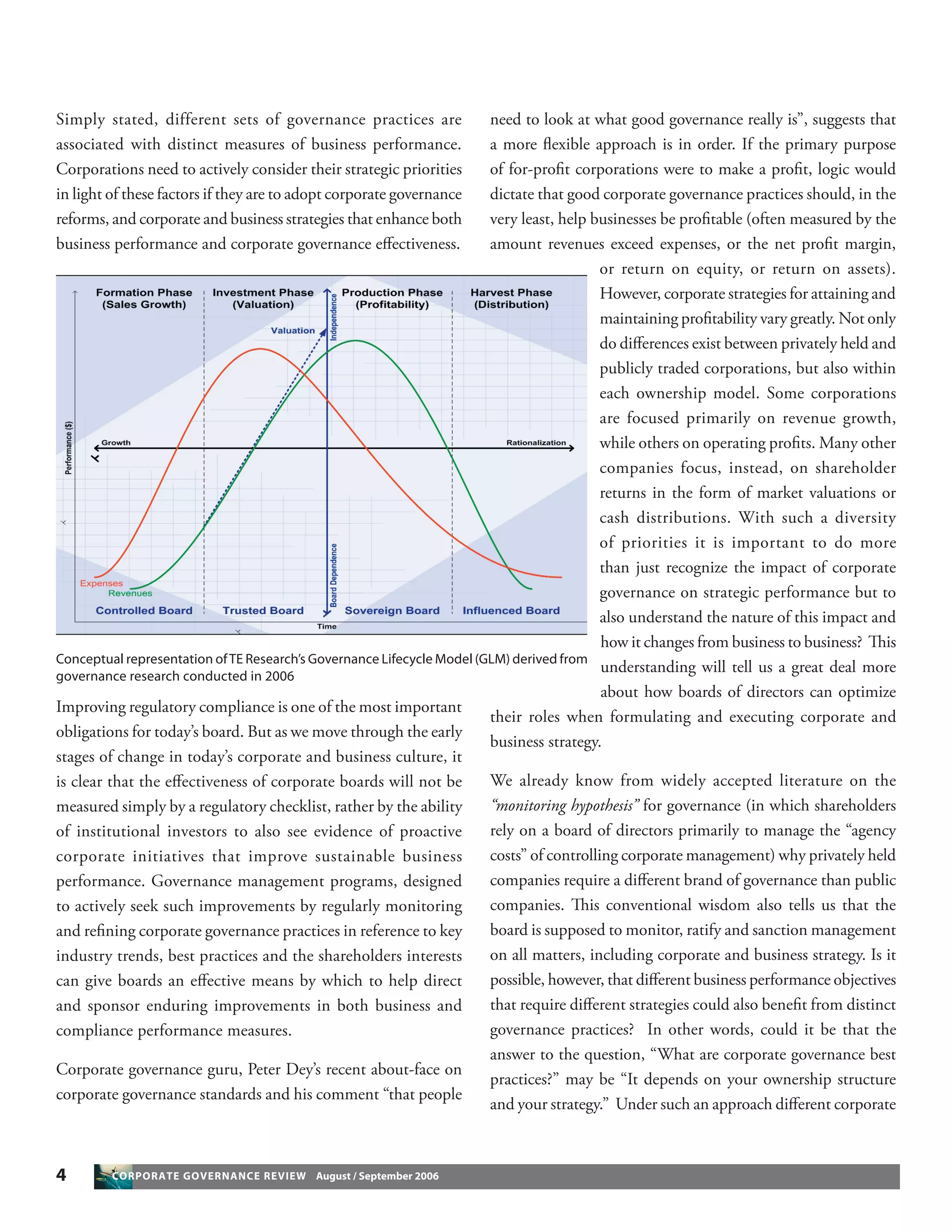
Conceptual representation ofTE Research’s Governance Lifecycle Model (GLM) derived from
governance research conducted in 2006
5CORPORATE GOVERNANCE REVIEW August / September 2006
and business strategies may best be served by distinct bundles
of governance practices appropriate to their type of business. If
so, there would be merit in Mr. Dey’s insight that “each board
will decide what the right formula is”.
E V A L U A T I N G T H E R E L A T I O N S H I P
B E T W E E N C O R P O R A T E G O V E R N A N C E
A N D B U S I N E S S P E R F O R M A N C E
In 2004, Lawrence D. Brown and Marcus L. Caylor from
Georgia State University published a research paper entitled
“Corporate Governance and Firm Performance”. They
correlated business performance data on 2,327 companies
from Compustat with 51 corporate governance provisions from
Institutional Shareholder Services (ISS) to conclude that “firms
with relatively poor governance are relatively less profitable (lower
return on equity and profit margin), less valuable (smaller Tobin’s
Q), and pay out less cash to their shareholders (lower dividend
yield and smaller stock repurchase).” They also identified the
specific governance factors that contribute most to business
performance, saying:
“We find that the 13 factors associated most often with good
performance are all directors attended at least 75% of board
meetings or had a valid excuse for non-attendance, board is
controlled by more than 50% independent outside directors,
nominating committee is independent, governance committee
meets once a year, board guidelines are in each proxy statement,
option re-pricing did not occur in the last three years, option
burn rate is not excessive, option re-pricing is prohibited,
executives are subject to stock ownership guidelines, directors
are subject to stock ownership guidelines, mandatory retirement
age for directors exists, performance of the board is reviewed
regularly, and board has outside advisors…. We identify seven
factors that are associated most often with bad performance,
namely, consulting fees paid to auditors are less than audit fees
paid to auditors, managers respond to shareholder proposals
within 12 months of shareholder meeting, board members
are elected annually (no staggered board), a simple majority
vote is required to approve a merger (not a super-majority),
company either has no poison pill or a pill that was shareholder
approved, a majority vote is required to amend charter/bylaws
(not a super-majority), and all directors with more than one
year of service own stock.”
Independently, TE Research has developed a paradigm that
reveals a strong correlation between business performance and
the enhancement and protection of conditions conducive to
creating trust. When considered together with the detailed
findings from the Brown and Caylor study, the existence of a
similar relationship between the corporate governance practices
that help establish trust and business performance was predicted.
We therefore used the same “Trust Enablement™ Framework
paradigm to assess conditions for trusting corporate governance
practices, as a filter, to classify each of the best practices that
were associated with enhanced business performance according
to their respective roles; as either helping to establish or ensure
(protect from a loss or deficiency of) trust. Our findings not
only validated our predictions but also identified common
characteristics of groupings of governance best practices that
were associated with distinct business performance metrics. Four
key factors where identified through this process:
1. Control - management controlled companies have better
sales growth performance;
2. Trust - companies with corporate governance practices
that help shareholders establish trust enjoy higher valuations
(Tobin’s Q);
3. Sovereignty - companies with truly independent boards,
both from management and shareholders, are more profitable
(return on equity and profit margins); and
4. Influence – companies with boards that are strongly
influenced by management and where shareholders have fewer
rights pay out more to shareholders in dividends and stock
repurchases.
It is noteworthy that counter intuitively, Brown and Caylor
found governance practices that enhance shareholder rights
to be strongly associated with poor business performance.
This finding brings to question whether the “monitoring
hypothesis” for corporate governance is sufficient to describe
the role of corporate boards, as one would expect shareholder
6 CORPORATE GOVERNANCE REVIEW August / September 2006
empowerment to be the overriding factor that drives a board’s
monitoring mandate and hence business performance.
Moreover, it lends support to the complementary “mediating
hypothesis” proposed by Lynn S. Stout from the University
of California, in her paper “Investors’ Choices”, namely that
“shareholders also seek to ‘tie their own hands’ by ceding control to
directors….” In other words, shareholders of public companies
generally prefer to trust rather than control their boards.
Consistent with this concept of the board, in a recent article that
appeared in Director, the newsletter of the Institute of Corporate
Governance, William A. Dimma, author of the book Tougher
Boards for Tougher Times, describes “the role of the board
as an intermediary between management and shareholders”.
In contrast with the traditional views of monitoring boards
being analogous to judges, the mediating role ascribes more of
a paternal archetype to the board. Our findings support these
views by revealing that shareholders who have reasons to trust
their sovereign boards are more often rewarded with higher
corporate profitability and share price values.
Our research revealed that governance best practices, such as
the average options granted in the past three years as a percentage
of basic shares outstanding did not exceed 3% (option burn rate),
board members are elected annually, and company either has no
poison pill or a pill that was shareholder approved (in apparent
contradiction, otherwise found to be associated with poor business
performance), among others help to establish shareholder trust
and are associated with higher share valuations. This leads
us to question what other, yet to be defined, governance best
practices could corporations adopt in order to further reduce
their cost of capital?
Would it be reasonable to expect, for example, that empowering
institutional shareholders with an ability to regularly contribute
comments directly to the boards of directors could help them
to establish even higher levels of trust and confidence in the
issuer’s ability to sustain superior business performance? In fact,
according to a recent article in The New York Times, publicly
traded companies are increasingly moving in that direction
by opening direct communication between boards and their
shareholders. The article asserts “22 percent of the S. & P. 500
reported that their boards had direct contact with shareholder
groups. But five years ago, it would have been close to zero.” It
is evident that improved communication between boards and
shareholders can be a significant factor in improving shareholder
trust, which is amply rewarded with higher market valuations.
Taking these factors into account it became obvious that there
was a large probability that these findings should be viewed
through the prism of a Governance Lifecycle Model™ (GLM)
that provides a useful roadmap for strategically matching best
corporate governance practices to the strategic objectives that
typify each phase of a natural corporate lifecycle. For example:
• Formation Phase: Entrepreneurial companies may
benefit from having corporate governance practices that
allow management more Control over the board, because
entrepreneurial start-ups are typically owner managed and
strategically focused on sales revenue growth;
• Investment Phase: Pre-IPO (initial public offering)
companies and publicly traded companies involved in mergers
and acquisitions (M&A) may benefit from governance practices
that build investor Trust, because when raising capital or
acquiring assets, companies strategically focus on leveraging
higher valuations;
• Production Phase: Publicly traded companies may benefit
from having corporate governance practices that support board
Sovereignty, because public companies need to satisfy more
stringent corporate governance standards and capital markets
expect them to strategically optimize their businesses for
profitability; and
• Harvest Phase: Mature or declining publicly traded
companies may benefit from having corporate governance
practices that allow management to Influence board decisions,
because a reliable, “cash cow” company may benefit from
strategically adopting a proceeds distribution strategy on behalf
of its shareholders.
Even more broadly, our findings cast new light on some
fundamental issues plaguing corporate governance reform:
7CORPORATE GOVERNANCE REVIEW August / September 2006
a) They reveal a symbiotic relationship between corporate
governance and business strategy, making interdependence
inherent in the relationship of strategic corporate objectives
and complementary corporate governance practices. Neither
are stand alone considerations;
b) They suggest a phased, lifecycle approach to corporate
governance is an important step in moving beyond simple
compliance enhancement, toward helping boards achieve a
sustained and positive impact on the overall performance of
their business operations;
c) They clarify the arguments in the debate over “shareholder
versus stakeholder” theory for corporate governance by
demonstrating how, depending on their business strategies,
boards can effectively serve the interests of different stakeholders,
beyond those of equity shareholders alone;
d) They distinguish between the relative roles of control and
trust in corporate governance, by recognizing that each approach
to attaining required levels of stakeholder confidence may be
valid, depending on the company’s business strategy; and
e) They indicate the essential nature of the board to be a
supportive and mediating paternal archetype that adaptively
serves the evolving needs of the corporation throughout its
lifecycle, rather than a dispassionate and rigid judge of good
and bad management.
Practically speaking, we hope these insights will help corporate
governance policy makers decide on pressing issues, such as
board composition of closely controlled corporations and
governance best practices for income trusts. Corporate directors
can benefit by starting a program to proactively and productively
manage their own governance practices relative to their
companies’ strategic priorities, beyond simply managing the
risks of regulatory compliance and their liability exposures.
Such an approach can present a real opportunity for corporate
boards to make meaningful contributions to the specific needs of
their organizations and in doing so respond to Mr. Dey’s notion of
developing“theirownbrandofcorporategovernancebestpractices”
with enlightenment and impactful strategic thinking.
Alex Todd is founder and CEO of TE Research, the research arm
of Trust Enablement Inc. that specializes in helping corporations
achieve their business goals by optimizing the trust of their
stakeholders. The governance research report discussed in this article
can be ordered by writing to AlexTodd@TrustEnablement.com.
Shareholder Votes Loud and Clear Despite Muffled
Reporting of Vote Results
by Julie Scott and Michelle Tan
Seemingly oblivious to the push of regulation or the pull of
shareholder activists, Canadian issuers show no discernable
improvement in filing meaningful voting reports. Our annual
survey of voting results shows that timeliness has improved
slightly overall while the quality of disclosure has stagnated.
Yet despite this lack of transparency, or maybe because of it
shareholders continue to utilize the votes to communicate
assert their views.
M E T H O D O L O G Y
For the 2006 survey of voting results, we compiled a database
of 2,183 annual general and special meetings held between
January 1 and June 30, 2006 covered by ISS and all the Report
of Voting Results (Voting Reports) filed on SEDAR for these
meetings between January and August 2006. Issuers at 839
of those meetings (38%) were successful in filing a report on
voting results prior to September. While this figure appears
8 CORPORATE GOVERNANCE REVIEW August / September 2006
extremely low, it is identical to the filing rate from 2005 and
we should note that NI51-102 does not require issuers listed on
the Toronto Venture Exchange (TSX Venture) to file a Voting
Report. TSX Venture-listed companies account for more than
half of all the issuers in the ISS universe of Canadian companies
and some voluntarily file Voting Reports. While these results
suggest to shareholders that their franchise is not important or
being taken seriously by issuers, closer inspection of the details
contained in the Voting Reports show that shareholders are
voicing their views loudly and issuers are becoming cognizant
of appearing to dismiss shareholder concerns too lightly.
B A C K G R O U N D
The Canadian Securities Administrators acknowledged the
importance of disclosing voting results when it finally included
a requirement to file voting reports in National Instrument
51–102 – Continuous Disclosure Obligations. The Instrument
requires issuers to publish the results of all items voted on at
shareholder meetings.While it was a commendable first step, the
Instrument provides for great flexibility in the amount of details
disclosed as well as no guidance on acceptable timeliness for the
filing of reports. More specifically, the instrument allows;
(1) vote tallies to be omitted when the vote is not conducted
by a ballot; and
(2) percentages of votes cast rather than actual numbers of shares
voted even when the vote is conducted by ballot.
This lack of a standardized disclosure requirements contributes
to the large number of opaque filings that provide less than full
disclosure, which can in the worst cases become misleading.
T I M E L I N E S S : N E X T T O G O D L I N E S S
The number of days between the annual meeting and the filing
of Voting Reports has further declined in this the third year in
which issuers have been required to file voting results. While
the average number of days for all issuers dropped dramatically
from the inaugural year – from 16.0 in 2004 to 9.2 days in
2005 – the decrease this year was significantly smaller. From
the 2006 proxy season, all issuers took an average of 7.1
days to file results, with companies listed on the S&P TSX
Composite Index (Index companies) taking an average of 5.7
days, and non-Index companies taking 7.3 days. While this
year’s improvement is small, it is encouraging nonetheless to
see a substantial number of issuers, both Index and non-Index,
able and willing to file voting
reports within one day of
holding their meetings.
S H O W O F
H A N D V O T I N G :
C O N V E N I E N C E V S
T R A N S P A R E N C Y
On the other hand, we were
disappointed to note from
the provided disclosure
that the number of agenda
items being approved by a
show of hands vote (SOH)
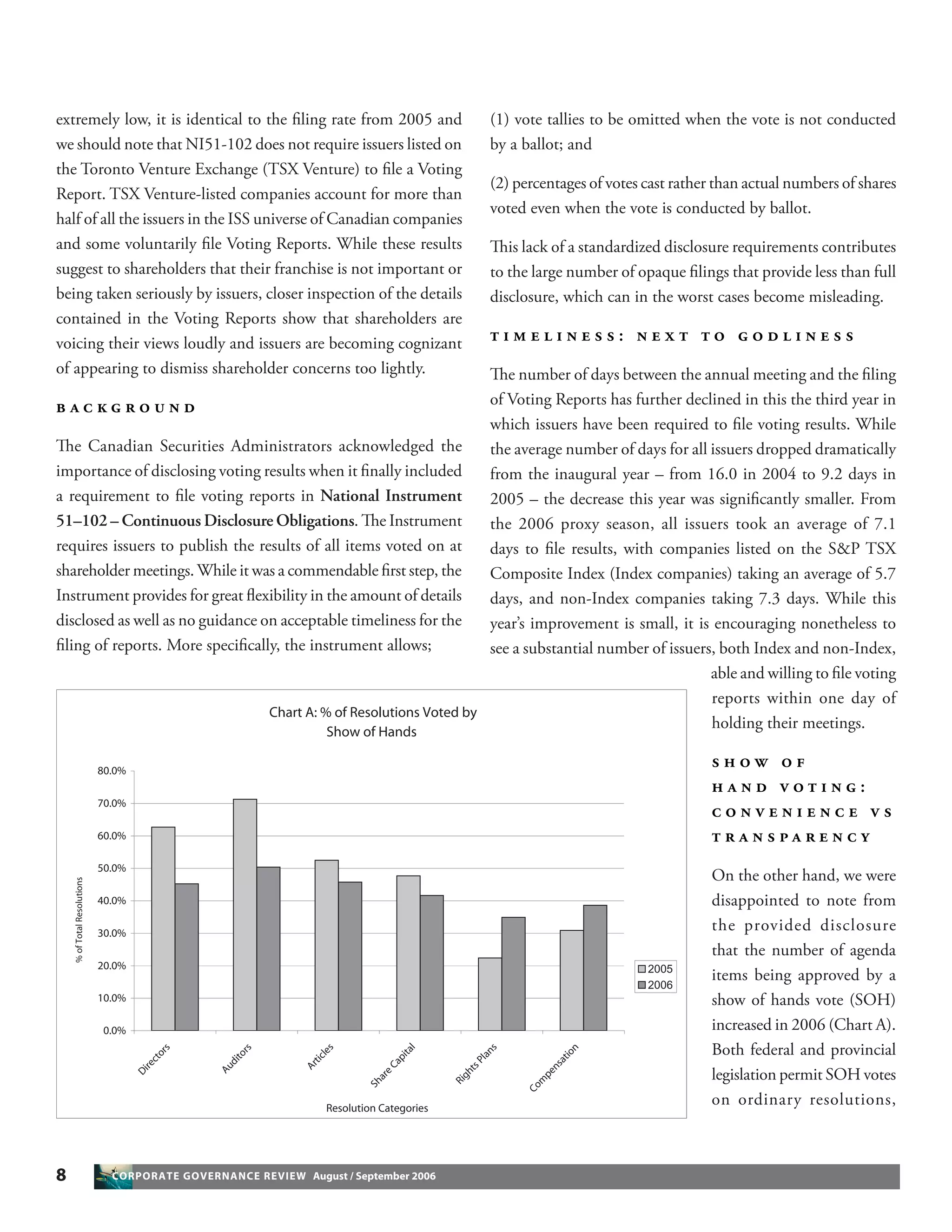
increased in 2006 (Chart A).
Both federal and provincial
legislation permit SOH votes
on ordinary resolutions,
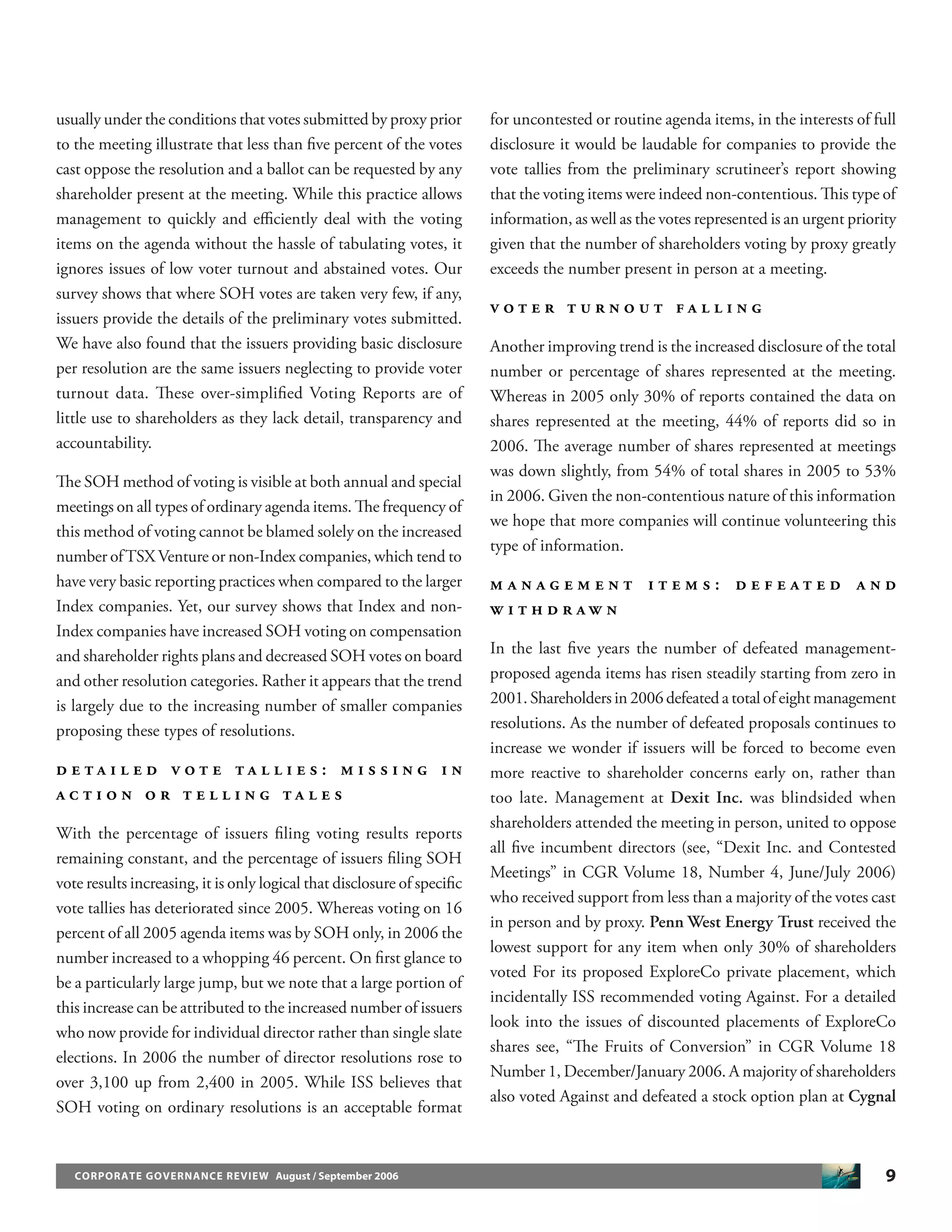
Chart A: % of Resolutions Voted by
Show of Hands
0.0%
10.0%
20.0%
30.0%
40.0%
50.0%
60.0%
70.0%
80.0%
Directors
Auditors
Articles
Share
Capital
RightsPlans
Com
pensation
Resolution Categories
%ofTotalResolutions
2005
2006
9CORPORATE GOVERNANCE REVIEW August / September 2006
usually under the conditions that votes submitted by proxy prior
to the meeting illustrate that less than five percent of the votes
cast oppose the resolution and a ballot can be requested by any
shareholder present at the meeting. While this practice allows
management to quickly and efficiently deal with the voting
items on the agenda without the hassle of tabulating votes, it
ignores issues of low voter turnout and abstained votes. Our
survey shows that where SOH votes are taken very few, if any,
issuers provide the details of the preliminary votes submitted.
We have also found that the issuers providing basic disclosure
per resolution are the same issuers neglecting to provide voter
turnout data. These over-simplified Voting Reports are of
little use to shareholders as they lack detail, transparency and
accountability.
The SOH method of voting is visible at both annual and special
meetings on all types of ordinary agenda items. The frequency of
this method of voting cannot be blamed solely on the increased
number ofTSX Venture or non-Index companies, which tend to
have very basic reporting practices when compared to the larger
Index companies. Yet, our survey shows that Index and non-
Index companies have increased SOH voting on compensation
and shareholder rights plans and decreased SOH votes on board
and other resolution categories. Rather it appears that the trend
is largely due to the increasing number of smaller companies
proposing these types of resolutions.
D E T A I L E D V O T E T A L L I E S : M I S S I N G I N
A C T I O N O R T E L L I N G T A L E S
With the percentage of issuers filing voting results reports
remaining constant, and the percentage of issuers filing SOH
vote results increasing, it is only logical that disclosure of specific
vote tallies has deteriorated since 2005. Whereas voting on 16
percent of all 2005 agenda items was by SOH only, in 2006 the
number increased to a whopping 46 percent. On first glance to
be a particularly large jump, but we note that a large portion of
this increase can be attributed to the increased number of issuers
who now provide for individual director rather than single slate
elections. In 2006 the number of director resolutions rose to
over 3,100 up from 2,400 in 2005. While ISS believes that
SOH voting on ordinary resolutions is an acceptable format
for uncontested or routine agenda items, in the interests of full
disclosure it would be laudable for companies to provide the
vote tallies from the preliminary scrutineer’s report showing
that the voting items were indeed non-contentious. This type of
information, as well as the votes represented is an urgent priority
given that the number of shareholders voting by proxy greatly
exceeds the number present in person at a meeting.
V O T E R T U R N O U T F A L L I N G
Another improving trend is the increased disclosure of the total
number or percentage of shares represented at the meeting.
Whereas in 2005 only 30% of reports contained the data on
shares represented at the meeting, 44% of reports did so in
2006. The average number of shares represented at meetings
was down slightly, from 54% of total shares in 2005 to 53%
in 2006. Given the non-contentious nature of this information
we hope that more companies will continue volunteering this
type of information.
M A N A G E M E N T I T E M S : D E F E A T E D A N D
W I T H D R A W N
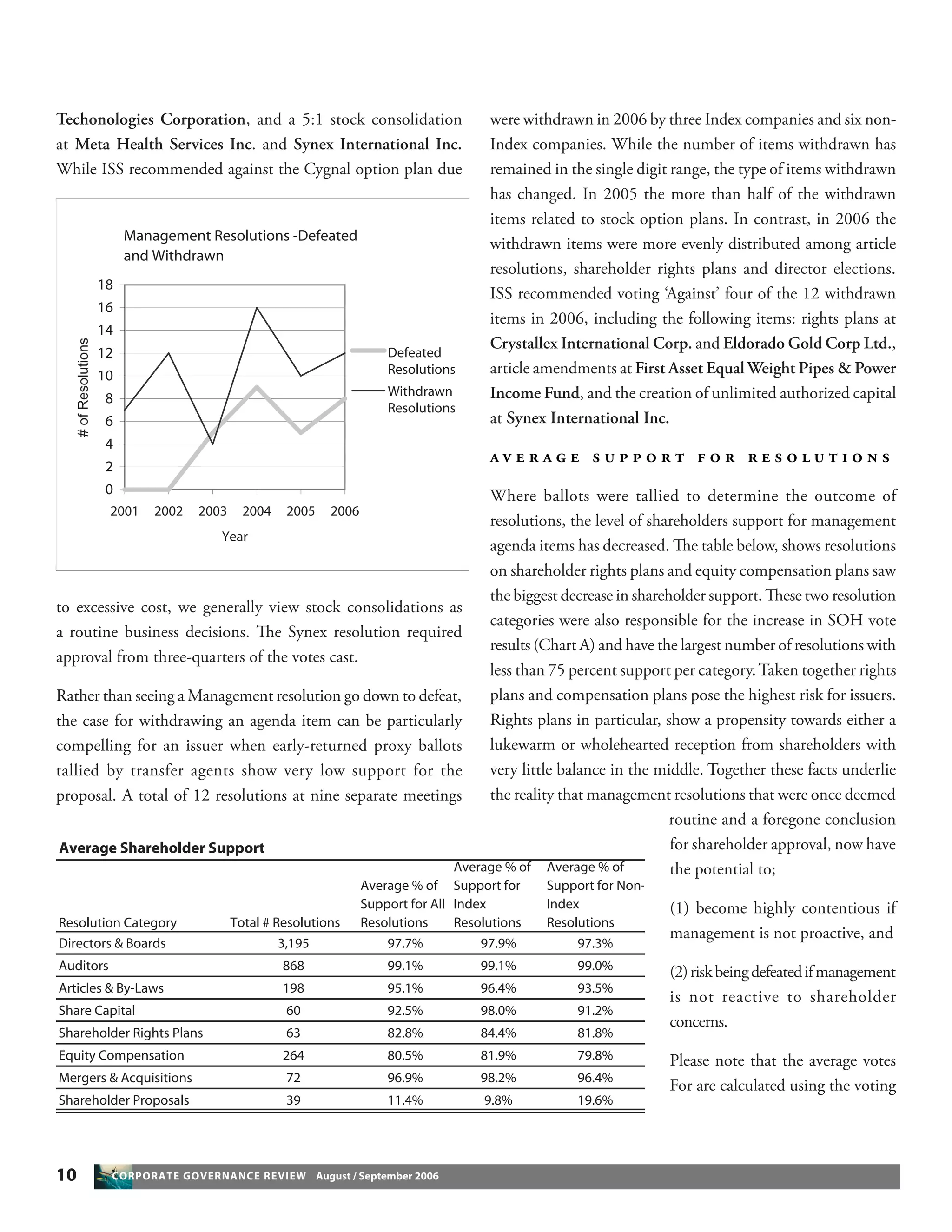
In the last five years the number of defeated management-
proposed agenda items has risen steadily starting from zero in
2001. Shareholders in 2006 defeated a total of eight management
resolutions. As the number of defeated proposals continues to
increase we wonder if issuers will be forced to become even
more reactive to shareholder concerns early on, rather than
too late. Management at Dexit Inc. was blindsided when
shareholders attended the meeting in person, united to oppose
all five incumbent directors (see, “Dexit Inc. and Contested
Meetings” in CGR Volume 18, Number 4, June/July 2006)
who received support from less than a majority of the votes cast
in person and by proxy. Penn West Energy Trust received the
lowest support for any item when only 30% of shareholders
voted For its proposed ExploreCo private placement, which
incidentally ISS recommended voting Against. For a detailed
look into the issues of discounted placements of ExploreCo
shares see, “The Fruits of Conversion” in CGR Volume 18
Number 1, December/January 2006. A majority of shareholders
also voted Against and defeated a stock option plan at Cygnal
10 CORPORATE GOVERNANCE REVIEW August / September 2006
Techonologies Corporation, and a 5:1 stock consolidation
at Meta Health Services Inc. and Synex International Inc.
While ISS recommended against the Cygnal option plan due
to excessive cost, we generally view stock consolidations as
a routine business decisions. The Synex resolution required
approval from three-quarters of the votes cast.
Rather than seeing a Management resolution go down to defeat,
the case for withdrawing an agenda item can be particularly
compelling for an issuer when early-returned proxy ballots
tallied by transfer agents show very low support for the
proposal. A total of 12 resolutions at nine separate meetings
were withdrawn in 2006 by three Index companies and six non-
Index companies. While the number of items withdrawn has
remained in the single digit range, the type of items withdrawn
has changed. In 2005 the more than half of the withdrawn
items related to stock option plans. In contrast, in 2006 the
withdrawn items were more evenly distributed among article
resolutions, shareholder rights plans and director elections.
ISS recommended voting ‘Against’ four of the 12 withdrawn
items in 2006, including the following items: rights plans at
Crystallex International Corp. and Eldorado Gold Corp Ltd.,
article amendments at First Asset EqualWeight Pipes & Power
Income Fund, and the creation of unlimited authorized capital
at Synex International Inc.
A V E R A G E S U P P O R T F O R R E S O L U T I O N S
Where ballots were tallied to determine the outcome of
resolutions, the level of shareholders support for management
agenda items has decreased. The table below, shows resolutions
on shareholder rights plans and equity compensation plans saw
the biggest decrease in shareholder support. These two resolution
categories were also responsible for the increase in SOH vote
results (Chart A) and have the largest number of resolutions with
less than 75 percent support per category.Taken together rights
plans and compensation plans pose the highest risk for issuers.
Rights plans in particular, show a propensity towards either a
lukewarm or wholehearted reception from shareholders with
very little balance in the middle. Together these facts underlie
the reality that management resolutions that were once deemed
routine and a foregone conclusion
for shareholder approval, now have
the potential to;
(1) become highly contentious if
management is not proactive, and
(2)riskbeingdefeatedifmanagement
is not reactive to shareholder
concerns.
Please note that the average votes
For are calculated using the voting
Management Resolutions -Defeated
and Withdrawn
0
2
4
6
8
10
12
14
16
18
2001 2002 2003 2004 2005 2006
Year
#ofResolutions
Defeated
Resolutions
Withdrawn
Resolutions
Average Shareholder Support
Resolution Category Total # Resolutions
Average % of
Support for All
Resolutions
Average % of
Support for
Index
Resolutions
Average % of
Support for Non-
Index
Resolutions
Directors & Boards 3,195 97.7% 97.9% 97.3%
Auditors 868 99.1% 99.1% 99.0%
Articles & By-Laws 198 95.1% 96.4% 93.5%
Share Capital 60 92.5% 98.0% 91.2%
Shareholder Rights Plans 63 82.8% 84.4% 81.8%
Equity Compensation 264 80.5% 81.9% 79.8%
Mergers & Acquisitions 72 96.9% 98.2% 96.4%
Shareholder Proposals 39 11.4% 9.8% 19.6%
11CORPORATE GOVERNANCE REVIEW August / September 2006
results reports that include tallies; while reports with SOH
results were excluded.
D I R E C T O R S
The director resolutions category encompasses all individual
and slate director elections as well as resolutions fixing the size
of boards. An overall high approval rating for director elections
with average votes For directors reaching 97.7 percent is almost
unchanged from 97.8 percent in 2005. Given the sheer volume
of director elections both by slate and individually, this average
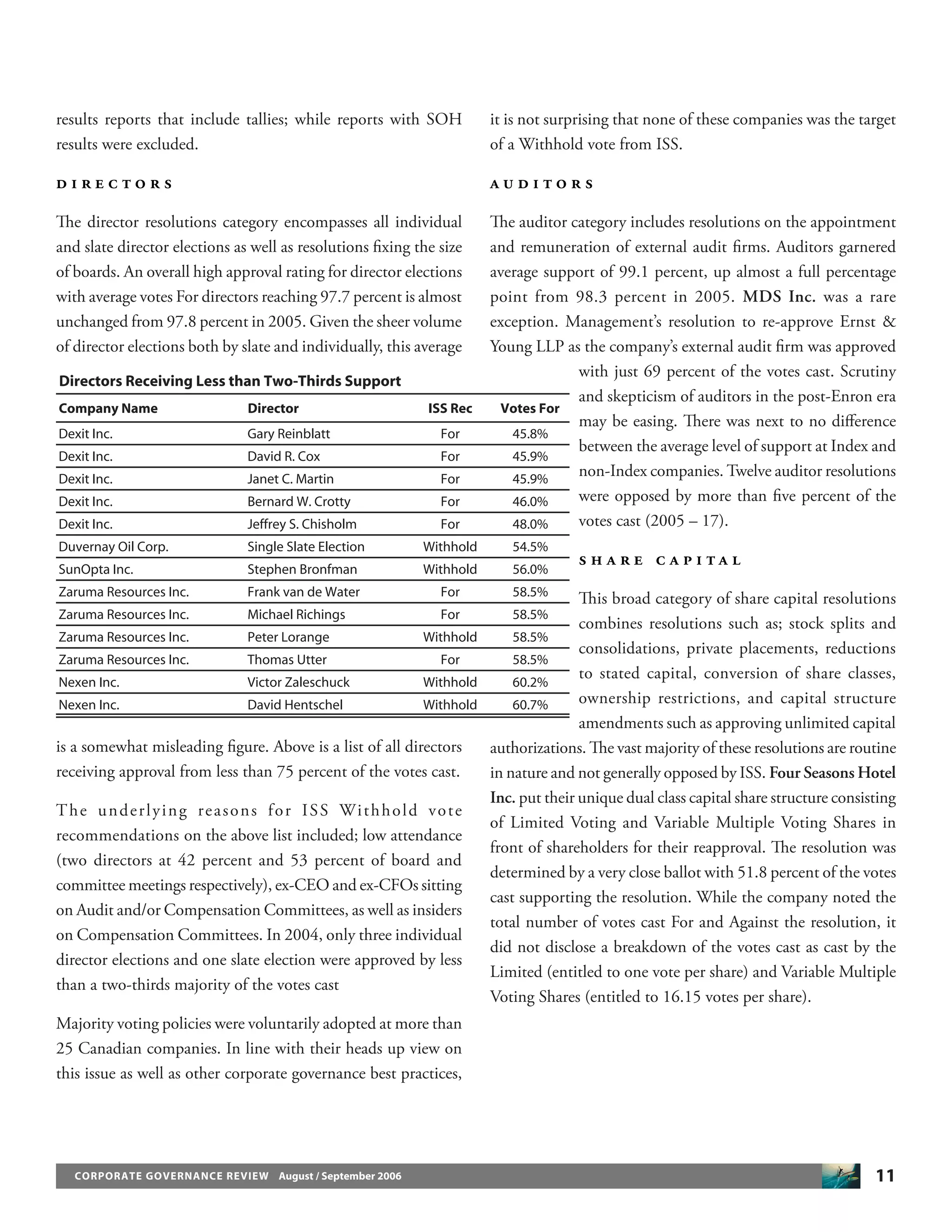
is a somewhat misleading figure. Above is a list of all directors
receiving approval from less than 75 percent of the votes cast.
The underlying reasons for ISS Withhold vote
recommendations on the above list included; low attendance
(two directors at 42 percent and 53 percent of board and
committee meetings respectively), ex-CEO and ex-CFOs sitting
on Audit and/or Compensation Committees, as well as insiders
on Compensation Committees. In 2004, only three individual
director elections and one slate election were approved by less
than a two-thirds majority of the votes cast
Majority voting policies were voluntarily adopted at more than
25 Canadian companies. In line with their heads up view on
this issue as well as other corporate governance best practices,
it is not surprising that none of these companies was the target
of a Withhold vote from ISS.
A U D I T O R S
The auditor category includes resolutions on the appointment
and remuneration of external audit firms. Auditors garnered
average support of 99.1 percent, up almost a full percentage
point from 98.3 percent in 2005. MDS Inc. was a rare
exception. Management’s resolution to re-approve Ernst &
Young LLP as the company’s external audit firm was approved
with just 69 percent of the votes cast. Scrutiny
and skepticism of auditors in the post-Enron era
may be easing. There was next to no difference
between the average level of support at Index and
non-Index companies. Twelve auditor resolutions
were opposed by more than five percent of the
votes cast (2005 – 17).
S H A R E C A P I T A L
This broad category of share capital resolutions
combines resolutions such as; stock splits and
consolidations, private placements, reductions
to stated capital, conversion of share classes,
ownership restrictions, and capital structure
amendments such as approving unlimited capital
authorizations. The vast majority of these resolutions are routine
in nature and not generally opposed by ISS. Four Seasons Hotel
Inc. put their unique dual class capital share structure consisting
of Limited Voting and Variable Multiple Voting Shares in
front of shareholders for their reapproval. The resolution was
determined by a very close ballot with 51.8 percent of the votes
cast supporting the resolution. While the company noted the
total number of votes cast For and Against the resolution, it
did not disclose a breakdown of the votes cast as cast by the
Limited (entitled to one vote per share) and Variable Multiple
Voting Shares (entitled to 16.15 votes per share).
Company Name Director ISS Rec Votes For
Dexit Inc. Gary Reinblatt For 45.8%
Dexit Inc. David R. Cox For 45.9%
Dexit Inc. Janet C. Martin For 45.9%
Dexit Inc. Bernard W. Crotty For 46.0%
Dexit Inc. Jeffrey S. Chisholm For 48.0%
Duvernay Oil Corp. Single Slate Election Withhold 54.5%
SunOpta Inc. Stephen Bronfman Withhold 56.0%
Zaruma Resources Inc. Frank van de Water For 58.5%
Zaruma Resources Inc. Michael Richings For 58.5%
Zaruma Resources Inc. Peter Lorange Withhold 58.5%
Zaruma Resources Inc. Thomas Utter For 58.5%
Nexen Inc. Victor Zaleschuck Withhold 60.2%
Nexen Inc. David Hentschel Withhold 60.7%
Directors Receiving Less than Two-Thirds Support
12 CORPORATE GOVERNANCE REVIEW August / September 2006
S H A R E H O L D E R R I G H T S P L A N S
Shareholders continue to question rights plans as
a safeguard in the battle for control of companies,
especially those in the booming energy sector.
Compared to the consensual voting for directors,
voting for rights plans is less certain with average
support at 83% in 2006. Of the companies
providing a vote tally, ISS supported 22 rights
plans which went on to receive average shareholder
support form 85.4 percent of the votes cast. Support
fell to 78.5 percent for the 15 plans that ISS did
not support, as they could not be considered ‘next
generation’. Spinrite Income Fund proposed a new
unitholder rights plan for shareholder approval at
their annual general meeting. While ISS found most
of the terms and provisions of the Spinrite plan to
conform to ‘new generation’ guidelines for Canadian
rights plans, the plan deviated in one significant
aspect, in that it did not permit partial bids. In our
initial report, ISS recommended shareholders vote
Against the plan. We issued an alert and updated
our vote recommendation, a day later and two weeks
prior to the voting deadline, after the fund filed an
amendment to its original rights plan to the effect
of permitting partial bids. After receiving votes from
almost half of the issued and outstanding shares,
even as a ‘new generation’ rights plan, the resolution
received support from only 51.9 percent of the votes
cast. Requiring a simple majority of votes cast to be
approved, the resolution just barely squeaked through. However,
in their Report of Voting results, the fund noted that it, “did not
wish to act in a manner not supported by its unitholders”. The
boardthereforewithdrewtheresolutionandthefundwasdeemed
to have elected to have redeemed the rights at the redemption
price of $0.00001 per right.
C O M P E N S A T I O N
Shareholders continue to be increasingly critical of executive
compensation plans. Average shareholder support for equity
compensation plans continues to be the lowest of all types of
agenda items with average support down slightly from 82%
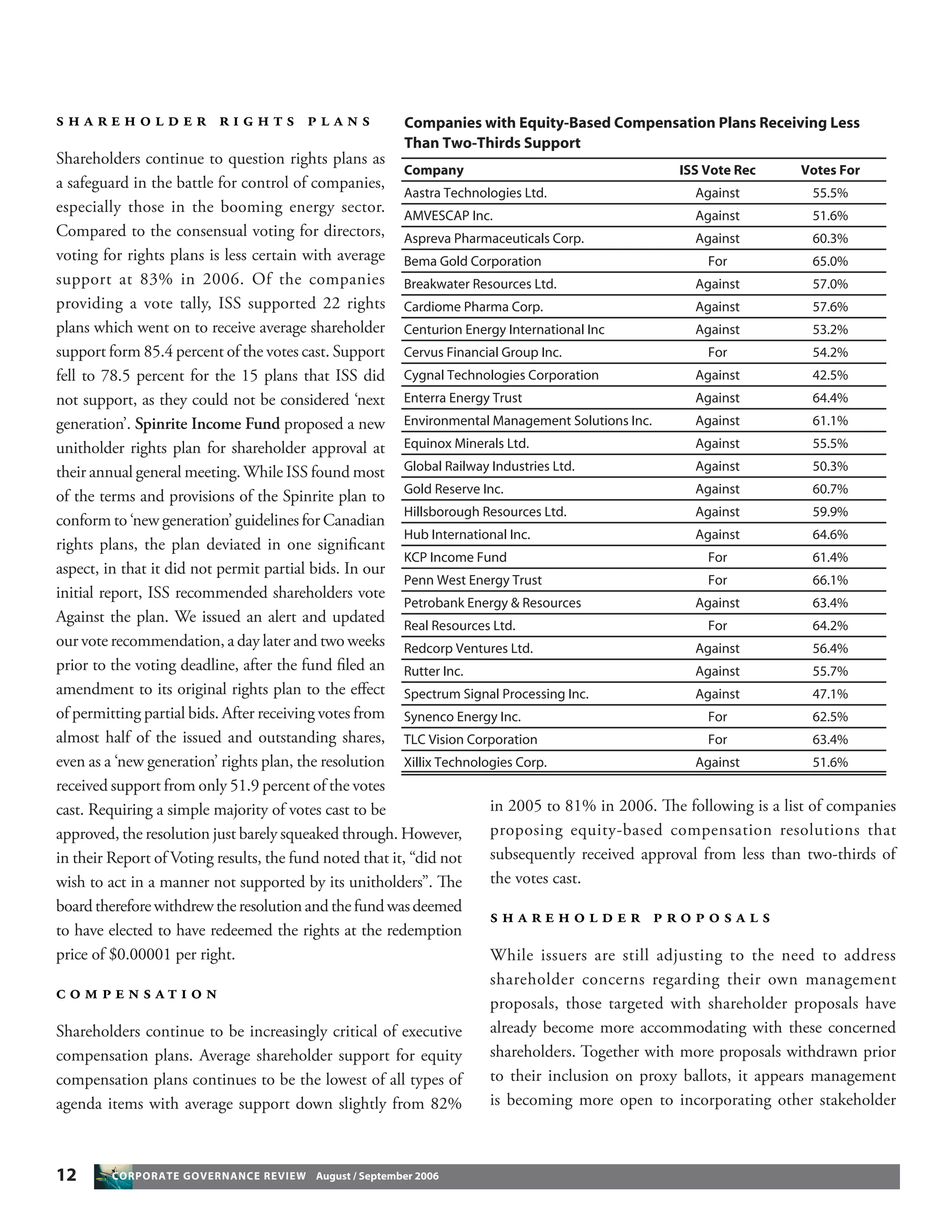
in 2005 to 81% in 2006. The following is a list of companies
proposing equity-based compensation resolutions that
subsequently received approval from less than two-thirds of
the votes cast.
S H A R E H O L D E R P R O P O S A L S
While issuers are still adjusting to the need to address
shareholder concerns regarding their own management
proposals, those targeted with shareholder proposals have
already become more accommodating with these concerned
shareholders. Together with more proposals withdrawn prior
to their inclusion on proxy ballots, it appears management
is becoming more open to incorporating other stakeholder
Company ISS Vote Rec Votes For
Aastra Technologies Ltd. Against 55.5%
AMVESCAP Inc. Against 51.6%
Aspreva Pharmaceuticals Corp. Against 60.3%
Bema Gold Corporation For 65.0%
Breakwater Resources Ltd. Against 57.0%
Cardiome Pharma Corp. Against 57.6%
Centurion Energy International Inc Against 53.2%
Cervus Financial Group Inc. For 54.2%
Cygnal Technologies Corporation Against 42.5%
Enterra Energy Trust Against 64.4%
Environmental Management Solutions Inc. Against 61.1%
Equinox Minerals Ltd. Against 55.5%
Global Railway Industries Ltd. Against 50.3%
Gold Reserve Inc. Against 60.7%
Hillsborough Resources Ltd. Against 59.9%
Hub International Inc. Against 64.6%
KCP Income Fund For 61.4%
Penn West Energy Trust For 66.1%
Petrobank Energy & Resources Against 63.4%
Real Resources Ltd. For 64.2%
Redcorp Ventures Ltd. Against 56.4%
Rutter Inc. Against 55.7%
Spectrum Signal Processing Inc. Against 47.1%
Synenco Energy Inc. For 62.5%
TLC Vision Corporation For 63.4%
Xillix Technologies Corp. Against 51.6%
Companies with Equity-Based Compensation Plans Receiving Less
Than Two-Thirds Support
13CORPORATE GOVERNANCE REVIEW August / September 2006
concerns into their decision-making process. In 2006, the
number of shareholder proposed resolutions appearing on
meeting agendas decreased while the average support has
increased. After reaching a high of 95 in 2005 (also reached in
2003) the total number of shareholder proposals fell to 39 at
19 meetings in 2006. In 2006 shareholders more than doubled
average support for their proposals from 5.4% in 2006 to
11.4% in 2006.
Abitibi Consolidated Inc.’s shareholder resolution requesting
individual director elections, won support from 70 percent of
the votes cast, partly explaining the jump in average support
and counting as the only shareholder proposal to be approved in
2006. Given that activist shareholders, along with ISS, have long
advocated for individual director elections, the majority support
for this proposal is unsurprising. Rather, it is striking that given
the shift toward greater director accountability, the board chose to
put this proposal to a vote rather than adopting it voluntarily.
Just as management-proposed agenda items with less than
75% support are unusual in Canada, so too are shareholder-
proposed agenda items with greater than 5% support. Proposals
to prepare human rights reports on China and
Tibet won an eye-popping percentage of ‘For’
votes at Power Corporation of Canada (10%),
Nortel Networks Corporation (36%) and
Bombardier Inc. (10%). Another shareholder
proposal relating to human rights and winning
unusually high support (38%) was the proposal
at Alcan Inc. to prepare a report on the social
impact of its operations in Kashipur India. Since
ISS recognizes the value of labour standards
and formal company policies on human rights
practices, particularly for companies that
have operations or substantial investments in
countries where there are fewer protections for
workers and human rights, we recommended
shareholders vote ‘For’ these shareholder
proposals.
P R O X Y C O N T E S T S
Extreme concerned shareholders go beyond
shareholder proposals, instead launching proxy
fights for control of the issuer’s board. It is difficult to report on
voting results at proxy contests as management and dissidents
are often able to negotiate compromises prior to going to a vote.
Three recent proxy contests at Gallery Resources Ltd., Vanguard
Investments Corp., and MOSAID Technologies Incorporated,
discussed later in this issue in the Company News Briefs section
illustrate this fact. In the case of WEX Pharmaceuticals Inc. the
companypostponedtheirAGMuponreceiptofadissidentcircular
which proposed an alternate slate of directors and recommended
shareholders vote against a shareholder proposal to create a royalty
trust and an amendment of outstanding warrant terms. The
company gained the support of the “dis-satisfied shareholders”,
which included members of the company’s own Advisory Board,
aftermanagementprovidedadditionalinformationandconsulted
with them on several amendments made to the proposals
in contention. The modified slate of directors and warrant
amendment resolutions were approved by a show of hands and
90 percent of votes cast, respectively. The resolution to convert to
a royalty trust was not put to a vote at the postponed meeting.
Depending on which side you were on, and what your final goal
Shareholder Proposals by the Numbers
0
10
20
30
40
50
60
70
80
90
100
110
2000 2001 2002 2003 2004 2005 2006
Number
# Proposals on Ballots # Companies W Proposals on Ballots
# Potential SPs Abandoned
14 CORPORATE GOVERNANCE REVIEW August / September 2006
was, proxy contests of varying success were also waged at the
following companies:
Algoma Steel Inc.
Condor Gold Corp.
Tiverton Petroleums Ltd.
Zaruma Resources Inc.
C O N C L U S I O N
Disclosure of Voting Reports continues to be far from complete.
Most often the percentage of shares represented at the meeting
is the key information missing. However also prominent are
Voting Reports that disclose; only show of hand approved
resolutions without a tally of proxy ballot votes, or resolutions
approved by ballot with percentages but missing the number
proxy votes For, Against and Abstained. ISS has long upheld
that complete disclosure of voting results at annual meetings
is an important part of the shareholder’s franchise and without
it shareholders cannot be assured that their votes have been
counted and contributed to the outcome of decisions made at
annual meetings.
As the third year of required disclosure of vote results parades by,
we continue to see many issuers still providing the most basic and
rudimentary levels of disclosure. As the regulators begin reviewing
other Instruments put in place to build investor confidence we
can only hope that a review and possible amendment of the
continuous disclosure obligations contained in Part 11 of NI51-
102 is also in the near future. As Venture issuers are no less likely
to experience concern from shareholders, removing their current
exemption from the vote reporting process would increase their
sense of accountability to shareholders.
We applaud all issuers who are able to file voting reports within
a week of their meetings and who take the time to carefully
tabulate and report on all the votes submitted to meetings in
person as well as by proxy. The disclosure of voter turnout is the
final piece of the puzzle, allowing each shareholder to gauge for
themselves whether or not they are part of or isolated from the
masses. In lieu of more useful continuous disclosure obligations
we put our trust in the hands of issuers to realize the importance
of making proxy voting a circular process of communication
rather than just the giving and taking of ballots.
Company News Briefs
Pill Update
The following new shareholder rights plans were adopted for
approval at shareholder meetings scheduled during the months
of August and September 2006:
International Wayside Gold Mine
Chariot Resources Ltd.
Bronco Energy Ltd.
Mountain Province Diamonds Inc.
Mega Uranium Ltd.
Keegan Resources Inc.
Pacific Rim Mining
As well, there were four proposals to reconfirm or approve
amended rights plans at the following companies:
Rubincon Minerals Corporation
Mediagrif Interactive
Certicom Corp.
Westbond Enteprises Corp.
Re-filings and Errors List
The following companies were added to the Ontario Securities
Commissions’ Re-filings and Errors List over the last two
months:
Allied Properties Real Estate Income Trust
Aquila Resources Inc.
Atlas Cold Storage Income Trust
Bioniche Life Sciences Inc.
Blue Pearl Mining Ltd.
Certicom Corp.
DVD Investments Limited
Echo Energy Canada Inc.
E.G. Capital Inc.
E-L Financial Corporation Ltd.
Emblem Capital Inc.
Family Memorials Inc.
First Nickel Inc.
The Goldfarb Corporation
H&R Real Estate Investment Trust
15CORPORATE GOVERNANCE REVIEW August / September 2006
Lexam Explorations Inc.
Lorus Therapeutics Inc.
Medoro Resources Ltd.
MedX Health Corp.
Microbix Biosystems Inc.
North Atlantic Resources Ltd.
OutdoorPartner Media Corporation
RoaDor Industries Ltd.
Rtica Corporation
Tiomin Resources Inc.
TLC Vision Corporation
Wesdome Gold Mines Ltd.
Majority Vote Adoptions Update
Ending a long late summer drought, Cognos Inc. kicked off
the fall season, disclosing the adoption of a majority voting
policy on the election of directors in their recent circular. The
Cognos policy included a provision not often seen in previous
Canadian policies whereby if fewer than three independent
directors receive the support of a majority of the votes cast then
all directors may participate in the decision on whether or not
to accept the tendered resignations.
Proxy Contests Camouflaged
In recent months three companies have found themselves the
target of concerned shareholders. A special meeting was convened
on August 14, 2006, by Gallery Resources Ltd. shareholders
after the company failed to respond to their earlier request in
December 2005 to call a shareholder meeting to remove an
incumbent director and elect one or more new directors. Gallery
is currently under investigation from the British Columbia
Securities Commission and the company’s shares were de-listed
from the Toronto Venture Exchange in January 2006.
The dissidents filed an information circular and proxy ballot
proposing a resolution to remove the three incumbent directors
and elect three of their own nominees. While the dissidents
did state that upon election, they would source appropriate
personnel to be retained as President and as Chief Financial
Officer to over see the company’s affairs and work with the
Toronto Stock Exchange and the British Columbia Securities
Commission regarding past accounting issues and the possibility
of re-establishing a listing for the company’s shares, they did
not provide any contact information, background history or
explanation for their proposal. Gallery management did not file
a public response to the concerned shareholders and did not
return ISS phone calls prior to the meeting. Given the lack of
information available from either side, ISS did feel there was
sufficient information to support this resolution.
The Gallery dissidents held just 0.026 percent of the company’s
outstanding shares as of the record date. Notwithstanding this,
over 60 percent of the outstanding shares were represented at the
meeting, and the resolution went on to garner the support of
77 percent of the votes cast. Since being elected, the new board
has appointed the company’s former CFO, Karl S. Basi as the
new Chief Operating Officer and is also seeking legal advice to
rescind recent share awards granted to former employees and
consultants of the company.
Inanothermorerecentone-sidedbattle,concernedshareholdersof
VanguardInvestmentsCorp.calledaspecialmeetingforOctober
6, 2006, following that company’s failure to call a meeting within
21 days of the shareholders requisitioning a meeting. After filing
a prospectus in August 2001 as a Capital Pool Company, the
company was de-listed from theTorontoVenture Stock Exchange
in July 2004 when it failed to complete a QualifyingTransaction.
The company does not appear to have ever held a shareholders’
meeting. Again the dissidents provided very little explanation for
their proposals to remove the incumbent directors and elect their
own nominees, other than to state that upon being elected they
intended to take immediate steps to rectify any deficient filings
and seek opportunities to adequate capitalize the corporation
and establish a business. Vanguard management did not file
a public response to the concerned shareholders and was not
able to provide ISS with any coherent answers. Given the lack
of information available from either side, ISS did feel there was
sufficient information to support this resolution. The Vanguard
dissidents are believed to hold 19 percent of the outstanding
shares, which easily meets the company’s quorum requirement
of two persons representing in person or by proxy at least five
percent of the outstanding shares.
Finally two sides made it to the battlefield well prepared to duke
it out for MOSAID Technologies Incorporated only to reach a
settlement agreement prior to the vote. After calling an AGM for
September, MOSAID received and responded to a letter from
hedge fund Loeb Partners Corporation, stating they would, if
necessary, “engage in a proxy contest to confirm the support
of our shareholders”. Just two weeks prior to the meeting date,
Loeb filed a dissident proxy circular and ballot, proposing to
replace three of the independent incumbent directors with three
of its own nominees.
After numerous meetings with both management and the
dissidents, ISS expected the potential for two different scenarios
unfolding for the company. If the dissidents were to win, the
new board would be driven to effect major changes to unlock
value in the near term, with the process culminating in the
sale of the company. While we believed that the incumbents
would be more concerned with the company as a going concern,
seeking to build value over the long-term through maximization
alternatives, with the dissident’s pressure accelerating the
pace of change. If elected the three dissident directors would
represent a minority of the seven directors, however through
the replacement of independent nominees of the incumbent
board, they would control the key committees of the board.
By taking control of the committees and thus control of the
recommendations made to the board, the dissidents would
assume a much more powerful position than their minority
position would suggest. On the other hand, four of seven
directors would still be incumbent directors, and with three
representing management, board decisions begin to look
particularly challenging especially following a proxy contest.
In the end, ISS decided to support the incumbent board as the
better choice for shareholders over the long term.
Directly and indirectly through various funds, Loeb owns 9.1
percent of the outstanding MOSAID shares. The company held
out until just prior to the AGM, before coming to agreement
with Loeb, which saw the board expanded to ten members
allowing for the election of all seven incumbent and three
dissident nominees. The agreement also specified that Thomas
Csathy will remained as Chairman of the board, and the Special
Committee of the board responsible for conducting the review
of strategic alternatives, will be comprised of two directors
from the MOSAID slate, and two from the Loeb slate, with
the committee Chairman being Eugene Davis. The agreement
further, allows Loeb to designate replacements if any of the Loeb
nominees are unable or unwilling to serve as a director, and
prohibits Loeb from launching a hostile take-over bid within
six months. With the agreement in place all ten nominees were
declared elected as directors.
ISSN 1203-2999
The Review is published six times per year
Subscriptions are available for $295 per year.
Call 416.364.9000 or
visit www.issproxy.com for information
Directors, shareholders or employees of this Company may be beneficial owners of the securities referred to herein.The information contained herein was obtained
from sources which we believe to be reliable, however such information is provided on the understanding that this Company is not responsible for financial losses
or damage of any kind whatsoever resulting from action taken in reliance thereon or from inaccuracies therein. Neither the information nor any opinion expressed
herein constitutes a solicitation by this Company or any of its employees of the purchase or sale of any security. Reproduction of this newsletter, in whole or in part,
is prohibited without the express permission of Institutional Shareholder Services Canada Corp..
Publisher: Institutional Shareholder Services
Canada Corp.
Editor: Michelle Tan
Contributors: Bill Mackenzie
Julie Scott
Debra Sisti
Michelle Tan
Corporate Governance Review

cgr18_5

  • 1.
    Volume 18 No.5August / September 2006 Suite 1400, 67 Yonge St., Toronto, ON, M5E 1J8 Phone 416 364 9000, Website: www.issproxy.com Institutional Shareholder Services Canada Corp. A bi-monthly publication of In This Issue 1CORPORATE GOVERNANCE REVIEW August / September 2006 Don’t Mess With That Option Plan by Debra Sisti and William Mackenzie Those of us who live and breathe for proxy season foresee some extra work coming in 2007. Option plans and any other share-based compensation plans will need to have their Amending Procedures sorted out. TheToronto Stock Exchange (TSX) Company Manual prescribed a list of plan constraints and required material amendments to be approved by shareholders.Today it is possible to have a number of key plan provisions, some previously made untouchable by the TSX, now set out as provisions that can be amended at the sole discretion of the plan administrators. But first, shareholders have to approve specific Amending Procedures, either in the form of an existing plan amendment or within a brand new plan. If new Amending Procedures are not in place by June 30, 2007, the administrators will have no discretion to amend any provision. Consequently, we anticipate, mixed with spring showers next April, a good deluge of option plan amendments. For many years, the TSX had established certain mandatory requirements for equity- based plans. Option terms could not exceed 10 years, awards could not be assignable, no individual could be granted awards for more than 5% of the outstanding shares; and discounted options were not permitted and shareholder approval was required for any material amendment including but not limited to the following types of amendments1 : • Any amendment to the number of securities issuable; • Any change to the eligible participants which would have the potential of broadening or increasing insider participation. • The addition of any form of financial assistance. • Any amendment to a financial assistance provision which is more favourable to participants. • The addition of a cashless exercise feature, payable in cash or securities which does not provide for a full deduction of the number of underlying securities from the Plan reserve. • The addition of a deferred or restricted share unit or grant of shares. Now the TSX will require only the following three types of amendments be subject to security holder approval, regardless of revised Amendment Procedures adopted by any issuer: P.1 Effective immediately: ISS Canada updates policy guidelines on the amending procedures of equity-based compensation plans for TSX companies. P.3 Alex Todd discusses a research report looking at appropriate styles of corporate governance. P.7 Our eleventh annual review of proxy voting trends shows a slow and circular progression towards full disclosure. P.14 Company News includes updates on poison pills, OSC refilling and errors list,majority vote adoptions update, and three recent proxy contests.
  • 2.
    2 CORPORATE GOVERNANCEREVIEW August / September 2006 • Any increase in the number of shares reserved. • Any reduction in exercise price which benefits an insider2 . • Any amendment that extends the term of an award beyond its original expiry and that benefits an insider of the issuer. In addition, the TSX requires that the exercise price for any stock option granted under a security based compensation arrangement or otherwise, must not be lower than the market price of the securities at the time the option is granted. New disclosure requirements include annual disclosure of the terms of any security based compensation arrangement including specific amending powers, as well as any amendments that were adopted in the most recently completed fiscal year, including whether or not security holder approval was obtained for the amendment. Such disclosure must be as of the date of the information circular containing the relevant disclosure and the issuer must update disclosure for the most recently completed fiscal year end to include grants, exercises, amendments, etc. which may occur after the fiscal year end is completed, but prior to the filing of the information circular. I S S P O L I C Y R E V I S I O N F O R A L L T S X L I S T E D I S S U E R S After discussions with several clients, law firms, issuers and other experts ISS Canada has determined that some key provisions must be carved out of the amending powers of the plan administrators. These are the basis for an updated Canadian voting policy guideline which is summarized below. The policy is now in effect and will soon be posted on the www.issproxy.com website in the “Policy Gateway” area of the site. ISS Canada will generally recommend AGAINST the approval of proposedAmendmentProceduresthatdonotrequireshareholder approval for the following types of amendments under any security based compensation arrangement, whether or not such approval is required under current regulatory rules: • Any increase in the number of shares reserved. • Any reduction in exercise price or cancellation and reissue of options. • Any amendment that extends the term of an award beyond the original expiry. • Amendments to eligible participants that may permit the introduction or reintroduction of non-employee directors on a discretionary basis. • Any amendment which would permit equity based awards granted under the Plan to be transferable or assignable other than for normal estate settlement purposes. ISSCanadahasreiteratedtheneedforshareholderapprovalforthe threeamendmentsthatcurrentlystillrequireshareholderapproval by the TSX due to the ability of the TSX to change or eliminate these requirements at any time in future. Consistent with ISS Canada’slongstandingguidelinesforsecurity-basedcompensation plans,wedonotbelievetheexercisepriceortermofoptionsshould be amended without shareholder approval, if at all. To enhance director accountability, and avoid potential self- dealing, ISS Canada considers discretionary participation by non-employee directors grounds to oppose share-based compensation plan proposals. A plan should provide very limited discretion, if at all, for participation by non-employee directors. Such limits must not be within the scope of the administrators amending powers. ISS Canada takes the position that the ability of plan participants to assign options by means of Option Transfer Programs or any other similar program which results in option holders receiving value for underwater options from a third party (eg: broker/dealer) is not consistent with the intended purpose of such plans (eg: attract, retain and provide an incentive). ISS Canada will continue to run its proprietary compensation model to evaluate security based compensation plan proposals including those seeking approval for Amendment Procedures, whether in new plans or old, in order to ascertain the effect of the proposed or potential amendments on the cost of the plan. The following will be captured as a cost increase in the compensation model, increasing the likelihood of an AGAINST recommendation: • Amendments to option terms; • Accelerating option expiry dates;
  • 3.
    3CORPORATE GOVERNANCE REVIEWAugust / September 2006 Corporate Governance Best Practices: One size does not fit all by Alex Todd, founder and CEO, TE Research At a time when North American business faces a higher degree of regulation and accountability than was common in the past, corporate boards have been seized with the issue of governance and in how best to improve the level and consistency of regulatory compliance. While the pursuit of improved compliance is an important and necessary goal for the protection and enhancement of public and shareholder confidence it has led to a conventional wisdom that a more independent and engaged board is the prescription for all that ails today’s corporate business. While this may often be true, new, soon-to-be-published research reveals that beyond simple regulatory compliance, corporate governance practices standards cannot be consistently applied to different structures in a “one size fits all” approach. What is clear from the research is that the appropriate style of corporate governance in any business is a strategic consideration that is directly influenced by the nature and the relative position of a business on the corporate lifecycle of its evolution. • Amendments to types of awards, i.e. addition of RSUs • Amending mechanics of exercise (eg: a cashless exercise where underlying shares are not deducted from the Plan reserve) The following will not be reflected in compensation model runs: • Amending mechanics of exercise (eg: when a gain on exercise is realized in cash, the underlying shares are deducted from the plan reserve; • Altering vesting provisions; • Addition or amendment to financial assistance. Although minimum mandatory vesting requirements are found in most institutional investors’ voting policies, plans that describe vesting practices have always contained language that gives administrators flexibility to adjust vesting to facilitate employee terminations. E M P L O Y E E S T O C K P U R C H A S E P L A N S ISS generally supports employee stock purchase plans with all of the following provisions: • Limit on employee contribution (expressed as a percentage of base salary excluding bonus, commissions and special compensation) • Purchase price is at least 80 percent of fair market value with no employer contribution, OR • No discount purchase price with maximum employer contribution of up to 20% of employee contribution • Offering period is 27 months or less, and • Potential dilution together with all other equity-based plans is ten percent of outstanding common shares or less. In addition, ISS Canada will generally recommend AGAINST proposals or plans where Amendment Procedures give administrators discretion to amend any of the above acceptable criteria. 1 Staff Notice #2004-0002, Section 613 Security Based Compensation Arrangements Toronto Stock Exchange. 2 Security holder approval, excluding the votes of securities held by insiders benefiting from the amendment, is required for a reduction in the exercise price, purchase price, or an extension of the term of options or similar securities held by insiders. If an issuer cancels options or similar securities held by insiders and then regrants those securities underdifferentterms,theTSXwillconsiderthisanamendmenttothose securities and will require security holder approval, unless the regrant occurs at least 3 months after the related cancellation. Staff Notice #2005-0001, Section 613 Security Based Compensation Arrangements, S.613(h)(iii) Amendments to Insider Securities.
  • 4.
    4 CORPORATE GOVERNANCEREVIEW August / September 2006 Simply stated, different sets of governance practices are associated with distinct measures of business performance. Corporations need to actively consider their strategic priorities in light of these factors if they are to adopt corporate governance reforms, and corporate and business strategies that enhance both business performance and corporate governance effectiveness. Improving regulatory compliance is one of the most important obligations for today’s board. But as we move through the early stages of change in today’s corporate and business culture, it is clear that the effectiveness of corporate boards will not be measured simply by a regulatory checklist, rather by the ability of institutional investors to also see evidence of proactive corporate initiatives that improve sustainable business performance. Governance management programs, designed to actively seek such improvements by regularly monitoring and refining corporate governance practices in reference to key industry trends, best practices and the shareholders interests can give boards an effective means by which to help direct and sponsor enduring improvements in both business and compliance performance measures. Corporate governance guru, Peter Dey’s recent about-face on corporate governance standards and his comment “that people need to look at what good governance really is”, suggests that a more flexible approach is in order. If the primary purpose of for-profit corporations were to make a profit, logic would dictate that good corporate governance practices should, in the very least, help businesses be profitable (often measured by the amount revenues exceed expenses, or the net profit margin, or return on equity, or return on assets). However, corporate strategies for attaining and maintaining profitability vary greatly. Not only do differences exist between privately held and publicly traded corporations, but also within each ownership model. Some corporations are focused primarily on revenue growth, while others on operating profits. Many other companies focus, instead, on shareholder returns in the form of market valuations or cash distributions. With such a diversity of priorities it is important to do more than just recognize the impact of corporate governance on strategic performance but to also understand the nature of this impact and how it changes from business to business? This understanding will tell us a great deal more about how boards of directors can optimize their roles when formulating and executing corporate and business strategy. We already know from widely accepted literature on the “monitoring hypothesis” for governance (in which shareholders rely on a board of directors primarily to manage the “agency costs” of controlling corporate management) why privately held companies require a different brand of governance than public companies. This conventional wisdom also tells us that the board is supposed to monitor, ratify and sanction management on all matters, including corporate and business strategy. Is it possible, however, that different business performance objectives that require different strategies could also benefit from distinct governance practices? In other words, could it be that the answer to the question, “What are corporate governance best practices?” may be “It depends on your ownership structure and your strategy.” Under such an approach different corporate Conceptual representation ofTE Research’s Governance Lifecycle Model (GLM) derived from governance research conducted in 2006
  • 5.
    5CORPORATE GOVERNANCE REVIEWAugust / September 2006 and business strategies may best be served by distinct bundles of governance practices appropriate to their type of business. If so, there would be merit in Mr. Dey’s insight that “each board will decide what the right formula is”. E V A L U A T I N G T H E R E L A T I O N S H I P B E T W E E N C O R P O R A T E G O V E R N A N C E A N D B U S I N E S S P E R F O R M A N C E In 2004, Lawrence D. Brown and Marcus L. Caylor from Georgia State University published a research paper entitled “Corporate Governance and Firm Performance”. They correlated business performance data on 2,327 companies from Compustat with 51 corporate governance provisions from Institutional Shareholder Services (ISS) to conclude that “firms with relatively poor governance are relatively less profitable (lower return on equity and profit margin), less valuable (smaller Tobin’s Q), and pay out less cash to their shareholders (lower dividend yield and smaller stock repurchase).” They also identified the specific governance factors that contribute most to business performance, saying: “We find that the 13 factors associated most often with good performance are all directors attended at least 75% of board meetings or had a valid excuse for non-attendance, board is controlled by more than 50% independent outside directors, nominating committee is independent, governance committee meets once a year, board guidelines are in each proxy statement, option re-pricing did not occur in the last three years, option burn rate is not excessive, option re-pricing is prohibited, executives are subject to stock ownership guidelines, directors are subject to stock ownership guidelines, mandatory retirement age for directors exists, performance of the board is reviewed regularly, and board has outside advisors…. We identify seven factors that are associated most often with bad performance, namely, consulting fees paid to auditors are less than audit fees paid to auditors, managers respond to shareholder proposals within 12 months of shareholder meeting, board members are elected annually (no staggered board), a simple majority vote is required to approve a merger (not a super-majority), company either has no poison pill or a pill that was shareholder approved, a majority vote is required to amend charter/bylaws (not a super-majority), and all directors with more than one year of service own stock.” Independently, TE Research has developed a paradigm that reveals a strong correlation between business performance and the enhancement and protection of conditions conducive to creating trust. When considered together with the detailed findings from the Brown and Caylor study, the existence of a similar relationship between the corporate governance practices that help establish trust and business performance was predicted. We therefore used the same “Trust Enablement™ Framework paradigm to assess conditions for trusting corporate governance practices, as a filter, to classify each of the best practices that were associated with enhanced business performance according to their respective roles; as either helping to establish or ensure (protect from a loss or deficiency of) trust. Our findings not only validated our predictions but also identified common characteristics of groupings of governance best practices that were associated with distinct business performance metrics. Four key factors where identified through this process: 1. Control - management controlled companies have better sales growth performance; 2. Trust - companies with corporate governance practices that help shareholders establish trust enjoy higher valuations (Tobin’s Q); 3. Sovereignty - companies with truly independent boards, both from management and shareholders, are more profitable (return on equity and profit margins); and 4. Influence – companies with boards that are strongly influenced by management and where shareholders have fewer rights pay out more to shareholders in dividends and stock repurchases. It is noteworthy that counter intuitively, Brown and Caylor found governance practices that enhance shareholder rights to be strongly associated with poor business performance. This finding brings to question whether the “monitoring hypothesis” for corporate governance is sufficient to describe the role of corporate boards, as one would expect shareholder
  • 6.
    6 CORPORATE GOVERNANCEREVIEW August / September 2006 empowerment to be the overriding factor that drives a board’s monitoring mandate and hence business performance. Moreover, it lends support to the complementary “mediating hypothesis” proposed by Lynn S. Stout from the University of California, in her paper “Investors’ Choices”, namely that “shareholders also seek to ‘tie their own hands’ by ceding control to directors….” In other words, shareholders of public companies generally prefer to trust rather than control their boards. Consistent with this concept of the board, in a recent article that appeared in Director, the newsletter of the Institute of Corporate Governance, William A. Dimma, author of the book Tougher Boards for Tougher Times, describes “the role of the board as an intermediary between management and shareholders”. In contrast with the traditional views of monitoring boards being analogous to judges, the mediating role ascribes more of a paternal archetype to the board. Our findings support these views by revealing that shareholders who have reasons to trust their sovereign boards are more often rewarded with higher corporate profitability and share price values. Our research revealed that governance best practices, such as the average options granted in the past three years as a percentage of basic shares outstanding did not exceed 3% (option burn rate), board members are elected annually, and company either has no poison pill or a pill that was shareholder approved (in apparent contradiction, otherwise found to be associated with poor business performance), among others help to establish shareholder trust and are associated with higher share valuations. This leads us to question what other, yet to be defined, governance best practices could corporations adopt in order to further reduce their cost of capital? Would it be reasonable to expect, for example, that empowering institutional shareholders with an ability to regularly contribute comments directly to the boards of directors could help them to establish even higher levels of trust and confidence in the issuer’s ability to sustain superior business performance? In fact, according to a recent article in The New York Times, publicly traded companies are increasingly moving in that direction by opening direct communication between boards and their shareholders. The article asserts “22 percent of the S. & P. 500 reported that their boards had direct contact with shareholder groups. But five years ago, it would have been close to zero.” It is evident that improved communication between boards and shareholders can be a significant factor in improving shareholder trust, which is amply rewarded with higher market valuations. Taking these factors into account it became obvious that there was a large probability that these findings should be viewed through the prism of a Governance Lifecycle Model™ (GLM) that provides a useful roadmap for strategically matching best corporate governance practices to the strategic objectives that typify each phase of a natural corporate lifecycle. For example: • Formation Phase: Entrepreneurial companies may benefit from having corporate governance practices that allow management more Control over the board, because entrepreneurial start-ups are typically owner managed and strategically focused on sales revenue growth; • Investment Phase: Pre-IPO (initial public offering) companies and publicly traded companies involved in mergers and acquisitions (M&A) may benefit from governance practices that build investor Trust, because when raising capital or acquiring assets, companies strategically focus on leveraging higher valuations; • Production Phase: Publicly traded companies may benefit from having corporate governance practices that support board Sovereignty, because public companies need to satisfy more stringent corporate governance standards and capital markets expect them to strategically optimize their businesses for profitability; and • Harvest Phase: Mature or declining publicly traded companies may benefit from having corporate governance practices that allow management to Influence board decisions, because a reliable, “cash cow” company may benefit from strategically adopting a proceeds distribution strategy on behalf of its shareholders. Even more broadly, our findings cast new light on some fundamental issues plaguing corporate governance reform:
  • 7.
    7CORPORATE GOVERNANCE REVIEWAugust / September 2006 a) They reveal a symbiotic relationship between corporate governance and business strategy, making interdependence inherent in the relationship of strategic corporate objectives and complementary corporate governance practices. Neither are stand alone considerations; b) They suggest a phased, lifecycle approach to corporate governance is an important step in moving beyond simple compliance enhancement, toward helping boards achieve a sustained and positive impact on the overall performance of their business operations; c) They clarify the arguments in the debate over “shareholder versus stakeholder” theory for corporate governance by demonstrating how, depending on their business strategies, boards can effectively serve the interests of different stakeholders, beyond those of equity shareholders alone; d) They distinguish between the relative roles of control and trust in corporate governance, by recognizing that each approach to attaining required levels of stakeholder confidence may be valid, depending on the company’s business strategy; and e) They indicate the essential nature of the board to be a supportive and mediating paternal archetype that adaptively serves the evolving needs of the corporation throughout its lifecycle, rather than a dispassionate and rigid judge of good and bad management. Practically speaking, we hope these insights will help corporate governance policy makers decide on pressing issues, such as board composition of closely controlled corporations and governance best practices for income trusts. Corporate directors can benefit by starting a program to proactively and productively manage their own governance practices relative to their companies’ strategic priorities, beyond simply managing the risks of regulatory compliance and their liability exposures. Such an approach can present a real opportunity for corporate boards to make meaningful contributions to the specific needs of their organizations and in doing so respond to Mr. Dey’s notion of developing“theirownbrandofcorporategovernancebestpractices” with enlightenment and impactful strategic thinking. Alex Todd is founder and CEO of TE Research, the research arm of Trust Enablement Inc. that specializes in helping corporations achieve their business goals by optimizing the trust of their stakeholders. The governance research report discussed in this article can be ordered by writing to AlexTodd@TrustEnablement.com. Shareholder Votes Loud and Clear Despite Muffled Reporting of Vote Results by Julie Scott and Michelle Tan Seemingly oblivious to the push of regulation or the pull of shareholder activists, Canadian issuers show no discernable improvement in filing meaningful voting reports. Our annual survey of voting results shows that timeliness has improved slightly overall while the quality of disclosure has stagnated. Yet despite this lack of transparency, or maybe because of it shareholders continue to utilize the votes to communicate assert their views. M E T H O D O L O G Y For the 2006 survey of voting results, we compiled a database of 2,183 annual general and special meetings held between January 1 and June 30, 2006 covered by ISS and all the Report of Voting Results (Voting Reports) filed on SEDAR for these meetings between January and August 2006. Issuers at 839 of those meetings (38%) were successful in filing a report on voting results prior to September. While this figure appears
  • 8.
    8 CORPORATE GOVERNANCEREVIEW August / September 2006 extremely low, it is identical to the filing rate from 2005 and we should note that NI51-102 does not require issuers listed on the Toronto Venture Exchange (TSX Venture) to file a Voting Report. TSX Venture-listed companies account for more than half of all the issuers in the ISS universe of Canadian companies and some voluntarily file Voting Reports. While these results suggest to shareholders that their franchise is not important or being taken seriously by issuers, closer inspection of the details contained in the Voting Reports show that shareholders are voicing their views loudly and issuers are becoming cognizant of appearing to dismiss shareholder concerns too lightly. B A C K G R O U N D The Canadian Securities Administrators acknowledged the importance of disclosing voting results when it finally included a requirement to file voting reports in National Instrument 51–102 – Continuous Disclosure Obligations. The Instrument requires issuers to publish the results of all items voted on at shareholder meetings.While it was a commendable first step, the Instrument provides for great flexibility in the amount of details disclosed as well as no guidance on acceptable timeliness for the filing of reports. More specifically, the instrument allows; (1) vote tallies to be omitted when the vote is not conducted by a ballot; and (2) percentages of votes cast rather than actual numbers of shares voted even when the vote is conducted by ballot. This lack of a standardized disclosure requirements contributes to the large number of opaque filings that provide less than full disclosure, which can in the worst cases become misleading. T I M E L I N E S S : N E X T T O G O D L I N E S S The number of days between the annual meeting and the filing of Voting Reports has further declined in this the third year in which issuers have been required to file voting results. While the average number of days for all issuers dropped dramatically from the inaugural year – from 16.0 in 2004 to 9.2 days in 2005 – the decrease this year was significantly smaller. From the 2006 proxy season, all issuers took an average of 7.1 days to file results, with companies listed on the S&P TSX Composite Index (Index companies) taking an average of 5.7 days, and non-Index companies taking 7.3 days. While this year’s improvement is small, it is encouraging nonetheless to see a substantial number of issuers, both Index and non-Index, able and willing to file voting reports within one day of holding their meetings. S H O W O F H A N D V O T I N G : C O N V E N I E N C E V S T R A N S P A R E N C Y On the other hand, we were disappointed to note from the provided disclosure that the number of agenda items being approved by a show of hands vote (SOH) increased in 2006 (Chart A). Both federal and provincial legislation permit SOH votes on ordinary resolutions, Chart A: % of Resolutions Voted by Show of Hands 0.0% 10.0% 20.0% 30.0% 40.0% 50.0% 60.0% 70.0% 80.0% Directors Auditors Articles Share Capital RightsPlans Com pensation Resolution Categories %ofTotalResolutions 2005 2006
  • 9.
    9CORPORATE GOVERNANCE REVIEWAugust / September 2006 usually under the conditions that votes submitted by proxy prior to the meeting illustrate that less than five percent of the votes cast oppose the resolution and a ballot can be requested by any shareholder present at the meeting. While this practice allows management to quickly and efficiently deal with the voting items on the agenda without the hassle of tabulating votes, it ignores issues of low voter turnout and abstained votes. Our survey shows that where SOH votes are taken very few, if any, issuers provide the details of the preliminary votes submitted. We have also found that the issuers providing basic disclosure per resolution are the same issuers neglecting to provide voter turnout data. These over-simplified Voting Reports are of little use to shareholders as they lack detail, transparency and accountability. The SOH method of voting is visible at both annual and special meetings on all types of ordinary agenda items. The frequency of this method of voting cannot be blamed solely on the increased number ofTSX Venture or non-Index companies, which tend to have very basic reporting practices when compared to the larger Index companies. Yet, our survey shows that Index and non- Index companies have increased SOH voting on compensation and shareholder rights plans and decreased SOH votes on board and other resolution categories. Rather it appears that the trend is largely due to the increasing number of smaller companies proposing these types of resolutions. D E T A I L E D V O T E T A L L I E S : M I S S I N G I N A C T I O N O R T E L L I N G T A L E S With the percentage of issuers filing voting results reports remaining constant, and the percentage of issuers filing SOH vote results increasing, it is only logical that disclosure of specific vote tallies has deteriorated since 2005. Whereas voting on 16 percent of all 2005 agenda items was by SOH only, in 2006 the number increased to a whopping 46 percent. On first glance to be a particularly large jump, but we note that a large portion of this increase can be attributed to the increased number of issuers who now provide for individual director rather than single slate elections. In 2006 the number of director resolutions rose to over 3,100 up from 2,400 in 2005. While ISS believes that SOH voting on ordinary resolutions is an acceptable format for uncontested or routine agenda items, in the interests of full disclosure it would be laudable for companies to provide the vote tallies from the preliminary scrutineer’s report showing that the voting items were indeed non-contentious. This type of information, as well as the votes represented is an urgent priority given that the number of shareholders voting by proxy greatly exceeds the number present in person at a meeting. V O T E R T U R N O U T F A L L I N G Another improving trend is the increased disclosure of the total number or percentage of shares represented at the meeting. Whereas in 2005 only 30% of reports contained the data on shares represented at the meeting, 44% of reports did so in 2006. The average number of shares represented at meetings was down slightly, from 54% of total shares in 2005 to 53% in 2006. Given the non-contentious nature of this information we hope that more companies will continue volunteering this type of information. M A N A G E M E N T I T E M S : D E F E A T E D A N D W I T H D R A W N In the last five years the number of defeated management- proposed agenda items has risen steadily starting from zero in 2001. Shareholders in 2006 defeated a total of eight management resolutions. As the number of defeated proposals continues to increase we wonder if issuers will be forced to become even more reactive to shareholder concerns early on, rather than too late. Management at Dexit Inc. was blindsided when shareholders attended the meeting in person, united to oppose all five incumbent directors (see, “Dexit Inc. and Contested Meetings” in CGR Volume 18, Number 4, June/July 2006) who received support from less than a majority of the votes cast in person and by proxy. Penn West Energy Trust received the lowest support for any item when only 30% of shareholders voted For its proposed ExploreCo private placement, which incidentally ISS recommended voting Against. For a detailed look into the issues of discounted placements of ExploreCo shares see, “The Fruits of Conversion” in CGR Volume 18 Number 1, December/January 2006. A majority of shareholders also voted Against and defeated a stock option plan at Cygnal
  • 10.
    10 CORPORATE GOVERNANCEREVIEW August / September 2006 Techonologies Corporation, and a 5:1 stock consolidation at Meta Health Services Inc. and Synex International Inc. While ISS recommended against the Cygnal option plan due to excessive cost, we generally view stock consolidations as a routine business decisions. The Synex resolution required approval from three-quarters of the votes cast. Rather than seeing a Management resolution go down to defeat, the case for withdrawing an agenda item can be particularly compelling for an issuer when early-returned proxy ballots tallied by transfer agents show very low support for the proposal. A total of 12 resolutions at nine separate meetings were withdrawn in 2006 by three Index companies and six non- Index companies. While the number of items withdrawn has remained in the single digit range, the type of items withdrawn has changed. In 2005 the more than half of the withdrawn items related to stock option plans. In contrast, in 2006 the withdrawn items were more evenly distributed among article resolutions, shareholder rights plans and director elections. ISS recommended voting ‘Against’ four of the 12 withdrawn items in 2006, including the following items: rights plans at Crystallex International Corp. and Eldorado Gold Corp Ltd., article amendments at First Asset EqualWeight Pipes & Power Income Fund, and the creation of unlimited authorized capital at Synex International Inc. A V E R A G E S U P P O R T F O R R E S O L U T I O N S Where ballots were tallied to determine the outcome of resolutions, the level of shareholders support for management agenda items has decreased. The table below, shows resolutions on shareholder rights plans and equity compensation plans saw the biggest decrease in shareholder support. These two resolution categories were also responsible for the increase in SOH vote results (Chart A) and have the largest number of resolutions with less than 75 percent support per category.Taken together rights plans and compensation plans pose the highest risk for issuers. Rights plans in particular, show a propensity towards either a lukewarm or wholehearted reception from shareholders with very little balance in the middle. Together these facts underlie the reality that management resolutions that were once deemed routine and a foregone conclusion for shareholder approval, now have the potential to; (1) become highly contentious if management is not proactive, and (2)riskbeingdefeatedifmanagement is not reactive to shareholder concerns. Please note that the average votes For are calculated using the voting Management Resolutions -Defeated and Withdrawn 0 2 4 6 8 10 12 14 16 18 2001 2002 2003 2004 2005 2006 Year #ofResolutions Defeated Resolutions Withdrawn Resolutions Average Shareholder Support Resolution Category Total # Resolutions Average % of Support for All Resolutions Average % of Support for Index Resolutions Average % of Support for Non- Index Resolutions Directors & Boards 3,195 97.7% 97.9% 97.3% Auditors 868 99.1% 99.1% 99.0% Articles & By-Laws 198 95.1% 96.4% 93.5% Share Capital 60 92.5% 98.0% 91.2% Shareholder Rights Plans 63 82.8% 84.4% 81.8% Equity Compensation 264 80.5% 81.9% 79.8% Mergers & Acquisitions 72 96.9% 98.2% 96.4% Shareholder Proposals 39 11.4% 9.8% 19.6%
  • 11.
    11CORPORATE GOVERNANCE REVIEWAugust / September 2006 results reports that include tallies; while reports with SOH results were excluded. D I R E C T O R S The director resolutions category encompasses all individual and slate director elections as well as resolutions fixing the size of boards. An overall high approval rating for director elections with average votes For directors reaching 97.7 percent is almost unchanged from 97.8 percent in 2005. Given the sheer volume of director elections both by slate and individually, this average is a somewhat misleading figure. Above is a list of all directors receiving approval from less than 75 percent of the votes cast. The underlying reasons for ISS Withhold vote recommendations on the above list included; low attendance (two directors at 42 percent and 53 percent of board and committee meetings respectively), ex-CEO and ex-CFOs sitting on Audit and/or Compensation Committees, as well as insiders on Compensation Committees. In 2004, only three individual director elections and one slate election were approved by less than a two-thirds majority of the votes cast Majority voting policies were voluntarily adopted at more than 25 Canadian companies. In line with their heads up view on this issue as well as other corporate governance best practices, it is not surprising that none of these companies was the target of a Withhold vote from ISS. A U D I T O R S The auditor category includes resolutions on the appointment and remuneration of external audit firms. Auditors garnered average support of 99.1 percent, up almost a full percentage point from 98.3 percent in 2005. MDS Inc. was a rare exception. Management’s resolution to re-approve Ernst & Young LLP as the company’s external audit firm was approved with just 69 percent of the votes cast. Scrutiny and skepticism of auditors in the post-Enron era may be easing. There was next to no difference between the average level of support at Index and non-Index companies. Twelve auditor resolutions were opposed by more than five percent of the votes cast (2005 – 17). S H A R E C A P I T A L This broad category of share capital resolutions combines resolutions such as; stock splits and consolidations, private placements, reductions to stated capital, conversion of share classes, ownership restrictions, and capital structure amendments such as approving unlimited capital authorizations. The vast majority of these resolutions are routine in nature and not generally opposed by ISS. Four Seasons Hotel Inc. put their unique dual class capital share structure consisting of Limited Voting and Variable Multiple Voting Shares in front of shareholders for their reapproval. The resolution was determined by a very close ballot with 51.8 percent of the votes cast supporting the resolution. While the company noted the total number of votes cast For and Against the resolution, it did not disclose a breakdown of the votes cast as cast by the Limited (entitled to one vote per share) and Variable Multiple Voting Shares (entitled to 16.15 votes per share). Company Name Director ISS Rec Votes For Dexit Inc. Gary Reinblatt For 45.8% Dexit Inc. David R. Cox For 45.9% Dexit Inc. Janet C. Martin For 45.9% Dexit Inc. Bernard W. Crotty For 46.0% Dexit Inc. Jeffrey S. Chisholm For 48.0% Duvernay Oil Corp. Single Slate Election Withhold 54.5% SunOpta Inc. Stephen Bronfman Withhold 56.0% Zaruma Resources Inc. Frank van de Water For 58.5% Zaruma Resources Inc. Michael Richings For 58.5% Zaruma Resources Inc. Peter Lorange Withhold 58.5% Zaruma Resources Inc. Thomas Utter For 58.5% Nexen Inc. Victor Zaleschuck Withhold 60.2% Nexen Inc. David Hentschel Withhold 60.7% Directors Receiving Less than Two-Thirds Support
  • 12.
    12 CORPORATE GOVERNANCEREVIEW August / September 2006 S H A R E H O L D E R R I G H T S P L A N S Shareholders continue to question rights plans as a safeguard in the battle for control of companies, especially those in the booming energy sector. Compared to the consensual voting for directors, voting for rights plans is less certain with average support at 83% in 2006. Of the companies providing a vote tally, ISS supported 22 rights plans which went on to receive average shareholder support form 85.4 percent of the votes cast. Support fell to 78.5 percent for the 15 plans that ISS did not support, as they could not be considered ‘next generation’. Spinrite Income Fund proposed a new unitholder rights plan for shareholder approval at their annual general meeting. While ISS found most of the terms and provisions of the Spinrite plan to conform to ‘new generation’ guidelines for Canadian rights plans, the plan deviated in one significant aspect, in that it did not permit partial bids. In our initial report, ISS recommended shareholders vote Against the plan. We issued an alert and updated our vote recommendation, a day later and two weeks prior to the voting deadline, after the fund filed an amendment to its original rights plan to the effect of permitting partial bids. After receiving votes from almost half of the issued and outstanding shares, even as a ‘new generation’ rights plan, the resolution received support from only 51.9 percent of the votes cast. Requiring a simple majority of votes cast to be approved, the resolution just barely squeaked through. However, in their Report of Voting results, the fund noted that it, “did not wish to act in a manner not supported by its unitholders”. The boardthereforewithdrewtheresolutionandthefundwasdeemed to have elected to have redeemed the rights at the redemption price of $0.00001 per right. C O M P E N S A T I O N Shareholders continue to be increasingly critical of executive compensation plans. Average shareholder support for equity compensation plans continues to be the lowest of all types of agenda items with average support down slightly from 82% in 2005 to 81% in 2006. The following is a list of companies proposing equity-based compensation resolutions that subsequently received approval from less than two-thirds of the votes cast. S H A R E H O L D E R P R O P O S A L S While issuers are still adjusting to the need to address shareholder concerns regarding their own management proposals, those targeted with shareholder proposals have already become more accommodating with these concerned shareholders. Together with more proposals withdrawn prior to their inclusion on proxy ballots, it appears management is becoming more open to incorporating other stakeholder Company ISS Vote Rec Votes For Aastra Technologies Ltd. Against 55.5% AMVESCAP Inc. Against 51.6% Aspreva Pharmaceuticals Corp. Against 60.3% Bema Gold Corporation For 65.0% Breakwater Resources Ltd. Against 57.0% Cardiome Pharma Corp. Against 57.6% Centurion Energy International Inc Against 53.2% Cervus Financial Group Inc. For 54.2% Cygnal Technologies Corporation Against 42.5% Enterra Energy Trust Against 64.4% Environmental Management Solutions Inc. Against 61.1% Equinox Minerals Ltd. Against 55.5% Global Railway Industries Ltd. Against 50.3% Gold Reserve Inc. Against 60.7% Hillsborough Resources Ltd. Against 59.9% Hub International Inc. Against 64.6% KCP Income Fund For 61.4% Penn West Energy Trust For 66.1% Petrobank Energy & Resources Against 63.4% Real Resources Ltd. For 64.2% Redcorp Ventures Ltd. Against 56.4% Rutter Inc. Against 55.7% Spectrum Signal Processing Inc. Against 47.1% Synenco Energy Inc. For 62.5% TLC Vision Corporation For 63.4% Xillix Technologies Corp. Against 51.6% Companies with Equity-Based Compensation Plans Receiving Less Than Two-Thirds Support
  • 13.
    13CORPORATE GOVERNANCE REVIEWAugust / September 2006 concerns into their decision-making process. In 2006, the number of shareholder proposed resolutions appearing on meeting agendas decreased while the average support has increased. After reaching a high of 95 in 2005 (also reached in 2003) the total number of shareholder proposals fell to 39 at 19 meetings in 2006. In 2006 shareholders more than doubled average support for their proposals from 5.4% in 2006 to 11.4% in 2006. Abitibi Consolidated Inc.’s shareholder resolution requesting individual director elections, won support from 70 percent of the votes cast, partly explaining the jump in average support and counting as the only shareholder proposal to be approved in 2006. Given that activist shareholders, along with ISS, have long advocated for individual director elections, the majority support for this proposal is unsurprising. Rather, it is striking that given the shift toward greater director accountability, the board chose to put this proposal to a vote rather than adopting it voluntarily. Just as management-proposed agenda items with less than 75% support are unusual in Canada, so too are shareholder- proposed agenda items with greater than 5% support. Proposals to prepare human rights reports on China and Tibet won an eye-popping percentage of ‘For’ votes at Power Corporation of Canada (10%), Nortel Networks Corporation (36%) and Bombardier Inc. (10%). Another shareholder proposal relating to human rights and winning unusually high support (38%) was the proposal at Alcan Inc. to prepare a report on the social impact of its operations in Kashipur India. Since ISS recognizes the value of labour standards and formal company policies on human rights practices, particularly for companies that have operations or substantial investments in countries where there are fewer protections for workers and human rights, we recommended shareholders vote ‘For’ these shareholder proposals. P R O X Y C O N T E S T S Extreme concerned shareholders go beyond shareholder proposals, instead launching proxy fights for control of the issuer’s board. It is difficult to report on voting results at proxy contests as management and dissidents are often able to negotiate compromises prior to going to a vote. Three recent proxy contests at Gallery Resources Ltd., Vanguard Investments Corp., and MOSAID Technologies Incorporated, discussed later in this issue in the Company News Briefs section illustrate this fact. In the case of WEX Pharmaceuticals Inc. the companypostponedtheirAGMuponreceiptofadissidentcircular which proposed an alternate slate of directors and recommended shareholders vote against a shareholder proposal to create a royalty trust and an amendment of outstanding warrant terms. The company gained the support of the “dis-satisfied shareholders”, which included members of the company’s own Advisory Board, aftermanagementprovidedadditionalinformationandconsulted with them on several amendments made to the proposals in contention. The modified slate of directors and warrant amendment resolutions were approved by a show of hands and 90 percent of votes cast, respectively. The resolution to convert to a royalty trust was not put to a vote at the postponed meeting. Depending on which side you were on, and what your final goal Shareholder Proposals by the Numbers 0 10 20 30 40 50 60 70 80 90 100 110 2000 2001 2002 2003 2004 2005 2006 Number # Proposals on Ballots # Companies W Proposals on Ballots # Potential SPs Abandoned
  • 14.
    14 CORPORATE GOVERNANCEREVIEW August / September 2006 was, proxy contests of varying success were also waged at the following companies: Algoma Steel Inc. Condor Gold Corp. Tiverton Petroleums Ltd. Zaruma Resources Inc. C O N C L U S I O N Disclosure of Voting Reports continues to be far from complete. Most often the percentage of shares represented at the meeting is the key information missing. However also prominent are Voting Reports that disclose; only show of hand approved resolutions without a tally of proxy ballot votes, or resolutions approved by ballot with percentages but missing the number proxy votes For, Against and Abstained. ISS has long upheld that complete disclosure of voting results at annual meetings is an important part of the shareholder’s franchise and without it shareholders cannot be assured that their votes have been counted and contributed to the outcome of decisions made at annual meetings. As the third year of required disclosure of vote results parades by, we continue to see many issuers still providing the most basic and rudimentary levels of disclosure. As the regulators begin reviewing other Instruments put in place to build investor confidence we can only hope that a review and possible amendment of the continuous disclosure obligations contained in Part 11 of NI51- 102 is also in the near future. As Venture issuers are no less likely to experience concern from shareholders, removing their current exemption from the vote reporting process would increase their sense of accountability to shareholders. We applaud all issuers who are able to file voting reports within a week of their meetings and who take the time to carefully tabulate and report on all the votes submitted to meetings in person as well as by proxy. The disclosure of voter turnout is the final piece of the puzzle, allowing each shareholder to gauge for themselves whether or not they are part of or isolated from the masses. In lieu of more useful continuous disclosure obligations we put our trust in the hands of issuers to realize the importance of making proxy voting a circular process of communication rather than just the giving and taking of ballots. Company News Briefs Pill Update The following new shareholder rights plans were adopted for approval at shareholder meetings scheduled during the months of August and September 2006: International Wayside Gold Mine Chariot Resources Ltd. Bronco Energy Ltd. Mountain Province Diamonds Inc. Mega Uranium Ltd. Keegan Resources Inc. Pacific Rim Mining As well, there were four proposals to reconfirm or approve amended rights plans at the following companies: Rubincon Minerals Corporation Mediagrif Interactive Certicom Corp. Westbond Enteprises Corp. Re-filings and Errors List The following companies were added to the Ontario Securities Commissions’ Re-filings and Errors List over the last two months: Allied Properties Real Estate Income Trust Aquila Resources Inc. Atlas Cold Storage Income Trust Bioniche Life Sciences Inc. Blue Pearl Mining Ltd. Certicom Corp. DVD Investments Limited Echo Energy Canada Inc. E.G. Capital Inc. E-L Financial Corporation Ltd. Emblem Capital Inc. Family Memorials Inc. First Nickel Inc. The Goldfarb Corporation H&R Real Estate Investment Trust
  • 15.
    15CORPORATE GOVERNANCE REVIEWAugust / September 2006 Lexam Explorations Inc. Lorus Therapeutics Inc. Medoro Resources Ltd. MedX Health Corp. Microbix Biosystems Inc. North Atlantic Resources Ltd. OutdoorPartner Media Corporation RoaDor Industries Ltd. Rtica Corporation Tiomin Resources Inc. TLC Vision Corporation Wesdome Gold Mines Ltd. Majority Vote Adoptions Update Ending a long late summer drought, Cognos Inc. kicked off the fall season, disclosing the adoption of a majority voting policy on the election of directors in their recent circular. The Cognos policy included a provision not often seen in previous Canadian policies whereby if fewer than three independent directors receive the support of a majority of the votes cast then all directors may participate in the decision on whether or not to accept the tendered resignations. Proxy Contests Camouflaged In recent months three companies have found themselves the target of concerned shareholders. A special meeting was convened on August 14, 2006, by Gallery Resources Ltd. shareholders after the company failed to respond to their earlier request in December 2005 to call a shareholder meeting to remove an incumbent director and elect one or more new directors. Gallery is currently under investigation from the British Columbia Securities Commission and the company’s shares were de-listed from the Toronto Venture Exchange in January 2006. The dissidents filed an information circular and proxy ballot proposing a resolution to remove the three incumbent directors and elect three of their own nominees. While the dissidents did state that upon election, they would source appropriate personnel to be retained as President and as Chief Financial Officer to over see the company’s affairs and work with the Toronto Stock Exchange and the British Columbia Securities Commission regarding past accounting issues and the possibility of re-establishing a listing for the company’s shares, they did not provide any contact information, background history or explanation for their proposal. Gallery management did not file a public response to the concerned shareholders and did not return ISS phone calls prior to the meeting. Given the lack of information available from either side, ISS did feel there was sufficient information to support this resolution. The Gallery dissidents held just 0.026 percent of the company’s outstanding shares as of the record date. Notwithstanding this, over 60 percent of the outstanding shares were represented at the meeting, and the resolution went on to garner the support of 77 percent of the votes cast. Since being elected, the new board has appointed the company’s former CFO, Karl S. Basi as the new Chief Operating Officer and is also seeking legal advice to rescind recent share awards granted to former employees and consultants of the company. Inanothermorerecentone-sidedbattle,concernedshareholdersof VanguardInvestmentsCorp.calledaspecialmeetingforOctober 6, 2006, following that company’s failure to call a meeting within 21 days of the shareholders requisitioning a meeting. After filing a prospectus in August 2001 as a Capital Pool Company, the company was de-listed from theTorontoVenture Stock Exchange in July 2004 when it failed to complete a QualifyingTransaction. The company does not appear to have ever held a shareholders’ meeting. Again the dissidents provided very little explanation for their proposals to remove the incumbent directors and elect their own nominees, other than to state that upon being elected they intended to take immediate steps to rectify any deficient filings and seek opportunities to adequate capitalize the corporation and establish a business. Vanguard management did not file a public response to the concerned shareholders and was not able to provide ISS with any coherent answers. Given the lack of information available from either side, ISS did feel there was sufficient information to support this resolution. The Vanguard dissidents are believed to hold 19 percent of the outstanding shares, which easily meets the company’s quorum requirement of two persons representing in person or by proxy at least five percent of the outstanding shares.
  • 16.
    Finally two sidesmade it to the battlefield well prepared to duke it out for MOSAID Technologies Incorporated only to reach a settlement agreement prior to the vote. After calling an AGM for September, MOSAID received and responded to a letter from hedge fund Loeb Partners Corporation, stating they would, if necessary, “engage in a proxy contest to confirm the support of our shareholders”. Just two weeks prior to the meeting date, Loeb filed a dissident proxy circular and ballot, proposing to replace three of the independent incumbent directors with three of its own nominees. After numerous meetings with both management and the dissidents, ISS expected the potential for two different scenarios unfolding for the company. If the dissidents were to win, the new board would be driven to effect major changes to unlock value in the near term, with the process culminating in the sale of the company. While we believed that the incumbents would be more concerned with the company as a going concern, seeking to build value over the long-term through maximization alternatives, with the dissident’s pressure accelerating the pace of change. If elected the three dissident directors would represent a minority of the seven directors, however through the replacement of independent nominees of the incumbent board, they would control the key committees of the board. By taking control of the committees and thus control of the recommendations made to the board, the dissidents would assume a much more powerful position than their minority position would suggest. On the other hand, four of seven directors would still be incumbent directors, and with three representing management, board decisions begin to look particularly challenging especially following a proxy contest. In the end, ISS decided to support the incumbent board as the better choice for shareholders over the long term. Directly and indirectly through various funds, Loeb owns 9.1 percent of the outstanding MOSAID shares. The company held out until just prior to the AGM, before coming to agreement with Loeb, which saw the board expanded to ten members allowing for the election of all seven incumbent and three dissident nominees. The agreement also specified that Thomas Csathy will remained as Chairman of the board, and the Special Committee of the board responsible for conducting the review of strategic alternatives, will be comprised of two directors from the MOSAID slate, and two from the Loeb slate, with the committee Chairman being Eugene Davis. The agreement further, allows Loeb to designate replacements if any of the Loeb nominees are unable or unwilling to serve as a director, and prohibits Loeb from launching a hostile take-over bid within six months. With the agreement in place all ten nominees were declared elected as directors. ISSN 1203-2999 The Review is published six times per year Subscriptions are available for $295 per year. Call 416.364.9000 or visit www.issproxy.com for information Directors, shareholders or employees of this Company may be beneficial owners of the securities referred to herein.The information contained herein was obtained from sources which we believe to be reliable, however such information is provided on the understanding that this Company is not responsible for financial losses or damage of any kind whatsoever resulting from action taken in reliance thereon or from inaccuracies therein. Neither the information nor any opinion expressed herein constitutes a solicitation by this Company or any of its employees of the purchase or sale of any security. Reproduction of this newsletter, in whole or in part, is prohibited without the express permission of Institutional Shareholder Services Canada Corp.. Publisher: Institutional Shareholder Services Canada Corp. Editor: Michelle Tan Contributors: Bill Mackenzie Julie Scott Debra Sisti Michelle Tan Corporate Governance Review