Basic Life Support Training
HOUSE RULES
• Always be on time.
• Attendance will be checked on morning and afternoon sessions.
• All Cellular Phones should be in silent mode.
• Maintain cleanliness and avoid unnecessary noises/small group
conferences during discussion.
• In case there is a need to go out from the training venue during
session (e.g. personal purpose or emergency call from their
respective offices), the Facilitators/Instructors must be notified.
• All participants will be evaluated thru a written(30%) and
skills(60%) examination and attitude (10%).
• Wear a comfortable attire (no jewelries, no lipstick for females,
neatly-tied hair for those with long hairs.
• Always wear a smile .
SL.ppt/TR/FC 20 3
BLS for HCP
Principles of Emergency Care
and
Introduction to Basic Life Support
SESSION 1
SL.ppt/TR/FC 20 4
BLS for HCP
Principles of Emergency Care
SESSION 1 – Part 1
SL.ppt/TR/FC 20 5
BLS for HCP
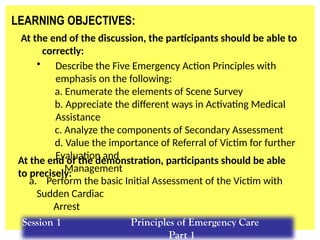
LEARNING OBJECTIVES:
At the end of the discussion, the participants should be able to
correctly:
• Describe the Five Emergency Action Principles with
emphasis on the following:
a. Enumerate the elements of Scene Survey
b. Appreciate the different ways in Activating Medical
Assistance
c. Analyze the components of Secondary Assessment
d. Value the importance of Referral of Victim for further
Evaluation and
Management
a. Perform the basic Initial Assessment of the Victim with
Sudden Cardiac
Arrest
At the end of the demonstration, participants should be able
to precisely:
Session 1 Principles of Emergency Care
Part 1
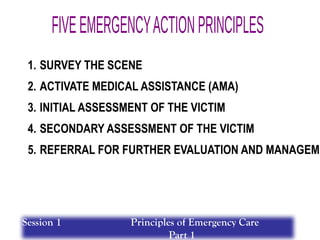
1. SURVEY THE SCENE
2. ACTIVATE MEDICAL ASSISTANCE (AMA)
3. INITIAL ASSESSMENT OF THE VICTIM
4. SECONDARY ASSESSMENT OF THE VICTIM
5. REFERRAL FOR FURTHER EVALUATION AND MANAGEME
Session 1 Principles of Emergency Care
Part 1
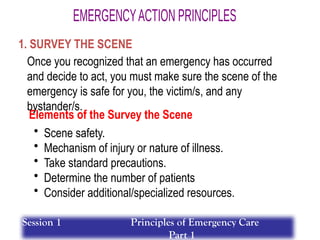
Elements of the Survey the Scene
• Scene safety.
• Mechanism of injury or nature of illness.
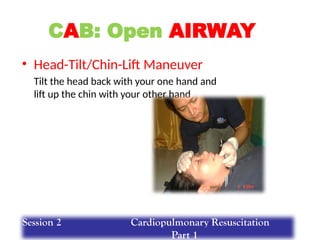
• Take standard precautions.
• Determine the number of patients
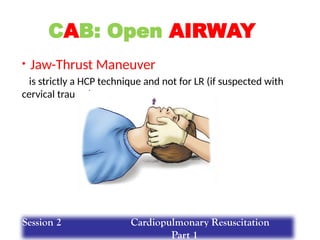
• Consider additional/specialized resources.
1. SURVEY THE SCENE
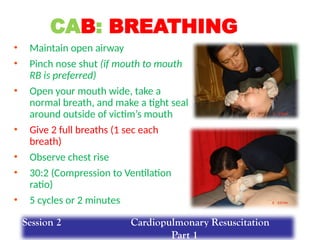
Once you recognized that an emergency has occurred
and decide to act, you must make sure the scene of the
emergency is safe for you, the victim/s, and any
bystander/s.
Session 1 Principles of Emergency Care
Part 1
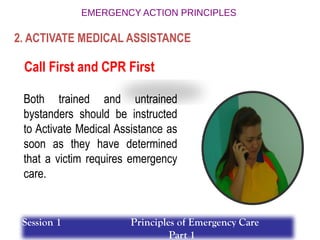
Call First and CPR First
Both trained and untrained
bystanders should be instructed
to Activate Medical Assistance as
soon as they have determined
that a victim requires emergency
care.
2. ACTIVATE MEDICAL ASSISTANCE
Session 1 Principles of Emergency Care
Part 1
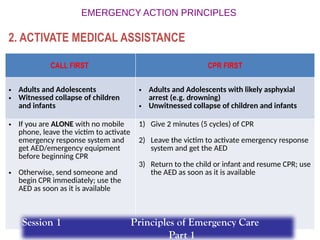
CALL FIRST CPR FIRST
• Adults and Adolescents
• Witnessed collapse of children
and infants
• Adults and Adolescents with likely asphyxial
arrest (e.g. drowning)
• Unwitnessed collapse of children and infants
• If you are ALONE with no mobile
phone, leave the victim to activate
emergency response system and
get AED/emergency equipment
before beginning CPR
• Otherwise, send someone and
begin CPR immediately; use the
AED as soon as it is available
1) Give 2 minutes (5 cycles) of CPR
2) Leave the victim to activate emergency response
system and get the AED
3) Return to the child or infant and resume CPR; use
the AED as soon as it is available
2. ACTIVATE MEDICAL ASSISTANCE
Session 1 Principles of Emergency Care
Part 1
• Use of Social Media to Summon Rescuers
2. ACTIVATE MEDICAL ASSISTANCE OR TRANSFER FACILITY
Note: The video presentation is only for demonstration purposes and not for any advertisements.
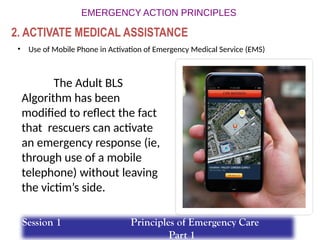
• Use of Mobile Phone in Activation of Emergency Medical Service (EMS)
The Adult BLS
Algorithm has been
modified to reflect the fact
that rescuers can activate
an emergency response (ie,
through use of a mobile
telephone) without leaving
the victim’s side.
2. ACTIVATE MEDICAL ASSISTANCE
Session 1 Principles of Emergency Care
Part 1
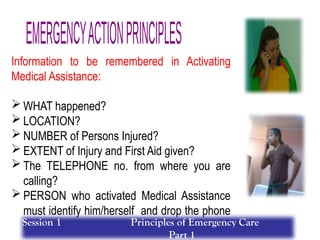
Information to be remembered in Activating
Medical Assistance:
 WHAT happened?
 LOCATION?
 NUMBER of Persons Injured?
 EXTENT of Injury and First Aid given?
 The TELEPHONE no. from where you are
calling?
 PERSON who activated Medical Assistance
must identify him/herself and drop the phone
last….
Session 1 Principles of Emergency Care
Part 1
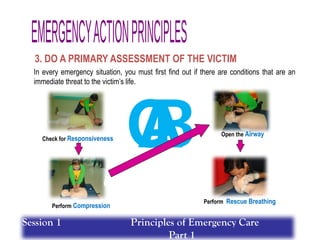
3. DO A PRIMARY ASSESSMENT OF THE VICTIM
In every emergency situation, you must first find out if there are conditions that are an
immediate threat to the victim’s life.
Check for Responsiveness
Open the Airway
Perform Rescue Breathing
Perform Compression
B
A
C
Session 1 Principles of Emergency Care
Part 1
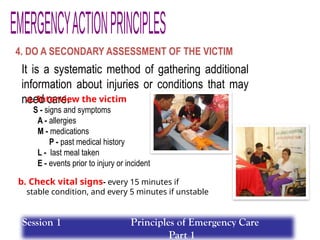
4. DO A SECONDARY ASSESSMENT OF THE VICTIM
It is a systematic method of gathering additional
information about injuries or conditions that may
need care.
a. Interview the victim
S - signs and symptoms
A - allergies
M - medications
P - past medical history
L - last meal taken
E - events prior to injury or incident
b. Check vital signs- every 15 minutes if
stable condition, and every 5 minutes if unstable
Session 1 Principles of Emergency Care
Part 1
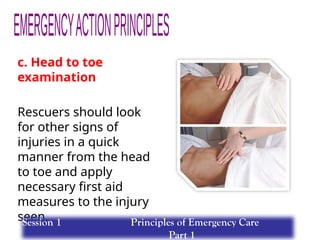
c. Head to toe
examination
Rescuers should look
for other signs of
injuries in a quick
manner from the head
to toe and apply
necessary first aid
measures to the injury
seen.
Session 1 Principles of Emergency Care
Part 1
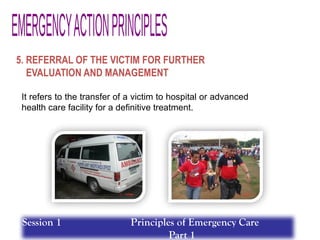
5. REFERRAL OF THE VICTIM FOR FURTHER
EVALUATION AND MANAGEMENT
It refers to the transfer of a victim to hospital or advanced
health care facility for a definitive treatment.
Session 1 Principles of Emergency Care
Part 1
SL.ppt/TR/FC 20 17
BLS for HCP
LEARNING OBJECTIVES:
At the end of the discussion, the participants should be able to
correctly:
• Describe the Five Emergency Action Principles with
emphasis on the following:
a. Enumerate the elements of Scene Survey
b. Appreciate the different ways in Activating Medical
Assistance
c. Analyze the components of Secondary Assessment
d. Value the importance of Referral of Victim for further
Evaluation and
Management
a. Perform the basic Initial Assessment of the Victim with
Sudden Cardiac
Arrest
At the end of the demonstration, participants should be able
to precisely:
Session 1 Principles of Emergency Care
Part 1
DID WE MEET OUR OBJECTIVES?
ANY QUESTIONS?
SL.ppt/TR/FC 20 19
BLS for HCP
Introduction to Basic Life Support
SESSION 1---Part 2
SL.ppt/TR/FC 20 20
BLS for HCP
Session 1 Introduction to Basic Life Support
Part 2
LEARNING OBJECTIVES:
At the end of the discussion, participants should be able to
accurately:
1. Differentiate the three kinds of Life Support .
2. Identify the Chain of Survival for Adult and Pediatric
Patients.
3. Explain the importance of the Respiratory, Circulatory, and
Nervous Systems in relation to Basic Life Support.
1. BASIC LIFE SUPPORT (BLS)
A set of emergency procedures that consist of
recognizing respiratory or cardiac arrest and the proper
application of Cardio-Pulmonary Resuscitation (CPR)
with or w/o Automated External Defibrillation (AED) or
Foreign Body Airway Obstruction Management
(FBAOM) and Rescue Breathing (RB) or to maintain life
until a victim recovers or advanced life support is
available.
THREE KINDS OF LIFE SUPPORT
Session 1 Introduction to Basic Life Support
Part 2
2. ADVANCED CARDIAC LIFE SUPPORT (ACLS)
3. PROLONGED LIFE SUPPORT (PLS)
A set of clinical interventions for the urgent treatment of
cardiac arrest and other life threatening emergencies, as
well as the knowledge and skills to deploy those
interventions.
For post resuscitative and long term resuscitation with
the use of adjunctive equipment such as ventilator,
cardiac monitor, pulse oximeter etc.
THREE KINDS OF LIFE SUPPORT
Session 1 Introduction to Basic Life Support
Part 2
Session 1 Introduction to Basic Life Support
Part 2
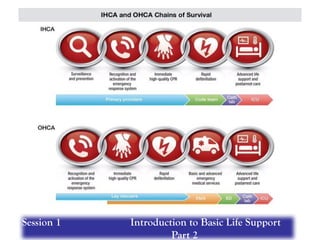
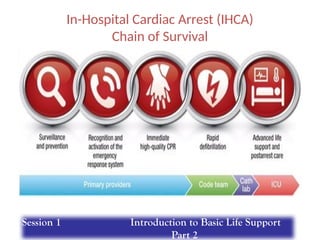
In-Hospital Cardiac Arrest (IHCA)
Chain of Survival
Session 1 Introduction to Basic Life Support
Part 2
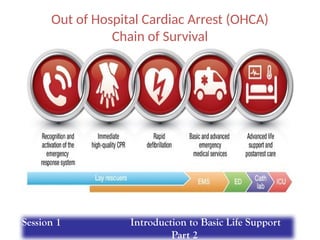
Out of Hospital Cardiac Arrest (OHCA)
Chain of Survival
Session 1 Introduction to Basic Life Support
Part 2
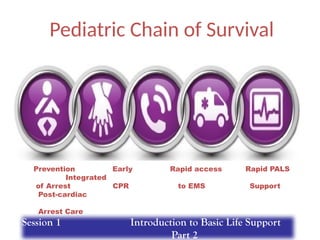
Pediatric Chain of Survival
Prevention Early Rapid access Rapid PALS
Integrated
of Arrest CPR to EMS Support
Post-cardiac
Arrest Care
Session 1 Introduction to Basic Life Support
Part 2
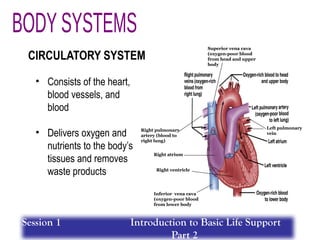
• Consists of the heart,
blood vessels, and
blood
• Delivers oxygen and
nutrients to the body’s
tissues and removes
waste products Right ventricle
Right atrium
Right pulmonary
artery (blood to
right lung)
Superior vena cava
(oxygen-poor blood
from head and upper
body
Inferior vena cava
(oxygen-poor blood
from lower body
Left pulmonary
vein
CIRCULATORY SYSTEM
Session 1 Introduction to Basic Life Support
Part 2
CIRCULATORY SYSTEM
Note: The video presentation is only for demonstration purposes and not for any advertisements.
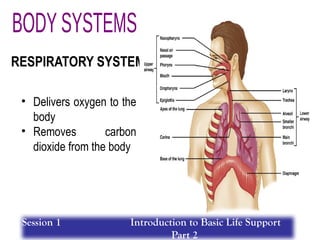
RESPIRATORY SYSTEM
• Delivers oxygen to the
body
• Removes carbon
dioxide from the body
Session 1 Introduction to Basic Life Support
Part 2
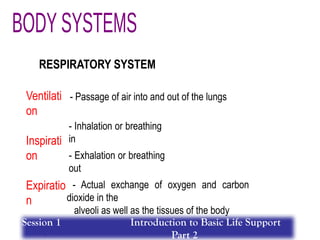
Ventilati
on
Inspirati
on
Expiratio
n
Respirati
- Passage of air into and out of the lungs
- Inhalation or breathing
in
- Exhalation or breathing
out
- Actual exchange of oxygen and carbon
dioxide in the
alveoli as well as the tissues of the body
RESPIRATORY SYSTEM
Session 1 Introduction to Basic Life Support
Part 2
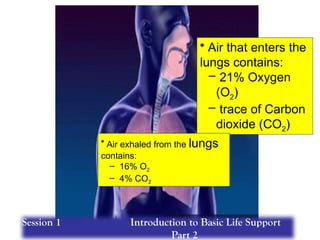
• Air that enters the
lungs contains:
– 21% Oxygen
(O2)
– trace of Carbon
dioxide (CO2)
• Air exhaled from the lungs
contains:
– 16% O2
– 4% CO2
Session 1 Introduction to Basic Life Support
Part 2
Note: The video presentation is only for demonstration purposes and not for any advertisements.
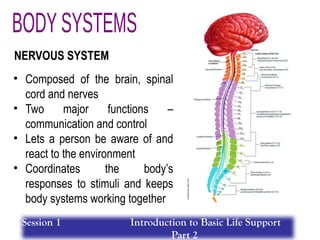
Respiratory System
• Composed of the brain, spinal
cord and nerves
• Two major functions –
communication and control
• Lets a person be aware of and
react to the environment
• Coordinates the body’s
responses to stimuli and keeps
body systems working together
NERVOUS SYSTEM
Session 1 Introduction to Basic Life Support
Part 2
Clinical death
0 - 1 min. - cardiac irritability
1 - 4 min. - brain damaged not likely
4 - 6 min. - brain damage possible
Biological death
6 - 10 min. - brain damaged very
likely
over 10 min. - irreversible brain
damaged
Session 1 Introduction to Basic Life Support
Part 2
SL.ppt/TR/FC 20 35
BLS for HCP
Session 1 Introduction to Basic Life Support
Part 2
LEARNING OBJECTIVES:
At the end of the discussion, participants should be able to
accurately:
1. Differentiate the three kinds of Life Support .
2. Identify the Chain of Survival for Adult and Pediatric
Patients.
3. Explain the importance of the Respiratory, Circulatory, and
Nervous Systems in relation to Basic Life Support.
DID WE MEET OUR OBJECTIVES?
ANY QUESTIONS?
SL.ppt/TR/FC 20 37
BLS for HCP
Cardiopulmonary Resuscitation (CPR)
&
Automated External Defibrillator (AED
SESSION 2
SL.ppt/TR/FC 20 38
BLS for HCP
Cardiopulmonary Resuscitation (CPR)
SESSION 2- Part 1
LEARNING OBJECTIVES:
At the end of the discussion, the participants should be able to
correctly:
1. Explain what CPR is;
2. Recognize the criteria for when to start, not to start, and
when to stop CPR;
3. Discuss the CPR sequence;
4. Enumerate the components of High Quality CPR; and
5. Identify the BLS Cardiac Arrest Algorithm.
1. Perform correct CPR techniques to an Adult,
Child/Infant who are in
cardiac arrest
At the end of the demonstration, participants should be able
to precisely:
Session 2 Cardiopulmonary Resuscitation
Part 1
About your heart Attack
Heart Failure
CARDIOPULMONARY
RESUSCITATION (CPR)
is a series of assessments and interventions
using techniques and maneuvers made to bring
victims of cardiac and respiratory arrest back to
life.
Session 2 Cardiopulmonary Resuscitation
Part 1
Note: The video presentation is only for demonstration purposes and not for any advertisements.
CPR Video
WHEN TO START CPR
If you see a victim who is:
1. Unconscious/Unresponsive
2. Not breathing or has no normal breathing (only gasping)
3. No definite pulse
Session 2 Cardiopulmonary Resuscitation
Part 1
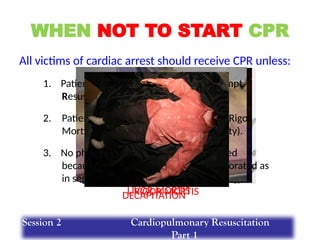
RIGOR MORTIS
LIVOR MORTIS
WHEN NOT TO START CPR
All victims of cardiac arrest should receive CPR unless:
1. Patient has a valid DNAR (Do Not Attempt
Resuscitation) order.
2. Patient has signs of irreversible death (Rigor
Mortis, Decapitation, Dependent Lividity).
3. No physiological benefit can be expected
because the vital functions have deteriorated as
in septic or cardiogenic shock.
DECAPITATION
Session 2 Cardiopulmonary Resuscitation
Part 1
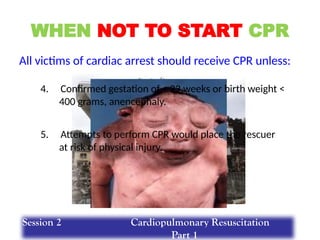
WHEN NOT TO START CPR
All victims of cardiac arrest should receive CPR unless:
4. Confirmed gestation of < 23 weeks or birth weight <
400 grams, anencephaly.
5. Attempts to perform CPR would place the rescuer
at risk of physical injury.
Session 2 Cardiopulmonary Resuscitation
Part 1
WHEN TO STOP CPR?
SPONTANEOUS signs of circulation are restored
TURNED over to medical services or properly trained and
authorized personnel
OPERATOR is already exhausted and cannot continue CPR
PHYSICIAN assumes responsibility (declares death, takes
over, etc.)
SCENE becomes unsafe (such as traffic, impending or
ongoing violence—gun fires, etc)
SIGNED waiver to stop CPR
S
O
T
S
P
S
Session 2 Cardiopulmonary Resuscitation
Part 1
Note: The video presentation is only for demonstration purposes and not for any advertisements.
CAB Animation
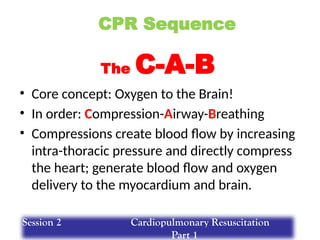
CPR Sequence
• Core concept: Oxygen to the Brain!
• In order: Compression-Airway-Breathing
• Compressions create blood flow by increasing
intra-thoracic pressure and directly compress
the heart; generate blood flow and oxygen
delivery to the myocardium and brain.
The C-A-B
Session 2 Cardiopulmonary Resuscitation
Part 1
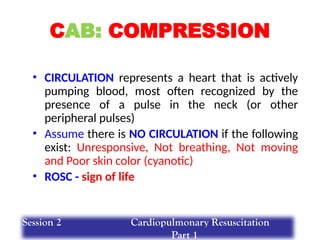
CAB: COMPRESSION
• CIRCULATION represents a heart that is actively
pumping blood, most often recognized by the
presence of a pulse in the neck (or other
peripheral pulses)
• Assume there is NO CIRCULATION if the following
exist: Unresponsive, Not breathing, Not moving
and Poor skin color (cyanotic)
• ROSC - sign of life
Session 2 Cardiopulmonary Resuscitation
Part 1
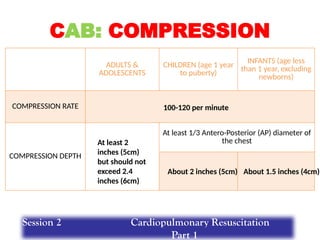
CAB: COMPRESSION
ADULTS &
ADOLESCENTS
CHILDREN (age 1 year
to puberty)
INFANTS (age less
than 1 year, excluding
newborns)
COMPRESSION RATE
COMPRESSION DEPTH
At least 1/3 Antero-Posterior (AP) diameter of
the chest
Session 2 Cardiopulmonary Resuscitation
Part 1
100-120 per minute
At least 2
inches (5cm)
but should not
exceed 2.4
inches (6cm)
About 2 inches (5cm) About 1.5 inches (4cm)
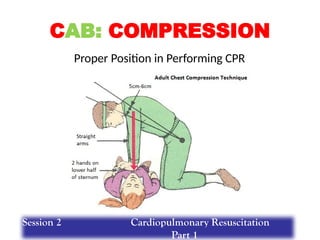
Proper Position in Performing CPR
CAB: COMPRESSION
Session 2 Cardiopulmonary Resuscitation
Part 1
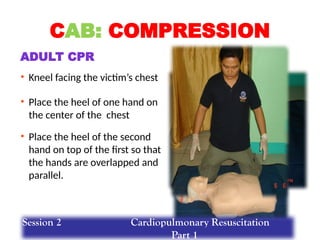
• Place the heel of the second
hand on top of the first so that
the hands are overlapped and
parallel.
• Kneel facing the victim’s chest
• Place the heel of one hand on
the center of the chest
CAB: COMPRESSION
ADULT CPR
Session 2 Cardiopulmonary Resuscitation
Part 1
CAB: COMPRESSION
CHILD CPR
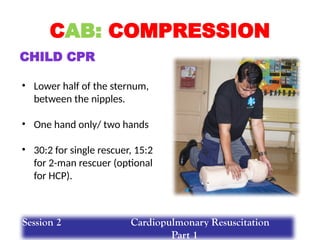
• Lower half of the sternum,
between the nipples.
• One hand only/ two hands
• 30:2 for single rescuer, 15:2
for 2-man rescuer (optional
for HCP).
Session 2 Cardiopulmonary Resuscitation
Part 1
CAB: COMPRESSION
INFANT CPR
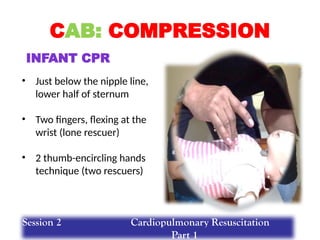
• Just below the nipple line,
lower half of sternum
• Two fingers, flexing at the
wrist (lone rescuer)
• 2 thumb-encircling hands
technique (two rescuers)
Session 2 Cardiopulmonary Resuscitation
Part 1
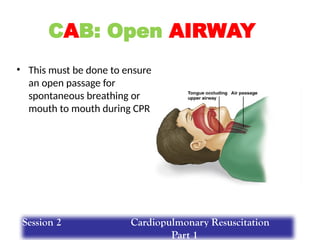
• This must be done to ensure
an open passage for
spontaneous breathing or
mouth to mouth during CPR
CAB: Open AIRWAY
Session 2 Cardiopulmonary Resuscitation
Part 1
• Head-Tilt/Chin-Lift Maneuver
Tilt the head back with your one hand and
lift up the chin with your other hand
CAB: Open AIRWAY
Session 2 Cardiopulmonary Resuscitation
Part 1
• Jaw-Thrust Maneuver
is strictly a HCP technique and not for LR (if suspected with
cervical trauma)
CAB: Open AIRWAY
Session 2 Cardiopulmonary Resuscitation
Part 1
• Jaw-Thrust Maneuve
r
CAB: Open AIRWAY
Note: The video presentation is only for demonstration purposes and not for any advertisements.
• Maintain open airway
• Pinch nose shut (if mouth to mouth
RB is preferred)
• Open your mouth wide, take a
normal breath, and make a tight seal
around outside of victim’s mouth
• Give 2 full breaths (1 sec each
breath)
• Observe chest rise
• 30:2 (Compression to Ventilation
ratio)
• 5 cycles or 2 minutes
CAB: BREATHING
Session 2 Cardiopulmonary Resuscitation
Part 1
HIGH-QUALITY CPR:
1. Adequate Compression Rate (100-120/minute)
2. Adequate Compression Depth (at least 2 inches
[5cm]
but should not exceed 2.4 inches [6cm]) (for adult
only)
3 . Allow Complete Chest Recoil after each
compression
4 . Minimize Interruptions in Compression
Session 2 Cardiopulmonary Resuscitation
Part 1
Introduce yourself.
Check for Responsiveness:
· Unconscious/unresponsive
HIGH-QUALITY CPR:
1. Adequate Compression Rate (100-120/minute)
2. Adequate Compression Depth (at least 2 inches [5cm]
but should not exceed 2.4 inches [6cm])
3 . Allow Complete Chest Recoil after each compression
4 . Minimize Interruptions in Compression
5. Avoid Excessive Ventilation
Use AED if already available
Resume CPR after Shock delivery
If AED tells “No Shock Advised” for the
second time:
· Check for Pulse
Simultaneously Check for:
· Breathing
· Pulse (for not more than 10 seconds [for HCP only])
Activate Emergency Response System:
· Shout for nearby help
· Mobile phone or phone patch(if available)
· Get AED/emergency equipment (or send someone to do so)
· No breathing or only gasping
· No definite pulse
If AED initially tells “No Shock Advised”:
· Continue CPR
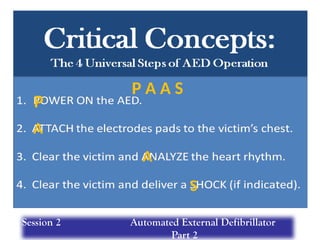
Universal Steps in AED Operation:
Power on
Attach pads
Analyze Heart Rhythm
Shock
START GIVING 5 CYCLES OF HIGH-QUALITY CPR:
· Give 30:2 (Compression to Ventilation Ratio)
· Compression: 30 compressions within 15-18 sec (100-120/min)
· Ventilation: 2 ventilations delivered 1 sec each breath
· 5 cycles equivalent to 2 minutes
BLS HEALTHCARE PROVIDER CARDIAC ARREST
ALGORITHM
BLS HEALTHCARE PROVIDER CARDIAC
ARREST ALGORITHM
Verify Scene Safety
Introduce yourself.
Check for Responsiveness and for No
breathing or
no normal breathing (only gasping)
for not more than 10 seconds
· Unconscious/unresponsive/not breathing
HIGH-QUALITY CPR:
1. Adequate Compression Rate (100-120/minute)
2. Adequate Compression Depth (at least 2 inches [5cm]
but should not exceed 2.4 inches [6cm])
3 . Allow Complete Chest Recoil after each compression
4 . Minimize Interruptions in Compression
5. Avoid Excessive Ventilation
Use AED if already available
Resume CPR after Shock delivery
If AED tells “No Shock Advised” for the
second time:
· Check for Responsiveness
Activate Emergency Response System:
· Shout for nearby help
· Mobile phone or phone patch(if available)
· Get AED/emergency equipment (or send someone to do so)
If AED initially tells “No Shock Advised”:
· Continue CPR
Universal Steps in AED Operation:
Power on
Attach pads
Analyze Heart Rhythm
Shock
START GIVING 5 CYCLES OF HIGH-QUALITY CPR:
· Give 30:2 (Compression to Ventilation Ratio)
· Compression: 30 compressions within 15-18 sec (100-120/min)
· Ventilation: 2 ventilations delivered 1 sec each breath
· 5 cycles equivalent to 2 minutes
BLS LAY RESCUER CARDIAC ARREST
ALGORITHM
BLS LAY RESCUER CARDIAC ARREST
ALGORITHM
Verify Scene Safety
START GIVING 5 CYCLES OF HIGH-QUALITY CPR:
Introduce yourself.
· No breathing or only gasping
· No definite pulse
Simultaneously Check for:
· Breathing
· Pulse (for not more than 10 seconds [for HCP only])
Check for Responsiveness:
· Unconscious/unresponsive
Use AED if already available
For lone rescuer (unwitnessed sudden collapse of a child/infant)
do 5 cycles of CPR before calling for help
Universal Steps in AED Operation:
Power on
Attach pads
Analyze Rhythm
Shock
Resume CPR after Shock delivery
If AED initially tells “No Shock Advised”:
· Continue CPR
If AED tells “No Shock Advised” for the
second time:
· Check for Pulse
HIGH-QUALITY CPR:
· Adequate Compression Rate (100-120/minute)
· Adequate Compression Depth: CHILDREN: about 2 inches [5cm]
INFANTS: about 1.5 inches [4cm]
• Allow Complete Chest Recoil after each compression
· Minimize Interruptions in Compression
· Avoid Excessive Ventilation
1 Rescuer 2 Rescuers
30:2
(Compression to Ventilation Ratio)
15:2
(Compression to Ventilation Ratio)
30 compressions in 15 to18 sec
(100-120/min) 15 compressions in 7 to 9 sec (100-120/min)
Child: Heel of one hand with the other hand
on top or One hand technique
Infant: Two-finger technique
Child: Heel of one hand with the other hand on
top or One hand technique
Infant: Two-thumbs hand encircling technique
2 ventilations delivered 1 sec each breath
5 cycles equivalent to 2 minutes 10 cycles equivalent to 2 minutes
Activate Emergency Response System:
· Shout for nearby help
· Mobile phone or phone patch (if available)
· Get AED/emergency equipment (or send someone to do so)
BLS PEDIATRIC CARDIAC ARREST ALGORITHM
(HEALTHCARE PROVIDER)
Verify Scene Safety
BLS PEDIATRIC CARDIAC ARREST ALGORITHM
(HEALTHCARE PROVIDER)
CPR
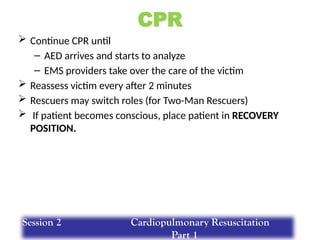
 Continue CPR until
– AED arrives and starts to analyze
– EMS providers take over the care of the victim
 Reassess victim every after 2 minutes
 Rescuers may switch roles (for Two-Man Rescuers)
 If patient becomes conscious, place patient in RECOVERY
POSITION.
Session 2 Cardiopulmonary Resuscitation
Part 1
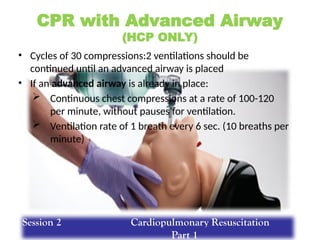
CPR with Advanced Airway
(HCP ONLY)
• Cycles of 30 compressions:2 ventilations should be
continued until an advanced airway is placed
• If an advanced airway is already in place:
 Continuous chest compressions at a rate of 100-120
per minute, without pauses for ventilation.
 Ventilation rate of 1 breath every 6 sec. (10 breaths per
minute)
Session 2 Cardiopulmonary Resuscitation
Part 1
120 COMPRESSIONS/MINUTE
Note: The video presentation is only for demonstration purposes and not for any advertisements.
Metronome
WERE WE ABLE TO MEET OUR LEARNING OBJECTIVES?
At the end of the discussion, the participants should be able to
correctly:
1. Explain what CPR is;
2. Recognize the criteria for when to start, not to start, and
when to stop CPR;
3. Discuss the CPR sequence;
4. Enumerate the components of High Quality CPR; and
5. Identify the BLS Cardiac Arrest Algorithm.
1. Perform correct CPR techniques to an Adult,
Child/Infant who are in
cardiac arrest
At the end of the demonstration, participants should be able
to precisely:
Session 2 Cardiopulmonary Resuscitation
Part 1
ANY QUESTIONS?
SL.ppt/TR/FC 20 70
BLS for HCP
Automated External Defibrillator (AED
SESSION 2---Part 2
LEARNING OBJECTIVES:
At the end of the discussion, participants should be
able to correctly:
1. Define AED and identify its parts
2. Define Defibrillation
3. Explain the indications and importance of early
defibrillation
4. Identify causes of sudden Cardiac Arrest
5. Enumerate the 4 universal steps of an AED
operation
6. Explain the special conditions that affect the use of
an AED
1. Demonstrate how to properly use AED to an
adult, child & infant who are in cardiac arrest.
At the end of the demonstration, participants should
be able to precisely:
Session 2 Automated External Defibrillator
Part 2
AED
Note: The video presentation is only for demonstration purposes and not for any advertisements.
AED
AUTOMATED EXTERNAL DEFIBRILLATOR
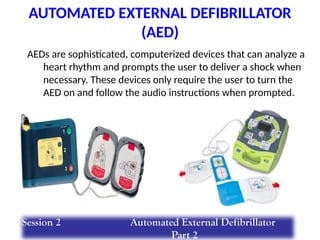
(AED)
AEDs are sophisticated, computerized devices that can analyze a
heart rhythm and prompts the user to deliver a shock when
necessary. These devices only require the user to turn the
AED on and follow the audio instructions when prompted.
Session 2 Automated External Defibrillator
Part 2
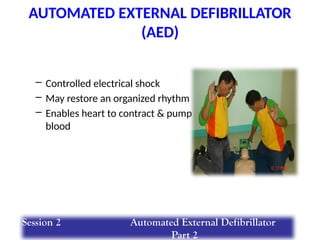
– Controlled electrical shock
– May restore an organized rhythm
– Enables heart to contract & pump
blood
AUTOMATED EXTERNAL DEFIBRILLATOR
(AED)
Session 2 Automated External Defibrillator
Part 2
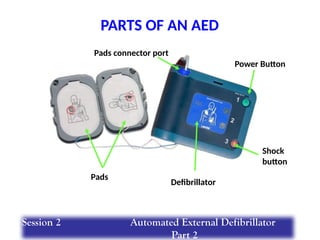
PARTS OF AN AED
Shock
button
Pads
Pads connector port
Power Button
Defibrillator
Session 2 Automated External Defibrillator
Part 2
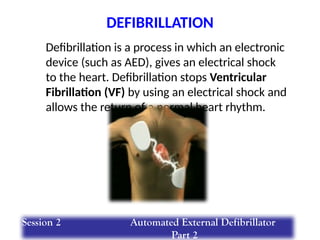
Defibrillation is a process in which an electronic
device (such as AED), gives an electrical shock
to the heart. Defibrillation stops Ventricular
Fibrillation (VF) by using an electrical shock and
allows the return of a normal heart rhythm.
DEFIBRILLATION
Session 2 Automated External Defibrillator
Part 2
• Shock success
– Termination of VF for at least 5 seconds
following the shock
VF frequently recurs after successful shocks & these
recurrence should
not be equated to shock failure
DEFIBRILLATION
Session 2 Automated External Defibrillator
Part 2
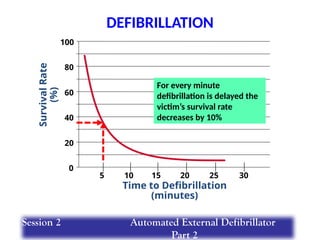
0
20
40
60
80
100
Survival
Rate
(%)
Time to Defibrillation
(minutes)
5 10 15 20 25 30
For every minute
defibrillation is delayed the
victim’s survival rate
decreases by 10%
DEFIBRILLATION
Session 2 Automated External Defibrillator
Part 2
Indications and Importance
Defibrillation
Early defibrillation is critical for victims of
sudden cardiac arrest because:
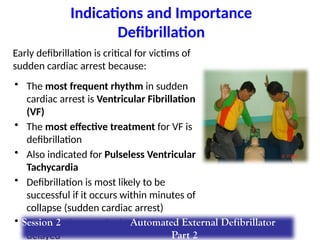
• The most frequent rhythm in sudden
cardiac arrest is Ventricular Fibrillation
(VF)
• The most effective treatment for VF is
defibrillation
• Also indicated for Pulseless Ventricular
Tachycardia
• Defibrillation is most likely to be
successful if it occurs within minutes of
collapse (sudden cardiac arrest)
• Defibrillation may be ineffective if it is
delayed
Session 2 Automated External Defibrillator
Part 2
Shockable and Non-shockable
Rhythms
Note: The video presentation is only for demonstration purposes and not for any advertisements.
VF
Shockable Rhythms
• Ventricular Fibrillation (VF)
• Pulseless Ventricular Tachycardia
Non-Shockable Rhythms
• Asystole
• Pulseless Electrical Activity (PEA)
Session 2 Automated External Defibrillator
Part 2
Ventricular Fibrillation (VF)
• Common and treatable initial rhythm in adults with
witnessed cardiac arrest
• Survival rates are highest when immediate bystander
CPR is provided and defibrillation occurs within 3 to 5
minutes of collapse
• Rapid defibrillation is the treatment of choice
• Rhythm causing ‘all’ sudden cardiac arrest
• Useless quivering of the heart  no blood flow
• Myocardium is depleted of oxygen & metabolic
substrates
Session 2 Automated External Defibrillator
Part 2
Pulseless Ventricular Tachycardia
• Rate - greater than 180 beats per minute
• Rhythm - very wide QRS complex in ECG
tracings and originates in the ventricles.
• The patient will be pulseless
Session 2 Automated External Defibrillator
Part 2
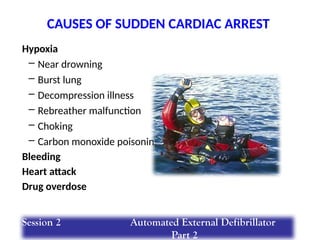
CAUSES OF SUDDEN CARDIAC ARREST
Hypoxia
– Near drowning
– Burst lung
– Decompression illness
– Rebreather malfunction
– Choking
– Carbon monoxide poisoning
Bleeding
Heart attack
Drug overdose
Session 2 Automated External Defibrillator
Part 2
Several factors that can affect AED analysis:
• Patient movement (eg. agonal gasp)
• Repositioning the patient
Use AED only when victims have the following 3
clinical findings:
• No response
• No breathing
• No Pulse
Session 2 Automated External Defibrillator
Part 2
Special Conditions that Affect
the Use of AED
• The victim is 1 month old or less.
• The victim has a hairy chest.
• The victim is lying in water, immersed in water,
or water is covering the victim’s chest.
• The victim has implanted defibrillator, or
pacemaker.
• The victim has a transdermal medication patch
or other object on the surface of the skin where
the AED electrode pads are placed.
Session 2 Automated External Defibrillator
Part 2
P A A S
P
A
A
S
Session 2 Automated External Defibrillator
Part 2
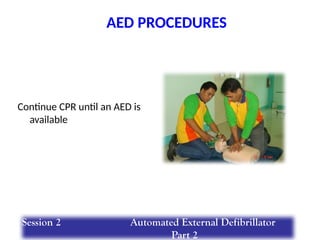
AED PROCEDURES
Continue CPR until an AED is
available
Session 2 Automated External Defibrillator
Part 2
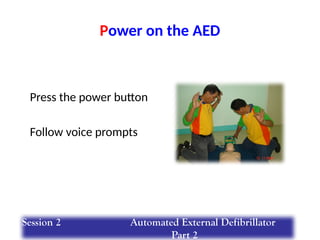
Power on the AED
Press the power button
Follow voice prompts
Session 2 Automated External Defibrillator
Part 2
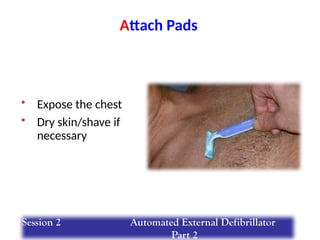
Attach Pads
• Expose the chest
• Dry skin/shave if
necessary
Session 2 Automated External Defibrillator
Part 2
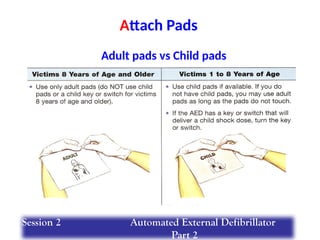
Adult pads vs Child pads
Attach Pads
Session 2 Automated External Defibrillator
Part 2
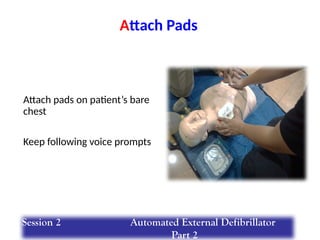
Attach pads on patient’s bare
chest
Keep following voice prompts
Attach Pads
Session 2 Automated External Defibrillator
Part 2
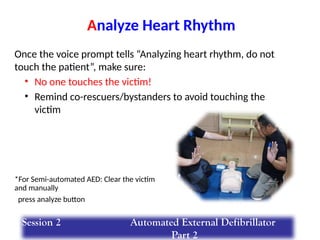
Once the voice prompt tells “Analyzing heart rhythm, do not
touch the patient”, make sure:
• No one touches the victim!
• Remind co-rescuers/bystanders to avoid touching the
victim
Analyze Heart Rhythm
*For Semi-automated AED: Clear the victim
and manually
press analyze button
Session 2 Automated External Defibrillator
Part 2
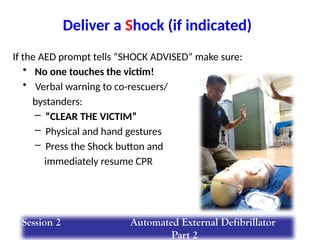
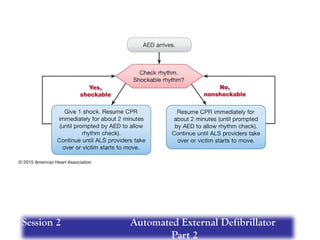
If the AED prompt tells “SHOCK ADVISED” make sure:
• No one touches the victim!
• Verbal warning to co-rescuers/
bystanders:
– “CLEAR THE VICTIM”
– Physical and hand gestures
– Press the Shock button and
immediately resume CPR
Deliver a Shock (if indicated)
Session 2 Automated External Defibrillator
Part 2
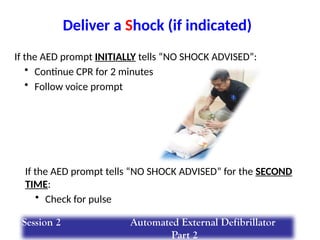
If the AED prompt INITIALLY tells “NO SHOCK ADVISED”:
• Continue CPR for 2 minutes
• Follow voice prompt
Deliver a Shock (if indicated)
If the AED prompt tells “NO SHOCK ADVISED” for the SECOND
TIME:
• Check for pulse
Session 2 Automated External Defibrillator
Part 2
Session 2 Automated External Defibrillator
Part 2
Shock First vs CPR First
• For witnessed adult cardiac arrest when an AED is
immediately available, it is reasonable that the defibrillator
be used as soon as possible.
• For adults with unmonitored cardiac arrest or for whom an
AED is not immediately available, it is reasonable that CPR be
initiated while the defibrillator equipment is being retrieved
and applied and that defibrillation, if indicated, be attempted
as soon as the device is ready for use
Session 2 Automated External Defibrillator
Part 2
At the end of the discussion, participants should be
able to correctly:
1. Define AED and identify its parts
2. Define Defibrillation
3. Explain the indications and importance of early
defibrillation
4. Identify causes of sudden Cardiac Arrest
5. Enumerate the 4 universal steps of an AED
operation
6. Explain the special conditions that affect the use of
an AED
1. Demonstrate how to properly use AED to an
adult, child & infant who are in cardiac arrest.
At the end of the demonstration, participants should
be able to precisely:
Session 2 Automated External Defibrillator
Part 2
WERE WE ABLE TO MEET OUR OBJECTIVES?
ANY QUESTIONS?
SL.ppt/TR/FC 20 100
BLS for HCP
Foreign Body Airway Obstruction (FBAO)
Management
&
Rescue Breathing due to Respiratory Arrest
SESSION 3
SL.ppt/TR/FC 20 101
BLS for HCP
Rescue Breathing due to Respiratory Arrest
SESSION 3---Part 1
LEARNING OBJECTIVES:
At the end of the discussion, participants should be able to
correctly:
1. Describe what Respiratory Arrest is and its causes
2. Discuss the significance of Rescue Breathing in respiratory
arrest
3. Enumerate the different ways in Rescue Breathing
4. Compare the Rescue Breathing techniques for infant, child,
&
adult
1. Demonstrate correct Rescue Breathing techniques for
infant, child, &
adult
At the end of the demonstration, participants should be able
to precisely:
Session 3 Respiratory Arrest and Rescue
Breathing Part 2
Is the condition in which breathing stops or is inadequate.
1. Obstruction
1.1 Anatomical
1.2 Mechanical
2. Diseases
2.1 Bronchitis
2.2 Pneumonia
2.3 COPD
2.4 Diphtheria
3. Other causes
3.1 Electrocution
3.2 Circulatory Collapse
3.3 Strangulation
3.4 Chest Compression by other
physical force
3.5 Drowning
3.6 Poisoning
3.7 Suffocation
Session 3 Respiratory Arrest and Rescue
Breathing Part 2
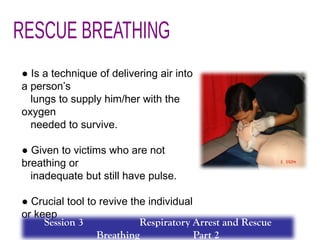
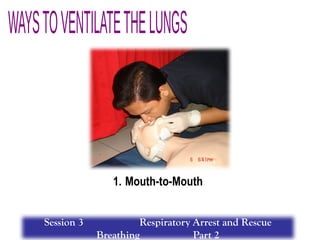
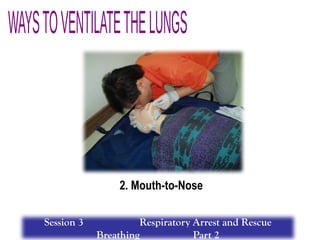
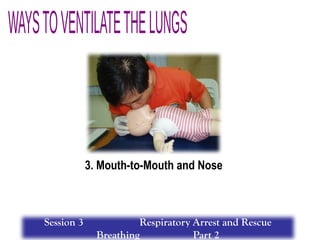
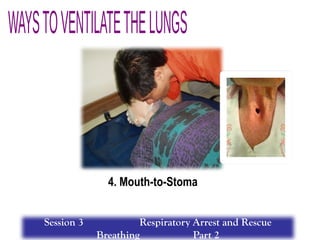
● Is a technique of delivering air into
a person’s
lungs to supply him/her with the
oxygen
needed to survive.
● Given to victims who are not
breathing or
inadequate but still have pulse.
● Crucial tool to revive the individual
or keep
him or her until the help comes.
Session 3 Respiratory Arrest and Rescue
Breathing Part 2
1. Mouth-to-Mouth
Session 3 Respiratory Arrest and Rescue
Breathing Part 2
2. Mouth-to-Nose
Session 3 Respiratory Arrest and Rescue
Breathing Part 2
3. Mouth-to-Mouth and Nose
Session 3 Respiratory Arrest and Rescue
Breathing Part 2
4. Mouth-to-Stoma
Session 3 Respiratory Arrest and Rescue
Breathing Part 2
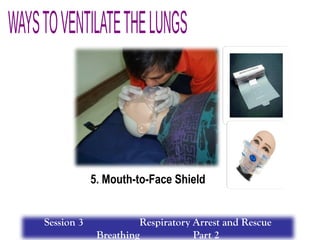
5. Mouth-to-Face Shield
Session 3 Respiratory Arrest and Rescue
Breathing Part 2
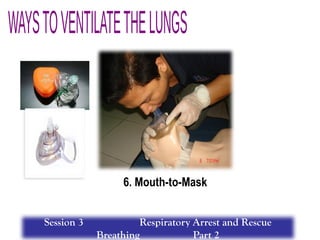
6. Mouth-to-Mask
Session 3 Respiratory Arrest and Rescue
Breathing Part 2
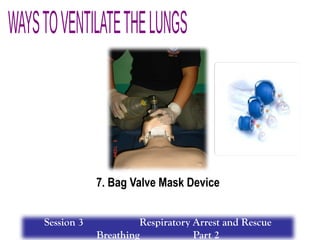
7. Bag Valve Mask Device
Session 3 Respiratory Arrest and Rescue
Breathing Part 2
SPECIAL CONSIDERATIONS:
● Avoid pressing soft tissue under the chin
● Don’t use the thumb to lift the chin
● Don’t close the victim’s mouth (unless mouth to nose is
the
technique)
● Each rescue breath should give enough air to make the
chest rise and be
given at 1 second;
● Avoid delivering more breaths (more than the number
recommended) or
breaths that are too large or too forceful.
● Rescuers should take a normal breath (not a deep breath)
mouth to mouth
or mouth-to-barrier device rescue breaths.
Session 3 Respiratory Arrest and Rescue
Breathing Part 2
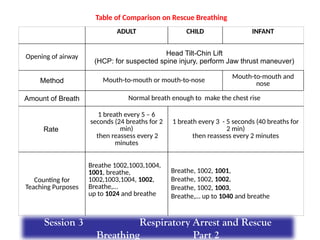
Table of Comparison on Rescue Breathing
ADULT CHILD INFANT
Opening of airway Head Tilt-Chin Lift
(HCP: for suspected spine injury, perform Jaw thrust maneuver)
Method Mouth-to-mouth or mouth-to-nose Mouth-to-mouth and
nose
Amount of Breath Normal breath enough to make the chest rise
Rate
1 breath every 5 – 6
seconds (24 breaths for 2
min)
then reassess every 2
minutes
1 breath every 3 - 5 seconds (40 breaths for
2 min)
then reassess every 2 minutes
Counting for
Teaching Purposes
Breathe 1002,1003,1004,
1001, breathe,
1002,1003,1004, 1002,
Breathe,…
up to 1024 and breathe
Breathe, 1002, 1001,
Breathe, 1002, 1002,
Breathe, 1002, 1003,
Breathe,… up to 1040 and breathe
Session 3 Respiratory Arrest and Rescue
Breathing Part 2
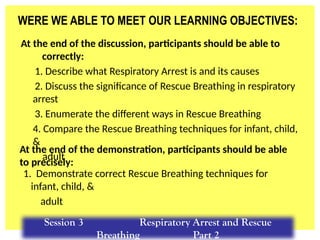
WERE WE ABLE TO MEET OUR LEARNING OBJECTIVES:
At the end of the discussion, participants should be able to
correctly:
1. Describe what Respiratory Arrest is and its causes
2. Discuss the significance of Rescue Breathing in respiratory
arrest
3. Enumerate the different ways in Rescue Breathing
4. Compare the Rescue Breathing techniques for infant, child,
&
adult
1. Demonstrate correct Rescue Breathing techniques for
infant, child, &
adult
At the end of the demonstration, participants should be able
to precisely:
Session 3 Respiratory Arrest and Rescue
Breathing Part 2
ANY QUESTIONS?
SL.ppt/TR/FC 20 116
BLS for HCP
Foreign Body Airway Obstruction (FBAO)
Management
&
Rescue Breathing due to Respiratory Arrest
SESSION 3
SL.ppt/TR/FC 20 117
BLS for HCP
Foreign Body Airway Obstruction (FBAO)
Management
SESSION 3---Part 2
LEARNING OBJECTIVES:
At the end of the discussion, participants should be able to
correctly:
1. Define FBAO
2. Discuss the causes, types and classification of airway
obstruction
3. Differentiate the following FBAO Management:
Abdominal Thrust, Chest Thrust, Back Slaps and Chest
Thrust
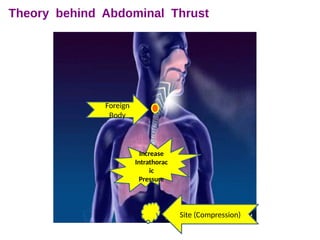
4. Explain the theory behind Abdominal Thrust and its
possible complications
1. Perform proper application of abdominal thrust to a
conscious child and adult.
2. Perform back slap and chest thrust to a conscious infant.
3. Perform chest thrust to an unconscious infant, child, and
adult.
4. Perform proper techniques of relieving FBAO under special
circumstances
such as in pregnant women, very obese victim, and self-
At the end of the demonstration, participants should be able
to precisely:
Session 3 FBAO Management
Part 1
Note: The video presentation is only for demonstration purposes and not for any advertisements.
FBAO
- is a condition when solid material like chunked foods,
coins, vomitus, small toys etc. are blocking the airway.
Session 3 FBAO Management
Part 1
1. IMPROPER CHEWING OF LARGE PIECES OF FOOD
2. EXCESSIVE ALCOHOL INTAKE –
a. relaxation of tongue back into the throat
b. Aspirated vomitus (stomach content)
3. PRESENCE OF LOOSE UPPER AND LOWER DENTURES
4. FOR CHILDREN WHO ARE RUNNING WHILE EATING
5. FOR SMALLER CHILDREN OF HAND-TO-MOUTH STAGE LEFT UNATTENDED.
Session 3 FBAO Management
Part 1
1. ANATOMICAL OBSTRUCTION
2. MECHANICAL
OBSTRUCTION
Session 3 FBAO Management
Part 1
2. SEVERE OBSTRUCTION
1. MILD OBSTRUCTION
Session 3 FBAO Management
Part 1
1. MILD OBSTRUCTION
• Good air exchange
• Responsive and can cough forcefully
• May wheeze between coughs.
Session 3 FBAO Management
Part 1
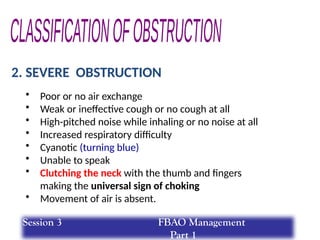
2. SEVERE OBSTRUCTION
• Poor or no air exchange
• Weak or ineffective cough or no cough at all
• High-pitched noise while inhaling or no noise at all
• Increased respiratory difficulty
• Cyanotic (turning blue)
• Unable to speak
• Clutching the neck with the thumb and fingers
making the universal sign of choking
• Movement of air is absent.
Session 3 FBAO Management
Part 1
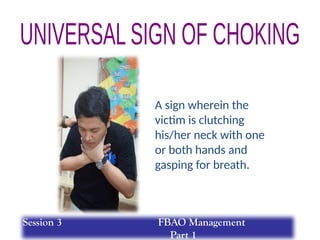
A sign wherein the
victim is clutching
his/her neck with one
or both hands and
gasping for breath.
Session 3 FBAO Management
Part 1
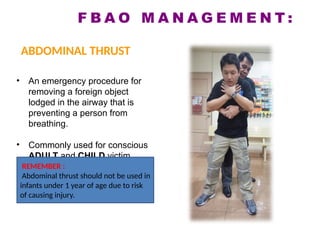
• An emergency procedure for
removing a foreign object
lodged in the airway that is
preventing a person from
breathing.
• Commonly used for conscious
ADULT and CHILD victim.
REMEMBER :
Abdominal thrust should not be used in
infants under 1 year of age due to risk
of causing injury.
F B A O M A N A G E M E N T :
ABDOMINAL THRUST
1. Incorrect application may damage the chest, ribs and internal
organs.
2. May also vomit after being treated with the Abdominal
thrust.
Note: The victim should be examined by a Physician to rule out any life-
threatening
complications.
Session 3 FBAO Management
Part 1
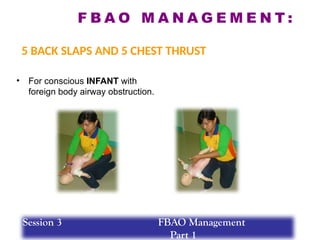
F B A O M A N A G E M E N T :
5 BACK SLAPS AND 5 CHEST THRUST
• For conscious INFANT with
foreign body airway obstruction.
Session 3 FBAO Management
Part 1
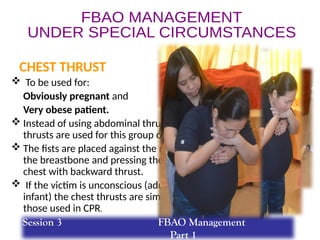
CHEST THRUST
 To be used for:
Obviously pregnant and
Very obese patient.
 Instead of using abdominal thrusts, Chest
thrusts are used for this group of people.
 The fists are placed against the middle of
the breastbone and pressing the patient’s
chest with backward thrust.
 If the victim is unconscious (adult, child or
infant) the chest thrusts are similar to
those used in CPR.
Session 3 FBAO Management
Part 1
Increase
Intrathorac
ic
Pressure
Site (Compression)
Foreign
Body
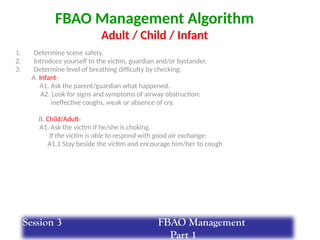
FBAO Management Algorithm
Adult / Child / Infant
1. Determine scene safety.
2. Introduce yourself to the victim, guardian and/or bystander.
3. Determine level of breathing difficulty by checking:
A. Infant-
A1. Ask the parent/guardian what happened.
A2. Look for signs and symptoms of airway obstruction:
ineffective coughs, weak or absence of cry.
B. Child/Adult-
A1. Ask the victim if he/she is choking.
If the victim is able to respond with good air exchange:
A1.1 Stay beside the victim and encourage him/her to cough
Session 3 FBAO Management
Part 1
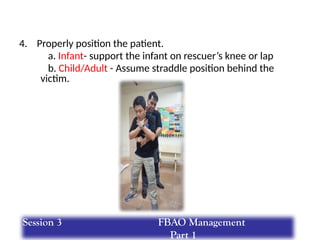
4. Properly position the patient.
a. Infant- support the infant on rescuer’s knee or lap
b. Child/Adult - Assume straddle position behind the
victim.
Session 3 FBAO Management
Part 1
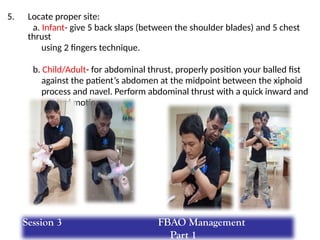
5. Locate proper site:
a. Infant- give 5 back slaps (between the shoulder blades) and 5 chest
thrust
using 2 fingers technique.
b. Child/Adult- for abdominal thrust, properly position your balled fist
against the patient’s abdomen at the midpoint between the xiphoid
process and navel. Perform abdominal thrust with a quick inward and
upward motion.
Session 3 FBAO Management
Part 1
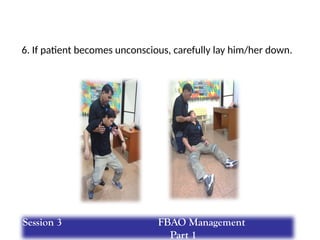
6. If patient becomes unconscious, carefully lay him/her down.
Session 3 FBAO Management
Part 1
7. Activate Emergency Medical Service (EMS) and perform 30
Chest Compression.
8. Check oral cavity for presence of obstruction. If foreign object
is visible, perform finger sweep; if not visible, properly
administer FIRST Rescue Breath.
9. If air bounces back, re-position patient’s head and properly
administer SECOND Rescue Breath.
10. If air goes in, assess for pulse and consciousness.
11. If patient becomes conscious, properly place patient in
recovery position.
Session 3 FBAO Management
Part 1
WERE WE ABLE TO MEET THE LEARNING OBJECTIVES:
At the end of the discussion, participants should be able to
correctly:
1. Define FBAO
2. Discuss the causes, types and classification of airway
obstruction
3. Differentiate the following FBAO Management:
Abdominal Thrust, Chest Thrust, Back Slaps and Chest
Thrust
4. Explain the theory behind Abdominal Thrust and its
possible complications
1. Perform proper application of abdominal thrust to a
conscious child and adult.
2. Perform back slap and chest thrust to a conscious infant.
3. Perform chest thrust to an unconscious infant, child, and
adult.
4. Perform proper techniques of relieving FBAO under special
circumstances
such as in pregnant women, very obese victim, and self-
At the end of the demonstration, participants should be able
to precisely:
Session 3 FBAO Management
Part 1
ANY QUESTIONS?

Basic-Life-Support-Training special.pptx

  • 1.
  • 2.
    HOUSE RULES • Alwaysbe on time. • Attendance will be checked on morning and afternoon sessions. • All Cellular Phones should be in silent mode. • Maintain cleanliness and avoid unnecessary noises/small group conferences during discussion. • In case there is a need to go out from the training venue during session (e.g. personal purpose or emergency call from their respective offices), the Facilitators/Instructors must be notified. • All participants will be evaluated thru a written(30%) and skills(60%) examination and attitude (10%). • Wear a comfortable attire (no jewelries, no lipstick for females, neatly-tied hair for those with long hairs. • Always wear a smile .
  • 3.
    SL.ppt/TR/FC 20 3 BLSfor HCP Principles of Emergency Care and Introduction to Basic Life Support SESSION 1
  • 4.
    SL.ppt/TR/FC 20 4 BLSfor HCP Principles of Emergency Care SESSION 1 – Part 1
  • 5.
    SL.ppt/TR/FC 20 5 BLSfor HCP LEARNING OBJECTIVES: At the end of the discussion, the participants should be able to correctly: • Describe the Five Emergency Action Principles with emphasis on the following: a. Enumerate the elements of Scene Survey b. Appreciate the different ways in Activating Medical Assistance c. Analyze the components of Secondary Assessment d. Value the importance of Referral of Victim for further Evaluation and Management a. Perform the basic Initial Assessment of the Victim with Sudden Cardiac Arrest At the end of the demonstration, participants should be able to precisely: Session 1 Principles of Emergency Care Part 1
  • 6.
    1. SURVEY THESCENE 2. ACTIVATE MEDICAL ASSISTANCE (AMA) 3. INITIAL ASSESSMENT OF THE VICTIM 4. SECONDARY ASSESSMENT OF THE VICTIM 5. REFERRAL FOR FURTHER EVALUATION AND MANAGEME Session 1 Principles of Emergency Care Part 1
  • 7.
    Elements of theSurvey the Scene • Scene safety. • Mechanism of injury or nature of illness. • Take standard precautions. • Determine the number of patients • Consider additional/specialized resources. 1. SURVEY THE SCENE Once you recognized that an emergency has occurred and decide to act, you must make sure the scene of the emergency is safe for you, the victim/s, and any bystander/s. Session 1 Principles of Emergency Care Part 1
  • 8.
    Call First andCPR First Both trained and untrained bystanders should be instructed to Activate Medical Assistance as soon as they have determined that a victim requires emergency care. 2. ACTIVATE MEDICAL ASSISTANCE Session 1 Principles of Emergency Care Part 1
  • 9.
    CALL FIRST CPRFIRST • Adults and Adolescents • Witnessed collapse of children and infants • Adults and Adolescents with likely asphyxial arrest (e.g. drowning) • Unwitnessed collapse of children and infants • If you are ALONE with no mobile phone, leave the victim to activate emergency response system and get AED/emergency equipment before beginning CPR • Otherwise, send someone and begin CPR immediately; use the AED as soon as it is available 1) Give 2 minutes (5 cycles) of CPR 2) Leave the victim to activate emergency response system and get the AED 3) Return to the child or infant and resume CPR; use the AED as soon as it is available 2. ACTIVATE MEDICAL ASSISTANCE Session 1 Principles of Emergency Care Part 1
  • 10.
    • Use ofSocial Media to Summon Rescuers 2. ACTIVATE MEDICAL ASSISTANCE OR TRANSFER FACILITY Note: The video presentation is only for demonstration purposes and not for any advertisements.
  • 11.
    • Use ofMobile Phone in Activation of Emergency Medical Service (EMS) The Adult BLS Algorithm has been modified to reflect the fact that rescuers can activate an emergency response (ie, through use of a mobile telephone) without leaving the victim’s side. 2. ACTIVATE MEDICAL ASSISTANCE Session 1 Principles of Emergency Care Part 1
  • 12.
    Information to beremembered in Activating Medical Assistance:  WHAT happened?  LOCATION?  NUMBER of Persons Injured?  EXTENT of Injury and First Aid given?  The TELEPHONE no. from where you are calling?  PERSON who activated Medical Assistance must identify him/herself and drop the phone last…. Session 1 Principles of Emergency Care Part 1
  • 13.
    3. DO APRIMARY ASSESSMENT OF THE VICTIM In every emergency situation, you must first find out if there are conditions that are an immediate threat to the victim’s life. Check for Responsiveness Open the Airway Perform Rescue Breathing Perform Compression B A C Session 1 Principles of Emergency Care Part 1
  • 14.
    4. DO ASECONDARY ASSESSMENT OF THE VICTIM It is a systematic method of gathering additional information about injuries or conditions that may need care. a. Interview the victim S - signs and symptoms A - allergies M - medications P - past medical history L - last meal taken E - events prior to injury or incident b. Check vital signs- every 15 minutes if stable condition, and every 5 minutes if unstable Session 1 Principles of Emergency Care Part 1
  • 15.
    c. Head totoe examination Rescuers should look for other signs of injuries in a quick manner from the head to toe and apply necessary first aid measures to the injury seen. Session 1 Principles of Emergency Care Part 1
  • 16.
    5. REFERRAL OFTHE VICTIM FOR FURTHER EVALUATION AND MANAGEMENT It refers to the transfer of a victim to hospital or advanced health care facility for a definitive treatment. Session 1 Principles of Emergency Care Part 1
  • 17.
    SL.ppt/TR/FC 20 17 BLSfor HCP LEARNING OBJECTIVES: At the end of the discussion, the participants should be able to correctly: • Describe the Five Emergency Action Principles with emphasis on the following: a. Enumerate the elements of Scene Survey b. Appreciate the different ways in Activating Medical Assistance c. Analyze the components of Secondary Assessment d. Value the importance of Referral of Victim for further Evaluation and Management a. Perform the basic Initial Assessment of the Victim with Sudden Cardiac Arrest At the end of the demonstration, participants should be able to precisely: Session 1 Principles of Emergency Care Part 1 DID WE MEET OUR OBJECTIVES?
  • 18.
  • 19.
    SL.ppt/TR/FC 20 19 BLSfor HCP Introduction to Basic Life Support SESSION 1---Part 2
  • 20.
    SL.ppt/TR/FC 20 20 BLSfor HCP Session 1 Introduction to Basic Life Support Part 2 LEARNING OBJECTIVES: At the end of the discussion, participants should be able to accurately: 1. Differentiate the three kinds of Life Support . 2. Identify the Chain of Survival for Adult and Pediatric Patients. 3. Explain the importance of the Respiratory, Circulatory, and Nervous Systems in relation to Basic Life Support.
  • 21.
    1. BASIC LIFESUPPORT (BLS) A set of emergency procedures that consist of recognizing respiratory or cardiac arrest and the proper application of Cardio-Pulmonary Resuscitation (CPR) with or w/o Automated External Defibrillation (AED) or Foreign Body Airway Obstruction Management (FBAOM) and Rescue Breathing (RB) or to maintain life until a victim recovers or advanced life support is available. THREE KINDS OF LIFE SUPPORT Session 1 Introduction to Basic Life Support Part 2
  • 22.
    2. ADVANCED CARDIACLIFE SUPPORT (ACLS) 3. PROLONGED LIFE SUPPORT (PLS) A set of clinical interventions for the urgent treatment of cardiac arrest and other life threatening emergencies, as well as the knowledge and skills to deploy those interventions. For post resuscitative and long term resuscitation with the use of adjunctive equipment such as ventilator, cardiac monitor, pulse oximeter etc. THREE KINDS OF LIFE SUPPORT Session 1 Introduction to Basic Life Support Part 2
  • 23.
    Session 1 Introductionto Basic Life Support Part 2
  • 24.
    In-Hospital Cardiac Arrest(IHCA) Chain of Survival Session 1 Introduction to Basic Life Support Part 2
  • 25.
    Out of HospitalCardiac Arrest (OHCA) Chain of Survival Session 1 Introduction to Basic Life Support Part 2
  • 26.
    Pediatric Chain ofSurvival Prevention Early Rapid access Rapid PALS Integrated of Arrest CPR to EMS Support Post-cardiac Arrest Care Session 1 Introduction to Basic Life Support Part 2
  • 27.
    • Consists ofthe heart, blood vessels, and blood • Delivers oxygen and nutrients to the body’s tissues and removes waste products Right ventricle Right atrium Right pulmonary artery (blood to right lung) Superior vena cava (oxygen-poor blood from head and upper body Inferior vena cava (oxygen-poor blood from lower body Left pulmonary vein CIRCULATORY SYSTEM Session 1 Introduction to Basic Life Support Part 2
  • 28.
    CIRCULATORY SYSTEM Note: Thevideo presentation is only for demonstration purposes and not for any advertisements.
  • 29.
    RESPIRATORY SYSTEM • Deliversoxygen to the body • Removes carbon dioxide from the body Session 1 Introduction to Basic Life Support Part 2
  • 30.
    Ventilati on Inspirati on Expiratio n Respirati - Passage ofair into and out of the lungs - Inhalation or breathing in - Exhalation or breathing out - Actual exchange of oxygen and carbon dioxide in the alveoli as well as the tissues of the body RESPIRATORY SYSTEM Session 1 Introduction to Basic Life Support Part 2
  • 31.
    • Air thatenters the lungs contains: – 21% Oxygen (O2) – trace of Carbon dioxide (CO2) • Air exhaled from the lungs contains: – 16% O2 – 4% CO2 Session 1 Introduction to Basic Life Support Part 2
  • 32.
    Note: The videopresentation is only for demonstration purposes and not for any advertisements. Respiratory System
  • 33.
    • Composed ofthe brain, spinal cord and nerves • Two major functions – communication and control • Lets a person be aware of and react to the environment • Coordinates the body’s responses to stimuli and keeps body systems working together NERVOUS SYSTEM Session 1 Introduction to Basic Life Support Part 2
  • 34.
    Clinical death 0 -1 min. - cardiac irritability 1 - 4 min. - brain damaged not likely 4 - 6 min. - brain damage possible Biological death 6 - 10 min. - brain damaged very likely over 10 min. - irreversible brain damaged Session 1 Introduction to Basic Life Support Part 2
  • 35.
    SL.ppt/TR/FC 20 35 BLSfor HCP Session 1 Introduction to Basic Life Support Part 2 LEARNING OBJECTIVES: At the end of the discussion, participants should be able to accurately: 1. Differentiate the three kinds of Life Support . 2. Identify the Chain of Survival for Adult and Pediatric Patients. 3. Explain the importance of the Respiratory, Circulatory, and Nervous Systems in relation to Basic Life Support. DID WE MEET OUR OBJECTIVES?
  • 36.
  • 37.
    SL.ppt/TR/FC 20 37 BLSfor HCP Cardiopulmonary Resuscitation (CPR) & Automated External Defibrillator (AED SESSION 2
  • 38.
    SL.ppt/TR/FC 20 38 BLSfor HCP Cardiopulmonary Resuscitation (CPR) SESSION 2- Part 1
  • 39.
    LEARNING OBJECTIVES: At theend of the discussion, the participants should be able to correctly: 1. Explain what CPR is; 2. Recognize the criteria for when to start, not to start, and when to stop CPR; 3. Discuss the CPR sequence; 4. Enumerate the components of High Quality CPR; and 5. Identify the BLS Cardiac Arrest Algorithm. 1. Perform correct CPR techniques to an Adult, Child/Infant who are in cardiac arrest At the end of the demonstration, participants should be able to precisely: Session 2 Cardiopulmonary Resuscitation Part 1
  • 40.
  • 41.
  • 42.
    CARDIOPULMONARY RESUSCITATION (CPR) is aseries of assessments and interventions using techniques and maneuvers made to bring victims of cardiac and respiratory arrest back to life. Session 2 Cardiopulmonary Resuscitation Part 1
  • 43.
    Note: The videopresentation is only for demonstration purposes and not for any advertisements. CPR Video
  • 44.
    WHEN TO STARTCPR If you see a victim who is: 1. Unconscious/Unresponsive 2. Not breathing or has no normal breathing (only gasping) 3. No definite pulse Session 2 Cardiopulmonary Resuscitation Part 1
  • 45.
    RIGOR MORTIS LIVOR MORTIS WHENNOT TO START CPR All victims of cardiac arrest should receive CPR unless: 1. Patient has a valid DNAR (Do Not Attempt Resuscitation) order. 2. Patient has signs of irreversible death (Rigor Mortis, Decapitation, Dependent Lividity). 3. No physiological benefit can be expected because the vital functions have deteriorated as in septic or cardiogenic shock. DECAPITATION Session 2 Cardiopulmonary Resuscitation Part 1
  • 46.
    WHEN NOT TOSTART CPR All victims of cardiac arrest should receive CPR unless: 4. Confirmed gestation of < 23 weeks or birth weight < 400 grams, anencephaly. 5. Attempts to perform CPR would place the rescuer at risk of physical injury. Session 2 Cardiopulmonary Resuscitation Part 1
  • 47.
    WHEN TO STOPCPR? SPONTANEOUS signs of circulation are restored TURNED over to medical services or properly trained and authorized personnel OPERATOR is already exhausted and cannot continue CPR PHYSICIAN assumes responsibility (declares death, takes over, etc.) SCENE becomes unsafe (such as traffic, impending or ongoing violence—gun fires, etc) SIGNED waiver to stop CPR S O T S P S Session 2 Cardiopulmonary Resuscitation Part 1
  • 48.
    Note: The videopresentation is only for demonstration purposes and not for any advertisements. CAB Animation
  • 49.
    CPR Sequence • Coreconcept: Oxygen to the Brain! • In order: Compression-Airway-Breathing • Compressions create blood flow by increasing intra-thoracic pressure and directly compress the heart; generate blood flow and oxygen delivery to the myocardium and brain. The C-A-B Session 2 Cardiopulmonary Resuscitation Part 1
  • 50.
    CAB: COMPRESSION • CIRCULATIONrepresents a heart that is actively pumping blood, most often recognized by the presence of a pulse in the neck (or other peripheral pulses) • Assume there is NO CIRCULATION if the following exist: Unresponsive, Not breathing, Not moving and Poor skin color (cyanotic) • ROSC - sign of life Session 2 Cardiopulmonary Resuscitation Part 1
  • 51.
    CAB: COMPRESSION ADULTS & ADOLESCENTS CHILDREN(age 1 year to puberty) INFANTS (age less than 1 year, excluding newborns) COMPRESSION RATE COMPRESSION DEPTH At least 1/3 Antero-Posterior (AP) diameter of the chest Session 2 Cardiopulmonary Resuscitation Part 1 100-120 per minute At least 2 inches (5cm) but should not exceed 2.4 inches (6cm) About 2 inches (5cm) About 1.5 inches (4cm)
  • 52.
    Proper Position inPerforming CPR CAB: COMPRESSION Session 2 Cardiopulmonary Resuscitation Part 1
  • 53.
    • Place theheel of the second hand on top of the first so that the hands are overlapped and parallel. • Kneel facing the victim’s chest • Place the heel of one hand on the center of the chest CAB: COMPRESSION ADULT CPR Session 2 Cardiopulmonary Resuscitation Part 1
  • 54.
    CAB: COMPRESSION CHILD CPR •Lower half of the sternum, between the nipples. • One hand only/ two hands • 30:2 for single rescuer, 15:2 for 2-man rescuer (optional for HCP). Session 2 Cardiopulmonary Resuscitation Part 1
  • 55.
    CAB: COMPRESSION INFANT CPR •Just below the nipple line, lower half of sternum • Two fingers, flexing at the wrist (lone rescuer) • 2 thumb-encircling hands technique (two rescuers) Session 2 Cardiopulmonary Resuscitation Part 1
  • 56.
    • This mustbe done to ensure an open passage for spontaneous breathing or mouth to mouth during CPR CAB: Open AIRWAY Session 2 Cardiopulmonary Resuscitation Part 1
  • 57.
    • Head-Tilt/Chin-Lift Maneuver Tiltthe head back with your one hand and lift up the chin with your other hand CAB: Open AIRWAY Session 2 Cardiopulmonary Resuscitation Part 1
  • 58.
    • Jaw-Thrust Maneuver isstrictly a HCP technique and not for LR (if suspected with cervical trauma) CAB: Open AIRWAY Session 2 Cardiopulmonary Resuscitation Part 1
  • 59.
    • Jaw-Thrust Maneuve r CAB:Open AIRWAY Note: The video presentation is only for demonstration purposes and not for any advertisements.
  • 60.
    • Maintain openairway • Pinch nose shut (if mouth to mouth RB is preferred) • Open your mouth wide, take a normal breath, and make a tight seal around outside of victim’s mouth • Give 2 full breaths (1 sec each breath) • Observe chest rise • 30:2 (Compression to Ventilation ratio) • 5 cycles or 2 minutes CAB: BREATHING Session 2 Cardiopulmonary Resuscitation Part 1
  • 61.
    HIGH-QUALITY CPR: 1. AdequateCompression Rate (100-120/minute) 2. Adequate Compression Depth (at least 2 inches [5cm] but should not exceed 2.4 inches [6cm]) (for adult only) 3 . Allow Complete Chest Recoil after each compression 4 . Minimize Interruptions in Compression Session 2 Cardiopulmonary Resuscitation Part 1
  • 62.
    Introduce yourself. Check forResponsiveness: · Unconscious/unresponsive HIGH-QUALITY CPR: 1. Adequate Compression Rate (100-120/minute) 2. Adequate Compression Depth (at least 2 inches [5cm] but should not exceed 2.4 inches [6cm]) 3 . Allow Complete Chest Recoil after each compression 4 . Minimize Interruptions in Compression 5. Avoid Excessive Ventilation Use AED if already available Resume CPR after Shock delivery If AED tells “No Shock Advised” for the second time: · Check for Pulse Simultaneously Check for: · Breathing · Pulse (for not more than 10 seconds [for HCP only]) Activate Emergency Response System: · Shout for nearby help · Mobile phone or phone patch(if available) · Get AED/emergency equipment (or send someone to do so) · No breathing or only gasping · No definite pulse If AED initially tells “No Shock Advised”: · Continue CPR Universal Steps in AED Operation: Power on Attach pads Analyze Heart Rhythm Shock START GIVING 5 CYCLES OF HIGH-QUALITY CPR: · Give 30:2 (Compression to Ventilation Ratio) · Compression: 30 compressions within 15-18 sec (100-120/min) · Ventilation: 2 ventilations delivered 1 sec each breath · 5 cycles equivalent to 2 minutes BLS HEALTHCARE PROVIDER CARDIAC ARREST ALGORITHM BLS HEALTHCARE PROVIDER CARDIAC ARREST ALGORITHM Verify Scene Safety
  • 63.
    Introduce yourself. Check forResponsiveness and for No breathing or no normal breathing (only gasping) for not more than 10 seconds · Unconscious/unresponsive/not breathing HIGH-QUALITY CPR: 1. Adequate Compression Rate (100-120/minute) 2. Adequate Compression Depth (at least 2 inches [5cm] but should not exceed 2.4 inches [6cm]) 3 . Allow Complete Chest Recoil after each compression 4 . Minimize Interruptions in Compression 5. Avoid Excessive Ventilation Use AED if already available Resume CPR after Shock delivery If AED tells “No Shock Advised” for the second time: · Check for Responsiveness Activate Emergency Response System: · Shout for nearby help · Mobile phone or phone patch(if available) · Get AED/emergency equipment (or send someone to do so) If AED initially tells “No Shock Advised”: · Continue CPR Universal Steps in AED Operation: Power on Attach pads Analyze Heart Rhythm Shock START GIVING 5 CYCLES OF HIGH-QUALITY CPR: · Give 30:2 (Compression to Ventilation Ratio) · Compression: 30 compressions within 15-18 sec (100-120/min) · Ventilation: 2 ventilations delivered 1 sec each breath · 5 cycles equivalent to 2 minutes BLS LAY RESCUER CARDIAC ARREST ALGORITHM BLS LAY RESCUER CARDIAC ARREST ALGORITHM Verify Scene Safety
  • 64.
    START GIVING 5CYCLES OF HIGH-QUALITY CPR: Introduce yourself. · No breathing or only gasping · No definite pulse Simultaneously Check for: · Breathing · Pulse (for not more than 10 seconds [for HCP only]) Check for Responsiveness: · Unconscious/unresponsive Use AED if already available For lone rescuer (unwitnessed sudden collapse of a child/infant) do 5 cycles of CPR before calling for help Universal Steps in AED Operation: Power on Attach pads Analyze Rhythm Shock Resume CPR after Shock delivery If AED initially tells “No Shock Advised”: · Continue CPR If AED tells “No Shock Advised” for the second time: · Check for Pulse HIGH-QUALITY CPR: · Adequate Compression Rate (100-120/minute) · Adequate Compression Depth: CHILDREN: about 2 inches [5cm] INFANTS: about 1.5 inches [4cm] • Allow Complete Chest Recoil after each compression · Minimize Interruptions in Compression · Avoid Excessive Ventilation 1 Rescuer 2 Rescuers 30:2 (Compression to Ventilation Ratio) 15:2 (Compression to Ventilation Ratio) 30 compressions in 15 to18 sec (100-120/min) 15 compressions in 7 to 9 sec (100-120/min) Child: Heel of one hand with the other hand on top or One hand technique Infant: Two-finger technique Child: Heel of one hand with the other hand on top or One hand technique Infant: Two-thumbs hand encircling technique 2 ventilations delivered 1 sec each breath 5 cycles equivalent to 2 minutes 10 cycles equivalent to 2 minutes Activate Emergency Response System: · Shout for nearby help · Mobile phone or phone patch (if available) · Get AED/emergency equipment (or send someone to do so) BLS PEDIATRIC CARDIAC ARREST ALGORITHM (HEALTHCARE PROVIDER) Verify Scene Safety BLS PEDIATRIC CARDIAC ARREST ALGORITHM (HEALTHCARE PROVIDER)
  • 65.
    CPR  Continue CPRuntil – AED arrives and starts to analyze – EMS providers take over the care of the victim  Reassess victim every after 2 minutes  Rescuers may switch roles (for Two-Man Rescuers)  If patient becomes conscious, place patient in RECOVERY POSITION. Session 2 Cardiopulmonary Resuscitation Part 1
  • 66.
    CPR with AdvancedAirway (HCP ONLY) • Cycles of 30 compressions:2 ventilations should be continued until an advanced airway is placed • If an advanced airway is already in place:  Continuous chest compressions at a rate of 100-120 per minute, without pauses for ventilation.  Ventilation rate of 1 breath every 6 sec. (10 breaths per minute) Session 2 Cardiopulmonary Resuscitation Part 1
  • 67.
    120 COMPRESSIONS/MINUTE Note: Thevideo presentation is only for demonstration purposes and not for any advertisements. Metronome
  • 68.
    WERE WE ABLETO MEET OUR LEARNING OBJECTIVES? At the end of the discussion, the participants should be able to correctly: 1. Explain what CPR is; 2. Recognize the criteria for when to start, not to start, and when to stop CPR; 3. Discuss the CPR sequence; 4. Enumerate the components of High Quality CPR; and 5. Identify the BLS Cardiac Arrest Algorithm. 1. Perform correct CPR techniques to an Adult, Child/Infant who are in cardiac arrest At the end of the demonstration, participants should be able to precisely: Session 2 Cardiopulmonary Resuscitation Part 1
  • 69.
  • 70.
    SL.ppt/TR/FC 20 70 BLSfor HCP Automated External Defibrillator (AED SESSION 2---Part 2
  • 71.
    LEARNING OBJECTIVES: At theend of the discussion, participants should be able to correctly: 1. Define AED and identify its parts 2. Define Defibrillation 3. Explain the indications and importance of early defibrillation 4. Identify causes of sudden Cardiac Arrest 5. Enumerate the 4 universal steps of an AED operation 6. Explain the special conditions that affect the use of an AED 1. Demonstrate how to properly use AED to an adult, child & infant who are in cardiac arrest. At the end of the demonstration, participants should be able to precisely: Session 2 Automated External Defibrillator Part 2
  • 72.
    AED Note: The videopresentation is only for demonstration purposes and not for any advertisements. AED
  • 73.
    AUTOMATED EXTERNAL DEFIBRILLATOR (AED) AEDsare sophisticated, computerized devices that can analyze a heart rhythm and prompts the user to deliver a shock when necessary. These devices only require the user to turn the AED on and follow the audio instructions when prompted. Session 2 Automated External Defibrillator Part 2
  • 74.
    – Controlled electricalshock – May restore an organized rhythm – Enables heart to contract & pump blood AUTOMATED EXTERNAL DEFIBRILLATOR (AED) Session 2 Automated External Defibrillator Part 2
  • 75.
    PARTS OF ANAED Shock button Pads Pads connector port Power Button Defibrillator Session 2 Automated External Defibrillator Part 2
  • 76.
    Defibrillation is aprocess in which an electronic device (such as AED), gives an electrical shock to the heart. Defibrillation stops Ventricular Fibrillation (VF) by using an electrical shock and allows the return of a normal heart rhythm. DEFIBRILLATION Session 2 Automated External Defibrillator Part 2
  • 77.
    • Shock success –Termination of VF for at least 5 seconds following the shock VF frequently recurs after successful shocks & these recurrence should not be equated to shock failure DEFIBRILLATION Session 2 Automated External Defibrillator Part 2
  • 78.
    0 20 40 60 80 100 Survival Rate (%) Time to Defibrillation (minutes) 510 15 20 25 30 For every minute defibrillation is delayed the victim’s survival rate decreases by 10% DEFIBRILLATION Session 2 Automated External Defibrillator Part 2
  • 79.
    Indications and Importance Defibrillation Earlydefibrillation is critical for victims of sudden cardiac arrest because: • The most frequent rhythm in sudden cardiac arrest is Ventricular Fibrillation (VF) • The most effective treatment for VF is defibrillation • Also indicated for Pulseless Ventricular Tachycardia • Defibrillation is most likely to be successful if it occurs within minutes of collapse (sudden cardiac arrest) • Defibrillation may be ineffective if it is delayed Session 2 Automated External Defibrillator Part 2
  • 80.
    Shockable and Non-shockable Rhythms Note:The video presentation is only for demonstration purposes and not for any advertisements. VF
  • 81.
    Shockable Rhythms • VentricularFibrillation (VF) • Pulseless Ventricular Tachycardia Non-Shockable Rhythms • Asystole • Pulseless Electrical Activity (PEA) Session 2 Automated External Defibrillator Part 2
  • 82.
    Ventricular Fibrillation (VF) •Common and treatable initial rhythm in adults with witnessed cardiac arrest • Survival rates are highest when immediate bystander CPR is provided and defibrillation occurs within 3 to 5 minutes of collapse • Rapid defibrillation is the treatment of choice • Rhythm causing ‘all’ sudden cardiac arrest • Useless quivering of the heart  no blood flow • Myocardium is depleted of oxygen & metabolic substrates Session 2 Automated External Defibrillator Part 2
  • 83.
    Pulseless Ventricular Tachycardia •Rate - greater than 180 beats per minute • Rhythm - very wide QRS complex in ECG tracings and originates in the ventricles. • The patient will be pulseless Session 2 Automated External Defibrillator Part 2
  • 84.
    CAUSES OF SUDDENCARDIAC ARREST Hypoxia – Near drowning – Burst lung – Decompression illness – Rebreather malfunction – Choking – Carbon monoxide poisoning Bleeding Heart attack Drug overdose Session 2 Automated External Defibrillator Part 2
  • 85.
    Several factors thatcan affect AED analysis: • Patient movement (eg. agonal gasp) • Repositioning the patient Use AED only when victims have the following 3 clinical findings: • No response • No breathing • No Pulse Session 2 Automated External Defibrillator Part 2
  • 86.
    Special Conditions thatAffect the Use of AED • The victim is 1 month old or less. • The victim has a hairy chest. • The victim is lying in water, immersed in water, or water is covering the victim’s chest. • The victim has implanted defibrillator, or pacemaker. • The victim has a transdermal medication patch or other object on the surface of the skin where the AED electrode pads are placed. Session 2 Automated External Defibrillator Part 2
  • 87.
    P A AS P A A S Session 2 Automated External Defibrillator Part 2
  • 88.
    AED PROCEDURES Continue CPRuntil an AED is available Session 2 Automated External Defibrillator Part 2
  • 89.
    Power on theAED Press the power button Follow voice prompts Session 2 Automated External Defibrillator Part 2
  • 90.
    Attach Pads • Exposethe chest • Dry skin/shave if necessary Session 2 Automated External Defibrillator Part 2
  • 91.
    Adult pads vsChild pads Attach Pads Session 2 Automated External Defibrillator Part 2
  • 92.
    Attach pads onpatient’s bare chest Keep following voice prompts Attach Pads Session 2 Automated External Defibrillator Part 2
  • 93.
    Once the voiceprompt tells “Analyzing heart rhythm, do not touch the patient”, make sure: • No one touches the victim! • Remind co-rescuers/bystanders to avoid touching the victim Analyze Heart Rhythm *For Semi-automated AED: Clear the victim and manually press analyze button Session 2 Automated External Defibrillator Part 2
  • 94.
    If the AEDprompt tells “SHOCK ADVISED” make sure: • No one touches the victim! • Verbal warning to co-rescuers/ bystanders: – “CLEAR THE VICTIM” – Physical and hand gestures – Press the Shock button and immediately resume CPR Deliver a Shock (if indicated) Session 2 Automated External Defibrillator Part 2
  • 95.
    If the AEDprompt INITIALLY tells “NO SHOCK ADVISED”: • Continue CPR for 2 minutes • Follow voice prompt Deliver a Shock (if indicated) If the AED prompt tells “NO SHOCK ADVISED” for the SECOND TIME: • Check for pulse Session 2 Automated External Defibrillator Part 2
  • 96.
    Session 2 AutomatedExternal Defibrillator Part 2
  • 97.
    Shock First vsCPR First • For witnessed adult cardiac arrest when an AED is immediately available, it is reasonable that the defibrillator be used as soon as possible. • For adults with unmonitored cardiac arrest or for whom an AED is not immediately available, it is reasonable that CPR be initiated while the defibrillator equipment is being retrieved and applied and that defibrillation, if indicated, be attempted as soon as the device is ready for use Session 2 Automated External Defibrillator Part 2
  • 98.
    At the endof the discussion, participants should be able to correctly: 1. Define AED and identify its parts 2. Define Defibrillation 3. Explain the indications and importance of early defibrillation 4. Identify causes of sudden Cardiac Arrest 5. Enumerate the 4 universal steps of an AED operation 6. Explain the special conditions that affect the use of an AED 1. Demonstrate how to properly use AED to an adult, child & infant who are in cardiac arrest. At the end of the demonstration, participants should be able to precisely: Session 2 Automated External Defibrillator Part 2 WERE WE ABLE TO MEET OUR OBJECTIVES?
  • 99.
  • 100.
    SL.ppt/TR/FC 20 100 BLSfor HCP Foreign Body Airway Obstruction (FBAO) Management & Rescue Breathing due to Respiratory Arrest SESSION 3
  • 101.
    SL.ppt/TR/FC 20 101 BLSfor HCP Rescue Breathing due to Respiratory Arrest SESSION 3---Part 1
  • 102.
    LEARNING OBJECTIVES: At theend of the discussion, participants should be able to correctly: 1. Describe what Respiratory Arrest is and its causes 2. Discuss the significance of Rescue Breathing in respiratory arrest 3. Enumerate the different ways in Rescue Breathing 4. Compare the Rescue Breathing techniques for infant, child, & adult 1. Demonstrate correct Rescue Breathing techniques for infant, child, & adult At the end of the demonstration, participants should be able to precisely: Session 3 Respiratory Arrest and Rescue Breathing Part 2
  • 103.
    Is the conditionin which breathing stops or is inadequate. 1. Obstruction 1.1 Anatomical 1.2 Mechanical 2. Diseases 2.1 Bronchitis 2.2 Pneumonia 2.3 COPD 2.4 Diphtheria 3. Other causes 3.1 Electrocution 3.2 Circulatory Collapse 3.3 Strangulation 3.4 Chest Compression by other physical force 3.5 Drowning 3.6 Poisoning 3.7 Suffocation Session 3 Respiratory Arrest and Rescue Breathing Part 2
  • 104.
    ● Is atechnique of delivering air into a person’s lungs to supply him/her with the oxygen needed to survive. ● Given to victims who are not breathing or inadequate but still have pulse. ● Crucial tool to revive the individual or keep him or her until the help comes. Session 3 Respiratory Arrest and Rescue Breathing Part 2
  • 105.
    1. Mouth-to-Mouth Session 3Respiratory Arrest and Rescue Breathing Part 2
  • 106.
    2. Mouth-to-Nose Session 3Respiratory Arrest and Rescue Breathing Part 2
  • 107.
    3. Mouth-to-Mouth andNose Session 3 Respiratory Arrest and Rescue Breathing Part 2
  • 108.
    4. Mouth-to-Stoma Session 3Respiratory Arrest and Rescue Breathing Part 2
  • 109.
    5. Mouth-to-Face Shield Session3 Respiratory Arrest and Rescue Breathing Part 2
  • 110.
    6. Mouth-to-Mask Session 3Respiratory Arrest and Rescue Breathing Part 2
  • 111.
    7. Bag ValveMask Device Session 3 Respiratory Arrest and Rescue Breathing Part 2
  • 112.
    SPECIAL CONSIDERATIONS: ● Avoidpressing soft tissue under the chin ● Don’t use the thumb to lift the chin ● Don’t close the victim’s mouth (unless mouth to nose is the technique) ● Each rescue breath should give enough air to make the chest rise and be given at 1 second; ● Avoid delivering more breaths (more than the number recommended) or breaths that are too large or too forceful. ● Rescuers should take a normal breath (not a deep breath) mouth to mouth or mouth-to-barrier device rescue breaths. Session 3 Respiratory Arrest and Rescue Breathing Part 2
  • 113.
    Table of Comparisonon Rescue Breathing ADULT CHILD INFANT Opening of airway Head Tilt-Chin Lift (HCP: for suspected spine injury, perform Jaw thrust maneuver) Method Mouth-to-mouth or mouth-to-nose Mouth-to-mouth and nose Amount of Breath Normal breath enough to make the chest rise Rate 1 breath every 5 – 6 seconds (24 breaths for 2 min) then reassess every 2 minutes 1 breath every 3 - 5 seconds (40 breaths for 2 min) then reassess every 2 minutes Counting for Teaching Purposes Breathe 1002,1003,1004, 1001, breathe, 1002,1003,1004, 1002, Breathe,… up to 1024 and breathe Breathe, 1002, 1001, Breathe, 1002, 1002, Breathe, 1002, 1003, Breathe,… up to 1040 and breathe Session 3 Respiratory Arrest and Rescue Breathing Part 2
  • 114.
    WERE WE ABLETO MEET OUR LEARNING OBJECTIVES: At the end of the discussion, participants should be able to correctly: 1. Describe what Respiratory Arrest is and its causes 2. Discuss the significance of Rescue Breathing in respiratory arrest 3. Enumerate the different ways in Rescue Breathing 4. Compare the Rescue Breathing techniques for infant, child, & adult 1. Demonstrate correct Rescue Breathing techniques for infant, child, & adult At the end of the demonstration, participants should be able to precisely: Session 3 Respiratory Arrest and Rescue Breathing Part 2
  • 115.
  • 116.
    SL.ppt/TR/FC 20 116 BLSfor HCP Foreign Body Airway Obstruction (FBAO) Management & Rescue Breathing due to Respiratory Arrest SESSION 3
  • 117.
    SL.ppt/TR/FC 20 117 BLSfor HCP Foreign Body Airway Obstruction (FBAO) Management SESSION 3---Part 2
  • 118.
    LEARNING OBJECTIVES: At theend of the discussion, participants should be able to correctly: 1. Define FBAO 2. Discuss the causes, types and classification of airway obstruction 3. Differentiate the following FBAO Management: Abdominal Thrust, Chest Thrust, Back Slaps and Chest Thrust 4. Explain the theory behind Abdominal Thrust and its possible complications 1. Perform proper application of abdominal thrust to a conscious child and adult. 2. Perform back slap and chest thrust to a conscious infant. 3. Perform chest thrust to an unconscious infant, child, and adult. 4. Perform proper techniques of relieving FBAO under special circumstances such as in pregnant women, very obese victim, and self- At the end of the demonstration, participants should be able to precisely: Session 3 FBAO Management Part 1
  • 119.
    Note: The videopresentation is only for demonstration purposes and not for any advertisements. FBAO
  • 120.
    - is acondition when solid material like chunked foods, coins, vomitus, small toys etc. are blocking the airway. Session 3 FBAO Management Part 1
  • 121.
    1. IMPROPER CHEWINGOF LARGE PIECES OF FOOD 2. EXCESSIVE ALCOHOL INTAKE – a. relaxation of tongue back into the throat b. Aspirated vomitus (stomach content) 3. PRESENCE OF LOOSE UPPER AND LOWER DENTURES 4. FOR CHILDREN WHO ARE RUNNING WHILE EATING 5. FOR SMALLER CHILDREN OF HAND-TO-MOUTH STAGE LEFT UNATTENDED. Session 3 FBAO Management Part 1
  • 122.
    1. ANATOMICAL OBSTRUCTION 2.MECHANICAL OBSTRUCTION Session 3 FBAO Management Part 1
  • 123.
    2. SEVERE OBSTRUCTION 1.MILD OBSTRUCTION Session 3 FBAO Management Part 1
  • 124.
    1. MILD OBSTRUCTION •Good air exchange • Responsive and can cough forcefully • May wheeze between coughs. Session 3 FBAO Management Part 1
  • 125.
    2. SEVERE OBSTRUCTION •Poor or no air exchange • Weak or ineffective cough or no cough at all • High-pitched noise while inhaling or no noise at all • Increased respiratory difficulty • Cyanotic (turning blue) • Unable to speak • Clutching the neck with the thumb and fingers making the universal sign of choking • Movement of air is absent. Session 3 FBAO Management Part 1
  • 126.
    A sign whereinthe victim is clutching his/her neck with one or both hands and gasping for breath. Session 3 FBAO Management Part 1
  • 127.
    • An emergencyprocedure for removing a foreign object lodged in the airway that is preventing a person from breathing. • Commonly used for conscious ADULT and CHILD victim. REMEMBER : Abdominal thrust should not be used in infants under 1 year of age due to risk of causing injury. F B A O M A N A G E M E N T : ABDOMINAL THRUST
  • 128.
    1. Incorrect applicationmay damage the chest, ribs and internal organs. 2. May also vomit after being treated with the Abdominal thrust. Note: The victim should be examined by a Physician to rule out any life- threatening complications. Session 3 FBAO Management Part 1
  • 129.
    F B AO M A N A G E M E N T : 5 BACK SLAPS AND 5 CHEST THRUST • For conscious INFANT with foreign body airway obstruction. Session 3 FBAO Management Part 1
  • 130.
    CHEST THRUST  Tobe used for: Obviously pregnant and Very obese patient.  Instead of using abdominal thrusts, Chest thrusts are used for this group of people.  The fists are placed against the middle of the breastbone and pressing the patient’s chest with backward thrust.  If the victim is unconscious (adult, child or infant) the chest thrusts are similar to those used in CPR. Session 3 FBAO Management Part 1
  • 131.
  • 132.
    FBAO Management Algorithm Adult/ Child / Infant 1. Determine scene safety. 2. Introduce yourself to the victim, guardian and/or bystander. 3. Determine level of breathing difficulty by checking: A. Infant- A1. Ask the parent/guardian what happened. A2. Look for signs and symptoms of airway obstruction: ineffective coughs, weak or absence of cry. B. Child/Adult- A1. Ask the victim if he/she is choking. If the victim is able to respond with good air exchange: A1.1 Stay beside the victim and encourage him/her to cough Session 3 FBAO Management Part 1
  • 133.
    4. Properly positionthe patient. a. Infant- support the infant on rescuer’s knee or lap b. Child/Adult - Assume straddle position behind the victim. Session 3 FBAO Management Part 1
  • 134.
    5. Locate propersite: a. Infant- give 5 back slaps (between the shoulder blades) and 5 chest thrust using 2 fingers technique. b. Child/Adult- for abdominal thrust, properly position your balled fist against the patient’s abdomen at the midpoint between the xiphoid process and navel. Perform abdominal thrust with a quick inward and upward motion. Session 3 FBAO Management Part 1
  • 135.
    6. If patientbecomes unconscious, carefully lay him/her down. Session 3 FBAO Management Part 1
  • 136.
    7. Activate EmergencyMedical Service (EMS) and perform 30 Chest Compression. 8. Check oral cavity for presence of obstruction. If foreign object is visible, perform finger sweep; if not visible, properly administer FIRST Rescue Breath. 9. If air bounces back, re-position patient’s head and properly administer SECOND Rescue Breath. 10. If air goes in, assess for pulse and consciousness. 11. If patient becomes conscious, properly place patient in recovery position. Session 3 FBAO Management Part 1
  • 137.
    WERE WE ABLETO MEET THE LEARNING OBJECTIVES: At the end of the discussion, participants should be able to correctly: 1. Define FBAO 2. Discuss the causes, types and classification of airway obstruction 3. Differentiate the following FBAO Management: Abdominal Thrust, Chest Thrust, Back Slaps and Chest Thrust 4. Explain the theory behind Abdominal Thrust and its possible complications 1. Perform proper application of abdominal thrust to a conscious child and adult. 2. Perform back slap and chest thrust to a conscious infant. 3. Perform chest thrust to an unconscious infant, child, and adult. 4. Perform proper techniques of relieving FBAO under special circumstances such as in pregnant women, very obese victim, and self- At the end of the demonstration, participants should be able to precisely: Session 3 FBAO Management Part 1
  • 138.

Editor's Notes

  • #7 The prehospital setting is not a controlled and isolated scene. It is: Unpredictable Dangerous Unforgiving Ensure your own safety first and your patient’s second. Wear a public safety vest. Look for possible dangers as you approach the scene. Typically the way you enter an area is the way you will leave. Consider difficult terrain. Consider traffic safety issues. Consider environmental conditions Occasionally, you will not be able to enter a scene safely. If the scene is unsafe, make it safe. If this is not possible, do not enter. Request law enforcement or other assistance. Beware of scenes with potential for violence.
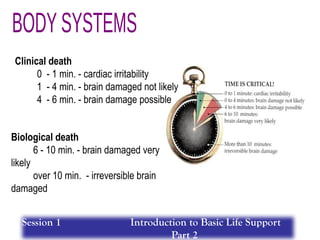
  • #10 · Use of Social Media to Summon Rescuers It may be reasonable for communities to incorporate social media technologies that summon rescuers who are in close proximity to a victim of suspected OHCA and are willing and able to perform CPR.
  • #26 The pediatric chain of survival can be thought of as a sequence of events that must occur in order to restore health in a child or infant victim of sudden cardiac arrest. Therefore, the Pediatric Chain of Survival includes: Prevention of respiratory/cardiac arrest. Early high-quality CPR.
  • #27 The circulatory system is a network consisting of blood, blood vessels, and the heart. This network supplies tissues in the body with oxygen and other nutrients, transports hormones, and removes unnecessary waste products. Large Vessel = Aorta
  • #47 All rescuers who have started resuscitation procedures should continue to do so unless: Effective and spontaneous (normal) breathing and circulation has been restored. Responsibility is assumed by a more senior emergency medical professional who may determine unresponsiveness to resuscitation efforts such as a paramedic arriving on the scene or a physician in the emergency room. Recognition of reliable criteria indicating irreversible death (Physician). Rescuer is unable to continue resuscitation due to exhaustion, the scene is no longer safe, or when continued resuscitation may place other lives at risk. Presentation of a valid DNAR order to the rescuer.
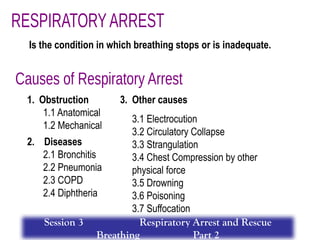
  • #81 Ventricular fibrillation is a heart rhythm problem that occurs when the heart beats with rapid, erratic electrical impulses. This causes pumping chambers in your heart (the ventricles) to quiver uselessly, instead of pumping blood Ventricular fibrillation (v-fib) is not the only dysrhythmia that causes cardiac arrest. ... The difference is that ventricular tachycardia continues to make the heart beat regularly, but it goes so fast that the heart never gets a chance to fill with blood. The pulseless ventricular tachycardia rhythm is primarily identified by several criteria. First, the rate is usually greater than 180 beats per minute, and the rhythm generally has a very wide QRS complex. Second, the patient will be pulseless. And third, the rhythm originates in the ventricles.