BASIC LAWS
OF MATH
Commutative Law of Addition;
In this law, order dose not matter
when you add up numbers, you will
always get the same answer.
If we exchange numbers over and over ,get the same
answer
... when we add numbers
ANOTHER NAME
this law is also called the Order Property.
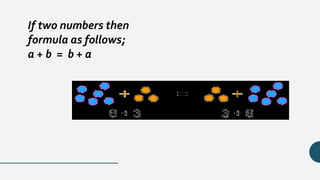
If two numbers then
formula as follows;
a + b = b + a
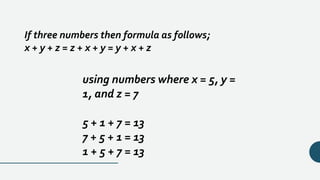
If three numbers then formula as follows;
x + y + z = z + x + y = y + x + z
using numbers where x = 5, y =
1, and z = 7
5 + 1 + 7 = 13
7 + 5 + 1 = 13
1 + 5 + 7 = 13
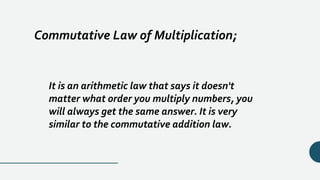
Commutative Law of Multiplication;
It is an arithmetic law that says it doesn't
matter what order you multiply numbers, you
will always get the same answer. It is very
similar to the commutative addition law.
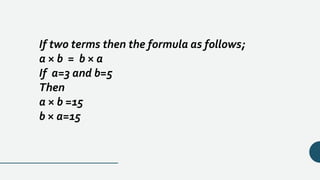
If two terms then the formula as follows;
a × b = b × a
If a=3 and b=5
Then
a × b =15
b × a=15
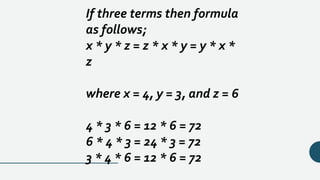
If three terms then formula
as follows;
x * y * z = z * x * y = y * x *
z
where x = 4, y = 3, and z = 6
4 * 3 * 6 = 12 * 6 = 72
6 * 4 * 3 = 24 * 3 = 72
3 * 4 * 6 = 12 * 6 = 72
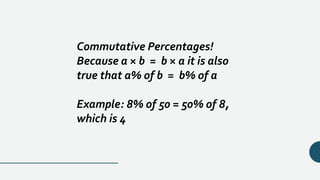
Commutative Percentages!
Because a × b = b × a it is also
true that a% of b = b% of a
Example: 8% of 50 = 50% of 8,
which is 4
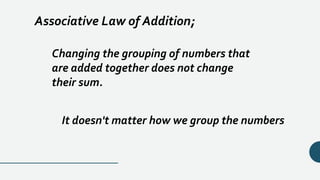
Associative Law of Addition;
Changing the grouping of numbers that
are added together does not change
their sum.
It doesn't matter how we group the numbers
ANOTHER NAME;
This law is also called the Grouping Property.
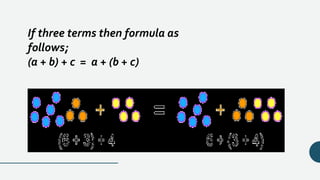
If three terms then formula as
follows;
(a + b) + c = a + (b + c)
Associative Law of
Multiplication;
The Associative Law of Multiplication is similar to
the same law for addition. It says that no matter
how you group numbers you are multiplying
together, you will get the same answer.
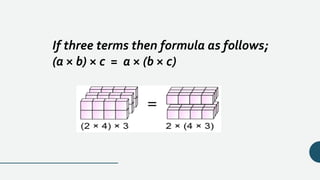
If three terms then formula as follows;
(a × b) × c = a × (b × c)
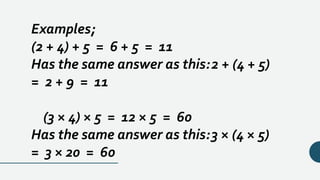
Examples;
(2 + 4) + 5 = 6 + 5 = 11
Has the same answer as this:2 + (4 + 5)
= 2 + 9 = 11
(3 × 4) × 5 = 12 × 5 = 60
Has the same answer as this:3 × (4 × 5)
= 3 × 20 = 60
5 × (2 × 9) is also equal to:
A
5 - (2 - 9)
B
5 × 2 - 9
C
(5 × 2) × 9
D
5 × 11
C correct answer
5 × (2 × 9) = (5 × 2) × 9
(The Associative Law)
Basic laws of math
Basic laws of math
Basic laws of math
Basic laws of math

Basic laws of math

  • 2.
  • 3.
    Commutative Law ofAddition; In this law, order dose not matter when you add up numbers, you will always get the same answer. If we exchange numbers over and over ,get the same answer ... when we add numbers
  • 4.
    ANOTHER NAME this lawis also called the Order Property.
  • 5.
    If two numbersthen formula as follows; a + b = b + a
  • 6.
    If three numbersthen formula as follows; x + y + z = z + x + y = y + x + z using numbers where x = 5, y = 1, and z = 7 5 + 1 + 7 = 13 7 + 5 + 1 = 13 1 + 5 + 7 = 13
  • 7.
    Commutative Law ofMultiplication; It is an arithmetic law that says it doesn't matter what order you multiply numbers, you will always get the same answer. It is very similar to the commutative addition law.
  • 8.
    If two termsthen the formula as follows; a × b = b × a If a=3 and b=5 Then a × b =15 b × a=15
  • 9.
    If three termsthen formula as follows; x * y * z = z * x * y = y * x * z where x = 4, y = 3, and z = 6 4 * 3 * 6 = 12 * 6 = 72 6 * 4 * 3 = 24 * 3 = 72 3 * 4 * 6 = 12 * 6 = 72
  • 10.
    Commutative Percentages! Because a× b = b × a it is also true that a% of b = b% of a Example: 8% of 50 = 50% of 8, which is 4
  • 11.
    Associative Law ofAddition; Changing the grouping of numbers that are added together does not change their sum. It doesn't matter how we group the numbers
  • 12.
    ANOTHER NAME; This lawis also called the Grouping Property.
  • 13.
    If three termsthen formula as follows; (a + b) + c = a + (b + c)
  • 14.
    Associative Law of Multiplication; TheAssociative Law of Multiplication is similar to the same law for addition. It says that no matter how you group numbers you are multiplying together, you will get the same answer.
  • 15.
    If three termsthen formula as follows; (a × b) × c = a × (b × c)
  • 16.
    Examples; (2 + 4)+ 5 = 6 + 5 = 11 Has the same answer as this:2 + (4 + 5) = 2 + 9 = 11 (3 × 4) × 5 = 12 × 5 = 60 Has the same answer as this:3 × (4 × 5) = 3 × 20 = 60
  • 17.
    5 × (2× 9) is also equal to: A 5 - (2 - 9) B 5 × 2 - 9 C (5 × 2) × 9 D 5 × 11 C correct answer 5 × (2 × 9) = (5 × 2) × 9 (The Associative Law)