ORDERING DECIMALS
Because often we look
at 0.42 and 0.402 and
say that 0.402 must be
bigger because there
are more digits. But no!
We can use this method
to see which decimals
are bigger:
Set up a table with the decimal
point in the same place for each
number.
Put in each number.
Fill in the empty squares with
zeros.
Compare using the first column
on the left
If the digits are equal move to
the next column to the right until
If you want ascending order
you always pick the smallest
first.
If you want descending order
you always pick the largest
first.
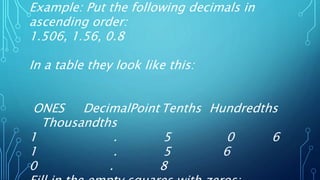
Example: Put the following decimals in
ascending order:
1.506, 1.56, 0.8
In a table they look like this:
ONES DecimalPoint Tenths Hundredths
Thousandths
1 . 5 0 6
1 . 5 6
0 . 8
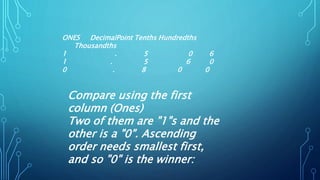
ONES DecimalPoint Tenths Hundredths
Thousandths
1 . 5 0 6
1 . 5 6 0
0 . 8 0 0
Compare using the first
column (Ones)
Two of them are "1"s and the
other is a "0". Ascending
order needs smallest first,
and so "0" is the winner:
Now we can remove 0.8 from the list:
ONES DecimalPoint Tenths Hundredths
Thousandths
1 . 5 0 6
1 . 5 6 0
- . - - -
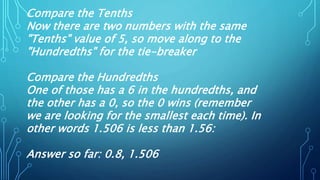
Compare the Tenths
Now there are two numbers with the same
"Tenths" value of 5, so move along to the
"Hundredths" for the tie-breaker
Compare the Hundredths
One of those has a 6 in the hundredths, and
the other has a 0, so the 0 wins (remember
we are looking for the smallest each time). In
other words 1.506 is less than 1.56:
Answer so far: 0.8, 1.506
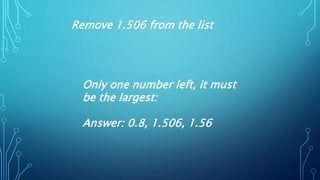
Remove 1.506 from the list
Only one number left, it must
be the largest:
Answer: 0.8, 1.506, 1.56
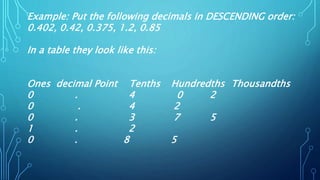
Example: Put the following decimals in DESCENDING order:
0.402, 0.42, 0.375, 1.2, 0.85
In a table they look like this:
Ones decimal Point Tenths Hundredths Thousandths
0 . 4 0 2
0 . 4 2
0 . 3 7 5
1 . 2
0 . 8 5
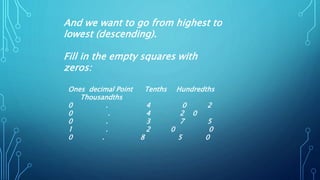
And we want to go from highest to
lowest (descending).
Fill in the empty squares with
zeros:
Ones decimal Point Tenths Hundredths
Thousandths
0 . 4 0 2
0 . 4 2 0
0 . 3 7 5
1 . 2 0 0
0 . 8 5 0
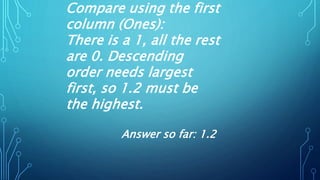
Compare using the first
column (Ones):
There is a 1, all the rest
are 0. Descending
order needs largest
first, so 1.2 must be
the highest.
Answer so far: 1.2
Ones decimal Point TenthsHundredths
Thousandths
0 . 4 0 2
0 . 4 2 0
0 . 3 7 5
- . - - -
0 . 8 5 0
Compare the Tenths.
The 8 is highest, so 0.85 is
next in value.
Answer so far: 1.2, 0.85
Ones decimal Point TenthsHundredths
Thousandths
0 . 4 0 2
0 . 4 2 0
0 . 3 7 5
- . - - -
- . - - -
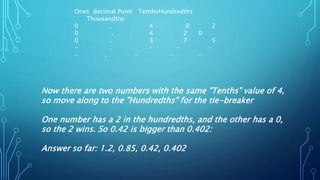
Now there are two numbers with the same "Tenths" value of 4,
so move along to the "Hundredths" for the tie-breaker
One number has a 2 in the hundredths, and the other has a 0,
so the 2 wins. So 0.42 is bigger than 0.402:
Answer so far: 1.2, 0.85, 0.42, 0.402
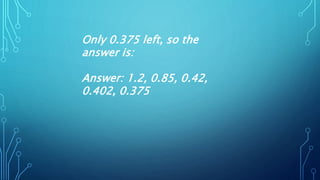
Only 0.375 left, so the
answer is:
Answer: 1.2, 0.85, 0.42,
0.402, 0.375
Ordering   decimals
Ordering   decimals
Ordering   decimals
Ordering   decimals

Ordering decimals

  • 1.
  • 2.
    Because often welook at 0.42 and 0.402 and say that 0.402 must be bigger because there are more digits. But no! We can use this method to see which decimals are bigger:
  • 3.
    Set up atable with the decimal point in the same place for each number. Put in each number. Fill in the empty squares with zeros. Compare using the first column on the left If the digits are equal move to the next column to the right until
  • 4.
    If you wantascending order you always pick the smallest first. If you want descending order you always pick the largest first.
  • 5.
    Example: Put thefollowing decimals in ascending order: 1.506, 1.56, 0.8 In a table they look like this: ONES DecimalPoint Tenths Hundredths Thousandths 1 . 5 0 6 1 . 5 6 0 . 8
  • 6.
    ONES DecimalPoint TenthsHundredths Thousandths 1 . 5 0 6 1 . 5 6 0 0 . 8 0 0 Compare using the first column (Ones) Two of them are "1"s and the other is a "0". Ascending order needs smallest first, and so "0" is the winner:
  • 7.
    Now we canremove 0.8 from the list: ONES DecimalPoint Tenths Hundredths Thousandths 1 . 5 0 6 1 . 5 6 0 - . - - -
  • 8.
    Compare the Tenths Nowthere are two numbers with the same "Tenths" value of 5, so move along to the "Hundredths" for the tie-breaker Compare the Hundredths One of those has a 6 in the hundredths, and the other has a 0, so the 0 wins (remember we are looking for the smallest each time). In other words 1.506 is less than 1.56: Answer so far: 0.8, 1.506
  • 9.
    Remove 1.506 fromthe list Only one number left, it must be the largest: Answer: 0.8, 1.506, 1.56
  • 10.
    Example: Put thefollowing decimals in DESCENDING order: 0.402, 0.42, 0.375, 1.2, 0.85 In a table they look like this: Ones decimal Point Tenths Hundredths Thousandths 0 . 4 0 2 0 . 4 2 0 . 3 7 5 1 . 2 0 . 8 5
  • 11.
    And we wantto go from highest to lowest (descending). Fill in the empty squares with zeros: Ones decimal Point Tenths Hundredths Thousandths 0 . 4 0 2 0 . 4 2 0 0 . 3 7 5 1 . 2 0 0 0 . 8 5 0
  • 12.
    Compare using thefirst column (Ones): There is a 1, all the rest are 0. Descending order needs largest first, so 1.2 must be the highest. Answer so far: 1.2
  • 13.
    Ones decimal PointTenthsHundredths Thousandths 0 . 4 0 2 0 . 4 2 0 0 . 3 7 5 - . - - - 0 . 8 5 0 Compare the Tenths. The 8 is highest, so 0.85 is next in value. Answer so far: 1.2, 0.85
  • 14.
    Ones decimal PointTenthsHundredths Thousandths 0 . 4 0 2 0 . 4 2 0 0 . 3 7 5 - . - - - - . - - - Now there are two numbers with the same "Tenths" value of 4, so move along to the "Hundredths" for the tie-breaker One number has a 2 in the hundredths, and the other has a 0, so the 2 wins. So 0.42 is bigger than 0.402: Answer so far: 1.2, 0.85, 0.42, 0.402
  • 15.
    Only 0.375 left,so the answer is: Answer: 1.2, 0.85, 0.42, 0.402, 0.375