MODULE 3
BASIC
AUTOMOTIVE
ELECTRICAL
UNIT 1-INTRODUCTION TO
ELECTRICS
UNIT 2- ELECTRICAL VARIABLES AND
OHM’S LAW
UNIT 3- CIRCUITS
UNIT 4- ELECTRICAL MEASURING
TOOLS
UNIT 5- ELECTRICAL DIAGNOSIS
OBJECTIVES
At the end of this module, you should be able to:
 Understand the basics of electricity.
 Understand the variables and their relationship.
 Understand the different types of circuits
 Know how to troubleshoot electrical system.
UNIT 1
INTRODUCTION TO ELECTRICAL
 Electricity is simply defined as a flow of electric
charge.
 For a charge to flow, there must be a source, a
medium to allow the flow and the user of the
charge.
 This charges are also referred to as electron
which is a component of matter.
Matter is anything that has weight and occupy
space. It is composed of tiny particles called
atom which is the smallest indivisible part of
matter.
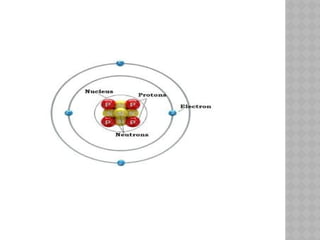
 It consist of 3-sub particles namely
1. Proton (positively charged)
2. Electron (negatively charged)
3.Neutron (neutral charged)
The proton and the neutron together forms
the nucleus of the atom with the electron
revolving in its orbit held together by the
attraction of positively charged nucleus.
Depending on arrangement, atoms can gain
electron from another atom or lose electron,
making them positively / negatively charged.
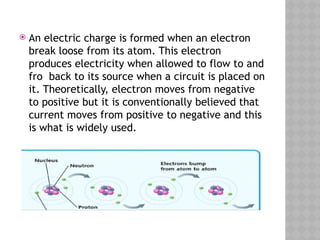
 An electric charge is formed when an electron
break loose from its atom. This electron
produces electricity when allowed to flow to and
fro back to its source when a circuit is placed on
it. Theoretically, electron moves from negative
to positive but it is conventionally believed that
current moves from positive to negative and this
is what is widely used.
UNIT 2: CONDUCTORS, INSULATOR
S AND SEMICONDUCTORS
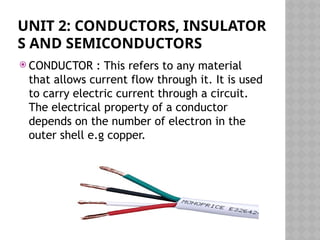
 CONDUCTOR : This refers to any material
that allows current flow through it. It is used
to carry electric current through a circuit.
The electrical property of a conductor
depends on the number of electron in the
outer shell e.g copper.
 INSULATORS : Are materials that inhibit the
flow of electrons. It helps to prevent current
passing through shorter route and also shield
a conductor from interference. E.g plastic,
rubber etc.
 SEMICONDUCTORS: These are materials that
has the ability to control the flow of
electricity and are used in building
electronics. It has the ability to act as
conductor under certain condition and as an
insulator in another e.g transistor, diode etc.
REVISION QUESTION
1. What is electricity?
2. Mention 5 types of conductors
3. Mention 5 types of insulators
4. Why is gold not popularly used as a
conductor
5. What advantage does silver as a conductor
over copper?
ELECTRICAL VARIABLES
Electricity is usually measured by three variables .
1. The amount of currents flowing.
2. Voltage that moves the current
3. the resistance to the flow of electric current.
Current
 it is a measure of flow of electron in a circuit.
Think of current as the flow of water through a
pipe. It is measured in ampere (A).Unlike
voltage the current does not decrease, it is the
same at the beginning to the end of the circuit.
VOLTAGE
 It is regarded as potential energy of
electricity. It is the force behind the
movement of current in a circuit, referred to
as (E.M.F (Electron Moving Force). Think of a
voltage as a full tank of water, it does not
decrease if the tank is not opened but
depletes when opened. It is measured in
volts (v).
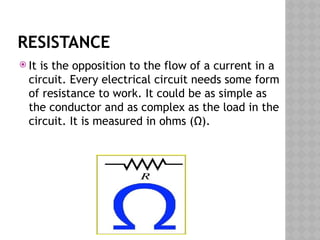
RESISTANCE
 It is the opposition to the flow of a current in a
circuit. Every electrical circuit needs some form
of resistance to work. It could be as simple as
the conductor and as complex as the load in the
circuit. It is measured in ohms (Ω).
KEY ELECTRICAL NOTES
 Voltage is created when an EMF is acting on a
conductor.
 Electron flows only when a voltage difference
exist between two points in the conductor
 The ground of a circuit is regarded as point of
lowest voltage and the return path of the circuit.
 By convention, current flows to ground in an
electric circuit.
 Resistance controls the amount of current
passing through it.
 All resistance changes energy to heat to some
extents.
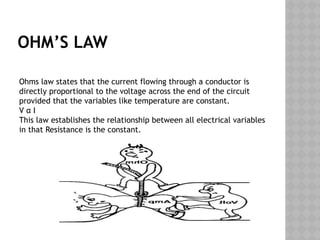
OHM’S LAW
Ohms law states that the current flowing through a conductor is
directly proportional to the voltage across the end of the circuit
provided that the variables like temperature are constant.
V α I
This law establishes the relationship between all electrical variables
in that Resistance is the constant.
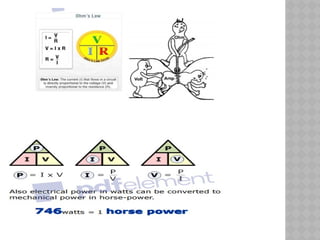
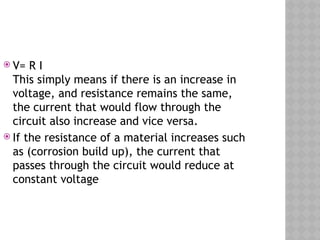
 V= R I
This simply means if there is an increase in
voltage, and resistance remains the same,
the current that would flow through the
circuit also increase and vice versa.
 If the resistance of a material increases such
as (corrosion build up), the current that
passes through the circuit would reduce at
constant voltage
POWER
 It is the rate at which an electrical work is
done.
If for example the battery on a car (12V) is weak
and now has (10V) on it, is used to power a
bulb of about 20Ω. The current that is
supposed to flow through the bulb (0.6A)
would reduced to (0.5A) and this could result
in dim illumination from the bulb.
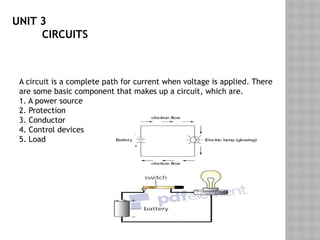
A circuit is a complete path for current when voltage is applied. There
are some basic component that makes up a circuit, which are.
1. A power source
2. Protection
3. Conductor
4. Control devices
5. Load
UNIT 3
CIRCUITS
POWER SOURCE:-
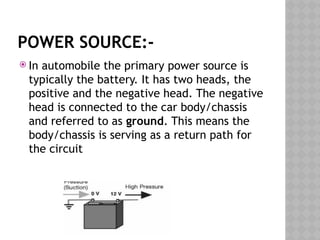
 In automobile the primary power source is
typically the battery. It has two heads, the
positive and the negative head. The negative
head is connected to the car body/chassis
and referred to as ground. This means the
body/chassis is serving as a return path for
the circuit
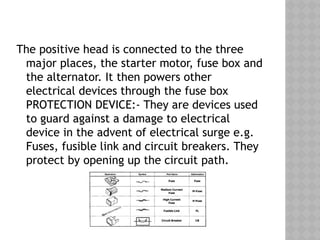
The positive head is connected to the three
major places, the starter motor, fuse box and
the alternator. It then powers other
electrical devices through the fuse box
PROTECTION DEVICE:- They are devices used
to guard against a damage to electrical
device in the advent of electrical surge e.g.
Fuses, fusible link and circuit breakers. They
protect by opening up the circuit path.
 CONTROL DEVICES:- They are devices that
must be operated before an electrical device
would work. The mode operation however is
could be through physical activation or
dependent on some measured factors e.g.
Switch, relays, Transistors and ECUs.
LOAD:- The load is any component that uses
electricity to do work, e.g. Light, Coil, Horn,
Radio etc.
TYPES OF CIRCUIT
 There are 3 types of circuit.
1. SERIES CIRCUIT:- A series circuit consist of
two or more electrical loads connected in a
way that same current flows through them.
FEATURES
An open, any where in the circuit affect
others.
The total resistance is the sum of all the
resistance of the loads in the circuit.
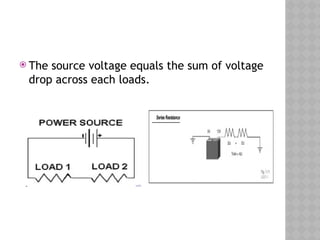
 The source voltage equals the sum of voltage
drop across each loads.
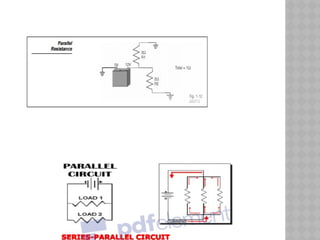
PARALLEL CIRCUIT:-
• Parallel circuit has more than one path for
current, each path operates independent of
the other.
FEATURE
• Total resistance is lower than the resistance
of individual load.
• An open in a path would not affect other
circuits.
• The total current equals the sum of
individual current on paths.
• Voltage is constant through the circuits.
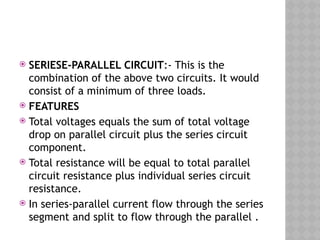
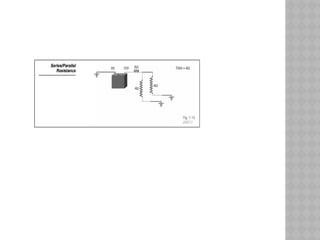
 SERIESE-PARALLEL CIRCUIT:- This is the
combination of the above two circuits. It would
consist of a minimum of three loads.
 FEATURES
 Total voltages equals the sum of total voltage
drop on parallel circuit plus the series circuit
component.
 Total resistance will be equal to total parallel
circuit resistance plus individual series circuit
resistance.
 In series-parallel current flow through the series
segment and split to flow through the parallel .
CIRCUIT ISSUES
There are three major faults common to electrical
circuits; they are
 Short circuit
 Open circuit
 High resistance
SHORT CIRCUIT: this is the term used when an a
circuit finds an alternative path different from
what it was designed to be. It is not an intended
circuit and could result serious electrical issues.
It could exist as a short to ground, short to power
or any other short aside from the two
aforementioned
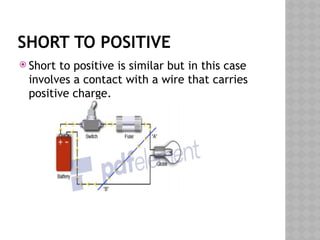
SHORT TO POSITIVE
 Short to positive is similar but in this case
involves a contact with a wire that carries
positive charge.
OPEN CIRCUIT
 Open circuit: This is a broken circuit which
would stop the flow of current across a circuit
thereby making the load to be in operative
 The open could be anywhere in a circuit, it
could be on the feed side or ground side of the
circuit and as well as in the load.
 Major suspect on the feed side is the fuse,
however an open could also be on the
conductor
 A major culprit on the ground side is a loose
ground.
HIGH RESISTANCE
 It is caused by the presence of an unwanted resistance
in a circuit.
 These could e due to corrosion build up, loose
connections, wrong wire size or breakage of wire
strands
 This is a problem that causes an excessive voltage drop
at some point before the load in the circuit or after it.
 It is different from an open circuit fault in that current
still flows in the circuits.
 An open voltage check might measure source voltage.
 A voltage drop test is the easiest method of
determining high resistance fault
REVISION QUESTION
1. What appropriate fuse rating would be
good for a circuit that has two load of 20W
and 15W connected in parallel?
2. What is the effect of an open circuit on a
circuit?
3. What is the effect of a short to ground on a
circuit?
UNIT 4
ELECTRICAL MEASURING TOOLS
A good electrical components most time might
not be known through physical appearance,
so a there is a need for electrical tools that
could measure certain variables to know if
the component or connection is right.
Tools commonly used for electrical
troubleshooting are test lamps, multimeter,
scan tools, oscilloscope, cutters, and jumper
wire among others.
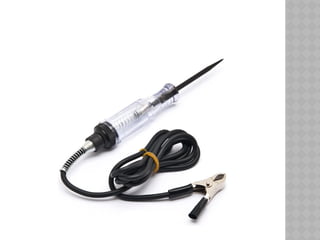
TEST LAMP
 this is a good tool to know if the prerequisite
for a load to work gets to the load. It consist
of a bulb(a low wattage), a probe and a wire
connected to a clip.
 It uses the principle of a closed circuit to
determine if positive or negative needed by
the load is present at the load. It however
restricted to a 12v system as it cannot
measure effectively voltage lower than this
and does not display the voltage available.
HOW TO USE A TEST LAMP
 The following steps describes how to use a test lamp in an
electrical diagnosis
1. Test the test lamp operation by placing the probe end and the
clip end to a positive and negative respectively to confirm a
good circuit on the tester
2. Determine what is to be checked,
3. Study the operation of the faulty circuits and identify its proper
operation conditions
4. If it is a positive for example, place the clip end of the test
lamp to a negative source (best at negative battery terminal)
5. probe the circuit to be checked one after the other.
6. Any one that lit the bulb after been probed carries a positive.
7. If the bulb does not lit, then check fuses or use wiring diagram
to determine circuit path for further troubleshooting.
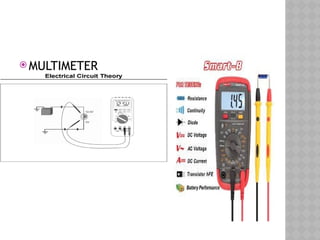
MULTIMETER
 this is a meter that could be used for many electrical variable
measurement.
 It comes in analog or digital form
 Digital are mostly used in automotive repair in that it has a high
impedance and draws a little or no current form measuring
device thereby reducing the chances of causing a damage to
vehicle computers
 It is powered by a battery and consist of a pair of probe or more
in the case of insulation tester
 It has a Voltmeter that helps to measure voltages of different
ranges,
 ohms meter that is used to determine the resistance of a
material,
 a continuity function that helps determine the integrity of a
conductor
 ammeter which helps to measure current through a circuit etc
 MULTIMETER
FEATURE OF A MULTIMETER
 A simple
multimeter consist
of
 A jack
 A dial
 Function button
 probe
JACK
 This is the hole that the probes
are fixed on
 The number of jacks depends on
the manufacturer.
 It could 2, 3 0r 4
 Each of the jack are labelled
with the parameter it is used to
measure
 The com jack is where the black
probe
 Other possible jack are the
v/ohms, milliamp, amp and
insulation.
 Careful selection of the jack is
necessary for correct reading and
to avoid a damage to the meter.
DIAL
 It is used to select the
necessary parameter to
be measured, they are
 Voltmeter: it is a function
used to measure the
voltage potential of at
any point in a circuit or
passing through a
conductor. It is denoted
with a V with a straight
line on it denoting DC
voltage or with a
sinusoidal line denoting
AC voltage.
OHMS METER
 It is used to measure
the resistance of a
circuit or component.
 It allows for
comparism with
manufacturer’s
specific resistance.
 The device being
tested should be
powered down to have
an accurate reading.
AMPERAGE
 This is used to measure
of the amount current
passing through a circuit.
 It is connected in series
to a circuit except in a
case of inductive amp
probe.
 It could be measured in
either AC current or DC
just like voltage.
 Careful selection of
range is important
before connection.
CONTINUITY AND DIODE
 Used to know the
integrity of a
conductor
 It buzzes when the
probe is used on the
two ends of a good
conductor
 Diode function is
used to test the
integrity of a diode.
FUNCTION BUTTONS
 Most multimeters have
buttons on them that
is meant to switch
certain functions on
the meter, they are
 On/off
 Auto range/range
selection
 Min/max
 Insulation test
 Hold
JUMPER CABLE
 It is used to bypass a side or both side of a
circuits.
 It is usually fused and the type used on a
circuit should depend on the amps rating of
the device.
 The proper wire nomenclature should be
known before jumping
SCAN TOOLS
 Scan tool is a tool used to interact with
vehicle computers
 It is a bidirectional tools that could send and
receive information from vehicle computers
 it fixes on to the car through the Data link
connector.
 Most are not self powered, hence are
powered through the dlc.
 A typical dlc port would consist of battery
positive, ground and at least a
communication line
 A typical OBD2 dlc consist of 16 pins
 Pin 4 is chassis ground, 5 is signal ground and
16 is battery positive
 Other pins represent a communication line or
manufacturers digression.
OSCILLOSCOPE
UNIT 5
ELECTRICAL TROUBLESHOOTING
 When an electrical faults happens, certain
processes is needed to be followed to get to
know trouble area and solution to the
problem.
 Before proceeding on electrical
troubleshooting, it is necessary to examine
the source of electricity i.e the Battery and
the charging system.
BATTERY
Battery is an electromechanical device that uses
chemical energy( sponge lead, lead oxide and
sulfuric acid react chemically) to electrical
energy (allows the flows of current)
This is the primary source of electrical power, it
helps
 to power up electrical devices when engine is not
running,
 filter off ripples from the charging system there
by making a neat dc voltage available for the load
 it also support the charging system at low engine
speed when electrical demand is high.
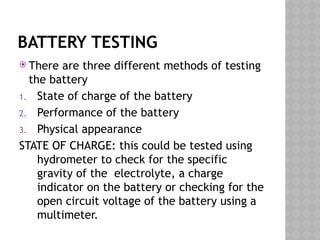
BATTERY TESTING
 There are three different methods of testing
the battery
1. State of charge of the battery
2. Performance of the battery
3. Physical appearance
STATE OF CHARGE: this could be tested using
hydrometer to check for the specific
gravity of the electrolyte, a charge
indicator on the battery or checking for the
open circuit voltage of the battery using a
multimeter.
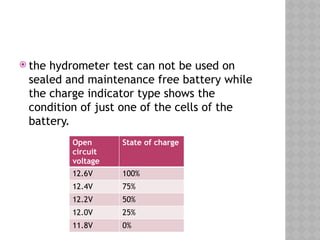
 the hydrometer test can not be used on
sealed and maintenance free battery while
the charge indicator type shows the
condition of just one of the cells of the
battery.
Open
circuit
voltage
State of charge
12.6V 100%
12.4V 75%
12.2V 50%
12.0V 25%
11.8V 0%
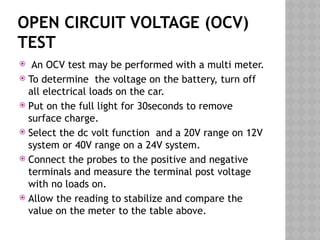
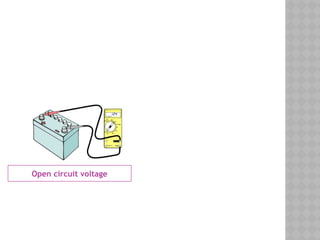
OPEN CIRCUIT VOLTAGE (OCV)
TEST
 An OCV test may be performed with a multi meter.
 To determine the voltage on the battery, turn off
all electrical loads on the car.
 Put on the full light for 30seconds to remove
surface charge.
 Select the dc volt function and a 20V range on 12V
system or 40V range on a 24V system.
 Connect the probes to the positive and negative
terminals and measure the terminal post voltage
with no loads on.
 Allow the reading to stabilize and compare the
value on the meter to the table above.
Open circuit voltage
PERFORMANCE
 Load Test: This helps to determine if a
battery can or can no longer hold charge. It
is a more accurate way to test the health of
the battery. A load tester is used and this
help places a load on the battery and see if
the battery could hold charge.
PHYSICAL CHECKS
Visually check the battery and observe
 Foul smell
 Broken terminal
 Bulge or bump in the case
 Crack or rupture on the battery case
 Excessive fluid leak
These are tell tale signs of a bad battery.
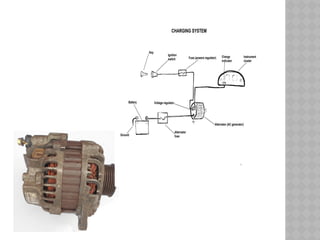
CHARGING SYSTEM
The electrical and electronic devices of an automobile require a
source of power for operation. Typically, the battery provides
power to keep these components running but without charging
the battery it will run down within a short time. The charging
system charges the battery when the engine is running and
also supplies power to the vehicle components. The system
consists of the following:
 Charge indicator (battery light on the dashboard or instrument
cluster): used for warning the driver/vehicle operator of a
charging system problem (poor charge or no charge).
 Alternator: an ac voltage generator that has an inbuilt rectifier
(converts ac voltage to dc voltage) and regulator .
 Battery: an electrical storage for electrical power or energy.
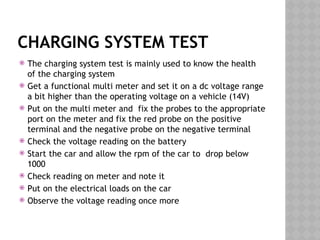
CHARGING SYSTEM TEST
 The charging system test is mainly used to know the health
of the charging system
 Get a functional multi meter and set it on a dc voltage range
a bit higher than the operating voltage on a vehicle (14V)
 Put on the multi meter and fix the probes to the appropriate
port on the meter and fix the red probe on the positive
terminal and the negative probe on the negative terminal
 Check the voltage reading on the battery
 Start the car and allow the rpm of the car to drop below
1000
 Check reading on meter and note it
 Put on the electrical loads on the car
 Observe the voltage reading once more
 For a good charging system, the expected
value 0.5v above battery voltage and about
2V above. An undercharging system results
with a voltage below 13.2.
DIAGNOSTIC STEPS
Skills, know-how of how system works and
logical reasoning is needed to successfully fix
.the problem. A general fault finding step
should also be deployed. they are
1. Verify the complaint: verify the complaint of the
vehicle’s operator by operating the system or
taking a test drive to see if the complaint is really
a problem.
2. Determine the symptoms: check for the symptoms of the
complaint and observe abnormalities in the vehicle’s operation.
3. Analyze the symptoms: all abnormalities should be well
looked into for causes of such abnormal operation.
4. Isolate the troubled area: good analyses of a system can lead
a technician to the affected area of the vehicle. When
discovered, isolate the area and work on it.
5. Correct the trouble: the real fault in a troubled area can
range from a faulty and/or worn-out part/s, poor adjustment or
a bad circuitry to a particular component. This should be
corrected or repaired.
6. Check for proper operation: after repairing a fault, the
system should be tested properly for efficient operation
TASK
 Record a video showing you doing a charging
system test on a car.
 record a video showing you checking the
fuses 0n a car using either a test lamp or
multi meter.
MODULE 3(1)(2), INTRODUCTION TO ELECTRICAL

MODULE 3(1)(2), INTRODUCTION TO ELECTRICAL

  • 1.
    MODULE 3 BASIC AUTOMOTIVE ELECTRICAL UNIT 1-INTRODUCTIONTO ELECTRICS UNIT 2- ELECTRICAL VARIABLES AND OHM’S LAW UNIT 3- CIRCUITS UNIT 4- ELECTRICAL MEASURING TOOLS UNIT 5- ELECTRICAL DIAGNOSIS
  • 2.
    OBJECTIVES At the endof this module, you should be able to:  Understand the basics of electricity.  Understand the variables and their relationship.  Understand the different types of circuits  Know how to troubleshoot electrical system.
  • 3.
    UNIT 1 INTRODUCTION TOELECTRICAL  Electricity is simply defined as a flow of electric charge.  For a charge to flow, there must be a source, a medium to allow the flow and the user of the charge.  This charges are also referred to as electron which is a component of matter. Matter is anything that has weight and occupy space. It is composed of tiny particles called atom which is the smallest indivisible part of matter.
  • 4.
     It consistof 3-sub particles namely 1. Proton (positively charged) 2. Electron (negatively charged) 3.Neutron (neutral charged) The proton and the neutron together forms the nucleus of the atom with the electron revolving in its orbit held together by the attraction of positively charged nucleus. Depending on arrangement, atoms can gain electron from another atom or lose electron, making them positively / negatively charged.
  • 6.
     An electriccharge is formed when an electron break loose from its atom. This electron produces electricity when allowed to flow to and fro back to its source when a circuit is placed on it. Theoretically, electron moves from negative to positive but it is conventionally believed that current moves from positive to negative and this is what is widely used.
  • 7.
    UNIT 2: CONDUCTORS,INSULATOR S AND SEMICONDUCTORS  CONDUCTOR : This refers to any material that allows current flow through it. It is used to carry electric current through a circuit. The electrical property of a conductor depends on the number of electron in the outer shell e.g copper.
  • 8.
     INSULATORS :Are materials that inhibit the flow of electrons. It helps to prevent current passing through shorter route and also shield a conductor from interference. E.g plastic, rubber etc.  SEMICONDUCTORS: These are materials that has the ability to control the flow of electricity and are used in building electronics. It has the ability to act as conductor under certain condition and as an insulator in another e.g transistor, diode etc.
  • 9.
    REVISION QUESTION 1. Whatis electricity? 2. Mention 5 types of conductors 3. Mention 5 types of insulators 4. Why is gold not popularly used as a conductor 5. What advantage does silver as a conductor over copper?
  • 10.
    ELECTRICAL VARIABLES Electricity isusually measured by three variables . 1. The amount of currents flowing. 2. Voltage that moves the current 3. the resistance to the flow of electric current. Current  it is a measure of flow of electron in a circuit. Think of current as the flow of water through a pipe. It is measured in ampere (A).Unlike voltage the current does not decrease, it is the same at the beginning to the end of the circuit.
  • 11.
    VOLTAGE  It isregarded as potential energy of electricity. It is the force behind the movement of current in a circuit, referred to as (E.M.F (Electron Moving Force). Think of a voltage as a full tank of water, it does not decrease if the tank is not opened but depletes when opened. It is measured in volts (v).
  • 12.
    RESISTANCE  It isthe opposition to the flow of a current in a circuit. Every electrical circuit needs some form of resistance to work. It could be as simple as the conductor and as complex as the load in the circuit. It is measured in ohms (Ω).
  • 13.
    KEY ELECTRICAL NOTES Voltage is created when an EMF is acting on a conductor.  Electron flows only when a voltage difference exist between two points in the conductor  The ground of a circuit is regarded as point of lowest voltage and the return path of the circuit.  By convention, current flows to ground in an electric circuit.  Resistance controls the amount of current passing through it.  All resistance changes energy to heat to some extents.
  • 14.
    OHM’S LAW Ohms lawstates that the current flowing through a conductor is directly proportional to the voltage across the end of the circuit provided that the variables like temperature are constant. V α I This law establishes the relationship between all electrical variables in that Resistance is the constant.
  • 16.
     V= RI This simply means if there is an increase in voltage, and resistance remains the same, the current that would flow through the circuit also increase and vice versa.  If the resistance of a material increases such as (corrosion build up), the current that passes through the circuit would reduce at constant voltage
  • 17.
    POWER  It isthe rate at which an electrical work is done.
  • 18.
    If for examplethe battery on a car (12V) is weak and now has (10V) on it, is used to power a bulb of about 20Ω. The current that is supposed to flow through the bulb (0.6A) would reduced to (0.5A) and this could result in dim illumination from the bulb.
  • 19.
    A circuit isa complete path for current when voltage is applied. There are some basic component that makes up a circuit, which are. 1. A power source 2. Protection 3. Conductor 4. Control devices 5. Load UNIT 3 CIRCUITS
  • 20.
    POWER SOURCE:-  Inautomobile the primary power source is typically the battery. It has two heads, the positive and the negative head. The negative head is connected to the car body/chassis and referred to as ground. This means the body/chassis is serving as a return path for the circuit
  • 21.
    The positive headis connected to the three major places, the starter motor, fuse box and the alternator. It then powers other electrical devices through the fuse box PROTECTION DEVICE:- They are devices used to guard against a damage to electrical device in the advent of electrical surge e.g. Fuses, fusible link and circuit breakers. They protect by opening up the circuit path.
  • 22.
     CONTROL DEVICES:-They are devices that must be operated before an electrical device would work. The mode operation however is could be through physical activation or dependent on some measured factors e.g. Switch, relays, Transistors and ECUs. LOAD:- The load is any component that uses electricity to do work, e.g. Light, Coil, Horn, Radio etc.
  • 23.
    TYPES OF CIRCUIT There are 3 types of circuit. 1. SERIES CIRCUIT:- A series circuit consist of two or more electrical loads connected in a way that same current flows through them. FEATURES An open, any where in the circuit affect others. The total resistance is the sum of all the resistance of the loads in the circuit.
  • 24.
     The sourcevoltage equals the sum of voltage drop across each loads.
  • 25.
    PARALLEL CIRCUIT:- • Parallelcircuit has more than one path for current, each path operates independent of the other. FEATURE • Total resistance is lower than the resistance of individual load. • An open in a path would not affect other circuits. • The total current equals the sum of individual current on paths. • Voltage is constant through the circuits.
  • 27.
     SERIESE-PARALLEL CIRCUIT:-This is the combination of the above two circuits. It would consist of a minimum of three loads.  FEATURES  Total voltages equals the sum of total voltage drop on parallel circuit plus the series circuit component.  Total resistance will be equal to total parallel circuit resistance plus individual series circuit resistance.  In series-parallel current flow through the series segment and split to flow through the parallel .
  • 29.
    CIRCUIT ISSUES There arethree major faults common to electrical circuits; they are  Short circuit  Open circuit  High resistance SHORT CIRCUIT: this is the term used when an a circuit finds an alternative path different from what it was designed to be. It is not an intended circuit and could result serious electrical issues. It could exist as a short to ground, short to power or any other short aside from the two aforementioned
  • 30.
    SHORT TO POSITIVE Short to positive is similar but in this case involves a contact with a wire that carries positive charge.
  • 31.
    OPEN CIRCUIT  Opencircuit: This is a broken circuit which would stop the flow of current across a circuit thereby making the load to be in operative  The open could be anywhere in a circuit, it could be on the feed side or ground side of the circuit and as well as in the load.  Major suspect on the feed side is the fuse, however an open could also be on the conductor  A major culprit on the ground side is a loose ground.
  • 32.
    HIGH RESISTANCE  Itis caused by the presence of an unwanted resistance in a circuit.  These could e due to corrosion build up, loose connections, wrong wire size or breakage of wire strands  This is a problem that causes an excessive voltage drop at some point before the load in the circuit or after it.  It is different from an open circuit fault in that current still flows in the circuits.  An open voltage check might measure source voltage.  A voltage drop test is the easiest method of determining high resistance fault
  • 33.
    REVISION QUESTION 1. Whatappropriate fuse rating would be good for a circuit that has two load of 20W and 15W connected in parallel? 2. What is the effect of an open circuit on a circuit? 3. What is the effect of a short to ground on a circuit?
  • 34.
    UNIT 4 ELECTRICAL MEASURINGTOOLS A good electrical components most time might not be known through physical appearance, so a there is a need for electrical tools that could measure certain variables to know if the component or connection is right. Tools commonly used for electrical troubleshooting are test lamps, multimeter, scan tools, oscilloscope, cutters, and jumper wire among others.
  • 35.
    TEST LAMP  thisis a good tool to know if the prerequisite for a load to work gets to the load. It consist of a bulb(a low wattage), a probe and a wire connected to a clip.  It uses the principle of a closed circuit to determine if positive or negative needed by the load is present at the load. It however restricted to a 12v system as it cannot measure effectively voltage lower than this and does not display the voltage available.
  • 37.
    HOW TO USEA TEST LAMP  The following steps describes how to use a test lamp in an electrical diagnosis 1. Test the test lamp operation by placing the probe end and the clip end to a positive and negative respectively to confirm a good circuit on the tester 2. Determine what is to be checked, 3. Study the operation of the faulty circuits and identify its proper operation conditions 4. If it is a positive for example, place the clip end of the test lamp to a negative source (best at negative battery terminal) 5. probe the circuit to be checked one after the other. 6. Any one that lit the bulb after been probed carries a positive. 7. If the bulb does not lit, then check fuses or use wiring diagram to determine circuit path for further troubleshooting.
  • 38.
    MULTIMETER  this isa meter that could be used for many electrical variable measurement.  It comes in analog or digital form  Digital are mostly used in automotive repair in that it has a high impedance and draws a little or no current form measuring device thereby reducing the chances of causing a damage to vehicle computers  It is powered by a battery and consist of a pair of probe or more in the case of insulation tester  It has a Voltmeter that helps to measure voltages of different ranges,  ohms meter that is used to determine the resistance of a material,  a continuity function that helps determine the integrity of a conductor  ammeter which helps to measure current through a circuit etc
  • 39.
  • 40.
    FEATURE OF AMULTIMETER  A simple multimeter consist of  A jack  A dial  Function button  probe
  • 41.
    JACK  This isthe hole that the probes are fixed on  The number of jacks depends on the manufacturer.  It could 2, 3 0r 4  Each of the jack are labelled with the parameter it is used to measure  The com jack is where the black probe  Other possible jack are the v/ohms, milliamp, amp and insulation.  Careful selection of the jack is necessary for correct reading and to avoid a damage to the meter.
  • 42.
    DIAL  It isused to select the necessary parameter to be measured, they are  Voltmeter: it is a function used to measure the voltage potential of at any point in a circuit or passing through a conductor. It is denoted with a V with a straight line on it denoting DC voltage or with a sinusoidal line denoting AC voltage.
  • 43.
    OHMS METER  Itis used to measure the resistance of a circuit or component.  It allows for comparism with manufacturer’s specific resistance.  The device being tested should be powered down to have an accurate reading.
  • 44.
    AMPERAGE  This isused to measure of the amount current passing through a circuit.  It is connected in series to a circuit except in a case of inductive amp probe.  It could be measured in either AC current or DC just like voltage.  Careful selection of range is important before connection.
  • 45.
    CONTINUITY AND DIODE Used to know the integrity of a conductor  It buzzes when the probe is used on the two ends of a good conductor  Diode function is used to test the integrity of a diode.
  • 46.
    FUNCTION BUTTONS  Mostmultimeters have buttons on them that is meant to switch certain functions on the meter, they are  On/off  Auto range/range selection  Min/max  Insulation test  Hold
  • 48.
    JUMPER CABLE  Itis used to bypass a side or both side of a circuits.  It is usually fused and the type used on a circuit should depend on the amps rating of the device.  The proper wire nomenclature should be known before jumping
  • 49.
    SCAN TOOLS  Scantool is a tool used to interact with vehicle computers  It is a bidirectional tools that could send and receive information from vehicle computers  it fixes on to the car through the Data link connector.  Most are not self powered, hence are powered through the dlc.  A typical dlc port would consist of battery positive, ground and at least a communication line
  • 50.
     A typicalOBD2 dlc consist of 16 pins  Pin 4 is chassis ground, 5 is signal ground and 16 is battery positive  Other pins represent a communication line or manufacturers digression.
  • 51.
  • 52.
    UNIT 5 ELECTRICAL TROUBLESHOOTING When an electrical faults happens, certain processes is needed to be followed to get to know trouble area and solution to the problem.  Before proceeding on electrical troubleshooting, it is necessary to examine the source of electricity i.e the Battery and the charging system.
  • 53.
    BATTERY Battery is anelectromechanical device that uses chemical energy( sponge lead, lead oxide and sulfuric acid react chemically) to electrical energy (allows the flows of current) This is the primary source of electrical power, it helps  to power up electrical devices when engine is not running,  filter off ripples from the charging system there by making a neat dc voltage available for the load  it also support the charging system at low engine speed when electrical demand is high.
  • 54.
    BATTERY TESTING  Thereare three different methods of testing the battery 1. State of charge of the battery 2. Performance of the battery 3. Physical appearance STATE OF CHARGE: this could be tested using hydrometer to check for the specific gravity of the electrolyte, a charge indicator on the battery or checking for the open circuit voltage of the battery using a multimeter.
  • 55.
     the hydrometertest can not be used on sealed and maintenance free battery while the charge indicator type shows the condition of just one of the cells of the battery. Open circuit voltage State of charge 12.6V 100% 12.4V 75% 12.2V 50% 12.0V 25% 11.8V 0%
  • 56.
    OPEN CIRCUIT VOLTAGE(OCV) TEST  An OCV test may be performed with a multi meter.  To determine the voltage on the battery, turn off all electrical loads on the car.  Put on the full light for 30seconds to remove surface charge.  Select the dc volt function and a 20V range on 12V system or 40V range on a 24V system.  Connect the probes to the positive and negative terminals and measure the terminal post voltage with no loads on.  Allow the reading to stabilize and compare the value on the meter to the table above.
  • 57.
  • 58.
    PERFORMANCE  Load Test:This helps to determine if a battery can or can no longer hold charge. It is a more accurate way to test the health of the battery. A load tester is used and this help places a load on the battery and see if the battery could hold charge.
  • 59.
    PHYSICAL CHECKS Visually checkthe battery and observe  Foul smell  Broken terminal  Bulge or bump in the case  Crack or rupture on the battery case  Excessive fluid leak These are tell tale signs of a bad battery.
  • 60.
    CHARGING SYSTEM The electricaland electronic devices of an automobile require a source of power for operation. Typically, the battery provides power to keep these components running but without charging the battery it will run down within a short time. The charging system charges the battery when the engine is running and also supplies power to the vehicle components. The system consists of the following:  Charge indicator (battery light on the dashboard or instrument cluster): used for warning the driver/vehicle operator of a charging system problem (poor charge or no charge).  Alternator: an ac voltage generator that has an inbuilt rectifier (converts ac voltage to dc voltage) and regulator .  Battery: an electrical storage for electrical power or energy.
  • 62.
    CHARGING SYSTEM TEST The charging system test is mainly used to know the health of the charging system  Get a functional multi meter and set it on a dc voltage range a bit higher than the operating voltage on a vehicle (14V)  Put on the multi meter and fix the probes to the appropriate port on the meter and fix the red probe on the positive terminal and the negative probe on the negative terminal  Check the voltage reading on the battery  Start the car and allow the rpm of the car to drop below 1000  Check reading on meter and note it  Put on the electrical loads on the car  Observe the voltage reading once more
  • 63.
     For agood charging system, the expected value 0.5v above battery voltage and about 2V above. An undercharging system results with a voltage below 13.2.
  • 64.
    DIAGNOSTIC STEPS Skills, know-howof how system works and logical reasoning is needed to successfully fix .the problem. A general fault finding step should also be deployed. they are 1. Verify the complaint: verify the complaint of the vehicle’s operator by operating the system or taking a test drive to see if the complaint is really a problem.
  • 65.
    2. Determine thesymptoms: check for the symptoms of the complaint and observe abnormalities in the vehicle’s operation. 3. Analyze the symptoms: all abnormalities should be well looked into for causes of such abnormal operation. 4. Isolate the troubled area: good analyses of a system can lead a technician to the affected area of the vehicle. When discovered, isolate the area and work on it. 5. Correct the trouble: the real fault in a troubled area can range from a faulty and/or worn-out part/s, poor adjustment or a bad circuitry to a particular component. This should be corrected or repaired. 6. Check for proper operation: after repairing a fault, the system should be tested properly for efficient operation
  • 66.
    TASK  Record avideo showing you doing a charging system test on a car.  record a video showing you checking the fuses 0n a car using either a test lamp or multi meter.