BASIC COMPUTER
CONCEPTS
Mrs.Rupal Patel, Assist. Professor, Sumandeep Nursing College
What is a computer?
An electronic device, operating under the
control of instructions stored in its own
memory unit, that can accept data
(input), manipulate the data according to
specified rules (process), produce
information (output) from the
processing, and store the results for
future use.
Mrs.Rupal Patel, Assist. Professor, Sumandeep Nursing College
What does a
computer do?
Input
Process
Output
Storage
Processor
Control Unit/Arithmetic Logic Unit
Memory
Storage Devices
Input
Devices
Output
Devices
Mrs.Rupal Patel, Assist. Professor, Sumandeep Nursing College
Input Devices
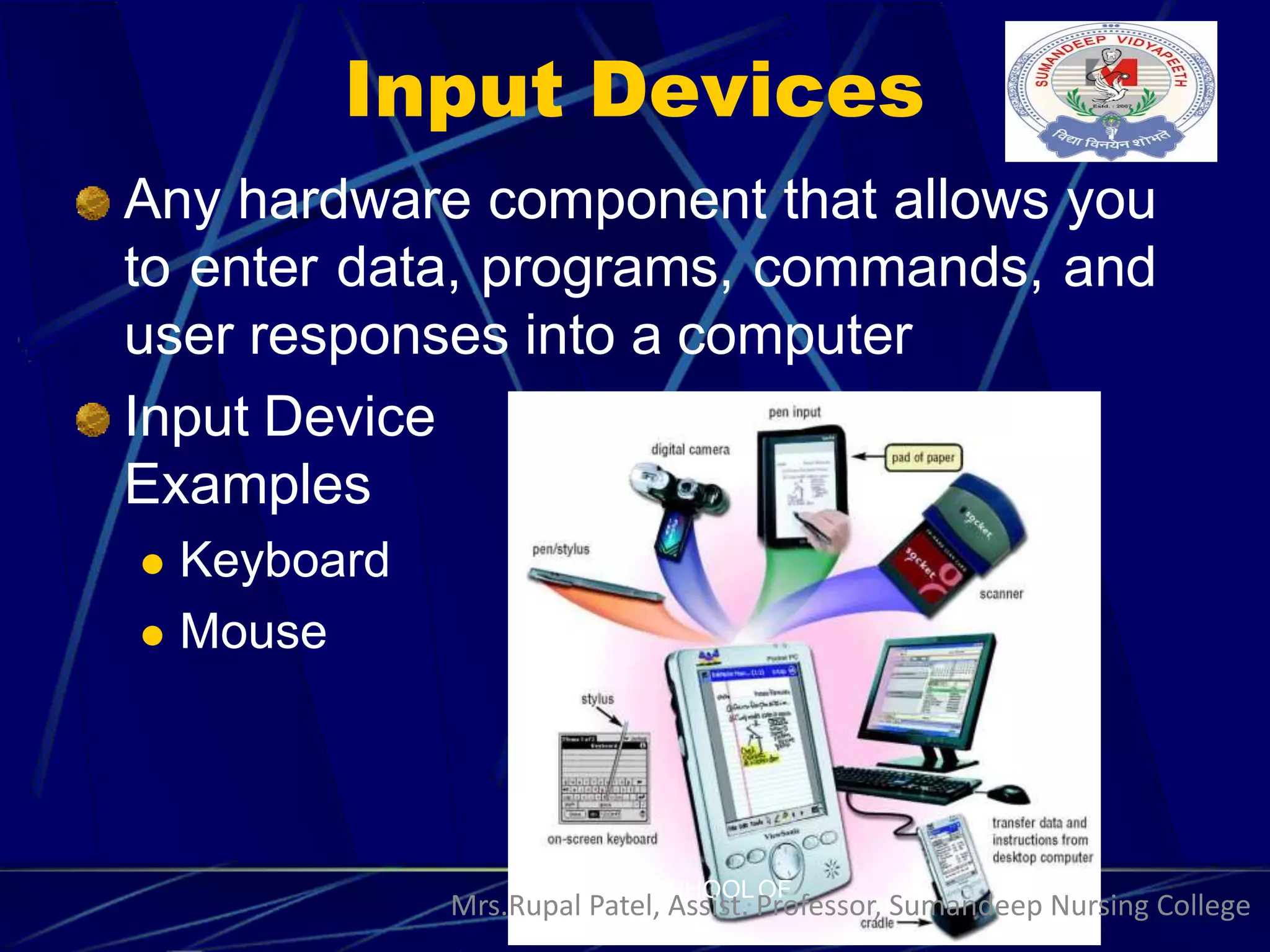
Any hardware component that allows you
to enter data, programs, commands, and
user responses into a computer
Input Device
Examples
 Keyboard
 Mouse
SCHOOLOF
Mrs.Rupal Patel, Assist. Professor, Sumandeep Nursing College
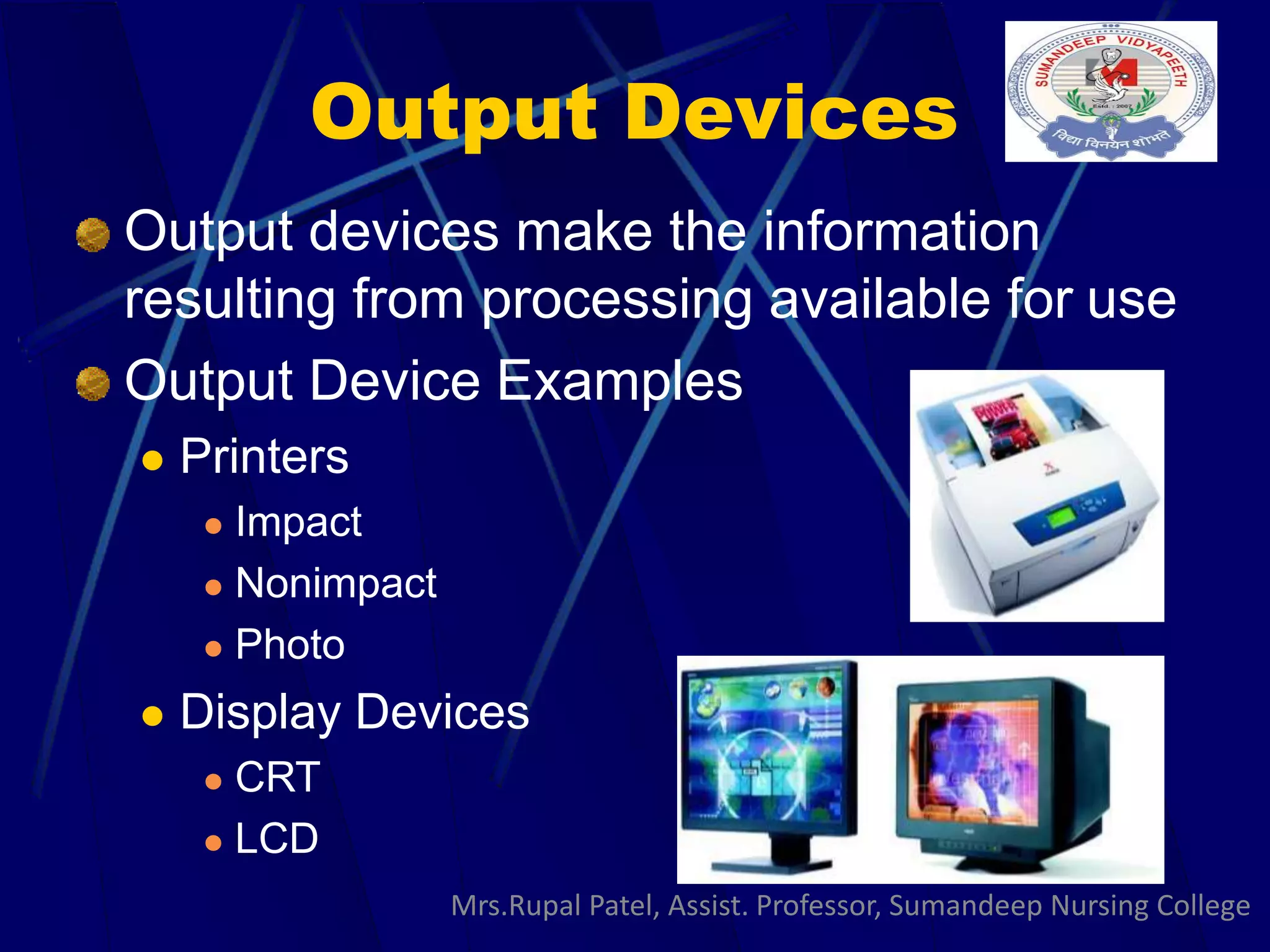
Output Devices
Output devices make the information
resulting from processing available for use
Output Device Examples
 Printers
 Impact
 Nonimpact
 Photo
 Display Devices
 CRT
 LCD
Mrs.Rupal Patel, Assist. Professor, Sumandeep Nursing College
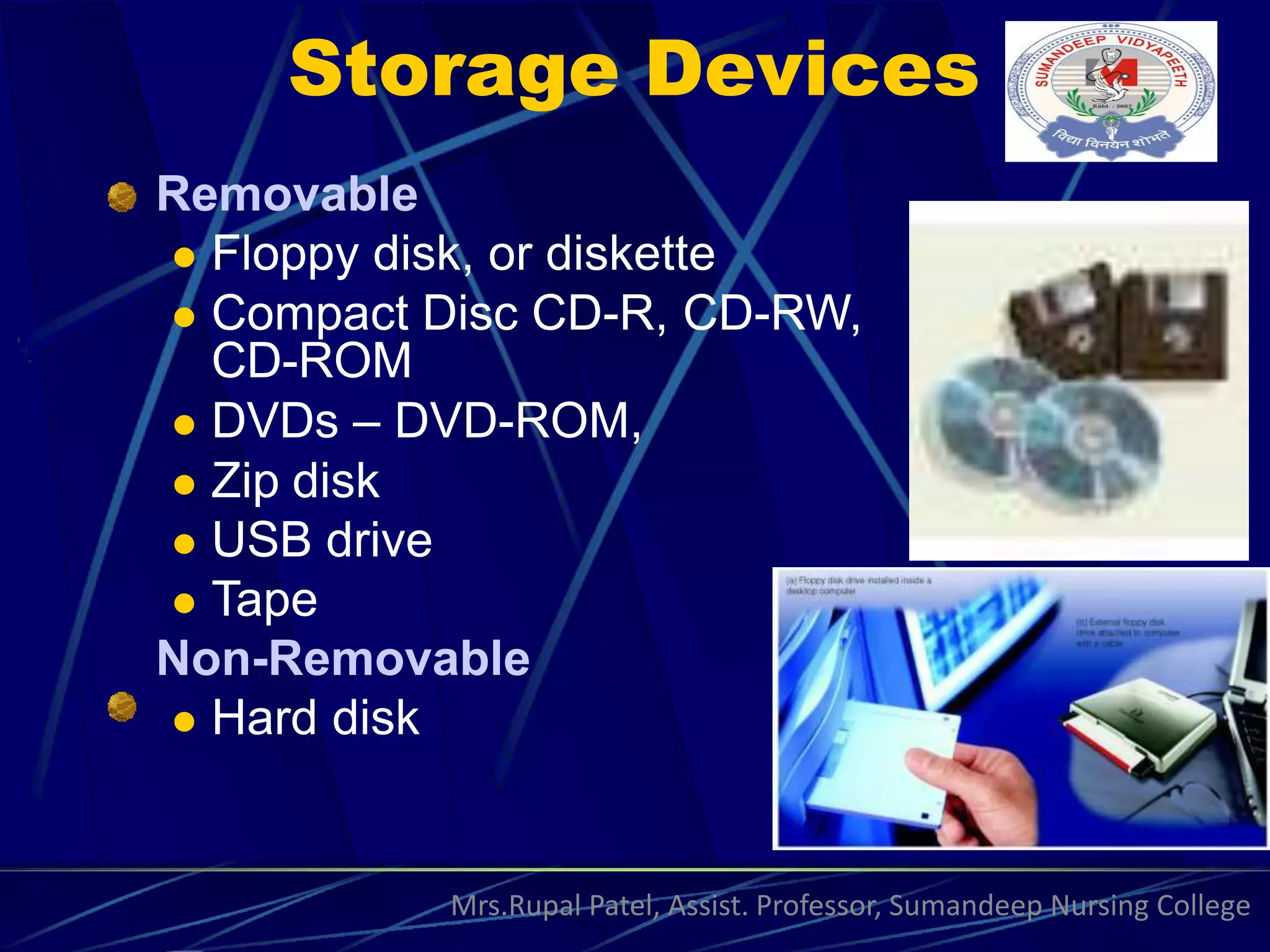
Storage Devices
Removable
 Floppy disk, or diskette
 Compact Disc CD-R, CD-RW,
CD-ROM
 DVDs – DVD-ROM,
 Zip disk
 USB drive
 Tape
Non-Removable
 Hard disk
Mrs.Rupal Patel, Assist. Professor, Sumandeep Nursing College
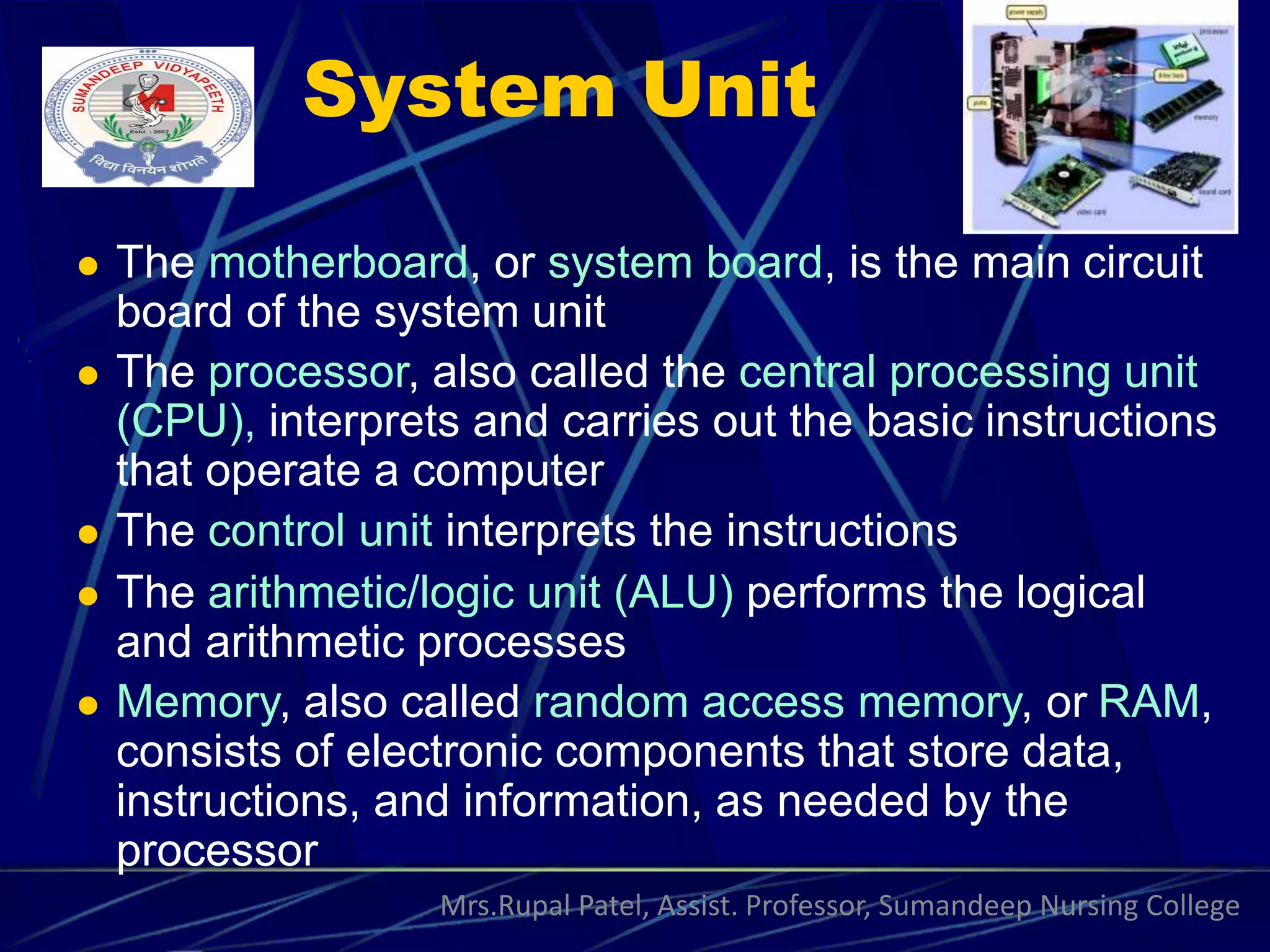
System Unit
 The motherboard, or system board, is the main circuit
board of the system unit
 The processor, also called the central processing unit
(CPU), interprets and carries out the basic instructions
that operate a computer
 The control unit interprets the instructions
 The arithmetic/logic unit (ALU) performs the logical
and arithmetic processes
 Memory, also called random access memory, or RAM,
consists of electronic components that store data,
instructions, and information, as needed by the
processor
Mrs.Rupal Patel, Assist. Professor, Sumandeep Nursing College
Communicati
ons Devices
A communications device is a hardware
component that enables a computer to
send (transmit) and receive data,
instructions, and information to and from
one or more computers
Communications occur over transmission
media, such as telephone lines, cables,
cellular radio networks, and satellites
Mrs.Rupal Patel, Assist. Professor, Sumandeep Nursing College
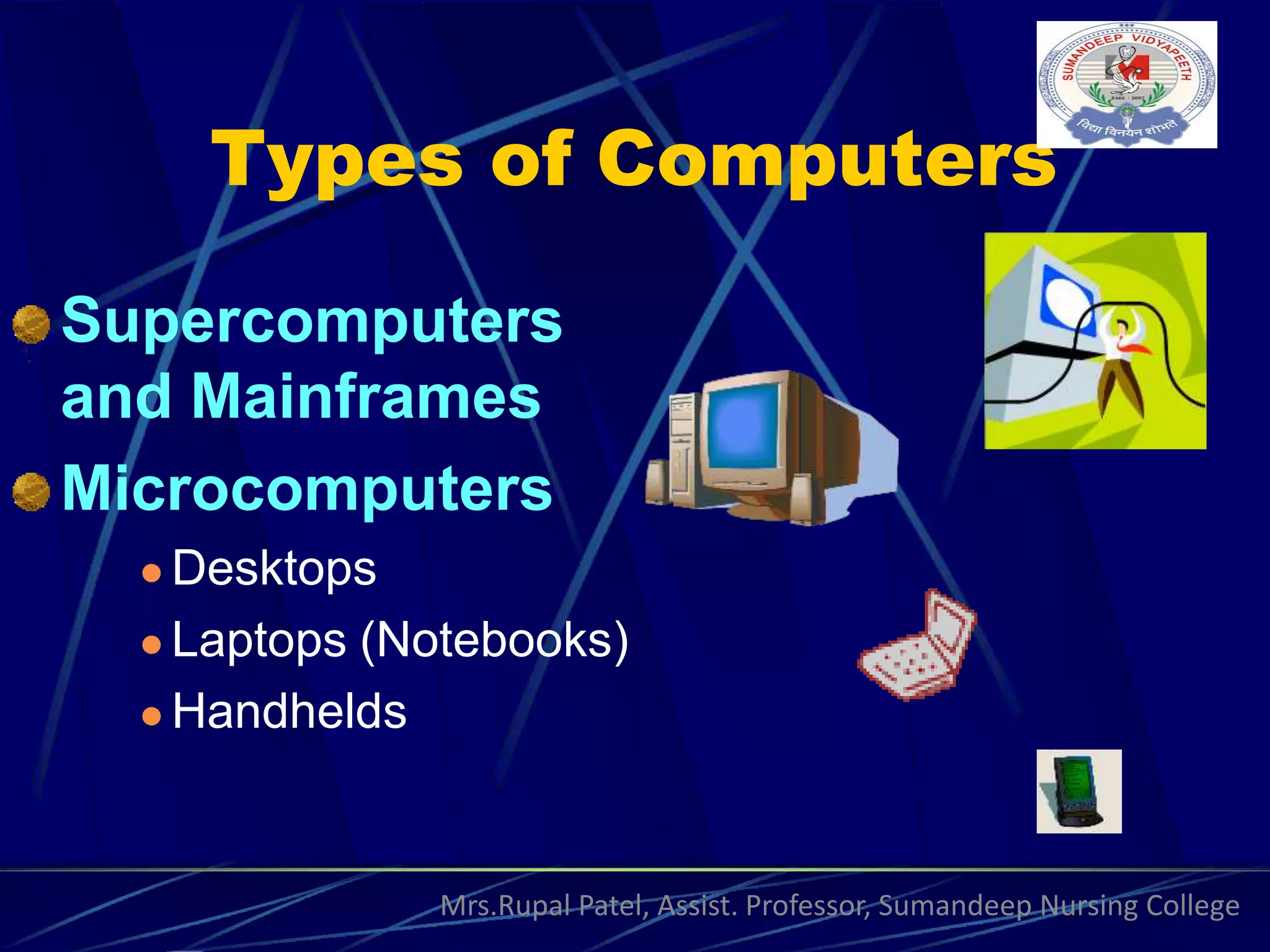
Types of Computers
Supercomputers
and Mainframes
Microcomputers
 Desktops
 Laptops (Notebooks)
 Handhelds
Mrs.Rupal Patel, Assist. Professor, Sumandeep Nursing College
COMPUTER SOFTWARE
System software consists of programs to control
the operations of computer equipment
Instructions in the operating system tell the
computer how to perform the functions of loading,
storing, and executing an application program and
how to transfer data
When a computer is turned on, the operating
system is loaded into the computer’s memory from
auxiliary storage, a process called booting
Mrs.Rupal Patel, Assist. Professor, Sumandeep Nursing College
Operating System Tasks
Operations Management
 Load, store and execute
programs
 Transfer data
File Management
 Files
 Folder
System Maintenance
 Defragment/Check Disk
 Virus Check
System Monitoring
Mrs.Rupal Patel, Assist. Professor, Sumandeep Nursing College
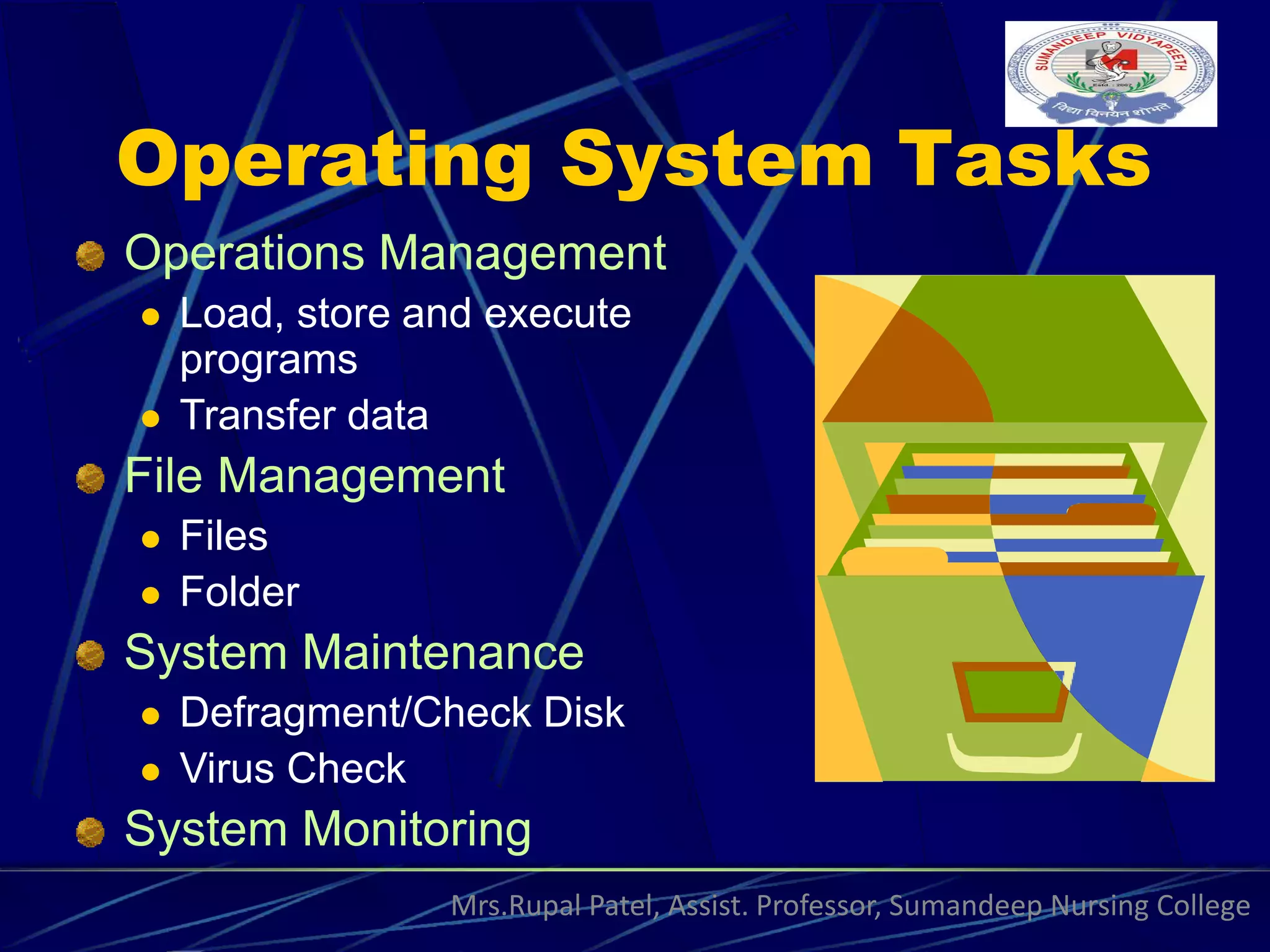
Application Software
Word Processing
Spreadsheet
Presentation Graphics
Database
Contact Management
Utility Software – anti-
virus, data backup, and
file compression
Mrs.Rupal Patel, Assist. Professor, Sumandeep Nursing College
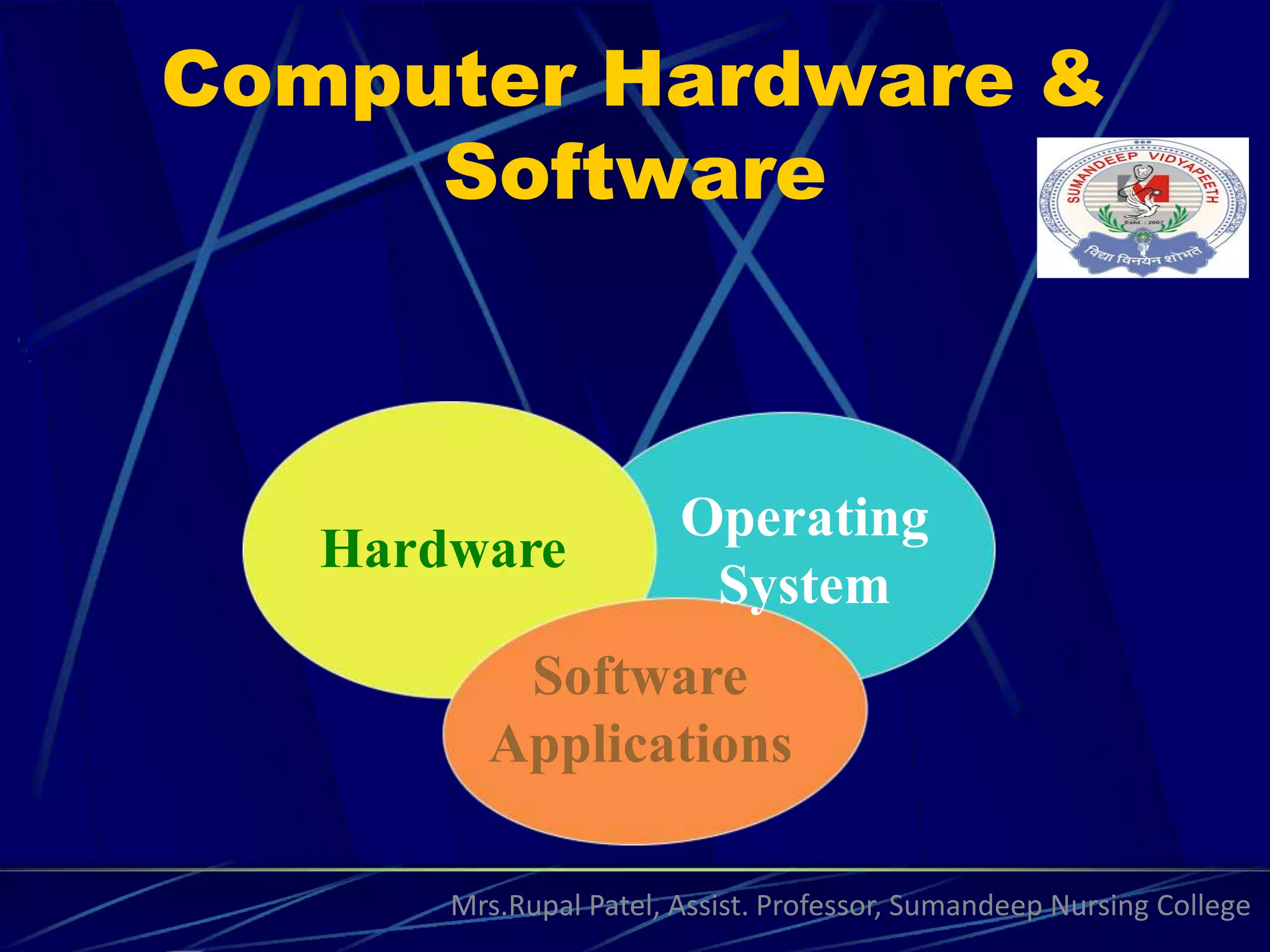
Computer Hardware &
Software
Hardware
Operating
System
Software
Applications
Mrs.Rupal Patel, Assist. Professor, Sumandeep Nursing College
NETWORKS
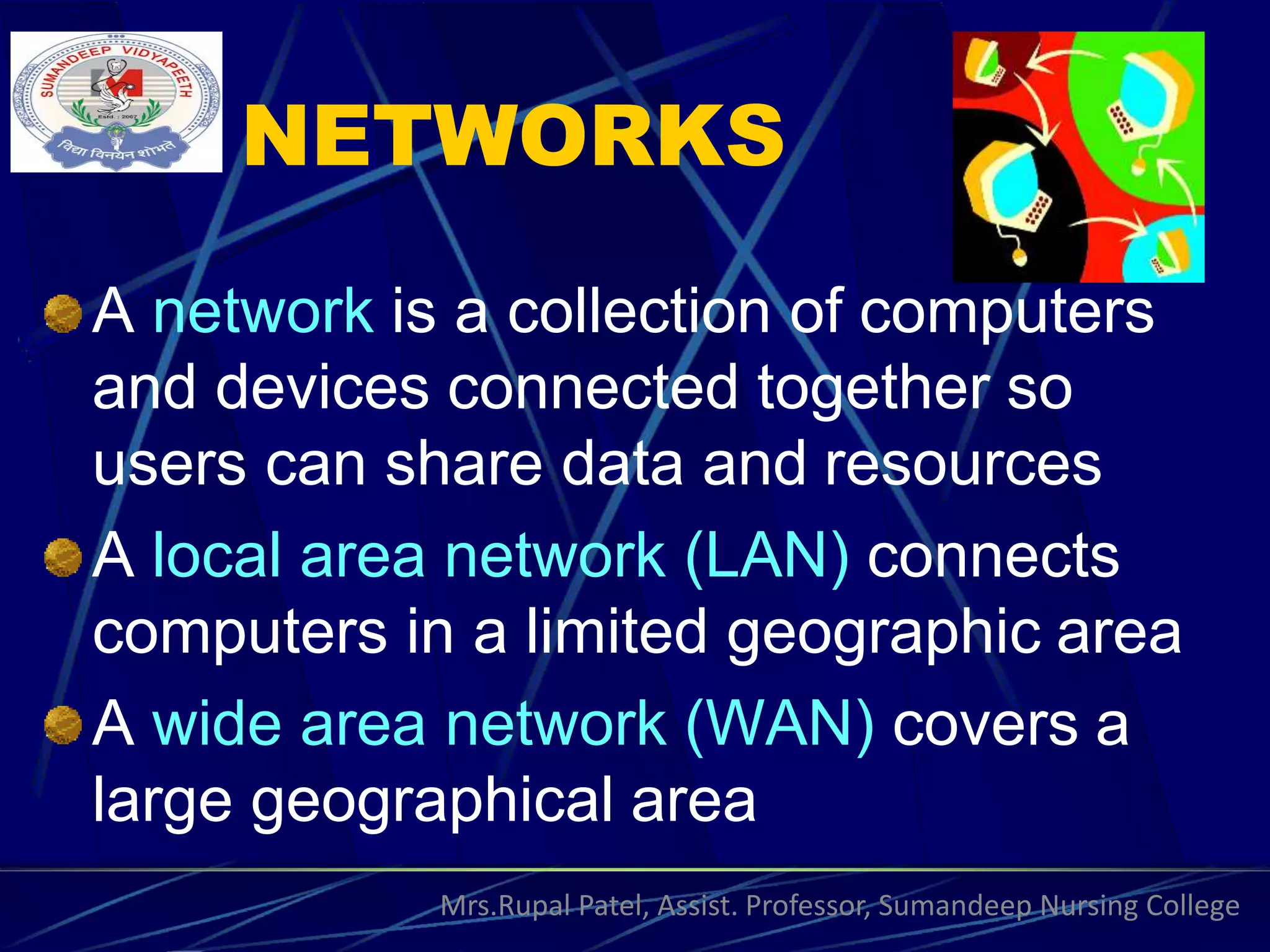
A network is a collection of computers
and devices connected together so
users can share data and resources
A local area network (LAN) connects
computers in a limited geographic area
A wide area network (WAN) covers a
large geographical area
Mrs.Rupal Patel, Assist. Professor, Sumandeep Nursing College
Networks and the
Internet
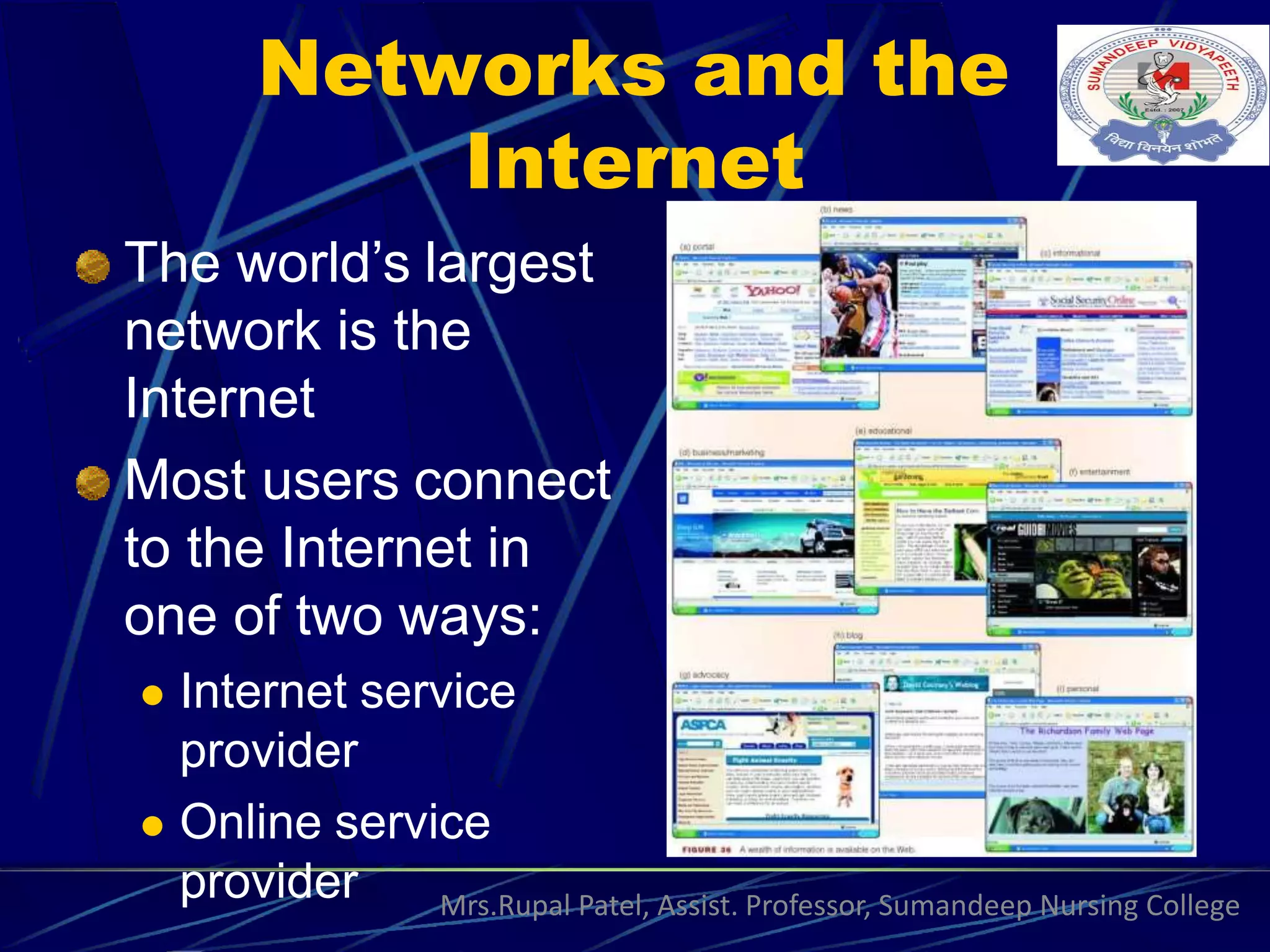
The world’s largest
network is the
Internet
Most users connect
to the Internet in
one of two ways:
 Internet service
provider
 Online service
provider Mrs.Rupal Patel, Assist. Professor, Sumandeep Nursing College
The World Wide Web
One of the more popular segments of the Internet is
the World Wide Web, also called the Web.
A Web page is a document that contains text,
graphics, sound, and/or video and has built-in
connections, or hyperlinks to other Web documents
A Web site is a related collection of Web pages
You access and view Web pages using a software
program called a Web browser
A Web page has a unique address, called a Uniform
Resource Locator (URL)
Mrs.Rupal Patel, Assist. Professor, Sumandeep Nursing College
Web Browsers
Internet Explorer – built into Windows
Netscape – the oldest browser; an all-
round communications package for the
Internet; free at http://www.netscape.com
Opera – free version available at
http://www.opera.com
Mrs.Rupal Patel, Assist. Professor, Sumandeep Nursing College
COMMON
APPLICATIONS
E-mail--Send messages to other connected users
Shop for goods and services
Meet and converse with people around the world
 Instant Messaging, such as Windows Messenger, and
Instant Messenger
Access sources of entertainment and leisure, such as online
games, magazines, and vacation planning guides
Access information such as news, maps, airline schedules,
and stock market data
Mrs.Rupal Patel, Assist. Professor, Sumandeep Nursing College
Electronic Commerce
When you conduct business activities
online, you are participating in electronic
commerce, also known as e-commerce
Business to consumer (B2C) involves
the sale of goods to the general public
Consumer to consumer (C2C) involves
one consumer selling directly to another
Business to business (B2B) provides
goods and services to other businesses
Mrs.Rupal Patel, Assist. Professor, Sumandeep Nursing College
THE END
Mrs.Rupal Patel, Assist. Professor, Sumandeep Nursing College
DIPOLOG SCHOOLOF
FISHERIES11/26/2015
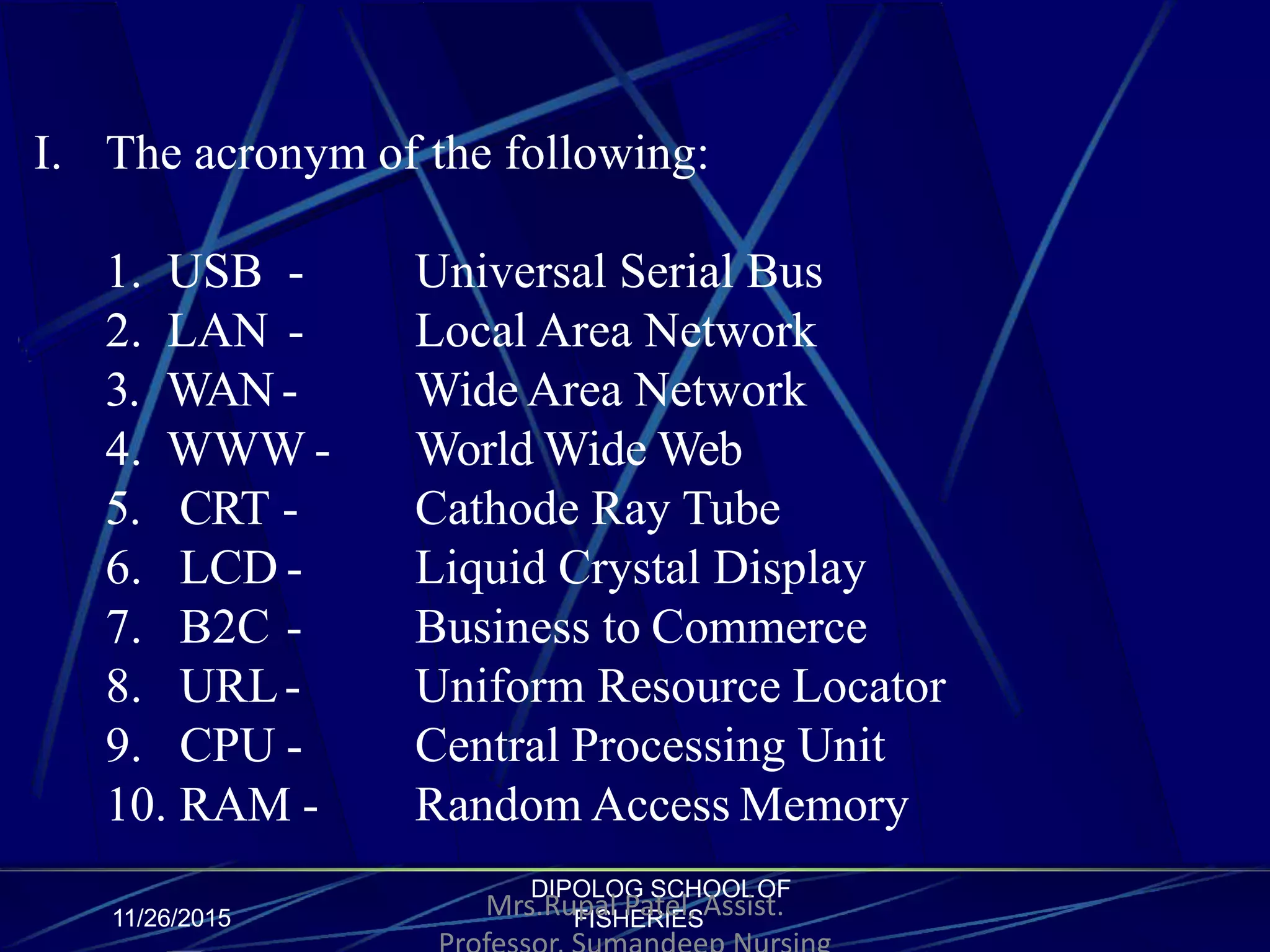
I. The acronym of the following:
1. USB -
2. LAN -
3. WAN-
4. WWW -
5. CRT -
6. LCD -
7. B2C -
8. URL-
9. CPU -
10. RAM -
Universal Serial Bus
Local Area Network
Wide Area Network
World Wide Web
Cathode Ray Tube
Liquid Crystal Display
Business to Commerce
Uniform Resource Locator
Central Processing Unit
Random Access Memory
Mrs.Rupal Patel, Assist.

Basic computer concepts

  • 1.
    BASIC COMPUTER CONCEPTS Mrs.Rupal Patel,Assist. Professor, Sumandeep Nursing College
  • 2.
    What is acomputer? An electronic device, operating under the control of instructions stored in its own memory unit, that can accept data (input), manipulate the data according to specified rules (process), produce information (output) from the processing, and store the results for future use. Mrs.Rupal Patel, Assist. Professor, Sumandeep Nursing College
  • 3.
    What does a computerdo? Input Process Output Storage Processor Control Unit/Arithmetic Logic Unit Memory Storage Devices Input Devices Output Devices Mrs.Rupal Patel, Assist. Professor, Sumandeep Nursing College
  • 4.
    Input Devices Any hardwarecomponent that allows you to enter data, programs, commands, and user responses into a computer Input Device Examples  Keyboard  Mouse SCHOOLOF Mrs.Rupal Patel, Assist. Professor, Sumandeep Nursing College
  • 5.
    Output Devices Output devicesmake the information resulting from processing available for use Output Device Examples  Printers  Impact  Nonimpact  Photo  Display Devices  CRT  LCD Mrs.Rupal Patel, Assist. Professor, Sumandeep Nursing College
  • 6.
    Storage Devices Removable  Floppydisk, or diskette  Compact Disc CD-R, CD-RW, CD-ROM  DVDs – DVD-ROM,  Zip disk  USB drive  Tape Non-Removable  Hard disk Mrs.Rupal Patel, Assist. Professor, Sumandeep Nursing College
  • 7.
    System Unit  Themotherboard, or system board, is the main circuit board of the system unit  The processor, also called the central processing unit (CPU), interprets and carries out the basic instructions that operate a computer  The control unit interprets the instructions  The arithmetic/logic unit (ALU) performs the logical and arithmetic processes  Memory, also called random access memory, or RAM, consists of electronic components that store data, instructions, and information, as needed by the processor Mrs.Rupal Patel, Assist. Professor, Sumandeep Nursing College
  • 8.
    Communicati ons Devices A communicationsdevice is a hardware component that enables a computer to send (transmit) and receive data, instructions, and information to and from one or more computers Communications occur over transmission media, such as telephone lines, cables, cellular radio networks, and satellites Mrs.Rupal Patel, Assist. Professor, Sumandeep Nursing College
  • 9.
    Types of Computers Supercomputers andMainframes Microcomputers  Desktops  Laptops (Notebooks)  Handhelds Mrs.Rupal Patel, Assist. Professor, Sumandeep Nursing College
  • 10.
    COMPUTER SOFTWARE System softwareconsists of programs to control the operations of computer equipment Instructions in the operating system tell the computer how to perform the functions of loading, storing, and executing an application program and how to transfer data When a computer is turned on, the operating system is loaded into the computer’s memory from auxiliary storage, a process called booting Mrs.Rupal Patel, Assist. Professor, Sumandeep Nursing College
  • 11.
    Operating System Tasks OperationsManagement  Load, store and execute programs  Transfer data File Management  Files  Folder System Maintenance  Defragment/Check Disk  Virus Check System Monitoring Mrs.Rupal Patel, Assist. Professor, Sumandeep Nursing College
  • 12.
    Application Software Word Processing Spreadsheet PresentationGraphics Database Contact Management Utility Software – anti- virus, data backup, and file compression Mrs.Rupal Patel, Assist. Professor, Sumandeep Nursing College
  • 13.
  • 14.
    NETWORKS A network isa collection of computers and devices connected together so users can share data and resources A local area network (LAN) connects computers in a limited geographic area A wide area network (WAN) covers a large geographical area Mrs.Rupal Patel, Assist. Professor, Sumandeep Nursing College
  • 15.
    Networks and the Internet Theworld’s largest network is the Internet Most users connect to the Internet in one of two ways:  Internet service provider  Online service provider Mrs.Rupal Patel, Assist. Professor, Sumandeep Nursing College
  • 16.
    The World WideWeb One of the more popular segments of the Internet is the World Wide Web, also called the Web. A Web page is a document that contains text, graphics, sound, and/or video and has built-in connections, or hyperlinks to other Web documents A Web site is a related collection of Web pages You access and view Web pages using a software program called a Web browser A Web page has a unique address, called a Uniform Resource Locator (URL) Mrs.Rupal Patel, Assist. Professor, Sumandeep Nursing College
  • 17.
    Web Browsers Internet Explorer– built into Windows Netscape – the oldest browser; an all- round communications package for the Internet; free at http://www.netscape.com Opera – free version available at http://www.opera.com Mrs.Rupal Patel, Assist. Professor, Sumandeep Nursing College
  • 18.
    COMMON APPLICATIONS E-mail--Send messages toother connected users Shop for goods and services Meet and converse with people around the world  Instant Messaging, such as Windows Messenger, and Instant Messenger Access sources of entertainment and leisure, such as online games, magazines, and vacation planning guides Access information such as news, maps, airline schedules, and stock market data Mrs.Rupal Patel, Assist. Professor, Sumandeep Nursing College
  • 19.
    Electronic Commerce When youconduct business activities online, you are participating in electronic commerce, also known as e-commerce Business to consumer (B2C) involves the sale of goods to the general public Consumer to consumer (C2C) involves one consumer selling directly to another Business to business (B2B) provides goods and services to other businesses Mrs.Rupal Patel, Assist. Professor, Sumandeep Nursing College
  • 20.
    THE END Mrs.Rupal Patel,Assist. Professor, Sumandeep Nursing College
  • 21.
    DIPOLOG SCHOOLOF FISHERIES11/26/2015 I. Theacronym of the following: 1. USB - 2. LAN - 3. WAN- 4. WWW - 5. CRT - 6. LCD - 7. B2C - 8. URL- 9. CPU - 10. RAM - Universal Serial Bus Local Area Network Wide Area Network World Wide Web Cathode Ray Tube Liquid Crystal Display Business to Commerce Uniform Resource Locator Central Processing Unit Random Access Memory Mrs.Rupal Patel, Assist.