PRESENTATIONTAGLINE
Presented by
AHMED YAMANI
M.Sc (Physics).,B.Ed.,DRP.,RSO
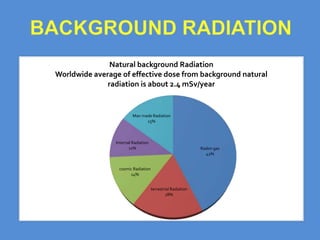
Radon gas
42%
terrestrial Radiation
18%
cosmic Radiation
14%
Internal Radiation
11%
Man made Radiation
15%
Natural background Radiation
Worldwide average of effective dose from background natural
radiation is about 2.4 mSv/year
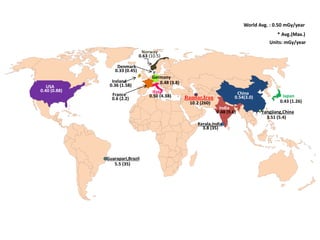
USA
0.40 (0.88)
Guarapari,Brazil
5.5 (35)
Kerala,India
3.8 (35)
Ramsar,Iran
10.2 (260)
Yangjiang,China
3.51 (5.4)
Japan
0.43 (1.26)
China
0.54(3.0)
India
0.48 (9.6)
Ireland
0.36 (1.58)
Italy
0.50 (4.38)France
0.6 (2.2)
Germany
0.48 (3.8)
Denmark
0.33 (0.45)
Norway
0.63 (10.5)
World Avg. : 0.50 mGy/year
* Avg.(Max.)
Units: mGy/year
Radon is a colorless, odorless, radioactive gas. It
forms naturally from the decay (breaking down) of
radioactive elements, such as uranium, which are
found in different amounts in soil and rock
throughout the world. Radon gas in the soil and
rock can move into the air and into underground
water and surface water
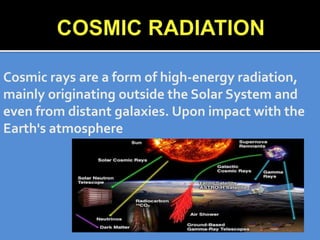
Cosmic rays are a form of high-energy radiation,
mainly originating outside the Solar System and
even from distant galaxies. Upon impact with the
Earth's atmosphere
11
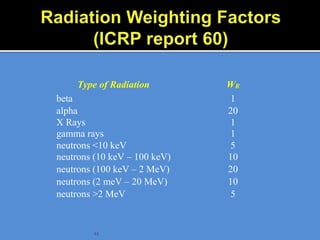
Type of Radiation WR
beta 1
alpha 20
X Rays 1
gamma rays 1
neutrons <10 keV 5
neutrons (10 keV – 100 keV) 10
neutrons (100 keV – 2 MeV) 20
neutrons (2 meV – 20 MeV) 10
neutrons >2 MeV 5
Radiation Protection in Radiotherapy Part 3, lecture 1: Radiation protection 17
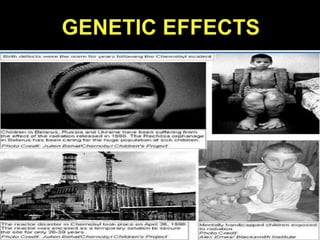
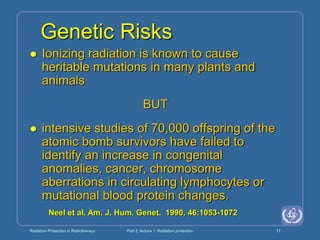
Genetic Risks
 Ionizing radiation is known to cause
heritable mutations in many plants and
animals
BUT
 intensive studies of 70,000 offspring of the
atomic bomb survivors have failed to
identify an increase in congenital
anomalies, cancer, chromosome
aberrations in circulating lymphocytes or
mutational blood protein changes.
Neel et al. Am. J. Hum. Genet. 1990, 46:1053-1072
Radiation Protection in Radiotherapy Part 3, lecture 1: Radiation protection 19
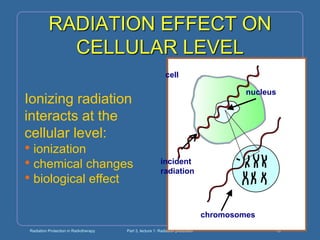
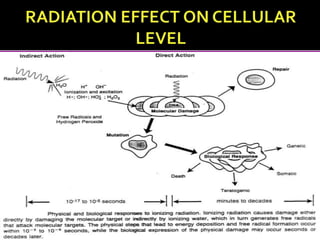
RADIATION EFFECT ON
CELLULAR LEVEL
Ionizing radiation
interacts at the
cellular level:
• ionization
• chemical changes
• biological effect
cell
nucleus
chromosomes
incident
radiation
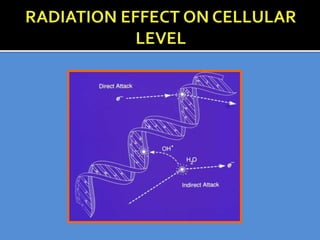
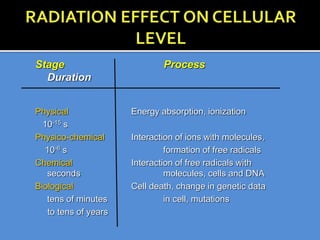
Stage Process
Duration
Physical Energy absorption, ionization
10-15 s
Physico-chemical Interaction of ions with molecules,
10-6 s formation of free radicals
Chemical Interaction of free radicals with
seconds molecules, cells and DNA
Biological Cell death, change in genetic data
tens of minutes in cell, mutations
to tens of years
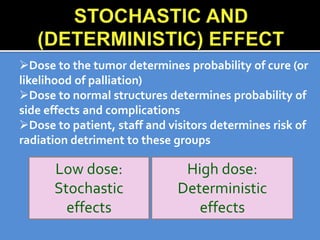
Dose to the tumor determines probability of cure (or
likelihood of palliation)
Dose to normal structures determines probability of
side effects and complications
Dose to patient, staff and visitors determines risk of
radiation detriment to these groups
Low dose:
Stochastic
effects
High dose:
Deterministic
effects
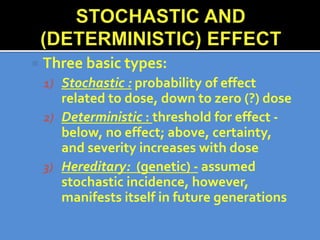
 Three basic types:
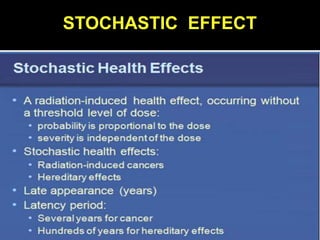
1) Stochastic : probability of effect
related to dose, down to zero (?) dose
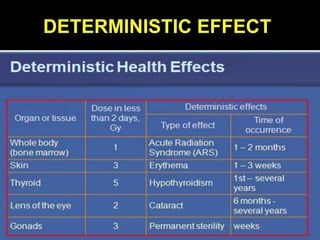
2) Deterministic : threshold for effect -
below, no effect; above, certainty,
and severity increases with dose
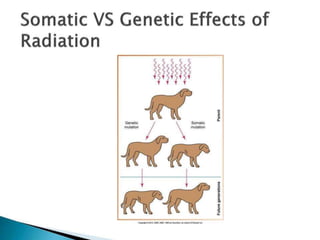
3) Hereditary: (genetic) - assumed
stochastic incidence, however,
manifests itself in future generations
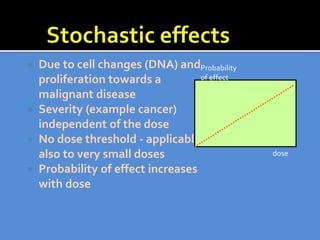
 Due to cell changes (DNA) and
proliferation towards a
malignant disease
 Severity (example cancer)
independent of the dose
 No dose threshold - applicable
also to very small doses
 Probability of effect increases
with dose
dose
Probability
of effect
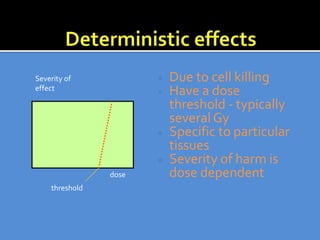
 Due to cell killing
 Have a dose
threshold - typically
severalGy
 Specific to particular
tissues
 Severity of harm is
dose dependentdose
Severity of
effect
threshold
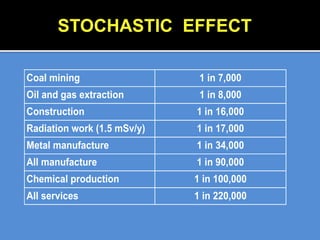
Coal mining 1 in 7,000
Oil and gas extraction 1 in 8,000
Construction 1 in 16,000
Radiation work (1.5 mSv/y) 1 in 17,000
Metal manufacture 1 in 34,000
All manufacture 1 in 90,000
Chemical production 1 in 100,000
All services 1 in 220,000
STOCHASTIC EFFECT
STOCHASTIC EFFECT
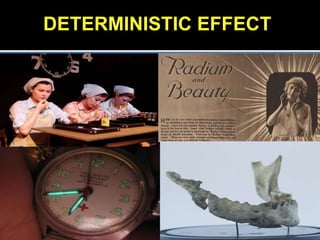
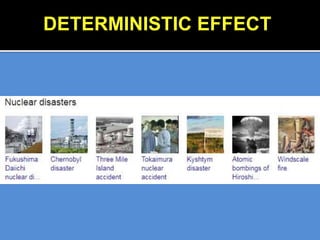
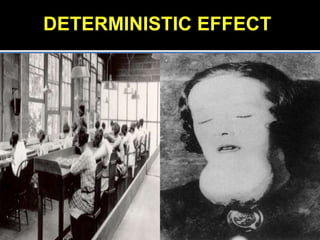
DETERMINISTIC EFFECT
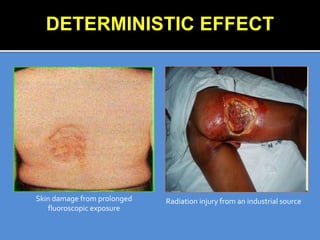
Radiation injury from an industrial sourceSkin damage from prolonged
fluoroscopic exposure
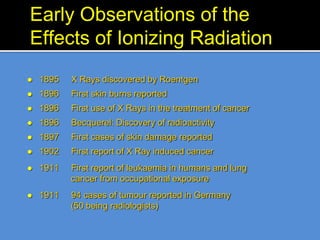
Early Observations of the
Effects of Ionizing Radiation
 1895 X Rays discovered by Roentgen
 1896 First skin burns reported
 1896 First use of X Rays in the treatment of cancer
 1896 Becquerel: Discovery of radioactivity
 1897 First cases of skin damage reported
 1902 First report of X Ray induced cancer
 1911 First report of leukaemia in humans and lung
cancer from occupational exposure
 1911 94 cases of tumour reported in Germany
(50 being radiologists)
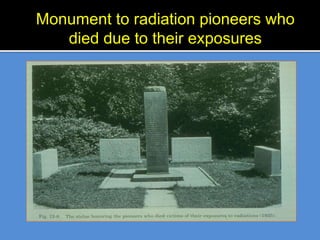
Monument to radiation pioneers who
died due to their exposures
DETERMINISTIC EFFECT
Basic Biological effects of Radiation

Basic Biological effects of Radiation

  • 1.
  • 3.
    Radon gas 42% terrestrial Radiation 18% cosmicRadiation 14% Internal Radiation 11% Man made Radiation 15% Natural background Radiation Worldwide average of effective dose from background natural radiation is about 2.4 mSv/year
  • 4.
    USA 0.40 (0.88) Guarapari,Brazil 5.5 (35) Kerala,India 3.8(35) Ramsar,Iran 10.2 (260) Yangjiang,China 3.51 (5.4) Japan 0.43 (1.26) China 0.54(3.0) India 0.48 (9.6) Ireland 0.36 (1.58) Italy 0.50 (4.38)France 0.6 (2.2) Germany 0.48 (3.8) Denmark 0.33 (0.45) Norway 0.63 (10.5) World Avg. : 0.50 mGy/year * Avg.(Max.) Units: mGy/year
  • 5.
    Radon is acolorless, odorless, radioactive gas. It forms naturally from the decay (breaking down) of radioactive elements, such as uranium, which are found in different amounts in soil and rock throughout the world. Radon gas in the soil and rock can move into the air and into underground water and surface water
  • 7.
    Cosmic rays area form of high-energy radiation, mainly originating outside the Solar System and even from distant galaxies. Upon impact with the Earth's atmosphere
  • 11.
    11 Type of RadiationWR beta 1 alpha 20 X Rays 1 gamma rays 1 neutrons <10 keV 5 neutrons (10 keV – 100 keV) 10 neutrons (100 keV – 2 MeV) 20 neutrons (2 meV – 20 MeV) 10 neutrons >2 MeV 5
  • 17.
    Radiation Protection inRadiotherapy Part 3, lecture 1: Radiation protection 17 Genetic Risks  Ionizing radiation is known to cause heritable mutations in many plants and animals BUT  intensive studies of 70,000 offspring of the atomic bomb survivors have failed to identify an increase in congenital anomalies, cancer, chromosome aberrations in circulating lymphocytes or mutational blood protein changes. Neel et al. Am. J. Hum. Genet. 1990, 46:1053-1072
  • 19.
    Radiation Protection inRadiotherapy Part 3, lecture 1: Radiation protection 19 RADIATION EFFECT ON CELLULAR LEVEL Ionizing radiation interacts at the cellular level: • ionization • chemical changes • biological effect cell nucleus chromosomes incident radiation
  • 21.
    Stage Process Duration Physical Energyabsorption, ionization 10-15 s Physico-chemical Interaction of ions with molecules, 10-6 s formation of free radicals Chemical Interaction of free radicals with seconds molecules, cells and DNA Biological Cell death, change in genetic data tens of minutes in cell, mutations to tens of years
  • 29.
    Dose to thetumor determines probability of cure (or likelihood of palliation) Dose to normal structures determines probability of side effects and complications Dose to patient, staff and visitors determines risk of radiation detriment to these groups Low dose: Stochastic effects High dose: Deterministic effects
  • 30.
     Three basictypes: 1) Stochastic : probability of effect related to dose, down to zero (?) dose 2) Deterministic : threshold for effect - below, no effect; above, certainty, and severity increases with dose 3) Hereditary: (genetic) - assumed stochastic incidence, however, manifests itself in future generations
  • 31.
     Due tocell changes (DNA) and proliferation towards a malignant disease  Severity (example cancer) independent of the dose  No dose threshold - applicable also to very small doses  Probability of effect increases with dose dose Probability of effect
  • 32.
     Due tocell killing  Have a dose threshold - typically severalGy  Specific to particular tissues  Severity of harm is dose dependentdose Severity of effect threshold
  • 33.
    Coal mining 1in 7,000 Oil and gas extraction 1 in 8,000 Construction 1 in 16,000 Radiation work (1.5 mSv/y) 1 in 17,000 Metal manufacture 1 in 34,000 All manufacture 1 in 90,000 Chemical production 1 in 100,000 All services 1 in 220,000 STOCHASTIC EFFECT
  • 34.
  • 35.
  • 36.
    DETERMINISTIC EFFECT Radiation injuryfrom an industrial sourceSkin damage from prolonged fluoroscopic exposure
  • 37.
    Early Observations ofthe Effects of Ionizing Radiation  1895 X Rays discovered by Roentgen  1896 First skin burns reported  1896 First use of X Rays in the treatment of cancer  1896 Becquerel: Discovery of radioactivity  1897 First cases of skin damage reported  1902 First report of X Ray induced cancer  1911 First report of leukaemia in humans and lung cancer from occupational exposure  1911 94 cases of tumour reported in Germany (50 being radiologists)
  • 38.
    Monument to radiationpioneers who died due to their exposures
  • 39.
  • 40.
  • 41.

Editor's Notes