Baseline
Pollution
Assessment
Mughalsarai
Gangaghat
Unnao
Outline
• Overview of sanitation arrangements in Ganga Basin
• Study objectives and scope
• Study approach and methodology
• Water and sanitation in selected cities
• Pollution sources and loads in selected cities
28%
47%
2%
6%
17%
Sanitation situation in Uttar Pradesh
Piped sewer system
ST
Other
Pit and other latrines
No Latrine within the
premises
Prevalence of sewered connections and
septic tanks in UP
0%
20%
40%
60%
80%
I II III IV V VI
Shareofseptictanks(%(
City Class
Septic tank prevalence across different
city classes in UP
0%
20%
40%
60%
I II III IV V VI
Shareofpipessewer
City Class
Piped sewer prevalence across different
city classes in UP
Class III and smaller cities
(population <50,000) have about
60% of HHs relying on septic tanks;
Account for 60% of all urban HHs
with septic tanks in UP
Class III and smaller cities
(population <50,000) have very
little coverage by sewer networks
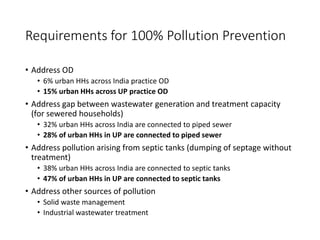
Requirements for 100% Pollution Prevention
• Address OD
• 6% urban HHs across India practice OD
• 15% urban HHs across UP practice OD
• Address gap between wastewater generation and treatment capacity
(for sewered households)
• 32% urban HHs across India are connected to piped sewer
• 28% of urban HHs in UP are connected to piped sewer
• Address pollution arising from septic tanks (dumping of septage without
treatment)
• 38% urban HHs across India are connected to septic tanks
• 47% of urban HHs in UP are connected to septic tanks
• Address other sources of pollution
• Solid waste management
• Industrial wastewater treatment
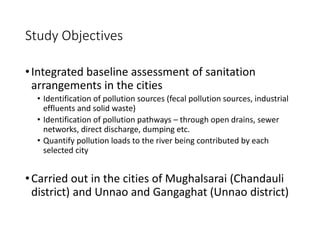
Study Objectives
•Integrated baseline assessment of sanitation
arrangements in the cities
• Identification of pollution sources (fecal pollution sources, industrial
effluents and solid waste)
• Identification of pollution pathways – through open drains, sewer
networks, direct discharge, dumping etc.
• Quantify pollution loads to the river being contributed by each
selected city
•Carried out in the cities of Mughalsarai (Chandauli
district) and Unnao and Gangaghat (Unnao district)
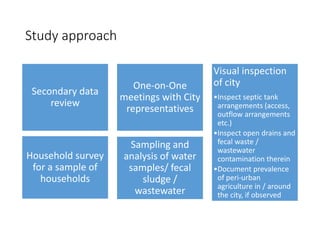
Study approach
Secondary data
review
One-on-One
meetings with City
representatives
Visual inspection
of city
•Inspect septic tank
arrangements (access,
outflow arrangements
etc.)
•Inspect open drains and
fecal waste /
wastewater
contamination therein
•Document prevalence
of peri-urban
agriculture in / around
the city, if observed
Household survey
for a sample of
households
Sampling and
analysis of water
samples/ fecal
sludge /
wastewater
Mughals
Population: 109650
No. of HHs: 16,796
Prevelance of HH to
Prevalence of septic
STP capacity: Nil
Unnao
Population: 177,658
No. of HHs: 33,273
Prevelance of HH toilets: 78%
Prevalence of septic tanks: 54%
STP capacity: Nil
Gangaghat
opulation: 84,072
o. of HHs: 17,210
revelance of HH toilets: 79%
revalence of septic tanks: 71%
TP capacity: Nil
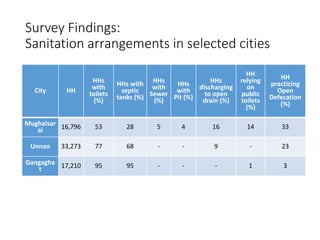
City HH
HHs
with
toilets
(%)
HHs with
septic
tanks (%)
HHs
with
Sewer
(%)
HHs
with
Pit (%)
HHs
discharging
to open
drain (%)
HH
relying
on
public
toilets
(%)
HH
practicing
Open
Defecation
(%)
Mughalsar
ai 16,796 53 28 5 4 16 14 33
Unnao 33,273 77 68 - - 9 - 23
Gangagha
t 17,210 95 95 - - - 1 3
Survey Findings:
Sanitation arrangements in selected cities
10
100%88%
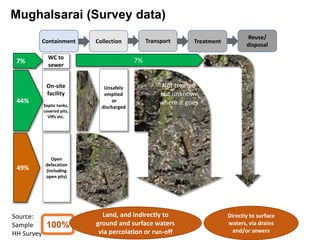
On-site
facility
Septic tanks,
covered pits,
VIPs etc.
Open
defecation
(including
open pits)
Unsafely
emptied
or
discharged
Treatment
Reuse/
disposal
TransportCollectionContainment
Source:
Sample
HH Survey
Not treated
Discharged in open drains
Unnao (based on Survey)
68%
32%
68%
32%
100%
Land, and indirectly to
ground and surface waters
via percolation or run-off
11
100%88%
On-site
facility
Septic tanks,
covered pits,
VIPs etc.
Open
defecation
Unsafely
emptied
or
discharged
Treatment
Reuse/
disposal
TransportCollectionContainment
Source:
Sample
HH Survey
Not treated
Discharged in open drains
Gangaghat (based on Survey)
97%
3%
97%
3%
100%
Directly to surface
waters, via drains
and/or sewers
Land, and indirectly to
ground and surface waters
via percolation or run-off
12
100%88%
WC to
sewer
On-site
facility
Septic tanks,
covered pits,
VIPs etc.
Open
defecation
(including
open pits)
Unsafely
emptied
or
discharged
Treatment
Reuse/
disposal
TransportCollectionContainment
Source:
Sample
HH Survey
Not treated
but unknown
where it goes
Mughalsarai (Survey data)
44%
49%
7%
44%
7%
7%
49%
100%
Directly to surface
waters, via drains
and/or sewers
Land, and indirectly to
ground and surface waters
via percolation or run-off
Households Practicing Open Defecation
Unnao
Gangaghat
Mughalsarai
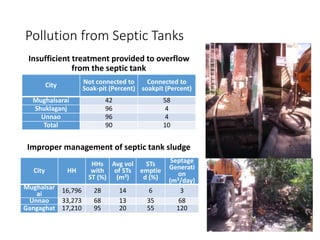
Pollution from Septic Tanks
City Not connected to
Soak-pit (Percent)
Connected to
soakpit (Percent)
Mughalsarai 42 58
Shuklaganj 96 4
Unnao 96 4
Total 90 10
City HH
HHs
with
ST (%)
Avg vol
of STs
(m3)
STs
emptie
d (%)
Septage
Generati
on
(m3/day)
Mughalsar
ai 16,796 28 14 6 3
Unnao 33,273 68 13 35 68
Gangaghat 17,210 95 20 55 120
Insufficient treatment provided to overflow
from the septic tank
Improper management of septic tank sludge
Pollution from open sewage drains
All domestic
sewage
generated in
the study
cities flows
through a
network of
small and
progressively
larger open
drains that
eventually
flow into the
Ganga.
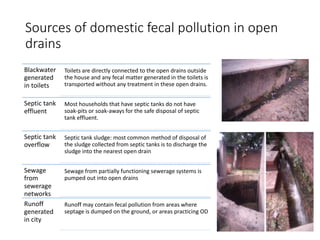
Sources of domestic fecal pollution in open
drains
Blackwater
generated
in toilets
Toilets are directly connected to the open drains outside
the house and any fecal matter generated in the toilets is
transported without any treatment in these open drains.
Septic tank
effluent
Most households that have septic tanks do not have
soak-pits or soak-aways for the safe disposal of septic
tank effluent.
Septic tank
overflow
Septic tank sludge: most common method of disposal of
the sludge collected from septic tanks is to discharge the
sludge into the nearest open drain
Sewage
from
sewerage
networks
Sewage from partially functioning sewerage systems is
pumped out into open drains
Runoff
generated
in city
Runoff may contain fecal pollution from areas where
septage is dumped on the ground, or areas practicing OD
Open drains and
sampling
locations -
Unnao
Loni
Drain
City
Jail
Drain
Open drains
and sampling
locations -
Gangaghat
Open drains
and sampling
locations -
Mughalsarai
Pollution loads from open drains (kg/d)
City
Dry weather
WW
(MLD)
BOD
Load COD TN TP NO3 TS VS
Unnao 39 2,639 8,796 7,919 210 519 43,678 6,657
Gangag
hat 35 4,498 14,996 7,114 368 691 53,438 9,642
Mughals
arai 122 4,699 15,728 10,541 127 2,282 170,620 39,059
City
Wet weather
WW
(MLD)
BOD
Load COD TN TP NO3 TS VS
Unnao 58 3,383 11,340 2,679 399 406 54,869 10,240
Gangag
hat 42 3,833 12,783 5,462 468 451 64,192 12,052
Mughals
arai 374 18,254 60,852 37,058 1,771 7,897 496,395 137,539
Impact of septage disposal in open drains
Location
Name
TS
(mg/l)
VS
(mg/l)
TC
(MPN
/100
ml)
TP
(mg/l)
NO3
(mg/l)
TKN
(mg/l)
TN
(g/l)
FC
(MPN
/100
ml)
COD
(mg/l)
BOD
(mg/l)
Sample
point 1278 216 22000 6 25 163 188 14000 490 147
Sample
point with
septage
1238 332 24000 10 22 192 214 50000 506 152
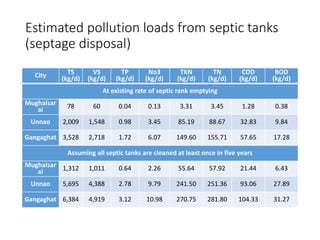
Estimated pollution loads from septic tanks
(septage disposal)
City TS
(kg/d)
VS
(kg/d)
TP
(kg/d)
No3
(kg/d)
TKN
(kg/d)
TN
(kg/d)
COD
(kg/d)
BOD
(kg/d)
At existing rate of septic rank emptying
Mughalsar
ai 78 60 0.04 0.13 3.31 3.45 1.28 0.38
Unnao 2,009 1,548 0.98 3.45 85.19 88.67 32.83 9.84
Gangaghat 3,528 2,718 1.72 6.07 149.60 155.71 57.65 17.28
Assuming all septic tanks are cleaned at least once in five years
Mughalsar
ai 1,312 1,011 0.64 2.26 55.64 57.92 21.44 6.43
Unnao 5,695 4,388 2.78 9.79 241.50 251.36 93.06 27.89
Gangaghat 6,384 4,919 3.12 10.98 270.75 281.80 104.33 31.27
Key Findings
Gangaghat: The city of Gangaghat contributes a significant quantity of flow and pollution load
despite being the smallest city. This is likely due to the direct physical connection
between the city and the River. The flows generated within the city are directly
routed into the river.
Mughalsarai: The open drains flowing through the city of Mughalsarai contribute a large quantum
of flow, far in excess of the expected flow from a similar sized city, and significantly
greater than the flows generated from the other cities. This is likely a result of
agricultural runoffs and flows from surrounding village panchayats flowing through
the “Hiloni Pulia” drain, which flows on the boundary of the city. While this drain
receives some flow from the city’s households, a major share of the flow may be
arising from activities outside the city’s municipal limits.
Unnao: Substantial industrial activity exists in the Unnao region. Previous assessments have
also been undertaken on the industrial pollution in the Unnao region and its impact
on water quality. The industrial effluents flow in the drains originating in the city,
and carry a mix of domestic and industrial effluent, ultimately discharging into river
Ganga.
Thank you!

Baseline pollution assessment

  • 1.
  • 2.
    Outline • Overview ofsanitation arrangements in Ganga Basin • Study objectives and scope • Study approach and methodology • Water and sanitation in selected cities • Pollution sources and loads in selected cities
  • 3.
    28% 47% 2% 6% 17% Sanitation situation inUttar Pradesh Piped sewer system ST Other Pit and other latrines No Latrine within the premises
  • 4.
    Prevalence of seweredconnections and septic tanks in UP 0% 20% 40% 60% 80% I II III IV V VI Shareofseptictanks(%( City Class Septic tank prevalence across different city classes in UP 0% 20% 40% 60% I II III IV V VI Shareofpipessewer City Class Piped sewer prevalence across different city classes in UP Class III and smaller cities (population <50,000) have about 60% of HHs relying on septic tanks; Account for 60% of all urban HHs with septic tanks in UP Class III and smaller cities (population <50,000) have very little coverage by sewer networks
  • 5.
    Requirements for 100%Pollution Prevention • Address OD • 6% urban HHs across India practice OD • 15% urban HHs across UP practice OD • Address gap between wastewater generation and treatment capacity (for sewered households) • 32% urban HHs across India are connected to piped sewer • 28% of urban HHs in UP are connected to piped sewer • Address pollution arising from septic tanks (dumping of septage without treatment) • 38% urban HHs across India are connected to septic tanks • 47% of urban HHs in UP are connected to septic tanks • Address other sources of pollution • Solid waste management • Industrial wastewater treatment
  • 6.
    Study Objectives •Integrated baselineassessment of sanitation arrangements in the cities • Identification of pollution sources (fecal pollution sources, industrial effluents and solid waste) • Identification of pollution pathways – through open drains, sewer networks, direct discharge, dumping etc. • Quantify pollution loads to the river being contributed by each selected city •Carried out in the cities of Mughalsarai (Chandauli district) and Unnao and Gangaghat (Unnao district)
  • 7.
    Study approach Secondary data review One-on-One meetingswith City representatives Visual inspection of city •Inspect septic tank arrangements (access, outflow arrangements etc.) •Inspect open drains and fecal waste / wastewater contamination therein •Document prevalence of peri-urban agriculture in / around the city, if observed Household survey for a sample of households Sampling and analysis of water samples/ fecal sludge / wastewater
  • 8.
    Mughals Population: 109650 No. ofHHs: 16,796 Prevelance of HH to Prevalence of septic STP capacity: Nil Unnao Population: 177,658 No. of HHs: 33,273 Prevelance of HH toilets: 78% Prevalence of septic tanks: 54% STP capacity: Nil Gangaghat opulation: 84,072 o. of HHs: 17,210 revelance of HH toilets: 79% revalence of septic tanks: 71% TP capacity: Nil
  • 9.
    City HH HHs with toilets (%) HHs with septic tanks(%) HHs with Sewer (%) HHs with Pit (%) HHs discharging to open drain (%) HH relying on public toilets (%) HH practicing Open Defecation (%) Mughalsar ai 16,796 53 28 5 4 16 14 33 Unnao 33,273 77 68 - - 9 - 23 Gangagha t 17,210 95 95 - - - 1 3 Survey Findings: Sanitation arrangements in selected cities
  • 10.
    10 100%88% On-site facility Septic tanks, covered pits, VIPsetc. Open defecation (including open pits) Unsafely emptied or discharged Treatment Reuse/ disposal TransportCollectionContainment Source: Sample HH Survey Not treated Discharged in open drains Unnao (based on Survey) 68% 32% 68% 32% 100% Land, and indirectly to ground and surface waters via percolation or run-off
  • 11.
    11 100%88% On-site facility Septic tanks, covered pits, VIPsetc. Open defecation Unsafely emptied or discharged Treatment Reuse/ disposal TransportCollectionContainment Source: Sample HH Survey Not treated Discharged in open drains Gangaghat (based on Survey) 97% 3% 97% 3% 100% Directly to surface waters, via drains and/or sewers Land, and indirectly to ground and surface waters via percolation or run-off
  • 12.
    12 100%88% WC to sewer On-site facility Septic tanks, coveredpits, VIPs etc. Open defecation (including open pits) Unsafely emptied or discharged Treatment Reuse/ disposal TransportCollectionContainment Source: Sample HH Survey Not treated but unknown where it goes Mughalsarai (Survey data) 44% 49% 7% 44% 7% 7% 49% 100% Directly to surface waters, via drains and/or sewers Land, and indirectly to ground and surface waters via percolation or run-off
  • 13.
    Households Practicing OpenDefecation Unnao Gangaghat Mughalsarai
  • 14.
    Pollution from SepticTanks City Not connected to Soak-pit (Percent) Connected to soakpit (Percent) Mughalsarai 42 58 Shuklaganj 96 4 Unnao 96 4 Total 90 10 City HH HHs with ST (%) Avg vol of STs (m3) STs emptie d (%) Septage Generati on (m3/day) Mughalsar ai 16,796 28 14 6 3 Unnao 33,273 68 13 35 68 Gangaghat 17,210 95 20 55 120 Insufficient treatment provided to overflow from the septic tank Improper management of septic tank sludge
  • 15.
    Pollution from opensewage drains All domestic sewage generated in the study cities flows through a network of small and progressively larger open drains that eventually flow into the Ganga.
  • 16.
    Sources of domesticfecal pollution in open drains Blackwater generated in toilets Toilets are directly connected to the open drains outside the house and any fecal matter generated in the toilets is transported without any treatment in these open drains. Septic tank effluent Most households that have septic tanks do not have soak-pits or soak-aways for the safe disposal of septic tank effluent. Septic tank overflow Septic tank sludge: most common method of disposal of the sludge collected from septic tanks is to discharge the sludge into the nearest open drain Sewage from sewerage networks Sewage from partially functioning sewerage systems is pumped out into open drains Runoff generated in city Runoff may contain fecal pollution from areas where septage is dumped on the ground, or areas practicing OD
  • 17.
    Open drains and sampling locations- Unnao Loni Drain City Jail Drain
  • 18.
  • 19.
  • 20.
    Pollution loads fromopen drains (kg/d) City Dry weather WW (MLD) BOD Load COD TN TP NO3 TS VS Unnao 39 2,639 8,796 7,919 210 519 43,678 6,657 Gangag hat 35 4,498 14,996 7,114 368 691 53,438 9,642 Mughals arai 122 4,699 15,728 10,541 127 2,282 170,620 39,059 City Wet weather WW (MLD) BOD Load COD TN TP NO3 TS VS Unnao 58 3,383 11,340 2,679 399 406 54,869 10,240 Gangag hat 42 3,833 12,783 5,462 468 451 64,192 12,052 Mughals arai 374 18,254 60,852 37,058 1,771 7,897 496,395 137,539
  • 21.
    Impact of septagedisposal in open drains Location Name TS (mg/l) VS (mg/l) TC (MPN /100 ml) TP (mg/l) NO3 (mg/l) TKN (mg/l) TN (g/l) FC (MPN /100 ml) COD (mg/l) BOD (mg/l) Sample point 1278 216 22000 6 25 163 188 14000 490 147 Sample point with septage 1238 332 24000 10 22 192 214 50000 506 152
  • 22.
    Estimated pollution loadsfrom septic tanks (septage disposal) City TS (kg/d) VS (kg/d) TP (kg/d) No3 (kg/d) TKN (kg/d) TN (kg/d) COD (kg/d) BOD (kg/d) At existing rate of septic rank emptying Mughalsar ai 78 60 0.04 0.13 3.31 3.45 1.28 0.38 Unnao 2,009 1,548 0.98 3.45 85.19 88.67 32.83 9.84 Gangaghat 3,528 2,718 1.72 6.07 149.60 155.71 57.65 17.28 Assuming all septic tanks are cleaned at least once in five years Mughalsar ai 1,312 1,011 0.64 2.26 55.64 57.92 21.44 6.43 Unnao 5,695 4,388 2.78 9.79 241.50 251.36 93.06 27.89 Gangaghat 6,384 4,919 3.12 10.98 270.75 281.80 104.33 31.27
  • 23.
    Key Findings Gangaghat: Thecity of Gangaghat contributes a significant quantity of flow and pollution load despite being the smallest city. This is likely due to the direct physical connection between the city and the River. The flows generated within the city are directly routed into the river. Mughalsarai: The open drains flowing through the city of Mughalsarai contribute a large quantum of flow, far in excess of the expected flow from a similar sized city, and significantly greater than the flows generated from the other cities. This is likely a result of agricultural runoffs and flows from surrounding village panchayats flowing through the “Hiloni Pulia” drain, which flows on the boundary of the city. While this drain receives some flow from the city’s households, a major share of the flow may be arising from activities outside the city’s municipal limits. Unnao: Substantial industrial activity exists in the Unnao region. Previous assessments have also been undertaken on the industrial pollution in the Unnao region and its impact on water quality. The industrial effluents flow in the drains originating in the city, and carry a mix of domestic and industrial effluent, ultimately discharging into river Ganga.
  • 24.

Editor's Notes

  • #18 About 16 percent of total households (or 31 percent of households with toilets) in Mughalsarai and 9 percent of total households in Unnao reported that they have toilets (presumably just the super structure) but lack any containment or conveyance infrastructure (based on results of the sample household survey).