Congressional Budget Office
A Joint Seminar by the Congressional Budget Office
and the Congressional Research Service
September 14, 2018
Theresa Gullo, Assistant Director for Budget Analysis
John McClelland, Assistant Director for Tax Analysis
Baseline Budget Projections
1
The Congressional Budget Office
CBO
2
To provide the Congress with objective, nonpartisan, and timely analyses of legislative
proposals and of budgetary and economic issues to support the Congressional budget
process
CBO’s Role
CBO
3
 Developing a budget plan
 Implementing that budget plan
 Assessing the impact of proposed federal mandates
 Considering issues related to the budget and to economic policy
What CBO Helps the Congress With
CBO
4
 Advisory
 Objective
 Nonpartisan
 Responsive and transparent
CBO’s Characteristics
CBO
5
CBO’s Process for Developing the
Budget Baseline
CBO
6
 A detailed projection for the current year and the ensuing 10 years of federal spending,
revenues, net spending for interest, and resulting deficits or surpluses
 Based on CBO’s economic forecast
 Incorporates the assumption that current laws governing taxes and spending generally
remain in place
 Not a forecast of future budgetary outcomes; those depend on future Congressional
action and other factors
 Generally provided two or three times a year
 Reported in the annual Budget and Economic Outlook and subsequent reports
What Is CBO’s Baseline?
CBO
7
 Principles and rules mainly come from law, budget resolutions, House and Senate rules,
and the 1967 Report of the President’s Commission on Budget Concepts
 A key law is the Balanced Budget and Emergency Deficit Control Act, section 257
–Defines the baseline
–Sets out rules for projecting spending and receipts
–Requires an assumption of full funding for entitlements
–Directs the treatment of expiring programs and certain excise taxes
How Is the Baseline Constructed?
CBO
8
 A neutral benchmark for measuring budgetary effects of proposed changes in federal
revenues and mandatory spending
 Basis for:
–Cost estimates for proposed legislation
–CBO’s analyses of the President’s annual budget
–CBO’s budget options volume
–Other reports (including those describing CBO’s long-term budget projections)
–Assessments of multiyear budget trends
 Often a starting point for budget resolutions
How Do CBO and the Congress Use the Baseline?
CBO
9
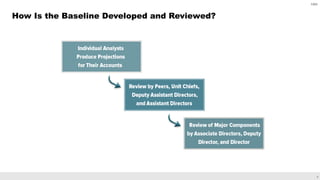
How Is the Baseline Developed and Reviewed?
CBO
10
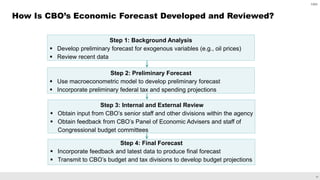
How Is CBO’s Economic Forecast Developed and Reviewed?
Step 1: Background Analysis
 Develop preliminary forecast for exogenous variables (e.g., oil prices)
 Review recent data
Step 2: Preliminary Forecast
 Use macroeconometric model to develop preliminary forecast
 Incorporate preliminary federal tax and spending projections
Step 3: Internal and External Review
 Obtain input from CBO’s senior staff and other divisions within the agency
 Obtain feedback from CBO’s Panel of Economic Advisers and staff of
Congressional budget committees
Step 4: Final Forecast
 Incorporate feedback and latest data to produce final forecast
 Transmit to CBO’s budget and tax divisions to develop budget projections
CBO
11
 Baseline updates begin with a thorough analysis of prior-year spending and revenue
collections for each account and revenue source.
 When it is appropriate, CBO uses historical patterns and experience to develop
projections.
 The internal review process includes an assessment of the quality of past projections to
identify opportunities to refine methods and improve the accuracy of projections.
 CBO solicits input from program experts at federal agencies and compares its
projections with those prepared by others.
How Does CBO Foster Accuracy in Its Projections?
CBO
12
 All projections are subject to some degree of uncertainty about how closely they will
correspond to actual outcomes.
 Projections for years farther in the future are more uncertain.
 The amount of uncertainty can vary depending on many factors, including data quality,
possible administrative actions, behavioral responses to changes in policies, and the
variability of underlying factors.
 Analysts often test the sensitivity of their projections to identify the range of possible
outcomes for those projections.
 CBO’s goal is to develop estimates that are near the middle of the range of possible
outcomes.
How Does CBO Address Uncertainty?
CBO
13
What Are the Components of the
Baseline?
CBO
14
 Includes spending for programs governed by permanent law, including payments to
people, businesses, and state and local governments
 The largest mandatory programs are Social Security, Medicare, Medicaid, and the
retirement program for civilians working for the federal government.
 Generally reflects current law (statutory language and administrative policy)
 Is driven by projections of key variables that affect cash flows:
–Enrollment by beneficiaries and their average costs
–Factors underlying CBO’s macroeconomic forecast
 By law, the baseline reflects an assumption that certain large entitlement programs
(such as the Supplemental Nutrition Assistance Program) continue after their expiration
date.
The Baseline for Mandatory Spending
CBO
15
 Spending stemming from annual appropriation acts
 Funding
–Starts with the enacted amount for the current year
–For individual accounts, incorporates adjustments for inflation for future years
–Totals constrained by caps through 2021
 Outlays
–Depends on how quickly funding is spent, with that rate differing widely among
programs and accounts
–For a given year, depends on funding in that year and prior years because funding is
usually spent gradually over several years
The Baseline for Discretionary Spending
CBO
16
 Is projected for each source
–More than 50 sources
–Largest share of total (49 percent) is from individual income taxes: $1.6 trillion in
2018
 Usually reflects current law
–Reductions in the individual income tax are assumed to expire as scheduled at the
end of 2025
–Exception: Excise taxes dedicated to trust funds are extended at current rates
 Is sensitive to economic projections
 Tends to increase as a percentage of gross domestic product (GDP) over time
The Baseline for Revenues
CBO
17
 CBO’s model:
–Incorporates existing stock of outstanding debt and associated interest rates
–Integrates projections of future deficits and other financing obligations
–Uses CBO’s forecast for interest rates
–Relies on a projection of the mix of securities that the Treasury could issue
 CBO’s projections also include offsets from interest income received on loans and cash
balances.
The Baseline for Net Spending for Interest
CBO
18
 Both CBO and OMB develop baselines that reflect the budgetary effects of current law.
 OMB also coordinates the President’s budget proposals as part of the annual budget
submission. Those proposals:
–Reflect the effects of the President’s legislative, regulatory, and administrative
changes
–Usually have significantly different spending and revenue projections from those in
CBO’s baseline because they incorporate proposed policy changes
 In CBO’s Analysis of the President’s Budget, the Administration’s proposals are
estimated in relation to CBO’s baseline
Projections by CBO and OMB
CBO
19
What Are CBO’s Current Baseline
Projections?
CBO
20
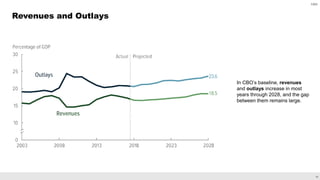
Revenues and Outlays
In CBO’s baseline, revenues
and outlays increase in most
years through 2028, and the gap
between them remains large.
CBO
21
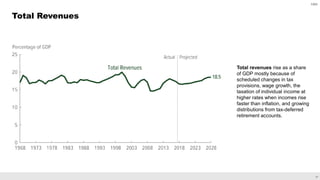
Total Revenues
Total revenues rise as a share
of GDP mostly because of
scheduled changes in tax
provisions, wage growth, the
taxation of individual income at
higher rates when incomes rise
faster than inflation, and growing
distributions from tax-deferred
retirement accounts.
CBO
22
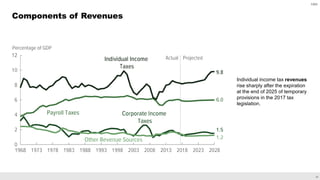
Components of Revenues
Individual income tax revenues
rise sharply after the expiration
at the end of 2025 of temporary
provisions in the 2017 tax
legislation.
CBO
23
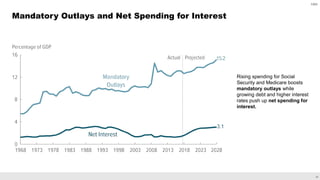
Mandatory Outlays and Net Spending for Interest
Rising spending for Social
Security and Medicare boosts
mandatory outlays while
growing debt and higher interest
rates push up net spending for
interest.
CBO
24
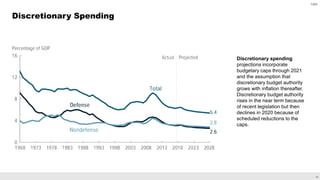
Discretionary Spending
Discretionary spending
projections incorporate
budgetary caps through 2021
and the assumption that
discretionary budget authority
grows with inflation thereafter.
Discretionary budget authority
rises in the near term because
of recent legislation but then
declines in 2020 because of
scheduled reductions to the
caps.
CBO
25
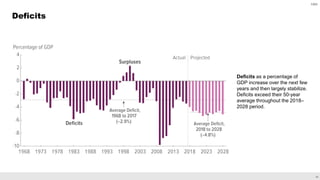
Deficits
Deficits as a percentage of
GDP increase over the next few
years and then largely stabilize.
Deficits exceed their 50-year
average throughout the 2018–
2028 period.
CBO
26
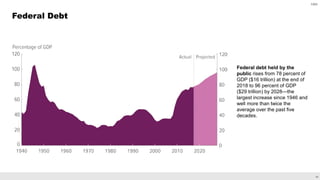
Federal Debt
Federal debt held by the
public rises from 78 percent of
GDP ($16 trillion) at the end of
2018 to 96 percent of GDP
($29 trillion) by 2028—the
largest increase since 1946 and
well more than twice the
average over the past five
decades.
CBO
27
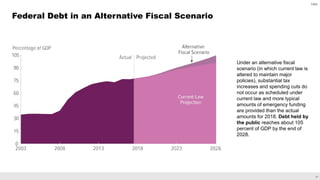
Federal Debt in an Alternative Fiscal Scenario
Under an alternative fiscal
scenario (in which current law is
altered to maintain major
policies), substantial tax
increases and spending cuts do
not occur as scheduled under
current law and more typical
amounts of emergency funding
are provided than the actual
amounts for 2018. Debt held by
the public reaches about 105
percent of GDP by the end of
2028.
CBO

Baseline Budget Projections

  • 1.
    Congressional Budget Office AJoint Seminar by the Congressional Budget Office and the Congressional Research Service September 14, 2018 Theresa Gullo, Assistant Director for Budget Analysis John McClelland, Assistant Director for Tax Analysis Baseline Budget Projections
  • 2.
  • 3.
    2 To provide theCongress with objective, nonpartisan, and timely analyses of legislative proposals and of budgetary and economic issues to support the Congressional budget process CBO’s Role CBO
  • 4.
    3  Developing abudget plan  Implementing that budget plan  Assessing the impact of proposed federal mandates  Considering issues related to the budget and to economic policy What CBO Helps the Congress With CBO
  • 5.
    4  Advisory  Objective Nonpartisan  Responsive and transparent CBO’s Characteristics CBO
  • 6.
    5 CBO’s Process forDeveloping the Budget Baseline CBO
  • 7.
    6  A detailedprojection for the current year and the ensuing 10 years of federal spending, revenues, net spending for interest, and resulting deficits or surpluses  Based on CBO’s economic forecast  Incorporates the assumption that current laws governing taxes and spending generally remain in place  Not a forecast of future budgetary outcomes; those depend on future Congressional action and other factors  Generally provided two or three times a year  Reported in the annual Budget and Economic Outlook and subsequent reports What Is CBO’s Baseline? CBO
  • 8.
    7  Principles andrules mainly come from law, budget resolutions, House and Senate rules, and the 1967 Report of the President’s Commission on Budget Concepts  A key law is the Balanced Budget and Emergency Deficit Control Act, section 257 –Defines the baseline –Sets out rules for projecting spending and receipts –Requires an assumption of full funding for entitlements –Directs the treatment of expiring programs and certain excise taxes How Is the Baseline Constructed? CBO
  • 9.
    8  A neutralbenchmark for measuring budgetary effects of proposed changes in federal revenues and mandatory spending  Basis for: –Cost estimates for proposed legislation –CBO’s analyses of the President’s annual budget –CBO’s budget options volume –Other reports (including those describing CBO’s long-term budget projections) –Assessments of multiyear budget trends  Often a starting point for budget resolutions How Do CBO and the Congress Use the Baseline? CBO
  • 10.
    9 How Is theBaseline Developed and Reviewed? CBO
  • 11.
    10 How Is CBO’sEconomic Forecast Developed and Reviewed? Step 1: Background Analysis  Develop preliminary forecast for exogenous variables (e.g., oil prices)  Review recent data Step 2: Preliminary Forecast  Use macroeconometric model to develop preliminary forecast  Incorporate preliminary federal tax and spending projections Step 3: Internal and External Review  Obtain input from CBO’s senior staff and other divisions within the agency  Obtain feedback from CBO’s Panel of Economic Advisers and staff of Congressional budget committees Step 4: Final Forecast  Incorporate feedback and latest data to produce final forecast  Transmit to CBO’s budget and tax divisions to develop budget projections CBO
  • 12.
    11  Baseline updatesbegin with a thorough analysis of prior-year spending and revenue collections for each account and revenue source.  When it is appropriate, CBO uses historical patterns and experience to develop projections.  The internal review process includes an assessment of the quality of past projections to identify opportunities to refine methods and improve the accuracy of projections.  CBO solicits input from program experts at federal agencies and compares its projections with those prepared by others. How Does CBO Foster Accuracy in Its Projections? CBO
  • 13.
    12  All projectionsare subject to some degree of uncertainty about how closely they will correspond to actual outcomes.  Projections for years farther in the future are more uncertain.  The amount of uncertainty can vary depending on many factors, including data quality, possible administrative actions, behavioral responses to changes in policies, and the variability of underlying factors.  Analysts often test the sensitivity of their projections to identify the range of possible outcomes for those projections.  CBO’s goal is to develop estimates that are near the middle of the range of possible outcomes. How Does CBO Address Uncertainty? CBO
  • 14.
    13 What Are theComponents of the Baseline? CBO
  • 15.
    14  Includes spendingfor programs governed by permanent law, including payments to people, businesses, and state and local governments  The largest mandatory programs are Social Security, Medicare, Medicaid, and the retirement program for civilians working for the federal government.  Generally reflects current law (statutory language and administrative policy)  Is driven by projections of key variables that affect cash flows: –Enrollment by beneficiaries and their average costs –Factors underlying CBO’s macroeconomic forecast  By law, the baseline reflects an assumption that certain large entitlement programs (such as the Supplemental Nutrition Assistance Program) continue after their expiration date. The Baseline for Mandatory Spending CBO
  • 16.
    15  Spending stemmingfrom annual appropriation acts  Funding –Starts with the enacted amount for the current year –For individual accounts, incorporates adjustments for inflation for future years –Totals constrained by caps through 2021  Outlays –Depends on how quickly funding is spent, with that rate differing widely among programs and accounts –For a given year, depends on funding in that year and prior years because funding is usually spent gradually over several years The Baseline for Discretionary Spending CBO
  • 17.
    16  Is projectedfor each source –More than 50 sources –Largest share of total (49 percent) is from individual income taxes: $1.6 trillion in 2018  Usually reflects current law –Reductions in the individual income tax are assumed to expire as scheduled at the end of 2025 –Exception: Excise taxes dedicated to trust funds are extended at current rates  Is sensitive to economic projections  Tends to increase as a percentage of gross domestic product (GDP) over time The Baseline for Revenues CBO
  • 18.
    17  CBO’s model: –Incorporatesexisting stock of outstanding debt and associated interest rates –Integrates projections of future deficits and other financing obligations –Uses CBO’s forecast for interest rates –Relies on a projection of the mix of securities that the Treasury could issue  CBO’s projections also include offsets from interest income received on loans and cash balances. The Baseline for Net Spending for Interest CBO
  • 19.
    18  Both CBOand OMB develop baselines that reflect the budgetary effects of current law.  OMB also coordinates the President’s budget proposals as part of the annual budget submission. Those proposals: –Reflect the effects of the President’s legislative, regulatory, and administrative changes –Usually have significantly different spending and revenue projections from those in CBO’s baseline because they incorporate proposed policy changes  In CBO’s Analysis of the President’s Budget, the Administration’s proposals are estimated in relation to CBO’s baseline Projections by CBO and OMB CBO
  • 20.
    19 What Are CBO’sCurrent Baseline Projections? CBO
  • 21.
    20 Revenues and Outlays InCBO’s baseline, revenues and outlays increase in most years through 2028, and the gap between them remains large. CBO
  • 22.
    21 Total Revenues Total revenuesrise as a share of GDP mostly because of scheduled changes in tax provisions, wage growth, the taxation of individual income at higher rates when incomes rise faster than inflation, and growing distributions from tax-deferred retirement accounts. CBO
  • 23.
    22 Components of Revenues Individualincome tax revenues rise sharply after the expiration at the end of 2025 of temporary provisions in the 2017 tax legislation. CBO
  • 24.
    23 Mandatory Outlays andNet Spending for Interest Rising spending for Social Security and Medicare boosts mandatory outlays while growing debt and higher interest rates push up net spending for interest. CBO
  • 25.
    24 Discretionary Spending Discretionary spending projectionsincorporate budgetary caps through 2021 and the assumption that discretionary budget authority grows with inflation thereafter. Discretionary budget authority rises in the near term because of recent legislation but then declines in 2020 because of scheduled reductions to the caps. CBO
  • 26.
    25 Deficits Deficits as apercentage of GDP increase over the next few years and then largely stabilize. Deficits exceed their 50-year average throughout the 2018– 2028 period. CBO
  • 27.
    26 Federal Debt Federal debtheld by the public rises from 78 percent of GDP ($16 trillion) at the end of 2018 to 96 percent of GDP ($29 trillion) by 2028—the largest increase since 1946 and well more than twice the average over the past five decades. CBO
  • 28.
    27 Federal Debt inan Alternative Fiscal Scenario Under an alternative fiscal scenario (in which current law is altered to maintain major policies), substantial tax increases and spending cuts do not occur as scheduled under current law and more typical amounts of emergency funding are provided than the actual amounts for 2018. Debt held by the public reaches about 105 percent of GDP by the end of 2028. CBO