Setting the Record Straight on Our Nation’s Finances
Putting The National Debt  Into Perspective
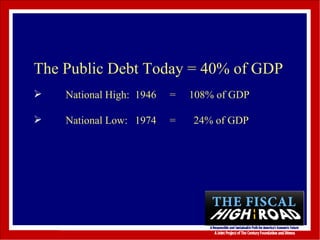
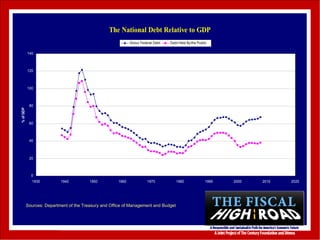
The Public Debt Today = 40% of GDP National High:   1946    =  108% of GDP National Low:   1974   = 24% of GDP
Sources: Department of the Treasury and Office of Management and Budget
We can’t reduce the debt by starving the nation.
Only by investing in our social and physical infrastructure can we achieve sustained economic growth and as a result reduce the debt
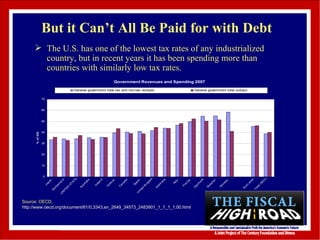
But it Can’t All Be Paid for with Debt The U.S. has one of the lowest tax rates of any industrialized country, but in recent years it has been spending more than countries with similarly low tax rates. Source: OECD,   http://www.oecd.org/document/61/0,3343,en_2649_34573_2483901_1_1_1_1,00.html
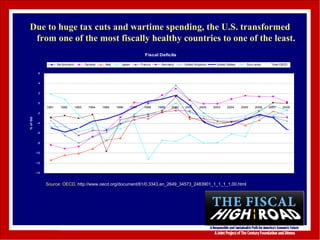
Due to huge tax cuts and wartime spending, the U.S. transformed from one of the most fiscally healthy countries to one of the least. Source: OECD,   http://www.oecd.org/document/61/0,3343,en_2649_34573_2483901_1_1_1_1,00.html
What is mistakenly called an “entitlements crisis” is actually a genuine health care crisis.  Rapidly rising medical costs, a large uninsured population, and highly uneven care are all urgent, severe problems.
Social Security’s projected shortfall over the next 75 years is just  0.38 Percent of GDP. That is not a crisis.  The Social Security System
The Projected Shortfall is Less than the Cost of Extending the Tax Cuts of 2001 and 2003 Source: CBPP,   http://www.cbpp.org/3-31-08socsec.htm 75-Year Social Security Shortfall and Cost of  Making the Bush Tax Cuts Permanent  (as share of GDP)
The aging of the population will cause social insurance programs to grow—but nowhere nearly as much as rising health care costs, if left unchecked.
Source: CBO,  http://www.cbo.gov/doc.cfm?index=8877
The United States spends a lot more on health care than other advanced nations. And we still have 46 million people with no health insurance.
2006 Medical Spending as a Percent of GDP Source: OECD,  http://www.oecd.org/document/16/0,3343,en_2649_34631_2085200_1_1_1_1,00.html
Health care spending has also grown much faster in the U.S. than it has in other countries over the past few decades.
Increase in Health Care Cost as a Percent of GDP, 1970 to 2006 Source: OECD,   http://www.oecd.org/document/16/0,3343,en_2649_34631_2085200_1_1_1_1,00.html
If trends continue, health care will absorb about half of all spending in the economy within 75 years. This is not a Medicare or Medicaid problem—it is a  system-wide problem.
Source: CBO,   http://www.cbo.gov/doc.cfm?index=8758 Projected Health Care Spending as Percent of GDP
Private employers and families are suffering  from rapidly rising health care costs. 119% increase Source: Kaiser Family Foundation,   http://facts.kff.org/chart.aspx?ch=706 117% increase $5,791 $12,680
Those who say Medicare spending increases are not sustainable are right. In recent years, the nation’s Medicare bill has been growing by 6-7% annually—far faster than workers’ wages.  The same is true for private health care spending.
Source: CMS,  http://www.cms.hhs.gov/NationalHealthExpendData/downloads/tables.pdf Changes in Spending per Enrollee, Medicare and Private Insurance
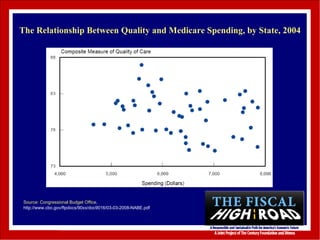
Peter Orszag, director of the Office of Management and Budget, says, “The gains from higher health care spending are not clear…Substantial evidence exists that more expensive care does not always mean higher quality care.”
The Relationship Between Quality and Medicare Spending, by State, 2004 Source: Congressional Budget Office,   http://www.cbo.gov/ftpdocs/90xx/doc9016/03-03-2008-NABE.pdf

Setting the Record Straight

  • 1.
    Setting the RecordStraight on Our Nation’s Finances
  • 2.
    Putting The NationalDebt Into Perspective
  • 3.
    The Public DebtToday = 40% of GDP National High: 1946 = 108% of GDP National Low: 1974 = 24% of GDP
  • 4.
    Sources: Department ofthe Treasury and Office of Management and Budget
  • 5.
    We can’t reducethe debt by starving the nation.
  • 6.
    Only by investingin our social and physical infrastructure can we achieve sustained economic growth and as a result reduce the debt
  • 7.
    But it Can’tAll Be Paid for with Debt The U.S. has one of the lowest tax rates of any industrialized country, but in recent years it has been spending more than countries with similarly low tax rates. Source: OECD, http://www.oecd.org/document/61/0,3343,en_2649_34573_2483901_1_1_1_1,00.html
  • 8.
    Due to hugetax cuts and wartime spending, the U.S. transformed from one of the most fiscally healthy countries to one of the least. Source: OECD, http://www.oecd.org/document/61/0,3343,en_2649_34573_2483901_1_1_1_1,00.html
  • 9.
    What is mistakenlycalled an “entitlements crisis” is actually a genuine health care crisis. Rapidly rising medical costs, a large uninsured population, and highly uneven care are all urgent, severe problems.
  • 10.
    Social Security’s projectedshortfall over the next 75 years is just 0.38 Percent of GDP. That is not a crisis. The Social Security System
  • 11.
    The Projected Shortfallis Less than the Cost of Extending the Tax Cuts of 2001 and 2003 Source: CBPP, http://www.cbpp.org/3-31-08socsec.htm 75-Year Social Security Shortfall and Cost of Making the Bush Tax Cuts Permanent (as share of GDP)
  • 12.
    The aging ofthe population will cause social insurance programs to grow—but nowhere nearly as much as rising health care costs, if left unchecked.
  • 13.
    Source: CBO, http://www.cbo.gov/doc.cfm?index=8877
  • 14.
    The United Statesspends a lot more on health care than other advanced nations. And we still have 46 million people with no health insurance.
  • 15.
    2006 Medical Spendingas a Percent of GDP Source: OECD, http://www.oecd.org/document/16/0,3343,en_2649_34631_2085200_1_1_1_1,00.html
  • 16.
    Health care spendinghas also grown much faster in the U.S. than it has in other countries over the past few decades.
  • 17.
    Increase in HealthCare Cost as a Percent of GDP, 1970 to 2006 Source: OECD, http://www.oecd.org/document/16/0,3343,en_2649_34631_2085200_1_1_1_1,00.html
  • 18.
    If trends continue,health care will absorb about half of all spending in the economy within 75 years. This is not a Medicare or Medicaid problem—it is a system-wide problem.
  • 19.
    Source: CBO, http://www.cbo.gov/doc.cfm?index=8758 Projected Health Care Spending as Percent of GDP
  • 20.
    Private employers andfamilies are suffering from rapidly rising health care costs. 119% increase Source: Kaiser Family Foundation, http://facts.kff.org/chart.aspx?ch=706 117% increase $5,791 $12,680
  • 21.
    Those who sayMedicare spending increases are not sustainable are right. In recent years, the nation’s Medicare bill has been growing by 6-7% annually—far faster than workers’ wages. The same is true for private health care spending.
  • 22.
    Source: CMS, http://www.cms.hhs.gov/NationalHealthExpendData/downloads/tables.pdf Changes in Spending per Enrollee, Medicare and Private Insurance
  • 23.
    Peter Orszag, directorof the Office of Management and Budget, says, “The gains from higher health care spending are not clear…Substantial evidence exists that more expensive care does not always mean higher quality care.”
  • 24.
    The Relationship BetweenQuality and Medicare Spending, by State, 2004 Source: Congressional Budget Office, http://www.cbo.gov/ftpdocs/90xx/doc9016/03-03-2008-NABE.pdf