Presentation for an Annual Seminar of the
European Centre for Parliamentary Research and Documentation
June 1, 2023
Mark Hadley
Chief Operating Officer and General Counsel
How CBO Acquires Data,
Evaluates Its Estimates, and
Makes Its Work Transparent
For information about the ECPRD, see https://tinyurl.com/y2h6urxd.
1
The Role of the
Congressional Budget Office (CBO)
2
The agency was created under the Congressional Budget and Impoundment Control Act of
1974 (often called the Budget Act), which also established the House and Senate Budget
Committees and instituted a formal Congressional budget process.
CBO’s chief responsibility under the Budget Act is to help the Budget Committees with matters
under their jurisdiction. The agency follows processes that are specified in statute or that it has
developed in concert with those committees and Congressional leadership.
The agency provides analysis of budgetary and economic issues that is
objective, nonpartisan, and timely. It does not make policy recommendations.
CBO’s work is available to the Congress and the public on the agency’s website, www.cbo.gov.
CBO Was Established to Give the Congress a Stronger Role in
Budget Matters
3
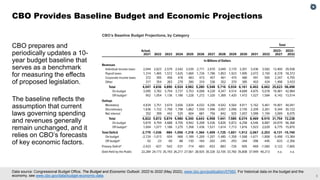
Data source: Congressional Budget Office, The Budget and Economic Outlook: 2022 to 2032 (May 2022), www.cbo.gov/publication/57950. For historical data on the budget and the
economy, see www.cbo.gov/data/budget-economic-data.
CBO prepares and
periodically updates a 10-
year budget baseline that
serves as a benchmark
for measuring the effects
of proposed legislation.
The baseline reflects the
assumption that current
laws governing spending
and revenues generally
remain unchanged, and it
relies on CBO’s forecasts
of key economic factors.​
CBO Provides Baseline Budget and Economic Projections
4
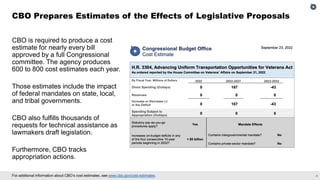
For additional information about CBO’s cost estimates, see www.cbo.gov/cost-estimates.
CBO is required to produce a cost
estimate for nearly every bill
approved by a full Congressional
committee. The agency produces
600 to 800 cost estimates each year.
Those estimates include the impact
of federal mandates on state, local,
and tribal governments.
CBO also fulfills thousands of
requests for technical assistance as
lawmakers draft legislation.
Furthermore, CBO tracks
appropriation actions.
CBO Prepares Estimates of the Effects of Legislative Proposals
5
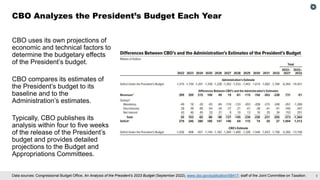
Data sources: Congressional Budget Office, An Analysis of the President’s 2023 Budget (September 2022), www.cbo.gov/publication/58417; staff of the Joint Committee on Taxation.
CBO uses its own projections of
economic and technical factors to
determine the budgetary effects
of the President’s budget.
CBO compares its estimates of
the President’s budget to its
baseline and to the
Administration’s estimates.
Typically, CBO publishes its
analysis within four to five weeks
of the release of the President’s
budget and provides detailed
projections to the Budget and
Appropriations Committees.
CBO Analyzes the President’s Budget Each Year
6
Accessing Data From
Federal Agencies
7
▪ Publicly available information is generally easy to access and is usually
well-documented.
▪ Other information is acquired upon request through informal cooperation
with federal agencies.
▪ CBO's analysts sometimes use information obtained through formal
agreements with federal agencies.
To Fulfill Its Mission, CBO Accesses a Wide Array of Data
From Federal Agencies
8
For more information, see Congressional Budget Office, The Congressional Budget Office’s Access to Data From Federal Agencies (June 2021), www.cbo.gov/publication/57150.
General authority derives from:
▪ The Budget Act, section 201(d);
▪ The Federal Credit Reform Act of 1990; and
▪ Requirements of the annual budget process.
Specific authority derives from:
▪ The Internal Revenue Code (for using tax information for long-term models of Social
Security and Medicare programs);
▪ The Emergency Economic Stabilization Act of 2008, section 201 (for information related to
the Troubled Asset Relief Program); and
▪ The Social Security Act, sections 1927 and 1150 (for information about certain drug
prices, rebates, and discounts).
Other authority derives from CBO’s collaboration with the Joint Committee on Taxation and
other federal agencies.
Three Different Types of Legal Authority Help CBO Obtain
Information From Federal Agencies
9
When arranging to use restricted-access data, CBO generally aims for:
▪ Continual and long-running access;
▪ Secure access from CBO’s offices (or from home, in the work-from-home
environment); and
▪ Clear and well-understood processes that are similar among agencies.
Restricted-Access Data Are Critical to Some Key Models Used in
Producing CBO’s Estimates
10
Evaluating the Accuracy
of CBO’s Budget Projections,
Economic Forecasts,
and Cost Estimates
11
CBO relies on the best available:
▪ Data,
▪ Research,
▪ Experts, and
▪ Understanding of current and proposed law.
The agency revisits its baseline estimates every year and adjusts them to reflect
new information.
Evaluating Evidence and Revisiting Estimates Is an
Ongoing Process
12
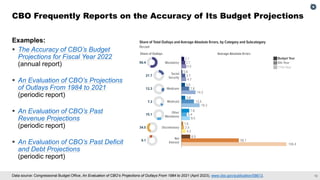
Data source: Congressional Budget Office, An Evaluation of CBO’s Projections of Outlays From 1984 to 2021 (April 2023), www.cbo.gov/publication/58613.
Examples:
▪ The Accuracy of CBO’s Budget
Projections for Fiscal Year 2022
(annual report)
▪ An Evaluation of CBO’s Projections
of Outlays From 1984 to 2021
(periodic report)
▪ An Evaluation of CBO’s Past
Revenue Projections
(periodic report)
▪ An Evaluation of CBO’s Past Deficit
and Debt Projections
(periodic report)
CBO Frequently Reports on the Accuracy of Its Budget Projections
13
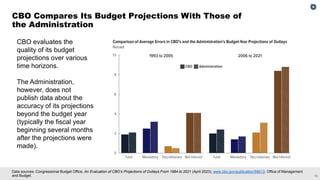
Data sources: Congressional Budget Office, An Evaluation of CBO’s Projections of Outlays From 1984 to 2021 (April 2023), www.cbo.gov/publication/58613; Office of Management
and Budget.
CBO Compares Its Budget Projections With Those of
the Administration
CBO evaluates the
quality of its budget
projections over various
time horizons.
The Administration,
however, does not
publish data about the
accuracy of its projections
beyond the budget year
(typically the fiscal year
beginning several months
after the projections were
made).
14
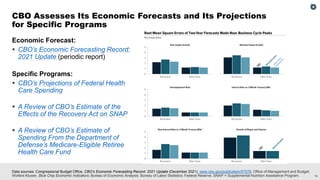
Data sources: Congressional Budget Office, CBO’s Economic Forecasting Record: 2021 Update (December 2021), www.cbo.gov/publication/57579; Office of Management and Budget;
Wolters Kluwer, Blue Chip Economic Indicators; Bureau of Economic Analysis; Bureau of Labor Statistics; Federal Reserve. SNAP = Supplemental Nutrition Assistance Program.
Economic Forecast:
▪ CBO’s Economic Forecasting Record:
2021 Update (periodic report)
Specific Programs:
▪ CBO’s Projections of Federal Health
Care Spending
▪ A Review of CBO’s Estimate of the
Effects of the Recovery Act on SNAP
▪ A Review of CBO’s Estimate of
Spending From the Department of
Defense’s Medicare-Eligible Retiree
Health Care Fund
CBO Assesses Its Economic Forecasts and Its Projections
for Specific Programs
15
That is because:
▪ Sometimes the proposed legislation was not enacted,
▪ The enacted version of the legislation was significantly different, or
▪ Spending for a legislative initiative was rolled into other spending.
Moreover,
▪ It is often unclear what spending would have been if no law was enacted, and
▪ Agencies determine the regulations and rules for implementing legislation that is
enacted.
Assessing the Accuracy of Cost Estimates Can Be Challenging
16
Providing Transparent and
Accessible Work
17
For more details about CBO’s efforts to make its work transparent, see www.cbo.gov/about/transparency.
▪ Testifying and publishing answers to
questions
▪ Explaining analytic methods
▪ Releasing data
▪ Analyzing the accuracy of its estimates
▪ Comparing current estimates with previous
estimates
▪ Comparing its estimates with those of other
organizations
▪ Estimating the effects of policy alternatives
▪ Characterizing uncertainty of estimates
▪ Creating data visualizations
▪ Conducting outreach
CBO Makes Its Work Transparent in Different Ways
18
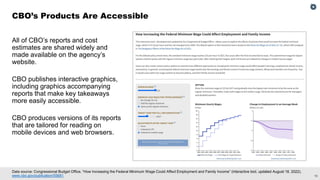
Data source: Congressional Budget Office, “How Increasing the Federal Minimum Wage Could Affect Employment and Family Income” (interactive tool, updated August 18, 2022),
www.cbo.gov/publication/55681.
All of CBO’s reports and cost
estimates are shared widely and
made available on the agency’s
website​.
CBO publishes interactive graphics,
including graphics accompanying
reports that make key takeaways
more easily accessible.
CBO produces versions of its reports
that are tailored for reading on
mobile devices and web browsers.
CBO’s Products Are Accessible

How CBO Acquires Data, Evaluates Its Estimates, and Makes Its Work Transparent

  • 1.
    Presentation for anAnnual Seminar of the European Centre for Parliamentary Research and Documentation June 1, 2023 Mark Hadley Chief Operating Officer and General Counsel How CBO Acquires Data, Evaluates Its Estimates, and Makes Its Work Transparent For information about the ECPRD, see https://tinyurl.com/y2h6urxd.
  • 2.
    1 The Role ofthe Congressional Budget Office (CBO)
  • 3.
    2 The agency wascreated under the Congressional Budget and Impoundment Control Act of 1974 (often called the Budget Act), which also established the House and Senate Budget Committees and instituted a formal Congressional budget process. CBO’s chief responsibility under the Budget Act is to help the Budget Committees with matters under their jurisdiction. The agency follows processes that are specified in statute or that it has developed in concert with those committees and Congressional leadership. The agency provides analysis of budgetary and economic issues that is objective, nonpartisan, and timely. It does not make policy recommendations. CBO’s work is available to the Congress and the public on the agency’s website, www.cbo.gov. CBO Was Established to Give the Congress a Stronger Role in Budget Matters
  • 4.
    3 Data source: CongressionalBudget Office, The Budget and Economic Outlook: 2022 to 2032 (May 2022), www.cbo.gov/publication/57950. For historical data on the budget and the economy, see www.cbo.gov/data/budget-economic-data. CBO prepares and periodically updates a 10- year budget baseline that serves as a benchmark for measuring the effects of proposed legislation. The baseline reflects the assumption that current laws governing spending and revenues generally remain unchanged, and it relies on CBO’s forecasts of key economic factors.​ CBO Provides Baseline Budget and Economic Projections
  • 5.
    4 For additional informationabout CBO’s cost estimates, see www.cbo.gov/cost-estimates. CBO is required to produce a cost estimate for nearly every bill approved by a full Congressional committee. The agency produces 600 to 800 cost estimates each year. Those estimates include the impact of federal mandates on state, local, and tribal governments. CBO also fulfills thousands of requests for technical assistance as lawmakers draft legislation. Furthermore, CBO tracks appropriation actions. CBO Prepares Estimates of the Effects of Legislative Proposals
  • 6.
    5 Data sources: CongressionalBudget Office, An Analysis of the President’s 2023 Budget (September 2022), www.cbo.gov/publication/58417; staff of the Joint Committee on Taxation. CBO uses its own projections of economic and technical factors to determine the budgetary effects of the President’s budget. CBO compares its estimates of the President’s budget to its baseline and to the Administration’s estimates. Typically, CBO publishes its analysis within four to five weeks of the release of the President’s budget and provides detailed projections to the Budget and Appropriations Committees. CBO Analyzes the President’s Budget Each Year
  • 7.
  • 8.
    7 ▪ Publicly availableinformation is generally easy to access and is usually well-documented. ▪ Other information is acquired upon request through informal cooperation with federal agencies. ▪ CBO's analysts sometimes use information obtained through formal agreements with federal agencies. To Fulfill Its Mission, CBO Accesses a Wide Array of Data From Federal Agencies
  • 9.
    8 For more information,see Congressional Budget Office, The Congressional Budget Office’s Access to Data From Federal Agencies (June 2021), www.cbo.gov/publication/57150. General authority derives from: ▪ The Budget Act, section 201(d); ▪ The Federal Credit Reform Act of 1990; and ▪ Requirements of the annual budget process. Specific authority derives from: ▪ The Internal Revenue Code (for using tax information for long-term models of Social Security and Medicare programs); ▪ The Emergency Economic Stabilization Act of 2008, section 201 (for information related to the Troubled Asset Relief Program); and ▪ The Social Security Act, sections 1927 and 1150 (for information about certain drug prices, rebates, and discounts). Other authority derives from CBO’s collaboration with the Joint Committee on Taxation and other federal agencies. Three Different Types of Legal Authority Help CBO Obtain Information From Federal Agencies
  • 10.
    9 When arranging touse restricted-access data, CBO generally aims for: ▪ Continual and long-running access; ▪ Secure access from CBO’s offices (or from home, in the work-from-home environment); and ▪ Clear and well-understood processes that are similar among agencies. Restricted-Access Data Are Critical to Some Key Models Used in Producing CBO’s Estimates
  • 11.
    10 Evaluating the Accuracy ofCBO’s Budget Projections, Economic Forecasts, and Cost Estimates
  • 12.
    11 CBO relies onthe best available: ▪ Data, ▪ Research, ▪ Experts, and ▪ Understanding of current and proposed law. The agency revisits its baseline estimates every year and adjusts them to reflect new information. Evaluating Evidence and Revisiting Estimates Is an Ongoing Process
  • 13.
    12 Data source: CongressionalBudget Office, An Evaluation of CBO’s Projections of Outlays From 1984 to 2021 (April 2023), www.cbo.gov/publication/58613. Examples: ▪ The Accuracy of CBO’s Budget Projections for Fiscal Year 2022 (annual report) ▪ An Evaluation of CBO’s Projections of Outlays From 1984 to 2021 (periodic report) ▪ An Evaluation of CBO’s Past Revenue Projections (periodic report) ▪ An Evaluation of CBO’s Past Deficit and Debt Projections (periodic report) CBO Frequently Reports on the Accuracy of Its Budget Projections
  • 14.
    13 Data sources: CongressionalBudget Office, An Evaluation of CBO’s Projections of Outlays From 1984 to 2021 (April 2023), www.cbo.gov/publication/58613; Office of Management and Budget. CBO Compares Its Budget Projections With Those of the Administration CBO evaluates the quality of its budget projections over various time horizons. The Administration, however, does not publish data about the accuracy of its projections beyond the budget year (typically the fiscal year beginning several months after the projections were made).
  • 15.
    14 Data sources: CongressionalBudget Office, CBO’s Economic Forecasting Record: 2021 Update (December 2021), www.cbo.gov/publication/57579; Office of Management and Budget; Wolters Kluwer, Blue Chip Economic Indicators; Bureau of Economic Analysis; Bureau of Labor Statistics; Federal Reserve. SNAP = Supplemental Nutrition Assistance Program. Economic Forecast: ▪ CBO’s Economic Forecasting Record: 2021 Update (periodic report) Specific Programs: ▪ CBO’s Projections of Federal Health Care Spending ▪ A Review of CBO’s Estimate of the Effects of the Recovery Act on SNAP ▪ A Review of CBO’s Estimate of Spending From the Department of Defense’s Medicare-Eligible Retiree Health Care Fund CBO Assesses Its Economic Forecasts and Its Projections for Specific Programs
  • 16.
    15 That is because: ▪Sometimes the proposed legislation was not enacted, ▪ The enacted version of the legislation was significantly different, or ▪ Spending for a legislative initiative was rolled into other spending. Moreover, ▪ It is often unclear what spending would have been if no law was enacted, and ▪ Agencies determine the regulations and rules for implementing legislation that is enacted. Assessing the Accuracy of Cost Estimates Can Be Challenging
  • 17.
  • 18.
    17 For more detailsabout CBO’s efforts to make its work transparent, see www.cbo.gov/about/transparency. ▪ Testifying and publishing answers to questions ▪ Explaining analytic methods ▪ Releasing data ▪ Analyzing the accuracy of its estimates ▪ Comparing current estimates with previous estimates ▪ Comparing its estimates with those of other organizations ▪ Estimating the effects of policy alternatives ▪ Characterizing uncertainty of estimates ▪ Creating data visualizations ▪ Conducting outreach CBO Makes Its Work Transparent in Different Ways
  • 19.
    18 Data source: CongressionalBudget Office, “How Increasing the Federal Minimum Wage Could Affect Employment and Family Income” (interactive tool, updated August 18, 2022), www.cbo.gov/publication/55681. All of CBO’s reports and cost estimates are shared widely and made available on the agency’s website​. CBO publishes interactive graphics, including graphics accompanying reports that make key takeaways more easily accessible. CBO produces versions of its reports that are tailored for reading on mobile devices and web browsers. CBO’s Products Are Accessible