Congressional Budget Office
Presentation at the Fall 2020 Federal Depository Library Conference
October 22, 2020
Deborah Kilroe
Director of Communications
An Introduction to CBO: Its Role, Services,
Products, and Communications
For further information about the venue, see www.fdlp.gov/2020-fdl-conference.
1
CBO
CBO’s Role and Structure
2
CBO
CBO was created by the Congressional Budget and
Impoundment Control Act of 1974 to give the Congress
a stronger role in budget matters.
It provides analysis of budgetary and economic issues
that is objective and impartial. The agency is strictly
nonpartisan and does not make policy
recommendations.
3
CBO
CBO’s mission is to help the Congress make
effective budget and economic policy. In carrying
out that mission, CBO offers an alternative to the
information provided by the Office of Management and
Budget in the executive branch.
4
CBO
The Director is appointed jointly by the Speaker of the
House and the President pro tempore of the Senate
and has a four-year term.
CBO has about 260 employees. They are hired solely
on the basis of professional competence, without
regard to political affiliation. Most have advanced
degrees.
5
CBO
CBO is organized into the Office of the Director and
eight divisions.
6
CBO
CBO’s Services
7
CBO
CBO assists the Congress in:
 Developing a budget plan​,
 Staying within that budget plan​,
 Assessing the impact of federal mandates, and​
 Considering issues related to the budget and
economic policy.
8
CBO
CBO helps the Congress develop a budget plan by:​
 Preparing a 10-year baseline to serve as a
benchmark (updated three times a year). The
baseline incorporates the assumption that current
law generally remains unchanged and relies on
CBO’s forecasts of key economic factors.​
 Producing estimates of proposals in the President’s
budget. ​
 Estimating budgetary effects of legislative options.
(Most such estimates are informal, but a volume of
budget options is produced every few years.) ​
The Budget Committees use the information to develop
a budget resolution.​
9
CBO
CBO helps the Congress stay within its plan by:​
 Preparing cost estimates for each bill approved by
a committee, as well as for bills and amendments at
other points in the process as requested. These
inform lawmakers whether enacting legislation would
worsen or improve the projected budget deficit.​
 Providing preliminary analysis on an informal
basis. This informs lawmakers about potential
budgetary effects so that they can make desired
changes before taking action.​
 Tracking appropriation actions. This informs
committees whether they are within allocations
specified in the budget resolution.​
10
CBO
CBO’s key characteristics:
 Advisory – CBO has no enforcement power; its
influence depends on the quality and objectivity of
the work.
 Independent – CBO’s appropriation is separate; the
agency works for both the majority and minority;
Director appointed by both Houses of Congress.
 Nonpolitical – The agency is nonpartisan by law; it
provides objective analysis.
 Transparent – CBO explains the basis of its findings
and answers questions about its methods; it
publishes all formal work on its website.
11
CBO
CBO’s work reflects the agency’s objective, impartial,
and nonpartisan analytical assessments. Those
assessments are based on:​
 A detailed understanding of federal programs and
the tax code;​
 Careful reading of the relevant research literature;
 Analysis of data reported by the government’s
statistical agencies and by private groups;
 Consultation with outside experts in academia, think
tanks, industry groups, the private sector, federal
agencies, and state and local governments;​ and
 Discussion with CBO’s Panel of Economic Advisers
and Panel of Health Advisers.​
12
CBO
CBO’s Products
13
CBO
CBO’s products include:
 Baseline budget projections and economic
forecasts covering the 10-year period used in the
Congressional budget process​;
 Long-term budget projections;
 Cost estimates for legislation, including analyses of
federal mandates​;
14
CBO
 Analyses of the President’s budget, including its
likely economic effects and their budgetary
feedback;
 Scorekeeping for enacted legislation​; and
 Analytic reports examining specific federal
programs, aspects of the tax code, and budgetary
and economic challenges​.
15
CBO
CBO’s yearly output typically includes:​
 Producing roughly 750 formal cost estimates and
related mandate statements​;
 Fulfilling thousands of requests for technical
assistance, typically from committees and Members
before legislation is formally introduced; and
 Publishing about 70 reports, testimonies, and
working papers​.
All reports and analyses of public proposals are
shared widely and made available on CBO’s website​.
16
CBO
CBO’s Communications and
Digital Innovations
17
CBO
CBO is committed to providing information that is
objective, insightful, timely, and clearly presented.
18
CBO
CBO’s mission is to serve the Congress. By law,
CBO’s primary responsibility is to provide information
to committees of the Congress. Much of this is
communicated directly to Members and their staff.​
At the same time, CBO’s analysis is also conveyed via
the press, academics, and researchers in think tanks,
among others.
CBO therefore works hard to ensure that its work is
portrayed accurately and is as accessible as
possible on its website and social media platforms.​
19
CBO
CBO has implemented a number of significant
innovations aimed at enhancing the online
presentation and accessibility of its work.
20
CBO
Examples of CBO’s recent digital innovations
include:​
 Producing fully digital versions of all of its reports
along with PDF versions, making the reports easier
to consume on mobile devices, which represent an
increasing share of website traffic;
 Publishing interactive graphics along with its
reports to make the key takeways more easily
accessible and developing a variety of stand-alone
interactive products;
 Launching enhancements to make cost estimates
easier to find and search (e.g., predictable URLs,
new search filters, and basic information about
estimates in XML); and
21
CBO
 Creating a new page on the agency’s website to
honor the legacy of CBO’s founding Director, Alice
Rivlin. Launched on CBO’s 45th anniversary in
February, the page recounts her efforts to get the
agency up and running and describes the guiding
principles she imparted, which the agency continues
to follow.
22
CBO
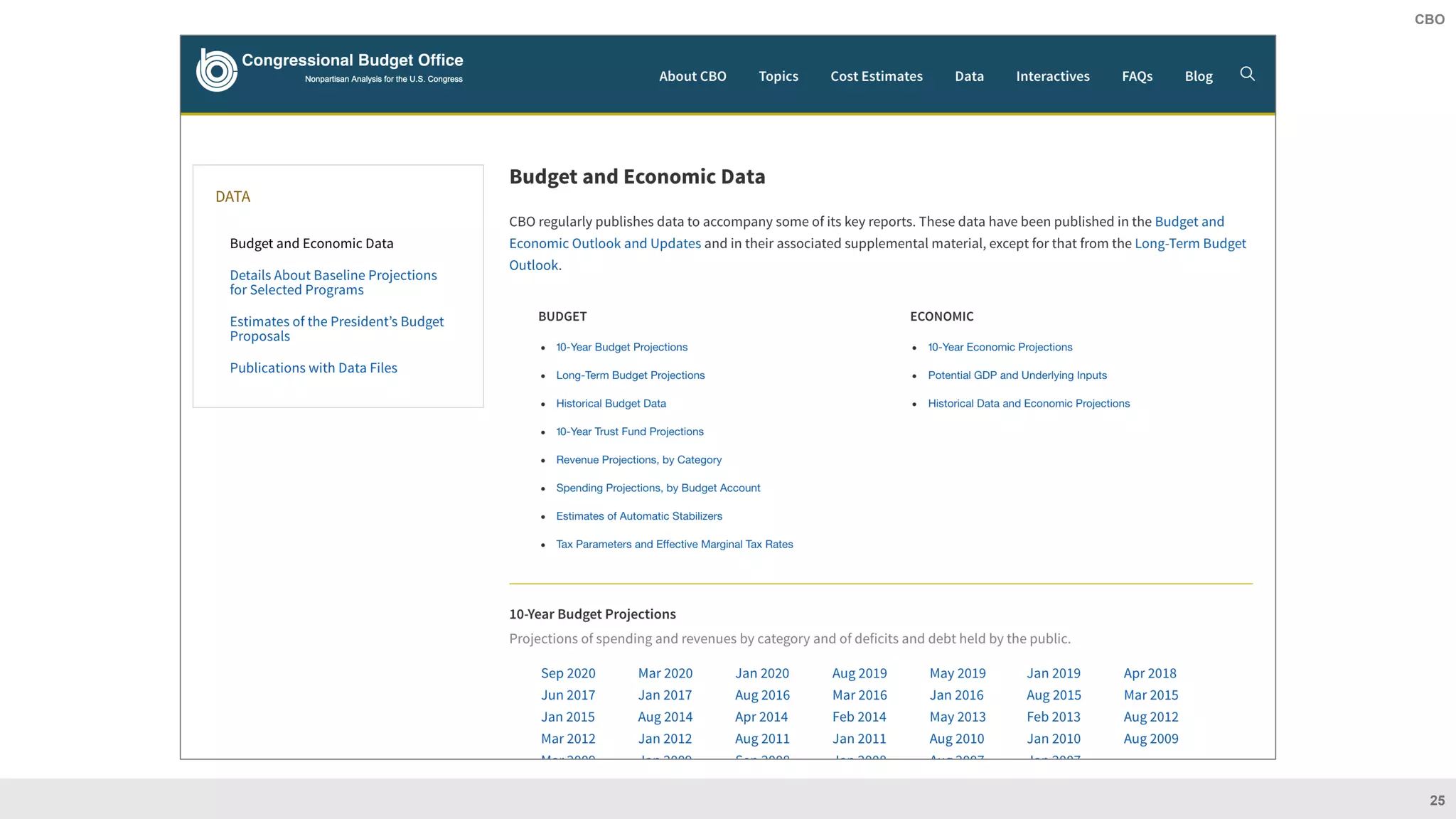
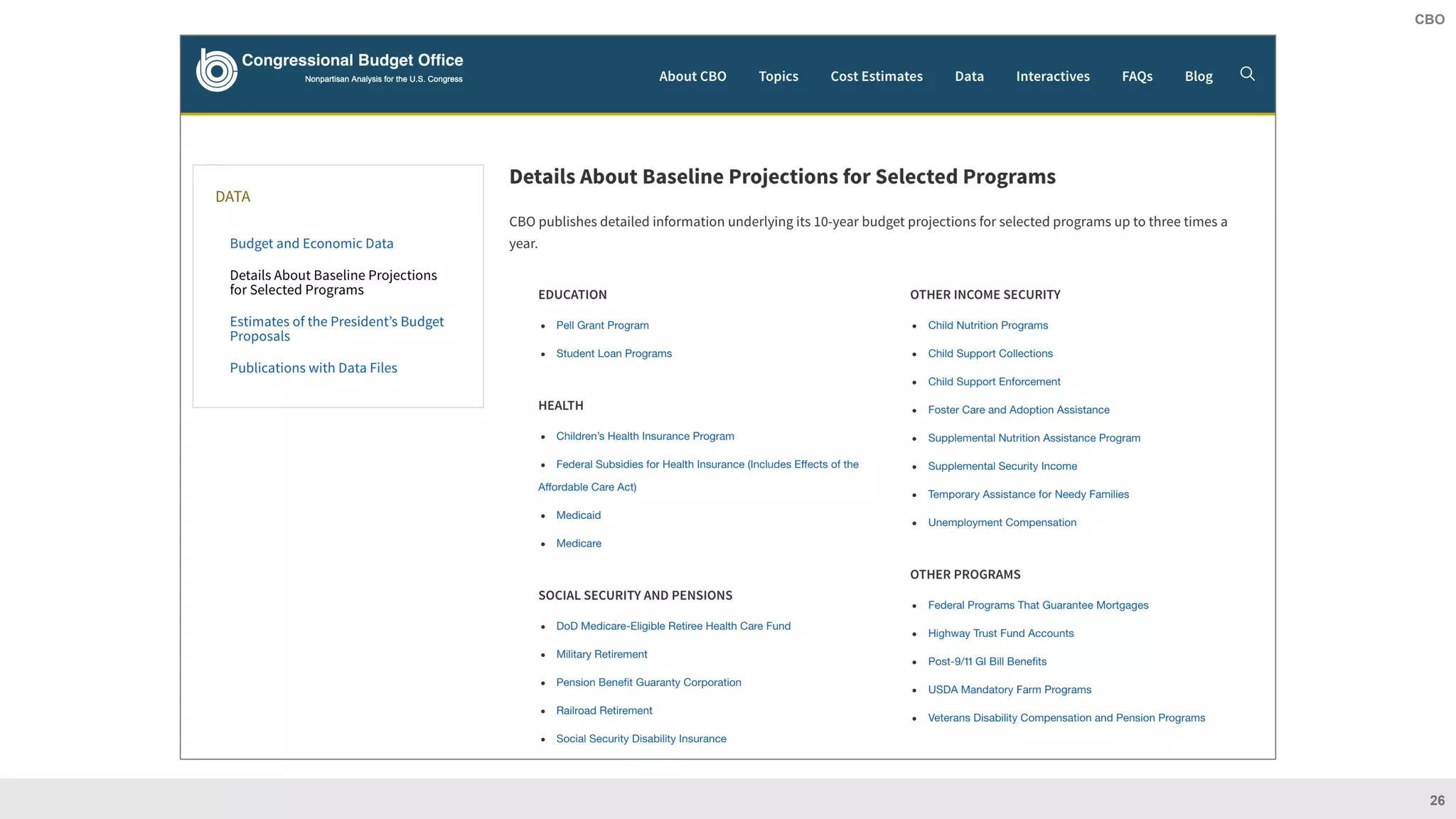
CBO has also developed pages on its website to
provide users a “one-stop shop” for:
 Major recurring reports,
 Budget and economic data,
 Baseline projections for selected programs,
 Reports with policy options,
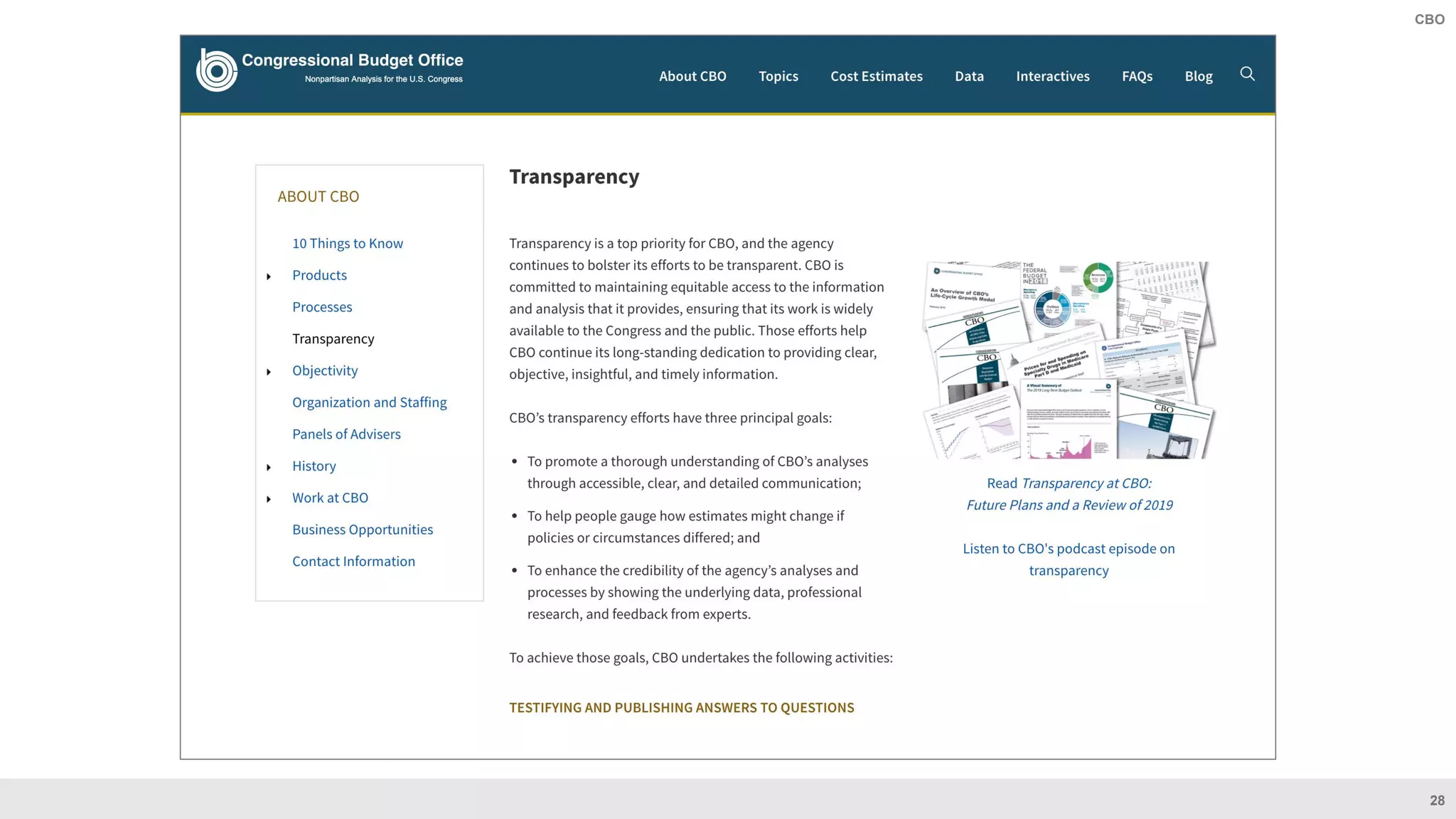
 Information on CBO’s transparency efforts, and
 CBO’s interactive products.
23
CBO
The pages are intended to make CBO’s work easier to
find and have been well received.
24
CBO
25
CBO
26
CBO
27
CBO
28
CBO
29
CBO
30
CBO
New Approaches for Assisting
the Congress During the
2020 Coronavirus Pandemic
31
CBO
CBO has released budget and economic analysis
more frequently this year and in shorter formats to
assist the Congress as it confronts the consequences
of the pandemic.
CBO’s Director participated in virtual briefings with
lawmakers to discuss CBO’s work and testified before
the Congress, both in person and virtually, about the
agency’s long-term budget projections.
32
CBO
CBO developed a new page on COVID-19 to make its
work related to the pandemic easier to find.
Throughout the year, CBO kept the Congress abreast
of its plans by releasing a schedule for its major
recurring reports and communicating changes to the
schedule through its blog.
33
CBO
Please feel free to reach out to CBO anytime. We
welcome your questions and feedback.
The best way to reach me is by e-mail:
communications@cbo.gov.

An Introduction to CBO: Its Role, Services, Products, and Communications

  • 1.
    Congressional Budget Office Presentationat the Fall 2020 Federal Depository Library Conference October 22, 2020 Deborah Kilroe Director of Communications An Introduction to CBO: Its Role, Services, Products, and Communications For further information about the venue, see www.fdlp.gov/2020-fdl-conference.
  • 2.
  • 3.
    2 CBO CBO was createdby the Congressional Budget and Impoundment Control Act of 1974 to give the Congress a stronger role in budget matters. It provides analysis of budgetary and economic issues that is objective and impartial. The agency is strictly nonpartisan and does not make policy recommendations.
  • 4.
    3 CBO CBO’s mission isto help the Congress make effective budget and economic policy. In carrying out that mission, CBO offers an alternative to the information provided by the Office of Management and Budget in the executive branch.
  • 5.
    4 CBO The Director isappointed jointly by the Speaker of the House and the President pro tempore of the Senate and has a four-year term. CBO has about 260 employees. They are hired solely on the basis of professional competence, without regard to political affiliation. Most have advanced degrees.
  • 6.
    5 CBO CBO is organizedinto the Office of the Director and eight divisions.
  • 7.
  • 8.
    7 CBO CBO assists theCongress in:  Developing a budget plan​,  Staying within that budget plan​,  Assessing the impact of federal mandates, and​  Considering issues related to the budget and economic policy.
  • 9.
    8 CBO CBO helps theCongress develop a budget plan by:​  Preparing a 10-year baseline to serve as a benchmark (updated three times a year). The baseline incorporates the assumption that current law generally remains unchanged and relies on CBO’s forecasts of key economic factors.​  Producing estimates of proposals in the President’s budget. ​  Estimating budgetary effects of legislative options. (Most such estimates are informal, but a volume of budget options is produced every few years.) ​ The Budget Committees use the information to develop a budget resolution.​
  • 10.
    9 CBO CBO helps theCongress stay within its plan by:​  Preparing cost estimates for each bill approved by a committee, as well as for bills and amendments at other points in the process as requested. These inform lawmakers whether enacting legislation would worsen or improve the projected budget deficit.​  Providing preliminary analysis on an informal basis. This informs lawmakers about potential budgetary effects so that they can make desired changes before taking action.​  Tracking appropriation actions. This informs committees whether they are within allocations specified in the budget resolution.​
  • 11.
    10 CBO CBO’s key characteristics: Advisory – CBO has no enforcement power; its influence depends on the quality and objectivity of the work.  Independent – CBO’s appropriation is separate; the agency works for both the majority and minority; Director appointed by both Houses of Congress.  Nonpolitical – The agency is nonpartisan by law; it provides objective analysis.  Transparent – CBO explains the basis of its findings and answers questions about its methods; it publishes all formal work on its website.
  • 12.
    11 CBO CBO’s work reflectsthe agency’s objective, impartial, and nonpartisan analytical assessments. Those assessments are based on:​  A detailed understanding of federal programs and the tax code;​  Careful reading of the relevant research literature;  Analysis of data reported by the government’s statistical agencies and by private groups;  Consultation with outside experts in academia, think tanks, industry groups, the private sector, federal agencies, and state and local governments;​ and  Discussion with CBO’s Panel of Economic Advisers and Panel of Health Advisers.​
  • 13.
  • 14.
    13 CBO CBO’s products include: Baseline budget projections and economic forecasts covering the 10-year period used in the Congressional budget process​;  Long-term budget projections;  Cost estimates for legislation, including analyses of federal mandates​;
  • 15.
    14 CBO  Analyses ofthe President’s budget, including its likely economic effects and their budgetary feedback;  Scorekeeping for enacted legislation​; and  Analytic reports examining specific federal programs, aspects of the tax code, and budgetary and economic challenges​.
  • 16.
    15 CBO CBO’s yearly outputtypically includes:​  Producing roughly 750 formal cost estimates and related mandate statements​;  Fulfilling thousands of requests for technical assistance, typically from committees and Members before legislation is formally introduced; and  Publishing about 70 reports, testimonies, and working papers​. All reports and analyses of public proposals are shared widely and made available on CBO’s website​.
  • 17.
  • 18.
    17 CBO CBO is committedto providing information that is objective, insightful, timely, and clearly presented.
  • 19.
    18 CBO CBO’s mission isto serve the Congress. By law, CBO’s primary responsibility is to provide information to committees of the Congress. Much of this is communicated directly to Members and their staff.​ At the same time, CBO’s analysis is also conveyed via the press, academics, and researchers in think tanks, among others. CBO therefore works hard to ensure that its work is portrayed accurately and is as accessible as possible on its website and social media platforms.​
  • 20.
    19 CBO CBO has implementeda number of significant innovations aimed at enhancing the online presentation and accessibility of its work.
  • 21.
    20 CBO Examples of CBO’srecent digital innovations include:​  Producing fully digital versions of all of its reports along with PDF versions, making the reports easier to consume on mobile devices, which represent an increasing share of website traffic;  Publishing interactive graphics along with its reports to make the key takeways more easily accessible and developing a variety of stand-alone interactive products;  Launching enhancements to make cost estimates easier to find and search (e.g., predictable URLs, new search filters, and basic information about estimates in XML); and
  • 22.
    21 CBO  Creating anew page on the agency’s website to honor the legacy of CBO’s founding Director, Alice Rivlin. Launched on CBO’s 45th anniversary in February, the page recounts her efforts to get the agency up and running and describes the guiding principles she imparted, which the agency continues to follow.
  • 23.
    22 CBO CBO has alsodeveloped pages on its website to provide users a “one-stop shop” for:  Major recurring reports,  Budget and economic data,  Baseline projections for selected programs,  Reports with policy options,  Information on CBO’s transparency efforts, and  CBO’s interactive products.
  • 24.
    23 CBO The pages areintended to make CBO’s work easier to find and have been well received.
  • 25.
  • 26.
  • 27.
  • 28.
  • 29.
  • 30.
  • 31.
    30 CBO New Approaches forAssisting the Congress During the 2020 Coronavirus Pandemic
  • 32.
    31 CBO CBO has releasedbudget and economic analysis more frequently this year and in shorter formats to assist the Congress as it confronts the consequences of the pandemic. CBO’s Director participated in virtual briefings with lawmakers to discuss CBO’s work and testified before the Congress, both in person and virtually, about the agency’s long-term budget projections.
  • 33.
    32 CBO CBO developed anew page on COVID-19 to make its work related to the pandemic easier to find. Throughout the year, CBO kept the Congress abreast of its plans by releasing a schedule for its major recurring reports and communicating changes to the schedule through its blog.
  • 34.
    33 CBO Please feel freeto reach out to CBO anytime. We welcome your questions and feedback. The best way to reach me is by e-mail: communications@cbo.gov.