Congressional Budget Office
Budget Line of Business
Fall Forum
October 31, 2019
Megan Carroll
Budget Analysis Division
CBO’s Relationships With Agencies:
Communication Is Key
1
CBO
CBO’s Role
2
CBO
The Congressional Budget Act of 1974 established
the House and Senate Budget Committees to set
federal spending policy and identify priorities for
allocating budgetary resources.
3
CBO
To support the Budget Committees in carrying out
those responsibilities, the Budget Act also established
the Congressional Budget Office and required it to
provide:
 Baseline budget projections—annual reports on
projected spending, revenues, and deficits under
current law; and
 Cost estimates for legislation that summarize the
legislation’s incremental budgetary effects relative to
the baseline.
4
CBO
The Budget Act also addressed the critical need for
open communication and data sharing between
CBO and other federal agencies.
To meet its responsibilities, CBO must understand how
agencies operate and carry out federal laws. As a
result, CBO consults with agencies on an ongoing
basis.
CBO’s analysts aim to develop strong relationships
with agencies’ staff members. CBO does not release
the names of the people it consults.
5
CBO
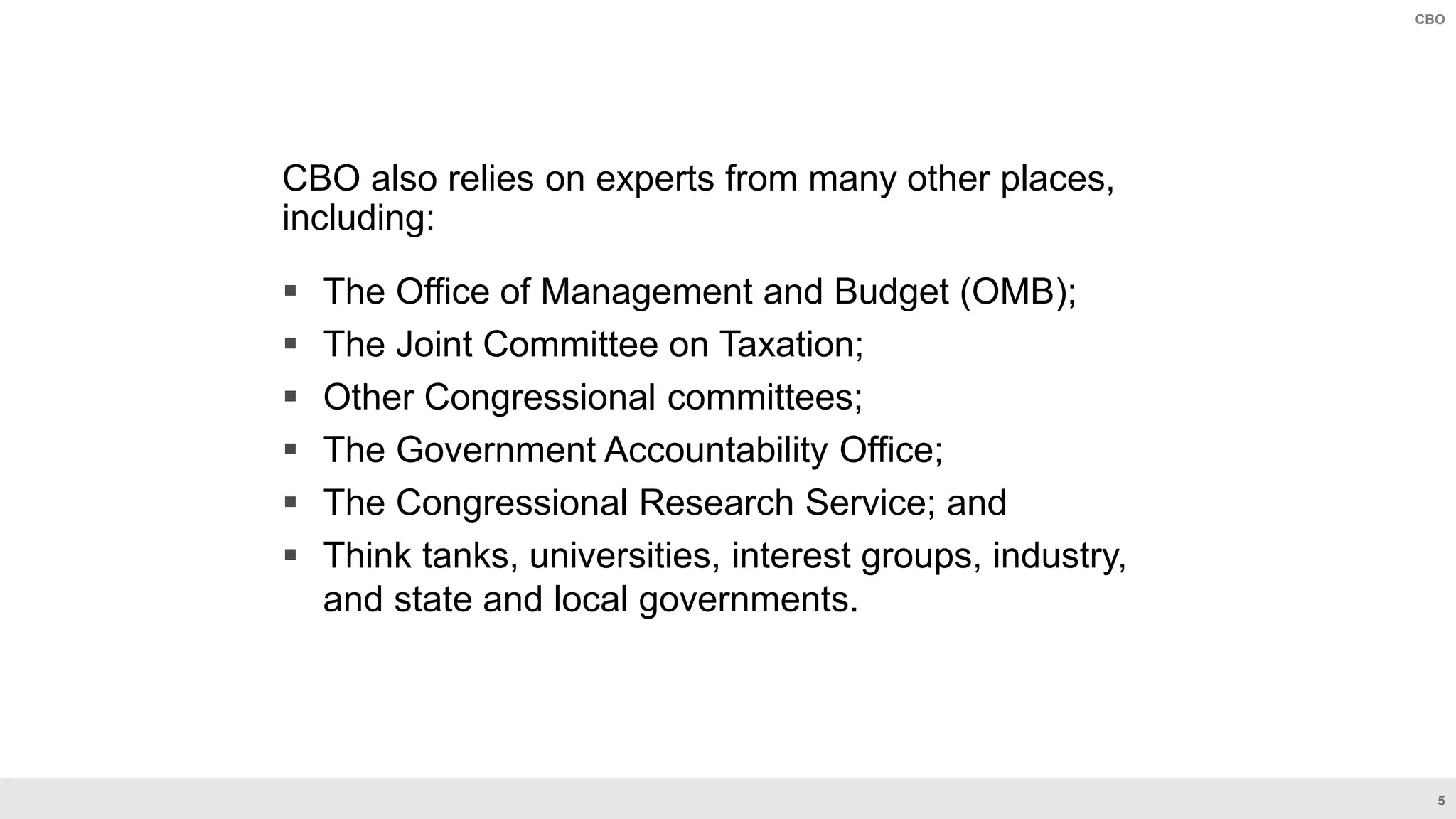
CBO also relies on experts from many other places,
including:
 The Office of Management and Budget (OMB);
 The Joint Committee on Taxation;
 Other Congressional committees;
 The Government Accountability Office;
 The Congressional Research Service; and
 Think tanks, universities, interest groups, industry,
and state and local governments.
6
CBO
How CBO Uses Information From Agencies
to Prepare Baseline Projections
7
CBO
CBO’s baseline projections are constructed to reflect
an assumption that current laws governing taxes and
spending generally remain unchanged. The projections
serve as a benchmark that the Congress can use to
enforce rules and procedures for considering
legislation that would affect the budget.
8
CBO
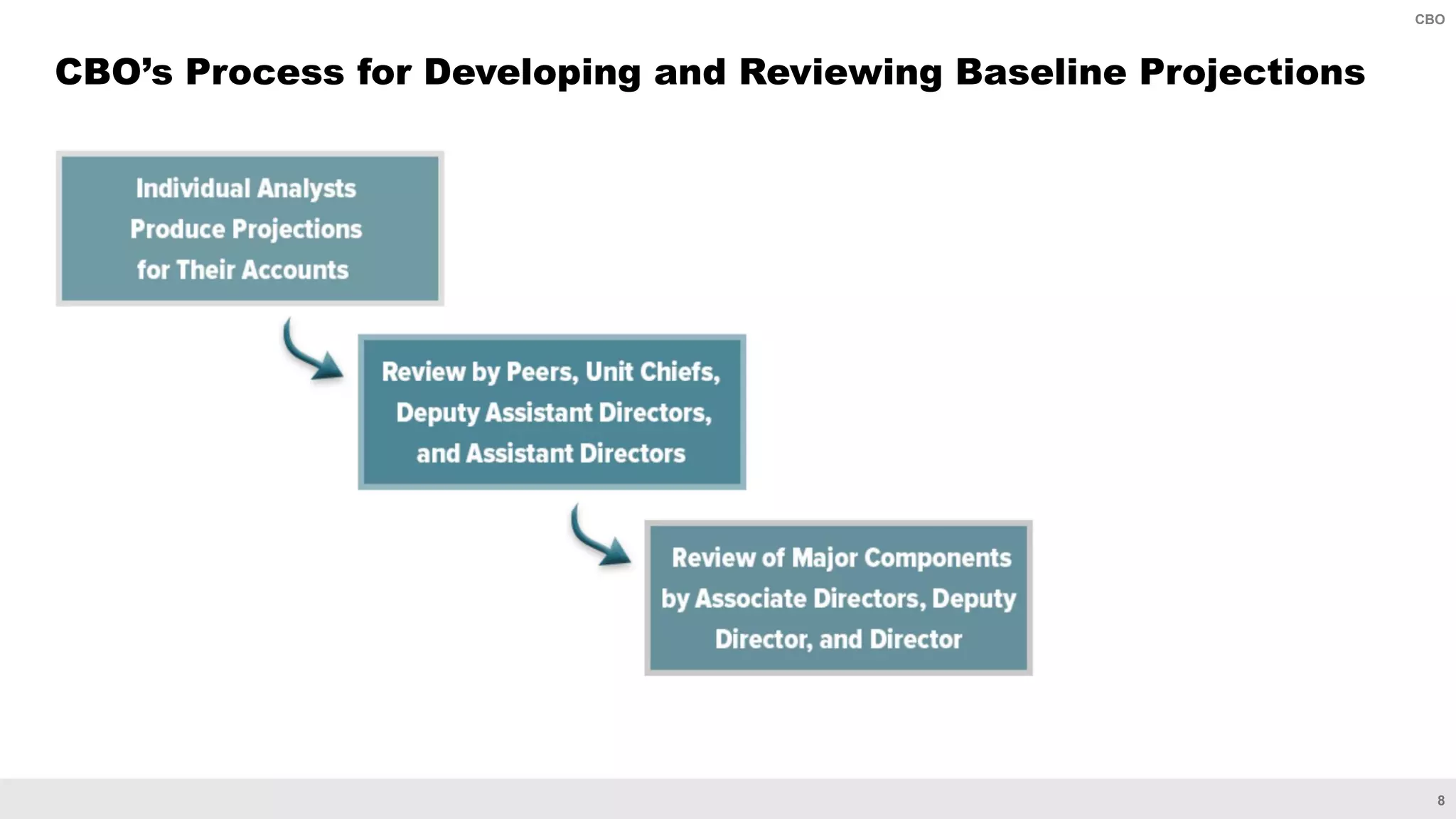
CBO’s Process for Developing and Reviewing Baseline Projections
9
CBO
Analysts consult staff members at federal agencies to
understand:
 How CBO’s estimates for prior projections compare
with actual results;
 Atypical patterns in actual and projected budgetary
effects;
 Key factors that affect how programs are
implemented and the timing and magnitude of
budgetary outcomes;
 The outlook for planned activities and potential
changes in the Administration’s policies; and
 How pending litigation may affect an agency’s
activities.
10
CBO
At the end of each fiscal year, CBO reviews actual
budget results in preparation for updating the agency’s
account-level projections for spending and revenues.
During that time, analysts frequently consult their
counterparts at other agencies and OMB about how
programs and accounts functioned in the previous year
and are expected to function in the future.
That work begins in October and culminates with the
release (usually in January) of the annual Budget and
Economic Outlook, which contains CBO’s baseline
projections.
11
CBO
In most years, CBO updates those January baseline
projections in the spring, when it analyzes the
President’s budget request for the upcoming fiscal
year.
Analysts use information contained in the President’s
budget request to adjust CBO’s projections of spending
and revenues under current law and to estimate the
budgetary effects of the Administration’s proposals.
They also review the budget justifications that agencies
provide to the Congress (and other public documents)
and consult experts at the agencies for additional
insights and information.
12
CBO
How CBO Uses Information From
Agencies to Prepare Cost Estimates
13
CBO
CBO’s cost estimates provide information that the
Congress can use to implement its rules and
procedures for considering legislation that would affect
the federal budget.
Each estimate tells a concise story about a legislative
proposal’s incremental effects on federal taxes or
spending. It also indicates whether the proposal would
impose mandates on state, local, or tribal governments
or private-sector entities.
14
CBO
CBO consults agencies’ staff members throughout the
year when preparing cost estimates. Statutory
requirements ensure that CBO places the highest
priority on preparing estimates for proposals that are
most likely to receive active consideration by the
Congress.
The scope of estimates varies, as does the amount of
time allowed to prepare them. Often, time frames are
short.
15
CBO
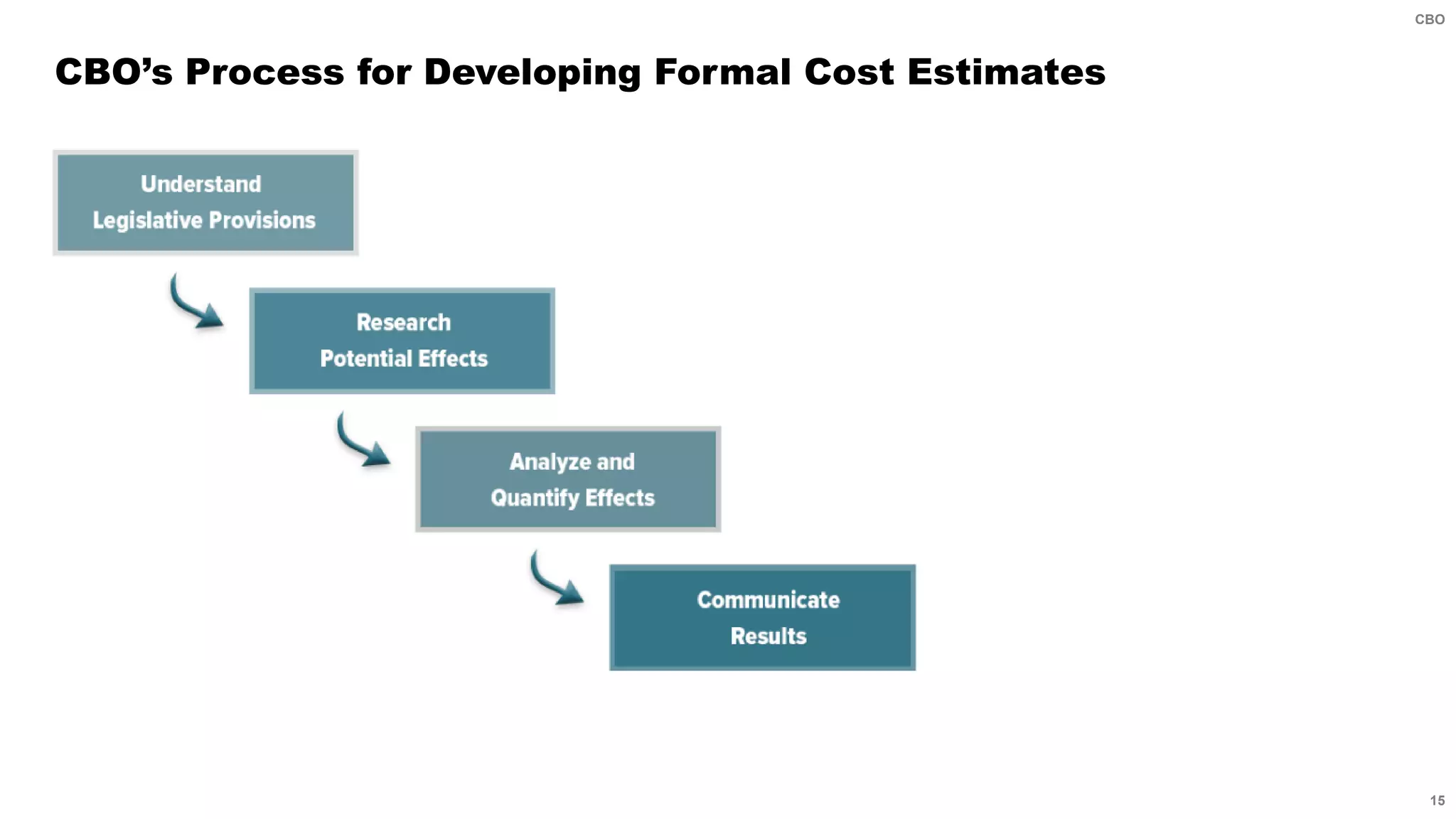
CBO’s Process for Developing Formal Cost Estimates
16
CBO
In Step 1, CBO’s analysts carefully study the
proposed legislation and assess the way it would
change current law. This step involves consulting
technical experts at federal agencies to understand
how the agencies might implement the legislation and
to determine whether its implications are clear.
17
CBO
In Step 2, analysts research potential incremental
budgetary effects. They solicit information about
those effects from a variety of sources. In some cases,
analysts consult publicly available government data
and information. In others, they use data provided
specifically at CBO’s request.
18
CBO
Step 3, in which analysts analyze and quantify
budgetary effects, is often the most complex and
time-consuming. No single approach works for all
estimates, and the best method will depend on the
question being addressed, the data available, and the
time available to produce the cost estimate.
The key is to determine how enacting the legislation
would change the behavior of affected individuals
and institutions.
19
CBO
To analyze those changes in behavior, CBO may ask:
How would federal agencies, states, or affected
industries and individuals react to a legislative
proposal’s directives and incentives?
Would the legislation result in an agency’s undertaking
activities that it would not pursue under current law?
Would the legislation change the scope of existing
efforts?
How much time would be needed to carry out
envisioned activities? Are the schedules proposed for
implementing those activities feasible?
20
CBO
CBO also asks technical questions about budget
execution, such as:
 What is the process for obligating and expending the
funding that is provided for a given activity?
 How much time typically passes between the point
when funding is provided and the point when it is
spent?
 What is the status of existing balances of funding?
Does an agency expect to obligate and spend them
under current law?
21
CBO
To estimate budgetary effects, analysts use a variety of
tools to synthesize the data and information that they
gather. Often, they also perform sensitivity analyses to
assess how outcomes depend on different factors.
22
CBO
CBO also looks at potential mandates on other
governments and the private sector. Analysts often
ask such questions as:
 How are nonfederal entities affected by current law?
 If a bill would prohibit or require an activity, how
would behaviors change?
 What are the relationships between federal agencies
and state governments that are involved in
implementing federal laws?
23
CBO
In Step 4, in which analysts communicate results,
CBO strives to be transparent, providing clear, concise
explanations and detailing the key components of the
estimate. The overarching goal is to make
information accessible by providing context,
explaining technical terms, and effectively using tables.
24
CBO
How CBO Prepares Baseline Budget Projections
(February 2018), www.cbo.gov/publication/53532
How CBO Prepares Cost Estimates
(February 2018), www.cbo.gov/publication/53519
“10 Things to Know About CBO,” CBO Blog
(January 30, 2018), www.cbo.gov/publication/53520
“Frequently Asked Questions
About Cost Estimates,”
www.cbo.gov/about/products/ce-faq
“CBO’s Activities Under the Unfunded
Mandates Reform Act,”
www.cbo.gov/publication/51335
“In Our Estimation,” www.cbo.gov/podcasts
Additional Resources

CBO’s Relationships With Agencies: Communication Is Key

  • 1.
    Congressional Budget Office BudgetLine of Business Fall Forum October 31, 2019 Megan Carroll Budget Analysis Division CBO’s Relationships With Agencies: Communication Is Key
  • 2.
  • 3.
    2 CBO The Congressional BudgetAct of 1974 established the House and Senate Budget Committees to set federal spending policy and identify priorities for allocating budgetary resources.
  • 4.
    3 CBO To support theBudget Committees in carrying out those responsibilities, the Budget Act also established the Congressional Budget Office and required it to provide:  Baseline budget projections—annual reports on projected spending, revenues, and deficits under current law; and  Cost estimates for legislation that summarize the legislation’s incremental budgetary effects relative to the baseline.
  • 5.
    4 CBO The Budget Actalso addressed the critical need for open communication and data sharing between CBO and other federal agencies. To meet its responsibilities, CBO must understand how agencies operate and carry out federal laws. As a result, CBO consults with agencies on an ongoing basis. CBO’s analysts aim to develop strong relationships with agencies’ staff members. CBO does not release the names of the people it consults.
  • 6.
    5 CBO CBO also relieson experts from many other places, including:  The Office of Management and Budget (OMB);  The Joint Committee on Taxation;  Other Congressional committees;  The Government Accountability Office;  The Congressional Research Service; and  Think tanks, universities, interest groups, industry, and state and local governments.
  • 7.
    6 CBO How CBO UsesInformation From Agencies to Prepare Baseline Projections
  • 8.
    7 CBO CBO’s baseline projectionsare constructed to reflect an assumption that current laws governing taxes and spending generally remain unchanged. The projections serve as a benchmark that the Congress can use to enforce rules and procedures for considering legislation that would affect the budget.
  • 9.
    8 CBO CBO’s Process forDeveloping and Reviewing Baseline Projections
  • 10.
    9 CBO Analysts consult staffmembers at federal agencies to understand:  How CBO’s estimates for prior projections compare with actual results;  Atypical patterns in actual and projected budgetary effects;  Key factors that affect how programs are implemented and the timing and magnitude of budgetary outcomes;  The outlook for planned activities and potential changes in the Administration’s policies; and  How pending litigation may affect an agency’s activities.
  • 11.
    10 CBO At the endof each fiscal year, CBO reviews actual budget results in preparation for updating the agency’s account-level projections for spending and revenues. During that time, analysts frequently consult their counterparts at other agencies and OMB about how programs and accounts functioned in the previous year and are expected to function in the future. That work begins in October and culminates with the release (usually in January) of the annual Budget and Economic Outlook, which contains CBO’s baseline projections.
  • 12.
    11 CBO In most years,CBO updates those January baseline projections in the spring, when it analyzes the President’s budget request for the upcoming fiscal year. Analysts use information contained in the President’s budget request to adjust CBO’s projections of spending and revenues under current law and to estimate the budgetary effects of the Administration’s proposals. They also review the budget justifications that agencies provide to the Congress (and other public documents) and consult experts at the agencies for additional insights and information.
  • 13.
    12 CBO How CBO UsesInformation From Agencies to Prepare Cost Estimates
  • 14.
    13 CBO CBO’s cost estimatesprovide information that the Congress can use to implement its rules and procedures for considering legislation that would affect the federal budget. Each estimate tells a concise story about a legislative proposal’s incremental effects on federal taxes or spending. It also indicates whether the proposal would impose mandates on state, local, or tribal governments or private-sector entities.
  • 15.
    14 CBO CBO consults agencies’staff members throughout the year when preparing cost estimates. Statutory requirements ensure that CBO places the highest priority on preparing estimates for proposals that are most likely to receive active consideration by the Congress. The scope of estimates varies, as does the amount of time allowed to prepare them. Often, time frames are short.
  • 16.
    15 CBO CBO’s Process forDeveloping Formal Cost Estimates
  • 17.
    16 CBO In Step 1,CBO’s analysts carefully study the proposed legislation and assess the way it would change current law. This step involves consulting technical experts at federal agencies to understand how the agencies might implement the legislation and to determine whether its implications are clear.
  • 18.
    17 CBO In Step 2,analysts research potential incremental budgetary effects. They solicit information about those effects from a variety of sources. In some cases, analysts consult publicly available government data and information. In others, they use data provided specifically at CBO’s request.
  • 19.
    18 CBO Step 3, inwhich analysts analyze and quantify budgetary effects, is often the most complex and time-consuming. No single approach works for all estimates, and the best method will depend on the question being addressed, the data available, and the time available to produce the cost estimate. The key is to determine how enacting the legislation would change the behavior of affected individuals and institutions.
  • 20.
    19 CBO To analyze thosechanges in behavior, CBO may ask: How would federal agencies, states, or affected industries and individuals react to a legislative proposal’s directives and incentives? Would the legislation result in an agency’s undertaking activities that it would not pursue under current law? Would the legislation change the scope of existing efforts? How much time would be needed to carry out envisioned activities? Are the schedules proposed for implementing those activities feasible?
  • 21.
    20 CBO CBO also askstechnical questions about budget execution, such as:  What is the process for obligating and expending the funding that is provided for a given activity?  How much time typically passes between the point when funding is provided and the point when it is spent?  What is the status of existing balances of funding? Does an agency expect to obligate and spend them under current law?
  • 22.
    21 CBO To estimate budgetaryeffects, analysts use a variety of tools to synthesize the data and information that they gather. Often, they also perform sensitivity analyses to assess how outcomes depend on different factors.
  • 23.
    22 CBO CBO also looksat potential mandates on other governments and the private sector. Analysts often ask such questions as:  How are nonfederal entities affected by current law?  If a bill would prohibit or require an activity, how would behaviors change?  What are the relationships between federal agencies and state governments that are involved in implementing federal laws?
  • 24.
    23 CBO In Step 4,in which analysts communicate results, CBO strives to be transparent, providing clear, concise explanations and detailing the key components of the estimate. The overarching goal is to make information accessible by providing context, explaining technical terms, and effectively using tables.
  • 25.
    24 CBO How CBO PreparesBaseline Budget Projections (February 2018), www.cbo.gov/publication/53532 How CBO Prepares Cost Estimates (February 2018), www.cbo.gov/publication/53519 “10 Things to Know About CBO,” CBO Blog (January 30, 2018), www.cbo.gov/publication/53520 “Frequently Asked Questions About Cost Estimates,” www.cbo.gov/about/products/ce-faq “CBO’s Activities Under the Unfunded Mandates Reform Act,” www.cbo.gov/publication/51335 “In Our Estimation,” www.cbo.gov/podcasts Additional Resources