Green and Blue Water

  a model & data based analysis of
water scarcity, productivity (and trade)

    with a focus on the CPWF basins

      Holger Hoff1,2, Dieter Gerten1 , Jens Heinke1
   1:Potsdam Institute for Climate Impact Research
2: Stockholm Environment Institute & Resilience Centre
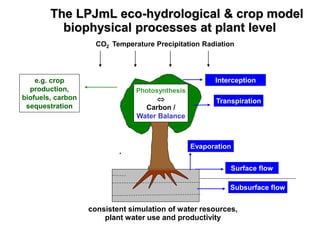
The LPJmL eco-hydrological & crop model
            biophysical processes at plant level
                     CO2 Temperature Precipitation Radiation


    e.g. crop                                          Interception
  production,                   Photosynthesis
biofuels, carbon                                      Transpiration
 sequestration                    Carbon /
                                Water Balance
                                                                  Water resources
     Crop yields


                                                 Evaporation


                                                           Surface flow

                                                           Subsurface flow


                   consistent simulation of water resources,
                       plant water use and productivity
 .
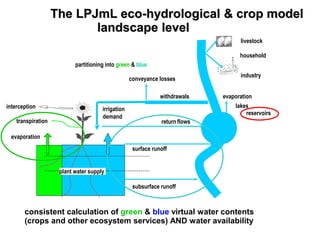
The LPJmL eco-hydrological & crop model
                           landscape level
                                                                                    livestock

                                                                                    household
                precipitation partitioning into green & blue
                                                                                    industry
                                                    conveyance losses

                                                                withdrawals   evaporation
interception                                                                      lakes
                                  irrigation
                                                                                      reservoirs
    transpiration
                       Irrigation….. figure
                                  demand              von Stefanie
                                                             return flows

  evaporation
                                                     surface runoff


                       plant water supply

                                                     subsurface runoff


       consistent calculation of green & blue virtual water contents
       (crops and other ecosystem services) AND water availability
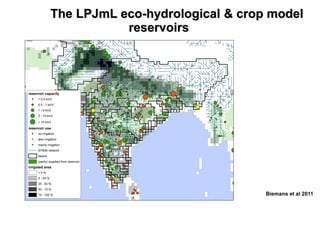
The LPJmL eco-hydrological & crop model
           reservoirs


                                 Biemans et al 2011
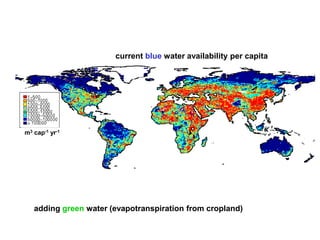
current blue water availability per capita


m3 cap-1 yr-1


   adding green water (evapotranspiration from cropland)
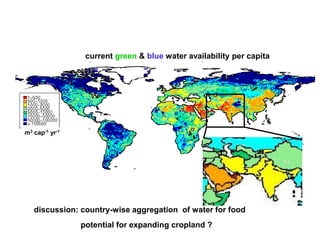
current green & blue water availability per capita


m3 cap-1 yr-1


   discussion: country-wise aggregation of water for food
                potential for expanding cropland ?
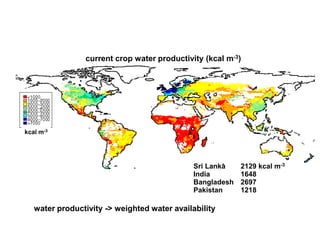
current crop water productivity (kcal m-3)


kcal m-3


                                              Sri Lanka    2129 kcal m-3
                                              India        1648
                                              Bangladesh   2697
                                              Pakistan     1218

   water productivity -> weighted water availability
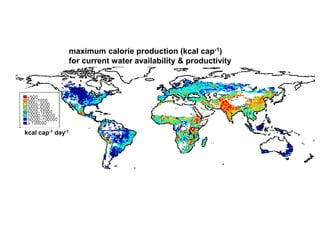
maximum calorie production (kcal cap-1)
                             agricultural water productivity
                   for current water availability & productivity


kcal cap-1 day-1
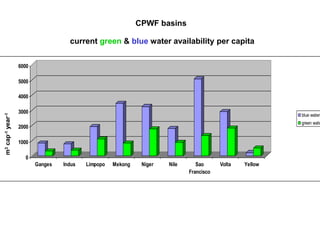
CPWF basins

                                    current green & blue water availability per capita


                  6000

                  5000

                  4000

                  3000
m3 cap-1 year-1


                                                                                              blue water
                                                                                              green wate
                  2000

                  1000

                    0
                         Ganges Indus Limpopo Mekong Niger Nile Sao Francisco Volta
                          Ganges  Indus Limpopo Mekong Niger   Nile   Sao            Yellow
                                                                               Volta Yellow
                                                                      Francisco


                                                                                       .
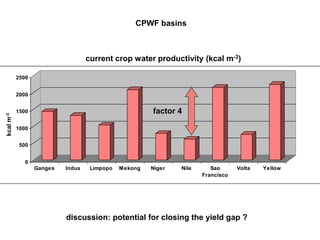
CPWF basins


                                   current crop water productivity (kcal m-3)

           2500


           2000


           1500                                        factor 4
kcal m-3


           1000


            500


              0
                  Ganges   Indus    Limpopo   Mekong   Niger   Nile      Sao      Volta   Yellow
                                                                      Francisco


                           discussion: potential for closing the yield gap ? .
                  .
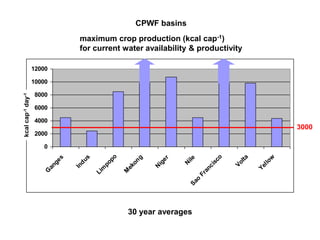
CPWF basins
                                 maximum crop production (kcal cap-1)
                                 for current water availability & productivity

                   12000

                   10000

                   8000
kcal cap-1 day-1


                   6000

                   4000
                                                                                                        3000
                   2000

                      0
                                            po


                                                                                  o


                                                                                        lta


                                                                                                    w
                                    s


                                                      g
                            s


                                                              er


                                                                   ile


                                                                                sc
                                  du
                         ge


                                                   on


                                                                                                l lo
                                                            ig
                                          po


                                                                                      Vo
                                                                   N


                                                                              ci
                       an


                                In


                                                 ek


                                                                                              Ye
                                                           N
                                          m


                                                                            an
                      G


                                                 M
                                        Li


                                                                         Fr
                                                                         o
       3000 a tipping point?                                           Sa


                                                     30 year averages                           .
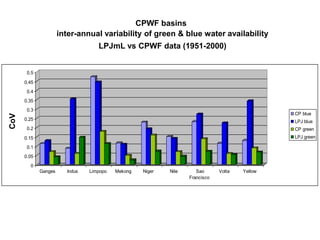
CPWF basins
                      inter-annual variability of green & blue water availability
                                   LPJmL vs CPWF data (1951-2000)


       0.5
      0.45
       0.4
      0.35
       0.3
                                                                                                   CP blue
CoV


      0.25                                                                                         LPJ blue
       0.2                                                                                         CP green
      0.15                                                                                         LPJ green

       0.1
      0.05
        0
             Ganges     Indus   Limpopo   Mekong   Niger   Nile      Sao      Volta   Yellow
                                                                  Francisco

      3000 a tipping point?

                                                                                               .
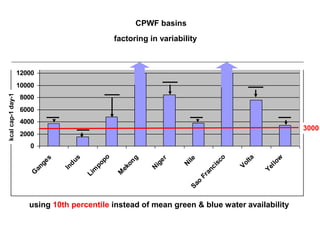
CPWF basins
                                                 factoring in variability

                   14000
                   12000
                   10000
kcal cap-1 day-1


                   8000
                   6000
                   4000
                                                                                                           3000
                   2000
                      0
                                            po


                                                                                     o


                                                                                           lta


                                                                                                       w
                                    s


                                                       g
                            s


                                                              er


                                                                     ile


                                                                                   sc
                                  du
                         ge


                                                    on


                                                                                                   l lo
                                                            ig
                                          po


                                                                                         Vo
                                                                    N


                                                                                 ci
                       an


                                In


                                                  ek


                                                                                                 Ye
                                                           N
                                          m


                                                                               an
                      G


                                                 M
                                        Li


                                                                            Fr
                                                                          o
                   3000 a tipping point?                                Sa

                      using 10th percentile instead of mean green & blue water availability
                                                                            .      .
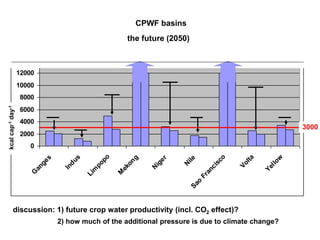
CPWF basins
                                                         the future (2050)

                   14000
                   12000
                   10000
                   8000
kcal cap-1 day-1


                   6000
                   4000
                                                                                                             3000
                   2000
                      0
                                                po


                                                                                       o


                                                                                             lta


                                                                                                         w
                                        s


                                                          g
                            s


                                                                  er


                                                                        ile


                                                                                     sc
                                      du
                         ge


                                                       on


                                                                                                     l lo
                                                                ig
                                              po


                                                                                           Vo
                                                                        N


                                                                                   ci
                       an


                                    In


                                                     ek


                                                                                                   Ye
                                                               N
                                              m


                                                                                 an
                      G


                                                     M
                                            Li


                                                                              Fr
                                                                              o
                                                                            Sa

           discussion: 1) future crop water productivity (incl. CO2 effect)?
                                2) how much of the additional pressure is due to climate change?
                                .                                                                             .
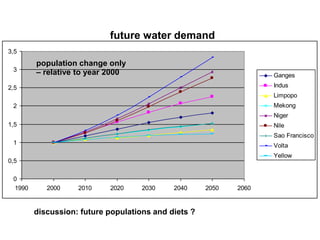
future water demand
3,5
            population change only
 3
            – relative to year 2000                                Ganges

2,5                                                                Indus
                                                                   Limpopo
 2                                                                 Mekong
                                                                   Niger
1,5                                                                Nile
                                                                   Sao Francisco
 1                                                                 Volta
                                                                   Yellow
0,5

 0
 1990         2000    2010    2020    2030   2040    2050   2060


        discussion: future populations and diets ?

        .
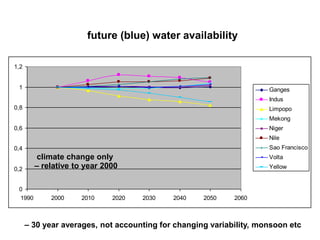
future (blue) water availability

1,2


 1                                                                   Ganges
                                                                     Indus
0,8                                                                  Limpopo
                                                                     Mekong
0,6                                                                  Niger
                                                                     Nile
0,4                                                                  Sao Francisco
         climate change only                                         Volta

0,2     – relative to year 2000                                      Yellow


 0
 1990       2000     2010    2020   2030    2040    2050    2060


                                      .
      – 30 year averages, not accounting for changing variability, monsoon etc
         .
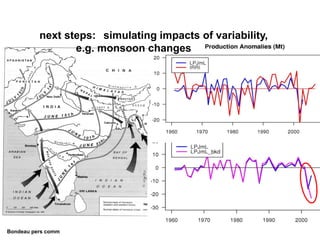
next steps: simulating impacts of variability,
                 e.g. monsoon changes


                                .
Bondeau pers comm
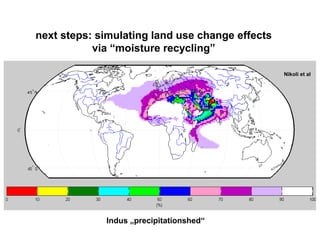
next steps: simulating land use change effects
           via “moisture recycling”

                                                 Nikoli et al


                        .
             Indus „precipitationshed“

   .
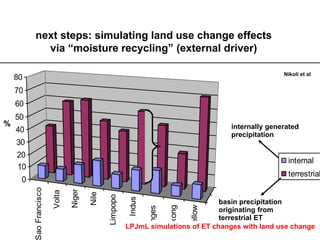
next steps: simulating land use change effects
           via “moisture recycling” (external driver)

                                                                                                                     Nikoli et al
    80
    70
    60
    50
%                                                                                                 internally generated
    40
                                                                                                  precipitation
    30
    20
                                                                                                                      internal
    10
                                                                                                                      terrestrial
     0
         ao Francisco


                                Niger
                        Volta


                                        Nile

                                               Limpopo


                                                                                             internalprecipitation
                                                          Indus


                                                                                              basin
                                                                                    Yellow
                                                                           Mekong
                                                                  Ganges


                                                                                   originating from
                                                                                   terrestrial ET
                                                         LPJmL simulations of ET changes with land use change
next steps: (“real”) water footprints
      of food production (and trade)
      plus other ecosystem services
         e.g. carbon sequestration


%
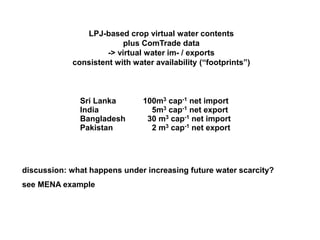
LPJ-based crop virtual water contents
                          plus ComTrade data
                     -> virtual water im- / exports
            consistent with water availability (“footprints”)


              Sri Lanka           100m3 cap-1 net import
                                          Cyprus

              India                 5m3 cap-1 net export
              Bangladesh           30 m3 cap-1 net import
              Pakistan              2 m3 cap-1 net export


discussion: what happens under increasing future water scarcity?
see MENA example


                              .
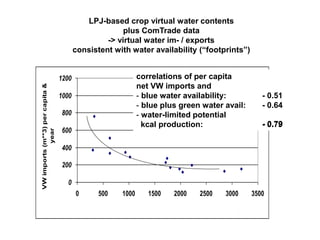
LPJ-based crop virtual water contents
                                                      plus ComTrade data
                                                 -> virtual water im- / exports
                                        consistent with water availability (“footprints”)


                                 1200                         correlations of per capita
                                                              net VW imports and
VW imports (m**3) per capita &


                                 1000                         - blue water availability:
                                                                         Cyprus
                                                                                                           - 0.51
                                                              - blue plus green water avail:               - 0.64
                                  800                         - water-limited potential
                                                                kcal production:                           - 0.79
                                  600
            year


                                  400

                                  200

                                    0
                                        0      500     1000       1500     2000      2500      3000     3500
                                             water-limited potential kcal production per capita & day

                                                              .
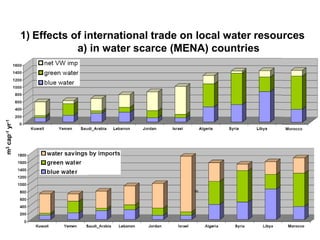
1) Effects of international trade on local water resources
                            a) in water scarce (MENA) countries
m3 cap-1 yr-1


           .

Green and Blue Water - a model & data based analysis of water scarcity, productivity (and trade) with a focus on the CPWF basins, by Holger Hoff, Dieter Gerten and Jens Heinke

  • 1.
    Green and BlueWater a model & data based analysis of water scarcity, productivity (and trade) with a focus on the CPWF basins Holger Hoff1,2, Dieter Gerten1 , Jens Heinke1 1:Potsdam Institute for Climate Impact Research 2: Stockholm Environment Institute & Resilience Centre
  • 2.
    The LPJmL eco-hydrological& crop model biophysical processes at plant level CO2 Temperature Precipitation Radiation e.g. crop Interception production, Photosynthesis biofuels, carbon  Transpiration sequestration Carbon / Water Balance Water resources Crop yields Evaporation Surface flow Subsurface flow consistent simulation of water resources, plant water use and productivity .
  • 3.
    The LPJmL eco-hydrological& crop model landscape level livestock household precipitation partitioning into green & blue industry conveyance losses withdrawals evaporation interception lakes irrigation reservoirs transpiration Irrigation….. figure demand von Stefanie return flows evaporation surface runoff plant water supply subsurface runoff consistent calculation of green & blue virtual water contents (crops and other ecosystem services) AND water availability
  • 4.
    The LPJmL eco-hydrological& crop model reservoirs Biemans et al 2011
  • 5.
    current blue wateravailability per capita m3 cap-1 yr-1 adding green water (evapotranspiration from cropland)
  • 6.
    current green &blue water availability per capita m3 cap-1 yr-1 discussion: country-wise aggregation of water for food potential for expanding cropland ?
  • 7.
    current crop waterproductivity (kcal m-3) kcal m-3 Sri Lanka 2129 kcal m-3 India 1648 Bangladesh 2697 Pakistan 1218 water productivity -> weighted water availability
  • 8.
    maximum calorie production(kcal cap-1) agricultural water productivity for current water availability & productivity kcal cap-1 day-1
  • 9.
    CPWF basins current green & blue water availability per capita 6000 5000 4000 3000 m3 cap-1 year-1 blue water green wate 2000 1000 0 Ganges Indus Limpopo Mekong Niger Nile Sao Francisco Volta Ganges Indus Limpopo Mekong Niger Nile Sao Yellow Volta Yellow Francisco .
  • 10.
    CPWF basins current crop water productivity (kcal m-3) 2500 2000 1500 factor 4 kcal m-3 1000 500 0 Ganges Indus Limpopo Mekong Niger Nile Sao Volta Yellow Francisco discussion: potential for closing the yield gap ? . .
  • 11.
    CPWF basins maximum crop production (kcal cap-1) for current water availability & productivity 12000 10000 8000 kcal cap-1 day-1 6000 4000 3000 2000 0 po o lta w s g s er ile sc du ge on l lo ig po Vo N ci an In ek Ye N m an G M Li Fr o 3000 a tipping point? Sa 30 year averages .
  • 12.
    CPWF basins inter-annual variability of green & blue water availability LPJmL vs CPWF data (1951-2000) 0.5 0.45 0.4 0.35 0.3 CP blue CoV 0.25 LPJ blue 0.2 CP green 0.15 LPJ green 0.1 0.05 0 Ganges Indus Limpopo Mekong Niger Nile Sao Volta Yellow Francisco 3000 a tipping point? .
  • 13.
    CPWF basins factoring in variability 14000 12000 10000 kcal cap-1 day-1 8000 6000 4000 3000 2000 0 po o lta w s g s er ile sc du ge on l lo ig po Vo N ci an In ek Ye N m an G M Li Fr o 3000 a tipping point? Sa using 10th percentile instead of mean green & blue water availability . .
  • 14.
    CPWF basins the future (2050) 14000 12000 10000 8000 kcal cap-1 day-1 6000 4000 3000 2000 0 po o lta w s g s er ile sc du ge on l lo ig po Vo N ci an In ek Ye N m an G M Li Fr o Sa discussion: 1) future crop water productivity (incl. CO2 effect)? 2) how much of the additional pressure is due to climate change? . .
  • 15.
    future water demand 3,5 population change only 3 – relative to year 2000 Ganges 2,5 Indus Limpopo 2 Mekong Niger 1,5 Nile Sao Francisco 1 Volta Yellow 0,5 0 1990 2000 2010 2020 2030 2040 2050 2060 discussion: future populations and diets ? .
  • 16.
    future (blue) wateravailability 1,2 1 Ganges Indus 0,8 Limpopo Mekong 0,6 Niger Nile 0,4 Sao Francisco climate change only Volta 0,2 – relative to year 2000 Yellow 0 1990 2000 2010 2020 2030 2040 2050 2060 . – 30 year averages, not accounting for changing variability, monsoon etc .
  • 17.
    next steps: simulatingimpacts of variability, e.g. monsoon changes . Bondeau pers comm
  • 18.
    next steps: simulatingland use change effects via “moisture recycling” Nikoli et al . Indus „precipitationshed“ .
  • 19.
    next steps: simulatingland use change effects via “moisture recycling” (external driver) Nikoli et al 80 70 60 50 % internally generated 40 precipitation 30 20 internal 10 terrestrial 0 ao Francisco Niger Volta Nile Limpopo internalprecipitation Indus basin Yellow Mekong Ganges originating from terrestrial ET LPJmL simulations of ET changes with land use change
  • 20.
    next steps: (“real”)water footprints of food production (and trade) plus other ecosystem services e.g. carbon sequestration %
  • 21.
    LPJ-based crop virtualwater contents plus ComTrade data -> virtual water im- / exports consistent with water availability (“footprints”) Sri Lanka 100m3 cap-1 net import Cyprus India 5m3 cap-1 net export Bangladesh 30 m3 cap-1 net import Pakistan 2 m3 cap-1 net export discussion: what happens under increasing future water scarcity? see MENA example .
  • 22.
    LPJ-based crop virtualwater contents plus ComTrade data -> virtual water im- / exports consistent with water availability (“footprints”) 1200 correlations of per capita net VW imports and VW imports (m**3) per capita & 1000 - blue water availability: Cyprus - 0.51 - blue plus green water avail: - 0.64 800 - water-limited potential kcal production: - 0.79 600 year 400 200 0 0 500 1000 1500 2000 2500 3000 3500 water-limited potential kcal production per capita & day .
  • 23.
    1) Effects ofinternational trade on local water resources a) in water scarce (MENA) countries m3 cap-1 yr-1 .