RESILIENCE:
ADAPTIVE AND SOCIAL SKILLS IN
  INTERNATIONALLY ADOPTED
      CHILDREN IN SPAIN
           Natalia Barcons Castel 1
       natalia.barcons@campus.uab.cat

                     Carme Brun 1
                   Albert Fornieles 1
                     Diana Marre 1
                    Neus Abrines 1
                   Victòria Fumadó 2

      1
          Universitat Autònoma de Barcelona
            2
              Hospital Sant Joan de Déu

     2010 Meeting SCCR/SASci/AAACIG
         Albuquerque, New México.
Research framework
o MEC R+D SEJ 2006-2009 15286
  “International adoption: social and familial inclusion
  of the internationally adopted children.
  Interdisciplinary and comparative perspectives”


o Period 2010-2012 : Science and Innovation Ministry
  CSO2009-14763-C03-01 “National and international
  adoption: family, education and pertinence:
  interdisciplinary and comparative perspectives”
Introduction

o   Research in resilience has been trying to identify the protective
    factors that may contribute to positive outcomes, but research in
    this construct is moving into the understanding of the underlying
    processes and how these factors contribute to a positive
    adaptation despite exposure to adversity.

   Rutter (1985) took this term from physics, denoting the skills of a
    body of resisting, be strong and not to distort; and adapted to the
    human being, characterizes those people that, in spite of being
    born and living in high risks situations, develop psychologically
    healthy.

   Resilience refers to the individuals' skills to superimpose to
    tragedies or periods of emotional problems, and to go out
    strengthened of these difficulties.
   In western countries the quality of the attachment relationships
    with parents or care keepers is considered as one of the factors
    that contribute to the proper development of the child.

   The attachment has consequences so much to short as long-term
    in the child’s development, in the neurobiological functioning,
    cognitive, in the emotional well-being and in the social relations.

   During the first life year, most of the children develop an internal
    organization to handle external stressors.

   Early maternal separation and psychological privation are
    distinctive on much of adoptions.

   All the adopted children have lived at least a first separation and,
    therefore, insecurities and difficulties can arise and be shown
    through his behavior.
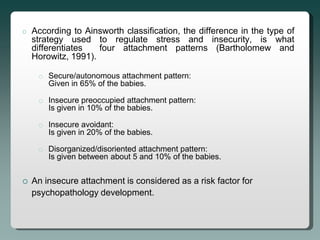
o   According to Ainsworth classification, the difference in the type of
    strategy used to regulate stress and insecurity, is what
    differentiates   four attachment patterns (Bartholomew and
    Horowitz, 1991).

     o Secure/autonomous attachment pattern:
       Given in 65% of the babies.

     o Insecure preoccupied attachment pattern:
       Is given in 10% of the babies.

     o Insecure avoidant:
       Is given in 20% of the babies.

     o Disorganized/disoriented attachment pattern:
       Is given between about 5 and 10% of the babies.


   An insecure attachment is considered as a risk factor for
    psychopathology development.
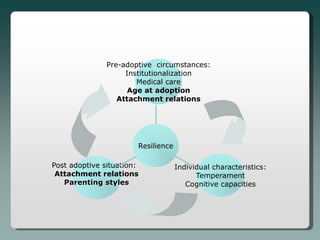
Pre-adoptive circumstances:
                    Institutionalization
                       Medical care
                     Age at adoption
                  Attachment relations


                       Resilience

Post adoptive situation:            Individual characteristics:
 Attachment relations                     Temperament
   Parenting styles                    Cognitive capacities
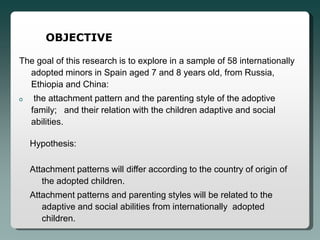
OBJECTIVE

The goal of this research is to explore in a sample of 58 internationally
  adopted minors in Spain aged 7 and 8 years old, from Russia,
  Ethiopia and China:
o    the attachment pattern and the parenting style of the adoptive
    family; and their relation with the children adaptive and social
    abilities.

    Hypothesis:

    Attachment patterns will differ according to the country of origin of
       the adopted children.
    Attachment patterns and parenting styles will be related to the
       adaptive and social abilities from internationally adopted
       children.
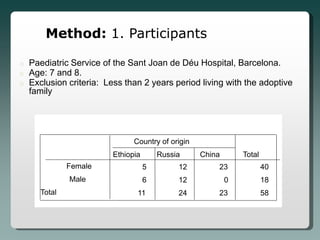
Method: 1. Participants

   Paediatric Service of the Sant Joan de Déu Hospital, Barcelona.
   Age: 7 and 8.
   Exclusion criteria: Less than 2 years period living with the adoptive
    family


                               Country of origin
                         Ethiopia       Russia     China       Total
               Female               5        12        23              40
               Male                 6        12            0           18
       Total                    11           24        23              58
Method: 2. Instruments

o   Family characteristics ad hoc questionnaire
o   Friends and Family Interview (FFI; Steele, H., y Steele, M.,
    2006). Interviews have been video recorded, transcribed and
    codified according to the training received by Prof. Steele.
o   Behavioral Assessment System for Children (BASC;
    Reynolds y Kamphaus, 1992). Parents questionnaire (adaptive
    and social skills scales).
o   Egna Minnen Beträffande Uppfostran (EMBU; Perris,
    Jacobsson, Lindström, Von Knorring, and Perris, 1980):
    Parenting styles.
Method: 3. Procedure

o   Contact Pediatric Service Hospital Sant Joan de Déu and
    Hospital appointments
o   Family information and parents written consent
o   Children assessment:
     o   During the Friends and Family Interview, the children is asked
         not only about the relationship with his/her mother but also
         about the relation with father, siblings, rest of the family,
         friends, teachers; school competence and social activities.
o   Correction of the applied instruments
o   Report to the family with the results
o   Database, Data Analysis and Preparation of the results.
Preliminary results:
Which factors relate with the development
of adaptive and social skills?

o   On the children's' available data:
o   No differences appear in adaptive skills, leadership, and
    social skills depending on the country of origin, age at
    adoption or depending on the sex of the minor.
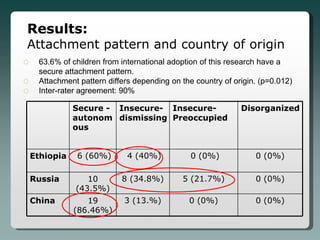
Results:
Attachment pattern and country of origin
    63.6% of children from international adoption of this research have a
     secure attachment pattern.
    Attachment pattern differs depending on the country of origin. (p=0.012)
    Inter-rater agreement: 90%

               Secure - Insecure- Insecure-                   Disorganized
               autonom dismissing Preoccupied
               ous ‫‏‬


    Ethiopia   6 (60%)        4 (40%)           0 (0%)            0 (0%)

    Russia        10        8 (34.8%)        5 (21.7%)            0 (0%)
               (43.5%)
    China         19         3 (13.%)          0 (0%)             0 (0%)
               (86.46%)
Results:
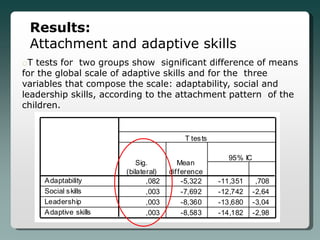
 Attachment and adaptive skills
oT tests for two groups show significant difference of means
for the global scale of adaptive skills and for the three
variables that compose the scale: adaptability, social and
leadership skills, according to the attachment pattern of the
children.


                                          T tes ts

                                                       95% IC
                           Sig.         Mean
                       (bilateral)   dif f erence
    Adaptability              ,082         -5,322    -11,351     ,708
    Social s kills            ,003         -7,692    -12,742    -2,64
    Leadership                ,003         -8,360    -13,680    -3,04
    Adaptive skills           ,003         -8,583    -14,182    -2,98
Results:
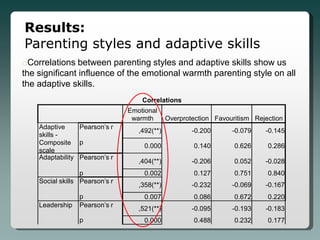
Parenting styles and adaptive skills
oCorrelations between parenting styles and adaptive skills show us
the significant influence of the emotional warmth parenting style on all
the adaptive skills.
                                    Correlations
                                Emotional
                                 warmth       Overprotection Favouritism Rejection
    Adaptive     Pearson’s r
                                   ,492(**)           -0.200      -0.079    -0.145
    skills -
    Composite p                      0.000            0.140        0.626     0.286
    scale
    Adaptability Pearson’s r
                                   ,404(**)           -0.206       0.052    -0.028
                  p                  0.002            0.127        0.751     0.840
    Social skills Pearson’s r
                                   ,358(**)           -0.232      -0.069    -0.167
                 p                   0.007            0.086        0.672     0.220
    Leadership   Pearson’s r
                                   ,521(**)           -0.095      -0.193    -0.183
                 p                   0.000            0.488        0.232     0.177
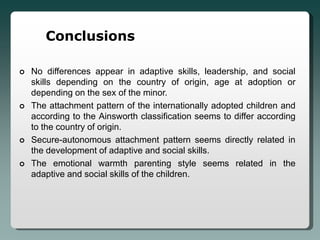
Conclusions

   No differences appear in adaptive skills, leadership, and social
    skills depending on the country of origin, age at adoption or
    depending on the sex of the minor.
   The attachment pattern of the internationally adopted children and
    according to the Ainsworth classification seems to differ according
    to the country of origin.
   Secure-autonomous attachment pattern seems directly related in
    the development of adaptive and social skills.
   The emotional warmth parenting style seems related in the
    adaptive and social skills of the children.
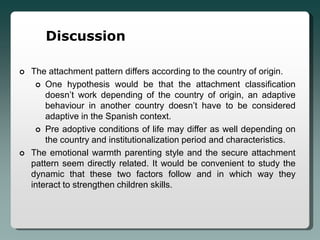
Discussion

   The attachment pattern differs according to the country of origin.
      One hypothesis would be that the attachment classification
        doesn’t work depending of the country of origin, an adaptive
        behaviour in another country doesn’t have to be considered
        adaptive in the Spanish context.
      Pre adoptive conditions of life may differ as well depending on
        the country and institutionalization period and characteristics.
   The emotional warmth parenting style and the secure attachment
    pattern seem directly related. It would be convenient to study the
    dynamic that these two factors follow and in which way they
    interact to strengthen children skills.
RESILIENCE:
ADAPTIVE AND SOCIAL SKILLS IN
  INTERNATIONALLY ADOPTED
      CHILDREN IN SPAIN
           Natalia Barcons Castel 1
       natalia.barcons@campus.uab.cat

                     Carme Brun 1
                   Albert Fornieles 1
                     Diana Marre 1
                    Neus Abrines 1
                   Victòria Fumadó 2

      1
          Universitat Autònoma de Barcelona
            2
              Hospital Sant Joan de Déu

     2010 Meeting SCCR/SASci/AAACIG
         Albuquerque, New México.

Barcons Sccr2010

  • 1.
    RESILIENCE: ADAPTIVE AND SOCIALSKILLS IN INTERNATIONALLY ADOPTED CHILDREN IN SPAIN Natalia Barcons Castel 1 natalia.barcons@campus.uab.cat Carme Brun 1 Albert Fornieles 1 Diana Marre 1 Neus Abrines 1 Victòria Fumadó 2 1 Universitat Autònoma de Barcelona 2 Hospital Sant Joan de Déu 2010 Meeting SCCR/SASci/AAACIG Albuquerque, New México.
  • 2.
    Research framework o MECR+D SEJ 2006-2009 15286 “International adoption: social and familial inclusion of the internationally adopted children. Interdisciplinary and comparative perspectives” o Period 2010-2012 : Science and Innovation Ministry CSO2009-14763-C03-01 “National and international adoption: family, education and pertinence: interdisciplinary and comparative perspectives”
  • 3.
    Introduction o Research in resilience has been trying to identify the protective factors that may contribute to positive outcomes, but research in this construct is moving into the understanding of the underlying processes and how these factors contribute to a positive adaptation despite exposure to adversity.  Rutter (1985) took this term from physics, denoting the skills of a body of resisting, be strong and not to distort; and adapted to the human being, characterizes those people that, in spite of being born and living in high risks situations, develop psychologically healthy.  Resilience refers to the individuals' skills to superimpose to tragedies or periods of emotional problems, and to go out strengthened of these difficulties.
  • 4.
    In western countries the quality of the attachment relationships with parents or care keepers is considered as one of the factors that contribute to the proper development of the child.  The attachment has consequences so much to short as long-term in the child’s development, in the neurobiological functioning, cognitive, in the emotional well-being and in the social relations.  During the first life year, most of the children develop an internal organization to handle external stressors.  Early maternal separation and psychological privation are distinctive on much of adoptions.  All the adopted children have lived at least a first separation and, therefore, insecurities and difficulties can arise and be shown through his behavior.
  • 5.
    o According to Ainsworth classification, the difference in the type of strategy used to regulate stress and insecurity, is what differentiates four attachment patterns (Bartholomew and Horowitz, 1991). o Secure/autonomous attachment pattern: Given in 65% of the babies. o Insecure preoccupied attachment pattern: Is given in 10% of the babies. o Insecure avoidant: Is given in 20% of the babies. o Disorganized/disoriented attachment pattern: Is given between about 5 and 10% of the babies.  An insecure attachment is considered as a risk factor for psychopathology development.
  • 6.
    Pre-adoptive circumstances: Institutionalization Medical care Age at adoption Attachment relations Resilience Post adoptive situation: Individual characteristics: Attachment relations Temperament Parenting styles Cognitive capacities
  • 7.
    OBJECTIVE The goal ofthis research is to explore in a sample of 58 internationally adopted minors in Spain aged 7 and 8 years old, from Russia, Ethiopia and China: o the attachment pattern and the parenting style of the adoptive family; and their relation with the children adaptive and social abilities. Hypothesis: Attachment patterns will differ according to the country of origin of the adopted children. Attachment patterns and parenting styles will be related to the adaptive and social abilities from internationally adopted children.
  • 8.
    Method: 1. Participants  Paediatric Service of the Sant Joan de Déu Hospital, Barcelona.  Age: 7 and 8.  Exclusion criteria: Less than 2 years period living with the adoptive family Country of origin Ethiopia Russia China Total Female 5 12 23 40 Male 6 12 0 18 Total 11 24 23 58
  • 9.
    Method: 2. Instruments o Family characteristics ad hoc questionnaire o Friends and Family Interview (FFI; Steele, H., y Steele, M., 2006). Interviews have been video recorded, transcribed and codified according to the training received by Prof. Steele. o Behavioral Assessment System for Children (BASC; Reynolds y Kamphaus, 1992). Parents questionnaire (adaptive and social skills scales). o Egna Minnen Beträffande Uppfostran (EMBU; Perris, Jacobsson, Lindström, Von Knorring, and Perris, 1980): Parenting styles.
  • 10.
    Method: 3. Procedure o Contact Pediatric Service Hospital Sant Joan de Déu and Hospital appointments o Family information and parents written consent o Children assessment: o During the Friends and Family Interview, the children is asked not only about the relationship with his/her mother but also about the relation with father, siblings, rest of the family, friends, teachers; school competence and social activities. o Correction of the applied instruments o Report to the family with the results o Database, Data Analysis and Preparation of the results.
  • 11.
    Preliminary results: Which factorsrelate with the development of adaptive and social skills? o On the children's' available data: o No differences appear in adaptive skills, leadership, and social skills depending on the country of origin, age at adoption or depending on the sex of the minor.
  • 12.
    Results: Attachment pattern andcountry of origin  63.6% of children from international adoption of this research have a secure attachment pattern.  Attachment pattern differs depending on the country of origin. (p=0.012)  Inter-rater agreement: 90% Secure - Insecure- Insecure- Disorganized autonom dismissing Preoccupied ous ‫‏‬ Ethiopia 6 (60%) 4 (40%) 0 (0%) 0 (0%) Russia 10 8 (34.8%) 5 (21.7%) 0 (0%) (43.5%) China 19 3 (13.%) 0 (0%) 0 (0%) (86.46%)
  • 13.
    Results: Attachment andadaptive skills oT tests for two groups show significant difference of means for the global scale of adaptive skills and for the three variables that compose the scale: adaptability, social and leadership skills, according to the attachment pattern of the children. T tes ts 95% IC Sig. Mean (bilateral) dif f erence Adaptability ,082 -5,322 -11,351 ,708 Social s kills ,003 -7,692 -12,742 -2,64 Leadership ,003 -8,360 -13,680 -3,04 Adaptive skills ,003 -8,583 -14,182 -2,98
  • 14.
    Results: Parenting styles andadaptive skills oCorrelations between parenting styles and adaptive skills show us the significant influence of the emotional warmth parenting style on all the adaptive skills. Correlations Emotional warmth Overprotection Favouritism Rejection Adaptive Pearson’s r ,492(**) -0.200 -0.079 -0.145 skills - Composite p 0.000 0.140 0.626 0.286 scale Adaptability Pearson’s r ,404(**) -0.206 0.052 -0.028 p 0.002 0.127 0.751 0.840 Social skills Pearson’s r ,358(**) -0.232 -0.069 -0.167 p 0.007 0.086 0.672 0.220 Leadership Pearson’s r ,521(**) -0.095 -0.193 -0.183 p 0.000 0.488 0.232 0.177
  • 15.
    Conclusions  No differences appear in adaptive skills, leadership, and social skills depending on the country of origin, age at adoption or depending on the sex of the minor.  The attachment pattern of the internationally adopted children and according to the Ainsworth classification seems to differ according to the country of origin.  Secure-autonomous attachment pattern seems directly related in the development of adaptive and social skills.  The emotional warmth parenting style seems related in the adaptive and social skills of the children.
  • 16.
    Discussion  The attachment pattern differs according to the country of origin.  One hypothesis would be that the attachment classification doesn’t work depending of the country of origin, an adaptive behaviour in another country doesn’t have to be considered adaptive in the Spanish context.  Pre adoptive conditions of life may differ as well depending on the country and institutionalization period and characteristics.  The emotional warmth parenting style and the secure attachment pattern seem directly related. It would be convenient to study the dynamic that these two factors follow and in which way they interact to strengthen children skills.
  • 17.
    RESILIENCE: ADAPTIVE AND SOCIALSKILLS IN INTERNATIONALLY ADOPTED CHILDREN IN SPAIN Natalia Barcons Castel 1 natalia.barcons@campus.uab.cat Carme Brun 1 Albert Fornieles 1 Diana Marre 1 Neus Abrines 1 Victòria Fumadó 2 1 Universitat Autònoma de Barcelona 2 Hospital Sant Joan de Déu 2010 Meeting SCCR/SASci/AAACIG Albuquerque, New México.