Attention Deficit and Hyperactivity Disorder (ADHD)
        in Internationally Adopted Children in Spain


          Neus Abrines Jaume, neus.abrines@campus.uab.cat
          Marre, D; Brun, C.; Fornieles, A.; Barcons, N.; Fumadó, V.


    2010 Meeting of the Society for Cross-Cultural Research
                      SCCR/SASci/AAACIG. Albuquerque, New México.
1. Framework of the research project
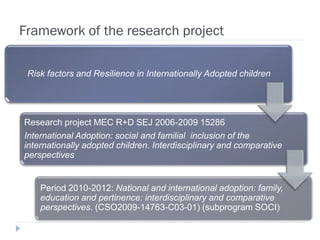
Framework of the research project

 Risk factors and Resilience in Internationally Adopted children


Research project MEC R+D SEJ 2006-2009 15286
International Adoption: social and familial inclusion of the
internationally adopted children. Interdisciplinary and comparative
perspectives


    Period 2010-2012: National and international adoption: family,
    education and pertinence: interdisciplinary and comparative
    perspectives. (CSO2009-14763-C03-01) (subprogram SOCI)
2. Theoretical Introduction
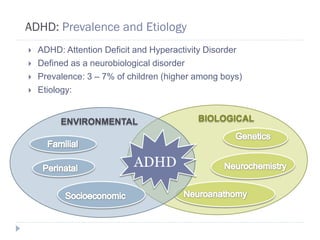
ADHD: Prevalence and Etiology
   ADHD: Attention Deficit and Hyperactivity Disorder
   Defined as a neurobiological disorder
   Prevalence: 3 – 7% of children (higher among boys)
   Etiology:


         ENVIRONMENTAL                     BIOLOGICAL


                           ADHD
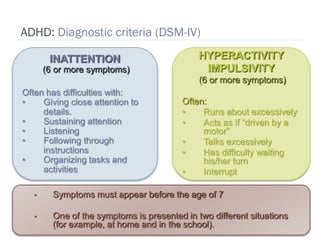
ADHD: Diagnostic criteria (DSM-IV)

        INATTENTION                           HYPERACTIVITY
       (6 or more symptoms)                    IMPULSIVITY
                                              (6 or more symptoms)
Often has difficulties with:
•    Giving close attention to            Often:
     details.                             •    Runs about excessively
•    Sustaining attention                 •    Acts as if “driven by a
•    Listening                                 motor”
•    Following through                    •    Talks excessively
     instructions                         •    Has difficulty waiting
•    Organizing tasks and                      his/her turn
     activities                           •    Interrupt

   •     Symptoms must appear before the age of 7

   •     One of the symptoms is presented in two different situations
         (for example, at home and in the school).
ADHD: Differential diagnosis

 • Attachment disorders.

 • Emotional disorders.

 • Anxiety disorders.

 • Behavior disorders.

 • Chronic brain syndromes.

 • Neglect, maltreatment and abuse.
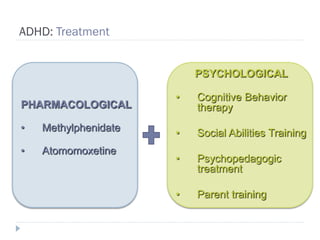
ADHD: Treatment


                          PSYCHOLOGICAL

                      •   Cognitive Behavior
PHARMACOLOGICAL           therapy
•   Methylphenidate   •   Social Abilities Training
•   Atomomoxetine
                      •   Psychopedagogic
                          treatment

                      •   Parent training
Theoretical Introduction
   A marked increase of ADHD diagnostics in
    internationally adopted children it’s been observed
    (Bimmel et al. 1990; Verrier, 2003), and this incidence seems to
    be higher among children adopted from Eastern Europe
    countries (Lindblad et al., 2010; Gunnar & Van Dulmen, 2007).

   In International Adoption, there are several risk factors
    which can favor the existence of Attachment Disorders
    and these disorders seem to be related to the ADHD
    symptomatology. (Franc et al., 2009; Niederhofer, 2009; Erdman,
    1998).
Theoretical Introduction

   Parenting styles are related with the ADHD symptomatology
    and the attachment disorders (Finzi-Dottan, Manor, & Tyano, 2006;
    Öngel, 2006).


   The existence of pre-adoptive and post-adoptive factors,
    which favor the appearance of ADHD-like symptoms, it’s
    been observed (Bimmel et al., 2003). These symptoms can lead
    to misdiagnosis of ADHD and can be followed by an
    inappropriate treatment.
3. Hypothesis
Hypothesis
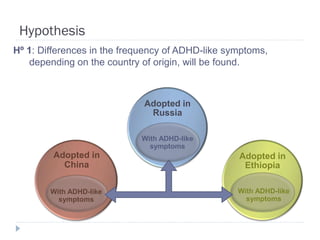
Hº 1: Differences in the frequency of ADHD-like symptoms,
   depending on the country of origin, will be found.


                             Adopted in
                              Russia

                            With ADHD-like
                              symptoms
        Adopted in                                Adopted in
       Adoptats a
          China                                    Ethiopia
     Europa de l’Est

        With ADHD-like                            With ADHD-like
          symptoms                                  symptoms
Hypothesis and objectives
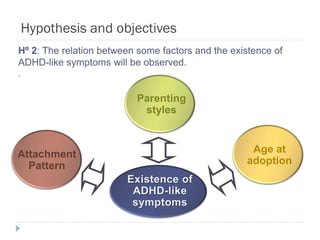
Hº 2: The relation between some factors and the existence of
ADHD-like symptoms will be observed.
.

                          Parenting
                           styles


Attachment                                          Age at
  Pattern                                          adoption
4. Method
    Participants
        Material
      Procedure
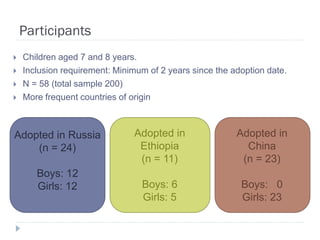
Participants
   Children aged 7 and 8 years.
   Inclusion requirement: Minimum of 2 years since the adoption date.
   N = 58 (total sample 200)
   More frequent countries of origin


Adopted in Russia              Adopted in                Adopted in
    (n = 24)                    Ethiopia                   China
                                (n = 11)                  (n = 23)
       Boys: 12
       Girls: 12                 Boys: 6                  Boys: 0
                                 Girls: 5                 Girls: 23
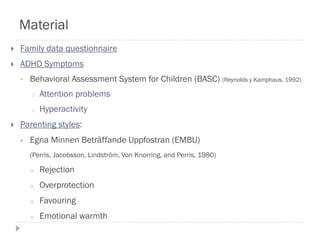
Material
   Family data questionnaire
   ADHD Symptoms
    •   Behavioral Assessment System for Children (BASC) (Reynolds y Kamphaus, 1992)
        o   Attention problems
        o   Hyperactivity
   Parenting styles:
    •   Egna Minnen Beträffande Uppfostran (EMBU)
        (Perris, Jacobsson, Lindström, Von Knorring, and Perris, 1980)

        o   Rejection
        o   Overprotection
        o   Favouring
        o   Emotional warmth
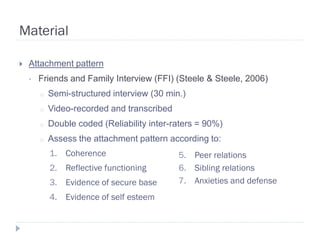
Material

   Attachment pattern
    •   Friends and Family Interview (FFI) (Steele & Steele, 2006)
        o   Semi-structured interview (30 min.)
        o   Video-recorded and transcribed
        o   Double coded (Reliability inter-raters = 90%)
        o   Assess the attachment pattern according to:
            1. Coherence                     5. Peer relations
            2. Reflective functioning        6. Sibling relations
            3. Evidence of secure base       7. Anxieties and defense
            4. Evidence of self esteem
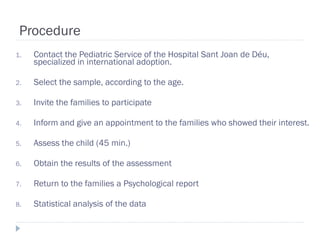
Procedure
1.   Contact the Pediatric Service of the Hospital Sant Joan de Déu,
     specialized in international adoption.

2.   Select the sample, according to the age.

3.   Invite the families to participate

4.   Inform and give an appointment to the families who showed their interest.

5.   Assess the child (45 min.)

6.   Obtain the results of the assessment

7.   Return to the families a Psychological report

8.   Statistical analysis of the data
5. Results
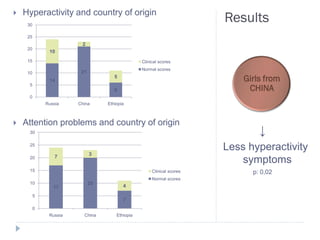
Hyperactivity and country of origin

     30
                                                                         Results
     25
                         2
     20
               10
     15                                           Clinical scores
                                                  Normal scores
     10                  21
               14
                                      5
                                                                             Girls from
      5
                                      6                                       CHINA
      0
              Russia    China      Ethiopia


   Attention problems and country of origin
      30                                                                         ↓
      25
                                                                         Less hyperactivity
                                                                             symptoms
                              3
      20          7

      15                                               Clinical scores         p: 0,02
                                                       Normal scores
      10                      20
                 17                       4

          5
                                          7
          0
               Russia     China        Ethiopia
Results

                        LESS
Girls from          HYPERACTIVITY
 CHINA                SYMPTOMS


          Age at
         adoption                      Sex


                                    NO SIGNIFICANT
                                     DIFFERENCES
   Age at adoption (months)and country of origin                        Results
60

50

40
                                                                   Russia
30
                                                                   Ethiopia
                                     51,3
20
                                                                   China           Age at
10
            27,33                                                                 adoption
                                               12,83
 0
           Russia                   Ethiopia   China


        Hyperactivity and age at adoption (months)
40
35
30
                                                                               RELATED WITH
25
20
                                                                               HYPERACTIVITY
15
                                                       35                        SYMPTOMS
10                     21,97                                                       p:0,02
 5
 0
                    Normal scores                Clinical scores
   Attachment and Attention problems
    40
                                                            Results
    35
                3
    30

    25                                                          Secure
    20
               32
                           11
                                       Clinical scores
                                       Normal scores
                                                              Attachment
    15

    10

     5                     12

     0
              Secure     Insecure
                                                                    ↓
   Attachment and hyperactivity                            Less hyperactivity
         40                                                     symptoms
         35                                                       p:0,001
         30
                    7

         25                                                         ↓
         20                               Clinical scores
         15         28
                                10
                                          Normal scores      Less attention
         10
         5
                                13
                                                                  deficit
         0
                                                                  p: 0.055
                Secure      Insecure
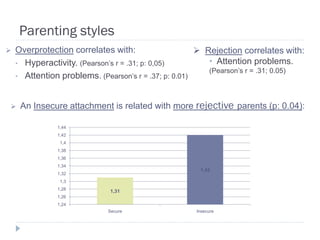
Parenting styles
   Overprotection correlates with:                     Rejection correlates with:
    • Hyperactivity. (Pearson’s r = .31; p: 0,05)         • Attention problems.
                                                          (Pearson’s r = .31; 0.05)
    • Attention problems. (Pearson’s r = .37; p: 0.01)


    An Insecure attachment is related with more rejective parents (p: 0.04):

               1,44
               1,42
                1,4
               1,38
               1,36
               1,34
                                                      1,42
               1,32
                1,3
               1,28
                             1,31
               1,26
               1,24
                             Secure                  Insecure
6. Conclusions
Conclusions
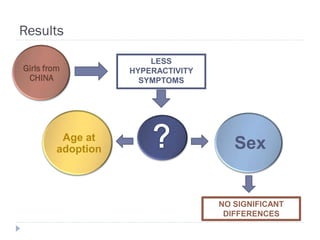
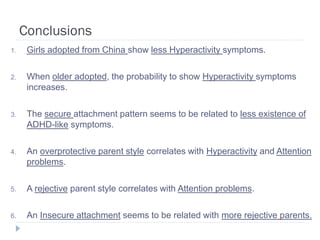
1.    Girls adopted from China show less Hyperactivity symptoms.

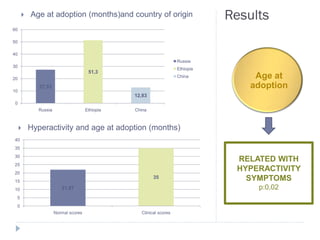
2.    When older adopted, the probability to show Hyperactivity symptoms
      increases.

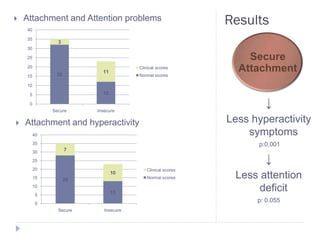
3.    The secure attachment pattern seems to be related to less existence of
      ADHD-like symptoms.

4.    An overprotective parent style correlates with Hyperactivity and Attention
      problems.

5.    A rejective parent style correlates with Attention problems.

6.    An Insecure attachment seems to be related with more rejective parents.
Conclusions


   Limitations of the research project:

    o   Size of the sample

    o   Unequal distribution of the groups

    o   Absence of a control group from general population
Acknowledgements


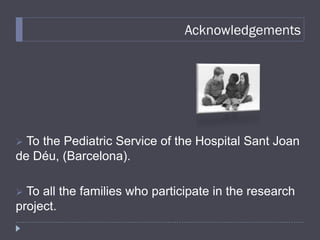
 To the Pediatric Service of the Hospital Sant Joan
de Déu, (Barcelona).

 To all the families who participate in the research
project.

Abrines Sccr2010

  • 1.
    Attention Deficit andHyperactivity Disorder (ADHD) in Internationally Adopted Children in Spain Neus Abrines Jaume, neus.abrines@campus.uab.cat Marre, D; Brun, C.; Fornieles, A.; Barcons, N.; Fumadó, V. 2010 Meeting of the Society for Cross-Cultural Research SCCR/SASci/AAACIG. Albuquerque, New México.
  • 2.
    1. Framework ofthe research project
  • 3.
    Framework of theresearch project Risk factors and Resilience in Internationally Adopted children Research project MEC R+D SEJ 2006-2009 15286 International Adoption: social and familial inclusion of the internationally adopted children. Interdisciplinary and comparative perspectives Period 2010-2012: National and international adoption: family, education and pertinence: interdisciplinary and comparative perspectives. (CSO2009-14763-C03-01) (subprogram SOCI)
  • 4.
  • 5.
    ADHD: Prevalence andEtiology  ADHD: Attention Deficit and Hyperactivity Disorder  Defined as a neurobiological disorder  Prevalence: 3 – 7% of children (higher among boys)  Etiology: ENVIRONMENTAL BIOLOGICAL ADHD
  • 6.
    ADHD: Diagnostic criteria(DSM-IV) INATTENTION HYPERACTIVITY (6 or more symptoms) IMPULSIVITY (6 or more symptoms) Often has difficulties with: • Giving close attention to Often: details. • Runs about excessively • Sustaining attention • Acts as if “driven by a • Listening motor” • Following through • Talks excessively instructions • Has difficulty waiting • Organizing tasks and his/her turn activities • Interrupt • Symptoms must appear before the age of 7 • One of the symptoms is presented in two different situations (for example, at home and in the school).
  • 7.
    ADHD: Differential diagnosis • Attachment disorders. • Emotional disorders. • Anxiety disorders. • Behavior disorders. • Chronic brain syndromes. • Neglect, maltreatment and abuse.
  • 8.
    ADHD: Treatment PSYCHOLOGICAL • Cognitive Behavior PHARMACOLOGICAL therapy • Methylphenidate • Social Abilities Training • Atomomoxetine • Psychopedagogic treatment • Parent training
  • 9.
    Theoretical Introduction  A marked increase of ADHD diagnostics in internationally adopted children it’s been observed (Bimmel et al. 1990; Verrier, 2003), and this incidence seems to be higher among children adopted from Eastern Europe countries (Lindblad et al., 2010; Gunnar & Van Dulmen, 2007).  In International Adoption, there are several risk factors which can favor the existence of Attachment Disorders and these disorders seem to be related to the ADHD symptomatology. (Franc et al., 2009; Niederhofer, 2009; Erdman, 1998).
  • 10.
    Theoretical Introduction  Parenting styles are related with the ADHD symptomatology and the attachment disorders (Finzi-Dottan, Manor, & Tyano, 2006; Öngel, 2006).  The existence of pre-adoptive and post-adoptive factors, which favor the appearance of ADHD-like symptoms, it’s been observed (Bimmel et al., 2003). These symptoms can lead to misdiagnosis of ADHD and can be followed by an inappropriate treatment.
  • 11.
  • 12.
    Hypothesis Hº 1: Differencesin the frequency of ADHD-like symptoms, depending on the country of origin, will be found. Adopted in Russia With ADHD-like symptoms Adopted in Adopted in Adoptats a China Ethiopia Europa de l’Est With ADHD-like With ADHD-like symptoms symptoms
  • 13.
    Hypothesis and objectives Hº2: The relation between some factors and the existence of ADHD-like symptoms will be observed. . Parenting styles Attachment Age at Pattern adoption
  • 14.
    4. Method  Participants  Material  Procedure
  • 15.
    Participants  Children aged 7 and 8 years.  Inclusion requirement: Minimum of 2 years since the adoption date.  N = 58 (total sample 200)  More frequent countries of origin Adopted in Russia Adopted in Adopted in (n = 24) Ethiopia China (n = 11) (n = 23) Boys: 12 Girls: 12 Boys: 6 Boys: 0 Girls: 5 Girls: 23
  • 16.
    Material  Family data questionnaire  ADHD Symptoms • Behavioral Assessment System for Children (BASC) (Reynolds y Kamphaus, 1992) o Attention problems o Hyperactivity  Parenting styles: • Egna Minnen Beträffande Uppfostran (EMBU) (Perris, Jacobsson, Lindström, Von Knorring, and Perris, 1980) o Rejection o Overprotection o Favouring o Emotional warmth
  • 17.
    Material  Attachment pattern • Friends and Family Interview (FFI) (Steele & Steele, 2006) o Semi-structured interview (30 min.) o Video-recorded and transcribed o Double coded (Reliability inter-raters = 90%) o Assess the attachment pattern according to: 1. Coherence 5. Peer relations 2. Reflective functioning 6. Sibling relations 3. Evidence of secure base 7. Anxieties and defense 4. Evidence of self esteem
  • 18.
    Procedure 1. Contact the Pediatric Service of the Hospital Sant Joan de Déu, specialized in international adoption. 2. Select the sample, according to the age. 3. Invite the families to participate 4. Inform and give an appointment to the families who showed their interest. 5. Assess the child (45 min.) 6. Obtain the results of the assessment 7. Return to the families a Psychological report 8. Statistical analysis of the data
  • 19.
  • 20.
    Hyperactivity and countryof origin  30 Results 25 2 20 10 15 Clinical scores Normal scores 10 21 14 5 Girls from 5 6 CHINA 0 Russia China Ethiopia  Attention problems and country of origin 30 ↓ 25 Less hyperactivity symptoms 3 20 7 15 Clinical scores p: 0,02 Normal scores 10 20 17 4 5 7 0 Russia China Ethiopia
  • 21.
    Results LESS Girls from HYPERACTIVITY CHINA SYMPTOMS Age at adoption Sex NO SIGNIFICANT DIFFERENCES
  • 22.
    Age at adoption (months)and country of origin Results 60 50 40 Russia 30 Ethiopia 51,3 20 China Age at 10 27,33 adoption 12,83 0 Russia Ethiopia China  Hyperactivity and age at adoption (months) 40 35 30 RELATED WITH 25 20 HYPERACTIVITY 15 35 SYMPTOMS 10 21,97 p:0,02 5 0 Normal scores Clinical scores
  • 23.
    Attachment and Attention problems 40 Results 35 3 30 25 Secure 20 32 11 Clinical scores Normal scores Attachment 15 10 5 12 0 Secure Insecure ↓  Attachment and hyperactivity Less hyperactivity 40 symptoms 35 p:0,001 30 7 25 ↓ 20 Clinical scores 15 28 10 Normal scores Less attention 10 5 13 deficit 0 p: 0.055 Secure Insecure
  • 24.
    Parenting styles  Overprotection correlates with:  Rejection correlates with: • Hyperactivity. (Pearson’s r = .31; p: 0,05) • Attention problems. (Pearson’s r = .31; 0.05) • Attention problems. (Pearson’s r = .37; p: 0.01)  An Insecure attachment is related with more rejective parents (p: 0.04): 1,44 1,42 1,4 1,38 1,36 1,34 1,42 1,32 1,3 1,28 1,31 1,26 1,24 Secure Insecure
  • 25.
  • 26.
    Conclusions 1. Girls adopted from China show less Hyperactivity symptoms. 2. When older adopted, the probability to show Hyperactivity symptoms increases. 3. The secure attachment pattern seems to be related to less existence of ADHD-like symptoms. 4. An overprotective parent style correlates with Hyperactivity and Attention problems. 5. A rejective parent style correlates with Attention problems. 6. An Insecure attachment seems to be related with more rejective parents.
  • 27.
    Conclusions  Limitations of the research project: o Size of the sample o Unequal distribution of the groups o Absence of a control group from general population
  • 28.
    Acknowledgements  To thePediatric Service of the Hospital Sant Joan de Déu, (Barcelona).  To all the families who participate in the research project.