Attachment:
PSYA1 Booster
Definition of attachment:
A strong emotional bond that is reciprocated
between two people (e.g. infant and
caregiver). Attachments are there for infants
to maintain proximity with their caregiver, as
they feel distress without one another.
Learning Theory of attachment –
Dollard and Miller (1950) POSSIBLAYYY
‘Attachment is based on the principles of
classical and operant conditioning.’
OPERANT: Any behaviour that creates a
positive reinforcement is repeated. E.g.
Crying gets you food, therefore babies cry.
CLASSICAL: The thing that gives pleasure, e.g.
food, becomes the conditioned stimulus –
The caregiver becomes a conditioned
stimulus by association.
Learning theory – Harlow and Harlow
(1962)16 Rhesus monkeys!
-Not repeatable.
-Went for comfort over food.
-When reintroduced with
monkeys, they were outcast.
- Ethical issues.
-Not generalisable to
humans
-Links to Bowlby
(1950’s)/Dollard & Miller
(1950)
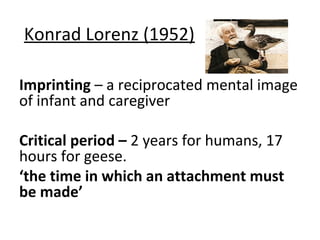
Konrad Lorenz (1952)
Imprinting – a reciprocated mental image
of infant and caregiver
Critical period – 2 years for humans, 17
hours for geese.
‘the time in which an attachment must
be made’
Bowlby (1952)- Evolutionary
explanation of
attachment
• Innate ability to attach
• Innate = born with it
• Important to survival
• Evolutionary explanation of
attachment
• Internal working model (Taken from
Freud) – where later relationships are
developed by primary attachment
• Monotropy – attachment to one
person (Taken from Lorenz)
• Maintaining close proximity to avoid
predation
Social releasers
+
Parental instinct
ATTACHMENT
Evaluating Bowlby’s evolutionary
theory of attachment:
• Backed up by Harlow and
Harlow (1962) – monkey’s
showed secure attachment.
• Harlow’s Monkeys
demonstrated privation and
isolation and not
deprivation
• Schaffer and Emerson
(1964) – Glasgow babies.
87% of the children were
attached to more than one
parents. THEREFORE NOT
MONOTROPY
However Glasgow Babies was
subjective, so is it reliable?
Evaluating Bowlby (1952):
SUPPORTS
• Backed up by Dollard and
Miller ‘cupboard love
theory’ (1950)
• Backed up by Harlow and
Harlow with their monkeys.
(1958)
• Backed up by Schaffer and
Emerson (1964)
GOES AGAINST
• Reductionist – Explains complex
behaviours in narrow terms.
• Schaffer and Emerson (1964) –
Glasgow babies.
87% of the children were attached to more
than one parents. THEREFORE NOT
MONOTROPY
However Glasgow Babies was subjective, so
is it reliable?
• Rutter et al (1998-2007) found orphans
who went into institutionalised care,
who were able to form attachments
after being adopted. After the 1st
year
of life – ARGUES CRITICAL PERIOD.
Maccoby: (1980)
1.Proximity seeking
2.Distress on seperation
3.Joy at reunion
4.General orientation towards
each other.
Ainsworth (1970’s)
• Strange situation – Baltimore 1970’s
• 100 x 12-18 month children
• 7 stages
- Parent, child, enter, explore
- Stranger enter, talk to parent
- Parent leaves
- Parent returns, stranger leaves
- Parent leaves
- Stranger returns
- Parents returns, stranger leaves
• 3 types of attachment:
- Securely attached – WAAAAAAAAAH – Oh, mommy!!!
- Insecure avoidant – DON’T CARE
- Insecure resistant – I HATE YOU BUT I LOVE YOU
• 65% securely attached.
• 21% insecure-avoidant.
• 14% insecure-resistant.
• Shows that most of N. American children were
securely attached.
• Association between mother’s behaviour &
infants attachment type, suggesting the mother’s
behaviour may help to determine attachment
type.
Evaluating Ainsworth:
+ Controlled
observation
+ Lab study
+ Easily replicated =
reliable
+ Interrater reliability
due to repeats, and
psychologists with
similar opinions.
- Demand characteristics
- Lacks ecological validity
(COUNTER ARGUE as it
COULD happen in real
life)
- Ethical issues (protection
from harm/lack of
consent)
- Ethnocentric with
Americans.
- (COUNTER ARGUE) as
was repeated in different
countries which leads to…
Van Ijzendoorn & Kroonenberg 1988 –
meta-analysis
Country Secure % Ins. Resistant % Ins. Avoidant %
USA 65 21 14
Great Brit. 75 22 3
Israel 64 7 29
Japan 68 5 27
China 50 25 25
Evaluating Van Ijzendoorn and
Kroonenberg
• Consistency throughout
the nations.
• The sample size isn’t
stated for example,
Chinese study only had
36 ppts.
• Cultures and classes of
the ppts may not be
generalizable due to
cultural relativism.
• Demand characteristics
due to setting
• Cultural relativism:
Whether the behaviour is
relative to that
particular culture or
not.
• Cultural differences:
Whether cultures are the
same or similar or not…
Key terms:
Disruption of attachment/separation:
If the infant is separated from his/hers attachment figure.
Privation:
Lack of something. Emotional privation – lack of attachment. Physical
privation – lack of basic need. Food/shelter.
Deprivation:
Deprived of something. Not having something. Could be LOSS of
attachment/breaking of an emotional bond.
Institutionalisation/institutional care:
To put someone in care.
Separation:
Being physically set apart from something e.g. one’s caregiver.
Hodges and Tizard (1989)
Aim: Effects of privation & instatutionalise care.
Procedure: Longitudinal, natural experiment.
65 children who’d been institutionalised from less than 4 months.
No attachments were formed.
When the children were 4:
- 24 had been adopted
- 15 returned home
- Rest remained in institution (control group)
At ages 8 and 16, the children were interviewed those who were
adopted, and those who’d returned home.
Findings: Adopted children generally had close attachments & good
relationships. However adopted & home groups both seeked
approval from adults more so than the ‘control’ group.
Conc: Shows recovery is possible in the right circumstances.
Hodges and Tizard (1989) evaluation:
• In a natural experiment,
it’s easy to conduct.
• There are no ethical
issues with natural
experiment – not very
invasive.
• Proves Bowlby as it
shows that early
privation effects
relationships.
• Longitudinal study, so
there may have been
attrition. Leaving a bias
sample, and not
necessarily
generalisable.
• Random allocation of
children – more
attractive, or more
sociable may have been
picked first.
Rutter et al (‘98-2007) – Romanian
orphans.
Aim: To see whether attachments are effected by
institutionalisation.
Procedure: 100 Romanian orphans were assessed at 4, 6 and
11.
Adopted at either:
6 months
6-24 months
Or after 24 months.
Findings: Children adopted by British families before the age
of six months showed ‘normal’ development. However,
children adopted after six months, showed disinhibited
attachment.
Conclusion: Long term consequences are less severe if the
child has a chance to form an attachment.
Rutter et al (‘98-2007) Romanian
Children – evaluation.
• Backs up
Bowlby’s/Lorenz’s
critical period, as
stronger attachments
were formed with the
children adopted before
6 months.
• Children were all
originally from
Romania. Ethnocentric?
• Adopted all by British
families. Culturally bias?
Created: disinhibited attachments =
Children who don’t form one strong
attachment, and just form lots of little
ones.
Long term privation:
1) Curtiss – Genie (1977)
- Beaten, tied to a potty, thought of to be
mentally disabled, lived with psychologists,
did not recover.
2) Koluchová – Czech Twins(1972, 77, 91)
- They had each other, 18 months in institute,
then step mum, who locked them away.
Deprived of food etc. Small, could barely talk.
HOWEVER, recovered well, and both are
married and live ‘normal’ lives.
Evaluate long term privation studies:
• Qualitative data
• High validity
• Links to critical period –
Bowlby.
- Evolutionary (Genie)
- Against evolutionary
theory. (Twins)
• High eco. Validity
• MAY NOT be generalizable
• Genie went to live with
psychologist
• Ethical issues – no consent,
no right to withdraw,
protection from harm.
• Confidentiality – Genie
• Not reliable, can’t replicate
• Psychologists can exploit
these case studies
• Reliant on anecdotal
evidence (passing on of
stories)
6 pt. rule for privation and
deprivation:
A01:
Genie – Curtiss ‘77:
-Locked in room. Thought to be retarded.
-Lacks speech.
-IQ remained low.
-Lived with psychologist.
Hodges and Tizard:
-65 British children under 4.
-Don’t form attachments.
-Privation.
-Adopt, return home, remain.
Czech Twins – Koluchová ‘72-’91:
-Left in basement for 18 months, emotional
privation at adopted family house.
-Special case (twins – had each other)
-Goes against internal working model.
A02:
Genie:
-Confidentiality.
-No right to withdraw.
Case studies:
-Lots of detail
-May not be generalizable
-Ecologically valid
-Not reliable
Bias:
-Subjective
-Objective
SUBJECTIVE = Opinions/thoughts
OBJECTIVE = Scientific.
DAY CARE!
Day Care:
• Any care given by someone
other than your primary
caregiver.
Nursery:
• 26-40 children.
• Aged 2-5.
• Divided into groups based
on age.
Good quality day care:
• High staff:children ratio.
• Low staff turnover. – Penelope Leach!
• High quality training.
• Good physical provisions for the children.
• Mixed ages of children.
Penelope Leach – a study into good day care
FCCC (families, children, childcare) (1998)
• 1200 Children (+ families)
• N. London & Oxfordshire. (varied from near-poverty to
more wealthy families = a good range!)
• Longitudinal.
• Conclusion: Children looked after by mothers do
better. Babies and toddlers in nursery did worst, and
kids looked after by a childminder did second best.
• Clarke-Stewart et al (1994) found children in group
based day care were better at negotiation.
• Harvey (1999) reached similar conclusions.
• Only tested N.London & Oxfordshire, not
generalizable.
• Longitudinal = attrition.
EPPE Project – Effective provision of pre-
school education Sylvia et al (2003):
Aim: Studying impact of intellectual and social
development of children.
Procedures: Studied 3000 children, from 141 pre-school
centres (day-care, volenteer nurserys etc)
Children assessed at 3 and 4 years old.
Findings: Pre-school children improved cognitive
development compared to ‘home children’.
Risks of anti-social behaviours at high-quality pre-
school.
Disadvantaged children did best along side variations
of advantaged and disadvantaged children.
Conclusion: Pre-school can have a positive impact on
intellectual and social development.
EPPE Evaluation:
• Children were tested
from suburban and
rural areas, giving a
good range of ethnic
diversity and
backgrounds.
• Locally and nationally
tested.
• Critics argued it wasn’t
widespread enough
(only in N.London and
Oxford)
• Bryson et al (2006)
found 1.3million
families couldn’t find
childcare when needed.
Does Day Care cause aggression?
No
• Jay Belsky was counter
argued by NICHD 1991, as
they stated that the 17% of
aggression was within the
normal range.
• Campbell and Brownell also
questioned the true
definition of ‘aggression’.
Yes
• Cole and Cole (1996)
suggested children are
more aggressive.
• Jay Belsky (2001), showed
that 17% of children
receiving day care were
aggressive as opposed to
the 6% who hadn’t received
day care.
Does day care effect peer
relationships?
Better peer relationships:
• Clarke-Stewart (1994) day-
care children = better at
negotiation.
• Creps and Vernon (1999)
start day care before 6
months = more sociable
peer relationships.
Worse peer relationships:
• Unless securely attached…
Securely attached = more
popular (Sroufe et al 2005).
• 20+ hours of day-care
before the age of 1 = more
likely to be insecure.

Attachmentpsya1version2 1-120522134931-phpapp01

  • 1.
  • 2.
    Definition of attachment: Astrong emotional bond that is reciprocated between two people (e.g. infant and caregiver). Attachments are there for infants to maintain proximity with their caregiver, as they feel distress without one another.
  • 3.
    Learning Theory ofattachment – Dollard and Miller (1950) POSSIBLAYYY ‘Attachment is based on the principles of classical and operant conditioning.’ OPERANT: Any behaviour that creates a positive reinforcement is repeated. E.g. Crying gets you food, therefore babies cry. CLASSICAL: The thing that gives pleasure, e.g. food, becomes the conditioned stimulus – The caregiver becomes a conditioned stimulus by association.
  • 4.
    Learning theory –Harlow and Harlow (1962)16 Rhesus monkeys! -Not repeatable. -Went for comfort over food. -When reintroduced with monkeys, they were outcast. - Ethical issues. -Not generalisable to humans -Links to Bowlby (1950’s)/Dollard & Miller (1950)
  • 5.
    Konrad Lorenz (1952) Imprinting– a reciprocated mental image of infant and caregiver Critical period – 2 years for humans, 17 hours for geese. ‘the time in which an attachment must be made’
  • 6.
    Bowlby (1952)- Evolutionary explanationof attachment • Innate ability to attach • Innate = born with it • Important to survival • Evolutionary explanation of attachment • Internal working model (Taken from Freud) – where later relationships are developed by primary attachment • Monotropy – attachment to one person (Taken from Lorenz) • Maintaining close proximity to avoid predation Social releasers + Parental instinct ATTACHMENT
  • 7.
    Evaluating Bowlby’s evolutionary theoryof attachment: • Backed up by Harlow and Harlow (1962) – monkey’s showed secure attachment. • Harlow’s Monkeys demonstrated privation and isolation and not deprivation • Schaffer and Emerson (1964) – Glasgow babies. 87% of the children were attached to more than one parents. THEREFORE NOT MONOTROPY However Glasgow Babies was subjective, so is it reliable?
  • 8.
    Evaluating Bowlby (1952): SUPPORTS •Backed up by Dollard and Miller ‘cupboard love theory’ (1950) • Backed up by Harlow and Harlow with their monkeys. (1958) • Backed up by Schaffer and Emerson (1964) GOES AGAINST • Reductionist – Explains complex behaviours in narrow terms. • Schaffer and Emerson (1964) – Glasgow babies. 87% of the children were attached to more than one parents. THEREFORE NOT MONOTROPY However Glasgow Babies was subjective, so is it reliable? • Rutter et al (1998-2007) found orphans who went into institutionalised care, who were able to form attachments after being adopted. After the 1st year of life – ARGUES CRITICAL PERIOD.
  • 9.
    Maccoby: (1980) 1.Proximity seeking 2.Distresson seperation 3.Joy at reunion 4.General orientation towards each other.
  • 10.
    Ainsworth (1970’s) • Strangesituation – Baltimore 1970’s • 100 x 12-18 month children • 7 stages - Parent, child, enter, explore - Stranger enter, talk to parent - Parent leaves - Parent returns, stranger leaves - Parent leaves - Stranger returns - Parents returns, stranger leaves • 3 types of attachment: - Securely attached – WAAAAAAAAAH – Oh, mommy!!! - Insecure avoidant – DON’T CARE - Insecure resistant – I HATE YOU BUT I LOVE YOU
  • 11.
    • 65% securelyattached. • 21% insecure-avoidant. • 14% insecure-resistant. • Shows that most of N. American children were securely attached. • Association between mother’s behaviour & infants attachment type, suggesting the mother’s behaviour may help to determine attachment type.
  • 12.
    Evaluating Ainsworth: + Controlled observation +Lab study + Easily replicated = reliable + Interrater reliability due to repeats, and psychologists with similar opinions. - Demand characteristics - Lacks ecological validity (COUNTER ARGUE as it COULD happen in real life) - Ethical issues (protection from harm/lack of consent) - Ethnocentric with Americans. - (COUNTER ARGUE) as was repeated in different countries which leads to…
  • 13.
    Van Ijzendoorn &Kroonenberg 1988 – meta-analysis Country Secure % Ins. Resistant % Ins. Avoidant % USA 65 21 14 Great Brit. 75 22 3 Israel 64 7 29 Japan 68 5 27 China 50 25 25
  • 14.
    Evaluating Van Ijzendoornand Kroonenberg • Consistency throughout the nations. • The sample size isn’t stated for example, Chinese study only had 36 ppts. • Cultures and classes of the ppts may not be generalizable due to cultural relativism. • Demand characteristics due to setting
  • 15.
    • Cultural relativism: Whetherthe behaviour is relative to that particular culture or not. • Cultural differences: Whether cultures are the same or similar or not…
  • 16.
    Key terms: Disruption ofattachment/separation: If the infant is separated from his/hers attachment figure. Privation: Lack of something. Emotional privation – lack of attachment. Physical privation – lack of basic need. Food/shelter. Deprivation: Deprived of something. Not having something. Could be LOSS of attachment/breaking of an emotional bond. Institutionalisation/institutional care: To put someone in care. Separation: Being physically set apart from something e.g. one’s caregiver.
  • 17.
    Hodges and Tizard(1989) Aim: Effects of privation & instatutionalise care. Procedure: Longitudinal, natural experiment. 65 children who’d been institutionalised from less than 4 months. No attachments were formed. When the children were 4: - 24 had been adopted - 15 returned home - Rest remained in institution (control group) At ages 8 and 16, the children were interviewed those who were adopted, and those who’d returned home. Findings: Adopted children generally had close attachments & good relationships. However adopted & home groups both seeked approval from adults more so than the ‘control’ group. Conc: Shows recovery is possible in the right circumstances.
  • 18.
    Hodges and Tizard(1989) evaluation: • In a natural experiment, it’s easy to conduct. • There are no ethical issues with natural experiment – not very invasive. • Proves Bowlby as it shows that early privation effects relationships. • Longitudinal study, so there may have been attrition. Leaving a bias sample, and not necessarily generalisable. • Random allocation of children – more attractive, or more sociable may have been picked first.
  • 19.
    Rutter et al(‘98-2007) – Romanian orphans. Aim: To see whether attachments are effected by institutionalisation. Procedure: 100 Romanian orphans were assessed at 4, 6 and 11. Adopted at either: 6 months 6-24 months Or after 24 months. Findings: Children adopted by British families before the age of six months showed ‘normal’ development. However, children adopted after six months, showed disinhibited attachment. Conclusion: Long term consequences are less severe if the child has a chance to form an attachment.
  • 20.
    Rutter et al(‘98-2007) Romanian Children – evaluation. • Backs up Bowlby’s/Lorenz’s critical period, as stronger attachments were formed with the children adopted before 6 months. • Children were all originally from Romania. Ethnocentric? • Adopted all by British families. Culturally bias? Created: disinhibited attachments = Children who don’t form one strong attachment, and just form lots of little ones.
  • 21.
    Long term privation: 1)Curtiss – Genie (1977) - Beaten, tied to a potty, thought of to be mentally disabled, lived with psychologists, did not recover. 2) Koluchová – Czech Twins(1972, 77, 91) - They had each other, 18 months in institute, then step mum, who locked them away. Deprived of food etc. Small, could barely talk. HOWEVER, recovered well, and both are married and live ‘normal’ lives.
  • 22.
    Evaluate long termprivation studies: • Qualitative data • High validity • Links to critical period – Bowlby. - Evolutionary (Genie) - Against evolutionary theory. (Twins) • High eco. Validity • MAY NOT be generalizable • Genie went to live with psychologist • Ethical issues – no consent, no right to withdraw, protection from harm. • Confidentiality – Genie • Not reliable, can’t replicate • Psychologists can exploit these case studies • Reliant on anecdotal evidence (passing on of stories)
  • 23.
    6 pt. rulefor privation and deprivation: A01: Genie – Curtiss ‘77: -Locked in room. Thought to be retarded. -Lacks speech. -IQ remained low. -Lived with psychologist. Hodges and Tizard: -65 British children under 4. -Don’t form attachments. -Privation. -Adopt, return home, remain. Czech Twins – Koluchová ‘72-’91: -Left in basement for 18 months, emotional privation at adopted family house. -Special case (twins – had each other) -Goes against internal working model. A02: Genie: -Confidentiality. -No right to withdraw. Case studies: -Lots of detail -May not be generalizable -Ecologically valid -Not reliable Bias: -Subjective -Objective SUBJECTIVE = Opinions/thoughts OBJECTIVE = Scientific.
  • 24.
    DAY CARE! Day Care: •Any care given by someone other than your primary caregiver. Nursery: • 26-40 children. • Aged 2-5. • Divided into groups based on age.
  • 25.
    Good quality daycare: • High staff:children ratio. • Low staff turnover. – Penelope Leach! • High quality training. • Good physical provisions for the children. • Mixed ages of children.
  • 26.
    Penelope Leach –a study into good day care FCCC (families, children, childcare) (1998) • 1200 Children (+ families) • N. London & Oxfordshire. (varied from near-poverty to more wealthy families = a good range!) • Longitudinal. • Conclusion: Children looked after by mothers do better. Babies and toddlers in nursery did worst, and kids looked after by a childminder did second best. • Clarke-Stewart et al (1994) found children in group based day care were better at negotiation. • Harvey (1999) reached similar conclusions. • Only tested N.London & Oxfordshire, not generalizable. • Longitudinal = attrition.
  • 27.
    EPPE Project –Effective provision of pre- school education Sylvia et al (2003): Aim: Studying impact of intellectual and social development of children. Procedures: Studied 3000 children, from 141 pre-school centres (day-care, volenteer nurserys etc) Children assessed at 3 and 4 years old. Findings: Pre-school children improved cognitive development compared to ‘home children’. Risks of anti-social behaviours at high-quality pre- school. Disadvantaged children did best along side variations of advantaged and disadvantaged children. Conclusion: Pre-school can have a positive impact on intellectual and social development.
  • 28.
    EPPE Evaluation: • Childrenwere tested from suburban and rural areas, giving a good range of ethnic diversity and backgrounds. • Locally and nationally tested. • Critics argued it wasn’t widespread enough (only in N.London and Oxford) • Bryson et al (2006) found 1.3million families couldn’t find childcare when needed.
  • 29.
    Does Day Carecause aggression? No • Jay Belsky was counter argued by NICHD 1991, as they stated that the 17% of aggression was within the normal range. • Campbell and Brownell also questioned the true definition of ‘aggression’. Yes • Cole and Cole (1996) suggested children are more aggressive. • Jay Belsky (2001), showed that 17% of children receiving day care were aggressive as opposed to the 6% who hadn’t received day care.
  • 30.
    Does day careeffect peer relationships? Better peer relationships: • Clarke-Stewart (1994) day- care children = better at negotiation. • Creps and Vernon (1999) start day care before 6 months = more sociable peer relationships. Worse peer relationships: • Unless securely attached… Securely attached = more popular (Sroufe et al 2005). • 20+ hours of day-care before the age of 1 = more likely to be insecure.