Attachment Patterns in
                                                     Internationally Adopted Children
                                                     N.Abrines1, N. Barcons1, D.Marre3, C.Brun1 & A.Fornieles2
                                                                          1Departament        de Psicologia Clínica i de la Salut
                                                         2Departament       de Psicobiologia i Metodologia de las Ciències de la Salut
                                                                           3 Departament       d’Antropologia Social i Cultural
INTRODUCTION
Internationally adopted children are frequently faced with situations which promote the appearance of an insecure attachment, like
early parental separation, institutionalization periods and frequent caretakers replacements. Furthermore, many studies have
observed association between insecure child-mother attachment relationships and higher levels of both internalizing and
externalizing behavior problems. Even though Spain has the highest rate of international adoption in the world, there are very few
studies of attachment patterns and adoption.
                                                                                                   Objective
                 The aim of the study is to explore the adoption patterns according to their country of origin and age at adoption.
METHOD
        • Subjects: 60 children aged 7 to 8 internationally adopted from: China, Ethiopia and Russia.
        • Material: Friends and Family Interview (FFI; Steele and Steele, 2006)
        • Procedure: 2 trained interviewers assessed the children. Interviews were videorecorded, transcribed
                       and double-coded.
        • Statistical Analysis: Descriptive statistical analysis of the qualitative data.
                                   Global inter-rater agreement: 92%:               Secure-autonomous: 95 %
                                                                                                                 Insecure-dismissing: 91%
                                                                                                                 Insecure- preoccupied: 97 %
                                                                                                                 Disorganized-disoriented: 93 %
                                                                                                                 Non-verbal scales: Fear/distress: 85 %; Frustration/anger: 93 %
RESULTS
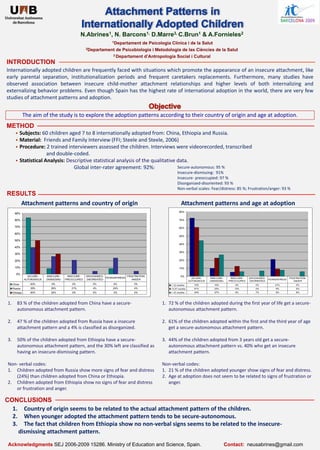
               Attachment patterns and country of origin                                                            Attachment patterns and age at adoption
                                                                                                                  80%
       90%

       80%                                                                                                        70%

       70%                                                                                                        60%

       60%
                                                                                                                  50%
       50%
                                                                                                                  40%
       40%
                                                                                                                  30%
       30%

       20%                                                                                                        20%

       10%                                                                                                        10%

         0%
                   SECURE-    INSECURE-     INSECURE-    DISOGANIZED-               FRUSTRATION/                   0%
                                                                      FEAR/DISTRESS                                          SECURE-    INSECURE-      INSECURE-    DISOGANIZED-                   FRUSTRATION/
                 AUTONOMOUS   DISMISSING   PREOCCUPIED   DISORIENTED                   ANGER                                                                                       FEAR/DISTRESS
                                                                                                                           AUTONOMOUS   DISMISSING    PREOCCUPIED   DISORIENTED                       ANGER
      China         83%          8%            0%            0%            8%           0%                  1-12 months       72%          10%            5%            0%             21%             0%
      Russia        39%          26%           21%           4%           24%           4%                  13-37 months      61%          23%           13%            0%              9%             0%
      Ethiopia      50%          30%           0%            0%            0%           0%                  > 37 months       44%          27%            6%            7%              8%             6%


 1.      83 % of the children adopted from China have a secure-                                        1. 72 % of the children adopted during the first year of life get a secure-
         autonomous attachment pattern.                                                                   autonomous attachment pattern.

 2.      47 % of the children adopted from Russia have a insecure                                      2. 61% of the children adopted within the first and the third year of age
         attachment pattern and a 4% is classified as disorganized.                                       get a secure-autonomous attachment pattern.

 3.      50% of the children adopted from Ethiopia have a secure-                                      3. 44% of the children adopted from 3 years old get a secure-
         autonomous attachment pattern, and the 30% left are classified as                                autonomous attachment pattern vs. 40% who get an insecure
         having an insecure-dismissing pattern.                                                           attachment pattern.

 Non- verbal codes:                                                                                    Non-verbal codes:
 1. Children adopted from Russia show more signs of fear and distress                                  1. 21 % of the children adopted younger show signs of fear and distress.
    (24%) than children adopted from China or Ethiopia.                                                2. Age at adoption does not seem to be related to signs of frustration or
 2. Children adopted from Ethiopia show no signs of fear and distress                                     anger.
    or frustration and anger.

CONCLUSIONS
  1. Country of origin seems to be related to the actual attachment pattern of the children.
  2. When younger adopted the attachment pattern tends to be secure-autonomous.
  3. The fact that children from Ethiopia show no non-verbal signs seems to be related to the insecure-
    dismissing attachment pattern.

 Acknowledgments SEJ 2006-2009 15286. Ministry of Education and Science, Spain.                                                                      Contact: neusabrines@gmail.com

Abrines Iac2009

  • 1.
    Attachment Patterns in Internationally Adopted Children N.Abrines1, N. Barcons1, D.Marre3, C.Brun1 & A.Fornieles2 1Departament de Psicologia Clínica i de la Salut 2Departament de Psicobiologia i Metodologia de las Ciències de la Salut 3 Departament d’Antropologia Social i Cultural INTRODUCTION Internationally adopted children are frequently faced with situations which promote the appearance of an insecure attachment, like early parental separation, institutionalization periods and frequent caretakers replacements. Furthermore, many studies have observed association between insecure child-mother attachment relationships and higher levels of both internalizing and externalizing behavior problems. Even though Spain has the highest rate of international adoption in the world, there are very few studies of attachment patterns and adoption. Objective The aim of the study is to explore the adoption patterns according to their country of origin and age at adoption. METHOD • Subjects: 60 children aged 7 to 8 internationally adopted from: China, Ethiopia and Russia. • Material: Friends and Family Interview (FFI; Steele and Steele, 2006) • Procedure: 2 trained interviewers assessed the children. Interviews were videorecorded, transcribed and double-coded. • Statistical Analysis: Descriptive statistical analysis of the qualitative data. Global inter-rater agreement: 92%: Secure-autonomous: 95 % Insecure-dismissing: 91% Insecure- preoccupied: 97 % Disorganized-disoriented: 93 % Non-verbal scales: Fear/distress: 85 %; Frustration/anger: 93 % RESULTS Attachment patterns and country of origin Attachment patterns and age at adoption 80% 90% 80% 70% 70% 60% 60% 50% 50% 40% 40% 30% 30% 20% 20% 10% 10% 0% SECURE- INSECURE- INSECURE- DISOGANIZED- FRUSTRATION/ 0% FEAR/DISTRESS SECURE- INSECURE- INSECURE- DISOGANIZED- FRUSTRATION/ AUTONOMOUS DISMISSING PREOCCUPIED DISORIENTED ANGER FEAR/DISTRESS AUTONOMOUS DISMISSING PREOCCUPIED DISORIENTED ANGER China 83% 8% 0% 0% 8% 0% 1-12 months 72% 10% 5% 0% 21% 0% Russia 39% 26% 21% 4% 24% 4% 13-37 months 61% 23% 13% 0% 9% 0% Ethiopia 50% 30% 0% 0% 0% 0% > 37 months 44% 27% 6% 7% 8% 6% 1. 83 % of the children adopted from China have a secure- 1. 72 % of the children adopted during the first year of life get a secure- autonomous attachment pattern. autonomous attachment pattern. 2. 47 % of the children adopted from Russia have a insecure 2. 61% of the children adopted within the first and the third year of age attachment pattern and a 4% is classified as disorganized. get a secure-autonomous attachment pattern. 3. 50% of the children adopted from Ethiopia have a secure- 3. 44% of the children adopted from 3 years old get a secure- autonomous attachment pattern, and the 30% left are classified as autonomous attachment pattern vs. 40% who get an insecure having an insecure-dismissing pattern. attachment pattern. Non- verbal codes: Non-verbal codes: 1. Children adopted from Russia show more signs of fear and distress 1. 21 % of the children adopted younger show signs of fear and distress. (24%) than children adopted from China or Ethiopia. 2. Age at adoption does not seem to be related to signs of frustration or 2. Children adopted from Ethiopia show no signs of fear and distress anger. or frustration and anger. CONCLUSIONS 1. Country of origin seems to be related to the actual attachment pattern of the children. 2. When younger adopted the attachment pattern tends to be secure-autonomous. 3. The fact that children from Ethiopia show no non-verbal signs seems to be related to the insecure- dismissing attachment pattern. Acknowledgments SEJ 2006-2009 15286. Ministry of Education and Science, Spain. Contact: neusabrines@gmail.com