Pay-per-Use Revenue Models for
Geoprocessing Services in the Cloud
                      •


  B. Baranski*, T. Deelmann and B. Schäffer
          Institute for Geoinformatics
        University of Münster, Germany
Agenda

   • Motivation
   • Requirements
   • System Design
   • Demonstration
   • Conclusion


B. Baranski   Pay-per-Use Revenue Models for Geoprocessing Services in the Cloud   2
Motivation

   • Evolution of GIS
         • data- and desktop-centric GIS
         • emerging technologies (SOA, web services)
         • Spatial Data Infrastructure (SDI) concept
   • Geoprocessing
         • OGC Web Processing Service (WPS)
         • proprietary and complex desktop-software
         • increasing amount of data and higher
           requirements on adopted algorithms


B. Baranski   Pay-per-Use Revenue Models for Geoprocessing Services in the Cloud   3
Challenges

   • Quality of Service (QoS)
         • INSPIRE QoS requirements
   • Cloud Computing
         • general trend in mainstream-IT
         • on-demand resource provisioning
         • pay-per-use revenue models
         • no up-front infrastructure investments
    Emerging Business Models


B. Baranski   Pay-per-Use Revenue Models for Geoprocessing Services in the Cloud   4
Goal

   • Design a system that
         • enables (OGC-) service providers to provide
           sustainable pay-per-use business models
            • define usage costs per service request, service
              uptime, accessed resource, executed process,
              amount of processed data, etc.
         • enables (OGC-) service consumers to compare
           cost-benefit ratio of different service offerings
    Applicable for all kind of (OGC-) services …
    but focus on Geoprocessing Services


B. Baranski   Pay-per-Use Revenue Models for Geoprocessing Services in the Cloud   5
Requirements

   • Payment Models
         • flatrate vs. pay-per-use
   • Contract Models
         • click-through licenses vs. long term contracts
   • Accounting Models
         • post-paid vs. pre-paid
   • Pricing Models


B. Baranski   Pay-per-Use Revenue Models for Geoprocessing Services in the Cloud   6
Requirements

   • Publish-Find-Bind
         • additional agree phase (Publish-Find-Agree-Bind)
   • OGC Technical Baseline
         • existing client and service implementations should
           remain unchanged
   • Security and Trust
         • authentication, authorization, confidentiality,
           integrity, non-repudiation, protection and privacy


B. Baranski   Pay-per-Use Revenue Models for Geoprocessing Services in the Cloud   7
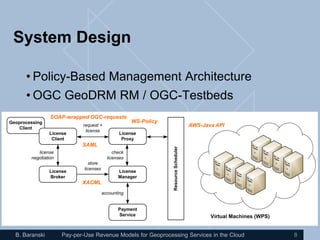
System Design

   • Policy-Based Management Architecture
   • OGC GeoDRM RM / OGC-Testbeds
              SOAP-wrapped OGC-requests
                                          WS-Policy
                                                              AWS-Java API


                        SAML


                        XACML


B. Baranski      Pay-per-Use Revenue Models for Geoprocessing Services in the Cloud   8
Demonstration

   • Scenario 1: Pay-per-“Process-Execution“


B. Baranski   Pay-per-Use Revenue Models for Geoprocessing Services in the Cloud   9
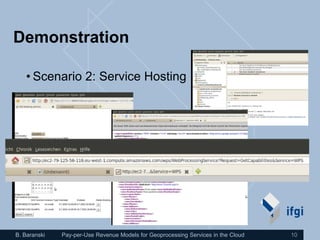
Demonstration

   • Scenario 2: Service Hosting


B. Baranski   Pay-per-Use Revenue Models for Geoprocessing Services in the Cloud   10
Conclusion

   • Design a system that
         • enables service providers to provide sustainable pay-
           per-use business models
         • Enables service consumers to compare cost-benefit
           ratio of different service offerings
   • Impact on SDIs
         • technological shift vs. paradigm change
         • new business opportunities
             • for small companies (no up-front investments)
             • *real* Software as a Service (SaaS)
   Cloud Computing as enabling technologie!
B. Baranski   Pay-per-Use Revenue Models for Geoprocessing Services in the Cloud   11
Conclusion

   • Open Issues
         • Cloud Computing
            • interoperability
            • reliability
            • security
         • Business Models
            • software licenses


B. Baranski   Pay-per-Use Revenue Models for Geoprocessing Services in the Cloud   12
Thank you for your time!
          •


        Bastian Baranski
   bastian.baranski@uni-muenster.de

Baranski

  • 1.
    Pay-per-Use Revenue Modelsfor Geoprocessing Services in the Cloud • B. Baranski*, T. Deelmann and B. Schäffer Institute for Geoinformatics University of Münster, Germany
  • 2.
    Agenda • Motivation • Requirements • System Design • Demonstration • Conclusion B. Baranski Pay-per-Use Revenue Models for Geoprocessing Services in the Cloud 2
  • 3.
    Motivation • Evolution of GIS • data- and desktop-centric GIS • emerging technologies (SOA, web services) • Spatial Data Infrastructure (SDI) concept • Geoprocessing • OGC Web Processing Service (WPS) • proprietary and complex desktop-software • increasing amount of data and higher requirements on adopted algorithms B. Baranski Pay-per-Use Revenue Models for Geoprocessing Services in the Cloud 3
  • 4.
    Challenges • Quality of Service (QoS) • INSPIRE QoS requirements • Cloud Computing • general trend in mainstream-IT • on-demand resource provisioning • pay-per-use revenue models • no up-front infrastructure investments  Emerging Business Models B. Baranski Pay-per-Use Revenue Models for Geoprocessing Services in the Cloud 4
  • 5.
    Goal • Design a system that • enables (OGC-) service providers to provide sustainable pay-per-use business models • define usage costs per service request, service uptime, accessed resource, executed process, amount of processed data, etc. • enables (OGC-) service consumers to compare cost-benefit ratio of different service offerings  Applicable for all kind of (OGC-) services … but focus on Geoprocessing Services B. Baranski Pay-per-Use Revenue Models for Geoprocessing Services in the Cloud 5
  • 6.
    Requirements • Payment Models • flatrate vs. pay-per-use • Contract Models • click-through licenses vs. long term contracts • Accounting Models • post-paid vs. pre-paid • Pricing Models B. Baranski Pay-per-Use Revenue Models for Geoprocessing Services in the Cloud 6
  • 7.
    Requirements • Publish-Find-Bind • additional agree phase (Publish-Find-Agree-Bind) • OGC Technical Baseline • existing client and service implementations should remain unchanged • Security and Trust • authentication, authorization, confidentiality, integrity, non-repudiation, protection and privacy B. Baranski Pay-per-Use Revenue Models for Geoprocessing Services in the Cloud 7
  • 8.
    System Design • Policy-Based Management Architecture • OGC GeoDRM RM / OGC-Testbeds SOAP-wrapped OGC-requests WS-Policy AWS-Java API SAML XACML B. Baranski Pay-per-Use Revenue Models for Geoprocessing Services in the Cloud 8
  • 9.
    Demonstration • Scenario 1: Pay-per-“Process-Execution“ B. Baranski Pay-per-Use Revenue Models for Geoprocessing Services in the Cloud 9
  • 10.
    Demonstration • Scenario 2: Service Hosting B. Baranski Pay-per-Use Revenue Models for Geoprocessing Services in the Cloud 10
  • 11.
    Conclusion • Design a system that • enables service providers to provide sustainable pay- per-use business models • Enables service consumers to compare cost-benefit ratio of different service offerings • Impact on SDIs • technological shift vs. paradigm change • new business opportunities • for small companies (no up-front investments) • *real* Software as a Service (SaaS) Cloud Computing as enabling technologie! B. Baranski Pay-per-Use Revenue Models for Geoprocessing Services in the Cloud 11
  • 12.
    Conclusion • Open Issues • Cloud Computing • interoperability • reliability • security • Business Models • software licenses B. Baranski Pay-per-Use Revenue Models for Geoprocessing Services in the Cloud 12
  • 13.
    Thank you foryour time! • Bastian Baranski bastian.baranski@uni-muenster.de